EP3847043B1 - Land and aerial transportation vehicle and powertrain thereof - Google Patents
Land and aerial transportation vehicle and powertrain thereof Download PDFInfo
- Publication number
- EP3847043B1 EP3847043B1 EP19919551.2A EP19919551A EP3847043B1 EP 3847043 B1 EP3847043 B1 EP 3847043B1 EP 19919551 A EP19919551 A EP 19919551A EP 3847043 B1 EP3847043 B1 EP 3847043B1
- Authority
- EP
- European Patent Office
- Prior art keywords
- clutch mechanism
- powertrain
- various embodiments
- coupled
- driven member
- Prior art date
- Legal status (The legal status is an assumption and is not a legal conclusion. Google has not performed a legal analysis and makes no representation as to the accuracy of the status listed.)
- Not-in-force
Links
Images







Classifications
-
- B—PERFORMING OPERATIONS; TRANSPORTING
- B60—VEHICLES IN GENERAL
- B60F—VEHICLES FOR USE BOTH ON RAIL AND ON ROAD; VEHICLES CAPABLE OF TRAVELLING IN OR ON DIFFERENT MEDIA, e.g. AMPHIBIOUS VEHICLES
- B60F5/00—Other vehicles capable of travelling in or on different media
- B60F5/02—Other vehicles capable of travelling in or on different media convertible into aircraft
-
- B—PERFORMING OPERATIONS; TRANSPORTING
- B60—VEHICLES IN GENERAL
- B60K—ARRANGEMENT OR MOUNTING OF PROPULSION UNITS OR OF TRANSMISSIONS IN VEHICLES; ARRANGEMENT OR MOUNTING OF PLURAL DIVERSE PRIME-MOVERS IN VEHICLES; AUXILIARY DRIVES FOR VEHICLES; INSTRUMENTATION OR DASHBOARDS FOR VEHICLES; ARRANGEMENTS IN CONNECTION WITH COOLING, AIR INTAKE, GAS EXHAUST OR FUEL SUPPLY OF PROPULSION UNITS IN VEHICLES
- B60K17/00—Arrangement or mounting of transmissions in vehicles
- B60K17/04—Arrangement or mounting of transmissions in vehicles characterised by arrangement, location or kind of gearing
- B60K17/043—Transmission unit disposed in on near the vehicle wheel, or between the differential gear unit and the wheel
-
- B—PERFORMING OPERATIONS; TRANSPORTING
- B60—VEHICLES IN GENERAL
- B60K—ARRANGEMENT OR MOUNTING OF PROPULSION UNITS OR OF TRANSMISSIONS IN VEHICLES; ARRANGEMENT OR MOUNTING OF PLURAL DIVERSE PRIME-MOVERS IN VEHICLES; AUXILIARY DRIVES FOR VEHICLES; INSTRUMENTATION OR DASHBOARDS FOR VEHICLES; ARRANGEMENTS IN CONNECTION WITH COOLING, AIR INTAKE, GAS EXHAUST OR FUEL SUPPLY OF PROPULSION UNITS IN VEHICLES
- B60K17/00—Arrangement or mounting of transmissions in vehicles
- B60K17/22—Arrangement or mounting of transmissions in vehicles characterised by arrangement, location, or type of main drive shafting, e.g. cardan shaft
-
- B—PERFORMING OPERATIONS; TRANSPORTING
- B60—VEHICLES IN GENERAL
- B60K—ARRANGEMENT OR MOUNTING OF PROPULSION UNITS OR OF TRANSMISSIONS IN VEHICLES; ARRANGEMENT OR MOUNTING OF PLURAL DIVERSE PRIME-MOVERS IN VEHICLES; AUXILIARY DRIVES FOR VEHICLES; INSTRUMENTATION OR DASHBOARDS FOR VEHICLES; ARRANGEMENTS IN CONNECTION WITH COOLING, AIR INTAKE, GAS EXHAUST OR FUEL SUPPLY OF PROPULSION UNITS IN VEHICLES
- B60K6/00—Arrangement or mounting of plural diverse prime-movers for mutual or common propulsion, e.g. hybrid propulsion systems comprising electric motors and internal combustion engines
- B60K6/20—Arrangement or mounting of plural diverse prime-movers for mutual or common propulsion, e.g. hybrid propulsion systems comprising electric motors and internal combustion engines the prime-movers consisting of electric motors and internal combustion engines, e.g. HEVs
- B60K6/22—Arrangement or mounting of plural diverse prime-movers for mutual or common propulsion, e.g. hybrid propulsion systems comprising electric motors and internal combustion engines the prime-movers consisting of electric motors and internal combustion engines, e.g. HEVs characterised by apparatus, components or means specially adapted for HEVs
- B60K6/24—Arrangement or mounting of plural diverse prime-movers for mutual or common propulsion, e.g. hybrid propulsion systems comprising electric motors and internal combustion engines the prime-movers consisting of electric motors and internal combustion engines, e.g. HEVs characterised by apparatus, components or means specially adapted for HEVs characterised by the combustion engines
-
- B—PERFORMING OPERATIONS; TRANSPORTING
- B60—VEHICLES IN GENERAL
- B60K—ARRANGEMENT OR MOUNTING OF PROPULSION UNITS OR OF TRANSMISSIONS IN VEHICLES; ARRANGEMENT OR MOUNTING OF PLURAL DIVERSE PRIME-MOVERS IN VEHICLES; AUXILIARY DRIVES FOR VEHICLES; INSTRUMENTATION OR DASHBOARDS FOR VEHICLES; ARRANGEMENTS IN CONNECTION WITH COOLING, AIR INTAKE, GAS EXHAUST OR FUEL SUPPLY OF PROPULSION UNITS IN VEHICLES
- B60K6/00—Arrangement or mounting of plural diverse prime-movers for mutual or common propulsion, e.g. hybrid propulsion systems comprising electric motors and internal combustion engines
- B60K6/20—Arrangement or mounting of plural diverse prime-movers for mutual or common propulsion, e.g. hybrid propulsion systems comprising electric motors and internal combustion engines the prime-movers consisting of electric motors and internal combustion engines, e.g. HEVs
- B60K6/22—Arrangement or mounting of plural diverse prime-movers for mutual or common propulsion, e.g. hybrid propulsion systems comprising electric motors and internal combustion engines the prime-movers consisting of electric motors and internal combustion engines, e.g. HEVs characterised by apparatus, components or means specially adapted for HEVs
- B60K6/26—Arrangement or mounting of plural diverse prime-movers for mutual or common propulsion, e.g. hybrid propulsion systems comprising electric motors and internal combustion engines the prime-movers consisting of electric motors and internal combustion engines, e.g. HEVs characterised by apparatus, components or means specially adapted for HEVs characterised by the motors or the generators
-
- B—PERFORMING OPERATIONS; TRANSPORTING
- B60—VEHICLES IN GENERAL
- B60K—ARRANGEMENT OR MOUNTING OF PROPULSION UNITS OR OF TRANSMISSIONS IN VEHICLES; ARRANGEMENT OR MOUNTING OF PLURAL DIVERSE PRIME-MOVERS IN VEHICLES; AUXILIARY DRIVES FOR VEHICLES; INSTRUMENTATION OR DASHBOARDS FOR VEHICLES; ARRANGEMENTS IN CONNECTION WITH COOLING, AIR INTAKE, GAS EXHAUST OR FUEL SUPPLY OF PROPULSION UNITS IN VEHICLES
- B60K6/00—Arrangement or mounting of plural diverse prime-movers for mutual or common propulsion, e.g. hybrid propulsion systems comprising electric motors and internal combustion engines
- B60K6/20—Arrangement or mounting of plural diverse prime-movers for mutual or common propulsion, e.g. hybrid propulsion systems comprising electric motors and internal combustion engines the prime-movers consisting of electric motors and internal combustion engines, e.g. HEVs
- B60K6/22—Arrangement or mounting of plural diverse prime-movers for mutual or common propulsion, e.g. hybrid propulsion systems comprising electric motors and internal combustion engines the prime-movers consisting of electric motors and internal combustion engines, e.g. HEVs characterised by apparatus, components or means specially adapted for HEVs
- B60K6/36—Arrangement or mounting of plural diverse prime-movers for mutual or common propulsion, e.g. hybrid propulsion systems comprising electric motors and internal combustion engines the prime-movers consisting of electric motors and internal combustion engines, e.g. HEVs characterised by apparatus, components or means specially adapted for HEVs characterised by the transmission gearings
- B60K6/365—Arrangement or mounting of plural diverse prime-movers for mutual or common propulsion, e.g. hybrid propulsion systems comprising electric motors and internal combustion engines the prime-movers consisting of electric motors and internal combustion engines, e.g. HEVs characterised by apparatus, components or means specially adapted for HEVs characterised by the transmission gearings with the gears having orbital motion
-
- B—PERFORMING OPERATIONS; TRANSPORTING
- B60—VEHICLES IN GENERAL
- B60K—ARRANGEMENT OR MOUNTING OF PROPULSION UNITS OR OF TRANSMISSIONS IN VEHICLES; ARRANGEMENT OR MOUNTING OF PLURAL DIVERSE PRIME-MOVERS IN VEHICLES; AUXILIARY DRIVES FOR VEHICLES; INSTRUMENTATION OR DASHBOARDS FOR VEHICLES; ARRANGEMENTS IN CONNECTION WITH COOLING, AIR INTAKE, GAS EXHAUST OR FUEL SUPPLY OF PROPULSION UNITS IN VEHICLES
- B60K6/00—Arrangement or mounting of plural diverse prime-movers for mutual or common propulsion, e.g. hybrid propulsion systems comprising electric motors and internal combustion engines
- B60K6/20—Arrangement or mounting of plural diverse prime-movers for mutual or common propulsion, e.g. hybrid propulsion systems comprising electric motors and internal combustion engines the prime-movers consisting of electric motors and internal combustion engines, e.g. HEVs
- B60K6/22—Arrangement or mounting of plural diverse prime-movers for mutual or common propulsion, e.g. hybrid propulsion systems comprising electric motors and internal combustion engines the prime-movers consisting of electric motors and internal combustion engines, e.g. HEVs characterised by apparatus, components or means specially adapted for HEVs
- B60K6/38—Arrangement or mounting of plural diverse prime-movers for mutual or common propulsion, e.g. hybrid propulsion systems comprising electric motors and internal combustion engines the prime-movers consisting of electric motors and internal combustion engines, e.g. HEVs characterised by apparatus, components or means specially adapted for HEVs characterised by the driveline clutches
-
- B—PERFORMING OPERATIONS; TRANSPORTING
- B64—AIRCRAFT; AVIATION; COSMONAUTICS
- B64C—AEROPLANES; HELICOPTERS
- B64C37/00—Convertible aircraft
-
- B—PERFORMING OPERATIONS; TRANSPORTING
- B64—AIRCRAFT; AVIATION; COSMONAUTICS
- B64D—EQUIPMENT FOR FITTING IN OR TO AIRCRAFT; FLIGHT SUITS; PARACHUTES; ARRANGEMENT OR MOUNTING OF POWER PLANTS OR PROPULSION TRANSMISSIONS IN AIRCRAFT
- B64D27/00—Arrangement or mounting of power plants in aircraft; Aircraft characterised by the type or position of power plants
- B64D27/02—Aircraft characterised by the type or position of power plants
- B64D27/30—Aircraft characterised by electric power plants
- B64D27/33—Hybrid electric aircraft
-
- B—PERFORMING OPERATIONS; TRANSPORTING
- B64—AIRCRAFT; AVIATION; COSMONAUTICS
- B64D—EQUIPMENT FOR FITTING IN OR TO AIRCRAFT; FLIGHT SUITS; PARACHUTES; ARRANGEMENT OR MOUNTING OF POWER PLANTS OR PROPULSION TRANSMISSIONS IN AIRCRAFT
- B64D35/00—Transmitting power from power plants to propellers or rotors; Arrangements of transmissions
- B64D35/02—Transmitting power from power plants to propellers or rotors; Arrangements of transmissions specially adapted for specific power plants
- B64D35/021—Transmitting power from power plants to propellers or rotors; Arrangements of transmissions specially adapted for specific power plants for electric power plants
- B64D35/022—Transmitting power from power plants to propellers or rotors; Arrangements of transmissions specially adapted for specific power plants for electric power plants of hybrid-electric type
- B64D35/023—Transmitting power from power plants to propellers or rotors; Arrangements of transmissions specially adapted for specific power plants for electric power plants of hybrid-electric type of series-parallel type
-
- B—PERFORMING OPERATIONS; TRANSPORTING
- B64—AIRCRAFT; AVIATION; COSMONAUTICS
- B64D—EQUIPMENT FOR FITTING IN OR TO AIRCRAFT; FLIGHT SUITS; PARACHUTES; ARRANGEMENT OR MOUNTING OF POWER PLANTS OR PROPULSION TRANSMISSIONS IN AIRCRAFT
- B64D35/00—Transmitting power from power plants to propellers or rotors; Arrangements of transmissions
- B64D35/04—Transmitting power from power plants to propellers or rotors; Arrangements of transmissions characterised by the transmission driving a plurality of propellers or rotors
- B64D35/06—Transmitting power from power plants to propellers or rotors; Arrangements of transmissions characterised by the transmission driving a plurality of propellers or rotors the propellers or rotors being counter-rotating
-
- F—MECHANICAL ENGINEERING; LIGHTING; HEATING; WEAPONS; BLASTING
- F01—MACHINES OR ENGINES IN GENERAL; ENGINE PLANTS IN GENERAL; STEAM ENGINES
- F01D—NON-POSITIVE DISPLACEMENT MACHINES OR ENGINES, e.g. STEAM TURBINES
- F01D5/00—Blades; Blade-carrying members; Heating, heat-insulating, cooling or antivibration means on the blades or the members
- F01D5/12—Blades
- F01D5/14—Form or construction
- F01D5/141—Shape, i.e. outer, aerodynamic form
-
- F—MECHANICAL ENGINEERING; LIGHTING; HEATING; WEAPONS; BLASTING
- F04—POSITIVE - DISPLACEMENT MACHINES FOR LIQUIDS; PUMPS FOR LIQUIDS OR ELASTIC FLUIDS
- F04D—NON-POSITIVE-DISPLACEMENT PUMPS
- F04D29/00—Details, component parts, or accessories
- F04D29/40—Casings; Connections of working fluid
- F04D29/52—Casings; Connections of working fluid for axial pumps
- F04D29/54—Fluid-guiding means, e.g. diffusers
- F04D29/56—Fluid-guiding means, e.g. diffusers adjustable
- F04D29/563—Fluid-guiding means, e.g. diffusers adjustable specially adapted for elastic fluid pumps
-
- B—PERFORMING OPERATIONS; TRANSPORTING
- B60—VEHICLES IN GENERAL
- B60K—ARRANGEMENT OR MOUNTING OF PROPULSION UNITS OR OF TRANSMISSIONS IN VEHICLES; ARRANGEMENT OR MOUNTING OF PLURAL DIVERSE PRIME-MOVERS IN VEHICLES; AUXILIARY DRIVES FOR VEHICLES; INSTRUMENTATION OR DASHBOARDS FOR VEHICLES; ARRANGEMENTS IN CONNECTION WITH COOLING, AIR INTAKE, GAS EXHAUST OR FUEL SUPPLY OF PROPULSION UNITS IN VEHICLES
- B60K17/00—Arrangement or mounting of transmissions in vehicles
- B60K17/02—Arrangement or mounting of transmissions in vehicles characterised by arrangement, location, or kind of clutch
-
- B—PERFORMING OPERATIONS; TRANSPORTING
- B60—VEHICLES IN GENERAL
- B60K—ARRANGEMENT OR MOUNTING OF PROPULSION UNITS OR OF TRANSMISSIONS IN VEHICLES; ARRANGEMENT OR MOUNTING OF PLURAL DIVERSE PRIME-MOVERS IN VEHICLES; AUXILIARY DRIVES FOR VEHICLES; INSTRUMENTATION OR DASHBOARDS FOR VEHICLES; ARRANGEMENTS IN CONNECTION WITH COOLING, AIR INTAKE, GAS EXHAUST OR FUEL SUPPLY OF PROPULSION UNITS IN VEHICLES
- B60K17/00—Arrangement or mounting of transmissions in vehicles
- B60K17/34—Arrangement or mounting of transmissions in vehicles for driving both front and rear wheels, e.g. four wheel drive vehicles
- B60K17/344—Arrangement or mounting of transmissions in vehicles for driving both front and rear wheels, e.g. four wheel drive vehicles having a transfer gear
-
- B—PERFORMING OPERATIONS; TRANSPORTING
- B60—VEHICLES IN GENERAL
- B60K—ARRANGEMENT OR MOUNTING OF PROPULSION UNITS OR OF TRANSMISSIONS IN VEHICLES; ARRANGEMENT OR MOUNTING OF PLURAL DIVERSE PRIME-MOVERS IN VEHICLES; AUXILIARY DRIVES FOR VEHICLES; INSTRUMENTATION OR DASHBOARDS FOR VEHICLES; ARRANGEMENTS IN CONNECTION WITH COOLING, AIR INTAKE, GAS EXHAUST OR FUEL SUPPLY OF PROPULSION UNITS IN VEHICLES
- B60K23/00—Arrangement or mounting of control devices for vehicle transmissions, or parts thereof, not otherwise provided for
- B60K23/08—Arrangement or mounting of control devices for vehicle transmissions, or parts thereof, not otherwise provided for for changing number of driven wheels, for switching from driving one axle to driving two or more axles
- B60K23/0808—Arrangement or mounting of control devices for vehicle transmissions, or parts thereof, not otherwise provided for for changing number of driven wheels, for switching from driving one axle to driving two or more axles for varying torque distribution between driven axles, e.g. by transfer clutch
- B60K2023/0816—Arrangement or mounting of control devices for vehicle transmissions, or parts thereof, not otherwise provided for for changing number of driven wheels, for switching from driving one axle to driving two or more axles for varying torque distribution between driven axles, e.g. by transfer clutch for varying front-rear torque distribution with a central differential
- B60K2023/0825—Arrangement or mounting of control devices for vehicle transmissions, or parts thereof, not otherwise provided for for changing number of driven wheels, for switching from driving one axle to driving two or more axles for varying torque distribution between driven axles, e.g. by transfer clutch for varying front-rear torque distribution with a central differential for adding torque to the front wheels
-
- B—PERFORMING OPERATIONS; TRANSPORTING
- B60—VEHICLES IN GENERAL
- B60K—ARRANGEMENT OR MOUNTING OF PROPULSION UNITS OR OF TRANSMISSIONS IN VEHICLES; ARRANGEMENT OR MOUNTING OF PLURAL DIVERSE PRIME-MOVERS IN VEHICLES; AUXILIARY DRIVES FOR VEHICLES; INSTRUMENTATION OR DASHBOARDS FOR VEHICLES; ARRANGEMENTS IN CONNECTION WITH COOLING, AIR INTAKE, GAS EXHAUST OR FUEL SUPPLY OF PROPULSION UNITS IN VEHICLES
- B60K5/00—Arrangement or mounting of internal-combustion or jet-propulsion units
- B60K5/02—Arrangement or mounting of internal-combustion or jet-propulsion units with the engine main axis, e.g. crankshaft axis, substantially in or parallel to the longitudinal centre line of the vehicle
-
- B—PERFORMING OPERATIONS; TRANSPORTING
- B60—VEHICLES IN GENERAL
- B60Y—INDEXING SCHEME RELATING TO ASPECTS CROSS-CUTTING VEHICLE TECHNOLOGY
- B60Y2200/00—Type of vehicle
- B60Y2200/40—Special vehicles
-
- B—PERFORMING OPERATIONS; TRANSPORTING
- B60—VEHICLES IN GENERAL
- B60Y—INDEXING SCHEME RELATING TO ASPECTS CROSS-CUTTING VEHICLE TECHNOLOGY
- B60Y2200/00—Type of vehicle
- B60Y2200/50—Aeroplanes, Helicopters
-
- B—PERFORMING OPERATIONS; TRANSPORTING
- B60—VEHICLES IN GENERAL
- B60Y—INDEXING SCHEME RELATING TO ASPECTS CROSS-CUTTING VEHICLE TECHNOLOGY
- B60Y2200/00—Type of vehicle
- B60Y2200/90—Vehicles comprising electric prime movers
- B60Y2200/92—Hybrid vehicles
-
- B—PERFORMING OPERATIONS; TRANSPORTING
- B60—VEHICLES IN GENERAL
- B60Y—INDEXING SCHEME RELATING TO ASPECTS CROSS-CUTTING VEHICLE TECHNOLOGY
- B60Y2400/00—Special features of vehicle units
- B60Y2400/42—Clutches or brakes
-
- B—PERFORMING OPERATIONS; TRANSPORTING
- B64—AIRCRAFT; AVIATION; COSMONAUTICS
- B64D—EQUIPMENT FOR FITTING IN OR TO AIRCRAFT; FLIGHT SUITS; PARACHUTES; ARRANGEMENT OR MOUNTING OF POWER PLANTS OR PROPULSION TRANSMISSIONS IN AIRCRAFT
- B64D27/00—Arrangement or mounting of power plants in aircraft; Aircraft characterised by the type or position of power plants
- B64D27/02—Aircraft characterised by the type or position of power plants
- B64D27/026—Aircraft characterised by the type or position of power plants comprising different types of power plants, e.g. combination of a piston engine and a gas-turbine
-
- F—MECHANICAL ENGINEERING; LIGHTING; HEATING; WEAPONS; BLASTING
- F04—POSITIVE - DISPLACEMENT MACHINES FOR LIQUIDS; PUMPS FOR LIQUIDS OR ELASTIC FLUIDS
- F04D—NON-POSITIVE-DISPLACEMENT PUMPS
- F04D19/00—Axial-flow pumps
- F04D19/007—Axial-flow pumps multistage fans
Definitions
- Various embodiments generally relate to a land and aerial transportation vehicle, a powertrain for the vehicle, and an axle assembly for the vehicle.
- various embodiments generally relate to a flying car, a powertrain for the flying car, and an axle assembly for the flying car.
- the PAL-V flying car features a dual engine configuration with dual drivetrain, using one engine for driving on the road and one for flying in the air.
- the Aeromobil flying car feature a generator/engine to run two separate mode via one switching mechanism switchable between powering the propeller for flight and powering a pair of electric motors for driving.
- these flying cars either have separate powertrain for driving and flying, or have one generator/engine switchable between driving separate drivetrain for flying and driving.
- they generally have multiple drivetrain taking up excess weight and space, as well as a lack of backup in case of propulsion failure for land and air travel.
- CN107856488A discloses a power transmission system for a hybrid power flying vehicle capable of vertical take-off and landing.
- a first clutch 528 to connect between an engine 11 and a second gear combination transmission device 52
- the second gear combination transmission device 52 further includes a second clutch 529 for connecting a second rear axle reducer driving gear 523 and a second rear axle first driven gear 522, and a third clutch 530 for connecting the second rear axle driving bevel gear 526 and the second rear axle first driven gear 522.
- the second rear axle first driven gear 522 being driven by the engine 11 when the first clutch 528 is engaged, the drive wheel 54 being driven by the second rear axle reducer driving gear 523 when the second clutch 529 is engaged, and the thrust duct fan 55 being driven by the second rear axle driving bevel gear 526 when the third clutch 530 is engaged.
- a powertrain for a vehicle capable of land and aerial transportation.
- the powertrain may include an engine having at least one output shaft.
- the powertrain may include a primary clutch mechanism coupled to the at least one output shaft of the engine in a manner such that a driving member of the primary clutch mechanism is rotatable by the at least one output shaft of the engine.
- the powertrain may include a main drive shaft assembly coupled to a driven member of the primary clutch mechanism.
- the primary clutch mechanism may be operable to engage or disengage the driven member of the primary clutch mechanism and the driving member of the primary clutch mechanism so as to connect or disconnect the main drive shaft assembly and the at least one output shaft of the engine.
- the powertrain may include an axle shaft coupled transversely to the main drive shaft assembly and driven by the main drive shaft assembly.
- the powertrain may include a secondary clutch mechanism coupled to an end of the axle shaft in a manner such that a driving member of the secondary clutch mechanism is rotatable by the axle shaft.
- the powertrain may include a drive wheel coupled to a first driven member of the secondary clutch mechanism.
- the secondary clutch mechanism may be operable to engage or disengage the first driven member of the secondary clutch mechanism and the driving member of the secondary clutch mechanism so as to connect or disconnect the drive wheel and the axle shaft.
- the powertrain may include an air propulsion unit coupled to a second driven member of the secondary clutch mechanism.
- the secondary clutch mechanism may be operable to engage or disengage the second driven member of the secondary clutch mechanism and the driving member of the secondary clutch mechanism so as to connect or disconnect the air propulsion unit and the axle shaft.
- a land and aerial transportation vehicle may include a powertrain as described herein.
- the land and aerial transportation vehicle may include a plurality of wheels.
- at least one of the wheels may be the drive wheel which is provided for driving the vehicle on land.
- the land and aerial transportation vehicle may include at least the one air propulsion unit for providing lift and/or forward propulsion for aerial travel of the vehicle.
- an axle assembly for a vehicle capable of land and aerial transportation.
- the axle assembly may include an axle shaft.
- the axle assembly may include a clutch mechanism coupled to an end of the axle shaft in a manner such that a driving member of the clutch mechanism is rotatable by the axle shaft.
- the axle assembly may include a drive wheel coupled to a first driven member of the clutch mechanism.
- the clutch mechanism may be operable to engage or disengage the first driven member of the clutch mechanism and the driving member of the clutch mechanism so as to connect or disconnect the drive wheel and the axle shaft.
- the axle assembly may include an air propulsion unit coupled to a second driven member of the clutch mechanism.
- the clutch mechanism may be operable to engage or disengage the second driven member of the clutch mechanism and the driving member of the clutch mechanism so as to connect or disconnect the air propulsion unit and the axle shaft.
- a powertrain for a vehicle capable of land and aerial transportation and a land and aerial transportation vehicle.
- various embodiments generally relate to a powertrain for a flying car, and a flying car.
- a powertrain may include all components used to transform energy, such as mechanical energy, potential energy, electrical energy, chemical energy, solar energy, nuclear energy, into kinetic energy for propulsion purposes.
- a vehicle capable of land and aerial transportation or a flying car may be a roadable aircraft or a vehicle that provides transportation by both ground and air or a vehicle that is capable of being driven on a road and flown in the air or a multimode transport vehicle for ground travel and air travel.
- a powertrain that allows any vehicle to achieve flight, while at the same time able to drive on land.
- the powertrain is readily switchable between electrical and mechanical operations as redundancy to serve as backup or fail-safe for each other.
- the electrical and mechanical components of the powertrain are integrated to operate within a single combined axis or drive shaft.
- the powertrain may allow the use of any or a combination or electrical actuator, mechanical actuators, hydraulic actuators, pneumatic actuators or other suitable actuators to switch between both modes as a safety requirement.
- the powertrain may allow for a true dual redundancy safety system, whereby if all electrical systems fail the vehicle may still be maneuvered using just the engines, vice versa, regardless on land or air.
- the powertrain may include an onboard power generator to provide the electrical power required without being limited by the size or capacity of a battery.
- the powertrain may include at least one engine, with at least one electrical generator coupled thereto, and a mechanical driveshaft, using a planetary gear array for interconnecting the components.
- the at least one electrical generator may serve as a secondary power generation system.
- the at least one electrical generator may be coupled to the mechanical driveshaft via a clutch mechanism or via a torque transfer gearbox.
- the powertrain may also include an array of electrical motors with their axis aligned in a parallel manner, allowing thrust to be produced in the same direction.
- the electrical power generated by the at least one electrical generator may be used to provide power to the array of electrical motors that provide additional torque to the powertrain.
- the electrical power generated may also be used to charge batteries which in turn provide electrical power to the array of electrical motors.
- the array of electrical motors may be coupled to driving fans which are compressive in nature or propellers to produce thrust.
- the fans may be arranged to face vertically and horizontally.
- the vertically arranged fans may produce thrust in the vertical direction for generating lift.
- the powertrain may enable travel via multi-modes.
- the powertrain may enable travel via four different modes of operation, namely, flight in electrical mode, flight in mechanical mode, land travel in electrical mode, and land travel in mechanical mode.
- the powertrain may enable travel via six different modes of operation, namely, flight in electrical mode, flight in mechanical mode, flight in hybrid mode, land travel in electrical mode, land travel in mechanical mode, and land travel in hybrid mode.
- fans which are actuated by electrical motors and which are facing in the vertical direction are responsible for generating lift. Further, fans which are actuated by electrical motors and which are facing in the horizontal direction are responsible for generating forward thrust.
- Directional movement of the vehicle may be achieved via the final stator assembly of the vertical fans, whereby exit vents on the side of respective nacelle may open up to allow thrust to be directed in the lateral direction.
- the same vertical fans may be coupled to the main transmission drive.
- vertical fans may be coupled via gears, chain, belt, etc. to the main transmission drive.
- flight may be achieved by the simultaneous operation of the flight in electrical mode and flight in mechanical mode, whereby torque transfer of both modes are summated via torque transfer mechanisms.
- the electrical motors for the horizontal fans may be coupled to the main transmission drive via a power transfer assembly.
- the engine may be mechanically coupled to a clutch which engages the main transmission drive to directly drive the wheels.
- land travel may be achieved by the simultaneous operation of the land travel in electrical mode and land travel in mechanical mode, whereby torque transfer of both modes are summated via torque transfer mechanisms.
- Example 1 is a powertrain for a vehicle capable of land and aerial transportation, the powertrain including:
- Example 2 the subject matter of Example 1 may optionally include that the powertrain may include a generator coupled to the engine in a manner so as to be powered by the engine.
- the powertrain may include a generator coupled to the engine in a manner so as to be powered by the engine.
- Example 3 the subject matter of Example 2 may optionally include that the primary clutch mechanism may include a further driven member, wherein a rotor of the generator is coupled to the further driven member of the primary clutch mechanism, wherein the primary clutch mechanism is operable to engage or disengage the further driven member of the primary clutch mechanism and the driving member of the primary clutch mechanism so as to connect or disconnect the rotor of the generator and the at least one output shaft of the engine.
- the primary clutch mechanism may include a further driven member, wherein a rotor of the generator is coupled to the further driven member of the primary clutch mechanism, wherein the primary clutch mechanism is operable to engage or disengage the further driven member of the primary clutch mechanism and the driving member of the primary clutch mechanism so as to connect or disconnect the rotor of the generator and the at least one output shaft of the engine.
- Example 4 the subject matter of Example 2 or 3 may optionally include that a connection arrangement between the air propulsion unit and the secondary clutch mechanism may include:
- Example 5 the subject matter of Example 4 may optionally include that the electric hub motor is electrically coupled to a battery which is connected to the generator.
- Example 6 the subject matter of any one of Examples 1 to 5 may optionally include that the air propulsion unit may include a thrust fan unit oriented with a fan-blade-rotational-axis perpendicular to a rotational axis of the drive wheel in a manner so as to be capable of generating a thrust providing vertical lift.
- the air propulsion unit may include a thrust fan unit oriented with a fan-blade-rotational-axis perpendicular to a rotational axis of the drive wheel in a manner so as to be capable of generating a thrust providing vertical lift.
- Example 7 the subject matter of Example 6 may optionally include that a converter mechanism may be connected between the thrust fan unit and the second driven member of the secondary clutch mechanism, wherein the converter mechanism may convert a rotation about a rotational axis of the second driven member to a rotation about the fan-blade-rotational-axis of the thrust fan unit.
- Example 8 the subject matter of Example 7 may optionally include that the connection arrangement may further include the converter mechanism, the converter mechanism being connected between the planet carrier of the planetary gear set and the thrust fan unit.
- Example 9 the subject matter of Example 7 or 8 may optionally include that the converter mechanism may include a bevel gear arrangement or a worm gear arrangement.
- Example 10 the subject matter of any one of Examples 6 to 9 may optionally include that the thrust fan unit may include multiple fan stages arranged in series.
- Example 11 the subject matter of Example 10 may optionally include that the multiple fan stages may be arranged in a manner such that alternate fan stages may be counter-rotating.
- Example 12 the subject matter of Example 11 may optionally include that one or more gearbox of the multiple fan stages may be configured and arranged such that alternate fan stages may be counter-rotating.
- Example 13 the subject matter of any one of Examples 10 to 12 may optionally include that the thrust fan unit may include at least one fan stage being coupled to and driven by a further fan stage via a reduction planetary gearbox.
- Example 14 the subject matter of any one of Examples 6 to 13 may optionally include that the thrust fan unit may include a thrust vectoring mechanism.
- Example 15 the subject matter of Example 14 may optionally include that the thrust vectoring mechanism may include a plurality of hollow vanes arranged radially from a fixed hub at an outlet of the thrust fan unit, wherein each of the plurality of hollow vanes may include:
- Example 16 the subject matter of Example 15 may optionally include that each of the plurality of hollow vanes may include a plurality of elongated control surface slats extending longitudinally along the vane face of the respective hollow vane to form the at least one slot, wherein the plurality of elongated control surface slats are in a louver arrangement.
- Example 17 the subject matter of Example 16 may optionally include that each of the plurality of elongated control surface slats may have a twist profile so as to better accommodate the air flow.
- Example 18 the subject matter of Example 16 or 17 may optionally include that each of the plurality of elongated control surface slats may be rotatable about respective longitudinal axis.
- Example 19 the subject matter of any one of Examples 15 to 18 may optionally include that each of the plurality of hollow vanes may be rotatable about respective longitudinal axis.
- Example 20 the subject matter of any one of Examples 2 to 19 may optionally include that the powertrain may include:
- Example 21 the subject matter of Example 20 may optionally include that the powertrain may include an auxiliary clutch mechanism coupled to the electric motor in a manner such that a driving member of the auxiliary clutch mechanism may be rotatable by the electric motor, wherein the horizontal air propulsion unit is coupled to a first driven member of the auxiliary clutch mechanism,
- Example 22 is a land and aerial transportation vehicle, including:
- Example 23 is an axle assembly for a vehicle capable of land and aerial transportation, the axle assembly including:
- Example 24 the subject matter of Example 23 may optionally include that a connection arrangement between the air propulsion unit and the clutch mechanism may include:
- Example 25 the subject matter of Example 23 or 24 may optionally include that the air propulsion unit may include a thrust fan unit oriented with a fan-blade-rotational-axis perpendicular to a rotational axis of the drive wheel in a manner so as to be capable of generating a thrust providing vertical lift.
- the air propulsion unit may include a thrust fan unit oriented with a fan-blade-rotational-axis perpendicular to a rotational axis of the drive wheel in a manner so as to be capable of generating a thrust providing vertical lift.
- Example 26 the subject matter of Example 25 may optionally include that the connection arrangement may further include a converter mechanism, the converter mechanism being connected between the planet carrier of the planetary gear set and the thrust fan unit, wherein the converter mechanism converts a rotation about a rotational axis of the planet carrier of the planetary gear set to a rotation about the fan-blade-rotational-axis of the thrust fan unit.
- the connection arrangement may further include a converter mechanism, the converter mechanism being connected between the planet carrier of the planetary gear set and the thrust fan unit, wherein the converter mechanism converts a rotation about a rotational axis of the planet carrier of the planetary gear set to a rotation about the fan-blade-rotational-axis of the thrust fan unit.
- Example 27 is a thrust fan unit, including
- Example 28 the subject matter of Example 27 may optionally include that each of the plurality of hollow vanes may include a plurality of elongated control surface slats extending longitudinally along the vane face of the respective hollow vane to form the at least one slot, wherein the plurality of elongated control surface slats are in a louver arrangement.
- each of the plurality of elongated control surface slats may have a twist profile so as to better accommodate the air flow.
- Example 29 the subject matter of Example 28 may optionally include that each of the plurality of elongated control surface slats may have a twist profile so as to better accommodate the air flow.
- Example 30 the subject matter of Example 28 or 29 may optionally include that each of the plurality of elongated control surface slats may be rotatable about respective longitudinal axis.
- Example 31 the subject matter of any one of Examples 27 to 30 may optionally include that each of the plurality of hollow vanes may be rotatable about respective longitudinal axis.
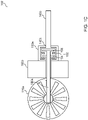
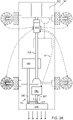
- FIG. 1A shows a schematic diagram of a powertrain 100 for a vehicle 101 capable of land and aerial transportation according to various embodiments.
- the land and aerial transportation vehicle 101 may include the powertrain 100.
- the powertrain 100 may include an engine 110 or at least one engine 110 or one or more engine 110.
- the engine 110 may include an automotive engine such as heat engine.
- the heat engine may include, but not limited to, an internal combustion engine, or an external combustion engine, or a steam engine, or a gasoline engine, or a carburetor engine, or a diesel engine, or a turbine engine (which is able to provide lateral thrust and mechanical torque simultaneously), etc.
- the engine 110 may include at least one output shaft 112 (or one or more output shaft 112). According to various embodiments, the engine 110 may generate a rotary motion in the at least one output shaft 112. According to various embodiments, the at least one output shaft 112 may be in a traverse arrangement or a coaxial arrangement.
- FIG. 1B shows a schematic diagram of a primary clutch mechanism 120 of the powertrain 100 of FIG. 1A according to various embodiments.
- the powertrain 100 may include the primary clutch mechanism 120 coupled to the at least one output shaft 112 of the engine 110 in a manner such that a driving member 122 of the primary clutch mechanism 120 may be rotatable by the at least one output shaft 112 of the engine 110.
- the primary clutch mechanism 120 may include the driving member 122 which may be fixedly coupled to the at least one output shaft 112 of the engine 110 such that the driving member 122 of the primary clutch mechanism 120 may rotate at the same speed as the at least one output shaft 112 when the at least one output shaft 112 is rotated during operation of the engine 110.
- the at least one output shaft 112 of the engine 110 and the driving member 122 of the primary clutch mechanism 120 may be integrally connected or joined or formed so as to function as a single rotating unit.
- the powertrain 100 may include a main drive shaft assembly 130 coupled to a driven member 126 of the primary clutch mechanism 120.
- the driven member 126 of the primary clutch mechanism 120 may be fixedly coupled to the main drive shaft assembly 130 such that the driven member 126 and the main drive shaft assembly 130 may rotate together.
- the driven member 126 of the primary clutch mechanism 120 and the main drive shaft assembly 130 may be integrally connected or joined or formed so as to function as a single rotating unit.
- the main drive shaft assembly 130 may extend longitudinally from a front portion 107 of the vehicle 101 towards a rear portion 109 of the vehicle 101.
- the main drive shaft assembly 130 may transmit torque and rotation along a length of the vehicle.
- the main drive shaft assembly 130 may include a single shaft formed as a single piece. According to various embodiments, the main drive shaft assembly 130 may include multiple sections joined together to form the main drive shaft assembly 130. According to various embodiments, the multiple sections may be joined via universal pivot joints or flexible couplings etc to form the main drive shaft assembly 130. According to various embodiments, the main drive shaft assembly 130 may include multiple sections connected to a transfer case (for example, transfer case assembly 134). For example, the main drive shaft assembly 130 may include a first section connecting a front portion of the powertrain 100 to the transfer case and a second section connecting the transfer case to the rear portion of the powertrain 100.
- a transfer case for example, transfer case assembly 134
- FIG. 1B is provided for illustration purposes only to explain the primary clutch mechanism 120 and should not be construed to be limiting. It is understood that when the at least one output shaft 112 of the engine 110 is in a traverse arrangement, there may be additional motion conversion arrangement to connect the at least one output shaft 112 of the engine 110 to the driving member 112 of the primary clutch mechanism 120 and/or to connect the driven member 126 of the primary clutch mechanism 120 to the main drive shaft assembly 120 such that the rotation of the at least one output shaft 112 of the engine 110 may be transmitted to the main drive shaft assembly 120 when the at least one output shaft 112 and the main drive shaft assembly 120 are non-parallel or non-coaxial.
- the configuration and arrangement of the driving member 112 of the primary clutch mechanism 120, the driven member 126 of the primary clutch mechanism 120 and a further driven member 124 of the primary clutch mechanism 120 may be in any suitable manner to serve the respective function and purposes. While in FIG.
- the driving member 112 of the primary clutch mechanism 120, the driven member 126 of the primary clutch mechanism 120 and the further driven member 124 of the primary clutch mechanism may be configured and arranged such that the main drive shaft assembly 130 and a generator 114 (to be described later) are on a same side of the primary clutch mechanism 120 and the engine 110 is on an opposite side of the primary clutch mechanism 120
- the primary clutch mechanism 120 may be configured such that the driving member 112 of the primary clutch mechanism 120, the driven member 126 of the primary clutch mechanism 120 and the further driven member 124 of the primary clutch mechanism may be configured and arranged such that the engine 110 and the generator 114 may be on a same side of the primary clutch mechanism 120 and the main drive shaft assembly 130 may be on an opposite side of the primary clutch mechanism 120.
- the primary clutch mechanism 120 may be operable to engage or disengage the driven member 126 of the primary clutch mechanism 120 and the driving member 122 of the primary clutch mechanism 120 so as to connect or disconnect the main drive shaft assembly 130 and the at least one output shaft 112 of the engine 110. Accordingly, when the driven member 126 of the primary clutch mechanism 120 is engaged with the driving member 122 of the primary clutch mechanism 120, they may be locked together and spin at the same speed. Hence, the main drive shaft assembly 130 and the at least one output shaft 112 of the engine 110 may be connected together by the primary clutch mechanism 120 so as to rotate as a single unit, whereby the rotation of the at least one output shaft 112 of the engine 110 is transmitted to the main drive shaft assembly 130.
- the driven member 126 of the primary clutch mechanism 120 When the driven member 126 of the primary clutch mechanism 120 is disengaged from the driving member 122 of the primary clutch mechanism 120, they may be separated from and independent of each other. Hence, the main drive shaft assembly 130 and the at least one output shaft 112 of the engine 110 may be disconnected from each other by the primary clutch mechanism 120 such that the rotation of the at least one output shaft 112 of the engine 110 is no longer transmitted to the main drive shaft assembly 130.
- the powertrain 100 may include a first axle shaft 140a coupled transversely to the main drive shaft assembly 130 and driven by the main drive shaft assembly 130.
- the first axle shaft 140a may transmit a rotation and torque from the main drive shaft assembly 130 to a distal end 142a of the first axle shaft 140a.
- the first axle shaft 140a may be perpendicular to the main drive shaft assembly 130 such that, in transmitting the rotation of the main drive shaft assembly 130 to the first axle shaft 140a, a direction of an axis of rotation of the main drive shaft assembly 130 may be changed by approximately 90° to a direction of an axis of rotation of the axle shaft 140a.
- FIG. 1C shows a schematic diagram of an axle assembly 102 of the powertrain 100 of FIG. 1A according to various embodiments.
- the powertrain 100 or the axle assembly 102 of the powertrain 100 may include a first secondary clutch mechanism 150a coupled to the distal end 142a of the first axle shaft 140a in a manner such that a driving member 152 of the first secondary clutch mechanism 150a is rotatable by the first axle shaft 140a.
- the first secondary clutch mechanism 150a may include the driving member 152 which may be fixedly coupled to the first axle shaft 140a such that the driving member 152 of the first secondary clutch mechanism 150a may rotate at the same speed as the first axle shaft 140a when the first axle shaft 140a is rotated by the main drive shaft assembly 130 during operation of the engine 110.
- the first axle shaft 140a and the driving member 152 of the first secondary clutch mechanism 150a may be integrally connected or joined or formed so as to function as a single rotating unit.
- the powertrain 100 or the axle assembly 102 of the powertrain 100 may include a first drive wheel 160a coupled to a first driven member 154 of the first secondary clutch mechanism 150a.
- the first driven member 154 of the first secondary clutch mechanism 150a may be fixedly coupled to the first drive wheel 160a such that the first driven member 154 and the first drive wheel 160a may rotate together.
- the first driven member 154 of the first secondary clutch mechanism 150a and the first drive wheel 160a may be integrally connected or joined or formed so as to function as a single rotating unit.
- the first drive wheel 160a may be disposed at a first lateral side 103 of the vehicle 101.
- the first driven member 154 of the first secondary clutch mechanism 150a may transmit torque and rotation to the first drive wheel 160a.
- the first secondary clutch mechanism 150a may be operable to engage or disengage the first driven member 154 of the first secondary clutch mechanism 150a and the driving member 152 of the first secondary clutch mechanism 150a so as to connect or disconnect the first drive wheel 160a and the first axle shaft 140a. Accordingly, when the first driven member 154 of the first secondary clutch mechanism 150a is engaged with the driving member 152 of the first secondary clutch mechanism 150a, they may be locked together and spin at the same speed.
- the first drive wheel 160a and the first axle shaft 140a may be connected together by the first secondary clutch mechanism 150a so as to rotate as a single unit, whereby the rotation of the first axle shaft 140a, due to the rotation of the main drive shaft assembly 130 from the operation of the engine 110, is transmitted to the first drive wheel 160a.
- the first driven member 154 of the first secondary clutch mechanism 150a is disengaged from the driving member 152 of the first secondary clutch mechanism 150a, they may be separated from and independent of each other.
- the first drive wheel 160a and the first axle shaft 140a may be disconnected from each other by the first secondary clutch mechanism 150a such that the rotation of the first axle shaft 140a is no longer transmitted to the first drive wheel 160a.
- the powertrain 100 or the axle assembly 102 of the powertrain 100 may include a first air propulsion unit 170a coupled to a second driven member 156 of the first secondary clutch mechanism 150a.
- the second driven member 156 of the first secondary clutch mechanism 150a may be coupled to the first air propulsion unit 170a in a manner such that the second driven member 156 may rotate and drive the first air propulsion unit 170a.
- the second driven member 156 of the first secondary clutch mechanism 150a and the first air propulsion unit 170a may be connected or joined or assembled in a manner such that the second driven member 156 of the first secondary clutch mechanism 150a may rotate so as to serve to drive the first air propulsion unit 170a.
- the first air propulsion unit 170a may be configured to generate thrust for flying. According to various embodiments, the first air propulsion unit 170a may be disposed at the first lateral side 103 of the vehicle 101. According to various embodiments, the first air propulsion unit 170a may be disposed adjacent to the first drive wheel 160a. According to various embodiments, the second driven member 156 of the first secondary clutch mechanism 150a may transmit torque and rotation to drive the first air propulsion unit 170a. According to various embodiments, the powertrain 100 or the axle assembly 102 of the powertrain 100 may include a first connection arrangement 180a between the first air propulsion unit 170a and the first secondary clutch mechanism 150a.
- the first connection arrangement 180a may include any one or a combination of a gear or belt or chain or links or other suitable components to connect the second driven member 156 of the first secondary clutch mechanism 150a to the first air propulsion unit 170a so as to transmit torque and rotation to drive the first air propulsion unit 170a.
- the first secondary clutch mechanism 150a may be operable to engage or disengage the second driven member 156 of the first secondary clutch mechanism 150a and the driving member 152 of the first secondary clutch mechanism 150a so as to connect or disconnect the first air propulsion unit 170a and the first axle shaft 140a. Accordingly, when the second driven member 156 of the first secondary clutch mechanism 150a is engaged with the driving member 152 of the first secondary clutch mechanism 150a, they may be locked together and spin at the same speed.
- the first air propulsion unit 170a and the first axle shaft 140a may be connected together by the first secondary clutch mechanism 150a so as to drive the first air propulsion unit 170a, whereby the rotation of the first axle shaft 140a, due to the rotation of the main drive shaft assembly 130 from the operation of the engine 110, is transmitted to drive the first air propulsion unit 170a.
- the second driven member 156 of the first secondary clutch mechanism 150a is disengaged from the driving member 152 of the first secondary clutch mechanism 150a, they may be separated from and independent of each other.
- the first air propulsion unit 170a and the first axle shaft 140a may be disconnected from each other by the first secondary clutch mechanism 150a such that the rotation of the first axle shaft 140a is no longer transmitted to the first air propulsion unit 170a.
- the first secondary clutch mechanism 150a may be configured to engage either the first driven member 154 of the first secondary clutch mechanism 150a or the second driven member 156 of the first secondary clutch mechanism 150a to the driving member 152 of the first secondary clutch mechanism 150a so as to independently connect the first drive wheel 160a and the first air propulsion unit 170a to the first axle shaft 140a.
- the first secondary clutch mechanism 150a may be configured to disengage either the first driven member 154 of the first secondary clutch mechanism 150a or the second driven member 156 of the first secondary clutch mechanism 150a from the driving member 152 of the first secondary clutch mechanism 150a so as to independently disconnect the first drive wheel 160a and the first air propulsion unit 170a from the first axle shaft 140a.
- FIG. 1C is provided for illustration purposes only to explain the secondary clutch mechanism 120 and should not be construed to be limiting. It is understood that the configuration and arrangement of the driving member 152 of the first secondary clutch mechanism 150a, the first driven member 154 of the first secondary clutch mechanism 150a and the second driven member 156 of the first secondary clutch mechanism 150a may be in any suitable manner to serve the respective function and purposes. While in FIG.
- the driving member 152 of the first secondary clutch mechanism 150a, the first driven member 154 of the first secondary clutch mechanism 150a and the second driven member 156 of the first secondary clutch mechanism 150a may be configured and arranged such that the first drive wheel 160a and the first air propulsion unit 170a are connected to a same side of the first secondary clutch mechanism 150a and the first axle shaft 140a is connected to an opposite side of the first secondary clutch mechanism 150a
- the first secondary clutch mechanism 150a may be configured such that the driving member 152 of the first secondary clutch mechanism 150a, the first driven member 154 of the first secondary clutch mechanism 150a and the second driven member 156 of the first secondary clutch mechanism 150a may be configured and arranged such that the first air population unit 170a and the first axle shaft 140a may be connected to a same side of the first secondary clutch mechanism 150a and the first drive wheel 160a may be connected to an opposite side of the first secondary clutch mechanism 150a.
- the powertrain 100 may include a differential assembly 132 which couples the first axle shaft 140a to the main drive shaft assembly 130.
- the first axle shaft 140a may be a half axle connected to the differential assembly 132. Accordingly, the first axle shaft 140a may extend from the differential assembly 132 to the first lateral side 103 of the vehicle 101.
- the powertrain 100 may include a second axle shaft 140b coupled to the differential assembly 132. Accordingly, the second axle shaft 140b may extend from the differential assembly 132 to a second lateral side 105 of the vehicle 101.
- the powertrain 100 may include a second secondary clutch mechanism 150b coupled to a distal end 142b of the second axle shaft 140b, a second drive wheel 160b coupled to the second secondary clutch mechanism 150b, a second air propulsion unit 170b coupled to the second secondary clutch mechanism 150b, and a second connection arrangement 180b between the second air propulsion unit 170b and the second secondary clutch mechanism 150b.
- the second axle shaft 140b, the second secondary clutch mechanism 150b, the second drive wheel 160b, the second air propulsion unit 170b and the second connection arrangement 180b may be coupled together in a manner similar to that of the first axle shaft 140a, the first secondary clutch mechanism 150a, the first drive wheel 160a, the first air propulsion unit 170a and the first connection arrangement 180a as previously described.
- the powertrain 100 may include a transfer case assembly 134 and a secondary drive shaft assembly 136.
- the transfer case assembly 134 may couple the main drive shaft assembly 130 to the secondary drive shaft assembly 136.
- the transfer case assembly 134 may be configured to transmit the rotation and torque from the main drive shaft assembly 130 to the secondary drive shaft assembly 136.
- the powertrain 100 may include an auxiliary differential assembly 138 which couples a third axle shaft 140c to the secondary drive shaft assembly 136.
- the third axle shaft 140c may be a half axle connected to the auxiliary differential assembly 138. Accordingly, the third axle shaft 140c may extend from the auxiliary differential assembly 138 to the first lateral side 103 of the vehicle 101.
- the powertrain 100 may include a third secondary clutch mechanism 150c coupled to a distal end 142c of the third axle shaft 140c, a third drive wheel 160c coupled to the third secondary clutch mechanism 150c, a third air propulsion unit 170c coupled to the third secondary clutch mechanism 150c, and a third connection arrangement 180c between the third air propulsion unit 170c and the third secondary clutch mechanism 150c.
- the third axle shaft 140c, the third secondary clutch mechanism 150c, the third drive wheel 160c, the third air propulsion unit 170c, and the third connection arrangement 180c may be coupled together in a manner similar to that of the first axle shaft 140a, the first secondary clutch mechanism 150a, the first drive wheel 160a, the first air propulsion unit 170a, and the first connection arrangement 180a as previously described.
- the powertrain 100 may include a fourth axle shaft 140d which may be coupled to the auxiliary differential assembly 138. Accordingly, the fourth axle shaft 140d may extend from the auxiliary differential assembly 138 to the second lateral side 105 of the vehicle 101.
- the powertrain 100 may include a fourth secondary clutch mechanism 150d coupled to a distal end 142d of the fourth axle shaft 140d, a fourth drive wheel 160d coupled to the fourth secondary clutch mechanism 150d, a fourth air propulsion unit 170d coupled to the fourth secondary clutch mechanism 150d, and a fourth connection arrangement 180d between the fourth air propulsion unit 170d and the fourth secondary clutch mechanism 150d.
- the fourth axle shaft 140d, the fourth secondary clutch mechanism 150d, the fourth drive wheel 160d, the fourth air propulsion unit 170d and the fourth connection arrangement 180d may be coupled together in a manner similar to that of the first axle shaft 140a, the first secondary clutch mechanism 150a, the first drive wheel 160a, the first air propulsion unit 170a and the first connection arrangement 180a as previously described.
- the powertrain 100 may include the generator 114 or at least one generator 114 or one or more generator 114 coupled to the engine 110 in a manner so as to be powered by the engine 110.
- the generator 114 may be configured for electricity generation whereby motive power (or mechanical energy) from the engine 110 may be converted into electrical power for use in electrical circuits.
- the generator 114 may include direct current generator or alternating current generator.
- the primary clutch mechanism 120 may include the further driven member 124.
- a rotor 116 of the generator 114 may be coupled to the further driven member 124 of the primary clutch mechanism 120.
- the further driven member 124 of the primary clutch mechanism 120 may be fixedly coupled to the rotor 116 of the generator 114 such that the further driven member 124 and rotor 116 may rotate together.
- the further driven member 124 of the primary clutch mechanism 120 and the rotor 116 of the generator 114 may be integrally connected or joined or formed so as to function as a single rotating unit.
- the further driven member 124 of the primary clutch mechanism 120 may transmit torque and rotation to the rotor 116 of the generator 114 for rotating the rotor 116 to generate electricity.
- the generator 114 may be disposed with the rotor 116 aligned to be coaxial with the main drive shaft assembly 130.
- the further driven member 124 of the primary clutch mechanism 120 which is coupled to the rotor 116 of the generator 114 and the driven member 126 of the primary clutch mechanism 120 which is coupled to the main drive shaft assembly 130 may be mechanically coupled on the same side (or end portion) of the main drive shaft assembly 130.
- the rotor 116 may be a hollow cylinder with a central channel extending longitudinally whereby the rotor 116 surrounds a section of the main drive shaft assembly 130 and the main drive shaft assembly 130 runs through the central channel of the rotor 116.
- the rotor 216 of the generator 214 of FIG. 2A see rotor 216 of the generator 214 of FIG. 2A .
- the primary clutch mechanism 120 may be operable to engage or disengage the further driven member 124 of the primary clutch mechanism 120 and the driving member 122 of the primary clutch mechanism 120 so as to connect or disconnect the rotor 116 of the generator 114 and the at least one output shaft 112 of the engine 110. Accordingly, when the further driven member 124 of the primary clutch mechanism 120 is engaged with the driving member 122 of the primary clutch mechanism 120, they may be locked together and spin at the same speed.
- the rotor 116 of the generator 114 and the at least one output shaft 112 of the engine 110 may be connected together by the primary clutch mechanism 120 so as to rotate as a single unit, whereby the rotation of the at least one output shaft 112 of the engine 110 is transmitted to the rotor 116 of the generator 114 for generating electricity.
- the further driven member 124 of the primary clutch mechanism 120 is disengaged from the driving member 122 of the primary clutch mechanism 120, they may be separated from and independent of each other.
- the rotor 116 of the generator 114 and the at least one output shaft 112 of the engine 110 may be disconnected from each other by the primary clutch mechanism 120 such that the rotation of the at least one output shaft 112 of the engine 110 is no longer transmitted to the rotor 116 of the generator 114.
- the primary clutch mechanism 120 may be configured to simultaneously engage the driven member 126 and the further driven member 124 to the driving member 122 so as to simultaneously connect the main drive shaft assembly 130 and the rotor 116 of the generator 114 to the at least one output shaft 112 of the engine 110. According to various embodiments, the primary clutch mechanism 120 may be configured to simultaneously disengage the driven member 126 and the further driven member 124 to the driving member 122 so as to simultaneously disconnect the main drive shaft assembly 130 and the rotor 116 of the generator 114 from the at least one output shaft 112 of the engine 110.
- the primary clutch mechanism 120 may be configured to engage either the driven member 126 or the further driven member 124 to the driving member 122 so as to independently connect the main drive shaft assembly 130 or the rotor 116 of the generator 114 to the at least one output shaft 112 of the engine 110. According to various embodiments, the primary clutch mechanism 120 may be configured to disengage either the driven member 126 or the further driven member 124 from the driving member 122 so as to independently disconnect the main drive shaft assembly 130 or the rotor 116 of the generator 114 from the at least one output shaft 112 of the engine 110.
- the first air propulsion unit 170a may be electrically powered by the generator 114 as schematically represented by line 118a as shown in FIG. 1A .
- the powertrain 100 may include a first electric motor (see, for example, a first electric hub motor 262a in FIG. 2A ) connected between the generator 114 and the first air propulsion unit 170a to power the first air propulsion unit 170a.
- the first electric motor may be configured to convert the electrical energy from the generator 114 into mechanical energy in the form of a rotation of a motor shaft of the first electric motor.
- the first electric motor may include an inbuilt motor of the first air propulsion unit 170a or an external motor, such as the first electric hub motor 262a, coupled to the first air propulsion unit 170a.
- the first electric motor may be electrically coupled to a battery connected to the generator 114.
- each of the second air propulsion unit 170b, the third air propulsion unit 170c, and the fourth air propulsion unit 170d may be electrically powered by the generator 114 as schematically represented by respective line 118b, 118c, 118d as shown in FIG. 1A .
- the powertrain 100 may include a second electric motor (see, for example, a second electric hub motor 262b in FIG.
- each of the second electric motor, the third electric motor and the fourth electric motor may be electrically coupled to the battery in electrical connection with the generator 114.
- the generator 114 may charge the battery for powering the respective electric motor.
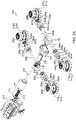
- FIG. 2A shows an exploded view of a powertrain 200 for a vehicle capable of land and aerial transportation according to various embodiments.
- FIG. 2B shows a top view of of the powertrain 200 of FIG. 2A (in an exploded manner) according to various embodiments.
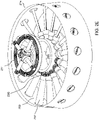
- FIG. 2C shows an exploded view of an axle assembly 202 of the powertrain 200 according to various embodiments.
- the land and aerial transportation vehicle may include the powertrain 200.
- the powertrain 200 may, similar to the power train 100 of FIG.
- the powertrain 200 or the axle assembly 202 of the powertrain 200 may, similar to the powertrain 100 of FIG. 1A or the axle assembly 102 of the powertrain 100 of FIG.
- 1C include a first axle shaft 240a, a first secondary clutch mechanism 250a, a first drive wheel 260a, a first air propulsion unit 270a and a first connection arrangement 280a, which may be coupled together in a manner similar to that of the first axle shaft 140a, the first secondary clutch mechanism 150a, the first drive wheel 160a, the first air propulsion unit 170a and the first connection arrangement 180a of the powertrain 100 of FIG. 1A or the axle assembly 102 of FIG. 1C .
- the first axle shaft 240a of the powertrain 200 of FIG. 2A may be coupled to the main drive shaft assembly 230 of the powertrain 200 of FIG. 2A in a manner similar to that of the first axle shaft 140a and the main drive shaft assembly 130 of the powertrain 100 of FIG. 1A .
- the powertrain 200 may, similar to the powertrain 100 of FIG. 1A , include a differential assembly 232 which couples the first axle shaft 240a to the main drive shaft assembly 230.
- the powertrain 200 may, similar to the powertrain 100 of FIG. 1A , include a second axle shaft 240b coupled to the differential assembly 232. According to various embodiments, the powertrain 200 may, similar to the powertrain 100 of FIG. 1A , include a second secondary clutch mechanism 250b, a second drive wheel 260b, a second air propulsion unit 270b, and a second connection arrangement 280b coupled in a manner similar to that of the power train 100 of FIG. 1A .
- the powertrain 200 may, similar to the powertrain 100 of FIG. 1A , include a transfer case assembly 234, which couple a secondary drive shaft assembly 236 to the main drive shaft assembly 230.
- the powertrain 200 may, similar to the powertrain 100 of FIG. 1A , include an auxiliary differential assembly 238 which couples a third axle shaft 240c to the secondary drive shaft assembly 236.
- the powertrain 200 may, similar to the powertrain 100 of FIG. 1A , include a third secondary clutch mechanism 250c, a third drive wheel 260c, a third air propulsion unit 270c, and a third connection arrangement 280c coupled in a manner similar to that of the power train 100 of FIG. 1A .
- the powertrain 200 may, similar to the powertrain 100 of FIG. 1A , include a fourth axle shaft 240d which may be coupled to the auxiliary differential assembly 238.
- the powertrain 200 may, similar to the powertrain 100 of FIG. 1A , include a fourth secondary clutch mechanism 250d, a fourth drive wheel 260d, a fourth air propulsion unit 270d, and a fourth connection arrangement 280d coupled in a manner similar to that of the power train 100 of FIG. 1A .
- the first connection arrangement 280a between the first air propulsion unit 270a and the first secondary clutch mechanism 250a may include a first transfer shaft 282a with a first end 281 coupled to the second driven member (see, for example, the second driven member 156 of FIG. 1C ) of the first secondary clutch mechanism 250a.
- the second driven member of the first secondary clutch mechanism 250a may be fixedly coupled to the first transfer shaft 282a such that the second driven member and the first transfer shaft 282a may rotate together.
- the second driven member of the first secondary clutch mechanism 250a and the first transfer shaft 282a may be integrally connected or joined or formed so as to function as a single rotating unit.
- the first transfer shaft 282a may be inserted or may extend through the first drive wheel 260a.
- the first transfer shaft 282a and the first drive wheel 260a may rotate independently of each other.
- the torque and rotation of the first axle shaft 240a may be transmitted to the first transfer shaft 282a.
- the first connection arrangement 280a may further include a first planetary gear set 284a with a sun gear 285 coupled to a second end 283 of the first transfer shaft 282a.
- the sun gear 285 of the first planetary gear set 284a may be fixedly coupled to the first transfer shaft 282a such that the sun gear 285 of the first planetary gear set 284a and the first transfer shaft 282a may rotate together.
- the sun gear 285 of the first planetary gear set 284a and the first transfer shaft 282a may be integrally connected or joined or formed so as to function as a single rotating unit.
- the first connection arrangement 280a may further include the first electric hub motor 262a mounted to the first transfer shaft 282a.
- the first electric hub motor 262a may be operable to rotate a hub motor body 264 relative to the first transfer shaft 282a and about a longitudinal axis of the first transfer shaft 282a. Accordingly, when the first transfer shaft 282a is fixed and the first electric hub motor 262a is operated, the hub motor body 264 may be rotated about the first transfer shaft 282a.
- a ring gear 286 of the first planetary gear set 284a may be coupled to the hub motor body 264.
- the ring gear 286 of the first planetary gear set 284a may be fixedly coupled to the hub motor body 264 such that the ring gear 286 of the first planetary gear set 284a and the hub motor body 264 may rotate together.
- the ring gear 286 of the first planetary gear set 284a and the hub motor body 264 may be integrally connected or joined so as to function as a single rotating unit.
- the hub motor body 264 may be rotated about the first transfer shaft 282a (or the longitudinal axis of the first transfer shaft 282a) so as to rotate the ring gear 286 of the first planetary gear set 284a relative to the sun gear 285 of the first planetary gear set 284a. Accordingly, relative rotation between the ring gear 286 and the sun gear 285 may cause the planet gears 288 of the planetary gear set 284a to rotate and travel about the sun gear 285.
- a planet carrier 287 connecting respective centres of planet gears 288 of the planetary gear set 284a may be rotated about the longitudinal axis of the first transfer shaft 282a (or an axis of rotation of the ring gear 286) as the planet gears 288 of the planetary gear set 284a rotate and travel about the sun gear 285 so as to transmit a torque and rotation of the electric hub motor 262a.
- the hub motor body 264 may be rotated together in tandem with the first transfer shaft 282a as the first transfer shaft 282a is rotated.
- the ring gear 286 of the first planetary gear set 284a may be rotated together in tandem with the sun gear 285 of the first planetary gear set 284a to directly drive the rotation of the planet carrier 287 of the planetary gear set 284a so as to transmit the mechanical torque and rotation of the first axel shaft 240a to the planet carrier 287 of the planetary gear set 284a.
- the planet carrier 287 of the planetary gear set 284a may be coupled to the first air propulsion unit 270a for driving the first air propulsion unit 270a to generate a thrust. Accordingly, the planet carrier 287 of the planetary gear set 284a and the first air propulsion unit 270a may be connected or joined or assembled in a manner such that the planet carrier 287 of the planetary gear set 284a may be rotate so as to drive the first air propulsion unit 270a. According to various embodiments, the planet carrier 287 of the planetary gear set 284a may transmit torque and rotation to drive the first air propulsion unit 270a.
- the first electric hub motor 262a may be electrically coupled to the generator 214. Accordingly, when the generator 214 is operated to generate electrical power, the electrical power may be used to operate and drive the electric hub motor 262a for electrically driving the planet carrier 287 of the planetary gear set 284a to drive the first air propulsion unit 270a. According to various embodiments, the first electric hub motor 262a may be electrically coupled to a battery connected to the generator 214. According to various embodiments, the generator 214 may charge the battery for powering the first electric hub motor 262a.
- the second connection arrangement 280b between the second air propulsion unit 270b and the second secondary clutch mechanism 250b may include a second transfer shaft 282b, a second planetary gear set 284b and a second electric hub motor 262b coupled in a manner similar to that of the first connection arrangement 280a.
- the third connection arrangement 280c between the third air propulsion unit 270c and the third secondary clutch mechanism 250c may include a third transfer shaft 282c, a third planetary gear set 284c and a third electric hub motor 262c coupled in a manner similar to that of the first connection arrangement 280a.
- the fourth connection arrangement 280d between the fourth air propulsion unit 270d and the fourth secondary clutch mechanism 250d may include a fourth transfer shaft 282d, a fourth planetary gear set 284d and a fourth electric hub motor 262d coupled in a manner similar to that of the first connection arrangement 280a.
- the respective electric hub motor 262b, 262c, 262d may be electrically coupled to the generator 214. Accordingly, when the generator 214 is operated to generate electrical power, the electrical power may be used to operate and drive the respective electric hub motor 262b, 262c, 262d for driving the respective air propulsion unit 270b, 270c, 270d. According to various embodiments, the respective electric hub motor 262b, 262c, 262d may be electrically coupled to the battery connected to the generator 214. According to various embodiments, the generator 214 may charge the battery for powering the respective electric hub motor 262b, 262c, 262d.
- the first air propulsion unit 270a may include a first thrust fan unit 271a or a propeller oriented with a fan-blade-rotational-axis perpendicular to a rotational axis of the first drive wheel 260a in a manner so as to be capable of generating a thrust providing vertical lift.
- the first thrust fan unit 271a may include, but not limited to, a ducted fan, a turbofan, a fan-jet, or the like.
- the first thrust fan unit 271a may be oriented to direct a thrust towards a ground so as to generate lift.
- the first thrust fan unit 271a may be vertically oriented so as to be capable of generating direct vertical lift thrust. Accordingly, the fan-blade-rotational-axis of the first thrust fan unit 271a may be vertical and may be orthogonal to the horizontal rotational axis of the first drive wheel 260a. According to various embodiments, the first thrust fan unit 271a may be oriented off-vertical so as to be capable of generating indirect vertical lift thrust.
- a first converter mechanism 289a may be connected between the first thrust fan unit 271a and the second driven member (see, for example, the second driven member 156 of FIG. 1C ) of the first secondary clutch mechanism 250a.
- the first converter mechanism 289a may convert a rotation about a rotational axis of the second driven member to a rotation about the fan-blade-rotational-axis of the thrust fan unit 271a.
- the first converter mechanism 289a may be configured to change a direction of axis of rotation as the torque and rotation is transmitted through the first converter mechanism 289a to drive the thrust fan unit 271a.
- the first connection arrangement 280a may include the first converter mechanism 289a.
- the first converter mechanism 289a may be connected between the planet carrier 287 of the first planetary gear set 284a and the first thrust fan unit 271a.
- the first converter mechanism 289a may convert a rotation about a rotational axis of the planet carrier 287 of the first planetary gear set 284a to a rotation about the fan-blade-rotational-axis of the thrust fan unit 271a.
- the first converter mechanism 289a may be configured to change a direction of axis of rotation as the torque and rotation is transmitted from the planet carrier 287 of the first planetary gear set 284a through the first converter mechanism 289a to drive the thrust fan unit 271a.
- the first converter mechanism 289a may include a bevel gear arrangement or a worm gear arrangement or a chain drive arrangement.
- the chain drive arrangement may include a gear which is a carrier of a chain to transmit mechanical torque to the thrust fan unit 271a.
- the second air propulsion unit 270b may, similar to the first air propulsion unit 270a, include a second thrust fan unit 271b oriented to generate vertical lift thrust.
- a second converter mechanism 289b may, similar to the first converter mechanism 289a, be connected between the second thrust fan unit 271b and the second secondary clutch mechanism 250b.
- the second connection arrangement 280b may, similar to the first connection arrangement 280a, include the second converter mechanism 289b.
- the third air propulsion unit 270c may, similar to the first air propulsion unit 270a, include a third thrust fan unit 271c oriented to generate vertical lift thrust.
- a third converter mechanism 289c may, similar to the first converter mechanism 289a, be connected between the third thrust fan unit 271c and the third secondary clutch mechanism 250c.
- the third connection arrangement 280c may, similar to the first connection arrangement 280a, include the third converter mechanism 289c.
- the fourth air propulsion unit 270d may, similar to the first air propulsion unit 270a, include a fourth thrust fan unit 271d oriented to generate vertical lift thrust.
- a fourth converter mechanism 289d may, similar to the first converter mechanism 289a, be connected between the fourth thrust fan unit 271d and the fourth secondary clutch mechanism 250d.
- the fourth connection arrangement 280d may, similar to the first connection arrangement 280a, include the fourth converter mechanism 289d.
- FIG. 2D shows a side view of the axle assembly 202 of the powertrain 200 according to various embodiments.
- the first thrust fan unit 271a may include multiple fan stages 272 arranged in series. Accordingly, multiple fan stages 272 of the thrust fan unit 271a may be stacked or arranged one after another in sequence to create a flow path through the multiple fan stages 272. According to various embodiments, the multiple fan stages 272 of the thrust fan unit 271a may include two or more fan stages.
- the first converter mechanism 289a may include two or more bevel gears 273a for connecting to the multiple fan stages 272 of the thrust fan unit 271a.
- the first converter mechanism 289a may include belt or chain arrangements 273b for connecting the two or more bevel gears 273a to the multiple fan stages 272 of the thrust fan unit 271a. Accordingly, the respective fan stages may be driven by the first converter mechanism 289a.
- the multiple fan stages 272 may include three fan stages 272a, 272b, 272c. According to various embodiments, the multiple fan stages 272 may be arranged in a manner such that alternate fan stages may be counter-rotating. According to various embodiments, one or more gearbox of the multiple fan stages 272 may be configured and arranged such that alternate fan stages may be counter-rotating.
- the multiple fan stages 272 of the thrust fan unit may include sub-stages such as a compressor stage with or without fan blades or propellers.
- the first thrust fan unit 271a may include at least one fan stage being coupled to and driven by a further fan stage via a reduction planetary gearbox. Accordingly, the at least one fan stage may be rotating at a speed different from the further fan stage.
- FIG. 2E shows an underside perspective view of an outlet 274 of the first thrust fan unit 271a according to various embodiments.
- FIG. 2F shows an enlarged view of a thrust vectoring mechanism 290 at the outlet 274 of the first thrust fan unit 271a.
- the first thrust fan unit 271a may include the thrust vectoring mechanism 290.
- the thrust vectoring mechanism 290 may be disposed at the outlet 274 of the first thrust fan unit 271a.
- the thrust vectoring mechanism 290 may form part of the outlet 274 of the first thrust fan unit 271a.
- the thrust vectoring mechanism 290 may include a plurality of hollow vanes 292 arranged radially from a fixed hub 294 at the outlet 274 of the first thrust fan unit 271a.
- the fixed hub 294 may be fixedly mounted to the outlet 274 of the first thrust fan unit 271a.
- the plurality of hollow vanes 292 may extend radially or in the direction of the radius from the fixed hub 294.
- each of the plurality of hollow vanes 292 may be rotatable about respective longitudinal axis. Accordingly, each of the plurality of hollow vanes 292 may be rotated about its own longitudinal axis so as to change an orientation of the respective hollow vanes with respect to a direction of the thrust generated by the first thrust fan unit 271a.
- each of the plurality of hollow vanes 292 may include an opening 296 at a tip 295 of respective hollow vane 292.
- the opening 296 may be located at a distal end of the respective hollow vane 292 with respect to the fixed hub 294.
- the longitudinal axis of the respective hollow vane 292 may pass through the respective opening 296.
- the respective opening 296 may be perpendicular to the longitudinal axis of the respective hollow vane 292.
- each of the plurality of hollow vanes 292 may include at least one slot 298 aligned and extending longitudinally along a vane face 299 on a first side of the respective hollow vane 292.
- each of the plurality of hollow vanes 292 may include the at least one slot 298, or one or more slots 298, or a plurality of slots 298.
- the at least one slot 298 may be a long narrow opening extending lengthwise in the vane face 299 on the first side of the respective hollow vane 292.
- a second side of the respective hollow vane 292 may be free of any openings or slots.
- the opening 296 at the tip 295 of respective hollow vane 292 and the at least one slot 298 of the respective hollow vane 292 may provide access into an inner cavity of the respective hollow vane 292.
- each of the plurality of hollow vanes 292 may be rotated about its longitudinal axis to vector or guide or change a direction of thrust so as to steer the vehicle.
- the respective hollow vane 292 when the respective hollow vane 292 is rotated into a horizontal orientation with the vane face 299 facing the air flow (i.e. the vane face 299 is oriented to be perpendicular to the air flow and at the windward side of the respective hollow vane 292), the flow of air may enter the respective hollow vane 292 via the at least one slot 298 along the vane face 299 and exit from the respective hollow vane 292 via the opening 296 at the tip 295 of respective hollow vane 292.
- the change in flow of air by rotating and orientating the respective hollow vane 292 may vector or guide or change a direction of thrust for steering.
- the air flow may generally flow over the respective hollow vane 292 without entering the respective hollow vane 292 via the at least one slot 298 along the vane face 299. Accordingly, in such orientation, the respective hollow vane 292 may not change the direction of thrust.
- each of the plurality of hollow vanes 292 may include a plurality of elongated control surface slats 297 aligned and extending longitudinally along the vane face 299 of the respective hollow vane 292 to form the at least one slot 298.
- the plurality of elongated control surface slats 297 may be in a louver arrangement.
- the plurality of elongated control surface slats 297 (or at least two elongated control surface slats 297) may be placed lengthwise and parallel to each other in the louver arrangement so as to form the at least one slot 298 therebetween.
- the plurality of elongated control surface slats 297 may be angled in a manner such that the plurality of elongated control surface slats 297 may guide or deflect airflow through the at least one slot 298 when the respective hollow vane 292 is in the horizontal orientation, and the plurality of elongated control surface slats 297 may guide or deflect airflow to flow over the respective hollow vane 292 when the respective hollow vane 292 is in the vertical orientation.
- each of the plurality of elongated control surface slats 297 may have a twist profile so as to better accommodate the air flow. Accordingly, each of the plurality of elongated control surface slats 297 may have a twist along its longitudinal axis to cater for air flow.
- each of the plurality of elongated control surface slats of respective hollow vane 292 may be rotatable about respective longitudinal axis.
- the respective hollow vane 292 may or may not be rotatable about respective longitudinal axis of the respective hollow vane 292.
- the plurality of elongated control surface slats of the respective hollow vane 292 may be rotated to direct or guide air flow into the respective hollow vane 292 via the at least one slot 298 along the vane face 299 such that the air flow may exit from the respective hollow vane 292 via the opening 296 at the tip 295 of respective hollow vane 292 for vectoring or guiding or changing a direction of thrust so as to steer the vehicle.
- the thrust vectoring mechanism 290 may be configured to actuate a subset of the plurality of hollow vanes 292 to capture the airflow for re-directing the airflow to steer the vehicle.
- the thrust vectoring mechanism 290 may include a actuated ring gear mechanism 291 which is in engagement with corresponding gears 293 of the subset of the plurality of hollow vanes 292 for rotating the subset of the plurality of hollow vanes 292 to capture the airflow as required.
- the remaining hollow vanes 292 other than the subset of the plurality of hollow vanes 292 may be free of any corresponding gears 293 such that the actuated ring gear mechanism 291 may not rotate the remaining hollow vanes 292.
- the subset of the plurality of hollow vanes 292 may be a group of hollow vanes 292 with respective tips 295 that are directed away from a respective side of the vehicle at which the first thrust fan unit 271a is located.
- the second thrust fan unit 271b and the second converter mechanism 289b, the third thrust fan unit 271c and the third converter mechanism 289c, the fourth thrust fan unit 271d and the fourth converter mechanism 289d may be similar to the first thrust fan unit 271a and the first converter mechanism 289a as described previously.
- FIG. 3A shows a schematic diagram of a powertrain 300 for a vehicle 301 capable of land and aerial transportation according to various embodiments.
- the land and aerial transportation vehicle 301 may include the powertrain 300.
- the powertrain 300 of FIG. 3A includes all the features of the powertrain 100 of FIG. 1A and/or the powertrain 200 of FIG. 2A . Accordingly, all features, changes, modifications and variations that are applicable to the powertrain 100 of FIG. 1A and/or the powertrain 200 of FIG. 2A may also be applicable to the powertrain 300 of FIG. 3A .
- the powertrain 300 of FIG. 3A may differ from the powertrain 100 of FIG. 1A and/or the powertrain 200 of FIG. 2A in that the powertrain 300 of FIG. 3A may further include the following additional features and/or limitations.
- the powertrain 300 may include a horizontal air propulsion unit 375 or at least one horizontal air propulsion unit 375 or one or more horizontal air propulsion unit 375.
- the horizontal air propulsion unit 375 may be configured to generate thrust for propelling the vehicle 301 forward in the air.
- the powertrain 300 may include an electric motor 365 coupled to the horizontal air propulsion unit 375 to drive the horizontal air propulsion unit 375. Accordingly, the electric motor 365 may transmit a torque and rotation to the horizontal air propulsion unit 375 for driving the horizontal air propulsion unit 375.
- the electric motor 365 may be electrically coupled to the generator 314 as represented by line 319.
- the electric motor 365 may be electrically powered by the generator 314. According to various embodiments, the electric motor 365 may be electrically coupled to a battery connected to the generator 314. According to various embodiments, the generator 314 may charge the battery for powering the electric motor 365.
- FIG. 3B shows a schematic diagram of an auxiliary clutch mechanism 351of the powertrain 300 of FIG. 3A according to various embodiments.
- the powertrain 300 may include the auxiliary clutch mechanism 351 coupled to the electric motor 365 in a manner such that a driving member 353 of the auxiliary clutch mechanism 351 may be rotatable by the electric motor 365.
- the auxiliary clutch mechanism 351 may include the driving member 353 which may be fixedly coupled to a driving shaft 367 of the electric motor 365 such that the driving member 353 of the auxiliary clutch mechanism 351 may rotate at the same speed as the driving shaft 367 of the electric motor 365 when the driving shaft 367 is rotated during operation of the electric motor 365.
- the driving shaft 367 of the electric motor 365 and the driving member 353 of the auxiliary clutch mechanism 351 may be integrally connected or joined or formed so as to function as a single rotating unit.
- the horizontal air propulsion unit 375 may be coupled to a first driven member 355 of the auxiliary clutch mechanism 351.
- the first driven member 355 of the auxiliary clutch mechanism 351 may be coupled to the horizontal air propulsion unit 375 in a manner such that the first driven member 355 of the auxiliary clutch mechanism 351 may rotate and drive the horizontal air propulsion unit 375.
- horizontal air propulsion unit 375 may include a horizontal thrust fan unit.
- the horizontal air propulsion unit 375 in the form of the horizontal thrust fan unit may include a fan axle 377.
- the first driven member 355 of the auxiliary clutch mechanism 351 may be fixedly coupled to the fan axle 377 of the horizontal air propulsion unit 375 such that the first driven member 355 and the fan axle 377 of the horizontal air propulsion unit 375 may rotate together. Accordingly, the first driven member 355 of the auxiliary clutch mechanism 351 and the fan axle 377 of the horizontal air propulsion unit 375 may be integrally connected or joined or formed so as to function as a single rotating unit. According to various embodiments, the first driven member 355 of the auxiliary clutch mechanism 351 may transmit torque and rotation to the fan axle 377 of the horizontal air propulsion unit 375 for driving the horizontal air propulsion unit 375 to generate thrust.
- the auxiliary clutch mechanism 351 may be operable to engage or disengage the first driven member 355 of the auxiliary clutch mechanism 351 and the driving member 353 of the auxiliary clutch mechanism 351 so as to connect or disconnect the fan axle 377 of the horizontal air propulsion unit 375 and the driving shaft 367 of the electric motor 365. Accordingly, when the first driven member 355 of the auxiliary clutch mechanism 351 is engaged with the driving member 353 of the auxiliary clutch mechanism 351, they may be locked together and spin at the same speed.
- the fan axle 377 of the horizontal air propulsion unit 375 and the driving shaft 367 of the electric motor 365 may be connected together by the auxiliary clutch mechanism 351 so as to rotate as a single unit, whereby the rotation of the driving shaft 367 of the electric motor 365 is transmitted to the fan axle 377 of the horizontal air propulsion unit 375.
- the first driven member 355 of the auxiliary clutch mechanism 351 is disengaged from the driving member 353 of the auxiliary clutch mechanism 351, they may be separated from and independent of each other.
- the fan axle 377 of the horizontal air propulsion unit 375 and the driving shaft 367 of the electric motor 365 may be disconnected from each other by the auxiliary clutch mechanism 351 such that the rotation of the driving shaft 367 of the electric motor 365 is no longer transmitted to the fan axle 377 of the horizontal air propulsion unit 375.
- the main drive shaft assembly 330 may be coupled to a second driven member 357 of the auxiliary clutch mechanism 351.
- the second driven member 357 of the auxiliary clutch mechanism 351 may be coupled to the main drive shaft assembly 330, via a mechanical connection assembly 337, in a manner such that the second driven member 357 of the auxiliary clutch mechanism 351 may rotate and drive the main drive shaft assembly 330.
- the second driven member 357 of the auxiliary clutch mechanism 351 and the main drive shaft assembly 330 may be connected or joined or assembled, via the mechanical connection assembly 337, in a manner such that the second driven member 357 of the auxiliary clutch mechanism 351 may rotate so as to serve to drive the main drive shaft assembly 330.
- the second driven member 357 of the auxiliary clutch mechanism 351 may transmit torque and rotation to drive the main drive shaft assembly 330.
- the mechanical connection assembly 337 of the powertrain 300 may include an auxiliary drive shaft 335 coupled to the second driven member 357 of the auxiliary clutch mechanism 351 via any one or a combination of a gear or belt or chain or links or other suitable components so as to transmit torque and rotation from the second driven member 357 of the auxiliary clutch mechanism 351 to the auxiliary drive shaft 335.
- the mechanical connection assembly 337 of the powertrain 300 may include an auxiliary transfer case assembly 333.
- the auxiliary transfer case assembly 333 may couple the main drive shaft assembly 330 to the auxiliary drive shaft 355.
- the transfer case assembly 333 may be configured to transmit the rotation and torque from the auxiliary drive shaft 335 to the main drive shaft assembly 330.
- the second driven member 357 of the auxiliary clutch mechanism 351 may transmit torque and rotation to drive the main drive shaft assembly 330 via the auxiliary drive shaft 335 and the auxiliary transfer case assembly 333.
- the auxiliary clutch mechanism 351 may be operable to engage or disengage the second driven member 357 of the auxiliary clutch mechanism 351 and the driving member 353 of the auxiliary clutch mechanism 351so as to connect or disconnect the main drive shaft assembly 330 and the electric motor 365. Accordingly, when the second driven member 357 of the auxiliary clutch mechanism 351 is engaged with the driving member 353 of the auxiliary clutch mechanism 351, they may be locked together and spin at the same speed. Hence, the main drive shaft assembly 330 and the electric motor 365 may be connected together by the auxiliary clutch mechanism 351 so as to drive the main drive shaft assembly 330 using the electric motor 365, whereby the rotation of the driving shaft 367 of the electric motor 365 is transmitted to drive the main drive shaft assembly 330.
- the main driven member 357 of the auxiliary clutch mechanism 351 When the second driven member 357 of the auxiliary clutch mechanism 351 is disengaged from the driving member 353 of the auxiliary clutch mechanism 351, they may be separated from and independent of each other. Hence, the main drive shaft assembly 330 and the electric motor 365 may be disconnected from each other by the auxiliary clutch mechanism 351 such that the rotation of the driving shaft 367 of the electric motor 365 is no longer transmitted to the main drive shaft assembly 330.
- FIG. 3B is provided for illustration purposes only to explain the auxiliary clutch mechanism 351 and should not be construed to be limiting. It is understood that the configuration and arrangement of the driving member 353 of the auxiliary clutch mechanism 351, the first driven member 355 of the auxiliary clutch mechanism 351, the second driven member 357 of the auxiliary clutch mechanism 351 and the mechanical connection assembly 337 connecting the auxiliary clutch mechanism 351 to the main drive shaft assembly 330 may be in any suitable manner to serve the respective function and purposes. While in FIG.
- the driving member 353 of the auxiliary clutch mechanism 351, the first driven member 355 of the auxiliary clutch mechanism 351, and the second driven member 357 of the auxiliary clutch mechanism 351 may be configured and arranged such that the horizontal air propulsion unit 375 and the mechanical connection assembly 337 are connected to a same side of the auxiliary clutch mechanism 351 and the electric motor 365 is connected to an opposite side of the auxiliary clutch mechanism 351, it is understood that the auxiliary clutch mechanism 351may be configured such that the driving member 353 of the auxiliary clutch mechanism 351, the first driven member 355 of the auxiliary clutch mechanism 351, and the second driven member 357 of the auxiliary clutch mechanism 351 may be configured and arranged such that the mechanical connection assembly 337 and the electric motor 365 may be connected to a same side of the auxiliary clutch mechanism 351 and the horizontal air propulsion unit 375 may be connected to an opposite side of the auxiliary clutch mechanism 351.
- FIG. 4 shows an exploded top view of a powertrain 400 for a vehicle capable of land and aerial transportation according to various embodiments.
- the land and aerial transportation vehicle may include the powertrain 400.
- the powertrain 400 of FIG. 4 includes all the features of the powertrain 100 of FIG. 1A and/or the powertrain 200 of FIG. 2A . Accordingly, all features, changes, modifications and variations that are applicable to the powertrain 100 of FIG. 1A and/or the powertrain 200 of FIG. 2A may also be applicable to the powertrain 400 of FIG. 4 .
- the powertrain 400 of FIG. 4 may be a variant of the powertrain 300 of FIG. 3A .
- the powertrain 400 of FIG. 4 may differ from the powertrain 300 of FIG. 3A in that the powertrain 400 of FIG. 4 may further include the following variations and/or modifications.
- the powertrain 400 may, similar to the powertrain 300 of FIG. 3A , include a horizontal air propulsion unit 475 or at least one horizontal air propulsion unit 475 or one or more horizontal air propulsion unit 475.
- the powertrain 400 may, similar to the powertrain 300 of FIG. 3A , include an electric motor 465 coupled to the horizontal air propulsion unit 475 to drive the horizontal air propulsion unit 475. Accordingly, the electric motor 465 may transmit a torque and rotation to the horizontal air propulsion unit 475 for driving the horizontal air propulsion unit 475.
- the electric motor 465 may be electrically coupled to a battery (not shown).
- the battery may be connected to and charged by the generator 414. Accordingly, the electric motor 465 may be electrically powered by the battery.
- the powertrain 400 may, similar to the powertrain 300 of FIG. 3A , include an auxiliary clutch mechanism 451 coupled to the electric motor 365 in a manner similar to that between auxiliary clutch mechanism 351 and the electric motor 365 of FIG. 3A .
- the horizontal air propulsion unit 475 may also be coupled to the auxiliary clutch mechanism 451 in a manner similar to that between the horizontal air propulsion unit 375 and the auxiliary clutch mechanism 351 of FIG. 3A .
- the auxiliary clutch mechanism 451 may, similar to the auxiliary clutch mechanism 351 of FIG. 3A , be operable to engage or disengage the auxiliary clutch mechanism 451 so as to connect or disconnect the horizontal air propulsion unit 475 and the electric motor 465.
- the main drive shaft assembly 430 of the powertrain 400 may, similar to the main drive shaft assembly 330 of the powertrain 300, be coupled to the auxiliary clutch mechanism 451, via a mechanical connection assembly 437, in a manner such that the auxiliary clutch mechanism 451 may be engaged or disengaged to drive the main drive shaft assembly 430.
- the auxiliary clutch mechanism 451 may be engaged in a manner so as to transmit torque and rotation from the electric motor 465 to drive the main drive shaft assembly 430.
- the powertrain 400 may differ from the powertrain 300 of FIG. 3A in that the mechanical connection assembly 437 of the powertrain 400 may include an auxiliary drive shaft 435 coupling the auxiliary clutch mechanism 451 to the transfer case assembly 434, which also in connection with the secondary drive shaft assembly 436 and the main drive shaft assembly 430.
- the transfer case assembly 434 may be configured to transmit a rotation and torque, which originated from the electric motor 465, from the auxiliary drive shaft 435 to the main drive shaft assembly 430 and the secondary drive shaft assembly 436.
- the auxiliary clutch mechanism 451 may, similar to the auxiliary clutch mechanism 351 of FIG. 3A , be operable to engage or disengage so as to connect or disconnect the main drive shaft assembly 430 and the electric motor 465.
- Various embodiments have provided a vehicle capable of land and aerial transportation, and a land and aerial transportation vehicle which have addressed the various issues previously identified.
- Various embodiments differ from conventional powertrain of a land vehicle in that it is not based on a single clutch for a single drive shaft.
- a two-tier clutch arrangement or a multi-tier clutch arrangement i.e. at least a first tier clutch mechanism at the power generation side of the powertrain and at least a second tier clutch mechanism at the propulsion side of the powertrain, that governs both the mechanical operations and electrical operations for land and aerial transportation, thus allowing multi-modes or configurations of operation when required.
- the multi-modes of operation may include four different modes of operations namely, flight in electrical mode, flight in mechanical mode, land travel in electrical mode, and land travel in mechanical mode.
- the multi-modes of operation may include six different modes of operations namely, namely, flight in electrical mode, flight in mechanical mode, flight in hybrid mode, land travel in electrical mode, land travel in mechanical mode, and land travel in hybrid mode.
- flight using electrical systems may be achieved with the use of electrical power generated from the generator systems to supply power to the electrical motors, for example two or three or four or five or six or more motors, which in turn generates thrust from the thrust fans that are attached to the motors via a planetary drive, connected via a clutch.
- the thrust fans there is at least one thrust fan which is positioned to provide thrust in the horizontal axis, and at least one thrust fan is positioned to provide thrust in the vertical axis.
- all thrust fans may be of compressive nature, where the output pressure is higher than that of the input pressure.
- two of the thrust fans may be positioned to provide thrust in the horizontal axis, and four of the thrust fans may be positioned to provide thrust in the vertical axis.
- they may have a thrust vectoring mechanism including a plurality of vanes which are rotatable about respective longitudinal axis via the use of a ring gear, actuated via an electrical actuator. This action may concurrently open up a set of side facing slots to allow airflow to exit by the side, which may allow lateral movement.
- flight using mechanical systems may be achieved with the meshing of the mechanical transmission systems for land travel to the secondary flight transmission systems via the two-tier or multi-tier clutch arrangement, where the same thrust fans used in the electrical flight mode are operated via a direct gear drive assembly.
- the motors that are connected to the thrust fans providing thrust in the horizontal axis may also be connected to the drive axes of the wheels via the same two-tier or multi-tier clutch arrangement.
- the mechanical transmission systems for land travel may be connected to the wheels via the same two-tier or multi-tier clutch arrangement.
Landscapes
- Engineering & Computer Science (AREA)
- Mechanical Engineering (AREA)
- Transportation (AREA)
- Aviation & Aerospace Engineering (AREA)
- Combustion & Propulsion (AREA)
- Chemical & Material Sciences (AREA)
- General Engineering & Computer Science (AREA)
- Physics & Mathematics (AREA)
- Fluid Mechanics (AREA)
- Arrangement Of Transmissions (AREA)
- Hybrid Electric Vehicles (AREA)
- Adjustment And Processing Of Grains (AREA)
- Hydraulic Clutches, Magnetic Clutches, Fluid Clutches, And Fluid Joints (AREA)
Description
- Various embodiments generally relate to a land and aerial transportation vehicle, a powertrain for the vehicle, and an axle assembly for the vehicle. In particular, various embodiments generally relate to a flying car, a powertrain for the flying car, and an axle assembly for the flying car.
- In recent years, various models of flying cars have been commercialized in the market. For example, the PAL-V flying car features a dual engine configuration with dual drivetrain, using one engine for driving on the road and one for flying in the air. As another example, the Aeromobil flying car feature a generator/engine to run two separate mode via one switching mechanism switchable between powering the propeller for flight and powering a pair of electric motors for driving. However, if the switching mechanism fails, there is no alternative ways to operate the flying car. As can be seen, these flying cars either have separate powertrain for driving and flying, or have one generator/engine switchable between driving separate drivetrain for flying and driving. Thus, they generally have multiple drivetrain taking up excess weight and space, as well as a lack of backup in case of propulsion failure for land and air travel.
-
CN107856488A discloses a power transmission system for a hybrid power flying vehicle capable of vertical take-off and landing. In particular, it is disclosed to use a first clutch 528 to connect between an engine 11 and a second gear combination transmission device 52, wherein the second gear combination transmission device 52 further includes a second clutch 529 for connecting a second rear axle reducer driving gear 523 and a second rear axle first driven gear 522, and a third clutch 530 for connecting the second rear axle driving bevel gear 526 and the second rear axle first driven gear 522. The second rear axle first driven gear 522 being driven by the engine 11 when the first clutch 528 is engaged, the drive wheel 54 being driven by the second rear axle reducer driving gear 523 when the second clutch 529 is engaged, and the thrust duct fan 55 being driven by the second rear axle driving bevel gear 526 when the third clutch 530 is engaged. - Accordingly, there is a need for a more effective powertrain solution without compromising performance for cost for vehicle capable of land and aerial transportation so as to address the above issues.
- According to the invention claimed, there is provided a powertrain for a vehicle capable of land and aerial transportation. The powertrain may include an engine having at least one output shaft. The powertrain may include a primary clutch mechanism coupled to the at least one output shaft of the engine in a manner such that a driving member of the primary clutch mechanism is rotatable by the at least one output shaft of the engine. The powertrain may include a main drive shaft assembly coupled to a driven member of the primary clutch mechanism. The primary clutch mechanism may be operable to engage or disengage the driven member of the primary clutch mechanism and the driving member of the primary clutch mechanism so as to connect or disconnect the main drive shaft assembly and the at least one output shaft of the engine. The powertrain may include an axle shaft coupled transversely to the main drive shaft assembly and driven by the main drive shaft assembly. The powertrain may include a secondary clutch mechanism coupled to an end of the axle shaft in a manner such that a driving member of the secondary clutch mechanism is rotatable by the axle shaft. The powertrain may include a drive wheel coupled to a first driven member of the secondary clutch mechanism. The secondary clutch mechanism may be operable to engage or disengage the first driven member of the secondary clutch mechanism and the driving member of the secondary clutch mechanism so as to connect or disconnect the drive wheel and the axle shaft. The powertrain may include an air propulsion unit coupled to a second driven member of the secondary clutch mechanism. The secondary clutch mechanism may be operable to engage or disengage the second driven member of the secondary clutch mechanism and the driving member of the secondary clutch mechanism so as to connect or disconnect the air propulsion unit and the axle shaft.
- According to various embodiments, there is provided a land and aerial transportation vehicle. The land and aerial transportation vehicle may include a powertrain as described herein. The land and aerial transportation vehicle may include a plurality of wheels. According to various embodiments, at least one of the wheels may be the drive wheel which is provided for driving the vehicle on land. The land and aerial transportation vehicle may include at least the one air propulsion unit for providing lift and/or forward propulsion for aerial travel of the vehicle.
- According to various embodiments, there is provided an axle assembly for a vehicle capable of land and aerial transportation. The axle assembly may include an axle shaft. The axle assembly may include a clutch mechanism coupled to an end of the axle shaft in a manner such that a driving member of the clutch mechanism is rotatable by the axle shaft. The axle assembly may include a drive wheel coupled to a first driven member of the clutch mechanism. The clutch mechanism may be operable to engage or disengage the first driven member of the clutch mechanism and the driving member of the clutch mechanism so as to connect or disconnect the drive wheel and the axle shaft. The axle assembly may include an air propulsion unit coupled to a second driven member of the clutch mechanism. The clutch mechanism may be operable to engage or disengage the second driven member of the clutch mechanism and the driving member of the clutch mechanism so as to connect or disconnect the air propulsion unit and the axle shaft.
- In the drawings, like reference characters generally refer to the same parts throughout the different views. The drawings are not necessarily to scale, emphasis instead generally being placed upon illustrating the principles of the invention. In the following description, various embodiments are described with reference to the following drawings, in which:
-
FIG. 1A shows a schematic diagram of a powertrain for a vehicle capable of land and aerial transportation according to various embodiments; -
FIG. 1B shows a schematic diagram of a primary clutch mechanism of the powertrain ofFIG. 1A according to various embodiment; -
FIG. 1C shows a schematic diagram of an axle assembly of the powertrain ofFIG. 1A according to various embodiments; -
FIG. 2A shows an exploded view of a powertrain for a vehicle capable of land and aerial transportation according to various embodiments; -
FIG. 2B shows a top view of the powertrain ofFIG. 2A according to various embodiments; -
FIG. 2C shows an exploded view of an axle assembly of the powertrain ofFIG. 2A according to various embodiments; -
FIG. 2D shows a side view of the axle assembly ofFIG. 2C according to various embodiments; -
FIG. 2E shows an underside perspective view of an outlet of the first thrust fan unit of the powertrain ofFIG. 2A according to various embodiments; -
FIG. 2F shows an enlarged view of a thrust vectoring mechanism at the outlet of the first thrust fan unit ofFIG. 2E according to various embodiments; -
FIG. 3A shows a schematic diagram of a powertrain for a vehicle capable of land and aerial transportation according to various embodiments; -
FIG. 3B shows a schematic diagram of an auxiliary clutch mechanism of the powertrain ofFIG. 3A according to various embodiments; and -
FIG. 4 shows an exploded top view of a powertrain for a vehicle capable of land and aerial transportation according to various embodiments. - Embodiments described below in the context of the apparatus are analogously valid for the respective methods, and vice versa. Furthermore, it will be understood that the embodiments described below may be combined, for example, a part of one embodiment may be combined with a part of another embodiment.
- It should be understood that the terms "on", "over", "top", "bottom", "down", "side", "back", "left", "right", "front", "lateral", "side", "up", "down" etc., when used in the following description are used for convenience and to aid understanding of relative positions or directions, and not intended to limit the orientation of any device, or structure or any part of any device or structure. In addition, the singular terms "a", "an", and "the" include plural references unless context clearly indicates otherwise. Similarly, the word "or" is intended to include "and" unless the context clearly indicates otherwise.
- Various embodiments generally relate to a powertrain for a vehicle capable of land and aerial transportation, and a land and aerial transportation vehicle. In particular, various embodiments generally relate to a powertrain for a flying car, and a flying car. According to various embodiments, a powertrain may include all components used to transform energy, such as mechanical energy, potential energy, electrical energy, chemical energy, solar energy, nuclear energy, into kinetic energy for propulsion purposes. According to various embodiments a vehicle capable of land and aerial transportation or a flying car may be a roadable aircraft or a vehicle that provides transportation by both ground and air or a vehicle that is capable of being driven on a road and flown in the air or a multimode transport vehicle for ground travel and air travel.
- Various embodiments have provided a powertrain that allows any vehicle to achieve flight, while at the same time able to drive on land. According to various embodiments, the powertrain is readily switchable between electrical and mechanical operations as redundancy to serve as backup or fail-safe for each other. According to various embodiments, the electrical and mechanical components of the powertrain are integrated to operate within a single combined axis or drive shaft. According to various embodiments, the powertrain may allow the use of any or a combination or electrical actuator, mechanical actuators, hydraulic actuators, pneumatic actuators or other suitable actuators to switch between both modes as a safety requirement. According to various embodiments, the powertrain may allow for a true dual redundancy safety system, whereby if all electrical systems fail the vehicle may still be maneuvered using just the engines, vice versa, regardless on land or air.
- According to various embodiments, the powertrain may include an onboard power generator to provide the electrical power required without being limited by the size or capacity of a battery. According to various embodiments, the powertrain may include at least one engine, with at least one electrical generator coupled thereto, and a mechanical driveshaft, using a planetary gear array for interconnecting the components. According to various embodiments, the at least one electrical generator may serve as a secondary power generation system. According to various embodiments, the at least one electrical generator may be coupled to the mechanical driveshaft via a clutch mechanism or via a torque transfer gearbox. According to various embodiments, the powertrain may also include an array of electrical motors with their axis aligned in a parallel manner, allowing thrust to be produced in the same direction. According to various embodiments, the electrical power generated by the at least one electrical generator may be used to provide power to the array of electrical motors that provide additional torque to the powertrain. The electrical power generated may also be used to charge batteries which in turn provide electrical power to the array of electrical motors. According to various embodiments, the array of electrical motors may be coupled to driving fans which are compressive in nature or propellers to produce thrust. According to various embodiments, the fans may be arranged to face vertically and horizontally. According to various embodiments, the vertically arranged fans may produce thrust in the vertical direction for generating lift.
- According to various embodiments, the powertrain may enable travel via multi-modes. For example, the powertrain may enable travel via four different modes of operation, namely, flight in electrical mode, flight in mechanical mode, land travel in electrical mode, and land travel in mechanical mode. As another example, the powertrain may enable travel via six different modes of operation, namely, flight in electrical mode, flight in mechanical mode, flight in hybrid mode, land travel in electrical mode, land travel in mechanical mode, and land travel in hybrid mode.
- According to various embodiments, for flight in electrical mode, fans which are actuated by electrical motors and which are facing in the vertical direction are responsible for generating lift. Further, fans which are actuated by electrical motors and which are facing in the horizontal direction are responsible for generating forward thrust. Directional movement of the vehicle may be achieved via the final stator assembly of the vertical fans, whereby exit vents on the side of respective nacelle may open up to allow thrust to be directed in the lateral direction.
- According to various embodiments, for flight in mechanical mode, the same vertical fans may be coupled to the main transmission drive. According to various embodiments, vertical fans may be coupled via gears, chain, belt, etc. to the main transmission drive.
- According to various embodiments, for flight in hybrid mode, flight may be achieved by the simultaneous operation of the flight in electrical mode and flight in mechanical mode, whereby torque transfer of both modes are summated via torque transfer mechanisms.
- According to various embodiments, for land travel in electrical mode, the electrical motors for the horizontal fans may be coupled to the main transmission drive via a power transfer assembly.
- According to various embodiments, for land travel in mechanical mode, the engine may be mechanically coupled to a clutch which engages the main transmission drive to directly drive the wheels.
- According to various embodiments, for land travel in hybrid mode, land travel may be achieved by the simultaneous operation of the land travel in electrical mode and land travel in mechanical mode, whereby torque transfer of both modes are summated via torque transfer mechanisms.
- The following examples pertain to various embodiments.
- Example 1 is a powertrain for a vehicle capable of land and aerial transportation, the powertrain including:
- an engine having at least one output shaft;
- a primary clutch mechanism coupled to the at least one output shaft of the engine in a manner such that a driving member of the primary clutch mechanism is rotatable by the at least one output shaft of the engine;
- a main drive shaft assembly coupled to a driven member of the primary clutch mechanism, wherein the primary clutch mechanism is operable to engage or disengage the driven member of the primary clutch mechanism and the driving member of the primary clutch mechanism so as to connect or disconnect the main drive shaft assembly and the at least one output shaft of the engine;
- an axle shaft coupled transversely to the main drive shaft assembly and driven by the main drive shaft assembly;
- a secondary clutch mechanism coupled to an end of the axle shaft in a manner such that a driving member of the secondary clutch mechanism is rotatable by the axle shaft;
- a drive wheel coupled to a first driven member of the secondary clutch mechanism, wherein the secondary clutch mechanism is operable to engage or disengage the first driven member of the secondary clutch mechanism and the driving member of the secondary clutch mechanism so as to connect or disconnect the drive wheel and the axle shaft; and
- an air propulsion unit coupled to a second driven member of the secondary clutch mechanism, wherein the secondary clutch mechanism is operable to engage or disengage the second driven member of the secondary clutch mechanism and the driving member of the secondary clutch mechanism so as to connect or disconnect the air propulsion unit and the axle shaft.
- In Example 2, the subject matter of Example 1 may optionally include that the powertrain may include a generator coupled to the engine in a manner so as to be powered by the engine.
- In Example 3, the subject matter of Example 2 may optionally include that the primary clutch mechanism may include a further driven member, wherein a rotor of the generator is coupled to the further driven member of the primary clutch mechanism, wherein the primary clutch mechanism is operable to engage or disengage the further driven member of the primary clutch mechanism and the driving member of the primary clutch mechanism so as to connect or disconnect the rotor of the generator and the at least one output shaft of the engine.
- In Example 4, the subject matter of Example 2 or 3 may optionally include that a connection arrangement between the air propulsion unit and the secondary clutch mechanism may include:
- a transfer shaft with a first end coupled to the second driven member of the secondary clutch mechanism;
- a planetary gear set with a sun gear coupled to a second end of the transfer shaft;
- an electric hub motor mounted to the transfer shaft, the electric hub motor operable to rotate a hub motor body relative to the transfer shaft and about a longitudinal axis of the transfer shaft,
- wherein a ring gear of the planetary gear set is coupled to the hub motor body,
- wherein a planet carrier connecting respective centres of planet gears of the planetary gear set is coupled to the air propulsion unit, and
- wherein the electric hub motor is electrically coupled to the generator.
- In Example 5, the subject matter of Example 4 may optionally include that the electric hub motor is electrically coupled to a battery which is connected to the generator.
- In Example 6, the subject matter of any one of Examples 1 to 5 may optionally include that the air propulsion unit may include a thrust fan unit oriented with a fan-blade-rotational-axis perpendicular to a rotational axis of the drive wheel in a manner so as to be capable of generating a thrust providing vertical lift.
- In Example 7, the subject matter of Example 6 may optionally include that a converter mechanism may be connected between the thrust fan unit and the second driven member of the secondary clutch mechanism, wherein the converter mechanism may convert a rotation about a rotational axis of the second driven member to a rotation about the fan-blade-rotational-axis of the thrust fan unit.
- In Example 8, the subject matter of Example 7 may optionally include that the connection arrangement may further include the converter mechanism, the converter mechanism being connected between the planet carrier of the planetary gear set and the thrust fan unit.
- In Example 9, the subject matter of Example 7 or 8 may optionally include that the converter mechanism may include a bevel gear arrangement or a worm gear arrangement.
- In Example 10, the subject matter of any one of Examples 6 to 9 may optionally include that the thrust fan unit may include multiple fan stages arranged in series.
- In Example 11, the subject matter of Example 10 may optionally include that the multiple fan stages may be arranged in a manner such that alternate fan stages may be counter-rotating.
- In Example 12, the subject matter of Example 11 may optionally include that one or more gearbox of the multiple fan stages may be configured and arranged such that alternate fan stages may be counter-rotating.
- In Example 13, the subject matter of any one of Examples 10 to 12 may optionally include that the thrust fan unit may include at least one fan stage being coupled to and driven by a further fan stage via a reduction planetary gearbox.
- In Example 14, the subject matter of any one of Examples 6 to 13 may optionally include that the thrust fan unit may include a thrust vectoring mechanism.
- In Example 15, the subject matter of Example 14 may optionally include that the thrust vectoring mechanism may include a plurality of hollow vanes arranged radially from a fixed hub at an outlet of the thrust fan unit, wherein each of the plurality of hollow vanes may include:
- an opening at a tip of respective hollow vane; and
- at least one slot extending longitudinally along a vane face on one side of the respective hollow vane,
- wherein the opening and the at least one slot provide access into an inner cavity of the respective hollow vane.
- In Example 16, the subject matter of Example 15 may optionally include that each of the plurality of hollow vanes may include a plurality of elongated control surface slats extending longitudinally along the vane face of the respective hollow vane to form the at least one slot, wherein the plurality of elongated control surface slats are in a louver arrangement.
- In Example 17, the subject matter of Example 16 may optionally include that each of the plurality of elongated control surface slats may have a twist profile so as to better accommodate the air flow.
- In Example 18, the subject matter of Example 16 or 17 may optionally include that each of the plurality of elongated control surface slats may be rotatable about respective longitudinal axis.
- In Example 19, the subject matter of any one of Examples 15 to 18 may optionally include that each of the plurality of hollow vanes may be rotatable about respective longitudinal axis.
- In Example 20, the subject matter of any one of Examples 2 to 19 may optionally include that the powertrain may include:
- a horizontal air propulsion unit; and
- an electric motor coupled to the horizontal air propulsion unit to drive the horizontal air propulsion unit,
- wherein the electric motor is electrically coupled to the generator.
- In Example 21, the subject matter of Example 20 may optionally include that the powertrain may include an auxiliary clutch mechanism coupled to the electric motor in a manner such that a driving member of the auxiliary clutch mechanism may be rotatable by the electric motor, wherein the horizontal air propulsion unit is coupled to a first driven member of the auxiliary clutch mechanism,
- wherein the auxiliary clutch mechanism is operable to engage or disengage the first driven member of the auxiliary clutch mechanism and the driving member of the auxiliary clutch mechanism so as to connect or disconnect the horizontal air propulsion unit and the electric motor, and wherein the main drive shaft assembly is coupled to a second driven member of the auxiliary clutch mechanism,
- wherein the auxiliary clutch mechanism is operable to engage or disengage the second driven member of the auxiliary clutch mechanism and the driving member of the auxiliary clutch mechanism so as to connect or disconnect the main drive shaft assembly and the electric motor.
- Example 22 is a land and aerial transportation vehicle, including:
- a powertrain according to any one of Examples 1-21;
- a plurality of wheels, wherein at least one of the wheels being the drive wheel which is provided for driving the vehicle on land; and
- at least the one air propulsion unit for providing lift and/or forward propulsion for aerial travel of the vehicle.
- Example 23 is an axle assembly for a vehicle capable of land and aerial transportation, the axle assembly including:
- an axle shaft;
- a clutch mechanism coupled to an end of the axle shaft in a manner such that a driving member of the clutch mechanism is rotatable by the axle shaft;
- a drive wheel coupled to a first driven member of the clutch mechanism, wherein the clutch mechanism is operable to engage or disengage the first driven member of the clutch mechanism and the driving member of the clutch mechanism so as to connect or disconnect the drive wheel and the axle shaft; and
- an air propulsion unit coupled to a second driven member of the clutch mechanism, wherein the clutch mechanism is operable to engage or disengage the second driven member of the clutch mechanism and the driving member of the clutch mechanism so as to connect or disconnect the air propulsion unit and the axle shaft.
- In Example 24, the subject matter of Example 23 may optionally include that a connection arrangement between the air propulsion unit and the clutch mechanism may include:
- a transfer shaft with a first end coupled to the second driven member of the clutch mechanism;
- a planetary gear set with a sun gear coupled to a second end of the transfer shaft; and
- an electric hub motor mounted to the transfer shaft, the electric hub motor operable to rotate a hub motor body relative to the transfer shaft and about a longitudinal axis of the transfer shaft,
- wherein a ring gear of the planetary gear set is coupled to the hub motor body,
- wherein a planet carrier connecting respective centres of planet gears of the planetary gear set is coupled to the air propulsion unit.
- In Example 25, the subject matter of Example 23 or 24 may optionally include that the air propulsion unit may include a thrust fan unit oriented with a fan-blade-rotational-axis perpendicular to a rotational axis of the drive wheel in a manner so as to be capable of generating a thrust providing vertical lift.
- In Example 26, the subject matter of Example 25 may optionally include that the connection arrangement may further include a converter mechanism, the converter mechanism being connected between the planet carrier of the planetary gear set and the thrust fan unit, wherein the converter mechanism converts a rotation about a rotational axis of the planet carrier of the planetary gear set to a rotation about the fan-blade-rotational-axis of the thrust fan unit.
- Example 27 is a thrust fan unit, including
- multiple fan stages arranged in series; and
- a thrust vectoring mechanism,
- wherein the thrust vectoring mechanism includes a plurality of hollow vanes arranged radially from a fixed hub at an outlet of the thrust fan unit, wherein each of the plurality of hollow vanes includes
- an opening at a tip of respective hollow vane; and
- at least one slot extending longitudinally along a vane face on one side of the respective hollow vane,
- wherein the opening and the at least one slot provide access into an inner cavity of the respective hollow vane
- In Example 28, the subject matter of Example 27 may optionally include that each of the plurality of hollow vanes may include a plurality of elongated control surface slats extending longitudinally along the vane face of the respective hollow vane to form the at least one slot, wherein the plurality of elongated control surface slats are in a louver arrangement. According to various embodiments, each of the plurality of elongated control surface slats may have a twist profile so as to better accommodate the air flow.
- In Example 29, the subject matter of Example 28 may optionally include that each of the plurality of elongated control surface slats may have a twist profile so as to better accommodate the air flow.
- In Example 30, the subject matter of Example 28 or 29 may optionally include that each of the plurality of elongated control surface slats may be rotatable about respective longitudinal axis.
- In Example 31, the subject matter of any one of Examples 27 to 30 may optionally include that each of the plurality of hollow vanes may be rotatable about respective longitudinal axis.
-
FIG. 1A shows a schematic diagram of apowertrain 100 for avehicle 101 capable of land and aerial transportation according to various embodiments. According to various embodiments, the land andaerial transportation vehicle 101 may include thepowertrain 100. According to various embodiments, thepowertrain 100 may include anengine 110 or at least oneengine 110 or one ormore engine 110. According to various embodiments, theengine 110 may include an automotive engine such as heat engine. According to various embodiments, the heat engine may include, but not limited to, an internal combustion engine, or an external combustion engine, or a steam engine, or a gasoline engine, or a carburetor engine, or a diesel engine, or a turbine engine (which is able to provide lateral thrust and mechanical torque simultaneously), etc. According to various embodiments, theengine 110 may include at least one output shaft 112 (or one or more output shaft 112). According to various embodiments, theengine 110 may generate a rotary motion in the at least oneoutput shaft 112. According to various embodiments, the at least oneoutput shaft 112 may be in a traverse arrangement or a coaxial arrangement. -
FIG. 1B shows a schematic diagram of a primaryclutch mechanism 120 of thepowertrain 100 ofFIG. 1A according to various embodiments. According to various embodiments, thepowertrain 100 may include the primaryclutch mechanism 120 coupled to the at least oneoutput shaft 112 of theengine 110 in a manner such that a drivingmember 122 of the primaryclutch mechanism 120 may be rotatable by the at least oneoutput shaft 112 of theengine 110. Accordingly, the primaryclutch mechanism 120 may include the drivingmember 122 which may be fixedly coupled to the at least oneoutput shaft 112 of theengine 110 such that the drivingmember 122 of the primaryclutch mechanism 120 may rotate at the same speed as the at least oneoutput shaft 112 when the at least oneoutput shaft 112 is rotated during operation of theengine 110. According to various embodiments, the at least oneoutput shaft 112 of theengine 110 and the drivingmember 122 of the primaryclutch mechanism 120 may be integrally connected or joined or formed so as to function as a single rotating unit. - According to various embodiments, the
powertrain 100 may include a maindrive shaft assembly 130 coupled to a drivenmember 126 of the primaryclutch mechanism 120. According to various embodiments, the drivenmember 126 of the primaryclutch mechanism 120 may be fixedly coupled to the maindrive shaft assembly 130 such that the drivenmember 126 and the maindrive shaft assembly 130 may rotate together. Accordingly, the drivenmember 126 of the primaryclutch mechanism 120 and the maindrive shaft assembly 130 may be integrally connected or joined or formed so as to function as a single rotating unit. According to various embodiments, the maindrive shaft assembly 130 may extend longitudinally from afront portion 107 of thevehicle 101 towards arear portion 109 of thevehicle 101. According to various embodiments, the maindrive shaft assembly 130 may transmit torque and rotation along a length of the vehicle. According to various embodiments, the maindrive shaft assembly 130 may include a single shaft formed as a single piece. According to various embodiments, the maindrive shaft assembly 130 may include multiple sections joined together to form the maindrive shaft assembly 130. According to various embodiments, the multiple sections may be joined via universal pivot joints or flexible couplings etc to form the maindrive shaft assembly 130. According to various embodiments, the maindrive shaft assembly 130 may include multiple sections connected to a transfer case (for example, transfer case assembly 134). For example, the maindrive shaft assembly 130 may include a first section connecting a front portion of thepowertrain 100 to the transfer case and a second section connecting the transfer case to the rear portion of thepowertrain 100. -
FIG. 1B is provided for illustration purposes only to explain the primaryclutch mechanism 120 and should not be construed to be limiting. It is understood that when the at least oneoutput shaft 112 of theengine 110 is in a traverse arrangement, there may be additional motion conversion arrangement to connect the at least oneoutput shaft 112 of theengine 110 to the drivingmember 112 of the primaryclutch mechanism 120 and/or to connect the drivenmember 126 of the primaryclutch mechanism 120 to the maindrive shaft assembly 120 such that the rotation of the at least oneoutput shaft 112 of theengine 110 may be transmitted to the maindrive shaft assembly 120 when the at least oneoutput shaft 112 and the maindrive shaft assembly 120 are non-parallel or non-coaxial. Further, it is also understood that the configuration and arrangement of the drivingmember 112 of the primaryclutch mechanism 120, the drivenmember 126 of the primaryclutch mechanism 120 and a further drivenmember 124 of the primary clutch mechanism 120 (to be described later) may be in any suitable manner to serve the respective function and purposes. While inFIG. 1B , it is shown as an example that the drivingmember 112 of the primaryclutch mechanism 120, the drivenmember 126 of the primaryclutch mechanism 120 and the further drivenmember 124 of the primary clutch mechanism may be configured and arranged such that the maindrive shaft assembly 130 and a generator 114 (to be described later) are on a same side of the primaryclutch mechanism 120 and theengine 110 is on an opposite side of the primaryclutch mechanism 120, it is understood that the primaryclutch mechanism 120 may be configured such that the drivingmember 112 of the primaryclutch mechanism 120, the drivenmember 126 of the primaryclutch mechanism 120 and the further drivenmember 124 of the primary clutch mechanism may be configured and arranged such that theengine 110 and thegenerator 114 may be on a same side of the primaryclutch mechanism 120 and the maindrive shaft assembly 130 may be on an opposite side of the primaryclutch mechanism 120. - According to various embodiments, the primary
clutch mechanism 120 may be operable to engage or disengage the drivenmember 126 of the primaryclutch mechanism 120 and the drivingmember 122 of the primaryclutch mechanism 120 so as to connect or disconnect the maindrive shaft assembly 130 and the at least oneoutput shaft 112 of theengine 110. Accordingly, when the drivenmember 126 of the primaryclutch mechanism 120 is engaged with the drivingmember 122 of the primaryclutch mechanism 120, they may be locked together and spin at the same speed. Hence, the maindrive shaft assembly 130 and the at least oneoutput shaft 112 of theengine 110 may be connected together by the primaryclutch mechanism 120 so as to rotate as a single unit, whereby the rotation of the at least oneoutput shaft 112 of theengine 110 is transmitted to the maindrive shaft assembly 130. When the drivenmember 126 of the primaryclutch mechanism 120 is disengaged from the drivingmember 122 of the primaryclutch mechanism 120, they may be separated from and independent of each other. Hence, the maindrive shaft assembly 130 and the at least oneoutput shaft 112 of theengine 110 may be disconnected from each other by the primaryclutch mechanism 120 such that the rotation of the at least oneoutput shaft 112 of theengine 110 is no longer transmitted to the maindrive shaft assembly 130. - Referring back to
FIG. 1A , according to various embodiments, thepowertrain 100 may include afirst axle shaft 140a coupled transversely to the maindrive shaft assembly 130 and driven by the maindrive shaft assembly 130. According to various embodiments, thefirst axle shaft 140a may transmit a rotation and torque from the maindrive shaft assembly 130 to adistal end 142a of thefirst axle shaft 140a. According to various embodiments, thefirst axle shaft 140a may be perpendicular to the maindrive shaft assembly 130 such that, in transmitting the rotation of the maindrive shaft assembly 130 to thefirst axle shaft 140a, a direction of an axis of rotation of the maindrive shaft assembly 130 may be changed by approximately 90° to a direction of an axis of rotation of theaxle shaft 140a. -
FIG. 1C shows a schematic diagram of anaxle assembly 102 of thepowertrain 100 ofFIG. 1A according to various embodiments. According to various embodiments, thepowertrain 100 or theaxle assembly 102 of thepowertrain 100 may include a first secondaryclutch mechanism 150a coupled to thedistal end 142a of thefirst axle shaft 140a in a manner such that a drivingmember 152 of the first secondaryclutch mechanism 150a is rotatable by thefirst axle shaft 140a. Accordingly, the first secondaryclutch mechanism 150a may include the drivingmember 152 which may be fixedly coupled to thefirst axle shaft 140a such that the drivingmember 152 of the first secondaryclutch mechanism 150a may rotate at the same speed as thefirst axle shaft 140a when thefirst axle shaft 140a is rotated by the maindrive shaft assembly 130 during operation of theengine 110. According to various embodiments, thefirst axle shaft 140a and the drivingmember 152 of the first secondaryclutch mechanism 150a may be integrally connected or joined or formed so as to function as a single rotating unit. - According to various embodiments, the
powertrain 100 or theaxle assembly 102 of thepowertrain 100 may include afirst drive wheel 160a coupled to a first drivenmember 154 of the first secondaryclutch mechanism 150a. According to various embodiments, the first drivenmember 154 of the first secondaryclutch mechanism 150a may be fixedly coupled to thefirst drive wheel 160a such that the first drivenmember 154 and thefirst drive wheel 160a may rotate together. Accordingly, the first drivenmember 154 of the first secondaryclutch mechanism 150a and thefirst drive wheel 160a may be integrally connected or joined or formed so as to function as a single rotating unit. According to various embodiments, thefirst drive wheel 160a may be disposed at a firstlateral side 103 of thevehicle 101. According to various embodiments, the first drivenmember 154 of the first secondaryclutch mechanism 150a may transmit torque and rotation to thefirst drive wheel 160a. - According to various embodiments, the first secondary
clutch mechanism 150a may be operable to engage or disengage the first drivenmember 154 of the first secondaryclutch mechanism 150a and the drivingmember 152 of the first secondaryclutch mechanism 150a so as to connect or disconnect thefirst drive wheel 160a and thefirst axle shaft 140a. Accordingly, when the first drivenmember 154 of the first secondaryclutch mechanism 150a is engaged with the drivingmember 152 of the first secondaryclutch mechanism 150a, they may be locked together and spin at the same speed. Hence, thefirst drive wheel 160a and thefirst axle shaft 140a may be connected together by the first secondaryclutch mechanism 150a so as to rotate as a single unit, whereby the rotation of thefirst axle shaft 140a, due to the rotation of the maindrive shaft assembly 130 from the operation of theengine 110, is transmitted to thefirst drive wheel 160a. When the first drivenmember 154 of the first secondaryclutch mechanism 150a is disengaged from the drivingmember 152 of the first secondaryclutch mechanism 150a, they may be separated from and independent of each other. Hence, thefirst drive wheel 160a and thefirst axle shaft 140a may be disconnected from each other by the first secondaryclutch mechanism 150a such that the rotation of thefirst axle shaft 140a is no longer transmitted to thefirst drive wheel 160a. - According to various embodiments, the
powertrain 100 or theaxle assembly 102 of thepowertrain 100 may include a firstair propulsion unit 170a coupled to a second drivenmember 156 of the first secondaryclutch mechanism 150a. According to various embodiments, the second drivenmember 156 of the first secondaryclutch mechanism 150a may be coupled to the firstair propulsion unit 170a in a manner such that the second drivenmember 156 may rotate and drive the firstair propulsion unit 170a. Accordingly, the second drivenmember 156 of the first secondaryclutch mechanism 150a and the firstair propulsion unit 170a may be connected or joined or assembled in a manner such that the second drivenmember 156 of the first secondaryclutch mechanism 150a may rotate so as to serve to drive the firstair propulsion unit 170a. According to various embodiments, the firstair propulsion unit 170a may be configured to generate thrust for flying. According to various embodiments, the firstair propulsion unit 170a may be disposed at the firstlateral side 103 of thevehicle 101. According to various embodiments, the firstair propulsion unit 170a may be disposed adjacent to thefirst drive wheel 160a. According to various embodiments, the second drivenmember 156 of the first secondaryclutch mechanism 150a may transmit torque and rotation to drive the firstair propulsion unit 170a. According to various embodiments, thepowertrain 100 or theaxle assembly 102 of thepowertrain 100 may include afirst connection arrangement 180a between the firstair propulsion unit 170a and the first secondaryclutch mechanism 150a. According to various embodiments, thefirst connection arrangement 180a may include any one or a combination of a gear or belt or chain or links or other suitable components to connect the second drivenmember 156 of the first secondaryclutch mechanism 150a to the firstair propulsion unit 170a so as to transmit torque and rotation to drive the firstair propulsion unit 170a. - According to various embodiments, the first secondary
clutch mechanism 150a may be operable to engage or disengage the second drivenmember 156 of the first secondaryclutch mechanism 150a and the drivingmember 152 of the first secondaryclutch mechanism 150a so as to connect or disconnect the firstair propulsion unit 170a and thefirst axle shaft 140a. Accordingly, when the second drivenmember 156 of the first secondaryclutch mechanism 150a is engaged with the drivingmember 152 of the first secondaryclutch mechanism 150a, they may be locked together and spin at the same speed. Hence, the firstair propulsion unit 170a and thefirst axle shaft 140a may be connected together by the first secondaryclutch mechanism 150a so as to drive the firstair propulsion unit 170a, whereby the rotation of thefirst axle shaft 140a, due to the rotation of the maindrive shaft assembly 130 from the operation of theengine 110, is transmitted to drive the firstair propulsion unit 170a. When the second drivenmember 156 of the first secondaryclutch mechanism 150a is disengaged from the drivingmember 152 of the first secondaryclutch mechanism 150a, they may be separated from and independent of each other. Hence, the firstair propulsion unit 170a and thefirst axle shaft 140a may be disconnected from each other by the first secondaryclutch mechanism 150a such that the rotation of thefirst axle shaft 140a is no longer transmitted to the firstair propulsion unit 170a. - According to various embodiments, the first secondary
clutch mechanism 150a may be configured to engage either the first drivenmember 154 of the first secondaryclutch mechanism 150a or the second drivenmember 156 of the first secondaryclutch mechanism 150a to the drivingmember 152 of the first secondaryclutch mechanism 150a so as to independently connect thefirst drive wheel 160a and the firstair propulsion unit 170a to thefirst axle shaft 140a. According to various embodiments, the first secondaryclutch mechanism 150a may be configured to disengage either the first drivenmember 154 of the first secondaryclutch mechanism 150a or the second drivenmember 156 of the first secondaryclutch mechanism 150a from the drivingmember 152 of the first secondaryclutch mechanism 150a so as to independently disconnect thefirst drive wheel 160a and the firstair propulsion unit 170a from thefirst axle shaft 140a. -
FIG. 1C is provided for illustration purposes only to explain the secondaryclutch mechanism 120 and should not be construed to be limiting. It is understood that the configuration and arrangement of the drivingmember 152 of the first secondaryclutch mechanism 150a, the first drivenmember 154 of the first secondaryclutch mechanism 150a and the second drivenmember 156 of the first secondaryclutch mechanism 150a may be in any suitable manner to serve the respective function and purposes. While inFIG. 1C , it is shown as an example that the drivingmember 152 of the first secondaryclutch mechanism 150a, the first drivenmember 154 of the first secondaryclutch mechanism 150a and the second drivenmember 156 of the first secondaryclutch mechanism 150a may be configured and arranged such that thefirst drive wheel 160a and the firstair propulsion unit 170a are connected to a same side of the first secondaryclutch mechanism 150a and thefirst axle shaft 140a is connected to an opposite side of the first secondaryclutch mechanism 150a, it is understood that the first secondaryclutch mechanism 150a may be configured such that the drivingmember 152 of the first secondaryclutch mechanism 150a, the first drivenmember 154 of the first secondaryclutch mechanism 150a and the second drivenmember 156 of the first secondaryclutch mechanism 150a may be configured and arranged such that the firstair population unit 170a and thefirst axle shaft 140a may be connected to a same side of the first secondaryclutch mechanism 150a and thefirst drive wheel 160a may be connected to an opposite side of the first secondaryclutch mechanism 150a. - Referring back to
FIG. 1A , according to various embodiments, thepowertrain 100 may include adifferential assembly 132 which couples thefirst axle shaft 140a to the maindrive shaft assembly 130. According to various embodiments, thefirst axle shaft 140a may be a half axle connected to thedifferential assembly 132. Accordingly, thefirst axle shaft 140a may extend from thedifferential assembly 132 to the firstlateral side 103 of thevehicle 101. - According to various embodiments, the
powertrain 100 may include asecond axle shaft 140b coupled to thedifferential assembly 132. Accordingly, thesecond axle shaft 140b may extend from thedifferential assembly 132 to a secondlateral side 105 of thevehicle 101. According to various embodiments, thepowertrain 100 may include a second secondaryclutch mechanism 150b coupled to adistal end 142b of thesecond axle shaft 140b, asecond drive wheel 160b coupled to the second secondaryclutch mechanism 150b, a secondair propulsion unit 170b coupled to the second secondaryclutch mechanism 150b, and asecond connection arrangement 180b between the secondair propulsion unit 170b and the second secondaryclutch mechanism 150b. According to various embodiments, thesecond axle shaft 140b, the second secondaryclutch mechanism 150b, thesecond drive wheel 160b, the secondair propulsion unit 170b and thesecond connection arrangement 180b may be coupled together in a manner similar to that of thefirst axle shaft 140a, the first secondaryclutch mechanism 150a, thefirst drive wheel 160a, the firstair propulsion unit 170a and thefirst connection arrangement 180a as previously described. - According to various embodiments, the
powertrain 100 may include atransfer case assembly 134 and a secondarydrive shaft assembly 136. Thetransfer case assembly 134 may couple the maindrive shaft assembly 130 to the secondarydrive shaft assembly 136. According to various embodiments, thetransfer case assembly 134 may be configured to transmit the rotation and torque from the maindrive shaft assembly 130 to the secondarydrive shaft assembly 136. According to various embodiments, thepowertrain 100 may include an auxiliarydifferential assembly 138 which couples athird axle shaft 140c to the secondarydrive shaft assembly 136. According to various embodiments, thethird axle shaft 140c may be a half axle connected to the auxiliarydifferential assembly 138. Accordingly, thethird axle shaft 140c may extend from the auxiliarydifferential assembly 138 to the firstlateral side 103 of thevehicle 101. According to various embodiments, thepowertrain 100 may include a third secondaryclutch mechanism 150c coupled to adistal end 142c of thethird axle shaft 140c, athird drive wheel 160c coupled to the third secondaryclutch mechanism 150c, a thirdair propulsion unit 170c coupled to the third secondaryclutch mechanism 150c, and athird connection arrangement 180c between the thirdair propulsion unit 170c and the third secondaryclutch mechanism 150c. According to various embodiments, thethird axle shaft 140c, the third secondaryclutch mechanism 150c, thethird drive wheel 160c, the thirdair propulsion unit 170c, and thethird connection arrangement 180c may be coupled together in a manner similar to that of thefirst axle shaft 140a, the first secondaryclutch mechanism 150a, thefirst drive wheel 160a, the firstair propulsion unit 170a, and thefirst connection arrangement 180a as previously described. - According to various embodiments, the
powertrain 100 may include afourth axle shaft 140d which may be coupled to the auxiliarydifferential assembly 138. Accordingly, thefourth axle shaft 140d may extend from the auxiliarydifferential assembly 138 to the secondlateral side 105 of thevehicle 101. According to various embodiments, thepowertrain 100 may include a fourth secondaryclutch mechanism 150d coupled to adistal end 142d of thefourth axle shaft 140d, afourth drive wheel 160d coupled to the fourth secondaryclutch mechanism 150d, a fourthair propulsion unit 170d coupled to the fourth secondaryclutch mechanism 150d, and afourth connection arrangement 180d between the fourthair propulsion unit 170d and the fourth secondaryclutch mechanism 150d. According to various embodiments, thefourth axle shaft 140d, the fourth secondaryclutch mechanism 150d, thefourth drive wheel 160d, the fourthair propulsion unit 170d and thefourth connection arrangement 180d may be coupled together in a manner similar to that of thefirst axle shaft 140a, the first secondaryclutch mechanism 150a, thefirst drive wheel 160a, the firstair propulsion unit 170a and thefirst connection arrangement 180a as previously described. - According to various embodiments, the
powertrain 100 may include thegenerator 114 or at least onegenerator 114 or one ormore generator 114 coupled to theengine 110 in a manner so as to be powered by theengine 110. According to various embodiments, thegenerator 114 may be configured for electricity generation whereby motive power (or mechanical energy) from theengine 110 may be converted into electrical power for use in electrical circuits. According to various embodiments, thegenerator 114 may include direct current generator or alternating current generator. - Referring to
FIG. 1B , according to various embodiments, the primaryclutch mechanism 120 may include the further drivenmember 124. According to various embodiments, arotor 116 of thegenerator 114 may be coupled to the further drivenmember 124 of the primaryclutch mechanism 120. According to various embodiments, the further drivenmember 124 of the primaryclutch mechanism 120 may be fixedly coupled to therotor 116 of thegenerator 114 such that the further drivenmember 124 androtor 116 may rotate together. Accordingly, the further drivenmember 124 of the primaryclutch mechanism 120 and therotor 116 of thegenerator 114 may be integrally connected or joined or formed so as to function as a single rotating unit. According to various embodiments, the further drivenmember 124 of the primaryclutch mechanism 120 may transmit torque and rotation to therotor 116 of thegenerator 114 for rotating therotor 116 to generate electricity. According to various embodiments, thegenerator 114 may be disposed with therotor 116 aligned to be coaxial with the maindrive shaft assembly 130. According to various embodiments, the further drivenmember 124 of the primaryclutch mechanism 120 which is coupled to therotor 116 of thegenerator 114 and the drivenmember 126 of the primaryclutch mechanism 120 which is coupled to the maindrive shaft assembly 130 may be mechanically coupled on the same side (or end portion) of the maindrive shaft assembly 130. According to various embodiments, therotor 116 may be a hollow cylinder with a central channel extending longitudinally whereby therotor 116 surrounds a section of the maindrive shaft assembly 130 and the maindrive shaft assembly 130 runs through the central channel of therotor 116. For example, seerotor 216 of thegenerator 214 ofFIG. 2A . - According to various embodiments, the primary
clutch mechanism 120 may be operable to engage or disengage the further drivenmember 124 of the primaryclutch mechanism 120 and the drivingmember 122 of the primaryclutch mechanism 120 so as to connect or disconnect therotor 116 of thegenerator 114 and the at least oneoutput shaft 112 of theengine 110. Accordingly, when the further drivenmember 124 of the primaryclutch mechanism 120 is engaged with the drivingmember 122 of the primaryclutch mechanism 120, they may be locked together and spin at the same speed. Hence, therotor 116 of thegenerator 114 and the at least oneoutput shaft 112 of theengine 110 may be connected together by the primaryclutch mechanism 120 so as to rotate as a single unit, whereby the rotation of the at least oneoutput shaft 112 of theengine 110 is transmitted to therotor 116 of thegenerator 114 for generating electricity. When the further drivenmember 124 of the primaryclutch mechanism 120 is disengaged from the drivingmember 122 of the primaryclutch mechanism 120, they may be separated from and independent of each other. Hence, therotor 116 of thegenerator 114 and the at least oneoutput shaft 112 of theengine 110 may be disconnected from each other by the primaryclutch mechanism 120 such that the rotation of the at least oneoutput shaft 112 of theengine 110 is no longer transmitted to therotor 116 of thegenerator 114. - According to various embodiments, the primary
clutch mechanism 120 may be configured to simultaneously engage the drivenmember 126 and the further drivenmember 124 to the drivingmember 122 so as to simultaneously connect the maindrive shaft assembly 130 and therotor 116 of thegenerator 114 to the at least oneoutput shaft 112 of theengine 110. According to various embodiments, the primaryclutch mechanism 120 may be configured to simultaneously disengage the drivenmember 126 and the further drivenmember 124 to the drivingmember 122 so as to simultaneously disconnect the maindrive shaft assembly 130 and therotor 116 of thegenerator 114 from the at least oneoutput shaft 112 of theengine 110. According to various embodiments, the primaryclutch mechanism 120 may be configured to engage either the drivenmember 126 or the further drivenmember 124 to the drivingmember 122 so as to independently connect the maindrive shaft assembly 130 or therotor 116 of thegenerator 114 to the at least oneoutput shaft 112 of theengine 110. According to various embodiments, the primaryclutch mechanism 120 may be configured to disengage either the drivenmember 126 or the further drivenmember 124 from the drivingmember 122 so as to independently disconnect the maindrive shaft assembly 130 or therotor 116 of thegenerator 114 from the at least oneoutput shaft 112 of theengine 110. - According to various embodiments, the first
air propulsion unit 170a may be electrically powered by thegenerator 114 as schematically represented byline 118a as shown inFIG. 1A . According to various embodiments, thepowertrain 100 may include a first electric motor (see, for example, a firstelectric hub motor 262a inFIG. 2A ) connected between thegenerator 114 and the firstair propulsion unit 170a to power the firstair propulsion unit 170a. According to various embodiments, the first electric motor may be configured to convert the electrical energy from thegenerator 114 into mechanical energy in the form of a rotation of a motor shaft of the first electric motor. According to various embodiments, the first electric motor may include an inbuilt motor of the firstair propulsion unit 170a or an external motor, such as the firstelectric hub motor 262a, coupled to the firstair propulsion unit 170a. According to various embodiments, the first electric motor may be electrically coupled to a battery connected to thegenerator 114. Similarly, each of the secondair propulsion unit 170b, the thirdair propulsion unit 170c, and the fourthair propulsion unit 170d may be electrically powered by thegenerator 114 as schematically represented byrespective line FIG. 1A . According to various embodiments, thepowertrain 100 may include a second electric motor (see, for example, a secondelectric hub motor 262b inFIG. 2A ) connected between thegenerator 114 and the secondair propulsion unit 170b, a third electric motor (see, for example, a thirdelectric hub motor 262c inFIG. 2A ) connected between thegenerator 114 and the thirdair propulsion unit 170c, and a fourth electric motor (see, for example, a fourthelectric hub motor 262d inFIG. 2A ) connected between thegenerator 114 and the fourthair propulsion unit 170d. According to various embodiments, each of the second electric motor, the third electric motor and the fourth electric motor may be electrically coupled to the battery in electrical connection with thegenerator 114. According to various embodiments, thegenerator 114 may charge the battery for powering the respective electric motor. -
FIG. 2A shows an exploded view of apowertrain 200 for a vehicle capable of land and aerial transportation according to various embodiments.FIG. 2B shows a top view of of thepowertrain 200 ofFIG. 2A (in an exploded manner) according to various embodiments.FIG. 2C shows an exploded view of anaxle assembly 202 of thepowertrain 200 according to various embodiments. According to various embodiments, the land and aerial transportation vehicle may include thepowertrain 200. According to various embodiments, thepowertrain 200 may, similar to thepower train 100 ofFIG. 1A , include anengine 210, a primaryclutch mechanism 220, and a maindrive shaft assembly 230, which may be coupled together in a manner similar to that of theengine 110, the primaryclutch mechanism 120 and the maindrive shaft assembly 130 of thepowertrain 100 ofFIG. 1A as previously described. According to various embodiments, thepowertrain 200 or theaxle assembly 202 of thepowertrain 200 may, similar to thepowertrain 100 ofFIG. 1A or theaxle assembly 102 of thepowertrain 100 ofFIG. 1C , include afirst axle shaft 240a, a first secondaryclutch mechanism 250a, afirst drive wheel 260a, a firstair propulsion unit 270a and afirst connection arrangement 280a, which may be coupled together in a manner similar to that of thefirst axle shaft 140a, the first secondaryclutch mechanism 150a, thefirst drive wheel 160a, the firstair propulsion unit 170a and thefirst connection arrangement 180a of thepowertrain 100 ofFIG. 1A or theaxle assembly 102 ofFIG. 1C . - According to various embodiments, the
first axle shaft 240a of thepowertrain 200 ofFIG. 2A may be coupled to the maindrive shaft assembly 230 of thepowertrain 200 ofFIG. 2A in a manner similar to that of thefirst axle shaft 140a and the maindrive shaft assembly 130 of thepowertrain 100 ofFIG. 1A . According to various embodiments, thepowertrain 200 may, similar to thepowertrain 100 ofFIG. 1A , include adifferential assembly 232 which couples thefirst axle shaft 240a to the maindrive shaft assembly 230. - According to various embodiments, the
powertrain 200 may, similar to thepowertrain 100 ofFIG. 1A , include asecond axle shaft 240b coupled to thedifferential assembly 232. According to various embodiments, thepowertrain 200 may, similar to thepowertrain 100 ofFIG. 1A , include a second secondaryclutch mechanism 250b, asecond drive wheel 260b, a secondair propulsion unit 270b, and asecond connection arrangement 280b coupled in a manner similar to that of thepower train 100 ofFIG. 1A . - According to various embodiments, the
powertrain 200 may, similar to thepowertrain 100 ofFIG. 1A , include atransfer case assembly 234, which couple a secondarydrive shaft assembly 236 to the maindrive shaft assembly 230. According to various embodiments, thepowertrain 200 may, similar to thepowertrain 100 ofFIG. 1A , include an auxiliarydifferential assembly 238 which couples athird axle shaft 240c to the secondarydrive shaft assembly 236. According to various embodiments, thepowertrain 200 may, similar to thepowertrain 100 ofFIG. 1A , include a third secondaryclutch mechanism 250c, athird drive wheel 260c, a thirdair propulsion unit 270c, and athird connection arrangement 280c coupled in a manner similar to that of thepower train 100 ofFIG. 1A . - According to various embodiments, the
powertrain 200 may, similar to thepowertrain 100 ofFIG. 1A , include afourth axle shaft 240d which may be coupled to the auxiliarydifferential assembly 238. According to various embodiments, thepowertrain 200 may, similar to thepowertrain 100 ofFIG. 1A , include a fourth secondaryclutch mechanism 250d, afourth drive wheel 260d, a fourthair propulsion unit 270d, and afourth connection arrangement 280d coupled in a manner similar to that of thepower train 100 ofFIG. 1A . - Referring to
FIG. 2C , according to various embodiments, in thepowertrain 200 or theaxle assembly 202 of thepowertrain 200, thefirst connection arrangement 280a between the firstair propulsion unit 270a and the first secondaryclutch mechanism 250a may include afirst transfer shaft 282a with afirst end 281 coupled to the second driven member (see, for example, the second drivenmember 156 ofFIG. 1C ) of the first secondaryclutch mechanism 250a. According to various embodiments, the second driven member of the first secondaryclutch mechanism 250a may be fixedly coupled to thefirst transfer shaft 282a such that the second driven member and thefirst transfer shaft 282a may rotate together. Accordingly, the second driven member of the first secondaryclutch mechanism 250a and thefirst transfer shaft 282a may be integrally connected or joined or formed so as to function as a single rotating unit. According to various embodiments, thefirst transfer shaft 282a may be inserted or may extend through thefirst drive wheel 260a. According to various embodiments, thefirst transfer shaft 282a and thefirst drive wheel 260a may rotate independently of each other. According to various embodiments, when the second driven member of the first secondaryclutch mechanism 250a is engaged to the driving member of the first secondaryclutch mechanism 250a, the torque and rotation of thefirst axle shaft 240a may be transmitted to thefirst transfer shaft 282a. - According to various embodiments, the
first connection arrangement 280a may further include a firstplanetary gear set 284a with asun gear 285 coupled to asecond end 283 of thefirst transfer shaft 282a. According to various embodiments, thesun gear 285 of the first planetary gear set 284a may be fixedly coupled to thefirst transfer shaft 282a such that thesun gear 285 of the first planetary gear set 284a and thefirst transfer shaft 282a may rotate together. Accordingly, thesun gear 285 of the first planetary gear set 284a and thefirst transfer shaft 282a may be integrally connected or joined or formed so as to function as a single rotating unit. - According to various embodiments, the
first connection arrangement 280a may further include the firstelectric hub motor 262a mounted to thefirst transfer shaft 282a. According to various embodiments, the firstelectric hub motor 262a may be operable to rotate ahub motor body 264 relative to thefirst transfer shaft 282a and about a longitudinal axis of thefirst transfer shaft 282a. Accordingly, when thefirst transfer shaft 282a is fixed and the firstelectric hub motor 262a is operated, thehub motor body 264 may be rotated about thefirst transfer shaft 282a. - According to various embodiments, a
ring gear 286 of the first planetary gear set 284a may be coupled to thehub motor body 264. According to various embodiments, thering gear 286 of the first planetary gear set 284a may be fixedly coupled to thehub motor body 264 such that thering gear 286 of the first planetary gear set 284a and thehub motor body 264 may rotate together. Accordingly, thering gear 286 of the first planetary gear set 284a and thehub motor body 264 may be integrally connected or joined so as to function as a single rotating unit. - According to various embodiments, when the
first transfer shaft 282a is fixed and theelectric hub motor 262a is operated, thehub motor body 264 may be rotated about thefirst transfer shaft 282a (or the longitudinal axis of thefirst transfer shaft 282a) so as to rotate thering gear 286 of the firstplanetary gear set 284a relative to thesun gear 285 of the first planetary gear set 284a. Accordingly, relative rotation between thering gear 286 and thesun gear 285 may cause the planet gears 288 of the planetary gear set 284a to rotate and travel about thesun gear 285. Hence, aplanet carrier 287 connecting respective centres of planet gears 288 of the planetary gear set 284a may be rotated about the longitudinal axis of thefirst transfer shaft 282a (or an axis of rotation of the ring gear 286) as the planet gears 288 of theplanetary gear set 284a rotate and travel about thesun gear 285 so as to transmit a torque and rotation of theelectric hub motor 262a. According to various embodiments, when thefirst transfer shaft 282a is rotated (due to the rotation of thefirst axle shaft 240a) and the operation of theelectric hub motor 262a is ceased, thehub motor body 264 may be rotated together in tandem with thefirst transfer shaft 282a as thefirst transfer shaft 282a is rotated. Hence, thering gear 286 of the first planetary gear set 284a may be rotated together in tandem with thesun gear 285 of the first planetary gear set 284a to directly drive the rotation of theplanet carrier 287 of the planetary gear set 284a so as to transmit the mechanical torque and rotation of thefirst axel shaft 240a to theplanet carrier 287 of the planetary gear set 284a. - According to various embodiments, the
planet carrier 287 of the planetary gear set 284a may be coupled to the firstair propulsion unit 270a for driving the firstair propulsion unit 270a to generate a thrust. Accordingly, theplanet carrier 287 of the planetary gear set 284a and the firstair propulsion unit 270a may be connected or joined or assembled in a manner such that theplanet carrier 287 of the planetary gear set 284a may be rotate so as to drive the firstair propulsion unit 270a. According to various embodiments, theplanet carrier 287 of the planetary gear set 284a may transmit torque and rotation to drive the firstair propulsion unit 270a. - According to various embodiments, the first
electric hub motor 262a may be electrically coupled to thegenerator 214. Accordingly, when thegenerator 214 is operated to generate electrical power, the electrical power may be used to operate and drive theelectric hub motor 262a for electrically driving theplanet carrier 287 of the planetary gear set 284a to drive the firstair propulsion unit 270a. According to various embodiments, the firstelectric hub motor 262a may be electrically coupled to a battery connected to thegenerator 214. According to various embodiments, thegenerator 214 may charge the battery for powering the firstelectric hub motor 262a. - According to various embodiments, the
second connection arrangement 280b between the secondair propulsion unit 270b and the second secondaryclutch mechanism 250b may include asecond transfer shaft 282b, a second planetary gear set 284b and a secondelectric hub motor 262b coupled in a manner similar to that of thefirst connection arrangement 280a. According to various embodiments, thethird connection arrangement 280c between the thirdair propulsion unit 270c and the third secondaryclutch mechanism 250c may include athird transfer shaft 282c, a third planetary gear set 284c and a thirdelectric hub motor 262c coupled in a manner similar to that of thefirst connection arrangement 280a. According to various embodiments, thefourth connection arrangement 280d between the fourthair propulsion unit 270d and the fourth secondaryclutch mechanism 250d may include afourth transfer shaft 282d, a fourthplanetary gear set 284d and a fourthelectric hub motor 262d coupled in a manner similar to that of thefirst connection arrangement 280a. - According to various embodiments, the respective
electric hub motor generator 214. Accordingly, when thegenerator 214 is operated to generate electrical power, the electrical power may be used to operate and drive the respectiveelectric hub motor air propulsion unit electric hub motor generator 214. According to various embodiments, thegenerator 214 may charge the battery for powering the respectiveelectric hub motor - According to various embodiments, the first
air propulsion unit 270a may include a firstthrust fan unit 271a or a propeller oriented with a fan-blade-rotational-axis perpendicular to a rotational axis of thefirst drive wheel 260a in a manner so as to be capable of generating a thrust providing vertical lift. According to various embodiments, the firstthrust fan unit 271a may include, but not limited to, a ducted fan, a turbofan, a fan-jet, or the like. According to various embodiments, the firstthrust fan unit 271a may be oriented to direct a thrust towards a ground so as to generate lift. According to various embodiments, the firstthrust fan unit 271a may be vertically oriented so as to be capable of generating direct vertical lift thrust. Accordingly, the fan-blade-rotational-axis of the firstthrust fan unit 271a may be vertical and may be orthogonal to the horizontal rotational axis of thefirst drive wheel 260a. According to various embodiments, the firstthrust fan unit 271a may be oriented off-vertical so as to be capable of generating indirect vertical lift thrust. - According to various embodiments, a
first converter mechanism 289a may be connected between the firstthrust fan unit 271a and the second driven member (see, for example, the second drivenmember 156 ofFIG. 1C ) of the first secondaryclutch mechanism 250a. According to various embodiments, thefirst converter mechanism 289a may convert a rotation about a rotational axis of the second driven member to a rotation about the fan-blade-rotational-axis of thethrust fan unit 271a. Accordingly, thefirst converter mechanism 289a may be configured to change a direction of axis of rotation as the torque and rotation is transmitted through thefirst converter mechanism 289a to drive thethrust fan unit 271a. - According to various embodiments, the
first connection arrangement 280a may include thefirst converter mechanism 289a. According to various embodiments, thefirst converter mechanism 289a may be connected between theplanet carrier 287 of the first planetary gear set 284a and the firstthrust fan unit 271a. According to various embodiments, thefirst converter mechanism 289a may convert a rotation about a rotational axis of theplanet carrier 287 of the firstplanetary gear set 284a to a rotation about the fan-blade-rotational-axis of thethrust fan unit 271a. Accordingly, thefirst converter mechanism 289a may be configured to change a direction of axis of rotation as the torque and rotation is transmitted from theplanet carrier 287 of the firstplanetary gear set 284a through thefirst converter mechanism 289a to drive thethrust fan unit 271a. According to various embodiments, thefirst converter mechanism 289a may include a bevel gear arrangement or a worm gear arrangement or a chain drive arrangement. According to various embodiments, the chain drive arrangement may include a gear which is a carrier of a chain to transmit mechanical torque to thethrust fan unit 271a. - According to various embodiments, the second
air propulsion unit 270b may, similar to the firstair propulsion unit 270a, include a secondthrust fan unit 271b oriented to generate vertical lift thrust. According to various embodiments, asecond converter mechanism 289b may, similar to thefirst converter mechanism 289a, be connected between the secondthrust fan unit 271b and the second secondaryclutch mechanism 250b. According to various embodiments, thesecond connection arrangement 280b may, similar to thefirst connection arrangement 280a, include thesecond converter mechanism 289b. - According to various embodiments, the third
air propulsion unit 270c may, similar to the firstair propulsion unit 270a, include a thirdthrust fan unit 271c oriented to generate vertical lift thrust. According to various embodiments, athird converter mechanism 289c may, similar to thefirst converter mechanism 289a, be connected between the thirdthrust fan unit 271c and the third secondaryclutch mechanism 250c. According to various embodiments, thethird connection arrangement 280c may, similar to thefirst connection arrangement 280a, include thethird converter mechanism 289c. - According to various embodiments, the fourth
air propulsion unit 270d may, similar to the firstair propulsion unit 270a, include a fourth thrust fan unit 271d oriented to generate vertical lift thrust. According to various embodiments, afourth converter mechanism 289d may, similar to thefirst converter mechanism 289a, be connected between the fourth thrust fan unit 271d and the fourth secondaryclutch mechanism 250d. According to various embodiments, thefourth connection arrangement 280d may, similar to thefirst connection arrangement 280a, include thefourth converter mechanism 289d. -
FIG. 2D shows a side view of theaxle assembly 202 of thepowertrain 200 according to various embodiments. According to various embodiments, the firstthrust fan unit 271a may includemultiple fan stages 272 arranged in series. Accordingly,multiple fan stages 272 of thethrust fan unit 271a may be stacked or arranged one after another in sequence to create a flow path through the multiple fan stages 272. According to various embodiments, themultiple fan stages 272 of thethrust fan unit 271a may include two or more fan stages. According to various embodiments, thefirst converter mechanism 289a may include two ormore bevel gears 273a for connecting to themultiple fan stages 272 of thethrust fan unit 271a. According to various embodiments, thefirst converter mechanism 289a may include belt orchain arrangements 273b for connecting the two ormore bevel gears 273a to themultiple fan stages 272 of thethrust fan unit 271a. Accordingly, the respective fan stages may be driven by thefirst converter mechanism 289a. As shown inFIG. 2A andFIG. 2D , according to various embodiments, themultiple fan stages 272 may include threefan stages multiple fan stages 272 may be arranged in a manner such that alternate fan stages may be counter-rotating. According to various embodiments, one or more gearbox of themultiple fan stages 272 may be configured and arranged such that alternate fan stages may be counter-rotating. According to various embodiments, themultiple fan stages 272 of the thrust fan unit may include sub-stages such as a compressor stage with or without fan blades or propellers. - According to various embodiments, the first
thrust fan unit 271a may include at least one fan stage being coupled to and driven by a further fan stage via a reduction planetary gearbox. Accordingly, the at least one fan stage may be rotating at a speed different from the further fan stage. -
FIG. 2E shows an underside perspective view of anoutlet 274 of the firstthrust fan unit 271a according to various embodiments.FIG. 2F shows an enlarged view of athrust vectoring mechanism 290 at theoutlet 274 of the firstthrust fan unit 271a. According to various embodiments, the firstthrust fan unit 271a may include thethrust vectoring mechanism 290. According to various embodiments, thethrust vectoring mechanism 290 may be disposed at theoutlet 274 of the firstthrust fan unit 271a. According to various embodiments, thethrust vectoring mechanism 290 may form part of theoutlet 274 of the firstthrust fan unit 271a. - According to various embodiments, the
thrust vectoring mechanism 290 may include a plurality ofhollow vanes 292 arranged radially from afixed hub 294 at theoutlet 274 of the firstthrust fan unit 271a. According to various embodiments, thefixed hub 294 may be fixedly mounted to theoutlet 274 of the firstthrust fan unit 271a. According to various embodiments, the plurality ofhollow vanes 292 may extend radially or in the direction of the radius from the fixedhub 294. - According to various embodiments, each of the plurality of
hollow vanes 292 may be rotatable about respective longitudinal axis. Accordingly, each of the plurality ofhollow vanes 292 may be rotated about its own longitudinal axis so as to change an orientation of the respective hollow vanes with respect to a direction of the thrust generated by the firstthrust fan unit 271a. - According to various embodiments, each of the plurality of
hollow vanes 292 may include anopening 296 at atip 295 of respectivehollow vane 292. According to various embodiments, theopening 296 may be located at a distal end of the respectivehollow vane 292 with respect to thefixed hub 294. According to various embodiments, the longitudinal axis of the respectivehollow vane 292 may pass through therespective opening 296. According to various embodiments, therespective opening 296 may be perpendicular to the longitudinal axis of the respectivehollow vane 292. - Referring to
FIG. 2F , according to various embodiments, each of the plurality ofhollow vanes 292 may include at least oneslot 298 aligned and extending longitudinally along avane face 299 on a first side of the respectivehollow vane 292. According to various embodiments, each of the plurality ofhollow vanes 292 may include the at least oneslot 298, or one ormore slots 298, or a plurality ofslots 298. According to various embodiments, the at least oneslot 298 may be a long narrow opening extending lengthwise in thevane face 299 on the first side of the respectivehollow vane 292. According to various embodiments, a second side of the respectivehollow vane 292 may be free of any openings or slots. - According to various embodiments, the
opening 296 at thetip 295 of respectivehollow vane 292 and the at least oneslot 298 of the respectivehollow vane 292 may provide access into an inner cavity of the respectivehollow vane 292. - According to various embodiments, each of the plurality of
hollow vanes 292 may be rotated about its longitudinal axis to vector or guide or change a direction of thrust so as to steer the vehicle. According to various embodiments, when the respectivehollow vane 292 is rotated into a horizontal orientation with thevane face 299 facing the air flow (i.e. thevane face 299 is oriented to be perpendicular to the air flow and at the windward side of the respective hollow vane 292), the flow of air may enter the respectivehollow vane 292 via the at least oneslot 298 along thevane face 299 and exit from the respectivehollow vane 292 via theopening 296 at thetip 295 of respectivehollow vane 292. Accordingly, the change in flow of air by rotating and orientating the respectivehollow vane 292 may vector or guide or change a direction of thrust for steering. According to various embodiments, when the respectivehollow vane 292 is rotated into a vertical orientation with the vane face lined along the airflow (i.e. thevane face 299 is oriented to be streamline with the airflow), the air flow may generally flow over the respectivehollow vane 292 without entering the respectivehollow vane 292 via the at least oneslot 298 along thevane face 299. Accordingly, in such orientation, the respectivehollow vane 292 may not change the direction of thrust. - According to various embodiments, each of the plurality of
hollow vanes 292 may include a plurality of elongatedcontrol surface slats 297 aligned and extending longitudinally along thevane face 299 of the respectivehollow vane 292 to form the at least oneslot 298. According to various embodiments, the plurality of elongatedcontrol surface slats 297 may be in a louver arrangement. According to various embodiments, the plurality of elongated control surface slats 297 (or at least two elongated control surface slats 297) may be placed lengthwise and parallel to each other in the louver arrangement so as to form the at least oneslot 298 therebetween. According to various embodiments, the plurality of elongatedcontrol surface slats 297 may be angled in a manner such that the plurality of elongatedcontrol surface slats 297 may guide or deflect airflow through the at least oneslot 298 when the respectivehollow vane 292 is in the horizontal orientation, and the plurality of elongatedcontrol surface slats 297 may guide or deflect airflow to flow over the respectivehollow vane 292 when the respectivehollow vane 292 is in the vertical orientation. According to various embodiments, each of the plurality of elongatedcontrol surface slats 297 may have a twist profile so as to better accommodate the air flow. Accordingly, each of the plurality of elongatedcontrol surface slats 297 may have a twist along its longitudinal axis to cater for air flow. - According to various embodiments, each of the plurality of elongated control surface slats of respective
hollow vane 292 may be rotatable about respective longitudinal axis. According to various embodiments, the respectivehollow vane 292 may or may not be rotatable about respective longitudinal axis of the respectivehollow vane 292. According to various embodiments, the plurality of elongated control surface slats of the respectivehollow vane 292 may be rotated to direct or guide air flow into the respectivehollow vane 292 via the at least oneslot 298 along thevane face 299 such that the air flow may exit from the respectivehollow vane 292 via theopening 296 at thetip 295 of respectivehollow vane 292 for vectoring or guiding or changing a direction of thrust so as to steer the vehicle. - According to various embodiments, the
thrust vectoring mechanism 290 may be configured to actuate a subset of the plurality ofhollow vanes 292 to capture the airflow for re-directing the airflow to steer the vehicle. For example, when the plurality ofhollow vanes 292 is rotatable about the respective longitudinal axis, thethrust vectoring mechanism 290 may include a actuatedring gear mechanism 291 which is in engagement withcorresponding gears 293 of the subset of the plurality ofhollow vanes 292 for rotating the subset of the plurality ofhollow vanes 292 to capture the airflow as required. According to various embodiments, the remaininghollow vanes 292 other than the subset of the plurality ofhollow vanes 292 may be free of any correspondinggears 293 such that the actuatedring gear mechanism 291 may not rotate the remaininghollow vanes 292. According to various embodiments, the subset of the plurality ofhollow vanes 292 may be a group ofhollow vanes 292 withrespective tips 295 that are directed away from a respective side of the vehicle at which the firstthrust fan unit 271a is located. - According to various embodiments, the second
thrust fan unit 271b and thesecond converter mechanism 289b, the thirdthrust fan unit 271c and thethird converter mechanism 289c, the fourth thrust fan unit 271d and thefourth converter mechanism 289d, may be similar to the firstthrust fan unit 271a and thefirst converter mechanism 289a as described previously. -
FIG. 3A shows a schematic diagram of apowertrain 300 for avehicle 301 capable of land and aerial transportation according to various embodiments. According to various embodiments, the land andaerial transportation vehicle 301 may include thepowertrain 300. According to various embodiments, thepowertrain 300 ofFIG. 3A includes all the features of thepowertrain 100 ofFIG. 1A and/or thepowertrain 200 ofFIG. 2A . Accordingly, all features, changes, modifications and variations that are applicable to thepowertrain 100 ofFIG. 1A and/or thepowertrain 200 ofFIG. 2A may also be applicable to thepowertrain 300 ofFIG. 3A . According to various embodiments, thepowertrain 300 ofFIG. 3A may differ from thepowertrain 100 ofFIG. 1A and/or thepowertrain 200 ofFIG. 2A in that thepowertrain 300 ofFIG. 3A may further include the following additional features and/or limitations. - According to various embodiments, the
powertrain 300 may include a horizontalair propulsion unit 375 or at least one horizontalair propulsion unit 375 or one or more horizontalair propulsion unit 375. According to various embodiments, the horizontalair propulsion unit 375 may be configured to generate thrust for propelling thevehicle 301 forward in the air. According to various embodiments, thepowertrain 300 may include anelectric motor 365 coupled to the horizontalair propulsion unit 375 to drive the horizontalair propulsion unit 375. Accordingly, theelectric motor 365 may transmit a torque and rotation to the horizontalair propulsion unit 375 for driving the horizontalair propulsion unit 375. According to various embodiments, theelectric motor 365 may be electrically coupled to thegenerator 314 as represented by line 319. Accordingly, theelectric motor 365 may be electrically powered by thegenerator 314. According to various embodiments, theelectric motor 365 may be electrically coupled to a battery connected to thegenerator 314. According to various embodiments, thegenerator 314 may charge the battery for powering theelectric motor 365. -
FIG. 3B shows a schematic diagram of an auxiliary clutch mechanism 351of thepowertrain 300 ofFIG. 3A according to various embodiments. According to various embodiments, thepowertrain 300 may include the auxiliaryclutch mechanism 351 coupled to theelectric motor 365 in a manner such that a drivingmember 353 of the auxiliaryclutch mechanism 351 may be rotatable by theelectric motor 365. According to various embodiments, the auxiliaryclutch mechanism 351 may include the drivingmember 353 which may be fixedly coupled to a drivingshaft 367 of theelectric motor 365 such that the drivingmember 353 of the auxiliaryclutch mechanism 351 may rotate at the same speed as the drivingshaft 367 of theelectric motor 365 when the drivingshaft 367 is rotated during operation of theelectric motor 365. According to various embodiments, the drivingshaft 367 of theelectric motor 365 and the drivingmember 353 of the auxiliaryclutch mechanism 351 may be integrally connected or joined or formed so as to function as a single rotating unit. - According to various embodiments, the horizontal
air propulsion unit 375 may be coupled to a first drivenmember 355 of the auxiliaryclutch mechanism 351. According to various embodiments, the first drivenmember 355 of the auxiliaryclutch mechanism 351 may be coupled to the horizontalair propulsion unit 375 in a manner such that the first drivenmember 355 of the auxiliaryclutch mechanism 351 may rotate and drive the horizontalair propulsion unit 375. According to various embodiments, horizontalair propulsion unit 375 may include a horizontal thrust fan unit. According to various embodiments, the horizontalair propulsion unit 375 in the form of the horizontal thrust fan unit may include afan axle 377. According to various embodiments, the first drivenmember 355 of the auxiliaryclutch mechanism 351 may be fixedly coupled to thefan axle 377 of the horizontalair propulsion unit 375 such that the first drivenmember 355 and thefan axle 377 of the horizontalair propulsion unit 375 may rotate together. Accordingly, the first drivenmember 355 of the auxiliaryclutch mechanism 351 and thefan axle 377 of the horizontalair propulsion unit 375 may be integrally connected or joined or formed so as to function as a single rotating unit. According to various embodiments, the first drivenmember 355 of the auxiliaryclutch mechanism 351 may transmit torque and rotation to thefan axle 377 of the horizontalair propulsion unit 375 for driving the horizontalair propulsion unit 375 to generate thrust. - According to various embodiments, the auxiliary
clutch mechanism 351 may be operable to engage or disengage the first drivenmember 355 of the auxiliaryclutch mechanism 351 and the drivingmember 353 of the auxiliaryclutch mechanism 351 so as to connect or disconnect thefan axle 377 of the horizontalair propulsion unit 375 and the drivingshaft 367 of theelectric motor 365. Accordingly, when the first drivenmember 355 of the auxiliaryclutch mechanism 351 is engaged with the drivingmember 353 of the auxiliaryclutch mechanism 351, they may be locked together and spin at the same speed. Hence, thefan axle 377 of the horizontalair propulsion unit 375 and the drivingshaft 367 of theelectric motor 365 may be connected together by the auxiliaryclutch mechanism 351 so as to rotate as a single unit, whereby the rotation of the drivingshaft 367 of theelectric motor 365 is transmitted to thefan axle 377 of the horizontalair propulsion unit 375. When the first drivenmember 355 of the auxiliaryclutch mechanism 351 is disengaged from the drivingmember 353 of the auxiliaryclutch mechanism 351, they may be separated from and independent of each other. Hence, thefan axle 377 of the horizontalair propulsion unit 375 and the drivingshaft 367 of theelectric motor 365 may be disconnected from each other by the auxiliaryclutch mechanism 351 such that the rotation of the drivingshaft 367 of theelectric motor 365 is no longer transmitted to thefan axle 377 of the horizontalair propulsion unit 375. - According to various embodiments, the main
drive shaft assembly 330 may be coupled to a second drivenmember 357 of the auxiliaryclutch mechanism 351. According to various embodiments, the second drivenmember 357 of the auxiliaryclutch mechanism 351 may be coupled to the maindrive shaft assembly 330, via amechanical connection assembly 337, in a manner such that the second drivenmember 357 of the auxiliaryclutch mechanism 351 may rotate and drive the maindrive shaft assembly 330. Accordingly, the second drivenmember 357 of the auxiliaryclutch mechanism 351 and the maindrive shaft assembly 330 may be connected or joined or assembled, via themechanical connection assembly 337, in a manner such that the second drivenmember 357 of the auxiliaryclutch mechanism 351 may rotate so as to serve to drive the maindrive shaft assembly 330. According to various embodiments, the second drivenmember 357 of the auxiliaryclutch mechanism 351 may transmit torque and rotation to drive the maindrive shaft assembly 330. - According to various embodiments, the
mechanical connection assembly 337 of thepowertrain 300 may include anauxiliary drive shaft 335 coupled to the second drivenmember 357 of the auxiliaryclutch mechanism 351 via any one or a combination of a gear or belt or chain or links or other suitable components so as to transmit torque and rotation from the second drivenmember 357 of the auxiliaryclutch mechanism 351 to theauxiliary drive shaft 335. According to various embodiments, themechanical connection assembly 337 of thepowertrain 300 may include an auxiliarytransfer case assembly 333. The auxiliarytransfer case assembly 333 may couple the maindrive shaft assembly 330 to theauxiliary drive shaft 355. According to various embodiments, thetransfer case assembly 333 may be configured to transmit the rotation and torque from theauxiliary drive shaft 335 to the maindrive shaft assembly 330. According to various embodiments, the second drivenmember 357 of the auxiliaryclutch mechanism 351 may transmit torque and rotation to drive the maindrive shaft assembly 330 via theauxiliary drive shaft 335 and the auxiliarytransfer case assembly 333. - According to various embodiments, the auxiliary
clutch mechanism 351 may be operable to engage or disengage the second drivenmember 357 of the auxiliaryclutch mechanism 351 and the drivingmember 353 of the auxiliary clutch mechanism 351so as to connect or disconnect the maindrive shaft assembly 330 and theelectric motor 365. Accordingly, when the second drivenmember 357 of the auxiliaryclutch mechanism 351 is engaged with the drivingmember 353 of the auxiliaryclutch mechanism 351, they may be locked together and spin at the same speed. Hence, the maindrive shaft assembly 330 and theelectric motor 365 may be connected together by the auxiliaryclutch mechanism 351 so as to drive the maindrive shaft assembly 330 using theelectric motor 365, whereby the rotation of the drivingshaft 367 of theelectric motor 365 is transmitted to drive the maindrive shaft assembly 330. When the second drivenmember 357 of the auxiliaryclutch mechanism 351 is disengaged from the drivingmember 353 of the auxiliaryclutch mechanism 351, they may be separated from and independent of each other. Hence, the maindrive shaft assembly 330 and theelectric motor 365 may be disconnected from each other by the auxiliaryclutch mechanism 351 such that the rotation of the drivingshaft 367 of theelectric motor 365 is no longer transmitted to the maindrive shaft assembly 330. -
FIG. 3B is provided for illustration purposes only to explain the auxiliaryclutch mechanism 351 and should not be construed to be limiting. It is understood that the configuration and arrangement of the drivingmember 353 of the auxiliaryclutch mechanism 351, the first drivenmember 355 of the auxiliaryclutch mechanism 351, the second drivenmember 357 of the auxiliaryclutch mechanism 351 and themechanical connection assembly 337 connecting the auxiliaryclutch mechanism 351 to the maindrive shaft assembly 330 may be in any suitable manner to serve the respective function and purposes. While inFIG. 3B , it is shown as an example that the drivingmember 353 of the auxiliaryclutch mechanism 351, the first drivenmember 355 of the auxiliaryclutch mechanism 351, and the second drivenmember 357 of the auxiliaryclutch mechanism 351 may be configured and arranged such that the horizontalair propulsion unit 375 and themechanical connection assembly 337 are connected to a same side of the auxiliaryclutch mechanism 351 and theelectric motor 365 is connected to an opposite side of the auxiliaryclutch mechanism 351, it is understood that the auxiliary clutch mechanism 351may be configured such that the drivingmember 353 of the auxiliaryclutch mechanism 351, the first drivenmember 355 of the auxiliaryclutch mechanism 351, and the second drivenmember 357 of the auxiliaryclutch mechanism 351 may be configured and arranged such that themechanical connection assembly 337 and theelectric motor 365 may be connected to a same side of the auxiliaryclutch mechanism 351 and the horizontalair propulsion unit 375 may be connected to an opposite side of the auxiliaryclutch mechanism 351. -
FIG. 4 shows an exploded top view of apowertrain 400 for a vehicle capable of land and aerial transportation according to various embodiments. According to various embodiments, the land and aerial transportation vehicle may include thepowertrain 400. According to various embodiments, thepowertrain 400 ofFIG. 4 includes all the features of thepowertrain 100 ofFIG. 1A and/or thepowertrain 200 ofFIG. 2A . Accordingly, all features, changes, modifications and variations that are applicable to thepowertrain 100 ofFIG. 1A and/or thepowertrain 200 ofFIG. 2A may also be applicable to thepowertrain 400 ofFIG. 4 . According to various embodiments, thepowertrain 400 ofFIG. 4 may be a variant of thepowertrain 300 ofFIG. 3A . According to various embodiments, thepowertrain 400 ofFIG. 4 may differ from thepowertrain 300 ofFIG. 3A in that thepowertrain 400 ofFIG. 4 may further include the following variations and/or modifications. - According to various embodiments, the
powertrain 400 may, similar to thepowertrain 300 ofFIG. 3A , include a horizontalair propulsion unit 475 or at least one horizontalair propulsion unit 475 or one or more horizontalair propulsion unit 475. According to various embodiments, thepowertrain 400 may, similar to thepowertrain 300 ofFIG. 3A , include anelectric motor 465 coupled to the horizontalair propulsion unit 475 to drive the horizontalair propulsion unit 475. Accordingly, theelectric motor 465 may transmit a torque and rotation to the horizontalair propulsion unit 475 for driving the horizontalair propulsion unit 475. According to various embodiments, theelectric motor 465 may be electrically coupled to a battery (not shown). According to various embodiments, the battery may be connected to and charged by thegenerator 414. Accordingly, theelectric motor 465 may be electrically powered by the battery. - According to various embodiments, the
powertrain 400 may, similar to thepowertrain 300 ofFIG. 3A , include an auxiliaryclutch mechanism 451 coupled to theelectric motor 365 in a manner similar to that between auxiliaryclutch mechanism 351 and theelectric motor 365 ofFIG. 3A . According to various embodiments, the horizontalair propulsion unit 475 may also be coupled to the auxiliaryclutch mechanism 451 in a manner similar to that between the horizontalair propulsion unit 375 and the auxiliaryclutch mechanism 351 ofFIG. 3A . According to various embodiments, the auxiliaryclutch mechanism 451 may, similar to the auxiliaryclutch mechanism 351 ofFIG. 3A , be operable to engage or disengage the auxiliaryclutch mechanism 451 so as to connect or disconnect the horizontalair propulsion unit 475 and theelectric motor 465. - According to various embodiments, the main
drive shaft assembly 430 of thepowertrain 400 may, similar to the maindrive shaft assembly 330 of thepowertrain 300, be coupled to the auxiliaryclutch mechanism 451, via amechanical connection assembly 437, in a manner such that the auxiliaryclutch mechanism 451 may be engaged or disengaged to drive the maindrive shaft assembly 430. According to various embodiments, the auxiliaryclutch mechanism 451 may be engaged in a manner so as to transmit torque and rotation from theelectric motor 465 to drive the maindrive shaft assembly 430. - According to various embodiments, the
powertrain 400 may differ from thepowertrain 300 ofFIG. 3A in that themechanical connection assembly 437 of thepowertrain 400 may include anauxiliary drive shaft 435 coupling the auxiliaryclutch mechanism 451 to thetransfer case assembly 434, which also in connection with the secondarydrive shaft assembly 436 and the maindrive shaft assembly 430. According to various embodiments, thetransfer case assembly 434 may be configured to transmit a rotation and torque, which originated from theelectric motor 465, from theauxiliary drive shaft 435 to the maindrive shaft assembly 430 and the secondarydrive shaft assembly 436. According to various embodiments, the auxiliaryclutch mechanism 451 may, similar to the auxiliaryclutch mechanism 351 ofFIG. 3A , be operable to engage or disengage so as to connect or disconnect the maindrive shaft assembly 430 and theelectric motor 465. - Various embodiments have provided a vehicle capable of land and aerial transportation, and a land and aerial transportation vehicle which have addressed the various issues previously identified. Various embodiments differ from conventional powertrain of a land vehicle in that it is not based on a single clutch for a single drive shaft. In various embodiments, there is provided a two-tier clutch arrangement or a multi-tier clutch arrangement, i.e. at least a first tier clutch mechanism at the power generation side of the powertrain and at least a second tier clutch mechanism at the propulsion side of the powertrain, that governs both the mechanical operations and electrical operations for land and aerial transportation, thus allowing multi-modes or configurations of operation when required. For example, the multi-modes of operation may include four different modes of operations namely, flight in electrical mode, flight in mechanical mode, land travel in electrical mode, and land travel in mechanical mode. As another example, the multi-modes of operation may include six different modes of operations namely, namely, flight in electrical mode, flight in mechanical mode, flight in hybrid mode, land travel in electrical mode, land travel in mechanical mode, and land travel in hybrid mode.
- According to various embodiments, for flight in electrical mode, flight using electrical systems may be achieved with the use of electrical power generated from the generator systems to supply power to the electrical motors, for example two or three or four or five or six or more motors, which in turn generates thrust from the thrust fans that are attached to the motors via a planetary drive, connected via a clutch. According to various embodiments, there is at least one thrust fan which is positioned to provide thrust in the horizontal axis, and at least one thrust fan is positioned to provide thrust in the vertical axis. According to various embodiments, all thrust fans may be of compressive nature, where the output pressure is higher than that of the input pressure. According to various embodiments, when there are six electrical motors and six thrust fans configuration, two of the thrust fans may be positioned to provide thrust in the horizontal axis, and four of the thrust fans may be positioned to provide thrust in the vertical axis. According to various embodiments, particularly for the vertical facing thrust fans, they may have a thrust vectoring mechanism including a plurality of vanes which are rotatable about respective longitudinal axis via the use of a ring gear, actuated via an electrical actuator. This action may concurrently open up a set of side facing slots to allow airflow to exit by the side, which may allow lateral movement.
- According to various embodiments, for flight in mechanical mode, flight using mechanical systems may be achieved with the meshing of the mechanical transmission systems for land travel to the secondary flight transmission systems via the two-tier or multi-tier clutch arrangement, where the same thrust fans used in the electrical flight mode are operated via a direct gear drive assembly.
- According to various embodiments, for land travel in electrical mode, the motors that are connected to the thrust fans providing thrust in the horizontal axis may also be connected to the drive axes of the wheels via the same two-tier or multi-tier clutch arrangement.
- According to various embodiments, for land travel in mechanical mode, the mechanical transmission systems for land travel may be connected to the wheels via the same two-tier or multi-tier clutch arrangement.
- While the invention has been particularly shown and described with reference to specific embodiments, it should be understood by those skilled in the art that various changes, modification, variation in form and detail may be made therein without departing from the scope of the invention as defined by the appended claims. The scope of the invention is thus indicated by the appended claims
Claims (15)
- A powertrain (100, 200, 300, 400) for a vehicle capable of land and aerial transportation (101, 301), the powertrain comprising:an engine (110, 210) having at least one output shaft (112);a primary clutch mechanism (120, 220) coupled to the at least one output shaft of the engine in a manner such that a driving member (122) of the primary clutch mechanism is rotatable by the at least one output shaft of the engine;a main drive shaft assembly (130, 230, 330, 430) coupled to a driven member (126) of the primary clutch mechanism, wherein the primary clutch mechanism is operable to engage or disengage the driven member of the primary clutch mechanism and the driving member of the primary clutch mechanism so as to connect or disconnect the main drive shaft assembly and the at least one output shaft of the engine;an axle shaft (140a, 140b, 140c, 140d, 240a, 240b, 240c, 240d) coupled transversely to the main drive shaft assembly and driven by the main drive shaft assembly;a secondary clutch mechanism (150a, 150b, 150c, 150d, 250a, 250b, 250c, 250d) coupled to an end (142a, 142b, 142c, 142d) of the axle shaft in a manner such that a driving member (152) of the secondary clutch mechanism at the end of the axle shaft is rotatable by the axle shaft;a drive wheel (160a, 160b, 160c, 160d, 260a, 260b, 260c, 260d) coupled to a first driven member (154) of the secondary clutch mechanism, wherein the secondary clutch mechanism is operable to engage or disengage the first driven member of the secondary clutch mechanism and the driving member of the secondary clutch mechanism so as to connect or disconnect the drive wheel and the axle shaft; andan air propulsion unit (170a, 170b, 170c, 170d, 270a, 270b, 270c, 270d) coupled to a second driven member (156) of the secondary clutch mechanism, wherein the secondary clutch mechanism is operable to engage or disengage the second driven member of the secondary clutch mechanism and the driving member of the secondary clutch mechanism so as to connect or disconnect the air propulsion unit and the axle shaft.
- The powertrain as claimed in claim 1, further comprising a generator (114) coupled to the engine in a manner so as to be powered by the engine.
- The powertrain as claimed in claim 2,wherein the primary clutch mechanism comprises a further driven member (124),wherein a rotor (116) of the generator (114) is coupled to the further driven member of the primary clutch mechanism,wherein the primary clutch mechanism is operable to engage or disengage the further driven member of the primary clutch mechanism and the driving member of the primary clutch mechanism so as to connect or disconnect the rotor of the generator and the at least one output shaft of the engine.
- The powertrain as claimed in claim 2 or 3, wherein a connection arrangement (180a, 180b, 180c, 180d, 280a, 280b, 280c, 280d) between the air propulsion unit and the secondary clutch mechanism comprises:a transfer shaft (282a, 282b, 282c, 282d) with a first end (281) coupled to the second driven member of the secondary clutch mechanism;a planetary gear set (284a, 284b, 284c, 284d) with a sun gear (285) coupled to a second end of the transfer shaft; andan electric hub motor (262a, 262b, 262c, 262d) mounted to the transfer shaft, the electric hub motor operable to rotate a hub motor body (264) relative to the transfer shaft and about a longitudinal axis of the transfer shaft,wherein a ring gear (286) of the planetary gear set is coupled to the hub motor body,wherein a planet carrier (287) connecting respective centres of planet gears of the planetary gear set is coupled to the air propulsion unit, andwherein the electric hub motor is electrically coupled to the generator.
- The powertrain as claimed in any one of claims 1 to 4, wherein the air propulsion unit comprises a thrust fan unit (271a, 271b, 271c, 271d) oriented with a fan-blade-rotational-axis perpendicular to a rotational axis of the drive wheel in a manner so as to be capable of generating a thrust providing vertical lift.
- The powertrain as claimed in claim 5, wherein a converter mechanism (289a, 289b, 289c, 289d) is connected between the thrust fan unit and the second driven member of the secondary clutch mechanism, wherein the converter mechanism converts a rotation about a rotational axis of the second driven member to a rotation about the fan-blade-rotational-axis of the thrust fan unit.
- The powertrain as claimed in claim 6 in combination with claim 4, wherein the connection arrangement further comprises the converter mechanism, the converter mechanism being connected between the planet carrier of the planetary gear set and the thrust fan unit, preferably, wherein the converter mechanism comprises a bevel gear arrangement or a worm gear arrangement or a chain drive arrangement.
- The powertrain as claimed in any one of claims 5 to 7, wherein the thrust fan unit comprises multiple fan stages (272) arranged in series, preferably, wherein the multiple fan stages may be arranged in a manner such that alternate fan stages may be counter-rotating, and/or the thrust fan unit comprises at least one fan stage being coupled to and driven by a further fan stage via a reduction planetary gearbox.
- The powertrain as claimed in any one of claims 5 to 8, wherein the thrust fan unit comprises a thrust vectoring mechanism (290).
- The powertrain as claimed in claim 9, wherein the thrust vectoring mechanism comprises a plurality of hollow vanes (292) arranged radially from a fixed hub (294) at an outlet (274) of the thrust fan unit, wherein each of the plurality of hollow vanes comprises:an opening (296) at a tip (295) of respective hollow vane; andat least one slot (298) extending longitudinally along a vane face (299) on one side of the respective hollow vane,wherein the opening and the at least one slot provide access into an inner cavity of the respective hollow vane.
- The powertrain as claimed in claim 10, wherein each of the plurality of hollow vanes comprises a plurality of elongated control surface slats (297) extending longitudinally along the vane face of the respective hollow vane to form the at least one slot, wherein the plurality of elongated control surface slats are in a louver arrangement, preferably, wherein each of the plurality of elongated control surface slats may have a twist profile, and/or each of the plurality of elongated control surface slats may be rotatable about respective longitudinal axis.
- The powertrain as claimed in claim 10 or 11, wherein each of the plurality of hollow vanes may be rotatable about respective longitudinal axis.
- The powertrain as claimed in any one of claims 2 to 12, further comprising:a horizontal air propulsion unit (375); andan electric motor (365) coupled to the horizontal air propulsion unit to drive the horizontal air propulsion unit,wherein the electric motor is electrically coupled to the generator.
- The powertrain as claimed in claim 13, further comprising an auxiliary clutch mechanism (351) coupled to the electric motor in a manner such that a driving member (353) of the auxiliary clutch mechanism is rotatable by the electric motor,wherein the horizontal air propulsion unit is coupled to a first driven member (355) of the auxiliary clutch mechanism, wherein the auxiliary clutch mechanism is operable to engage or disengage the first driven member of the auxiliary clutch mechanism and the driving member of the auxiliary clutch mechanism so as to connect or disconnect the horizontal air propulsion unit and the electric motor, andwherein the main drive shaft assembly is coupled to a second driven member (357) of the auxiliary clutch mechanism, wherein the auxiliary clutch mechanism is operable to engage or disengage the second driven member of the auxiliary clutch mechanism and the driving member of the auxiliary clutch mechanism so as to connect or disconnect the main drive shaft assembly and the electric motor.
- A land and aerial transportation vehicle, comprising:a powertrain according to one of claims 1-14;a plurality of wheels, wherein at least one of the wheels being the drive wheel which is provided for driving the vehicle on land; andat least the one air propulsion unit for providing lift and/or forward propulsion for aerial travel of the vehicle.
Applications Claiming Priority (1)
| Application Number | Priority Date | Filing Date | Title |
|---|---|---|---|
| PCT/SG2019/050587 WO2021107859A1 (en) | 2019-11-29 | 2019-11-29 | Land and aerial transportation vehicle and powertrain thereof |
Publications (3)
| Publication Number | Publication Date |
|---|---|
| EP3847043A4 EP3847043A4 (en) | 2021-07-14 |
| EP3847043A1 EP3847043A1 (en) | 2021-07-14 |
| EP3847043B1 true EP3847043B1 (en) | 2022-04-13 |
Family
ID=76128929
Family Applications (1)
| Application Number | Title | Priority Date | Filing Date |
|---|---|---|---|
| EP19919551.2A Not-in-force EP3847043B1 (en) | 2019-11-29 | 2019-11-29 | Land and aerial transportation vehicle and powertrain thereof |
Country Status (9)
| Country | Link |
|---|---|
| US (1) | US11312194B2 (en) |
| EP (1) | EP3847043B1 (en) |
| JP (1) | JP7090173B2 (en) |
| KR (1) | KR102257122B1 (en) |
| CN (1) | CN113348098A (en) |
| AU (1) | AU2019441822B2 (en) |
| SG (1) | SG11202010196TA (en) |
| TW (1) | TWI770679B (en) |
| WO (1) | WO2021107859A1 (en) |
Cited By (5)
| Publication number | Priority date | Publication date | Assignee | Title |
|---|---|---|---|---|
| WO2024007061A1 (en) * | 2022-07-05 | 2024-01-11 | Peychev Mihail Hristov | Vertical take-off and landing aircraft |
| EP4306424A1 (en) * | 2022-07-15 | 2024-01-17 | Pratt & Whitney Canada Corp. | Aircraft propulsion system with intermittent combusion engine(s) |
| EP4306425A1 (en) * | 2022-07-15 | 2024-01-17 | Pratt & Whitney Canada Corp. | Aircraft propulsion system with intermittent combustion engine(s) |
| EP4306423A3 (en) * | 2022-07-15 | 2024-04-17 | Pratt & Whitney Canada Corp. | Aircraft propulsion system with intermittent combustion engine(s) |
| RU2851537C1 (en) * | 2024-12-02 | 2025-11-25 | Александр Иванович Амельченко | Electric mobility platform for ground-air movement |
Families Citing this family (14)
| Publication number | Priority date | Publication date | Assignee | Title |
|---|---|---|---|---|
| NL1042265B1 (en) * | 2017-02-13 | 2018-09-04 | Pal V Ip B V | Fly/drive vehicle that is convertible between a road riding condition and a flying condition |
| US11764642B2 (en) * | 2020-02-17 | 2023-09-19 | Big Jon Sports, Inc. | Reel assembly with internal motor and gear box |
| US11885769B2 (en) * | 2021-08-18 | 2024-01-30 | Saudi Arabian Oil Company | UAV for continuous ultrasound testing (UT) scans |
| KR102530021B1 (en) * | 2021-08-25 | 2023-05-04 | 신용식 | Vtol type flying car |
| CN114103570B (en) * | 2021-11-30 | 2023-07-14 | 重庆交通大学绿色航空技术研究院 | flying motorcycle |
| CN114475115B (en) * | 2021-12-30 | 2024-05-17 | 广州小鹏智慧充电科技有限公司 | Drive system and vehicle |
| CN114211919B (en) * | 2022-01-05 | 2023-12-22 | 广东汇天航空航天科技有限公司 | Driving system and aerocar |
| CN114248590B (en) * | 2022-01-07 | 2023-12-22 | 广东汇天航空航天科技有限公司 | Driving system and aerocar |
| CN114407598B (en) * | 2022-01-28 | 2022-09-06 | 广东汇天航空航天科技有限公司 | Land-air coupled steering system and flying car |
| IL291912A (en) * | 2022-04-03 | 2023-11-01 | B G Negev Technologies And Applications Ltd At Ben Gurion Univ | Hybrid flying driving robot with a clutch mechanism for energy efficiency |
| US12365469B2 (en) | 2022-07-15 | 2025-07-22 | Pratt & Whitney Canada Corp. | Aircraft propulsion system with intermittent combustion engine(s) |
| JP2024110599A (en) * | 2023-02-03 | 2024-08-16 | トヨタ自動車株式会社 | Power generation equipment |
| CN116714401B (en) * | 2023-04-28 | 2025-12-12 | 重庆中岳航空航天装备智能制造有限公司 | A vertical takeoff and landing flying car |
| US20250375991A1 (en) * | 2025-08-22 | 2025-12-11 | Guanhao Wu | Dual-Mode Vehicle with Selectively Attachable Flight Module and Energy Transmission Control |
Family Cites Families (52)
| Publication number | Priority date | Publication date | Assignee | Title |
|---|---|---|---|---|
| US5141173A (en) * | 1991-08-12 | 1992-08-25 | Lay Joachim E | Pressure-jet and ducted fan hybrid electric car |
| US5915649A (en) * | 1996-08-23 | 1999-06-29 | Mcdonnell Douglas Helicopter Company | Roadable helicopter |
| US5836541A (en) * | 1997-03-05 | 1998-11-17 | Pham; Roger N. C. | Easily-convertible fixed-wing roadable aircraft |
| US20030094536A1 (en) * | 2001-10-25 | 2003-05-22 | Labiche Mitchell G. | Flyable automobile |
| US6808037B1 (en) * | 2003-04-08 | 2004-10-26 | New Venture Gear, Inc. | On-demand transfer case |
| DE102004063205B3 (en) * | 2004-12-23 | 2006-05-04 | Julian Kuntz | Aircraft for transporting persons, has rotors/propellers with sheathings, which enable independent drive movement of aircraft on land according to function of wheel rims based on direct power transmission from aircraft to land |
| US7207851B1 (en) * | 2005-10-21 | 2007-04-24 | Gibbs Technologies Ltd | Amphibious vehicle |
| JP2007125960A (en) * | 2005-11-02 | 2007-05-24 | Tokai Univ | Amphibious vehicle propulsion device, automatic steering device, automatic steering method, and automatic steering program |
| US7490526B2 (en) | 2006-05-22 | 2009-02-17 | Magna Powertrain Usa, Inc. | Dual clutch powershift transmission with transfer shaft |
| JP5217304B2 (en) * | 2007-08-31 | 2013-06-19 | 株式会社Ihi | Amphibious vehicle |
| GB2454531A (en) * | 2007-11-12 | 2009-05-13 | Pik Wan Chan | Flying boat |
| KR101023754B1 (en) | 2008-10-20 | 2011-03-21 | 정수철 | Ground Vehicles |
| CN201423172Y (en) * | 2009-05-26 | 2010-03-17 | 张学元 | A multifunctional flying toy |
| CN101954844B (en) * | 2009-07-15 | 2012-07-25 | 中国科学院沈阳自动化研究所 | Triphibian omnibearing moving mechanism |
| US8469858B2 (en) | 2011-05-10 | 2013-06-25 | GM Global Technology Operations LLC | Hybrid vehicle with dual clutch transmission |
| BG111231A (en) * | 2012-06-07 | 2013-12-31 | КРЪСТЕВ ИванKrustev Ivan | Road aircraft |
| US10518595B2 (en) | 2013-03-15 | 2019-12-31 | Terrafugia, Inc. | Combined flying/driving vehicle with vertical takeoff and fixed-wing cruise capabilities |
| CA2840823A1 (en) * | 2014-01-28 | 2015-07-28 | Rajesh Gaonjur | Vertical take-off and landing roadable aircraft |
| US20150337937A1 (en) * | 2014-05-23 | 2015-11-26 | GM Global Technology Operations LLC | Torque vectoring hybrid transaxle |
| CN204109715U (en) * | 2014-07-30 | 2015-01-21 | 付佃华 | A kind of displacement four axle hovercar |
| US9630710B2 (en) * | 2014-10-29 | 2017-04-25 | Qualcomm Incorporated | Unmanned aerial vehicle |
| CN104369635B (en) * | 2014-10-31 | 2017-11-03 | 蔡闯 | A kind of air-ground amphibious vehicles |
| CN104385846A (en) * | 2014-11-24 | 2015-03-04 | 中国计量学院 | Wheeled propeller |
| CN204488375U (en) * | 2014-11-24 | 2015-07-22 | 中国计量学院 | Wheel type screw propeller |
| US20160207368A1 (en) * | 2015-01-21 | 2016-07-21 | Rajesh Gaonjur | Vertical Take-Off and Landing Roadable Aircraft |
| US20160311282A1 (en) * | 2015-04-27 | 2016-10-27 | Toyota Motor Engineering & Manufacturing North America, Inc. | Dual-mode vehicle with wheel rotors |
| JP5902338B1 (en) * | 2015-06-04 | 2016-04-13 | 有限会社トウカイミキ | Amphibious vehicle |
| EP3386788A1 (en) | 2015-12-07 | 2018-10-17 | Dana Heavy Vehicle Systems Group, LLC | Distributed drivetrain architectures for commercial vehicles with a hybrid electric powertrain |
| RU2018130978A (en) * | 2016-01-29 | 2020-03-02 | ДжейДжи ЭНТРЕПРЕНЬЮРИЭЛ ЭНТЕРПРАЙСЕЗ ЛЛС | AIRCRAFT AND RELATED SIGNS |
| CN105835640B (en) * | 2016-03-28 | 2018-08-31 | 上海交通大学 | Three Degree Of Freedom attitude-control device, system and method |
| US20190121371A1 (en) * | 2016-03-31 | 2019-04-25 | USDrobotics Inc. | System and Method for Safe Autonomous Light Aircraft |
| DE102016206551B4 (en) * | 2016-04-19 | 2018-03-22 | Andreas Knoop | aircraft |
| US20190232745A1 (en) * | 2016-06-22 | 2019-08-01 | Dmitry Nikolaevich KHARITONOV | Hybrid electric vehicle |
| US11333032B2 (en) * | 2016-07-13 | 2022-05-17 | Hyalta Aeronautics, Inc. | Convertible ducted fan engine |
| US20180065435A1 (en) * | 2016-09-03 | 2018-03-08 | Akash Girendra Barot | Flying car |
| US10857881B2 (en) * | 2016-11-15 | 2020-12-08 | Dana Heavy Vehicle Systems Group, Llc | Electric drivetrain for a tandem drive axle |
| US10605088B2 (en) * | 2016-11-17 | 2020-03-31 | United Technologies Corporation | Airfoil endwall with partial integral airfoil wall |
| EP3335916A1 (en) * | 2016-12-13 | 2018-06-20 | AeroMobil R&D, s. r. o. | Acceleration control for a convertible air - road vehicle |
| US11673663B2 (en) * | 2017-05-19 | 2023-06-13 | The Texas A&M University System | Multi-modal vehicle |
| JP6425323B1 (en) | 2017-07-27 | 2018-11-21 | 株式会社辰巳菱機 | Floating type moving device |
| CN107856488B (en) * | 2017-11-16 | 2023-12-19 | 四川省特种设备检验研究院 | Power transmission system of plug-in type hybrid electric flying car capable of taking off and landing vertically |
| CN207942888U (en) * | 2017-11-16 | 2018-10-09 | 四川省特种设备检验研究院 | Power transmission system of plug-in hybrid power hovercar capable of taking off and landing vertically |
| CN107757930A (en) * | 2017-11-22 | 2018-03-06 | 廖展颖 | A kind of new energy electric drive return-flow system land sky aircraft |
| US11772440B2 (en) * | 2018-06-04 | 2023-10-03 | Ali Salem | Multi-purpose wheels for use in multi-purpose vehicles |
| CN112839829B (en) * | 2018-08-14 | 2025-02-07 | 埃弗隆股份有限公司 | Private Autonomous Aircraft |
| CN109249768A (en) * | 2018-10-30 | 2019-01-22 | 佛山市神风航空科技有限公司 | A kind of car of new model |
| US11117658B2 (en) * | 2018-11-30 | 2021-09-14 | William J. Neff | Propulsion system for an aerial vehicle |
| CN109624689B (en) * | 2019-01-03 | 2021-08-20 | 潘世澄 | An in-wheel motor of an electric flying car |
| CN109624627B (en) * | 2019-02-20 | 2023-07-21 | 吉林大学 | A dual-clutch dual-planetary gear transmission mechanism and control method for an amphibious vehicle based on motor drive mode |
| CN109849603A (en) * | 2019-03-29 | 2019-06-07 | 南昌航空大学 | A kind of hovercar |
| CN110395070B (en) * | 2019-07-22 | 2023-02-28 | 中北大学 | Multifunctional wheel and axle system applied to amphibious principle combat tank |
| DE102019120492B3 (en) * | 2019-07-30 | 2020-07-30 | Dr. Ing. H.C. F. Porsche Aktiengesellschaft | vehicle |
-
2019
- 2019-11-29 WO PCT/SG2019/050587 patent/WO2021107859A1/en not_active Ceased
- 2019-11-29 EP EP19919551.2A patent/EP3847043B1/en not_active Not-in-force
- 2019-11-29 US US17/044,246 patent/US11312194B2/en active Active
- 2019-11-29 CN CN201980028259.8A patent/CN113348098A/en active Pending
- 2019-11-29 SG SG11202010196TA patent/SG11202010196TA/en unknown
- 2019-11-29 KR KR1020207033366A patent/KR102257122B1/en active Active
- 2019-11-29 JP JP2020553451A patent/JP7090173B2/en active Active
- 2019-11-29 AU AU2019441822A patent/AU2019441822B2/en active Active
-
2020
- 2020-11-18 TW TW109140411A patent/TWI770679B/en active
Cited By (5)
| Publication number | Priority date | Publication date | Assignee | Title |
|---|---|---|---|---|
| WO2024007061A1 (en) * | 2022-07-05 | 2024-01-11 | Peychev Mihail Hristov | Vertical take-off and landing aircraft |
| EP4306424A1 (en) * | 2022-07-15 | 2024-01-17 | Pratt & Whitney Canada Corp. | Aircraft propulsion system with intermittent combusion engine(s) |
| EP4306425A1 (en) * | 2022-07-15 | 2024-01-17 | Pratt & Whitney Canada Corp. | Aircraft propulsion system with intermittent combustion engine(s) |
| EP4306423A3 (en) * | 2022-07-15 | 2024-04-17 | Pratt & Whitney Canada Corp. | Aircraft propulsion system with intermittent combustion engine(s) |
| RU2851537C1 (en) * | 2024-12-02 | 2025-11-25 | Александр Иванович Амельченко | Electric mobility platform for ground-air movement |
Also Published As
| Publication number | Publication date |
|---|---|
| JP7090173B2 (en) | 2022-06-23 |
| SG11202010196TA (en) | 2021-07-29 |
| EP3847043A4 (en) | 2021-07-14 |
| KR102257122B1 (en) | 2021-05-28 |
| CN113348098A (en) | 2021-09-03 |
| WO2021107859A1 (en) | 2021-06-03 |
| AU2019441822A1 (en) | 2021-06-17 |
| US11312194B2 (en) | 2022-04-26 |
| TWI770679B (en) | 2022-07-11 |
| JP2022509896A (en) | 2022-01-25 |
| EP3847043A1 (en) | 2021-07-14 |
| US20210309059A1 (en) | 2021-10-07 |
| TW202142422A (en) | 2021-11-16 |
| AU2019441822B2 (en) | 2021-11-18 |
Similar Documents
| Publication | Publication Date | Title |
|---|---|---|
| EP3847043B1 (en) | Land and aerial transportation vehicle and powertrain thereof | |
| EP3941830B1 (en) | Architectures for hybrid-electric propulsion | |
| JP7495928B2 (en) | Machine Including a Hybrid Powertrain and Corresponding Control Method - Patent application | |
| CN105752344B (en) | A kind of plug-in hybrid driving device for tiltrotor aircraft | |
| EP3931101B1 (en) | Mechanical disconnects for parallel power lanes in hybrid electric propulsion systems | |
| AU2018357230B2 (en) | Vertical take-off and landing aircraft and transformation gear sets for same | |
| CA2796373C (en) | Drive unit for aircraft running gear | |
| JP2022509896A5 (en) | ||
| CN107856488B (en) | Power transmission system of plug-in type hybrid electric flying car capable of taking off and landing vertically | |
| ES2235881T3 (en) | SUPPLEMENTARY POWER TRANSMISSION SYSTEM FOR ROTARY AIRCRAFT AIRCRAFT. | |
| US10967981B2 (en) | Hybrid aircraft with transversely oriented engine | |
| CN113492989A (en) | Aircraft with hybrid propulsion | |
| JP7419386B2 (en) | Drives especially for the main rotor of rotorcraft | |
| JP7522768B2 (en) | Machine with hybrid powertrain and corresponding control method | |
| CN112591111A (en) | Dual hybrid propulsion system for aircraft with cross-connect clutch | |
| CN109606701B (en) | Oil-electricity hybrid power matching method and system for rotary wing aircraft | |
| CN114248590A (en) | Driving system and hovercar | |
| CN116767498A (en) | Combined rotor transmission system and combined rotor craft | |
| CN119173685A (en) | Improved turbine for hybrid aircraft | |
| CN115489295B (en) | Transmission systems, hybrid drive systems, and flying cars | |
| CN222291483U (en) | Power drive system and vehicle | |
| CN100361868C (en) | Helicopter car airplane | |
| CN222291484U (en) | Power drive system and vehicle | |
| EP4588780A1 (en) | Marine hybrid transmission and marine hybrid drive | |
| ES2980166T3 (en) | Rotary-wing aircraft having an electric propeller to drive a main and/or tail rotor of the rotary-wing aircraft |
Legal Events
| Date | Code | Title | Description |
|---|---|---|---|
| STAA | Information on the status of an ep patent application or granted ep patent |
Free format text: STATUS: UNKNOWN |
|
| STAA | Information on the status of an ep patent application or granted ep patent |
Free format text: STATUS: THE INTERNATIONAL PUBLICATION HAS BEEN MADE |
|
| PUAI | Public reference made under article 153(3) epc to a published international application that has entered the european phase |
Free format text: ORIGINAL CODE: 0009012 |
|
| STAA | Information on the status of an ep patent application or granted ep patent |
Free format text: STATUS: REQUEST FOR EXAMINATION WAS MADE |
|
| 17P | Request for examination filed |
Effective date: 20200924 |
|
| A4 | Supplementary search report drawn up and despatched |
Effective date: 20210225 |
|
| AK | Designated contracting states |
Kind code of ref document: A1 Designated state(s): AL AT BE BG CH CY CZ DE DK EE ES FI FR GB GR HR HU IE IS IT LI LT LU LV MC MK MT NL NO PL PT RO RS SE SI SK SM TR |
|
| GRAP | Despatch of communication of intention to grant a patent |
Free format text: ORIGINAL CODE: EPIDOSNIGR1 |
|
| STAA | Information on the status of an ep patent application or granted ep patent |
Free format text: STATUS: GRANT OF PATENT IS INTENDED |
|
| INTG | Intention to grant announced |
Effective date: 20211103 |
|
| GRAS | Grant fee paid |
Free format text: ORIGINAL CODE: EPIDOSNIGR3 |
|
| GRAA | (expected) grant |
Free format text: ORIGINAL CODE: 0009210 |
|
| STAA | Information on the status of an ep patent application or granted ep patent |
Free format text: STATUS: THE PATENT HAS BEEN GRANTED |
|
| AK | Designated contracting states |
Kind code of ref document: B1 Designated state(s): AL AT BE BG CH CY CZ DE DK EE ES FI FR GB GR HR HU IE IS IT LI LT LU LV MC MK MT NL NO PL PT RO RS SE SI SK SM TR |
|
| DAV | Request for validation of the european patent (deleted) | ||
| DAX | Request for extension of the european patent (deleted) | ||
| REG | Reference to a national code |
Ref country code: GB Ref legal event code: FG4D |
|
| REG | Reference to a national code |
Ref country code: CH Ref legal event code: EP |
|
| REG | Reference to a national code |
Ref country code: DE Ref legal event code: R096 Ref document number: 602019013773 Country of ref document: DE |
|
| REG | Reference to a national code |
Ref country code: IE Ref legal event code: FG4D |
|
| REG | Reference to a national code |
Ref country code: AT Ref legal event code: REF Ref document number: 1483122 Country of ref document: AT Kind code of ref document: T Effective date: 20220515 |
|
| REG | Reference to a national code |
Ref country code: LT Ref legal event code: MG9D |
|
| REG | Reference to a national code |
Ref country code: NL Ref legal event code: MP Effective date: 20220413 |
|
| REG | Reference to a national code |
Ref country code: AT Ref legal event code: MK05 Ref document number: 1483122 Country of ref document: AT Kind code of ref document: T Effective date: 20220413 |
|
| PG25 | Lapsed in a contracting state [announced via postgrant information from national office to epo] |
Ref country code: NL Free format text: LAPSE BECAUSE OF FAILURE TO SUBMIT A TRANSLATION OF THE DESCRIPTION OR TO PAY THE FEE WITHIN THE PRESCRIBED TIME-LIMIT Effective date: 20220413 |
|
| PG25 | Lapsed in a contracting state [announced via postgrant information from national office to epo] |
Ref country code: SE Free format text: LAPSE BECAUSE OF FAILURE TO SUBMIT A TRANSLATION OF THE DESCRIPTION OR TO PAY THE FEE WITHIN THE PRESCRIBED TIME-LIMIT Effective date: 20220413 Ref country code: PT Free format text: LAPSE BECAUSE OF FAILURE TO SUBMIT A TRANSLATION OF THE DESCRIPTION OR TO PAY THE FEE WITHIN THE PRESCRIBED TIME-LIMIT Effective date: 20220816 Ref country code: NO Free format text: LAPSE BECAUSE OF FAILURE TO SUBMIT A TRANSLATION OF THE DESCRIPTION OR TO PAY THE FEE WITHIN THE PRESCRIBED TIME-LIMIT Effective date: 20220713 Ref country code: LT Free format text: LAPSE BECAUSE OF FAILURE TO SUBMIT A TRANSLATION OF THE DESCRIPTION OR TO PAY THE FEE WITHIN THE PRESCRIBED TIME-LIMIT Effective date: 20220413 Ref country code: HR Free format text: LAPSE BECAUSE OF FAILURE TO SUBMIT A TRANSLATION OF THE DESCRIPTION OR TO PAY THE FEE WITHIN THE PRESCRIBED TIME-LIMIT Effective date: 20220413 Ref country code: GR Free format text: LAPSE BECAUSE OF FAILURE TO SUBMIT A TRANSLATION OF THE DESCRIPTION OR TO PAY THE FEE WITHIN THE PRESCRIBED TIME-LIMIT Effective date: 20220714 Ref country code: FI Free format text: LAPSE BECAUSE OF FAILURE TO SUBMIT A TRANSLATION OF THE DESCRIPTION OR TO PAY THE FEE WITHIN THE PRESCRIBED TIME-LIMIT Effective date: 20220413 Ref country code: ES Free format text: LAPSE BECAUSE OF FAILURE TO SUBMIT A TRANSLATION OF THE DESCRIPTION OR TO PAY THE FEE WITHIN THE PRESCRIBED TIME-LIMIT Effective date: 20220413 Ref country code: BG Free format text: LAPSE BECAUSE OF FAILURE TO SUBMIT A TRANSLATION OF THE DESCRIPTION OR TO PAY THE FEE WITHIN THE PRESCRIBED TIME-LIMIT Effective date: 20220713 Ref country code: AT Free format text: LAPSE BECAUSE OF FAILURE TO SUBMIT A TRANSLATION OF THE DESCRIPTION OR TO PAY THE FEE WITHIN THE PRESCRIBED TIME-LIMIT Effective date: 20220413 |
|
| PG25 | Lapsed in a contracting state [announced via postgrant information from national office to epo] |
Ref country code: RS Free format text: LAPSE BECAUSE OF FAILURE TO SUBMIT A TRANSLATION OF THE DESCRIPTION OR TO PAY THE FEE WITHIN THE PRESCRIBED TIME-LIMIT Effective date: 20220413 Ref country code: PL Free format text: LAPSE BECAUSE OF FAILURE TO SUBMIT A TRANSLATION OF THE DESCRIPTION OR TO PAY THE FEE WITHIN THE PRESCRIBED TIME-LIMIT Effective date: 20220413 Ref country code: LV Free format text: LAPSE BECAUSE OF FAILURE TO SUBMIT A TRANSLATION OF THE DESCRIPTION OR TO PAY THE FEE WITHIN THE PRESCRIBED TIME-LIMIT Effective date: 20220413 Ref country code: IS Free format text: LAPSE BECAUSE OF FAILURE TO SUBMIT A TRANSLATION OF THE DESCRIPTION OR TO PAY THE FEE WITHIN THE PRESCRIBED TIME-LIMIT Effective date: 20220813 |
|
| REG | Reference to a national code |
Ref country code: DE Ref legal event code: R097 Ref document number: 602019013773 Country of ref document: DE |
|
| PG25 | Lapsed in a contracting state [announced via postgrant information from national office to epo] |
Ref country code: SM Free format text: LAPSE BECAUSE OF FAILURE TO SUBMIT A TRANSLATION OF THE DESCRIPTION OR TO PAY THE FEE WITHIN THE PRESCRIBED TIME-LIMIT Effective date: 20220413 Ref country code: SK Free format text: LAPSE BECAUSE OF FAILURE TO SUBMIT A TRANSLATION OF THE DESCRIPTION OR TO PAY THE FEE WITHIN THE PRESCRIBED TIME-LIMIT Effective date: 20220413 Ref country code: RO Free format text: LAPSE BECAUSE OF FAILURE TO SUBMIT A TRANSLATION OF THE DESCRIPTION OR TO PAY THE FEE WITHIN THE PRESCRIBED TIME-LIMIT Effective date: 20220413 Ref country code: EE Free format text: LAPSE BECAUSE OF FAILURE TO SUBMIT A TRANSLATION OF THE DESCRIPTION OR TO PAY THE FEE WITHIN THE PRESCRIBED TIME-LIMIT Effective date: 20220413 Ref country code: DK Free format text: LAPSE BECAUSE OF FAILURE TO SUBMIT A TRANSLATION OF THE DESCRIPTION OR TO PAY THE FEE WITHIN THE PRESCRIBED TIME-LIMIT Effective date: 20220413 Ref country code: CZ Free format text: LAPSE BECAUSE OF FAILURE TO SUBMIT A TRANSLATION OF THE DESCRIPTION OR TO PAY THE FEE WITHIN THE PRESCRIBED TIME-LIMIT Effective date: 20220413 |
|
| PGFP | Annual fee paid to national office [announced via postgrant information from national office to epo] |
Ref country code: IE Payment date: 20221122 Year of fee payment: 4 Ref country code: FR Payment date: 20221118 Year of fee payment: 4 Ref country code: DE Payment date: 20221021 Year of fee payment: 4 |
|
| PLBE | No opposition filed within time limit |
Free format text: ORIGINAL CODE: 0009261 |
|
| STAA | Information on the status of an ep patent application or granted ep patent |
Free format text: STATUS: NO OPPOSITION FILED WITHIN TIME LIMIT |
|
| 26N | No opposition filed |
Effective date: 20230116 |
|
| PG25 | Lapsed in a contracting state [announced via postgrant information from national office to epo] |
Ref country code: AL Free format text: LAPSE BECAUSE OF FAILURE TO SUBMIT A TRANSLATION OF THE DESCRIPTION OR TO PAY THE FEE WITHIN THE PRESCRIBED TIME-LIMIT Effective date: 20220413 |
|
| PG25 | Lapsed in a contracting state [announced via postgrant information from national office to epo] |
Ref country code: SI Free format text: LAPSE BECAUSE OF FAILURE TO SUBMIT A TRANSLATION OF THE DESCRIPTION OR TO PAY THE FEE WITHIN THE PRESCRIBED TIME-LIMIT Effective date: 20220413 |
|
| PG25 | Lapsed in a contracting state [announced via postgrant information from national office to epo] |
Ref country code: MC Free format text: LAPSE BECAUSE OF FAILURE TO SUBMIT A TRANSLATION OF THE DESCRIPTION OR TO PAY THE FEE WITHIN THE PRESCRIBED TIME-LIMIT Effective date: 20220413 |
|
| REG | Reference to a national code |
Ref country code: CH Ref legal event code: PL |
|
| REG | Reference to a national code |
Ref country code: BE Ref legal event code: MM Effective date: 20221130 |
|
| PG25 | Lapsed in a contracting state [announced via postgrant information from national office to epo] |
Ref country code: LI Free format text: LAPSE BECAUSE OF NON-PAYMENT OF DUE FEES Effective date: 20221130 Ref country code: CH Free format text: LAPSE BECAUSE OF NON-PAYMENT OF DUE FEES Effective date: 20221130 |
|
| PG25 | Lapsed in a contracting state [announced via postgrant information from national office to epo] |
Ref country code: LU Free format text: LAPSE BECAUSE OF NON-PAYMENT OF DUE FEES Effective date: 20221129 |
|
| PG25 | Lapsed in a contracting state [announced via postgrant information from national office to epo] |
Ref country code: BE Free format text: LAPSE BECAUSE OF NON-PAYMENT OF DUE FEES Effective date: 20221130 |
|
| PG25 | Lapsed in a contracting state [announced via postgrant information from national office to epo] |
Ref country code: IT Free format text: LAPSE BECAUSE OF FAILURE TO SUBMIT A TRANSLATION OF THE DESCRIPTION OR TO PAY THE FEE WITHIN THE PRESCRIBED TIME-LIMIT Effective date: 20220413 |
|
| PG25 | Lapsed in a contracting state [announced via postgrant information from national office to epo] |
Ref country code: CY Free format text: LAPSE BECAUSE OF FAILURE TO SUBMIT A TRANSLATION OF THE DESCRIPTION OR TO PAY THE FEE WITHIN THE PRESCRIBED TIME-LIMIT Effective date: 20220413 |
|
| PG25 | Lapsed in a contracting state [announced via postgrant information from national office to epo] |
Ref country code: MK Free format text: LAPSE BECAUSE OF FAILURE TO SUBMIT A TRANSLATION OF THE DESCRIPTION OR TO PAY THE FEE WITHIN THE PRESCRIBED TIME-LIMIT Effective date: 20220413 Ref country code: HU Free format text: LAPSE BECAUSE OF FAILURE TO SUBMIT A TRANSLATION OF THE DESCRIPTION OR TO PAY THE FEE WITHIN THE PRESCRIBED TIME-LIMIT; INVALID AB INITIO Effective date: 20191129 |
|
| REG | Reference to a national code |
Ref country code: DE Ref legal event code: R119 Ref document number: 602019013773 Country of ref document: DE |
|
| GBPC | Gb: european patent ceased through non-payment of renewal fee |
Effective date: 20231129 |
|
| REG | Reference to a national code |
Ref country code: IE Ref legal event code: MM4A |
|
| PG25 | Lapsed in a contracting state [announced via postgrant information from national office to epo] |
Ref country code: MT Free format text: LAPSE BECAUSE OF FAILURE TO SUBMIT A TRANSLATION OF THE DESCRIPTION OR TO PAY THE FEE WITHIN THE PRESCRIBED TIME-LIMIT Effective date: 20220413 |
|
| PG25 | Lapsed in a contracting state [announced via postgrant information from national office to epo] |
Ref country code: DE Free format text: LAPSE BECAUSE OF NON-PAYMENT OF DUE FEES Effective date: 20240601 Ref country code: IE Free format text: LAPSE BECAUSE OF NON-PAYMENT OF DUE FEES Effective date: 20231129 |
|
| PG25 | Lapsed in a contracting state [announced via postgrant information from national office to epo] |
Ref country code: GB Free format text: LAPSE BECAUSE OF NON-PAYMENT OF DUE FEES Effective date: 20231129 |
|
| PG25 | Lapsed in a contracting state [announced via postgrant information from national office to epo] |
Ref country code: FR Free format text: LAPSE BECAUSE OF NON-PAYMENT OF DUE FEES Effective date: 20231130 |
|
| PG25 | Lapsed in a contracting state [announced via postgrant information from national office to epo] |
Ref country code: IE Free format text: LAPSE BECAUSE OF NON-PAYMENT OF DUE FEES Effective date: 20231129 Ref country code: GB Free format text: LAPSE BECAUSE OF NON-PAYMENT OF DUE FEES Effective date: 20231129 Ref country code: FR Free format text: LAPSE BECAUSE OF NON-PAYMENT OF DUE FEES Effective date: 20231130 Ref country code: DE Free format text: LAPSE BECAUSE OF NON-PAYMENT OF DUE FEES Effective date: 20240601 |
|
| PG25 | Lapsed in a contracting state [announced via postgrant information from national office to epo] |
Ref country code: BG Free format text: LAPSE BECAUSE OF FAILURE TO SUBMIT A TRANSLATION OF THE DESCRIPTION OR TO PAY THE FEE WITHIN THE PRESCRIBED TIME-LIMIT Effective date: 20220413 |
|
| PG25 | Lapsed in a contracting state [announced via postgrant information from national office to epo] |
Ref country code: BG Free format text: LAPSE BECAUSE OF FAILURE TO SUBMIT A TRANSLATION OF THE DESCRIPTION OR TO PAY THE FEE WITHIN THE PRESCRIBED TIME-LIMIT Effective date: 20220413 |
|
| PG25 | Lapsed in a contracting state [announced via postgrant information from national office to epo] |
Ref country code: TR Free format text: LAPSE BECAUSE OF FAILURE TO SUBMIT A TRANSLATION OF THE DESCRIPTION OR TO PAY THE FEE WITHIN THE PRESCRIBED TIME-LIMIT Effective date: 20220413 |