EP3845532A1 - Quinolino-pyrrolidin-2-one derivative and application thereof - Google Patents
Quinolino-pyrrolidin-2-one derivative and application thereof Download PDFInfo
- Publication number
- EP3845532A1 EP3845532A1 EP19865180.4A EP19865180A EP3845532A1 EP 3845532 A1 EP3845532 A1 EP 3845532A1 EP 19865180 A EP19865180 A EP 19865180A EP 3845532 A1 EP3845532 A1 EP 3845532A1
- Authority
- EP
- European Patent Office
- Prior art keywords
- compound
- isomer
- synthesis
- pharmaceutically acceptable
- acceptable salt
- Prior art date
- Legal status (The legal status is an assumption and is not a legal conclusion. Google has not performed a legal analysis and makes no representation as to the accuracy of the status listed.)
- Granted
Links
- 0 IOCCC*1CCCCC1 Chemical compound IOCCC*1CCCCC1 0.000 description 4
- YAWSBYJYRPLGOH-UHFFFAOYSA-N CC(CC1)(CCC1(c1c(cc(cc2)-c(cc3)cnc3OCCCN(C)CCN(C(C3(CC4)CCC4OC)=O)c4c3c3cc(-c(cc5)cnc5OCCCN(C)C)ccc3nc4)c2ncc1N1C)/C1=[O]/C1CN(CCCOc(cc2)ncc2-c2cc3c(C4(CCOCC4)C(N4C)=O)c4cnc3cc2)CCC1)O Chemical compound CC(CC1)(CCC1(c1c(cc(cc2)-c(cc3)cnc3OCCCN(C)CCN(C(C3(CC4)CCC4OC)=O)c4c3c3cc(-c(cc5)cnc5OCCCN(C)C)ccc3nc4)c2ncc1N1C)/C1=[O]/C1CN(CCCOc(cc2)ncc2-c2cc3c(C4(CCOCC4)C(N4C)=O)c4cnc3cc2)CCC1)O YAWSBYJYRPLGOH-UHFFFAOYSA-N 0.000 description 2
- KHKPVEMMXJCWGP-UHFFFAOYSA-N [O-][N+](c(cnc(cc1)c2cc1Br)c2Cl)=O Chemical compound [O-][N+](c(cnc(cc1)c2cc1Br)c2Cl)=O KHKPVEMMXJCWGP-UHFFFAOYSA-N 0.000 description 2
- NQRYJNQNLNOLGT-UHFFFAOYSA-O C1CC[NH2+]CC1 Chemical compound C1CC[NH2+]CC1 NQRYJNQNLNOLGT-UHFFFAOYSA-O 0.000 description 1
- BSZGXCFUKRLAAN-UHFFFAOYSA-N C=C(CO)c1ccccc1 Chemical compound C=C(CO)c1ccccc1 BSZGXCFUKRLAAN-UHFFFAOYSA-N 0.000 description 1
- QMYUBKLHWOGSSH-UHFFFAOYSA-N CC12N=CC(N(C)C(C34CCOCC3)=O)=C4C1=CC(c(cc1)cnc1OCCCN(C)C)=CC2 Chemical compound CC12N=CC(N(C)C(C34CCOCC3)=O)=C4C1=CC(c(cc1)cnc1OCCCN(C)C)=CC2 QMYUBKLHWOGSSH-UHFFFAOYSA-N 0.000 description 1
- WIFMCZOKRIQEDR-UHFFFAOYSA-N CCN(C)C(CCCN(CC)CC)=O Chemical compound CCN(C)C(CCCN(CC)CC)=O WIFMCZOKRIQEDR-UHFFFAOYSA-N 0.000 description 1
- FCUJPJWYOOIDEA-MDWZMJQESA-N CN(/C(/OCCCN1CCCCC1)=C\C=C)N Chemical compound CN(/C(/OCCCN1CCCCC1)=C\C=C)N FCUJPJWYOOIDEA-MDWZMJQESA-N 0.000 description 1
- ZGEDJYLODMPIDT-UHFFFAOYSA-N CN(C)CCCOc(cc1)ncc1-c(cc1)cc2c1ncc(N1C)c2C2(CCN(CC(F)F)CC2)C1=O Chemical compound CN(C)CCCOc(cc1)ncc1-c(cc1)cc2c1ncc(N1C)c2C2(CCN(CC(F)F)CC2)C1=O ZGEDJYLODMPIDT-UHFFFAOYSA-N 0.000 description 1
- OAYCCYBPFFRPEA-UHFFFAOYSA-N CN(C)CCCOc(cc1)ncc1-c1cc2c(C3(CCOCC3)C(N3C4CC4)=O)c3cnc2cc1F Chemical compound CN(C)CCCOc(cc1)ncc1-c1cc2c(C3(CCOCC3)C(N3C4CC4)=O)c3cnc2cc1F OAYCCYBPFFRPEA-UHFFFAOYSA-N 0.000 description 1
- SPSPIAHDVNBNKR-UHFFFAOYSA-N CN(CCCOc(cc1)ncc1-c1cc2c(C(CC3)(CCC3(F)F)C(N3CC(C4)C4N(CCCOc(cc4)ncc4-c(cc4)cc5c4ncc(N4C)c5C5(CCOCC5)C4=O)C4CC4)=O)c3cnc2cc1)C/[O]=C1\N(C)c2cnc(ccc(-c(cn3)ccc3OCCCN(CC3)CC3F)c3)c3c2C11CCOCC1 Chemical compound CN(CCCOc(cc1)ncc1-c1cc2c(C(CC3)(CCC3(F)F)C(N3CC(C4)C4N(CCCOc(cc4)ncc4-c(cc4)cc5c4ncc(N4C)c5C5(CCOCC5)C4=O)C4CC4)=O)c3cnc2cc1)C/[O]=C1\N(C)c2cnc(ccc(-c(cn3)ccc3OCCCN(CC3)CC3F)c3)c3c2C11CCOCC1 SPSPIAHDVNBNKR-UHFFFAOYSA-N 0.000 description 1
- ZUBSPHTVHXZFKB-UHFFFAOYSA-N CN1c2cnc(ccc(-c(cc3)cnc3F)c3)c3c2C2(CCOCC2)C1=O Chemical compound CN1c2cnc(ccc(-c(cc3)cnc3F)c3)c3c2C2(CCOCC2)C1=O ZUBSPHTVHXZFKB-UHFFFAOYSA-N 0.000 description 1
- IRNSFCUFPABBKP-UHFFFAOYSA-N CN1c2cnc(ccc(Br)c3)c3c2C2(CCOCC2)C1O Chemical compound CN1c2cnc(ccc(Br)c3)c3c2C2(CCOCC2)C1O IRNSFCUFPABBKP-UHFFFAOYSA-N 0.000 description 1
- JALKQEQTQDQGSD-KTKRTIGZSA-N CO/C(/O)=C(/CO)\c1ccccc1 Chemical compound CO/C(/O)=C(/CO)\c1ccccc1 JALKQEQTQDQGSD-KTKRTIGZSA-N 0.000 description 1
- JALKQEQTQDQGSD-MDZDMXLPSA-N CO/C(/O)=C(\CO)/c1ccccc1 Chemical compound CO/C(/O)=C(\CO)/c1ccccc1 JALKQEQTQDQGSD-MDZDMXLPSA-N 0.000 description 1
- OLZCVWVCDVLBGO-UHFFFAOYSA-N COC(C1(CCOCC1)c(c(cc(cc1)Br)c1nc1)c1[N+]([O-])=O)=O Chemical compound COC(C1(CCOCC1)c(c(cc(cc1)Br)c1nc1)c1[N+]([O-])=O)=O OLZCVWVCDVLBGO-UHFFFAOYSA-N 0.000 description 1
- JPPVDQPMPJYUDN-UHFFFAOYSA-N COc1cc(C(CO)=N)ccc1 Chemical compound COc1cc(C(CO)=N)ccc1 JPPVDQPMPJYUDN-UHFFFAOYSA-N 0.000 description 1
- NXPPLFVLUKTWHG-UHFFFAOYSA-N O=C(C12CCOCC1)Nc1c2c2cc(Br)ccc2nc1 Chemical compound O=C(C12CCOCC1)Nc1c2c2cc(Br)ccc2nc1 NXPPLFVLUKTWHG-UHFFFAOYSA-N 0.000 description 1
- PLRXAFVBCHEMGD-UHFFFAOYSA-N OCCCN1CCCCC1 Chemical compound OCCCN1CCCCC1 PLRXAFVBCHEMGD-UHFFFAOYSA-N 0.000 description 1
- AMKJVYOALDEARM-UHFFFAOYSA-N [O-][N+](c1cnc(ccc(Br)c2)c2c1O)=O Chemical compound [O-][N+](c1cnc(ccc(Br)c2)c2c1O)=O AMKJVYOALDEARM-UHFFFAOYSA-N 0.000 description 1
Images

Classifications
-
- A—HUMAN NECESSITIES
- A61—MEDICAL OR VETERINARY SCIENCE; HYGIENE
- A61K—PREPARATIONS FOR MEDICAL, DENTAL OR TOILETRY PURPOSES
- A61K45/00—Medicinal preparations containing active ingredients not provided for in groups A61K31/00 - A61K41/00
- A61K45/06—Mixtures of active ingredients without chemical characterisation, e.g. antiphlogistics and cardiaca
-
- A—HUMAN NECESSITIES
- A61—MEDICAL OR VETERINARY SCIENCE; HYGIENE
- A61K—PREPARATIONS FOR MEDICAL, DENTAL OR TOILETRY PURPOSES
- A61K31/00—Medicinal preparations containing organic active ingredients
- A61K31/33—Heterocyclic compounds
- A61K31/395—Heterocyclic compounds having nitrogen as a ring hetero atom, e.g. guanethidine or rifamycins
- A61K31/435—Heterocyclic compounds having nitrogen as a ring hetero atom, e.g. guanethidine or rifamycins having six-membered rings with one nitrogen as the only ring hetero atom
- A61K31/47—Quinolines; Isoquinolines
- A61K31/472—Non-condensed isoquinolines, e.g. papaverine
- A61K31/4725—Non-condensed isoquinolines, e.g. papaverine containing further heterocyclic rings
-
- A—HUMAN NECESSITIES
- A61—MEDICAL OR VETERINARY SCIENCE; HYGIENE
- A61K—PREPARATIONS FOR MEDICAL, DENTAL OR TOILETRY PURPOSES
- A61K31/00—Medicinal preparations containing organic active ingredients
- A61K31/33—Heterocyclic compounds
- A61K31/395—Heterocyclic compounds having nitrogen as a ring hetero atom, e.g. guanethidine or rifamycins
- A61K31/435—Heterocyclic compounds having nitrogen as a ring hetero atom, e.g. guanethidine or rifamycins having six-membered rings with one nitrogen as the only ring hetero atom
- A61K31/47—Quinolines; Isoquinolines
- A61K31/4738—Quinolines; Isoquinolines ortho- or peri-condensed with heterocyclic ring systems
- A61K31/4745—Quinolines; Isoquinolines ortho- or peri-condensed with heterocyclic ring systems condensed with ring systems having nitrogen as a ring hetero atom, e.g. phenantrolines
-
- A—HUMAN NECESSITIES
- A61—MEDICAL OR VETERINARY SCIENCE; HYGIENE
- A61K—PREPARATIONS FOR MEDICAL, DENTAL OR TOILETRY PURPOSES
- A61K31/00—Medicinal preparations containing organic active ingredients
- A61K31/33—Heterocyclic compounds
- A61K31/395—Heterocyclic compounds having nitrogen as a ring hetero atom, e.g. guanethidine or rifamycins
- A61K31/435—Heterocyclic compounds having nitrogen as a ring hetero atom, e.g. guanethidine or rifamycins having six-membered rings with one nitrogen as the only ring hetero atom
- A61K31/47—Quinolines; Isoquinolines
- A61K31/4747—Quinolines; Isoquinolines spiro-condensed
-
- A—HUMAN NECESSITIES
- A61—MEDICAL OR VETERINARY SCIENCE; HYGIENE
- A61K—PREPARATIONS FOR MEDICAL, DENTAL OR TOILETRY PURPOSES
- A61K31/00—Medicinal preparations containing organic active ingredients
- A61K31/70—Carbohydrates; Sugars; Derivatives thereof
- A61K31/7042—Compounds having saccharide radicals and heterocyclic rings
- A61K31/7048—Compounds having saccharide radicals and heterocyclic rings having oxygen as a ring hetero atom, e.g. leucoglucosan, hesperidin, erythromycin, nystatin, digitoxin or digoxin
-
- A—HUMAN NECESSITIES
- A61—MEDICAL OR VETERINARY SCIENCE; HYGIENE
- A61P—SPECIFIC THERAPEUTIC ACTIVITY OF CHEMICAL COMPOUNDS OR MEDICINAL PREPARATIONS
- A61P35/00—Antineoplastic agents
-
- C—CHEMISTRY; METALLURGY
- C07—ORGANIC CHEMISTRY
- C07D—HETEROCYCLIC COMPOUNDS
- C07D471/00—Heterocyclic compounds containing nitrogen atoms as the only ring hetero atoms in the condensed system, at least one ring being a six-membered ring with one nitrogen atom, not provided for by groups C07D451/00 - C07D463/00
- C07D471/02—Heterocyclic compounds containing nitrogen atoms as the only ring hetero atoms in the condensed system, at least one ring being a six-membered ring with one nitrogen atom, not provided for by groups C07D451/00 - C07D463/00 in which the condensed system contains two hetero rings
- C07D471/04—Ortho-condensed systems
-
- C—CHEMISTRY; METALLURGY
- C07—ORGANIC CHEMISTRY
- C07D—HETEROCYCLIC COMPOUNDS
- C07D471/00—Heterocyclic compounds containing nitrogen atoms as the only ring hetero atoms in the condensed system, at least one ring being a six-membered ring with one nitrogen atom, not provided for by groups C07D451/00 - C07D463/00
- C07D471/12—Heterocyclic compounds containing nitrogen atoms as the only ring hetero atoms in the condensed system, at least one ring being a six-membered ring with one nitrogen atom, not provided for by groups C07D451/00 - C07D463/00 in which the condensed system contains three hetero rings
- C07D471/20—Spiro-condensed systems
-
- C—CHEMISTRY; METALLURGY
- C07—ORGANIC CHEMISTRY
- C07D—HETEROCYCLIC COMPOUNDS
- C07D491/00—Heterocyclic compounds containing in the condensed ring system both one or more rings having oxygen atoms as the only ring hetero atoms and one or more rings having nitrogen atoms as the only ring hetero atoms, not provided for by groups C07D451/00 - C07D459/00, C07D463/00, C07D477/00 or C07D489/00
- C07D491/12—Heterocyclic compounds containing in the condensed ring system both one or more rings having oxygen atoms as the only ring hetero atoms and one or more rings having nitrogen atoms as the only ring hetero atoms, not provided for by groups C07D451/00 - C07D459/00, C07D463/00, C07D477/00 or C07D489/00 in which the condensed system contains three hetero rings
- C07D491/20—Spiro-condensed systems
Definitions
- the present disclosure relates to a series of quinolino-pyrrolidin-2-one compounds, and use thereof in the manufacture of drugs for ATM inhibitor-related diseases.
- the present disclosure specifically relates to a derivative compound represented by formula (I), tautomers thereof or pharmaceutically acceptable compositions thereof.
- Ataxia telangiectasia mutated gene is an autosomal recessive genetic gene. Homozygotes show a progressive neurodegenerative disease. The patient became ill at about 1 year old, manifested as cerebellar ataxia. Tumor-like small blood vessels dilation appears in the right and left eyes, face and neck at about 6 years old. The patient often died of infection. ATM gene is an important gene related to DNA damage repair, so patients generally manifest as particularly sensitive to X-rays and significantly reduced DNA repair ability. Approximately 1% of humans are heterozygous for ATM mutant genes. Although they do not show disease, they also have increased risk of cancer.
- ATM gene is located on chromosome 11q22-q23, with a total length of 150 kb, a coding sequence of 12 kb, and a total of 66 exons.
- ATM gene is one of the human genes with the most exons discovered so far, is also one of the most important genes, and is a house-keeping gene.
- ATM protein which is a serine/threonine protein kinase comprising 3056 amino acids, has a relative molecular weight of 370 000, is mainly located in the nucleus and microsomes and is involved in the progression of the cell cycle and the responses to cell cycle checkpoints when DNA damage.
- ATM protein kinase which is a member of phosphatidylinositol 3-kinase related kinase family (PIKK), is an autophosphorylated protein and usually exists in the form of an inactive dimer.
- PIKK phosphatidylinositol 3-kinase related kinase family
- the signaling pathway of ATM protein in DNA damage repair mainly include: 1 ATM-CHK2-Cdc25A/B/C signaling pathway; 2 ATM-CHK2-p53 signaling pathway; 3 ATM-Nbs1-Smc1/3 signaling pathway; 4 and ATM-p38MAPK-MK2 signaling pathway.
- the process by which ATM protein recognizes DNA double-strand breaks and is phosphorylated involves the participation of MRN complexes.
- M i.e., MRE11 (meiotic recombination protein) has a nuclease activity and the ability to bind to DNA
- R is Rad50, which has an ATPase activity
- N means that NBS1 is involved in the localization of the complex in the nucleus and helps the normal assembly of the complex at DNA break point.
- Various proteins in the MRN complex must coordinate with each other to regulate the ATM protein to bind to the break point of the DNA to help the broken DNA to complete repair.
- ATM plays a key role in the repair of DNA double-strand breaks. Since the probability of double-strand breaks in normal cells is small, selective ATM inhibitors have little effect when used alone. However, since ATM is a key link in the entire DNA damage repair pathway, many possible combinations comprise ATM inhibitors. Currently, ATM inhibitors are combined with radiotherapy, chemotherapy, and other target inhibitors for DNA damage repair, such as PARP inhibitors in preclinical and clinical studies. AstraZeneca's AZD0156 is the first compound to enter Phase I clinic. Currently, AZD1390 and M-3541 from Merck, Germany also subsequently enter Phase I clinical study.
- Solid tumors include but are not limited to: lung cancer, breast cancer, head and neck cancer, prostate cancer, lymphoma, ovarian cancer, renal cell carcinoma, esophageal cancer, leukemia, bladder cancer, gastric cancer, melanoma, urothelial carcinoma, brain tumor, colorectal cancer, liver cancer, mesothelioma, intrahepatic bile duct carcinoma, etc.
- the present invention provides a compound represented by formula (I), an isomer thereof or a pharmaceutically acceptable salt thereof, wherein, E is selected from -N(R 5 )-, -O- and -C(R 6 )(R 7 )-; R 1 is selected from C 1-3 alkyl, C 1-3 alkoxy and C 3-6 cycloalkyl, wherein the C 1-3 alkyl, C 1-3 alkoxy and C 3-6 cycloalkyl are optionally substituted with 1, 2 or 3 R a ; R 2 is selected from H, F, Cl, Br, I, OH and NH 2 ; R 3 is selected from H, F, Cl, Br, I, OH, NH 2 , CN, C 1-3 alkyl and C 1-3 alkoxy, wherein the C 1-3 alkyl and C 1-3 alkoxy are optionally substituted with 1, 2 or 3 R b ; R 4 is selected from C 1-6 alkyl and N(R c )(R d ); R
- R 1 is selected from CH 3 , CH 2 CH 3 and cyclopropyl, wherein the CH 3 , CH 2 CH 3 and cyclopropyl are optionally substituted with 1, 2 or 3 R a , and other variables are as defined in the present disclosure.
- R 1 is selected from CH 3 , CH 2 F, CHF 2 , CF 3 , CH 2 CH 3 and cyclopropyl, and other variables are as defined in the present disclosure.
- R 3 is selected from H, F, Cl, Br, I, OH, NH 2 , CN, CH 3 , CH 2 CH 3 and wherein the CH 3 , CH 2 CH 3 and are optionally substituted with 1, 2 or 3 R b , and other variables are as defined in the present disclosure.
- R 3 is selected from H, F, Cl, Br, I, OH, NH 2 , CN, CH 3 , CH 2 F, CHF 2 , CF 3 , CH 2 CH 3 and and other variables are as defined in the present disclosure.
- R c and R d are each independently selected from CH 3 , CH 2 CH 3 and cyclopropyl, and other variables are as defined in the present disclosure.
- the above-mentioned R c and R d together with the N atom to which they are attached form pyrrolidyl and piperidinyl, wherein the pyrrolidyl and piperidinyl are optionally substituted with 1, 2 or 3 R, and other variables are as defined in the present disclosure.
- R 4 is selected from CH 3 , CH 2 CH 3 , and other variables are as defined in the present disclosure.
- R 6 and R 7 are each independently selected from H, F, Cl, Br, I, OH, NH 2 , CN, CH 3 , CH 3 CH 2 , CH(CH 3 ) 2 and wherein the CH 3 , CH 3 CH 2 , CH(CH 3 ) 2 and are optionally substituted with 1, 2 or 3 Rf, and other variables are as defined in the present disclosure.
- R 6 and R 7 are each independently selected from H, F, Cl, Br, I, OH, NH 2 , CN, CH 3 , CH 2 F, CHF 2 , CF 3 , CH 3 CH 2 , CH(CH 3 ) 2 and and other variables are as defined in the present disclosure.
- the above-mentioned E is selected from -O-, -CF 2 -, -N(CH 3 )-, -NH-,
- the above-mentioned L 1 is selected from a single bond, -(CH 2 )-O- and -(CH 2 ) 3 -O-, and other variables are as defined in the present disclosure.
- the above-mentioned ring B is selected from phenyl, pyridyl, pyrazolyl, indazolyl and imidazolyl, wherein the phenyl, pyridyl, pyrazolyl, indazolyl and imidazolyl are optionally substituted with 1, 2 or 3 R g , and other variables are as defined in the present disclosure.
- the above-mentioned ring B is selected from wherein the and are optionally substituted with 1, 2 or 3 R g , and other variables are as defined in the present disclosure.
- the above-mentioned ring B is selected from and other variables are as defined in the present disclosure.
- R 4 -L 1 - is selected from CH 3 , CH 3 OCH 2 -, and other variables are as defined in the present disclosure.
- the above-mentioned compound, isomer thereof or pharmaceutically acceptable salt thereof is selected from wherein, R 1 , R 2 , R 3 , R 4 , R 5 , R 6 , R 7 and L 1 are as defined in the present disclosure.
- the present disclosure also provides the following compound, isomer thereof or pharmaceutically acceptable salt thereof, wherein the compound is selected from
- the above-mentioned compound, isomer thereof or pharmaceutically acceptable salt thereof is selected from
- the above-mentioned application wherein the ATM kinase inhibitor-related drugs are drugs for solid tumors.
- pharmaceutically acceptable refers to those compounds, materials, compositions and/or dosage forms, which are, within the scope of sound medical judgment, suitable for use in contact with human and animal tissues, without excessive toxicity, irritation, allergic reactions or other problems or complications, which is commensurate with a reasonable benefit/risk ratio.
- pharmaceutically acceptable salt refers to a salt of the compound of the present disclosure, which is prepared from the compound having specific substituents found in the present disclosure with relatively non-toxic acids or bases.
- base addition salts can be obtained by contacting the neutral form of such compounds with a sufficient amount of base, either in pure solution or a suitable inert solvent.
- Pharmaceutically acceptable base addition salts include sodium, potassium, calcium, ammonium, organic amino or magnesium salts or similar salts.
- acid addition salts can be obtained by contacting the neutral form of such compounds with a sufficient amount of acid, either in pure solution or a suitable inert solvent.
- Examples of pharmaceutically acceptable acid addition salts include salts of inorganic acids, which include, for example, hydrochloric acid, hydrobromic acid, nitric acid, carbonic acid, bicarbonate, phosphoric acid, monohydrogen phosphate, dihydrogen phosphate, sulfuric acid, hydrogen sulfate, hydroiodic acid and phosphorous acid; and salts of organic acids, which include, for example, acetic acid, propionic acid, isobutyric acid, maleic acid, malonic acid, benzoic acid, succinic acid, suberic acid, fumaric acid, lactic acid, mandelic acid, phthalic acid, benzenesulfonic acid, p-toluenesulfonic acid, citric acid, tartaric acid, and methanesulfonic acid; and also include salts of amino acids (such as arginine), and salts of organic acids such as glucuronic acid.
- Certain specific compounds of the present disclosure contain basic and acidic functional groups and thus can
- the pharmaceutically acceptable salts of the present disclosure can be synthesized from a parent compound containing acid radicals or base radicals by conventional chemical methods.
- the method for preparing such salts comprises: in water or an organic solvent or a mixture of both, reacting these compounds in free acid or base forms with a stoichiometric amount of a suitable base or acid to prepare the salts.
- the structure of the compound of the present disclosure can be confirmed by conventional methods well known to a person skilled in the art. If the present disclosure relates to the absolute configuration of the compound, the absolute configuration can be confirmed by conventional technical means in the art.
- single-crystal X-ray diffraction uses a Bruker D8 venture diffractometer to collect the diffraction intensity data of the cultivated single crystal, the light source is CuK ⁇ radiation, and the scanning mode is ⁇ / ⁇ scanning. After the related data is collected, a direct method (Shelxs97) is further used to resolve the crystal structure, so that the absolute configuration can be confirmed.
- the compounds of the present disclosure may exist in specific geometric or stereoisomeric forms.
- the present invention contemplates all such compounds, including cis and trans isomers, (-)- and (+)-enantiomers, ( R )- and ( S )-enantiomers, diastereomers, ( D )-isomers, ( L )-isomers, and racemic mixtures and other mixtures thereof, such as enantiomerically or diastereomerically enriched mixtures, all of which fall within the scope of the present invention.
- Additional asymmetric carbon atoms may be present in a substituent such as an alkyl group. All these isomers and mixtures thereof are included in the scope of the present disclosure.
- enantiomer or “optical isomers” refers to stereoisomers that are mirror images of each other.
- cis-trans isomer or “geometric isomer” is caused by the fact that double bonds or single bonds of ring-forming carbon atoms cannot rotate freely.
- diastereomers refers to stereoisomers in which molecules have two or more chiral centers and are not mirror images of each other.
- the wedge-shaped solid bond ( ) and the wedge-shaped dotted bond ( ) represent the absolute configuration of a stereoscopic center; the straight solid bond ( ) and straight dotted bond ( ) represent the relative configuration of a stereoscopic center; the wavy line ( ) represents the wedge-shaped solid bond ( ) or the wedge-shaped dotted bond ( ); or the wavy line ( ) represents the straight solid bond ( ) and the straight dotted bond ( ).
- the following formula (A) indicates that the compound is in the form of a single isomer of formula (A-1) or formula (A-2) or a mixture of two isomers of formula (A-1) and formula (A-2);
- the following formula (B) indicates that the compound is in the form of a single isomer of formula (B-1) or formula (B-2) or a mixture of two isomers of formula (B-1) and formula (B-2).
- the following formula (C) indicates that the compound is in the form of a single isomer of formula (C-1) or formula (C-2) or a mixture of two isomers of formula (C-1) and formula (C-2).
- tautomer or “tautomeric form” means that at room temperature, isomers with different functional groups are in dynamic equilibrium and can be quickly converted to each other. Where tautomerization is possible (such as in solution), a chemical equilibrium of tautomers can be achieved.
- proton tautomers also known as prototropic tautomers
- prototropic tautomers include interconversion via migration of a proton, such as keto-enol isomerization and imine-enamine isomerization.
- Valence tautomers include some interconversions by recombination of some of bond-forming electrons.
- keto-enol tautomerization is the interconversion between two tautomers, pentane-2,4-dione and 4-hydroxypent-3-en-2-one.
- the terms “rich in one isomer”, “isomer enriched”, “rich in one enantiomer” or “enantiomerically enriched” refer to the content of one of the isomers or enantiomers is less than 100%, and the content of the isomer or enantiomer is greater than or equal to 60%, or greater than or equal to 70%, or greater than or equal to 80%, or greater than or equal to 90%, or greater than or equal to 95%, or greater than or equal to 96%, or greater than or equal to 97%, or greater than or equal to 98%, or greater than or equal to 99%, or greater than or equal to 99.5%, or greater than or equal to 99.6%, or greater than or equal to 99.7%, or greater than or equal to 99.8%, or greater than or equal to 99.9%.
- the term “isomer excess” or “enantiomeric excess” refers to the difference between the relative percentages of two isomers or two enantiomers. For example, if the content of one isomer or enantiomer is 90%, and the content of the other isomer or enantiomer is 10%, the isomer or enantiomer excess (ee value) is 80%.
- Optically active ( R )- and ( S )-isomers and D and L isomers can be prepared using chiral synthesis or chiral reagents or other conventional techniques. If a particular enantiomer of a compound of the present disclosure is desired, it can be prepared by asymmetric synthesis or derivatization with a chiral auxiliary, wherein the resulting diastereomeric mixture is separated and the auxiliary groups are cleaved to provide pure desired enantiomers.
- diastereomeric salts can be formed with an appropriate optically active acid or base, followed by resolution of the diastereomers using conventional methods well known in the art, and subsequent recovery of the pure enantiomers.
- separation of enantiomers and diastereomers is frequently accomplished using chromatography, which uses chiral stationary phases, optionally in combination with chemical derivatization methods (e.g., formation of carbamates from amines).
- the compounds of the present disclosure may contain unnatural proportions of atomic isotopes at one or more of the atoms constituting the compound.
- the compounds may be radiolabeled with radioactive isotopes, such as tritium ( 3 H), iodine-125 ( 125 I) or C-14 ( 14 C).
- the hydrogen can be substituted by heavy hydrogen to form deuterated drugs.
- the bond formed by deuterium and carbon is stronger than the bond formed by ordinary hydrogen and carbon.
- deuterated drugs have reduced toxic side effects, increased drug stability, enhanced efficacy, prolonged biological half-life of drugs and other advantages. All isotopic variations of the compounds of the present disclosure, whether radioactive or not, are intended to be encompassed within the scope of the present disclosure.
- "Optional" or “optionally” means that the subsequently described event or circumstance may, but not necessarily occur, and that the description includes instances where said event or circumstance occurs and instances where said event or circumstance does not occur.
- substituted means that any one or more hydrogen atoms on the designated atom is substituted by a substituent, which may include heavy hydrogen and hydrogen variants, provided that the valence state of the designated atom is normal, and the substituted compound is stable.
- Oxygen substitution does not occur on aromatic groups.
- optionally substituted means that it may or may not be substituted. Unless otherwise specified, the type and number of substituents may be arbitrary on the basis that they can be achieved in chemistry.
- any variable (such as R) appears more than once in the composition or structure of a compound, its definition in each case is independent.
- R in each case has independent options.
- substituents and/or variants thereof are permissible only if such combinations result in stable compounds.
- linking group When the number of a linking group is 0, such as -(CRR) 0 -, it means that the linking group is a single bond.
- one of the variables When one of the variables is selected from a single bond, it means that the two groups to which it is connected are directly connected. For example, when L represents a single bond in A-L-Z, it means that the structure is actually A-Z.
- substituents listed do not indicate through which atom they are connected to the substituted group, such substituents can be bonded through any of the atoms thereof, for example, pyridyl as a substituent can be attached to the substituted group via any carbon atom on the pyridine ring.
- the linking direction is arbitrary, for example, the linking group L is -M-W- in at this situation, -M-W- can connect ring A and ring B in the same direction as the reading order from left to right to form and can also connect ring A and ring B in the opposite direction as the reading order from left to right to form
- Combinations of the linking groups, substituents, and/or variants thereof are permissible only if such combinations result in stable compounds.
- the number of atoms in a ring is usually defined as the member number of the ring.
- “5- to 7-membered ring” means a “ring” with 5-7 atoms arranging in a circle.
- C 1-6 alkyl is used to represent a linear or branched saturated hydrocarbon group consisting of 1 to 6 carbon atoms.
- the C 1-6 alkyl includes C 1-5 , C 1-4 , C 1-3 , C 1-2 , C 2-6 , C 2-4 , C 6 and C 5 alkyl; It can be monovalent (such as methyl), divalent (such as methyl) or multivalent (such as methine).
- C 1-6 alkyl examples include, but are not limited to, methyl (Me), ethyl (Et), propyl (including n -propyl and isopropyl), butyl (including n -butyl, isobutyl, s -butyl and t -butyl), pentyl (including n -pentyl, isopentyl and neopentyl) and hexyl.
- C 1-3 alkyl is used to represent a linear or branched saturated hydrocarbon group consisting of 1 to 3 carbon atoms.
- the C 1-3 alkyl includes C 1-2 and C 2-3 alkyl; It can be monovalent (such as methyl), divalent (such as methyl) or multivalent (such as methine).
- Examples of C 1-3 alkyl include, but are not limited to, methyl (Me), ethyl (Et) and propyl (including n -propyl and isopropyl).
- C 1-6 alkoxy means those alkyl groups containing 1 to 6 carbon atoms that are connected to the rest of the molecule through one oxygen atom.
- the C 1-6 alkoxy includes C 1-4 , C 1-3 , C 1-2 , C 2-6 , C 2-4 , C 6 , C 5 , C 4 , C 3 alkoxy, etc.
- C 1-6 alkoxy examples include but are not limited to methoxy, ethoxy, propoxy (including n-propoxy and isopropoxy), butoxy (including n -butoxy, isobutoxy, s -butoxy and t -butoxy), pentyloxy (including n -pentyloxy, isopentyloxy and neopentyloxy), hexyloxy, etc.
- C 1-3 alkoxy means those alkyl groups containing 1 to 3 carbon atoms that are connected to the rest of the molecule through one oxygen atom.
- the C 1-3 alkoxy group includes C 1-2 , C 2-3 , C 3 , C 2 alkoxy, etc.
- Examples of C 1-3 alkoxy include but are not limited to methoxy, ethoxy, propoxy (including n-propoxy and isopropoxy), etc.
- C 3-6 cycloalkyl means a saturated cyclic hydrocarbon group consisting of 3 to 6 carbon atoms, which comprises a monocyclic and bicyclic ring system, and the C 3-6 cycloalkyl includes C 3-5 , C 4-5 , and C 5-6 cycloalkyl; It can be monovalent, bivalent or multivalent.
- Examples of C 3-6 cycloalkyl include, but are not limited to, cyclopropyl, cyclobutyl, cyclopentyl and cyclohexyl.
- the term "4- to 6- membered heterocycloalkyl" by itself or in combination with other terms respectively represents a saturated cyclic group consisting of 4 to 6 ring atoms, of which 1, 2, 3 or 4 ring atoms are heteroatoms independently selected from O, S and N, and the rest of which are carbon atoms, wherein the nitrogen atom is optionally quaternized, and the nitrogen and sulfur heteroatoms can be optionally oxidized (i.e., NO and S(O) p , wherein p is 1 or 2). It comprises a monocyclic and bicyclic ring system, wherein the bicyclic system includes a spiro ring, a fused ring, and a bridged ring.
- the heteroatom may occupy the connection position of the heterocyclic alkyl to the remainder of the molecule.
- the 4- to 6-membered heterocycloalkyl includes 5- to 6-membered, 4-membered, 5-membered and 6-membered heterocycloalkyl, etc.
- 4- to 6-membered heterocycloalkyl examples include, but are not limited to, azetidinyl, oxetanyl, thiatanyl, pyrrolidinyl, pyrazolidinyl, imidazolidinyl, tetrahydrothienyl (including tetrahydrothiophene-2-yl, tetrahydrothiophen-3-yl, etc.), tetrahydrofuranyl (including tetrahydrofuran-2-yl, etc.), tetrahydropyranyl, piperidinyl (including 1-piperidinyl, 2-piperidinyl and 3-piperidinyl), piperazinyl (including 1-piperazinyl, 2-piperazinyl, etc.), morpholinyl (including 3-morpholinyl, 4-morpholinyl, etc.), dioxanyl, dithianyl, isoxazolidinyl, isothiazolidinyl, 1,2-
- the terms “5- to 6-membered heteroaryl ring” and “5- to 6-membered heteroaryl” of the present disclosure can be used interchangeably, and the term “5- to 6-membered heteroaryl” represents a monocyclic group having a conjugated ⁇ -electron system and consisting of 5 to 6 ring atoms, of which 1, 2, 3, or 4 ring atoms are heteroatoms independently selected from O, S, and N, and the rest of which are carbon atoms. wherein nitrogen atoms are optionally quaternized, and nitrogen and sulfur heteroatoms can be optionally oxidized (i.e., NO and S(O) p , wherein p is 1 or 2).
- the 5- to 6-membered heteroaryl can be connected to the remainder of the molecule via a heteroatom or a carbon atom.
- the 5-to 6-membered heteroaryl includes 5-membered and 6-membered heteroaryl.
- Examples of the 5- to 6-membered heteroaryl include, but are not limited to, pyrrolyl (including N -pyrrolyl, 2-pyrrolyl and 3-pyrrolyl), pyrazolyl (including 2-pyrazolyl and 3-pyrazolyl), imidazolyl (including N -imidazolyl, 2-imidazolyl, 4-imidazolyl and 5-imidazolyl), oxazolyl (including 2-oxazolyl, 4-oxazolyl and 5-oxazolyl), triazolyl (1 H -1,2,3-triazolyl, 2 H -1,2,3-triazolyl, 1 H- 1,2,4-triazolyl and 4 H -1,2,4-triazolyl), tetrazolyl
- C n-n+m or C n -C n+m includes any specific case of n to n + m carbons, for example, C 1-12 includes C 1 , C 2 , C 3 , C 4 , C 5 , C 6 , C 7 , C 8 , C 9 , C 10 , C 11 and C 12 , and also includes any range from n to n + m, for example, C 1-12 includes C 1-3 , C 1-6 , C 1-9 , C 3-6 , C 3-9 , C 3-12 , C 6-9 , C 6-12 , and C 9-12 ;
- n-membered to n + m-membered means that the number of atoms in the ring is n to n + m, for example, a 3- to 12-membered ring includes a 3-membered ring, a 4-membered ring, a 5-membered ring, a 6-membered ring, a 7
- leaving group refers to a functional group or atom that can be substituted by another functional group or atom through a substitution reaction (e.g., an affinity substitution reaction).
- a substitution reaction e.g., an affinity substitution reaction
- representative leaving groups include trifluoromethanesulfonate; chlorine, bromine and iodine; sulfonates, such as methanesulfonate, tosylate, p-bromobenzenesulfonate, and p-toluenesulfonate; and acyloxy, such as acetoxy and trifluoroacetoxy.
- protecting group includes, but is not limited to, "amino protecting group", “hydroxy protecting group” or “mercapto protecting group”.
- amino protecting group refers to a protecting group suitable for preventing side reactions occur at the nitrogen atom of an amino group.
- Representative amino protecting groups include, but are not limited to: formyl; acyl, such as alkanoyl (e.g., acetyl, trichloroacetyl or trifluoroacetyl); alkoxycarbonyl, such as tert-butoxycarbonyl (Boc); aryl methoxycarbonyl, such as benzyloxycarbonyl (Cbz) and 9-fluorenylmethoxycarbonyl (Fmoc); aryl methyl, such as benzyl (Bn), triphenyl methyl (Tr), 1,1-bis-(4'-methoxyphenyl)methyl; silyl, such as trimethylsilyl (TMS) and tert-butyldimethylsilyl (TBS).
- alkanoyl e.g., acetyl, trichloroacetyl or trifluoroacetyl
- alkoxycarbonyl such as tert-
- hydroxyl protecting group refers to a protecting group suitable for preventing side reactions of a hydroxyl group.
- Representative hydroxyl protecting groups include, but are not limited to: alkyl, such as methyl, ethyl and tert-butyl; acyl, such as alkanoyl (e.g., acetyl); arylmethyl, such as benzyl (Bn), p-methoxybenzyl (PMB), 9-fluorenylmethyl (Fm) and diphenylmethyl (DPM); silyl, such as trimethylsilyl (TMS) and tert-butyldimethylsilyl (TBS).
- alkyl such as methyl, ethyl and tert-butyl
- acyl such as alkanoyl (e.g., acetyl)
- arylmethyl such as benzyl (Bn), p-methoxybenzyl (PMB), 9-fluorenyl
- the compounds of the present disclosure can be prepared by various synthetic methods well known to a person skilled in the art, including the specific embodiments listed below, the embodiments formed by the combination with other chemical synthesis methods, and equivalent alternative embodiments well known to a person skilled in the art, wherein the preferred embodiments include but are not limited to the examples of the present disclosure.
- aq represents water
- HATU O-(7-azabenzotriazol-1-yl)- N,N,N',N' -tetramethylurea hexafluorophosphate
- EDC represents N-(3-dimethylaminopropyl)- N' -ethylcarbodiimide hydrochloride
- m-CPBA represents 3-chloroperoxybenzoic acid
- eq represents equivalent
- CDI represents carbonyldiimidazole
- DCM represents dichloromethane
- PE represents petroleum ether
- DIAD represents diisopropyl azodicarboxylate
- DMF represents N,N- dimethylformamide
- DMSO represents dimethyl sulfoxide
- EtOAc represents ethyl acetate
- EtOH represents ethanol
- MeOH represents methanol
- CBz represents benzyloxycarbonyl, which is an amine protecting group
- the compound of the present disclosure has a significant ATM kinase inhibitory effect and very good kinase selectivity, good solubility and permeability, can penetrate the brain, and has the potential to be developed into a drug for treating brain tumors.
- the combination of the compound of the present disclosure and etoposide shows a good synergistic effect, which is better than the efficacy of AZD0156 in combination with etoposide.
- nitromethane (18 g, 294.89 mmol, 15.93 mL) (B-3) was added slowly to a solution of NaOH (17.69 g, 442.33 mmol) in H 2 O (100 mL), and the internal temperature was kept at 30 °C. Then the mixture was heated to 40 °C and stirred for 30 minutes, and cooled. Then another part of nitromethane (18.00 g, 294.89 mmol, 15.93 mL) was slowly added, the reaction system was heated to 45 °C and stirred for 30 minutes, and then raised to 50 °C-55 °C and stirred for 5 minutes to obtain a mixed solution of B-6, which was directly used in the next step.
- a mixed solution of B-6 was cooled to 30 °C, and ice (80 g) and concentrated hydrochloric acid (15 mL) were added.
- the above-mentioned mixed solution was added to a solution of B-2 (34.3 g, 146.57 mmol) in HCl (12 M, 90 mL) and H 2 O (200 mL), and stirred at 30 °C for 12 h.
- a solid was precipitated, and filtered. The filter cake was collected, and then washed with acetonitrile (50 mL) to obtain compound B-4.
- n-BuLi 2.5 M, 765.23 ⁇ L was slowly added dropwise to a solution of DIPA (193.58 mg, 1.91 mmol, 270.37 ⁇ L) in THF (1 mL) at -60 °C, and stirred for 0.5 h. Then methyl tetrahydropyran-4-carboxylate (300.88 mg, 2.09 mmol, 278.59 ⁇ L) was added dropwise at -60 °C and stirred for 1 h, and a solution of intermediate A (500 mg, 1.74 mmol) in THF (4 mL) was added and stirred at -60 °C for 2 h.
- reaction was quenched by adding 20 mL of saturated NH 4 Cl solution at 0 °C, and extracted with EtOAc (30 mL, 10 mL ⁇ 3). The organic phase was combined, washed with saturated brine (50 mL), and dried over anhydrous sodium sulfate. After removing the desiccant by filtration, the solvent was removed under reduced pressure to obtain a crude product. The crude product was purified by column chromatography (0 to 10% THF/PE) to obtain compound 1-A.
- 1,4-dioxane (3 mL) and H 2 O (3 mL) were added to a reaction system of compound 1-C (70 mg, 201.61 ⁇ mol), 2-fluoropyridine-5-boracic acid (42.61 mg, 302.41 ⁇ mol), Pd(PPh 3 ) 4 (23.30 mg, 20.16 ⁇ mol) and Na 2 CO 3 (64.11 mg, 604.83 ⁇ mol), and stirred at 80 °C for 3 h.
- the reaction system was added with H 2 O (20 mL) and EtOAc (30 mL), and filtered through celite.
- 1,4-dioxane (3 mL) was added to a reaction system of compound 1-C (200 mg, 576.03 ⁇ mol), (1-methyl-1H-pyrazol)-4-boracic acid (179.78 mg, 864.04 ⁇ mol), [1,1'-bis(diphenylphosphino)ferrocene]palladium dichloride dichloromethane complex (47.04 mg, 57.60 ⁇ mol) and potassium acetate (169.59 mg, 1.73 mmol), and stirred at 80 °C for 18 h.
- Acetonitrile (10 mL) was added to a flask of 3-A (200 mg, 1.59 mmol), 3-B (225.80 mg, 1.62 mmol, 146.62 ⁇ L) and K 2 CO 3 (660.37 mg, 4.78 mmol), and stirred at 80 °C for 12 h.
- the system was filtered by adding methanol (50 mL), and then the solvent was removed from the filtrate under reduced pressure. The residual solid was added to dichloromethane (50 mL), filtered, and concentrated under reduced pressure to obtain 3-C.
- the compound 8-A was prepared using the same method as in the preparation of compound 1-A in Example 1.
- Aqueous formaldehyde solution (127.51 mg, 1.57 mmol, 116.98 ⁇ L, 37% purity) was added to a solution of compound 8 (70 mg, 157.11 ⁇ mol) in formic acid (3 mL), and the reaction solution was stirred at 60 °C for 23 h. After completion of the reaction, a crude product was obtained by concentration under reduced pressure. 20 ml of ammonia water was added, and a crude product was obtained by concentration under reduced pressure. The crude product was purified by column chromatography (0 to 6% MeOH/DCM) and then purified by preparative chromatography (neutral, mobile phase: acetonitrile-water) to obtain compound 9.
- compound 10-C 200 mg, 512.23 ⁇ mol was added to a solution of 3-dimethylamino-1-propanol (105.69 mg, 1.02 mmol, 119.82 ⁇ L) and NaH (81.96 mg, 2.05 mmol, 60% purity) in DMF (10 mL), and the reaction solution was stirred for 2 h at 70 °C. The reaction solution was quenched with water (2 mL) at 20 °C, diluted by adding water (10 mL), and extracted with EtOAc (10 mL ⁇ 3).
- the compound 13-B was prepared using the same method as in the preparation of compound 10-C in Example 10.
- the mixed system was dispersed into 100 mL of water, and extracted with dichloromethane (150 mL, 50 mL * 3). The organic phase was collected, washed with saturated brine (50 mL), dried over anhydrous sodium sulfate, and concentrated to obtain a crude product, which was separated and purified by preparative high performance liquid chromatography (neutral, mobile phase: acetonitrile-water) to obtain compound 17.
- 1,2-dichloroethane (100 mL) was added to methyl 4-piperidinecarboxylate (10 g, 69.84 mmol), cyclopropylboronic acid (12.00 g, 139.68 mmol), pyridine (5.52 g, 69.84 mmol, 5.64 mL) and sodium carbonate (14.80 g, 139.68 mmol, 2 eq), replaced three times with oxygen, and stirred for 16 h at 70 °C under oxygen atmosphere. After completion of the reaction, the reaction was cooled 0 °C and quenched by adding 200 mL of water.
- the mixed system was raised to room temperature (25 °C), continuously stirred 2 h under a nitrogen atmosphere, then quenched by adding water (10 mL), and extracted with dichloromethane (150 mL, 50 mL * 3). The organic phase was collected, and the organic phase was concentrated to obtain a crude product, which was separated and purified by preparative high performance liquid chromatography ([water (10 mM ammonium bicarbonate)-acetonitrile]; acetonitrile B%: 28%-58%, 7 min) to obtain compound 24.
- Sodium hydride (106.29 mg, 2.66 mmol, purity: 60%) was dissolved in tetrahydrofuran (10 mL), and a solution of 25-E (320 mg, 885.86 ⁇ mol) in tetrahydrofuran (10 mL) was added at 0 °C under a nitrogen atmosphere, and stirred at 0 °C for 0.5 h. Then iodomethane (502.95 mg, 3.54 mmol, 220.59 ⁇ L) was added under a nitrogen atmosphere. The mixed system was raised to room temperature (25 °C), and stirred for 2 h under a nitrogen atmosphere.
- compound 31-A 5 g, 26.59 mmol was added slowly to a solution of sodium hydride (1.60 g, 39.89 mmol, 60% purity) in THF (20 mL). The reaction solution was stirred at 25 °C for 0.5 h, and then a solution of iodomethane (5.66 g, 39.89 mmol, 2.48 mL) in THF (10 mL) was added slowly at 0 °C. The reaction solution was stirred at 20 °C for 12 h.
- reaction solution was quenched with water (20 mL), diluted by adding water (10 mL), and extracted with EtOAc (150 mL, 50 mL * 3). The organic phase was combined, washed with saturated sodium chloride (150 mL, 50 mL * 3), dried over anhydrous sodium sulfate, filtered, and concentrated to obtain a crude product, The residue was purified by column chromatography (0 to 10% EtOAc/PE) to obtain 31-B.
- n-BuLi 2.5 M, 3.93 mL was added slowly to a solution of DIPA (993.72 mg, 9.82 mmol, 1.39 mL) in THF (10 mL), and the reaction system was stirred for 30 minutes at -30 °C, and then a solution of methyl tetrahydropyran-4-carboxylate (1.49 g, 10.31 mmol, 1.38 mL) in THF (10 mL) was added slowly. The reaction system was stirred for 1 h at -65 °C, and finally a solution of compound B (1.5 g, 4.91 mmol) in THF (10 mL) was added slowly.
- the compounds of the present disclosure used for experiments are all prepared in-house, and their chemical names and structural formulas are shown in the preparation examples of each compound.
- the experimental tests were carried out by a UK company Eurofins, and the experimental results were provided by the company. The following experimental processes were also provided by the company.
- Human-derived ATM kinase was incubated in a buffer solution containing 30 nM of GST-cMyc-p53 and Mg/ATP. The concentration of Mg/ATP was determined according to different needs. The reaction was initiated by adding a Mg/ATP complex. After incubating for about 30 minutes at room temperature, a stop solution containing EDTA was added to stop the reaction. Finally, for phosphorylated p53, a detection buffer containing a d2-labeled anti-GST monoclonal antibody and an europium-labeled phosphorylated Ser15 antibody was added.
- Human-derived DNA-PK kinase was incubated in a buffer solution containing 50 nM of GST-cMyc-p53 and Mg/ATP. The concentration of Mg/ATP was determined according to different needs. The reaction was initiated by adding a Mg/ATP complex. After incubating for about 30 minutes at room temperature, a stop solution containing EDTA was added to stop the reaction. Finally, for phosphorylated p53, a detection buffer containing a d2-labeled anti-GST monoclonal antibody and an europium-labeled phosphorylated Ser15 antibody was added.
- the compound of the present disclosure has a significant inhibitory effect on ATM kinase and has good selectivity for DNA-PK kinase.
- Human lung cancer cells H446 (ATCC, Manassas, VA, HTB-171) were cultured in a monolayer in vitro.
- the culture conditions were: RPMI-1640 medium with 10% fetal bovine serum, 100 U/mL penicillin and 100 ⁇ g/mL streptomycin, and 37°C 5% CO 2 culture.
- Conventional digestion treatment with pancreatin-EDTA for passage was carried out twice a week. When the cell saturation was 80% to 90%, the cells were collected, counted and inoculated.
- H446 cells (1 : 1 plus matrigel) were subcutaneously inoculated on the right back of each nude mouse. The grouping and administration were started when the average tumor volume reached 125 mm 3 (Table).
- Example 32 5.4 mg of Example 32 was weighed, firstly 0.54 mL of DMSO was added, and stirred until a clear solution, and then 4.86 mL of Vehicle 1 was added and stirred until a clear solution, and PH was adjusted to 4-6.
- the experimental index was to investigate whether the tumor growth was inhibited, delayed or cured.
- Tumor diameter was measured twice a week with a vernier caliper.
- the calculation formula of tumor volume: V 0.5 a ⁇ b 2 , wherein a and b represented the long and short diameters of the tumor, respectively.
- TGI (%) [1- (average tumor volume at the end of administration in a treatment group - average tumor volume at the beginning of administration in this treatment group)/(average tumor volume at the end of administration in the solvent control group - average tumor volume at the beginning of administration in the solvent control group)] ⁇ 100%.
- T/C (%) wherein T is the average tumor volume obtained from the last measurement (PG-D26) of the treatment group, and C is the average tumor volume obtained from the last measurement (PG-D26) of the control group.
- the tumor volume changes in each group after the treatment by administrating the test drug ATM inhibitor and etoposide in female BALB/c nude mouse model with H446 cells subcutaneous xenograft tumor are shown in Table 4.
- Tumor growth curve of tumor-bearing mice model with H446 xenograft tumor after administering with the test drug ATM inhibitor and etoposide Tumor growth curve is shown in Figure 2 .
- the data point represents mean tumor volume within a group, and the error bar represents standard error (SEM).
- Anti-tumor efficacy evaluation index (calculated based on tumor volume on day 26 after administration)
- TGI (%) [1-(T 26 -T 0 )/(V 26 -V 0 )] ⁇ 100).
- TGI (%) [1-(T 26 -T 0 )/(V 26 -V 0 )] ⁇ 100).
- TGI (%) [1-(T 26 -T 0 )/(V 26 -V 0 )] ⁇ 100).
- TGI (%) [1-(T 26 -T 0 )/(V 26 -V 0 )] ⁇ 100).
- Thep value was calculated based on the tumor volume.
- the tumor volume of tumor-bearing mice in the solvent control group reached 2,782 mm 3 , and for groups Etoposide + Example 32 (15 mg/kg + 5 mg/kg) and Etoposide + AZD0156 (15 mg/kg + 5 mg/kg), the average tumor volume was 930 mm 3 and 1,344 mm 3 , respectively, the T/C was 33.42% and 48.30, respectively, the TGI was 69.70% and 54.11%, and the p value was 0.006 and 0.028 compared with the solvent control, respectively.
- Example 32 In the in vivo efficacy experiment of the ATM inhibitor and etoposide in the human lung cancer H446 xenograft tumor model, the combination of Example 32 and etoposide showed a good synergistic effect, which was better than the efficacy of AZD0156 in combination with etoposide.
Landscapes
- Chemical & Material Sciences (AREA)
- Organic Chemistry (AREA)
- Health & Medical Sciences (AREA)
- Life Sciences & Earth Sciences (AREA)
- Veterinary Medicine (AREA)
- Medicinal Chemistry (AREA)
- Pharmacology & Pharmacy (AREA)
- Animal Behavior & Ethology (AREA)
- General Health & Medical Sciences (AREA)
- Public Health (AREA)
- Epidemiology (AREA)
- Nuclear Medicine, Radiotherapy & Molecular Imaging (AREA)
- General Chemical & Material Sciences (AREA)
- Chemical Kinetics & Catalysis (AREA)
- Molecular Biology (AREA)
- Pharmaceuticals Containing Other Organic And Inorganic Compounds (AREA)
- Nitrogen Condensed Heterocyclic Rings (AREA)
Abstract

Description
-
CN 201811157825.9, application date September 30, 2018 - The present disclosure relates to a series of quinolino-pyrrolidin-2-one compounds, and use thereof in the manufacture of drugs for ATM inhibitor-related diseases. The present disclosure specifically relates to a derivative compound represented by formula (I), tautomers thereof or pharmaceutically acceptable compositions thereof.
- Ataxia telangiectasia mutated gene (ATM) is an autosomal recessive genetic gene. Homozygotes show a progressive neurodegenerative disease. The patient became ill at about 1 year old, manifested as cerebellar ataxia. Tumor-like small blood vessels dilation appears in the right and left eyes, face and neck at about 6 years old. The patient often died of infection. ATM gene is an important gene related to DNA damage repair, so patients generally manifest as particularly sensitive to X-rays and significantly reduced DNA repair ability. Approximately 1% of humans are heterozygous for ATM mutant genes. Although they do not show disease, they also have increased risk of cancer. ATM gene is located on chromosome 11q22-q23, with a total length of 150 kb, a coding sequence of 12 kb, and a total of 66 exons. ATM gene is one of the human genes with the most exons discovered so far, is also one of the most important genes, and is a house-keeping gene.
- The product encoded by ATM gene is an ATM protein, which is a serine/threonine protein kinase comprising 3056 amino acids, has a relative molecular weight of 370 000, is mainly located in the nucleus and microsomes and is involved in the progression of the cell cycle and the responses to cell cycle checkpoints when DNA damage. ATM protein kinase, which is a member of phosphatidylinositol 3-kinase related kinase family (PIKK), is an autophosphorylated protein and usually exists in the form of an inactive dimer. When a double-strand break occurs in DNA, ATM protein kinase is phosphorylated and depolymerized at the earliest few minutes, and the phosphorylated ATM protein kinase reaches a maximum value in 2 to 3 hours.
- The signaling pathway of ATM protein in DNA damage repair mainly include: ① ATM-CHK2-Cdc25A/B/C signaling pathway; ② ATM-CHK2-p53 signaling pathway; ③ ATM-Nbs1-Smc1/3 signaling pathway; ④ and ATM-p38MAPK-MK2 signaling pathway. The process by which ATM protein recognizes DNA double-strand breaks and is phosphorylated involves the participation of MRN complexes. M, i.e., MRE11 (meiotic recombination protein) has a nuclease activity and the ability to bind to DNA; R is Rad50, which has an ATPase activity; N means that NBS1 is involved in the localization of the complex in the nucleus and helps the normal assembly of the complex at DNA break point. Various proteins in the MRN complex must coordinate with each other to regulate the ATM protein to bind to the break point of the DNA to help the broken DNA to complete repair.
- ATM plays a key role in the repair of DNA double-strand breaks. Since the probability of double-strand breaks in normal cells is small, selective ATM inhibitors have little effect when used alone. However, since ATM is a key link in the entire DNA damage repair pathway, many possible combinations comprise ATM inhibitors. Currently, ATM inhibitors are combined with radiotherapy, chemotherapy, and other target inhibitors for DNA damage repair, such as PARP inhibitors in preclinical and clinical studies. AstraZeneca's AZD0156 is the first compound to enter Phase I clinic. Currently, AZD1390 and M-3541 from Merck, Germany also subsequently enter Phase I clinical study.
- Related diseases treated by the ATM kinase inhibitors are solid tumors, wherein the solid tumors include but are not limited to: lung cancer, breast cancer, head and neck cancer, prostate cancer, lymphoma, ovarian cancer, renal cell carcinoma, esophageal cancer, leukemia, bladder cancer, gastric cancer, melanoma, urothelial carcinoma, brain tumor, colorectal cancer, liver cancer, mesothelioma, intrahepatic bile duct carcinoma, etc.

- The present invention provides a compound represented by formula (I), an isomer thereof or a pharmaceutically acceptable salt thereof,

E is selected from -N(R5)-, -O- and -C(R6)(R7)-;
R1 is selected from C1-3 alkyl, C1-3 alkoxy and C3-6 cycloalkyl, wherein the C1-3 alkyl, C1-3 alkoxy and C3-6 cycloalkyl are optionally substituted with 1, 2 or 3 Ra;
R2 is selected from H, F, Cl, Br, I, OH and NH2;
R3 is selected from H, F, Cl, Br, I, OH, NH2, CN, C1-3 alkyl and C1-3 alkoxy, wherein the C1-3 alkyl and C1-3 alkoxy are optionally substituted with 1, 2 or 3 Rb;
R4 is selected from C1-6 alkyl and N(Rc)(Rd);
R5 is selected from H, C1-6 alkyl, C3-6 cycloalkyl, C1-6 alkyl-C=O-, C1-6 alkyl-O-C=O- and C3-6 cycloalkyl-C=O-, wherein the C1-6 alkyl, C3-6 cycloalkyl, C1-6 alkyl-C=O-, C1-6 alkyl-O-C=O- and C3-6 cycloalkyl-C=O- are optionally substituted with 1, 2 or 3 Re;
R6 and R7 are each independently selected from H, F, Cl, Br, I, OH, NH2, CN, C1-6 alkyl and C1-6 alkoxy, wherein the C1-6 alkyl or C1-6 alkoxy are optionally substituted with 1, 2 or 3 Rf;
L1 is selected from a single bond, -(CH2)m- and -(CH2)m-O-;
m is selected from 1, 2, 3 and 4;
ring B is selected from phenyl and 5- to 6-membered heteroaryl, wherein the phenyl and 5- to 6-membered heteroaryl are optionally substituted with 1, 2 or 3 Rg;
Ra and Rb are each independently selected from F, Cl, Br, I, OH and NH2;
Rc and Rd are each independently selected from H, C1-3 alkyl and C3-6 cycloalkyl, wherein the C1-3 alkyl and C3-6 cycloalkyl are each independently selected from 1, 2 or 3 R;
or, Rc and Rd together with the N atom to which they are attached form 4- to 6-membered heterocycloalkyl optionally substituted by 1, 2 or 3 R;
Re, Rf and Rg are each independently selected from F, Cl, Br, I, OH and NH2;
each R is independently selected from F, Cl, Br, I, OH and NH2;
and the 5- to 6-membered heteroaryl and 4- to 6-membered heterocycloalkyl are each comprise 1, 2, 3 or 4 heteroatoms or heteroatom groups independently selected from -NH-, - O-, -S- and N. - In some embodiments of the present disclosure, the above-mentioned R1 is selected from CH3, CH2CH3 and cyclopropyl, wherein the CH3, CH2CH3 and cyclopropyl are optionally substituted with 1, 2 or 3 Ra, and other variables are as defined in the present disclosure.
- In some embodiments of the present disclosure, the above-mentioned R1 is selected from CH3, CH2F, CHF2, CF3, CH2CH3 and cyclopropyl, and other variables are as defined in the present disclosure.
- In some embodiments of the present disclosure, the above-mentioned R3 is selected from H, F, Cl, Br, I, OH, NH2, CN, CH3, CH2CH3 and


- In some embodiments of the present disclosure, the above-mentioned R3 is selected from H, F, Cl, Br, I, OH, NH2, CN, CH3, CH2F, CHF2, CF3, CH2CH3 and

- In some embodiments of the present disclosure, the above-mentioned Rc and Rd are each independently selected from CH3, CH2CH3 and cyclopropyl, and other variables are as defined in the present disclosure.
- In some embodiments of the present disclosure, the above-mentioned Rc and Rd together with the N atom to which they are attached form pyrrolidyl and piperidinyl, wherein the pyrrolidyl and piperidinyl are optionally substituted with 1, 2 or 3 R, and other variables are as defined in the present disclosure.
- In some embodiments of the present disclosure, the above-mentioned Rc and Rd together with the N atom to which they are attached form


- In some embodiments of the present disclosure, the above-mentioned R4 is selected from CH3, CH2CH3,

- In some embodiments of the present disclosure, the above-mentioned R5 is selected from H, CH3, CH3CH2, CH(CH3)2, cyclopropyl, CH3OC=O-, CH(CH3)2OC=O-, CH3C=O- and cyclopropyl-C=O-, wherein the CH3, CH3CH2, CH(CH3)2, cyclopropyl, CH3OC=O-, CH(CH3)2OC=O-, CH3C=O- and cyclopropyl-C=O- are optionally substituted with 1, 2 or 3 Re, and other variables are as defined in the present disclosure.
- In some embodiments of the present disclosure, the above-mentioned R5 is selected from H, CH3, CH2F, CHF2, CF3, CH3CH2, CH2FCH2, CHF2CH2, CF3CH2, CH(CH3)2, cyclopropyl, CH3OC=O-, CH(CH3)2OC=O-, CH3C=O- and cyclopropyl-C=O-, and other variables are as defined in the present disclosure.
- In some embodiments of the present disclosure, the above-mentioned R6 and R7 are each independently selected from H, F, Cl, Br, I, OH, NH2, CN, CH3, CH3CH2, CH(CH3)2 and


- In some embodiments of the present disclosure, the above-mentioned R6 and R7 are each independently selected from H, F, Cl, Br, I, OH, NH2, CN, CH3, CH2F, CHF2, CF3, CH3CH2, CH(CH3)2 and

- In some embodiments of the present disclosure, the above-mentioned E is selected from -O-, -CF2-, -N(CH3)-, -NH-,


- In some embodiments of the present disclosure, the above-mentioned L1 is selected from a single bond, -(CH2)-O- and -(CH2)3-O-, and other variables are as defined in the present disclosure.
- In some embodiments of the present disclosure, the above-mentioned ring B is selected from phenyl, pyridyl, pyrazolyl, indazolyl and imidazolyl, wherein the phenyl, pyridyl, pyrazolyl, indazolyl and imidazolyl are optionally substituted with 1, 2 or 3 Rg, and other variables are as defined in the present disclosure.
- In some embodiments of the present disclosure, the above-mentioned ring B is selected from


- In some embodiments of the present disclosure, the above-mentioned ring B is selected from

- In some embodiments of the present disclosure, the above-mentioned R4-L1- is selected from CH3, CH3OCH2-,


- Other solutions of the present disclosure are generated by any combination of the above variables.
- In some embodiments of the present disclosure, the above-mentioned compound, isomer thereof or pharmaceutically acceptable salt thereof is selected from


R1, R2, R3, R4, R5, R6, R7 and L1 are as defined in the present disclosure. - The present disclosure also provides the following compound, isomer thereof or pharmaceutically acceptable salt thereof, wherein the compound is selected from


- In some embodiments of the present disclosure, the above-mentioned compound, isomer thereof or pharmaceutically acceptable salt thereof is selected from

- In some embodiments of the present disclosure, provided is uses of the above-mentioned compound, isomer thereof or pharmaceutically acceptable salt thereof in the manufacture of ATM kinase inhibitor-related drugs.
- In some embodiments of the present disclosure, the above-mentioned application, wherein the ATM kinase inhibitor-related drugs are drugs for solid tumors.
- Unless otherwise stated, the following terms and phrases used herein are intended to have the following meanings. A specific term or phrase should not be considered uncertain or unclear unless specifically defined, but should be understood in its ordinary meaning. When a trade name appears herein, it is intended to refer to the corresponding commodity or an active ingredient thereof.
- The term "pharmaceutically acceptable" as used herein refers to those compounds, materials, compositions and/or dosage forms, which are, within the scope of sound medical judgment, suitable for use in contact with human and animal tissues, without excessive toxicity, irritation, allergic reactions or other problems or complications, which is commensurate with a reasonable benefit/risk ratio.
- The term "pharmaceutically acceptable salt" refers to a salt of the compound of the present disclosure, which is prepared from the compound having specific substituents found in the present disclosure with relatively non-toxic acids or bases. When compounds of the present disclosure contain relatively acidic functional groups, base addition salts can be obtained by contacting the neutral form of such compounds with a sufficient amount of base, either in pure solution or a suitable inert solvent. Pharmaceutically acceptable base addition salts include sodium, potassium, calcium, ammonium, organic amino or magnesium salts or similar salts. When compounds of the present disclosure contain relatively basic functional groups, acid addition salts can be obtained by contacting the neutral form of such compounds with a sufficient amount of acid, either in pure solution or a suitable inert solvent. Examples of pharmaceutically acceptable acid addition salts include salts of inorganic acids, which include, for example, hydrochloric acid, hydrobromic acid, nitric acid, carbonic acid, bicarbonate, phosphoric acid, monohydrogen phosphate, dihydrogen phosphate, sulfuric acid, hydrogen sulfate, hydroiodic acid and phosphorous acid; and salts of organic acids, which include, for example, acetic acid, propionic acid, isobutyric acid, maleic acid, malonic acid, benzoic acid, succinic acid, suberic acid, fumaric acid, lactic acid, mandelic acid, phthalic acid, benzenesulfonic acid, p-toluenesulfonic acid, citric acid, tartaric acid, and methanesulfonic acid; and also include salts of amino acids (such as arginine), and salts of organic acids such as glucuronic acid. Certain specific compounds of the present disclosure contain basic and acidic functional groups and thus can be converted to any base or acid addition salt.
- The pharmaceutically acceptable salts of the present disclosure can be synthesized from a parent compound containing acid radicals or base radicals by conventional chemical methods. In general, the method for preparing such salts comprises: in water or an organic solvent or a mixture of both, reacting these compounds in free acid or base forms with a stoichiometric amount of a suitable base or acid to prepare the salts.
- The structure of the compound of the present disclosure can be confirmed by conventional methods well known to a person skilled in the art. If the present disclosure relates to the absolute configuration of the compound, the absolute configuration can be confirmed by conventional technical means in the art. For example, single-crystal X-ray diffraction (SXRD) uses a Bruker D8 venture diffractometer to collect the diffraction intensity data of the cultivated single crystal, the light source is CuKα radiation, and the scanning mode is ϕ/ω scanning. After the related data is collected, a direct method (Shelxs97) is further used to resolve the crystal structure, so that the absolute configuration can be confirmed.
- The compounds of the present disclosure may exist in specific geometric or stereoisomeric forms. The present invention contemplates all such compounds, including cis and trans isomers, (-)- and (+)-enantiomers, (R)- and (S)-enantiomers, diastereomers, (D)-isomers, (L)-isomers, and racemic mixtures and other mixtures thereof, such as enantiomerically or diastereomerically enriched mixtures, all of which fall within the scope of the present invention. Additional asymmetric carbon atoms may be present in a substituent such as an alkyl group. All these isomers and mixtures thereof are included in the scope of the present disclosure.
- Unless otherwise stated, the term "enantiomer" or "optical isomers" refers to stereoisomers that are mirror images of each other.
- Unless otherwise stated, the term "cis-trans isomer" or "geometric isomer" is caused by the fact that double bonds or single bonds of ring-forming carbon atoms cannot rotate freely.
- Unless otherwise stated, the term "diastereomers" refers to stereoisomers in which molecules have two or more chiral centers and are not mirror images of each other.
- Unless otherwise stated, "(D)" or "(+)" means dextrorotatory, "(L)" or "(-)" means levorotatory, and "(DL)" or "(±)" means racemic.
- Unless otherwise stated, the wedge-shaped solid bond () and the wedge-shaped dotted bond (
 ) represent the absolute configuration of a stereoscopic center; the straight solid bond (
 ) and straight dotted bond (
 ) represent the relative configuration of a stereoscopic center; the wavy line (
 ) represents the wedge-shaped solid bond (
 ) or the wedge-shaped dotted bond (); or the wavy line () represents the straight solid bond () and the straight dotted bond ().
 - Unless otherwise stated, when there is a double bond structure in the compound, such as a carbon-carbon double bond, a carbon-nitrogen double bond, and a nitrogen-nitrogen double bond, and each atom on the double bond is connected to two different substituents (in a double bond containing a nitrogen atom, a lone pair of electrons on the nitrogen atom is regarded as a substituent connected to it), if the atom on the double bond in the compound and its substituent are connected by the wavy line (), it represents the (Z) isomer, (E) isomer or a mixture of two isomers of the compound. For example, the following formula (A) indicates that the compound is in the form of a single isomer of formula (A-1) or formula (A-2) or a mixture of two isomers of formula (A-1) and formula (A-2); the following formula (B) indicates that the compound is in the form of a single isomer of formula (B-1) or formula (B-2) or a mixture of two isomers of formula (B-1) and formula (B-2). The following formula (C) indicates that the compound is in the form of a single isomer of formula (C-1) or formula (C-2) or a mixture of two isomers of formula (C-1) and formula (C-2).


- The compounds of the present disclosure may exist in specific. Unless otherwise stated, the term "tautomer" or "tautomeric form" means that at room temperature, isomers with different functional groups are in dynamic equilibrium and can be quickly converted to each other. Where tautomerization is possible (such as in solution), a chemical equilibrium of tautomers can be achieved. For example, proton tautomers (also known as prototropic tautomers) include interconversion via migration of a proton, such as keto-enol isomerization and imine-enamine isomerization. Valence tautomers include some interconversions by recombination of some of bond-forming electrons. A specific example of keto-enol tautomerization is the interconversion between two tautomers, pentane-2,4-dione and 4-hydroxypent-3-en-2-one.
- Unless otherwise stated, the terms "rich in one isomer", "isomer enriched", "rich in one enantiomer" or "enantiomerically enriched" refer to the content of one of the isomers or enantiomers is less than 100%, and the content of the isomer or enantiomer is greater than or equal to 60%, or greater than or equal to 70%, or greater than or equal to 80%, or greater than or equal to 90%, or greater than or equal to 95%, or greater than or equal to 96%, or greater than or equal to 97%, or greater than or equal to 98%, or greater than or equal to 99%, or greater than or equal to 99.5%, or greater than or equal to 99.6%, or greater than or equal to 99.7%, or greater than or equal to 99.8%, or greater than or equal to 99.9%.
- Unless otherwise stated, the term "isomer excess" or "enantiomeric excess" refers to the difference between the relative percentages of two isomers or two enantiomers. For example, if the content of one isomer or enantiomer is 90%, and the content of the other isomer or enantiomer is 10%, the isomer or enantiomer excess (ee value) is 80%.
- Optically active (R)- and (S)-isomers and D and L isomers can be prepared using chiral synthesis or chiral reagents or other conventional techniques. If a particular enantiomer of a compound of the present disclosure is desired, it can be prepared by asymmetric synthesis or derivatization with a chiral auxiliary, wherein the resulting diastereomeric mixture is separated and the auxiliary groups are cleaved to provide pure desired enantiomers. Alternatively, where the molecule contains a basic functional group (such as an amino group) or an acidic functional group (such as a carboxyl group), diastereomeric salts can be formed with an appropriate optically active acid or base, followed by resolution of the diastereomers using conventional methods well known in the art, and subsequent recovery of the pure enantiomers. In addition, separation of enantiomers and diastereomers is frequently accomplished using chromatography, which uses chiral stationary phases, optionally in combination with chemical derivatization methods (e.g., formation of carbamates from amines). The compounds of the present disclosure may contain unnatural proportions of atomic isotopes at one or more of the atoms constituting the compound. For example, the compounds may be radiolabeled with radioactive isotopes, such as tritium (3H), iodine-125 (125 I) or C-14 (14C). For another example, the hydrogen can be substituted by heavy hydrogen to form deuterated drugs. The bond formed by deuterium and carbon is stronger than the bond formed by ordinary hydrogen and carbon. Compared with undeuterated drugs, deuterated drugs have reduced toxic side effects, increased drug stability, enhanced efficacy, prolonged biological half-life of drugs and other advantages. All isotopic variations of the compounds of the present disclosure, whether radioactive or not, are intended to be encompassed within the scope of the present disclosure. "Optional" or "optionally" means that the subsequently described event or circumstance may, but not necessarily occur, and that the description includes instances where said event or circumstance occurs and instances where said event or circumstance does not occur.
- The term "substituted" means that any one or more hydrogen atoms on the designated atom is substituted by a substituent, which may include heavy hydrogen and hydrogen variants, provided that the valence state of the designated atom is normal, and the substituted compound is stable. Where the substituent is oxygen (i.e., =O), it means that two hydrogen atoms are substituted. Oxygen substitution does not occur on aromatic groups. The term "optionally substituted" means that it may or may not be substituted. Unless otherwise specified, the type and number of substituents may be arbitrary on the basis that they can be achieved in chemistry.
- Where any variable (such as R) appears more than once in the composition or structure of a compound, its definition in each case is independent. Thus, for example, if a group is substituted with 0-2 R, the group can optionally be substituted with up to two R, and R in each case has independent options. In addition, combinations of substituents and/or variants thereof are permissible only if such combinations result in stable compounds.
- When the number of a linking group is 0, such as -(CRR)0-, it means that the linking group is a single bond.
- When one of the variables is selected from a single bond, it means that the two groups to which it is connected are directly connected. For example, when L represents a single bond in A-L-Z, it means that the structure is actually A-Z.
- When a substituent is vacant, it means that the substituent does not exist. For example, when X is vacant in A-X, it means that the structure is actually A. When the substituents listed do not indicate through which atom they are connected to the substituted group, such substituents can be bonded through any of the atoms thereof, for example, pyridyl as a substituent can be attached to the substituted group via any carbon atom on the pyridine ring.
- When the linking group listed does not indicate the linking direction thereof, the linking direction is arbitrary, for example, the linking group L is -M-W- in


- Unless otherwise specified, the number of atoms in a ring is usually defined as the member number of the ring. For example, "5- to 7-membered ring" means a "ring" with 5-7 atoms arranging in a circle.
- Unless otherwise specified, the term "C1-6 alkyl" is used to represent a linear or branched saturated hydrocarbon group consisting of 1 to 6 carbon atoms. The C1-6 alkyl includes C1-5, C1-4, C1-3, C1-2, C2-6, C2-4, C6 and C5 alkyl; It can be monovalent (such as methyl), divalent (such as methyl) or multivalent (such as methine). Examples of C1-6 alkyl include, but are not limited to, methyl (Me), ethyl (Et), propyl (including n-propyl and isopropyl), butyl (including n-butyl, isobutyl, s-butyl and t-butyl), pentyl (including n-pentyl, isopentyl and neopentyl) and hexyl.
- Unless otherwise specified, the term "C1-3 alkyl" is used to represent a linear or branched saturated hydrocarbon group consisting of 1 to 3 carbon atoms. The C1-3 alkyl includes C1-2 and C2-3 alkyl; It can be monovalent (such as methyl), divalent (such as methyl) or multivalent (such as methine). Examples of C1-3 alkyl include, but are not limited to, methyl (Me), ethyl (Et) and propyl (including n-propyl and isopropyl).
- Unless otherwise specified, the term "C1-6 alkoxy" means those alkyl groups containing 1 to 6 carbon atoms that are connected to the rest of the molecule through one oxygen atom. The C1-6 alkoxy includes C1-4, C1-3, C1-2, C2-6, C2-4, C6, C5, C4, C3 alkoxy, etc. Examples of C1-6 alkoxy include but are not limited to methoxy, ethoxy, propoxy (including n-propoxy and isopropoxy), butoxy (including n-butoxy, isobutoxy, s-butoxy and t-butoxy), pentyloxy (including n-pentyloxy, isopentyloxy and neopentyloxy), hexyloxy, etc.
- Unless otherwise specified, the term "C1-3 alkoxy" means those alkyl groups containing 1 to 3 carbon atoms that are connected to the rest of the molecule through one oxygen atom. The C1-3 alkoxy group includes C1-2, C2-3, C3, C2 alkoxy, etc. Examples of C1-3 alkoxy include but are not limited to methoxy, ethoxy, propoxy (including n-propoxy and isopropoxy), etc.
- Unless otherwise specified, "C3-6 cycloalkyl" means a saturated cyclic hydrocarbon group consisting of 3 to 6 carbon atoms, which comprises a monocyclic and bicyclic ring system, and the C3-6 cycloalkyl includes C3-5, C4-5, and C5-6 cycloalkyl; It can be monovalent, bivalent or multivalent. Examples of C3-6 cycloalkyl include, but are not limited to, cyclopropyl, cyclobutyl, cyclopentyl and cyclohexyl.
- Unless otherwise specified, the term "4- to 6- membered heterocycloalkyl" by itself or in combination with other terms respectively represents a saturated cyclic group consisting of 4 to 6 ring atoms, of which 1, 2, 3 or 4 ring atoms are heteroatoms independently selected from O, S and N, and the rest of which are carbon atoms, wherein the nitrogen atom is optionally quaternized, and the nitrogen and sulfur heteroatoms can be optionally oxidized (i.e., NO and S(O)p, wherein p is 1 or 2). It comprises a monocyclic and bicyclic ring system, wherein the bicyclic system includes a spiro ring, a fused ring, and a bridged ring. In addition, in terms of the "4- to 6- membered heterocycloalkyl", the heteroatom may occupy the connection position of the heterocyclic alkyl to the remainder of the molecule. The 4- to 6-membered heterocycloalkyl includes 5- to 6-membered, 4-membered, 5-membered and 6-membered heterocycloalkyl, etc. Examples of 4- to 6-membered heterocycloalkyl include, but are not limited to, azetidinyl, oxetanyl, thiatanyl, pyrrolidinyl, pyrazolidinyl, imidazolidinyl, tetrahydrothienyl (including tetrahydrothiophene-2-yl, tetrahydrothiophen-3-yl, etc.), tetrahydrofuranyl (including tetrahydrofuran-2-yl, etc.), tetrahydropyranyl, piperidinyl (including 1-piperidinyl, 2-piperidinyl and 3-piperidinyl), piperazinyl (including 1-piperazinyl, 2-piperazinyl, etc.), morpholinyl (including 3-morpholinyl, 4-morpholinyl, etc.), dioxanyl, dithianyl, isoxazolidinyl, isothiazolidinyl, 1,2-oxazinyl, 1,2-thiazinyl, hexahydropyridazinyl, homopiperazinyl, or homopiperidinyl, etc.
- Unless otherwise specified, the terms "5- to 6-membered heteroaryl ring" and "5- to 6-membered heteroaryl" of the present disclosure can be used interchangeably, and the term "5- to 6-membered heteroaryl" represents a monocyclic group having a conjugated π-electron system and consisting of 5 to 6 ring atoms, of which 1, 2, 3, or 4 ring atoms are heteroatoms independently selected from O, S, and N, and the rest of which are carbon atoms. wherein nitrogen atoms are optionally quaternized, and nitrogen and sulfur heteroatoms can be optionally oxidized (i.e., NO and S(O)p, wherein p is 1 or 2). The 5- to 6-membered heteroaryl can be connected to the remainder of the molecule via a heteroatom or a carbon atom. The 5-to 6-membered heteroaryl includes 5-membered and 6-membered heteroaryl. Examples of the 5- to 6-membered heteroaryl include, but are not limited to, pyrrolyl (including N-pyrrolyl, 2-pyrrolyl and 3-pyrrolyl), pyrazolyl (including 2-pyrazolyl and 3-pyrazolyl), imidazolyl (including N-imidazolyl, 2-imidazolyl, 4-imidazolyl and 5-imidazolyl), oxazolyl (including 2-oxazolyl, 4-oxazolyl and 5-oxazolyl), triazolyl (1H-1,2,3-triazolyl, 2H-1,2,3-triazolyl, 1H-1,2,4-triazolyl and 4H-1,2,4-triazolyl), tetrazolyl, isoxazolyl (3-isoxazolyl, 4-isoxazolyl and 5-isoxazolyl), thiazolyl (including 2-thiazolyl, 4-thiazolyl and 5-thiazolyl), furyl (including 2-furanyl and 3-furanyl), thienyl (including 2-thienyl and 3-thienyl), pyridyl (including 2 -pyridyl, 3-pyridyl and 4-pyridyl), pyrazinyl or pyrimidinyl (including 2-pyrimidyl and 4-pyrimidyl).
- Unless otherwise specified, Cn-n+m or Cn-Cn+m includes any specific case of n to n + m carbons, for example, C1-12 includes C1, C2, C3, C4, C5, C6, C7, C8, C9, C10, C11 and C12, and also includes any range from n to n + m, for example, C1-12 includes C1-3, C1-6, C1-9, C3-6, C3-9, C3-12, C6-9, C6-12, and C9-12; Similarly, n-membered to n + m-membered means that the number of atoms in the ring is n to n + m, for example, a 3- to 12-membered ring includes a 3-membered ring, a 4-membered ring, a 5-membered ring, a 6-membered ring, a 7-membered ring, a 8-membered ring, a 9-membered ring, a 10-membered ring, a 11-membered ring, and a 12-membered ring, and also includes any range from n to n + m, for example, a 3- to 12-membered ring includes a 3- to 6-membered ring, a 3- to 9-membered ring, a 5- to 6-membered ring, a 5-to 7-membered ring, a 6- to 7-membered ring, a 6- to 8-membered ring, and a 6- to 10-membered ring.
- The term "leaving group" refers to a functional group or atom that can be substituted by another functional group or atom through a substitution reaction (e.g., an affinity substitution reaction). For example, representative leaving groups include trifluoromethanesulfonate; chlorine, bromine and iodine; sulfonates, such as methanesulfonate, tosylate, p-bromobenzenesulfonate, and p-toluenesulfonate; and acyloxy, such as acetoxy and trifluoroacetoxy.
- The term "protecting group" includes, but is not limited to, "amino protecting group", "hydroxy protecting group" or "mercapto protecting group". The term "amino protecting group" refers to a protecting group suitable for preventing side reactions occur at the nitrogen atom of an amino group. Representative amino protecting groups include, but are not limited to: formyl; acyl, such as alkanoyl (e.g., acetyl, trichloroacetyl or trifluoroacetyl); alkoxycarbonyl, such as tert-butoxycarbonyl (Boc); aryl methoxycarbonyl, such as benzyloxycarbonyl (Cbz) and 9-fluorenylmethoxycarbonyl (Fmoc); aryl methyl, such as benzyl (Bn), triphenyl methyl (Tr), 1,1-bis-(4'-methoxyphenyl)methyl; silyl, such as trimethylsilyl (TMS) and tert-butyldimethylsilyl (TBS). The term "hydroxyl protecting group" refers to a protecting group suitable for preventing side reactions of a hydroxyl group. Representative hydroxyl protecting groups include, but are not limited to: alkyl, such as methyl, ethyl and tert-butyl; acyl, such as alkanoyl (e.g., acetyl); arylmethyl, such as benzyl (Bn), p-methoxybenzyl (PMB), 9-fluorenylmethyl (Fm) and diphenylmethyl (DPM); silyl, such as trimethylsilyl (TMS) and tert-butyldimethylsilyl (TBS).
- The compounds of the present disclosure can be prepared by various synthetic methods well known to a person skilled in the art, including the specific embodiments listed below, the embodiments formed by the combination with other chemical synthesis methods, and equivalent alternative embodiments well known to a person skilled in the art, wherein the preferred embodiments include but are not limited to the examples of the present disclosure.
- The solvents used in the present disclosure are commercially available. The present disclosure uses the following abbreviations: aq represents water; HATU represents O-(7-azabenzotriazol-1-yl)-N,N,N',N'-tetramethylurea hexafluorophosphate; EDC represents N-(3-dimethylaminopropyl)-N'-ethylcarbodiimide hydrochloride; m-CPBA represents 3-chloroperoxybenzoic acid; eq represents equivalent; CDI represents carbonyldiimidazole; DCM represents dichloromethane; PE represents petroleum ether; DIAD represents diisopropyl azodicarboxylate; DMF represents N,N-dimethylformamide; DMSO represents dimethyl sulfoxide; EtOAc represents ethyl acetate; EtOH represents ethanol; MeOH represents methanol; CBz represents benzyloxycarbonyl, which is an amine protecting group; BOC represents tert-butoxycarbonyl, which is an amine protecting group; HOAc represents acetic acid; NaCNBH3 represents sodium cyanoborohydride; r.t. represents room temperature; O/N represents overnight; THF represents tetrahydrofuran; Boc2O represents di-tert-butyl dicarbonate; TFA represents trifluoroacetic acid; DIPEA represents diisopropylethylamine; SOCl2 represents thionyl chloride; CS2 represents carbon disulfide; TsOH represents p-toluenesulfonic acid; NFSI represents N-fluoro-N-(benzenesulfonyl)benzenesulfonamide; NCS represents 1-chloropyrrolidine-2,5-dione; n-Bu4NF represents tetrabutylammonium fluoride; iPrOH represents 2-propanol; mp represents melting point; LDA represents lithium diisopropylamide; LiHMDS represents lithium hexamethyldisilazide; Xantphos represents 4,5-bisdiphenylphosphino-9,9-dimethylxanthene; LiAlH4 represents lithium aluminium tetrahydride; Pd(dba)2 represents tris(dibenzylideneacetone)dipalladium; mCPBA represents m-chloroperoxybenzoic acid; pd(dppf)Cl2 represents [1,1'-bis(diphenylphosphino)ferrocene]palladium dichloride; DBU represents 1,8-diazabicyclo[5.4.0]undecen-7-en; DIPA represents diisopropylamine; n-BuLi represents n-butyllithium; NBS represents N-bromosuccinimide; Mel represents iodomethane; TBAB represents tetrabutylammonium bromide; Pd(PPh3)4 represents tetrakistriphenylphosphine palladium; MeCN represents acetonitrile; NaH represents sodium hydride; TBSOTf represents (tert-butyldimethylsilyl)trifluoromethanesulfonate.
- Compounds are named by hand or ChemDraw® software, and commercially available compounds are named by the supplier catalog names.
- The compound of the present disclosure has a significant ATM kinase inhibitory effect and very good kinase selectivity, good solubility and permeability, can penetrate the brain, and has the potential to be developed into a drug for treating brain tumors. The combination of the compound of the present disclosure and etoposide shows a good synergistic effect, which is better than the efficacy of AZD0156 in combination with etoposide.
-
-
Figure 1 : relative weight change; -
Figure 2 : tumor growth curve. - The present disclosure will be described in detail with the following examples, but not imply any adverse limitation to the present disclosure. The present disclosure has been described in detail herein, and the specific embodiments thereof are also disclosed therein. For a person skilled in the art, without departing from the spirit and scope of the present disclosure, all the variations and improvements made to the specific embodiments of the present disclosure would have been obvious.
-

-

- DMF (95.00 mg, 1.30 mmol, 0.1 mL) was added to a solution of compound A-1 (34 g, 126.37 mmol) in SOCl2 (200 mL), and the reaction solution was stirred at 80 °C for 16 hours. After completion of the reaction, SOCl2 was removed under reduced pressure to obtain a crude A, which was directly used in the next step.
MS m/z: 286.7[M+H] +
1H NMR (400 MHz, DMSO-d 6) δ 9.20 (s, 1H), 8.29 (d, J= 2.3 Hz, 1H), 7.94 (dd, J= 2.3, 8.8 Hz, 1H), 7.72 (d, J = 8.8 Hz, 1H) -

-

- At 0 °C and under nitrogen protection, a solution of NBS (30.12 g, 169.22 mmol) in DMF (100 mL) was added to a solution of B-1 (25 g, 161.16 mmol) in DMF (100 mL), and the reaction system was stirred at 30 °C for 2 h. After completion of the reaction, the mixture was concentrated under reduced pressure to remove the reaction solvent, then slurried for 30 minutes with water (100 mL), and then washed with acetonitrile (10 mL) to obtain B-2.
MS m/z: 233.8[M+H] +
1H NMR (400 MHz, DMSO-d 6) δ 7.88 (br d, J= 7.88 Hz, 1 H), 6.69 (br d, J= 11.38 Hz, 1 H) - In a round-bottom flask, nitromethane (18 g, 294.89 mmol, 15.93 mL) (B-3) was added slowly to a solution of NaOH (17.69 g, 442.33 mmol) in H2O (100 mL), and the internal temperature was kept at 30 °C. Then the mixture was heated to 40 °C and stirred for 30 minutes, and cooled. Then another part of nitromethane (18.00 g, 294.89 mmol, 15.93 mL) was slowly added, the reaction system was heated to 45 °C and stirred for 30 minutes, and then raised to 50 °C-55 °C and stirred for 5 minutes to obtain a mixed solution of B-6, which was directly used in the next step.
- A mixed solution of B-6 was cooled to 30 °C, and ice (80 g) and concentrated hydrochloric acid (15 mL) were added. The above-mentioned mixed solution was added to a solution of B-2 (34.3 g, 146.57 mmol) in HCl (12 M, 90 mL) and H2O (200 mL), and stirred at 30 °C for 12 h. A solid was precipitated, and filtered. The filter cake was collected, and then washed with acetonitrile (50 mL) to obtain compound B-4.
MS m/z: 304.7[M+H] +
1H NMR (400 MHz, DMSO-d 6) δ 12.99 (br d, J = 12.5 Hz, 1H), 8.23 - 8.13 (m, 1H), 8.08 - 7.96 (m, 1H), 7.88 (br d, J = 10.5 Hz, 1H), 6.80 (br s, 1H) - Under nitrogen protection, a solution of B-4 (44 g, 111.06 mmol) in acetic anhydride (397.79 g, 3.90 mol, 364.94 mL) was heated at 100 °C for 1 h, and then heating was discontinued. Sodium acetate (9.38 g, 114.39 mmol) was added, and refluxed at 150 °C for 15 minutes. Finally, another portion of sodium acetate (9.38 g, 114.39 mmol) was added, and the reaction system was refluxed at 150 °C for 1 h. After completion of the reaction, the solvent was removed by concentration. The residual solids were slurried with water (200 mL) for 1 h, then slurried with a mixed solution of EtOAc and methanol (55 mL, EtOAc : MeOH = 10 : 1) for 1 h, and filtered to obtain compound B-5.
MS m/z: 287.0[M+H] +
1H NMR (400 MHz, DMSO-d 6) δ 9.25 (s, 1H), 8.44 (d, J= 7.5 Hz, 1H), 7.63 (br d, J = 9.3 Hz, 1H) - Except for using the corresponding raw materials, the intermediate B was prepared using the same method as in the preparation of compound A in Intermediate A.
MS m/z: 304.7[M+H] + -

-

- Except for using the corresponding raw materials, the compound C-2 was prepared using the same method as in the preparation of compound B-2 in Intermediate B.
MS m/z: 249.8[M+H] +
1H NMR (400 MHz, DMSO-d 6) δ 7.90 (br s, 1H), 7.01 (br s, 1H) - Except for using the corresponding raw materials, the compound C-3 was prepared using the same method as in the preparation of compound B-4 in Intermediate B.
MS m/z: 320.8[M+H] +
1H NMR (400 MHz, DMSO-d 6) δ 14.71 - 13.60 (m, 1H), 12.91 (br s, 1H), 8.26 - 8.01 (m, 3H), 6.80 (br s, 1H) - Except for using the corresponding raw materials, the compound C-4 was prepared using the same method as in the preparation of compound B-5 in Intermediate B.
MS m/z: 302.7[M+H] +
1H NMR (400 MHz, DMSO-d 6) δ 9.29 (br s, 1H), 8.46 (s, 1H), 7.94 (s, 1H) - Except for using the corresponding raw materials, the intermediate C was prepared using the same method as in the preparation of compound A in Intermediate A.
MS m/z: 320.7[M+H] + -

-

- n-BuLi (2.5 M, 765.23 µL) was slowly added dropwise to a solution of DIPA (193.58 mg, 1.91 mmol, 270.37 µL) in THF (1 mL) at -60 °C, and stirred for 0.5 h. Then methyl tetrahydropyran-4-carboxylate (300.88 mg, 2.09 mmol, 278.59 µL) was added dropwise at -60 °C and stirred for 1 h, and a solution of intermediate A (500 mg, 1.74 mmol) in THF (4 mL) was added and stirred at -60 °C for 2 h. After completion of the reaction, the reaction was quenched by adding 20 mL of saturated NH4Cl solution at 0 °C, and extracted with EtOAc (30 mL, 10 mL ∗ 3). The organic phase was combined, washed with saturated brine (50 mL), and dried over anhydrous sodium sulfate. After removing the desiccant by filtration, the solvent was removed under reduced pressure to obtain a crude product. The crude product was purified by column chromatography (0 to 10% THF/PE) to obtain compound 1-A.
MS m/z: 394.9[M+H] +
1H NMR (400 MHz, CDCl3) δ 8.75 (s, 1H), 8.52 (d, J= 1.8 Hz, 1H), 8.05 (d, J= 9.0 Hz, 1H), 7.88 (dd, J = 2.0, 9.0 Hz, 1H), 4.00 - 3.89 (m, 4H), 3.69 (s, 3H), 2.52 - 2.46 (m, 2H), 2.43 - 2.31 (m, 2H) - Zn (330.92 mg, 5.06 mmol) and NH4Cl (270.70 mg, 5.06 mmol) were added to a solution of compound 1-A (200 mg, 506.07 µmol) in H2O (10 mL) and THF (10 mL). The reaction solution was stirred at 70°C for 0.5 h. After completion of the reaction, the reaction solution was filtered through celite. The filtrate was extracted with EtOAc (90 mL, 30 mL ∗ 3). The organic phase was combined, washed with saturated brine (50 mL), and dried over anhydrous sodium sulfate. After removing the desiccant by filtration, the solvent was removed under reduced pressure to obtain a crude product, and the crude product was purified by column chromatography (0 to 10% THF/DCM) to obtain compound 1-B.
MS m/z: 332.8[M+H] +
1H NMR (400 MHz, CDCl3) δ 8.74 (s, 1H), 8.23 (d, J = 1.8 Hz, 1H), 8.01 (d, J = 9.0 Hz, 1H), 7.69 (dd, J = 2.0, 9.0 Hz, 1H), 4.48 - 4.40 (m, 2H), 4.01 (dd, J = 5.1, 11.7 Hz, 2H), 2.68 (dt, J= 5.1, 13.5 Hz, 2H), 1.75 (br d, J= 14.3 Hz, 2H) - MeI (1.350 g, 9.51 mmol, 592.11 µL), TBAB (9.68 mg, 30.01 µmol) and NaOH (24.01 mg, 600.28 µmol) were added to a mixed solution of compound 1-B (100 mg, 300.14 µmol) in DCM (5 mL) and H2O (5 mL), and stirred at 25 °C for 21 h. After completion of the reaction, the reaction system was added with 10 mL of water at room temperature to quench the reaction, and extracted with DCM (30 mL, 10 mL∗3). The organic phase was combined, washed with saturated brine (50 mL), and dried over anhydrous sodium sulfate. After removing the desiccant by filtration, the solvent was removed under reduced pressure to obtain a crude product, and the crude product was purified by column chromatography (0 to 10% THF/DCM) to obtain compound 1-C.
MS m/z: 346.9[M+H] +
1H NMR (400 MHz, CDCl3) δ 8.71 (s, 1H), 8.24 (d, J = 2.0 Hz, 1H), 8.01 (d, J = 9.1 Hz, 1H), 7.68 (dd, J = 2.1, 9.1 Hz, 1H), 4.48 (dt, J = 2.1, 12.2 Hz, 2H), 4.00 (dd, J = 5.1, 11.6 Hz, 2H), 3.38 (s, 3H), 2.67 (dt, J = 5.3, 13.4 Hz, 2H), 1.66 (br d, J = 14.3 Hz, 2H) - Under nitrogen protection, 1,4-dioxane (3 mL) and H2O (3 mL) were added to a reaction system of compound 1-C (70 mg, 201.61 µmol), 2-fluoropyridine-5-boracic acid (42.61 mg, 302.41 µmol), Pd(PPh3)4 (23.30 mg, 20.16 µmol) and Na2CO3 (64.11 mg, 604.83 µmol), and stirred at 80 °C for 3 h. After completion of the reaction, the reaction system was added with H2O (20 mL) and EtOAc (30 mL), and filtered through celite. The organic phase was collected, washed with saturated brine (50 mL), and dried over anhydrous sodium sulfate. After removing the desiccant by filtration, the solvent was removed under reduced pressure to obtain a crude product, and the crude product was purified by column chromatography (0 to 30% THF/DCM) to obtain compound 1-D.
MS m/z: 364.0[M+H] +
1H NMR (400 MHz, CDCl3) δ 8.75 (s, 1H), 8.56 (d, J= 2.1 Hz, 1H), 8.26 (d, J = 8.9 Hz, 1H), 8.18 (d, J = 1.5 Hz, 1H), 8.11 (dt, J = 2.5, 8.0 Hz, 1H), 7.79 (dd, J = 1.8, 8.8 Hz, 1H), 7.12 (dd, J = 3.0, 8.4 Hz, 1H), 4.50 (br t, J = 11.3 Hz, 2H), 4.00 (dd, J = 4.9, 11.7 Hz, 2H), 3.41 (s, 3H), 2.74 (dt, J = 5.3, 13.4 Hz, 2H), 1.72 (br d, J = 14.1 Hz, 2H) - At 0 °C and under nitrogen protection, a solution of compound 3-dimethylamino-1-propanol (34.39 mg, 333.34 µmol, 38.99 µL) in DMF (2 mL) was added with NaH (26.67 mg, 666.68 µmol, 60% purity), and then a solution of compound 1-D (61.45 mg, 166.67 µmol) in DMF (2 mL) was added, and stirred at 27 °C for 2.5 h. At 0 °C, the reaction system was added with 50 mL of water to quench the reaction, and extracted with DCM/i-prOH(5/1) (10 mL ∗ 3). The organic phase was combined, washed with saturated brine (100 mL), and dried over anhydrous sodium sulfate. After removing the desiccant by filtration, the solvent was removed under reduced pressure to obtain a crude product, and the crude product was subjected to column chromatography (0 to 10% MeOH/DCM (adding aqueous ammonia)) to obtain compound 1.
MS m/z: 447.2[M+H] +
1H NMR (400 MHz, CDCl3) δ 8.66 (s, 1H), 8.47 (d, J= 2.5 Hz, 1H), 8.16 (d, J= 8.9 Hz, 1H), 8.12 (d, J = 1.5 Hz, 1H), 7.88 (dd, J = 2.5, 8.6 Hz, 1H), 7.75 (dd, J = 1.7, 8.8 Hz, 1H), 6.85 (d, J = 8.5 Hz, 1H), 4.49 - 4.34 (m, 4H), 3.94 (dd, J = 4.9, 11.6 Hz, 2H), 3.35 (s, 3H), 2.71 (dt, J = 5.1, 13.4 Hz, 2H), 2.50 - 2.43 (m, 2H), 2.25 (s, 6H), 2.02 - 1.94 (m, 2H), 1.65 (br d, J = 14.0 Hz, 2H) -

-

- Under nitrogen protection, 1,4-dioxane (3 mL) was added to a reaction system of compound 1-C (200 mg, 576.03 µmol), (1-methyl-1H-pyrazol)-4-boracic acid (179.78 mg, 864.04 µmol), [1,1'-bis(diphenylphosphino)ferrocene]palladium dichloride dichloromethane complex (47.04 mg, 57.60 µmol) and potassium acetate (169.59 mg, 1.73 mmol), and stirred at 80 °C for 18 h. After completion of the reaction, the solvent was removed under reduced pressure to obtain a crude product, and the crude product was purified by column chromatography (0 to 10% THF/DCM) to obtain compound 2.
MS m/z: 349.1[M+H] +
1H NMR (400 MHz, CDCl3) δ 8.64 (s, 1H), 8.13 (d, J = 8.9 Hz, 1H), 8.08 (d, J = 1.8 Hz, 1H), 7.91 (s, 1H), 7.83 (s, 1H), 7.75 (dd, J = 1.8, 8.8 Hz, 1H), 4.51 (dt, J = 2.1, 12.2 Hz, 2H), 4.04 - 3.98 (m, 5H), 3.38 (s, 3H), 2.81 - 2.70 (m, 2H), 1.69 (br d, J = 14.3 Hz, 2H) -

-

- Acetonitrile (10 mL) was added to a flask of 3-A (200 mg, 1.59 mmol), 3-B (225.80 mg, 1.62 mmol, 146.62 µL) and K2CO3 (660.37 mg, 4.78 mmol), and stirred at 80 °C for 12 h. The system was filtered by adding methanol (50 mL), and then the solvent was removed from the filtrate under reduced pressure. The residual solid was added to dichloromethane (50 mL), filtered, and concentrated under reduced pressure to obtain 3-C.
MS m/z: 147.9[M+H] +
1H NMR (400 MHz, CD3OD) δ 5.28- 5.07(m, 1 H), 3.72 -3.57(m, 2 H), 3.04-2.87 (m, 2 H), 2.73 - 2.56 (m, 3 H), 2.47-2.39 (m, 1 H), 2.28-1.90(m, 2 H), 1.82-1.69 (m, 2 H) - Except for using the corresponding raw materials, the compound 3 was prepared using the same method as in the preparation of compound 1 in Example 1.
MS m/z: 491.2[M+H] + - ee: 100%, RT = 1.955 min (column type: Chiralpak AD-3 50×3 mm I.D., 3 µm; mobile phase: A: CO2, B: ethanol (0.05% diethylamine); gradient: the proportion of B in mobile phase rises from 5% to 40% within 2.5 minutes and keeps at 40% for 0.35 minutes, and then the proportion of mobile phase is reduced from 40% to 5% within 0.15 minutes; flow rate: 2.5 mL/min, column temperature: 40 °C)
1H NMR (400 MHz, CDCl3) δ 8.71 (s, 1H), 8.51 (d, J = 2.5 Hz, 1H), 8.21 (d, J = 8.8 Hz, 1H), 8.16 (d, J = 1.8 Hz, 1H), 7.93 (dd, J= 2.5, 8.5 Hz, 1H), 7.80 (dd, J= 1.9, 8.9 Hz, 1H), 6.89 (d, J= 8.5 Hz, 1H), 5.28 - 5.09 (m, 1H), 4.53 - 4.42 (m, 4H), 3.99 (dd, J= 4.8, 11.5 Hz, 2H), 3.40 (s, 3H), 2.98 - 2.85 (m, 2H), 2.84 - 2.77 (m, 1H), 2.75 (br d, J = 5.0 Hz, 1H), 2.74 - 2.66 (m, 3H), 2.52 - 2.44 (m, 1H), 2.25 - 1.98 (m, 4H), 1.70 (br d, J= 14.3 Hz, 2H) -
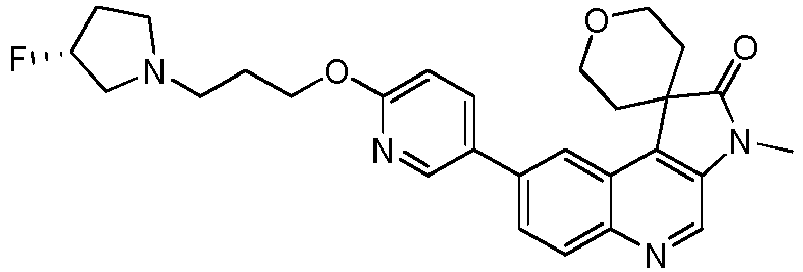
-

- Except for using the corresponding raw materials, the compound 4-C was prepared using the same method as in the preparation of compound 3-C in Example 3.
MS m/z: 147.9[M+H] +
1H NMR (400 MHz, CD3OD) δ 5.30 - 5.08 (m, 1 H), 3.64 (t, J= 6.28 Hz, 2 H), 3.04 - 2.89 (m, 2 H), 2.62 (ddd, J = 9.66, 5.52, 2.38 Hz, 3 H), 2.42 (td, J = 8.16, 7.03 Hz, 1 H), 2.29 -1.94(m, 2 H), 1.83 - 1.70 (m, 2 H) - Except for using the corresponding raw materials, the compound 4 was prepared using the same method as in the preparation of compound 1 in Example 1.
MS m/z: 491.3[M+H]+ - ee: 100%, retention time = 1.952 min (column type: Chiralpak AD-3 50 × 3 mm I.D., 3 µm; mobile phase: A: CO2, B: ethanol (0.05% diethylamine); gradient: 5%-40% B, 2.5 minutes 40%-40% B, 0.35 minutes; 40%-5% B, 0.15 minutes; flow rate: 2.5 mL/min; column temperature: 40 °C)
1H NMR (400 MHz, CDCl3) δ 8.71 (s, 1H), 8.51 (d, J = 2.3 Hz, 1H), 8.21 (d, J = 8.8 Hz, 1H), 8.16 (s, 1H), 7.93 (dd, J= 2.4, 8.7 Hz, 1H), 7.83 - 7.77 (m, 1H), 6.89 (d, J= 8.8 Hz, 1H), 5.28 - 5.08 (m, 1H), 4.54 - 4.42 (m, 4H), 3.99 (br dd, J= 4.6, 11.7 Hz, 2H), 3.40 (s, 3H), 2.98 - 2.85 (m, 2H), 2.84 - 2.66 (m, 5H), 2.53 - 2.43 (m, 1H), 2.26 - 1.97 (m, 4H), 1.71 (br s, 2H) -

-

- Except for using the corresponding raw materials, the compound 5-C was prepared using the same method as in the preparation of compound 3-C in Example 3.
1H NMR (400 MHz, CDCl3) δ 4.84 - 4.56 (m, 1H), 3.83 - 3.70 (m, 3H), 3.52 (t, J= 6.5 Hz, 1H), 2.64 - 2.57 (m, 3H), 2.10 - 04 (m, 1H), 1.93 - 1.87 (m, 2H), 1.87 - 1.81 (m, 2H), 1.74 - 1.68 (m, 2H) - Except for using the corresponding raw materials, the
compound 5 was prepared using the same method as in the preparation of compound 1 in Example 1.
MS m/z: 505.3[M+H] +
1H NMR (400 MHz, CDCl3) δ 8.71 (s, 1H), 8.51 (d, J = 2.3 Hz, 1H), 8.22 (d, J = 9.0 Hz, 1H), 8.16 (d, J= 1.5 Hz, 1H), 7.93 (dd, J= 2.5, 8.8 Hz, 1H), 7.80 (dd, J= 1.8, 8.8 Hz, 1H), 6.89 (d, J= 8.5 Hz, 1H), 4.80 - 4.59 (m, 1H), 4.49 (br t, J= 11.4 Hz, 2H), 4.43 (t, J= 6.5 Hz, 2H), 3.99 (dd, J = 4.9, 11.7 Hz, 2H), 3.40 (s, 3H), 2.76 (dt, J = 5.1, 13.5 Hz, 2H), 2.63 (br s, 2H), 2.56 (br t, J = 7.4 Hz, 2H), 2.42 (br s, 2H), 2.08 - 1.99 (m, 2H), 1.88 (br d, J = 4.5 Hz, 4H), 1.70 (br d, J= 14.1 Hz, 2H) -
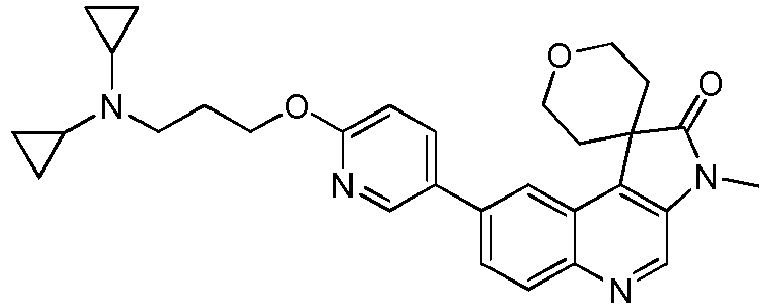
-

- Except for using the corresponding raw materials, the compound 6-C was prepared using the same method as in the preparation of compound 3-C in Example 3.
MS m/z: 155.9 [M+H] + - Except for using the corresponding raw materials, the compound 6 was prepared using the same method as in the preparation of compound 1 in Example 1.
MS m/z: 499.3 [M+H] +
1H NMR (400 MHz, CDCl3) δ 8.71 (s, 1H), 8.52 (d, J= 2.0 Hz, 1H), 8.22 (d, J= 8.8 Hz, 1H), 8.17 (d, J = 1.8 Hz, 1H), 7.93 (dd, J = 2.5, 8.5 Hz, 1H), 7.80 (dd, J = 1.9, 8.9 Hz, 1H), 6.90 (d, J = 8.5 Hz, 1H), 4.49 (br t, J = 11.2 Hz, 2H), 4.39 (t, J = 6.5 Hz, 2H), 3.99 (dd, J = 4.8, 11.5 Hz, 2H), 3.40 (s, 3H), 2.94 - 2.88 (m, 2H), 2.76 (dt, J = 5.0, 13.4 Hz, 2H), 2.18 - 2.10 (m, 2H), 1.94 - 1.87 (m, 2H), 1.70 (br d, J = 14.3 Hz, 2H), 0.50 - 0.39 (m, 8H) -

-

- Except for using the corresponding raw materials, the compound 7-A was prepared using the same method as in the preparation of compound 1-A in Example 1.
MS m/z: 443.0[M+H] +
1H NMR (400 MHz, CDCl3) δ 8.79 (s, 1H), 8.52 (d, J = 1.8 Hz, 1H), 8.05 (d, J = 9.0 Hz, 1H), 7.88 (dd, J = 1.9, 8.9 Hz, 1H), 4.14 (q, J = 7.2 Hz, 2H), 2.66 - 2.57 (m, 2H), 2.53 - 2.39 (m, 3H), 2.38 - 2.27 (m, 1H), 2.21 - 2.09 (m, 2H), 1.08 (t, J = 7.2 Hz, 3H) - Except for using the corresponding raw materials, the compound 7-B was prepared using the same method as in the preparation of compound 1-B in Example 1.
MS m/z: 366.8[M+H] +
1H NMR (400 MHz, CDCl3) δ 8.78 (s, 1H), 8.05 - 8.02 (m, 2H), 7.70 (dd, J = 2.0, 9.0 Hz, 1H), 2.92 - 2.80 (m, 1H), 2.78 - 2.65 (m, 3H), 2.17 (br s, 2H), 1.94 (br d, J = 12.3 Hz, 2H) - Except for using the corresponding raw materials, the compound 7-C was prepared using the same method as in the preparation of compound 1-C in Example 1.
1H NMR (400 MHz, CDCl3) δ 8.71 (s, 1H), 8.04 (d, J = 1.8 Hz, 1H), 8.01 (d, J = 9.0 Hz, 1H), 7.68 (dd, J = 1.8, 9.0 Hz, 1H), 3.38 (s, 3H), 2.94 - 2.75 (m, 2H), 2.74 - 2.63 (m, 2H), 2.15 (br s, 2H), 1.89 - 1.79 (m, 2H) - Except for using the corresponding raw materials, the compound 7-D was prepared using the same method as in the preparation of compound 1-D in Example 1.
MS m/z: 398.0[M+H] +
1H NMR (400 MHz, CDCl3) δ 8.75 (s, 1H), 8.56 (d, J = 2.5 Hz, 1H), 8.26 (d, J = 8.8 Hz, 1H), 8.10 (dt, J = 2.5, 8.0 Hz, 1H), 8.06 (d, J = 1.8 Hz, 1H), 7.82 (dd, J = 2.0, 8.8 Hz, 1H), 7.11 (dd, J = 2.9, 8.4 Hz, 1H), 3.41 (s, 3H), 2.95 - 2.73 (m, 4H), 2.15 (br d, J = 5.3 Hz, 2H), 1.90 (br d, J = 11.5 Hz, 2H) - Except for using the corresponding raw materials, the
compound 7 was prepared using the same method as in the preparation of compound 1 in Example 1.
MS m/z: 481.2[M+H] +
1H NMR (400 MHz, CDCl3) δ 8.70 (s, 1H), 8.50 (d, J = 2.3 Hz, 1H), 8.21 (d, J = 9.0 Hz, 1H), 8.02 (d, J = 1.8 Hz, 1H), 7.91 (dd, J = 2.6, 8.7 Hz, 1H), 7.81 (dd, J = 1.9, 8.9 Hz, 1H), 6.88 (d, J= 8.5 Hz, 1H), 4.43 (t, J= 6.4 Hz, 2H), 3.40 (s, 3H), 2.96 - 2.74 (m, 4H), 2.58 (br t, J= 7.5 Hz, 2H), 2.35 (s, 6H), 2.20 - 2.11 (m, 2H), 2.10 - 2.01 (m, 2H), 1.88 (br d, J= 9.8 Hz, 2H) -
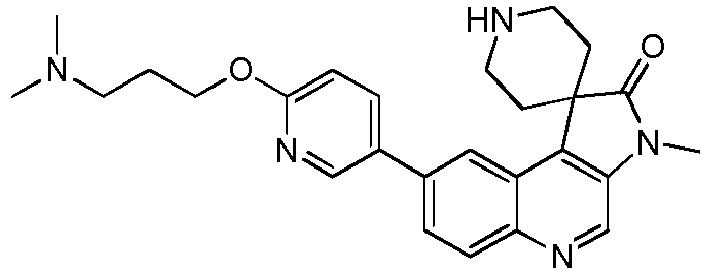
-

- Except for using the corresponding raw materials, the compound 8-A was prepared using the same method as in the preparation of compound 1-A in Example 1.
1H NMR (400 MHz, CDCl3) δ 8.74 (s, 1H), 8.46 (d, J= 1.8 Hz, 1H), 8.05 (d, J= 8.8 Hz, 1H), 7.88 (dd, J= 2.0, 9.0 Hz, 1H), 4.02 (br s, 2H), 3.66 (s, 3H), 3.36 - 3.22 (m, 2H), 2.53 (br s, 2H), 2.28 - 2.18 (m, 2H), 1.48 (s, 9H) - Except for using the corresponding raw materials, the compound 8-B was prepared using the same method as in the preparation of compound 1-B in Example 1.
MS: m/z: 432.0[M+H] +
1H NMR (400 MHz, CDCl3) δ 8.73 (s, 1H), 8.07 (s, 1H), 8.02 - 7.98 (m, 2H), 7.68 (dd, J = 2.0, 9.0 Hz, 1H), 4.30 - 4.01 (m, 2H), 3.78 - 3.72 (m, 2H), 2.49 (br s, 2H), 1.78 (br d, J = 13.8 Hz, 2H), 1.62 (s, 9H) - Except for using the corresponding raw materials, the compound 8-C was prepared using the same method as in the preparation of compound 1-C in Example 1.
MS m/z: 446.0[M+H] +
1H NMR (400 MHz, CDCl3) δ 8.71 (s, 1H), 8.03 - 7.99 (m, 2H), 7.67 (dd, J = 2.1, 9.2 Hz, 1H), 4.30 - 4.02 (m, 2H), 3.75 (br d, J = 6.8 Hz, 2H), 3.38 (s, 3H), 2.48 (br s, 2H), 1.69 (br d, J = 13.1 Hz, 2H), 1.57 (s, 9H) - Except for using the corresponding raw materials, the compound 8-D was prepared using the same method as in the preparation of compound 1-D in Example 1.
MS m/z: 463.2[M+H] +
1H NMR (400 MHz, CDCl3) δ 8.75 (s, 1H), 8.51 (d, J = 2.5 Hz, 1H), 8.25 (d, J = 8.8 Hz, 1H), 8.06 (dt, J = 2.6, 8.0 Hz, 1H), 7.97 (d, J = 1.8 Hz, 1H), 7.78 (dd, J = 1.8, 8.8 Hz, 1H), 7.06 (dd, J = 3.0, 8.5 Hz, 1H), 4.29 - 4.02 (m, 2H), 3.90 - 3.72 (m, 2H), 3.41 (s, 3H), 2.55 (br s, 2H), 1.76 (br d, J = 14.1 Hz, 2H), 1.50 (s, 9H) - Except for using the corresponding raw materials, the compound 8-E was prepared using the same method as in the preparation of compound 1 in Example 1.
1H NMR (400 MHz, CDCl3) δ 8.70 (s, 1H), 8.45 (d, J = 2.3 Hz, 1H), 8.20 (d, J = 8.8 Hz, 1H), 7.96 (d, J = 1.5 Hz, 1H), 7.86 (dd, J = 2.5, 8.5 Hz, 1H), 7.78 (dd, J = 1.9, 8.9 Hz, 1H), 6.84 (d, J= 8.5 Hz, 1H), 4.41 (t, J= 6.5 Hz, 2H), 3.81 - 3.77 (m, 2H), 3.39 (s, 3H), 2.57 - 2.52 (m, 2H), 2.50 - 2.45 (m, 2H), 2.28 (s, 6H), 2.03 - 1.96 (m, 2H), 1.74 (br d, J= 13.6 Hz, 2H), 1.71 - 1.65 (m, 2H), 1.51 (s, 9H) - Trifluoroacetic acid (1 mL) was added to 8-E (100 mg, 183.26 µmol). The reaction solution was stirred at 20 °C for 1 h. Trifluoroacetic acid was removed under reduced pressure to obtain a crude, which was separated by preparative chromatography (acid, mobile phase: acetonitrile -water). Then ammonia water was added to adjust pH = 8. The crude product was obtained by concentration under reduced pressure, and purified by column chromatography (0 to 10% MeOH/DCM) to obtain compound 8.
MS m/z: 446.2[M+H] +
1H NMR (400 MHz, CDCl3) δ 8.69 (s, 1H), 8.51 (d, J= 2.5 Hz, 1H), 8.22 (d, J= 1.5 Hz, 1H), 8.20 (d, J= 8.9 Hz, 1H), 7.93 (dd, J= 2.6, 8.6 Hz, 1H), 7.77 (dd, J= 1.7, 8.8 Hz, 1H), 6.88 (d, J= 8.6 Hz, 1H), 4.42 (t, J= 6.5 Hz, 2H), 3.74 - 3.65 (m, 2H), 3.38 (s, 3H), 3.04 (br dd, J= 3.4, 12.3 Hz, 2H), 2.59 (dt, J= 4.6, 13.3 Hz, 2H), 2.50 - 2.45 (m, 2H), 2.27 (s, 6H), 2.04 - 1.96 (m, 2H), 1.75 (br d, J = 14.0 Hz, 2H) -

-

- Aqueous formaldehyde solution (127.51 mg, 1.57 mmol, 116.98 µL, 37% purity) was added to a solution of compound 8 (70 mg, 157.11 µmol) in formic acid (3 mL), and the reaction solution was stirred at 60 °C for 23 h. After completion of the reaction, a crude product was obtained by concentration under reduced pressure. 20 ml of ammonia water was added, and a crude product was obtained by concentration under reduced pressure. The crude product was purified by column chromatography (0 to 6% MeOH/DCM) and then purified by preparative chromatography (neutral, mobile phase: acetonitrile-water) to obtain compound 9.
MS m/z: 460.3 [M+H] +
1H NMR (400 MHz, CDCl3) δ 8.67 (s, 1H), 8.52 (br s, 1H), 8.26 (br s, 1H), 8.19 (br d, J = 8.8 Hz, 1H), 7.96 (br d, J = 7.8 Hz, 1H), 7.76 (br d, J = 8.5 Hz, 1H), 6.87 (br d, J = 8.5 Hz, 1H), 4.41 (br t, J = 6.1 Hz, 2H), 3.37 (s, 3H), 3.10 - 2.98 (m, 2H), 2.79 (br d, J = 8.8 Hz, 4H), 2.51 - 2.45 (m, 2H), 2.27 (s, 9H), 2.05 - 1.94 (m, 2H), 1.76 (br d, J = 12.8 Hz, 2H) -

-
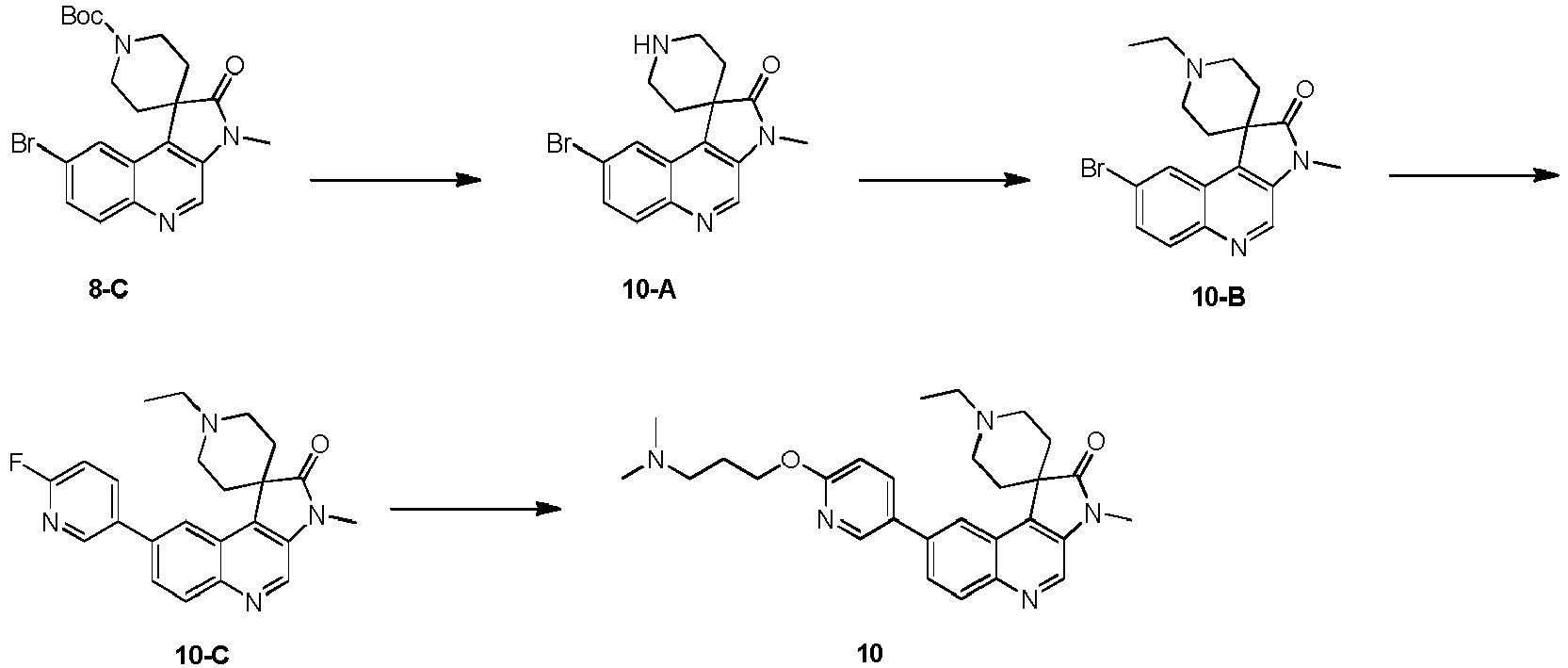
- Trifluoroacetic acid (3 mL) was added to compound 8-C (900 mg, 2.02 mmol), and the reaction solution was stirred at 20 °C for 0.5 h. After completion of the reaction, a crude product was obtained by concentration under reduced pressure. Ammonia water was added to adjust pH = 9. Extraction with dichloromethane (90 mL, 30 mL ∗ 3) was performed, and the organic phase was concentrated under reduced pressure to obtain a crude product 10-A, which was directly used in the next step.
MS m/z: 346.1[M+H] +
1H NMR (400 MHz, CDCl3) δ 8.72 (s, 1H), 8.41 (d, J= 2.0 Hz, 1H), 7.99 (d, J= 9.0 Hz, 1H), 7.69 (dd, J = 2.0, 9.0 Hz, 1H), 3.97 - 3.88 (m, 2H), 3.39 (s, 3H), 3.35 (br d, J = 3.0 Hz, 2H), 2.94 - 2.86 (m, 2H), 1.84 (br d, J = 14.6 Hz, 2H) - At 20 °C and under nitrogen protection, K2CO3 (1.20 g, 8.67 mmol) was added to a solution of compound 10-A (1 g, 2.89 mmol) and ethyl bromide (629.82 mg, 5.78 mmol, 431.38 µL) in acetonitrile (20 mL). The reaction solution was stirred at 60 °C for 1 h. The reaction was quenched by adding water (5 mL) at 20°C, then diluted with water (20 mL), extracted with EtOAc (90 mL, 30 mL ∗ 3). The organic phase was combined, washed with saturated sodium chloride (90 mL, 30 mL ∗ 3), dried over anhydrous sodium sulfate, filtered, and concentrated. The crude product was subjected to column chromatography (0 to 5% MeOH/DCM) to obtain compound 10-B.
MS m/z: 373.9[M+H] +
1H NMR (400 MHz, DMSO-d 6) δ 8.94 (s, 1H), 8.15 (d, J= 1.8 Hz, 1H), 8.03 (d, J= 9.0 Hz, 1H), 7.76 (dd, J= 2.3, 9.0 Hz, 1H), 3.30 (s, 3H), 2.92 - 2.75 (m, 4H), 2.56 - 2.53 (m, 1H), 2.48 - 2.39 (m, 3H), 1.80 - 1.64 (m, 2H), 1.14 - 1.08 (m, 3H) - Under nitrogen protection, an aqueous solution of compound 10-B (400 mg, 1.07 mmol), 2-fluoropyridine-5-boracic acid (301.19 mg, 2.14 mmol), Na2CO3 (226.55 mg, 2.14 mmol) and Pd(PPh3)4 (123.50 mg, 106.87 µmol) in dioxane (18 mL) and H2O (2 mL) was stirred at 100 °C for 4 h. The reaction solvent was removed by concentration, and the crude product was subjected to column chromatography (0 to 5% MeOH/DCM) to obtain compound 10-C.
MS m/z: 391.1[M+H] + - At 20 °C and under nitrogen protection, compound 10-C (200 mg, 512.23 µmol) was added to a solution of 3-dimethylamino-1-propanol (105.69 mg, 1.02 mmol, 119.82 µL) and NaH (81.96 mg, 2.05 mmol, 60% purity) in DMF (10 mL), and the reaction solution was stirred for 2 h at 70 °C. The reaction solution was quenched with water (2 mL) at 20 °C, diluted by adding water (10 mL), and extracted with EtOAc (10 mL ∗ 3). The organic phase was combined, washed with saturated sodium chloride (10 mL ∗ 3), dried over anhydrous sodium sulfate, filtered, and concentrated, and the crude product was subjected to column chromatography (0 to 5% MeOH/DCM) to obtain
compound 10.
MS m/z: 474.2[M+H] +
1H NMR (400 MHz, CDCl3) δ 8.67 (s, 1H), 8.51 (d, J = 2.3 Hz, 1H), 8.26 - 8.23 (m, 1H), 8.19 (d, J = 9.0 Hz, 1H), 7.98 - 7.89 (m, 1H), 7.80 - 7.71 (m, 1H), 6.88 (d, J = 8.8 Hz, 1H), 4.42 (t, J = 6.5 Hz, 2H), 3.37 (s, 3H), 3.03 (br s, 2H), 2.87 (br d, J = 11.5 Hz, 2H), 2.76 (br s, 2H), 2.62 (q, J = 7.1 Hz, 2H), 2.47 (s, 2H), 2.27 (s, 6H), 2.04 - 1.96 (m, 2H), 1.78 (br d, J = 13.8 Hz, 2H), 1.17 (t, J = 7.3 Hz, 3H) -

-

- Except for using the corresponding raw materials, the compound 11-C was prepared using the same method as in the preparation of compound 3-C in Example 3.
1H NMR (400 MHz, CDCl3) δ 5.96 - 5.45 (m, 1H), 3.78 - 3.70 (m, 2H), 2.51 (t, J = 5.6 Hz, 2H), 2.47 - 2.05 (m, 4H), 1.65 (quin, J = 5.5 Hz, 2H), 1.52 (quin, J = 5.5 Hz, 4H), 1.39 (br s, 2H) - Except for using the corresponding raw materials, the compound 11 was prepared using the same method as in the preparation of
compound 10 in Example 10.
MS m/z: 514.3[M+H]+
1H NMR (400 MHz, CDCl3) δ 8.67 (s, 1H), 8.53 (d, J = 2.5 Hz, 1H), 8.30 (d, J = 1.3 Hz, 1H), 8.19 (d, J = 8.8 Hz, 1H), 7.97 (dd, J = 2.5, 8.8 Hz, 1H), 7.77 (dd, J = 1.8, 8.8 Hz, 1H), 6.87 (d, J = 8.5 Hz, 1H), 4.40 (t, J = 6.5 Hz, 2H), 3.37 (s, 3H), 3.11 - 2.98 (m, 2H), 2.92 - 2.84 (m, 2H), 2.78 (br s, 2H), 2.62 (q, J = 7.1 Hz, 2H), 2.54 - 2.33 (m, 8H), 2.08 - 1.95 (m, 2H), 1.77 (br d, J = 13.8 Hz, 2H), 1.64 - 1.60 (m, 2H), 1.44 (br d, J = 4.8 Hz, 2H), 1.17 (t, J = 7.2 Hz, 3H) -

-

- Except for using the corresponding raw materials, the compound 12-A was prepared using the same method as in the preparation of compound 10-B in Example 10.
MS m/z: 410.4 [M+H] +
1H NMR (400 MHz, CDCl3) δ 8.69 (s, 1H), 8.25 (d, J = 1.8 Hz, 1H), 8.00 (d, J = 9.0 Hz, 1H), 7.67 (dd, J = 2.0, 9.0 Hz, 1H), 6.21 - 5.85 (m, 1H), 3.36 (s, 3H), 3.33 - 3.25 (m, 2H), 3.00 - 2.87 (m, 4H), 2.65 (dt, J = 4.6, 13.4 Hz, 2H), 1.73 (br d, J = 14.6 Hz, 2H) - Except for using the corresponding raw materials, the compound 12-B was prepared using the same method as in the preparation of compound 10-C in Example 10.
MS m/z: 427.2[M+H]+ - Except for using the corresponding raw materials, the compound 12 was prepared using the same method as in the preparation of
compound 10 in Example 10.
MS m/z: 510.4 [M+H] +
1H NMR (400 MHz, CDCl3) δ 8.69 (s, 1H), 8.53 (d, J= 2.3 Hz, 1H), 8.24 - 8.16 (m, 2H), 7.93 (dd, J = 2.5, 8.5 Hz, 1H), 7.78 (dd, J = 2.0, 8.8 Hz, 1H), 6.90 (d, J = 8.5 Hz, 1H), 6.20 - 5.81 (m, 1H), 4.43 (t, J = 6.5 Hz, 2H), 3.38 (s, 3H), 3.31 (brt, J = 11.0 Hz, 2H), 3.00 - 2.93 (m, 1H), 2.92 - 2.81 (m, 3H), 2.75 (dt, J= 4.8, 13.3 Hz, 2H), 2.52 - 2.46 (m, 2H), 2.29 (s, 6H), 2.07 - 1.96 (m, 2H), 1.77 (br d, J = 14.3 Hz, 2H). -

-
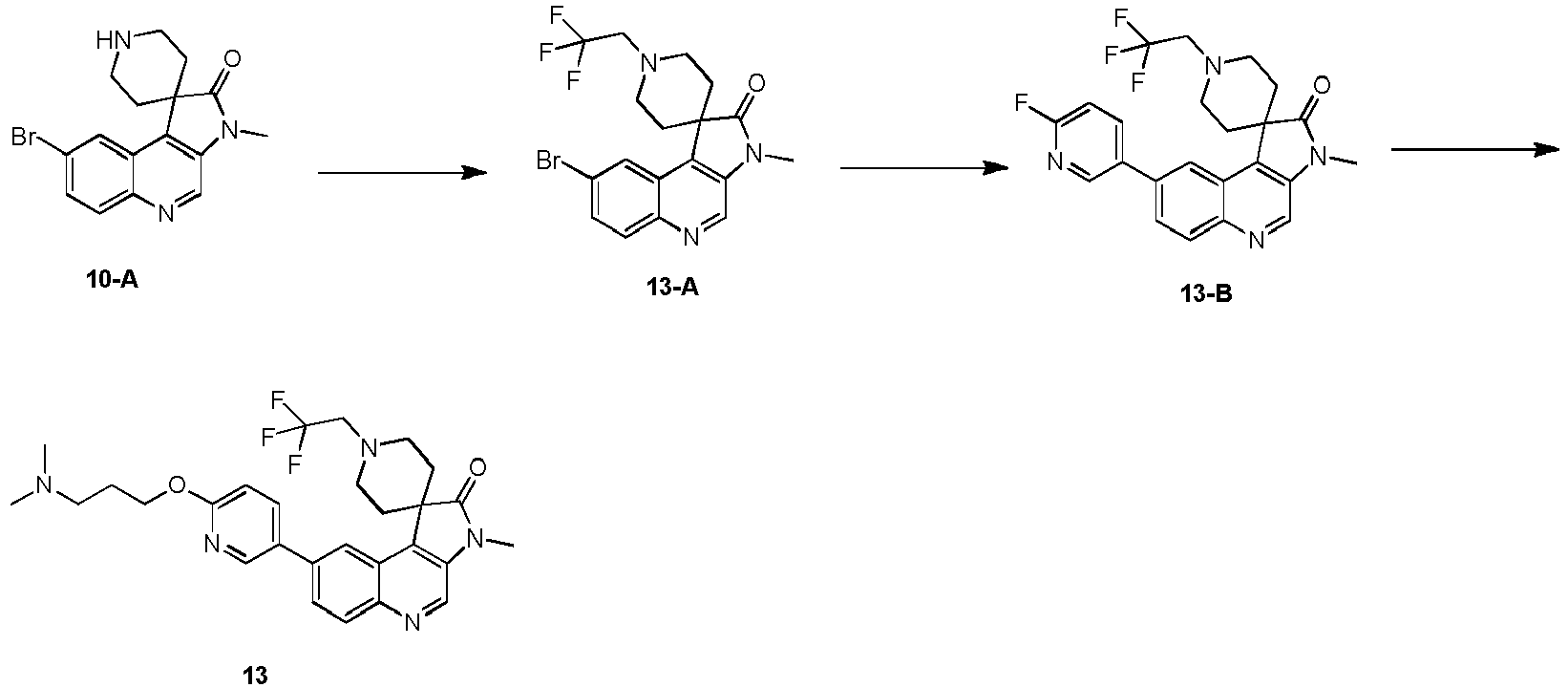
- Except for using the corresponding raw materials, the compound 13-A was prepared using the same method as in the preparation of compound 10-B in Example 10.
MS m/z: 428.1[M+H]+ - Except for using the corresponding raw materials, the compound 13-B was prepared using the same method as in the preparation of compound 10-C in Example 10.
- 1H NMR (400 MHz, CDCl3) δ 8.73 (s, 1H), 8.58 (d, J = 2.3 Hz, 1H), 8.27 - 8.22 (m, 2H), 8.13 (dt, J = 2.6, 8.0 Hz, 1H), 7.79 (dd, J = 1.8, 9.0 Hz, 1H), 7.11 (dd, J = 2.9, 8.4 Hz, 1H), 3.50 - 3.41 (m, 2H), 3.39 (s, 3H), 3.17 (q, J = 9.5 Hz, 2H), 2.94 (br dd, J = 3.9, 10.9 Hz, 2H), 2.76 (dt, J = 4.8, 13.3 Hz, 2H), 1.80 (br s, 2H).
- Except for using the corresponding raw materials, the compound 13 was prepared using the same method as in the preparation of
compound 10 in Example 10.
MS m/z: 528.3 [M+H]+
1H NMR (400 MHz, CDCl3) δ 8.68 (s, 1H), 8.53 (d, J = 2.3 Hz, 1H), 8.23 - 8.18 (m, 2H), 7.94 (dd, J = 2.5, 8.8 Hz, 1H), 7.79 (dd, J = 1.6, 8.9 Hz, 1H), 6.90 (d, J = 8.5 Hz, 1H), 4.43 (t, J = 6.4 Hz, 2H), 3.46 (br t, J = 11.2 Hz, 2H), 3.38 (s, 3H), 3.17 (q, J = 9.7 Hz, 2H), 2.92 (br d, J = 11.0 Hz, 2H), 2.78 (dt, J = 4.5, 13.3 Hz, 2H), 2.53 - 2.46 (m, 2H), 2.28 (s, 6H), 2.06 - 1.96 (m, 2H), 1.77 (br s, 2H) -

-
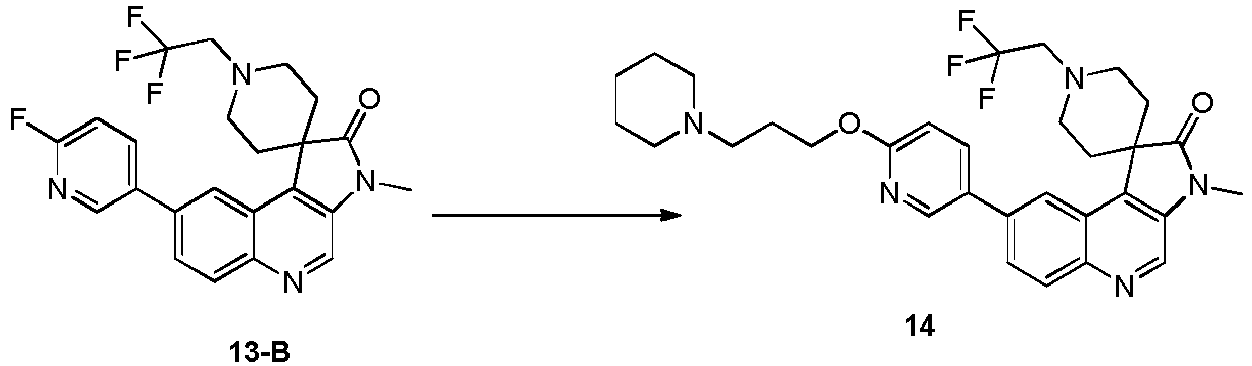
- Except for using the corresponding raw materials, the
compound 14 was prepared using the same method as in the preparation ofcompound 10 in Example 10.
MS m/z: 568.3 [M+H] +
1H NMR (400 MHz, CDCl3) δ 8.69 (s, 1H), 8.53 (d, J= 2.5 Hz, 1H), 8.24 - 8.18 (m, 2H), 7.94 (dd, J = 2.5, 8.5 Hz, 1H), 7.79 (dd, J = 1.6, 8.9 Hz, 1H), 6.89 (d, J = 8.5 Hz, 1H), 4.42 (t, J = 6.4 Hz, 2H), 3.46 (br t, J = 11.2 Hz, 2H), 3.38 (s, 3H), 3.17 (q, J = 9.5 Hz, 2H), 2.92 (br d, J = 11.3 Hz, 2H), 2.77 (dt, J = 4.6, 13.4 Hz, 2H), 2.58 - 2.51 (m, 2H), 2.46 (br s, 2H), 2.10 - 2.00 (m, 2H), 1.77 (br d, J= 14.1 Hz, 2H), 1.63 (br s, 6H), 1.46 (br s, 2H). -

-

- Except for using the corresponding raw materials, the compound 15-A was prepared using the same method as in the preparation of compound 10-B in Example 10.
MS m/z: 388.1 [M+H]+
1H NMR (400 MHz, DMSO-d 6) δ 8.94 (s, 1H), 8.22 - 8.14 (m, 1H), 8.03 (d, J = 9.0 Hz, 1H), 7.76 (dd, J = 2.0, 9.0 Hz, 1H), 3.30 (s, 3H), 3.19 - 3.04 (m, 2H), 2.92 (br d, J = 8.3 Hz, 1H), 2.83 - 2.66 (m, 2H), 2.43 (br s, 2H), 1.82 - 1.68 (m, 2H), 1.11 (br d, J= 4.8 Hz, 6H) - Except for using the corresponding raw materials, the compound 15-B was prepared using the same method as in the preparation of compound 10-C in Example 10.
MS m/z: 405.0[M+H]+
1H NMR (400 MHz, CDCl3) δ 8.64 (s, 1H), 8.53 (d, J = 2.0 Hz, 1H), 8.39 (s, 1H), 8.15 (d, J = 8.8 Hz, 2H), 7.70 (dd, J = 1.8, 8.8 Hz, 1H), 6.98 (dd, J = 2.8, 8.5 Hz, 1H), 3.31 (s, 3H), 3.28 - 3.17 (m, 2H), 2.87 (br s, 1H), 2.83 - 2.67 (m, 4H), 1.81 - 1.67 (m, 2H), 1.09 (br d, J = 6.0 Hz, 6H) - Except for using the corresponding raw materials, the
compound 15 was prepared using the same method as in the preparation ofcompound 10 in Example 10.
MS m/z: 488.4[M+H]+
1H NMR (400 MHz, CDCl3) δ 8.70 (s, 1H), 8.56 (d, J = 2.3 Hz, 1H), 8.37 (s, 1H), 8.21 (d, J = 8.8 Hz, 1H), 8.03 (br d, J = 6.8 Hz, 1H), 7.85 - 7.76 (m, 1H), 6.91 (d, J = 8.5 Hz, 1H), 4.44 (s, 2H), 3.39 (s, 3H), 3.37 - 3.26 (m, 2H), 2.97 (br s, 1H), 2.81 (br s, 4H), 2.49 (s, 2H), 2.29 (s, 6H), 2.07 - 1.98 (m, 2H), 1.87 - 1.75 (m, 2H), 1.19 (br d, J = 6.5 Hz, 6H) -

-

- Except for using the corresponding raw materials, the compound 16 was prepared using the same method as in the preparation of
compound 10 in Example 10.
MS m/z: 528.2[M+H]+
1H NMR (400 MHz, CDCl3) δ 8.61 (s, 1H), 8.48 (d, J= 2.4 Hz, 1H), 8.29 (br s, 1H), 8.13 (d, J = 8.9 Hz, 1H), 7.94 (br s, 1H), 7.71 (br d, J = 8.8 Hz, 1H), 6.81 (d, J = 8.6 Hz, 1H), 4.33 (s, 2H), 3.31 (s, 3H), 3.28 - 3.16 (m, 2H), 2.89 (br s, 1H), 2.73 (br s, 4H), 2.43 (br d, J = 7.9 Hz, 2H), 2.36 (br s, 4H), 2.05 (br s, 2H), 1.99 - 1.93 (m, 2H), 1.72 (br d, J = 12.8 Hz, 2H), 1.58 - 1.54 (m, 2H), 1.38 (br d, J = 3.8 Hz, 2H), 1.11 (brd, J = 6.1 Hz, 6H) -

-

- Compound 10-A (150 mg, 433.25 µmol) was dissolved in dichloromethane (10 mL), N,N-diisopropylethylamine (111.99 mg, 866.50 µmol, 150.93 µL) was added, and acetylchloride (51.01 mg, 649.87 µmol, 46.38 µL) was added at 0 °C under a nitrogen atmosphere. The mixed system was warmed to 30 °C, stirred for 2 h, and then concentrated to obtain a crude product, which was separated and purified by chromatography column (DCM/THF = 1/0 to 4/1) to obtain compound 17-A.
MS m/z: 388.1[M+H]+
1H NMR (400 MHz, CDCl3) δ 8.72 (s, 1H), 8.01 (d, J = 9.3 Hz, 1H), 7.98 (d, J = 2.0 Hz, 1H), 7.68 (dd, J = 2.0, 9.0 Hz, 1H), 4.74 (br dd, J = 4.9, 13.7 Hz, 1H), 4.18 (dt, J = 2.8, 13.3 Hz, 1H), 3.84 (br dd, J = 4.6, 13.7 Hz, 1H), 3.60 (dt, J = 2.9, 13.2 Hz, 1H), 3.39 (s, 3H), 2.56 - 2.40 (m, 2H), 2.26 (s, 3H), 1.87 - 1.74 (m, 2H) - Compound 17-A (85 mg, 218.93 µmol) was dissolved in anhydrous dioxane (10 mL) and water (2 mL), 2-fluoropyridine-5-boracic acid (46.27 mg, 328.39 µmol) and sodium carbonate (69.61 mg, 656.78 µmol) were added, and tetrakistriphenylphosphine palladium (37.95 mg, 32.84 µmol) was added under a nitrogen atmosphere. The mixed system was stirred at 80 °C for 4 h, and then extracted with dichloromethane (150 mL, 50 mL * 3). The organic phase was collected, washed with saturated brine (50 mL), dried over anhydrous sodium sulfate, and concentrated to obtain a crude product, which was separated and purified by chromatography column (DCM : THF = 1/0 to 4/1) to obtain compound 17-B.
MS m/z: 405.6[M+H]+
1H NMR (400 MHz, CDCl3) δ 8.76 (s, 1H), 8.49 (d, J = 2.5 Hz, 1H), 8.26 (d, J = 8.8 Hz, 1H), 8.09 - 8.01 (m, 1H), 7.92 (d, J = 1.8 Hz, 1H), 7.78 (dd, J = 2.0, 8.8 Hz, 1H), 7.12 (dd, J = 2.9, 8.4 Hz, 1H), 4.71 (br d, J = 8.5 Hz, 1H), 4.20 (dt, J = 2.9, 13.2 Hz, 1H), 3.84 (br d, J = 9.3 Hz, 1H), 3.68 - 3.54 (m, 1H), 3.42 (s, 3H), 2.65 - 2.49 (m, 2H), 2.22 (s, 3H), 1.86 (br dd, J = 14.9, 18.9 Hz, 2H) - Sodium hydride (24.07 mg, 601.71 µmol, purity: 60%) was dissolved in N, N dimethylformamide (10 mL), and 3-dimethylamino-1-propanol (23.28 mg, 225.64 µmol, 26.39 µL) was added at 0 °C under a nitrogen atmosphere and stirred for 0.5 h, and then a solution of 17-B (70 mg, 150.43 µmol) in N, N dimethylformamide (5 mL) was added. The mixed system was raised to room temperature (25 °C) and stirred for 4 h, and then quenched by adding water (20 mL). The mixed system was dispersed into 100 mL of water, and extracted with dichloromethane (150 mL, 50 mL * 3). The organic phase was collected, washed with saturated brine (50 mL), dried over anhydrous sodium sulfate, and concentrated to obtain a crude product, which was separated and purified by preparative high performance liquid chromatography (neutral, mobile phase: acetonitrile-water) to obtain compound 17.
MS m/z: 488.4[M+H] +
1H NMR (400 MHz, CDCl3) δ 8.72 (s, 1H), 8.44 (d, J= 2.0 Hz, 1H), 8.22 (d, J= 8.8 Hz, 1H), 7.90 (d, J = 1.5 Hz, 1H), 7.85 (dd, J = 2.5, 8.5 Hz, 1H), 7.79 (dd, J = 1.9, 8.9 Hz, 1H), 6.90 (d, J = 8.8 Hz, 1H), 4.71 (br d, J = 10.0 Hz, 1H), 4.43 (t, J = 6.4 Hz, 2H), 4.24 - 4.13 (m, 1H), 3.83 (br d, J= 13.8 Hz, 1H), 3.68 - 3.57 (m, 1H), 3.41 (s, 3H), 2.65 - 2.52 (m, 2H), 2.52 - 2.43 (m, 2H), 2.28 (s, 6H), 2.23 (s, 3H), 2.05 - 1.96 (m, 2H), 1.85 (br t, J = 14.2 Hz, 2H) -

-

- Except for using the corresponding raw materials, the compound 18-A was prepared using the same method as in the preparation of compound 17-A in Example 17.
MS m/z: 414.1[M+H]+ - Except for using the corresponding raw materials, the compound 18-B was prepared using the same method as in the preparation of compound 17-B in Example 17.
MS m/z: 431,2[M+H]+
1H NMR (400 MHz, CDCl3) δ 8.76 (s, 1H), 8.50 (d, J = 2.5 Hz, 1H), 8.26 (d, J = 9.0 Hz, 1H), 8.05 (dt, J = 2.6, 8.0 Hz, 1H), 7.93 (d, J = 1.5 Hz, 1H), 7.79 (dd, J = 1.9, 8.9 Hz, 1H), 7.11 (dd, J = 2.8, 8.5 Hz, 1H), 4.67 (br d, J = 12.5 Hz, 1H), 4.26 (br d, J = 7.5 Hz, 2H), 3.67 (br t, J = 12.8 Hz, 1H), 3.42 (s, 3H), 2.59 (br d, J = 12.3 Hz, 2H), 1.95 - 1.85 (m, 2H), 1.79 (br d, J = 13.1 Hz, 1H), 1.12 (br s, 1H), 1.00 (br s, 1H), 0.83 (dd, J = 3.6, 7.9 Hz, 2H) - Except for using the corresponding raw materials, the compound 18 was prepared using the same method as in the preparation of compound 17 in Example 17.
MS m/z: 514.4[M+H]+
1H NMR (400 MHz, CDCl3) δ 8.72 (s, 1H), 8.45 (d, J= 2.3 Hz, 1H), 8.21 (d, J = 8.8 Hz, 1H), 7.91 (d, J = 1.8 Hz, 1H), 7.86 (dd, J = 2.5, 8.5 Hz, 1H), 7.80 (dd, J = 1.8, 8.8 Hz, 1H), 6.88 (d, J = 8.3 Hz, 1H), 4.67 (br d, J = 11.0 Hz, 1H), 4.43 (t, J = 6.4 Hz, 2H), 4.25 (br d, J = 8.3 Hz, 2H), 3.67 (br t, J = 12.3 Hz, 1H), 3.41 (s, 3H), 2.71 - 2.52 (m, 4H), 2.34 (s, 6H), 2.09 - 2.05 (m, 1H), 2.04 - 2.00 (m, 1H), 1.95 - 1.83 (m, 3H), 1.16 - 1.01 (m, 2H), 0.89 - 0.79 (m, 2H) -

-

- Except for using the corresponding raw materials, the compound 19-A was prepared using the same method as in the preparation of compound 17-A in Example 17.
1H NMR (400 MHz, CDCl3) δ 8.71 (s, 1H), 8.03 -7.99 (m, 2H), 7.67 (dd, J = 2.0, 9.0 Hz, 1H), 4.35 - 4.09 (m, 2H), 3.82 (s, 3H), 3.38 (s, 3H), 2.57 - 2.44 (m, 2H), 1.74 (br d, J = 14.1 Hz, 2H), 1.04 (br s, 2H) - Except for using the corresponding raw materials, the compound 19-B was prepared using the same method as in the preparation of compound 17-B in Example 17.
MS m/z: 421.1[M+H]+
1H NMR (400 MHz, CDCl3) δ 8.75 (s, 1H), 8.51 (d, J = 2.0 Hz, 1H), 8.25 (d, J = 9.0 Hz, 1H), 8.07 (dt, J = 2.5, 7.9 Hz, 1H), 7.97 (s, 1H), 7.78 (dd, J = 1.8, 8.8 Hz, 1H), 7.11 (dd, J = 2.9, 8.4 Hz, 1H), 4.24 (br s, 2H), 3.83 (br s, 2H), 3.79 (s, 3H), 3.41 (s, 3H), 2.64 - 2.51 (m, 2H), 1.79 (br d, J = 14.1 Hz, 2H) - Except for using the corresponding raw materials, the compound 19 was prepared using the same method as in the preparation of compound 17 in Example 17.
MS m/z: 504.2[M+H]+
1H NMR (400 MHz, CDCl3) δ 8.71 (s, 1H), 8.46 (d, J = 2.3 Hz, 1H), 8.21 (d, J = 8.8 Hz, 1H), 7.94 (d, J = 1.5 Hz, 1H), 7.88 (dd, J = 2.5, 8.5 Hz, 1H), 7.78 (dd, J = 1.9, 8.9 Hz, 1H), 6.89 (d, J = 8.8 Hz, 1H), 4.42 (t, J = 6.4 Hz, 2H), 4.32 - 4.08 (m, 2H), 3.92 - 3.81 (m, 2H), 3.79 (s, 3H), 3.40 (s, 3H), 2.65 - 2.55 (m, 2H), 2.53 - 2.47 (m, 2H), 2.29 (s, 6H), 2.06 - 1.97 (m, 2H), 1.76 (br s, 2H) -

-

- Except for using the corresponding raw materials, the
compound 20 was prepared using the same method as in the preparation of compound 17 in Example 17.
MS m/z: 544.3 [M+H]+
1H NMR (400 MHz, CDCl3) δ 8.71 (s, 1H), 8.46 (s, 1H), 8.21 (d, J = 8.8 Hz, 1H), 7.94 (s, 1H), 7.87 (dd, J = 2.1, 8.7 Hz, 1H), 7.78 (br d, J = 9.0 Hz, 1H), 6.88 (d, J = 8.5 Hz, 1H), 4.41 (br t, J = 6.4 Hz, 2H), 4.33 - 4.07 (m, 2H), 3.94 - 3.81 (m, 2H), 3.79 (s, 3H), 3.40 (s, 3H), 2.66 - 2.37 (m, 8H), 2.10 - 1.98 (m, 2H), 1.78 (br d, J= 12.8 Hz, 6H), 1.45 (br s, 2H) -

-

- Except for using the corresponding raw materials, the compound 21-A was prepared using the same method as in the preparation of compound 17-A in Example 17.
MS m/z: 432.2[M+H]+ - Except for using the corresponding raw materials, the compound 21-B was prepared using the same method as in the preparation of compound 17-B in Example 17.
MS m/z: 449.2[M+H]+
1H NMR (400 MHz, CDCl3) δ 8.75 (s, 1H), 8.51 (d, J = 2.5 Hz, 1H), 8.25 (d, J = 8.8 Hz, 1H), 8.09 - 8.02 (m, 1H), 7.96 (d, J = 1.8 Hz, 1H), 7.78 (dd, J = 2.0, 8.8 Hz, 1H), 7.08 (dd, J = 2.9, 8.4 Hz, 1H), 5.02 (td, J = 6.3, 12.4 Hz, 1H), 4.15 (br s, 2H), 3.83 (br s, 2H), 3.41 (s, 3H), 2.57 (br s, 2H), 1.77 (br d, J = 14.1 Hz, 2H), 1.28 (d, J = 6.3 Hz, 6H) - Except for using the corresponding raw materials, the
compound 21 was prepared using the same method as in the preparation of compound 17 in Example 17.
MS m/z: 532.3 [M+H]+
1H NMR (400 MHz, CD3OD) δ 8.77 (s, 1H), 8.45 (d, J = 2.3 Hz, 1H), 8.12 (d, J = 8.8 Hz, 1H), 8.02 (dd, J= 2.5,8.8 Hz, 1H), 7.96(d, J = 1.5 Hz, 1H), 7.85 (dd, J = 1.8, 9.0 Hz, 1H), 6.92 (d, J= 8.8 Hz, 1H), 4.97 (td, J= 6.2, 12.5 Hz, 1H), 4.44 (t, J= 6.0 Hz, 2H), 4.12 (br dd, J= 3.5, 13.3 Hz, 2H), 3.84 - 3.71 (m, 2H), 3.38 (s, 3H), 3.13 - 3.06 (m, 2H), 2.74 (s, 6H), 2.60 - 2.49 (m, 2H), 2.23 - 2.13 (m, 2H), 1.73 (br d, J= 14.1 Hz, 2H), 1.27 (d, J= 6.3 Hz, 6H) -

-

- 1,2-dichloroethane (100 mL) was added to methyl 4-piperidinecarboxylate (10 g, 69.84 mmol), cyclopropylboronic acid (12.00 g, 139.68 mmol), pyridine (5.52 g, 69.84 mmol, 5.64 mL) and sodium carbonate (14.80 g, 139.68 mmol, 2 eq), replaced three times with oxygen, and stirred for 16 h at 70 °C under oxygen atmosphere. After completion of the reaction, the reaction was cooled 0 °C and quenched by adding 200 mL of water. Then 100 mL of ammonia water was added, and extracted with dichloromethane (150 mL, 50 mL * 3). The organic phase was combined, washed with saturated brine (200 mL), and dried over anhydrous sodium sulfate. After removing the desiccant by filtration, the solvent was removed under reduced pressure to obtain a crude product. The crude product was purified by column chromatography (0 to 10% EtOAc/PE) to obtain compound 22-B.
1H NMR (400 MHz, CDCl3) δ 3.66 (s, 3H), 3.03 - 2.95 (m, 2H), 2.29 (tt, J =4.0, 11.2 Hz, 1H), 2.20 (dt, J = 2.5, 11.5 Hz, 2H), 1.91 - 1.83 (m, 2H), 1.73 - 1.62 (m, 2H), 1.59 - 1.52 (m, 1H), 0.46 - 0.40 (m, 2H), 0.40 - 0.36 (m, 2H) - Except for using the corresponding raw materials, the compound 22-C was prepared using the same method as in the preparation of compound 1-A in Example 1.
MS m/z: 434.0[M+H]+
1H NMR (400 MHz, CDCl3) δ 8.75 (s, 1H), 8.68 (d, J = 1.8 Hz, 1H), 8.03 (d, J = 8.8 Hz, 1H), 7.86 (dd, J = 1.9, 8.9 Hz, 1H), 3.67 (s, 3H), 2.95 (br d, J = 12.3 Hz, 2H), 2.81 - 2.70 (m, 2H), 2.55 (br d, J = 13.1 Hz, 2H), 2.32 - 2.22 (m, 2H), 1.77 - 1.66 (m, 1H), 0.45 (br d, J = 7.0 Hz, 2H), 0.42 (br d, J = 4.3 Hz, 2H) - Compound 22-C (1.7 g, 3.91 mmol) was dissolved in THF (70 mL), a solution of NH4Cl (2.09 g, 39.14 mmol) in water (70 mL) was added, and then a zinc powder (2.56 g, 39.14 mmol) was added. The reaction solution was stirred at 70 °C for 24 h. After completion of the reaction, the zinc powder was removed, and the mixed solution was concentrated to obtain a crude product which was directly used in the next step.
MS m/z: 371.9[M+H]+ - A solution of sodium hydroxide (322.36 mg, 8.06 mmol) and tetrabutylammonium bromide (64.95 mg, 201.47 µmol) in water (20 mL) was added to a solution of 22-D (1.5 g, 4.03 mmol) in dichloromethane (40 mL). Then iodomethane (3.660 g, 25.79 mmol, 1.61 mL) was added dropwise, and the reaction solution was stirred at 20 °C for 48 h. After completion of the reaction, the reaction system was added with 50 mL of water at room temperature to quench the reaction, and extracted with dichloromethane (90 mL, 30 mL * 3). The organic phase was combined, washed with saturated brine (100 mL), and dried over anhydrous sodium sulfate. After removing the desiccant by filtration, a solvent was removed under reduced pressure to obtain a crude compound 22-E, which was directly used in the next step.
MS m/z: 386.1[M+H] + - Under nitrogen protection, 1,4-dioxane (20 mL) and H2O (20 mL) were added to a reaction system of compound 22-E (1 g, 2.53 mmol), 2-fluoropyridine-5-boracic acid (534.71 mg, 3.79 mmol), tetrakistriphenylphosphine palladium (292.34 mg, 252.98 µmol) and sodium carbonate (804.41 mg, 7.59 mmol), and stirred at 80 °C for 16 h. After completion of the reaction, a solvent was removed under reduced pressure to obtain a crude compound 22-F, which was directly used in the next step.
MS m/z: 403.1[M+H]+ - Except for using the corresponding raw materials, the compound 22 was prepared using the same method as in the preparation of compound 1 in Example 1.
MS m/z: 486.3[M+H]+
1H NMR (400 MHz, CDCl3) δ 8.68 (s, 1H), 8.51 (d, J = 2.0 Hz, 1H), 8.24 (s, 1H), 8.19 (d, J = 8.8 Hz, 1H), 7.94 (dd, J = 2.0, 8.5 Hz, 1H), 7.76 (br d, J = 8.8 Hz, 1H), 6.87 (d, J = 8.5 Hz, 1H), 4.41 (t, J = 6.4 Hz, 2H), 3.38 (s, 3H), 3.27 (br t, J = 11.4 Hz, 2H), 2.97 (br d, J = 9.5 Hz, 2H), 2.68 (dt, J = 4.4, 13.2 Hz, 2H), 2.47 (br t, J = 7.4 Hz, 2H), 2.27 (s, 6H), 1.98 (br s, 2H), 1.88 (br d, J = 4.3 Hz, 1H), 1.75 (br d, J = 13.8 Hz, 2H), 0.52 (br s, 4H) -

-

- Except for using the corresponding raw materials, the compound 23 was prepared using the same method as in the preparation of compound 1 in Example 1.
MS m/z: 526.3[M+H]+
1H NMR (400 MHz, CDCl3) δ 8.68 (s, 1H), 8.51 (d, J = 2.3 Hz, 1H), 8.24 (d, J= 1.5 Hz, 1H), 8.19 (d, J= 9.0 Hz, 1H), 7.94 (dd, J= 2.5, 8.5 Hz, 1H), 7.76 (dd, J= 1.8, 8.8 Hz, 1H), 6.87 (d, J= 8.5 Hz, 1H), 4.40 (t, J= 6.5 Hz, 2H), 3.38 (s, 3H), 3.32 - 3.22 (m, 2H), 3.01 - 2.93 (m, 2H), 2.68 (dt, J = 4.5, 13.3 Hz, 2H), 2.55 - 2.49 (m, 2H), 2.44 (br s, 2H), 2.08 - 1.97 (m, 6H), 1.91 - 1.86 (m, 1H), 1.75 (br d, J = 13.8 Hz, 2H), 1.65 - 1.62 (m, 1H), 1.60 - 1.58 (m, 1H), 1.45 (br s, 2H), 0.55 - 0.49 (m, 4H) -

-

- Sodium hydride (101.26 mg, 2.53 mmol, purity: 60%) was dissolved in N,N - dimethylformamide (10 mL), and a solution of compound 11-C (181.31 mg, 1.27 mmol) in N,N -dimethylformamide (5 mL) was added at 0 °C under a nitrogen atmosphere, and stirred for 0.5 h, and then a solution of 1-D (230 mg, 632.94 µmol) in N,N-dimethylformamide (5 mL) was added. The mixed system was raised to room temperature (25 °C), continuously stirred 2 h under a nitrogen atmosphere, then quenched by adding water (10 mL), and extracted with dichloromethane (150 mL, 50 mL * 3). The organic phase was collected, and the organic phase was concentrated to obtain a crude product, which was separated and purified by preparative high performance liquid chromatography ([water (10 mM ammonium bicarbonate)-acetonitrile]; acetonitrile B%: 28%-58%, 7 min) to obtain compound 24.
MS m/z: 487.3 [M+H]+
1H NMR (400 MHz, CDCl3) δ 8.69 (s, 1H), 8.50 (d, J= 2.0 Hz, 1H), 8.20 (d, J= 8.8 Hz, 1H), 8.15 (s, 1H), 7.91 (dd, J = 2.3, 8.5 Hz, 1H), 7.78 (br d, J= 8.0 Hz, 1H), 6.87 (d, J = 8.5 Hz, 1H), 4.54 - 4.34 (m, 4H), 3.97 (br dd, J= 4.8, 11.5 Hz, 2H), 3.38 (s, 3H), 2.74 (dt, J = 4.9, 13.2 Hz, 2H), 2.54 - 2.46 (m, 2H), 2.42 (br s, 2H), 2.12 (br s, 2H), 2.02 (td, J = 6.9, 14.3 Hz, 2H), 1.68 (br d, J= 13.8 Hz, 2H), 1.62 - 1.53 (m, 4H), 1.43 (br s, 2H) -

-

- Except for using the corresponding raw materials, the compound 25-A was prepared using the same method as in the preparation of compound 1-A in Example 1.
MS m/z: 465.0[M+H]+ - Except for using the corresponding raw materials, the compound 25-B was prepared using the same method as in the preparation of compound 1-B in Example 1.
MS m/z: 389.4[M+H]+ - Compound 25-B (3.2 g, 8.22 mmol) was dissolved in tetrahydrofuran (10 mL), and trifluoroacetic acid (15.40 g, 135.06 mmol, 10.00 mL) and water (10.00 g, 555.08 mmol, 10 mL) were added. The mixed system was stirred at room temperature (25 °C) for 12 h, then adjusted to achieve pH = 7 to 8 with sodium hydroxide (1 M), and extracted with EtOAc (200 mL, 100 mL * 2). The organic phase was collected, and concentrated to obtain a crude product, which was separated and purified by chromatography column (dichloromethane/tetrahydrofuran = 1/0 to 4/1) to obtain compound 25-C.
MS m/z: 345.1[M+H]+ - Except for using the corresponding raw materials, the compound 25-D was prepared using the same method as in the preparation of compound 1-C in Example 1.
MS m/z: 359.1[M+H]+ - Compound 25-D (0.367 g, 1.02 mmol) was dissolved in methanol (20 mL), and sodium borohydride (77.30 mg, 2.04 mmol) was added at 0 °C under a nitrogen atmosphere. The mixed system was raised to room temperature (20 °C), continuously stirred for 3 h, then quenched by adding water (20 mL), and extracted with dichloromethane/methanol = 10/1 (50 mL). The organic phase was collected, and concentrated to obtain a crude product, which was separated and purified by chromatography column (DCM/THF = 1/0 to 4/1) to obtain compound 25-E.
MS m/z: 360.9[M+H]+ - Sodium hydride (106.29 mg, 2.66 mmol, purity: 60%) was dissolved in tetrahydrofuran (10 mL), and a solution of 25-E (320 mg, 885.86 µmol) in tetrahydrofuran (10 mL) was added at 0 °C under a nitrogen atmosphere, and stirred at 0 °C for 0.5 h. Then iodomethane (502.95 mg, 3.54 mmol, 220.59 µL) was added under a nitrogen atmosphere. The mixed system was raised to room temperature (25 °C), and stirred for 2 h under a nitrogen atmosphere. The mixed solution was quenched by dispersing into 50 mL of water, extracted with dichloromethane (150 mL, 50 mL * 3), and washed with saturated brine (50 mL). The organic phase was collected, dried over anhydrous sodium sulfate, and separated and purified by chromatography column (dichloromethane/tetrahydrofuran = 1/0 to 10/1) to obtain compound 25-F.
MS m/z 375.1[M+H]+ - Except for using the corresponding raw materials, the compound 25-G was prepared using the same method as in the preparation of compound 1-D in Example 1.
MS m/z: 392.6[M+H]+ - Except for using the corresponding raw materials, the compound 25 was prepared using the same method as in the preparation of compound 1 in Example 1.
MS m/z: 475.2[M+H]+
1H NMR (400 MHz, CDCl3) δ 8.68 (s, 1H), 8.50 (d, J= 2.5 Hz, 1H), 8.20 (d, J= 8.8 Hz, 1H), 8.01 (s, 1H), 7.90 (dd, J = 2.5, 8.5 Hz, 1H), 7.76 (dd, J = 1.5, 8.8 Hz, 1H), 6.91 (d, J = 8.5 Hz, 1H), 4.43 (t, J = 6.4 Hz, 2H), 3.48 (s, 3H), 3.38 (s, 3H), 2.53 - 2.44 (m, 4H), 2.41 - 2.35 (m, 2H), 2.28 (s, 6H), 2.10 - 1.97 (m, 4H), 1.91 (br d, J= 13.8 Hz, 2H), 1.78 (br s, 2H) -

-

- Compound 25-C (1.05 g, 3.04 mmol) was dissolved in methanol (20 mL), and sodium borohydride (172.62 mg, 4.56 mmol) was added at 0 °C under a nitrogen atmosphere. The mixed system was raised to room temperature (20 °C), continuously stirred for 3 h, then quenched by adding water (20 mL), and extracted with dichloromethane (100 mL, 50 mL * 2). The organic phase was collected, and concentrated to obtain a crude product, which was separated and purified by chromatography column (dichloromethane/tetrahydrofuran = 1/0 to 4/1) to obtain compound 26-A.
MS m/z: 347.0[M+H]+ - Compound 26-A (840 mg, 2.42 mmol) was dissolved in dichloromethane (5 mL), a solution of sodium hydroxide (387.09 mg, 9.68 mmol) in water (5 mL), and tetrabutylammonium bromide (39.00 mg, 120.97 µmol) were added, and iodomethane (1.37 g, 9.68 mmol, 602.44 µL) was added at 0 °C under a nitrogen atmosphere. The mixed system was raised to room temperature (25 °C) and stirred for 3 h under a nitrogen atmosphere, and then the mixed solution was dispersed into 50 mL of water, and extracted with dichloromethane (100 mL, 50 mL * 2). The organic phase was collected and concentrated to obtain a crude product, which was separated and purified by chromatography column (dichloromethane/tetrahydrofuran = 1/0 to 5/1) to obtain 26-B.
MS m/z: 361.1[M+H]+ - Compound 26-B (260 mg, 719.76 µmol) was dissolved in N,N dimethylformamide (10 mL), and pyridine (56.93 mg, 719.76 µmol, 58.09 µL) and TBSOTf (190.26 mg, 719.76 µmol, 165.44 µL) were added, and stirred for 3 h at room temperature (25 °C), then washed by adding 300 mL (100 mL * 3) of water, and extracted with 150 mL (50 mL * 3) of dichloromethane. The organic phase was collected, and concentrated to obtain a crude product, which was separated and purified by column chromatography (dichloromethane/tetrahydrofuran = 1/0 to 10/1) to obtain 26-C.
MS m/z: 474.6[M+H]+ - Except for using the corresponding raw materials, the compound 26-D was prepared using the same method as in the preparation of compound 1-D in Example 1.
MS m/z: 492.3 [M+H]+
1H NMR (400 MHz, CDCl3) δ 8.72 (s, 1H), 8.55 (d, J = 2.3 Hz, 1H), 8.24 (d, J = 9.0 Hz, 1H), 8.12 - 8.05 (m, 1H), 8.03 (d, J = 1.8 Hz, 1H), 7.75 (dd, J = 2.0, 8.8 Hz, 1H), 7.12 (dd, J = 2.8, 8.5 Hz, 1H), 3.39 (s, 3H), 2.55 - 2.40 (m, 4H), 1.94 - 1.78 (m, 4H), 0.97 - 0.88 (m, 9H), 0.13 (s, 6H) - Except for using the corresponding raw materials, the compound 26 was prepared using the same method as in the preparation of compound 1 in Example 1.
MS m/z: 461.3 [M+H]+
1H NMR (400 MHz, CDCl3) δ 8.69 (s, 1H), 8.49 (d, J = 2.3 Hz, 1H), 8.21 (d, J = 8.8 Hz, 1H), 8.00 (d, J = 1.5 Hz, 1H), 7.89 (dd, J = 2.6, 8.7 Hz, 1H), 7.77 (dd, J = 1.8, 8.8 Hz, 1H), 6.90 (d, J = 8.5 Hz, 1H), 4.43 (t, J = 6.5 Hz, 2H), 3.99 - 3.89 (m, 1H), 3.39 (s, 3H), 2.58 - 2.36 (m, 6H), 2.28 (s, 6H), 2.06 - 1.96 (m, 4H), 1.89 (br d, J = 13.8 Hz, 2H) -

-
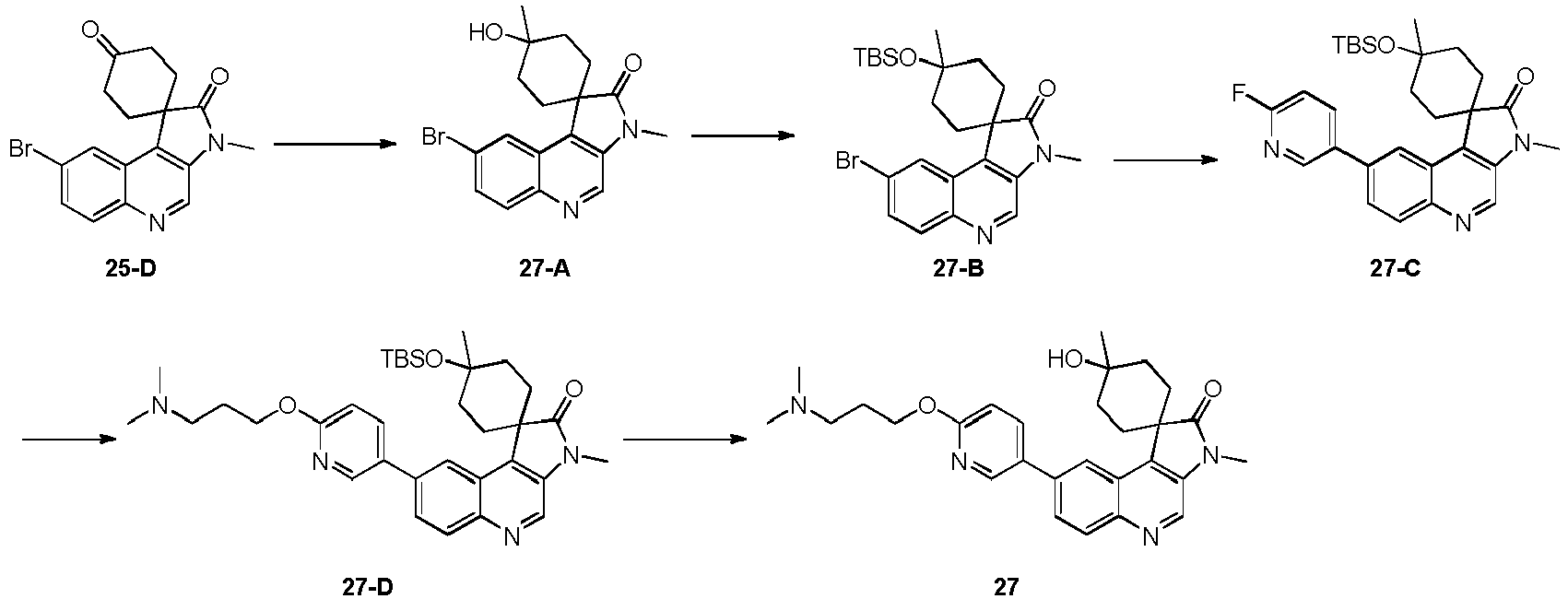
- Compound 25-D (900 mg, 2.51 mmol) was dissolved in tetrahydrofuran (20 mL) at 0 °C, and methyl magnesium bromide (4 M, 1.88 mL) was added dropwise under a nitrogen atmosphere. The mixed system was raised to 25 °C, and stirred for 2 h under a nitrogen atmosphere, and then the reaction system was quenched with water (50 mL), and extracted with dichloromethane/isopropanol = 10/1 (50 mL * 3). The organic phase was collected, separated and purified by chromatography column (DCM/tetrahydrofuran = 1/0 to 3/1) to obtain compound 27-A.
MS m/z: 375.0[M+H] + - Compound 27-A (380 mg, 1.01 mmol) was dissolved in dichloromethane (10 mL), and TBSOTf (401.52 mg, 1.52 mmol, 349.14 µL) and triethylamine (204.94 mg, 2.03 mmol, 281.89 µL) were added. The mixed system was stirred for 12 h at room temperature (25 °C), then washed by adding 300 mL (100 mL * 3) of water, and extracted with dichloromethane (150 mL, 50 mL * 3). The organic phase was collected, and concentrated to obtain a crude product, which was separated and purified by column chromatography (dichloromethane/tetrahydrofuran = 1/0 to 10/1) to obtain 27-B.
MS m/z: 489.3 [M+H]+
1H NMR (400 MHz, CDCl3) δ 8.68 (s, 1H), 8.10 (d, J= 2.0 Hz, 1H), 8.00 (d, J= 9.0 Hz, 1H), 7.66 (dd, J= 2.3, 9.0 Hz, 1H), 3.36 (s, 3H), 2.71 - 2.54 (m, 2H), 2.41 (dt, J= 3.8, 14.2 Hz, 2H), 1.80 - 1.65 (m, 4H), 1.56 (s, 3H), 0.91 (s, 9H), 0.22 - 0.13 (m, 6H) - Except for using the corresponding raw materials, the compound 27-C was prepared using the same method as in the preparation of compound 1-D in Example 1.
MS m/z: 506.8[M+H]+ - Except for using the corresponding raw materials, the compound 27-D was prepared using the same method as in the preparation of compound 1 in Example 1.
MS m/z: 589.6[M+H]+ - Compound 27-D (110 mg, 186.80 µmol) was dissolved in trifluoroacetic acid (21.30 mg, 186.80 µmol, 13.83 µL), stirred at 60 °C for 1 h, then adjusted with 1 M sodium hydroxide solution to pH = 7 to 8, extracted with dichloromethane (150 mL, 50 mL * 3), and washed with saturated brine (50 mL). The organic phase was collected, dried over anhydrous sodium sulfate, and concentrated to obtain a crude product, which was separated and purified by preparative high performance liquid chromatography (neutral, mobile phase: acetonitrile-water) to obtain compound 27.
MS m/z: 475.3 [M+H]+
1H NMR (400 MHz, CDCl3) δ 8.69 (s, 1H), 8.49 (d, J = 2.5 Hz, 1H), 8.22 (d, J = 8.8 Hz, 1H), 8.06 (d, J = 1.8 Hz, 1H), 7.89 (dd, J= 2.5, 8.5 Hz, 1H), 7.79 (dd, J= 2.0, 8.8 Hz, 1H), 6.89 (d, J = 8.5 Hz, 1H), 4.42 (t, J = 6.5 Hz, 2H), 3.39 (s, 3H), 2.57 (d, J = 9.0 Hz, 4H), 2.51 - 2.45 (m, 2H), 2.28 (s, 6H), 2.04 - 1.96 (m, 2H), 1.87 - 1.75 (m, 4H), 1.58 (s, 3H) -

-

- Except for using the corresponding raw materials, the compound 28-A was prepared using the same method as in the preparation of compound 1 in Example 1.
MS m/z: 629.6[M+H]+ - Except for using the corresponding raw materials, the
compound 28 was prepared using the same method as in the preparation of compound 27 in Example 27.
MS m/z: 515.4[M+H]+
1H NMR (400 MHz, CDCl3) δ 8.69 (s, 1H), 8.49 (d, J= 2.8 Hz, 1H), 8.22 (d, J= 8.8 Hz, 1H), 8.05 (d, J = 1.5 Hz, 1H), 7.89 (dd, J= 2.5, 8.5 Hz, 1H), 7.79 (dd, J= 2.0, 8.8 Hz, 1H), 6.89 (d, J= 8.5 Hz, 1H), 4.41 (t, J= 6.5 Hz, 2H), 3.39 (s, 3H), 2.57 (d, J= 9.3 Hz, 2H), 2.50 (br d, J= 8.0 Hz, 2H), 2.43 (br s, 2H), 2.09 - 1.97 (m, 2H), 1.84 (br d, J= 8.5 Hz, 2H), 1.78 (br d, J= 7.8 Hz, 2H), 1.59 (br s, 8H), 1.57 (br s, 3H), 1.45 (br s, 2H) -

-
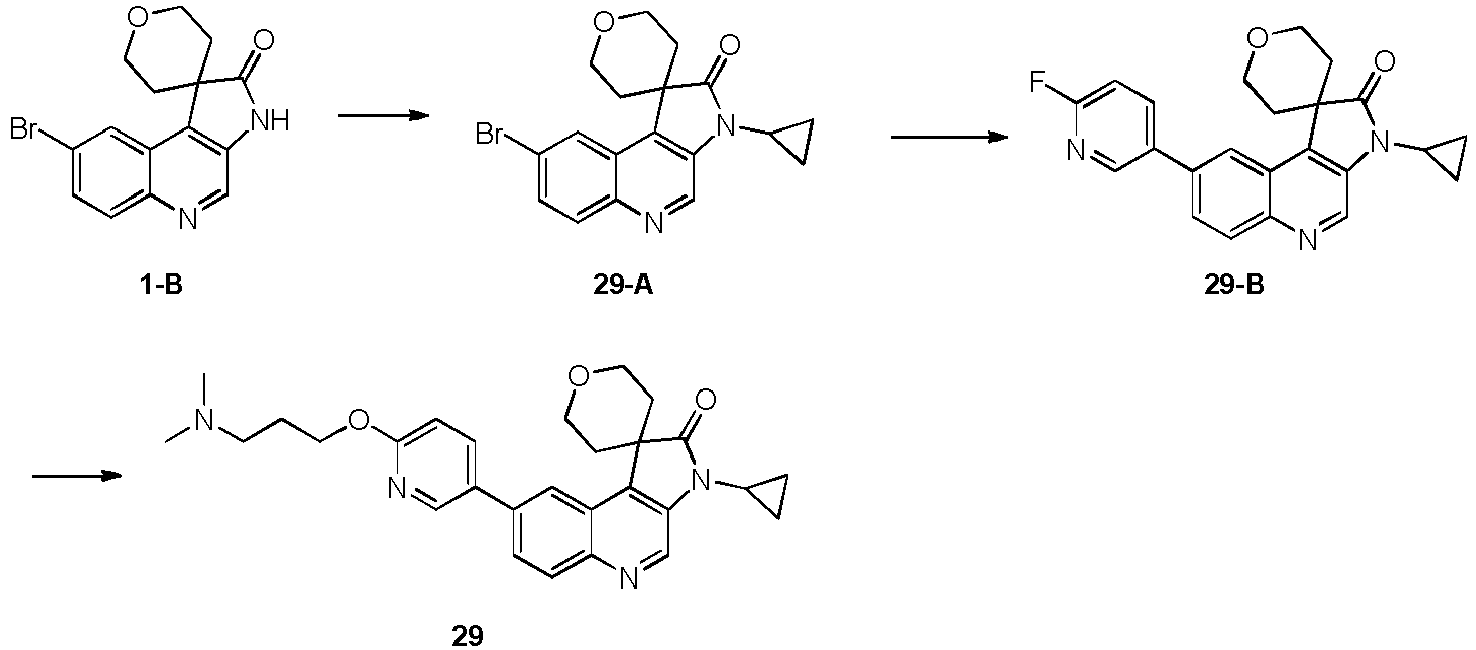
- Compound 1-B (200 mg, 600.28 µmol) was dissolved in anhydrous toluene (15 mL), and cyclopropylboronic acid (103.12 mg, 1.20 mmol), sodium carbonate (127.25 mg, 1.20 mmol), copper acetate (109.03 mg, 600.28 µmol) and pyridine (94.96 mg, 1.20 mmol, 96.90 µL) were added. The mixed system was stirred for 12 h at 70 °C, and then filtered. The filtrate was collected, and concentrated to obtain a crude product, which was separated and purified by chromatography column (dichloromethane/tetrahydrofuran = 1/0 to 10/1) to obtain compound 29-A.
MS m/z: 373.0[M+H]+
1H NMR (400 MHz, CDCl3) δ 8.95 (s, 1H), 8.22 (d, J= 1.5 Hz, 1H), 8.01 (d, J= 9.0 Hz, 1H), 7.67 (dd, J= 2.0, 9.0 Hz, 1H), 4.50 - 4.35 (m, 2H), 4.03 - 3.91 (m, 2H), 2.80 (tt, J = 3.6, 7.0 Hz, 1H), 2.64 (dt, J = 5.4, 13.5 Hz, 2H), 1.64 (s, 2H), 1.23 - 1.15 (m, 2H), 1.01 - 0.93 (m, 2H) - Except for using the corresponding raw materials, the compound 29-B was prepared using the same method as in the preparation of compound 1-D in Example 1.
MS m/z: 390.1 [M+H]+
1H NMR (400 MHz, CDCl3) δ 8.99 (s, 1H), 8.55 (d, J = 1.8 Hz, 1H), 8.26 (d, J = 8.8 Hz, 1H), 8.17 (d, J = 1.0 Hz, 1H), 8.11 (dt, J = 2.5, 7.9 Hz, 1H), 7.85 - 7.75 (m, 1H), 7.11 (dd, J = 2.9, 8.4 Hz, 1H), 4.47 (br t, J = 11.3 Hz, 2H), 3.98 (dd, J = 5.0, 11.8 Hz, 2H), 2.83 (tt, J = 3.7, 6.9 Hz, 1H), 2.71 (dt, J= 5.3, 13.4 Hz, 2H), 1.70 (br s, 2H), 1.28 - 1.16 (m, 2H), 1.05 - 0.90 (m, 2H) - Except for using the corresponding raw materials, the compound 29 was prepared using the same method as in the preparation of compound 1 in Example 1.
MS m/z: 473.3 [M+H]+
1H NMR (400 MHz, CDCl3) δ 8.95 (s, 1H), 8.50 (d, J = 2.5 Hz, 1H), 8.21 (d, J = 8.8 Hz, 1H), 8.15 (d, J = 1.8 Hz, 1H), 7.92 (dd, J= 2.5, 8.5 Hz, 1H), 7.79 (dd, J= 1.8, 8.8 Hz, 1H), 6.89 (d, J = 8.5 Hz, 1H), 4.51 - 4.42 (m, 4H), 3.97 (dd, J = 4.9, 11.7 Hz, 2H), 2.82 (td, J = 3.3, 6.9 Hz, 1H), 2.73 (dt, J= 5.3, 13.7 Hz, 2H), 2.64 (br s, 2H), 2.40 (s, 6H), 2.14 - 2.05 (m, 2H), 1.67 (br d, J= 14.1 Hz, 2H), 1.21 (q, J= 6.8 Hz, 2H), 1.02 - 0.96 (m, 2H) -

-

- Except for using the corresponding raw materials, the compound 30 was prepared using the same method as in the preparation of compound 1 in Example 1.
MS m/z: 513.2[M+H]+
1H NMR (400 MHz, CDCl3) δ 8.95 (s, 1H), 8.50 (d, J = 2.5 Hz, 1H), 8.21 (d, J = 9.0 Hz, 1H), 8.15 (d, J= 1.5 Hz, 1H), 7.92 (dd, J= 2.6,8.7 Hz, 1H), 7.79 (dd, J = 1.9, 8.9 Hz, 1H), 6.88 (d, J = 8.5 Hz, 1H), 4.51 - 4.39 (m, 4H), 3.97 (dd, J = 4.9, 11.7 Hz, 2H), 2.82 (tt, J = 3.5, 7.0 Hz, 1H), 2.73 (dt, J= 5.3, 13.4 Hz, 2H), 2.55 - 2.48 (m, 2H), 2.43 (br s, 2H), 2.12 - 1.98 (m, 2H), 1.68 (br s, 4H), 1.63 - 1.56 (m, 4H), 1.45 (br d, J= 5.3 Hz, 2H), 1.26 - 1.14 (m, 2H), 1.08 - 0.90 (m, 2H) -

-

- At 0 °C and under nitrogen protection, compound 31-A (5 g, 26.59 mmol) was added slowly to a solution of sodium hydride (1.60 g, 39.89 mmol, 60% purity) in THF (20 mL). The reaction solution was stirred at 25 °C for 0.5 h, and then a solution of iodomethane (5.66 g, 39.89 mmol, 2.48 mL) in THF (10 mL) was added slowly at 0 °C. The reaction solution was stirred at 20 °C for 12 h. At 20 °C, the reaction solution was quenched with water (20 mL), diluted by adding water (10 mL), and extracted with EtOAc (150 mL, 50 mL * 3). The organic phase was combined, washed with saturated sodium chloride (150 mL, 50 mL * 3), dried over anhydrous sodium sulfate, filtered, and concentrated to obtain a crude product, The residue was purified by column chromatography (0 to 10% EtOAc/PE) to obtain 31-B.
MS m/z: 201.8[M+H]+
1H NMR (400 MHz, CDCl3) δ 8.61 (d, J= 2.0 Hz, 1H), 7.82 (dd, J= 2.3, 8.5 Hz, 1H), 7.33 (d, J= 8.3 Hz, 1H), 4.53 (s, 2H), 3.47 (s, 3H) - Under nitrogen protection, a mixed solution of 31-B (4.8 g, 23.76 mmol), bis(pinacolato)diboron (6.64 g, 26.13 mmol), potassium acetate (6.99 g, 71.27 mmol) and Pd(dppf)Cl2 (1.74 g, 2.38 mmol) in dioxane (40 mL) and water (8 mL) was stirred at 100 °C for 12 h. The reaction solution was filtered, and the filtrate was concentrated to obtain a residue, which was separated and purified by preparative thin-layer chromatography silica gel plate to obtain compound 31-C.
MS m/z: 167.9[M+H]+
1H NMR (400 MHz, DMSO-d6) δ 8.88 (s, 1H), 8.49 (d, J= 7.8 Hz, 1H), 7.73 (d, J = 7.8 Hz, 1H), 4.69 (s, 2H), 3.42 (s, 3H). - Except for using the corresponding raw materials, the compound 31 was prepared using the same method as in the preparation of compound 1-D in Example 1.
MS m/z: 390.3 [M+H]+
1H NMR (400 MHz, CDCl3) δ 8.92 (d, J = 2.0 Hz, 1H), 8.74 (s, 1H), 8.28 - 8.19 (m, 2H), 8.03 (dd, J = 2.3, 8.0 Hz, 1H), 7.84 (dd, J = 2.0, 8.8 Hz, 1H), 7.59 (d, J = 8.0 Hz, 1H), 4.69 (s, 2H), 4.56 - 4.41 (m, 2H), 3.99 (dd, J = 4.9, 11.7 Hz, 2H), 3.54 (s, 3H), 3.40 (s, 3H), 2.75 (dt, J= 5.3, 13.4 Hz, 2H), 1.71 (br d, J= 14.1 Hz, 2H) -

-

- At -60 °C and under nitrogen protection, n-BuLi (2.5 M, 3.93 mL) was added slowly to a solution of DIPA (993.72 mg, 9.82 mmol, 1.39 mL) in THF (10 mL), and the reaction system was stirred for 30 minutes at -30 °C, and then a solution of methyl tetrahydropyran-4-carboxylate (1.49 g, 10.31 mmol, 1.38 mL) in THF (10 mL) was added slowly. The reaction system was stirred for 1 h at -65 °C, and finally a solution of compound B (1.5 g, 4.91 mmol) in THF (10 mL) was added slowly. The reaction system was stirred at -65 °C for 2 h. After completion of the reaction, the reaction was quenched by adding water (5 mL), and then diluted by adding saturated brine (10 mL), and extracted with EtOAc (30 mL, 10 mL * 3). The organic phase was combined, washed with saturated brine (30 mL, 10 mL * 3), dried over anhydrous sodium sulfate, and concentrated to obtain residual solids, which were subjected to column chromatography (0 to 5% THF/PE) to obtain 32-A.
MS m/z: 412.8[M+H]+ - Under nitrogen protection, a zinc powder (1.14 g, 17.43 mmol) was added to a solution of 32-A (720 mg, 1.74 mmol) and NH4Cl (932.10 mg, 17.43 mmol, 609.22 µL) in THF (10 mL) and H2O (10 mL), and the reaction system was stirred at 70 °C for 3 h. After completion of the reaction, the reaction system was filtered, and the filtrate was concentrated to obtain residual solids. The solids were slurried with water (20mL) for 30 minutes to obtain 32-B.
MS m/z: 350.9[M+H]+ - Under nitrogen protection, a solution of iodomethane (347.68 mg, 2.45 mmol, 152.49 µL) in dichloromethane (10 mL) was added to a solution of 32-B (500 mg, 1.07 mmol), TBAB (34.33 mg, 106.50 µmol) and NaOH (63.90 mg, 1.60 mmol) in DCM (10 mL) and H2O (10 mL), and the reaction system was stirred at 30 °C for 1 h. After completion of the reaction, the reaction system was filtered, and the filtrate was concentrated to obtain residual solids. The residual solids were slurried with water (20 mL) for 30 minutes to obtain 32-C.
MS m/z: 364.9[M+H]+ - Under nitrogen protection, a solution of 32-C (200 mg, 547.65 µmol), 2-fluoropyridine-5-boracic acid (154.34 mg, 1.10 mmol), Na2CO3 (116.09 mg, 1.10 mmol), Pd2(dba)3 (50.15 mg, 54.77 µmol) and Xphos (50.15 mg, 54.77 µmol) in dioxane (18 mL) and water (2 mL) was stirred at 100 °C for 2 h. The reaction mixed solution was concentrated to obtain residual solids, and the solids were subjected to column chromatography (0 to 50% EtOAc/PE) to obtain compound 32-D.
MS m/z: 382.0[M+H]+ - At 20 °C and under nitrogen protection, 32-D (100 mg, 262.21 µmol) was added to a solution of 1-piperidinepropanol (75.11 mg, 524.42 µmol, 28.71 µL) and NaH (41.95 mg, 1.05 mmol, 60% purity) in DMF (10 mL), and the reaction system was stirred at 70 °C for 2 h. After completion of the reaction, the reaction was quenched by adding water (2 mL), and concentrated to obtain the residual solids. The solids was separated by column chromatography (0 to 10% MeOH/DCM) and preparative HPLC (column: Boston Prime C18 150 × 30
mm 5 µm; mobile phase: [water (0.05% ammonium hydroxide v/v)-acetonitrile]; acetonitrile B%: 50%-80%,8 min) to obtain compound 32.
MS m/z: 505.3[M+H] +
1H NMR (400 MHz, CDCl3) δ 8.71 (s, 1H), 8.42 (s, 1H), 8.07 (d, J = 8.0 Hz, 1H), 7.93 - 7.84 (m, 2H), 6.89 (d, J= 8.8 Hz, 1H), 4.56 - 4.34 (m, 4H), 3.97 (dd, J= 4.8, 11.5 Hz, 2H), 3.39 (s, 3H), 2.78 - 2.60 (m, 2H), 2.52 (br s, 2H), 2.50 - 2.33 (m, 4H), 2.10 - 1.99 (m, 2H), 1.69 (br d, J= 14.3 Hz, 2H), 1.60 (br s, 4H), 1.50 - 1.40 (m, 2H) -

-

- Except for using the corresponding raw materials, the compound 33 was prepared using the same method as in the preparation of compound 1 in Example 1.
MS m/z: 465.2[M+H]+
1H NMR (400 MHz, CDCl3) δ 8.64 (s, 1H), 8.37 - 8.32 (m, 1H), 7.99 (d, J= 8.0 Hz, 1H), 7.85 - 7.77 (m, 2H), 6.82 (d, J= 8.5 Hz, 1H), 4.45 - 4.35 (m, 4H), 3.90 (dd, J= 4.9, 11.7 Hz, 2H), 3.32 (s, 3H), 2.69 - 2.54 (m, 4H), 2.34 (s, 6H), 2.11 - 1.97 (m, 2H), 1.63 (br d, J = 14.1 Hz, 2H) -

-

- Except for using the corresponding raw materials, the compound 34-A was prepared using the same method as in the preparation of compound 29-A in Example 29.
1H NMR (400 MHz, CDCl3) δ 8.95 (s, 1H), 8.31 (d, J= 7.3 Hz, 1H), 7.84 (d, J= 9.5 Hz, 1H), 4.50 - 4.37 (m, 2H), 3.98 (dd, J= 5.0, 11.8 Hz, 2H), 2.84 - 2.72 (m, 1H), 2.66 - 2.52 (m, 2H), 1.62 (s, 2H), 0.98 - 0.94 (m, 2H), 0.90 - 0.86 (m, 2H) - Except for using the corresponding raw materials, the compound 34-B was prepared using the same method as in the preparation of compound 1-D in Example 1.
MS m/z: 408.1[M+H]+
1H NMR (400 MHz, CDCl3) δ 8.92 (s, 1H), 8.42 (s, 1H), 8.01 (d, J = 8.0 Hz, 2H), 7.86 (d, J= 11.4 Hz, 1H), 7.05 (dd, J= 2.9, 8.4 Hz, 1H), 4.38 (dt, J= 1.9, 12.1 Hz, 2H), 3.89 (dd, J = 5.1, 11.7 Hz, 2H), 2.75 (s, 1H), 2.56 (br d, J= 4.6 Hz, 2H), 1.63 (s, 1H), 1.61 - 1.59 (m, 1H), 1.17 - 1.11 (m, 2H), 0.96 - 0.89 (m, 2H) - Except for using the corresponding raw materials, the compound 34 was prepared using the same method as in the preparation of compound 1 in Example 1.
MS m/z: 491.3[M+H]+
1H NMR (400 MHz, CDCl3) δ 8.97 (s, 1H), 8.43 (s, 1H), 8.07 (d, J = 8.0 Hz, 1H), 7.96 - 7.85 (m, 2H), 6.91 (d, J = 8.5 Hz, 1H), 4.46 (br t, J = 6.4 Hz, 4H), 4.03 - 3.92 (m, 2H), 2.90 - 2.79 (m, 1H), 2.72 - 2.62 (m, 2H), 2.56 - 2.49 (m, 2H), 2.31 (s, 6H), 2.07 - 2.01 (m, 2H), 1.71 - 1.66 (m, 2H), 1.26 - 1.20 (m, 2H), 1.05 - 0.97 (m, 2H) -

-

- Except for using the corresponding raw materials, the compound 35 was prepared using the same method as in the preparation of compound 1 in Example 1.
MS m/z: 531.4[M+H]+
1H NMR (400 MHz, CDCl3) δ 8.97 (s, 1H), 8.43 (s, 1H), 8.07 (d, J = 8.1 Hz, 1H), 7.95 - 7.85 (m, 2H), 6.91 (d, J= 8.6 Hz, 1H), 4.45 (br d, J = 6.8 Hz, 4H), 4.04 - 3.94 (m, 2H), 2.88 - 2.80 (m, 1H), 2.72 - 2.61 (m, 2H), 2.57 - 2.51 (m, 2H), 2.50 - 2.33 (m, 4H), 2.11 - 2.03 (m, 2H), 1.72 - 1.66 (m, 6H), 1.47 (br s, 2H), 1.26 - 1.20 (m, 2H), 1.05 - 0.98 (m, 2H) -

-

- Except for using the corresponding raw materials, the compound 36-A was prepared using the same method as in the preparation of compound 1-A in Example 1.
MS m/z: 429.0[M+H]+ - Except for using the corresponding raw materials, the compound 36-B was prepared using the same method as in the preparation of compound 1-B in Example 1.
MS m/z: 366.9[M+H]+ - Except for using the corresponding raw materials, the compound 36-C was prepared using the same method as in the preparation of compound 1-C in Example 1.
MS m/z: 381.0[M+H]+ - Except for using the corresponding raw materials, the compound 36-D was prepared using the same method as in the preparation of compound 1-D in Example 1.
MS m/z: 398.0[M+H]+
1H NMR (400 MHz, CDCl3) δ 8.76 (s, 1H), 8.36 (d, J = 2.3 Hz, 1H), 8.32 (s, 1H), 8.01 (s, 1H), 8.00 - 7.94 (m, 1H), 7.10 (dd, J= 2.8, 8.3 Hz, 1H), 4.50 - 4.39 (m, 2H), 3.95 (dd, J = 5.0, 11.8 Hz, 2H), 3.40 (s, 3H), 2.61 (dt, J = 5.3, 13.4 Hz, 2H), 1.68 (br d, J = 14.6 Hz, 2H) - Except for using the corresponding raw materials, the compound 36 was prepared using the same method as in the preparation of compound 1 in Example 1.
MS m/z: 481.3[M+H]+
1H NMR (400 MHz, CDCl3) δ 8.66 (s, 1H), 8.27 - 8.17 (m, 2H), 7.93 (s, 1H), 7.73 (dd, J = 2.5, 8.5 Hz, 1H), 6.80 (d, J = 8.5 Hz, 1H), 4.45 - 4.33 (m, 4H), 3.88 (dd, J = 4.9, 11.7 Hz, 2H), 3.33 (s, 3H), 2.75 - 2.65 (m, 2H), 2.57 (dt, J= 5.3, 13.3 Hz, 2H), 2.43 (s, 6H), 2.16 - 2.06 (m, 2H), 1.61 (br d, J = 13.8 Hz, 2H) - The compounds of the present disclosure used for experiments are all prepared in-house, and their chemical names and structural formulas are shown in the preparation examples of each compound. The experimental tests were carried out by a UK company Eurofins, and the experimental results were provided by the company. The following experimental processes were also provided by the company.
- Human-derived ATM kinase was incubated in a buffer solution containing 30 nM of GST-cMyc-p53 and Mg/ATP. The concentration of Mg/ATP was determined according to different needs. The reaction was initiated by adding a Mg/ATP complex. After incubating for about 30 minutes at room temperature, a stop solution containing EDTA was added to stop the reaction. Finally, for phosphorylated p53, a detection buffer containing a d2-labeled anti-GST monoclonal antibody and an europium-labeled phosphorylated Ser15 antibody was added. Then time-resolved fluorescence mode was used to read a detection disk, and a homogeneous time-resolved fluorescence (HTRF) signal was obtained by calculating formula HTRF = 10000 x (Em665 nm/Em620 nm).
- Human-derived DNA-PK kinase was incubated in a buffer solution containing 50 nM of GST-cMyc-p53 and Mg/ATP. The concentration of Mg/ATP was determined according to different needs. The reaction was initiated by adding a Mg/ATP complex. After incubating for about 30 minutes at room temperature, a stop solution containing EDTA was added to stop the reaction. Finally, for phosphorylated p53, a detection buffer containing a d2-labeled anti-GST monoclonal antibody and an europium-labeled phosphorylated Ser15 antibody was added. Then time-resolved fluorescence mode was used to read a detection disk, and a homogeneous time-resolved fluorescence (HTRF) signal was obtained by calculating formula HTRF = 10000 x (Em665nm/Em620nm).
Table 1: In vitro cell activity determination results (IC50) of the compounds of the present disclosure Compound No. ATM (IC50 nM) DNA-PK (IC50 nM) AZD0156 1 58 Example 1 0.9 78 Example 2 288 73 Example 3 1 48 Example 4 1 62 Example 5 2 92 Example 6 2 800 Example 7 1 153 Example 8 3 99 Example 9 1 83 Example 10 2 80 Example 11 2 243 Example 12 2 26 Example 13 4 27 Example 14 3 46 Example 15 2 41 Example 16 4 204 Example 17 3 352 Example 18 2 343 Example 19 0.8 77 Example 20 2 129 Example 21 7 509 Example 22 1 14 Example 23 0.8 30 Example 24 2 80 Example 25 1 92 Example 26 1 76 Example 27 1 99 Example 28 2 334 Example 29 2 269 Example 30 2 475 Example 31 63 88 Example 32 2 561 Example 33 1 593 Example 34 5 >1000 Example 35 3 >1000 Example 36 12 >1000 - Conclusion: The compound of the present disclosure has a significant inhibitory effect on ATM kinase and has good selectivity for DNA-PK kinase.
- Experimental example 2: In vivo pharmacodynamic studies of ATM inhibitors and etoposide that act synergistically in female BALB/c nude mouse model with human lung cancer H446 cell subcutaneous xenograft tumor
- Evaluation of the in vivo efficacy of the test drug ATM inhibitor and etoposide in a BALB/c nude mouse model with human lung cancer H446 cell subcutaneous xenograft tumor via intraperitoneal or oral administration.
-
Table 2. Experimental animal grouping and dosage regimen for in vivo efficacy of ATM inhibitors and etoposide Number of groups (G) Number of mice per group (N) Treatment Dosage (mg/kg) Route of administration Frequency and cycle of administration 1 6 Vehicle Control -- PO QD × 4W 2 6 etoposide 15 IP BIW × 4W 3 6 Example 32 5 PO QD (PG-D0, 3D on, 4D off from PG-D1) × 4W 4 6 etoposide + example 32 15 + 5 IP + PO BIW+ QD (PG-D0, 3D on, 4D off from PG-D1) × 4W 5 6 etoposide + AZD0156 15 + 5 IP + PO BIW+ QD (PG-D0, 3D on, 4D off from PG-D1) × 4W Note: IP: Intraperitoneal injection; PO: Oral administration; QD: Once a day; BIW: Twice a week; QD (PG-D0, 3D on, 4D off from PG-D1) × 4W: administration from Tuesday to Thursday, once a day, weekly cycle, for four weeks; BIW + QD (PG-D0, 3D on, 4D off from PG-D1) × 4 W: etoposide was administered on Monday, ATM inhibitor was administered from Tuesday to Thursday, once a day, weekly cycle, for four weeks. - Human lung cancer cells H446 (ATCC, Manassas, VA, HTB-171) were cultured in a monolayer in vitro. The culture conditions were: RPMI-1640 medium with 10% fetal bovine serum, 100 U/mL penicillin and 100 µg/mL streptomycin, and 37°
C 5% CO2 culture. Conventional digestion treatment with pancreatin-EDTA for passage was carried out twice a week. When the cell saturation was 80% to 90%, the cells were collected, counted and inoculated. - 0.2
mL 5 × 10⁶ of H446 cells (1 : 1 plus matrigel) were subcutaneously inoculated on the right back of each nude mouse. The grouping and administration were started when the average tumor volume reached 125 mm3 (Table). -
Table 3 Preparation method of tested samples Compound Compound preparation Storage conditions Vehicle 1 45 g of Captisol was taken, 100 mL of water was added, vortexed until clear, and finally water was added to adjust the volume to 150 mL. Room temperature Vehicle 2 50 g of HP-β-CD was taken, 200 mL of water was added, vortexed until clear, and finally water was added to adjust the volume to 500 mL, and PH was adjusted to 6. Room temperature Etoposide 13.636 mg of etoposide was weighed, and a stirrer was put. Firstly, 1.8 mL of PEG300 was added, and stirred at 50 °C until a clear solution, and then 0.9 mL of Solutol HS15 (thawing Solutol at 50°C) was added and stirred at 50 °C until a clear solution. 6.3 mL of 20% HP-β-CD prepared with 50 mM of phosphate buffer (pH = 6.8) was added and stirred at room temperature until a clear solution. 4 °C Example 32 5.4 mg of Example 32 was weighed, firstly 0.54 mL of DMSO was added, and stirred until a clear solution, and then 4.86 mL of Vehicle 1 was added and stirred until a clear solution, and PH was adjusted to 4-6. 4 °C AZD0156 2.735 mg of AZD0156 was weighed, firstly 0.54 mL of DMSO was added, and stirred until a clear solution, and then 4.86 mL of Vehicle 1 was added and stirred until clear. PH was adjusted to 4-6. 4 °C Note: Drugs needs to be mixed gently and thoroughly before administering to animals. - The experimental index was to investigate whether the tumor growth was inhibited, delayed or cured. Tumor diameter was measured twice a week with a vernier caliper. The calculation formula of tumor volume: V = 0.5a × b 2, wherein a and b represented the long and short diameters of the tumor, respectively.
- The tumor suppressive effect of the compounds uses TGI (%). TGI (%) reflected the tumor growth inhibition rate. Calculation of TGI (%): TGI (%) = [1- (average tumor volume at the end of administration in a treatment group - average tumor volume at the beginning of administration in this treatment group)/(average tumor volume at the end of administration in the solvent control group - average tumor volume at the beginning of administration in the solvent control group)] × 100%.
- Tumor proliferation rate T/C (%): wherein T is the average tumor volume obtained from the last measurement (PG-D26) of the treatment group, and C is the average tumor volume obtained from the last measurement (PG-D26) of the control group.
- Mean value and standard error (SEM) of the tumor volume of each group at each time point were included (specific data is shown in tables). The treatment group showed the best treatment effect on day 26 after the administration at the end of the test, so the statistical analysis was performed based on this data to evaluate the differences between the groups. The comparison between two groups was analyzed by T-test, and the comparison between three or more groups was analyzed by one-way ANOVA. If there was heterogeneity of variance, the Games-Howell test was applied. If there was homogeneity of variance, the Dunnet (2-sided) test was used for analysis. All data analysis was performed with SPSS 17.0. p < 0.05 was considered significantly different.
- The body weight of experimental animals is used as a reference index for indirect determination of drug toxicity. In this model, none of the administration groups showed significant weight loss (
Figure 1 ). Mice with no. 42161 were found dead onday 15 after administration of the combination group of 15 mg/kg of etoposide and 5 mg/kg of AZD0156. In the treatment group where etoposide was used in combination with Example 32 and AZD0156, respectively, a part of animals lost more than 10% but not less than 15% in body weight. The effect of the test drug ATM inhibitor and etoposide on the body weight of the female BALB/c nude mouse model with H446 cell subcutaneous xenograft tumor was shown inFigure 1 . Relative weight change was calculated based on the weight of an animal at the beginning of administration. The data point represents the percent change in average weight within a group, and the error bar represents standard error (SEM). - The tumor volume changes in each group after the treatment by administrating the test drug ATM inhibitor and etoposide in female BALB/c nude mouse model with H446 cells subcutaneous xenograft tumor are shown in Table 4.
Table 4. Tumor volume at different time points in each group After administration Days Tumor volume (mm3)a Vehicle 1 + Vehicle 2 Etoposide Example 32 Etoposide + example 32 Etoposide + AZD0156 15 mg/ kg 5 mg/ kg 15 + 5 mg/ kg 15 + 5 mg/ kg 0 125 ± 7 125 ± 8 125 ± 7 125 ± 7 124 ± 7 3 148 ± 10 132 ± 11 138 ± 6 119 ± 18 133 ± 8 7 275 ± 21 259 ± 37 229 ± 10 170 ± 29 197 ± 26 10 434 ± 40 364 ± 47 359 ± 36 245 ± 40 291 ± 29 14 751 ± 61 552 ± 66 644 ± 83 317 ± 59 417 ± 36 17 1128 ± 74 851 ± 84 974 ± 129 413 ± 64 590 ± 59 21 1798 ± 153 1021 ± 112 1240 ± 157 570 ± 88 759 ± 82 26 2782 ± 265 1667 ± 193 2054 ± 221 930 ± 142 1344 ± 146 Note: a. Mean ± SEM. - Tumor growth curve of tumor-bearing mice model with H446 xenograft tumor after administering with the test drug ATM inhibitor and etoposide. Tumor growth curve is shown in
Figure 2 . The data point represents mean tumor volume within a group, and the error bar represents standard error (SEM). -
Table 5. Evaluation of tumor suppressive efficacy of test drug ATM inhibitor and etoposide on H446 xenograft tumor model Groups Tumor volume (mm3)a T/Cb TGIb p valuec (Day 26) (%) (%) Vehicle 1 + Vehicle 2 2782 ± 265 -- -- -- etoposide, 15 mg/kg 1667 ± 193 59.93 41.95 0.119 Example 32, 5 mg/kg 2054 ± 221 73.86 27.36 0.559 Etoposide + example 32, 15 + 5 mg/kg 930 ± 142 33.42 69.70 0.006 Etoposide + AZD0156, 15 + 5 mg/kg 1344 ± 146 48.30 54.17 0.028 Note: a. Mean ± SEM. The animal #42161 in group 5 was found dead on PG-D15, and its data is not counted in statistics.
b. Tumor growth inhibition was calculated by T/C and TGI (TGI (%) = [1-(T26-T0)/(V26-V0)] × 100).
c. Thep value was calculated based on the tumor volume. - In this experiment, we evaluated the in vivo efficacy of the test drug ATM inhibitor and etoposide in the human lung cancer H446 xenograft tumor model. The tumor volume of each group at different time points was shown in Table 4, Table 5 and
Figure 2 . 26 days after administration, the tumor volume of tumor-bearing mice in the solvent control group reached 2,782 mm3, and for groups Etoposide + Example 32 (15 mg/kg + 5 mg/kg) and Etoposide + AZD0156 (15 mg/kg + 5 mg/kg), the average tumor volume was 930 mm3 and 1,344 mm3, respectively, the T/C was 33.42% and 48.30, respectively, the TGI was 69.70% and 54.11%, and the p value was 0.006 and 0.028 compared with the solvent control, respectively. - In the in vivo efficacy experiment of the ATM inhibitor and etoposide in the human lung cancer H446 xenograft tumor model, the combination of Example 32 and etoposide showed a good synergistic effect, which was better than the efficacy of AZD0156 in combination with etoposide.
Claims (24)
- A compound represented by formula (I), an isomer thereof or a pharmaceutically acceptable salt thereof,

E is selected from -N(R5)-, -O- and -C(R6)(R7)-;
R1 is selected from C1-3 alkyl, C1-3 alkoxy and C3-6 cycloalkyl, wherein the C1-3 alkyl, C1-3 alkoxy and C3-6 cycloalkyl are optionally substituted with 1, 2 or 3 Ra;
R2 is selected from H, F, Cl, Br, I, OH and NH2;
R3 is selected from H, F, Cl, Br, I, OH, NH2, CN, C1-3 alkyl and C1-3 alkoxy, wherein the C1-3 alkyl and C1-3 alkoxy are optionally substituted with 1, 2 or 3 Rb;
R4 is selected from C1-6 alkyl and N(Rc)(Rd);
R5 is selected from H, C1-6 alkyl, C3-6 cycloalkyl, C1-6 alkyl-C=O-, C1-6 alkyl-O-C=O- and C3-6 cycloalkyl-C=O-, wherein the C1-6 alkyl, C3-6 cycloalkyl, C1-6 alkyl-C=O-, C1-6 alkyl-O-C=O- and C3-6 cycloalkyl-C=O- are optionally substituted with 1, 2 or 3 Re;
R6 and R7 are each independently selected from H, F, Cl, Br, I, OH, NH2, CN, C1-6 alkyl and C1-6 alkoxy, wherein the C1-6 alkyl or C1-6 alkoxy are optionally substituted with 1, 2 or 3 Rf;
L1 is selected from a single bond, -(CH2)m- and -(CH2)m-O-;
m is selected from 1, 2, 3 and 4;
ring B is selected from phenyl and 5- to 6-membered heteroaryl, wherein the phenyl and 5- to 6-membered heteroaryl are optionally substituted with 1, 2 or 3 Rg;
Ra and Rb are each independently selected from F, Cl, Br, I, OH and NH2;
Rc and Rd are each independently selected from H, C1-3 alkyl and C3-6 cycloalkyl, wherein the C1-3 alkyl and C3-6 cycloalkyl are each independently selected from 1, 2 or 3 R;
or, Rc and Rd together with the N atom to which they are attached form 4- to 6-membered heterocycloalkyl optionally substituted by 1, 2 or 3 R;
Re, Rf and Rg are each independently selected from F, Cl, Br, I, OH and NH2;
each R is independently selected from F, Cl, Br, I, OH and NH2;
and the 5- to 6-membered heteroaryl and 4- to 6-membered heterocycloalkyl are each independently comprise 1, 2, 3 or 4 heteroatoms or heteroatom groups independently selected from -NH-, -O-, -S- and N. - The compound, isomer thereof or pharmaceutically acceptable salt thereof as defined in claim 1, wherein R1 is selected from CH3, CH2CH3 and cyclopropyl, and the CH3, CH2CH3 and cyclopropyl are optionally substituted with 1, 2 or 3 Ra.
- The compound, isomer thereof or pharmaceutically acceptable salt thereof as defined in claim 2, wherein R1 is selected from CH3, CH2F, CHF2, CF3, CH2CH3 and cyclopropyl.
- The compound, isomer thereof or pharmaceutically acceptable salt thereof as defined in any one of claims 1 to 3, wherein R3 is selected from H, F, Cl, Br, I, OH, NH2, CN, CH3, CH2CH3 and


- The compound, isomer thereof or pharmaceutically acceptable salt thereof as defined in claim 4, wherein R3 is selected from H, F, Cl, Br, I, OH, NH2, CN, CH3, CH2F, CHF2, CF3, CH2CH3 and

- The compound, isomer thereof or pharmaceutically acceptable salt thereof as defined in claim 1, wherein Rc and Rd are each independently selected from CH3, CH2CH3 and cyclopropyl.
- The compound, isomer thereof or pharmaceutically acceptable salt thereof as defined in any one of claims 1 to 3, wherein Rc and Rd together with the N atom to which they are attached form pyrrolidyl and piperidinyl, wherein the pyrrolidyl and piperidinyl are optionally substituted with 1, 2 or 3 R.
- The compound, isomer thereof or pharmaceutically acceptable salt thereof as defined in claim 7, wherein Rc and Rd together with the N atom to which they are attached form

- The compound, isomer thereof or pharmaceutically acceptable salt thereof as defined in claim 6 or 8, wherein R4 is selected from CH3, CH2CH3,


- The compound, isomer thereof or pharmaceutically acceptable salt thereof as defined in any one of claims 1 to 3, wherein R5 is selected from H, CH3, CH3CH2, CH(CH3)2, cyclopropyl, CH3OC=O-, CH(CH3)2OC=O-, CH3C=O-, and cyclopropyl-C=O-, and the CH3, CH3CH2, CH(CH3)2, cyclopropyl, CH3OC=O-, CH(CH3)2OC=O-, CH3C=O-, and cyclopropyl-C=O- are optionally substituted with 1, 2 or 3 Re.
- The compound, isomer thereof or pharmaceutically acceptable salt thereof as defined in claim 10, wherein R5 is selected from H, CH3, CH2F, CHF2, CF3, CH3CH2, CH2FCH2, CHF2CH2, CF3CH2, CH(CH3)2, cyclopropyl, CH3OC=O-, CH(CH3)2OC=O-, CH3C=O-, and cyclopropyl-C=O-.
- The compound, isomer thereof or pharmaceutically acceptable salt thereof as defined in any one of claims 1 to 3, wherein R6 and R7 are each independently selected from H, F, Cl, Br, I, OH, NH2, CN, CH3, CH3CH2, CH(CH3)2 and


- The compound, isomer thereof or pharmaceutically acceptable salt thereof as defined in claim 12, wherein R6 and R7 are each independently selected from H, F, Cl, Br, I, OH, NH2, CN, CH3, CH2F, CHF2, CF3, CH3CH2, CH(CH3)2 and

- The compound, isomer thereof or pharmaceutically acceptable salt thereof as defined in claim 11 or 13, wherein E is selected from -O-, -CF2-, -N(CH3)-, -NH-,


- The compound, isomer thereof or pharmaceutically acceptable salt thereof as defined in claim 1, wherein L1 is selected from a single bond, -(CH2)-O- and -(CH2)3-O-.
- The compound, isomer thereof or pharmaceutically acceptable salt thereof as defined in any one of claims 1 to 3, wherein ring B is selected from phenyl, pyridyl, pyrazolyl, indazolyl and imidazolyl, and the phenyl, pyridyl, pyrazolyl, indazolyl and imidazolyl are optionally substituted with 1, 2 or 3 Rg.
- The compound, isomer thereof or pharmaceutically acceptable salt thereof as defined in claim 16, wherein ring B is selected from


- The compound, isomer thereof or pharmaceutically acceptable salt thereof as defined in claim 17, wherein ring B is selected from

- The compound, isomer thereof or pharmaceutically acceptable salt thereof as defined in claim 15, wherein R4-L1- is selected from CH3, CH3OCH2-,


- The compound, isomer thereof or pharmaceutically acceptable salt thereof as defined in any one of claims 1 to 15, selected from


R1, R2, R3, R4, R5, R6, R7 and L1 are as defined in any one of claims 1 to 15. - A compound represented by the following formulas, an isomer thereof or a pharmaceutically acceptable salt thereof, wherein the compound is selected from





- The compound, isomer thereof or pharmaceutically acceptable salt thereof as defined in claim 21, selected from

- A use of the compound, isomer thereof or pharmaceutically acceptable salt thereof as defined in any one of claims 1 to 22 in the manufacture of ATM kinase inhibitor-related drugs.
- The use as defined in claim 23, wherein the ATM kinase inhibitor-related drugs are drugs for solid tumors.
Applications Claiming Priority (2)
| Application Number | Priority Date | Filing Date | Title |
|---|---|---|---|
| CN201811157825 | 2018-09-30 | ||
| PCT/CN2019/108520 WO2020063855A1 (en) | 2018-09-30 | 2019-09-27 | Quinolino-pyrrolidin-2-one derivative and application thereof |
Publications (3)
| Publication Number | Publication Date |
|---|---|
| EP3845532A1 true EP3845532A1 (en) | 2021-07-07 |
| EP3845532A4 EP3845532A4 (en) | 2021-11-17 |
| EP3845532B1 EP3845532B1 (en) | 2022-12-21 |
Family
ID=69949734
Family Applications (1)
| Application Number | Title | Priority Date | Filing Date |
|---|---|---|---|
| EP19865180.4A Active EP3845532B1 (en) | 2018-09-30 | 2019-09-27 | Quinolino-pyrrolidin-2-one derivative and application thereof |
Country Status (11)
| Country | Link |
|---|---|
| US (1) | US11230549B2 (en) |
| EP (1) | EP3845532B1 (en) |
| JP (1) | JP6997358B2 (en) |
| KR (1) | KR102345208B1 (en) |
| CN (1) | CN112771045B (en) |
| AU (1) | AU2019348132B2 (en) |
| BR (1) | BR112021005989A2 (en) |
| CA (1) | CA3114646C (en) |
| MX (1) | MX391410B (en) |
| RU (1) | RU2771314C1 (en) |
| WO (1) | WO2020063855A1 (en) |
Cited By (1)
| Publication number | Priority date | Publication date | Assignee | Title |
|---|---|---|---|---|
| EP3784671A4 (en) * | 2018-04-20 | 2021-11-17 | XRad Therapeutics, Inc. | DUAL ATM AND DNA-PK INHIBITORS FOR USE IN ANTI-TUMOR THERAPY |
Families Citing this family (16)
| Publication number | Priority date | Publication date | Assignee | Title |
|---|---|---|---|---|
| CN114746421A (en) * | 2019-11-19 | 2022-07-12 | 南京明德新药研发有限公司 | Substituted quinolinopyrrolones as ATM inhibitors and uses thereof |
| WO2021197339A1 (en) * | 2020-03-30 | 2021-10-07 | 南京明德新药研发有限公司 | Crystal form of quinopyrrolidine-2-one compound serving as atm inhibitor and use thereof |
| AU2022271540B2 (en) * | 2021-05-08 | 2025-02-27 | Jumbo Drug Bank Co., Ltd. | Salt form of pyrrolotriazine compound, crystal form thereof, and preparation method therefor |
| WO2025217307A1 (en) | 2024-04-09 | 2025-10-16 | Revolution Medicines, Inc. | Methods for predicting response to a ras(on) inhibitor and combination therapies |
| WO2025240847A1 (en) | 2024-05-17 | 2025-11-20 | Revolution Medicines, Inc. | Ras inhibitors |
| WO2025255438A1 (en) | 2024-06-07 | 2025-12-11 | Revolution Medicines, Inc. | Methods of treating a ras protein-related disease or disorder |
| WO2025265060A1 (en) | 2024-06-21 | 2025-12-26 | Revolution Medicines, Inc. | Therapeutic compositions and methods for managing treatment-related effects |
| WO2026006747A1 (en) | 2024-06-28 | 2026-01-02 | Revolution Medicines, Inc. | Ras inhibitors |
| WO2026015790A1 (en) | 2024-07-12 | 2026-01-15 | Revolution Medicines, Inc. | Methods of treating a ras related disease or disorder |
| WO2026015825A1 (en) | 2024-07-12 | 2026-01-15 | Revolution Medicines, Inc. | Use of ras inhibitor for treating pancreatic cancer |
| WO2026015796A1 (en) | 2024-07-12 | 2026-01-15 | Revolution Medicines, Inc. | Methods of treating a ras related disease or disorder |
| WO2026015801A1 (en) | 2024-07-12 | 2026-01-15 | Revolution Medicines, Inc. | Methods of treating a ras related disease or disorder |
| WO2026050446A1 (en) | 2024-08-29 | 2026-03-05 | Revolution Medicines, Inc. | Ras inhibitors |
| WO2026072904A2 (en) | 2024-09-26 | 2026-04-02 | Revolution Medicines, Inc. | Compositions and methods for treating lung cancer |
| US20260108528A1 (en) | 2024-10-22 | 2026-04-23 | Revolution Medicines, Inc. | Methods of treating a ras protein-related disease or disorder |
| WO2026090245A1 (en) | 2024-10-22 | 2026-04-30 | Revolution Medicines, Inc. | Use of ras inhibitors for treating cancer |
Family Cites Families (8)
| Publication number | Priority date | Publication date | Assignee | Title |
|---|---|---|---|---|
| KR20080111144A (en) * | 2006-04-18 | 2008-12-22 | 아보트 러보러터리즈 | Antagonists of vanilloid receptor subtype 1 (JR1) and uses thereof |
| EP2303890A4 (en) * | 2008-06-19 | 2012-04-11 | Progenics Pharm Inc | Phosphatidylinositol 3 kinase inhibitors |
| CN102399218A (en) * | 2010-09-16 | 2012-04-04 | 和记黄埔医药(上海)有限公司 | Triheterocyclic compounds and their use as PI3K inhibitors |
| DK3560924T3 (en) | 2015-04-02 | 2021-06-28 | Merck Patent Gmbh | IMIDAZOLONYLQUINOLINES AND THEIR USE AS ATM CHINASE INHIBITORS |
| GB201519406D0 (en) * | 2015-11-03 | 2015-12-16 | Astrazeneca Ab | Imidazo[4,5-c]quinolin-2-one compounds and their use in treating cancer |
| GB201519568D0 (en) | 2015-11-05 | 2015-12-23 | Astrazeneca Ab | Imidazo[4,5-c]quinolin-2-one compounds and their use in treating cancer |
| GB201608227D0 (en) * | 2016-05-11 | 2016-06-22 | Astrazeneca Ab | Imidazo[4,5-c]quinolin-2-one compounds and their use in treating cancer |
| WO2019201283A1 (en) * | 2018-04-20 | 2019-10-24 | Xrad Therapeutics, Inc. | Dual atm and dna-pk inhibitors for use in anti-tumor therapy |
-
2019
- 2019-09-27 MX MX2021003739A patent/MX391410B/en unknown
- 2019-09-27 CN CN201980064561.9A patent/CN112771045B/en not_active Expired - Fee Related
- 2019-09-27 WO PCT/CN2019/108520 patent/WO2020063855A1/en not_active Ceased
- 2019-09-27 BR BR112021005989-0A patent/BR112021005989A2/en not_active IP Right Cessation
- 2019-09-27 AU AU2019348132A patent/AU2019348132B2/en not_active Ceased
- 2019-09-27 EP EP19865180.4A patent/EP3845532B1/en active Active
- 2019-09-27 US US17/280,538 patent/US11230549B2/en not_active Expired - Fee Related
- 2019-09-27 RU RU2021110825A patent/RU2771314C1/en active
- 2019-09-27 JP JP2021517848A patent/JP6997358B2/en not_active Expired - Fee Related
- 2019-09-27 KR KR1020217013030A patent/KR102345208B1/en not_active Expired - Fee Related
- 2019-09-27 CA CA3114646A patent/CA3114646C/en active Active
Cited By (3)
| Publication number | Priority date | Publication date | Assignee | Title |
|---|---|---|---|---|
| EP3784671A4 (en) * | 2018-04-20 | 2021-11-17 | XRad Therapeutics, Inc. | DUAL ATM AND DNA-PK INHIBITORS FOR USE IN ANTI-TUMOR THERAPY |
| EP4327877A3 (en) * | 2018-04-20 | 2024-04-24 | XRad Therapeutics, Inc. | Dual atm and dna-pk inhibitors for use in anti-tumor therapy |
| US12187742B2 (en) | 2018-04-20 | 2025-01-07 | Xrad Therapeutics, Inc. | Dual ATM and DNA-PK inhibitors for use in anti-tumor therapy |
Also Published As
| Publication number | Publication date |
|---|---|
| AU2019348132B2 (en) | 2022-03-31 |
| MX391410B (en) | 2025-03-21 |
| JP6997358B2 (en) | 2022-01-17 |
| JP2021529214A (en) | 2021-10-28 |
| CN112771045A (en) | 2021-05-07 |
| US20210380599A1 (en) | 2021-12-09 |
| MX2021003739A (en) | 2022-04-07 |
| RU2771314C1 (en) | 2022-04-29 |
| AU2019348132A1 (en) | 2021-05-20 |
| EP3845532B1 (en) | 2022-12-21 |
| WO2020063855A1 (en) | 2020-04-02 |
| BR112021005989A2 (en) | 2021-06-29 |
| CA3114646C (en) | 2022-03-08 |
| US11230549B2 (en) | 2022-01-25 |
| KR102345208B1 (en) | 2021-12-30 |
| EP3845532A4 (en) | 2021-11-17 |
| CN112771045B (en) | 2022-04-19 |
| KR20210060613A (en) | 2021-05-26 |
| CA3114646A1 (en) | 2020-04-02 |
Similar Documents
| Publication | Publication Date | Title |
|---|---|---|
| EP3845532B1 (en) | Quinolino-pyrrolidin-2-one derivative and application thereof | |
| CN114502561B (en) | LSD1 inhibitor | |
| JP7233523B2 (en) | Cyclopropylamine compound as LSD1 inhibitor and use thereof | |
| EP3712150B1 (en) | Macrocyclic compound serving as wee1 inhibitor and applications thereof | |
| US12180184B2 (en) | Pyrimidopyrazolone derivative as Wee1 inhibitor and use thereof | |
| EP4365178A1 (en) | Nitrogen-containing heterocyclic compound, and preparation method therefor, intermediate thereof, and application thereof | |
| CN113527335B (en) | Macrocyclic compounds as EGFR inhibitors and their applications | |
| EP3848371A1 (en) | Tricyclic furan-substituted piperidinedione compound | |
| EP3760632B1 (en) | Pyrazolopyrimidine derivative and use thereof | |
| EP4353724A1 (en) | Compound as cdk kinase inhibitor and use thereof | |
| EP4046999A1 (en) | Aminopyrimidine compound as cdk2/4/6 triple inhibitor | |
| EP4667469A1 (en) | Compound containing trifluoromethylsulfonyl | |
| EP4159734B1 (en) | Fluoropyrrolopyridine compound and application thereof | |
| EP3738961B1 (en) | Heterocyclic compound as csf-1r inhibitor and use thereof | |
| EP4079733A1 (en) | Heterocyclic compound, and pharmaceutical composition thereof, preparation method therefor, intermediate thereof and application thereof | |
| EP3101020A1 (en) | Deuterated quinazolinone compound and pharmaceutical composition comprising same | |
| EP4714948A1 (en) | Compound used for egfr protein degradation, and use thereof | |
| EP4036095A1 (en) | Pyrazolopyridine compounds as selective btk kinase inhibitors | |
| EP4714938A1 (en) | Hdac1/2 selective inhibitor and use thereof | |
| EP3712157A1 (en) | Pyridopyrimidine compounds acting as mtorc 1/2 double-kinase inhibitors | |
| CN114127077B (en) | Tetracyclic compounds used as Cdc7 inhibitors | |
| EP3805219A1 (en) | Pyrazolopyrimidine derivative, use thereof and pharmaceutical composition | |
| EP4653431A1 (en) | Pyrazole derivative, and pharmaceutically acceptable salt, stereoisomer, pharmaceutical composition and use thereof | |
| HK40041289B (en) | Quinolino-pyrrolidin-2-one derivative and application thereof | |
| HK40041289A (en) | Quinolino-pyrrolidin-2-one derivative and application thereof |
Legal Events
| Date | Code | Title | Description |
|---|---|---|---|
| STAA | Information on the status of an ep patent application or granted ep patent |
Free format text: STATUS: THE INTERNATIONAL PUBLICATION HAS BEEN MADE |
|
| STAA | Information on the status of an ep patent application or granted ep patent |
Free format text: STATUS: REQUEST FOR EXAMINATION WAS MADE |
|
| PUAI | Public reference made under article 153(3) epc to a published international application that has entered the european phase |
Free format text: ORIGINAL CODE: 0009012 |
|
| 17P | Request for examination filed |
Effective date: 20210331 |
|
| AK | Designated contracting states |
Kind code of ref document: A1 Designated state(s): AL AT BE BG CH CY CZ DE DK EE ES FI FR GB GR HR HU IE IS IT LI LT LU LV MC MK MT NL NO PL PT RO RS SE SI SK SM TR |
|
| STAA | Information on the status of an ep patent application or granted ep patent |
Free format text: STATUS: EXAMINATION IS IN PROGRESS |
|
| A4 | Supplementary search report drawn up and despatched |
Effective date: 20211014 |
|
| RIC1 | Information provided on ipc code assigned before grant |
Ipc: A61P 35/00 20060101ALI20211008BHEP Ipc: A61K 31/551 20060101ALI20211008BHEP Ipc: A61K 31/4545 20060101ALI20211008BHEP Ipc: A61K 31/444 20060101ALI20211008BHEP Ipc: C07D 491/20 20060101ALI20211008BHEP Ipc: C07D 471/04 20060101AFI20211008BHEP |
|
| 17Q | First examination report despatched |
Effective date: 20211026 |
|
| DAV | Request for validation of the european patent (deleted) | ||
| DAX | Request for extension of the european patent (deleted) | ||
| REG | Reference to a national code |
Ref country code: DE Ref legal event code: R079 Ref document number: 602019023527 Country of ref document: DE Free format text: PREVIOUS MAIN CLASS: C07D0471040000 Ipc: C07D0471200000 |
|
| GRAP | Despatch of communication of intention to grant a patent |
Free format text: ORIGINAL CODE: EPIDOSNIGR1 |
|
| RIC1 | Information provided on ipc code assigned before grant |
Ipc: C07D 471/20 20060101AFI20220527BHEP |
|
| STAA | Information on the status of an ep patent application or granted ep patent |
Free format text: STATUS: GRANT OF PATENT IS INTENDED |
|
| INTG | Intention to grant announced |
Effective date: 20220707 |
|
| GRAS | Grant fee paid |
Free format text: ORIGINAL CODE: EPIDOSNIGR3 |
|
| GRAA | (expected) grant |
Free format text: ORIGINAL CODE: 0009210 |
|
| STAA | Information on the status of an ep patent application or granted ep patent |
Free format text: STATUS: THE PATENT HAS BEEN GRANTED |
|
| AK | Designated contracting states |
Kind code of ref document: B1 Designated state(s): AL AT BE BG CH CY CZ DE DK EE ES FI FR GB GR HR HU IE IS IT LI LT LU LV MC MK MT NL NO PL PT RO RS SE SI SK SM TR |
|
| REG | Reference to a national code |
Ref country code: GB Ref legal event code: FG4D |
|
| REG | Reference to a national code |
Ref country code: DE Ref legal event code: R096 Ref document number: 602019023527 Country of ref document: DE |
|
| REG | Reference to a national code |
Ref country code: CH Ref legal event code: EP |
|
| REG | Reference to a national code |
Ref country code: AT Ref legal event code: REF Ref document number: 1539018 Country of ref document: AT Kind code of ref document: T Effective date: 20230115 |
|
| REG | Reference to a national code |
Ref country code: IE Ref legal event code: FG4D |
|
| REG | Reference to a national code |
Ref country code: LT Ref legal event code: MG9D |
|
| REG | Reference to a national code |
Ref country code: NL Ref legal event code: MP Effective date: 20221221 |
|
| PG25 | Lapsed in a contracting state [announced via postgrant information from national office to epo] |
Ref country code: SE Free format text: LAPSE BECAUSE OF FAILURE TO SUBMIT A TRANSLATION OF THE DESCRIPTION OR TO PAY THE FEE WITHIN THE PRESCRIBED TIME-LIMIT Effective date: 20221221 Ref country code: NO Free format text: LAPSE BECAUSE OF FAILURE TO SUBMIT A TRANSLATION OF THE DESCRIPTION OR TO PAY THE FEE WITHIN THE PRESCRIBED TIME-LIMIT Effective date: 20230321 Ref country code: LT Free format text: LAPSE BECAUSE OF FAILURE TO SUBMIT A TRANSLATION OF THE DESCRIPTION OR TO PAY THE FEE WITHIN THE PRESCRIBED TIME-LIMIT Effective date: 20221221 Ref country code: FI Free format text: LAPSE BECAUSE OF FAILURE TO SUBMIT A TRANSLATION OF THE DESCRIPTION OR TO PAY THE FEE WITHIN THE PRESCRIBED TIME-LIMIT Effective date: 20221221 |
|
| REG | Reference to a national code |
Ref country code: AT Ref legal event code: MK05 Ref document number: 1539018 Country of ref document: AT Kind code of ref document: T Effective date: 20221221 |
|
| PG25 | Lapsed in a contracting state [announced via postgrant information from national office to epo] |
Ref country code: RS Free format text: LAPSE BECAUSE OF FAILURE TO SUBMIT A TRANSLATION OF THE DESCRIPTION OR TO PAY THE FEE WITHIN THE PRESCRIBED TIME-LIMIT Effective date: 20221221 Ref country code: LV Free format text: LAPSE BECAUSE OF FAILURE TO SUBMIT A TRANSLATION OF THE DESCRIPTION OR TO PAY THE FEE WITHIN THE PRESCRIBED TIME-LIMIT Effective date: 20221221 Ref country code: HR Free format text: LAPSE BECAUSE OF FAILURE TO SUBMIT A TRANSLATION OF THE DESCRIPTION OR TO PAY THE FEE WITHIN THE PRESCRIBED TIME-LIMIT Effective date: 20221221 Ref country code: GR Free format text: LAPSE BECAUSE OF FAILURE TO SUBMIT A TRANSLATION OF THE DESCRIPTION OR TO PAY THE FEE WITHIN THE PRESCRIBED TIME-LIMIT Effective date: 20230322 |
|
| PG25 | Lapsed in a contracting state [announced via postgrant information from national office to epo] |
Ref country code: NL Free format text: LAPSE BECAUSE OF FAILURE TO SUBMIT A TRANSLATION OF THE DESCRIPTION OR TO PAY THE FEE WITHIN THE PRESCRIBED TIME-LIMIT Effective date: 20221221 |
|
| PG25 | Lapsed in a contracting state [announced via postgrant information from national office to epo] |
Ref country code: SM Free format text: LAPSE BECAUSE OF FAILURE TO SUBMIT A TRANSLATION OF THE DESCRIPTION OR TO PAY THE FEE WITHIN THE PRESCRIBED TIME-LIMIT Effective date: 20221221 Ref country code: RO Free format text: LAPSE BECAUSE OF FAILURE TO SUBMIT A TRANSLATION OF THE DESCRIPTION OR TO PAY THE FEE WITHIN THE PRESCRIBED TIME-LIMIT Effective date: 20221221 Ref country code: PT Free format text: LAPSE BECAUSE OF FAILURE TO SUBMIT A TRANSLATION OF THE DESCRIPTION OR TO PAY THE FEE WITHIN THE PRESCRIBED TIME-LIMIT Effective date: 20230421 Ref country code: ES Free format text: LAPSE BECAUSE OF FAILURE TO SUBMIT A TRANSLATION OF THE DESCRIPTION OR TO PAY THE FEE WITHIN THE PRESCRIBED TIME-LIMIT Effective date: 20221221 Ref country code: EE Free format text: LAPSE BECAUSE OF FAILURE TO SUBMIT A TRANSLATION OF THE DESCRIPTION OR TO PAY THE FEE WITHIN THE PRESCRIBED TIME-LIMIT Effective date: 20221221 Ref country code: CZ Free format text: LAPSE BECAUSE OF FAILURE TO SUBMIT A TRANSLATION OF THE DESCRIPTION OR TO PAY THE FEE WITHIN THE PRESCRIBED TIME-LIMIT Effective date: 20221221 Ref country code: AT Free format text: LAPSE BECAUSE OF FAILURE TO SUBMIT A TRANSLATION OF THE DESCRIPTION OR TO PAY THE FEE WITHIN THE PRESCRIBED TIME-LIMIT Effective date: 20221221 |
|
| PG25 | Lapsed in a contracting state [announced via postgrant information from national office to epo] |
Ref country code: SK Free format text: LAPSE BECAUSE OF FAILURE TO SUBMIT A TRANSLATION OF THE DESCRIPTION OR TO PAY THE FEE WITHIN THE PRESCRIBED TIME-LIMIT Effective date: 20221221 Ref country code: PL Free format text: LAPSE BECAUSE OF FAILURE TO SUBMIT A TRANSLATION OF THE DESCRIPTION OR TO PAY THE FEE WITHIN THE PRESCRIBED TIME-LIMIT Effective date: 20221221 Ref country code: IS Free format text: LAPSE BECAUSE OF FAILURE TO SUBMIT A TRANSLATION OF THE DESCRIPTION OR TO PAY THE FEE WITHIN THE PRESCRIBED TIME-LIMIT Effective date: 20230421 Ref country code: AL Free format text: LAPSE BECAUSE OF FAILURE TO SUBMIT A TRANSLATION OF THE DESCRIPTION OR TO PAY THE FEE WITHIN THE PRESCRIBED TIME-LIMIT Effective date: 20221221 |
|
| REG | Reference to a national code |
Ref country code: DE Ref legal event code: R097 Ref document number: 602019023527 Country of ref document: DE |
|
| PLBE | No opposition filed within time limit |
Free format text: ORIGINAL CODE: 0009261 |
|
| STAA | Information on the status of an ep patent application or granted ep patent |
Free format text: STATUS: NO OPPOSITION FILED WITHIN TIME LIMIT |
|
| PG25 | Lapsed in a contracting state [announced via postgrant information from national office to epo] |
Ref country code: DK Free format text: LAPSE BECAUSE OF FAILURE TO SUBMIT A TRANSLATION OF THE DESCRIPTION OR TO PAY THE FEE WITHIN THE PRESCRIBED TIME-LIMIT Effective date: 20221221 |
|
| 26N | No opposition filed |
Effective date: 20230922 |
|
| PG25 | Lapsed in a contracting state [announced via postgrant information from national office to epo] |
Ref country code: SI Free format text: LAPSE BECAUSE OF FAILURE TO SUBMIT A TRANSLATION OF THE DESCRIPTION OR TO PAY THE FEE WITHIN THE PRESCRIBED TIME-LIMIT Effective date: 20221221 |
|
| REG | Reference to a national code |
Ref country code: DE Ref legal event code: R119 Ref document number: 602019023527 Country of ref document: DE |
|
| REG | Reference to a national code |
Ref country code: CH Ref legal event code: PL |
|
| PG25 | Lapsed in a contracting state [announced via postgrant information from national office to epo] |
Ref country code: LU Free format text: LAPSE BECAUSE OF NON-PAYMENT OF DUE FEES Effective date: 20230927 |
|
| REG | Reference to a national code |
Ref country code: BE Ref legal event code: MM Effective date: 20230930 |
|
| GBPC | Gb: european patent ceased through non-payment of renewal fee |
Effective date: 20230927 |
|
| PG25 | Lapsed in a contracting state [announced via postgrant information from national office to epo] |
Ref country code: LU Free format text: LAPSE BECAUSE OF NON-PAYMENT OF DUE FEES Effective date: 20230927 Ref country code: IT Free format text: LAPSE BECAUSE OF FAILURE TO SUBMIT A TRANSLATION OF THE DESCRIPTION OR TO PAY THE FEE WITHIN THE PRESCRIBED TIME-LIMIT Effective date: 20221221 Ref country code: MC Free format text: LAPSE BECAUSE OF FAILURE TO SUBMIT A TRANSLATION OF THE DESCRIPTION OR TO PAY THE FEE WITHIN THE PRESCRIBED TIME-LIMIT Effective date: 20221221 |
|
| REG | Reference to a national code |
Ref country code: IE Ref legal event code: MM4A |
|
| PG25 | Lapsed in a contracting state [announced via postgrant information from national office to epo] |
Ref country code: IE Free format text: LAPSE BECAUSE OF NON-PAYMENT OF DUE FEES Effective date: 20230927 |
|
| PG25 | Lapsed in a contracting state [announced via postgrant information from national office to epo] |
Ref country code: GB Free format text: LAPSE BECAUSE OF NON-PAYMENT OF DUE FEES Effective date: 20230927 |
|
| PG25 | Lapsed in a contracting state [announced via postgrant information from national office to epo] |
Ref country code: CH Free format text: LAPSE BECAUSE OF NON-PAYMENT OF DUE FEES Effective date: 20230930 |
|
| PG25 | Lapsed in a contracting state [announced via postgrant information from national office to epo] |
Ref country code: IE Free format text: LAPSE BECAUSE OF NON-PAYMENT OF DUE FEES Effective date: 20230927 Ref country code: GB Free format text: LAPSE BECAUSE OF NON-PAYMENT OF DUE FEES Effective date: 20230927 Ref country code: FR Free format text: LAPSE BECAUSE OF NON-PAYMENT OF DUE FEES Effective date: 20230930 Ref country code: DE Free format text: LAPSE BECAUSE OF NON-PAYMENT OF DUE FEES Effective date: 20240403 Ref country code: CH Free format text: LAPSE BECAUSE OF NON-PAYMENT OF DUE FEES Effective date: 20230930 |
|
| PG25 | Lapsed in a contracting state [announced via postgrant information from national office to epo] |
Ref country code: BE Free format text: LAPSE BECAUSE OF NON-PAYMENT OF DUE FEES Effective date: 20230930 |
|
| PG25 | Lapsed in a contracting state [announced via postgrant information from national office to epo] |
Ref country code: BG Free format text: LAPSE BECAUSE OF FAILURE TO SUBMIT A TRANSLATION OF THE DESCRIPTION OR TO PAY THE FEE WITHIN THE PRESCRIBED TIME-LIMIT Effective date: 20221221 |
|
| PG25 | Lapsed in a contracting state [announced via postgrant information from national office to epo] |
Ref country code: BG Free format text: LAPSE BECAUSE OF FAILURE TO SUBMIT A TRANSLATION OF THE DESCRIPTION OR TO PAY THE FEE WITHIN THE PRESCRIBED TIME-LIMIT Effective date: 20221221 |
|
| PG25 | Lapsed in a contracting state [announced via postgrant information from national office to epo] |
Ref country code: CY Free format text: LAPSE BECAUSE OF FAILURE TO SUBMIT A TRANSLATION OF THE DESCRIPTION OR TO PAY THE FEE WITHIN THE PRESCRIBED TIME-LIMIT; INVALID AB INITIO Effective date: 20190927 |
|
| PG25 | Lapsed in a contracting state [announced via postgrant information from national office to epo] |
Ref country code: HU Free format text: LAPSE BECAUSE OF FAILURE TO SUBMIT A TRANSLATION OF THE DESCRIPTION OR TO PAY THE FEE WITHIN THE PRESCRIBED TIME-LIMIT; INVALID AB INITIO Effective date: 20190927 |
|
| PG25 | Lapsed in a contracting state [announced via postgrant information from national office to epo] |
Ref country code: TR Free format text: LAPSE BECAUSE OF FAILURE TO SUBMIT A TRANSLATION OF THE DESCRIPTION OR TO PAY THE FEE WITHIN THE PRESCRIBED TIME-LIMIT Effective date: 20221221 |