EP3845464B1 - Dual voltage low spool generator - Google Patents
Dual voltage low spool generator Download PDFInfo
- Publication number
- EP3845464B1 EP3845464B1 EP20217800.0A EP20217800A EP3845464B1 EP 3845464 B1 EP3845464 B1 EP 3845464B1 EP 20217800 A EP20217800 A EP 20217800A EP 3845464 B1 EP3845464 B1 EP 3845464B1
- Authority
- EP
- European Patent Office
- Prior art keywords
- engine
- fan
- generator
- output
- voltage
- Prior art date
- Legal status (The legal status is an assumption and is not a legal conclusion. Google has not performed a legal analysis and makes no representation as to the accuracy of the status listed.)
- Active
Links
Images


Classifications
-
- B—PERFORMING OPERATIONS; TRANSPORTING
- B64—AIRCRAFT; AVIATION; COSMONAUTICS
- B64D—EQUIPMENT FOR FITTING IN OR TO AIRCRAFT; FLIGHT SUITS; PARACHUTES; ARRANGEMENT OR MOUNTING OF POWER PLANTS OR PROPULSION TRANSMISSIONS IN AIRCRAFT
- B64D41/00—Power installations for auxiliary purposes
-
- H—ELECTRICITY
- H02—GENERATION; CONVERSION OR DISTRIBUTION OF ELECTRIC POWER
- H02P—CONTROL OR REGULATION OF ELECTRIC MOTORS, ELECTRIC GENERATORS OR DYNAMO-ELECTRIC CONVERTERS; CONTROLLING TRANSFORMERS, REACTORS OR CHOKE COILS
- H02P9/00—Arrangements for controlling electric generators for the purpose of obtaining a desired output
- H02P9/14—Arrangements for controlling electric generators for the purpose of obtaining a desired output by variation of field
- H02P9/26—Arrangements for controlling electric generators for the purpose of obtaining a desired output by variation of field using discharge tubes or semiconductor devices
- H02P9/30—Arrangements for controlling electric generators for the purpose of obtaining a desired output by variation of field using discharge tubes or semiconductor devices using semiconductor devices
- H02P9/305—Arrangements for controlling electric generators for the purpose of obtaining a desired output by variation of field using discharge tubes or semiconductor devices using semiconductor devices controlling voltage
- H02P9/307—Arrangements for controlling electric generators for the purpose of obtaining a desired output by variation of field using discharge tubes or semiconductor devices using semiconductor devices controlling voltage more than one voltage output
-
- H—ELECTRICITY
- H02—GENERATION; CONVERSION OR DISTRIBUTION OF ELECTRIC POWER
- H02P—CONTROL OR REGULATION OF ELECTRIC MOTORS, ELECTRIC GENERATORS OR DYNAMO-ELECTRIC CONVERTERS; CONTROLLING TRANSFORMERS, REACTORS OR CHOKE COILS
- H02P9/00—Arrangements for controlling electric generators for the purpose of obtaining a desired output
- H02P9/008—Arrangements for controlling electric generators for the purpose of obtaining a desired output wherein the generator is controlled by the requirements of the prime mover
-
- B—PERFORMING OPERATIONS; TRANSPORTING
- B60—VEHICLES IN GENERAL
- B60L—PROPULSION OF ELECTRICALLY-PROPELLED VEHICLES; SUPPLYING ELECTRIC POWER FOR AUXILIARY EQUIPMENT OF ELECTRICALLY-PROPELLED VEHICLES; ELECTRODYNAMIC BRAKE SYSTEMS FOR VEHICLES IN GENERAL; MAGNETIC SUSPENSION OR LEVITATION FOR VEHICLES; MONITORING OPERATING VARIABLES OF ELECTRICALLY-PROPELLED VEHICLES; ELECTRIC SAFETY DEVICES FOR ELECTRICALLY-PROPELLED VEHICLES
- B60L2200/00—Type of vehicles
- B60L2200/10—Air crafts
-
- B—PERFORMING OPERATIONS; TRANSPORTING
- B64—AIRCRAFT; AVIATION; COSMONAUTICS
- B64D—EQUIPMENT FOR FITTING IN OR TO AIRCRAFT; FLIGHT SUITS; PARACHUTES; ARRANGEMENT OR MOUNTING OF POWER PLANTS OR PROPULSION TRANSMISSIONS IN AIRCRAFT
- B64D2221/00—Electric power distribution systems onboard aircraft
-
- H—ELECTRICITY
- H02—GENERATION; CONVERSION OR DISTRIBUTION OF ELECTRIC POWER
- H02P—CONTROL OR REGULATION OF ELECTRIC MOTORS, ELECTRIC GENERATORS OR DYNAMO-ELECTRIC CONVERTERS; CONTROLLING TRANSFORMERS, REACTORS OR CHOKE COILS
- H02P2101/00—Special adaptation of control arrangements for generators
- H02P2101/30—Special adaptation of control arrangements for generators for aircraft
Definitions
- the subject matter disclosed herein generally relates to aircraft components, and more particularly to a dual voltage low spool generator.
- Aircraft may include power generation using turbines in main engines.
- alternate power device e.g., supplementary or backup units
- a ram air turbine is deployable to generate power when sufficient primary power generation is not available.
- the ram air turbine typically includes a turbine that is deployed into an airstream along (e.g., external to) the aircraft. Rotation of the turbine drives a generator and/or hydraulic pump.
- the generator and/or hydraulic pump can be mounted at a pivot point of the ram air turbine that is a distance from the turbine deployed within the airstream.
- a drive arrangement including a gearbox is utilized to transfer power from the turbine to the generator and/or hydraulic pump.
- the drive arrangement includes a gearbox that provides a desired speed and direction for driving the generator and/or hydraulic pump.
- Gears, shafts, and other drive components are constrained by limitations in the desired size, weight, and power generation of the ram air turbine.
- ram air turbine systems add significant weight and when deployed cause significant drag on the aircraft.
- EP 2 458 160 A2 describes an aircraft gas turbine engine comprising a generator.
- a system according to claim 1 is provided.
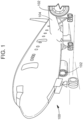
- an aircraft 100 typically includes one or more engines 102 for driving flight and powering the aircraft.
- the engines 102 are typically mounted on wings 104 of the aircraft 100, but may be located at other locations depending on the specific aircraft configuration.
- the engine(s) may be tail mounted, or housed within the body of the aircraft, or otherwise arranged as will be appreciated by those of skill in the art.
- Each engine 102 of the aircraft 100 may include one or more attached or connected generators, as appreciated by those of skill in the art.
- the generators may provide electrical power to various components of aircraft, as will be appreciated by those of skill in the art.
- the generators may be operably connected to an output shaft of the engine which drives a stator/rotor to generate electricity.
- a shaft from the engine may interface to a gearbox, and generators may be mounted, as an accessory, to the gearbox.
- additional power generation systems may be arranged on an aircraft.
- One type of such alternative, backup, or supplemental power generation may be a generator coupled to the low spool primary fan of the engines 102.
- large, modern turbofan engines for aircraft include very large primary fan stages within the engine assembly. These fan stages typically operate in one of two speed ranges. These speed ranges include an active thrust speed where the engine fan is engaged and spinning at a high rate of speed. Another speed range includes a speed range referred to as wind milling when the engine has failed but the fan is still turning because the aircraft is still in flight. Aspects of the present disclosure provide for a generator coupled to the primary fan (sometimes referred to as the "low spool") that can serve in place of a ram air turbine (RAT) in a situation where the engine is in a wind milling speed range (i.e., when the engine has failed).
- RAT ram air turbine
- the generator coupled to the primary fan generates a given normal operating voltage which typically is regulated by the magnetic field strength of a winding inside the generator.
- the speed of the primary fan drops significantly, but does not usually stop completely (i.e., wind milling).
- a generator coupled to the low spool primary fan of a turbofan engine can provide two different voltage levels.
- FIG. 2 depicts a diagram of an exemplary turbofan engine with a generator coupled to the low spool primary fan according to one or more embodiments.
- the turbofan 200 is a type of airbreathing jet engine that is used in aircraft propulsion.
- the turbo portion refers to a gas turbine engine which achieves mechanical energy from combustion, and the fan, a ducted fan that uses the mechanical energy from the gas turbine to accelerate air rearwards.
- the turbofan engine 200 includes a low spool primary fan 202 with airfoils (e.g., blades) that facilitate movement of air through the engine 200. In addition, the airfoils can rotate responsive to airflow in the event that the aircraft is moving but the engine 200 is no longer working.
- the turbofan engine 200 also includes a gearbox 204 that can transmit power from the fan 202 to a generator within the gearbox 204. In one or more embodiments, the gearbox 204 of the engine 200 is configured to receive and transmit rotation from the low spool primary fan 202 to a drive shaft.
- the gearbox 204 may be configured to receive a turbine shaft driven by the rotation of the low spool primary fan 202 at a rotational velocity and convert the rotation to a different speed drive shaft rotation velocity.
- This drive shaft can be operably connected to the generator to generate power.
- the gear set within the gearbox 204 may provide increased or decreased rotational speeds for the generator depending on the specific application.
- FIG. 3 depicts a system for dual voltage generation in an aircraft according to one or more embodiments.
- the system 300 includes a generator 302 which can be the generator operably connected to the low spool primary fan 202 (from FIG. 2 ) and operated as described above to receive rotational speed from the fan 202.
- the system 300 also includes a generator controller 304, a rectifier 306, a converter bypass switch 308, a power converter 310, and a load 312 being driven by the generator 302.
- the rectifier 306 is electrical device that converts alternating current (AC), which periodically reverses direction, to direct current (DC), which flows in only one direction.
- the rectifier 306 can be any type of rectifier configuration including, but not limited to, half bridge or full bridge rectifier circuits.
- the rectifier 306 is configured to convert the AC voltage from the generator to a DC voltage to drive the load 312.
- the output of the rectifier 306 is coupled to the converter bypass switch 308 which is controlled and operated by the generator controller 304.
- the converter bypass switch 308 is operable to either pass the DC voltage directly to the load 312 or though a converter 310 connected to the load 312.
- the generator controller 304 operates the converter bypass switch 308 to either supply voltage to the converter 310 or bypass the converter 310 and supply voltage directly to the load 310.
- the converter 310 is a DC-to-DC step down converter which takes in a DC voltage and steps down (i.e., lowers) the voltage at the output of the converter 310.
- the system 300 operates through the generator controller 304 to supply two different voltage levels to the load 312 depending on the operational state of the engine.
- the generator 302 is regulated to produce a higher voltage (e.g., 270V DC at the output of the rectifier 306 or 115V AC from the generator 302).
- the low spool primary fan continues to spin due to the ram air pressure as the fan is still in the slip stream of the aircraft.
- the low spool primary fan is spinning at a lower speed (nominally 1/10 th of the speed during normal operation), also called wind milling.
- the generator 302 is regulated to a lower voltage (28V DC at the output of the rectifier 306 or 12V AC from the generator.
- the speed ratio can vary by engine type and also how fast the aircraft is travelling.
- the generator controller 304 can determine the operational mode of the engine (normal vs. wind milling) based on the speed of the fan and/or as reported by the engine.
- the full authority digital engine control (FADEC) system can report on the status of the engine.
- the voltage of the generator 302 is continuously monitored.
- the load 312 can require a 28V DC voltage and the converter 310 is a DC/DC converter that is configured to step down the 270V DC voltage from the rectifier 306 to a 28V DC voltage.
- the low spool primary fan is spinning at a high rate causing the generator 302 to produce a rectified voltage of 270V.
- the converter bypass switch 308 is operated by the generator controller 304 to allow the rectified voltage of 270V to be inputted into the converter 310.
- the output of the converter 310 is the stepped down voltage of 28V and is used to drive the load 312.
- the low spool primary fan is spinning at a slower rate (1/10 th ) causing the generator 302 to produce a rectified voltage of 28V.
- the converter bypass switch 308 can be operated by the generator controller 304 to provide the rectified voltage of 28V directly to the load 312.
- the generator controller 304 can operate the bypass switch 308 based on the rotational speed of the fan in the engine by defining a threshold speed for operation. Should the rotational speed of the fan drop below the threshold speed, the generator controller 304 can operate the converter bypass switch 308 in a bypass state where the output of the rectifier 306 is connected directly to the load 312. And if the rotational speed of the fan remains above the threshold speed (e.g., normal operation state), the generator controller 304 can operate the converter bypass switch 308 in the normal operation state by connecting the output of the rectifier 306 to the input of the converter 310 allowing the rectified voltage to be stepped down for the load 312.
- the generator 302 can be a wound field generator.
- the output voltage of a wound field generator may be controlled by modulating the strength of the magnetic field in the generator.
- the generator controller 304 uses energy from a small permanent magnet generator on the same shaft as the main generator to modulate the magnetic field of the main generator 302 (the more excitation of the field, and the faster the generator is spinning, the higher the generated voltage).
- the generator controller 304 can control the field to generate the higher voltage during the higher speed operational range of the engine. When the engine speed is not high enough, then the generator controller 304 will control the field to generate the lower voltage.
- the load 312 can require a 270V DC voltage for operation and the converter 310 is a boost converter that steps up the 28V DC voltage from the rectifier 306 to a 270V DC voltage.
- the low spool primary fan is spinning at a high rate causing the generator 302 to produce a rectified voltage of 270V.
- the converter bypass switch 308 is operated by the generator controller 304 to provide the rectified voltage of 270V directly to the load 312.
- wind milling i.e., engine failure
- the low spool primary fan is spinning at a slower rate (1/10 th ) causing the generator 302 to produce a rectified voltage of 28V.
- the converter bypass switch 308 can be operated by the generator controller 304 to allow the rectified voltage of 28V to be inputted into the converter 310.
- the output of the converter 310 is the stepped up voltage of 270V and is used to drive the load 312.
- the rectifier 306 can be optional based on the load 312.
- the load 312 can be an AC load that would not require rectification of the AC voltage coming from the generator 302.
- the converter 310 can be an AC/AC converter that is configured to either step up (boost) or step down the voltage based on the load 312 requirements.
- the system described herein can provide power (e.g., electric) to one or more aircraft components.
- aircraft components that can be powered by the system described herein can include airfoil actuators, ailerons and other flight control surfaces (flaps, slats, etc.), and electrical and/or electronic components, including, but not limited to flight-critical instrumentation, navigation, heaters, and/or communication equipment.
- the generator controller 304 or any of the hardware referenced in the system 300 can be implemented by executable instructions and/or circuitry such as a processing circuit and memory.
- the processing circuit can be embodied in any type of central processing unit (CPU), including a microprocessor, a digital signal processor (DSP), a microcontroller, an application specific integrated circuit (ASIC), a field programmable gate array (FPGA), or the like.
- the memory may include random access memory (RAM), read only memory (ROM), or other electronic, optical, magnetic, or any other computer readable medium onto which is stored data and algorithms as executable instructions in a non-transitory form.
- the converter bypass switch 308 can be any type of switch including a one output switch, a two output switch, a combination of switches that allows for operation such that the voltage can flow in one of two directions (e.g., to the load 312 directly or to the converter 310)
- FIG. 4 depicts a flow diagram of a method for dual voltage power generation according to one or more embodiments of the invention.
- the method 400 includes providing a generator having an input connected to an engine to receive rotational energy proportional to a rotation speed of a fan driven by the engine and having an output through which electrical energy is output, as shown in block 402.
- the method 400 includes providing a rectifier circuit having an input coupled to the output of the generator and a rectifier output that outputs rectified power.
- the method 400 includes providing a bypass switch connected to the output of rectifier and configured to operate in a plurality of states, wherein the plurality of states includes a normal operation state where the rectified power is provided a power converter and a bypass state where the rectified power is provided directly to a load.
- the method 400 also includes determining an occurrence of an event associated with the engine, as shown at block 408. And at block 410, the method 400 includes operating the bypass switch in the bypass state based on the occurrence of the event associated with the engine.
Landscapes
- Engineering & Computer Science (AREA)
- Power Engineering (AREA)
- Aviation & Aerospace Engineering (AREA)
- Control Of Eletrric Generators (AREA)
- Transportation (AREA)
- Mechanical Engineering (AREA)
Description
- The subject matter disclosed herein generally relates to aircraft components, and more particularly to a dual voltage low spool generator.
- Aircraft may include power generation using turbines in main engines. However, as a safety feature, or for other reasons, alternate power device (e.g., supplementary or backup units) may be arranged on aircraft to supply power (e.g., electric and/or hydraulic) to components of the aircraft, when needed. For example, a ram air turbine is deployable to generate power when sufficient primary power generation is not available. The ram air turbine typically includes a turbine that is deployed into an airstream along (e.g., external to) the aircraft. Rotation of the turbine drives a generator and/or hydraulic pump. The generator and/or hydraulic pump can be mounted at a pivot point of the ram air turbine that is a distance from the turbine deployed within the airstream. Accordingly, a drive arrangement including a gearbox is utilized to transfer power from the turbine to the generator and/or hydraulic pump. The drive arrangement includes a gearbox that provides a desired speed and direction for driving the generator and/or hydraulic pump. Gears, shafts, and other drive components are constrained by limitations in the desired size, weight, and power generation of the ram air turbine. However, ram air turbine systems add significant weight and when deployed cause significant drag on the aircraft.
EP 2 458 160 A2 describes an aircraft gas turbine engine comprising a generator. - According to a first aspect, a system according to claim 1 is provided.
- According to a second aspect, a method according to claim 8 is provided.
- The foregoing features and elements may be combined in various combinations without exclusivity, unless expressly indicated otherwise. These features and elements as well as the operation thereof will become more apparent in light of the following description and the accompanying drawings. It should be understood, however, the following description and drawings are intended to be illustrative and explanatory in nature and non-limiting.
- The following descriptions should not be considered limiting in any way. With reference to the accompanying drawings, like elements are numbered alike:
-
FIG. 1 depicts an aircraft according to one or more embodiments; -
FIG. 2 depicts a diagram of an exemplary turbofan engine with a generator coupled to the low spool primary fan according to one or more embodiments; -
FIG. 3 depicts a system for dual voltage generation in an aircraft according to one or more embodiments; and -
FIG. 4 depicts a method for operating a dual voltage generator in an aircraft according to one or more embodiments. - A detailed description of one or more embodiments of the disclosed apparatus and method are presented herein by way of exemplification and not limitation with reference to the Figures.
- As shown in
FIG. 1 , anaircraft 100 typically includes one ormore engines 102 for driving flight and powering the aircraft. Theengines 102 are typically mounted onwings 104 of theaircraft 100, but may be located at other locations depending on the specific aircraft configuration. In some aircraft, the engine(s) may be tail mounted, or housed within the body of the aircraft, or otherwise arranged as will be appreciated by those of skill in the art. - Each
engine 102 of theaircraft 100, regardless of location, may include one or more attached or connected generators, as appreciated by those of skill in the art. The generators may provide electrical power to various components of aircraft, as will be appreciated by those of skill in the art. In some configurations, the generators may be operably connected to an output shaft of the engine which drives a stator/rotor to generate electricity. In other configurations, a shaft from the engine may interface to a gearbox, and generators may be mounted, as an accessory, to the gearbox. - In addition to the power generated by the traditional or main engines (i.e., engines 102), additional power generation systems may be arranged on an aircraft. One type of such alternative, backup, or supplemental power generation may be a generator coupled to the low spool primary fan of the
engines 102. - Turning now to an overview of technologies that are more specifically relevant to aspects of the disclosure, large, modern turbofan engines for aircraft include very large primary fan stages within the engine assembly. These fan stages typically operate in one of two speed ranges. These speed ranges include an active thrust speed where the engine fan is engaged and spinning at a high rate of speed. Another speed range includes a speed range referred to as wind milling when the engine has failed but the fan is still turning because the aircraft is still in flight. Aspects of the present disclosure provide for a generator coupled to the primary fan (sometimes referred to as the "low spool") that can serve in place of a ram air turbine (RAT) in a situation where the engine is in a wind milling speed range (i.e., when the engine has failed). During normal operations, the generator coupled to the primary fan generates a given normal operating voltage which typically is regulated by the magnetic field strength of a winding inside the generator. In a situation where the engine has failed, the speed of the primary fan drops significantly, but does not usually stop completely (i.e., wind milling).
- In one or more embodiments, given the two speed ranges (e.g., normal operation and wind milling), a generator coupled to the low spool primary fan of a turbofan engine can provide two different voltage levels.
FIG. 2 depicts a diagram of an exemplary turbofan engine with a generator coupled to the low spool primary fan according to one or more embodiments. Theturbofan 200 is a type of airbreathing jet engine that is used in aircraft propulsion. The turbo portion refers to a gas turbine engine which achieves mechanical energy from combustion, and the fan, a ducted fan that uses the mechanical energy from the gas turbine to accelerate air rearwards. Theturbofan engine 200 includes a low spoolprimary fan 202 with airfoils (e.g., blades) that facilitate movement of air through theengine 200. In addition, the airfoils can rotate responsive to airflow in the event that the aircraft is moving but theengine 200 is no longer working. Theturbofan engine 200 also includes agearbox 204 that can transmit power from thefan 202 to a generator within thegearbox 204. In one or more embodiments, thegearbox 204 of theengine 200 is configured to receive and transmit rotation from the low spoolprimary fan 202 to a drive shaft. For example, thegearbox 204 may be configured to receive a turbine shaft driven by the rotation of the low spoolprimary fan 202 at a rotational velocity and convert the rotation to a different speed drive shaft rotation velocity. This drive shaft can be operably connected to the generator to generate power. The gear set within thegearbox 204 may provide increased or decreased rotational speeds for the generator depending on the specific application. -
FIG. 3 depicts a system for dual voltage generation in an aircraft according to one or more embodiments. The system 300 includes agenerator 302 which can be the generator operably connected to the low spool primary fan 202 (fromFIG. 2 ) and operated as described above to receive rotational speed from thefan 202. The system 300 also includes agenerator controller 304, arectifier 306, aconverter bypass switch 308, apower converter 310, and a load 312 being driven by thegenerator 302. Therectifier 306 is electrical device that converts alternating current (AC), which periodically reverses direction, to direct current (DC), which flows in only one direction. Therectifier 306 can be any type of rectifier configuration including, but not limited to, half bridge or full bridge rectifier circuits. Therectifier 306 is configured to convert the AC voltage from the generator to a DC voltage to drive the load 312. The output of therectifier 306 is coupled to theconverter bypass switch 308 which is controlled and operated by thegenerator controller 304. Theconverter bypass switch 308 is operable to either pass the DC voltage directly to the load 312 or though aconverter 310 connected to the load 312. As described in greater detail below, thegenerator controller 304 operates theconverter bypass switch 308 to either supply voltage to theconverter 310 or bypass theconverter 310 and supply voltage directly to theload 310. In one or more embodiments, theconverter 310 is a DC-to-DC step down converter which takes in a DC voltage and steps down (i.e., lowers) the voltage at the output of theconverter 310. - The system 300 operates through the
generator controller 304 to supply two different voltage levels to the load 312 depending on the operational state of the engine. When the engine is operating, and the fan is spinning faster (e.g., 1500-1700 RPM), thegenerator 302 is regulated to produce a higher voltage (e.g., 270V DC at the output of therectifier 306 or 115V AC from the generator 302). However, if the engine fails, the low spool primary fan continues to spin due to the ram air pressure as the fan is still in the slip stream of the aircraft. During engine failure, the low spool primary fan is spinning at a lower speed (nominally 1/10th of the speed during normal operation), also called wind milling. During wind milling, thegenerator 302 is regulated to a lower voltage (28V DC at the output of therectifier 306 or 12V AC from the generator. The speed ratio can vary by engine type and also how fast the aircraft is travelling. Thegenerator controller 304 can determine the operational mode of the engine (normal vs. wind milling) based on the speed of the fan and/or as reported by the engine. The full authority digital engine control (FADEC) system can report on the status of the engine. Also, the voltage of thegenerator 302 is continuously monitored. In one or more embodiments, the load 312 can require a 28V DC voltage and theconverter 310 is a DC/DC converter that is configured to step down the 270V DC voltage from therectifier 306 to a 28V DC voltage. During normal operation of the engine, the low spool primary fan is spinning at a high rate causing thegenerator 302 to produce a rectified voltage of 270V. Theconverter bypass switch 308 is operated by thegenerator controller 304 to allow the rectified voltage of 270V to be inputted into theconverter 310. The output of theconverter 310 is the stepped down voltage of 28V and is used to drive the load 312. During wind milling (i.e., engine failure), the low spool primary fan is spinning at a slower rate (1/10th) causing thegenerator 302 to produce a rectified voltage of 28V. Theconverter bypass switch 308 can be operated by thegenerator controller 304 to provide the rectified voltage of 28V directly to the load 312. In one or more embodiments, thegenerator controller 304 can operate thebypass switch 308 based on the rotational speed of the fan in the engine by defining a threshold speed for operation. Should the rotational speed of the fan drop below the threshold speed, thegenerator controller 304 can operate theconverter bypass switch 308 in a bypass state where the output of therectifier 306 is connected directly to the load 312. And if the rotational speed of the fan remains above the threshold speed (e.g., normal operation state), thegenerator controller 304 can operate theconverter bypass switch 308 in the normal operation state by connecting the output of therectifier 306 to the input of theconverter 310 allowing the rectified voltage to be stepped down for the load 312. In one or more embodiments, thegenerator 302 can be a wound field generator. The output voltage of a wound field generator may be controlled by modulating the strength of the magnetic field in the generator. Thegenerator controller 304 uses energy from a small permanent magnet generator on the same shaft as the main generator to modulate the magnetic field of the main generator 302 (the more excitation of the field, and the faster the generator is spinning, the higher the generated voltage). Thegenerator controller 304 can control the field to generate the higher voltage during the higher speed operational range of the engine. When the engine speed is not high enough, then thegenerator controller 304 will control the field to generate the lower voltage. - In one or more embodiments, the load 312 can require a 270V DC voltage for operation and the
converter 310 is a boost converter that steps up the 28V DC voltage from therectifier 306 to a 270V DC voltage. During normal operation of the engine, the low spool primary fan is spinning at a high rate causing thegenerator 302 to produce a rectified voltage of 270V. Theconverter bypass switch 308 is operated by thegenerator controller 304 to provide the rectified voltage of 270V directly to the load 312. During wind milling (i.e., engine failure), the low spool primary fan is spinning at a slower rate (1/10th) causing thegenerator 302 to produce a rectified voltage of 28V. Theconverter bypass switch 308 can be operated by thegenerator controller 304 to allow the rectified voltage of 28V to be inputted into theconverter 310. The output of theconverter 310 is the stepped up voltage of 270V and is used to drive the load 312. - In one or more embodiments, the
rectifier 306 can be optional based on the load 312. The load 312 can be an AC load that would not require rectification of the AC voltage coming from thegenerator 302. With an AC load as the load 312, theconverter 310 can be an AC/AC converter that is configured to either step up (boost) or step down the voltage based on the load 312 requirements. - As will be appreciated by those of skill in the art, the system described herein can provide power (e.g., electric) to one or more aircraft components. For example, without limitation, aircraft components that can be powered by the system described herein can include airfoil actuators, ailerons and other flight control surfaces (flaps, slats, etc.), and electrical and/or electronic components, including, but not limited to flight-critical instrumentation, navigation, heaters, and/or communication equipment.
- In one or more embodiments, the
generator controller 304 or any of the hardware referenced in the system 300 can be implemented by executable instructions and/or circuitry such as a processing circuit and memory. The processing circuit can be embodied in any type of central processing unit (CPU), including a microprocessor, a digital signal processor (DSP), a microcontroller, an application specific integrated circuit (ASIC), a field programmable gate array (FPGA), or the like. Also, in embodiments, the memory may include random access memory (RAM), read only memory (ROM), or other electronic, optical, magnetic, or any other computer readable medium onto which is stored data and algorithms as executable instructions in a non-transitory form. - In one or more embodiments, the
converter bypass switch 308 can be any type of switch including a one output switch, a two output switch, a combination of switches that allows for operation such that the voltage can flow in one of two directions (e.g., to the load 312 directly or to the converter 310) -
FIG. 4 depicts a flow diagram of a method for dual voltage power generation according to one or more embodiments of the invention. Themethod 400 includes providing a generator having an input connected to an engine to receive rotational energy proportional to a rotation speed of a fan driven by the engine and having an output through which electrical energy is output, as shown inblock 402. Atblock 404, themethod 400 includes providing a rectifier circuit having an input coupled to the output of the generator and a rectifier output that outputs rectified power. Themethod 400, atblock 406, includes providing a bypass switch connected to the output of rectifier and configured to operate in a plurality of states, wherein the plurality of states includes a normal operation state where the rectified power is provided a power converter and a bypass state where the rectified power is provided directly to a load. Themethod 400 also includes determining an occurrence of an event associated with the engine, as shown atblock 408. And atblock 410, themethod 400 includes operating the bypass switch in the bypass state based on the occurrence of the event associated with the engine. - Additional processes may also be included. It should be understood that the processes depicted in
FIG. 4 represent illustrations, and that other processes may be added or existing processes may be removed, modified, or rearranged as far as it remains within the scope of the appended claims. - The term "about" is intended to include the degree of error associated with measurement of the particular quantity based upon the equipment available at the time of filing the application.
- The terminology used herein is for the purpose of describing particular embodiments only and is not intended to be limiting of the present disclosure. As used herein, the singular forms "a", "an" and "the" are intended to include the plural forms as well, unless the context clearly indicates otherwise. It will be further understood that the terms "comprises" and/or "comprising," when used in this specification, specify the presence of stated features, integers, steps, operations, elements, and/or components, but do not preclude the presence or addition of one or more other features, integers, steps, operations, element components, and/or groups thereof.
- While the present disclosure has been described with reference to an exemplary embodiment or embodiments, it will be understood by those skilled in the art that various changes may be made without departing from the scope of the appended claims. In addition, many modifications may be made to adapt a particular situation or material to the teachings of the present disclosure without departing from the scope thereof. Therefore, it is intended that the present disclosure not be limited to the particular embodiment disclosed as the best mode contemplated for carrying out this present disclosure, but that the present disclosure will include all embodiments falling within the scope of the claims.
Claims (15)
- A system (300) comprising:an engine (200) including a fan (202);a generator (302) having an input connected to the engine to receive rotational energy proportional to a rotation speed of the fan driven by the engine and having an output through which electrical energy is output;a rectifier circuit (306) having an input coupled to the output of the generator and a rectifier output that outputs rectified power;a power converter (310);a load (312);a bypass switch (308) connected to the rectifier output and configured to operate in a plurality of states, wherein the plurality of states comprises a normal operation state where the rectified power is provided to an input of the power converter and a bypass state where the rectified power is provided directly to the load;a controller (304) configured to:determine an occurrence of an event associated with the engine; andoperate the bypass switch in the bypass state based on the occurrence of the event associated with the engine, and wherein the occurrence of the event comprises the rotational speed of the fan being below a threshold rotational speed; andregulate the generator to produce a first voltage in the normal operation state and to produce a second voltage lower than the first voltage in the bypass state.
- The system of Claim 1, wherein the controller (304) is further configured to:
operate the bypass switch (308) in the normal operation state based at least in part on a determination that the rotational speed of the fan exceeds a threshold rotational speed for the fan. - The system of any preceding Claim, wherein an output of the power converter is connected to the load.
- The system of any preceding Claim, wherein the power converter comprises a step-down converter or wherein the power converter comprises a boost converter.
- The system of any preceding Claim, wherein the engine comprises a turbofan engine, and/or wherein the fan comprises a low spool primary fan in a turbofan engine.
- The system of any preceding Claim, wherein the event comprises a failure of the engine.
- The system of any preceding Claim, wherein the load comprises at least one of an airfoil actuator, a flight-critical instrument, navigation instrument, heater, and communication equipment.
- A method (400) for dual voltage power generation, the method comprising:providing (402) a generator having an input connected to an engine to receive rotational energy proportional to a rotation speed of a fan driven by the engine and having an output through which electrical energy is output;providing (404) a rectifier circuit having an input coupled to the output of the generator and a rectifier output that outputs rectified power;providing (406) a bypass switch connected to the rectifier output and configured to operate in a plurality of states, wherein the plurality of states comprises a normal operation state where the rectified power is provided to an input of a power converter and a bypass state where the rectified power is provided directly to a load;determining an occurrence of an event associated with the engine;operating the bypass switch in the bypass state based on the occurrence of the event associated with the engine, and wherein the occurrence of the event comprises the rotational speed of the fan being below a threshold rotational speed; andregulate the generator to produce a first voltage in the normal operation state and to produce a second voltage lower than the first voltage in the bypass state.
- The method of Claim 8, further comprising
operating the bypass switch in the normal operation state based at least in part on a determination that the rotational speed of the fan exceeds a threshold rotational speed for the fan. - The method of any of claims 8 or 9, wherein operating the bypass switch in the bypass state comprises connecting the output of the rectifier circuit to the load.
- The method of any of claims 8 to 9, wherein operating the bypass switch in the normal operation state comprises connecting the rectifier output to the input of the power converter.
- The method of any of Claims 8, 9, 10 or 11, wherein the power converter comprises a step-down converter, or wherein the power converter comprises a boost converter.
- The method of any of Claims 8 to 12, wherein the engine comprises a turbofan engine.
- The method of any of claims 8 to 12, wherein the fan comprises a low spool primary fan in a turbofan engine.
- The method of any of Claims 8 to 14, wherein the load comprises at least one of an airfoil actuator, a flight-critical instrument, navigation instrument, heater, and communication equipment.
Applications Claiming Priority (1)
| Application Number | Priority Date | Filing Date | Title |
|---|---|---|---|
| US16/733,750 US11482958B2 (en) | 2020-01-03 | 2020-01-03 | Dual voltage low spool generator |
Publications (2)
| Publication Number | Publication Date |
|---|---|
| EP3845464A1 EP3845464A1 (en) | 2021-07-07 |
| EP3845464B1 true EP3845464B1 (en) | 2025-01-29 |
Family
ID=74004041
Family Applications (1)
| Application Number | Title | Priority Date | Filing Date |
|---|---|---|---|
| EP20217800.0A Active EP3845464B1 (en) | 2020-01-03 | 2020-12-30 | Dual voltage low spool generator |
Country Status (2)
| Country | Link |
|---|---|
| US (1) | US11482958B2 (en) |
| EP (1) | EP3845464B1 (en) |
Families Citing this family (1)
| Publication number | Priority date | Publication date | Assignee | Title |
|---|---|---|---|---|
| US12341428B2 (en) | 2023-05-09 | 2025-06-24 | Ge Aviation Systems Llc | Method and power distribution system for generating electrical power |
Family Cites Families (9)
| Publication number | Priority date | Publication date | Assignee | Title |
|---|---|---|---|---|
| GB0128662D0 (en) | 2001-11-30 | 2002-01-23 | Rolls Royce Plc | Improvements in or relating to generator arrangements |
| US7622817B2 (en) | 2006-12-13 | 2009-11-24 | General Electric Company | High-speed high-pole count generators |
| US8519555B2 (en) * | 2010-11-29 | 2013-08-27 | Pratt & Whitney Canada Corp. | Combination low spool generator and ram air turbine generator |
| US20120221157A1 (en) | 2011-02-28 | 2012-08-30 | Hamilton Sundstrand Corporation | Low pressure spool emergency generator |
| US10814991B2 (en) * | 2015-11-09 | 2020-10-27 | General Electric Company | Propulsion system and methods of use thereof |
| US10141829B2 (en) * | 2016-06-29 | 2018-11-27 | John Bean Technologies Corporation | Multiple power topologies from single power generator |
| US10608565B2 (en) | 2017-12-07 | 2020-03-31 | General Electric Company | Systems and methods for rotating a crankshaft to start an engine |
| FR3078845B1 (en) * | 2018-03-08 | 2022-08-05 | Thales Sa | ELECTRICAL ARCHITECTURE FOR CONTROLLING CONVERTERS AND AIRCRAFT COMPRISING THE ARCHITECTURE |
| US20200385133A1 (en) * | 2019-06-06 | 2020-12-10 | Gulfstream Aerospace Corporation | Engine and thrust control of aircraft in no dwell zone |
-
2020
- 2020-01-03 US US16/733,750 patent/US11482958B2/en active Active
- 2020-12-30 EP EP20217800.0A patent/EP3845464B1/en active Active
Also Published As
| Publication number | Publication date |
|---|---|
| EP3845464A1 (en) | 2021-07-07 |
| US11482958B2 (en) | 2022-10-25 |
| US20210206501A1 (en) | 2021-07-08 |
Similar Documents
| Publication | Publication Date | Title |
|---|---|---|
| US11530647B2 (en) | In flight restart system and method for free turbine engine | |
| CN109110137B (en) | Propulsion system for aircraft and method of operation thereof | |
| US10759545B2 (en) | Hybrid electric aircraft system with distributed propulsion | |
| JP5923515B2 (en) | Power generation control method used for aircraft gas turbine and apparatus for implementing the method | |
| US10180080B2 (en) | Electromagnetic propeller brake | |
| EP3403932B1 (en) | Propulsion system for an aircraft | |
| EP3375713A1 (en) | Emergency power generation via electrically driven tail cone boundary layer ingestion thruster | |
| US20190382121A1 (en) | Aircraft system with distributed propulsion | |
| EP2985901A1 (en) | Hybrid electric pulsed-power propulsion system for aircraft | |
| JP2019048615A (en) | Aircraft propulsion system | |
| EP2733312A2 (en) | Gas turbine engine optimization by electric power transfer | |
| CA2913526C (en) | Jet engine assembly and method for generating electricity | |
| CN112576376A (en) | Drive system for counter-rotating components | |
| CN113494359B (en) | dynamo | |
| US20230139529A1 (en) | Hybrid-electric single engine descent failure management | |
| CN114513000A (en) | Electric power system | |
| EP3845464B1 (en) | Dual voltage low spool generator | |
| US20230095723A1 (en) | Turbine engine with variable pitch fan | |
| EP4552979A1 (en) | Windmill brake for an auxiliary power unit | |
| CN121794452A (en) | Turbomachine comprising an electric machine with radially arranged stationary, field and rotary windings |
Legal Events
| Date | Code | Title | Description |
|---|---|---|---|
| PUAI | Public reference made under article 153(3) epc to a published international application that has entered the european phase |
Free format text: ORIGINAL CODE: 0009012 |
|
| STAA | Information on the status of an ep patent application or granted ep patent |
Free format text: STATUS: THE APPLICATION HAS BEEN PUBLISHED |
|
| AK | Designated contracting states |
Kind code of ref document: A1 Designated state(s): AL AT BE BG CH CY CZ DE DK EE ES FI FR GB GR HR HU IE IS IT LI LT LU LV MC MK MT NL NO PL PT RO RS SE SI SK SM TR |
|
| STAA | Information on the status of an ep patent application or granted ep patent |
Free format text: STATUS: REQUEST FOR EXAMINATION WAS MADE |
|
| 17P | Request for examination filed |
Effective date: 20220107 |
|
| RBV | Designated contracting states (corrected) |
Designated state(s): AL AT BE BG CH CY CZ DE DK EE ES FI FR GB GR HR HU IE IS IT LI LT LU LV MC MK MT NL NO PL PT RO RS SE SI SK SM TR |
|
| STAA | Information on the status of an ep patent application or granted ep patent |
Free format text: STATUS: EXAMINATION IS IN PROGRESS |
|
| 17Q | First examination report despatched |
Effective date: 20221221 |
|
| GRAP | Despatch of communication of intention to grant a patent |
Free format text: ORIGINAL CODE: EPIDOSNIGR1 |
|
| STAA | Information on the status of an ep patent application or granted ep patent |
Free format text: STATUS: GRANT OF PATENT IS INTENDED |
|
| INTG | Intention to grant announced |
Effective date: 20240819 |
|
| GRAS | Grant fee paid |
Free format text: ORIGINAL CODE: EPIDOSNIGR3 |
|
| GRAA | (expected) grant |
Free format text: ORIGINAL CODE: 0009210 |
|
| STAA | Information on the status of an ep patent application or granted ep patent |
Free format text: STATUS: THE PATENT HAS BEEN GRANTED |
|
| AK | Designated contracting states |
Kind code of ref document: B1 Designated state(s): AL AT BE BG CH CY CZ DE DK EE ES FI FR GB GR HR HU IE IS IT LI LT LU LV MC MK MT NL NO PL PT RO RS SE SI SK SM TR |
|
| REG | Reference to a national code |
Ref country code: GB Ref legal event code: FG4D |
|
| REG | Reference to a national code |
Ref country code: CH Ref legal event code: EP |
|
| REG | Reference to a national code |
Ref country code: DE Ref legal event code: R096 Ref document number: 602020045474 Country of ref document: DE |
|
| REG | Reference to a national code |
Ref country code: IE Ref legal event code: FG4D |
|
| REG | Reference to a national code |
Ref country code: NL Ref legal event code: MP Effective date: 20250129 |
|
| PG25 | Lapsed in a contracting state [announced via postgrant information from national office to epo] |
Ref country code: NL Free format text: LAPSE BECAUSE OF FAILURE TO SUBMIT A TRANSLATION OF THE DESCRIPTION OR TO PAY THE FEE WITHIN THE PRESCRIBED TIME-LIMIT Effective date: 20250129 |
|
| PG25 | Lapsed in a contracting state [announced via postgrant information from national office to epo] |
Ref country code: RS Free format text: LAPSE BECAUSE OF FAILURE TO SUBMIT A TRANSLATION OF THE DESCRIPTION OR TO PAY THE FEE WITHIN THE PRESCRIBED TIME-LIMIT Effective date: 20250429 |
|
| PG25 | Lapsed in a contracting state [announced via postgrant information from national office to epo] |
Ref country code: FI Free format text: LAPSE BECAUSE OF FAILURE TO SUBMIT A TRANSLATION OF THE DESCRIPTION OR TO PAY THE FEE WITHIN THE PRESCRIBED TIME-LIMIT Effective date: 20250129 |
|
| PG25 | Lapsed in a contracting state [announced via postgrant information from national office to epo] |
Ref country code: PL Free format text: LAPSE BECAUSE OF FAILURE TO SUBMIT A TRANSLATION OF THE DESCRIPTION OR TO PAY THE FEE WITHIN THE PRESCRIBED TIME-LIMIT Effective date: 20250129 |
|
| PG25 | Lapsed in a contracting state [announced via postgrant information from national office to epo] |
Ref country code: ES Free format text: LAPSE BECAUSE OF FAILURE TO SUBMIT A TRANSLATION OF THE DESCRIPTION OR TO PAY THE FEE WITHIN THE PRESCRIBED TIME-LIMIT Effective date: 20250129 |
|
| REG | Reference to a national code |
Ref country code: LT Ref legal event code: MG9D |
|
| PG25 | Lapsed in a contracting state [announced via postgrant information from national office to epo] |
Ref country code: IS Free format text: LAPSE BECAUSE OF FAILURE TO SUBMIT A TRANSLATION OF THE DESCRIPTION OR TO PAY THE FEE WITHIN THE PRESCRIBED TIME-LIMIT Effective date: 20250529 Ref country code: NO Free format text: LAPSE BECAUSE OF FAILURE TO SUBMIT A TRANSLATION OF THE DESCRIPTION OR TO PAY THE FEE WITHIN THE PRESCRIBED TIME-LIMIT Effective date: 20250429 |
|
| REG | Reference to a national code |
Ref country code: AT Ref legal event code: MK05 Ref document number: 1763243 Country of ref document: AT Kind code of ref document: T Effective date: 20250129 |
|
| PG25 | Lapsed in a contracting state [announced via postgrant information from national office to epo] |
Ref country code: HR Free format text: LAPSE BECAUSE OF FAILURE TO SUBMIT A TRANSLATION OF THE DESCRIPTION OR TO PAY THE FEE WITHIN THE PRESCRIBED TIME-LIMIT Effective date: 20250129 |
|
| PG25 | Lapsed in a contracting state [announced via postgrant information from national office to epo] |
Ref country code: PT Free format text: LAPSE BECAUSE OF FAILURE TO SUBMIT A TRANSLATION OF THE DESCRIPTION OR TO PAY THE FEE WITHIN THE PRESCRIBED TIME-LIMIT Effective date: 20250529 Ref country code: LV Free format text: LAPSE BECAUSE OF FAILURE TO SUBMIT A TRANSLATION OF THE DESCRIPTION OR TO PAY THE FEE WITHIN THE PRESCRIBED TIME-LIMIT Effective date: 20250129 |
|
| PG25 | Lapsed in a contracting state [announced via postgrant information from national office to epo] |
Ref country code: BG Free format text: LAPSE BECAUSE OF FAILURE TO SUBMIT A TRANSLATION OF THE DESCRIPTION OR TO PAY THE FEE WITHIN THE PRESCRIBED TIME-LIMIT Effective date: 20250129 Ref country code: GR Free format text: LAPSE BECAUSE OF FAILURE TO SUBMIT A TRANSLATION OF THE DESCRIPTION OR TO PAY THE FEE WITHIN THE PRESCRIBED TIME-LIMIT Effective date: 20250430 |
|
| PG25 | Lapsed in a contracting state [announced via postgrant information from national office to epo] |
Ref country code: AT Free format text: LAPSE BECAUSE OF FAILURE TO SUBMIT A TRANSLATION OF THE DESCRIPTION OR TO PAY THE FEE WITHIN THE PRESCRIBED TIME-LIMIT Effective date: 20250129 |
|
| PG25 | Lapsed in a contracting state [announced via postgrant information from national office to epo] |
Ref country code: SE Free format text: LAPSE BECAUSE OF FAILURE TO SUBMIT A TRANSLATION OF THE DESCRIPTION OR TO PAY THE FEE WITHIN THE PRESCRIBED TIME-LIMIT Effective date: 20250129 |
|
| PG25 | Lapsed in a contracting state [announced via postgrant information from national office to epo] |
Ref country code: SM Free format text: LAPSE BECAUSE OF FAILURE TO SUBMIT A TRANSLATION OF THE DESCRIPTION OR TO PAY THE FEE WITHIN THE PRESCRIBED TIME-LIMIT Effective date: 20250129 |
|
| PG25 | Lapsed in a contracting state [announced via postgrant information from national office to epo] |
Ref country code: DK Free format text: LAPSE BECAUSE OF FAILURE TO SUBMIT A TRANSLATION OF THE DESCRIPTION OR TO PAY THE FEE WITHIN THE PRESCRIBED TIME-LIMIT Effective date: 20250129 |
|
| PG25 | Lapsed in a contracting state [announced via postgrant information from national office to epo] |
Ref country code: IT Free format text: LAPSE BECAUSE OF FAILURE TO SUBMIT A TRANSLATION OF THE DESCRIPTION OR TO PAY THE FEE WITHIN THE PRESCRIBED TIME-LIMIT Effective date: 20250129 |
|
| PG25 | Lapsed in a contracting state [announced via postgrant information from national office to epo] |
Ref country code: EE Free format text: LAPSE BECAUSE OF FAILURE TO SUBMIT A TRANSLATION OF THE DESCRIPTION OR TO PAY THE FEE WITHIN THE PRESCRIBED TIME-LIMIT Effective date: 20250129 Ref country code: CZ Free format text: LAPSE BECAUSE OF FAILURE TO SUBMIT A TRANSLATION OF THE DESCRIPTION OR TO PAY THE FEE WITHIN THE PRESCRIBED TIME-LIMIT Effective date: 20250129 |
|
| PG25 | Lapsed in a contracting state [announced via postgrant information from national office to epo] |
Ref country code: RO Free format text: LAPSE BECAUSE OF FAILURE TO SUBMIT A TRANSLATION OF THE DESCRIPTION OR TO PAY THE FEE WITHIN THE PRESCRIBED TIME-LIMIT Effective date: 20250129 |
|
| PG25 | Lapsed in a contracting state [announced via postgrant information from national office to epo] |
Ref country code: SK Free format text: LAPSE BECAUSE OF FAILURE TO SUBMIT A TRANSLATION OF THE DESCRIPTION OR TO PAY THE FEE WITHIN THE PRESCRIBED TIME-LIMIT Effective date: 20250129 |
|
| REG | Reference to a national code |
Ref country code: DE Ref legal event code: R097 Ref document number: 602020045474 Country of ref document: DE |
|
| PLBE | No opposition filed within time limit |
Free format text: ORIGINAL CODE: 0009261 |
|
| STAA | Information on the status of an ep patent application or granted ep patent |
Free format text: STATUS: NO OPPOSITION FILED WITHIN TIME LIMIT |
|
| 26N | No opposition filed |
Effective date: 20251030 |
|
| PGFP | Annual fee paid to national office [announced via postgrant information from national office to epo] |
Ref country code: FR Payment date: 20251119 Year of fee payment: 6 |