EP3845307A1 - Stationary phase for chromatography - Google Patents
Stationary phase for chromatography Download PDFInfo
- Publication number
- EP3845307A1 EP3845307A1 EP19854825.7A EP19854825A EP3845307A1 EP 3845307 A1 EP3845307 A1 EP 3845307A1 EP 19854825 A EP19854825 A EP 19854825A EP 3845307 A1 EP3845307 A1 EP 3845307A1
- Authority
- EP
- European Patent Office
- Prior art keywords
- meth
- hydrophilic group
- group
- stationary phase
- carbon atoms
- Prior art date
- Legal status (The legal status is an assumption and is not a legal conclusion. Google has not performed a legal analysis and makes no representation as to the accuracy of the status listed.)
- Pending
Links
- 230000005526 G1 to G0 transition Effects 0.000 title claims abstract description 106
- 238000004587 chromatography analysis Methods 0.000 title claims abstract description 35
- 239000002245 particle Substances 0.000 claims abstract description 118
- 238000004519 manufacturing process Methods 0.000 claims abstract description 54
- 229920000642 polymer Polymers 0.000 claims abstract description 54
- 125000004432 carbon atom Chemical group C* 0.000 claims description 77
- HRPVXLWXLXDGHG-UHFFFAOYSA-N Acrylamide Chemical group NC(=O)C=C HRPVXLWXLXDGHG-UHFFFAOYSA-N 0.000 claims description 56
- 239000000178 monomer Substances 0.000 claims description 56
- NIXOWILDQLNWCW-UHFFFAOYSA-N acrylic acid group Chemical group C(C=C)(=O)O NIXOWILDQLNWCW-UHFFFAOYSA-N 0.000 claims description 42
- 125000000217 alkyl group Chemical group 0.000 claims description 36
- 239000011258 core-shell material Substances 0.000 claims description 33
- 239000001257 hydrogen Substances 0.000 claims description 30
- 229910052739 hydrogen Inorganic materials 0.000 claims description 30
- 125000000524 functional group Chemical group 0.000 claims description 29
- 239000010954 inorganic particle Substances 0.000 claims description 25
- 238000004808 supercritical fluid chromatography Methods 0.000 claims description 24
- 125000002947 alkylene group Chemical group 0.000 claims description 23
- 238000000034 method Methods 0.000 claims description 22
- BLRPTPMANUNPDV-UHFFFAOYSA-N Silane Chemical compound [SiH4] BLRPTPMANUNPDV-UHFFFAOYSA-N 0.000 claims description 19
- 238000010168 coupling process Methods 0.000 claims description 19
- 238000005859 coupling reaction Methods 0.000 claims description 19
- 229910000077 silane Inorganic materials 0.000 claims description 19
- 239000006087 Silane Coupling Agent Substances 0.000 claims description 17
- 230000008878 coupling Effects 0.000 claims description 17
- 125000004435 hydrogen atom Chemical group [H]* 0.000 claims description 15
- 239000012530 fluid Substances 0.000 claims description 13
- 230000000379 polymerizing effect Effects 0.000 claims description 12
- 229910052736 halogen Inorganic materials 0.000 claims description 11
- 150000002367 halogens Chemical class 0.000 claims description 11
- 239000012986 chain transfer agent Substances 0.000 claims description 10
- 125000003808 silyl group Chemical group [H][Si]([H])([H])[*] 0.000 claims description 9
- 125000002768 hydroxyalkyl group Chemical group 0.000 claims description 7
- 239000013076 target substance Substances 0.000 claims description 7
- 239000013077 target material Substances 0.000 claims 1
- VYPSYNLAJGMNEJ-UHFFFAOYSA-N Silicium dioxide Chemical compound O=[Si]=O VYPSYNLAJGMNEJ-UHFFFAOYSA-N 0.000 description 112
- 239000000741 silica gel Substances 0.000 description 105
- 229910002027 silica gel Inorganic materials 0.000 description 105
- OKKJLVBELUTLKV-UHFFFAOYSA-N Methanol Chemical compound OC OKKJLVBELUTLKV-UHFFFAOYSA-N 0.000 description 75
- OKTJSMMVPCPJKN-UHFFFAOYSA-N Carbon Chemical group [C] OKTJSMMVPCPJKN-UHFFFAOYSA-N 0.000 description 44
- 229910052799 carbon Inorganic materials 0.000 description 44
- -1 (2-pyridyl)ethyl groups Chemical group 0.000 description 30
- CSCPPACGZOOCGX-UHFFFAOYSA-N Acetone Chemical compound CC(C)=O CSCPPACGZOOCGX-UHFFFAOYSA-N 0.000 description 25
- 239000011148 porous material Substances 0.000 description 25
- 238000007334 copolymerization reaction Methods 0.000 description 24
- YXFVVABEGXRONW-UHFFFAOYSA-N Toluene Chemical compound CC1=CC=CC=C1 YXFVVABEGXRONW-UHFFFAOYSA-N 0.000 description 21
- DRTQHJPVMGBUCF-XVFCMESISA-N Uridine Chemical compound O[C@@H]1[C@H](O)[C@@H](CO)O[C@H]1N1C(=O)NC(=O)C=C1 DRTQHJPVMGBUCF-XVFCMESISA-N 0.000 description 20
- 239000000243 solution Substances 0.000 description 20
- 150000001875 compounds Chemical class 0.000 description 18
- 239000000463 material Substances 0.000 description 18
- 229920001223 polyethylene glycol Polymers 0.000 description 18
- 239000000047 product Substances 0.000 description 18
- 238000000926 separation method Methods 0.000 description 18
- 150000003254 radicals Chemical class 0.000 description 17
- XNWFRZJHXBZDAG-UHFFFAOYSA-N 2-METHOXYETHANOL Chemical compound COCCO XNWFRZJHXBZDAG-UHFFFAOYSA-N 0.000 description 16
- CCIVGXIOQKPBKL-UHFFFAOYSA-M ethanesulfonate Chemical compound CCS([O-])(=O)=O CCIVGXIOQKPBKL-UHFFFAOYSA-M 0.000 description 15
- ZJXZSIYSNXKHEA-UHFFFAOYSA-N ethyl dihydrogen phosphate Chemical compound CCOP(O)(O)=O ZJXZSIYSNXKHEA-UHFFFAOYSA-N 0.000 description 15
- 238000005259 measurement Methods 0.000 description 15
- KCXFHTAICRTXLI-UHFFFAOYSA-N propane-1-sulfonic acid Chemical compound CCCS(O)(=O)=O KCXFHTAICRTXLI-UHFFFAOYSA-N 0.000 description 15
- 238000004364 calculation method Methods 0.000 description 14
- 238000000921 elemental analysis Methods 0.000 description 14
- 239000003921 oil Substances 0.000 description 14
- 239000000843 powder Substances 0.000 description 14
- 239000002904 solvent Substances 0.000 description 14
- 239000000126 substance Substances 0.000 description 14
- XLYOFNOQVPJJNP-UHFFFAOYSA-N water Substances O XLYOFNOQVPJJNP-UHFFFAOYSA-N 0.000 description 14
- ZSZRUEAFVQITHH-UHFFFAOYSA-N 2-(2-methylprop-2-enoyloxy)ethyl 2-(trimethylazaniumyl)ethyl phosphate Chemical compound CC(=C)C(=O)OCCOP([O-])(=O)OCC[N+](C)(C)C ZSZRUEAFVQITHH-UHFFFAOYSA-N 0.000 description 13
- 238000002360 preparation method Methods 0.000 description 13
- WEVYAHXRMPXWCK-UHFFFAOYSA-N Acetonitrile Chemical compound CC#N WEVYAHXRMPXWCK-UHFFFAOYSA-N 0.000 description 12
- KFZMGEQAYNKOFK-UHFFFAOYSA-N Isopropanol Chemical compound CC(C)O KFZMGEQAYNKOFK-UHFFFAOYSA-N 0.000 description 12
- 239000002202 Polyethylene glycol Substances 0.000 description 12
- 125000002496 methyl group Chemical group [H]C([H])([H])* 0.000 description 12
- 230000014759 maintenance of location Effects 0.000 description 11
- FXHOOIRPVKKKFG-UHFFFAOYSA-N N,N-Dimethylacetamide Chemical compound CN(C)C(C)=O FXHOOIRPVKKKFG-UHFFFAOYSA-N 0.000 description 10
- DRTQHJPVMGBUCF-PSQAKQOGSA-N beta-L-uridine Natural products O[C@H]1[C@@H](O)[C@H](CO)O[C@@H]1N1C(=O)NC(=O)C=C1 DRTQHJPVMGBUCF-PSQAKQOGSA-N 0.000 description 10
- 150000002431 hydrogen Chemical class 0.000 description 10
- DRTQHJPVMGBUCF-UHFFFAOYSA-N uracil arabinoside Natural products OC1C(O)C(CO)OC1N1C(=O)NC(=O)C=C1 DRTQHJPVMGBUCF-UHFFFAOYSA-N 0.000 description 10
- 229940045145 uridine Drugs 0.000 description 10
- ZLMJMSJWJFRBEC-UHFFFAOYSA-N Potassium Chemical compound [K] ZLMJMSJWJFRBEC-UHFFFAOYSA-N 0.000 description 9
- 229910052792 caesium Inorganic materials 0.000 description 9
- TVFDJXOCXUVLDH-UHFFFAOYSA-N caesium atom Chemical compound [Cs] TVFDJXOCXUVLDH-UHFFFAOYSA-N 0.000 description 9
- ZQMHJBXHRFJKOT-UHFFFAOYSA-N methyl 2-[(1-methoxy-2-methyl-1-oxopropan-2-yl)diazenyl]-2-methylpropanoate Chemical compound COC(=O)C(C)(C)N=NC(C)(C)C(=O)OC ZQMHJBXHRFJKOT-UHFFFAOYSA-N 0.000 description 9
- 238000006116 polymerization reaction Methods 0.000 description 9
- 229910052700 potassium Inorganic materials 0.000 description 9
- 239000011591 potassium Substances 0.000 description 9
- 125000003903 2-propenyl group Chemical group [H]C([*])([H])C([H])=C([H])[H] 0.000 description 8
- DGAQECJNVWCQMB-PUAWFVPOSA-M Ilexoside XXIX Chemical compound C[C@@H]1CC[C@@]2(CC[C@@]3(C(=CC[C@H]4[C@]3(CC[C@@H]5[C@@]4(CC[C@@H](C5(C)C)OS(=O)(=O)[O-])C)C)[C@@H]2[C@]1(C)O)C)C(=O)O[C@H]6[C@@H]([C@H]([C@@H]([C@H](O6)CO)O)O)O.[Na+] DGAQECJNVWCQMB-PUAWFVPOSA-M 0.000 description 8
- WHXSMMKQMYFTQS-UHFFFAOYSA-N Lithium Chemical compound [Li] WHXSMMKQMYFTQS-UHFFFAOYSA-N 0.000 description 8
- 239000003054 catalyst Substances 0.000 description 8
- 238000004128 high performance liquid chromatography Methods 0.000 description 8
- 229910052744 lithium Inorganic materials 0.000 description 8
- 229910052708 sodium Inorganic materials 0.000 description 8
- 239000011734 sodium Substances 0.000 description 8
- 125000000391 vinyl group Chemical group [H]C([*])=C([H])[H] 0.000 description 8
- 238000004458 analytical method Methods 0.000 description 7
- 238000006243 chemical reaction Methods 0.000 description 7
- 239000000470 constituent Substances 0.000 description 7
- 125000001495 ethyl group Chemical group [H]C([H])([H])C([H])([H])* 0.000 description 7
- 125000000555 isopropenyl group Chemical group [H]\C([H])=C(\*)C([H])([H])[H] 0.000 description 7
- 239000011164 primary particle Substances 0.000 description 7
- JUJWROOIHBZHMG-UHFFFAOYSA-N Pyridine Chemical compound C1=CC=NC=C1 JUJWROOIHBZHMG-UHFFFAOYSA-N 0.000 description 6
- XUIMIQQOPSSXEZ-UHFFFAOYSA-N Silicon Chemical group [Si] XUIMIQQOPSSXEZ-UHFFFAOYSA-N 0.000 description 6
- 239000007864 aqueous solution Substances 0.000 description 6
- 229910052710 silicon Inorganic materials 0.000 description 6
- 125000003368 amide group Chemical group 0.000 description 5
- 229910002092 carbon dioxide Inorganic materials 0.000 description 5
- 125000001033 ether group Chemical group 0.000 description 5
- 125000001570 methylene group Chemical group [H]C([H])([*:1])[*:2] 0.000 description 5
- 238000001179 sorption measurement Methods 0.000 description 5
- 229930003231 vitamin Natural products 0.000 description 5
- 239000011782 vitamin Substances 0.000 description 5
- 235000013343 vitamin Nutrition 0.000 description 5
- 229940088594 vitamin Drugs 0.000 description 5
- ZNQVEEAIQZEUHB-UHFFFAOYSA-N 2-ethoxyethanol Chemical compound CCOCCO ZNQVEEAIQZEUHB-UHFFFAOYSA-N 0.000 description 4
- ZCYVEMRRCGMTRW-UHFFFAOYSA-N 7553-56-2 Chemical compound [I] ZCYVEMRRCGMTRW-UHFFFAOYSA-N 0.000 description 4
- WKBOTKDWSSQWDR-UHFFFAOYSA-N Bromine atom Chemical compound [Br] WKBOTKDWSSQWDR-UHFFFAOYSA-N 0.000 description 4
- CURLTUGMZLYLDI-UHFFFAOYSA-N Carbon dioxide Chemical compound O=C=O CURLTUGMZLYLDI-UHFFFAOYSA-N 0.000 description 4
- ZAMOUSCENKQFHK-UHFFFAOYSA-N Chlorine atom Chemical compound [Cl] ZAMOUSCENKQFHK-UHFFFAOYSA-N 0.000 description 4
- UFHFLCQGNIYNRP-UHFFFAOYSA-N Hydrogen Chemical compound [H][H] UFHFLCQGNIYNRP-UHFFFAOYSA-N 0.000 description 4
- FAPWRFPIFSIZLT-UHFFFAOYSA-M Sodium chloride Chemical class [Na+].[Cl-] FAPWRFPIFSIZLT-UHFFFAOYSA-M 0.000 description 4
- GWEVSGVZZGPLCZ-UHFFFAOYSA-N Titan oxide Chemical compound O=[Ti]=O GWEVSGVZZGPLCZ-UHFFFAOYSA-N 0.000 description 4
- LXEKPEMOWBOYRF-UHFFFAOYSA-N [2-[(1-azaniumyl-1-imino-2-methylpropan-2-yl)diazenyl]-2-methylpropanimidoyl]azanium;dichloride Chemical compound Cl.Cl.NC(=N)C(C)(C)N=NC(C)(C)C(N)=N LXEKPEMOWBOYRF-UHFFFAOYSA-N 0.000 description 4
- 125000003545 alkoxy group Chemical group 0.000 description 4
- GDTBXPJZTBHREO-UHFFFAOYSA-N bromine Substances BrBr GDTBXPJZTBHREO-UHFFFAOYSA-N 0.000 description 4
- 229910052794 bromium Inorganic materials 0.000 description 4
- 239000000460 chlorine Substances 0.000 description 4
- 229910052801 chlorine Inorganic materials 0.000 description 4
- 239000007771 core particle Substances 0.000 description 4
- 125000004185 ester group Chemical group 0.000 description 4
- 239000011521 glass Substances 0.000 description 4
- 238000002013 hydrophilic interaction chromatography Methods 0.000 description 4
- 239000011630 iodine Substances 0.000 description 4
- 229910052740 iodine Inorganic materials 0.000 description 4
- LXNHXLLTXMVWPM-UHFFFAOYSA-N pyridoxine Chemical compound CC1=NC=C(CO)C(CO)=C1O LXNHXLLTXMVWPM-UHFFFAOYSA-N 0.000 description 4
- 239000002002 slurry Substances 0.000 description 4
- 150000003573 thiols Chemical class 0.000 description 4
- BCAIDFOKQCVACE-UHFFFAOYSA-N 3-[dimethyl-[2-(2-methylprop-2-enoyloxy)ethyl]azaniumyl]propane-1-sulfonate Chemical compound CC(=C)C(=O)OCC[N+](C)(C)CCCS([O-])(=O)=O BCAIDFOKQCVACE-UHFFFAOYSA-N 0.000 description 3
- USFZMSVCRYTOJT-UHFFFAOYSA-N Ammonium acetate Chemical compound N.CC(O)=O USFZMSVCRYTOJT-UHFFFAOYSA-N 0.000 description 3
- 239000005695 Ammonium acetate Substances 0.000 description 3
- 238000004438 BET method Methods 0.000 description 3
- YMWUJEATGCHHMB-UHFFFAOYSA-N Dichloromethane Chemical compound ClCCl YMWUJEATGCHHMB-UHFFFAOYSA-N 0.000 description 3
- LFQSCWFLJHTTHZ-UHFFFAOYSA-N Ethanol Chemical compound CCO LFQSCWFLJHTTHZ-UHFFFAOYSA-N 0.000 description 3
- XEKOWRVHYACXOJ-UHFFFAOYSA-N Ethyl acetate Chemical compound CCOC(C)=O XEKOWRVHYACXOJ-UHFFFAOYSA-N 0.000 description 3
- WOBHKFSMXKNTIM-UHFFFAOYSA-N Hydroxyethyl methacrylate Chemical compound CC(=C)C(=O)OCCO WOBHKFSMXKNTIM-UHFFFAOYSA-N 0.000 description 3
- 229910019142 PO4 Inorganic materials 0.000 description 3
- ZMANZCXQSJIPKH-UHFFFAOYSA-N Triethylamine Chemical compound CCN(CC)CC ZMANZCXQSJIPKH-UHFFFAOYSA-N 0.000 description 3
- 125000003342 alkenyl group Chemical group 0.000 description 3
- 229940043376 ammonium acetate Drugs 0.000 description 3
- 235000019257 ammonium acetate Nutrition 0.000 description 3
- QVGXLLKOCUKJST-UHFFFAOYSA-N atomic oxygen Chemical compound [O] QVGXLLKOCUKJST-UHFFFAOYSA-N 0.000 description 3
- 239000012043 crude product Substances 0.000 description 3
- 125000001301 ethoxy group Chemical group [H]C([H])([H])C([H])([H])O* 0.000 description 3
- 125000000816 ethylene group Chemical group [H]C([H])([*:1])C([H])([H])[*:2] 0.000 description 3
- 230000004927 fusion Effects 0.000 description 3
- 239000000499 gel Substances 0.000 description 3
- 125000002883 imidazolyl group Chemical group 0.000 description 3
- 230000006872 improvement Effects 0.000 description 3
- 125000000956 methoxy group Chemical group [H]C([H])([H])O* 0.000 description 3
- QJGQUHMNIGDVPM-UHFFFAOYSA-N nitrogen group Chemical group [N] QJGQUHMNIGDVPM-UHFFFAOYSA-N 0.000 description 3
- 239000001301 oxygen Substances 0.000 description 3
- 229910052760 oxygen Inorganic materials 0.000 description 3
- 150000002978 peroxides Chemical class 0.000 description 3
- 239000010452 phosphate Substances 0.000 description 3
- 229920003228 poly(4-vinyl pyridine) Polymers 0.000 description 3
- UMJSCPRVCHMLSP-UHFFFAOYSA-N pyridine Natural products COC1=CC=CN=C1 UMJSCPRVCHMLSP-UHFFFAOYSA-N 0.000 description 3
- 238000010526 radical polymerization reaction Methods 0.000 description 3
- 230000009257 reactivity Effects 0.000 description 3
- 239000000377 silicon dioxide Substances 0.000 description 3
- 125000001174 sulfone group Chemical group 0.000 description 3
- 125000003375 sulfoxide group Chemical group 0.000 description 3
- 238000006276 transfer reaction Methods 0.000 description 3
- 125000003258 trimethylene group Chemical group [H]C([H])([*:2])C([H])([H])C([H])([H])[*:1] 0.000 description 3
- 229920002554 vinyl polymer Polymers 0.000 description 3
- SMZOUWXMTYCWNB-UHFFFAOYSA-N 2-(2-methoxy-5-methylphenyl)ethanamine Chemical compound COC1=CC=C(C)C=C1CCN SMZOUWXMTYCWNB-UHFFFAOYSA-N 0.000 description 2
- QGZKDVFQNNGYKY-UHFFFAOYSA-N Ammonia Chemical compound N QGZKDVFQNNGYKY-UHFFFAOYSA-N 0.000 description 2
- IJGRMHOSHXDMSA-UHFFFAOYSA-N Atomic nitrogen Chemical compound N#N IJGRMHOSHXDMSA-UHFFFAOYSA-N 0.000 description 2
- AUNGANRZJHBGPY-UHFFFAOYSA-N D-Lyxoflavin Natural products OCC(O)C(O)C(O)CN1C=2C=C(C)C(C)=CC=2N=C2C1=NC(=O)NC2=O AUNGANRZJHBGPY-UHFFFAOYSA-N 0.000 description 2
- RTZKZFJDLAIYFH-UHFFFAOYSA-N Diethyl ether Chemical compound CCOCC RTZKZFJDLAIYFH-UHFFFAOYSA-N 0.000 description 2
- VGGSQFUCUMXWEO-UHFFFAOYSA-N Ethene Chemical compound C=C VGGSQFUCUMXWEO-UHFFFAOYSA-N 0.000 description 2
- 239000005977 Ethylene Substances 0.000 description 2
- CPLXHLVBOLITMK-UHFFFAOYSA-N Magnesium oxide Chemical compound [Mg]=O CPLXHLVBOLITMK-UHFFFAOYSA-N 0.000 description 2
- GQPLMRYTRLFLPF-UHFFFAOYSA-N Nitrous Oxide Chemical compound [O-][N+]#N GQPLMRYTRLFLPF-UHFFFAOYSA-N 0.000 description 2
- ATUOYWHBWRKTHZ-UHFFFAOYSA-N Propane Chemical compound CCC ATUOYWHBWRKTHZ-UHFFFAOYSA-N 0.000 description 2
- 108091034057 RNA (poly(A)) Proteins 0.000 description 2
- AUNGANRZJHBGPY-SCRDCRAPSA-N Riboflavin Chemical compound OC[C@@H](O)[C@@H](O)[C@@H](O)CN1C=2C=C(C)C(C)=CC=2N=C2C1=NC(=O)NC2=O AUNGANRZJHBGPY-SCRDCRAPSA-N 0.000 description 2
- RAHZWNYVWXNFOC-UHFFFAOYSA-N Sulphur dioxide Chemical compound O=S=O RAHZWNYVWXNFOC-UHFFFAOYSA-N 0.000 description 2
- BOTDANWDWHJENH-UHFFFAOYSA-N Tetraethyl orthosilicate Chemical compound CCO[Si](OCC)(OCC)OCC BOTDANWDWHJENH-UHFFFAOYSA-N 0.000 description 2
- WYURNTSHIVDZCO-UHFFFAOYSA-N Tetrahydrofuran Chemical compound C1CCOC1 WYURNTSHIVDZCO-UHFFFAOYSA-N 0.000 description 2
- RTAQQCXQSZGOHL-UHFFFAOYSA-N Titanium Chemical compound [Ti] RTAQQCXQSZGOHL-UHFFFAOYSA-N 0.000 description 2
- 229930003451 Vitamin B1 Natural products 0.000 description 2
- 229930003779 Vitamin B12 Natural products 0.000 description 2
- 229930003471 Vitamin B2 Natural products 0.000 description 2
- MCMNRKCIXSYSNV-UHFFFAOYSA-N Zirconium dioxide Chemical compound O=[Zr]=O MCMNRKCIXSYSNV-UHFFFAOYSA-N 0.000 description 2
- 238000005054 agglomeration Methods 0.000 description 2
- 230000002776 aggregation Effects 0.000 description 2
- PNEYBMLMFCGWSK-UHFFFAOYSA-N aluminium oxide Inorganic materials [O-2].[O-2].[O-2].[Al+3].[Al+3] PNEYBMLMFCGWSK-UHFFFAOYSA-N 0.000 description 2
- 125000004429 atom Chemical group 0.000 description 2
- 150000007514 bases Chemical class 0.000 description 2
- 239000001569 carbon dioxide Substances 0.000 description 2
- 239000000969 carrier Substances 0.000 description 2
- 230000008859 change Effects 0.000 description 2
- FDJOLVPMNUYSCM-WZHZPDAFSA-L cobalt(3+);[(2r,3s,4r,5s)-5-(5,6-dimethylbenzimidazol-1-yl)-4-hydroxy-2-(hydroxymethyl)oxolan-3-yl] [(2r)-1-[3-[(1r,2r,3r,4z,7s,9z,12s,13s,14z,17s,18s,19r)-2,13,18-tris(2-amino-2-oxoethyl)-7,12,17-tris(3-amino-3-oxopropyl)-3,5,8,8,13,15,18,19-octamethyl-2 Chemical compound [Co+3].N#[C-].N([C@@H]([C@]1(C)[N-]\C([C@H]([C@@]1(CC(N)=O)C)CCC(N)=O)=C(\C)/C1=N/C([C@H]([C@@]1(CC(N)=O)C)CCC(N)=O)=C\C1=N\C([C@H](C1(C)C)CCC(N)=O)=C/1C)[C@@H]2CC(N)=O)=C\1[C@]2(C)CCC(=O)NC[C@@H](C)OP([O-])(=O)O[C@H]1[C@@H](O)[C@@H](N2C3=CC(C)=C(C)C=C3N=C2)O[C@@H]1CO FDJOLVPMNUYSCM-WZHZPDAFSA-L 0.000 description 2
- 239000013065 commercial product Substances 0.000 description 2
- SBZXBUIDTXKZTM-UHFFFAOYSA-N diglyme Chemical compound COCCOCCOC SBZXBUIDTXKZTM-UHFFFAOYSA-N 0.000 description 2
- 238000009826 distribution Methods 0.000 description 2
- 125000002228 disulfide group Chemical group 0.000 description 2
- SUPCQIBBMFXVTL-UHFFFAOYSA-N ethyl 2-methylprop-2-enoate Chemical compound CCOC(=O)C(C)=C SUPCQIBBMFXVTL-UHFFFAOYSA-N 0.000 description 2
- 238000005194 fractionation Methods 0.000 description 2
- 239000007789 gas Substances 0.000 description 2
- 238000005227 gel permeation chromatography Methods 0.000 description 2
- 125000004836 hexamethylene group Chemical group [H]C([H])([*:2])C([H])([H])C([H])([H])C([H])([H])C([H])([H])C([H])([H])[*:1] 0.000 description 2
- 230000003301 hydrolyzing effect Effects 0.000 description 2
- 150000002433 hydrophilic molecules Chemical class 0.000 description 2
- 238000004811 liquid chromatography Methods 0.000 description 2
- 229910052751 metal Inorganic materials 0.000 description 2
- 239000002184 metal Substances 0.000 description 2
- 150000002739 metals Chemical class 0.000 description 2
- VNWKTOKETHGBQD-UHFFFAOYSA-N methane Chemical compound C VNWKTOKETHGBQD-UHFFFAOYSA-N 0.000 description 2
- KEHPXLZVVHSDLW-UHFFFAOYSA-N n-methyl-n-(3-trimethoxysilylpropyl)prop-2-enamide Chemical compound CO[Si](OC)(OC)CCCN(C)C(=O)C=C KEHPXLZVVHSDLW-UHFFFAOYSA-N 0.000 description 2
- 239000012299 nitrogen atmosphere Substances 0.000 description 2
- 238000012643 polycondensation polymerization Methods 0.000 description 2
- PNOXUQIZPBURMT-UHFFFAOYSA-M potassium;3-(2-methylprop-2-enoyloxy)propane-1-sulfonate Chemical compound [K+].CC(=C)C(=O)OCCCS([O-])(=O)=O PNOXUQIZPBURMT-UHFFFAOYSA-M 0.000 description 2
- RADKZDMFGJYCBB-UHFFFAOYSA-N pyridoxal hydrochloride Natural products CC1=NC=C(CO)C(C=O)=C1O RADKZDMFGJYCBB-UHFFFAOYSA-N 0.000 description 2
- 239000002994 raw material Substances 0.000 description 2
- 229960002477 riboflavin Drugs 0.000 description 2
- 238000004381 surface treatment Methods 0.000 description 2
- 230000002194 synthesizing effect Effects 0.000 description 2
- 229960003495 thiamine Drugs 0.000 description 2
- KYMBYSLLVAOCFI-UHFFFAOYSA-N thiamine Chemical compound CC1=C(CCO)SCN1CC1=CN=C(C)N=C1N KYMBYSLLVAOCFI-UHFFFAOYSA-N 0.000 description 2
- 125000000101 thioether group Chemical group 0.000 description 2
- OGIDPMRJRNCKJF-UHFFFAOYSA-N titanium oxide Inorganic materials [Ti]=O OGIDPMRJRNCKJF-UHFFFAOYSA-N 0.000 description 2
- UZNHKBFIBYXPDV-UHFFFAOYSA-N trimethyl-[3-(2-methylprop-2-enoylamino)propyl]azanium;chloride Chemical compound [Cl-].CC(=C)C(=O)NCCC[N+](C)(C)C UZNHKBFIBYXPDV-UHFFFAOYSA-N 0.000 description 2
- 235000010374 vitamin B1 Nutrition 0.000 description 2
- 239000011691 vitamin B1 Substances 0.000 description 2
- 235000019163 vitamin B12 Nutrition 0.000 description 2
- 239000011715 vitamin B12 Substances 0.000 description 2
- 235000019164 vitamin B2 Nutrition 0.000 description 2
- 239000011716 vitamin B2 Substances 0.000 description 2
- 235000019158 vitamin B6 Nutrition 0.000 description 2
- 239000011726 vitamin B6 Substances 0.000 description 2
- 229940011671 vitamin b6 Drugs 0.000 description 2
- WFTWWOCWRSUGAW-UHFFFAOYSA-N 2-(2-ethoxyethoxy)ethyl 2-methylprop-2-enoate Chemical compound CCOCCOCCOC(=O)C(C)=C WFTWWOCWRSUGAW-UHFFFAOYSA-N 0.000 description 1
- FTALTLPZDVFJSS-UHFFFAOYSA-N 2-(2-ethoxyethoxy)ethyl prop-2-enoate Chemical compound CCOCCOCCOC(=O)C=C FTALTLPZDVFJSS-UHFFFAOYSA-N 0.000 description 1
- NHJSRJRLIFJOJW-UHFFFAOYSA-N 2-(2-hydroxyethoxy)ethanol;2-methylprop-2-enamide Chemical compound CC(=C)C(N)=O.OCCOCCO NHJSRJRLIFJOJW-UHFFFAOYSA-N 0.000 description 1
- OLQFXOWPTQTLDP-UHFFFAOYSA-N 2-(2-hydroxyethoxy)ethyl 2-methylprop-2-enoate Chemical compound CC(=C)C(=O)OCCOCCO OLQFXOWPTQTLDP-UHFFFAOYSA-N 0.000 description 1
- RWXMAAYKJDQVTF-UHFFFAOYSA-N 2-(2-hydroxyethoxy)ethyl prop-2-enoate Chemical compound OCCOCCOC(=O)C=C RWXMAAYKJDQVTF-UHFFFAOYSA-N 0.000 description 1
- DAVVKEZTUOGEAK-UHFFFAOYSA-N 2-(2-methoxyethoxy)ethyl 2-methylprop-2-enoate Chemical compound COCCOCCOC(=O)C(C)=C DAVVKEZTUOGEAK-UHFFFAOYSA-N 0.000 description 1
- HZMXJTJBSWOCQB-UHFFFAOYSA-N 2-(2-methoxyethoxy)ethyl prop-2-enoate Chemical compound COCCOCCOC(=O)C=C HZMXJTJBSWOCQB-UHFFFAOYSA-N 0.000 description 1
- RBFPEAGEJJSYCX-UHFFFAOYSA-N 2-[2-(2-ethoxyethoxy)ethoxy]ethyl 2-methylprop-2-enoate Chemical compound CCOCCOCCOCCOC(=O)C(C)=C RBFPEAGEJJSYCX-UHFFFAOYSA-N 0.000 description 1
- WPDXVLVDHUDHPC-UHFFFAOYSA-N 2-[2-(2-ethoxyethoxy)ethoxy]ethyl prop-2-enoate Chemical compound CCOCCOCCOCCOC(=O)C=C WPDXVLVDHUDHPC-UHFFFAOYSA-N 0.000 description 1
- MFOVQRGJOIUMOZ-UHFFFAOYSA-N 2-[2-(2-hydroxyethoxy)ethoxy]ethanol;2-methylprop-2-enamide Chemical compound CC(=C)C(N)=O.OCCOCCOCCO MFOVQRGJOIUMOZ-UHFFFAOYSA-N 0.000 description 1
- BQZVUSUERYUGAY-UHFFFAOYSA-N 2-[2-(2-hydroxyethoxy)ethoxy]ethanol;prop-2-enamide Chemical compound NC(=O)C=C.OCCOCCOCCO BQZVUSUERYUGAY-UHFFFAOYSA-N 0.000 description 1
- MZGMQAMKOBOIDR-UHFFFAOYSA-N 2-[2-(2-hydroxyethoxy)ethoxy]ethyl 2-methylprop-2-enoate Chemical compound CC(=C)C(=O)OCCOCCOCCO MZGMQAMKOBOIDR-UHFFFAOYSA-N 0.000 description 1
- VETIYACESIPJSO-UHFFFAOYSA-N 2-[2-(2-hydroxyethoxy)ethoxy]ethyl prop-2-enoate Chemical compound OCCOCCOCCOC(=O)C=C VETIYACESIPJSO-UHFFFAOYSA-N 0.000 description 1
- OBBZSGOPJQSCNY-UHFFFAOYSA-N 2-[2-(2-methoxyethoxy)ethoxy]ethyl 2-methylprop-2-enoate Chemical compound COCCOCCOCCOC(=O)C(C)=C OBBZSGOPJQSCNY-UHFFFAOYSA-N 0.000 description 1
- NMLCFUMBGQIRJX-UHFFFAOYSA-N 2-[2-(2-methoxyethoxy)ethoxy]ethyl prop-2-enoate Chemical compound COCCOCCOCCOC(=O)C=C NMLCFUMBGQIRJX-UHFFFAOYSA-N 0.000 description 1
- GJRHFNHAJZWFDX-UHFFFAOYSA-N 2-[2-[2-(2-ethoxyethoxy)ethoxy]ethoxy]ethyl 2-methylprop-2-enoate Chemical compound CCOCCOCCOCCOCCOC(=O)C(C)=C GJRHFNHAJZWFDX-UHFFFAOYSA-N 0.000 description 1
- ZIZXQUSKKWSRBZ-UHFFFAOYSA-N 2-[2-[2-(2-ethoxyethoxy)ethoxy]ethoxy]ethyl prop-2-enoate Chemical compound CCOCCOCCOCCOCCOC(=O)C=C ZIZXQUSKKWSRBZ-UHFFFAOYSA-N 0.000 description 1
- WFQWWYGWSZYLKB-UHFFFAOYSA-N 2-[2-[2-(2-hydroxyethoxy)ethoxy]ethoxy]ethanol;prop-2-enamide Chemical compound NC(=O)C=C.OCCOCCOCCOCCO WFQWWYGWSZYLKB-UHFFFAOYSA-N 0.000 description 1
- MCWMYICYUGCRDY-UHFFFAOYSA-N 2-[2-[2-(2-hydroxyethoxy)ethoxy]ethoxy]ethyl 2-methylprop-2-enoate Chemical compound CC(=C)C(=O)OCCOCCOCCOCCO MCWMYICYUGCRDY-UHFFFAOYSA-N 0.000 description 1
- QUASZQPLPKGIJY-UHFFFAOYSA-N 2-[2-[2-(2-hydroxyethoxy)ethoxy]ethoxy]ethyl prop-2-enoate Chemical compound OCCOCCOCCOCCOC(=O)C=C QUASZQPLPKGIJY-UHFFFAOYSA-N 0.000 description 1
- KRCGBOKYIUDIFY-UHFFFAOYSA-N 2-[2-[2-(2-methoxyethoxy)ethoxy]ethoxy]ethyl 2-methylprop-2-enoate Chemical compound COCCOCCOCCOCCOC(=O)C(C)=C KRCGBOKYIUDIFY-UHFFFAOYSA-N 0.000 description 1
- WJAJKNVAXCVWCO-UHFFFAOYSA-N 2-[2-[2-(2-methoxyethoxy)ethoxy]ethoxy]ethyl prop-2-enoate Chemical compound COCCOCCOCCOCCOC(=O)C=C WJAJKNVAXCVWCO-UHFFFAOYSA-N 0.000 description 1
- JSAAXJFDFKYJRJ-UHFFFAOYSA-N 2-ethylpyridine Chemical compound [CH2]CC1=CC=CC=N1 JSAAXJFDFKYJRJ-UHFFFAOYSA-N 0.000 description 1
- OMIGHNLMNHATMP-UHFFFAOYSA-N 2-hydroxyethyl prop-2-enoate Chemical compound OCCOC(=O)C=C OMIGHNLMNHATMP-UHFFFAOYSA-N 0.000 description 1
- HFCUBKYHMMPGBY-UHFFFAOYSA-N 2-methoxyethyl prop-2-enoate Chemical compound COCCOC(=O)C=C HFCUBKYHMMPGBY-UHFFFAOYSA-N 0.000 description 1
- 125000006022 2-methyl-2-propenyl group Chemical group 0.000 description 1
- CSWRCKVZMMKVDC-UHFFFAOYSA-N 3-[dimethyl-[2-(2-methylprop-2-enoyloxy)ethyl]azaniumyl]propanoate Chemical compound CC(=C)C(=O)OCC[N+](C)(C)CCC([O-])=O CSWRCKVZMMKVDC-UHFFFAOYSA-N 0.000 description 1
- ZPZDIFSPRVHGIF-UHFFFAOYSA-N 3-aminopropylsilicon Chemical compound NCCC[Si] ZPZDIFSPRVHGIF-UHFFFAOYSA-N 0.000 description 1
- YFICSDVNKFLZRQ-UHFFFAOYSA-N 3-trimethylsilylpropyl 2-methylprop-2-enoate Chemical compound CC(=C)C(=O)OCCC[Si](C)(C)C YFICSDVNKFLZRQ-UHFFFAOYSA-N 0.000 description 1
- RGUKYNXWOWSRET-UHFFFAOYSA-N 4-pyrrolidin-1-ylpyridine Chemical compound C1CCCN1C1=CC=NC=C1 RGUKYNXWOWSRET-UHFFFAOYSA-N 0.000 description 1
- OTOMCGZQGBZDMC-UHFFFAOYSA-N 5-fluoro-2-methoxypyridine-4-carbaldehyde Chemical compound COC1=CC(C=O)=C(F)C=N1 OTOMCGZQGBZDMC-UHFFFAOYSA-N 0.000 description 1
- IQAGXMNEUYBTLG-UHFFFAOYSA-N 5-hydroxy-2-methylpent-2-enamide Chemical compound NC(=O)C(C)=CCCO IQAGXMNEUYBTLG-UHFFFAOYSA-N 0.000 description 1
- 239000005995 Aluminium silicate Substances 0.000 description 1
- CPELXLSAUQHCOX-UHFFFAOYSA-M Bromide Chemical compound [Br-] CPELXLSAUQHCOX-UHFFFAOYSA-M 0.000 description 1
- GPHSMVFQVQDAHY-UHFFFAOYSA-N C(C(=C)C)(=O)OCC.[K] Chemical compound C(C(=C)C)(=O)OCC.[K] GPHSMVFQVQDAHY-UHFFFAOYSA-N 0.000 description 1
- ZJLPJZNBJJGGAX-UHFFFAOYSA-N C(C(=C)C)(=O)OCCC.[Cs] Chemical compound C(C(=C)C)(=O)OCCC.[Cs] ZJLPJZNBJJGGAX-UHFFFAOYSA-N 0.000 description 1
- LHYWPOJWRVAJIQ-UHFFFAOYSA-N C(C(=C)C)(=O)OCCC.[Li] Chemical compound C(C(=C)C)(=O)OCCC.[Li] LHYWPOJWRVAJIQ-UHFFFAOYSA-N 0.000 description 1
- WIQCGCPPHDDTQA-UHFFFAOYSA-N C(C(=C)C)(=O)OCCC.[Na] Chemical compound C(C(=C)C)(=O)OCCC.[Na] WIQCGCPPHDDTQA-UHFFFAOYSA-N 0.000 description 1
- FUBFRSXLNFKBRC-UHFFFAOYSA-N C(C=C)(=O)N.C(COCCO)O Chemical compound C(C=C)(=O)N.C(COCCO)O FUBFRSXLNFKBRC-UHFFFAOYSA-N 0.000 description 1
- UHSHNRLKLGAXBT-UHFFFAOYSA-N C(C=C)(=O)NCCOCCOCCOCCOC Chemical compound C(C=C)(=O)NCCOCCOCCOCCOC UHSHNRLKLGAXBT-UHFFFAOYSA-N 0.000 description 1
- TUWWOIIMFKLZJJ-UHFFFAOYSA-N C(C=C)(=O)OCC.[Na] Chemical compound C(C=C)(=O)OCC.[Na] TUWWOIIMFKLZJJ-UHFFFAOYSA-N 0.000 description 1
- SIZBJUSGMJYPDP-UHFFFAOYSA-N C(C=C)(=O)OCCC.[Li] Chemical compound C(C=C)(=O)OCCC.[Li] SIZBJUSGMJYPDP-UHFFFAOYSA-N 0.000 description 1
- UGOZCZDMLGVAAF-UHFFFAOYSA-O CC(C)(C)C(C)(CC(C)(C)S)C(O)OCC[N+](C)(C)CCCS(OC)(=O)=O Chemical compound CC(C)(C)C(C)(CC(C)(C)S)C(O)OCC[N+](C)(C)CCCS(OC)(=O)=O UGOZCZDMLGVAAF-UHFFFAOYSA-O 0.000 description 1
- 0 CC(C)(C)CC(CC(N(C)CCC[Si](C)(C)O*1CCCC1)=O)[C@@](C1)C=C1C(C)(C)C*(C)(C(C)(C)C)C(OC=CCS(OC)(=O)=O)=O Chemical compound CC(C)(C)CC(CC(N(C)CCC[Si](C)(C)O*1CCCC1)=O)[C@@](C1)C=C1C(C)(C)C*(C)(C(C)(C)C)C(OC=CCS(OC)(=O)=O)=O 0.000 description 1
- VEXZGXHMUGYJMC-UHFFFAOYSA-M Chloride anion Chemical compound [Cl-] VEXZGXHMUGYJMC-UHFFFAOYSA-M 0.000 description 1
- RWSOTUBLDIXVET-UHFFFAOYSA-N Dihydrogen sulfide Chemical compound S RWSOTUBLDIXVET-UHFFFAOYSA-N 0.000 description 1
- OTMSDBZUPAUEDD-UHFFFAOYSA-N Ethane Chemical compound CC OTMSDBZUPAUEDD-UHFFFAOYSA-N 0.000 description 1
- KRHYYFGTRYWZRS-UHFFFAOYSA-M Fluoride anion Chemical compound [F-] KRHYYFGTRYWZRS-UHFFFAOYSA-M 0.000 description 1
- MXVIHYHDAJVVFX-UHFFFAOYSA-N N-[2-[2-(2-ethoxyethoxy)ethoxy]ethyl]-2-methylprop-2-enamide Chemical compound C(C(=C)C)(=O)NCCOCCOCCOCC MXVIHYHDAJVVFX-UHFFFAOYSA-N 0.000 description 1
- PNFORIYNYVHXOP-UHFFFAOYSA-N N-[2-[2-(2-ethoxyethoxy)ethoxy]ethyl]prop-2-enamide Chemical compound CCOCCOCCOCCNC(=O)C=C PNFORIYNYVHXOP-UHFFFAOYSA-N 0.000 description 1
- ZUSASXNCXHRRGV-UHFFFAOYSA-N N-[2-[2-(2-methoxyethoxy)ethoxy]ethyl]-2-methylprop-2-enamide Chemical compound COCCOCCOCCNC(=O)C(C)=C ZUSASXNCXHRRGV-UHFFFAOYSA-N 0.000 description 1
- VMRKOCQQQHJZHO-UHFFFAOYSA-N N-[2-[2-[2-(2-ethoxyethoxy)ethoxy]ethoxy]ethyl]-2-methylprop-2-enamide Chemical compound C(C(=C)C)(=O)NCCOCCOCCOCCOCC VMRKOCQQQHJZHO-UHFFFAOYSA-N 0.000 description 1
- LRGRVVRHTZSOJO-UHFFFAOYSA-N N-[2-[2-[2-(2-ethoxyethoxy)ethoxy]ethoxy]ethyl]prop-2-enamide Chemical compound C(C=C)(=O)NCCOCCOCCOCCOCC LRGRVVRHTZSOJO-UHFFFAOYSA-N 0.000 description 1
- BPQQTUXANYXVAA-UHFFFAOYSA-N Orthosilicate Chemical compound [O-][Si]([O-])([O-])[O-] BPQQTUXANYXVAA-UHFFFAOYSA-N 0.000 description 1
- 239000004793 Polystyrene Substances 0.000 description 1
- XBDQKXXYIPTUBI-UHFFFAOYSA-M Propionate Chemical compound CCC([O-])=O XBDQKXXYIPTUBI-UHFFFAOYSA-M 0.000 description 1
- QCWXUUIWCKQGHC-UHFFFAOYSA-N Zirconium Chemical compound [Zr] QCWXUUIWCKQGHC-UHFFFAOYSA-N 0.000 description 1
- IWYRSXGDECZTAB-UHFFFAOYSA-N [Br-].C(C(=C)C)(=O)NCCCC[N+](C)(C)C Chemical compound [Br-].C(C(=C)C)(=O)NCCCC[N+](C)(C)C IWYRSXGDECZTAB-UHFFFAOYSA-N 0.000 description 1
- CJGXZRCKQBVBLG-UHFFFAOYSA-M [Br-].CC(=C)C(=O)OCCCCCC[N+](C)(C)C Chemical compound [Br-].CC(=C)C(=O)OCCCCCC[N+](C)(C)C CJGXZRCKQBVBLG-UHFFFAOYSA-M 0.000 description 1
- IGHNZZQBOPDYBC-UHFFFAOYSA-M [Br-].CC(=C)C(=O)OC[N+](C)(C)C Chemical compound [Br-].CC(=C)C(=O)OC[N+](C)(C)C IGHNZZQBOPDYBC-UHFFFAOYSA-M 0.000 description 1
- HWWWBGGLMNKGPB-UHFFFAOYSA-N [I-].C(C(=C)C)(=O)NCCCC[N+](C)(C)C Chemical compound [I-].C(C(=C)C)(=O)NCCCC[N+](C)(C)C HWWWBGGLMNKGPB-UHFFFAOYSA-N 0.000 description 1
- WBALULJIAHOPRP-UHFFFAOYSA-N [K].C(C=C)(=O)OCCC Chemical compound [K].C(C=C)(=O)OCCC WBALULJIAHOPRP-UHFFFAOYSA-N 0.000 description 1
- HQLSVOWNWRZPBW-UHFFFAOYSA-N [Li].CCOC(=O)C=C Chemical compound [Li].CCOC(=O)C=C HQLSVOWNWRZPBW-UHFFFAOYSA-N 0.000 description 1
- 238000010521 absorption reaction Methods 0.000 description 1
- 150000007513 acids Chemical class 0.000 description 1
- HFBMWMNUJJDEQZ-UHFFFAOYSA-N acryloyl chloride Chemical compound ClC(=O)C=C HFBMWMNUJJDEQZ-UHFFFAOYSA-N 0.000 description 1
- 125000003647 acryloyl group Chemical group O=C([*])C([H])=C([H])[H] 0.000 description 1
- 238000012644 addition polymerization Methods 0.000 description 1
- 239000000654 additive Substances 0.000 description 1
- 230000000274 adsorptive effect Effects 0.000 description 1
- 150000001298 alcohols Chemical class 0.000 description 1
- 235000012211 aluminium silicate Nutrition 0.000 description 1
- 150000001408 amides Chemical class 0.000 description 1
- 235000001014 amino acid Nutrition 0.000 description 1
- 150000001413 amino acids Chemical class 0.000 description 1
- 125000003277 amino group Chemical group 0.000 description 1
- 229910021529 ammonia Inorganic materials 0.000 description 1
- VZTDIZULWFCMLS-UHFFFAOYSA-N ammonium formate Chemical compound [NH4+].[O-]C=O VZTDIZULWFCMLS-UHFFFAOYSA-N 0.000 description 1
- 150000001450 anions Chemical class 0.000 description 1
- 230000003466 anti-cipated effect Effects 0.000 description 1
- 239000000440 bentonite Substances 0.000 description 1
- 229910000278 bentonite Inorganic materials 0.000 description 1
- SVPXDRXYRYOSEX-UHFFFAOYSA-N bentoquatam Chemical compound O.O=[Si]=O.O=[Al]O[Al]=O SVPXDRXYRYOSEX-UHFFFAOYSA-N 0.000 description 1
- 230000033228 biological regulation Effects 0.000 description 1
- 239000013590 bulk material Substances 0.000 description 1
- 239000001273 butane Substances 0.000 description 1
- 239000006227 byproduct Substances 0.000 description 1
- 125000003178 carboxy group Chemical group [H]OC(*)=O 0.000 description 1
- 150000001768 cations Chemical class 0.000 description 1
- 239000003795 chemical substances by application Substances 0.000 description 1
- 239000002734 clay mineral Substances 0.000 description 1
- 230000001276 controlling effect Effects 0.000 description 1
- 239000007822 coupling agent Substances 0.000 description 1
- 230000008021 deposition Effects 0.000 description 1
- 238000003795 desorption Methods 0.000 description 1
- 238000001514 detection method Methods 0.000 description 1
- 125000004663 dialkyl amino group Chemical group 0.000 description 1
- 239000006185 dispersion Substances 0.000 description 1
- 238000004090 dissolution Methods 0.000 description 1
- 230000000694 effects Effects 0.000 description 1
- 238000010828 elution Methods 0.000 description 1
- PBWSYIAOWSLGFG-UHFFFAOYSA-N ethyl prop-2-enoate;potassium Chemical compound [K].CCOC(=O)C=C PBWSYIAOWSLGFG-UHFFFAOYSA-N 0.000 description 1
- 239000000706 filtrate Substances 0.000 description 1
- 150000004820 halides Chemical class 0.000 description 1
- 150000008282 halocarbons Chemical class 0.000 description 1
- 238000010438 heat treatment Methods 0.000 description 1
- JYVPKRHOTGQJSE-UHFFFAOYSA-M hexyl(trimethyl)azanium;bromide Chemical compound [Br-].CCCCCC[N+](C)(C)C JYVPKRHOTGQJSE-UHFFFAOYSA-M 0.000 description 1
- OXRVSIYVKVCGEW-UHFFFAOYSA-M hexyl(trimethyl)azanium;iodide Chemical compound [I-].CCCCCC[N+](C)(C)C OXRVSIYVKVCGEW-UHFFFAOYSA-M 0.000 description 1
- XMBWDFGMSWQBCA-UHFFFAOYSA-N hydrogen iodide Chemical compound I XMBWDFGMSWQBCA-UHFFFAOYSA-N 0.000 description 1
- 229910000037 hydrogen sulfide Inorganic materials 0.000 description 1
- 239000000413 hydrolysate Substances 0.000 description 1
- 125000002887 hydroxy group Chemical group [H]O* 0.000 description 1
- 229910052588 hydroxylapatite Inorganic materials 0.000 description 1
- 230000001771 impaired effect Effects 0.000 description 1
- 230000001939 inductive effect Effects 0.000 description 1
- 125000003010 ionic group Chemical group 0.000 description 1
- 150000002500 ions Chemical class 0.000 description 1
- 230000001788 irregular Effects 0.000 description 1
- NLYAJNPCOHFWQQ-UHFFFAOYSA-N kaolin Chemical compound O.O.O=[Al]O[Si](=O)O[Si](=O)O[Al]=O NLYAJNPCOHFWQQ-UHFFFAOYSA-N 0.000 description 1
- 150000002576 ketones Chemical class 0.000 description 1
- 239000010410 layer Substances 0.000 description 1
- 239000003446 ligand Substances 0.000 description 1
- 125000005647 linker group Chemical group 0.000 description 1
- 239000000395 magnesium oxide Substances 0.000 description 1
- 238000000691 measurement method Methods 0.000 description 1
- 239000002207 metabolite Substances 0.000 description 1
- FQPSGWSUVKBHSU-UHFFFAOYSA-N methacrylamide Chemical compound CC(=C)C(N)=O FQPSGWSUVKBHSU-UHFFFAOYSA-N 0.000 description 1
- RXRHXOLQBOFMDI-UHFFFAOYSA-N methoxymethane;2-methylprop-2-enoic acid Chemical compound COC.CC(=C)C(O)=O RXRHXOLQBOFMDI-UHFFFAOYSA-N 0.000 description 1
- 239000010445 mica Substances 0.000 description 1
- 229910052618 mica group Inorganic materials 0.000 description 1
- 239000012046 mixed solvent Substances 0.000 description 1
- 239000003607 modifier Substances 0.000 description 1
- WFKDPJRCBCBQNT-UHFFFAOYSA-N n,2-dimethylprop-2-enamide Chemical compound CNC(=O)C(C)=C WFKDPJRCBCBQNT-UHFFFAOYSA-N 0.000 description 1
- UUORTJUPDJJXST-UHFFFAOYSA-N n-(2-hydroxyethyl)prop-2-enamide Chemical compound OCCNC(=O)C=C UUORTJUPDJJXST-UHFFFAOYSA-N 0.000 description 1
- BUJVBGDZLZXBOE-UHFFFAOYSA-N n-[2-(2-ethoxyethoxy)ethyl]-2-methylprop-2-enamide Chemical compound CCOCCOCCNC(=O)C(C)=C BUJVBGDZLZXBOE-UHFFFAOYSA-N 0.000 description 1
- LEIVYIRRJFHYGG-UHFFFAOYSA-N n-[2-(2-ethoxyethoxy)ethyl]prop-2-enamide Chemical compound CCOCCOCCNC(=O)C=C LEIVYIRRJFHYGG-UHFFFAOYSA-N 0.000 description 1
- VUKPZVKHIWGVMR-UHFFFAOYSA-N n-[2-(2-methoxyethoxy)ethyl]-2-methylprop-2-enamide Chemical compound COCCOCCNC(=O)C(C)=C VUKPZVKHIWGVMR-UHFFFAOYSA-N 0.000 description 1
- BQSDTNDJSSPYCZ-UHFFFAOYSA-N n-[2-(2-methoxyethoxy)ethyl]prop-2-enamide Chemical compound COCCOCCNC(=O)C=C BQSDTNDJSSPYCZ-UHFFFAOYSA-N 0.000 description 1
- IAPJFAPUOXFODB-UHFFFAOYSA-N n-[2-[2-(2-methoxyethoxy)ethoxy]ethyl]prop-2-enamide Chemical compound COCCOCCOCCNC(=O)C=C IAPJFAPUOXFODB-UHFFFAOYSA-N 0.000 description 1
- PUZGFRXYZWWMAT-UHFFFAOYSA-N n-[2-[2-[2-(2-methoxyethoxy)ethoxy]ethoxy]ethyl]-2-methylprop-2-enamide Chemical compound COCCOCCOCCOCCNC(=O)C(C)=C PUZGFRXYZWWMAT-UHFFFAOYSA-N 0.000 description 1
- IJDNQMDRQITEOD-UHFFFAOYSA-N n-butane Chemical compound CCCC IJDNQMDRQITEOD-UHFFFAOYSA-N 0.000 description 1
- ZIWDVJPPVMGJGR-UHFFFAOYSA-N n-ethyl-2-methylprop-2-enamide Chemical compound CCNC(=O)C(C)=C ZIWDVJPPVMGJGR-UHFFFAOYSA-N 0.000 description 1
- SWPMNMYLORDLJE-UHFFFAOYSA-N n-ethylprop-2-enamide Chemical compound CCNC(=O)C=C SWPMNMYLORDLJE-UHFFFAOYSA-N 0.000 description 1
- DVYVMJLSUSGYMH-UHFFFAOYSA-N n-methyl-3-trimethoxysilylpropan-1-amine Chemical compound CNCCC[Si](OC)(OC)OC DVYVMJLSUSGYMH-UHFFFAOYSA-N 0.000 description 1
- YPHQUSNPXDGUHL-UHFFFAOYSA-N n-methylprop-2-enamide Chemical compound CNC(=O)C=C YPHQUSNPXDGUHL-UHFFFAOYSA-N 0.000 description 1
- OFBQJSOFQDEBGM-UHFFFAOYSA-N n-pentane Natural products CCCCC OFBQJSOFQDEBGM-UHFFFAOYSA-N 0.000 description 1
- 229910052757 nitrogen Inorganic materials 0.000 description 1
- 239000001272 nitrous oxide Substances 0.000 description 1
- 108020004707 nucleic acids Proteins 0.000 description 1
- 150000007523 nucleic acids Chemical class 0.000 description 1
- 102000039446 nucleic acids Human genes 0.000 description 1
- 230000003287 optical effect Effects 0.000 description 1
- 238000012856 packing Methods 0.000 description 1
- XYJRXVWERLGGKC-UHFFFAOYSA-D pentacalcium;hydroxide;triphosphate Chemical compound [OH-].[Ca+2].[Ca+2].[Ca+2].[Ca+2].[Ca+2].[O-]P([O-])([O-])=O.[O-]P([O-])([O-])=O.[O-]P([O-])([O-])=O XYJRXVWERLGGKC-UHFFFAOYSA-D 0.000 description 1
- 230000002093 peripheral effect Effects 0.000 description 1
- 229920000075 poly(4-vinylpyridine) Polymers 0.000 description 1
- 229920003229 poly(methyl methacrylate) Polymers 0.000 description 1
- 239000004926 polymethyl methacrylate Substances 0.000 description 1
- 229920002223 polystyrene Polymers 0.000 description 1
- 239000002243 precursor Substances 0.000 description 1
- 230000002265 prevention Effects 0.000 description 1
- 125000002924 primary amino group Chemical group [H]N([H])* 0.000 description 1
- 230000008569 process Effects 0.000 description 1
- 239000001294 propane Substances 0.000 description 1
- 125000001436 propyl group Chemical group [H]C([*])([H])C([H])([H])C([H])([H])[H] 0.000 description 1
- 238000010926 purge Methods 0.000 description 1
- 239000013558 reference substance Substances 0.000 description 1
- 230000001105 regulatory effect Effects 0.000 description 1
- 238000011160 research Methods 0.000 description 1
- 230000000717 retained effect Effects 0.000 description 1
- 229920006395 saturated elastomer Polymers 0.000 description 1
- 238000004062 sedimentation Methods 0.000 description 1
- 125000005372 silanol group Chemical group 0.000 description 1
- 229910000180 silicate apatite Inorganic materials 0.000 description 1
- 150000003384 small molecules Chemical class 0.000 description 1
- DEWNCLAWVNEDHG-UHFFFAOYSA-M sodium;2-(2-methylprop-2-enoyloxy)ethanesulfonate Chemical compound [Na+].CC(=C)C(=O)OCCS([O-])(=O)=O DEWNCLAWVNEDHG-UHFFFAOYSA-M 0.000 description 1
- LDYPJGUPKKJBIB-UHFFFAOYSA-M sodium;3-prop-2-enoyloxypropane-1-sulfonate Chemical compound [Na+].[O-]S(=O)(=O)CCCOC(=O)C=C LDYPJGUPKKJBIB-UHFFFAOYSA-M 0.000 description 1
- 239000007787 solid Substances 0.000 description 1
- 238000000638 solvent extraction Methods 0.000 description 1
- 239000012798 spherical particle Substances 0.000 description 1
- 239000007858 starting material Substances 0.000 description 1
- 235000000346 sugar Nutrition 0.000 description 1
- 150000008163 sugars Chemical class 0.000 description 1
- 125000000542 sulfonic acid group Chemical group 0.000 description 1
- 239000006228 supernatant Substances 0.000 description 1
- 230000001629 suppression Effects 0.000 description 1
- 239000002344 surface layer Substances 0.000 description 1
- 239000012756 surface treatment agent Substances 0.000 description 1
- UQMOLLPKNHFRAC-UHFFFAOYSA-N tetrabutyl silicate Chemical compound CCCCO[Si](OCCCC)(OCCCC)OCCCC UQMOLLPKNHFRAC-UHFFFAOYSA-N 0.000 description 1
- ZQZCOBSUOFHDEE-UHFFFAOYSA-N tetrapropyl silicate Chemical compound CCCO[Si](OCCC)(OCCC)OCCC ZQZCOBSUOFHDEE-UHFFFAOYSA-N 0.000 description 1
- 150000003568 thioethers Chemical class 0.000 description 1
- 239000010936 titanium Substances 0.000 description 1
- 229910052719 titanium Inorganic materials 0.000 description 1
- 238000012546 transfer Methods 0.000 description 1
- 125000004954 trialkylamino group Chemical group 0.000 description 1
- ILWRPSCZWQJDMK-UHFFFAOYSA-N triethylazanium;chloride Chemical compound Cl.CCN(CC)CC ILWRPSCZWQJDMK-UHFFFAOYSA-N 0.000 description 1
- KUPSQIUKGXWNEW-UHFFFAOYSA-M trimethyl(2-methylprop-2-enoyloxymethyl)azanium iodide Chemical compound [I-].CC(=C)C(=O)OC[N+](C)(C)C KUPSQIUKGXWNEW-UHFFFAOYSA-M 0.000 description 1
- RUHDTQQTDXFTNC-UHFFFAOYSA-M trimethyl(2-methylprop-2-enoyloxymethyl)azanium;chloride Chemical compound [Cl-].CC(=C)C(=O)OC[N+](C)(C)C RUHDTQQTDXFTNC-UHFFFAOYSA-M 0.000 description 1
- DDTCQZQZSZVZIM-UHFFFAOYSA-N trimethyl-[(2-methylprop-2-enoylamino)methyl]azanium bromide Chemical compound [Br-].C(C(=C)C)(=O)NC[N+](C)(C)C DDTCQZQZSZVZIM-UHFFFAOYSA-N 0.000 description 1
- RLAZXDDJUZVVBH-UHFFFAOYSA-N trimethyl-[(2-methylprop-2-enoylamino)methyl]azanium iodide Chemical compound [I-].C(C(=C)C)(=O)NC[N+](C)(C)C RLAZXDDJUZVVBH-UHFFFAOYSA-N 0.000 description 1
- YHGXAMTWIGBSND-UHFFFAOYSA-N trimethyl-[(2-methylprop-2-enoylamino)methyl]azanium;chloride Chemical compound [Cl-].CC(=C)C(=O)NC[N+](C)(C)C YHGXAMTWIGBSND-UHFFFAOYSA-N 0.000 description 1
- YKGLFTQEQJSRJS-UHFFFAOYSA-N trimethyl-[2-(2-methylprop-2-enoylamino)ethyl]azanium;bromide Chemical compound [Br-].CC(=C)C(=O)NCC[N+](C)(C)C YKGLFTQEQJSRJS-UHFFFAOYSA-N 0.000 description 1
- GXJFCAAVAPZBDY-UHFFFAOYSA-N trimethyl-[2-(2-methylprop-2-enoylamino)ethyl]azanium;chloride Chemical compound [Cl-].CC(=C)C(=O)NCC[N+](C)(C)C GXJFCAAVAPZBDY-UHFFFAOYSA-N 0.000 description 1
- ZBCHIAJADHDKDH-UHFFFAOYSA-N trimethyl-[2-(2-methylprop-2-enoylamino)ethyl]azanium;iodide Chemical compound [I-].CC(=C)C(=O)NCC[N+](C)(C)C ZBCHIAJADHDKDH-UHFFFAOYSA-N 0.000 description 1
- FGKCGMMQJOWMFW-UHFFFAOYSA-M trimethyl-[2-(2-methylprop-2-enoyloxy)ethyl]azanium;bromide Chemical compound [Br-].CC(=C)C(=O)OCC[N+](C)(C)C FGKCGMMQJOWMFW-UHFFFAOYSA-M 0.000 description 1
- RRHXZLALVWBDKH-UHFFFAOYSA-M trimethyl-[2-(2-methylprop-2-enoyloxy)ethyl]azanium;chloride Chemical compound [Cl-].CC(=C)C(=O)OCC[N+](C)(C)C RRHXZLALVWBDKH-UHFFFAOYSA-M 0.000 description 1
- XIXDXIUWZQJVHJ-UHFFFAOYSA-M trimethyl-[2-(2-methylprop-2-enoyloxy)ethyl]azanium;iodide Chemical compound [I-].CC(=C)C(=O)OCC[N+](C)(C)C XIXDXIUWZQJVHJ-UHFFFAOYSA-M 0.000 description 1
- CYBATNNYLRISSM-UHFFFAOYSA-N trimethyl-[3-(2-methylprop-2-enoylamino)propyl]azanium iodide Chemical compound [I-].C(C(=C)C)(=O)NCCC[N+](C)(C)C CYBATNNYLRISSM-UHFFFAOYSA-N 0.000 description 1
- HEQWURSBZKREPY-UHFFFAOYSA-N trimethyl-[3-(2-methylprop-2-enoylamino)propyl]azanium;bromide Chemical compound [Br-].CC(=C)C(=O)NCCC[N+](C)(C)C HEQWURSBZKREPY-UHFFFAOYSA-N 0.000 description 1
- IZYCXLQBOZUYAR-UHFFFAOYSA-M trimethyl-[3-(2-methylprop-2-enoyloxy)propyl]azanium;bromide Chemical compound [Br-].CC(=C)C(=O)OCCC[N+](C)(C)C IZYCXLQBOZUYAR-UHFFFAOYSA-M 0.000 description 1
- NFUDTVOYLQNLPF-UHFFFAOYSA-M trimethyl-[3-(2-methylprop-2-enoyloxy)propyl]azanium;chloride Chemical compound [Cl-].CC(=C)C(=O)OCCC[N+](C)(C)C NFUDTVOYLQNLPF-UHFFFAOYSA-M 0.000 description 1
- GTLXKMNTNRDVBP-UHFFFAOYSA-M trimethyl-[3-(2-methylprop-2-enoyloxy)propyl]azanium;iodide Chemical compound [I-].CC(=C)C(=O)OCCC[N+](C)(C)C GTLXKMNTNRDVBP-UHFFFAOYSA-M 0.000 description 1
- JIQWUPNEOSUGBI-UHFFFAOYSA-M trimethyl-[4-(2-methylprop-2-enoyloxy)butyl]azanium;bromide Chemical compound [Br-].CC(=C)C(=O)OCCCC[N+](C)(C)C JIQWUPNEOSUGBI-UHFFFAOYSA-M 0.000 description 1
- AOUXCXXWFABGTK-UHFFFAOYSA-M trimethyl-[4-(2-methylprop-2-enoyloxy)butyl]azanium;chloride Chemical compound [Cl-].CC(=C)C(=O)OCCCC[N+](C)(C)C AOUXCXXWFABGTK-UHFFFAOYSA-M 0.000 description 1
- VZYLIBJEHQPXSN-UHFFFAOYSA-M trimethyl-[4-(2-methylprop-2-enoyloxy)butyl]azanium;iodide Chemical compound [I-].CC(=C)C(=O)OCCCC[N+](C)(C)C VZYLIBJEHQPXSN-UHFFFAOYSA-M 0.000 description 1
- MUFWOYDUKJKJBR-UHFFFAOYSA-N trimethyl-[5-(2-methylprop-2-enoylamino)pentyl]azanium bromide Chemical compound [Br-].C(C(=C)C)(=O)NCCCCC[N+](C)(C)C MUFWOYDUKJKJBR-UHFFFAOYSA-N 0.000 description 1
- BVRYDZKFGPNMGF-UHFFFAOYSA-N trimethyl-[5-(2-methylprop-2-enoylamino)pentyl]azanium chloride Chemical compound [Cl-].C(C(=C)C)(=O)NCCCCC[N+](C)(C)C BVRYDZKFGPNMGF-UHFFFAOYSA-N 0.000 description 1
- DJMBTKNDHXOELC-UHFFFAOYSA-N trimethyl-[5-(2-methylprop-2-enoylamino)pentyl]azanium iodide Chemical compound [I-].C(C(=C)C)(=O)NCCCCC[N+](C)(C)C DJMBTKNDHXOELC-UHFFFAOYSA-N 0.000 description 1
- FRWUUCDSRVDEFL-UHFFFAOYSA-M trimethyl-[5-(2-methylprop-2-enoyloxy)pentyl]azanium bromide Chemical compound [Br-].C(C(=C)C)(=O)OCCCCC[N+](C)(C)C FRWUUCDSRVDEFL-UHFFFAOYSA-M 0.000 description 1
- WSTYUKZUMCEKPL-UHFFFAOYSA-M trimethyl-[5-(2-methylprop-2-enoyloxy)pentyl]azanium chloride Chemical compound [Cl-].C(C(=C)C)(=O)OCCCCC[N+](C)(C)C WSTYUKZUMCEKPL-UHFFFAOYSA-M 0.000 description 1
- LMFGRBLKQSYYSL-UHFFFAOYSA-M trimethyl-[5-(2-methylprop-2-enoyloxy)pentyl]azanium iodide Chemical compound [I-].C(C(=C)C)(=O)OCCCCC[N+](C)(C)C LMFGRBLKQSYYSL-UHFFFAOYSA-M 0.000 description 1
- DRVUCCASVDVTHP-UHFFFAOYSA-N trimethyl-[6-(2-methylprop-2-enoylamino)hexyl]azanium chloride Chemical compound [Cl-].C(C(=C)C)(=O)NCCCCCC[N+](C)(C)C DRVUCCASVDVTHP-UHFFFAOYSA-N 0.000 description 1
- HLLWYEUYRIVTLP-UHFFFAOYSA-M trimethyl-[6-(2-methylprop-2-enoyloxy)hexyl]azanium chloride Chemical compound [Cl-].C(C(=C)C)(=O)OCCCCCC[N+](C)(C)C HLLWYEUYRIVTLP-UHFFFAOYSA-M 0.000 description 1
- JEEXYIAQPICJCH-UHFFFAOYSA-M trimethyl-[6-(2-methylprop-2-enoyloxy)hexyl]azanium iodide Chemical compound [I-].C(C(=C)C)(=O)OCCCCCC[N+](C)(C)C JEEXYIAQPICJCH-UHFFFAOYSA-M 0.000 description 1
- 229910052726 zirconium Inorganic materials 0.000 description 1
Images




Classifications
-
- C—CHEMISTRY; METALLURGY
- C08—ORGANIC MACROMOLECULAR COMPOUNDS; THEIR PREPARATION OR CHEMICAL WORKING-UP; COMPOSITIONS BASED THEREON
- C08F—MACROMOLECULAR COMPOUNDS OBTAINED BY REACTIONS ONLY INVOLVING CARBON-TO-CARBON UNSATURATED BONDS
- C08F2/00—Processes of polymerisation
- C08F2/38—Polymerisation using regulators, e.g. chain terminating agents, e.g. telomerisation
-
- B—PERFORMING OPERATIONS; TRANSPORTING
- B01—PHYSICAL OR CHEMICAL PROCESSES OR APPARATUS IN GENERAL
- B01J—CHEMICAL OR PHYSICAL PROCESSES, e.g. CATALYSIS OR COLLOID CHEMISTRY; THEIR RELEVANT APPARATUS
- B01J20/00—Solid sorbent compositions or filter aid compositions; Sorbents for chromatography; Processes for preparing, regenerating or reactivating thereof
- B01J20/281—Sorbents specially adapted for preparative, analytical or investigative chromatography
-
- B—PERFORMING OPERATIONS; TRANSPORTING
- B01—PHYSICAL OR CHEMICAL PROCESSES OR APPARATUS IN GENERAL
- B01D—SEPARATION
- B01D15/00—Separating processes involving the treatment of liquids with solid sorbents; Apparatus therefor
- B01D15/08—Selective adsorption, e.g. chromatography
- B01D15/26—Selective adsorption, e.g. chromatography characterised by the separation mechanism
- B01D15/40—Selective adsorption, e.g. chromatography characterised by the separation mechanism using supercritical fluid as mobile phase or eluent
-
- B—PERFORMING OPERATIONS; TRANSPORTING
- B01—PHYSICAL OR CHEMICAL PROCESSES OR APPARATUS IN GENERAL
- B01J—CHEMICAL OR PHYSICAL PROCESSES, e.g. CATALYSIS OR COLLOID CHEMISTRY; THEIR RELEVANT APPARATUS
- B01J20/00—Solid sorbent compositions or filter aid compositions; Sorbents for chromatography; Processes for preparing, regenerating or reactivating thereof
- B01J20/281—Sorbents specially adapted for preparative, analytical or investigative chromatography
- B01J20/282—Porous sorbents
- B01J20/283—Porous sorbents based on silica
-
- B—PERFORMING OPERATIONS; TRANSPORTING
- B01—PHYSICAL OR CHEMICAL PROCESSES OR APPARATUS IN GENERAL
- B01J—CHEMICAL OR PHYSICAL PROCESSES, e.g. CATALYSIS OR COLLOID CHEMISTRY; THEIR RELEVANT APPARATUS
- B01J20/00—Solid sorbent compositions or filter aid compositions; Sorbents for chromatography; Processes for preparing, regenerating or reactivating thereof
- B01J20/281—Sorbents specially adapted for preparative, analytical or investigative chromatography
- B01J20/282—Porous sorbents
- B01J20/285—Porous sorbents based on polymers
-
- B—PERFORMING OPERATIONS; TRANSPORTING
- B01—PHYSICAL OR CHEMICAL PROCESSES OR APPARATUS IN GENERAL
- B01J—CHEMICAL OR PHYSICAL PROCESSES, e.g. CATALYSIS OR COLLOID CHEMISTRY; THEIR RELEVANT APPARATUS
- B01J20/00—Solid sorbent compositions or filter aid compositions; Sorbents for chromatography; Processes for preparing, regenerating or reactivating thereof
- B01J20/281—Sorbents specially adapted for preparative, analytical or investigative chromatography
- B01J20/286—Phases chemically bonded to a substrate, e.g. to silica or to polymers
-
- B—PERFORMING OPERATIONS; TRANSPORTING
- B01—PHYSICAL OR CHEMICAL PROCESSES OR APPARATUS IN GENERAL
- B01J—CHEMICAL OR PHYSICAL PROCESSES, e.g. CATALYSIS OR COLLOID CHEMISTRY; THEIR RELEVANT APPARATUS
- B01J20/00—Solid sorbent compositions or filter aid compositions; Sorbents for chromatography; Processes for preparing, regenerating or reactivating thereof
- B01J20/281—Sorbents specially adapted for preparative, analytical or investigative chromatography
- B01J20/286—Phases chemically bonded to a substrate, e.g. to silica or to polymers
- B01J20/289—Phases chemically bonded to a substrate, e.g. to silica or to polymers bonded via a spacer
-
- B—PERFORMING OPERATIONS; TRANSPORTING
- B01—PHYSICAL OR CHEMICAL PROCESSES OR APPARATUS IN GENERAL
- B01J—CHEMICAL OR PHYSICAL PROCESSES, e.g. CATALYSIS OR COLLOID CHEMISTRY; THEIR RELEVANT APPARATUS
- B01J20/00—Solid sorbent compositions or filter aid compositions; Sorbents for chromatography; Processes for preparing, regenerating or reactivating thereof
- B01J20/30—Processes for preparing, regenerating, or reactivating
-
- B—PERFORMING OPERATIONS; TRANSPORTING
- B01—PHYSICAL OR CHEMICAL PROCESSES OR APPARATUS IN GENERAL
- B01J—CHEMICAL OR PHYSICAL PROCESSES, e.g. CATALYSIS OR COLLOID CHEMISTRY; THEIR RELEVANT APPARATUS
- B01J20/00—Solid sorbent compositions or filter aid compositions; Sorbents for chromatography; Processes for preparing, regenerating or reactivating thereof
- B01J20/30—Processes for preparing, regenerating, or reactivating
- B01J20/32—Impregnating or coating ; Solid sorbent compositions obtained from processes involving impregnating or coating
- B01J20/3214—Impregnating or coating ; Solid sorbent compositions obtained from processes involving impregnating or coating characterised by the method for obtaining this coating or impregnating
- B01J20/3217—Resulting in a chemical bond between the coating or impregnating layer and the carrier, support or substrate, e.g. a covalent bond
- B01J20/3219—Resulting in a chemical bond between the coating or impregnating layer and the carrier, support or substrate, e.g. a covalent bond involving a particular spacer or linking group, e.g. for attaching an active group
-
- B—PERFORMING OPERATIONS; TRANSPORTING
- B01—PHYSICAL OR CHEMICAL PROCESSES OR APPARATUS IN GENERAL
- B01J—CHEMICAL OR PHYSICAL PROCESSES, e.g. CATALYSIS OR COLLOID CHEMISTRY; THEIR RELEVANT APPARATUS
- B01J20/00—Solid sorbent compositions or filter aid compositions; Sorbents for chromatography; Processes for preparing, regenerating or reactivating thereof
- B01J20/30—Processes for preparing, regenerating, or reactivating
- B01J20/32—Impregnating or coating ; Solid sorbent compositions obtained from processes involving impregnating or coating
- B01J20/3231—Impregnating or coating ; Solid sorbent compositions obtained from processes involving impregnating or coating characterised by the coating or impregnating layer
- B01J20/3242—Layers with a functional group, e.g. an affinity material, a ligand, a reactant or a complexing group
- B01J20/3268—Macromolecular compounds
- B01J20/327—Polymers obtained by reactions involving only carbon to carbon unsaturated bonds
-
- B—PERFORMING OPERATIONS; TRANSPORTING
- B01—PHYSICAL OR CHEMICAL PROCESSES OR APPARATUS IN GENERAL
- B01J—CHEMICAL OR PHYSICAL PROCESSES, e.g. CATALYSIS OR COLLOID CHEMISTRY; THEIR RELEVANT APPARATUS
- B01J20/00—Solid sorbent compositions or filter aid compositions; Sorbents for chromatography; Processes for preparing, regenerating or reactivating thereof
- B01J20/30—Processes for preparing, regenerating, or reactivating
- B01J20/32—Impregnating or coating ; Solid sorbent compositions obtained from processes involving impregnating or coating
- B01J20/3231—Impregnating or coating ; Solid sorbent compositions obtained from processes involving impregnating or coating characterised by the coating or impregnating layer
- B01J20/3242—Layers with a functional group, e.g. an affinity material, a ligand, a reactant or a complexing group
- B01J20/3268—Macromolecular compounds
- B01J20/3276—Copolymers
-
- C—CHEMISTRY; METALLURGY
- C08—ORGANIC MACROMOLECULAR COMPOUNDS; THEIR PREPARATION OR CHEMICAL WORKING-UP; COMPOSITIONS BASED THEREON
- C08F—MACROMOLECULAR COMPOUNDS OBTAINED BY REACTIONS ONLY INVOLVING CARBON-TO-CARBON UNSATURATED BONDS
- C08F2/00—Processes of polymerisation
- C08F2/44—Polymerisation in the presence of compounding ingredients, e.g. plasticisers, dyestuffs, fillers
-
- C—CHEMISTRY; METALLURGY
- C08—ORGANIC MACROMOLECULAR COMPOUNDS; THEIR PREPARATION OR CHEMICAL WORKING-UP; COMPOSITIONS BASED THEREON
- C08F—MACROMOLECULAR COMPOUNDS OBTAINED BY REACTIONS ONLY INVOLVING CARBON-TO-CARBON UNSATURATED BONDS
- C08F222/00—Copolymers of compounds having one or more unsaturated aliphatic radicals, each having only one carbon-to-carbon double bond, and at least one being terminated by a carboxyl radical and containing at least one other carboxyl radical in the molecule; Salts, anhydrides, esters, amides, imides, or nitriles thereof
- C08F222/36—Amides or imides
- C08F222/38—Amides
-
- C—CHEMISTRY; METALLURGY
- C08—ORGANIC MACROMOLECULAR COMPOUNDS; THEIR PREPARATION OR CHEMICAL WORKING-UP; COMPOSITIONS BASED THEREON
- C08F—MACROMOLECULAR COMPOUNDS OBTAINED BY REACTIONS ONLY INVOLVING CARBON-TO-CARBON UNSATURATED BONDS
- C08F292/00—Macromolecular compounds obtained by polymerising monomers on to inorganic materials
-
- G—PHYSICS
- G01—MEASURING; TESTING
- G01N—INVESTIGATING OR ANALYSING MATERIALS BY DETERMINING THEIR CHEMICAL OR PHYSICAL PROPERTIES
- G01N30/00—Investigating or analysing materials by separation into components using adsorption, absorption or similar phenomena or using ion-exchange, e.g. chromatography or field flow fractionation
- G01N30/02—Column chromatography
-
- B—PERFORMING OPERATIONS; TRANSPORTING
- B01—PHYSICAL OR CHEMICAL PROCESSES OR APPARATUS IN GENERAL
- B01J—CHEMICAL OR PHYSICAL PROCESSES, e.g. CATALYSIS OR COLLOID CHEMISTRY; THEIR RELEVANT APPARATUS
- B01J2220/00—Aspects relating to sorbent materials
- B01J2220/50—Aspects relating to the use of sorbent or filter aid materials
- B01J2220/54—Sorbents specially adapted for analytical or investigative chromatography
Definitions
- the present invention relates to a chromatography technique. More specifically, the invention relates to a stationary phase that can be used in chromatography.
- stationary phases examples include, as discussed in Non-Patent Document 1, silica gel and silica gel that is surface-modified with various atomic groups.
- the stationary phases frequently used in SFC include a stationary phase having (2-pyridyl)ethyl groups bonded therein, which is referred to as "2-ethylpyridine".
- 2-ethylpyridine Even in cases where basic compounds that result in broad peaks due to tailing in ordinary stationary phases are separated, it is preferred because not only elution of the basic compounds gives a sharp peak, but also acidic compounds can be suitably retained as well when the stationary phase is used.
- Non-Patent Document 2 there are also many stationary phases which have similar retention tendencies for various compounds and thus lack differences in their retention characteristics.
- Non-Patent Document 3 and Patent Document 1 vinyl polymers have been used as the stationary phase for high-performance liquid chromatography.
- poly(4-vinylpyridine) that is chemically bonded onto a silica gel surface is used and has been shown to be effective for separating various compounds.
- Patent Document 2 a technique for applying a zwitterionic substance that is carried by a monolithic carrier to liquid chromatography is also known for separation of hydrophilic substances such as bio-related substances.
- An object of the present invention is to provide a stationary phase for chromatography having a good molecular recognition ability, and having good separation characteristics, particularly for hydrophilic compounds.
- the inventors have conducted extensive research aimed at resolving the above problems, and as a result, they have discovered a stationary phase for chromatography made of inorganic carrier particles to which is bonded a polymer having a hydrophilic group on repeating units of a main chain thereof, and obtained by a production method including a specific step, and that the stationary phase exhibits a good molecular recognition ability in chromatography, particularly in supercritical fluid chromatography.
- the present invention has been accomplished thereby.
- the stationary phase for chromatography of the present invention includes an inorganic carrier particle to which is bonded a polymer having a hydrophilic group on repeating units of a main chain thereof.
- stationary phase refers to a material which, in chromatography, is immobilized at the interior of an analytical instrument (a column or capillary) and brings about, between itself and a fluid that moves while remaining in touch with the material, the partitioning and separation of substances to be separated.
- an analytical instrument a column or capillary
- stationary phase may denote the bulk material formed by the packing of these particles or may denote the individual particles.
- hydrophilic group examples include an ionic group of an amphoteric ion, a cation, or an anion, for example.
- examples thereof include a hydroxyl group, a carboxyl group, a sulfonic acid group, an amide group, an amino group, a dialkylamino group, a trialkylamino base, a trialkylphosphonium base, and a polyoxyethylene group.
- step (i) A production method including step (i) will be described.
- the inorganic carrier particle (hereinafter, also simply referred to as carrier) to which is bonded a polymerizable functional group and which can be used in the production method including step (i) can be obtained by the following method.
- the polymerizable functional group bonded to the carrier is exemplified by a radically polymerizable functional group.
- Illustrative examples include a vinyl group, an allyl group, an isopropenyl group, and an alkenyl group of 4 to 12 carbon atoms having a double bond at the co position. Of these, a vinyl group, an allyl group, and an isopropenyl group are preferred.
- porous inorganic particles or non-porous inorganic particles are used as the inorganic carrier particle.
- Suitable carriers for porous inorganic particles include silica gel, alumina, zirconia, titania, magnesia, glass, kaolin, titanium oxide, silicate, and hydroxyapatite.
- Preferred porous inorganic particles are silica gel, alumina, or glass.
- Suitable carriers for non-porous inorganic particles include non-porous silica gel and non-porous titanium oxide.
- silica gel When a porous silica gel or a non-porous silica gel (hereinafter, also simply referred to as "silica gel” as a concept including both) is used as the carrier, the polymerizable functional group described above is chemically bonded to the carrier via silanol groups on the silica gel.
- a carrier other than a porous silica gel or a non-porous silica gel is used, by carrying out surface treatment of the carrier, excess adsorption of the substances to be separated to the carrier itself can be suppressed. Further, polymerizable functional group via the groups introduced in the surface treatment can be bonded to the carrier.
- surface treatment agents include silane coupling agents such as aminopropylsilane and titanate or aluminate-type coupling agents.
- a porous silica gel when used as the carrier, this may be a core-shell type silica gel that is referred to as “core shell” or “peripheral”, in which the core is non-porous and only the surface layer has been made porous.
- core-shell type carrier also referred to as core-shell particle
- core-shell particle it is possible to use the one to be described later.
- the carrier to which such polymerizable functional group is bonded is obtained by, for example, silane coupling a compound represented by Formula (I) below with a carrier, preferably silica gel.
- a carrier preferably silica gel.
- W is a vinyl group, an allyl group, an isopropenyl group, or an alkenyl group of 4 to 12 carbon atoms having a double bond at the co position;
- X is an amide group, an ester group, an N-alkylamide group of 1 to 3 carbon atoms, an ether group, a sulfoxide group, a sulfone group, a sulfide group, or a phosphate ester group;
- Y is an alkylene group of 1 to 30 carbon atoms; each R is independently an alkyl group of 1 to 3 carbon atoms; Z is a leaving group that can form a bond between the silicon atom in Formula (I) and the carrier; and n is an integer from 1 to 3.
- W is preferably a vinyl, allyl, or isopropenyl group.
- X is part of the linker between W and the terminal Z group, and is preferably an amide group, an N-alkylamide group of 1 to 3 carbon atoms, or an ester group.
- Y in Formula (I) above is preferably an alkylene of 1 to 5 carbon atoms, and is more preferably a methylene group, an ethylene group, or a trimethylene group.
- R in Formula (I) above is preferably a methyl group or an ethyl group.
- Z in Formula (I) above is a leaving group, and can be any atomic group that can form a bond between the silicon atom in Formula (I) and a constituent atom such as oxygen of the carrier.
- a alkoxy group of 1 to 5 carbon atoms can generally be used, with the use of a methoxy group or an ethoxy group being especially preferred.
- Illustrative examples include halogens (chlorine, bromine, or iodine), alkylmercaptyl groups of 1 to 20 carbon atoms, nitrogen-containing groups such as dimethylamino, diethylamino, pyrrolidino and imidazolyl groups, and allyl or 2-methyl-2-propenyl groups.
- the reaction conditions can be adjusted according to the type of leaving group.
- the compound of Formula (I) above can be obtained by reacting a compound having the structure represented by W in Formula (I) above with a compound having the -Y-SiR 3-n Z n structure in Formula (I) above.
- the compound having the structure represented by W is exemplified by acrylic acid in which the hydrogen on the carbon bonded to the vinyl group can be substituted with an alkyl group of 1 to 12 carbon atoms, or a halide of an acrylic acid in which the hydrogen on the carbon bonded to the vinyl group can be substituted with an alkyl group of 1 to 12 carbon atoms.
- the compound having the -Y-SiR 3-n Z n structure in Formula (I) above is exemplified by silane coupling agents having a group that is the precursor of the above-described X moiety and having an alkoxy group of 1 to 5 carbon atoms as a leaving group.
- the carrier to which is bonded a polymerizable functional group that is used in the present invention is preferably a surface-modified silica gel obtained by silane coupling the compound represented by Formula (I) above with silica gel.
- the stationary phase according to an embodiment of the present invention is produced by the production method including step (i) described above, it can be obtained by copolymerizing a (meth)acrylic monomer having a hydrophilic group or a (meth)acrylamide monomer having a hydrophilic group with a carrier to which a polymerizable functional group is bonded.
- Such copolymerization may involve, for example, inducing copolymerization for both the (meth) acryloyl groups of the monomer and the polymerizable functional group.
- a known method can be used for the reaction conditions for this case.
- R 1 is hydrogen or methyl; and R 2 is methylene, ethylene, propylene, butylene, pentylene, or hexylene, and is preferably methylene or ethylene; R 3 is methylene, ethylene, propylene, butylene, pentylene, or hexylene, and is preferably methylene or ethylene; and R 4 is methyl or ethyl, and is preferably methyl.
- the monomer represented by Formula (2) above examples include 2-((meth)acryloyloxy)ethyl-2'-(trimethylammonio)ethyl phosphate, 3-((meth)acryloyloxy)propyl-2'-(trimethylammonio)ethyl phosphate, 4-((meth)acryloyloxy)butyl-2'-(trimethylammonio)ethyl phosphate, 5-((meth)acryloyloxy)pentyl-2'-(trimethylammonio)ethyl phosphate, 6-((meth)acryloyloxy)hexyl-2'-(trimethylammonio)ethyl phosphate, 2-((meth)acryloyloxy)ethyl-2'-(triethylammonio)ethyl phosphate, 2-((meth)acryloyloxy)ethyl-2'-(triethylammonio)ethyl phosphate, 2-(
- 2-((meth)acryloyloxy)ethyl-2'-(trimethylammonio)ethyl phosphate (2-methacryloyloxyethyl phosphorylcholine: hereinafter, also abbreviated as "PA"
- PA 2-methacryloyloxyethyl phosphorylcholine
- R 1 is hydrogen or methyl
- R 2 is an alkylene of 1 to 12 carbon atoms
- R 4 is hydrogen, methyl, or ethyl
- Z 2 is the same group as R 4 .
- X - is a fluoride, chloride, bromide, or iodide.
- the monomer represented by formula (3) above include methacryloylaminomethyltrimethylammonium chloride, 2-(methacryloylamino)ethyltrimethylammonium chloride, 3 -(methacryloylamino)propyltrimethylammonium chloride, 4-(methacryloyl)amino)butyltrimethylammonium chloride, 5-(methacryloylamino)pentyltrimethylammonium chloride, 6-(methacryloylamino)hexyltrimethylammonium chloride, methacryloylaminomethyltrimethylammonium bromide, 2-(methacryloylamino)ethyltrimethylammonium bromide, 3 -(methacrylamino)propyltrimethylammonium bromide, 4-(methacrylamino)butyltrimethylammonium bromide, 5-(methacrylamino)pentyltrimethylammonium bromide, 6-
- X 2 is -O-, -NH-, or -N(CH 3 )-;
- R 1 is hydrogen or methyl;
- R 2 is an alkylene group having 1 to 12 carbon atoms;
- R 3 is an alkyl group having 1 to 12 carbon atoms;
- Z 2 is -CO 2 -, or and
- R 4 is hydrogen, alkyl of 1 to 6 carbon atoms, or hydroxyalkyl of 1 to 6 carbon atoms.
- Specific examples of the monomer represented by Formula (4) above include 2-(N-3-sulfopropyl-N,N-dimethylammonium)ethyl methacrylate, 2-(N-3-sulfopropyl-N,N-dimethylammonium)ethyl methacrylamide, 3-[[2-(methacryloyloxy)ethyl]dimethylammonio] propionate, and 3-[[2-(methacrylamide)ethyl]dimethylammonio] propionate.
- X 2 is -O-, -NH-, or -N(CH 3 )-;
- R 1 is hydrogen or methyl;
- a is an integer from 1 to 5;
- b is an integer from 1 to 20; and
- Z 2 is preferably hydrogen, methyl, or ethyl.
- Specific examples of the monomer represented by Formula (5) above include 2-hydroxyethyl methacrylate, diethylene glycol monomethacrylate, diethylene glycol monomethyl ether methacrylate, diethylene glycol monoethyl ether methacrylate, triethylene glycol monomethacrylate, triethylene glycol monomethyl ether methacrylate, triethylene glycol monoethyl ether methacrylate, tetraethylene glycol monomethacrylate, tetraethylene glycol monomethyl ether methacrylate, tetraethylene glycol monoethyl ether methacrylate, polyethylene glycol monomethacrylate, polyethylene glycol monomethyl ether methacrylate, polyethylene glycol monoethyl ether methacrylate, 2-hydroxyethyl methacrylamide, diethylene glycol monomethacrylamide, diethylene glycol monomethyl ether methacrylamide, diethylene glycol monoethyl ether methacrylamide, triethylene glycol monomethacrylamide, triethylene glycol mono
- Z 2 when Z 2 is a monomer represented by Formula (6) below can be preferable.
- X 2 is -O-, -NH-, or -N(CH 3 )-;
- R 1 is hydrogen or methyl;
- R 2 is an alkylene group having from 1 to 12 carbon atoms;
- Y 2 is a single bond;
- R 3 is an alkyl group of 1 to 12 carbon atoms;
- Z 2 is -CO 2 -, or R 4 is hydrogen, an alkyl of 1 to 6 carbon atoms, or a hydroxyalkyl of 1 to 6 carbon atoms;
- A is an element that is a counterion, and is lithium, sodium, potassium, or cesium.
- the monomer represented by formula (6) above include lithium 3-(methacryloyloxy) propane sulfonate, sodium 3-(methacryloyloxy) propane sulfonate, potassium 3-(methacryloyloxy) propane sulfonate, cesium 3-(methacryloyloxy) propane sulfonate, lithium 3-(methacrylamide) propane sulfonate, sodium 3-(methacrylamido) propane sulfonate, potassium 3-(methacrylamide) propane sulfonate, cesium 3-(methacrylamide) propane sulfonate, lithium 3-(N-methylmethacrylamide) propane sulfonate, sodium 3-(N-methylmethacrylamide) propane sulfonate, potassium 3-(N-methylmethacrylamide) propane sulfonate, cesium 3-(N-methylmethacrylamide) propane sulfonate, lithium 3-(acryloyloxy) propane sulfonate, sodium 3-(acryloy
- R1 is hydrogen or an alkyl of 1 to 6 carbon atoms
- Z 2 is hydrogen or an alkyl of 1 to 6 carbon atoms.
- Specific examples of the monomer represented by Formula (7) above include acrylamide, methacrylamide, N-methyl acrylamide, N-methyl methacrylamide, N-ethyl acrylamide, and N-ethyl methacrylamide.
- the copolymerization conditions include radical copolymerization, and a small amount of a radical generator can be used as a catalyst to induce copolymerization.
- the radical generator can be a known radical generator that is used in polymerization reactions, and specific examples thereof include azo compounds and peroxides.
- W' and W which are derived from W in Formula (I), are groups that form by addition polymerization;
- X is an amide group, an ester group, an N-alkylamide group of 1 to 3 carbon atoms, an ether group, a sulfoxide group, a sulfone group, a sulfide group, or a phosphate ester group;
- Y is an alkylene group of 1 to 30 carbon atoms;
- V is an ether group bonded to the silica gel surface, or an unreacted Z group shown in Formula (I) above, or an R group; and
- X 2 , Y 2 , Z 2 , R 1 , R 2 , and R 3 are the same as those described in Formula (1) above.
- W' include a single bond and an alkylene group of 1 to 10 carbon atoms which may have a branched chain.
- Preferred examples thereof include a single bond, a methylene group, an ethylene group, and a trimethylene group.
- W include hydrogen or an alkyl group of 1 to 12 carbon atoms.
- Preferred groups of X and Y in Formula (II) can be the same as for Formula (I) above.
- X 2 , Y 2 , Z 2 , R 1 , R 2 , and R 3 in Formula (II) are the same as those described in Formula (1) above, and the preferred combinations of X 2 and Y 2 and the preferred structure generated thereby are the same as those described in Formulas (2) to (7) above.
- p can be from 1 to 10, and q can be from about 10 to about 3000.
- p is preferably from 1 to 5
- q is preferably from 15 to 2500, and more preferably from 20 to 2000.
- X 2 , Y 2 , Z 2 , R 1 , R 2 , and R 3 in Formula (II) are the same as those described in Formula (1) above, and specific examples thereof include those described in any of Formulas (2) to (7) above.
- step (ii) for obtaining the stationary phase according to an embodiment of the present invention.
- the production method including step (ii) includes radically polymerizing in the presence of a chain transfer agent having a terminal crosslinkable silyl group, and silane coupling the obtained polymer with a carrier surface.
- crosslinkable silyl group refers to a silyl group to which is bonded a leaving group such as that indicated by Z in Formula (III) below.
- Z Z in Formula (III)
- each R is independently an alkyl group of 1 to 5 carbon atoms; and Z is a leaving group that can form a bond between the silicon atom in Formula (III) and a carrier.
- Y is a single bond or an alkylene group of 1 to 30 carbon atoms, and T is a chain transferring functional group.
- n is an integer from 1 to 3.
- R is preferably a methyl group, an ethyl group, or a propyl group.
- Z is a leaving group, and can be any atomic group that can form a bond between the silicon atom in Formula (III) and a constituent oxygen of the silica gel.
- alkoxy groups of 1 to 5 carbon atoms can generally be used as the leaving group; illustrative examples include methoxy and ethoxy groups.
- Halogens chlorine, bromine, or iodine
- nitrogen-containing groups such as dimethylamino, diethylamino, pyrrolidino, and imidazolyl groups, and allyl and isopropenyl groups can also be used.
- the reaction conditions (including catalyst addition) can be adjusted according to the type of leaving group.
- Y is more preferably a single bond or an alkylene group of 1 to 10 carbon atoms.
- T is a chain transferring functional group.
- Chain transferring functional group refers to a functional group which, in a polymerization reaction, leads vigorously to a chain transfer reaction accompanied by transfer of a growing active species and a re-initiation reaction.
- the presence of a chain transferring functional group means that it is possible to some extent to control the molecular weight and terminal structure of the obtained polymer.
- Preferred specific examples of the chain transferring functional group include halogenated alkyl groups of 1 to 12 carbon atoms, alkyl group of 1 to 12 carbon atoms having a thiol at the end, and alkyl groups of 1 to 12 carbon atoms having therein a disulfide group.
- halogen on the halogenated alkyl groups of 1 to 12 carbon atoms include chlorine, bromine, and iodine. These alkyl groups are exemplified by alkyl groups of 1 to 3 carbon atoms.
- a compound having a structure shown in formula (IV) below can be obtained.
- the radical generator can be a known radical generator that is used in polymerization reactions, and specific examples thereof include azo compounds and peroxides.
- silica gel it is possible to use as the carrier the same materials as can be used in the production method including step (i) above.
- the (meth)acrylic monomer having a hydrophilic group or the (meth)acrylamide monomer having a hydrophilic group can also be the same as those used in the production method including step (i). Further, it is also possible to use as the radical generator the same materials as can be used in the production method including step (i).
- T' is derived from T in Formula III and is a group that forms by a chain transfer reaction; and X 2 , Y 2 , Z 2 , R 1 , R 2 , and R 3 are the same as those described in Formula (1) above. q is an integer of 2 to 300.
- X 2 , Y 2 , Z 2 , R 1 , R 2 , and R 3 in Formula (IV) are the same as those described in Formula (1) above, and specific examples thereof include those described in any of Formulas (2) to (7) above.
- T' in Formula (IV) is an alkylene residue of 1 to 12 carbon atoms which is substituted with that halogen.
- T' is a thioether.
- the carrier used in production method (ii) for the stationary phase according to an embodiment of the present invention can be the same as the carrier used in production method (i).
- a known silane coupling method can be used as the method for coupling the compound of Formula (III) to the carrier by a silane coupling reaction.
- the stationary phase according to an embodiment of the present invention obtained by the production method including step (ii) above presumably has a structure represented by Formula (V) below.
- Y is a single bond or an alkylene group of 1 to 30 carbon atoms; when the inorganic carrier is silica gel, V is an ether group bonded to the silica gel surface, or an unreacted Z group shown in Formula (III) above, or an R group; T' is derived from T in Formula (III) and is a group that forms by a chain transfer reaction; and X 2 , Y 2 , Z 2 , R 1 , R 2 , and R 3 are the same as those described in Formula (1) above, and specific examples thereof include those described in any of Formulas (2) to (7) above. q is an integer from 2 to 300.
- step (iii) a production method including step (iii) will be described.
- This production method includes copolymerizing a silane coupling agent having a polymerizable double bond with a (meth)acrylic monomer having a hydrophilic group or a (meth)acrylamide monomer having a hydrophilic group, and silane coupling the resulting polymer on a carrier surface.
- silane coupling agent having a polymerizable double bond is exemplified by compounds of the structure represented by Formula (VI) below.
- W is a vinyl group, an allyl group, an isopropenyl group, or an alkenyl group of 4 to 12 carbon atoms having a double bond at the co position;
- X is an amide group, an ester group, an N-alkylamide group of 1 to 3 carbon atoms, an ether group, a sulfoxide group, a sulfone group, or a phosphate ester group; each R is independently an alkyl group of 1 to 5 carbon atoms;
- Z is a leaving group that can form a bond between the silicon atom in Formula (VI) and the carrier;
- Y is an alkylene group of 1 to 30 carbon atoms; and n is an integer from 1 to 3.
- Y in Formula (VI) above is preferably an alkylene of 1 to 5 carbon atoms, and is more preferably a methylene group, an ethylene group, or a trimethylene group.
- R is preferably a methyl group or an ethyl group.
- Z is a leaving group, and can be any atomic group that can form a bond between the silicon atom in Formula (VI) and, in cases where the carrier is, for example, silica gel, a constituent oxygen in the silica gel. Even in cases where the carrier is not silica gel, the leaving group is capable of forming a bond with a constituent atom of the carrier.
- alkoxy groups of 1 to 5 carbon atoms can generally be used as the leaving group; illustrative examples include methoxy and ethoxy groups. Use can also be made of halogens (chlorine, bromine, or iodine), nitrogen-containing groups such as dimethylamino, diethylamino, pyrrolidino, and imidazolyl groups, and allyl and isopropenyl groups.
- the reaction conditions (including catalyst addition) can be adjusted according to the type of leaving group.
- step (iii) above in addition to silica gel, it is possible to use as the carrier the same materials as can be used in the production method including steps (i) and (ii) above.
- the (meth)acrylic monomer having a hydrophilic group or the (meth)acrylamide monomer having a hydrophilic group can also be the same as those used in the production method including steps (i) and (ii).
- the copolymerization conditions include radical copolymerization, and a small amount of a radical generator can be used as a catalyst to induce copolymerization. It is possible to use as the radical generator the same materials as can be used in production method (i). In this production method, regulation of the molecular weight is possible by using a suitable chain transfer agent and the above-described living radical polymerization process when synthesizing the polymer.
- a known silane coupling method can be used as the method for coupling the resulting polymer with the carrier by a silane coupling reaction.
- the stationary phase according to an embodiment of the present invention obtained by the production method including step (iii) above presumably has the structure represented by Formula (II) above.
- step (iv) a production method including step (iv) will be described.
- This production method includes copolymerizing a silane coupling agent having a polymerizable double bond with a (meth)acrylic monomer having a hydrophilic group or a (meth)acrylamide monomer having a hydrophilic group in the presence of a carrier.
- a compound having a structure represented by Formula (VI) used in the production method including step (iii) above can be used as the silane coupling agent having a polymerizable double bond.
- the carrier in addition to silica gel, it is possible to use as the carrier the same materials as can be used in the production method including steps (i) and (ii) above.
- the (meth)acrylic monomer having a hydrophilic group or the (meth)acrylamide monomer having a hydrophilic group can also be the same as those used in the production method including steps (i) and (ii).
- the copolymerization conditions include radical copolymerization, and a small amount of a radical generator can be used as a catalyst to induce copolymerization.
- the radical generator can be a known radical generator that is used in polymerization reactions, and specific examples thereof include azo compounds and peroxides.
- the stationary phase according to an embodiment of the present invention obtained by the production method including step (iv) above presumably has the structure represented by Formula (II) above.
- This production method includes introducing a chain transferring functional group to a carrier surface, and radically polymerizing a (meth)acrylic monomer having a hydrophilic group or a (meth)acrylamide monomer having a hydrophilic group.
- the chain transferring functional group is exemplified by the same as those exemplified in the description of Formula (III), and preferred examples are also the same.
- the carrier to which the chain transferring functional group is bonded can be obtained by silane coupling a compound having the structure of Formula (III), which is used in the production method including step (ii) above, with silica gel (in cases where silica gel is used as the carrier).
- the (meth)acrylic monomer having a hydrophilic group or the (meth)acrylamide monomer having a hydrophilic group can also be the same as those used in the production method including steps (i) and (ii). Further, it is also possible to use as the radical generator the same materials as can be used in the production method including steps (i) and (ii).
- the stationary phase according to an embodiment of the present invention obtained by the production method including step (v) above presumably has the structure represented by Formula (v) above.
- Stationary phases obtained by the production method including any of steps (i) to (v) above also have excellent performances as stationary phases for supercritical fluid chromatography.
- the polymer obtained through the above operations which is bonded to the carrier of the stationary phase according to an embodiment of the present invention and has a hydrophilic group on repeating units of the main chain thereof, has a weight-average molecular weight of preferably 1000 or greater and 5000000 or less.
- weight-average molecular weight refers to that of the -(CH 2 -CAB) n -sites which, in the case of structures represented by, for example, above Formula (II) or (IV), are the repeating units of the main chain thereof.
- the weight-average molecular weight is preferably in the above range.
- the optimum weight-average molecular weight differs depending on the type of polymer.
- the weight-average molecular weight of the polymer is measured.
- the weight-average molecular weight can be measured by gel permeation chromatography (GPC) using polystyrene, poly(methyl methacrylate), or poly(ethylene glycol) as the reference substance.
- the polymer having a hydrophilic group on repeating units of the main chain thereof is covalently bonded to the carrier surface, even when a solvent inherently capable of dissolving the polymer, or a mixed solvent containing the same, is used as the developing solvent, the polymer does not dissolve and thus its function as a stationary phase is not impaired.
- the specific surface area of the stationary phase corresponds to the specific surface area of the carrier used
- a carrier having the desired specific surface area may be selected.
- the carrier is, for example, a porous inorganic particle which includes porous silica gel as an option
- the specific surface area can be adjusted by choosing a suitable product.
- the specific surface area of the stationary phase can be regarded as identical to the specific surface area of the carrier used.
- the specific surface area thereof corresponds to the specific surface area of the shell.
- the average particle size of the carrier that can be used in the present invention is typically 0.1 ⁇ m or greater and 50 ⁇ m or less, in another aspect, 1 ⁇ m or greater and 40 ⁇ m or less, in yet another aspect, 1 ⁇ m or greater and 30 ⁇ m or less, in yet another aspect, 1 ⁇ m or greater and 5 ⁇ m or less, and in yet another aspect, 1 ⁇ m or greater and 3 ⁇ m or less.
- the average pore size is typically 10 ⁇ or greater and 10000 ⁇ or less, in another aspect, 50 ⁇ or greater and 1000 ⁇ or less, and in yet another aspect, 100 ⁇ or greater and 1000 ⁇ or less.
- the specific surface area of the carrier is typically 5 m 2 /g or greater and 1000 m 2 /g or less, and in another aspect, 10 m 2 /g or greater and 500 m 2 /g or less.
- the specific surface area thereof is typically less than 5 m 2 /g, in another aspect, 4 m 2 /g or less, and typically 0.01 m 2 /g or greater.
- the average particle size of the stationary phase can be regarded as identical to the average particle size of the carrier used. That is, in cases where the stationary phase of the present invention is particulate, the average particle size thereof is 0.1 ⁇ m or greater and 1000 ⁇ m or less, typically 0.1 ⁇ m or greater and 50 ⁇ m or less, and in another aspect, 1 ⁇ m and 50 ⁇ m or less.
- the polymer carried by the carrier has an average thickness (carrying amount per gram of carrier/specific surface area of carrier) of typically preferably 0.5 nm or greater and 5 nm or less. In this range, the peak has a tendency to be sharp, which is preferable.
- a core-shell particle having a non-porous core and a porous shell on the outer surface thereof can be used as the carrier.
- the core-shell particles as used herein is classified as porous inorganic particles.
- Core-shell particles having a shell with an average pore diameter of 9 nm or greater, and also 30 nm or greater can be used.
- the average pore diameter of the shell is typically 300 nm or less.
- the shell of the core-shell particle an average pore diameter of 9 nm or greater, and in another aspect, 30 nm or greater will cause the ligand material to penetrate into the shell of the core-shell particle, which contributes to good separation of target substances.
- the average pore diameter of the shell of the core-shell particle can be measured by the gas adsorption technique.
- the standards of JIS Z8831-2 (mesopores and macropores) or JIS Z8831-3 (micropores), which has been established for pore size distribution and pore characteristics of powder (solid), are applicable to this technique.
- non-porous used herein means that when the specific surface area (m 2 /g) of the surface of the core particles determined by the BET method is expressed by A and the surface area (m 2 /g) thereof per unit weight that can be calculated from the surface area (4 ⁇ r 2 , which is calculated from the particle radius r) determined from the particle size of the core particles is expressed by B, then the value of (A - B)/B ⁇ 100 is less than 20.
- porous used herein means the specific surface area of the surface of the material, determined by the BET method, is 10 mm 2 /g or greater.
- the thickness ratio of the cores to the shells of the core-shell particle is typically from 1:9 to 9:1. This ratio is preferably from 4:1 to 2:1 from the standpoint of ensuring good separation characteristics for a target substance. This ratio can be controlled by adjusting the thickness of the shell layer of the core-shell particle as described below.
- thickness of a core refers to the diameter of the core.
- the material of the core as a constituent component of the core-shell particle is an inorganic substance.
- specific examples thereof include non-porous particles selected from materials represented by glasses, metals such as titanium and zirconium, oxides of these metals, and clay minerals such as bentonite and mica.
- the average particle size of the core-shell particle is typically 0.1 ⁇ m or greater and 10 ⁇ m or less, preferably from 1 ⁇ m to 5 ⁇ m, and even more preferably from 1 ⁇ m to 3 ⁇ m.
- the particle size of the core-shell particle refers to a particle size measured by an average particle size measurement method using centrifugal sedimentation.
- the material of the shell as a constituent component of the core-shell particle is obtained by partially hydrolyzing an alkoxysilane and further hydrolyzing the resultant polyalkoxysiloxane. Such material is preferred from the standpoint that the core-shell particle can be easily produced.
- alkoxysilane Preferred as the alkoxysilane are tetraalkoxysilanes. Preferred of these are tetramethoxylane, tetraethoxysilane, tetrapropoxysilane, and tetrabutoxysilane. Use of tetraethoxysilane is more preferred.
- JP 49-36396 For production of the core-shell particle, JP 49-36396 can be referred to. Specifically, an alkoxysilane is first partially hydrolyzed to yield a polyalkoxysiloxane. The polyalkoxysiloxane thus obtained is dissolved in a solvent such as an ether, acetone, or dichloromethane to prepare a polyalkoxysiloxane solution. This solution is applied to particles serving as the cores, or the core particles are immersed in this solution. Thereafter, the solvent is removed to deposit the polyalkoxysiloxane as shells on the surfaces of the core particles. Subsequently, the deposited polyalkoxysiloxane is subjected to condensation polymerization (hydrolyzed) in the presence of water. Thus, core-shell particles can be obtained.
- a solvent such as an ether, acetone, or dichloromethane
- the thickness of the shell as a constituent component of the core-shell particle can be controlled, as appropriate, in the range of 0.1 to 100 ⁇ m.
- An example of methods therefor is to regulate the viscosity of the alkoxysilane which becomes the shell. For example, in cases where a shell having an increased thickness is to be formed, the viscosity of the alkoxysilane is lowered.
- Examples of methods for controlling the specific surface area and pore diameter of the shell include a method in which the pH of the aqueous solution to be used for deposition and condensation polymerization of the shell is regulated.
- the pH of the aqueous solution is thought to be increased when a larger specific surface area and a larger pore diameter are to be obtained.
- thickness of a shell refers to the value obtained by subtracting the diameter of the core from the diameter of the core-shell particle and dividing the obtained value by 2.
- a commercially available "core-shell silica gel” may also be used for this core-shell particle.
- a commercial product has a pore diameter, specific surface area, and particle size within the aforementioned ranges as catalog values.
- a commercial core-shell silica gel it is possible to use a product in which the core is made of glass and the shell is made of silica gel (polyalkoxysiloxane hydrolysate).
- a commercially available "core-shell silica gel” may also be used for this core-shell particle.
- Such a commercial product has a pore diameter, specific surface area, and particle size within the aforementioned ranges as catalog values.
- the ratio (%) in parts by mass of polymer included per 100 parts by mass of the stationary phase is preferably from 1 to 50 mass%, more preferably from 3 to 30 mass%, and even more preferably from 5 to 30 mass%. This ratio is desirable because excessively strong retention and broadening of the peak can be avoided while yet enabling the adsorptive ability of the polymer to be suitably manifested.
- the ratio (%) of the parts by mass of polymer included per 100 parts by mass of the stationary phase can be measured by elemental analysis.
- the parts by mass ratio of polymer in the stationary phase is calculated based on measurement results for the carbon content of the carrier prior to bonding of the polymer and the carbon content of the resulting stationary phase, and under the assumption that all carbon aside from that included in the carrier prior to bonding of the polymer is derived from the polymer.
- the average particle size indicates the diameter when the particles are spherical, and indicates the diameter of a sphere of equivalent particle volume when the particles are of irregular shape.
- the average particle size can be measured with an apparatus that carries out measurement using microscopic images, such as the Mastersizer 2000E available from Malvern Instruments Ltd.
- the particles are preferably spherical particles having an aspect ratio of 2 or less, and preferably 1.5 or less. Particles that are closer to being truly spherical are more desirable, and thus the aspect ratio has no particular lower limit down to 1.
- the aspect ratio is measured as follows.
- the sample is placed on an observation stage in a randomly scattered state and examined from directly above with an electron microscope or an optical microscope.
- the major axis and minor axis length of longest portion perpendicular to major axis
- the arithmetic mean of the aspect ratios for all the independent primary particles in the image is treated as the aspect ratio in the present invention.
- "primary particles” refers to particles for which the interfaces between particles are clearly observable.
- Observation is generally carried out after suitable dispersion on a sample stage so as to avoid overlapping of the primary particles.
- incidental overlap can be difficult to be avoided and bulk particles formed by the agglomeration of a plurality of primary particles may be present. These instances are excluded from observation.
- the stationary phase according to an embodiment of the present invention is preferably used as a stationary phase for supercritical fluid chromatography (SFC).
- SFC supercritical fluid chromatography
- the stationary phase according to an embodiment of the present invention When used for SFC, it has excellent separation characteristics for hydrophilic materials.
- the stationary phase according to an embodiment of the present invention can be packed into columns for supercritical fluid chromatography, such as those described in JP 2006-058147 , and used.
- supercritical fluid chromatography a fluid containing a supercritical fluid and a solvent is used as the mobile phase.
- supercritical fluid chromatography is a general term for chromatography in which a supercritical fluid serves as the primary mobile phase.
- the supercritical fluid is a substance in a state at or above a critical pressure and at or above a critical temperature (i.e., a supercritical state).
- substances that can be used as supercritical fluids include carbon dioxide, ammonia, sulfur dioxide, hydrogen halides, nitrous oxide, hydrogen sulfide, methane, ethane, propane, butane, ethylene, propylene, halogenated hydrocarbons, and water.
- the supercritical fluid refers substantially to carbon dioxide.
- “supercritical fluid chromatography” also encompassing use in a subcritical state.
- the solvent is one, two or more solvents selected from among various known solvents depending on the types of target substances, the type of supercritical fluid, and the like.
- the solvent include lower alcohols such as methanol, ethanol, and 2-propanol, ketones such as acetone, acetonitrile, ethyl acetate, and THF.
- the foregoing supercritical fluid chromatography is not particularly limited, so long as it is chromatography that uses as the mobile phase a fluid which includes the above supercritical fluid and the above solvent.
- the supercritical fluid chromatography that uses the stationary phase according to an embodiment of the present invention may be used for analysis or for fractionation.
- Supercritical fluid chromatography for fractionation is not particularly limited, so long as it is supercritical fluid chromatography that includes separately collecting with a fraction collector, according to the target substances to be separated in the column, the mobile phase after it has passed through the column.
- a column of a known size can be used as the column to be packed.
- a suitably adjusted flow rate can be used.
- the flow rate can be from 0.3 to 10 mL/min, and preferably from 1 to 6 mL/min.
- the column temperature can be from about 0°C to about 50°C, and preferably from about 20°C to about 40°C.
- the back pressure can be from about 120 to 180 bar, and preferably from about 130 to 160 bar.
- the stationary phase for supercritical fluid chromatography of the present invention has excellent separation performance for hydrophilic substances such as water-soluble vitamins, amino acids, sugars, nucleic acids, and hydrophilic metabolites.
- an acrylamide-containing silane coupling agent was carried out by the following procedure.
- 4-Pyrrolidinopyridine 151 mg was added to a flask, and after deaeration, a nitrogen purge was carried out.
- To the flask were added in order the following under a nitrogen atmosphere: 95 mL of toluene, 4.04 mL of N-methylaminopropyltrimethoxysilane, and 5.66 mL of triethylamine.
- a solution (5 mL) of 2.16 mL of acryloyl chloride in toluene was added dropwise over a period of about 10 minutes under a nitrogen atmosphere.
- the system was heated at 60°C for 3 hours, thereby synthesizing an acrylamide-containing silane coupling agent
- the crude product obtained by the above reaction was filtered to remove the by-product triethylamine hydrochloride, and the filtrate was caught on 20.1 g of silica gel.
- the silica gel was vacuum dried at 160°C for 3 hours and then cooled to room temperature.
- the crude product was washed with about 10 mL of toluene, after which a toluene solution in which silica gel had been dispersed was heated and refluxed for 3 hours at 130°C in an oil bath.
- the system was cooled to room temperature, filtered and collected, and then washed with 100 mL of toluene, 400 mL of methanol and 200 mL of acetone.
- the resulting stationary phase was vacuum dried overnight at 60°C, giving an acrylamide-bonded silica gel (referred to below as "acrylamide-treated silica gel").
- the carbon content of the silica gel thus obtained was 4.26 mass%.
- the resulting poly(PA)-bonded silica gel can be assumed to have the following structure.
- the resulting poly(AS)-bonded silica gel can be assumed to have the following structure.
- the resulting poly(A)-bonded silica gel can be assumed to have the following structure.
- the resulting poly(PEG)-bonded silica gel can be assumed to have the following structure.
- the resulting poly(S)-bonded silica gel can be assumed to have the following structure.
- HEMA 2-hydroxyethyl methacrylate
- the resulting poly(HEMA)-bonded silica gel can be assumed to have the following structure.
- the resulting poly(Am)-bonded silica gel can be assumed to have the following structure.
- the resulting poly(PA)-bonded silica gel can be assumed to have the same structure as in Example 1.
- the resulting poly(PA)-bonded silica gel can be assumed to have the same structure as in Example 1.
- the resulting poly(PA)-bonded silica gel can be assumed to have the same structure as in Example 1.
- the resulting poly(PA)-bonded silica gel can be assumed to have the same structure as in Example 1.
- the resulting poly(PA)-bonded silica gel can be assumed to have the following structure.
- the resulting poly(AS)-bonded silica gel can be assumed to have the following structure.
- FIG. 1 is an SFC chromatogram under conditions of linear gradient from 10% to 60% of methanol containing 20 mM of ammonium formate as a modifier over 10 minutes. Chromatography was carried out under the following conditions: flow rate, 3 mL/min; temperature, 40°C; back pressure, 15.0 MPa.
- the sample detection conditions are as follows. Vitamin B1: UV 266 nm; vitamin B2: UV 268 nm; vitamin B6: UV 284 nm; Vitamin B12: 361 nm.
- FIG. 2 is an SFC chromatogram obtained by analysis of water soluble vitamins under the same conditions as in FIG. 1 using an existing commercially available P4VP column (DAICEL DCpak P4VP; particle size, 3 ⁇ m).
- DICEL DCpak P4VP particle size, 3 ⁇ m
- the stationary phase according to an embodiment of the present invention clearly exhibits good retention properties and a good separating ability for water soluble vitamins.
- the resulting chromatograms are shown in FIG. 5 .
- the retention time is shorter than that in Example 1, and the peak symmetry is also good, and therefore, the stationary phase may be suitable for high-throughput analysis.
- the resulting chromatograms are shown in FIG. 6 .
- the peaks of Examples 9 and 12 were sharper as compared to that of Example 1.
- Table 1 lists values of the retention coefficient (k) shown in the chromatograms of FIG. 6 .
- the stationary phase according to an embodiment of the present invention has good separation characteristics for materials that have been difficult to separate by known separation agent, particularly hydrophilic substances. Specifically, an improvement in the number of column plates is anticipated. It was also shown that the hydrophilic compounds are more excellent in retention properties than that of existing commercially available products. It is thus expected that the stationary phase according to an embodiment of the present invention will contribute not only to the discovery and improvement of novel separation conditions for various substances that have hitherto been difficult to separate, but also to improvements in the convenience of identification and analysis of separated substances.
Landscapes
- Chemical & Material Sciences (AREA)
- Chemical Kinetics & Catalysis (AREA)
- Analytical Chemistry (AREA)
- Organic Chemistry (AREA)
- Health & Medical Sciences (AREA)
- Medicinal Chemistry (AREA)
- Polymers & Plastics (AREA)
- Inorganic Chemistry (AREA)
- Engineering & Computer Science (AREA)
- Materials Engineering (AREA)
- General Physics & Mathematics (AREA)
- Life Sciences & Earth Sciences (AREA)
- Immunology (AREA)
- Pathology (AREA)
- General Health & Medical Sciences (AREA)
- Physics & Mathematics (AREA)
- Biochemistry (AREA)
- Addition Polymer Or Copolymer, Post-Treatments, Or Chemical Modifications (AREA)
- Solid-Sorbent Or Filter-Aiding Compositions (AREA)
- Treatment Of Liquids With Adsorbents In General (AREA)
- Graft Or Block Polymers (AREA)
Abstract
Description
- The present invention relates to a chromatography technique. More specifically, the invention relates to a stationary phase that can be used in chromatography.
- Liquid chromatography and supercritical fluid chromatography (SFC) are widely known as chromatography.
- Examples of stationary phases that can be used in SFC include, as discussed in Non-Patent
Document 1, silica gel and silica gel that is surface-modified with various atomic groups. In particular, the stationary phases frequently used in SFC include a stationary phase having (2-pyridyl)ethyl groups bonded therein, which is referred to as "2-ethylpyridine". Even in cases where basic compounds that result in broad peaks due to tailing in ordinary stationary phases are separated, it is preferred because not only elution of the basic compounds gives a sharp peak, but also acidic compounds can be suitably retained as well when the stationary phase is used. - Yet, as pointed out in
Non-Patent Document 2, there are also many stationary phases which have similar retention tendencies for various compounds and thus lack differences in their retention characteristics. - The vast majority of stationary phases for SFC that have been used to date are silica gels or silica gels that are surface-modified with various low-molecular-weight compounds. At the same time, stationary phases that are silica gels surface-modified with polymers have also been reported in the documents.
- For example, as described in Non-Patent
Document 3 andPatent Document 1, vinyl polymers have been used as the stationary phase for high-performance liquid chromatography. In these examples, poly(4-vinylpyridine) that is chemically bonded onto a silica gel surface is used and has been shown to be effective for separating various compounds. - In addition, a technique for applying a zwitterionic substance that is carried by a monolithic carrier to liquid chromatography is also known for separation of hydrophilic substances such as bio-related substances (Patent Document 2).
-
- Patent Document 1:
JP 2003-337125 A - Patent Document 2:
JP 2010-190602 A -
- Non-Patent Document 1: C. West et al., J. Chromatogr. A, 1203 (2008) 105
- Non-Patent Document 2: C. West et al., J. Chemometrics, 26 (2012) 52
- Non-Patent Document 3: H. Ihara et al., J. Liq. Chromatogr. Relat. Technol. 26 (2003) 2491
- An object of the present invention is to provide a stationary phase for chromatography having a good molecular recognition ability, and having good separation characteristics, particularly for hydrophilic compounds.
- The inventors have conducted extensive research aimed at resolving the above problems, and as a result, they have discovered a stationary phase for chromatography made of inorganic carrier particles to which is bonded a polymer having a hydrophilic group on repeating units of a main chain thereof, and obtained by a production method including a specific step, and that the stationary phase exhibits a good molecular recognition ability in chromatography, particularly in supercritical fluid chromatography. The present invention has been accomplished thereby.
- The present invention is described below.
- [1] A stationary phase for chromatography made of inorganic carrier particles to which is bonded a polymer having a hydrophilic group on repeating units of a main chain thereof, in which the stationary phase is produced by a production method including any of steps (i) to (v) below.
- (i) radically copolymerizing a (meth)acrylic monomer having a hydrophilic group or a (meth)acrylamide monomer having a hydrophilic group with the inorganic carrier particle having a polymerizable functional group bonded thereto;
- (ii) producing a polymer by radically polymerizing a (meth)acrylic monomer having a hydrophilic group or a (meth)acrylamide monomer having a hydrophilic group in the presence of a chain transfer agent having on an end thereof a crosslinkable silyl group; and silane coupling the resulting polymer on a surface of the inorganic carrier particle;
- (iii) copolymerizing a (meth)acrylic monomer having a hydrophilic group or a (meth)acrylamide monomer having a hydrophilic group with a silane coupling agent having a polymerizable double bond, and silane coupling the resulting polymer on a surface of the inorganic carrier particle;
- (iv) copolymerizing a silane coupling agent having a polymerizable double bond with a (meth)acrylic monomer having a hydrophilic group or a (meth)acrylamide monomer having a hydrophilic group in the presence of the inorganic carrier particle; and
- (v) introducing a chain transferring functional group onto a surface of the inorganic carrier particle, and radically polymerizing a (meth)acrylic monomer having a hydrophilic group or a (meth)acrylamide monomer having a hydrophilic group.
- [2] The stationary phase for chromatography according to [1], in which the (meth)acrylic monomer having a hydrophilic group or the (meth)acrylamide monomer having a hydrophilic group has a structure represented by Formula (1) below:

- R1 is hydrogen or an alkyl of 1 to 6 carbon atoms;
- R2 is a single bond or an alkylene of 1 to 12 carbon atoms;
- R3 is a single bond or an alkylene of 1 to 6 carbon atoms;
- X2 is -O-, -NH-, or -N(CH3)-,
- Y2 is a single bond,


- Z2 is hydrogen, alkyl of 1 to 6 carbon atoms, halogen, -N+R4 3,


- [3] The stationary phase for chromatography according to [1] or [2], in which the inorganic carrier particles are porous inorganic particles or non-porous inorganic particles.
- [4] The stationary phase for chromatography according to [3], in which the inorganic carrier particles are porous inorganic particles, and the porous inorganic particles are core-shell particles.
- [5] The stationary phase for chromatography according to any one of [1] to [4], in which an average particle size is from 0.1 µm to 50 µm.
- [6] The stationary phase for chromatography according to any one of [1] to [5], which is used for supercritical fluid chromatography.
- [7] A method for separating a target substance, the method including separating the target substance using the stationary phase described in any one of [1] to [6] and a mobile phase containing a supercritical fluid.
- [8] A method for producing a stationary phase for chromatography, the method including any of steps (i) to (v) below:
- (i) radically copolymerizing a (meth)acrylic monomer having a hydrophilic group or a (meth)acrylamide monomer having a hydrophilic group with an inorganic carrier particle having a polymerizable functional group bonded thereto;
- (ii) producing a polymer by radically polymerizing a (meth)acrylic monomer having a hydrophilic group or a (meth)acrylamide monomer having a hydrophilic group in the presence of a chain transfer agent having on an end thereof a crosslinkable silyl group; and silane coupling the resulting polymer on a surface of an inorganic carrier particle;
- (iii) copolymerizing a (meth)acrylic monomer having a hydrophilic group or a (meth)acrylamide monomer having a hydrophilic group with a silane coupling agent having a polymerizable double bond, and silane coupling the resulting polymer on a surface of an inorganic carrier particle;
- (iv) copolymerizing a silane coupling agent having a polymerizable double bond with a (meth)acrylic monomer having a hydrophilic group or a (meth)acrylamide monomer having a hydrophilic group in the presence of an inorganic carrier particle; and
- (v) introducing a chain transferring functional group onto a surface of an inorganic carrier particle, and radically polymerizing a (meth)acrylic monomer having a hydrophilic group or a (meth)acrylamide monomer having a hydrophilic group.
- [9] The method for producing a stationary phase for chromatography according to [8], in which the (meth)acrylic monomer having a hydrophilic group or the (meth)acrylamide monomer having a hydrophilic group has a structure represented by Formula (1) below:

- R1 is hydrogen or an alkyl of 1 to 6 carbon atoms;
- R2 is a single bond or an alkylene of 1 to 12 carbon atoms;
- R3 is a single bond or an alkylene of 1 to 6 carbon atoms;
- X2 is -O-, -NH-, or -N(CH3)-,
- Y2 is a single bond,


- Z2 is hydrogen, alkyl of 1 to 6 carbon atoms, halogen, -N+R4 3,
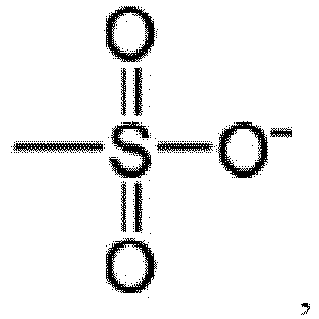
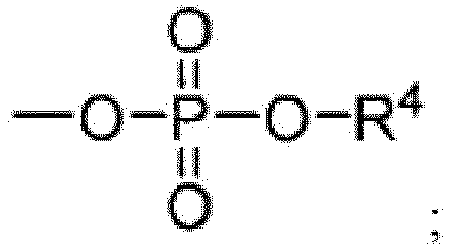
- [10] The method for producing a stationary phase for chromatography according to [8] or [9], in which the inorganic carrier particles are porous inorganic particles or non-porous inorganic particles.
- [11] The method for producing a stationary phase for chromatography according to [10], in which the inorganic carrier particles are porous inorganic particles, and the porous inorganic particles are core-shell particles.
- According to the present invention, it is possible to provide a stationary phase for chromatography which has a good molecular recognition ability, and has good separation characteristics, particularly for hydrophilic substances.
-
-
FIG. 1 is a chromatogram showing the separation of water-soluble vitamins by SFC using a poly(PA)-bonded silica gel as the stationary phase. -
FIG. 2 is a chromatogram showing the separation of water-soluble vitamins by SFC using a poly(4-vinylpyridine)-bonded silica gel as the stationary phase. -
FIG. 3 is a chromatogram showing the separation of uridine by HPLC using various vinyl polymer-bonded silica gel as the stationary phase. -
FIG. 4 is a chromatogram showing the separation of uridine by HPLC using an existing commercially available silica gel as the stationary phase. -
FIG. 5 is a chromatogram showing the separation of uridine by HPLC using, as the stationary phase, a poly(PA)-bonded silica gel prepared from a 1.6 µm silica gel as a raw material. -
FIG. 6 is a chromatogram showing the separation of uridine by HPLC using various preparation methods and as the stationary phase, a poly(PA)-bonded silica gel prepared using a core-shell silica gel as a raw material. - The stationary phase for chromatography of the present invention includes an inorganic carrier particle to which is bonded a polymer having a hydrophilic group on repeating units of a main chain thereof.
- As used herein, "stationary phase" refers to a material which, in chromatography, is immobilized at the interior of an analytical instrument (a column or capillary) and brings about, between itself and a fluid that moves while remaining in touch with the material, the partitioning and separation of substances to be separated. When the material is in the form of particles, "stationary phase" may denote the bulk material formed by the packing of these particles or may denote the individual particles.
- Here, preferred examples of the "hydrophilic group" include an ionic group of an amphoteric ion, a cation, or an anion, for example. Examples thereof include a hydroxyl group, a carboxyl group, a sulfonic acid group, an amide group, an amino group, a dialkylamino group, a trialkylamino base, a trialkylphosphonium base, and a polyoxyethylene group.
- In the stationary phase according to an embodiment of the present invention, from the standpoint of safety and separation performance, chemical bonds (covalent bonds) are formed between the carrier and the polymer. Exemplary production methods include any of the steps shown in (i) to (v) below.
- Although it is possible, in a stationary phase for chromatography, to utilize physical bonds with the carrier to coat a polymer thereon, the polymer in such cases may leach out depending on the solvent, and so this is not a desirable method.
- (i) radically copolymerizing a (meth)acrylic monomer having a hydrophilic group or a (meth)acrylamide monomer having a hydrophilic group with an inorganic carrier particle having a polymerizable functional group bonded thereto;
- (ii) producing a polymer by radically polymerizing a (meth)acrylic monomer having a hydrophilic group or a (meth)acrylamide monomer having a hydrophilic group in the presence of a chain transfer agent having on an end thereof a crosslinkable silyl group; and silane coupling the resulting polymer on a surface of an inorganic carrier particle;
- (iii) copolymerizing a (meth)acrylic monomer having a hydrophilic group or a (meth)acrylamide monomer having a hydrophilic group with a silane coupling agent having a polymerizable double bond, and silane coupling the resulting polymer on a surface of an inorganic carrier particle;
- (iv) copolymerizing a silane coupling agent having a polymerizable double bond with a (meth)acrylic monomer having a hydrophilic group or a (meth)acrylamide monomer having a hydrophilic group in the presence of an inorganic carrier particle; and
- (v) introducing a chain transferring functional group onto a surface of an inorganic carrier particle, and radically polymerizing a (meth)acrylic monomer having a hydrophilic group or a (meth)acrylamide monomer having a hydrophilic group.
- In all of these methods, it is possible to regulate the stereoregularity of the produced polymer by adjusting polymerization temperature, polymerization solvents, additives and the like for polymerization.
- A production method including step (i) will be described.
- The inorganic carrier particle (hereinafter, also simply referred to as carrier) to which is bonded a polymerizable functional group and which can be used in the production method including step (i) can be obtained by the following method.
- The polymerizable functional group bonded to the carrier is exemplified by a radically polymerizable functional group. Illustrative examples include a vinyl group, an allyl group, an isopropenyl group, and an alkenyl group of 4 to 12 carbon atoms having a double bond at the co position. Of these, a vinyl group, an allyl group, and an isopropenyl group are preferred.
- As the inorganic carrier particle, porous inorganic particles or non-porous inorganic particles are used. Suitable carriers for porous inorganic particles include silica gel, alumina, zirconia, titania, magnesia, glass, kaolin, titanium oxide, silicate, and hydroxyapatite. Preferred porous inorganic particles are silica gel, alumina, or glass.
- Suitable carriers for non-porous inorganic particles include non-porous silica gel and non-porous titanium oxide.
- When a porous silica gel or a non-porous silica gel (hereinafter, also simply referred to as "silica gel" as a concept including both) is used as the carrier, the polymerizable functional group described above is chemically bonded to the carrier via silanol groups on the silica gel.
- When a carrier other than a porous silica gel or a non-porous silica gel is used, by carrying out surface treatment of the carrier, excess adsorption of the substances to be separated to the carrier itself can be suppressed. Further, polymerizable functional group via the groups introduced in the surface treatment can be bonded to the carrier. Examples of surface treatment agents include silane coupling agents such as aminopropylsilane and titanate or aluminate-type coupling agents.
- When a porous silica gel is used as the carrier, this may be a core-shell type silica gel that is referred to as "core shell" or "peripheral", in which the core is non-porous and only the surface layer has been made porous.
- When a core-shell type carrier (also referred to as core-shell particle) is used, it is possible to use the one to be described later.
- The carrier to which such polymerizable functional group is bonded is obtained by, for example, silane coupling a compound represented by Formula (I) below with a carrier, preferably silica gel.
W-X-Y SiR3-nZn (I)
- (In Formula (I), W is a vinyl group, an allyl group, an isopropenyl group, or an alkenyl group of 4 to 12 carbon atoms having a double bond at the co position; X is an amide group, an ester group, an N-alkylamide group of 1 to 3 carbon atoms, an ether group, a sulfoxide group, a sulfone group, a sulfide group, or a phosphate ester group; Y is an alkylene group of 1 to 30 carbon atoms; each R is independently an alkyl group of 1 to 3 carbon atoms; Z is a leaving group that can form a bond between the silicon atom in Formula (I) and the carrier; and n is an integer from 1 to 3.)
- In Formula (I) above, W is preferably a vinyl, allyl, or isopropenyl group.
- In Formula (I) above, X is part of the linker between W and the terminal Z group, and is preferably an amide group, an N-alkylamide group of 1 to 3 carbon atoms, or an ester group.
- Y in Formula (I) above is preferably an alkylene of 1 to 5 carbon atoms, and is more preferably a methylene group, an ethylene group, or a trimethylene group.
- R in Formula (I) above is preferably a methyl group or an ethyl group.
- Z in Formula (I) above is a leaving group, and can be any atomic group that can form a bond between the silicon atom in Formula (I) and a constituent atom such as oxygen of the carrier. For a good balance between ease of handling and reactivity, an alkoxy group of 1 to 5 carbon atoms can generally be used, with the use of a methoxy group or an ethoxy group being especially preferred. Illustrative examples include halogens (chlorine, bromine, or iodine), alkylmercaptyl groups of 1 to 20 carbon atoms, nitrogen-containing groups such as dimethylamino, diethylamino, pyrrolidino and imidazolyl groups, and allyl or 2-methyl-2-propenyl groups. The reaction conditions (including catalyst addition) can be adjusted according to the type of leaving group.
- The compound of Formula (I) above can be obtained by reacting a compound having the structure represented by W in Formula (I) above with a compound having the -Y-SiR3-nZn structure in Formula (I) above.
- The "-X-" moiety in Formula (I) above is formed by a reaction between these compounds.
- The compound having the structure represented by W is exemplified by acrylic acid in which the hydrogen on the carbon bonded to the vinyl group can be substituted with an alkyl group of 1 to 12 carbon atoms, or a halide of an acrylic acid in which the hydrogen on the carbon bonded to the vinyl group can be substituted with an alkyl group of 1 to 12 carbon atoms.
- The compound having the -Y-SiR3-nZn structure in Formula (I) above is exemplified by silane coupling agents having a group that is the precursor of the above-described X moiety and having an alkoxy group of 1 to 5 carbon atoms as a leaving group.
- The carrier to which is bonded a polymerizable functional group that is used in the present invention is preferably a surface-modified silica gel obtained by silane coupling the compound represented by Formula (I) above with silica gel.
- When the stationary phase according to an embodiment of the present invention is produced by the production method including step (i) described above, it can be obtained by copolymerizing a (meth)acrylic monomer having a hydrophilic group or a (meth)acrylamide monomer having a hydrophilic group with a carrier to which a polymerizable functional group is bonded.
- Such copolymerization may involve, for example, inducing copolymerization for both the (meth) acryloyl groups of the monomer and the polymerizable functional group. A known method can be used for the reaction conditions for this case.
- An example of the (meth)acrylic monomer having a hydrophilic group or the (meth)acrylamide monomer having a hydrophilic group is a monomer represented by Formula (1) below.

- R1 is hydrogen or an alkyl of 1 to 6 carbon atoms;
- R2 is a single bond or an alkylene of 1 to 12 carbon atoms;
- R3 is a single bond or an alkylene of 1 to 6 carbon atoms;
- X2 is -O-, -NH-, or -N(CH3)-, Y2 is a single bond,


- Z2 is hydrogen, alkyl of 1 to 6 carbon atoms, halogen, -N+R4 3,


- In Formula (1), when X2 is -O- and Y2 is


- In Formula (2), R1 is hydrogen or methyl; and R2 is methylene, ethylene, propylene, butylene, pentylene, or hexylene, and is preferably methylene or ethylene; R3 is methylene, ethylene, propylene, butylene, pentylene, or hexylene, and is preferably methylene or ethylene; and R4 is methyl or ethyl, and is preferably methyl.
- Specific examples of the monomer represented by Formula (2) above include 2-((meth)acryloyloxy)ethyl-2'-(trimethylammonio)ethyl phosphate, 3-((meth)acryloyloxy)propyl-2'-(trimethylammonio)ethyl phosphate, 4-((meth)acryloyloxy)butyl-2'-(trimethylammonio)ethyl phosphate, 5-((meth)acryloyloxy)pentyl-2'-(trimethylammonio)ethyl phosphate, 6-((meth)acryloyloxy)hexyl-2'-(trimethylammonio)ethyl phosphate, 2-((meth)acryloyloxy)ethyl-2'-(triethylammonio)ethyl phosphate, 2-((meth)acryloyloxy)ethyl-2'-(tripropylammonio)ethyl phosphate, 2-((meth)acryloyloxy)ethyl-2'-(tributylammonio)ethyl phosphate, 2-((meth)acryloyloxy)ethyl-2'-(tricyclohexylammonio)ethyl phosphate, 2-((meth)acryloyloxy)ethyl-2'-(triphenylammonio)ethyl phosphate, 2-((meth)acryloyloxy)propyl-2'-(trimethylammonio)ethyl phosphate, 2-((meth)acryloyloxy)butyl-2'-(trimethylammonio)ethyl phosphate, 2-((meth)acryloyloxy)pentyl-2'-(trimethylammonio)ethyl phosphate, and 2-((meth)acryloyloxy)hexyl-2'-(trimethylammonio)ethyl phosphate. Of these, 2-((meth)acryloyloxy)ethyl-2'-(trimethylammonio)ethyl phosphate (2-methacryloyloxyethyl phosphorylcholine: hereinafter, also abbreviated as "PA") is preferably used in terms of availability.
- In Formula (1), when X2 is -O-, -NH-, or -N(CH3)-, and Y2 is -N+(R4)2-, a monomer represented by Formula (3) below can be preferable.

- In Formula (3), R1 is hydrogen or methyl; R2 is an alkylene of 1 to 12 carbon atoms; R4 is hydrogen, methyl, or ethyl; and Z2 is the same group as R4. X- is a fluoride, chloride, bromide, or iodide.
- Specific examples of the monomer represented by formula (3) above include methacryloylaminomethyltrimethylammonium chloride, 2-(methacryloylamino)ethyltrimethylammonium chloride, 3 -(methacryloylamino)propyltrimethylammonium chloride, 4-(methacryloyl)amino)butyltrimethylammonium chloride, 5-(methacryloylamino)pentyltrimethylammonium chloride, 6-(methacryloylamino)hexyltrimethylammonium chloride, methacryloylaminomethyltrimethylammonium bromide, 2-(methacryloylamino)ethyltrimethylammonium bromide, 3 -(methacrylamino)propyltrimethylammonium bromide, 4-(methacrylamino)butyltrimethylammonium bromide, 5-(methacrylamino)pentyltrimethylammonium bromide, 6-(methacylamino)hexyltrimethylammonium bromide, methacryloylaminomethyltrimethylammonium iodide, 2-(methacryloylamino)ethyltrimethylammonium iodide, 3-(methacryloylamino)propyltrimethylammonium iodide, 4-(methacryloylamino)butyltrimethylammonium iodide, 5-(methacryloylamino)pentyltrimethylammonium iodide, 6-(methacloylamino)hexyltrimethylammonium iodide, methacryloyloxymethyltrimethylammonium chloride, 2-(methacryloyloxy)ethyltrimethylammonium chloride, 3 -(methacryloyloxy)propyltrimethylammonium chloride, 4-(methacryloyloxy)butyltrimethylammonium chloride, 5-(methacryloyloxy)pentyltrimethylammonium chloride, 6-(methacryloyloxy)hexyltrimethylammonium chloride, methacryloyloxymethyltrimethylammonium bromide, 2-(methacryloyloxy)ethyltrimethylammonium bromide, 3 -(methacryloyloxy)propyltrimethylammonium bromide, 4-(methacryloyloxy)butyltrimethylammonium bromide, 5-(methacryloyloxy)pentyltrimethylammonium bromide, 6-(methacryloyloxy)hexyltrimethylammonium bromide, methacryloyloxymethyltrimethylammonium iodide, 2-(methacryloyloxy)ethyltrimethylammonium iodide, 3-(methacryloyloxy)propyltrimethylammonium iodide, 4-(methacryloyloxy)butyltrimethylammonium iodide, 5-(methacryloyloxy)pentyltrimethylammonium iodide and 6-(methacryloyloxy)hexyltrimethylammonium iodide.
- In Formula (1), when Y2 is -N+(R4)2-, a monomer represented by Formula (4) below can be preferable.

- In Formula (4), X2 is -O-, -NH-, or -N(CH3)-; R1 is hydrogen or methyl; R2 is an alkylene group having 1 to 12 carbon atoms; R3 is an alkyl group having 1 to 12 carbon atoms; Z2 is


- Specific examples of the monomer represented by Formula (4) above include 2-(N-3-sulfopropyl-N,N-dimethylammonium)ethyl methacrylate, 2-(N-3-sulfopropyl-N,N-dimethylammonium)ethyl methacrylamide, 3-[[2-(methacryloyloxy)ethyl]dimethylammonio] propionate, and 3-[[2-(methacrylamide)ethyl]dimethylammonio] propionate.
- In Formula (1), when Y2 is


- In Formula (5), X2 is -O-, -NH-, or -N(CH3)-; R1 is hydrogen or methyl; a is an integer from 1 to 5; b is an integer from 1 to 20; and Z2 is preferably hydrogen, methyl, or ethyl.
- Specific examples of the monomer represented by Formula (5) above include 2-hydroxyethyl methacrylate, diethylene glycol monomethacrylate, diethylene glycol monomethyl ether methacrylate, diethylene glycol monoethyl ether methacrylate, triethylene glycol monomethacrylate, triethylene glycol monomethyl ether methacrylate, triethylene glycol monoethyl ether methacrylate, tetraethylene glycol monomethacrylate, tetraethylene glycol monomethyl ether methacrylate, tetraethylene glycol monoethyl ether methacrylate, polyethylene glycol monomethacrylate, polyethylene glycol monomethyl ether methacrylate, polyethylene glycol monoethyl ether methacrylate, 2-hydroxyethyl methacrylamide, diethylene glycol monomethacrylamide, diethylene glycol monomethyl ether methacrylamide, diethylene glycol monoethyl ether methacrylamide, triethylene glycol monomethacrylamide, triethylene glycol monomethyl ether methacrylamide, triethylene glycol monoethyl ether methacrylamide, tetraethylene glycol monomethacrylamide, tetraethylene glycol monomethyl ether methacrylamide, tetraethylene glycol monoethyl ether methacrylamide, polyethylene glycol monomethacrylamide, polyethylene glycol monomethyl ether methacrylamide, polyethylene glycol monoethyl ether methacrylamide, 2-hydroxyethyl acrylate, diethylene glycol monoacrylate, diethylene glycol monomethyl ether acrylate, diethylene glycol monoethyl ether acrylate, triethylene glycol monoacrylate, triethylene glycol monomethyl ether acrylate, triethylene glycol monoethyl ether acrylate, tetraethylene glycol monoacrylate, tetraethylene glycol monomethyl ether acrylate, tetraethylene glycol monoethyl ether acrylate, polyethylene glycol monoacrylate, polyethylene glycol monomethyl ether acrylate, polyethylene glycol monoethyl ether acrylate, 2-hydroxyethyl acrylamide, diethylene glycol monoacrylamide, diethylene glycol monomethyl ether acrylamide, diethylene glycol monoethyl ether acrylamide, triethylene glycol monoacrylamide, triethylene glycol monomethyl ether acrylamide, triethylene glycol monoethyl ether acrylamide, tetraethylene glycol monoacrylamide, tetraethylene glycol monomethyl ether acrylamide, tetraethylene glycol monoethyl ether acrylamide, polyethylene glycol monoacrylamide, polyethylene glycol monomethyl ether acrylamide, and polyethylene glycol monoethyl ether acrylamide.
- In Formula (1), when Z2 is


- Specific examples of the monomer represented by formula (6) above include lithium 3-(methacryloyloxy) propane sulfonate, sodium 3-(methacryloyloxy) propane sulfonate, potassium 3-(methacryloyloxy) propane sulfonate, cesium 3-(methacryloyloxy) propane sulfonate, lithium 3-(methacrylamide) propane sulfonate, sodium 3-(methacrylamido) propane sulfonate, potassium 3-(methacrylamide) propane sulfonate, cesium 3-(methacrylamide) propane sulfonate, lithium 3-(N-methylmethacrylamide) propane sulfonate, sodium 3-(N-methylmethacrylamide) propane sulfonate, potassium 3-(N-methylmethacrylamide) propane sulfonate, cesium 3-(N-methylmethacrylamide) propane sulfonate, lithium 3-(acryloyloxy) propane sulfonate, sodium 3-(acryloyloxy) propane sulfonate, potassium 3-(acryloyloxy) propane sulfonate, cesium 3-(acryloyloxy) propane sulfonate, lithium 3-(acrylamide) propane sulfonate, sodium 3-(acrylamide) propane sulfonate, potassium 3-(acrylamide) propane sulfonate, cesium 3-(acrylamide) propane sulfonate, lithium 3-(N-methylacrylamide) propane sulfonate, sodium 3-(N-methylacrylamide) propane sulfonate, potassium 3-(N-methylacrylamide) propane sulfonate, cesium 3-(N-methylacrylamide) propane sulfonate, lithium 2-(methacryloyloxy) ethane sulfonate, sodium 2-(methacryloyloxy) ethane sulfonate, potassium 2-(methacryloyloxy) ethane sulfonate, cesium 2-(methacryloyloxy) ethane sulfonate, lithium 2-(methacrylamido) ethane sulfonate, sodium 2-(methacrylamide) ethane sulfonate, potassium 2-(methacrylamide) ethane sulfonate, cesium 2-(methacrylamide) ethane sulfonate, lithium 2-(N-methylmethacrylamide) ethane sulfonate, sodium 2-(N-methylmethacrylamide) ethane sulfonate, potassium 2-(N-methylmethacrylamide) ethane sulfonate, cesium 2-(N-methylmethacrylamide) ethane sulfonate, lithium 2-(acryloyloxy) ethane sulfonate, sodium 2-(acryloyloxy) ethane sulfonate, potassium 2-(acryloyloxy) ethane sulfonate, cesium 2-(acryloyloxy) ethane sulfonate, lithium 2-(acrylamide) ethane sulfonate, sodium 2-(acrylamide) ethane sulfonate, potassium 2-(acrylamide) ethane sulfonate, cesium 2-(acrylamide) ethane sulfonate, lithium 2-(N-methylacrylamide) ethane sulfonate, sodium 2-(N-methylacrylamide) ethane sulfonate, potassium 2-(N-methylacrylamide) ethane sulfonate, and cesium 2-(N-methylacrylamide) ethane sulfonate.
- In Formula (1), when R2 and R3 are single bonds, and X2 is-NH-, a monomer represented by Formula (7) below can be preferable.

- In Formula (7), R1 is hydrogen or an alkyl of 1 to 6 carbon atoms; and Z2 is hydrogen or an alkyl of 1 to 6 carbon atoms.
- Specific examples of the monomer represented by Formula (7) above include acrylamide, methacrylamide, N-methyl acrylamide, N-methyl methacrylamide, N-ethyl acrylamide, and N-ethyl methacrylamide.
- The copolymerization conditions include radical copolymerization, and a small amount of a radical generator can be used as a catalyst to induce copolymerization. The radical generator can be a known radical generator that is used in polymerization reactions, and specific examples thereof include azo compounds and peroxides. The stationary phase according to an embodiment of the present invention obtained using the starting materials and the production method including step (i) described above presumably has the following structure.

- (In Formula II, W' and W", which are derived from W in Formula (I), are groups that form by addition polymerization; X is an amide group, an ester group, an N-alkylamide group of 1 to 3 carbon atoms, an ether group, a sulfoxide group, a sulfone group, a sulfide group, or a phosphate ester group; Y is an alkylene group of 1 to 30 carbon atoms; V is an ether group bonded to the silica gel surface, or an unreacted Z group shown in Formula (I) above, or an R group; and X2, Y2, Z2, R1, R2, and R3 are the same as those described in Formula (1) above.)
- In Formula (II) above, specific examples of W' include a single bond and an alkylene group of 1 to 10 carbon atoms which may have a branched chain. Preferred examples thereof include a single bond, a methylene group, an ethylene group, and a trimethylene group.
- In Formula (II) above, specific examples of W" include hydrogen or an alkyl group of 1 to 12 carbon atoms.
- Preferred groups of X and Y in Formula (II) can be the same as for Formula (I) above.
- X2, Y2, Z2, R1, R2, and R3 in Formula (II) are the same as those described in Formula (1) above, and the preferred combinations of X2 and Y2 and the preferred structure generated thereby are the same as those described in Formulas (2) to (7) above.
- In Formula (II), p can be from 1 to 10, and q can be from about 10 to about 3000. Here, p is preferably from 1 to 5, and q is preferably from 15 to 2500, and more preferably from 20 to 2000.
- With regard to V in Formula (II), when n = 1 in the compound of Formula (I) above, V=R; and when n = 2, the ratio of the numbers of unreacted Z groups or R groups to the total number of V is from 50 to 100%; and when n = 3, the ratio of the numbers of unreacted Z groups or R groups to the total number of V is from 0 to 100%.
- X2, Y2, Z2, R1, R2, and R3 in Formula (II) are the same as those described in Formula (1) above, and specific examples thereof include those described in any of Formulas (2) to (7) above.
- Next, a production method including step (ii) for obtaining the stationary phase according to an embodiment of the present invention will be described.
- The production method including step (ii) includes radically polymerizing in the presence of a chain transfer agent having a terminal crosslinkable silyl group, and silane coupling the obtained polymer with a carrier surface.
- The chain transfer agent having a terminal crosslinkable silyl group that is used in the production method including step (ii) is exemplified by compounds of formula (III) below. In the invention, "crosslinkable silyl group" refers to a silyl group to which is bonded a leaving group such as that indicated by Z in Formula (III) below. The same applies also to the compound used in other production methods below.
R3-nZnSi-Y-T (III)
- (In Formula (III), each R is independently an alkyl group of 1 to 5 carbon atoms; and Z is a leaving group that can form a bond between the silicon atom in Formula (III) and a carrier. Y is a single bond or an alkylene group of 1 to 30 carbon atoms, and T is a chain transferring functional group. n is an integer from 1 to 3.)
- In Formula (III), R is preferably a methyl group, an ethyl group, or a propyl group. Z is a leaving group, and can be any atomic group that can form a bond between the silicon atom in Formula (III) and a constituent oxygen of the silica gel.
- For a good balance between ease of handling and reactivity, alkoxy groups of 1 to 5 carbon atoms can generally be used as the leaving group; illustrative examples include methoxy and ethoxy groups. Halogens (chlorine, bromine, or iodine), nitrogen-containing groups such as dimethylamino, diethylamino, pyrrolidino, and imidazolyl groups, and allyl and isopropenyl groups can also be used. The reaction conditions (including catalyst addition) can be adjusted according to the type of leaving group. Y is more preferably a single bond or an alkylene group of 1 to 10 carbon atoms. T is a chain transferring functional group. "Chain transferring functional group" refers to a functional group which, in a polymerization reaction, leads vigorously to a chain transfer reaction accompanied by transfer of a growing active species and a re-initiation reaction. The presence of a chain transferring functional group means that it is possible to some extent to control the molecular weight and terminal structure of the obtained polymer. Preferred specific examples of the chain transferring functional group include halogenated alkyl groups of 1 to 12 carbon atoms, alkyl group of 1 to 12 carbon atoms having a thiol at the end, and alkyl groups of 1 to 12 carbon atoms having therein a disulfide group.
- Examples of the halogen on the halogenated alkyl groups of 1 to 12 carbon atoms include chlorine, bromine, and iodine. These alkyl groups are exemplified by alkyl groups of 1 to 3 carbon atoms.
- By carrying out radical polymerization on a (meth)acrylic monomer having a hydrophilic group or a (meth)acrylamide monomer having a hydrophilic group in the presence of such a chain transfer agent and using a small amount of a radical generator as a catalyst, a compound having a structure shown in formula (IV) below can be obtained. Here, it is possible to control the molecular weight to some degree using the molar ratio between the chain transfer agent and the monomer. The radical generator can be a known radical generator that is used in polymerization reactions, and specific examples thereof include azo compounds and peroxides. In addition to silica gel, it is possible to use as the carrier the same materials as can be used in the production method including step (i) above. The (meth)acrylic monomer having a hydrophilic group or the (meth)acrylamide monomer having a hydrophilic group can also be the same as those used in the production method including step (i). Further, it is also possible to use as the radical generator the same materials as can be used in the production method including step (i).

- (In Formula (IV), T' is derived from T in Formula III and is a group that forms by a chain transfer reaction; and X2, Y2, Z2, R1, R2, and R3 are the same as those described in Formula (1) above. q is an integer of 2 to 300.)
- X2, Y2, Z2, R1, R2, and R3 in Formula (IV) are the same as those described in Formula (1) above, and specific examples thereof include those described in any of Formulas (2) to (7) above.
- When T is an alkyl group of 1 to 12 carbon atoms having a halogen bonded at the end, T' in Formula (IV) is an alkylene residue of 1 to 12 carbon atoms which is substituted with that halogen. When T is an alkyl group of 1 to 12 carbon atoms having a thiol at the end or an alkyl group of 1 to 12 carbon atoms having a disulfide group therein, T' is a thioether.
- The carrier used in production method (ii) for the stationary phase according to an embodiment of the present invention can be the same as the carrier used in production method (i).
- A known silane coupling method can be used as the method for coupling the compound of Formula (III) to the carrier by a silane coupling reaction.
- The stationary phase according to an embodiment of the present invention obtained by the production method including step (ii) above presumably has a structure represented by Formula (V) below.

- (In Formula (V), Y is a single bond or an alkylene group of 1 to 30 carbon atoms; when the inorganic carrier is silica gel, V is an ether group bonded to the silica gel surface, or an unreacted Z group shown in Formula (III) above, or an R group; T' is derived from T in Formula (III) and is a group that forms by a chain transfer reaction; and X2, Y2, Z2, R1, R2, and R3 are the same as those described in Formula (1) above, and specific examples thereof include those described in any of Formulas (2) to (7) above. q is an integer from 2 to 300.)
- Next, a production method including step (iii) will be described.
- This production method includes copolymerizing a silane coupling agent having a polymerizable double bond with a (meth)acrylic monomer having a hydrophilic group or a (meth)acrylamide monomer having a hydrophilic group, and silane coupling the resulting polymer on a carrier surface.
- The silane coupling agent having a polymerizable double bond is exemplified by compounds of the structure represented by Formula (VI) below.
W-X-Y-SiR3-nZn (VI)
- (In Formula (VI), W is a vinyl group, an allyl group, an isopropenyl group, or an alkenyl group of 4 to 12 carbon atoms having a double bond at the co position; X is an amide group, an ester group, an N-alkylamide group of 1 to 3 carbon atoms, an ether group, a sulfoxide group, a sulfone group, or a phosphate ester group; each R is independently an alkyl group of 1 to 5 carbon atoms; Z is a leaving group that can form a bond between the silicon atom in Formula (VI) and the carrier; Y is an alkylene group of 1 to 30 carbon atoms; and n is an integer from 1 to 3.)
- Y in Formula (VI) above is preferably an alkylene of 1 to 5 carbon atoms, and is more preferably a methylene group, an ethylene group, or a trimethylene group.
- R is preferably a methyl group or an ethyl group.
- Z is a leaving group, and can be any atomic group that can form a bond between the silicon atom in Formula (VI) and, in cases where the carrier is, for example, silica gel, a constituent oxygen in the silica gel. Even in cases where the carrier is not silica gel, the leaving group is capable of forming a bond with a constituent atom of the carrier.
- For a good balance between ease of handling and reactivity, alkoxy groups of 1 to 5 carbon atoms can generally be used as the leaving group; illustrative examples include methoxy and ethoxy groups. Use can also be made of halogens (chlorine, bromine, or iodine), nitrogen-containing groups such as dimethylamino, diethylamino, pyrrolidino, and imidazolyl groups, and allyl and isopropenyl groups. The reaction conditions (including catalyst addition) can be adjusted according to the type of leaving group.
- In the production method including step (iii) above as well, in addition to silica gel, it is possible to use as the carrier the same materials as can be used in the production method including steps (i) and (ii) above. The (meth)acrylic monomer having a hydrophilic group or the (meth)acrylamide monomer having a hydrophilic group can also be the same as those used in the production method including steps (i) and (ii).
- The copolymerization conditions include radical copolymerization, and a small amount of a radical generator can be used as a catalyst to induce copolymerization. It is possible to use as the radical generator the same materials as can be used in production method (i). In this production method, regulation of the molecular weight is possible by using a suitable chain transfer agent and the above-described living radical polymerization process when synthesizing the polymer. A known silane coupling method can be used as the method for coupling the resulting polymer with the carrier by a silane coupling reaction.
- The stationary phase according to an embodiment of the present invention obtained by the production method including step (iii) above presumably has the structure represented by Formula (II) above.
- Next, a production method including step (iv) will be described.
- This production method includes copolymerizing a silane coupling agent having a polymerizable double bond with a (meth)acrylic monomer having a hydrophilic group or a (meth)acrylamide monomer having a hydrophilic group in the presence of a carrier.
- In this production method, a compound having a structure represented by Formula (VI) used in the production method including step (iii) above can be used as the silane coupling agent having a polymerizable double bond.
- Further, in addition to silica gel, it is possible to use as the carrier the same materials as can be used in the production method including steps (i) and (ii) above. The (meth)acrylic monomer having a hydrophilic group or the (meth)acrylamide monomer having a hydrophilic group can also be the same as those used in the production method including steps (i) and (ii).
- The copolymerization conditions include radical copolymerization, and a small amount of a radical generator can be used as a catalyst to induce copolymerization. The radical generator can be a known radical generator that is used in polymerization reactions, and specific examples thereof include azo compounds and peroxides.
- The stationary phase according to an embodiment of the present invention obtained by the production method including step (iv) above presumably has the structure represented by Formula (II) above.
- Next, a production method including step (v) will be described. This production method includes introducing a chain transferring functional group to a carrier surface, and radically polymerizing a (meth)acrylic monomer having a hydrophilic group or a (meth)acrylamide monomer having a hydrophilic group. The chain transferring functional group is exemplified by the same as those exemplified in the description of Formula (III), and preferred examples are also the same.
- In this production method, the carrier to which the chain transferring functional group is bonded can be obtained by silane coupling a compound having the structure of Formula (III), which is used in the production method including step (ii) above, with silica gel (in cases where silica gel is used as the carrier).
- By carrying out the radical polymerization of a (meth)acrylic monomer having a hydrophilic group or a (meth)acrylamide monomer having a hydrophilic group in the presence of a carrier onto the surface of which chain transferring functional groups have been introduced (chemically bonded) and using a small amount of a radical generator as a catalyst, it is possible to immobilize a polymer on the carrier surface. In addition to silica gel, it is possible to use as the carrier the same materials as can be used in the production method including steps (i) and (ii) above. The (meth)acrylic monomer having a hydrophilic group or the (meth)acrylamide monomer having a hydrophilic group can also be the same as those used in the production method including steps (i) and (ii). Further, it is also possible to use as the radical generator the same materials as can be used in the production method including steps (i) and (ii).
- The stationary phase according to an embodiment of the present invention obtained by the production method including step (v) above presumably has the structure represented by Formula (v) above.
- Stationary phases obtained by the production method including any of steps (i) to (v) above also have excellent performances as stationary phases for supercritical fluid chromatography.
- The polymer obtained through the above operations, which is bonded to the carrier of the stationary phase according to an embodiment of the present invention and has a hydrophilic group on repeating units of the main chain thereof, has a weight-average molecular weight of preferably 1000 or greater and 5000000 or less. As used herein, "weight-average molecular weight" refers to that of the -(CH2-CAB)n-sites which, in the case of structures represented by, for example, above Formula (II) or (IV), are the repeating units of the main chain thereof.
- From such standpoints as the solubility of the polymer in solvent, prevention of particle agglomeration when the polymer is carried by the carrier, suppression of dissolution in the mobile phase solvent, and maintaining the bonded amount of polymer when chemically bonded to the carrier, the weight-average molecular weight is preferably in the above range. The optimum weight-average molecular weight differs depending on the type of polymer.
- However, in the production method including steps (i), (iv), and (v), because polymerization of the monomer having a hydrophilic group and immobilization on the silica gel occur at the same time, the weight-average molecular weight is estimated from the polymerization solution supernatant.
- In the production method including steps (ii) and (iii), before bonding the polymer having a hydrophilic group on repeating units of the main chain thereof to the carrier, the weight-average molecular weight of the polymer is measured.
- The weight-average molecular weight can be measured by gel permeation chromatography (GPC) using polystyrene, poly(methyl methacrylate), or poly(ethylene glycol) as the reference substance.
- In the stationary phase according to an embodiment of the present invention, because the polymer having a hydrophilic group on repeating units of the main chain thereof is covalently bonded to the carrier surface, even when a solvent inherently capable of dissolving the polymer, or a mixed solvent containing the same, is used as the developing solvent, the polymer does not dissolve and thus its function as a stationary phase is not impaired.
- Because the specific surface area of the stationary phase according to an embodiment of the present invention corresponds to the specific surface area of the carrier used, a carrier having the desired specific surface area may be selected. When the carrier is, for example, a porous inorganic particle which includes porous silica gel as an option, the specific surface area can be adjusted by choosing a suitable product. Generally, in cases where the polymer is carried by a carrier, a change in specific surface area greater than that attributable to error does not occur before and after the polymer is carried; hence, the specific surface area of the stationary phase can be regarded as identical to the specific surface area of the carrier used.
- When a core-shell particle is used as the carrier, the specific surface area thereof corresponds to the specific surface area of the shell.
- The average particle size of the carrier that can be used in the present invention is typically 0.1 µm or greater and 50 µm or less, in another aspect, 1 µm or greater and 40 µm or less, in yet another aspect, 1 µm or greater and 30 µm or less, in yet another aspect, 1 µm or greater and 5 µm or less, and in yet another aspect, 1 µm or greater and 3 µm or less. The average pore size is typically 10 Å or greater and 10000 Å or less, in another aspect, 50 Å or greater and 1000 Å or less, and in yet another aspect, 100 Å or greater and 1000 Å or less.
- In the case of porous inorganic particles including porous silica gel as an option, the specific surface area of the carrier is typically 5 m2/g or greater and 1000 m2/g or less, and in another aspect, 10 m2/g or greater and 500 m2/g or less. On the other hand, in the case of non-porous inorganic particles including non-porous silica gel as an option, the specific surface area thereof is typically less than 5 m2/g, in another aspect, 4 m2/g or less, and typically 0.01 m2/g or greater. Generally, in cases where the polymer is carried by a carrier, a change in specific surface area greater than that attributable to error does not occur before and after the polymer is carried; hence, the average particle size of the stationary phase can be regarded as identical to the average particle size of the carrier used. That is, in cases where the stationary phase of the present invention is particulate, the average particle size thereof is 0.1 µm or greater and 1000 µm or less, typically 0.1 µm or greater and 50 µm or less, and in another aspect, 1 µm and 50 µm or less.
- The polymer carried by the carrier has an average thickness (carrying amount per gram of carrier/specific surface area of carrier) of typically preferably 0.5 nm or greater and 5 nm or less. In this range, the peak has a tendency to be sharp, which is preferable.
- On the other hand, in the embodiment of the present invention, a core-shell particle having a non-porous core and a porous shell on the outer surface thereof can be used as the carrier. The core-shell particles as used herein is classified as porous inorganic particles. Core-shell particles having a shell with an average pore diameter of 9 nm or greater, and also 30 nm or greater can be used. The average pore diameter of the shell is typically 300 nm or less.
- It is expected that giving the shell of the core-shell particle an average pore diameter of 9 nm or greater, and in another aspect, 30 nm or greater will cause the ligand material to penetrate into the shell of the core-shell particle, which contributes to good separation of target substances.
- The average pore diameter of the shell of the core-shell particle can be measured by the gas adsorption technique.
- The gas adsorption technique is a method in which vapor is adsorbed by varying pressure on a porous sample, the amount of adsorption at that time is measured, and the specific surface area, pore volume, pore distribution, and the like are calculated from the absorption/desorption isothermal curves plotted with the relative pressure (=the ratio of the pressure in the adsorption equilibrium state and the saturated vapor pressure) and the adsorbed amount. The standards of JIS Z8831-2 (mesopores and macropores) or JIS Z8831-3 (micropores), which has been established for pore size distribution and pore characteristics of powder (solid), are applicable to this technique.
- Here, "non-porous" used herein means that when the specific surface area (m2/g) of the surface of the core particles determined by the BET method is expressed by A and the surface area (m2/g) thereof per unit weight that can be calculated from the surface area (4πr2, which is calculated from the particle radius r) determined from the particle size of the core particles is expressed by B, then the value of (A - B)/B × 100 is less than 20.
- Meanwhile, "porous" used herein means the specific surface area of the surface of the material, determined by the BET method, is 10 mm2/g or greater.
- The thickness ratio of the cores to the shells of the core-shell particle is typically from 1:9 to 9:1. This ratio is preferably from 4:1 to 2:1 from the standpoint of ensuring good separation characteristics for a target substance. This ratio can be controlled by adjusting the thickness of the shell layer of the core-shell particle as described below.
- Here, "thickness of a core" refers to the diameter of the core.
- The material of the core as a constituent component of the core-shell particle is an inorganic substance. Specific examples thereof include non-porous particles selected from materials represented by glasses, metals such as titanium and zirconium, oxides of these metals, and clay minerals such as bentonite and mica.
- The average particle size of the core-shell particle is typically 0.1 µm or greater and 10 µm or less, preferably from 1 µm to 5 µm, and even more preferably from 1 µm to 3 µm. In the present invention, the particle size of the core-shell particle refers to a particle size measured by an average particle size measurement method using centrifugal sedimentation.
- The material of the shell as a constituent component of the core-shell particle is obtained by partially hydrolyzing an alkoxysilane and further hydrolyzing the resultant polyalkoxysiloxane. Such material is preferred from the standpoint that the core-shell particle can be easily produced.
- Preferred as the alkoxysilane are tetraalkoxysilanes. Preferred of these are tetramethoxylane, tetraethoxysilane, tetrapropoxysilane, and tetrabutoxysilane. Use of tetraethoxysilane is more preferred.
- For production of the core-shell particle,
JP 49-36396 - The thickness of the shell as a constituent component of the core-shell particle can be controlled, as appropriate, in the range of 0.1 to 100 µm. An example of methods therefor is to regulate the viscosity of the alkoxysilane which becomes the shell. For example, in cases where a shell having an increased thickness is to be formed, the viscosity of the alkoxysilane is lowered.
- Examples of methods for controlling the specific surface area and pore diameter of the shell include a method in which the pH of the aqueous solution to be used for deposition and condensation polymerization of the shell is regulated. For example, the pH of the aqueous solution is thought to be increased when a larger specific surface area and a larger pore diameter are to be obtained.
- Here, "thickness of a shell" refers to the value obtained by subtracting the diameter of the core from the diameter of the core-shell particle and dividing the obtained value by 2.
- A commercially available "core-shell silica gel" may also be used for this core-shell particle. Such a commercial product has a pore diameter, specific surface area, and particle size within the aforementioned ranges as catalog values. In the case of a commercial core-shell silica gel, it is possible to use a product in which the core is made of glass and the shell is made of silica gel (polyalkoxysiloxane hydrolysate).
- A commercially available "core-shell silica gel" may also be used for this core-shell particle. Such a commercial product has a pore diameter, specific surface area, and particle size within the aforementioned ranges as catalog values.
- In a stationary phase having a polymer carried by a carrier, the ratio (%) in parts by mass of polymer included per 100 parts by mass of the stationary phase is preferably from 1 to 50 mass%, more preferably from 3 to 30 mass%, and even more preferably from 5 to 30 mass%. This ratio is desirable because excessively strong retention and broadening of the peak can be avoided while yet enabling the adsorptive ability of the polymer to be suitably manifested.
- The ratio (%) of the parts by mass of polymer included per 100 parts by mass of the stationary phase can be measured by elemental analysis. The parts by mass ratio of polymer in the stationary phase is calculated based on measurement results for the carbon content of the carrier prior to bonding of the polymer and the carbon content of the resulting stationary phase, and under the assumption that all carbon aside from that included in the carrier prior to bonding of the polymer is derived from the polymer.
- In cases where the stationary phase of the present invention is particulate, the average particle size indicates the diameter when the particles are spherical, and indicates the diameter of a sphere of equivalent particle volume when the particles are of irregular shape. The average particle size can be measured with an apparatus that carries out measurement using microscopic images, such as the Mastersizer 2000E available from Malvern Instruments Ltd.
- In cases where the stationary phase of the present invention is particulate, the particles are preferably spherical particles having an aspect ratio of 2 or less, and preferably 1.5 or less. Particles that are closer to being truly spherical are more desirable, and thus the aspect ratio has no particular lower limit down to 1.
- The aspect ratio is measured as follows. The sample is placed on an observation stage in a randomly scattered state and examined from directly above with an electron microscope or an optical microscope. In a random image in which ten or more independent primary particles (that is, primary particles not touching or overlapping with any other particles) are observed, the major axis and minor axis (length of longest portion perpendicular to major axis) of each independent primary particle in the image are determined, and the ratio of the two is treated as the aspect ratio for the individual particles. The arithmetic mean of the aspect ratios for all the independent primary particles in the image is treated as the aspect ratio in the present invention. Here, "primary particles" refers to particles for which the interfaces between particles are clearly observable. Observation is generally carried out after suitable dispersion on a sample stage so as to avoid overlapping of the primary particles. However, incidental overlap can be difficult to be avoided and bulk particles formed by the agglomeration of a plurality of primary particles may be present. These instances are excluded from observation.
- The stationary phase according to an embodiment of the present invention is preferably used as a stationary phase for supercritical fluid chromatography (SFC).
- When the stationary phase according to an embodiment of the present invention is used for SFC, it has excellent separation characteristics for hydrophilic materials.
- The stationary phase according to an embodiment of the present invention can be packed into columns for supercritical fluid chromatography, such as those described in
JP 2006-058147 - In supercritical fluid chromatography, a fluid containing a supercritical fluid and a solvent is used as the mobile phase. Here, "supercritical fluid chromatography" is a general term for chromatography in which a supercritical fluid serves as the primary mobile phase. The supercritical fluid is a substance in a state at or above a critical pressure and at or above a critical temperature (i.e., a supercritical state). Examples of substances that can be used as supercritical fluids include carbon dioxide, ammonia, sulfur dioxide, hydrogen halides, nitrous oxide, hydrogen sulfide, methane, ethane, propane, butane, ethylene, propylene, halogenated hydrocarbons, and water. However, in terms of suitable critical conditions, safety, cost, and other considerations, the supercritical fluid refers substantially to carbon dioxide. Nor is it strictly necessary for the fluid to be supercritical, with "supercritical fluid chromatography" also encompassing use in a subcritical state.
- The solvent is one, two or more solvents selected from among various known solvents depending on the types of target substances, the type of supercritical fluid, and the like. Examples of the solvent include lower alcohols such as methanol, ethanol, and 2-propanol, ketones such as acetone, acetonitrile, ethyl acetate, and THF.
- The foregoing supercritical fluid chromatography is not particularly limited, so long as it is chromatography that uses as the mobile phase a fluid which includes the above supercritical fluid and the above solvent. The supercritical fluid chromatography that uses the stationary phase according to an embodiment of the present invention may be used for analysis or for fractionation.
- Supercritical fluid chromatography for fractionation is not particularly limited, so long as it is supercritical fluid chromatography that includes separately collecting with a fraction collector, according to the target substances to be separated in the column, the mobile phase after it has passed through the column.
- A column of a known size can be used as the column to be packed.
- A suitably adjusted flow rate can be used. For example, the flow rate can be from 0.3 to 10 mL/min, and preferably from 1 to 6 mL/min.
- The column temperature can be from about 0°C to about 50°C, and preferably from about 20°C to about 40°C.
- The back pressure can be from about 120 to 180 bar, and preferably from about 130 to 160 bar.
- The stationary phase for supercritical fluid chromatography of the present invention has excellent separation performance for hydrophilic substances such as water-soluble vitamins, amino acids, sugars, nucleic acids, and hydrophilic metabolites.
- The present invention will be described more concretely below with reference to examples. However, the present invention is not limited to the embodiments in the following examples.
- First, the preparation of an acrylamide-containing silane coupling agent was carried out by the following procedure. 4-Pyrrolidinopyridine (151 mg) was added to a flask, and after deaeration, a nitrogen purge was carried out. To the flask were added in order the following under a nitrogen atmosphere: 95 mL of toluene, 4.04 mL of N-methylaminopropyltrimethoxysilane, and 5.66 mL of triethylamine. Next, a solution (5 mL) of 2.16 mL of acryloyl chloride in toluene was added dropwise over a period of about 10 minutes under a nitrogen atmosphere. The system was heated at 60°C for 3 hours, thereby synthesizing an
- The crude product obtained by the above reaction was filtered to remove the by-product triethylamine hydrochloride, and the filtrate was caught on 20.1 g of silica gel. Before that, the silica gel was vacuum dried at 160°C for 3 hours and then cooled to room temperature. The crude product was washed with about 10 mL of toluene, after which a toluene solution in which silica gel had been dispersed was heated and refluxed for 3 hours at 130°C in an oil bath. Following the end of heat treatment, the system was cooled to room temperature, filtered and collected, and then washed with 100 mL of toluene, 400 mL of methanol and 200 mL of acetone. The resulting stationary phase was vacuum dried overnight at 60°C, giving an acrylamide-bonded silica gel (referred to below as "acrylamide-treated silica gel").
- The carbon content of the silica gel thus obtained was 4.26 mass%. The specific surface area of the resulting silica gel, as measured by the BET method, was 119 m2/g, and the average particle size was regarded to be 3 µm.
- An amount of 1.11 g of 2-methacryloyloxyethyl phosphorylcholine (PA) was placed in a flask, and 5.89 mL of 2-propanol and 0.1 mL of pyridine were added in this order. To the flask was added 0.4 mL of a 2-propanol solution of
dimethyl 2,2'-azobis(2-methylpropionate) adjusted to 0.23 M. Finally, 2.00 g of the acrylamide-treated silica gel obtained in Preparation Example 1 (average particle size, 3 µm; average pore size, 300 Å) was added in a flask, and the flask was heated in an oil bath to 60°C and held for 6 hours. Following the end of copolymerization, the resulting powder was filtered and collected, and then washed four times with 50 mL of methanol. The stationary phase thus obtained was vacuum dried overnight at 60°C. - Given that the carbon content of the resulting silica gel was 8.81 mass% and the carbon content of the starting silica gel was 4.26 mass%, about 12.7 mass% of poly(PA) was assumed to be bonded. Measurement of the carbon content was carried out by elemental analysis, and calculation was carried out assuming the amount of increase to be entirely attributable to poly(PA).
- The resulting poly(PA)-bonded silica gel can be assumed to have the following structure.

- An amount of 1.69 g of 2-(N-3-sulfopropyl-N,N-dimethylammonium)ethyl methacrylate (AS) was placed in a flask, and 5.23 mL of water and 0.1 mL of pyridine were added in this order. To the flask was added 0.4 mL of an aqueous solution of 2,2'-azobis(2-methylpropionamidine) dihydrochloride adjusted to 0.38 M. Finally, 2.00 g of the acrylamide-treated silica gel obtained in Preparation Example 1 (average particle size, 3 µm; average pore size, 300 Å) was added in a flask, and the flask was heated in an oil bath to 70°C and held for 6 hours. Following the end of copolymerization, 10 mL of a saturated saline solution was added to the resulting powder, which was then filtered and collected. The collected product was then washed twice with 10 mL of a saturated saline solution, once with 50 mL of water, twice with 50 mL of methanol, and once with 50 mL of acetone. The stationary phase thus obtained was vacuum dried overnight at 60°C.
- Given that the carbon content of the resulting silica gel was 10.02 mass% and the carbon content of the starting silica gel was 4.19 mass%, about 15.6 mass% of poly(AS) was assumed to be bonded. Measurement of the carbon content was carried out by elemental analysis, and calculation was carried out assuming the amount of increase to be entirely attributable to poly(AS).
- The resulting poly(AS)-bonded silica gel can be assumed to have the following structure.

- An amount of 1.83 g of 3-(methacryloylamino)propyltrimethylammonium chloride (A) was placed in a flask, and 5.93 mL of 2-methoxyethanol and 0.1 mL of N,N-dimethylacetamide were added in this order. To the flask was added 0.4 mL of a 2-methoxyethanol solution of
dimethyl 2,2'-azobis(2-methylpropionate) adjusted to 0.52 M. Finally, 2.21 g of the acrylamide-treated silica gel obtained in Preparation Example 1 (average particle size, 3 µm; average pore size, 300 Å) was added in a flask, and the flask was heated in an oil bath to 80°C and held for 6 hours. Following the end of copolymerization, 10 mL of methanol was added to the resulting powder, which was then filtered and collected. The collected product was then washed four times with 50 mL of methanol and once with 50 mL of acetone. The stationary phase thus obtained was vacuum dried overnight at 60°C. - Given that the carbon content of the resulting silica gel was 10.09 mass% and the carbon content of the starting silica gel was 4.19 mass%, about 13.3 mass% of poly(A) was assumed to be bonded. Measurement of the carbon content was carried out by elemental analysis, and calculation was carried out assuming the amount of increase to be entirely attributable to poly(A).
- The resulting poly(A)-bonded silica gel can be assumed to have the following structure.

- An amount of 1.88 g of poly(ethylene glycol) monomethyl ether methacrylate (PEG) having a number average molecular weight of 500 was placed in a flask, and 5.26 mL of diethylene glycol dimethyl ether and 0.1 mL of N,N-dimethylacetamide were added in this order. To the flask was added 0.4 mL of a diethylene glycol dimethyl ether solution of
dimethyl 2,2'-azobis(2-methylpropionate) adjusted to 0.234 M. Finally, 2.03 g of the acrylamide-treated silica gel obtained in Preparation Example 1 (average particle size, 3 µm; average pore size, 300 Å) was added in a flask, and the flask was heated in an oil bath to 80°C and held for 6 hours. Following the end of copolymerization, 10 mL of methanol was added to the resulting powder, which was then filtered and collected. The collected product was then washed three times with 50 mL of methanol and once with 50 mL of acetone. The stationary phase thus obtained was vacuum dried overnight at 60°C. - Given that the carbon content of the resulting silica gel was 12.24 mass% and the carbon content of the starting silica gel was 4.19 mass%, about 18.6 mass% of poly(PEG) was assumed to be bonded. Measurement of the carbon content was carried out by elemental analysis, and calculation was carried out assuming the amount of increase to be entirely attributable to poly(PEG).
- The resulting poly(PEG)-bonded silica gel can be assumed to have the following structure.

- An amount of 1.60 g of potassium 3-(methacryloyloxy) propanesulfonate (S) was placed in a flask, and 5.81 mL of water and 0.1 mL of N,N-dimethylacetamide were added in this order. To the flask was added 0.4 mL of an aqueous solution of 2,2'-azobis(2-methylpropionamidine) dihydrochloride adjusted to 0.38 M. Finally, 2.03 g of the acrylamide-treated silica gel obtained in Preparation Example 1 (average particle size, 3 µm; average pore size, 300 Å) was added in a flask, and the flask was heated in an oil bath to 80°C and held for 6 hours. Following the end of copolymerization, 10 mL of water was added to the resulting powder, which was then filtered and collected. The collected product was then washed twice with 10 mL of water, once with 40 mL of methanol, and once with 50 mL of acetone. The stationary phase thus obtained was vacuum dried overnight at 60°C.
- Given that the carbon content of the resulting silica gel was 9.52 mass% and the carbon content of the starting silica gel was 4.19 mass%, about 21.7 mass% of poly(S) was assumed to be bonded. Measurement of the carbon content was carried out by elemental analysis, and calculation was carried out assuming the amount of increase to be entirely attributable to poly(S).
- The resulting poly(S)-bonded silica gel can be assumed to have the following structure.

- An amount of 0.98 g of 2-hydroxyethyl methacrylate (HEMA) was placed in a flask, and 6.09 mL of 2-methoxyethanol and 0.1 mL of N,N-dimethylacetamide were added in this order. To the flask was added 0.4 mL of a 2-methoxyethanol solution of
dimethyl 2,2'-azobis(2-methylpropionate) adjusted to 0.47 M. Finally, 2.02 g of the acrylamide-treated silica gel obtained in Preparation Example 1 (average particle size, 3 µm; average pore size, 300 Å) was added in a flask, and the flask was heated in an oil bath to 80°C and held for 6 hours. Following the end of copolymerization, 10 mL of methanol was added to the resulting powder, which was then filtered and collected. The collected product was then washed three times with 50 mL of methanol and once with 50 mL of acetone. The stationary phase thus obtained was vacuum dried overnight at 60°C. - Given that the carbon content of the resulting silica gel was 10.45 mass% and the carbon content of the starting silica gel was 4.19 mass%, about 13.9 mass% of poly(HEMA) was assumed to be bonded. Measurement of the carbon content was carried out by elemental analysis, and calculation was carried out assuming the amount of increase to be entirely attributable to poly(HEMA).
- The resulting poly(HEMA)-bonded silica gel can be assumed to have the following structure.

- An amount of 0.53 g of acrylamide (Am) was placed in a flask, and 6.47 mL of water and 0.1 mL of N,N-dimethylacetamide were added in this order. To the flask was added 0.4 mL of an aqueous solution of 2,2'-azobis(2-methylpropionamidine) dihydrochloride adjusted to 0.47 M. Finally, 2.21 g of the acrylamide-treated silica gel obtained in Preparation Example 1 (average particle size, 3 µm; average pore size, 300 Å) was added in a flask, and the flask was heated in an oil bath to 70°C and held for 6 hours. Following the end of copolymerization, 20 mL of methanol and 20 mL of water were added to the resulting powder, which was then filtered and collected. The collected product was then washed twice with 50 mL of water, once with 50 mL of methanol, and once with 50 mL of acetone. The stationary phase thus obtained was vacuum dried overnight at 60°C.
- Given that the carbon content of the resulting silica gel was 7.87 mass% and the carbon content of the starting silica gel was 4.19 mass%, about 8.6 mass% of poly(Am) was assumed to be bonded. Measurement of the carbon content was carried out by elemental analysis, and calculation was carried out assuming the amount of increase to be entirely attributable to poly(Am).
- The resulting poly(Am)-bonded silica gel can be assumed to have the following structure.
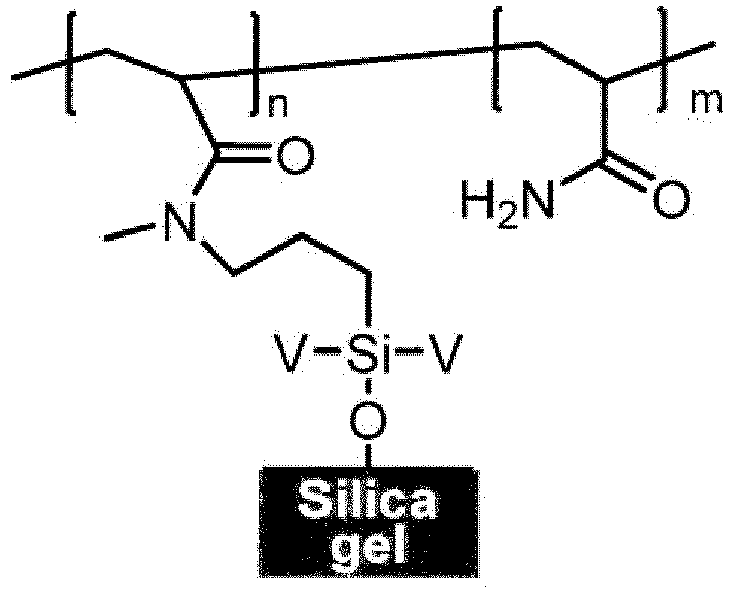
- An amount of 2.48 g of 2-methacryloyloxyethyl phosphorylcholine (PA) was placed in a flask, and 8.92 mL of 2-methoxyethanol and 0.2 mL of N,N-dimethylacetamide were added in this order. To the flask was added 0.4 mL of a 2-methoxyethanol solution of
dimethyl 2,2'-azobis(2-methylpropionate) adjusted to 0.52 M. Finally, 3.49 g of acrylamide-treated core-shell silica gel obtained in the same manner as in Preparation Example 1 (average particle size, 2.7 µm; average pore size, 160 Å; shell thickness, 0.5 µm) was added in a flask, and the flask was heated in an oil bath to 80°C and held for 6 hours. Following the end of copolymerization, 10 mL of methanol was added to the resulting powder, which was then filtered and collected. The collected product was then washed four times with 50 mL of methanol. The stationary phase thus obtained was vacuum dried overnight at 60°C. - Given that the carbon content of the resulting silica gel was 5.57 mass% and the carbon content of the starting silica gel was 2.97 mass%, about 6.6 mass% of poly(PA) was assumed to be bonded. Measurement of the carbon content was carried out by elemental analysis, and calculation was carried out assuming the amount of increase to be entirely attributable to poly(PA).
- The resulting poly(PA)-bonded silica gel can be assumed to have the same structure as in Example 1.
- An amount of 1.55 g of 2-methacryloyloxyethyl phosphorylcholine (PA) was placed in a flask, and 5.45 mL of 2-methoxyethanol and 0.1 mL of N,N-dimethylacetamide were added in this order. To the flask was added 0.4 mL of a 2-methoxyethanol solution of
dimethyl 2,2'-azobis(2-methylpropionate) adjusted to 0.33 M. Finally, 2.24 g of acrylamide-treated silica gel obtained in the same manner as in Preparation Example 1 (average particle size, 1.6 µm; average pore size, 700 Å) was added in a flask, and the flask was heated in an oil bath to 80°C and held for 6 hours. Following the end of copolymerization, 15 mL of methanol was added to the resulting powder, which was then filtered and collected. The collected product was then washed four times with 50 mL of methanol. The stationary phase thus obtained was vacuum dried overnight at 60°C. - Given that the carbon content of the resulting silica gel was 14.02 mass% and the carbon content of the starting silica gel was 6.49 mass%, about 24.5 mass% of poly(PA) was assumed to be bonded. Measurement of the carbon content was carried out by elemental analysis, and calculation was carried out assuming the amount of increase to be entirely attributable to poly(PA).
- The resulting poly(PA)-bonded silica gel can be assumed to have the same structure as in Example 1.
- An amount of 3.55 g of 2-methacryloyloxyethyl phosphorylcholine (PA) was placed in a flask, and 12.5 mL of 2-methoxyethanol and 0.2 mL of N,N-dimethylacetamide were added in this order. To the flask was added 0.8 mL of a 2-methoxyethanol solution of
dimethyl 2,2'-azobis(2-methylpropionate) adjusted to 0.37 M. Finally, 5.01 g of acrylamide-treated non-porous silica gel obtained in the same manner as in Preparation Example 1 (average particle size, 2.5 µm) was added in a flask, and the flask was heated in an oil bath to 80°C and held for 6 hours. Following the end of copolymerization, 20 mL of methanol was added to the resulting powder, which was then filtered and collected. The collected product was then washed four times with 50 mL of methanol. The stationary phase thus obtained was vacuum dried overnight at 60°C. - Given that the carbon content of the resulting non-porous silica gel was 0.62 mass% and the carbon content of the starting non-porous silica gel was 0.44 mass%, about 0.4 mass% of poly(PA) was assumed to be bonded. Measurement of the carbon content was carried out by elemental analysis, and calculation was carried out assuming the amount of increase to be entirely attributable to poly(PA).
- The resulting poly(PA)-bonded silica gel can be assumed to have the same structure as in Example 1.
- An amount of 1.55 g of 2-methacryloyloxyethyl phosphorylcholine (PA) was placed in a flask, and 5.32 mL of 2-methoxyethanol and 0.1 mL of N,N-dimethylacetamide were added in this order. To the flask was added 0.4 mL of a 2-propanol solution of
dimethyl 2,2'-azobis(2-methylpropionate) adjusted to 0.33 M. To the flask was added 2.21 g of silica gel (average particle size, 3 µm; average pore size, 300 Å). Finally, 0.12 mL of 3-(trimethylsilyl)propyl methacrylate was then added in a flask, and the flask was heated in an oil bath to 60°C and held for 6 hours. Following the end of copolymerization, 15 mL of methanol was added to the resulting powder, which was then filtered and collected. The collected product was then washed with 15 mL of methanol, and then with 25 mL of acetone. The stationary phase thus obtained was vacuum dried overnight at 60°C. - Given that the carbon content of the resulting silica gel was 9.14 mass%, about 20.4 mass% of poly(PA) was assumed to be bonded. Measurement of the carbon content was carried out by elemental analysis, and calculation was carried out assuming the amount of increase to be entirely attributable to poly(PA).
- The resulting poly(PA)-bonded silica gel can be assumed to have the same structure as in Example 1.
- An amount of 1.56 g of 2-methacryloyloxyethyl phosphorylcholine (PA) was placed in a flask, and 5.45 mL of 2-methoxyethanol and 0.1 mL of N,N-dimethylacetamide were added in this order. To the flask was added 0.4 mL of a 2-methoxyethanol solution of
dimethyl 2,2' azobis(2-methylpropionate) adjusted to 0.33 M. Finally, 2.21 g of acrylamide-treated silica gel surface treated with thiol (average particle size, 3 µm; average pore size, 300 Å; commercially available product) was added in a flask, and the flask was heated in an oil bath to 80°C and held for 6 hours. Following the end of copolymerization, 20 mL of methanol was added to the resulting powder, which was then filtered and collected. The collected product was then washed three times with 50 mL of methanol and once with 50 mL of acetone. The stationary phase thus obtained was vacuum dried overnight at 60°C. - Given that the carbon content of the resulting silica gel was 6.41 mass% and the carbon content of the starting silica gel was 1.94 mass%, about 11.7 mass% of poly(PA) was assumed to be bonded. Measurement of the carbon content was carried out by elemental analysis, and calculation was carried out assuming the amount of increase to be entirely attributable to poly(PA).
- The resulting poly(PA)-bonded silica gel can be assumed to have the following structure.

- An amount of 1.68 g of [2-(methacryloyloxy)ethyl]dimethyl-(3-sulfopropyl)ammonium hydroxide (AS) was placed in a flask, and 5.33 mL of water and 0.1 mL of pyridine were added in this order. To the flask was added 0.4 mL of an aqueous solution of 2,2'-azobis(2-methylpropionamidine) dihydrochloride adjusted to 0.38 M. Finally, 2.21 g of acrylamide-treated silica gel surface treated with thiol (average particle size, 3 µm; average pore size, 300 Å; commercially available product) was added in a flask, and the flask was heated in an oil bath to 70°C and held for 6 hours. Following the end of copolymerization, 20 mL of a saturated saline solution was added to the resulting powder, which was then filtered and collected. The collected product was then washed twice with 30 mL of a saturated saline solution, twice with 30 mL of water, once with 50 mL of methanol, and once with 50 mL of acetone. The stationary phase thus obtained was vacuum dried overnight at 60°C.
- Given that the carbon content of the resulting silica gel was 2.35 mass% and the carbon content of the starting silica gel was 1.94 mass%, about 0.9 mass% of poly(AS) was assumed to be bonded. Measurement of the carbon content was carried out by elemental analysis, and calculation was carried out assuming the amount of increase to be entirely attributable to poly(AS).
- The resulting poly(AS)-bonded silica gel can be assumed to have the following structure.

- The poly(PA)-bonded silica gel stationary phase obtained in Example 1 was slurry packed into a 3.0 mmϕ × 150 mm column, and vitamin B1, vitamin B2, vitamin B6, and vitamin B12 were separated by SFC.
FIG. 1 is an SFC chromatogram under conditions of linear gradient from 10% to 60% of methanol containing 20 mM of ammonium formate as a modifier over 10 minutes. Chromatography was carried out under the following conditions: flow rate, 3 mL/min; temperature, 40°C; back pressure, 15.0 MPa. The sample detection conditions are as follows. Vitamin B1: UV 266 nm; vitamin B2: UV 268 nm; vitamin B6: UV 284 nm; Vitamin B12: 361 nm. -
FIG. 2 is an SFC chromatogram obtained by analysis of water soluble vitamins under the same conditions as inFIG. 1 using an existing commercially available P4VP column (DAICEL DCpak P4VP; particle size, 3 µm). - The stationary phase according to an embodiment of the present invention clearly exhibits good retention properties and a good separating ability for water soluble vitamins.
- The resulting stationary phases of Examples 1 to 7 were each slurry packed into a 4.6 mmϕ × 150 mm column, and uridine was analyzed by HPLC using each of such columns. The analysis was carried out under the following conditions: flow rate, 1 mL/min; temperature, 25°C; mobile phase A, acetonitrile; mobile phase B, 20 mM of aqueous ammonium acetate solution; mobile phase ratio A:B = 90:10. This sample is commonly used as an indicator of the retention strength of a stationary phase in hydrophilic interaction chromatography (HILIC) mode (J. Chromatogr. A1218 (2011) 5903). The resulting chromatograms are shown in
FIG. 3 . - Using existing commercially available columns of Agilent HILIC-Z (particle size: 2.7 µm); HILICON iHILIC Fusion (particle size: 3.5 µm), HILICON iHILIC Fusion (+) (particle size: 3.5 µm); HILICON iHILIC Fusion (P) (particle size: 5.0 µm), DAICEL, DCpakP4VP (particle size: 3.0 µm); and Merck, ZIC-HILIC (particle size: 3.0 µm), uridine was analyzed under the same conditions as when the stationary phases of Examples 1 to 7 were used. The chromatograms are shown in
FIG. 4 . Table 1 lists values of the retention coefficient (k) shown in the chromatograms ofFIGs. 3 and4 . Calculation was made taking the retention time of toluene as t0. In particular, Examples 3 and 5 were found to show more excellent retention properties than that of existing commercially available products. -
Table 1 Examples, Columns t0 Toluene t Uridine k Uridine Example 1 1.741 5.601 2.22 Example 2 1.795 5.154 1.87 Example 3 1.563 8.302 4.31 Example 4 1.914 2.55 0.33 Example 5 1.687 8.749 4.19 Example 6 1.867 2.831 0.52 Example 7 1.883 4.971 1.64 Example 9 1.285 4.441 2.46 Example 11 1.585 5.864 2.70 Example 12 1.847 4.482 1.43 P4VP 1.821 6.905 2.79 ZIC-HILIC 1.619 5.471 2.38 iHILIC-Fusion 1.592 5.478 2.44 iHILIC-Fusion (+) 1.727 4.61 1.67 iHILIC-Fusion (P) 1.732 4.55 1.63 Amide 80 1.569 8.549 4.45 HILIC-Z 1.44 4.407 2.06 - The resulting stationary phase of Example 8 was slurry packed into a 3.0 mmcp × 50 mm column, and uridine was analyzed by HPLC using such column. Analysis was carried out under the following conditions: flow rate, 0.43 mL/min; temperature, 25°C; mobile phase A, acetonitrile; mobile phase B, 20 mM of aqueous ammonium acetate solution; mobile phase ratio A:B = 90:10. The resulting chromatograms are shown in
FIG. 5 . Despite passing the solution through at a low flow rate, the retention time is shorter than that in Example 1, and the peak symmetry is also good, and therefore, the stationary phase may be suitable for high-throughput analysis. - The resulting stationary phases of Examples 1, 9, 11, and 12 were each slurry packed into a 4.6 mmcp × 150 mm column, and uridine was analyzed by HPLC using each of such columns. The analysis was carried out under the following conditions: flow rate, 1 mL/min; temperature, 25°C; mobile phase A, acetonitrile; mobile phase B, 20 mM of aqueous ammonium acetate solution; mobile phase ratio A:B = 90:10. The resulting chromatograms are shown in
FIG. 6 . The peaks of Examples 9 and 12 were sharper as compared to that of Example 1. Table 1 lists values of the retention coefficient (k) shown in the chromatograms ofFIG. 6 . - The stationary phase according to an embodiment of the present invention has good separation characteristics for materials that have been difficult to separate by known separation agent, particularly hydrophilic substances. Specifically, an improvement in the number of column plates is anticipated. It was also shown that the hydrophilic compounds are more excellent in retention properties than that of existing commercially available products. It is thus expected that the stationary phase according to an embodiment of the present invention will contribute not only to the discovery and improvement of novel separation conditions for various substances that have hitherto been difficult to separate, but also to improvements in the convenience of identification and analysis of separated substances.
Claims (11)
- A stationary phase for chromatography, comprising inorganic carrier particles to which is bonded a polymer having a hydrophilic group on repeating units of a main chain thereof,
wherein the stationary phase is produced by a production method including any of steps (i) to (v):(i) radically copolymerizing a (meth)acrylic monomer having a hydrophilic group or a (meth)acrylamide monomer having a hydrophilic group with the inorganic carrier particle having a polymerizable functional group bonded thereto;(ii) producing a polymer by radically polymerizing a (meth)acrylic monomer having a hydrophilic group or a (meth)acrylamide monomer having a hydrophilic group in the presence of a chain transfer agent having on an end thereof a crosslinkable silyl group; and silane coupling the resulting polymer on a surface of the inorganic carrier particle;(iii) copolymerizing a (meth)acrylic monomer having a hydrophilic group or a (meth)acrylamide monomer having a hydrophilic group with a silane coupling agent having a polymerizable double bond, and silane coupling the resulting polymer on a surface of the inorganic carrier particle;(iv) copolymerizing a silane coupling agent having a polymerizable double bond with a (meth)acrylic monomer having a hydrophilic group or a (meth)acrylamide monomer having a hydrophilic group in the presence of the inorganic carrier particle; and(v) introducing a chain transferring functional group onto a surface of the inorganic carrier particle, and radically polymerizing a (meth)acrylic monomer having a hydrophilic group or a (meth)acrylamide monomer having a hydrophilic group. - The stationary phase for chromatography according to claim 1, wherein the (meth)acrylic monomer having a hydrophilic group or the (meth)acrylamide monomer having a hydrophilic group has a structure represented by Formula (1):
 R1 is hydrogen or an alkyl of 1 to 6 carbon atoms;R2 is a single bond or an alkylene of 1 to 12 carbon atoms;R3 is a single bond or an alkylene of 1 to 6 carbon atoms;X2 is -O-, -NH-, or -N(CH3)-,Y2 is a single bond,
 Z2 is hydrogen, alkyl of 1 to 6 carbon atoms, halogen, -N+R4 3,

- The stationary phase for chromatography according to claim 1 or 2, wherein the inorganic carrier particles are porous inorganic particles or non-porous inorganic particles.
- The stationary phase for chromatography according to claim 3, wherein the inorganic carrier particles are porous inorganic particles, and the porous inorganic particles are core-shell particles.
- The stationary phase for chromatography according to any one of claims 1 to 4, wherein an average particle size is from 0.1 µm to 50 µm.
- The stationary phase for chromatography according to any one of claims 1 to 5, which is used for supercritical fluid chromatography.
- A method for separating a target material, the method including separating the target substance using the stationary phase described in any one of claims 1 to 6 and a mobile phase comprising a supercritical fluid.
- A method for producing a stationary phase for chromatography, the method comprising any of steps (i) to (v):(i) radically copolymerizing a (meth)acrylic monomer having a hydrophilic group or a (meth)acrylamide monomer having a hydrophilic group with an inorganic carrier particle having a polymerizable functional group bonded thereto;(ii) producing a polymer by radically polymerizing a (meth)acrylic monomer having a hydrophilic group or a (meth)acrylamide monomer having a hydrophilic group in the presence of a chain transfer agent having on an end thereof a crosslinkable silyl group; and silane coupling the resulting polymer on a surface of an inorganic carrier particle;(iii) copolymerizing a (meth)acrylic monomer having a hydrophilic group or a (meth)acrylamide monomer having a hydrophilic group with a silane coupling agent having a polymerizable double bond, and silane coupling the resulting polymer on a surface of an inorganic carrier particle;(iv) copolymerizing a silane coupling agent having a polymerizable double bond with a (meth)acrylic monomer having a hydrophilic group or a (meth)acrylamide monomer having a hydrophilic group in the presence of an inorganic carrier particle; and(v) introducing a chain transferring functional group onto a surface of an inorganic carrier particle, and radically polymerizing a (meth)acrylic monomer having a hydrophilic group or a (meth)acrylamide monomer having a hydrophilic group.
- The method for producing a stationary phase for chromatography according to claim 8, wherein a (meth)acrylic monomer having a hydrophilic group or a (meth)acrylamide monomer having a hydrophilic group has a structure represented by Formula (1):
 R1 is hydrogen or an alkyl of 1 to 6 carbon atoms;R2 is a single bond or an alkylene of 1 to 12 carbon atoms;R3 is a single bond or an alkylene of 1 to 6 carbon atoms;X2 is -O-, -NH-, or -N(CH3)-,Y2 is a single bond,
 Z2 is hydrogen, alkyl of 1 to 6 carbon atoms, halogen, -N+R4 3,

- The method for producing a stationary phase for chromatography according to claim 8 or 9, wherein the inorganic carrier particles are porous inorganic particles or non-porous inorganic particles.
- The method for producing a stationary phase for chromatography according to claim 10, wherein the inorganic carrier particles are porous inorganic particles, and the porous inorganic particles are core-shell particles.
Applications Claiming Priority (2)
| Application Number | Priority Date | Filing Date | Title |
|---|---|---|---|
| JP2018161561 | 2018-08-30 | ||
| PCT/JP2019/034204 WO2020045648A1 (en) | 2018-08-30 | 2019-08-30 | Stationary phase for chromatography |
Publications (2)
| Publication Number | Publication Date |
|---|---|
| EP3845307A1 true EP3845307A1 (en) | 2021-07-07 |
| EP3845307A4 EP3845307A4 (en) | 2021-11-03 |
Family
ID=69643587
Family Applications (1)
| Application Number | Title | Priority Date | Filing Date |
|---|---|---|---|
| EP19854825.7A Pending EP3845307A4 (en) | 2018-08-30 | 2019-08-30 | STATIONARY PHASE FOR CHROMATOGRAPHY |
Country Status (5)
| Country | Link |
|---|---|
| US (2) | US12403452B2 (en) |
| EP (1) | EP3845307A4 (en) |
| JP (2) | JP7112499B2 (en) |
| CN (2) | CN112638519B (en) |
| WO (1) | WO2020045648A1 (en) |
Families Citing this family (2)
| Publication number | Priority date | Publication date | Assignee | Title |
|---|---|---|---|---|
| CN117980066A (en) * | 2021-09-29 | 2024-05-03 | 株式会社大赛璐 | Method for producing stationary phase for column chromatography |
| CN114106350B (en) * | 2021-11-17 | 2023-02-03 | 赣江中药创新中心 | Polyacrylamide chromatographic stationary phase and preparation method and application thereof |
Family Cites Families (13)
| Publication number | Priority date | Publication date | Assignee | Title |
|---|---|---|---|---|
| DE2225973C2 (en) | 1972-05-27 | 1974-07-04 | Merck Patent Gmbh, 6100 Darmstadt | Process for coating non-porous material with a porous silicon dioxide layer |
| JP2504005B2 (en) * | 1986-11-17 | 1996-06-05 | 東ソー株式会社 | Filler and its manufacturing method |
| JP2003337125A (en) | 2002-05-17 | 2003-11-28 | Kumamoto Technology & Industry Foundation | Adsorbents, chromatographic packing materials, chromatographic columns and liquid chromatographs |
| WO2004002618A1 (en) * | 2002-06-27 | 2004-01-08 | Akzo Nobel N.V. | Adsorbent material and method of preparing an adsorbent material |
| AU2002361527A1 (en) | 2002-06-28 | 2004-01-19 | Ryszard Seruga | Multi-face rudder stabilizing device of floating units |
| JP4431009B2 (en) | 2004-08-20 | 2010-03-10 | ダイセル化学工業株式会社 | Supercritical fluid chromatography column |
| JP5343603B2 (en) | 2009-02-16 | 2013-11-13 | ソニー株式会社 | Monolith type silica column for separation of cortisol, method for producing the same, and method for separating cortisol |
| US20210220814A1 (en) * | 2011-05-20 | 2021-07-22 | Waters Technologies Corporation | Porous materials for solid phase extraction and chromatography and processes for preparation and use thereof |
| MY195756A (en) * | 2012-09-17 | 2023-02-09 | Grace W R & Co | Functionalized Particulate Support Material and Methods of Making and Using the Same |
| EP3936226A3 (en) * | 2013-06-11 | 2022-03-16 | Waters Technologies Corporation | Chromatographic columns and separation devices comprising a superficially porous material; and use thereof for supercritical fluid chromatography and other chromatography |
| EP3137209B1 (en) | 2014-05-02 | 2022-10-05 | W.R. Grace & CO. - CONN. | Functionalized support material and methods of making and using functionalized support material |
| WO2016152996A1 (en) * | 2015-03-24 | 2016-09-29 | 株式会社ダイセル | Stationary phase for supercritical fluid chromatography |
| JP6567313B2 (en) * | 2015-03-31 | 2019-08-28 | 国立大学法人京都工芸繊維大学 | Chromatographic packing material |
-
2019
- 2019-08-30 CN CN201980056782.1A patent/CN112638519B/en active Active
- 2019-08-30 JP JP2020539639A patent/JP7112499B2/en active Active
- 2019-08-30 CN CN202311359922.7A patent/CN119425650A/en active Pending
- 2019-08-30 EP EP19854825.7A patent/EP3845307A4/en active Pending
- 2019-08-30 WO PCT/JP2019/034204 patent/WO2020045648A1/en not_active Ceased
- 2019-08-30 US US17/271,688 patent/US12403452B2/en active Active
-
2022
- 2022-07-22 JP JP2022117602A patent/JP7368561B2/en active Active
-
2025
- 2025-07-31 US US19/287,061 patent/US20250360491A1/en active Pending
Also Published As
| Publication number | Publication date |
|---|---|
| JP7368561B2 (en) | 2023-10-24 |
| US12403452B2 (en) | 2025-09-02 |
| WO2020045648A1 (en) | 2020-03-05 |
| CN112638519B (en) | 2023-11-10 |
| US20210252479A1 (en) | 2021-08-19 |
| US20250360491A1 (en) | 2025-11-27 |
| JPWO2020045648A1 (en) | 2021-09-02 |
| JP2022159325A (en) | 2022-10-17 |
| CN112638519A (en) | 2021-04-09 |
| JP7112499B2 (en) | 2022-08-03 |
| CN119425650A (en) | 2025-02-14 |
| EP3845307A4 (en) | 2021-11-03 |
Similar Documents
| Publication | Publication Date | Title |
|---|---|---|
| US20250360491A1 (en) | Stationary phase for chromatography | |
| JP6445397B2 (en) | High purity chromatographic material containing ionic modifier | |
| US11065558B2 (en) | Stationary phase for supercritical fluid chromatography | |
| JP6151021B2 (en) | Hybrid material for chromatographic separation | |
| EP2811983B1 (en) | Functionalized particulate support material and methods of making and using the same | |
| US20130133516A1 (en) | Fine particles for chromatography and chromatography using same | |
| CN111405934A (en) | High-purity chromatography material containing ionizable modifiers for retention of acidic analytes | |
| EP3435079B1 (en) | Chromatography stationary phase | |
| US11014019B2 (en) | Stationary phase for supercritical fluid chromatography | |
| US20240092959A1 (en) | Bonded hybrid polymer non-porous particles and their use for bioseparations | |
| US20240082820A1 (en) | Core-shell particles having a non-porous core and a porous shell | |
| CN119744199A (en) | Non-porous hybrid coated polymer particles | |
| CA1293083C (en) | Packing material and process for its production | |
| HK1204969B (en) | Functionalized particulate support material and methods of making and using the same |
Legal Events
| Date | Code | Title | Description |
|---|---|---|---|
| STAA | Information on the status of an ep patent application or granted ep patent |
Free format text: STATUS: THE INTERNATIONAL PUBLICATION HAS BEEN MADE |
|
| STAA | Information on the status of an ep patent application or granted ep patent |
Free format text: STATUS: REQUEST FOR EXAMINATION WAS MADE |
|
| PUAI | Public reference made under article 153(3) epc to a published international application that has entered the european phase |
Free format text: ORIGINAL CODE: 0009012 |
|
| 17P | Request for examination filed |
Effective date: 20210315 |
|
| AK | Designated contracting states |
Kind code of ref document: A1 Designated state(s): AL AT BE BG CH CY CZ DE DK EE ES FI FR GB GR HR HU IE IS IT LI LT LU LV MC MK MT NL NO PL PT RO RS SE SI SK SM TR |
|
| A4 | Supplementary search report drawn up and despatched |
Effective date: 20211005 |
|
| RIC1 | Information provided on ipc code assigned before grant |
Ipc: B01D 15/40 20060101ALI20210929BHEP Ipc: B01J 20/32 20060101ALI20210929BHEP Ipc: B01J 20/289 20060101ALI20210929BHEP Ipc: B01J 20/286 20060101ALI20210929BHEP Ipc: C08F 222/38 20060101ALI20210929BHEP Ipc: G01N 30/02 20060101ALI20210929BHEP Ipc: C08F 292/00 20060101ALI20210929BHEP Ipc: C08F 2/44 20060101AFI20210929BHEP |
|
| DAV | Request for validation of the european patent (deleted) | ||
| DAX | Request for extension of the european patent (deleted) |