EP3844646B1 - Context-aware content object security - Google Patents
Context-aware content object security Download PDFInfo
- Publication number
- EP3844646B1 EP3844646B1 EP19853611.2A EP19853611A EP3844646B1 EP 3844646 B1 EP3844646 B1 EP 3844646B1 EP 19853611 A EP19853611 A EP 19853611A EP 3844646 B1 EP3844646 B1 EP 3844646B1
- Authority
- EP
- European Patent Office
- Prior art keywords
- interaction
- context
- user
- attributes
- permissions
- Prior art date
- Legal status (The legal status is an assumption and is not a legal conclusion. Google has not performed a legal analysis and makes no representation as to the accuracy of the status listed.)
- Active
Links
Images




Classifications
-
- H—ELECTRICITY
- H04—ELECTRIC COMMUNICATION TECHNIQUE
- H04L—TRANSMISSION OF DIGITAL INFORMATION, e.g. TELEGRAPHIC COMMUNICATION
- H04L63/00—Network architectures or network communication protocols for network security
- H04L63/20—Network architectures or network communication protocols for network security for managing network security; network security policies in general
- H04L63/205—Network architectures or network communication protocols for network security for managing network security; network security policies in general involving negotiation or determination of the one or more network security mechanisms to be used, e.g. by negotiation between the client and the server or between peers or by selection according to the capabilities of the entities involved
-
- H—ELECTRICITY
- H04—ELECTRIC COMMUNICATION TECHNIQUE
- H04L—TRANSMISSION OF DIGITAL INFORMATION, e.g. TELEGRAPHIC COMMUNICATION
- H04L63/00—Network architectures or network communication protocols for network security
- H04L63/10—Network architectures or network communication protocols for network security for controlling access to devices or network resources
-
- H—ELECTRICITY
- H04—ELECTRIC COMMUNICATION TECHNIQUE
- H04L—TRANSMISSION OF DIGITAL INFORMATION, e.g. TELEGRAPHIC COMMUNICATION
- H04L63/00—Network architectures or network communication protocols for network security
- H04L63/10—Network architectures or network communication protocols for network security for controlling access to devices or network resources
- H04L63/101—Access control lists [ACL]
-
- H—ELECTRICITY
- H04—ELECTRIC COMMUNICATION TECHNIQUE
- H04L—TRANSMISSION OF DIGITAL INFORMATION, e.g. TELEGRAPHIC COMMUNICATION
- H04L63/00—Network architectures or network communication protocols for network security
- H04L63/10—Network architectures or network communication protocols for network security for controlling access to devices or network resources
- H04L63/105—Multiple levels of security
-
- H—ELECTRICITY
- H04—ELECTRIC COMMUNICATION TECHNIQUE
- H04L—TRANSMISSION OF DIGITAL INFORMATION, e.g. TELEGRAPHIC COMMUNICATION
- H04L63/00—Network architectures or network communication protocols for network security
- H04L63/20—Network architectures or network communication protocols for network security for managing network security; network security policies in general
Definitions
- This disclosure relates to content management systems, and more particularly to techniques for context-aware content object security.
- Cloud-based content management services and systems have impacted the way personal and enterprise computer-readable content objects (e.g., documents, spreadsheets, images, programming code files, etc.) are stored, and has also impacted the way such personal and enterprise content objects are shared and managed.
- Content management systems provide the ability to securely share large volumes of content objects among trusted users (e.g., collaborators) on a variety of user devices such as mobile phones, tablets, laptop computers, desktop computers, and/or other devices.
- sharing and collaboration activities include one or more interactions (e.g., authoring, editing, viewing, etc.) that are performed over the content objects.
- the interactions may be performed by one user, or by multiple users, and/or even autonomously by one or more computing entities (e.g., processes, agents, applications, etc.).
- computing entities e.g., processes, agents, applications, etc.
- such interactions may span across multiple departments and/or multiple enterprises.
- resource access permissions may correspond to not only users and content objects, but also may correspond to connections, services, URLs, and/or other resources associated with the content management system.
- a global permissions model defines a single set of semantics and workflows to efficiently manage (e.g., assign, lookup, etc.) resources permissions over the many resources of a content management system.
- a global permissions model might predefine a set of user roles (e.g., owner, co-owner, editor, viewer, previewer, uploader, etc.), a set of permitted content object interactions (e.g., edit, download, preview, view/add comments, view metadata, etc.), and a set of mappings between the aforementioned user roles and the permitted content object interactions.
- a user can be assigned a particular user role for a particular content object so as to restrict the user to performing only those permitted interactions associated with that user's role over that content object.
- a first user from a first enterprise and a second user from a second enterprise who have been assigned user roles e.g., "previewer”
- a global permissions model of a content management system that permits both users to download any content objects in a particular shared folder managed by the content management system.
- the owner may want to restrict downloads of the document to only users at the first enterprise (e.g., due to certain sensitive information in the document).
- US 2015/089575 A1 discloses a global policy store in which policies applicable to multiple applications in an enterprise environment can be stored in association with that environment.
- An application-level policy combining algorithm can be associated with a specific application to resolve conflicts between the results of evaluating policies that pertain to that application's resources.
- a persistent model is defined for an Extensible Access Control Markup Language (XACML) target definition.
- XACML Extensible Access Control Markup Language
- US 2016/070758 A1 discloses a system for managing data sharing and permission rules for a plurality of sensitive information across disparate entities and contexts.
- the system enables multiple tiers of permission rules that may vary by requesting user, specific data fields, and sharing context.
- the system provides patients or other users who provide data with an interface to select permission rules so that other users may access that data in a controlled manner.
- the system is capable of capturing and structuring the logic of written laws, consent agreements, and individual user preferences that enable or restrict data sharing among users.
- the system provides a requesting user with an interface to query the data about a patient or other entity, where data access is enabled by applicable rules.
- the system provides consistent access to information by linking related data fields through ontological mappings.
- the system may facilitate the creation of new knowledge using ontology-mapped data from disparate sources.
- US 2018/114015 A1 discloses a method for controlling access to data held in the cloud that includes determining, at a cloud server, the validity of user credentials received from a user device. The method may also include receiving context data related to the user device based on the validity of the user credentials. The method may further include synchronizing the context data with the cloud server. In addition, the method may include enforcing context-sensitive security checks on requests made by the user for resources based on the sensor data collected by the user device.
- the invention is defined by the independent claims.
- the dependent claims concern optional features of some embodiments of the invention.
- the present disclosure describes techniques used in systems, methods, and in computer program products for context-aware content object security, which techniques advance the relevant technologies to address technological issues with legacy approaches. More specifically, the present disclosure describes techniques used in systems, methods, and in computer program products for context-aware extensible content object access permissions. Certain embodiments are directed to technologies for analyzing the attributes of interactions with content objects to dynamically determine extensible access permissions that override a global permissions model.
- the disclosed embodiments modify and improve over legacy approaches.
- the herein-disclosed techniques provide technical solutions that address the technical problems attendant to the limited applicability of global permissions models in collaboration systems.
- Such technical solutions involve specific implementations (i.e., data organization, data communication paths, module-to-module interrelationships, etc.) that relate to the software arts for improving computer functionality.
- the ordered combination of steps of the embodiments serve in the context of practical applications that perform steps to analyze various attributes of user interactions with content objects to dynamically determine extensible access permissions.
- the disclosed techniques for analyzing the attributes of interactions with content objects to dynamically determine extensible access permissions serve to overcome long standing yet heretofore unsolved technological problems that arise in the realm of computerized collaboration systems. Aspects of the present disclosure achieve performance and other improvements in peripheral technical fields including (but not limited to) computer security and distributed storage systems.
- Some embodiments perform a series of steps for establishing a global permissions model that applies a first set of resource access permissions to a shared content object, establishing one or more context-aware access policies that govern user interactions over the shared content object; gathering one or more interaction attributes associated with a particular user interaction over the shared content object; applying the context-aware access policies to the one or more interaction attributes to determine a set of extensible access permissions; and overriding the first set of resource access permissions with the set of extensible access permissions.
- Some embodiments perform further steps including generating a response to the particular user interaction, the response being generated in accordance with the set of extensible access permissions.
- the response corresponds to at least one of, taking no action, allowing an interaction, allowing the interaction with a justification, or blocking the interaction.
- at least a portion of the response is presented to a user at a user interface.
- Some embodiments process context-aware access policies wherein the context-aware access policies comprise extensible permissions rules, and in some cases the extensible permissions rules are evaluated against at least a portion of the one or more interaction attributes to determine the set of extensible access permissions.
- a context associated with the particular user interaction is characterized by one or more of the one or more interaction attributes, which interaction attributes comprise one or more event attributes, or one or more object attributes, or one or more user attributes.
- Context-aware access policies can be specified by a user at a user interface.
- Some embodiments include a user interface for inputting a justification for a particular requested action.
- the acceptability of a justification is determined based on sentiment analysis and/or natural language processing techniques.
- sentiment analysis and/or natural language processing is provided by one or more external data processing modules.
- Some embodiments include a sequence of instructions that are stored on a non-transitory computer readable medium. Such a sequence of instructions, when stored in memory and executed by one or more processors causes the one or more processors to perform a set of acts for context-aware content object security over shared content objects.
- Some embodiments include the aforementioned sequence of instructions that are stored in a memory, which memory is interfaced to one or more processors such that the one or more processors can execute the sequence of instructions to cause the one or more processors to implement context-aware content object security over shared content objects.
- any combinations of any of the above can be combined to perform any variations of acts for implementing context-aware content object security, and many such combinations of aspects of the above elements are contemplated.
- aspects of the present disclosure solve problems associated with collaboration systems that suffer from the limited applicability of global permissions models. These problems are unique to, and may have been created by, various computer-implemented permissions models used in content management systems. Some embodiments are directed to approaches for analyzing the attributes of interactions with content objects to dynamically determine extensible access permissions that override other permissions models.
- the accompanying figures and discussions herein present example environments, systems, methods, and computer program products for context-aware extensible content object access permissions.
- such techniques are implemented in a content management system that facilitates user-to-user interactions and user-to-content interactions over a plurality of users and a plurality of content objects.
- Instances of context-aware access policies are established at the content management system to govern the interactions of the users over the content objects.
- various interaction events associated with the user and content objects are detected (e.g., a request to download a content object)
- certain event attributes corresponding to the events are identified.
- the event attributes, and other attributes derived from the event attributes, constitute the interaction attributes that characterize the respective contexts of the interaction events.
- the interaction attributes are subjected to the context-aware access policies to determine sets of extensible access permissions that govern further interaction events. Specifically, responses to the interaction events are issued in accordance with the sets of extensible access permissions.
- a response might allow an action (e.g., "OK to download") associated with the event, or might block the action, or might allow the action only if accompanied with some justification by the requestor.
- an action e.g., "OK to download”
- classification labels are assigned to content objects to facilitate the determination of sets of extensible access permissions.
- the context-aware access policies comprise one or more extensible permissions rules that facilitate the determination of the sets of extensible access permissions.
- a conflict remediation capability is implemented in the content management system to resolve conflicts between different permissions models and/or conflicts between multiple access policies.
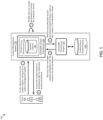
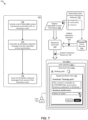
- FIG. 1 exemplifies a computing environment 100 in which embodiments of the present disclosure can be implemented. As an option, one or more variations of computing environment 100 or any aspect thereof may be implemented in the context of the architecture and functionality of the embodiments described herein.
- FIG. 1 illustrates aspects pertaining to analyzing the attributes of interactions with content objects to dynamically determine extensible access permissions. Specifically, the figure presents a logical depiction of how the herein disclosed techniques can be used to override global access permissions with extensible access permissions that are derived from the contexts of content object interaction events. A representative set of high order operations are presented to illustrate how the herein disclosed techniques might be applied in a computing environment.
- FIG. 1 depicts a representative set of users 102 (e.g., user "u1", ..., user "uN") who desire to interact with various instances of content objects 106 managed at a content management system 104
- Users 102 may be users of content management system 104 which facilitates interactions (e.g., authoring, editing, viewing, etc.) over content objects 106 for sharing, collaboration, and/or other purposes.
- the interactions may be performed by one user, or by multiple users, and/or even autonomously by one or more computing entities (e.g., processes, agents, applications, etc.). Moreover, such interactions may span across multiple departments and/or multiple enterprises.
- the interactions by users 102 over content objects 106 in content management system 104 are governed at least in part by sets of global access permissions 112 associated with the various combinations of users and content objects.
- global access permissions may correspond to not only users and content objects, but also may correspond to connections, services, URLs, and/or other resources associated with the content management system.
- Such global access permissions may comply with a global permissions model that is implemented and managed at content management system 104.
- a global permissions model is a scheme that defines an initial set (e.g., a default set) of resource permissions to the many resources of a content management system. In today's dynamic collaboration and shared content management environments, however, using such a global permissions model is deficient.
- the limited flexibility of global access permissions 112 as derived from a global permissions model is deficient in addressing the many dynamic contexts in which user interactions with content objects 106 can occur.
- Some mechanism is needed to define a second set (e.g., an override set) of resource permissions.
- a second set e.g., an override set
- the act of overriding means to modify a previously established permission that was set by a global permissions model. Such modification serves to address the limited applicability of the aforementioned global permissions model.
- Various challenges pertaining to the limited applicability of global permissions models are addressed at least in part by analyzing the attributes of interactions between users 102 and content objects 106 so as to dynamically determine sets of extensible access permissions 122 that govern the interactions.
- the techniques are facilitated at least in part by an extensible permissions engine 120 and a set of context-aware access policies 124 implemented at content management system 104.
- extensible access permissions refer to characteristics that apply to then-current interactions between users and content objects, which characteristics are considered after a global permissions model has been established.
- context-aware access policies 124 may be established by one or more of the users 102 (e.g., enterprise system administrators, etc.).
- users 102 invoke interaction events over content objects 106 (operation 1)
- global access permissions 112 are first identified to govern the interaction events (operation 2).
- Extensible permissions engine 120 accesses the context-aware access policies 124 to retrieve any sets of extensible access permissions 122 to apply to the interaction events, which extensible access permissions are based at least in part on the context of the interaction events (operation 3).
- the context of an interaction event comprises the set of conditions that correspond to the interaction event. Such conditions are often described by one or more interaction attributes.
- the interaction attributes can comprise event attributes and other attributes derived from the event attributes that correspond to a particular interaction event. In this case, the interaction attributes are applied to context-aware access policies 124 to determine the sets of extensible access permissions 122 for the respective interaction events.
- the sets of extensible access permissions 122 are reconciled with the global access permissions (operation 4) to facilitate access to content objects 106 in accordance with the extensible access permissions 122 (operation 5).
- responses to the interaction events are issued to users 102 in accordance with the extensible access permissions 122.
- a response might allow an action (e.g., download) associated with the event, block the action, allow the action with some justification by the requestor, and/or perform some other operation.
- extensible access permissions 122 serves as a permissions layer (e.g., permission wrapper) that is managed, determined, and/or applied separately from the global access permissions 112.
- this extensible context-aware permissions capability facilitated by the herein disclosed techniques serves to address the problems attendant to the limited applicability of global permissions models.
- application of the techniques disclosed herein facilitate improvements in computer functionality that serve to reduce the demand for computer memory, reduce the demand for computer processing power, reduce network bandwidth use, and reduce the demand for intercomponent communication. Specifically, consumption of such computing resources to facilitate manual permissions adjustments and/or global permissions models updates so as to accommodate newly discovered user-to-user and/or user-to-content interactions is eliminated.
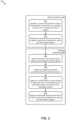
- FIG. 2 exemplifies a context-aware extensible access permissions assignment technique 200 as implemented in systems that enforce context-aware extensible content object access permissions.
- context-aware extensible access permissions assignment technique 200 may be implemented in the context of the architecture and functionality of the embodiments described herein.
- the context-aware extensible access permissions assignment technique 200 or any aspect thereof may be implemented in any environment.
- FIG. 2 illustrates aspects pertaining to analyzing the attributes of interactions with content objects to dynamically determine extensible access permissions.
- the figure is presented to illustrate one embodiment of certain steps and/or operations performed over a network of devices (e.g., user devices, computing systems, etc.) to determine sets of extensible access permissions for the interaction events based at least in part on the context of the interaction events.
- the steps and/or operations can be grouped into a set of setup operations 210 and a set of ongoing operations 220.
- the respective contexts of the interaction events are determined (step 224).
- Such contexts are often described by one or more interaction attributes that can comprise event attributes and other attributes derived from the event attributes (e.g., user attributes, object attributes, resource attributes, etc.) that correspond to the interaction events.
- the contexts (e.g., interaction attributes) of the interaction events are applied to the context-aware access policies to determine respective sets of extensible access permissions that correspond to the interaction events (step 226).
- the policy parameters of the context-aware access policies might codify sets of extensible permission rules that are evaluated subject to the interaction attributes describing the contexts to determine the sets of extensible access permissions.
- the extensible access permissions are applied to govern interactions between the users and the content objects (step 228).
- Application of the extensible access permissions often raise responses to specific interaction events. The responses are then processed within the content management system. As examples, such responses might allow an interaction, or might block an interaction, or might allow an interaction with justification (e.g., as might be specified by a user desiring to perform the interaction).
- FIG. 3 presents a block diagram of a system 300 that implements and enforces context-aware extensible content object access permissions.
- system 300 may be implemented in the context of the architecture and functionality of the embodiments described herein.
- the system 300 or any aspect thereof may be implemented in any environment.
- FIG. 3 illustrates aspects pertaining to analyzing the attributes of interactions with content objects to dynamically determine extensible access permissions.
- the figure is being presented to show one embodiment of certain representative components and associated data structures and data flows implemented in a computing environment to facilitate the herein disclosed techniques.
- the components, data flows, and data structures are associated with a set of users (e.g., user 102 1 , ..., user 102 N ) that interact with each other and a set of content objects 106 managed at a content management system 104.
- the components, data flows, and data structures shown in FIG. 3 present one partitioning and associated data manipulation approach.
- the specific example shown is purely exemplary, and other subsystems, data structures, and/or partitionings are reasonable.
- the servers and/or storage devices of content management system 104 might facilitate interactions over content objects 106 by the users (e.g., user 102 1 , ..., user 102 N ) from a respective set of user devices (e.g., user device 302 1 , ..., user device 302 N ).
- a content management system "manages" a plurality of content objects at least in part by maintaining (e.g., storing, updating, resolving interaction conflicts, etc.) the content objects subject to the various interactions performed over the content objects by the users of the content objects at their respective user devices.
- the content objects (e.g., files, folders, etc.) in content objects 106 are characterized at least in part by a set of object attributes 340 (e.g., content object metadata) stored at storage devices 330.
- the users are characterized at least in part by a set of user attributes 342 stored in a set of user profiles 332 at storage devices 330.
- the users access instances of applications (e.g., app 304 11 , ..., app 304 1N ) operating at their respective user devices to interact with the content objects 106 managed by content management system 104.
- applications might comprise native applications provided by content management system 104, or third-party applications that are integrated with content management system 104, which applications facilitate initiation and performance of interactions over the content objects.
- Various information pertaining to such integration with content management system 104 might be codified in a registry at content management system 104.
- the applications often present user interfaces (e.g., user interface 306 11 , ..., user interface 306 1N ) to the users to facilitate the interactions with content objects 106 and/or other communications with content management server 310 and/or content management system 104.
- the instances of the applications operating at the user devices send or receive various instances of messages 322 that are received or sent by message processor 312 at content management server 310.
- messages 322 are sent to or received from content management server 310 without human interaction.
- One class of messages 322 pertains to the policy parameters that constitute various instances of context-aware access policies 124 stored in storage devices 330.
- Such analyses may include certain conflict remediation operations performed by policy conflict remediator 316.
- Conflict remediation may be applied when multiple parties specify conflicting policy parameters. The multiples parties may be within one enterprise or over two or more enterprises. As merely one example, a first admin in an enterprise might specify that no users external to the enterprise can download a particular content object, while a second admin might specify that external users can download the content object. Policy conflict remediator 316 will identify such conflicts and resolve them according to certain criteria (e.g., always select the most restrictive or conservative setting).
- Another class of messages 322 corresponds to interaction events that are invoked by users when they interact with or attempt to interact with content objects 106.
- users might log in to any of the applications to interact with content objects they own or that are shared with them, to invite other users to collaborate on content objects, and/or to perform other collaboration activities. Any of the foregoing interactions or collaboration activities can be characterized as interaction events.
- the global permissions framework 314 assigns respective sets of global access permissions 112, as determined by a global permissions model 324, to govern the interaction events.
- Global permissions framework 314 then calls extensible permissions engine 120 to retrieve any instances of extensible access permissions 122 that are to be assigned to the interaction events.
- Extensible permissions engine 120 applies the interaction attributes that describe the respective contexts of the interaction events to the context-aware access policies 124 to determine the extensible access permissions for the events.
- some or all of the interaction attributes may be applied to sets of extensible permissions rules 346 associated with respective instances of the context-aware access policies 124 to facilitate determination of the extensible access permissions.
- extensible access permissions 122 will override global access permissions 112 to govern the interaction events whereas, in other cases, a combination of extensible access permissions 122 and global access permissions 112 may govern the interaction events.
- Response generator 318 receives sets of extensible access permissions 122 determined by extensible permissions engine 120 to generate and issue responses to the sources of the interaction events. Specifically, interaction responses generated by response generator 318 are issued as instances of messages 322 to the user devices of the users. For example, consider an interaction event that pertains to a preview of a content object by a user. A set of extensible access permissions corresponding to this interaction event indicates that the content object can be downloaded by the user if a business justification is provided. In this case, response generator 318 will receive the set of extensible access permissions and generate an interaction response that presents a modal to the user to request selection by the user of one of several business justification descriptions. When an acceptable business justification is submitted by the user, the content object is provisioned (e.g., in an instance of messages 322) to the user.
- the content object is provisioned (e.g., in an instance of messages 322) to the user.
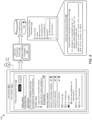
- FIG. 4 depicts a context-aware access policy recording technique 400 as implemented in systems that facilitate use of context-aware extensible content object access permissions.
- context-aware access policy recording technique 400 may be implemented in the context of the architecture and functionality of the embodiments described herein.
- the context-aware access policy recording technique 400 or any aspect thereof may be implemented in any environment.
- the context-aware access policy recording technique 400 is facilitated at least in part by a policy specification view 422 presented at user interface 306 1N of user device 302 N associated with user 102 N .
- User 102 N might be a system administrator of an enterprise who is responsible for establishing at least some of the context-aware access policies for the enterprise.
- a context management system might provide the policy specification view 422 or other views to collect the user inputs that specify the policy parameters of the context-aware access policies.
- policy specification view 422 comprises user interface elements (e.g., text boxes, radio buttons, drop down selection lists, switches, checkboxes, etc.) to collect such user inputs.
- user 102 N can manipulate the user interface elements to specify a policy name (e.g., entered in a "Policy Name” text box), a policy description (e.g., entered in a "Description” text box), a classification label associated with the policy (e.g., enabled by a radio button and selected in a dropdown in a "Content Type” section), one or more security controls (e.g., as selected in a "Security Controls” section), and/or other policy attributes.
- a classification label is a data object that is assigned to one or more content objects to identify a respective context-aware access policy to apply to the content objects having that classification label.
- a classification label defined by the text string "Confidential” is associated with the "Classified Files” policy.
- any interactions with any content objects having the classification label of "Confidential” will be governed by the "Classified Files” policy.
- multiple classification labels might be associated with a particular context-aware access policy.
- each policy in context-aware access policies 124 might be describe by a policy identifier (e.g., stored in a "policyID” field), a policy name (e.g., stored in a "name” field), a policy description (e.g., stored in a "description” field), an enterprise identifier (e.g., stored in an "enterpriseID” field), one or more classification labels (e.g., stored in a "classLabel[]” object), one or more extensible permissions rules (e.g., stored in a "rules[]” object), and/or other parameters.
- a policy identifier e.g., stored in a "policyID” field
- a policy name e.g., stored in a "name” field
- a policy description e.g., stored in a "description” field
- an enterprise identifier e.g., stored in an "enterpriseID” field
- classification labels e.g
- a particular context-aware access policy can be uniquely selected for a subject content object using the classification label (e.g., as specified in the "classLabel[]” object) and enterprise identifier (e.g., as specified in the "enterpriseID” field) that corresponds to the subject content object.
- classification label e.g., as specified in the "classLabel[]” object
- enterprise identifier e.g., as specified in the "enterpriseID” field
- a set of rules (e.g., rule base), such as the extensible permissions rules 346 stored in the "rules[]" object or any other rules described herein, comprises data records storing various information that can be used to form one or more constraints to apply to certain functions and/or operations.
- information pertaining to a rule in the rule base might comprise conditional logic operands (e.g., input variables, conditions, constraints, etc.) and/or conditional logic operators (e.g., "if”, “then”, “and”, “or”, “greater than”, “less than”, etc.) for forming a conditional logic statement that returns one or more results.
- the information pertaining to a rule might comprise conditions (e.g., predicates, conditional expressions, field names, field values, etc.) and commands and/or clauses (e.g., "select", "where", “order by”, etc.) for forming a data statement (e.g., query) that returns one or more results.
- the aforementioned conditional logic operands may comprise various interaction attributes (e.g., stored in an "iAttributes[]" object) and the aforementioned conditional logic operators may be incorporated into one or more conditional logic statements (e.g., codified in instances of "ruleLogic") that have placeholder for the interaction attributes.
- the representative extensible permissions rule 426 is formed by extensible permissions engine 120 in response to the "Download restriction" specified in policy specification view 422 "For mobile" devices and/or applications. More specifically, the shown user inputs of policy specification view 422 indicate that any downloads of content objects classified as "Confidential" by an enterprise are allowed with justification when the download requests are from the mobile applications of users external to the enterprise. In response to this download restriction as specified in policy specification view 422, the representative extensible permissions rule 426 is formed and recorded in context-aware access policies 124.
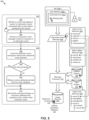
- FIG. 5 depicts an interaction event context identification technique 500 as implemented in systems that facilitate use of context-aware extensible content object access permissions.
- interaction event context identification technique 500 may be implemented in the context of the architecture and functionality of the embodiments described herein.
- the interaction event context identification technique 500 or any aspect thereof may be implemented in any environment.
- FIG. 5 illustrates aspects pertaining to analyzing the attributes of interactions with content objects to dynamically determine extensible access permissions. Specifically, the figure is presented to illustrate one embodiment of certain steps and/or operations that facilitate detecting interaction events and determining the contexts of those events. As depicted in the figure, the steps and/or operations are associated with step 222 and step 224 of FIG. 2 . A representative scenario is also shown in the figure to illustrate an example application of interaction event context identification technique 500.
- interaction event message 520 is parsed to retrieve the event attributes of the interaction event (step 506).
- interaction event message 520 might be characterized by attributes that describe an event identifier (e.g., stored in an "eventID” field), a user identifier (e.g., stored in a "userID” field), a content object identifier (e.g., stored in an "objID” field), an application identifier (e.g., stored in an "appID” field), an interaction type (e.g., stored in an "interaction” field), and/or other attributes.
- additional attributes might be required to characterize the interaction event ("Yes" path of decision 508), in which case various other attributes derived from the event attributes are retrieved (step 510).
- certain content objects attributes e.g., content object metadata
- the content object identifier e.g., "objID” attribute
- certain user attributes might be retrieved from user profiles 332 using the user identifier (e.g., "userID” attribute) from interaction event message 520
- the retrieved object attributes might include a classification label assigned to the content object (e.g., stored in an "objLabel” field).
- a classification label might be assigned to the content object by operation of a rule or parser that considers the subject matter of the content object.
- a particular content object might be associated with subject matter that is known to be sensitive, and as such is labeled such that the attribute "objLabel" takes on the value "sensitive”.
- a particular content object might be deemed to be a legal document of a nature that is automatically labeled as "sensitive”.
- additional event attributes might include an enterprise identifier associated with the content object (e.g., stored in an "objEntID” field), a content object owner identifier (e.g., stored in an "ownerID” field), and/or other object attributes.
- the retrieved user attributes might include a user name (e.g., stored in a "userName” field), an enterprise identifier associated with the user (e g., stored in a "userEntID” field), one or more roles assigned to the user (e.g., stored in a "role[]” object), and/or other user attributes.
- each role e.g., owner, co-owner, editor, viewer, previewer, uploader, etc.
- a role identifier e.g., stored in a "roleID”
- the object identifier e.g., stored in an "objID” field
- Such roles can be accessed to apply, for example, a specific set of access permissions that correspond to specific types of interaction events. Application of such a specific set of access permissions may be in accordance with a global permissions model.
- step 512 When all desired attributes associated with an interaction event are retrieved (e.g., "No" path of decision 508 or completion of step 510), then the retrieved attributes are recorded as a set of interaction attributes that characterize the context of the interaction event (step 512).
- message processor 3 12 can record a set of subject interaction attributes 544 associated with interaction event message 520 in event records 334.
- subject interaction attributes 544 characterize an interaction context 540 that corresponds to the download request from user 102 1 at app 304 11 .
- FIG. 6 depicts a rule-based extensible access permissions override technique 600 as implemented in systems that facilitate use of context-aware extensible content object access permissions.
- a rule-based extensible access permissions override technique 600 may be implemented in the context of the architecture and functionality of the embodiments described herein.
- the rule-based extensible access permissions override technique 600 or any aspect thereof may be implemented in any environment.
- FIG. 6 illustrates aspects pertaining to analyzing attributes of interactions with content objects to dynamically determine extensible access permissions.
- the figure is presented to illustrate one embodiment of certain steps and/or operations that facilitate applying the contexts (e.g., as characterized by interaction attributes) of interaction events to context-aware access policies to determine sets of extensible permissions to govern the interaction events.
- the steps and/or operations are associated with step 226 of FIG. 2 .
- a representative scenario is also shown in the figure to illustrate an example application of rule-based extensible access permissions override technique 600.
- the rule-based extensible access permissions override technique 600 commences by accessing the interaction attributes that characterize the context of an interaction event (step 602). Continuing the scenario depicted in FIG. 5 , the subject interaction attributes 544 earlier described are accessed at event records 334 of a content management system.
- subject interaction attributes 544 might describe an interaction type (e.g., stored in an "interaction” field), a user identifier (e.g., stored in a "userID” field), a content object identifier (e.g., stored in an "objID” field), an application identifier (e.g., stored in an "appID” field), an enterprise identifier associated with the user (e.g., stored in a "userEntID” field), a role identifier associated with the user (e.g., stored in a "roleID” field), a classification label assigned to the content object (e.g., stored in an "objLabel” field), an enterprise identifier associated with the content object (e.g., stored in an "objEntID” field), and/or other attributes.
- interaction type e.g., stored in an "interaction” field
- a user identifier e.g., stored in a "userID” field
- a global permissions framework 3 14 at the content management system might assign a set of subject resource access permissions 624 to the interaction event that corresponds to subject interaction attributes 544.
- subject resource access permissions 624 might be derived from the role identifier (e.g., the "roleID” attribute of subject interaction attributes 544) associated with interaction event.
- subject resource access permissions 624 might be considered the "default" permissions assigned to the interaction event. According to the herein disclosed techniques, such default permissions may be overridden by a set of extensible access permissions as follows.
- One or more extensible permissions rules applicable to the interaction attributes are retrieved (step 608).
- an instance of extensible permissions engine 120 implemented at the content management system might access a store of context-aware access policies 124 to retrieve a policy that is applicable to the interaction event described by the subject interaction attributes 544.
- an applicable context-aware access policy from context-aware access policies 124 is identified based at least in part on the classification label assigned to the content object (e.g., the "objLabel" attribute of subject interaction attributes 544) and the enterprise identifier associated with the content object (e.g., the "objEntID" attribute of subject interaction attributes 544).
- such context-aware access policies often comprise certain respective instances of extensible permissions rules 346.
- the applicable rules from among a set of extensible access rules associated with the identified context-aware access policy are evaluated subject to some or all of the interaction attributes to determine a set of rule results (step 610).
- Such rule results are, for example, the outcomes of the logical statements that comprise the rules as evaluated in accordance with the interaction attributes.
- the rule results describe certain permissions that may or may not override any access permissions that had already been applied to the interaction event.
- the rule results are reconciled with the resource access permissions to identify a set of extensible access permissions (e.g., subject extensible access permissions 626) for the interaction event (step 612).
- resource access permissions provisioned to a user that permits download of a content object may be overridden by rule results that require downloads of the applicable content are to be blocked.
- resource access permissions provisioned to a user that block downloads of a content object may override a rule that allows downloads.
- FIG. 7 depicts an interaction event response technique 700 as implemented in systems that facilitate use of context-aware extensible content object access permissions.
- one or more variations of interaction event response technique 700 or any aspect thereof may be implemented in the context of the architecture and functionality of the embodiments described herein.
- the interaction event response technique 700 or any aspect thereof may be implemented in any environment.
- FIG. 7 illustrates aspects pertaining to analyzing the attributes of interactions with content objects to dynamically determine extensible access permissions. Specifically, the figure is presented to illustrate one embodiment of certain steps and/or operations that facilitate issuing responses to interaction events over content objects in accordance with extensible access permissions identified for the interaction events. As depicted in the figure, the steps and/or operations are associated with step 228 of FIG. 2 . A representative scenario is also shown in the figure to illustrate an example application of interaction event response technique 700.
- the interaction event response technique 700 commences by accessing a set of extensible access permissions associated with an interaction event (step 702).
- the subject extensible access permissions 626 earlier described are accessed by an instance of a response generator 318 at a content management system.
- subject extensible access permissions 626 might describe an event identifier corresponding to the interaction event (e.g., stored in an "eventID” field), a response action identifier (e.g., stored in an "actionID” field), a response reason (e.g., stored in a "reason” field), and/or other attributes that characterize the extensible access permissions.
- the "actionID” field might be populated with some identifier that refers to an "allow with justification” action, and the corresponding “reason” field might be populated with message that explains the action (e.g., "This content is classified as [objLabel] and requires business justification to download”).
- An interaction response is generated from the extensible access permissions (step 704).
- response generator 318 might access some or all of the subject interaction attributes 544 associated with subject extensible access permissions 626 to generate a subject interaction response 724.
- the subject interaction attributes 544 can be retrieved from event records 334 using the event identifier (e.g., stored in the "eventID" field) associated with subject extensible access permissions 626.
- the interaction response is then issued to the source of the interaction event (step 708).
- the source is app 304 11 associated with user 102 1 .
- subject interaction response 724 is issued to a download view 530 2 presented in user interface 306 11 of app 304 11 . More specifically, the information contained in subject interaction response 724 is accessed to populate a response modal view 720 in download view 530 2 .
- response modal view 720 presents the subject extensible access permissions 626, as determined by the herein disclosed techniques, in human-readable form to user 102 1 .
- response modal view 720 facilitates the application of subject extensible access permissions 626 by presenting the reason associated with the permissions and a mechanism for receiving the business justification for the download.
- download of the content object e.g., the "Strategy.pptx" file
- download of the content object can commence when the "Send" button is clicked.
- the acceptability of a justification is determined based on sentiment analysis and/or natural language processing techniques. Further, in some embodiments, sentiment analysis and/or natural language processing is provided by one or more external data processing modules.
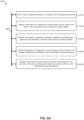
- FIG. 8A depicts a system 8A00 as an arrangement of computing modules that are interconnected so as to operate cooperatively to implement certain of the herein-disclosed embodiments.
- This and other embodiments present particular arrangements of elements that, individually or as combined, serve to form improved technological processes that address the limited applicability of global permissions models.
- the partitioning of system 8A00 is merely illustrative and other partitions are possible.
- the system 8A00 may be implemented in the context of the architecture and functionality of the embodiments described herein. Of course, however, the system 8A00 or any operation therein may be carried out in any desired environment.
- the system 8A00 comprises at least one processor and at least one memory, the memory serving to store program instructions corresponding to the operations of the system. As shown, an operation can be implemented in whole or in part using program instructions accessible by a module.
- the modules are connected to a communication path 8A05, and any operation can communicate with any other operations over communication path 8A05.
- the modules of the system can, individually or in combination, perform method operations within system 8A00. Any operations performed within system 8A00 may be performed in any order unless as may be specified in the claims.
- the shown embodiment implements a portion of a computer system, presented as system 8A00, comprising one or more computer processors to execute a set of program code instructions (module 8A10) and modules for accessing memory to hold program code instructions to perform: establishing context-aware access policies that govern user interactions over a plurality of content objects (module 8A20); gathering interaction attributes associated with a particular user interaction over one of the plurality of content objects (module 8A30); applying the context-aware access policies to the interaction attributes to determine a set of extensible access permissions (module 8A40); and generating a response to the particular user interaction, the response being generated in accordance with the set of extensible access permissions (module 8A50).
- Some embodiments further comprise acts for applying global resource access permissions to the particular user interaction; and then overriding the resource access permissions with the set of extensible access permissions.
- the context-aware access policies are implemented at least in part by evaluation of extensible permissions rules. More specifically, the extensible permissions rules can be evaluated against at least a portion of the interaction attributes to determine a set of extensible access permissions that correspond to the particular interaction.
- enforcement might take the form of one or more of, taking no action, allowing the interaction, allowing the interaction but only with a user-provided justification, or blocking the interaction.
- Variations of the foregoing may include more or fewer of the shown modules. Certain variations may perform more or fewer (or different) steps and/or certain variations may use data elements in more, or in fewer, or in different operations. Still further, some embodiments include variations in the operations performed, and some embodiments include variations of aspects of the data elements used in the operations.
- FIG. 8B depicts a system 8B00 as an arrangement of computing modules that are interconnected so as to operate cooperatively to implement certain of the herein-disclosed embodiments.
- the partitioning of system 8B00 is merely illustrative and other partitions are possible.
- the system 8B00 may be implemented in the context of the architecture and functionality of the embodiments described herein. Of course, however, the system 8B00 or any operation therein may be carried out in any desired environment.
- the system 8B00 comprises at least one processor and at least one memory, the memory serving to store program instructions corresponding to the operations of the system. As shown, an operation can be implemented in whole or in part using program instructions accessible by a module.
- the modules are connected to a communication path 8B05, and any operation can communicate with any other operations over communication path 8B05.
- the modules of the system can, individually or in combination, perform method operations within system 8B00. Any operations performed within system 8B00 may be performed in any order unless as may be specified in the claims.
- the shown embodiment implements a portion of a computer system, presented as system 8B00, comprising one or more computer processors to execute a set of program code instructions (module 8B10) and modules for accessing memory to hold program code instructions to perform: establishing a global permissions model that applies a first set of resource access permissions to a shared content object (module 8B20); establishing one or more context-aware access policies that govern user interactions over the shared content object (module 8B30); gathering one or more interaction attributes associated with a particular user interaction over the shared content object (module 8B40); applying the context-aware access policies to the one or more interaction attributes to determine a set of extensible access permissions (module 8B50); and overriding the first set of resource access permissions with the set of extensible access permissions (module SB60).
- system 8B00 comprising one or more computer processors to execute a set of program code instructions (module 8B10) and modules for accessing memory to hold program code instructions to perform: establishing a global permissions model that
- FIG. 9A depicts a block diagram of an instance of a computer system 9A00 suitable for implementing embodiments of the present disclosure.
- Computer system 9A00 includes a bus 906 or other communication mechanism for communicating information.
- the bus interconnects subsystems and devices such as a central processing unit (CPU), or a multi-core CPU (e.g., data processor 907), a system memory (e.g., main memory 908, or an area of random access memory (RAM)), a non-volatile storage device or non-volatile storage area (e.g., read-only memory 909), an internal storage device 910 or external storage device 913 (e.g., magnetic or optical), a data interface 933, a communications interface 914 (e.g., PHY, MAC, Ethernet interface, modem, etc.).
- CPU central processing unit
- RAM random access memory
- non-volatile storage device or non-volatile storage area e.g., read-only memory 909
- Computer system 9A00 further comprises a display 911 (e.g., CRT or LCD), various input devices 912 (e.g., keyboard, cursor control), and an external data repository 931.
- display 911 e.g., CRT or LCD
- input devices 912 e.g., keyboard, cursor control
- external data repository 931 e.g., external data repository
- computer system 9A00 performs specific operations by data processor 907 executing one or more sequences of one or more program instructions contained in a memory.
- Such instructions e.g., program instructions 902 1 , program instructions 902 2 , program instructions 902 3 , etc.
- program instructions 902 1 , program instructions 902 2 , program instructions 902 3 , etc. can be contained in or can be read into a storage location or memory from any computer readable/usable storage medium such as a static storage device or a disk drive.
- the sequences can be organized to be accessed by one or more processing entities configured to execute a single process or configured to execute multiple concurrent processes to perform work.
- a processing entity can be hardware-based (e.g., involving one or more cores) or software-based, and/or can be formed using a combination of hardware and software that implements logic, and/or can carry out computations and/or processing steps using one or more processes and/or one or more tasks and/or one or more threads or any combination thereof.
- computer system 9A00 performs specific networking operations using one or more instances of communications interface 914.
- Instances of communications interface 914 may comprise one or more networking ports that are configurable (e.g., pertaining to speed, protocol, physical layer characteristics, media access characteristics, etc.) and any particular instance of communications interface 914 or port thereto can be configured differently from any other particular instance.
- Portions of a communication protocol can be carried out in whole or in part by any instance of communications interface 914, and data (e.g., packets, data structures, bit fields, etc.) can be positioned in storage locations within communications interface 914, or within system memory, and such data can be accessed (e.g., using random access addressing, or using direct memory access DMA, etc.) by devices such as data processor 907.
- data e.g., packets, data structures, bit fields, etc.
- DMA direct memory access
- Communications link 915 can be configured to transmit (e.g., send, receive, signal, etc.) any types of communications packets (e.g., communication packet 938 1 , communication packet 938 N ) comprising any organization of data items.
- the data items can comprise a payload data area 937, a destination address 936 (e.g., a destination IP address), a source address 935 (e.g., a source IP address), and can include various encodings or formatting of bit fields to populate packet characteristics 934.
- the packet characteristics include a version identifier, a packet or payload length, a traffic class, a flow label, etc.
- payload data area 937 comprises a data structure that is encoded and/or formatted to fit into byte or word boundaries of the packet.
- hard-wired circuitry may be used in place of or in combination with software instructions to implement aspects of the disclosure.
- embodiments of the disclosure are not limited to any specific combination of hardware circuitry and/or software.
- the term "logic" shall mean any combination of software or hardware that is used to implement all or part of the disclosure.
- Non-volatile media includes, for example, optical or magnetic disks such as disk drives or tape drives.
- Volatile media includes dynamic memory such as RAM.
- Computer readable media include, for example, floppy disk, flexible disk, hard disk, magnetic tape, or any other magnetic medium; CD-ROM or any other optical medium; punch cards, paper tape, or any other physical medium with patterns of holes; RAM, PROM, EPROM, FLASH-EPROM, or any other memory chip or cartridge, or any other non-transitory computer readable medium.
- Such data can be stored, for example, in any form of external data repository 931, which in turn can be formatted into any one or more storage areas, and which can comprise parameterized storage 939 accessible by a key (e.g., filename, table name, block address, offset address, etc.).
- Execution of the sequences of instructions to practice certain embodiments of the disclosure are performed by a single instance of a computer system 9A00.
- a communications link 915 e.g., LAN, public switched telephone network, or wireless network
- Computer system 9A00 may transmit and receive messages such as data and/or instructions organized into a data structure (e.g., communications packets).
- the data structure can include program instructions (e.g., application code 903), communicated through communications link 915 and communications interface 914.
- Received program instructions may be executed by data processor 907 as it is received and/or stored in the shown storage device or in or upon any other non-volatile storage for later execution.
- Computer system 9A00 may communicate through a data interface 933 to a database 932 on an external data repository 931. Data items in a database can be accessed using a primary key (e.g., a relational database primary key).
- a primary key e.g., a relational database primary key
- Processing element partition 901 is merely one sample partition.
- Other partitions can include multiple data processors, and/or multiple communications interfaces, and/or multiple storage devices, etc. within a partition.
- a partition can bound a multi-core processor (e.g., possibly including embedded or co-located memory), or a partition can bound a computing cluster having plurality of computing elements, any of which computing elements are connected directly or indirectly to a communications link.
- a first partition can be configured to communicate to a second partition.
- a particular first partition and particular second partition can be congruent (e.g., in a processing element array) or can be different (e.g., comprising disjoint sets of components).
- a module as used herein can be implemented using any mix of any portions of the system memory and any extent of hard-wired circuitry including hard-wired circuitry embodied as a data processor 907. Some embodiments include one or more special-purpose hardware components (e.g., power control, logic, sensors, transducers, etc.). Some embodiments of a module include instructions that are stored in a memory for execution so as to facilitate operational and/or performance characteristics pertaining to context-aware extensible content object access permissions. A module may include one or more state machines and/or combinational logic used to implement or facilitate the operational and/or performance characteristics pertaining to forming context-aware extensible content object access permissions.
- special-purpose hardware components e.g., power control, logic, sensors, transducers, etc.
- Some embodiments of a module include instructions that are stored in a memory for execution so as to facilitate operational and/or performance characteristics pertaining to context-aware extensible content object access permissions.
- a module may include one or more state machines and/or combinational logic used
- database 932 comprise storage media organized to hold a series of records or files such that individual records or files are accessed using a name or key (e.g., a primary key or a combination of keys and/or query clauses).
- Such files or records can be organized into one or more data structures (e.g., data structures used to implement or facilitate aspects of context-aware extensible content object access permissions).
- Such files, records, or data structures can be brought into and/or stored in volatile or non-volatile memory.
- the occurrence and organization of the foregoing files, records, and data structures improve the way that the computer stores and retrieves data in memory, for example, to improve the way data is accessed when the computer is performing operations pertaining to context-aware extensible content object access permissions, and/or for improving the way data is manipulated when performing computerized operations pertaining to analyzing the attributes of interactions with content objects to dynamically determine extensible access permissions.
- FIG. 9B depicts a block diagram of an instance of a cloud-based environment 9B00.
- a cloud-based environment supports access to workspaces through the execution of workspace access code (e.g., workspace access code 942o, workspace access code 942 1 , and workspace access code 942 2 ).
- Workspace access code can be executed on any of access devices 952 (e.g., laptop device 952 4 , workstation device 952 5 , IP phone device 952 3 , tablet device 952 2 , smart phone device 952 1 , etc.), and can be configured to access any type of object. Strictly as examples, such objects can be folders or directories or can be files of any filetype.
- a group of users can form a collaborator group 958, and a collaborator group can be composed of any types or roles of users.
- a collaborator group can comprise a user collaborator, an administrator collaborator, a creator collaborator, etc. Any user can use any one or more of the access devices, and such access devices can be operated concurrently to provide multiple concurrent sessions and/or other techniques to access workspaces through the workspace access code.
- a portion of workspace access code can reside in and be executed on any access device. Any portion of the workspace access code can reside in and be executed on any computing platform 951, including in a middleware setting. As shown, a portion of the workspace access code resides in and can be executed on one or more processing elements (e.g., processing element 9051)
- the workspace access code can interface with storage devices such as networked storage 955. Storage of workspaces and/or any constituent files or objects, and/or any other code or scripts or data can be stored in any one or more storage partitions (e.g., storage partition 904i).
- a processing element includes forms of storage, such as RAM and/or ROM and/or FLASH, and/or other forms of volatile and non-volatile storage.
- a stored workspace can be populated via an upload (e.g., an upload from an access device to a processing element over an upload network path 957).
- a stored workspace can be delivered to a particular user and/or shared with other particular users via a download (e.g., a download from a processing element to an access device over a download network path 959).
Landscapes
- Engineering & Computer Science (AREA)
- Computer Security & Cryptography (AREA)
- Computer Hardware Design (AREA)
- Computing Systems (AREA)
- General Engineering & Computer Science (AREA)
- Computer Networks & Wireless Communication (AREA)
- Signal Processing (AREA)
- Storage Device Security (AREA)
Description
- This disclosure relates to content management systems, and more particularly to techniques for context-aware content object security.
- Cloud-based content management services and systems have impacted the way personal and enterprise computer-readable content objects (e.g., documents, spreadsheets, images, programming code files, etc.) are stored, and has also impacted the way such personal and enterprise content objects are shared and managed. Content management systems provide the ability to securely share large volumes of content objects among trusted users (e.g., collaborators) on a variety of user devices such as mobile phones, tablets, laptop computers, desktop computers, and/or other devices.
- In some systems, sharing and collaboration activities include one or more interactions (e.g., authoring, editing, viewing, etc.) that are performed over the content objects. The interactions may be performed by one user, or by multiple users, and/or even autonomously by one or more computing entities (e.g., processes, agents, applications, etc.). Moreover, such interactions may span across multiple departments and/or multiple enterprises.
- The interactions by users over content objects in such content management systems are governed in accordance with certain resource access permissions associated with the various combinations of users and content objects. In some settings, resource access permissions may correspond to not only users and content objects, but also may correspond to connections, services, URLs, and/or other resources associated with the content management system.
- Resource access permissions for specific resources often comply with a global permissions model that is implemented and managed at the content management system. A global permissions model defines a single set of semantics and workflows to efficiently manage (e.g., assign, lookup, etc.) resources permissions over the many resources of a content management system. As one example, a global permissions model might predefine a set of user roles (e.g., owner, co-owner, editor, viewer, previewer, uploader, etc.), a set of permitted content object interactions (e.g., edit, download, preview, view/add comments, view metadata, etc.), and a set of mappings between the aforementioned user roles and the permitted content object interactions. In this case, a user can be assigned a particular user role for a particular content object so as to restrict the user to performing only those permitted interactions associated with that user's role over that content object.
- Unfortunately, in today's dynamic collaboration environments, using such a global permissions model is deficient. Specifically, the static nature of the global permissions model is deficient in addressing the many dynamic contexts of the interactions with the content objects performed at a content management system. Such interaction contexts are defined not only by a user's role as pertains to a content object, but also by the enterprise of the user, the application being used for the interaction, and/or by other interaction attributes.
- To illustrate, consider a first user from a first enterprise and a second user from a second enterprise who have been assigned user roles (e.g., "previewer"), in accordance with a global permissions model of a content management system, that permits both users to download any content objects in a particular shared folder managed by the content management system. When a new document is added to the shared folder by an owner at the first enterprise, the first user and the second user will inherit download privileges for the new document according to the global permissions model. In this case, however, the owner may want to restrict downloads of the document to only users at the first enterprise (e.g., due to certain sensitive information in the document).
- One approach to implementing this restriction is to work with an admin at the second enterprise to change the user role (e.g., from "previewer" to "viewer") of the second user as pertains to the document. Another approach is to modify the global permissions model to define a new user role and associated set of mappings to address this particular download restriction context. Both approaches place a tremendous burden on human and computing resources associated with the content management system to overcome the deficiencies of the global permissions model. What is needed is a way to dynamically assign resource access permissions to particular interactions over content objects based on the context of those interactions.
-
US 2015/089575 A1 discloses a global policy store in which policies applicable to multiple applications in an enterprise environment can be stored in association with that environment. An application-level policy combining algorithm can be associated with a specific application to resolve conflicts between the results of evaluating policies that pertain to that application's resources. A persistent model is defined for an Extensible Access Control Markup Language (XACML) target definition. -
US 2016/070758 A1 discloses a system for managing data sharing and permission rules for a plurality of sensitive information across disparate entities and contexts. The system enables multiple tiers of permission rules that may vary by requesting user, specific data fields, and sharing context. The system provides patients or other users who provide data with an interface to select permission rules so that other users may access that data in a controlled manner. The system is capable of capturing and structuring the logic of written laws, consent agreements, and individual user preferences that enable or restrict data sharing among users. The system provides a requesting user with an interface to query the data about a patient or other entity, where data access is enabled by applicable rules. These rules may be set and controlled by the user, other users with permission to set access controls on the user's behalf, or any laws or consent agreements governing data sharing among users. The system provides consistent access to information by linking related data fields through ontological mappings. The system may facilitate the creation of new knowledge using ontology-mapped data from disparate sources. -
US 2018/114015 A1 discloses a method for controlling access to data held in the cloud that includes determining, at a cloud server, the validity of user credentials received from a user device. The method may also include receiving context data related to the user device based on the validity of the user credentials. The method may further include synchronizing the context data with the cloud server. In addition, the method may include enforcing context-sensitive security checks on requests made by the user for resources based on the sensor data collected by the user device. - The invention is defined by the independent claims. The dependent claims concern optional features of some embodiments of the invention. The present disclosure describes techniques used in systems, methods, and in computer program products for context-aware content object security, which techniques advance the relevant technologies to address technological issues with legacy approaches. More specifically, the present disclosure describes techniques used in systems, methods, and in computer program products for context-aware extensible content object access permissions. Certain embodiments are directed to technologies for analyzing the attributes of interactions with content objects to dynamically determine extensible access permissions that override a global permissions model.
- The disclosed embodiments modify and improve over legacy approaches. In particular, the herein-disclosed techniques provide technical solutions that address the technical problems attendant to the limited applicability of global permissions models in collaboration systems. Such technical solutions involve specific implementations (i.e., data organization, data communication paths, module-to-module interrelationships, etc.) that relate to the software arts for improving computer functionality.
- The ordered combination of steps of the embodiments serve in the context of practical applications that perform steps to analyze various attributes of user interactions with content objects to dynamically determine extensible access permissions. The disclosed techniques for analyzing the attributes of interactions with content objects to dynamically determine extensible access permissions serve to overcome long standing yet heretofore unsolved technological problems that arise in the realm of computerized collaboration systems. Aspects of the present disclosure achieve performance and other improvements in peripheral technical fields including (but not limited to) computer security and distributed storage systems.
- Some embodiments perform a series of steps for establishing a global permissions model that applies a first set of resource access permissions to a shared content object, establishing one or more context-aware access policies that govern user interactions over the shared content object; gathering one or more interaction attributes associated with a particular user interaction over the shared content object; applying the context-aware access policies to the one or more interaction attributes to determine a set of extensible access permissions; and overriding the first set of resource access permissions with the set of extensible access permissions.
- Some embodiments perform further steps including generating a response to the particular user interaction, the response being generated in accordance with the set of extensible access permissions. In some cases, the response corresponds to at least one of, taking no action, allowing an interaction, allowing the interaction with a justification, or blocking the interaction. In some cases, at least a portion of the response is presented to a user at a user interface.
- Some embodiments process context-aware access policies wherein the context-aware access policies comprise extensible permissions rules, and in some cases the extensible permissions rules are evaluated against at least a portion of the one or more interaction attributes to determine the set of extensible access permissions.
- In various embodiments, a context associated with the particular user interaction is characterized by one or more of the one or more interaction attributes, which interaction attributes comprise one or more event attributes, or one or more object attributes, or one or more user attributes. Context-aware access policies can be specified by a user at a user interface.
- Some embodiments include a user interface for inputting a justification for a particular requested action. In some embodiments, the acceptability of a justification is determined based on sentiment analysis and/or natural language processing techniques. In some embodiments, sentiment analysis and/or natural language processing is provided by one or more external data processing modules.
- Some embodiments include a sequence of instructions that are stored on a non-transitory computer readable medium. Such a sequence of instructions, when stored in memory and executed by one or more processors causes the one or more processors to perform a set of acts for context-aware content object security over shared content objects.
- Some embodiments include the aforementioned sequence of instructions that are stored in a memory, which memory is interfaced to one or more processors such that the one or more processors can execute the sequence of instructions to cause the one or more processors to implement context-aware content object security over shared content objects.
- In various embodiments, any combinations of any of the above can be combined to perform any variations of acts for implementing context-aware content object security, and many such combinations of aspects of the above elements are contemplated.
- Further details of aspects, objectives, and advantages of the technological embodiments are described herein, and in the drawings and claims.
- The drawings described below are for illustration purposes only. The drawings are not intended to limit the scope of the present disclosure.
-
FIG.1 exemplifies a computing environment in which embodiments of the present disclosure can be implemented. -
FIG. 2 exemplifies a context-aware extensible access permissions assignment technique as implemented in systems that enforce context-aware extensible content object access permissions, according to an embodiment. -
FIG. 3 presents a block diagram of a system that implements and enforces context-aware extensible content object access permissions, according to some embodiments. -
FIG. 4 depicts a context-aware access policy recording technique as implemented in systems that facilitate use of context-aware extensible content object access permissions, according to an embodiment. -
FIG. 5 depicts an interaction event context identification technique as implemented in systems that facilitate use of context-aware extensible content object access permissions, according to an embodiment. -
FIG. 6 depicts a rule-based extensible access permissions override technique as implemented in systems that facilitate use of context-aware extensible content object access permissions, according to an embodiment. -
FIG. 7 depicts an interaction event response technique as implemented in systems that facilitate use of context-aware extensible content object access permissions, according to an embodiment. -
FIG. 8A andFIG. 8B depict system components as arrangements of computing modules that are interconnected so as to implement certain of the herein-disclosed embodiments. -
FIG. 9A andFIG. 9B present block diagrams of computer system architectures having components suitable for implementing embodiments of the present disclosure, and/or for use in the herein-described environments. - Aspects of the present disclosure solve problems associated with collaboration systems that suffer from the limited applicability of global permissions models. These problems are unique to, and may have been created by, various computer-implemented permissions models used in content management systems. Some embodiments are directed to approaches for analyzing the attributes of interactions with content objects to dynamically determine extensible access permissions that override other permissions models. The accompanying figures and discussions herein present example environments, systems, methods, and computer program products for context-aware extensible content object access permissions.
- Disclosed herein are techniques for analyzing the attributes of content object interactions so as to dynamically determine sets of extensible access permissions that govern user interactions over shared content objects. In exemplary embodiments, such techniques are implemented in a content management system that facilitates user-to-user interactions and user-to-content interactions over a plurality of users and a plurality of content objects.
- Instances of context-aware access policies are established at the content management system to govern the interactions of the users over the content objects. When various interaction events associated with the user and content objects are detected (e.g., a request to download a content object), certain event attributes corresponding to the events are identified. The event attributes, and other attributes derived from the event attributes, constitute the interaction attributes that characterize the respective contexts of the interaction events. The interaction attributes are subjected to the context-aware access policies to determine sets of extensible access permissions that govern further interaction events. Specifically, responses to the interaction events are issued in accordance with the sets of extensible access permissions. As an example, for a particular interaction event (e.g., download request), a response might allow an action (e.g., "OK to download") associated with the event, or might block the action, or might allow the action only if accompanied with some justification by the requestor.
- In some embodiments, classification labels are assigned to content objects to facilitate the determination of sets of extensible access permissions. In certain embodiments, the context-aware access policies comprise one or more extensible permissions rules that facilitate the determination of the sets of extensible access permissions. In certain embodiments, a conflict remediation capability is implemented in the content management system to resolve conflicts between different permissions models and/or conflicts between multiple access policies.
- Some of the terms used in this description are defined below for easy reference. The presented terms and their respective definitions are not rigidly restricted to these definitions-a term may be further defined by the term's use within this disclosure. The term "exemplary" is used herein to mean serving as an example, instance, or illustration. Any aspect or design described herein as "exemplary" is not necessarily to be construed as preferred or advantageous over other aspects or designs. Rather, use of the word exemplary is intended to present concepts in a concrete fashion. As used in this application and the appended claims, the term "or" is intended to mean an inclusive "or" rather than an exclusive "or". That is, unless specified otherwise, or is clear from the context, "X employs A or B" is intended to mean any of the natural inclusive permutations. That is, if X employs A, X employs B, or X employs both A and B, then "X employs A or B" is satisfied under any of the foregoing instances. As used herein, at least one of A or B means at least one of A, or at least one of B, or at least one of both A and 13. In other words, this phrase is disjunctive. The articles "a" and "an" as used in this application and the appended claims should generally be construed to mean "one or more" unless specified otherwise or is clear from the context to be directed to a singular form.
- Various embodiments are described herein with reference to the figures. It should be noted that the figures are not necessarily drawn to scale, and that elements of similar structures or functions are sometimes represented by like reference characters throughout the figures. It should also be noted that the figures are only intended to facilitate the description of the disclosed embodiments they are not representative of an exhaustive treatment of all possible embodiments, and they are not intended to impute any limitation as to the scope of the claims. In addition, an illustrated embodiment need not portray all aspects or advantages of usage in any particular environment.
- An aspect or an advantage described in conjunction with a particular embodiment is not necessarily limited to that embodiment and can be practiced in any other embodiments even if not so illustrated. References throughout this specification to "some embodiments" or "other embodiments" refer to a particular feature, structure, material or characteristic described in connection with the embodiments as being included in at least one embodiment. Thus, the appearance of the phrases "in some embodiments" or "in other embodiments" in various places throughout this specification are not necessarily referring to the same embodiment or embodiments. The disclosed embodiments are not intended to be limiting of the claims.
-
FIG. 1 exemplifies acomputing environment 100 in which embodiments of the present disclosure can be implemented. As an option, one or more variations ofcomputing environment 100 or any aspect thereof may be implemented in the context of the architecture and functionality of the embodiments described herein. -
FIG. 1 illustrates aspects pertaining to analyzing the attributes of interactions with content objects to dynamically determine extensible access permissions. Specifically, the figure presents a logical depiction of how the herein disclosed techniques can be used to override global access permissions with extensible access permissions that are derived from the contexts of content object interaction events. A representative set of high order operations are presented to illustrate how the herein disclosed techniques might be applied in a computing environment. - The logical depiction of
FIG. 1 depicts a representative set of users 102 (e.g., user "u1", ..., user "uN") who desire to interact with various instances ofcontent objects 106 managed at acontent management system 104 Users 102 may be users ofcontent management system 104 which facilitates interactions (e.g., authoring, editing, viewing, etc.) over content objects 106 for sharing, collaboration, and/or other purposes. The interactions may be performed by one user, or by multiple users, and/or even autonomously by one or more computing entities (e.g., processes, agents, applications, etc.). Moreover, such interactions may span across multiple departments and/or multiple enterprises. - As illustrated, the interactions by users 102 over
content objects 106 incontent management system 104 are governed at least in part by sets ofglobal access permissions 112 associated with the various combinations of users and content objects. In some settings, global access permissions may correspond to not only users and content objects, but also may correspond to connections, services, URLs, and/or other resources associated with the content management system. Such global access permissions may comply with a global permissions model that is implemented and managed atcontent management system 104. As used herein, a global permissions model is a scheme that defines an initial set (e.g., a default set) of resource permissions to the many resources of a content management system. In today's dynamic collaboration and shared content management environments, however, using such a global permissions model is deficient. Specifically, the limited flexibility ofglobal access permissions 112 as derived from a global permissions model is deficient in addressing the many dynamic contexts in which user interactions withcontent objects 106 can occur. Some mechanism is needed to define a second set (e.g., an override set) of resource permissions. Moreover, such a mechanism needs to be flexible such that the second set (e.g., the override set) of resource permissions can be flexibly extended in accordance with a policy that can in turn be used to determine the specifics of the second set of permissions (e.g., the overridden permissions) to apply to the various types of resources and/or interactions in the content management system. As used herein, the act of overriding means to modify a previously established permission that was set by a global permissions model. Such modification serves to address the limited applicability of the aforementioned global permissions model. - Various challenges pertaining to the limited applicability of global permissions models are addressed at least in part by analyzing the attributes of interactions between users 102 and
content objects 106 so as to dynamically determine sets ofextensible access permissions 122 that govern the interactions. In the embodiment ofFIG. 1 , the techniques are facilitated at least in part by anextensible permissions engine 120 and a set of context-aware access policies 124 implemented atcontent management system 104. As used herein, extensible access permissions refer to characteristics that apply to then-current interactions between users and content objects, which characteristics are considered after a global permissions model has been established. - As shown, context-
aware access policies 124 may be established by one or more of the users 102 (e.g., enterprise system administrators, etc.). When users 102 invoke interaction events over content objects 106 (operation 1),global access permissions 112 are first identified to govern the interaction events (operation 2).Extensible permissions engine 120 accesses the context-aware access policies 124 to retrieve any sets ofextensible access permissions 122 to apply to the interaction events, which extensible access permissions are based at least in part on the context of the interaction events (operation 3). - The context of an interaction event, as used herein, comprises the set of conditions that correspond to the interaction event. Such conditions are often described by one or more interaction attributes. The interaction attributes can comprise event attributes and other attributes derived from the event attributes that correspond to a particular interaction event. In this case, the interaction attributes are applied to context-
aware access policies 124 to determine the sets ofextensible access permissions 122 for the respective interaction events. - As used herein, context-aware access policies are groups of extensible permissions rules, which extensible permissions rules are evaluated against at least a portion of the one or more interaction attributes to determine a set of extensible access permissions, which extensible access permissions allow or deny access to a content object that already has an assigned access permission. Such interaction attributes might derive from a particular context associated with the particular user interaction and/or such interaction attributes might derive from one or more event attributes, or might derive from one or more object attributes, or might derive from one or more user attributes. The heretofore mentioned contexts are defined at least in part by one or more context-aware access policies, which context-aware access policies can be specified by a user at a user interface.
- It can happen that the semantics of extensible access permissions that derive from any one or more context-aware access policies may conflict with the semantics of the global access permissions. As such, the sets of
extensible access permissions 122 are reconciled with the global access permissions (operation 4) to facilitate access tocontent objects 106 in accordance with the extensible access permissions 122 (operation 5). In some cases, responses to the interaction events are issued to users 102 in accordance with theextensible access permissions 122. As an example, for a particular interaction event (e.g., download request), a response might allow an action (e.g., download) associated with the event, block the action, allow the action with some justification by the requestor, and/or perform some other operation. - As depicted in
FIG. 1 ,extensible access permissions 122 serves as a permissions layer (e.g., permission wrapper) that is managed, determined, and/or applied separately from theglobal access permissions 112. Moreover, this extensible context-aware permissions capability facilitated by the herein disclosed techniques serves to address the problems attendant to the limited applicability of global permissions models. As such, application of the techniques disclosed herein facilitate improvements in computer functionality that serve to reduce the demand for computer memory, reduce the demand for computer processing power, reduce network bandwidth use, and reduce the demand for intercomponent communication. Specifically, consumption of such computing resources to facilitate manual permissions adjustments and/or global permissions models updates so as to accommodate newly discovered user-to-user and/or user-to-content interactions is eliminated. - One embodiment of techniques for such context-aware extensible access permissions assignment is disclosed in further detail as follows.
-
FIG. 2 exemplifies a context-aware extensible accesspermissions assignment technique 200 as implemented in systems that enforce context-aware extensible content object access permissions. As an option, one or more variations of context-aware extensible accesspermissions assignment technique 200 or any aspect thereof may be implemented in the context of the architecture and functionality of the embodiments described herein. The context-aware extensible accesspermissions assignment technique 200 or any aspect thereof may be implemented in any environment. -
FIG. 2 illustrates aspects pertaining to analyzing the attributes of interactions with content objects to dynamically determine extensible access permissions. Specifically, the figure is presented to illustrate one embodiment of certain steps and/or operations performed over a network of devices (e.g., user devices, computing systems, etc.) to determine sets of extensible access permissions for the interaction events based at least in part on the context of the interaction events. As can be observed, the steps and/or operations can be grouped into a set ofsetup operations 210 and a set ofongoing operations 220. -
Setup operations 210 of context-aware extensible accesspermissions assignment technique 200 commences by identifying a content management system that facilitates interactions over a plurality of users and a plurality of content objects (step 212). Such interactions can involve both user-to-user interactions and user-to-content interactions. One or more context-aware access policies are established at the content management system to govern interactions between the user and the content objects in accordance with the context of the interactions (step 214). As used herein, a policy, such as a context-aware access policy, comprises a collection of electronically-stored parameters that serve to constrain one or more computing system operations. More specifically, a context-aware access policy comprises a set of policy parameters that are evaluated subject to the context of an invoked interaction event to determine certain permissions to govern over the interaction event. - As depicted in
ongoing operations 220, when any such interaction events associated with the users and the content objects are detected (step 222), the respective contexts of the interaction events are determined (step 224). Such contexts are often described by one or more interaction attributes that can comprise event attributes and other attributes derived from the event attributes (e.g., user attributes, object attributes, resource attributes, etc.) that correspond to the interaction events. - The contexts (e.g., interaction attributes) of the interaction events are applied to the context-aware access policies to determine respective sets of extensible access permissions that correspond to the interaction events (step 226). As merely one example, the policy parameters of the context-aware access policies might codify sets of extensible permission rules that are evaluated subject to the interaction attributes describing the contexts to determine the sets of extensible access permissions. Then, the extensible access permissions are applied to govern interactions between the users and the content objects (step 228). Application of the extensible access permissions often raise responses to specific interaction events. The responses are then processed within the content management system. As examples, such responses might allow an interaction, or might block an interaction, or might allow an interaction with justification (e.g., as might be specified by a user desiring to perform the interaction).
- One embodiment of a system, data flows, and data structures for implementing the context-aware extensible access
permissions assignment technique 200 and/or other herein disclosed techniques, is disclosed as follows. -
FIG. 3 presents a block diagram of asystem 300 that implements and enforces context-aware extensible content object access permissions. As an option, one or more variations ofsystem 300 or any aspect thereof may be implemented in the context of the architecture and functionality of the embodiments described herein. Thesystem 300 or any aspect thereof may be implemented in any environment. -
FIG. 3 illustrates aspects pertaining to analyzing the attributes of interactions with content objects to dynamically determine extensible access permissions. Specifically, the figure is being presented to show one embodiment of certain representative components and associated data structures and data flows implemented in a computing environment to facilitate the herein disclosed techniques. As shown, the components, data flows, and data structures are associated with a set of users (e.g., user 1021, ..., user 102N) that interact with each other and a set of content objects 106 managed at acontent management system 104. The components, data flows, and data structures shown inFIG. 3 present one partitioning and associated data manipulation approach. The specific example shown is purely exemplary, and other subsystems, data structures, and/or partitionings are reasonable. - As shown,
system 300 comprises an instance of acontent management server 310 operating atcontent management system 104.Content management server 310 comprises amessage processor 312, an instance of aglobal permissions framework 314 that comprises aresponse generator 318, and an instance of anextensible permissions engine 120 that comprises a policy conflict remediator 316. A plurality of instances of the foregoing components might operate at a plurality of instances of servers (e.g., content management server 310) atcontent management system 104 and/or any portion ofsystem 300. Such instances can interact with acommunications layer 320 to access each other and/or a set ofstorage devices 330 that store various information to support the operation of the components ofsystem 300 and/or any implementations of the herein disclosed techniques. - For example, the servers and/or storage devices of
content management system 104 might facilitate interactions overcontent objects 106 by the users (e.g., user 1021, ..., user 102N) from a respective set of user devices (e.g., user device 3021, ..., user device 302N). A content management system "manages" a plurality of content objects at least in part by maintaining (e.g., storing, updating, resolving interaction conflicts, etc.) the content objects subject to the various interactions performed over the content objects by the users of the content objects at their respective user devices. The content objects (e.g., files, folders, etc.) in content objects 106 are characterized at least in part by a set of object attributes 340 (e.g., content object metadata) stored atstorage devices 330. Furthermore, the users are characterized at least in part by a set of user attributes 342 stored in a set ofuser profiles 332 atstorage devices 330. - The users access instances of applications (e.g., app 30411, ..., app 3041N) operating at their respective user devices to interact with the content objects 106 managed by
content management system 104. Such applications might comprise native applications provided bycontent management system 104, or third-party applications that are integrated withcontent management system 104, which applications facilitate initiation and performance of interactions over the content objects. Various information pertaining to such integration withcontent management system 104 might be codified in a registry atcontent management system 104. As indicated, the applications often present user interfaces (e.g., user interface 30611, ..., user interface 3061N) to the users to facilitate the interactions withcontent objects 106 and/or other communications withcontent management server 310 and/orcontent management system 104. - Specifically, the instances of the applications operating at the user devices send or receive various instances of
messages 322 that are received or sent bymessage processor 312 atcontent management server 310. In some cases,messages 322 are sent to or received fromcontent management server 310 without human interaction. One class ofmessages 322 pertains to the policy parameters that constitute various instances of context-aware access policies 124 stored instorage devices 330. - Such messages might be invoked, for example, by a system administrator (e.g., admin) submitting a policy creation form at a user interface of an application. In this case, the policy parameters derived from the information specified by the system administrator in the policy creation form are embedded in one or more instances of
messages 322 and delivered tomessage processor 312. The policy parameters are then forwarded toextensible permissions engine 120 for analysis and storage in context-aware access policies 124. - Such analyses may include certain conflict remediation operations performed by policy conflict remediator 316. Conflict remediation may be applied when multiple parties specify conflicting policy parameters. The multiples parties may be within one enterprise or over two or more enterprises. As merely one example, a first admin in an enterprise might specify that no users external to the enterprise can download a particular content object, while a second admin might specify that external users can download the content object. Policy conflict remediator 316 will identify such conflicts and resolve them according to certain criteria (e.g., always select the most restrictive or conservative setting).
- Another class of
messages 322 corresponds to interaction events that are invoked by users when they interact with or attempt to interact with content objects 106. As examples, users might log in to any of the applications to interact with content objects they own or that are shared with them, to invite other users to collaborate on content objects, and/or to perform other collaboration activities. Any of the foregoing interactions or collaboration activities can be characterized as interaction events. -
Message processor 312 atcontent management server 310 monitors themessages 322 to detect interaction events performed over the plurality of users and/or the plurality of content objects.Message processor 312 codifies certain interaction attributes 344 pertaining to interaction events in a set ofevent records 334 stored instorage devices 330. In some cases,message processor 312 will access any instances of user attributes 342 (e.g., user enterprise identifiers, etc.) stored inuser profiles 332 and/or will access any instances the object attributes 340 (e.g., content object types, etc.) stored incontent objects 106 to facilitate the populating of interaction attributes 344 that are included in event records 334. - Event records 334 and/or any other data described herein can be organized and/or stored using various techniques. For example,
event records 334 might be organized and/or stored in a tabular structure (e.g., relational database table) that has rows that relate various interaction attributes with a particular interaction event. As another example, the event data might be organized and/or stored in a programming code object that has instances corresponding to a particular interaction event and properties that describe the various attributes associated with the event. - When interaction events are detected at
message processor 312, theglobal permissions framework 314 assigns respective sets ofglobal access permissions 112, as determined by aglobal permissions model 324, to govern the interaction events.Global permissions framework 314 then callsextensible permissions engine 120 to retrieve any instances ofextensible access permissions 122 that are to be assigned to the interaction events.Extensible permissions engine 120 applies the interaction attributes that describe the respective contexts of the interaction events to the context-aware access policies 124 to determine the extensible access permissions for the events. - As shown, some or all of the interaction attributes may be applied to sets of
extensible permissions rules 346 associated with respective instances of the context-aware access policies 124 to facilitate determination of the extensible access permissions. In some cases,extensible access permissions 122 will overrideglobal access permissions 112 to govern the interaction events whereas, in other cases, a combination ofextensible access permissions 122 andglobal access permissions 112 may govern the interaction events. -
Response generator 318 receives sets ofextensible access permissions 122 determined byextensible permissions engine 120 to generate and issue responses to the sources of the interaction events. Specifically, interaction responses generated byresponse generator 318 are issued as instances ofmessages 322 to the user devices of the users. For example, consider an interaction event that pertains to a preview of a content object by a user. A set of extensible access permissions corresponding to this interaction event indicates that the content object can be downloaded by the user if a business justification is provided. In this case,response generator 318 will receive the set of extensible access permissions and generate an interaction response that presents a modal to the user to request selection by the user of one of several business justification descriptions. When an acceptable business justification is submitted by the user, the content object is provisioned (e.g., in an instance of messages 322) to the user. - Further details pertaining to techniques for establishing (e.g., specifying, recording, etc.) context-aware access policies to govern interactions over content objects (e.g., step 214 of
FIG. 2 ) are disclosed as follows. Additionally, further details pertaining to techniques for establishing policies to govern interactions are disclosed in co-pendingU.S. Patent Application Serial No. 16/552,956 titled "ACTIVITY-BASED CONTENT OBJECT ACCESS PERMISSIONS", filed on even date herewith. -
FIG. 4 depicts a context-aware accesspolicy recording technique 400 as implemented in systems that facilitate use of context-aware extensible content object access permissions. As an option, one or more variations of context-aware accesspolicy recording technique 400 or any aspect thereof may be implemented in the context of the architecture and functionality of the embodiments described herein. The context-aware accesspolicy recording technique 400 or any aspect thereof may be implemented in any environment. -
FIG. 4 illustrates aspects pertaining to analyzing the attributes of interactions with content objects to dynamically determine extensible access permissions. Specifically, the figure is presented to illustrate one embodiment of a user interface and data structure for specifying and recording policy parameters of instances of context-aware access policies. The flow depicted in the figure can represent an embodiment ofstep 214 ofFIG. 2 . - The context-aware access
policy recording technique 400 is facilitated at least in part by apolicy specification view 422 presented at user interface 3061N of user device 302N associated with user 102N. User 102N might be a system administrator of an enterprise who is responsible for establishing at least some of the context-aware access policies for the enterprise. To assist such system administrators, a context management system might provide thepolicy specification view 422 or other views to collect the user inputs that specify the policy parameters of the context-aware access policies. - Specifically,
policy specification view 422 comprises user interface elements (e.g., text boxes, radio buttons, drop down selection lists, switches, checkboxes, etc.) to collect such user inputs. As can be observed, user 102N can manipulate the user interface elements to specify a policy name (e.g., entered in a "Policy Name" text box), a policy description (e.g., entered in a "Description" text box), a classification label associated with the policy (e.g., enabled by a radio button and selected in a dropdown in a "Content Type" section), one or more security controls (e.g., as selected in a "Security Controls" section), and/or other policy attributes. A classification label, as used herein, is a data object that is assigned to one or more content objects to identify a respective context-aware access policy to apply to the content objects having that classification label. - As can be observed in
policy specification view 422, for example, a classification label defined by the text string "Confidential" is associated with the "Classified Files" policy. As such, any interactions with any content objects having the classification label of "Confidential" will be governed by the "Classified Files" policy. In some cases, multiple classification labels might be associated with a particular context-aware access policy. - When user 102N clicks the "Save" button in
policy specification view 422, the user inputs from the view are submitted toextensible permissions engine 120. After certain policy conflict remediation operations are performed by policy conflict remediator 316 as earlier described, the policy parameters associated with the "Classified Files" policy are recorded in context-aware access policies 124. As depicted in a set ofrepresentative policy parameters 424, each policy in context-aware access policies 124 might be describe by a policy identifier (e.g., stored in a "policyID" field), a policy name (e.g., stored in a "name" field), a policy description (e.g., stored in a "description" field), an enterprise identifier (e.g., stored in an "enterpriseID" field), one or more classification labels (e.g., stored in a "classLabel[]" object), one or more extensible permissions rules (e.g., stored in a "rules[]" object), and/or other parameters. - As facilitated by the foregoing representative policy parameters, a particular context-aware access policy can be uniquely selected for a subject content object using the classification label (e.g., as specified in the "classLabel[]" object) and enterprise identifier (e.g., as specified in the "enterpriseID" field) that corresponds to the subject content object.
- A set of rules (e.g., rule base), such as the
extensible permissions rules 346 stored in the "rules[]" object or any other rules described herein, comprises data records storing various information that can be used to form one or more constraints to apply to certain functions and/or operations. For example, information pertaining to a rule in the rule base might comprise conditional logic operands (e.g., input variables, conditions, constraints, etc.) and/or conditional logic operators (e.g., "if", "then", "and", "or", "greater than", "less than", etc.) for forming a conditional logic statement that returns one or more results. In some cases, the information pertaining to a rule might comprise conditions (e.g., predicates, conditional expressions, field names, field values, etc.) and commands and/or clauses (e.g., "select", "where", "order by", etc.) for forming a data statement (e.g., query) that returns one or more results. As shown inrepresentative policy parameters 424, the aforementioned conditional logic operands may comprise various interaction attributes (e.g., stored in an "iAttributes[]" object) and the aforementioned conditional logic operators may be incorporated into one or more conditional logic statements (e.g., codified in instances of "ruleLogic") that have placeholder for the interaction attributes. - One example of such rules is depicted in a representative extensible permissions rule 426. The representative extensible permissions rule 426 is formed by
extensible permissions engine 120 in response to the "Download restriction" specified inpolicy specification view 422 "For mobile" devices and/or applications. More specifically, the shown user inputs ofpolicy specification view 422 indicate that any downloads of content objects classified as "Confidential" by an enterprise are allowed with justification when the download requests are from the mobile applications of users external to the enterprise. In response to this download restriction as specified inpolicy specification view 422, the representative extensible permissions rule 426 is formed and recorded in context-aware access policies 124. The rule specifically states that if a content object has a classification label that is equal to any of the classification labels associated with the policy (e.g., "objLabel==classLabel (any)"), and the application is a mobile application (e.g., "appID== (ALL_MOBILE_APP_IDS)"), and the user is not from the enterprise associated with the content object (e.g., "userEntID!=objEntID"), then access is allow with justification. For all other conditions, access to the content object is allowed. - The foregoing discussions include techniques for detecting interaction events (e.g., step 222 of
FIG. 2 ) and determining the contexts of those events (e.g.,step 224. ofFIG. 2 ), which techniques are disclosed in further detail as follows. -
FIG. 5 depicts an interaction eventcontext identification technique 500 as implemented in systems that facilitate use of context-aware extensible content object access permissions. As an option, one or more variations of interaction eventcontext identification technique 500 or any aspect thereof may be implemented in the context of the architecture and functionality of the embodiments described herein. The interaction eventcontext identification technique 500 or any aspect thereof may be implemented in any environment. -
FIG. 5 illustrates aspects pertaining to analyzing the attributes of interactions with content objects to dynamically determine extensible access permissions. Specifically, the figure is presented to illustrate one embodiment of certain steps and/or operations that facilitate detecting interaction events and determining the contexts of those events. As depicted in the figure, the steps and/or operations are associated withstep 222 and step 224 ofFIG. 2 . A representative scenario is also shown in the figure to illustrate an example application of interaction eventcontext identification technique 500. - The interaction event
context identification technique 500 commences by monitoring a content management system for interaction events associated with content objects managed by the system (step 502). As illustrated, one or more instances ofmessage processor 312 might monitor all interaction events invoked by users of the content management system. In response to any one of the interaction events, an interaction event message is received (step 504). Referring to the scenario ofFIG. 5 , consider an interaction event that pertains to user 1021 clicking on a download icon in a download view 5301 to download a file named "Strategy.pptx". As shown, the download view 5301 might be presented in a user interface 30611 of app 30411. In response to the foregoing user action, aninteraction event message 520 is received atmessage processor 312. - The interaction event message is parsed to retrieve the event attributes of the interaction event (step 506). As indicated in a set of select event attributes 522,
interaction event message 520 might be characterized by attributes that describe an event identifier (e.g., stored in an "eventID" field), a user identifier (e.g., stored in a "userID" field), a content object identifier (e.g., stored in an "objID" field), an application identifier (e.g., stored in an "appID" field), an interaction type (e.g., stored in an "interaction" field), and/or other attributes. In some situations, additional attributes might be required to characterize the interaction event ("Yes" path of decision 508), in which case various other attributes derived from the event attributes are retrieved (step 510). - As shown, certain content objects attributes (e.g., content object metadata) might be retrieved from
content objects 106 using the content object identifier (e.g., "objID" attribute) frominteraction event message 520, and/or certain user attributes might be retrieved fromuser profiles 332 using the user identifier (e.g., "userID" attribute) frominteraction event message 520. As depicted in a set of select object attributes 524, the retrieved object attributes might include a classification label assigned to the content object (e.g., stored in an "objLabel" field). A classification label might be assigned to the content object by operation of a rule or parser that considers the subject matter of the content object. For example, a particular content object might be associated with subject matter that is known to be sensitive, and as such is labeled such that the attribute "objLabel" takes on the value "sensitive". Or, a particular content object might be deemed to be a legal document of a nature that is automatically labeled as "sensitive". - Alternatively, or in addition to the foregoing event attributes, additional event attributes might include an enterprise identifier associated with the content object (e.g., stored in an "objEntID" field), a content object owner identifier (e.g., stored in an "ownerID" field), and/or other object attributes. Furthermore, and as depicted in a set of select user attributes 526, the retrieved user attributes might include a user name (e.g., stored in a "userName" field), an enterprise identifier associated with the user (e g., stored in a "userEntID" field), one or more roles assigned to the user (e.g., stored in a "role[]" object), and/or other user attributes. As shown, each role (e.g., owner, co-owner, editor, viewer, previewer, uploader, etc.) assigned to a particular user can be represented by a role identifier (e.g., stored in a "roleID") and the object identifier (e.g., stored in an "objID" field) of the content object to which the role identifier applies. Such roles can be accessed to apply, for example, a specific set of access permissions that correspond to specific types of interaction events. Application of such a specific set of access permissions may be in accordance with a global permissions model.
- When all desired attributes associated with an interaction event are retrieved (e.g., "No" path of
decision 508 or completion of step 510), then the retrieved attributes are recorded as a set of interaction attributes that characterize the context of the interaction event (step 512). As depicted in the scenario ofFIG. 5 ,message processor 3 12 can record a set of subject interaction attributes 544 associated withinteraction event message 520 in event records 334. In this case, subject interaction attributes 544 characterize aninteraction context 540 that corresponds to the download request from user 1021 at app 30411. - The foregoing discussions include techniques for applying the contexts (e.g., as characterized by interaction attributes) of interaction events to context-aware access policies to determine sets of extensible permissions to govern the interaction events (e.g., step 226 of
FIG. 2 ), which techniques are disclosed in further detail as follows. -
FIG. 6 depicts a rule-based extensible accesspermissions override technique 600 as implemented in systems that facilitate use of context-aware extensible content object access permissions. As an option, one or more variations of rule-based extensible accesspermissions override technique 600 or any aspect thereof may be implemented in the context of the architecture and functionality of the embodiments described herein. The rule-based extensible accesspermissions override technique 600 or any aspect thereof may be implemented in any environment. -
FIG. 6 illustrates aspects pertaining to analyzing attributes of interactions with content objects to dynamically determine extensible access permissions. Specifically, the figure is presented to illustrate one embodiment of certain steps and/or operations that facilitate applying the contexts (e.g., as characterized by interaction attributes) of interaction events to context-aware access policies to determine sets of extensible permissions to govern the interaction events. As depicted in the figure, the steps and/or operations are associated withstep 226 ofFIG. 2 . A representative scenario is also shown in the figure to illustrate an example application of rule-based extensible accesspermissions override technique 600. - The rule-based extensible access
permissions override technique 600 commences by accessing the interaction attributes that characterize the context of an interaction event (step 602). Continuing the scenario depicted inFIG. 5 , the subject interaction attributes 544 earlier described are accessed atevent records 334 of a content management system. As indicated in a set of select interaction attributes 622, subject interaction attributes 544 might describe an interaction type (e.g., stored in an "interaction" field), a user identifier (e.g., stored in a "userID" field), a content object identifier (e.g., stored in an "objID" field), an application identifier (e.g., stored in an "appID" field), an enterprise identifier associated with the user (e.g., stored in a "userEntID" field), a role identifier associated with the user (e.g., stored in a "roleID" field), a classification label assigned to the content object (e.g., stored in an "objLabel" field), an enterprise identifier associated with the content object (e.g., stored in an "objEntID" field), and/or other attributes. - If valid extensible access permissions for the particular set of interaction attributes and associated interaction event are stored in a cache memory ("Yes" path of decision 604), then the set of extensible access permissions are retrieved from cache memory (step 616). If no pertinent extensible access permissions are cached ("No" path of decision 604), then a set of global access permissions are assigned to the interaction event in accordance with a global permissions model (step 606). As illustrated in the scenario of
FIG. 6 , aglobal permissions framework 3 14 at the content management system might assign a set of subjectresource access permissions 624 to the interaction event that corresponds to subject interaction attributes 544. Specifically, subjectresource access permissions 624 might be derived from the role identifier (e.g., the "roleID" attribute of subject interaction attributes 544) associated with interaction event. In some cases, subjectresource access permissions 624 might be considered the "default" permissions assigned to the interaction event. According to the herein disclosed techniques, such default permissions may be overridden by a set of extensible access permissions as follows. - One or more extensible permissions rules applicable to the interaction attributes are retrieved (step 608). For example, an instance of
extensible permissions engine 120 implemented at the content management system might access a store of context-aware access policies 124 to retrieve a policy that is applicable to the interaction event described by the subject interaction attributes 544. In some cases, an applicable context-aware access policy from context-aware access policies 124 is identified based at least in part on the classification label assigned to the content object (e.g., the "objLabel" attribute of subject interaction attributes 544) and the enterprise identifier associated with the content object (e.g., the "objEntID" attribute of subject interaction attributes 544). - As earlier described, such context-aware access policies often comprise certain respective instances of extensible permissions rules 346. As such, the applicable rules from among a set of extensible access rules associated with the identified context-aware access policy are evaluated subject to some or all of the interaction attributes to determine a set of rule results (step 610). Such rule results are, for example, the outcomes of the logical statements that comprise the rules as evaluated in accordance with the interaction attributes. In this case, the rule results describe certain permissions that may or may not override any access permissions that had already been applied to the interaction event. The rule results are reconciled with the resource access permissions to identify a set of extensible access permissions (e.g., subject extensible access permissions 626) for the interaction event (step 612).
- As one permission reconciliation example, resource access permissions provisioned to a user that permits download of a content object may be overridden by rule results that require downloads of the applicable content are to be blocked. As another permission reconciliation example, resource access permissions provisioned to a user that block downloads of a content object may override a rule that allows downloads. When the set of extensible access permissions for the interaction event are determined, the extensible access permissions (e.g., subject extensible access permissions 626) are stored in a cache memory (step 614) for efficient subsequent retrievals (step 616).
- The foregoing discussions include techniques for issuing responses to the interaction events in accordance with the extensible access permissions identified for the events (e.g., step 228 of
FIG. 2 ), which techniques are disclosed in further detail as follows. -
FIG. 7 depicts an interactionevent response technique 700 as implemented in systems that facilitate use of context-aware extensible content object access permissions. As an option, one or more variations of interactionevent response technique 700 or any aspect thereof may be implemented in the context of the architecture and functionality of the embodiments described herein. The interactionevent response technique 700 or any aspect thereof may be implemented in any environment. -
FIG. 7 illustrates aspects pertaining to analyzing the attributes of interactions with content objects to dynamically determine extensible access permissions. Specifically, the figure is presented to illustrate one embodiment of certain steps and/or operations that facilitate issuing responses to interaction events over content objects in accordance with extensible access permissions identified for the interaction events. As depicted in the figure, the steps and/or operations are associated withstep 228 ofFIG. 2 . A representative scenario is also shown in the figure to illustrate an example application of interactionevent response technique 700. - The interaction
event response technique 700 commences by accessing a set of extensible access permissions associated with an interaction event (step 702). Continuing the scenario depicted inFIG. 5 andFIG. 6 , the subjectextensible access permissions 626 earlier described are accessed by an instance of aresponse generator 318 at a content management system. As indicated in a set of select extensible access permissions attributes 722, subjectextensible access permissions 626 might describe an event identifier corresponding to the interaction event (e.g., stored in an "eventID" field), a response action identifier (e.g., stored in an "actionID" field), a response reason (e.g., stored in a "reason" field), and/or other attributes that characterize the extensible access permissions. As merely one example, the "actionID" field might be populated with some identifier that refers to an "allow with justification" action, and the corresponding "reason" field might be populated with message that explains the action (e.g., "This content is classified as [objLabel] and requires business justification to download"). - An interaction response is generated from the extensible access permissions (step 704). As can observed,
response generator 318 might access some or all of the subject interaction attributes 544 associated with subjectextensible access permissions 626 to generate asubject interaction response 724. The subject interaction attributes 544 can be retrieved fromevent records 334 using the event identifier (e.g., stored in the "eventID" field) associated with subjectextensible access permissions 626. The interaction response is then issued to the source of the interaction event (step 708). - In the scenario of
FIG. 7 , the source is app 30411 associated with user 1021. As such,subject interaction response 724 is issued to a download view 5302 presented in user interface 30611 of app 30411. More specifically, the information contained insubject interaction response 724 is accessed to populate a responsemodal view 720 in download view 5302. As can be observed, responsemodal view 720 presents the subjectextensible access permissions 626, as determined by the herein disclosed techniques, in human-readable form to user 1021. Specifically, responsemodal view 720 facilitates the application of subjectextensible access permissions 626 by presenting the reason associated with the permissions and a mechanism for receiving the business justification for the download. If an acceptable business justification is selected by user 1021, download of the content object (e.g., the "Strategy.pptx" file) can commence when the "Send" button is clicked. In some embodiments, the acceptability of a justification is determined based on sentiment analysis and/or natural language processing techniques. Further, in some embodiments, sentiment analysis and/or natural language processing is provided by one or more external data processing modules. - Further details regarding general approaches to using external data processing for sentiment analysis and/or natural language processing techniques are described in PCT Application Ser. No.
PCT/US18/55096 titled "INTEGRATING EXTERNAL DATA PROCESSING TECHNOLOGIES WITH A CLOUD-BASED COLLABORATION PLATFORM", filed on October 3, 2018 . -
FIG. 8A depicts a system 8A00 as an arrangement of computing modules that are interconnected so as to operate cooperatively to implement certain of the herein-disclosed embodiments. This and other embodiments present particular arrangements of elements that, individually or as combined, serve to form improved technological processes that address the limited applicability of global permissions models. The partitioning of system 8A00 is merely illustrative and other partitions are possible. As an option, the system 8A00 may be implemented in the context of the architecture and functionality of the embodiments described herein. Of course, however, the system 8A00 or any operation therein may be carried out in any desired environment. - The system 8A00 comprises at least one processor and at least one memory, the memory serving to store program instructions corresponding to the operations of the system. As shown, an operation can be implemented in whole or in part using program instructions accessible by a module. The modules are connected to a communication path 8A05, and any operation can communicate with any other operations over communication path 8A05. The modules of the system can, individually or in combination, perform method operations within system 8A00. Any operations performed within system 8A00 may be performed in any order unless as may be specified in the claims.
- The shown embodiment implements a portion of a computer system, presented as system 8A00, comprising one or more computer processors to execute a set of program code instructions (module 8A10) and modules for accessing memory to hold program code instructions to perform: establishing context-aware access policies that govern user interactions over a plurality of content objects (module 8A20); gathering interaction attributes associated with a particular user interaction over one of the plurality of content objects (module 8A30); applying the context-aware access policies to the interaction attributes to determine a set of extensible access permissions (module 8A40); and generating a response to the particular user interaction, the response being generated in accordance with the set of extensible access permissions (module 8A50).
- Some embodiments further comprise acts for applying global resource access permissions to the particular user interaction; and then overriding the resource access permissions with the set of extensible access permissions. In some embodiments, the context-aware access policies are implemented at least in part by evaluation of extensible permissions rules. More specifically, the extensible permissions rules can be evaluated against at least a portion of the interaction attributes to determine a set of extensible access permissions that correspond to the particular interaction.
- There are many ways to enforce the permissions. For example, enforcement might take the form of one or more of, taking no action, allowing the interaction, allowing the interaction but only with a user-provided justification, or blocking the interaction.
- Variations of the foregoing may include more or fewer of the shown modules. Certain variations may perform more or fewer (or different) steps and/or certain variations may use data elements in more, or in fewer, or in different operations. Still further, some embodiments include variations in the operations performed, and some embodiments include variations of aspects of the data elements used in the operations.
-
FIG. 8B depicts a system 8B00 as an arrangement of computing modules that are interconnected so as to operate cooperatively to implement certain of the herein-disclosed embodiments. The partitioning of system 8B00 is merely illustrative and other partitions are possible. As an option, the system 8B00 may be implemented in the context of the architecture and functionality of the embodiments described herein. Of course, however, the system 8B00 or any operation therein may be carried out in any desired environment. The system 8B00 comprises at least one processor and at least one memory, the memory serving to store program instructions corresponding to the operations of the system. As shown, an operation can be implemented in whole or in part using program instructions accessible by a module. The modules are connected to a communication path 8B05, and any operation can communicate with any other operations over communication path 8B05. The modules of the system can, individually or in combination, perform method operations within system 8B00. Any operations performed within system 8B00 may be performed in any order unless as may be specified in the claims. The shown embodiment implements a portion of a computer system, presented as system 8B00, comprising one or more computer processors to execute a set of program code instructions (module 8B10) and modules for accessing memory to hold program code instructions to perform: establishing a global permissions model that applies a first set of resource access permissions to a shared content object (module 8B20); establishing one or more context-aware access policies that govern user interactions over the shared content object (module 8B30); gathering one or more interaction attributes associated with a particular user interaction over the shared content object (module 8B40); applying the context-aware access policies to the one or more interaction attributes to determine a set of extensible access permissions (module 8B50); and overriding the first set of resource access permissions with the set of extensible access permissions (module SB60). -
FIG. 9A depicts a block diagram of an instance of a computer system 9A00 suitable for implementing embodiments of the present disclosure. Computer system 9A00 includes a bus 906 or other communication mechanism for communicating information. The bus interconnects subsystems and devices such as a central processing unit (CPU), or a multi-core CPU (e.g., data processor 907), a system memory (e.g.,main memory 908, or an area of random access memory (RAM)), a non-volatile storage device or non-volatile storage area (e.g., read-only memory 909), aninternal storage device 910 or external storage device 913 (e.g., magnetic or optical), adata interface 933, a communications interface 914 (e.g., PHY, MAC, Ethernet interface, modem, etc.). The aforementioned components are shown withinprocessing element partition 901, however other partitions are possible. Computer system 9A00 further comprises a display 911 (e.g., CRT or LCD), various input devices 912 (e.g., keyboard, cursor control), and anexternal data repository 931. - According to an embodiment of the disclosure, computer system 9A00 performs specific operations by
data processor 907 executing one or more sequences of one or more program instructions contained in a memory. Such instructions (e.g., program instructions 9021, program instructions 9022, program instructions 9023, etc.) can be contained in or can be read into a storage location or memory from any computer readable/usable storage medium such as a static storage device or a disk drive. The sequences can be organized to be accessed by one or more processing entities configured to execute a single process or configured to execute multiple concurrent processes to perform work. A processing entity can be hardware-based (e.g., involving one or more cores) or software-based, and/or can be formed using a combination of hardware and software that implements logic, and/or can carry out computations and/or processing steps using one or more processes and/or one or more tasks and/or one or more threads or any combination thereof. - According to an embodiment of the disclosure, computer system 9A00 performs specific networking operations using one or more instances of
communications interface 914. Instances ofcommunications interface 914 may comprise one or more networking ports that are configurable (e.g., pertaining to speed, protocol, physical layer characteristics, media access characteristics, etc.) and any particular instance ofcommunications interface 914 or port thereto can be configured differently from any other particular instance. Portions of a communication protocol can be carried out in whole or in part by any instance ofcommunications interface 914, and data (e.g., packets, data structures, bit fields, etc.) can be positioned in storage locations withincommunications interface 914, or within system memory, and such data can be accessed (e.g., using random access addressing, or using direct memory access DMA, etc.) by devices such asdata processor 907. - Communications link 915 can be configured to transmit (e.g., send, receive, signal, etc.) any types of communications packets (e.g., communication packet 9381, communication packet 938N) comprising any organization of data items. The data items can comprise a
payload data area 937, a destination address 936 (e.g., a destination IP address), a source address 935 (e.g., a source IP address), and can include various encodings or formatting of bit fields to populatepacket characteristics 934. In some cases, the packet characteristics include a version identifier, a packet or payload length, a traffic class, a flow label, etc. In some cases,payload data area 937 comprises a data structure that is encoded and/or formatted to fit into byte or word boundaries of the packet. - In some embodiments, hard-wired circuitry may be used in place of or in combination with software instructions to implement aspects of the disclosure. Thus, embodiments of the disclosure are not limited to any specific combination of hardware circuitry and/or software. In embodiments, the term "logic" shall mean any combination of software or hardware that is used to implement all or part of the disclosure.
- The term "computer readable medium" or "computer usable medium" as used herein refers to any medium that participates in providing instructions to
data processor 907 for execution. Such a medium may take many forms including, but not limited to, non-volatile media and volatile media. Non-volatile media includes, for example, optical or magnetic disks such as disk drives or tape drives. Volatile media includes dynamic memory such as RAM. - Common forms of computer readable media include, for example, floppy disk, flexible disk, hard disk, magnetic tape, or any other magnetic medium; CD-ROM or any other optical medium; punch cards, paper tape, or any other physical medium with patterns of holes; RAM, PROM, EPROM, FLASH-EPROM, or any other memory chip or cartridge, or any other non-transitory computer readable medium. Such data can be stored, for example, in any form of
external data repository 931, which in turn can be formatted into any one or more storage areas, and which can comprise parameterizedstorage 939 accessible by a key (e.g., filename, table name, block address, offset address, etc.). - Execution of the sequences of instructions to practice certain embodiments of the disclosure are performed by a single instance of a computer system 9A00. According to certain embodiments of the disclosure, two or more instances of computer system 9A00 coupled by a communications link 915 (e.g., LAN, public switched telephone network, or wireless network) may perform the sequence of instructions required to practice embodiments of the disclosure using two or more instances of components of computer system 9A00.
- Computer system 9A00 may transmit and receive messages such as data and/or instructions organized into a data structure (e.g., communications packets). The data structure can include program instructions (e.g., application code 903), communicated through communications link 915 and
communications interface 914. Received program instructions may be executed bydata processor 907 as it is received and/or stored in the shown storage device or in or upon any other non-volatile storage for later execution. Computer system 9A00 may communicate through adata interface 933 to adatabase 932 on anexternal data repository 931. Data items in a database can be accessed using a primary key (e.g., a relational database primary key). - Processing
element partition 901 is merely one sample partition. Other partitions can include multiple data processors, and/or multiple communications interfaces, and/or multiple storage devices, etc. within a partition. For example, a partition can bound a multi-core processor (e.g., possibly including embedded or co-located memory), or a partition can bound a computing cluster having plurality of computing elements, any of which computing elements are connected directly or indirectly to a communications link. A first partition can be configured to communicate to a second partition. A particular first partition and particular second partition can be congruent (e.g., in a processing element array) or can be different (e.g., comprising disjoint sets of components). - A module as used herein can be implemented using any mix of any portions of the system memory and any extent of hard-wired circuitry including hard-wired circuitry embodied as a
data processor 907. Some embodiments include one or more special-purpose hardware components (e.g., power control, logic, sensors, transducers, etc.). Some embodiments of a module include instructions that are stored in a memory for execution so as to facilitate operational and/or performance characteristics pertaining to context-aware extensible content object access permissions. A module may include one or more state machines and/or combinational logic used to implement or facilitate the operational and/or performance characteristics pertaining to forming context-aware extensible content object access permissions. - Various implementations of
database 932 comprise storage media organized to hold a series of records or files such that individual records or files are accessed using a name or key (e.g., a primary key or a combination of keys and/or query clauses). Such files or records can be organized into one or more data structures (e.g., data structures used to implement or facilitate aspects of context-aware extensible content object access permissions). Such files, records, or data structures can be brought into and/or stored in volatile or non-volatile memory. More specifically, the occurrence and organization of the foregoing files, records, and data structures improve the way that the computer stores and retrieves data in memory, for example, to improve the way data is accessed when the computer is performing operations pertaining to context-aware extensible content object access permissions, and/or for improving the way data is manipulated when performing computerized operations pertaining to analyzing the attributes of interactions with content objects to dynamically determine extensible access permissions. -
FIG. 9B depicts a block diagram of an instance of a cloud-based environment 9B00. Such a cloud-based environment supports access to workspaces through the execution of workspace access code (e.g., workspace access code 942o, workspace access code 9421, and workspace access code 9422). Workspace access code can be executed on any of access devices 952 (e.g.,laptop device 9524,workstation device 9525,IP phone device 9523,tablet device 9522,smart phone device 9521, etc.), and can be configured to access any type of object. Strictly as examples, such objects can be folders or directories or can be files of any filetype. A group of users can form acollaborator group 958, and a collaborator group can be composed of any types or roles of users. For example, and as shown, a collaborator group can comprise a user collaborator, an administrator collaborator, a creator collaborator, etc. Any user can use any one or more of the access devices, and such access devices can be operated concurrently to provide multiple concurrent sessions and/or other techniques to access workspaces through the workspace access code. - A portion of workspace access code can reside in and be executed on any access device. Any portion of the workspace access code can reside in and be executed on any
computing platform 951, including in a middleware setting. As shown, a portion of the workspace access code resides in and can be executed on one or more processing elements (e.g., processing element 9051) The workspace access code can interface with storage devices such asnetworked storage 955. Storage of workspaces and/or any constituent files or objects, and/or any other code or scripts or data can be stored in any one or more storage partitions (e.g., storage partition 904i). In some environments, a processing element includes forms of storage, such as RAM and/or ROM and/or FLASH, and/or other forms of volatile and non-volatile storage. - A stored workspace can be populated via an upload (e.g., an upload from an access device to a processing element over an upload network path 957). A stored workspace can be delivered to a particular user and/or shared with other particular users via a download (e.g., a download from a processing element to an access device over a download network path 959).
- In the foregoing specification, the disclosure has been described with reference to specific embodiments thereof. It will however be evident that various modifications and changes may be made thereto without departing from the scope of the claims provided that these modifications and changes are equivalent to an element specified in the claims. For example, the above-described process flows are described with reference to a particular ordering of process actions. However, the ordering of many of the described process actions may be changed without affecting the scope or operation of the disclosure. The specification and drawings are to be regarded in an illustrative sense rather than in a restrictive sense.
Claims (15)
- A method for context-aware content object security, the method comprising:applying a predefined global permission model (324) to a shared content object (106), the predefined global permission model (324) mapping a predetermined user role to determine a set of global access permissions (112) to a shared content object (106) for a particular user (102-1.. 102-N);maintaining (214) one or more context-aware access policies (124) that govern user interactions over the shared content object (106);determining a context of a particular user interaction by gathering one or more interaction attributes (344) associated with the particular user interaction over the shared content object (106), the one or more interaction attributes (344) comprising at least a user identifier, a content object identifier, an application identifier, and an interaction type;applying (226) the one or more context-aware access policies (124) to the one or more interaction attributes (344) comprising at least the user identifier, the content object identifier, the application identifier, and the interaction type, to dynamically determine a set of extensible access permissions (122);determining that the dynamically determined set of extensible access permissions (122) conflict with the set of global access permissions (112); anddetermining whether the extensible access permissions (122) override the set of global access permissions (112).
- The method of claim 1, further comprising:
generating a response to the particular user interaction, the response being generated in accordance with the set of extensible access permissions (122), wherein the response to the particular user interaction is parsed (506) to retrieve the one or more interaction attributes (344) associated with the particular user interaction over the shared content object (106). - The method of claim 2, wherein the response corresponds to at least one of, taking no action, allowing an interaction, allowing the interaction with a justification, or blocking the interaction.
- The method of claim 3, wherein at least a portion of the response is presented to a user (102-1..102-N) at a user interface (306-11..306-1N).
- The method of any of claims 1-4, wherein the context-aware access policies (124) comprise extensible permissions rules.
- The method of claim 5, wherein the extensible permissions rules are evaluated against at least a portion of the one or more interaction attributes (344) to determine the set of extensible access permissions (122).
- The method of any of claims 1-6, wherein a context associated with the particular user interaction is characterized by one or more of the one or more interaction attributes (344).
- The method of any of claims 1-7, wherein the one or more interaction attributes (344) comprise one or more event attributes.
- The method of any of claims 1-8, wherein the one or more interaction attributes (344) comprise at least one of, one or more object attributes (340), or one or more user attributes (342).
- The method of any of claims 1-9, wherein at least one of the context-aware access policies (124) are specified by a user (102-1..102-N) at a user interface (306-11..306-1N).
- The method of any of claims 1-10, further comprising inputting a justification for a particular requested action.
- The method of any of claims 1-11, further comprising determining an acceptability of a justification based on a sentiment analysis or natural language processing.
- The method of claim 12, wherein the sentiment analysis and/or the natural language processing is provided by one or more external data processing modules.
- A system (9A00) for enforcing context-aware content object security, comprising means to implement the method of any of claims 1-13.
- A computer program product embodied on a computer readable medium, the computer readable medium having stored thereon a sequence of instructions which, when executed by a processor (907), executes the method of any of claims 1-13.
Applications Claiming Priority (3)
| Application Number | Priority Date | Filing Date | Title |
|---|---|---|---|
| US201862723435P | 2018-08-27 | 2018-08-27 | |
| US201862723314P | 2018-08-27 | 2018-08-27 | |
| PCT/US2019/048435 WO2020047011A1 (en) | 2018-08-27 | 2019-08-27 | Context-aware content object security |
Publications (3)
| Publication Number | Publication Date |
|---|---|
| EP3844646A1 EP3844646A1 (en) | 2021-07-07 |
| EP3844646A4 EP3844646A4 (en) | 2021-10-27 |
| EP3844646B1 true EP3844646B1 (en) | 2024-07-24 |
Family
ID=69644713
Family Applications (1)
| Application Number | Title | Priority Date | Filing Date |
|---|---|---|---|
| EP19853611.2A Active EP3844646B1 (en) | 2018-08-27 | 2019-08-27 | Context-aware content object security |
Country Status (3)
| Country | Link |
|---|---|
| US (1) | US12284225B2 (en) |
| EP (1) | EP3844646B1 (en) |
| WO (1) | WO2020047011A1 (en) |
Families Citing this family (9)
| Publication number | Priority date | Publication date | Assignee | Title |
|---|---|---|---|---|
| US11616782B2 (en) | 2018-08-27 | 2023-03-28 | Box, Inc. | Context-aware content object security |
| US12388808B2 (en) | 2018-08-27 | 2025-08-12 | Box, Inc. | Security and governance policies in electronic signature systems |
| US12099619B2 (en) | 2018-08-27 | 2024-09-24 | Box, Inc. | Ransomware remediation in collaboration environments |
| WO2020047011A1 (en) | 2018-08-27 | 2020-03-05 | Box, Inc. | Context-aware content object security |
| US11475071B2 (en) * | 2019-03-29 | 2022-10-18 | Salesforce, Inc. | Configuring dynamic content previews |
| US11916918B2 (en) * | 2020-04-14 | 2024-02-27 | Salesforce, Inc. | System mode override during flow execution |
| US11861029B2 (en) * | 2020-09-14 | 2024-01-02 | Box Inc. | Workflow execution state variables |
| US20230035274A1 (en) * | 2021-08-01 | 2023-02-02 | Authomize Ltd. | Methods and Systems for Classification of Sensitive Electronic Resources |
| US20250190592A1 (en) * | 2023-12-12 | 2025-06-12 | Varonis Systems Inc. | Service Security Control |
Family Cites Families (14)
| Publication number | Priority date | Publication date | Assignee | Title |
|---|---|---|---|---|
| US20030018890A1 (en) | 2001-07-23 | 2003-01-23 | Hale Douglas Lavell | Method of local due diligence for accepting certificates |
| CN101299660B (en) | 2007-04-30 | 2010-12-08 | 华为技术有限公司 | A method, system and device for implementing security control |
| GB2507357B (en) | 2013-01-21 | 2016-04-20 | F Secure Corp | Agent based application reputation system for operating systems |
| US9471798B2 (en) | 2013-09-20 | 2016-10-18 | Oracle International Corporation | Authorization policy objects sharable across applications, persistence model, and application-level decision-combining algorithm |
| GB2522918A (en) * | 2014-02-11 | 2015-08-12 | Ibm | Adaptive access control in relational database system |
| US10846424B2 (en) | 2014-09-05 | 2020-11-24 | Medidata Solutions, Inc. | Method for multi-tiered, rule-based data sharing and ontology mapping |
| US9697349B2 (en) | 2014-10-26 | 2017-07-04 | Microsoft Technology Licensing, Llc | Access blocking for data loss prevention in collaborative environments |
| US20160210446A1 (en) | 2015-01-19 | 2016-07-21 | Dell Products, Lp | System and Method for Providing Persistent Authentication in an Information Handling System |
| US10713355B2 (en) | 2016-10-21 | 2020-07-14 | Qatar University | Method and system for adaptive security in cloud-based services |
| US10237740B2 (en) * | 2016-10-27 | 2019-03-19 | International Business Machines Corporation | Smart management of mobile applications based on visual recognition |
| US10902072B2 (en) | 2017-11-29 | 2021-01-26 | International Business Machines Corporation | Indirect crowdsourcing by associating data from multiple data sources |
| US10726152B1 (en) | 2018-03-02 | 2020-07-28 | Allscripts Software, Llc | Computing system that facilitates digital rights management for healthcare records |
| WO2020047011A1 (en) | 2018-08-27 | 2020-03-05 | Box, Inc. | Context-aware content object security |
| US11425131B2 (en) | 2020-06-23 | 2022-08-23 | Slack Technologies, Llc | Verified entities associated with a communication platform |
-
2019
- 2019-08-27 WO PCT/US2019/048435 patent/WO2020047011A1/en not_active Ceased
- 2019-08-27 US US16/553,057 patent/US12284225B2/en active Active
- 2019-08-27 EP EP19853611.2A patent/EP3844646B1/en active Active
Also Published As
| Publication number | Publication date |
|---|---|
| EP3844646A4 (en) | 2021-10-27 |
| US20200092337A1 (en) | 2020-03-19 |
| WO2020047011A1 (en) | 2020-03-05 |
| US12284225B2 (en) | 2025-04-22 |
| EP3844646A1 (en) | 2021-07-07 |
Similar Documents
| Publication | Publication Date | Title |
|---|---|---|
| US11675918B2 (en) | Policy-based user device security checks | |
| US12284225B2 (en) | Context-aware content object security | |
| US11799969B2 (en) | Forming activity streams across heterogeneous applications | |
| US12561170B2 (en) | Workflow selection | |
| US10979438B2 (en) | Policy management, enforcement, and audit for data security | |
| US11616782B2 (en) | Context-aware content object security | |
| US8234693B2 (en) | Secure document management | |
| US11153328B2 (en) | Sharing dynamically changing units of cloud-based content | |
| US12388808B2 (en) | Security and governance policies in electronic signature systems | |
| US12149535B2 (en) | Cross-platform collaboration systems | |
| US10585854B2 (en) | Establishing and enforcing selective object deletion operations on cloud-based shared content | |
| US20200074015A1 (en) | Filtering collaboration activity | |
| US20230374095A1 (en) | Inter-application workflow performance analytics | |
| US10757208B2 (en) | Curating collaboration activity | |
| EP2565814B1 (en) | Assigning access rights in enterprise digital rights management systems |
Legal Events
| Date | Code | Title | Description |
|---|---|---|---|
| STAA | Information on the status of an ep patent application or granted ep patent |
Free format text: STATUS: THE INTERNATIONAL PUBLICATION HAS BEEN MADE |
|
| STAA | Information on the status of an ep patent application or granted ep patent |
Free format text: STATUS: REQUEST FOR EXAMINATION WAS MADE |
|
| PUAI | Public reference made under article 153(3) epc to a published international application that has entered the european phase |
Free format text: ORIGINAL CODE: 0009012 |
|
| 17P | Request for examination filed |
Effective date: 20210310 |
|
| AK | Designated contracting states |
Kind code of ref document: A1 Designated state(s): AL AT BE BG CH CY CZ DE DK EE ES FI FR GB GR HR HU IE IS IT LI LT LU LV MC MK MT NL NO PL PT RO RS SE SI SK SM TR |
|
| A4 | Supplementary search report drawn up and despatched |
Effective date: 20210923 |
|
| RIC1 | Information provided on ipc code assigned before grant |
Ipc: H04L 29/06 20060101AFI20210917BHEP |
|
| DAV | Request for validation of the european patent (deleted) | ||
| DAX | Request for extension of the european patent (deleted) | ||
| REG | Reference to a national code |
Ref country code: DE Ref legal event code: R079 Free format text: PREVIOUS MAIN CLASS: G06F0021000000 Ipc: H04L0009400000 Ref country code: DE Ref legal event code: R079 Ref document number: 602019055867 Country of ref document: DE Free format text: PREVIOUS MAIN CLASS: G06F0021000000 Ipc: H04L0009400000 |
|
| GRAP | Despatch of communication of intention to grant a patent |
Free format text: ORIGINAL CODE: EPIDOSNIGR1 |
|
| STAA | Information on the status of an ep patent application or granted ep patent |
Free format text: STATUS: GRANT OF PATENT IS INTENDED |
|
| RIC1 | Information provided on ipc code assigned before grant |
Ipc: H04L 9/40 20220101AFI20240131BHEP |
|
| INTG | Intention to grant announced |
Effective date: 20240216 |
|
| GRAS | Grant fee paid |
Free format text: ORIGINAL CODE: EPIDOSNIGR3 |
|
| GRAA | (expected) grant |
Free format text: ORIGINAL CODE: 0009210 |
|
| STAA | Information on the status of an ep patent application or granted ep patent |
Free format text: STATUS: THE PATENT HAS BEEN GRANTED |
|
| AK | Designated contracting states |
Kind code of ref document: B1 Designated state(s): AL AT BE BG CH CY CZ DE DK EE ES FI FR GB GR HR HU IE IS IT LI LT LU LV MC MK MT NL NO PL PT RO RS SE SI SK SM TR |
|
| REG | Reference to a national code |
Ref country code: GB Ref legal event code: FG4D |
|
| P01 | Opt-out of the competence of the unified patent court (upc) registered |
Free format text: CASE NUMBER: APP_37686/2024 Effective date: 20240624 |
|
| REG | Reference to a national code |
Ref country code: CH Ref legal event code: EP |
|
| REG | Reference to a national code |
Ref country code: IE Ref legal event code: FG4D Ref country code: DE Ref legal event code: R096 Ref document number: 602019055867 Country of ref document: DE |
|
| REG | Reference to a national code |
Ref country code: LT Ref legal event code: MG9D |
|
| REG | Reference to a national code |
Ref country code: NL Ref legal event code: MP Effective date: 20240724 |
|
| PG25 | Lapsed in a contracting state [announced via postgrant information from national office to epo] |
Ref country code: PT Free format text: LAPSE BECAUSE OF FAILURE TO SUBMIT A TRANSLATION OF THE DESCRIPTION OR TO PAY THE FEE WITHIN THE PRESCRIBED TIME-LIMIT Effective date: 20241125 |
|
| REG | Reference to a national code |
Ref country code: AT Ref legal event code: MK05 Ref document number: 1707312 Country of ref document: AT Kind code of ref document: T Effective date: 20240724 |
|
| PG25 | Lapsed in a contracting state [announced via postgrant information from national office to epo] |
Ref country code: NL Free format text: LAPSE BECAUSE OF FAILURE TO SUBMIT A TRANSLATION OF THE DESCRIPTION OR TO PAY THE FEE WITHIN THE PRESCRIBED TIME-LIMIT Effective date: 20240724 |
|
| PG25 | Lapsed in a contracting state [announced via postgrant information from national office to epo] |
Ref country code: PT Free format text: LAPSE BECAUSE OF FAILURE TO SUBMIT A TRANSLATION OF THE DESCRIPTION OR TO PAY THE FEE WITHIN THE PRESCRIBED TIME-LIMIT Effective date: 20241125 Ref country code: NL Free format text: LAPSE BECAUSE OF FAILURE TO SUBMIT A TRANSLATION OF THE DESCRIPTION OR TO PAY THE FEE WITHIN THE PRESCRIBED TIME-LIMIT Effective date: 20240724 |
|
| PG25 | Lapsed in a contracting state [announced via postgrant information from national office to epo] |
Ref country code: NO Free format text: LAPSE BECAUSE OF FAILURE TO SUBMIT A TRANSLATION OF THE DESCRIPTION OR TO PAY THE FEE WITHIN THE PRESCRIBED TIME-LIMIT Effective date: 20241024 |
|
| PG25 | Lapsed in a contracting state [announced via postgrant information from national office to epo] |
Ref country code: FI Free format text: LAPSE BECAUSE OF FAILURE TO SUBMIT A TRANSLATION OF THE DESCRIPTION OR TO PAY THE FEE WITHIN THE PRESCRIBED TIME-LIMIT Effective date: 20240724 Ref country code: PL Free format text: LAPSE BECAUSE OF FAILURE TO SUBMIT A TRANSLATION OF THE DESCRIPTION OR TO PAY THE FEE WITHIN THE PRESCRIBED TIME-LIMIT Effective date: 20240724 Ref country code: GR Free format text: LAPSE BECAUSE OF FAILURE TO SUBMIT A TRANSLATION OF THE DESCRIPTION OR TO PAY THE FEE WITHIN THE PRESCRIBED TIME-LIMIT Effective date: 20241025 |
|
| PG25 | Lapsed in a contracting state [announced via postgrant information from national office to epo] |
Ref country code: BG Free format text: LAPSE BECAUSE OF FAILURE TO SUBMIT A TRANSLATION OF THE DESCRIPTION OR TO PAY THE FEE WITHIN THE PRESCRIBED TIME-LIMIT Effective date: 20240724 |
|
| PG25 | Lapsed in a contracting state [announced via postgrant information from national office to epo] |
Ref country code: LV Free format text: LAPSE BECAUSE OF FAILURE TO SUBMIT A TRANSLATION OF THE DESCRIPTION OR TO PAY THE FEE WITHIN THE PRESCRIBED TIME-LIMIT Effective date: 20240724 |
|
| PG25 | Lapsed in a contracting state [announced via postgrant information from national office to epo] |
Ref country code: IS Free format text: LAPSE BECAUSE OF FAILURE TO SUBMIT A TRANSLATION OF THE DESCRIPTION OR TO PAY THE FEE WITHIN THE PRESCRIBED TIME-LIMIT Effective date: 20241124 Ref country code: AT Free format text: LAPSE BECAUSE OF FAILURE TO SUBMIT A TRANSLATION OF THE DESCRIPTION OR TO PAY THE FEE WITHIN THE PRESCRIBED TIME-LIMIT Effective date: 20240724 |
|
| PG25 | Lapsed in a contracting state [announced via postgrant information from national office to epo] |
Ref country code: HR Free format text: LAPSE BECAUSE OF FAILURE TO SUBMIT A TRANSLATION OF THE DESCRIPTION OR TO PAY THE FEE WITHIN THE PRESCRIBED TIME-LIMIT Effective date: 20240724 |
|
| PG25 | Lapsed in a contracting state [announced via postgrant information from national office to epo] |
Ref country code: ES Free format text: LAPSE BECAUSE OF FAILURE TO SUBMIT A TRANSLATION OF THE DESCRIPTION OR TO PAY THE FEE WITHIN THE PRESCRIBED TIME-LIMIT Effective date: 20240724 Ref country code: RS Free format text: LAPSE BECAUSE OF FAILURE TO SUBMIT A TRANSLATION OF THE DESCRIPTION OR TO PAY THE FEE WITHIN THE PRESCRIBED TIME-LIMIT Effective date: 20241024 |
|
| PG25 | Lapsed in a contracting state [announced via postgrant information from national office to epo] |
Ref country code: RS Free format text: LAPSE BECAUSE OF FAILURE TO SUBMIT A TRANSLATION OF THE DESCRIPTION OR TO PAY THE FEE WITHIN THE PRESCRIBED TIME-LIMIT Effective date: 20241024 Ref country code: PL Free format text: LAPSE BECAUSE OF FAILURE TO SUBMIT A TRANSLATION OF THE DESCRIPTION OR TO PAY THE FEE WITHIN THE PRESCRIBED TIME-LIMIT Effective date: 20240724 Ref country code: NO Free format text: LAPSE BECAUSE OF FAILURE TO SUBMIT A TRANSLATION OF THE DESCRIPTION OR TO PAY THE FEE WITHIN THE PRESCRIBED TIME-LIMIT Effective date: 20241024 Ref country code: LV Free format text: LAPSE BECAUSE OF FAILURE TO SUBMIT A TRANSLATION OF THE DESCRIPTION OR TO PAY THE FEE WITHIN THE PRESCRIBED TIME-LIMIT Effective date: 20240724 Ref country code: IS Free format text: LAPSE BECAUSE OF FAILURE TO SUBMIT A TRANSLATION OF THE DESCRIPTION OR TO PAY THE FEE WITHIN THE PRESCRIBED TIME-LIMIT Effective date: 20241124 Ref country code: HR Free format text: LAPSE BECAUSE OF FAILURE TO SUBMIT A TRANSLATION OF THE DESCRIPTION OR TO PAY THE FEE WITHIN THE PRESCRIBED TIME-LIMIT Effective date: 20240724 Ref country code: GR Free format text: LAPSE BECAUSE OF FAILURE TO SUBMIT A TRANSLATION OF THE DESCRIPTION OR TO PAY THE FEE WITHIN THE PRESCRIBED TIME-LIMIT Effective date: 20241025 Ref country code: FI Free format text: LAPSE BECAUSE OF FAILURE TO SUBMIT A TRANSLATION OF THE DESCRIPTION OR TO PAY THE FEE WITHIN THE PRESCRIBED TIME-LIMIT Effective date: 20240724 Ref country code: ES Free format text: LAPSE BECAUSE OF FAILURE TO SUBMIT A TRANSLATION OF THE DESCRIPTION OR TO PAY THE FEE WITHIN THE PRESCRIBED TIME-LIMIT Effective date: 20240724 Ref country code: BG Free format text: LAPSE BECAUSE OF FAILURE TO SUBMIT A TRANSLATION OF THE DESCRIPTION OR TO PAY THE FEE WITHIN THE PRESCRIBED TIME-LIMIT Effective date: 20240724 Ref country code: AT Free format text: LAPSE BECAUSE OF FAILURE TO SUBMIT A TRANSLATION OF THE DESCRIPTION OR TO PAY THE FEE WITHIN THE PRESCRIBED TIME-LIMIT Effective date: 20240724 |
|
| REG | Reference to a national code |
Ref country code: CH Ref legal event code: PL |
|
| PG25 | Lapsed in a contracting state [announced via postgrant information from national office to epo] |
Ref country code: DK Free format text: LAPSE BECAUSE OF FAILURE TO SUBMIT A TRANSLATION OF THE DESCRIPTION OR TO PAY THE FEE WITHIN THE PRESCRIBED TIME-LIMIT Effective date: 20240724 Ref country code: SM Free format text: LAPSE BECAUSE OF FAILURE TO SUBMIT A TRANSLATION OF THE DESCRIPTION OR TO PAY THE FEE WITHIN THE PRESCRIBED TIME-LIMIT Effective date: 20240724 Ref country code: RO Free format text: LAPSE BECAUSE OF FAILURE TO SUBMIT A TRANSLATION OF THE DESCRIPTION OR TO PAY THE FEE WITHIN THE PRESCRIBED TIME-LIMIT Effective date: 20240724 |
|
| PG25 | Lapsed in a contracting state [announced via postgrant information from national office to epo] |
Ref country code: LU Free format text: LAPSE BECAUSE OF NON-PAYMENT OF DUE FEES Effective date: 20240827 |
|
| PG25 | Lapsed in a contracting state [announced via postgrant information from national office to epo] |
Ref country code: EE Free format text: LAPSE BECAUSE OF FAILURE TO SUBMIT A TRANSLATION OF THE DESCRIPTION OR TO PAY THE FEE WITHIN THE PRESCRIBED TIME-LIMIT Effective date: 20240724 Ref country code: MC Free format text: LAPSE BECAUSE OF FAILURE TO SUBMIT A TRANSLATION OF THE DESCRIPTION OR TO PAY THE FEE WITHIN THE PRESCRIBED TIME-LIMIT Effective date: 20240724 Ref country code: CH Free format text: LAPSE BECAUSE OF NON-PAYMENT OF DUE FEES Effective date: 20240831 |
|
| PG25 | Lapsed in a contracting state [announced via postgrant information from national office to epo] |
Ref country code: CZ Free format text: LAPSE BECAUSE OF FAILURE TO SUBMIT A TRANSLATION OF THE DESCRIPTION OR TO PAY THE FEE WITHIN THE PRESCRIBED TIME-LIMIT Effective date: 20240724 |
|
| REG | Reference to a national code |
Ref country code: DE Ref legal event code: R097 Ref document number: 602019055867 Country of ref document: DE |
|
| PG25 | Lapsed in a contracting state [announced via postgrant information from national office to epo] |
Ref country code: IT Free format text: LAPSE BECAUSE OF FAILURE TO SUBMIT A TRANSLATION OF THE DESCRIPTION OR TO PAY THE FEE WITHIN THE PRESCRIBED TIME-LIMIT Effective date: 20240724 Ref country code: SK Free format text: LAPSE BECAUSE OF FAILURE TO SUBMIT A TRANSLATION OF THE DESCRIPTION OR TO PAY THE FEE WITHIN THE PRESCRIBED TIME-LIMIT Effective date: 20240724 |
|
| PLBE | No opposition filed within time limit |
Free format text: ORIGINAL CODE: 0009261 |
|
| STAA | Information on the status of an ep patent application or granted ep patent |
Free format text: STATUS: NO OPPOSITION FILED WITHIN TIME LIMIT |
|
| REG | Reference to a national code |
Ref country code: BE Ref legal event code: MM Effective date: 20240831 |
|
| 26N | No opposition filed |
Effective date: 20250425 |
|
| PG25 | Lapsed in a contracting state [announced via postgrant information from national office to epo] |
Ref country code: BE Free format text: LAPSE BECAUSE OF NON-PAYMENT OF DUE FEES Effective date: 20240831 |
|
| PG25 | Lapsed in a contracting state [announced via postgrant information from national office to epo] |
Ref country code: FR Free format text: LAPSE BECAUSE OF NON-PAYMENT OF DUE FEES Effective date: 20240924 |
|
| PG25 | Lapsed in a contracting state [announced via postgrant information from national office to epo] |
Ref country code: IE Free format text: LAPSE BECAUSE OF NON-PAYMENT OF DUE FEES Effective date: 20240827 |
|
| PG25 | Lapsed in a contracting state [announced via postgrant information from national office to epo] |
Ref country code: SE Free format text: LAPSE BECAUSE OF FAILURE TO SUBMIT A TRANSLATION OF THE DESCRIPTION OR TO PAY THE FEE WITHIN THE PRESCRIBED TIME-LIMIT Effective date: 20240724 |
|
| PGFP | Annual fee paid to national office [announced via postgrant information from national office to epo] |
Ref country code: DE Payment date: 20250724 Year of fee payment: 7 |
|
| PGFP | Annual fee paid to national office [announced via postgrant information from national office to epo] |
Ref country code: GB Payment date: 20250725 Year of fee payment: 7 |
|
| PG25 | Lapsed in a contracting state [announced via postgrant information from national office to epo] |
Ref country code: CY Free format text: LAPSE BECAUSE OF FAILURE TO SUBMIT A TRANSLATION OF THE DESCRIPTION OR TO PAY THE FEE WITHIN THE PRESCRIBED TIME-LIMIT; INVALID AB INITIO Effective date: 20190827 |
|
| PG25 | Lapsed in a contracting state [announced via postgrant information from national office to epo] |
Ref country code: HU Free format text: LAPSE BECAUSE OF FAILURE TO SUBMIT A TRANSLATION OF THE DESCRIPTION OR TO PAY THE FEE WITHIN THE PRESCRIBED TIME-LIMIT; INVALID AB INITIO Effective date: 20190827 |
|
| REG | Reference to a national code |
Ref country code: DE Ref legal event code: R082 Ref document number: 602019055867 Country of ref document: DE Representative=s name: KELLER SCHNEIDER PATENTANWALTS GMBH, DE |