EP3844108B1 - Hydrogen-selective oxygen carrier materials and methods of use - Google Patents
Hydrogen-selective oxygen carrier materials and methods of use Download PDFInfo
- Publication number
- EP3844108B1 EP3844108B1 EP19773976.6A EP19773976A EP3844108B1 EP 3844108 B1 EP3844108 B1 EP 3844108B1 EP 19773976 A EP19773976 A EP 19773976A EP 3844108 B1 EP3844108 B1 EP 3844108B1
- Authority
- EP
- European Patent Office
- Prior art keywords
- hydrogen
- oxygen carrier
- shell
- core
- selective oxygen
- Prior art date
- Legal status (The legal status is an assumption and is not a legal conclusion. Google has not performed a legal analysis and makes no representation as to the accuracy of the status listed.)
- Active
Links
Images






Classifications
-
- B—PERFORMING OPERATIONS; TRANSPORTING
- B01—PHYSICAL OR CHEMICAL PROCESSES OR APPARATUS IN GENERAL
- B01J—CHEMICAL OR PHYSICAL PROCESSES, e.g. CATALYSIS OR COLLOID CHEMISTRY; THEIR RELEVANT APPARATUS
- B01J23/00—Catalysts comprising metals or metal oxides or hydroxides, not provided for in group B01J21/00
- B01J23/16—Catalysts comprising metals or metal oxides or hydroxides, not provided for in group B01J21/00 of arsenic, antimony, bismuth, vanadium, niobium, tantalum, polonium, chromium, molybdenum, tungsten, manganese, technetium or rhenium
- B01J23/24—Chromium, molybdenum or tungsten
- B01J23/28—Molybdenum
-
- B—PERFORMING OPERATIONS; TRANSPORTING
- B01—PHYSICAL OR CHEMICAL PROCESSES OR APPARATUS IN GENERAL
- B01J—CHEMICAL OR PHYSICAL PROCESSES, e.g. CATALYSIS OR COLLOID CHEMISTRY; THEIR RELEVANT APPARATUS
- B01J23/00—Catalysts comprising metals or metal oxides or hydroxides, not provided for in group B01J21/00
- B01J23/16—Catalysts comprising metals or metal oxides or hydroxides, not provided for in group B01J21/00 of arsenic, antimony, bismuth, vanadium, niobium, tantalum, polonium, chromium, molybdenum, tungsten, manganese, technetium or rhenium
- B01J23/24—Chromium, molybdenum or tungsten
- B01J23/30—Tungsten
-
- B—PERFORMING OPERATIONS; TRANSPORTING
- B01—PHYSICAL OR CHEMICAL PROCESSES OR APPARATUS IN GENERAL
- B01J—CHEMICAL OR PHYSICAL PROCESSES, e.g. CATALYSIS OR COLLOID CHEMISTRY; THEIR RELEVANT APPARATUS
- B01J23/00—Catalysts comprising metals or metal oxides or hydroxides, not provided for in group B01J21/00
- B01J23/16—Catalysts comprising metals or metal oxides or hydroxides, not provided for in group B01J21/00 of arsenic, antimony, bismuth, vanadium, niobium, tantalum, polonium, chromium, molybdenum, tungsten, manganese, technetium or rhenium
- B01J23/32—Manganese, technetium or rhenium
- B01J23/34—Manganese
-
- B—PERFORMING OPERATIONS; TRANSPORTING
- B01—PHYSICAL OR CHEMICAL PROCESSES OR APPARATUS IN GENERAL
- B01J—CHEMICAL OR PHYSICAL PROCESSES, e.g. CATALYSIS OR COLLOID CHEMISTRY; THEIR RELEVANT APPARATUS
- B01J23/00—Catalysts comprising metals or metal oxides or hydroxides, not provided for in group B01J21/00
- B01J23/70—Catalysts comprising metals or metal oxides or hydroxides, not provided for in group B01J21/00 of the iron group metals or copper
- B01J23/74—Iron group metals
- B01J23/745—Iron
-
- B—PERFORMING OPERATIONS; TRANSPORTING
- B01—PHYSICAL OR CHEMICAL PROCESSES OR APPARATUS IN GENERAL
- B01J—CHEMICAL OR PHYSICAL PROCESSES, e.g. CATALYSIS OR COLLOID CHEMISTRY; THEIR RELEVANT APPARATUS
- B01J23/00—Catalysts comprising metals or metal oxides or hydroxides, not provided for in group B01J21/00
- B01J23/70—Catalysts comprising metals or metal oxides or hydroxides, not provided for in group B01J21/00 of the iron group metals or copper
- B01J23/74—Iron group metals
- B01J23/75—Cobalt
-
- B—PERFORMING OPERATIONS; TRANSPORTING
- B01—PHYSICAL OR CHEMICAL PROCESSES OR APPARATUS IN GENERAL
- B01J—CHEMICAL OR PHYSICAL PROCESSES, e.g. CATALYSIS OR COLLOID CHEMISTRY; THEIR RELEVANT APPARATUS
- B01J23/00—Catalysts comprising metals or metal oxides or hydroxides, not provided for in group B01J21/00
- B01J23/70—Catalysts comprising metals or metal oxides or hydroxides, not provided for in group B01J21/00 of the iron group metals or copper
- B01J23/76—Catalysts comprising metals or metal oxides or hydroxides, not provided for in group B01J21/00 of the iron group metals or copper combined with metals, oxides or hydroxides provided for in groups B01J23/02 - B01J23/36
- B01J23/84—Catalysts comprising metals or metal oxides or hydroxides, not provided for in group B01J21/00 of the iron group metals or copper combined with metals, oxides or hydroxides provided for in groups B01J23/02 - B01J23/36 with arsenic, antimony, bismuth, vanadium, niobium, tantalum, polonium, chromium, molybdenum, tungsten, manganese, technetium or rhenium
- B01J23/85—Chromium, molybdenum or tungsten
- B01J23/888—Tungsten
-
- B—PERFORMING OPERATIONS; TRANSPORTING
- B01—PHYSICAL OR CHEMICAL PROCESSES OR APPARATUS IN GENERAL
- B01J—CHEMICAL OR PHYSICAL PROCESSES, e.g. CATALYSIS OR COLLOID CHEMISTRY; THEIR RELEVANT APPARATUS
- B01J35/00—Catalysts, in general, characterised by their form or physical properties
- B01J35/19—Catalysts containing parts with different compositions
-
- B—PERFORMING OPERATIONS; TRANSPORTING
- B01—PHYSICAL OR CHEMICAL PROCESSES OR APPARATUS IN GENERAL
- B01J—CHEMICAL OR PHYSICAL PROCESSES, e.g. CATALYSIS OR COLLOID CHEMISTRY; THEIR RELEVANT APPARATUS
- B01J35/00—Catalysts, in general, characterised by their form or physical properties
- B01J35/20—Catalysts, in general, characterised by their form or physical properties characterised by their non-solid state
- B01J35/23—Catalysts, in general, characterised by their form or physical properties characterised by their non-solid state in a colloidal state
-
- B—PERFORMING OPERATIONS; TRANSPORTING
- B01—PHYSICAL OR CHEMICAL PROCESSES OR APPARATUS IN GENERAL
- B01J—CHEMICAL OR PHYSICAL PROCESSES, e.g. CATALYSIS OR COLLOID CHEMISTRY; THEIR RELEVANT APPARATUS
- B01J35/00—Catalysts, in general, characterised by their form or physical properties
- B01J35/30—Catalysts, in general, characterised by their form or physical properties characterised by their physical properties
- B01J35/396—Distribution of the active metal ingredient
- B01J35/398—Egg yolk like
-
- B—PERFORMING OPERATIONS; TRANSPORTING
- B01—PHYSICAL OR CHEMICAL PROCESSES OR APPARATUS IN GENERAL
- B01J—CHEMICAL OR PHYSICAL PROCESSES, e.g. CATALYSIS OR COLLOID CHEMISTRY; THEIR RELEVANT APPARATUS
- B01J35/00—Catalysts, in general, characterised by their form or physical properties
- B01J35/40—Catalysts, in general, characterised by their form or physical properties characterised by dimensions, e.g. grain size
- B01J35/45—Nanoparticles
-
- B—PERFORMING OPERATIONS; TRANSPORTING
- B01—PHYSICAL OR CHEMICAL PROCESSES OR APPARATUS IN GENERAL
- B01J—CHEMICAL OR PHYSICAL PROCESSES, e.g. CATALYSIS OR COLLOID CHEMISTRY; THEIR RELEVANT APPARATUS
- B01J35/00—Catalysts, in general, characterised by their form or physical properties
- B01J35/60—Catalysts, in general, characterised by their form or physical properties characterised by their surface properties or porosity
- B01J35/64—Pore diameter
- B01J35/643—Pore diameter less than 2 nm
-
- B—PERFORMING OPERATIONS; TRANSPORTING
- B01—PHYSICAL OR CHEMICAL PROCESSES OR APPARATUS IN GENERAL
- B01J—CHEMICAL OR PHYSICAL PROCESSES, e.g. CATALYSIS OR COLLOID CHEMISTRY; THEIR RELEVANT APPARATUS
- B01J35/00—Catalysts, in general, characterised by their form or physical properties
- B01J35/60—Catalysts, in general, characterised by their form or physical properties characterised by their surface properties or porosity
- B01J35/64—Pore diameter
- B01J35/647—2-50 nm
-
- B—PERFORMING OPERATIONS; TRANSPORTING
- B01—PHYSICAL OR CHEMICAL PROCESSES OR APPARATUS IN GENERAL
- B01J—CHEMICAL OR PHYSICAL PROCESSES, e.g. CATALYSIS OR COLLOID CHEMISTRY; THEIR RELEVANT APPARATUS
- B01J35/00—Catalysts, in general, characterised by their form or physical properties
- B01J35/60—Catalysts, in general, characterised by their form or physical properties characterised by their surface properties or porosity
- B01J35/64—Pore diameter
- B01J35/651—50-500 nm
-
- B—PERFORMING OPERATIONS; TRANSPORTING
- B01—PHYSICAL OR CHEMICAL PROCESSES OR APPARATUS IN GENERAL
- B01J—CHEMICAL OR PHYSICAL PROCESSES, e.g. CATALYSIS OR COLLOID CHEMISTRY; THEIR RELEVANT APPARATUS
- B01J35/00—Catalysts, in general, characterised by their form or physical properties
- B01J35/70—Catalysts, in general, characterised by their form or physical properties characterised by their crystalline properties, e.g. semi-crystalline
- B01J35/77—Compounds characterised by their crystallite size
-
- B—PERFORMING OPERATIONS; TRANSPORTING
- B01—PHYSICAL OR CHEMICAL PROCESSES OR APPARATUS IN GENERAL
- B01J—CHEMICAL OR PHYSICAL PROCESSES, e.g. CATALYSIS OR COLLOID CHEMISTRY; THEIR RELEVANT APPARATUS
- B01J37/00—Processes, in general, for preparing catalysts; Processes, in general, for activation of catalysts
- B01J37/02—Impregnation, coating or precipitation
- B01J37/0201—Impregnation
-
- B—PERFORMING OPERATIONS; TRANSPORTING
- B01—PHYSICAL OR CHEMICAL PROCESSES OR APPARATUS IN GENERAL
- B01J—CHEMICAL OR PHYSICAL PROCESSES, e.g. CATALYSIS OR COLLOID CHEMISTRY; THEIR RELEVANT APPARATUS
- B01J37/00—Processes, in general, for preparing catalysts; Processes, in general, for activation of catalysts
- B01J37/02—Impregnation, coating or precipitation
- B01J37/0215—Coating
- B01J37/0221—Coating of particles
-
- B—PERFORMING OPERATIONS; TRANSPORTING
- B01—PHYSICAL OR CHEMICAL PROCESSES OR APPARATUS IN GENERAL
- B01J—CHEMICAL OR PHYSICAL PROCESSES, e.g. CATALYSIS OR COLLOID CHEMISTRY; THEIR RELEVANT APPARATUS
- B01J37/00—Processes, in general, for preparing catalysts; Processes, in general, for activation of catalysts
- B01J37/04—Mixing
-
- B—PERFORMING OPERATIONS; TRANSPORTING
- B01—PHYSICAL OR CHEMICAL PROCESSES OR APPARATUS IN GENERAL
- B01J—CHEMICAL OR PHYSICAL PROCESSES, e.g. CATALYSIS OR COLLOID CHEMISTRY; THEIR RELEVANT APPARATUS
- B01J37/00—Processes, in general, for preparing catalysts; Processes, in general, for activation of catalysts
- B01J37/08—Heat treatment
- B01J37/082—Decomposition and pyrolysis
- B01J37/088—Decomposition of a metal salt
-
- B—PERFORMING OPERATIONS; TRANSPORTING
- B02—CRUSHING, PULVERISING, OR DISINTEGRATING; PREPARATORY TREATMENT OF GRAIN FOR MILLING
- B02C—CRUSHING, PULVERISING, OR DISINTEGRATING IN GENERAL; MILLING GRAIN
- B02C17/00—Disintegrating by tumbling mills, i.e. mills having a container charged with the material to be disintegrated with or without special disintegrating members such as pebbles or balls
- B02C17/18—Details
- B02C17/24—Driving mechanisms
-
- C—CHEMISTRY; METALLURGY
- C01—INORGANIC CHEMISTRY
- C01B—NON-METALLIC ELEMENTS; COMPOUNDS THEREOF; METALLOIDS OR COMPOUNDS THEREOF NOT COVERED BY SUBCLASS C01C
- C01B3/00—Hydrogen; Gaseous mixtures containing hydrogen; Separation of hydrogen from mixtures containing it; Purification of hydrogen; Reversible storage of hydrogen
- C01B3/02—Production of hydrogen; Production of gaseous mixtures containing hydrogen
- C01B3/22—Production of hydrogen; Production of gaseous mixtures containing hydrogen by decomposition of gaseous or liquid organic compounds
- C01B3/24—Production of hydrogen; Production of gaseous mixtures containing hydrogen by decomposition of gaseous or liquid organic compounds of hydrocarbons
- C01B3/26—Production of hydrogen; Production of gaseous mixtures containing hydrogen by decomposition of gaseous or liquid organic compounds of hydrocarbons using catalysts
-
- C—CHEMISTRY; METALLURGY
- C01—INORGANIC CHEMISTRY
- C01B—NON-METALLIC ELEMENTS; COMPOUNDS THEREOF; METALLOIDS OR COMPOUNDS THEREOF NOT COVERED BY SUBCLASS C01C
- C01B5/00—Water
-
- C—CHEMISTRY; METALLURGY
- C01—INORGANIC CHEMISTRY
- C01G—COMPOUNDS CONTAINING METALS NOT COVERED BY SUBCLASSES C01D OR C01F
- C01G45/00—Compounds of manganese
- C01G45/02—Oxides
-
- C—CHEMISTRY; METALLURGY
- C01—INORGANIC CHEMISTRY
- C01G—COMPOUNDS CONTAINING METALS NOT COVERED BY SUBCLASSES C01D OR C01F
- C01G45/00—Compounds of manganese
- C01G45/12—Complex oxides containing manganese and at least one other metal element
- C01G45/1221—Manganates or manganites with trivalent manganese, tetravalent manganese or mixtures thereof
-
- C—CHEMISTRY; METALLURGY
- C01—INORGANIC CHEMISTRY
- C01G—COMPOUNDS CONTAINING METALS NOT COVERED BY SUBCLASSES C01D OR C01F
- C01G45/00—Compounds of manganese
- C01G45/12—Complex oxides containing manganese and at least one other metal element
- C01G45/1221—Manganates or manganites with trivalent manganese, tetravalent manganese or mixtures thereof
- C01G45/125—Manganates or manganites with trivalent manganese, tetravalent manganese or mixtures thereof of the type (MnO3)n-, e.g. CaMnO3
-
- C—CHEMISTRY; METALLURGY
- C01—INORGANIC CHEMISTRY
- C01G—COMPOUNDS CONTAINING METALS NOT COVERED BY SUBCLASSES C01D OR C01F
- C01G45/00—Compounds of manganese
- C01G45/12—Complex oxides containing manganese and at least one other metal element
- C01G45/1221—Manganates or manganites with trivalent manganese, tetravalent manganese or mixtures thereof
- C01G45/125—Manganates or manganites with trivalent manganese, tetravalent manganese or mixtures thereof of the type (MnO3)n-, e.g. CaMnO3
- C01G45/1264—Manganates or manganites with trivalent manganese, tetravalent manganese or mixtures thereof of the type (MnO3)n-, e.g. CaMnO3 containing rare earths, e.g. (La1-xCax)MnO3 or LaMnO3
-
- C—CHEMISTRY; METALLURGY
- C01—INORGANIC CHEMISTRY
- C01G—COMPOUNDS CONTAINING METALS NOT COVERED BY SUBCLASSES C01D OR C01F
- C01G49/00—Compounds of iron
- C01G49/02—Oxides; Hydroxides
- C01G49/06—Ferric oxide [Fe2O3]
-
- C—CHEMISTRY; METALLURGY
- C01—INORGANIC CHEMISTRY
- C01G—COMPOUNDS CONTAINING METALS NOT COVERED BY SUBCLASSES C01D OR C01F
- C01G51/00—Compounds of cobalt
- C01G51/04—Oxides
-
- B—PERFORMING OPERATIONS; TRANSPORTING
- B01—PHYSICAL OR CHEMICAL PROCESSES OR APPARATUS IN GENERAL
- B01J—CHEMICAL OR PHYSICAL PROCESSES, e.g. CATALYSIS OR COLLOID CHEMISTRY; THEIR RELEVANT APPARATUS
- B01J2235/00—Indexing scheme associated with group B01J35/00, related to the analysis techniques used to determine the catalysts form or properties
-
- B—PERFORMING OPERATIONS; TRANSPORTING
- B01—PHYSICAL OR CHEMICAL PROCESSES OR APPARATUS IN GENERAL
- B01J—CHEMICAL OR PHYSICAL PROCESSES, e.g. CATALYSIS OR COLLOID CHEMISTRY; THEIR RELEVANT APPARATUS
- B01J2235/00—Indexing scheme associated with group B01J35/00, related to the analysis techniques used to determine the catalysts form or properties
- B01J2235/30—Scanning electron microscopy; Transmission electron microscopy
-
- B—PERFORMING OPERATIONS; TRANSPORTING
- B01—PHYSICAL OR CHEMICAL PROCESSES OR APPARATUS IN GENERAL
- B01J—CHEMICAL OR PHYSICAL PROCESSES, e.g. CATALYSIS OR COLLOID CHEMISTRY; THEIR RELEVANT APPARATUS
- B01J2523/00—Constitutive chemical elements of heterogeneous catalysts
-
- C—CHEMISTRY; METALLURGY
- C01—INORGANIC CHEMISTRY
- C01P—INDEXING SCHEME RELATING TO STRUCTURAL AND PHYSICAL ASPECTS OF SOLID INORGANIC COMPOUNDS
- C01P2002/00—Crystal-structural characteristics
- C01P2002/80—Crystal-structural characteristics defined by measured data other than those specified in group C01P2002/70
- C01P2002/85—Crystal-structural characteristics defined by measured data other than those specified in group C01P2002/70 by XPS, EDX or EDAX data
-
- C—CHEMISTRY; METALLURGY
- C01—INORGANIC CHEMISTRY
- C01P—INDEXING SCHEME RELATING TO STRUCTURAL AND PHYSICAL ASPECTS OF SOLID INORGANIC COMPOUNDS
- C01P2004/00—Particle morphology
- C01P2004/01—Particle morphology depicted by an image
- C01P2004/04—Particle morphology depicted by an image obtained by TEM, STEM, STM or AFM
-
- C—CHEMISTRY; METALLURGY
- C01—INORGANIC CHEMISTRY
- C01P—INDEXING SCHEME RELATING TO STRUCTURAL AND PHYSICAL ASPECTS OF SOLID INORGANIC COMPOUNDS
- C01P2004/00—Particle morphology
- C01P2004/80—Particles consisting of a mixture of two or more inorganic phases
- C01P2004/82—Particles consisting of a mixture of two or more inorganic phases two phases having the same anion, e.g. both oxidic phases
- C01P2004/84—Particles consisting of a mixture of two or more inorganic phases two phases having the same anion, e.g. both oxidic phases one phase coated with the other
Definitions
- Embodiments described herein generally relate to materials utilized in chemical processing and, more specifically, to oxygen carrier materials.
- oxygen carrier materials include redox-active metal oxides. In such processes, oxygen may be delivered or "carried" in a cycle via a reduction and subsequent oxidation of the metal oxide.
- WO 2018/025117 A1 refers to a catalytic system for dehydrogenation of alkanes. Seif Yusuf et al, ACS Catalysis US, (20170804), vol. 7, no. 8, ISSN 2155-5435, pages 5163 - 5173, XP055640638 , refers to the Effect of Promoters on Manganese-Containing Mixed Metal Oxides for Oxidative Dehydrogenation of Ethane via a Cyclic Redox Scheme.
- combustion reactions may utilize oxygen from an oxygen carrier material.
- Oxygen carriers may be utilized in chemical processes that require oxygen. In such processes, the oxygen present in the metal oxide of the oxygen carrier material may be utilized as the source of oxygen.
- manufacturers may be concerned with factors such as the cost of production, the cost of materials, and the effectiveness of the final product for use in specific processes.
- oxygen carrier materials with high selectivity for hydrogen combustion over the combustion of other materials such as hydrocarbons there is a need for oxygen carrier materials with high selectivity for hydrogen combustion over the combustion of other materials such as hydrocarbons.
- One example may include dehydrogenation processes.
- one way to increase the equilibrium conversion of such a reaction and simultaneously reduce the downstream separation cost may include selectively removing hydrogen from the product stream. As can be seen in Formula 1, the removal of hydrogen pushes the equilibrium to the right.
- the product stream may require liquefaction.
- the reduction of hydrogen in the product stream reduces the volume of gas to be liquefied. Therefore, the complete or partial removal of hydrogen in in the product stream may reduce the energy requirements for downstream liquefaction processes. Also, the complete or partial removal of hydrogen in in the product stream may subsequently reduce downstream separation costs for separating out the hydrogen.
- Embodiments of the present disclosure may meet those needs by providing a conformal coating, or shell, of an alkali transition metal oxide around a redox-active metal oxide interior portion, or core. It is believed that without the shell, the core may combust both hydrogen and hydrocarbon similar to conventional oxygen carrier materials.
- the shell material may cover at least a portion of the core material so that some or all of the surface area of the core material that would otherwise be exposed to an outside environment is covered by the shell material. As such, it is believed that the shell material may allow the oxygen carrier material to become selective for hydrogen combustion.
- the hydrogen-selective oxygen carrier material which may include the shell material, may have a higher selectively for hydrogen combustion compared to the combustion of alkanes, alkenes, or alkyl aromatics.
- the inclusion of a support material may allow for the physical properties of the hydrogen-selective oxygen carrier material to be adjusted.
- the amount of, the type, and the manner in which the support material is incorporated may allow for the solids residence time in the circulating fluidized bed reactor to be adjusted, may allow for the attrition resistance of the hydrogen-selective oxygen carrier material to be modified, may allow for dispersion of the redox-active transition metal oxide near the surface of hydrogen-selective oxygen carrier material, and may allow for the retention of selectivity towards hydrogen combustion upon attrition.
- hydrogen-selective oxygen carrier materials of claim 1 are provided.
- the hydrogen-selective oxygen carrier materials have a core material, which includes a redox-active transition metal oxide; a shell material, which includes one or more alkali transition metal oxides; and a support material, which may include one or more metal oxides.
- the shell material is in direct contact with at least a majority of an outer surface of the core material. At least a portion of the core material is in direct contact with the support material.
- the hydrogen-selective oxygen carrier material is selective to combust hydrogen in an environment that includes hydrogen and hydrocarbons.
- a method, of claim 12, for converting hydrocarbons using hydrogen-selective oxygen carrier materials includes contacting the hydrogen with a hydrogen-selective oxygen carrier material.
- the hydrogen-selective oxygen carrier materials have a core material, which includes a redox-active transition metal oxide; a shell material, which includes one or more alkali transition metal oxides; and a support material, which may include one or more metal oxides.
- the shell material is in direct contact with at least a majority of an outer surface of the core material. At least a portion of the core material is in direct contact with the support material.
- the method includes dehydrogenating one or more alkanes and alkyl aromatics to produce a dehydrogenated product and hydrogen.
- the hydrogen-selective oxygen carrier material is selective for combusting the hydrogen compared to combusting hydrocarbons.
- the hydrogen-selective oxygen carrier material includes a core material, which includes a redox-active transition metal oxide capable of oxygen carrying functionality by which oxygen atoms can be removed and replaced from the solid lattice.
- a redox-active transition metal oxide capable of oxygen carrying functionality by which oxygen atoms can be removed and replaced from the solid lattice.
- hydrogen-selective refers to the oxygen carrier's selectivity towards hydrogen combustion.
- the redox-active transition metal oxide may include binary, ternary, or other mixed metal oxides capable of undergoing reduction in the presence of a reducing agent (for example, hydrogen) and oxidation in the presence of oxidizing agent (for example, oxygen or air).
- the hydrogen-selective oxygen carrier material includes a shell material, which may impart selectivity towards hydrogen combustion.
- the shell material includes one or more alkali transition metal oxides, which may include one or more alkali elements and transition metals.
- FIG. 1 depicts a cross-section view of embodiments of a hydrogen-selective oxygen carrier material.
- embodiments of the hydrogen-selective oxygen carrier material 1000 include the core material 100 and the shell material 200.
- the shell material may allow the hydrogen-selective oxygen carrier material to be at least partially selective for hydrogen combustion in the presence of hydrocarbons. Without being bound by theory, it is believed that the shell may act as a selective barrier that prevents the contact between the surface of the core and hydrocarbons. In embodiments, the shell material may allow smaller (relative to the hydrocarbons) hydrogen molecules to permeate through the shell material and react with lattice oxygen on the surface of the core material. As the hydrogen diffuse through the shell material into the core, the hydrogen may be combusted, and water may permeate back through the shell material.
- the shell material may act to control diffusion of oxygen from the lattice of the core material and may provide selective sites which combust hydrogen more selectively than hydrocarbons.
- Hydrocarbons as described herein, may include alkanes, alkenes, or alkyl aromatics.
- the core material may have a higher selectively for the combustion of hydrocarbons over hydrogen relative to embodiments that include the shell. It should be understood that a hydrogen-selective material may still react some hydrocarbons, but that the majority of chemical conversion will be of hydrogen in an environment that includes both hydrogen and hydrocarbons.
- the core material may act as a source of oxygen for a reaction such that, in its absence, there is minimal combustion of either hydrogen or hydrocarbons. Without being bound by theory, in embodiments, some relatively small amount of oxygen from the shell material may combust hydrogen or hydrocarbons.
- the removal or partial removal of hydrogen may be beneficial in processes used for the production of light olefins and aromatics like ethylene, propylene, and benzene.
- the presently disclosed hydrogen-selective oxygen carrier materials may allow for the removal of hydrogen from upstream dehydrogenation reactions and may subsequently reduce downstream separation costs. Therefore, the presently-disclosed hydrogen-selective oxygen carrier materials allow for more economical and efficient production of light olefins and aromatics.
- the presently-disclosed hydrogen-selective oxygen carrier materials may be produced by a method comprising combining one or more core material precursors and one or more shell material precursors to form a precursor mixture.
- the method may also include heat-treating the precursor mixture at a treatment temperature to form embodiments of the hydrogen-selective oxygen carrier material.
- the hydrogen-selective oxygen carrier material has a core material (sometimes referred to herein a "core") and a shell material (which may be referred to herein as a "shell").
- the shell material may at least partially or fully surround the core material.
- the treatment temperature may be greater than or equal to 100 °C less than the melting point of a shell material.
- the core material includes a redox-active transition metal oxide
- the shell material includes an alkali transition metal oxide.
- one or more core material precursors and one or more shell material precursors are combined to form the precursor mixture.
- the one or more shell material precursors may be combined with the one or more core material precursors in a solution.
- the one or more shell material precursors may be combined with the one or more core material precursors via wet impregnation.
- the one or more shell material precursors are dissolved in an aqueous solution and then are added to the one or more core material precursors to form the precursor mixture.
- the aqueous solution may be water, or specifically, deionized water.
- the one or more core material precursors and the one or more shell material precursors may be combined by physically mixing the one or more core material precursors, present as a dry powder, with the one or more shell material precursors, present as a dry powder.
- the one or more core material precursors may include one or more transition metal oxides.
- the core material precursors may be a redox-active transition metal oxide.
- the redox-active transition metal oxide includes binary, ternary, or other mixed metal oxides capable of undergoing reduction in the presence of a reducing agent (for example, hydrogen) and oxidation in the presence of oxidizing agent (for example, oxygen or air).
- the redox-active transition metal oxide may be chosen from Mn 2 O 3 , Fe 2 O 3 , Co 3 O 4 , CuO, (LaSr)CoO 3 , (LaSr)MnO 3 , Mg 6 MnO 8 , MgMnO 3 , MnO 2 , Fe 3 O 4 , Mn 3 O 4 , and Cu 2 O.
- the one or more core material precursors may be solids.
- the one or more core material precursors may be a crushed solid, such as a powder.
- the hydrogen-selective oxygen carrier material comprises a core material, which makes up a core. The core material precursor or precursors lead to the formation of the core material making up the core.
- the one or more shell material precursors may include one or more alkali transition metal oxides, which may include one or more alkali elements and transition metals.
- alkali elements may include one or more of sodium (Na), lithium (Li), potassium (K), and cesium (Cs).
- transition metals may include one or more of tungsten (W) and molybdenum (Mo).
- the hydrogen-selective oxygen carrier material also comprises a shell material, which makes up a shell.
- the shell material precursor or precursors lead to the formation of the shell material making up the shell.
- the precursor mixture may comprise a single core material precursor and a single shell material precursor.
- one or more core material precursors are formed prior to combining the one or more core material precursors and the one or more shell material precursors.
- one or more shell material precursors are formed prior to combining the one or more core material precursors and the one or more shell material precursors.
- the precursor mixture may be heat treated at a treatment temperature to form the hydrogen-selective oxygen carrier material.
- the heat treatment may cause the shell material to cover the core material, which may therefore allow the oxygen carrier material to become at least partially selective for hydrogen combustion in the presence of hydrocarbons.
- the shell material may cover at least a portion of the core material so that the entire surface area or a portion of the surface area of the core material that would otherwise be exposed to an outside environment is covered or surrounded by the shell material.
- the core may be completely covered or surrounded, but the shell may not be uniform.
- the shell may be conformal or uniform.
- the treatment temperature may be sufficient to cause the shell material to cover the core material. In some embodiments, the treatment temperature may be greater than or equal to about 100 °C less than the melting point of the shell material. In other embodiments, the treatment temperature may be greater than or equal to about 50 °C, about 25 °C, about 10 °C, or about 5 °C less than the melting point of the shell material. In further embodiments, the treatment temperature may be about equal to (e.g., within 5 °C, 10 °C, 20 °C, or 30 °C of) the melting point of the shell material.
- the treatment temperature may be sufficient to prevent the core material from becoming exposed or destroyed.
- the core material may become exposed if the treatment temperature is higher than the melting point of the core material, which may prevent the core material from being surrounded or covered by the shell material.
- the treatment temperature may cause the core material to melt and mix with the shell material.
- the mixture of core material and shell material may then form an oxygen carrier material with a surface that includes at least some core material.
- the core material may be non-selective to hydrogen combustion, which would therefore be exposed. As a result of this exposure, both the hydrocarbons and hydrogen may be combusted.
- the treatment temperature may be less than the melting point of the core material. In such embodiments, the treatment temperature may be at least about 25 °C, about 50 °C, or about 100 °C less than less than the melting point of the core material.
- two or more shell material precursors in the precursor mixture may react to form the shell material.
- the shell material may act as a selective barrier that prevents the contact between the surface of the core and hydrocarbons.
- the shell material may allow smaller (relative to the hydrocarbons) hydrogen molecules to permeate through the shell material and react with lattice oxygen on the surface of the core material. As the hydrogen diffuses through the shell material to the core, the hydrogen may be combusted, and water may permeate back through the shell material.
- the shell material may act to control the diffusion of oxygen from the lattice of the core material and may provide selective sites which combust hydrogen more selectively than hydrocarbons.
- the precursor mixture is heat treated for a time period long enough to impart hydrogen selectivity onto the core material, which is a time period long enough for the shell material to completely cover the core material.
- the heat treatment time period may be from about 0.5 hours to about 12 hours.
- the heat treatment time period may be from about 0.5 hours to about 10 hours, from about 0.5 hours to about 8 hours, from about 0.5 hours to about 5 hours, from about 1 hour to about 12 hours, from about 1 hour to about 10 hours, from about 1 hour to about 8 hours, or from about 1 hour to about 5 hours.
- the methods of forming hydrogen-selective oxygen carrier materials may include additional drying steps.
- the method may include drying the precursor mixture prior to heat treating the precursor mixture.
- the hydrogen-selective oxygen carrier material includes a core material, which includes a redox-active transition metal oxide.
- the redox-active transition metal oxide may include binary, ternary, or other mixed metal oxides capable of undergoing reduction in the presence of a reducing agent (for example, hydrogen) and oxidation in the presence of oxidizing agent (for example, oxygen or air).
- the redox-active transition metal oxide may be chosen from Mn 2 O 3 , Fe 2 O 3 , Co 3 O 4 , CuO, (LaSr)CoO 3 , (LaSr)MnO 3 , Mg 6 MnO 8 , MgMnO 3 , MnO 2 , Fe 3 O 4 , Mn 3 O 4 , Cu 2 O, and combinations thereof.
- the formed hydrogen-selective oxygen carrier material includes a shell material, which imparts selectivity towards hydrogen combustion.
- the shell material includes one or more alkali transition metal oxides, which may include one or more alkali elements and transition metals.
- alkali elements may include one or more of sodium (Na), lithium (Li), potassium (K), and cesium (Cs).
- transition metals may include one or more of tungsten (W) and molybdenum (Mo).
- the one or more alkali transition metal oxides are chosen from Na 2 WO 4 , K 2 MoO 4 , Na 2 MoO 4 , K 2 WO 4 , Li 2 WO 4 , Cs 2 WO 4 , Cs 2 MoO 4 , Li 2 MoO 4 , and combinations thereof.
- the formed hydrogen-selective oxygen carrier material has a shell, where at least a portion of or the entire shell material has a thickness of at least 1 crystalline unit cell.
- a crystalline cell unit is the simplest repeating unit in a crystal.
- the shell material may have a thickness of from about 1 crystalline unit cell to about 5 crystalline unit cells.
- the shell material may have a thickness of from about 1 crystalline unit cell to about 2 crystalline unit cells or from about 2 crystalline unit cells to about 5 crystalline unit cells.
- the shell material has a thickness of from about 1 nm to about 50 nm.
- the shell material may have a thickness of from about 1 to about 25 nm, from about 5 nm to about 50 nm, from about 5 nm to about 25 nm, from about 5 nm to about 10 nm, from about 10 nm to about 50 nm, from about 10 nm to about 25 nm, or from about 25 nm to about 50 nm.
- the shell material is in direct contact with at least a majority of the outer surface of the core material. It should be understood that, in some embodiments, substantially the entire outer surface (e.g., greater than 99.5%) of the core material may be covered by the shell material. In additional embodiments, only a portion of the outer surface of the core material is in direct contact with the shell material. For example, the shell material may be in contact with at least 50%, at least 60%, at least 70%, at least 80%, at least 90%, at least 95%, at least 96%, at least 97%, at least 98%, or even at least 99% of the outer surface of the core material. The portions of the core material which are not directly contacted by the shell material may form an interface with surrounding air, or may be in direct contact with other materials such as, for example, a support or another shell layer, as is described herein.
- the amount of shell material may be related to the surface area of the core material. In some embodiments, the amount of core material may be related to the volume of the core material. In further embodiments, the ratio, by weight, of the core material to the shell material may be a function of particle size of the core material. In some embodiments the ratio of the core material to the shell material in the formed hydrogen-selective oxygen may be 1: 1 by weight. In other embodiments, the ratio of the core material to the shell material may be from about 1 to about 45 : 1 or from about 1 to about 10 : 1 by weight.
- the formed hydrogen-selective oxygen carrier material may further include a secondary coating material.
- the secondary coating material may include one or more alkali transition metal oxides.
- the material composition of shell material may be different from the material composition of the secondary coating material.
- the secondary coating material may be coated onto the surface of the hydrogen-selective oxygen carrier material according to coating processes known in the art.
- the formed hydrogen-selective oxygen carrier material further includes a support material.
- the alkali transition metal oxides, the redox-active metal oxides, or both may be supported on the support material.
- the support material may include one or more inorganic bulk metal oxides, such as silica (SiO 2 ), alumina (Al 2 O 3 ), silica and alumina, zirconia (ZrO 2 ), titania (TiO 2 ), other metal oxides, or combinations of metal oxides.
- the support material may include a microporous material, such as ZSM-5 zeolite.
- the porosity of at least a portion of the support material may have a pore size of from about 0.1 nm to about 100 nm, from about 0.1 nm to about 75 nm, from about 0.1 nm to about 50 nm, from about 0.1 nm to about 25 nm, from about 0.1 nm to about 1 nm, from about 1 nm to about 100 nm, from about 1 nm to about 75 nm, from about 1 nm to about 50 nm, from about 1 nm to about 25 nm, from about 25 nm to about 100 nm, from about 25 nm to about 75 nm, from about 25 nm to about 50 nm, from about 50 nm to about 100 nm, from about 50 nm to about 75 nm, or from about 75 nm to about 100 nm.
- the alkali transition metal oxides, the redox-active metal oxides, or both may be supported on the surface of the support or incorporated into the support material. At least a portion of the core material is in direct contact with the support material. In further embodiments, the shell material is in direct contact with at least some portions of the surface of the core material that are not in contact with the support material. In some embodiments, the core material is in direct contact with and completely surrounds the support material, and the shell material is in direct contact with an entire outer surface of the core material. In additional embodiments, the shell material may completely or partially cover both the support and the core material so that the entire surface area of the core material and the support that would otherwise be exposed to an outside environment is completely covered. In such embodiments, the core material precursors, the shell material precursors, or both, may be impregnated onto the support. In some embodiments, the support material may be impregnated specifically by wet impregnation.
- the support material and the shell material may be in contact with the core material so that some or the entire surface area of the core material that would otherwise be exposed to an outside environment is covered.
- the core material may be partially or completely covered, but portions of the core material may contact only the support material or only the shell material.
- the shell material may partially or completely cover both the support and the core material so that the entire surface area of the core material and the support that would otherwise be exposed to an outside environment is completely covered.
- at least a portion of either the support material or the shell material may not be in direct contact with the core material.
- the shell material, the support, or both may act as a barrier that prevents the contact between the surface of all or some of the core and hydrocarbons.
- FIGS. 2A-4B depict a cross-section view of embodiments of a hydrogen-selective oxygen carrier material including a support material.
- the hydrogen-selective oxygen carrier material 1000 includes the core material 100, the shell material 200, and the support material 300.
- the hydrogen-selective oxygen carrier material 1000 includes the core material 100, which may be surrounded by the support material 300, which may be surrounded by the shell material 200.
- the hydrogen-selective oxygen carrier material 1000 includes the support material 300, which may be surrounded by the core material 100, which may be surrounded by the shell material 200.
- portions of the core material 100 are contacted by the support material 300, and the shell material 200 may surround both the core material 100 and the support material 300.
- portions of the core material 100 are contacted by the support material, and the shell material 200 and the support material 300 may together entirely surround the core material 100 so that some or the entire surface area of the core material that would otherwise be exposed to an outside environment is covered.
- portions of the core material 100 are contacted by the support material, and the shell material 200 and the support material 300 may together entirely surround the core material 100 so that some or the entire surface area of the core material that would otherwise be exposed to an outside environment is covered.
- portions of the core material 100 are contacted by the support material 300, and the shell material 200 may surround both the core material 100 and the support material 300.
- the inclusion of the support material may allow for the physical properties of the hydrogen-selective oxygen carrier material to be adjusted. It is contemplated that the amount of and type of support material may increase or decrease the particle density of the hydrogen-selective oxygen carrier material, which may adjust the solids residence time in the circulating fluidized bed reactor. It is contemplated that the attrition resistance of the support material may increase or decrease the attrition resistance of the hydrogen-selective oxygen carrier material. For example, the use of a support material with a high mechanical strength may increase the attrition resistance of the hydrogen-selective oxygen carrier material.
- the support material may be utilized to disperse the redox-active transition metal oxide near the surface of hydrogen-selective oxygen carrier material.
- the diffusion length needed for the lattice oxygen atoms to react with hydrogen may be shorter in comparison to embodiments that do not include a support material, which may improve hydrogen combustion activity.
- the hydrogen-selective oxygen carrier material including a support material may retain selectivity towards hydrogen combustion upon attrition in comparison to embodiments that do not include a support material.
- the support material may allow for the hydrogen-selective oxygen carrier material to retain an additional reservoir of the shell material that can recoat the exposed redox-active transition metal oxide surface due to attrition.
- a method for converting hydrocarbons using hydrogen-selective oxygen carrier materials includes contacting hydrogen with embodiments of the hydrogen-selective oxygen carrier material described herein.
- the method includes dehydrogenating one or more alkanes and alkyl aromatics to produce a dehydrogenated product and hydrogen.
- the hydrogen-selective oxygen carrier material is selective for combusting the hydrogen compared to combusting hydrocarbons.
- the one or more alkanes may be dehydrogenated by thermal cracking.
- the one or more alkanes may be dehydrogenated by contact with a dehydrogenation catalyst.
- Further embodiments may include a reactor in which a paraffin is converted to a olefin and the resulting hydrogen reacts with the hydrogen-selective oxygen carrier material to produce water and a reduced transition metal in the hydrogen-selective oxygen carrier material.
- the method may include regenerating the reduced hydrogen-selective oxygen carrier material.
- the reduced hydrogen-selective oxygen carrier material may be reoxidized in air.
- the presently-described hydrogen-selective oxygen carrier materials may be utilized in a wide variety of chemical processes, which utilize oxygen carrier materials.
- the hydrogen-selective oxygen carrier materials described herein may be utilized in chemical looping processes (for example, for dehydrogenation of alkanes or alkyl aromatics), processes for the removal of hydrogen from a product stream containing hydrogen and hydrocarbons (for example, alkanes or alkenes), and processes that require in-situ generation of water at temperatures greater than 300 °C or, more specifically, at temperatures from 300 °C to 900 °C.
- Comparative Example B 5 grams (g) of Fe 2 O 3 powder were calcined in air at 900 °C for 8 hours.
- Example 1 To prepare Example 1, 0.69 g of a shell precursor, sodium tungstate (Na 2 WO 4 •2H 2 O, Sigma Aldrich# 223336), was dissolved in 5 mL of deionized water and added to 5 g of a core precursor, cobalt oxide powder (Co 3 O 4 , Alfa Aesar #A16121). The mixture was then dried overnight at 80 °C and then calcined in air at 900 °C for a period of 8 hrs.
- Example 1 provides an example of a hydrogen-selective oxygen carrier material with a Co 3 O 4 core and a shell that includes Na and W.
- Example 2 To prepare Example 2, 11.04 g of a shell precursor, sodium tungstate (Na 2 WO 4 •2H 2 O, Sigma Aldrich #223336), was dissolved in 35 mL of deionized water and added to 80 g of a shell precursor, iron oxide powder (Fe 2 O 3 ). The mixture was then dried overnight at 80 °C and then calcined in air at 900 °C for a period of 8 hours.
- Example 2 provides an example of a hydrogen-selective oxygen carrier material with a Fe 2 O 3 core and a shell that includes Na and W.
- Example 3 provides an example of a hydrogen-selective oxygen carrier material with a Fe 2 O 3 core and a shell that includes K and W.
- Example 4 To prepare Example 4, 0.67 g of a shell precursor, sodium nitrate (NaNO 3 , Sigma Aldrich# 221341), and 0.55 g of a shell precursor, ammonium molybdate (Sigma Aldrich #277908), were dissolved in 3 mL of water and added to 4 g of a core precursor, iron oxide powder (Fe 2 O 3 ). The mixture was then dried overnight under ambient conditions and then calcined in air at 950 °C for a period of 8 hours.
- Example 4 provides an example of a hydrogen-selective oxygen carrier material with a Fe 2 O 3 core and a shell that includes Na and Mo.
- Example 5 To prepare Example 5, 65.24 g of a core precursor, manganese nitrate (Mn(NO 3 ) 2 •4H 2 O, Sigma Aldrich #63547) and 11.60 g of a shell precursor, sodium tungstate (Na 2 WO 4 •2H 2 O, Sigma Aldrich #223336) was dissolved in 75 mL of deionized water and added to 62.86 g of a core precursor, magnesium oxide powder (MgO, Alfa Aesar #12287) . The mixture was then dried under ambient conditions overnight and then calcined at 900 °C for 8 hours.
- Example 5 provides an example of a hydrogen-selective oxygen carrier material with an Mg 6 MnO 8 core and a shell that includes Na and W.
- Example 6 To prepare Example 6, 4.66 g of a core precursor, manganese nitrate (Mn(NO 3 ) 2 •4H 2 O, Sigma Aldrich # 63547), and 0.85 g of a shell precursor, potassium tungstate (K 2 WO 4 , Alfa Aesar#14031), were dissolved in 5 mL of deionized water and added to 4.5 g of a core precursor, magnesium oxide powder (MgO, Alfa Aesar #12287). The mixture was then dried overnight under ambient conditions and then calcined at 900 °C for 8 hrs.
- Example 6 provides an example of a hydrogen-selective oxygen carrier material with a Mg 6 MnO 8 core and a shell that includes K and W.
- Example 7 To prepare Example 7, 0.55 g of a shell precursor, ammonium molybdate ((NH 4 ) 2 MoO 4 , Sigma Aldrich #277908) and 0.67 g of a shell precursor sodium nitrate (NaNO 3 , Sigma Aldrich #221341) were dissolved in 4 mL of deionized water and added to 4 g of a pre-synthesized metal oxide magnesium manganese oxide (Mg 6 MnO 8 ). The mixture was then dried overnight under ambient conditions and then calcined at 950 °C for 8 hours. The pre-synthesized magnesium manganese oxide can be prepared by two methods.
- the first method includes wet impregnating magnesium oxide (MgO, Alfa Aesar, #12287), with stoichiometric amount of manganese nitrate (Mn(NO 3 ) 2 •4H 2 O, Sigma Aldrich #63547) in deionized water, drying the mixture overnight, and calcining the dried powder in the temperature range of 400 °C to 950 °C for 2 hours to 10 hours.
- the second method includes a sol-gel method that uses magnesium nitrate, manganese nitrate, ethylene glycol and citric acid where 23.4 g of magnesium nitrate are dissolved in 3.81 g of manganese nitrate in deionized water.
- Example 7 provides an example of a hydrogen-selective oxygen carrier material with an Mg 6 MnO 8 core and a shell that includes Na and Mo.
- Example 8 To prepare Example 8, 155.78 g of a core precursor, manganese nitrate (Mn(NO 3 ) 2 •4H 2 O, Sigma Aldrich #63547), and 10.80 g of a shell precursor, sodium tungstate (Na 2 WO 4 •2H 2 O, Sigma Aldrich #223336), were dissolved in 100 mL of deionized water and added to 25 g of a core precursor, magnesium oxide powder (MgO, Alfa Aesar #12287). The mixture was then dried overnight under ambient conditions and then calcined at 900 °C for 8 hours.
- Example 8 provides an example of a hydrogen-selective oxygen carrier material with an MgMnOs core and a shell that includes Na and W.
- Example 9 To prepare Example 9, 0.69 g of a shell precursor, sodium tungstate (Na 2 WO 4 •2H 2 O, Sigma Aldrich #223336), were dissolved 6 mL of deionized water and added to 5 g of a core precursor, manganese oxide powder (MnO 2 , Alfa Aesar #14340). The mixture was then dried overnight at 80 °C and then calcined at 900 °C for a period of 8 hours.
- Example 9 provides an example of a hydrogen-selective oxygen carrier material with a MnO 2 core and a shell that includes Na and W.
- Example 10 To prepare Example 10, 1.6 g of a shell precursor, sodium molybdate (Na 2 MoO 4 •2H 2 O, Sigma Aldrich #331058), was dissolved in 1 mL of deionized water and added to 4 g of a core precursor iron oxide powder (Fe 2 O 3 ). The mixture was then dried overnight under ambient conditions and then calcined in air at 950 °C for a period of 8 hours.
- Example 10 provides an example of a hydrogen-selective oxygen carrier material with a Fe 2 O 3 core and a shell that includes Na and Mo.
- Example 11 To prepare Example 11, 4.66 g of manganese nitrate (Mn(NO 3 ) 2 •4H 2 O, Sigma Aldrich # 63547 ) and 1.2 g of sodium molybdate (Na 2 MoO 4 •2H 2 O, Sigma Aldrich #331058) were dissolved in 5 mL of deionized water and added to 4.5 g of magnesium oxide powder (MgO, Alfa Aesar #12287). The mixture was then dried overnight under ambient conditions and then calcined at 950 °C for 8 hours.
- Example 11 provides an example of a hydrogen-selective oxygen carrier material with an Mg 6 MnO 8 core and a shell that includes Na and Mo.
- Example 12 To prepare Example 12, 0.4 g of sodium tungstate dihydrate (Na 2 WO 4 •2H 2 O, Sigma Aldrich #223336) was dissolved in 3 mL of deionized water and added to 3 g of pre-synthesized metal oxide magnesium manganese oxide (Mg 6 MnO 8 ). The mixture was dried overnight under ambient conditions and then calcined at 950 °C for 30 minutes.
- the pre-synthesized metal oxide magnesium manganese oxide may be prepared by either of the two methods provided in Example 7.
- Example 12 provides an example of a hydrogen-selective oxygen carrier material with an Mg 6 MnO 8 core and a shell that includes Na and W.
- Example 13 To prepare Example 13, 0.4 g of sodium tungstate (Na 2 WO 4 •2H 2 O, Sigma Aldrich# 223336) was dissolved in 3 mL of deionized water and added to 3 g of iron oxide (Fe 2 O 3 ) powder, The mixture was then dried overnight under ambient conditions and then calcined at 950 °C for 30 minutes.
- Example 13 provides an example of a hydrogen-selective oxygen carrier material with an Fe 2 O 3 core and a shell that includes Na and W.
- Example 14 To prepare Example 14, 0.27 g of shell precursor, sodium tungstate (Na 2 WO 4 •2H 2 O, Sigma Aldrich #223336) was dissolved in 2.5 mL of deionized water and added to 2.00 g of core precursor lanthanum strontium manganese oxide ((LaSr)MnOs, Sigma Aldrich #704296). The mixture was then dried overnight under ambient conditions and calcined at calcined at 900 °C for 8 hours.
- Example 14 provides an example of a hydrogen-selective oxygen carrier material with a ((LaSr)MnO 3 core and a shell that includes Na and W.
- Example 15 To prepare Example 15, 4.66 g of a core precursor, manganese nitrate (Mn(NO 3 ) 2 •4H 2 O, Sigma Aldrich # 63547), and 0.17 g of a shell precursor, sodium tungstate (Na 2 WO 4 •2H 2 O, Sigma Aldrich #223336), were dissolved in 5 mL of deionized water and added to 4.5 g of a core precursor, magnesium oxide powder (MgO, Alfa Aesar #12287). The mixture was then dried overnight under ambient conditions and then calcined at 900 °C for 8 hrs.
- Example 15 provides an example of a hydrogen-selective oxygen carrier material with a Mg 6 MnO 8 core and a shell that includes Na and W.
- Example 16 To prepare Example 16, 0.055 g of shell precursor, sodium tungstate (Na 2 WO 4 •2H 2 O, Sigma Aldrich #223336) was dissolved in 4.8 ml of deionized water and added to 5.00 g of pre-synthesized magnesium manganese oxide (Mg 6 MnO 8 ) as described in Example 7. The mixture was then dried overnight at 80 °C and calcined at 900 °C for 8 hours.
- Example 16 provides an example of a hydrogen-selective oxygen carrier material with a Mg 6 MnO 8 core and a shell that includes Na and W.
- Example 17 To prepare Example 17, 5.0 gm of Fe 2 O 3 (Alfa Aesar #12375) was mixed with 5.0 gm of alpha alumina (Alfa Aesar #42572) and milled in a planetary ball mill at 500 rpm for 10 min. Post ball milling the powder mixture was impregnated with 1.45 gm of K 2 WO 4 (Alfa Aesar#14031) by dissolving it in 2.5 ml of deionized water. The impregnated material was then dried overnight under ambient conditions and calcined at 950 °C for 10 hrs.
- Example 18 To prepare Example 18, 3.0 g of Fe 2 O 3 (Alfa Aesar #12375) were mixed with 3.0 gm of gamma alumina (Alfa Aesar #39812) and milled in a planetary ball mill at 500 rpm for 10 min. Post ball milling the powder mixture was impregnated with 0.83 g of K 2 WO 4 (Alfa Aesar#14031) by dissolving it in 1.5 ml of deionized water. The impregnated material was then dried overnight under ambient conditions and calcined at 950 °C for 10 hrs.
- K 2 WO 4 Alfa Aesar#14031
- Example 19 To prepare Example 19, 5.0 g of Fe 2 O 3 (Alfa Aesar #12375) were mixed with 5.0 gm of aluminum hydroxide (Sigma Aldrich #11037) and milled in a planetary ball mill at 500 rpm for 10 min. Post ball milling the powder mixture was impregnated with 1.40 g of K 2 WO 4 (Alfa Aesar#14031) by dissolving it in 2.5 ml of deionized water. The impregnated material was then dried overnight under ambient conditions and calcined at 950 °C for 10 hrs.
- Example 20 To prepare Example 20, 5.0 g of Fe 2 O 3 (Alfa Aesar #12375) were mixed with 5.0 gm of alpha alumina (Alfa Aesar #42572) and milled in a planetary ball mill at 500 rpm for 10 min. Post ball milling the powder mixture was calcined at 950 °C for 10 hrs. The calcined material was then impregnated with 1.4 g of K 2 WO 4 (Alfa Aesar#14031) by dissolving it in 1.5 ml of deionized water. The impregnated material was then dried overnight under ambient conditions and calcined at 950 °C for 8 hrs.
- Example 21 To prepare Example 21, 3.0 g of Fe 2 O 3 (Alfa Aesar #12375) were mixed with 3.0 gm of gamma alumina (Alfa Aesar #39812) and milled in a planetary ball mill at 500 rpm for 10 min. Post ball milling the powder mixture was calcined at 950°C for 10 hrs. The calcined material was then impregnated with 0.84 g of K 2 WO 4 (Alfa Aesar#14031) by dissolving it in 1.5 ml of deionized water. The impregnated material was then dried overnight under ambient conditions and calcined at 950 °C for 8 hrs.
- K 2 WO 4 Alfa Aesar#14031
- Example 22 To prepare Example 22, 5.0 g of Fe 2 O 3 (Alfa Aesar #12375) were mixed with 5.0 gm of aluminum hydroxide (Sigma Aldrich #11037) and milled in a planetary ball mill at 500 rpm for 10 min. Post ball milling the powder mixture was calcined at 950 °C for 10 hrs. The calcined material was then impregnated with 1.4 g of K 2 WO 4 (Alfa Aesar#14031) by dissolving it in 1.5 ml of deionized water. The impregnated material was then dried overnight under ambient conditions and calcined at 950 °C for 8 hrs.
- Example 23 To prepare Example 23, 6.0 g of Fe 2 O 3 (Alfa Aesar #12375) were impregnated with 0.84 g of K 2 WO 4 (Alfa Aesar#14031) by dissolving it in 1.5 ml of deionized water. The impregnated material was then dried overnight under ambient conditions and calcined at 950 °C for 8 hrs.
- Example 1-16 In comparison to Comparative Examples A-C, a fixed bed reactor setup was used. To perform the experiment, 150 milligrams (mg) samples of Examples 1-16 and Comparative Examples A-C were each loaded into a 4 mm ID quartz reactor. The fixed bed reactor was then operated at 700 °C, 750 °C, 800 °C, and 850 °C, respectively, for each sample, with a feed flow of 10 standard cubic centimeters per minute (sccm) comprising 50 vol.% ethane and 50 vol.% helium. For each Run, the composition of the product stream composition was measured by Gas Chromatography 40 seconds after the start of the feed flow.
- sccm standard cubic centimeters per minute
- Table 1 provides the results for the reactor operating at 700 °C;
- Table 2 provides the results for the reactor operating at 750 °C;
- Table 3 provides the results for the reactor operating at 800 °C; and
- Table 4 provides the results for the reactor operating at 850 °C. Table 1. Results for a reactor operating at 700 °C. Ex. A Ex. B Ex. C Ex. 1 Ex. 2 Ex. 3 Ex. 4 Ex. 5 Ex. 6 Ex.
- reactors utilizing Comparative Examples B and C and Examples 1-16 resulted in a percentage of hydrogen in the product stream that was less than the percentage of hydrogen in the product stream for Comparative Example A.
- the percentage of carbon oxides, including carbon dioxide and carbon oxide was less than the product stream for each of Comparative Examples B and C.
- the percentage of carbon oxides, including carbon dioxide and carbon oxide was less than the product stream for each of Comparative Examples B and C and more than the product stream of each of Examples 1-14.
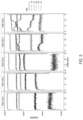
- FIG. 5 the signal intensity of product stream composition as a function of time, as measured by Mass Spectrometry, is depicted for a fixed bed reactor operating at temperatures between 700 °C and 900 °C with a feed flow of 35 sccm comprising 5 vol.% ethane and 95 vol.% helium through a 9.5 mm ID quartz reactor tube loaded with 150 mg of the Example 2 (Fe 2 O 3 /Na,W).
- FIG. 6 provides a Transmission Electron Micrograph with EDS elemental mapping of Example 2 (Fe 2 O 3 /Na,W).
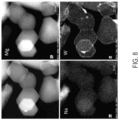
- FIG. 8 shows a Transmission Electron Micrograph with EDS elemental mapping of Example 5 (Mg 6 MnO 8 /Na,W).
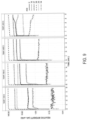
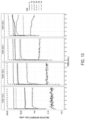
- FIGS. 9-14 the signal intensity of product stream composition as a function of time, as measured by Mass Spectrometry, is depicted for a fixed bed reactor operating at temperatures between 720 °C and 840 °C with a feed flow of 35 sccm comprising 5 vol.% ethane and 95 vol.% helium through a 9.5 mm ID quartz reactor tube loaded with 150 mg of the Example 17 through Example 22 materials, respectively.
- FIG. 9-14 the signal intensity of product stream composition as a function of time, as measured by Mass Spectrometry, is depicted for a fixed bed reactor operating at temperatures between 720 °C and 840 °C with a feed flow of 35 sccm comprising 5 vol.% ethane and 95 vol.% helium through a 9.5 mm ID quartz reactor tube loaded with 150 mg of the Example 17 through Example 22 materials, respectively.
- FIG. 15 the signal intensity of product stream composition as a function of time, as measured by Mass Spectrometry, is depicted for a fixed bed reactor operating at temperatures between 720 °C and 840 °C with a feed flow of 35 sccm comprising 5 vol.% ethane and 95 vol.% helium through a 9.5 mm ID quartz reactor tube loaded with 76 mg of the Example 23.
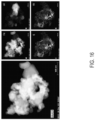
- FIG. 16 provides a Transmission Electron Micrograph with EDS elemental mapping of Example 18 (Fe 2 O 3 /K 2 WO 4 /gamma-alumina).
- the inclusion of the support material may allow for the physical properties of the hydrogen-selective oxygen carrier material to be adjusted.
- the amount of, the type, and the manner in which the support material is incorporated may allow for the solids residence time in the circulating fluidized bed reactor to be adjusted, may allow for the attrition resistance of the hydrogen-selective oxygen carrier material to be modified, may allow for dispersion of the redox-active transition metal oxide near the surface of hydrogen-selective oxygen carrier material, and may allow for the retention of selectivity towards hydrogen combustion upon attrition.
- the present disclosure shows that there is a need for oxygen carrier materials with high selectivity for hydrogen combustion at elevated temperatures in the presence of hydrocarbons (paraffins and olefins) under a non-oxidative environment (i.e. in the absence of molecular oxygen).
- Embodiments of the present disclosure meet those needs by providing a conformal coating, or shell, of an alkali transition metal oxide around an oxidizable and reducible metal oxide core. Without the shell, the core combusts both hydrogen and hydrocarbon similar to conventional oxygen carrier materials, such as those used for chemical looping combustion processes.
- the presently disclosed hydrogen-selective oxygen carrier materials allow for economical and efficient processes for converting hydrocarbons.
- the presently disclosed hydrogen-selective oxygen carrier materials allow for the complete or partial removal of hydrogen, which may subsequently reduce downstream separation costs.
Landscapes
- Chemical & Material Sciences (AREA)
- Organic Chemistry (AREA)
- Engineering & Computer Science (AREA)
- Chemical Kinetics & Catalysis (AREA)
- Materials Engineering (AREA)
- Inorganic Chemistry (AREA)
- Life Sciences & Earth Sciences (AREA)
- General Life Sciences & Earth Sciences (AREA)
- Geology (AREA)
- Thermal Sciences (AREA)
- Physics & Mathematics (AREA)
- Food Science & Technology (AREA)
- General Health & Medical Sciences (AREA)
- Health & Medical Sciences (AREA)
- Combustion & Propulsion (AREA)
- Catalysts (AREA)
- Solid-Sorbent Or Filter-Aiding Compositions (AREA)
- Nanotechnology (AREA)
- Dispersion Chemistry (AREA)
- Hydrogen, Water And Hydrids (AREA)
Description
- This application claims priority to
U.S. Provisional Patent Application No. 62/725,504, entitled "METHODS OF PRODUCING HYDROGEN-SELECTIVE OXYGEN CARRIER MATERIALS," filed on, August 31, 2018 U.S. Provisional Patent Application No. 62/725,508, entitled "HYDROGEN-SELECTIVE OXYGEN CARRIER MATERIALS AND METHODS OF USE," filed on, August 31, 2018 - Embodiments described herein generally relate to materials utilized in chemical processing and, more specifically, to oxygen carrier materials.
- Some conventional chemical processes utilize oxygen carrier materials. Conventional oxygen carrier materials include redox-active metal oxides. In such processes, oxygen may be delivered or "carried" in a cycle via a reduction and subsequent oxidation of the metal oxide.
WO 2018/025117 A1 refers to a catalytic system for dehydrogenation of alkanes. Seif Yusuf et al, ACS Catalysis US, (20170804), vol. 7, no. 8, ISSN 2155-5435, pages 5163 - 5173, XP055640638, refers to the Effect of Promoters on Manganese-Containing Mixed Metal Oxides for Oxidative Dehydrogenation of Ethane via a Cyclic Redox Scheme. - For example, combustion reactions may utilize oxygen from an oxygen carrier material. Oxygen carriers may be utilized in chemical processes that require oxygen. In such processes, the oxygen present in the metal oxide of the oxygen carrier material may be utilized as the source of oxygen. When producing oxygen carrier materials, manufacturers may be concerned with factors such as the cost of production, the cost of materials, and the effectiveness of the final product for use in specific processes.
- In some chemical processes, there is a need for oxygen carrier materials with high selectivity for hydrogen combustion over the combustion of other materials such as hydrocarbons. One example may include dehydrogenation processes. For example, it is contemplated that one way to increase the equilibrium conversion of such a reaction and simultaneously reduce the downstream separation cost may include selectively removing hydrogen from the product stream. As can be seen in Formula 1, the removal of hydrogen pushes the equilibrium to the right.

- For example, in downstream processes, the product stream may require liquefaction. As such, the reduction of hydrogen in the product stream reduces the volume of gas to be liquefied. Therefore, the complete or partial removal of hydrogen in in the product stream may reduce the energy requirements for downstream liquefaction processes. Also, the complete or partial removal of hydrogen in in the product stream may subsequently reduce downstream separation costs for separating out the hydrogen.
- As such, there are needs for oxygen carrier materials that may be selective for the combustion of hydrogen. Embodiments of the present disclosure may meet those needs by providing a conformal coating, or shell, of an alkali transition metal oxide around a redox-active metal oxide interior portion, or core. It is believed that without the shell, the core may combust both hydrogen and hydrocarbon similar to conventional oxygen carrier materials. The shell material may cover at least a portion of the core material so that some or all of the surface area of the core material that would otherwise be exposed to an outside environment is covered by the shell material. As such, it is believed that the shell material may allow the oxygen carrier material to become selective for hydrogen combustion. Furthermore, the hydrogen-selective oxygen carrier material, which may include the shell material, may have a higher selectively for hydrogen combustion compared to the combustion of alkanes, alkenes, or alkyl aromatics. The inclusion of a support material may allow for the physical properties of the hydrogen-selective oxygen carrier material to be adjusted. In comparison to embodiments that do not include a support material, the amount of, the type, and the manner in which the support material is incorporated may allow for the solids residence time in the circulating fluidized bed reactor to be adjusted, may allow for the attrition resistance of the hydrogen-selective oxygen carrier material to be modified, may allow for dispersion of the redox-active transition metal oxide near the surface of hydrogen-selective oxygen carrier material, and may allow for the retention of selectivity towards hydrogen combustion upon attrition.
- In the first aspect of the present invention, hydrogen-selective oxygen carrier materials of claim 1 are provided. The hydrogen-selective oxygen carrier materials have a core material, which includes a redox-active transition metal oxide; a shell material, which includes one or more alkali transition metal oxides; and a support material, which may include one or more metal oxides. The shell material is in direct contact with at least a majority of an outer surface of the core material. At least a portion of the core material is in direct contact with the support material. The hydrogen-selective oxygen carrier material is selective to combust hydrogen in an environment that includes hydrogen and hydrocarbons.
- In another aspect of the present invention a method, of claim 12, for converting hydrocarbons using hydrogen-selective oxygen carrier materials is provided. The method includes contacting the hydrogen with a hydrogen-selective oxygen carrier material. The hydrogen-selective oxygen carrier materials have a core material, which includes a redox-active transition metal oxide; a shell material, which includes one or more alkali transition metal oxides; and a support material, which may include one or more metal oxides. The shell material is in direct contact with at least a majority of an outer surface of the core material. At least a portion of the core material is in direct contact with the support material. The method includes dehydrogenating one or more alkanes and alkyl aromatics to produce a dehydrogenated product and hydrogen. The hydrogen-selective oxygen carrier material is selective for combusting the hydrogen compared to combusting hydrocarbons.
- These and other embodiments are described in more detail in the following Detailed Description in conjunction with the appended drawings.
- The following detailed description of specific embodiments of the present disclosure can be best understood when read in conjunction with the following drawings, where like structure is indicated with like reference numerals and in which:
-
FIG. 1 depicts a cross sectional view of a hydrogen-selective oxygen carrier material having a core material and a shell material, according to one or more embodiments of the present disclosure; -
FIG. 2A depicts a cross sectional view of a hydrogen-selective oxygen carrier material having a core material, a shell material, and a support material, according to one or more embodiments of the present disclosure; -
FIG. 2B depicts a cross sectional view of a hydrogen-selective oxygen carrier material having a core material, a shell material, and a support material, according to one or more embodiments of the present disclosure; -
FIG. 3A depicts a cross sectional view of a hydrogen-selective oxygen carrier material having a core material, a shell material, and a support material, according to one or more embodiments of the present disclosure; -
FIG. 3B depicts a cross sectional view of a hydrogen-selective oxygen carrier material having a core material, a shell material, and a support material, according to one or more embodiments of the present disclosure; -
FIG. 4A depicts a cross sectional view of a hydrogen-selective oxygen carrier material having a core material, a shell material, and a support material, according to one or more embodiments of the present disclosure; -
FIG. 4B depicts a cross sectional view of a hydrogen-selective oxygen carrier material having a core material, a shell material, and a support material, according to one or more embodiments of the present disclosure; -
FIG. 5 is a schematic depiction of the signal intensity of product stream composition, as measured by Mass Spectrometry, for a fixed bed reactor operating at temperatures between 700 °C and 900 °C with a feed flow of 35 standard cubic centimeters per minute (sccm) comprising 5 vol.% ethane and 95 vol.% helium through a 9.5 mm ID quartz reactor tube loaded with 150 mg of theExample Material 2, according to one or more embodiments of the present disclosure; -
FIG. 6 is a graphical depiction of the signal intensity of product stream composition, as measured by Mass Spectrometry, for a fixed bed reactor operating at temperatures between 700 °C and 900 °C with a feed flow of 35 sccm comprising 5 vol.% ethane and 95 vol.% helium through a 9.5 mm ID quartz reactor tube loaded with 150 mg of the Example Material 5, according to one or more embodiments of the present disclosure; -
FIG. 7 is a Transmission Electron Micrograph with EDS elemental mapping ofExample Material 2, according to one or more embodiments of the present disclosure; -
FIG. 8 is a Transmission Electron Micrograph with EDS elemental mapping of Example Material 5, according to one or more embodiments of the present disclosure; -
FIG. 9 is a graphical depiction of the signal intensity of product stream composition, as measured by Mass Spectrometry, for a fixed bed reactor operating at temperatures between 720 °C and 840 °C with a feed flow of 35 sccm comprising 5 vol.% ethane and 95 vol.% helium through a 9.5 mm ID quartz reactor tube loaded with 150 mg of the Example Material 17, according to one or more embodiments of the present disclosure; -
FIG. 10 is a graphical depiction of the signal intensity of product stream composition, as measured by Mass Spectrometry, for a fixed bed reactor operating at temperatures between 720 °C and 840 °C with a feed flow of 35 sccm comprising 5 vol.% ethane and 95 vol.% helium through a 9.5 mm ID quartz reactor tube loaded with 150 mg of the Example Material 18, according to one or more embodiments of the present disclosure; -
FIG. 11 is a graphical depiction of the signal intensity of product stream composition, as measured by Mass Spectrometry, for a fixed bed reactor operating at temperatures between 720 °C and 840 °C with a feed flow of 35 sccm comprising 5 vol.% ethane and 95 vol.% helium through a 9.5 mm ID quartz reactor tube loaded with 150 mg of the Example Material 19, according to one or more embodiments of the present disclosure; -
FIG. 12 is a graphical depiction of the signal intensity of product stream composition, as measured by Mass Spectrometry, for a fixed bed reactor operating at temperatures between 720 °C and 840 °C with a feed flow of 35 sccm comprising 5 vol.% ethane and 95 vol.% helium through a 9.5 mm ID quartz reactor tube loaded with 150 mg of the Example Material 20, according to one or more embodiments of the present disclosure; -
FIG. 13 is a graphical depiction of the signal intensity of product stream composition, as measured by Mass Spectrometry, for a fixed bed reactor operating at temperatures between 720 °C and 840 °C with a feed flow of 35 sccm comprising 5 vol.% ethane and 95 vol.% helium through a 9.5 mm ID quartz reactor tube loaded with 150 mg of the Example Material 21, according to one or more embodiments of the present disclosure; -
FIG. 14 is a graphical depiction of the signal intensity of product stream composition, as measured by Mass Spectrometry, for a fixed bed reactor operating at temperatures between 720 °C and 840 °C with a feed flow of 35 sccm comprising 5 vol.% ethane and 95 vol.% helium through a 9.5 mm ID quartz reactor tube loaded with 150 mg of the Example Material 22, according to one or more embodiments of the present disclosure; -
FIG. 15 is a graphical depiction of the signal intensity of product stream composition, as measured by Mass Spectrometry, for a fixed bed reactor operating at temperatures between 720 °C and 840 °C with a feed flow of 35 sccm comprising 5 vol.% ethane and 95 vol.% helium through a 9.5 mm ID quartz reactor tube loaded with 76 mg of the Example Material 23, according to one or more embodiments of the present disclosure; and -
FIG. 16 is a Transmission Electron Micrograph with EDS elemental mapping of Example Material 18, according to one or more embodiments of the present disclosure. - Specific embodiments of the present application will now be described. The disclosure may, however, be embodied in different forms and should not be construed as limited to the embodiments set forth in this disclosure. Rather, these embodiments are provided so that this disclosure will be thorough and complete and will fully convey the scope of the subject matter to those skilled in the art.
- Generally, described in this disclosure are various embodiments of hydrogen-selective oxygen carrier materials and embodiments of methods of using such materials to selectively combust hydrogen in the presence of hydrocarbons.
- The hydrogen-selective oxygen carrier material includes a core material, which includes a redox-active transition metal oxide capable of oxygen carrying functionality by which oxygen atoms can be removed and replaced from the solid lattice. As used herein, "hydrogen-selective" refers to the oxygen carrier's selectivity towards hydrogen combustion. The redox-active transition metal oxide may include binary, ternary, or other mixed metal oxides capable of undergoing reduction in the presence of a reducing agent (for example, hydrogen) and oxidation in the presence of oxidizing agent (for example, oxygen or air). According to one or more embodiments, the hydrogen-selective oxygen carrier material includes a shell material, which may impart selectivity towards hydrogen combustion. The shell material includes one or more alkali transition metal oxides, which may include one or more alkali elements and transition metals.
FIG. 1 depicts a cross-section view of embodiments of a hydrogen-selective oxygen carrier material. InFIG. 1 , embodiments of the hydrogen-selectiveoxygen carrier material 1000 include thecore material 100 and theshell material 200. - The shell material may allow the hydrogen-selective oxygen carrier material to be at least partially selective for hydrogen combustion in the presence of hydrocarbons. Without being bound by theory, it is believed that the shell may act as a selective barrier that prevents the contact between the surface of the core and hydrocarbons. In embodiments, the shell material may allow smaller (relative to the hydrocarbons) hydrogen molecules to permeate through the shell material and react with lattice oxygen on the surface of the core material. As the hydrogen diffuse through the shell material into the core, the hydrogen may be combusted, and water may permeate back through the shell material. Without being bound by theory, it is also believed that the shell material may act to control diffusion of oxygen from the lattice of the core material and may provide selective sites which combust hydrogen more selectively than hydrocarbons. Hydrocarbons, as described herein, may include alkanes, alkenes, or alkyl aromatics. In the absence of the shell material, the core material may have a higher selectively for the combustion of hydrocarbons over hydrogen relative to embodiments that include the shell. It should be understood that a hydrogen-selective material may still react some hydrocarbons, but that the majority of chemical conversion will be of hydrogen in an environment that includes both hydrogen and hydrocarbons. The core material may act as a source of oxygen for a reaction such that, in its absence, there is minimal combustion of either hydrogen or hydrocarbons. Without being bound by theory, in embodiments, some relatively small amount of oxygen from the shell material may combust hydrogen or hydrocarbons.
- As stated previously in this disclosure, the removal or partial removal of hydrogen may be beneficial in processes used for the production of light olefins and aromatics like ethylene, propylene, and benzene. Compared to processes that do not combust hydrogen, the presently disclosed hydrogen-selective oxygen carrier materials may allow for the removal of hydrogen from upstream dehydrogenation reactions and may subsequently reduce downstream separation costs. Therefore, the presently-disclosed hydrogen-selective oxygen carrier materials allow for more economical and efficient production of light olefins and aromatics.
- The presently-disclosed hydrogen-selective oxygen carrier materials may be produced by a method comprising combining one or more core material precursors and one or more shell material precursors to form a precursor mixture. The method may also include heat-treating the precursor mixture at a treatment temperature to form embodiments of the hydrogen-selective oxygen carrier material. The hydrogen-selective oxygen carrier material has a core material (sometimes referred to herein a "core") and a shell material (which may be referred to herein as a "shell"). The shell material may at least partially or fully surround the core material. The treatment temperature may be greater than or equal to 100 °C less than the melting point of a shell material. The core material includes a redox-active transition metal oxide, and the shell material includes an alkali transition metal oxide.
- According to embodiments, one or more core material precursors and one or more shell material precursors are combined to form the precursor mixture. In some embodiments, the one or more shell material precursors may be combined with the one or more core material precursors in a solution. In further embodiments, the one or more shell material precursors may be combined with the one or more core material precursors via wet impregnation. In such embodiments, the one or more shell material precursors are dissolved in an aqueous solution and then are added to the one or more core material precursors to form the precursor mixture. The aqueous solution may be water, or specifically, deionized water. In other embodiments, the one or more core material precursors and the one or more shell material precursors may be combined by physically mixing the one or more core material precursors, present as a dry powder, with the one or more shell material precursors, present as a dry powder.
- The one or more core material precursors may include one or more transition metal oxides. According to one or more embodiments, the core material precursors may be a redox-active transition metal oxide. The redox-active transition metal oxide includes binary, ternary, or other mixed metal oxides capable of undergoing reduction in the presence of a reducing agent (for example, hydrogen) and oxidation in the presence of oxidizing agent (for example, oxygen or air). In some embodiments the redox-active transition metal oxide may be chosen from Mn2O3, Fe2O3, Co3O4, CuO, (LaSr)CoO3, (LaSr)MnO3, Mg6MnO8, MgMnO3, MnO2, Fe3O4, Mn3O4, and Cu2O. In some embodiments, the one or more core material precursors may be solids. In specific embodiments, the one or more core material precursors may be a crushed solid, such as a powder. As stated previously, the hydrogen-selective oxygen carrier material comprises a core material, which makes up a core. The core material precursor or precursors lead to the formation of the core material making up the core.
- The one or more shell material precursors may include one or more alkali transition metal oxides, which may include one or more alkali elements and transition metals. In some embodiments, alkali elements may include one or more of sodium (Na), lithium (Li), potassium (K), and cesium (Cs). In some embodiments, transition metals may include one or more of tungsten (W) and molybdenum (Mo). As stated previously, the hydrogen-selective oxygen carrier material also comprises a shell material, which makes up a shell. The shell material precursor or precursors lead to the formation of the shell material making up the shell.
- In some embodiments, the precursor mixture may comprise a single core material precursor and a single shell material precursor. In other embodiments, one or more core material precursors are formed prior to combining the one or more core material precursors and the one or more shell material precursors. In other embodiments, one or more shell material precursors are formed prior to combining the one or more core material precursors and the one or more shell material precursors.
- According to embodiments, once the precursor mixture has been formed, it may be heat treated at a treatment temperature to form the hydrogen-selective oxygen carrier material. Without being bound by theory, it is believed that the heat treatment may cause the shell material to cover the core material, which may therefore allow the oxygen carrier material to become at least partially selective for hydrogen combustion in the presence of hydrocarbons. The shell material may cover at least a portion of the core material so that the entire surface area or a portion of the surface area of the core material that would otherwise be exposed to an outside environment is covered or surrounded by the shell material. In some embodiments, the core may be completely covered or surrounded, but the shell may not be uniform. In other embodiments, the shell may be conformal or uniform. As such, it is believed that in the absence of the heat treatment, at least a portion of the core material, which may have a relatively higher selectively for hydrocarbons, may be exposed. As a result of this exposure, both the hydrocarbons and hydrogen may be combusted.
- In some embodiments, the treatment temperature may be sufficient to cause the shell material to cover the core material. In some embodiments, the treatment temperature may be greater than or equal to about 100 °C less than the melting point of the shell material. In other embodiments, the treatment temperature may be greater than or equal to about 50 °C, about 25 °C, about 10 °C, or about 5 °C less than the melting point of the shell material. In further embodiments, the treatment temperature may be about equal to (e.g., within 5 °C, 10 °C, 20 °C, or 30 °C of) the melting point of the shell material.
- In some embodiments, the treatment temperature may be sufficient to prevent the core material from becoming exposed or destroyed. In some embodiments, the core material may become exposed if the treatment temperature is higher than the melting point of the core material, which may prevent the core material from being surrounded or covered by the shell material. In such embodiments, the treatment temperature may cause the core material to melt and mix with the shell material. The mixture of core material and shell material may then form an oxygen carrier material with a surface that includes at least some core material. As stated previously in this disclosure, the core material may be non-selective to hydrogen combustion, which would therefore be exposed. As a result of this exposure, both the hydrocarbons and hydrogen may be combusted. In some embodiments, the treatment temperature may be less than the melting point of the core material. In such embodiments, the treatment temperature may be at least about 25 °C, about 50 °C, or about 100 °C less than less than the melting point of the core material.
- During heat treatment, in some embodiments, two or more shell material precursors in the precursor mixture may react to form the shell material. As explained previously in this disclosure, the shell material may act as a selective barrier that prevents the contact between the surface of the core and hydrocarbons. In embodiments, the shell material may allow smaller (relative to the hydrocarbons) hydrogen molecules to permeate through the shell material and react with lattice oxygen on the surface of the core material. As the hydrogen diffuses through the shell material to the core, the hydrogen may be combusted, and water may permeate back through the shell material. In some embodiments, the shell material may act to control the diffusion of oxygen from the lattice of the core material and may provide selective sites which combust hydrogen more selectively than hydrocarbons.
- In some embodiments, the precursor mixture is heat treated for a time period long enough to impart hydrogen selectivity onto the core material, which is a time period long enough for the shell material to completely cover the core material. In some embodiments, the heat treatment time period may be from about 0.5 hours to about 12 hours. In other embodiments, the heat treatment time period may be from about 0.5 hours to about 10 hours, from about 0.5 hours to about 8 hours, from about 0.5 hours to about 5 hours, from about 1 hour to about 12 hours, from about 1 hour to about 10 hours, from about 1 hour to about 8 hours, or from about 1 hour to about 5 hours.
- According to one or more embodiments, the methods of forming hydrogen-selective oxygen carrier materials may include additional drying steps. In some embodiments, the method may include drying the precursor mixture prior to heat treating the precursor mixture.
- Once formed, the hydrogen-selective oxygen carrier material includes a core material, which includes a redox-active transition metal oxide. The redox-active transition metal oxide may include binary, ternary, or other mixed metal oxides capable of undergoing reduction in the presence of a reducing agent (for example, hydrogen) and oxidation in the presence of oxidizing agent (for example, oxygen or air). In some embodiments the redox-active transition metal oxide may be chosen from Mn2O3, Fe2O3, Co3O4, CuO, (LaSr)CoO3, (LaSr)MnO3, Mg6MnO8, MgMnO3, MnO2, Fe3O4, Mn3O4, Cu2O, and combinations thereof.
- The formed hydrogen-selective oxygen carrier material includes a shell material, which imparts selectivity towards hydrogen combustion. The shell material includes one or more alkali transition metal oxides, which may include one or more alkali elements and transition metals. In some embodiments, alkali elements may include one or more of sodium (Na), lithium (Li), potassium (K), and cesium (Cs). In some embodiments, transition metals may include one or more of tungsten (W) and molybdenum (Mo). In further embodiments, the one or more alkali transition metal oxides are chosen from Na2WO4, K2MoO4, Na2MoO4, K2WO4, Li2WO4, Cs2WO4, Cs2MoO4, Li2MoO4, and combinations thereof.
- In some embodiments, the formed hydrogen-selective oxygen carrier material has a shell, where at least a portion of or the entire shell material has a thickness of at least 1 crystalline unit cell. A crystalline cell unit is the simplest repeating unit in a crystal. In other embodiments the shell material may have a thickness of from about 1 crystalline unit cell to about 5 crystalline unit cells. In further embodiments, the shell material may have a thickness of from about 1 crystalline unit cell to about 2 crystalline unit cells or from about 2 crystalline unit cells to about 5 crystalline unit cells. In some embodiments, the shell material has a thickness of from about 1 nm to about 50 nm. In other embodiments, the shell material may have a thickness of from about 1 to about 25 nm, from about 5 nm to about 50 nm, from about 5 nm to about 25 nm, from about 5 nm to about 10 nm, from about 10 nm to about 50 nm, from about 10 nm to about 25 nm, or from about 25 nm to about 50 nm.
- The shell material is in direct contact with at least a majority of the outer surface of the core material. It should be understood that, in some embodiments, substantially the entire outer surface (e.g., greater than 99.5%) of the core material may be covered by the shell material. In additional embodiments, only a portion of the outer surface of the core material is in direct contact with the shell material. For example, the shell material may be in contact with at least 50%, at least 60%, at least 70%, at least 80%, at least 90%, at least 95%, at least 96%, at least 97%, at least 98%, or even at least 99% of the outer surface of the core material. The portions of the core material which are not directly contacted by the shell material may form an interface with surrounding air, or may be in direct contact with other materials such as, for example, a support or another shell layer, as is described herein.
- Without being bound by theory, the amount of shell material may be related to the surface area of the core material. In some embodiments, the amount of core material may be related to the volume of the core material. In further embodiments, the ratio, by weight, of the core material to the shell material may be a function of particle size of the core material. In some embodiments the ratio of the core material to the shell material in the formed hydrogen-selective oxygen may be 1: 1 by weight. In other embodiments, the ratio of the core material to the shell material may be from about 1 to about 45 : 1 or from about 1 to about 10 : 1 by weight.
- In further embodiments, the formed hydrogen-selective oxygen carrier material may further include a secondary coating material. The secondary coating material may include one or more alkali transition metal oxides. In embodiments, the material composition of shell material may be different from the material composition of the secondary coating material. In such embodiments, the secondary coating material may be coated onto the surface of the hydrogen-selective oxygen carrier material according to coating processes known in the art.
- The formed hydrogen-selective oxygen carrier material further includes a support material. In such embodiments, the alkali transition metal oxides, the redox-active metal oxides, or both may be supported on the support material. The support material may include one or more inorganic bulk metal oxides, such as silica (SiO2), alumina (Al2O3), silica and alumina, zirconia (ZrO2), titania (TiO2), other metal oxides, or combinations of metal oxides. In some embodiments, the support material may include a microporous material, such as ZSM-5 zeolite. In embodiments, the porosity of at least a portion of the support material may have a pore size of from about 0.1 nm to about 100 nm, from about 0.1 nm to about 75 nm, from about 0.1 nm to about 50 nm, from about 0.1 nm to about 25 nm, from about 0.1 nm to about 1 nm, from about 1 nm to about 100 nm, from about 1 nm to about 75 nm, from about 1 nm to about 50 nm, from about 1 nm to about 25 nm, from about 25 nm to about 100 nm, from about 25 nm to about 75 nm, from about 25 nm to about 50 nm, from about 50 nm to about 100 nm, from about 50 nm to about 75 nm, or from about 75 nm to about 100 nm.
- The alkali transition metal oxides, the redox-active metal oxides, or both, may be supported on the surface of the support or incorporated into the support material. At least a portion of the core material is in direct contact with the support material. In further embodiments, the shell material is in direct contact with at least some portions of the surface of the core material that are not in contact with the support material. In some embodiments, the core material is in direct contact with and completely surrounds the support material, and the shell material is in direct contact with an entire outer surface of the core material. In additional embodiments, the shell material may completely or partially cover both the support and the core material so that the entire surface area of the core material and the support that would otherwise be exposed to an outside environment is completely covered. In such embodiments, the core material precursors, the shell material precursors, or both, may be impregnated onto the support. In some embodiments, the support material may be impregnated specifically by wet impregnation.
- In further embodiments, the support material and the shell material may be in contact with the core material so that some or the entire surface area of the core material that would otherwise be exposed to an outside environment is covered. In further embodiments the core material may be partially or completely covered, but portions of the core material may contact only the support material or only the shell material. In further embodiments, the shell material may partially or completely cover both the support and the core material so that the entire surface area of the core material and the support that would otherwise be exposed to an outside environment is completely covered. In other embodiments at least a portion of either the support material or the shell material may not be in direct contact with the core material. As a result, the shell material, the support, or both may act as a barrier that prevents the contact between the surface of all or some of the core and hydrocarbons.
-
FIGS. 2A-4B depict a cross-section view of embodiments of a hydrogen-selective oxygen carrier material including a support material. InFIGS. 2A-4A , the hydrogen-selectiveoxygen carrier material 1000 includes thecore material 100, theshell material 200, and thesupport material 300. Referring now toFIG. 2A , the hydrogen-selectiveoxygen carrier material 1000 includes thecore material 100, which may be surrounded by thesupport material 300, which may be surrounded by theshell material 200. Referring now toFIG. 2B , the hydrogen-selectiveoxygen carrier material 1000 includes thesupport material 300, which may be surrounded by thecore material 100, which may be surrounded by theshell material 200. Referring now toFIG. 3A , in the hydrogen-selective carrier material 1000, portions of thecore material 100 are contacted by thesupport material 300, and theshell material 200 may surround both thecore material 100 and thesupport material 300. Referring now toFIG. 3B , in the hydrogen-selective carrier material 1000, portions of thecore material 100 are contacted by the support material, and theshell material 200 and thesupport material 300 may together entirely surround thecore material 100 so that some or the entire surface area of the core material that would otherwise be exposed to an outside environment is covered. Referring now toFIG. 4A , in the hydrogen-selective carrier material 1000, portions of thecore material 100 are contacted by the support material, and theshell material 200 and thesupport material 300 may together entirely surround thecore material 100 so that some or the entire surface area of the core material that would otherwise be exposed to an outside environment is covered. Referring now toFIG. 4B , in the hydrogen-selective carrier material 1000, portions of thecore material 100 are contacted by thesupport material 300, and theshell material 200 may surround both thecore material 100 and thesupport material 300. - Without being bound by theory, the inclusion of the support material may allow for the physical properties of the hydrogen-selective oxygen carrier material to be adjusted. It is contemplated that the amount of and type of support material may increase or decrease the particle density of the hydrogen-selective oxygen carrier material, which may adjust the solids residence time in the circulating fluidized bed reactor. It is contemplated that the attrition resistance of the support material may increase or decrease the attrition resistance of the hydrogen-selective oxygen carrier material. For example, the use of a support material with a high mechanical strength may increase the attrition resistance of the hydrogen-selective oxygen carrier material. It is contemplated that the support material may be utilized to disperse the redox-active transition metal oxide near the surface of hydrogen-selective oxygen carrier material. For example, when the redox-active transition metal oxide completely surrounds the support material, the diffusion length needed for the lattice oxygen atoms to react with hydrogen may be shorter in comparison to embodiments that do not include a support material, which may improve hydrogen combustion activity. It is contemplated that the hydrogen-selective oxygen carrier material including a support material may retain selectivity towards hydrogen combustion upon attrition in comparison to embodiments that do not include a support material. For example, the support material may allow for the hydrogen-selective oxygen carrier material to retain an additional reservoir of the shell material that can recoat the exposed redox-active transition metal oxide surface due to attrition.
- A method for converting hydrocarbons using hydrogen-selective oxygen carrier materials is provided. Embodiments of the method include contacting hydrogen with embodiments of the hydrogen-selective oxygen carrier material described herein. The method includes dehydrogenating one or more alkanes and alkyl aromatics to produce a dehydrogenated product and hydrogen. The hydrogen-selective oxygen carrier material is selective for combusting the hydrogen compared to combusting hydrocarbons. In some embodiments, the one or more alkanes may be dehydrogenated by thermal cracking. In some embodiments, the one or more alkanes may be dehydrogenated by contact with a dehydrogenation catalyst. Further embodiments may include a reactor in which a paraffin is converted to a olefin and the resulting hydrogen reacts with the hydrogen-selective oxygen carrier material to produce water and a reduced transition metal in the hydrogen-selective oxygen carrier material. In further embodiments, the method may include regenerating the reduced hydrogen-selective oxygen carrier material. In further embodiments, the reduced hydrogen-selective oxygen carrier material may be reoxidized in air.
- According to additional embodiments, it is contemplated that the presently-described hydrogen-selective oxygen carrier materials may be utilized in a wide variety of chemical processes, which utilize oxygen carrier materials. For example, the hydrogen-selective oxygen carrier materials described herein may be utilized in chemical looping processes (for example, for dehydrogenation of alkanes or alkyl aromatics), processes for the removal of hydrogen from a product stream containing hydrogen and hydrocarbons (for example, alkanes or alkenes), and processes that require in-situ generation of water at temperatures greater than 300 °C or, more specifically, at temperatures from 300 °C to 900 °C.
- The following examples illustrate features of the present disclosure but are not intended to limit the scope of the disclosure. The following experiments compared the performance of comparative oxygen carrier materials with examples of the presently-described hydrogen-selective oxygen carrier materials.
- For Comparative Example A, PyroSil fused silica chips (0.5-1 mm) were used as received.
- To prepare Comparative Example B, 5 grams (g) of Fe2O3 powder were calcined in air at 900 °C for 8 hours.
- To prepare comparative Example C, 4.49 g of magnesium oxide powder (MgO, Alfa Aesar #12287) was impregnated with 4.66g of manganese nitrate (Mn(NO3)2•4H2O, Sigma Aldrich #63547) by dissolving manganese nitrate in 5.8 ml of deionized water. The mixture was dried at 80 °C overnight and calcined at 900 °C for 8 hours.
- To prepare Example 1, 0.69 g of a shell precursor, sodium tungstate (Na2WO4•2H2O, Sigma Aldrich# 223336), was dissolved in 5 mL of deionized water and added to 5 g of a core precursor, cobalt oxide powder (Co3O4, Alfa Aesar #A16121). The mixture was then dried overnight at 80 °C and then calcined in air at 900 °C for a period of 8 hrs. Example 1 provides an example of a hydrogen-selective oxygen carrier material with a Co3O4 core and a shell that includes Na and W.
- To prepare Example 2, 11.04 g of a shell precursor, sodium tungstate (Na2WO4•2H2O, Sigma Aldrich #223336), was dissolved in 35 mL of deionized water and added to 80 g of a shell precursor, iron oxide powder (Fe2O3). The mixture was then dried overnight at 80 °C and then calcined in air at 900 °C for a period of 8 hours. Example 2 provides an example of a hydrogen-selective oxygen carrier material with a Fe2O3 core and a shell that includes Na and W.
- To prepare Example 3, 0.27 g of potassium tungstate (K2WO4) was dissolved in 0.5 mL of deionized water and added to 2 g of iron oxide (Fe2O3) powder. The mixture was then dried overnight under ambient conditions and then calcined at 950 °C for 8 hours. Example 3 provides an example of a hydrogen-selective oxygen carrier material with a Fe2O3 core and a shell that includes K and W.
- To prepare Example 4, 0.67 g of a shell precursor, sodium nitrate (NaNO3, Sigma Aldrich# 221341), and 0.55 g of a shell precursor, ammonium molybdate (Sigma Aldrich #277908), were dissolved in 3 mL of water and added to 4 g of a core precursor, iron oxide powder (Fe2O3). The mixture was then dried overnight under ambient conditions and then calcined in air at 950 °C for a period of 8 hours. Example 4 provides an example of a hydrogen-selective oxygen carrier material with a Fe2O3 core and a shell that includes Na and Mo.
- To prepare Example 5, 65.24 g of a core precursor, manganese nitrate (Mn(NO3)2•4H2O, Sigma Aldrich #63547) and 11.60 g of a shell precursor, sodium tungstate (Na2WO4•2H2O, Sigma Aldrich #223336) was dissolved in 75 mL of deionized water and added to 62.86 g of a core precursor, magnesium oxide powder (MgO, Alfa Aesar #12287) . The mixture was then dried under ambient conditions overnight and then calcined at 900 °C for 8 hours. Example 5 provides an example of a hydrogen-selective oxygen carrier material with an Mg6MnO8 core and a shell that includes Na and W.
- To prepare Example 6, 4.66 g of a core precursor, manganese nitrate (Mn(NO3)2•4H2O, Sigma Aldrich # 63547), and 0.85 g of a shell precursor, potassium tungstate (K2WO4, Alfa Aesar#14031), were dissolved in 5 mL of deionized water and added to 4.5 g of a core precursor, magnesium oxide powder (MgO, Alfa Aesar #12287). The mixture was then dried overnight under ambient conditions and then calcined at 900 °C for 8 hrs. Example 6 provides an example of a hydrogen-selective oxygen carrier material with a Mg6MnO8 core and a shell that includes K and W.
- To prepare Example 7, 0.55 g of a shell precursor, ammonium molybdate ((NH4)2MoO4, Sigma Aldrich #277908) and 0.67 g of a shell precursor sodium nitrate (NaNO3, Sigma Aldrich #221341) were dissolved in 4 mL of deionized water and added to 4 g of a pre-synthesized metal oxide magnesium manganese oxide (Mg6MnO8). The mixture was then dried overnight under ambient conditions and then calcined at 950 °C for 8 hours. The pre-synthesized magnesium manganese oxide can be prepared by two methods. The first method includes wet impregnating magnesium oxide (MgO, Alfa Aesar, #12287), with stoichiometric amount of manganese nitrate (Mn(NO3)2•4H2O, Sigma Aldrich #63547) in deionized water, drying the mixture overnight, and calcining the dried powder in the temperature range of 400 °C to 950 °C for 2 hours to 10 hours. The second method includes a sol-gel method that uses magnesium nitrate, manganese nitrate, ethylene glycol and citric acid where 23.4 g of magnesium nitrate are dissolved in 3.81 g of manganese nitrate in deionized water. Then 61.36 g of citric acid are added the mixture, which is heated to 50 °C to 60 °C for 10 minutes to 30 minutes. Then 39.65 g of ethylene glycol are added to the mixture, which is heated at 85 °C to 95 °C until a gel is produced. The gel is then dried at 135 °C and calcined at 400 °C to 950 °C for 4 hours to 12 hours. Example 7 provides an example of a hydrogen-selective oxygen carrier material with an Mg6MnO8 core and a shell that includes Na and Mo.
- To prepare Example 8, 155.78 g of a core precursor, manganese nitrate (Mn(NO3)2•4H2O, Sigma Aldrich #63547), and 10.80 g of a shell precursor, sodium tungstate (Na2WO4•2H2O, Sigma Aldrich #223336), were dissolved in 100 mL of deionized water and added to 25 g of a core precursor, magnesium oxide powder (MgO, Alfa Aesar #12287). The mixture was then dried overnight under ambient conditions and then calcined at 900 °C for 8 hours. Example 8 provides an example of a hydrogen-selective oxygen carrier material with an MgMnOs core and a shell that includes Na and W.
- To prepare Example 9, 0.69 g of a shell precursor, sodium tungstate (Na2WO4•2H2O, Sigma Aldrich #223336), were dissolved 6 mL of deionized water and added to 5 g of a core precursor, manganese oxide powder (MnO2, Alfa Aesar #14340). The mixture was then dried overnight at 80 °C and then calcined at 900 °C for a period of 8 hours. Example 9 provides an example of a hydrogen-selective oxygen carrier material with a MnO2 core and a shell that includes Na and W.
- To prepare Example 10, 1.6 g of a shell precursor, sodium molybdate (Na2MoO4•2H2O, Sigma Aldrich #331058), was dissolved in 1 mL of deionized water and added to 4 g of a core precursor iron oxide powder (Fe2O3). The mixture was then dried overnight under ambient conditions and then calcined in air at 950 °C for a period of 8 hours. Example 10 provides an example of a hydrogen-selective oxygen carrier material with a Fe2O3 core and a shell that includes Na and Mo.
- To prepare Example 11, 4.66 g of manganese nitrate (Mn(NO3)2•4H2O, Sigma Aldrich # 63547 ) and 1.2 g of sodium molybdate (Na2MoO4•2H2O, Sigma Aldrich #331058) were dissolved in 5 mL of deionized water and added to 4.5 g of magnesium oxide powder (MgO, Alfa Aesar #12287). The mixture was then dried overnight under ambient conditions and then calcined at 950 °C for 8 hours. Example 11 provides an example of a hydrogen-selective oxygen carrier material with an Mg6MnO8 core and a shell that includes Na and Mo.
- To prepare Example 12, 0.4 g of sodium tungstate dihydrate (Na2WO4•2H2O, Sigma Aldrich #223336) was dissolved in 3 mL of deionized water and added to 3 g of pre-synthesized metal oxide magnesium manganese oxide (Mg6MnO8). The mixture was dried overnight under ambient conditions and then calcined at 950 °C for 30 minutes. The pre-synthesized metal oxide magnesium manganese oxide may be prepared by either of the two methods provided in Example 7. Example 12 provides an example of a hydrogen-selective oxygen carrier material with an Mg6MnO8 core and a shell that includes Na and W.
- To prepare Example 13, 0.4 g of sodium tungstate (Na2WO4•2H2O, Sigma Aldrich# 223336) was dissolved in 3 mL of deionized water and added to 3 g of iron oxide (Fe2O3) powder, The mixture was then dried overnight under ambient conditions and then calcined at 950 °C for 30 minutes. Example 13 provides an example of a hydrogen-selective oxygen carrier material with an Fe2O3 core and a shell that includes Na and W.
- To prepare Example 14, 0.27 g of shell precursor, sodium tungstate (Na2WO4•2H2O, Sigma Aldrich #223336) was dissolved in 2.5 mL of deionized water and added to 2.00 g of core precursor lanthanum strontium manganese oxide ((LaSr)MnOs, Sigma Aldrich #704296). The mixture was then dried overnight under ambient conditions and calcined at calcined at 900 °C for 8 hours. Example 14 provides an example of a hydrogen-selective oxygen carrier material with a ((LaSr)MnO3 core and a shell that includes Na and W.
- To prepare Example 15, 4.66 g of a core precursor, manganese nitrate (Mn(NO3)2•4H2O, Sigma Aldrich # 63547), and 0.17 g of a shell precursor, sodium tungstate (Na2WO4•2H2O, Sigma Aldrich #223336), were dissolved in 5 mL of deionized water and added to 4.5 g of a core precursor, magnesium oxide powder (MgO, Alfa Aesar #12287). The mixture was then dried overnight under ambient conditions and then calcined at 900 °C for 8 hrs. Example 15 provides an example of a hydrogen-selective oxygen carrier material with a Mg6MnO8 core and a shell that includes Na and W.
- To prepare Example 16, 0.055 g of shell precursor, sodium tungstate (Na2WO4•2H2O, Sigma Aldrich #223336) was dissolved in 4.8 ml of deionized water and added to 5.00 g of pre-synthesized magnesium manganese oxide (Mg6MnO8) as described in Example 7. The mixture was then dried overnight at 80 °C and calcined at 900 °C for 8 hours. Example 16 provides an example of a hydrogen-selective oxygen carrier material with a Mg6MnO8 core and a shell that includes Na and W.
- To prepare Example 17, 5.0 gm of Fe2O3 (Alfa Aesar #12375) was mixed with 5.0 gm of alpha alumina (Alfa Aesar #42572) and milled in a planetary ball mill at 500 rpm for 10 min. Post ball milling the powder mixture was impregnated with 1.45 gm of K2WO4 (Alfa Aesar#14031) by dissolving it in 2.5 ml of deionized water. The impregnated material was then dried overnight under ambient conditions and calcined at 950 °C for 10 hrs.
- To prepare Example 18, 3.0 g of Fe2O3 (Alfa Aesar #12375) were mixed with 3.0 gm of gamma alumina (Alfa Aesar #39812) and milled in a planetary ball mill at 500 rpm for 10 min. Post ball milling the powder mixture was impregnated with 0.83 g of K2WO4 (Alfa Aesar#14031) by dissolving it in 1.5 ml of deionized water. The impregnated material was then dried overnight under ambient conditions and calcined at 950 °C for 10 hrs.
- To prepare Example 19, 5.0 g of Fe2O3 (Alfa Aesar #12375) were mixed with 5.0 gm of aluminum hydroxide (Sigma Aldrich #11037) and milled in a planetary ball mill at 500 rpm for 10 min. Post ball milling the powder mixture was impregnated with 1.40 g of K2WO4 (Alfa Aesar#14031) by dissolving it in 2.5 ml of deionized water. The impregnated material was then dried overnight under ambient conditions and calcined at 950 °C for 10 hrs.
- To prepare Example 20, 5.0 g of Fe2O3 (Alfa Aesar #12375) were mixed with 5.0 gm of alpha alumina (Alfa Aesar #42572) and milled in a planetary ball mill at 500 rpm for 10 min. Post ball milling the powder mixture was calcined at 950 °C for 10 hrs. The calcined material was then impregnated with 1.4 g of K2WO4 (Alfa Aesar#14031) by dissolving it in 1.5 ml of deionized water. The impregnated material was then dried overnight under ambient conditions and calcined at 950 °C for 8 hrs.
- To prepare Example 21, 3.0 g of Fe2O3 (Alfa Aesar #12375) were mixed with 3.0 gm of gamma alumina (Alfa Aesar #39812) and milled in a planetary ball mill at 500 rpm for 10 min. Post ball milling the powder mixture was calcined at 950°C for 10 hrs. The calcined material was then impregnated with 0.84 g of K2WO4 (Alfa Aesar#14031) by dissolving it in 1.5 ml of deionized water. The impregnated material was then dried overnight under ambient conditions and calcined at 950 °C for 8 hrs.
- To prepare Example 22, 5.0 g of Fe2O3 (Alfa Aesar #12375) were mixed with 5.0 gm of aluminum hydroxide (Sigma Aldrich #11037) and milled in a planetary ball mill at 500 rpm for 10 min. Post ball milling the powder mixture was calcined at 950 °C for 10 hrs. The calcined material was then impregnated with 1.4 g of K2WO4 (Alfa Aesar#14031) by dissolving it in 1.5 ml of deionized water. The impregnated material was then dried overnight under ambient conditions and calcined at 950 °C for 8 hrs.
- To prepare Example 23, 6.0 g of Fe2O3 (Alfa Aesar #12375) were impregnated with 0.84 g of K2WO4 (Alfa Aesar#14031) by dissolving it in 1.5 ml of deionized water. The impregnated material was then dried overnight under ambient conditions and calcined at 950 °C for 8 hrs.
- To test the performance of Examples 1-16 in comparison to Comparative Examples A-C, a fixed bed reactor setup was used. To perform the experiment, 150 milligrams (mg) samples of Examples 1-16 and Comparative Examples A-C were each loaded into a 4 mm ID quartz reactor. The fixed bed reactor was then operated at 700 °C, 750 °C, 800 °C, and 850 °C, respectively, for each sample, with a feed flow of 10 standard cubic centimeters per minute (sccm) comprising 50 vol.% ethane and 50 vol.% helium. For each Run, the composition of the product stream composition was measured by Gas Chromatography 40 seconds after the start of the feed flow.
- Table 1 provides the results for the reactor operating at 700 °C; Table 2 provides the results for the reactor operating at 750 °C; Table 3 provides the results for the reactor operating at 800 °C; and Table 4 provides the results for the reactor operating at 850 °C.
Table 1. Results for a reactor operating at 700 °C. Ex. A Ex. B Ex. C Ex. 1 Ex. 2 Ex. 3 Ex. 4 Ex. 5 Ex. 6 Ex. 7 Acetylene 0 0 0.018 0 0 0 0 0 0 0 C3 0.006 0.002 0.007 0.007 0 0 0.005 0 0.006 0.006 C4 0.006 0.003 0.022 0.01 0.002 0.001 0.002 0.002 0.003 0.006 C5 0 0 0 0 0 0 0 0 0 0 C6 0 0 0 0 0 0 0 0 0 0 CO 0 0 0 0 0 0 0 0 0 0 CO2 0.042 15.809 17.415 0.022 0.008 0.022 0.026 0.011 0.007 0.09 Ethane 43.99 21.003 15.848 43.807 45.843 45.996 45.21 46.135 44.646 43.906 Ethylene 2.031 2.215 5.306 2.059 0.919 0.679 1.126 0.901 1.567 1.831 Helium 50.134 33.464 32.809 49.567 51.497 51.45 49.848 50.894 50.652 50.508 Hydrogen 2.009 0.121 0.183 0.249 0.159 0.097 0.498 0.476 0.808 0.253 Methane 0.068 0.114 0.763 0.046 0 0 0.069 0 0.057 0.052 Oxygen 0.059 0.068 0.05 0.061 0.066 0.077 0.072 0.064 0.075 0.063 Ex. 8 Ex. 9 Ex. 10 Ex. 11 Ex. 12 Ex. 13 Ex. 14 Ex. 15 Ex. 16 Acetylene 0 0 0 0 0 0 0 0 0 C3 0.005 0.005 0 0.006 0 0.004 0.006 0.005 0.008 C4 0.003 0.005 0 0.007 0.002 0.003 0.001 0.004 0.013 C5 0 0 0 0 0 0 0 0 0 C6 0 0 0 0 0 0 0 0 0 CO 0 0 0 0 0 0 0 0 0 CO2 0.031 0.026 0.003 0.125 0.005 0.067 0.184 0.025 0.524 Ethane 45.19 44.568 46.136 43.576 45.41 45.437 45.065 44.59 41.739 Ethylene 1.231 1.5 0.23 2.027 1.069 1.349 1.839 1.734 2.875 Helium 51.315 49.795 50.648 50.432 50.263 49.442 49.62 49.524 50.521 Hydrogen 0.876 0.337 0.179 0.265 0.462 0.247 1.301 0.814 0.884 Methane 0.047 0.03 0 0.079 0 0.074 0.051 0.049 0.083 Oxygen 0.067 0.075 0.053 0.076 0.067 0.092 0.071 0.075 0.067 Table 2. Results for a reactor operating at 750 °C. Ex. A Ex. B Ex. C Ex. 1 Ex. 2 Ex. 3 Ex. 4 Ex. 5 Ex. 6 Ex. 7 Acetylene 0 0 0.038 0 0 0 0 0 0 0 C3 0.059 0.004 0.01 0.06 0.025 0.019 0.039 0.023 0.044 0.046 C4 0.044 0.006 0.015 0.048 0.024 0.017 0.021 0.019 0.021 0.034 C5 0 0 0 0 0 0 0 0 0 0 C6 0.001 0 0 0.002 0 0 0.001 0 0.001 0.002 CO 0 0 0.226 0 0 0 0 0 0 0 CO2 0.027 23.743 18.504 0.149 0.045 0.162 0.081 0.04 0.09 0.529 Ethane 31.159 13.62 12.308 31.126 38.134 39.31 35.619 39.018 32.998 31.913 Ethylene 10.285 3.174 7.541 10.058 5.979 4.884 7.564 6.107 9.263 9.291 Helium 45.162 31.397 31.715 45.798 47.756 48.067 47.55 48.114 46.712 45.582 Hydrogen 10.73 0.259 0.35 0.856 0.363 0.176 0.96 1.567 2.474 0.468 Methane 0.486 0.771 1.713 0.462 0.277 0.262 0.505 0.323 0.429 0.442 Oxygen 0.07 0.076 0.072 0.07 0.056 0.074 0.068 0.064 0.075 0.092 Ex. 8 Ex. 9 Ex. 10 Ex. 11 Ex. 12 Ex. 13 Ex. 14 Ex. 15 Ex. 16 Acetylene 0 0 0 0 0 0 0.007 0.004 0.013 C3 0.031 0.076 0.012 0.053 0.025 0.04 0.03 0.047 0.049 C4 0.025 0.072 0.008 0.042 0.016 0.024 0.028 0.023 0.029 C5 0 0 0 0 0 0 0 0 0 C6 0 0.003 0 0.002 0 0.001 0 0.002 0.002 CO 0 0 0 0 0 0 0 0 0 CO2 0.045 0.211 0.046 0.734 0.071 0.146 0.401 0.23 0.795 Ethane 38.109 29.145 41.511 30.511 36.897 35.377 35.582 32.54 29.386 Ethylene 7.064 11.301 3.647 10.099 7.044 7.874 7.49 9.961 10.515 Helium 50.042 45.207 48.842 44.998 46.645 45.478 48.103 44.73 45.289 Hydrogen 2.946 1.184 0.474 0.361 1.034 0.374 3.596 1.711 2.409 Methane 0.369 0.408 0.288 0.499 0.345 0.492 0.368 0.464 0.498 Oxygen 0.101 0.068 0.059 0.078 0.069 0.068 0.086 0.074 0.062 Table 3. Results for a reactor operating at 800 °C. Ex. A Ex. B Ex. C Ex. 1 Ex. 2 Ex. 3 Ex. 4 Ex. 5 Ex. 6 Ex. 7 Acetylene 0.057 0 0.067 0 0.009 0.005 0.007 0.018 0.104 0.041 C3 0.246 0.006 0.027 0.29 0.2 0.169 0.263 0.208 0.343 0.306 C4 0.029 0.001 0.005 0.025 0.03 0.034 0.017 0.025 0.035 0.015 C5 0.002 0 0 0.008 0.001 0 0 0.001 0.008 0.003 C6 0.013 0 0.001 0.02 0.009 0.007 0.015 0.012 0.033 0.027 CO 0 0 0 0 0 0 0 0 1.151 0 CO2 0.016 37.922 19.703 2.329 0.481 1.087 0.713 0.386 3.797 2.528 Ethane 0.004 2.844 6.058 8.747 19.484 21.478 15.256 17.483 6.382 9.907 Ethylene 20.21 1.815 10.159 17.908 16.705 14.838 18.72 17.902 19.201 19.088 Helium 38.229 27.765 31.33 35.209 41.087 42.277 39.814 40.839 37.305 37.301 Hydrogen 23.116 0.204 0.621 1.278 0.435 0.274 0.422 2.72 1.127 0.555 Methane 2.277 2.749 3.964 2.022 1.482 1.362 2.149 1.611 2.445 1.994 Oxygen 0.116 0.065 0.066 0.068 0.067 0.07 0.077 0.078 0.07 0.069 Ex. 8 Ex. 9 Ex. 10 Ex. 11 Ex. 12 Ex. 13 Ex. 14 Ex. 15 Ex. 16 Acetylene 0.019 0.079 0.007 0.039 0.056 0.013 0.053 0.167 0.132 C3 0.237 0.457 0.139 0.314 0.277 0.229 0.183 0.33 0.3 C4 0.026 0.026 0.024 0.016 0.018 0.015 0.23 0.036 0.012 C5 0.001 0.009 0 0.004 0.005 0.001 0.002 0.008 0.005 C6 0.012 0.032 0.004 0.028 0.026 0.014 0.009 0.033 0.026 CO 0 0.636 0 0.558 0 0 0.164 1.571 0 CO2 0.313 1.898 0.348 2.86 1.509 1.134 1.19 4.705 6.514 Ethane 21.49 6.74 24.01 9.208 10.847 15.395 17.094 5.988 0.004 Ethylene 20.652 19.389 14.021 18.756 18.858 17.776 17.084 18.292 20.602 Helium 48.05 35.874 42.792 37.076 37.854 39.235 40.385 36.421 37.385 Hydrogen 4.032 1.529 0.663 0.456 1 0.386 6.65 1.275 2.76 Methane 1.985 2.27 1.379 2.04 1.794 2.039 1.693 2.359 2.87 Oxygen 0.06 0.067 0.067 0.058 0.056 0.081 0.079 0.068 0.076 Table 4. Results for a reactor operating at 850 °C. Ex. A Ex. B Ex. C Ex. 1 Ex. 2 Ex. 3 Ex. 4 Ex. 5 Ex. 6 Ex. 7 Acetylene 0.374 0 0.046 0 0.043 0.033 0.031 0.064 0.167 0.125 C3 0.272 0.001 0.048 0.392 0.4 0.397 0.428 0.347 0.416 0.469 C4 0.006 0 0.003 0.029 0.016 0.003 0.007 0.017 0.018 0.009 C5 0.001 0 0 0.007 0.001 0 0 0.003 0.005 0.002 C6 0.021 0 0 0.019 0.027 0.025 0.032 0.028 0.019 0.03 CO 0 0 6.546 8.182 0 0.26 0 0.392 2.109 1.647 CO2 0.034 40.178 11.773 5.2 2.041 3.971 3.768 1.002 10.517 6.412 Ethane 3.78 0.063 1.987 1.036 5.416 6.109 3.118 4.651 1.013 1.8 Ethylene 21.143 0.076 7.637 14.22 21.068 19.702 20.393 21.244 14.184 17.509 Helium 34.94 27.979 26.372 32.896 37.212 37.038 35.575 35.669 35.673 36.219 Hydrogen 29.119 0.058 17.864 3.016 0.362 0.278 0.359 4.507 0.696 0.779 Methane 6.057 3.08 6.384 4.796 4.38 4.149 5.661 4.755 5.547 4.897 Oxygen 0.076 0.086 0.069 0.06 0.068 0.065 0.061 0.071 0.072 0.068 Ex. 8 Ex. 9 Ex. 10 Ex. 11 Ex. 12 Ex. 13 Ex. 14 Ex. 15 Ex. 16 Acetylene 0.159 0.131 0.039 0.14 0.221 0.052 0.172 0.467 0.312 C3 0.575 0.44 0.412 0.495 0.435 0.382 0.292 0.34 0.325 C4 0.02 0.013 0.002 0.015 0.021 0.009 0.459 0.02 0.02 C5 0.004 0.002 0 0.003 0.006 0.001 0.002 0.006 0.005 C6 0.044 0.031 0.028 0.029 0.025 0.026 0.019 0.013 0.012 CO 0.918 0.874 0 1.788 2.478 0 0.784 4.97 0 CO2 2.44 1.507 1.927 7.024 6.886 5.348 1.268 11.586 18.265 Ethane 5.047 3.941 6.767 1.794 1.376 3.516 4.604 0.592 0.002 Ethylene 27.961 20.334 21.696 17.554 15.867 19.431 19.757 11.032 12.842 Helium 49.019 36.115 35.126 34.317 36.807 36.903 33.632 35.114 37.329 Hydrogen 2.318 1.754 0.627 0.687 0.902 0.336 12.755 1.04 1.679 Methane 6.603 4.66 4.284 5.279 4.589 4.958 4.967 4.723 6.244 Oxygen 0.083 0.063 0.054 0.067 0.075 0.063 0.07 0.065 0.077 - The results provided in Tables 1-4 show that for the oxygen carrier materials of Comparative Examples B and C and Examples 1-16, the percentage of hydrogen in the product stream was generally lower than for Comparative Example A, which does not include an oxygen carrier. The results provided in Tables 1-4 also show that for the oxygen carrier materials of Comparative Examples B and C, which do not include a shell material, the percentage of carbon oxides, including carbon dioxide and carbon oxide, in the product stream was generally higher than for each of the Examples. The results provided in Tables 1-4 also show that for the oxygen carrier materials of Examples 15 and 16, which have only enough shell material to form a coating with thickness of one or less than one crystalline unit cell, respectively, the percentage of carbon oxides, including carbon dioxide and carbon oxide, in the product stream was generally higher than for each of the Examples 1-14 and was generally lower than for Comparative Examples B and C.
- Referring to Table 1, showing the results of the process run at 700 °C, reactors utilizing Comparative Examples B and C and Examples 1-16 resulted in a percentage of hydrogen in the product stream that was less than the percentage of hydrogen in the product stream for Comparative Example A. For reactors utilizing each of Examples 1-16, the percentage of carbon oxides, including carbon dioxide and carbon oxide, was less than the product stream for each of Comparative Examples B and C.
- Referring to Table 2, showing the results of the process run at 750 °C, reactors utilizing Comparative Examples B and C and Examples 1-16 resulted in a percentage of hydrogen in the product stream that was less than the percentage of hydrogen in the product stream for Comparative Example A. For reactors utilizing each of Examples 1-16, the percentage of carbon oxides, including carbon dioxide and carbon oxide, was less than the product stream for each of Comparative Examples B and C.
- Referring to Table 3, showing the results of the process run at 800 °C, reactors utilizing Comparative Examples B and C and Examples 1-16 resulted in a percentage of hydrogen in the product stream that was less than the percentage of hydrogen in the product stream for Comparative Example A. For reactors utilizing each of Examples 1-16, the percentage of carbon oxides, including carbon dioxide and carbon oxide, was less than the product stream for each of Comparative Examples B and C. For reactors utilizing each of Examples 15 and 16, the percentage of carbon oxides, including carbon dioxide and carbon oxide, was less than the product stream for each of Comparative Examples B and C and more than the product stream of each of Examples 1-14.
- Referring to Table 4, showing the results of the process run at 850 °C, reactors utilizing Comparative Examples B and C and Examples 1-16 resulted in a percentage of hydrogen in the product stream that was less than the percentage of hydrogen in the product stream for Comparative Example A. For reactors utilizing each of Examples 1-16, the percentage of carbon oxides, including carbon dioxide and carbon oxide, was less than the product stream for each of Comparative Examples B and C. For reactors utilizing each of Examples 15 and 16, the percentage of carbon oxides, including carbon dioxide and carbon oxide, was less than the product stream for each of Comparative Examples B and C and more than the product stream of each of Examples 1-14.
- Referring now to
FIG. 5 , the signal intensity of product stream composition as a function of time, as measured by Mass Spectrometry, is depicted for a fixed bed reactor operating at temperatures between 700 °C and 900 °C with a feed flow of 35 sccm comprising 5 vol.% ethane and 95 vol.% helium through a 9.5 mm ID quartz reactor tube loaded with 150 mg of the Example 2 (Fe2O3/Na,W). Referring now toFIG. 6 , the signal intensity of product stream composition as a function of time, as measured by Mass Spectrometry, is depicted for a fixed bed reactor operating at temperatures between 700 °C and 900 °C with a feed flow of 35 sccm comprising 5 vol.% ethane and 95 vol.% helium through a 9.5 mm ID quartz reactor tube loaded with 150 mg of the Example 5 (Mg6MnO8/Na,W).FIG. 7 , provides a Transmission Electron Micrograph with EDS elemental mapping of Example 2 (Fe2O3/Na,W).FIG. 8 shows a Transmission Electron Micrograph with EDS elemental mapping of Example 5 (Mg6MnO8/Na,W). - Referring now to
FIGS. 9-14 , the signal intensity of product stream composition as a function of time, as measured by Mass Spectrometry, is depicted for a fixed bed reactor operating at temperatures between 720 °C and 840 °C with a feed flow of 35 sccm comprising 5 vol.% ethane and 95 vol.% helium through a 9.5 mm ID quartz reactor tube loaded with 150 mg of the Example 17 through Example 22 materials, respectively. Referring now toFIG. 15 , the signal intensity of product stream composition as a function of time, as measured by Mass Spectrometry, is depicted for a fixed bed reactor operating at temperatures between 720 °C and 840 °C with a feed flow of 35 sccm comprising 5 vol.% ethane and 95 vol.% helium through a 9.5 mm ID quartz reactor tube loaded with 76 mg of the Example 23.FIG. 16 , provides a Transmission Electron Micrograph with EDS elemental mapping of Example 18 (Fe2O3/K2WO4/gamma-alumina). The inclusion of the support material may allow for the physical properties of the hydrogen-selective oxygen carrier material to be adjusted. In comparison to embodiments that do not include a support material, the amount of, the type, and the manner in which the support material is incorporated may allow for the solids residence time in the circulating fluidized bed reactor to be adjusted, may allow for the attrition resistance of the hydrogen-selective oxygen carrier material to be modified, may allow for dispersion of the redox-active transition metal oxide near the surface of hydrogen-selective oxygen carrier material, and may allow for the retention of selectivity towards hydrogen combustion upon attrition. - The present disclosure shows that there is a need for oxygen carrier materials with high selectivity for hydrogen combustion at elevated temperatures in the presence of hydrocarbons (paraffins and olefins) under a non-oxidative environment (i.e. in the absence of molecular oxygen). Embodiments of the present disclosure meet those needs by providing a conformal coating, or shell, of an alkali transition metal oxide around an oxidizable and reducible metal oxide core. Without the shell, the core combusts both hydrogen and hydrocarbon similar to conventional oxygen carrier materials, such as those used for chemical looping combustion processes. As such, the presently disclosed hydrogen-selective oxygen carrier materials allow for economical and efficient processes for converting hydrocarbons. For example, the presently disclosed hydrogen-selective oxygen carrier materials allow for the complete or partial removal of hydrogen, which may subsequently reduce downstream separation costs.
- It will be apparent that modifications and variations are possible without departing from the scope of the disclosure defined in the appended claims. More specifically, although some aspects of the present disclosure are identified herein as preferred or particularly advantageous, it is contemplated that the present disclosure is not necessarily limited to these aspects.
Claims (13)
- A hydrogen-selective oxygen carrier material comprising:a core material comprising a redox-active transition metal oxide; anda shell material comprising one or more alkali transition metal oxides, the shell material in direct contact with at least a majority of an outer surface of the core material;a support material, wherein at least a portion of the core material is in direct contact with the support material; andwherein the hydrogen-selective oxygen carrier material is selective to combust hydrogen in an environment comprising hydrogen and one or more hydrocarbons.
- The hydrogen-selective oxygen carrier material of claim 1, wherein the redox-active transition metal oxide is chosen from Mn2O3, Fe2O3, Co3O4, CuO, (LaSr)CoO3, (LaSr)MnO3, Mg6MnO8, MgMnO3, MnO2, Fe3O4, Mn3O4, and Cu2O.
- The hydrogen-selective oxygen carrier material of any preceding claim, wherein the one or more alkali transition metal oxides comprise one or more of Na, Li, K, or Cs.
- The hydrogen-selective oxygen carrier material any preceding claim, wherein the one or more alkali transition metal oxides are chosen from Na2WO4, K2MoO4, Na2MoO4, K2WO4, Li2WO4, Cs2WO4, Cs2MoO4, or Li2MoO4.
- The hydrogen-selective oxygen carrier material of any preceding claim, wherein the shell material has a thickness of at least one crystalline unit cell.
- The hydrogen-selective oxygen carrier material of any preceding claim, wherein the shell material has a thickness of from 1 nm to 50 nm.
- The hydrogen-selective oxygen carrier material of any preceding claim, further comprising a secondary coating material comprising one or more alkali transition metal oxides, wherein the material composition of the shell material is different from the material composition of the secondary coating material.
- The hydrogen-selective oxygen carrier material of any preceding claim, wherein the shell material is in direct contact with at least 90% of the outer surface of the core material.
- The hydrogen-selective oxygen carrier material of any preceding claim, wherein the shell material is in direct contact with at least a majority of the outer surface of the support material and the core material.
- The hydrogen-selective oxygen carrier material of any preceding claim, wherein at least a portion of the support material has a pore size between 0.1 nm to 100 nm.
- The hydrogen-selective oxygen carrier material of any preceding claim, wherein the core material is in direct contact with and surrounds the support material.
- A method for converting hydrocarbons, the method comprising:dehydrogenating one or more alkanes and alkyl aromatics to produce a dehydrogenated product and hydrogen,contacting the hydrogen with a hydrogen-selective oxygen carrier material to combust the hydrogen, wherein the hydrogen-selective oxygen carrier material comprises:wherein the hydrogen-selective oxygen carrier material is selective for combusting hydrogen.a core material comprising a redox-active transition metal oxide; anda shell material comprising one or more alkali transition metal oxides, the shell material in direct contact with at least a majority of an outer surface of the core material;a support material, wherein at least a portion of the core material is in direct contact with the support material; and
- The process of claim 12, wherein the one or more alkanes is dehydrogenated by thermal cracking or by contact with a catalyst.
Applications Claiming Priority (3)
| Application Number | Priority Date | Filing Date | Title |
|---|---|---|---|
| US201862725504P | 2018-08-31 | 2018-08-31 | |
| US201862725508P | 2018-08-31 | 2018-08-31 | |
| PCT/US2019/048290 WO2020046898A1 (en) | 2018-08-31 | 2019-08-27 | Hydrogen-selective oxygen carrier materials and methods of use |
Publications (2)
| Publication Number | Publication Date |
|---|---|
| EP3844108A1 EP3844108A1 (en) | 2021-07-07 |
| EP3844108B1 true EP3844108B1 (en) | 2024-09-25 |
Family
ID=68063021
Family Applications (2)
| Application Number | Title | Priority Date | Filing Date |
|---|---|---|---|
| EP19773977.4A Active EP3844109B1 (en) | 2018-08-31 | 2019-08-27 | Methods of producing hydrogen-selective oxygen carrier materials |
| EP19773976.6A Active EP3844108B1 (en) | 2018-08-31 | 2019-08-27 | Hydrogen-selective oxygen carrier materials and methods of use |
Family Applications Before (1)
| Application Number | Title | Priority Date | Filing Date |
|---|---|---|---|
| EP19773977.4A Active EP3844109B1 (en) | 2018-08-31 | 2019-08-27 | Methods of producing hydrogen-selective oxygen carrier materials |
Country Status (7)
| Country | Link |
|---|---|
| US (2) | US12151233B2 (en) |
| EP (2) | EP3844109B1 (en) |
| KR (2) | KR102725736B1 (en) |
| CN (2) | CN112585095A (en) |
| CA (2) | CA3109515A1 (en) |
| MX (2) | MX2021002175A (en) |
| WO (2) | WO2020046898A1 (en) |
Families Citing this family (4)
| Publication number | Priority date | Publication date | Assignee | Title |
|---|---|---|---|---|
| CN114466695A (en) * | 2019-08-02 | 2022-05-10 | 埃克森美孚化学专利公司 | Metal oxides for selective hydrogen combustion |
| CN115703073B (en) * | 2021-08-12 | 2024-04-12 | 中国石油大学(华东) | Application of a metal oxide@molecular sieve core-shell oxygen carrier in the process of chemical chain dehydrogenation coupled with hydrogen selective oxidation of light alkanes |
| WO2025096750A1 (en) * | 2023-11-03 | 2025-05-08 | Dow Global Technologies Llc | Oxygen carrier materials that include iron and one or more additional metals, and methods of making the same |
| CN122055205A (en) * | 2023-11-03 | 2026-05-15 | 陶氏环球技术有限责任公司 | Oxygen carrier material comprising iron and method of making same |
Family Cites Families (33)
| Publication number | Priority date | Publication date | Assignee | Title |
|---|---|---|---|---|
| EP0179869B1 (en) | 1984-04-16 | 1992-10-21 | Atlantic Richfield Company | Supported catalysts and their use for converting methane and for dehydrogenating hydrocarbons |
| US4806624A (en) | 1987-06-17 | 1989-02-21 | Uop Inc. | Dehydrogenation of dehydrogenatable hydrocarbons |
| US4827066A (en) | 1988-05-23 | 1989-05-02 | Uop Inc. | Dehydrogenation of dehydrogenatable hydrocarbons |
| EP0482276B1 (en) | 1990-10-22 | 1996-01-03 | Fina Research S.A. | Process for the catalytic dehydrogenation of alkylaromatic hydrocarbons |
| US6525232B1 (en) | 1992-04-27 | 2003-02-25 | Sunoco, Inc. (R&M) | Process and apparatus for endothermic reactions of organic compounds |
| US5563314A (en) | 1993-08-27 | 1996-10-08 | Agaskar; Pradyot A. | Process for the catalytic dehydrogenation of alkanes to alkenes with simultaneous combustion of hydrogen |
| US5430209A (en) | 1993-08-27 | 1995-07-04 | Mobil Oil Corp. | Process for the catalytic dehydrogenation of alkanes to alkenes with simultaneous combustion of hydrogen |
| US5527979A (en) | 1993-08-27 | 1996-06-18 | Mobil Oil Corporation | Process for the catalytic dehydrogenation of alkanes to alkenes with simultaneous combustion of hydrogen |
| US5430210A (en) | 1993-08-27 | 1995-07-04 | Mobil Oil Corporation | Selective hydrogen combustion processes |
| US5935889A (en) * | 1996-10-04 | 1999-08-10 | Abb Lummus Global Inc. | Catalyst and method of preparation |
| CN1047376C (en) | 1996-12-24 | 1999-12-15 | 中国科学院兰州化学物理研究所 | Method for producing ethylene by oxidative dehydrogenation of ethane |
| DE19654391A1 (en) | 1996-12-27 | 1998-07-02 | Basf Ag | Catalyst for the selective production of propylene from propane |
| US6177381B1 (en) * | 1998-11-03 | 2001-01-23 | Uop Llc | Layered catalyst composition and processes for preparing and using the composition |
| US20040010174A1 (en) | 2002-07-15 | 2004-01-15 | Conoco Inc. | Oxidative dehydrogenation of hydrocarbons by promoted metal oxides |
| US7122494B2 (en) | 2003-02-05 | 2006-10-17 | Exxonmobil Chemical Patents Inc. | Combined cracking and selective hydrogen combustion for catalytic cracking |
| US7122493B2 (en) | 2003-02-05 | 2006-10-17 | Exxonmobil Chemical Patents Inc. | Combined cracking and selective hydrogen combustion for catalytic cracking |
| US7122492B2 (en) | 2003-02-05 | 2006-10-17 | Exxonmobil Chemical Patents Inc. | Combined cracking and selective hydrogen combustion for catalytic cracking |
| US7122495B2 (en) | 2003-02-05 | 2006-10-17 | Exxonmobil Chemical Patents Inc. | Combined cracking and selective hydrogen combustion for catalytic cracking |
| US7125817B2 (en) | 2003-02-20 | 2006-10-24 | Exxonmobil Chemical Patents Inc. | Combined cracking and selective hydrogen combustion for catalytic cracking |
| ITMI20040198A1 (en) | 2004-02-09 | 2004-05-09 | Snam Progetti | REACTOR-REGENERATOR DEVICE AND ITS USE IN THE PRODUCTION OF STYRENE |
| JP4726240B2 (en) | 2004-02-09 | 2011-07-20 | ザ ダウ ケミカル カンパニー | Method for producing dehydrogenated hydrocarbon compound |
| SG175761A1 (en) | 2009-05-20 | 2011-12-29 | Basf Se | Monolith catalyst and use thereof |
| EP2530125A1 (en) | 2011-05-30 | 2012-12-05 | Total SA | Core-shell particles with catalytic activity |
| CN104936688B (en) | 2012-09-17 | 2016-11-23 | 陶氏环球技术有限责任公司 | Reactor and Feed Distribution Components |
| WO2014160223A1 (en) | 2013-03-13 | 2014-10-02 | Ohio State Innovation Foundation | Oxygen carrying materials and methods for making the same |
| WO2016049144A1 (en) | 2014-09-24 | 2016-03-31 | Bio2Electric, Llc | Oxygen transfer agents for the oxidative dehydrogenation of hydrocarbons and systems and processes using the same |
| US20160318828A1 (en) | 2015-04-30 | 2016-11-03 | Exxonmobil Chemical Patents Inc. | Catalytic Alkane Dehydrogenation |
| WO2016209811A1 (en) | 2015-06-22 | 2016-12-29 | Bio2Electric, Llc | Systems for promoting endothermic conversions with oxygen transfer agents |
| KR101814451B1 (en) | 2015-11-10 | 2018-01-04 | 희성촉매 주식회사 | A stabilized active metal complex based catalyst for dehydrogenation of straight-chain hydrocarbons |
| US10968149B2 (en) | 2016-06-28 | 2021-04-06 | Ecocatalytic Inc. | Enhanced oxygen transfer agent systems for oxidative dehydrogenation of hydrocarbons |
| WO2018025117A1 (en) * | 2016-08-03 | 2018-02-08 | Sabic Global Technologies B.V. | Selective catalyst system for oxidative dehydrogenation of alkanes |
| CN110382108A (en) | 2016-09-12 | 2019-10-25 | 北卡罗来纳州立大学 | Oxygen-carrying catalyst for oxidative dehydrogenation of hydrocarbons, preparation method and application method thereof |
| US11813592B2 (en) * | 2017-06-15 | 2023-11-14 | North Carolina State University | Oxygen carrying materials with surface modification for redox-based catalysis and methods of making and uses thereof |
-
2019
- 2019-08-27 KR KR1020217009027A patent/KR102725736B1/en active Active
- 2019-08-27 MX MX2021002175A patent/MX2021002175A/en unknown
- 2019-08-27 EP EP19773977.4A patent/EP3844109B1/en active Active
- 2019-08-27 CA CA3109515A patent/CA3109515A1/en active Pending
- 2019-08-27 MX MX2021002102A patent/MX2021002102A/en unknown
- 2019-08-27 WO PCT/US2019/048290 patent/WO2020046898A1/en not_active Ceased
- 2019-08-27 US US17/271,089 patent/US12151233B2/en active Active
- 2019-08-27 CA CA3109514A patent/CA3109514A1/en active Pending
- 2019-08-27 KR KR1020217009028A patent/KR102816229B1/en active Active
- 2019-08-27 CN CN201980054784.7A patent/CN112585095A/en active Pending
- 2019-08-27 US US17/271,093 patent/US11794181B2/en active Active
- 2019-08-27 WO PCT/US2019/048298 patent/WO2020046902A1/en not_active Ceased
- 2019-08-27 EP EP19773976.6A patent/EP3844108B1/en active Active
- 2019-08-27 CN CN201980055786.8A patent/CN112638828A/en active Pending
Also Published As
| Publication number | Publication date |
|---|---|
| CN112638828A (en) | 2021-04-09 |
| US20210317004A1 (en) | 2021-10-14 |
| US11794181B2 (en) | 2023-10-24 |
| BR112021003227A2 (en) | 2021-05-18 |
| CA3109514A1 (en) | 2020-03-05 |
| MX2021002175A (en) | 2021-04-28 |
| KR20210047346A (en) | 2021-04-29 |
| CA3109515A1 (en) | 2020-03-05 |
| KR102816229B1 (en) | 2025-06-09 |
| KR20210047345A (en) | 2021-04-29 |
| US12151233B2 (en) | 2024-11-26 |
| MX2021002102A (en) | 2021-04-28 |
| EP3844108A1 (en) | 2021-07-07 |
| US20210245146A1 (en) | 2021-08-12 |
| WO2020046902A1 (en) | 2020-03-05 |
| WO2020046898A1 (en) | 2020-03-05 |
| KR102725736B1 (en) | 2024-11-06 |
| BR112021003391A2 (en) | 2021-05-18 |
| EP3844109A1 (en) | 2021-07-07 |
| CN112585095A (en) | 2021-03-30 |
| EP3844109B1 (en) | 2023-11-15 |
Similar Documents
| Publication | Publication Date | Title |
|---|---|---|
| EP3844109B1 (en) | Methods of producing hydrogen-selective oxygen carrier materials | |
| Ralphs et al. | Application of heterogeneous catalysts prepared by mechanochemical synthesis | |
| She et al. | The role of AgOAl species in silver–alumina catalysts for the selective catalytic reduction of NOx with methane | |
| US20120003132A1 (en) | Process for catalytic deoxygenation of coal mine methane | |
| CN1440309A (en) | Catalyst for decomposing nitrous oxide and method for performing processes comprising formation of nitrous oxide | |
| CN107029726A (en) | A kind of preparation method and application of the Ni-based CO methanation catalysts of nanometer | |
| CA2283137A1 (en) | Use of ce/zr mixed oxide phase for the manufacture of styrene by dehydrogenation of ethylbenzene | |
| CN112169817B (en) | A kind of perovskite composite oxygen carrier and its application | |
| CN116078423B (en) | In/H-Beta@CeO2 catalyst and its preparation method and application | |
| US11433384B2 (en) | Nitrogen-doped catalyst for oxidative coupling reaction of methane, manufacturing method of nitrogen-doped catalyst for oxidative coupling reaction of methane thereby, and method for oxidative coupling reaction of methane using the same | |
| CN113828321A (en) | A novel composite oxygen carrier and preparation method thereof | |
| JP4864688B2 (en) | Carbon monoxide methanation catalyst and carbon monoxide methanation method using the catalyst | |
| Khan et al. | Rb-promoted Fe/CeO 2 nanocatalyst for aniline conversion into azoxybenzene, DFT calculations and mechanism | |
| CN117654565B (en) | A supported noble metal catalyst for reverse water-gas shift reaction, its preparation method and application | |
| US20240058794A1 (en) | Copper-based catalyst for reverse water gas shift reaction including gas-permeable amorphous shell formed by strong metal-support interaction | |
| Xia et al. | Preparation of Mn2O3-Co3O4 and its xylene removal by oxidation | |
| CN115869970A (en) | A supported transition metal chalcogenide catalyst and its application in hydrogen production from methanol | |
| CN112387275B (en) | A kind of highly active anti-sintering gold catalyst and its preparation and application | |
| BR112021003391B1 (en) | SELECTIVE OXYGEN-CARRYING MATERIAL FOR HYDROGEN AND METHOD FOR CONVERTING HYDROCARBONS | |
| BR112021003227B1 (en) | METHOD FOR PRODUCING A HYDROGEN-SELECTIVE OXYGEN CARRIER MATERIAL | |
| Zhao et al. | Silver enhanced oxidative coupling of methane over the Mn–Na 2 WO 4/SiO 2 catalyst | |
| More et al. | Bimetallic Co and Mn supported on hydroxyapatite catalyst for carbon monoxide oxidation at lower temperature | |
| Wu et al. | Regulate surface oxygen vacancies and oxygen migration in Fe-based carriers via tungstate-modified for oxidative dehydrogenation of ethane with low COx selectivity | |
| CN119281315B (en) | A CO2 catalytic conversion catalyst and its preparation method and application | |
| Tomita et al. | Size-dependent properties of Pt catalysts for the synthesis of NH 3 during a gas-switching NO x storage and reduction process using BaO/Pt/γ-Al 2 O 3 |
Legal Events
| Date | Code | Title | Description |
|---|---|---|---|
| STAA | Information on the status of an ep patent application or granted ep patent |
Free format text: STATUS: UNKNOWN |
|
| STAA | Information on the status of an ep patent application or granted ep patent |
Free format text: STATUS: THE INTERNATIONAL PUBLICATION HAS BEEN MADE |
|
| STAA | Information on the status of an ep patent application or granted ep patent |
Free format text: STATUS: REQUEST FOR EXAMINATION WAS MADE |
|
| PUAI | Public reference made under article 153(3) epc to a published international application that has entered the european phase |
Free format text: ORIGINAL CODE: 0009012 |
|
| 17P | Request for examination filed |
Effective date: 20210312 |
|
| AK | Designated contracting states |
Kind code of ref document: A1 Designated state(s): AL AT BE BG CH CY CZ DE DK EE ES FI FR GB GR HR HU IE IS IT LI LT LU LV MC MK MT NL NO PL PT RO RS SE SI SK SM TR |
|
| DAV | Request for validation of the european patent (deleted) | ||
| DAX | Request for extension of the european patent (deleted) | ||
| STAA | Information on the status of an ep patent application or granted ep patent |
Free format text: STATUS: EXAMINATION IS IN PROGRESS |
|
| 17Q | First examination report despatched |
Effective date: 20220412 |
|
| P01 | Opt-out of the competence of the unified patent court (upc) registered |
Effective date: 20230526 |
|
| REG | Reference to a national code |
Ref country code: DE Ref legal event code: R079 Free format text: PREVIOUS MAIN CLASS: C01G0045020000 Ipc: C01G0045120000 Ref document number: 602019059460 Country of ref document: DE |
|
| GRAP | Despatch of communication of intention to grant a patent |
Free format text: ORIGINAL CODE: EPIDOSNIGR1 |
|
| STAA | Information on the status of an ep patent application or granted ep patent |
Free format text: STATUS: GRANT OF PATENT IS INTENDED |
|
| RIC1 | Information provided on ipc code assigned before grant |
Ipc: B01J 37/08 20060101ALI20240320BHEP Ipc: B01J 37/04 20060101ALI20240320BHEP Ipc: B01J 37/02 20060101ALI20240320BHEP Ipc: B01J 35/64 20240101ALI20240320BHEP Ipc: B01J 35/40 20240101ALI20240320BHEP Ipc: B01J 35/30 20240101ALI20240320BHEP Ipc: B01J 35/23 20240101ALI20240320BHEP Ipc: B01J 35/00 20060101ALI20240320BHEP Ipc: C01B 5/00 20060101ALI20240320BHEP Ipc: C01G 51/04 20060101ALI20240320BHEP Ipc: C01G 49/06 20060101ALI20240320BHEP Ipc: C01G 45/02 20060101ALI20240320BHEP Ipc: C01G 45/12 20060101AFI20240320BHEP |
|
| INTG | Intention to grant announced |
Effective date: 20240422 |
|
| GRAS | Grant fee paid |
Free format text: ORIGINAL CODE: EPIDOSNIGR3 |
|
| GRAA | (expected) grant |
Free format text: ORIGINAL CODE: 0009210 |
|
| STAA | Information on the status of an ep patent application or granted ep patent |
Free format text: STATUS: THE PATENT HAS BEEN GRANTED |
|
| AK | Designated contracting states |
Kind code of ref document: B1 Designated state(s): AL AT BE BG CH CY CZ DE DK EE ES FI FR GB GR HR HU IE IS IT LI LT LU LV MC MK MT NL NO PL PT RO RS SE SI SK SM TR |
|
| REG | Reference to a national code |
Ref country code: GB Ref legal event code: FG4D |
|
| REG | Reference to a national code |
Ref country code: CH Ref legal event code: EP |
|
| REG | Reference to a national code |
Ref country code: DE Ref legal event code: R096 Ref document number: 602019059460 Country of ref document: DE |
|
| REG | Reference to a national code |
Ref country code: NL Ref legal event code: FP |
|
| REG | Reference to a national code |
Ref country code: IE Ref legal event code: FG4D |
|
| REG | Reference to a national code |
Ref country code: LT Ref legal event code: MG9D |
|
| PG25 | Lapsed in a contracting state [announced via postgrant information from national office to epo] |
Ref country code: NO Free format text: LAPSE BECAUSE OF FAILURE TO SUBMIT A TRANSLATION OF THE DESCRIPTION OR TO PAY THE FEE WITHIN THE PRESCRIBED TIME-LIMIT Effective date: 20241225 |
|
| PG25 | Lapsed in a contracting state [announced via postgrant information from national office to epo] |
Ref country code: GR Free format text: LAPSE BECAUSE OF FAILURE TO SUBMIT A TRANSLATION OF THE DESCRIPTION OR TO PAY THE FEE WITHIN THE PRESCRIBED TIME-LIMIT Effective date: 20241226 Ref country code: FI Free format text: LAPSE BECAUSE OF FAILURE TO SUBMIT A TRANSLATION OF THE DESCRIPTION OR TO PAY THE FEE WITHIN THE PRESCRIBED TIME-LIMIT Effective date: 20240925 |
|
| PG25 | Lapsed in a contracting state [announced via postgrant information from national office to epo] |
Ref country code: BG Free format text: LAPSE BECAUSE OF FAILURE TO SUBMIT A TRANSLATION OF THE DESCRIPTION OR TO PAY THE FEE WITHIN THE PRESCRIBED TIME-LIMIT Effective date: 20240925 |
|
| PG25 | Lapsed in a contracting state [announced via postgrant information from national office to epo] |
Ref country code: LV Free format text: LAPSE BECAUSE OF FAILURE TO SUBMIT A TRANSLATION OF THE DESCRIPTION OR TO PAY THE FEE WITHIN THE PRESCRIBED TIME-LIMIT Effective date: 20240925 |
|
| PG25 | Lapsed in a contracting state [announced via postgrant information from national office to epo] |
Ref country code: RS Free format text: LAPSE BECAUSE OF FAILURE TO SUBMIT A TRANSLATION OF THE DESCRIPTION OR TO PAY THE FEE WITHIN THE PRESCRIBED TIME-LIMIT Effective date: 20241225 |
|
| PG25 | Lapsed in a contracting state [announced via postgrant information from national office to epo] |
Ref country code: RS Free format text: LAPSE BECAUSE OF FAILURE TO SUBMIT A TRANSLATION OF THE DESCRIPTION OR TO PAY THE FEE WITHIN THE PRESCRIBED TIME-LIMIT Effective date: 20241225 Ref country code: NO Free format text: LAPSE BECAUSE OF FAILURE TO SUBMIT A TRANSLATION OF THE DESCRIPTION OR TO PAY THE FEE WITHIN THE PRESCRIBED TIME-LIMIT Effective date: 20241225 Ref country code: LV Free format text: LAPSE BECAUSE OF FAILURE TO SUBMIT A TRANSLATION OF THE DESCRIPTION OR TO PAY THE FEE WITHIN THE PRESCRIBED TIME-LIMIT Effective date: 20240925 Ref country code: GR Free format text: LAPSE BECAUSE OF FAILURE TO SUBMIT A TRANSLATION OF THE DESCRIPTION OR TO PAY THE FEE WITHIN THE PRESCRIBED TIME-LIMIT Effective date: 20241226 Ref country code: FI Free format text: LAPSE BECAUSE OF FAILURE TO SUBMIT A TRANSLATION OF THE DESCRIPTION OR TO PAY THE FEE WITHIN THE PRESCRIBED TIME-LIMIT Effective date: 20240925 Ref country code: BG Free format text: LAPSE BECAUSE OF FAILURE TO SUBMIT A TRANSLATION OF THE DESCRIPTION OR TO PAY THE FEE WITHIN THE PRESCRIBED TIME-LIMIT Effective date: 20240925 |
|
| REG | Reference to a national code |
Ref country code: AT Ref legal event code: MK05 Ref document number: 1726542 Country of ref document: AT Kind code of ref document: T Effective date: 20240925 |
|
| PG25 | Lapsed in a contracting state [announced via postgrant information from national office to epo] |
Ref country code: IS Free format text: LAPSE BECAUSE OF FAILURE TO SUBMIT A TRANSLATION OF THE DESCRIPTION OR TO PAY THE FEE WITHIN THE PRESCRIBED TIME-LIMIT Effective date: 20250125 Ref country code: PT Free format text: LAPSE BECAUSE OF FAILURE TO SUBMIT A TRANSLATION OF THE DESCRIPTION OR TO PAY THE FEE WITHIN THE PRESCRIBED TIME-LIMIT Effective date: 20250127 |
|
| PG25 | Lapsed in a contracting state [announced via postgrant information from national office to epo] |
Ref country code: SM Free format text: LAPSE BECAUSE OF FAILURE TO SUBMIT A TRANSLATION OF THE DESCRIPTION OR TO PAY THE FEE WITHIN THE PRESCRIBED TIME-LIMIT Effective date: 20240925 Ref country code: RO Free format text: LAPSE BECAUSE OF FAILURE TO SUBMIT A TRANSLATION OF THE DESCRIPTION OR TO PAY THE FEE WITHIN THE PRESCRIBED TIME-LIMIT Effective date: 20240925 |
|
| PG25 | Lapsed in a contracting state [announced via postgrant information from national office to epo] |
Ref country code: ES Free format text: LAPSE BECAUSE OF FAILURE TO SUBMIT A TRANSLATION OF THE DESCRIPTION OR TO PAY THE FEE WITHIN THE PRESCRIBED TIME-LIMIT Effective date: 20240925 |
|
| PG25 | Lapsed in a contracting state [announced via postgrant information from national office to epo] |
Ref country code: EE Free format text: LAPSE BECAUSE OF FAILURE TO SUBMIT A TRANSLATION OF THE DESCRIPTION OR TO PAY THE FEE WITHIN THE PRESCRIBED TIME-LIMIT Effective date: 20240925 Ref country code: AT Free format text: LAPSE BECAUSE OF FAILURE TO SUBMIT A TRANSLATION OF THE DESCRIPTION OR TO PAY THE FEE WITHIN THE PRESCRIBED TIME-LIMIT Effective date: 20240925 |
|
| PG25 | Lapsed in a contracting state [announced via postgrant information from national office to epo] |
Ref country code: PL Free format text: LAPSE BECAUSE OF FAILURE TO SUBMIT A TRANSLATION OF THE DESCRIPTION OR TO PAY THE FEE WITHIN THE PRESCRIBED TIME-LIMIT Effective date: 20240925 Ref country code: CZ Free format text: LAPSE BECAUSE OF FAILURE TO SUBMIT A TRANSLATION OF THE DESCRIPTION OR TO PAY THE FEE WITHIN THE PRESCRIBED TIME-LIMIT Effective date: 20240925 |
|
| PG25 | Lapsed in a contracting state [announced via postgrant information from national office to epo] |
Ref country code: IT Free format text: LAPSE BECAUSE OF FAILURE TO SUBMIT A TRANSLATION OF THE DESCRIPTION OR TO PAY THE FEE WITHIN THE PRESCRIBED TIME-LIMIT Effective date: 20240925 Ref country code: SK Free format text: LAPSE BECAUSE OF FAILURE TO SUBMIT A TRANSLATION OF THE DESCRIPTION OR TO PAY THE FEE WITHIN THE PRESCRIBED TIME-LIMIT Effective date: 20240925 |
|
| REG | Reference to a national code |
Ref country code: DE Ref legal event code: R097 Ref document number: 602019059460 Country of ref document: DE |
|
| PG25 | Lapsed in a contracting state [announced via postgrant information from national office to epo] |
Ref country code: DK Free format text: LAPSE BECAUSE OF FAILURE TO SUBMIT A TRANSLATION OF THE DESCRIPTION OR TO PAY THE FEE WITHIN THE PRESCRIBED TIME-LIMIT Effective date: 20240925 |
|
| PLBE | No opposition filed within time limit |
Free format text: ORIGINAL CODE: 0009261 |
|
| STAA | Information on the status of an ep patent application or granted ep patent |
Free format text: STATUS: NO OPPOSITION FILED WITHIN TIME LIMIT |
|
| PGFP | Annual fee paid to national office [announced via postgrant information from national office to epo] |
Ref country code: NL Payment date: 20250704 Year of fee payment: 7 |
|
| 26N | No opposition filed |
Effective date: 20250626 |
|
| PG25 | Lapsed in a contracting state [announced via postgrant information from national office to epo] |
Ref country code: SE Free format text: LAPSE BECAUSE OF FAILURE TO SUBMIT A TRANSLATION OF THE DESCRIPTION OR TO PAY THE FEE WITHIN THE PRESCRIBED TIME-LIMIT Effective date: 20240925 |
|
| PGFP | Annual fee paid to national office [announced via postgrant information from national office to epo] |
Ref country code: DE Payment date: 20250702 Year of fee payment: 7 |
|
| PG25 | Lapsed in a contracting state [announced via postgrant information from national office to epo] |
Ref country code: HR Free format text: LAPSE BECAUSE OF FAILURE TO SUBMIT A TRANSLATION OF THE DESCRIPTION OR TO PAY THE FEE WITHIN THE PRESCRIBED TIME-LIMIT Effective date: 20240925 |
|
| REG | Reference to a national code |
Ref country code: CH Ref legal event code: H13 Free format text: ST27 STATUS EVENT CODE: U-0-0-H10-H13 (AS PROVIDED BY THE NATIONAL OFFICE) Effective date: 20260324 |
|
| PG25 | Lapsed in a contracting state [announced via postgrant information from national office to epo] |
Ref country code: MC Free format text: LAPSE BECAUSE OF FAILURE TO SUBMIT A TRANSLATION OF THE DESCRIPTION OR TO PAY THE FEE WITHIN THE PRESCRIBED TIME-LIMIT Effective date: 20240925 |
|
| PG25 | Lapsed in a contracting state [announced via postgrant information from national office to epo] |
Ref country code: LU Free format text: LAPSE BECAUSE OF NON-PAYMENT OF DUE FEES Effective date: 20250827 |
|
| PG25 | Lapsed in a contracting state [announced via postgrant information from national office to epo] |
Ref country code: CH Free format text: LAPSE BECAUSE OF NON-PAYMENT OF DUE FEES Effective date: 20250831 |
|
| GBPC | Gb: european patent ceased through non-payment of renewal fee |
Effective date: 20250827 |