EP3843681B1 - Absorbent article with absorbent strips - Google Patents
Absorbent article with absorbent strips Download PDFInfo
- Publication number
- EP3843681B1 EP3843681B1 EP19854887.7A EP19854887A EP3843681B1 EP 3843681 B1 EP3843681 B1 EP 3843681B1 EP 19854887 A EP19854887 A EP 19854887A EP 3843681 B1 EP3843681 B1 EP 3843681B1
- Authority
- EP
- European Patent Office
- Prior art keywords
- absorbent
- strips
- chassis
- absorbent article
- edge
- Prior art date
- Legal status (The legal status is an assumption and is not a legal conclusion. Google has not performed a legal analysis and makes no representation as to the accuracy of the status listed.)
- Active
Links
Images





Classifications
-
- A—HUMAN NECESSITIES
- A61—MEDICAL OR VETERINARY SCIENCE; HYGIENE
- A61F—FILTERS IMPLANTABLE INTO BLOOD VESSELS; PROSTHESES; DEVICES PROVIDING PATENCY TO, OR PREVENTING COLLAPSING OF, TUBULAR STRUCTURES OF THE BODY, e.g. STENTS; ORTHOPAEDIC, NURSING OR CONTRACEPTIVE DEVICES; FOMENTATION; TREATMENT OR PROTECTION OF EYES OR EARS; BANDAGES, DRESSINGS OR ABSORBENT PADS; FIRST-AID KITS
- A61F13/00—Bandages or dressings; Absorbent pads
- A61F13/15—Absorbent pads, e.g. sanitary towels, swabs or tampons for external or internal application to the body; Supporting or fastening means therefor; Tampon applicators
- A61F13/45—Absorbent pads, e.g. sanitary towels, swabs or tampons for external or internal application to the body; Supporting or fastening means therefor; Tampon applicators characterised by the shape
- A61F13/49—Absorbent pads, e.g. sanitary towels, swabs or tampons for external or internal application to the body; Supporting or fastening means therefor; Tampon applicators characterised by the shape specially adapted to be worn around the waist, e.g. diapers, nappies
- A61F13/494—Absorbent pads, e.g. sanitary towels, swabs or tampons for external or internal application to the body; Supporting or fastening means therefor; Tampon applicators characterised by the shape specially adapted to be worn around the waist, e.g. diapers, nappies characterised by edge leakage prevention means
- A61F13/49473—Absorbent pads, e.g. sanitary towels, swabs or tampons for external or internal application to the body; Supporting or fastening means therefor; Tampon applicators characterised by the shape specially adapted to be worn around the waist, e.g. diapers, nappies characterised by edge leakage prevention means the edge leakage prevention means having a continuous closed form, e.g. circle, ellipse, rectangle
-
- A—HUMAN NECESSITIES
- A61—MEDICAL OR VETERINARY SCIENCE; HYGIENE
- A61F—FILTERS IMPLANTABLE INTO BLOOD VESSELS; PROSTHESES; DEVICES PROVIDING PATENCY TO, OR PREVENTING COLLAPSING OF, TUBULAR STRUCTURES OF THE BODY, e.g. STENTS; ORTHOPAEDIC, NURSING OR CONTRACEPTIVE DEVICES; FOMENTATION; TREATMENT OR PROTECTION OF EYES OR EARS; BANDAGES, DRESSINGS OR ABSORBENT PADS; FIRST-AID KITS
- A61F13/00—Bandages or dressings; Absorbent pads
- A61F13/15—Absorbent pads, e.g. sanitary towels, swabs or tampons for external or internal application to the body; Supporting or fastening means therefor; Tampon applicators
- A61F13/45—Absorbent pads, e.g. sanitary towels, swabs or tampons for external or internal application to the body; Supporting or fastening means therefor; Tampon applicators characterised by the shape
- A61F13/49—Absorbent pads, e.g. sanitary towels, swabs or tampons for external or internal application to the body; Supporting or fastening means therefor; Tampon applicators characterised by the shape specially adapted to be worn around the waist, e.g. diapers, nappies
- A61F13/494—Absorbent pads, e.g. sanitary towels, swabs or tampons for external or internal application to the body; Supporting or fastening means therefor; Tampon applicators characterised by the shape specially adapted to be worn around the waist, e.g. diapers, nappies characterised by edge leakage prevention means
- A61F13/49406—Absorbent pads, e.g. sanitary towels, swabs or tampons for external or internal application to the body; Supporting or fastening means therefor; Tampon applicators characterised by the shape specially adapted to be worn around the waist, e.g. diapers, nappies characterised by edge leakage prevention means the edge leakage prevention means being at the crotch region
- A61F13/4946—Absorbent pads, e.g. sanitary towels, swabs or tampons for external or internal application to the body; Supporting or fastening means therefor; Tampon applicators characterised by the shape specially adapted to be worn around the waist, e.g. diapers, nappies characterised by edge leakage prevention means the edge leakage prevention means being at the crotch region the edge leakage prevention means being an absorbent medium
-
- A—HUMAN NECESSITIES
- A61—MEDICAL OR VETERINARY SCIENCE; HYGIENE
- A61F—FILTERS IMPLANTABLE INTO BLOOD VESSELS; PROSTHESES; DEVICES PROVIDING PATENCY TO, OR PREVENTING COLLAPSING OF, TUBULAR STRUCTURES OF THE BODY, e.g. STENTS; ORTHOPAEDIC, NURSING OR CONTRACEPTIVE DEVICES; FOMENTATION; TREATMENT OR PROTECTION OF EYES OR EARS; BANDAGES, DRESSINGS OR ABSORBENT PADS; FIRST-AID KITS
- A61F13/00—Bandages or dressings; Absorbent pads
- A61F13/15—Absorbent pads, e.g. sanitary towels, swabs or tampons for external or internal application to the body; Supporting or fastening means therefor; Tampon applicators
- A61F13/45—Absorbent pads, e.g. sanitary towels, swabs or tampons for external or internal application to the body; Supporting or fastening means therefor; Tampon applicators characterised by the shape
- A61F13/49—Absorbent pads, e.g. sanitary towels, swabs or tampons for external or internal application to the body; Supporting or fastening means therefor; Tampon applicators characterised by the shape specially adapted to be worn around the waist, e.g. diapers, nappies
- A61F13/494—Absorbent pads, e.g. sanitary towels, swabs or tampons for external or internal application to the body; Supporting or fastening means therefor; Tampon applicators characterised by the shape specially adapted to be worn around the waist, e.g. diapers, nappies characterised by edge leakage prevention means
- A61F13/49466—Absorbent pads, e.g. sanitary towels, swabs or tampons for external or internal application to the body; Supporting or fastening means therefor; Tampon applicators characterised by the shape specially adapted to be worn around the waist, e.g. diapers, nappies characterised by edge leakage prevention means the edge leakage prevention means being at the waist region
-
- A—HUMAN NECESSITIES
- A61—MEDICAL OR VETERINARY SCIENCE; HYGIENE
- A61F—FILTERS IMPLANTABLE INTO BLOOD VESSELS; PROSTHESES; DEVICES PROVIDING PATENCY TO, OR PREVENTING COLLAPSING OF, TUBULAR STRUCTURES OF THE BODY, e.g. STENTS; ORTHOPAEDIC, NURSING OR CONTRACEPTIVE DEVICES; FOMENTATION; TREATMENT OR PROTECTION OF EYES OR EARS; BANDAGES, DRESSINGS OR ABSORBENT PADS; FIRST-AID KITS
- A61F13/00—Bandages or dressings; Absorbent pads
- A61F13/15—Absorbent pads, e.g. sanitary towels, swabs or tampons for external or internal application to the body; Supporting or fastening means therefor; Tampon applicators
- A61F13/53—Absorbent pads, e.g. sanitary towels, swabs or tampons for external or internal application to the body; Supporting or fastening means therefor; Tampon applicators characterised by the absorbing medium
- A61F13/534—Absorbent pads, e.g. sanitary towels, swabs or tampons for external or internal application to the body; Supporting or fastening means therefor; Tampon applicators characterised by the absorbing medium having an inhomogeneous composition through the thickness of the pad
-
- A—HUMAN NECESSITIES
- A61—MEDICAL OR VETERINARY SCIENCE; HYGIENE
- A61F—FILTERS IMPLANTABLE INTO BLOOD VESSELS; PROSTHESES; DEVICES PROVIDING PATENCY TO, OR PREVENTING COLLAPSING OF, TUBULAR STRUCTURES OF THE BODY, e.g. STENTS; ORTHOPAEDIC, NURSING OR CONTRACEPTIVE DEVICES; FOMENTATION; TREATMENT OR PROTECTION OF EYES OR EARS; BANDAGES, DRESSINGS OR ABSORBENT PADS; FIRST-AID KITS
- A61F13/00—Bandages or dressings; Absorbent pads
- A61F13/15—Absorbent pads, e.g. sanitary towels, swabs or tampons for external or internal application to the body; Supporting or fastening means therefor; Tampon applicators
- A61F13/53—Absorbent pads, e.g. sanitary towels, swabs or tampons for external or internal application to the body; Supporting or fastening means therefor; Tampon applicators characterised by the absorbing medium
- A61F2013/530007—Absorbent pads, e.g. sanitary towels, swabs or tampons for external or internal application to the body; Supporting or fastening means therefor; Tampon applicators characterised by the absorbing medium being made from pulp
-
- A—HUMAN NECESSITIES
- A61—MEDICAL OR VETERINARY SCIENCE; HYGIENE
- A61F—FILTERS IMPLANTABLE INTO BLOOD VESSELS; PROSTHESES; DEVICES PROVIDING PATENCY TO, OR PREVENTING COLLAPSING OF, TUBULAR STRUCTURES OF THE BODY, e.g. STENTS; ORTHOPAEDIC, NURSING OR CONTRACEPTIVE DEVICES; FOMENTATION; TREATMENT OR PROTECTION OF EYES OR EARS; BANDAGES, DRESSINGS OR ABSORBENT PADS; FIRST-AID KITS
- A61F13/00—Bandages or dressings; Absorbent pads
- A61F13/15—Absorbent pads, e.g. sanitary towels, swabs or tampons for external or internal application to the body; Supporting or fastening means therefor; Tampon applicators
- A61F13/53—Absorbent pads, e.g. sanitary towels, swabs or tampons for external or internal application to the body; Supporting or fastening means therefor; Tampon applicators characterised by the absorbing medium
- A61F2013/530481—Absorbent pads, e.g. sanitary towels, swabs or tampons for external or internal application to the body; Supporting or fastening means therefor; Tampon applicators characterised by the absorbing medium having superabsorbent materials, i.e. highly absorbent polymer gel materials
- A61F2013/530489—Absorbent pads, e.g. sanitary towels, swabs or tampons for external or internal application to the body; Supporting or fastening means therefor; Tampon applicators characterised by the absorbing medium having superabsorbent materials, i.e. highly absorbent polymer gel materials being randomly mixed in with other material
Definitions
- the present invention relates generally to absorbent articles and, in particular, to the use of absorbent strips with the article.
- Typical absorbent articles include a topsheet facing the wearer that permits fluid exudates to pass through and a backsheet that prevents the exudates from escaping from the absorbent article.
- Absorbent articles as described herein generally include a moisture-pervious inner layer, an absorbent layer, and a moisture-impervious outer layer. Although the remainder of the description will be specifically directed to adult incontinence articles, such as disposable diapers, it is to be understood that the embodiments may also be implemented using other absorbent articles and that the properties and uses described below apply to these other absorbent articles as well.
- absorbent article and diaper are used interchangeably. However, it should be understood that the term diaper is intended to include other absorbent articles, such as training pants, incontinence pads, etc., as would be understood by one of ordinary skill in the art.
- the terms user and patient are also used interchangeably to indicate a person on whom a diaper is placed.
- FIGS. 1 and 2 illustrate an exemplary non-limiting general embodiment of an absorbent article 100 known in the art.
- FIG. 1 illustrates a plan view of the absorbent article 100 in a substantially flat un-contracted state.
- the absorbent article 100 generally consists of several layers, including an inner layer, an absorbent layer, and an outer layer.
- the inner layer faces a wearer and contacts the skin of the wearer when the absorbent article 100 is secured to the wearer.
- the inner layer may comprise a topsheet 130 that is composed of a moisture-pervious fabric suitable to allow bodily discharge to pass through the inner layer and be absorbed by the absorbent layer.
- Non-limiting examples of materials suitable to form the topsheet 130 include polypropylene, polyethylene, polyester, materials having hydrophobic properties, combinations thereof and/or the like. Additionally, the topsheet can be treated with a hydrophilic finish to improve pass through of liquids to diaper layers beneath the inner layer.
- suitable hydrophilic finishes include stearic acid, melamine-based chemicals, fluorocarbon chemicals, and silicon-based chemicals.
- FIG. 1 The plan view of FIG. 1 is shown from the top or patient contacting side of the absorbent article.
- the topsheet (130) and other components have been removed for clarity.
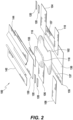
- FIG. 2 is an exploded perspective view of the absorbent article 100. Again, the article 100 is shown in a substantially flat un-contracted state with certain items removed for clarity.
- an embodiment of the absorbent article 100 comprises a chassis 102.
- the chassis 102 includes a front waist region 105, a back waist region 107, and a crotch region 109 that is disposed longitudinally between the front and back waist regions 105 and 107.
- the front waist region 105 and the back waist region 107 generally comprise those portions of the absorbent article 100 which, when worn, encircle the waist of the wearer.
- the crotch region 109 is that portion of the absorbent article 100 which, when the absorbent article 100 is worn, is generally positioned between the legs of the wearer.
- the chassis 102 has a shape such that its outer perimeter is rectangular or at least substantially rectangular in the illustrative embodiment of the absorbent article 100. In other embodiments, there may be portions of the chassis that are shaped and/or removed, such as in the crotch region 109, for example, resulting in a narrower crotch region portion 109 to provide a contoured fit between the legs. Still other embodiments known in the art have different shaped chassis, such as hourglass shapes, T-shapes, and the like.
- Rear side panels 104, 106 are coupled to and may extend from the back waist region 105.
- the disposable article may further include front side panels 108, 110 that are coupled to and may extend from the front waist region 105.
- the back region 107 is generally positioned against the back of the user.
- the front region 105 is generally positioned against the front of the user.
- the rear side panels 104, 106 are configured to wrap around a wearer's waist from back to front, extending from each side of the back waist region 105.
- the front side panels 108, 110 are configured to wrap around a wearer's waist from front to back.
- rear side panel 106 can be connected to front side panel 108 and rear side panel 104 can be connected to front side panel 110 to couple the front region 105 to the back region 107.
- other embodiments known in the art may be configured with more or fewer side panels.
- rear side panels 104, 106 may connect directly to an outside surface of front waist region 105 rather than to front side panels 108, 110.
- the side panels may attach to the chassis 102 in a variety of manners as would be apparent to one of skill in the art.
- one or more of the side panels may be integrally formed, in whole or in part, with a backsheet 135 or topsheet 130 of the absorbent article.
- the backsheet 135 will have an outside surface 134 facing away from the patient wearing the absorbent article and an inside surface 136 facing toward the patient.
- the rear side panels 104, 106 may also include fasteners 120.
- Fasteners 120 may comprise adhesive tape, hook and loop, snaps or any other appropriate fasteners as would be understood by one of ordinary skill in the art.
- rear side panel 104, 106 includes two fasteners 120.
- Fasteners 120 can be configured to operatively couple rear side panels 104, 106 to a front region 105 of the diaper chassis 102.
- fasteners 120 may also engage front side panels 108, 110 to attach rear side panels 104, 106, respectively. While FIG. 1 depicts rear side panels 104, 106 as including two fasteners 120, it will be understood to those skilled in the art that more or fewer fasteners may be used. While FIG.
- fasteners 120 sized and shaped a particular way, in other embodiments, fasteners 120 can be a different size and/or shape.
- the front side panels 108, 110 may include fasteners in additions to, or in place of, the fasteners 120 attached to rear side panels 104, 106.
- the front region 105 and/or front panels 108, 110 may include added or modified features to reinforce or increase the affinity to the fastening device. Additionally, features may be employed to allow adhesive fasteners to be attached and detached from the fastening region multiple times. Those skilled in the art will recognize that there are multiple approaches to doing so via modification of the base material as well as additions of various materials.
- fasteners 120 may incorporate the hook component of a hook-and-loop closure and portions of the front region 105 and/or front panels 108, 110 may be comprise a corresponding loop component.
- the surface of front region 105 and/or front panels 108, 110 may be treated to increase or decrease the affinity for the hook components.
- separate loop component material may be adhered to the surface of the front region 105 and/or front panels 108, 110.
- the absorbent layer may comprise an acquisition and/or distribution ("A/D") layer 133, a first absorbent core 116, and a second absorbent core 118.
- A/D acquisition and/or distribution
- the liquid acquisition and/or distribution layers serves to rapidly acquire and then distribute acquired liquid to an absorbent core for retention.
- these layers often include cellulosic fibers.
- These layers can include cross-linked cellulosic fibers to impart bulk and resilience to the layer, and wood pulp fibers to increase the wicking of liquid within the layer and to facilitate distribution of the liquid throughout the layer and ultimately to another layer, such as a storage layer, that is in liquid communication with the distribution layer.
- FIG. 3 is a perspective view of a top (facing towards wearer) of the second core 118
- FIG. 4 is a perspective view of a bottom side (facing away from a wearer) of the first core 116.
- Each of the first core 116 and second core 118 can be composed of similar material, and can be shaped depending on the size of the absorbent article, and whether it is intended for use by infants, children and/or adults.
- first core 116 can be larger and substantially hourglass shaped
- second core 118 can be smaller, relative to first core 116, and can be substantially rectangular shaped.
- the absorbent article can include a large surface area of coverage provided by the first core 116, and the increased absorbency provided by the second core 118, without the additional bulk of a second core having the same size as the first core.
- First core 116 is shown having an embossed bottom and second core 118 is shown having an embossed top.
- the embossed top of second core 118 and the embossed bottom of first core 116 provide increased longitudinal flow while reducing lateral flow, and, in this manner, reducing leakage. Said another way, the embossed top of second core 118 and the embossed bottom of first core 116 allows fluid to move longitudinally towards the front and the back of a wearer, as opposed to towards the legs of a wearer.
- Each of the first core 116 and the second core 118 may be composed of any materials suitable for absorbing the fluids and discharge including, but not limited to, a fibrous material (e.g., fluffed wood pulp), a super absorbent polymer ("SAP"), or the combination of SAP and fibrous material.
- SAP can be natural or synthetic and may be biodegradable.
- Non-limiting examples of SAP include polymers based on acrylate(s) such as sodium acrylate, potassium acrylate, and/or an alkyl acrylate(s) (e.g., methyl acrylate, ethyl acrylate, propyl acrylate, butyl acrylate, and hexyl acrylate).
- the absorbency of the diaper may vary depending upon whether it is intended for use by infants, children and/or adults.
- an absorbent article can have only a single core with no embossing, a single core with embossing on both, and/or other combinations of one or two cores each with embossing on one, both, or neither side. While the figures show absorbent articles include one or two cores, in some embodiments, absorbent articles can include more or fewer cores.
- FIGS. 3 and 4 depict embossing as including four spaced apart embossing "lines," in some embodiments.
- a core can include more or fewer embossing lines.
- embossing lines can be adjacent one another, or can be a combination of adjacent and space apart embossing line. In this manner, the different combinations of embossing lines can define an embossing pattern.
- FIGS. 3 and 4 depict embossing substantially along the entire width and length of each respective core
- a core can have embossing substantially along an entire width and/or length, and/or a portion of a width and/or length.
- the first 116 and second 118 cores may be created with or without the use of super absorbent polymer (SAP). While some literature indicates that the presence of SAP in a diaper used for urine testing is considered benign, manufacturing diapers without SAP for the benefit of accuracy is contemplated by the present invention and may be considered beneficial.
- SAP super absorbent polymer
- the absorbent article 100 may further include a set of leak guards and/or a set of leg cuffs 142, 144, both known to those of ordinary skill in the art.
- the exemplary absorbent article includes an outer layer or backsheet 135 and elastic bands 137.
- the elastic bands 137 can be used to gather the leg of the article around the user's leg, improving the fit of the absorbent article 100 and can improve the comfort of the wearer.
- Elastic bands and other elastic materials may be used at other places in the absorbent article in order to improve the fit and/or fluid retention of the article.
- FIG 5 illustrates the absorbent article 100 of FIG. 1 in which the absorbent layer 133 did not completely absorb the liquid and other discharge 146 deposited thereon.
- the liquid and other discharge 146 has moved to and beyond the outer edges of the chassis 102, and has leaked outside of the absorbent article 133.
- such an instance is known to health and medical professionals, as well as to users of absorbent articles, as a blowout, which tend to occur when the absorbent layer 133 is abruptly overwhelmed by a large amount of liquid and other discharge 146 deposited onto it, resulting in the inability of the article to entirely absorb the waste.
- Such leaking may also occur as the result of an absorbent article that has been worn for too long, has built up too much waste, and can no longer absorb new waste.
- the absorbent article 200 includes a chassis 202, similar to that of the embodiment of FIG. 1 , and further comprises absorbent strips 250, 252, 254, 256 arranged at an outer edge 260 of the front waist region 205, an outer edge 262 of the back waist region 207, and at lateral edges 264, 266 of the crotch region 209.
- the topsheet (130) has been removed to better illustrate the structure of the absorbent article 200.
- the absorbent strips are configured to absorb liquid and other discharge 246 that is initially deposited onto the absorbent layer 233 but that breaches that layer.
- the amount of waste 246 deposited onto the layer exceeds the amount that the absorbent layer 233 is capable of absorbing, or that the absorbent layer 233 cannot keep up with the rate at which the waste 246 is deposited onto the layer.
- the absorbent strips 250, 252, 254, 256 will act as an additional barrier, preventing the waste from leaking beyond the chassis outer edges.
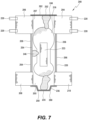
- FIG. 7 shows liquid and other discharge 246 that has breached the edges of the absorbent layer 233 and that has moved toward the outer edges of the chassis 102.
- the absorbent strips 250, 252, 254, 256 arranged at the edges 260, 262, 264, 266 of the front waist region 205, back waist region 207 and at lateral edges of the crotch region 309, it is absorbed by the absorbent strips and is prevented from breaching the outer edges of the chassis, stopping any potential leakage.
- any number of absorbent strips could be placed at any number of the four edges 260, 262, 264, 266 of the absorbent article 200. It will also be understood that although one absorbent strip is demonstrated at each edge 260, 262, 264, 266, more than one absorbent strip could be placed at an edge to further assist in absorbing fluids. And though the absorbent strips demonstrated herein extend along the entire length of the outer edge to which they are arranged, it will be understood that the absorbent strips can be of any length, extending along the entirety of the edges or along only a portion of the edge.
- the absorbent strips disclosed herein could comprise one, two or more layers of material depending on the level of absorbency desired.
- the absorbent strip could comprise a first and second core, similar to the first core 116 and second core 118 of FIGS. 3 and 4 .
- Each core could have an embossed top or bottom to provide increased flow along the absorbent strip to further improve absorbency of greater amounts of liquid and other discharge, to assist in preventing leaking along the edges of the absorbent article.
- the absorbent strips could have a single core with no embossing, a single core with embossing on both sides, and/or other combinations of one or two cores each with embossing on one, both, or neither side.
- an absorbent strip could include more or fewer cores.
- embossing lines can differ in some embodiments.
- embossing lines can be adjacent one another, or can be a combination of adjacent and spaced apart embossing line.
- the different combinations of embossing lines can define an embossing pattern.
- the embossing could be substantially along the entire width and length of an absorbent strip, or it could be arranged along a portion of a width and/or length of the absorbent strip.
- an absorbent strip may extend along the entirety of an edge with embossing also extending along its entirety, or the absorbent strip may extend along a portion of the edge with the embossing extending along only a portion of the absorbent strip. Any combination of length and width of the absorbent strip with or without any combination of length or width of embossing is feasible.
- the absorbent strips may be composed of any materials suitable for absorbing the fluids and discharge including, but not limited to, a fibrous material (e.g., fluffed wood pulp), a super absorbent polymer ("SAP"), or the combination of SAP and fibrous material.
- SAP can be natural or synthetic and may be biodegradable.
- Non-limiting examples of SAP include polymers based on acrylate(s) such as sodium acrylate, potassium acrylate, and/or an alkyl acrylate(s) (e.g., methyl acrylate, ethyl acrylate, propyl acrylate, butyl acrylate, and hexyl acrylate).
- the absorbency of the diaper may vary depending upon whether it is intended for use by infants, children and/or adults.
- the absorbent strips have a width of approximately 15 millimeters and a length substantially the length of the outer edge 260, 262, 264, 266 to which it corresponds.
- FIGS. 8 and 9 additional embodiments of the absorbent article 300, 400 of the present disclosure are shown.
- a chassis 302, 402 similar to that of FIGS. 1 , 6 and 7 but including lateral edge absorbent strips 354, 356 arranged along the lateral edges 364, 366 of the crotch region 309 and/or longitudinal edge absorbent strips 450, 452 arranged at the edges 460, 462 of the front waist region 405 and back waist region 407, respectively.
- the topsheet (130) has been removed to better illustrate the structure of the absorbent article 300, 400.
- lateral edge absorbent strips 354, 356 are positioned along the lateral edges 364, 366 of the absorbent article chassis 302.
- the exemplary strips extend continuously from front edges 3 11, 313 to a rear edge 315, 317.
- the strips extend across an outer surface of the side panels 304, 306, 308, 310 which are attached to an inner surface 336 of the backsheet 335.
- the side panels may be adhered to an outer surface of the backsheet 335 such that the lateral edge absorbent strips 354, 356 extend across an inner surface 322, 324, 326, 328 of the side panels 304, 306, 308, 310.
- the absorbent strips may extend only along the chassis in a crotch portion 309 between the side panels 304, 306, 308, 310 such that the absorbent strips do not overlap with the side panels.
- longitudinal edge absorbent strips 450, 452 are positioned along the longitudinal edges 460, 462 of the absorbent article chassis 402.
- the exemplary strips extend continuously between front edges 4 11, 413 and between rear edges 415, 417.
- the strips extend to an outer surface edge of the side panels 404, 406, 408, 410.
- the strips 450, 452 may extend along the inner surface edge of the side panels 404, 406, 408, 410, or may extend up to but not overlapping with the side panels.
- FIG 10 shows the embodiment of FIG. 6 but in a rounded, contracted state, as it would be formed when worn by a user.
- the absorbent article 200 has absorbent strips 250, 252, 254, 256 arranged along the edges 260, 262, 264, 266 of the chassis, but it will be understood that, just as with FIGS 8 and 9 as detailed above, the absorbent strips could be arranged at only the lateral edges 264, 266 or longitudinal edges 260, 262.
- the absorbent strips 250, 252, 254, 256 do not overlap with the side panels 204, 206, 208, 210 but rather are arranged adjacent to the panels.
- the absorbent strip could be arranged at a single edge of the chassis, rather than at more than one. Any number of strips placed at any of the chassis edges is considered by the invention.
Landscapes
- Health & Medical Sciences (AREA)
- Epidemiology (AREA)
- Engineering & Computer Science (AREA)
- Biomedical Technology (AREA)
- Heart & Thoracic Surgery (AREA)
- Vascular Medicine (AREA)
- Life Sciences & Earth Sciences (AREA)
- Animal Behavior & Ethology (AREA)
- General Health & Medical Sciences (AREA)
- Public Health (AREA)
- Veterinary Medicine (AREA)
- Absorbent Articles And Supports Therefor (AREA)
- Orthopedics, Nursing, And Contraception (AREA)
Description
- The present invention relates generally to absorbent articles and, in particular, to the use of absorbent strips with the article.
- Millions of people of all ages suffer from incontinence of the bowel or bladder. Whether an infant, adult, or elderly person, the underlying cause of incontinence varies but the method of treatment typically involves absorbent article products. Adult incontinent briefs, disposable diapers, pull-up diapers, protective underwear and underpads can alleviate some of the emotional and physical discomfort of incontinence by absorbing and containing liquid and other discharges from the human body to prevent body and clothing soiling.
- Typical absorbent articles include a topsheet facing the wearer that permits fluid exudates to pass through and a backsheet that prevents the exudates from escaping from the absorbent article. Much advancement has been made in the art since the introduction of the disposable absorbent article. However, quality care for patients and other users of absorbent articles requires that the article be capable of withstanding a considerable amount of liquid and other discharge. Most articles, though adapted to retain a heavy amount of liquid and other discharges, fall short of providing adequate collection and retention in all instances.
US 2014171898 discloses an absorbent article with barrier cuffs. - From time-to-time the absorbent articles known in the art, like those described above, fail in their ability to retain and keep liquid and other discharge from exiting the sides or front of the diaper. Such instances are known in the industry and are often referred to as a "blow out." Failure in waste retention is uncomfortable and bothersome to the user, but more so, is embarrassing and can result in unwanted attention, especially for users who are insecure about having to use the article. Accordingly, there is a need to provide an absorbent article that can better retain fluids and other discharge deposited onto the article to prevent such blowouts from occurring.
- Advantages of the invention will become apparent upon reading the following detailed description and upon reference to the drawings.
-
FIG. 1 is a top plan view of an absorbent article in a substantially flat un-contracted position according to the prior art. -
FIG. 2 is an exploded perspective view of the absorbent article ofFIG. 1 , again in a substantially flat un-contracted position. -
FIG. 3 is a perspective view of an absorbent core of the absorbent article depicted inFIG. 1 . -
FIG. 4 is a perspective view of a second absorbent core of the absorbent article depicted inFIG. 1 . -
FIG. 5 is a top plan view of an absorbent article according to the prior art, similar to that ofFIG. 1 -
FIG. 6 is a top plan view of one embodiment of an absorbent article in a substantially flat un-contracted position according to one embodiment of the invention. -
FIG. 7 is a top plan view of the absorbent article ofFIG. 1 , again in a substantially flat un-contracted position. -
FIGS. 8 and 9 are top plan views of separate embodiments of an absorbent article in a substantially flat un-contracted position according to other embodiments of the invention. -
FIG. 10 is a perspective view of one embodiment of an absorbent article in a substantially rounded contracted position according to one embodiment of the invention. - While the invention is susceptible to various modifications and alternative forms, specific embodiments have been shown by way of example in the drawings and will be described in detail herein. It should be understood, however, that the invention is not intended to be limited to the particular forms disclosed.
- Embodiments of the invention are now described in detail. Referring to the drawings, like numbers indicate like parts throughout the views. As used in the description herein and throughout the claims, the following terms take the meanings explicitly associated herein, unless the context clearly dictates otherwise: the meaning of "a," "an," and "the" includes plural reference, the meaning of "in" includes "in" and "on." Relational terms such as first and second, top and bottom, forward and rearward, and the like may be used solely to distinguish one entity or action from another entity or action without necessarily requiring or implying any actual such relationship, direction or order between such entities or actions.
- Absorbent articles as described herein generally include a moisture-pervious inner layer, an absorbent layer, and a moisture-impervious outer layer. Although the remainder of the description will be specifically directed to adult incontinence articles, such as disposable diapers, it is to be understood that the embodiments may also be implemented using other absorbent articles and that the properties and uses described below apply to these other absorbent articles as well. Throughout this application, the terms absorbent article and diaper are used interchangeably. However, it should be understood that the term diaper is intended to include other absorbent articles, such as training pants, incontinence pads, etc., as would be understood by one of ordinary skill in the art. The terms user and patient are also used interchangeably to indicate a person on whom a diaper is placed.
-
FIGS. 1 and2 illustrate an exemplary non-limiting general embodiment of anabsorbent article 100 known in the art.FIG. 1 illustrates a plan view of theabsorbent article 100 in a substantially flat un-contracted state. As shown in these figures, theabsorbent article 100 generally consists of several layers, including an inner layer, an absorbent layer, and an outer layer. The inner layer faces a wearer and contacts the skin of the wearer when theabsorbent article 100 is secured to the wearer. The inner layer may comprise atopsheet 130 that is composed of a moisture-pervious fabric suitable to allow bodily discharge to pass through the inner layer and be absorbed by the absorbent layer. Non-limiting examples of materials suitable to form thetopsheet 130 include polypropylene, polyethylene, polyester, materials having hydrophobic properties, combinations thereof and/or the like. Additionally, the topsheet can be treated with a hydrophilic finish to improve pass through of liquids to diaper layers beneath the inner layer. Non-limiting examples of suitable hydrophilic finishes include stearic acid, melamine-based chemicals, fluorocarbon chemicals, and silicon-based chemicals. - The plan view of
FIG. 1 is shown from the top or patient contacting side of the absorbent article. The topsheet (130) and other components have been removed for clarity.FIG. 2 is an exploded perspective view of theabsorbent article 100. Again, thearticle 100 is shown in a substantially flat un-contracted state with certain items removed for clarity. - As shown in
FIG. 1 , an embodiment of theabsorbent article 100 comprises achassis 102. Thechassis 102 includes afront waist region 105, aback waist region 107, and acrotch region 109 that is disposed longitudinally between the front andback waist regions front waist region 105 and theback waist region 107 generally comprise those portions of theabsorbent article 100 which, when worn, encircle the waist of the wearer. Thecrotch region 109 is that portion of theabsorbent article 100 which, when theabsorbent article 100 is worn, is generally positioned between the legs of the wearer. - The
chassis 102 has a shape such that its outer perimeter is rectangular or at least substantially rectangular in the illustrative embodiment of theabsorbent article 100. In other embodiments, there may be portions of the chassis that are shaped and/or removed, such as in thecrotch region 109, for example, resulting in a narrowercrotch region portion 109 to provide a contoured fit between the legs. Still other embodiments known in the art have different shaped chassis, such as hourglass shapes, T-shapes, and the like. -
Rear side panels back waist region 105. The disposable article may further includefront side panels front waist region 105. Theback region 107 is generally positioned against the back of the user. Thefront region 105 is generally positioned against the front of the user. Therear side panels back waist region 105. Thefront side panels rear side panel 106 can be connected tofront side panel 108 andrear side panel 104 can be connected tofront side panel 110 to couple thefront region 105 to theback region 107. In this embodiment there are fourside panels rear side panels front waist region 105 rather than tofront side panels - The side panels may attach to the
chassis 102 in a variety of manners as would be apparent to one of skill in the art. Alternatively, one or more of the side panels may be integrally formed, in whole or in part, with abacksheet 135 ortopsheet 130 of the absorbent article. Thebacksheet 135 will have an outside surface 134 facing away from the patient wearing the absorbent article and aninside surface 136 facing toward the patient. - The
rear side panels fasteners 120.Fasteners 120 may comprise adhesive tape, hook and loop, snaps or any other appropriate fasteners as would be understood by one of ordinary skill in the art. As shown in the illustrative embodiment,rear side panel fasteners 120.Fasteners 120 can be configured to operatively couplerear side panels front region 105 of thediaper chassis 102. Alternative,fasteners 120 may also engagefront side panels rear side panels FIG. 1 depictsrear side panels fasteners 120, it will be understood to those skilled in the art that more or fewer fasteners may be used. WhileFIG. 1 depictsfasteners 120 sized and shaped a particular way, in other embodiments,fasteners 120 can be a different size and/or shape. Alternatively, thefront side panels fasteners 120 attached torear side panels - In another embodiment, the
front region 105 and/orfront panels fasteners 120 may incorporate the hook component of a hook-and-loop closure and portions of thefront region 105 and/orfront panels front region 105 and/orfront panels front region 105 and/orfront panels - Referring again to
FIGS. 1 and2 , embodiments of theabsorbent article 100 include an absorbent layer. The absorbent layer may comprise an acquisition and/or distribution ("A/D")layer 133, a firstabsorbent core 116, and a secondabsorbent core 118. - The liquid acquisition and/or distribution layers serves to rapidly acquire and then distribute acquired liquid to an absorbent core for retention. To achieve rapid acquisition and distribution, these layers often include cellulosic fibers. These layers can include cross-linked cellulosic fibers to impart bulk and resilience to the layer, and wood pulp fibers to increase the wicking of liquid within the layer and to facilitate distribution of the liquid throughout the layer and ultimately to another layer, such as a storage layer, that is in liquid communication with the distribution layer.
-
FIG. 3 is a perspective view of a top (facing towards wearer) of thesecond core 118, andFIG. 4 is a perspective view of a bottom side (facing away from a wearer) of thefirst core 116. Each of thefirst core 116 andsecond core 118 can be composed of similar material, and can be shaped depending on the size of the absorbent article, and whether it is intended for use by infants, children and/or adults. By way of example, and as shown inFIGS. 3 and 4 ,first core 116 can be larger and substantially hourglass shaped, whereassecond core 118 can be smaller, relative tofirst core 116, and can be substantially rectangular shaped. In this manner, the absorbent article can include a large surface area of coverage provided by thefirst core 116, and the increased absorbency provided by thesecond core 118, without the additional bulk of a second core having the same size as the first core. -
First core 116 is shown having an embossed bottom andsecond core 118 is shown having an embossed top. The embossed top ofsecond core 118 and the embossed bottom offirst core 116 provide increased longitudinal flow while reducing lateral flow, and, in this manner, reducing leakage. Said another way, the embossed top ofsecond core 118 and the embossed bottom offirst core 116 allows fluid to move longitudinally towards the front and the back of a wearer, as opposed to towards the legs of a wearer. - Each of the
first core 116 and thesecond core 118 may be composed of any materials suitable for absorbing the fluids and discharge including, but not limited to, a fibrous material (e.g., fluffed wood pulp), a super absorbent polymer ("SAP"), or the combination of SAP and fibrous material. The SAP can be natural or synthetic and may be biodegradable. Non-limiting examples of SAP include polymers based on acrylate(s) such as sodium acrylate, potassium acrylate, and/or an alkyl acrylate(s) (e.g., methyl acrylate, ethyl acrylate, propyl acrylate, butyl acrylate, and hexyl acrylate). The absorbency of the diaper may vary depending upon whether it is intended for use by infants, children and/or adults. - While
FIGS. 3 and 4 depict thefirst core 116 having an embossed bottom, and thesecond core 118 having an embossed top, in some embodiments, an absorbent article can have only a single core with no embossing, a single core with embossing on both, and/or other combinations of one or two cores each with embossing on one, both, or neither side. While the figures show absorbent articles include one or two cores, in some embodiments, absorbent articles can include more or fewer cores. -
FIGS. 3 and 4 depict embossing as including four spaced apart embossing "lines," in some embodiments. However, a core can include more or fewer embossing lines. In some embodiments, embossing lines can be adjacent one another, or can be a combination of adjacent and space apart embossing line. In this manner, the different combinations of embossing lines can define an embossing pattern. WhileFIGS. 3 and 4 depict embossing substantially along the entire width and length of each respective core, in some embodiments a core can have embossing substantially along an entire width and/or length, and/or a portion of a width and/or length. - In embodiments of the invention, the first 116 and second 118 cores may be created with or without the use of super absorbent polymer (SAP). While some literature indicates that the presence of SAP in a diaper used for urine testing is considered benign, manufacturing diapers without SAP for the benefit of accuracy is contemplated by the present invention and may be considered beneficial.
- Returning to
FIGS. 1 and2 , theabsorbent article 100 may further include a set of leak guards and/or a set of leg cuffs 142, 144, both known to those of ordinary skill in the art. Additionally, the exemplary absorbent article includes an outer layer orbacksheet 135 andelastic bands 137. Theelastic bands 137 can be used to gather the leg of the article around the user's leg, improving the fit of theabsorbent article 100 and can improve the comfort of the wearer. Elastic bands and other elastic materials may be used at other places in the absorbent article in order to improve the fit and/or fluid retention of the article. -
FIG 5 illustrates theabsorbent article 100 ofFIG. 1 in which theabsorbent layer 133 did not completely absorb the liquid andother discharge 146 deposited thereon. In this example, the liquid andother discharge 146 has moved to and beyond the outer edges of thechassis 102, and has leaked outside of theabsorbent article 133. As previously noted, such an instance is known to health and medical professionals, as well as to users of absorbent articles, as a blowout, which tend to occur when theabsorbent layer 133 is abruptly overwhelmed by a large amount of liquid andother discharge 146 deposited onto it, resulting in the inability of the article to entirely absorb the waste. Such leaking may also occur as the result of an absorbent article that has been worn for too long, has built up too much waste, and can no longer absorb new waste. - Referring now to
FIGS. 6 and7 , theabsorbent article 200 includes achassis 202, similar to that of the embodiment ofFIG. 1 , and further comprisesabsorbent strips outer edge 260 of thefront waist region 205, anouter edge 262 of theback waist region 207, and atlateral edges crotch region 209. For the examples ofFIGS. 6 and7 the topsheet (130) has been removed to better illustrate the structure of theabsorbent article 200. The absorbent strips are configured to absorb liquid andother discharge 246 that is initially deposited onto theabsorbent layer 233 but that breaches that layer. It may be that the amount ofwaste 246 deposited onto the layer exceeds the amount that theabsorbent layer 233 is capable of absorbing, or that theabsorbent layer 233 cannot keep up with the rate at which thewaste 246 is deposited onto the layer. When the liquid andother discharge 246 has overwhelmed theabsorbent layer 233 and moved toward theouter edges absorbent strips -
FIG. 7 shows liquid andother discharge 246 that has breached the edges of theabsorbent layer 233 and that has moved toward the outer edges of thechassis 102. However, unlike in the illustration ofFIG. 5 , once theexcess waste 246 reaches theabsorbent strips edges front waist region 205, backwaist region 207 and at lateral edges of the crotch region 309, it is absorbed by the absorbent strips and is prevented from breaching the outer edges of the chassis, stopping any potential leakage. - It will be understood by those of skill in the art that any number of absorbent strips could be placed at any number of the four
edges absorbent article 200. It will also be understood that although one absorbent strip is demonstrated at eachedge - The absorbent strips disclosed herein could comprise one, two or more layers of material depending on the level of absorbency desired. The absorbent strip could comprise a first and second core, similar to the
first core 116 andsecond core 118 ofFIGS. 3 and 4 . Each core could have an embossed top or bottom to provide increased flow along the absorbent strip to further improve absorbency of greater amounts of liquid and other discharge, to assist in preventing leaking along the edges of the absorbent article. - In some embodiments, the absorbent strips could have a single core with no embossing, a single core with embossing on both sides, and/or other combinations of one or two cores each with embossing on one, both, or neither side. In some embodiments, an absorbent strip could include more or fewer cores.
- The arrangement of embossing lines can differ in some embodiments. In some embodiments, embossing lines can be adjacent one another, or can be a combination of adjacent and spaced apart embossing line. In this manner, the different combinations of embossing lines can define an embossing pattern. The embossing could be substantially along the entire width and length of an absorbent strip, or it could be arranged along a portion of a width and/or length of the absorbent strip. Thus, an absorbent strip may extend along the entirety of an edge with embossing also extending along its entirety, or the absorbent strip may extend along a portion of the edge with the embossing extending along only a portion of the absorbent strip. Any combination of length and width of the absorbent strip with or without any combination of length or width of embossing is feasible.
- The absorbent strips may be composed of any materials suitable for absorbing the fluids and discharge including, but not limited to, a fibrous material (e.g., fluffed wood pulp), a super absorbent polymer ("SAP"), or the combination of SAP and fibrous material. The SAP can be natural or synthetic and may be biodegradable. Non-limiting examples of SAP include polymers based on acrylate(s) such as sodium acrylate, potassium acrylate, and/or an alkyl acrylate(s) (e.g., methyl acrylate, ethyl acrylate, propyl acrylate, butyl acrylate, and hexyl acrylate). The absorbency of the diaper may vary depending upon whether it is intended for use by infants, children and/or adults. Preferably, the absorbent strips have a width of approximately 15 millimeters and a length substantially the length of the
outer edge - Referring now to
FIGS. 8 and 9 , additional embodiments of theabsorbent article chassis FIGS. 1 ,6 and7 but including lateral edgeabsorbent strips lateral edges absorbent strips 450, 452 arranged at theedges front waist region 405 and backwaist region 407, respectively. In the examples shown inFIGS. 8 and 9 , the topsheet (130) has been removed to better illustrate the structure of theabsorbent article - As illustrated in
Fig. 8 , lateral edgeabsorbent strips lateral edges absorbent article chassis 302. The exemplary strips extend continuously fromfront edges 3 11, 313 to arear edge side panels inner surface 336 of thebacksheet 335. Alternatively, the side panels may be adhered to an outer surface of thebacksheet 335 such that the lateral edgeabsorbent strips inner surface side panels side panels - Illustrated in
Fig. 9 , longitudinal edgeabsorbent strips 450, 452 are positioned along thelongitudinal edges absorbent article chassis 402. The exemplary strips extend continuously between front edges 4 11, 413 and betweenrear edges side panels strips 450, 452 may extend along the inner surface edge of theside panels -
FIG 10 shows the embodiment ofFIG. 6 but in a rounded, contracted state, as it would be formed when worn by a user. As is shown, theabsorbent article 200 hasabsorbent strips edges FIGS 8 and 9 as detailed above, the absorbent strips could be arranged at only thelateral edges longitudinal edges absorbent strips side panels
Claims (12)
- An absorbent article, comprising:a chassis (202), the chassis having a length greater than its width, the length extending in a longitudinal direction from the back to the front of a user between first and second longitudinal edges (260,262) and the width extending in a lateral direction substantially perpendicular to the length and between first and second lateral edges (264,266), the chassis comprising a liquid impervious backsheet (135,235), a liquid pervious topsheet (130) and an absorbent layer (133,233) positioned between the backsheet and topsheet;two elongated lateral edge absorbent strips (254,256) and two elongated longitudinal edge absorbent strips (250,252), each strip having a length greater than its width and comprising a fluid absorbent material;wherein the longitudinal edge absorbent strips (250,252) have a length less than the length of the lateral edge absorbent strips (254,256) and are arranged in parallel spaced relation to each other and proximate and parallel to each of the first and second longitudinal edges (260,262) and extending substantially the length of the chassis longitudinal edges (260,262);wherein the lateral edge absorbent strips (254,256) have a length less than the length of the longitudinal edge absorbent strips (250,252) and are arranged in parallel spaced relation to each other and proximate and parallel to each of the first and second lateral edges (264,266) and generally normal to the longitudinal edge absorbent strips, extending substantially the length of the chassis lateral edges (264,266); andwherein the absorbent strips are adhered to the liquid impervious backsheet (135,235) layer, and covered by the liquid pervious topsheet (130) layer.
- The absorbent article of claim 1, wherein the absorbent strips (250, 252, 254, 256) comprise a single absorbent layer.
- The absorbent article of claim 1, wherein the absorbent strips (250, 252, 254, 256) comprise a first absorbent core (116) and a second absorbent core (118).
- The absorbent article of claim 3, wherein one of the first and second absorbent core (116,118) comprises an embossed top.
- The absorbent article of claim 4, wherein one of the first and second absorbent core (116,118) comprises an embossed bottom.
- The absorbent article of claim 4, wherein the first absorbent core (116) comprises an embossed top and the second absorbent core (118) comprises an embossed bottom.
- The absorbent article of claim 1, wherein the absorbent strips (250, 252, 254, 256) comprise a mixture of super absorbent polymer and wood pulp fluff
- The absorbent article of claim 7, wherein the mixture is enveloped in a hydrophilic nonwoven layer.
- The absorbent article of claim 1, wherein:the first and second lateral edges and first and second longitudinal edges forming a chassis perimeter; andwherein an edge absorbent strip comprising the lateral edge absorbent strips and the longitudinal edge absorbent strips surrounds substantially all of the chassis perimeter.
- The absorbent article of claim 9 further comprising a side panel (204, 206, 208, 210) that extends beyond the chassis perimeter.
- The absorbent article of claim 10wherein the side panel (204, 206, 208, 210) attached to the chassis at a position that is interior of the edge absorbent strip.
- The absorbent article of claim 10 wherein the side panel (204, 206, 208, 210) attached to the chassis at a position that is exterior of the edge absorbent strip.
Applications Claiming Priority (2)
| Application Number | Priority Date | Filing Date | Title |
|---|---|---|---|
| US16/117,077 US11351069B2 (en) | 2018-08-30 | 2018-08-30 | Absorbent article with absorbent strips |
| PCT/US2019/048806 WO2020047252A1 (en) | 2018-08-30 | 2019-08-29 | Absorbent article with absorbent strips |
Publications (3)
| Publication Number | Publication Date |
|---|---|
| EP3843681A1 EP3843681A1 (en) | 2021-07-07 |
| EP3843681A4 EP3843681A4 (en) | 2022-05-18 |
| EP3843681B1 true EP3843681B1 (en) | 2023-11-01 |
Family
ID=69640770
Family Applications (1)
| Application Number | Title | Priority Date | Filing Date |
|---|---|---|---|
| EP19854887.7A Active EP3843681B1 (en) | 2018-08-30 | 2019-08-29 | Absorbent article with absorbent strips |
Country Status (4)
| Country | Link |
|---|---|
| US (3) | US11351069B2 (en) |
| EP (1) | EP3843681B1 (en) |
| CA (1) | CA3110845A1 (en) |
| WO (1) | WO2020047252A1 (en) |
Family Cites Families (15)
| Publication number | Priority date | Publication date | Assignee | Title |
|---|---|---|---|---|
| US4657539A (en) * | 1985-04-26 | 1987-04-14 | The Procter & Gamble Company | Waste containment garment having elasticized barrier wall leg flaps |
| JPH0827942B2 (en) * | 1987-11-30 | 1996-03-21 | コニカ株式会社 | Method of manufacturing magnetic recording medium |
| US5776122A (en) * | 1994-12-21 | 1998-07-07 | Kimberly-Clark Worldwide, Inc. | Absorbent article providing improved fecal containment |
| AU7521396A (en) | 1995-11-22 | 1997-06-11 | Kimberly-Clark Corporation | Disposable absorbent article having a garment-like appearance |
| US6060638A (en) | 1995-12-22 | 2000-05-09 | Kimberly-Clark Worldwide, Inc. | Matched permeability liner/absorbent structure system for absorbent articles and the like |
| US6613955B1 (en) | 1999-10-01 | 2003-09-02 | Kimberly-Clark Worldwide, Inc. | Absorbent articles with wicking barrier cuffs |
| JP3993452B2 (en) * | 2002-03-29 | 2007-10-17 | ユニ・チャーム株式会社 | Thin absorbent article and method for manufacturing the same |
| US7780643B2 (en) | 2003-12-30 | 2010-08-24 | Sca Hygiene Products Ab | Absorbent article having X-shaped shaping element |
| JP4227031B2 (en) * | 2004-01-16 | 2009-02-18 | ユニ・チャームペットケア株式会社 | Absorbent sheet for pet |
| JP4342337B2 (en) * | 2004-02-17 | 2009-10-14 | ユニ・チャーム株式会社 | Disposable diapers |
| JP2008534230A (en) * | 2005-04-04 | 2008-08-28 | ザ プロクター アンド ギャンブル カンパニー | Disposable clothing |
| US9456935B2 (en) * | 2012-12-18 | 2016-10-04 | The Procter & Gamble Company | Absorbent articles comprising raised barriers |
| US10555843B2 (en) | 2014-06-13 | 2020-02-11 | Daio Paper Corporation | Absorbent article |
| EP2962669A1 (en) * | 2014-06-30 | 2016-01-06 | The Procter & Gamble Company | Bed pad with one or more releasable and fastenable wings |
| EP3193802B1 (en) * | 2014-09-15 | 2019-11-20 | The Procter and Gamble Company | Adhesive striping with apertured films |
-
2018
- 2018-08-30 US US16/117,077 patent/US11351069B2/en active Active
-
2019
- 2019-08-29 EP EP19854887.7A patent/EP3843681B1/en active Active
- 2019-08-29 WO PCT/US2019/048806 patent/WO2020047252A1/en not_active Ceased
- 2019-08-29 CA CA3110845A patent/CA3110845A1/en active Pending
-
2022
- 2022-05-13 US US17/743,838 patent/US12213865B2/en active Active
-
2024
- 2024-12-27 US US19/004,142 patent/US20250143936A1/en active Pending
Also Published As
| Publication number | Publication date |
|---|---|
| US12213865B2 (en) | 2025-02-04 |
| WO2020047252A1 (en) | 2020-03-05 |
| EP3843681A4 (en) | 2022-05-18 |
| US20220323268A1 (en) | 2022-10-13 |
| EP3843681A1 (en) | 2021-07-07 |
| US11351069B2 (en) | 2022-06-07 |
| CA3110845A1 (en) | 2020-03-05 |
| US20200069484A1 (en) | 2020-03-05 |
| US20250143936A1 (en) | 2025-05-08 |
Similar Documents
| Publication | Publication Date | Title |
|---|---|---|
| JP5038393B2 (en) | Absorbent article with multidimensionally shaped barrier cuff | |
| US8395017B2 (en) | Absorbent article having extensibility at waist panel | |
| CA2441038C (en) | Absorbent article having hydrophobic leak protection zones | |
| EP1686938B1 (en) | Absorbent article with elasticized barrier cuffs | |
| CZ153495A3 (en) | Disposable absorption article | |
| JP2008521481A (en) | Absorption article | |
| AU2004325970A1 (en) | Absorbent article | |
| AU2019240557B2 (en) | Fastener for an absorbent article | |
| US20220304866A1 (en) | Multi-piece absorbent articles with leg cuffs | |
| US20080255532A1 (en) | Multiple barrier leg cuff | |
| JP2010523259A (en) | Absorbent article with leakage barrier | |
| JP2009532170A (en) | Absorbent article with leakage barrier | |
| WO2019130910A1 (en) | Wearable article | |
| WO2017203955A1 (en) | Absorbent article | |
| US12213865B2 (en) | Absorbent article with absorbent strips | |
| AU2002341480B2 (en) | An absorbent article | |
| JP2023109275A (en) | crotch fit supporter | |
| US20220401273A1 (en) | Absorbent article with channeled core | |
| CN222917715U (en) | Pants-type absorbent product | |
| RU2397744C2 (en) | Absorbing product with barriers against leakage | |
| JP2000197663A (en) | Pants-type diapers | |
| RU2417065C1 (en) | Absorbent product with leakage barriers |
Legal Events
| Date | Code | Title | Description |
|---|---|---|---|
| STAA | Information on the status of an ep patent application or granted ep patent |
Free format text: STATUS: THE INTERNATIONAL PUBLICATION HAS BEEN MADE |
|
| STAA | Information on the status of an ep patent application or granted ep patent |
Free format text: STATUS: REQUEST FOR EXAMINATION WAS MADE |
|
| PUAI | Public reference made under article 153(3) epc to a published international application that has entered the european phase |
Free format text: ORIGINAL CODE: 0009012 |
|
| 17P | Request for examination filed |
Effective date: 20210217 |
|
| AK | Designated contracting states |
Kind code of ref document: A1 Designated state(s): AL AT BE BG CH CY CZ DE DK EE ES FI FR GB GR HR HU IE IS IT LI LT LU LV MC MK MT NL NO PL PT RO RS SE SI SK SM TR |
|
| DAV | Request for validation of the european patent (deleted) | ||
| DAX | Request for extension of the european patent (deleted) | ||
| RAP3 | Party data changed (applicant data changed or rights of an application transferred) |
Owner name: MEDLINE INDUSTRIES, LP |
|
| A4 | Supplementary search report drawn up and despatched |
Effective date: 20220414 |
|
| RIC1 | Information provided on ipc code assigned before grant |
Ipc: A61F 13/534 20060101ALI20220408BHEP Ipc: A61F 13/53 20060101ALI20220408BHEP Ipc: A61F 13/494 20060101ALI20220408BHEP Ipc: A61F 13/537 20060101ALI20220408BHEP Ipc: A61F 13/49 20060101AFI20220408BHEP |
|
| GRAP | Despatch of communication of intention to grant a patent |
Free format text: ORIGINAL CODE: EPIDOSNIGR1 |
|
| STAA | Information on the status of an ep patent application or granted ep patent |
Free format text: STATUS: GRANT OF PATENT IS INTENDED |
|
| INTG | Intention to grant announced |
Effective date: 20230526 |
|
| GRAS | Grant fee paid |
Free format text: ORIGINAL CODE: EPIDOSNIGR3 |
|
| GRAA | (expected) grant |
Free format text: ORIGINAL CODE: 0009210 |
|
| STAA | Information on the status of an ep patent application or granted ep patent |
Free format text: STATUS: THE PATENT HAS BEEN GRANTED |
|
| AK | Designated contracting states |
Kind code of ref document: B1 Designated state(s): AL AT BE BG CH CY CZ DE DK EE ES FI FR GB GR HR HU IE IS IT LI LT LU LV MC MK MT NL NO PL PT RO RS SE SI SK SM TR |
|
| REG | Reference to a national code |
Ref country code: GB Ref legal event code: FG4D |
|
| REG | Reference to a national code |
Ref country code: CH Ref legal event code: EP |
|
| P01 | Opt-out of the competence of the unified patent court (upc) registered |
Effective date: 20231018 |
|
| REG | Reference to a national code |
Ref country code: IE Ref legal event code: FG4D |
|
| REG | Reference to a national code |
Ref country code: DE Ref legal event code: R096 Ref document number: 602019040754 Country of ref document: DE |
|
| REG | Reference to a national code |
Ref country code: NL Ref legal event code: FP |
|
| REG | Reference to a national code |
Ref country code: LT Ref legal event code: MG9D |
|
| PG25 | Lapsed in a contracting state [announced via postgrant information from national office to epo] |
Ref country code: GR Free format text: LAPSE BECAUSE OF FAILURE TO SUBMIT A TRANSLATION OF THE DESCRIPTION OR TO PAY THE FEE WITHIN THE PRESCRIBED TIME-LIMIT Effective date: 20240202 |
|
| PG25 | Lapsed in a contracting state [announced via postgrant information from national office to epo] |
Ref country code: IS Free format text: LAPSE BECAUSE OF FAILURE TO SUBMIT A TRANSLATION OF THE DESCRIPTION OR TO PAY THE FEE WITHIN THE PRESCRIBED TIME-LIMIT Effective date: 20240301 |
|
| PG25 | Lapsed in a contracting state [announced via postgrant information from national office to epo] |
Ref country code: LT Free format text: LAPSE BECAUSE OF FAILURE TO SUBMIT A TRANSLATION OF THE DESCRIPTION OR TO PAY THE FEE WITHIN THE PRESCRIBED TIME-LIMIT Effective date: 20231101 |
|
| REG | Reference to a national code |
Ref country code: AT Ref legal event code: MK05 Ref document number: 1626375 Country of ref document: AT Kind code of ref document: T Effective date: 20231101 |
|
| PG25 | Lapsed in a contracting state [announced via postgrant information from national office to epo] |
Ref country code: AT Free format text: LAPSE BECAUSE OF FAILURE TO SUBMIT A TRANSLATION OF THE DESCRIPTION OR TO PAY THE FEE WITHIN THE PRESCRIBED TIME-LIMIT Effective date: 20231101 |
|
| PG25 | Lapsed in a contracting state [announced via postgrant information from national office to epo] |
Ref country code: ES Free format text: LAPSE BECAUSE OF FAILURE TO SUBMIT A TRANSLATION OF THE DESCRIPTION OR TO PAY THE FEE WITHIN THE PRESCRIBED TIME-LIMIT Effective date: 20231101 |
|
| PG25 | Lapsed in a contracting state [announced via postgrant information from national office to epo] |
Ref country code: LT Free format text: LAPSE BECAUSE OF FAILURE TO SUBMIT A TRANSLATION OF THE DESCRIPTION OR TO PAY THE FEE WITHIN THE PRESCRIBED TIME-LIMIT Effective date: 20231101 Ref country code: IS Free format text: LAPSE BECAUSE OF FAILURE TO SUBMIT A TRANSLATION OF THE DESCRIPTION OR TO PAY THE FEE WITHIN THE PRESCRIBED TIME-LIMIT Effective date: 20240301 Ref country code: GR Free format text: LAPSE BECAUSE OF FAILURE TO SUBMIT A TRANSLATION OF THE DESCRIPTION OR TO PAY THE FEE WITHIN THE PRESCRIBED TIME-LIMIT Effective date: 20240202 Ref country code: ES Free format text: LAPSE BECAUSE OF FAILURE TO SUBMIT A TRANSLATION OF THE DESCRIPTION OR TO PAY THE FEE WITHIN THE PRESCRIBED TIME-LIMIT Effective date: 20231101 Ref country code: BG Free format text: LAPSE BECAUSE OF FAILURE TO SUBMIT A TRANSLATION OF THE DESCRIPTION OR TO PAY THE FEE WITHIN THE PRESCRIBED TIME-LIMIT Effective date: 20240201 Ref country code: AT Free format text: LAPSE BECAUSE OF FAILURE TO SUBMIT A TRANSLATION OF THE DESCRIPTION OR TO PAY THE FEE WITHIN THE PRESCRIBED TIME-LIMIT Effective date: 20231101 Ref country code: PT Free format text: LAPSE BECAUSE OF FAILURE TO SUBMIT A TRANSLATION OF THE DESCRIPTION OR TO PAY THE FEE WITHIN THE PRESCRIBED TIME-LIMIT Effective date: 20240301 |
|
| PG25 | Lapsed in a contracting state [announced via postgrant information from national office to epo] |
Ref country code: SE Free format text: LAPSE BECAUSE OF FAILURE TO SUBMIT A TRANSLATION OF THE DESCRIPTION OR TO PAY THE FEE WITHIN THE PRESCRIBED TIME-LIMIT Effective date: 20231101 Ref country code: RS Free format text: LAPSE BECAUSE OF FAILURE TO SUBMIT A TRANSLATION OF THE DESCRIPTION OR TO PAY THE FEE WITHIN THE PRESCRIBED TIME-LIMIT Effective date: 20231101 Ref country code: PL Free format text: LAPSE BECAUSE OF FAILURE TO SUBMIT A TRANSLATION OF THE DESCRIPTION OR TO PAY THE FEE WITHIN THE PRESCRIBED TIME-LIMIT Effective date: 20231101 Ref country code: NO Free format text: LAPSE BECAUSE OF FAILURE TO SUBMIT A TRANSLATION OF THE DESCRIPTION OR TO PAY THE FEE WITHIN THE PRESCRIBED TIME-LIMIT Effective date: 20240201 Ref country code: LV Free format text: LAPSE BECAUSE OF FAILURE TO SUBMIT A TRANSLATION OF THE DESCRIPTION OR TO PAY THE FEE WITHIN THE PRESCRIBED TIME-LIMIT Effective date: 20231101 Ref country code: HR Free format text: LAPSE BECAUSE OF FAILURE TO SUBMIT A TRANSLATION OF THE DESCRIPTION OR TO PAY THE FEE WITHIN THE PRESCRIBED TIME-LIMIT Effective date: 20231101 |
|
| PG25 | Lapsed in a contracting state [announced via postgrant information from national office to epo] |
Ref country code: DK Free format text: LAPSE BECAUSE OF FAILURE TO SUBMIT A TRANSLATION OF THE DESCRIPTION OR TO PAY THE FEE WITHIN THE PRESCRIBED TIME-LIMIT Effective date: 20231101 |
|
| PG25 | Lapsed in a contracting state [announced via postgrant information from national office to epo] |
Ref country code: CZ Free format text: LAPSE BECAUSE OF FAILURE TO SUBMIT A TRANSLATION OF THE DESCRIPTION OR TO PAY THE FEE WITHIN THE PRESCRIBED TIME-LIMIT Effective date: 20231101 |
|
| PG25 | Lapsed in a contracting state [announced via postgrant information from national office to epo] |
Ref country code: SK Free format text: LAPSE BECAUSE OF FAILURE TO SUBMIT A TRANSLATION OF THE DESCRIPTION OR TO PAY THE FEE WITHIN THE PRESCRIBED TIME-LIMIT Effective date: 20231101 |
|
| PG25 | Lapsed in a contracting state [announced via postgrant information from national office to epo] |
Ref country code: SM Free format text: LAPSE BECAUSE OF FAILURE TO SUBMIT A TRANSLATION OF THE DESCRIPTION OR TO PAY THE FEE WITHIN THE PRESCRIBED TIME-LIMIT Effective date: 20231101 Ref country code: SK Free format text: LAPSE BECAUSE OF FAILURE TO SUBMIT A TRANSLATION OF THE DESCRIPTION OR TO PAY THE FEE WITHIN THE PRESCRIBED TIME-LIMIT Effective date: 20231101 Ref country code: IT Free format text: LAPSE BECAUSE OF FAILURE TO SUBMIT A TRANSLATION OF THE DESCRIPTION OR TO PAY THE FEE WITHIN THE PRESCRIBED TIME-LIMIT Effective date: 20231101 Ref country code: EE Free format text: LAPSE BECAUSE OF FAILURE TO SUBMIT A TRANSLATION OF THE DESCRIPTION OR TO PAY THE FEE WITHIN THE PRESCRIBED TIME-LIMIT Effective date: 20231101 Ref country code: DK Free format text: LAPSE BECAUSE OF FAILURE TO SUBMIT A TRANSLATION OF THE DESCRIPTION OR TO PAY THE FEE WITHIN THE PRESCRIBED TIME-LIMIT Effective date: 20231101 Ref country code: CZ Free format text: LAPSE BECAUSE OF FAILURE TO SUBMIT A TRANSLATION OF THE DESCRIPTION OR TO PAY THE FEE WITHIN THE PRESCRIBED TIME-LIMIT Effective date: 20231101 |
|
| REG | Reference to a national code |
Ref country code: DE Ref legal event code: R097 Ref document number: 602019040754 Country of ref document: DE |
|
| PLBE | No opposition filed within time limit |
Free format text: ORIGINAL CODE: 0009261 |
|
| STAA | Information on the status of an ep patent application or granted ep patent |
Free format text: STATUS: NO OPPOSITION FILED WITHIN TIME LIMIT |
|
| 26N | No opposition filed |
Effective date: 20240802 |
|
| PG25 | Lapsed in a contracting state [announced via postgrant information from national office to epo] |
Ref country code: SI Free format text: LAPSE BECAUSE OF FAILURE TO SUBMIT A TRANSLATION OF THE DESCRIPTION OR TO PAY THE FEE WITHIN THE PRESCRIBED TIME-LIMIT Effective date: 20231101 |
|
| PG25 | Lapsed in a contracting state [announced via postgrant information from national office to epo] |
Ref country code: SI Free format text: LAPSE BECAUSE OF FAILURE TO SUBMIT A TRANSLATION OF THE DESCRIPTION OR TO PAY THE FEE WITHIN THE PRESCRIBED TIME-LIMIT Effective date: 20231101 |
|
| REG | Reference to a national code |
Ref country code: CH Ref legal event code: PL |
|
| PG25 | Lapsed in a contracting state [announced via postgrant information from national office to epo] |
Ref country code: LU Free format text: LAPSE BECAUSE OF NON-PAYMENT OF DUE FEES Effective date: 20240829 |
|
| GBPC | Gb: european patent ceased through non-payment of renewal fee |
Effective date: 20240829 |
|
| PG25 | Lapsed in a contracting state [announced via postgrant information from national office to epo] |
Ref country code: MC Free format text: LAPSE BECAUSE OF FAILURE TO SUBMIT A TRANSLATION OF THE DESCRIPTION OR TO PAY THE FEE WITHIN THE PRESCRIBED TIME-LIMIT Effective date: 20231101 Ref country code: CH Free format text: LAPSE BECAUSE OF NON-PAYMENT OF DUE FEES Effective date: 20240831 |
|
| REG | Reference to a national code |
Ref country code: BE Ref legal event code: MM Effective date: 20240831 |
|
| PG25 | Lapsed in a contracting state [announced via postgrant information from national office to epo] |
Ref country code: GB Free format text: LAPSE BECAUSE OF NON-PAYMENT OF DUE FEES Effective date: 20240829 |
|
| PG25 | Lapsed in a contracting state [announced via postgrant information from national office to epo] |
Ref country code: BE Free format text: LAPSE BECAUSE OF NON-PAYMENT OF DUE FEES Effective date: 20240831 |
|
| PG25 | Lapsed in a contracting state [announced via postgrant information from national office to epo] |
Ref country code: FR Free format text: LAPSE BECAUSE OF NON-PAYMENT OF DUE FEES Effective date: 20240831 |
|
| PG25 | Lapsed in a contracting state [announced via postgrant information from national office to epo] |
Ref country code: IE Free format text: LAPSE BECAUSE OF NON-PAYMENT OF DUE FEES Effective date: 20240829 |
|
| PGFP | Annual fee paid to national office [announced via postgrant information from national office to epo] |
Ref country code: NL Payment date: 20250826 Year of fee payment: 7 |
|
| PG25 | Lapsed in a contracting state [announced via postgrant information from national office to epo] |
Ref country code: FI Free format text: LAPSE BECAUSE OF FAILURE TO SUBMIT A TRANSLATION OF THE DESCRIPTION OR TO PAY THE FEE WITHIN THE PRESCRIBED TIME-LIMIT Effective date: 20231101 |
|
| PGFP | Annual fee paid to national office [announced via postgrant information from national office to epo] |
Ref country code: DE Payment date: 20250827 Year of fee payment: 7 |
|
| PG25 | Lapsed in a contracting state [announced via postgrant information from national office to epo] |
Ref country code: RO Free format text: LAPSE BECAUSE OF FAILURE TO SUBMIT A TRANSLATION OF THE DESCRIPTION OR TO PAY THE FEE WITHIN THE PRESCRIBED TIME-LIMIT Effective date: 20231101 |
|
| PG25 | Lapsed in a contracting state [announced via postgrant information from national office to epo] |
Ref country code: CY Free format text: LAPSE BECAUSE OF FAILURE TO SUBMIT A TRANSLATION OF THE DESCRIPTION OR TO PAY THE FEE WITHIN THE PRESCRIBED TIME-LIMIT; INVALID AB INITIO Effective date: 20190829 |
|
| PG25 | Lapsed in a contracting state [announced via postgrant information from national office to epo] |
Ref country code: HU Free format text: LAPSE BECAUSE OF FAILURE TO SUBMIT A TRANSLATION OF THE DESCRIPTION OR TO PAY THE FEE WITHIN THE PRESCRIBED TIME-LIMIT; INVALID AB INITIO Effective date: 20190829 |