EP3843420B1 - Loudspeakers - Google Patents
Loudspeakers Download PDFInfo
- Publication number
- EP3843420B1 EP3843420B1 EP20216692.2A EP20216692A EP3843420B1 EP 3843420 B1 EP3843420 B1 EP 3843420B1 EP 20216692 A EP20216692 A EP 20216692A EP 3843420 B1 EP3843420 B1 EP 3843420B1
- Authority
- EP
- European Patent Office
- Prior art keywords
- acoustic
- duct
- metamaterial
- diaphragm
- loudspeaker according
- Prior art date
- Legal status (The legal status is an assumption and is not a legal conclusion. Google has not performed a legal analysis and makes no representation as to the accuracy of the status listed.)
- Active
Links
Images


Classifications
-
- H—ELECTRICITY
- H04—ELECTRIC COMMUNICATION TECHNIQUE
- H04R—LOUDSPEAKERS, MICROPHONES, GRAMOPHONE PICK-UPS OR LIKE ACOUSTIC ELECTROMECHANICAL TRANSDUCERS; ELECTRIC HEARING AIDS; PUBLIC ADDRESS SYSTEMS
- H04R1/00—Details of transducers, loudspeakers or microphones
- H04R1/20—Arrangements for obtaining desired frequency or directional characteristics
- H04R1/22—Arrangements for obtaining desired frequency or directional characteristics for obtaining desired frequency characteristic only
- H04R1/28—Transducer mountings or enclosures modified by provision of mechanical or acoustic impedances, e.g. resonator, damping means
- H04R1/2869—Reduction of undesired resonances, i.e. standing waves within enclosure, or of undesired vibrations, i.e. of the enclosure itself
- H04R1/2876—Reduction of undesired resonances, i.e. standing waves within enclosure, or of undesired vibrations, i.e. of the enclosure itself by means of damping material, e.g. as cladding
- H04R1/288—Reduction of undesired resonances, i.e. standing waves within enclosure, or of undesired vibrations, i.e. of the enclosure itself by means of damping material, e.g. as cladding for loudspeaker transducers
-
- H—ELECTRICITY
- H04—ELECTRIC COMMUNICATION TECHNIQUE
- H04R—LOUDSPEAKERS, MICROPHONES, GRAMOPHONE PICK-UPS OR LIKE ACOUSTIC ELECTROMECHANICAL TRANSDUCERS; ELECTRIC HEARING AIDS; PUBLIC ADDRESS SYSTEMS
- H04R9/00—Transducers of moving-coil, moving-strip, or moving-wire type
- H04R9/06—Loudspeakers
-
- G—PHYSICS
- G10—MUSICAL INSTRUMENTS; ACOUSTICS
- G10K—SOUND-PRODUCING DEVICES; METHODS OR DEVICES FOR PROTECTING AGAINST, OR FOR DAMPING, NOISE OR OTHER ACOUSTIC WAVES IN GENERAL; ACOUSTICS NOT OTHERWISE PROVIDED FOR
- G10K11/00—Methods or devices for transmitting, conducting or directing sound in general; Methods or devices for protecting against, or for damping, noise or other acoustic waves in general
- G10K11/002—Devices for damping, suppressing, obstructing or conducting sound in acoustic devices
-
- G—PHYSICS
- G10—MUSICAL INSTRUMENTS; ACOUSTICS
- G10K—SOUND-PRODUCING DEVICES; METHODS OR DEVICES FOR PROTECTING AGAINST, OR FOR DAMPING, NOISE OR OTHER ACOUSTIC WAVES IN GENERAL; ACOUSTICS NOT OTHERWISE PROVIDED FOR
- G10K11/00—Methods or devices for transmitting, conducting or directing sound in general; Methods or devices for protecting against, or for damping, noise or other acoustic waves in general
- G10K11/16—Methods or devices for protecting against, or for damping, noise or other acoustic waves in general
- G10K11/162—Selection of materials
-
- G—PHYSICS
- G10—MUSICAL INSTRUMENTS; ACOUSTICS
- G10K—SOUND-PRODUCING DEVICES; METHODS OR DEVICES FOR PROTECTING AGAINST, OR FOR DAMPING, NOISE OR OTHER ACOUSTIC WAVES IN GENERAL; ACOUSTICS NOT OTHERWISE PROVIDED FOR
- G10K11/00—Methods or devices for transmitting, conducting or directing sound in general; Methods or devices for protecting against, or for damping, noise or other acoustic waves in general
- G10K11/18—Methods or devices for transmitting, conducting or directing sound
- G10K11/22—Methods or devices for transmitting, conducting or directing sound for conducting sound through hollow pipes, e.g. speaking tubes
-
- H—ELECTRICITY
- H04—ELECTRIC COMMUNICATION TECHNIQUE
- H04R—LOUDSPEAKERS, MICROPHONES, GRAMOPHONE PICK-UPS OR LIKE ACOUSTIC ELECTROMECHANICAL TRANSDUCERS; ELECTRIC HEARING AIDS; PUBLIC ADDRESS SYSTEMS
- H04R1/00—Details of transducers, loudspeakers or microphones
- H04R1/20—Arrangements for obtaining desired frequency or directional characteristics
- H04R1/22—Arrangements for obtaining desired frequency or directional characteristics for obtaining desired frequency characteristic only
- H04R1/28—Transducer mountings or enclosures modified by provision of mechanical or acoustic impedances, e.g. resonator, damping means
-
- H—ELECTRICITY
- H04—ELECTRIC COMMUNICATION TECHNIQUE
- H04R—LOUDSPEAKERS, MICROPHONES, GRAMOPHONE PICK-UPS OR LIKE ACOUSTIC ELECTROMECHANICAL TRANSDUCERS; ELECTRIC HEARING AIDS; PUBLIC ADDRESS SYSTEMS
- H04R1/00—Details of transducers, loudspeakers or microphones
- H04R1/20—Arrangements for obtaining desired frequency or directional characteristics
- H04R1/22—Arrangements for obtaining desired frequency or directional characteristics for obtaining desired frequency characteristic only
- H04R1/28—Transducer mountings or enclosures modified by provision of mechanical or acoustic impedances, e.g. resonator, damping means
- H04R1/2803—Transducer mountings or enclosures modified by provision of mechanical or acoustic impedances, e.g. resonator, damping means for loudspeaker transducers
-
- H—ELECTRICITY
- H04—ELECTRIC COMMUNICATION TECHNIQUE
- H04R—LOUDSPEAKERS, MICROPHONES, GRAMOPHONE PICK-UPS OR LIKE ACOUSTIC ELECTROMECHANICAL TRANSDUCERS; ELECTRIC HEARING AIDS; PUBLIC ADDRESS SYSTEMS
- H04R1/00—Details of transducers, loudspeakers or microphones
- H04R1/20—Arrangements for obtaining desired frequency or directional characteristics
- H04R1/22—Arrangements for obtaining desired frequency or directional characteristics for obtaining desired frequency characteristic only
- H04R1/28—Transducer mountings or enclosures modified by provision of mechanical or acoustic impedances, e.g. resonator, damping means
- H04R1/2807—Enclosures comprising vibrating or resonating arrangements
- H04R1/2861—Enclosures comprising vibrating or resonating arrangements using a back-loaded horn
-
- H—ELECTRICITY
- H04—ELECTRIC COMMUNICATION TECHNIQUE
- H04R—LOUDSPEAKERS, MICROPHONES, GRAMOPHONE PICK-UPS OR LIKE ACOUSTIC ELECTROMECHANICAL TRANSDUCERS; ELECTRIC HEARING AIDS; PUBLIC ADDRESS SYSTEMS
- H04R1/00—Details of transducers, loudspeakers or microphones
- H04R1/20—Arrangements for obtaining desired frequency or directional characteristics
- H04R1/22—Arrangements for obtaining desired frequency or directional characteristics for obtaining desired frequency characteristic only
- H04R1/28—Transducer mountings or enclosures modified by provision of mechanical or acoustic impedances, e.g. resonator, damping means
- H04R1/2807—Enclosures comprising vibrating or resonating arrangements
- H04R1/2861—Enclosures comprising vibrating or resonating arrangements using a back-loaded horn
- H04R1/2865—Enclosures comprising vibrating or resonating arrangements using a back-loaded horn for loudspeaker transducers
-
- H—ELECTRICITY
- H04—ELECTRIC COMMUNICATION TECHNIQUE
- H04R—LOUDSPEAKERS, MICROPHONES, GRAMOPHONE PICK-UPS OR LIKE ACOUSTIC ELECTROMECHANICAL TRANSDUCERS; ELECTRIC HEARING AIDS; PUBLIC ADDRESS SYSTEMS
- H04R1/00—Details of transducers, loudspeakers or microphones
- H04R1/20—Arrangements for obtaining desired frequency or directional characteristics
- H04R1/32—Arrangements for obtaining desired frequency or directional characteristics for obtaining desired directional characteristic only
- H04R1/34—Arrangements for obtaining desired frequency or directional characteristics for obtaining desired directional characteristic only by using a single transducer with sound reflecting, diffracting, directing or guiding means
- H04R1/36—Arrangements for obtaining desired frequency or directional characteristics for obtaining desired directional characteristic only by using a single transducer with sound reflecting, diffracting, directing or guiding means by using a single aperture of dimensions not greater than the shortest operating wavelength
-
- H—ELECTRICITY
- H04—ELECTRIC COMMUNICATION TECHNIQUE
- H04R—LOUDSPEAKERS, MICROPHONES, GRAMOPHONE PICK-UPS OR LIKE ACOUSTIC ELECTROMECHANICAL TRANSDUCERS; ELECTRIC HEARING AIDS; PUBLIC ADDRESS SYSTEMS
- H04R31/00—Apparatus or processes specially adapted for the manufacture of transducers or diaphragms therefor
-
- H—ELECTRICITY
- H04—ELECTRIC COMMUNICATION TECHNIQUE
- H04R—LOUDSPEAKERS, MICROPHONES, GRAMOPHONE PICK-UPS OR LIKE ACOUSTIC ELECTROMECHANICAL TRANSDUCERS; ELECTRIC HEARING AIDS; PUBLIC ADDRESS SYSTEMS
- H04R9/00—Transducers of moving-coil, moving-strip, or moving-wire type
- H04R9/02—Details
- H04R9/025—Magnetic circuit
-
- G—PHYSICS
- G10—MUSICAL INSTRUMENTS; ACOUSTICS
- G10K—SOUND-PRODUCING DEVICES; METHODS OR DEVICES FOR PROTECTING AGAINST, OR FOR DAMPING, NOISE OR OTHER ACOUSTIC WAVES IN GENERAL; ACOUSTICS NOT OTHERWISE PROVIDED FOR
- G10K11/00—Methods or devices for transmitting, conducting or directing sound in general; Methods or devices for protecting against, or for damping, noise or other acoustic waves in general
- G10K11/02—Mechanical acoustic impedances; Impedance matching, e.g. by horns; Acoustic resonators
- G10K11/025—Mechanical acoustic impedances; Impedance matching, e.g. by horns; Acoustic resonators horns for impedance matching
-
- H—ELECTRICITY
- H04—ELECTRIC COMMUNICATION TECHNIQUE
- H04R—LOUDSPEAKERS, MICROPHONES, GRAMOPHONE PICK-UPS OR LIKE ACOUSTIC ELECTROMECHANICAL TRANSDUCERS; ELECTRIC HEARING AIDS; PUBLIC ADDRESS SYSTEMS
- H04R2201/00—Details of transducers, loudspeakers or microphones covered by H04R1/00 but not provided for in any of its subgroups
- H04R2201/34—Directing or guiding sound by means of a phase plug
-
- H—ELECTRICITY
- H04—ELECTRIC COMMUNICATION TECHNIQUE
- H04R—LOUDSPEAKERS, MICROPHONES, GRAMOPHONE PICK-UPS OR LIKE ACOUSTIC ELECTROMECHANICAL TRANSDUCERS; ELECTRIC HEARING AIDS; PUBLIC ADDRESS SYSTEMS
- H04R2400/00—Loudspeakers
- H04R2400/13—Use or details of compression drivers
Definitions
- the present invention relates to loudspeakers.
- a vibration diaphragm is attached to a coil of wire known as a voice coil, and the voice coil is placed in a magnetic field usually provided by one or more permanent magnets (together the voice coil and magnets being termed a motor or drive unit).
- a motor or drive unit When an alternating current is passed through the voice coil a force is induced in the voice coil, causing it to reciprocate and the diaphragm to vibrate and so to radiate acoustic waves.
- the loudspeaker is provided with an enclosure from which the front of the diaphragm projects, so that rear radiated sound is absorbed within the enclosure.
- the best possible scenario is that the rear radiated sound propagates totally unimpeded into the enclosure and is totally absorbed without reflection. This optimal situation would lead to the best possible sound quality with the driver free to operate without any influence from the enclosure.
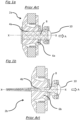
- Figure 1a shows a section view of a prior art high frequency tweeter 2a from a coaxial driver using this approach, in this case having a large vent tube or duct 4a leading through the motor, or drive unit, 6a away from the rear of the diaphragm 10 (in this case having a 25.4mm diameter).
- the cross-sectional area of the duct 4a should be as large as possible for the rear sound to propagate unimpeded (the sound radiated from the front of the diaphragm 10 travels toward the direction of the listener, as shown by arrow A, which is parallel to the rear-front axis XX of the tweeter 2a, duct 4a, drive unit 6a and diaphragm 10).
- the entire duct 4a is filled with an acoustically absorbent material 8, such as wadding or high density polyurethane foam.
- US2293181A describes a loudspeaker that attempts to achieve the above ideal using an exponentially tapering duct filled with lightweight porous wadding material.
- the tapering duct has an acoustic diaphragm located at its large end with a driver located in the centre of the horn and, at the smaller end of the horn and after the cross-sectional area of the horn has reduced to a constant value, the horn is filled with the sound absorbing wadding material.
- This style of midrange and high-frequency loudspeaker enclosure is now in wide use in high-quality loudspeakers. However, in order to achieve low reflection over a wide bandwidth the tapered duct must be long.
- Figure 1b shows a section through such a known high-frequency driver 2b from another coaxial driver (with a 25.4mm diameter diaphragm 10 and again having a rear-front axis XX) using a 120mm long exponentially tapering duct 4b leading through the drive unit 6b to the rear enclosure.
- this duct 4b is again filled with a porous absorbent material 8, such as polyester fibre.
- a design such as this reflects approximately 30%, or -10dB, of the rear radiated sound at 2kHz, and is therefore an improvement over the design in Figure 1a in acoustic terms, but is significantly larger (particularly in depth, along the XX axis) than the Figure 1a design.
- GB2290672 discloses a loudspeaker system comprising several diaphragms and associated drivers, in which each of the drivers has an aperture through which, in use, sound from the rearward side of the diaphragm passes.
- JP 2016 082313 discloses a compression driver capable of reducing the standing-wave of a sound generated in the back cavity of a horn loudspeaker.
- a back cover provided behind and spaced from the diaphragm on the other side of which is a phase plug.
- Hollow acoustic bodies extend from the rear of the back cover so as to interconnect with the space between the diaphragm and the back cover.
- the acoustic bodies have a length equal to 1/4 of the wavelength of a standing wave to be suppressed in the back cavity.
- US10453438 discloses the use in broad band noise reduction systems of acoustic metamaterial as a resonator within a speaker enclosure to reduce the amplitude of unwanted amplification by the audio reducing sound generated by the speaker.
- the present invention is predicated on using acoustic metamaterials as the absorbing material, and on incorporating such materials in a design specifically tailored to reduce reflection of rear radiated sound in a small overall volume.
- a metamaterial is a material engineered to have a property that is not found in naturally occurring materials
- an acoustic metamaterial is a man-made material which has superior damping or vibro-acoustic characteristics compared to conventional damping materials. These improved characteristics comprise damping or absorbing sound or pressure to a greater extent than conventional absorbers, and/or over a greater variety or range of frequencies; these improved properties are often due to the structure of the metamaterial rather than its material composition.
- Such structural metamaterials are made from assemblies of multiple elements fashioned from composite materials such as metals and plastics.
- the materials are often arranged in repeating patterns, and are at a scale that is smaller than the wavelengths of the phenomena they influence; in the present invention, acoustic wavelengths across the usual audible frequency range, between about 20Hz and 20kHz.
- the precise shape, geometry, size, orientation and arrangement of the elements of acoustic metamaterials gives them their smart properties, capable of manipulating acoustic waves by blocking, absorbing, enhancing, or bending the waves.
- Structural acoustic metamaterials are known, for example from US 2014/0027201 and WO 2018/047153 .
- Metamaterial absorbers offer much higher absorption at comparable sizes to conventional absorbers, such as the tapered tube.
- the devices outlined in WO 2018/047153 have a length of about 11cm, and reflect (approximately) only 2% of the incident sound at 2kHz.
- Other, non-structural metamaterials comprise a plurality of active and/or mechanical components, such as a number of MEMs (Micro-Electro-Mechanical systems) diaphragms each with tuned mass, stiffness and mechanical resistance, and such non-structural metamaterials provide an acoustic absorption of specific impedance.
- MEMs Micro-Electro-Mechanical systems
- the present invention is not limited to structural metamaterials, but instead may be carried out using any kind of metamaterial.
- a metamaterial absorber is typically composed of a number of narrow acoustical channels of various different lengths, shapes, orientations and/or cross-sectional areas.
- the metamaterial absorbent surface is formed by closely spaced walls forming ducts, or channels as we will refer to them here. These channels are usually sufficiently narrow for viscous effects of the air to dissipate acoustic energy. Often (as in WO2018047153A1 ) these channels are folded to create a compact overall structure. In most cases a significant portion of the acoustical dissipation comes from air viscosity in these narrow channels, and therefore it is important that the channels are extremely narrow to attain optimum results. The manufacture of such an arrangement is complicated.
- the structural walls that form the channels through the metamaterial occupy volume and, in some arrangements, this can reduce the effectiveness of the absorber.
- a straightforward approach to improving existing designs would be to incorporate a metamaterial into a loudspeaker, by placing the metamaterial directly behind the diaphragm (e.g. so as to replace the material 8 shown in Figures 1a and 1b with the same physical arrangement of metamaterial). The benefit of this approach is that the acoustical behaviour of the enclosure can be almost entirely dictated by the metamaterial.
- the space directly behind the diaphragm 10 is limited by the dimensions of the duct 4a, 4b, which are determined by the design of the drive unit 6a, 6b.
- the present invention therefore provides a loudspeaker comprising the set of features defined in claim 1.
- the rear sound is channelled from the diaphragm to the metamaterial through a large area and low impedance duct with minimal or no porous acoustic wadding.
- This arrangement is very effective at allowing the majority of the rear-radiated sound to propagate to the metamaterial absorber, which in turn can be located further away from the diaphragm in an area where space is available, thereby allowing much more freedom over the metamaterial design and mechanical construction.
- the metamaterial absorber can be designed to have extremely low reflection, this arrangement makes the effect of even a small reflection by the metamaterial much more problematic.
- a significant proportion of the absorbent surface is formed by the walls separating adjacent channels, but these walls decrease the 'opening area' of the channels making it smaller than the 'opening area' of the driver duct* resulting in reflections.
- the duct 'opening area' is the "long-wavelength wavefront area' within an infinitely extending duct at the position of the opening). It is not always the case, however, that the metamaterial effective open area should match the duct open area. To get the best impedance match it is sometimes helpful to have a slight mismatch in the physical areas (to compensate for different acoustic materials or for viscosity in the meta-material).
- the characteristic impedance of the wave travelling in the duct must match the acoustic impedance of the metamaterial absorber.
- Any fully enclosed and finite size acoustical absorber, including a metamaterial absorber has zero absorption at very low frequencies. From this it follows that the real part of the acoustic impedance of the absorber will also be zero at very low frequencies.
- any fully enclosed, finite size acoustic absorber will have a low frequency impedance that has a negative imaginary part due to the acoustical compliance of the enclosed volume.
- a duct with constant cross-section as shown in Figure 1a , carries a plane acoustical wave with a characteristic impedance that has zero imaginary part and a constant real part. Consequently a constant cross-section duct cannot minimise the impedance mis-match or the magnitude of the reflected sound.
- the characteristic impedance requirement to have zero real part at low frequencies and a negative imaginary part, means that the duct necessarily must have a cross sectional area that reduces as the wave propagates from the diaphragm to the metamaterial absorber.
- the front surface of the acoustic metamaterial absorber may be located at the opening at the rearward end of the or each open duct.
- the metamaterial behind the opening at the rearward end of the or each open duct has a size perpendicular to the front-rear direction, greater than the size of the opening at the rearward end of the or each open duct.
- the length of the metamaterial in the front-rear direction can be less than its size perpendicular to the front-rear direction; this allows the metamaterial to be in the form of a thin block or sheet, so as to be able to minimise the axial length of the loudspeaker.
- the cross-sectional area of the or each open duct may taper or decrease linearly in a rearward direction to the opening at its rearward end; in such cases, the duct leading forwardly from the opening at the rear end of the duct can be conically tapered (as defined below).
- the acoustic metamaterial may be partially contained within the or each duct, or the or each open duct may have an opening at its rearward end, the front surface of the acoustic metamaterial absorber being located at this opening.
- Such arrangements effectively move the metamaterial absorber away from the rear of the diaphragm, so that the metamaterial is located behind the drive unit where there is more space and freeing up room immediately behind the diaphragm for other loudspeaker elements.
- the drive unit and the at least one open duct may be located to the rear of the diaphragm and the at least one open duct may extend through the drive unit in a rearward direction, away from the diaphragm, with the front surface of the acoustic metamaterial absorber being located generally to the rear of the drive unit.
- the drive unit may be located outside and/or forwardly of the diaphragm; in this case, the open duct would not pass though the drive unit but would still extend rearwardly of the diaphragm, and the metamaterial would be located at or adjacent the rearward end of the duct.
- the or each open duct preferably tapers conically towards the front surface of the acoustic metamaterial absorber, in a right or oblique cone. Additionally or alternatively the or each open duct might have walls which taper inwardly in a curve towards the front surface of the acoustic metamaterial absorber.
- the or each duct may comprise walls which taper conically, and taper inwardly in a curve, in successive sections. Where the walls taper inwardly in a curve, the walls continue to define a conic taper because the cross-sectional area of the duct preferably reduces in size linearly in the direction of the metamaterial absorber.
- each duct may lead to a separate acoustic metamaterial absorber.
- the plurality of open ducts can be arranged in a matrix or in a ring and/or, where the plurality of open ducts is arranged in a ring, the ring can be circular.
- the or each open duct may have a constant cross-sectional shape, which may be circular. it is preferred that the or each open duct does not contain sound absorbent material (although in some applications such material may have benefits).
- the diaphragm can be a dome or conical diaphragm; in the latter case the duct(s) is/are preferably located outside of the tweeter drive unit and behind the diaphragm in an annular or ring-like arrangement.
- the invention also provides a method of designing a loudspeaker as described above in which one or more of the length, one or both end areas, the resonance frequency and the resonant strengths of the or each open duct are adjusted so as to allow the acoustic impedance of the acoustic metamaterial absorber substantially to match the characteristic acoustic impedance of acoustic waves radiated from the rear surface of the diaphragm at the point they contact the surface of the acoustic metamaterial absorber.
- Figure 1a shows a high-frequency driver with a 25.4mm diameter diaphragm using a large central vent tube/duct filled with dense acoustical wadding.
- Figure 1b shows a high-frequency driver with a 25.4mm diameter diaphragm using a 120mm long, exponentially tapering duct which is also filled with dense acoustical wadding.
- FIG. 2 shows in cross-section a tweeter 20 forming part of a coaxial driver with a highly effective arrangement according to this invention.
- the conical duct 24 through the drive unit 26 connecting the 25.4mm diameter diaphragm 10 to the front surface 30 of the acoustic metamaterial 28 results in a spherical contracting acoustical wave with radius 146.4mm at the front surface 30 of the metamaterial 28.
- the characteristic acoustical impedance of this wave is a close match to the impedance of the metamaterial described in WO 2018/047153 when a design frequency of 600Hz is used.
- the impedance match in this case is not perfect and only over a limited bandwidth but it is enough that the reflection issue is almost totally solved to the extent that it is not a limiting factor in the tweeter performance.
- a tapering duct is also very practical for a number of reasons:
- Figure 2 shows that the metamaterial 28 not only extends axially in a rearward direction (to the left as shown) behind the duct 24, but also that it extends radially from the XX axis to a substantially greater extent than the radius of the conical duct 24.
- the narrow acoustic channels (not shown) forming the metamaterial have at least a part of their lengths oriented radially (or with a substantially radial component); this allows the axial dimensions of the loudspeaker to be kept small.
- the radial parts of the channels may be folded, so as to incorporate channels of greater overall length within a short axial distance.
- the metamaterial 28 is shown as having a front surface 30 which extends across the open rear end of the duct 24; this front surface may be formed by the ends of the structural walls which form the narrow channels, so that there is a physical, albeit discontinuous, surface extending across the open end of the duct 24.
- this front surface may be formed by the ends of the structural walls which form the narrow channels, so that there is a physical, albeit discontinuous, surface extending across the open end of the duct 24.
- this interface volume is shaped to have at least a part facing outwardly radially or substantially radially so as to direct acoustic waves in or approaching a radial direction.
- the interface volume could for example, be part spherical, domed or even cylindrical (provided that there is always at least a solid rear boundary 31 to the metamaterial 28 (at the left hand broken vertical line in the drawing); the significant design element of this interface volume is that its impedance matches the end of the conical duct.
- reference herein to the "front surface" of the metamaterial embraces not only cases where there is a physical albeit discontinuous surface of metamaterial structure extending radially across the open rear end of the duct 24, but also where there is only a virtual surface extending radially across the open rear end of the duct 24 (i.e. where there is an interface volume within that part of the metamaterial immediately adjacent the open rear end of the duct 24).
- the front surface of the metamaterial outside the interface volume/the open rear end of the duct seals against the rear structure of the tweeter 20 as shown to prevent acoustic energy from travelling other than through the narrow channels - to be dissipated therein.
- FIG 3 an alternative loudspeaker arrangement 320 is shown which is in accordance with the invention, in which the drive unit 326 is located forwardly and radially outside the diaphragm 310.
- the diaphragm 310 is curved in the opposite direction to that shown in Figure 2 , so that its concave surface radiates sound in the direction of arrow A towards the listener, this sound passing through passages in a phase plug 336, leaving the driver opening 334 and passing through acoustic horn 332.
- the duct 324 extending rearwardly of the diaphragm 310 is initially curved in profile, and initially it enlarges in cross-sectional area, before curving inwardly and tapering towards the metamaterial 328, the front surface of which 330 is located at the end of the duct 324.
- the embodiment above is described as having one or more circular, conical ducts; however, the invention applies equally to non-circular arrangements, such as oval, elliptical or race track shaped (figure of eight, or triangular/square/polygonal with rounded corners), or any shape being symmetrical in one or two orthogonal directions lying in the general plane perpendicular to the front-rear axis A, as well as combinations of such arrangements and/or shapes.
- the duct(s) may be conical, with straight walls, or the walls may be curved (e.g. exponentially, elliptical, hyperbolic or parabolic).
- Conical ducts may be right cones or oblique cones. There may be an annular arrangement of several ducts, which may be parallel, or arranged as a tapering or an enlarging right cone or oblique cone. Where several ducts are provided, there may be separate and/or different acoustic metamaterials provided at the rear end of each different duct.
- the metamaterial could intrude into a duct, such that the front surface of the metamaterial extends forwardly inside the duct, a short distance forward of its rearward end; this might be for acoustic reasons, or to help accurately locate the metamaterial relative to the duct (such as where there are multiple ducts, the metamaterial might be shaped with protrusions to engage with the rearward ends of some or all of the ducts.
- Different types of metamaterials may be combined in an embodiment, and the multiple elements forming the metamaterial may repeat or they may be different in shape, dimension or structure.
- each tapering duct may comprise portions which taper conically in combination with portions which taper in a curved profile, provided that the tapering of the duct in the vicinity of the front surface of the metamaterial is conical as described above.
Landscapes
- Engineering & Computer Science (AREA)
- Physics & Mathematics (AREA)
- Acoustics & Sound (AREA)
- Signal Processing (AREA)
- Health & Medical Sciences (AREA)
- Otolaryngology (AREA)
- Multimedia (AREA)
- Manufacturing & Machinery (AREA)
- Details Of Audible-Bandwidth Transducers (AREA)
- Obtaining Desirable Characteristics In Audible-Bandwidth Transducers (AREA)
Applications Claiming Priority (2)
| Application Number | Priority Date | Filing Date | Title |
|---|---|---|---|
| GB1919144.4A GB2590656A (en) | 2019-12-23 | 2019-12-23 | Loudspeakers |
| GB2017429.8A GB2590785B (en) | 2019-12-23 | 2020-11-04 | Loudspeakers |
Publications (2)
| Publication Number | Publication Date |
|---|---|
| EP3843420A1 EP3843420A1 (en) | 2021-06-30 |
| EP3843420B1 true EP3843420B1 (en) | 2025-03-19 |
Family
ID=69322873
Family Applications (1)
| Application Number | Title | Priority Date | Filing Date |
|---|---|---|---|
| EP20216692.2A Active EP3843420B1 (en) | 2019-12-23 | 2020-12-22 | Loudspeakers |
Country Status (5)
| Country | Link |
|---|---|
| US (1) | US11647326B2 (https=) |
| EP (1) | EP3843420B1 (https=) |
| JP (1) | JP7417512B2 (https=) |
| CN (1) | CN113099368B (https=) |
| GB (2) | GB2590656A (https=) |
Families Citing this family (3)
| Publication number | Priority date | Publication date | Assignee | Title |
|---|---|---|---|---|
| US12587780B1 (en) | 2021-08-19 | 2026-03-24 | Dan Clark Audio Inc. | Rear side acoustic metamaterial compensation system |
| KR20230064909A (ko) * | 2021-11-04 | 2023-05-11 | 엘지디스플레이 주식회사 | 장치 |
| CN118124482B (zh) * | 2024-05-08 | 2024-09-03 | 苏州上声电子股份有限公司 | 一种车载发声装置、车载行人警示器及车载警示系统 |
Family Cites Families (23)
| Publication number | Priority date | Publication date | Assignee | Title |
|---|---|---|---|---|
| US2293181A (en) * | 1940-07-17 | 1942-08-18 | Int Standard Electric Corp | Sound absorbing apparatus |
| GB547922A (en) * | 1940-07-17 | 1942-09-17 | Standard Telephones Cables Ltd | Sound absorbing apparatus |
| GB864683A (en) * | 1958-04-08 | 1961-04-06 | Decca Record Co Ltd | Improvements in or relating to loudspeakers |
| US5548657A (en) | 1988-05-09 | 1996-08-20 | Kef Audio (Uk) Limited | Compound loudspeaker drive unit |
| GB2290672A (en) * | 1995-09-08 | 1996-01-03 | B & W Loudspeakers | Loudspeaker systems |
| GB2324928B (en) * | 1997-05-02 | 2001-09-12 | B & W Loudspeakers | Loudspeaker systems |
| US6771787B1 (en) * | 1998-09-03 | 2004-08-03 | Bose Corporation | Waveguide electroacoustical transducing |
| US7325649B1 (en) * | 1999-09-23 | 2008-02-05 | Farnsworth & Budge, Llc | Loudspeaker with progressively damped acoustical chamber |
| JP2003032774A (ja) * | 2001-07-19 | 2003-01-31 | Matsushita Electric Ind Co Ltd | スピーカシステム |
| JP2004072140A (ja) * | 2002-08-01 | 2004-03-04 | Hiroshi China | 全指向性バックロードホーン型スピーカー |
| GB2423908B (en) | 2005-03-02 | 2008-04-02 | Kh Technology Corp | Loudspeaker |
| DK2040483T3 (da) * | 2007-09-21 | 2013-06-03 | Laurence George Dickie | Port-højtalerkabinet med konisk bølgelederabsorber |
| WO2012106327A1 (en) * | 2011-01-31 | 2012-08-09 | Wayne State University | Acoustic metamaterials |
| JP2016082313A (ja) * | 2014-10-14 | 2016-05-16 | ヤマハ株式会社 | コンプレッションドライバおよびホーンスピーカ |
| US9906198B2 (en) * | 2015-03-20 | 2018-02-27 | Nokia Technologies Oy | Narrowing audio filter transition band |
| FR3034564B1 (fr) * | 2015-04-02 | 2017-04-28 | Focal Jmlab | Dispositif d'adaptation d'impedance acoustique et haut-parleur equipe d'un tel dispositif |
| CN105142074B (zh) * | 2015-08-19 | 2019-03-12 | 歌尔股份有限公司 | 扬声器模组 |
| WO2018047153A1 (en) * | 2016-09-12 | 2018-03-15 | Acoustic Metamaterials Group Limited | Acoustic metamaterial sound absorber |
| US10032445B1 (en) * | 2016-12-13 | 2018-07-24 | Northrop Grumman Systems Corporation | Honeycomb unit cell acoustic metamaterial with in situ buttresses for tuned acoustic frequency attenuation |
| GB2567673B (en) * | 2017-10-20 | 2022-01-26 | Gp Acoustics International Ltd | Loudspeaker |
| US10453438B1 (en) * | 2018-05-30 | 2019-10-22 | The Boeing Company | Methods and systems for broad-band active noise reduction |
| GB201905258D0 (en) * | 2019-04-12 | 2019-05-29 | Univ Of Sussex | acoustic metamaterial systems |
| EP3984019B1 (en) * | 2019-06-13 | 2024-08-21 | Ask Industries Societa' per Azioni | High-performance sound generating system for vehicles |
-
2019
- 2019-12-23 GB GB1919144.4A patent/GB2590656A/en not_active Withdrawn
-
2020
- 2020-11-04 GB GB2017429.8A patent/GB2590785B/en active Active
- 2020-12-22 US US17/130,678 patent/US11647326B2/en active Active
- 2020-12-22 EP EP20216692.2A patent/EP3843420B1/en active Active
- 2020-12-23 JP JP2020213651A patent/JP7417512B2/ja active Active
- 2020-12-23 CN CN202011538077.6A patent/CN113099368B/zh active Active
Also Published As
| Publication number | Publication date |
|---|---|
| CN113099368A (zh) | 2021-07-09 |
| JP2021100245A (ja) | 2021-07-01 |
| GB2590785A (en) | 2021-07-07 |
| EP3843420A1 (en) | 2021-06-30 |
| US20210195316A1 (en) | 2021-06-24 |
| CN113099368B (zh) | 2024-07-23 |
| GB202017429D0 (en) | 2020-12-16 |
| GB2590785B (en) | 2023-11-01 |
| JP7417512B2 (ja) | 2024-01-18 |
| GB2590656A (en) | 2021-07-07 |
| US11647326B2 (en) | 2023-05-09 |
| GB201919144D0 (en) | 2020-02-05 |
Similar Documents
| Publication | Publication Date | Title |
|---|---|---|
| EP3843420B1 (en) | Loudspeakers | |
| EP3135043B1 (en) | Coaxial loudspeaker apparatus | |
| US7039211B2 (en) | Horn-loaded compression driver system | |
| US7920712B2 (en) | Coaxial mid-frequency and high-frequency loudspeaker | |
| EP3383060B1 (en) | Speaker device | |
| EP0984662A2 (en) | Waveguide electroacoustical transducing | |
| TWI483621B (zh) | 揚聲器組合及其相位錐 | |
| EP3501184A1 (en) | Compression driver and phasing plug assembly therefor | |
| JP2005503742A (ja) | スピーカシステム | |
| US20190058954A1 (en) | Layered speaker assembly | |
| KR20220054874A (ko) | 도파관을 갖는 지향성 멀티웨이 라우드스피커 | |
| AU747905B2 (en) | Loudspeaker systems | |
| CN101185367B (zh) | 扬声器 | |
| US11265630B2 (en) | Layered speaker diaphragm with a first perforated layer | |
| WO2000028780A1 (en) | Loudspeakers comprising a phase uncorrelated diffuse sound source | |
| CN110012397B (zh) | 一种扬声器 | |
| US6334505B1 (en) | Optimum edges for speakers and musical instruments | |
| HK40057420A (en) | Loudspeakers | |
| US20050254681A1 (en) | Loudspeaker | |
| HK40057420B (zh) | 扬声器和设计扬声器的方法 | |
| CN117643071A (zh) | 包含超材料的减少声衍射的扬声器 | |
| WO2025251216A1 (en) | Sound output assembly | |
| CN121600893A (zh) | 用于avas应用的具有声学透镜效应的穿孔压缩腔室 |
Legal Events
| Date | Code | Title | Description |
|---|---|---|---|
| PUAI | Public reference made under article 153(3) epc to a published international application that has entered the european phase |
Free format text: ORIGINAL CODE: 0009012 |
|
| STAA | Information on the status of an ep patent application or granted ep patent |
Free format text: STATUS: THE APPLICATION HAS BEEN PUBLISHED |
|
| AK | Designated contracting states |
Kind code of ref document: A1 Designated state(s): AL AT BE BG CH CY CZ DE DK EE ES FI FR GB GR HR HU IE IS IT LI LT LU LV MC MK MT NL NO PL PT RO RS SE SI SK SM TR |
|
| STAA | Information on the status of an ep patent application or granted ep patent |
Free format text: STATUS: REQUEST FOR EXAMINATION WAS MADE |
|
| 17P | Request for examination filed |
Effective date: 20211109 |
|
| RBV | Designated contracting states (corrected) |
Designated state(s): AL AT BE BG CH CY CZ DE DK EE ES FI FR GB GR HR HU IE IS IT LI LT LU LV MC MK MT NL NO PL PT RO RS SE SI SK SM TR |
|
| STAA | Information on the status of an ep patent application or granted ep patent |
Free format text: STATUS: EXAMINATION IS IN PROGRESS |
|
| 17Q | First examination report despatched |
Effective date: 20230322 |
|
| GRAP | Despatch of communication of intention to grant a patent |
Free format text: ORIGINAL CODE: EPIDOSNIGR1 |
|
| STAA | Information on the status of an ep patent application or granted ep patent |
Free format text: STATUS: GRANT OF PATENT IS INTENDED |
|
| RIC1 | Information provided on ipc code assigned before grant |
Ipc: G10K 11/02 20060101ALN20241010BHEP Ipc: H04R 31/00 20060101ALN20241010BHEP Ipc: G10K 11/00 20060101ALI20241010BHEP Ipc: H04R 9/02 20060101ALI20241010BHEP Ipc: H04R 1/36 20060101ALI20241010BHEP Ipc: H04R 1/28 20060101AFI20241010BHEP |
|
| INTG | Intention to grant announced |
Effective date: 20241021 |
|
| RIC1 | Information provided on ipc code assigned before grant |
Ipc: G10K 11/02 20060101ALN20241014BHEP Ipc: H04R 31/00 20060101ALN20241014BHEP Ipc: G10K 11/00 20060101ALI20241014BHEP Ipc: H04R 9/02 20060101ALI20241014BHEP Ipc: H04R 1/36 20060101ALI20241014BHEP Ipc: H04R 1/28 20060101AFI20241014BHEP |
|
| GRAS | Grant fee paid |
Free format text: ORIGINAL CODE: EPIDOSNIGR3 |
|
| GRAA | (expected) grant |
Free format text: ORIGINAL CODE: 0009210 |
|
| STAA | Information on the status of an ep patent application or granted ep patent |
Free format text: STATUS: THE PATENT HAS BEEN GRANTED |
|
| AK | Designated contracting states |
Kind code of ref document: B1 Designated state(s): AL AT BE BG CH CY CZ DE DK EE ES FI FR GB GR HR HU IE IS IT LI LT LU LV MC MK MT NL NO PL PT RO RS SE SI SK SM TR |
|
| RAP3 | Party data changed (applicant data changed or rights of an application transferred) |
Owner name: GP ACOUSTICS INTERNATIONAL LIMITED |
|
| REG | Reference to a national code |
Ref country code: GB Ref legal event code: FG4D |
|
| P01 | Opt-out of the competence of the unified patent court (upc) registered |
Free format text: CASE NUMBER: APP_7870/2025 Effective date: 20250217 |
|
| REG | Reference to a national code |
Ref country code: CH Ref legal event code: EP |
|
| REG | Reference to a national code |
Ref country code: IE Ref legal event code: FG4D |
|
| REG | Reference to a national code |
Ref country code: DE Ref legal event code: R096 Ref document number: 602020047869 Country of ref document: DE |
|
| PG25 | Lapsed in a contracting state [announced via postgrant information from national office to epo] |
Ref country code: RS Free format text: LAPSE BECAUSE OF FAILURE TO SUBMIT A TRANSLATION OF THE DESCRIPTION OR TO PAY THE FEE WITHIN THE PRESCRIBED TIME-LIMIT Effective date: 20250619 |
|
| PG25 | Lapsed in a contracting state [announced via postgrant information from national office to epo] |
Ref country code: FI Free format text: LAPSE BECAUSE OF FAILURE TO SUBMIT A TRANSLATION OF THE DESCRIPTION OR TO PAY THE FEE WITHIN THE PRESCRIBED TIME-LIMIT Effective date: 20250319 |
|
| REG | Reference to a national code |
Ref country code: LT Ref legal event code: MG9D |
|
| PG25 | Lapsed in a contracting state [announced via postgrant information from national office to epo] |
Ref country code: NO Free format text: LAPSE BECAUSE OF FAILURE TO SUBMIT A TRANSLATION OF THE DESCRIPTION OR TO PAY THE FEE WITHIN THE PRESCRIBED TIME-LIMIT Effective date: 20250619 |
|
| PG25 | Lapsed in a contracting state [announced via postgrant information from national office to epo] |
Ref country code: HR Free format text: LAPSE BECAUSE OF FAILURE TO SUBMIT A TRANSLATION OF THE DESCRIPTION OR TO PAY THE FEE WITHIN THE PRESCRIBED TIME-LIMIT Effective date: 20250319 |
|
| PG25 | Lapsed in a contracting state [announced via postgrant information from national office to epo] |
Ref country code: LV Free format text: LAPSE BECAUSE OF FAILURE TO SUBMIT A TRANSLATION OF THE DESCRIPTION OR TO PAY THE FEE WITHIN THE PRESCRIBED TIME-LIMIT Effective date: 20250319 |
|
| PG25 | Lapsed in a contracting state [announced via postgrant information from national office to epo] |
Ref country code: GR Free format text: LAPSE BECAUSE OF FAILURE TO SUBMIT A TRANSLATION OF THE DESCRIPTION OR TO PAY THE FEE WITHIN THE PRESCRIBED TIME-LIMIT Effective date: 20250620 Ref country code: BG Free format text: LAPSE BECAUSE OF FAILURE TO SUBMIT A TRANSLATION OF THE DESCRIPTION OR TO PAY THE FEE WITHIN THE PRESCRIBED TIME-LIMIT Effective date: 20250319 |
|
| REG | Reference to a national code |
Ref country code: NL Ref legal event code: MP Effective date: 20250319 |
|
| REG | Reference to a national code |
Ref country code: AT Ref legal event code: MK05 Ref document number: 1777963 Country of ref document: AT Kind code of ref document: T Effective date: 20250319 |
|
| PG25 | Lapsed in a contracting state [announced via postgrant information from national office to epo] |
Ref country code: NL Free format text: LAPSE BECAUSE OF FAILURE TO SUBMIT A TRANSLATION OF THE DESCRIPTION OR TO PAY THE FEE WITHIN THE PRESCRIBED TIME-LIMIT Effective date: 20250319 |
|
| PG25 | Lapsed in a contracting state [announced via postgrant information from national office to epo] |
Ref country code: SE Free format text: LAPSE BECAUSE OF FAILURE TO SUBMIT A TRANSLATION OF THE DESCRIPTION OR TO PAY THE FEE WITHIN THE PRESCRIBED TIME-LIMIT Effective date: 20250319 |
|
| PG25 | Lapsed in a contracting state [announced via postgrant information from national office to epo] |
Ref country code: SM Free format text: LAPSE BECAUSE OF FAILURE TO SUBMIT A TRANSLATION OF THE DESCRIPTION OR TO PAY THE FEE WITHIN THE PRESCRIBED TIME-LIMIT Effective date: 20250319 |
|
| PG25 | Lapsed in a contracting state [announced via postgrant information from national office to epo] |
Ref country code: ES Free format text: LAPSE BECAUSE OF FAILURE TO SUBMIT A TRANSLATION OF THE DESCRIPTION OR TO PAY THE FEE WITHIN THE PRESCRIBED TIME-LIMIT Effective date: 20250319 Ref country code: PT Free format text: LAPSE BECAUSE OF FAILURE TO SUBMIT A TRANSLATION OF THE DESCRIPTION OR TO PAY THE FEE WITHIN THE PRESCRIBED TIME-LIMIT Effective date: 20250721 |
|
| PG25 | Lapsed in a contracting state [announced via postgrant information from national office to epo] |
Ref country code: IT Free format text: LAPSE BECAUSE OF FAILURE TO SUBMIT A TRANSLATION OF THE DESCRIPTION OR TO PAY THE FEE WITHIN THE PRESCRIBED TIME-LIMIT Effective date: 20250319 Ref country code: PL Free format text: LAPSE BECAUSE OF FAILURE TO SUBMIT A TRANSLATION OF THE DESCRIPTION OR TO PAY THE FEE WITHIN THE PRESCRIBED TIME-LIMIT Effective date: 20250319 |
|
| PG25 | Lapsed in a contracting state [announced via postgrant information from national office to epo] |
Ref country code: AT Free format text: LAPSE BECAUSE OF FAILURE TO SUBMIT A TRANSLATION OF THE DESCRIPTION OR TO PAY THE FEE WITHIN THE PRESCRIBED TIME-LIMIT Effective date: 20250319 |
|
| PG25 | Lapsed in a contracting state [announced via postgrant information from national office to epo] |
Ref country code: CZ Free format text: LAPSE BECAUSE OF FAILURE TO SUBMIT A TRANSLATION OF THE DESCRIPTION OR TO PAY THE FEE WITHIN THE PRESCRIBED TIME-LIMIT Effective date: 20250319 Ref country code: EE Free format text: LAPSE BECAUSE OF FAILURE TO SUBMIT A TRANSLATION OF THE DESCRIPTION OR TO PAY THE FEE WITHIN THE PRESCRIBED TIME-LIMIT Effective date: 20250319 |
|
| PG25 | Lapsed in a contracting state [announced via postgrant information from national office to epo] |
Ref country code: RO Free format text: LAPSE BECAUSE OF FAILURE TO SUBMIT A TRANSLATION OF THE DESCRIPTION OR TO PAY THE FEE WITHIN THE PRESCRIBED TIME-LIMIT Effective date: 20250319 |
|
| PG25 | Lapsed in a contracting state [announced via postgrant information from national office to epo] |
Ref country code: SK Free format text: LAPSE BECAUSE OF FAILURE TO SUBMIT A TRANSLATION OF THE DESCRIPTION OR TO PAY THE FEE WITHIN THE PRESCRIBED TIME-LIMIT Effective date: 20250319 |
|
| PG25 | Lapsed in a contracting state [announced via postgrant information from national office to epo] |
Ref country code: IS Free format text: LAPSE BECAUSE OF FAILURE TO SUBMIT A TRANSLATION OF THE DESCRIPTION OR TO PAY THE FEE WITHIN THE PRESCRIBED TIME-LIMIT Effective date: 20250719 |
|
| REG | Reference to a national code |
Ref country code: DE Ref legal event code: R097 Ref document number: 602020047869 Country of ref document: DE |
|
| PGFP | Annual fee paid to national office [announced via postgrant information from national office to epo] |
Ref country code: DE Payment date: 20251114 Year of fee payment: 6 |
|
| PG25 | Lapsed in a contracting state [announced via postgrant information from national office to epo] |
Ref country code: DK Free format text: LAPSE BECAUSE OF FAILURE TO SUBMIT A TRANSLATION OF THE DESCRIPTION OR TO PAY THE FEE WITHIN THE PRESCRIBED TIME-LIMIT Effective date: 20250319 |
|
| PGFP | Annual fee paid to national office [announced via postgrant information from national office to epo] |
Ref country code: FR Payment date: 20251114 Year of fee payment: 6 |
|
| PLBE | No opposition filed within time limit |
Free format text: ORIGINAL CODE: 0009261 |
|
| STAA | Information on the status of an ep patent application or granted ep patent |
Free format text: STATUS: NO OPPOSITION FILED WITHIN TIME LIMIT |
|
| REG | Reference to a national code |
Ref country code: CH Ref legal event code: L10 Free format text: ST27 STATUS EVENT CODE: U-0-0-L10-L00 (AS PROVIDED BY THE NATIONAL OFFICE) Effective date: 20260128 |
|
| 26N | No opposition filed |
Effective date: 20251222 |