EP3843357A1 - Control method, information processing apparatus, and control program - Google Patents
Control method, information processing apparatus, and control program Download PDFInfo
- Publication number
- EP3843357A1 EP3843357A1 EP20204942.5A EP20204942A EP3843357A1 EP 3843357 A1 EP3843357 A1 EP 3843357A1 EP 20204942 A EP20204942 A EP 20204942A EP 3843357 A1 EP3843357 A1 EP 3843357A1
- Authority
- EP
- European Patent Office
- Prior art keywords
- server
- request
- certificate
- address
- terminal apparatus
- Prior art date
- Legal status (The legal status is an assumption and is not a legal conclusion. Google has not performed a legal analysis and makes no representation as to the accuracy of the status listed.)
- Granted
Links
Images







Classifications
-
- H—ELECTRICITY
- H04—ELECTRIC COMMUNICATION TECHNIQUE
- H04L—TRANSMISSION OF DIGITAL INFORMATION, e.g. TELEGRAPHIC COMMUNICATION
- H04L63/00—Network architectures or network communication protocols for network security
- H04L63/08—Network architectures or network communication protocols for network security for authentication of entities
- H04L63/0823—Network architectures or network communication protocols for network security for authentication of entities using certificates
-
- H—ELECTRICITY
- H04—ELECTRIC COMMUNICATION TECHNIQUE
- H04L—TRANSMISSION OF DIGITAL INFORMATION, e.g. TELEGRAPHIC COMMUNICATION
- H04L61/00—Network arrangements, protocols or services for addressing or naming
- H04L61/45—Network directories; Name-to-address mapping
- H04L61/4505—Network directories; Name-to-address mapping using standardised directories; using standardised directory access protocols
- H04L61/4511—Network directories; Name-to-address mapping using standardised directories; using standardised directory access protocols using domain name system [DNS]
-
- H—ELECTRICITY
- H04—ELECTRIC COMMUNICATION TECHNIQUE
- H04L—TRANSMISSION OF DIGITAL INFORMATION, e.g. TELEGRAPHIC COMMUNICATION
- H04L63/00—Network architectures or network communication protocols for network security
- H04L63/02—Network architectures or network communication protocols for network security for separating internal from external traffic, e.g. firewalls
- H04L63/0227—Filtering policies
- H04L63/0236—Filtering by address, protocol, port number or service, e.g. IP-address or URL
-
- H—ELECTRICITY
- H04—ELECTRIC COMMUNICATION TECHNIQUE
- H04L—TRANSMISSION OF DIGITAL INFORMATION, e.g. TELEGRAPHIC COMMUNICATION
- H04L63/00—Network architectures or network communication protocols for network security
- H04L63/14—Network architectures or network communication protocols for network security for detecting or protecting against malicious traffic
- H04L63/1441—Countermeasures against malicious traffic
-
- H—ELECTRICITY
- H04—ELECTRIC COMMUNICATION TECHNIQUE
- H04L—TRANSMISSION OF DIGITAL INFORMATION, e.g. TELEGRAPHIC COMMUNICATION
- H04L63/00—Network architectures or network communication protocols for network security
- H04L63/14—Network architectures or network communication protocols for network security for detecting or protecting against malicious traffic
- H04L63/1441—Countermeasures against malicious traffic
- H04L63/1466—Active attacks involving interception, injection, modification, spoofing of data unit addresses, e.g. hijacking, packet injection or TCP sequence number attacks
-
- H—ELECTRICITY
- H04—ELECTRIC COMMUNICATION TECHNIQUE
- H04L—TRANSMISSION OF DIGITAL INFORMATION, e.g. TELEGRAPHIC COMMUNICATION
- H04L63/00—Network architectures or network communication protocols for network security
- H04L63/20—Network architectures or network communication protocols for network security for managing network security; network security policies in general
-
- H—ELECTRICITY
- H04—ELECTRIC COMMUNICATION TECHNIQUE
- H04L—TRANSMISSION OF DIGITAL INFORMATION, e.g. TELEGRAPHIC COMMUNICATION
- H04L2463/00—Additional details relating to network architectures or network communication protocols for network security covered by H04L63/00
- H04L2463/145—Detection or countermeasures against cache poisoning
Definitions
- the embodiments discussed herein are related to a control method, an information processing apparatus, and a control program.
- DNS domain name system
- a sender server (hereinafter also called a sending server) that is going to transmit data to a server that is the transmission destination (hereinafter also called a transmission destination server) accesses a DNS server that manages the identification information pieces (such as domain names) and the IP addresses of servers with those associated with each other to obtain the IP address of the transmission destination server.
- the sending server transmits data to the IP address obtained from the DNS server to transmit the data to the transmission destination server.
- the attacks to a DNS server described above include, for example, rewriting of records managed by the DNS server and rewriting of routing tables managed by routers on networks.
- servers that transmit and receive data on the Internet may receive an IP address transmitted from an attacker's DNS server (hereinafter also called a fake DNS server), and this may make it impossible to ensure the security of communication.
- a fake DNS server an IP address transmitted from an attacker's DNS server
- control method for avoiding obtaining an IP address that is not a desired IP address.
- control method implemented by a computer which is configured to be operated as a terminal apparatus.
- the control method includes: transmitting, from the terminal apparatus to a first management server, a first request for transmission of a certificate of a first server, the first server being one of a plurality of servers, the first management server being configured to manage certificates for the plurality of servers; in response to the transmitting of the first request, receiving the certificate of the first server from the first management server; in response to the receiving of the certificate, determining a certificate authority by using information included in the received certificate, the certificate authority being a server from which the received certificate has been issued; and transmitting, from the terminal apparatus to the determined certificate authority, a second request for transmission of first address information on the first server.
- FIG. 1 is a diagram for explaining the configuration of the information processing system 10.
- the information processing system 10 illustrated in FIG. 1 includes a certificate authority server 1 which functions as a certificate authority for public keys, a communication destination server 2, a terminal apparatus (hereinafter also called an information processing apparatus) 3, a CT log server (hereinafter also called a first management server) 4, and a DNS server (hereinafter also called a second management server) 5.
- a certificate authority server 1 which functions as a certificate authority for public keys
- a communication destination server 2 hereinafter also called an information processing apparatus
- a CT log server hereinafter also called a first management server
- DNS server hereinafter also called a DNS server
- the information processing system 10 may have multiple servers (apparatuses) that have the same function.
- the terminal apparatus 3 is a personal computer (PC) with which the operator performs, for example, input of desired information. For example, when the operator inputs information indicating that data will be transmitted to the communication destination server 2, the terminal apparatus 3 accesses the communication destination server 2.
- PC personal computer
- the terminal apparatus 3 accesses the communication destination server 2
- the terminal apparatus 3 has to obtain the IP address of the communication destination server 2.
- the communication destination server 2 registers, for example, the IP address of the server itself in the DNS server 5 in advance, as illustrated in FIG. 1 .
- the terminal apparatus 3 accesses the communication destination server 2
- the terminal apparatus 3 inquires the IP address of the communication destination server 2 from the DNS server 5. After that, the terminal apparatus 3 accesses the IP address of the communication destination server 2 transmitted from the DNS server 5.
- the certificate authority server 1 when the certificate authority server 1 receives a request for issuance of the certificate for a public key (hereinafter simply called the certificate) from the communication destination server 2, the certificate authority server 1 issues the certificate to the communication destination server 2.
- the certificate authority server 1 registers the certificate for the communication destination server 2 in the certificate transparency (CT) log server 4.
- the CT log server 4 is a server that registers the certificates issued by each certificate authority server for the purpose of detecting erroneous issuance of certificates by certificate authority servers (including the certificate authority server 1), attacks to those certificate authority servers, and the like.
- the attacks to the DNS server include, for example, rewriting of records managed by the DNS server 5 and rewriting of routing tables managed by routers (not illustrated) disposed on networks.
- the terminal apparatus 3 may receive an IP address transmitted from a fake DNS server (not illustrated) (a fake IP address that is not the IP address of the communication destination server 2), and hence, there may be a case where the security of communication is not ensured.
- the DNS server 5 employs the DNS Security Extensions (DNSSEC) technique which adds a signature to the IP address to be transmitted to the terminal apparatus 3.
- DNS server 5 generates a signature from an IP address by using the signature key (not illustrated) of the DNS server 5, adds the generated signature to the IP address, and transmits it to the terminal apparatus 3.
- the terminal apparatus 3 confirms that the IP address received from the DNS server 5 agrees with the IP address restored from the signature by using the public key (not illustrated) of the DNS server 5.
- the DNS server 5 has to strictly manage the signature key in a safe place in the DNS server 5 (hereinafter also called a storage place). In this case, every time a change or the like in the IP address of the communication destination server 2 occurs, the DNS server 5 has to take the signature key out of the storage place to perform processing on it. Hence, in the case of employing the DNSSEC technique as above, the cost for managing the signature key in the DNS server 5 is high.
- the terminal apparatus 3 in the present embodiment transmits a request for transmission of the certificate for the communication destination server 2, to the CT log server 4 which manages certificates for multiple servers.
- the terminal apparatus 3 determines the certificate authority server 1 that issued the received certificate based on information included in the received certificate. After that, the terminal apparatus 3 transmits a request for transmission of the IP address of the communication destination server 2 to the determined certificate authority server 1.
- the terminal apparatus 3 in the present embodiment obtains the IP address of the communication destination server 2 without inquiring the IP address from the DNS server 5.
- FIG. 2 is a diagram for explaining the hardware configuration of the terminal apparatus 3.
- the terminal apparatus 3 includes a CPU 301 which is a processor, a memory 302, a communication device 303, and a storage medium 304. Those components are coupled to one another via a bus 305.
- the storage medium 304 has, for example, a program storage area (not illustrated) for storing a program 310 to perform processing that controls obtaining of the IP address of the communication destination server 2 (hereinafter also called control processing).
- the storage medium 304 also has, for example, a storage section 330 (hereinafter also called an information storage area 330) that stores information that is used when the control processing is performed.
- the storage medium 304 may be, for example, a hard disk drive (HDD) or a solid-state drive (SSD).
- the CPU 301 executes the program 310 loaded from the storage medium 304 into the memory 302 to perform the control processing.
- the communication device 303 performs communication with the communication destination server 2 and others via a network NW.
- FIG. 3 is a diagram for explaining the hardware configuration of the CT log server 4.
- the CT log server 4 includes a CPU 401 which is a processor, a memory 402, a communication device 403, and a storage medium 404. Those components are coupled to one another via a bus 405.
- the storage medium 404 includes, for example, a program storage area (not illustrated) for storing a program 410 to perform control processing.
- the storage medium 404 also includes, for example, a storage section 430 (hereinafter also called an information storage area 430) that stores information that is used when the control processing is performed.
- the storage medium 404 may be, for example, an HDD or an SSD.
- the CPU 401 executes the program 410 loaded from the storage medium 404 into the memory 402 to perform the control processing.
- the communication device 403 performs communication with the terminal apparatus 3 and others via the network NW.
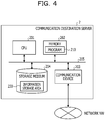
- FIG. 4 is a diagram for explaining the hardware configuration of the communication destination server 2.
- the communication destination server 2 includes a CPU 201 which is a processor, a memory 202, a communication device 203, and a storage medium 204. Those components are coupled to one another via a bus 205.
- the storage medium 204 includes, for example, a program storage area (not illustrated) for storing a program 210 to perform control processing.
- the storage medium 204 also includes, for example, a storage section 230 (hereinafter also called an information storage area 230) that stores information that is used when the control processing is performed.
- the storage medium 204 may be, for example, an HDD or an SSD.
- the CPU 201 executes the program 210 loaded from the storage medium 204 into the memory 202 to perform the control processing.
- the communication device 203 performs communication with the terminal apparatus 3 and others via the network NW.
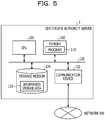
- FIG. 5 is a diagram for explaining the hardware configuration of the certificate authority server 1.
- the certificate authority server 1 includes a CPU 101 which is a processor, a memory 102, a communication device 103, and a storage medium 104. Those components are coupled to one another via a bus 105.
- the storage medium 104 includes, for example, a program storage area (not illustrated) for storing a program 110 to perform control processing.
- the storage medium 104 also includes, for example, a storage section 130 (hereinafter also called an information storage area 130) that stores information that is used when the control processing is performed.
- the storage medium 104 may be, for example, an HDD or an SSD.
- the CPU 101 executes the program 110 loaded from the storage medium 104 into the memory 102 to perform the control processing.
- the communication device 103 performs communication with the terminal apparatus 3 and others via the network NW.
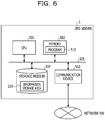
- FIG. 6 is a diagram for explaining the hardware configuration of the DNS server 5.
- the DNS server 5 includes a CPU 501 which is a processor, a memory 502, a communication device 503, and a storage medium 504. Those components are coupled to one another via a bus 505.
- the storage medium 504 includes, for example, a program storage area (not illustrated) for storing a program 510 to perform control processing.
- the storage medium 504 also includes, for example, a storage section 530 (hereinafter also called an information storage area 530) that stores information that is used when the control processing is performed.
- the storage medium 504 may be, for example, an HDD or an SSD.
- the CPU 501 executes the program 510 loaded from the storage medium 504 into the memory 502 to perform the control processing.
- the communication device 503 performs communication with the terminal apparatus 3 and others via the network NW.
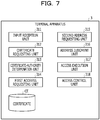
- FIG. 7 is a block diagram of functions of the terminal apparatus 3.
- the terminal apparatus 3 for example, hardware including the CPU 301 and the memory 302 and the program 310 work together organically to implement various functions including an input reception unit 311, certificate requesting unit 312, certificate-authority determination unit 313, first address requesting unit 314, second address requesting unit 315, address judgment unit 316, access execution unit 317, and access control unit 318.
- the terminal apparatus 3 for example, stores certificates CE in the information storage area 330, as illustrated in FIG. 7 .
- the input reception unit 31 receives an input of a request for access to the communication destination server 2.
- the certificate requesting unit 312 transmits a request for transmission of the certificate CE for the communication destination server 2 to the CT log server 4 which manages certificates CE for multiple servers.
- the certificate requesting unit 312 receives the certificate CE for the communication destination server 2 transmitted from the CT log server 4. After that, the certificate requesting unit 312, for example, stores the received certificate CE for the communication destination server 2 in the information storage area 330.
- the certificate-authority determination unit 313 determines the certificate authority server 1 that issued the certificate CE for the communication destination server 2, based on information included in the certificate CE for the communication destination server 2 received by the certificate requesting unit 312.
- the first address requesting unit 314 transmits a request for transmission of the IP address of the communication destination server 2 to the certificate authority server 1 determined by the certificate-authority determination unit 313.
- the first address requesting unit 314 receives the IP address of the communication destination server 2 transmitted from the certificate authority server 1.
- the second address requesting unit 315 transmits a request for transmission of the IP address of the communication destination server 2 to the DNS server 5 which manages the IP addresses and the identification information pieces (for example, domain names or the like) of servers (including the communication destination server 2) with those associated with each other. For example, the second address requesting unit 315 transmits a request for transmission of the IP address of the communication destination server 2 and also the FQDN of the communication destination server 2, to the DNS server 5. The second address requesting unit 315 receives the IP address of the communication destination server 2 transmitted from the DNS server 5.
- the DNS server 5 which manages the IP addresses and the identification information pieces (for example, domain names or the like) of servers (including the communication destination server 2) with those associated with each other.
- the second address requesting unit 315 transmits a request for transmission of the IP address of the communication destination server 2 and also the FQDN of the communication destination server 2, to the DNS server 5.
- the second address requesting unit 315 receives the IP address of the communication destination server 2 transmitted from the DNS server 5.
- the address judgment unit 316 judges whether the IP address received by the first address requesting unit 314 agrees with the IP address received by the second address requesting unit 315.
- the access execution unit 317 starts accessing the communication destination server 2.
- the access control unit 318 limits access to the communication destination server 2.
- FIG. 8 is a block diagram of functions of the CT log server 4.
- CT log server 4 for example, hardware including the CPU 401 and the memory 402 and the program 410 work together organically to implement various functions including a registration-request reception unit 411, certificate registration unit 412, certificate-request reception unit 413, and certificate transmission unit 414.
- the CT log server 4 for example, stores certificates CE in the information storage area 430, as illustrated in FIG. 8 .
- the registration-request reception unit 411 receives a request for registration of a certificate CE from the certificate authority server 1.
- the certificate registration unit 412 stores (registers) the certificate CE corresponding to the registration request received by the registration-request reception unit 411 in the information storage area 430.
- the certificate-request reception unit 413 receives a request for transmission of a certificate CE (the certificate CE for the communication destination server 2) from the terminal apparatus 3.
- the certificate transmission unit 414 transmits the certificate CE corresponding to the transmission request received by the certificate-request reception unit 413 to the terminal apparatus 3.
- FIG. 9 is a block diagram of functions of the communication destination server 2.
- the communication destination server 2 for example, hardware including the CPU 201 and the memory 202 and the program 210 work together organically to implement various functions including a certificate requesting unit 211, address-request reception unit 212, and address transmission unit 213.
- the communication destination server 2 stores the certificate CE in the information storage area 230, as illustrated in FIG. 9 .
- the certificate requesting unit 211 transmits a request for transmission (a request for issuance) of the certificate CE for the communication destination server 2 to the certificate authority server 1.
- the certificate requesting unit 211 receives the certificate CE for the communication destination server 2 from the certificate authority server 1. After that, the certificate requesting unit 211, for example, stores the received certificate CE for the communication destination server 2 in the information storage area 230.
- the address-request reception unit 212 receives a request for transmission of the IP address of the communication destination server 2 from the certificate authority server 1.
- the address-request reception unit 212 receives a transmission request transmitted by the certificate authority server 1 via a specified path.
- the address-request reception unit 212 receives a transmission request transmitted by the certificate authority server 1 to the mail address of the communication destination server 2.
- the address transmission unit 213 transmits the IP address corresponding to the transmission request received by the address-request reception unit 212 to the certificate authority server 1.
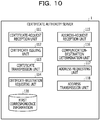
- FIG. 10 is a block diagram of functions of the certificate authority server 1.
- the certificate authority server for example, hardware including the CPU 101 and the memory 102 and the program 110 work together organically to implement various functions including a certificate-request reception unit 111, certificate issuing unit 112, certificate transmission unit 113, certificate-registration requesting unit 114, address-request reception unit 115, communication-destination determination unit 116, address requesting unit 117, and address transmission unit 118.
- the certificate authority server stores first correspondence information 131 in the information storage area 130 as illustrated in FIG. 10 .
- the certificate-request reception unit 111 receives a request for transmission (a request for issuance) of a certificate CE from the communication destination server 2.
- the certificate issuing unit 112 issues the certificate CE corresponding to the transmission request (issuance request) received by the certificate-request reception unit 111.
- the certificate transmission unit 113 transmits the certificate CE issued by the certificate issuing unit 112, to the communication destination server 2.
- the certificate-registration requesting unit 114 transmits a request for registration of the certificate CE issued by the certificate issuing unit 112, to the CT log server 4.
- the address-request reception unit 115 receives a request for transmission of the IP address of the communication destination server 2 from the terminal apparatus 3.
- the address-request reception unit 115 receives a request for transmission of the IP address of the communication destination server 2 and also part of the information included in the certificate CE for the communication destination server 2 (for example, the FQDN of the communication destination server 2) from the terminal apparatus 3.
- the communication-destination determination unit 116 refers to the first correspondence information 131 stored in the information storage area 130 to determine the mail address corresponding to the transmission request received by the address-request reception unit 115.
- the first correspondence information 131 is, for example, information in which the FQDNs of servers (including the communication destination server 2) are associated with the mail addresses of the servers.
- the address requesting unit 117 transmits a request for transmission of the IP address of the communication destination server 2 to the mail address determined by the communication-destination determination unit 116.
- the address requesting unit 117 receives the IP address of the communication destination server 2 transmitted from the communication destination server 2.
- the address transmission unit 118 transmits the IP address of the communication destination server 2 received by the address requesting unit 117 to the terminal apparatus 3.
- FIG. 11 is a block diagram of functions of the DNS server 5.
- the DNS server 5 for example, hardware including the CPU 501 and the memory 502 and the program 510 work together organically to implement various functions including an address-request reception unit 511, address determination unit 512, and address transmission unit 513.
- the DNS server 5 stores second correspondence information 531 in the information storage area 530, as illustrated in FIG. 11 .
- the address-request reception unit 511 receives a request for transmission of the IP address of the communication destination server 2 from the terminal apparatus 3.
- the address determination unit 512 refers to the second correspondence information 531 stored in the information storage areas (including the information storage area 530) of multiple DNS servers including the DNS server 5 in a distributed manner and determines the IP address corresponding to the transmission request received by the address-request reception unit 511.
- the second correspondence information 531 is, for example, information in which the FQDNs of servers (including the communication destination server 2) are associated with the IP addresses of the servers.
- the address determination unit 512 refers to information included in the second correspondence information 531 stored in the information storage area 530 of the DNS server 5 and also information obtained from other DNS servers (information included in the second correspondence information 531 stored in the information storage areas of the other DNS servers) and determines the IP address corresponding to the transmission request received by the address-request reception unit 511.
- the address transmission unit 513 transmits the IP address determined by the address determination unit 512 to the terminal apparatus 3.
- FIG. 12 is a flowchart diagram for explaining the outline of control processing in the first embodiment.
- FIG. 13 is a diagram for explaining the outline of the control processing in the first embodiment.
- the terminal apparatus 3 waits until a control timing, as illustrated in FIG. 12 (NO at S1).
- the control timing is, for example, a time when the operator transmits a request for access to the communication destination server 2, using the terminal apparatus 3.
- the terminal apparatus 3 transmits a request for transmission of the certificate CE for the communication destination server 2, to the CT log server 4 which manages certificates CE for multiple servers (S2).
- the terminal apparatus 3 waits until the terminal apparatus 3 receives the certificate CE for the communication destination server 2 transmitted from the CT log server 4 (NO at S3).
- the terminal apparatus 3 When the terminal apparatus 3 receives the certificate CE for the communication destination server 2 transmitted from the CT log server 4 (YES at S3), the terminal apparatus 3 determines the certificate authority server 1 that issued the certificate CE received in the process at S3, based on information included in the certificate CE received in the process at S3 (S4).
- the terminal apparatus 3 transmits a request for transmission of address information on (the IP address of) the communication destination server 2 to the certificate authority server 1 determined in the process at S4 (S5).
- the terminal apparatus 3 in the present embodiment obtains the IP address of the communication destination server 2 without inquiring the IP address from the DNS server 5, as illustrated in FIG. 13 .
- FIGs. 14 to 19 are flowchart diagrams for explaining details of control processing in the first embodiment.
- FIGs. 20 and 21 are diagrams for explaining details of the control processing in the first embodiment.
- FIGs. 14 and 15 are flowchart diagrams for explaining the control processing in the terminal apparatus 3.
- the input reception unit 311 of the terminal apparatus 3 waits until the input reception unit 311 receives an input of a request for access to the communication destination server 2 (NO at S11). For example, in the case where the communication destination server 2 is a web server, the input reception unit 311 waits until the input reception unit 311 receives an input of a request for viewing of web pages stored in the communication destination server 2.
- the certificate requesting unit 312 of the terminal apparatus 3 transmits, to the CT log server 4 which manages certificates CE for multiple servers, a request for transmission of the certificate CE for the communication destination server 2 corresponding to the access request the input of which was received in the process at S11 (S12).
- the certificate requesting unit 312 waits until the certificate requesting unit 312 receives the certificate CE for the communication destination server 2 from the CT log server 4 (NO at S13).
- the certificate-authority determination unit 313 of the terminal apparatus 3 refers to information included in the certificate CE received in the process at S13 to determine the certificate authority server 1 that issued the certificate CE received in the process at S13 (S14).
- the first address requesting unit 314 of the terminal apparatus 3 transmits, to the certificate authority server 1 determined in the process at S14, a request for transmission of the IP address of the communication destination server 2 corresponding to the access request the input of which was received in the process at S11, and also part of the information included in the certificate CE received in the process at S13 (S15).
- the first address requesting unit 314 transmits a request for transmission of the IP address of the communication destination server 2 corresponding the access request the input of which was received in the process at S11 and also the FQDN of the communication destination server 2 included in the certificate CE received in the process at S13.
- the first address requesting unit 314 waits until the first address requesting unit 314 receives the IP address of the communication destination server 2 from the certificate authority server 1 (NO at S16).
- the second address requesting unit 315 of the terminal apparatus 3 transmits, to the DNS server 5 which manages the identification information pieces and the IP addresses of servers with those associated with each other, a request for transmission of the IP address of the communication destination server 2 corresponding to the access request the input of which was received in the process at S11 and also the identification information on the communication destination server 2 (for example, the FQDN) (S21).
- the second address requesting unit 315 waits until the second address requesting unit 315 receives the IP address of the communication destination server 2 from the DNS server 5 (NO at S22).
- the address judgment unit 316 of the terminal apparatus 3 judges whether the IP address received in the process at S16 and the IP address received in the process at S22 agree with each other (S23).
- the access control unit 318 of the terminal apparatus 3 permits access corresponding to the access request the input of which was received in the process at S11 (S25).
- the terminal apparatus 3 obtains the IP address of the communication destination server 2 from the certificate authority server 1 by using information included in the certificate CE for the communication destination server 2 received from the CT log server 4.
- the terminal apparatus 3 also obtains the IP address of the communication destination server 2 from the DNS server 5.
- the terminal apparatus 3 judges that the IP address transmitted from the DNS server 5 is valid as the IP address of the communication destination server 2 and permits access to the IP address.
- the access execution unit 317 of the terminal apparatus 3 starts access corresponding to the access request the input of which was received in the process at S11 (S26).
- the access control unit 318 and the access execution unit 317 do not perform the processes at S25 and S26.
- the terminal apparatus 3 judges that it is possible that the DNS server 5 and others have been attacked, and that the IP address that the terminal apparatus 3 received was transmitted from a fake DNS server and does not permit access to the IP address.
- FIG. 16 is a flowchart diagram for explaining the control processing in the CT log server 4.
- the certificate-request reception unit 413 of the CT log server 4, as illustrated in FIG. 16 waits until the certificate-request reception unit 413 receives a request for transmission of a certificate CE from the terminal apparatus 3 (NO at S31).
- the certificate transmission unit 414 of the CT log server 4 transmits the certificate corresponding to the transmission request received in the process at S31 to the sender of the transmission request received in the process at S41 (the terminal apparatus 3) (S32).
- FIG. 17 is a flowchart diagram for explaining the control processing in the certificate authority server 1.
- the communication-destination determination unit 116 of the certificate authority server 1 refers to the first correspondence information 131 stored in the information storage area 130 and determines the mail address corresponding to the certificate CE received in the process at S41 (S42). In other words, the communication-destination determination unit 116, in this case, for example, determines the mail address used when the certificate authority server 1 issued the certificate CE for the communication destination server 2. In the following, specific examples of the first correspondence information 131 are described.
- FIG. 20 is a diagram for explaining specific examples of the first correspondence information 131.
- the first correspondence information 131 illustrated in FIG. 20 has the following items: "item number” for identifying each information piece included in the first correspondence information 131, "FQDN” in which the FQDNs of servers are set, and "mail address” in which the mail addresses of the servers are set.
- the information with the "item number” being “1” has "server01.AAA.co.jp” set as the "FQDN” and "xxx@AAA.co.jp” set as the "mail address”.
- the information with the "item number” being “2” has "server02.BBB.co.jp” set as the "FQDN” and "yyy@BBB.co.jp” set as the "mail address”. Explanation on the other information included in FIG. 20 is omitted.
- the communication-destination determination unit 116 determines that the mail address of the communication destination server 2 is "xxx@AAA.co.jp".
- the address requesting unit 117 transmits a request for transmission of the IP address corresponding to the transmission request received in the process at S41, to the mail address determined in the process at S42 (S43).
- the address requesting unit 117 waits until the address requesting unit 117 receives the IP address corresponding to the transmission request received in the process at S41 from the communication destination server (NO at S44).
- the address transmission unit 118 of the terminal apparatus 3 transmits the IP address received in the process at S44 (the IP address of the communication destination server 2) to the sender of the transmission request and other information received in the process at S41 (the terminal apparatus 3) (S45).
- FIG. 18 is a flowchart diagram for explaining the control processing in the communication destination server 2.
- the address-request reception unit 212 of the communication destination server 2 waits until the address-request reception unit 212 receives a request for transmission of an IP address from the certificate authority server 1, as illustrated in FIG. 18 (NO at S51).
- the address-request reception unit 212 periodically accesses a mail server (not illustrated) of the communication destination server 2 to obtain newly arrived mail. For example, when there is mail received from the certificate authority server 1 in the mail server, the address-request reception unit 212 also obtains the mail transmitted from the certificate authority server 1.
- the address transmission unit 213 of the communication destination server 2 transmits the IP address of the server itself to the sender of the transmission request received in the process at S51 (certificate authority server 1) (S52).
- FIG. 19 is a flowchart diagram for explaining control processing in the DNS server 5.
- the address-request reception unit 115 of the DNS server 5, as illustrated in FIG. 19 receives a request for transmission of the IP address of the communication destination server 2 and the FQDN of the communication destination server 2 from the terminal apparatus 3 (NO at S61).
- the address determination unit 512 of the DNS server 5 refers to the second correspondence information 531 stored in the information storage area 530 and the like to determine the IP address corresponding to the FQDN received in the process at S61 (S62).
- S62 specific examples of the second correspondence information 531 are described.
- FIG. 21 is a diagram for explaining specific examples of the second correspondence information 531.
- the second correspondence information 531 illustrated in FIG. 21 has the following items: "item number” for identifying each information piece included in the second correspondence information 531, "FQDN” in which the FQDNs of servers are set, and "IP address” in which the IP addresses of the servers are set.
- the information with the "item number” being “1” has "server01.AAA.co.jp” set as the "FQDN” and "111.111.111.111” set as the "IP address”.
- the information with the "item number” being “2” has "server02.BBB.co.jp” set as the "FQDN” and "222.222.222.222” set as the "IP address”. Explanation on the other information included in FIG. 21 is omitted.
- the communication-destination determination unit 116 determines that the IP address of the communication destination server 2 is "111.111.111.111".
- the address transmission unit 513 of the DNS server 5 transmits the IP address determined in the process at S62 to the sender of the transmission request received in the process at S61 (the terminal apparatus 3) (S63).
- the terminal apparatus 3 in the first embodiment transmits a request for transmission of the certificate CE for the communication destination server 2, to the CT log server 4 which manages certificates CE for multiple servers.
- the terminal apparatus 3 receives the certificate CE for the communication destination server 2 from the CT log server 4, the terminal apparatus 3 determines the certificate authority server 1 that issued the received certificate CE, based on information included in the received certificate CE. After that, the terminal apparatus 3 transmits a request for transmission of the IP address of the communication destination server 2 to the determined certificate authority server 1.
- the terminal apparatus 3 in the first embodiment obtains the IP address of the communication destination server 2 without inquiring the IP address from the DNS server 5.
- the terminal apparatus 3 in the first embodiment receives an input of a request for access to the communication destination server 2, the terminal apparatus 3 does not permit access corresponding to the request for access to the communication destination server 2 until it is judged that the IP addresses agree with each other in the process at S23.
- FIGs. 22 and 23 are flowchart diagrams for explaining control processing in the second embodiment.
- the processing in the CT log server 4, the processing in the certificate authority server 1, the processing in the communication destination server 2, and the processing in the DNS server 5 are the same as that in the control processing in the first embodiment, and hence, description thereof is omitted.
- the input reception unit 311 waits until the input reception unit 311 receives an input of a request for access to the communication destination server 2 (NO at S111).
- the access execution unit 317 starts access corresponding to the access request the input of which was received in the process at S111 (S112).
- the terminal apparatus 3 in the second embodiment starts access corresponding to the access request.
- the terminal apparatus 3 in the second embodiment prohibits information input associated with the access corresponding to the access request.
- the certificate requesting unit 312 transmits, to the CT log server 4 which manages certificates CE for multiple servers, a request for transmission of the certificate CE for the communication destination server 2 corresponding to the access request the input of which was received in the process at S111 (S113).
- the certificate requesting unit 312 waits until the certificate requesting unit 312 receives the certificate CE for the communication destination server 2 from the CT log server 4 (NO at S114).
- the certificate-authority determination unit 313 refers to information included in the certificate CE received in the process at S114 to determine the certificate authority server 1 that issued the certificate CE received in the process at S114 (S115).
- the first address requesting unit 314 transmits, to the certificate authority server 1 determined in the process at S115, the IP address of the communication destination server 2 corresponding to the access request the input of which was received in the process at S111 and also part of the information included in the certificate CE received in the process at S114 (for example, the FQDN of the communication destination server 2) (S116).
- the first address requesting unit 314 waits until the first address requesting unit 314 receives the IP address of the communication destination server 2 from the certificate authority server 1 (NO at S121).
- the second address requesting unit 315 transmits, to the DNS server 5 which manages the identification information pieces and the IP addresses of servers with those associated with each other, a request for transmission of the IP address of the communication destination server 2 corresponding to the access request the input of which was received in the process at S111 and also the FQDN of the communication destination server 2 (S122).
- the second address requesting unit 315 waits until the second address requesting unit 315 receives the IP address of the communication destination server 2 from the DNS server 5 (NO at S123).
- the address judgment unit 316 judges whether the IP address received in the process at S16 and the IP address received in the process at S123 agree with each other (S124).
- the access control unit 318 permits information input associated with the access corresponding to the access request the input of which was received in the process at S111 (S126).
- the terminal apparatus 3 judges that the IP address transmitted from the DNS server 5 is valid as the IP address of the communication destination server 2 and permits information input performed along with the access to the IP address.
- FIG. 24 is a block diagram of functions of the terminal apparatus 3 in the third embodiment.
- the functions in the CT log server 4, the functions in the certificate authority server 1, the functions in the communication destination server 2, and the functions in the DNS server 5 in the third embodiment are the same as those in the control processing in the first and second embodiments, and hence, description thereof is omitted.
- the terminal apparatus 3 for example, hardware including the CPU 301 and the memory 302 and the program 310 work together organically to implement a third address requesting unit 319 in addition to the various functions described with reference to FIG. 7 .
- the terminal apparatus 3 stores certificates CE in the information storage area 330 in the same or similar manner described with reference to FIG. 7 .
- the third address requesting unit 319 transmits a request for transmission of the IP address of the communication destination server 2 to a DNS cache server (not illustrated).
- the DNS cache server is a server that stores the IP address transmitted from the DNS server 5 in response to an inquiry from the terminal apparatus 3.
- the third address requesting unit 319 receives the IP address of the communication destination server 2 transmitted from the DNS cache server.
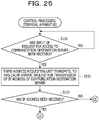
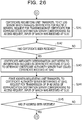
- FIGs. 25 and 27 are flowchart diagrams for explaining control processing in the third embodiment.
- the processing in the CT log server 4, the processing in the certificate authority server 1, the processing in the communication destination server 2, and the processing in the DNS server 5 are the same as that in the control processing in the first and second embodiments, and hence, description thereof is omitted.
- the input reception unit 311 waits until the input reception unit 311 receives an input of a request for access to the communication destination server 2 (NO at S131).
- the third address requesting unit 319 of the terminal apparatus 3 transmits a request for transmission of the IP address of the communication destination server 2 to the DNS cache server (S132).
- the third address requesting unit 319 waits until the third address requesting unit 319 receives the IP address of the communication destination server 2 transmitted from the DNS cache server (S133).
- the access control unit 318 permits access corresponding to the access request the input of which was received in the process at S131, as illustrated in FIG. 27 (S155).
- the access execution unit 317 starts access corresponding to the access request the input of which was received in the process at S131 (S156).
- the terminal apparatus 3 performs the processing in S141 and after.
- the terminal apparatus 3 judges that the IP address transmitted from the DNS cache server is valid and permits access to the IP address.
- the terminal apparatus 3 may judge that there is a possibility that the IP address transmitted from the DNS cache server is not valid and may perform the processing in S141 and after.
- the certificate requesting unit 312 transmits a request for transmission of the certificate CE for the communication destination server 2 corresponding to the access request the input of which was received in the process at S131, to the CT log server 4 which manages certificates CE for multiple servers, as illustrated in FIG. 26 (S141).
- the certificate requesting unit 312 waits until the certificate requesting unit 312 receives the certificate CE for the communication destination server 2 from the CT log server 4 (NO at S142).
- the certificate-authority determination unit 313 refers to information included in the certificate CE received in the process at S142 to determine the certificate authority server 1 that issued the certificate CE received in the process at S142 (S143).
- the first address requesting unit 314 transmits, to the certificate authority server 1 determined in the process at S143, the IP address of the communication destination server 2 corresponding to the access request the input of which was received in the process at S131 and also part of the information included in the certificate CE received in the process at S142 (for example, the FQDN of the communication destination server 2) (S144).
- the first address requesting unit 314 waits until the first address requesting unit 314 receives the IP address of the communication destination server 2 from the certificate authority server 1 (NO at S145).
- the second address requesting unit 315 When the first address requesting unit 314 receives the IP address of the communication destination server 2 from the certificate authority server 1 (YES at S145), the second address requesting unit 315, as illustrated in FIG. 27 , transmits, to the DNS server 5 which manages the identification information pieces and the IP addresses of servers with those associated with each other, a request for transmission of the IP address of the communication destination server 2 corresponding to the access request the input of which was received in the process at S131 and also the identification information on the communication destination server 2 (for example, the FQDN) (S151).
- the DNS server 5 which manages the identification information pieces and the IP addresses of servers with those associated with each other
- the second address requesting unit 315 waits until the second address requesting unit 315 receives the IP address of the communication destination server 2 from the DNS server 5 (NO at S152).
- the address judgment unit 316 judges whether the IP address received in the process at S145 and the IP address received in the process at S152 agree with each other (S153).
- the access control unit 318 permits access corresponding to the access request the input of which was received in the process at S131 (S155).
- the access execution unit 317 starts access corresponding to the access request the input of which was received in the process at S131 (S156).
Landscapes
- Engineering & Computer Science (AREA)
- Computer Security & Cryptography (AREA)
- Computer Networks & Wireless Communication (AREA)
- Signal Processing (AREA)
- Computer Hardware Design (AREA)
- Computing Systems (AREA)
- General Engineering & Computer Science (AREA)
- Data Exchanges In Wide-Area Networks (AREA)
Abstract
Description
- The embodiments discussed herein are related to a control method, an information processing apparatus, and a control program.
- Usually, transmission and reception of date on the Internet are carried out by obtaining the IP address corresponding to the data transmission destination from a domain name system (DNS) server.
- For example, a sender server (hereinafter also called a sending server) that is going to transmit data to a server that is the transmission destination (hereinafter also called a transmission destination server) accesses a DNS server that manages the identification information pieces (such as domain names) and the IP addresses of servers with those associated with each other to obtain the IP address of the transmission destination server. The sending server transmits data to the IP address obtained from the DNS server to transmit the data to the transmission destination server.
- In recent years, much business data (data on payment information, personal information, and the like) has come to be transmitted and received on the Internet, and also, use of virtual servers whose IP addresses frequently change is becoming widespread. In these circumstances, in recent years, the importance of the DNS server as described above has been becoming higher, and along with this situation, the number of attacks from the outside to the DNS server is increasing.
- The attacks to a DNS server described above include, for example, rewriting of records managed by the DNS server and rewriting of routing tables managed by routers on networks.
- Hence, in the case where a DNS server is attacked in such a way, servers that transmit and receive data on the Internet may receive an IP address transmitted from an attacker's DNS server (hereinafter also called a fake DNS server), and this may make it impossible to ensure the security of communication.
- In an aspect of the present disclosure, described are a control method, an information processing apparatus, and control program instructions for avoiding obtaining an IP address that is not a desired IP address.
- According to an aspect of the embodiments, described is a control method implemented by a computer which is configured to be operated as a terminal apparatus. In an example, the control method includes: transmitting, from the terminal apparatus to a first management server, a first request for transmission of a certificate of a first server, the first server being one of a plurality of servers, the first management server being configured to manage certificates for the plurality of servers; in response to the transmitting of the first request, receiving the certificate of the first server from the first management server; in response to the receiving of the certificate, determining a certificate authority by using information included in the received certificate, the certificate authority being a server from which the received certificate has been issued; and transmitting, from the terminal apparatus to the determined certificate authority, a second request for transmission of first address information on the first server.
- In an aspect, it is possible to avoid obtaining an IP address that is not a desired IP address.
-
-
FIG. 1 is a diagram for explaining the configuration of aninformation processing system 10; -
FIG. 2 is a diagram for explaining the hardware configuration of aterminal apparatus 3; -
FIG. 3 is a diagram for explaining the hardware configuration of aCT log server 4; -
FIG. 4 is a diagram for explaining the hardware configuration of acommunication destination server 2; -
FIG. 5 is a diagram for explaining the hardware configuration of acertificate authority server 1; -
FIG. 6 is a diagram for explaining the hardware configuration of aDNS server 5; -
FIG. 7 is a block diagram of functions of theterminal apparatus 3; -
FIG. 8 is a block diagram of functions of theCT log server 4; -
FIG. 9 is a block diagram of functions of thecommunication destination server 2; -
FIG. 10 is a block diagram of functions of thecertificate authority server 1; -
FIG. 11 is a block diagram of functions of theDNS server 5; -
FIG. 12 is a flowchart diagram for explaining the outline of control processing in a first embodiment; -
FIG. 13 is a diagram for explaining the outline of the control processing in the first embodiment; -
FIG. 14 is a flowchart diagram for explaining details of the control processing in the first embodiment; -
FIG. 15 is a flowchart diagram for explaining details of the control processing in the first embodiment; -
FIG. 16 is a flowchart diagram for explaining details of the control processing in the first embodiment; -
FIG. 17 is a flowchart diagram for explaining details of the control processing in the first embodiment; -
FIG. 18 is a flowchart diagram for explaining details of the control processing in the first embodiment; -
FIG. 19 is a flowchart diagram for explaining details of the control processing in the first embodiment; -
FIG. 20 is a diagram for explaining specific examples offirst correspondence information 131; -
FIG. 21 is a diagram for explaining specific examples ofsecond correspondence information 531; -
FIG. 22 is a flowchart diagram for explaining control processing in a second embodiment; -
FIG. 23 is a flowchart diagram for explaining the control processing in the second embodiment; -
FIG. 24 is a block diagram of functions of aterminal apparatus 3 in a third embodiment; -
FIG. 25 is a flowchart diagram for explaining control processing in the third embodiment; -
FIG. 26 is a flowchart diagram for explaining the control processing in the third embodiment; and -
FIG. 27 is a flowchart diagram for explaining the control processing in the third embodiment. - First, the configuration of an
information processing system 10 is described.FIG. 1 is a diagram for explaining the configuration of theinformation processing system 10. - The
information processing system 10 illustrated inFIG. 1 includes acertificate authority server 1 which functions as a certificate authority for public keys, acommunication destination server 2, a terminal apparatus (hereinafter also called an information processing apparatus) 3, a CT log server (hereinafter also called a first management server) 4, and a DNS server (hereinafter also called a second management server) 5. - Although the following description is based on a case where the
information processing system 10 has one each of thecertificate authority server 1, thecommunication destination server 2, theterminal apparatus 3, theCT log server 4, and theDNS server 5, theinformation processing system 10 may have multiple servers (apparatuses) that have the same function. - In the example illustrated in
FIG. 1 , theterminal apparatus 3 is a personal computer (PC) with which the operator performs, for example, input of desired information. For example, when the operator inputs information indicating that data will be transmitted to thecommunication destination server 2, theterminal apparatus 3 accesses thecommunication destination server 2. - When the
terminal apparatus 3 accesses thecommunication destination server 2, theterminal apparatus 3 has to obtain the IP address of thecommunication destination server 2. - For this purpose, the
communication destination server 2 registers, for example, the IP address of the server itself in theDNS server 5 in advance, as illustrated inFIG. 1 . When theterminal apparatus 3 accesses thecommunication destination server 2, theterminal apparatus 3 inquires the IP address of thecommunication destination server 2 from theDNS server 5. After that, theterminal apparatus 3 accesses the IP address of thecommunication destination server 2 transmitted from theDNS server 5. - In the example illustrated in
FIG. 1 , when thecertificate authority server 1 receives a request for issuance of the certificate for a public key (hereinafter simply called the certificate) from thecommunication destination server 2, thecertificate authority server 1 issues the certificate to thecommunication destination server 2. In this case, thecertificate authority server 1 registers the certificate for thecommunication destination server 2 in the certificate transparency (CT)log server 4. TheCT log server 4 is a server that registers the certificates issued by each certificate authority server for the purpose of detecting erroneous issuance of certificates by certificate authority servers (including the certificate authority server 1), attacks to those certificate authority servers, and the like. - In recent years, much business data (data on payment information, personal information, and the like) are communicated on the Internet, and also, the number of cases of using virtual servers whose IP addresses frequently change is increasing. In these circumstances, the importance of the
DNS server 5 as described above has been becoming higher than before, and along with this situation, and the number of attacks from the outside to theDNS server 5 is increasing. - The attacks to the DNS server include, for example, rewriting of records managed by the
DNS server 5 and rewriting of routing tables managed by routers (not illustrated) disposed on networks. - In these circumstances, when the
DNS server 5 is attacked as mentioned above, theterminal apparatus 3 may receive an IP address transmitted from a fake DNS server (not illustrated) (a fake IP address that is not the IP address of the communication destination server 2), and hence, there may be a case where the security of communication is not ensured. - Hence, the
DNS server 5, for example, employs the DNS Security Extensions (DNSSEC) technique which adds a signature to the IP address to be transmitted to theterminal apparatus 3. For example, theDNS server 5 generates a signature from an IP address by using the signature key (not illustrated) of theDNS server 5, adds the generated signature to the IP address, and transmits it to theterminal apparatus 3. Theterminal apparatus 3 confirms that the IP address received from theDNS server 5 agrees with the IP address restored from the signature by using the public key (not illustrated) of theDNS server 5. - This enables the
terminal apparatus 3 to confirm that the IP address transmitted from theDNS server 5 is the desired IP address. - In this case, the
DNS server 5 has to strictly manage the signature key in a safe place in the DNS server 5 (hereinafter also called a storage place). In this case, every time a change or the like in the IP address of thecommunication destination server 2 occurs, theDNS server 5 has to take the signature key out of the storage place to perform processing on it. Hence, in the case of employing the DNSSEC technique as above, the cost for managing the signature key in theDNS server 5 is high. - To address this, the
terminal apparatus 3 in the present embodiment transmits a request for transmission of the certificate for thecommunication destination server 2, to theCT log server 4 which manages certificates for multiple servers. When theterminal apparatus 3 receives the certificate for thecommunication destination server 2 from theCT log server 4, theterminal apparatus 3 determines thecertificate authority server 1 that issued the received certificate based on information included in the received certificate. After that, theterminal apparatus 3 transmits a request for transmission of the IP address of thecommunication destination server 2 to the determinedcertificate authority server 1. - In other words, for example, the
terminal apparatus 3 in the present embodiment obtains the IP address of thecommunication destination server 2 without inquiring the IP address from theDNS server 5. - This enables the
terminal apparatus 3 to avoid obtaining an IP address that is not the desired IP address. - Next, the hardware configuration of the
information processing system 10 is described. - First, the hardware configuration of the
terminal apparatus 3 is described.FIG. 2 is a diagram for explaining the hardware configuration of theterminal apparatus 3. - The
terminal apparatus 3, as illustrated inFIG. 2 , includes aCPU 301 which is a processor, amemory 302, acommunication device 303, and astorage medium 304. Those components are coupled to one another via abus 305. - The
storage medium 304 has, for example, a program storage area (not illustrated) for storing aprogram 310 to perform processing that controls obtaining of the IP address of the communication destination server 2 (hereinafter also called control processing). Thestorage medium 304 also has, for example, a storage section 330 (hereinafter also called an information storage area 330) that stores information that is used when the control processing is performed. Thestorage medium 304 may be, for example, a hard disk drive (HDD) or a solid-state drive (SSD). - The
CPU 301 executes theprogram 310 loaded from thestorage medium 304 into thememory 302 to perform the control processing. - The
communication device 303 performs communication with thecommunication destination server 2 and others via a network NW. - Next, the hardware configuration of the
CT log server 4 is described.FIG. 3 is a diagram for explaining the hardware configuration of theCT log server 4. - The
CT log server 4, as illustrated inFIG. 3 , includes aCPU 401 which is a processor, amemory 402, acommunication device 403, and astorage medium 404. Those components are coupled to one another via abus 405. - The
storage medium 404 includes, for example, a program storage area (not illustrated) for storing aprogram 410 to perform control processing. Thestorage medium 404 also includes, for example, a storage section 430 (hereinafter also called an information storage area 430) that stores information that is used when the control processing is performed. Thestorage medium 404 may be, for example, an HDD or an SSD. - The
CPU 401 executes theprogram 410 loaded from thestorage medium 404 into thememory 402 to perform the control processing. - The
communication device 403 performs communication with theterminal apparatus 3 and others via the network NW. - Next, the hardware configuration of the
communication destination server 2 is described.FIG. 4 is a diagram for explaining the hardware configuration of thecommunication destination server 2. - The
communication destination server 2, as illustrated inFIG. 4 , includes aCPU 201 which is a processor, amemory 202, acommunication device 203, and astorage medium 204. Those components are coupled to one another via abus 205. - The
storage medium 204 includes, for example, a program storage area (not illustrated) for storing aprogram 210 to perform control processing. Thestorage medium 204 also includes, for example, a storage section 230 (hereinafter also called an information storage area 230) that stores information that is used when the control processing is performed. Thestorage medium 204 may be, for example, an HDD or an SSD. - The
CPU 201 executes theprogram 210 loaded from thestorage medium 204 into thememory 202 to perform the control processing. - The
communication device 203 performs communication with theterminal apparatus 3 and others via the network NW. - Next, the hardware configuration of the
certificate authority server 1 is described.FIG. 5 is a diagram for explaining the hardware configuration of thecertificate authority server 1. - The
certificate authority server 1, as illustrated inFIG. 5 , includes aCPU 101 which is a processor, amemory 102, acommunication device 103, and astorage medium 104. Those components are coupled to one another via abus 105. - The
storage medium 104 includes, for example, a program storage area (not illustrated) for storing aprogram 110 to perform control processing. Thestorage medium 104 also includes, for example, a storage section 130 (hereinafter also called an information storage area 130) that stores information that is used when the control processing is performed. Thestorage medium 104 may be, for example, an HDD or an SSD. - The
CPU 101 executes theprogram 110 loaded from thestorage medium 104 into thememory 102 to perform the control processing. - The
communication device 103 performs communication with theterminal apparatus 3 and others via the network NW. - Next, the hardware configuration of the
DNS server 5 is described.FIG. 6 is a diagram for explaining the hardware configuration of theDNS server 5. - The
DNS server 5, as illustrated inFIG. 6 , includes aCPU 501 which is a processor, amemory 502, acommunication device 503, and astorage medium 504. Those components are coupled to one another via abus 505. - The
storage medium 504 includes, for example, a program storage area (not illustrated) for storing aprogram 510 to perform control processing. Thestorage medium 504 also includes, for example, a storage section 530 (hereinafter also called an information storage area 530) that stores information that is used when the control processing is performed. Thestorage medium 504 may be, for example, an HDD or an SSD. - The
CPU 501 executes theprogram 510 loaded from thestorage medium 504 into thememory 502 to perform the control processing. - The
communication device 503 performs communication with theterminal apparatus 3 and others via the network NW. - Next, functions of the
information processing system 10 are described. - First, functions of the
terminal apparatus 3 are described.FIG. 7 is a block diagram of functions of theterminal apparatus 3. - As illustrated in
FIG. 7 , in theterminal apparatus 3, for example, hardware including theCPU 301 and thememory 302 and theprogram 310 work together organically to implement various functions including aninput reception unit 311,certificate requesting unit 312, certificate-authority determination unit 313, firstaddress requesting unit 314, secondaddress requesting unit 315,address judgment unit 316,access execution unit 317, andaccess control unit 318. - The
terminal apparatus 3, for example, stores certificates CE in theinformation storage area 330, as illustrated inFIG. 7 . - The
input reception unit 311, for example, receives an input of a request for access to thecommunication destination server 2. Theinput reception unit 311, for example, receives an access request that the operator inputs via theterminal apparatus 3. - The
certificate requesting unit 312 transmits a request for transmission of the certificate CE for thecommunication destination server 2 to theCT log server 4 which manages certificates CE for multiple servers. Thecertificate requesting unit 312 receives the certificate CE for thecommunication destination server 2 transmitted from theCT log server 4. After that, thecertificate requesting unit 312, for example, stores the received certificate CE for thecommunication destination server 2 in theinformation storage area 330. - The certificate-
authority determination unit 313 determines thecertificate authority server 1 that issued the certificate CE for thecommunication destination server 2, based on information included in the certificate CE for thecommunication destination server 2 received by thecertificate requesting unit 312. The certificate-authority determination unit 313, for example, refers to the IP address included in the certificate for thecommunication destination server 2 to determine thecertificate authority server 1 that issued the certificate CE for thecommunication destination server 2. - The first
address requesting unit 314 transmits a request for transmission of the IP address of thecommunication destination server 2 to thecertificate authority server 1 determined by the certificate-authority determination unit 313. The firstaddress requesting unit 314, for example, transmits a request for transmission of the IP address of thecommunication destination server 2 and also part of the information included in the certificate CE for thecommunication destination server 2, to thecertificate authority server 1. In this case, the firstaddress requesting unit 314, for example, transmits the fully qualified domain name (FQDN) of thecommunication destination server 2 as the part of the information included in the certificate CE. In this case, the firstaddress requesting unit 314, for example, transmits the FQDN of thecommunication destination server 2 and the identification number of the certificate CE for thecommunication destination server 2 as the part of the information included in the certificate CE. The firstaddress requesting unit 314 receives the IP address of thecommunication destination server 2 transmitted from thecertificate authority server 1. - The second
address requesting unit 315 transmits a request for transmission of the IP address of thecommunication destination server 2 to theDNS server 5 which manages the IP addresses and the identification information pieces (for example, domain names or the like) of servers (including the communication destination server 2) with those associated with each other. For example, the secondaddress requesting unit 315 transmits a request for transmission of the IP address of thecommunication destination server 2 and also the FQDN of thecommunication destination server 2, to theDNS server 5. The secondaddress requesting unit 315 receives the IP address of thecommunication destination server 2 transmitted from theDNS server 5. - The
address judgment unit 316 judges whether the IP address received by the firstaddress requesting unit 314 agrees with the IP address received by the secondaddress requesting unit 315. - For example, in the case where the
address judgment unit 316 judged that the IP addresses agree with each other, theaccess execution unit 317 starts accessing thecommunication destination server 2. - For example, in the case where the
address judgment unit 316 judged that the IP addresses do not agree with each other, theaccess control unit 318 limits access to thecommunication destination server 2. - Next, functions of the
CT log server 4 are described.FIG. 8 is a block diagram of functions of theCT log server 4. - As illustrated in
FIG. 8 , in theCT log server 4, for example, hardware including theCPU 401 and thememory 402 and theprogram 410 work together organically to implement various functions including a registration-request reception unit 411,certificate registration unit 412, certificate-request reception unit 413, andcertificate transmission unit 414. - The
CT log server 4, for example, stores certificates CE in theinformation storage area 430, as illustrated inFIG. 8 . - The registration-
request reception unit 411, for example, receives a request for registration of a certificate CE from thecertificate authority server 1. - The
certificate registration unit 412 stores (registers) the certificate CE corresponding to the registration request received by the registration-request reception unit 411 in theinformation storage area 430. - The certificate-
request reception unit 413 receives a request for transmission of a certificate CE (the certificate CE for the communication destination server 2) from theterminal apparatus 3. - The
certificate transmission unit 414 transmits the certificate CE corresponding to the transmission request received by the certificate-request reception unit 413 to theterminal apparatus 3. - Next, functions of the
communication destination server 2 are described.FIG. 9 is a block diagram of functions of thecommunication destination server 2. - As illustrated in
FIG. 9 , in thecommunication destination server 2, for example, hardware including theCPU 201 and thememory 202 and theprogram 210 work together organically to implement various functions including acertificate requesting unit 211, address-request reception unit 212, and addresstransmission unit 213. - The
communication destination server 2, for example, stores the certificate CE in theinformation storage area 230, as illustrated inFIG. 9 . - The
certificate requesting unit 211 transmits a request for transmission (a request for issuance) of the certificate CE for thecommunication destination server 2 to thecertificate authority server 1. Thecertificate requesting unit 211 receives the certificate CE for thecommunication destination server 2 from thecertificate authority server 1. After that, thecertificate requesting unit 211, for example, stores the received certificate CE for thecommunication destination server 2 in theinformation storage area 230. - The address-
request reception unit 212 receives a request for transmission of the IP address of thecommunication destination server 2 from thecertificate authority server 1. The address-request reception unit 212, for example, receives a transmission request transmitted by thecertificate authority server 1 via a specified path. The address-request reception unit 212, for example, receives a transmission request transmitted by thecertificate authority server 1 to the mail address of thecommunication destination server 2. - The
address transmission unit 213 transmits the IP address corresponding to the transmission request received by the address-request reception unit 212 to thecertificate authority server 1. - Next, functions of the
certificate authority server 1 are described.FIG. 10 is a block diagram of functions of thecertificate authority server 1. - As illustrated in
FIG. 10 , in thecertificate authority server 1, for example, hardware including theCPU 101 and thememory 102 and theprogram 110 work together organically to implement various functions including a certificate-request reception unit 111,certificate issuing unit 112,certificate transmission unit 113, certificate-registration requesting unit 114, address-request reception unit 115, communication-destination determination unit 116,address requesting unit 117, and addresstransmission unit 118. - The
certificate authority server 1, for example, storesfirst correspondence information 131 in theinformation storage area 130 as illustrated inFIG. 10 . - The certificate-
request reception unit 111, for example, receives a request for transmission (a request for issuance) of a certificate CE from thecommunication destination server 2. - The
certificate issuing unit 112 issues the certificate CE corresponding to the transmission request (issuance request) received by the certificate-request reception unit 111. - The
certificate transmission unit 113 transmits the certificate CE issued by thecertificate issuing unit 112, to thecommunication destination server 2. - The certificate-
registration requesting unit 114 transmits a request for registration of the certificate CE issued by thecertificate issuing unit 112, to theCT log server 4. - The address-
request reception unit 115 receives a request for transmission of the IP address of thecommunication destination server 2 from theterminal apparatus 3. The address-request reception unit 115, for example, receives a request for transmission of the IP address of thecommunication destination server 2 and also part of the information included in the certificate CE for the communication destination server 2 (for example, the FQDN of the communication destination server 2) from theterminal apparatus 3. - The communication-
destination determination unit 116, for example, refers to thefirst correspondence information 131 stored in theinformation storage area 130 to determine the mail address corresponding to the transmission request received by the address-request reception unit 115. Thefirst correspondence information 131 is, for example, information in which the FQDNs of servers (including the communication destination server 2) are associated with the mail addresses of the servers. - The
address requesting unit 117, for example, transmits a request for transmission of the IP address of thecommunication destination server 2 to the mail address determined by the communication-destination determination unit 116. Theaddress requesting unit 117 receives the IP address of thecommunication destination server 2 transmitted from thecommunication destination server 2. - The
address transmission unit 118 transmits the IP address of thecommunication destination server 2 received by theaddress requesting unit 117 to theterminal apparatus 3. - Next, functions of the
DNS server 5 are described.FIG. 11 is a block diagram of functions of theDNS server 5. - As illustrated in
FIG. 11 , in theDNS server 5, for example, hardware including theCPU 501 and thememory 502 and theprogram 510 work together organically to implement various functions including an address-request reception unit 511,address determination unit 512, and addresstransmission unit 513. - The
DNS server 5, for example, storessecond correspondence information 531 in theinformation storage area 530, as illustrated inFIG. 11 . - The address-
request reception unit 511 receives a request for transmission of the IP address of thecommunication destination server 2 from theterminal apparatus 3. - The
address determination unit 512 refers to thesecond correspondence information 531 stored in the information storage areas (including the information storage area 530) of multiple DNS servers including theDNS server 5 in a distributed manner and determines the IP address corresponding to the transmission request received by the address-request reception unit 511. Thesecond correspondence information 531 is, for example, information in which the FQDNs of servers (including the communication destination server 2) are associated with the IP addresses of the servers. - For example, the
address determination unit 512 refers to information included in thesecond correspondence information 531 stored in theinformation storage area 530 of theDNS server 5 and also information obtained from other DNS servers (information included in thesecond correspondence information 531 stored in the information storage areas of the other DNS servers) and determines the IP address corresponding to the transmission request received by the address-request reception unit 511. - The
address transmission unit 513 transmits the IP address determined by theaddress determination unit 512 to theterminal apparatus 3. - Next, the outline of a first embodiment is described.
FIG. 12 is a flowchart diagram for explaining the outline of control processing in the first embodiment.FIG. 13 is a diagram for explaining the outline of the control processing in the first embodiment. - The
terminal apparatus 3 waits until a control timing, as illustrated inFIG. 12 (NO at S1). The control timing is, for example, a time when the operator transmits a request for access to thecommunication destination server 2, using theterminal apparatus 3. - When a control timing comes (YES at S1), the
terminal apparatus 3 transmits a request for transmission of the certificate CE for thecommunication destination server 2, to theCT log server 4 which manages certificates CE for multiple servers (S2). - After that, the
terminal apparatus 3 waits until theterminal apparatus 3 receives the certificate CE for thecommunication destination server 2 transmitted from the CT log server 4 (NO at S3). - When the
terminal apparatus 3 receives the certificate CE for thecommunication destination server 2 transmitted from the CT log server 4 (YES at S3), theterminal apparatus 3 determines thecertificate authority server 1 that issued the certificate CE received in the process at S3, based on information included in the certificate CE received in the process at S3 (S4). - After that, the
terminal apparatus 3 transmits a request for transmission of address information on (the IP address of) thecommunication destination server 2 to thecertificate authority server 1 determined in the process at S4 (S5). - In other words, for example, the
terminal apparatus 3 in the present embodiment obtains the IP address of thecommunication destination server 2 without inquiring the IP address from theDNS server 5, as illustrated inFIG. 13 . - This enables the
terminal apparatus 3 to avoid obtaining an IP address that is not the desired IP address. - Next, details of the first embodiment are described.
FIGs. 14 to 19 are flowchart diagrams for explaining details of control processing in the first embodiment.FIGs. 20 and21 are diagrams for explaining details of the control processing in the first embodiment. - First, control processing performed in the
terminal apparatus 3 is described.FIGs. 14 and15 are flowchart diagrams for explaining the control processing in theterminal apparatus 3. - As illustrated in
FIG. 14 , theinput reception unit 311 of theterminal apparatus 3 waits until theinput reception unit 311 receives an input of a request for access to the communication destination server 2 (NO at S11). For example, in the case where thecommunication destination server 2 is a web server, theinput reception unit 311 waits until theinput reception unit 311 receives an input of a request for viewing of web pages stored in thecommunication destination server 2. - When the
input reception unit 311 receives an input of a request for access to the communication destination server 2 (YES at S11), thecertificate requesting unit 312 of theterminal apparatus 3 transmits, to theCT log server 4 which manages certificates CE for multiple servers, a request for transmission of the certificate CE for thecommunication destination server 2 corresponding to the access request the input of which was received in the process at S11 (S12). - After that, the
certificate requesting unit 312 waits until thecertificate requesting unit 312 receives the certificate CE for thecommunication destination server 2 from the CT log server 4 (NO at S13). - When the
certificate requesting unit 312 receives the certificate CE for thecommunication destination server 2 from the CT log server 4 (YES at S13), the certificate-authority determination unit 313 of theterminal apparatus 3 refers to information included in the certificate CE received in the process at S13 to determine thecertificate authority server 1 that issued the certificate CE received in the process at S13 (S14). - The certificate-
authority determination unit 313, for example, refers to the IP address of the certificate authority server that issued the certificate CE among the information pieces included in the certificate CE received in the process at S13 and thereby determines thecertificate authority server 1 that issued the certificate CE received in the process at S13. - Next, the first
address requesting unit 314 of theterminal apparatus 3 transmits, to thecertificate authority server 1 determined in the process at S14, a request for transmission of the IP address of thecommunication destination server 2 corresponding to the access request the input of which was received in the process at S11, and also part of the information included in the certificate CE received in the process at S13 (S15). - The first
address requesting unit 314, for example, transmits a request for transmission of the IP address of thecommunication destination server 2 corresponding the access request the input of which was received in the process at S11 and also the FQDN of thecommunication destination server 2 included in the certificate CE received in the process at S13. - After that, the first
address requesting unit 314 waits until the firstaddress requesting unit 314 receives the IP address of thecommunication destination server 2 from the certificate authority server 1 (NO at S16). - When the first
address requesting unit 314 receives the IP address of thecommunication destination server 2 from the certificate authority server 1 (YES at S16), the secondaddress requesting unit 315 of theterminal apparatus 3, as illustrated inFIG. 15 , transmits, to theDNS server 5 which manages the identification information pieces and the IP addresses of servers with those associated with each other, a request for transmission of the IP address of thecommunication destination server 2 corresponding to the access request the input of which was received in the process at S11 and also the identification information on the communication destination server 2 (for example, the FQDN) (S21). - After that, the second
address requesting unit 315 waits until the secondaddress requesting unit 315 receives the IP address of thecommunication destination server 2 from the DNS server 5 (NO at S22). - When the second
address requesting unit 315 receives the IP address of thecommunication destination server 2 from the DNS server 5 (YES at S22), theaddress judgment unit 316 of theterminal apparatus 3 judges whether the IP address received in the process at S16 and the IP address received in the process at S22 agree with each other (S23). - In the case where it is judged that the IP addresses agree with each other (YES at S24), the
access control unit 318 of theterminal apparatus 3 permits access corresponding to the access request the input of which was received in the process at S11 (S25). - In other words, for example, the
terminal apparatus 3 obtains the IP address of thecommunication destination server 2 from thecertificate authority server 1 by using information included in the certificate CE for thecommunication destination server 2 received from theCT log server 4. Theterminal apparatus 3 also obtains the IP address of thecommunication destination server 2 from theDNS server 5. In the case where the IP addresses obtained in the different ways agree with each other, theterminal apparatus 3 judges that the IP address transmitted from theDNS server 5 is valid as the IP address of thecommunication destination server 2 and permits access to the IP address. - After that, the
access execution unit 317 of theterminal apparatus 3 starts access corresponding to the access request the input of which was received in the process at S11 (S26). - In contrast, in the case where it is judged that the IP addresses do not agree with each other (NO at S24), the
access control unit 318 and theaccess execution unit 317 do not perform the processes at S25 and S26. - For example, in the case where the IP address obtained from the
certificate authority server 1 and the IP address obtained from theDNS server 5 do not agree with each other, theterminal apparatus 3 judges that it is possible that theDNS server 5 and others have been attacked, and that the IP address that theterminal apparatus 3 received was transmitted from a fake DNS server and does not permit access to the IP address. - This enables the
terminal apparatus 3, for example, to avoid accessing an IP address transmitted from a fake DNS server. - Next, control processing performed in the
CT log server 4 is described.FIG. 16 is a flowchart diagram for explaining the control processing in theCT log server 4. - The certificate-
request reception unit 413 of theCT log server 4, as illustrated inFIG. 16 , waits until the certificate-request reception unit 413 receives a request for transmission of a certificate CE from the terminal apparatus 3 (NO at S31). - When the
CT log server 4 receives a request for transmission of a certificate CE from the terminal apparatus 3 (YES at S31), thecertificate transmission unit 414 of theCT log server 4 transmits the certificate corresponding to the transmission request received in the process at S31 to the sender of the transmission request received in the process at S41 (the terminal apparatus 3) (S32). - Next, control processing performed in the
certificate authority server 1 is described.FIG. 17 is a flowchart diagram for explaining the control processing in thecertificate authority server 1. - The address-
request reception unit 115 of thecertificate authority server 1, as illustrated inFIG. 17 , waits until the address-request reception unit 115 receives a request for transmission of the IP address of thecommunication destination server 2 and part of the information included in the certificate CE for the communication destination server 2 (for example, the FQDN of the communication destination server 2) from the terminal apparatus 3 (NO at S41). - When the address-
request reception unit 115 receives a request for transmission of the IP address of thecommunication destination server 2 and other information from the terminal apparatus 3 (YES at S41), the communication-destination determination unit 116 of thecertificate authority server 1 refers to thefirst correspondence information 131 stored in theinformation storage area 130 and determines the mail address corresponding to the certificate CE received in the process at S41 (S42). In other words, the communication-destination determination unit 116, in this case, for example, determines the mail address used when thecertificate authority server 1 issued the certificate CE for thecommunication destination server 2. In the following, specific examples of thefirst correspondence information 131 are described. -
FIG. 20 is a diagram for explaining specific examples of thefirst correspondence information 131. - The
first correspondence information 131 illustrated inFIG. 20 has the following items: "item number" for identifying each information piece included in thefirst correspondence information 131, "FQDN" in which the FQDNs of servers are set, and "mail address" in which the mail addresses of the servers are set. - In the
first correspondence information 131 illustrated inFIG. 20 , for example, the information with the "item number" being "1" has "server01.AAA.co.jp" set as the "FQDN" and "xxx@AAA.co.jp" set as the "mail address". - In the
first correspondence information 131 illustrated inFIG. 20 , for example, the information with the "item number" being "2" has "server02.BBB.co.jp" set as the "FQDN" and "yyy@BBB.co.jp" set as the "mail address". Explanation on the other information included inFIG. 20 is omitted. - Hence, for example, in the case where the FQDN of the
communication destination server 2 received in the process at S41 is "server01.AAA.co.jp", the communication-destination determination unit 116 determines that the mail address of thecommunication destination server 2 is "xxx@AAA.co.jp". - Returning to
FIG. 17 , theaddress requesting unit 117 transmits a request for transmission of the IP address corresponding to the transmission request received in the process at S41, to the mail address determined in the process at S42 (S43). - After that, the
address requesting unit 117 waits until theaddress requesting unit 117 receives the IP address corresponding to the transmission request received in the process at S41 from the communication destination server (NO at S44). - When the
address requesting unit 117 receives the IP address corresponding to the transmission request received in the process at S41, from the communication destination server 2 (YES at S44), theaddress transmission unit 118 of theterminal apparatus 3 transmits the IP address received in the process at S44 (the IP address of the communication destination server 2) to the sender of the transmission request and other information received in the process at S41 (the terminal apparatus 3) (S45). - Next, control processing performed in the
communication destination server 2 is described.FIG. 18 is a flowchart diagram for explaining the control processing in thecommunication destination server 2. - The address-
request reception unit 212 of thecommunication destination server 2 waits until the address-request reception unit 212 receives a request for transmission of an IP address from thecertificate authority server 1, as illustrated inFIG. 18 (NO at S51). - For example, the address-
request reception unit 212 periodically accesses a mail server (not illustrated) of thecommunication destination server 2 to obtain newly arrived mail. For example, when there is mail received from thecertificate authority server 1 in the mail server, the address-request reception unit 212 also obtains the mail transmitted from thecertificate authority server 1. - When the address-
request reception unit 212 receives a request for transmission of the IP address from the certificate authority server 1 (YES at S52), theaddress transmission unit 213 of thecommunication destination server 2 transmits the IP address of the server itself to the sender of the transmission request received in the process at S51 (certificate authority server 1) (S52). - Next, control processing performed in the
DNS server 5 is described.FIG. 19 is a flowchart diagram for explaining control processing in theDNS server 5. - The address-
request reception unit 115 of theDNS server 5, as illustrated inFIG. 19 , receives a request for transmission of the IP address of thecommunication destination server 2 and the FQDN of thecommunication destination server 2 from the terminal apparatus 3 (NO at S61). - When the address-
request reception unit 115 receives a request for transmission of the IP address of thecommunication destination server 2 and other information from the terminal apparatus 3 (YES at S61), theaddress determination unit 512 of theDNS server 5 refers to thesecond correspondence information 531 stored in theinformation storage area 530 and the like to determine the IP address corresponding to the FQDN received in the process at S61 (S62). In the following, specific examples of thesecond correspondence information 531 are described. -
FIG. 21 is a diagram for explaining specific examples of thesecond correspondence information 531. - The
second correspondence information 531 illustrated inFIG. 21 has the following items: "item number" for identifying each information piece included in thesecond correspondence information 531, "FQDN" in which the FQDNs of servers are set, and "IP address" in which the IP addresses of the servers are set. - In the
second correspondence information 531 illustrated inFIG. 21 , for example, the information with the "item number" being "1" has "server01.AAA.co.jp" set as the "FQDN" and "111.111.111.111" set as the "IP address". - In the
second correspondence information 531 illustrated inFIG. 21 , for example, the information with the "item number" being "2" has "server02.BBB.co.jp" set as the "FQDN" and "222.222.222.222" set as the "IP address". Explanation on the other information included inFIG. 21 is omitted. - Hence, for example, in the case where the FQDN of the
communication destination server 2 received in the process at S61 is "server01.AAA.co.jp", the communication-destination determination unit 116 determines that the IP address of thecommunication destination server 2 is "111.111.111.111". - Returning to
FIG. 19 , theaddress transmission unit 513 of theDNS server 5 transmits the IP address determined in the process at S62 to the sender of the transmission request received in the process at S61 (the terminal apparatus 3) (S63). - As described above, the
terminal apparatus 3 in the first embodiment transmits a request for transmission of the certificate CE for thecommunication destination server 2, to theCT log server 4 which manages certificates CE for multiple servers. When theterminal apparatus 3 receives the certificate CE for thecommunication destination server 2 from theCT log server 4, theterminal apparatus 3 determines thecertificate authority server 1 that issued the received certificate CE, based on information included in the received certificate CE. After that, theterminal apparatus 3 transmits a request for transmission of the IP address of thecommunication destination server 2 to the determinedcertificate authority server 1. - In other words, for example, the
terminal apparatus 3 in the first embodiment obtains the IP address of thecommunication destination server 2 without inquiring the IP address from theDNS server 5. When theterminal apparatus 3 in the first embodiment receives an input of a request for access to thecommunication destination server 2, theterminal apparatus 3 does not permit access corresponding to the request for access to thecommunication destination server 2 until it is judged that the IP addresses agree with each other in the process at S23. - This enables the
terminal apparatus 3 to avoid accessing an IP address that is not the desired IP address (for example, an IP address transmitted from a fake DNS server). - Next, a second embodiment is described.
FIGs. 22 and23 are flowchart diagrams for explaining control processing in the second embodiment. Note that in the control processing in the second embodiment, the processing in theCT log server 4, the processing in thecertificate authority server 1, the processing in thecommunication destination server 2, and the processing in theDNS server 5 are the same as that in the control processing in the first embodiment, and hence, description thereof is omitted. - As illustrated in
FIG. 22 , theinput reception unit 311 waits until theinput reception unit 311 receives an input of a request for access to the communication destination server 2 (NO at S111). - When a
terminal apparatus 3 receives an input of a request for access to the communication destination server 2 (YES at S111), theaccess execution unit 317 starts access corresponding to the access request the input of which was received in the process at S111 (S112). - In other words, for example, in response to reception of a request for access to the
communication destination server 2, theterminal apparatus 3 in the second embodiment starts access corresponding to the access request. - This enables the
terminal apparatus 3 to perform access corresponding to the access request without waiting for the execution of the control processing to finish. Thus, for example, even in the case where the execution of the control processing takes time, it is possible for theterminal apparatus 3 to promptly start access corresponding to the access request. - In this case, the
terminal apparatus 3 in the second embodiment prohibits information input associated with the access corresponding to the access request. - This enables the
terminal apparatus 3 to avoid the operator's personal information or the like being inputted to a fake DNS server or the like. - The
certificate requesting unit 312 transmits, to theCT log server 4 which manages certificates CE for multiple servers, a request for transmission of the certificate CE for thecommunication destination server 2 corresponding to the access request the input of which was received in the process at S111 (S113). - After that, the
certificate requesting unit 312 waits until thecertificate requesting unit 312 receives the certificate CE for thecommunication destination server 2 from the CT log server 4 (NO at S114). - When the
certificate requesting unit 312 receives the certificate CE for thecommunication destination server 2 from the CT log server 4 (YES at S114), the certificate-authority determination unit 313 refers to information included in the certificate CE received in the process at S114 to determine thecertificate authority server 1 that issued the certificate CE received in the process at S114 (S115). - Next, the first
address requesting unit 314 transmits, to thecertificate authority server 1 determined in the process at S115, the IP address of thecommunication destination server 2 corresponding to the access request the input of which was received in the process at S111 and also part of the information included in the certificate CE received in the process at S114 (for example, the FQDN of the communication destination server 2) (S116). - After that, as illustrated in
FIG. 23 , the firstaddress requesting unit 314 waits until the firstaddress requesting unit 314 receives the IP address of thecommunication destination server 2 from the certificate authority server 1 (NO at S121). - When the first
address requesting unit 314 receives the IP address of thecommunication destination server 2 from the certificate authority server 1 (YES at S121), the secondaddress requesting unit 315 transmits, to theDNS server 5 which manages the identification information pieces and the IP addresses of servers with those associated with each other, a request for transmission of the IP address of thecommunication destination server 2 corresponding to the access request the input of which was received in the process at S111 and also the FQDN of the communication destination server 2 (S122). - After that, the second
address requesting unit 315 waits until the secondaddress requesting unit 315 receives the IP address of thecommunication destination server 2 from the DNS server 5 (NO at S123). - When the second
address requesting unit 315 receives the IP address of thecommunication destination server 2 from the DNS server 5 (YES at S123), theaddress judgment unit 316 judges whether the IP address received in the process at S16 and the IP address received in the process at S123 agree with each other (S124). - In the case where it is judged that the IP addresses agree with each other (YES at S125), the
access control unit 318 permits information input associated with the access corresponding to the access request the input of which was received in the process at S111 (S126). - For example, in the case where the IP addresses obtained in the different ways agree with each other, the
terminal apparatus 3 judges that the IP address transmitted from theDNS server 5 is valid as the IP address of thecommunication destination server 2 and permits information input performed along with the access to the IP address. - This enables the
terminal apparatus 3 to promptly start access corresponding to the access request and also to perform control such that the operator's personal information or the like will not be inputted to a fake DNS server or the like. - Next, a third embodiment is described.
- First, functions of a
terminal apparatus 3 in the third embodiment are described.FIG. 24 is a block diagram of functions of theterminal apparatus 3 in the third embodiment. Note that the functions in theCT log server 4, the functions in thecertificate authority server 1, the functions in thecommunication destination server 2, and the functions in theDNS server 5 in the third embodiment are the same as those in the control processing in the first and second embodiments, and hence, description thereof is omitted. - As illustrated in
FIG. 24 , in theterminal apparatus 3, for example, hardware including theCPU 301 and thememory 302 and theprogram 310 work together organically to implement a thirdaddress requesting unit 319 in addition to the various functions described with reference toFIG. 7 . - The
terminal apparatus 3, for example, stores certificates CE in theinformation storage area 330 in the same or similar manner described with reference toFIG. 7 . - The third
address requesting unit 319 transmits a request for transmission of the IP address of thecommunication destination server 2 to a DNS cache server (not illustrated). The DNS cache server is a server that stores the IP address transmitted from theDNS server 5 in response to an inquiry from theterminal apparatus 3. The thirdaddress requesting unit 319 receives the IP address of thecommunication destination server 2 transmitted from the DNS cache server. - Next, flowchart diagrams of the third embodiment are described.
FIGs. 25 and27 are flowchart diagrams for explaining control processing in the third embodiment. Note that in the control processing in the third embodiment, the processing in theCT log server 4, the processing in thecertificate authority server 1, the processing in thecommunication destination server 2, and the processing in theDNS server 5 are the same as that in the control processing in the first and second embodiments, and hence, description thereof is omitted. - As illustrated in
FIG. 25 , theinput reception unit 311 waits until theinput reception unit 311 receives an input of a request for access to the communication destination server 2 (NO at S131). - When the
input reception unit 311 receives an input of a request for access to the communication destination server 2 (YES at S131), the thirdaddress requesting unit 319 of theterminal apparatus 3 transmits a request for transmission of the IP address of thecommunication destination server 2 to the DNS cache server (S132). - After that, the third
address requesting unit 319 waits until the thirdaddress requesting unit 319 receives the IP address of thecommunication destination server 2 transmitted from the DNS cache server (S133). - When the third
address requesting unit 319 receives the IP address of thecommunication destination server 2 transmitted from the DNS cache server (YES at S133), theaccess control unit 318 permits access corresponding to the access request the input of which was received in the process at S131, as illustrated inFIG. 27 (S155). - After that, the
access execution unit 317 starts access corresponding to the access request the input of which was received in the process at S131 (S156). - In the case where the IP address of the
communication destination server 2 is not transmitted from the DNS cache server, or in the case where theterminal apparatus 3 receives, from the DNS cache server, information indicating that the IP address of thecommunication destination server 2 is not stored in the DNS cache server (NO at S133), theterminal apparatus 3 performs the processing in S141 and after. - For example, in the case where an inquiry for the IP address of the
communication destination server 2 was made to theDNS server 5 before and where the IP address is stored in the DNS cache server, theterminal apparatus 3 judges that the IP address transmitted from the DNS cache server is valid and permits access to the IP address. - This enables the
terminal apparatus 3 to reduce processing loads on theCT log server 4 and thecertificate authority server 1 associated with the execution of the control processing. - Note that even in the case where the IP address of the
communication destination server 2 was transmitted from the DNS cache server in the process at S133, if the date and time when the IP address was stored in the DNS cache server is before a specified date and time, theterminal apparatus 3 may judge that there is a possibility that the IP address transmitted from the DNS cache server is not valid and may perform the processing in S141 and after. - Returning to
FIG. 25 , in the case where the IP address of thecommunication destination server 2 is not transmitted from the DNS cache server, or in the case where theterminal apparatus 3 receives, from the DNS cache server, information indicating that the IP address of thecommunication destination server 2 is not stored in the (NO at S133), thecertificate requesting unit 312 transmits a request for transmission of the certificate CE for thecommunication destination server 2 corresponding to the access request the input of which was received in the process at S131, to theCT log server 4 which manages certificates CE for multiple servers, as illustrated inFIG. 26 (S141). - After that, the
certificate requesting unit 312 waits until thecertificate requesting unit 312 receives the certificate CE for thecommunication destination server 2 from the CT log server 4 (NO at S142). - When the
certificate requesting unit 312 receives the certificate CE for thecommunication destination server 2 from the CT log server 4 (YES at S142), the certificate-authority determination unit 313 refers to information included in the certificate CE received in the process at S142 to determine thecertificate authority server 1 that issued the certificate CE received in the process at S142 (S143). - The first
address requesting unit 314 transmits, to thecertificate authority server 1 determined in the process at S143, the IP address of thecommunication destination server 2 corresponding to the access request the input of which was received in the process at S131 and also part of the information included in the certificate CE received in the process at S142 (for example, the FQDN of the communication destination server 2) (S144). - After that, the first
address requesting unit 314 waits until the firstaddress requesting unit 314 receives the IP address of thecommunication destination server 2 from the certificate authority server 1 (NO at S145). - When the first
address requesting unit 314 receives the IP address of thecommunication destination server 2 from the certificate authority server 1 (YES at S145), the secondaddress requesting unit 315, as illustrated inFIG. 27 , transmits, to theDNS server 5 which manages the identification information pieces and the IP addresses of servers with those associated with each other, a request for transmission of the IP address of thecommunication destination server 2 corresponding to the access request the input of which was received in the process at S131 and also the identification information on the communication destination server 2 (for example, the FQDN) (S151). - After that, the second
address requesting unit 315 waits until the secondaddress requesting unit 315 receives the IP address of thecommunication destination server 2 from the DNS server 5 (NO at S152). - When the second
address requesting unit 315 receives the IP address of thecommunication destination server 2 from the DNS server 5 (YES at S152), theaddress judgment unit 316 judges whether the IP address received in the process at S145 and the IP address received in the process at S152 agree with each other (S153). - In the case where it is judged that the IP addresses agree with each other (YES at S154), the
access control unit 318 permits access corresponding to the access request the input of which was received in the process at S131 (S155). - After that, the
access execution unit 317 starts access corresponding to the access request the input of which was received in the process at S131 (S156). - This enables the
terminal apparatus 3 to reduce processing loads on theCT log server 4 and thecertificate authority server 1 associated with the execution of the control processing, and also to perform control such that the operator's personal information or the like will not be inputted to a fake DNS server or the like. -
- 1: certificate authority server
- 2: communication destination server
- 3: terminal apparatus
- 4: CT log server
- 5: DNS server
- Japanese Laid-open Patent Publication No.
2017-103614
Claims (10)
- A control method implemented by a computer which is configured to be operated as a terminal apparatus, the control method comprising:transmitting, from the terminal apparatus to a first management server, a first request for transmission of a certificate of a first server, the first server being one of a plurality of servers, the first management server being configured to manage certificates for the plurality of servers;in response to the transmitting of the first request, receiving the certificate of the first server from the first management server;in response to the receiving of the certificate, determining a certificate authority by using information included in the received certificate, the certificate authority being a server from which the received certificate has been issued; andtransmitting, from the terminal apparatus to the determined certificate authority, a second request for transmission of first address information on the first server.
- The control method according to claim 1, wherein
the information included in the certificate is address information on the certificate authority that has issued the certificate. - The control method according to claim 1, wherein
the transmitting of the first request causes the certificate authority to execute processing including:transmit the first request for transmission of the first address information on the first server to the first server;in response to the transmitting of the first request, receiving the first address information on the first server; andin response to the receiving of the first address information, transmitting from the certificate authority to the terminal apparatus, the received first address information on the first server. - The control method according to claim 1, further comprising:transmitting a third request for transmission of second address information on the first server, from the terminal apparatus to a second management server, the second management server being configured to manage the second address information on the first server and corresponding identification information on the first server;in response to the transmitting of the third request, receiving the second address information on the first server transmitted from the second management server;in response to the transmitting of the second request, receiving the first address information from the determined certificate authority;in response to the first address information and the second address information, obtaining a determination result by determining whether the first address information on the first server transmitted from the determined certification authority and the second address information on the first server transmitted from the second management server agree with each other; andin response to the determination result indicating that the first address information and the second address information do not agree with each other, limiting access to the first server.
- The control method according to claim 4, further comprising:
in response to the determination result indicating that the first address information and the second address information agree with each other, permitting access to the first server. - The control method according to claim 5, wherein
the transmitting of the second request and the transmitting of the third request are performed in case where the terminal apparatus detects an access request for accessing to the first server,
the control method further comprises: in response to the detecting of the access request, prohibiting access corresponding to the access request,
the limiting of the access is configured to continue to prohibit access corresponding to the access request, and
the permitting of the access is configured to permit access corresponding to the access request. - The control method according to claim 5, wherein
the transmitting of the second request and the transmitting of the third request is performed when the terminal apparatus detects an access request for accessing to the first server,
the control method further comprises: in response to the detecting of the access request, permitting access corresponding to the access request, but prohibiting input of information associated with the access corresponding to the access request to the first server,
the limiting of the access is configured to continue to prohibit input of information associated with the access corresponding to the access request to the first server, and
the permitting of the access is configured to permit input of information associated with the access corresponding to the access request to the first server. - The control method according to claim 5, further comprising transmitting a fourth request for transmission of third address information on the first server, from the terminal apparatus to a third management server, the third management server being configured to manage the third address information that has been transmitted from the second management server before, wherein
the transmitting of the first request and the transmitting of the third request are performed in a case where the terminal apparatus does not receive the third address information on the first server from the third management server during a predetermined time period after the transmitting of the fourth request. - An information processing apparatus operable as a terminal apparatus, the information processing apparatus comprising:a memory; anda processor coupled to the memory, the processor being configured to execute program instructions, the program instructions including:transmitting, from the information processing apparatus to a first management server, a first request for transmission of a certificate of a first server, the first server being one of a plurality of servers, the first management server being configured to manage certificates for the plurality of servers;in response to the transmitting of the first request, receiving the certificate of the first server from the first management server;in response to the receiving of the certificate, determining a certificate authority by using information included in the received certificate, the certificate authority being a server from which the received certificate has been issued; andtransmitting, from the information processing apparatus to the determined certificate authority, a second request for transmission of first address information on the first server.
- A computer program comprising instructions which, when the program is executed by a computer which is operable as a terminal apparatus, cause the computer to carry out processing comprising:transmitting, from the terminal apparatus to a first management server, a first request for transmission of a certificate of a first server, the first server being one of a plurality of servers, the first management server being configured to manage certificates for the plurality of servers;in response to the transmitting of the first request, receiving the certificate of the first server from the first management server;in response to the receiving of the certificate, determining a certificate authority by using information included in the received certificate, the certificate authority being a server from which the received certificate has been issued; andtransmitting, from the terminal apparatus to the determined certificate authority, a second request for transmission of first address information on the first server.
Applications Claiming Priority (1)
| Application Number | Priority Date | Filing Date | Title |
|---|---|---|---|
| JP2019232215A JP7352092B2 (en) | 2019-12-24 | 2019-12-24 | Control method, information processing device and control program |
Publications (2)
| Publication Number | Publication Date |
|---|---|
| EP3843357A1 true EP3843357A1 (en) | 2021-06-30 |
| EP3843357B1 EP3843357B1 (en) | 2023-03-29 |
Family
ID=73043063
Family Applications (1)
| Application Number | Title | Priority Date | Filing Date |
|---|---|---|---|
| EP20204942.5A Active EP3843357B1 (en) | 2019-12-24 | 2020-10-30 | Control method, information processing apparatus, and control program |
Country Status (3)
| Country | Link |
|---|---|
| US (1) | US11647011B2 (en) |
| EP (1) | EP3843357B1 (en) |
| JP (1) | JP7352092B2 (en) |
Families Citing this family (2)
| Publication number | Priority date | Publication date | Assignee | Title |
|---|---|---|---|---|
| JP7697434B2 (en) * | 2022-08-26 | 2025-06-24 | 横河電機株式会社 | Information providing device, information providing program, device registration system, and device registration method |
| WO2025128429A1 (en) * | 2023-12-12 | 2025-06-19 | Centurylink Intellectual Property Llc | Systems and methods for publishing and using images of dns zone configurations |
Citations (3)
| Publication number | Priority date | Publication date | Assignee | Title |
|---|---|---|---|---|
| US7177839B1 (en) * | 1996-12-13 | 2007-02-13 | Certco, Inc. | Reliance manager for electronic transaction system |
| US20110213967A1 (en) * | 2010-02-26 | 2011-09-01 | Andrew Wnuk | Pre-encoding a cached certificate revocation list |
| JP2017103614A (en) | 2015-12-01 | 2017-06-08 | システムプラザ株式会社 | Electronic certificate management system, electronic certificate utilization terminal, and electronic certificate management method |
Family Cites Families (16)
| Publication number | Priority date | Publication date | Assignee | Title |
|---|---|---|---|---|
| JP2002215826A (en) | 2001-01-19 | 2002-08-02 | Hitachi Ltd | Automatic certificate updating device and method |
| JP4397675B2 (en) | 2003-11-12 | 2010-01-13 | 株式会社日立製作所 | Computer system |
| JP4283250B2 (en) | 2005-06-22 | 2009-06-24 | 克佳 長嶋 | Email verification system to prevent phishing |
| JP4213689B2 (en) | 2005-07-08 | 2009-01-21 | 株式会社クローバー・ネットワーク・コム | Farming fraud prevention system, network terminal device and program |
| JP4950606B2 (en) | 2005-09-30 | 2012-06-13 | トレンドマイクロ株式会社 | COMMUNICATION SYSTEM, SECURITY MANAGEMENT DEVICE, AND ACCESS CONTROL METHOD |
| JP4494521B2 (en) * | 2007-06-27 | 2010-06-30 | Gmoグローバルサイン株式会社 | Server certificate issuing system |
| JP2011049745A (en) | 2009-08-26 | 2011-03-10 | Toshiba Corp | Device for defending dns cache poisoning attack |
| US8327424B2 (en) * | 2009-12-22 | 2012-12-04 | Motorola Solutions, Inc. | Method and apparatus for selecting a certificate authority |
| US8898457B2 (en) * | 2010-02-26 | 2014-11-25 | Red Hat, Inc. | Automatically generating a certificate operation request |
| US9178888B2 (en) * | 2013-06-14 | 2015-11-03 | Go Daddy Operating Company, LLC | Method for domain control validation |
| US9455980B2 (en) * | 2014-12-16 | 2016-09-27 | Fortinet, Inc. | Management of certificate authority (CA) certificates |
| US9641516B2 (en) * | 2015-07-01 | 2017-05-02 | International Business Machines Corporation | Using resource records for digital certificate validation |
| JP6084278B1 (en) | 2015-11-27 | 2017-02-22 | 株式会社Pfu | Information processing apparatus, method, and program |
| US10652271B2 (en) * | 2016-03-25 | 2020-05-12 | Verisign, Inc. | Detecting and remediating highly vulnerable domain names using passive DNS measurements |
| US11032071B2 (en) * | 2019-03-29 | 2021-06-08 | Microsoft Technology Licensing, Llc | Secure and verifiable data access logging system |
| US11720718B2 (en) * | 2019-07-31 | 2023-08-08 | Microsoft Technology Licensing, Llc | Security certificate identity analysis |
-
2019
- 2019-12-24 JP JP2019232215A patent/JP7352092B2/en active Active
-
2020
- 2020-10-30 EP EP20204942.5A patent/EP3843357B1/en active Active
- 2020-11-09 US US17/093,338 patent/US11647011B2/en active Active
Patent Citations (3)
| Publication number | Priority date | Publication date | Assignee | Title |
|---|---|---|---|---|
| US7177839B1 (en) * | 1996-12-13 | 2007-02-13 | Certco, Inc. | Reliance manager for electronic transaction system |
| US20110213967A1 (en) * | 2010-02-26 | 2011-09-01 | Andrew Wnuk | Pre-encoding a cached certificate revocation list |
| JP2017103614A (en) | 2015-12-01 | 2017-06-08 | システムプラザ株式会社 | Electronic certificate management system, electronic certificate utilization terminal, and electronic certificate management method |
Non-Patent Citations (3)
| Title |
|---|
| BERTINO ELISA: "Computer Security CS 426 Public Key Infrastructure (PKI)", 8 September 2009 (2009-09-08), Purdue University, XP055793886, Retrieved from the Internet <URL:http://citeseerx.ist.psu.edu/viewdoc/download?doi=10.1.1.176.6298&rep=rep1&type=pdf> [retrieved on 20210409] * |
| HUA-QING ZHOU ET AL: "PKI-Based E-Business Security System", 2008 3RD INTERNATIONAL CONFERENCE ON INNOVATIVE COMPUTING INFORMATION AND CONTROL, IEEE, PISCATAWAY, NJ, USA, 18 June 2008 (2008-06-18), pages 203, XP031309474, ISBN: 978-0-7695-3161-8 * |
| SCHOMP KYLE ET AL: "Assessing DNS Vulnerability to Record Injection", 10 March 2014, ICIAP: INTERNATIONAL CONFERENCE ON IMAGE ANALYSIS AND PROCESSING, 17TH INTERNATIONAL CONFERENCE, NAPLES, ITALY, SEPTEMBER 9-13, 2013. PROCEEDINGS; [LECTURE NOTES IN COMPUTER SCIENCE; LECT.NOTES COMPUTER], SPRINGER, BERLIN, HEIDELBERG, PAGE(S) 214 - 2, ISBN: 978-3-642-17318-9, XP047195667 * |
Also Published As
| Publication number | Publication date |
|---|---|
| JP7352092B2 (en) | 2023-09-28 |
| US20210194867A1 (en) | 2021-06-24 |
| JP2021099754A (en) | 2021-07-01 |
| EP3843357B1 (en) | 2023-03-29 |
| US11647011B2 (en) | 2023-05-09 |
Similar Documents
| Publication | Publication Date | Title |
|---|---|---|
| JP7038165B2 (en) | Information processing equipment, information processing methods and information processing programs | |
| US9473528B2 (en) | Identification of malware sites using unknown URL sites and newly registered DNS addresses | |
| US9560072B1 (en) | Discovering and selecting candidates for sinkholing of network domains | |
| US8621556B1 (en) | Dynamic resolution of fully qualified domain name (FQDN) address objects in policy definitions | |
| CN102427484B (en) | Determine whether equipment is in the method and apparatus of network internal based on DNS | |
| US9258293B1 (en) | Safe and secure access to dynamic domain name systems | |
| US20070220605A1 (en) | Identifying unauthorized access to a network resource | |
| EP2228720A1 (en) | System and method for reduced cloud IP address utilization | |
| JP2013247674A (en) | Method, system, and computer program for identifying rogue domain name service (dns) server (system for detecting presence of rogue domain name service providers through passive monitoring) | |
| EP3306900A1 (en) | Dns routing for improved network security | |
| WO2006094228A2 (en) | Implementing trust policies | |
| CN102171984A (en) | Service provider access | |
| WO2012166087A1 (en) | Transaction gateway | |
| Korczyński et al. | Zone poisoning: The how and where of non-secure DNS dynamic updates | |
| US20170180312A1 (en) | Methods and systems for identification of a domain of a command and control server of a botnet | |
| EP3843357B1 (en) | Control method, information processing apparatus, and control program | |
| US10165008B2 (en) | Using events to identify a user and enforce policies | |
| US20060069805A1 (en) | Network system role determination | |
| US20130227276A1 (en) | Device management apparatus, method for device management, and computer program product | |
| US20220103579A1 (en) | System and apparatus for internet traffic inspection via localized dns caching | |
| US8799428B2 (en) | Automated provisioning of new networked devices | |
| Wazan et al. | TLS connection validation by web browsers: Why do web browsers still not agree? | |
| JP2008504776A (en) | Method and system for dynamic device address management | |
| US9705898B2 (en) | Applying group policies | |
| US8854650B2 (en) | Network printing system executing printing by comparing certification information in a database |
Legal Events
| Date | Code | Title | Description |
|---|---|---|---|
| PUAI | Public reference made under article 153(3) epc to a published international application that has entered the european phase |
Free format text: ORIGINAL CODE: 0009012 |
|
| STAA | Information on the status of an ep patent application or granted ep patent |
Free format text: STATUS: THE APPLICATION HAS BEEN PUBLISHED |
|
| AK | Designated contracting states |
Kind code of ref document: A1 Designated state(s): AL AT BE BG CH CY CZ DE DK EE ES FI FR GB GR HR HU IE IS IT LI LT LU LV MC MK MT NL NO PL PT RO RS SE SI SK SM TR |
|
| STAA | Information on the status of an ep patent application or granted ep patent |
Free format text: STATUS: REQUEST FOR EXAMINATION WAS MADE |
|
| 17P | Request for examination filed |
Effective date: 20210923 |
|
| RBV | Designated contracting states (corrected) |
Designated state(s): AL AT BE BG CH CY CZ DE DK EE ES FI FR GB GR HR HU IE IS IT LI LT LU LV MC MK MT NL NO PL PT RO RS SE SI SK SM TR |
|
| REG | Reference to a national code |
Ref country code: DE Ref legal event code: R079 Ref document number: 602020009197 Country of ref document: DE Free format text: PREVIOUS MAIN CLASS: H04L0029060000 Ipc: H04L0009400000 |
|
| GRAP | Despatch of communication of intention to grant a patent |
Free format text: ORIGINAL CODE: EPIDOSNIGR1 |
|
| STAA | Information on the status of an ep patent application or granted ep patent |
Free format text: STATUS: GRANT OF PATENT IS INTENDED |
|
| RIC1 | Information provided on ipc code assigned before grant |
Ipc: H04L 61/4511 20220101ALI20221020BHEP Ipc: H04L 9/40 20220101AFI20221020BHEP |
|
| INTG | Intention to grant announced |
Effective date: 20221117 |
|
| GRAS | Grant fee paid |
Free format text: ORIGINAL CODE: EPIDOSNIGR3 |
|
| GRAA | (expected) grant |
Free format text: ORIGINAL CODE: 0009210 |
|
| STAA | Information on the status of an ep patent application or granted ep patent |
Free format text: STATUS: THE PATENT HAS BEEN GRANTED |
|
| AK | Designated contracting states |
Kind code of ref document: B1 Designated state(s): AL AT BE BG CH CY CZ DE DK EE ES FI FR GB GR HR HU IE IS IT LI LT LU LV MC MK MT NL NO PL PT RO RS SE SI SK SM TR |
|
| REG | Reference to a national code |
Ref country code: CH Ref legal event code: EP |
|
| REG | Reference to a national code |
Ref country code: DE Ref legal event code: R096 Ref document number: 602020009197 Country of ref document: DE |
|
| REG | Reference to a national code |
Ref country code: AT Ref legal event code: REF Ref document number: 1557433 Country of ref document: AT Kind code of ref document: T Effective date: 20230415 |
|
| REG | Reference to a national code |
Ref country code: IE Ref legal event code: FG4D |
|
| REG | Reference to a national code |
Ref country code: LT Ref legal event code: MG9D |
|
| PG25 | Lapsed in a contracting state [announced via postgrant information from national office to epo] |
Ref country code: RS Free format text: LAPSE BECAUSE OF FAILURE TO SUBMIT A TRANSLATION OF THE DESCRIPTION OR TO PAY THE FEE WITHIN THE PRESCRIBED TIME-LIMIT Effective date: 20230329 Ref country code: NO Free format text: LAPSE BECAUSE OF FAILURE TO SUBMIT A TRANSLATION OF THE DESCRIPTION OR TO PAY THE FEE WITHIN THE PRESCRIBED TIME-LIMIT Effective date: 20230629 Ref country code: LV Free format text: LAPSE BECAUSE OF FAILURE TO SUBMIT A TRANSLATION OF THE DESCRIPTION OR TO PAY THE FEE WITHIN THE PRESCRIBED TIME-LIMIT Effective date: 20230329 Ref country code: LT Free format text: LAPSE BECAUSE OF FAILURE TO SUBMIT A TRANSLATION OF THE DESCRIPTION OR TO PAY THE FEE WITHIN THE PRESCRIBED TIME-LIMIT Effective date: 20230329 Ref country code: HR Free format text: LAPSE BECAUSE OF FAILURE TO SUBMIT A TRANSLATION OF THE DESCRIPTION OR TO PAY THE FEE WITHIN THE PRESCRIBED TIME-LIMIT Effective date: 20230329 |
|
| REG | Reference to a national code |
Ref country code: NL Ref legal event code: MP Effective date: 20230329 |
|
| REG | Reference to a national code |
Ref country code: AT Ref legal event code: MK05 Ref document number: 1557433 Country of ref document: AT Kind code of ref document: T Effective date: 20230329 |
|
| PG25 | Lapsed in a contracting state [announced via postgrant information from national office to epo] |
Ref country code: SE Free format text: LAPSE BECAUSE OF FAILURE TO SUBMIT A TRANSLATION OF THE DESCRIPTION OR TO PAY THE FEE WITHIN THE PRESCRIBED TIME-LIMIT Effective date: 20230329 Ref country code: NL Free format text: LAPSE BECAUSE OF FAILURE TO SUBMIT A TRANSLATION OF THE DESCRIPTION OR TO PAY THE FEE WITHIN THE PRESCRIBED TIME-LIMIT Effective date: 20230329 Ref country code: GR Free format text: LAPSE BECAUSE OF FAILURE TO SUBMIT A TRANSLATION OF THE DESCRIPTION OR TO PAY THE FEE WITHIN THE PRESCRIBED TIME-LIMIT Effective date: 20230630 Ref country code: FI Free format text: LAPSE BECAUSE OF FAILURE TO SUBMIT A TRANSLATION OF THE DESCRIPTION OR TO PAY THE FEE WITHIN THE PRESCRIBED TIME-LIMIT Effective date: 20230329 |
|
| PG25 | Lapsed in a contracting state [announced via postgrant information from national office to epo] |
Ref country code: SM Free format text: LAPSE BECAUSE OF FAILURE TO SUBMIT A TRANSLATION OF THE DESCRIPTION OR TO PAY THE FEE WITHIN THE PRESCRIBED TIME-LIMIT Effective date: 20230329 Ref country code: RO Free format text: LAPSE BECAUSE OF FAILURE TO SUBMIT A TRANSLATION OF THE DESCRIPTION OR TO PAY THE FEE WITHIN THE PRESCRIBED TIME-LIMIT Effective date: 20230329 Ref country code: PT Free format text: LAPSE BECAUSE OF FAILURE TO SUBMIT A TRANSLATION OF THE DESCRIPTION OR TO PAY THE FEE WITHIN THE PRESCRIBED TIME-LIMIT Effective date: 20230731 Ref country code: ES Free format text: LAPSE BECAUSE OF FAILURE TO SUBMIT A TRANSLATION OF THE DESCRIPTION OR TO PAY THE FEE WITHIN THE PRESCRIBED TIME-LIMIT Effective date: 20230329 Ref country code: EE Free format text: LAPSE BECAUSE OF FAILURE TO SUBMIT A TRANSLATION OF THE DESCRIPTION OR TO PAY THE FEE WITHIN THE PRESCRIBED TIME-LIMIT Effective date: 20230329 Ref country code: AT Free format text: LAPSE BECAUSE OF FAILURE TO SUBMIT A TRANSLATION OF THE DESCRIPTION OR TO PAY THE FEE WITHIN THE PRESCRIBED TIME-LIMIT Effective date: 20230329 |
|
| PG25 | Lapsed in a contracting state [announced via postgrant information from national office to epo] |
Ref country code: SK Free format text: LAPSE BECAUSE OF FAILURE TO SUBMIT A TRANSLATION OF THE DESCRIPTION OR TO PAY THE FEE WITHIN THE PRESCRIBED TIME-LIMIT Effective date: 20230329 Ref country code: PL Free format text: LAPSE BECAUSE OF FAILURE TO SUBMIT A TRANSLATION OF THE DESCRIPTION OR TO PAY THE FEE WITHIN THE PRESCRIBED TIME-LIMIT Effective date: 20230329 Ref country code: IS Free format text: LAPSE BECAUSE OF FAILURE TO SUBMIT A TRANSLATION OF THE DESCRIPTION OR TO PAY THE FEE WITHIN THE PRESCRIBED TIME-LIMIT Effective date: 20230729 |
|
| PGFP | Annual fee paid to national office [announced via postgrant information from national office to epo] |
Ref country code: FR Payment date: 20230816 Year of fee payment: 4 |
|
| REG | Reference to a national code |
Ref country code: DE Ref legal event code: R097 Ref document number: 602020009197 Country of ref document: DE |
|
| PG25 | Lapsed in a contracting state [announced via postgrant information from national office to epo] |
Ref country code: DK Free format text: LAPSE BECAUSE OF FAILURE TO SUBMIT A TRANSLATION OF THE DESCRIPTION OR TO PAY THE FEE WITHIN THE PRESCRIBED TIME-LIMIT Effective date: 20230329 Ref country code: CZ Free format text: LAPSE BECAUSE OF FAILURE TO SUBMIT A TRANSLATION OF THE DESCRIPTION OR TO PAY THE FEE WITHIN THE PRESCRIBED TIME-LIMIT Effective date: 20230329 |
|
| PGFP | Annual fee paid to national office [announced via postgrant information from national office to epo] |
Ref country code: DE Payment date: 20230717 Year of fee payment: 4 |
|
| PLBE | No opposition filed within time limit |
Free format text: ORIGINAL CODE: 0009261 |
|
| STAA | Information on the status of an ep patent application or granted ep patent |
Free format text: STATUS: NO OPPOSITION FILED WITHIN TIME LIMIT |
|
| 26N | No opposition filed |
Effective date: 20240103 |
|
| PG25 | Lapsed in a contracting state [announced via postgrant information from national office to epo] |
Ref country code: SI Free format text: LAPSE BECAUSE OF FAILURE TO SUBMIT A TRANSLATION OF THE DESCRIPTION OR TO PAY THE FEE WITHIN THE PRESCRIBED TIME-LIMIT Effective date: 20230329 |
|
| PG25 | Lapsed in a contracting state [announced via postgrant information from national office to epo] |
Ref country code: SI Free format text: LAPSE BECAUSE OF FAILURE TO SUBMIT A TRANSLATION OF THE DESCRIPTION OR TO PAY THE FEE WITHIN THE PRESCRIBED TIME-LIMIT Effective date: 20230329 Ref country code: IT Free format text: LAPSE BECAUSE OF FAILURE TO SUBMIT A TRANSLATION OF THE DESCRIPTION OR TO PAY THE FEE WITHIN THE PRESCRIBED TIME-LIMIT Effective date: 20230329 Ref country code: MC Free format text: LAPSE BECAUSE OF FAILURE TO SUBMIT A TRANSLATION OF THE DESCRIPTION OR TO PAY THE FEE WITHIN THE PRESCRIBED TIME-LIMIT Effective date: 20230329 |
|
| REG | Reference to a national code |
Ref country code: CH Ref legal event code: PL |
|
| REG | Reference to a national code |
Ref country code: BE Ref legal event code: MM Effective date: 20231031 |
|
| PG25 | Lapsed in a contracting state [announced via postgrant information from national office to epo] |
Ref country code: LU Free format text: LAPSE BECAUSE OF NON-PAYMENT OF DUE FEES Effective date: 20231030 |
|
| PG25 | Lapsed in a contracting state [announced via postgrant information from national office to epo] |
Ref country code: LU Free format text: LAPSE BECAUSE OF NON-PAYMENT OF DUE FEES Effective date: 20231030 |
|
| PG25 | Lapsed in a contracting state [announced via postgrant information from national office to epo] |
Ref country code: CH Free format text: LAPSE BECAUSE OF NON-PAYMENT OF DUE FEES Effective date: 20231031 |
|
| PG25 | Lapsed in a contracting state [announced via postgrant information from national office to epo] |
Ref country code: CH Free format text: LAPSE BECAUSE OF NON-PAYMENT OF DUE FEES Effective date: 20231031 |
|
| PG25 | Lapsed in a contracting state [announced via postgrant information from national office to epo] |
Ref country code: BE Free format text: LAPSE BECAUSE OF NON-PAYMENT OF DUE FEES Effective date: 20231031 |
|
| PG25 | Lapsed in a contracting state [announced via postgrant information from national office to epo] |
Ref country code: IE Free format text: LAPSE BECAUSE OF NON-PAYMENT OF DUE FEES Effective date: 20231030 |
|
| PG25 | Lapsed in a contracting state [announced via postgrant information from national office to epo] |
Ref country code: IE Free format text: LAPSE BECAUSE OF NON-PAYMENT OF DUE FEES Effective date: 20231030 |
|
| PG25 | Lapsed in a contracting state [announced via postgrant information from national office to epo] |
Ref country code: BG Free format text: LAPSE BECAUSE OF FAILURE TO SUBMIT A TRANSLATION OF THE DESCRIPTION OR TO PAY THE FEE WITHIN THE PRESCRIBED TIME-LIMIT Effective date: 20230329 |
|
| PG25 | Lapsed in a contracting state [announced via postgrant information from national office to epo] |
Ref country code: BG Free format text: LAPSE BECAUSE OF FAILURE TO SUBMIT A TRANSLATION OF THE DESCRIPTION OR TO PAY THE FEE WITHIN THE PRESCRIBED TIME-LIMIT Effective date: 20230329 |
|
| REG | Reference to a national code |
Ref country code: DE Ref legal event code: R119 Ref document number: 602020009197 Country of ref document: DE |
|
| GBPC | Gb: european patent ceased through non-payment of renewal fee |
Effective date: 20241030 |
|
| PG25 | Lapsed in a contracting state [announced via postgrant information from national office to epo] |
Ref country code: DE Free format text: LAPSE BECAUSE OF NON-PAYMENT OF DUE FEES Effective date: 20250501 |
|
| PG25 | Lapsed in a contracting state [announced via postgrant information from national office to epo] |
Ref country code: GB Free format text: LAPSE BECAUSE OF NON-PAYMENT OF DUE FEES Effective date: 20241030 |
|
| PG25 | Lapsed in a contracting state [announced via postgrant information from national office to epo] |
Ref country code: FR Free format text: LAPSE BECAUSE OF NON-PAYMENT OF DUE FEES Effective date: 20241031 |
|
| PG25 | Lapsed in a contracting state [announced via postgrant information from national office to epo] |
Ref country code: CY Free format text: LAPSE BECAUSE OF FAILURE TO SUBMIT A TRANSLATION OF THE DESCRIPTION OR TO PAY THE FEE WITHIN THE PRESCRIBED TIME-LIMIT; INVALID AB INITIO Effective date: 20201030 |
|
| PG25 | Lapsed in a contracting state [announced via postgrant information from national office to epo] |
Ref country code: HU Free format text: LAPSE BECAUSE OF FAILURE TO SUBMIT A TRANSLATION OF THE DESCRIPTION OR TO PAY THE FEE WITHIN THE PRESCRIBED TIME-LIMIT; INVALID AB INITIO Effective date: 20201030 |
|
| PG25 | Lapsed in a contracting state [announced via postgrant information from national office to epo] |
Ref country code: TR Free format text: LAPSE BECAUSE OF FAILURE TO SUBMIT A TRANSLATION OF THE DESCRIPTION OR TO PAY THE FEE WITHIN THE PRESCRIBED TIME-LIMIT Effective date: 20230329 |