EP3842438B1 - Preparation method for ecteinascidin compound and intermediate thereof - Google Patents
Preparation method for ecteinascidin compound and intermediate thereof Download PDFInfo
- Publication number
- EP3842438B1 EP3842438B1 EP19913508.8A EP19913508A EP3842438B1 EP 3842438 B1 EP3842438 B1 EP 3842438B1 EP 19913508 A EP19913508 A EP 19913508A EP 3842438 B1 EP3842438 B1 EP 3842438B1
- Authority
- EP
- European Patent Office
- Prior art keywords
- compound
- reaction
- yield
- method further
- protecting group
- Prior art date
- Legal status (The legal status is an assumption and is not a legal conclusion. Google has not performed a legal analysis and makes no representation as to the accuracy of the status listed.)
- Active
Links
Classifications
-
- C—CHEMISTRY; METALLURGY
- C07—ORGANIC CHEMISTRY
- C07D—HETEROCYCLIC COMPOUNDS
- C07D487/00—Heterocyclic compounds containing nitrogen atoms as the only ring hetero atoms in the condensed system, not provided for by groups C07D451/00 - C07D477/00
- C07D487/12—Heterocyclic compounds containing nitrogen atoms as the only ring hetero atoms in the condensed system, not provided for by groups C07D451/00 - C07D477/00 in which the condensed system contains three hetero rings
- C07D487/18—Bridged systems
-
- C—CHEMISTRY; METALLURGY
- C07—ORGANIC CHEMISTRY
- C07D—HETEROCYCLIC COMPOUNDS
- C07D491/00—Heterocyclic compounds containing in the condensed ring system both one or more rings having oxygen atoms as the only ring hetero atoms and one or more rings having nitrogen atoms as the only ring hetero atoms, not provided for by groups C07D451/00 - C07D459/00, C07D463/00, C07D477/00 or C07D489/00
- C07D491/22—Heterocyclic compounds containing in the condensed ring system both one or more rings having oxygen atoms as the only ring hetero atoms and one or more rings having nitrogen atoms as the only ring hetero atoms, not provided for by groups C07D451/00 - C07D459/00, C07D463/00, C07D477/00 or C07D489/00 in which the condensed system contains four or more hetero rings
-
- C—CHEMISTRY; METALLURGY
- C07—ORGANIC CHEMISTRY
- C07D—HETEROCYCLIC COMPOUNDS
- C07D515/00—Heterocyclic compounds containing in the condensed system at least one hetero ring having nitrogen, oxygen, and sulfur atoms as the only ring hetero atoms, not provided for in groups C07D463/00, C07D477/00 or C07D499/00 - C07D507/00
- C07D515/22—Heterocyclic compounds containing in the condensed system at least one hetero ring having nitrogen, oxygen, and sulfur atoms as the only ring hetero atoms, not provided for in groups C07D463/00, C07D477/00 or C07D499/00 - C07D507/00 in which the condensed system contains four or more hetero rings
-
- Y—GENERAL TAGGING OF NEW TECHNOLOGICAL DEVELOPMENTS; GENERAL TAGGING OF CROSS-SECTIONAL TECHNOLOGIES SPANNING OVER SEVERAL SECTIONS OF THE IPC; TECHNICAL SUBJECTS COVERED BY FORMER USPC CROSS-REFERENCE ART COLLECTIONS [XRACs] AND DIGESTS
- Y02—TECHNOLOGIES OR APPLICATIONS FOR MITIGATION OR ADAPTATION AGAINST CLIMATE CHANGE
- Y02P—CLIMATE CHANGE MITIGATION TECHNOLOGIES IN THE PRODUCTION OR PROCESSING OF GOODS
- Y02P20/00—Technologies relating to chemical industry
- Y02P20/50—Improvements relating to the production of bulk chemicals
- Y02P20/55—Design of synthesis routes, e.g. reducing the use of auxiliary or protecting groups
Definitions
- the present invention belongs to the technical field of medicine, and in particular relates to a method for preparing an ecteinascidin compound and an intermediate thereof.
- Ecteinascidin-743 (ET743), also known as trabectedin, is a class of active natural products with unique structures and is a first marine-derived anti-tumor drug from the tunicate Ecteinascidia turbinata, which is a semi-synthetic product of tetrahydroquinoline alkaloids extracted from ascidians.
- ecteinascidin-743 can also inhibit the secretion of vascular endothelial growth factor (VEGF) and the expression of a receptor thereof.
- VEGF vascular endothelial growth factor
- Trabectedin was approved by the European Union in September 2007 for the treatment of soft tissue sarcomas for which anthracyclines and ifosfamide treatments fail, or patients who are not suitable for receiving these two drugs; and trabectedin is combined with an azithromycin liposome for the treatment of platinum-sensitive ovarian cancer.
- trabectedin is higher than well-known anticancer drugs such as camptothecin, paclitaxel, doxorubicin, bleomycin, cisplatin and etoposide, which are currently widely used in the clinic, by 1 to 3 orders of magnitude and has a unique multiple mechanism of action.
- the main methods for preparing trabectedin include a biological extraction method, wherein the highest yield of trabectedin is 0.0001% ( ACS Chem. Biol. 2011, 6, 1244 ), which is very low in preparation and cannot satisfy industrial use.
- Corey et al. reported a total synthesis method for totally synthesizing trabectedin through 36 steps of reaction ( J. Am. Chem. Soc.
- Cuevas et al. reported a method for preparing ecteinascidin analogs ( J. Org. Chem, Vol. 68, No. 23, 2003, 8859-8866 ), which involves intermediate preparation methods involving first protecting a primary hydroxyl group with TBDPS, followed by phenol hydroxyl group oxidation, selective hydroxylation, then TBDPS protecting group removal from the primary hydroxyl group, and then esterification of the primary hydroxyl group with a cysteic acid derivative.
- the deprotection of the phenol hydroxyl group and the primary hydroxyl group in this method lacks selectivity, for example, during the removal of the TBDPS from compound 32/33 to prepare compound 34, MEM on the phenol hydroxyl group is easily removed from protection at the same time, and the by-product is difficult to remove and affects the yield and purity of subsequent reactions, thereby ultimately affecting the purification and quality control of API; furthermore, as shown below, 7 steps of reaction are required for only the preparation of compound 34 from compound 25, causing the reaction route to be cumbersome; in addition, during the preparation of compound 28 from compound 25, the protection of the primary hydroxyl group and phenol hydroxyl group with TBDPS also presents a poor selectivity as what is mentioned above, and during the protection of the primary hydroxyl group, the phenol hydroxyl group is also protected at the same time; furthermore, the subsequent purification process has difficulty in removing by-products.
- Manzanares et al. reported another method for preparing trabectedin ( Org. Lett., Vol.2, No.16, 2000, 2545-2548 ), which comprises first subjecting compound 7 to three steps of reaction to obtain compound 8 in which a phenol hydroxyl group is protected by MOM, and then subjecting the compound 8 to a one-step reaction to obtain compound 9 with an overall yield of 35.8%; this method has a long preparation route, complicated operations and a very low overall yield, and is not suitable for industrial use.
- Fukuyama et al reported a total synthesis involving 50 steps, with a yield of 0.56%, in which the use of an expensive chiral ligand and a noble metal ruthenium are also required; in addition, n-butyl lithium, which is a flammable hazardous agent, is used many times ( J. Am. Chem. Soc. 2002, 124, 6552-6554 ); in addition, Zhu et al. reported a total synthesis route involving 31 steps of reaction, with a yield of 1.7%, in which the use of highly toxic hydrofluoric acid and hazardous n-butyl lithium is required. Fukuyama et al.
- This method also has the problem of a poor reaction selectivity; during the esterification of the primary hydroxyl group of compound 146 with a cysteine derivative, the phenol hydroxyl group in the structure also easily undergoes an esterification reaction. Furthermore, compound 153 and compound 154 are both present as an oil, and are difficult to purify and store.
- CN 100475822 C discloses a method for preparing compound 170, in which a primary hydroxyl group needs to be protected first by TBOMS due to poor selectivity for the protection of a phenol hydroxyl group with MEM, and the protecting group TBMOS further needs to be subsequently removed from the primary hydroxyl group, resulting in cumbersome reaction steps; in addition, during the deprotection of the primary hydroxyl group, the deprotection of the phenol hydroxyl group easily occurs, resulting in defects such as more side reactions and a low reaction yield.
- WO00/18233 describes the synthesis and the characterization of analogues of ecteinascidin-743 including the following preparation route:
- US5721362 relates to a synthetic process for the formation of ecteinascidin compounds and related structures.
- WO2011/147828 relates to processes for the synthesis of ecteinascidins.
- CN107522698 relates to preparation methods and intermediates of trabectedin.
- the present invention provides a new method for preparing trabectedin and an intermediate.
- the present invention provides a method for preparing intermediate compound QT9 of trabectedin, the method comprising reacting compound QT10 with a hydroxyl protecting agent to obtain compound QT9: in which R 1 is a hydroxyl protecting group, and wherein the hydroxyl protecting group R 1 is MOM or MEM; and wherein the compound QT10 is converted into compound QT9 under alkaline conditions, in which the base is NaOH, KOH, NaH or a mixture thereof.
- the compound QT10 is reacted with the hydroxyl protecting agent in a suitable solution such as tetrahydrofuran, ethylene glycol dimethyl ether or a mixed solution thereof at a suitable temperature such as -10°C to 20°C under alkaline conditions to produce the compound QT9, wherein the hydroxyl protecting agent is preferably bromomethyl methyl ether, chloromethyl methyl ether, or 2-methoxyethoxymethyl chloride, more preferably bromomethyl methyl ether or 2-methoxyethoxymethyl chloride.
- a suitable solution such as tetrahydrofuran, ethylene glycol dimethyl ether or a mixed solution thereof at a suitable temperature such as -10°C to 20°C under alkaline conditions
- the hydroxyl protecting agent is preferably bromomethyl methyl ether, chloromethyl methyl ether, or 2-methoxyethoxymethyl chloride, more preferably bromomethyl methyl ether or 2-methoxyethoxymethyl chloride.
- the molar ratio of the compound QT10 to the hydroxyl protecting agent therein is 1 : 1 to 20, preferably 1 : 1 to 10, more preferably 1 : 1.5 to 2.5, and the base is NaOH, KOH, NaH, or a mixture thereof, most preferably NaOH.
- the molar ratio of the compound QT10 to the base is 1 : 0.5 to 30, preferably 1 : 1 to 15, more preferably 1 : 1.5 to 4, most preferably 1 : 1 to 2.5; and the reaction temperature is -10°C to 30°C, preferably 0°C to 20°C, more preferably 0°C to 10°C.
- the inventors have found through extensive experimental design and verification studies that during the reaction of the compound QT10 with the hydroxyl protecting agent, where the base is NaOH, KOH, NaH, potassium t-butoxide, lithium t-butoxide, LiOH, LiOCH 3 or a combination thereof, conversion of the compound QT10 to the compound QT9 can be achieved; furthermore, where the base is selected from NaOH or NaH, the reaction effect is particularly good, and the conversion efficiency is significantly improved, for example, it can be as high as 98%; moreover, where the base is NaOH or NaH, and the hydroxyl protecting agent is bromomethyl methyl ether or 2-methoxyethoxymethyl chloride, the reaction process can results in the selective protection of the phenol hydroxyl group with MOM or MEM, while side reactions on the primary hydroxyl position are very few, for example, it can be less than 2%; in addition, since the conversion rate of the reaction in this step is high and the purity of the resulting product is very high, no complicated chromatographic pur
- the present invention further provides a method for preparing an ecteinascidin compound, the method comprising: selectively protecting the phenol hydroxyl group of compound QT10 to obtain compound QT9: in which R 1 is a hydroxyl protecting group; wherein the hydroxyl protecting group R 1 is MOM or MEM, and wherein the compound QT10 is converted into compound QT9 under alkaline conditions, in which the base is NaOH, KOH, NaH or a mixture thereof.
- the above-mentioned method for preparing the ecteinascidin compound further comprises selectively removing the allyl group from the compound QT9 to obtain compound QT8:
- the reaction temperature for the conversion of the compound QT9 into the compound QT8 is preferably -10°C to 30°C, more preferably -5°C to 10°C, and the reaction time for this conversion is preferably 0.5 to 4 hours, more preferably 1 to 2 hours.
- the method for preparing the ecteinascidin compound further comprises subjecting the phenol hydroxyl group of the compound QT8 to oxidization, and selective hydroxylation for conversion into compound QT7: wherein an oxidizing agent for the oxidation reaction is preferably benzeneseleninic anhydride or 2-iodoxybenzoic acid, more preferably benzeneseleninic anhydride; the molar ratio of the compound QT8 to the oxidizing agent is preferably 0.5 to 2.0 eq, more preferably 0.6 to 0.8 eq; the reaction temperature is preferably -40°C to 30°C, more preferably -20°C to -10°C; the reaction time is preferably 0.5 to 4 hours, more preferably, 1.5 to 2 hours; and the reaction solvent is preferably dichloromethane, ethyl acetate, tetrahydrofuran or isopropanol.
- an oxidizing agent for the oxidation reaction is preferably benzeneseleninic anhydr
- the method for preparing the ecteinascidin compound further comprises esterifying the primary hydroxyl group of the compound QT7 with a cysteine derivative for conversion into compound QT6: wherein R is an amino protecting group, and preferably, R is Alloc (allyloxycarbonyl), Cbz (benzyloxycarbonyl), Troc (2,2,2-trichloroethoxycarbonyl), or Boc (benzyloxycarbonyl).
- a method for preparing an ecteinascidin compound comprising esterifying the primary hydroxyl group of the above-mentioned compound QT9 with a cysteine derivative for conversion into compound QT8A: in which R is an amino protecting group, and preferably, R is Alloc, Cbz, Troc, or Boc.
- the molar ratio of the compound QT9 to the compound A is preferably 1 : 1 to 2, more preferably 1 : 1.5;
- the reaction temperature is preferably -10°C to 30°C, more preferably 5°C to 10°C;
- the reaction time is preferably 1 to 4 hours, more preferably 1.5 to 2 hours;
- the amount of EDCl is preferably 1.5 to 3 eq, more preferably 1.5 eq;
- the amount of DMAP is preferably 0.3 to 1 eq, more preferably 0.5 eq.
- the method further comprises selectively removing the allyl group from the compound QT8A to obtain compound QT7A:
- the reaction temperature is preferably -10°C to 30°C, more preferably -5°C to 10°C, and the reaction time is preferably 0.5 to 4 hours, more preferably 1 to 2 hours.
- the above-mentioned method for preparing the ecteinascidin compound further comprises subjecting the phenol hydroxyl group of the compound QT7A to oxidization, and selective hydroxylation for conversion into compound QT6: wherein an oxidizing agent for the oxidation reaction is preferably benzeneseleninic anhydride or 2-iodoxybenzoic acid, more preferably benzeneseleninic anhydride; the molar ratio of the compound QT7A to the oxidizing agent is preferably 0.5 to 2.0 eq, more preferably 0.6 to 0.8 eq, and the reaction temperature is preferably -40°C to 30°C, more preferably -20°C to -10°C; the reaction time is preferably 0.5 to 4 hours, more preferably 1 to 2 hours, and the reaction solvent is preferably dichloromethane, ethyl acetate, tetrahydrofuran or isopropanol.
- an oxidizing agent for the oxidation reaction is preferably
- the above-mentioned method for preparing the ecteinascidin compound further comprises reacting the compound QT6 with a Swern reagent and further with N-tert-butyl-N',N'-tetramethylguanidine to form a 1,4-bridged lactone compound QT5:
- the above-mentioned method for preparing the ecteinascidin compound further comprises selectively removing amino protecting group R from the compound QT5 to obtain compound QT4:
- the above-mentioned method for preparing the ecteinascidin compound further comprises converting the compound QT4 into compound QT3 by means of a transamination reaction:
- the above-mentioned method for preparing the ecteinascidin compound further comprises reacting the compound QT3 with 2-[3-hydroxy-4-methoxy-phenyl]ethylamine for conversion into compound QT2, then selectively removing the phenol hydroxyl protecting group R1 from the compound QT2 to obtain compound ET770, and optionally converting CN in the compound ET770 into OH to obtain compound ET743:
- the above-mentioned method for preparing the ecteinascidin compound further comprises simultaneously removing the amino protecting group R and the hydroxyl protecting group R 1 from the compound QT5 to obtain compound QT4A:
- the above-mentioned method for preparing the ecteinascidin compound further comprises converting the compound QT4A into compound QT3A by means a transamination reaction, and optionally comprises reacting the compound QT3A with 2-[3-hydroxy-4-methoxy-phenyl]ethylamine for conversion into compound ET770, and further converting CN in the compound ET770 into OH to obtain compound ET743:
- route 1 in which R 1 is MOM or MEM.
- R 1 is MOM or MEM.
- R 1 is MOM or MEM.
- R 1 is MOM or MEM.
- R 1 is MOM or MEM.
- R 1 is MOM or MEM.
- R 1 is MOM or MEM.
- MCM methoxy methyl ether
- MEM methoxyethoxymethyl
- Boc refers to tert-butoxycarbonyl
- Alloc refers to allyloxycarbonyl
- Cbz refers to benzyloxycarbonyl
- Troc refers to 2,2,2-trichloroethoxycarbonyl
- EDCl 1-ethyl-(3-dimethylaminopropyl)carbodiimide hydrochloride (EDCHCl)
- DMAP 4-dimethylaminopyridine
- DBU refers to 1,8-diazabicycloundec-7-ene
- DIPEA diisopropylethylamine.
- An advantage of the present invention is that a new method for preparing compound QT9 and a method for preparing trabectedin from the compound QT9 are provided, wherein in the methods provided by the present invention, a plurality of intermediates such as QT9, QT8, QT7, QT4 and QT5 are all in a solid form and are easy to purify and store; among them, compounds QT9, QT4 and QT5 can all be purified by means of crystallization, with both the yield and purity being very high; in particular, the compound QT9 can be purified by means of crystallization from various solvents; the overall route is very suitable for industrial applications.
- a plurality of intermediates such as QT9, QT8, QT7, QT4 and QT5 are all in a solid form and are easy to purify and store; among them, compounds QT9, QT4 and QT5 can all be purified by means of crystallization, with both the yield and purity being very high; in particular, the compound QT9
- the reactions for preparing a plurality of intermediates particularly compounds QT9, QT4 and QT5 in the reaction process have properties of high selectivity, high conversion efficiency, and easy purification, and a plurality of intermediates have higher purities, thereby greatly improving the yields of the reactions in the subsequent steps, thus significantly increasing the overall yield of trabectedin. Furthermore, the defects of a plurality of intermediates for preparing trabectedin being oil and difficult to purify in the prior art are overcome.
- the reaction selectivity for the protection and deprotection of the phenol hydroxyl group and the protection of the primary hydroxyl group are high, and the yield and purity of the product are both significantly improved; particular in the process of the preparation of the compound QT9, the inventors have found through a large number of experimental design studies that where sodium hydroxide or sodium hydride is used as a base in the reaction system, the reaction conversion rate is very high, for example, it may be close to 100%, and the yield of the resulting product QT9 is significantly improved, for example, it may be up to 98%, leading to easy handle after reaction.
- the present invention directly selectively protects the phenol hydroxyl group without protection on the primary hydroxyl group, thus omitting the process of the two reaction steps of protecting and deprotecting the primary hydroxyl group; furthermore, the reaction selectivity is high, and the double-protected by-product is very few and can be removed by means of recrystallization, which greatly simplifies the operation steps and production cycle, so that it is very suitable for industrialization.
- the reaction is stirred for 4 hours, quenched by adding a saturated ammonium chloride aqueous solution, and extracted with dichloromethane (2 ⁇ 500 ml); the organic layers are combined, dried over anhydrous sodium sulfate, and concentrated in vacuo; and the resulting viscous material is recrystallized from ethyl acetate and n-hexane to obtain 64.2 g of the compound as a white solid, with a yield of 91.8% and HPLC > 99%.
- the reaction is stirred for 2 hours, quenched by adding a saturated ammonium chloride aqueous solution, and extracted with dichloromethane (2 ⁇ 200 ml) ; the organic layers are combined, dried over anhydrous sodium sulfate, and concentrated in vacuo; and the resulting foamy solid is recrystallized from ethyl acetate and n-hexane to obtain 9.8 g of the compound as a white solid, with a yield of 90.3% and HPLC > 99%.
- the compound is prepared from compound 3, with a yield of 97.3% and HPLC > 96%.
- compound 7 is prepared from compound 5 and obtained as a light yellow solid (8.0 g), with a yield of 97.0% and HPLC > 96%.
- the compound is prepared and obtained as a white powdery solid, with a yield of 72.7% and HPLC > 96%.
- QT3A is prepared from QT4A, with a yield of 64.1%.
- ET770 is prepared from QT3A, with a yield of 93% and HPLC > 99%.
- compound 40 is prepared from compound 38, and compound 41 is prepared from compound 39.
- compound 33 is prepared from compound 31 and obtained as a white foamy solid, with a yield of 95.2%. MS: m/z (939.08), Found: 940.0 (M+H) + .
- compound 15 is prepared and obtained as a white foamy solid, with a yield of 96.1%.
- compound 34 is prepared from compound 40; and compound 35 is prepared from compound 41.
- compound 26 is prepared from compound 32 and obtained as a light yellow solid, with a yield of 95.6%. MS: m/z (999.13), Found: 1000.05 (M+H) + .
- compound 17 is prepared and obtained as a light yellow solid, with a yield of 87.4%.
- compound 19 is prepared and obtained as an off-white foamy solid, with a yield of 74.3%.
- compound 23 is prepared and obtained as a white solid, with a yield of 69.6% and HPLC > 96%.
- compound ET770 is prepared, with a yield of 92.8% and HPLC > 99%.
- compound 29 is prepared and obtained as a white powdery solid, with a yield of 72.6%.
- compound 21 is prepared and obtained as a white foamy solid, with a yield of 86.1% and HPLC > 95%.
- compound 30 is prepared and obtained as a white foamy solid, with a yield of 94.4%.
- compound 32 is prepared and obtained as a white foamy solid, with a yield of 93.6%.
- compound 35 is prepared from compound 7 and obtained as a light yellow solid, with a yield of 96.7%.
- compound QT9 is prepared from compound QT10, wherein the material charge amounts are shown as in the following table:
- the batches described in the table represent reaction conditions of the invention, wherein the base is NaOH, KOH, NaH or mixtures thereof, and comparative examples.
- Batch No. Compound QT10 amount Type and amount of base Protecting agent (MEMCl or MOMBr) and amount thereof Reaction temperature Reaction situation 1 1 eq K 2 CO 3 , 30 eq 20 eq 20°C to 30°C Yield > 50%;
- TLC results show the existence of impurities 2 1 eq K 2 CO 3 , 8 eq 12 eq 5°C to 10°C Yield > 60%;
- the double-protected by-product has a content of 19.2% 3 1 eq DIPEA, 1 eq 15 eq 0°C to 10°C Yield > 50%;
- TLC results show the existence of impurities 4 1 eq NaH, 1.0 eq 2.0 eq - 10°C to 0°C Yield > 85%;
- the double-protected by-product has a
- the corresponding compound QT9 can be prepared in all these cases; in addition, where NaOH, KOH, NaH or a mixture thereof is preferably selected as the base, the molar ratio of the compound QT10 to the base is 1 : 1 to 10, particularly 1 to 2.5, and the molar ratio of the compound QT10 to the hydroxyl protecting agent is 1 : 1 to 10, particularly 1 to 2.5, a very good effect can be achieved, and the double-protected impurities can be controlled to less than 2%; moreover, a majority of the double-protected impurities may be further removed by means of recrystallization, such that the purity of the target product reaches 99% or more; furthermore, taking into account safety issues in the industrial production process, sodium hydroxide is the most preferred, and the use of sodium hydroxide results in a high conversion rate,
Landscapes
- Chemical & Material Sciences (AREA)
- Organic Chemistry (AREA)
- Organic Low-Molecular-Weight Compounds And Preparation Thereof (AREA)
Description
- The present invention belongs to the technical field of medicine, and in particular relates to a method for preparing an ecteinascidin compound and an intermediate thereof.
- Ecteinascidin-743 (ET743), also known as trabectedin, is a class of active natural products with unique structures and is a first marine-derived anti-tumor drug from the tunicate Ecteinascidia turbinata, which is a semi-synthetic product of tetrahydroquinoline alkaloids extracted from ascidians. In addition to arresting the differentiation of tumor cells at the G1/G2 phase, ecteinascidin-743 can also inhibit the secretion of vascular endothelial growth factor (VEGF) and the expression of a receptor thereof. Trabectedin was approved by the European Union in September 2007 for the treatment of soft tissue sarcomas for which anthracyclines and ifosfamide treatments fail, or patients who are not suitable for receiving these two drugs; and trabectedin is combined with an azithromycin liposome for the treatment of platinum-sensitive ovarian cancer.
- Studies have shown that in terms of anti-tumor activity, trabectedin is higher than well-known anticancer drugs such as camptothecin, paclitaxel, doxorubicin, bleomycin, cisplatin and etoposide, which are currently widely used in the clinic, by 1 to 3 orders of magnitude and has a unique multiple mechanism of action.
- At present, the main methods for preparing trabectedin include a biological extraction method, wherein the highest yield of trabectedin is 0.0001% (ACS Chem. Biol. 2011, 6, 1244), which is very low in preparation and cannot satisfy industrial use. Corey et al. reported a total synthesis method for totally synthesizing trabectedin through 36 steps of reaction (J. Am. Chem. Soc. 1996, 118, 9202-9203), which method has cumbersome steps and requires the use of an expensive chiral ligand and noble metal ruthenium for the reactions, as well as harsh reaction conditions such as a reaction at -78°C; moreover, the selectivity in the protection and deprotection for a plurality of intermediate phenol hydroxyl groups and primary hydroxyl groups is poor, resulting in difficulty in purification, and the multiple protections and deprotections result in cumbersome operation steps.
- Cuevas et al. reported a method for preparing ecteinascidin analogs (J. Org. Chem, Vol. 68, No. 23, 2003, 8859-8866), which involves intermediate preparation methods involving first protecting a primary hydroxyl group with TBDPS, followed by phenol hydroxyl group oxidation, selective hydroxylation, then TBDPS protecting group removal from the primary hydroxyl group, and then esterification of the primary hydroxyl group with a cysteic acid derivative. The deprotection of the phenol hydroxyl group and the primary hydroxyl group in this method lacks selectivity, for example, during the removal of the TBDPS from compound 32/33 to prepare compound 34, MEM on the phenol hydroxyl group is easily removed from protection at the same time, and the by-product is difficult to remove and affects the yield and purity of subsequent reactions, thereby ultimately affecting the purification and quality control of API; furthermore, as shown below, 7 steps of reaction are required for only the preparation of compound 34 from compound 25, causing the reaction route to be cumbersome; in addition, during the preparation of compound 28 from compound 25, the protection of the primary hydroxyl group and phenol hydroxyl group with TBDPS also presents a poor selectivity as what is mentioned above, and during the protection of the primary hydroxyl group, the phenol hydroxyl group is also protected at the same time; furthermore, the subsequent purification process has difficulty in removing by-products.

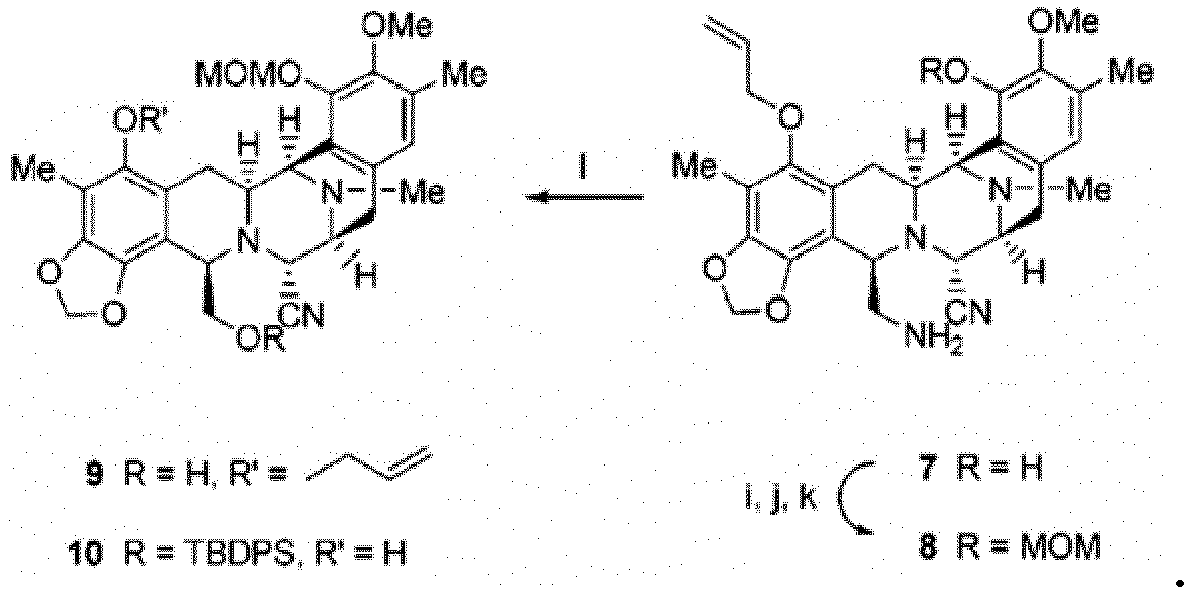
- Manzanares et al. reported another method for preparing trabectedin (Org. Lett., Vol.2, No.16, 2000, 2545-2548), which comprises first subjecting compound 7 to three steps of reaction to obtain compound 8 in which a phenol hydroxyl group is protected by MOM, and then subjecting the compound 8 to a one-step reaction to obtain compound 9 with an overall yield of 35.8%; this method has a long preparation route, complicated operations and a very low overall yield, and is not suitable for industrial use.
- Fukuyama et al reported a total synthesis involving 50 steps, with a yield of 0.56%, in which the use of an expensive chiral ligand and a noble metal ruthenium are also required; in addition, n-butyl lithium, which is a flammable hazardous agent, is used many times (J. Am. Chem. Soc. 2002, 124, 6552-6554); in addition, Zhu et al. reported a total synthesis route involving 31 steps of reaction, with a yield of 1.7%, in which the use of highly toxic hydrofluoric acid and hazardous n-butyl lithium is required. Fukuyama et al. further reported a new total synthesis route involving 30 steps of reaction, with an overall yield of 1.3%, wherein iodobenzene acetate, and expensive osmium tetroxide and palladium catalysts are repeatedly used during the synthesis. Zhang, Fuli et al. disclosed a method for the total synthesis of trabectedin (Eur. J. Org. Chem. 2017, 975-983), which relates to methods for preparing intermediates 21 and 24, as follows:

- In addition, the prior art discloses a semi-synthesis method for trabectedin, the method comprising the following process:

- This method also has the problem of a poor reaction selectivity; during the esterification of the primary hydroxyl group of compound 146 with a cysteine derivative, the phenol hydroxyl group in the structure also easily undergoes an esterification reaction. Furthermore, compound 153 and compound 154 are both present as an oil, and are difficult to purify and store.

-
CN 100475822 C discloses a method for preparing compound 170, in which a primary hydroxyl group needs to be protected first by TBOMS due to poor selectivity for the protection of a phenol hydroxyl group with MEM, and the protecting group TBMOS further needs to be subsequently removed from the primary hydroxyl group, resulting in cumbersome reaction steps; in addition, during the deprotection of the primary hydroxyl group, the deprotection of the phenol hydroxyl group easily occurs, resulting in defects such as more side reactions and a low reaction yield. -
US 2004/002602 describes synthetic processes for the manufacture of ecteinascidin compounds and describes the preparation of compound 25 according to the following route:
-
WO00/18233 
- From the above, it can be seen that there are still many problems to be solved in the methods for preparing trabectedin, such as a long preparation route, a low selectivity for protection and deprotection of the phenol hydroxyl group during a reaction, difficulty in purification, or a need to use highly toxic, expensive reagents, etc., during the reaction process.
-
US5721362 relates to a synthetic process for the formation of ecteinascidin compounds and related structures.WO2011/147828 relates to processes for the synthesis of ecteinascidins.CN107522698 relates to preparation methods and intermediates of trabectedin. - In order to solve the above-mentioned problems, the present invention provides a new method for preparing trabectedin and an intermediate.
- Firstly, the present invention provides a method for preparing intermediate compound QT9 of trabectedin, the method comprising reacting compound QT10 with a hydroxyl protecting agent to obtain compound QT9:

- Preferably, in the above-mentioned reaction, the compound QT10 is reacted with the hydroxyl protecting agent in a suitable solution such as tetrahydrofuran, ethylene glycol dimethyl ether or a mixed solution thereof at a suitable temperature such as -10°C to 20°C under alkaline conditions to produce the compound QT9, wherein the hydroxyl protecting agent is preferably bromomethyl methyl ether, chloromethyl methyl ether, or 2-methoxyethoxymethyl chloride, more preferably bromomethyl methyl ether or 2-methoxyethoxymethyl chloride. The molar ratio of the compound QT10 to the hydroxyl protecting agent therein is 1 : 1 to 20, preferably 1 : 1 to 10, more preferably 1 : 1.5 to 2.5, and the base is NaOH, KOH, NaH, or a mixture thereof, most preferably NaOH. The molar ratio of the compound QT10 to the base is 1 : 0.5 to 30, preferably 1 : 1 to 15, more preferably 1 : 1.5 to 4, most preferably 1 : 1 to 2.5; and the reaction temperature is -10°C to 30°C, preferably 0°C to 20°C, more preferably 0°C to 10°C.
- The inventors have found through extensive experimental design and verification studies that during the reaction of the compound QT10 with the hydroxyl protecting agent, where the base is NaOH, KOH, NaH, potassium t-butoxide, lithium t-butoxide, LiOH, LiOCH3 or a combination thereof, conversion of the compound QT10 to the compound QT9 can be achieved; furthermore, where the base is selected from NaOH or NaH, the reaction effect is particularly good, and the conversion efficiency is significantly improved, for example, it can be as high as 98%; moreover, where the base is NaOH or NaH, and the hydroxyl protecting agent is bromomethyl methyl ether or 2-methoxyethoxymethyl chloride, the reaction process can results in the selective protection of the phenol hydroxyl group with MOM or MEM, while side reactions on the primary hydroxyl position are very few, for example, it can be less than 2%; in addition, since the conversion rate of the reaction in this step is high and the purity of the resulting product is very high, no complicated chromatographic purification or column chromatography is necessary, and refining can be achieved simply by recrystallization; in addition, studies have found that the compound QT9 has a very good performance and can be purified by means of crystallization in various solvents such as ethyl acetate, isopropanol and methanol, so that it is very suitable for industrial applications; in addition, since NaOH is significantly safer than NaH in the industrial scale-up production process, it is more preferable that the base is NaOH in the industrial process.
- In another aspect, the present invention further provides a method for preparing an ecteinascidin compound, the method comprising: selectively protecting the phenol hydroxyl group of compound QT10 to obtain compound QT9:

- The above-mentioned method for preparing the ecteinascidin compound further comprises selectively removing the allyl group from the compound QT9 to obtain compound QT8:

- In a preferred embodiment, the reaction temperature for the conversion of the compound QT9 into the compound QT8 is preferably -10°C to 30°C, more preferably -5°C to 10°C, and the reaction time for this conversion is preferably 0.5 to 4 hours, more preferably 1 to 2 hours.
- Furthermore, the method for preparing the ecteinascidin compound further comprises subjecting the phenol hydroxyl group of the compound QT8 to oxidization, and selective hydroxylation for conversion into compound QT7:

- Furthermore, the method for preparing the ecteinascidin compound further comprises esterifying the primary hydroxyl group of the compound QT7 with a cysteine derivative for conversion into compound QT6:

- In another embodiment of the present invention, a method for preparing an ecteinascidin compound is further provided, the method comprising esterifying the primary hydroxyl group of the above-mentioned compound QT9 with a cysteine derivative for conversion into compound QT8A:

- In the above reaction, the molar ratio of the compound QT9 to the compound A is preferably 1 : 1 to 2, more preferably 1 : 1.5; the reaction temperature is preferably -10°C to 30°C, more preferably 5°C to 10°C; the reaction time is preferably 1 to 4 hours, more preferably 1.5 to 2 hours; the amount of EDCl is preferably 1.5 to 3 eq, more preferably 1.5 eq; and the amount of DMAP is preferably 0.3 to 1 eq, more preferably 0.5 eq.
- Furthermore, the method further comprises selectively removing the allyl group from the compound QT8A to obtain compound QT7A:

- In a preferred embodiment, in the above-mentioned steps for the conversion of the compound QT8A into the compound QT7A, the reaction temperature is preferably -10°C to 30°C, more preferably -5°C to 10°C, and the reaction time is preferably 0.5 to 4 hours, more preferably 1 to 2 hours.
- The above-mentioned method for preparing the ecteinascidin compound further comprises subjecting the phenol hydroxyl group of the compound QT7A to oxidization, and selective hydroxylation for conversion into compound QT6:

- Furthermore, the above-mentioned method for preparing the ecteinascidin compound further comprises reacting the compound QT6 with a Swern reagent and further with N-tert-butyl-N',N'-tetramethylguanidine to form a 1,4-bridged lactone compound QT5:

- Furthermore, the above-mentioned method for preparing the ecteinascidin compound further comprises selectively removing amino protecting group R from the compound QT5 to obtain compound QT4:

- Furthermore, the above-mentioned method for preparing the ecteinascidin compound further comprises converting the compound QT4 into compound QT3 by means of a transamination reaction:

- Furthermore, the above-mentioned method for preparing the ecteinascidin compound further comprises reacting the compound QT3 with 2-[3-hydroxy-4-methoxy-phenyl]ethylamine for conversion into compound QT2, then selectively removing the phenol hydroxyl protecting group R1 from the compound QT2 to obtain compound ET770, and optionally converting CN in the compound ET770 into OH to obtain compound ET743:
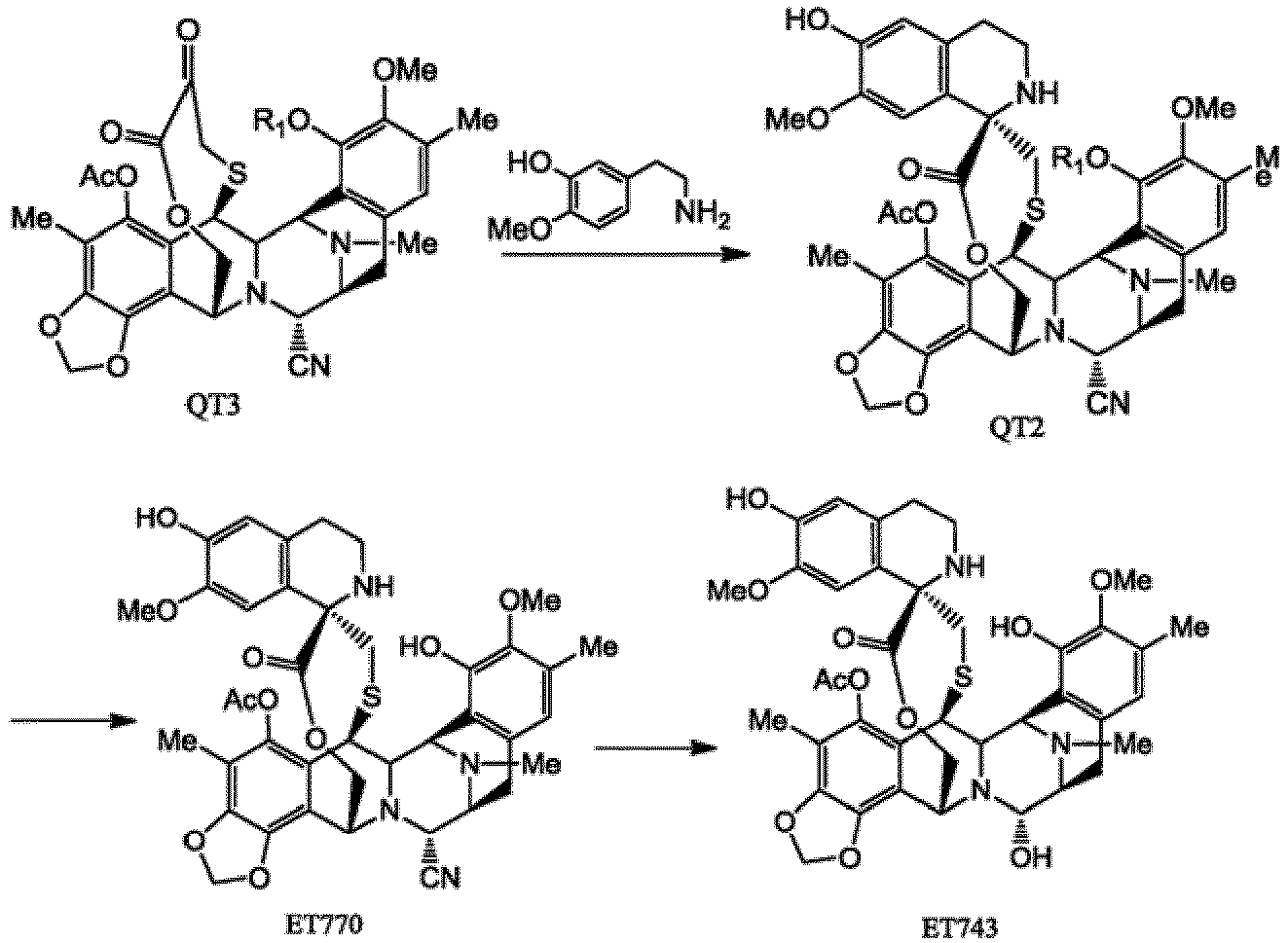
- For the methods for preparing compound QT2 from compound QT3 and for preparing compound ET743 from compound E770, reference can be made to preparation methods disclosed in J. Am. Chem. Soc. 2006, 128, 87-89 or J. Am. Chem. Soc. 1996, 118, 9202-9203.
- Furthermore, the above-mentioned method for preparing the ecteinascidin compound further comprises simultaneously removing the amino protecting group R and the hydroxyl protecting group R1 from the compound QT5 to obtain compound QT4A:

- For the method for the reaction in this step, reference can be made to preparation methods disclosed in Eur. J. Org. Chem. 2017, 975-983 and J. Org. Chem, Vol. 68, No.23, 2003, 8863.
- Furthermore, the above-mentioned method for preparing the ecteinascidin compound further comprises converting the compound QT4A into compound QT3A by means a transamination reaction, and optionally comprises reacting the compound QT3A with 2-[3-hydroxy-4-methoxy-phenyl]ethylamine for conversion into compound ET770, and further converting CN in the compound ET770 into OH to obtain compound ET743:

- For the method for the reaction in this step, reference can be made to preparation methods disclosed in Eur. J. Org. Chem. 2017, 975-983 and J. Org. Chem, Vol. 68, No. 23, 2003, 8863.
- In the above-mentioned method of the present invention, depending on the choice of the specific protecting groups for the phenol hydroxyl group and the cysteine side chain, a plurality of alternative intermediates may be produced, and the total number of synthetic conversions may also vary depending on the selected protecting groups. Generally, where the cysteine side chain protecting group is Boc, the reaction step is correspondingly shorter than where Cbz, Alloc or Troc is used. The reaction schemes and steps are introduced herein for ready understanding by a person skilled in the art.
- In particular, in more specific preferred embodiments of the present invention, six methods for preparing ecteinascidin 743 are provided, specifically as shown in routes 1 to 7. Route 1:


-

-

-


-


-


-


- In addition, described (but not claimed) herein is an intermediate having the following structure for preparing an ecteinascidin compound:


- Terms and abbreviations used in the present invention: "MOM" refers to methoxy methyl ether; "MEM" refers to methoxyethoxymethyl; Boc refers to tert-butoxycarbonyl; Alloc refers to allyloxycarbonyl: Cbz refers to benzyloxycarbonyl; Troc refers to 2,2,2-trichloroethoxycarbonyl; EDCl refers to 1-ethyl-(3-dimethylaminopropyl)carbodiimide hydrochloride (EDCHCl) ; DMAP refers to 4-dimethylaminopyridine; DBU refers to 1,8-diazabicycloundec-7-ene; and DIPEA refers to diisopropylethylamine.
- An advantage of the present invention is that a new method for preparing compound QT9 and a method for preparing trabectedin from the compound QT9 are provided, wherein in the methods provided by the present invention, a plurality of intermediates such as QT9, QT8, QT7, QT4 and QT5 are all in a solid form and are easy to purify and store; among them, compounds QT9, QT4 and QT5 can all be purified by means of crystallization, with both the yield and purity being very high; in particular, the compound QT9 can be purified by means of crystallization from various solvents; the overall route is very suitable for industrial applications. With regard to the method provided by the present invention, since the reactions for preparing a plurality of intermediates, particularly compounds QT9, QT4 and QT5 in the reaction process have properties of high selectivity, high conversion efficiency, and easy purification, and a plurality of intermediates have higher purities, thereby greatly improving the yields of the reactions in the subsequent steps, thus significantly increasing the overall yield of trabectedin. Furthermore, the defects of a plurality of intermediates for preparing trabectedin being oil and difficult to purify in the prior art are overcome.
- Secondly, in the method provided by the present invention, the reaction selectivity for the protection and deprotection of the phenol hydroxyl group and the protection of the primary hydroxyl group are high, and the yield and purity of the product are both significantly improved; particular in the process of the preparation of the compound QT9, the inventors have found through a large number of experimental design studies that where sodium hydroxide or sodium hydride is used as a base in the reaction system, the reaction conversion rate is very high, for example, it may be close to 100%, and the yield of the resulting product QT9 is significantly improved, for example, it may be up to 98%, leading to easy handle after reaction.
- Since the reactivities of the phenol hydroxyl group and the primary hydroxyl group are relatively close, when protection is carried out on the phenol hydroxyl group, a side reaction of simultaneously protecting the primary hydroxyl group easily occurs, so that it is usually necessarily for a person skilled in the art to protect the primary hydroxyl group prior to the protection of the phenol hydroxyl group with MEM or MOM, and in the subsequent reaction process, it is further necessarily to remove the protecting group on the primary hydroxyl group, causing the operation to be cumbersome; furthermore, the protecting group on the phenol hydroxyl group is easy to remove during the removal of the primary hydroxyl protecting group, and there are many by-products in the reaction product, thereby resulting in purification difficulties. Compared with the solutions disclosed in the prior art, the present invention directly selectively protects the phenol hydroxyl group without protection on the primary hydroxyl group, thus omitting the process of the two reaction steps of protecting and deprotecting the primary hydroxyl group; furthermore, the reaction selectivity is high, and the double-protected by-product is very few and can be removed by means of recrystallization, which greatly simplifies the operation steps and production cycle, so that it is very suitable for industrialization.
- The content and preferred embodiments of the present invention are further explained below in conjunction with specific examples.
-

- To a 1000 ml three-necked flask, 6.9 g of sodium hydroxide and 250 ml of tetrahydrofuran are added, and after the temperature is reduced to 0°C or less, 59.8 g of compound QT10 is added, and 21.5 g of 2-methoxyethoxymethyl chloride (MEM-Cl) is dropwise added. After the dropwise addition is completed, with the temperature being maintained at 0°C to 10°C, the reaction is stirred for 4 hours, quenched by adding a saturated ammonium chloride aqueous solution, and extracted with dichloromethane (2 × 500 ml); the organic layers are combined, dried over anhydrous sodium sulfate, and concentrated in vacuo; and the resulting viscous material is recrystallized from ethyl acetate and n-hexane to obtain 64.2 g of the compound as a white solid, with a yield of 91.8% and HPLC > 99%.
- 1HNMR (400MHZ, CDCl3): δ6.71 (s, 1H), 06.10 (m, 1H), 5.93 (d, J = 1.2Hz, 1H), 5.87 (d, J = 1.2Hz, 1H), 5.44 (dd, J1 = 1.2Hz, J2 = 17.2Hz, 1H), 5.30 (dd, J1 = 1.2Hz, J2 = 10.4Hz, 1H), 5.27 (d, J = 6Hz, 1H), 5.18 (d, J = 6Hz, 1H), 4.26 (d, J=2.4Hz, 1H), 4, 18-4.14 (m, 2H), 4.04 (d, J=2.4Hz, 1H), 3.99 (t, 2H), 3.86 (m, 1H), 3.66 (s, 3H), 3.64 (m, 1H), 3.60 (t, 2H), 3.42-3.32 (m, 3H), 3.37 (s, 3H), 3.25 (dd, J1 = 2.8Hz, J2 = 16Hz, 1H), 3.14 (dd, J1 = 8.4Hz, J2 = 17.4Hz, 1H), 2.53 (d, J = 18.4Hz, 1H), 2.37 (s, 3H), 2.21 (s, 3H), 2.12 (s, 3H), 1.86-1.57 (m, 2H);MS: m/z (607.69), Found: 608.2 (M+H)+.
-

- To a 500 ml three-necked flask, 1.15 g of sodium hydroxide and 115 ml of tetrahydrofuran are added, and after the temperature is reduced to 0°C or less, 10.0 g of compound QT10 is added, and 2.41 g of bromomethyl methyl ether (MOM-Br) is dropwise added. After the dropwise addition is completed, with the temperature being maintained at -5°C to 5°C, the reaction is stirred for 2 hours, quenched by adding a saturated ammonium chloride aqueous solution, and extracted with dichloromethane (2 × 200 ml) ; the organic layers are combined, dried over anhydrous sodium sulfate, and concentrated in vacuo; and the resulting foamy solid is recrystallized from ethyl acetate and n-hexane to obtain 9.8 g of the compound as a white solid, with a yield of 90.3% and HPLC > 99%.
- 1HNMR (400MHZ, CDCl3): δ6.72 (s, 1H), 6.16-6.07 (m, 1H), 5.93 (d, J = 1.6Hz, 1H), 5.88 (d, J = 1.6Hz, 1H), 5.44 (dd, J1 = 1.6Hz, J2 = 17.2Hz, 1H), 5.30 (dq, J1 = 1.2Hz, J2 = 10.4Hz, 1H), 5.12 (s, 2H), 4.27 (d, J = 2.0Hz, 1H), 4, 12-4.11 (m, 2H), 4.05 (d, J = 2.4Hz, 1H), 3.99 (t, J = 3.2Hz, 2H), 3.71 (s, 3H), 3.68-3.63 (dt, J1 = 3.2Hz, J2 = 10.8Hz, 1H), 3.59 (s, 3H), 3.49-3.33 (m, 3H), 3.27 (dd, J1 = 2.8Hz, J2 = 16.0Hz, 1H), 3.16 (dd, J1 = 7. 6Hz, J2 = 18.0Hz, 1H), 2.54 (d, J = 18.0Hz, 1H), 2.37 (s, 3H), 2.22 (s, 3H), 2.12 (s, 3H), 1.86-1.81 (dd, J1 = 12Hz, J2 = 15.6Hz, 1H), 1.79-1.75 (dd, J1 = 2.8Hz, J2 = 10.4Hz, 1H) ; MS: m/z (563.64), Found: 564.5 (M+H)+.
-

- Under argon protection, to a 100 ml three-necked flask, 3.0 g of compound 2, 0.241 g of bis(triphenylphosphine)palladium dichloride, 1.48 g of acetic acid and 60 ml of dichloromethane are added, and 3.57 g of tri-n-butyl tin hydride is added at -15°C to -10°C; after the addition is completed, with the temperature being maintained at 0°C to 5°C, the reaction is stirred for 1 hour, quenched by adding a saturated potassium fluoride aqueous solution and extracted with dichloromethane (2 × 40 ml); and the organic layers are combined, dried over anhydrous sodium sulfate and concentrated in vacuo to obtain an oil, which is subjected to column chromatography (n-hexane : ethyl acetate = 4 : 1 to 1 : 1) to obtain 2.76 g of the compound as a white foamy solid, with a yield of 98.5% and HPLC > 98%.
- 1HNMR (400MHZ, CDCl3): δ6.68 (s, 1H), 5.89 (d, J = 1.2Hz, 1H), 5.82 (d, J = 1.2Hz, 1H), 5.44 (dd, J1 = 1.2Hz, J2 = 17.2Hz, 1H), 5.30 (dd, J1=1.2Hz, J2 = 10.4Hz, 1H), 5.61 (s, 1H), 5.39 (d, J = 6Hz, 1H), 5.27 (d, J = 6Hz, 1H), 4.26 (d, J = 2.4Hz, 1H), 4, 13-4.066 (m, 2H), 3.99-3.93 (m, 2H), 3.69 (s, 3H), 3.68-3.65 (m, 3H), 3.60 (t, 1H), 3.40 (s, 3H), 3.37-3.76 (m, 2H), 3.25 (dd, J = 3.2, J2 = 14.2, 1H), 3.13 (dd, J1 = 8.4Hz, J2 = 18.4Hz, 1H), 2.53 (d, J = 18.0Hz, 1H), 2.34 (s, 3H), 2.20 (s, 3H), 2.08 (s, 3H), 1.83-1.77 (m, 2H);
- MS: m/z (567.63), Found: 568.6 (M+H)+.
-

- With reference to a similar method to example 3, the compound is prepared from compound 3, with a yield of 97.3% and HPLC > 96%.
- 1HNMR (400MHZ, CDCl3): δ6.72 (s, 1H), 6.16-6.07 (m, 1H), 5.93 (d, J = 1.6Hz, 1H), 5.88 (d, J = 1.6Hz, 1H), 5.44 (dd, J1 = 1.6Hz, J2 = 17.2Hz, 1H), 5.36-5.30 (m, 1H), 5.19 (t, J = 6.5Hz, 1H), 4.28 (d, J = 2.4Hz, 1H), 4.10 (d, J = 2.4Hz, 1H), 4.05-3.98 (m, 1H), 3.70 (dd, J1 = 5.6Hz, J2 = 16.0Hz, 7H), 3.56 (m, 1H), 3.44-3.36 (m, 2H), 3.18-3.07 (m, 2H), 2.54 (d, J = 2.0Hz, 1H), 2.38 (d, J = 5.6Hz, 3H), 2.25 (d, J = 11.2Hz, 3H), 2.10 (s, 3H), 1.84 (dd, J = 15.2Hz, 2H); MS: m/z (523.58), Found: 524.5 (M+H)+.
-

- Under argon protection, to a 250 ml three-necked flask, 2.7 g of compound 4 and 40 ml of dichloromethane are added, and after the temperature is reduced to -40°C to -35°C, a solution of 1.71 g of benzeneseleninic anhydride in dichloromethane is added; with the temperature being maintained constant, the reaction is stirred for 1 hour, quenched by adding a saturated sodium bicarbonate aqueous solution and allowed for layering; the aqueous layer is extracted with dichloromethane (2 × 40 ml), and the organic layers are combined, dried over anhydrous sodium sulfate and concentrated in vacuo to obtain an oil, which is subjected to column chromatography (n-hexane : ethyl acetate = 4 : 1 to 1 : 1) to obtain 2.66 g of the compound as a light yellow solid, with a yield of 95.8% and HPLC > 96%.
- 1HNMR (400MHZ, CDCl3): δ6.69, 6.62 (s, 1H), 5.84, 5.74 (s, 2H), 5.26, 5.08 (d, J = 1.2Hz, 1H), 5.15 (d, J = 1.5Hz, 1H), 5.61 (s, 1H), 4.23-3.30 (m, 11H), 3.90, 3.62 (s, 3H), 3.39, 3.36 (s, 3H), 3.024-2.959 (m, 1H), 2.80-2.09 (m, 2H), 2.30, 2.24 (s, 3H), 2.22, 2.19 (s, 3H), 1.80 (s, 3H); MS: m/z (583.63), Found: 584.65 (M+H)+.
-

- With reference to a method of example 5, compound 7 is prepared from compound 5 and obtained as a light yellow solid (8.0 g), with a yield of 97.0% and HPLC > 96%.
- 1HNMR (400MHZ, CDCl3): δ6.72 (s, 1H), 5.86 (m, 1H), 5.93 (s, 2H), 5.12 (s, 2H), 4.10 (m, 2H), 3.92 (s, 3H), 3.88 (m, 1H), 3.80 (m, 1H), 3.62 (m, 1H), 3.52 (s, 3H), 3.34 (m, 1H), 3.04 (dd, J1 = 7.6, J2 = 18.0, 1H), 2.68 (m, 1H), 2.62 (d, J = 18, 1H), 2.32 (s, 3H), 2.24 (s, 3H), 2.21 (m, 1H), 2.00 (dd, J1 = 8.4, J2 = 15.2, 1H), 1.80 (s, 3H).
-

- 2.5 g of compound 6 and 2.57 g of N-tert-butoxycarbonyl-(s)-fluorenylmethyl-L-cysteine are dissolved in dichloromethane, and treated with anhydrous toluene (2 × 20 ml), and water is azeotropically removed. Under argon protection, the mixture from which water has been removed is dissolved in 50 ml of dichloromethane, transferred to a 250 ml three-necked flask, and cooled to -10°C or less; 0.262 g of DMAP (2.14 mmol) is added, and a solution of 1.64 g of 1-ethyl-(3-dimethylaminopropyl)carbodiimide hydrochloride (EDC hydrochloride) (8.57 mmol) in dichloromethane is dropwise added; after the dropwise addition is completed, the reaction is stirred at 10°C to 15°C for 2 hours, quenched by adding a saturated sodium bicarbonate aqueous solution and allowed for layering; the aqueous layer is extracted with dichloromethane (2 × 50 ml), and the organic layers are combined, dried over anhydrous sodium sulfate and concentrated in vacuo to obtain an oil, which is subjected to column chromatography (n-hexane : ethyl acetate = 4 : 1 to 1 : 1) to obtain 3.7 g of the compound as a light yellow solid, with a yield of 89.6%.
- 1HNMR (400MHZ, CDCl3): δ7.73 (t, J = 6.8Hz, 4H), 7.63 (m, 2H), 7.54 (d, J = 7.6Hz, 2H), 7.40-7.34 (m, 4H), 7.31-7.27 (m, 4H), 6.62 (s, 2H), 5.86 (s, 1H), 5.81 (s, 1H), 5.75 (s, 1H), 5.72 (s, 1H), 5.70 (s, 1H), 5.35 (d, J = 6.0Hz, 1H), 5.22 (d, J = 6.0Hz, 1H), 5.13 (d, J = 6.0Hz, 1H), 4.97 (d, J = 6.0, J = 8.8Hz, 1H), 4.43 (m, 2H), 4.20-4.01 (m, 8H), 3.97-3.85 (m, 4H), 3.54 (m, 2H), 3.38 (s, 3H), 3.35 (s, 3H), 3.34-2.91 (m, 8H), 2.60-2.31 (m, 4H), 2.27 (s, 3H), 2.25 (s, 3H), 2.21 (s, 3H), 1.97 (s, 3H), 1.94-1.81 (m, 2H), 1.77 (s, 3H), 1.43 (s, 9H), 1.41 (s, 9H);
- MS: m/z (965.12.), Found: 966.25 (M+H)+.
-

- 1.5 g of compound 7 and 1.67 g of N-tert-butoxycarbonyl-(s)-fluorenylmethyl-L-cysteine are dissolved in dichloromethane, and treated with anhydrous toluene (2 × 15 ml), and water is azeotropically removed. Under argon protection, the mixture from which water has been removed is dissolved in 30 ml of dichloromethane, transferred to a 100 ml three-necked flask, and cooled to -10°C or less; 0.17 g of DMAP is added and a solution of 1.07 g of 1-ethyl-(3-dimethylaminopropyl)carbodiimide hydrochloride (EDC hydrochloride) (5.56 mmol) in dichloromethane is dropwise added; after the dropwise addition is completed, the reaction is stirred at 10°C to 15°C for 2 hours, quenched by adding a saturated sodium bicarbonate aqueous solution and allowed for layering; the aqueous layer is extracted with dichloromethane (2 × 30 ml), and the organic layers are combined, dried over anhydrous sodium sulfate and concentrated in vacuo to obtain an oil, which is subjected to column chromatography (n-hexane : ethyl acetate = 4 : 1 to 1 : 1) to obtain 2.28 g of the compound as a light yellow solid, with a yield of 88.9%.
- 1HNMR (400MHZ, CDCl3): δ7.73-7.61 (m, 4H), 7.63 (m, 2H), 7.37-7.30 (m, 4H), 6.62 (s, 1H), 6.59 (s, 1H), 6.53 (s, 1H), 5.72 (s, 1H), 5.70 (s, 1H), 5.61 (s, 1H), 5.55 (bs, 1H), 5.34 (m, 2H), 5.08 (m, 1H), 5.01 (m, 1H), 4.67 (m, 1H), 4.50 (m, 1H), 4.38 (dd, J1 = 4.8, J2 = 12.8, 1H), 4.21 (dd, J1 = 6.4, J2 = 12.8, 1H), 4.11 (m, 1H), 4.02 (m, 3H), 3.87 (m, 1H), 3.83 (s, 3H), 3.72 (m, 1H), 3.61 (s, 3H), 3.49 (s, 3H), 3.27 (m, 1H), 3.15 (dd, J1 = 1.6Hz, J2 = 6.0Hz, 2H), 3.07 (d, J = 6.4Hz, 1H), 2.94 (m, 4H), 2.86 (m, 2H), 2.42 (m, 2H), 2.25 (s, 3H), 2.20 (s, 3H), 2.15 (s, 3H), 2.08 (dd, J1 = 2.4Hz, J2 = 13.2Hz, 1H), 1.77 (s, 3H), 1.76 (s, 3H), 1.43 (s, 9H);
- MS: m/z (921.06.), Found: 922.35 (M+H)+.
-

- Under argon protection, to a 500 ml three-necked flask, 4.1 g of dimethyl sulfoxide and 300 ml of anhydrous dichloromethane are added, and 3.5 g of trifluoromethanesulfonic anhydride is dropwise added at -70°C to -80°C; after the dropwise addition is completed, the reaction is stirred for 20 minutes with the temperature being maintained constant, and a solution of 10.0 g of compound 8 in dichloromethane is dropwise added, with the internal temperature being controlled to not exceed -70°C during the dropwise addition; after the dropwise addition is completed, the temperature is raised to -45°C to -40°C for 1 h of reaction, and 13.40 g of diisopropylethylamine is dropwise added; after the dropwise addition is completed, the temperature is slowly returned to 0°C and then reduced to -15°C or less and 3.45 g of tert-butanol (46.55 mmol) is dropwise added; the mixture is stirred for 10 minutes and a solution of 17.8 g of 2-tert-butyl-1,1,3,3-tetramethylguanidine in dichloromethane is dropwise added; the temperature is slowly raised to 0°C and then reduced to -10°C or less, 13.22 g of acetic anhydride is slowly dropwise added; and after the dropwise addition is completed, a reaction is carried out for 15 minutes with the temperature being maintained constant, quenched by adding a saturated ammonium chloride aqueous solution and allowed for layering, and the aqueous layer is extracted with 250 ml of dichloromethane. The organic layers are combined, washed with a saturated sodium bicarbonate aqueous solution and a saturated sodium chloride aqueous solution respectively, concentrated and subjected to column chromatography (n-hexane : ethyl acetate = 5 : 1 to 1 : 1) to obtain an off-white foamy solid, which is recrystallized from ethyl acetate and n-hexane to obtain 6.26 g of the compound as a white powdery solid, with a yield of 74.5% and HPLC > 96%.
- 1HNMR (400MHZ, CDCl3): δ6.78 (s, 1H), 6.09 (d, J = 1.2Hz, 1H), 5.99 (d, J = 1.2Hz, 1H), 5.33 (d, J = 6.0Hz, 1H), 5.20 (d, J = 5.6Hz, 1H), 5.03 (d, J = 11.6Hz, 1H), 4.64 (d, J = 9.6Hz, 1H), 4.51 (bs, 1H), 4.35 (d, J = 4.8Hz, 1H), 4.29-4.12 (m, 4H), 3.920 (m, 2H), 3.76 (s, 3H), 3.59-3.57 (t, J = 4.8Hz, 2H), 3.43-3.39 (m, 2H), 3.37 (s, 3H), 2.92-2.90 (m, 2H), 2.31-2.04 (m, 2H), 2.28 (s, 3H), 2.21 (s, 3H), 2.08 (s, 3H), 2.03 (s, 3H), 1.45 (s, 9H);
- MS: m/z (810.91), Found: 811.60 (M+H)+.
-

- With reference to a similar method to example 9, the compound is prepared and obtained as a white powdery solid, with a yield of 72.7% and HPLC > 96%.
- 1HNMR (400MHZ, CDCl3): δ6.78 (s, 1H), 6.09 (d, J = 1.2Hz, 1H), 5.99 (d, J = 1.2Hz, 1H), 5.20 (d, J = 5.6Hz, 1H), 5.14 (d, J = 5.6Hz, 1H), 5.03 (d, J = 11.6Hz, 1H), 4.64 (d, J = 9.6Hz, 1H), 4.51 (s, 1H), 4.33 (d, J = 4.8Hz, 1H), 4.29-4.17 (m, 4H), 3.76 (s, 3H), 3.57 (s, 3H), 3.42 (m, 2H), 2.93 (m, 2H), 2.35 (m, 1H), 2.31 (s, 3H), 2.28 (s, 3H), 2.21 (s, 3H), 2.09 (m, 1H), 2.05 (s, 3H), 1.45 (s, 9H); MS: m/z (766.86), Found: 767.50 (M+H)+.
-

- Under argon protection, to a 500 ml three-necked flask, 6.0 g of compound 10 and 300 ml of trichloromethane are added, and after the temperature is reduced to 0°C, 7.65 g of anhydrous p-toluenesulfonic acid is added; and after the addition is completed, the reaction is stirred for 44 hours with the temperature being maintained at 20°C to 25°C. After the temperature is reduced to 10°C, the reaction is quenched by adding a saturated sodium bicarbonate aqueous solution, and the pH is adjusted to about 8; the resultant is allowed for layering; the aqueous layer is extracted with dichloromethane (2 × 50 ml), and the organic layers are combined, concentrated and subjected to column chromatography (n-hexane : ethyl acetate = 2 : 1 to 1 : 2) followed by recrystallization from ethyl acetate and n-hexane to obtain 4.37 g of the compound as a white solid, with a yield of 94.9% and HPLC > 96%.
- 1HNMR (400MHZ, CDCl3): δ6.52 (s, 1H), 6.07 (d, J = 1.2Hz, 1H), 5.99 (d, J = 1.2Hz, 1H), 5.73 (bs, 1H), 5.02 (d, J = 11.6Hz, 1H), 4.54 (bs, 1H), 4.25 (d, J = 3.2Hz, 2H), 4.18 (d, J = 2.8Hz, 1H), 4.14 (dd, J1 = 2.0Hz, J2 = 11.6Hz, 1H), 3.78 (s, 3H), 3.42-3.39 (m, 2H), 3.27 (t, J = 6.8Hz, 1H), 2.91 (m, 2H), 2.21-2.18 (m, 2H), 2.30 (s, 3H), 2.28 (s, 3H), 2.18 (s, 3H), 2.03 (s, 3H); MS: m/z (622.69), Found: 623.25 (M+H)+.
-

- With reference to a similar method to example 11, compound QT4A is prepared from compound 11, with a yield of 94.8%. 1HNMR (400MHZ, CDCl3): δ6.52 (s, 1H), 6.07 (d, J = 1.2Hz, 1H), 5.99 (d, J = 1.2Hz, 1H), 5.73 (bs, 1H), 5.02 (d, J=11.6Hz, 1H), 4.54 (bs, 1H), 4.25 (d, J=3.2Hz, 2H), 4.18 (d, J = 2.8Hz, 1H), 4.14 (dd, J1 = 2.0Hz, J2 = 11.6Hz, 1H), 3.78 (s, 3H), 3.42-3.39 (m, 2H), 3.27 (t, J = 6.8Hz, 1H), 2.91 (m, 2H), 2.21-2.18 (m, 2H), 2.30 (s, 3H), 2.28 (s, 3H), 2.18 (s, 3H), 2.03 (s, 3H); MS: m/z (622.69), Found: 623.25 (M+H)+.
-

- According to methods known in the art, such as a method disclosed in example 20 of
WO 2001087895 , QT3A is prepared from QT4A, with a yield of 64.1%. - 1HNMR (400MHZ, CDCl3): δ6.49 (s, 1H), 6.11 (d, J = 1.2Hz, 1H), 6.02 (d, J = 1.2Hz, 1H), 5.70 (s, 1H), 5.10 (d, J = 11.6Hz, 1H), 4.66 (bs, 1H), 4.39 (s, 1H), 4.27 (d, J = 4Hz, 1H), 4.23 (dd, J1 = 1.2Hz, J2 = 11.2Hz, 1H), 4.16 (d, J = 2.4Hz, 1H), 3.75 (s, 3H), 3.55 (d, J = 5.2Hz, 1H), 3.43 (d, J = 8.8Hz, 1H), 2.93-2.82 (m, 2H), 2.72 (d, J = 17.6Hz, 1H), 2.58 (dd, J = 10.0Hz, 1H), 2.32 (s, 3H), 2.24 (s, 3H), 2.14 (s, 3H), 2.04 (s, 3H);
- MS: m/z (621.66), Found: 622.30 (M+H)+.
-

- With reference to methods known in the art, such as a method disclosed in example 21 of
WO 2001087895 , ET770 is prepared from QT3A, with a yield of 93% and HPLC > 99%. - 1HNMR (400MHZ, CDCl3): δ6.59 (s, 1H), 6.47 (s, 1H), 6.44 (s, 1H), 6.05 (d, J = 1.2Hz, 1H), 5.98 (d, J = 1.2Hz, 1H), 5.75 (s, 1H), 5.44 (bs, 1H), 5.03 (d, J = 11.6Hz, 1H), 4.57 (bs, 1H), 4.32 (s, 1H), 4.28 (d, J = 4.8Hz, 1H), 4.18 (d, J = 2.8Hz, 1H), 4.13 (dd, J1 = 2.0Hz, J2 = 11.6Hz, 1H), 3.79 (s, 3H), 3.62 (s, 3H), 3.51 (d, J=5.2Hz, 1H), 3.42 (m, 1H), 3.12 (m, 1H), 2.95 (m, 2H), 2.79 (m, 1H), 2.60 (m, 1H), 2.49 (m, 1H), 2.36-2.11 (m, 2H), 2.32 (s, 3H), 2.26 (s, 3H), 2.19 (s, 3H), 2.04 (s, 3H); MS: m/z (770.85), Found: 771.50 (M+H)+.
-

- Under argon protection, to a 250 ml three-necked flask, 2.5 g of compound ET770, 11.02 g of silver nitrate, 50 ml of acetonitrile and 37.5 ml of deionized water are added, and the mixture is stirred at 20°C to 25°C for 2 hours away from light and filtered over diatomaceous earth; the filtrate is added to a mixed solution of 200 ml of a saturated sodium bicarbonate aqueous solution and 100 ml of a saturated sodium chloride aqueous solution; after a large amount of white solid sufficiently precipitates out, the mixture is filtered over diatomaceous earth, and the filter cake is washed with dichloromethane; after layering, the aqueous layer is extracted with dichloromethane (3 × 100 ml), and the organic layers are combined, washed sequentially with a saturated sodium chloride aqueous solution, an ammonium chloride-aqueous ammonia buffer (pH 8-9) and a saturated sodium chloride aqueous solution, dried over anhydrous sodium sulfate, concentrated under reduced pressure, and recrystallized from dichloromethane and n-pentane to obtain 2.35 g of the compound as a white crystalline powder, with a yield of 95.1% and HPLC > 99%.
- 1HNMR (400MHZ, CDCl3): δ6.60 (s, 1H), 6.46 (s, 1H), 6.45 (s, 1H), 6.02 (d, J = 0.8Hz, 1H), 5.94 (d, J = 0.8Hz, 1H), 5.69 (s, 1H), 5.41 (bs, 1H), 5.14 (d, J = 10.8Hz, 1H), 4.81 (s, 1H), 4.47 (bs, 1H), 4.41 (bs, 1H), 4.16 (d, J = 4.0Hz, 1H), 4.05 (dd, J1 = 2.0Hz, J2 = 11.2Hz, 1H), 3.79 (s, 3H), 3.61 (s, 3H), 3.58 (d, J = 4.8Hz, 1H), 3.22 (m, 1H), 3.13 (m, 1H), 2.88-2.77 (m, 3H), 2.60 (m, 1H), 2.50 (m, 1H), 2.37-2.13 (m, 2H), 2.32 (s, 3H), 2.26 (s, 3H), 2.17 (s, 3H), 2.04 (s, 3H); MS: m/z (761.84), Found: 762.25 (M+H)+.
-

- 5.0 g of compound 2 and 4.93 g of N-tert-butoxycarbonyl-(s)-fluorenylmethyl-L-cysteine are dissolved in dichloromethane, and treated with anhydrous toluene (2 × 50 ml), and water is azeotropically removed. Under argon protection, the mixture from which water has been removed is dissolved in 100 ml of dichloromethane, transferred to a 250 ml three-necked flask, and cooled to -10°C or less; 0.502 g of DMAP is added, and a solution of 3.15 g of 1-ethyl-(3-dimethylaminopropyl)carbodiimide hydrochloride (EDC hydrochloride) in dichloromethane is dropwise added; after the dropwise addition is completed, the reaction is stirred at 10°C to 15°C for 2 hours, quenched by adding a saturated sodium bicarbonate aqueous solution and allowed for layering; the aqueous layer is extracted with dichloromethane (2 × 100 ml), and the organic layers are combined, dried over anhydrous sodium sulfate and concentrated in vacuo to obtain an oil, which is subjected to column chromatography (n-hexane : ethyl acetate = 4 : 1 to 2 : 1) to obtain 7.90 g of the compound as a white foamy solid, with a yield of 97.1% and HPLC > 96%.
- 1HNMR (400MHZ, CDCl3): δ7.73-7.70 (m, 2H), 7.61 (dd, J1 = 7.6Hz, J2 = 15.6Hz, 2H), 7.37 (m, 2H), 7.29-7.26 (m, 2H), 6.62 (s, 1H), 6.08-5.99 (m, 1H), 5.91 (d, J=1.2Hz, 1H), 5.80 (d, J = 1.2Hz, 1H), 5.37 (dd, J1 = 1.6, J2 = 17.2Hz), 5.24 (d, J = 6.0Hz, 1H), 5.14 (d, J = 6.0Hz), 5.04 (brd, J = 8.8Hz, 1H), 4.28 (m, 2H), 4.17-3.92 (m, 8H), 3.85 (m, 1H), 3.69 (s, 3H), 3.57 (m, 2H), 3.38 (s, 3H), 3.37-3.16 (m, 3H), 2.98-2.93 (m, 3H), 2.61 (m, 2H), 2.29 (s, 3H), 2.20 (s, 3H), 2.03 (s, 3H), 1.75 (dd, J1 = 11.6, J2 = 15.6, 1H), 1.44 (s, 9H); MS: m/z (989.18), Found: 990.0 (M+H)+.
-

- With reference to a similar method to example 16, compound 13 is prepared and obtained as a white foamy solid, with a yield of 97.4% and HPLC > 95%.
MS: m/z (945.13), Found: 946.50 (M+H)+. -

- Under argon protection, to a 250 ml three-necked flask, 7.5 g of compound 12, 0.37 g of bis(triphenylphosphine)palladium dichloride, 2.28 g of acetic acid and 150 ml of dichloromethane are added, and 5.50 g of tri-n-butyl tin hydride is added at -15°C to -10°C; after the addition is completed, with the temperature being maintained at 0°C to 5°C, the reaction is stirred for 1 hour, quenched by adding a saturated potassium fluoride aqueous solution and extracted with dichloromethane (2 × 100 ml) ; and the organic layers are combined, dried over anhydrous sodium sulfate and concentrated in vacuo to obtain an oil, which is subjected to column chromatography (n-hexane : ethyl acetate = 4 : 1 to 1 : 1) to obtain 7.0 g of the compound as a white foamy solid, with a yield of 97.3% and HPLC > 96%. MS: m/z (949.12), Found: 950.0 (M+H)+.
- With reference to a similar method to example 18, compound 40 is prepared from compound 38, and compound 41 is prepared from compound 39.
- With reference to a similar method to example 18, compound 33 is prepared from compound 31 and obtained as a white foamy solid, with a yield of 95.2%. MS: m/z (939.08), Found: 940.0 (M+H)+.
-

- With reference to a method of example 19, compound 15 is prepared and obtained as a white foamy solid, with a yield of 96.1%.
- MS: m/z (905.07), Found: 906.35 (M+H)+.
-

- Under argon protection, to a 500 ml three-necked flask, 6.0 g of compound 14 (6.32 mmol) and 120 ml of dichloromethane are added; after the temperature is reduced to -40°C to -35°C, a solution of 2.28 g of benzeneseleninic anhydride (6.33 mmol) in dichloromethane is added; with the temperature being raised to -20°C to -15°C, the reaction is stirred for 1 hour, quenched by adding a saturated sodium bicarbonate aqueous solution and allowed for layering; the aqueous layer is extracted with dichloromethane (2 × 100 ml), and the organic layers are combined, dried over anhydrous sodium sulfate and concentrated in vacuo to obtain an oil, which is subjected to column chromatography (n-hexane : ethyl acetate = 4 : 1 to 1 : 1) to obtain 5.9 g of the compound as a light yellow solid, with a yield of 96.7% and HPLC > 96%.
- 1HNMR (400MHZ, CDCl3): δ7.73 (t, J = 6.8Hz, 4H), 7.63 (m, 2H), 7.54 (d, J = 7.6Hz, 2H), 7.40-7.34 (m, 4H), 7.31-7.27 (m, 4H), 6.62 (s, 2H), 5.86 (s, 1H), 5.81 (s, 1H), 5.75 (s, 1H), 5.72 (s, 1H), 5.70 (s, 1H), 5.35 (d, J = 6.0Hz, 1H), 5.22 (d, J = 6.0Hz, 1H), 5.13 (d, J = 6.0Hz, 1H), 4.97 (d, J = 6.0, J = 8.8Hz, 1H), 4.43 (m, 2H), 4.20-4.01 (m, 8H), 3.97-3.85 (m, 4H), 3.54 (m, 2H), 3.38 (s, 3H), 3.35 (s, 3H), 3.34-2.91 (m, 8H), 2.60-2.31 (m, 4H), 2.27 (s, 3H), 2.25 (s, 3H), 2.21 (s, 3H), 1.97 (s, 3H), 1.94-1.81 (m, 2H), 1.77 (s, 3H), 1.43 (s, 9H), 1.41 (s, 9H);
- MS: m/z (965.12), Found: 966.25 (M+H)+.
- With reference to a similar method, compound 34 is prepared from compound 40; and compound 35 is prepared from compound 41.
- With reference to a similar method to example 20, compound 26 is prepared from compound 32 and obtained as a light yellow solid, with a yield of 95.6%. MS: m/z (999.13), Found: 1000.05 (M+H)+.
- With reference to a similar method to example 20, compound 27 is prepared from compound 33 and obtained as a light yellow solid, with a yield of 96.9%. MS: m/z (955.08.), Found: 956.0 (M+H)+.
-

- With reference to a similar method to example 20, compound 9 is prepared and obtained as a light yellow solid, with a yield of 98.3% and HPLC > 98%.
- MS: m/z (921.06.), Found: 922.35 (M+H)+.
-

- 2.5 g of compound 6 (4.28 mmol) and 2.47 g of N-(allyloxycarbonyl)-S-(fluorenylmethyl)-L-cysteine (6.44 mmol) are dissolved in dichloromethane, and treated with anhydrous toluene (2 × 20 ml), and water is azeotropically removed. Under argon protection, the mixture from which water has been removed is dissolved in 50 ml of dichloromethane, transferred to a 250 ml three-necked flask, and cooled to -10°C or less; 0.262 g of DMAP (2.14 mmol) is added, and a solution of 1.64 g of 1-ethyl-(3-dimethylaminopropyl)carbodiimide hydrochloride (EDC hydrochloride) (8.57 mmol) in dichloromethane is dropwise added; after the dropwise addition is completed, the reaction is stirred at 10°C to 15°C for 2 hours, quenched by adding a saturated sodium bicarbonate aqueous solution and allowed for layering; the aqueous layer is extracted with dichloromethane (2 × 50 ml), and the organic layers are combined, dried over anhydrous sodium sulfate, and concentrated in vacuo to obtain an oil, which is subjected to column chromatography (n-hexane : ethyl acetate = 4 : 1 to 1 : 1) to obtain 3.6 g of the compound as a light yellow solid, with a yield of 88.6%, wherein compound 16 is a mixture of two isomers.
- 1HNMR (400MHZ, CDCl3): δ7.74 (m, 4H), 7.63 (m, 4H), 7.38 (m, 4H), 7.29 (m, 4H), 6.61 (s, 1H), 6.54 (s, 1H), 5.89 (m, 2H), 5.72 (s, 1H), 5.70 (s, 1H), 5.69 (s, 1H), 5.62 (s, 1H), 5.55 (m, 1H), 5.32 (d, J= 15.2Hz, 1H), 5.23 (d, J= 6.0Hz, 1H), 5.22 (d, J = 10.4, 1H), 5.14 (d, J = 6.0Hz, 1H), 5.13 (d, J = 6.0Hz, 1H), 5.07 (d, J = 6.4Hz, 1H), 4.67 (m, 1H), 4.56 (m, 4H), 4.51 (m, 1H), 4.38 (dd, J1 = 4.4, J2 = 12.8, 1H), 4.22 (dd, J1 = 6.0Hz, J2 = 11.2Hz, 1H), 4.14-3.88 (m, 12H), 3.83 (s, 3H), 3.79-3.69 (m, 4H), 3.61 (s, 3H), 3.56 (m, 4H), 3.39 (s, 3H), 3.36 (s, 3H), 3.23 (m, 2H), 3.15 (dd, J = 6.0Hz, 2H), 3.07 (d, J = 6.0Hz, 2H), 3.00-2.81 (m, 6H), 2.46-2.34 (m, 4H), 2.25 (s, 3H), 2.20 (s, 3H), 2.15 (s, 3H), 2.08 (m, 1H), 1.83 (dd, J1 = 9.6Hz, J2 = 15.2Hz, 1H), 1.78 (s, 3H), 1.77 (s, 3H);
- MS: m/z (949.07), Found: 950.0 (M+H)+.
-

- With reference to a similar method to example 22, compound 17 is prepared and obtained as a light yellow solid, with a yield of 87.4%.
- 1HNMR (400MHZ, CDCl3): δ7.75 (m, 2H), 7.62 (m, 2H), 7.40 (m, 2H), 7.30 (m, 2H), 6.63 (s, 1H), 5.89 (m, 1H), 5.74 (s, 1H), 5.71 (s, 1H), 5.52 (d, J = 8.4Hz, 1H), 5.32 (d, J = 16.8Hz, 1H), 5.22 (d, J = 10.0Hz, 1H), 5.10 (m, 2H), 4.57 (m, 2H), 4.50 (m, 1H), 4.23 (dd, J1 = 6.0Hz, J2 = 11.2Hz, 1H), 4.04 (m, 1H), 4.00 (dd, J1 = 2.4Hz, J2 = 13.2Hz, 1H), 3.93 (m, 1H), 3.84 (s, 3H), 3.49 (s, 3H), 3.24 (m, 1H), 3.08 (m, 3H), 2.95 (m, 3H), 2.44 (d, J = 18.0Hz, 1H), 2.36 (dd, J1 = 5.6Hz, J2 = 15.2Hz, 1H), 2.25 (s, 3H), 2.20 (s, 3H), 1.83 (dd, J1 = 9.6Hz, J2 = 15.2Hz, 1H), 1.78 (s, 3H) ; MS: m/z (905.02.), Found: 906.0 (M+H)+.
-

- Under argon protection, to a 250 ml three-necked flask, 1.32 g of dimethyl sulfoxide (16.89 mmol) and 100 ml of anhydrous dichloromethane are added, and 1.24 g of trifluoromethanesulfonic anhydride (4.40 mmol) is dropwise added at -70°C to -80°C; after the dropwise addition is completed, the reaction is stirred for 20 minutes with the temperature being maintained constant, and a solution of 3.2 g of compound 16 (3.37 mmol) in dichloromethane is dropwise added, with the internal temperature being controlled to not exceed -70°C during the dropwise addition; after the dropwise addition is completed, the temperature is raised to -45°C to -40°C for 50 minutes of reaction, and 4.36 g of diisopropylethylamine (33.73 mmol) is then dropwise added; after the dropwise addition is completed, the temperature is slowly raised to 0°C and then reduced to -15°C or less, and 1.12 g of tert-butanol (15.11 mmol) is dropwise added; the mixture is stirred for 10 minutes with the temperature being maintained constant, and a solution of 5.78 g of 2-tert-butyl-1,1,3,3-tetramethylguanidine (33.74 mmol) in dichloromethane is dropwise added; the temperature is slowly raised to 0°C and then reduced to -10°C or less, 4.30 g of acetic anhydride (42.54 mmol) is slowly dropwise added; and after the dropwise addition is completed, a reaction is carried out for 15 minutes with the temperature being maintained constant, quenched by adding a saturated ammonium chloride aqueous solution and allowed for layering, and the aqueous layer is extracted with 100 ml of dichloromethane. The organic layers are combined, washed with a saturated sodium bicarbonate aqueous solution and a saturated sodium chloride aqueous solution respectively, concentrated and subjected to column chromatography (n-hexane : ethyl acetate = 5 : 1 to 1 : 1) to obtain 2.0 g of the compound as an off-white foamy solid, with a yield of 74.6% and HPLC > 96%.
- 1HNMR (400MHZ, CDCl3): δ6.78 (s, 1H), 6.07 (d, J = 1.2Hz, 1H), 5.98 (d, J = 1.2Hz, 1H), 5.92 (m, 1H), 5.32 (d, J = 6.0Hz, 1H), 5.31 (dd, J1 = 1.5Hz, J2 = 16.8Hz, 1H), 5.23 (dd, J1 = 1.6Hz, J2 = 10.4Hz, 1H), 5.19 (d, J = 5.6Hz, 1H), 5.01 (d, J = 11.6Hz, 1H), 4.81 (d, J = 9.6Hz, 1H), 4.53-4.51 (m, 3H), 4.35-4.27 (m, 2H), 4.24 (s, 1H), 4.18-4.13 (m, 2H), 3.943.84 (m, 2H), 3.73 (s, 3H), 3.58 (t, J = 4.8Hz, 2H), 3.43-3.37 (m, 2H), 3.36 (s, 3H), 2.92 (m, 2H), 2.27 (s, 3H), 2.26 (s, 3H), 2.20 (s, 3H), 2.36-2.06 (m, 2H), 2.02 (s, 3H);
- MS: m/z (794.97), Found: 795.55 (M+H)+.
-

- With reference to a similar method to example 24, compound 19 is prepared and obtained as an off-white foamy solid, with a yield of 74.3%.
- 1HNMR (400MHZ, CDCl3): δ6.80 (s, 1H), 6.09 (d, J = 1.2Hz, 1H), 6.00 (d, J = 1.2Hz, 1H), 5.93 (m, 1H), 5.32 (dd, J1 = 1.2Hz, J2 = 16.8Hz, 1H), 5.23 (d, J = 10.0Hz, 1H), 5.22 (d, J = 5.6Hz, 1H), 5.14 (d, J = 5.2Hz, 1H), 5.03 (d, J = 13.2Hz, 1H), 4.83 (d, J = 9.6Hz, 1H), 4.52 (m, 3H), 4.31 (m, 2H), 4.24 (s, 1H), 4.16 (m, 2H), 3.74 (s, 3H), 3.56 (s, 3H), 3.45 (m, 1H), 3.40 (m, 1H), 2.92 (m, 1H), 2.29 (s, 3H), 2.28 (s, 3H), 2.22 (s, 3H), 2.13 (m, 1H), 2.03 (s, 3H); MS: m/z (750.81), Found: 751.50 (M+H)+.
-

- Under argon protection, to a 50 ml three-necked flask, 1.0 g of compound 18 (1.89 mmol), 0.14 g of bis(triphenylphosphine)palladium dichloride (0.20 mmol), 0.68 g of acetic acid (11.32 mmol) and 15 ml of dichloromethane are added, and 1.64 g of tri-n-butyl tin hydride (5.65 mmol) is added at -15°C to -10°C; after the addition is completed, with the temperature being maintained at 0°C to 5°C, the reaction is stirred for 1 hour, quenched by adding a saturated potassium fluoride aqueous solution and extracted with dichloromethane (2 × 20 ml); and the organic layers are combined, dried over anhydrous sodium sulfate and concentrated in vacuo to obtain an oil, which is subjected to column chromatography (dichloromethane : methanol = 50 : 1 to 10 : 1) to obtain 1.28 g of the compound as a white foamy solid, with a yield of 95.4% and HPLC > 95%; MS: m/z (710.79), Found: 711.55 (M+H)+.
-

- With reference to a similar method to example 26, compound 21 is prepared and obtained as a white solid, with a yield of 96.8% and HPLC > 95%.
- 1HNMR (400MHZ, CDCl3): δ6.73 (s, 1H), 6.08 (d, J = 1.2Hz, 1H), 5.99 (d, J = 1.2Hz, 1H), 5.93 (m, 1H), 5.21 (d, J = 3.6Hz, 1H), 5.14 (d, J = 3.6Hz, 1H), 5.02 (d, J = 12.0Hz, 1H), 4.51 (m, 1H), 4.34 (d, J = 4.8Hz, 1H), 4.27 (s, 1H), 4.20 (d, J = 3.2, 1H), 4.13 (d, J = 12Hz, 1H), 3.79 (s, 3H), 3.57 (s, 3H), 3.45 (d, J = 4.8Hz, 1H), 3.41 (m, 1H), 3.31 (m, 1H), 2.92 (m, 2H), 2.29 (s, 3H), 2.25 (s, 3H), 2.19 (s, 3H), 2.16 (m, 1H), 2.04 (s, 3H).
-

- Under argon protection, 4.20 g of compound N-methyl-pyridine-4-carbaldehyde iodide (16.86 mmol), 40 ml of anhydrous DMF and 2 g of a molecular sieve are added to a 250 ml three-necked flask; the temperature is reduced to -5°C, and a solution of 1.2 g of compound 20 (1.69 mmol) in dichloromethane (60 ml) is dropwise added; after the dropwise addition is completed, the mixture is stirred for 5.5 hours with the temperature being maintained at 15°C to 20°C. The temperature is reduced to -5°C, and 0.031 g of DBU (0.204 mmol) is added; and the mixture is stirred for 10 minutes, and 40 ml of a saturated oxalic acid aqueous solution is dropwise added; after the dropwise addition is completed, the mixture is stirred for 4 hours with the temperature being maintained at 15°C to 20°C; the temperature is reduced to 0°C, and 40 ml of a saturated potassium bicarbonate aqueous solution is added; the mixture is allowed for layering; the aqueous layer is extracted with dichloromethane (2 × 60 ml), and the organic layers are combined, concentrated and subjected to column chromatography (dichloromethane : methanol = 50 : 1 to 10 : 1) to obtain a white solid, with a yield of 73.2% and HPLC > 96%. MS: m/z (709.76), Found: 710.45 (M+H)+.
-

- With reference to the method of example 28, compound 23 is prepared and obtained as a white solid, with a yield of 69.6% and HPLC > 96%.
- 1HNMR (400MHZ, CDCl3): δ6.70 (s, 1H), 6.12 (d, J = 1.6Hz, 1H), 6.03 (d, J = 1.6Hz, 1H), 5.20 (d, J = 5.6Hz, 1H), 5.13 (d, J = 5.6Hz, 1H), 5.10 (d, J = 12.0Hz, 1H), 4.68 (m, 1H), 4.40 (s, 1H), 4.38 (dd, J1 = 2.0Hz, J2 = 5.2Hz, 1H), 4.22 (dd, J1 = 2.0Hz, J2 = 10.8Hz, 1H), 4.18 (d, J = 2.8Hz, 1H), 3.75 (s, 3H), 3.58 (m, 1H), 3.57 (s, 3H), 3.44 (m, 2H), 2.90 (m, 1H), 2.82 (d, J = 13.2Hz, 1H), 2.71 (d, J = 17.2Hz, 1H), 2.32 (s, 3H), 2.22 (s, 3H), 2.17 (m, 1H) 2.16 (s, 3H), 2.05 (s, 3H); MS: m/z (665.71), Found: 666.35 (M+H)+.
-

- Under argon protection, 0.6 g of compound 22 (0.845 mmol), 2.0 g of silica gel (400 mesh), 0.57 g of 3-hydroxy-4-methoxyphenethylamine (3.41 mmol) and 30 ml of anhydrous ethanol are added to a 100 ml three-necked flask; the mixture is stirred at 20°C to 25°C for 18 hours, concentrated under reduced pressure to remove ethanol and subjected to column chromatography (dichloromethane : methanol = 50 : 1 to 10 : 1) to obtain 0.67 g of compound as a white solid, with a yield of 92.5%. MS: m/z (856.98), Found: 857.65 (M+H)+.
-

- With reference to a similar method to example 30, compound 25 is prepared, with a yield of 91.4%.
- 1HNMR (400MHZ, CDCl3): δ6.86 (s, 1H), 6.52 (s, 1H), 6.51 (s, 1H), 6.12 (d, J = 1.2Hz, 1H), 6.06 (d, J = 1.2Hz, 1H), 5.26 (d, J = 5.6Hz, 1H), 5.22 (d, J = 5.6Hz, 1H), 5.06 (d, J = 11.6Hz, 1H), 4.62 (m, 1H), 4.42 (d, J = 5.6Hz, 1H), 4.36 (3, 1H), 4.25 (d, J = 2.8Hz, 1H), 4.19 (dd, J1 = 2.4Hz, J2 = 11.2Hz, 1H), 3.84 (s, 3H), 3.69 (s, 3H), 3.63 (s, 3H), 3.55 (m, 1H), 3.48 (m, 1H), 3.42 (m, 1H), 3.12 (m, 1H), 3.00 (m, 2H), 2.85 (m, 1H), 2.76 (dd, J1 = 6.8Hz, J2 = 13.6Hz, 1H), 2.62 (m, 2H), 2.45 (m, 2H), 2.34 (s, 3H), 2.31 (s, 3H), 2.25 (s, 3H), 2.09 (s, 3H); MS: m/z (812.93), Found: 813.70 (M+H)+.
-

- Under argon protection, to a 100 ml three-necked flask, 0.5 g of compound 24 and 25 ml of dichloromethane are added, and after the temperature is reduced to 0°C, 0.30 g of anhydrous p-toluenesulfonic acid is added; and after the addition is completed, the mixture is stirred for 12 hours with the temperature being maintained at 20°C to 25°C. After the temperature is reduced to 10°C, the reaction is quenched by adding a saturated sodium bicarbonate aqueous solution, and the pH is adjusted to about 8; the resultant is allowed for layering; the aqueous layer is extracted with dichloromethane (2 × 20 ml), and the organic layers are combined, concentrated and subjected to column chromatography (dichloromethane : methanol = 50 : 1 to 10 : 1) to obtain 0.42 g of the compound as a white solid, with a yield of 93.4% and HPLC > 99%. MS: m/z (770.85), Found: 771.50 (M+H) +.
-

- With reference to the method of example 32, compound ET770 is prepared, with a yield of 92.8% and HPLC > 99%.
- 1HNMR (400MHZ, CDCl3): δ6.59 (s, 1H), 6.47 (s, 1H), 6.44 (s, 1H), 6.05 (d, J = 1.2Hz, 1H), 5.98 (d, J = 1.2Hz, 1H), 5.75 (s, 1H), 5.44 (bs, 1H), 5.03 (d, J = 11.6Hz, 1H), 4.57 (bs, 1H), 4.32 (s, 1H), 4.28 (d, J = 4.8Hz, 1H), 4.18 (d, J = 2.8Hz, 1H), 4.13 (dd, J1 = 2.0Hz, J2 = 11.6Hz, 1H), 3.79 (s, 3H), 3.62 (s, 3H), 3.51 (d, J=5.2Hz, 1H), 3.42 (m, 1H), 3.12 (m, 1H), 2.95 (m, 2H), 2.79 (m, 1H), 2.60 (m, 1H), 2.49 (m, 1H), 2.36-2.11 (m, 2H), 2.32 (s, 3H), 2.26 (s, 3H), 2.19 (s, 3H), 2.04 (s, 3H); MS: m/z (770.85), Found: 771.50 (M+H)+.
-
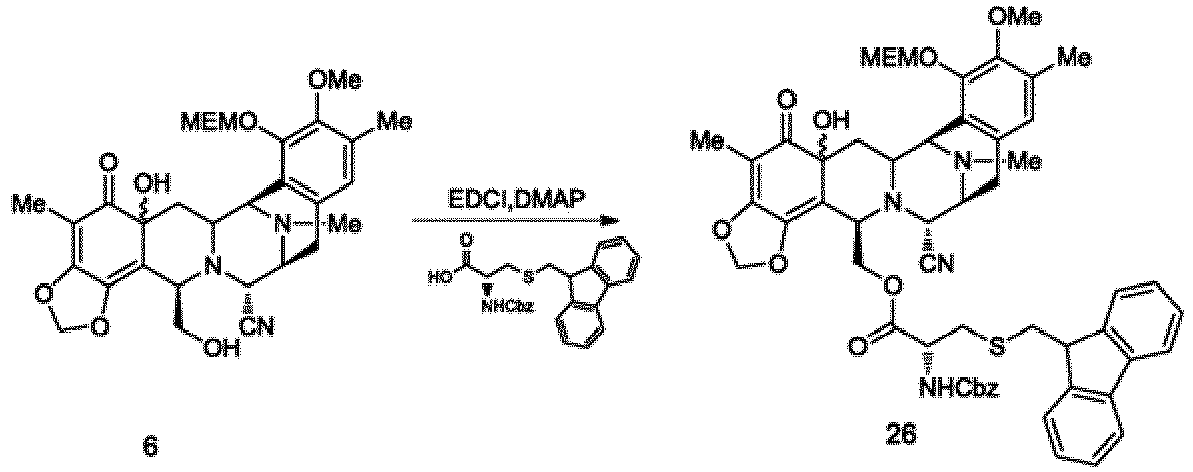
- With reference to a similar method to example 7, wherein the N-tert-butoxycarbonyl-(s)-fluorenylmethyl-L-cysteine in the method of example 7 is replaced by N-benzyloxycarbonyl-(s)-fluorenylmethyl-L-cysteine, compound 26 is prepared and obtained as a light yellow solid, with a yield of 93.5% and HPLC > 96%.
- 1HNMR (400MHZ, CDCl3): δ7.73 (d, J = 7.6Hz, 2H), 7.63 (d, J= 7. 6Hz, 2H), 7.40-7.29 (m, 9H), 6.59 (s, 1H), 6.52 (s, 1H), 5.68 (s, 1H), 5.66 (s, 1H), 5.58 (s, 1H), 5.56 (s, 1H), 5.23 (d, J = 6.0Hz, 1H), 5.15-5.05 (m, 4H), 4.76-4.68 (m, 1H), 4.64-4.55 (m, 1H), 4.40 (m, 1H), 4.15-3.68 (m, 8H), 3.60 (s, 3H), 3.57 (s, 3H), 3.39 (s, 3H), 3.36 (s, 3H), 3.25-2.78 (m, 7H), 2.38-2.24 (m, 2H), 2.20 (s, 3H), 2.18 (s, 3H), 2.15 (s, 3H), 2.09 (m, 1H), 2.04 (s, 3H), 1.77 (s, 3H), 1.58 (s, 3H); MS: m/z (999.13), Found: 1000.05 (M+H)+.
-

- With reference to a similar method to example 8, wherein the N-tert-butoxycarbonyl-(s)-fluorenylmethyl-L-cysteine in the method of example 8 is replaced by N-benzyloxycarbonyl-(s)-fluorenylmethyl-L-cysteine, compound 27 is prepared and obtained as a light yellow solid, with a yield of 90.4%.
- 1HNMR (400MHZ, CDCl3): δ7.73 (d, J = 7.6Hz, 2H), 7.59 (m, 2H), 7.40-7.28 (m, 9H), 6.60 (s, 1H), 5.69 (s, 1H), 5.65 (s, 1H), 5.54 (d, J = 7. 6Hz, 1H), 5.11-5.08 (m, 4H), 4.52 (m, 1H), 4.21-3.90 (m, 6H), 3.83 (s, 3H), 3.49 (s, 3H), 3.21 (d, J = 6.4, 1H), 3.09-2.90 (m, 6H), 2.41 (d, J = 18.0Hz, 1H), 2.34-2.31 (m, 1H), 2.25 (s, 3H), 2.19 (s, 3H) 1.88-1.83 (m, 1H), 1.77 (s, 3H); MS: m/z (955.08.), Found: 956.0 (M+H)+.
-
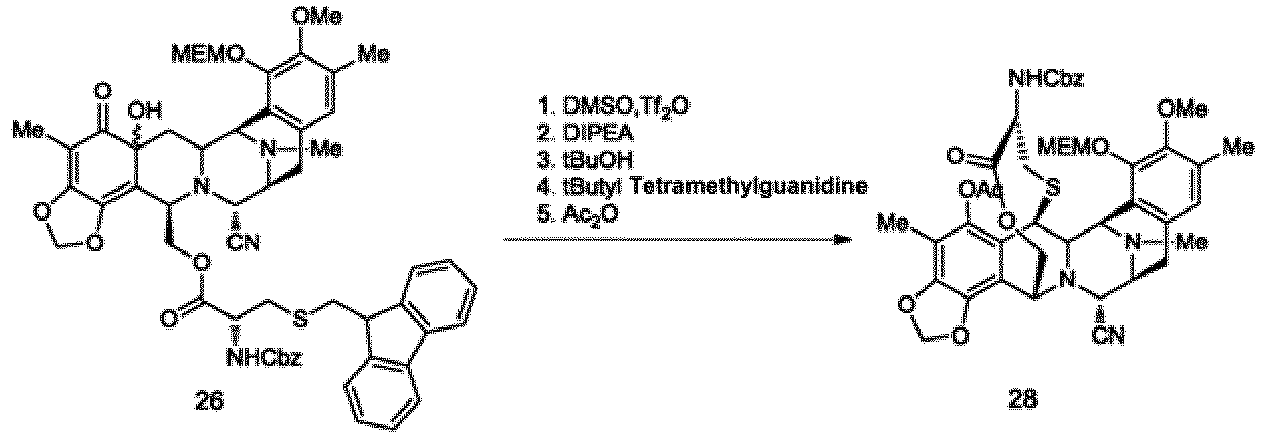
- Under argon protection, to a 250 ml three-necked flask, 1.37 g of dimethyl sulfoxide and 140 ml of anhydrous dichloromethane are added, and 1.48 g of trifluoromethanesulfonic anhydride (5.25 mmol) is dropwise added at -70°C to -80°C; after the dropwise addition is completed, the reaction is stirred for 20 minutes with the temperature being maintained constant, and a solution of 3.5 g of compound 26 (3.50 mmol) in dichloromethane is dropwise added, with the internal temperature being controlled to not exceed -70°C during the dropwise addition; after the dropwise addition is completed, the temperature is raised to -45°C to -40°C for 50 minutes of reaction, and 4.53 g of diisopropylethylamine (35.05 mmol) is then dropwise added; after the dropwise addition is completed, the temperature is slowly raised to 0°C and then reduced to -15°C or less, and 1.17 g of tert-butanol (15.78 mmol) is added; the mixture is stirred for 10 minutes with the temperature being maintained constant, and a solution of 6.0 g of 2-tert-butyl -1, 1,3,3-tetramethylguanidine (35.03 mmol) in dichloromethane is added; the temperature is slowly raised to 0°C and then reduced to -10°C or less, and 4.47 g of acetic anhydride (44.22 mmol) is slowly dropwise added; and after the dropwise addition is completed, a reaction is carried out for 15 minutes with the temperature being maintained constant, quenched by adding a saturated ammonium chloride aqueous solution and allowed for layering, and the aqueous layer is extracted with 100 ml of dichloromethane. The organic layers are combined, washed with a saturated sodium bicarbonate aqueous solution and a saturated sodium chloride aqueous solution respectively, concentrated and subjected to column chromatography (n-hexane : ethyl acetate = 5 : 1 to 3 : 1) to obtain a white powdery solid, with a yield of 77.4% and HPLC > 95%.
- 1HNMR (400MHZ, CDCl3): δ7.37 (m, 5H), 6. 66 (s, 1H), 6.09 (s, 1H), 5.99 (s, 1H), 5.30 (d, J=5.6Hz, 1H), 5.17 (d, J = 6.0Hz, 1H), 5.06 (d, J = 7.6Hz, 1H), 5.00 (s, 1H), 4.83 (d, J= 9.2Hz, 1H), 4.50 (s, 1H), 4.34-4.17 (m, 7H), 3.90-3.87 (m, 2H), 3.66 (s, 3H), 3.65-3.56 (m, 2H), 3.37 (s, 3H), 2.90 (m, 2H), 2.28 (s, 3H), 2.18 (s, 3H), 2.15-2.04 (m, 2H), 2.03 (s, 3H), 1.99 (s, 3H; MS: m/z (844.93), Found: 845.75 (M+H)+.
-
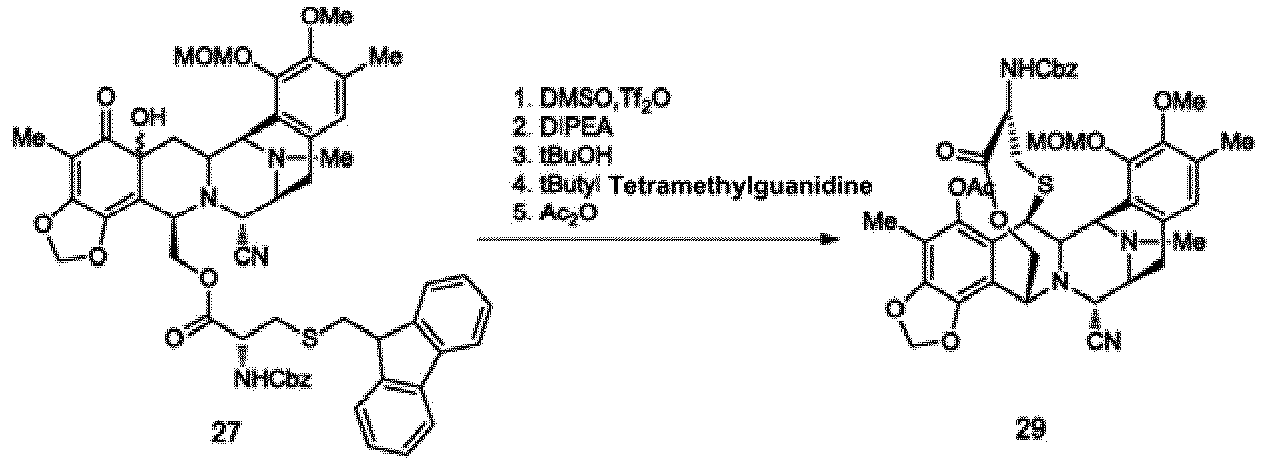
- With reference to a similar method to example 36, compound 29 is prepared and obtained as a white powdery solid, with a yield of 72.6%.
- 1HNMR (400MHZ, CDCl3): δ7.37 (m, 5H), 6.67 (s, 1H), 6.08 (d, J = 1.2, 1H), 5.99 (d, J = 1.2Hz, 1H), 5.19-5.00 (m, 4H), 4.82 (d, J = 9.2Hz, 1H), 4.49 (s, 1H), 4.32-4.15 (m, 5H), 3.66 (s, 3H), 3.55 (s, 3H), 3.44 (d, J = 4.8Hz, 1H), 3.39 (d, J = 6.0Hz, 1H), 2.90 (m, 2H), 2.28 (s, 3H), 2.19 (s, 3H), 2.15-2.07 (m, 2H), 2.03 (s, 3H), 1.99 (s, 3H); MS: m/z (800.87), Found: 801.50 (M+H)+.
-

- Under argon protection, 1.5 g of compound 28 (1.78 mmol), 30 ml of methanol and 1.0 ml of formic acid are added to a 100 ml three-necked flask; the temperature is reduced to 0°C to 5°C, and 0.4 g of 10% Pd/C is added in three portions; after the addition is completed, the mixture is stirred for 1.5 hours with the temperature being maintained constant, filtered, dissolved by adding 100 ml of dichloromethane, washed sequentially with a saturated sodium bicarbonate aqueous solution and a saturated sodium chloride aqueous solution, dried over anhydrous sodium sulfate, concentrated and subjected to column chromatography (dichloromethane : methanol = 50 : 1 to 10 : 1) to obtain 1.1 g of the compound as a white foamy solid, with a yield of 87.2% and HPLC > 96%. MS: m/z (710.79), Found: 711.55 (M+H)+.
-

- With reference to a similar method to example 38, compound 21 is prepared and obtained as a white foamy solid, with a yield of 86.1% and HPLC > 95%.
- MS: m/z (666.74), Found: 667.65 (M+H)+.
-

- With reference to a similar method to example 16, wherein the N-tert-butoxycarbonyl-(s)-fluorenylmethyl-L-cysteine in the method of example 16 is replaced by N-benzyloxycarbonyl-(s)-fluorenylmethyl-L-cysteine, 8.2 g of compound 30 is prepared and obtained as a white foamy solid, with a yield of 97.4%.MS: m/z (1023.20), Found: 1024.0 (M+H)+.
- With reference to a similar method, compound 38 and compound 39 are prepared.
-

- With reference to a similar method to example 16, compound 30 is prepared and obtained as a white foamy solid, with a yield of 94.4%.
- MS: m/z (979.15), Found: 980.0 (M+H)+.
-

- With reference to a similar method to example 18, compound 32 is prepared and obtained as a white foamy solid, with a yield of 93.6%.
- 1HNMR (400MHZ, CDCl3): δ7.71 (d, J =7.2, 2H), 7.59 (d, J = 7.6Hz, 1H), 7.53 (d, J = 7.6Hz, 1H), 7.41-7.23 (m, 9H), 6.60 (s, 1H), 5.87 (bs, 2H), 5.74 (s, 1H), 5.40 (d, J = 6.4Hz, 1H), 5.33 (d, J = 6.0Hz, 1H), 5.18 (d, J = 9.2Hz, 1H), 5.09 (d, J = 12Hz, 1H), 4.97 (d, J = 12Hz, 1H), 4.56 (dd, J1 = 3.2Hz, J2 = 11.2Hz, 1H), 4.19 (d, J = 2.0Hz, 1H), 4.16-3.87 (m, 9H), 3.6 (s, 3H), 3.38 (s, 3H), 3.32-3.20 (m, 3H), 2.96-2.87 (m, 3H), 2.62-2.54 (m, 2H), 2.28 (s, 3H), 2.19 (s, 3H), 1.97 (s, 3H), 1.82 (dd, J1 = 13.2Hz, J2 = 15.6Hz, 1H).
-

- 2.5 g of compound 6 (4.28 mmol) and 3.3 g of N-(2,2,2)-trichloroethyloxycarbonyl-(s)-fluorenylmethyl-L -cysteine (6.95 mmol) are dissolved in dichloromethane, and treated with anhydrous toluene (2 × 20 ml), and water is azeotropically removed. Under argon protection, the mixture from which water has been removed is dissolved in 50 ml of dichloromethane, transferred to a 250 ml three-necked flask, and cooled to -10°C or less; 0.262 g of DMAP (2.14 mmol) is added, and a solution of 1.64 g of 1-ethyl-(3-dimethylaminopropyl)carbodiimide hydrochloride (EDC hydrochloride) (8.57 mmol) in dichloromethane is dropwise added; after the dropwise addition is completed, the reaction is stirred at 10°C to 15°C for 2 hours, quenched by adding a saturated sodium bicarbonate aqueous solution and allowed for layering; the aqueous layer is extracted with dichloromethane (2 × 50 ml), and the organic layers are combined, dried over anhydrous sodium sulfate, and concentrated in vacuo to obtain an oil, which is subjected to column chromatography (n-hexane : ethyl acetate = 4 : 1 to 1 : 1) to obtain 3.8 g of the compound as a light yellow solid, with a yield of 85.3%. MS: m/z (1040.40), Found: 1040.25 (M+H)+.
-

- With reference to a similar method to example 43, compound 35 is prepared from compound 7 and obtained as a light yellow solid, with a yield of 96.7%.
- 1HNMR (400MHZ, CDCl3):δ7.76 (m, 4H), 7.65 (m, 4H), 7.39 (m, 4H), 7.29 (m, 4H), 6.62 (s, 1H), 6.55 (s, 1H), 5.79-5.63 (m, 6H), 5.09 (s, 1H), 5.02 (d, J = 6.0, 1H), 4.99 (d, J = 6.0Hz, 1H), 4.80-4.63 (m, 6H), 4.60 (m, 1H), 4.50 (m, 1H), 4.38 (dd, J1 = 7.6, J2 = 12.8Hz, 1H), 4.27 (dd, J1 = 7.6, J2 = 12.8, 1H), 4.16-3.90 (m, 10H), 3.84 (s, 3H), 3.62 (s, 3H), 3.50 (s, 3H), 3.33-2.83 (m, 14H), 2.45-2.18 (m, 2H), 2.21 (s, 6H), 2.17 (s, 6H), 1.77 (s, 6H), 1.67 (m, 2H).
-

- Under argon protection, to a 100 ml three-necked flask, 0.85 g of dimethyl sulfoxide (10.86 mmol) and 60 ml of anhydrous dichloromethane are added, and 0.80 g of trifluoromethanesulfonic anhydride (2.82 mmol) is added at -70°C to -80°C; after the dropwise addition is completed, the reaction is stirred for 20 minutes with the temperature maintained constant, and a solution of 2.1 g of compound 9 (2.17 mmol) in dichloromethane is dropwise added, with the internal temperature being controlled to not exceed -70°C during the dropwise addition; after the dropwise addition is completed, the temperature is raised to -45°C to -40°C for 50 minutes of reaction, and 2.81 g of diisopropylethylamine (21.71 mmol) is then dropwise added; after the dropwise addition is completed, the temperature is slowly raised to 0°C and then reduced to -15°C or less, and 0.72 g of tert-butanol (9.77 mmol) is added; the mixture is stirred for 10 minutes with the temperature being maintained constant, and a solution of 3.72 g of 2-tert-butyl 1,1,3,3-tetramethylguanidine (21.71 mmol) in dichloromethane is added; the temperature is slowly raised to 0°C and then reduced to -10°C or less, and 2.77 g of acetic anhydride (27.14 mmol) is slowly dropwise added; and after the dropwise addition is completed, a reaction is carried out for 15 minutes with the temperature being maintained constant, quenched by adding a saturated ammonium chloride aqueous solution, and allowed for layering, and the aqueous layer is extracted with 50 ml of dichloromethane. The organic layers are combined, washed with a saturated sodium bicarbonate aqueous solution and a saturated sodium chloride aqueous solution respectively, concentrated and subjected to column chromatography (n-hexane : ethyl acetate = 10 : 1 to 1 : 1) to obtain a white powdery solid, with a yield of 79.1%.
- 1HNMR (400MHZ, CDCl3):δ6.85 (s, 1H), 6.09 (s, 1H), 5.99 (s, 1H), 5.20 (d, J = 5.6Hz, 1H), 5.14 (d, J = 5.2Hz), 5.03 (m, 1H), 4.82 (d, J = 12.4Hz, 1H), 4.63 (d, J = 12.0Hz, 1H), 4.52 (m, 1H), 4.35-4.17 (m, 4H), 3.76 (s, 3H), 3.56 (s, 3H), 3.45 (m, 2H), 2.91 (m, 2H), 2.32 (s, 3H), 2.28 (s, 3H), 2.21 (s, 3H), 2.12 (m, 2H), 2.03 (s, 3H).
- With reference to a similar method, compound 36 is prepared, with a yield of 73.5%. MS: m/z (886.14), Found: 887.2 (M+H)+.
-

- Under argon protection, 1.0 g of compound 37 is dissolved in 25 ml of a 90% acetic acid aqueous solution, and 0.8 g of zinc powder is added; the mixture is stirred at 20°C to 25°C for 36 hours and filtered over diatomaceous earth; the filter cake is washed with dichloromethane, and the filtrate is added 100 ml of dichloromethane, washed with a saturated sodium bicarbonate aqueous solution and a saturated sodium chloride aqueous solution, dried over anhydrous sodium sulfate, concentrated and subjected to column chromatography (dichloromethane : methanol = 50 : 1 to 10 : 1) to obtain 0.69 g of the compound as a white foamy solid, with a yield of 87.2% and HPLC > 95%.
- 1HNMR (400MHZ, CDCl3): δ6.73 (s, 1H), 6.08 (d, J = 1.2Hz, 1H), 5.99 (d, J = 1.2Hz, 1H), 5.93 (m, 1H), 5.21 (d, J = 3.6Hz, 1H), 5.14 (d, J = 3.6Hz, 1H), 5.02 (d, J = 12.0Hz, 1H), 4.51 (m, 1H), 4.34 (d, J = 4.8Hz, 1H), 4.27 (s, 1H), 4.20 (d, J = 3.2, 1H), 4.13 (d, J = 12Hz, 1H), 3.79 (s, 3H), 3.57 (s, 3H), 3.45 (d, J = 4.8Hz, 1H), 3.41 (m, 1H), 3.31 (m, 1H), 2.92 (m, 2H), 2.29 (s, 3H), 2.25 (s, 3H), 2.19 (s, 3H), 2.16 (m, 1H), 2.04 (s, 3H).
- With reference to a similar method, compound 36 is prepared, with a yield of 83.5%. MS: m/z (710.2), Found: 711.0 (M+H)+.
-

- in which R1 is MEM or MOM; with reference to a similar method to examples 1 and 2, compound QT9 is prepared from compound QT10, wherein the material charge amounts are shown as in the following table:
- The batches described in the table represent reaction conditions of the invention, wherein the base is NaOH, KOH, NaH or mixtures thereof, and comparative examples.
Batch No. Compound QT10 amount Type and amount of base Protecting agent (MEMCl or MOMBr) and amount thereof Reaction temperature Reaction situation 1 1 eq K2CO3, 30 eq 20 eq 20°C to 30°C Yield > 50%; TLC results show the existence of impurities 2 1 eq K2CO3, 8 eq 12 eq 5°C to 10°C Yield > 60%; the double-protected by-product has a content of 19.2% 3 1 eq DIPEA, 1 eq 15 eq 0°C to 10°C Yield > 50%; TLC results show the existence of impurities 4 1 eq NaH, 1.0 eq 2.0 eq - 10°C to 0°C Yield > 85%; the double-protected by-product has a content of 1.3% 5 1 eq NaH, 1.5 eq 1.5 eq 5°C to 10°C Yield > 85%; the double-protected by-product has a content of 1.8% 6 1 eq NaH, 1.2 eq; t-KOBu, 1.0 eq 2.5 eq 0°C to 5°C Yield > 80%; the double-protected by-product has a content of 6.5% 7 1 eq t-KOBu, 3 eq 5 eq 5°C to 10°C Yield > 80%; the double-protected by-product has a content of 6.017% 8 1 eq t-KOBu, 1.0 eq 1 eq 15°C to 25°C Yield > 85%; the double-protected by-product has a content of 4.16% 9 1 eq t-KOBu, 5 eq 5 eq - 5°C to 5°C Yield > 80%; the double-protected by-product has a content of 7.1% 10 1 eq t-KOBu, 5 eq 15 eq - 10°C to 0°C Yield > 50%; TLC results show the existence of impurities 11 1 eq n-LiOBu, 10 eq 10 eq 10°C to 15°C Yield > 75%; the double-protected by-product has a content of 16.8% 12 1 eq KOH, 2.0 eq 2 eq 5°C to 15°C Yield > 85%; the double-protected by-product has a content of 1.7% 13 1 eq KOH, 15 eq 5 eq 0°C to 10°C Yield > 85%; the double-protected by-product has a content of 5.7% 14 1 eq LiOCH3, 2.0 eq 2.0 eq 0°C to 10°C Yield > 80%; the double-protected by-product has a content of 6.41% 15 1 eq NaOH, 4.0 eq 2.0 eq 0°C to 10°C Yield > 90%; the double-protected by-product has a content of <1% 16 1 eq NaOH, 2.5 eq 2.0 eq 5°C to 10°C Yield > 95%; the double-protected by-product has a content of <1% 17 1 eq NaOH, 1 eq 2.0 eq 0°C to 5°C Yield > 950; the double-protected by-product has a content of <1% - In the table, eq stands for molar equivalent.
- As can be seen from the reaction conditions in the above table, where the base is potassium t-butoxide, lithium methoxide, potassium hydroxide, lithium t-butoxide, etc., the corresponding compound QT9 can be prepared in all these cases; in addition, where NaOH, KOH, NaH or a mixture thereof is preferably selected as the base, the molar ratio of the compound QT10 to the base is 1 : 1 to 10, particularly 1 to 2.5, and the molar ratio of the compound QT10 to the hydroxyl protecting agent is 1 : 1 to 10, particularly 1 to 2.5, a very good effect can be achieved, and the double-protected impurities can be controlled to less than 2%; moreover, a majority of the double-protected impurities may be further removed by means of recrystallization, such that the purity of the target product reaches 99% or more; furthermore, taking into account safety issues in the industrial production process, sodium hydroxide is the most preferred, and the use of sodium hydroxide results in a high conversion rate, a smaller content of side reaction impurities, and a higher safety than sodium hydride. It can also be seen from the above comparative experiment that where sodium hydroxide is used, the amount thereof may fluctuate within a larger range.
Claims (12)
- A method for preparing compound QT9, comprising: reacting compound QT10 with a hydroxyl protecting agent to obtain compound QT9:
 in which R1 is a hydroxyl protecting group,wherein the hydroxyl protecting group R1 is MOM, or MEM; and wherein the compound QT10 is converted into compound QT9 under alkaline conditions, in which the base is NaOH, KOH, NaH or a mixture thereof.
 - A method for preparing an ecteinascidin compound, comprising: reacting compound QT10 with a hydroxyl protecting agent to obtain compound QT9:

- The method according to claim 2, wherein the method further comprises selectively removing the allyl group from the compound QT9 to obtain compound QT8:


- The method according to claim 2, wherein the method further comprises esterifying the primary hydroxyl group of the compound QT9 with a cysteine derivative for conversion into compound QT8A:

and preferably, the method further comprises selectively removing the allyl group from the compound QT8A to obtain compound QT7A:

- The method according to claim 3 or 4, wherein the method further comprises reacting the compound QT6 with a Swern reagent and further with N-tert-butyl-N' ,N'-tetramethylguanidine to form a 1,4-bridged lactone compound QT5:
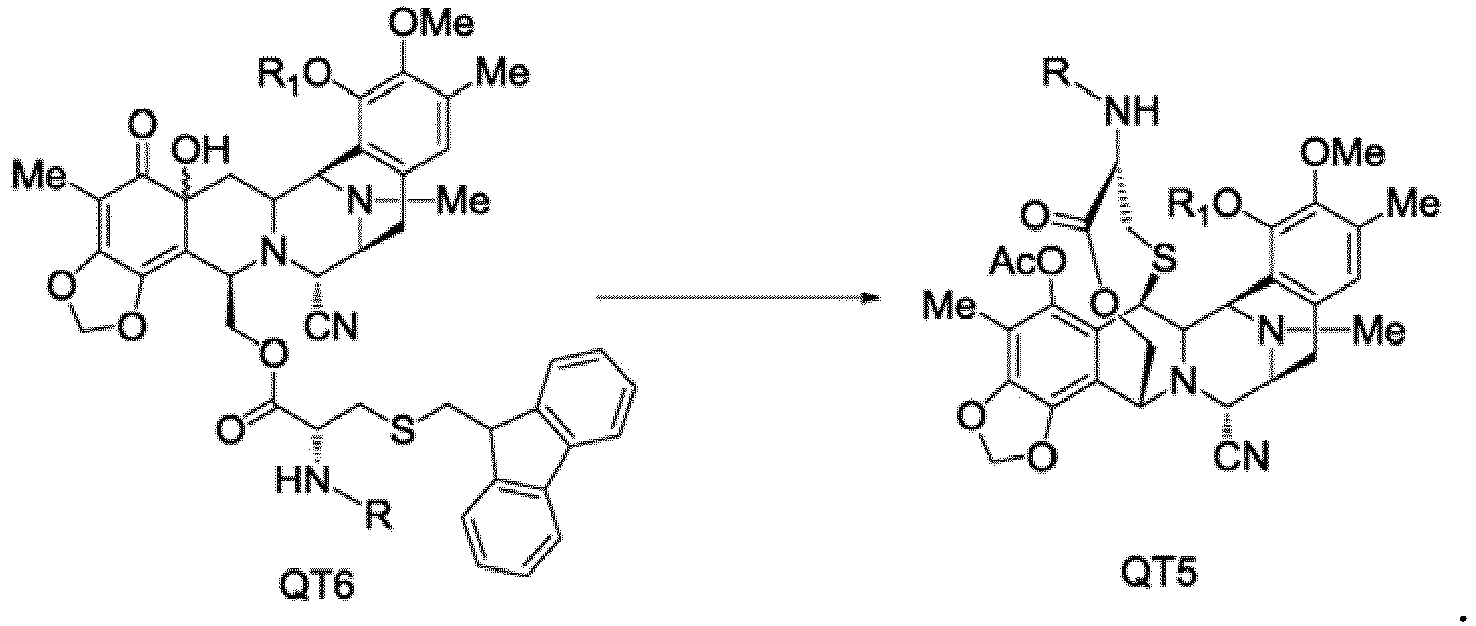
- The method according to claim 5, wherein the method further comprises selectively removing amino protecting group R from the compound QT5 to obtain compound QT4:


- The method according to claim 5, wherein the method further comprises simultaneously removing the amino protecting group R and the hydroxyl protecting group R1 from the compound QT5 to obtain compound QT4A:

- The method according to claim 7, wherein the method further comprises converting the compound QT4A into compound QT3A by means a transamination reaction, and optionally comprises reacting the compound QT3A with 2-[3-hydroxy-4-methoxy-phenyl]ethylamine for conversion into compound ET770, and further converting CN in the compound ET770 into OH to obtain compound ET743:

- The method according to claim 1 or 2, wherein the hydroxyl protecting agent is bromomethyl methyl ether, chloromethyl methyl ether, or 2-methoxyethoxymethyl chloride, and the molar ratio of the compound QT10 to the hydroxyl protecting agent is 1 : 1 to 20, preferably 1.5 to 2.5.
- The method according to claim 1 or 2, wherein the molar ratio of the compound QT10 to the base is 1 : 1 to 30, preferably 1.5 to 4, and the reaction temperature is -10°C to 30°C, preferably 0°C to 10°C.
- The method according to any one of claims 3 to 6, wherein R is Alloc, Cbz, or Troc.
- The method according to any one of claims 3 to 5 and 8, wherein R is Boc.
Applications Claiming Priority (2)
| Application Number | Priority Date | Filing Date | Title |
|---|---|---|---|
| CN201910101895.0A CN111518110B (en) | 2019-02-01 | 2019-02-01 | Preparation method of ecteinascidin compound and intermediate thereof |
| PCT/CN2019/102565 WO2020155613A1 (en) | 2019-02-01 | 2019-08-26 | Preparation method for ecteinascidin compound and intermediate thereof |
Publications (3)
| Publication Number | Publication Date |
|---|---|
| EP3842438A1 EP3842438A1 (en) | 2021-06-30 |
| EP3842438A4 EP3842438A4 (en) | 2021-08-04 |
| EP3842438B1 true EP3842438B1 (en) | 2023-11-08 |
Family
ID=71840324
Family Applications (1)
| Application Number | Title | Priority Date | Filing Date |
|---|---|---|---|
| EP19913508.8A Active EP3842438B1 (en) | 2019-02-01 | 2019-08-26 | Preparation method for ecteinascidin compound and intermediate thereof |
Country Status (4)
| Country | Link |
|---|---|
| US (1) | US12122784B2 (en) |
| EP (1) | EP3842438B1 (en) |
| CN (1) | CN111518110B (en) |
| WO (1) | WO2020155613A1 (en) |
Families Citing this family (4)
| Publication number | Priority date | Publication date | Assignee | Title |
|---|---|---|---|---|
| CN111518110B (en) | 2019-02-01 | 2023-11-03 | 博瑞生物医药(苏州)股份有限公司 | Preparation method of ecteinascidin compound and intermediate thereof |
| CN116151089B (en) * | 2021-11-17 | 2025-06-10 | 南京理工大学 | Prediction method for multiple sea surface physical quantities based on MoM and deep learning data driving |
| CN117304255B (en) * | 2022-08-02 | 2024-08-27 | 深圳湾实验室 | Dehydromembrane ecteinascidin B, derivatives thereof and preparation method thereof |
| WO2026022359A2 (en) | 2024-07-26 | 2026-01-29 | Pharma Mar, S.A. | Synthetic process for the manufacture of ecteinascidin compounds |
Citations (1)
| Publication number | Priority date | Publication date | Assignee | Title |
|---|---|---|---|---|
| WO2007045686A2 (en) * | 2005-10-20 | 2007-04-26 | Centre National De La Recherche Scientifique (Cnrs) | Intermediate and process of preparation of ecteinascidin such as ecteinascidines-583, 597 using such intermediate |
Family Cites Families (6)
| Publication number | Priority date | Publication date | Assignee | Title |
|---|---|---|---|---|
| US5721362A (en) | 1996-09-18 | 1998-02-24 | President And Fellows Of Harvard College | Process for producing ecteinascidin compounds |
| US6124292A (en) | 1998-09-30 | 2000-09-26 | President And Fellows Of Harvard College | Synthetic analogs of ecteinascidin-743 |
| AR035842A1 (en) | 1999-05-14 | 2004-07-21 | Pharma Mar Sa | METHOD OF HEMISINTESIS FOR THE FORMATION OF INTERMEDIARY AND DERIVATIVE COMPOUNDS AND OF STRUCTURES RELATED TO ECTEINASCIDINE AND TETRAHYDROISOCHINOLINPHENOLS AND INTERMEDIARY APPLICATION COMPOUNDS IN SUCH METHOD |
| AU2011257277B2 (en) * | 2010-05-25 | 2016-02-25 | Pharma Mar, S.A. | Synthetic process for the manufacture of ecteinascidin compounds |
| CN107522698B (en) * | 2016-06-20 | 2021-12-28 | 浙江海正药业股份有限公司 | Preparation method and intermediate of trabectedin |
| CN111518110B (en) | 2019-02-01 | 2023-11-03 | 博瑞生物医药(苏州)股份有限公司 | Preparation method of ecteinascidin compound and intermediate thereof |
-
2019
- 2019-02-01 CN CN201910101895.0A patent/CN111518110B/en active Active
- 2019-08-26 US US17/283,012 patent/US12122784B2/en active Active
- 2019-08-26 WO PCT/CN2019/102565 patent/WO2020155613A1/en not_active Ceased
- 2019-08-26 EP EP19913508.8A patent/EP3842438B1/en active Active
Patent Citations (1)
| Publication number | Priority date | Publication date | Assignee | Title |
|---|---|---|---|---|
| WO2007045686A2 (en) * | 2005-10-20 | 2007-04-26 | Centre National De La Recherche Scientifique (Cnrs) | Intermediate and process of preparation of ecteinascidin such as ecteinascidines-583, 597 using such intermediate |
Non-Patent Citations (9)
| Title |
|---|
| "Drug Discovery from Natural Products", 1 January 2012, RSC PUBLISHING, article CUEVAS C. ET AL: "Chapter 1:Semisynthesis Approach of Ecteinascidin 743 (ET-743, Yondelis )", pages: 5 - 16, XP055880011 * |
| "Greene's Protective Groups in Organic Synthesis. 5th ed.", 1 January 2014, JOHN WILEY & SONS, INC., article WUTS PETER G. M. ET AL: "Methoxymethyl Ether (MOM Ether)", pages: 489, XP055880032 * |
| "Houben-Weyl Methods of Molecular Transformations - Science of Synthesis - Compounds with Two Carbon-Heteroatom Bonds", 1 January 2007, GEORG THIEME VERLAG AG, article WARRINER S. L. ET AL: "Phenolic compounds", pages: 321 - 322, XP055880015 * |
| "Organic Chemistry. 5th ed.", 1 January 2009, ROBERTS AND COMPANY PUBLISHERS, article LOUDON MARC: "Alkylation and acylation reactions of amines", pages: 1131 - 1136, XP055880046 * |
| ANONYMOUS: "Alkylation of Amines by Alkyl Halides", 17 March 2015 (2015-03-17), XP055900204, Retrieved from the Internet <URL:https://chem.libretexts.org/Courses/Purdue/Purdue:_Chem_26200:_Organic_Chemistry_II_(Wenthold)/Chapter_20._Amines/20.05:_Other_Reactions_of_Amines/20.05.1:_Alkylation_of_Amines_by_Alkyl_Halides> [retrieved on 20220311] * |
| ANONYMOUS: "Reproduction of Methods from 19913508.8 (EP3842438)", 2 March 2023 (2023-03-02), pages 1 - 18, XP093040654, Retrieved from the Internet <URL:https://register.epo.org/application?documentId=LER0PHXY1LO8LHP&number=EP19913508&lng=en&npl=true> * |
| REUSCH WILLIAM: "Chemistry of Amines", 5 May 2013 (2013-05-05), XP055900191, Retrieved from the Internet <URL:https://www2.chemistry.msu.edu/faculty/reusch/VirtTxtJml/amine1.htm> [retrieved on 20220311] * |
| SAKAI R ET AL: "ECTEINASCIDINS: PUTATIVE BIOSYNTHETIC PRECURSORS AND ABSOLUTE STEREOCHEMISTRY", JOURNAL OF THE AMERICAN CHEMICAL SOCIETY, AMERICAN CHEMICAL SOCIETY, vol. 118, 1 January 1996 (1996-01-01), pages 9017 - 9023, XP000942122, ISSN: 0002-7863, DOI: 10.1021/JA950054M * |
| TOSHIKI NOKAMI ET AL: "Synthesis of Ionic Liquids Equipped with 2-Methoxyethoxymethyl/Methoxymethyl Groups Using a Simple Microreactor System", ORGANIC PROCESS RESEARCH & DEVELOPMENT, vol. 18, no. 11, 21 November 2014 (2014-11-21), US, pages 1367 - 1371, XP055300043, ISSN: 1083-6160, DOI: 10.1021/op500131u * |
Also Published As
| Publication number | Publication date |
|---|---|
| EP3842438A1 (en) | 2021-06-30 |
| CN111518110A (en) | 2020-08-11 |
| US20210355132A1 (en) | 2021-11-18 |
| WO2020155613A1 (en) | 2020-08-06 |
| CN111518110B (en) | 2023-11-03 |
| US12122784B2 (en) | 2024-10-22 |
| EP3842438A4 (en) | 2021-08-04 |
Similar Documents
| Publication | Publication Date | Title |
|---|---|---|
| EP3842438A1 (en) | Preparation method for ecteinascidin compound and intermediate thereof | |
| EP0737686A1 (en) | Camthothecin derivative with antitumour activity | |
| EP4301748B1 (en) | Triazolyl-methyl substituted alpha-d-galactopyranoside derivatives | |
| AU785385B2 (en) | Novel derivatives and analogues of galanthamin | |
| EP2346823B1 (en) | Intermediates for the synthesis of 8-[{1-(3,5-bis-(trifluoromethyl)phenyl)-ethoxy}-methyl]-8-phenyl-1,7-diaza-spiro[4.5]decan-2-one compounds | |
| KR20230008155A (en) | Ring closure synthesis of macrocyclic MCL-1 inhibitor intermediates | |
| US8247559B2 (en) | Process for preparing an intermediate to mu opioid receptor antagonists | |
| US9434740B2 (en) | Taxane compounds, compositions and methods | |
| CN114315755B (en) | A synthetic method for key intermediates of Tubulysin and its analogs | |
| Kiguchi et al. | RADICAL CY CLIZATION IN HETEROCYCLE SYNTHESJS. 7.1 SYNTHESJS OF CHIRAL 2SUBSTIITJTED 5-AMINO-4. PIPEIUDINOLS VIA RADICAL CYCLIZATION | |
| KR100921036B1 (en) | Method of preparing taxane derivatives and intermediates used therein | |
| KR101204145B1 (en) | Processes for preparing bicyclo[3.1.0]hexane derivatives, and intermediates thereto | |
| CN111479800B (en) | Intermediate compound, preparation method thereof and solid-phase synthesis method for preparing polypeptide by using intermediate compound | |
| WO1996025392A1 (en) | Novel borneol derivatives, methods of manufacturing them, and their pharmaceutical use | |
| WO2013162922A1 (en) | Taxane compounds, compositions and methods | |
| WO1995030650A1 (en) | Borneol derivatives affecting tubulin polymerization and depolymerization | |
| US9284327B2 (en) | Taxane compounds, compositions and methods | |
| EA003361B1 (en) | New compounds of 7-oxo-2,3,7,14-tetrehydro-1h-benzo[b]pyrano[3,2-h]acridine carboxylate and the pharmaceutical compounds containing them | |
| CN122070273A (en) | Novel process for the preparation of (3R) -fluoropyrrolidine hydrochloride | |
| HK40103132B (en) | Triazolyl‑methyl substituted alpha‑d‑galactopyranoside derivatives | |
| HK40103132A (en) | Triazolyl‑methyl substituted alpha‑d‑galactopyranoside derivatives | |
| CN121930225A (en) | Preparation method of levo Bao Gongteng A and its acid salt | |
| WO2019168025A1 (en) | Method for producing morphinan derivatives | |
| HK1185073B (en) | Preparation of tesetaxel and related compounds and corresponding synthesis intermediate | |
| HK1185073A (en) | Preparation of tesetaxel and related compounds and corresponding synthesis intermediate |
Legal Events
| Date | Code | Title | Description |
|---|---|---|---|
| STAA | Information on the status of an ep patent application or granted ep patent |
Free format text: STATUS: THE INTERNATIONAL PUBLICATION HAS BEEN MADE |
|
| PUAI | Public reference made under article 153(3) epc to a published international application that has entered the european phase |
Free format text: ORIGINAL CODE: 0009012 |
|
| STAA | Information on the status of an ep patent application or granted ep patent |
Free format text: STATUS: REQUEST FOR EXAMINATION WAS MADE |
|
| 17P | Request for examination filed |
Effective date: 20210326 |
|
| AK | Designated contracting states |
Kind code of ref document: A1 Designated state(s): AL AT BE BG CH CY CZ DE DK EE ES FI FR GB GR HR HU IE IS IT LI LT LU LV MC MK MT NL NO PL PT RO RS SE SI SK SM TR |
|
| A4 | Supplementary search report drawn up and despatched |
Effective date: 20210705 |
|
| RIC1 | Information provided on ipc code assigned before grant |
Ipc: C07D 498/22 20060101AFI20210629BHEP Ipc: C07D 491/22 20060101ALI20210629BHEP Ipc: C07D 515/22 20060101ALI20210629BHEP |
|
| TPAC | Observations filed by third parties |
Free format text: ORIGINAL CODE: EPIDOSNTIPA |
|
| STAA | Information on the status of an ep patent application or granted ep patent |
Free format text: STATUS: EXAMINATION IS IN PROGRESS |
|
| 17Q | First examination report despatched |
Effective date: 20220317 |
|
| DAV | Request for validation of the european patent (deleted) | ||
| DAX | Request for extension of the european patent (deleted) | ||
| TPAC | Observations filed by third parties |
Free format text: ORIGINAL CODE: EPIDOSNTIPA |
|
| TPAC | Observations filed by third parties |
Free format text: ORIGINAL CODE: EPIDOSNTIPA |
|
| GRAP | Despatch of communication of intention to grant a patent |
Free format text: ORIGINAL CODE: EPIDOSNIGR1 |
|
| STAA | Information on the status of an ep patent application or granted ep patent |
Free format text: STATUS: GRANT OF PATENT IS INTENDED |
|
| INTG | Intention to grant announced |
Effective date: 20230605 |
|
| GRAS | Grant fee paid |
Free format text: ORIGINAL CODE: EPIDOSNIGR3 |
|
| GRAA | (expected) grant |
Free format text: ORIGINAL CODE: 0009210 |
|
| STAA | Information on the status of an ep patent application or granted ep patent |
Free format text: STATUS: THE PATENT HAS BEEN GRANTED |
|
| RAP3 | Party data changed (applicant data changed or rights of an application transferred) |
Owner name: BRIGHTGENE BIO-MEDICAL TECHNOLOGY CO., LTD. |
|
| AK | Designated contracting states |
Kind code of ref document: B1 Designated state(s): AL AT BE BG CH CY CZ DE DK EE ES FI FR GB GR HR HU IE IS IT LI LT LU LV MC MK MT NL NO PL PT RO RS SE SI SK SM TR |
|
| REG | Reference to a national code |
Ref country code: GB Ref legal event code: FG4D |
|
| REG | Reference to a national code |
Ref country code: CH Ref legal event code: EP |
|
| REG | Reference to a national code |
Ref country code: DE Ref legal event code: R096 Ref document number: 602019041273 Country of ref document: DE |
|
| REG | Reference to a national code |
Ref country code: IE Ref legal event code: FG4D |
|
| REG | Reference to a national code |
Ref country code: LT Ref legal event code: MG9D |
|
| REG | Reference to a national code |
Ref country code: NL Ref legal event code: MP Effective date: 20231108 |
|
| PG25 | Lapsed in a contracting state [announced via postgrant information from national office to epo] |
Ref country code: GR Free format text: LAPSE BECAUSE OF FAILURE TO SUBMIT A TRANSLATION OF THE DESCRIPTION OR TO PAY THE FEE WITHIN THE PRESCRIBED TIME-LIMIT Effective date: 20240209 |
|
| PG25 | Lapsed in a contracting state [announced via postgrant information from national office to epo] |
Ref country code: IS Free format text: LAPSE BECAUSE OF FAILURE TO SUBMIT A TRANSLATION OF THE DESCRIPTION OR TO PAY THE FEE WITHIN THE PRESCRIBED TIME-LIMIT Effective date: 20240308 |
|
| PG25 | Lapsed in a contracting state [announced via postgrant information from national office to epo] |
Ref country code: LT Free format text: LAPSE BECAUSE OF FAILURE TO SUBMIT A TRANSLATION OF THE DESCRIPTION OR TO PAY THE FEE WITHIN THE PRESCRIBED TIME-LIMIT Effective date: 20231108 |
|
| REG | Reference to a national code |
Ref country code: AT Ref legal event code: MK05 Ref document number: 1629543 Country of ref document: AT Kind code of ref document: T Effective date: 20231108 |
|
| PG25 | Lapsed in a contracting state [announced via postgrant information from national office to epo] |
Ref country code: NL Free format text: LAPSE BECAUSE OF FAILURE TO SUBMIT A TRANSLATION OF THE DESCRIPTION OR TO PAY THE FEE WITHIN THE PRESCRIBED TIME-LIMIT Effective date: 20231108 |
|
| PG25 | Lapsed in a contracting state [announced via postgrant information from national office to epo] |
Ref country code: AT Free format text: LAPSE BECAUSE OF FAILURE TO SUBMIT A TRANSLATION OF THE DESCRIPTION OR TO PAY THE FEE WITHIN THE PRESCRIBED TIME-LIMIT Effective date: 20231108 |
|
| PG25 | Lapsed in a contracting state [announced via postgrant information from national office to epo] |
Ref country code: ES Free format text: LAPSE BECAUSE OF FAILURE TO SUBMIT A TRANSLATION OF THE DESCRIPTION OR TO PAY THE FEE WITHIN THE PRESCRIBED TIME-LIMIT Effective date: 20231108 |
|
| PG25 | Lapsed in a contracting state [announced via postgrant information from national office to epo] |
Ref country code: NL Free format text: LAPSE BECAUSE OF FAILURE TO SUBMIT A TRANSLATION OF THE DESCRIPTION OR TO PAY THE FEE WITHIN THE PRESCRIBED TIME-LIMIT Effective date: 20231108 Ref country code: LT Free format text: LAPSE BECAUSE OF FAILURE TO SUBMIT A TRANSLATION OF THE DESCRIPTION OR TO PAY THE FEE WITHIN THE PRESCRIBED TIME-LIMIT Effective date: 20231108 Ref country code: IS Free format text: LAPSE BECAUSE OF FAILURE TO SUBMIT A TRANSLATION OF THE DESCRIPTION OR TO PAY THE FEE WITHIN THE PRESCRIBED TIME-LIMIT Effective date: 20240308 Ref country code: GR Free format text: LAPSE BECAUSE OF FAILURE TO SUBMIT A TRANSLATION OF THE DESCRIPTION OR TO PAY THE FEE WITHIN THE PRESCRIBED TIME-LIMIT Effective date: 20240209 Ref country code: ES Free format text: LAPSE BECAUSE OF FAILURE TO SUBMIT A TRANSLATION OF THE DESCRIPTION OR TO PAY THE FEE WITHIN THE PRESCRIBED TIME-LIMIT Effective date: 20231108 Ref country code: BG Free format text: LAPSE BECAUSE OF FAILURE TO SUBMIT A TRANSLATION OF THE DESCRIPTION OR TO PAY THE FEE WITHIN THE PRESCRIBED TIME-LIMIT Effective date: 20240208 Ref country code: AT Free format text: LAPSE BECAUSE OF FAILURE TO SUBMIT A TRANSLATION OF THE DESCRIPTION OR TO PAY THE FEE WITHIN THE PRESCRIBED TIME-LIMIT Effective date: 20231108 Ref country code: PT Free format text: LAPSE BECAUSE OF FAILURE TO SUBMIT A TRANSLATION OF THE DESCRIPTION OR TO PAY THE FEE WITHIN THE PRESCRIBED TIME-LIMIT Effective date: 20240308 |
|
| PG25 | Lapsed in a contracting state [announced via postgrant information from national office to epo] |
Ref country code: SE Free format text: LAPSE BECAUSE OF FAILURE TO SUBMIT A TRANSLATION OF THE DESCRIPTION OR TO PAY THE FEE WITHIN THE PRESCRIBED TIME-LIMIT Effective date: 20231108 Ref country code: RS Free format text: LAPSE BECAUSE OF FAILURE TO SUBMIT A TRANSLATION OF THE DESCRIPTION OR TO PAY THE FEE WITHIN THE PRESCRIBED TIME-LIMIT Effective date: 20231108 Ref country code: PL Free format text: LAPSE BECAUSE OF FAILURE TO SUBMIT A TRANSLATION OF THE DESCRIPTION OR TO PAY THE FEE WITHIN THE PRESCRIBED TIME-LIMIT Effective date: 20231108 Ref country code: NO Free format text: LAPSE BECAUSE OF FAILURE TO SUBMIT A TRANSLATION OF THE DESCRIPTION OR TO PAY THE FEE WITHIN THE PRESCRIBED TIME-LIMIT Effective date: 20240208 Ref country code: LV Free format text: LAPSE BECAUSE OF FAILURE TO SUBMIT A TRANSLATION OF THE DESCRIPTION OR TO PAY THE FEE WITHIN THE PRESCRIBED TIME-LIMIT Effective date: 20231108 Ref country code: HR Free format text: LAPSE BECAUSE OF FAILURE TO SUBMIT A TRANSLATION OF THE DESCRIPTION OR TO PAY THE FEE WITHIN THE PRESCRIBED TIME-LIMIT Effective date: 20231108 |
|
| PG25 | Lapsed in a contracting state [announced via postgrant information from national office to epo] |
Ref country code: DK Free format text: LAPSE BECAUSE OF FAILURE TO SUBMIT A TRANSLATION OF THE DESCRIPTION OR TO PAY THE FEE WITHIN THE PRESCRIBED TIME-LIMIT Effective date: 20231108 |
|
| PG25 | Lapsed in a contracting state [announced via postgrant information from national office to epo] |
Ref country code: CZ Free format text: LAPSE BECAUSE OF FAILURE TO SUBMIT A TRANSLATION OF THE DESCRIPTION OR TO PAY THE FEE WITHIN THE PRESCRIBED TIME-LIMIT Effective date: 20231108 |
|
| PG25 | Lapsed in a contracting state [announced via postgrant information from national office to epo] |
Ref country code: SK Free format text: LAPSE BECAUSE OF FAILURE TO SUBMIT A TRANSLATION OF THE DESCRIPTION OR TO PAY THE FEE WITHIN THE PRESCRIBED TIME-LIMIT Effective date: 20231108 |
|
| PG25 | Lapsed in a contracting state [announced via postgrant information from national office to epo] |
Ref country code: SM Free format text: LAPSE BECAUSE OF FAILURE TO SUBMIT A TRANSLATION OF THE DESCRIPTION OR TO PAY THE FEE WITHIN THE PRESCRIBED TIME-LIMIT Effective date: 20231108 Ref country code: SK Free format text: LAPSE BECAUSE OF FAILURE TO SUBMIT A TRANSLATION OF THE DESCRIPTION OR TO PAY THE FEE WITHIN THE PRESCRIBED TIME-LIMIT Effective date: 20231108 Ref country code: RO Free format text: LAPSE BECAUSE OF FAILURE TO SUBMIT A TRANSLATION OF THE DESCRIPTION OR TO PAY THE FEE WITHIN THE PRESCRIBED TIME-LIMIT Effective date: 20231108 Ref country code: IT Free format text: LAPSE BECAUSE OF FAILURE TO SUBMIT A TRANSLATION OF THE DESCRIPTION OR TO PAY THE FEE WITHIN THE PRESCRIBED TIME-LIMIT Effective date: 20231108 Ref country code: EE Free format text: LAPSE BECAUSE OF FAILURE TO SUBMIT A TRANSLATION OF THE DESCRIPTION OR TO PAY THE FEE WITHIN THE PRESCRIBED TIME-LIMIT Effective date: 20231108 Ref country code: DK Free format text: LAPSE BECAUSE OF FAILURE TO SUBMIT A TRANSLATION OF THE DESCRIPTION OR TO PAY THE FEE WITHIN THE PRESCRIBED TIME-LIMIT Effective date: 20231108 Ref country code: CZ Free format text: LAPSE BECAUSE OF FAILURE TO SUBMIT A TRANSLATION OF THE DESCRIPTION OR TO PAY THE FEE WITHIN THE PRESCRIBED TIME-LIMIT Effective date: 20231108 |
|
| REG | Reference to a national code |
Ref country code: DE Ref legal event code: R097 Ref document number: 602019041273 Country of ref document: DE |
|
| PLBE | No opposition filed within time limit |
Free format text: ORIGINAL CODE: 0009261 |
|
| STAA | Information on the status of an ep patent application or granted ep patent |
Free format text: STATUS: NO OPPOSITION FILED WITHIN TIME LIMIT |
|
| 26N | No opposition filed |
Effective date: 20240809 |
|
| PG25 | Lapsed in a contracting state [announced via postgrant information from national office to epo] |
Ref country code: SI Free format text: LAPSE BECAUSE OF FAILURE TO SUBMIT A TRANSLATION OF THE DESCRIPTION OR TO PAY THE FEE WITHIN THE PRESCRIBED TIME-LIMIT Effective date: 20231108 |
|
| PG25 | Lapsed in a contracting state [announced via postgrant information from national office to epo] |
Ref country code: SI Free format text: LAPSE BECAUSE OF FAILURE TO SUBMIT A TRANSLATION OF THE DESCRIPTION OR TO PAY THE FEE WITHIN THE PRESCRIBED TIME-LIMIT Effective date: 20231108 |
|
| REG | Reference to a national code |
Ref country code: CH Ref legal event code: PL |
|
| PG25 | Lapsed in a contracting state [announced via postgrant information from national office to epo] |
Ref country code: LU Free format text: LAPSE BECAUSE OF NON-PAYMENT OF DUE FEES Effective date: 20240826 |
|
| PG25 | Lapsed in a contracting state [announced via postgrant information from national office to epo] |
Ref country code: CH Free format text: LAPSE BECAUSE OF NON-PAYMENT OF DUE FEES Effective date: 20240831 Ref country code: MC Free format text: LAPSE BECAUSE OF FAILURE TO SUBMIT A TRANSLATION OF THE DESCRIPTION OR TO PAY THE FEE WITHIN THE PRESCRIBED TIME-LIMIT Effective date: 20231108 |
|
| REG | Reference to a national code |
Ref country code: BE Ref legal event code: MM Effective date: 20240831 |
|
| PG25 | Lapsed in a contracting state [announced via postgrant information from national office to epo] |
Ref country code: BE Free format text: LAPSE BECAUSE OF NON-PAYMENT OF DUE FEES Effective date: 20240831 |
|
| PG25 | Lapsed in a contracting state [announced via postgrant information from national office to epo] |
Ref country code: IE Free format text: LAPSE BECAUSE OF NON-PAYMENT OF DUE FEES Effective date: 20240826 |
|
| PG25 | Lapsed in a contracting state [announced via postgrant information from national office to epo] |
Ref country code: FI Free format text: LAPSE BECAUSE OF FAILURE TO SUBMIT A TRANSLATION OF THE DESCRIPTION OR TO PAY THE FEE WITHIN THE PRESCRIBED TIME-LIMIT Effective date: 20231108 |
|
| PGFP | Annual fee paid to national office [announced via postgrant information from national office to epo] |
Ref country code: DE Payment date: 20250819 Year of fee payment: 7 |
|
| PGFP | Annual fee paid to national office [announced via postgrant information from national office to epo] |
Ref country code: GB Payment date: 20250709 Year of fee payment: 7 |
|
| PGFP | Annual fee paid to national office [announced via postgrant information from national office to epo] |
Ref country code: FR Payment date: 20250709 Year of fee payment: 7 |
|
| PG25 | Lapsed in a contracting state [announced via postgrant information from national office to epo] |
Ref country code: CY Free format text: LAPSE BECAUSE OF FAILURE TO SUBMIT A TRANSLATION OF THE DESCRIPTION OR TO PAY THE FEE WITHIN THE PRESCRIBED TIME-LIMIT; INVALID AB INITIO Effective date: 20190826 |
|
| PG25 | Lapsed in a contracting state [announced via postgrant information from national office to epo] |
Ref country code: HU Free format text: LAPSE BECAUSE OF FAILURE TO SUBMIT A TRANSLATION OF THE DESCRIPTION OR TO PAY THE FEE WITHIN THE PRESCRIBED TIME-LIMIT; INVALID AB INITIO Effective date: 20190826 |