EP3842128A1 - Composite semipermeable membrane - Google Patents
Composite semipermeable membrane Download PDFInfo
- Publication number
- EP3842128A1 EP3842128A1 EP20215831.7A EP20215831A EP3842128A1 EP 3842128 A1 EP3842128 A1 EP 3842128A1 EP 20215831 A EP20215831 A EP 20215831A EP 3842128 A1 EP3842128 A1 EP 3842128A1
- Authority
- EP
- European Patent Office
- Prior art keywords
- porous layer
- composite semipermeable
- membrane
- weight
- semipermeable membrane
- Prior art date
- Legal status (The legal status is an assumption and is not a legal conclusion. Google has not performed a legal analysis and makes no representation as to the accuracy of the status listed.)
- Granted
Links
Images
Classifications
-
- B—PERFORMING OPERATIONS; TRANSPORTING
- B01—PHYSICAL OR CHEMICAL PROCESSES OR APPARATUS IN GENERAL
- B01D—SEPARATION
- B01D61/00—Processes of separation using semi-permeable membranes, e.g. dialysis, osmosis or ultrafiltration; Apparatus, accessories or auxiliary operations specially adapted therefor
- B01D61/02—Reverse osmosis; Hyperfiltration ; Nanofiltration
-
- B—PERFORMING OPERATIONS; TRANSPORTING
- B01—PHYSICAL OR CHEMICAL PROCESSES OR APPARATUS IN GENERAL
- B01D—SEPARATION
- B01D61/00—Processes of separation using semi-permeable membranes, e.g. dialysis, osmosis or ultrafiltration; Apparatus, accessories or auxiliary operations specially adapted therefor
- B01D61/02—Reverse osmosis; Hyperfiltration ; Nanofiltration
- B01D61/025—Reverse osmosis; Hyperfiltration
-
- B—PERFORMING OPERATIONS; TRANSPORTING
- B01—PHYSICAL OR CHEMICAL PROCESSES OR APPARATUS IN GENERAL
- B01D—SEPARATION
- B01D69/00—Semi-permeable membranes for separation processes or apparatus characterised by their form, structure or properties; Manufacturing processes specially adapted therefor
- B01D69/02—Semi-permeable membranes for separation processes or apparatus characterised by their form, structure or properties; Manufacturing processes specially adapted therefor characterised by their properties
-
- B—PERFORMING OPERATIONS; TRANSPORTING
- B01—PHYSICAL OR CHEMICAL PROCESSES OR APPARATUS IN GENERAL
- B01D—SEPARATION
- B01D69/00—Semi-permeable membranes for separation processes or apparatus characterised by their form, structure or properties; Manufacturing processes specially adapted therefor
- B01D69/06—Flat membranes
-
- B—PERFORMING OPERATIONS; TRANSPORTING
- B01—PHYSICAL OR CHEMICAL PROCESSES OR APPARATUS IN GENERAL
- B01D—SEPARATION
- B01D69/00—Semi-permeable membranes for separation processes or apparatus characterised by their form, structure or properties; Manufacturing processes specially adapted therefor
- B01D69/10—Supported membranes; Membrane supports
- B01D69/107—Organic support material
-
- B—PERFORMING OPERATIONS; TRANSPORTING
- B01—PHYSICAL OR CHEMICAL PROCESSES OR APPARATUS IN GENERAL
- B01D—SEPARATION
- B01D69/00—Semi-permeable membranes for separation processes or apparatus characterised by their form, structure or properties; Manufacturing processes specially adapted therefor
- B01D69/12—Composite membranes; Ultra-thin membranes
- B01D69/1213—Laminated layers
-
- B—PERFORMING OPERATIONS; TRANSPORTING
- B01—PHYSICAL OR CHEMICAL PROCESSES OR APPARATUS IN GENERAL
- B01D—SEPARATION
- B01D69/00—Semi-permeable membranes for separation processes or apparatus characterised by their form, structure or properties; Manufacturing processes specially adapted therefor
- B01D69/12—Composite membranes; Ultra-thin membranes
- B01D69/1214—Chemically bonded layers, e.g. cross-linking
-
- B—PERFORMING OPERATIONS; TRANSPORTING
- B01—PHYSICAL OR CHEMICAL PROCESSES OR APPARATUS IN GENERAL
- B01D—SEPARATION
- B01D69/00—Semi-permeable membranes for separation processes or apparatus characterised by their form, structure or properties; Manufacturing processes specially adapted therefor
- B01D69/12—Composite membranes; Ultra-thin membranes
- B01D69/1216—Three or more layers
-
- B—PERFORMING OPERATIONS; TRANSPORTING
- B01—PHYSICAL OR CHEMICAL PROCESSES OR APPARATUS IN GENERAL
- B01D—SEPARATION
- B01D69/00—Semi-permeable membranes for separation processes or apparatus characterised by their form, structure or properties; Manufacturing processes specially adapted therefor
- B01D69/12—Composite membranes; Ultra-thin membranes
- B01D69/125—In situ manufacturing by polymerisation, polycondensation, cross-linking or chemical reaction
- B01D69/1251—In situ manufacturing by polymerisation, polycondensation, cross-linking or chemical reaction by interfacial polymerisation
-
- B—PERFORMING OPERATIONS; TRANSPORTING
- B01—PHYSICAL OR CHEMICAL PROCESSES OR APPARATUS IN GENERAL
- B01D—SEPARATION
- B01D71/00—Semi-permeable membranes for separation processes or apparatus characterised by the material; Manufacturing processes specially adapted therefor
- B01D71/06—Organic material
- B01D71/30—Polyalkenyl halides
- B01D71/32—Polyalkenyl halides containing fluorine atoms
- B01D71/34—Polyvinylidene fluoride
-
- B—PERFORMING OPERATIONS; TRANSPORTING
- B01—PHYSICAL OR CHEMICAL PROCESSES OR APPARATUS IN GENERAL
- B01D—SEPARATION
- B01D71/00—Semi-permeable membranes for separation processes or apparatus characterised by the material; Manufacturing processes specially adapted therefor
- B01D71/06—Organic material
- B01D71/30—Polyalkenyl halides
- B01D71/32—Polyalkenyl halides containing fluorine atoms
- B01D71/36—Polytetrafluoroethylene
-
- B—PERFORMING OPERATIONS; TRANSPORTING
- B01—PHYSICAL OR CHEMICAL PROCESSES OR APPARATUS IN GENERAL
- B01D—SEPARATION
- B01D71/00—Semi-permeable membranes for separation processes or apparatus characterised by the material; Manufacturing processes specially adapted therefor
- B01D71/06—Organic material
- B01D71/56—Polyamides, e.g. polyester-amides
-
- B—PERFORMING OPERATIONS; TRANSPORTING
- B01—PHYSICAL OR CHEMICAL PROCESSES OR APPARATUS IN GENERAL
- B01D—SEPARATION
- B01D71/00—Semi-permeable membranes for separation processes or apparatus characterised by the material; Manufacturing processes specially adapted therefor
- B01D71/06—Organic material
- B01D71/58—Other polymers having nitrogen in the main chain, with or without oxygen or carbon only
- B01D71/62—Polycondensates having nitrogen-containing heterocyclic rings in the main chain
- B01D71/64—Polyimides; Polyamide-imides; Polyester-imides; Polyamide acids or similar polyimide precursors
- B01D71/641—Polyamide-imides
-
- C—CHEMISTRY; METALLURGY
- C02—TREATMENT OF WATER, WASTE WATER, SEWAGE, OR SLUDGE
- C02F—TREATMENT OF WATER, WASTE WATER, SEWAGE, OR SLUDGE
- C02F1/00—Treatment of water, waste water, or sewage
- C02F1/44—Treatment of water, waste water, or sewage by dialysis, osmosis or reverse osmosis
-
- B—PERFORMING OPERATIONS; TRANSPORTING
- B01—PHYSICAL OR CHEMICAL PROCESSES OR APPARATUS IN GENERAL
- B01D—SEPARATION
- B01D2325/00—Details relating to properties of membranes
- B01D2325/02—Details relating to pores or porosity of the membranes
- B01D2325/0283—Pore size
-
- B—PERFORMING OPERATIONS; TRANSPORTING
- B01—PHYSICAL OR CHEMICAL PROCESSES OR APPARATUS IN GENERAL
- B01D—SEPARATION
- B01D2325/00—Details relating to properties of membranes
- B01D2325/02—Details relating to pores or porosity of the membranes
- B01D2325/0283—Pore size
- B01D2325/02833—Pore size more than 10 and up to 100 nm
-
- B—PERFORMING OPERATIONS; TRANSPORTING
- B01—PHYSICAL OR CHEMICAL PROCESSES OR APPARATUS IN GENERAL
- B01D—SEPARATION
- B01D2325/00—Details relating to properties of membranes
- B01D2325/24—Mechanical properties, e.g. strength
-
- B—PERFORMING OPERATIONS; TRANSPORTING
- B01—PHYSICAL OR CHEMICAL PROCESSES OR APPARATUS IN GENERAL
- B01D—SEPARATION
- B01D2325/00—Details relating to properties of membranes
- B01D2325/30—Chemical resistance
-
- B—PERFORMING OPERATIONS; TRANSPORTING
- B01—PHYSICAL OR CHEMICAL PROCESSES OR APPARATUS IN GENERAL
- B01D—SEPARATION
- B01D2325/00—Details relating to properties of membranes
- B01D2325/34—Molecular weight or degree of polymerisation
-
- Y—GENERAL TAGGING OF NEW TECHNOLOGICAL DEVELOPMENTS; GENERAL TAGGING OF CROSS-SECTIONAL TECHNOLOGIES SPANNING OVER SEVERAL SECTIONS OF THE IPC; TECHNICAL SUBJECTS COVERED BY FORMER USPC CROSS-REFERENCE ART COLLECTIONS [XRACs] AND DIGESTS
- Y02—TECHNOLOGIES OR APPLICATIONS FOR MITIGATION OR ADAPTATION AGAINST CLIMATE CHANGE
- Y02A—TECHNOLOGIES FOR ADAPTATION TO CLIMATE CHANGE
- Y02A20/00—Water conservation; Efficient water supply; Efficient water use
- Y02A20/124—Water desalination
- Y02A20/131—Reverse-osmosis
Definitions
- the present invention relates to a composite semipermeable membrane.
- composite semipermeable membranes used in desalination membranes having a substrate, a porous support layer composed of an organic polymer, and a separation membrane layer have been widely used.
- composite semipermeable membranes used for desalination by reverse osmosis and the like may including a polysulfone porous support layer and a polyamide separation membrane layer (for example, Patent Document 1), are conventionally used.
- materials of the porous layer which used to remove turbidity before desalination and does not provide a membrane separation function, include polymers such as polysulfone, polyfluorocarbon, polyvinylidene difluoride, polyethylene, polypropylene, polyvinyl alcohol, and polyacrylonitrile (for example, Patent Document 2).
- the porous layer that does not have the membrane separation function is normally a membrane that is produced for high water permeability at a pressure of less than 0.3 MPa. Generally, such membrane is poor in pressure resistance. Therefore, the use of such membrane is not presumed to be used under high pressure condition.
- one aspect of the invention is to provide a novel composite semipermeable membrane capable of stably desalting an oil-containing liquid even under high pressure conditions.
- a composite semipermeable membrane according to one aspect of the invention is a composite semipermeable membrane containing a substrate, a porous layer provided on the substrate, and a membrane separation layer provided on the porous layer, wherein the porous layer contains a crystalline polymer, and a crystallinity of the crystalline polymer is 30% or more and 50% or less, and the membrane separation layer is a polyamide-based membrane separation layer.
- the invention provides a composite semipermeable membrane that can stably desalt an oil-containing liquid.
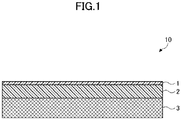
- FIG. 1 is a schematic cross-sectional view of a composite semipermeable membrane according to an embodiment of the invention.
- a composite semipermeable membrane 10 includes a porous layer 2 and a membrane separation layer (active layer or skin layer) 1 provided on the porous layer (porous support layer) 2, as illustrated in FIG. 1 .
- the composite semipermeable membrane 10 may include a substrate 3 for reinforcing the porous layer 2.
- semipermeable membrane refers to a membrane that is permeable to a portion of the components present in a liquid and impermeable to other components of the liquid.
- composite in a composite semipermeable membrane indicates that a plurality of layers having different functions or configurations are laminated.
- the membrane separation layer in the composite semipermeable membrane is an extremely thin layer provided at the top of the composite semipermeable membrane.
- the porous layer then serves to support the membrane separation layer.
- a porous layer consists of a polymer (organic polymer or organic polymer compound) or mainly formed by polymer as a main component.
- the polymer in the porous layer is mainly formed by a crystalline polymer.
- the "crystalline polymer” also referred to as a semi-crystalline polymer, and the semi-crystalline polymer contains a crystalline portion and an amorphous portion in solid state.
- the semi-crystalline polymer has a predetermined crystallinity (a ratio of crystalline portion to a total crystalline polymer) .
- a "main component" of a predetermined material or “mainly formed by” a predetermined material indicates that the predetermined material is contained 50% or weight or more of the main component.
- a composite semipermeable membrane with excellent oil resistance can be obtained because the polymer constituting the porous layer contains the crystalline polymer. Therefore, even if an oil-containing liquid is treated for a long time, the porous layer is not likely to deteriorate and delaminate. Therefore, the performance of the composite semipermeable membrane is not deteriorated due to the influence of oil, and favorable treatment can be continuously conducted.
- crystalline polymers include fluorine-containing polymer (fluoropolymer), polyethylene, nylon, polyacetals, polyethylene terephthalate, polybutylene terephthalate, and the like.
- a polymer in the porous layer preferably contains a fluoropolymer and more preferably, the polymer in the porous layer is mainly formed by a fluoropolymer. Accordingly, the effect of preventing deterioration of the porous layer with respect to the oil-containing liquid is enhanced.
- the amount of polymer in the porous layer based on the total amount of the polymer is preferably 80% by weight or more, more preferably 90% by weight or more, further more preferably 95% by weight or more, even more preferably 99% by weight or more, and most preferably 99.5% by weight or more. It is preferable that the polymer in the porous layer is substantially formed by fluoropolymer. In the present specification, the term "substantially formed by” indicates that the inclusion of components other than the predetermined components that are unavoidably generated or mixed in during production is allowed.
- the fluoropolymer can be a homopolymer or a copolymer.
- the fluoropolymer may be a homopolymer or copolymer of polyvinylidene fluoride (PVDF), polytetrafluoroethylene (PTFE), polyvinyl fluoride (PVF), polychlorotrifluoroethylene (PCTFE), and the like.
- PVDF polyvinylidene fluoride
- PTFE polytetrafluoroethylene
- PVF polyvinyl fluoride
- PCTFE polychlorotrifluoroethylene
- the weight of the monomer unit of the main component based on the weight of the fluoropolymer copolymer is 50% by weight or more, preferably 70% by weight or more, and more preferably 80% by weight or more. Therefore, for example, a polyvinylidene fluoride copolymer indicates that a polyvinylidene fluoride copolymer of the vinylidene fluoride monomer unit (the monomer unit derived from vinylidene fluoride) based on the weight of the polyvinylidene fluoride copolymer is 50% by weight or more, preferably 70% by weight or more, further more preferably 80% by weight or more, and most preferably 90% by weight or more.
- a polyvinylidene fluoride homopolymer, a polyvinylidene fluoride copolymer, or a mixture of both is preferably used, and a polyvinylidene fluoride copolymer is more preferably used.
- the polymer in the porous layer preferably mainly formed by a polyvinylidene fluoride homopolymer and/or a polyvinylidene fluoride copolymer.
- the polymer in the porous layer such that a polyvinylidene fluoride homopolymer and/or a polyvinylidene fluoride copolymer based on the total amount of the polymer is preferably 80% by weight or more, more preferably 90% by weight or more, further more preferably 95% by weight or more, even more preferably 99% by weight or more, and most preferably 99.5% by weight or more. Furthermore, it is preferable that the polymer in the porous layer is substantially formed by a polyvinylidene fluoride homopolymer and/or a polyvinylidene fluoride copolymer.
- another monomer unit that is copolymerized with the monomer unit of a main component may be the monomer unit of the fluoropolymer, the monomer unit of the fluoropolymer other than the fluoropolymer, or a monomer component (a fluorine-free monomer component) that is not a fluoropolymer.
- the crystalline polymer in the present embodiment is a polyvinylidene fluoride copolymer
- another copolymerized monomer unit is preferably a monomer unit derived from hexafluoropropylene, tetrafluoroethylene, and chlorotrifluoroethylene.
- another copolymerized monomer unit contains a monomer unit derived from hexafluoropropylene. That is, when the crystalline polymer contains a vinylidene fluoride copolymer, the vinylidene fluoride copolymer is preferably a vinylidene fluoride-hexafluoropropylene copolymer containing monomer units derived from vinylidene fluoride and monomer units derived from hexafluoropropylene.
- the weight of monomer units derived from hexafluoropropylene based on the weight of the total polyvinylidene fluoride copolymer may be preferably 30% by weight or less, more preferably 20% by weight or less, and even more preferably 10% by weight or less.
- the manner of polymerizing the copolymer is not limited.
- the polymerization may be a graft copolymer, a block copolymer, a random copolymer, or the like.
- fluoropolymer copolymers include perfluoroalkoxyalkanes (ethylene tetrafluoride-perfluoroalkoxyethylene copolymers, PFA), perfluoroethylene propene copolymers (ethylene tetrafluoride-propylene hexafluoride copolymers, FEP), ethylene tetrafluoroethylene copolymers (ethylene tetrafluoride-ethylene copolymers, ETFE), ethylene chlorotrifluoroethylene copolymers (ethylene trifluoride-ethylene copolymers, ECTFE), and the like.
- the above-described fluoropolymers may be arbitrarily combined polymer blends (polymer alloys) of two or more species. Polymers of different molecular weights can also be used in combination as the above-described fluoropolymers.
- a mixture of two or more polyvinylidene fluoride homopolymers having different average molecular weights may be used, two or more polyvinylidene fluoride copolymers having different average molecular weights may be used, or a mixture of a polyvinylidene fluoride homopolymer and a polyvinylidene fluoride copolymer, in which these average molecular weights are different, may be used.
- the crystallinity of a crystalline polymer may be 50% or less, preferably less than 50%, more preferably 48% or less, and even more preferably 45% or less.
- the amorphous portion of the crystalline polymer exceeds 50%, and a toughness of the entire porous layer is increased.
- the lower limit of crystallinity of the crystalline polymer is not particularly limited, but the lower limit may be 30% or more, preferably 32% or more. When the crystallinity is 30% or more, sufficient toughness can be secured, therefore, the resulting porous layer is resistant to deformation even when pressure is applied.
- the crystallinity of the crystalline polymer can be adjusted to 30% or more and 50% or less to form a composite semipermeable membrane with high resistance to pressure.
- the crystallinity can be calculated by measuring a melting heat quantity by differential scanning calorimetry (DSC).
- a weight average molecular weight of the crystalline polymer used to form the porous layer is preferably 100,000 or more and 1,000,000 or less, and more preferably 300,000 or more and 1,000, 000 or less.
- the weight average molecular weight of the polymer is 100,000 or more, a porous layer with a moderate thickness during a manufacturing of a composite semipermeable membrane can be formed, and a moderate strength of the porous layer formed can be ensured.
- the weight average molecular weight of the polymer is 1,000,000 or less, a suitable permeability of the porous layer formed can be ensured.
- the porous layer may contain polymers other than the crystalline polymer as long as the other polymers do not interfere with the action or effect of the present embodiment.
- an amorphous polymer may be contained in the porous layer as a polymer component.
- the porous layer may also contain crystalline polymers other than fluoropolymers. Regardless of crystallinity, polymers other than fluoropolymers, which may be included as a polymer component in the porous layer, are imide-containing polymers (polymers containing one or more imide bonds in the monomer unit which constituting the polymer), for example, such as polyetherimide (PEI), polyamideimide (PAI), and polyimide (PI) .
- PEI polyetherimide
- PAI polyamideimide
- PI polyimide
- the polymer contained in the porous layer is substantially free of polysulfone.
- the term "substantially free” indicates that the amount of predetermined components based on the total amount of polymer is 3% by weight or less, preferably 1% by weight or less, more preferably 0.5% by weight or less, even more preferably 0.1% by weight or less, and particularly preferably 0% by weight. That is, no predetermined component is preferably contained.
- the polymer in the porous layer is substantially free of polysulfone, thereby improving the oil resistance of the composite semipermeable membrane.
- the desalination can be continued without the occurrence of leaks spots in the porous layer or causing delamination between the porous layer and the membrane separation layer.
- the polymer contained in the porous layer of the present embodiment is substantially free of polymers having sulfonyl groups, such as polyethersulfone, polyphenylsulfone, and the like.
- the porous layer may contain components other than the polymer, such as additives and the like.
- Additives that may be included in the porous layer as components other than the polymer include functional particles such as colloidal silica, zeolites, and the like.
- a compression ratio of a portion including the porous layer and the membrane separation layer when subjected to a pressure of 5.5 MPa may be 0.1% or more and 60% or less, preferably 1.0% or more and 50% or less, and more preferably 1.0% or more and 40% or less.
- the compression ratio of the portion including the porous layer and the membrane separation layer is the ratio of the reduced thickness due to compression (i.e., the initial thickness minus the thickness post pressurization) during a predetermined period of time under a predetermined pressure to the initial thickness.
- the predetermined time may be 2 hours or more. Therefore, for example, the compression ratio of a portion including the porous layer and the membrane separation layer can be the compression ratio when subjected to a pressure of 5.5 MPa for 2 hours.
- the compression ratio can be a compression ratio after forming a composite semipermeable membrane including a porous layer and a membrane separation layer, followed by applying liquid to the composite semipermeable membrane at a pressure of 5.5 MPa for 2 hours.
- the portion including the porous layer and the membrane separation layer according to the present embodiment has a compression ratio in the range described above, and exhibits excellent pressure resistance. Accordingly, the composite semipermeable membrane of the present invention can be used under conditions of high operating pressure. For example, in the composite semipermeable membrane of the present embodiment, even when an operating pressure, for example, 1 to 12 MPa is applied to the composite semipermeable membrane by a reverse osmosis method, structural changes of the porous layer can be minimized, and the salt-blocking ratio can be maintained for a long period of time.
- an operating pressure for example, 1 to 12 MPa
- a method of producing the porous layer of the present embodiment is not particularly limited. Although a non-solvent-induced phase separation method (NIPS), a thermally-induced phase separation (TIPS), or the like can be used, a non-solvent-induced phase separation method (NIPS) is preferably used because a uniform and wide porous layer can be produced. More specifically, after the above-described polymer is dissolved in a solvent to obtain a membrane-forming solution, the membrane-forming solution is applied to a substrate such as a non-woven fabric, using a knife coater or the like. The resulting layer is placed under high humidity so as to generate a microphase separation in a portion where the solution is applied, and the polymer in the applied solution is then allowed to solidify and the residual solution is removed from the resulting layer.
- NIPS non-solvent-induced phase separation method
- TIPS thermally-induced phase separation
- NIPS non-solvent-induced phase separation method
- a crystalline polymer is dissolved in a solvent to form a homogenous membrane-forming solution.
- the solvent used is preferably a water-soluble solvent and has high boiling point, because a favorable microphase separation can be generated in a portion where the solution is applied.
- the solvent used is preferably a water-soluble solvent having a boiling point of 130°C or higher and 250°C or lower.
- the solvents include dimethylformamide (DMF), dimethylsulfoxide (DMSO), dimethylacetamide (DMAC), 1,3-dimethyl-2-imidazolidinone (DMI), N-methylpyrrolidone (NMP), ⁇ -butyrolactone (GBL), and the like.
- the crystalline polymer used in the present embodiment is preferably soluble in the above-mentioned solvents and can be dissolved in the solvents at temperatures from room temperature to about 80°C to obtain a homogenous membrane-forming solution.
- polyoxyalkylene such as polyethylene glycol, polybutylene glycol, and the like
- water-soluble polymers such as polyvinyl alcohol, polyvinyl butyral, and the like
- glycerin diethylene glycol; water; acetone; 1,3-dioxolane; and the like
- the porosity, pore diameter, and the like in the porous layer can be adjusted by adding a predetermined amount of the porous agent.
- the porosity of the porous layer before applying pressure in the present embodiment is preferably 30% or more and 70% or less and more preferably 40% or more and 60% or less.
- the porosity of the porous layer is 30% or more, the water permeability and desalting ability of the composite semipermeable membrane can be ensured.
- the porosity of the porous layer is 70% or less, the pressure resistance and the strength of the porous layer and the composite semipermeable membrane can be improved, and the permeation performance of the permeable flux can be improved.
- high permeability can be maintained even when the porous layer is compressed by the application of pressure for long periods of time or at high pressure.
- the porosity of the porous layer can be measured based on the weight and volume of the porous layer and the polymer density.
- the porosity of the porous layer after applying a pressure is preferably 30% or more and 60% or less.
- the average pore diameter on the surface of the porous layer is preferably 5 nm or more and 50 nm or less, and more preferably 15 nm or more and 25 nm or less.
- the membrane separation layer may be a layer including a crosslinked polyamide.
- the crosslinked polyamide membrane separation layer is obtained by interfacial polymerization of a multifunctional amine with an acid halide compound.
- the polyfunctional amine may be an aromatic polyfunctional amine, an aliphatic polyfunctional amine, or a combination thereof.
- the aromatic polyfunctional amines may be m-phenylenediamine, p-phenylenediamine, 1,3,5-triaminobenzene, and the like, or N-alkylates thereof, such as N,N-dimethyl m-phenylenediamine, N,N-diethyl m-phenylenediamine, N,N-dimethyl p-phenylenediamine, N,N-diethyl p-phenylenediamine.
- the aliphatic polyfunctional amine may be piperazine or a derivative thereof.
- aliphatic polyfunctional amines include piperazine, 2,5-dimethylpiperazine, 2-methylpiperazine, 2,6-dimethylpiperazine, 2,3,5-trimethylpiperazine, 2,5-diethylpiperazine, 2,3,5-triethylpiperazine, 2-n-propylpiperazine, 2,5-di-n-butylpiperazine, ethylenediamine, and the like.
- These polyfunctional amines can be used alone or in combination of two or more.
- the acid halide compound is not particularly limited as long as the acid halide compound provides polyamide by a reaction with the above polyfunctional amine.
- An acid halide having two or more carbonyl halide in one molecule is preferably used.
- the acid halide compound include an acid halide compound of a fatty acid such as oxalic acid, malonic acid, maleic acid, fumaric acid, glutaric acid, 1,3,5-cyclohexanetricarboxylic acid, 1,3-cyclohexanedicarboxylic acid, 1,4-cyclohexanedicarboxylic acid, and the like; an acid halide compound of an aromatic acid such as phthalic acid, isophthalic acid, 1,3,5-benzenetricarboxylic acid, 1,2,4-benzenetricarboxylic acid, 1,3-benzenedicarboxylic acid, 1,4-benzenedicarboxylic acid, and the like.
- These acid halide compounds can be used alone or in combination of two or more species.
- a porous layer is formed on a substrate, and then a surface of the porous layer is immersed in a solution of a polyfunctional amine compound. After that, the porous layer is contacted with a solution of an acid halide compound to form a crosslinked polyamide layer by processing an interfacial polymerization.
- the substrate in the composite semipermeable membrane examples include a fibrous planar structure, specifically, a woven fabric, a knitted fabric, a non-woven fabric, and the like.
- a non-woven fabric is preferably used.
- the non-woven fabric may be made by a spunbond process, a spunlace process, a meltblown process, a carding process, an air-lay process, a wet process, a chemical bond process, a thermal bond process, a needle punch process, a water jet process, a stitch bond process, an electrospinning process, and the like.
- the type of fibers constituting the non-woven fabric is not limited, the non-woven fabric is preferably synthetic fibers.
- fibers may be polyethylene terephthalate (PET), polybutylene terephthalate (PBT), polytrimethylene terephthalate (PTT), polyethylene naphthalate (PEN), polypropylene (PP), polyethylene (PE), polyphenylene sulfide (PPS), polyvinylidene fluoride (PVDF), polyglycolic acid (PGA), polylactic acid (PLA), nylon 6, polycaprolactone (PCL), polyethylene adipate (PEA), polyhydroxyalkanoate (PHA), or copolymers thereof.
- PET polyethylene terephthalate
- PBT polybutylene terephthalate
- PTT polytrimethylene terephthalate
- PEN polyethylene naphthalate
- PP polypropylene
- PE polyethylene
- PPS polyphenylene sulfide
- PVDF polyvinylidene fluoride
- PGA polyglycolic acid
- PLA polylactic acid
- PCL nylon 6, polycap
- the thickness of the composite semipermeable membrane of the present embodiment may be 100 ⁇ m or more and 250 ⁇ m or less.
- the thickness of the porous layer may be 10 ⁇ m or more and 100 ⁇ m or less.
- the thickness of the membrane separation layer may be 0.01 ⁇ m or more and 1 ⁇ m or less.
- the thickness of the substrate may be 50 ⁇ m or more and 200 ⁇ m or less.
- the composite semipermeable membrane of the present embodiment may be suitably used as a reverse osmosis membrane.
- NaCl blocking ratio can be 99% or more after desalting a solution of 32,000 mg/L of NaCl solution at a pressure of 5.5 MPa for 2 hours at room temperature (25°C).
- the composite semipermeable membrane of the present embodiment is preferably used for desalting an oil-containing liquid as described above.
- oil-containing indicates that oil is dissolved in water or an aqueous solution, or indicates that oil is mixed or emulsified by a surfactant and the like.
- the oil may be mineral oil, animal or vegetable oil, high grade fatty acids derived from animal or vegetable oil, and the like.
- the mineral oil may be, for example, gasoline, fuel oil, and the like, and may include hydrocarbon oils, such as paraffinic, olefinic, or aromatic hydrocarbon oils.
- aromatic hydrocarbon oil-containing liquid in which examples of oil include benzene, toluene, ethylbenzene, and xylene
- examples of oil include benzene, toluene, ethylbenzene, and xylene
- animal and vegetable oils include fish oil, whale oil, lard, linseed oil, sesame oil, palm oil, and the like.
- water or an aqueous solution containing 0.02 ppm or more of oil can be processed by using the composite semipermeable membrane of the present embodiment.
- water or an aqueous solution containing 0.1 ppm or more of oil, 1 ppm or more of oil, 10 ppm or more of oil, and 6,000 ppm or less of oil can be continuously processed.
- concentration of oil-containing liquid is greater than 6,000 pmg/L, a contamination speed of the surface of the composite semipermeable membrane becomes faster, which affects the desalination process.
- the composite semipermeable membrane of the present embodiment is preferably configured as a flat membrane.
- the flat-formed composite semipermeable membrane of the present embodiment can be preferably used in a spiral-shaped membrane module in which the composite semipermeable membrane is wound around the outside of the water collection tube in a spiral-shaped manner.
- the composite semipermeable membrane of the present embodiment can be particularly suitably used for desalination of an oil-containing liquid.
- the composite semipermeable membrane of the present embodiment can be used for effluents generated in petroleum refineries, petrochemical plants, thermal power plants, automotive manufacturing plants, oil manufacturing plants, food manufacturing plants, and the like; household oil-containing waste liquid; oil-containing seawater; or liquid obtained by pretreating aforementioned wastes.
- composite semipermeable membranes were produced or prepared, and the composite semipermeable membrane were evaluated by the following methods.
- the composite semipermeable membrane was set in a membrane evaluation device (a flow-type flat membrane test cell, manufactured by Nitto Denko Corporation, Membrane Master C70-F), and desalination was conducted by a cross-flow method.
- An effective penetration area was 32.5 cm 2 .
- a supply flow rate was 5 L/min.
- the evaluation was performed by the following method.
- a plurality of samples with a diameter of 75 mm was excised from a composite semipermeable membrane, and the average thickness was determined by measuring the thickness at five points in one sample to obtain an average value (A).
- the substrate was peeled off from the composite semipermeable membrane, and the average thickness was determined by measuring the thickness at five points in the peeled substrate to obtain an average value (B). Then, the average value (A) minus the average value (B) was defined as the thickness (C) of the portion including the porous layer and the membrane separation layer before applying a pressure.
- porous layer was prepared on the substrate, that is, prior to forming the crosslinked polyamide layer (membrane separation layer), samples with a diameter of 75 mm were excised from the porous layer sheet having the porous layer on the substrate and dried at 100°C for 1 hour. Thereafter, the thickness (T) and weight (W) of the porous layer sheet were measured.
- the porous layer was peeled off from the porous layer sheet, and the thickness (T1) and weight (W1) of the substrate were measured.
- the average thickness of the membrane was determined by measuring the thickness at five points of in a sample using the digital indicator "ID-C112X” manufactured by Mitsutoyo Co., Ltd., and an average weight was determined by measuring three times using the balance "AUW220D” manufactured by Shimadzu Co., Ltd.
- the substrate was removed from the dried porous layer sheet on the substrate, and approximately 5 mg of the porous layer was sealed to a DSC pan.
- the crystallinity of the porous layer was measured using a differential scanning calorimeter (DSC-6200) manufactured by Seiko Electronics Co., Ltd. in a temperature range of 50°C to 210°C by increasing the temperature at a rate of 10°C/minute under a nitrogen gas atmosphere to obtain a DSC curve.
- DSC-6200 differential scanning calorimeter
- a baseline of an endothermic value calculation was set from 120°C to the end of melting temperature (about 170°C to 190°C), and the melting calorific value (J/g) was calculated from the area surrounded by the baseline and the endothermic peak. Then, a crystallinity was calculated using the calorific value of a complete crystalline melting of PVDF as 104.7 (J/g).
- the oil resistance of the composite semipermeable membrane was evaluated in Examples 2 and Comparative Example 2.
- the composite semipermeable membrane was immersed in a solution having 85% by weight of xylene and 15% by weight of ethylbenzene as hydrocarbon oil at room temperature for 40 minutes. Thereafter, the blocking ratio in the composite semipermeable membrane was evaluated using the blocking ratio evaluation method described above.
- a homogenous membrane-forming solution was formed by dissolving 19 parts by weight of a polyvinylidene fluoride copolymer (Kynar Flex (Registered trademark) LBG, manufactured by Arkema Corporation) having a weight average molecular weight of 470,000 into 1 part by weight of a polyvinylidene fluoride homopolymer (Kynar (Registered trademark) 761A, manufactured by Arkema Corporation) having a weight average molecular weight of 680,000, 79.48 parts by weight of dimethylacetamide, 0.02 part by weight of polyethylene glycol (polyethylene glycol 35000, manufactured by Merck, Inc.) having a weight average molecular weight of 35,000, and 0.5 part by weight of glycerine at 70°C.
- a polyvinylidene fluoride copolymer (Kynar Flex (Registered trademark) LBG, manufactured by Arkema Corporation) having a weight average molecular weight of 470,000 into 1 part by weight
- the membrane-forming solution was cooled to 40°C and impregnated onto a polyester non-woven fabric with a 0.1 mm thickness, 0.7 g/cm 3 using a membrane-forming apparatus equipped with a knife coater.
- a coater gap of the knife coater was set to 130 ⁇ m.
- a microphase separation was generated in a portion where the solution was applied under an atmosphere of 95% relative humidity and a temperature at 30°C, and the resulting layer was allowed to solidify in a solidifying bath at 40°C.
- the residual solvent was washed off in a washing tank at 70°C to form a porous layer of polyvinylidene fluoride on the non-woven fabric.
- the porous layer formed on the non-woven fabric was immersed in a 1.5% by weight of m-phenylenediamine (an aromatic polyfunctional amine compound) aqueous solution for 1 minute so as to be in contact with the porous layer side.
- m-phenylenediamine an aromatic polyfunctional amine compound
- the excess m-phenylenediamine aqueous solution was then removed.
- the porous layer was then immersed for 30 seconds in a naphthene solution containing 0.1% by weight of trimesoyl trichloride (aromatic halide compound) and 0.13% by weight of isophthalic acid dichloride.
- trimesoyl trichloride aromatic halide compound
- the composite semipermeable membrane is configured by arranging the non-woven fabric, the porous layer, and the crosslinked polyamide membrane separation layer in this order. Then, a crystallinity of the porous layer, a porosity before applying a pressure of the porous layer, and a blocking ratio of composite semipermeable membrane, and a compression ratio (k) of a portion including the porous layer and the membrane separation layer were determined by the aforementioned evaluation method. The results are shown in Table 1.
- a polyvinylidene fluoride porous layer was obtained in the same manner as Example 1 except that the membrane-forming solution used included 20 parts by weight of a polyvinylidene fluoride copolymer (Kynar Flex (Registered trademark) LBG, manufactured by Arkema Corporation) having a weight average molecular weight of 470,000, 79.48 parts by weight of dimethylacetamide, 0.02 parts by weight of a polyethylene glycol (polyethylene glycol 20,000, manufactured by Merck, Inc.) having a weight average molecular weight of 20,000, and 0.5 parts by weight of glycerin.
- a polyvinylidene fluoride copolymer (Kynar Flex (Registered trademark) LBG, manufactured by Arkema Corporation) having a weight average molecular weight of 470,000, 79.48 parts by weight of dimethylacetamide, 0.02 parts by weight of a polyethylene glycol (polyethylene glycol 20,000, manufactured by Merck, Inc.) having
- a composite semipermeable membrane was then obtained by forming a crosslinked polyamide layer in the same manner as Example 1. Also, in Example 2, a crystallinity of the porous layer, a porosity before applying a pressure of the porous layer, and a blocking ratio of composite semipermeable membrane, and a compression ratio (k) of a portion including the porous layer and the membrane separation layer were determined by the above-described evaluation method. The results are shown in Table 1. In addition, oil resistance of Example 2 was evaluated. The result is shown in Table 2.
- a polyvinylidene fluoride porous layer was obtained on a non-woven fabric in the same manner as Example 1 except that the membrane-forming solution used included 20 parts by weight of a polyvinylidene fluoride copolymer (Kynar Flex (Registered trademark) 2850, manufactured by Arkema Corporation) having a weight average molecular weight of 470,000, 79.48 parts by weight of dimethylacetamide, 0.02 parts by weight of polyethylene glycol (polyethylene glycol 20000, manufactured by Merck, Inc.) having a weight average molecular weight of 20,000, and 0.5 parts by weight of glycerin.
- a polyvinylidene fluoride copolymer (Kynar Flex (Registered trademark) 2850, manufactured by Arkema Corporation) having a weight average molecular weight of 470,000, 79.48 parts by weight of dimethylacetamide, 0.02 parts by weight of polyethylene glycol (polyethylene glycol 20000, manufactured by Merck, Inc.
- a composite semipermeable membrane was then obtained by forming a crosslinked polyamide layer in the same manner as Example 1. Also, in Example 3, a crystallinity of the porous layer, a porosity before applying a pressure of the porous layer, and a blocking ratio of composite semipermeable membrane, and a compression ratio (k) of a portion including the porous layer and the membrane separation layer were determined by the above-described evaluation method. The results are shown in Table 1.
- a membrane-forming solution was impregnated onto a polyester non-woven fabric in the same manner as Example 1 except that the membrane-forming solution was formed by mixing 18 parts by weight of polyvinylidene fluoride copolymer (Kynar Flex (Registered trademark) LBG, manufactured by Arkema Corporation) having a weight average molecular weight of 470,000 with 15 parts by weight of polyvinyl pyrrolidone, 66 parts by weight of dimethylacetamide, and 1 part by weight of glycerin.
- a coater gap of the knife coater was set to 160 ⁇ m.
- a microphase separation was generated in a portion where the solution was applied under an atmosphere of 90% relative humidity and a temperature at 40°C, and the resulting layer was allowed to solidify in a solidifying bath at 40°C. Furthermore, the residual solvent was washed off in a washing tank at 70°C to form a porous layer of polyvinylidene fluoride on a non-woven fabric.
- Example 4 a crosslinked polyamide layer was formed by the method of forming the membrane separation layer in the same manner as Example 1 described above to obtain a composite semipermeable membrane. Also, in Example 4, a crystallinity the porous layer, a porosity before applying a pressure of the porous layer, and a blocking ratio of composite semipermeable membrane, and a compression ratio (k) of a portion including the porous layer and the membrane separation layer were determined. The results are shown in Table 1.
- a polyvinylidene fluoride porous layer was obtained on a non-woven fabric in the same manner as Example 1 except that a membrane-forming solution was formed by dissolving 24 parts by weight of a polyvinylidene fluoride homopolymer (Kynar (Registered trademark) HSV900, manufactured by Arkema Corporation) having a weight average molecular weight of 1,000,000 into 63 parts by weight of N-methylpyrrolidone and 13 parts by weight of pro 85°C.
- a polyvinylidene fluoride homopolymer Kel (Registered trademark) HSV900, manufactured by Arkema Corporation
- Example 5 was performed in the same manner as Example 1 except that a resulting layer was subjected to free running under an atmosphere of 15% relative humidity and a temperature at 42°C, and the resulting layer was allowed to immerse and solidify in a solidifying bath at 20°C.
- a coater gap of the knife coater was set to 120 ⁇ m.
- a composite semipermeable membrane was then obtained by forming a crosslinked polyamide layer as in Example 1. Also, in Example 5, a crystallinity of the porous layer, a porosity before applying a pressure of the porous layer, and a blocking ratio of composite semipermeable membrane, and a compression ratio (k) of a portion including the porous layer and the membrane separation layer were determined. The results are shown in Table 1.
- a homogenous membrane-forming solution was formed by dissolving 18 parts by weight of polyvinylidene fluoride (Solef (Registered trademark) 6012, manufactured by Solvay, Inc.) having an average molecular weight of 380,000 into 15 parts by weight of polyvinylpyrrolidone, 66.5 parts by weight of dimethylacetamide, and 0.5 parts by weight of glycerin at 70°C.
- the membrane-forming solution was cooled to 40°C and impregnated onto a polyester non-woven fabric with a 0.1 mm thickness, 0.7 g/cm 3 density using a membrane-forming apparatus equipped with a knife coater.
- a coater gap of the knife coater was set to 180 ⁇ m.
- a microphase separation was generated in a portion where the solution was applied under an atmosphere of 95% relative humidity and a temperature at 30°C, and the resulting layer was allowed to solidify in a solidifying bath at 45°C. Furthermore, the residual solvent was washed off in a washing tank at 50°C to form a porous layer of polyvinylidene fluoride on the non-woven fabric.
- a crosslinked polyamide layer was then formed in the same manner as Example 1 to obtain a composite semipermeable membrane. Also, in Comparative Example 2, a crystallinity of the porous layer, a porosity before applying a pressure of the porous layer, a blocking ratio of composite semipermeable membrane, and a compression ratio (k) of a portion including the porous layer and the membrane separation layer were determined by the above-described evaluation method. The results are shown in Table 1.
- a reverse osmosis membrane of a spiral RO membrane element (LG SW 400 R, manufactured by LG chemical) was prepared.
- the reverse osmosis membrane is a composite semipermeable membrane in which the porous layer is a polysulfone membrane.
- oil resistance was evaluated. The results are shown in Table 2.
- Example 1 Example 2
- Example 3 Example 4
- Example 5 Comparative Example 1 Calorific value [J/g] 39.5 35.0 40.7 44.3 35.1 54.5 Crystallinity [%] 37.7 33.4 38.9 42.3 33.5 52.1 Pressure applied [MPa] 5.5 5.5 5.5 5.5 5.5 5.5
- Example 2 From Table 2, it was found that the NaCl blocking ratio of Example 2 was high even after immersion in the xylene-containing liquid. In contrast, in Comparative Example 2, the blocking ratio could not be assessed because the porous layer was dissolved and delamination between the porous layer and the membrane separation layer was generated after immersion in the xylene-containing liquid for 40 minutes at room temperature.
Landscapes
- Chemical & Material Sciences (AREA)
- Chemical Kinetics & Catalysis (AREA)
- Engineering & Computer Science (AREA)
- Water Supply & Treatment (AREA)
- Nanotechnology (AREA)
- Life Sciences & Earth Sciences (AREA)
- Hydrology & Water Resources (AREA)
- Environmental & Geological Engineering (AREA)
- Organic Chemistry (AREA)
- Separation Using Semi-Permeable Membranes (AREA)
Abstract
Description
- The present invention relates to a composite semipermeable membrane.
- As composite semipermeable membranes used in desalination, membranes having a substrate, a porous support layer composed of an organic polymer, and a separation membrane layer have been widely used. In particular, composite semipermeable membranes used for desalination by reverse osmosis and the like may including a polysulfone porous support layer and a polyamide separation membrane layer (for example, Patent Document 1), are conventionally used.
- Meanwhile, materials of the porous layer, which used to remove turbidity before desalination and does not provide a membrane separation function, include polymers such as polysulfone, polyfluorocarbon, polyvinylidene difluoride, polyethylene, polypropylene, polyvinyl alcohol, and polyacrylonitrile (for example, Patent Document 2).
-
- Patent Document 1: Japanese Unexamined Patent Application Publication (Translation of
PCT Application) No. 2014-523340 - Patent Document 2: Japanese Unexamined Patent Publication No.
Sho58-93734 - In recent years, from the viewpoint of securing water resources and protecting the environment, the importance of reusing desalinated water or desalinated aqueous solution has been increased. In addition, according to circumstances, further processing to desalinate an oil-containing liquid may be required, for example by using high-pressure conditions, which differ from conventional techniques.
- However, it has been found that in the conventional configuration having a polysulfone porous layer as described in Patent Document 1, the processing performance deteriorates over time, and sufficient desalination cannot be achieved. A membrane separation layer having polysulfone as a porous support layer is not suitable for the treatment of an oil-containing liquid. When a composite semipermeable membrane including a porous layer of polysulfone is used to treat an oil-containing liquid, the porous layer formed by polysulfone may deteriorate and form a leak spot, or delaminate between the porous layer and the membrane separation layer. Therefore, it is difficult to maintain processing ability in the continued use of a composite semipermeable membrane with a polysulfone porous layer.
- In addition, because the porous layer that does not have the membrane separation function, as described in
Patent Document 2, is normally a membrane that is produced for high water permeability at a pressure of less than 0.3 MPa. Generally, such membrane is poor in pressure resistance. Therefore, the use of such membrane is not presumed to be used under high pressure condition. - Accordingly, in view of the foregoing, one aspect of the invention is to provide a novel composite semipermeable membrane capable of stably desalting an oil-containing liquid even under high pressure conditions.
- A composite semipermeable membrane according to one aspect of the invention is a composite semipermeable membrane containing a substrate, a porous layer provided on the substrate, and a membrane separation layer provided on the porous layer, wherein the porous layer contains a crystalline polymer, and a crystallinity of the crystalline polymer is 30% or more and 50% or less, and the membrane separation layer is a polyamide-based membrane separation layer.
- According to an aspect of the invention, the invention provides a composite semipermeable membrane that can stably desalt an oil-containing liquid.
-
FIG. 1 is a schematic cross-sectional view of a composite semipermeable membrane according to an embodiment of the invention. - A composite
semipermeable membrane 10 according to one embodiment of the present invention includes aporous layer 2 and a membrane separation layer (active layer or skin layer) 1 provided on the porous layer (porous support layer) 2, as illustrated inFIG. 1 . As illustrated inFIG. 1 , the compositesemipermeable membrane 10 may include asubstrate 3 for reinforcing theporous layer 2. - In this specification, "semipermeable membrane" refers to a membrane that is permeable to a portion of the components present in a liquid and impermeable to other components of the liquid. Also, "composite" in a composite semipermeable membrane indicates that a plurality of layers having different functions or configurations are laminated.
- The membrane separation layer in the composite semipermeable membrane is an extremely thin layer provided at the top of the composite semipermeable membrane. The porous layer then serves to support the membrane separation layer.
- In the present embodiment, a porous layer consists of a polymer (organic polymer or organic polymer compound) or mainly formed by polymer as a main component. The polymer in the porous layer is mainly formed by a crystalline polymer. The "crystalline polymer" also referred to as a semi-crystalline polymer, and the semi-crystalline polymer contains a crystalline portion and an amorphous portion in solid state. The semi-crystalline polymer has a predetermined crystallinity (a ratio of crystalline portion to a total crystalline polymer) . In the present specification, a "main component" of a predetermined material or "mainly formed by" a predetermined material indicates that the predetermined material is contained 50% or weight or more of the main component.
- In the present embodiment, a composite semipermeable membrane with excellent oil resistance can be obtained because the polymer constituting the porous layer contains the crystalline polymer. Therefore, even if an oil-containing liquid is treated for a long time, the porous layer is not likely to deteriorate and delaminate. Therefore, the performance of the composite semipermeable membrane is not deteriorated due to the influence of oil, and favorable treatment can be continuously conducted.
- Examples of crystalline polymers include fluorine-containing polymer (fluoropolymer), polyethylene, nylon, polyacetals, polyethylene terephthalate, polybutylene terephthalate, and the like. In the present embodiment, a polymer in the porous layer preferably contains a fluoropolymer and more preferably, the polymer in the porous layer is mainly formed by a fluoropolymer. Accordingly, the effect of preventing deterioration of the porous layer with respect to the oil-containing liquid is enhanced. Furthermore, the amount of polymer in the porous layer based on the total amount of the polymer is preferably 80% by weight or more, more preferably 90% by weight or more, further more preferably 95% by weight or more, even more preferably 99% by weight or more, and most preferably 99.5% by weight or more. It is preferable that the polymer in the porous layer is substantially formed by fluoropolymer. In the present specification, the term "substantially formed by" indicates that the inclusion of components other than the predetermined components that are unavoidably generated or mixed in during production is allowed.
- The fluoropolymer can be a homopolymer or a copolymer. For example, the fluoropolymer may be a homopolymer or copolymer of polyvinylidene fluoride (PVDF), polytetrafluoroethylene (PTFE), polyvinyl fluoride (PVF), polychlorotrifluoroethylene (PCTFE), and the like. Here, the copolymer is obtained by copolymerizing another monomer unit to a monomer unit of a main component in the fluoropolymer copolymer. The weight of the monomer unit of the main component based on the weight of the fluoropolymer copolymer is 50% by weight or more, preferably 70% by weight or more, and more preferably 80% by weight or more. Therefore, for example, a polyvinylidene fluoride copolymer indicates that a polyvinylidene fluoride copolymer of the vinylidene fluoride monomer unit (the monomer unit derived from vinylidene fluoride) based on the weight of the polyvinylidene fluoride copolymer is 50% by weight or more, preferably 70% by weight or more, further more preferably 80% by weight or more, and most preferably 90% by weight or more.
- Among the above-described examples of fluoropolymers, in view of excellent workability, excellent pressure resistance, and chemical resistance (including oil resistance), a polyvinylidene fluoride homopolymer, a polyvinylidene fluoride copolymer, or a mixture of both is preferably used, and a polyvinylidene fluoride copolymer is more preferably used. Thus, the polymer in the porous layer preferably mainly formed by a polyvinylidene fluoride homopolymer and/or a polyvinylidene fluoride copolymer. In addition, the polymer in the porous layer such that a polyvinylidene fluoride homopolymer and/or a polyvinylidene fluoride copolymer based on the total amount of the polymer is preferably 80% by weight or more, more preferably 90% by weight or more, further more preferably 95% by weight or more, even more preferably 99% by weight or more, and most preferably 99.5% by weight or more. Furthermore, it is preferable that the polymer in the porous layer is substantially formed by a polyvinylidene fluoride homopolymer and/or a polyvinylidene fluoride copolymer.
- When the fluoropolymer is a copolymer, another monomer unit that is copolymerized with the monomer unit of a main component may be the monomer unit of the fluoropolymer, the monomer unit of the fluoropolymer other than the fluoropolymer, or a monomer component (a fluorine-free monomer component) that is not a fluoropolymer. In the case where the crystalline polymer in the present embodiment is a polyvinylidene fluoride copolymer, another copolymerized monomer unit is preferably a monomer unit derived from hexafluoropropylene, tetrafluoroethylene, and chlorotrifluoroethylene. More preferably, another copolymerized monomer unit contains a monomer unit derived from hexafluoropropylene. That is, when the crystalline polymer contains a vinylidene fluoride copolymer, the vinylidene fluoride copolymer is preferably a vinylidene fluoride-hexafluoropropylene copolymer containing monomer units derived from vinylidene fluoride and monomer units derived from hexafluoropropylene. In addition, when the polyvinylidene fluoride copolymer contains monomer units derived from hexafluoropropylene as another monomer unit, the weight of monomer units derived from hexafluoropropylene based on the weight of the total polyvinylidene fluoride copolymer may be preferably 30% by weight or less, more preferably 20% by weight or less, and even more preferably 10% by weight or less.
- The manner of polymerizing the copolymer is not limited. The polymerization may be a graft copolymer, a block copolymer, a random copolymer, or the like. Also, examples of fluoropolymer copolymers include perfluoroalkoxyalkanes (ethylene tetrafluoride-perfluoroalkoxyethylene copolymers, PFA), perfluoroethylene propene copolymers (ethylene tetrafluoride-propylene hexafluoride copolymers, FEP), ethylene tetrafluoroethylene copolymers (ethylene tetrafluoride-ethylene copolymers, ETFE), ethylene chlorotrifluoroethylene copolymers (ethylene trifluoride-ethylene copolymers, ECTFE), and the like.
- In addition, regardless of whether the fluoropolymer is a homopolymer or a copolymer, the above-described fluoropolymers may be arbitrarily combined polymer blends (polymer alloys) of two or more species. Polymers of different molecular weights can also be used in combination as the above-described fluoropolymers. For example, a mixture of two or more polyvinylidene fluoride homopolymers having different average molecular weights may be used, two or more polyvinylidene fluoride copolymers having different average molecular weights may be used, or a mixture of a polyvinylidene fluoride homopolymer and a polyvinylidene fluoride copolymer, in which these average molecular weights are different, may be used.
- In the present embodiment, the crystallinity of a crystalline polymer may be 50% or less, preferably less than 50%, more preferably 48% or less, and even more preferably 45% or less. When the crystallinity of the crystalline polymer is 50% or less, the amorphous portion of the crystalline polymer exceeds 50%, and a toughness of the entire porous layer is increased. By having such structure, a porous layer that is resistant to breakage under pressure can be obtained. In addition, the lower limit of crystallinity of the crystalline polymer is not particularly limited, but the lower limit may be 30% or more, preferably 32% or more. When the crystallinity is 30% or more, sufficient toughness can be secured, therefore, the resulting porous layer is resistant to deformation even when pressure is applied. Therefore, the crystallinity of the crystalline polymer can be adjusted to 30% or more and 50% or less to form a composite semipermeable membrane with high resistance to pressure. The crystallinity can be calculated by measuring a melting heat quantity by differential scanning calorimetry (DSC).
- A weight average molecular weight of the crystalline polymer used to form the porous layer is preferably 100,000 or more and 1,000,000 or less, and more preferably 300,000 or more and 1,000, 000 or less. When the weight average molecular weight of the polymer is 100,000 or more, a porous layer with a moderate thickness during a manufacturing of a composite semipermeable membrane can be formed, and a moderate strength of the porous layer formed can be ensured. When the weight average molecular weight of the polymer is 1,000,000 or less, a suitable permeability of the porous layer formed can be ensured.
- The porous layer may contain polymers other than the crystalline polymer as long as the other polymers do not interfere with the action or effect of the present embodiment. For example, an amorphous polymer may be contained in the porous layer as a polymer component. In addition, the porous layer may also contain crystalline polymers other than fluoropolymers. Regardless of crystallinity, polymers other than fluoropolymers, which may be included as a polymer component in the porous layer, are imide-containing polymers (polymers containing one or more imide bonds in the monomer unit which constituting the polymer), for example, such as polyetherimide (PEI), polyamideimide (PAI), and polyimide (PI) .
- It is preferable that the polymer contained in the porous layer is substantially free of polysulfone. In the present specification, the term "substantially free" indicates that the amount of predetermined components based on the total amount of polymer is 3% by weight or less, preferably 1% by weight or less, more preferably 0.5% by weight or less, even more preferably 0.1% by weight or less, and particularly preferably 0% by weight. That is, no predetermined component is preferably contained. The polymer in the porous layer is substantially free of polysulfone, thereby improving the oil resistance of the composite semipermeable membrane. Therefore, when a composite semipermeable membrane of the present embodiment is used to desalinate an oil-containing liquid, the desalination can be continued without the occurrence of leaks spots in the porous layer or causing delamination between the porous layer and the membrane separation layer. Also, it is preferable that the polymer contained in the porous layer of the present embodiment is substantially free of polymers having sulfonyl groups, such as polyethersulfone, polyphenylsulfone, and the like.
- In addition, the porous layer may contain components other than the polymer, such as additives and the like. Additives that may be included in the porous layer as components other than the polymer include functional particles such as colloidal silica, zeolites, and the like.
- Furthermore, in the composite semipermeable membrane of the present embodiment, a compression ratio of a portion including the porous layer and the membrane separation layer when subjected to a pressure of 5.5 MPa may be 0.1% or more and 60% or less, preferably 1.0% or more and 50% or less, and more preferably 1.0% or more and 40% or less.
- The compression ratio of the portion including the porous layer and the membrane separation layer is the ratio of the reduced thickness due to compression (i.e., the initial thickness minus the thickness post pressurization) during a predetermined period of time under a predetermined pressure to the initial thickness. The predetermined time may be 2 hours or more. Therefore, for example, the compression ratio of a portion including the porous layer and the membrane separation layer can be the compression ratio when subjected to a pressure of 5.5 MPa for 2 hours. In addition, the compression ratio can be a compression ratio after forming a composite semipermeable membrane including a porous layer and a membrane separation layer, followed by applying liquid to the composite semipermeable membrane at a pressure of 5.5 MPa for 2 hours.
- As described above, the portion including the porous layer and the membrane separation layer according to the present embodiment has a compression ratio in the range described above, and exhibits excellent pressure resistance. Accordingly, the composite semipermeable membrane of the present invention can be used under conditions of high operating pressure. For example, in the composite semipermeable membrane of the present embodiment, even when an operating pressure, for example, 1 to 12 MPa is applied to the composite semipermeable membrane by a reverse osmosis method, structural changes of the porous layer can be minimized, and the salt-blocking ratio can be maintained for a long period of time.
- A method of producing the porous layer of the present embodiment is not particularly limited. Although a non-solvent-induced phase separation method (NIPS), a thermally-induced phase separation (TIPS), or the like can be used, a non-solvent-induced phase separation method (NIPS) is preferably used because a uniform and wide porous layer can be produced. More specifically, after the above-described polymer is dissolved in a solvent to obtain a membrane-forming solution, the membrane-forming solution is applied to a substrate such as a non-woven fabric, using a knife coater or the like. The resulting layer is placed under high humidity so as to generate a microphase separation in a portion where the solution is applied, and the polymer in the applied solution is then allowed to solidify and the residual solution is removed from the resulting layer.
- In preparing the porous layer by the non-solvent induced phase separation method described above, a crystalline polymer is dissolved in a solvent to form a homogenous membrane-forming solution. Also, the solvent used is preferably a water-soluble solvent and has high boiling point, because a favorable microphase separation can be generated in a portion where the solution is applied. For example, the solvent used is preferably a water-soluble solvent having a boiling point of 130°C or higher and 250°C or lower. Examples of the solvents include dimethylformamide (DMF), dimethylsulfoxide (DMSO), dimethylacetamide (DMAC), 1,3-dimethyl-2-imidazolidinone (DMI), N-methylpyrrolidone (NMP), γ-butyrolactone (GBL), and the like. In other words, the crystalline polymer used in the present embodiment is preferably soluble in the above-mentioned solvents and can be dissolved in the solvents at temperatures from room temperature to about 80°C to obtain a homogenous membrane-forming solution.
- At the time of producing the membrane-forming solution, in addition to the above solvents, polyoxyalkylene such as polyethylene glycol, polybutylene glycol, and the like; water-soluble polymers such as polyvinyl alcohol, polyvinyl butyral, and the like; glycerin; diethylene glycol; water; acetone; 1,3-dioxolane; and the like may be added as a porous agent. The porosity, pore diameter, and the like in the porous layer can be adjusted by adding a predetermined amount of the porous agent.
- In addition, the porosity of the porous layer before applying pressure in the present embodiment is preferably 30% or more and 70% or less and more preferably 40% or more and 60% or less. When the porosity of the porous layer is 30% or more, the water permeability and desalting ability of the composite semipermeable membrane can be ensured. In addition, when the porosity of the porous layer is 70% or less, the pressure resistance and the strength of the porous layer and the composite semipermeable membrane can be improved, and the permeation performance of the permeable flux can be improved. Furthermore, high permeability can be maintained even when the porous layer is compressed by the application of pressure for long periods of time or at high pressure. When the porosity is 80% or more and the crystallinity is 50% or more, the brittleness under high pressure increases and the composite semipermeable membrane breaks, resulting in a decrease in the desalination retention performance. Note that, the porosity of the porous layer can be measured based on the weight and volume of the porous layer and the polymer density.
- Further, the porosity of the porous layer after applying a pressure, for example, after applying a pressure at a pressure of 5.5 MPa for 2 hours, is preferably 30% or more and 60% or less.
- The average pore diameter on the surface of the porous layer is preferably 5 nm or more and 50 nm or less, and more preferably 15 nm or more and 25 nm or less.
- The membrane separation layer may be a layer including a crosslinked polyamide. The crosslinked polyamide membrane separation layer is obtained by interfacial polymerization of a multifunctional amine with an acid halide compound.
- The polyfunctional amine may be an aromatic polyfunctional amine, an aliphatic polyfunctional amine, or a combination thereof. The aromatic polyfunctional amines may be m-phenylenediamine, p-phenylenediamine,
1,3,5-triaminobenzene, and the like, or N-alkylates thereof, such as N,N-dimethyl m-phenylenediamine, N,N-diethyl m-phenylenediamine, N,N-dimethyl p-phenylenediamine,
N,N-diethyl p-phenylenediamine. Alternatively, the aliphatic polyfunctional amine may be piperazine or a derivative thereof. Specific examples of aliphatic polyfunctional amines include piperazine, 2,5-dimethylpiperazine, 2-methylpiperazine,
2,6-dimethylpiperazine, 2,3,5-trimethylpiperazine, 2,5-diethylpiperazine, 2,3,5-triethylpiperazine, 2-n-propylpiperazine, 2,5-di-n-butylpiperazine, ethylenediamine, and the like. These polyfunctional amines can be used alone or in combination of two or more. - The acid halide compound is not particularly limited as long as the acid halide compound provides polyamide by a reaction with the above polyfunctional amine. An acid halide having two or more carbonyl halide in one molecule is preferably used.
- Specific examples of the acid halide compound include an acid halide compound of a fatty acid such as oxalic acid, malonic acid, maleic acid, fumaric acid, glutaric acid,
1,3,5-cyclohexanetricarboxylic acid,
1,3-cyclohexanedicarboxylic acid,
1,4-cyclohexanedicarboxylic acid, and the like; an acid halide compound of an aromatic acid such as phthalic acid, isophthalic acid, 1,3,5-benzenetricarboxylic acid,
1,2,4-benzenetricarboxylic acid, 1,3-benzenedicarboxylic acid, 1,4-benzenedicarboxylic acid, and the like. These acid halide compounds can be used alone or in combination of two or more species. - When a membrane separation layer is formed, a porous layer is formed on a substrate, and then a surface of the porous layer is immersed in a solution of a polyfunctional amine compound. After that, the porous layer is contacted with a solution of an acid halide compound to form a crosslinked polyamide layer by processing an interfacial polymerization.
- Examples of the substrate in the composite semipermeable membrane include a fibrous planar structure, specifically, a woven fabric, a knitted fabric, a non-woven fabric, and the like. Among these, a non-woven fabric is preferably used. The non-woven fabric may be made by a spunbond process, a spunlace process, a meltblown process, a carding process, an air-lay process, a wet process, a chemical bond process, a thermal bond process, a needle punch process, a water jet process, a stitch bond process, an electrospinning process, and the like. Also, although the type of fibers constituting the non-woven fabric is not limited, the non-woven fabric is preferably synthetic fibers. Specific examples of fibers may be polyethylene terephthalate (PET), polybutylene terephthalate (PBT), polytrimethylene terephthalate (PTT), polyethylene naphthalate (PEN), polypropylene (PP), polyethylene (PE), polyphenylene sulfide (PPS), polyvinylidene fluoride (PVDF), polyglycolic acid (PGA), polylactic acid (PLA), nylon 6, polycaprolactone (PCL), polyethylene adipate (PEA), polyhydroxyalkanoate (PHA), or copolymers thereof. Among these, a polyester such as polyethylene terephthalate, is preferably used because polyethylene terephthalate is inexpensive, has high dimensional stability, is highly moldable, and has high oil resistance.
- The thickness of the composite semipermeable membrane of the present embodiment may be 100 µm or more and 250 µm or less. The thickness of the porous layer may be 10 µm or more and 100 µm or less. The thickness of the membrane separation layer may be 0.01 µm or more and 1 µm or less. The thickness of the substrate may be 50 µm or more and 200 µm or less.
- The composite semipermeable membrane of the present embodiment may be suitably used as a reverse osmosis membrane. When the composite semipermeable membrane of the present embodiment is used as the reverse osmosis membrane, for example, NaCl blocking ratio can be 99% or more after desalting a solution of 32,000 mg/L of NaCl solution at a pressure of 5.5 MPa for 2 hours at room temperature (25°C).
- The composite semipermeable membrane of the present embodiment is preferably used for desalting an oil-containing liquid as described above. Here, "oil-containing" indicates that oil is dissolved in water or an aqueous solution, or indicates that oil is mixed or emulsified by a surfactant and the like. In addition, the oil may be mineral oil, animal or vegetable oil, high grade fatty acids derived from animal or vegetable oil, and the like. The mineral oil may be, for example, gasoline, fuel oil, and the like, and may include hydrocarbon oils, such as paraffinic, olefinic, or aromatic hydrocarbon oils. In particular, in the present embodiment, desalination of aromatic hydrocarbon oil-containing liquid, in which examples of oil include benzene, toluene, ethylbenzene, and xylene, can be efficiently performed. Examples of the above-described animal and vegetable oils include fish oil, whale oil, lard, linseed oil, sesame oil, palm oil, and the like.
- In addition, water or an aqueous solution containing 0.02 ppm or more of oil can be processed by using the composite semipermeable membrane of the present embodiment. Also, water or an aqueous solution containing 0.1 ppm or more of oil, 1 ppm or more of oil, 10 ppm or more of oil, and 6,000 ppm or less of oil can be continuously processed. When the concentration of oil-containing liquid is greater than 6,000 pmg/L, a contamination speed of the surface of the composite semipermeable membrane becomes faster, which affects the desalination process.
- The composite semipermeable membrane of the present embodiment is preferably configured as a flat membrane. In addition, the flat-formed composite semipermeable membrane of the present embodiment can be preferably used in a spiral-shaped membrane module in which the composite semipermeable membrane is wound around the outside of the water collection tube in a spiral-shaped manner.
- The composite semipermeable membrane of the present embodiment can be particularly suitably used for desalination of an oil-containing liquid. For example, the composite semipermeable membrane of the present embodiment can be used for effluents generated in petroleum refineries, petrochemical plants, thermal power plants, automotive manufacturing plants, oil manufacturing plants, food manufacturing plants, and the like; household oil-containing waste liquid; oil-containing seawater; or liquid obtained by pretreating aforementioned wastes.
- Hereinafter, embodiments of the present invention will be described based on Examples, but the present invention is not limited to these examples.
- In Examples, composite semipermeable membranes were produced or prepared, and the composite semipermeable membrane were evaluated by the following methods.
- To evaluate the salt-blocking ratio of the composite semipermeable membrane, the composite semipermeable membrane was set in a membrane evaluation device (a flow-type flat membrane test cell, manufactured by Nitto Denko Corporation, Membrane Master C70-F), and desalination was conducted by a cross-flow method. An effective penetration area was 32.5 cm2. A supply flow rate was 5 L/min. The evaluation was performed by the following method.
- An aqueous NaCl solution of 32,000 mg/L was applied to a composite permeable membrane and desalination was conducted at a pressure of 5.5 MPa for 2 hours. After that, an amount of desalinated water and the amount of NaCl after the desalination were measured. Then, the salt-blocking ratio (%) was calculated based on the NaCl content before and after desalination.
- A plurality of samples with a diameter of 75 mm was excised from a composite semipermeable membrane, and the average thickness was determined by measuring the thickness at five points in one sample to obtain an average value (A). In addition, the substrate was peeled off from the composite semipermeable membrane, and the average thickness was determined by measuring the thickness at five points in the peeled substrate to obtain an average value (B). Then, the average value (A) minus the average value (B) was defined as the thickness (C) of the portion including the porous layer and the membrane separation layer before applying a pressure.
- Another plurality of samples with a diameter of 75 mm was prepared, and the blocking ratio (%) of the composite semipermeable membrane was calculated under the same condition described above. Then, the average thickness was determined by measuring the thickness at five points of in the sample to obtain an average value (A'). In addition, the substrate was peeled off from the composite semipermeable membrane, and the average thickness was determined by measuring the thickness at five points in the peeled substrate to obtain an average value (B'). Then, the average value (A') minus the average value (B') was defined as the thickness (C') of the portion including the porous layer and the membrane separation layer after applying a pressure. Then, the compression ratio (k) was obtained based on the following equation:

- When the porous layer was prepared on the substrate, that is, prior to forming the crosslinked polyamide layer (membrane separation layer), samples with a diameter of 75 mm were excised from the porous layer sheet having the porous layer on the substrate and dried at 100°C for 1 hour. Thereafter, the thickness (T) and weight (W) of the porous layer sheet were measured.
- In addition, the porous layer was peeled off from the porous layer sheet, and the thickness (T1) and weight (W1) of the substrate were measured. The average thickness of the membrane was determined by measuring the thickness at five points of in a sample using the digital indicator "ID-C112X" manufactured by Mitsutoyo Co., Ltd., and an average weight was determined by measuring three times using the balance "AUW220D" manufactured by Shimadzu Co., Ltd.
- The porosity (ϕ) was calculated based on the following equation.

- When the porous layer was prepared on the substrate, that is, prior to forming the crosslinked polyamide layer (membrane separation layer), the substrate was removed from the dried porous layer sheet on the substrate, and approximately 5 mg of the porous layer was sealed to a DSC pan. The crystallinity of the porous layer was measured using a differential scanning calorimeter (DSC-6200) manufactured by Seiko Electronics Co., Ltd. in a temperature range of 50°C to 210°C by increasing the temperature at a rate of 10°C/minute under a nitrogen gas atmosphere to obtain a DSC curve. A baseline of an endothermic value calculation was set from 120°C to the end of melting temperature (about 170°C to 190°C), and the melting calorific value (J/g) was calculated from the area surrounded by the baseline and the endothermic peak. Then, a crystallinity was calculated using the calorific value of a complete crystalline melting of PVDF as 104.7 (J/g).
- The oil resistance of the composite semipermeable membrane was evaluated in Examples 2 and Comparative Example 2. The composite semipermeable membrane was immersed in a solution having 85% by weight of xylene and 15% by weight of ethylbenzene as hydrocarbon oil at room temperature for 40 minutes. Thereafter, the blocking ratio in the composite semipermeable membrane was evaluated using the blocking ratio evaluation method described above.
- A homogenous membrane-forming solution was formed by dissolving 19 parts by weight of a polyvinylidene fluoride copolymer (Kynar Flex (Registered trademark) LBG, manufactured by Arkema Corporation) having a weight average molecular weight of 470,000 into 1 part by weight of a polyvinylidene fluoride homopolymer (Kynar (Registered trademark) 761A, manufactured by Arkema Corporation) having a weight average molecular weight of 680,000, 79.48 parts by weight of dimethylacetamide, 0.02 part by weight of polyethylene glycol (polyethylene glycol 35000, manufactured by Merck, Inc.) having a weight average molecular weight of 35,000, and 0.5 part by weight of glycerine at 70°C. The membrane-forming solution was cooled to 40°C and impregnated onto a polyester non-woven fabric with a 0.1 mm thickness, 0.7 g/cm3 using a membrane-forming apparatus equipped with a knife coater. A coater gap of the knife coater was set to 130 µm. A microphase separation was generated in a portion where the solution was applied under an atmosphere of 95% relative humidity and a temperature at 30°C, and the resulting layer was allowed to solidify in a solidifying bath at 40°C. Furthermore, the residual solvent was washed off in a washing tank at 70°C to form a porous layer of polyvinylidene fluoride on the non-woven fabric.
- Next, the porous layer formed on the non-woven fabric was immersed in a 1.5% by weight of m-phenylenediamine (an aromatic polyfunctional amine compound) aqueous solution for 1 minute so as to be in contact with the porous layer side. The excess m-phenylenediamine aqueous solution was then removed. The porous layer was then immersed for 30 seconds in a naphthene solution containing 0.1% by weight of trimesoyl trichloride (aromatic halide compound) and 0.13% by weight of isophthalic acid dichloride. Thus, a crosslinked polyamide layer (membrane separation layer) was formed on the porous layer, and dried in a dryer at 140°C to obtain a composite semipermeable membrane. The composite semipermeable membrane is configured by arranging the non-woven fabric, the porous layer, and the crosslinked polyamide membrane separation layer in this order. Then, a crystallinity of the porous layer, a porosity before applying a pressure of the porous layer, and a blocking ratio of composite semipermeable membrane, and a compression ratio (k) of a portion including the porous layer and the membrane separation layer were determined by the aforementioned evaluation method. The results are shown in Table 1.
- A polyvinylidene fluoride porous layer was obtained in the same manner as Example 1 except that the membrane-forming solution used included 20 parts by weight of a polyvinylidene fluoride copolymer (Kynar Flex (Registered trademark) LBG, manufactured by Arkema Corporation) having a weight average molecular weight of 470,000, 79.48 parts by weight of dimethylacetamide, 0.02 parts by weight of a polyethylene glycol (polyethylene glycol 20,000, manufactured by Merck, Inc.) having a weight average molecular weight of 20,000, and 0.5 parts by weight of glycerin.
- A composite semipermeable membrane was then obtained by forming a crosslinked polyamide layer in the same manner as Example 1. Also, in Example 2, a crystallinity of the porous layer, a porosity before applying a pressure of the porous layer, and a blocking ratio of composite semipermeable membrane, and a compression ratio (k) of a portion including the porous layer and the membrane separation layer were determined by the above-described evaluation method. The results are shown in Table 1. In addition, oil resistance of Example 2 was evaluated. The result is shown in Table 2.
- A polyvinylidene fluoride porous layer was obtained on a non-woven fabric in the same manner as Example 1 except that the membrane-forming solution used included 20 parts by weight of a polyvinylidene fluoride copolymer (Kynar Flex (Registered trademark) 2850, manufactured by Arkema Corporation) having a weight average molecular weight of 470,000, 79.48 parts by weight of dimethylacetamide, 0.02 parts by weight of polyethylene glycol (polyethylene glycol 20000, manufactured by Merck, Inc.) having a weight average molecular weight of 20,000, and 0.5 parts by weight of glycerin.
- A composite semipermeable membrane was then obtained by forming a crosslinked polyamide layer in the same manner as Example 1. Also, in Example 3, a crystallinity of the porous layer, a porosity before applying a pressure of the porous layer, and a blocking ratio of composite semipermeable membrane, and a compression ratio (k) of a portion including the porous layer and the membrane separation layer were determined by the above-described evaluation method. The results are shown in Table 1.
- A membrane-forming solution was impregnated onto a polyester non-woven fabric in the same manner as Example 1 except that the membrane-forming solution was formed by mixing 18 parts by weight of polyvinylidene fluoride copolymer (Kynar Flex (Registered trademark) LBG, manufactured by Arkema Corporation) having a weight average molecular weight of 470,000 with 15 parts by weight of polyvinyl pyrrolidone, 66 parts by weight of dimethylacetamide, and 1 part by weight of glycerin. A coater gap of the knife coater was set to 160 µm. Next, a microphase separation was generated in a portion where the solution was applied under an atmosphere of 90% relative humidity and a temperature at 40°C, and the resulting layer was allowed to solidify in a solidifying bath at 40°C. Furthermore, the residual solvent was washed off in a washing tank at 70°C to form a porous layer of polyvinylidene fluoride on a non-woven fabric.
- Then, a crosslinked polyamide layer was formed by the method of forming the membrane separation layer in the same manner as Example 1 described above to obtain a composite semipermeable membrane. Also, in Example 4, a crystallinity the porous layer, a porosity before applying a pressure of the porous layer, and a blocking ratio of composite semipermeable membrane, and a compression ratio (k) of a portion including the porous layer and the membrane separation layer were determined. The results are shown in Table 1.
- A polyvinylidene fluoride porous layer was obtained on a non-woven fabric in the same manner as Example 1 except that a membrane-forming solution was formed by dissolving 24 parts by weight of a polyvinylidene fluoride homopolymer (Kynar (Registered trademark) HSV900, manufactured by Arkema Corporation) having a weight average molecular weight of 1,000,000 into 63 parts by weight of N-methylpyrrolidone and 13 parts by weight of dientylene glycol at 85°C. Also, Example 5 was performed in the same manner as Example 1 except that a resulting layer was subjected to free running under an atmosphere of 15% relative humidity and a temperature at 42°C, and the resulting layer was allowed to immerse and solidify in a solidifying bath at 20°C. A coater gap of the knife coater was set to 120 µm.
- A composite semipermeable membrane was then obtained by forming a crosslinked polyamide layer as in Example 1. Also, in Example 5, a crystallinity of the porous layer, a porosity before applying a pressure of the porous layer, and a blocking ratio of composite semipermeable membrane, and a compression ratio (k) of a portion including the porous layer and the membrane separation layer were determined. The results are shown in Table 1.
- A homogenous membrane-forming solution was formed by dissolving 18 parts by weight of polyvinylidene fluoride (Solef (Registered trademark) 6012, manufactured by Solvay, Inc.) having an average molecular weight of 380,000 into 15 parts by weight of polyvinylpyrrolidone, 66.5 parts by weight of dimethylacetamide, and 0.5 parts by weight of glycerin at 70°C. The membrane-forming solution was cooled to 40°C and impregnated onto a polyester non-woven fabric with a 0.1 mm thickness, 0.7 g/cm3 density using a membrane-forming apparatus equipped with a knife coater. A coater gap of the knife coater was set to 180 µm. A microphase separation was generated in a portion where the solution was applied under an atmosphere of 95% relative humidity and a temperature at 30°C, and the resulting layer was allowed to solidify in a solidifying bath at 45°C. Furthermore, the residual solvent was washed off in a washing tank at 50°C to form a porous layer of polyvinylidene fluoride on the non-woven fabric.
- A crosslinked polyamide layer was then formed in the same manner as Example 1 to obtain a composite semipermeable membrane. Also, in Comparative Example 2, a crystallinity of the porous layer, a porosity before applying a pressure of the porous layer, a blocking ratio of composite semipermeable membrane, and a compression ratio (k) of a portion including the porous layer and the membrane separation layer were determined by the above-described evaluation method. The results are shown in Table 1.
- A reverse osmosis membrane of a spiral RO membrane element (LG SW 400 R, manufactured by LG chemical) was prepared. The reverse osmosis membrane is a composite semipermeable membrane in which the porous layer is a polysulfone membrane. In Comparative Example 2, oil resistance was evaluated. The results are shown in Table 2.
[Table 1] Example 1 Example 2 Example 3 Example 4 Example 5 Comparative Example 1 Calorific value [J/g] 39.5 35.0 40.7 44.3 35.1 54.5 Crystallinity [%] 37.7 33.4 38.9 42.3 33.5 52.1 Pressure applied [MPa] 5.5 5.5 5.5 5.5 5.5 5.5 Blocking ratio [%] 99.6 99.3 99.6 99.1 99.4 64.4 Porosity [%] 47.2 43.9 49.9 64.8 35.1 84.4 Compression ratio [k] of portion including porous layer and membrane separation 27.9 15.2 30.2 40.0 1.4 74.6 - As shown in Table 1, Examples 1 to 5 in which the compression ratio (k) of the portion including the porous layer and the membrane separation layer in composite semipermeable membrane was 60% or less exhibited a high NaCl blocking ratio of 99% or more. Furthermore, from Table 1, it was found that the NaCl blocking ratio in Comparative Example 1 in which the compression ratio (k) of the portion including the porous layer and the membrane separation layer exceeded 60% was inferior to Examples 1 to 5.
[Table 2] Example 2 Comparative Example 2 Blocking ratio [%] before immersing in xylene-containing liquid 99.30 99.4 Blocking ratio [%] after immersing in xylene-containing liquid 97.65 could not be assessed - From Table 2, it was found that the NaCl blocking ratio of Example 2 was high even after immersion in the xylene-containing liquid. In contrast, in Comparative Example 2, the blocking ratio could not be assessed because the porous layer was dissolved and delamination between the porous layer and the membrane separation layer was generated after immersion in the xylene-containing liquid for 40 minutes at room temperature.
-
- 1
- Membrane separation layer
- 2
- Porous layer
- 3
- Substrate
- 10
- Composite semipermeable membrane
Claims (4)
- A composite semipermeable membrane comprising:a substrate;a porous layer provided on the substrate;a membrane separation layer provided on the porous layer;andthe porous layer contains a crystalline polymer,wherein a crystallinity of the crystalline polymer is 30% or more and 50% or less, andthe membrane separation layer is a polyamide-based membrane separation layer.
- The composite semipermeable membrane according to claim 1, wherein the crystalline polymer is a fluoropolymer.
- The composite semipermeable membrane according to claim 2, wherein the fluoropolymer is one or more selected from polyvinylidene fluoride (PVDF), polytetrafluoroethylene (PTFE), ethylene tetrafluoroethylene (ETFE), and perfluoroalkoxyfluorocarbon polymer (PFA).
- The composite semipermeable membrane according to any one of claims 1 to 3, wherein a porosity of the porous layer is 30% or more and 70% or less.
Applications Claiming Priority (2)
| Application Number | Priority Date | Filing Date | Title |
|---|---|---|---|
| JP2019238353A JP6767562B1 (en) | 2019-12-27 | 2019-12-27 | Composite semipermeable membrane |
| JP2020139035A JP6792095B1 (en) | 2020-08-20 | 2020-08-20 | Composite semipermeable membrane |
Publications (2)
| Publication Number | Publication Date |
|---|---|
| EP3842128A1 true EP3842128A1 (en) | 2021-06-30 |
| EP3842128B1 EP3842128B1 (en) | 2023-05-03 |
Family
ID=73856023
Family Applications (2)
| Application Number | Title | Priority Date | Filing Date |
|---|---|---|---|
| EP20215831.7A Active EP3842128B1 (en) | 2019-12-27 | 2020-12-18 | Composite semipermeable membrane |
| EP20215824.2A Active EP3842127B1 (en) | 2019-12-27 | 2020-12-18 | Composite semipermeable membrane |
Family Applications After (1)
| Application Number | Title | Priority Date | Filing Date |
|---|---|---|---|
| EP20215824.2A Active EP3842127B1 (en) | 2019-12-27 | 2020-12-18 | Composite semipermeable membrane |
Country Status (4)
| Country | Link |
|---|---|
| US (2) | US20210197138A1 (en) |
| EP (2) | EP3842128B1 (en) |
| KR (2) | KR102309228B1 (en) |
| CN (2) | CN113041857B (en) |
Families Citing this family (3)
| Publication number | Priority date | Publication date | Assignee | Title |
|---|---|---|---|---|
| TWI804074B (en) * | 2021-11-29 | 2023-06-01 | 樂盟科技有限公司 | Isolation membrane member and gas capture device having the isolation membrane member |
| KR102851379B1 (en) * | 2022-11-23 | 2025-08-26 | 국립부경대학교 산학협력단 | Porous membrane by blending perfluoroalkoxy alkane (pfa) and organic material, and manufacturing method thereof |
| CN116272433B (en) * | 2023-04-28 | 2023-08-18 | 常州工程职业技术学院 | Modified polyvinylidene fluoride water treatment film and preparation method thereof |
Citations (4)
| Publication number | Priority date | Publication date | Assignee | Title |
|---|---|---|---|---|
| JPS5893734A (en) | 1981-11-30 | 1983-06-03 | Asahi Chem Ind Co Ltd | Production of porous membrane of hydrophilic polyvinylidene fluoride resin |
| US5702503A (en) * | 1994-06-03 | 1997-12-30 | Uop | Composite gas separation membranes and making thereof |
| CN108079806A (en) * | 2018-02-07 | 2018-05-29 | 浙江大学 | A kind of polyamide semi-permeable membrane, preparation method and applications |
| WO2019131304A1 (en) * | 2017-12-27 | 2019-07-04 | 株式会社クラレ | Composite hollow fiber membrane, and method for producing composite hollow fiber membrane |
Family Cites Families (17)
| Publication number | Priority date | Publication date | Assignee | Title |
|---|---|---|---|---|
| JP3781679B2 (en) * | 2000-01-18 | 2006-05-31 | 旭化成ケミカルズ株式会社 | Suspension water membrane purification method |
| JP2001252540A (en) * | 2000-03-10 | 2001-09-18 | Toray Ind Inc | Reverse osmosis composite membrane |
| KR101394622B1 (en) * | 2009-04-06 | 2014-05-20 | 에스케이이노베이션 주식회사 | Microporous polyolefin multilayer film possessing good mechanical properties and thermal stability |
| CN101934201A (en) * | 2009-06-29 | 2011-01-05 | 北京时代沃顿科技有限公司 | High-selectivity composite nanofiltration membrane and preparation method thereof |
| EP2696394B1 (en) * | 2011-04-08 | 2016-03-30 | Teijin Limited | Nonaqueous secondary battery separator and nonaqueous secondary battery |
| KR101394317B1 (en) | 2012-05-31 | 2014-05-13 | 주식회사 엘지화학 | High flux reverse osmosis membrane comprising carbodiimide compound and manufacturing method thereof |
| EP2858740B8 (en) * | 2012-07-19 | 2020-04-29 | DDP Specialty Electronic Materials US, Inc. | Method for making membrane composite polyamide membrane with combination of different polyfunctional amine-reactive monomers |
| JP5990556B2 (en) * | 2013-07-30 | 2016-09-14 | 富士フイルム株式会社 | Acid gas separation laminate and acid gas separation module comprising the laminate |
| JP6305729B2 (en) * | 2013-11-05 | 2018-04-04 | 日東電工株式会社 | Composite semipermeable membrane |
| CN104324619A (en) * | 2014-03-12 | 2015-02-04 | 唐山曹妃甸海清源科技有限公司 | Compound nanofiltration membrane with high selectivity, and preparation method thereof |
| KR20230107896A (en) * | 2014-12-15 | 2023-07-18 | 데이진 가부시키가이샤 | Separator for nonaqueous electrolyte cell, nonaqueous electrolyte cell, and method for manufacturing nonaqueous electrolyte cell |
| KR20160121987A (en) * | 2015-04-13 | 2016-10-21 | 엘지전자 주식회사 | Monomer Limited Interfacial Polymerization Method and Separation Membrane Prepared by the Same |
| US9943808B2 (en) * | 2016-02-19 | 2018-04-17 | King Fahd University Of Petroleum And Minerals | Aluminum oxide supported gas permeable membranes |
| JP2018039003A (en) * | 2016-08-31 | 2018-03-15 | 東レ株式会社 | Composite semipermeable membrane and production method of the same |
| WO2018151175A1 (en) * | 2017-02-15 | 2018-08-23 | 旭化成株式会社 | Gas separation membrane |
| KR102390788B1 (en) * | 2017-07-21 | 2022-04-27 | 주식회사 아모그린텍 | Filter media, method for manufacturing thereof and Filter unit comprising the same |
| JP2019098330A (en) * | 2017-11-30 | 2019-06-24 | 東レ株式会社 | Composite semipermeable membrane and method for producing the same |
-
2020
- 2020-12-18 KR KR1020200177999A patent/KR102309228B1/en active Active
- 2020-12-18 EP EP20215831.7A patent/EP3842128B1/en active Active
- 2020-12-18 EP EP20215824.2A patent/EP3842127B1/en active Active
- 2020-12-18 KR KR1020200177998A patent/KR102309225B1/en active Active
- 2020-12-21 CN CN202011518166.4A patent/CN113041857B/en active Active
- 2020-12-21 CN CN202011519030.5A patent/CN113041858A/en active Pending
- 2020-12-22 US US17/130,879 patent/US20210197138A1/en not_active Abandoned
- 2020-12-22 US US17/130,685 patent/US20210197137A1/en not_active Abandoned
Patent Citations (4)
| Publication number | Priority date | Publication date | Assignee | Title |
|---|---|---|---|---|
| JPS5893734A (en) | 1981-11-30 | 1983-06-03 | Asahi Chem Ind Co Ltd | Production of porous membrane of hydrophilic polyvinylidene fluoride resin |
| US5702503A (en) * | 1994-06-03 | 1997-12-30 | Uop | Composite gas separation membranes and making thereof |
| WO2019131304A1 (en) * | 2017-12-27 | 2019-07-04 | 株式会社クラレ | Composite hollow fiber membrane, and method for producing composite hollow fiber membrane |
| CN108079806A (en) * | 2018-02-07 | 2018-05-29 | 浙江大学 | A kind of polyamide semi-permeable membrane, preparation method and applications |
Non-Patent Citations (1)
| Title |
|---|
| LIU FENG ET AL: "A review: the effect of the microporous support during interfacial polymerization on the morphology and performances of a thin film composite membrane for liquid purification", RSC ADVANCES, vol. 9, no. 61, 1 November 2019 (2019-11-01), GB, pages 35417 - 35428, XP055798005, ISSN: 2046-2069, DOI: 10.1039/C9RA07114H * |
Also Published As
| Publication number | Publication date |
|---|---|
| CN113041857A (en) | 2021-06-29 |
| KR102309225B1 (en) | 2021-10-05 |
| KR20210084268A (en) | 2021-07-07 |
| US20210197137A1 (en) | 2021-07-01 |
| EP3842128B1 (en) | 2023-05-03 |
| EP3842127A1 (en) | 2021-06-30 |
| EP3842127B1 (en) | 2023-05-03 |
| CN113041857B (en) | 2023-04-25 |
| US20210197138A1 (en) | 2021-07-01 |
| KR102309228B1 (en) | 2021-10-05 |
| KR20210084269A (en) | 2021-07-07 |
| CN113041858A (en) | 2021-06-29 |
Similar Documents
| Publication | Publication Date | Title |
|---|---|---|
| JP7252183B2 (en) | composite semipermeable membrane | |
| EP3842128B1 (en) | Composite semipermeable membrane | |
| CA2703905C (en) | Micro-porous membrane having an interconnected open porous stucture | |
| JP6052172B2 (en) | Manufacturing method of composite semipermeable membrane | |
| KR102289642B1 (en) | Composite semipermeable membrane | |
| KR101572660B1 (en) | Reverse osmosis membrane with nanofiber-web layer and method for manufacturing thereof | |
| JPWO2014050701A1 (en) | Composite semipermeable membrane | |
| EP3733269A1 (en) | Composite hollow fiber membrane, and method for producing composite hollow fiber membrane | |
| US20220305445A1 (en) | Method of treating oil-containing discharged water | |
| JP6792095B1 (en) | Composite semipermeable membrane | |
| TW202222709A (en) | Method for treating wastewater containing organic substance | |
| KR102366889B1 (en) | Porous support body, composite semipermeable membrane, and spiral separation membrane element | |
| JPWO2017057378A1 (en) | Composite semipermeable membrane | |
| KR20250143763A (en) | Composite semipermeable membrane, composite semipermeable membrane module, fluid separation device and method for manufacturing composite semipermeable membrane | |
| WO2022071153A1 (en) | Method for treating oil-containing drainage water | |
| JP2023108133A (en) | composite semipermeable membrane | |
| WO2026029146A1 (en) | Semipermeable composite membrane, semipermeable composite membrane element, and fluid separation device | |
| JP2024137242A (en) | Method for producing composite semipermeable membrane | |
| WO2024162435A1 (en) | Composite semipermeable membrane, composite semipermeable membrane module, and fluid separation device | |
| JP2024137241A (en) | Separation membrane |
Legal Events
| Date | Code | Title | Description |
|---|---|---|---|
| PUAI | Public reference made under article 153(3) epc to a published international application that has entered the european phase |
Free format text: ORIGINAL CODE: 0009012 |
|
| STAA | Information on the status of an ep patent application or granted ep patent |
Free format text: STATUS: REQUEST FOR EXAMINATION WAS MADE |
|
| 17P | Request for examination filed |
Effective date: 20201218 |
|
| AK | Designated contracting states |
Kind code of ref document: A1 Designated state(s): AL AT BE BG CH CY CZ DE DK EE ES FI FR GB GR HR HU IE IS IT LI LT LU LV MC MK MT NL NO PL PT RO RS SE SI SK SM TR |
|
| STAA | Information on the status of an ep patent application or granted ep patent |
Free format text: STATUS: EXAMINATION IS IN PROGRESS |
|
| 17Q | First examination report despatched |
Effective date: 20211021 |
|
| GRAP | Despatch of communication of intention to grant a patent |
Free format text: ORIGINAL CODE: EPIDOSNIGR1 |
|
| STAA | Information on the status of an ep patent application or granted ep patent |
Free format text: STATUS: GRANT OF PATENT IS INTENDED |
|
| INTG | Intention to grant announced |
Effective date: 20230206 |
|
| GRAS | Grant fee paid |
Free format text: ORIGINAL CODE: EPIDOSNIGR3 |
|
| GRAA | (expected) grant |
Free format text: ORIGINAL CODE: 0009210 |
|
| STAA | Information on the status of an ep patent application or granted ep patent |
Free format text: STATUS: THE PATENT HAS BEEN GRANTED |
|
| AK | Designated contracting states |
Kind code of ref document: B1 Designated state(s): AL AT BE BG CH CY CZ DE DK EE ES FI FR GB GR HR HU IE IS IT LI LT LU LV MC MK MT NL NO PL PT RO RS SE SI SK SM TR |
|
| REG | Reference to a national code |
Ref country code: GB Ref legal event code: FG4D |
|
| REG | Reference to a national code |
Ref country code: DE Ref legal event code: R096 Ref document number: 602020010386 Country of ref document: DE |
|
| REG | Reference to a national code |
Ref country code: AT Ref legal event code: REF Ref document number: 1564102 Country of ref document: AT Kind code of ref document: T Effective date: 20230515 Ref country code: CH Ref legal event code: EP |
|
| REG | Reference to a national code |
Ref country code: IE Ref legal event code: FG4D |
|
| P01 | Opt-out of the competence of the unified patent court (upc) registered |
Effective date: 20230424 |
|
| REG | Reference to a national code |
Ref country code: LT Ref legal event code: MG9D |
|
| REG | Reference to a national code |
Ref country code: NL Ref legal event code: MP Effective date: 20230503 |
|
| REG | Reference to a national code |
Ref country code: AT Ref legal event code: MK05 Ref document number: 1564102 Country of ref document: AT Kind code of ref document: T Effective date: 20230503 |
|
| PG25 | Lapsed in a contracting state [announced via postgrant information from national office to epo] |
Ref country code: SE Free format text: LAPSE BECAUSE OF FAILURE TO SUBMIT A TRANSLATION OF THE DESCRIPTION OR TO PAY THE FEE WITHIN THE PRESCRIBED TIME-LIMIT Effective date: 20230503 Ref country code: PT Free format text: LAPSE BECAUSE OF FAILURE TO SUBMIT A TRANSLATION OF THE DESCRIPTION OR TO PAY THE FEE WITHIN THE PRESCRIBED TIME-LIMIT Effective date: 20230904 Ref country code: NO Free format text: LAPSE BECAUSE OF FAILURE TO SUBMIT A TRANSLATION OF THE DESCRIPTION OR TO PAY THE FEE WITHIN THE PRESCRIBED TIME-LIMIT Effective date: 20230803 Ref country code: NL Free format text: LAPSE BECAUSE OF FAILURE TO SUBMIT A TRANSLATION OF THE DESCRIPTION OR TO PAY THE FEE WITHIN THE PRESCRIBED TIME-LIMIT Effective date: 20230503 Ref country code: ES Free format text: LAPSE BECAUSE OF FAILURE TO SUBMIT A TRANSLATION OF THE DESCRIPTION OR TO PAY THE FEE WITHIN THE PRESCRIBED TIME-LIMIT Effective date: 20230503 Ref country code: AT Free format text: LAPSE BECAUSE OF FAILURE TO SUBMIT A TRANSLATION OF THE DESCRIPTION OR TO PAY THE FEE WITHIN THE PRESCRIBED TIME-LIMIT Effective date: 20230503 |
|
| PG25 | Lapsed in a contracting state [announced via postgrant information from national office to epo] |
Ref country code: RS Free format text: LAPSE BECAUSE OF FAILURE TO SUBMIT A TRANSLATION OF THE DESCRIPTION OR TO PAY THE FEE WITHIN THE PRESCRIBED TIME-LIMIT Effective date: 20230503 Ref country code: PL Free format text: LAPSE BECAUSE OF FAILURE TO SUBMIT A TRANSLATION OF THE DESCRIPTION OR TO PAY THE FEE WITHIN THE PRESCRIBED TIME-LIMIT Effective date: 20230503 Ref country code: LV Free format text: LAPSE BECAUSE OF FAILURE TO SUBMIT A TRANSLATION OF THE DESCRIPTION OR TO PAY THE FEE WITHIN THE PRESCRIBED TIME-LIMIT Effective date: 20230503 Ref country code: LT Free format text: LAPSE BECAUSE OF FAILURE TO SUBMIT A TRANSLATION OF THE DESCRIPTION OR TO PAY THE FEE WITHIN THE PRESCRIBED TIME-LIMIT Effective date: 20230503 Ref country code: IS Free format text: LAPSE BECAUSE OF FAILURE TO SUBMIT A TRANSLATION OF THE DESCRIPTION OR TO PAY THE FEE WITHIN THE PRESCRIBED TIME-LIMIT Effective date: 20230903 Ref country code: HR Free format text: LAPSE BECAUSE OF FAILURE TO SUBMIT A TRANSLATION OF THE DESCRIPTION OR TO PAY THE FEE WITHIN THE PRESCRIBED TIME-LIMIT Effective date: 20230503 Ref country code: GR Free format text: LAPSE BECAUSE OF FAILURE TO SUBMIT A TRANSLATION OF THE DESCRIPTION OR TO PAY THE FEE WITHIN THE PRESCRIBED TIME-LIMIT Effective date: 20230804 |
|
| PG25 | Lapsed in a contracting state [announced via postgrant information from national office to epo] |
Ref country code: FI Free format text: LAPSE BECAUSE OF FAILURE TO SUBMIT A TRANSLATION OF THE DESCRIPTION OR TO PAY THE FEE WITHIN THE PRESCRIBED TIME-LIMIT Effective date: 20230503 |
|
| PG25 | Lapsed in a contracting state [announced via postgrant information from national office to epo] |
Ref country code: SK Free format text: LAPSE BECAUSE OF FAILURE TO SUBMIT A TRANSLATION OF THE DESCRIPTION OR TO PAY THE FEE WITHIN THE PRESCRIBED TIME-LIMIT Effective date: 20230503 |
|
| PG25 | Lapsed in a contracting state [announced via postgrant information from national office to epo] |
Ref country code: SM Free format text: LAPSE BECAUSE OF FAILURE TO SUBMIT A TRANSLATION OF THE DESCRIPTION OR TO PAY THE FEE WITHIN THE PRESCRIBED TIME-LIMIT Effective date: 20230503 Ref country code: SK Free format text: LAPSE BECAUSE OF FAILURE TO SUBMIT A TRANSLATION OF THE DESCRIPTION OR TO PAY THE FEE WITHIN THE PRESCRIBED TIME-LIMIT Effective date: 20230503 Ref country code: RO Free format text: LAPSE BECAUSE OF FAILURE TO SUBMIT A TRANSLATION OF THE DESCRIPTION OR TO PAY THE FEE WITHIN THE PRESCRIBED TIME-LIMIT Effective date: 20230503 Ref country code: EE Free format text: LAPSE BECAUSE OF FAILURE TO SUBMIT A TRANSLATION OF THE DESCRIPTION OR TO PAY THE FEE WITHIN THE PRESCRIBED TIME-LIMIT Effective date: 20230503 Ref country code: DK Free format text: LAPSE BECAUSE OF FAILURE TO SUBMIT A TRANSLATION OF THE DESCRIPTION OR TO PAY THE FEE WITHIN THE PRESCRIBED TIME-LIMIT Effective date: 20230503 Ref country code: CZ Free format text: LAPSE BECAUSE OF FAILURE TO SUBMIT A TRANSLATION OF THE DESCRIPTION OR TO PAY THE FEE WITHIN THE PRESCRIBED TIME-LIMIT Effective date: 20230503 |
|
| REG | Reference to a national code |
Ref country code: DE Ref legal event code: R097 Ref document number: 602020010386 Country of ref document: DE |
|
| PLBE | No opposition filed within time limit |
Free format text: ORIGINAL CODE: 0009261 |
|
| STAA | Information on the status of an ep patent application or granted ep patent |
Free format text: STATUS: NO OPPOSITION FILED WITHIN TIME LIMIT |
|
| 26N | No opposition filed |
Effective date: 20240206 |
|
| PG25 | Lapsed in a contracting state [announced via postgrant information from national office to epo] |
Ref country code: SI Free format text: LAPSE BECAUSE OF FAILURE TO SUBMIT A TRANSLATION OF THE DESCRIPTION OR TO PAY THE FEE WITHIN THE PRESCRIBED TIME-LIMIT Effective date: 20230503 |
|
| PG25 | Lapsed in a contracting state [announced via postgrant information from national office to epo] |
Ref country code: SI Free format text: LAPSE BECAUSE OF FAILURE TO SUBMIT A TRANSLATION OF THE DESCRIPTION OR TO PAY THE FEE WITHIN THE PRESCRIBED TIME-LIMIT Effective date: 20230503 Ref country code: IT Free format text: LAPSE BECAUSE OF FAILURE TO SUBMIT A TRANSLATION OF THE DESCRIPTION OR TO PAY THE FEE WITHIN THE PRESCRIBED TIME-LIMIT Effective date: 20230503 |
|
| REG | Reference to a national code |
Ref country code: CH Ref legal event code: PL |
|
| PG25 | Lapsed in a contracting state [announced via postgrant information from national office to epo] |
Ref country code: LU Free format text: LAPSE BECAUSE OF NON-PAYMENT OF DUE FEES Effective date: 20231218 |
|
| PG25 | Lapsed in a contracting state [announced via postgrant information from national office to epo] |
Ref country code: MC Free format text: LAPSE BECAUSE OF FAILURE TO SUBMIT A TRANSLATION OF THE DESCRIPTION OR TO PAY THE FEE WITHIN THE PRESCRIBED TIME-LIMIT Effective date: 20230503 |
|
| REG | Reference to a national code |
Ref country code: BE Ref legal event code: MM Effective date: 20231231 |
|
| PG25 | Lapsed in a contracting state [announced via postgrant information from national office to epo] |
Ref country code: MC Free format text: LAPSE BECAUSE OF FAILURE TO SUBMIT A TRANSLATION OF THE DESCRIPTION OR TO PAY THE FEE WITHIN THE PRESCRIBED TIME-LIMIT Effective date: 20230503 Ref country code: LU Free format text: LAPSE BECAUSE OF NON-PAYMENT OF DUE FEES Effective date: 20231218 |
|
| REG | Reference to a national code |
Ref country code: IE Ref legal event code: MM4A |
|
| PG25 | Lapsed in a contracting state [announced via postgrant information from national office to epo] |
Ref country code: IE Free format text: LAPSE BECAUSE OF NON-PAYMENT OF DUE FEES Effective date: 20231218 |
|
| PG25 | Lapsed in a contracting state [announced via postgrant information from national office to epo] |
Ref country code: BE Free format text: LAPSE BECAUSE OF NON-PAYMENT OF DUE FEES Effective date: 20231231 |
|
| PG25 | Lapsed in a contracting state [announced via postgrant information from national office to epo] |
Ref country code: FR Free format text: LAPSE BECAUSE OF NON-PAYMENT OF DUE FEES Effective date: 20231231 |
|
| PG25 | Lapsed in a contracting state [announced via postgrant information from national office to epo] |
Ref country code: CH Free format text: LAPSE BECAUSE OF NON-PAYMENT OF DUE FEES Effective date: 20231231 |
|
| PG25 | Lapsed in a contracting state [announced via postgrant information from national office to epo] |
Ref country code: IE Free format text: LAPSE BECAUSE OF NON-PAYMENT OF DUE FEES Effective date: 20231218 Ref country code: FR Free format text: LAPSE BECAUSE OF NON-PAYMENT OF DUE FEES Effective date: 20231231 Ref country code: CH Free format text: LAPSE BECAUSE OF NON-PAYMENT OF DUE FEES Effective date: 20231231 Ref country code: BE Free format text: LAPSE BECAUSE OF NON-PAYMENT OF DUE FEES Effective date: 20231231 |
|
| PG25 | Lapsed in a contracting state [announced via postgrant information from national office to epo] |
Ref country code: BG Free format text: LAPSE BECAUSE OF FAILURE TO SUBMIT A TRANSLATION OF THE DESCRIPTION OR TO PAY THE FEE WITHIN THE PRESCRIBED TIME-LIMIT Effective date: 20230503 |
|
| PG25 | Lapsed in a contracting state [announced via postgrant information from national office to epo] |
Ref country code: BG Free format text: LAPSE BECAUSE OF FAILURE TO SUBMIT A TRANSLATION OF THE DESCRIPTION OR TO PAY THE FEE WITHIN THE PRESCRIBED TIME-LIMIT Effective date: 20230503 |
|
| PG25 | Lapsed in a contracting state [announced via postgrant information from national office to epo] |
Ref country code: CY Free format text: LAPSE BECAUSE OF FAILURE TO SUBMIT A TRANSLATION OF THE DESCRIPTION OR TO PAY THE FEE WITHIN THE PRESCRIBED TIME-LIMIT; INVALID AB INITIO Effective date: 20201218 |
|
| PG25 | Lapsed in a contracting state [announced via postgrant information from national office to epo] |
Ref country code: HU Free format text: LAPSE BECAUSE OF FAILURE TO SUBMIT A TRANSLATION OF THE DESCRIPTION OR TO PAY THE FEE WITHIN THE PRESCRIBED TIME-LIMIT; INVALID AB INITIO Effective date: 20201218 |
|
| GBPC | Gb: european patent ceased through non-payment of renewal fee |
Effective date: 20241218 |
|
| PG25 | Lapsed in a contracting state [announced via postgrant information from national office to epo] |
Ref country code: GB Free format text: LAPSE BECAUSE OF NON-PAYMENT OF DUE FEES Effective date: 20241218 |
|
| PG25 | Lapsed in a contracting state [announced via postgrant information from national office to epo] |
Ref country code: TR Free format text: LAPSE BECAUSE OF FAILURE TO SUBMIT A TRANSLATION OF THE DESCRIPTION OR TO PAY THE FEE WITHIN THE PRESCRIBED TIME-LIMIT Effective date: 20230503 |
|
| PGFP | Annual fee paid to national office [announced via postgrant information from national office to epo] |
Ref country code: DE Payment date: 20251028 Year of fee payment: 6 |