EP3841154B1 - Method for condensation polymerization of hydroxyl-terminated polydiorganosiloxanes - Google Patents
Method for condensation polymerization of hydroxyl-terminated polydiorganosiloxanes Download PDFInfo
- Publication number
- EP3841154B1 EP3841154B1 EP19752583.5A EP19752583A EP3841154B1 EP 3841154 B1 EP3841154 B1 EP 3841154B1 EP 19752583 A EP19752583 A EP 19752583A EP 3841154 B1 EP3841154 B1 EP 3841154B1
- Authority
- EP
- European Patent Office
- Prior art keywords
- iii
- trifluoromethane sulfonate
- trifluoromethanesulfonate
- starting material
- group
- Prior art date
- Legal status (The legal status is an assumption and is not a legal conclusion. Google has not performed a legal analysis and makes no representation as to the accuracy of the status listed.)
- Active
Links
Classifications
-
- C—CHEMISTRY; METALLURGY
- C08—ORGANIC MACROMOLECULAR COMPOUNDS; THEIR PREPARATION OR CHEMICAL WORKING-UP; COMPOSITIONS BASED THEREON
- C08G—MACROMOLECULAR COMPOUNDS OBTAINED OTHERWISE THAN BY REACTIONS ONLY INVOLVING UNSATURATED CARBON-TO-CARBON BONDS
- C08G77/00—Macromolecular compounds obtained by reactions forming a linkage containing silicon with or without sulfur, nitrogen, oxygen or carbon in the main chain of the macromolecule
- C08G77/04—Polysiloxanes
- C08G77/14—Polysiloxanes containing silicon bound to oxygen-containing groups
- C08G77/16—Polysiloxanes containing silicon bound to oxygen-containing groups to hydroxy groups
-
- C—CHEMISTRY; METALLURGY
- C08—ORGANIC MACROMOLECULAR COMPOUNDS; THEIR PREPARATION OR CHEMICAL WORKING-UP; COMPOSITIONS BASED THEREON
- C08G—MACROMOLECULAR COMPOUNDS OBTAINED OTHERWISE THAN BY REACTIONS ONLY INVOLVING UNSATURATED CARBON-TO-CARBON BONDS
- C08G77/00—Macromolecular compounds obtained by reactions forming a linkage containing silicon with or without sulfur, nitrogen, oxygen or carbon in the main chain of the macromolecule
- C08G77/04—Polysiloxanes
- C08G77/06—Preparatory processes
- C08G77/08—Preparatory processes characterised by the catalysts used
-
- C—CHEMISTRY; METALLURGY
- C08—ORGANIC MACROMOLECULAR COMPOUNDS; THEIR PREPARATION OR CHEMICAL WORKING-UP; COMPOSITIONS BASED THEREON
- C08G—MACROMOLECULAR COMPOUNDS OBTAINED OTHERWISE THAN BY REACTIONS ONLY INVOLVING UNSATURATED CARBON-TO-CARBON BONDS
- C08G77/00—Macromolecular compounds obtained by reactions forming a linkage containing silicon with or without sulfur, nitrogen, oxygen or carbon in the main chain of the macromolecule
- C08G77/04—Polysiloxanes
- C08G77/06—Preparatory processes
- C08G77/10—Equilibration processes
-
- C—CHEMISTRY; METALLURGY
- C08—ORGANIC MACROMOLECULAR COMPOUNDS; THEIR PREPARATION OR CHEMICAL WORKING-UP; COMPOSITIONS BASED THEREON
- C08L—COMPOSITIONS OF MACROMOLECULAR COMPOUNDS
- C08L83/00—Compositions of macromolecular compounds obtained by reactions forming in the main chain of the macromolecule a linkage containing silicon with or without sulfur, nitrogen, oxygen or carbon only; Compositions of derivatives of such polymers
- C08L83/04—Polysiloxanes
Definitions
- This invention relates to a method for condensation polymerization of hydroxyl-terminated polydiorganosiloxanes.
- the method employs a trifluoromethane sulfonate (triflate) compound as a catalyst that minimizes production of cyclic polydiorganosiloxane by-products.
- triflate trifluoromethane sulfonate
- Organosiloxane oligomers and short chain polymers having hydroxyl groups may be polymerized via condensation reaction to high molecular weight, high degree of polymerization (DP), polymers by polymerization in the presence of a suitable condensation reaction catalyst. Condensation polymerization of hydroxyl functional organosiloxanes occurs with the elimination of water as a by-product. Previous methods employed Bronsted acids, Bronsted bases, or phosphonitriles as catalysts.
- EP2155804 B1 discloses a method of making increased molecular weight phenylalkylsiloxanes via the polymerization of shorter-chain phenylalkylsiloxanes under vacuum in an aqueous alkaline solution comprising a hydroxide of sodium, potassium, magnesium, calcium, rubidium, (substituted) ammonium or phosphonium.
- aqueous alkaline solution comprising a hydroxide of sodium, potassium, magnesium, calcium, rubidium, (substituted) ammonium or phosphonium.
- the document goes on to disclose the use of phosphonitrile and dodecylbenzylsulfonic acid as catalysts for this same reaction in comparative examples.
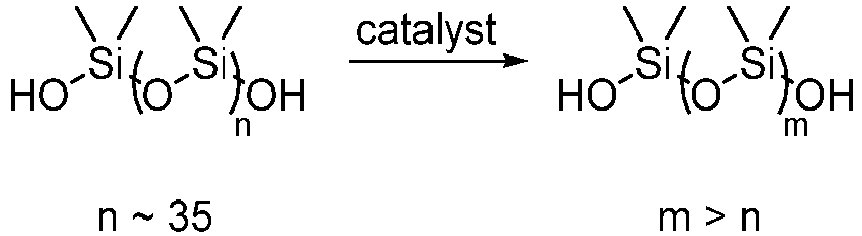
- a method for polymerizing polydiorganosiloxanes comprises:
- a method for polymerizing polydiorganosiloxanes to produce a hydroxyl-terminated polydiorganosiloxane product having higher DP than the starting material and low D4 content comprises: optionally, pre-1) mixing B) a trifluoromethane sulfonate compound and C) a chelating ligand for the trifluoromethane sulfonate compound before step 1);
- the method may be performed using a batch reactor or a continuous reactor, such as a gas liquid reactor. Residence time depends on various factors including the temperature selected and the type of reactor.
- step 1) may be performed by heating at a temperature of 80°C to 105°C for 30 seconds to 2 hours.
- the method may be performed at ambient pressure and does not require an inert atmosphere.
- conditions that enable by-product water to be removed may facilitate increasing DP of the product or improving selectivity (minimizing D4 in the product), or both. Therefore, the method may further comprise removing water during and/or after step 1). Selectivity may also be improved when starting material C), the ligand, is added.
- the method may be performed under conditions in which water is not removed during step 1).
- Step 2) may be performed by adding E) an amine and cooling the reaction mixture to a temperature less than 50°C.
- Step 3) may be performed by a method comprising filtering, stripping and/or distilling the reaction mixture.
- the method described above can produce a hydroxyl-terminated polydiorganosiloxane having a DP higher than that of starting material A) and a low D4 content.
- D4 content in the product may be ⁇ 400 ppm, alternatively ⁇ 300 ppm.
- the minimum amount of D4 may be 0, alternatively 100 ppm.
- DP of the product when starting material A) has a DP ⁇ 50, DP of the product may be > 300, alternatively > 400, alternatively > 500, alternatively > 1000, alternatively > 1500, and alternatively > 2000.
- DP of the product may be 300 to 3000, alternatively 400 to 2500, alternatively 500 to 2000.
- Starting material A) is a polydiorganosiloxane comprising unit formula [(HO)R 2 SiO 1/2 ] 2 (R 2 SiO 2/2 ) n , where subscript n is 0 to 2000, and each R is an independently selected monovalent hydrocarbon group of 1 to 18 carbon atoms. Suitable monovalent hydrocarbon groups for R may be selected from the group consisting of alkyl, alkenyl, and aryl.
- Exemplary alkyl groups include methyl, ethyl, propyl (including n-propyl and iso-propyl), butyl (including n-butyl, t-butyl, iso-butyl and sec-butyl), and hexyl groups (including branched and linear isomers thereof).
- Exemplary alkenyl groups include vinyl, allyl, and hexenyl (including branched and linear isomers thereof).
- Exemplary aryl groups include phenyl, tolyl, xylyl, naphthyl, and benzyl.
- each alkyl may be methyl
- each alkenyl may be selected from the group consisting of vinyl, allyl, and hexenyl
- each aryl may be phenyl.
- 50% to 100%, alternatively 80% to 100%, and alternatively 90% to 100% of all instances of R are alkyl groups such as methyl.
- the R groups on starting material A) may be methyl and phenyl.
- the R groups on starting material A) may be methyl and vinyl.
- subscript n is 0 to 2000.
- subscript n may be 5 to 2000, alternatively 5 to 200, alternatively 10 to 150, alternatively 15 to 100, alternatively 20 to 50, and alternatively 25 to 35.
- starting material A) may be substantially linear, alternatively starting material A) is linear. Furthermore, starting material A) may contain a small number of additional siloxane units, such as those of formula (HORSiO 2/2 ), (RSiO 3/2 ) and/or (SiO 4/2 ) provided that starting material A) is substantially linear. Examples of starting material A) include bis-hydroxy terminated polydimethylsiloxane.
- Suitable polydiorganosiloxanes for starting material (A) may be prepared by methods known in the art such as the addition of diorganodichlorosilanes to a water/solvent mixture to yield a mixture of low molecular weight hydroxy end-blocked polydiorganosiloxanes and cyclic siloxanes in solvent.
- the mixture may be purified to separate hydroxy end-blocked polydiorganosiloxanes and cyclic polysiloxanes.
- suitable bis-hydroxy terminated polydimethylsiloxane are commercially available from Dow Silicones Corporation of Midland, Michigan, USA.
- Starting material B) is a trifluoromethane sulfonate compound (triflate compound).
- Starting material B) is used in the method in an amount of 10 ppm to 500 ppm, based on the weight of starting material A).
- Starting material B) is selected from the group consisting of: B-1) aluminum(III) trifluoromethane sulfonate, B-2) bismuth(III) trifluoromethane sulfonate, B-3) gallium(III) trifluoromethane sulfonate, B-4) iron(III) trifluoromethane sulfonate, B-5) indium(III) trifluoromethane sulfonate, B-6) scandium(III) trifluoromethane sulfonate, and B-7) dicyclohexylboron trifluoromethane sulfonate.
- starting material B) may be selected from the group consisting of B-1) aluminum(III) trifluoromethane sulfonate, B-2) bismuth(III) trifluoromethane sulfonate, B-3) gallium(III) trifluoromethane sulfonate, B-4) iron(III) trifluoromethane sulfonate, and B-5) indium(III) trifluoromethane sulfonate.
- starting material B) may be a metal trifluoromethane sulfonate, i.e., starting material B) may be any one of B1), B2), B3), B4), B5), and B6).
- starting material B) may be selected from the group consisting of B-2) bismuth(III) trifluoromethane sulfonate, B-3) gallium(III) trifluoromethane sulfonate, and B-4) iron(III) trifluoromethane sulfonate.
- starting material B) may be selected from the group consisting of B-1) aluminum(III) trifluoromethane sulfonate, B-5) indium(III) trifluoromethane sulfonate, and B-6) scandium(III) trifluoromethane sulfonate.
- starting material B) may be selected from the group consisting of B-1) aluminum(III) trifluoromethane sulfonate and B-5) indium(III) trifluoromethane sulfonate.
- starting material B) may be combined with starting material C), a ligand, before step 1) of the method described herein.
- Suitable trifluoromethane sulfonate compounds are commercially available, e.g., from Sigma-Aldrich, Fischer Scientific, or Alfa Aesar.
- Starting material C) may optionally be added in the method described herein.
- starting material C) and starting material B) may be combined before step 1) by any convenient means, such as mixing.
- starting material C) may be a bisimine ligand.
- Starting material C) may have general formula: , where each R 2 and each R 1 are an independently selected alkyl groups of 1 to 8 carbon atoms, alternatively 1 to 6 carbon atoms, and alternatively 2 to 5 carbon atoms.
- R 1 and R 2 may each be a butyl group, such as a tert-butyl group.
- Suitable bisimine ligands such as 1,2-bis-(2-di-iso-propylphenyl) imino)ethane or 1,2-bis(2-di-tert-butylphenyl)imino)ethane are commercially available, e.g., from Sigma-Aldrich.
- starting material C) may be where tBu represents a t-butyl group.
- the amount of ligand added depends on various factors including which triflate compound is selected for starting material B) and the DP desired in the product, however, the amount of ligand may be 1 molar equivalent to 2 molar equivalents based on the amount of starting material B).
- Starting material D a solvent
- the solvent may be used to deliver one or more of the other starting materials.
- the ligand may be dissolved in a solvent before combining the ligand and the metal triflate.
- the metal triflate may be dissolved in a solvent before combining with the metal triflate in step pre-1) described above, or before combining with starting material A) in step 1).
- the solvent may be an aprotic solvent, such as tetrahydrofuran, toluene, or dichloromethane.
- the solvent may be a low molecular weight trimethylsiloxy-terminated polydimethylsiloxane, such as an OS Fluid, which is commercially available from Dow Silicones Corporation of Midland, Michigan, U.S.A.
- the solvent may be used to deliver one or more starting materials (i.e., one or more starting materials may be dissolved in solvent before step 1), the reaction may proceed in solvent, or both.
- the amount of solvent depends on various factors including the type and amount of starting materials A), B), and C) selected and whether one or more starting materials is being delivered in a solvent, or whether the reaction will proceed in a solvent. For example, when present, the amount may be sufficient to form a reaction mixture with a concentration of starting material A) of 0.1 M - 0.5 M.
- the amine is used to quench the reaction mixture in step 2) of the method described herein.
- the amine may be an alkyl amine such as trimethylamine, triethylamine, or N , N -dimethylcyclohexylamine.
- the amount of amine may be 100 ppm to 100,000 ppm of amine based on total weight of all starting materials used in the method. Alternatively, the amount of amine may be 100 ppm to 1000 ppm on the same basis.
- Suitable amines are commercially available, e.g., from Sigma-Aldrich or Fisher Scientific.
- the product of the method described herein is a bis-hydroxyl terminated polydiorganosiloxane of unit formula [(HO)R 2 SiO 1/2 ] 2 (R 2 SiO 2/2 ) m , where R is as described above for starting material A), and subscript m has a value greater than subscript n in starting material A).
- subscript m may have a value ranging from (n + 250) to (n + 2500), alternatively (n + 300) to (n + 2400), alternatively (n + 350) to (n + 2300), alternatively (n + 400) to (n + 2000), alternatively (n + 450) to (n + 1500).
- a 40 mL glass vial was filled with 10 g of bis-hydroxy terminated poly(dimethylsiloxane) having an average DP of 35 and equipped with a stir bar.
- the bis-hydroxy terminated poly(dimethylsiloxane) was obtained from Dow Silicones Corporation of Midland, MI, USA.
- the vial was heated to 80°C, and 71 ⁇ L of trifluoromethanesulfonic acid (as a 0.01 M solution in anhydrous dichloromethane) was added to the bis-hydroxy terminated poly(dimethylsiloxane) to initiate polymerization.
- Samples were prepared as follows. A 40 mL glass vial was filled with 10 g of bis-hydroxy terminated poly(dimethylsiloxane) having an average DP of 35 and equipped with a sandwich-style rare earth magnet stirbar. The vial was heated to 80°C or 105°C, and a trifluoromethane sulfonate compound (as a 0.01 M solution in anhydrous THF) was added to the bis-hydroxy terminated poly(dimethylsiloxane) to initiate polymerization.
- a trifluoromethane sulfonate compound as a 0.01 M solution in anhydrous THF
- the trifluoromethane sulfonate compound, temperature, concentration of metal triflate, degree of polymerization of the bis-hydroxy terminated polydimethylsiloxane prepared by the method, residual D4 in the bis-hydroxy terminated polydimethylsiloxane prepared by the method and DP/D4 ratio are shown below in Table 1.
- Other catalysts tested were Nonafluorobutane-1-sulfonic acid, Dicyclohexylboron trifluoromethanesulfonate, and Phosphonitrilic Chloride Catalyst were used instead of the metal triflate catalyst.
- the DP/D4 ratio shown in the tables herein was calculated by dividing the difference in DP between the final product and starting material A) by the amount of D4 generated. Generally, high DP/D4 ratio is desired, provided that DP increased sufficiently.
- Tables 1 and 2 show that under the conditions tested, only certain metal triflates produced a bis-hydroxy terminated polydimethylsiloxane with sufficient chain extension (as shown by increase in DP) and low D4 content.
- Copper(II) triflate, Yttrium (III) triflate, Cerium (IV) triflate, Cerium (III) triflate, Ytterbium (III) triflate, Zinc (II) triflate, and Samarium(III) triflate did not produce sufficient increase in DP of the product under the conditions tested.
- Samples were prepared as follows. A metal triflate and 1 or 2 molar equivalents of a ligand were dissolved in anhydrous THF to prepare a metal triflate• ligand solution.
- a 40 mL glass vial was filled with 10 g of bis-hydroxy terminated poly(dimethylsiloxane) having an average DP of 35 and equipped with a sandwich-style rare earth magnet stirbar. The vial was heated to 105°C, and metal triflate• ligand solution at a concentration of 0.01 M was added to the bis-hydroxy terminated poly(dimethylsiloxane) to initiate polymerization.
- Samples were prepared as follows. A metal triflate and 1 or 2 molar equivalents of ligand D were dissolved in anhydrous THF to prepare a metal triflate- ligand solution.
- a 40 mL glass vial was filled with 10 g of bis-hydroxy terminated poly(dimethylsiloxane) having an average DP of 35 and equipped with a sandwich-style rare earth magnet stirbar. The vial was heated to 105°C, and metal triflate• ligand solution at a concentration of 0.01 M was added to the bis-hydroxy terminated poly(dimethylsiloxane) to initiate polymerization.
- Molecular distribution of starting materials can be analyzed by GPC equipped with triple detector array (Refractive Index, Right Angle Light Scattering, and Viscometer). 0.5% of samples were used for GPC analysis. Mw of Polystyrene standards were in the range of 580 to 100,000, and a 3 rd order calibration curve was used for molecular weight determination. Both samples and standards were diluted in HPLC grade ethyl acetate.
- Quantitation of the D4 content was by the single point internal standard method.
- a relative response factor (RRF) of D4 relative to dodecane was established and updated every time a new batch of internal standard solution was prepared.
- Bis-hydroxy terminated silicone polymers produced by Dow Silicones Corporation can contain approximately 1000 ppm D4 as a by-product.
- the inventors surprisingly found that several triflate compounds generate significantly less octamethylcyclotetrasiloxane than the conventional catalysts used under the conditions tested in the examples above.
- the inventors further found that several ligands can improve the selectivity in silanol condensation polymerizations when combined with a metal triflate salt under the conditions tested in the examples above.
- the selectivity for each catalyst was determined by dividing the change in the degree of polymerization by the amount of D4 produced in the reaction ( ⁇ DP/ ⁇ D4).
- the initial ligand screen identified bisimine D as the optimal ligand for reducing D4 generation, increasing ⁇ DP/ ⁇ D4 from 2.5 for Bi(OTf) 3 to 4.9 for the Bi(OTf) 3 •2D complex (Table 3).
- Table 5 defines abbreviations used throughout this application. Table 5 - Abbreviations Abbreviation Description °C degrees Celsius D4 octamethylcyclotetrasiloxane DP degree of polymerization g grams GC gas chromatography GPC gel permeation chromatography HPLC high performance liquid chromatography hr hours M molar mL milliliter ppm parts per million THF tetrahydrofuran OTf or triflate trifluoromethanesulfonate ⁇ L microliters
Landscapes
- Chemical & Material Sciences (AREA)
- Health & Medical Sciences (AREA)
- Chemical Kinetics & Catalysis (AREA)
- Medicinal Chemistry (AREA)
- Polymers & Plastics (AREA)
- Organic Chemistry (AREA)
- Silicon Polymers (AREA)
Description
- This invention relates to a method for condensation polymerization of hydroxyl-terminated polydiorganosiloxanes. The method employs a trifluoromethane sulfonate (triflate) compound as a catalyst that minimizes production of cyclic polydiorganosiloxane by-products.
- Organosiloxane oligomers and short chain polymers having hydroxyl groups may be polymerized via condensation reaction to high molecular weight, high degree of polymerization (DP), polymers by polymerization in the presence of a suitable condensation reaction catalyst. Condensation polymerization of hydroxyl functional organosiloxanes occurs with the elimination of water as a by-product. Previous methods employed Bronsted acids, Bronsted bases, or phosphonitriles as catalysts. Although these catalysts can be highly active (to produce product with high DP), they tend to produce large quantities (>1000 ppm) of the cyclic by-product, octamethylcyclotetrasiloxane (D4), in the resulting hydroxyl-functional polydiorganosiloxane product.
-
EP2155804 B1 discloses a method of making increased molecular weight phenylalkylsiloxanes via the polymerization of shorter-chain phenylalkylsiloxanes under vacuum in an aqueous alkaline solution comprising a hydroxide of sodium, potassium, magnesium, calcium, rubidium, (substituted) ammonium or phosphonium. The document goes on to disclose the use of phosphonitrile and dodecylbenzylsulfonic acid as catalysts for this same reaction in comparative examples. PROBLEM TO BE SOLVED - There is an industry need to produce high molecular weight, high degree of polymerization polyorganosiloxanes with lower D4 content than achieved with previous methods, described above.
- A method for polymerizing polydiorganosiloxanes comprises:
- 1) heating, at a temperature of 50°C to 200°C, a reaction mixture prepared by mixing starting materials comprising
- A) a polydiorganosiloxane of unit formula [(HO)R2SiO1/2]2(R2SiO2/2)n, where subscript n is 0 to 2000, and each R is an independently selected monovalent hydrocarbon group of 1 to 18 carbon atoms; and
- B) 10 ppm to 500 ppm, based on weight of starting material A), of a trifluoromethane sulfonate compound selected from the group consisting of
- B-1) aluminum(III) trifluoromethane sulfonate,
- B-2) bismuth(III) trifluoromethane sulfonate,
- B-3) gallium(III) trifluoromethane sulfonate,
- B-4) iron(III) trifluoromethane sulfonate,
- B-5) indium(III) trifluoromethane sulfonate,
- B-6) scandium(III) trifluoromethane sulfonate, and
- B-7) dicyclohexylboron trifluoromethane sulfonate;
- 2) quenching the reaction mixture; and
- 3) recovering a product from the reaction mixture, where the product has unit formula [(HO)R2SiO1/2]2(R2SiO2/2)m, where m > n.
- A method for polymerizing polydiorganosiloxanes to produce a hydroxyl-terminated polydiorganosiloxane product having higher DP than the starting material and low D4 content comprises:
optionally, pre-1) mixing B) a trifluoromethane sulfonate compound and C) a chelating ligand for the trifluoromethane sulfonate compound before step 1); - 1) heating, at a temperature of 50°C to 200°C, a reaction mixture prepared by mixing starting materials comprising
- A) a polydiorganosiloxane of unit formula [(HO)R2SiO1/2]2(R2SiO2/2)n, where subscript n is 0 to 2000, and each R is an independently selected monovalent hydrocarbon group of 1 to 18 carbon atoms; and
- B) 10 ppm to 500 ppm, based on weight of starting material A), of the trifluoromethanesulfonate compound, which is selected from the group consisting of B-1) aluminum(III) trifluoromethanesulfonate,
- B-2) bismuth(III) trifluoromethanesulfonate,
- B-3) gallium(III) trifluoromethanesulfonate,
- B-4) iron(III) trifluoromethanesulfonate,
- B-5) indium(III) trifluoromethanesulfonate,
- B-6) scandium(III) trifluoromethanesulfonate, and
- B-7) dicyclohexylboron trifluoromethanesulfonate;
- optionally C) the chelating ligand; and
- optionally D) a solvent;
- 2) quenching the reaction mixture; and
- 3) recovering the product from the reaction mixture, where the product has unit formula [(HO)R2SiO1/2]2(R2SiO2/2)m, where m > n. In step 1), B) the trifluoromethane sulfonate compound and, when present, C) the chelating ligand may be combined. Alternatively, when step pre-1) is present, B) the trifluoromethane sulfonate compound and C) the chelating ligand may be combined to form a chelate before step 1).
- The method may be performed using a batch reactor or a continuous reactor, such as a gas liquid reactor. Residence time depends on various factors including the temperature selected and the type of reactor. However, step 1) may be performed by heating at a temperature of 80°C to 105°C for 30 seconds to 2 hours. The method may be performed at ambient pressure and does not require an inert atmosphere. However, conditions that enable by-product water to be removed may facilitate increasing DP of the product or improving selectivity (minimizing D4 in the product), or both. Therefore, the method may further comprise removing water during and/or after step 1). Selectivity may also be improved when starting material C), the ligand, is added. Alternatively, the method may be performed under conditions in which water is not removed during step 1). Step 2) may be performed by adding E) an amine and cooling the reaction mixture to a temperature less than 50°C. Step 3) may be performed by a method comprising filtering, stripping and/or distilling the reaction mixture.
- The method described above can produce a hydroxyl-terminated polydiorganosiloxane having a DP higher than that of starting material A) and a low D4 content. For example, D4 content in the product may be < 400 ppm, alternatively < 300 ppm. The minimum amount of D4 may be 0, alternatively 100 ppm. And, when starting material A) has a DP < 50, DP of the product may be > 300, alternatively > 400, alternatively > 500, alternatively > 1000, alternatively > 1500, and alternatively > 2000. Alternatively, when starting material A) has a DP < 50, DP of the product may be 300 to 3000, alternatively 400 to 2500, alternatively 500 to 2000.
- Starting material A) is a polydiorganosiloxane comprising unit formula [(HO)R2SiO1/2]2(R2SiO2/2)n, where subscript n is 0 to 2000, and each R is an independently selected monovalent hydrocarbon group of 1 to 18 carbon atoms. Suitable monovalent hydrocarbon groups for R may be selected from the group consisting of alkyl, alkenyl, and aryl. Exemplary alkyl groups include methyl, ethyl, propyl (including n-propyl and iso-propyl), butyl (including n-butyl, t-butyl, iso-butyl and sec-butyl), and hexyl groups (including branched and linear isomers thereof). Exemplary alkenyl groups include vinyl, allyl, and hexenyl (including branched and linear isomers thereof). Exemplary aryl groups include phenyl, tolyl, xylyl, naphthyl, and benzyl. Alternatively, each alkyl may be methyl, each alkenyl may be selected from the group consisting of vinyl, allyl, and hexenyl, and each aryl may be phenyl. Alternatively, 50% to 100%, alternatively 80% to 100%, and alternatively 90% to 100% of all instances of R are alkyl groups such as methyl. Alternatively, the R groups on starting material A) may be methyl and phenyl. Alternatively, the R groups on starting material A) may be methyl and vinyl. In starting material A), subscript n is 0 to 2000. Alternatively, subscript n may be 5 to 2000, alternatively 5 to 200, alternatively 10 to 150, alternatively 15 to 100, alternatively 20 to 50, and alternatively 25 to 35. One skilled in the art would recognize that starting material A) may be substantially linear, alternatively starting material A) is linear. Furthermore, starting material A) may contain a small number of additional siloxane units, such as those of formula (HORSiO2/2), (RSiO3/2) and/or (SiO4/2) provided that starting material A) is substantially linear. Examples of starting material A) include bis-hydroxy terminated polydimethylsiloxane. Suitable polydiorganosiloxanes for starting material (A) may be prepared by methods known in the art such as the addition of diorganodichlorosilanes to a water/solvent mixture to yield a mixture of low molecular weight hydroxy end-blocked polydiorganosiloxanes and cyclic siloxanes in solvent. The mixture may be purified to separate hydroxy end-blocked polydiorganosiloxanes and cyclic polysiloxanes. Alternatively, suitable bis-hydroxy terminated polydimethylsiloxane are commercially available from Dow Silicones Corporation of Midland, Michigan, USA.
- Starting material B) is a trifluoromethane sulfonate compound (triflate compound). Starting material B) is used in the method in an amount of 10 ppm to 500 ppm, based on the weight of starting material A). Starting material B) is selected from the group consisting of: B-1) aluminum(III) trifluoromethane sulfonate, B-2) bismuth(III) trifluoromethane sulfonate, B-3) gallium(III) trifluoromethane sulfonate, B-4) iron(III) trifluoromethane sulfonate, B-5) indium(III) trifluoromethane sulfonate, B-6) scandium(III) trifluoromethane sulfonate, and B-7) dicyclohexylboron trifluoromethane sulfonate. Alternatively, starting material B) may be selected from the group consisting of B-1) aluminum(III) trifluoromethane sulfonate, B-2) bismuth(III) trifluoromethane sulfonate, B-3) gallium(III) trifluoromethane sulfonate, B-4) iron(III) trifluoromethane sulfonate, and B-5) indium(III) trifluoromethane sulfonate. Alternatively, starting material B) may be a metal trifluoromethane sulfonate, i.e., starting material B) may be any one of B1), B2), B3), B4), B5), and B6). Alternatively, starting material B) may be selected from the group consisting of B-2) bismuth(III) trifluoromethane sulfonate, B-3) gallium(III) trifluoromethane sulfonate, and B-4) iron(III) trifluoromethane sulfonate. Alternatively, starting material B) may be selected from the group consisting of B-1) aluminum(III) trifluoromethane sulfonate, B-5) indium(III) trifluoromethane sulfonate, and B-6) scandium(III) trifluoromethane sulfonate. Alternatively, starting material B) may be selected from the group consisting of B-1) aluminum(III) trifluoromethane sulfonate and B-5) indium(III) trifluoromethane sulfonate. In one embodiment, starting material B) may be combined with starting material C), a ligand, before step 1) of the method described herein. Suitable trifluoromethane sulfonate compounds are commercially available, e.g., from Sigma-Aldrich, Fischer Scientific, or Alfa Aesar.
- Starting material C) may optionally be added in the method described herein. In this embodiment, starting material C) and starting material B) may be combined before step 1) by any convenient means, such as mixing. In one embodiment, starting material C) may be a bisimine ligand. Starting material C) may have general formula:

- Alternatively, starting material C) may be

- Starting material D), a solvent, may optionally be used in the method described herein. The solvent may be used to deliver one or more of the other starting materials. For example, the ligand may be dissolved in a solvent before combining the ligand and the metal triflate. Alternatively, the metal triflate may be dissolved in a solvent before combining with the metal triflate in step pre-1) described above, or before combining with starting material A) in step 1). The solvent may be an aprotic solvent, such as tetrahydrofuran, toluene, or dichloromethane. Alternatively, the solvent may be a low molecular weight trimethylsiloxy-terminated polydimethylsiloxane, such as an OS Fluid, which is commercially available from Dow Silicones Corporation of Midland, Michigan, U.S.A. The solvent may be used to deliver one or more starting materials (i.e., one or more starting materials may be dissolved in solvent before step 1), the reaction may proceed in solvent, or both. The amount of solvent depends on various factors including the type and amount of starting materials A), B), and C) selected and whether one or more starting materials is being delivered in a solvent, or whether the reaction will proceed in a solvent. For example, when present, the amount may be sufficient to form a reaction mixture with a concentration of starting material A) of 0.1 M - 0.5 M.
- Starting material E) the amine is used to quench the reaction mixture in step 2) of the method described herein. The amine may be an alkyl amine such as trimethylamine, triethylamine, or N,N-dimethylcyclohexylamine. The amount of amine may be 100 ppm to 100,000 ppm of amine based on total weight of all starting materials used in the method. Alternatively, the amount of amine may be 100 ppm to 1000 ppm on the same basis. Suitable amines are commercially available, e.g., from Sigma-Aldrich or Fisher Scientific.
- The product of the method described herein is a bis-hydroxyl terminated polydiorganosiloxane of unit formula [(HO)R2SiO1/2]2(R2SiO2/2)m, where R is as described above for starting material A), and subscript m has a value greater than subscript n in starting material A). For example, in the product described above, subscript m may have a value ranging from (n + 250) to (n + 2500), alternatively (n + 300) to (n + 2400), alternatively (n + 350) to (n + 2300), alternatively (n + 400) to (n + 2000), alternatively (n + 450) to (n + 1500).
- These examples are intended to illustrate some embodiments of the invention and should not be interpreted as limiting the scope of the invention set forth in the claims.
- A 40 mL glass vial was filled with 10 g of bis-hydroxy terminated poly(dimethylsiloxane) having an average DP of 35 and equipped with a stir bar. The bis-hydroxy terminated poly(dimethylsiloxane) was obtained from Dow Silicones Corporation of Midland, MI, USA. The vial was heated to 80°C, and 71 µL of trifluoromethanesulfonic acid (as a 0.01 M solution in anhydrous dichloromethane) was added to the bis-hydroxy terminated poly(dimethylsiloxane) to initiate polymerization. Stirring was continued for 2 hr at 80°C with open caps before the solutions were quenched by adding 2 drops of N,N-dimethylcyclohexylamine (as a 1% solution in toluene), and cooling to room temperature. Analysis of the crude reaction mixture by GPC indicated a final degree of polymerization of 1117, while headspace GC measured 3,678 ppm of residual D4.
-
- Samples were prepared as follows. A 40 mL glass vial was filled with 10 g of bis-hydroxy terminated poly(dimethylsiloxane) having an average DP of 35 and equipped with a sandwich-style rare earth magnet stirbar. The vial was heated to 80°C or 105°C, and a trifluoromethane sulfonate compound (as a 0.01 M solution in anhydrous THF) was added to the bis-hydroxy terminated poly(dimethylsiloxane) to initiate polymerization. Stirring was continued for 2 hr at 80°C or 105°C with open caps before the resulting solution was quenched by adding 2 drops of N,N-dimethylcyclohexylamine (as a 1% solution in toluene), and cooling to room temperature. Analysis of the resulting crude reaction mixture by GPC indicated a final degree of polymerization, while headspace GC measured residual octamethylcyclotetrasiloxane. The trifluoromethane sulfonate compound, temperature, concentration of metal triflate, degree of polymerization of the bis-hydroxy terminated polydimethylsiloxane prepared by the method, residual D4 in the bis-hydroxy terminated polydimethylsiloxane prepared by the method and DP/D4 ratio are shown below in Table 1. Other catalysts tested were Nonafluorobutane-1-sulfonic acid, Dicyclohexylboron trifluoromethanesulfonate, and Phosphonitrilic Chloride Catalyst were used instead of the metal triflate catalyst.
Table 1 - Comparison of Metal Triflates and Other Catalysts Entry Catalyst Temp (°C) Catalyst Concentration (mol/L) Degree of Polymerization (DP) Residual D4 (ppm) DP/D4 1 Bismuth(III) Triflate 80 1.44 × 10⁻⁵ 1004 140 7.17 2 Gallium(III) Triflate 80 1.44 × 10⁻⁵ 1054 229 4.60 3 Indium(III) Triflate 80 1.44 × 10⁻⁵ 677 147 4.61 4 Iron(III) Triflate 80 1.44 × 10⁻⁵ 1132 173 6.54 5 Scandium(III) Triflate 80 1.44 × 10⁻⁵ 224 103 2.17 6 Aluminum(III) Triflate 80 1.44 × 10⁻⁵ 598 151 3.96 7 Dicyclohexylboron trifluoromethanesulfonate 80 1.44 × 10⁻⁵ 476 164 2.90 8 (comp) Copper(II) Triflate 80 7.19 × 10⁻⁵ 118 55 2.15 9 (comp) Yttrium(III) Triflate 80 7.19 × 10⁻⁵ 54 73 0.74 10 (comp) Cerium(IV) Triflate 80 7.19 × 10⁻⁵ 226 132 1.71 11 (comp) Nonafluorobutane-1-sulfonic acid 80 7.19 × 10⁻⁵ 1948 4844 0.40 12 (comp) Trifluoromethanesulfonic acid 80 7.19 × 10⁻⁵ 1117 3678 0.30 13 Bismuth(III) Triflate 105 1.44 × 10⁻⁵ 746 152 4.91 14 Gallium(III) Triflate 105 1.44 × 10⁻⁵ 818 193 4.24 15 Indium(III) Triflate 105 1.44 × 10⁻⁵ 445 110 4.05 16 Iron(III) Triflate 105 1.44 × 10⁻⁵ 673 155 4.34 17 Scandium(III) Triflate 105 1.44 × 10⁻⁵ 187 62 3.02 18 Aluminum(III) Triflate 105 1.44 × 10⁻⁵ 481 108 4.45 19 Dicyclohexylboron trifluoromethanesulfonate 105 1.44 × 10⁻⁵ 372 99 3.76 20 (comp) Phosphonitrilic Chloride Catalyst* 105 7.19 × 10⁻⁶ 1189 670 1.77 20 (comp) Phosphonitrilic Chloride Catalyst* 105 2.88 × 10⁻⁵ 3585 14346 0.25 *The phosphonitrilic chloride catalyst is a mixture of [Cl3P=N-PCl2=N-PCl3]+[PxCl5x+1]- and [Cl3P=N-PCl2=N-PCl2=N-PCl3]+[PxCl5x+1]- - The DP/D4 ratio shown in the tables herein was calculated by dividing the difference in DP between the final product and starting material A) by the amount of D4 generated. Generally, high DP/D4 ratio is desired, provided that DP increased sufficiently.
- Samples were prepared as described above in Reference Example 2, except that heating was performed for 2 hr at 105°C and loading of the triflate was 25 ppm. Table 2, below, shows the degree of polymerization for each catalyst with bis-hydroxy terminated poly(dimethylsiloxane) after 2 hr at 105°C.
Table 2 Entry Metal Triflate Salt DP 21 Bismuth (III) Triflate 2,350 22 Iron (III) Triflate 2,008 23 Gallium (III) Triflate 1,732 24 Indium (III) Triflate 591 25 Aluminum (III) Triflate 430 26 Scandium (III) Triflate 317 27 (comp) Cerium (IV) Triflate 241 28 (comp) Copper (II) Triflate 118 29 (comp) Ytterbium (III) Triflate 54 30 (comp) Zinc (II) Triflate 42 31 (comp) Yttrium (III) Triflate 40 32 (comp) Samarium (III) Triflate 32 33 (comp) Cerium (III) Triflate 32 - Tables 1 and 2 show that under the conditions tested, only certain metal triflates produced a bis-hydroxy terminated polydimethylsiloxane with sufficient chain extension (as shown by increase in DP) and low D4 content. For example, Copper(II) triflate, Yttrium (III) triflate, Cerium (IV) triflate, Cerium (III) triflate, Ytterbium (III) triflate, Zinc (II) triflate, and Samarium(III) triflate did not produce sufficient increase in DP of the product under the conditions tested.
- Samples were prepared as follows. A metal triflate and 1 or 2 molar equivalents of a ligand were dissolved in anhydrous THF to prepare a metal triflate• ligand solution. A 40 mL glass vial was filled with 10 g of bis-hydroxy terminated poly(dimethylsiloxane) having an average DP of 35 and equipped with a sandwich-style rare earth magnet stirbar. The vial was heated to 105°C, and metal triflate• ligand solution at a concentration of 0.01 M was added to the bis-hydroxy terminated poly(dimethylsiloxane) to initiate polymerization. Stirring was continued for 2 hr at 105°C with open caps before the resulting solutions were quenched by adding 2 drops of N,N-dimethylcyclohexylamine (as a 1% solution in toluene) to each vial, and cooling to room temperature. Analysis of the resulting crude reaction mixtures by gel permeation chromatography (GPC) indicated a final degree of polymerization, and headspace gas chromatography (GC) measured residual D4. Table 3, below, shows the metal triflate or metal triflate• ligand tested, the concentration at which it was added, DP, and amount of D4 in the product.
- Ligands tested were as follows.
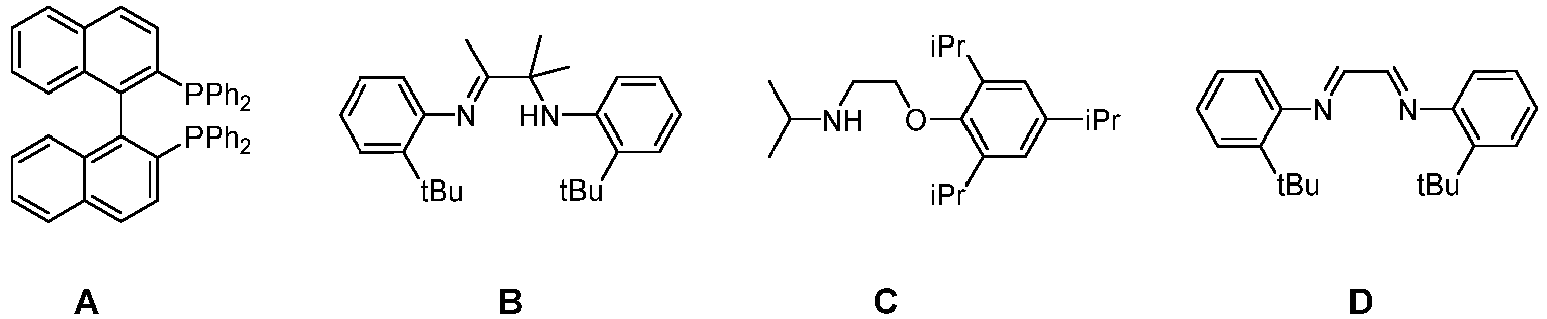
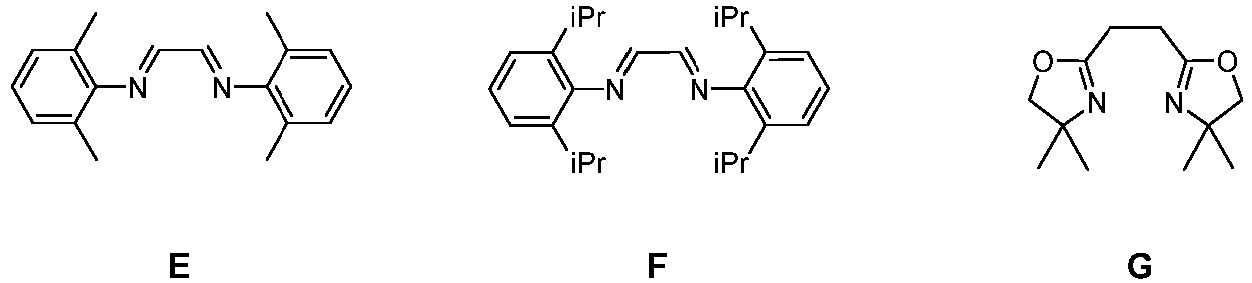
Table 3 Entry Catalyst Catalyst Concentration (mol/L) DP Residual D4 (ppm) DP/D4 34 (comp) BiOTf3•2A 3.60 × 10⁻⁵ 814 459 1.9 35 (comp) BiOTf3•2B 1.44 × 10⁻⁴ 373 160 3.1 36 (comp) BiOTf3•2C 1.44 × 10⁻⁴ 138 -- -- 37 BiOTf3•2D 1.44 × 10⁻⁴ 1168 282 4.9 38 (comp) BiOTf3•2E 1.44 × 10⁻⁴ 438 201 2.7 39 (comp) BiOTf3•2F 1.44 × 10⁻⁴ 328 162 2.6 40 (comp) BiOTf3•2G 1.44 × 10⁻⁴ 38 -- -- 41 BiOTf3 2.88 × 10⁻⁵ 1007 442 2.5 - Table 3 shows that the ligand of formula

- Samples were prepared as follows. A metal triflate and 1 or 2 molar equivalents of ligand D were dissolved in anhydrous THF to prepare a metal triflate- ligand solution. A 40 mL glass vial was filled with 10 g of bis-hydroxy terminated poly(dimethylsiloxane) having an average DP of 35 and equipped with a sandwich-style rare earth magnet stirbar. The vial was heated to 105°C, and metal triflate• ligand solution at a concentration of 0.01 M was added to the bis-hydroxy terminated poly(dimethylsiloxane) to initiate polymerization. Stirring was continued for 2 hr at 105 °C with open caps before the resulting solutions were quenched by adding 2 drops of N,N-dimethylcyclohexylamine (as a 1% solution in toluene) to each vial, and cooling to room temperature. Analysis of the resulting crude reaction mixtures by GPC indicated a final degree of polymerization, and headspace GC measured residual D4. Table 4, below, shows the metal triflate or metal triflate• ligand tested, the concentration at which it was added, DP, and amount of D4 in the product.
Table 4 Entry Catalyst Molar equivalents of ligand Catalyst Concentration (mol/L) DP Residual D4 (ppm) ΔDP/ΔD4 42 Bi(OTf)3 0 3.60 × 10⁻⁵ 1239 332 4.3 43 Bi(OTf)3•D 1 1.44 × 10⁻⁴ 846 133 6.1 44 Bi(OTf)3•2D 2 3.60 × 10⁻⁵ 1193 186 8.5 45 Fe(OTf)3 0 1.44 × 10⁻⁵ 673 155 6.1 46 (comparative) Fe(OTf)3•D 1 3.60 × 10⁻⁵ 274 -- -- 47 Fe(OTf)3•2D 2 1.44 × 10⁻⁴ 676 110 10.7 48 Ga(OTf)3 0 3.60 × 10⁻⁵ 2132 333 7.4 49 (comparative) Ga(OTf)3•D 1 3.60 × 10⁻⁵ 1189 581 2.0 50 Ga(OTf)3•2D 2 3.60 × 10⁻⁵ 1323 177 10.1 51 In(OTf)3 0 3.60 × 10⁻⁵ 1014 232 5.4 52 In(OTf)3•D 1 3.60 × 10⁻⁵ 1120 198 5.5 53 In(OTf)3•2D 2 3.60 × 10⁻⁵ 1188 196 7.9 54 Al(OTf)3 0 3.60 × 10⁻⁵ 1131 169 9.2 55 Al(OTf)3•D 1 3.60 × 10⁻⁵ 1160 218 5.2 56 Al(OTf)3•2D 2 3.60 × 10⁻⁵ 1155 120 16.0 - Molecular distribution of starting materials can be analyzed by GPC equipped with triple detector array (Refractive Index, Right Angle Light Scattering, and Viscometer). 0.5% of samples were used for GPC analysis. Mw of Polystyrene standards were in the range of 580 to 100,000, and a 3rd order calibration curve was used for molecular weight determination. Both samples and standards were diluted in HPLC grade ethyl acetate.
- D4 Concentration measurements were made using the following instruments, procedures, and quantitation methods.
- Gradient: 50 °C (1 min) - 220 °C @ 10 °C/min (no hold); Inlet: Split 1:20, 9.68 psi, 150 °C; Flow: 2 mL/min
FID: Hydrogen 40 mL/min, Air 450 mL/min, Makeup 45 mL/min, Temperature 260 °C; Column: RTX-1, 30 m / 320 µm / 0.25 µm - Incubation: 120 °C for 10 min with shaking; Syringe: 125 °C; Transfer Line: 130 °C; Pressurize: 3 min; Withdraw: 0.5 min; Column pressure: 20 psi; Injection: 0.15 min / 0.3 mL; GC cycle: 25 min
- Internal standards were prepared to be 0.01% dodecane by weight in Fisher Brand 19 fluid vacuum oil. 1 mL of internal standard solution was added to a 20 mL headspace vial (with Eppendorf repeater pipet). 100 mg of D4 standard (usually 100 ppm standard used) or 100 mg of experimental sample was added to the headspace vial.
- Quantitation of the D4 content was by the single point internal standard method. A relative response factor (RRF) of D4 relative to dodecane was established and updated every time a new batch of internal standard solution was prepared. The amount of D4 in the samples was determined within the Thermo Atlas data system according to an equation of the same type as the one below:

- Bis-hydroxy terminated silicone polymers produced by Dow Silicones Corporation can contain approximately 1000 ppm D4 as a by-product. The inventors surprisingly found that several triflate compounds generate significantly less octamethylcyclotetrasiloxane than the conventional catalysts used under the conditions tested in the examples above. The inventors further found that several ligands can improve the selectivity in silanol condensation polymerizations when combined with a metal triflate salt under the conditions tested in the examples above. In each case the selectivity for each catalyst was determined by dividing the change in the degree of polymerization by the amount of D4 produced in the reaction (ΔDP/ΔD4). The initial ligand screen identified bisimine D as the optimal ligand for reducing D4 generation, increasing ΔDP/ΔD4 from 2.5 for Bi(OTf)3 to 4.9 for the Bi(OTf)3•2D complex (Table 3).
- Table 5, below, defines abbreviations used throughout this application.
Table 5 - Abbreviations Abbreviation Description °C degrees Celsius D4 octamethylcyclotetrasiloxane DP degree of polymerization g grams GC gas chromatography GPC gel permeation chromatography HPLC high performance liquid chromatography hr hours M molar mL milliliter ppm parts per million THF tetrahydrofuran OTf or triflate trifluoromethanesulfonate µL microliters
Claims (15)
- A method for polymerizing polydiorganosiloxanes comprising:1) heating, at a temperature of 50°C to 200°C, a reaction mixture prepared by mixing starting materials comprisingA) a polydiorganosiloxane of unit formula [(HO)R2SiO1/2]2(R2SiO2/2)n, where subscript n is 0 to 2000, and each R is an independently selected monovalent hydrocarbon group of 1 to 18 carbon atoms; andB) 10 ppm to 500 ppm, based on weight of starting material A), of a trifluoromethane sulfonate compound selected from the group consisting ofB-1) aluminum(III) trifluoromethanesulfonate,B-2) bismuth(III) trifluoromethane sulfonate,B-3) gallium(III) trifluoromethane sulfonate,B-4) iron(III) trifluoromethanesulfonate,B-5) indium(III) trifluoromethane sulfonate,B-6) scandium(III) trifluoromethane sulfonate, andB-7) dicyclohexylboron trifluoromethanesulfonate;2) quenching the reaction mixture; and3) recovering a product from the reaction mixture, where the product has unit formula [(HO)R2SiO1/2]2(R2SiO2/2)m, where m > n.
- The method of claim 1, where each R is independently selected from the group consisting of alkyl, alkenyl, and aryl.
- The method of claim 1 or claim 2, where subscript n is 10 to 150.
- The method of any one of the preceding claims, where the trifluoromethanesulfonate compound is present in an amount of 10 ppm to 50 ppm.
- The method of any one of the preceding claims, where the trifluoromethanesulfonate compound is selected from the group consisting of B-2) bismuth(III) trifluoromethane sulfonate, B-3) gallium(III) trifluoromethane sulfonate, and B-4) iron(III) trifluoromethanesulfonate.
- The method of any one of claims 1 to 4, where the trifluoromethanesulfonate compound is selected from the group consisting of B-1) aluminum(III) trifluoromethane sulfonate, B-5) indium(III) trifluoromethane sulfonate, and B-6) scandium(III) trifluoromethane sulfonate.
- The method of claim 6, further comprising: mixing B) the trifluoromethanesulfonate compound and C) a chelating ligand for the metal trifluoromethanesulfonate before step 1).
- The method of claim 7, where starting material C) has general formula:

- The method of any one of the preceding claims, where starting material D), a solvent, is present.
- The method of claim 9, where the solvent is selected from the group consisting of aprotic solvents and trimethylsiloxy-terminated polydimethylsiloxanes.
- The method of claim 10, where the solvent is selected from the group consisting of tetrahydrofuran, toluene and dichloromethane.
- The method of any one of the preceding claims, where step 1) is performed by heating at a temperature of 80°C to 105°C for 30 seconds to 2 hours.
- The method of any one of the preceding claims, where the method further comprises removing water during and/or after step 1).
- The method of any one of the preceding claims, where step 2) is performed by adding an amine and cooling the reaction mixture to a temperature less than 50°C.
- The method of any one of the preceding claims, where step 3) is performed by a method comprising filtering, stripping and/or distilling the reaction mixture.
Applications Claiming Priority (2)
| Application Number | Priority Date | Filing Date | Title |
|---|---|---|---|
| US201862722345P | 2018-08-24 | 2018-08-24 | |
| PCT/US2019/040441 WO2020040885A1 (en) | 2018-08-24 | 2019-07-03 | Method for condensation polymerization of hydroxyl-terminated polydiorganosiloxanes |
Publications (2)
| Publication Number | Publication Date |
|---|---|
| EP3841154A1 EP3841154A1 (en) | 2021-06-30 |
| EP3841154B1 true EP3841154B1 (en) | 2022-09-21 |
Family
ID=67587933
Family Applications (1)
| Application Number | Title | Priority Date | Filing Date |
|---|---|---|---|
| EP19752583.5A Active EP3841154B1 (en) | 2018-08-24 | 2019-07-03 | Method for condensation polymerization of hydroxyl-terminated polydiorganosiloxanes |
Country Status (7)
| Country | Link |
|---|---|
| US (1) | US11028230B1 (en) |
| EP (1) | EP3841154B1 (en) |
| JP (1) | JP7389061B2 (en) |
| KR (1) | KR102792743B1 (en) |
| CN (1) | CN112352009B (en) |
| MY (1) | MY208159A (en) |
| WO (1) | WO2020040885A1 (en) |
Families Citing this family (1)
| Publication number | Priority date | Publication date | Assignee | Title |
|---|---|---|---|---|
| EP4442731A1 (en) * | 2023-04-06 | 2024-10-09 | Venturi Lab SA | Silicone composition for low-temperature applications |
Family Cites Families (53)
| Publication number | Priority date | Publication date | Assignee | Title |
|---|---|---|---|---|
| US2906734A (en) | 1957-09-23 | 1959-09-29 | Dow Corning | Fast curing organosiloxane resins |
| US3105061A (en) | 1959-09-28 | 1963-09-24 | Dow Corning | Diorganopolysiloxane polymerization |
| US3160301A (en) | 1963-10-11 | 1964-12-08 | K C K Holding Company | Container and safety closure therefor |
| US3308208A (en) | 1964-05-04 | 1967-03-07 | Douglas Aircraft Co Inc | Polyfluorinated phosphate esters |
| FR2479236A1 (en) * | 1980-03-27 | 1981-10-02 | France Etat | NOVEL HOMOGENEOUS CATIONIC POLYMERIZATION CATALYSTS |
| US4448927A (en) | 1983-03-14 | 1984-05-15 | Dow Corning Corporation | Method of polymerizing oligomers of polydiorganosiloxane in the presence of filler |
| US4431771A (en) | 1983-03-14 | 1984-02-14 | Dow Corning Corporation | Polymerization of silicone polymer-filler mixtures as powders |
| US4486567A (en) | 1983-03-14 | 1984-12-04 | Dow Corning Corporation | Method of polymerizing hydroxyl endblocked polydiorganosiloxane using quaternary ammonium carboxylate-carboxylic acid catalyst |
| US4525470A (en) | 1983-08-01 | 1985-06-25 | Dow Corning Corporation | Catalyst compositions for preparing polyorganosiloxanes |
| US4508887A (en) * | 1983-08-01 | 1985-04-02 | Dow Corning Corporation | Method and novel catalyst compositions for preparing polyorganosiloxanes |
| GB8724956D0 (en) | 1987-10-24 | 1987-11-25 | Dow Corning Sa | Hydroxy terminated polysiloxanes |
| GB8902936D0 (en) | 1989-02-09 | 1989-03-30 | Dow Corning | Process for the production of organosilicon compounds |
| GB8902937D0 (en) | 1989-02-09 | 1989-03-30 | Dow Corning | Process for the production of organosilicon compounds |
| GB8902935D0 (en) | 1989-02-09 | 1989-03-30 | Dow Corning | Process for producing organosilicon products |
| US5256755A (en) | 1990-06-28 | 1993-10-26 | Dow Corning Limited | Process for the production of organosilicon compounds |
| JP2712817B2 (en) | 1990-11-15 | 1998-02-16 | 信越化学工業株式会社 | Method for producing polyorganosiloxane resin |
| GB9218841D0 (en) | 1992-09-05 | 1992-10-21 | Dow Corning | Process for producing organosiloxanes |
| GB9325342D0 (en) | 1993-12-10 | 1994-02-16 | Dow Corning Sa | Process for polymerisation |
| FR2802540B1 (en) | 1999-12-17 | 2002-05-24 | Rhodia Chimie Sa | PROCESS FOR THE PREPARATION OF POLYORGANOSILOXANES BY CATALYZED POLYMERIZATION BY A CATALYTIC SYSTEM BASED ON TRIFLIC ACID OR TRIFLIC ACID DERIVATIVES |
| GB0018162D0 (en) | 2000-07-26 | 2000-09-13 | Dow Corning Sa | Polymerisation reactor and process |
| GB0120058D0 (en) | 2001-08-17 | 2001-10-10 | Dow Corning | Polysiloxanes and their preparation |
| FR2837826B1 (en) | 2002-03-26 | 2005-10-28 | Rhodia Chimie Sa | PROCESS FOR PREPARING POLYORGANOSILOXANE RESINS FUNCTIONALIZED BY REDISTRIBUTION IN THE PRESENCE OF AT LEAST ONE TRIFLIC ACID DERIVATIVE |
| GB2390092A (en) | 2002-06-25 | 2003-12-31 | Qinetiq Ltd | Silane hydrolysis with rare earth metal catalysts |
| US7064173B2 (en) | 2002-12-30 | 2006-06-20 | General Electric Company | Silicone condensation reaction |
| US7754800B2 (en) | 2005-04-06 | 2010-07-13 | Dow Corning Europe Sa | Organosiloxane compositions |
| KR20080008360A (en) | 2005-05-16 | 2008-01-23 | 다우 코닝 코포레이션 | Redistribution Method of Polyorganosiloxane |
| CN104130414A (en) | 2006-12-28 | 2014-11-05 | 道康宁东丽株式会社 | Catalyst for dealcoholization condensation reaction and method for producing organopolysiloxane using the same |
| WO2008099858A1 (en) | 2007-02-13 | 2008-08-21 | Kaneka Corporation | Curable composition |
| JP5476119B2 (en) | 2007-03-12 | 2014-04-23 | 株式会社カネカ | Curable composition |
| GB0711313D0 (en) * | 2007-06-11 | 2007-07-25 | Dow Corning | A method for making phenylalkylsiloxanes |
| DE102007036069A1 (en) | 2007-08-01 | 2009-02-05 | Wacker Chemie Ag | Multi-stage process for the preparation of aminoalkyl-containing organopolysiloxanes |
| FR2925515A1 (en) * | 2007-12-20 | 2009-06-26 | Bluestar Silicones France Soc | ORGANOPOLYSILOXANIC COMPOSITION VULCANIZABLE AT ROOM TEMPERATURE IN ELASTOMER AND NEW POLYCONDENSATION CATALYSTS OF ORGANOPOLYSILOXANES. |
| DE102008000353A1 (en) * | 2008-02-20 | 2009-08-27 | Wacker Chemie Ag | Hardenable polymer blends |
| JP5485902B2 (en) | 2008-09-29 | 2014-05-07 | 株式会社カネカ | Curable composition and cured product thereof |
| GB0905206D0 (en) | 2009-03-26 | 2009-05-13 | Dow Corning | Preparation of organosiloxane polymers |
| GB0905204D0 (en) | 2009-03-26 | 2009-05-13 | Dow Corning | Preparation of organosiloxane polymers |
| GB0905205D0 (en) | 2009-03-26 | 2009-05-13 | Dow Corning | Preparation of organosiloxane polymer |
| GB0905488D0 (en) | 2009-03-31 | 2009-05-13 | Dow Corning | Organopolysiloxane compositions and their production |
| GB0905507D0 (en) | 2009-03-31 | 2009-05-13 | Dow Corning | Organopol Ysiloxane Compositions Containing An Active Material |
| EP2430077B1 (en) | 2009-05-13 | 2018-09-12 | Dow Silicones Corporation | Continuous process for polymerization and emulsification of siloxane |
| DK2509937T3 (en) * | 2009-12-11 | 2014-12-15 | Bayer Ip Gmbh | PROCEDURE FOR PREPARING 2,2-DIFLUORETHYLAMINE AND SALTS THEREOF OUT OF DIFLUORACETONITRIL |
| WO2012017660A1 (en) | 2010-08-05 | 2012-02-09 | 日本曹達株式会社 | Organic-inorganic complex and composition for forming same |
| WO2013009840A1 (en) | 2011-07-12 | 2013-01-17 | Dow Corning Corporation | Lanthanide complexes with imidazole ligands for condensation reactions |
| JP2014530918A (en) | 2011-07-12 | 2014-11-20 | ダウ コーニング コーポレーションDowcorning Corporation | Complex containing samarium and condensation reaction catalyst, method for preparing the catalyst, and composition containing the catalyst |
| US9139699B2 (en) * | 2012-10-04 | 2015-09-22 | Dow Corning Corporation | Metal containing condensation reaction catalysts, methods for preparing the catalysts, and compositions containing the catalysts |
| US9527959B2 (en) * | 2011-12-29 | 2016-12-27 | Momentive Performance Materials Inc. | Moisture curable organopolysiloxane composition |
| CN104487520B (en) * | 2012-07-27 | 2017-03-15 | 三菱化学株式会社 | Curable organopolysiloxane composition, production method thereof, production method of organopolysiloxane cured product, organopolysiloxane condensation method, optical semiconductor sealing body, and organopolysiloxane condensation catalyst |
| PL404691A1 (en) | 2013-07-15 | 2015-01-19 | Dow Corning Corporation | Telomerization of cyclic polyorganosiloxanes |
| DE102013216787A1 (en) | 2013-08-23 | 2015-02-26 | Evonik Degussa Gmbh | Guanidinruppen containing semi-organic silicon group-containing compounds |
| CN105611920B (en) * | 2013-10-12 | 2021-07-16 | 泰拉科斯萨普有限责任公司 | Preparation of hydroxy-diphenylmethane derivatives |
| JP6431088B2 (en) * | 2014-03-24 | 2018-11-28 | バイエル・クロップサイエンス・アクチェンゲゼルシャフト | Process for producing 3,5-bis (haloalkyl) pyrazole derivatives from α, α-dihaloamines and ketimines |
| US20170107413A1 (en) | 2015-10-19 | 2017-04-20 | Liang Wang | Anti-icing composition driven by catalytic hydrogen generation under subzero temperatures |
| JP7157998B2 (en) * | 2017-04-24 | 2022-10-21 | 国立研究開発法人産業技術総合研究所 | Method for producing siloxane compound, novel siloxane compound, and use thereof |
-
2019
- 2019-07-03 EP EP19752583.5A patent/EP3841154B1/en active Active
- 2019-07-03 WO PCT/US2019/040441 patent/WO2020040885A1/en not_active Ceased
- 2019-07-03 KR KR1020207035938A patent/KR102792743B1/en active Active
- 2019-07-03 CN CN201980044333.5A patent/CN112352009B/en active Active
- 2019-07-03 MY MYPI2020006832A patent/MY208159A/en unknown
- 2019-07-03 US US17/259,720 patent/US11028230B1/en active Active
- 2019-07-03 JP JP2020570839A patent/JP7389061B2/en active Active
Also Published As
| Publication number | Publication date |
|---|---|
| KR20210047823A (en) | 2021-04-30 |
| CN112352009A (en) | 2021-02-09 |
| JP2021534264A (en) | 2021-12-09 |
| KR102792743B1 (en) | 2025-04-11 |
| US11028230B1 (en) | 2021-06-08 |
| CN112352009B (en) | 2022-07-08 |
| WO2020040885A1 (en) | 2020-02-27 |
| MY208159A (en) | 2025-04-19 |
| JP7389061B2 (en) | 2023-11-29 |
| EP3841154A1 (en) | 2021-06-30 |
| US20210163686A1 (en) | 2021-06-03 |
Similar Documents
| Publication | Publication Date | Title |
|---|---|---|
| JP6250632B2 (en) | Process for producing controlled structure functional siloxanes | |
| KR100504410B1 (en) | Polymerization Method of Cyclosiloxane | |
| US4508887A (en) | Method and novel catalyst compositions for preparing polyorganosiloxanes | |
| JP7249954B2 (en) | Hydrosilylation-curable silicone resin | |
| EP3036279B1 (en) | Reactive functional siloxane compositions | |
| US10647822B2 (en) | Process for preparing organosilicon compounds containing organyloxy groups | |
| US20200055992A1 (en) | Sioc-bonded, linear polydimethylsiloxane-polyoxyalkylene block copolymers | |
| EP1401919B1 (en) | Liquid alkoxysilyl-functional silicone resins, method for their preparation, and curable silicone resin compositions | |
| JPH107802A (en) | Silanol condensation method catalyzed by peralkylated phosphazene base | |
| US6284859B1 (en) | Polymerization of siloxanes | |
| EP1008611A2 (en) | Polymerisation of siloxanes | |
| EP3841155B1 (en) | Method for condensation poplymerization of hydroxyl-terminated polydiorganosiloxanes | |
| US11028230B1 (en) | Method for condensation polymerization of hydroxyl-terminated polydiorganosiloxanes | |
| CN101454271A (en) | Method for preparing ester-substituted diaryl carbonates | |
| KR102203923B1 (en) | Telomerisation of cyclic polyorganosiloxanes | |
| US11136436B2 (en) | Method for condensation polymerization of hydroxyl-terminated polydiorganosiloxanes | |
| JP5440381B2 (en) | Method for producing low molecular weight linear organopolysiloxane having silanol groups at both ends | |
| US6583258B1 (en) | Salts of organic phosphates as catalysts for melt polycarbonate | |
| JP2018188562A (en) | Method for producing fluoroalkyl-modified organopolysiloxane | |
| US20230399513A1 (en) | Mixtures containing phosphorus compounds and use thereof | |
| EP3943471B1 (en) | Method for producing silane compound | |
| US6610814B2 (en) | Compounds of antimony and germanium as catalysts for melt polycarbonate | |
| US6221996B1 (en) | Preparation of organoplysiloxane gum | |
| US6288195B1 (en) | Preparation of organopolysiloxane gum | |
| JPH1142435A (en) | Platinum complex catalyst composition containing organosiloxane containing long-chain alkyl group and method for producing the same |
Legal Events
| Date | Code | Title | Description |
|---|---|---|---|
| STAA | Information on the status of an ep patent application or granted ep patent |
Free format text: STATUS: UNKNOWN |
|
| STAA | Information on the status of an ep patent application or granted ep patent |
Free format text: STATUS: THE INTERNATIONAL PUBLICATION HAS BEEN MADE |
|
| PUAI | Public reference made under article 153(3) epc to a published international application that has entered the european phase |
Free format text: ORIGINAL CODE: 0009012 |
|
| STAA | Information on the status of an ep patent application or granted ep patent |
Free format text: STATUS: REQUEST FOR EXAMINATION WAS MADE |
|
| 17P | Request for examination filed |
Effective date: 20210105 |
|
| AK | Designated contracting states |
Kind code of ref document: A1 Designated state(s): AL AT BE BG CH CY CZ DE DK EE ES FI FR GB GR HR HU IE IS IT LI LT LU LV MC MK MT NL NO PL PT RO RS SE SI SK SM TR |
|
| DAV | Request for validation of the european patent (deleted) | ||
| DAX | Request for extension of the european patent (deleted) | ||
| GRAP | Despatch of communication of intention to grant a patent |
Free format text: ORIGINAL CODE: EPIDOSNIGR1 |
|
| STAA | Information on the status of an ep patent application or granted ep patent |
Free format text: STATUS: GRANT OF PATENT IS INTENDED |
|
| INTG | Intention to grant announced |
Effective date: 20220518 |
|
| GRAS | Grant fee paid |
Free format text: ORIGINAL CODE: EPIDOSNIGR3 |
|
| GRAA | (expected) grant |
Free format text: ORIGINAL CODE: 0009210 |
|
| STAA | Information on the status of an ep patent application or granted ep patent |
Free format text: STATUS: THE PATENT HAS BEEN GRANTED |
|
| AK | Designated contracting states |
Kind code of ref document: B1 Designated state(s): AL AT BE BG CH CY CZ DE DK EE ES FI FR GB GR HR HU IE IS IT LI LT LU LV MC MK MT NL NO PL PT RO RS SE SI SK SM TR |
|
| REG | Reference to a national code |
Ref country code: GB Ref legal event code: FG4D |
|
| REG | Reference to a national code |
Ref country code: CH Ref legal event code: EP |
|
| REG | Reference to a national code |
Ref country code: IE Ref legal event code: FG4D |
|
| REG | Reference to a national code |
Ref country code: DE Ref legal event code: R096 Ref document number: 602019019835 Country of ref document: DE |
|
| REG | Reference to a national code |
Ref country code: AT Ref legal event code: REF Ref document number: 1519938 Country of ref document: AT Kind code of ref document: T Effective date: 20221015 |
|
| REG | Reference to a national code |
Ref country code: LT Ref legal event code: MG9D |
|
| REG | Reference to a national code |
Ref country code: NL Ref legal event code: MP Effective date: 20220921 |
|
| PG25 | Lapsed in a contracting state [announced via postgrant information from national office to epo] |
Ref country code: SE Free format text: LAPSE BECAUSE OF FAILURE TO SUBMIT A TRANSLATION OF THE DESCRIPTION OR TO PAY THE FEE WITHIN THE PRESCRIBED TIME-LIMIT Effective date: 20220921 Ref country code: RS Free format text: LAPSE BECAUSE OF FAILURE TO SUBMIT A TRANSLATION OF THE DESCRIPTION OR TO PAY THE FEE WITHIN THE PRESCRIBED TIME-LIMIT Effective date: 20220921 Ref country code: NO Free format text: LAPSE BECAUSE OF FAILURE TO SUBMIT A TRANSLATION OF THE DESCRIPTION OR TO PAY THE FEE WITHIN THE PRESCRIBED TIME-LIMIT Effective date: 20221221 Ref country code: LV Free format text: LAPSE BECAUSE OF FAILURE TO SUBMIT A TRANSLATION OF THE DESCRIPTION OR TO PAY THE FEE WITHIN THE PRESCRIBED TIME-LIMIT Effective date: 20220921 Ref country code: LT Free format text: LAPSE BECAUSE OF FAILURE TO SUBMIT A TRANSLATION OF THE DESCRIPTION OR TO PAY THE FEE WITHIN THE PRESCRIBED TIME-LIMIT Effective date: 20220921 Ref country code: FI Free format text: LAPSE BECAUSE OF FAILURE TO SUBMIT A TRANSLATION OF THE DESCRIPTION OR TO PAY THE FEE WITHIN THE PRESCRIBED TIME-LIMIT Effective date: 20220921 |
|
| REG | Reference to a national code |
Ref country code: AT Ref legal event code: MK05 Ref document number: 1519938 Country of ref document: AT Kind code of ref document: T Effective date: 20220921 |
|
| PG25 | Lapsed in a contracting state [announced via postgrant information from national office to epo] |
Ref country code: HR Free format text: LAPSE BECAUSE OF FAILURE TO SUBMIT A TRANSLATION OF THE DESCRIPTION OR TO PAY THE FEE WITHIN THE PRESCRIBED TIME-LIMIT Effective date: 20220921 Ref country code: GR Free format text: LAPSE BECAUSE OF FAILURE TO SUBMIT A TRANSLATION OF THE DESCRIPTION OR TO PAY THE FEE WITHIN THE PRESCRIBED TIME-LIMIT Effective date: 20221222 |
|
| PG25 | Lapsed in a contracting state [announced via postgrant information from national office to epo] |
Ref country code: SM Free format text: LAPSE BECAUSE OF FAILURE TO SUBMIT A TRANSLATION OF THE DESCRIPTION OR TO PAY THE FEE WITHIN THE PRESCRIBED TIME-LIMIT Effective date: 20220921 Ref country code: RO Free format text: LAPSE BECAUSE OF FAILURE TO SUBMIT A TRANSLATION OF THE DESCRIPTION OR TO PAY THE FEE WITHIN THE PRESCRIBED TIME-LIMIT Effective date: 20220921 Ref country code: PT Free format text: LAPSE BECAUSE OF FAILURE TO SUBMIT A TRANSLATION OF THE DESCRIPTION OR TO PAY THE FEE WITHIN THE PRESCRIBED TIME-LIMIT Effective date: 20230123 Ref country code: ES Free format text: LAPSE BECAUSE OF FAILURE TO SUBMIT A TRANSLATION OF THE DESCRIPTION OR TO PAY THE FEE WITHIN THE PRESCRIBED TIME-LIMIT Effective date: 20220921 Ref country code: CZ Free format text: LAPSE BECAUSE OF FAILURE TO SUBMIT A TRANSLATION OF THE DESCRIPTION OR TO PAY THE FEE WITHIN THE PRESCRIBED TIME-LIMIT Effective date: 20220921 Ref country code: AT Free format text: LAPSE BECAUSE OF FAILURE TO SUBMIT A TRANSLATION OF THE DESCRIPTION OR TO PAY THE FEE WITHIN THE PRESCRIBED TIME-LIMIT Effective date: 20220921 |
|
| PG25 | Lapsed in a contracting state [announced via postgrant information from national office to epo] |
Ref country code: SK Free format text: LAPSE BECAUSE OF FAILURE TO SUBMIT A TRANSLATION OF THE DESCRIPTION OR TO PAY THE FEE WITHIN THE PRESCRIBED TIME-LIMIT Effective date: 20220921 Ref country code: PL Free format text: LAPSE BECAUSE OF FAILURE TO SUBMIT A TRANSLATION OF THE DESCRIPTION OR TO PAY THE FEE WITHIN THE PRESCRIBED TIME-LIMIT Effective date: 20220921 Ref country code: IS Free format text: LAPSE BECAUSE OF FAILURE TO SUBMIT A TRANSLATION OF THE DESCRIPTION OR TO PAY THE FEE WITHIN THE PRESCRIBED TIME-LIMIT Effective date: 20230121 Ref country code: EE Free format text: LAPSE BECAUSE OF FAILURE TO SUBMIT A TRANSLATION OF THE DESCRIPTION OR TO PAY THE FEE WITHIN THE PRESCRIBED TIME-LIMIT Effective date: 20220921 |
|
| REG | Reference to a national code |
Ref country code: DE Ref legal event code: R097 Ref document number: 602019019835 Country of ref document: DE |
|
| PG25 | Lapsed in a contracting state [announced via postgrant information from national office to epo] |
Ref country code: NL Free format text: LAPSE BECAUSE OF FAILURE TO SUBMIT A TRANSLATION OF THE DESCRIPTION OR TO PAY THE FEE WITHIN THE PRESCRIBED TIME-LIMIT Effective date: 20220921 Ref country code: AL Free format text: LAPSE BECAUSE OF FAILURE TO SUBMIT A TRANSLATION OF THE DESCRIPTION OR TO PAY THE FEE WITHIN THE PRESCRIBED TIME-LIMIT Effective date: 20220921 |
|
| P01 | Opt-out of the competence of the unified patent court (upc) registered |
Effective date: 20230526 |
|
| PLBE | No opposition filed within time limit |
Free format text: ORIGINAL CODE: 0009261 |
|
| STAA | Information on the status of an ep patent application or granted ep patent |
Free format text: STATUS: NO OPPOSITION FILED WITHIN TIME LIMIT |
|
| PG25 | Lapsed in a contracting state [announced via postgrant information from national office to epo] |
Ref country code: DK Free format text: LAPSE BECAUSE OF FAILURE TO SUBMIT A TRANSLATION OF THE DESCRIPTION OR TO PAY THE FEE WITHIN THE PRESCRIBED TIME-LIMIT Effective date: 20220921 |
|
| 26N | No opposition filed |
Effective date: 20230622 |
|
| PG25 | Lapsed in a contracting state [announced via postgrant information from national office to epo] |
Ref country code: SI Free format text: LAPSE BECAUSE OF FAILURE TO SUBMIT A TRANSLATION OF THE DESCRIPTION OR TO PAY THE FEE WITHIN THE PRESCRIBED TIME-LIMIT Effective date: 20220921 |
|
| PG25 | Lapsed in a contracting state [announced via postgrant information from national office to epo] |
Ref country code: MC Free format text: LAPSE BECAUSE OF FAILURE TO SUBMIT A TRANSLATION OF THE DESCRIPTION OR TO PAY THE FEE WITHIN THE PRESCRIBED TIME-LIMIT Effective date: 20220921 |
|
| PG25 | Lapsed in a contracting state [announced via postgrant information from national office to epo] |
Ref country code: MC Free format text: LAPSE BECAUSE OF FAILURE TO SUBMIT A TRANSLATION OF THE DESCRIPTION OR TO PAY THE FEE WITHIN THE PRESCRIBED TIME-LIMIT Effective date: 20220921 |
|
| REG | Reference to a national code |
Ref country code: CH Ref legal event code: PL |
|
| REG | Reference to a national code |
Ref country code: BE Ref legal event code: MM Effective date: 20230731 |
|
| PG25 | Lapsed in a contracting state [announced via postgrant information from national office to epo] |
Ref country code: LU Free format text: LAPSE BECAUSE OF NON-PAYMENT OF DUE FEES Effective date: 20230703 |
|
| GBPC | Gb: european patent ceased through non-payment of renewal fee |
Effective date: 20230703 |
|
| PG25 | Lapsed in a contracting state [announced via postgrant information from national office to epo] |
Ref country code: LU Free format text: LAPSE BECAUSE OF NON-PAYMENT OF DUE FEES Effective date: 20230703 |
|
| REG | Reference to a national code |
Ref country code: IE Ref legal event code: MM4A |
|
| PG25 | Lapsed in a contracting state [announced via postgrant information from national office to epo] |
Ref country code: GB Free format text: LAPSE BECAUSE OF NON-PAYMENT OF DUE FEES Effective date: 20230703 Ref country code: CH Free format text: LAPSE BECAUSE OF NON-PAYMENT OF DUE FEES Effective date: 20230731 |
|
| PG25 | Lapsed in a contracting state [announced via postgrant information from national office to epo] |
Ref country code: IT Free format text: LAPSE BECAUSE OF FAILURE TO SUBMIT A TRANSLATION OF THE DESCRIPTION OR TO PAY THE FEE WITHIN THE PRESCRIBED TIME-LIMIT Effective date: 20220921 Ref country code: BE Free format text: LAPSE BECAUSE OF NON-PAYMENT OF DUE FEES Effective date: 20230731 |
|
| PG25 | Lapsed in a contracting state [announced via postgrant information from national office to epo] |
Ref country code: IE Free format text: LAPSE BECAUSE OF NON-PAYMENT OF DUE FEES Effective date: 20230703 |
|
| PG25 | Lapsed in a contracting state [announced via postgrant information from national office to epo] |
Ref country code: IE Free format text: LAPSE BECAUSE OF NON-PAYMENT OF DUE FEES Effective date: 20230703 |
|
| PG25 | Lapsed in a contracting state [announced via postgrant information from national office to epo] |
Ref country code: BG Free format text: LAPSE BECAUSE OF FAILURE TO SUBMIT A TRANSLATION OF THE DESCRIPTION OR TO PAY THE FEE WITHIN THE PRESCRIBED TIME-LIMIT Effective date: 20220921 |
|
| PG25 | Lapsed in a contracting state [announced via postgrant information from national office to epo] |
Ref country code: BG Free format text: LAPSE BECAUSE OF FAILURE TO SUBMIT A TRANSLATION OF THE DESCRIPTION OR TO PAY THE FEE WITHIN THE PRESCRIBED TIME-LIMIT Effective date: 20220921 |
|
| PGFP | Annual fee paid to national office [announced via postgrant information from national office to epo] |
Ref country code: FR Payment date: 20250610 Year of fee payment: 7 |
|
| PG25 | Lapsed in a contracting state [announced via postgrant information from national office to epo] |
Ref country code: CY Free format text: LAPSE BECAUSE OF FAILURE TO SUBMIT A TRANSLATION OF THE DESCRIPTION OR TO PAY THE FEE WITHIN THE PRESCRIBED TIME-LIMIT; INVALID AB INITIO Effective date: 20190703 |
|
| PG25 | Lapsed in a contracting state [announced via postgrant information from national office to epo] |
Ref country code: HU Free format text: LAPSE BECAUSE OF FAILURE TO SUBMIT A TRANSLATION OF THE DESCRIPTION OR TO PAY THE FEE WITHIN THE PRESCRIBED TIME-LIMIT; INVALID AB INITIO Effective date: 20190703 |
|
| PGFP | Annual fee paid to national office [announced via postgrant information from national office to epo] |
Ref country code: DE Payment date: 20250604 Year of fee payment: 7 |
|
| PG25 | Lapsed in a contracting state [announced via postgrant information from national office to epo] |
Ref country code: TR Free format text: LAPSE BECAUSE OF FAILURE TO SUBMIT A TRANSLATION OF THE DESCRIPTION OR TO PAY THE FEE WITHIN THE PRESCRIBED TIME-LIMIT Effective date: 20220921 |