EP3839743B1 - System-state monitoring method and device and storage medium - Google Patents
System-state monitoring method and device and storage medium Download PDFInfo
- Publication number
- EP3839743B1 EP3839743B1 EP19861456.2A EP19861456A EP3839743B1 EP 3839743 B1 EP3839743 B1 EP 3839743B1 EP 19861456 A EP19861456 A EP 19861456A EP 3839743 B1 EP3839743 B1 EP 3839743B1
- Authority
- EP
- European Patent Office
- Prior art keywords
- running
- graph
- running mode
- determining
- state
- Prior art date
- Legal status (The legal status is an assumption and is not a legal conclusion. Google has not performed a legal analysis and makes no representation as to the accuracy of the status listed.)
- Active
Links
Images



Classifications
-
- G—PHYSICS
- G06—COMPUTING OR CALCULATING; COUNTING
- G06Q—INFORMATION AND COMMUNICATION TECHNOLOGY [ICT] SPECIALLY ADAPTED FOR ADMINISTRATIVE, COMMERCIAL, FINANCIAL, MANAGERIAL OR SUPERVISORY PURPOSES; SYSTEMS OR METHODS SPECIALLY ADAPTED FOR ADMINISTRATIVE, COMMERCIAL, FINANCIAL, MANAGERIAL OR SUPERVISORY PURPOSES, NOT OTHERWISE PROVIDED FOR
- G06Q10/00—Administration; Management
- G06Q10/20—Administration of product repair or maintenance
-
- G—PHYSICS
- G06—COMPUTING OR CALCULATING; COUNTING
- G06F—ELECTRIC DIGITAL DATA PROCESSING
- G06F11/00—Error detection; Error correction; Monitoring
- G06F11/30—Monitoring
- G06F11/3003—Monitoring arrangements specially adapted to the computing system or computing system component being monitored
-
- G—PHYSICS
- G05—CONTROLLING; REGULATING
- G05B—CONTROL OR REGULATING SYSTEMS IN GENERAL; FUNCTIONAL ELEMENTS OF SUCH SYSTEMS; MONITORING OR TESTING ARRANGEMENTS FOR SUCH SYSTEMS OR ELEMENTS
- G05B19/00—Program-control systems
- G05B19/02—Program-control systems electric
- G05B19/04—Program control other than numerical control, i.e. in sequence controllers or logic controllers
- G05B19/042—Program control other than numerical control, i.e. in sequence controllers or logic controllers using digital processors
- G05B19/0428—Safety, monitoring
-
- G—PHYSICS
- G06—COMPUTING OR CALCULATING; COUNTING
- G06F—ELECTRIC DIGITAL DATA PROCESSING
- G06F11/00—Error detection; Error correction; Monitoring
- G06F11/07—Responding to the occurrence of a fault, e.g. fault tolerance
- G06F11/0703—Error or fault processing not based on redundancy, i.e. by taking additional measures to deal with the error or fault not making use of redundancy in operation, in hardware, or in data representation
- G06F11/0706—Error or fault processing not based on redundancy, i.e. by taking additional measures to deal with the error or fault not making use of redundancy in operation, in hardware, or in data representation the processing taking place on a specific hardware platform or in a specific software environment
-
- G—PHYSICS
- G06—COMPUTING OR CALCULATING; COUNTING
- G06F—ELECTRIC DIGITAL DATA PROCESSING
- G06F11/00—Error detection; Error correction; Monitoring
- G06F11/07—Responding to the occurrence of a fault, e.g. fault tolerance
- G06F11/0703—Error or fault processing not based on redundancy, i.e. by taking additional measures to deal with the error or fault not making use of redundancy in operation, in hardware, or in data representation
- G06F11/0766—Error or fault reporting or storing
- G06F11/0772—Means for error signaling, e.g. using interrupts, exception flags, dedicated error registers
-
- G—PHYSICS
- G06—COMPUTING OR CALCULATING; COUNTING
- G06F—ELECTRIC DIGITAL DATA PROCESSING
- G06F11/00—Error detection; Error correction; Monitoring
- G06F11/07—Responding to the occurrence of a fault, e.g. fault tolerance
- G06F11/0703—Error or fault processing not based on redundancy, i.e. by taking additional measures to deal with the error or fault not making use of redundancy in operation, in hardware, or in data representation
- G06F11/0766—Error or fault reporting or storing
- G06F11/0787—Storage of error reports, e.g. persistent data storage, storage using memory protection
-
- G—PHYSICS
- G06—COMPUTING OR CALCULATING; COUNTING
- G06F—ELECTRIC DIGITAL DATA PROCESSING
- G06F11/00—Error detection; Error correction; Monitoring
- G06F11/30—Monitoring
- G06F11/3055—Monitoring arrangements for monitoring the status of the computing system or of the computing system component, e.g. monitoring if the computing system is on, off, available, not available
-
- G—PHYSICS
- G06—COMPUTING OR CALCULATING; COUNTING
- G06F—ELECTRIC DIGITAL DATA PROCESSING
- G06F11/00—Error detection; Error correction; Monitoring
- G06F11/30—Monitoring
- G06F11/3058—Monitoring arrangements for monitoring environmental properties or parameters of the computing system or of the computing system component, e.g. monitoring of power, currents, temperature, humidity, position, vibrations
-
- G—PHYSICS
- G06—COMPUTING OR CALCULATING; COUNTING
- G06F—ELECTRIC DIGITAL DATA PROCESSING
- G06F11/00—Error detection; Error correction; Monitoring
- G06F11/30—Monitoring
- G06F11/3065—Monitoring arrangements determined by the means or processing involved in reporting the monitored data
- G06F11/3072—Monitoring arrangements determined by the means or processing involved in reporting the monitored data where the reporting involves data filtering, e.g. pattern matching, time or event triggered, adaptive or policy-based reporting
- G06F11/3079—Monitoring arrangements determined by the means or processing involved in reporting the monitored data where the reporting involves data filtering, e.g. pattern matching, time or event triggered, adaptive or policy-based reporting the data filtering being achieved by reporting only the changes of the monitored data
-
- G—PHYSICS
- G06—COMPUTING OR CALCULATING; COUNTING
- G06F—ELECTRIC DIGITAL DATA PROCESSING
- G06F11/00—Error detection; Error correction; Monitoring
- G06F11/30—Monitoring
- G06F11/32—Monitoring with visual or acoustical indication of the functioning of the machine
-
- G—PHYSICS
- G06—COMPUTING OR CALCULATING; COUNTING
- G06F—ELECTRIC DIGITAL DATA PROCESSING
- G06F16/00—Information retrieval; Database structures therefor; File system structures therefor
- G06F16/90—Details of database functions independent of the retrieved data types
- G06F16/901—Indexing; Data structures therefor; Storage structures
- G06F16/9024—Graphs; Linked lists
-
- G—PHYSICS
- G06—COMPUTING OR CALCULATING; COUNTING
- G06F—ELECTRIC DIGITAL DATA PROCESSING
- G06F17/00—Digital computing or data processing equipment or methods, specially adapted for specific functions
- G06F17/40—Data acquisition and logging
-
- G—PHYSICS
- G06—COMPUTING OR CALCULATING; COUNTING
- G06F—ELECTRIC DIGITAL DATA PROCESSING
- G06F18/00—Pattern recognition
- G06F18/20—Analysing
- G06F18/22—Matching criteria, e.g. proximity measures
-
- G—PHYSICS
- G06—COMPUTING OR CALCULATING; COUNTING
- G06Q—INFORMATION AND COMMUNICATION TECHNOLOGY [ICT] SPECIALLY ADAPTED FOR ADMINISTRATIVE, COMMERCIAL, FINANCIAL, MANAGERIAL OR SUPERVISORY PURPOSES; SYSTEMS OR METHODS SPECIALLY ADAPTED FOR ADMINISTRATIVE, COMMERCIAL, FINANCIAL, MANAGERIAL OR SUPERVISORY PURPOSES, NOT OTHERWISE PROVIDED FOR
- G06Q10/00—Administration; Management
- G06Q10/04—Forecasting or optimisation specially adapted for administrative or management purposes, e.g. linear programming or "cutting stock problem"
-
- H—ELECTRICITY
- H02—GENERATION; CONVERSION OR DISTRIBUTION OF ELECTRIC POWER
- H02J—ELECTRIC POWER NETWORKS; CIRCUIT ARRANGEMENTS OR SYSTEMS FOR SUPPLYING OR DISTRIBUTING ELECTRIC POWER; SYSTEMS FOR STORING ELECTRIC ENERGY
- H02J13/00—Circuit arrangements for providing remote monitoring or remote control of equipment in a power distribution network
- H02J13/12—Monitoring network conditions, e.g. electrical magnitudes or operational status
-
- H—ELECTRICITY
- H02—GENERATION; CONVERSION OR DISTRIBUTION OF ELECTRIC POWER
- H02J—ELECTRIC POWER NETWORKS; CIRCUIT ARRANGEMENTS OR SYSTEMS FOR SUPPLYING OR DISTRIBUTING ELECTRIC POWER; SYSTEMS FOR STORING ELECTRIC ENERGY
- H02J13/00—Circuit arrangements for providing remote monitoring or remote control of equipment in a power distribution network
- H02J13/13—Circuit arrangements for providing remote monitoring or remote control of equipment in a power distribution network characterised by the transmission of data to equipment in the power network
- H02J13/1321—Circuit arrangements for providing remote monitoring or remote control of equipment in a power distribution network characterised by the transmission of data to equipment in the power network using a wired telecommunication network or a data transmission bus
-
- H—ELECTRICITY
- H02—GENERATION; CONVERSION OR DISTRIBUTION OF ELECTRIC POWER
- H02J—ELECTRIC POWER NETWORKS; CIRCUIT ARRANGEMENTS OR SYSTEMS FOR SUPPLYING OR DISTRIBUTING ELECTRIC POWER; SYSTEMS FOR STORING ELECTRIC ENERGY
- H02J13/00—Circuit arrangements for providing remote monitoring or remote control of equipment in a power distribution network
- H02J13/13—Circuit arrangements for providing remote monitoring or remote control of equipment in a power distribution network characterised by the transmission of data to equipment in the power network
- H02J13/1331—Circuit arrangements for providing remote monitoring or remote control of equipment in a power distribution network characterised by the transmission of data to equipment in the power network using wireless data transmission
-
- Y—GENERAL TAGGING OF NEW TECHNOLOGICAL DEVELOPMENTS; GENERAL TAGGING OF CROSS-SECTIONAL TECHNOLOGIES SPANNING OVER SEVERAL SECTIONS OF THE IPC; TECHNICAL SUBJECTS COVERED BY FORMER USPC CROSS-REFERENCE ART COLLECTIONS [XRACs] AND DIGESTS
- Y02—TECHNOLOGIES OR APPLICATIONS FOR MITIGATION OR ADAPTATION AGAINST CLIMATE CHANGE
- Y02B—CLIMATE CHANGE MITIGATION TECHNOLOGIES RELATED TO BUILDINGS, e.g. HOUSING, HOUSE APPLIANCES OR RELATED END-USER APPLICATIONS
- Y02B90/00—Enabling technologies or technologies with a potential or indirect contribution to GHG emissions mitigation
- Y02B90/20—Smart grids as enabling technology in buildings sector
-
- Y—GENERAL TAGGING OF NEW TECHNOLOGICAL DEVELOPMENTS; GENERAL TAGGING OF CROSS-SECTIONAL TECHNOLOGIES SPANNING OVER SEVERAL SECTIONS OF THE IPC; TECHNICAL SUBJECTS COVERED BY FORMER USPC CROSS-REFERENCE ART COLLECTIONS [XRACs] AND DIGESTS
- Y02—TECHNOLOGIES OR APPLICATIONS FOR MITIGATION OR ADAPTATION AGAINST CLIMATE CHANGE
- Y02E—REDUCTION OF GREENHOUSE GAS [GHG] EMISSIONS, RELATED TO ENERGY GENERATION, TRANSMISSION OR DISTRIBUTION
- Y02E60/00—Enabling technologies; Technologies with a potential or indirect contribution to GHG emissions mitigation
-
- Y—GENERAL TAGGING OF NEW TECHNOLOGICAL DEVELOPMENTS; GENERAL TAGGING OF CROSS-SECTIONAL TECHNOLOGIES SPANNING OVER SEVERAL SECTIONS OF THE IPC; TECHNICAL SUBJECTS COVERED BY FORMER USPC CROSS-REFERENCE ART COLLECTIONS [XRACs] AND DIGESTS
- Y04—INFORMATION OR COMMUNICATION TECHNOLOGIES HAVING AN IMPACT ON OTHER TECHNOLOGY AREAS
- Y04S—SYSTEMS INTEGRATING TECHNOLOGIES RELATED TO POWER NETWORK OPERATION, COMMUNICATION OR INFORMATION TECHNOLOGIES FOR IMPROVING THE ELECTRICAL POWER GENERATION, TRANSMISSION, DISTRIBUTION, MANAGEMENT OR USAGE, i.e. SMART GRIDS
- Y04S10/00—Systems supporting electrical power generation, transmission or distribution
- Y04S10/30—State monitoring, e.g. fault, temperature monitoring, insulator monitoring, corona discharge
-
- Y—GENERAL TAGGING OF NEW TECHNOLOGICAL DEVELOPMENTS; GENERAL TAGGING OF CROSS-SECTIONAL TECHNOLOGIES SPANNING OVER SEVERAL SECTIONS OF THE IPC; TECHNICAL SUBJECTS COVERED BY FORMER USPC CROSS-REFERENCE ART COLLECTIONS [XRACs] AND DIGESTS
- Y04—INFORMATION OR COMMUNICATION TECHNOLOGIES HAVING AN IMPACT ON OTHER TECHNOLOGY AREAS
- Y04S—SYSTEMS INTEGRATING TECHNOLOGIES RELATED TO POWER NETWORK OPERATION, COMMUNICATION OR INFORMATION TECHNOLOGIES FOR IMPROVING THE ELECTRICAL POWER GENERATION, TRANSMISSION, DISTRIBUTION, MANAGEMENT OR USAGE, i.e. SMART GRIDS
- Y04S10/00—Systems supporting electrical power generation, transmission or distribution
- Y04S10/50—Systems or methods supporting the power network operation or management, involving a certain degree of interaction with the load-side end user applications
-
- Y—GENERAL TAGGING OF NEW TECHNOLOGICAL DEVELOPMENTS; GENERAL TAGGING OF CROSS-SECTIONAL TECHNOLOGIES SPANNING OVER SEVERAL SECTIONS OF THE IPC; TECHNICAL SUBJECTS COVERED BY FORMER USPC CROSS-REFERENCE ART COLLECTIONS [XRACs] AND DIGESTS
- Y04—INFORMATION OR COMMUNICATION TECHNOLOGIES HAVING AN IMPACT ON OTHER TECHNOLOGY AREAS
- Y04S—SYSTEMS INTEGRATING TECHNOLOGIES RELATED TO POWER NETWORK OPERATION, COMMUNICATION OR INFORMATION TECHNOLOGIES FOR IMPROVING THE ELECTRICAL POWER GENERATION, TRANSMISSION, DISTRIBUTION, MANAGEMENT OR USAGE, i.e. SMART GRIDS
- Y04S20/00—Management or operation of end-user stationary applications or the last stages of power distribution; Controlling, monitoring or operating thereof
Definitions
- the present invention relates to the field of information processing, in particular to a system-state monitoring method, device, and storage medium.
- a present system-state monitoring mechanism usually collects running parameter values of a system, judges whether the running parameter values fall within a normal range and provides a monitoring result of whether the system state is normal according to the judgment result.
- running parameter values may still be within the normal range, a change in a running rule of the system, for example, performance degradation due to equipment aging or a change in a running rule of the system caused by process reformation, may occur. It is also necessary to discover such changes in a timely manner to allow adjustment of related supporting services, such as equipment maintenance and energy configuration.
- US-A-2011029817 discloses an abnormality detection method that involves executing a task name assignment procedure to obtain task names from extracted process statuses and associating task names with performance information and recording said information as performance statuses. Abnormality is detected based on current and past performance statuses.
- WO-A-2015110873 discloses a computer monitoring system that may predict near term and long term performance by comparing a segment of current time series data with previously observed time series to find matching segments. From a matching segment, a prediction of performance may be made by examining later observations in the time series.
- US-A-2018210803 discloses a system that monitors performance based on the degree that system performance and detected past behaviour when the system was operating normally correspond.
- the present invention proposes a system-state monitoring method, device, and storage medium, which can detect a change in a running rule of a system
- FIG. 1 is a schematic diagram for an application scenario of an embodiment of the present application.
- This application scenario is only an example of various possible application scenarios, and technical solutions provided by each embodiment may also be applied to other scenarios. As shown in Figure 1 , this scenario may include a system-state monitoring device 12, a network 11, a sensor 13, and a monitored system 14.
- the network 11 can maintain the communication between the system-state monitoring device 12, the sensor 13, and the monitored system 14.
- the network 11 may be a wired or wireless network running any communication protocol.
- the monitored system 14 may be a collection of devices or components that operate to implement a certain function.
- the monitored system 14 may comprise one or more devices (such as a mechanical device and a chemical device) and may also comprise one or more components, such as a motor and bearings.
- the sensor 13 may be one of various contact or non-contact detection devices.
- the sensor 13 may be selected from various devices, including voltage sensors, current sensors, displacement sensors, and rotational speed sensors, that detect parameters in various fields, such as sound, light, electricity, magnetism, heat, and force.
- the system-state monitoring device 12 can, through the network 11, obtain running data of the monitored system 14 provided by the sensor 13 and/or the monitored system 14, and analyze the running data by the method of each embodiment, thereby determining whether the running state of the monitored system 14 is normal.
- the system-state monitoring device 12 may comprise a processor 121 and a running database 124.
- the running database 124 can store running data of the monitored system 14.
- the processor 121 may be one or a plurality of processors, and may be provided in one or a plurality of physical devices.
- the processor 121 may analyze running data to determine whether the running condition of the monitored system 14 is normal.
- FIG 2A shows a flowchart for a system-state monitoring method according to an embodiment of the present application. This method is executed by the system-state monitoring device 12 shown in Figure 1 . The method comprises the following steps:
- a system mentioned herein may be any one device or a collection of a plurality of devices; for example, it may be the monitored system 14 shown in Figure 1 .
- a running state refers to the performance of a system when it is running, which is determined according to the value of one or more parameters obtained when the system is running.
- a running state may be the value of a parameter of the system, for example, a voltage, a current, or a rotation speed.
- a running state may be a value calculated on the basis of the values of a plurality of parameters, such as comprehensive energy consumption and overall equipment efficiency (OEE).
- a unit time period may be any length of time period, which may be set as needed; for example, it may be set to several hours, one day, several days, one week, several weeks, one month, several months, etc.
- a reference running mode refers to a running pattern exhibited during normal running of a system.
- a reference running mode may be obtained from historical running data of the system, or may be set manually.
- a reference running mode comprises a plurality of different running states, such as a plurality of running states reached when the system is running under different loads.
- Each running state is represented by graphs.
- a plurality of different running states comprised in a reference running mode may be obtained by performing various analyses on historical running data of the system. For example, it is possible to cluster a plurality of running state examples corresponding to the unit time period in historical running data of the system to obtain a plurality of clusters, and calculate a running state for each cluster in the plurality of clusters to serve as one running state in the plurality of running states.
- a running state instance refers to an actual running state comprised in collected running data.
- Optional clustering algorithms may include K-means, K-medoids, and hierarchical clustering.
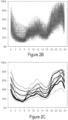
- Figures 2B and 2C show schematic diagrams for obtaining various running state curves according to historical running data in an embodiment of the present application.
- a unit time period is measured in days, and each curve reflects the distribution of the running state of a day in the historical running data, which is called a running state instance.
- Figure 2C shows several running state curves obtained by analyzing and processing the running state curves in Figure 2B , which serve as a reference running mode.
- Current running data refer to the running data of the system collected in the data collection period closest to the time for determining the current running mode.
- the current running mode may comprise one or more running states.
- the data collection period comprises several days
- these days may all correspond to the same running state, or, of these days, a plurality of days correspond to a first running state, a plurality of days correspond to a second running state, a plurality of days correspond to a third running state, and so on.
- the form and determination method of a running state in the current running mode are similar to the above-mentioned form and determination method of a running state in the reference running mode, and no similar descriptions will be provided again herein.
- comparing the current running mode and the reference running mode involves the comparison of two sets of running states, with the purpose of judging whether the current running mode conforms to the reference running mode. If the current running mode conforms to the reference running mode, then it indicates that the system is in the reference running mode; otherwise, it indicates that the system is not in the reference running mode; in other words, the system has deviated from its usual running mode and is in a running state that is significantly different from usual running state.
- the monitored system 14 is a factory with 3 production lines
- the system-state monitoring device 12 is installed in a power supply enterprise
- the sensor 13 is installed in a power distribution device for supplying power to the monitored system 14 to collect running parameter values of the power distribution device.
- the system-state monitoring device 12 is provided with a reference running mode based on the monitored system 14, comprising a plurality of previous running states of the monitored system 14, such as a first running state of the factory during a busy period, a second running state during a usual period, and a third running state during an idle period.
- Each running state may be a distribution rule of the running parameter values of the power distribution device within a unit time period.
- the system-state monitoring device 12 determines the current running mode of the monitored system 14 according to the running data of the monitored system 14 collected in the previous data collection period.
- the system-state monitoring device 12 can determine that the current running mode matches none of the three running modes in the reference running mode, and so it is determined that the monitored system 14 is not in the reference running mode. Accordingly, the power supply enterprise can handle the situation based on a monitoring result (for example, an alarm message) obtained by the system-state monitoring device 12; for example, it can increase the power supply to the factory, replace the power distribution device with one having higher power, etc., which helps to improve the performance of the monitored system 14.
- a monitoring result for example, an alarm message
- a plurality of usual running states of a monitored system are determined as a reference running mode and, by comparing the current running mode of the system with the reference running mode, whether the system is in the reference running mode is determined; thus, a change in a running rule of the system may be detected; therefore, the monitored system or a peripheral matched mechanism may be adjusted conveniently in a timely manner, and performance of the system is improved.
- running states of a system are represented by graphs. Examples will be given below.
- the reference running mode may comprise a plurality of first state distribution graphs corresponding to a plurality of running states
- the current running mode may comprise at least one second state distribution graph.
- a state distribution graph is a graphical representation of the distribution of running parameter values of a system within a unit time period.
- a first state distribution graph and a second state distribution graph are only intended for distinguishing between respective state distribution graphs of a reference running mode and a current running mode, and neither "first" nor "second” has any substantial meaning. The same is also true of the other instances of "first", “second", “third”, etc. below, and no similar descriptions will be provided again herein.
- a plurality of first state distribution graphs may be used as a first graph group, at least one second state distribution graph may be used as a second graph group, a similarity measuring value of the first graph group and the second graph group may be determined, and whether the system is in the reference running mode may be determined according to the similarity measuring value.
- a similarity measuring value is used to indicate the degree of similarity between a first graph group and a second graph group.
- the degree of similarity between two groups of graphs may be calculated, and the degree of similarity may be used as the above-described similarity measuring value.
- the degree of difference between two groups of graphs may be calculated as the above-described similarity measuring value.
- a similarity measuring value may be compared with a preset threshold value, and whether the system is in the reference running mode may be determined according to the comparison result. For example, assuming that the similarity measuring value is a degree of similarity, when the similarity measuring value is greater than the threshold value, it may be determined that the system is in the reference running mode; assuming that the similarity measuring value is a degree of difference, when the similarity measuring value is smaller than the threshold value, it may be determined that the system is in the reference running mode.
- various graph processing methods may be used to determine whether the system is in the reference running mode, which is relatively easy to implement.
- the purpose of comparing the current running mode and the reference running mode is to determine whether the current running mode conforms to the reference running mode. Therefore, when determining a similarity measuring value of the first graph group and the second graph group, for each second state distribution graph in the second graph group, the graph most similar thereto in the first graph group is searched; in other words, a third state distribution graph in the first graph group that is most similar to the second state distribution graph is determined, and a graph similarity measuring value of the second state distribution graph and the third state distribution graph is obtained.
- a measuring value set corresponding to the second graph group may be obtained, and thus the measuring value set is used to determine a similarity measuring value of the first graph group and the second graph group.
- a measuring value set corresponding to the second graph group is obtained according to the graph similarity measuring value; the measuring value set represents how close each running state graph in the current running mode is to the reference running mode; this allows a reduction of the computational complexity, facilitating subsequent processing.
- various analysis methods may be used to process the measuring value set, so as to obtain a similarity measuring value of the first graph group and the second graph group.
- an extreme value for example, a maximum value, a minimum value, etc.
- a similarity measuring value of the first graph group and the second graph group may be selected as a similarity measuring value of the first graph group and the second graph group.
- the minimum value may be selected from the measuring value set (that is, the lowest degree of similarity) as the similarity measuring value of the first graph group and the second graph group.
- the maximum value may be selected from the measuring value set (that is, the lowest degree of similarity) as the similarity measuring value of the first graph group and the second graph group.
- a plurality of values may be selected from a measuring value set, and the mean value of the plurality of values may be used as the similarity measuring value of the first graph group and the second graph group.
- a plurality of values may be selected from a measuring value set, and the sum of the plurality of values may be used as the similarity measuring value of the first graph group and the second graph group.
- N of the first N values may be selected, or several values greater than or smaller than a preset threshold value may be selected.
- a similarity measuring value of the first graph group and the second graph group may also be determined by adopting other strategies.
- the computational complexity may be further reduced, and the computation efficiency may be improved.
- FIGS 3A and 3B show flowcharts for a state monitoring method according to the invention which is executed by the system-state monitoring device 12.
- Figure 3A shows how the weight of each running state in the reference running mode is considered.
- the method comprises the following steps: Step S301: determining a first weight of each first state distribution graph in a plurality of first state distribution graphs.
- a first weight may be determined according to the probability of creation of a running state corresponding to a first state distribution graph. For example, historical running data of a system may be analyzed; for example, historical running states may be clustered, and each first state distribution graph and its first weight may be obtained according to methods such as the number of running state instances in each cluster.
- Step S302 determining a third state distribution graph most similar to the second state distribution graph in the first graph group for each second state distribution graph in the second graph group, calculating a graph similarity measuring value of the second state distribution graph and the third state distribution graph, and obtaining a measuring value set corresponding to the second graph group according to the graph similarity measuring value; and Step S303: determining whether the system is in a reference running mode by using the measuring value set and the first weight.
- the second graph group comprises graph 1 and graph 2
- graph 1 is the most similar to graph 3 in the first graph group, with a degree of similarity of 0.9, and the weight of graph 3 is 0.6
- graph 2 is the most similar to graph 4 in the first graph group, with a degree of similarity of 0.3, and the weight of graph 3 is 0.2
- the weighted graph similarity of graph 1 is 0.48
- the weighted graph similarity of graph 2 is 0.06. Therefore, in the process of determining whether the system is in a reference running mode, although the degree of conformity of graph 2 to the reference running mode is low, since the weight of graph 4 is small, the influence of graph 2 on the final result is much less significant than that of graph 1.
- the degree of similarity in the current running state to the high-weighted running state in the reference running state may be caused to have a more significant influence on a result than the degree of similarity to the lower-weighted running state in the reference running state, so that a more accurate judgment result may be obtained.
- Figure 3B shows how the weight of each running state in the current running mode is considered. As shown in Figure 3B , the method comprises the following steps:
- the second graph group comprises graph 1 and graph 2
- graph 1 is the most similar to graph 3 in the first graph group, with a degree of similarity of 0.9, and the weight of graph 1 is 0.7
- graph 2 is the most similar to graph 4 in the first graph group, with a degree of similarity of 0.3, and the weight of graph 2 is 0.3
- the weighted graph similarity of graph 1 is 0.63
- the weighted graph similarity of graph 2 is 0.09. Therefore, in the process of determining whether the system is in a reference running mode, although the degree of conformity of graph 2 to the reference running mode is low, since its weight is small, the influence of graph 2 on the final result is much less significant than that of graph 1.
- the degree of similarity of the high-weighted running state in the current running state may be caused to have a more significant impact on a result than the degree of similarity of the low-weighted running state, so that a more accurate judgment result may be obtained.
- the first weight and the second weight are used at the same time to determine whether the system is in the reference running mode.
- the first weight and/or the second weight may be used to weight each value in a measuring value set to obtain a weighted value of each value, and whether the system is in the reference running mode may be determined according to the extreme value among the weighted values. For example, when the graph similarity measuring value is the degree of similarity, the weighted minimum value may be used to determine whether the system is in the reference running mode; when the graph similarity measuring value is the degree of difference, the weighted maximum value may be used to determine whether the system is in the reference running mode.
- a plurality of values may be selected from a measuring value set, a weighted average of the plurality of values may be calculated according to the first weight and/or the second weight, and whether the system is in the reference running mode is determined according to the weighted average.
- a plurality of values may be selected from the measuring value set, a weighted sum of the plurality of values may be calculated according to the first weight and/or the second weight, and whether the system is in the reference running mode is determined according to the weighted sum.
- the values in the measuring value set may be sorted according to a preset sorting method, and the plurality of values may be selected in order; for example, N of the first N values may be selected, or several values may be selected in proportion to a preset number, etc.
- the above-mentioned extreme value, or weighted average value, or weighted sum may be compared with a preset threshold value, and whether the system is in the reference running mode is determined according to the comparison result.
- the probability of creation of each running state in the current running mode and the reference running mode may be considered, so that a more accurate judgment result may be obtained.
- the creation of running states follows a strict time rule; therefore, time information of the current running mode may be used to further verify whether the system is in the reference running mode.
- time information corresponding to each running state in the plurality of running states in a reference running mode it is possible to determine whether the system is in the reference running mode or not by comparing state characteristics and time information of the plurality of running states and the current running mode.
- State characteristics refer to information used to distinguish between running states, such as running state graphs and fitting functions for running states.
- Time information corresponding to a running state is information characterizing the time at which the system is in the running state.
- time information may be information about a time period, for example, from January to March or from May 10 to July 20.
- time information may be an array or a curve, which represents the probability of creation of a running state within a period of time.
- time information may be expressed in other forms.
- time information is an array
- the dimension of the array is determined by a statistical period and a change unit time period. For example, if the statistical period is 1 year and the change unit time period is 1 month, then the time information may be a 12-dimensional array, where each value represents the probability of creation of this running state in the corresponding month.
- a statistical period and a change unit time period may be set according to actual situations; for example, the statistical period may be several months, and the change unit time period may be several days.
- the time information is a curve
- the curve is a curve continuous in the time dimension; the first dimension of the curve is a statistical period (for example, several months) and the second dimension is the probability of creation of a running state.
- the third running state the most similar running state in the reference running mode for each running state (hereinafter referred to as the first running state) in the current running mode
- compare the time information corresponding to the first running state and the third running state and judge the degree of conformity between the time information of the two states; if the information does not match, it may be determined that the current running mode of the system does not match the reference running mode in time.
- the time information is a time period
- the time period corresponding to the current first running state falls within the time period corresponding to the third running state, then it may be determined that the first running state matches the reference running mode in time; otherwise, it may be determined that the first running state does not match the reference running mode in time.
- a period of the corresponding time may be intercepted from the time information corresponding to the third running state, and then the information may be compared. For example, if the time information corresponding to the current first running state is from September 15 to November 15, then the array or curve corresponding to the period from September 15 to November 15 is intercepted from the time information corresponding to the third running state, and then data or curve similarity is compared to determine the degree of conformity in time information.
- a preset strategy may be that the state characteristics of each running state in the current running mode conform to a running state in the reference running mode (for example, the graph similarity measuring value satisfies a preset condition), and that the time information conforms to the running state (for example, the degree of conformity in time is greater than a preset threshold value).
- a preset strategy may be that the degree of conformity of the state characteristics corresponding to each running state in the current running mode and the degree of conformity of the time information are respectively weighted according to a preset weight, and whether the system is in the reference running mode is determined on the basis of a calculation result.
- the description given above is only exemplary, and other methods may also be adopted in other embodiments as needed.
- the reference running mode corresponding to each preset time period determines whether the system is in the reference running mode by comparing the current running mode with the reference running mode corresponding to the same time period.
- the reference running mode corresponding to each time period may be determined according to a preset time period (for example, several days, several weeks, or several months).
- the reference running mode of the same time period is compared with the current running mode according to the method of each embodiment to determine whether the state characteristics and time information of the current running mode conform to those of the reference running mode; if yes, then it is determined that the system is in the reference running mode.
- a time distribution rule of a system parameter value of the system may be determined, the time distribution of the system parameter value may be determined according to the current running data, and whether the system is in the reference running mode may be determined according to whether the time distribution conforms to the time distribution rule.
- the extreme value or average value of a system parameter value within a unit time period may be determined, and the time distribution rule of the extreme value or average value may be determined as the time distribution rule of the system parameter value, such as a curve or an array.
- the time distribution of the system parameter value in the current running mode is determined in a similar manner, and the time distribution is compared with the above-mentioned time distribution rule to determine the degree of conformity of the time information. Then, in combination with the similarity comparison results of the state characteristics of the running state, whether the system is in the reference running mode may be determined according to a preset strategy.
- the specific method is the same as that described above and no similar descriptions will be provided again herein.
- any irregularity of a running state of the system may be detected in a timely manner, which facilitates the handling of irregular running of the system.
- the reference running mode of the system may be determined on the basis of historical running data of the system, and the current running mode may be determined on the basis of the running data of the system collected within the recent period of time (that is, current running data).
- the time span of historical running data is generally relatively wide.
- the time span of the current running data is narrower. In other words, the first duration of collecting historical running data is generally longer than the duration of collecting current running data.
- historical running data and current running data may be collected separately according to a preset collection period.
- a collection period of historical running data may be several months, several years, etc.
- a collection period of current running data may be several days, several weeks, several months, etc.
- a pre-allocated data storage space may be used to control the data volume of historical running data and that of current running data.
- running data of a system may be obtained, and the running data may be stored in a first storage space and a second storage space, respectively, the first storage space being larger than the second storage space.
- the first storage space may be a hard disk space, a cache space, etc.
- the first storage space is used for storing historical running data; when the first storage space is full, storing running data in the first storage space is stopped, and the running data in the first storage space is used to determine a reference running mode; when it is determined that the system is not in a reference running mode, an alarm message is sent out and the first storage space is cleared.
- the second storage space may be a hard disk space, a cache space, etc.
- the first storage space is used for storing current running data; when the second storage space is full and a reference running mode exists, the running data in the second storage space may be used to determine a current running mode.
- FIGS. 4A and 4B are schematic diagrams for the system-state monitoring device 12 according to an embodiment of the present application.
- the system-state monitoring device 12 may comprise: a reference mode determining module 27, a current mode determining module 28, and a judging module 29.
- the reference mode determining module 27 determines a reference running mode of the system, wherein the reference running mode comprises a plurality of running states of the system within a unit time period.
- the current mode determining module allows a current running mode of a system to be determined according to the current running data of the system.
- the judging module 29 can determines whether the system is in a reference running mode by comparing a current running mode with a reference running mode.
- the system-state monitoring device 12 of each embodiment determines a plurality of usual running states of a monitored system as a reference running mode and, by comparing the current running mode of the system with the reference running mode, determines whether the system is in the reference running mode; thus, a change in a running rule of the system may be detected; therefore, the monitored system or a peripheral matched mechanism may be adjusted conveniently in a timely manner, and performance of the system is improved.
- the judging module 29 may comprise: a similarity determining unit 291 and a judging unit 292.
- the similarity determining unit 291 using a plurality of first state distribution graphs corresponding to a plurality of running states as a first graph group, and using at least one second state distribution graph corresponding to the current running mode as a second graph group, the similarity measuring value of the first graph group and the second graph group.
- the judging unit 292 determines whether the system is in a reference running mode according to the similarity measuring value.
- the system-state monitoring device 12 can use various graph processing methods to determine whether the system is in the reference running mode, which is relatively simple to implement.
- the similarity determining unit 291 determines a third state distribution graph most similar to the second state distribution graph in the first graph group for each second state distribution graph in the second graph group, calculates a graph similarity measuring value of the second state distribution graph and the third state distribution graph, and obtains a measuring value set corresponding to the second graph group according to the graph similarity measuring value; and determines a similarity measuring value of the first graph group and the second graph group by using the measuring value set.
- the judging unit 292 may execute one of the following:
- the computation load on the system-state monitoring device 12 may be further reduced, and the calculation efficiency may be improved.
- the invention takes into consideration the weight of each running state when comparing a reference running mode with a current running mode.
- the reference mode determining module 27 determines a first weight of each first state distribution graph in a plurality of first state distribution graphs according to historical running data.
- the current mode determining module 28 also determines a second weight of each second state distribution graph in the at least one second state distribution graph according to the current running data.
- the judging module 29 determines a third state distribution graph most similar to the second state distribution graph in the first graph group for each second state distribution graph in the second graph group, calculate a graph similarity measuring value of the second state distribution graph and the third state distribution graph, and obtain a measuring value set corresponding to the second graph group according to the graph similarity measuring value; and determine whether the system is in the reference running mode or not according to the measuring value set and the first weight and/or the second weight. By taking the weight of each running state into consideration, the judging module 29 obtains a more accurate judgment result.
- the judging module 29 may execute one of the following: weighting each value in the measuring value set with the first weight and/or the second weight to obtain a weighted value of each value, and determining whether the system is in the reference running mode according to the extreme value in the weighted values;
- the probability of creation of each running state in the current running mode and the reference running mode may be considered, so that a more accurate judgment result may be obtained.
- time information of the current running mode may be used to further verify whether the system is in the reference running mode.
- the judging module 29 can execute one of the following:
- any irregularity of a running state of the system may be detected in a timely manner, which facilitates the handling of irregular running of the system.
- system-state monitoring device 12 may further comprise: a storage module 24 and a data acquisition module 26.
- the storage module 24 may comprise a first storage space 241 and a second storage space 242, wherein the first storage space 241 is larger than the second storage space 242.
- the data acquisition module 26 can store running data of the system in the first storage space 241 and the second storage space 242, respectively; when the first storage space 241 is full, storing running data in the first storage space 241 is stopped, and the reference mode determining module is triggered to determine a reference running mode by using the running data in the first storage space 241; when the second storage space 242 is full and a reference running mode exists, the current mode determining module is triggered to determine a current running mode by using the running data in the second storage space 242.
- the judging module 29 may also send out an alarm message and clear the first storage space 241 when it is determined that the system is not in a reference running mode.
- the reference mode determining module 27 may execute one of the following:
- the system-state monitoring device 12 may further comprise a processor 21, a storage 20, and a communication module 22.
- the communication module 22 is used for communicating with another device through any communication network.
- the storage 20 may comprise an operating system 23, a monitoring module 25, and a storage module 24.
- the monitoring module 25 comprises computer-readable instructions corresponding to the above-described modules.
- the processor 21 can execute the computer-readable instructions in the storage 20 to implement the methods of various embodiments.
- FIG. 5 shows a schematic diagram for an application scenario of an embodiment of the present application.
- the system-state monitoring device 12 of each embodiment is applied in a power supply enterprise (the monitored system 14) to monitor the power consumption by each power user, so as to ensure that the power grid runs effectively and stably.
- the sensor 13 may be installed in a power distribution device (for example, a transformer) that supplies power to each power user, to continuously collect running data (such as voltage, current, power) of the power distribution device, and send the data to the system-state monitoring device 12.
- a power distribution device for example, a transformer
- the system-state monitoring device 12 comprises a processor 51 and a cache 52 (for example, a RAM).
- the processor 51 preprocesses time series data (for example, by data cleaning and data normalization), and stores preprocessed data in a database 53 to generate time series data, that is, data arranged in chronological order.
- the processor 51 uses a predefined mathematical model and data in the database 53 to perform modeling, and a model is stored in the cache 52.
- the system-state monitoring device 12 sends a signal to an alarm device 56; the alarm device 56 can send an alarm message to relevant personnel by email, SMS, or by any other possible method.
- the system-state monitoring device 12 can create a log file and store it in a log database 55.
- FIG. 6 shows a processing flowchart for the system-state monitoring device 12 according to an embodiment of the present application.
- step S61 the system-state monitoring device 12 preprocesses time series data and stores preprocessed data in the first storage space and the second storage space in the database 53, respectively.
- step S62 the system-state monitoring device 12 uses the data in the first storage space to perform modeling and obtain a reference running model (that is, a mathematical model in a reference running mode).
- a reference running model that is, a mathematical model in a reference running mode.
- step S63 modeling is performed using the data in the second storage space to obtain a current running model (that is, a mathematical model in a current running mode).
- step S64 the system-state monitoring device 12 calculates the degree of similarity between the current running model and the reference running model.
- step S65 the system-state monitoring device 12 judges whether the degree of similarity is smaller than a preset threshold value; if the degree of similarity is smaller than the threshold value, then step S66 is executed; otherwise, return to step S63.
- step S66 the system-state monitoring device 12 sends a signal to the alarm device 56, writes a log to the log database 55, clears the first storage space, and returns to step S62.
- Figure 7 shows a schematic diagram for a method for storing data by the system-state monitoring device 12 in an embodiment of the present application.
- the first storage space is used for storing time series data used to establish a reference running model
- the second storage space 82 is used for storing time series data used to establish a current running model.
- step S81 the system-state monitoring device 12 attempts to write data into both the first storage space and the second storage space.
- the system-state monitoring device 12 determines in step S82 whether the first storage space is full and, if the space is not full, writes data to the first storage space in step S83; if the space is full, then it is determined in step S84 whether a reference running model exists; if it exists, no processing is performed; otherwise, in step S85, the time series data in the first storage space are used to establish a reference running model.
- the system-state monitoring device 12 determines in step S86 whether the second storage space is full and, if the space is not full, writes time series data into the second storage space in step S87; if the space is full, it is determined in step S88 whether a reference running model exists. If no reference running model exists, then the stored old data are updated with the newly written data in step S810. If a reference running model exists, then the time series data in the second storage space are used to establish a current running model in step S811.
- the system-state monitoring device 12 judges in step S812 whether the degree of similarity between the current running model and the reference running model is smaller than a threshold value, and if the degree of similarity is smaller than the threshold value, clears the first storage space in step S813; otherwise, no processing is performed.
Landscapes
- Engineering & Computer Science (AREA)
- Theoretical Computer Science (AREA)
- Physics & Mathematics (AREA)
- General Physics & Mathematics (AREA)
- General Engineering & Computer Science (AREA)
- Quality & Reliability (AREA)
- Business, Economics & Management (AREA)
- Human Resources & Organizations (AREA)
- Computing Systems (AREA)
- Economics (AREA)
- Strategic Management (AREA)
- Data Mining & Analysis (AREA)
- Tourism & Hospitality (AREA)
- Operations Research (AREA)
- Marketing (AREA)
- Entrepreneurship & Innovation (AREA)
- General Business, Economics & Management (AREA)
- Databases & Information Systems (AREA)
- Mathematical Physics (AREA)
- Computer Vision & Pattern Recognition (AREA)
- Software Systems (AREA)
- Life Sciences & Earth Sciences (AREA)
- Evolutionary Biology (AREA)
- Evolutionary Computation (AREA)
- Bioinformatics & Computational Biology (AREA)
- Bioinformatics & Cheminformatics (AREA)
- Artificial Intelligence (AREA)
- Computer Hardware Design (AREA)
- Development Economics (AREA)
- Game Theory and Decision Science (AREA)
- Automation & Control Theory (AREA)
- Testing And Monitoring For Control Systems (AREA)
- Debugging And Monitoring (AREA)
Description
- The present invention relates to the field of information processing, in particular to a system-state monitoring method, device, and storage medium.
- A present system-state monitoring mechanism usually collects running parameter values of a system, judges whether the running parameter values fall within a normal range and provides a monitoring result of whether the system state is normal according to the judgment result. In reality, even when running parameter values may still be within the normal range, a change in a running rule of the system, for example, performance degradation due to equipment aging or a change in a running rule of the system caused by process reformation, may occur. It is also necessary to discover such changes in a timely manner to allow adjustment of related supporting services, such as equipment maintenance and energy configuration.
-
US-A-2011029817 discloses an abnormality detection method that involves executing a task name assignment procedure to obtain task names from extracted process statuses and associating task names with performance information and recording said information as performance statuses. Abnormality is detected based on current and past performance statuses. -
WO-A-2015110873 discloses a computer monitoring system that may predict near term and long term performance by comparing a segment of current time series data with previously observed time series to find matching segments. From a matching segment, a prediction of performance may be made by examining later observations in the time series. -
US-A-2018210803 discloses a system that monitors performance based on the degree that system performance and detected past behaviour when the system was operating normally correspond. - In view of the above-described problem, the present invention proposes a system-state monitoring method, device, and storage medium, which can detect a change in a running rule of a system,
- The invention is defined by the features laid down in the independent claims. Further enhancements are provided by the dependent claims.
- Preferred embodiments of the present invention will be described in detail below with reference to the drawings to make the above-mentioned and other characteristics and benefits of the present invention clearer to those of ordinary skill in the art. In the drawings,
-
Figure 1 shows a schematic diagram for an application scenario of an embodiment of the present application; -
Figure 2A shows a flowchart for a system-state monitoring method according to an embodiment of the present application; -
Figures 2B and 2C show schematic diagrams for obtaining various running state curves according to historical running data in an embodiment of the present application; -
Figures 3A and 3B show flowcharts for a state monitoring method according to an embodiment of the present application; -
Figures 4A and4B show schematic diagrams for a system-state monitoring device according to an embodiment of the present application; -
Figure 5 shows a schematic diagram for an application scenario of an embodiment of the present application; -
Figure 6 shows a processing flowchart for the system-state monitoring device according to an embodiment of the present application; and -
Figure 7 shows a schematic diagram for a method for storing data in a system-state monitoring device in an embodiment of the present application. - In order to further clarify the objective, technical solution, and benefits of the present invention, the present invention will be described below in greater detail with reference to embodiments.
- An embodiment of the present application provides a technical solution for system-state monitoring, which allows the determination of a reference running mode of a system, the reference running mode comprising a plurality of running states of the system within a unit time period; and allows the determination of whether the system is in the reference running mode by comparing the reference running mode with the current running mode.
Figure 1 is a schematic diagram for an application scenario of an embodiment of the present application. This application scenario is only an example of various possible application scenarios, and technical solutions provided by each embodiment may also be applied to other scenarios. As shown inFigure 1 , this scenario may include a system-state monitoring device 12, anetwork 11, asensor 13, and a monitoredsystem 14. - The
network 11 can maintain the communication between the system-state monitoring device 12, thesensor 13, and the monitoredsystem 14. Thenetwork 11 may be a wired or wireless network running any communication protocol. - The monitored
system 14 may be a collection of devices or components that operate to implement a certain function. The monitoredsystem 14 may comprise one or more devices (such as a mechanical device and a chemical device) and may also comprise one or more components, such as a motor and bearings. - The
sensor 13 may be one of various contact or non-contact detection devices. Thesensor 13 may be selected from various devices, including voltage sensors, current sensors, displacement sensors, and rotational speed sensors, that detect parameters in various fields, such as sound, light, electricity, magnetism, heat, and force. - The system-
state monitoring device 12 can, through thenetwork 11, obtain running data of the monitoredsystem 14 provided by thesensor 13 and/or the monitoredsystem 14, and analyze the running data by the method of each embodiment, thereby determining whether the running state of the monitoredsystem 14 is normal. - In some embodiments, the system-
state monitoring device 12 may comprise a processor 121 and a running database 124. The running database 124 can store running data of the monitoredsystem 14. The processor 121 may be one or a plurality of processors, and may be provided in one or a plurality of physical devices. The processor 121 may analyze running data to determine whether the running condition of the monitoredsystem 14 is normal. -
Figure 2A shows a flowchart for a system-state monitoring method according to an embodiment of the present application. This method is executed by the system-state monitoring device 12 shown inFigure 1 . The method comprises the following steps: - Step S21: determining a reference running mode of a system, wherein the reference running mode comprises a plurality of running states of the system within a unit time period;
- Step S22: determining a current running mode of the system according to current running data of the system; and Step S23: determining whether the system is in the reference running mode or not by comparing the current running mode and the reference running mode.
- A system mentioned herein may be any one device or a collection of a plurality of devices; for example, it may be the monitored
system 14 shown inFigure 1 . - A running state refers to the performance of a system when it is running, which is determined according to the value of one or more parameters obtained when the system is running. For example, a running state may be the value of a parameter of the system, for example, a voltage, a current, or a rotation speed. For another example, a running state may be a value calculated on the basis of the values of a plurality of parameters, such as comprehensive energy consumption and overall equipment efficiency (OEE).
- A unit time period may be any length of time period, which may be set as needed; for example, it may be set to several hours, one day, several days, one week, several weeks, one month, several months, etc.
- Since a system may have a plurality of different running states according to order requirements, operating conditions, etc., different running states correspond to different distributions of system parameters in time. Even if parameters remain within the normal range, a running state of the system may be constantly changing. A reference running mode refers to a running pattern exhibited during normal running of a system. A reference running mode may be obtained from historical running data of the system, or may be set manually.
- A reference running mode comprises a plurality of different running states, such as a plurality of running states reached when the system is running under different loads. Each running state is represented by graphs.
- In each embodiment, a plurality of different running states comprised in a reference running mode may be obtained by performing various analyses on historical running data of the system. For example, it is possible to cluster a plurality of running state examples corresponding to the unit time period in historical running data of the system to obtain a plurality of clusters, and calculate a running state for each cluster in the plurality of clusters to serve as one running state in the plurality of running states. A running state instance refers to an actual running state comprised in collected running data. Optional clustering algorithms may include K-means, K-medoids, and hierarchical clustering. For another example, it is possible to build a matrix by utilizing the plurality of running state examples corresponding to the unit time period in the historical running data of the system, and perform dimensionality reduction on the matrix by utilizing singular value decomposition or main component analysis to obtain the plurality of running states. Other methods may also be used in other embodiments, and no similar descriptions will be provided again herein. For example, when running states are represented by graphs,
Figures 2B and 2C show schematic diagrams for obtaining various running state curves according to historical running data in an embodiment of the present application. InFigure 2B , a unit time period is measured in days, and each curve reflects the distribution of the running state of a day in the historical running data, which is called a running state instance.Figure 2C shows several running state curves obtained by analyzing and processing the running state curves inFigure 2B , which serve as a reference running mode. - Current running data refer to the running data of the system collected in the data collection period closest to the time for determining the current running mode. In each embodiment, it is possible to set a fixed or variable data collection period as needed, for example, several days, one week, several weeks, one month, several months, etc., and, after the end of each data collection period, determine the current running mode by using the running data collected during the period. The current running mode may comprise one or more running states. For example, when the data collection period comprises several days, these days may all correspond to the same running state, or, of these days, a plurality of days correspond to a first running state, a plurality of days correspond to a second running state, a plurality of days correspond to a third running state, and so on. The form and determination method of a running state in the current running mode are similar to the above-mentioned form and determination method of a running state in the reference running mode, and no similar descriptions will be provided again herein.
- Here, comparing the current running mode and the reference running mode involves the comparison of two sets of running states, with the purpose of judging whether the current running mode conforms to the reference running mode. If the current running mode conforms to the reference running mode, then it indicates that the system is in the reference running mode; otherwise, it indicates that the system is not in the reference running mode; in other words, the system has deviated from its usual running mode and is in a running state that is significantly different from usual running state.
- For example, the monitored
system 14 is a factory with 3 production lines, the system-state monitoring device 12 is installed in a power supply enterprise, and thesensor 13 is installed in a power distribution device for supplying power to the monitoredsystem 14 to collect running parameter values of the power distribution device. The system-state monitoring device 12 is provided with a reference running mode based on the monitoredsystem 14, comprising a plurality of previous running states of the monitoredsystem 14, such as a first running state of the factory during a busy period, a second running state during a usual period, and a third running state during an idle period. Each running state may be a distribution rule of the running parameter values of the power distribution device within a unit time period. The system-state monitoring device 12 determines the current running mode of the monitoredsystem 14 according to the running data of the monitoredsystem 14 collected in the previous data collection period. When the factory adds 2 new production lines in order to increase production, by comparing the current running mode and the reference running mode, the system-state monitoring device 12 can determine that the current running mode matches none of the three running modes in the reference running mode, and so it is determined that the monitoredsystem 14 is not in the reference running mode. Accordingly, the power supply enterprise can handle the situation based on a monitoring result (for example, an alarm message) obtained by the system-state monitoring device 12; for example, it can increase the power supply to the factory, replace the power distribution device with one having higher power, etc., which helps to improve the performance of the monitoredsystem 14. - It is clear that, in each embodiment, a plurality of usual running states of a monitored system are determined as a reference running mode and, by comparing the current running mode of the system with the reference running mode, whether the system is in the reference running mode is determined; thus, a change in a running rule of the system may be detected; therefore, the monitored system or a peripheral matched mechanism may be adjusted conveniently in a timely manner, and performance of the system is improved.
- In each embodiment, running states of a system are represented by graphs. Examples will be given below. For example, when running states of the system are represented with graphs, the reference running mode may comprise a plurality of first state distribution graphs corresponding to a plurality of running states, and the current running mode may comprise at least one second state distribution graph. A state distribution graph is a graphical representation of the distribution of running parameter values of a system within a unit time period. A first state distribution graph and a second state distribution graph are only intended for distinguishing between respective state distribution graphs of a reference running mode and a current running mode, and neither "first" nor "second" has any substantial meaning. The same is also true of the other instances of "first", "second", "third", etc. below, and no similar descriptions will be provided again herein. In step S23 described above, a plurality of first state distribution graphs may be used as a first graph group, at least one second state distribution graph may be used as a second graph group, a similarity measuring value of the first graph group and the second graph group may be determined, and whether the system is in the reference running mode may be determined according to the similarity measuring value. A similarity measuring value is used to indicate the degree of similarity between a first graph group and a second graph group. In some examples, the degree of similarity between two groups of graphs may be calculated, and the degree of similarity may be used as the above-described similarity measuring value. In other examples, the degree of difference between two groups of graphs may be calculated as the above-described similarity measuring value. In each embodiment, a similarity measuring value may be compared with a preset threshold value, and whether the system is in the reference running mode may be determined according to the comparison result. For example, assuming that the similarity measuring value is a degree of similarity, when the similarity measuring value is greater than the threshold value, it may be determined that the system is in the reference running mode; assuming that the similarity measuring value is a degree of difference, when the similarity measuring value is smaller than the threshold value, it may be determined that the system is in the reference running mode.
- Thus, by transforming the comparison between a current running mode and a reference running mode into comparison of the similarity between two groups of graphs, various graph processing methods may be used to determine whether the system is in the reference running mode, which is relatively easy to implement.
- When determining a similarity measuring value of the first graph group and the second graph group, various graph distance algorithms, such as Euclidean distance, Hausdorff distance, and Frechet distance, are used.
- As mentioned earlier, the purpose of comparing the current running mode and the reference running mode is to determine whether the current running mode conforms to the reference running mode. Therefore, when determining a similarity measuring value of the first graph group and the second graph group, for each second state distribution graph in the second graph group, the graph most similar thereto in the first graph group is searched; in other words, a third state distribution graph in the first graph group that is most similar to the second state distribution graph is determined, and a graph similarity measuring value of the second state distribution graph and the third state distribution graph is obtained. Thus, by using the graph similarity measuring values of each second state distribution graph and its corresponding third state distribution graph, a measuring value set corresponding to the second graph group may be obtained, and thus the measuring value set is used to determine a similarity measuring value of the first graph group and the second graph group.
- It is clear that, by determining the graphs in the second graph group that are most similar in the first graph group, a measuring value set corresponding to the second graph group is obtained according to the graph similarity measuring value; the measuring value set represents how close each running state graph in the current running mode is to the reference running mode; this allows a reduction of the computational complexity, facilitating subsequent processing.
- In each embodiment, various analysis methods may be used to process the measuring value set, so as to obtain a similarity measuring value of the first graph group and the second graph group.
- In some embodiments, an extreme value (for example, a maximum value, a minimum value, etc.) in a measuring value set may be selected as a similarity measuring value of the first graph group and the second graph group. For example, when the measuring value set is the maximum similarity corresponding to each running state graph (that is, the degree of similarity to the most similar running state graph in the first graph group), the minimum value may be selected from the measuring value set (that is, the lowest degree of similarity) as the similarity measuring value of the first graph group and the second graph group. For another example, when the measuring value set is the minimum value of the degree of difference corresponding to each running state graph (that is, the degree of difference from the most similar running state graph in the first graph group), the maximum value may be selected from the measuring value set (that is, the lowest degree of similarity) as the similarity measuring value of the first graph group and the second graph group.
- In some embodiments, a plurality of values may be selected from a measuring value set, and the mean value of the plurality of values may be used as the similarity measuring value of the first graph group and the second graph group.
- In some embodiments, a plurality of values may be selected from a measuring value set, and the sum of the plurality of values may be used as the similarity measuring value of the first graph group and the second graph group.
- When selecting a plurality of values from a measuring value set, it is possible to sort the values in the measuring value set by a preset sorting method, and select a plurality of values in order; for example, N of the first N values may be selected, or several values greater than or smaller than a preset threshold value may be selected.
- The description given above is only exemplary; in other embodiments, a similarity measuring value of the first graph group and the second graph group may also be determined by adopting other strategies.
- By selecting some values from a measuring value set to determine the similarity measuring value between a first graph group and a second graph group, the computational complexity may be further reduced, and the computation efficiency may be improved.
- In each embodiment, the number and frequency of creations of various running states vary; in other words, some running states are relatively common, while some others are relatively rare. Therefore, when determining a reference running mode and/or a current running mode, the weight of each running state is determined, and the weight of the running state is considered when comparing the reference running mode and the current running mode.
Figures 3A and 3B show flowcharts for a state monitoring method according to the invention which is executed by the system-state monitoring device 12.Figure 3A shows how the weight of each running state in the reference running mode is considered. As shown inFigure 3A , the method comprises the following steps:
Step S301: determining a first weight of each first state distribution graph in a plurality of first state distribution graphs. - In some examples, a first weight may be determined according to the probability of creation of a running state corresponding to a first state distribution graph. For example, historical running data of a system may be analyzed; for example, historical running states may be clustered, and each first state distribution graph and its first weight may be obtained according to methods such as the number of running state instances in each cluster.
- Step S302: determining a third state distribution graph most similar to the second state distribution graph in the first graph group for each second state distribution graph in the second graph group, calculating a graph similarity measuring value of the second state distribution graph and the third state distribution graph, and obtaining a measuring value set corresponding to the second graph group according to the graph similarity measuring value; and
Step S303: determining whether the system is in a reference running mode by using the measuring value set and the first weight. - For example, when the similarity between graphs is used as the graph similarity measuring value, it is assumed that the second graph group comprises graph 1 and
graph 2, graph 1 is the most similar to graph 3 in the first graph group, with a degree of similarity of 0.9, and the weight of graph 3 is 0.6;graph 2 is the most similar tograph 4 in the first graph group, with a degree of similarity of 0.3, and the weight of graph 3 is 0.2; then, the weighted graph similarity of graph 1 is 0.48, and the weighted graph similarity ofgraph 2 is 0.06. Therefore, in the process of determining whether the system is in a reference running mode, although the degree of conformity ofgraph 2 to the reference running mode is low, since the weight ofgraph 4 is small, the influence ofgraph 2 on the final result is much less significant than that of graph 1. - Thus, in the process of judging whether the system is in a reference running mode, considering the probability of creation of the current running state in the corresponding running state in the reference running state, the degree of similarity in the current running state to the high-weighted running state in the reference running state may be caused to have a more significant influence on a result than the degree of similarity to the lower-weighted running state in the reference running state, so that a more accurate judgment result may be obtained.
-
Figure 3B shows how the weight of each running state in the current running mode is considered. As shown inFigure 3B , the method comprises the following steps: - Step S311: determining a second weight of each second state distribution graph in the at least one second state distribution graph according to the current running data;
- Step S312: determining a third state distribution graph most similar to the second state distribution graph in the first graph group for each second state distribution graph in the second graph group, calculating a graph similarity measuring value of the second state distribution graph and the third state distribution graph, and obtaining a measuring value set corresponding to the second graph group according to the graph similarity measuring value; and
- Step S313: determining whether the system is in the reference running mode by using the measuring value set and the second weight.
- For example, when the similarity between graphs is used as the graph similarity measuring value, it is assumed that the second graph group comprises graph 1 and
graph 2, graph 1 is the most similar to graph 3 in the first graph group, with a degree of similarity of 0.9, and the weight of graph 1 is 0.7;graph 2 is the most similar tograph 4 in the first graph group, with a degree of similarity of 0.3, and the weight ofgraph 2 is 0.3; then, the weighted graph similarity of graph 1 is 0.63, and the weighted graph similarity ofgraph 2 is 0.09. Therefore, in the process of determining whether the system is in a reference running mode, although the degree of conformity ofgraph 2 to the reference running mode is low, since its weight is small, the influence ofgraph 2 on the final result is much less significant than that of graph 1. - Thus, in the process of judging whether the system is in a reference running mode, considering the probability of creation of each running state in the current running state, the degree of similarity of the high-weighted running state in the current running state may be caused to have a more significant impact on a result than the degree of similarity of the low-weighted running state, so that a more accurate judgment result may be obtained.
- The first weight and the second weight are used at the same time to determine whether the system is in the reference running mode.
- In some examples, the first weight and/or the second weight may be used to weight each value in a measuring value set to obtain a weighted value of each value, and whether the system is in the reference running mode may be determined according to the extreme value among the weighted values. For example, when the graph similarity measuring value is the degree of similarity, the weighted minimum value may be used to determine whether the system is in the reference running mode; when the graph similarity measuring value is the degree of difference, the weighted maximum value may be used to determine whether the system is in the reference running mode.
- In some examples, a plurality of values may be selected from a measuring value set, a weighted average of the plurality of values may be calculated according to the first weight and/or the second weight, and whether the system is in the reference running mode is determined according to the weighted average. In some examples, a plurality of values may be selected from the measuring value set, a weighted sum of the plurality of values may be calculated according to the first weight and/or the second weight, and whether the system is in the reference running mode is determined according to the weighted sum.
- In the process of selecting a plurality of values from a measuring value set, the values in the measuring value set may be sorted according to a preset sorting method, and the plurality of values may be selected in order; for example, N of the first N values may be selected, or several values may be selected in proportion to a preset number, etc. The above-mentioned extreme value, or weighted average value, or weighted sum may be compared with a preset threshold value, and whether the system is in the reference running mode is determined according to the comparison result.
- Thus, when judging whether a system is in the reference running mode, the probability of creation of each running state in the current running mode and the reference running mode may be considered, so that a more accurate judgment result may be obtained.
- In some embodiments, the creation of running states follows a strict time rule; therefore, time information of the current running mode may be used to further verify whether the system is in the reference running mode.
- In some examples, it is possible to determine time information corresponding to each running state in the plurality of running states in a reference running mode, and determine whether the system is in the reference running mode or not by comparing state characteristics and time information of the plurality of running states and the current running mode. State characteristics refer to information used to distinguish between running states, such as running state graphs and fitting functions for running states. Time information corresponding to a running state is information characterizing the time at which the system is in the running state. In some examples, time information may be information about a time period, for example, from January to March or from May 10 to July 20. In some examples, time information may be an array or a curve, which represents the probability of creation of a running state within a period of time. The description given above is only exemplary; in other embodiments, time information may be expressed in other forms. When time information is an array, the dimension of the array is determined by a statistical period and a change unit time period. For example, if the statistical period is 1 year and the change unit time period is 1 month, then the time information may be a 12-dimensional array, where each value represents the probability of creation of this running state in the corresponding month. A statistical period and a change unit time period may be set according to actual situations; for example, the statistical period may be several months, and the change unit time period may be several days. When the time information is a curve, the curve is a curve continuous in the time dimension; the first dimension of the curve is a statistical period (for example, several months) and the second dimension is the probability of creation of a running state.
- In some examples, when comparing the time information of the current running mode with the plurality of running states, it is possible to find the most similar running state (hereinafter referred to as the third running state) in the reference running mode for each running state (hereinafter referred to as the first running state) in the current running mode, compare the time information corresponding to the first running state and the third running state, and judge the degree of conformity between the time information of the two states; if the information does not match, it may be determined that the current running mode of the system does not match the reference running mode in time.
- For example, when the time information is a time period, if the time period corresponding to the current first running state falls within the time period corresponding to the third running state, then it may be determined that the first running state matches the reference running mode in time; otherwise, it may be determined that the first running state does not match the reference running mode in time.
- For another example, in the process of comparing time information, according to the time information corresponding to the current first running state, a period of the corresponding time may be intercepted from the time information corresponding to the third running state, and then the information may be compared. For example, if the time information corresponding to the current first running state is from September 15 to November 15, then the array or curve corresponding to the period from September 15 to November 15 is intercepted from the time information corresponding to the third running state, and then data or curve similarity is compared to determine the degree of conformity in time information.
- After the degree of conformity of time information is determined, in combination with the similarity comparison results of the state characteristics of the running state, whether the system is in the reference running mode may be determined according to a preset strategy. For example, a preset strategy may be that the state characteristics of each running state in the current running mode conform to a running state in the reference running mode (for example, the graph similarity measuring value satisfies a preset condition), and that the time information conforms to the running state (for example, the degree of conformity in time is greater than a preset threshold value). For example, a preset strategy may be that the degree of conformity of the state characteristics corresponding to each running state in the current running mode and the degree of conformity of the time information are respectively weighted according to a preset weight, and whether the system is in the reference running mode is determined on the basis of a calculation result. The description given above is only exemplary, and other methods may also be adopted in other embodiments as needed.
- In other examples, it is possible to determine the reference running mode corresponding to each preset time period, and determine whether the system is in the reference running mode by comparing the current running mode with the reference running mode corresponding to the same time period. For example, the reference running mode corresponding to each time period may be determined according to a preset time period (for example, several days, several weeks, or several months). According to the time period corresponding to the current running mode, the reference running mode of the same time period is compared with the current running mode according to the method of each embodiment to determine whether the state characteristics and time information of the current running mode conform to those of the reference running mode; if yes, then it is determined that the system is in the reference running mode.
- In some other examples, a time distribution rule of a system parameter value of the system may be determined, the time distribution of the system parameter value may be determined according to the current running data, and whether the system is in the reference running mode may be determined according to whether the time distribution conforms to the time distribution rule. For example, the extreme value or average value of a system parameter value within a unit time period may be determined, and the time distribution rule of the extreme value or average value may be determined as the time distribution rule of the system parameter value, such as a curve or an array. The time distribution of the system parameter value in the current running mode is determined in a similar manner, and the time distribution is compared with the above-mentioned time distribution rule to determine the degree of conformity of the time information. Then, in combination with the similarity comparison results of the state characteristics of the running state, whether the system is in the reference running mode may be determined according to a preset strategy. The specific method is the same as that described above and no similar descriptions will be provided again herein.
- By comparing the time information of the current running mode with the time information of the running state in the reference running mode, any irregularity of a running state of the system may be detected in a timely manner, which facilitates the handling of irregular running of the system.
- In each embodiment, the reference running mode of the system may be determined on the basis of historical running data of the system, and the current running mode may be determined on the basis of the running data of the system collected within the recent period of time (that is, current running data). In order to ensure that the reference running mode is more accurate, the time span of historical running data is generally relatively wide. In order to enable the current running mode to reflect the current running conditions of the system, the time span of the current running data is narrower. In other words, the first duration of collecting historical running data is generally longer than the duration of collecting current running data.
- In some examples, historical running data and current running data may be collected separately according to a preset collection period. For example, a collection period of historical running data may be several months, several years, etc., and a collection period of current running data may be several days, several weeks, several months, etc.
- In other examples, a pre-allocated data storage space may be used to control the data volume of historical running data and that of current running data. For example, running data of a system may be obtained, and the running data may be stored in a first storage space and a second storage space, respectively, the first storage space being larger than the second storage space. The first storage space may be a hard disk space, a cache space, etc. The first storage space is used for storing historical running data; when the first storage space is full, storing running data in the first storage space is stopped, and the running data in the first storage space is used to determine a reference running mode; when it is determined that the system is not in a reference running mode, an alarm message is sent out and the first storage space is cleared. Similarly, the second storage space may be a hard disk space, a cache space, etc. The first storage space is used for storing current running data; when the second storage space is full and a reference running mode exists, the running data in the second storage space may be used to determine a current running mode.
- It is clear that, by storing historical running data and current running data in two storage spaces of different sizes respectively and, when a storage space has become full, triggering the determination process of the corresponding running mode, no timer needs to be used and thus the implementation is simple.
- The system-state monitoring method of each embodiment may be executed by the system-
state monitoring device 12.Figures 4A and4B are schematic diagrams for the system-state monitoring device 12 according to an embodiment of the present application. As shown inFigure 4A , the system-state monitoring device 12 may comprise: a referencemode determining module 27, a currentmode determining module 28, and a judgingmodule 29. - The reference
mode determining module 27 determines a reference running mode of the system, wherein the reference running mode comprises a plurality of running states of the system within a unit time period. - The current mode determining module allows a current running mode of a system to be determined according to the current running data of the system.
- The judging
module 29 can determines whether the system is in a reference running mode by comparing a current running mode with a reference running mode. - It is clear that the system-
state monitoring device 12 of each embodiment determines a plurality of usual running states of a monitored system as a reference running mode and, by comparing the current running mode of the system with the reference running mode, determines whether the system is in the reference running mode; thus, a change in a running rule of the system may be detected; therefore, the monitored system or a peripheral matched mechanism may be adjusted conveniently in a timely manner, and performance of the system is improved. - In some embodiments, as shown in
Figure 4B , the judgingmodule 29 may comprise: asimilarity determining unit 291 and ajudging unit 292. Thesimilarity determining unit 291 using a plurality of first state distribution graphs corresponding to a plurality of running states as a first graph group, and using at least one second state distribution graph corresponding to the current running mode as a second graph group, the similarity measuring value of the first graph group and the second graph group. The judgingunit 292 determines whether the system is in a reference running mode according to the similarity measuring value. Thus, by transforming the comparison between a current running mode and a reference running mode into the comparison of similarity between two groups of graphs, the system-state monitoring device 12 can use various graph processing methods to determine whether the system is in the reference running mode, which is relatively simple to implement. - When determining the similarity measuring value of the first graph group and the second graph group, the
similarity determining unit 291 determines a third state distribution graph most similar to the second state distribution graph in the first graph group for each second state distribution graph in the second graph group, calculates a graph similarity measuring value of the second state distribution graph and the third state distribution graph, and obtains a measuring value set corresponding to the second graph group according to the graph similarity measuring value; and determines a similarity measuring value of the first graph group and the second graph group by using the measuring value set. It is clear that by determining the graphs in the second graph group that are most similar in the first graph group, and determining the closeness of each running state graph in the current running mode to the reference running mode according to its graph similarity measuring value, the computation load on thesimilarity determining unit 291 is reduced. - In some embodiments, when processing the measuring value set, the judging
unit 292 may execute one of the following: - selecting an extreme value in the measuring value set as the similarity measuring value of the first graph group and the second graph group;
- selecting a plurality of values from the measuring value set, and using the mean value of the plurality of values as the similarity measuring value of the first graph group and the second graph group; and
- selecting a plurality of values from the measuring value set, and using the sum of the plurality of values as the similarity measuring value of the first graph group and the second graph group.
- By selecting some values from the measuring value set to determine the similarity measuring value of the first graph group and the second graph group, the computation load on the system-
state monitoring device 12 may be further reduced, and the calculation efficiency may be improved. - The invention takes into consideration the weight of each running state when comparing a reference running mode with a current running mode. The reference
mode determining module 27 determines a first weight of each first state distribution graph in a plurality of first state distribution graphs according to historical running data. - The current
mode determining module 28 also determines a second weight of each second state distribution graph in the at least one second state distribution graph according to the current running data. The judgingmodule 29 determines a third state distribution graph most similar to the second state distribution graph in the first graph group for each second state distribution graph in the second graph group, calculate a graph similarity measuring value of the second state distribution graph and the third state distribution graph, and obtain a measuring value set corresponding to the second graph group according to the graph similarity measuring value; and determine whether the system is in the reference running mode or not according to the measuring value set and the first weight and/or the second weight. By taking the weight of each running state into consideration, the judgingmodule 29 obtains a more accurate judgment result. - In some embodiments, when determining whether a system is in a reference running mode by using a first weight and/or a second weight, the judging
module 29 may execute one of the following: weighting each value in the measuring value set with the first weight and/or the second weight to obtain a weighted value of each value, and determining whether the system is in the reference running mode according to the extreme value in the weighted values; - selecting a plurality of values from the measuring value set, calculating a weighted average of the plurality of values according to the first weight and/or the second weight, and determining whether the system is in the reference running mode according to the weighted average; and
- selecting a plurality of values from the measuring value set, calculating a weighted sum of the plurality of values according to the first weight and/or the second weight, and determining whether the system is in the reference running mode according to the weighted sum.
- Thus, when judging whether a system is in the reference running mode, the probability of creation of each running state in the current running mode and the reference running mode may be considered, so that a more accurate judgment result may be obtained.
- In some embodiments, time information of the current running mode may be used to further verify whether the system is in the reference running mode. The judging
module 29 can execute one of the following: - determining time information corresponding to each running state in the plurality of running states, and determining whether the system is in the reference running mode or not by comparing state characteristics and time information of the plurality of running states and the current running mode;
- determining a reference running mode corresponding to each preset time period, and determining whether the system is in the reference running mode or not by comparing the current running mode and the reference running mode corresponding to the same time period; and
- determining a time distribution rule of a system parameter value of the system, determining a time distribution condition of the system parameter value according to the current running data, and determining whether the system is in the reference running mode or not according to whether the time distribution condition conforms to the time distribution rule or not.
- By comparing the time information of the current running mode with the time information of the running state in the reference running mode, any irregularity of a running state of the system may be detected in a timely manner, which facilitates the handling of irregular running of the system.
- In some embodiments, as shown in
Figure 4B , the system-state monitoring device 12 may further comprise: astorage module 24 and adata acquisition module 26. - The
storage module 24 may comprise afirst storage space 241 and asecond storage space 242, wherein thefirst storage space 241 is larger than thesecond storage space 242. - The
data acquisition module 26 can store running data of the system in thefirst storage space 241 and thesecond storage space 242, respectively; when thefirst storage space 241 is full, storing running data in thefirst storage space 241 is stopped, and the reference mode determining module is triggered to determine a reference running mode by using the running data in thefirst storage space 241; when thesecond storage space 242 is full and a reference running mode exists, the current mode determining module is triggered to determine a current running mode by using the running data in thesecond storage space 242. - The judging
module 29 may also send out an alarm message and clear thefirst storage space 241 when it is determined that the system is not in a reference running mode. - It is clear that, by storing historical running data and current running data in two storage spaces of different sizes respectively and, when a storage space has become full, triggering the determination process of the corresponding running mode, no timer needs to be used and thus the implementation is simple.
- In some embodiments, when determining a reference running mode, the reference
mode determining module 27 may execute one of the following: - clustering a plurality of running state examples corresponding to the unit time period in historical running data of the system to obtain a plurality of clusters, and calculating a running state for each cluster in the plurality of clusters to serve as one running state in the plurality of running states; and
- building a matrix by utilizing the plurality of running state examples corresponding to the unit time period in the historical running data of the system, and performing dimensionality reduction on the matrix by utilizing singular value decomposition or main component analysis to obtain the plurality of running states.
- After the above-described processing, a large number of running state instances may be simplified into a few running states, which facilitates the subsequent comparison with the current running mode and allows a reduction in the implementation complexity.
- In some embodiments, the system-
state monitoring device 12 may further comprise aprocessor 21, astorage 20, and acommunication module 22. Thecommunication module 22 is used for communicating with another device through any communication network. - The
storage 20 may comprise anoperating system 23, amonitoring module 25, and astorage module 24. Themonitoring module 25 comprises computer-readable instructions corresponding to the above-described modules. - The
processor 21 can execute the computer-readable instructions in thestorage 20 to implement the methods of various embodiments. - It is clear that technical solutions provided by each embodiment may also be embodied as computer-readable instructions in a computer-readable storage medium.
- System-state monitoring solutions provided by each embodiment are applicable to various fields. For example,
Figure 5 shows a schematic diagram for an application scenario of an embodiment of the present application. In this application scenario, the system-state monitoring device 12 of each embodiment is applied in a power supply enterprise (the monitored system 14) to monitor the power consumption by each power user, so as to ensure that the power grid runs effectively and stably. Thesensor 13 may be installed in a power distribution device (for example, a transformer) that supplies power to each power user, to continuously collect running data (such as voltage, current, power) of the power distribution device, and send the data to the system-state monitoring device 12. - The system-
state monitoring device 12 comprises aprocessor 51 and a cache 52 (for example, a RAM). Theprocessor 51 preprocesses time series data (for example, by data cleaning and data normalization), and stores preprocessed data in adatabase 53 to generate time series data, that is, data arranged in chronological order. Theprocessor 51 uses a predefined mathematical model and data in thedatabase 53 to perform modeling, and a model is stored in thecache 52. When it is determined that the system is not in a reference running mode, the system-state monitoring device 12 sends a signal to analarm device 56; thealarm device 56 can send an alarm message to relevant personnel by email, SMS, or by any other possible method. The system-state monitoring device 12 can create a log file and store it in alog database 55. -
Figure 6 shows a processing flowchart for the system-state monitoring device 12 according to an embodiment of the present application. - In step S61, the system-
state monitoring device 12 preprocesses time series data and stores preprocessed data in the first storage space and the second storage space in thedatabase 53, respectively. - In step S62, the system-
state monitoring device 12 uses the data in the first storage space to perform modeling and obtain a reference running model (that is, a mathematical model in a reference running mode). - In step S63, modeling is performed using the data in the second storage space to obtain a current running model (that is, a mathematical model in a current running mode).
- In step S64, the system-
state monitoring device 12 calculates the degree of similarity between the current running model and the reference running model. - In step S65, the system-
state monitoring device 12 judges whether the degree of similarity is smaller than a preset threshold value; if the degree of similarity is smaller than the threshold value, then step S66 is executed; otherwise, return to step S63. - In step S66, the system-
state monitoring device 12 sends a signal to thealarm device 56, writes a log to thelog database 55, clears the first storage space, and returns to step S62. -
Figure 7 shows a schematic diagram for a method for storing data by the system-state monitoring device 12 in an embodiment of the present application. - The first storage space is used for storing time series data used to establish a reference running model, and the second storage space 82 is used for storing time series data used to establish a current running model.
- When new time series data are generated in step S81, the system-
state monitoring device 12 attempts to write data into both the first storage space and the second storage space. - For the first storage space, the system-
state monitoring device 12 determines in step S82 whether the first storage space is full and, if the space is not full, writes data to the first storage space in step S83; if the space is full, then it is determined in step S84 whether a reference running model exists; if it exists, no processing is performed; otherwise, in step S85, the time series data in the first storage space are used to establish a reference running model. - For the second storage space, the system-
state monitoring device 12 determines in step S86 whether the second storage space is full and, if the space is not full, writes time series data into the second storage space in step S87; if the space is full, it is determined in step S88 whether a reference running model exists. If no reference running model exists, then the stored old data are updated with the newly written data in step S810. If a reference running model exists, then the time series data in the second storage space are used to establish a current running model in step S811. - The system-
state monitoring device 12 judges in step S812 whether the degree of similarity between the current running model and the reference running model is smaller than a threshold value, and if the degree of similarity is smaller than the threshold value, clears the first storage space in step S813; otherwise, no processing is performed.
Claims (7)
- A system-state monitoring method, comprising:1.1 determining (S21) a reference running mode of a system, wherein the reference running mode refers to a running pattern exhibited during normal running of the system and comprises a plurality of running states of the system within a unit time period and a running state refers to the performance of the system when it is running which is determined according to a value of one or more system parameters obtained within the unit time period when the system is running;1.2 determining (S22) a current running mode of the system according to current running data of the system; and1.3 determining (S23) whether the system is in the reference running mode or not by comparing the current running mode and the reference running mode; wherein1.4.1 running states are represented with graphs and the reference running mode comprises a plurality of first state distribution graphs corresponding to the plurality of running states, and the current running mode comprises at least one second state distribution graph, wherein a state distribution graph is a graphical representation of the distribution of the running parameter values of the system within the unit time period;1.4.2 wherein the step of determining whether the system is in the reference running mode or not by comparing the current running mode and the reference running mode comprises:1.4.3 using the plurality of first state distribution graphs as a first graph group, using the at least one second state distribution graph as a second graph group, determining a similarity measuring value of the first graph group and the second graph group using a graph distance algorithm such as Euclidean distance, Hausdorff distance, or Frechet distance, and determining whether the system is in the reference running mode or not according to the similarity measuring value; and1.5.1 determining (S301) a first weight of each first state distribution graph in the plurality of first state distribution graphs; and1.5.2 determining (S311) a second weight of each second state distribution graph in the at least one second state distribution graph according to the current running data;1.5.3 wherein the step of determining whether the system is in the reference running mode or not by comparing the current running mode and the reference running mode comprises:1.5.4 determining (S302, S312) in the first graph group, for each second state distribution graph in the second graph group, a third state distribution graph most similar to the respective second state distribution graph, 1.5.5 calculating a respective graph similarity measuring value of each second state distribution graph and the respective determined third state distribution graph, and obtaining a measuring value set corresponding to the respective second state distribution graphs in the second graph set including the respective graph similarity measuring values; and1.5.6 determining (S303, S313) whether the system is in the reference running mode or not based on evaluating the measuring value set and the first weight and/or the second weight.
- The method as claimed in claim 1, characterized in that it further comprises one of the following:determining time information corresponding to each running state in the plurality of running states, and determining whether the system is in the reference running mode or not by comparing state characteristics and time information of the plurality of running states and the current running mode;determining a reference running mode corresponding to each preset time period, and determining whether the system is in the reference running mode or not by comparing the current running mode and the reference running mode corresponding to the same time period; anddetermining a time distribution rule of a system parameter value of the system, determining a time distribution condition of the system parameter value according to the current running data, and determining whether the system is in the reference running mode or not according to whether the time distribution condition conforms to the time distribution rule or not.
- The method as claimed in any one of claims 1 to 2, characterized in that it further comprises:acquiring running data of the system, and storing the running data in a first storage space and a second storage space respectively, the first storage space being greater than the second storage space;when it is determined that the system is not in the reference running mode, sending out alarming information, and emptying the first storage space;wherein the step of determining the reference running mode of the system and determining the current running mode of the system according to the current running data of the system comprises:when the first storage space is full, stopping storing the running data into the first storage space, and determining the reference running mode according to the running data in the first storage space; andwhen the second storage space is full and the reference running mode exists, determining the current running mode by utilizing the running data in the second storage space.
- The method as claimed in any one of claims 1 to 3, characterized in that the step of determining the reference running mode of the system comprises one of the following:clustering a plurality of running state examples corresponding to the unit time period in historical running data of the system to obtain a plurality of clusters, and calculating a running state for each cluster in the plurality of clusters to serve as one running state in the plurality of running states; andbuilding a matrix by utilizing the plurality of running state examples corresponding to the unit time period in the historical running data of the system, and performing dimensionality reduction on the matrix by utilizing singular value decomposition or main component analysis to obtain the plurality of running states.
- A system-state monitoring device, comprising:5.1 a reference mode determining module (27), used for determining a reference running mode of a system, wherein the reference running mode refers to a running pattern exhibited during normal running of the system and comprises a plurality of running states of the system within a unit time period and a running state refers to the performance of the system when it is running which is determined according to a value of one or more system parameters obtained within the unit time period when the system is running;5.2 a current mode determining module (28), used for determining a current running mode of the system according to current running data of the system; and5.3 a judging module (29), used for determining whether the system is in the reference running mode or not by comparing the current running mode and the reference running mode; wherein5.4.1 running states are represented with graphs and the judging module (29) comprises:5.4.2 a similarity determining unit (291), using a plurality of first state distribution graphs corresponding to the plurality of running states as a first graph group, using at least one second state distribution graph corresponding to the current running mode as a second graph group, wherein a state distribution graph is a graphical representation of the distribution of the running parameter values of the system within the unit time period, and determining a similarity measuring value of the first graph group and the second graph group using a graph distance algorithm such as Euclidean distance, Hausdorff distance, or Frechet distance; and5.4.3 a judging unit (292), used for determining whether the system is in the reference running mode or not according to the similarity measuring value;5.5.1 the reference mode determining module (27) is further used for determining (S301) a first weight of each first state distribution graph in the plurality of first state distribution graphs according to historical running data; or5.5.2 the current mode determining module (28) is further used for determining (S311) a second weight of each second state distribution graph in the at least one second state distribution graph according to the current running data;5.5.3 wherein the judging module (29) is further used for:5.5.4 determining (S302, S312) in the first graph group, for each second state distribution graph in the second graph group, a third state distribution graph most similar to the respective second state distribution graph, calculating a respective graph similarity measuring value of each second state distribution graph and the respective determined third state distribution graph, and obtaining a measuring value set corresponding to the respective second state distribution graphs in the second graph set including the respective graph similarity measuring values; and5.5.5 determining (S303, S313) whether the system is in the reference running mode or not based on evaluating the measuring value set and the first weight and/or the second weight.
- The device as claimed in claim 5, characterized in that the judging module (29) is used for executing one of the following:determining time information corresponding to each running state in the plurality of running states, and determining whether the system is in the reference running mode or not by comparing state characteristics and time information of the plurality of running states and the current running mode;determining a reference running mode corresponding to each preset time period, and determining whether the system is in the reference running mode or not by comparing the current running mode and the reference running mode corresponding to the same time period; anddetermining a time distribution rule of a system parameter value of the system, determining a time distribution condition of the system parameter value according to the current running data, and determining whether the system is in the reference running mode or not according to whether the time distribution condition conforms to the time distribution rule or not.
- A computer-readable storage medium, characterized by storing computer-readable instructions, which when executed by a processor, enable the processor to execute the method as claimed in any one of claims 1 to 4.
Applications Claiming Priority (2)
| Application Number | Priority Date | Filing Date | Title |
|---|---|---|---|
| CN201811103227.3A CN110928741B (en) | 2018-09-20 | 2018-09-20 | System state monitoring method, device and storage medium |
| PCT/CN2019/105232 WO2020057402A1 (en) | 2018-09-20 | 2019-09-10 | System-state monitoring method and device and storage medium |
Publications (4)
| Publication Number | Publication Date |
|---|---|
| EP3839743A1 EP3839743A1 (en) | 2021-06-23 |
| EP3839743A4 EP3839743A4 (en) | 2022-05-04 |
| EP3839743B1 true EP3839743B1 (en) | 2023-07-12 |
| EP3839743C0 EP3839743C0 (en) | 2023-07-12 |
Family
ID=69855574
Family Applications (1)
| Application Number | Title | Priority Date | Filing Date |
|---|---|---|---|
| EP19861456.2A Active EP3839743B1 (en) | 2018-09-20 | 2019-09-10 | System-state monitoring method and device and storage medium |
Country Status (4)
| Country | Link |
|---|---|
| US (1) | US11847619B2 (en) |
| EP (1) | EP3839743B1 (en) |
| CN (1) | CN110928741B (en) |
| WO (1) | WO2020057402A1 (en) |
Families Citing this family (4)
| Publication number | Priority date | Publication date | Assignee | Title |
|---|---|---|---|---|
| CN110928741B (en) | 2018-09-20 | 2021-09-24 | 西门子(中国)有限公司 | System state monitoring method, device and storage medium |
| CN112306802A (en) * | 2020-10-29 | 2021-02-02 | 平安科技(深圳)有限公司 | Data acquisition method, device, medium and electronic equipment of system |
| CN116445980B (en) * | 2023-04-23 | 2025-09-23 | 中铝郑州有色金属研究院有限公司 | Method and system for determining operating status of electrolytic cell |
| CN117972348B (en) * | 2024-02-01 | 2024-11-08 | 山东云天安全技术有限公司 | Cluster running state determining method, device and medium based on model |
Family Cites Families (22)
| Publication number | Priority date | Publication date | Assignee | Title |
|---|---|---|---|---|
| US4607346A (en) * | 1983-03-28 | 1986-08-19 | International Business Machines Corporation | Apparatus and method for placing data on a partitioned direct access storage device |
| CN101251441B (en) * | 2008-03-20 | 2011-03-16 | 桂林电子科技大学 | Method and system for on-line monitoring car engine state |
| US8566549B1 (en) * | 2008-12-31 | 2013-10-22 | Emc Corporation | Synchronizing performance requirements across multiple storage platforms |
| JP5468837B2 (en) * | 2009-07-30 | 2014-04-09 | 株式会社日立製作所 | Anomaly detection method, apparatus, and program |
| CN104040512B (en) * | 2012-12-28 | 2017-09-19 | 华为技术有限公司 | The processing method and processing device of memory space |
| CN103245912B (en) | 2013-03-23 | 2016-09-14 | 中国水利电力物资有限公司 | A kind of running of wind generating set state analysis diagnostic method and system |
| DE102013214398A1 (en) * | 2013-07-23 | 2015-01-29 | Siemens Aktiengesellschaft | Monitoring of redundant components |
| JP2015075821A (en) * | 2013-10-07 | 2015-04-20 | 横河電機株式会社 | State diagnostic method and state diagnostic device |
| CN106030565B (en) | 2014-01-23 | 2019-08-20 | 微软技术许可有限责任公司 | Use the computer performance prediction of search technique |
| JP6353747B2 (en) * | 2014-08-29 | 2018-07-04 | 日置電機株式会社 | Waveform recorder |
| US10083073B2 (en) * | 2015-09-14 | 2018-09-25 | Dynatrace Llc | Method and system for real-time causality and root cause determination of transaction and infrastructure related events provided by multiple, heterogeneous agents |
| CN105372591B (en) | 2015-09-28 | 2018-02-16 | 国家电网公司 | A kind of Hydropower Unit health status method for quantitatively evaluating based on transient process |
| WO2017134758A1 (en) * | 2016-02-03 | 2017-08-10 | 株式会社日立製作所 | Management computer and method for managing computer to be managed |
| CN106447206A (en) | 2016-10-09 | 2017-02-22 | 国网浙江省电力公司信息通信分公司 | Power utilization analysis method based on acquisition data of power utilization information |
| CN106779200A (en) | 2016-12-07 | 2017-05-31 | 东北大学 | Based on the Wind turbines trend prediction method for carrying out similarity in the historical data |
| EP3565217B1 (en) * | 2017-01-20 | 2021-05-12 | Huawei Technologies Co., Ltd. | Method for realizing value-added service and cloud server |
| CN106656368A (en) * | 2017-02-13 | 2017-05-10 | 中国联合网络通信集团有限公司 | Communication system monitoring method and apparatus |
| CN107203746B (en) * | 2017-05-12 | 2020-06-19 | 同济大学 | Turnout fault identification method |
| CN107814288B (en) | 2017-09-30 | 2023-10-13 | 南京市特种设备安全监督检验研究院 | A method for intelligent monitoring and early warning of elevator brakes |
| US10425437B1 (en) * | 2017-11-27 | 2019-09-24 | Lacework Inc. | Extended user session tracking |
| CN108121640B (en) * | 2017-12-29 | 2021-08-24 | 北京奇虎科技有限公司 | A method and system for automatically acquiring operating data of an application |
| CN110928741B (en) | 2018-09-20 | 2021-09-24 | 西门子(中国)有限公司 | System state monitoring method, device and storage medium |
-
2018
- 2018-09-20 CN CN201811103227.3A patent/CN110928741B/en active Active
-
2019
- 2019-09-10 US US17/277,770 patent/US11847619B2/en active Active
- 2019-09-10 EP EP19861456.2A patent/EP3839743B1/en active Active
- 2019-09-10 WO PCT/CN2019/105232 patent/WO2020057402A1/en not_active Ceased
Also Published As
| Publication number | Publication date |
|---|---|
| US20210286695A1 (en) | 2021-09-16 |
| WO2020057402A1 (en) | 2020-03-26 |
| CN110928741B (en) | 2021-09-24 |
| EP3839743C0 (en) | 2023-07-12 |
| CN110928741A (en) | 2020-03-27 |
| US11847619B2 (en) | 2023-12-19 |
| EP3839743A1 (en) | 2021-06-23 |
| EP3839743A4 (en) | 2022-05-04 |
Similar Documents
| Publication | Publication Date | Title |
|---|---|---|
| CN116976707B (en) | User electricity consumption data anomaly analysis method and system based on electricity consumption data acquisition | |
| EP3839743B1 (en) | System-state monitoring method and device and storage medium | |
| CN119539769A (en) | An intelligent operation and maintenance method and system for a solar thermal power generation system based on the Internet of Things | |
| CN116466672B (en) | Data center machine room parameter regulation and control method based on artificial intelligence and related device | |
| CN119291342B (en) | Power equipment state monitoring data acquisition method based on Beidou navigation system | |
| CN119025833B (en) | Intelligent power plant data storage management method and system | |
| CN119739535B (en) | Computing resource scheduling method, system and storage medium | |
| CN119622608A (en) | A fault risk perception and early warning method for high and low voltage complete switchgear | |
| CN117543835A (en) | Intelligent power distribution control method and device for power distribution cabinet | |
| CN119341901B (en) | A method, apparatus and medium for monitoring communication equipment | |
| CN118965171A (en) | Online intelligent monitoring method for anti-electricity theft based on abnormal electricity consumption data | |
| CN119004115B (en) | Power equipment fault prediction method and system based on 5G communication | |
| CN117543791B (en) | Power supply detection method, device, equipment and storage medium for power supply | |
| CN117331790A (en) | A computer room fault detection method and device for data centers | |
| CN120832625A (en) | Online energy monitoring system and method | |
| CN119760550A (en) | Digital light source controller fault diagnosis method and device | |
| CN119037241B (en) | Load power distribution method and system for hydrogen fuel cell emergency power supply vehicle | |
| CN119179986B (en) | Electric energy meter data storage method and system based on user behavior analysis | |
| CN121208637A (en) | A method and system for safety monitoring and early warning of batteries in new energy used vehicles | |
| CN118316036A (en) | Load forecasting method, device and equipment for power system | |
| CN117094478A (en) | Energy scheduling management method, device, equipment and storage medium | |
| CN119761766B (en) | Temporary electricity utilization identification monitoring and management system based on Internet of things | |
| CN119051236B (en) | An intelligent control method combining normal temperature and pressure solid-state hydrogen storage with hydrogen energy UPS | |
| CN119539628B (en) | Energy consumption optimization method based on data analysis | |
| CN111382946A (en) | Self-assessment method, system and industrial Internet equipment for equipment health status |
Legal Events
| Date | Code | Title | Description |
|---|---|---|---|
| STAA | Information on the status of an ep patent application or granted ep patent |
Free format text: STATUS: THE INTERNATIONAL PUBLICATION HAS BEEN MADE |
|
| PUAI | Public reference made under article 153(3) epc to a published international application that has entered the european phase |
Free format text: ORIGINAL CODE: 0009012 |
|
| STAA | Information on the status of an ep patent application or granted ep patent |
Free format text: STATUS: REQUEST FOR EXAMINATION WAS MADE |
|
| 17P | Request for examination filed |
Effective date: 20210319 |
|
| AK | Designated contracting states |
Kind code of ref document: A1 Designated state(s): AL AT BE BG CH CY CZ DE DK EE ES FI FR GB GR HR HU IE IS IT LI LT LU LV MC MK MT NL NO PL PT RO RS SE SI SK SM TR |
|
| DAV | Request for validation of the european patent (deleted) | ||
| DAX | Request for extension of the european patent (deleted) | ||
| A4 | Supplementary search report drawn up and despatched |
Effective date: 20220405 |
|
| RIC1 | Information provided on ipc code assigned before grant |
Ipc: G05B 19/042 20060101ALI20220330BHEP Ipc: G06F 17/40 20060101ALI20220330BHEP Ipc: G06Q 10/04 20120101ALI20220330BHEP Ipc: G06Q 10/00 20120101AFI20220330BHEP |
|
| REG | Reference to a national code |
Ref country code: DE Ref legal event code: R079 Free format text: PREVIOUS MAIN CLASS: G06F0011300000 Ipc: G06Q0010000000 Ref document number: 602019032781 Country of ref document: DE |
|
| RIC1 | Information provided on ipc code assigned before grant |
Ipc: G05B 19/042 20060101ALI20221215BHEP Ipc: G06F 17/40 20060101ALI20221215BHEP Ipc: G06Q 10/04 20120101ALI20221215BHEP Ipc: G06Q 10/00 20120101AFI20221215BHEP |
|
| GRAP | Despatch of communication of intention to grant a patent |
Free format text: ORIGINAL CODE: EPIDOSNIGR1 |
|
| STAA | Information on the status of an ep patent application or granted ep patent |
Free format text: STATUS: GRANT OF PATENT IS INTENDED |
|
| INTG | Intention to grant announced |
Effective date: 20230208 |
|
| RAP3 | Party data changed (applicant data changed or rights of an application transferred) |
Owner name: SIEMENS LTD., CHINA |
|
| GRAS | Grant fee paid |
Free format text: ORIGINAL CODE: EPIDOSNIGR3 |
|
| GRAA | (expected) grant |
Free format text: ORIGINAL CODE: 0009210 |
|
| STAA | Information on the status of an ep patent application or granted ep patent |
Free format text: STATUS: THE PATENT HAS BEEN GRANTED |
|
| AK | Designated contracting states |
Kind code of ref document: B1 Designated state(s): AL AT BE BG CH CY CZ DE DK EE ES FI FR GB GR HR HU IE IS IT LI LT LU LV MC MK MT NL NO PL PT RO RS SE SI SK SM TR |
|
| REG | Reference to a national code |
Ref country code: CH Ref legal event code: EP |
|
| REG | Reference to a national code |
Ref country code: IE Ref legal event code: FG4D |
|
| REG | Reference to a national code |
Ref country code: DE Ref legal event code: R096 Ref document number: 602019032781 Country of ref document: DE |
|
| U01 | Request for unitary effect filed |
Effective date: 20230712 |
|
| U07 | Unitary effect registered |
Designated state(s): AT BE BG DE DK EE FI FR IT LT LU LV MT NL PT SE SI Effective date: 20230721 |
|
| U20 | Renewal fee for the european patent with unitary effect paid |
Year of fee payment: 5 Effective date: 20230918 |
|
| REG | Reference to a national code |
Ref country code: LT Ref legal event code: MG9D |
|
| PG25 | Lapsed in a contracting state [announced via postgrant information from national office to epo] |
Ref country code: GR Free format text: LAPSE BECAUSE OF FAILURE TO SUBMIT A TRANSLATION OF THE DESCRIPTION OR TO PAY THE FEE WITHIN THE PRESCRIBED TIME-LIMIT Effective date: 20231013 |
|
| PG25 | Lapsed in a contracting state [announced via postgrant information from national office to epo] |
Ref country code: ES Free format text: LAPSE BECAUSE OF FAILURE TO SUBMIT A TRANSLATION OF THE DESCRIPTION OR TO PAY THE FEE WITHIN THE PRESCRIBED TIME-LIMIT Effective date: 20230712 |
|
| PG25 | Lapsed in a contracting state [announced via postgrant information from national office to epo] |
Ref country code: IS Free format text: LAPSE BECAUSE OF FAILURE TO SUBMIT A TRANSLATION OF THE DESCRIPTION OR TO PAY THE FEE WITHIN THE PRESCRIBED TIME-LIMIT Effective date: 20231112 |
|
| PG25 | Lapsed in a contracting state [announced via postgrant information from national office to epo] |
Ref country code: RS Free format text: LAPSE BECAUSE OF FAILURE TO SUBMIT A TRANSLATION OF THE DESCRIPTION OR TO PAY THE FEE WITHIN THE PRESCRIBED TIME-LIMIT Effective date: 20230712 Ref country code: NO Free format text: LAPSE BECAUSE OF FAILURE TO SUBMIT A TRANSLATION OF THE DESCRIPTION OR TO PAY THE FEE WITHIN THE PRESCRIBED TIME-LIMIT Effective date: 20231012 Ref country code: IS Free format text: LAPSE BECAUSE OF FAILURE TO SUBMIT A TRANSLATION OF THE DESCRIPTION OR TO PAY THE FEE WITHIN THE PRESCRIBED TIME-LIMIT Effective date: 20231112 Ref country code: HR Free format text: LAPSE BECAUSE OF FAILURE TO SUBMIT A TRANSLATION OF THE DESCRIPTION OR TO PAY THE FEE WITHIN THE PRESCRIBED TIME-LIMIT Effective date: 20230712 Ref country code: GR Free format text: LAPSE BECAUSE OF FAILURE TO SUBMIT A TRANSLATION OF THE DESCRIPTION OR TO PAY THE FEE WITHIN THE PRESCRIBED TIME-LIMIT Effective date: 20231013 Ref country code: ES Free format text: LAPSE BECAUSE OF FAILURE TO SUBMIT A TRANSLATION OF THE DESCRIPTION OR TO PAY THE FEE WITHIN THE PRESCRIBED TIME-LIMIT Effective date: 20230712 |
|
| PG25 | Lapsed in a contracting state [announced via postgrant information from national office to epo] |
Ref country code: PL Free format text: LAPSE BECAUSE OF FAILURE TO SUBMIT A TRANSLATION OF THE DESCRIPTION OR TO PAY THE FEE WITHIN THE PRESCRIBED TIME-LIMIT Effective date: 20230712 |
|
| REG | Reference to a national code |
Ref country code: DE Ref legal event code: R097 Ref document number: 602019032781 Country of ref document: DE |
|
| PG25 | Lapsed in a contracting state [announced via postgrant information from national office to epo] |
Ref country code: SM Free format text: LAPSE BECAUSE OF FAILURE TO SUBMIT A TRANSLATION OF THE DESCRIPTION OR TO PAY THE FEE WITHIN THE PRESCRIBED TIME-LIMIT Effective date: 20230712 Ref country code: RO Free format text: LAPSE BECAUSE OF FAILURE TO SUBMIT A TRANSLATION OF THE DESCRIPTION OR TO PAY THE FEE WITHIN THE PRESCRIBED TIME-LIMIT Effective date: 20230712 Ref country code: CZ Free format text: LAPSE BECAUSE OF FAILURE TO SUBMIT A TRANSLATION OF THE DESCRIPTION OR TO PAY THE FEE WITHIN THE PRESCRIBED TIME-LIMIT Effective date: 20230712 Ref country code: SK Free format text: LAPSE BECAUSE OF FAILURE TO SUBMIT A TRANSLATION OF THE DESCRIPTION OR TO PAY THE FEE WITHIN THE PRESCRIBED TIME-LIMIT Effective date: 20230712 |
|
| REG | Reference to a national code |
Ref country code: CH Ref legal event code: PL |
|
| PLBE | No opposition filed within time limit |
Free format text: ORIGINAL CODE: 0009261 |
|
| STAA | Information on the status of an ep patent application or granted ep patent |
Free format text: STATUS: NO OPPOSITION FILED WITHIN TIME LIMIT |
|
| PG25 | Lapsed in a contracting state [announced via postgrant information from national office to epo] |
Ref country code: MC Free format text: LAPSE BECAUSE OF FAILURE TO SUBMIT A TRANSLATION OF THE DESCRIPTION OR TO PAY THE FEE WITHIN THE PRESCRIBED TIME-LIMIT Effective date: 20230712 |
|
| 26N | No opposition filed |
Effective date: 20240415 |
|
| GBPC | Gb: european patent ceased through non-payment of renewal fee |
Effective date: 20231012 |
|
| REG | Reference to a national code |
Ref country code: IE Ref legal event code: MM4A |
|
| PG25 | Lapsed in a contracting state [announced via postgrant information from national office to epo] |
Ref country code: IE Free format text: LAPSE BECAUSE OF NON-PAYMENT OF DUE FEES Effective date: 20230910 |
|
| PG25 | Lapsed in a contracting state [announced via postgrant information from national office to epo] |
Ref country code: GB Free format text: LAPSE BECAUSE OF NON-PAYMENT OF DUE FEES Effective date: 20231012 |
|
| PG25 | Lapsed in a contracting state [announced via postgrant information from national office to epo] |
Ref country code: CH Free format text: LAPSE BECAUSE OF NON-PAYMENT OF DUE FEES Effective date: 20230930 |
|
| PG25 | Lapsed in a contracting state [announced via postgrant information from national office to epo] |
Ref country code: IE Free format text: LAPSE BECAUSE OF NON-PAYMENT OF DUE FEES Effective date: 20230910 Ref country code: GB Free format text: LAPSE BECAUSE OF NON-PAYMENT OF DUE FEES Effective date: 20231012 Ref country code: CH Free format text: LAPSE BECAUSE OF NON-PAYMENT OF DUE FEES Effective date: 20230930 |
|
| U20 | Renewal fee for the european patent with unitary effect paid |
Year of fee payment: 6 Effective date: 20240919 |
|
| PG25 | Lapsed in a contracting state [announced via postgrant information from national office to epo] |
Ref country code: CY Free format text: LAPSE BECAUSE OF FAILURE TO SUBMIT A TRANSLATION OF THE DESCRIPTION OR TO PAY THE FEE WITHIN THE PRESCRIBED TIME-LIMIT; INVALID AB INITIO Effective date: 20190910 |
|
| PG25 | Lapsed in a contracting state [announced via postgrant information from national office to epo] |
Ref country code: HU Free format text: LAPSE BECAUSE OF FAILURE TO SUBMIT A TRANSLATION OF THE DESCRIPTION OR TO PAY THE FEE WITHIN THE PRESCRIBED TIME-LIMIT; INVALID AB INITIO Effective date: 20190910 |
|
| U20 | Renewal fee for the european patent with unitary effect paid |
Year of fee payment: 7 Effective date: 20250919 |
|
| PG25 | Lapsed in a contracting state [announced via postgrant information from national office to epo] |
Ref country code: TR Free format text: LAPSE BECAUSE OF FAILURE TO SUBMIT A TRANSLATION OF THE DESCRIPTION OR TO PAY THE FEE WITHIN THE PRESCRIBED TIME-LIMIT Effective date: 20230712 |