EP3838242B1 - Absorbent core for disposable absorbent articles with increased absorption rate and improved integrity - Google Patents
Absorbent core for disposable absorbent articles with increased absorption rate and improved integrity Download PDFInfo
- Publication number
- EP3838242B1 EP3838242B1 EP19219034.6A EP19219034A EP3838242B1 EP 3838242 B1 EP3838242 B1 EP 3838242B1 EP 19219034 A EP19219034 A EP 19219034A EP 3838242 B1 EP3838242 B1 EP 3838242B1
- Authority
- EP
- European Patent Office
- Prior art keywords
- cavities
- basis weight
- absorbent
- absorbent article
- central axis
- Prior art date
- Legal status (The legal status is an assumption and is not a legal conclusion. Google has not performed a legal analysis and makes no representation as to the accuracy of the status listed.)
- Active
Links
Images




Classifications
-
- A—HUMAN NECESSITIES
- A61—MEDICAL OR VETERINARY SCIENCE; HYGIENE
- A61F—FILTERS IMPLANTABLE INTO BLOOD VESSELS; PROSTHESES; DEVICES PROVIDING PATENCY TO, OR PREVENTING COLLAPSING OF, TUBULAR STRUCTURES OF THE BODY, e.g. STENTS; ORTHOPAEDIC, NURSING OR CONTRACEPTIVE DEVICES; FOMENTATION; TREATMENT OR PROTECTION OF EYES OR EARS; BANDAGES, DRESSINGS OR ABSORBENT PADS; FIRST-AID KITS
- A61F13/00—Bandages or dressings; Absorbent pads
- A61F13/15—Absorbent pads, e.g. sanitary towels, swabs or tampons for external or internal application to the body; Supporting or fastening means therefor; Tampon applicators
- A61F13/53—Absorbent pads, e.g. sanitary towels, swabs or tampons for external or internal application to the body; Supporting or fastening means therefor; Tampon applicators characterised by the absorbing medium
- A61F13/531—Absorbent pads, e.g. sanitary towels, swabs or tampons for external or internal application to the body; Supporting or fastening means therefor; Tampon applicators characterised by the absorbing medium having a homogeneous composition through the thickness of the pad
- A61F13/532—Absorbent pads, e.g. sanitary towels, swabs or tampons for external or internal application to the body; Supporting or fastening means therefor; Tampon applicators characterised by the absorbing medium having a homogeneous composition through the thickness of the pad inhomogeneous in the plane of the pad
- A61F13/5323—Absorbent pads, e.g. sanitary towels, swabs or tampons for external or internal application to the body; Supporting or fastening means therefor; Tampon applicators characterised by the absorbing medium having a homogeneous composition through the thickness of the pad inhomogeneous in the plane of the pad having absorbent material located in discrete regions, e.g. pockets
-
- A—HUMAN NECESSITIES
- A61—MEDICAL OR VETERINARY SCIENCE; HYGIENE
- A61F—FILTERS IMPLANTABLE INTO BLOOD VESSELS; PROSTHESES; DEVICES PROVIDING PATENCY TO, OR PREVENTING COLLAPSING OF, TUBULAR STRUCTURES OF THE BODY, e.g. STENTS; ORTHOPAEDIC, NURSING OR CONTRACEPTIVE DEVICES; FOMENTATION; TREATMENT OR PROTECTION OF EYES OR EARS; BANDAGES, DRESSINGS OR ABSORBENT PADS; FIRST-AID KITS
- A61F13/00—Bandages or dressings; Absorbent pads
- A61F13/15—Absorbent pads, e.g. sanitary towels, swabs or tampons for external or internal application to the body; Supporting or fastening means therefor; Tampon applicators
- A61F13/45—Absorbent pads, e.g. sanitary towels, swabs or tampons for external or internal application to the body; Supporting or fastening means therefor; Tampon applicators characterised by the shape
- A61F13/49—Absorbent pads, e.g. sanitary towels, swabs or tampons for external or internal application to the body; Supporting or fastening means therefor; Tampon applicators characterised by the shape specially adapted to be worn around the waist, e.g. diapers, nappies
- A61F13/49007—Form-fitting, self-adjusting disposable diapers
-
- A—HUMAN NECESSITIES
- A61—MEDICAL OR VETERINARY SCIENCE; HYGIENE
- A61F—FILTERS IMPLANTABLE INTO BLOOD VESSELS; PROSTHESES; DEVICES PROVIDING PATENCY TO, OR PREVENTING COLLAPSING OF, TUBULAR STRUCTURES OF THE BODY, e.g. STENTS; ORTHOPAEDIC, NURSING OR CONTRACEPTIVE DEVICES; FOMENTATION; TREATMENT OR PROTECTION OF EYES OR EARS; BANDAGES, DRESSINGS OR ABSORBENT PADS; FIRST-AID KITS
- A61F13/00—Bandages or dressings; Absorbent pads
- A61F13/15—Absorbent pads, e.g. sanitary towels, swabs or tampons for external or internal application to the body; Supporting or fastening means therefor; Tampon applicators
- A61F13/53—Absorbent pads, e.g. sanitary towels, swabs or tampons for external or internal application to the body; Supporting or fastening means therefor; Tampon applicators characterised by the absorbing medium
- A61F13/539—Absorbent pads, e.g. sanitary towels, swabs or tampons for external or internal application to the body; Supporting or fastening means therefor; Tampon applicators characterised by the absorbing medium characterised by the connection of the absorbent layers with each other or with the outer layers
-
- A—HUMAN NECESSITIES
- A61—MEDICAL OR VETERINARY SCIENCE; HYGIENE
- A61F—FILTERS IMPLANTABLE INTO BLOOD VESSELS; PROSTHESES; DEVICES PROVIDING PATENCY TO, OR PREVENTING COLLAPSING OF, TUBULAR STRUCTURES OF THE BODY, e.g. STENTS; ORTHOPAEDIC, NURSING OR CONTRACEPTIVE DEVICES; FOMENTATION; TREATMENT OR PROTECTION OF EYES OR EARS; BANDAGES, DRESSINGS OR ABSORBENT PADS; FIRST-AID KITS
- A61F13/00—Bandages or dressings; Absorbent pads
- A61F13/15—Absorbent pads, e.g. sanitary towels, swabs or tampons for external or internal application to the body; Supporting or fastening means therefor; Tampon applicators
- A61F13/53—Absorbent pads, e.g. sanitary towels, swabs or tampons for external or internal application to the body; Supporting or fastening means therefor; Tampon applicators characterised by the absorbing medium
- A61F2013/530007—Absorbent pads, e.g. sanitary towels, swabs or tampons for external or internal application to the body; Supporting or fastening means therefor; Tampon applicators characterised by the absorbing medium being made from pulp
-
- A—HUMAN NECESSITIES
- A61—MEDICAL OR VETERINARY SCIENCE; HYGIENE
- A61F—FILTERS IMPLANTABLE INTO BLOOD VESSELS; PROSTHESES; DEVICES PROVIDING PATENCY TO, OR PREVENTING COLLAPSING OF, TUBULAR STRUCTURES OF THE BODY, e.g. STENTS; ORTHOPAEDIC, NURSING OR CONTRACEPTIVE DEVICES; FOMENTATION; TREATMENT OR PROTECTION OF EYES OR EARS; BANDAGES, DRESSINGS OR ABSORBENT PADS; FIRST-AID KITS
- A61F13/00—Bandages or dressings; Absorbent pads
- A61F13/15—Absorbent pads, e.g. sanitary towels, swabs or tampons for external or internal application to the body; Supporting or fastening means therefor; Tampon applicators
- A61F13/53—Absorbent pads, e.g. sanitary towels, swabs or tampons for external or internal application to the body; Supporting or fastening means therefor; Tampon applicators characterised by the absorbing medium
- A61F2013/530481—Absorbent pads, e.g. sanitary towels, swabs or tampons for external or internal application to the body; Supporting or fastening means therefor; Tampon applicators characterised by the absorbing medium having superabsorbent materials, i.e. highly absorbent polymer gel materials
-
- A—HUMAN NECESSITIES
- A61—MEDICAL OR VETERINARY SCIENCE; HYGIENE
- A61F—FILTERS IMPLANTABLE INTO BLOOD VESSELS; PROSTHESES; DEVICES PROVIDING PATENCY TO, OR PREVENTING COLLAPSING OF, TUBULAR STRUCTURES OF THE BODY, e.g. STENTS; ORTHOPAEDIC, NURSING OR CONTRACEPTIVE DEVICES; FOMENTATION; TREATMENT OR PROTECTION OF EYES OR EARS; BANDAGES, DRESSINGS OR ABSORBENT PADS; FIRST-AID KITS
- A61F13/00—Bandages or dressings; Absorbent pads
- A61F13/15—Absorbent pads, e.g. sanitary towels, swabs or tampons for external or internal application to the body; Supporting or fastening means therefor; Tampon applicators
- A61F13/53—Absorbent pads, e.g. sanitary towels, swabs or tampons for external or internal application to the body; Supporting or fastening means therefor; Tampon applicators characterised by the absorbing medium
- A61F2013/530481—Absorbent pads, e.g. sanitary towels, swabs or tampons for external or internal application to the body; Supporting or fastening means therefor; Tampon applicators characterised by the absorbing medium having superabsorbent materials, i.e. highly absorbent polymer gel materials
- A61F2013/530489—Absorbent pads, e.g. sanitary towels, swabs or tampons for external or internal application to the body; Supporting or fastening means therefor; Tampon applicators characterised by the absorbing medium having superabsorbent materials, i.e. highly absorbent polymer gel materials being randomly mixed in with other material
- A61F2013/530496—Absorbent pads, e.g. sanitary towels, swabs or tampons for external or internal application to the body; Supporting or fastening means therefor; Tampon applicators characterised by the absorbing medium having superabsorbent materials, i.e. highly absorbent polymer gel materials being randomly mixed in with other material being fixed to fibres
-
- A—HUMAN NECESSITIES
- A61—MEDICAL OR VETERINARY SCIENCE; HYGIENE
- A61F—FILTERS IMPLANTABLE INTO BLOOD VESSELS; PROSTHESES; DEVICES PROVIDING PATENCY TO, OR PREVENTING COLLAPSING OF, TUBULAR STRUCTURES OF THE BODY, e.g. STENTS; ORTHOPAEDIC, NURSING OR CONTRACEPTIVE DEVICES; FOMENTATION; TREATMENT OR PROTECTION OF EYES OR EARS; BANDAGES, DRESSINGS OR ABSORBENT PADS; FIRST-AID KITS
- A61F13/00—Bandages or dressings; Absorbent pads
- A61F13/15—Absorbent pads, e.g. sanitary towels, swabs or tampons for external or internal application to the body; Supporting or fastening means therefor; Tampon applicators
- A61F13/53—Absorbent pads, e.g. sanitary towels, swabs or tampons for external or internal application to the body; Supporting or fastening means therefor; Tampon applicators characterised by the absorbing medium
- A61F13/531—Absorbent pads, e.g. sanitary towels, swabs or tampons for external or internal application to the body; Supporting or fastening means therefor; Tampon applicators characterised by the absorbing medium having a homogeneous composition through the thickness of the pad
- A61F2013/5315—Absorbent pads, e.g. sanitary towels, swabs or tampons for external or internal application to the body; Supporting or fastening means therefor; Tampon applicators characterised by the absorbing medium having a homogeneous composition through the thickness of the pad with a tissue-wrapped core
Definitions
- This disclosure pertains to the technical field of disposable absorbent articles such as sanitary napkins, panty liners, baby diapers, baby pants, adult diapers, adult pants, adult incontinence pads, etc., having an absorbent assembly with improved integrity, lower return of liquids to the surface (rewet), improved distribution of fluids and a quick rate of absorption.
- disposable absorbent articles such as sanitary napkins, panty liners, baby diapers, baby pants, adult diapers, adult pants, adult incontinence pads, etc.
- the disposable absorbent articles are articles which are used in proximity with the skin of a wearer to absorb and retain body exudates; they are basically constituted by an upper liquid-pervious topsheet, a bottom liquid impervious backsheet and an absorbent core disposed between them.
- the absorbent core of this kind of articles is generally composed of fibers of absorbent material and / or particles of superabsorbent material; its main functions are to absorb and to retain liquid or semi-liquid exudates from the human body that penetrate through the upper layer of the article.
- the absorbent core being effective, it needs to have a good integrity, that is to say, the absorbent core must maintain its structure and does not break or collapse either in a dry or in a wet state.
- absorbent core breaks, its absorption and retention capacity is lost and it is not capable of distributing the fluids properly causing leakage, agglomerations of absorbent material and discomfort to the wearer.
- Multiple attempts have been made to prevent or minimize the structural breaks of the absorbent cores such as the use of nets, adhesives, core wraps, embossing and others.
- the fluids must be distributed properly along it in order to use its full absorbent capacity; it is also relevant that the fluids penetrate into the absorbent core as quickly as possible in order to preserve the health of the skin of the wearer.
- US20150342796A1 from Procter & Gamble refers to an absorbent core comprising a core wrap enclosing superabsorbent particles: the superabsorbent particles form a pattern of dot-shape discrete areas which can be oriented longitudinally or transversely; these areas are separated from each other by areas substantially free of material.
- EP3238676B1 (Procter & Gamble ) describes an absorbent core with first and second longitudinal channels free of absorbent material; the core may further comprise one or more transverse oriented folding lines in which the basis weight of absorbent material reaches a minimum relative to the immediately adjacent regions.
- the present invention addresses the technical problems described above and provides an absorbent article with an absorbent assembly with improved integrity which also improves the absorption rate, the rewet and the distribution of fluids inside it, expressed as the percentage of use of the absorbent core, said absorbent article having the features of claim 1.
- the at least one connecting line participates for improving the distribution of fluids in the absorbent core.
- the present invention relates to a disposable absorbent article having a longitudinal direction and a transverse direction, the absorbent article comprising a liquid-pervious topsheet, a liquid-impervious backsheet and an absorbent assembly disposed between the topsheet and the backsheet.
- the absorbent assembly has two longitudinal edges, two transverse edges, a wearer-facing surface, a garment-facing surface, a longitudinal central axis extending along a length of the absorbent assembly and a transverse central axis defining a front portion and a back portion.
- the absorbent assembly comprises an absorbent core, an upper core wrap and a lower core wrap.
- the upper core wrap is a hydrophilic nonwoven web having a basis weight between 5 g/m 2 and 20 g/m 2 .
- the lower core wrap is a hydrophobic or a hydrophilic nonwoven web having a basis weight between 5 g/m 2 and 20 g/m 2 .
- the absorbent core comprises absorbent material comprised by a mixture of superabsorbent polymer and cellulosic fibers. It further comprises at least two cavities substantially free of absorbent material having a width with respect to the transverse central axis and a length with respect to the longitudinal central axis. Said cavities are interconnected via at least one connecting line having a width with respect to the transverse central axis and a length with respect to the longitudinal central axis.
- the at least one connecting line comprises absorbent material.
- the absorbent core has a first basis weight in the zone out of the cavities and the connecting lines and a second basis weight in the connecting lines, the first basis weight being greater than the second basis weight.
- the upper core wrap and the lower core wrap are permanently attached to each other in the cavities.
- the at least two cavities of the absorbent core may be aligned on the longitudinal central axis of the absorbent assembly and be interconnected via at least one longitudinal connecting line substantially parallel to the longitudinal central axis.
- the cavities of the absorbent core may form a pattern comprising two rows of at least two cavities, the cavities of each row being longitudinally interconnected via at least one longitudinal connecting line substantially parallel to the longitudinal central axis, each row being disposed on each side of the longitudinal central axis. Both these patterns may provide particularly advantageous integrity, distribution of fluids and quick rate of absorption.
- Embodiments of articles according to the present invention will now be described, from here on, in relation to a disposable diaper, but it is understood that the absorbent article may be selected from disposable diapers, disposable adult pants, disposable baby pants, adult incontinence pads, sanitary napkins and the like.
- the technical features described in one or more embodiments may be combined with one or more other embodiments without departing from the intention of the disclosure and without generalization thereof.
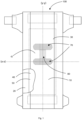
- Fig. 1 illustrates a wearer facing surface of a disposable absorbent article (100) according to an embodiment of the present invention in an extended configuration.
- the disposable absorbent article (100) comprises basically a liquid-pervious topsheet (10), a liquid-impervious backsheet (20) and an absorbent assembly (30) placed between them.
- the disposable absorbent article comprises two opposite longitudinal sides and two opposite transverse sides; the disposable absorbent article (100) can also contain a fastening system, leg and waist elastic zones, front and back ears, transfer layers, containment barriers and other elements well known in the art.
- Fig. 1A shows a transverse cross-section of the disposable absorbent article of Fig. 1 taken along the transverse central axis (X-X).
- the disposable absorbent article (100) comprises a liquid-pervious topsheet (10), an absorbent assembly (30) and a backsheet (20); the absorbent assembly (30) is constituted by an upper core wrap (50), an absorbent core (40) and a lower core wrap (60).
- the absorbent assembly (30) has two longitudinal edges (41, 41'), two transverse edges (42, 42'), a wearer-facing surface (43), a garment-facing surface (44), a longitudinal central axis (Y-Y) and a transverse central axis (X-X).
- the longitudinal central axis (Y-Y) extends along the length of the absorbent assembly (30) so that it defines a left side and a right side, each one of said sides having a substantially equal transverse width; the transverse central axis (X-X) extends along the width of the absorbent assembly (30) defining a front portion (45) and a back portion (46), each one of said portions having a substantially equal length.
- the absorbent core (40) of the invention comprises at least two cavities (70) and at least one connecting line (80) interconnecting them.
- Said absorbent core (40) is comprised of absorbent material which is composed preferably of a mixture of superabsorbent polymer particles (SAP) and cellulosic fibers which could be replaced by other fibers of absorbent material of natural or synthetic origin.
- SAP superabsorbent polymer particles
- the superabsorbent polymer particles are able to absorb and retain fluids many times their own weight and may be in the form of particles, fibers, flakes or the like.
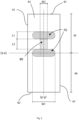
- the cavities (70), as are shown for example in fig. 2 , are substantially free of absorbent material and have a width (W1) in transverse direction and a length (L1) in longitudinal direction.
- cavities according to the invention may have an area between 50 mm 2 and 2500 mm 2 , preferably between 100 mm 2 and 2000 mm 2 , more preferably between 150 mm 2 and 1500 mm 2 .
- the cavities (70) of the invention are longitudinally spaced from each other by a distance between 5 mm and 250 mm, more preferably between 10 mm and 200 mm, even more preferably between 10 mm and 150 mm or between 15 mm and 150 mm.
- they are transversely spaced from each other by a distance between 5 mm and 250 mm, more preferably between 10 mm and 200 mm, even more preferably between 10 mm and 150 mm or between 15 mm and 150 mm.
- These distances between the cavities corresponds to the shortest distance between the perimeter of one cavity and the perimeter of the next cavity in longitudinal or transverse direction.
- the distance in longitudinal direction between two neighboring cavities (70) may correspond to the length (L2) of a connecting line (80).
- the cavities (70) have a circular shape but alternatively, they may have a shape selected from the group consisting of triangles, squares, rectangles, polygons, ovals, semicircles, arrows, crosses, irregular shapes and combinations thereof.
- the absorbent material between each cavity is immobilized thereby helping in maintaining the integrity of the absorbent core (40).
- One function of the at least one connecting line (80) is to spread or distribute the fluids effectively throughout the absorbent core (40), thereby helping in increasing the absorption rate and better using all the absorption capacity of the absorbent core.
- Each connecting line has a width (W2) with respect to the transverse direction and a length (L2) with respect to the longitudinal direction, as can be seen in Fig. 2 .
- the ratio (W2/W1) between the transverse width of the connecting line (W2) and the transverse width of the cavities substantially free of absorbent material (W1) is preferably at most 1, more preferably at most 0.9, even more preferably at most 0.8, so that when a fluid reaches a cavity, it passes quickly through the connecting line(s) directly to another cavity helping in distributing the fluid in the absorbent core.
- the absorbent core (40) of the present invention has a first basis weight (bw1) outside the cavities (70) and the connecting line (80), and a second basis weight (bw2) in the connecting line (80).
- the first basis weight (bw1) is greater than the second basis weight (bw2).
- the ratio (bw2/bw1) between the second basis weight (bw2) and the first basis weight (bw1) is between 0.25 and 0.95, more preferably between 0.35 and 0.85, even more preferably between 0.45 and 0.75.
- the distribution of fluid inside the absorbent core (40) of the present invention may be improved compared with the distribution of fluids in an absorbent core (40) having a constant basis weight.
- the fluid is better distributed, it does not accumulate in small zones and as a result of this, the rewet may be lowered.
- the cavities (70) in conjunction with the connecting line (80) may help for the absorbent assembly (30) having a fast rate of absorption and / or in directing the fluid in order to use all the absorption capacity of the core (40).
- the upper core wrap (50) is permanently attached to the lower core wrap (60) in the cavities (70) by means of adhesive, thermal bonding, pressure bonding, mechanical bonding, ultrasonic bonding or combinations thereof or any other means known in the art.
- the permanent attachment between the upper core wrap (50) and the lower core wrap (60) in the cavities (70) defines bonding zones (90), as can be seen in Fig. 2a which may contribute to the absorbent assembly (30) having a very good integrity given that the absorbent material is immobilized between the cavities (70).
- the upper core wrap and lower core wrap (50, 60) are preferably nonwoven webs made from natural or synthetic fibers and/or combinations thereof; they can be composed of one or more layers bonded together and can be manufactured by any known method.
- the upper core wrap (50) is a hydrophilic nonwoven web having a basis weight between 5 g/m 2 and 20 g/m 2
- the lower core wrap (60) is a hydrophobic or a hydrophilic nonwoven web having a basis weight between about 5 g/m 2 and 20 g/m 2 .
- nine cavities (70) are aligned on the longitudinal central axis (Y-Y) of the absorbent assembly (30), and are interconnected via at least eight longitudinal connecting lines (80), said connecting lines (80) being on the longitudinal central axis (Y-Y).
- FIG. 4 Another embodiment of the present invention is shown in Fig. 4 .
- six cavities (70) have an arrow-shape and are aligned on the longitudinal central axis of the absorbent assembly (30), such that, the arrow-shaped cavities (70) point toward the transverse edges of the absorbent assembly (30).
- Said cavities (70) are interconnected through five longitudinal connection lines (80) on the longitudinal central axis (Y-Y).
- Fig. 5 shows another embodiment of the present invention in which the cavities (70) are disposed in the absorbent core (40) forming a pattern, said pattern comprising two rows of two cavities (70) being interconnected via one longitudinal connecting lines (80). Each row is disposed on each side of the longitudinal central axis (Y-Y) of the absorbent assembly (30) and parallel to it.
- the connecting lines (80) are substantially parallel to the longitudinal central axis (Y-Y).
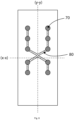
- Fig. 6 shows another embodiment of the present invention in which the cavities (70) form a pattern comprising four rows.
- Each row comprises at least two cavities (70) interconnected via at least one connecting line (80), one row being disposed in the front right quarter of the absorbent assembly (30), the second one being disposed in the front left quarter of the absorbent assembly (30), the third one in the back right quarter of the absorbent assembly (30) and the fourth row in the back left quarter of the absorbent assembly (30) respectively.
- the first row is interconnected to the fourth row via at least one connecting line (80) and the second row is interconnected to the third row via at least one connecting line (80), such that, these connecting lines (80) form an X-shaped pattern.
- Fig. 7 shows another embodiment of the present invention in which, the cavities (70) are disposed in the absorbent core (40) forming a hexagonal pattern, said hexagonal pattern comprising six cavities (70) coinciding with the apex of the hexagonal pattern, and a plurality of connecting lines (80) connecting the cavities (70) such that, the connecting lines (80) define the outer perimeter of the hexagonal pattern.
- one or more connecting lines (80) may comprise regions having the second basis weight (bw2) and other regions having a third basis weight (bw3), so that the first basis weight (bw1) is greater than the second basis weight (bw2), and the second basis weight (bw2) is greater than the third basis weight (bw3).
- the fluid may run in the connecting lines at varying speed, helping the absorbent assembly (30) to be more efficient in the rate of absorption and in the distribution of fluids.
- the cavities (70) may be distributed in the absorbent core forming any pattern. As the discharge of fluids into the absorbent article is made generally in the front portion (45) of the absorbent assembly (30), this front portion (45) is the one that tends to first loss the integrity, thereby losing its capability to absorb and distribute the fluids. Therefore, in a preferred embodiment, more than 50% of the total area of the cavities (70) is disposed in the front portion of the absorbent assembly (30). The total area of the cavities is obtained by adding the individual area of each cavity (70).
- the saline solution should be prepared 4 hours before the test; its shelf life is up to 7 days.
- Embodiment A (not according to the invention): Disposable absorbent baby diaper size "L" containing an absorbent assembly comprising:
- Embodiment B (according to the invention): Disposable absorbent baby diaper size "L" containing an absorbent assembly comprising:
- Embodiment C (according to the invention): Disposable absorbent baby diaper size "L" containing an absorbent assembly comprising:
- Table 4 shows the results obtained for the three embodiments A, B, C. TABLE 4 EMBODIMENT A EMBODIMENT B EMBODIMENT C Total absorption rate after three insults (ml/s) 3.9 4.4 3.17 Rewet after three insults. (g) 20.55 13.05 8.46 Total distribution length after three insults. (mm) 235.4 262.6 276.0 Percentage of use of the absorbent core. (%) 65 73 77
- the absorption rate of embodiment B is around 20% faster than the absorption rate of embodiment A
- the absorption rate of embodiment C is around 30% faster than the absorption rate of embodiment A.
- the return of fluids to the surface of the diaper (rewet) of embodiment B is around 35% lower than the rewet of embodiment A and the rewet of embodiment C is around 60% lower than the rewet of embodiment A.
- the percentage of use of the absorbent core of embodiment B is around 15% greater than the percentage of use of the absorbent core of embodiment A and finally the percentage of use of the absorbent core of embodiment C is around 20% greater than the percentage of use of the absorbent core of embodiment A.
Landscapes
- Health & Medical Sciences (AREA)
- Epidemiology (AREA)
- Engineering & Computer Science (AREA)
- Biomedical Technology (AREA)
- Heart & Thoracic Surgery (AREA)
- Vascular Medicine (AREA)
- Life Sciences & Earth Sciences (AREA)
- Animal Behavior & Ethology (AREA)
- General Health & Medical Sciences (AREA)
- Public Health (AREA)
- Veterinary Medicine (AREA)
- Absorbent Articles And Supports Therefor (AREA)
- Orthopedics, Nursing, And Contraception (AREA)
Description
- This disclosure pertains to the technical field of disposable absorbent articles such as sanitary napkins, panty liners, baby diapers, baby pants, adult diapers, adult pants, adult incontinence pads, etc., having an absorbent assembly with improved integrity, lower return of liquids to the surface (rewet), improved distribution of fluids and a quick rate of absorption.
- The disposable absorbent articles are articles which are used in proximity with the skin of a wearer to absorb and retain body exudates; they are basically constituted by an upper liquid-pervious topsheet, a bottom liquid impervious backsheet and an absorbent core disposed between them. The absorbent core of this kind of articles is generally composed of fibers of absorbent material and / or particles of superabsorbent material; its main functions are to absorb and to retain liquid or semi-liquid exudates from the human body that penetrate through the upper layer of the article. For the absorbent core being effective, it needs to have a good integrity, that is to say, the absorbent core must maintain its structure and does not break or collapse either in a dry or in a wet state. If said absorbent core breaks, its absorption and retention capacity is lost and it is not capable of distributing the fluids properly causing leakage, agglomerations of absorbent material and discomfort to the wearer. Multiple attempts have been made to prevent or minimize the structural breaks of the absorbent cores such as the use of nets, adhesives, core wraps, embossing and others. On the other hand, for an absorbent core having a good functionality, the fluids must be distributed properly along it in order to use its full absorbent capacity; it is also relevant that the fluids penetrate into the absorbent core as quickly as possible in order to preserve the health of the skin of the wearer.
- There are some patents focused on improving the integrity of the absorbent cores, for example the
US Pat. No. 8, 198, 506 andUS Pat No. 7,718,021 (Kimberly Clark Worldwide Inc. ) which disclose a stabilized absorbent composite web and the method for producing it; said absorbent composite comprises a first sheet joined to a second sheet through a plurality of holes formed in the absorbent core. These patents are fully focused on improving the integrity of the absorbent core sacrificing the ability to absorb liquids more quickly as well as the ability to distribute them more evenly and efficiently through the absorbent core. - On the other hand, there are several patents focused in improving the distribution of fluids in the absorbent core using channels. For example the patents listed below refer to absorbent articles comprising an absorbent core with an upper core wrap, a lower core wrap, a fibrous layer and one or more areas free of absorbent material through which the upper core wrap joins to the lower core wrap, such that when the absorbent material swells, the core wrap forms channels along the areas free of absorbent material; these channels also help for having a good rate of absorption of fluids into the core:
US 10,071,002 US 10,130,527 US 9,789,009 US 10,137,039 US 10,335,324 US 10,052,242 US 2018 0360671 ,US 2017 0135871 ,US 2015 0080821 . -
US20150342796A1 from Procter & Gamble refers to an absorbent core comprising a core wrap enclosing superabsorbent particles: the superabsorbent particles form a pattern of dot-shape discrete areas which can be oriented longitudinally or transversely; these areas are separated from each other by areas substantially free of material. -
EP3238676B1 (Procter & Gamble ) describes an absorbent core with first and second longitudinal channels free of absorbent material; the core may further comprise one or more transverse oriented folding lines in which the basis weight of absorbent material reaches a minimum relative to the immediately adjacent regions. - The present invention addresses the technical problems described above and provides an absorbent article with an absorbent assembly with improved integrity which also improves the absorption rate, the rewet and the distribution of fluids inside it, expressed as the percentage of use of the absorbent core, said absorbent article having the features of
claim 1. The at least one connecting line participates for improving the distribution of fluids in the absorbent core. By combining in an absorbent assembly the cavities substantially free of absorbent material, the at least one connecting line interconnecting them and the permanent bonding between the upper and lower core wraps, the resulting absorbent assembly may show all together a very good integrity, a very good distribution of fluids a quick rate of absorption and a low rewet. - The present invention relates to a disposable absorbent article having a longitudinal direction and a transverse direction, the absorbent article comprising a liquid-pervious topsheet, a liquid-impervious backsheet and an absorbent assembly disposed between the topsheet and the backsheet. The absorbent assembly has two longitudinal edges, two transverse edges, a wearer-facing surface, a garment-facing surface, a longitudinal central axis extending along a length of the absorbent assembly and a transverse central axis defining a front portion and a back portion. The absorbent assembly comprises an absorbent core, an upper core wrap and a lower core wrap. The upper core wrap is a hydrophilic nonwoven web having a basis weight between 5 g/m2 and 20 g/m2. The lower core wrap is a hydrophobic or a hydrophilic nonwoven web having a basis weight between 5 g/m2 and 20 g/m2.
- The absorbent core comprises absorbent material comprised by a mixture of superabsorbent polymer and cellulosic fibers. It further comprises at least two cavities substantially free of absorbent material having a width with respect to the transverse central axis and a length with respect to the longitudinal central axis. Said cavities are interconnected via at least one connecting line having a width with respect to the transverse central axis and a length with respect to the longitudinal central axis. The at least one connecting line comprises absorbent material. The absorbent core has a first basis weight in the zone out of the cavities and the connecting lines and a second basis weight in the connecting lines, the first basis weight being greater than the second basis weight. The upper core wrap and the lower core wrap are permanently attached to each other in the cavities.
- In an embodiment of the invention, the at least two cavities of the absorbent core may be aligned on the longitudinal central axis of the absorbent assembly and be interconnected via at least one longitudinal connecting line substantially parallel to the longitudinal central axis. In an alternative embodiment of the invention, the cavities of the absorbent core may form a pattern comprising two rows of at least two cavities, the cavities of each row being longitudinally interconnected via at least one longitudinal connecting line substantially parallel to the longitudinal central axis, each row being disposed on each side of the longitudinal central axis. Both these patterns may provide particularly advantageous integrity, distribution of fluids and quick rate of absorption.
-
-
Fig. 1 shows a plan view of the wearer facing surface of a disposable absorbent article according to the present invention in an extended configuration. -
Fig. 1A is a cross-sectional view of the disposable absorbent article ofFig. 1 taken along the transverse central axis (X-X). -
Fig. 2 representatively illustrates a plan view of the absorbent assembly of a disposable absorbent article according to an embodiment of the present invention. -
Fig. 2a is a longitudinal cross-sectional view of the absorbent assembly ofFig. 2 taken along the longitudinal central axis (Y-Y) -
Fig. 3 Illustrates a plan view of an absorbent assembly of a disposable absorbent article according to an embodiment of the present invention. -
Fig. 4 shows a plan view of another embodiment of the absorbent assembly of a disposable absorbent article according to the present invention. -
Fig. 5 ,6 and7 show plan views of other embodiments of the absorbent assembly of disposable absorbent articles according to the present invention. - All the terms used to define the elements and / or features of the present invention, including technical and scientific terms, have the meaning as commonly understood by one of ordinary skill in the art to which this invention belongs.
- As used herein, the following terms have the following meanings:
- "Absorbent articles" refers to devices that absorb and contain body exudates, and, more specifically, refers to devices that are placed against or in proximity to the body of the wearer to absorb and contain the various exudates discharged from the body. Absorbent articles include baby and adult diapers, baby and adult pants, adult incontinence undergarments, feminine hygiene products, and the like.
- "Topsheet" refers to a liquid permeable substrate forming the inner cover of the absorbent article and which in use is placed in direct contact with the skin of the wearer. The topsheet can comprise a nonwoven material made of natural or synthetic fibers or any mixture of natural or synthetic fibers and made by any method known in the art.
- "Backsheet" refers to a liquid impermeable sheet forming the garment facing surface of the absorbent article. The backsheet prevents body fluids and exudates absorbed by the absorbent article for passing through it. The backsheet may comprise a thin plastic film such as a thermoplastic film (e.g. a polyethylene or polypropylene film) or it could be a laminate comprised by a thin impermeable film and a nonwoven web. The materials which are commonly used as backsheets may include breathable materials which permit vapors to pass through it still preventing, fluids for passing through the backsheet.
- "Absorbent assembly" refers to the combination of an absorbent core enclosed by at least one core wrap.
- "Core wrap" refers to one or more substrate layers that enclose the absorbent core and can comprise one or more layers of nonwoven material made of mono or bicomponent natural or synthetic fibers such as, but not limited to polyester, polyethylene, polypropylene, viscose, rayon, cotton, polyhydroxyalkanoates, etc., they may comprise hydrophilic and / or hydrophobic treatments.
- "Absorbent core" refers to a structure for the absorption and containment of body exudates, said absorbent core is comprised by absorbent materials such as, but not limited to cellulosic fluff pulp, tissue layers, superabsorbent polymer particles (SAP), absorbent foam materials, absorbent nonwoven materials or mixtures thereof; the absorbent core can have any shape as for example a rectangular shape, an anatomical shape, an hourglass-shape, a "T" shape or any other one known in the art.
- "Cavities" refers to areas substantially free of absorbent material located in the absorbent core.
- "Connecting lines" refers to substantially rectilinear regions that interconnect at least two cavities to each other. Contrary to the cavities, the connecting lines contain some absorbent material having a lower basis weight than the rest of the absorbent core.
- "Attached" refers to the relationship between two or more elements, which can be joined to each other in any known way, such as but not limited to ultrasonic bonding, mechanical bonding, thermal bonding, by adhesives, or the like.
- Embodiments of articles according to the present invention will now be described, from here on, in relation to a disposable diaper, but it is understood that the absorbent article may be selected from disposable diapers, disposable adult pants, disposable baby pants, adult incontinence pads, sanitary napkins and the like. The technical features described in one or more embodiments may be combined with one or more other embodiments without departing from the intention of the disclosure and without generalization thereof.
-
Fig. 1 illustrates a wearer facing surface of a disposable absorbent article (100) according to an embodiment of the present invention in an extended configuration. As can be seen, the disposable absorbent article (100) comprises basically a liquid-pervious topsheet (10), a liquid-impervious backsheet (20) and an absorbent assembly (30) placed between them. The disposable absorbent article comprises two opposite longitudinal sides and two opposite transverse sides; the disposable absorbent article (100) can also contain a fastening system, leg and waist elastic zones, front and back ears, transfer layers, containment barriers and other elements well known in the art. -
Fig. 1A shows a transverse cross-section of the disposable absorbent article ofFig. 1 taken along the transverse central axis (X-X). The disposable absorbent article (100) comprises a liquid-pervious topsheet (10), an absorbent assembly (30) and a backsheet (20); the absorbent assembly (30) is constituted by an upper core wrap (50), an absorbent core (40) and a lower core wrap (60). - The absorbent assembly (30) has two longitudinal edges (41, 41'), two transverse edges (42, 42'), a wearer-facing surface (43), a garment-facing surface (44), a longitudinal central axis (Y-Y) and a transverse central axis (X-X). The longitudinal central axis (Y-Y) extends along the length of the absorbent assembly (30) so that it defines a left side and a right side, each one of said sides having a substantially equal transverse width; the transverse central axis (X-X) extends along the width of the absorbent assembly (30) defining a front portion (45) and a back portion (46), each one of said portions having a substantially equal length. The absorbent core (40) of the invention comprises at least two cavities (70) and at least one connecting line (80) interconnecting them.
- Said absorbent core (40) is comprised of absorbent material which is composed preferably of a mixture of superabsorbent polymer particles (SAP) and cellulosic fibers which could be replaced by other fibers of absorbent material of natural or synthetic origin. The superabsorbent polymer particles are able to absorb and retain fluids many times their own weight and may be in the form of particles, fibers, flakes or the like.
- The cavities (70), as are shown for example in
fig. 2 , are substantially free of absorbent material and have a width (W1) in transverse direction and a length (L1) in longitudinal direction. - Advantageously, cavities according to the invention may have an area between 50 mm2 and 2500 mm2, preferably between 100 mm2 and 2000 mm2, more preferably between 150 mm2 and 1500 mm2.
- Preferably, the cavities (70) of the invention are longitudinally spaced from each other by a distance between 5 mm and 250 mm, more preferably between 10 mm and 200 mm, even more preferably between 10 mm and 150 mm or between 15 mm and 150 mm. Advantageously, they are transversely spaced from each other by a distance between 5 mm and 250 mm, more preferably between 10 mm and 200 mm, even more preferably between 10 mm and 150 mm or between 15 mm and 150 mm. These distances between the cavities corresponds to the shortest distance between the perimeter of one cavity and the perimeter of the next cavity in longitudinal or transverse direction. The distance in longitudinal direction between two neighboring cavities (70) may correspond to the length (L2) of a connecting line (80).
- In a preferred embodiment, the cavities (70) have a circular shape but alternatively, they may have a shape selected from the group consisting of triangles, squares, rectangles, polygons, ovals, semicircles, arrows, crosses, irregular shapes and combinations thereof.
- As the upper and lower core wraps are permanently attached in these cavities, the absorbent material between each cavity is immobilized thereby helping in maintaining the integrity of the absorbent core (40). These dimensions and shapes have proven to help in providing this integrity.
- One function of the at least one connecting line (80) is to spread or distribute the fluids effectively throughout the absorbent core (40), thereby helping in increasing the absorption rate and better using all the absorption capacity of the absorbent core. Each connecting line has a width (W2) with respect to the transverse direction and a length (L2) with respect to the longitudinal direction, as can be seen in
Fig. 2 . The ratio (W2/W1) between the transverse width of the connecting line (W2) and the transverse width of the cavities substantially free of absorbent material (W1) is preferably at most 1, more preferably at most 0.9, even more preferably at most 0.8, so that when a fluid reaches a cavity, it passes quickly through the connecting line(s) directly to another cavity helping in distributing the fluid in the absorbent core. - The absorbent core (40) of the present invention has a first basis weight (bw1) outside the cavities (70) and the connecting line (80), and a second basis weight (bw2) in the connecting line (80). The first basis weight (bw1) is greater than the second basis weight (bw2). Preferably, the ratio (bw2/bw1) between the second basis weight (bw2) and the first basis weight (bw1) is between 0.25 and 0.95, more preferably between 0.35 and 0.85, even more preferably between 0.45 and 0.75. These ratios are advantageous in that the fluid may be transported more quickly in the areas having less basis weight. For this reason, the distribution of fluid inside the absorbent core (40) of the present invention may be improved compared with the distribution of fluids in an absorbent core (40) having a constant basis weight. In addition, as the fluid is better distributed, it does not accumulate in small zones and as a result of this, the rewet may be lowered. On the other side, the cavities (70) in conjunction with the connecting line (80) may help for the absorbent assembly (30) having a fast rate of absorption and / or in directing the fluid in order to use all the absorption capacity of the core (40).
- In preferred embodiments of the present invention, the upper core wrap (50) is permanently attached to the lower core wrap (60) in the cavities (70) by means of adhesive, thermal bonding, pressure bonding, mechanical bonding, ultrasonic bonding or combinations thereof or any other means known in the art. The permanent attachment between the upper core wrap (50) and the lower core wrap (60) in the cavities (70) defines bonding zones (90), as can be seen in
Fig. 2a which may contribute to the absorbent assembly (30) having a very good integrity given that the absorbent material is immobilized between the cavities (70). The upper core wrap and lower core wrap (50, 60) are preferably nonwoven webs made from natural or synthetic fibers and/or combinations thereof; they can be composed of one or more layers bonded together and can be manufactured by any known method. According to the present invention, the upper core wrap (50) is a hydrophilic nonwoven web having a basis weight between 5 g/m2 and 20 g/m2 and the lower core wrap (60) is a hydrophobic or a hydrophilic nonwoven web having a basis weight between about 5 g/m2 and 20 g/m2. - In an embodiment of the present invention shown in
Fig. 3 , nine cavities (70) are aligned on the longitudinal central axis (Y-Y) of the absorbent assembly (30), and are interconnected via at least eight longitudinal connecting lines (80), said connecting lines (80) being on the longitudinal central axis (Y-Y). - Another embodiment of the present invention is shown in
Fig. 4 . In this embodiment, six cavities (70) have an arrow-shape and are aligned on the longitudinal central axis of the absorbent assembly (30), such that, the arrow-shaped cavities (70) point toward the transverse edges of the absorbent assembly (30). Said cavities (70) are interconnected through five longitudinal connection lines (80) on the longitudinal central axis (Y-Y). -
Fig. 5 shows another embodiment of the present invention in which the cavities (70) are disposed in the absorbent core (40) forming a pattern, said pattern comprising two rows of two cavities (70) being interconnected via one longitudinal connecting lines (80). Each row is disposed on each side of the longitudinal central axis (Y-Y) of the absorbent assembly (30) and parallel to it. The connecting lines (80) are substantially parallel to the longitudinal central axis (Y-Y). -
Fig. 6 shows another embodiment of the present invention in which the cavities (70) form a pattern comprising four rows. Each row comprises at least two cavities (70) interconnected via at least one connecting line (80), one row being disposed in the front right quarter of the absorbent assembly (30), the second one being disposed in the front left quarter of the absorbent assembly (30), the third one in the back right quarter of the absorbent assembly (30) and the fourth row in the back left quarter of the absorbent assembly (30) respectively. The first row is interconnected
to the fourth row via at least one connecting line (80) and the second row is interconnected to the third row via at least one connecting line (80), such that, these connecting lines (80) form an X-shaped pattern. -
Fig. 7 shows another embodiment of the present invention in which, the cavities (70) are disposed in the absorbent core (40) forming a hexagonal pattern, said hexagonal pattern comprising six cavities (70) coinciding with the apex of the hexagonal pattern, and a plurality of connecting lines (80) connecting the cavities (70) such that, the connecting lines (80) define the outer perimeter of the hexagonal pattern. - In some embodiments of the invention, one or more connecting lines (80) may comprise regions having the second basis weight (bw2) and other regions having a third basis weight (bw3), so that the first basis weight (bw1) is greater than the second basis weight (bw2), and the second basis weight (bw2) is greater than the third basis weight (bw3). In this way the fluid may run in the connecting lines at varying speed, helping the absorbent assembly (30) to be more efficient in the rate of absorption and in the distribution of fluids.
- The cavities (70) may be distributed in the absorbent core forming any pattern. As the discharge of fluids into the absorbent article is made generally in the front portion (45) of the absorbent assembly (30), this front portion (45) is the one that tends to first loss the integrity, thereby losing its capability to absorb and distribute the fluids. Therefore, in a preferred embodiment, more than 50% of the total area of the cavities (70) is disposed in the front portion of the absorbent assembly (30). The total area of the cavities is obtained by adding the individual area of each cavity (70).
- Materials:
- Synthetic urine (0.9% saline solution)
- Universal support
- Semi-analytical balance with precision of 0.01g;
- Calculator
- Stopwatch
- Metal scale
- Separation funnel 125 mL (7 mL / s or equivalent);
- Tissue paper previously cut to square 100 mm x 100 mm;
-
Test tube 100 ml; - Stainless steel dosing ring (internal Ø 53 mm /
height 50 mm and wall thickness 3 mm); - Weight 2.5 kg (external Ø 76 mm and
height 70 mm); - Disposable absorbent articles
- Separation funnel fitting ring with internal Ø 55 mm
- Procedure:
- 1. Prepare the synthetic urine.
- 2. Stack and weigh an amount of absorbent paper, according to the values measured in table 1.
- 3. Record the weight (Dry weight of the absorbent paper) to measure the fluid returns (first, second and third);
- 4. Measure the absorbent core length and record this length.
- 5. Cut and remove the leg elastics to keep the product taut. For underwear, tear the side seal of the product and use scissors to cut the outline of the polyethylene film. Then position / stick the product with the outer side on an acrylic plate with hook strips at the ends to keep the product straight.
- 6. Mark the insult zone in the disposable absorbent article (drawing an horizontal line on the frontal portion of the disposable absorbent article at a distance of 5.0 cm to the transverse central axis (X-X) and position the dosing ring over the horizontal line and aligned with the longitudinal central axis (Y-Y). The zone inside the dosing ring is the insult zone.
- 7. For each disposable absorbent article / size analyzed, measure an amount of synthetic urine (showed in Table 2, Table 3) and place it in the funnel.
- 8. Place the tip of the funnel about 1.0 cm from the top end of the dosing ring.
- 9. Open the funnel valve and start the timer when the liquid contacts the product, stop the timer as soon as all the synthetic urine is absorbed and record the time as the primary acquisition time (first time).
- 10. Once all synthetic urine has been absorbed, wait 10 minutes and place the previously weighed 15.0 g absorbent paper stack centered over the marked area of insult, put the 2.50 kg weight on the absorbent paper stack and wait for 2 minutes. Mark the point at the front and back portions of the absorbent core as far as the liquid went, measure the length of the stain created by the synthetic urine, record the length as the primary fluid distribution (first distribution).
- 11. After 2 minutes, remove the weight of 2.50 kg, weigh and record the weight of the absorbent paper stack (wet weight);
- 12. Repeat the previous steps to measure the second and third return, distribution and time. (The laboratory test must be carried out with 5 different samples, then the values obtained are averaged in order to have a reliable result.)
- Return (g) = Weight of the absorbent paper (g) - Dry weight of the absorbent paper (g)
- Rate of absorption (ml/s) = Amount of synthetic urine (ml) / time of absorption (s).
- Total distribution (mm) = Third measured length of the stain (mm).
- Percentage of use of the absorbent core = [Total distribution (mm) * 100] / Length of the core (mm)
-
- 2 L volumetric flask;
- Coloring;
- Sodium chloride;
- Deionized water.
- Procedure:
- 1. Weigh 18 g of sodium chloride and transfer to a 2.0 L volumetric flask.
- 2. Dissolve and complete to volume with deionized water.
- 3. Add a small portion of coloring to the solution
- The saline solution should be prepared 4 hours before the test; its shelf life is up to 7 days.
-
TABLE 1 Absorbent paper weight Primary Return 15,0 g (+/- 0,5 g) Secondary Return 30,0 g (+/- 0,5 g) Tertiary Return 30,0 g (+/- 0,5 g) TABLE 2 Infants Size Newborn Small Medium Large XL XXL Quantity (ml.) 40 40 60 80 100 100 TABLE 3 Adults Size Youth Small Medium Large XL Quantity (ml.) 40 40 60 80 100 - Embodiment A (not according to the invention): Disposable absorbent baby diaper size "L" containing an absorbent assembly comprising:
- an upper core wrap and a lower core wrap having a basis weight of 8 g/m2 each and
- an absorbent core without cavities and connecting lines containing 7g of cellulosic fibers and 10.5 g of superabsorbent polymer (SAP) and having a basis weight (bw1) of 505.56 g/m2.
- Embodiment B (according to the invention): Disposable absorbent baby diaper size "L" containing an absorbent assembly comprising:
- an upper core wrap and a lower core wrap having a basis weight of 8 g/m2 each one and
- an absorbent core containing 7g of cellulosic fibers and 10.5 g of superabsorbent polymer (SAP) and having six bar shaped cavities (70) [each one with an area of around 306 mm2] aligned on the longitudinal central axis (Y-Y) interconnected via five longitudinal connecting lines (80). The absorbent core has a basis weight (bw1) of 397 g/m2 and each one of the connecting lines has a basis weight (bw2) of 291.12 g/m2.
- Embodiment C (according to the invention): Disposable absorbent baby diaper size "L" containing an absorbent assembly comprising:
- an upper core wrap and a lower core wrap each one having a basis weight of 8 g/m2 and
- an absorbent core containing 7g of cellulosic fibers and 10.5 g of superabsorbent polymer (SAP) and having six arrow-shaped cavities (70) [each one with an area of around 378mm2] aligned on the longitudinal central axis (Y-Y) interconnected via five longitudinal connecting lines (80). The absorbent core has a basis weight (bw1) of 557 g/m2 and each one of the connecting lines has a basis weight (bw2) of 339 g/m2.
- Table 4 shows the results obtained for the three embodiments A, B, C.
TABLE 4 EMBODIMENT A EMBODIMENT B EMBODIMENT C Total absorption rate after three insults (ml/s) 3.9 4.4 3.17 Rewet after three insults. (g) 20.55 13.05 8.46 Total distribution length after three insults. (mm) 235.4 262.6 276.0 Percentage of use of the absorbent core. (%) 65 73 77 - According to these results, the absorption rate of embodiment B is around 20% faster than the absorption rate of embodiment A, and the absorption rate of embodiment C is around 30% faster than the absorption rate of embodiment A. The return of fluids to the surface of the diaper (rewet) of embodiment B is around 35% lower than the rewet of embodiment A and the rewet of embodiment C is around 60% lower than the rewet of embodiment A. The percentage of use of the absorbent core of embodiment B is around 15% greater than the percentage of use of the absorbent core of embodiment A and finally the percentage of use of the absorbent core of embodiment C is around 20% greater than the percentage of use of the absorbent core of embodiment A.
Claims (12)
- A disposable absorbent article (100) having a longitudinal direction and a transverse direction, the absorbent article comprising:▪ a liquid-pervious topsheet (10),▪ a liquid-impervious backsheet (20) and▪ an absorbent assembly (30) disposed between the topsheet (10) and the backsheet (20) and having two longitudinal edges (41, 41'), two transverse edges (42, 42'), a wearer-facing surface (43), a garment-facing surface (44), a longitudinal central axis (Y-Y) extending along a length of the absorbent assembly (30) and a transverse central axis (X-X) defining a front portion (45) and a back portion (46), the absorbent assembly (30) comprising:- an absorbent core (40),- an upper core wrap (50) which is a hydrophilic nonwoven web having a basis weight between 5 g/m2 and 20 g/m2 and- a lower core wrap (60) which is a hydrophobic or a hydrophilic nonwoven web having a basis weight between 5 g/m2 and 20 g/m2,wherein the absorbent core (40) comprises absorbent material comprised by a mixture of superabsorbent polymer and cellulosic fibers,wherein the absorbent core (40) comprises at least two cavities (70) free of absorbent material having a width (W1) with respect to the transverse central axis (X-X) and a length (L1) with respect to the longitudinal central axis (Y-Y), said cavities (70) being interconnected via at least one connecting line (80) having a width (W2) with respect to the transverse central axis (X-X) and a length (L2) with respect to the longitudinal central axis (Y-Y), the at least one connecting line (80) comprising absorbent material,wherein the absorbent core (40) has a first basis weight (bw1) in the zone out of the cavities (70) and the connecting lines (80), and a second basis weight (bw2) in the connecting lines, the first basis weight (bw1) being greater than the second basis weight (bw2), andwherein the upper core wrap (50) and the lower core wrap (60) are permanently attached to each other in the cavities (70).
- The disposable absorbent article (100) according to claim 1, wherein the at least two cavities (70) are aligned on the longitudinal central axis (Y-Y) of the absorbent assembly (30) and interconnected via at least one longitudinal connecting line (80) substantially parallel to the longitudinal central axis (Y-Y).
- The disposable absorbent article (100) according to claim 1, wherein the cavities (70) form a pattern, the pattern comprising two rows of at least two cavities (70), the cavities (70) of each row being longitudinally interconnected via at least one longitudinal connecting line (80) substantially parallel to the longitudinal central axis (Y-Y), each row being disposed on each side of the longitudinal central axis (Y-Y).
- The disposable absorbent article (100) according to any of the preceding claims, wherein the cavities (70) are longitudinally spaced from each other by a distance between 5 mm and 250 mm and are transversely spaced from each other by a distance between 5 mm and 250 mm.
- The disposable absorbent article (100) according to any of the preceding claims, wherein the cavities (70) have a shape selected from the group consisting of triangles, squares, rectangles, polygons, circles, ovals, semi-circles, arrow-shapes, crosses, irregular shapes and combinations thereof.
- The disposable absorbent article (100) according to any of the preceding claims, wherein the cavities (70) have an area between 50 mm2 and 2500 mm2.
- The disposable absorbent article according to any of the preceding claims, wherein more than 50% of the total area of the cavities (70) is disposed in the front portion (45) of the absorbent assembly (30).
- The disposable absorbent article according to any of the preceding claims, wherein the ratio (W2/W1) between the transverse width (W2) of the at least one connecting line and the transverse width (W1) of the cavities (70) is at most 1.
- The disposable absorbent article according to any of the preceding claims, wherein the ratio (bw2/bw1) between the second basis weight (bw2) and the first basis weight (bw1) is between 0.25 and 0.95
- The disposable absorbent article according to any of the preceding claims, wherein the upper core wrap (50) is permanently attached to the lower core wrap (60) in the cavities (70) by means of adhesive, thermal bonding, pressure bonding, mechanical bonding, ultrasonic bonding or combinations thereof.
- The disposable absorbent article according to any of the preceding claims, wherein said disposable absorbent article (100) is selected from the group consisting of baby diapers, adult diapers, baby pants, adult pants, adult incontinence undergarments or pads, sanitary napkins and panty liners.
- The disposable absorbent article according to any of the preceding claims, wherein one or more connecting lines (80) comprise regions having the second basis weight (bw2) and regions having a third basis weight (bw3), wherein the first basis weight (bw1) is greater than the second basis weight (bw2), and the second basis weight (bw2) is greater than the third basis weight (bw3).
Priority Applications (8)
| Application Number | Priority Date | Filing Date | Title |
|---|---|---|---|
| ES19219034T ES3027665T3 (en) | 2019-12-20 | 2019-12-20 | Absorbent core for disposable absorbent articles with increased absorption rate and improved integrity |
| EP19219034.6A EP3838242B1 (en) | 2019-12-20 | 2019-12-20 | Absorbent core for disposable absorbent articles with increased absorption rate and improved integrity |
| EP25172902.6A EP4585199A3 (en) | 2019-12-20 | 2019-12-20 | Absorbent core for disposable absorbent articles with increased absorption rate and improved integrity |
| EP20838460.2A EP4076321B1 (en) | 2019-12-20 | 2020-12-18 | Absorbent core for disposable absorbent articles with increased absorption rate and improved integrity |
| PCT/EP2020/087098 WO2021123221A1 (en) | 2019-12-20 | 2020-12-18 | Absorbent core for disposable absorbent articles with increased absorption rate and improved integrity |
| ES20838460T ES2969009T3 (en) | 2019-12-20 | 2020-12-18 | Absorbent core for disposable absorbent articles with higher absorption rate and improved integrity |
| US17/787,032 US11679040B2 (en) | 2019-12-20 | 2020-12-18 | Absorbent core for disposable absorbent articles with increased absorption rate and improved integrity |
| US18/144,223 US20240041669A1 (en) | 2019-12-20 | 2023-05-07 | Absorbent core for disposable absorbent articles with increased absorption rate and improved integrity |
Applications Claiming Priority (1)
| Application Number | Priority Date | Filing Date | Title |
|---|---|---|---|
| EP19219034.6A EP3838242B1 (en) | 2019-12-20 | 2019-12-20 | Absorbent core for disposable absorbent articles with increased absorption rate and improved integrity |
Related Child Applications (1)
| Application Number | Title | Priority Date | Filing Date |
|---|---|---|---|
| EP25172902.6A Division EP4585199A3 (en) | 2019-12-20 | 2019-12-20 | Absorbent core for disposable absorbent articles with increased absorption rate and improved integrity |
Publications (3)
| Publication Number | Publication Date |
|---|---|
| EP3838242A1 EP3838242A1 (en) | 2021-06-23 |
| EP3838242C0 EP3838242C0 (en) | 2025-04-30 |
| EP3838242B1 true EP3838242B1 (en) | 2025-04-30 |
Family
ID=69005425
Family Applications (3)
| Application Number | Title | Priority Date | Filing Date |
|---|---|---|---|
| EP19219034.6A Active EP3838242B1 (en) | 2019-12-20 | 2019-12-20 | Absorbent core for disposable absorbent articles with increased absorption rate and improved integrity |
| EP25172902.6A Pending EP4585199A3 (en) | 2019-12-20 | 2019-12-20 | Absorbent core for disposable absorbent articles with increased absorption rate and improved integrity |
| EP20838460.2A Active EP4076321B1 (en) | 2019-12-20 | 2020-12-18 | Absorbent core for disposable absorbent articles with increased absorption rate and improved integrity |
Family Applications After (2)
| Application Number | Title | Priority Date | Filing Date |
|---|---|---|---|
| EP25172902.6A Pending EP4585199A3 (en) | 2019-12-20 | 2019-12-20 | Absorbent core for disposable absorbent articles with increased absorption rate and improved integrity |
| EP20838460.2A Active EP4076321B1 (en) | 2019-12-20 | 2020-12-18 | Absorbent core for disposable absorbent articles with increased absorption rate and improved integrity |
Country Status (4)
| Country | Link |
|---|---|
| US (2) | US11679040B2 (en) |
| EP (3) | EP3838242B1 (en) |
| ES (2) | ES3027665T3 (en) |
| WO (1) | WO2021123221A1 (en) |
Families Citing this family (8)
| Publication number | Priority date | Publication date | Assignee | Title |
|---|---|---|---|---|
| ES3027665T3 (en) * | 2019-12-20 | 2025-06-16 | Ontex Bv | Absorbent core for disposable absorbent articles with increased absorption rate and improved integrity |
| JP2023097913A (en) * | 2021-12-28 | 2023-07-10 | 株式会社リブドゥコーポレーション | absorbent article |
| CN116392324B (en) * | 2023-03-15 | 2024-12-13 | 佛山市南海区西樵啟丰卫生用品有限公司 | A hollowing process and a sanitary napkin |
| EP4450040A1 (en) | 2023-04-20 | 2024-10-23 | Ontex BV | Absorbent article with channel(s) |
| EP4450035A1 (en) | 2023-04-20 | 2024-10-23 | Ontex BV | Absorbent article and method of making |
| EP4450036A1 (en) | 2023-04-20 | 2024-10-23 | Ontex BV | Absorbent article with functional core matrix |
| EP4450034A1 (en) | 2023-04-20 | 2024-10-23 | Ontex BV | Improved absorbent articles and methods of making |
| CN118873331B (en) * | 2024-10-09 | 2024-12-24 | 泉州市嘉华卫生用品有限公司 | A core body for urine and feces partition absorption and its production process |
Citations (10)
| Publication number | Priority date | Publication date | Assignee | Title |
|---|---|---|---|---|
| US5433715A (en) | 1993-10-29 | 1995-07-18 | Kimberly-Clark Corporation | Absorbent article which includes superabsorbent material located in discrete pockets having water-sensitive and water-insensitive containment structures |
| US20090270825A1 (en) | 2008-04-29 | 2009-10-29 | Maja Wciorka | Disposable Absorbent Article With Absorbent Particulate Polymer Material Distributed For Improved Isolation Of Body Exudates |
| US7744576B2 (en) | 2003-02-12 | 2010-06-29 | The Procter & Gamble Company | Thin and dry diaper |
| US20110268932A1 (en) | 2010-04-30 | 2011-11-03 | Kemal Vatansever Catalan | Nonwoven Having Durable Hydrophilic Coating |
| US20110319848A1 (en) | 2010-06-28 | 2011-12-29 | Mckiernan Robin Lynn | Substrate Coated With A Hydrophilic Elastomer |
| US20160206482A1 (en) | 2015-01-16 | 2016-07-21 | The Procter & Gamble Company | Absorbent pant with advantageously channeled absorbent core structure and bulge-reducing features |
| EP3238678A1 (en) | 2016-04-29 | 2017-11-01 | The Procter and Gamble Company | Absorbent core with transversal folding lines |
| EP3315106A1 (en) | 2016-10-31 | 2018-05-02 | The Procter and Gamble Company | Absorbent article with an intermediate layer comprising channels and back pocket |
| WO2018210754A1 (en) | 2017-05-15 | 2018-11-22 | Drylock Technologies Nv | Absorbent article with channels and method for manufacturing thereof |
| WO2019170801A1 (en) | 2018-03-09 | 2019-09-12 | Drylock Technologies Nv | Absorbent article with channels and method for manufacturing thereof |
Family Cites Families (14)
| Publication number | Priority date | Publication date | Assignee | Title |
|---|---|---|---|---|
| JP4455241B2 (en) * | 2004-09-14 | 2010-04-21 | ユニ・チャーム株式会社 | Sanitary napkin |
| US7718021B2 (en) | 2006-04-21 | 2010-05-18 | Kimberly-Clark Worldwide, Inc. | Method for making a stabilized absorbent composite |
| US8198506B2 (en) | 2006-04-21 | 2012-06-12 | Kimberly-Clark Worldwide, Inc. | Stabilized absorbent composite |
| US10639215B2 (en) * | 2012-12-10 | 2020-05-05 | The Procter & Gamble Company | Absorbent articles with channels and/or pockets |
| PL2813201T3 (en) | 2013-06-14 | 2018-04-30 | The Procter And Gamble Company | Absorbent article and absorbent core forming channels when wet |
| US9789011B2 (en) | 2013-08-27 | 2017-10-17 | The Procter & Gamble Company | Absorbent articles with channels |
| EP2851048B1 (en) | 2013-09-19 | 2018-09-05 | The Procter and Gamble Company | Absorbent cores having material free areas |
| EP2886092B1 (en) | 2013-12-19 | 2016-09-14 | The Procter and Gamble Company | Absorbent cores having channel-forming areas and c-wrap seals |
| US9789009B2 (en) | 2013-12-19 | 2017-10-17 | The Procter & Gamble Company | Absorbent articles having channel-forming areas and wetness indicator |
| ES2643577T3 (en) * | 2014-05-27 | 2017-11-23 | The Procter & Gamble Company | Absorbent core with absorbent material design |
| EP3167859B1 (en) | 2015-11-16 | 2020-05-06 | The Procter and Gamble Company | Absorbent cores having material free areas |
| EP3238676B1 (en) * | 2016-04-29 | 2019-01-02 | The Procter and Gamble Company | Absorbent core with profiled distribution of absorbent material |
| PL3403627T3 (en) * | 2017-05-15 | 2019-11-29 | Drylock Tech Nv | Absorbent article with channels and method for manufacturing thereof |
| ES3027665T3 (en) * | 2019-12-20 | 2025-06-16 | Ontex Bv | Absorbent core for disposable absorbent articles with increased absorption rate and improved integrity |
-
2019
- 2019-12-20 ES ES19219034T patent/ES3027665T3/en active Active
- 2019-12-20 EP EP19219034.6A patent/EP3838242B1/en active Active
- 2019-12-20 EP EP25172902.6A patent/EP4585199A3/en active Pending
-
2020
- 2020-12-18 WO PCT/EP2020/087098 patent/WO2021123221A1/en not_active Ceased
- 2020-12-18 US US17/787,032 patent/US11679040B2/en active Active
- 2020-12-18 ES ES20838460T patent/ES2969009T3/en active Active
- 2020-12-18 EP EP20838460.2A patent/EP4076321B1/en active Active
-
2023
- 2023-05-07 US US18/144,223 patent/US20240041669A1/en not_active Abandoned
Patent Citations (11)
| Publication number | Priority date | Publication date | Assignee | Title |
|---|---|---|---|---|
| US5433715A (en) | 1993-10-29 | 1995-07-18 | Kimberly-Clark Corporation | Absorbent article which includes superabsorbent material located in discrete pockets having water-sensitive and water-insensitive containment structures |
| US7744576B2 (en) | 2003-02-12 | 2010-06-29 | The Procter & Gamble Company | Thin and dry diaper |
| US20090270825A1 (en) | 2008-04-29 | 2009-10-29 | Maja Wciorka | Disposable Absorbent Article With Absorbent Particulate Polymer Material Distributed For Improved Isolation Of Body Exudates |
| US20110268932A1 (en) | 2010-04-30 | 2011-11-03 | Kemal Vatansever Catalan | Nonwoven Having Durable Hydrophilic Coating |
| US20110319848A1 (en) | 2010-06-28 | 2011-12-29 | Mckiernan Robin Lynn | Substrate Coated With A Hydrophilic Elastomer |
| US20160206482A1 (en) | 2015-01-16 | 2016-07-21 | The Procter & Gamble Company | Absorbent pant with advantageously channeled absorbent core structure and bulge-reducing features |
| EP3238678A1 (en) | 2016-04-29 | 2017-11-01 | The Procter and Gamble Company | Absorbent core with transversal folding lines |
| US20170312147A1 (en) | 2016-04-29 | 2017-11-02 | The Procter & Gamble Company | Absorbent core with transversal folding lines |
| EP3315106A1 (en) | 2016-10-31 | 2018-05-02 | The Procter and Gamble Company | Absorbent article with an intermediate layer comprising channels and back pocket |
| WO2018210754A1 (en) | 2017-05-15 | 2018-11-22 | Drylock Technologies Nv | Absorbent article with channels and method for manufacturing thereof |
| WO2019170801A1 (en) | 2018-03-09 | 2019-09-12 | Drylock Technologies Nv | Absorbent article with channels and method for manufacturing thereof |
Also Published As
| Publication number | Publication date |
|---|---|
| ES2969009T3 (en) | 2024-05-16 |
| ES3027665T3 (en) | 2025-06-16 |
| EP4076321C0 (en) | 2024-01-03 |
| EP3838242A1 (en) | 2021-06-23 |
| US11679040B2 (en) | 2023-06-20 |
| EP3838242C0 (en) | 2025-04-30 |
| US20240041669A1 (en) | 2024-02-08 |
| WO2021123221A1 (en) | 2021-06-24 |
| EP4076321A1 (en) | 2022-10-26 |
| EP4585199A3 (en) | 2025-09-17 |
| EP4076321B1 (en) | 2024-01-03 |
| US20230081440A1 (en) | 2023-03-16 |
| EP4585199A2 (en) | 2025-07-16 |
Similar Documents
| Publication | Publication Date | Title |
|---|---|---|
| EP3838242B1 (en) | Absorbent core for disposable absorbent articles with increased absorption rate and improved integrity | |
| US6548732B2 (en) | Absorbent article having hydrophobic leak protection zones | |
| AU2004325279B2 (en) | Absorbent article | |
| CA2210203C (en) | Absorbent article with expandable backsheet | |
| US9301890B2 (en) | Absorbent articles in a unitary package | |
| EP0959840B1 (en) | Absorbent article having a breathability gradient | |
| AU734954B2 (en) | Absorbent article having an opening for feces in the topsheet | |
| US20130184666A1 (en) | Disposable wearing article | |
| US20220304867A1 (en) | Multi-piece absorbent articles and arrays thereof | |
| US6852101B2 (en) | Liquid absorbent pad having a single large through slit and absorbent article comprising same | |
| WO2020251438A1 (en) | Absorbent article | |
| US20040220539A1 (en) | Absorbent article with improved absorbency performance | |
| US20030078557A1 (en) | Absorbent article having double vertical cuff assembly | |
| JP7812651B2 (en) | absorbent articles | |
| AU7065800A (en) | Refastenable absorbent article | |
| JP2023174068A (en) | Auxiliary absorbent articles | |
| HK1004107B (en) | Absorbent article with expandable backsheet |
Legal Events
| Date | Code | Title | Description |
|---|---|---|---|
| PUAI | Public reference made under article 153(3) epc to a published international application that has entered the european phase |
Free format text: ORIGINAL CODE: 0009012 |
|
| STAA | Information on the status of an ep patent application or granted ep patent |
Free format text: STATUS: REQUEST FOR EXAMINATION WAS MADE |
|
| 17P | Request for examination filed |
Effective date: 20191220 |
|
| AK | Designated contracting states |
Kind code of ref document: A1 Designated state(s): AL AT BE BG CH CY CZ DE DK EE ES FI FR GB GR HR HU IE IS IT LI LT LU LV MC MK MT NL NO PL PT RO RS SE SI SK SM TR |
|
| GRAP | Despatch of communication of intention to grant a patent |
Free format text: ORIGINAL CODE: EPIDOSNIGR1 |
|
| STAA | Information on the status of an ep patent application or granted ep patent |
Free format text: STATUS: GRANT OF PATENT IS INTENDED |
|
| RIC1 | Information provided on ipc code assigned before grant |
Ipc: A61F 13/53 20060101ALI20230602BHEP Ipc: A61F 13/531 20060101ALI20230602BHEP Ipc: A61F 13/532 20060101AFI20230602BHEP |
|
| INTG | Intention to grant announced |
Effective date: 20230622 |
|
| GRAJ | Information related to disapproval of communication of intention to grant by the applicant or resumption of examination proceedings by the epo deleted |
Free format text: ORIGINAL CODE: EPIDOSDIGR1 |
|
| STAA | Information on the status of an ep patent application or granted ep patent |
Free format text: STATUS: REQUEST FOR EXAMINATION WAS MADE |
|
| STAA | Information on the status of an ep patent application or granted ep patent |
Free format text: STATUS: EXAMINATION IS IN PROGRESS |
|
| INTC | Intention to grant announced (deleted) | ||
| 17Q | First examination report despatched |
Effective date: 20231103 |
|
| GRAP | Despatch of communication of intention to grant a patent |
Free format text: ORIGINAL CODE: EPIDOSNIGR1 |
|
| STAA | Information on the status of an ep patent application or granted ep patent |
Free format text: STATUS: GRANT OF PATENT IS INTENDED |
|
| INTG | Intention to grant announced |
Effective date: 20250107 |
|
| TPAC | Observations filed by third parties |
Free format text: ORIGINAL CODE: EPIDOSNTIPA |
|
| GRAS | Grant fee paid |
Free format text: ORIGINAL CODE: EPIDOSNIGR3 |
|
| GRAA | (expected) grant |
Free format text: ORIGINAL CODE: 0009210 |
|
| STAA | Information on the status of an ep patent application or granted ep patent |
Free format text: STATUS: THE PATENT HAS BEEN GRANTED |
|
| AK | Designated contracting states |
Kind code of ref document: B1 Designated state(s): AL AT BE BG CH CY CZ DE DK EE ES FI FR GB GR HR HU IE IS IT LI LT LU LV MC MK MT NL NO PL PT RO RS SE SI SK SM TR |
|
| REG | Reference to a national code |
Ref country code: CH Ref legal event code: EP Ref country code: GB Ref legal event code: FG4D |
|
| REG | Reference to a national code |
Ref country code: DE Ref legal event code: R096 Ref document number: 602019069277 Country of ref document: DE |
|
| REG | Reference to a national code |
Ref country code: IE Ref legal event code: FG4D |
|
| REG | Reference to a national code |
Ref country code: ES Ref legal event code: FG2A Ref document number: 3027665 Country of ref document: ES Kind code of ref document: T3 Effective date: 20250616 |
|
| U01 | Request for unitary effect filed |
Effective date: 20250515 |
|
| U07 | Unitary effect registered |
Designated state(s): AT BE BG DE DK EE FI FR IT LT LU LV MT NL PT RO SE SI Effective date: 20250521 |
|
| PG25 | Lapsed in a contracting state [announced via postgrant information from national office to epo] |
Ref country code: NO Free format text: LAPSE BECAUSE OF FAILURE TO SUBMIT A TRANSLATION OF THE DESCRIPTION OR TO PAY THE FEE WITHIN THE PRESCRIBED TIME-LIMIT Effective date: 20250730 Ref country code: GR Free format text: LAPSE BECAUSE OF FAILURE TO SUBMIT A TRANSLATION OF THE DESCRIPTION OR TO PAY THE FEE WITHIN THE PRESCRIBED TIME-LIMIT Effective date: 20250731 |
|
| PG25 | Lapsed in a contracting state [announced via postgrant information from national office to epo] |
Ref country code: PL Free format text: LAPSE BECAUSE OF FAILURE TO SUBMIT A TRANSLATION OF THE DESCRIPTION OR TO PAY THE FEE WITHIN THE PRESCRIBED TIME-LIMIT Effective date: 20250430 |
|
| PG25 | Lapsed in a contracting state [announced via postgrant information from national office to epo] |
Ref country code: HR Free format text: LAPSE BECAUSE OF FAILURE TO SUBMIT A TRANSLATION OF THE DESCRIPTION OR TO PAY THE FEE WITHIN THE PRESCRIBED TIME-LIMIT Effective date: 20250430 |
|
| PG25 | Lapsed in a contracting state [announced via postgrant information from national office to epo] |
Ref country code: RS Free format text: LAPSE BECAUSE OF FAILURE TO SUBMIT A TRANSLATION OF THE DESCRIPTION OR TO PAY THE FEE WITHIN THE PRESCRIBED TIME-LIMIT Effective date: 20250731 |
|
| PG25 | Lapsed in a contracting state [announced via postgrant information from national office to epo] |
Ref country code: IS Free format text: LAPSE BECAUSE OF FAILURE TO SUBMIT A TRANSLATION OF THE DESCRIPTION OR TO PAY THE FEE WITHIN THE PRESCRIBED TIME-LIMIT Effective date: 20250830 |
|
| PGFP | Annual fee paid to national office [announced via postgrant information from national office to epo] |
Ref country code: GB Payment date: 20251218 Year of fee payment: 7 |
|
| PG25 | Lapsed in a contracting state [announced via postgrant information from national office to epo] |
Ref country code: SM Free format text: LAPSE BECAUSE OF FAILURE TO SUBMIT A TRANSLATION OF THE DESCRIPTION OR TO PAY THE FEE WITHIN THE PRESCRIBED TIME-LIMIT Effective date: 20250430 |
|
| PGFP | Annual fee paid to national office [announced via postgrant information from national office to epo] |
Ref country code: CZ Payment date: 20251209 Year of fee payment: 7 |
|
| PG25 | Lapsed in a contracting state [announced via postgrant information from national office to epo] |
Ref country code: SK Free format text: LAPSE BECAUSE OF FAILURE TO SUBMIT A TRANSLATION OF THE DESCRIPTION OR TO PAY THE FEE WITHIN THE PRESCRIBED TIME-LIMIT Effective date: 20250430 |
|
| PLBI | Opposition filed |
Free format text: ORIGINAL CODE: 0009260 |
|
| REG | Reference to a national code |
Ref country code: CH Ref legal event code: L10 Free format text: ST27 STATUS EVENT CODE: U-0-0-L10-L00 (AS PROVIDED BY THE NATIONAL OFFICE) Effective date: 20260204 |
|
| PLAX | Notice of opposition and request to file observation + time limit sent |
Free format text: ORIGINAL CODE: EPIDOSNOBS2 |
|
| U20 | Renewal fee for the european patent with unitary effect paid |
Year of fee payment: 7 Effective date: 20260102 |
|
| 26 | Opposition filed |
Opponent name: ERXLEBEN, CORNELIUS Effective date: 20260128 |