EP3836711A1 - Method executed by user equipment and user equipment - Google Patents
Method executed by user equipment and user equipment Download PDFInfo
- Publication number
- EP3836711A1 EP3836711A1 EP19846872.0A EP19846872A EP3836711A1 EP 3836711 A1 EP3836711 A1 EP 3836711A1 EP 19846872 A EP19846872 A EP 19846872A EP 3836711 A1 EP3836711 A1 EP 3836711A1
- Authority
- EP
- European Patent Office
- Prior art keywords
- prach
- baseband signal
- lowest numbered
- grid
- resource block
- Prior art date
- Legal status (The legal status is an assumption and is not a legal conclusion. Google has not performed a legal analysis and makes no representation as to the accuracy of the status listed.)
- Granted
Links
Images



Classifications
-
- H—ELECTRICITY
- H04—ELECTRIC COMMUNICATION TECHNIQUE
- H04W—WIRELESS COMMUNICATION NETWORKS
- H04W74/00—Wireless channel access
- H04W74/08—Non-scheduled access, e.g. ALOHA
- H04W74/0833—Random access procedures, e.g. with 4-step access
-
- H—ELECTRICITY
- H04—ELECTRIC COMMUNICATION TECHNIQUE
- H04W—WIRELESS COMMUNICATION NETWORKS
- H04W74/00—Wireless channel access
- H04W74/002—Transmission of channel access control information
- H04W74/004—Transmission of channel access control information in the uplink, i.e. towards network
-
- H—ELECTRICITY
- H04—ELECTRIC COMMUNICATION TECHNIQUE
- H04L—TRANSMISSION OF DIGITAL INFORMATION, e.g. TELEGRAPHIC COMMUNICATION
- H04L27/00—Modulated-carrier systems
- H04L27/26—Systems using multi-frequency codes
- H04L27/2601—Multicarrier modulation systems
- H04L27/2602—Signal structure
- H04L27/26025—Numerology, i.e. varying one or more of symbol duration, subcarrier spacing, Fourier transform size, sampling rate or down-clocking
-
- H—ELECTRICITY
- H04—ELECTRIC COMMUNICATION TECHNIQUE
- H04L—TRANSMISSION OF DIGITAL INFORMATION, e.g. TELEGRAPHIC COMMUNICATION
- H04L27/00—Modulated-carrier systems
- H04L27/26—Systems using multi-frequency codes
- H04L27/2601—Multicarrier modulation systems
- H04L27/2602—Signal structure
- H04L27/261—Details of reference signals
- H04L27/2613—Structure of the reference signals
- H04L27/26134—Pilot insertion in the transmitter chain, e.g. pilot overlapping with data, insertion in time or frequency domain
-
- H—ELECTRICITY
- H04—ELECTRIC COMMUNICATION TECHNIQUE
- H04W—WIRELESS COMMUNICATION NETWORKS
- H04W56/00—Synchronisation arrangements
- H04W56/001—Synchronization between nodes
- H04W56/0015—Synchronization between nodes one node acting as a reference for the others
-
- H—ELECTRICITY
- H04—ELECTRIC COMMUNICATION TECHNIQUE
- H04W—WIRELESS COMMUNICATION NETWORKS
- H04W72/00—Local resource management
- H04W72/04—Wireless resource allocation
- H04W72/044—Wireless resource allocation based on the type of the allocated resource
- H04W72/0453—Resources in frequency domain, e.g. a carrier in FDMA
-
- H—ELECTRICITY
- H04—ELECTRIC COMMUNICATION TECHNIQUE
- H04W—WIRELESS COMMUNICATION NETWORKS
- H04W74/00—Wireless channel access
- H04W74/002—Transmission of channel access control information
- H04W74/006—Transmission of channel access control information in the downlink, i.e. towards the terminal
-
- H—ELECTRICITY
- H04—ELECTRIC COMMUNICATION TECHNIQUE
- H04W—WIRELESS COMMUNICATION NETWORKS
- H04W74/00—Wireless channel access
- H04W74/08—Non-scheduled access, e.g. ALOHA
- H04W74/0833—Random access procedures, e.g. with 4-step access
- H04W74/0841—Random access procedures, e.g. with 4-step access with collision treatment
- H04W74/085—Random access procedures, e.g. with 4-step access with collision treatment collision avoidance
-
- H—ELECTRICITY
- H04—ELECTRIC COMMUNICATION TECHNIQUE
- H04L—TRANSMISSION OF DIGITAL INFORMATION, e.g. TELEGRAPHIC COMMUNICATION
- H04L5/00—Arrangements affording multiple use of the transmission path
- H04L5/0001—Arrangements for dividing the transmission path
- H04L5/0003—Two-dimensional division
- H04L5/0005—Time-frequency
- H04L5/0007—Time-frequency the frequencies being orthogonal, e.g. OFDM(A) or DMT
-
- H—ELECTRICITY
- H04—ELECTRIC COMMUNICATION TECHNIQUE
- H04L—TRANSMISSION OF DIGITAL INFORMATION, e.g. TELEGRAPHIC COMMUNICATION
- H04L5/00—Arrangements affording multiple use of the transmission path
- H04L5/0001—Arrangements for dividing the transmission path
- H04L5/0003—Two-dimensional division
- H04L5/0005—Time-frequency
- H04L5/0007—Time-frequency the frequencies being orthogonal, e.g. OFDM(A) or DMT
- H04L5/001—Time-frequency the frequencies being orthogonal, e.g. OFDM(A) or DMT the frequencies being arranged in component carriers
Definitions
- the present invention relates to the field of wireless communication technology, and more particularly to a method executed by a user equipment, a method executed by a base station, and a corresponding user equipment.
- a new study item regarding 5G technical standard was approved.
- the purpose of the study item is to develop a new radio (NR) access technology to meet all 5G application scenarios, requirements and deployment environments.
- the NR has three major use cases: Enhanced Mobile Broadband (eMBB), massive Machine Type Communication (mMTC), and Ultra-Reliable and Low Latency Communications (URLLC).
- eMBB Enhanced Mobile Broadband
- mMTC massive Machine Type Communication
- URLLC Ultra-Reliable and Low Latency Communications
- the waveform supported in the downlink direction is CP-OFDM (Cyclic Prefix Orthogonal Frequency Division Multiplexing), and the waveforms supported in the uplink direction include CP-OFDM and DFT-s-OFDM (Discrete Fourier Transformation Spread Orthogonal Frequency Division Multiplexing).
- CP-OFDM Cyclic Prefix Orthogonal Frequency Division Multiplexing
- DFT-s-OFDM Discrete Fourier Transformation Spread Orthogonal Frequency Division Multiplexing
- CP-OFDM performs an operation called "transform precoding" after the layer mapping operation, and the former does not perform this operation.
- the key parameters of CP-OFDM and DFT-s-OFDM are subcarrier spacing and cyclic prefix length.
- 5G for a given waveform (e.g., CP-OFDM or DFT-s-OFDM), the use of multiple numerologies (which refer to subcarrier interval, or subcarrier interval and cyclic prefix length) is supported in a cell.
- the waveform numerologies supported by 5G are shown in Table 1 where two types of cyclic prefixes, "normal” and "extended", are defined.
- the lowest numbered common resource block (CRB) of the resource grid is configured by the higher-layer parameter offsetToCarrier
- Each BWP includes one or more contiguous common resource blocks. If it is assumed that the number of a certain BWP is i, then its starting point N BWP , i start , ⁇ and length N BWP , i size , ⁇ must fulfil the following relations: N grid , x start , ⁇ ⁇ N BWP , i start , ⁇ ⁇ N grid , x start , ⁇ + N grid , x size , ⁇ N grid , x start , ⁇ ⁇ N BWP , i size , ⁇ + N BWP , i start , ⁇ ⁇ N grid , x start , ⁇ + N grid , x size , ⁇ That is, the common resource blocks included in the BWP must be located within a corresponding resource grid.
- the starting point N BWP , i start , ⁇ may use the
- Resource blocks within a BWP are also referred to as "physical resource blocks (PRBs)" and numbered from 0 to N BWP , i size , ⁇ ⁇ 1 , where the physical resource block 0 is the lowest numbered resource block of the BWP and corresponds to the common resource block N BWP , i start , ⁇ .
- PRBs physical resource blocks
- the used uplink BWP and downlink BWP are respectively referred to as an initial active uplink BWP and an initial active downlink BWP.
- the used uplink BWP and downlink BWP are respectively referred to as an active uplink BWP and an active downlink BWP.
- Subcarriers within a resource block are numbered from 0 to N sc RB ⁇ 1 (that is, the lowest numbered subcarrier is subcarrier 0, and the highest numbered subcarrier is subcarrier N sc RB ⁇ 1 ) regardless of whether the resource block uses the numbering of common resource blocks or the numbering of physical resource blocks.
- both the uplink and the downlink transmissions consist of multiple radio frames (or referred to as system frames, sometimes simply referred to as frames, and numbered from 0 to 1023) with each radio frame having a length of 10ms, where each frame includes 10 subframes (which are numbered from 0 to 9 in a frame) with each subframe having a length of 1ms, each subframe includes N slot subframe , ⁇ slots (which are numbered from 0 to N slot subframe , ⁇ ⁇ 1 in a subframe), and each slot includes N symb slot OFDM symbols.
- Table 2 shows the values of N symb slot and N slot subframe , ⁇ under different subcarrier spacing configurations.
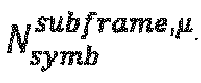
- N symb subframe N symb slot N slot subframe , ⁇ .
- Table 2 Time-domain parameters related to subcarrier spacing configuration ⁇ ⁇ N symb slot N slot subframe , ⁇ slot 0 14 1 1 14 2 2 14 4 3 14 8 4 14 16
- the x representing the transmission direction in the subscript of a mathematical symbol can be removed.
- N grid size , ⁇ can be used to express the number of resource blocks of the resource grid corresponding to the subcarrier spacing configuration ⁇ in the frequency domain.
- the parameter k 1 in the OFDM baseband signal generation formula for PRACH is used for positioning the location of the lowest numbered subcarrier of the lowest numbered resource block, which is occupied by a PRACH transmission occasion in a used frequency domain, in a resource grid where
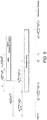
- FIG. 1 shows the relations among items constituting k 1 . It can be seen from FIG. 1 that in the current 3GPP standard specification, the k 1 may be considered to be constituted by the following two items:
- the k 1 cannot express the location of the lowest numbered subcarrier of the lowest numbered resource block, which is occupied by a PRACH transmission occasion in a frequency domain used by the OFDM baseband signal of the PRACH, in a resource grid. This may cause the PRACH transmission occasion in the frequency domain used by the OFDM baseband signal of the PRACH is seriously offset from an allocated location. Therefore, there is a need to improve the OFDM baseband signal generation formula for PRACH in the current 3GPP standard specification, so as to accurately position the location of a PRACH transmission occasion in the frequency domain used by the OFDM baseband signal of the PRACH.
- the present invention provides a method executed by a user equipment and a user equipment, which can accurately position the location of a PRACH transmission occasion in the frequency domain used by the OFDM baseband signal of the PRACH.
- the present invention further provides a method executed by a user equipment and a user equipment, which can improve the definition of ⁇ 0 in the current 3GPP standard specification so as to avoid conflicts of physical channels/signals transmitted by different UEs in the frequency domain.
- a method executed by a user equipment comprises: obtaining a parameter related to generation of an orthogonal frequency division multiplexing (OFDM) baseband signal of a physical random access channel (PRACH); and generating the OFDM baseband signal of the PRACH according to the parameter by using an OFDM baseband signal generation formula for the PRACH, wherein the OFDM baseband signal generation formula for the PRACH includes an item indicating a location of a lowest numbered subcarrier of a lowest numbered resource block, which is occupied by a PRACH transmission occasion in a frequency domain used by the OFDM baseband signal of the PRACH, in a resource grid; the resource grid is a resource grid corresponding to a subcarrier spacing configuration ⁇ of an uplink BWP; and the uplink BWP is an initial active uplink BWP for an initial access or an active uplink BWP for a non-initial access.
- OFDM orthogonal frequency division multiplexing
- the item includes an offset of a lowest numbered subcarrier of a lowest numbered resource block of the uplink BWP with respect to a lowest numbered subcarrier of a lowest numbered resource block of the resource grid, and the offset is expressed by the number of subcarriers.
- the item includes an offset of the lowest numbered subcarrier of the lowest numbered resource block occupied by the PRACH transmission occasion with respect to a lowest numbered subcarrier of a lowest numbered resource block of the resource grid, and the offset is expressed by the number of subcarriers.
- the offset of the lowest numbered subcarrier of the lowest numbered resource block occupied by the PRACH transmission occasion with respect to the lowest numbered subcarrier of the lowest numbered resource block of the resource grid is expressed as follow: N BWP , i start ⁇ N grid start , ⁇ N sc RB + n RA start N sc RB + n RA N RB RA N sc RB
- N BWP , i start is the lowest numbered resource block of the uplink BWP, and the resource block uses the numbering of common resource blocks
- N grid start , ⁇ is the lowest numbered resource block of the resource grid, and the resource block uses the numbering of common resource blocks
- N sc RB is the number of subcarriers in one resource block
- n RA start is an offset of the lowest numbered resource block occupied by the lowest PRACH transmission occasion in the frequency domain with respect to the lowest numbered resource block of the uplink BWP, and the offset is expressed by the number of resource blocks;
- k 1 k 0 ⁇ + N BWP , i start ⁇ N grid start , ⁇ N sc RB + n RA start N sc RB + n RA N RB RA N sc RB ⁇ N grid size , ⁇ N sc RB / 2 where k 0 ⁇ ⁇ N grid size , ⁇ N sc RB / 2 corresponds to the lowest numbered subcarrier of the lowest numbered resource block of the resource grid.
- a reference subcarrier spacing configuration ⁇ 0 is set as a value determined according to one or more subcarrier spacing configurations in an indication information received by the user equipment.
- the reference subcarrier spacing configuration ⁇ 0 is set as a subcarrier spacing configuration used by a synchronization signal/physical broadcast channel (SSB) block.
- SSB synchronization signal/physical broadcast channel
- a method executed by a user equipment comprises: obtaining a parameter related to generation of an orthogonal frequency division multiplexing (OFDM) baseband signal of a physical channel or signal; and generating the OFDM baseband signal of the physical channel or signal according to the parameter by using an OFDM baseband signal generation formula for the physical channel or signal, wherein in the OFDM baseband signal generation formula for the physical channel or signal, a reference subcarrier spacing configuration ⁇ 0 is set as a value determined according to one or more subcarrier spacing configurations in an indication information received by the user equipment.
- OFDM orthogonal frequency division multiplexing
- the reference subcarrier spacing configuration ⁇ 0 is set as a subcarrier spacing configuration used by a synchronization signal/physical broadcast channel (SSB) block.
- SSB synchronization signal/physical broadcast channel
- a user equipment comprises: a processor; and a memory configured to store instructions; wherein the instructions are executed by the processor to execute the above methods.
- the location of the PRACH transmission occasion in the frequency domain used by the OFDM baseband signal of the PRACH can be accurately positioned.
- the definition of ⁇ 0 in the current 3GPP standard specification is improved so as to avoid conflicts of physical channels/signals transmitted by different UEs in the frequency domain.
- the 5G mobile communication system and its subsequent evolved versions are taken as an exemplary application circumstance, under which several embodiments according to the present invention are described in detail.
- the present invention is not limited to the following embodiments but is applicable to other wireless communication systems, such as communication systems released after the 5G mobile communication system and the 4G mobile communication system released before the 5G mobile communication system.
- FIG. 2 is a flowchart illustrating steps executed by a user equipment UE of the present invention to generate an OFDM baseband signal of PRACH, wherein the steps executed by the user equipment UE may include the following:
- a parameter related to generation of an OFDM baseband signal of PRACH is obtained.
- one or more parameters of the following parameters may be obtained from a base station and may be:
- the OFDM baseband signal of the PRACH is generated according to the parameter related to the generation of the OFDM baseband signal of the PRACH.
- FIG. 3 is a flowchart illustrating steps executed by a user equipment UE of the present invention to generate an OFDM baseband signal of physical channels or signals except PRACH, wherein the steps executed by the user equipment UE include the following:
- a parameter related to generation of an OFDM baseband signal of physical channels or signals except PRACH is obtained.
- the following parameters may be obtained from a base station and may be:
- the OFDM baseband signal of the physical channels or signals except PRACH is generated according to the parameter related to the generation of the OFDM baseband signal of the physical channels or signals except PRACH.
- FIG. 4 is a flowchart illustrating a method executed by a user equipment according to the first embodiment of the present invention.
- the method executed by the user equipment UE comprises the following steps:
- step 401 a parameter related to generation of an OFDM baseband signal of PRACH is obtained.
- one or more parameters listed in the step 201 in the flowchart (which illustrates steps executed by a user equipment UE to generate an OFDM baseband signal of PRACH) shown in FIG. 2 may be obtained from a base station.
- the OFDM baseband signal of the PRACH is generated according to the obtained parameter by using an OFDM baseband signal generation formula for the PRACH.
- the OFDM baseband signal generation formula for the PRACH includes an item indicating a location of a lowest numbered subcarrier of a lowest numbered resource block, which is occupied by a PRACH transmission occasion in a frequency domain used by the OFDM baseband signal of the PRACH, in a resource grid; the resource grid is a resource grid corresponding to a subcarrier spacing configuration ⁇ of an uplink BWP; and the uplink BWP is an initial active uplink BWP or an active uplink BWP.
- the offset (which is expressed by the number of subcarriers) of the lowest numbered subcarrier of the lowest numbered resource block occupied by the PRACH transmission occasion in the frequency domain used by the OFDM baseband signal of the PRACH with respect to the lowest numbered subcarrier of the lowest numbered resource block of the resource grid corresponding to the subcarrier spacing configuration ⁇ of the uplink BWP is expressed as follow: N BWP , i start ⁇ N grid start , ⁇ N sc RB + n RA start N sc RB + n RA N RB RA N sc RB where
- FIG. 5 is a diagram showing the relations among items constituting the above k 1 in the first embodiment of the present invention. From FIG. 5 , it can be seen that the above k 1 in the first embodiment of the present invention may be considered to be constituted by the following two items:
- the location of the PRACH transmission occasion in the frequency domain used by the OFDM baseband signal of the PRACH can be accurately positioned through the use of the baseband signal generation formula for the PRACH in the first embodiment of the present invention.
- the difference from the first embodiment of the present invention is that, in the OFDM baseband signal generation formula for the PRACH, the offset (which is expressed by the number of subcarriers) of the lowest numbered subcarrier of the lowest numbered resource block occupied by the PRACH transmission occasion in the frequency domain used by the OFDM baseband signal of the PRACH with respect to the lowest numbered subcarrier of the lowest numbered resource block of the resource grid corresponding to the subcarrier spacing configuration ⁇ of the uplink BWP may be expressed as follow: X + n RA start N sc RB + n RA N RB RA N sc RB where
- the second embodiment according to the present invention can accurately position the location of the PRACH transmission occasion in the frequency domain used by the OFDM baseband signal of the PRACH.
- FIG. 6 is a flowchart illustrating a method executed by a user equipment according to the third embodiment of the present invention.
- the method executed by the user equipment UE comprises the following steps:
- step 601 a parameter related to generation of an OFDM baseband signal of PRACH is obtained.
- one or more parameters listed in the step 201 in the flowchart (which illustrates steps executed by a user equipment UE to generate an OFDM baseband signal of PRACH) shown in FIG. 2 may be obtained from a base station.
- the OFDM baseband signal of the PRACH is generated according to the obtained parameter by using an OFDM baseband signal generation formula for the PRACH.
- a reference subcarrier spacing configuration ⁇ 0 is set as a value determined according to one or more subcarrier spacing configurations in an indication information received by the user equipment.
- the reference subcarrier spacing configuration ⁇ 0 is equal one of the following configurations:
- FIG. 7 is a flowchart illustrating a method executed by a user equipment according to the fourth embodiment of the present invention.
- the method executed by the user equipment UE comprises the following steps:
- step 701 a parameter related to generation of an OFDM baseband signal of physical channels or signals except PRACH is obtained.
- a parameter related to generation of an OFDM baseband signal of physical channels or signals except PRACH is obtained.
- one or more parameters listed in the step 301 in the flowchart (which illustrates steps executed by a user equipment UE to generate an OFDM baseband signal of PRACH) shown in FIG. 3 may be obtained from a base station.
- the OFDM baseband signal of the physical channels or signals except the PRACH is generated according to the obtained parameter by using an OFDM baseband signal generation formula for the physical channels or signals except the PRACH.
- a reference subcarrier spacing configuration ⁇ 0 is set as a value determined according to one or more subcarrier spacing configurations in an indication information received by the user equipment.
- the reference subcarrier spacing configuration ⁇ 0 is equal one of the following configurations:
- the fourth embodiment according to the present invention can avoid conflicts of physical channels/signals transmitted by different UEs in the frequency domain.
- the fourth embodiment of the present invention is applicable to a user equipment UE that generates an OFDM baseband signal of physical channels or signals except PRACH for an uplink carrier or a supplementary uplink carrier.
- the physical channels or signals, which are generated for the uplink carrier or supplementary uplink carrier, except the PRACH may include PUSCH, PUCCH, DM-RS, PT-RS, SRS, etc.
- the fourth embodiment is also applicable to a base station that generates an OFDM baseband signal of a physical channel or signal for a downlink carrier.
- the physical channel or signal generated for the downlink carrier may include PDSCH, PBCH, PDCCH, DM-RS, PT-RS, CSI-RS, PSS, SSS, etc.
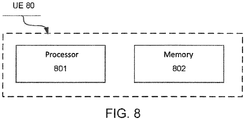
- FIG. 8 is a block diagram showing a user equipment UE according to the present invention.
- the user equipment UE80 includes a processor 801 and a memory 802.
- the processor 801 may include, for example, a microprocessor, a microcontroller, an embedded processor, etc.
- the memory 802 may include, for example, a volatile memory (e.g., a random access memory), a hard disk drive (HDD), a non-volatile memory (e.g., a flash memory), or other memories.
- the memory 802 stores program instructions. When the instructions are executed by the processor 801, the above methods executed by the user equipment described in detail in the present invention can be executed.
- the methods and related equipment of the present invention have been described above in conjunction with preferred embodiments. Those skilled in the art may understand that the methods described above are only exemplary, and the various embodiments described above can be combined with each other under a condition where there is no conflict. The methods of the present invention are not limited to the steps and sequence described above.
- the network nodes and user equipment described above may include more modules, e.g., modules that may be developable or developed in the future and used for base stations, MMEs, or UEs, and so on.
- the various identifiers described above are only exemplary rather than restrictive, and the present invention is not limited to specific information elements functioning as examples of these identifiers. Those skilled in the art can make many changes and modifications based on the teaching of the illustrated embodiment.
- the above embodiments of the present invention can be implemented by software, hardware, or a combination of both software and hardware.
- the various components inside the base station and user equipment in the above embodiments can be implemented by a variety of devices including, but not limited to, analog circuit devices, digital circuit devices, digital signal processing (DSP) circuits, programmable processors, application specific integrated circuits (ASIC), field programmable gate arrays (FPGA), programmable logic devices (CPLD), etc.
- DSP digital signal processing
- ASIC application specific integrated circuits
- FPGA field programmable gate arrays
- CPLD programmable logic devices
- a “base station” may refer to a mobile communication data and control exchanging center with larger transmission power and wider coverage area and include functions such as resource allocation/scheduling and data reception/transmission.
- a “user equipment” may refer to user mobile terminals including, for example, terminal devices such as mobile phones, notebooks, etc. that can wirelessly communicate with base stations or micro base stations.
- the embodiments of the present invention disclosed herein can be implemented on a computer program product.
- the computer program product is a product that has a computer-readable medium on which computer program logic is programmed, and when the computer program logic is executed by a computing device, it provides related operations to implement the above technical solutions of the present invention.
- the computer program logic is executed by at least one processor of a computing system, it makes the processor execute the operations (methods) described in the embodiments of the present invention.
- This arrangement of the present invention is typically provided as software, codes and/or other data structures stored or encoded in a computer readable medium such as an optical medium (e.g., a CD-ROM), a floppy disk or a hard disk, or provided as one or more firmware or micro-codes in a ROM or RAM or PROM chip, or provided as downloadable software images, shared databases, etc. in one or more modules.
- Software or firmware or such a configuration may be installed on a computing device, so that one or more processors in the computing device execute the technical solutions described in the embodiments of the present invention.
- each functional module or each feature of the base station equipment and terminal equipment used in each of the above embodiments may be implemented or executed by a circuit, and the circuit is usually one or more integrated circuits.
- Circuits designed to perform the functions described in this specification may include general-purpose processors, digital signal processors (DSP), application-specific integrated circuits (ASIC) or general-purpose integrated circuits, field programmable gate arrays (FPGA), or other programming logic devices, separate gates or transistor logics, or separate hardware components, or any combination of the above devices.
- the general-purpose processor may be a microprocessor, or the processor may be an existing processor, controller, microcontroller, or state machine.
- the above general-purpose processor or each circuit may be configured by a digital circuit or may be configured by a logic circuit.
- the present invention can also use integrated circuits obtained by the advanced technology.
Landscapes
- Engineering & Computer Science (AREA)
- Signal Processing (AREA)
- Computer Networks & Wireless Communication (AREA)
- Physics & Mathematics (AREA)
- Mathematical Physics (AREA)
- Mobile Radio Communication Systems (AREA)
Abstract
Description
- The present invention relates to the field of wireless communication technology, and more particularly to a method executed by a user equipment, a method executed by a base station, and a corresponding user equipment.
- At the 3rd Generation Partnership Project (3GPP) RAN#71 plenary meeting held in March 2016, a new study item regarding 5G technical standard (see non-patent document 1) was approved. The purpose of the study item is to develop a new radio (NR) access technology to meet all 5G application scenarios, requirements and deployment environments. The NR has three major use cases: Enhanced Mobile Broadband (eMBB), massive Machine Type Communication (mMTC), and Ultra-Reliable and Low Latency Communications (URLLC). At the 3rd Generation Partnership Project (3GPP) RAN#75 plenary meeting held in June 2017, the corresponding 5G NR work item (see non-patent document 2) was approved.
- In 5G, the waveform supported in the downlink direction is CP-OFDM (Cyclic Prefix Orthogonal Frequency Division Multiplexing), and the waveforms supported in the uplink direction include CP-OFDM and DFT-s-OFDM (Discrete Fourier Transformation Spread Orthogonal Frequency Division Multiplexing).
- In 5G, the difference between CP-OFDM and DFT-s-OFDM is that the latter performs an operation called "transform precoding" after the layer mapping operation, and the former does not perform this operation.
- The key parameters of CP-OFDM and DFT-s-OFDM are subcarrier spacing and cyclic prefix length. In 5G, for a given waveform (e.g., CP-OFDM or DFT-s-OFDM), the use of multiple numerologies (which refer to subcarrier interval, or subcarrier interval and cyclic prefix length) is supported in a cell. The waveform numerologies supported by 5G are shown in Table 1 where two types of cyclic prefixes, "normal" and "extended", are defined.
Table 1: Waveform numerologies supported by 5G µ Δf=2 µ ·15[kHz] Cyclic prefix 0 15 Normal 1 30 Normal 2 60 Normal, Extended 3 120 Normal 4 240 Normal - In a given transmission direction of a carrier (which is denoted as x, where if x=DL, then it represents downlink; if x=UL, then it represents uplink or supplementary uplink), a resource grid is defined for each waveform numerology and comprises




- The common resource block is defined for the waveform numerology. For example, for µ = 0 (i.e., Δf= 15kHz), the size of one common resource block is 15×12=180 kHz, and for µ = 1 (i.e., Δf= 30kHz), the size of one common resource block is 30×12 = 360 kHz.
- For all waveform numerologies, the center frequency of subcarrier 0 of common resource block 0 coincides with the same position in the frequency domain. This position is also referred as "point A".
- For each waveform numerology, one or more "bandwidth parts (BWP)" may be defined. Each BWP includes one or more contiguous common resource blocks. If it is assumed that the number of a certain BWP is i, then its starting point


- Resource blocks within a BWP are also referred to as "physical resource blocks (PRBs)" and numbered from 0 to


- Subcarriers within a resource block are numbered from 0 to


- In the time domain, both the uplink and the downlink transmissions consist of multiple radio frames (or referred to as system frames, sometimes simply referred to as frames, and numbered from 0 to 1023) with each radio frame having a length of 10ms, where each frame includes 10 subframes (which are numbered from 0 to 9 in a frame) with each subframe having a length of 1ms, each subframe includes


Table 2: Time-domain parameters related to subcarrier spacing configuration µ µ 

0 14 1 1 14 2 2 14 4 3 14 8 4 14 16 - The basic time unit of 5G is Tc =1/(Δfmax ·N f ), where Δfmax =480·103 Hz and Nf =4096. The constant κ = TslTc = 64, where Ts = 1/(Δfref·Nf,ref ), Δfref =15·103Hz, and Nf,ref =2048.
- When there is no risk of causing confusion, the x representing the transmission direction in the subscript of a mathematical symbol can be removed. For example, for a given downlink physical channel or signal,

- In the current 3GPP standard specification, the OFDM baseband signal generation formula for any physical channel or signal except PRACH (Physical Random Access Channel) can be expressed as follow:

- p is an antenna port.
- µ is a subcarrier spacing configuration, and Δf is its corresponding subcarrier spacing (see Table 1).
- l is an OFDM symbol number within a subframe.

-

-

- For l=0,
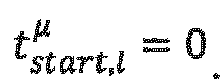
- For l≠0,

-

- For extended cyclic prefix,

- For normal cyclic prefix and l = 0 or l = 7.2 µ ,

- For normal cyclic prefix and l≠ 0 and l ≠ 7·2 µ ,

- µ0 is the largest µ value among the subcarrier spacing configurations provided to the UE for a corresponding carrier.
- In the current 3GPP standard specification, the OFDM baseband signal generation formula for PRACH can be expressed as follow:

- p is an antenna port.
- For an initial access, µ is a subcarrier spacing configuration of an initial active uplink BWP, and Δf is its corresponding subcarrier spacing (see Table 1). For a non-initial access, µ is a subcarrier spacing configuration of an active uplink BWP, and Δf is its corresponding subcarrier spacing (see Table 1).
- K = Δf/Δf RA.
-

-

- µ0 is the largest µ value among the subcarrier spacing configurations provided to the UE for a corresponding carrier.
- For an initial access,


- For an initial access,


- n RA is an index of the PRACH transmission occasion in the frequency domain used by the OFDM baseband signal of the PRACH. One PRACH transmission described by the OFDM baseband signal of the PRACH corresponds to a PRACH transmission occasion (described by


-

-

-
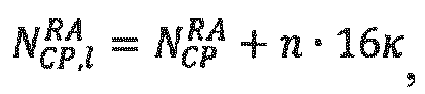
for ΔfRA ∈ {15, 30,60,120} kHz, n is the number of times the interval

- For ΔfRA ∈ {1.25, 5, 15, 30} kHz,


- ▪ it is assumed that the subframe or 60 kHz slot starts at t = 0.
- ▪ a timing advance value N TA = 0 is assumed.
- ▪ The definitions and corresponding values of


- ▪ µ = 0 is assumed for ΔfRA ∈ {1.25, 5} kHz, otherwise µ is taken from the µ values corresponding to ΔfRA ∈ {15, 30, 60,120} kHz (see Table 1).
- ▪

- ◆ l 0 is given by the parameter "starting symbol" in random access configurations.
For example, if the PRACH configuration index is 0, then the starting symbol is 0. - ◆


- ◆

- ◆ If ΔfRA ∈ {1.25, 5, 15, 60} kHz, then

- ◆ If ΔfRA ∈ {30,120} kHz and either of "Number of PRACH slots within a subframe" or "Number of PRACH slots within a 60 kHz slot" is equal 1, then

- ◆ otherwise,

- ◆ l 0 is given by the parameter "starting symbol" in random access configurations.
- LRA, ΔfRA, Nu and


-
k and

k = 7. - If the PRACH preamble format in random access configurations is A1/B1, A2/B2 or A3/B3, then
- ▪ if

- ▪ otherwise, the PRACH preamble with the corresponding format A1, A2 or A3 is transmitted in the PRACH transmission occasion.
- ▪ if
- In the current 3GPP standard specification, the parameter k 1 in the OFDM baseband signal generation formula for PRACH is used for positioning the location of the lowest numbered subcarrier of the lowest numbered resource block, which is occupied by a PRACH transmission occasion in a used frequency domain, in a resource grid where
-

-

-

-

-
FIG. 1 shows the relations among items constituting k 1. It can be seen fromFIG. 1 that in the current 3GPP standard specification, the k 1 may be considered to be constituted by the following two items: -

-

- Therefore, the k 1 cannot express the location of the lowest numbered subcarrier of the lowest numbered resource block, which is occupied by a PRACH transmission occasion in a frequency domain used by the OFDM baseband signal of the PRACH, in a resource grid. This may cause the PRACH transmission occasion in the frequency domain used by the OFDM baseband signal of the PRACH is seriously offset from an allocated location. Therefore, there is a need to improve the OFDM baseband signal generation formula for PRACH in the current 3GPP standard specification, so as to accurately position the location of a PRACH transmission occasion in the frequency domain used by the OFDM baseband signal of the PRACH.
- In addition, in the current 3GPP standard specifications, no matter whether it is PRACH or any physical channel or signal except PRACH, its OFDM baseband signal generation formula needs to use a reference subcarrier spacing µ0, that is, the largest µ value among the subcarrier spacing configurations provided to the UE for a corresponding carrier. This makes two UEs using different sets of subcarrier spacing configurations possibly use different µ0 values, resulting in different understandings of a subcarrier frequency of the resource grid corresponding to the same subcarrier spacing µ and thus causing conflicts of physical channels/signals transmitted by different UEs in the frequency domain. Therefore, there is a need to improve the definition of µ0 in the current 3GPP standard specification so as to eliminate possible conflicts.
-
- Non-patent document 1: PR-160671, New SID Proposal: Study on New Radio Access Technology
- Non-patent document 2: PR-170855, New WID on New Radio Access Technology
- In order to solve at least one part of the above-mentioned problems, the present invention provides a method executed by a user equipment and a user equipment, which can accurately position the location of a PRACH transmission occasion in the frequency domain used by the OFDM baseband signal of the PRACH.
- In addition, the present invention further provides a method executed by a user equipment and a user equipment, which can improve the definition of µ0 in the current 3GPP standard specification so as to avoid conflicts of physical channels/signals transmitted by different UEs in the frequency domain.
- According to the present invention, a method executed by a user equipment is provided and comprises: obtaining a parameter related to generation of an orthogonal frequency division multiplexing (OFDM) baseband signal of a physical random access channel (PRACH); and generating the OFDM baseband signal of the PRACH according to the parameter by using an OFDM baseband signal generation formula for the PRACH, wherein the OFDM baseband signal generation formula for the PRACH includes an item indicating a location of a lowest numbered subcarrier of a lowest numbered resource block, which is occupied by a PRACH transmission occasion in a frequency domain used by the OFDM baseband signal of the PRACH, in a resource grid; the resource grid is a resource grid corresponding to a subcarrier spacing configuration µ of an uplink BWP; and the uplink BWP is an initial active uplink BWP for an initial access or an active uplink BWP for a non-initial access.
- In the above method, the item includes an offset of a lowest numbered subcarrier of a lowest numbered resource block of the uplink BWP with respect to a lowest numbered subcarrier of a lowest numbered resource block of the resource grid, and the offset is expressed by the number of subcarriers.
- In the above method, the item includes an offset of the lowest numbered subcarrier of the lowest numbered resource block occupied by the PRACH transmission occasion with respect to a lowest numbered subcarrier of a lowest numbered resource block of the resource grid, and the offset is expressed by the number of subcarriers.
- In the above method, the offset of the lowest numbered subcarrier of the lowest numbered resource block occupied by the PRACH transmission occasion with respect to the lowest numbered subcarrier of the lowest numbered resource block of the resource grid is expressed as follow:


- In the above method, the item is expressed as follow:


- In the above method, in the OFDM baseband signal generation formula for the PRACH, a reference subcarrier spacing configuration µ0 is set as a value determined according to one or more subcarrier spacing configurations in an indication information received by the user equipment.
- In the above method, the reference subcarrier spacing configuration µ0 is set as a subcarrier spacing configuration used by a synchronization signal/physical broadcast channel (SSB) block.
- According to the present invention, a method executed by a user equipment is provided and comprises: obtaining a parameter related to generation of an orthogonal frequency division multiplexing (OFDM) baseband signal of a physical channel or signal; and generating the OFDM baseband signal of the physical channel or signal according to the parameter by using an OFDM baseband signal generation formula for the physical channel or signal, wherein in the OFDM baseband signal generation formula for the physical channel or signal, a reference subcarrier spacing configuration µ0 is set as a value determined according to one or more subcarrier spacing configurations in an indication information received by the user equipment.
- In the above method, the reference subcarrier spacing configuration µ0 is set as a subcarrier spacing configuration used by a synchronization signal/physical broadcast channel (SSB) block.
- According to the present invention, a user equipment is provided and comprises: a processor; and a memory configured to store instructions; wherein the instructions are executed by the processor to execute the above methods.
- According to the method executed by a user equipment and the user equipment of the present invention, the location of the PRACH transmission occasion in the frequency domain used by the OFDM baseband signal of the PRACH can be accurately positioned.
- In addition, according to the method executed by a user equipment and the user equipment of the present invention, the definition of µ0 in the current 3GPP standard specification is improved so as to avoid conflicts of physical channels/signals transmitted by different UEs in the frequency domain.
- The above and other features of the present invention will become more apparent through the following detailed description with reference to the accompanying drawings.
-
FIG. 1 is a diagram showing the relations among items constituting k1 in an OFDM baseband signal generation formula for PRACH in the current 3GPP standard specification. -
FIG. 2 is a flowchart illustrating steps executed by a user equipment of the present invention to generate an OFDM baseband signal of PRACH. -
FIG. 3 is a flowchart illustrating steps executed by a user equipment of the present invention to generate an OFDM baseband signal of physical channels or signals except PRACH. -
FIG. 4 is a flowchart illustrating a method executed by a user equipment according to the first embodiment of the present invention. -
FIG. 5 is a diagram showing the relations among items constituting k1 in an OFDM baseband signal generation formula for PRACH in the first embodiment of the present invention. -
FIG. 6 is a flowchart illustrating a method executed by a user equipment according to the third embodiment of the present invention. -
FIG. 7 is a flowchart illustrating a method executed by a user equipment according to the fourth embodiment of the present invention. -
FIG. 8 is a block diagram showing a user equipment according to the present invention. - The present invention will be described in detail below with reference to the drawings and embodiments. It should be noted that the present invention should not be limited to the embodiments described below. In addition, for the sake of brevity, detailed descriptions of well-known technologies that are not directly related to the present invention are omitted to avoid confusion with the understanding of the present invention.
- In the following description, the 5G mobile communication system and its subsequent evolved versions are taken as an exemplary application circumstance, under which several embodiments according to the present invention are described in detail. However, it should be pointed out that the present invention is not limited to the following embodiments but is applicable to other wireless communication systems, such as communication systems released after the 5G mobile communication system and the 4G mobile communication system released before the 5G mobile communication system.
- Some terms of the present invention are described below. Unless otherwise described, the terms related to the present invention are defined hereinafter. Different naming rules in LTE, LTE-Advanced, LTE-Advanced Pro, NR and later communication systems may be adopted for the terms given by the present invention. The consistent terms are used in the present invention; however, when those terms are applied to specific systems, they can be replaced with terms adopted in a corresponding system.
- 3GPP: 3rd Generation Partnership Project,
- BWP: Bandwidth Part, Bandwidth Part,
- CP-OFDM: Cyclic Prefix Orthogonal Frequency Division Multiplexing,
- DFT-s-OFDM: Discrete Fourier Transformation Spread Orthogonal Frequency Division Multiplexing,
- eMBB: Enhanced Mobile Broadband,
- CRB: Common Resource Block,
- CSI-RS: Channel-state information reference signal,
- DCI: Downlink Control Information,
- DM-RS: Demodulation reference signal,
- IE: Information Element,
- LTE-A: Long Term Evolution-Advanced,
- MAC: Medium Access Control,
- MAC CE: MAC Control Element,
- mMTC: massive Machine Type Communication,
- NR: New Radio,
- OFDM: Orthogonal Frequency Division Multiplexing,
- PBCH: Physical Broadcast Channel,
- PDCCH: Physical Downlink Control Channel,
- PDSCH: Physical Downlink Shared Channel,
- PRACH: Physical Random Access Channel,
- PRB: Physical Resource Block,
- PT-RS: Phase-tracking reference signal,
- PUCCH: Physical Uplink Control Channel,
- PUSCH: Physical Uplink Shared Channel,
- Random Access Preamble,
- RB: Resource Block,
- RRC: Radio Resource Control,
- SRS: Sounding reference signal,
- SSB: SS/PBCH block,
- UE: User Equipment,
- URLLC: Ultra-Reliable and Low Latency Communication,
- Unless otherwise described, in all embodiments and exemplary methods of the present invention:
- for an initial access, the "uplink BWP" refers to "initial active uplink BWP". For example, it can be configured through initialUplinkBWP in uplinkConfigCommon in SIB1 (system information block 1).
- for a non-initial access, the "uplink BWP" refers to "active uplink BWP". For example, it can be configured through uplinkBWP-ToAddModList in uplinkConfig in ServingCellConfig IE.
- the offset or distance between two subcarriers (or the offset or distance of one subcarrier with respect to another subcarrier) refers to the frequency offset or distance between the center frequencies of the two subcarriers and is expressed by the number of subcarriers.
- the offset or distance between two resource blocks (or the offset or distance of one resource block with respect to another resource block) refers to the frequency offset or distance between the center frequencies of the lowest numbered subcarriers of the two resource blocks and is expressed by the number of resource blocks.
- the usage and interpretation of mathematical symbols and mathematical expressions follow those used in the existing technology. For example:
- ▪


- ▪

- ▪
-
FIG. 2 is a flowchart illustrating steps executed by a user equipment UE of the present invention to generate an OFDM baseband signal of PRACH, wherein the steps executed by the user equipment UE may include the following: - In
step 201, a parameter related to generation of an OFDM baseband signal of PRACH is obtained. For example, one or more parameters of the following parameters may be obtained from a base station and may be: - the uplink BWP configuration. For example, the subcarrier spacing configuration of the uplink BWP is µ (with the corresponding subcarrier spacing that is Δf), and the lowest numbered resource block (using the numbering of common resource blocks) is

- the random access configuration. For example, for the paired spectrum in frequency range 1 (FR1), if the PRACH configuration index (which is configured, for example, through the higher-layer parameter prach-ConfigurationIndex) is 87, then the preamble format is A1, the starting symbol is 0, the number of PRACH slots within a subframe is 1, the number of time-domain PRACH occasions within a PRACH slot, i.e.,


- the resource grid configuration corresponding to the waveform numerology required for generating the OFDM baseband signal of the PRACH. For example, the numbering of the lowest numbered common resource block of the resource grid corresponding to the subcarrier spacing configuration µ of the uplink BWP is


- the lowest PRACH transmission occasion configuration in frequency domain. For example, the offset of the lowest PRACH transmission occasion in the frequency domain with respect to the lowest numbered resource block of the uplink BWP is

- the number of PRACH transmission occasions FDMed (i.e., processed by frequency-division multiplexing) in one given time instance. For example, the number of PRACH transmission occasions FDMed in one given time instance is M, which is configured, for example, through the higher-layer parameter msg1-FDM; accordingly, the value set of indexes nRA of the PRACH transmission occasion in the frequency domain used by the OFDM baseband signal of the PRACH may be {0, 1, ..., M-1}.
- In
step 203, the OFDM baseband signal of the PRACH is generated according to the parameter related to the generation of the OFDM baseband signal of the PRACH. For example, the OFDM baseband signal of the PRACH may be expressed by using the time-continuous signal

-
FIG. 3 is a flowchart illustrating steps executed by a user equipment UE of the present invention to generate an OFDM baseband signal of physical channels or signals except PRACH, wherein the steps executed by the user equipment UE include the following: - In
step 301, a parameter related to generation of an OFDM baseband signal of physical channels or signals except PRACH is obtained. For example, the following parameters may be obtained from a base station and may be: - the resource grid configuration corresponding to the waveform numerology required for generating the OFDM baseband signal of the physical channels or signals except PRACH. For example, the numbering of the lowest numbered common resource block of the resource grid corresponding to the subcarrier spacing configuration µ used by the OFDM baseband signal of the physical channels or signals except PRACH is


- In
step 303, the OFDM baseband signal of the physical channels or signals except PRACH is generated according to the parameter related to the generation of the OFDM baseband signal of the physical channels or signals except PRACH. For example, the OFDM baseband signal of the physical channels or signals except PRACH may be expressed by using the time-continuous signal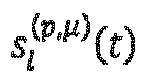

- The embodiments are listed below for illustrating the preferred implementations of the present invention.
-
FIG. 4 is a flowchart illustrating a method executed by a user equipment according to the first embodiment of the present invention. - In the first embodiment of the present invention, the method executed by the user equipment UE comprises the following steps:
Instep 401, a parameter related to generation of an OFDM baseband signal of PRACH is obtained. For example, one or more parameters listed in thestep 201 in the flowchart (which illustrates steps executed by a user equipment UE to generate an OFDM baseband signal of PRACH) shown inFIG. 2 may be obtained from a base station. - In
step 403, the OFDM baseband signal of the PRACH is generated according to the obtained parameter by using an OFDM baseband signal generation formula for the PRACH. The OFDM baseband signal generation formula for the PRACH includes an item indicating a location of a lowest numbered subcarrier of a lowest numbered resource block, which is occupied by a PRACH transmission occasion in a frequency domain used by the OFDM baseband signal of the PRACH, in a resource grid; the resource grid is a resource grid corresponding to a subcarrier spacing configuration µ of an uplink BWP; and the uplink BWP is an initial active uplink BWP or an active uplink BWP. - Specifically, in the OFDM baseband signal generation formula for the PRACH, the offset (which is expressed by the number of subcarriers) of the lowest numbered subcarrier of the lowest numbered resource block occupied by the PRACH transmission occasion in the frequency domain used by the OFDM baseband signal of the PRACH with respect to the lowest numbered subcarrier of the lowest numbered resource block of the resource grid corresponding to the subcarrier spacing configuration µ of the uplink BWP is expressed as follow:

-

-

-

- n RA is an index of the PRACH transmission occasion in the frequency domain used by the OFDM baseband signal of the PRACH.
- For example, the baseband signal of the PRACH may be expressed by using the time-continuous signal


- K = Δf/ΔfRA
-

-

-
FIG. 5 is a diagram showing the relations among items constituting the above k 1 in the first embodiment of the present invention. FromFIG. 5 , it can be seen that the above k 1 in the first embodiment of the present invention may be considered to be constituted by the following two items: -

-

- Therefore, compared with
FIG. 1 showing the related items in the current 3GPP standard specification, the location of the PRACH transmission occasion in the frequency domain used by the OFDM baseband signal of the PRACH can be accurately positioned through the use of the baseband signal generation formula for the PRACH in the first embodiment of the present invention. - In the second embodiment of the present invention, the difference from the first embodiment of the present invention is that, in the OFDM baseband signal generation formula for the PRACH, the offset (which is expressed by the number of subcarriers) of the lowest numbered subcarrier of the lowest numbered resource block occupied by the PRACH transmission occasion in the frequency domain used by the OFDM baseband signal of the PRACH with respect to the lowest numbered subcarrier of the lowest numbered resource block of the resource grid corresponding to the subcarrier spacing configuration µ of the uplink BWP may be expressed as follow:

- X is the offset of the lowest numbered subcarrier of the lowest numbered resource block (which uses the numbering of common resource blocks) of the uplink BWP with respect to the lowest numbered subcarrier of the lowest numbered resource block (which uses the numbering of common resource blocks) of the resource grid, that is,

FIG. 5 . -

- n RA is an index of the PRACH transmission occasion in the frequency domain used by the OFDM baseband signal of the PRACH.
- For example, the OFDM baseband signal of the PRACH may be expressed by using the time-continuous signal


- K = Δf/ΔfRA
-

-

- Same as the first embodiment of the present invention, the second embodiment according to the present invention can accurately position the location of the PRACH transmission occasion in the frequency domain used by the OFDM baseband signal of the PRACH.
-
FIG. 6 is a flowchart illustrating a method executed by a user equipment according to the third embodiment of the present invention. - In the third embodiment of the present invention, the method executed by the user equipment UE comprises the following steps:
Instep 601, a parameter related to generation of an OFDM baseband signal of PRACH is obtained. For example, one or more parameters listed in thestep 201 in the flowchart (which illustrates steps executed by a user equipment UE to generate an OFDM baseband signal of PRACH) shown inFIG. 2 may be obtained from a base station. - In
step 603, the OFDM baseband signal of the PRACH is generated according to the obtained parameter by using an OFDM baseband signal generation formula for the PRACH. In the OFDM baseband signal generation formula for the PRACH, a reference subcarrier spacing configuration µ0 is set as a value determined according to one or more subcarrier spacing configurations in an indication information received by the user equipment. - Specifically, in the baseband signal generation formula for the PRACH, the reference subcarrier spacing configuration µ0 is equal one of the following configurations:
- a subcarrier spacing configuration used by SS/PBCH block (SSB).
- a subcarrier spacing configuration used by System Information Block 1 (SIB 1). For example, the subcarrier spacing configuration used by SIB1 can be configured by the higher-layer parameter subCarrierSpacingCommon.
- the largest subcarrier spacing configuration configured in scs-SpecificCarrierList in FrequencyInfoUL IE.
- the smallest subcarrier spacing configuration configured in scs-SpecificCarrierList in FrequencyInfoUL IE.
- the largest subcarrier spacing configuration configured in scs-SpecificCarrierList in FrequencylnfoDL IE.
- the smallest subcarrier spacing configuration configured in scs-SpecificCarrierList in FrequencylnfoDL IE.
- According to the third embodiment of the present invention, since the definition of µ0 in the current 3GPP standard specification is improved, conflicts of physical channels/signals transmitted by different UEs in the frequency domain can be avoided.
-
FIG. 7 is a flowchart illustrating a method executed by a user equipment according to the fourth embodiment of the present invention. - In the fourth embodiment of the present invention, the method executed by the user equipment UE comprises the following steps:
- In
step 701, a parameter related to generation of an OFDM baseband signal of physical channels or signals except PRACH is obtained. For example, one or more parameters listed in thestep 301 in the flowchart (which illustrates steps executed by a user equipment UE to generate an OFDM baseband signal of PRACH) shown inFIG. 3 may be obtained from a base station. - In
step 703, the OFDM baseband signal of the physical channels or signals except the PRACH is generated according to the obtained parameter by using an OFDM baseband signal generation formula for the physical channels or signals except the PRACH. In the OFDM baseband signal generation formula for the physical channels or signals except the PRACH, a reference subcarrier spacing configuration µ0 is set as a value determined according to one or more subcarrier spacing configurations in an indication information received by the user equipment. - Specifically, in the OFDM baseband signal generation formula for the physical channels or signals except the PRACH, the reference subcarrier spacing configuration µ0 is equal one of the following configurations:
- a subcarrier spacing configuration used by SS/PBCH block (SSB).
- a subcarrier spacing configuration used by System Information Block 1 (SIB 1). For example, the subcarrier spacing configuration used by SIB1 can be configured by the higher-layer parameter subCarrierSpacingCommon.
- the largest subcarrier spacing configuration configured in scs-SpecificCarrierList in FrequencyInfoUL IE.
- the smallest subcarrier spacing configuration configured in scs-SpecificCarrierList in FrequencylnfoUL IE.
- the largest subcarrier spacing configuration configured in scs-SpecificCarrierList in FrequencylnfoDL IE.
- the smallest subcarrier spacing configuration configured in scs-SpecificCarrierList in FrequencyInfoDL IE.
- Same as the third embodiment of the present invention, the fourth embodiment according to the present invention can avoid conflicts of physical channels/signals transmitted by different UEs in the frequency domain.
- The fourth embodiment of the present invention is applicable to a user equipment UE that generates an OFDM baseband signal of physical channels or signals except PRACH for an uplink carrier or a supplementary uplink carrier. The physical channels or signals, which are generated for the uplink carrier or supplementary uplink carrier, except the PRACH may include PUSCH, PUCCH, DM-RS, PT-RS, SRS, etc. In addition, by just replacing "user equipment" with "base station" and replacing "obtained from a user equipment" with "obtained from a base station" in the fourth embodiment and related implementations, the fourth embodiment is also applicable to a base station that generates an OFDM baseband signal of a physical channel or signal for a downlink carrier. The physical channel or signal generated for the downlink carrier may include PDSCH, PBCH, PDCCH, DM-RS, PT-RS, CSI-RS, PSS, SSS, etc.
-
FIG. 8 is a block diagram showing a user equipment UE according to the present invention. As shown inFIG. 8 , the user equipment UE80 includes aprocessor 801 and amemory 802. Theprocessor 801 may include, for example, a microprocessor, a microcontroller, an embedded processor, etc. Thememory 802 may include, for example, a volatile memory (e.g., a random access memory), a hard disk drive (HDD), a non-volatile memory (e.g., a flash memory), or other memories. Thememory 802 stores program instructions. When the instructions are executed by theprocessor 801, the above methods executed by the user equipment described in detail in the present invention can be executed. - The methods and related equipment of the present invention have been described above in conjunction with preferred embodiments. Those skilled in the art may understand that the methods described above are only exemplary, and the various embodiments described above can be combined with each other under a condition where there is no conflict. The methods of the present invention are not limited to the steps and sequence described above. The network nodes and user equipment described above may include more modules, e.g., modules that may be developable or developed in the future and used for base stations, MMEs, or UEs, and so on. The various identifiers described above are only exemplary rather than restrictive, and the present invention is not limited to specific information elements functioning as examples of these identifiers. Those skilled in the art can make many changes and modifications based on the teaching of the illustrated embodiment.
- It should be understood that the above embodiments of the present invention can be implemented by software, hardware, or a combination of both software and hardware. For example, the various components inside the base station and user equipment in the above embodiments can be implemented by a variety of devices including, but not limited to, analog circuit devices, digital circuit devices, digital signal processing (DSP) circuits, programmable processors, application specific integrated circuits (ASIC), field programmable gate arrays (FPGA), programmable logic devices (CPLD), etc.
- In this disclosure, a "base station" may refer to a mobile communication data and control exchanging center with larger transmission power and wider coverage area and include functions such as resource allocation/scheduling and data reception/transmission. A "user equipment" may refer to user mobile terminals including, for example, terminal devices such as mobile phones, notebooks, etc. that can wirelessly communicate with base stations or micro base stations.
- Furthermore, the embodiments of the present invention disclosed herein can be implemented on a computer program product. More specifically, the computer program product is a product that has a computer-readable medium on which computer program logic is programmed, and when the computer program logic is executed by a computing device, it provides related operations to implement the above technical solutions of the present invention. When the computer program logic is executed by at least one processor of a computing system, it makes the processor execute the operations (methods) described in the embodiments of the present invention. This arrangement of the present invention is typically provided as software, codes and/or other data structures stored or encoded in a computer readable medium such as an optical medium (e.g., a CD-ROM), a floppy disk or a hard disk, or provided as one or more firmware or micro-codes in a ROM or RAM or PROM chip, or provided as downloadable software images, shared databases, etc. in one or more modules. Software or firmware or such a configuration may be installed on a computing device, so that one or more processors in the computing device execute the technical solutions described in the embodiments of the present invention.
- In addition, each functional module or each feature of the base station equipment and terminal equipment used in each of the above embodiments may be implemented or executed by a circuit, and the circuit is usually one or more integrated circuits. Circuits designed to perform the functions described in this specification may include general-purpose processors, digital signal processors (DSP), application-specific integrated circuits (ASIC) or general-purpose integrated circuits, field programmable gate arrays (FPGA), or other programming logic devices, separate gates or transistor logics, or separate hardware components, or any combination of the above devices. The general-purpose processor may be a microprocessor, or the processor may be an existing processor, controller, microcontroller, or state machine. The above general-purpose processor or each circuit may be configured by a digital circuit or may be configured by a logic circuit. In addition, when an advanced technology that may replace current integrated circuits appears due to advances in semiconductor technology, the present invention can also use integrated circuits obtained by the advanced technology.
- Although the present invention has been described above in conjunction with the preferred embodiments of the present invention, those skilled in the art will understand that various modifications, substitutions and changes can be made to the present invention without departing from the spirit and scope of the invention. Therefore, the present invention should not be limited by the above embodiments but should be limited by the appended claims and their equivalents.
Claims (10)
- A method executed by a user equipment, comprising:obtaining a parameter related to generation of an orthogonal frequency division multiplexing (OFDM) baseband signal of a physical random access channel (PRACH); andgenerating the OFDM baseband signal of the PRACH according to the parameter by using an OFDM baseband signal generation formula for the PRACH,wherein the OFDM baseband signal generation formula includes an item indicating a location of a lowest numbered subcarrier of a lowest numbered resource block, which is occupied by a PRACH transmission occasion in a frequency domain used by the OFDM baseband signal, in a resource grid; andwherein the resource grid corresponds to a subcarrier spacing configuration µ of an uplink bandwidth part (BWP), and the uplink BWP is either an initial active uplink BWP for an initial access or an active uplink BWP for a non-initial access.
- The method according to claim 1, characterized in that
the item includes an offset of a lowest numbered subcarrier of a lowest numbered resource block of the uplink BWP with respect to a lowest numbered subcarrier of a lowest numbered resource block of the resource grid, and the offset is expressed by the number of subcarriers. - The method according to claim 1, characterized in that
the item includes an offset of the lowest numbered subcarrier of the lowest numbered resource block occupied by the PRACH transmission occasion with respect to a lowest numbered subcarrier of a lowest numbered resource block of the resource grid, and the offset is expressed by the number of subcarriers. - The method according to claim 3, characterized in that the offset is expressed as


 the offset is expressed by a number of resource blocks;n RA is an index of the PRACH transmission occasion; and
- The method according to claim 4, characterized in that
the item is expressed as

- The method according to claim 1, characterized in that
a reference subcarrier spacing configuration µ0 in the OFDM baseband signal generation formula is set as a value determined according to one or more subcarrier spacing configurations in an indication information received by the user equipment. - The method according to claim 6, characterized in that
the reference subcarrier spacing configuration µ0 is set as a subcarrier spacing configuration used by a synchronization signal/physical broadcast channel (SSB) block. - A method executed by a user equipment, comprising:obtaining a parameter related to generation of an orthogonal frequency division multiplexing (OFDM) baseband signal of a physical channel; andgenerating the OFDM baseband signal of the physical channel according to the parameter by using an OFDM baseband signal generation formula for the physical channel,wherein a reference subcarrier spacing configuration µ0 in the OFDM baseband signal generation formula is set as a value determined according to one or more subcarrier spacing configurations in an indication information received by the user equipment.
- The method according to claim 8, characterized in that
the reference subcarrier spacing configuration µ0 is set as a subcarrier spacing configuration used by a synchronization signal/physical broadcast channel (SSB) block. - A user equipment, comprising:a processor; anda memory configured to store instructions;wherein the instructions are executed by the processor to execute the method according to any of claims 1 to 9.
Applications Claiming Priority (2)
| Application Number | Priority Date | Filing Date | Title |
|---|---|---|---|
| CN201810899869.2A CN110831226B (en) | 2018-08-08 | 2018-08-08 | Methods executed by user equipment and user equipment |
| PCT/CN2019/098854 WO2020029863A1 (en) | 2018-08-08 | 2019-08-01 | Method executed by user equipment and user equipment |
Publications (3)
| Publication Number | Publication Date |
|---|---|
| EP3836711A1 true EP3836711A1 (en) | 2021-06-16 |
| EP3836711A4 EP3836711A4 (en) | 2022-05-11 |
| EP3836711B1 EP3836711B1 (en) | 2023-02-15 |
Family
ID=69415342
Family Applications (1)
| Application Number | Title | Priority Date | Filing Date |
|---|---|---|---|
| EP19846872.0A Active EP3836711B1 (en) | 2018-08-08 | 2019-08-01 | Method executed by user equipment and user equipment |
Country Status (6)
| Country | Link |
|---|---|
| US (1) | US12035357B2 (en) |
| EP (1) | EP3836711B1 (en) |
| KR (1) | KR102915074B1 (en) |
| CN (1) | CN110831226B (en) |
| AU (1) | AU2019317388A1 (en) |
| WO (1) | WO2020029863A1 (en) |
Cited By (1)
| Publication number | Priority date | Publication date | Assignee | Title |
|---|---|---|---|---|
| US11800569B2 (en) * | 2019-10-03 | 2023-10-24 | Lg Electronics Inc. | Method and device for transmitting signal based on determination of starting RB index of RO in wireless communication system |
Families Citing this family (11)
| Publication number | Priority date | Publication date | Assignee | Title |
|---|---|---|---|---|
| CN110831226B (en) * | 2018-08-08 | 2023-11-21 | 夏普株式会社 | Methods executed by user equipment and user equipment |
| US11844114B2 (en) * | 2019-02-15 | 2023-12-12 | Lg Electronics Inc. | Method and apparatus for transmitting and receiving signals in wireless communication system |
| EP3930393B1 (en) * | 2019-02-22 | 2025-12-17 | Ntt Docomo, Inc. | User device and base station device |
| CN114375608B (en) * | 2019-10-03 | 2024-01-12 | Lg 电子株式会社 | Method and apparatus for transmitting and receiving signals in a wireless communication system |
| AU2019474027B2 (en) * | 2019-11-15 | 2024-01-18 | Nec Corporation | Methods, devices and computer readable media for communication on unlicensed band |
| US11576214B2 (en) * | 2020-03-25 | 2023-02-07 | Samsung Electronics Co., Ltd. | Method and apparatus for enhanced PRACH preamble |
| CN113811001B (en) * | 2020-06-16 | 2024-10-01 | 维沃移动通信有限公司 | Basic time unit processing method, device and electronic equipment |
| CN114598433B (en) * | 2020-12-07 | 2024-11-26 | 维沃移动通信有限公司 | Time domain resource configuration method, device and electronic device of RO |
| WO2022154859A1 (en) * | 2021-01-14 | 2022-07-21 | Apple Inc. | Methods and apparatus for prach resource determination and ra-rnti computation in wireless communication |
| CN114980321B (en) * | 2021-02-23 | 2026-02-03 | 维沃移动通信有限公司 | Indication method and device for SCS of initial downlink BWP |
| CN114095112B (en) * | 2021-10-12 | 2023-09-15 | 北京长焜科技有限公司 | A long-distance access method based on 5G NR wireless communication technology |
Family Cites Families (29)
| Publication number | Priority date | Publication date | Assignee | Title |
|---|---|---|---|---|
| CN101420265B (en) * | 2007-10-26 | 2012-08-08 | 鼎桥通信技术有限公司 | Data transmission method, system and device in long term evolution system |
| GB2487782B (en) | 2011-02-04 | 2015-05-20 | Sca Ipla Holdings Inc | Telecommunications method and system |
| EP3255928B1 (en) * | 2015-02-27 | 2020-11-04 | Huawei Technologies Co., Ltd. | Random access method and user equipment |
| WO2016182050A1 (en) * | 2015-05-14 | 2016-11-17 | 株式会社Nttドコモ | User terminal, wireless base station, wireless communication system, and wireless communication method |
| EP3398391B1 (en) * | 2015-12-31 | 2023-03-15 | Apple Inc. | Scheduling request in extremely high frequency systems |
| EP3419340B1 (en) * | 2016-03-11 | 2024-05-01 | LG Electronics Inc. | System information signal reception method, user equipment, system information signal transmitting method and base station |
| US10420135B2 (en) * | 2016-04-01 | 2019-09-17 | HFI Innovation | Physical random access channel design in eLAA |
| KR102471056B1 (en) * | 2016-05-11 | 2022-11-25 | 아이디에이씨 홀딩스, 인크. | Systems and methods for beamformed uplink transmission |
| WO2017196387A1 (en) * | 2016-05-12 | 2017-11-16 | Intel IP Corporation | Physical random access channel (prach) design |
| KR102397351B1 (en) * | 2016-06-15 | 2022-05-13 | 콘비다 와이어리스, 엘엘씨 | Random access procedures in next generation networks |
| CN109150483B (en) * | 2016-09-29 | 2020-01-21 | 华为技术有限公司 | Parameter determination method, base station and user equipment |
| US10992510B2 (en) * | 2016-09-30 | 2021-04-27 | Motorola Mobility Llc | Method and apparatus for synchronization signals and random access for flexible radio communication |
| CN108243508A (en) * | 2016-12-23 | 2018-07-03 | 北京佰才邦技术有限公司 | A kind of resource allocation method, method for sending information, base station and terminal |
| RU2742048C1 (en) | 2017-01-05 | 2021-02-02 | Гуандун Оппо Мобайл Телекоммьюникейшнз Корп., Лтд. | Method and device for random access |
| GB2562100B (en) * | 2017-05-05 | 2022-01-19 | Tcl Communication Ltd | Methods and apparatuses for random-access |
| CN109392143B (en) * | 2017-08-11 | 2021-04-30 | 电信科学技术研究院有限公司 | Random access method, base station and user equipment |
| KR102588435B1 (en) * | 2017-09-08 | 2023-10-12 | 삼성전자주식회사 | Method and apparatus for resource determination, resource configuration, random access preamble transmission, and random access |
| EP3685623B1 (en) * | 2017-10-24 | 2021-08-11 | LG Electronics Inc. | Method and apparatus for performing random access procedure in wireless communication system |
| US11025456B2 (en) * | 2018-01-12 | 2021-06-01 | Apple Inc. | Time domain resource allocation for mobile communication |
| US10863494B2 (en) * | 2018-01-22 | 2020-12-08 | Apple Inc. | Control signaling for uplink multiple input multiple output, channel state information reference signal configuration and sounding reference signal configuration |
| US10419257B2 (en) * | 2018-02-15 | 2019-09-17 | Huawei Technologies Co., Ltd. | OFDM communication system with method for determination of subcarrier offset for OFDM symbol generation |
| CN112020842B (en) * | 2018-02-28 | 2023-10-03 | 瑞典爱立信有限公司 | Method for indicating time domain resource allocation for physical downlink shared channel before RRC connection |
| US11160050B2 (en) * | 2018-03-28 | 2021-10-26 | Samsung Electronics Co., Ltd. | Method and apparatus for supporting large subcarrier spacing for SS/PBCH block |
| US10986622B2 (en) * | 2018-05-10 | 2021-04-20 | Apple Inc. | User equipment (UE) downlink transmission configuration indication (TCI)-state selection |
| US10448432B1 (en) * | 2018-06-11 | 2019-10-15 | Hong Kong Applied Science And Technology Research Institute Co., Ltd. | Frequency domain PRACH filter for PRACH signal recovery |
| US11729782B2 (en) * | 2018-06-11 | 2023-08-15 | Apple Inc. | Enhanced uplink beam management |
| WO2020027710A1 (en) * | 2018-08-02 | 2020-02-06 | Telefonaktiebolaget Lm Ericsson (Publ) | Nr peak rate and transport block size |
| CN110831226B (en) * | 2018-08-08 | 2023-11-21 | 夏普株式会社 | Methods executed by user equipment and user equipment |
| CN111757527B (en) * | 2019-03-29 | 2023-10-20 | 华为技术有限公司 | Communication method, communication device and system |
-
2018
- 2018-08-08 CN CN201810899869.2A patent/CN110831226B/en active Active
-
2019
- 2019-08-01 EP EP19846872.0A patent/EP3836711B1/en active Active
- 2019-08-01 KR KR1020217006994A patent/KR102915074B1/en active Active
- 2019-08-01 AU AU2019317388A patent/AU2019317388A1/en not_active Abandoned
- 2019-08-01 WO PCT/CN2019/098854 patent/WO2020029863A1/en not_active Ceased
- 2019-08-01 US US17/263,891 patent/US12035357B2/en active Active
Cited By (1)
| Publication number | Priority date | Publication date | Assignee | Title |
|---|---|---|---|---|
| US11800569B2 (en) * | 2019-10-03 | 2023-10-24 | Lg Electronics Inc. | Method and device for transmitting signal based on determination of starting RB index of RO in wireless communication system |
Also Published As
| Publication number | Publication date |
|---|---|
| AU2019317388A1 (en) | 2021-04-01 |
| US20210250986A1 (en) | 2021-08-12 |
| EP3836711A4 (en) | 2022-05-11 |
| US12035357B2 (en) | 2024-07-09 |
| EP3836711B1 (en) | 2023-02-15 |
| CN110831226A (en) | 2020-02-21 |
| WO2020029863A1 (en) | 2020-02-13 |
| KR20210042359A (en) | 2021-04-19 |
| KR102915074B1 (en) | 2026-01-21 |
| CN110831226B (en) | 2023-11-21 |
Similar Documents
| Publication | Publication Date | Title |
|---|---|---|
| EP3836711B1 (en) | Method executed by user equipment and user equipment | |
| US11889446B2 (en) | Method performed by user equipment, and user equipment | |
| KR102460799B1 (en) | Apparatus and Method of performing positioning in new radio | |
| JP6059357B2 (en) | Method and apparatus for generating synchronization signal in wireless connection system supporting super high frequency band | |
| US10098156B2 (en) | Method and MTC device for performing random access procedure according to plurality of parameter sets | |
| EP3198962B1 (en) | First communication device, second communication device and methods therein, for sending and receiving, respectively, an indication of a subframe type | |
| KR20220116412A (en) | Apparatus and method of performing positioning in new radio | |
| CN108781431B (en) | Network node, method and computer program product for scheduling paging messages for discovery signal transmission | |
| EP2822331A1 (en) | Information transmission method, base station and user equipment | |
| EP3761722A1 (en) | Uplink power control on unlicensed carriers | |
| US11843490B2 (en) | Method and apparatus for transmitting tracking reference signal in new radio | |
| EP3780800A1 (en) | User terminal and wireless base station | |
| US20220006677A1 (en) | Method performed by user equipment, and user equipment | |
| US20180167957A1 (en) | Method, apparatus, and system for transmitting control channel in unlicensed band | |
| KR20210018010A (en) | Apparatus and method for performing positioning | |
| US20200059321A1 (en) | Coverage enhancement for ofdm transmissions | |
| CN110393029A (en) | User terminal and wireless communication method | |
| WO2020063478A1 (en) | Method executed by user device and user device | |
| RU2776353C1 (en) | Method implemented by user equipment and user equipment | |
| RU2796259C2 (en) | User equipment method and user equipment | |
| KR20210017777A (en) | Apparatus and method of frequency-domain PRS muting in new radio | |
| US20250300873A1 (en) | Reference signal for channel and interference measurement | |
| US20230379121A1 (en) | Method performed by user equipment, and user equipment | |
| KR20200110590A (en) | Apparatus and method of low-complex positioning reference signal configuration in new radio |
Legal Events
| Date | Code | Title | Description |
|---|---|---|---|
| STAA | Information on the status of an ep patent application or granted ep patent |
Free format text: STATUS: THE INTERNATIONAL PUBLICATION HAS BEEN MADE |
|
| PUAI | Public reference made under article 153(3) epc to a published international application that has entered the european phase |
Free format text: ORIGINAL CODE: 0009012 |
|
| STAA | Information on the status of an ep patent application or granted ep patent |
Free format text: STATUS: REQUEST FOR EXAMINATION WAS MADE |
|
| 17P | Request for examination filed |
Effective date: 20210308 |
|
| AK | Designated contracting states |
Kind code of ref document: A1 Designated state(s): AL AT BE BG CH CY CZ DE DK EE ES FI FR GB GR HR HU IE IS IT LI LT LU LV MC MK MT NL NO PL PT RO RS SE SI SK SM TR |
|
| DAV | Request for validation of the european patent (deleted) | ||
| DAX | Request for extension of the european patent (deleted) | ||
| A4 | Supplementary search report drawn up and despatched |
Effective date: 20220412 |
|
| RIC1 | Information provided on ipc code assigned before grant |
Ipc: H04L 5/00 20060101ALN20220406BHEP Ipc: H04L 27/26 20060101ALI20220406BHEP Ipc: H04W 74/00 20090101AFI20220406BHEP |
|
| STAA | Information on the status of an ep patent application or granted ep patent |
Free format text: STATUS: EXAMINATION IS IN PROGRESS |
|
| 17Q | First examination report despatched |
Effective date: 20220802 |
|
| GRAP | Despatch of communication of intention to grant a patent |
Free format text: ORIGINAL CODE: EPIDOSNIGR1 |
|
| STAA | Information on the status of an ep patent application or granted ep patent |
Free format text: STATUS: GRANT OF PATENT IS INTENDED |
|
| RIC1 | Information provided on ipc code assigned before grant |
Ipc: H04L 5/00 20060101ALN20221102BHEP Ipc: H04L 27/26 20060101ALI20221102BHEP Ipc: H04W 74/00 20090101AFI20221102BHEP |
|
| INTG | Intention to grant announced |
Effective date: 20221114 |
|
| GRAS | Grant fee paid |
Free format text: ORIGINAL CODE: EPIDOSNIGR3 |
|
| GRAA | (expected) grant |
Free format text: ORIGINAL CODE: 0009210 |
|
| STAA | Information on the status of an ep patent application or granted ep patent |
Free format text: STATUS: THE PATENT HAS BEEN GRANTED |
|
| AK | Designated contracting states |
Kind code of ref document: B1 Designated state(s): AL AT BE BG CH CY CZ DE DK EE ES FI FR GB GR HR HU IE IS IT LI LT LU LV MC MK MT NL NO PL PT RO RS SE SI SK SM TR |
|
| REG | Reference to a national code |
Ref country code: CH Ref legal event code: EP Ref country code: GB Ref legal event code: FG4D |
|
| REG | Reference to a national code |
Ref country code: DE Ref legal event code: R096 Ref document number: 602019025362 Country of ref document: DE |
|
| REG | Reference to a national code |
Ref country code: AT Ref legal event code: REF Ref document number: 1548923 Country of ref document: AT Kind code of ref document: T Effective date: 20230315 Ref country code: IE Ref legal event code: FG4D |
|
| REG | Reference to a national code |
Ref country code: LT Ref legal event code: MG9D |
|
| REG | Reference to a national code |
Ref country code: NL Ref legal event code: MP Effective date: 20230215 |
|
| REG | Reference to a national code |
Ref country code: AT Ref legal event code: MK05 Ref document number: 1548923 Country of ref document: AT Kind code of ref document: T Effective date: 20230215 |
|
| PG25 | Lapsed in a contracting state [announced via postgrant information from national office to epo] |
Ref country code: RS Free format text: LAPSE BECAUSE OF FAILURE TO SUBMIT A TRANSLATION OF THE DESCRIPTION OR TO PAY THE FEE WITHIN THE PRESCRIBED TIME-LIMIT Effective date: 20230215 Ref country code: PT Free format text: LAPSE BECAUSE OF FAILURE TO SUBMIT A TRANSLATION OF THE DESCRIPTION OR TO PAY THE FEE WITHIN THE PRESCRIBED TIME-LIMIT Effective date: 20230615 Ref country code: NO Free format text: LAPSE BECAUSE OF FAILURE TO SUBMIT A TRANSLATION OF THE DESCRIPTION OR TO PAY THE FEE WITHIN THE PRESCRIBED TIME-LIMIT Effective date: 20230515 Ref country code: NL Free format text: LAPSE BECAUSE OF FAILURE TO SUBMIT A TRANSLATION OF THE DESCRIPTION OR TO PAY THE FEE WITHIN THE PRESCRIBED TIME-LIMIT Effective date: 20230215 Ref country code: LV Free format text: LAPSE BECAUSE OF FAILURE TO SUBMIT A TRANSLATION OF THE DESCRIPTION OR TO PAY THE FEE WITHIN THE PRESCRIBED TIME-LIMIT Effective date: 20230215 Ref country code: LT Free format text: LAPSE BECAUSE OF FAILURE TO SUBMIT A TRANSLATION OF THE DESCRIPTION OR TO PAY THE FEE WITHIN THE PRESCRIBED TIME-LIMIT Effective date: 20230215 Ref country code: HR Free format text: LAPSE BECAUSE OF FAILURE TO SUBMIT A TRANSLATION OF THE DESCRIPTION OR TO PAY THE FEE WITHIN THE PRESCRIBED TIME-LIMIT Effective date: 20230215 Ref country code: ES Free format text: LAPSE BECAUSE OF FAILURE TO SUBMIT A TRANSLATION OF THE DESCRIPTION OR TO PAY THE FEE WITHIN THE PRESCRIBED TIME-LIMIT Effective date: 20230215 Ref country code: AT Free format text: LAPSE BECAUSE OF FAILURE TO SUBMIT A TRANSLATION OF THE DESCRIPTION OR TO PAY THE FEE WITHIN THE PRESCRIBED TIME-LIMIT Effective date: 20230215 |
|
| PG25 | Lapsed in a contracting state [announced via postgrant information from national office to epo] |
Ref country code: SE Free format text: LAPSE BECAUSE OF FAILURE TO SUBMIT A TRANSLATION OF THE DESCRIPTION OR TO PAY THE FEE WITHIN THE PRESCRIBED TIME-LIMIT Effective date: 20230215 Ref country code: PL Free format text: LAPSE BECAUSE OF FAILURE TO SUBMIT A TRANSLATION OF THE DESCRIPTION OR TO PAY THE FEE WITHIN THE PRESCRIBED TIME-LIMIT Effective date: 20230215 Ref country code: IS Free format text: LAPSE BECAUSE OF FAILURE TO SUBMIT A TRANSLATION OF THE DESCRIPTION OR TO PAY THE FEE WITHIN THE PRESCRIBED TIME-LIMIT Effective date: 20230615 Ref country code: GR Free format text: LAPSE BECAUSE OF FAILURE TO SUBMIT A TRANSLATION OF THE DESCRIPTION OR TO PAY THE FEE WITHIN THE PRESCRIBED TIME-LIMIT Effective date: 20230516 Ref country code: FI Free format text: LAPSE BECAUSE OF FAILURE TO SUBMIT A TRANSLATION OF THE DESCRIPTION OR TO PAY THE FEE WITHIN THE PRESCRIBED TIME-LIMIT Effective date: 20230215 |
|
| PG25 | Lapsed in a contracting state [announced via postgrant information from national office to epo] |
Ref country code: SM Free format text: LAPSE BECAUSE OF FAILURE TO SUBMIT A TRANSLATION OF THE DESCRIPTION OR TO PAY THE FEE WITHIN THE PRESCRIBED TIME-LIMIT Effective date: 20230215 Ref country code: RO Free format text: LAPSE BECAUSE OF FAILURE TO SUBMIT A TRANSLATION OF THE DESCRIPTION OR TO PAY THE FEE WITHIN THE PRESCRIBED TIME-LIMIT Effective date: 20230215 Ref country code: DK Free format text: LAPSE BECAUSE OF FAILURE TO SUBMIT A TRANSLATION OF THE DESCRIPTION OR TO PAY THE FEE WITHIN THE PRESCRIBED TIME-LIMIT Effective date: 20230215 Ref country code: CZ Free format text: LAPSE BECAUSE OF FAILURE TO SUBMIT A TRANSLATION OF THE DESCRIPTION OR TO PAY THE FEE WITHIN THE PRESCRIBED TIME-LIMIT Effective date: 20230215 |
|
| REG | Reference to a national code |
Ref country code: DE Ref legal event code: R097 Ref document number: 602019025362 Country of ref document: DE |
|
| PG25 | Lapsed in a contracting state [announced via postgrant information from national office to epo] |
Ref country code: SK Free format text: LAPSE BECAUSE OF FAILURE TO SUBMIT A TRANSLATION OF THE DESCRIPTION OR TO PAY THE FEE WITHIN THE PRESCRIBED TIME-LIMIT Effective date: 20230215 |
|
| PLBE | No opposition filed within time limit |
Free format text: ORIGINAL CODE: 0009261 |
|
| STAA | Information on the status of an ep patent application or granted ep patent |
Free format text: STATUS: NO OPPOSITION FILED WITHIN TIME LIMIT |
|
| 26N | No opposition filed |
Effective date: 20231116 |
|
| PG25 | Lapsed in a contracting state [announced via postgrant information from national office to epo] |
Ref country code: SI Free format text: LAPSE BECAUSE OF FAILURE TO SUBMIT A TRANSLATION OF THE DESCRIPTION OR TO PAY THE FEE WITHIN THE PRESCRIBED TIME-LIMIT Effective date: 20230215 |
|
| PG25 | Lapsed in a contracting state [announced via postgrant information from national office to epo] |
Ref country code: MC Free format text: LAPSE BECAUSE OF FAILURE TO SUBMIT A TRANSLATION OF THE DESCRIPTION OR TO PAY THE FEE WITHIN THE PRESCRIBED TIME-LIMIT Effective date: 20230215 |
|
| REG | Reference to a national code |
Ref country code: CH Ref legal event code: PL |
|
| PG25 | Lapsed in a contracting state [announced via postgrant information from national office to epo] |
Ref country code: MC Free format text: LAPSE BECAUSE OF FAILURE TO SUBMIT A TRANSLATION OF THE DESCRIPTION OR TO PAY THE FEE WITHIN THE PRESCRIBED TIME-LIMIT Effective date: 20230215 |
|
| PG25 | Lapsed in a contracting state [announced via postgrant information from national office to epo] |
Ref country code: LU Free format text: LAPSE BECAUSE OF NON-PAYMENT OF DUE FEES Effective date: 20230801 |
|
| PG25 | Lapsed in a contracting state [announced via postgrant information from national office to epo] |
Ref country code: LU Free format text: LAPSE BECAUSE OF NON-PAYMENT OF DUE FEES Effective date: 20230801 Ref country code: CH Free format text: LAPSE BECAUSE OF NON-PAYMENT OF DUE FEES Effective date: 20230831 |
|
| REG | Reference to a national code |
Ref country code: BE Ref legal event code: MM Effective date: 20230831 |
|
| REG | Reference to a national code |
Ref country code: IE Ref legal event code: MM4A |
|
| PG25 | Lapsed in a contracting state [announced via postgrant information from national office to epo] |
Ref country code: IT Free format text: LAPSE BECAUSE OF FAILURE TO SUBMIT A TRANSLATION OF THE DESCRIPTION OR TO PAY THE FEE WITHIN THE PRESCRIBED TIME-LIMIT Effective date: 20230215 |
|
| PG25 | Lapsed in a contracting state [announced via postgrant information from national office to epo] |
Ref country code: IE Free format text: LAPSE BECAUSE OF NON-PAYMENT OF DUE FEES Effective date: 20230801 |
|
| PG25 | Lapsed in a contracting state [announced via postgrant information from national office to epo] |
Ref country code: IE Free format text: LAPSE BECAUSE OF NON-PAYMENT OF DUE FEES Effective date: 20230801 |
|
| PG25 | Lapsed in a contracting state [announced via postgrant information from national office to epo] |
Ref country code: BE Free format text: LAPSE BECAUSE OF NON-PAYMENT OF DUE FEES Effective date: 20230831 |
|
| PG25 | Lapsed in a contracting state [announced via postgrant information from national office to epo] |
Ref country code: BG Free format text: LAPSE BECAUSE OF FAILURE TO SUBMIT A TRANSLATION OF THE DESCRIPTION OR TO PAY THE FEE WITHIN THE PRESCRIBED TIME-LIMIT Effective date: 20230215 |
|
| PG25 | Lapsed in a contracting state [announced via postgrant information from national office to epo] |
Ref country code: BG Free format text: LAPSE BECAUSE OF FAILURE TO SUBMIT A TRANSLATION OF THE DESCRIPTION OR TO PAY THE FEE WITHIN THE PRESCRIBED TIME-LIMIT Effective date: 20230215 |
|
| REG | Reference to a national code |
Ref country code: DE Ref legal event code: R081 Ref document number: 602019025362 Country of ref document: DE Owner name: SHARP KABUSHIKI KAISHA, SAKAI CITY, JP Free format text: FORMER OWNERS: FG INNOVATION COMPANY LIMITED, HONG KONG, HK; SHARP KABUSHIKI KAISHA, SAKAI-SHI, OSAKA, JP |
|
| REG | Reference to a national code |
Ref country code: GB Ref legal event code: 732E Free format text: REGISTERED BETWEEN 20250501 AND 20250507 |
|
| PG25 | Lapsed in a contracting state [announced via postgrant information from national office to epo] |
Ref country code: EE Free format text: LAPSE BECAUSE OF FAILURE TO SUBMIT A TRANSLATION OF THE DESCRIPTION OR TO PAY THE FEE WITHIN THE PRESCRIBED TIME-LIMIT Effective date: 20230215 |
|
| PG25 | Lapsed in a contracting state [announced via postgrant information from national office to epo] |
Ref country code: CY Free format text: LAPSE BECAUSE OF FAILURE TO SUBMIT A TRANSLATION OF THE DESCRIPTION OR TO PAY THE FEE WITHIN THE PRESCRIBED TIME-LIMIT; INVALID AB INITIO Effective date: 20190801 |
|
| PG25 | Lapsed in a contracting state [announced via postgrant information from national office to epo] |
Ref country code: HU Free format text: LAPSE BECAUSE OF FAILURE TO SUBMIT A TRANSLATION OF THE DESCRIPTION OR TO PAY THE FEE WITHIN THE PRESCRIBED TIME-LIMIT; INVALID AB INITIO Effective date: 20190801 |
|
| PGFP | Annual fee paid to national office [announced via postgrant information from national office to epo] |
Ref country code: DE Payment date: 20250820 Year of fee payment: 7 |
|
| PGFP | Annual fee paid to national office [announced via postgrant information from national office to epo] |
Ref country code: GB Payment date: 20250820 Year of fee payment: 7 |
|
| PGFP | Annual fee paid to national office [announced via postgrant information from national office to epo] |
Ref country code: FR Payment date: 20250828 Year of fee payment: 7 |
|
| PG25 | Lapsed in a contracting state [announced via postgrant information from national office to epo] |
Ref country code: TR Free format text: LAPSE BECAUSE OF FAILURE TO SUBMIT A TRANSLATION OF THE DESCRIPTION OR TO PAY THE FEE WITHIN THE PRESCRIBED TIME-LIMIT Effective date: 20230215 |