EP3836106B1 - Server device, vehicle, and method - Google Patents
Server device, vehicle, and method Download PDFInfo
- Publication number
- EP3836106B1 EP3836106B1 EP18929256.8A EP18929256A EP3836106B1 EP 3836106 B1 EP3836106 B1 EP 3836106B1 EP 18929256 A EP18929256 A EP 18929256A EP 3836106 B1 EP3836106 B1 EP 3836106B1
- Authority
- EP
- European Patent Office
- Prior art keywords
- information
- abnormality
- vehicle
- information terminal
- server apparatus
- Prior art date
- Legal status (The legal status is an assumption and is not a legal conclusion. Google has not performed a legal analysis and makes no representation as to the accuracy of the status listed.)
- Active
Links
Images



Classifications
-
- G—PHYSICS
- G07—CHECKING-DEVICES
- G07C—TIME OR ATTENDANCE REGISTERS; REGISTERING OR INDICATING THE WORKING OF MACHINES; GENERATING RANDOM NUMBERS; VOTING OR LOTTERY APPARATUS; ARRANGEMENTS, SYSTEMS OR APPARATUS FOR CHECKING NOT PROVIDED FOR ELSEWHERE
- G07C5/00—Registering or indicating the working of vehicles
- G07C5/008—Registering or indicating the working of vehicles communicating information to a remotely located station
-
- G—PHYSICS
- G08—SIGNALLING
- G08G—TRAFFIC CONTROL SYSTEMS
- G08G1/00—Traffic control systems for road vehicles
- G08G1/20—Monitoring the location of vehicles belonging to a group, e.g. fleet of vehicles, countable or determined number of vehicles
- G08G1/205—Indicating the location of the monitored vehicles as destination, e.g. accidents, stolen, rental
-
- G—PHYSICS
- G07—CHECKING-DEVICES
- G07C—TIME OR ATTENDANCE REGISTERS; REGISTERING OR INDICATING THE WORKING OF MACHINES; GENERATING RANDOM NUMBERS; VOTING OR LOTTERY APPARATUS; ARRANGEMENTS, SYSTEMS OR APPARATUS FOR CHECKING NOT PROVIDED FOR ELSEWHERE
- G07C5/00—Registering or indicating the working of vehicles
- G07C5/08—Registering or indicating performance data other than driving, working, idle, or waiting time, with or without registering driving, working, idle or waiting time
- G07C5/0816—Indicating performance data, e.g. occurrence of a malfunction
-
- G—PHYSICS
- G01—MEASURING; TESTING
- G01M—TESTING STATIC OR DYNAMIC BALANCE OF MACHINES OR STRUCTURES; TESTING OF STRUCTURES OR APPARATUS, NOT OTHERWISE PROVIDED FOR
- G01M17/00—Testing of vehicles
- G01M17/007—Wheeled or endless-tracked vehicles
-
- G—PHYSICS
- G08—SIGNALLING
- G08B—SIGNALLING SYSTEMS, e.g. PERSONAL CALLING SYSTEMS; ORDER TELEGRAPHS; ALARM SYSTEMS
- G08B25/00—Alarm systems in which the location of the alarm condition is signalled to a central station, e.g. fire or police telegraphic systems
-
- G—PHYSICS
- G08—SIGNALLING
- G08B—SIGNALLING SYSTEMS, e.g. PERSONAL CALLING SYSTEMS; ORDER TELEGRAPHS; ALARM SYSTEMS
- G08B27/00—Alarm systems in which the alarm condition is signalled from a central station to a plurality of substations
-
- H—ELECTRICITY
- H04—ELECTRIC COMMUNICATION TECHNIQUE
- H04L—TRANSMISSION OF DIGITAL INFORMATION, e.g. TELEGRAPHIC COMMUNICATION
- H04L67/00—Network arrangements or protocols for supporting network services or applications
- H04L67/01—Protocols
- H04L67/12—Protocols specially adapted for proprietary or special-purpose networking environments, e.g. medical networks, sensor networks, networks in vehicles or remote metering networks
Definitions
- the present invention relates to a technique of making a notification of an abnormality of a vehicle.
- JPH11-175885 A discloses a system, in which a sensor (GPS sensor or inertial sensor) for detecting an abnormality of a vehicle is provided and, when the sensor detects an abnormality of the vehicle, information about it is transmitted to a control center.
- a sensor GPS sensor or inertial sensor
- US 2017/136943 A1 discloses an electronic safety system for a vehicle comprising a GPS sensor for determining a geographic location of the vehicle, a sensor for detecting a distress signal and a telecommunication unit that transmits an alert notification indicating the determined geographic location of the vehicle to an emergency service organization if the distress signal is detected.
- Fig. 1 is a view showing an example of the arrangement of a vehicle 10 according to this embodiment.
- the vehicle 10 may be any of a two-wheeled vehicle, a three-wheeled vehicle, or a four-wheeled vehicle.
- this embodiment will exemplify, as the vehicle 10, a working machine (to also be referred to as the working machine 10 hereinafter) configured to execute a work in a predetermined area.
- the working machine 10 are a lawn mower, a blower, a cultivator, and a snowplow. In this embodiment, however, the working machine 10 is a lawn mower.
- the working machine 10 is a riding vehicle whose vehicle body 1 is provided with a seat 6 on which an operator (occupant) can sit.
- the working machine 10 is not limited to this example, and may be, for example, an unmanned traveling vehicle or a handcart of a type that is pushed with the hands of the operator.
- the working machine 10 includes a traveling unit 2, a working unit 3, a storage unit 4, and an operation unit 5.
- the traveling unit 2 is configured to make the working machine 10 travel and provided on the lower side of the vehicle body 1 to support the vehicle body 1.
- the working machine 10 is a four-wheeled vehicle
- the traveling unit 2 includes a pair of left and right rear wheels 2R as driving wheels and a pair of left and right front wheels 2F as driven wheels.
- the working unit 3 is a lawn mowing blade provided on the lower side of the vehicle body 1, and is provided such that the position in the vertical direction of the vehicle body with respect to the working unit 3 can be adjusted.
- the lawn mowing blade serving as the working unit 3 can mow a lawn in a working area to a desired height.
- the storage unit 4 stores the lawn mowed by the lawn mowing blade serving as the working unit 3.
- the vehicle body 1 is provided with a duct (not shown) from the upper portion of the working unit 3 to the rear portion, and the mowed lawn is guided to the storage unit 4 via the duct and stored.
- the operation unit 5 includes a plurality of operators configured to drive and control the traveling unit 2 and the working unit 3.
- a steering wheel 5a serving as a steering operator is shown here.
- an acceleration operator, a braking operator, a working operator, and the like are included. Note that as these operators, any one of a pedal method, a lever method, a switch method, and the like may be employed.
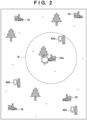
- Fig. 2 is a view showing a state in which the plurality of working machines 10 are working in a working area.
- the working machines 10 are performing lawn mowing operations at a plurality of positions in the working area, and leaders each holding an information terminal 40 are arranged in the working area.
- Fig. 2 shows an example in which three leaders are arranged.
- the information terminals 40 held by three leaders are represented by information terminals 40a to 40c.
- Each of the information terminals 40a to 40c can be, for example, a portable information terminal such as a portable phone including a display (display unit) capable of displaying received information.
- an abnormality of the working machine 10 may occur, such as a crash against a tree existing within the working area or run-off of a wheel into a ditch existing in the working area.
- Fig. 2 shows an example in which the working machine 10a crashes against a tree to cause an abnormality.
- an abnormality occurs in the working machine 10a, if pieces of information of the same contents indicating the abnormality (the problem) of the working machine 10a are respectively transmitted to the plurality of information terminals 40a to 40c, the plurality of leaders go to deal with the abnormality of the working machine 10a, which is very inefficient.
- the abnormality of the working machine 10 includes dangerous traveling such as sudden acceleration or high-speed traveling by the worker.
- the information terminal 40a existing within a predetermined range R from the working machine 10a in which the abnormality has occurred is selected, and the information is transmitted to the selected information terminal 40a.
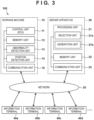
- Fig. 3 is a block diagram showing the arrangement of a system 100 according to this embodiment.
- the system 100 according to this embodiment includes the working machine 10, a server apparatus 20 (cloud), and the plurality of information terminals 40 (information terminals 40a to 40d in Fig. 3 ).
- the working machine 10 can include, as in-vehicle devices, a control unit 11, a memory unit 12, an abnormality detection unit 13, a position detection unit 14, and a communication unit 15 (a transmission unit).
- the control unit 11 is an ECU (Electronic Control Unit) in this embodiment, and includes a processor represented by a CPU, a memory device such as a semiconductor memory, and an interface with an external device.
- the memory unit 12 stores a program to be executed by the processor, data to be used by the processor for processing, and the like, and the control unit 11 (ECU) can read out the program stored in the memory unit 12 into the memory device such as a memory and execute it.
- the abnormality detection unit 13 detects an abnormality of the working machine 10. More specifically, the abnormality detection unit 13 includes a vibration sensor that detects a vibration of the vehicle body 1, and an acceleration sensor that detects the acceleration of the vehicle body 1, and detects occurrence of an abnormality when a value (vibration or acceleration) detected by each sensor exceeds a predetermined value.
- the abnormality detection unit 13 may be configured to detect an abnormality caused by an internal element of the working machine 10, such as an abnormality of the engine of the working machine 10 and an abnormality of a lawn mowing blade (working unit 3), in addition to an abnormality caused by run-off of a wheel or crash of the working machine 10. More specifically, the abnormality detection unit 13 can be provided with a sensor that detects the rotation speed of the engine or lawn mowing blade, and detect occurrence of an abnormality when the rotation speed detected by the sensor does not reach a desired value.
- the position detection unit 14 detects the current position of the working machine 10. More specifically, the position detection unit 14 includes a GPS sensor that detects the position of the working machine 10 and a gyro sensor that detects the rotary motion of the working machine 10, and detects the current position of the working machine 10 based on the detection result of each sensor.
- the communication unit 15 is communicably connected to the server apparatus 20 via a network 30. More specifically, the communication unit 15 has a function as a reception unit that receives information from the server apparatus 20 via the network 30 and a function as a transmission unit that transmits information to the server apparatus 20 via the network 30.
- the communication unit 15 transmits abnormality detection information to the server apparatus 20 via the network 30.
- the abnormality detection information may include, for example, information indicating the value (vibration, acceleration, rotation speed, or the like) detected by the abnormality detection unit 13 and the position information of the working machine 10 detected by the position detection unit 14 in addition to information about detection of the abnormality by the abnormality detection unit 13.
- the abnormality detection information includes both the value detected by the abnormality detection unit 13 and the position information detected by the position detection unit 14.
- the server apparatus 20 includes a processing unit 21, a memory unit 22, and a communication unit 23 (a transmission unit).
- the processing unit 21 includes a processor represented by a CPU, a memory device such as a semiconductor memory, and an interface with an external device.
- the memory unit 22 stores a program to be executed by the processor, data to be used by the processor for processing, and the like, and the processing unit 21 can read out the program stored in the memory unit 22 into the memory device such as a memory and execute it.
- the processing unit 21 includes a selection unit 21a that selects, among the plurality of information terminals 40, the information terminal 40 (target terminal) to which abnormality notification information is to be transmitted, and a generation unit 21b that generates the abnormality notification information.
- the communication unit 23 is communicably connected to each working machine 10 and each information terminal 40 via the network 30. More specifically, the communication unit 23 has a function as a reception unit that receives abnormality detection information from each working machine 10 via the network 30 and a function as a transmission unit that transmits abnormality notification information to each information terminal 40 via the network 30.
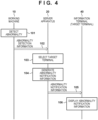
- Fig. 4 is a sequence chart showing processing performed among the working machine 10, the server apparatus 20, and the information terminal 40 (target terminal). If an abnormality is detected in the working machine 10 (step 101), abnormality detection information is transmitted to the server apparatus 20 via the network 30 (step 102). Upon receiving the abnormality detection information, the server apparatus 20 selects (step 103), based on the pieces of position information of the information terminals 40 and the working machine 10, among the plurality of information terminals 40, a target terminal to which a notification of abnormality notification information is to be made, and generates abnormality notification information (step 104). Then, the abnormality notification information is transmitted to the target terminal (step 105). The target terminal (information terminal 40) displays the received abnormality notification information on the display (step 106). In the example shown in Fig. 4 , step 104 is performed after step 103. However, step 104 may be performed before step 103 or steps 103 and 104 may be performed in parallel to each other.
- Fig. 5 is a flowchart illustrating a processing procedure by the server apparatus 20. Each step of the flowchart shown in Fig. 5 can be performed by the processing unit 21 of the server apparatus 20.
- step S11 the processing unit 21 determines whether abnormality detection information is received. For example, if, as shown in Fig. 2 , the working machine 10a crashes against a tree, the acceleration of the working machine 10a detected by the acceleration sensor (or the vibration of the working machine 10a detected by the vibration sensor) is equal to or more than a predetermined value, and the abnormality detection unit 13 detects an abnormality. In this case, the working machine 10a transmits abnormality detection information indicating that the abnormality detection unit 13 has detected the abnormality, and the server apparatus 20 receives the abnormality detection information via the network. In this way, if the server apparatus 20 receives the abnormality detection information, the process advances to step S12.
- step S12 the processing unit 21 acquires the position information of the working machine 10 in which the abnormality has been detected. For example, if the received abnormality detection information includes the position information of the working machine 10, the processing unit 21 acquires the position information of the working machine 10 from the abnormality detection information. On the other hand, if the received abnormality detection information does not include the position information of the working machine 10a, the processing unit 21 acquires the position information detected by the position detection unit 14 of the working machine 10 by receiving it by the communication unit 23 via the network 30.
- step S13 the processing unit 21 acquires the position information of each information terminal 40.
- Each information terminal 40 is preset (preregistered) as a transmission destination of information for managing the plurality of working machines 10, and includes a GPS sensor or the like for detecting the current position.
- the processing unit 21 acquires the current position detected by the GPS sensor or the like in each information terminal 40 by receiving it by the communication unit 23 from each information terminal 40 via the network 30.
- step S14 the processing unit 21 (selection unit 21a) selects, among the plurality of information terminals 40, the target terminal to which abnormality notification information to be generated in step S15 (to be described later) is to be transmitted.
- the target terminal selection processing performed in step S14 will be described with reference to Fig. 6.
- Fig. 6 is a flowchart illustrating an example of the target terminal selection processing. Each step of the flowchart shown in Fig. 6 can be performed by the selection unit 21a of the processing unit 21 of the server apparatus 20.
- step S14-1 based on the position information of the working machine 10 acquired in step S12 and the pieces of position information of the information terminals 40 acquired in step S13, the selection unit 21a specifies the positions of the respective information terminals 40 and the working machine 10 in which the abnormality has occurred.
- step S14-2 the selection unit 21a sets the predetermined range R with respect to the working machine 10 in which the abnormality has occurred. For example, as shown in Fig. 2 , the selection unit 21a sets, as the predetermined range R, a range within a predetermined distance with reference to (centering) the working machine 10a in which the abnormality has occurred.
- step S14-3 the processing unit 21a selects the information terminals 40 existing within the predetermined region set in step S14-2. In the example shown in Fig. 2 , since the information terminal 40a exists within the predetermined range R, the information terminal 40a is selected.
- the predetermined distance can arbitrarily be set. However, for example, the interval of the plurality of leaders to be arranged in the working area may be set as the predetermined distance or if the working area is divided into a plurality of partial areas, the dimension (size) of one partial area may be set as the predetermined distance.
- the predetermined distance can be preset via, for example, a user interface but may automatically be set by the selection unit 21a based on the pieces of position information of the respective information terminals 40 specified in step S14-1. More specifically, the selection unit 21a may calculate the average, minimum, or maximum value of the intervals between the information terminals 40 based on the pieces of position information of the respective information terminals 40 specified in step S14-1, and set the calculated value as the predetermined distance.
- step S14-4 the selection unit 21a determines whether two or more information terminals 40 have been selected in step S14-3, that is, whether two or more information terminals 40 exist within the predetermined region R. If one information terminal 40 has been selected in step S14-3, this information terminal 40 is decided as the target terminal to which the abnormality notification information is to be transmitted. On the other hand, if two or more information terminals 40 have been selected, the process advances to step S14-5.
- step S14-5 the selection unit 21a selects, from the two or more information terminals 40 selected in step S14-3, the information terminal 40 closest to the working machine 10 in which the abnormality has been detected, and decides this information terminal 40 as the target terminal to which the abnormality notification information is to be transmitted.
- This embodiment has explained the example in which among the two or more information terminals 40 existing within the predetermined region, the information terminal 40 closest to the working machine 10 is selected as the target terminal.
- the present invention is not limited to this. For example, if priority levels are preset for the plurality of information terminals 40, among the two or more information terminals 40 existing within the predetermined region, the information terminal 40 having the higher priority level may be selected as the target terminal.
- This embodiment has explained the example in which the predetermined region R is set. However, for example, an arrangement of selecting the information terminal 40 closest to the working machine 10 in which the abnormality has been detected, without setting the predetermined region R, may be adopted.
- step S15 the processing unit 21 (generation unit 21b) generates the abnormality notification information for making a notification of the abnormality of the working machine 10.
- the processing unit 21 generation unit 21b
- Fig. 7 is a flowchart illustrating an example of the abnormality notification information generation processing. Each step of the flowchart shown in Fig. 7 can be performed by the generation unit 21b of the processing unit 21 of the server apparatus 20.
- step S15-1 the generation unit 21b determines whether the reception time (time period) of the abnormality detection information is in a working time (for example, daytime). If, for example, the reception time of the abnormality detection information is in the working time, an abnormality (including performance deterioration) highly probably occurs in the working machine 10. Thus, the process advances to step S15-2, and the generation unit 21b determines that the abnormality has occurred in the working machine 10 (abnormality occurrence).
- Fig. 8 is a view showing an example of display of abnormality notification information 50a for making a notification of the abnormality occurrence, and the information is displayed on the display of the target terminal selected in step S14.
- the display example shown in Fig. 8 includes display 51 of "an abnormality has occurred" as information concerning the abnormality (the problem) of the working machine 10, and includes display 52 of "go to deal with the abnormality of the working machine 10" as information for encouraging a person to go to deal with the abnormality of the working machine 10.
- the display example shown in Fig. 8 also includes map information 53 indicating the position of the working machine 10 in which the abnormality has been detected.
- step S15-4 the generation unit 21b evaluates the abnormality degree of the working machine 10 based on the value (vibration, acceleration, or the like) detected by the abnormality detection unit 13 of the working machine 10. If, for example, the vibration sensor is provided as the abnormality detection unit 13 in the working machine 10, the generation unit 21b receives the information of the vibration detected by the vibration sensor together with the abnormality detection information, and evaluates the abnormality degree of the working machine 10 in accordance with the magnitude of the vibration.
- the magnitude of the vibration detected by the vibration sensor is used as the abnormality degree of the working machine 10.
- an index obtained by reflecting the detection result of another sensor (the acceleration sensor or the like) in addition to the detection result of the vibration sensor may be used as the abnormality degree.
- step S15-5 the generation unit 21b determines whether the abnormality degree evaluated in step S15-4 is larger than a threshold. If, for example, the abnormality degree (the vibration detected by the vibration sensor) is larger than the threshold, the abnormality of the working machine 10 highly probably needs to urgently be dealt with. Therefore, in this case, the process advances to step S15-6, and the generation unit 21b changes the notification contents of the abnormality notification information in accordance with the abnormality degree.
- display 54 of "urgent" is added, as in the display example shown in Fig. 8 .
- the threshold of the abnormality degree is set to a value larger than a predetermined value used to detect the abnormality of the working machine 10 by the abnormality detection unit 13.
- the processing unit 21 may change, in accordance with the abnormality degree of the working machine 10, the target terminal to which the abnormality notification information is to be transmitted. For example, if the abnormality degree of the working machine 10 is equal to or smaller than the threshold, the processing unit 21 selects, as the target terminal, only the information terminal 40 selected in step S14. On the other hand, if the abnormality degree of the working machine 10 is larger than the threshold, the abnormality needs to urgently be dealt with, and thus the information terminal 40 of the manager (for example, the owner) of the working area may also be added as the target terminal in addition to the information terminal 40 selected in step S14.
- the information terminal 40 of the manager for example, the owner
- step S15-1 the reception time (time period) of the abnormality detection information is outside the working time
- the working machine 10 is normally in a stop state, and thus the probability that the abnormality has occurred in the working machine 10 is low and a theft (or unauthorized use outside the working time) of the working machine 10 highly probably occurs. Therefore, in this case, the process advances to step S15-7, and the generation unit 21b determines theft occurrence.
- the predetermined value used by the abnormality detection unit 13 to detect the abnormality of the working machine 10 may be set, outside the working time, to a value smaller than that during the working time.
- the processing unit 21 changes, in accordance with the reception time (time period) of the abnormality detection information, the target terminal to which the abnormality notification information is to be transmitted. If, for example, the reception time of the abnormality detection information is in the working time (for example, daytime), the processing unit 21 selects, as the target terminal, only the information terminal 40 selected in step S14. On the other hand, if the reception time of the abnormality detection information is outside the working time (for example, midnight), no leader highly probably exists within the working area, and thus the information terminal 40 of the manager (for example, owner) of the working area is set as the target terminal instead of the information terminal 40 selected in step S14.
- Fig. 9 is a view showing an example of display of abnormality notification information 50b for making a notification of theft occurrence, and the information is displayed on the display of the selected target terminal in step S16 (to be described later).
- the display example shown in Fig. 9 includes display 55 of "a theft has occurred" as information concerning the abnormality of the working machine 10, and includes the display 52 of "go to deal with the theft of the working machine” as information for encouraging the leader to go to deal with the theft of the working machine 10.
- the display example shown in Fig. 9 also includes the map information 53 indicating the position of the working machine 10 at the time of the occurrence of the theft.
- step S16 the processing unit 21 uses the communication unit 23 to transmit, via the network 30, the abnormality notification information generated in step S15 to the information terminal 40 (target terminal) selected in step S14.
- the abnormality notification information is transmitted to the information terminal 40 selected as the target terminal.
- information including notification contents different from the abnormality notification information may be transmitted to the information terminal 40 (to also be referred to as a "terminal other than the target” hereinafter) different from the target terminal.
- the second abnormality notification information can be transmitted to each of the information terminals 40b and 40c (terminals other than the target) different from the information terminal 40a selected as the target terminal.
- the second abnormality notification information may be transmitted to the information terminal 40 of the manager (for example, owner) of the working area.
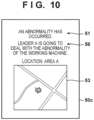
- Fig. 10 is a view showing an example of display of second abnormality notification information 50c, which is displayed on the display of the terminal other than the target.
- the second abnormality notification information 50c shown in Fig. 10 includes the display 51 of "an abnormality has occurred" as information concerning the abnormality of the working machine 10 and the map information 53 indicating the position of the working machine 10 in which the abnormality has been detected.
- the second abnormality notification information 50c does not include information for encouraging the leader to go to deal with the abnormality of the working machine 10 but can include display 56 of "leader A is going to deal with the abnormality of the working machine” as information indicating the status of dealing with the abnormality of the working machine 10.
- the information terminal 40 existing within the predetermined range R from the working machine 10a in which the abnormality has occurred is selected, and the abnormality notification information is transmitted to the selected information terminal 40. This can prevent a situation that a plurality of leaders go to deal with the abnormality of the working machine 10 in which the abnormality has been detected, thereby efficiently dealing with the abnormality of the working machine 10.
- the second embodiment of the present invention will be described.
- the second embodiment basically takes over the first embodiment.
- the processing unit 21 (selection unit 21a and the generation unit 21b) of the server apparatus 20 perform the target terminal selection processing and the abnormality notification information generation processing in the first embodiment
- a control unit 11 of a working machine 10 performs these processes in the second embodiment.
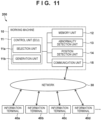
- Fig. 11 is a block diagram showing the arrangement of a system 200 according to this embodiment.
- the system 200 according to this embodiment includes the working machine 10 and a plurality of information terminals (information terminals 40a to 40d in Fig. 11 ).
- the control unit 11 of the working machine 10 includes a selection unit 11a that selects a target terminal and a generation unit 11b that generates abnormality notification information. Processes performed by the selection unit 11a and the generation unit 11b of the working machine 10 are the same as those performed by the selection unit 21a and the generation unit 21b of the server apparatus 20 described in the first embodiment. Furthermore, the control unit 11 of the working machine 10 according to this embodiment performs the same processing as that of the processing unit 21 of the server apparatus, which has been described with reference to the flowchart of Fig. 5 in the first embodiment.
- the control unit 11 of the working machine 10 selects, among the plurality of information terminals 40, the information terminal 40 existing within a predetermined range R from a working machine 10a in which an abnormality has occurred, and transmits abnormality notification information to the selected information terminal 40 via a network 30.
- This can prevent a situation in which a plurality of leaders go to deal with the abnormality of the working machine 10 in which the abnormality has been detected, thereby efficiently dealing with the abnormality of the working machine 10.
- a server apparatus of the above-described embodiment is a server apparatus (for example, 20) communicably connected to a vehicle (for example, 10) and a plurality of information terminals (for example, 40), comprising reception means (for example, 23) for receiving abnormality detection information from the vehicle, selection means (for example, 21a) for selecting, if the reception means receives the abnormality detection information, among the plurality of information terminals, the information terminal existing within a predetermined range from the vehicle as a target terminal to which abnormality notification information of the vehicle is to be transmitted, and transmission means (for example, 23) for transmitting the abnormality notification information to the information terminal selected by the selection means.
- reception means for example, 23
- selection means for example, 21a
- a leader or manager or the like
- a leader near the vehicle can be notified of an abnormality (a problem) of the vehicle
- he/she can immediately grasp the status of the vehicle and quickly perform status confirmation.
- the selection means selects, from the at least two information terminals, the information terminal closest to the vehicle as the target terminal. According to this aspect, even if there are a plurality of leaders within the predetermined range, the leader closest to the vehicle can be notified of the abnormality notification information, and it is thus possible to quickly and efficiently deal with the abnormality of the vehicle.
- the selection means selects, from the at least two information terminals, the information terminal, whose preset priority level is high, as the target terminal. According to this aspect, even if there are a plurality of leaders within the predetermined range, the leader can be notified of the abnormality notification information in accordance with the preset priority level, and it is thus possible to quickly and efficiently deal with the abnormality of the vehicle.
- the abnormality notification information includes information concerning an abnormality of the vehicle and position information of the vehicle. According to this aspect, it is possible to specify the status and position of the vehicle in which the abnormality has been detected and to notify the leader of more appropriate abnormality notification information.
- the abnormality notification information includes information for encouraging a user to go to deal with an abnormality of the vehicle.
- the leader the user can appropriately determine whether to go to deal with the abnormality of the vehicle.
- the server apparatus further comprises acquisition means (for example, 21, 23) for acquiring the position information of the vehicle and position information of each of the plurality of information terminals, wherein the selection means selects the information terminal as the target terminal based on the pieces of position information acquired by the acquisition means. According to this aspect, it is possible to appropriately select the information terminal which is to be notified of the abnormality notification information.
- the transmission means transmits second abnormality notification information including contents different from the abnormality notification information to, among the plurality of information terminals, the information terminal different from the information terminal selected as the target terminal. According to this aspect, a leader holding an information terminal other than the target terminal can also be notified of the abnormality of the vehicle.
- the second abnormality notification information includes no information for encouraging a user to go to deal with the abnormality of the vehicle.
- a leader (the user) holding an information terminal other than the target terminal can appropriately determine whether to go to deal with the abnormality of the vehicle.
- the transmission means transmits the abnormality notification information whose notification contents have been changed in accordance with an abnormality degree of the vehicle obtained from the abnormality detection information. According to this aspect, a leader notified of the abnormality notification information can immediately grasp the status of the vehicle, and quickly and appropriately deal with the abnormality of the vehicle.
- the transmission means transmits the abnormality notification information whose notification contents have been changed in accordance with a time period in which the reception means receives the abnormality detection information. According to this aspect, a leader notified of the abnormality notification information can immediately grasp the status of the vehicle, and quickly and appropriately deal with the abnormality of the vehicle.
- the selection means changes the information terminal as the target terminal in accordance with the abnormality degree of the vehicle obtained from the abnormality detection information. According to this aspect, it is possible to appropriately deal with the abnormality of the vehicle in accordance with the abnormality degree of the vehicle.
- the selection means changes the information terminal as the target terminal in accordance with a time period in which the reception means receives the abnormality detection information. According to this aspect, it is possible to appropriately deal with the abnormality of the vehicle in accordance with the time period in which the abnormality of the vehicle occurs.
- Each of the plurality of information terminals is a portable information terminal. According to this aspect, since the abnormality notification information can be transmitted to an information terminal carried (held) by a leader, the leader can quickly know the abnormality of the vehicle and move while carrying the information terminal, and can thus appropriately deal with the abnormality of the vehicle even before arriving at the vehicle in which the abnormality has been detected.
- a vehicle of the above-described embodiment is a vehicle (for example, 10) communicably connected to a plurality of information terminals (for example, 40), comprising detection means (for example, 13) for detecting an abnormality of the vehicle, and transmission means (for example, 15) for transmitting, if the detection means detects the abnormality, abnormality notification information of the vehicle to, among the plurality of information terminals, the information terminal existing within a predetermined range from the vehicle.
- detection means for example, 13
- transmission means for example, 15
Landscapes
- Physics & Mathematics (AREA)
- General Physics & Mathematics (AREA)
- Alarm Systems (AREA)
Description
- The present invention relates to a technique of making a notification of an abnormality of a vehicle.
-
JPH11-175885 A - When a plurality of transmission destinations are preset, if information indicating that an abnormality of a vehicle has been detected is transmitted to the plurality of transmission destinations, people go to deal with the abnormality of the vehicle from the plurality of transmission destinations, which is very inefficient.
- A server apparatus, in which all features of the preamble of claim 1 are disclosed, is described in
US 2016/071399 A1 . -
US 2017/136943 A1 discloses an electronic safety system for a vehicle comprising a GPS sensor for determining a geographic location of the vehicle, a sensor for detecting a distress signal and a telecommunication unit that transmits an alert notification indicating the determined geographic location of the vehicle to an emergency service organization if the distress signal is detected. - It is an object of the present invention to provide a server apparatus, a control apparatus and a control method that efficiently deals with an abnormality of a vehicle.
- This object is achieved by a server apparatus, a control apparatus and a control method according to the enclosed independent claims. Advantageous features of the present invention are defined in the corresponding subclaims.
- According to the present invention, it is possible to efficiently deal with an abnormality of a vehicle.
- The accompanying drawings, which are incorporated in and constitute a part of the specification, illustrate embodiments of the invention and, together with the description, serve to explain principles of the invention.
-
Fig. 1 is a view showing an example of the arrangement of a vehicle (working machine); -
Fig. 2 is a view showing a state in which a plurality of working machines are working in a working area; -
Fig. 3 is a block diagram showing the arrangement of a system according to the first embodiment; -
Fig. 4 is a sequence chart showing processing performed among a working machine, a server apparatus, and an information terminal (target terminal); -
Fig. 5 is a flowchart illustrating a processing procedure by the server apparatus; -
Fig. 6 is a flowchart illustrating an example of target terminal selection processing; -
Fig. 7 is a flowchart illustrating an example of abnormality notification information generation processing; -
Fig. 8 is a view showing an example of display of abnormality notification information for making a notification of abnormality occurrence; -
Fig. 9 is a view showing an example of display of abnormality notification information for making a notification of theft occurrence; -
Fig. 10 is a view showing an example of display of second abnormality notification information; and -
Fig. 11 is a block diagram showing the arrangement of a system according to the second embodiment. - Embodiments of the present invention will be described below with reference to the accompanying drawings. Note that the drawings are schematic views showing a structure or an arrangement according to the embodiment, and the dimensions of members shown in the drawings do not necessarily reflect real dimensions. The same reference numerals denote the same elements in the drawing, and a description of repetitive contents will be omitted in this specification.
- The first embodiment of the present invention will be described.
Fig. 1 is a view showing an example of the arrangement of avehicle 10 according to this embodiment. Thevehicle 10 may be any of a two-wheeled vehicle, a three-wheeled vehicle, or a four-wheeled vehicle. However, this embodiment will exemplify, as thevehicle 10, a working machine (to also be referred to as the workingmachine 10 hereinafter) configured to execute a work in a predetermined area. Examples of the workingmachine 10 are a lawn mower, a blower, a cultivator, and a snowplow. In this embodiment, however, theworking machine 10 is a lawn mower. In this embodiment, theworking machine 10 is a riding vehicle whose vehicle body 1 is provided with aseat 6 on which an operator (occupant) can sit. However, theworking machine 10 is not limited to this example, and may be, for example, an unmanned traveling vehicle or a handcart of a type that is pushed with the hands of the operator. Theworking machine 10 includes atraveling unit 2, aworking unit 3, astorage unit 4, and anoperation unit 5. - The traveling
unit 2 is configured to make the workingmachine 10 travel and provided on the lower side of the vehicle body 1 to support the vehicle body 1. In this embodiment, theworking machine 10 is a four-wheeled vehicle, and the travelingunit 2 includes a pair of left and rightrear wheels 2R as driving wheels and a pair of left and rightfront wheels 2F as driven wheels. - In this embodiment, the working
unit 3 is a lawn mowing blade provided on the lower side of the vehicle body 1, and is provided such that the position in the vertical direction of the vehicle body with respect to the workingunit 3 can be adjusted. Hence, the lawn mowing blade serving as the workingunit 3 can mow a lawn in a working area to a desired height. - The
storage unit 4 stores the lawn mowed by the lawn mowing blade serving as the workingunit 3. For example, the vehicle body 1 is provided with a duct (not shown) from the upper portion of the workingunit 3 to the rear portion, and the mowed lawn is guided to thestorage unit 4 via the duct and stored. - The
operation unit 5 includes a plurality of operators configured to drive and control the travelingunit 2 and theworking unit 3. As one example of theoperation unit 5, asteering wheel 5a serving as a steering operator is shown here. In addition, an acceleration operator, a braking operator, a working operator, and the like are included. Note that as these operators, any one of a pedal method, a lever method, a switch method, and the like may be employed. -
Fig. 2 is a view showing a state in which the plurality ofworking machines 10 are working in a working area. In the example shown inFig. 2 , the workingmachines 10 are performing lawn mowing operations at a plurality of positions in the working area, and leaders each holding aninformation terminal 40 are arranged in the working area.Fig. 2 shows an example in which three leaders are arranged. Theinformation terminals 40 held by three leaders are represented byinformation terminals 40a to 40c. Each of theinformation terminals 40a to 40c can be, for example, a portable information terminal such as a portable phone including a display (display unit) capable of displaying received information. - In the working area where the plurality of
working machines 10 are working, for example, an abnormality of theworking machine 10 may occur, such as a crash against a tree existing within the working area or run-off of a wheel into a ditch existing in the working area.Fig. 2 shows an example in which the workingmachine 10a crashes against a tree to cause an abnormality. When an abnormality occurs in theworking machine 10a, if pieces of information of the same contents indicating the abnormality (the problem) of the workingmachine 10a are respectively transmitted to the plurality ofinformation terminals 40a to 40c, the plurality of leaders go to deal with the abnormality of theworking machine 10a, which is very inefficient. The abnormality of theworking machine 10 includes dangerous traveling such as sudden acceleration or high-speed traveling by the worker. If such abnormality (dangerous traveling) of the workingmachine 10 occurs, it is preferable to transmit the information to the leader existing around the worker who has performed dangerous traveling, instead of transmitting the information to all the plurality of leaders (information terminals). To do this, in this embodiment, among the plurality of preregisteredinformation terminals 40, theinformation terminal 40a existing within a predetermined range R from theworking machine 10a in which the abnormality has occurred is selected, and the information is transmitted to theselected information terminal 40a. -
Fig. 3 is a block diagram showing the arrangement of asystem 100 according to this embodiment. Thesystem 100 according to this embodiment includes theworking machine 10, a server apparatus 20 (cloud), and the plurality of information terminals 40 (information terminals 40a to 40d inFig. 3 ). - The
working machine 10 can include, as in-vehicle devices, acontrol unit 11, amemory unit 12, anabnormality detection unit 13, aposition detection unit 14, and a communication unit 15 (a transmission unit). Thecontrol unit 11 is an ECU (Electronic Control Unit) in this embodiment, and includes a processor represented by a CPU, a memory device such as a semiconductor memory, and an interface with an external device. Thememory unit 12 stores a program to be executed by the processor, data to be used by the processor for processing, and the like, and the control unit 11 (ECU) can read out the program stored in thememory unit 12 into the memory device such as a memory and execute it. - The
abnormality detection unit 13 detects an abnormality of theworking machine 10. More specifically, theabnormality detection unit 13 includes a vibration sensor that detects a vibration of the vehicle body 1, and an acceleration sensor that detects the acceleration of the vehicle body 1, and detects occurrence of an abnormality when a value (vibration or acceleration) detected by each sensor exceeds a predetermined value. Theabnormality detection unit 13 may be configured to detect an abnormality caused by an internal element of the workingmachine 10, such as an abnormality of the engine of the workingmachine 10 and an abnormality of a lawn mowing blade (working unit 3), in addition to an abnormality caused by run-off of a wheel or crash of the workingmachine 10. More specifically, theabnormality detection unit 13 can be provided with a sensor that detects the rotation speed of the engine or lawn mowing blade, and detect occurrence of an abnormality when the rotation speed detected by the sensor does not reach a desired value. - The
position detection unit 14 detects the current position of the workingmachine 10. More specifically, theposition detection unit 14 includes a GPS sensor that detects the position of the workingmachine 10 and a gyro sensor that detects the rotary motion of the workingmachine 10, and detects the current position of the workingmachine 10 based on the detection result of each sensor. - The
communication unit 15 is communicably connected to theserver apparatus 20 via anetwork 30. More specifically, thecommunication unit 15 has a function as a reception unit that receives information from theserver apparatus 20 via thenetwork 30 and a function as a transmission unit that transmits information to theserver apparatus 20 via thenetwork 30. In this embodiment, if theabnormality detection unit 13 detects an abnormality of the workingmachine 10, thecommunication unit 15 transmits abnormality detection information to theserver apparatus 20 via thenetwork 30. The abnormality detection information may include, for example, information indicating the value (vibration, acceleration, rotation speed, or the like) detected by theabnormality detection unit 13 and the position information of the workingmachine 10 detected by theposition detection unit 14 in addition to information about detection of the abnormality by theabnormality detection unit 13. This embodiment assumes that the abnormality detection information includes both the value detected by theabnormality detection unit 13 and the position information detected by theposition detection unit 14. - The
server apparatus 20 includes aprocessing unit 21, amemory unit 22, and a communication unit 23 (a transmission unit). Theprocessing unit 21 includes a processor represented by a CPU, a memory device such as a semiconductor memory, and an interface with an external device. Thememory unit 22 stores a program to be executed by the processor, data to be used by the processor for processing, and the like, and theprocessing unit 21 can read out the program stored in thememory unit 22 into the memory device such as a memory and execute it. Theprocessing unit 21 includes aselection unit 21a that selects, among the plurality ofinformation terminals 40, the information terminal 40 (target terminal) to which abnormality notification information is to be transmitted, and ageneration unit 21b that generates the abnormality notification information. - The
communication unit 23 is communicably connected to each workingmachine 10 and eachinformation terminal 40 via thenetwork 30. More specifically, thecommunication unit 23 has a function as a reception unit that receives abnormality detection information from each workingmachine 10 via thenetwork 30 and a function as a transmission unit that transmits abnormality notification information to eachinformation terminal 40 via thenetwork 30. -
Fig. 4 is a sequence chart showing processing performed among the workingmachine 10, theserver apparatus 20, and the information terminal 40 (target terminal). If an abnormality is detected in the working machine 10 (step 101), abnormality detection information is transmitted to theserver apparatus 20 via the network 30 (step 102). Upon receiving the abnormality detection information, theserver apparatus 20 selects (step 103), based on the pieces of position information of theinformation terminals 40 and the workingmachine 10, among the plurality ofinformation terminals 40, a target terminal to which a notification of abnormality notification information is to be made, and generates abnormality notification information (step 104). Then, the abnormality notification information is transmitted to the target terminal (step 105). The target terminal (information terminal 40) displays the received abnormality notification information on the display (step 106). In the example shown inFig. 4 ,step 104 is performed afterstep 103. However,step 104 may be performed beforestep 103 orsteps - Processing performed by the
server apparatus 20 will be described next.Fig. 5 is a flowchart illustrating a processing procedure by theserver apparatus 20. Each step of the flowchart shown inFig. 5 can be performed by theprocessing unit 21 of theserver apparatus 20. - In step S11, the
processing unit 21 determines whether abnormality detection information is received. For example, if, as shown inFig. 2 , the workingmachine 10a crashes against a tree, the acceleration of the workingmachine 10a detected by the acceleration sensor (or the vibration of the workingmachine 10a detected by the vibration sensor) is equal to or more than a predetermined value, and theabnormality detection unit 13 detects an abnormality. In this case, the workingmachine 10a transmits abnormality detection information indicating that theabnormality detection unit 13 has detected the abnormality, and theserver apparatus 20 receives the abnormality detection information via the network. In this way, if theserver apparatus 20 receives the abnormality detection information, the process advances to step S12. - In step S12, the
processing unit 21 acquires the position information of the workingmachine 10 in which the abnormality has been detected. For example, if the received abnormality detection information includes the position information of the workingmachine 10, theprocessing unit 21 acquires the position information of the workingmachine 10 from the abnormality detection information. On the other hand, if the received abnormality detection information does not include the position information of the workingmachine 10a, theprocessing unit 21 acquires the position information detected by theposition detection unit 14 of the workingmachine 10 by receiving it by thecommunication unit 23 via thenetwork 30. - In step S13, the
processing unit 21 acquires the position information of eachinformation terminal 40. Eachinformation terminal 40 is preset (preregistered) as a transmission destination of information for managing the plurality of workingmachines 10, and includes a GPS sensor or the like for detecting the current position. Theprocessing unit 21 acquires the current position detected by the GPS sensor or the like in eachinformation terminal 40 by receiving it by thecommunication unit 23 from eachinformation terminal 40 via thenetwork 30. - In step S14, the processing unit 21 (
selection unit 21a) selects, among the plurality ofinformation terminals 40, the target terminal to which abnormality notification information to be generated in step S15 (to be described later) is to be transmitted. A practical example of the target terminal selection processing performed in step S14 will be described with reference toFig. 6. Fig. 6 is a flowchart illustrating an example of the target terminal selection processing. Each step of the flowchart shown inFig. 6 can be performed by theselection unit 21a of theprocessing unit 21 of theserver apparatus 20. - In step S14-1, based on the position information of the working
machine 10 acquired in step S12 and the pieces of position information of theinformation terminals 40 acquired in step S13, theselection unit 21a specifies the positions of therespective information terminals 40 and the workingmachine 10 in which the abnormality has occurred. In step S14-2, theselection unit 21a sets the predetermined range R with respect to the workingmachine 10 in which the abnormality has occurred. For example, as shown inFig. 2 , theselection unit 21a sets, as the predetermined range R, a range within a predetermined distance with reference to (centering) the workingmachine 10a in which the abnormality has occurred. In step S14-3, theprocessing unit 21a selects theinformation terminals 40 existing within the predetermined region set in step S14-2. In the example shown inFig. 2 , since theinformation terminal 40a exists within the predetermined range R, theinformation terminal 40a is selected. - The predetermined distance can arbitrarily be set. However, for example, the interval of the plurality of leaders to be arranged in the working area may be set as the predetermined distance or if the working area is divided into a plurality of partial areas, the dimension (size) of one partial area may be set as the predetermined distance. The predetermined distance can be preset via, for example, a user interface but may automatically be set by the
selection unit 21a based on the pieces of position information of therespective information terminals 40 specified in step S14-1. More specifically, theselection unit 21a may calculate the average, minimum, or maximum value of the intervals between theinformation terminals 40 based on the pieces of position information of therespective information terminals 40 specified in step S14-1, and set the calculated value as the predetermined distance. - In step S14-4, the
selection unit 21a determines whether two ormore information terminals 40 have been selected in step S14-3, that is, whether two ormore information terminals 40 exist within the predetermined region R. If oneinformation terminal 40 has been selected in step S14-3, thisinformation terminal 40 is decided as the target terminal to which the abnormality notification information is to be transmitted. On the other hand, if two ormore information terminals 40 have been selected, the process advances to step S14-5. - In step S14-5, the
selection unit 21a selects, from the two ormore information terminals 40 selected in step S14-3, theinformation terminal 40 closest to the workingmachine 10 in which the abnormality has been detected, and decides thisinformation terminal 40 as the target terminal to which the abnormality notification information is to be transmitted. This embodiment has explained the example in which among the two ormore information terminals 40 existing within the predetermined region, theinformation terminal 40 closest to the workingmachine 10 is selected as the target terminal. The present invention, however, is not limited to this. For example, if priority levels are preset for the plurality ofinformation terminals 40, among the two ormore information terminals 40 existing within the predetermined region, theinformation terminal 40 having the higher priority level may be selected as the target terminal. This embodiment has explained the example in which the predetermined region R is set. However, for example, an arrangement of selecting theinformation terminal 40 closest to the workingmachine 10 in which the abnormality has been detected, without setting the predetermined region R, may be adopted. - Referring back to the flowchart shown in
Fig. 5 , in step S15, the processing unit 21 (generation unit 21b) generates the abnormality notification information for making a notification of the abnormality of the workingmachine 10. A practical example of the abnormality notification information generation processing performed in step S15 will be described with reference toFig. 7. Fig. 7 is a flowchart illustrating an example of the abnormality notification information generation processing. Each step of the flowchart shown inFig. 7 can be performed by thegeneration unit 21b of theprocessing unit 21 of theserver apparatus 20. - In step S15-1, the
generation unit 21b determines whether the reception time (time period) of the abnormality detection information is in a working time (for example, daytime). If, for example, the reception time of the abnormality detection information is in the working time, an abnormality (including performance deterioration) highly probably occurs in the workingmachine 10. Thus, the process advances to step S15-2, and thegeneration unit 21b determines that the abnormality has occurred in the working machine 10 (abnormality occurrence). - In step S15-3, the
generation unit 21b generates the abnormality notification information for making a notification of the abnormality occurrence.Fig. 8 is a view showing an example of display ofabnormality notification information 50a for making a notification of the abnormality occurrence, and the information is displayed on the display of the target terminal selected in step S14. The display example shown inFig. 8 includesdisplay 51 of "an abnormality has occurred" as information concerning the abnormality (the problem) of the workingmachine 10, and includesdisplay 52 of "go to deal with the abnormality of the workingmachine 10" as information for encouraging a person to go to deal with the abnormality of the workingmachine 10. The display example shown inFig. 8 also includesmap information 53 indicating the position of the workingmachine 10 in which the abnormality has been detected. - In step S15-4, the
generation unit 21b evaluates the abnormality degree of the workingmachine 10 based on the value (vibration, acceleration, or the like) detected by theabnormality detection unit 13 of the workingmachine 10. If, for example, the vibration sensor is provided as theabnormality detection unit 13 in the workingmachine 10, thegeneration unit 21b receives the information of the vibration detected by the vibration sensor together with the abnormality detection information, and evaluates the abnormality degree of the workingmachine 10 in accordance with the magnitude of the vibration. In this embodiment, the magnitude of the vibration detected by the vibration sensor is used as the abnormality degree of the workingmachine 10. However, for example, an index obtained by reflecting the detection result of another sensor (the acceleration sensor or the like) in addition to the detection result of the vibration sensor may be used as the abnormality degree. - In step S15-5, the
generation unit 21b determines whether the abnormality degree evaluated in step S15-4 is larger than a threshold. If, for example, the abnormality degree (the vibration detected by the vibration sensor) is larger than the threshold, the abnormality of the workingmachine 10 highly probably needs to urgently be dealt with. Therefore, in this case, the process advances to step S15-6, and thegeneration unit 21b changes the notification contents of the abnormality notification information in accordance with the abnormality degree. In this embodiment, if the abnormality degree evaluated in step S15-4 is larger than the threshold,display 54 of "urgent" is added, as in the display example shown inFig. 8 . The threshold of the abnormality degree is set to a value larger than a predetermined value used to detect the abnormality of the workingmachine 10 by theabnormality detection unit 13. - The processing unit 21 (
selection unit 21a) may change, in accordance with the abnormality degree of the workingmachine 10, the target terminal to which the abnormality notification information is to be transmitted. For example, if the abnormality degree of the workingmachine 10 is equal to or smaller than the threshold, theprocessing unit 21 selects, as the target terminal, only theinformation terminal 40 selected in step S14. On the other hand, if the abnormality degree of the workingmachine 10 is larger than the threshold, the abnormality needs to urgently be dealt with, and thus theinformation terminal 40 of the manager (for example, the owner) of the working area may also be added as the target terminal in addition to theinformation terminal 40 selected in step S14. - If, in step S15-1, the reception time (time period) of the abnormality detection information is outside the working time, the working
machine 10 is normally in a stop state, and thus the probability that the abnormality has occurred in the workingmachine 10 is low and a theft (or unauthorized use outside the working time) of the workingmachine 10 highly probably occurs. Therefore, in this case, the process advances to step S15-7, and thegeneration unit 21b determines theft occurrence. As described above, since the workingmachine 10 is in the stop state outside the working time, the predetermined value used by theabnormality detection unit 13 to detect the abnormality of the workingmachine 10 may be set, outside the working time, to a value smaller than that during the working time. - The processing unit 21 (
selection unit 21a) changes, in accordance with the reception time (time period) of the abnormality detection information, the target terminal to which the abnormality notification information is to be transmitted. If, for example, the reception time of the abnormality detection information is in the working time (for example, daytime), theprocessing unit 21 selects, as the target terminal, only theinformation terminal 40 selected in step S14. On the other hand, if the reception time of the abnormality detection information is outside the working time (for example, midnight), no leader highly probably exists within the working area, and thus theinformation terminal 40 of the manager (for example, owner) of the working area is set as the target terminal instead of theinformation terminal 40 selected in step S14. - In step S15-8, the
generation unit 21b generates the abnormality notification information for making a notification of theft occurrence.Fig. 9 is a view showing an example of display ofabnormality notification information 50b for making a notification of theft occurrence, and the information is displayed on the display of the selected target terminal in step S16 (to be described later). The display example shown inFig. 9 includesdisplay 55 of "a theft has occurred" as information concerning the abnormality of the workingmachine 10, and includes thedisplay 52 of "go to deal with the theft of the working machine" as information for encouraging the leader to go to deal with the theft of the workingmachine 10. The display example shown inFig. 9 also includes themap information 53 indicating the position of the workingmachine 10 at the time of the occurrence of the theft. - Referring back to the flowchart shown in
Fig. 5 , in step S16, theprocessing unit 21 uses thecommunication unit 23 to transmit, via thenetwork 30, the abnormality notification information generated in step S15 to the information terminal 40 (target terminal) selected in step S14. - This embodiment has explained the example in which the abnormality notification information is transmitted to the
information terminal 40 selected as the target terminal. However, for example, information (second abnormality notification information) including notification contents different from the abnormality notification information may be transmitted to the information terminal 40 (to also be referred to as a "terminal other than the target" hereinafter) different from the target terminal. In the example shown inFig. 2 , the second abnormality notification information can be transmitted to each of theinformation terminals information terminal 40a selected as the target terminal. The second abnormality notification information may be transmitted to theinformation terminal 40 of the manager (for example, owner) of the working area. -
Fig. 10 is a view showing an example of display of secondabnormality notification information 50c, which is displayed on the display of the terminal other than the target. The secondabnormality notification information 50c shown inFig. 10 includes thedisplay 51 of "an abnormality has occurred" as information concerning the abnormality of the workingmachine 10 and themap information 53 indicating the position of the workingmachine 10 in which the abnormality has been detected. To prevent the leader having the terminal other than the target from go to deal with the abnormality of the workingmachine 10, the secondabnormality notification information 50c does not include information for encouraging the leader to go to deal with the abnormality of the workingmachine 10 but can includedisplay 56 of "leader A is going to deal with the abnormality of the working machine" as information indicating the status of dealing with the abnormality of the workingmachine 10. - As described above, in this embodiment, among the plurality of
information terminals 40, theinformation terminal 40 existing within the predetermined range R from the workingmachine 10a in which the abnormality has occurred is selected, and the abnormality notification information is transmitted to the selectedinformation terminal 40. This can prevent a situation that a plurality of leaders go to deal with the abnormality of the workingmachine 10 in which the abnormality has been detected, thereby efficiently dealing with the abnormality of the workingmachine 10. - The second embodiment of the present invention will be described. The second embodiment basically takes over the first embodiment. However, while the processing unit 21 (
selection unit 21a and thegeneration unit 21b) of theserver apparatus 20 perform the target terminal selection processing and the abnormality notification information generation processing in the first embodiment, acontrol unit 11 of a workingmachine 10 performs these processes in the second embodiment. -
Fig. 11 is a block diagram showing the arrangement of asystem 200 according to this embodiment. Thesystem 200 according to this embodiment includes the workingmachine 10 and a plurality of information terminals (information terminals 40a to 40d inFig. 11 ). Thecontrol unit 11 of the workingmachine 10 includes aselection unit 11a that selects a target terminal and ageneration unit 11b that generates abnormality notification information. Processes performed by theselection unit 11a and thegeneration unit 11b of the workingmachine 10 are the same as those performed by theselection unit 21a and thegeneration unit 21b of theserver apparatus 20 described in the first embodiment. Furthermore, thecontrol unit 11 of the workingmachine 10 according to this embodiment performs the same processing as that of theprocessing unit 21 of the server apparatus, which has been described with reference to the flowchart ofFig. 5 in the first embodiment. - That is, in this embodiment, the
control unit 11 of the workingmachine 10 selects, among the plurality ofinformation terminals 40, theinformation terminal 40 existing within a predetermined range R from a workingmachine 10a in which an abnormality has occurred, and transmits abnormality notification information to the selectedinformation terminal 40 via anetwork 30. This can prevent a situation in which a plurality of leaders go to deal with the abnormality of the workingmachine 10 in which the abnormality has been detected, thereby efficiently dealing with the abnormality of the workingmachine 10. - A server apparatus of the above-described embodiment is a server apparatus (for example, 20) communicably connected to a vehicle (for example, 10) and a plurality of information terminals (for example, 40), comprising reception means (for example, 23) for receiving abnormality detection information from the vehicle, selection means (for example, 21a) for selecting, if the reception means receives the abnormality detection information, among the plurality of information terminals, the information terminal existing within a predetermined range from the vehicle as a target terminal to which abnormality notification information of the vehicle is to be transmitted, and transmission means (for example, 23) for transmitting the abnormality notification information to the information terminal selected by the selection means. According to this aspect, since a leader (or manager or the like) near the vehicle can be notified of an abnormality (a problem) of the vehicle, he/she can immediately grasp the status of the vehicle and quickly perform status confirmation. In addition, it is possible to prevent a plurality of leaders from go to deal with the abnormality (the problem) the vehicle in which the abnormality has been detected, thereby efficiently dealing with the abnormality of the vehicle.
- If at least two information terminals exist within the predetermined range, the selection means selects, from the at least two information terminals, the information terminal closest to the vehicle as the target terminal. According to this aspect, even if there are a plurality of leaders within the predetermined range, the leader closest to the vehicle can be notified of the abnormality notification information, and it is thus possible to quickly and efficiently deal with the abnormality of the vehicle.
- If at least two information terminals exist within the predetermined range, the selection means selects, from the at least two information terminals, the information terminal, whose preset priority level is high, as the target terminal. According to this aspect, even if there are a plurality of leaders within the predetermined range, the leader can be notified of the abnormality notification information in accordance with the preset priority level, and it is thus possible to quickly and efficiently deal with the abnormality of the vehicle.
- The abnormality notification information includes information concerning an abnormality of the vehicle and position information of the vehicle. According to this aspect, it is possible to specify the status and position of the vehicle in which the abnormality has been detected and to notify the leader of more appropriate abnormality notification information.
- The abnormality notification information includes information for encouraging a user to go to deal with an abnormality of the vehicle. According to this aspect, the leader (the user) can appropriately determine whether to go to deal with the abnormality of the vehicle.
- The server apparatus further comprises acquisition means (for example, 21, 23) for acquiring the position information of the vehicle and position information of each of the plurality of information terminals, wherein the selection means selects the information terminal as the target terminal based on the pieces of position information acquired by the acquisition means. According to this aspect, it is possible to appropriately select the information terminal which is to be notified of the abnormality notification information.
- The transmission means transmits second abnormality notification information including contents different from the abnormality notification information to, among the plurality of information terminals, the information terminal different from the information terminal selected as the target terminal. According to this aspect, a leader holding an information terminal other than the target terminal can also be notified of the abnormality of the vehicle.
- The second abnormality notification information includes no information for encouraging a user to go to deal with the abnormality of the vehicle. According to this aspect, a leader (the user) holding an information terminal other than the target terminal can appropriately determine whether to go to deal with the abnormality of the vehicle.
- The transmission means transmits the abnormality notification information whose notification contents have been changed in accordance with an abnormality degree of the vehicle obtained from the abnormality detection information. According to this aspect, a leader notified of the abnormality notification information can immediately grasp the status of the vehicle, and quickly and appropriately deal with the abnormality of the vehicle.
- The transmission means transmits the abnormality notification information whose notification contents have been changed in accordance with a time period in which the reception means receives the abnormality detection information. According to this aspect, a leader notified of the abnormality notification information can immediately grasp the status of the vehicle, and quickly and appropriately deal with the abnormality of the vehicle.
- The selection means changes the information terminal as the target terminal in accordance with the abnormality degree of the vehicle obtained from the abnormality detection information. According to this aspect, it is possible to appropriately deal with the abnormality of the vehicle in accordance with the abnormality degree of the vehicle.
- The selection means changes the information terminal as the target terminal in accordance with a time period in which the reception means receives the abnormality detection information. According to this aspect, it is possible to appropriately deal with the abnormality of the vehicle in accordance with the time period in which the abnormality of the vehicle occurs.
- Each of the plurality of information terminals is a portable information terminal. According to this aspect, since the abnormality notification information can be transmitted to an information terminal carried (held) by a leader, the leader can quickly know the abnormality of the vehicle and move while carrying the information terminal, and can thus appropriately deal with the abnormality of the vehicle even before arriving at the vehicle in which the abnormality has been detected.
- A vehicle of the above-described embodiment is a vehicle (for example, 10) communicably connected to a plurality of information terminals (for example, 40), comprising detection means (for example, 13) for detecting an abnormality of the vehicle, and transmission means (for example, 15) for transmitting, if the detection means detects the abnormality, abnormality notification information of the vehicle to, among the plurality of information terminals, the information terminal existing within a predetermined range from the vehicle. According to this aspect, since a leader (or a manager or the like) near the vehicle can be notified of the abnormality of the vehicle, he/she can immediately grasp the status of the vehicle and quickly perform status confirmation. In addition, it is possible to prevent a plurality of leaders from going to deal with the abnormality of the vehicle in which the abnormality has been detected, thereby efficiently dealing with the abnormality of the vehicle.
- 10: vehicle (working machine), 11: control unit, 13: abnormality detection unit, 14: position detection unit, 20: server apparatus, 21: processing unit, 21a: selection unit, 21b: generation unit, 40: information terminal
Claims (16)
- A server apparatus (20) communicably connected to a vehicle (10) working in a predetermined area and a plurality of information terminals (40a-40d) respectively held by leaders arranged in the predetermined area, comprising: acquisition means (21) for acquiring position information of the vehicle (10) and position information of each of the plurality of information terminals (40a-40d);reception means (23) for receiving abnormality detection information from the vehicle (10);selection means (21a) for selecting, in case where the reception means (23) receives the abnormality detection information, among the plurality of information terminals (40a-40d), an information terminal existing within a predetermined range (R) from the vehicle (10) as a target information terminal to which abnormality of the vehicle (10) is to be notified;the selection means (21a) is configured to select the target information terminal based on the pieces of position information acquired by the acquisition means (21);generation means (21b) for generating first abnormality notification information for notifying the abnormality of the vehicle (10) to the selected target information terminal; andtransmission means (23) for transmitting the first abnormality notification information generated by the generation means (21b) to the selected target information terminal;
characterized in thatthe generation means (21b) is configured to generate, in a case where time when the reception means (23) has received the abnormality detection information from the vehicle (10) is outside working time of the vehicle (10), second abnormality notification information for making a notification of theft occurrence, andthe transmission means (23) is configured to transmit the generated second abnormality notification information to an information terminal of a manager instead of the target information terminal. - The server apparatus (20) according to claim 1, characterized in that in a case where at least two information terminals exist within the predetermined range (R),
the selection means (21a) is configured to select, from the at least two information terminals, the information terminal closest to the vehicle (10) as the target information terminal. - The server apparatus (20) according to claim 1, characterized in that in a case where at least two information terminals (40a-40d) exist within the predetermined range, the selection means (21b) is configured to select, from the at least two information terminals (40a-40d), the information terminal, whose preset priority level is high, as the target information terminal.
- The server apparatus (20) according to any one of claims 1 to 3, characterized in that the first abnormality notification information includes information concerning an abnormality of the vehicle (10) and position information of the vehicle (10).
- The server apparatus (20) according to any one of claims 1 to 4, characterized in that the first abnormality notification information includes information for encouraging a leader to go to the vehicle (10).
- The server apparatus (20) according to any one of claims 1 to 5, characterized in that the transmission means (23) is configured to transmit second abnormality notification information including contents different from the abnormality notification information to, among the plurality of information terminals (40a-40d), the information terminal different from the target information terminal.
- The server apparatus (20) according to any one of claims 1 to 6, characterized in that
the generation means (21b) is configured to generate the first abnormality notification information in a case where time when the reception means (23) has received the abnormality detection information from the vehicle (10) is during the working time of the vehicle (10). - The server apparatus (20) according to any one of claims 1 to 7, characterized in thatthe abnormality detection information includes information indicating magnitude of vibration detected in the vehicle (10), andthe generation means (21b) is configured to generate the first abnormality notification information such that notification contents is changed in accordance with the magnitude of the vibration detected in the vehicle (10).
- The server apparatus (20) according to any one of claims 1 to 8, characterized in that
the transmission means (23) is configured to transmit the first abnormality notification information whose notification contents have been changed in accordance with an abnormality degree of the vehicle (10) obtained from the abnormality detection information. - The server apparatus (20) according to any one of claims 1 to 9, characterized in that
the transmission means (23) is configured to transmit the first abnormality notification information whose notification contents have been changed in accordance with a time when the reception means (23) has received the abnormality detection information. - The server apparatus (20) according to any one of claims 1 to 10, characterized in that
the selection means (21a) is configured to change the target information terminal in accordance with the abnormality degree of the vehicle (10) obtained from the abnormality detection information. - The server apparatus (20) according to any one of claims 1 to 11, characterized in that
the selection means (21a) is configured to change as the target information terminal in accordance with a time when the reception means (23) has received the abnormality detection information. - The server apparatus (20) according to any one of claims 1 to 12, characterized in that
each of the plurality of information terminals (40a-40d) is a portable information terminal. - The server apparatus (20) according to any one of claims 1 to 13, characterized in that
in a case where time when the reception means (23) has received the abnormality detection information from the vehicle is outside the working time of the vehicle (10), the transmission means (23) is configured to transmit the generated second abnormality notification information to the information terminal of the manager of the predetermined area. - A vehicle (10) working in a predetermined area, wherein the vehicle (10) is communicably connected to a plurality of information terminals (40a-40d) respectively held by leaders arranged in the predetermined area, comprising:acquisition means (11) for acquiring position information of each of the plurality of information terminals (40a-40d);detection means (13) for detecting an abnormality of the vehicle (10);a position detection unit (14) for detecting position information of the vehicle (10);selection means (11a) for selecting, in a case where the detection means (13) detects the abnormality of the vehicle (10), among the plurality of information terminals (40a-40d), an information terminal existing within a predetermined range (R) from the vehicle (10) as a target information terminal to which the abnormality of the vehicle is to be notified; wherein the target information terminal is selected based on the position information of the vehicle (10) and position information of the information terminals;generation means (11b) for generating first abnormality notification information for notifying the abnormality of the vehicle (10) to the selected target information terminal; andtransmission means (15) for transmitting the first abnormality notification information generated by the generation means (11b), to the selected target information terminal,characterized in thatthe generation means (11b) is configured to generate, in a case where time when the detection means (13) has detected the abnormality of the vehicle is outside working time of the vehicle, second abnormality notification information for making a notification of theft occurrence, andthe transmission means (15) is configured to transmit the generated second abnormality notification information to an information terminal of a manager instead of the target information terminal.
- A control method of a server apparatus (20) communicably connected to a vehicle (10) working in a predetermined area and a plurality of information terminal (40a-40b) respectively held by leaders arranged in the predetermined area, comprising:a reception step (S11), carried out by a communication unit (23), of receiving abnormality detection information from a vehicle (10);an acquisition step (S12,S13), carried out by an acquisition means (21), of acquiring position information of the vehicle (10) and position information of each of the plurality of information terminals (40a-40d);a selection step (S14), carried out by a selection unit (21a), of selecting, in a case where the abnormality detection information is received in the reception step (S11) based on on the pieces of position information acquired by the acquisition means (21), among the plurality of information terminals (40a-40d), an information terminal existing within a predetermined range (R) from the vehicle (10) as a target information terminal to which abnormality of the vehicle (10) is to be notified;a generation step (S15), carried out by a generation unit (21b), of generating first abnormality notification information for notifying the abnormality of the vehicle (10) to the selected target information terminal; anda transmission step (S16), carried out by the communication unit (23), of transmitting the first abnormality notification information generated in the generation step (S15), to the selected target information terminal,characterized in thatthe generation step (S15) generates, in a case where time when the reception means (23) has received the abnormality detection information from the vehicle is outside working time of the vehicle, second abnormality notification information for making a notification of theft occurrence, andthe transmission step (S16) transmits the generated second abnormality notification information to an information terminal of a manager instead of the target information terminal.
Applications Claiming Priority (1)
| Application Number | Priority Date | Filing Date | Title |
|---|---|---|---|
| PCT/JP2018/029537 WO2020031249A1 (en) | 2018-08-07 | 2018-08-07 | Server device, vehicle, and method |
Publications (3)
| Publication Number | Publication Date |
|---|---|
| EP3836106A1 EP3836106A1 (en) | 2021-06-16 |
| EP3836106A4 EP3836106A4 (en) | 2021-07-28 |
| EP3836106B1 true EP3836106B1 (en) | 2023-08-30 |
Family
ID=69413304
Family Applications (1)
| Application Number | Title | Priority Date | Filing Date |
|---|---|---|---|
| EP18929256.8A Active EP3836106B1 (en) | 2018-08-07 | 2018-08-07 | Server device, vehicle, and method |
Country Status (3)
| Country | Link |
|---|---|
| US (1) | US12315308B2 (en) |
| EP (1) | EP3836106B1 (en) |
| WO (1) | WO2020031249A1 (en) |
Families Citing this family (3)
| Publication number | Priority date | Publication date | Assignee | Title |
|---|---|---|---|---|
| EP3836106B1 (en) | 2018-08-07 | 2023-08-30 | Honda Motor Co., Ltd. | Server device, vehicle, and method |
| JP7728133B2 (en) * | 2021-09-15 | 2025-08-22 | 株式会社アマダ | Automatic conveying device, conveying system, and method for notifying abnormality of automatic conveying device |
| KR102597695B1 (en) * | 2021-11-30 | 2023-11-02 | 주식회사 코리아세븐 | Method of providing service by using chatbot, system for providing service by using chatbot, and computer program for the method |
Family Cites Families (20)
| Publication number | Priority date | Publication date | Assignee | Title |
|---|---|---|---|---|
| JPH11175885A (en) | 1997-12-10 | 1999-07-02 | Rising Sun Security Service:Kk | Satellite managing system of mobile object like automobile or the like |
| JP3964553B2 (en) * | 1998-09-10 | 2007-08-22 | 株式会社東芝 | Information distribution system |
| JP4114940B2 (en) * | 1999-03-17 | 2008-07-09 | 株式会社小松製作所 | Communication equipment for construction machinery |
| WO2009072165A1 (en) * | 2007-12-05 | 2009-06-11 | Fujitsu Limited | Equipment control system using its system |
| EP2107531A1 (en) * | 2008-04-01 | 2009-10-07 | iNEWIT nv | Server and method for delivery of data from a mobile platform to a mobile terminal |
| JP5589745B2 (en) * | 2010-10-14 | 2014-09-17 | 富士通株式会社 | Hospital information system |
| CN103116917B (en) * | 2012-12-28 | 2016-03-02 | 银江股份有限公司 | A kind of public transport intelligent parking field control method based on GPS |
| JP2015201188A (en) * | 2014-03-31 | 2015-11-12 | 船井電機株式会社 | Information processing apparatus, information transmission system, and information transmission method |
| JP6398097B2 (en) * | 2014-05-13 | 2018-10-03 | 東芝情報システム株式会社 | Watch system |
| KR102232068B1 (en) * | 2014-07-17 | 2021-03-25 | 현대모비스 주식회사 | System and method for transmitting emergency call using neighboring vehicles |
| US20160071399A1 (en) * | 2014-09-08 | 2016-03-10 | On Guard LLC | Personal security system |
| CN105262792B (en) * | 2015-09-09 | 2019-09-20 | 深圳市元征科技股份有限公司 | A kind of vehicle abnormality processing method and car-mounted terminal |
| JP6278280B2 (en) | 2015-09-30 | 2018-02-14 | パナソニックIpマネジメント株式会社 | Sensor network system |
| US20170101054A1 (en) * | 2015-10-08 | 2017-04-13 | Harman International Industries, Incorporated | Inter-vehicle communication for roadside assistance |
| SG10201509383SA (en) * | 2015-11-13 | 2017-06-29 | Mastercard International Inc | An electronic safety system for a vehicle |
| WO2018046106A1 (en) * | 2016-09-12 | 2018-03-15 | Telefonaktiebolaget Lm Ericsson (Publ) | Methods, apparatus and computer-readable mediums for notification of vehicular accidents |
| KR102385245B1 (en) * | 2017-01-10 | 2022-04-12 | 삼성전자주식회사 | Vehicle terminal device and control method thereof |
| JP2018116839A (en) * | 2017-01-18 | 2018-07-26 | 株式会社ダイヘン | Management system, non-contact power supply system, and method for managing non-contact power supply system |
| CN107424108A (en) * | 2017-06-23 | 2017-12-01 | 深圳市盛路物联通讯技术有限公司 | A kind of car accident Quick rescue method and device |
| EP3836106B1 (en) | 2018-08-07 | 2023-08-30 | Honda Motor Co., Ltd. | Server device, vehicle, and method |
-
2018
- 2018-08-07 EP EP18929256.8A patent/EP3836106B1/en active Active
- 2018-08-07 WO PCT/JP2018/029537 patent/WO2020031249A1/en not_active Ceased
-
2021
- 2021-01-29 US US17/162,089 patent/US12315308B2/en active Active
Also Published As
| Publication number | Publication date |
|---|---|
| WO2020031249A1 (en) | 2020-02-13 |
| EP3836106A4 (en) | 2021-07-28 |
| US20210256779A1 (en) | 2021-08-19 |
| US12315308B2 (en) | 2025-05-27 |
| EP3836106A1 (en) | 2021-06-16 |
Similar Documents
| Publication | Publication Date | Title |
|---|---|---|
| US12315308B2 (en) | Server apparatus, vehicle, and method for managing a plurality of vehicles executing work in a predetermined area | |
| JP7641510B2 (en) | Information processing method, information processing terminal, and information processing system | |
| EP2187368B1 (en) | Monitoring system for vehicle, particularly a power wheelchair | |
| JP2016090274A (en) | Alarm apparatus, alarm system, and portable terminal | |
| WO2018100661A1 (en) | Communication system, vehicle-mounted device, and communication method | |
| EP3410247B1 (en) | Master work vehicle performing work in cooperation with slave work vehicle | |
| GB2602369A (en) | Security gateway | |
| JP2018132533A (en) | Alarm apparatus, alarm system, and portable terminal | |
| EP1303117A1 (en) | Method and system for taking out insurance policy, server and terminal | |
| US20070299600A1 (en) | Off-board navigation system for vehicles | |
| CN119173925A (en) | Information processing method, information processing device, and program | |
| US11615500B2 (en) | Vehicle information processing apparatus, vehicle information processing system, and method of processing vehicle information | |
| JP7401217B2 (en) | Base station, traffic communication system, and traffic management method | |
| JP7251352B2 (en) | Driving support device, driving support method, and program | |
| JP6705177B2 (en) | vehicle | |
| JP2011048565A (en) | Remote control system for half-autonomous type unmanned vehicle | |
| JP7416219B2 (en) | Video distribution device, video distribution method and program | |
| CN112002034A (en) | Vehicle accident rescue method, device, equipment and storage medium | |
| JP6803663B2 (en) | Terminal device, contact system, transmission method and transmission program | |
| JP3703066B2 (en) | Vehicle information display device and information distribution device | |
| US20250029484A1 (en) | Vehicle control method, decision server, and storage medium | |
| JP2013225254A (en) | Information communication system | |
| CN113433966A (en) | Unmanned aerial vehicle control method and device, storage medium and electronic equipment | |
| JP2018151716A (en) | Information processing device, risk avoidance notification method, and risk avoidance notification program | |
| US20250021104A1 (en) | Remote operation device, video presentation method, and storage medium |
Legal Events
| Date | Code | Title | Description |
|---|---|---|---|
| STAA | Information on the status of an ep patent application or granted ep patent |
Free format text: STATUS: THE INTERNATIONAL PUBLICATION HAS BEEN MADE |
|
| PUAI | Public reference made under article 153(3) epc to a published international application that has entered the european phase |
Free format text: ORIGINAL CODE: 0009012 |
|
| STAA | Information on the status of an ep patent application or granted ep patent |
Free format text: STATUS: REQUEST FOR EXAMINATION WAS MADE |
|
| 17P | Request for examination filed |
Effective date: 20210226 |
|
| AK | Designated contracting states |
Kind code of ref document: A1 Designated state(s): AL AT BE BG CH CY CZ DE DK EE ES FI FR GB GR HR HU IE IS IT LI LT LU LV MC MK MT NL NO PL PT RO RS SE SI SK SM TR |
|
| A4 | Supplementary search report drawn up and despatched |
Effective date: 20210628 |
|
| RIC1 | Information provided on ipc code assigned before grant |
Ipc: G08B 25/00 20060101AFI20210622BHEP Ipc: G08G 1/09 20060101ALI20210622BHEP Ipc: H04M 11/04 20060101ALI20210622BHEP Ipc: G08B 25/01 20060101ALI20210622BHEP Ipc: G08G 1/00 20060101ALI20210622BHEP |
|
| DAV | Request for validation of the european patent (deleted) | ||
| DAX | Request for extension of the european patent (deleted) | ||
| STAA | Information on the status of an ep patent application or granted ep patent |
Free format text: STATUS: EXAMINATION IS IN PROGRESS |
|
| 17Q | First examination report despatched |
Effective date: 20220301 |
|
| GRAP | Despatch of communication of intention to grant a patent |
Free format text: ORIGINAL CODE: EPIDOSNIGR1 |
|
| STAA | Information on the status of an ep patent application or granted ep patent |
Free format text: STATUS: GRANT OF PATENT IS INTENDED |
|
| INTG | Intention to grant announced |
Effective date: 20230329 |
|
| GRAS | Grant fee paid |
Free format text: ORIGINAL CODE: EPIDOSNIGR3 |
|
| GRAA | (expected) grant |
Free format text: ORIGINAL CODE: 0009210 |
|
| STAA | Information on the status of an ep patent application or granted ep patent |
Free format text: STATUS: THE PATENT HAS BEEN GRANTED |
|
| AK | Designated contracting states |
Kind code of ref document: B1 Designated state(s): AL AT BE BG CH CY CZ DE DK EE ES FI FR GB GR HR HU IE IS IT LI LT LU LV MC MK MT NL NO PL PT RO RS SE SI SK SM TR |
|
| REG | Reference to a national code |
Ref country code: GB Ref legal event code: FG4D |
|
| REG | Reference to a national code |
Ref country code: CH Ref legal event code: EP |
|
| REG | Reference to a national code |
Ref country code: DE Ref legal event code: R096 Ref document number: 602018056783 Country of ref document: DE |
|
| REG | Reference to a national code |
Ref country code: IE Ref legal event code: FG4D |
|
| REG | Reference to a national code |
Ref country code: LT Ref legal event code: MG9D |
|
| REG | Reference to a national code |
Ref country code: NL Ref legal event code: MP Effective date: 20230830 |
|
| REG | Reference to a national code |
Ref country code: AT Ref legal event code: MK05 Ref document number: 1606453 Country of ref document: AT Kind code of ref document: T Effective date: 20230830 |
|
| PG25 | Lapsed in a contracting state [announced via postgrant information from national office to epo] |
Ref country code: GR Free format text: LAPSE BECAUSE OF FAILURE TO SUBMIT A TRANSLATION OF THE DESCRIPTION OR TO PAY THE FEE WITHIN THE PRESCRIBED TIME-LIMIT Effective date: 20231201 |
|
| PG25 | Lapsed in a contracting state [announced via postgrant information from national office to epo] |
Ref country code: IS Free format text: LAPSE BECAUSE OF FAILURE TO SUBMIT A TRANSLATION OF THE DESCRIPTION OR TO PAY THE FEE WITHIN THE PRESCRIBED TIME-LIMIT Effective date: 20231230 |
|
| PG25 | Lapsed in a contracting state [announced via postgrant information from national office to epo] |
Ref country code: SE Free format text: LAPSE BECAUSE OF FAILURE TO SUBMIT A TRANSLATION OF THE DESCRIPTION OR TO PAY THE FEE WITHIN THE PRESCRIBED TIME-LIMIT Effective date: 20230830 Ref country code: RS Free format text: LAPSE BECAUSE OF FAILURE TO SUBMIT A TRANSLATION OF THE DESCRIPTION OR TO PAY THE FEE WITHIN THE PRESCRIBED TIME-LIMIT Effective date: 20230830 Ref country code: NO Free format text: LAPSE BECAUSE OF FAILURE TO SUBMIT A TRANSLATION OF THE DESCRIPTION OR TO PAY THE FEE WITHIN THE PRESCRIBED TIME-LIMIT Effective date: 20231130 Ref country code: LV Free format text: LAPSE BECAUSE OF FAILURE TO SUBMIT A TRANSLATION OF THE DESCRIPTION OR TO PAY THE FEE WITHIN THE PRESCRIBED TIME-LIMIT Effective date: 20230830 Ref country code: LT Free format text: LAPSE BECAUSE OF FAILURE TO SUBMIT A TRANSLATION OF THE DESCRIPTION OR TO PAY THE FEE WITHIN THE PRESCRIBED TIME-LIMIT Effective date: 20230830 Ref country code: IS Free format text: LAPSE BECAUSE OF FAILURE TO SUBMIT A TRANSLATION OF THE DESCRIPTION OR TO PAY THE FEE WITHIN THE PRESCRIBED TIME-LIMIT Effective date: 20231230 Ref country code: HR Free format text: LAPSE BECAUSE OF FAILURE TO SUBMIT A TRANSLATION OF THE DESCRIPTION OR TO PAY THE FEE WITHIN THE PRESCRIBED TIME-LIMIT Effective date: 20230830 Ref country code: GR Free format text: LAPSE BECAUSE OF FAILURE TO SUBMIT A TRANSLATION OF THE DESCRIPTION OR TO PAY THE FEE WITHIN THE PRESCRIBED TIME-LIMIT Effective date: 20231201 Ref country code: FI Free format text: LAPSE BECAUSE OF FAILURE TO SUBMIT A TRANSLATION OF THE DESCRIPTION OR TO PAY THE FEE WITHIN THE PRESCRIBED TIME-LIMIT Effective date: 20230830 Ref country code: AT Free format text: LAPSE BECAUSE OF FAILURE TO SUBMIT A TRANSLATION OF THE DESCRIPTION OR TO PAY THE FEE WITHIN THE PRESCRIBED TIME-LIMIT Effective date: 20230830 |
|
| PG25 | Lapsed in a contracting state [announced via postgrant information from national office to epo] |
Ref country code: PL Free format text: LAPSE BECAUSE OF FAILURE TO SUBMIT A TRANSLATION OF THE DESCRIPTION OR TO PAY THE FEE WITHIN THE PRESCRIBED TIME-LIMIT Effective date: 20230830 Ref country code: NL Free format text: LAPSE BECAUSE OF FAILURE TO SUBMIT A TRANSLATION OF THE DESCRIPTION OR TO PAY THE FEE WITHIN THE PRESCRIBED TIME-LIMIT Effective date: 20230830 |
|
| PG25 | Lapsed in a contracting state [announced via postgrant information from national office to epo] |
Ref country code: ES Free format text: LAPSE BECAUSE OF FAILURE TO SUBMIT A TRANSLATION OF THE DESCRIPTION OR TO PAY THE FEE WITHIN THE PRESCRIBED TIME-LIMIT Effective date: 20230830 |
|
| PG25 | Lapsed in a contracting state [announced via postgrant information from national office to epo] |
Ref country code: SM Free format text: LAPSE BECAUSE OF FAILURE TO SUBMIT A TRANSLATION OF THE DESCRIPTION OR TO PAY THE FEE WITHIN THE PRESCRIBED TIME-LIMIT Effective date: 20230830 Ref country code: RO Free format text: LAPSE BECAUSE OF FAILURE TO SUBMIT A TRANSLATION OF THE DESCRIPTION OR TO PAY THE FEE WITHIN THE PRESCRIBED TIME-LIMIT Effective date: 20230830 Ref country code: ES Free format text: LAPSE BECAUSE OF FAILURE TO SUBMIT A TRANSLATION OF THE DESCRIPTION OR TO PAY THE FEE WITHIN THE PRESCRIBED TIME-LIMIT Effective date: 20230830 Ref country code: EE Free format text: LAPSE BECAUSE OF FAILURE TO SUBMIT A TRANSLATION OF THE DESCRIPTION OR TO PAY THE FEE WITHIN THE PRESCRIBED TIME-LIMIT Effective date: 20230830 Ref country code: DK Free format text: LAPSE BECAUSE OF FAILURE TO SUBMIT A TRANSLATION OF THE DESCRIPTION OR TO PAY THE FEE WITHIN THE PRESCRIBED TIME-LIMIT Effective date: 20230830 Ref country code: CZ Free format text: LAPSE BECAUSE OF FAILURE TO SUBMIT A TRANSLATION OF THE DESCRIPTION OR TO PAY THE FEE WITHIN THE PRESCRIBED TIME-LIMIT Effective date: 20230830 Ref country code: PT Free format text: LAPSE BECAUSE OF FAILURE TO SUBMIT A TRANSLATION OF THE DESCRIPTION OR TO PAY THE FEE WITHIN THE PRESCRIBED TIME-LIMIT Effective date: 20240102 Ref country code: SK Free format text: LAPSE BECAUSE OF FAILURE TO SUBMIT A TRANSLATION OF THE DESCRIPTION OR TO PAY THE FEE WITHIN THE PRESCRIBED TIME-LIMIT Effective date: 20230830 |
|
| PG25 | Lapsed in a contracting state [announced via postgrant information from national office to epo] |
Ref country code: IT Free format text: LAPSE BECAUSE OF FAILURE TO SUBMIT A TRANSLATION OF THE DESCRIPTION OR TO PAY THE FEE WITHIN THE PRESCRIBED TIME-LIMIT Effective date: 20230830 |
|
| REG | Reference to a national code |
Ref country code: DE Ref legal event code: R097 Ref document number: 602018056783 Country of ref document: DE |
|
| PLBE | No opposition filed within time limit |
Free format text: ORIGINAL CODE: 0009261 |
|
| STAA | Information on the status of an ep patent application or granted ep patent |
Free format text: STATUS: NO OPPOSITION FILED WITHIN TIME LIMIT |
|
| PG25 | Lapsed in a contracting state [announced via postgrant information from national office to epo] |
Ref country code: SI Free format text: LAPSE BECAUSE OF FAILURE TO SUBMIT A TRANSLATION OF THE DESCRIPTION OR TO PAY THE FEE WITHIN THE PRESCRIBED TIME-LIMIT Effective date: 20230830 |
|
| 26N | No opposition filed |
Effective date: 20240603 |
|
| PGFP | Annual fee paid to national office [announced via postgrant information from national office to epo] |
Ref country code: FR Payment date: 20240821 Year of fee payment: 7 |
|
| PG25 | Lapsed in a contracting state [announced via postgrant information from national office to epo] |
Ref country code: BG Free format text: LAPSE BECAUSE OF FAILURE TO SUBMIT A TRANSLATION OF THE DESCRIPTION OR TO PAY THE FEE WITHIN THE PRESCRIBED TIME-LIMIT Effective date: 20230830 |
|
| PG25 | Lapsed in a contracting state [announced via postgrant information from national office to epo] |
Ref country code: BG Free format text: LAPSE BECAUSE OF FAILURE TO SUBMIT A TRANSLATION OF THE DESCRIPTION OR TO PAY THE FEE WITHIN THE PRESCRIBED TIME-LIMIT Effective date: 20230830 |
|
| REG | Reference to a national code |
Ref country code: CH Ref legal event code: PL |
|
| PG25 | Lapsed in a contracting state [announced via postgrant information from national office to epo] |
Ref country code: LU Free format text: LAPSE BECAUSE OF NON-PAYMENT OF DUE FEES Effective date: 20240807 |
|
| GBPC | Gb: european patent ceased through non-payment of renewal fee |
Effective date: 20240807 |
|
| PG25 | Lapsed in a contracting state [announced via postgrant information from national office to epo] |
Ref country code: MC Free format text: LAPSE BECAUSE OF FAILURE TO SUBMIT A TRANSLATION OF THE DESCRIPTION OR TO PAY THE FEE WITHIN THE PRESCRIBED TIME-LIMIT Effective date: 20230830 Ref country code: CH Free format text: LAPSE BECAUSE OF NON-PAYMENT OF DUE FEES Effective date: 20240831 |
|
| REG | Reference to a national code |
Ref country code: BE Ref legal event code: MM Effective date: 20240831 |
|
| PG25 | Lapsed in a contracting state [announced via postgrant information from national office to epo] |
Ref country code: GB Free format text: LAPSE BECAUSE OF NON-PAYMENT OF DUE FEES Effective date: 20240807 |
|
| PG25 | Lapsed in a contracting state [announced via postgrant information from national office to epo] |
Ref country code: BE Free format text: LAPSE BECAUSE OF NON-PAYMENT OF DUE FEES Effective date: 20240831 |
|
| PG25 | Lapsed in a contracting state [announced via postgrant information from national office to epo] |
Ref country code: IE Free format text: LAPSE BECAUSE OF NON-PAYMENT OF DUE FEES Effective date: 20240807 |
|
| PGFP | Annual fee paid to national office [announced via postgrant information from national office to epo] |
Ref country code: DE Payment date: 20250724 Year of fee payment: 8 |
|
| PG25 | Lapsed in a contracting state [announced via postgrant information from national office to epo] |
Ref country code: CY Free format text: LAPSE BECAUSE OF FAILURE TO SUBMIT A TRANSLATION OF THE DESCRIPTION OR TO PAY THE FEE WITHIN THE PRESCRIBED TIME-LIMIT; INVALID AB INITIO Effective date: 20180807 |
|
| PG25 | Lapsed in a contracting state [announced via postgrant information from national office to epo] |
Ref country code: HU Free format text: LAPSE BECAUSE OF FAILURE TO SUBMIT A TRANSLATION OF THE DESCRIPTION OR TO PAY THE FEE WITHIN THE PRESCRIBED TIME-LIMIT; INVALID AB INITIO Effective date: 20180807 |