EP3835350A2 - A rubber composition and a tire - Google Patents
A rubber composition and a tire Download PDFInfo
- Publication number
- EP3835350A2 EP3835350A2 EP20213233.8A EP20213233A EP3835350A2 EP 3835350 A2 EP3835350 A2 EP 3835350A2 EP 20213233 A EP20213233 A EP 20213233A EP 3835350 A2 EP3835350 A2 EP 3835350A2
- Authority
- EP
- European Patent Office
- Prior art keywords
- phr
- rubber composition
- composition
- ply
- rubber
- Prior art date
- Legal status (The legal status is an assumption and is not a legal conclusion. Google has not performed a legal analysis and makes no representation as to the accuracy of the status listed.)
- Pending
Links
- 239000000203 mixture Substances 0.000 title claims abstract description 177
- 229920001971 elastomer Polymers 0.000 title claims abstract description 145
- 239000005060 rubber Substances 0.000 title claims abstract description 132
- VYPSYNLAJGMNEJ-UHFFFAOYSA-N Silicium dioxide Chemical compound O=[Si]=O VYPSYNLAJGMNEJ-UHFFFAOYSA-N 0.000 claims abstract description 173
- 239000000377 silicon dioxide Substances 0.000 claims abstract description 83
- 239000006229 carbon black Substances 0.000 claims abstract description 22
- 239000004636 vulcanized rubber Substances 0.000 claims abstract description 19
- 239000007795 chemical reaction product Substances 0.000 claims abstract description 17
- 229920003211 cis-1,4-polyisoprene Polymers 0.000 claims abstract description 16
- 150000001868 cobalt Chemical class 0.000 claims abstract description 15
- 238000004519 manufacturing process Methods 0.000 claims abstract description 12
- 125000000325 methylidene group Chemical group [H]C([H])=* 0.000 claims abstract 15
- NINIDFKCEFEMDL-UHFFFAOYSA-N Sulfur Chemical compound [S] NINIDFKCEFEMDL-UHFFFAOYSA-N 0.000 claims description 30
- 229910052717 sulfur Inorganic materials 0.000 claims description 29
- 239000011593 sulfur Substances 0.000 claims description 29
- 229910052751 metal Inorganic materials 0.000 claims description 24
- 239000002184 metal Substances 0.000 claims description 23
- 238000002156 mixing Methods 0.000 claims description 21
- 238000000034 method Methods 0.000 claims description 20
- 150000001875 compounds Chemical class 0.000 claims description 16
- 229920005989 resin Polymers 0.000 claims description 15
- 239000011347 resin Substances 0.000 claims description 15
- 229920001194 natural rubber Polymers 0.000 claims description 13
- 244000043261 Hevea brasiliensis Species 0.000 claims description 12
- XLOMVQKBTHCTTD-UHFFFAOYSA-N Zinc monoxide Chemical compound [Zn]=O XLOMVQKBTHCTTD-UHFFFAOYSA-N 0.000 claims description 12
- 229920003052 natural elastomer Polymers 0.000 claims description 12
- 229910052757 nitrogen Inorganic materials 0.000 claims description 12
- BNCADMBVWNPPIZ-UHFFFAOYSA-N 2-n,2-n,4-n,4-n,6-n,6-n-hexakis(methoxymethyl)-1,3,5-triazine-2,4,6-triamine Chemical compound COCN(COC)C1=NC(N(COC)COC)=NC(N(COC)COC)=N1 BNCADMBVWNPPIZ-UHFFFAOYSA-N 0.000 claims description 9
- BLRPTPMANUNPDV-UHFFFAOYSA-N Silane Chemical compound [SiH4] BLRPTPMANUNPDV-UHFFFAOYSA-N 0.000 claims description 9
- 230000003014 reinforcing effect Effects 0.000 claims description 9
- 229910000077 silane Inorganic materials 0.000 claims description 9
- 150000002989 phenols Chemical class 0.000 claims description 8
- 239000005077 polysulfide Substances 0.000 claims description 8
- 229920001021 polysulfide Polymers 0.000 claims description 8
- 150000008117 polysulfides Polymers 0.000 claims description 8
- 229910001369 Brass Inorganic materials 0.000 claims description 7
- 239000010951 brass Substances 0.000 claims description 7
- LZZYPRNAOMGNLH-UHFFFAOYSA-M Cetrimonium bromide Chemical compound [Br-].CCCCCCCCCCCCCCCC[N+](C)(C)C LZZYPRNAOMGNLH-UHFFFAOYSA-M 0.000 claims description 6
- 229910000831 Steel Inorganic materials 0.000 claims description 6
- 229920003986 novolac Polymers 0.000 claims description 6
- GHMLBKRAJCXXBS-UHFFFAOYSA-N resorcinol Chemical compound OC1=CC=CC(O)=C1 GHMLBKRAJCXXBS-UHFFFAOYSA-N 0.000 claims description 6
- 239000010959 steel Substances 0.000 claims description 6
- 239000011787 zinc oxide Substances 0.000 claims description 6
- 239000011248 coating agent Substances 0.000 claims description 5
- 238000000576 coating method Methods 0.000 claims description 5
- 239000004744 fabric Substances 0.000 claims description 4
- VKYKSIONXSXAKP-UHFFFAOYSA-N hexamethylenetetramine Chemical compound C1N(C2)CN3CN1CN2C3 VKYKSIONXSXAKP-UHFFFAOYSA-N 0.000 claims description 4
- 238000011065 in-situ storage Methods 0.000 claims description 4
- 125000004434 sulfur atom Chemical group 0.000 claims description 4
- 238000001179 sorption measurement Methods 0.000 claims description 3
- 150000005207 1,3-dihydroxybenzenes Chemical class 0.000 claims description 2
- 229920000877 Melamine resin Polymers 0.000 claims description 2
- 239000007983 Tris buffer Substances 0.000 claims description 2
- MBHRHUJRKGNOKX-UHFFFAOYSA-N [(4,6-diamino-1,3,5-triazin-2-yl)amino]methanol Chemical compound NC1=NC(N)=NC(NCO)=N1 MBHRHUJRKGNOKX-UHFFFAOYSA-N 0.000 claims description 2
- SUPOBRXPULIDDX-UHFFFAOYSA-N [[4-amino-6-(hydroxymethylamino)-1,3,5-triazin-2-yl]amino]methanol Chemical compound NC1=NC(NCO)=NC(NCO)=N1 SUPOBRXPULIDDX-UHFFFAOYSA-N 0.000 claims description 2
- MIHINWMALJZIBX-UHFFFAOYSA-N cyclohexa-2,4-dien-1-ol Chemical class OC1CC=CC=C1 MIHINWMALJZIBX-UHFFFAOYSA-N 0.000 claims description 2
- 239000004312 hexamethylene tetramine Substances 0.000 claims description 2
- 235000010299 hexamethylene tetramine Nutrition 0.000 claims description 2
- JDSHMPZPIAZGSV-UHFFFAOYSA-N melamine Chemical compound NC1=NC(N)=NC(N)=N1 JDSHMPZPIAZGSV-UHFFFAOYSA-N 0.000 claims description 2
- 125000001570 methylene group Chemical group [H]C([H])([*:1])[*:2] 0.000 description 40
- -1 for example Chemical group 0.000 description 23
- 125000004432 carbon atom Chemical group C* 0.000 description 18
- 235000019241 carbon black Nutrition 0.000 description 17
- 239000003921 oil Substances 0.000 description 16
- 235000019198 oils Nutrition 0.000 description 16
- 239000013068 control sample Substances 0.000 description 15
- KAKZBPTYRLMSJV-UHFFFAOYSA-N Butadiene Chemical compound C=CC=C KAKZBPTYRLMSJV-UHFFFAOYSA-N 0.000 description 14
- 239000000806 elastomer Substances 0.000 description 13
- 235000014113 dietary fatty acids Nutrition 0.000 description 11
- 239000000194 fatty acid Substances 0.000 description 11
- 229930195729 fatty acid Natural products 0.000 description 11
- 239000000463 material Substances 0.000 description 10
- 150000003961 organosilicon compounds Chemical class 0.000 description 9
- 239000011324 bead Substances 0.000 description 8
- 229920002857 polybutadiene Polymers 0.000 description 8
- 239000005062 Polybutadiene Substances 0.000 description 7
- DOIRQSBPFJWKBE-UHFFFAOYSA-N dibutyl phthalate Chemical compound CCCCOC(=O)C1=CC=CC=C1C(=O)OCCCC DOIRQSBPFJWKBE-UHFFFAOYSA-N 0.000 description 6
- 150000001993 dienes Chemical class 0.000 description 6
- 125000002496 methyl group Chemical group [H]C([H])([H])* 0.000 description 6
- 238000012545 processing Methods 0.000 description 6
- 238000005096 rolling process Methods 0.000 description 6
- 238000004073 vulcanization Methods 0.000 description 6
- 150000001343 alkyl silanes Chemical class 0.000 description 5
- 239000003795 chemical substances by application Substances 0.000 description 5
- 229920003193 cis-1,4-polybutadiene polymer Polymers 0.000 description 5
- 150000001869 cobalt compounds Chemical class 0.000 description 5
- 150000004665 fatty acids Chemical class 0.000 description 5
- 235000000346 sugar Nutrition 0.000 description 5
- 150000008163 sugars Chemical class 0.000 description 5
- 229920003051 synthetic elastomer Polymers 0.000 description 5
- OKTJSMMVPCPJKN-UHFFFAOYSA-N Carbon Chemical group [C] OKTJSMMVPCPJKN-UHFFFAOYSA-N 0.000 description 4
- ZAMOUSCENKQFHK-UHFFFAOYSA-N Chlorine atom Chemical compound [Cl] ZAMOUSCENKQFHK-UHFFFAOYSA-N 0.000 description 4
- RRHGJUQNOFWUDK-UHFFFAOYSA-N Isoprene Chemical compound CC(=C)C=C RRHGJUQNOFWUDK-UHFFFAOYSA-N 0.000 description 4
- PPBRXRYQALVLMV-UHFFFAOYSA-N Styrene Chemical compound C=CC1=CC=CC=C1 PPBRXRYQALVLMV-UHFFFAOYSA-N 0.000 description 4
- 239000000654 additive Substances 0.000 description 4
- 239000003963 antioxidant agent Substances 0.000 description 4
- 239000010941 cobalt Substances 0.000 description 4
- 229910017052 cobalt Inorganic materials 0.000 description 4
- GUTLYIVDDKVIGB-UHFFFAOYSA-N cobalt atom Chemical compound [Co] GUTLYIVDDKVIGB-UHFFFAOYSA-N 0.000 description 4
- 229940125810 compound 20 Drugs 0.000 description 4
- JAXFJECJQZDFJS-XHEPKHHKSA-N gtpl8555 Chemical compound OC(=O)C[C@H](N)C(=O)N[C@@H](CCC(O)=O)C(=O)N[C@@H](C(C)C)C(=O)N[C@@H](C(C)C)C(=O)N1CCC[C@@H]1C(=O)N[C@H](B1O[C@@]2(C)[C@H]3C[C@H](C3(C)C)C[C@H]2O1)CCC1=CC=C(F)C=C1 JAXFJECJQZDFJS-XHEPKHHKSA-N 0.000 description 4
- 239000000049 pigment Substances 0.000 description 4
- 239000000047 product Substances 0.000 description 4
- 229920003048 styrene butadiene rubber Polymers 0.000 description 4
- 238000012360 testing method Methods 0.000 description 4
- 230000000930 thermomechanical effect Effects 0.000 description 4
- QTBSBXVTEAMEQO-UHFFFAOYSA-N Acetic acid Chemical compound CC(O)=O QTBSBXVTEAMEQO-UHFFFAOYSA-N 0.000 description 3
- 235000021355 Stearic acid Nutrition 0.000 description 3
- 230000009102 absorption Effects 0.000 description 3
- 238000010521 absorption reaction Methods 0.000 description 3
- 229920001577 copolymer Polymers 0.000 description 3
- 229960002380 dibutyl phthalate Drugs 0.000 description 3
- HQQADJVZYDDRJT-UHFFFAOYSA-N ethene;prop-1-ene Chemical group C=C.CC=C HQQADJVZYDDRJT-UHFFFAOYSA-N 0.000 description 3
- 125000001495 ethyl group Chemical group [H]C([H])([H])C([H])([H])* 0.000 description 3
- 239000000945 filler Substances 0.000 description 3
- 230000009477 glass transition Effects 0.000 description 3
- 239000000178 monomer Substances 0.000 description 3
- QIQXTHQIDYTFRH-UHFFFAOYSA-N octadecanoic acid Chemical compound CCCCCCCCCCCCCCCCCC(O)=O QIQXTHQIDYTFRH-UHFFFAOYSA-N 0.000 description 3
- OQCDKBAXFALNLD-UHFFFAOYSA-N octadecanoic acid Natural products CCCCCCCC(C)CCCCCCCCC(O)=O OQCDKBAXFALNLD-UHFFFAOYSA-N 0.000 description 3
- 238000010058 rubber compounding Methods 0.000 description 3
- 239000008117 stearic acid Substances 0.000 description 3
- 235000015112 vegetable and seed oil Nutrition 0.000 description 3
- 239000008158 vegetable oil Substances 0.000 description 3
- JNYAEWCLZODPBN-JGWLITMVSA-N (2r,3r,4s)-2-[(1r)-1,2-dihydroxyethyl]oxolane-3,4-diol Chemical compound OC[C@@H](O)[C@H]1OC[C@H](O)[C@H]1O JNYAEWCLZODPBN-JGWLITMVSA-N 0.000 description 2
- WRIDQFICGBMAFQ-UHFFFAOYSA-N (E)-8-Octadecenoic acid Natural products CCCCCCCCCC=CCCCCCCC(O)=O WRIDQFICGBMAFQ-UHFFFAOYSA-N 0.000 description 2
- LQJBNNIYVWPHFW-UHFFFAOYSA-N 20:1omega9c fatty acid Natural products CCCCCCCCCCC=CCCCCCCCC(O)=O LQJBNNIYVWPHFW-UHFFFAOYSA-N 0.000 description 2
- ZGHFDIIVVIFNPS-UHFFFAOYSA-N 3-Methyl-3-buten-2-one Chemical compound CC(=C)C(C)=O ZGHFDIIVVIFNPS-UHFFFAOYSA-N 0.000 description 2
- ZCYVEMRRCGMTRW-UHFFFAOYSA-N 7553-56-2 Chemical compound [I] ZCYVEMRRCGMTRW-UHFFFAOYSA-N 0.000 description 2
- QSBYPNXLFMSGKH-UHFFFAOYSA-N 9-Heptadecensaeure Natural products CCCCCCCC=CCCCCCCCC(O)=O QSBYPNXLFMSGKH-UHFFFAOYSA-N 0.000 description 2
- HGINCPLSRVDWNT-UHFFFAOYSA-N Acrolein Chemical compound C=CC=O HGINCPLSRVDWNT-UHFFFAOYSA-N 0.000 description 2
- NLHHRLWOUZZQLW-UHFFFAOYSA-N Acrylonitrile Chemical compound C=CC#N NLHHRLWOUZZQLW-UHFFFAOYSA-N 0.000 description 2
- 235000004977 Brassica sinapistrum Nutrition 0.000 description 2
- WKBOTKDWSSQWDR-UHFFFAOYSA-N Bromine atom Chemical compound [Br] WKBOTKDWSSQWDR-UHFFFAOYSA-N 0.000 description 2
- 239000004215 Carbon black (E152) Substances 0.000 description 2
- ZRALSGWEFCBTJO-UHFFFAOYSA-N Guanidine Chemical compound NC(N)=N ZRALSGWEFCBTJO-UHFFFAOYSA-N 0.000 description 2
- VEXZGXHMUGYJMC-UHFFFAOYSA-N Hydrochloric acid Chemical compound Cl VEXZGXHMUGYJMC-UHFFFAOYSA-N 0.000 description 2
- 239000005642 Oleic acid Substances 0.000 description 2
- ZQPPMHVWECSIRJ-UHFFFAOYSA-N Oleic acid Natural products CCCCCCCCC=CCCCCCCCC(O)=O ZQPPMHVWECSIRJ-UHFFFAOYSA-N 0.000 description 2
- 229920003171 Poly (ethylene oxide) Chemical class 0.000 description 2
- 229920006978 SSBR Polymers 0.000 description 2
- QAOWNCQODCNURD-UHFFFAOYSA-N Sulfuric acid Chemical compound OS(O)(=O)=O QAOWNCQODCNURD-UHFFFAOYSA-N 0.000 description 2
- 125000003545 alkoxy group Chemical group 0.000 description 2
- GDTBXPJZTBHREO-UHFFFAOYSA-N bromine Substances BrBr GDTBXPJZTBHREO-UHFFFAOYSA-N 0.000 description 2
- 229910052794 bromium Inorganic materials 0.000 description 2
- RTACIUYXLGWTAE-UHFFFAOYSA-N buta-1,3-diene;2-methylbuta-1,3-diene;styrene Chemical compound C=CC=C.CC(=C)C=C.C=CC1=CC=CC=C1 RTACIUYXLGWTAE-UHFFFAOYSA-N 0.000 description 2
- 229920005549 butyl rubber Polymers 0.000 description 2
- 229910052799 carbon Inorganic materials 0.000 description 2
- 229910052801 chlorine Inorganic materials 0.000 description 2
- 239000000460 chlorine Substances 0.000 description 2
- IJOOHPMOJXWVHK-UHFFFAOYSA-N chlorotrimethylsilane Chemical compound C[Si](C)(C)Cl IJOOHPMOJXWVHK-UHFFFAOYSA-N 0.000 description 2
- 239000008119 colloidal silica Substances 0.000 description 2
- 239000000470 constituent Substances 0.000 description 2
- 235000005687 corn oil Nutrition 0.000 description 2
- 239000002285 corn oil Substances 0.000 description 2
- 239000007822 coupling agent Substances 0.000 description 2
- AUZONCFQVSMFAP-UHFFFAOYSA-N disulfiram Chemical compound CCN(CC)C(=S)SSC(=S)N(CC)CC AUZONCFQVSMFAP-UHFFFAOYSA-N 0.000 description 2
- 239000012990 dithiocarbamate Substances 0.000 description 2
- 239000000839 emulsion Substances 0.000 description 2
- 238000007720 emulsion polymerization reaction Methods 0.000 description 2
- FJKIXWOMBXYWOQ-UHFFFAOYSA-N ethenoxyethane Chemical compound CCOC=C FJKIXWOMBXYWOQ-UHFFFAOYSA-N 0.000 description 2
- 238000010528 free radical solution polymerization reaction Methods 0.000 description 2
- 150000002357 guanidines Chemical class 0.000 description 2
- 229910052736 halogen Inorganic materials 0.000 description 2
- 150000002367 halogens Chemical class 0.000 description 2
- 238000010438 heat treatment Methods 0.000 description 2
- IPCSVZSSVZVIGE-UHFFFAOYSA-N hexadecanoic acid Chemical compound CCCCCCCCCCCCCCCC(O)=O IPCSVZSSVZVIGE-UHFFFAOYSA-N 0.000 description 2
- 229930195733 hydrocarbon Natural products 0.000 description 2
- 150000002430 hydrocarbons Chemical class 0.000 description 2
- 230000006872 improvement Effects 0.000 description 2
- 229910052740 iodine Inorganic materials 0.000 description 2
- 239000011630 iodine Substances 0.000 description 2
- QXJSBBXBKPUZAA-UHFFFAOYSA-N isooleic acid Natural products CCCCCCCC=CCCCCCCCCC(O)=O QXJSBBXBKPUZAA-UHFFFAOYSA-N 0.000 description 2
- ZQPPMHVWECSIRJ-KTKRTIGZSA-N oleic acid Chemical compound CCCCCCCC\C=C/CCCCCCCC(O)=O ZQPPMHVWECSIRJ-KTKRTIGZSA-N 0.000 description 2
- 235000021313 oleic acid Nutrition 0.000 description 2
- 150000007524 organic acids Chemical class 0.000 description 2
- 210000000006 pectoral fin Anatomy 0.000 description 2
- 229920001084 poly(chloroprene) Polymers 0.000 description 2
- 229920001195 polyisoprene Polymers 0.000 description 2
- 229920000642 polymer Polymers 0.000 description 2
- 229920000136 polysorbate Polymers 0.000 description 2
- 238000002360 preparation method Methods 0.000 description 2
- 230000008569 process Effects 0.000 description 2
- 239000010734 process oil Substances 0.000 description 2
- 238000010074 rubber mixing Methods 0.000 description 2
- 150000004756 silanes Chemical class 0.000 description 2
- 239000000243 solution Substances 0.000 description 2
- 239000003549 soybean oil Substances 0.000 description 2
- 235000012424 soybean oil Nutrition 0.000 description 2
- 239000000126 substance Substances 0.000 description 2
- TXDNPSYEJHXKMK-UHFFFAOYSA-N sulfanylsilane Chemical compound S[SiH3] TXDNPSYEJHXKMK-UHFFFAOYSA-N 0.000 description 2
- 229920001897 terpolymer Polymers 0.000 description 2
- 125000003396 thiol group Chemical group [H]S* 0.000 description 2
- 229960002447 thiram Drugs 0.000 description 2
- 239000003981 vehicle Substances 0.000 description 2
- 125000000391 vinyl group Chemical group [H]C([*])=C([H])[H] 0.000 description 2
- 239000001993 wax Substances 0.000 description 2
- CUNWUEBNSZSNRX-RKGWDQTMSA-N (2r,3r,4r,5s)-hexane-1,2,3,4,5,6-hexol;(z)-octadec-9-enoic acid Chemical compound OC[C@H](O)[C@@H](O)[C@H](O)[C@H](O)CO.OC[C@H](O)[C@@H](O)[C@H](O)[C@H](O)CO.CCCCCCCC\C=C/CCCCCCCC(O)=O.CCCCCCCC\C=C/CCCCCCCC(O)=O.CCCCCCCC\C=C/CCCCCCCC(O)=O CUNWUEBNSZSNRX-RKGWDQTMSA-N 0.000 description 1
- PMJHHCWVYXUKFD-SNAWJCMRSA-N (E)-1,3-pentadiene Chemical compound C\C=C\C=C PMJHHCWVYXUKFD-SNAWJCMRSA-N 0.000 description 1
- ZORQXIQZAOLNGE-UHFFFAOYSA-N 1,1-difluorocyclohexane Chemical compound FC1(F)CCCCC1 ZORQXIQZAOLNGE-UHFFFAOYSA-N 0.000 description 1
- CBXRMKZFYQISIV-UHFFFAOYSA-N 1-n,1-n,1-n',1-n',2-n,2-n,2-n',2-n'-octamethylethene-1,1,2,2-tetramine Chemical compound CN(C)C(N(C)C)=C(N(C)C)N(C)C CBXRMKZFYQISIV-UHFFFAOYSA-N 0.000 description 1
- HECLRDQVFMWTQS-RGOKHQFPSA-N 1755-01-7 Chemical compound C1[C@H]2[C@@H]3CC=C[C@@H]3[C@@H]1C=C2 HECLRDQVFMWTQS-RGOKHQFPSA-N 0.000 description 1
- LLMLGZUZTFMXSA-UHFFFAOYSA-N 2,3,4,5,6-pentachlorobenzenethiol Chemical compound SC1=C(Cl)C(Cl)=C(Cl)C(Cl)=C1Cl LLMLGZUZTFMXSA-UHFFFAOYSA-N 0.000 description 1
- SDJHPPZKZZWAKF-UHFFFAOYSA-N 2,3-dimethylbuta-1,3-diene Chemical compound CC(=C)C(C)=C SDJHPPZKZZWAKF-UHFFFAOYSA-N 0.000 description 1
- SMZOUWXMTYCWNB-UHFFFAOYSA-N 2-(2-methoxy-5-methylphenyl)ethanamine Chemical compound COC1=CC=C(C)C=C1CCN SMZOUWXMTYCWNB-UHFFFAOYSA-N 0.000 description 1
- NIXOWILDQLNWCW-UHFFFAOYSA-N 2-Propenoic acid Natural products OC(=O)C=C NIXOWILDQLNWCW-UHFFFAOYSA-N 0.000 description 1
- BWLBGMIXKSTLSX-UHFFFAOYSA-N 2-hydroxyisobutyric acid Chemical compound CC(C)(O)C(O)=O BWLBGMIXKSTLSX-UHFFFAOYSA-N 0.000 description 1
- DVNPFNZTPMWRAX-UHFFFAOYSA-N 2-triethoxysilylethanethiol Chemical compound CCO[Si](CCS)(OCC)OCC DVNPFNZTPMWRAX-UHFFFAOYSA-N 0.000 description 1
- HNNQYHFROJDYHQ-UHFFFAOYSA-N 3-(4-ethylcyclohexyl)propanoic acid 3-(3-ethylcyclopentyl)propanoic acid Chemical compound CCC1CCC(CCC(O)=O)C1.CCC1CCC(CCC(O)=O)CC1 HNNQYHFROJDYHQ-UHFFFAOYSA-N 0.000 description 1
- MBNRBJNIYVXSQV-UHFFFAOYSA-N 3-[diethoxy(methyl)silyl]propane-1-thiol Chemical compound CCO[Si](C)(OCC)CCCS MBNRBJNIYVXSQV-UHFFFAOYSA-N 0.000 description 1
- IKYAJDOSWUATPI-UHFFFAOYSA-N 3-[dimethoxy(methyl)silyl]propane-1-thiol Chemical compound CO[Si](C)(OC)CCCS IKYAJDOSWUATPI-UHFFFAOYSA-N 0.000 description 1
- DQMRXALBJIVORP-UHFFFAOYSA-N 3-[methoxy(dimethyl)silyl]propane-1-thiol Chemical compound CO[Si](C)(C)CCCS DQMRXALBJIVORP-UHFFFAOYSA-N 0.000 description 1
- DCQBZYNUSLHVJC-UHFFFAOYSA-N 3-triethoxysilylpropane-1-thiol Chemical compound CCO[Si](OCC)(OCC)CCCS DCQBZYNUSLHVJC-UHFFFAOYSA-N 0.000 description 1
- UUEWCQRISZBELL-UHFFFAOYSA-N 3-trimethoxysilylpropane-1-thiol Chemical compound CO[Si](OC)(OC)CCCS UUEWCQRISZBELL-UHFFFAOYSA-N 0.000 description 1
- IJGRMHOSHXDMSA-UHFFFAOYSA-N Atomic nitrogen Chemical compound N#N IJGRMHOSHXDMSA-UHFFFAOYSA-N 0.000 description 1
- ZOXJGFHDIHLPTG-UHFFFAOYSA-N Boron Chemical compound [B] ZOXJGFHDIHLPTG-UHFFFAOYSA-N 0.000 description 1
- 235000014698 Brassica juncea var multisecta Nutrition 0.000 description 1
- 240000002791 Brassica napus Species 0.000 description 1
- 235000006008 Brassica napus var napus Nutrition 0.000 description 1
- 235000006618 Brassica rapa subsp oleifera Nutrition 0.000 description 1
- 244000188595 Brassica sinapistrum Species 0.000 description 1
- 229910021503 Cobalt(II) hydroxide Inorganic materials 0.000 description 1
- WQZGKKKJIJFFOK-QTVWNMPRSA-N D-mannopyranose Chemical compound OC[C@H]1OC(O)[C@@H](O)[C@@H](O)[C@@H]1O WQZGKKKJIJFFOK-QTVWNMPRSA-N 0.000 description 1
- BWGNESOTFCXPMA-UHFFFAOYSA-N Dihydrogen disulfide Chemical compound SS BWGNESOTFCXPMA-UHFFFAOYSA-N 0.000 description 1
- IAYPIBMASNFSPL-UHFFFAOYSA-N Ethylene oxide Chemical group C1CO1 IAYPIBMASNFSPL-UHFFFAOYSA-N 0.000 description 1
- YCKRFDGAMUMZLT-UHFFFAOYSA-N Fluorine atom Chemical compound [F] YCKRFDGAMUMZLT-UHFFFAOYSA-N 0.000 description 1
- VQTUBCCKSQIDNK-UHFFFAOYSA-N Isobutene Chemical group CC(C)=C VQTUBCCKSQIDNK-UHFFFAOYSA-N 0.000 description 1
- LKDRXBCSQODPBY-AMVSKUEXSA-N L-(-)-Sorbose Chemical compound OCC1(O)OC[C@H](O)[C@@H](O)[C@@H]1O LKDRXBCSQODPBY-AMVSKUEXSA-N 0.000 description 1
- OYHQOLUKZRVURQ-HZJYTTRNSA-N Linoleic acid Chemical compound CCCCC\C=C/C\C=C/CCCCCCCC(O)=O OYHQOLUKZRVURQ-HZJYTTRNSA-N 0.000 description 1
- CERQOIWHTDAKMF-UHFFFAOYSA-N Methacrylic acid Chemical compound CC(=C)C(O)=O CERQOIWHTDAKMF-UHFFFAOYSA-N 0.000 description 1
- LSDPWZHWYPCBBB-UHFFFAOYSA-N Methanethiol Chemical group SC LSDPWZHWYPCBBB-UHFFFAOYSA-N 0.000 description 1
- VVQNEPGJFQJSBK-UHFFFAOYSA-N Methyl methacrylate Chemical compound COC(=O)C(C)=C VVQNEPGJFQJSBK-UHFFFAOYSA-N 0.000 description 1
- UTGQNNCQYDRXCH-UHFFFAOYSA-N N,N'-diphenyl-1,4-phenylenediamine Chemical compound C=1C=C(NC=2C=CC=CC=2)C=CC=1NC1=CC=CC=C1 UTGQNNCQYDRXCH-UHFFFAOYSA-N 0.000 description 1
- CHJJGSNFBQVOTG-UHFFFAOYSA-N N-methyl-guanidine Natural products CNC(N)=N CHJJGSNFBQVOTG-UHFFFAOYSA-N 0.000 description 1
- 239000006057 Non-nutritive feed additive Substances 0.000 description 1
- BPQQTUXANYXVAA-UHFFFAOYSA-N Orthosilicate Chemical compound [O-][Si]([O-])([O-])[O-] BPQQTUXANYXVAA-UHFFFAOYSA-N 0.000 description 1
- 235000019482 Palm oil Nutrition 0.000 description 1
- 235000021314 Palmitic acid Nutrition 0.000 description 1
- 235000019483 Peanut oil Nutrition 0.000 description 1
- 229920005683 SIBR Polymers 0.000 description 1
- 235000019485 Safflower oil Nutrition 0.000 description 1
- 229920000026 Si 363 Polymers 0.000 description 1
- XUIMIQQOPSSXEZ-UHFFFAOYSA-N Silicon Chemical compound [Si] XUIMIQQOPSSXEZ-UHFFFAOYSA-N 0.000 description 1
- 239000004115 Sodium Silicate Substances 0.000 description 1
- PRXRUNOAOLTIEF-ADSICKODSA-N Sorbitan trioleate Chemical compound CCCCCCCC\C=C/CCCCCCCC(=O)OC[C@@H](OC(=O)CCCCCCC\C=C/CCCCCCCC)[C@H]1OC[C@H](O)[C@H]1OC(=O)CCCCCCC\C=C/CCCCCCCC PRXRUNOAOLTIEF-ADSICKODSA-N 0.000 description 1
- 235000019486 Sunflower oil Nutrition 0.000 description 1
- ATJFFYVFTNAWJD-UHFFFAOYSA-N Tin Chemical compound [Sn] ATJFFYVFTNAWJD-UHFFFAOYSA-N 0.000 description 1
- TTZKGYULRVDFJJ-GIVMLJSASA-N [(2r)-2-[(2s,3r,4s)-3,4-dihydroxyoxolan-2-yl]-2-[(z)-octadec-9-enoyl]oxyethyl] (z)-octadec-9-enoate Chemical compound CCCCCCCC\C=C/CCCCCCCC(=O)OC[C@@H](OC(=O)CCCCCCC\C=C/CCCCCCCC)[C@H]1OC[C@H](O)[C@H]1O TTZKGYULRVDFJJ-GIVMLJSASA-N 0.000 description 1
- 235000011054 acetic acid Nutrition 0.000 description 1
- 239000002253 acid Substances 0.000 description 1
- 230000009471 action Effects 0.000 description 1
- 239000012190 activator Substances 0.000 description 1
- 230000000996 additive effect Effects 0.000 description 1
- 150000001299 aldehydes Chemical class 0.000 description 1
- 125000001931 aliphatic group Chemical group 0.000 description 1
- 150000001336 alkenes Chemical class 0.000 description 1
- 125000005370 alkoxysilyl group Chemical group 0.000 description 1
- 125000000217 alkyl group Chemical group 0.000 description 1
- 150000001412 amines Chemical class 0.000 description 1
- 238000004458 analytical method Methods 0.000 description 1
- 230000003078 antioxidant effect Effects 0.000 description 1
- PYMYPHUHKUWMLA-WDCZJNDASA-N arabinose Chemical compound OC[C@@H](O)[C@@H](O)[C@H](O)C=O PYMYPHUHKUWMLA-WDCZJNDASA-N 0.000 description 1
- PYMYPHUHKUWMLA-UHFFFAOYSA-N arabinose Natural products OCC(O)C(O)C(O)C=O PYMYPHUHKUWMLA-UHFFFAOYSA-N 0.000 description 1
- 125000003118 aryl group Chemical group 0.000 description 1
- SRBFZHDQGSBBOR-UHFFFAOYSA-N beta-D-Pyranose-Lyxose Natural products OC1COC(O)C(O)C1O SRBFZHDQGSBBOR-UHFFFAOYSA-N 0.000 description 1
- 229910052796 boron Inorganic materials 0.000 description 1
- 229920005557 bromobutyl Polymers 0.000 description 1
- MTAZNLWOLGHBHU-UHFFFAOYSA-N butadiene-styrene rubber Chemical compound C=CC=C.C=CC1=CC=CC=C1 MTAZNLWOLGHBHU-UHFFFAOYSA-N 0.000 description 1
- WFYPICNXBKQZGB-UHFFFAOYSA-N butenyne Chemical group C=CC#C WFYPICNXBKQZGB-UHFFFAOYSA-N 0.000 description 1
- 238000003490 calendering Methods 0.000 description 1
- DKVNPHBNOWQYFE-UHFFFAOYSA-N carbamodithioic acid Chemical compound NC(S)=S DKVNPHBNOWQYFE-UHFFFAOYSA-N 0.000 description 1
- 150000001721 carbon Chemical group 0.000 description 1
- 239000003054 catalyst Substances 0.000 description 1
- 238000006243 chemical reaction Methods 0.000 description 1
- 229920005556 chlorobutyl Polymers 0.000 description 1
- 238000010073 coating (rubber) Methods 0.000 description 1
- 229940011182 cobalt acetate Drugs 0.000 description 1
- 150000004700 cobalt complex Chemical class 0.000 description 1
- IIGAELMXVLEZPM-GRVYQHKQSA-L cobalt(2+);(9z,12z)-octadeca-9,12-dienoate Chemical compound [Co+2].CCCCC\C=C/C\C=C/CCCCCCCC([O-])=O.CCCCC\C=C/C\C=C/CCCCCCCC([O-])=O IIGAELMXVLEZPM-GRVYQHKQSA-L 0.000 description 1
- LHEFLUZWISWYSQ-CVBJKYQLSA-L cobalt(2+);(z)-octadec-9-enoate Chemical compound [Co+2].CCCCCCCC\C=C/CCCCCCCC([O-])=O.CCCCCCCC\C=C/CCCCCCCC([O-])=O LHEFLUZWISWYSQ-CVBJKYQLSA-L 0.000 description 1
- KDMCQAXHWIEEDE-UHFFFAOYSA-L cobalt(2+);7,7-dimethyloctanoate Chemical compound [Co+2].CC(C)(C)CCCCCC([O-])=O.CC(C)(C)CCCCCC([O-])=O KDMCQAXHWIEEDE-UHFFFAOYSA-L 0.000 description 1
- AMFIJXSMYBKJQV-UHFFFAOYSA-L cobalt(2+);octadecanoate Chemical compound [Co+2].CCCCCCCCCCCCCCCCCC([O-])=O.CCCCCCCCCCCCCCCCCC([O-])=O AMFIJXSMYBKJQV-UHFFFAOYSA-L 0.000 description 1
- QAHREYKOYSIQPH-UHFFFAOYSA-L cobalt(II) acetate Chemical compound [Co+2].CC([O-])=O.CC([O-])=O QAHREYKOYSIQPH-UHFFFAOYSA-L 0.000 description 1
- ASKVAEGIVYSGNY-UHFFFAOYSA-L cobalt(ii) hydroxide Chemical compound [OH-].[OH-].[Co+2] ASKVAEGIVYSGNY-UHFFFAOYSA-L 0.000 description 1
- 239000003240 coconut oil Substances 0.000 description 1
- 235000019864 coconut oil Nutrition 0.000 description 1
- 238000013329 compounding Methods 0.000 description 1
- 235000012343 cottonseed oil Nutrition 0.000 description 1
- 239000002385 cottonseed oil Substances 0.000 description 1
- 125000000000 cycloalkoxy group Chemical group 0.000 description 1
- 125000000113 cyclohexyl group Chemical group [H]C1([H])C([H])([H])C([H])([H])C([H])(*)C([H])([H])C1([H])[H] 0.000 description 1
- 230000003247 decreasing effect Effects 0.000 description 1
- 239000008380 degradant Substances 0.000 description 1
- 230000003111 delayed effect Effects 0.000 description 1
- 230000001419 dependent effect Effects 0.000 description 1
- WITDFSFZHZYQHB-UHFFFAOYSA-N dibenzylcarbamothioylsulfanyl n,n-dibenzylcarbamodithioate Chemical compound C=1C=CC=CC=1CN(CC=1C=CC=CC=1)C(=S)SSC(=S)N(CC=1C=CC=CC=1)CC1=CC=CC=C1 WITDFSFZHZYQHB-UHFFFAOYSA-N 0.000 description 1
- MTHSVFCYNBDYFN-UHFFFAOYSA-N diethylene glycol Chemical class OCCOCCO MTHSVFCYNBDYFN-UHFFFAOYSA-N 0.000 description 1
- JJQZDUKDJDQPMQ-UHFFFAOYSA-N dimethoxy(dimethyl)silane Chemical compound CO[Si](C)(C)OC JJQZDUKDJDQPMQ-UHFFFAOYSA-N 0.000 description 1
- JVUVKQDVTIIMOD-UHFFFAOYSA-N dimethoxy(dipropyl)silane Chemical compound CCC[Si](OC)(OC)CCC JVUVKQDVTIIMOD-UHFFFAOYSA-N 0.000 description 1
- CJSBUWDGPXGFGA-UHFFFAOYSA-N dimethyl-butadiene Natural products CC(C)=CC=C CJSBUWDGPXGFGA-UHFFFAOYSA-N 0.000 description 1
- SWSQBOPZIKWTGO-UHFFFAOYSA-N dimethylaminoamidine Natural products CN(C)C(N)=N SWSQBOPZIKWTGO-UHFFFAOYSA-N 0.000 description 1
- LIKFHECYJZWXFJ-UHFFFAOYSA-N dimethyldichlorosilane Chemical compound C[Si](C)(Cl)Cl LIKFHECYJZWXFJ-UHFFFAOYSA-N 0.000 description 1
- YYLGKUPAFFKGRQ-UHFFFAOYSA-N dimethyldiethoxysilane Chemical compound CCO[Si](C)(C)OCC YYLGKUPAFFKGRQ-UHFFFAOYSA-N 0.000 description 1
- 229910001873 dinitrogen Inorganic materials 0.000 description 1
- 238000007598 dipping method Methods 0.000 description 1
- 150000002019 disulfides Chemical class 0.000 description 1
- 150000004659 dithiocarbamates Chemical class 0.000 description 1
- POULHZVOKOAJMA-UHFFFAOYSA-M dodecanoate Chemical compound CCCCCCCCCCCC([O-])=O POULHZVOKOAJMA-UHFFFAOYSA-M 0.000 description 1
- 238000001035 drying Methods 0.000 description 1
- 238000005516 engineering process Methods 0.000 description 1
- 150000002170 ethers Chemical class 0.000 description 1
- 125000005677 ethinylene group Chemical class [*:2]C#C[*:1] 0.000 description 1
- 230000001747 exhibiting effect Effects 0.000 description 1
- 230000002349 favourable effect Effects 0.000 description 1
- 229910052731 fluorine Inorganic materials 0.000 description 1
- 239000011737 fluorine Substances 0.000 description 1
- SLGWESQGEUXWJQ-UHFFFAOYSA-N formaldehyde;phenol Chemical compound O=C.OC1=CC=CC=C1 SLGWESQGEUXWJQ-UHFFFAOYSA-N 0.000 description 1
- 238000007306 functionalization reaction Methods 0.000 description 1
- 239000000499 gel Substances 0.000 description 1
- 150000002334 glycols Chemical class 0.000 description 1
- 229920005555 halobutyl Polymers 0.000 description 1
- 125000004968 halobutyl group Chemical group 0.000 description 1
- 239000008131 herbal destillate Substances 0.000 description 1
- IPCSVZSSVZVIGE-UHFFFAOYSA-M hexadecanoate Chemical compound CCCCCCCCCCCCCCCC([O-])=O IPCSVZSSVZVIGE-UHFFFAOYSA-M 0.000 description 1
- RSKGMYDENCAJEN-UHFFFAOYSA-N hexadecyl(trimethoxy)silane Chemical compound CCCCCCCCCCCCCCCC[Si](OC)(OC)OC RSKGMYDENCAJEN-UHFFFAOYSA-N 0.000 description 1
- 125000002887 hydroxy group Chemical group [H]O* 0.000 description 1
- 239000004615 ingredient Substances 0.000 description 1
- 125000001449 isopropyl group Chemical group [H]C([H])([H])C([H])(*)C([H])([H])[H] 0.000 description 1
- 150000002576 ketones Chemical class 0.000 description 1
- 229940070765 laurate Drugs 0.000 description 1
- 235000020778 linoleic acid Nutrition 0.000 description 1
- OYHQOLUKZRVURQ-IXWMQOLASA-N linoleic acid Natural products CCCCC\C=C/C\C=C\CCCCCCCC(O)=O OYHQOLUKZRVURQ-IXWMQOLASA-N 0.000 description 1
- 239000011159 matrix material Substances 0.000 description 1
- 238000005259 measurement Methods 0.000 description 1
- POPACFLNWGUDSR-UHFFFAOYSA-N methoxy(trimethyl)silane Chemical compound CO[Si](C)(C)C POPACFLNWGUDSR-UHFFFAOYSA-N 0.000 description 1
- JLUFWMXJHAVVNN-UHFFFAOYSA-N methyltrichlorosilane Chemical compound C[Si](Cl)(Cl)Cl JLUFWMXJHAVVNN-UHFFFAOYSA-N 0.000 description 1
- BFXIKLCIZHOAAZ-UHFFFAOYSA-N methyltrimethoxysilane Chemical compound CO[Si](C)(OC)OC BFXIKLCIZHOAAZ-UHFFFAOYSA-N 0.000 description 1
- 239000004200 microcrystalline wax Substances 0.000 description 1
- 235000019808 microcrystalline wax Nutrition 0.000 description 1
- WQEPLUUGTLDZJY-UHFFFAOYSA-N n-Pentadecanoic acid Natural products CCCCCCCCCCCCCCC(O)=O WQEPLUUGTLDZJY-UHFFFAOYSA-N 0.000 description 1
- 125000004108 n-butyl group Chemical group [H]C([H])([H])C([H])([H])C([H])([H])C([H])([H])* 0.000 description 1
- 125000004123 n-propyl group Chemical group [H]C([H])([H])C([H])([H])C([H])([H])* 0.000 description 1
- MSRJTTSHWYDFIU-UHFFFAOYSA-N octyltriethoxysilane Chemical compound CCCCCCCC[Si](OCC)(OCC)OCC MSRJTTSHWYDFIU-UHFFFAOYSA-N 0.000 description 1
- 229960003493 octyltriethoxysilane Drugs 0.000 description 1
- JRZJOMJEPLMPRA-UHFFFAOYSA-N olefin Natural products CCCCCCCC=C JRZJOMJEPLMPRA-UHFFFAOYSA-N 0.000 description 1
- 239000004006 olive oil Substances 0.000 description 1
- 235000008390 olive oil Nutrition 0.000 description 1
- 230000020477 pH reduction Effects 0.000 description 1
- 239000002540 palm oil Substances 0.000 description 1
- 239000002245 particle Substances 0.000 description 1
- 239000000312 peanut oil Substances 0.000 description 1
- PMJHHCWVYXUKFD-UHFFFAOYSA-N penta-1,3-diene Chemical compound CC=CC=C PMJHHCWVYXUKFD-UHFFFAOYSA-N 0.000 description 1
- 239000013500 performance material Substances 0.000 description 1
- 239000003208 petroleum Substances 0.000 description 1
- 229920001568 phenolic resin Polymers 0.000 description 1
- 125000001997 phenyl group Chemical group [H]C1=C([H])C([H])=C(*)C([H])=C1[H] 0.000 description 1
- 239000004014 plasticizer Substances 0.000 description 1
- 229920001223 polyethylene glycol Polymers 0.000 description 1
- 230000000379 polymerizing effect Effects 0.000 description 1
- 229940068965 polysorbates Drugs 0.000 description 1
- DWUCCPNOMFYDOL-UHFFFAOYSA-N propyl(sulfanyl)silicon Chemical compound CCC[Si]S DWUCCPNOMFYDOL-UHFFFAOYSA-N 0.000 description 1
- QQONPFPTGQHPMA-UHFFFAOYSA-N propylene Natural products CC=C QQONPFPTGQHPMA-UHFFFAOYSA-N 0.000 description 1
- 230000001698 pyrogenic effect Effects 0.000 description 1
- 238000011084 recovery Methods 0.000 description 1
- 230000009467 reduction Effects 0.000 description 1
- 230000002787 reinforcement Effects 0.000 description 1
- JPPLPDOXWBVPCW-UHFFFAOYSA-N s-(3-triethoxysilylpropyl) octanethioate Chemical compound CCCCCCCC(=O)SCCC[Si](OCC)(OCC)OCC JPPLPDOXWBVPCW-UHFFFAOYSA-N 0.000 description 1
- 239000003813 safflower oil Substances 0.000 description 1
- 235000005713 safflower oil Nutrition 0.000 description 1
- 150000003839 salts Chemical class 0.000 description 1
- 239000000523 sample Substances 0.000 description 1
- 239000000741 silica gel Substances 0.000 description 1
- 229910002027 silica gel Inorganic materials 0.000 description 1
- 229910052710 silicon Inorganic materials 0.000 description 1
- 239000010703 silicon Substances 0.000 description 1
- NTHWMYGWWRZVTN-UHFFFAOYSA-N sodium silicate Chemical compound [Na+].[Na+].[O-][Si]([O-])=O NTHWMYGWWRZVTN-UHFFFAOYSA-N 0.000 description 1
- 229910052911 sodium silicate Inorganic materials 0.000 description 1
- 229940035049 sorbitan monooleate Drugs 0.000 description 1
- 239000001593 sorbitan monooleate Substances 0.000 description 1
- 235000011069 sorbitan monooleate Nutrition 0.000 description 1
- 238000010561 standard procedure Methods 0.000 description 1
- QAZLUNIWYYOJPC-UHFFFAOYSA-M sulfenamide Chemical group [Cl-].COC1=C(C)C=[N+]2C3=NC4=CC=C(OC)C=C4N3SCC2=C1C QAZLUNIWYYOJPC-UHFFFAOYSA-M 0.000 description 1
- 239000002600 sunflower oil Substances 0.000 description 1
- 230000002195 synergetic effect Effects 0.000 description 1
- 229920001059 synthetic polymer Polymers 0.000 description 1
- 239000005061 synthetic rubber Substances 0.000 description 1
- 150000003557 thiazoles Chemical class 0.000 description 1
- 150000003585 thioureas Chemical class 0.000 description 1
- KUAZQDVKQLNFPE-UHFFFAOYSA-N thiram Chemical compound CN(C)C(=S)SSC(=S)N(C)C KUAZQDVKQLNFPE-UHFFFAOYSA-N 0.000 description 1
- CPUDPFPXCZDNGI-UHFFFAOYSA-N triethoxy(methyl)silane Chemical compound CCO[Si](C)(OCC)OCC CPUDPFPXCZDNGI-UHFFFAOYSA-N 0.000 description 1
- NBXZNTLFQLUFES-UHFFFAOYSA-N triethoxy(propyl)silane Chemical compound CCC[Si](OCC)(OCC)OCC NBXZNTLFQLUFES-UHFFFAOYSA-N 0.000 description 1
- VTHOKNTVYKTUPI-UHFFFAOYSA-N triethoxy-[3-(3-triethoxysilylpropyltetrasulfanyl)propyl]silane Chemical compound CCO[Si](OCC)(OCC)CCCSSSSCCC[Si](OCC)(OCC)OCC VTHOKNTVYKTUPI-UHFFFAOYSA-N 0.000 description 1
- NMEPHPOFYLLFTK-UHFFFAOYSA-N trimethoxy(octyl)silane Chemical compound CCCCCCCC[Si](OC)(OC)OC NMEPHPOFYLLFTK-UHFFFAOYSA-N 0.000 description 1
- HQYALQRYBUJWDH-UHFFFAOYSA-N trimethoxy(propyl)silane Chemical compound CCC[Si](OC)(OC)OC HQYALQRYBUJWDH-UHFFFAOYSA-N 0.000 description 1
- 229920001567 vinyl ester resin Polymers 0.000 description 1
- 238000005406 washing Methods 0.000 description 1
- XLYOFNOQVPJJNP-UHFFFAOYSA-N water Substances O XLYOFNOQVPJJNP-UHFFFAOYSA-N 0.000 description 1
- 239000012991 xanthate Substances 0.000 description 1
Images
Classifications
-
- B—PERFORMING OPERATIONS; TRANSPORTING
- B60—VEHICLES IN GENERAL
- B60C—VEHICLE TYRES; TYRE INFLATION; TYRE CHANGING; CONNECTING VALVES TO INFLATABLE ELASTIC BODIES IN GENERAL; DEVICES OR ARRANGEMENTS RELATED TO TYRES
- B60C1/00—Tyres characterised by the chemical composition or the physical arrangement or mixture of the composition
- B60C1/0041—Compositions of the carcass layers
-
- C—CHEMISTRY; METALLURGY
- C08—ORGANIC MACROMOLECULAR COMPOUNDS; THEIR PREPARATION OR CHEMICAL WORKING-UP; COMPOSITIONS BASED THEREON
- C08F—MACROMOLECULAR COMPOUNDS OBTAINED BY REACTIONS ONLY INVOLVING CARBON-TO-CARBON UNSATURATED BONDS
- C08F136/00—Homopolymers of compounds having one or more unsaturated aliphatic radicals, at least one having two or more carbon-to-carbon double bonds
- C08F136/02—Homopolymers of compounds having one or more unsaturated aliphatic radicals, at least one having two or more carbon-to-carbon double bonds the radical having only two carbon-to-carbon double bonds
- C08F136/04—Homopolymers of compounds having one or more unsaturated aliphatic radicals, at least one having two or more carbon-to-carbon double bonds the radical having only two carbon-to-carbon double bonds conjugated
- C08F136/08—Isoprene
-
- C—CHEMISTRY; METALLURGY
- C08—ORGANIC MACROMOLECULAR COMPOUNDS; THEIR PREPARATION OR CHEMICAL WORKING-UP; COMPOSITIONS BASED THEREON
- C08L—COMPOSITIONS OF MACROMOLECULAR COMPOUNDS
- C08L7/00—Compositions of natural rubber
-
- B—PERFORMING OPERATIONS; TRANSPORTING
- B60—VEHICLES IN GENERAL
- B60C—VEHICLE TYRES; TYRE INFLATION; TYRE CHANGING; CONNECTING VALVES TO INFLATABLE ELASTIC BODIES IN GENERAL; DEVICES OR ARRANGEMENTS RELATED TO TYRES
- B60C1/00—Tyres characterised by the chemical composition or the physical arrangement or mixture of the composition
-
- B—PERFORMING OPERATIONS; TRANSPORTING
- B60—VEHICLES IN GENERAL
- B60C—VEHICLE TYRES; TYRE INFLATION; TYRE CHANGING; CONNECTING VALVES TO INFLATABLE ELASTIC BODIES IN GENERAL; DEVICES OR ARRANGEMENTS RELATED TO TYRES
- B60C9/00—Reinforcements or ply arrangement of pneumatic tyres
- B60C9/0007—Reinforcements made of metallic elements, e.g. cords, yarns, filaments or fibres made from metal
-
- C—CHEMISTRY; METALLURGY
- C08—ORGANIC MACROMOLECULAR COMPOUNDS; THEIR PREPARATION OR CHEMICAL WORKING-UP; COMPOSITIONS BASED THEREON
- C08K—Use of inorganic or non-macromolecular organic substances as compounding ingredients
- C08K3/00—Use of inorganic substances as compounding ingredients
- C08K3/02—Elements
- C08K3/04—Carbon
-
- C—CHEMISTRY; METALLURGY
- C08—ORGANIC MACROMOLECULAR COMPOUNDS; THEIR PREPARATION OR CHEMICAL WORKING-UP; COMPOSITIONS BASED THEREON
- C08K—Use of inorganic or non-macromolecular organic substances as compounding ingredients
- C08K3/00—Use of inorganic substances as compounding ingredients
- C08K3/02—Elements
- C08K3/06—Sulfur
-
- C—CHEMISTRY; METALLURGY
- C08—ORGANIC MACROMOLECULAR COMPOUNDS; THEIR PREPARATION OR CHEMICAL WORKING-UP; COMPOSITIONS BASED THEREON
- C08K—Use of inorganic or non-macromolecular organic substances as compounding ingredients
- C08K3/00—Use of inorganic substances as compounding ingredients
- C08K3/10—Metal compounds
- C08K3/11—Compounds containing metals of Groups 4 to 10 or of Groups 14 to 16 of the Periodic Table
-
- C—CHEMISTRY; METALLURGY
- C08—ORGANIC MACROMOLECULAR COMPOUNDS; THEIR PREPARATION OR CHEMICAL WORKING-UP; COMPOSITIONS BASED THEREON
- C08K—Use of inorganic or non-macromolecular organic substances as compounding ingredients
- C08K3/00—Use of inorganic substances as compounding ingredients
- C08K3/18—Oxygen-containing compounds, e.g. metal carbonyls
- C08K3/20—Oxides; Hydroxides
- C08K3/22—Oxides; Hydroxides of metals
-
- C—CHEMISTRY; METALLURGY
- C08—ORGANIC MACROMOLECULAR COMPOUNDS; THEIR PREPARATION OR CHEMICAL WORKING-UP; COMPOSITIONS BASED THEREON
- C08K—Use of inorganic or non-macromolecular organic substances as compounding ingredients
- C08K3/00—Use of inorganic substances as compounding ingredients
- C08K3/34—Silicon-containing compounds
- C08K3/36—Silica
-
- C—CHEMISTRY; METALLURGY
- C08—ORGANIC MACROMOLECULAR COMPOUNDS; THEIR PREPARATION OR CHEMICAL WORKING-UP; COMPOSITIONS BASED THEREON
- C08K—Use of inorganic or non-macromolecular organic substances as compounding ingredients
- C08K5/00—Use of organic ingredients
- C08K5/04—Oxygen-containing compounds
- C08K5/09—Carboxylic acids; Metal salts thereof; Anhydrides thereof
- C08K5/098—Metal salts of carboxylic acids
-
- C—CHEMISTRY; METALLURGY
- C08—ORGANIC MACROMOLECULAR COMPOUNDS; THEIR PREPARATION OR CHEMICAL WORKING-UP; COMPOSITIONS BASED THEREON
- C08K—Use of inorganic or non-macromolecular organic substances as compounding ingredients
- C08K5/00—Use of organic ingredients
- C08K5/16—Nitrogen-containing compounds
- C08K5/34—Heterocyclic compounds having nitrogen in the ring
- C08K5/3467—Heterocyclic compounds having nitrogen in the ring having more than two nitrogen atoms in the ring
- C08K5/3477—Six-membered rings
- C08K5/3492—Triazines
- C08K5/34922—Melamine; Derivatives thereof
-
- C—CHEMISTRY; METALLURGY
- C08—ORGANIC MACROMOLECULAR COMPOUNDS; THEIR PREPARATION OR CHEMICAL WORKING-UP; COMPOSITIONS BASED THEREON
- C08K—Use of inorganic or non-macromolecular organic substances as compounding ingredients
- C08K9/00—Use of pretreated ingredients
- C08K9/04—Ingredients treated with organic substances
- C08K9/06—Ingredients treated with organic substances with silicon-containing compounds
-
- B—PERFORMING OPERATIONS; TRANSPORTING
- B60—VEHICLES IN GENERAL
- B60C—VEHICLE TYRES; TYRE INFLATION; TYRE CHANGING; CONNECTING VALVES TO INFLATABLE ELASTIC BODIES IN GENERAL; DEVICES OR ARRANGEMENTS RELATED TO TYRES
- B60C1/00—Tyres characterised by the chemical composition or the physical arrangement or mixture of the composition
- B60C2001/0066—Compositions of the belt layers
-
- B—PERFORMING OPERATIONS; TRANSPORTING
- B60—VEHICLES IN GENERAL
- B60C—VEHICLE TYRES; TYRE INFLATION; TYRE CHANGING; CONNECTING VALVES TO INFLATABLE ELASTIC BODIES IN GENERAL; DEVICES OR ARRANGEMENTS RELATED TO TYRES
- B60C1/00—Tyres characterised by the chemical composition or the physical arrangement or mixture of the composition
- B60C2001/0083—Compositions of the cap ply layers
-
- B—PERFORMING OPERATIONS; TRANSPORTING
- B60—VEHICLES IN GENERAL
- B60C—VEHICLE TYRES; TYRE INFLATION; TYRE CHANGING; CONNECTING VALVES TO INFLATABLE ELASTIC BODIES IN GENERAL; DEVICES OR ARRANGEMENTS RELATED TO TYRES
- B60C9/00—Reinforcements or ply arrangement of pneumatic tyres
- B60C9/0007—Reinforcements made of metallic elements, e.g. cords, yarns, filaments or fibres made from metal
- B60C2009/0021—Coating rubbers for steel cords
-
- C—CHEMISTRY; METALLURGY
- C08—ORGANIC MACROMOLECULAR COMPOUNDS; THEIR PREPARATION OR CHEMICAL WORKING-UP; COMPOSITIONS BASED THEREON
- C08K—Use of inorganic or non-macromolecular organic substances as compounding ingredients
- C08K3/00—Use of inorganic substances as compounding ingredients
- C08K3/18—Oxygen-containing compounds, e.g. metal carbonyls
- C08K3/20—Oxides; Hydroxides
- C08K3/22—Oxides; Hydroxides of metals
- C08K2003/2296—Oxides; Hydroxides of metals of zinc
-
- C—CHEMISTRY; METALLURGY
- C08—ORGANIC MACROMOLECULAR COMPOUNDS; THEIR PREPARATION OR CHEMICAL WORKING-UP; COMPOSITIONS BASED THEREON
- C08K—Use of inorganic or non-macromolecular organic substances as compounding ingredients
- C08K2201/00—Specific properties of additives
- C08K2201/002—Physical properties
- C08K2201/006—Additives being defined by their surface area
-
- C—CHEMISTRY; METALLURGY
- C08—ORGANIC MACROMOLECULAR COMPOUNDS; THEIR PREPARATION OR CHEMICAL WORKING-UP; COMPOSITIONS BASED THEREON
- C08L—COMPOSITIONS OF MACROMOLECULAR COMPOUNDS
- C08L2205/00—Polymer mixtures characterised by other features
- C08L2205/03—Polymer mixtures characterised by other features containing three or more polymers in a blend
Definitions
- the present invention relates to a rubber composition or non-vulcanized (non-productive) rubber composition for a rubber product, such as a tire or a tire component.
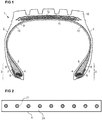
- the rubber composition may be provided in a tire ply or ply strip, such as a carcass ply, a belt ply, a breaker ply, an overlay ply or a ply strip.
- a tire may comprise such a rubber composition and/or ply or ply strip.
- the present invention is directed a method of making a rubber composition, a method of making a tire ply or ply strip and a method of manufacturing a tire.
- One object of the present invention may be to provide an advanced rubber composition for a tire ply or ply strip, in particular for plies of ply strips comprising metal reinforcements.
- Another object of the present invention may be to provide a rubber composition, in particular for a tire ply or ply strip exhibiting limited hysteresis and/or resulting in advanced rolling resistance performance.
- the present invention is directed to a non-vulcanized (or sulfur vulcanizable) rubber composition
- a non-vulcanized (or sulfur vulcanizable) rubber composition comprising (1) 90 to 100 phr of cis 1,4-polyisoprene; (2) 10 to 40 phr of pre-silanized (and preferably precipitated) silica; (3) 10 to 40 phr of carbon black, (4) 0.1 phr to 5 phr of a cobalt salt, and (5) 1 to 15 phr of a resinous reaction product of a methylene donor composition and a methylene acceptor composition.
- compositions have particularly proven to be desirable as rubber coat compositions in plies or ply strips for tires, in particular plies comprising metal cords/wires such a brass-coated steel wires.
- the resinous reaction product of the methylene donor composition and the methylene acceptor composition is formed in situ within the non-vulcanized rubber composition. This resinous reaction product results in a network providing increased stiffness and hardness in the rubber.
- the methylene donor composition is comprised of (or in other words comprises) hexamethoxymethylmelamine (HMMM).
- the hexamethoxymethylmelamine is present in the methylene donor composition at a level of at least 50 weight, preferably at a level of at least 80 weight percent or even more preferably at a level of at least 90 weight percent.
- the methylene donor composition consists of hexamethoxymethylmelamine.
- the hexamethoxymethylmelamine represents the only or essentially the only constituent of the methylene donor composition.
- the methylene donor composition is comprised of hexamethoxymethylmelamine and up to 50 weight percent of one or more methylene donor compounds selected from the group consisting of hexamethylenetetramine, methoxymethylmelamaine, N,N'N"-trimethyl N,N'N"-trimethylolmelamine, hexamethyolmelanime, N,N'N"-dimethylolmelamine, N-methylolmelamine, N,N'-dimethylolmelamine, N,N'N"-tris(methoxymethyl)melamine, N,N'N"-tributyl-N,N'N"-trimethylol-melamine, and hexaethoxymethylmelamine.
- methylene donor compounds selected from the group consisting of hexamethylenetetramine, methoxymethylmelamaine, N,N'N"-trimethyl N,N'N"-trimethylolmelamine, hexamethyolmel
- the methylene acceptor composition is comprised of at least one member selected from the group consisting of resorcinol, resorcinol derivatives, monohydric phenols and their derivatives, dihydric phenols and their derivatives, polyhydric phenols and their derivatives, unmodified phenol novolak resins, modified phenol novolak resin, and rescorcinol novolak resins.
- the methylene acceptor composition is comprised of resorcinol.
- resorcinol a reactive resin combination
- the rubber composition is further comprised of 5 phr to 15 phr of zinc oxide, preferably 8 phr to 15 phr. These relatively high amounts of zinc oxide are particularly desirable in applications where brass coated metal wire is utilized to reinforce plies which are comprised of the rubber composition.
- the rubber composition is further comprised of at least one anti-degradant, such as an antioxidant and/or antiozonant.
- the pre-silanized silica has a CTAB adsorption surface area which is within the range of 130 m 2 /g to 210 m 2 /g.
- the CTAB surface can be suitably measured in accordance with ASTM D6845 or equivalent.
- said pre-silanized silica is silica which is prereacted (or pre-treated) with a sulfur-containing silane.
- the sulfur-containing silane is comprised of bis(3-triethoxysilylpropyl)polysulfide containing an average of from 2 to 5 connecting sulfur atoms in its polysulfidic bridge.
- the sulfur-containing silane is an alkoxyorganomercaptosilane.
- the composition comprises from 15 to 30 phr of the pre-silanized silica and from 15 to 30 phr of the carbon black.
- the composition comprises between 20 phr to 25 phr of the carbon black and 20 phr to 25 phr of the pre-silanized silica.
- the composition comprises from 3 phr to 15 phr of the resinous reaction product.
- the resinous reaction product is based on 2 phr to 10 phr of the methylene donor composition and/or 1 phr to 5 phr of the methylene acceptor composition.
- the composition comprises at least 90 phr of (cis 1,4-polyisoprene) natural rubber, or preferably at least 95 phr of natural rubber.
- the ratio of pre-silanized silica to carbon black ranges between 1.2 to 1 and 1 to 1.2.
- the rubber composition comprises less than 10 phr, preferably less than 5 phr oil.
- the present invention is directed to a non-vulcanized rubber composition further comprises from 4 phr to 15 phr of sulfur and at least one cure accelerator.
- the rubber composition could also, in general, be described as uncured, vulcanizable, non-sulfur vulcanized or sulfur vulcanizable.
- sulfur is present at a level of at least 6 phr and at most 10 phr or 9 phr in the composition, in particular in the productive composition.
- a productive rubber composition is considered to be a rubber formulation that will cure upon being heated to an elevated curing temperature (the productive rubber composition contains curatives) while a non-productive is not capable of being cured due to the lack of the presence of curatives.
- the methylene donor composition is added in a non-productive mixing step (or in other words in the non-productive rubber composition) and the methylene acceptor composition is added in a productive mixing step (i.e. in the productive rubber composition).
- the resinous reaction product may be formed in the productive mixing step.
- the methylene acceptor composition is added in a non-productive mixing step and the methylene donor composition is added in a productive mixing step.
- the resinous reaction product may be formed in the productive mixing step.
- the methylene acceptor composition and the methylene donor composition are added in a non-productive mixing step.
- the resinous reaction product may already be formed in the non-productive mixing step.
- the methylene acceptor composition and the methylene donor composition are added in a productive mixing step such that the resinous reaction product may be formed in the productive mixing step.
- the present invention is directed to a non-vulcanized (or sulfur vulcanizable) rubber composition
- a non-vulcanized (or sulfur vulcanizable) rubber composition comprising (1) 90 phr to 100 phr of cis 1,4-polyisoprene; (2) 10 phr to 40 phr of pre-silanized silica; (3) 10 phr to 40 phr of carbon black, (4) 0.1 phr to 5 phr of a cobalt salt, a methylene donor composition and a methylene acceptor composition.
- the composition comprises from 2 phr to 10 phr of the methylene donor composition and/or 1 phr to 5 phr of the methylene acceptor composition.
- the second aspect may be combined with one or more embodiments of the first aspect.
- the present invention is directed to a non-vulcanized or vulcanized rubber component, the rubber component comprising metal reinforcing elements, which are embedded in the rubber composition.
- the metal elements may be coated on both sides or all sides with the (non-vulcanized) rubber composition.
- the rubber composition may be cured together with the metal reinforcing element being embedded therein.
- the rubber component is a rubber ply or rubber ply strip which may also be a gum strip.
- the metal reinforcing element is brass coated steel wire.
- the rubber composition comprises an additional diene-based rubber.
- Representative synthetic polymers may be the homopolymerization products of butadiene and its homologues and derivatives, for example, methylbutadiene, dimethylbutadiene and pentadiene as well as copolymers such as those formed from butadiene or its homologues or derivatives with other unsaturated monomers.
- acetylenes for example, vinyl acetylene
- olefins for example, isobutylene, which copolymerizes with isoprene to form butyl rubber
- vinyl compounds for example, acrylic acid, acrylonitrile (which polymerize with butadiene to form NBR), methacrylic acid and styrene, the latter compound polymerizing with butadiene to form SBR, as well as vinyl esters and various unsaturated aldehydes, ketones and ethers, e.g. acrolein, methyl isopropenyl ketone and vinylethyl ether.
- synthetic rubbers include neoprene (polychloroprene), polybutadiene (including cis 1,4-polybutadiene), polyisoprene (including cis 1,4-polyisoprene), butyl rubber, halobutyl rubber such as chlorobutyl rubber or bromobutyl rubber, styrene/isoprene/butadiene rubber, copolymers of 1,3-butadiene or isoprene with monomers such as styrene, acrylonitrile and methyl methacrylate, as well as ethylene/propylene terpolymers, also known as ethylene/propylene/diene monomer (EPDM), and in particular, ethylene/propylene/dicyclopentadiene terpolymers.
- neoprene polychloroprene
- polybutadiene including cis 1,4-polybutadiene
- Rubbers which may be used include alkoxy-silyl end functionalized solution polymerized polymers (SBR, PBR, IBR and SIBR), silicon-coupled and tin-coupled star-branched polymers.
- SBR alkoxy-silyl end functionalized solution polymerized polymers
- PBR polybutadiene
- SIBR silicon-coupled star-branched polymers
- Preferred rubber or elastomers may be in general natural rubber, synthetic polyisoprene, polybutadiene and SBR including SSBR.
- the composition may comprise at least two diene-based rubbers.
- a combination of two or more rubbers is preferred such as cis 1,4-polyisoprene rubber (natural or synthetic, although natural is preferred), 3,4-polyisoprene rubber, styrene/isoprene/butadiene rubber, emulsion and solution polymerization derived styrene/butadiene rubbers, cis 1,4-polybutadiene rubbers and emulsion polymerization prepared butadiene/acrylonitrile copolymers.
- a synthetic or natural polyisoprene rubber may be used.
- Synthetic cis 1,4-polyisoprene and cis 1,4-polyisoprene natural rubber are as such well known to those having skill in the rubber art.
- a cis 1,4-(microstructure) content may be at least 90%, and in many cases will be at least 95%.
- cis 1,4-polybutadiene rubber (BR or PBD) is used.
- Suitable polybutadiene rubbers may be prepared, for example, by organic solution polymerization of 1,3-butadiene.
- the BR may be conveniently characterized, for example, by having at least a 90 percent cis 1,4-content ("high cis" content) and a glass transition temperature (Tg) in a range of from -95 to -110oC.
- Suitable cis-1,4-polybutadiene rubbers are available commercially, such as Budene® 1207, Budene® 1208, Budene® 1223, or Budene® 1280 from The Goodyear Tire & Rubber Company.
- These high cis-1,4-polybutadiene rubbers can for instance be synthesized utilizing nickle catalyst systems which include a mixture of (1) an organonickel compound, (2) an organoaluminum compound, and (3) a fluorine containing compound as described in United States Patent 5,698,643 and United States Patent 5,451,646 , which are incorporated herein by reference.
- a reference to a glass transition temperature, or Tg, of an elastomer or elastomer composition represents the glass transition temperature(s) of the respective elastomer or elastomer composition in its uncured state or possibly a cured state in the case of an elastomer composition.
- a Tg can be suitably determined as a peak midpoint by a differential scanning calorimeter (DSC) at a temperature rate of increase of 10oC per minute, according to ASTM D3418.
- phr refers to "parts by weight of a respective material per 100 parts by weight of rubber, or elastomer.”
- a rubber composition is comprised of 100 parts by weight of rubber/elastomer.
- the claimed composition may comprise other rubbers / elastomers than explicitly mentioned in the claims, provided that the phr value of the claimed rubbers / elastomers is in accordance with claimed phr ranges and the amount of all rubbers / elastomers in the composition results in total in 100 parts of rubber.
- the composition may further comprise from 1 phr to 10 phr, optionally from 1 phr to 5 phr of one or more additional diene-based rubbers, such as SBR, SSBR, ESBR, PBD/BR, NR and/or synthetic polyisoprene.
- the composition may include less than 5 phr, preferably less than 3 phr, of an additional diene-based rubber or can also be essentially free of such an additional diene-based rubber.
- the terms "compound” and “composition” may be used herein interchangeably, unless indicated otherwise.
- the rubber composition may also include oil, in particular processing oil.
- Processing oil may be included in the rubber composition as extending oil typically used to extend elastomers. Processing oil may also be included in the rubber composition by addition of the oil directly during rubber compounding. The processing oil used may include both extending oil present in the elastomers, and process oil added during compounding.
- Suitable process oils may include various oils as are known in the art, including aromatic, paraffinic, naphthenic, vegetable oils, and low PCA oils, such as MES, TDAE, SRAE and heavy naphthenic oils.
- Suitable low PCA oils may include those having a polycyclic aromatic content of less than 3 percent by weight as determined by the IP346 method.
- Procedures for the IP346 method may be found in Standard Methods for Analysis & Testing of Petroleum and Related Products and British Standard 2000 Parts, 2003, 62nd edition, published by the Institute of Petroleum, United Kingdom.
- Some representative examples of vegetable oils that can be used include soybean oil, sunflower oil, canola (rapeseed) oil, corn oil, coconut oil, cottonseed oil, olive oil, palm oil, peanut oil, and safflower oil. Soybean oil and corn oil are typically preferred vegetable oils.
- the rubber composition may also include less than 10 phr oil, preferably less than 5 phr.
- the rubber composition may include silica.
- siliceous pigments which may be used in the rubber compound include for instance conventional pyrogenic and precipitated siliceous pigments (silica).
- precipitated silica is used.
- the conventional siliceous pigments may be precipitated silicas such as, for example, those obtained by the acidification of a soluble silicate, e.g., sodium silicate.
- Such conventional silicas might be characterized, for example, by having a BET surface area, as measured using nitrogen gas.
- the BET surface area may be in the range of 40 to 600 square meters per gram.
- the BET surface area may be in a range of 50 to 300 square meters per gram.
- the BET surface area can be suitably determined according to ASTM D6556 or equivalent and is described in the Journal of the American Chemical Society, Volume 60, Page 304 (1930 ).
- the conventional silica may also be characterized by having a dibutylphthalate (DBP) absorption value in a range of 100 cm 3 /100g to 400 cm 3 /100 g, alternatively 150 cm 3 /100 g to 300 cm 3 /100 g which can be suitably determined according to ASTM D 2414 or equivalent.
- a conventional silica might be expected to have an average ultimate particle size, for example, in the range of 0.01 to 0.05 micron as determined by the electron microscope, although the silica particles may be even smaller, or possibly larger, in size.
- Ranges of silica use could be for instance between 5 phr and 120 phr, preferably in a range of between 20 phr and 70 phr or 80 phr to 120 phr.
- Various commercially available silicas may be used, such as, only for example herein, and without limitation, silicas commercially available from PPG Industries under the Hi-Sil trademark with designations 210, 315G, EZ160G, etc; silicas available from Solvay, with, for example, designations of Z1165MP and Premium200MP, etc. and silicas available from Evonik AG with, for example, designations VN2 and Ultrasil 6000GR, 9100GR, etc.
- the rubber composition comprises pre-silanized and preferably precipitated silica which may for instance have a CTAB adsorption surface area of between 130 m 2 /g and 210 m 2 /g, optionally between 130 m 2 /g and 150 m 2 /g and/or between 190 m 2 /g and 210 m 2 /g, or even between 195 m 2 /g and 205 m 2 /g.
- CTAB cetyl trimethyl ammonium bromide
- the pre-silanized, or in other words pre-hydrophobated, silica utilized is hydrophobated prior to its addition to the rubber composition by treatment with at least one silane.
- Suitable silanes include but are not limited to alkylsilanes, alkoxysilanes, organoalkoxysilyl polysulfides and organomercaptoalkoxysilanes.
- the pre-hydrophobated silica may be pre-treated with a silica coupling agent comprised of, for example, an alkoxyorganomercaptoalkoxysilane or combination of alkoxysilane and organomercaptoalkoxysilane prior to blending the pre-treated silica with the rubber instead of reacting the silica with the silica coupling agent in situ within the rubber.
- a silica coupling agent comprised of, for example, an alkoxyorganomercaptoalkoxysilane or combination of alkoxysilane and organomercaptoalkoxysilane
- said pre-silanized precipitated silica is silica prereacted with a silica coupler comprised of bis(3-triethoxysilylpropyl)polysulfide containing an average of from 1 to 5 connecting sulfur atoms (preferably 2 to 4) in its polysulfidic bridge or an alkoxyorganomercaptosilane.
- a silica coupler comprised of bis(3-triethoxysilylpropyl)polysulfide containing an average of from 1 to 5 connecting sulfur atoms (preferably 2 to 4) in its polysulfidic bridge or an alkoxyorganomercaptosilane.
- the mercaptosilane which contains mercaptan groups may improve compatibility with the rubber material or rubber matrix and/or support the curing process.
- the amount mercapto groups on the surface of the silica may be in the range of between 0.1 and 1 weight percent, alternatively 0.4 to 1 weight percent or 0.4 to 0.6 weight percent.
- the silica may comprise a compatibilizer which is typically a (hydro-)carbon chain material having multiple carbon atoms (for instance at least 4 carbon atoms) along its chain.
- a compatibilizer may facilitate the mixing of the composition.
- the weight % of carbon surface load / functionalization is between 2 and 10, or alternatively between 3 and 8.
- the prehydrophobated silica may optionally be treated with a silica dispersing aid.
- silica dispersing aids may include glycols, such as fatty acids, diethylene glycols, polyethylene glycols, fatty acid esters of hydrogenated or non-hydrogenated C 5 or C 6 sugars, and polyoxyethylene derivatives of fatty acid esters of hydrogenated or non-hydrogenated C 5 or C 6 sugars.
- Exemplary fatty acids include stearic acid, palmitic acid and oleic acid.
- Exemplary fatty acid esters of hydrogenated and non-hydrogenated C 5 and C 6 sugars include, but are not limited to, the sorbitan oleates, such as sorbitan monooleate, dioleate, trioleate and sesquioleate, as well as sorbitan esters of laurate, palmitate and stearate fatty acids.
- Exemplary polyoxyethylene derivatives of fatty acid esters of hydrogenated and non-hydrogenated C 5 and C 6 sugars include, but are not limited to, polysorbates and polyoxyethylene sorbitan esters, which are analogous to the fatty acid esters of hydrogenated and non-hydrogenated sugars noted above except that ethylene oxide groups are placed on each of the hydroxyl groups.
- the optional silica dispersing aids are present in an amount ranging from about 0.1% to about 25% by weight based on the weight of the silica, with about 0.5% to about 20% by weight being suitable, and about 1% to about 15% by weight based on the weight of the silica also being suitable.
- Various pre-treated precipitated silicas are described in United States Patent 4,704,414 , United States Patent 6,123,762 and United States Patent 6,573,324 .
- the teachings of United States Patent 4,704,414 , United States Patent 6,123,762 and United States Patent 6,573,324 are incorporated herein by reference.
- the pre-hydrophobated silica is pre-hydrophobated by treating silica in an aqueous colloidal form thereof with both an organomercaptosilane and an alkylsilane in a weight ratio of said organomercaptosilane to said alkylsilane in a range of from 10/90 to 90/10; wherein said alkylsilane is of the general Formula (I): X n -Si-R 4-n (I), wherein R is an alkyl radical having from 1 to 18 carbon atoms, preferably from 1 to 8, carbon atoms, such as, methyl, ethyl, isopropyl, n-butyl and octadecyl radicals, n is a numeral from 1 to 3 and X is a radical selected from halogens, namely chlorine or bromine, preferably a chlorine radical, and alkoxy radicals, preferably an alkoxy radical as (R 1 O)-, where
- the hydrophobated silica aggregates might be recovered, for example, from said treated colloidal silica, for example as a treated silica hydrosol, with the aid of acid addition to the treated colloidal silica (for example, sulfuric acid or hydrochloric acid) followed by water washing and drying the recovered hydrophobated silica as a hydrophobated silica gel or as a hydrophobated silica.
- acid addition to the treated colloidal silica for example, sulfuric acid or hydrochloric acid
- Representative alkylsilanes of Formula (I) are, for example, trichloro methyl silane, dichloro dimethyl silane, chloro trimethyl silane, trimethoxy methyl silane, dimethoxy dimethyl silane, methoxy trimethyl silane, trimethoxy propyl silane, trimethoxy octyl silane, trimethoxy hexadecyl silane, dimethoxy dipropyl silane, triethoxy methyl silane, triethoxy propyl silane, triethoxy octyl silane, and diethoxy dimethyl silane.
- Organomercaptosilanes of Formula (II) are, for example, triethoxy mercaptopropyl silane, trimethoxy mercaptopropyl silane, methyl dimethoxy mercaptopropyl silane, methyl diethoxy mercaptopropyl silane, dimethyl methoxy mercaptopropyl silane, triethoxy mercaptoethyl silane, and tripropoxy mercaptopropyl silane.
- pre-treated silicas i.e., silicas that have been pre-surface treated with a silane
- silicas that have been pre-surface treated with a silane
- Coupsil® 8113 Degussa
- Agilon® 400 silica from PPG Industries Agilon® 454 silica from PPG Industries
- Agilon® 458 silica from PPG Industries Some representative examples of preferred pre-silanized silicas include Agilon® 400, Agilon® 454 and Agilon® 458 from PPG Industries.
- the rubber composition is exclusive of addition of (added) silica to the rubber composition (thereby exclusive of addition of non-pre-silanized silica).
- the pre-silanized silica is not precipitated silica.
- the rubber composition is exclusive of addition of silica coupler to the rubber composition (thereby exclusive of silica coupler).
- the rubber composition may contain a combination of additional silica coupler added to the rubber composition, particularly a bis(3-triethoxysilylpropyl) polysulfide containing an average of from about 2 to about 4 connecting sulfur atoms in its polysulfidic bridge together with an additional silica (non-pre-silanized silica) added to said rubber composition, wherein the ratio of pre-silanized precipitated silica to said silica is desirably at least 8/1, alternately at least 10/1.
- additional silica coupler added to the rubber composition, particularly a bis(3-triethoxysilylpropyl) polysulfide containing an average of from about 2 to about 4 connecting sulfur atoms in its polysulfidic bridge together with an additional silica (non-pre-silanized silica) added to said rubber composition, wherein the ratio of pre-silanized precipitated silica to said silica is desirably at least 8/1,
- carbon blacks include N110, N121, N134, N220, N231, N234, N242, N293, N299, N315, N326, N330, N332, N339, N343, N347, N351, N358, N375, N539, N550, N582, N630, N642, N650, N683, N754, N762, N765, N774, N787, N907, N908, N990 and N991 grades. These carbon blacks have iodine absorptions ranging from 9 to 145 g/kg and DBP number ranging from 34 to 150 cm 3 /100 g. Iodine absorption values can be suitably determined according to ASTM D1510 or equivalent.
- the rubber composition may contain also a conventional sulfur containing organosilicon compounds or silanes.
- suitable sulfur containing organosilicon compounds are of the formula: Z - Alk - S n - Alk - Z I in which Z is selected from the group consisting of where R 1 is an alkyl group of 1 to 4 carbon atoms, cyclohexyl or phenyl; R 2 is alkoxy of 1 to 8 carbon atoms, or cycloalkoxy of 5 to 8 carbon atoms; Alk is a divalent hydrocarbon of 1 to 18 carbon atoms and n is an integer of 2 to 8.
- the sulfur containing organosilicon compounds are the 3,3'-bis(trimethoxy or triethoxy silylpropyl) polysulfides. In one embodiment, the sulfur containing organosilicon compounds are 3,3'-bis(triethoxysilylpropyl) disulfide and/or 3,3'-bis(triethoxysilylpropyl) tetrasulfide. Therefore, as to formula I, Z may be where R 2 is an alkoxy of 2 to 4 carbon atoms, alternatively 2 carbon atoms; Alk is a divalent hydrocarbon of 2 to 4 carbon atoms, alternatively with 3 carbon atoms; and n is an integer of from 2 to 5, alternatively 2 or 4.
- suitable sulfur containing organosilicon compounds include compounds disclosed in United States Patent 6,608,125 .
- suitable sulfur containing organosilicon compounds include those disclosed in United States Patent Application Publication No. 2003/0130535 .
- the sulfur containing organosilicon compound is Si-363 from Degussa.
- the amount of the sulfur containing organosilicon compound in a rubber composition may vary depending on the level of other additives that are used. Generally speaking, the amount of the compound may range from 0.5 to 20 phr. In one embodiment, the amount will range from 1 to 10 phr.
- the rubber composition comprises from 0.2 phr to 2 phr of a cobalt salt.
- This content may be of particular interest if used in ply coating compounds as it may amongst others improve the adhesion of the rubber coating to the ply or belt material, in particular if such material is metal, preferably brass coated metal as for instance steel.
- the cobalt compound will typically be a cobalt salt of a fatty acid or a cobalt salt of an aliphatic or alicyclic carboxylic acid containing from 6 to 30 carbon atoms.
- cobalt compounds which may be used include the cobalt salts, cobalt naphthanate, cobalt linoleate, cobalt stearate, cobalt oleate, cobalt acetate, cobalt neodecanoate, cobalt tallate, cobalt resinate, cobalt acetonate, or in situ salts prepared from cobalt hydroxide and an organic acid such as naphthenic acid, stearic acid, oleic acid, acetic acid, linoleic acid and the like. Additional cobalt compounds which may be used are known under the tradename ManobandTM C.
- ManobandTM C is a cobalt complex of an organic acid containing boron manufactured by Manchem Company.
- ManobandTM C cobalt compounds are described in British Patent No. 972,804 .
- the teachings of British Patent No. 972,804 are incorporated herein by reference in their entirety for the purpose of disclosing cobalt compounds that can be utilized in accordance with this invention.
- the rubber composition may be compounded by methods generally known in the rubber compounding art, such as mixing the various sulfur-vulcanizable constituent rubbers with various commonly used additive materials such as, for example, sulfur donors, curing aids, such as activators and retarders and processing additives, such as oils, resins including tackifying resins and plasticizers, fillers, pigments, fatty acid, zinc oxide, waxes, antioxidants and antiozonants and peptizing agents.
- additives mentioned above are selected and commonly used in conventional amounts.
- sulfur donors include elemental sulfur (free sulfur), an amine disulfide, polymeric polysulfide and sulfur olefin adducts.
- the sulfur-vulcanizing agent is elemental sulfur.
- the sulfur-vulcanizing agent may for instance be used in an amount ranging from 0.5 phr to 8 phr, alternatively with a range of from 1.5 phr to 6 phr.
- Typical amounts of tackifier resins, if used, comprise for example 0.5 phr to 10 phr, usually 1 phr to 5 phr.
- processing aids if used, comprise for example 1 phr to 50 phr (this may comprise in particular oil).
- Typical amounts of antioxidants may for example comprise 1 phr to 5 phr.
- Representative antioxidants may be, for example, diphenyl-p-phenylenediamine and others, such as, for example, those disclosed in The Vanderbilt Rubber Handbook (1978), Pages 344 through 346 .
- Typical amounts of antiozonants, if used may for instance comprise 1phr to 5 phr.
- Typical amounts of fatty acids, if used, which can include stearic acid may for instance comprise 0.5 phr to 3 phr.
- Typical amounts of waxes if used, may for example comprise 1phr to 5 phr. Often microcrystalline waxes are used.
- Typical amounts of peptizers if used, may for instance comprise 0.1 to 1 phr.
- Typical peptizers may be, for example, pentachlorothiophenol and dibenzamidodiphenyl disulfide.
- Accelerators may be preferably but not necessarily used to control the time and/or temperature required for vulcanization and to improve the properties of the vulcanizate.
- a single accelerator system may be used, i.e., primary accelerator.
- the primary accelerator(s) may be used in total amounts ranging from 0.5 phr to 4 phr, alternatively 0.8 phr to 1.5, phr.
- combinations of a primary and a secondary accelerator might be used with the secondary accelerator being used in smaller amounts, such as from 0.05 phr to 3 phr, in order to activate and to improve the properties of the vulcanizate.
- accelerators might be expected to produce a synergistic effect on the final properties and are somewhat better than those produced by use of either accelerator alone.
- delayed action accelerators may be used which are not affected by normal processing temperatures but produce a satisfactory cure at ordinary vulcanization temperatures.
- Vulcanization retarders might also be used.
- Suitable types of accelerators that may be used in the present invention are for instance amines, disulfides, guanidines, thioureas, thiazoles, thiurams, sulfenamides, dithiocarbamates and xanthates.
- the primary accelerator is a sulfenamide.
- the secondary accelerator may be for instance a guanidine, dithiocarbamate or thiuram compound.
- Suitable guanidines include dipheynylguanidine and the like.
- Suitable thiurams include tetramethylthiuram disulfide, tetraethylthiuram disulfide, and tetrabenzylthiuram disulfide.
- the mixing of the rubber composition can be accomplished by methods known to those having skill in the rubber mixing art.
- the ingredients may be typically mixed in at least two stages, namely, at least one non-productive stage followed by a productive mix stage.
- the final curatives including sulfur-vulcanizing agents may be typically mixed in the final stage which is conventionally called the "productive" mix stage in which the mixing typically occurs at a temperature, or ultimate temperature, lower than the mix temperature(s) of the preceding non-productive mix stage(s).
- the terms "non-productive" and “productive” mix stages or composition, respectively, are well known to those having skill in the rubber mixing art.
- the rubber composition may be subjected to a thermomechanical mixing step.
- the thermomechanical mixing step generally comprises a mechanical working in a mixer or extruder for a period of time, for example suitable to produce a rubber temperature between 140°C and 190°C.
- the appropriate duration of the thermomechanical working varies as a function of the operating conditions, and the volume and nature of the components.
- the thermomechanical working may be from 1 to 20 minutes.
- Vulcanization of the pneumatic tire of the present invention may for instance be carried out at conventional temperatures ranging from 100°C to 200°C. In one embodiment, the vulcanization is conducted at temperatures ranging from 110°C to 180°C. Any of the usual vulcanization processes may be used such as heating in a press or mold, heating with superheated steam or hot air. Such tires can be built, shaped, molded and cured by various methods which are known and will be readily apparent to those having skill in such art.
- the present invention is directed to a tire which is comprised of a cured rubber which is made by curing the productive rubber composition comprising sulfur and accelerator.
- a tire comprising at least one of the following components: a ply (e.g. a breaker ply) and a ply strip (e.g. an overlay ply strip), wherein the component comprises wires being coated with a rubber composition (1) 90 phr to 100 phr of cis 1,4-polyisoprene; (2) 10 phr to 40 phr of pre-silanized silica; (3) 10 phr to 40 phr of carbon black, (4) 0.1 phr to 5 phr of a cobalt salt, and (5) 1 phr to 15 phr of a resinous reaction product of a methylene donor composition and a methylene acceptor composition.
- the term ply strip may include herein also gum strips.
- a tire comprising at least one of the following components: a ply (e.g. a breaker ply) and a ply strip (e.g. an overlay ply strip or gum strip), which comprises a rubber composition (1) 90 phr to 100 phr of cis 1,4-polyisoprene; (2) 10 phr to 40 phr of pre-silanized silica; (3) 10 phr to 40 phr of carbon black, (4) 0.1 phr to 5 phr of a cobalt salt, and (5) 1 phr to 15 phr of a resinous reaction product of a methylene donor composition and a methylene acceptor composition.
- a ply e.g. a breaker ply
- a ply strip e.g. an overlay ply strip or gum strip
- a rubber composition (1) 90 phr to 100 phr of cis 1,4-poly
- the tire is a passenger car tire, truck tire, airplane tire.
- a method of making a rubber composition for a tire ply or ply strip comprising the following steps:
- a method of making a tire ply or ply strip comprising the step of coating a fabric or a plurality of wires arranged in parallel in a plane from both sides with a rubber composition according to one or more of the above aspects or embodiments or according to a composition obtained with one or more of the methods described herein, so as to obtain a reinforced rubber ply or reinforced rubber ply strip (in particular reinforced by a fabric or wire, such as a metal wire, preferably a brass coated steel wire).
- the ply or ply strip comprises a plurality of essentially parallelly extending, and spaced apart from one another, metal wires coated with the rubber composition, wherein the plurality of metal wires define a plane of parallelly extending and spaced apart from one another metal wires which are calendered on both sides with the rubber composition.
- a method of manufacturing a cured or vulcanized tire comprising the step of curing a tire comprising a reinforced rubber ply or reinforced rubber ply strip obtained by one of the aforementioned methods.
- Figure 1 is a schematic cross-section of a tire 1.
- the tire 1 has a tread 10, an inner liner 13, a belt structure comprising four belt plies 11, a carcass ply 9, two sidewalls 2, and two bead regions 3 comprising bead filler apexes 5 and beads 4.
- the example tire 1 is suitable, for example, for mounting on a rim of a vehicle, e.g. a truck or a passenger car.
- the belt plies 11 may be covered by an overlay ply 12 and/or may include one or more breaker plies.
- the carcass ply 9 includes a pair of axially opposite end portions 6, each of which is associated with a respective one of the beads 4.
- Each axial end portion 6 of the carcass ply 9 may be turned up and around the respective bead 4 to a position to anchor each axial end portion 6.
- One or more of the carcass ply 9, belt / breaker plies 11 and overlay ply 12 comprise a rubber composition in accordance with the invention and may have a plurality of substantially parallel reinforcing members made of metal wire.
- the turned-up portions 6 of the carcass ply 9 may engage the axial outer surfaces of two flippers 8 and axial inner surfaces of two chippers 7.
- the example tread 10 may have four circumferential grooves, each groove essentially defining a U-shaped opening in the tread 10.
- the main portion of the tread 10 may be formed of one or more tread compounds, which may be any suitable tread compound or compounds.
- Figure 1 suggests a plurality of tire components including for instance apexes 5, chippers 7, flippers 8 and overlay 12, such components are not mandatory for the invention.
- the turned-up end of the carcass ply 9 is not necessary for the invention or may pass on the opposite side of the bead area 3 and end on the axially inner side of the bead 4 instead of the axially outer side of the bead 4.
- the tire could also have for instance more or less than four grooves.
- FIG. 2 shows a ply, e.g. a carcass, belt (in particular breaker ply) or overlay ply 9' which comprises a plurality of metal, for instance steel, wires 15 reinforcing the rubber composition/wire coat 20.
- a ply e.g. a carcass, belt (in particular breaker ply) or overlay ply 9' which comprises a plurality of metal, for instance steel, wires 15 reinforcing the rubber composition/wire coat 20.
- a ply is made in a wire calendar in which a plurality of essentially parallel metal and spaced apart wires is coated from both sides with a layer or sheet of rubber composition 20.
- the wires 15 are embedded in the rubber composition 20, reinforcing the same.
- the rubber composition could also be provided in a rubber ply or rubber ply strip which is not reinforced by (metal) wires.
- Metal wires 15 may be coated with brass for better adhesion properties with regards to connection of the wires 15 to the cured rubber composition 20.
- the wires 15 may also be dipped in dipping solutions or emulsions for better adhesion properties as known in the art. Neither a dip nor a metal coating is shown here in Figure 2 .
- the compound 20 may comprise a cobalt salt.
- the compound 20 can comprise zinc oxide which may also improve the adhesion between the metal wire 15 and the cured compound 20.
- Figure 2 While the schematic drawing of Figure 2 indicates nine wires, the number of parallel wires per ply could be different, for instance at least 5 or 10.
- the invention could also be used in a ply strip comprising the rubber composition, with the strip comprising only between 3 and 6 cords or wires.
- Control Sample 1 and Control Sample 2 constitute wire coat rubber compositions in the absence of a resin and utilizing carbon black in relatively high quantities of 60 phr.
- Control Sample 1 is comprised of 100 phr natural rubber, while Control Sample 2 comprises a blend of natural rubber and synthetic cis-1,4 polyisoprene.
- Control Sample 3 comprises a reactive resin system and silica together with 100 phr natural rubber.
- Control Sample 4 is also a full natural rubber examples comprising the same reactive resin system but comprise 24 phr carbon black together with 23 phr silica as filler material. In Control Samples 3 and 4 appropriate amounts of silane have been added to the composition.
- the Inventive Examples 1 and 2 comprise a combination of a pre-silanized silica in combination with carbon black.
- equal parts of silica and carbon black (23 phr) have been added to the composition.
- Inventive Example 2 differs over Inventive Example 1 in that it comprises a blend of natural rubber and synthetic polyisoprene, while Inventive Example 1 is a full natural rubber compound.
- Table 2 shows test data for the compositions listed above in Table 1.
- Shore A hardness is on a similar level for all tested samples. G' levels, which may be considered as stiffness indicators, are significantly higher for the Inventive Examples. Such an increased stiffness could amongst others help to improve steering performance. Most remarkable are the differences in tangent delta which are an indicator for improved hysteresis and thus also for improved rolling resistance. In particular, the Inventive Examples show a decrease in tangent delta which range roughly between -20% and -40% with respect to the control samples. While tensile strength and elongation at break have decreased for the inventive examples as well, those are still deemed to be at an appropriate level. Modulus measurements are at a comparable level with the exception of the almost full silica example of Control Sample 3 which is less favorable.
Landscapes
- Chemical & Material Sciences (AREA)
- Health & Medical Sciences (AREA)
- Chemical Kinetics & Catalysis (AREA)
- Medicinal Chemistry (AREA)
- Polymers & Plastics (AREA)
- Organic Chemistry (AREA)
- Engineering & Computer Science (AREA)
- Mechanical Engineering (AREA)
- Compositions Of Macromolecular Compounds (AREA)
Abstract
Description
- The present invention relates to a rubber composition or non-vulcanized (non-productive) rubber composition for a rubber product, such as a tire or a tire component. In particular, the rubber composition may be provided in a tire ply or ply strip, such as a carcass ply, a belt ply, a breaker ply, an overlay ply or a ply strip. A tire may comprise such a rubber composition and/or ply or ply strip. Moreover, the present invention is directed a method of making a rubber composition, a method of making a tire ply or ply strip and a method of manufacturing a tire.
- While tire performance has improved significantly over decades and the use of silica in tire compounds has resulted in rolling resistance improvements, there is still remains significant room for further improvement. In particular, in an effort to further reduce vehicle emissions, there is a desire to further reduce the rolling resistance of tires for used in multiple applications, including primarily passenger car tires and also truck tires. However, it is an important objective for such a reduction in rolling resistance to be attained without compromising other tire performance characteristics, such as handling, traction on both wet and dry surfaces, and treadwear (tire service life).
- One object of the present invention may be to provide an advanced rubber composition for a tire ply or ply strip, in particular for plies of ply strips comprising metal reinforcements.
- Another object of the present invention may be to provide a rubber composition, in particular for a tire ply or ply strip exhibiting limited hysteresis and/or resulting in advanced rolling resistance performance.
- The scope of protection of the present invention is defined by the independent claims. Further preferred embodiments are recited in the dependent claims and the aspects and embodiments provided in the summary and description herein below.
- In a first aspect, the present invention is directed to a non-vulcanized (or sulfur vulcanizable) rubber composition comprising (1) 90 to 100 phr of cis 1,4-polyisoprene; (2) 10 to 40 phr of pre-silanized (and preferably precipitated) silica; (3) 10 to 40 phr of carbon black, (4) 0.1 phr to 5 phr of a cobalt salt, and (5) 1 to 15 phr of a resinous reaction product of a methylene donor composition and a methylene acceptor composition.
- Such compositions have particularly proven to be desirable as rubber coat compositions in plies or ply strips for tires, in particular plies comprising metal cords/wires such a brass-coated steel wires.
- In one embodiment, the resinous reaction product of the methylene donor composition and the methylene acceptor composition is formed in situ within the non-vulcanized rubber composition. This resinous reaction product results in a network providing increased stiffness and hardness in the rubber.
- In another embodiment, the methylene donor composition is comprised of (or in other words comprises) hexamethoxymethylmelamine (HMMM).
- In still another embodiment, the hexamethoxymethylmelamine is present in the methylene donor composition at a level of at least 50 weight, preferably at a level of at least 80 weight percent or even more preferably at a level of at least 90 weight percent.
- In yet another embodiment, the methylene donor composition consists of hexamethoxymethylmelamine. In other words, the hexamethoxymethylmelamine represents the only or essentially the only constituent of the methylene donor composition.
- In yet another embodiment, the methylene donor composition is comprised of hexamethoxymethylmelamine and up to 50 weight percent of one or more methylene donor compounds selected from the group consisting of hexamethylenetetramine, methoxymethylmelamaine, N,N'N"-trimethyl N,N'N"-trimethylolmelamine, hexamethyolmelanime, N,N'N"-dimethylolmelamine, N-methylolmelamine, N,N'-dimethylolmelamine, N,N'N"-tris(methoxymethyl)melamine, N,N'N"-tributyl-N,N'N"-trimethylol-melamine, and hexaethoxymethylmelamine.
- In still another embodiment, the methylene acceptor composition is comprised of at least one member selected from the group consisting of resorcinol, resorcinol derivatives, monohydric phenols and their derivatives, dihydric phenols and their derivatives, polyhydric phenols and their derivatives, unmodified phenol novolak resins, modified phenol novolak resin, and rescorcinol novolak resins.
- In yet another embodiment, the methylene acceptor composition is comprised of resorcinol. Such a reactive resin combination has been found to be of particular interest.
- In yet another embodiment of the present invention, the rubber composition is further comprised of 5 phr to 15 phr of zinc oxide, preferably 8 phr to 15 phr. These relatively high amounts of zinc oxide are particularly desirable in applications where brass coated metal wire is utilized to reinforce plies which are comprised of the rubber composition.
- In still another embodiment, the rubber composition is further comprised of at least one anti-degradant, such as an antioxidant and/or antiozonant.
- In still another embodiment, the pre-silanized silica has a CTAB adsorption surface area which is within the range of 130 m2/g to 210 m2/g. The CTAB surface can be suitably measured in accordance with ASTM D6845 or equivalent.
- In still another embodiment, said pre-silanized silica is silica which is prereacted (or pre-treated) with a sulfur-containing silane.
- In still another embodiment, the sulfur-containing silane is comprised of bis(3-triethoxysilylpropyl)polysulfide containing an average of from 2 to 5 connecting sulfur atoms in its polysulfidic bridge.
- In yet another embodiment, the sulfur-containing silane is an alkoxyorganomercaptosilane.
- In yet another embodiment, the composition comprises from 15 to 30 phr of the pre-silanized silica and from 15 to 30 phr of the carbon black. Preferably, the composition comprises between 20 phr to 25 phr of the carbon black and 20 phr to 25 phr of the pre-silanized silica.
- In still another embodiment, the composition comprises from 3 phr to 15 phr of the resinous reaction product.
- In still another embodiment, the resinous reaction product is based on 2 phr to 10 phr of the methylene donor composition and/or 1 phr to 5 phr of the methylene acceptor composition.
- In still another embodiment, the composition comprises at least 90 phr of (cis 1,4-polyisoprene) natural rubber, or preferably at least 95 phr of natural rubber.
- In still another embodiment, the ratio of pre-silanized silica to carbon black ranges between 1.2 to 1 and 1 to 1.2.
- In still another embodiment, the rubber composition comprises less than 10 phr, preferably less than 5 phr oil.
- In another embodiment, the present invention is directed to a non-vulcanized rubber composition further comprises from 4 phr to 15 phr of sulfur and at least one cure accelerator. Instead of being non-vulcanized, the rubber composition could also, in general, be described as uncured, vulcanizable, non-sulfur vulcanized or sulfur vulcanizable.
- In yet another embodiment, sulfur is present at a level of at least 6 phr and at most 10 phr or 9 phr in the composition, in particular in the productive composition. A productive rubber composition is considered to be a rubber formulation that will cure upon being heated to an elevated curing temperature (the productive rubber composition contains curatives) while a non-productive is not capable of being cured due to the lack of the presence of curatives.
- In yet another embodiment, the methylene donor composition is added in a non-productive mixing step (or in other words in the non-productive rubber composition) and the methylene acceptor composition is added in a productive mixing step (i.e. in the productive rubber composition). In particular, the resinous reaction product may be formed in the productive mixing step.
- In another embodiment, the methylene acceptor composition is added in a non-productive mixing step and the methylene donor composition is added in a productive mixing step. In particular, the resinous reaction product may be formed in the productive mixing step.
- In yet another embodiment, the methylene acceptor composition and the methylene donor composition are added in a non-productive mixing step. In particular, the resinous reaction product may already be formed in the non-productive mixing step.
- In still another embodiment, the methylene acceptor composition and the methylene donor composition are added in a productive mixing step such that the resinous reaction product may be formed in the productive mixing step.
- In a second aspect, the present invention is directed to a non-vulcanized (or sulfur vulcanizable) rubber composition comprising (1) 90 phr to 100 phr of cis 1,4-polyisoprene; (2) 10 phr to 40 phr of pre-silanized silica; (3) 10 phr to 40 phr of carbon black, (4) 0.1 phr to 5 phr of a cobalt salt, a methylene donor composition and a methylene acceptor composition.
- In an embodiment, the composition comprises from 2 phr to 10 phr of the methylene donor composition and/or 1 phr to 5 phr of the methylene acceptor composition.
- In particular, the second aspect may be combined with one or more embodiments of the first aspect.
- In another aspect, the present invention is directed to a non-vulcanized or vulcanized rubber component, the rubber component comprising metal reinforcing elements, which are embedded in the rubber composition. In particular, the metal elements may be coated on both sides or all sides with the (non-vulcanized) rubber composition. The rubber composition may be cured together with the metal reinforcing element being embedded therein.
- In still a further embodiment, the rubber component is a rubber ply or rubber ply strip which may also be a gum strip.
- In yet another embodiment, the metal reinforcing element is brass coated steel wire.
- In an embodiment, the rubber composition comprises an additional diene-based rubber. Representative synthetic polymers may be the homopolymerization products of butadiene and its homologues and derivatives, for example, methylbutadiene, dimethylbutadiene and pentadiene as well as copolymers such as those formed from butadiene or its homologues or derivatives with other unsaturated monomers. Among the latter may be acetylenes, for example, vinyl acetylene; olefins, for example, isobutylene, which copolymerizes with isoprene to form butyl rubber; vinyl compounds, for example, acrylic acid, acrylonitrile (which polymerize with butadiene to form NBR), methacrylic acid and styrene, the latter compound polymerizing with butadiene to form SBR, as well as vinyl esters and various unsaturated aldehydes, ketones and ethers, e.g. acrolein, methyl isopropenyl ketone and vinylethyl ether. Specific examples of synthetic rubbers include neoprene (polychloroprene), polybutadiene (including cis 1,4-polybutadiene), polyisoprene (including cis 1,4-polyisoprene), butyl rubber, halobutyl rubber such as chlorobutyl rubber or bromobutyl rubber, styrene/isoprene/butadiene rubber, copolymers of 1,3-butadiene or isoprene with monomers such as styrene, acrylonitrile and methyl methacrylate, as well as ethylene/propylene terpolymers, also known as ethylene/propylene/diene monomer (EPDM), and in particular, ethylene/propylene/dicyclopentadiene terpolymers. Additional examples of rubbers which may be used include alkoxy-silyl end functionalized solution polymerized polymers (SBR, PBR, IBR and SIBR), silicon-coupled and tin-coupled star-branched polymers. Preferred rubber or elastomers may be in general natural rubber, synthetic polyisoprene, polybutadiene and SBR including SSBR.
- In another embodiment, the composition may comprise at least two diene-based rubbers. For example, a combination of two or more rubbers is preferred such as cis 1,4-polyisoprene rubber (natural or synthetic, although natural is preferred), 3,4-polyisoprene rubber, styrene/isoprene/butadiene rubber, emulsion and solution polymerization derived styrene/butadiene rubbers, cis 1,4-polybutadiene rubbers and emulsion polymerization prepared butadiene/acrylonitrile copolymers.
- In one embodiment, a synthetic or natural polyisoprene rubber may be used. Synthetic cis 1,4-polyisoprene and cis 1,4-polyisoprene natural rubber are as such well known to those having skill in the rubber art. In particular, a cis 1,4-(microstructure) content may be at least 90%, and in many cases will be at least 95%.
- In one embodiment, cis 1,4-polybutadiene rubber (BR or PBD) is used. Suitable polybutadiene rubbers may be prepared, for example, by organic solution polymerization of 1,3-butadiene. The BR may be conveniently characterized, for example, by having at least a 90 percent cis 1,4-content ("high cis" content) and a glass transition temperature (Tg) in a range of from -95 to -110ºC. Suitable cis-1,4-polybutadiene rubbers are available commercially, such as Budene® 1207, Budene® 1208, Budene® 1223, or Budene® 1280 from The Goodyear Tire & Rubber Company. These high cis-1,4-polybutadiene rubbers can for instance be synthesized utilizing nickle catalyst systems which include a mixture of (1) an organonickel compound, (2) an organoaluminum compound, and (3) a fluorine containing compound as described in United States Patent
5,698,643 and United States Patent5,451,646 , which are incorporated herein by reference. - A reference to a glass transition temperature, or Tg, of an elastomer or elastomer composition, where referred to herein, represents the glass transition temperature(s) of the respective elastomer or elastomer composition in its uncured state or possibly a cured state in the case of an elastomer composition. A Tg can be suitably determined as a peak midpoint by a differential scanning calorimeter (DSC) at a temperature rate of increase of 10ºC per minute, according to ASTM D3418.
- The term "phr" as used herein, and according to conventional practice, refers to "parts by weight of a respective material per 100 parts by weight of rubber, or elastomer." In general, using this convention, a rubber composition is comprised of 100 parts by weight of rubber/elastomer. The claimed composition may comprise other rubbers / elastomers than explicitly mentioned in the claims, provided that the phr value of the claimed rubbers / elastomers is in accordance with claimed phr ranges and the amount of all rubbers / elastomers in the composition results in total in 100 parts of rubber. In an example, the composition may further comprise from 1 phr to 10 phr, optionally from 1 phr to 5 phr of one or more additional diene-based rubbers, such as SBR, SSBR, ESBR, PBD/BR, NR and/or synthetic polyisoprene. In another example, the composition may include less than 5 phr, preferably less than 3 phr, of an additional diene-based rubber or can also be essentially free of such an additional diene-based rubber. The terms "compound" and "composition" may be used herein interchangeably, unless indicated otherwise.
- In an embodiment, the rubber composition may also include oil, in particular processing oil. Processing oil may be included in the rubber composition as extending oil typically used to extend elastomers. Processing oil may also be included in the rubber composition by addition of the oil directly during rubber compounding. The processing oil used may include both extending oil present in the elastomers, and process oil added during compounding. Suitable process oils may include various oils as are known in the art, including aromatic, paraffinic, naphthenic, vegetable oils, and low PCA oils, such as MES, TDAE, SRAE and heavy naphthenic oils. Suitable low PCA oils may include those having a polycyclic aromatic content of less than 3 percent by weight as determined by the IP346 method. Procedures for the IP346 method may be found in Standard Methods for Analysis & Testing of Petroleum and Related Products and British Standard 2000 Parts, 2003, 62nd edition, published by the Institute of Petroleum, United Kingdom. Some representative examples of vegetable oils that can be used include soybean oil, sunflower oil, canola (rapeseed) oil, corn oil, coconut oil, cottonseed oil, olive oil, palm oil, peanut oil, and safflower oil. Soybean oil and corn oil are typically preferred vegetable oils. If used, the rubber composition may also include less than 10 phr oil, preferably less than 5 phr.
- In an embodiment, the rubber composition may include silica. Commonly employed siliceous pigments which may be used in the rubber compound include for instance conventional pyrogenic and precipitated siliceous pigments (silica). In one embodiment, precipitated silica is used. The conventional siliceous pigments may be precipitated silicas such as, for example, those obtained by the acidification of a soluble silicate, e.g., sodium silicate. Such conventional silicas might be characterized, for example, by having a BET surface area, as measured using nitrogen gas. In one embodiment, the BET surface area may be in the range of 40 to 600 square meters per gram. In another embodiment, the BET surface area may be in a range of 50 to 300 square meters per gram. The BET surface area can be suitably determined according to ASTM D6556 or equivalent and is described in the Journal of the American Chemical Society, Volume 60, Page 304 (1930). The conventional silica may also be characterized by having a dibutylphthalate (DBP) absorption value in a range of 100 cm3/100g to 400 cm3/100 g, alternatively 150 cm3/100 g to 300 cm3/100 g which can be suitably determined according to ASTM D 2414 or equivalent. A conventional silica might be expected to have an average ultimate particle size, for example, in the range of 0.01 to 0.05 micron as determined by the electron microscope, although the silica particles may be even smaller, or possibly larger, in size. Ranges of silica use could be for instance between 5 phr and 120 phr, preferably in a range of between 20 phr and 70 phr or 80 phr to 120 phr. Various commercially available silicas may be used, such as, only for example herein, and without limitation, silicas commercially available from PPG Industries under the Hi-Sil trademark with designations 210, 315G, EZ160G, etc; silicas available from Solvay, with, for example, designations of Z1165MP and Premium200MP, etc. and silicas available from Evonik AG with, for example, designations VN2 and Ultrasil 6000GR, 9100GR, etc.
- In accordance with the invention, the rubber composition comprises pre-silanized and preferably precipitated silica which may for instance have a CTAB adsorption surface area of between 130 m2/g and 210 m2/g, optionally between 130 m2/g and 150 m2/g and/or between 190 m2/g and 210 m2/g, or even between 195 m2/g and 205 m2/g. The CTAB (cetyl trimethyl ammonium bromide) method for determination of the silica surface area (ASTM D6845) is known to the person skilled in the art.
- In another embodiment, the pre-silanized, or in other words pre-hydrophobated, silica utilized is hydrophobated prior to its addition to the rubber composition by treatment with at least one silane. Suitable silanes include but are not limited to alkylsilanes, alkoxysilanes, organoalkoxysilyl polysulfides and
organomercaptoalkoxysilanes. - In an alternative embodiment, the pre-hydrophobated silica may be pre-treated with a silica coupling agent comprised of, for example, an
alkoxyorganomercaptoalkoxysilane or combination of alkoxysilane and organomercaptoalkoxysilane prior to blending the pre-treated silica with the rubber instead of reacting the silica with the silica coupling agent in situ within the rubber. For example, see United States Patent7,214,731 , the teachings of which are incorporated herein for the purpose of describing pre-hydrophobated silica and techniques for making such pre-hydrophobated silica. - In another embodiment, said pre-silanized precipitated silica is silica prereacted with a silica coupler comprised of bis(3-triethoxysilylpropyl)polysulfide containing an average of from 1 to 5 connecting sulfur atoms (preferably 2 to 4) in its polysulfidic bridge or an alkoxyorganomercaptosilane.
- The mercaptosilane which contains mercaptan groups (-SH groups) may improve compatibility with the rubber material or rubber matrix and/or support the curing process.
- The amount mercapto groups on the surface of the silica may be in the range of between 0.1 and 1 weight percent, alternatively 0.4 to 1 weight percent or 0.4 to 0.6 weight percent.
- In addition to mercapto groups coupled to the silica, the silica may comprise a compatibilizer which is typically a (hydro-)carbon chain material having multiple carbon atoms (for instance at least 4 carbon atoms) along its chain. Such a compatibilizer may facilitate the mixing of the composition. In an example, the weight % of carbon surface load / functionalization is between 2 and 10, or alternatively between 3 and 8.
- The prehydrophobated silica may optionally be treated with a silica dispersing aid. Such silica dispersing aids may include glycols, such as fatty acids, diethylene glycols, polyethylene glycols, fatty acid esters of hydrogenated or non-hydrogenated C5 or C6 sugars, and polyoxyethylene derivatives of fatty acid esters of hydrogenated or non-hydrogenated C5 or C6 sugars. Exemplary fatty acids include stearic acid, palmitic acid and oleic acid. Exemplary fatty acid esters of hydrogenated and non-hydrogenated C5 and C6 sugars (e.g., sorbose, mannose, and arabinose) include, but are not limited to, the sorbitan oleates, such as sorbitan monooleate, dioleate, trioleate and sesquioleate, as well as sorbitan esters of laurate, palmitate and stearate fatty acids. Exemplary polyoxyethylene derivatives of fatty acid esters of hydrogenated and non-hydrogenated C5 and C6 sugars include, but are not limited to, polysorbates and polyoxyethylene sorbitan esters, which are analogous to the fatty acid esters of hydrogenated and non-hydrogenated sugars noted above except that ethylene oxide groups are placed on each of the hydroxyl groups.
- The optional silica dispersing aids, if used, are present in an amount ranging from about 0.1% to about 25% by weight based on the weight of the silica, with about 0.5% to about 20% by weight being suitable, and about 1% to about 15% by weight based on the weight of the silica also being suitable. Various pre-treated precipitated silicas are described in United States Patent
4,704,414 , United States Patent6,123,762 and United States Patent6,573,324 . The teachings of United States Patent4,704,414 , United States Patent6,123,762 and United States Patent6,573,324 are incorporated herein by reference. - In another embodiment, the pre-hydrophobated silica is pre-hydrophobated by treating silica in an aqueous colloidal form thereof with both an organomercaptosilane and an alkylsilane in a weight ratio of said organomercaptosilane to said alkylsilane in a range of from 10/90 to 90/10; wherein said alkylsilane is of the general Formula (I):
Xn-Si-R4-n (I),
wherein R is an alkyl radical having from 1 to 18 carbon atoms, preferably from 1 to 8, carbon atoms, such as, methyl, ethyl, isopropyl, n-butyl and octadecyl radicals, n is a numeral from 1 to 3 and X is a radical selected from halogens, namely chlorine or bromine, preferably a chlorine radical, and alkoxy radicals, preferably an alkoxy radical as (R1O)-, wherein R1 is an alkyl radical having from 1 to 3 carbon atoms, such as, methyl, ethyl and isopropyl radicals, preferably from methyl and ethyl radicals, and where said organomercaptosilane is of the general formula (II):
(X)n(R2O)3-n-Si-R3-SH (II),
wherein X is a radical selected from halogens, such as chlorine or bromine, preferably a chlorine radical, and alkyl radicals having from 1 to 16 carbon atoms, preferably selected from methyl, ethyl, n-propyl, and n-butyl radicals; wherein R2 is an alkyl radical having from 1 to 16 carbon atom, preferably from 1 to 4 carbon atoms, preferably selected from methyl and ethyl radicals and R3 is an alkylene radical having from 1 to 16 carbon atoms, preferably from 1 to 4 carbon atoms, preferably a propylene radical; wherein n represents an integer from 0 to 3 with n preferably representing zero. - The hydrophobated silica aggregates might be recovered, for example, from said treated colloidal silica, for example as a treated silica hydrosol, with the aid of acid addition to the treated colloidal silica (for example, sulfuric acid or hydrochloric acid) followed by water washing and drying the recovered hydrophobated silica as a hydrophobated silica gel or as a hydrophobated silica. While this invention is not intended to be directed to a specific preparation technique (preparation of silica hydrosols, recovery of silica gels and silicas, etc.) of the pre-hydrophobated silica itself, for education purposes in this regard, reference might be made to the aforesaid Condensed Chemical Dictionary and United States Patent
5,094,829 as well as United States Patent5,708,069 , United States Patent5,789,514 and United States Patent5,750,610 for a more detailed discussion. - Representative alkylsilanes of Formula (I) are, for example, trichloro methyl silane, dichloro dimethyl silane, chloro trimethyl silane, trimethoxy methyl silane, dimethoxy dimethyl silane, methoxy trimethyl silane, trimethoxy propyl silane, trimethoxy octyl silane, trimethoxy hexadecyl silane, dimethoxy dipropyl silane, triethoxy methyl silane, triethoxy propyl silane, triethoxy octyl silane, and diethoxy dimethyl silane.
- Representative organomercaptosilanes of Formula (II) are, for example, triethoxy mercaptopropyl silane, trimethoxy mercaptopropyl silane, methyl dimethoxy mercaptopropyl silane, methyl diethoxy mercaptopropyl silane, dimethyl methoxy mercaptopropyl silane, triethoxy mercaptoethyl silane, and tripropoxy mercaptopropyl silane.
- Some non-limiting examples of pre-treated silicas (i.e., silicas that have been pre-surface treated with a silane) which are suitable for use in the practice of this invention include, but are not limited to, Ciptane® 255 LD and Ciptane® LP (PPG Industries) silicas that have been pre-treated with a mercaptosilane, and Coupsil® 8113 (Degussa) that is the product of the reaction between organosilane Bis(triethoxysilylpropyl) polysulfide (Si69) and Ultrasil® VN3 silica, and Coupsil® 6508, Agilon® 400 silica from PPG Industries, Agilon® 454 silica from PPG Industries, and Agilon® 458 silica from PPG Industries. Some representative examples of preferred pre-silanized silicas include Agilon® 400, Agilon® 454 and Agilon® 458 from PPG Industries.
- In an embodiment, the rubber composition is exclusive of addition of (added) silica to the rubber composition (thereby exclusive of addition of non-pre-silanized silica).
- In another embodiment, the pre-silanized silica is not precipitated silica.
- In one embodiment, the rubber composition is exclusive of addition of silica coupler to the rubber composition (thereby exclusive of silica coupler).
- As indicated, in one embodiment, the rubber composition may contain a combination of additional silica coupler added to the rubber composition, particularly a bis(3-triethoxysilylpropyl) polysulfide containing an average of from about 2 to about 4 connecting sulfur atoms in its polysulfidic bridge together with an additional silica (non-pre-silanized silica) added to said rubber composition, wherein the ratio of pre-silanized precipitated silica to said silica is desirably at least 8/1, alternately at least 10/1.
- Representative examples of carbon blacks include N110, N121, N134, N220, N231, N234, N242, N293, N299, N315, N326, N330, N332, N339, N343, N347, N351, N358, N375, N539, N550, N582, N630, N642, N650, N683, N754, N762, N765, N774, N787, N907, N908, N990 and N991 grades. These carbon blacks have iodine absorptions ranging from 9 to 145 g/kg and DBP number ranging from 34 to 150 cm3/100 g. Iodine absorption values can be suitably determined according to ASTM D1510 or equivalent.
- In one embodiment, the rubber composition may contain also a conventional sulfur containing organosilicon compounds or silanes. Examples of suitable sulfur containing organosilicon compounds are of the formula:
Z - Alk - Sn - Alk - Z I
in which Z is selected from the group consisting of

6,608,125 . In one embodiment, the sulfur containing organosilicon compounds includes 3-(octanoylthio)-1-propyltriethoxysilane,
CH3(CH2)6C(=O)-S-CH2CH2CH2Si(OCH2CH3)3, which is available commercially as NXT™ from Momentive Performance Materials. In another embodiment, suitable sulfur containing organosilicon compounds include those disclosed in United States Patent Application Publication No.2003/0130535 . In one embodiment, the sulfur containing organosilicon compound is Si-363 from Degussa. The amount of the sulfur containing organosilicon compound in a rubber composition may vary depending on the level of other additives that are used. Generally speaking, the amount of the compound may range from 0.5 to 20 phr. In one embodiment, the amount will range from 1 to 10 phr. - In another embodiment, the rubber composition comprises from 0.2 phr to 2 phr of a cobalt salt. This content may be of particular interest if used in ply coating compounds as it may amongst others improve the adhesion of the rubber coating to the ply or belt material, in particular if such material is metal, preferably brass coated metal as for instance steel. The cobalt compound will typically be a cobalt salt of a fatty acid or a cobalt salt of an aliphatic or alicyclic carboxylic acid containing from 6 to 30 carbon atoms. Some representative examples of cobalt compounds which may be used include the cobalt salts, cobalt naphthanate, cobalt linoleate, cobalt stearate, cobalt oleate, cobalt acetate, cobalt neodecanoate, cobalt tallate, cobalt resinate, cobalt acetonate, or in situ salts prepared from cobalt hydroxide and an organic acid such as naphthenic acid, stearic acid, oleic acid, acetic acid, linoleic acid and the like. Additional cobalt compounds which may be used are known under the tradename Manoband™ C. Manoband™ C is a cobalt complex of an organic acid containing boron manufactured by Manchem Company. Manoband™ C cobalt compounds are described in British Patent No.
972,804 972,804 - It is readily understood by those having skill in the art that the rubber composition may be compounded by methods generally known in the rubber compounding art, such as mixing the various sulfur-vulcanizable constituent rubbers with various commonly used additive materials such as, for example, sulfur donors, curing aids, such as activators and retarders and processing additives, such as oils, resins including tackifying resins and plasticizers, fillers, pigments, fatty acid, zinc oxide, waxes, antioxidants and antiozonants and peptizing agents. As known to those skilled in the art, depending on the intended use of the sulfur vulcanizable and sulfur-vulcanized material (rubbers), the additives mentioned above are selected and commonly used in conventional amounts. Some representative examples of sulfur donors include elemental sulfur (free sulfur), an amine disulfide, polymeric polysulfide and sulfur olefin adducts. In one embodiment, the sulfur-vulcanizing agent is elemental sulfur. The sulfur-vulcanizing agent may for instance be used in an amount ranging from 0.5 phr to 8 phr, alternatively with a range of from 1.5 phr to 6 phr. Typical amounts of tackifier resins, if used, comprise for example 0.5 phr to 10 phr, usually 1 phr to 5 phr. Typical amounts of processing aids, if used, comprise for example 1 phr to 50 phr (this may comprise in particular oil). Typical amounts of antioxidants, if used, may for example comprise 1 phr to 5 phr. Representative antioxidants may be, for example, diphenyl-p-phenylenediamine and others, such as, for example, those disclosed in The Vanderbilt Rubber Handbook (1978), Pages 344 through 346. Typical amounts of antiozonants, if used, may for instance comprise 1phr to 5 phr. Typical amounts of fatty acids, if used, which can include stearic acid, may for instance comprise 0.5 phr to 3 phr. Typical amounts of waxes, if used, may for example comprise 1phr to 5 phr. Often microcrystalline waxes are used. Typical amounts of peptizers, if used, may for instance comprise 0.1 to 1 phr. Typical peptizers may be, for example, pentachlorothiophenol and dibenzamidodiphenyl disulfide.
- Accelerators may be preferably but not necessarily used to control the time and/or temperature required for vulcanization and to improve the properties of the vulcanizate. In one embodiment, a single accelerator system may be used, i.e., primary accelerator. The primary accelerator(s) may be used in total amounts ranging from 0.5 phr to 4 phr, alternatively 0.8 phr to 1.5, phr. In another embodiment, combinations of a primary and a secondary accelerator might be used with the secondary accelerator being used in smaller amounts, such as from 0.05 phr to 3 phr, in order to activate and to improve the properties of the vulcanizate. Combinations of these accelerators might be expected to produce a synergistic effect on the final properties and are somewhat better than those produced by use of either accelerator alone. In addition, delayed action accelerators may be used which are not affected by normal processing temperatures but produce a satisfactory cure at ordinary vulcanization temperatures. Vulcanization retarders might also be used. Suitable types of accelerators that may be used in the present invention are for instance amines, disulfides, guanidines, thioureas, thiazoles, thiurams, sulfenamides, dithiocarbamates and xanthates. In one embodiment, the primary accelerator is a sulfenamide. If a second accelerator is used, the secondary accelerator may be for instance a guanidine, dithiocarbamate or thiuram compound. Suitable guanidines include dipheynylguanidine and the like. Suitable thiurams include tetramethylthiuram disulfide, tetraethylthiuram disulfide, and tetrabenzylthiuram disulfide.
- The mixing of the rubber composition can be accomplished by methods known to those having skill in the rubber mixing art. For example, the ingredients may be typically mixed in at least two stages, namely, at least one non-productive stage followed by a productive mix stage. The final curatives including sulfur-vulcanizing agents may be typically mixed in the final stage which is conventionally called the "productive" mix stage in which the mixing typically occurs at a temperature, or ultimate temperature, lower than the mix temperature(s) of the preceding non-productive mix stage(s). The terms "non-productive" and "productive" mix stages or composition, respectively, are well known to those having skill in the rubber mixing art. In an embodiment, the rubber composition may be subjected to a thermomechanical mixing step. The thermomechanical mixing step generally comprises a mechanical working in a mixer or extruder for a period of time, for example suitable to produce a rubber temperature between 140°C and 190°C. The appropriate duration of the thermomechanical working varies as a function of the operating conditions, and the volume and nature of the components. For example, the thermomechanical working may be from 1 to 20 minutes.
- Vulcanization of the pneumatic tire of the present invention may for instance be carried out at conventional temperatures ranging from 100°C to 200°C. In one embodiment, the vulcanization is conducted at temperatures ranging from 110°C to 180°C. Any of the usual vulcanization processes may be used such as heating in a press or mold, heating with superheated steam or hot air. Such tires can be built, shaped, molded and cured by various methods which are known and will be readily apparent to those having skill in such art.
- In another aspect, the present invention is directed to a tire which is comprised of a cured rubber which is made by curing the productive rubber composition comprising sulfur and accelerator.
- In still another aspect of the present invention, a tire is provided, the tire comprising at least one of the following components: a ply (e.g. a breaker ply) and a ply strip (e.g. an overlay ply strip), wherein the component comprises wires being coated with a rubber composition (1) 90 phr to 100 phr of cis 1,4-polyisoprene; (2) 10 phr to 40 phr of pre-silanized silica; (3) 10 phr to 40 phr of carbon black, (4) 0.1 phr to 5 phr of a cobalt salt, and (5) 1 phr to 15 phr of a resinous reaction product of a methylene donor composition and a methylene acceptor composition. The term ply strip may include herein also gum strips.
- In still another aspect of the present invention, a tire is provided, the tire comprising at least one of the following components: a ply (e.g. a breaker ply) and a ply strip (e.g. an overlay ply strip or gum strip), which comprises a rubber composition (1) 90 phr to 100 phr of cis 1,4-polyisoprene; (2) 10 phr to 40 phr of pre-silanized silica; (3) 10 phr to 40 phr of carbon black, (4) 0.1 phr to 5 phr of a cobalt salt, and (5) 1 phr to 15 phr of a resinous reaction product of a methylene donor composition and a methylene acceptor composition.
- In an embodiment, the tire is a passenger car tire, truck tire, airplane tire.
- In yet another aspect of the present invention, a method is provided comprising one or more of the following steps:
- (1) providing a non-vulcanized rubber composition comprising 90 phr to 100 phr of cis 1,4-polyisoprene, 10 phr to 40 phr of pre-silanized silica, 10 phr to 40 phr of carbon black, 0.1 phr to 5 phr of a cobalt salt, a methylene donor composition, a methylene acceptor composition;
- (2) mixing the composition, in particular in at least one productive mixing step, to obtain a rubber composition comprising a resinous reaction product of the methylene donor composition and the methylene acceptor composition;
- (3) coating a fabric or a plurality of wires arranged in parallel in a plane from both sides with the composition to obtain a reinforced rubber ply or reinforced rubber ply strip;
- (4) applying the ply or the ply strip to an uncured tire; and
- (5) curing the tire or the ply or ply strip.
- In yet another aspect, a method of making a rubber composition for a tire ply or ply strip is provided, the method comprising the following steps:
- (1) providing a non-vulcanized rubber composition comprising 90 phr to 100 phr of cis 1,4-polyisoprene, 10 phr to 40 phr of pre-silanized silica, 10 phr to 40 phr of carbon black, 0.1 phr to 5 phr of a cobalt salt, a methylene donor composition, a methylene acceptor composition,
- (2) mixing the composition to obtain a rubber composition comprising a resinous reaction product of the methylene donor composition and the methylene acceptor composition.
- In still another aspect, a method of making a tire ply or ply strip is provided, comprising the step of coating a fabric or a plurality of wires arranged in parallel in a plane from both sides with a rubber composition according to one or more of the above aspects or embodiments or according to a composition obtained with one or more of the methods described herein, so as to obtain a reinforced rubber ply or reinforced rubber ply strip (in particular reinforced by a fabric or wire, such as a metal wire, preferably a brass coated steel wire).
- In an embodiment, the ply or ply strip comprises a plurality of essentially parallelly extending, and spaced apart from one another, metal wires coated with the rubber composition, wherein the plurality of metal wires define a plane of parallelly extending and spaced apart from one another metal wires which are calendered on both sides with the rubber composition.
- In still another aspect, a method of manufacturing a cured or vulcanized tire is provided, the method comprising the step of curing a tire comprising a reinforced rubber ply or reinforced rubber ply strip obtained by one of the aforementioned methods.
- The features of the above aspects and/or embodiments may be combined with one another other.
- The structure, operation, and advantages of the invention will become more apparent upon contemplation of the following description taken in conjunction with the accompanying drawings, wherein:
-
Figure 1 is a schematic cross section of a tire comprising amongst others belt plies having the rubber composition in accordance with an embodiment of the invention; and -
Figure 2 is a schematic cross section of a ply comprising wires and a wire coat material rubber composition in accordance with an embodiment of the invention. -
Figure 1 is a schematic cross-section of a tire 1. The tire 1 has atread 10, aninner liner 13, a belt structure comprising four belt plies 11, acarcass ply 9, twosidewalls 2, and twobead regions 3 comprising bead filler apexes 5 andbeads 4. The example tire 1 is suitable, for example, for mounting on a rim of a vehicle, e.g. a truck or a passenger car. As shown inFigure 1 , the belt plies 11 may be covered by anoverlay ply 12 and/or may include one or more breaker plies. The carcass ply 9 includes a pair of axiallyopposite end portions 6, each of which is associated with a respective one of thebeads 4. Eachaxial end portion 6 of thecarcass ply 9 may be turned up and around therespective bead 4 to a position to anchor eachaxial end portion 6. One or more of thecarcass ply 9, belt / breaker plies 11 and overlay ply 12 comprise a rubber composition in accordance with the invention and may have a plurality of substantially parallel reinforcing members made of metal wire. The turned-upportions 6 of thecarcass ply 9 may engage the axial outer surfaces of twoflippers 8 and axial inner surfaces of twochippers 7. As shown inFigure 1 , theexample tread 10 may have four circumferential grooves, each groove essentially defining a U-shaped opening in thetread 10. The main portion of thetread 10 may be formed of one or more tread compounds, which may be any suitable tread compound or compounds. - While the embodiment of
Figure 1 suggests a plurality of tire components including for instance apexes 5,chippers 7,flippers 8 andoverlay 12, such components are not mandatory for the invention. Also, the turned-up end of thecarcass ply 9 is not necessary for the invention or may pass on the opposite side of thebead area 3 and end on the axially inner side of thebead 4 instead of the axially outer side of thebead 4. The tire could also have for instance more or less than four grooves. - The schematic cross-section of
Figure 2 shows a ply, e.g. a carcass, belt (in particular breaker ply) or overlay ply 9' which comprises a plurality of metal, for instance steel,wires 15 reinforcing the rubber composition/wire coat 20. Typically, such a ply is made in a wire calendar in which a plurality of essentially parallel metal and spaced apart wires is coated from both sides with a layer or sheet ofrubber composition 20. Such methods are well known to the person skilled in the art of tire building. After curing, thewires 15 are embedded in therubber composition 20, reinforcing the same. However, in another embodiment, the rubber composition could also be provided in a rubber ply or rubber ply strip which is not reinforced by (metal) wires. -
Metal wires 15 may be coated with brass for better adhesion properties with regards to connection of thewires 15 to the curedrubber composition 20. Thewires 15 may also be dipped in dipping solutions or emulsions for better adhesion properties as known in the art. Neither a dip nor a metal coating is shown here inFigure 2 . For the sake of better adhesion of thecompound 20 to themetal wire 15, thecompound 20 may comprise a cobalt salt. Moreover, thecompound 20 can comprise zinc oxide which may also improve the adhesion between themetal wire 15 and the curedcompound 20. - While the schematic drawing of
Figure 2 indicates nine wires, the number of parallel wires per ply could be different, for instance at least 5 or 10. The invention could also be used in a ply strip comprising the rubber composition, with the strip comprising only between 3 and 6 cords or wires. - Table 1 shows examples of a rubber composition in accordance with examples of the present invention. Control Sample 1 and
Control Sample 2 constitute wire coat rubber compositions in the absence of a resin and utilizing carbon black in relatively high quantities of 60 phr. Control Sample 1 is comprised of 100 phr natural rubber, whileControl Sample 2 comprises a blend of natural rubber and synthetic cis-1,4 polyisoprene.Control Sample 3 comprises a reactive resin system and silica together with 100 phr natural rubber.Control Sample 4 is also a full natural rubber examples comprising the same reactive resin system but comprise 24 phr carbon black together with 23 phr silica as filler material. InControl Samples TABLE 1 Material Parts by weight (phr) Control Sample 1 Control Sample 2Control Sample 3Control Sample 4Inventive Example 1 Inventive Example 2 Natural Rubber 100 60 100 100 100 60 Synthetic cis 1,4-polyisoprene 0 40 0 0 0 40 Pre-Silanized 0 0 0 0 23 23 Carbon Black 60 60 4 24 23 23 Silica2 0 0 43 23 0 0 Silane3 0 0 5.2 2.8 0 0 Cobalt Salt 1 1 0.5 0.5 0.5 0.5 Antidegradants 2 2 2.5 2.5 2.5 2.5 Methylene donor4 0 0 4.1 4.1 4.1 4.1 Methylene 0 0 1.5 1.5 1.5 1.5 Accelerators 1 1.2 1.8 1.8 1.8 2.0 ZnO 10 10 10 10 10 10 Sulfur 6.3 6.3 6.3 6.3 6.9 6.9 1 Pre-silanized (pre-hydrophobated) precipitated silica as Agilon 400™ from PPG Industries as silica chemically treated with an alkoxyorganomercaptosilane
2 Precipitated silica as Zeosil™ 1165 MP from the company Solvay
3 Bis-triethyoxysilylpropyl tetrasulfideas SI 69™ from the company Evonik
4 Hexamethoxymethylmelamine
5 100% phenol formaldehyde reactive type resin - Table 2 shows test data for the compositions listed above in Table 1.
- Shore A hardness is on a similar level for all tested samples. G' levels, which may be considered as stiffness indicators, are significantly higher for the Inventive Examples. Such an increased stiffness could amongst others help to improve steering performance. Most remarkable are the differences in tangent delta which are an indicator for improved hysteresis and thus also for improved rolling resistance. In particular, the Inventive Examples show a decrease in tangent delta which range roughly between -20% and -40% with respect to the control samples. While tensile strength and elongation at break have decreased for the inventive examples as well, those are still deemed to be at an appropriate level. Modulus measurements are at a comparable level with the exception of the almost full silica example of
Control Sample 3 which is less favorable. In summary, the combination of a pre-silanized silica, carbon black and a resin, as exemplarily shown in the below Inventive Examples, results in a considerably advanced hysteresis behavior and thus in improved rolling resistance.TABLE 2 Test / Property Units Control Sample 1 Control Sample 2Control Sample 3Control Sample 4Inventive Example 1 Inventive Example 2 Shore A hardness (23°C)a - 66 68 67 71 67 70 G'(1%)b MPa 1849 2237 1981 1942 2613 2989 G' (15%) b MPa 1072 1159 1177 1112 1585 1695 Tan delta (10%)b - 0.17 0.18 0.16 0.18 0.11 0.12 Modulus (100%)c MPa 3.1 3.2 2.3 3.4 3.3 3.3 Modulus (200%)c MPa 8.1 7.9 5.5 8.3 8.2 7.6 Elongation at break c % 316 374 506 435 277 297 Tensile strengthc MPa 13.3 15.8 17.6 20.6 11.3 11.4 a Shore A hardness measured according to ASTM D2240 or equivalent.
b Data obtained with an RPA 2000™ Rubber Process Analyzer of Alpha Technologies based on ASTM D5289; percentages are percentages of strain; Tan delta has been determined at 100°C.
c Ring sample test based on ASTM D412 or equivalent, percentages are percentages of elongation, respectively strain; tensile strength is stress at break; elongation is elongation at break in %.
Claims (15)
- A non-vulcanized rubber composition which comprises: (1) 90 phr to 100 phr of cis 1,4-polyisoprene; (2) 10 phr to 40 phr of pre-silanized silica; (3) 10 phr to 40 phr of carbon black, (4) 0.1 phr to 5 phr of a cobalt salt, and (5) 1 phr to 15 phr of a resinous reaction product of a methylene donor composition and a methylene acceptor composition.
- The non-vulcanized rubber composition according to claim 1 characterized in that the resinous reaction product of the methylene donor composition and the methylene acceptor composition is formed in situ within the rubber composition.
- The non-vulcanized rubber composition according to claim 1 or 2 characterized in that the methylene donor composition comprises hexamethoxymethylmelamine, optionally present in the methylene donor composition at a level of at least 50 weight percent.
- The non-vulcanized rubber composition according to one or more of the preceding claims, characterized in that the methylene donor composition comprises hexamethoxymethylmelamine and up to 50 weight percent of one or more methylene donor compounds selected from the group consisting of hexamethylenetetramine, methoxymethylmelamaine, N,N'N"-trimethyl N,N'N"-trimethylolmelamine, hexamethyolmelanime, N,N'N"-dimethylolmelamine, N-methylolmelamine, N,N'-dimethylolmelamine, N,N'N"-tris(methoxymethyl)melamine, N,N'N"-tributyl-N,N'N"-trimethylol-melamine and hexaethoxymethylmelamine.
- The non-vulcanized rubber composition according to one or more of the preceding claims characterized in that the methylene acceptor composition comprises at least one member selected from the group consisting of resorcinol, resorcinol derivatives, monohydric phenols and their derivatives, dihydric phenols and their derivatives, polyhydric phenols and their derivatives, unmodified phenol novolak resins, modified phenol novolak resin, and rescorcinol novolak resins.
- The non-vulcanized rubber composition according to one or more of the preceding claims characterized in that the non-vulcanized rubber composition comprises one or more of:5 phr to 15 phr of zinc oxide;15 phr to 30 phr of the pre-silanized silica and/or 15 phr to 30 phr of the carbon black;90 phr to 100 phr of natural rubber;
less than 10 phr of oil. - The non-vulcanized rubber composition according to one or more of the preceding claims characterized in that
a ratio of the pre-silanized silica to the carbon black ranges between 1.2 to 1 and 1 to 1.2; and/or
the pre-silanized silica has a CTAB adsorption surface area which is within the range of 130 m2/g to 210 m2/g. - The non-vulcanized rubber composition according to one or more of the preceding claims characterized in that said pre-silanized silica is silica which is prereacted with a sulfur-containing silane, and wherein said sulfur-containing silane is optionally comprised of: bis(3-triethoxysilylpropyl)polysulfide containing an average of from 2 to 5 connecting sulfur atoms in its polysulfidic bridge and/or an alkoxyorganomercaptosilane.
- The non-vulcanized rubber composition according to one or more of the preceding claims characterized in further comprising from 4 phr to 15 phr of sulfur and at least one cure accelerator, wherein the sulfur is optionally present at a level of at least 6 phr.
- A reinforced rubber component which comprises a metal reinforcing element embedded in a cured rubber composition obtained by curing the metal reinforcing element in the non-vulcanized rubber composition according to one or more of the preceding claims.
- The reinforced rubber component according to claim 10 characterized in that the reinforced rubber component is a tire ply or a tire ply strip; and/or wherein the metal reinforcing element is a steel wire which is optionally brass coated.
- A tire having a rubber ply or rubber ply strip comprising a rubber composition in accordance with one or more of claims 1 to 9.
- A method of making a rubber composition for a tire ply or ply strip, the method comprising the following steps:(1) providing a non-vulcanized rubber composition comprising 90 phr to 100 phr of cis 1,4-polyisoprene, 10 phr to 40 phr of pre-silanized silica, 10 phr to 40 phr of carbon black, 0.1 phr to 5 phr of a cobalt salt, a methylene donor composition, and a methylene acceptor composition;(2) mixing the non-vulcanized composition to obtain a rubber composition comprising a resinous reaction product of the methylene donor composition and the methylene acceptor composition.
- A method of making a tire ply or ply strip, comprising the step of
coating a fabric or a plurality of wires arranged essentially in parallel in a plane from both sides with the non-vulcanized rubber composition according to one or more of claims 1 to 9, or with the rubber composition obtained according to the method of claim 13, to obtain a reinforced rubber ply or reinforced rubber ply strip. - A method of manufacturing a cured tire comprising the step of curing a tire comprising the reinforced rubber ply or reinforced rubber ply strip obtained by the method of claim 14.
Applications Claiming Priority (1)
| Application Number | Priority Date | Filing Date | Title |
|---|---|---|---|
| US201962947056P | 2019-12-12 | 2019-12-12 |
Publications (2)
| Publication Number | Publication Date |
|---|---|
| EP3835350A2 true EP3835350A2 (en) | 2021-06-16 |
| EP3835350A3 EP3835350A3 (en) | 2021-07-14 |
Family
ID=73793162
Family Applications (1)
| Application Number | Title | Priority Date | Filing Date |
|---|---|---|---|
| EP20213233.8A Pending EP3835350A3 (en) | 2019-12-12 | 2020-12-10 | A rubber composition and a tire |
Country Status (3)
| Country | Link |
|---|---|
| US (1) | US11629207B2 (en) |
| EP (1) | EP3835350A3 (en) |
| CN (1) | CN113061293B (en) |
Cited By (1)
| Publication number | Priority date | Publication date | Assignee | Title |
|---|---|---|---|---|
| EP4566839A1 (en) * | 2023-12-07 | 2025-06-11 | The Goodyear Tire & Rubber Company | Coating composition |
Families Citing this family (1)
| Publication number | Priority date | Publication date | Assignee | Title |
|---|---|---|---|---|
| DE102020204152A1 (en) * | 2020-03-31 | 2021-09-30 | Continental Reifen Deutschland Gmbh | Sulfur-crosslinkable gumming compound |
Citations (13)
| Publication number | Priority date | Publication date | Assignee | Title |
|---|---|---|---|---|
| GB972804A (en) | 1962-02-23 | 1964-10-14 | Hardman & Holden Ltd | Improvements relating to metal-organic compounds |
| US4704414A (en) | 1984-10-12 | 1987-11-03 | Degussa Aktiengesellschaft | Surface modified synthetic, silicatic filler, a process for its production and its use |
| US5094829A (en) | 1990-06-21 | 1992-03-10 | Ppg Industries, Inc. | Reinforced precipitated silica |
| US5451646A (en) | 1994-12-05 | 1995-09-19 | The Goodyear Tire & Rubber Company | Technique for reducing the molecular weight and improving the processability of cis-1,4-polybutadiene |
| US5698643A (en) | 1982-04-26 | 1997-12-16 | The Goodyear Tire & Rubber Company | Controlling the molecular weight of polybutadiene |
| US5708069A (en) | 1997-02-24 | 1998-01-13 | Dow Corning Corporation | Method for making hydrophobic silica gels under neutral conditions |
| US5750610A (en) | 1997-02-24 | 1998-05-12 | Dow Corning Corporation | Hydrophobic organosilicate-modified silica gels |
| US5789514A (en) | 1997-02-24 | 1998-08-04 | Dow Corning Corporation | Method for preparing hydrophobic silica gels |
| US6123762A (en) | 1996-03-12 | 2000-09-26 | Degussa-Huls Ag | Low-dust, well dispersible granulates based on silicate fillers modified with organosilicon compounds |
| US6573324B1 (en) | 2000-04-04 | 2003-06-03 | The Goodyear Tire & Rubber Company | Tire with component comprised of rubber composition containing pre-hydrophobated silica aggregates |
| US20030130535A1 (en) | 2001-08-06 | 2003-07-10 | Degussa Ag, | Organosilicon compounds |
| US6608125B2 (en) | 1997-08-21 | 2003-08-19 | Crompton Corporation | Blocked mercaptosilane coupling agents for filled rubbers |
| US7214731B2 (en) | 2003-03-17 | 2007-05-08 | The Goodyear Tire & Rubber Company | Tire with low hydrocarbon emission rubber combination of tread and sidewall components with compositional limitations |
Family Cites Families (16)
| Publication number | Priority date | Publication date | Assignee | Title |
|---|---|---|---|---|
| CA2035662A1 (en) * | 1990-08-28 | 1992-03-01 | Lawson Gibson Wideman | Rubber compositions containing a hydroxy aryl substituted maleamic acid |
| US5394919A (en) | 1993-06-18 | 1995-03-07 | The Goodyear Tire & Rubber Company | Tire with rubber/cord belt laminate |
| US6583210B2 (en) * | 2001-02-01 | 2003-06-24 | The Goodyear Tire & Rubber Company | Tire having tread with co-extruded non-black colored overlay |
| KR100459664B1 (en) * | 2002-07-30 | 2004-12-03 | 금호타이어 주식회사 | rubber composition for tire steel cord adhesion |
| US7000661B2 (en) | 2003-06-09 | 2006-02-21 | The Goodyear Tire & Rubber Company | Two-piece tire with improved tire tread belt and carcass |
| US7249621B2 (en) | 2004-07-29 | 2007-07-31 | The Goodyear Tire & Rubber Company | Rubber composition and tire with component of diene-based elastomer composition with corncob granule dispersion |
| US20060169382A1 (en) * | 2005-01-28 | 2006-08-03 | Sandstrom Paul H | Tire with internal cord reinforced rubber component |
| US7285584B2 (en) * | 2005-12-16 | 2007-10-23 | The Goodyear Tire & Rubber Company | Tire with component comprised of rubber composition containing hydrophobated, pre-silanized silica |
| JP5300179B2 (en) | 2006-05-02 | 2013-09-25 | 大王製紙株式会社 | Production equipment and production method for coated paper |
| US20090151838A1 (en) | 2007-12-17 | 2009-06-18 | Erik Paul Sandstrom | Tire containing an internal cord reinforced rubber component |
| CN102199314B (en) * | 2011-03-16 | 2013-01-16 | 杭州中策橡胶有限公司 | Tire bead filler composition for improving bond system and its preparation method and application |
| US20120241066A1 (en) | 2011-03-24 | 2012-09-27 | Paul Harry Sandstrom | Tire containing an internal composite comprised of metal cord reinforced rubber layer with auxiliary buffer rubber layer |
| US9212275B2 (en) | 2012-09-26 | 2015-12-15 | The Goodyear Tire & Rubber Company | Tire with tread comprised of functionalized elastomer and pre-treated silica |
| US20160053071A1 (en) | 2014-08-25 | 2016-02-25 | The Goodyear Tire & Rubber Company | Rubber prepared with pre-treated precipitated silica and tire with component |
| EP3450206B1 (en) * | 2017-08-30 | 2020-04-29 | The Goodyear Tire & Rubber Company | Rubber composition and pneumatic tire having tread with hydroxy-terminated polybutadiene |
| US20200070579A1 (en) | 2018-09-04 | 2020-03-05 | The Goodyear Tire & Rubber Company | Pneumatic tire |
-
2020
- 2020-12-10 EP EP20213233.8A patent/EP3835350A3/en active Pending
- 2020-12-11 US US17/119,542 patent/US11629207B2/en active Active
- 2020-12-11 CN CN202011450167.XA patent/CN113061293B/en active Active
Patent Citations (13)
| Publication number | Priority date | Publication date | Assignee | Title |
|---|---|---|---|---|
| GB972804A (en) | 1962-02-23 | 1964-10-14 | Hardman & Holden Ltd | Improvements relating to metal-organic compounds |
| US5698643A (en) | 1982-04-26 | 1997-12-16 | The Goodyear Tire & Rubber Company | Controlling the molecular weight of polybutadiene |
| US4704414A (en) | 1984-10-12 | 1987-11-03 | Degussa Aktiengesellschaft | Surface modified synthetic, silicatic filler, a process for its production and its use |
| US5094829A (en) | 1990-06-21 | 1992-03-10 | Ppg Industries, Inc. | Reinforced precipitated silica |
| US5451646A (en) | 1994-12-05 | 1995-09-19 | The Goodyear Tire & Rubber Company | Technique for reducing the molecular weight and improving the processability of cis-1,4-polybutadiene |
| US6123762A (en) | 1996-03-12 | 2000-09-26 | Degussa-Huls Ag | Low-dust, well dispersible granulates based on silicate fillers modified with organosilicon compounds |
| US5750610A (en) | 1997-02-24 | 1998-05-12 | Dow Corning Corporation | Hydrophobic organosilicate-modified silica gels |
| US5789514A (en) | 1997-02-24 | 1998-08-04 | Dow Corning Corporation | Method for preparing hydrophobic silica gels |
| US5708069A (en) | 1997-02-24 | 1998-01-13 | Dow Corning Corporation | Method for making hydrophobic silica gels under neutral conditions |
| US6608125B2 (en) | 1997-08-21 | 2003-08-19 | Crompton Corporation | Blocked mercaptosilane coupling agents for filled rubbers |
| US6573324B1 (en) | 2000-04-04 | 2003-06-03 | The Goodyear Tire & Rubber Company | Tire with component comprised of rubber composition containing pre-hydrophobated silica aggregates |
| US20030130535A1 (en) | 2001-08-06 | 2003-07-10 | Degussa Ag, | Organosilicon compounds |
| US7214731B2 (en) | 2003-03-17 | 2007-05-08 | The Goodyear Tire & Rubber Company | Tire with low hydrocarbon emission rubber combination of tread and sidewall components with compositional limitations |
Non-Patent Citations (1)
| Title |
|---|
| JOURNAL OF THE AMERICAN CHEMICAL SOCIETY, vol. 60, 1930, pages 304 |
Cited By (1)
| Publication number | Priority date | Publication date | Assignee | Title |
|---|---|---|---|---|
| EP4566839A1 (en) * | 2023-12-07 | 2025-06-11 | The Goodyear Tire & Rubber Company | Coating composition |
Also Published As
| Publication number | Publication date |
|---|---|
| CN113061293A (en) | 2021-07-02 |
| US11629207B2 (en) | 2023-04-18 |
| CN113061293B (en) | 2024-02-02 |
| EP3835350A3 (en) | 2021-07-14 |
| US20210179748A1 (en) | 2021-06-17 |
Similar Documents
| Publication | Publication Date | Title |
|---|---|---|
| EP2072283B1 (en) | Tire with component containing aramid fibers | |
| CN115044113B (en) | Rubber composition and tire | |
| US12054610B2 (en) | Wire coat rubber composition for a tire and a tire comprising a wire coat rubber composition | |
| EP4015237B1 (en) | Rubber composition offering high stiffness and low hysteresis, method of manufacturing and tire | |
| EP3888940B1 (en) | A rubber composition and a rubber product | |
| EP3838617B1 (en) | Tire | |
| US20110120606A1 (en) | Pneumatic tire with tread | |
| US11629207B2 (en) | Rubber composition and a tire | |
| EP4056640A1 (en) | A rubber composition and a tire | |
| US20220089844A1 (en) | Rubber composition and a tire | |
| EP3926009A1 (en) | A rubber composition and a tire | |
| EP4141062B1 (en) | Rubber composition and tire | |
| EP4159478A1 (en) | Rubber composition and tire | |
| EP4159808A1 (en) | Rubber composition and tire | |
| US20230086513A1 (en) | Rubber composition and a tire | |
| EP3896125B1 (en) | A rubber composition and a rubber product | |
| US20250188304A1 (en) | Coating composition | |
| EP4261048A1 (en) | Rubber composition and tire |
Legal Events
| Date | Code | Title | Description |
|---|---|---|---|
| PUAI | Public reference made under article 153(3) epc to a published international application that has entered the european phase |
Free format text: ORIGINAL CODE: 0009012 |
|
| STAA | Information on the status of an ep patent application or granted ep patent |
Free format text: STATUS: THE APPLICATION HAS BEEN PUBLISHED |
|
| PUAL | Search report despatched |
Free format text: ORIGINAL CODE: 0009013 |
|
| AK | Designated contracting states |
Kind code of ref document: A2 Designated state(s): AL AT BE BG CH CY CZ DE DK EE ES FI FR GB GR HR HU IE IS IT LI LT LU LV MC MK MT NL NO PL PT RO RS SE SI SK SM TR |
|
| AK | Designated contracting states |
Kind code of ref document: A3 Designated state(s): AL AT BE BG CH CY CZ DE DK EE ES FI FR GB GR HR HU IE IS IT LI LT LU LV MC MK MT NL NO PL PT RO RS SE SI SK SM TR |
|
| RIC1 | Information provided on ipc code assigned before grant |
Ipc: C08L 9/00 20060101AFI20210608BHEP Ipc: B60C 1/00 20060101ALI20210608BHEP Ipc: C08K 3/04 20060101ALI20210608BHEP Ipc: C08K 3/11 20180101ALI20210608BHEP Ipc: C08K 3/36 20060101ALI20210608BHEP Ipc: C08L 61/28 20060101ALI20210608BHEP |
|
| STAA | Information on the status of an ep patent application or granted ep patent |
Free format text: STATUS: REQUEST FOR EXAMINATION WAS MADE |
|
| 17P | Request for examination filed |
Effective date: 20220114 |
|
| RBV | Designated contracting states (corrected) |
Designated state(s): AL AT BE BG CH CY CZ DE DK EE ES FI FR GB GR HR HU IE IS IT LI LT LU LV MC MK MT NL NO PL PT RO RS SE SI SK SM TR |
|
| STAA | Information on the status of an ep patent application or granted ep patent |
Free format text: STATUS: EXAMINATION IS IN PROGRESS |
|
| 17Q | First examination report despatched |
Effective date: 20241204 |