EP3835160B1 - Control device, control method and non-transitory storage medium - Google Patents
Control device, control method and non-transitory storage medium Download PDFInfo
- Publication number
- EP3835160B1 EP3835160B1 EP20200044.4A EP20200044A EP3835160B1 EP 3835160 B1 EP3835160 B1 EP 3835160B1 EP 20200044 A EP20200044 A EP 20200044A EP 3835160 B1 EP3835160 B1 EP 3835160B1
- Authority
- EP
- European Patent Office
- Prior art keywords
- acceleration
- lower limit
- control
- powertrain
- requested acceleration
- Prior art date
- Legal status (The legal status is an assumption and is not a legal conclusion. Google has not performed a legal analysis and makes no representation as to the accuracy of the status listed.)
- Active
Links
Images


Classifications
-
- B—PERFORMING OPERATIONS; TRANSPORTING
- B60—VEHICLES IN GENERAL
- B60W—CONJOINT CONTROL OF VEHICLE SUB-UNITS OF DIFFERENT TYPE OR DIFFERENT FUNCTION; CONTROL SYSTEMS SPECIALLY ADAPTED FOR HYBRID VEHICLES; ROAD VEHICLE DRIVE CONTROL SYSTEMS FOR PURPOSES NOT RELATED TO THE CONTROL OF A PARTICULAR SUB-UNIT
- B60W50/00—Details of control systems for road vehicle drive control not related to the control of a particular sub-unit, e.g. process diagnostic or vehicle driver interfaces
- B60W50/08—Interaction between the driver and the control system
- B60W50/085—Changing the parameters of the control units, e.g. changing limit values, working points by control input
-
- B—PERFORMING OPERATIONS; TRANSPORTING
- B60—VEHICLES IN GENERAL
- B60W—CONJOINT CONTROL OF VEHICLE SUB-UNITS OF DIFFERENT TYPE OR DIFFERENT FUNCTION; CONTROL SYSTEMS SPECIALLY ADAPTED FOR HYBRID VEHICLES; ROAD VEHICLE DRIVE CONTROL SYSTEMS FOR PURPOSES NOT RELATED TO THE CONTROL OF A PARTICULAR SUB-UNIT
- B60W30/00—Purposes of road vehicle drive control systems not related to the control of a particular sub-unit, e.g. of systems using conjoint control of vehicle sub-units
- B60W30/18—Propelling the vehicle
- B60W30/18009—Propelling the vehicle related to particular drive situations
- B60W30/18109—Braking
-
- B—PERFORMING OPERATIONS; TRANSPORTING
- B60—VEHICLES IN GENERAL
- B60T—VEHICLE BRAKE CONTROL SYSTEMS OR PARTS THEREOF; BRAKE CONTROL SYSTEMS OR PARTS THEREOF, IN GENERAL; ARRANGEMENT OF BRAKING ELEMENTS ON VEHICLES IN GENERAL; PORTABLE DEVICES FOR PREVENTING UNWANTED MOVEMENT OF VEHICLES; VEHICLE MODIFICATIONS TO FACILITATE COOLING OF BRAKES
- B60T8/00—Arrangements for adjusting wheel-braking force to meet varying vehicular or ground-surface conditions, e.g. limiting or varying distribution of braking force
- B60T8/17—Using electrical or electronic regulation means to control braking
- B60T8/171—Detecting parameters used in the regulation; Measuring values used in the regulation
-
- B—PERFORMING OPERATIONS; TRANSPORTING
- B60—VEHICLES IN GENERAL
- B60W—CONJOINT CONTROL OF VEHICLE SUB-UNITS OF DIFFERENT TYPE OR DIFFERENT FUNCTION; CONTROL SYSTEMS SPECIALLY ADAPTED FOR HYBRID VEHICLES; ROAD VEHICLE DRIVE CONTROL SYSTEMS FOR PURPOSES NOT RELATED TO THE CONTROL OF A PARTICULAR SUB-UNIT
- B60W10/00—Conjoint control of vehicle sub-units of different type or different function
- B60W10/04—Conjoint control of vehicle sub-units of different type or different function including control of propulsion units
- B60W10/06—Conjoint control of vehicle sub-units of different type or different function including control of propulsion units including control of combustion engines
-
- B—PERFORMING OPERATIONS; TRANSPORTING
- B60—VEHICLES IN GENERAL
- B60W—CONJOINT CONTROL OF VEHICLE SUB-UNITS OF DIFFERENT TYPE OR DIFFERENT FUNCTION; CONTROL SYSTEMS SPECIALLY ADAPTED FOR HYBRID VEHICLES; ROAD VEHICLE DRIVE CONTROL SYSTEMS FOR PURPOSES NOT RELATED TO THE CONTROL OF A PARTICULAR SUB-UNIT
- B60W10/00—Conjoint control of vehicle sub-units of different type or different function
- B60W10/18—Conjoint control of vehicle sub-units of different type or different function including control of braking systems
- B60W10/184—Conjoint control of vehicle sub-units of different type or different function including control of braking systems with wheel brakes
-
- B—PERFORMING OPERATIONS; TRANSPORTING
- B60—VEHICLES IN GENERAL
- B60W—CONJOINT CONTROL OF VEHICLE SUB-UNITS OF DIFFERENT TYPE OR DIFFERENT FUNCTION; CONTROL SYSTEMS SPECIALLY ADAPTED FOR HYBRID VEHICLES; ROAD VEHICLE DRIVE CONTROL SYSTEMS FOR PURPOSES NOT RELATED TO THE CONTROL OF A PARTICULAR SUB-UNIT
- B60W30/00—Purposes of road vehicle drive control systems not related to the control of a particular sub-unit, e.g. of systems using conjoint control of vehicle sub-units
- B60W30/02—Control of vehicle driving stability
- B60W30/025—Control of vehicle driving stability related to comfort of drivers or passengers
-
- B—PERFORMING OPERATIONS; TRANSPORTING
- B60—VEHICLES IN GENERAL
- B60W—CONJOINT CONTROL OF VEHICLE SUB-UNITS OF DIFFERENT TYPE OR DIFFERENT FUNCTION; CONTROL SYSTEMS SPECIALLY ADAPTED FOR HYBRID VEHICLES; ROAD VEHICLE DRIVE CONTROL SYSTEMS FOR PURPOSES NOT RELATED TO THE CONTROL OF A PARTICULAR SUB-UNIT
- B60W30/00—Purposes of road vehicle drive control systems not related to the control of a particular sub-unit, e.g. of systems using conjoint control of vehicle sub-units
- B60W30/14—Adaptive cruise control
- B60W30/143—Speed control
-
- B—PERFORMING OPERATIONS; TRANSPORTING
- B60—VEHICLES IN GENERAL
- B60W—CONJOINT CONTROL OF VEHICLE SUB-UNITS OF DIFFERENT TYPE OR DIFFERENT FUNCTION; CONTROL SYSTEMS SPECIALLY ADAPTED FOR HYBRID VEHICLES; ROAD VEHICLE DRIVE CONTROL SYSTEMS FOR PURPOSES NOT RELATED TO THE CONTROL OF A PARTICULAR SUB-UNIT
- B60W30/00—Purposes of road vehicle drive control systems not related to the control of a particular sub-unit, e.g. of systems using conjoint control of vehicle sub-units
- B60W30/18—Propelling the vehicle
- B60W30/188—Controlling power parameters of the driveline, e.g. determining the required power
- B60W30/1882—Controlling power parameters of the driveline, e.g. determining the required power characterised by the working point of the engine, e.g. by using engine output chart
-
- B—PERFORMING OPERATIONS; TRANSPORTING
- B60—VEHICLES IN GENERAL
- B60W—CONJOINT CONTROL OF VEHICLE SUB-UNITS OF DIFFERENT TYPE OR DIFFERENT FUNCTION; CONTROL SYSTEMS SPECIALLY ADAPTED FOR HYBRID VEHICLES; ROAD VEHICLE DRIVE CONTROL SYSTEMS FOR PURPOSES NOT RELATED TO THE CONTROL OF A PARTICULAR SUB-UNIT
- B60W50/00—Details of control systems for road vehicle drive control not related to the control of a particular sub-unit, e.g. process diagnostic or vehicle driver interfaces
- B60W50/08—Interaction between the driver and the control system
- B60W50/087—Interaction between the driver and the control system where the control system corrects or modifies a request from the driver
-
- B—PERFORMING OPERATIONS; TRANSPORTING
- B60—VEHICLES IN GENERAL
- B60W—CONJOINT CONTROL OF VEHICLE SUB-UNITS OF DIFFERENT TYPE OR DIFFERENT FUNCTION; CONTROL SYSTEMS SPECIALLY ADAPTED FOR HYBRID VEHICLES; ROAD VEHICLE DRIVE CONTROL SYSTEMS FOR PURPOSES NOT RELATED TO THE CONTROL OF A PARTICULAR SUB-UNIT
- B60W50/00—Details of control systems for road vehicle drive control not related to the control of a particular sub-unit, e.g. process diagnostic or vehicle driver interfaces
- B60W2050/0001—Details of the control system
- B60W2050/0019—Control system elements or transfer functions
- B60W2050/0027—Minimum/maximum value selectors
-
- B—PERFORMING OPERATIONS; TRANSPORTING
- B60—VEHICLES IN GENERAL
- B60W—CONJOINT CONTROL OF VEHICLE SUB-UNITS OF DIFFERENT TYPE OR DIFFERENT FUNCTION; CONTROL SYSTEMS SPECIALLY ADAPTED FOR HYBRID VEHICLES; ROAD VEHICLE DRIVE CONTROL SYSTEMS FOR PURPOSES NOT RELATED TO THE CONTROL OF A PARTICULAR SUB-UNIT
- B60W50/00—Details of control systems for road vehicle drive control not related to the control of a particular sub-unit, e.g. process diagnostic or vehicle driver interfaces
- B60W2050/0062—Adapting control system settings
- B60W2050/0075—Automatic parameter input, automatic initialising or calibrating means
- B60W2050/009—Priority selection
-
- B—PERFORMING OPERATIONS; TRANSPORTING
- B60—VEHICLES IN GENERAL
- B60W—CONJOINT CONTROL OF VEHICLE SUB-UNITS OF DIFFERENT TYPE OR DIFFERENT FUNCTION; CONTROL SYSTEMS SPECIALLY ADAPTED FOR HYBRID VEHICLES; ROAD VEHICLE DRIVE CONTROL SYSTEMS FOR PURPOSES NOT RELATED TO THE CONTROL OF A PARTICULAR SUB-UNIT
- B60W2510/00—Input parameters relating to a particular sub-units
- B60W2510/06—Combustion engines, Gas turbines
- B60W2510/0657—Engine torque
-
- B—PERFORMING OPERATIONS; TRANSPORTING
- B60—VEHICLES IN GENERAL
- B60W—CONJOINT CONTROL OF VEHICLE SUB-UNITS OF DIFFERENT TYPE OR DIFFERENT FUNCTION; CONTROL SYSTEMS SPECIALLY ADAPTED FOR HYBRID VEHICLES; ROAD VEHICLE DRIVE CONTROL SYSTEMS FOR PURPOSES NOT RELATED TO THE CONTROL OF A PARTICULAR SUB-UNIT
- B60W2520/00—Input parameters relating to overall vehicle dynamics
- B60W2520/10—Longitudinal speed
- B60W2520/105—Longitudinal acceleration
-
- B—PERFORMING OPERATIONS; TRANSPORTING
- B60—VEHICLES IN GENERAL
- B60W—CONJOINT CONTROL OF VEHICLE SUB-UNITS OF DIFFERENT TYPE OR DIFFERENT FUNCTION; CONTROL SYSTEMS SPECIALLY ADAPTED FOR HYBRID VEHICLES; ROAD VEHICLE DRIVE CONTROL SYSTEMS FOR PURPOSES NOT RELATED TO THE CONTROL OF A PARTICULAR SUB-UNIT
- B60W2540/00—Input parameters relating to occupants
- B60W2540/10—Accelerator pedal position
-
- B—PERFORMING OPERATIONS; TRANSPORTING
- B60—VEHICLES IN GENERAL
- B60W—CONJOINT CONTROL OF VEHICLE SUB-UNITS OF DIFFERENT TYPE OR DIFFERENT FUNCTION; CONTROL SYSTEMS SPECIALLY ADAPTED FOR HYBRID VEHICLES; ROAD VEHICLE DRIVE CONTROL SYSTEMS FOR PURPOSES NOT RELATED TO THE CONTROL OF A PARTICULAR SUB-UNIT
- B60W2710/00—Output or target parameters relating to a particular sub-units
- B60W2710/06—Combustion engines, Gas turbines
- B60W2710/0666—Engine torque
-
- B—PERFORMING OPERATIONS; TRANSPORTING
- B60—VEHICLES IN GENERAL
- B60W—CONJOINT CONTROL OF VEHICLE SUB-UNITS OF DIFFERENT TYPE OR DIFFERENT FUNCTION; CONTROL SYSTEMS SPECIALLY ADAPTED FOR HYBRID VEHICLES; ROAD VEHICLE DRIVE CONTROL SYSTEMS FOR PURPOSES NOT RELATED TO THE CONTROL OF A PARTICULAR SUB-UNIT
- B60W2710/00—Output or target parameters relating to a particular sub-units
- B60W2710/18—Braking system
-
- B—PERFORMING OPERATIONS; TRANSPORTING
- B60—VEHICLES IN GENERAL
- B60W—CONJOINT CONTROL OF VEHICLE SUB-UNITS OF DIFFERENT TYPE OR DIFFERENT FUNCTION; CONTROL SYSTEMS SPECIALLY ADAPTED FOR HYBRID VEHICLES; ROAD VEHICLE DRIVE CONTROL SYSTEMS FOR PURPOSES NOT RELATED TO THE CONTROL OF A PARTICULAR SUB-UNIT
- B60W2710/00—Output or target parameters relating to a particular sub-units
- B60W2710/18—Braking system
- B60W2710/182—Brake pressure, e.g. of fluid or between pad and disc
-
- B—PERFORMING OPERATIONS; TRANSPORTING
- B60—VEHICLES IN GENERAL
- B60W—CONJOINT CONTROL OF VEHICLE SUB-UNITS OF DIFFERENT TYPE OR DIFFERENT FUNCTION; CONTROL SYSTEMS SPECIALLY ADAPTED FOR HYBRID VEHICLES; ROAD VEHICLE DRIVE CONTROL SYSTEMS FOR PURPOSES NOT RELATED TO THE CONTROL OF A PARTICULAR SUB-UNIT
- B60W2720/00—Output or target parameters relating to overall vehicle dynamics
- B60W2720/10—Longitudinal speed
- B60W2720/106—Longitudinal acceleration
Definitions
- the present invention relates to a control device, a control method and a non-transitory storage medium.
- the driving assist system executes a degeneration control in which a braking force resulting from the deceleration control is gradually decreased as a process at the end of the driving assist system, in order to save a user from feeling uncomfortable due to a sudden stop in deceleration.
- the degeneration control is ended when the following state is realized: the braking force is not generated in the brakes; unnecessary output torque is not generated in the powertrain; and a lower limit torque, which is the lower limit within a range of a torque that can be output, is output.
- An electronic control unit (ECU) in which the driving assist system is implemented acquires the lower limit value of the torque that can be output at the time from an ECU that controls the powertrain via the in-vehicle network and performs a feedback control based on the acquired value to perform the degeneration control described above.
- the lower limit value changes depending on the state of the powertrain. Thus, if the degeneration control is delayed due to a communication delay of the in-vehicle network, the change in the lower limit value cannot be followed and there is a possibility that the control of the driving force and the braking force becomes unstable.
- the present invention provides a control device according to claim 1.
- the control device enhances a control stability at an end of a deceleration control by a driving assist system.
- a control method according to claim 3 is also provided.
- a non-transitory storage medium according to claim 4 is also provided.
- control stability can be enhanced.
- a control device While a driving assist system is performing a degeneration control, which is an ending process of a deceleration control, a control device according to the present embodiment detects the degeneration control and suppresses an output torque that is larger than a lower limit torque from being generated in a powertrain, regardless of an acceleration requested from the driving assist system. In this way, the degeneration control can be ended early to enhance a control stability of a vehicle.
- FIG. 1 is a configuration diagram of a control device 10 and peripheral units thereof, according to the present embodiment.
- a powertrain electronic control unit (ECU) 20 and a brake ECU 30 are connected to the control device 10 via a network.
- Various ECUs such as a camera ECU 41, an autonomous driving ECU 42, a clearance sonar ECU 43 are connected to the control device 10 via the network.
- the powertrain ECU 20 is an ECU that controls an engine and a transmission (or a motor) provided in the vehicle.
- the brake ECU 30 is an ECU that controls brakes provided in the vehicle.
- the control device 10 has an acquisition unit 12 that acquires information from these ECUs and a control unit 11 that controls the powertrain ECU 20 and the brake ECU 30 based on the acquired information and that can control a driving force and a braking force.
- the driving force and the braking force both are expressed by their absolute values.
- the driving force and the braking force are collectively referred to as a braking/driving force
- the braking/driving force is expressed as a value with a reference sign in which the force is defined as positive when the force is applied in a traveling direction of the vehicle.
- the acceleration is expressed as a value with a reference sign in which the traveling direction of the vehicle is defined as a positive direction.
- the control device 10 and the ECUs are each typically a computer provided with a control unit that is a processor, a memory, and the like.
- a function of the control device 10 may be implemented in a device such as an ECU that is provided independently. Otherwise, the function of the control device may be integrated in any of the powertrain ECU 20, the brake ECU 30, or the like, or be appropriately dispersed in each of the powertrain ECU 20, the brake ECU 30, or the like.
- the camera ECU 41 is an ECU that has a function such as following a preceding vehicle and avoiding a collision.
- the autonomous driving ECU 42 is an ECU that implements an autonomous driving function that executes all driving tasks.
- the clearance sonar ECU 43 is an ECU that has a function such as avoiding a collision. In this way, the vehicle is provided with the driving assist system by the plurality of ECUs, for example.
- the control device 10 arbitrates a request from each driving assist system based on a prescribed rule, and controls the braking/driving force based on the arbitration result.
- the degeneration response process performed by the control device 10 in response to the degeneration control of the driving assist system according to the present embodiment will be described below with reference to the flowchart in FIG. 2 .
- this process one or more driving assist systems provided in the vehicle are operated, and the control device 10 controls the braking/driving force based on the request from the one driving assist system selected as the arbitration result.
- the process is executed repeatedly while the driving assist system is being operated.
- the acquisition unit 12 of the control device 10 acquires a requested acceleration and a degenerating flag that indicates whether the degeneration control for ending the deceleration control is being performed, from the selected driving assist system.
- the requested acceleration is the acceleration requested by the driving assist system to be generated by the vehicle.
- the degenerating flag is turned on, this indicates that the driving assist system is performing a process of gradually reducing a degree of deceleration in order to end the deceleration control. That is, when the degenerating flag is turned on, this means that the driving assist system will end the deceleration control.
- the acquisition unit 12 acquires from the powertrain ECU 20, the lower limit torque that is the lower limit value of the torque that the powertrain can output at the time.
- the powertrain ECU 20 can calculate the lower limit torque based on an engine speed, a throttle opening degree, a gear ratio by a transmission or a torque converter at the time, etc., in the case of an engine vehicle, and based on a regenerative power generation rate at the time in the case of an electric vehicle.
- the control unit 11 of the control device 10 determines whether the degenerating flag is turned on. When the degenerating flag is turned on, the process proceeds to step S 104, and when the degenerating flag is off, the process proceeds to step S106.
- the control unit 11 compares the requested acceleration with a lower limit torque equivalent acceleration.
- the lower limit torque equivalent acceleration is an acceleration generated in the vehicle by the lower limit torque.
- the control unit 11 can calculate the lower limit torque equivalent acceleration based on the lower limit torque and the weight of the vehicle, etc.
- the acquisition unit 12 may acquire the lower limit torque equivalent acceleration, instead of the lower limit torque, from the powertrain ECU 20.
- the process proceeds to step S 105, and when the requested acceleration is equal to or less than the lower limit torque equivalent acceleration, the process proceeds to step S106.
- the control unit 11 sets as the requested acceleration used for control in the next step S 106, a value in which the requested acceleration acquired from the driving assist system is replaced by the lower limit torque equivalent acceleration. That is, the upper limit is guarded so that the requested acceleration used for control does not exceed the lower limit torque equivalent acceleration.
- the control unit 11 controls the powertrain ECU 20 and the brake ECU 30 based on the requested acceleration. If the requested acceleration is larger than the lower limit torque equivalent acceleration, the powertrain ECU 20 is controlled so as to generate an output torque larger than the lower limit torque in the powertrain and the brake ECU 30 is controlled so that the braking force is not generated in the brake, so that the requested acceleration is generated in the vehicle. If the requested acceleration is equal to or less than the lower limit torque equivalent acceleration, the powertrain ECU 20 is controlled so as to generate the lower limit torque in the powertrain and the brake ECU 30 is controlled so that the braking force is generated in the brakes, so that the requested acceleration is generated in the vehicle.
- control device 10 can switch the process to a control based on a request of the other driving assist system in accordance with the arbitration result based on the prescribed rule.
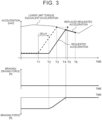
- FIG. 3 schematically shows an example of the control.
- FIG. 3 is a graph in which the time is plotted on the horizontal axis and the acceleration, the braking/driving force, and the braking force are plotted on the vertical axis.
- the requested acceleration that the control device 10 uses for the process in step S106 described above, the braking/driving force generated in the powertrain (an offset from the lower limit torque at each time), and the braking force generated in the brakes are each indicated by a solid line.
- a part of the requested acceleration that is output to the control device 10 by the driving assist system is shown by a dotted line.
- the control device 10 acquires the requested acceleration after a fixed communication delay time has passed.
- the requested acceleration is actually a discrete value that is calculated by the driving assist system at regular intervals and that is acquired by the control device 10. However, the requested acceleration is indicated as being continuous in FIG. 3 .
- the driving assist system performs the deceleration control up to time T1 and determines to end the deceleration control at time T1 based on an instruction from the user, for example.
- the driving assist system turns on the degenerating flag, acquires the lower limit torque or the lower limit torque equivalent acceleration from the powertrain ECU 20, and gradually increases the requested acceleration while suppressing a steep change by setting an upper limit to an absolute value of a jerk for example, to perform the degeneration control with the objective of matching the requested acceleration to the lower limit torque equivalent acceleration.
- the control can be performed by a feedback control that compares the requested acceleration with the actual acceleration of the vehicle, for example. If there is no communication delay, the degeneration control ends at time T3 or in a relatively short time thereafter. In FIG. 3 , the requested acceleration is indicated by a dotted line up to time T3.
- the control device 10 acquires the requested acceleration with a delay and performs the process based on the requested acceleration. After time T2, the control device 10 performs the degeneration response process described above since the degenerating flag is turned on. After time T2, the lower limit torque tends to decrease, and at time T4, the requested acceleration acquired by the control device 10 exceeds the lower limit torque equivalent acceleration. From time T4 onward and at least up to time T5 is a period in which the requested acceleration is larger than the lower limit torque equivalent acceleration. Thus, during this period, the control device 10 replaces the requested acceleration with the lower limit torque equivalent acceleration, as the degeneration response process.
- the degeneration control is easily converged and the degeneration control can be ended at time T6, for example.
- step S103 Since there is a delay in the acquisition of the lower limit torque acquired by the control device 10 in step S103 described above due to the communication delay, there is a case in which the acquired lower limit torque is different from the lower limit torque at the time of the acquisition. Even in such a case, the lower limit torque acquired in step S103 is more recent than the lower limit torque acquired by the driving assist system at the time of calculating the requested acceleration acquired in step S101. Thus, it is possible to perform the degeneration response process that reflects the new lower limit torque, and therefore it is possible to speed up the convergence of the degeneration control.
- the degeneration response process may be modified as appropriate as long as the process can stabilize the degeneration control.
- step S105 instead of replacing the requested acceleration with the lower limit torque equivalent acceleration, the powertrain ECU 20 may be instructed to prohibit the generation of a driving force that is larger than the lower limit torque at the time, regardless of the instruction in the next step S106.
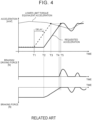
- FIG. 4 schematically shows the example of the control.
- the driving assist system performs the deceleration control up to time T1, and determines to end the deceleration control at time T1 based on an instruction from the user, for example.
- the driving assist system acquires the lower limit torque or the lower limit torque equivalent acceleration from the powertrain ECU 20, and gradually increases the requested acceleration while setting the upper limit to the absolute value of the jerk, to perform degeneration control with the objective of matching the requested acceleration with the lower limit equivalent acceleration.
- the control can be performed by the feedback control that compares the requested acceleration with the actual acceleration of the vehicle, for example. If there is no communication delay, the degeneration control ends at time T3.
- the control device 10 acquires the requested acceleration with a delay and performs the process based on the requested acceleration. Since the lower limit torque tends to decrease, at time T4, the requested acceleration acquired by the control device 10 exceeds the lower limit torque equivalent acceleration. Since the control device 10 does not perform the degeneration response process described above after time T4, a driving force larger than the lower limit torque is generated in the powertrain.
- the lower limit torque is not maintained for the braking/driving force that is generated in the powertrain and the powertrain is unnecessarily operated to the driving side.
- the degeneration control by the driving assist system becomes difficult to converge, control hunting occurs in which the driving force generated by the powertrain and the braking force generated by the brake oscillate, and there is a possibility that the completion of the degeneration control is delayed or that the degeneration control cannot be ended.
- the control device 10 while the degeneration control is being performed by the driving assist system at the end of the deceleration control, the control device 10 detects the degeneration control and the powertrain is suppressed from generating a braking/driving force that is larger than the lower limit torque regardless of the requested acceleration from the driving assist system. In this way, the degeneration control can be ended early to enhance the control stability of the vehicle.
- the control device 10 can detect that the degeneration control is being performed, with a simple method of acquiring the degenerating flag. Further, each driving assist system imposes a minimum limit called the upper limit guard on the requested acceleration calculated by a unique method while the degeneration control is being performed. However, since there are no other restrictions, each driving assist system can utilize the degeneration control method, which is adopted by the corresponding driving assist system based on the characteristics, to the maximum.
- the driving assist system In order to make the driving assist system compatible with the present embodiment, it is only necessary to additionally implement a function of turning on the degenerating flag while the degeneration control is being performed to notify the control device 10. Thus, the amount of programs to be added is small, and a development amount and a memory amount can be economized. Further, a communication amount for notification of the degenerating flag is also small.
- a specification standard has been proposed in which the driving assist system generates various numerical parameters related to the degeneration control in addition to the requested acceleration and sends the numerical parameters to the in-vehicle network. Compared to when the standard is adopted, costs of the communication traffic, the process amount, the memory amount, and the development amount can be greatly suppressed according to the present invention.
- the present invention is not limited to the control device of the vehicle, and can be construed as a driving assist system including a control device and other devices, a control method executed by a control device provided with a processor and a memory, a control program, a non-transitory storage medium storing a control program, and a vehicle provided with a control device, etc.
- the present invention is useful as a control device mounted on a vehicle or the like.
Landscapes
- Engineering & Computer Science (AREA)
- Automation & Control Theory (AREA)
- Transportation (AREA)
- Mechanical Engineering (AREA)
- Chemical & Material Sciences (AREA)
- Combustion & Propulsion (AREA)
- Human Computer Interaction (AREA)
- Regulating Braking Force (AREA)
- Control Of Driving Devices And Active Controlling Of Vehicle (AREA)
- Electric Propulsion And Braking For Vehicles (AREA)
Description
- The present invention relates to a control device, a control method and a non-transitory storage medium.
- In recent years, vehicles have been equipped with various driving assist systems. A control device that controls a powertrain and brakes by appropriately arbitrating a request from such a driving assist system and a request from a user has been proposed (
Japanese Unexamined Patent Application Publication No. 2007-120352 JP 2007-120352 A Japanese Patent Application Publication No. 2009-173105 JP 2009-173105 A - When ending a driving assist function during a deceleration control for operating the brakes of the vehicle, the driving assist system executes a degeneration control in which a braking force resulting from the deceleration control is gradually decreased as a process at the end of the driving assist system, in order to save a user from feeling uncomfortable due to a sudden stop in deceleration. The degeneration control is ended when the following state is realized: the braking force is not generated in the brakes; unnecessary output torque is not generated in the powertrain; and a lower limit torque, which is the lower limit within a range of a torque that can be output, is output.
- An electronic control unit (ECU) in which the driving assist system is implemented acquires the lower limit value of the torque that can be output at the time from an ECU that controls the powertrain via the in-vehicle network and performs a feedback control based on the acquired value to perform the degeneration control described above. The lower limit value changes depending on the state of the powertrain. Thus, if the degeneration control is delayed due to a communication delay of the in-vehicle network, the change in the lower limit value cannot be followed and there is a possibility that the control of the driving force and the braking force becomes unstable.
- The present invention provides a control device according to claim 1. The control device enhances a control stability at an end of a deceleration control by a driving assist system.
- A control method according to claim 3 is also provided.
- A non-transitory storage medium according to claim 4 is also provided.
- According to the present invention, since the control device acquires the information indicating the end of the deceleration control by the driving assist system and performs the prescribed process triggered by the acquisition of the information, the control stability can be enhanced.
- Features, advantages, and technical and industrial significance of exemplary embodiments of the invention will be described below with reference to the accompanying drawings, in which like signs denote like elements, and wherein:
-
FIG. 1 is a configuration diagram of a control device and peripheral units thereof, according to an embodiment of the present invention; -
FIG. 2 is a flowchart of a process according to the embodiment of the present invention; -
FIG. 3 is a graph of an example of a process according to the embodiment of the present invention; and -
FIG. 4 is a graph of an example of a process according to a comparative example. - Hereinafter, an embodiment of the present invention will be described with reference to the drawings. While a driving assist system is performing a degeneration control, which is an ending process of a deceleration control, a control device according to the present embodiment detects the degeneration control and suppresses an output torque that is larger than a lower limit torque from being generated in a powertrain, regardless of an acceleration requested from the driving assist system. In this way, the degeneration control can be ended early to enhance a control stability of a vehicle.
-
FIG. 1 is a configuration diagram of acontrol device 10 and peripheral units thereof, according to the present embodiment. - In the present embodiment, a powertrain electronic control unit (ECU) 20 and a
brake ECU 30 are connected to thecontrol device 10 via a network. Various ECUs such as acamera ECU 41, anautonomous driving ECU 42, a clearance sonar ECU 43 are connected to thecontrol device 10 via the network. Thepowertrain ECU 20 is an ECU that controls an engine and a transmission (or a motor) provided in the vehicle. Thebrake ECU 30 is an ECU that controls brakes provided in the vehicle. Thecontrol device 10 has anacquisition unit 12 that acquires information from these ECUs and acontrol unit 11 that controls thepowertrain ECU 20 and thebrake ECU 30 based on the acquired information and that can control a driving force and a braking force. - Hereinafter, when referring to the driving force and the braking force, both are expressed by their absolute values. When the driving force and the braking force are collectively referred to as a braking/driving force, the braking/driving force is expressed as a value with a reference sign in which the force is defined as positive when the force is applied in a traveling direction of the vehicle. When referring to an acceleration, the acceleration is expressed as a value with a reference sign in which the traveling direction of the vehicle is defined as a positive direction.
- The
control device 10 and the ECUs are each typically a computer provided with a control unit that is a processor, a memory, and the like. A function of thecontrol device 10 may be implemented in a device such as an ECU that is provided independently. Otherwise, the function of the control device may be integrated in any of thepowertrain ECU 20, thebrake ECU 30, or the like, or be appropriately dispersed in each of thepowertrain ECU 20, thebrake ECU 30, or the like. - The camera ECU 41 is an ECU that has a function such as following a preceding vehicle and avoiding a collision. The autonomous driving
ECU 42 is an ECU that implements an autonomous driving function that executes all driving tasks. Theclearance sonar ECU 43 is an ECU that has a function such as avoiding a collision. In this way, the vehicle is provided with the driving assist system by the plurality of ECUs, for example. Thecontrol device 10 arbitrates a request from each driving assist system based on a prescribed rule, and controls the braking/driving force based on the arbitration result. - Process
- The degeneration response process performed by the
control device 10 in response to the degeneration control of the driving assist system according to the present embodiment will be described below with reference to the flowchart inFIG. 2 . In this process, one or more driving assist systems provided in the vehicle are operated, and thecontrol device 10 controls the braking/driving force based on the request from the one driving assist system selected as the arbitration result. In addition, the process is executed repeatedly while the driving assist system is being operated. - The
acquisition unit 12 of thecontrol device 10 acquires a requested acceleration and a degenerating flag that indicates whether the degeneration control for ending the deceleration control is being performed, from the selected driving assist system. The requested acceleration is the acceleration requested by the driving assist system to be generated by the vehicle. When the degenerating flag is turned on, this indicates that the driving assist system is performing a process of gradually reducing a degree of deceleration in order to end the deceleration control. That is, when the degenerating flag is turned on, this means that the driving assist system will end the deceleration control. - The
acquisition unit 12 acquires from thepowertrain ECU 20, the lower limit torque that is the lower limit value of the torque that the powertrain can output at the time. Thepowertrain ECU 20 can calculate the lower limit torque based on an engine speed, a throttle opening degree, a gear ratio by a transmission or a torque converter at the time, etc., in the case of an engine vehicle, and based on a regenerative power generation rate at the time in the case of an electric vehicle. - The
control unit 11 of thecontrol device 10 determines whether the degenerating flag is turned on. When the degenerating flag is turned on, the process proceeds to step S 104, and when the degenerating flag is off, the process proceeds to step S106. - The
control unit 11 compares the requested acceleration with a lower limit torque equivalent acceleration. The lower limit torque equivalent acceleration is an acceleration generated in the vehicle by the lower limit torque. Thecontrol unit 11 can calculate the lower limit torque equivalent acceleration based on the lower limit torque and the weight of the vehicle, etc. In step S103, theacquisition unit 12 may acquire the lower limit torque equivalent acceleration, instead of the lower limit torque, from thepowertrain ECU 20. When the requested acceleration is larger than the lower limit torque equivalent acceleration, the process proceeds to step S 105, and when the requested acceleration is equal to or less than the lower limit torque equivalent acceleration, the process proceeds to step S106. - The
control unit 11 sets as the requested acceleration used for control in the next step S 106, a value in which the requested acceleration acquired from the driving assist system is replaced by the lower limit torque equivalent acceleration. That is, the upper limit is guarded so that the requested acceleration used for control does not exceed the lower limit torque equivalent acceleration. - The
control unit 11 controls thepowertrain ECU 20 and thebrake ECU 30 based on the requested acceleration. If the requested acceleration is larger than the lower limit torque equivalent acceleration, thepowertrain ECU 20 is controlled so as to generate an output torque larger than the lower limit torque in the powertrain and thebrake ECU 30 is controlled so that the braking force is not generated in the brake, so that the requested acceleration is generated in the vehicle. If the requested acceleration is equal to or less than the lower limit torque equivalent acceleration, thepowertrain ECU 20 is controlled so as to generate the lower limit torque in the powertrain and thebrake ECU 30 is controlled so that the braking force is generated in the brakes, so that the requested acceleration is generated in the vehicle. - While the control is being performed by the driving assist system, the above steps S101 to S106 are executed repeatedly. When the requested acceleration is newly acquired from another driving assist system, the
control device 10 can switch the process to a control based on a request of the other driving assist system in accordance with the arbitration result based on the prescribed rule. - An example of the control by the above process will be described.
FIG. 3 schematically shows an example of the control.FIG. 3 is a graph in which the time is plotted on the horizontal axis and the acceleration, the braking/driving force, and the braking force are plotted on the vertical axis. The requested acceleration that thecontrol device 10 uses for the process in step S106 described above, the braking/driving force generated in the powertrain (an offset from the lower limit torque at each time), and the braking force generated in the brakes are each indicated by a solid line. A part of the requested acceleration that is output to thecontrol device 10 by the driving assist system is shown by a dotted line. Thecontrol device 10 acquires the requested acceleration after a fixed communication delay time has passed. The requested acceleration is actually a discrete value that is calculated by the driving assist system at regular intervals and that is acquired by thecontrol device 10. However, the requested acceleration is indicated as being continuous inFIG. 3 . - The driving assist system performs the deceleration control up to time T1 and determines to end the deceleration control at time T1 based on an instruction from the user, for example.
- After time T1, the driving assist system turns on the degenerating flag, acquires the lower limit torque or the lower limit torque equivalent acceleration from the
powertrain ECU 20, and gradually increases the requested acceleration while suppressing a steep change by setting an upper limit to an absolute value of a jerk for example, to perform the degeneration control with the objective of matching the requested acceleration to the lower limit torque equivalent acceleration. The control can be performed by a feedback control that compares the requested acceleration with the actual acceleration of the vehicle, for example. If there is no communication delay, the degeneration control ends at time T3 or in a relatively short time thereafter. InFIG. 3 , the requested acceleration is indicated by a dotted line up to time T3. - The
control device 10 acquires the requested acceleration with a delay and performs the process based on the requested acceleration. After time T2, thecontrol device 10 performs the degeneration response process described above since the degenerating flag is turned on. After time T2, the lower limit torque tends to decrease, and at time T4, the requested acceleration acquired by thecontrol device 10 exceeds the lower limit torque equivalent acceleration. From time T4 onward and at least up to time T5 is a period in which the requested acceleration is larger than the lower limit torque equivalent acceleration. Thus, during this period, thecontrol device 10 replaces the requested acceleration with the lower limit torque equivalent acceleration, as the degeneration response process. - With the above process, the lower limit torque of the braking/driving force generated in the powertrain is maintained, no unnecessary output torque is generated, and the state of the powertrain is stable. Thus, even if there is a delay, the degeneration control is easily converged and the degeneration control can be ended at time T6, for example.
- Since there is a delay in the acquisition of the lower limit torque acquired by the
control device 10 in step S103 described above due to the communication delay, there is a case in which the acquired lower limit torque is different from the lower limit torque at the time of the acquisition. Even in such a case, the lower limit torque acquired in step S103 is more recent than the lower limit torque acquired by the driving assist system at the time of calculating the requested acceleration acquired in step S101. Thus, it is possible to perform the degeneration response process that reflects the new lower limit torque, and therefore it is possible to speed up the convergence of the degeneration control. - The degeneration response process may be modified as appropriate as long as the process can stabilize the degeneration control. For example, in step S105, instead of replacing the requested acceleration with the lower limit torque equivalent acceleration, the
powertrain ECU 20 may be instructed to prohibit the generation of a driving force that is larger than the lower limit torque at the time, regardless of the instruction in the next step S106. - As a comparative example, an example of a control when the
control device 10 does not perform the degeneration response process described above will be indicated below. Similar toFIG. 3 ,FIG. 4 schematically shows the example of the control. - The driving assist system performs the deceleration control up to time T1, and determines to end the deceleration control at time T1 based on an instruction from the user, for example.
- After time T1, the driving assist system acquires the lower limit torque or the lower limit torque equivalent acceleration from the
powertrain ECU 20, and gradually increases the requested acceleration while setting the upper limit to the absolute value of the jerk, to perform degeneration control with the objective of matching the requested acceleration with the lower limit equivalent acceleration. The control can be performed by the feedback control that compares the requested acceleration with the actual acceleration of the vehicle, for example. If there is no communication delay, the degeneration control ends at time T3. - The
control device 10 acquires the requested acceleration with a delay and performs the process based on the requested acceleration. Since the lower limit torque tends to decrease, at time T4, the requested acceleration acquired by thecontrol device 10 exceeds the lower limit torque equivalent acceleration. Since thecontrol device 10 does not perform the degeneration response process described above after time T4, a driving force larger than the lower limit torque is generated in the powertrain. - The lower limit torque is not maintained for the braking/driving force that is generated in the powertrain and the powertrain is unnecessarily operated to the driving side. Thus, the degeneration control by the driving assist system becomes difficult to converge, control hunting occurs in which the driving force generated by the powertrain and the braking force generated by the brake oscillate, and there is a possibility that the completion of the degeneration control is delayed or that the degeneration control cannot be ended.
- In the
control device 10 according to the present embodiment, while the degeneration control is being performed by the driving assist system at the end of the deceleration control, thecontrol device 10 detects the degeneration control and the powertrain is suppressed from generating a braking/driving force that is larger than the lower limit torque regardless of the requested acceleration from the driving assist system. In this way, the degeneration control can be ended early to enhance the control stability of the vehicle. - The
control device 10 can detect that the degeneration control is being performed, with a simple method of acquiring the degenerating flag. Further, each driving assist system imposes a minimum limit called the upper limit guard on the requested acceleration calculated by a unique method while the degeneration control is being performed. However, since there are no other restrictions, each driving assist system can utilize the degeneration control method, which is adopted by the corresponding driving assist system based on the characteristics, to the maximum. - In order to make the driving assist system compatible with the present embodiment, it is only necessary to additionally implement a function of turning on the degenerating flag while the degeneration control is being performed to notify the
control device 10. Thus, the amount of programs to be added is small, and a development amount and a memory amount can be economized. Further, a communication amount for notification of the degenerating flag is also small. In recent years, as a process during the degeneration control, a specification standard has been proposed in which the driving assist system generates various numerical parameters related to the degeneration control in addition to the requested acceleration and sends the numerical parameters to the in-vehicle network. Compared to when the standard is adopted, costs of the communication traffic, the process amount, the memory amount, and the development amount can be greatly suppressed according to the present invention. - The present invention is not limited to the control device of the vehicle, and can be construed as a driving assist system including a control device and other devices, a control method executed by a control device provided with a processor and a memory, a control program, a non-transitory storage medium storing a control program, and a vehicle provided with a control device, etc.
- The present invention is useful as a control device mounted on a vehicle or the like.
Claims (4)
- A control device (10) comprising:an acquisition unit (12) configured to acquire, from a driving assist system, a requested acceleration and ending information indicating an end of a deceleration control; anda control unit (11) configured tocontrol a powertrain and a brake based on the requested acceleration, andperform a prescribed process of stabilizing a driving force and a braking force that are generated in an ending process of the deceleration control based on the requested acceleration when the acquisition unit (12) acquires the ending information;characterized in that the acquisition unit (12) is configured to acquire a lower limit value of a torque that the powertrain is allowed to output;the control unit (11) is configured to turn on a degenerating flag when the acquisition unit (12) acquires the ending information; andthe control unit (11) is configured to, as the prescribed process, while the degenerating flag is turned on,compare the requested acceleration acquired by the acquisition unit (12) with an acceleration generated by the lower limit value of the torque that the powertrain is allowed to output, andchange the requested acceleration to the acceleration generated by the lower limit value when the requested acceleration acquired by the acquisition unit (12) exceeds the acceleration generated by the lower limit value.
- The control device (10) according to claim 1, wherein the control unit (11) is configured to, as the prescribed process, limit an upper limit of the requested acceleration to an acceleration determined based on the lower limit value of the torque that the powertrain is allowed to output at a time of performing the prescribed process.
- A control method performed by one or more processors comprising:acquiring a requested acceleration and ending information indicating an end of a deceleration control, from a driving assist system;controlling a powertrain and a brake based on the requested acceleration, andperforming a prescribed process of stabilizing a driving force and a braking force that are generated in an ending process of the deceleration control based on the requested acceleration when the processor acquires the ending information;characterized by acquiring a lower limit value of a torque that the powertrain is allowed to output;turning on a degenerating flag when acquiring the ending information; andas the prescribed process, while the degenerating flag is turned on,comparing the acquired requested acceleration with an acceleration generated by the lower limit value of the torque that the powertrain is allowed to output, andchanging the requested acceleration to the acceleration generated by the lower limit value when the acquired requested acceleration exceeds the acceleration generated by the lower limit value.
- A non-transitory storage medium storing instructions that are executable by one or more processors and that cause the one or more processors to perform functions comprising:acquiring a requested acceleration and ending information indicating an end of a deceleration control, from a driving assist system;controlling a powertrain and a brake based on the requested acceleration, andperforming a prescribed process of stabilizing a driving force and a braking force that are generated in an ending process of the deceleration control based on the requested acceleration when the processor acquires the ending information;characterized in that the functions comprise:acquiring a lower limit value of a torque that the powertrain is allowed to output;turning on a degenerating flag when acquiring the ending information; andas the prescribed process, while the degenerating flag is turned on,comparing the acquired requested acceleration with an acceleration generated by the lower limit value of the torque that the powertrain is allowed to output, andchanging the requested acceleration to the acceleration generated by the lower limit value when the acquired requested acceleration exceeds the acceleration generated by the lower limit value.
Applications Claiming Priority (1)
| Application Number | Priority Date | Filing Date | Title |
|---|---|---|---|
| JP2019222237A JP7368206B2 (en) | 2019-12-09 | 2019-12-09 | Control device |
Publications (2)
| Publication Number | Publication Date |
|---|---|
| EP3835160A1 EP3835160A1 (en) | 2021-06-16 |
| EP3835160B1 true EP3835160B1 (en) | 2024-04-03 |
Family
ID=73037663
Family Applications (1)
| Application Number | Title | Priority Date | Filing Date |
|---|---|---|---|
| EP20200044.4A Active EP3835160B1 (en) | 2019-12-09 | 2020-10-05 | Control device, control method and non-transitory storage medium |
Country Status (4)
| Country | Link |
|---|---|
| US (3) | US11383729B2 (en) |
| EP (1) | EP3835160B1 (en) |
| JP (2) | JP7368206B2 (en) |
| CN (1) | CN112937525B (en) |
Families Citing this family (5)
| Publication number | Priority date | Publication date | Assignee | Title |
|---|---|---|---|---|
| JP7464355B2 (en) * | 2018-08-07 | 2024-04-09 | トヨタ自動車株式会社 | Braking force control device, control device, manager, method, program, actuator system, and vehicle |
| JP7440237B2 (en) | 2019-10-16 | 2024-02-28 | トヨタ自動車株式会社 | display device |
| JP7453173B2 (en) * | 2021-03-18 | 2024-03-19 | トヨタ自動車株式会社 | Manager, vehicle control method, vehicle control program, and vehicle equipped with manager |
| JP2024112141A (en) * | 2023-02-07 | 2024-08-20 | トヨタ自動車株式会社 | Vehicle motion manager, vehicle control method, and vehicle control program |
| DE102023131966A1 (en) * | 2023-11-16 | 2025-05-22 | Bayerische Motoren Werke Aktiengesellschaft | Method and assistance device for controlling a drive system of a motor vehicle and correspondingly equipped motor vehicle |
Family Cites Families (47)
| Publication number | Priority date | Publication date | Assignee | Title |
|---|---|---|---|---|
| JPH0623019B2 (en) * | 1984-10-29 | 1994-03-30 | 株式会社島津製作所 | Vehicle acceleration control device |
| KR930001391B1 (en) * | 1985-06-12 | 1993-02-27 | 미쯔비시지도샤고교 가부시끼가이샤 | Vehicle Engine Control |
| JP3020232B2 (en) * | 1991-01-14 | 2000-03-15 | アイシン精機株式会社 | Variable valve timing control device |
| JP3572978B2 (en) | 1999-01-14 | 2004-10-06 | 日産自動車株式会社 | Travel control device for vehicles |
| JP3566151B2 (en) * | 1999-10-04 | 2004-09-15 | 本田技研工業株式会社 | Motor control device for hybrid vehicle |
| JP4135291B2 (en) | 2000-03-13 | 2008-08-20 | 株式会社デンソー | Vehicle control apparatus and recording medium |
| JP2003048461A (en) * | 2001-08-06 | 2003-02-18 | Denso Corp | Vehicle integrated control system and recording medium |
| DE10222198A1 (en) * | 2002-05-18 | 2003-11-27 | Bosch Gmbh Robert | Method for influencing driving torque of motor vehicle, gives measure of driving torque requested by driver and increases driving torque of vehicle independent of request from driver when necessary |
| US20040034460A1 (en) * | 2002-08-13 | 2004-02-19 | Folkerts Charles Henry | Powertrain control system |
| JP3918686B2 (en) * | 2002-08-30 | 2007-05-23 | 株式会社日立製作所 | Driving control apparatus and control method for automobile |
| JP2005104320A (en) | 2003-09-30 | 2005-04-21 | Advics:Kk | Vehicle control device |
| JP4752679B2 (en) * | 2005-10-13 | 2011-08-17 | 日産自動車株式会社 | Driving assistance device for vehicle |
| JP4297107B2 (en) | 2005-10-26 | 2009-07-15 | トヨタ自動車株式会社 | Vehicle control device |
| DE102005060820B4 (en) * | 2005-12-20 | 2022-05-19 | Zf Cv Systems Hannover Gmbh | Method for assisting in driving a vehicle |
| JP5546106B2 (en) * | 2008-01-23 | 2014-07-09 | 株式会社アドヴィックス | Vehicle motion control device |
| JP2009204127A (en) * | 2008-02-28 | 2009-09-10 | Mitsubishi Heavy Ind Ltd | Vehicle control unit and vehicle mounted with this unit |
| JP5407326B2 (en) * | 2008-12-25 | 2014-02-05 | 日産自動車株式会社 | Vehicular acceleration / deceleration control apparatus and method |
| JP5324367B2 (en) * | 2009-09-16 | 2013-10-23 | 株式会社デンソー | Control request arbitration device |
| GB2483720B (en) * | 2010-09-20 | 2017-10-25 | Jaguar Land Rover Ltd | Improvements relating to brake control |
| JP5741029B2 (en) * | 2011-02-04 | 2015-07-01 | 日産自動車株式会社 | Electric vehicle tread downshift control device |
| JP2012184683A (en) * | 2011-03-03 | 2012-09-27 | Toyota Motor Corp | Driving force control apparatus for vehicle |
| DE102011114072C5 (en) | 2011-09-22 | 2021-04-22 | Knorr-Bremse Systeme für Nutzfahrzeuge GmbH | Driver assistance system with autonomous braking to a standstill |
| JP5852512B2 (en) * | 2012-06-07 | 2016-02-03 | 日立オートモティブシステムズ株式会社 | Vehicle travel control device |
| JP5704147B2 (en) * | 2012-10-25 | 2015-04-22 | 株式会社デンソー | Deceleration control device |
| JP5929885B2 (en) * | 2013-12-20 | 2016-06-08 | 株式会社デンソー | Inter-vehicle control device |
| JP6020510B2 (en) * | 2014-04-24 | 2016-11-02 | トヨタ自動車株式会社 | Vehicle control device |
| DE102014219845B4 (en) * | 2014-09-30 | 2020-12-24 | Ford Global Technologies, Llc | Cruise control for automobiles |
| JP6181678B2 (en) * | 2015-01-29 | 2017-08-16 | トヨタ自動車株式会社 | Vehicle braking control device |
| JP6156403B2 (en) * | 2015-02-13 | 2017-07-05 | トヨタ自動車株式会社 | Vehicle drive device |
| KR101724467B1 (en) * | 2015-05-07 | 2017-04-18 | 현대자동차 주식회사 | Automatic vehicle speed control device and method |
| US10654465B2 (en) * | 2015-07-02 | 2020-05-19 | Volvo Truck Corporation | Method for controlling a hydraulic hybrid vehicle |
| JP6716871B2 (en) * | 2015-07-15 | 2020-07-01 | いすゞ自動車株式会社 | Travel control device and travel control method |
| JP6347417B2 (en) * | 2015-12-25 | 2018-06-27 | マツダ株式会社 | Engine control device |
| JP6520858B2 (en) * | 2016-08-08 | 2019-05-29 | トヨタ自動車株式会社 | Vehicle travel control device |
| JP6597528B2 (en) * | 2016-09-08 | 2019-10-30 | 株式会社デンソー | Acceleration / deceleration control system, acceleration / deceleration control method |
| US10040453B2 (en) * | 2016-11-17 | 2018-08-07 | Toyota Motor Engineering & Manufacturing North America, Inc. | Systems and methods for preemptively modifying vehicle parameters according to predicted accelerations upon a travel lane clearing |
| JP6610525B2 (en) * | 2016-12-15 | 2019-11-27 | トヨタ自動車株式会社 | Driving support device |
| JP6834853B2 (en) | 2017-08-31 | 2021-02-24 | トヨタ自動車株式会社 | Vehicle control device |
| JP6875240B2 (en) | 2017-09-21 | 2021-05-19 | 日立Astemo株式会社 | Mobile control system and mobile control method |
| CN111465758B (en) * | 2017-11-22 | 2022-02-25 | 日产自动车株式会社 | Control method for internal combustion engine and control device for internal combustion engine |
| JP6568965B2 (en) * | 2018-02-14 | 2019-08-28 | 本田技研工業株式会社 | Vehicle control device |
| JP2019143484A (en) * | 2018-02-16 | 2019-08-29 | マツダ株式会社 | Control device of vehicle |
| US11801835B2 (en) * | 2018-02-26 | 2023-10-31 | Jaguar Land Rover Limited | Controller for a vehicle based on accelerator pedal position |
| US20200101961A1 (en) * | 2018-10-02 | 2020-04-02 | GM Global Technology Operations LLC | System and method for inhibiting harsh engagement of a one-way clutch in a vehicle |
| US20200247395A1 (en) * | 2019-01-31 | 2020-08-06 | Volvo Car Corporation | Off-road control brake |
| JP7053523B2 (en) * | 2019-03-14 | 2022-04-12 | ファナック株式会社 | Numerical control system for industrial machinery |
| JP7360290B2 (en) * | 2019-09-26 | 2023-10-12 | 株式会社Subaru | Vehicle travel control device |
-
2019
- 2019-12-09 JP JP2019222237A patent/JP7368206B2/en active Active
-
2020
- 2020-09-23 US US16/948,546 patent/US11383729B2/en active Active
- 2020-09-24 CN CN202011014199.5A patent/CN112937525B/en active Active
- 2020-10-05 EP EP20200044.4A patent/EP3835160B1/en active Active
-
2022
- 2022-06-08 US US17/835,431 patent/US11952002B2/en active Active
-
2023
- 2023-10-11 JP JP2023176239A patent/JP7632554B2/en active Active
-
2024
- 2024-02-29 US US18/592,185 patent/US12600371B2/en active Active
Also Published As
| Publication number | Publication date |
|---|---|
| CN112937525B (en) | 2023-07-07 |
| JP2023175990A (en) | 2023-12-12 |
| US11952002B2 (en) | 2024-04-09 |
| JP7632554B2 (en) | 2025-02-19 |
| US20220297711A1 (en) | 2022-09-22 |
| JP7368206B2 (en) | 2023-10-24 |
| JP2021091269A (en) | 2021-06-17 |
| US20210171052A1 (en) | 2021-06-10 |
| US11383729B2 (en) | 2022-07-12 |
| CN112937525A (en) | 2021-06-11 |
| US12600371B2 (en) | 2026-04-14 |
| US20240199043A1 (en) | 2024-06-20 |
| EP3835160A1 (en) | 2021-06-16 |
Similar Documents
| Publication | Publication Date | Title |
|---|---|---|
| EP3835160B1 (en) | Control device, control method and non-transitory storage medium | |
| US12304504B2 (en) | Vehicle control system | |
| JP6333655B2 (en) | Method and apparatus for assisting in driving a vehicle | |
| US11738762B2 (en) | Control device, manager, method, non-transitory storage medium, actuator system, and vehicle | |
| CN114030472B (en) | Control method, device and equipment for adaptive cruise and readable storage medium | |
| JP2017138740A (en) | Operation assisting device | |
| JP2007008422A (en) | Vehicle control device and vehicle vibration control method | |
| CN115140031B (en) | Automatic driving method, device and electronic equipment | |
| US12280788B2 (en) | Control apparatus, manager, electronic control unit, system, control method, non-transitory computer-readable storage medium storing program, and vehicle | |
| US20240059291A1 (en) | Vehicle anti-pitch operations during near stopped state conditions | |
| US12122343B2 (en) | Control device for vehicle, actuator system, control method, non-transitory storage medium, and vehicle | |
| US7228220B2 (en) | Device for adaptive distance and speed control with having torque dampening | |
| JP2025115169A (en) | Braking control device | |
| JP7517235B2 (en) | Vehicles, programs, and notification methods | |
| JP7444806B2 (en) | Vehicle control device, control method, control program, manager, and vehicle | |
| CN114655204B (en) | Adaptive cruise control method, system, terminal device and readable storage medium | |
| CN219687244U (en) | Controller and vehicle | |
| JP4905191B2 (en) | Vehicle travel control device |
Legal Events
| Date | Code | Title | Description |
|---|---|---|---|
| PUAI | Public reference made under article 153(3) epc to a published international application that has entered the european phase |
Free format text: ORIGINAL CODE: 0009012 |
|
| STAA | Information on the status of an ep patent application or granted ep patent |
Free format text: STATUS: REQUEST FOR EXAMINATION WAS MADE |
|
| 17P | Request for examination filed |
Effective date: 20201005 |
|
| AK | Designated contracting states |
Kind code of ref document: A1 Designated state(s): AL AT BE BG CH CY CZ DE DK EE ES FI FR GB GR HR HU IE IS IT LI LT LU LV MC MK MT NL NO PL PT RO RS SE SI SK SM TR |
|
| GRAP | Despatch of communication of intention to grant a patent |
Free format text: ORIGINAL CODE: EPIDOSNIGR1 |
|
| STAA | Information on the status of an ep patent application or granted ep patent |
Free format text: STATUS: GRANT OF PATENT IS INTENDED |
|
| RIC1 | Information provided on ipc code assigned before grant |
Ipc: B60W 50/00 20060101ALN20231009BHEP Ipc: B60W 10/184 20120101ALI20231009BHEP Ipc: B60W 10/06 20060101ALI20231009BHEP Ipc: B60W 50/08 20200101ALI20231009BHEP Ipc: B60W 30/188 20120101ALI20231009BHEP Ipc: B60W 30/02 20120101ALI20231009BHEP Ipc: B60W 30/18 20120101AFI20231009BHEP |
|
| INTG | Intention to grant announced |
Effective date: 20231031 |
|
| GRAS | Grant fee paid |
Free format text: ORIGINAL CODE: EPIDOSNIGR3 |
|
| GRAA | (expected) grant |
Free format text: ORIGINAL CODE: 0009210 |
|
| STAA | Information on the status of an ep patent application or granted ep patent |
Free format text: STATUS: THE PATENT HAS BEEN GRANTED |
|
| AK | Designated contracting states |
Kind code of ref document: B1 Designated state(s): AL AT BE BG CH CY CZ DE DK EE ES FI FR GB GR HR HU IE IS IT LI LT LU LV MC MK MT NL NO PL PT RO RS SE SI SK SM TR |
|
| REG | Reference to a national code |
Ref country code: CH Ref legal event code: EP |
|
| REG | Reference to a national code |
Ref country code: IE Ref legal event code: FG4D |
|
| REG | Reference to a national code |
Ref country code: DE Ref legal event code: R096 Ref document number: 602020028230 Country of ref document: DE |
|
| REG | Reference to a national code |
Ref country code: LT Ref legal event code: MG9D |
|
| REG | Reference to a national code |
Ref country code: NL Ref legal event code: MP Effective date: 20240403 |
|
| REG | Reference to a national code |
Ref country code: AT Ref legal event code: MK05 Ref document number: 1671964 Country of ref document: AT Kind code of ref document: T Effective date: 20240403 |
|
| PG25 | Lapsed in a contracting state [announced via postgrant information from national office to epo] |
Ref country code: NL Free format text: LAPSE BECAUSE OF FAILURE TO SUBMIT A TRANSLATION OF THE DESCRIPTION OR TO PAY THE FEE WITHIN THE PRESCRIBED TIME-LIMIT Effective date: 20240403 |
|
| PG25 | Lapsed in a contracting state [announced via postgrant information from national office to epo] |
Ref country code: NL Free format text: LAPSE BECAUSE OF FAILURE TO SUBMIT A TRANSLATION OF THE DESCRIPTION OR TO PAY THE FEE WITHIN THE PRESCRIBED TIME-LIMIT Effective date: 20240403 |
|
| PG25 | Lapsed in a contracting state [announced via postgrant information from national office to epo] |
Ref country code: IS Free format text: LAPSE BECAUSE OF FAILURE TO SUBMIT A TRANSLATION OF THE DESCRIPTION OR TO PAY THE FEE WITHIN THE PRESCRIBED TIME-LIMIT Effective date: 20240803 |
|
| PG25 | Lapsed in a contracting state [announced via postgrant information from national office to epo] |
Ref country code: BG Free format text: LAPSE BECAUSE OF FAILURE TO SUBMIT A TRANSLATION OF THE DESCRIPTION OR TO PAY THE FEE WITHIN THE PRESCRIBED TIME-LIMIT Effective date: 20240403 |
|
| PG25 | Lapsed in a contracting state [announced via postgrant information from national office to epo] |
Ref country code: FI Free format text: LAPSE BECAUSE OF FAILURE TO SUBMIT A TRANSLATION OF THE DESCRIPTION OR TO PAY THE FEE WITHIN THE PRESCRIBED TIME-LIMIT Effective date: 20240403 Ref country code: HR Free format text: LAPSE BECAUSE OF FAILURE TO SUBMIT A TRANSLATION OF THE DESCRIPTION OR TO PAY THE FEE WITHIN THE PRESCRIBED TIME-LIMIT Effective date: 20240403 |
|
| PG25 | Lapsed in a contracting state [announced via postgrant information from national office to epo] |
Ref country code: GR Free format text: LAPSE BECAUSE OF FAILURE TO SUBMIT A TRANSLATION OF THE DESCRIPTION OR TO PAY THE FEE WITHIN THE PRESCRIBED TIME-LIMIT Effective date: 20240704 |
|
| PG25 | Lapsed in a contracting state [announced via postgrant information from national office to epo] |
Ref country code: PT Free format text: LAPSE BECAUSE OF FAILURE TO SUBMIT A TRANSLATION OF THE DESCRIPTION OR TO PAY THE FEE WITHIN THE PRESCRIBED TIME-LIMIT Effective date: 20240805 |
|
| PG25 | Lapsed in a contracting state [announced via postgrant information from national office to epo] |
Ref country code: ES Free format text: LAPSE BECAUSE OF FAILURE TO SUBMIT A TRANSLATION OF THE DESCRIPTION OR TO PAY THE FEE WITHIN THE PRESCRIBED TIME-LIMIT Effective date: 20240403 |
|
| PG25 | Lapsed in a contracting state [announced via postgrant information from national office to epo] |
Ref country code: CZ Free format text: LAPSE BECAUSE OF FAILURE TO SUBMIT A TRANSLATION OF THE DESCRIPTION OR TO PAY THE FEE WITHIN THE PRESCRIBED TIME-LIMIT Effective date: 20240403 |
|
| PG25 | Lapsed in a contracting state [announced via postgrant information from national office to epo] |
Ref country code: AT Free format text: LAPSE BECAUSE OF FAILURE TO SUBMIT A TRANSLATION OF THE DESCRIPTION OR TO PAY THE FEE WITHIN THE PRESCRIBED TIME-LIMIT Effective date: 20240403 |
|
| PG25 | Lapsed in a contracting state [announced via postgrant information from national office to epo] |
Ref country code: PL Free format text: LAPSE BECAUSE OF FAILURE TO SUBMIT A TRANSLATION OF THE DESCRIPTION OR TO PAY THE FEE WITHIN THE PRESCRIBED TIME-LIMIT Effective date: 20240403 |
|
| PG25 | Lapsed in a contracting state [announced via postgrant information from national office to epo] |
Ref country code: LV Free format text: LAPSE BECAUSE OF FAILURE TO SUBMIT A TRANSLATION OF THE DESCRIPTION OR TO PAY THE FEE WITHIN THE PRESCRIBED TIME-LIMIT Effective date: 20240403 |
|
| PG25 | Lapsed in a contracting state [announced via postgrant information from national office to epo] |
Ref country code: PT Free format text: LAPSE BECAUSE OF FAILURE TO SUBMIT A TRANSLATION OF THE DESCRIPTION OR TO PAY THE FEE WITHIN THE PRESCRIBED TIME-LIMIT Effective date: 20240805 Ref country code: PL Free format text: LAPSE BECAUSE OF FAILURE TO SUBMIT A TRANSLATION OF THE DESCRIPTION OR TO PAY THE FEE WITHIN THE PRESCRIBED TIME-LIMIT Effective date: 20240403 Ref country code: NO Free format text: LAPSE BECAUSE OF FAILURE TO SUBMIT A TRANSLATION OF THE DESCRIPTION OR TO PAY THE FEE WITHIN THE PRESCRIBED TIME-LIMIT Effective date: 20240703 Ref country code: LV Free format text: LAPSE BECAUSE OF FAILURE TO SUBMIT A TRANSLATION OF THE DESCRIPTION OR TO PAY THE FEE WITHIN THE PRESCRIBED TIME-LIMIT Effective date: 20240403 Ref country code: IS Free format text: LAPSE BECAUSE OF FAILURE TO SUBMIT A TRANSLATION OF THE DESCRIPTION OR TO PAY THE FEE WITHIN THE PRESCRIBED TIME-LIMIT Effective date: 20240803 Ref country code: HR Free format text: LAPSE BECAUSE OF FAILURE TO SUBMIT A TRANSLATION OF THE DESCRIPTION OR TO PAY THE FEE WITHIN THE PRESCRIBED TIME-LIMIT Effective date: 20240403 Ref country code: GR Free format text: LAPSE BECAUSE OF FAILURE TO SUBMIT A TRANSLATION OF THE DESCRIPTION OR TO PAY THE FEE WITHIN THE PRESCRIBED TIME-LIMIT Effective date: 20240704 Ref country code: FI Free format text: LAPSE BECAUSE OF FAILURE TO SUBMIT A TRANSLATION OF THE DESCRIPTION OR TO PAY THE FEE WITHIN THE PRESCRIBED TIME-LIMIT Effective date: 20240403 Ref country code: ES Free format text: LAPSE BECAUSE OF FAILURE TO SUBMIT A TRANSLATION OF THE DESCRIPTION OR TO PAY THE FEE WITHIN THE PRESCRIBED TIME-LIMIT Effective date: 20240403 Ref country code: CZ Free format text: LAPSE BECAUSE OF FAILURE TO SUBMIT A TRANSLATION OF THE DESCRIPTION OR TO PAY THE FEE WITHIN THE PRESCRIBED TIME-LIMIT Effective date: 20240403 Ref country code: BG Free format text: LAPSE BECAUSE OF FAILURE TO SUBMIT A TRANSLATION OF THE DESCRIPTION OR TO PAY THE FEE WITHIN THE PRESCRIBED TIME-LIMIT Effective date: 20240403 Ref country code: AT Free format text: LAPSE BECAUSE OF FAILURE TO SUBMIT A TRANSLATION OF THE DESCRIPTION OR TO PAY THE FEE WITHIN THE PRESCRIBED TIME-LIMIT Effective date: 20240403 Ref country code: RS Free format text: LAPSE BECAUSE OF FAILURE TO SUBMIT A TRANSLATION OF THE DESCRIPTION OR TO PAY THE FEE WITHIN THE PRESCRIBED TIME-LIMIT Effective date: 20240703 |
|
| REG | Reference to a national code |
Ref country code: DE Ref legal event code: R097 Ref document number: 602020028230 Country of ref document: DE |
|
| PG25 | Lapsed in a contracting state [announced via postgrant information from national office to epo] |
Ref country code: DK Free format text: LAPSE BECAUSE OF FAILURE TO SUBMIT A TRANSLATION OF THE DESCRIPTION OR TO PAY THE FEE WITHIN THE PRESCRIBED TIME-LIMIT Effective date: 20240403 |
|
| PG25 | Lapsed in a contracting state [announced via postgrant information from national office to epo] |
Ref country code: EE Free format text: LAPSE BECAUSE OF FAILURE TO SUBMIT A TRANSLATION OF THE DESCRIPTION OR TO PAY THE FEE WITHIN THE PRESCRIBED TIME-LIMIT Effective date: 20240403 |
|
| PG25 | Lapsed in a contracting state [announced via postgrant information from national office to epo] |
Ref country code: RO Free format text: LAPSE BECAUSE OF FAILURE TO SUBMIT A TRANSLATION OF THE DESCRIPTION OR TO PAY THE FEE WITHIN THE PRESCRIBED TIME-LIMIT Effective date: 20240403 Ref country code: SK Free format text: LAPSE BECAUSE OF FAILURE TO SUBMIT A TRANSLATION OF THE DESCRIPTION OR TO PAY THE FEE WITHIN THE PRESCRIBED TIME-LIMIT Effective date: 20240403 |
|
| PG25 | Lapsed in a contracting state [announced via postgrant information from national office to epo] |
Ref country code: SM Free format text: LAPSE BECAUSE OF FAILURE TO SUBMIT A TRANSLATION OF THE DESCRIPTION OR TO PAY THE FEE WITHIN THE PRESCRIBED TIME-LIMIT Effective date: 20240403 |
|
| PG25 | Lapsed in a contracting state [announced via postgrant information from national office to epo] |
Ref country code: SM Free format text: LAPSE BECAUSE OF FAILURE TO SUBMIT A TRANSLATION OF THE DESCRIPTION OR TO PAY THE FEE WITHIN THE PRESCRIBED TIME-LIMIT Effective date: 20240403 Ref country code: SK Free format text: LAPSE BECAUSE OF FAILURE TO SUBMIT A TRANSLATION OF THE DESCRIPTION OR TO PAY THE FEE WITHIN THE PRESCRIBED TIME-LIMIT Effective date: 20240403 Ref country code: RO Free format text: LAPSE BECAUSE OF FAILURE TO SUBMIT A TRANSLATION OF THE DESCRIPTION OR TO PAY THE FEE WITHIN THE PRESCRIBED TIME-LIMIT Effective date: 20240403 Ref country code: EE Free format text: LAPSE BECAUSE OF FAILURE TO SUBMIT A TRANSLATION OF THE DESCRIPTION OR TO PAY THE FEE WITHIN THE PRESCRIBED TIME-LIMIT Effective date: 20240403 Ref country code: DK Free format text: LAPSE BECAUSE OF FAILURE TO SUBMIT A TRANSLATION OF THE DESCRIPTION OR TO PAY THE FEE WITHIN THE PRESCRIBED TIME-LIMIT Effective date: 20240403 |
|
| PLBE | No opposition filed within time limit |
Free format text: ORIGINAL CODE: 0009261 |
|
| STAA | Information on the status of an ep patent application or granted ep patent |
Free format text: STATUS: NO OPPOSITION FILED WITHIN TIME LIMIT |
|
| 26N | No opposition filed |
Effective date: 20250106 |
|
| PG25 | Lapsed in a contracting state [announced via postgrant information from national office to epo] |
Ref country code: SI Free format text: LAPSE BECAUSE OF FAILURE TO SUBMIT A TRANSLATION OF THE DESCRIPTION OR TO PAY THE FEE WITHIN THE PRESCRIBED TIME-LIMIT Effective date: 20240403 |
|
| REG | Reference to a national code |
Ref country code: CH Ref legal event code: PL |
|
| PG25 | Lapsed in a contracting state [announced via postgrant information from national office to epo] |
Ref country code: MC Free format text: LAPSE BECAUSE OF FAILURE TO SUBMIT A TRANSLATION OF THE DESCRIPTION OR TO PAY THE FEE WITHIN THE PRESCRIBED TIME-LIMIT Effective date: 20240403 |
|
| PG25 | Lapsed in a contracting state [announced via postgrant information from national office to epo] |
Ref country code: BE Free format text: LAPSE BECAUSE OF NON-PAYMENT OF DUE FEES Effective date: 20241031 Ref country code: LU Free format text: LAPSE BECAUSE OF NON-PAYMENT OF DUE FEES Effective date: 20241005 |
|
| PG25 | Lapsed in a contracting state [announced via postgrant information from national office to epo] |
Ref country code: CH Free format text: LAPSE BECAUSE OF NON-PAYMENT OF DUE FEES Effective date: 20241031 |
|
| REG | Reference to a national code |
Ref country code: BE Ref legal event code: MM Effective date: 20241031 |
|
| PG25 | Lapsed in a contracting state [announced via postgrant information from national office to epo] |
Ref country code: SE Free format text: LAPSE BECAUSE OF FAILURE TO SUBMIT A TRANSLATION OF THE DESCRIPTION OR TO PAY THE FEE WITHIN THE PRESCRIBED TIME-LIMIT Effective date: 20240403 |
|
| PGFP | Annual fee paid to national office [announced via postgrant information from national office to epo] |
Ref country code: GB Payment date: 20250828 Year of fee payment: 6 |
|
| PGFP | Annual fee paid to national office [announced via postgrant information from national office to epo] |
Ref country code: FR Payment date: 20250908 Year of fee payment: 6 |
|
| PG25 | Lapsed in a contracting state [announced via postgrant information from national office to epo] |
Ref country code: IE Free format text: LAPSE BECAUSE OF NON-PAYMENT OF DUE FEES Effective date: 20241005 |
|
| PGFP | Annual fee paid to national office [announced via postgrant information from national office to epo] |
Ref country code: DE Payment date: 20250902 Year of fee payment: 6 |
|
| PG25 | Lapsed in a contracting state [announced via postgrant information from national office to epo] |
Ref country code: CY Free format text: LAPSE BECAUSE OF FAILURE TO SUBMIT A TRANSLATION OF THE DESCRIPTION OR TO PAY THE FEE WITHIN THE PRESCRIBED TIME-LIMIT; INVALID AB INITIO Effective date: 20201005 Ref country code: IT Free format text: LAPSE BECAUSE OF FAILURE TO SUBMIT A TRANSLATION OF THE DESCRIPTION OR TO PAY THE FEE WITHIN THE PRESCRIBED TIME-LIMIT Effective date: 20240403 |
|
| PG25 | Lapsed in a contracting state [announced via postgrant information from national office to epo] |
Ref country code: HU Free format text: LAPSE BECAUSE OF FAILURE TO SUBMIT A TRANSLATION OF THE DESCRIPTION OR TO PAY THE FEE WITHIN THE PRESCRIBED TIME-LIMIT; INVALID AB INITIO Effective date: 20201005 |