EP3834758A1 - Catheter with plurality of sensing electrodes used as ablation electrode - Google Patents
Catheter with plurality of sensing electrodes used as ablation electrode Download PDFInfo
- Publication number
- EP3834758A1 EP3834758A1 EP20212559.7A EP20212559A EP3834758A1 EP 3834758 A1 EP3834758 A1 EP 3834758A1 EP 20212559 A EP20212559 A EP 20212559A EP 3834758 A1 EP3834758 A1 EP 3834758A1
- Authority
- EP
- European Patent Office
- Prior art keywords
- electrode
- electrodes
- processor
- switching assembly
- catheter
- Prior art date
- Legal status (The legal status is an assumption and is not a legal conclusion. Google has not performed a legal analysis and makes no representation as to the accuracy of the status listed.)
- Pending
Links
Images

Classifications
-
- A—HUMAN NECESSITIES
- A61—MEDICAL OR VETERINARY SCIENCE; HYGIENE
- A61B—DIAGNOSIS; SURGERY; IDENTIFICATION
- A61B18/00—Surgical instruments, devices or methods for transferring non-mechanical forms of energy to or from the body
- A61B18/04—Surgical instruments, devices or methods for transferring non-mechanical forms of energy to or from the body by heating
- A61B18/12—Surgical instruments, devices or methods for transferring non-mechanical forms of energy to or from the body by heating by passing a current through the tissue to be heated, e.g. high-frequency current
- A61B18/14—Probes or electrodes therefor
-
- A—HUMAN NECESSITIES
- A61—MEDICAL OR VETERINARY SCIENCE; HYGIENE
- A61B—DIAGNOSIS; SURGERY; IDENTIFICATION
- A61B5/00—Measuring for diagnostic purposes; Identification of persons
- A61B5/68—Arrangements of detecting, measuring or recording means, e.g. sensors, in relation to patient
- A61B5/6846—Arrangements of detecting, measuring or recording means, e.g. sensors, in relation to patient specially adapted to be brought in contact with an internal body part, i.e. invasive
- A61B5/6847—Arrangements of detecting, measuring or recording means, e.g. sensors, in relation to patient specially adapted to be brought in contact with an internal body part, i.e. invasive mounted on an invasive device
- A61B5/6852—Catheters
- A61B5/6858—Catheters with a distal basket, e.g. expandable basket
-
- A—HUMAN NECESSITIES
- A61—MEDICAL OR VETERINARY SCIENCE; HYGIENE
- A61B—DIAGNOSIS; SURGERY; IDENTIFICATION
- A61B18/00—Surgical instruments, devices or methods for transferring non-mechanical forms of energy to or from the body
- A61B18/04—Surgical instruments, devices or methods for transferring non-mechanical forms of energy to or from the body by heating
- A61B18/12—Surgical instruments, devices or methods for transferring non-mechanical forms of energy to or from the body by heating by passing a current through the tissue to be heated, e.g. high-frequency current
- A61B18/14—Probes or electrodes therefor
- A61B18/1492—Probes or electrodes therefor having a flexible, catheter-like structure, e.g. for heart ablation
-
- A—HUMAN NECESSITIES
- A61—MEDICAL OR VETERINARY SCIENCE; HYGIENE
- A61B—DIAGNOSIS; SURGERY; IDENTIFICATION
- A61B5/00—Measuring for diagnostic purposes; Identification of persons
- A61B5/05—Detecting, measuring or recording for diagnosis by means of electric currents or magnetic fields; Measuring using microwaves or radio waves
- A61B5/053—Measuring electrical impedance or conductance of a portion of the body
- A61B5/0538—Measuring electrical impedance or conductance of a portion of the body invasively, e.g. using a catheter
-
- A—HUMAN NECESSITIES
- A61—MEDICAL OR VETERINARY SCIENCE; HYGIENE
- A61B—DIAGNOSIS; SURGERY; IDENTIFICATION
- A61B5/00—Measuring for diagnostic purposes; Identification of persons
- A61B5/06—Devices, other than using radiation, for detecting or locating foreign bodies ; Determining position of diagnostic devices within or on the body of the patient
- A61B5/065—Determining position of the probe employing exclusively positioning means located on or in the probe, e.g. using position sensors arranged on the probe
- A61B5/068—Determining position of the probe employing exclusively positioning means located on or in the probe, e.g. using position sensors arranged on the probe using impedance sensors
-
- A—HUMAN NECESSITIES
- A61—MEDICAL OR VETERINARY SCIENCE; HYGIENE
- A61B—DIAGNOSIS; SURGERY; IDENTIFICATION
- A61B5/00—Measuring for diagnostic purposes; Identification of persons
- A61B5/24—Detecting, measuring or recording bioelectric or biomagnetic signals of the body or parts thereof
- A61B5/316—Modalities, i.e. specific diagnostic methods
- A61B5/318—Heart-related electrical modalities, e.g. electrocardiography [ECG]
- A61B5/367—Electrophysiological study [EPS], e.g. electrical activation mapping or electro-anatomical mapping
-
- A—HUMAN NECESSITIES
- A61—MEDICAL OR VETERINARY SCIENCE; HYGIENE
- A61B—DIAGNOSIS; SURGERY; IDENTIFICATION
- A61B5/00—Measuring for diagnostic purposes; Identification of persons
- A61B5/68—Arrangements of detecting, measuring or recording means, e.g. sensors, in relation to patient
- A61B5/6846—Arrangements of detecting, measuring or recording means, e.g. sensors, in relation to patient specially adapted to be brought in contact with an internal body part, i.e. invasive
- A61B5/6847—Arrangements of detecting, measuring or recording means, e.g. sensors, in relation to patient specially adapted to be brought in contact with an internal body part, i.e. invasive mounted on an invasive device
- A61B5/6852—Catheters
- A61B5/6853—Catheters with a balloon
-
- A—HUMAN NECESSITIES
- A61—MEDICAL OR VETERINARY SCIENCE; HYGIENE
- A61M—DEVICES FOR INTRODUCING MEDIA INTO, OR ONTO, THE BODY; DEVICES FOR TRANSDUCING BODY MEDIA OR FOR TAKING MEDIA FROM THE BODY; DEVICES FOR PRODUCING OR ENDING SLEEP OR STUPOR
- A61M25/00—Catheters; Hollow probes
- A61M25/0067—Catheters; Hollow probes characterised by the distal end, e.g. tips
- A61M25/0074—Dynamic characteristics of the catheter tip, e.g. openable, closable, expandable or deformable
-
- A—HUMAN NECESSITIES
- A61—MEDICAL OR VETERINARY SCIENCE; HYGIENE
- A61N—ELECTROTHERAPY; MAGNETOTHERAPY; RADIATION THERAPY; ULTRASOUND THERAPY
- A61N1/00—Electrotherapy; Circuits therefor
- A61N1/18—Applying electric currents by contact electrodes
- A61N1/32—Applying electric currents by contact electrodes alternating or intermittent currents
- A61N1/327—Applying electric currents by contact electrodes alternating or intermittent currents for enhancing the absorption properties of tissue, e.g. by electroporation
-
- A—HUMAN NECESSITIES
- A61—MEDICAL OR VETERINARY SCIENCE; HYGIENE
- A61B—DIAGNOSIS; SURGERY; IDENTIFICATION
- A61B18/00—Surgical instruments, devices or methods for transferring non-mechanical forms of energy to or from the body
- A61B2018/00005—Cooling or heating of the probe or tissue immediately surrounding the probe
- A61B2018/00011—Cooling or heating of the probe or tissue immediately surrounding the probe with fluids
- A61B2018/00029—Cooling or heating of the probe or tissue immediately surrounding the probe with fluids open
-
- A—HUMAN NECESSITIES
- A61—MEDICAL OR VETERINARY SCIENCE; HYGIENE
- A61B—DIAGNOSIS; SURGERY; IDENTIFICATION
- A61B18/00—Surgical instruments, devices or methods for transferring non-mechanical forms of energy to or from the body
- A61B2018/00053—Mechanical features of the instrument of device
- A61B2018/0016—Energy applicators arranged in a two- or three dimensional array
-
- A—HUMAN NECESSITIES
- A61—MEDICAL OR VETERINARY SCIENCE; HYGIENE
- A61B—DIAGNOSIS; SURGERY; IDENTIFICATION
- A61B18/00—Surgical instruments, devices or methods for transferring non-mechanical forms of energy to or from the body
- A61B2018/00053—Mechanical features of the instrument of device
- A61B2018/00214—Expandable means emitting energy, e.g. by elements carried thereon
- A61B2018/0022—Balloons
-
- A—HUMAN NECESSITIES
- A61—MEDICAL OR VETERINARY SCIENCE; HYGIENE
- A61B—DIAGNOSIS; SURGERY; IDENTIFICATION
- A61B18/00—Surgical instruments, devices or methods for transferring non-mechanical forms of energy to or from the body
- A61B2018/00053—Mechanical features of the instrument of device
- A61B2018/00273—Anchoring means for temporary attachment of a device to tissue
- A61B2018/00279—Anchoring means for temporary attachment of a device to tissue deployable
- A61B2018/00285—Balloons
-
- A—HUMAN NECESSITIES
- A61—MEDICAL OR VETERINARY SCIENCE; HYGIENE
- A61B—DIAGNOSIS; SURGERY; IDENTIFICATION
- A61B18/00—Surgical instruments, devices or methods for transferring non-mechanical forms of energy to or from the body
- A61B2018/00315—Surgical instruments, devices or methods for transferring non-mechanical forms of energy to or from the body for treatment of particular body parts
- A61B2018/00345—Vascular system
- A61B2018/00351—Heart
-
- A—HUMAN NECESSITIES
- A61—MEDICAL OR VETERINARY SCIENCE; HYGIENE
- A61B—DIAGNOSIS; SURGERY; IDENTIFICATION
- A61B18/00—Surgical instruments, devices or methods for transferring non-mechanical forms of energy to or from the body
- A61B2018/00315—Surgical instruments, devices or methods for transferring non-mechanical forms of energy to or from the body for treatment of particular body parts
- A61B2018/00345—Vascular system
- A61B2018/00351—Heart
- A61B2018/00357—Endocardium
-
- A—HUMAN NECESSITIES
- A61—MEDICAL OR VETERINARY SCIENCE; HYGIENE
- A61B—DIAGNOSIS; SURGERY; IDENTIFICATION
- A61B18/00—Surgical instruments, devices or methods for transferring non-mechanical forms of energy to or from the body
- A61B2018/00315—Surgical instruments, devices or methods for transferring non-mechanical forms of energy to or from the body for treatment of particular body parts
- A61B2018/00345—Vascular system
- A61B2018/00351—Heart
- A61B2018/00375—Ostium, e.g. ostium of pulmonary vein or artery
-
- A—HUMAN NECESSITIES
- A61—MEDICAL OR VETERINARY SCIENCE; HYGIENE
- A61B—DIAGNOSIS; SURGERY; IDENTIFICATION
- A61B18/00—Surgical instruments, devices or methods for transferring non-mechanical forms of energy to or from the body
- A61B2018/00571—Surgical instruments, devices or methods for transferring non-mechanical forms of energy to or from the body for achieving a particular surgical effect
- A61B2018/00577—Ablation
-
- A—HUMAN NECESSITIES
- A61—MEDICAL OR VETERINARY SCIENCE; HYGIENE
- A61B—DIAGNOSIS; SURGERY; IDENTIFICATION
- A61B18/00—Surgical instruments, devices or methods for transferring non-mechanical forms of energy to or from the body
- A61B2018/00571—Surgical instruments, devices or methods for transferring non-mechanical forms of energy to or from the body for achieving a particular surgical effect
- A61B2018/00613—Irreversible electroporation
-
- A—HUMAN NECESSITIES
- A61—MEDICAL OR VETERINARY SCIENCE; HYGIENE
- A61B—DIAGNOSIS; SURGERY; IDENTIFICATION
- A61B18/00—Surgical instruments, devices or methods for transferring non-mechanical forms of energy to or from the body
- A61B2018/00636—Sensing and controlling the application of energy
- A61B2018/00773—Sensed parameters
- A61B2018/00791—Temperature
-
- A—HUMAN NECESSITIES
- A61—MEDICAL OR VETERINARY SCIENCE; HYGIENE
- A61B—DIAGNOSIS; SURGERY; IDENTIFICATION
- A61B18/00—Surgical instruments, devices or methods for transferring non-mechanical forms of energy to or from the body
- A61B2018/00636—Sensing and controlling the application of energy
- A61B2018/00773—Sensed parameters
- A61B2018/00839—Bioelectrical parameters, e.g. ECG, EEG
-
- A—HUMAN NECESSITIES
- A61—MEDICAL OR VETERINARY SCIENCE; HYGIENE
- A61B—DIAGNOSIS; SURGERY; IDENTIFICATION
- A61B18/00—Surgical instruments, devices or methods for transferring non-mechanical forms of energy to or from the body
- A61B2018/00636—Sensing and controlling the application of energy
- A61B2018/00773—Sensed parameters
- A61B2018/00875—Resistance or impedance
-
- A—HUMAN NECESSITIES
- A61—MEDICAL OR VETERINARY SCIENCE; HYGIENE
- A61B—DIAGNOSIS; SURGERY; IDENTIFICATION
- A61B18/00—Surgical instruments, devices or methods for transferring non-mechanical forms of energy to or from the body
- A61B2018/0091—Handpieces of the surgical instrument or device
- A61B2018/00916—Handpieces of the surgical instrument or device with means for switching or controlling the main function of the instrument or device
- A61B2018/00958—Handpieces of the surgical instrument or device with means for switching or controlling the main function of the instrument or device for switching between different working modes of the main function
-
- A—HUMAN NECESSITIES
- A61—MEDICAL OR VETERINARY SCIENCE; HYGIENE
- A61B—DIAGNOSIS; SURGERY; IDENTIFICATION
- A61B18/00—Surgical instruments, devices or methods for transferring non-mechanical forms of energy to or from the body
- A61B18/04—Surgical instruments, devices or methods for transferring non-mechanical forms of energy to or from the body by heating
- A61B18/12—Surgical instruments, devices or methods for transferring non-mechanical forms of energy to or from the body by heating by passing a current through the tissue to be heated, e.g. high-frequency current
- A61B18/14—Probes or electrodes therefor
- A61B2018/1467—Probes or electrodes therefor using more than two electrodes on a single probe
-
- A—HUMAN NECESSITIES
- A61—MEDICAL OR VETERINARY SCIENCE; HYGIENE
- A61B—DIAGNOSIS; SURGERY; IDENTIFICATION
- A61B2218/00—Details of surgical instruments, devices or methods for transferring non-mechanical forms of energy to or from the body
- A61B2218/001—Details of surgical instruments, devices or methods for transferring non-mechanical forms of energy to or from the body having means for irrigation and/or aspiration of substances to and/or from the surgical site
- A61B2218/002—Irrigation
- A61B2218/003—Irrigation using a spray or a foam
-
- A—HUMAN NECESSITIES
- A61—MEDICAL OR VETERINARY SCIENCE; HYGIENE
- A61M—DEVICES FOR INTRODUCING MEDIA INTO, OR ONTO, THE BODY; DEVICES FOR TRANSDUCING BODY MEDIA OR FOR TAKING MEDIA FROM THE BODY; DEVICES FOR PRODUCING OR ENDING SLEEP OR STUPOR
- A61M2205/00—General characteristics of the apparatus
- A61M2205/05—General characteristics of the apparatus combined with other kinds of therapy
- A61M2205/054—General characteristics of the apparatus combined with other kinds of therapy with electrotherapy
-
- A—HUMAN NECESSITIES
- A61—MEDICAL OR VETERINARY SCIENCE; HYGIENE
- A61M—DEVICES FOR INTRODUCING MEDIA INTO, OR ONTO, THE BODY; DEVICES FOR TRANSDUCING BODY MEDIA OR FOR TAKING MEDIA FROM THE BODY; DEVICES FOR PRODUCING OR ENDING SLEEP OR STUPOR
- A61M2205/00—General characteristics of the apparatus
- A61M2205/33—Controlling, regulating or measuring
-
- A—HUMAN NECESSITIES
- A61—MEDICAL OR VETERINARY SCIENCE; HYGIENE
- A61M—DEVICES FOR INTRODUCING MEDIA INTO, OR ONTO, THE BODY; DEVICES FOR TRANSDUCING BODY MEDIA OR FOR TAKING MEDIA FROM THE BODY; DEVICES FOR PRODUCING OR ENDING SLEEP OR STUPOR
- A61M2230/00—Measuring parameters of the user
- A61M2230/65—Impedance, e.g. conductivity, capacity
Definitions
- the present invention relates generally to medical probes, and particularly to cardiac multi-electrode electrophysiological (EP) sensing and ablation catheters.
- EP electrophysiological
- Multi electrode catheters for tissue sensing and ablation were previously proposed in the patent literature.
- U.S. Patent Application Publication 2010/0168548 describes cardiac catheters, including a lasso catheter, for use in a system for electrical mapping of the heart has an array of raised, perforated electrodes, which are in fluid communication with an irrigating lumen.
- the electrodes are sensing electrodes that may be adapted for pacing or ablation.
- the raised electrodes securely contact cardiac tissue, forming electrical connections having little resistance.
- U.S. Patent 5,562,720 describes an endometrial ablation device and a method of manufacturing and using the device.
- An electroconductive expandable member such as a balloon, is used as a medium for passing RF current through endometrium tissue to heat the endometrium tissue.
- the power delivered from a power source to the balloon is selectively provided to a plurality of electrode area segments on the balloon with each of the segments having a thermistor associated with it, whereby temperature is monitored and controlled by a feedback arrangement from the thermistors.
- the selective application of power is provided on the basis of a switching arrangement which provides either monopolar or bipolar energy to the electrodes.
- An embodiment of the present invention provides a system including a switching assembly and a processor.
- the switching assembly is connected to multiple electrodes that are disposed on an expandable distal end of a catheter, and is configured to switch the electrodes between a position tracking system, an electrophysiological (EP) sensing module and a generator of an ablative power.
- the processor is configured to control the switching assembly to switch the electrodes.
- the ablative power includes at least one of a radiofrequency (RF) power outputted by an RF generator and irreversible electroporation (IRE) pulses outputted by an IRE pulse generator.
- RF radiofrequency
- IRE irreversible electroporation
- each of the electrodes includes a plurality of electrode segments.
- the switching assembly and the processor when connecting a given electrode to the position tracking system or to the EP sensing module, are configured to connect each of the electrode segments of the given electrode individually.
- the switching assembly and the processor when connecting the given electrode to the generator of the ablative power, are configured to jointly connect all the electrode segments of the given electrode.
- the processor is configured to control whether to use the electrode as a position sensor, as an EP sensor, or as an ablation electrode, by evaluating a preset impedance criterion.
- the processor is configured to evaluate the impedance criterion by assessing whether a frequency-dependence of the impedance indicates that the electrode is in contact with blood or with tissue.
- a method including, using a switching assembly, interchangeably switching multiple electrodes, which are disposed on an expandable distal end of a catheter, between a position tracking system, an electrophysiological (EP) sensing module and a generator of an ablative power.
- the switching assembly is controlled to switch the electrodes.
- a medical probe such as an intra-cardiac radiofrequency (RF) and/or an irreversible electroporation (IRE) catheter with a distal end disposed with multiple electrodes
- RF radiofrequency
- IRE irreversible electroporation
- a balloon catheter with multiple electrodes when used for treating cardiac arrhythmia, the balloon has to be brought to a cardiac location, such as an ostium of a pulmonary ventricle (PV), acquire EP signals to verify an arrhythmia, and ablate arrhythmogenic tissue, all using the multiple electrodes.
- a cardiac location such as an ostium of a pulmonary ventricle (PV)
- PV pulmonary ventricle
- Embodiments of the present invention that are described hereinafter provide techniques to interchangeably use electrodes disposed over the distal end for sensing and for ablation.
- the electrodes are initially used as sensors, to track a position of the distal end, so as to navigate it to a cardiac tissue location inside the heart. Subsequently, the electrodes are used for EP sensing. Finally, RF and/or IRE ablation is applied using the electrodes.
- the electrodes can be used in a spatially selectable manner, in which at any given time any subset of the electrodes can be switched to be used for any of the above applications. For example, electrodes that have insufficient contact with tissue can be used for position tracking, while others for EP sensing and subsequent ablation.
- the term "applying ablation” covers both applying RF power and applying IRE pulses.
- the ablative power comprises either a radiofrequency (RF) power outputted by an RF generator or irreversible electroporation (IRE) pulses outputted by an IRE pulse generator.
- RF radiofrequency
- IRE irreversible electroporation
- a single generator may be configured to interchangeably output RF power and IRE pulses.
- an expandable multi-electrode catheter e.g., an inflatable balloon catheter, which is used by way of example hereinafter
- an expandable multi-electrode catheter e.g., an inflatable balloon catheter, which is used by way of example hereinafter
- a balloon catheter is provided with ten electrodes disposed on a membrane of the balloon. Each of the ten electrodes is divided into four segments with one or more temperature sensors, such as thermocouples, located on each electrode segment.
- a processor-controlled switching box also referred to as a switching assembly.
- a catheter e.g., a balloon catheter
- the disclosed system uses the electrode segments as position sensors of an electrical-impedance-based position tracking sub-system, as described below.
- the processor controlling the switching box switches an EP sensing module or ablative power to at least part of the electrode segments.
- the processor analyzes a characteristic of the measured impedance, such as, for example, the different frequency-dependence of the impedance of blood and tissue, and, using the outcome of the analysis, provides an independent assessment for each electrode segment as to whether the electrode segment is in direct electrical contact with (i.e., touches) cardiac tissue or is not in contact (e.g., the electrode segment is mostly immersed in blood).
- a characteristic of the measured impedance such as, for example, the different frequency-dependence of the impedance of blood and tissue
- the impedance of an electrode can be determined in any of the modes that the electrodes are used in (i.e., position tracking, EP sensing and ablation). Each electrode having a frequency-dependent impedance indicative of tissue is subsequently switched to the EP sensing module or the ablative power source by the processor, using the switching box. An electrode segment with a frequency-dependent impedance indicative of blood is kept as a position sensing electrode by the processor.
- the balloon direction in space is measured using a magnetic sensor on the catheter in vicinity of the balloon, as described below, to further assist a best placement of the balloon against the ostium, e.g., to achieve sufficient electrode contact over an entire circumference of the balloon.
- the processor is programmed in software containing a particular algorithm that enables the processor to conduct each of the processor-related steps and functions outlined above.
- the disclosed segmented-electrode sensing and ablation technique can provide safer and more effective diagnostics and treatment. This, in turn, may improve the clinical outcome of, for example, cardiac balloon ablation treatments, such as of PV isolation for treatment of arrhythmia.
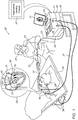
- Fig. 1 is a schematic, pictorial illustration of a balloon-catheter based position-tracking, electrophysiological (EP) sensing, and ablation system 20, in accordance with an embodiment of the present invention.
- System 20 comprises a catheter 21 that is fitted at a distal end 22a of a shaft 22 of the catheter with an RF ablation expandable balloon 40 comprising segmented electrodes 50 (seen in inset 25).
- segmented electrodes 50 are used for ablating tissue of an ostium 51 of a PV in a heart 26.
- Console 24 includes a processor 41 that controls a switching box 46 (also referred to as a switching assembly) to switch any segment of a segmented electrode 50 between acting as a position sensing electrode and acting as an ablation electrode.
- An ablation protocol comprising ablation parameters including impedance criteria is stored in a memory 48 of console 24.
- Physician 30 inserts distal end 22a of shaft 22 through a sheath 23 into heart 26 of a patient 28 lying on a table 29. Physician 30 advances the distal end of shaft 22 to a target location in heart 26 by manipulating shaft 22 using a manipulator 32 near the proximal end of the catheter and/or deflection from the sheath 23. During the insertion of distal end 22a, balloon 40 is maintained in a collapsed configuration by sheath 23. By containing balloon 40 in a collapsed configuration, sheath 23 also serves to minimize vascular trauma along the way to target location.
- physician 30 retracts sheath 23 and partially inflates balloon 40, and further manipulates shaft 22 to navigate balloon 40 to an ostium 51 the pulmonary vein.
- physician 30 navigates the distal end of shaft 22 to the target location by tracking a position of balloon 40 using impedances measured between segmented electrodes 50 and surface electrodes 38.
- processor 41 includes an electrode-impedance-sensing module 47.
- impedance-sensing module 47 receives electrical impedance signals measured between segmented electrodes 50 and surface electrodes 38, which are seen as attached by wires running through a cable 37 to the chest of patient 28. Electrodes 50 are connected by wires running through shaft 22 to processor 41 controlling switching box 46 of interface circuits 44 in a console 24.
- a method for tracking the positions of electrodes, such as electrodes 50, using the aforementioned measured impedances is implemented in various medical applications, for example in the CARTOTM system, produced by Biosense-Webster (Irvine, California) and is described in detail in U.S. Patents 7,756,576 , 7,869,865 , 7,848,787 , and 8,456,182 , whose disclosures are all incorporated herein by reference with a copy provided in the Appendix.
- This method is sometimes called Advanced Catheter Location (ACL).
- console 24 drives a display 27, which shows the tracked position of balloon 40 inside heart 26.
- physician 30 When at target position (e.g., at ostium 51), physician 30 fully inflates balloon 40 and places segmented electrodes 50 disposed over a perimeter of balloon 40 in contact with ostium 51 tissue.
- physician 30 measures, e.g., using impedance sensing module 47, the impedance of each of segmented electrode segments, as described above.
- Processor 41 compares the measured impedance of each segment with a preset threshold impedance. If segment impedance is below or equals the preset impedance threshold, which means that the electrode segment is in contact with blood rather than being in good contact with tissue, processor 41 controls switching box 46 to keep the segment operating as a position sensing electrode. If, on the other hand, the segment impedance is above the preset threshold, which means that the electrode segment is in good contact with tissue, the processor controls switching box 46 to operate the segment as an ablation electrode.
- distal end 22a comprises a magnetic position sensor 39 contained within distal end 22a just proximally to expandable balloon 40.
- console 24 receives signals from magnetic sensor 39 in response to magnetic fields from external field generators 36, for example, for the purpose of measuring the direction of ablation balloon 40 in the heart and, optionally, presenting the tracked direction on a display 27, e.g., relative to an orientation of an axis of approximate symmetry of ostium 51.
- Magnetic field generators 36 are placed at known positions external to patient 28, e.g., below patient table 29.
- Console 24 also comprises a driver circuit 34, configured to drive magnetic field generators 36.
- the method of direction sensing using external magnetic fields is implemented in various medical applications, for example, in the CARTOTM system, produced by Biosense-Webster, and is described in detail in U.S. Patents 5,391,199 , 6,690,963 , 6,484,118 , 6,239,724 , 6,618,612 and 6,332,089 , in PCT Patent Publication WO 96/05768 , and in U.S. Patent Application Publications 2002/0065455 A1 , 2003/0120150 A1 and 2004/0068178 A1 , whose disclosures are all incorporated herein by reference as if set forth in full into this application with a copy provided in the Appendix.
- signals from sensor 39 are further used for position sensing using the aforementioned CARTOTM system.
- Processor 41 is typically a general-purpose computer, with suitable front end and interface circuits 44 for receiving signals from catheter 21, as well as for applying RF energy treatment via catheter 21 in a left atrium of heart 26 and for controlling the other components of system 20.
- Processor 41 typically comprises software in a memory 48 of system 20 that is programmed to carry out the functions described herein.
- the software may be downloaded to the computer in electronic form, over a network, for example, or it may, alternatively or additionally, be provided and/or stored on non-transitory tangible media, such as magnetic, optical, or electronic memory.
- processor 41 runs a dedicated algorithm as disclosed herein, included in Fig. 4 , that enables processor 41 to perform the disclosed steps, as further described below.
- Fig. 1 describes a multi-electrode balloon catheter
- the principles of the present technique apply to any catheter having a distal end fitted with multiple electrodes, such as the aforementioned Lasso and basket catheters.
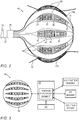
- Fig. 2 is a schematic, pictorial side view of the balloon catheter of Fig. 1 deployed in a region of a pulmonary vein (PV) and its ostium 51, in accordance with an embodiment of the invention.
- the balloon catheter is used to sense EP signals from ostium 51 tissue, to determine an arrhythmia, and to ablate ostium 51 tissue to isolate a source of arrhythmia.
- Balloon 40 has ten segmented electrodes 50 disposed over a membrane 71 of the balloon.
- IRE and/or RF power can be delivered from ablative power source 45 independently to each of the four electrode segments 55 of each of the ten electrodes, depending, for example, on the level of physical contact of each segment 55 with tissue during ablation.
- an electrode segment 55a is not in good contact with tissue. Based on impedance readings from electrode segment 55a as below or equal to the preset impedance value, processor 41 determines the insufficient physical contact of electrode segment 55a. In response, processor 41 controls switching box 46 to maintain electrode segment 55a as a position-sensing electrode.
- An electrode segment 55b is in good contact with tissue. Based on impedance readings from electrode segment 55b as above the preset threshold impedance value, processor 41 determines the sufficient physical contact of electrode segment 55a. In response, processor 41 controls switching box 46 to switch electrode segment 55b to be used as an EP-sensing electrode or as an ablation electrode.
- the impedance of each electrode segment is monitored by the processor that receives impedance readings sensed by the electrode segment.
- the processor uses a preset impedance criterion, such as a relation of the impedance readings with respect to a preset threshold impedance, to determine whether a physical contact between any of the electrodes and tissue meets a predefined contact quality with tissue. For example, if the impedance of an electrode segment does not rise above the threshold impedance, the processor determines that the level of contact of the electrode segment with tissue is insufficient (meaning that EP-sensing is of blood signals, or that ablative energy would mainly heat blood).
- the processor controls the switching box to maintain the electrode segment as a position-sensing electrode. If, on the other hand, an impedance reading from an electrode segment is above the preset threshold impedance (e.g., above a threshold determined by previous experimentation), the processor determines that the contact of the electrode segment with the tissue is good, i.e., meets a predefined contact quality criterion, and that tissue can be either EP sensed, or ablated with the electrode segment. In this case the switching box switches the electrode segment to connect the electrode segment to either an EP sensing module, or the ablative power source.
- the preset threshold impedance e.g., above a threshold determined by previous experimentation
- FIG. 2 The pictorial side view shown in Fig. 2 is chosen by way of example, where other embodiments are possible.
- cooling fluid sprays via irrigation holes (not shown) in electrodes 50 to cool ablated tissue.
- tissue temperature is measured using temperature sensors (not shown) fitted on electrodes 50.
- Fig. 3 is a block diagram that schematically describes the functionality of processor-controlled switching box 46 of Fig. 1 , in accordance with an embodiment of the invention.
- switching box 46 in response to a command by processor 41, connects an electrode segment to the aforementioned ACL position-sensing sub-system of system 20 to provide position signals to be used with the ACL position tracking method, or connects the electrode segment to an EP sensing module, or connects the electrode segment to an RF power supply to be used as an ablation electrode.
- the switching assembly and the processor when connecting a given electrode to the position tracking system or to the EP sensing module, are configured to connect each of the electrode segments of the given electrode individually, whereas when connecting the given electrode to the generator of the ablative power, the switching assembly and the processor are configured to jointly connect all the electrode segments of the given electrode.
- Fig. 3 The block diagram of Fig. 3 is highly simplified to maintain clarity of presentation. Information from other system elements, such as temperature sensors on balloon 40, which do not contribute directly to the clarity presentation, are thus omitted.
- Fig. 4 is a flow chart that schematically illustrates a method for interchangeably using segmented electrodes of the balloon catheter of Fig. 2 for position sensing, electrophysiological (EP) sensing, and ablation, in accordance with an embodiment of the invention.
- the algorithm carries out a process that begins when physician 30 navigates the balloon catheter to a target location within a lumen of a patient, such as at ostium 51, using electrode segments 55 as ACL-sensing electrodes, at a balloon catheter navigation step 80.
- physician 30 positions the balloon catheter at ostium 51, at a balloon catheter positioning step 82.
- physician 30 fully inflates balloon 40 to contact the lumen wall with electrode segments 55 over an entire circumference of the lumen, at a balloon inflation step 84.
- processor 41 switches part or all electrode segments 55 for use as EP sensing electrodes.
- the processor controls switching box 46 to operate the segment as an ablation electrode (e.g., to connect the electrode to ablative power source 45), at a switching step 88.
- physician 30 re-switches part or all electrode segments 55 for use as EP sensing electrodes, to verify arrhythmia was eliminated.
- FIG. 4 The example flow chart shown in Fig. 4 is chosen purely for the sake of conceptual clarity. In alternative embodiments, additional steps may be performed, such as processor 41 monitoring measured contact force of segments, and acting according to measured contact forces.
- Fig. 4 describes a multi-electrode balloon catheter
- the principles of the present technique apply to any catheter having a distal end fitted with multiple electrodes, such as the aforementioned Lasso and basket catheters.
- the methods and systems described herein can also be used in other applications that require a determination of occlusion, such as, for example, in renal denervation, and generally, in ablating other organs.
Landscapes
- Health & Medical Sciences (AREA)
- Life Sciences & Earth Sciences (AREA)
- Engineering & Computer Science (AREA)
- General Health & Medical Sciences (AREA)
- Biomedical Technology (AREA)
- Animal Behavior & Ethology (AREA)
- Public Health (AREA)
- Veterinary Medicine (AREA)
- Surgery (AREA)
- Heart & Thoracic Surgery (AREA)
- Biophysics (AREA)
- Physics & Mathematics (AREA)
- Molecular Biology (AREA)
- Medical Informatics (AREA)
- Pathology (AREA)
- Nuclear Medicine, Radiotherapy & Molecular Imaging (AREA)
- Radiology & Medical Imaging (AREA)
- Cardiology (AREA)
- Plasma & Fusion (AREA)
- Otolaryngology (AREA)
- Hematology (AREA)
- Anesthesiology (AREA)
- Pulmonology (AREA)
- Human Computer Interaction (AREA)
- Physiology (AREA)
- Surgical Instruments (AREA)
Abstract
Description
- The present invention relates generally to medical probes, and particularly to cardiac multi-electrode electrophysiological (EP) sensing and ablation catheters.
- Multi electrode catheters for tissue sensing and ablation were previously proposed in the patent literature. For example,
U.S. Patent Application Publication 2010/0168548 describes cardiac catheters, including a lasso catheter, for use in a system for electrical mapping of the heart has an array of raised, perforated electrodes, which are in fluid communication with an irrigating lumen. There are position sensors on a distal loop section and on a proximal base section of the catheter. The electrodes are sensing electrodes that may be adapted for pacing or ablation. The raised electrodes securely contact cardiac tissue, forming electrical connections having little resistance. - As another example,
U.S. Patent 5,562,720 describes an endometrial ablation device and a method of manufacturing and using the device. An electroconductive expandable member, such as a balloon, is used as a medium for passing RF current through endometrium tissue to heat the endometrium tissue. The power delivered from a power source to the balloon is selectively provided to a plurality of electrode area segments on the balloon with each of the segments having a thermistor associated with it, whereby temperature is monitored and controlled by a feedback arrangement from the thermistors. The selective application of power is provided on the basis of a switching arrangement which provides either monopolar or bipolar energy to the electrodes. - An embodiment of the present invention provides a system including a switching assembly and a processor. The switching assembly is connected to multiple electrodes that are disposed on an expandable distal end of a catheter, and is configured to switch the electrodes between a position tracking system, an electrophysiological (EP) sensing module and a generator of an ablative power. The processor is configured to control the switching assembly to switch the electrodes.
- In some embodiments, the ablative power includes at least one of a radiofrequency (RF) power outputted by an RF generator and irreversible electroporation (IRE) pulses outputted by an IRE pulse generator.
- In some embodiments, each of the electrodes includes a plurality of electrode segments.
- In an embodiment, when connecting a given electrode to the position tracking system or to the EP sensing module, the switching assembly and the processor are configured to connect each of the electrode segments of the given electrode individually. When connecting the given electrode to the generator of the ablative power, the switching assembly and the processor are configured to jointly connect all the electrode segments of the given electrode.
- In another embodiment, the processor is configured to control whether to use the electrode as a position sensor, as an EP sensor, or as an ablation electrode, by evaluating a preset impedance criterion.
- In some embodiments, the processor is configured to evaluate the impedance criterion by assessing whether a frequency-dependence of the impedance indicates that the electrode is in contact with blood or with tissue.
- There is additionally provided, in accordance with an embodiment of the present invention, a method including, using a switching assembly, interchangeably switching multiple electrodes, which are disposed on an expandable distal end of a catheter, between a position tracking system, an electrophysiological (EP) sensing module and a generator of an ablative power. Using a processor, the switching assembly is controlled to switch the electrodes.
- The present invention will be more fully understood from the following detailed description of the embodiments thereof, taken together with the drawings in which:
-
-
Fig. 1 is a schematic, pictorial illustration of a balloon-catheter based position-tracking, electrophysiological (EP) sensing, and ablation system, in accordance with an embodiment of the present invention; -
Fig. 2 is a schematic, pictorial side view of a distal end of the balloon catheter ofFig. 1 deployed in a region of a pulmonary vein (PV) and its ostium, in accordance with an embodiment of the invention; -
Fig. 3 is a block diagram that schematically describes the functionality of the processor-controlled switching box ofFig. 1 , in accordance with an embodiment of the invention; and -
Fig. 4 is a flow chart that schematically illustrates a method for interchangeably using segmented electrodes of the balloon catheter ofFig. 2 for position sensing, electrophysiological (EP) sensing, and ablation, in accordance with an embodiment of the invention. - For efficient sensing and ablation with a medical probe, such as an intra-cardiac radiofrequency (RF) and/or an irreversible electroporation (IRE) catheter with a distal end disposed with multiple electrodes, it is important that (a) the distal end is accurately navigated to a tissue location most suitable for electrophysiological (EP) sensing and ablation, and (b) the electrodes disposed over the distal can effectively acquire EP signals from tissue and/or ablate tissue. For example, when a balloon catheter with multiple electrodes is used for treating cardiac arrhythmia, the balloon has to be brought to a cardiac location, such as an ostium of a pulmonary ventricle (PV), acquire EP signals to verify an arrhythmia, and ablate arrhythmogenic tissue, all using the multiple electrodes.
- Similarly, other multi-electrode catheters, such as the Lasso catheter (made by Biosense Webster, Irvine, California) or a basket catheter, also need to have their electrodes capable of such sensing and ablation.
- Embodiments of the present invention that are described hereinafter provide techniques to interchangeably use electrodes disposed over the distal end for sensing and for ablation. In some embodiments, the electrodes are initially used as sensors, to track a position of the distal end, so as to navigate it to a cardiac tissue location inside the heart. Subsequently, the electrodes are used for EP sensing. Finally, RF and/or IRE ablation is applied using the electrodes. Typically, the electrodes can be used in a spatially selectable manner, in which at any given time any subset of the electrodes can be switched to be used for any of the above applications. For example, electrodes that have insufficient contact with tissue can be used for position tracking, while others for EP sensing and subsequent ablation.
- In the context of the present patent application, the term "applying ablation" covers both applying RF power and applying IRE pulses. Typically, the ablative power comprises either a radiofrequency (RF) power outputted by an RF generator or irreversible electroporation (IRE) pulses outputted by an IRE pulse generator. However, a single generator may be configured to interchangeably output RF power and IRE pulses.
- In some embodiments, an expandable multi-electrode catheter (e.g., an inflatable balloon catheter, which is used by way of example hereinafter) is provided that comprises electrodes divided into segments (i.e., into electrode segments). In some embodiments, a balloon catheter is provided with ten electrodes disposed on a membrane of the balloon. Each of the ten electrodes is divided into four segments with one or more temperature sensors, such as thermocouples, located on each electrode segment.
- Further provided is a processor-controlled switching box (also referred to as a switching assembly). During navigation of the distal end of a catheter (e.g., a balloon catheter) to a target location for ablation, the disclosed system uses the electrode segments as position sensors of an electrical-impedance-based position tracking sub-system, as described below. Once the balloon is determined to be at the target location (using the position tracking sub-system), the processor controlling the switching box switches an EP sensing module or ablative power to at least part of the electrode segments.
- In an embodiment, once catheter is placed in target position, the processor analyzes a characteristic of the measured impedance, such as, for example, the different frequency-dependence of the impedance of blood and tissue, and, using the outcome of the analysis, provides an independent assessment for each electrode segment as to whether the electrode segment is in direct electrical contact with (i.e., touches) cardiac tissue or is not in contact (e.g., the electrode segment is mostly immersed in blood).
- The impedance of an electrode can be determined in any of the modes that the electrodes are used in (i.e., position tracking, EP sensing and ablation). Each electrode having a frequency-dependent impedance indicative of tissue is subsequently switched to the EP sensing module or the ablative power source by the processor, using the switching box. An electrode segment with a frequency-dependent impedance indicative of blood is kept as a position sensing electrode by the processor.
- In some embodiments, the balloon direction in space is measured using a magnetic sensor on the catheter in vicinity of the balloon, as described below, to further assist a best placement of the balloon against the ostium, e.g., to achieve sufficient electrode contact over an entire circumference of the balloon.
- Typically, the processor is programmed in software containing a particular algorithm that enables the processor to conduct each of the processor-related steps and functions outlined above.
- By providing electrode segments that are switchable according to navigational tasks, EP sensing tasks, and ablation tasks, the disclosed segmented-electrode sensing and ablation technique can provide safer and more effective diagnostics and treatment. This, in turn, may improve the clinical outcome of, for example, cardiac balloon ablation treatments, such as of PV isolation for treatment of arrhythmia.
-
Fig. 1 is a schematic, pictorial illustration of a balloon-catheter based position-tracking, electrophysiological (EP) sensing, andablation system 20, in accordance with an embodiment of the present invention.System 20 comprises acatheter 21 that is fitted at adistal end 22a of ashaft 22 of the catheter with an RF ablationexpandable balloon 40 comprising segmented electrodes 50 (seen in inset 25). In the embodiment described herein, segmentedelectrodes 50 are used for ablating tissue of anostium 51 of a PV in aheart 26. - The proximal end of
catheter 21 is connected to acontrol console 24 comprising anablative power source 45 that can deliver IRE and/or RF power.Console 24 includes aprocessor 41 that controls a switching box 46 (also referred to as a switching assembly) to switch any segment of a segmentedelectrode 50 between acting as a position sensing electrode and acting as an ablation electrode. An ablation protocol comprising ablation parameters including impedance criteria is stored in amemory 48 ofconsole 24. -
Physician 30 insertsdistal end 22a ofshaft 22 through asheath 23 intoheart 26 of apatient 28 lying on a table 29.Physician 30 advances the distal end ofshaft 22 to a target location inheart 26 by manipulatingshaft 22 using amanipulator 32 near the proximal end of the catheter and/or deflection from thesheath 23. During the insertion ofdistal end 22a,balloon 40 is maintained in a collapsed configuration bysheath 23. By containingballoon 40 in a collapsed configuration,sheath 23 also serves to minimize vascular trauma along the way to target location. - Once
distal end 22a ofshaft 22 has reachedheart 26,physician 30 retractssheath 23 and partially inflatesballoon 40, and further manipulatesshaft 22 to navigateballoon 40 to anostium 51 the pulmonary vein. - In an embodiment,
physician 30 navigates the distal end ofshaft 22 to the target location by tracking a position ofballoon 40 using impedances measured betweensegmented electrodes 50 andsurface electrodes 38. - To perform its functions,
processor 41 includes an electrode-impedance-sensingmodule 47. In the exemplified system, impedance-sensingmodule 47 receives electrical impedance signals measured betweensegmented electrodes 50 andsurface electrodes 38, which are seen as attached by wires running through acable 37 to the chest ofpatient 28.Electrodes 50 are connected by wires running throughshaft 22 toprocessor 41controlling switching box 46 ofinterface circuits 44 in aconsole 24. - A method for tracking the positions of electrodes, such as
electrodes 50, using the aforementioned measured impedances is implemented in various medical applications, for example in the CARTO™ system, produced by Biosense-Webster (Irvine, California) and is described in detail inU.S. Patents 7,756,576 ,7,869,865 ,7,848,787 , and8,456,182 , whose disclosures are all incorporated herein by reference with a copy provided in the Appendix. This method is sometimes called Advanced Catheter Location (ACL). In an embodiment,console 24 drives adisplay 27, which shows the tracked position ofballoon 40 insideheart 26. - When at target position (e.g., at ostium 51),
physician 30 fully inflatesballoon 40 and places segmentedelectrodes 50 disposed over a perimeter ofballoon 40 in contact withostium 51 tissue. Next,physician 30 measures, e.g., usingimpedance sensing module 47, the impedance of each of segmented electrode segments, as described above.Processor 41 compares the measured impedance of each segment with a preset threshold impedance. If segment impedance is below or equals the preset impedance threshold, which means that the electrode segment is in contact with blood rather than being in good contact with tissue,processor 41controls switching box 46 to keep the segment operating as a position sensing electrode. If, on the other hand, the segment impedance is above the preset threshold, which means that the electrode segment is in good contact with tissue, the processorcontrols switching box 46 to operate the segment as an ablation electrode. - As further shown in
inset 25,distal end 22a comprises amagnetic position sensor 39 contained withindistal end 22a just proximally toexpandable balloon 40. During navigation ofdistal end 22a inheart 26,console 24 receives signals frommagnetic sensor 39 in response to magnetic fields fromexternal field generators 36, for example, for the purpose of measuring the direction ofablation balloon 40 in the heart and, optionally, presenting the tracked direction on adisplay 27, e.g., relative to an orientation of an axis of approximate symmetry ofostium 51.Magnetic field generators 36 are placed at known positions external topatient 28, e.g., below patient table 29.Console 24 also comprises adriver circuit 34, configured to drivemagnetic field generators 36. - The method of direction sensing using external magnetic fields is implemented in various medical applications, for example, in the CARTO™ system, produced by Biosense-Webster, and is described in detail in
U.S. Patents 5,391,199 ,6,690,963 ,6,484,118 ,6,239,724 ,6,618,612 and6,332,089 , inPCT Patent Publication WO 96/05768 U.S. Patent Application Publications 2002/0065455 A1 ,2003/0120150 A1 and2004/0068178 A1 , whose disclosures are all incorporated herein by reference as if set forth in full into this application with a copy provided in the Appendix. - In an embodiment, signals from
sensor 39 are further used for position sensing using the aforementioned CARTO™ system. -
Processor 41 is typically a general-purpose computer, with suitable front end andinterface circuits 44 for receiving signals fromcatheter 21, as well as for applying RF energy treatment viacatheter 21 in a left atrium ofheart 26 and for controlling the other components ofsystem 20.Processor 41 typically comprises software in amemory 48 ofsystem 20 that is programmed to carry out the functions described herein. The software may be downloaded to the computer in electronic form, over a network, for example, or it may, alternatively or additionally, be provided and/or stored on non-transitory tangible media, such as magnetic, optical, or electronic memory. In particular,processor 41 runs a dedicated algorithm as disclosed herein, included inFig. 4 , that enablesprocessor 41 to perform the disclosed steps, as further described below. - While
Fig. 1 describes a multi-electrode balloon catheter, the principles of the present technique apply to any catheter having a distal end fitted with multiple electrodes, such as the aforementioned Lasso and basket catheters. -
Fig. 2 is a schematic, pictorial side view of the balloon catheter ofFig. 1 deployed in a region of a pulmonary vein (PV) and itsostium 51, in accordance with an embodiment of the invention. The balloon catheter is used to sense EP signals fromostium 51 tissue, to determine an arrhythmia, and to ablateostium 51 tissue to isolate a source of arrhythmia.Balloon 40 has ten segmentedelectrodes 50 disposed over amembrane 71 of the balloon. IRE and/or RF power can be delivered fromablative power source 45 independently to each of the fourelectrode segments 55 of each of the ten electrodes, depending, for example, on the level of physical contact of eachsegment 55 with tissue during ablation. - As seen in
Fig. 2 , anelectrode segment 55a is not in good contact with tissue. Based on impedance readings fromelectrode segment 55a as below or equal to the preset impedance value,processor 41 determines the insufficient physical contact ofelectrode segment 55a. In response,processor 41controls switching box 46 to maintainelectrode segment 55a as a position-sensing electrode. - An
electrode segment 55b, on the other hand, is in good contact with tissue. Based on impedance readings fromelectrode segment 55b as above the preset threshold impedance value,processor 41 determines the sufficient physical contact ofelectrode segment 55a. In response,processor 41controls switching box 46 to switchelectrode segment 55b to be used as an EP-sensing electrode or as an ablation electrode. - In some embodiments, to determine sufficiency of contact with tissue, the impedance of each electrode segment is monitored by the processor that receives impedance readings sensed by the electrode segment. The processor uses a preset impedance criterion, such as a relation of the impedance readings with respect to a preset threshold impedance, to determine whether a physical contact between any of the electrodes and tissue meets a predefined contact quality with tissue. For example, if the impedance of an electrode segment does not rise above the threshold impedance, the processor determines that the level of contact of the electrode segment with tissue is insufficient (meaning that EP-sensing is of blood signals, or that ablative energy would mainly heat blood). In this case the processor controls the switching box to maintain the electrode segment as a position-sensing electrode. If, on the other hand, an impedance reading from an electrode segment is above the preset threshold impedance (e.g., above a threshold determined by previous experimentation), the processor determines that the contact of the electrode segment with the tissue is good, i.e., meets a predefined contact quality criterion, and that tissue can be either EP sensed, or ablated with the electrode segment. In this case the switching box switches the electrode segment to connect the electrode segment to either an EP sensing module, or the ablative power source.
- A technique for sensing electrode-tissue physical contact using analysis of frequency response of tissue is described in
U.S. Patent Application 15/991,291, filed May 29, 2018 - The pictorial side view shown in
Fig. 2 is chosen by way of example, where other embodiments are possible. For example, in another embodiment, cooling fluid sprays via irrigation holes (not shown) inelectrodes 50 to cool ablated tissue. As another example, tissue temperature is measured using temperature sensors (not shown) fitted onelectrodes 50. -
Fig. 3 is a block diagram that schematically describes the functionality of processor-controlledswitching box 46 ofFig. 1 , in accordance with an embodiment of the invention. As seen, in response to a command byprocessor 41, switchingbox 46 either connects an electrode segment to the aforementioned ACL position-sensing sub-system ofsystem 20 to provide position signals to be used with the ACL position tracking method, or connects the electrode segment to an EP sensing module, or connects the electrode segment to an RF power supply to be used as an ablation electrode. - In another embodiment, when connecting a given electrode to the position tracking system or to the EP sensing module, the switching assembly and the processor are configured to connect each of the electrode segments of the given electrode individually, whereas when connecting the given electrode to the generator of the ablative power, the switching assembly and the processor are configured to jointly connect all the electrode segments of the given electrode.
- The block diagram of
Fig. 3 is highly simplified to maintain clarity of presentation. Information from other system elements, such as temperature sensors onballoon 40, which do not contribute directly to the clarity presentation, are thus omitted. -
Fig. 4 is a flow chart that schematically illustrates a method for interchangeably using segmented electrodes of the balloon catheter ofFig. 2 for position sensing, electrophysiological (EP) sensing, and ablation, in accordance with an embodiment of the invention. The algorithm, according to the presented embodiment, carries out a process that begins whenphysician 30 navigates the balloon catheter to a target location within a lumen of a patient, such as atostium 51, usingelectrode segments 55 as ACL-sensing electrodes, at a ballooncatheter navigation step 80. - Next,
physician 30 positions the balloon catheter atostium 51, at a ballooncatheter positioning step 82. Next,physician 30 fully inflatesballoon 40 to contact the lumen wall withelectrode segments 55 over an entire circumference of the lumen, at aballoon inflation step 84. - Next, using impedance reading by
module 47, the impedance of each ofelectrode segments 55, typically to one ofsurface electrodes 38, is measured, and based on an impedance criterion,processor 41 switches part or allelectrode segments 55 for use as EP sensing electrodes. - After using the electrodes as EP sensors, to verify an arrythmia, the processor
controls switching box 46 to operate the segment as an ablation electrode (e.g., to connect the electrode to ablative power source 45), at a switchingstep 88. At a switchingstep 90,physician 30 re-switches part or allelectrode segments 55 for use as EP sensing electrodes, to verify arrhythmia was eliminated. - The example flow chart shown in
Fig. 4 is chosen purely for the sake of conceptual clarity. In alternative embodiments, additional steps may be performed, such asprocessor 41 monitoring measured contact force of segments, and acting according to measured contact forces. - While
Fig. 4 describes a multi-electrode balloon catheter, the principles of the present technique apply to any catheter having a distal end fitted with multiple electrodes, such as the aforementioned Lasso and basket catheters. - Although the embodiments described herein mainly address pulmonary vein isolation, the methods and systems described herein can also be used in other applications that require a determination of occlusion, such as, for example, in renal denervation, and generally, in ablating other organs.
- It will thus be appreciated that the embodiments described above are cited by way of example, and that the present invention is not limited to what has been particularly shown and described hereinabove. Rather, the scope of the present invention includes both combinations and sub-combinations of the various features described hereinabove, as well as variations and modifications thereof which would occur to persons skilled in the art upon reading the foregoing description and which are not disclosed in the prior art. Documents incorporated by reference in the present patent application are to be considered an integral part of the application except that to the extent any terms are defined in these incorporated documents in a manner that conflicts with the definitions made explicitly or implicitly in the present specification, only the definitions in the present specification should be considered.
Claims (12)
- A system, comprising:a switching assembly, which is connected to multiple electrodes that are disposed on an expandable distal end of a catheter, the switching assembly configured to electrically connect the electrodes to electrically connect to one of a position tracking system, an electrophysiological (EP) sensing module and a generator of an ablative power; anda processor, which is configured to control the switching assembly to switch the electrodes.
- The system according to claim 1, wherein the ablative power comprises at least one of a radiofrequency (RF) power outputted by an RF generator and irreversible electroporation (IRE) pulses outputted by an IRE pulse generator.
- The system according to claim 1, wherein each of the electrodes comprises a plurality of electrode segments.
- The system according to claim 3, wherein:when connecting a given electrode to the position tracking system or to the EP sensing module, the switching assembly and the processor are configured to connect each of the electrode segments of the given electrode individually; andwhen connecting the given electrode to the generator of the ablative power, the switching assembly and the processor are configured to jointly connect all the electrode segments of the given electrode.
- The system according to claim 1, wherein the processor is configured to control whether to use the electrode as a position sensor, as an EP sensor, or as an ablation electrode, by evaluating a preset impedance criterion.
- The system according to claim 5, wherein the processor is configured to evaluate the impedance criterion by assessing whether a frequency-dependence of the impedance indicates that the electrode is in contact with blood or with tissue.
- A method, comprising:using a switching assembly, interchangeably switching multiple electrodes, which are disposed on an expandable distal end of a catheter, between a position tracking system, an electrophysiological (EP) sensing module and a generator of an ablative power; andusing a processor, controlling the switching assembly to switch the electrodes.
- The method according to claim 7, wherein applying the ablative power comprises applying at least one of radiofrequency (RF) ablative power and applying irreversible electroporation (IRE) pulses.
- The method according to claim 7, wherein each of the electrodes comprises a plurality of electrode segments.
- The method according to claim 9, wherein:connecting a given electrode to the position tracking system or to the EP sensing module comprises connecting each of the electrode segments of the given electrode individually; andconnecting the given electrode to the generator of the ablative power comprises jointly connecting all the electrode segments of the given electrode.
- The method according to claim 7, wherein controlling the switching assembly comprises controlling whether to use the electrode as a position sensor, as an EP sensor, or as an ablation electrode, by evaluating a preset impedance criterion.
- The method according to claim 11, evaluating the preset impedance comprises assessing whether a frequency-dependence of the impedance indicates that the electrode contacts is in contact with blood or with tissue.
Applications Claiming Priority (1)
| Application Number | Priority Date | Filing Date | Title |
|---|---|---|---|
| US16/708,285 US11931182B2 (en) | 2019-12-09 | 2019-12-09 | Catheter with plurality of sensing electrodes used as ablation electrode |
Publications (1)
| Publication Number | Publication Date |
|---|---|
| EP3834758A1 true EP3834758A1 (en) | 2021-06-16 |
Family
ID=73789802
Family Applications (1)
| Application Number | Title | Priority Date | Filing Date |
|---|---|---|---|
| EP20212559.7A Pending EP3834758A1 (en) | 2019-12-09 | 2020-12-08 | Catheter with plurality of sensing electrodes used as ablation electrode |
Country Status (5)
| Country | Link |
|---|---|
| US (3) | US11931182B2 (en) |
| EP (1) | EP3834758A1 (en) |
| JP (1) | JP7625410B2 (en) |
| CN (1) | CN113017823B (en) |
| IL (1) | IL279105B2 (en) |
Cited By (2)
| Publication number | Priority date | Publication date | Assignee | Title |
|---|---|---|---|---|
| EP3991682A1 (en) * | 2020-10-30 | 2022-05-04 | Biosense Webster (Israel) Ltd | Balloon catheter with split electrodes |
| US12076071B2 (en) | 2020-08-14 | 2024-09-03 | Kardium Inc. | Systems and methods for treating tissue with pulsed field ablation |
Families Citing this family (46)
| Publication number | Priority date | Publication date | Assignee | Title |
|---|---|---|---|---|
| US10905329B2 (en) | 2016-06-09 | 2021-02-02 | Biosense Webster (Israel) Ltd. | Multi-function conducting elements for a catheter |
| US12029545B2 (en) | 2017-05-30 | 2024-07-09 | Biosense Webster (Israel) Ltd. | Catheter splines as location sensors |
| US20190314083A1 (en) | 2018-04-11 | 2019-10-17 | Biosense Webster (Israel) Ltd. | Flexible Multi-Arm Catheter with Diametrically Opposed Sensing Electrodes |
| US11045628B2 (en) | 2018-12-11 | 2021-06-29 | Biosense Webster (Israel) Ltd. | Balloon catheter with high articulation |
| US11207016B2 (en) | 2018-12-28 | 2021-12-28 | Biosense Webster (Israel) Ltd. | Mapping ECG signals using a multipole electrode assembly |
| US11850051B2 (en) | 2019-04-30 | 2023-12-26 | Biosense Webster (Israel) Ltd. | Mapping grid with high density electrode array |
| US11712172B2 (en) | 2019-07-18 | 2023-08-01 | Biosense Webster (Israel) Ltd. | Visual guidance for positioning a distal end of a medical probe |
| US11759150B2 (en) | 2019-08-27 | 2023-09-19 | Biosense Webster (Israel) Ltd. | Accurate basket catheter tracking |
| US11950930B2 (en) | 2019-12-12 | 2024-04-09 | Biosense Webster (Israel) Ltd. | Multi-dimensional acquisition of bipolar signals from a catheter |
| US11517218B2 (en) | 2019-12-20 | 2022-12-06 | Biosense Webster (Israel) Ltd. | Selective graphical presentation of electrophysiological parameters |
| US12232874B2 (en) | 2020-05-29 | 2025-02-25 | Biosense Webster (Israel) Ltd. | Electrode apparatus for diagnosis of arrhythmias |
| US11987017B2 (en) | 2020-06-08 | 2024-05-21 | Biosense Webster (Israel) Ltd. | Features to assist in assembly and testing of devices |
| AU2021291158B2 (en) * | 2020-06-17 | 2023-11-30 | Boston Scientific Medical Device Limited | Electroanatomical mapping system |
| US11730413B2 (en) | 2020-07-01 | 2023-08-22 | Biosense Webster (Israel) Ltd. | Analyzing multi-electrode catheter signals to determine electrophysiological (EP) wave propagation vector |
| US12303281B2 (en) | 2020-07-01 | 2025-05-20 | Biosense Webster (Israel) Ltd. | Mapping resolution of electrophysiological (EP) wave propagating on the surface of patient heart |
| US12048479B2 (en) | 2020-09-10 | 2024-07-30 | Biosense Webster (Israel) Ltd. | Surface mounted electrode catheter |
| US11950840B2 (en) | 2020-09-22 | 2024-04-09 | Biosense Webster (Israel) Ltd. | Basket catheter having insulated ablation electrodes |
| US11950841B2 (en) | 2020-09-22 | 2024-04-09 | Biosense Webster (Israel) Ltd. | Basket catheter having insulated ablation electrodes and diagnostic electrodes |
| US12082875B2 (en) | 2020-09-24 | 2024-09-10 | Biosense Webster (Israel) Ltd | Balloon catheter having a coil for sensing tissue temperature and position of the balloon |
| US20230338731A1 (en) * | 2020-10-07 | 2023-10-26 | Northwestern University | Integration of electrophysiology mapping systems with electroporation synchronized with pacing |
| US11974803B2 (en) | 2020-10-12 | 2024-05-07 | Biosense Webster (Israel) Ltd. | Basket catheter with balloon |
| US20220175302A1 (en) * | 2020-12-04 | 2022-06-09 | Biosense Webster (Israel) Ltd. | Generating electrocardiograms from multiple references |
| US12201786B2 (en) | 2020-12-17 | 2025-01-21 | Biosense Webster (Israel) Ltd. | Measurement of distal end dimension of catheters using magnetic fields |
| US11918383B2 (en) | 2020-12-21 | 2024-03-05 | Biosense Webster (Israel) Ltd. | Visualizing performance of catheter electrodes |
| AU2022254861B2 (en) | 2021-04-07 | 2024-01-18 | Btl Medical Development A.S. | Pulsed field ablation device and method |
| US12064170B2 (en) | 2021-05-13 | 2024-08-20 | Biosense Webster (Israel) Ltd. | Distal assembly for catheter with lumens running along spines |
| EP4366637B1 (en) | 2021-07-06 | 2025-06-25 | BTL Medical Development A.S. | Pulsed field ablation device |
| US12364426B2 (en) | 2021-08-12 | 2025-07-22 | Biosense Webster (Israel) Ltd. | Electro-anatomical mapping and annotation presented in electrophysiological procedures |
| US12004804B2 (en) | 2021-09-09 | 2024-06-11 | Biosense Webster (Israel) Ltd. | Basket catheter with mushroom shape distal tip |
| US12478424B2 (en) | 2021-09-10 | 2025-11-25 | Biosense Webster (Israel) Ltd. | Staggered pairs of biased ablation electrodes on basket catheter |
| US12011280B2 (en) | 2021-10-04 | 2024-06-18 | Biosense Webster (Israel) Ltd. | Electrophysiological mapping in the presence of injury current |
| WO2023059507A1 (en) * | 2021-10-04 | 2023-04-13 | Boston Scientific Scimed Inc. | Cardiac ablation catheters with integrated navigation sensors |
| US12533489B2 (en) | 2021-10-08 | 2026-01-27 | Biosense Webster (Israel) Ltd. | Measuring tissue proximity for multi-electrode catheter |
| US12419683B2 (en) | 2021-12-22 | 2025-09-23 | Biosense Webster (Israel) Ltd. | Irreversible electroporation with shorted electrodes |
| US12446946B2 (en) | 2022-01-20 | 2025-10-21 | Biosense Webster (Israel) Ltd. | Systems and methods for a single spiral electrode assembly forming a spherical basket for improved tissue contact and current delivery |
| US12440263B2 (en) | 2022-01-20 | 2025-10-14 | Biosense Webster (Israel) Ltd. | Systems and methods for tripodic spines forming a spherical basket for improved tissue contact and current delivery |
| US12484961B2 (en) | 2022-01-20 | 2025-12-02 | Biosense Webster (Israel) Ltd. | Mechanical retainer systems for electrodes of a basket catheter, and methods of the same |
| US12616517B2 (en) | 2022-03-25 | 2026-05-05 | Biosense Webster (Israel) Ltd. | Expandable basket assemblies with linear spine patterns for improved tissue contact and methods for making thereof |
| US12616518B2 (en) | 2022-04-28 | 2026-05-05 | Biosense Webster (Israel) Ltd. | Barrel electrodes for a basket catheter, and methods of the same |
| US12471989B2 (en) | 2022-04-28 | 2025-11-18 | Biosense Webster (Israel) Ltd. | Strengthened expandable baskets for medical probes and medical probes containing strengthen expandable baskets |
| CN115429412A (en) * | 2022-09-05 | 2022-12-06 | 苏州中荟医疗科技有限公司 | Ablation device and ablation energy supply method |
| EP4598461A1 (en) | 2022-10-05 | 2025-08-13 | BTL Medical Development A.S. | Pulsed field ablation device and method |
| US12616519B2 (en) | 2022-12-15 | 2026-05-05 | Biosense Webster (Israel) Ltd. | Basket assembly with atraumatic tip electrode and methods of making thereof |
| US12533185B2 (en) | 2022-12-28 | 2026-01-27 | Biosense Webster (Israel) Ltd. | Basket end effector with distal position sensor |
| US12521035B2 (en) | 2022-12-29 | 2026-01-13 | Biosense Webster (Israel) Ltd. | Cylindrical cage systems and methods for distributed tissue contact for mapping and ablation |
| CN116269731B (en) * | 2023-02-22 | 2026-05-05 | 上海鑫律通生命科技有限公司 | A pulsed electric field ablation system |
Citations (21)
| Publication number | Priority date | Publication date | Assignee | Title |
|---|---|---|---|---|
| US5391199A (en) | 1993-07-20 | 1995-02-21 | Biosense, Inc. | Apparatus and method for treating cardiac arrhythmias |
| WO1996005768A1 (en) | 1994-08-19 | 1996-02-29 | Biosense, Inc. | Medical diagnosis, treatment and imaging systems |
| US5562720A (en) | 1992-05-01 | 1996-10-08 | Vesta Medical, Inc. | Bipolar/monopolar endometrial ablation device and method |
| US6239724B1 (en) | 1997-12-30 | 2001-05-29 | Remon Medical Technologies, Ltd. | System and method for telemetrically providing intrabody spatial position |
| US6332089B1 (en) | 1996-02-15 | 2001-12-18 | Biosense, Inc. | Medical procedures and apparatus using intrabody probes |
| US20020065455A1 (en) | 1995-01-24 | 2002-05-30 | Shlomo Ben-Haim | Medical diagnosis, treatment and imaging systems |
| US6484118B1 (en) | 2000-07-20 | 2002-11-19 | Biosense, Inc. | Electromagnetic position single axis system |
| US20030120150A1 (en) | 2001-12-21 | 2003-06-26 | Assaf Govari | Wireless position sensor |
| US6618612B1 (en) | 1996-02-15 | 2003-09-09 | Biosense, Inc. | Independently positionable transducers for location system |
| US20040068178A1 (en) | 2002-09-17 | 2004-04-08 | Assaf Govari | High-gradient recursive locating system |
| US20100168548A1 (en) | 2008-12-30 | 2010-07-01 | Assaf Govari | Dual-Purpose Lasso Catheter with Irrigation |
| US7756576B2 (en) | 2005-08-26 | 2010-07-13 | Biosense Webster, Inc. | Position sensing and detection of skin impedance |
| US7848787B2 (en) | 2005-07-08 | 2010-12-07 | Biosense Webster, Inc. | Relative impedance measurement |
| US7869865B2 (en) | 2005-01-07 | 2011-01-11 | Biosense Webster, Inc. | Current-based position sensing |
| US8456182B2 (en) | 2008-09-30 | 2013-06-04 | Biosense Webster, Inc. | Current localization tracker |
| US20170042614A1 (en) * | 2008-11-11 | 2017-02-16 | Amr Salahieh | Ablation catheters |
| US20180235692A1 (en) * | 2017-02-01 | 2018-08-23 | The George Washington University | High resolution multi-function and conformal electronics device for diagnosis and treatment of cardiac arrhythmias |
| WO2018191149A1 (en) * | 2017-04-10 | 2018-10-18 | St. Jude Medical, Cardiology Division, Inc. | Electroporation system and method of energizing a catheter |
| US20190008582A1 (en) * | 2017-07-06 | 2019-01-10 | Biosense Webster (Israel) Ltd. | Temperature controlled short duration ablation with multiple electrodes |
| US20190350649A1 (en) * | 2018-05-21 | 2019-11-21 | St. Jude Medical, Cardiology Division, Inc. | Radio-frequency ablation and direct current electroporation catheters |
| US20190365463A1 (en) * | 2018-05-29 | 2019-12-05 | Biosense Webster (Israel) Ltd. | Touch detection based on frequency response of tissue |
Family Cites Families (18)
| Publication number | Priority date | Publication date | Assignee | Title |
|---|---|---|---|---|
| US5496312A (en) | 1993-10-07 | 1996-03-05 | Valleylab Inc. | Impedance and temperature generator control |
| US5697925A (en) | 1995-06-09 | 1997-12-16 | Engineering & Research Associates, Inc. | Apparatus and method for thermal ablation |
| US6569160B1 (en) * | 2000-07-07 | 2003-05-27 | Biosense, Inc. | System and method for detecting electrode-tissue contact |
| US7879029B2 (en) | 2005-12-30 | 2011-02-01 | Biosense Webster, Inc. | System and method for selectively energizing catheter electrodes |
| US20090306643A1 (en) * | 2008-02-25 | 2009-12-10 | Carlo Pappone | Method and apparatus for delivery and detection of transmural cardiac ablation lesions |
| US8467863B2 (en) * | 2008-08-22 | 2013-06-18 | Koninklijke Philips N.V. | Sensing apparatus for sensing an object |
| US8295902B2 (en) * | 2008-11-11 | 2012-10-23 | Shifamed Holdings, Llc | Low profile electrode assembly |
| US20100168557A1 (en) | 2008-12-30 | 2010-07-01 | Deno D Curtis | Multi-electrode ablation sensing catheter and system |
| WO2010085765A2 (en) * | 2009-01-23 | 2010-07-29 | Moshe Meir H | Therapeutic energy delivery device with rotational mechanism |
| JP4545216B1 (en) | 2009-03-23 | 2010-09-15 | 日本ライフライン株式会社 | Intracardiac defibrillation catheter system |
| CA2797130A1 (en) | 2010-05-12 | 2011-11-17 | Shifamed Holdings, Llc | Low profile electrode assembly |
| US9539046B2 (en) * | 2010-08-03 | 2017-01-10 | Medtronic Cryocath Lp | Cryogenic medical mapping and treatment device |
| WO2012138980A2 (en) | 2011-04-06 | 2012-10-11 | Coolsystems, Inc. | System for providing treatment to a mammal and method |
| WO2015130829A1 (en) * | 2014-02-25 | 2015-09-03 | St. Jude Medical, Cardiology Division, Inc. | Systems and methods for using electrophysiology properties for classifying arrhythmia sources |
| US10758302B2 (en) * | 2014-11-11 | 2020-09-01 | Biosense Webster (Israel) Ltd. | Irrigated ablation catheter with sensor array |
| WO2017024055A1 (en) * | 2015-08-03 | 2017-02-09 | Boston Scientific Scimed, Inc. | Steerable tissue mapping and ablation device |
| US10136945B2 (en) * | 2015-12-09 | 2018-11-27 | Biosense Webster (Israel) Ltd. | Ablation catheter with light-based contact sensors |
| US11052246B2 (en) * | 2017-07-28 | 2021-07-06 | Medtronic, Inc. | Expandable elements for delivery of electric fields |
-
2019
- 2019-12-09 US US16/708,285 patent/US11931182B2/en active Active
-
2020
- 2020-11-30 IL IL279105A patent/IL279105B2/en unknown
- 2020-12-08 JP JP2020203206A patent/JP7625410B2/en active Active
- 2020-12-08 EP EP20212559.7A patent/EP3834758A1/en active Pending
- 2020-12-09 CN CN202011430870.4A patent/CN113017823B/en active Active
-
2024
- 2024-03-15 US US18/606,965 patent/US12336845B2/en active Active
-
2025
- 2025-06-23 US US19/245,658 patent/US20250311978A1/en active Pending
Patent Citations (22)
| Publication number | Priority date | Publication date | Assignee | Title |
|---|---|---|---|---|
| US5562720A (en) | 1992-05-01 | 1996-10-08 | Vesta Medical, Inc. | Bipolar/monopolar endometrial ablation device and method |
| US5391199A (en) | 1993-07-20 | 1995-02-21 | Biosense, Inc. | Apparatus and method for treating cardiac arrhythmias |
| WO1996005768A1 (en) | 1994-08-19 | 1996-02-29 | Biosense, Inc. | Medical diagnosis, treatment and imaging systems |
| US20020065455A1 (en) | 1995-01-24 | 2002-05-30 | Shlomo Ben-Haim | Medical diagnosis, treatment and imaging systems |
| US6690963B2 (en) | 1995-01-24 | 2004-02-10 | Biosense, Inc. | System for determining the location and orientation of an invasive medical instrument |
| US6332089B1 (en) | 1996-02-15 | 2001-12-18 | Biosense, Inc. | Medical procedures and apparatus using intrabody probes |
| US6618612B1 (en) | 1996-02-15 | 2003-09-09 | Biosense, Inc. | Independently positionable transducers for location system |
| US6239724B1 (en) | 1997-12-30 | 2001-05-29 | Remon Medical Technologies, Ltd. | System and method for telemetrically providing intrabody spatial position |
| US6484118B1 (en) | 2000-07-20 | 2002-11-19 | Biosense, Inc. | Electromagnetic position single axis system |
| US20030120150A1 (en) | 2001-12-21 | 2003-06-26 | Assaf Govari | Wireless position sensor |
| US20040068178A1 (en) | 2002-09-17 | 2004-04-08 | Assaf Govari | High-gradient recursive locating system |
| US7869865B2 (en) | 2005-01-07 | 2011-01-11 | Biosense Webster, Inc. | Current-based position sensing |
| US7848787B2 (en) | 2005-07-08 | 2010-12-07 | Biosense Webster, Inc. | Relative impedance measurement |
| US7756576B2 (en) | 2005-08-26 | 2010-07-13 | Biosense Webster, Inc. | Position sensing and detection of skin impedance |
| US8456182B2 (en) | 2008-09-30 | 2013-06-04 | Biosense Webster, Inc. | Current localization tracker |
| US20170042614A1 (en) * | 2008-11-11 | 2017-02-16 | Amr Salahieh | Ablation catheters |
| US20100168548A1 (en) | 2008-12-30 | 2010-07-01 | Assaf Govari | Dual-Purpose Lasso Catheter with Irrigation |
| US20180235692A1 (en) * | 2017-02-01 | 2018-08-23 | The George Washington University | High resolution multi-function and conformal electronics device for diagnosis and treatment of cardiac arrhythmias |
| WO2018191149A1 (en) * | 2017-04-10 | 2018-10-18 | St. Jude Medical, Cardiology Division, Inc. | Electroporation system and method of energizing a catheter |
| US20190008582A1 (en) * | 2017-07-06 | 2019-01-10 | Biosense Webster (Israel) Ltd. | Temperature controlled short duration ablation with multiple electrodes |
| US20190350649A1 (en) * | 2018-05-21 | 2019-11-21 | St. Jude Medical, Cardiology Division, Inc. | Radio-frequency ablation and direct current electroporation catheters |
| US20190365463A1 (en) * | 2018-05-29 | 2019-12-05 | Biosense Webster (Israel) Ltd. | Touch detection based on frequency response of tissue |
Cited By (3)
| Publication number | Priority date | Publication date | Assignee | Title |
|---|---|---|---|---|
| US12076071B2 (en) | 2020-08-14 | 2024-09-03 | Kardium Inc. | Systems and methods for treating tissue with pulsed field ablation |
| EP3991682A1 (en) * | 2020-10-30 | 2022-05-04 | Biosense Webster (Israel) Ltd | Balloon catheter with split electrodes |
| US12544128B2 (en) | 2020-10-30 | 2026-02-10 | Biosense Webster (Israel) Ltd. | Balloon catheter with split electrodes |
Also Published As
| Publication number | Publication date |
|---|---|
| US20240215919A1 (en) | 2024-07-04 |
| IL279105B1 (en) | 2025-09-01 |
| CN113017823B (en) | 2026-01-09 |
| IL279105B2 (en) | 2026-01-01 |
| US20250311978A1 (en) | 2025-10-09 |
| US11931182B2 (en) | 2024-03-19 |
| IL279105A (en) | 2021-06-30 |
| JP7625410B2 (en) | 2025-02-03 |
| US20210169421A1 (en) | 2021-06-10 |
| US12336845B2 (en) | 2025-06-24 |
| CN113017823A (en) | 2021-06-25 |
| JP2021090749A (en) | 2021-06-17 |
Similar Documents
| Publication | Publication Date | Title |
|---|---|---|
| US12336845B2 (en) | Catheter with plurality of sensing electrodes used as ablation electrode | |
| EP3777743B1 (en) | Dynamic ablation and sensing according to contact of segmented electrodes | |
| JP7395663B2 (en) | Temperature-controlled short-term ablation using multiple electrodes | |
| US20230414279A1 (en) | Ablation catheters and related systems and methods | |
| EP3785656B1 (en) | Estimation of electrode-tissue contact using stem and edge electrodes | |
| JP2026034580A (en) | Application of irreversible electroporation (IRE) ablation using a catheter with an electrode array | |
| JP6570813B2 (en) | Adaptive electrodes for bipolar ablation | |
| CN117814902A (en) | Seamless switching between different modes of tissue ablation | |
| CN115886980A (en) | Phrenic Nerve Warning | |
| KR20200062414A (en) | Temperature controlled short duration ablation with multiple electrodes |
Legal Events
| Date | Code | Title | Description |
|---|---|---|---|
| PUAI | Public reference made under article 153(3) epc to a published international application that has entered the european phase |
Free format text: ORIGINAL CODE: 0009012 |
|
| STAA | Information on the status of an ep patent application or granted ep patent |
Free format text: STATUS: THE APPLICATION HAS BEEN PUBLISHED |
|
| AK | Designated contracting states |
Kind code of ref document: A1 Designated state(s): AL AT BE BG CH CY CZ DE DK EE ES FI FR GB GR HR HU IE IS IT LI LT LU LV MC MK MT NL NO PL PT RO RS SE SI SK SM TR |
|
| STAA | Information on the status of an ep patent application or granted ep patent |
Free format text: STATUS: REQUEST FOR EXAMINATION WAS MADE |
|
| 17P | Request for examination filed |
Effective date: 20211215 |
|
| RBV | Designated contracting states (corrected) |
Designated state(s): AL AT BE BG CH CY CZ DE DK EE ES FI FR GB GR HR HU IE IS IT LI LT LU LV MC MK MT NL NO PL PT RO RS SE SI SK SM TR |
|
| RAP3 | Party data changed (applicant data changed or rights of an application transferred) |
Owner name: BIOSENSE WEBSTER (ISRAEL) LTD. |
|
| STAA | Information on the status of an ep patent application or granted ep patent |
Free format text: STATUS: EXAMINATION IS IN PROGRESS |
|
| 17Q | First examination report despatched |
Effective date: 20240523 |