EP3832983B1 - Method and system for reducing latency between an automated vehicle and a remote terminal - Google Patents
Method and system for reducing latency between an automated vehicle and a remote terminal Download PDFInfo
- Publication number
- EP3832983B1 EP3832983B1 EP19213953.3A EP19213953A EP3832983B1 EP 3832983 B1 EP3832983 B1 EP 3832983B1 EP 19213953 A EP19213953 A EP 19213953A EP 3832983 B1 EP3832983 B1 EP 3832983B1
- Authority
- EP
- European Patent Office
- Prior art keywords
- automated vehicle
- remote terminal
- information
- sequence
- data packet
- Prior art date
- Legal status (The legal status is an assumption and is not a legal conclusion. Google has not performed a legal analysis and makes no representation as to the accuracy of the status listed.)
- Active
Links
Images

Classifications
-
- H—ELECTRICITY
- H04—ELECTRIC COMMUNICATION TECHNIQUE
- H04L—TRANSMISSION OF DIGITAL INFORMATION, e.g. TELEGRAPHIC COMMUNICATION
- H04L67/00—Network arrangements or protocols for supporting network services or applications
- H04L67/01—Protocols
- H04L67/12—Protocols specially adapted for proprietary or special-purpose networking environments, e.g. medical networks, sensor networks, networks in vehicles or remote metering networks
-
- B—PERFORMING OPERATIONS; TRANSPORTING
- B60—VEHICLES IN GENERAL
- B60W—CONJOINT CONTROL OF VEHICLE SUB-UNITS OF DIFFERENT TYPE OR DIFFERENT FUNCTION; CONTROL SYSTEMS SPECIALLY ADAPTED FOR HYBRID VEHICLES; ROAD VEHICLE DRIVE CONTROL SYSTEMS FOR PURPOSES NOT RELATED TO THE CONTROL OF A PARTICULAR SUB-UNIT
- B60W60/00—Drive control systems specially adapted for autonomous road vehicles
- B60W60/001—Planning or execution of driving tasks
-
- G—PHYSICS
- G05—CONTROLLING; REGULATING
- G05D—SYSTEMS FOR CONTROLLING OR REGULATING NON-ELECTRIC VARIABLES
- G05D1/00—Control of position, course, altitude or attitude of land, water, air or space vehicles, e.g. using automatic pilots
- G05D1/0011—Control of position, course, altitude or attitude of land, water, air or space vehicles, e.g. using automatic pilots associated with a remote control arrangement
- G05D1/0022—Control of position, course, altitude or attitude of land, water, air or space vehicles, e.g. using automatic pilots associated with a remote control arrangement characterised by the communication link
-
- G—PHYSICS
- G07—CHECKING-DEVICES
- G07C—TIME OR ATTENDANCE REGISTERS; REGISTERING OR INDICATING THE WORKING OF MACHINES; GENERATING RANDOM NUMBERS; VOTING OR LOTTERY APPARATUS; ARRANGEMENTS, SYSTEMS OR APPARATUS FOR CHECKING NOT PROVIDED FOR ELSEWHERE
- G07C5/00—Registering or indicating the working of vehicles
- G07C5/008—Registering or indicating the working of vehicles communicating information to a remotely located station
-
- G—PHYSICS
- G08—SIGNALLING
- G08G—TRAFFIC CONTROL SYSTEMS
- G08G1/00—Traffic control systems for road vehicles
- G08G1/01—Detecting movement of traffic to be counted or controlled
- G08G1/0104—Measuring and analyzing of parameters relative to traffic conditions
- G08G1/0108—Measuring and analyzing of parameters relative to traffic conditions based on the source of data
- G08G1/0112—Measuring and analyzing of parameters relative to traffic conditions based on the source of data from the vehicle, e.g. floating car data [FCD]
-
- G—PHYSICS
- G08—SIGNALLING
- G08G—TRAFFIC CONTROL SYSTEMS
- G08G1/00—Traffic control systems for road vehicles
- G08G1/01—Detecting movement of traffic to be counted or controlled
- G08G1/0104—Measuring and analyzing of parameters relative to traffic conditions
- G08G1/0137—Measuring and analyzing of parameters relative to traffic conditions for specific applications
-
- H—ELECTRICITY
- H04—ELECTRIC COMMUNICATION TECHNIQUE
- H04L—TRANSMISSION OF DIGITAL INFORMATION, e.g. TELEGRAPHIC COMMUNICATION
- H04L47/00—Traffic control in data switching networks
- H04L47/10—Flow control; Congestion control
- H04L47/34—Flow control; Congestion control ensuring sequence integrity, e.g. using sequence numbers
-
- B—PERFORMING OPERATIONS; TRANSPORTING
- B60—VEHICLES IN GENERAL
- B60W—CONJOINT CONTROL OF VEHICLE SUB-UNITS OF DIFFERENT TYPE OR DIFFERENT FUNCTION; CONTROL SYSTEMS SPECIALLY ADAPTED FOR HYBRID VEHICLES; ROAD VEHICLE DRIVE CONTROL SYSTEMS FOR PURPOSES NOT RELATED TO THE CONTROL OF A PARTICULAR SUB-UNIT
- B60W2554/00—Input parameters relating to objects
- B60W2554/40—Dynamic objects, e.g. animals, windblown objects
- B60W2554/404—Characteristics
- B60W2554/4041—Position
-
- H—ELECTRICITY
- H04—ELECTRIC COMMUNICATION TECHNIQUE
- H04L—TRANSMISSION OF DIGITAL INFORMATION, e.g. TELEGRAPHIC COMMUNICATION
- H04L45/00—Routing or path finding of packets in data switching networks
- H04L45/24—Multipath
Definitions
- the present disclosure relates to a method and system for communicating information between an automated vehicle and a remote terminal and for reducing latency between said automated vehicle and remote terminal.
- Automated vehicles are currently being investigated for improving traffic safety and for improving transportation. Automated vehicles may be categorized with respect to their autonomy, i.e. the level of required interaction by a user for operating various functions of the automated vehicles.
- One particular category of automated vehicles is the remote-operated automated vehicle.
- the automated vehicle captures sensory data and transmits the sensory data to a remote terminal for constructing a representation of the surrounding of the automated vehicle.
- the automated vehicle may be instructed from the remote terminal with further driving instructions enabling it to navigate its surrounding.
- two particular problems must be solved in a satisfactory manner: how to transmit such high quantities of information between the automated vehicle and the remote terminal without significant loss of information, and how to transmit such high quantities of information with low latency.
- US 2018/270150 A1 discloses an invention involving an autonomous and/or semi-autonomous vehicle which can assess whether safe driving can be carried out and if necessary, request driving assistance by a teleoperator. Multipath transport of Internet Protocol (IP) packets between the vehicle and a teleoperator device is also disclosed.
- IP Internet Protocol
- a computer-implemented method for communicating information between an automated vehicle and a remote terminal comprising the steps of providing information to be communicated between the automated vehicle and the remote terminal, packaging said information by means of a first packaging unit as a sequence of N data packets, wherein each data packet is provided with a unique data packet number ranging from 1 to N indicating the position of each data packet in the sequence of data packets, transmitting the sequence of N data packets via a first communication link between the automated vehicle and the remote terminal and also via at least a second communication link between the automated vehicle and the remote terminal, said first and at least second communication link established by means of an automated vehicle communication unit and a remote terminal communication unit, assembling a complete sequence of N unique data packets by means of an assembling unit after each unique data packet has been successfully communicated via either said first or at least second communication link, wherein the sequence of N data packets is transmitted via said first communication link in an order of ascending data packet numbers and via said at least second communication link in an order
- the information to be communicated may be sent either from the automated vehicle or the remote terminal.
- the entity transmitting the sequence of data packets via the two communication links may provide or be provided with the information to be communicated, and may package the information into the sequence of N data packets.
- the other entity may receive the sequence of N data packets via the two communication links and assemble a complete sequence of data packets using the sequences sent via the two communication links.
- the assembling of the data packets into a complete sequence may be made using the data packets first received at either of the communication links. Thereby, not the complete sequence needs to be received over each communication link before a complete sequence of the communicated data packets can be assembled.
- the communication links may be over separate communication networks, or over different links or channels in a common communication network.
- the unique data packet number may be provided in a header of each data packet.
- the data packet number of each data packet may start on 1 followed by 2, 3, ... N in the sequence of data packets.
- each data packet may be provided with the data packet number in the header.
- unique it may be meant that each data packet in the sequence of data packets has a number that is unique relative the other data packets in the sequence.
- the step of packaging the information in a sequence of N data packets may comprise a step of using a protocol defining a header comprising any combination of the following fields: protocol identifier, frame index, frame buffer, buffer offset, data payload.
- protocol identifier any combination of the following fields: protocol identifier, frame index, frame buffer, buffer offset, data payload.
- Each data packet may thereby be formed with a header.
- the header may comprise the unique data packet number.
- At least one of the first and second communications link may be a wireless communication link established over a cellular network, such as 4G/LTE or 5G.
- said provided information to be communicated may include sensory data of the surroundings of the automated vehicle, and the method may comprise the step of capturing sensory data of the surroundings of the automated vehicle by means of sensors of the automated vehicle.
- the automated vehicle may thereby transmit the information comprising the sensory data to the remote terminal.
- the sensory data may be visual information, sound, distance information via for instance radar or laser, temperature, speed data, motor data etc.
- the method may comprise a step of rendering a representation of the surroundings of the automated vehicle based on the captured sensory data communicated from the automated vehicle to the remote terminal, and displaying the rendered representation by means of at least one remote terminal display or a remote terminal VR headset connected to the remote terminal.
- said provided information to be communicated may include driving instructions for the automated vehicle, and the method may comprise a step of operating the remote terminal for providing said driving instructions for the automated vehicle.
- the driving instructions may thereby be communicated from the remote terminal to the automated vehicle by transmitting the sequence of N data packets.
- the displayed rendered representation may present a field of view in a driving direction of the automated vehicle having a horizontal field of view that extends between 90 degrees and 360 degrees and having a vertical field of view that extends between 45 degrees and 180 degrees
- the method may comprise a step of driving the automated vehicle by means of the remote terminal.
- Information may be transmitted both from the automated vehicle to the remote terminal and vice versa in sequences of N data packets.
- the displayed rendered representation may present augmented reality features for assisting a user operating the automated vehicle from the remote terminal.
- the augmented reality features may be based on information transmitted from the automated vehicle in one or more sequences of N data packets.
- the method may comprise a step of communicating a request for further driving instructions between the automated vehicle and the remote terminal, and communicating further driving instructions between the automated vehicle and the remote terminal based on the communicated request.
- the request may be communicated from the automated vehicle to request assistance in a certain situation, or from the remote terminal to request a recommended measure by the automated vehicle.
- the automated vehicle may be a land vehicle, such as a motor vehicle or a railed vehicle.
- the automated vehicle may further be a flying vehicle or floating vehicle.
- the method may comprise a step of monitoring at least one automated vehicle by means of a single remote terminal, and assuming control of one of the at least one automated vehicle if said one automated vehicle is identified to require further driving assistance.
- an automated vehicle comprising communication means for communicating information to a remote terminal using a method according to any of the embodiments above.
- a remote terminal comprising communication means for communicating information to an automated vehicle using a method according to any of the embodiments above.
- an automated vehicle control system comprising an automated vehicle and a remote terminal according to any of the embodiments above.
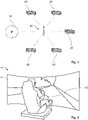
- Fig. 1 illustrates a system according to an embodiment of the present invention.
- a remote terminal 10 is communicatively connected to one or more automated vehicles 20 via a communications network 40.
- the remote terminal 10 may comprise a display unit 11 and a control unit 13.
- image data received from an automated vehicle 20 is displayed.
- the image data can be provided by one or more cameras on the automated vehicle 20.
- the image data may also comprise other sensory data, or be communicated along with other sensory data, that can be displayed to the user at the remote terminal 10.
- the other sensory data can be presented on top of the image data on the display unit 11 to provide an augmented reality view for the user.
- a user using the control unit generate information to be communicated to the automated vehicle 20, such as driving instructions.
- the driving instructions may include steering instructions, acceleration or braking instructions and similar.
- low latency is provided such that minimal delay is achieved between the actual event at the location of the automated vehicle 20, represented for the user on the display unit 11 and to which the user may respond using the control unit 13, and when the automated vehicle 20 receives responsive driving instructions from the remote terminal 10.
- one remote terminal 10 can be in communication with several automated vehicles 20.
- the remote terminal 10 may then be used for monitoring the plurality of automated vehicles 20, and if necessary assume control of a specific automated vehicle 20.
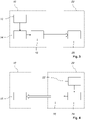
- Figs. 3 and 4 illustrates embodiments of communication from the remote terminal 10 to the automated vehicle 20 ( fig. 3 ), and from the automated vehicle 20 to the remote terminal 10 ( fig. 4 ).
- Information 13 to be communicated is generated or received by the remote terminal 10 and provided to a packaging unit 14.
- the packaging unit 14 packages the information 12 into a sequence 30 of N data packets P.
- the sequence 30 of data packets P is then transmitted by a transmission unit 16 to the automated vehicle 20.
- the data packets P are received and assembled by a receiving unit 28.
- a packaging unit 24 receives the information 22 to be communicated.
- the packaging unit 24 packages the information 22 into a sequence 30 of N data packets P.
- the sequence 30 of data packets P is then transmitted by a transmission unit 26 to the remote terminal 10.
- the data packets P are received and assembled by a receiving unit 18.
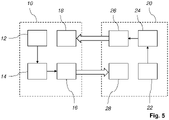
- Fig. 5 illustrates the embodiment wherein both the remote terminal 10 and the automated vehicle 20 communicates information 12, 22 to the other entity using the above described method and units.
- the communication of the information 12, 22 is provided over one or more communications network 40, using two communication links A, B.
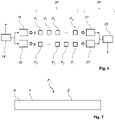
- the packaging unit 14 provides a sequence 30 of N data packets P to the transmission unit 16.
- Each data packet P is also provided with data packet number 6 that is unique for each data packet P in the sequence 30.
- the data packets P in the sequence 30 is thereby provided with a data packet number of 1, 2, 3,... N, respectively.
- the sequence 30 of N data packets thereby comprises data packets P 1 , P 2 , P 3 , ... P N .
- the transmission unit 16 transmits the sequence 30 of N data packets, it is sent over two communication links A, B.
- the sequence 30 of data packets is sent with the data packets P in an ascending order, i.e. in the order of P 1 , P 2 , P 3 , ... P N .
- the sequence 30 of data packets is sent with the data packets P in a descending order, i.e. in the order of P N ,... P 3 , P 2 , P 1 .
- the receiving unit 28 comprises one or more receivers 27 that receives the data packets P communicated over the first communication link A and the second communication link B.
- the receiving unit 28 further comprises an assembling unit 29 that assembles the received data packets P to the complete sequence 30 of data packets.
- the assembling unit 29 uses the data packets P that are first received on either of the communication links A, B for the assembling of the complete sequence 30.
- the assembling unit 29 would start assembling a complete sequence 30 of the communicated data packets P using the data packet P 1 and the data packet P N , since those two are first received on the respective communication link A, B.
- the data packets P 2 and P N-1 will be received and used by the assembling unit 29. Consequently, only about half of the sequence 30 of data packets P would need to have been received by the receiving unit 28 before the assembling unit 29 can have assembled the complete sequence 30 of data packets P.
- the embodiment illustrated in fig. 6 applies equally in the situation when the automated vehicle 20 is to communicate information 22 to the remote terminal 10.
- the transmission unit 26 of the automated vehicle 20 will then transmit the sequence 30 of data packets P over two communication links A, B, and the receiving unit 18 of the remote terminal would receive and assemble the received data packets P correspondingly.
- Fig. 7 illustrates a data packet P 1 that comprises a header 4 and a data payload 2.
- the data payload 2 is received by the packaging unit 14, 24 as part of the information 12, 22 to be communicated.
- the packaging unit 14, 24 provides the data payload 2 with a header 4, forming the data packet P.
- the data packet P is provided with the data packet number 6.
- each data packet P is given a unique data packet number 6. If a sequence of ten data packets is formed by the packaging unit 14, 24, the data packets forming the sequence are given the data packet numbers 1 to 10 respectively.
- the header 4 comprises further fields.
- the header 4 may be defined using a protocol, and the header may comprise a protocol identification field.
- Fig. 8 illustrates a method 100 for communicating information between an automated vehicle 20 and a remote terminal 10 according to an embodiment of the present invention.
- the method 100 may be computer-implemented and comprises a step 102 of providing information to be communicated.
- the information 12, 22 may be received by the one of the automated vehicle 20 and the remote terminal 10 that is to communicate the information 12, 22, or it can be generated by the same entity.
- the information 12, 22 to be communicated is packaged 104 by means of the packaging unit 14, 24 to the sequence 30 of N data packets P.
- each data packet P is provided with a unique data packet number 6 ranging from 1 to N.
- the data packet number 6 indicates the respective data packet's position in the sequence 30 of data packets P.
- the sequence 30 of N data packets P When the sequence 30 of N data packets P has been formed by the packaging unit 14, 24, the sequence 30 is transmitted 106 via at least two communication links A, B.
- the transmission 106 is made by means of a transmission unit 16, 26.
- the transmission unit 16, 26 transmits the sequence 30 of N data packets, each having a unique data packet number 6, over two communication links A, B. Over the first communication link A, the transmission unit 16, 26 transmits the sequence 30 in an order of ascending data packet numbers 6. Over the second communication link B, the transmission unit 16, 26 transmits the sequence 30 in an order of descending data packet numbers 6.
- the receiving entity out of the automated vehicle 20 and the remote terminal 10 assembles 108 a complete sequence 30 of the unique data packets after each unique data packet P has been successfully communicated via either the first or the second communication link A, B.
Landscapes
- Engineering & Computer Science (AREA)
- Computer Networks & Wireless Communication (AREA)
- General Physics & Mathematics (AREA)
- Physics & Mathematics (AREA)
- Signal Processing (AREA)
- Automation & Control Theory (AREA)
- Computer Security & Cryptography (AREA)
- Health & Medical Sciences (AREA)
- Computing Systems (AREA)
- General Health & Medical Sciences (AREA)
- Medical Informatics (AREA)
- Chemical & Material Sciences (AREA)
- Analytical Chemistry (AREA)
- Mechanical Engineering (AREA)
- Transportation (AREA)
- Human Computer Interaction (AREA)
- Aviation & Aerospace Engineering (AREA)
- Radar, Positioning & Navigation (AREA)
- Remote Sensing (AREA)
- Selective Calling Equipment (AREA)
- Traffic Control Systems (AREA)
Description
- The present disclosure relates to a method and system for communicating information between an automated vehicle and a remote terminal and for reducing latency between said automated vehicle and remote terminal.
- Automated vehicles are currently being investigated for improving traffic safety and for improving transportation. Automated vehicles may be categorized with respect to their autonomy, i.e. the level of required interaction by a user for operating various functions of the automated vehicles.
- One particular category of automated vehicles is the remote-operated automated vehicle. In such automated vehicle systems, the automated vehicle captures sensory data and transmits the sensory data to a remote terminal for constructing a representation of the surrounding of the automated vehicle. Using the constructed representation, the automated vehicle may be instructed from the remote terminal with further driving instructions enabling it to navigate its surrounding. In order to realize such an automated vehicle system, two particular problems must be solved in a satisfactory manner: how to transmit such high quantities of information between the automated vehicle and the remote terminal without significant loss of information, and how to transmit such high quantities of information with low latency.
-
US 2018/270150 A1 discloses an invention involving an autonomous and/or semi-autonomous vehicle which can assess whether safe driving can be carried out and if necessary, request driving assistance by a teleoperator. Multipath transport of Internet Protocol (IP) packets between the vehicle and a teleoperator device is also disclosed. - It has been identified that current solutions may be improved upon in order to solve these problems in a more satisfactory manner. Hence, there is a need for an improved remote-operated automated vehicle and method for remote operating an automated vehicle.
- It is an object of the present invention to provide an improved solution that alleviates the mentioned drawbacks with present solutions. Furthermore, it is an object to provide a method for communicating information between an automated vehicle and a remote control with low latency.
- The invention is defined by the appended
independent claims - According to a first aspect of the invention, this is provided by a computer-implemented method for communicating information between an automated vehicle and a remote terminal, comprising the steps of providing information to be communicated between the automated vehicle and the remote terminal, packaging said information by means of a first packaging unit as a sequence of N data packets, wherein each data packet is provided with a unique data packet number ranging from 1 to N indicating the position of each data packet in the sequence of data packets, transmitting the sequence of N data packets via a first communication link between the automated vehicle and the remote terminal and also via at least a second communication link between the automated vehicle and the remote terminal, said first and at least second communication link established by means of an automated vehicle communication unit and a remote terminal communication unit, assembling a complete sequence of N unique data packets by means of an assembling unit after each unique data packet has been successfully communicated via either said first or at least second communication link, wherein the sequence of N data packets is transmitted via said first communication link in an order of ascending data packet numbers and via said at least second communication link in an order of descending data packet numbers.
- The information to be communicated may be sent either from the automated vehicle or the remote terminal. The entity transmitting the sequence of data packets via the two communication links may provide or be provided with the information to be communicated, and may package the information into the sequence of N data packets. The other entity may receive the sequence of N data packets via the two communication links and assemble a complete sequence of data packets using the sequences sent via the two communication links. By sending the sequence via two communication links in reversed packet number orders, an efficient transmission with low losses and low latency may be provided. The assembling of the data packets into a complete sequence may be made using the data packets first received at either of the communication links. Thereby, not the complete sequence needs to be received over each communication link before a complete sequence of the communicated data packets can be assembled.
- The communication links may be over separate communication networks, or over different links or channels in a common communication network.
- According to one embodiment, the unique data packet number may be provided in a header of each data packet. The data packet number of each data packet may start on 1 followed by 2, 3, ... N in the sequence of data packets. When packaging the information in to a sequence of data packets, each data packet may be provided with the data packet number in the header. By unique it may be meant that each data packet in the sequence of data packets has a number that is unique relative the other data packets in the sequence.
- According to one embodiment, the step of packaging the information in a sequence of N data packets may comprise a step of using a protocol defining a header comprising any combination of the following fields: protocol identifier, frame index, frame buffer, buffer offset, data payload. Each data packet may thereby be formed with a header. The header may comprise the unique data packet number.
- According to one embodiment, at least one of the first and second communications link may be a wireless communication link established over a cellular network, such as 4G/LTE or 5G.
- According to one embodiment, said provided information to be communicated may include sensory data of the surroundings of the automated vehicle, and the method may comprise the step of capturing sensory data of the surroundings of the automated vehicle by means of sensors of the automated vehicle. The automated vehicle may thereby transmit the information comprising the sensory data to the remote terminal. The sensory data may be visual information, sound, distance information via for instance radar or laser, temperature, speed data, motor data etc.
- According to one embodiment, the method may comprise a step of rendering a representation of the surroundings of the automated vehicle based on the captured sensory data communicated from the automated vehicle to the remote terminal, and displaying the rendered representation by means of at least one remote terminal display or a remote terminal VR headset connected to the remote terminal.
- According to one embodiment, said provided information to be communicated may include driving instructions for the automated vehicle, and the method may comprise a step of operating the remote terminal for providing said driving instructions for the automated vehicle. The driving instructions may thereby be communicated from the remote terminal to the automated vehicle by transmitting the sequence of N data packets.
- According to one embodiment, the displayed rendered representation may present a field of view in a driving direction of the automated vehicle having a horizontal field of view that extends between 90 degrees and 360 degrees and having a vertical field of view that extends between 45 degrees and 180 degrees
- According to one embodiment, the method may comprise a step of driving the automated vehicle by means of the remote terminal. Information may be transmitted both from the automated vehicle to the remote terminal and vice versa in sequences of N data packets.
- According to one embodiment, the displayed rendered representation may present augmented reality features for assisting a user operating the automated vehicle from the remote terminal. The augmented reality features may be based on information transmitted from the automated vehicle in one or more sequences of N data packets.
- According to one embodiment, the method may comprise a step of communicating a request for further driving instructions between the automated vehicle and the remote terminal, and communicating further driving instructions between the automated vehicle and the remote terminal based on the communicated request. The request may be communicated from the automated vehicle to request assistance in a certain situation, or from the remote terminal to request a recommended measure by the automated vehicle.
- According to one embodiment, the automated vehicle may be a land vehicle, such as a motor vehicle or a railed vehicle. The automated vehicle may further be a flying vehicle or floating vehicle.
- According to one embodiment, the method may comprise a step of monitoring at least one automated vehicle by means of a single remote terminal, and assuming control of one of the at least one automated vehicle if said one automated vehicle is identified to require further driving assistance.
- According to a second aspect of the invention, an automated vehicle may be provided, comprising communication means for communicating information to a remote terminal using a method according to any of the embodiments above.
- According to a third aspect of the invention, a remote terminal may be provided, comprising communication means for communicating information to an automated vehicle using a method according to any of the embodiments above.
- According to a fourth aspect of the invention, an automated vehicle control system may be provided, comprising an automated vehicle and a remote terminal according to any of the embodiments above.
- The invention will in the following be described in more detail with reference to the enclosed drawings, wherein:
-
Fig. 1 shows a schematic view of a system according to an embodiment of the present invention; -
Fig. 2 shows a perspective view of a remote terminal according to an embodiment of the present invention; -
Fig. 3 shows a block diagram of a system according to an embodiment of the present invention; -
Fig. 4 shows a block diagram of a system according to an embodiment of the present invention; -
Fig. 5 shows a block diagram of a system according to an embodiment of the present invention; -
Fig. 6 shows a block diagram of a system according to an embodiment of the present invention; -
Fig. 7 shows a data packet according to an embodiment of the present invention; and -
Fig. 8 shows a flow chart of a method according to an embodiment of the present invention. - The present invention will be described more fully hereinafter with reference to the accompanying drawings, in which preferred embodiments of the invention are shown. This invention may, however, be embodied in many different forms and should not be construed as limited to the embodiments set forth herein; rather, these embodiments are provided so that this disclosure will be thorough and complete, and will fully convey the scope of the invention to those skilled in the art. In the drawings, like numbers refer to like elements.
-
Fig. 1 illustrates a system according to an embodiment of the present invention. Aremote terminal 10 is communicatively connected to one or moreautomated vehicles 20 via acommunications network 40. As seen infig. 2 , theremote terminal 10 may comprise adisplay unit 11 and acontrol unit 13. On thedisplay unit 11 image data received from anautomated vehicle 20 is displayed. The image data can be provided by one or more cameras on theautomated vehicle 20. The image data may also comprise other sensory data, or be communicated along with other sensory data, that can be displayed to the user at theremote terminal 10. The other sensory data can be presented on top of the image data on thedisplay unit 11 to provide an augmented reality view for the user. A user using the control unit generate information to be communicated to theautomated vehicle 20, such as driving instructions. The driving instructions may include steering instructions, acceleration or braking instructions and similar. When receiving the image data from the automatedvehicle 20 using a communication method as in the present invention, low latency is provided such that minimal delay is achieved between the actual event at the location of the automatedvehicle 20, represented for the user on thedisplay unit 11 and to which the user may respond using thecontrol unit 13, and when theautomated vehicle 20 receives responsive driving instructions from theremote terminal 10. - As seen in
fig. 1 , oneremote terminal 10 can be in communication with severalautomated vehicles 20. Theremote terminal 10 may then be used for monitoring the plurality ofautomated vehicles 20, and if necessary assume control of a specificautomated vehicle 20. -
Figs. 3 and 4 illustrates embodiments of communication from theremote terminal 10 to the automated vehicle 20 (fig. 3 ), and from the automatedvehicle 20 to the remote terminal 10 (fig. 4 ).Information 13 to be communicated is generated or received by theremote terminal 10 and provided to apackaging unit 14. Thepackaging unit 14 packages theinformation 12 into asequence 30 of N data packets P. Thesequence 30 of data packets P is then transmitted by atransmission unit 16 to theautomated vehicle 20. At theautomated vehicle 20, the data packets P are received and assembled by a receivingunit 28. When theautomated vehicle 20 is to communicateinformation 22 to the remote terminal, as illustrated infig. 4 , apackaging unit 24 receives theinformation 22 to be communicated. Thepackaging unit 24 packages theinformation 22 into asequence 30 of N data packets P. Thesequence 30 of data packets P is then transmitted by atransmission unit 26 to theremote terminal 10. At theremote terminal 10, the data packets P are received and assembled by a receivingunit 18. -
Fig. 5 illustrates the embodiment wherein both theremote terminal 10 and theautomated vehicle 20 communicatesinformation - The communication of the
information more communications network 40, using two communication links A, B. As further illustrated infig. 6 , thepackaging unit 14 provides asequence 30 of N data packets P to thetransmission unit 16. Each data packet P is also provided withdata packet number 6 that is unique for each data packet P in thesequence 30. The data packets P in thesequence 30 is thereby provided with a data packet number of 1, 2, 3,... N, respectively. Thesequence 30 of N data packets thereby comprises data packets P1, P2, P3, ... PN. When thetransmission unit 16 transmits thesequence 30 of N data packets, it is sent over two communication links A, B. On a first communication link A, thesequence 30 of data packets is sent with the data packets P in an ascending order, i.e. in the order of P1, P2, P3, ... PN. On a second communication link B, thesequence 30 of data packets is sent with the data packets P in a descending order, i.e. in the order of PN,... P3, P2, P1. - In the embodiment illustrated in
fig. 6 , the receivingunit 28 comprises one ormore receivers 27 that receives the data packets P communicated over the first communication link A and the second communication link B. The receivingunit 28 further comprises an assemblingunit 29 that assembles the received data packets P to thecomplete sequence 30 of data packets. The assemblingunit 29 uses the data packets P that are first received on either of the communication links A, B for the assembling of thecomplete sequence 30. In the illustrated embodiment offig. 6 , the assemblingunit 29 would start assembling acomplete sequence 30 of the communicated data packets P using the data packet P1 and the data packet PN, since those two are first received on the respective communication link A, B. Next, the data packets P2 and PN-1 will be received and used by the assemblingunit 29. Consequently, only about half of thesequence 30 of data packets P would need to have been received by the receivingunit 28 before the assemblingunit 29 can have assembled thecomplete sequence 30 of data packets P. The embodiment illustrated infig. 6 applies equally in the situation when theautomated vehicle 20 is to communicateinformation 22 to theremote terminal 10. Thetransmission unit 26 of the automatedvehicle 20 will then transmit thesequence 30 of data packets P over two communication links A, B, and the receivingunit 18 of the remote terminal would receive and assemble the received data packets P correspondingly. -
Fig. 7 illustrates a data packet P1 that comprises aheader 4 and adata payload 2. Thedata payload 2 is received by thepackaging unit information packaging unit data payload 2 with aheader 4, forming the data packet P. As part of theheader 4, the data packet P is provided with thedata packet number 6. In thesequence 30 of data packets P, each data packet P is given a uniquedata packet number 6. If a sequence of ten data packets is formed by thepackaging unit data packet numbers 1 to 10 respectively. In some embodiments, theheader 4 comprises further fields. For instance, theheader 4 may be defined using a protocol, and the header may comprise a protocol identification field. -
Fig. 8 illustrates amethod 100 for communicating information between anautomated vehicle 20 and aremote terminal 10 according to an embodiment of the present invention. Themethod 100 may be computer-implemented and comprises astep 102 of providing information to be communicated. Theinformation vehicle 20 and theremote terminal 10 that is to communicate theinformation information packaging unit sequence 30 of N data packets P. In the step ofpackaging 104, each data packet P is provided with a uniquedata packet number 6 ranging from 1 to N. Thedata packet number 6 indicates the respective data packet's position in thesequence 30 of data packets P. - When the
sequence 30 of N data packets P has been formed by thepackaging unit sequence 30 is transmitted 106 via at least two communication links A, B. Thetransmission 106 is made by means of atransmission unit transmission unit sequence 30 of N data packets, each having a uniquedata packet number 6, over two communication links A, B. Over the first communication link A, thetransmission unit sequence 30 in an order of ascendingdata packet numbers 6. Over the second communication link B, thetransmission unit sequence 30 in an order of descendingdata packet numbers 6. - Finally, the receiving entity out of the automated
vehicle 20 and theremote terminal 10 assembles 108 acomplete sequence 30 of the unique data packets after each unique data packet P has been successfully communicated via either the first or the second communication link A, B. - In the drawings and specification, there have been disclosed preferred embodiments and examples of the invention and, although specific terms are employed, they are used in a generic and descriptive sense only and not for the purpose of limitation, the scope of the invention being set forth in the following claims.
Claims (15)
- A computer-implemented method (100) for communicating information between an automated vehicle (20) and a remote terminal (10), comprising the steps of:providing (102) information to be communicated between the automated vehicle (20) and the remote terminal (10);packaging (104) said information by means of a packaging unit (14, 24) as a sequence (30) of N data packets (P1-PN), wherein each data packet (P1-PN) is provided with a unique data packet number (6) ranging from 1 to N indicating the position of each data packet in the sequence (30) of data packets;transmitting (106) the sequence (30) of N data packets (P1-PN) via a first communication link (A) between the automated vehicle (20) and the remote terminal (10) and also via at least a second communication link (B) between the automated vehicle (20) and the remote terminal (10), said first and at least second communication link (A, B) established by means of an automated vehicle communication unit (26, 28) and a remote terminal communication unit (16, 18);assembling (108) a complete sequence of N unique data packets (P1-PN) by means of an assembling unit (18, 28, 29) after each unique data packet (P1-PN) has been successfully communicated via either said first or at least second communication link (A, B),characterized in thatthe sequence (30) of N data packets (P1-PN) is transmitted via said first communication link (A) in an order of ascending data packet numbers (6) and via said at leastsecond communication link (B) in an order of descending data packet numbers (6).
- The method (100) according to claim 1, wherein the unique data packet number (6) is provided in a header (4) of the data packet (P1-PN).
- The method (100) according to claim 2, wherein the step of packaging (104) the information in a sequence (30) of N data packets (P1-PN) comprises a step of using a protocol defining the data payload (2) and a header (4) further comprising any combination of the following fields: protocol identifier, frame index, frame buffer, buffer offset.
- The method (100) according to claim 1, wherein at least one of the first (A) and second (B) communications link is a wireless communication link established over a cellular network, such as 4G/LTE or 5G.
- The method (100) according to any preceding claims, wherein said provided information to be communicated includes sensory data of the surroundings of the automated vehicle (20), and the step of providing (102) information to be communicated comprises a step of capturing sensory data of the surroundings of the automated vehicle (20) by means of sensors of the automated vehicle.
- The method (100) according to claim 5, further comprising a step of rendering a representation of the surroundings of the automated vehicle (20) based on the captured sensory data communicated from the automated vehicle (20) to the remote terminal (10), and displaying the rendered representation by means of at least one remote terminal display (11) or a remote terminal VR headset.
- The method (100) according to any preceding claims, wherein said provided information to be communicated includes driving instructions for the automated vehicle (20), and the step of providing (102) information to be communicated comprises a step of operating the remote terminal (10) for providing said driving instructions for the automated vehicle (20).
- The method (100) according to claim 7, wherein the displayed rendered representation presents a field of view in a driving direction of the automated vehicle having a horizontal field of view that extends between 90 degrees and 360 degrees and having a vertical field of view that extends between 45 degrees and 180 degrees.
- The method (100) according to any of the claims 6-8, further comprising a step of driving the automated vehicle (20) by means of the remote terminal (10).
- The method (100) according to any of claims 4 - 7, wherein the displayed rendered representation presents augmented reality features for assisting a user operating the automated vehicle from the remote terminal.
- The method (100) according to any of claims 5 - 9, comprising the steps ofcommunicating a request for further driving instructions between the automated vehicle (20) and the remote terminal (10), andcommunicating further driving instructions between the automated vehicle (20) and the remote terminal (10) based on the communicated request.
- The method (100) according to any preceding claims, comprising the step of monitoring at least one automated vehicle (20) by means of a single remote terminal (10), and assuming control of one of the at least one automated vehicle (20) if said one automated vehicle (20) is identified to require further driving assistance.
- An automated vehicle (20) comprising communications means for communicating information between the automated vehicle and a remote terminal (10) using the method according to any of claims 1 - 12.
- A remote terminal (10) comprising communication means for communicating information between the remote terminal and an automated vehicle (20) using the method according to any of claims 1 - 12.
- An automated vehicle control system (10, 20) comprising the automated vehicle (20) according to claim 13 and the remote terminal (10) according to claim 14.
Priority Applications (3)
| Application Number | Priority Date | Filing Date | Title |
|---|---|---|---|
| EP19213953.3A EP3832983B1 (en) | 2019-12-05 | 2019-12-05 | Method and system for reducing latency between an automated vehicle and a remote terminal |
| PCT/EP2020/084518 WO2021110863A1 (en) | 2019-12-05 | 2020-12-03 | Method and system for reducing latency between an automated vehicle and a remote terminal |
| US17/781,307 US12240488B2 (en) | 2019-12-05 | 2020-12-03 | Method and system for reducing latency between an automated vehicle and a remote terminal |
Applications Claiming Priority (1)
| Application Number | Priority Date | Filing Date | Title |
|---|---|---|---|
| EP19213953.3A EP3832983B1 (en) | 2019-12-05 | 2019-12-05 | Method and system for reducing latency between an automated vehicle and a remote terminal |
Publications (2)
| Publication Number | Publication Date |
|---|---|
| EP3832983A1 EP3832983A1 (en) | 2021-06-09 |
| EP3832983B1 true EP3832983B1 (en) | 2023-01-04 |
Family
ID=68808062
Family Applications (1)
| Application Number | Title | Priority Date | Filing Date |
|---|---|---|---|
| EP19213953.3A Active EP3832983B1 (en) | 2019-12-05 | 2019-12-05 | Method and system for reducing latency between an automated vehicle and a remote terminal |
Country Status (3)
| Country | Link |
|---|---|
| US (1) | US12240488B2 (en) |
| EP (1) | EP3832983B1 (en) |
| WO (1) | WO2021110863A1 (en) |
Families Citing this family (1)
| Publication number | Priority date | Publication date | Assignee | Title |
|---|---|---|---|---|
| EP3832983B1 (en) * | 2019-12-05 | 2023-01-04 | Voysys AB | Method and system for reducing latency between an automated vehicle and a remote terminal |
Family Cites Families (5)
| Publication number | Priority date | Publication date | Assignee | Title |
|---|---|---|---|---|
| US4630260A (en) * | 1985-06-27 | 1986-12-16 | At&T Bell Laboratories | Self-routing multipath packet switching network with sequential delivery of packets |
| CN105898471A (en) * | 2015-11-11 | 2016-08-24 | 乐卡汽车智能科技(北京)有限公司 | Vehicle-mounted audio and video transmission method and system, vehicle-mounted terminal and server |
| KR102568436B1 (en) * | 2016-07-28 | 2023-08-21 | 삼성전자 주식회사 | Method and apparatus for transmitting the data |
| US10601710B2 (en) * | 2017-03-15 | 2020-03-24 | Qualcomm Incorporated | IP level multipath protocol |
| EP3832983B1 (en) * | 2019-12-05 | 2023-01-04 | Voysys AB | Method and system for reducing latency between an automated vehicle and a remote terminal |
-
2019
- 2019-12-05 EP EP19213953.3A patent/EP3832983B1/en active Active
-
2020
- 2020-12-03 US US17/781,307 patent/US12240488B2/en active Active
- 2020-12-03 WO PCT/EP2020/084518 patent/WO2021110863A1/en not_active Ceased
Also Published As
| Publication number | Publication date |
|---|---|
| US12240488B2 (en) | 2025-03-04 |
| US20220410928A1 (en) | 2022-12-29 |
| WO2021110863A1 (en) | 2021-06-10 |
| EP3832983A1 (en) | 2021-06-09 |
Similar Documents
| Publication | Publication Date | Title |
|---|---|---|
| US11753033B2 (en) | Context-aware navigation protocol for safe driving | |
| KR102478809B1 (en) | Method for invoking a teleoperated driving session, apparatus for performing the steps of the method, vehicle and computer program | |
| CN109501801B (en) | Method, control unit, vehicle and computer program for planning a collision avoidance maneuver | |
| US12412473B2 (en) | Method for vehicle transmitting signal in wireless communication system and vehicle therefor | |
| US20220319329A1 (en) | Method for transmitting and receiving, by user equipment, message for vulnerable road user in wireless communication system | |
| EP3859709B1 (en) | Method for planning a cooperative driving maneuver, corresponding control unit and vehicle equipped with a control unit as well as computer program | |
| US10171955B2 (en) | Method for communication between vehicles | |
| CN111200842B (en) | Method for data communication, control unit and vehicle, and computer program | |
| US12057014B2 (en) | Method by which rsus transmit and receive signals in wireless communication system | |
| CA2464395A1 (en) | Individual transport control and communication system | |
| US7486202B2 (en) | Vehicle communication device | |
| CN113805509A (en) | Remote driving system and method based on V2X | |
| KR102830989B1 (en) | Correction of video for remote control of the vehicle in autonomous driving system | |
| KR20140047112A (en) | Data selection method for reducing the decoding computational complexity of a vehicle-to-x communication system, and vehicle-to-x communication system | |
| EP3044980B1 (en) | Communication system | |
| EP3832983B1 (en) | Method and system for reducing latency between an automated vehicle and a remote terminal | |
| CN105704240A (en) | Remote IoV intelligent monitoring system | |
| US11143515B2 (en) | Method for the generation of a merged free-space map, electronic control device and storage medium | |
| CN102461080B (en) | Controller in two-way adhoc network radio communication | |
| US20150200984A1 (en) | System for sharing multimedia data in realtime wireless manner for the purpose of extending vision | |
| KR20170075346A (en) | monitoring system for communication module performance | |
| US12131635B2 (en) | Methods, computer programs, communication circuits for communicating in a tele-operated driving session, vehicle and remote control center for controlling a vehicle from remote | |
| KR20210005762A (en) | Autonomous vehicle control system for child protection mode, and autonomous drive providing server for the same | |
| KR20210127277A (en) | Driver assistance apparatus and method of thereof | |
| US20240329632A1 (en) | Transmitting Sideband Data to Enable Tele-Operation of a Vehicle |
Legal Events
| Date | Code | Title | Description |
|---|---|---|---|
| PUAI | Public reference made under article 153(3) epc to a published international application that has entered the european phase |
Free format text: ORIGINAL CODE: 0009012 |
|
| STAA | Information on the status of an ep patent application or granted ep patent |
Free format text: STATUS: THE APPLICATION HAS BEEN PUBLISHED |
|
| AK | Designated contracting states |
Kind code of ref document: A1 Designated state(s): AL AT BE BG CH CY CZ DE DK EE ES FI FR GB GR HR HU IE IS IT LI LT LU LV MC MK MT NL NO PL PT RO RS SE SI SK SM TR |
|
| STAA | Information on the status of an ep patent application or granted ep patent |
Free format text: STATUS: REQUEST FOR EXAMINATION WAS MADE |
|
| 17P | Request for examination filed |
Effective date: 20211201 |
|
| RBV | Designated contracting states (corrected) |
Designated state(s): AL AT BE BG CH CY CZ DE DK EE ES FI FR GB GR HR HU IE IS IT LI LT LU LV MC MK MT NL NO PL PT RO RS SE SI SK SM TR |
|
| REG | Reference to a national code |
Ref country code: DE Ref legal event code: R079 Ref document number: 602019023924 Country of ref document: DE Free format text: PREVIOUS MAIN CLASS: H04L0029080000 Ipc: H04L0067120000 |
|
| GRAP | Despatch of communication of intention to grant a patent |
Free format text: ORIGINAL CODE: EPIDOSNIGR1 |
|
| STAA | Information on the status of an ep patent application or granted ep patent |
Free format text: STATUS: GRANT OF PATENT IS INTENDED |
|
| RIC1 | Information provided on ipc code assigned before grant |
Ipc: G08G 1/01 20060101ALI20220701BHEP Ipc: G05D 1/00 20060101ALI20220701BHEP Ipc: H04L 47/34 20220101ALI20220701BHEP Ipc: H04L 45/24 20220101ALI20220701BHEP Ipc: H04L 67/12 20220101AFI20220701BHEP |
|
| RIN1 | Information on inventor provided before grant (corrected) |
Inventor name: NILSSON, JONATHAN |
|
| INTG | Intention to grant announced |
Effective date: 20220725 |
|
| GRAS | Grant fee paid |
Free format text: ORIGINAL CODE: EPIDOSNIGR3 |
|
| GRAA | (expected) grant |
Free format text: ORIGINAL CODE: 0009210 |
|
| STAA | Information on the status of an ep patent application or granted ep patent |
Free format text: STATUS: THE PATENT HAS BEEN GRANTED |
|
| AK | Designated contracting states |
Kind code of ref document: B1 Designated state(s): AL AT BE BG CH CY CZ DE DK EE ES FI FR GB GR HR HU IE IS IT LI LT LU LV MC MK MT NL NO PL PT RO RS SE SI SK SM TR |
|
| REG | Reference to a national code |
Ref country code: GB Ref legal event code: FG4D |
|
| REG | Reference to a national code |
Ref country code: DE Ref legal event code: R096 Ref document number: 602019023924 Country of ref document: DE |
|
| REG | Reference to a national code |
Ref country code: CH Ref legal event code: EP |
|
| REG | Reference to a national code |
Ref country code: AT Ref legal event code: REF Ref document number: 1542728 Country of ref document: AT Kind code of ref document: T Effective date: 20230115 |
|
| REG | Reference to a national code |
Ref country code: IE Ref legal event code: FG4D |
|
| REG | Reference to a national code |
Ref country code: LT Ref legal event code: MG9D |
|
| REG | Reference to a national code |
Ref country code: NL Ref legal event code: MP Effective date: 20230104 |
|
| REG | Reference to a national code |
Ref country code: AT Ref legal event code: MK05 Ref document number: 1542728 Country of ref document: AT Kind code of ref document: T Effective date: 20230104 |
|
| PG25 | Lapsed in a contracting state [announced via postgrant information from national office to epo] |
Ref country code: NL Free format text: LAPSE BECAUSE OF FAILURE TO SUBMIT A TRANSLATION OF THE DESCRIPTION OR TO PAY THE FEE WITHIN THE PRESCRIBED TIME-LIMIT Effective date: 20230104 |
|
| PG25 | Lapsed in a contracting state [announced via postgrant information from national office to epo] |
Ref country code: RS Free format text: LAPSE BECAUSE OF FAILURE TO SUBMIT A TRANSLATION OF THE DESCRIPTION OR TO PAY THE FEE WITHIN THE PRESCRIBED TIME-LIMIT Effective date: 20230104 Ref country code: PT Free format text: LAPSE BECAUSE OF FAILURE TO SUBMIT A TRANSLATION OF THE DESCRIPTION OR TO PAY THE FEE WITHIN THE PRESCRIBED TIME-LIMIT Effective date: 20230504 Ref country code: NO Free format text: LAPSE BECAUSE OF FAILURE TO SUBMIT A TRANSLATION OF THE DESCRIPTION OR TO PAY THE FEE WITHIN THE PRESCRIBED TIME-LIMIT Effective date: 20230404 Ref country code: LV Free format text: LAPSE BECAUSE OF FAILURE TO SUBMIT A TRANSLATION OF THE DESCRIPTION OR TO PAY THE FEE WITHIN THE PRESCRIBED TIME-LIMIT Effective date: 20230104 Ref country code: LT Free format text: LAPSE BECAUSE OF FAILURE TO SUBMIT A TRANSLATION OF THE DESCRIPTION OR TO PAY THE FEE WITHIN THE PRESCRIBED TIME-LIMIT Effective date: 20230104 Ref country code: HR Free format text: LAPSE BECAUSE OF FAILURE TO SUBMIT A TRANSLATION OF THE DESCRIPTION OR TO PAY THE FEE WITHIN THE PRESCRIBED TIME-LIMIT Effective date: 20230104 Ref country code: ES Free format text: LAPSE BECAUSE OF FAILURE TO SUBMIT A TRANSLATION OF THE DESCRIPTION OR TO PAY THE FEE WITHIN THE PRESCRIBED TIME-LIMIT Effective date: 20230104 Ref country code: AT Free format text: LAPSE BECAUSE OF FAILURE TO SUBMIT A TRANSLATION OF THE DESCRIPTION OR TO PAY THE FEE WITHIN THE PRESCRIBED TIME-LIMIT Effective date: 20230104 |
|
| PG25 | Lapsed in a contracting state [announced via postgrant information from national office to epo] |
Ref country code: SE Free format text: LAPSE BECAUSE OF FAILURE TO SUBMIT A TRANSLATION OF THE DESCRIPTION OR TO PAY THE FEE WITHIN THE PRESCRIBED TIME-LIMIT Effective date: 20230104 Ref country code: PL Free format text: LAPSE BECAUSE OF FAILURE TO SUBMIT A TRANSLATION OF THE DESCRIPTION OR TO PAY THE FEE WITHIN THE PRESCRIBED TIME-LIMIT Effective date: 20230104 Ref country code: IS Free format text: LAPSE BECAUSE OF FAILURE TO SUBMIT A TRANSLATION OF THE DESCRIPTION OR TO PAY THE FEE WITHIN THE PRESCRIBED TIME-LIMIT Effective date: 20230504 Ref country code: GR Free format text: LAPSE BECAUSE OF FAILURE TO SUBMIT A TRANSLATION OF THE DESCRIPTION OR TO PAY THE FEE WITHIN THE PRESCRIBED TIME-LIMIT Effective date: 20230405 Ref country code: FI Free format text: LAPSE BECAUSE OF FAILURE TO SUBMIT A TRANSLATION OF THE DESCRIPTION OR TO PAY THE FEE WITHIN THE PRESCRIBED TIME-LIMIT Effective date: 20230104 |
|
| REG | Reference to a national code |
Ref country code: DE Ref legal event code: R097 Ref document number: 602019023924 Country of ref document: DE |
|
| PG25 | Lapsed in a contracting state [announced via postgrant information from national office to epo] |
Ref country code: SM Free format text: LAPSE BECAUSE OF FAILURE TO SUBMIT A TRANSLATION OF THE DESCRIPTION OR TO PAY THE FEE WITHIN THE PRESCRIBED TIME-LIMIT Effective date: 20230104 Ref country code: RO Free format text: LAPSE BECAUSE OF FAILURE TO SUBMIT A TRANSLATION OF THE DESCRIPTION OR TO PAY THE FEE WITHIN THE PRESCRIBED TIME-LIMIT Effective date: 20230104 Ref country code: EE Free format text: LAPSE BECAUSE OF FAILURE TO SUBMIT A TRANSLATION OF THE DESCRIPTION OR TO PAY THE FEE WITHIN THE PRESCRIBED TIME-LIMIT Effective date: 20230104 Ref country code: DK Free format text: LAPSE BECAUSE OF FAILURE TO SUBMIT A TRANSLATION OF THE DESCRIPTION OR TO PAY THE FEE WITHIN THE PRESCRIBED TIME-LIMIT Effective date: 20230104 Ref country code: CZ Free format text: LAPSE BECAUSE OF FAILURE TO SUBMIT A TRANSLATION OF THE DESCRIPTION OR TO PAY THE FEE WITHIN THE PRESCRIBED TIME-LIMIT Effective date: 20230104 |
|
| PLBE | No opposition filed within time limit |
Free format text: ORIGINAL CODE: 0009261 |
|
| STAA | Information on the status of an ep patent application or granted ep patent |
Free format text: STATUS: NO OPPOSITION FILED WITHIN TIME LIMIT |
|
| PG25 | Lapsed in a contracting state [announced via postgrant information from national office to epo] |
Ref country code: SK Free format text: LAPSE BECAUSE OF FAILURE TO SUBMIT A TRANSLATION OF THE DESCRIPTION OR TO PAY THE FEE WITHIN THE PRESCRIBED TIME-LIMIT Effective date: 20230104 |
|
| 26N | No opposition filed |
Effective date: 20231005 |
|
| PG25 | Lapsed in a contracting state [announced via postgrant information from national office to epo] |
Ref country code: SI Free format text: LAPSE BECAUSE OF FAILURE TO SUBMIT A TRANSLATION OF THE DESCRIPTION OR TO PAY THE FEE WITHIN THE PRESCRIBED TIME-LIMIT Effective date: 20230104 |
|
| PG25 | Lapsed in a contracting state [announced via postgrant information from national office to epo] |
Ref country code: IT Free format text: LAPSE BECAUSE OF FAILURE TO SUBMIT A TRANSLATION OF THE DESCRIPTION OR TO PAY THE FEE WITHIN THE PRESCRIBED TIME-LIMIT Effective date: 20230104 |
|
| REG | Reference to a national code |
Ref country code: CH Ref legal event code: PL |
|
| PG25 | Lapsed in a contracting state [announced via postgrant information from national office to epo] |
Ref country code: LU Free format text: LAPSE BECAUSE OF NON-PAYMENT OF DUE FEES Effective date: 20231205 |
|
| PG25 | Lapsed in a contracting state [announced via postgrant information from national office to epo] |
Ref country code: MC Free format text: LAPSE BECAUSE OF FAILURE TO SUBMIT A TRANSLATION OF THE DESCRIPTION OR TO PAY THE FEE WITHIN THE PRESCRIBED TIME-LIMIT Effective date: 20230104 |
|
| GBPC | Gb: european patent ceased through non-payment of renewal fee |
Effective date: 20231205 |
|
| REG | Reference to a national code |
Ref country code: BE Ref legal event code: MM Effective date: 20231231 |
|
| PG25 | Lapsed in a contracting state [announced via postgrant information from national office to epo] |
Ref country code: MC Free format text: LAPSE BECAUSE OF FAILURE TO SUBMIT A TRANSLATION OF THE DESCRIPTION OR TO PAY THE FEE WITHIN THE PRESCRIBED TIME-LIMIT Effective date: 20230104 Ref country code: LU Free format text: LAPSE BECAUSE OF NON-PAYMENT OF DUE FEES Effective date: 20231205 |
|
| REG | Reference to a national code |
Ref country code: IE Ref legal event code: MM4A |
|
| PG25 | Lapsed in a contracting state [announced via postgrant information from national office to epo] |
Ref country code: IE Free format text: LAPSE BECAUSE OF NON-PAYMENT OF DUE FEES Effective date: 20231205 |
|
| PG25 | Lapsed in a contracting state [announced via postgrant information from national office to epo] |
Ref country code: GB Free format text: LAPSE BECAUSE OF NON-PAYMENT OF DUE FEES Effective date: 20231205 |
|
| PG25 | Lapsed in a contracting state [announced via postgrant information from national office to epo] |
Ref country code: BE Free format text: LAPSE BECAUSE OF NON-PAYMENT OF DUE FEES Effective date: 20231231 |
|
| PG25 | Lapsed in a contracting state [announced via postgrant information from national office to epo] |
Ref country code: FR Free format text: LAPSE BECAUSE OF NON-PAYMENT OF DUE FEES Effective date: 20231231 |
|
| PG25 | Lapsed in a contracting state [announced via postgrant information from national office to epo] |
Ref country code: CH Free format text: LAPSE BECAUSE OF NON-PAYMENT OF DUE FEES Effective date: 20231231 |
|
| PG25 | Lapsed in a contracting state [announced via postgrant information from national office to epo] |
Ref country code: IE Free format text: LAPSE BECAUSE OF NON-PAYMENT OF DUE FEES Effective date: 20231205 Ref country code: GB Free format text: LAPSE BECAUSE OF NON-PAYMENT OF DUE FEES Effective date: 20231205 Ref country code: FR Free format text: LAPSE BECAUSE OF NON-PAYMENT OF DUE FEES Effective date: 20231231 Ref country code: CH Free format text: LAPSE BECAUSE OF NON-PAYMENT OF DUE FEES Effective date: 20231231 Ref country code: BE Free format text: LAPSE BECAUSE OF NON-PAYMENT OF DUE FEES Effective date: 20231231 |
|
| PG25 | Lapsed in a contracting state [announced via postgrant information from national office to epo] |
Ref country code: BG Free format text: LAPSE BECAUSE OF FAILURE TO SUBMIT A TRANSLATION OF THE DESCRIPTION OR TO PAY THE FEE WITHIN THE PRESCRIBED TIME-LIMIT Effective date: 20230104 |
|
| PG25 | Lapsed in a contracting state [announced via postgrant information from national office to epo] |
Ref country code: BG Free format text: LAPSE BECAUSE OF FAILURE TO SUBMIT A TRANSLATION OF THE DESCRIPTION OR TO PAY THE FEE WITHIN THE PRESCRIBED TIME-LIMIT Effective date: 20230104 |
|
| PG25 | Lapsed in a contracting state [announced via postgrant information from national office to epo] |
Ref country code: CY Free format text: LAPSE BECAUSE OF FAILURE TO SUBMIT A TRANSLATION OF THE DESCRIPTION OR TO PAY THE FEE WITHIN THE PRESCRIBED TIME-LIMIT; INVALID AB INITIO Effective date: 20191205 |
|
| PG25 | Lapsed in a contracting state [announced via postgrant information from national office to epo] |
Ref country code: HU Free format text: LAPSE BECAUSE OF FAILURE TO SUBMIT A TRANSLATION OF THE DESCRIPTION OR TO PAY THE FEE WITHIN THE PRESCRIBED TIME-LIMIT; INVALID AB INITIO Effective date: 20191205 |
|
| PG25 | Lapsed in a contracting state [announced via postgrant information from national office to epo] |
Ref country code: TR Free format text: LAPSE BECAUSE OF FAILURE TO SUBMIT A TRANSLATION OF THE DESCRIPTION OR TO PAY THE FEE WITHIN THE PRESCRIBED TIME-LIMIT Effective date: 20230104 |
|
| PGFP | Annual fee paid to national office [announced via postgrant information from national office to epo] |
Ref country code: DE Payment date: 20251121 Year of fee payment: 7 |