EP3832420B1 - Deep learning based motion control of a group of autonomous vehicles - Google Patents
Deep learning based motion control of a group of autonomous vehicles Download PDFInfo
- Publication number
- EP3832420B1 EP3832420B1 EP19465591.6A EP19465591A EP3832420B1 EP 3832420 B1 EP3832420 B1 EP 3832420B1 EP 19465591 A EP19465591 A EP 19465591A EP 3832420 B1 EP3832420 B1 EP 3832420B1
- Authority
- EP
- European Patent Office
- Prior art keywords
- agent
- agents
- deep network
- temporal
- controller
- Prior art date
- Legal status (The legal status is an assumption and is not a legal conclusion. Google has not performed a legal analysis and makes no representation as to the accuracy of the status listed.)
- Active
Links
Images


Classifications
-
- G—PHYSICS
- G05—CONTROLLING; REGULATING
- G05D—SYSTEMS FOR CONTROLLING OR REGULATING NON-ELECTRIC VARIABLES
- G05D1/00—Control of position, course, altitude or attitude of land, water, air or space vehicles, e.g. using automatic pilots
- G05D1/02—Control of position or course in two dimensions
- G05D1/021—Control of position or course in two dimensions specially adapted to land vehicles
- G05D1/0212—Control of position or course in two dimensions specially adapted to land vehicles with means for defining a desired trajectory
- G05D1/0221—Control of position or course in two dimensions specially adapted to land vehicles with means for defining a desired trajectory involving a learning process
-
- B—PERFORMING OPERATIONS; TRANSPORTING
- B60—VEHICLES IN GENERAL
- B60W—CONJOINT CONTROL OF VEHICLE SUB-UNITS OF DIFFERENT TYPE OR DIFFERENT FUNCTION; CONTROL SYSTEMS SPECIALLY ADAPTED FOR HYBRID VEHICLES; ROAD VEHICLE DRIVE CONTROL SYSTEMS FOR PURPOSES NOT RELATED TO THE CONTROL OF A PARTICULAR SUB-UNIT
- B60W30/00—Purposes of road vehicle drive control systems not related to the control of a particular sub-unit, e.g. of systems using conjoint control of vehicle sub-units
- B60W30/08—Active safety systems predicting or avoiding probable or impending collision or attempting to minimise its consequences
- B60W30/095—Predicting travel path or likelihood of collision
-
- B—PERFORMING OPERATIONS; TRANSPORTING
- B60—VEHICLES IN GENERAL
- B60W—CONJOINT CONTROL OF VEHICLE SUB-UNITS OF DIFFERENT TYPE OR DIFFERENT FUNCTION; CONTROL SYSTEMS SPECIALLY ADAPTED FOR HYBRID VEHICLES; ROAD VEHICLE DRIVE CONTROL SYSTEMS FOR PURPOSES NOT RELATED TO THE CONTROL OF A PARTICULAR SUB-UNIT
- B60W60/00—Drive control systems specially adapted for autonomous road vehicles
- B60W60/001—Planning or execution of driving tasks
- B60W60/0011—Planning or execution of driving tasks involving control alternatives for a single driving scenario, e.g. planning several paths to avoid obstacles
-
- B—PERFORMING OPERATIONS; TRANSPORTING
- B60—VEHICLES IN GENERAL
- B60W—CONJOINT CONTROL OF VEHICLE SUB-UNITS OF DIFFERENT TYPE OR DIFFERENT FUNCTION; CONTROL SYSTEMS SPECIALLY ADAPTED FOR HYBRID VEHICLES; ROAD VEHICLE DRIVE CONTROL SYSTEMS FOR PURPOSES NOT RELATED TO THE CONTROL OF A PARTICULAR SUB-UNIT
- B60W60/00—Drive control systems specially adapted for autonomous road vehicles
- B60W60/001—Planning or execution of driving tasks
- B60W60/0027—Planning or execution of driving tasks using trajectory prediction for other traffic participants
-
- G—PHYSICS
- G05—CONTROLLING; REGULATING
- G05D—SYSTEMS FOR CONTROLLING OR REGULATING NON-ELECTRIC VARIABLES
- G05D1/00—Control of position, course, altitude or attitude of land, water, air or space vehicles, e.g. using automatic pilots
- G05D1/02—Control of position or course in two dimensions
- G05D1/021—Control of position or course in two dimensions specially adapted to land vehicles
- G05D1/0287—Control of position or course in two dimensions specially adapted to land vehicles involving a plurality of land vehicles, e.g. fleet or convoy travelling
- G05D1/0289—Control of position or course in two dimensions specially adapted to land vehicles involving a plurality of land vehicles, e.g. fleet or convoy travelling with means for avoiding collisions between vehicles
-
- G—PHYSICS
- G06—COMPUTING OR CALCULATING; COUNTING
- G06F—ELECTRIC DIGITAL DATA PROCESSING
- G06F18/00—Pattern recognition
- G06F18/20—Analysing
- G06F18/21—Design or setup of recognition systems or techniques; Extraction of features in feature space; Blind source separation
- G06F18/214—Generating training patterns; Bootstrap methods, e.g. bagging or boosting
-
- G—PHYSICS
- G06—COMPUTING OR CALCULATING; COUNTING
- G06N—COMPUTING ARRANGEMENTS BASED ON SPECIFIC COMPUTATIONAL MODELS
- G06N3/00—Computing arrangements based on biological models
- G06N3/004—Artificial life, i.e. computing arrangements simulating life
- G06N3/006—Artificial life, i.e. computing arrangements simulating life based on simulated virtual individual or collective life forms, e.g. social simulations or particle swarm optimisation [PSO]
-
- G—PHYSICS
- G06—COMPUTING OR CALCULATING; COUNTING
- G06N—COMPUTING ARRANGEMENTS BASED ON SPECIFIC COMPUTATIONAL MODELS
- G06N3/00—Computing arrangements based on biological models
- G06N3/02—Neural networks
- G06N3/04—Architecture, e.g. interconnection topology
- G06N3/044—Recurrent networks, e.g. Hopfield networks
-
- G—PHYSICS
- G06—COMPUTING OR CALCULATING; COUNTING
- G06N—COMPUTING ARRANGEMENTS BASED ON SPECIFIC COMPUTATIONAL MODELS
- G06N3/00—Computing arrangements based on biological models
- G06N3/02—Neural networks
- G06N3/04—Architecture, e.g. interconnection topology
- G06N3/044—Recurrent networks, e.g. Hopfield networks
- G06N3/0442—Recurrent networks, e.g. Hopfield networks characterised by memory or gating, e.g. long short-term memory [LSTM] or gated recurrent units [GRU]
-
- G—PHYSICS
- G06—COMPUTING OR CALCULATING; COUNTING
- G06N—COMPUTING ARRANGEMENTS BASED ON SPECIFIC COMPUTATIONAL MODELS
- G06N3/00—Computing arrangements based on biological models
- G06N3/02—Neural networks
- G06N3/04—Architecture, e.g. interconnection topology
- G06N3/0464—Convolutional networks [CNN, ConvNet]
-
- G—PHYSICS
- G06—COMPUTING OR CALCULATING; COUNTING
- G06N—COMPUTING ARRANGEMENTS BASED ON SPECIFIC COMPUTATIONAL MODELS
- G06N3/00—Computing arrangements based on biological models
- G06N3/02—Neural networks
- G06N3/04—Architecture, e.g. interconnection topology
- G06N3/049—Temporal neural networks, e.g. delay elements, oscillating neurons or pulsed inputs
-
- G—PHYSICS
- G06—COMPUTING OR CALCULATING; COUNTING
- G06N—COMPUTING ARRANGEMENTS BASED ON SPECIFIC COMPUTATIONAL MODELS
- G06N3/00—Computing arrangements based on biological models
- G06N3/02—Neural networks
- G06N3/08—Learning methods
-
- G—PHYSICS
- G06—COMPUTING OR CALCULATING; COUNTING
- G06N—COMPUTING ARRANGEMENTS BASED ON SPECIFIC COMPUTATIONAL MODELS
- G06N3/00—Computing arrangements based on biological models
- G06N3/02—Neural networks
- G06N3/08—Learning methods
- G06N3/084—Backpropagation, e.g. using gradient descent
-
- G—PHYSICS
- G06—COMPUTING OR CALCULATING; COUNTING
- G06N—COMPUTING ARRANGEMENTS BASED ON SPECIFIC COMPUTATIONAL MODELS
- G06N3/00—Computing arrangements based on biological models
- G06N3/02—Neural networks
- G06N3/08—Learning methods
- G06N3/092—Reinforcement learning
-
- G—PHYSICS
- G08—SIGNALLING
- G08G—TRAFFIC CONTROL SYSTEMS
- G08G1/00—Traffic control systems for road vehicles
- G08G1/16—Anti-collision systems
- G08G1/164—Centralised systems, e.g. external to vehicles
Definitions
- the present invention is related to a controller for an agent of a group of agents, in particular for a group of autonomous or semi-autonomous vehicles, and to a computer program implementing such a controller.
- the invention is further related to a temporal deep network for such a controller and to a method, a computer program and an apparatus for training the temporal deep network.
- a multi-agent system refers to a group, or swarm, of autonomous systems or robots operating in a networked environment. Calculating collision-free trajectories in multi-agent autonomous vehicles is a safety-critical task. This is valid not only for cooperative robotic systems used for inspection or warehouse management, but also for self-driving cars.
- Controlling a single robot is traditionally performed in the "sense-plan-act"-paradigm.
- the working environment is discretized in a virtual space used by a path planner to calculate the path of the robot.
- the obtained path represents input to an underling motion controller of the robot.
- Such a system can be viewed as a modular pipeline, where the output of each component represents input to the following module.
- the path planner computes a least-cost path through the discretized space using A*- or Dijkstra-methods.
- Extensions of these well-established path planning algorithms to multi-agent systems have been proposed. For example, MA-RRT* [1] and DMA-RRT [2] are based on a combination of A* grid search and sampling-based rapidly exploring random trees (RRT).
- RRT random trees
- MILP Mixed integer linear programming
- Deep reinforcement learning is a type of machine learning algorithm, where agents are taught actions by interacting with their environment.
- a policy is a mapping from a state to a distribution over actions.
- the algorithm does not leverage on training data, but maximizes a cumulative reward, which is positive if the vehicle is able to maintain its direction without collisions, and negative otherwise.
- the reward is used as a pseudo label for training a deep neural network, which is then used to estimate an action-value function approximating the next best action to take, given the current state.
- Deep reinforcement learning has mainly been used in controlling single agents, such as robotic cars, or dexterous manipulation of objects. Similar to traditional path planners, the main challenge with deep reinforcement learning on physical systems is that the agent's dynamics are not taken into account.
- a LSTM Neural Network applied to Mobile Robots Path Planning refers to a controller for an agent of a group of agents comprising a temporal deep network designed to calculate a desired trajectory for the agent.
- a controller according to claim 1 by a computer program code according to claim 4, which implements this controller, by a temporal deep network according to claim 5, by a computer program code according to claim 8, which implements this temporal deep network, by a method according to claim 9 for training the temporal deep network, by a computer program code according to claim 11, which implements this method, by an apparatus according to claim 12 for training the temporal deep network, and by an autonomous or semi-autonomous vehicle according to claim 13, which comprises the controller.
- the dependent claims include advantageous further developments and improvements of the present principles as described below.
- a controller for an agent of a group of agents comprises:
- the nonlinear model predictive controller is configured to take into account a collision avoidance constraint for each agent.
- a collision avoidance constraint is added for each agent, which is preferably modeled as a collision boundary.
- the boundary can, for example, be represented as a multidimensional agent centered circle.
- the controller is further configured to share the desired trajectory of the agent and observations of the agent with the other agents of the group of agents. This ensures that all agents of the groups of agents are in possession of the data necessary for modeling the environment as a dynamic system observed by the agents and influenced by their movements.
- the temporal deep network is designed to calculate a desired trajectory for the agent based on historic observations of the agent, a reference trajectory for the agent, and historic states of all agents.
- the historic states are used to train the temporal deep networks of all agents.
- a computer program code comprises instructions, which, when executed by at least one processor, cause the at least one processor to implement a controller according to the invention.
- the term computer has to be understood broadly. In particular, it also includes electronic control units, embedded devices and other processor-based data processing devices.
- the computer program code can, for example, be made available for electronic retrieval or stored on a computer-readable storage medium.
- a temporal deep network for a controller for an agent of a group of agents is designed to calculate a desired trajectory for the agent based on historic observations of the agent, a reference trajectory for the agent, and historic states of all agents.
- a computer program code comprises instructions, which, when executed by at least one processor, cause the at least one processor to implement a temporal deep network according to the invention.
- the term computer has to be understood broadly. In particular, it also includes electronic control units, embedded devices and other processor-based data processing devices.
- the computer program code can, for example, be made available for electronic retrieval or stored on a computer-readable storage medium.
- a novel approach for planning safe trajectories for a group of agents is described, entitled multi-agent deep learning-based nonlinear model predictive control.
- the agents are represented as single-track kinematic systems, equipped with state estimators and underlying motion controllers.
- the environment is modeled as a dynamic system observed by the agents and influenced by their movements.
- the approach is based on temporal deep neural networks, which estimate optimal desired state trajectories for the agents.
- the predicted desired trajectories of the agents are fed to respective nonlinear model predictive controllers of the agents, which together can be considered to constitute a distributed nonlinear model predictive controller.
- the nonlinear model predictive controller of each agent then computes optimal commands transmitted to the underlying motion controller of the agent, subject to motion and actuator constraints.
- Model predictive control is a control strategy that computes control actions by solving an optimization problem. It has the ability to handle complex nonlinear systems with state and input constraints.
- a central idea behind model predictive control is to calculate control actions at each sampling time by minimizing a cost function over a short time horizon, while taking into account observations, input-output constraints and the dynamics of the system given by a process model.
- Model predictive control has been proven as a reliable control technique for self-driving cars, autonomous mobile robots and unmanned aerial vehicles.
- the historic system states of the group of agents comprise historic states and observations of the agents. Based on these data the temporal deep network of an agent is able to estimate the desired future trajectory of the agent.
- the temporal deep network comprises a long short-term memory recurrent neural network.
- long short-term memories solve recurrent estimation by incorporating three gates, which control the input, output and memory state. They are particularly good in predicting time sequences.
- a method for training a temporal deep network comprises training the temporal deep network using inverse reinforcement learning based on trajectories acquired from manually driving agents in a test environment.
- a computer program code comprises instructions, which, when executed by at least one processor, cause the at least one processor to train a temporal deep network according to the invention using inverse reinforcement learning based on trajectories acquired from manually driving agents in a test environment.
- computer has to be understood broadly. In particular, it also includes workstations, distributed systems and other processor-based data processing devices.
- the computer program code can, for example, be made available for electronic retrieval or stored on a computer-readable storage medium.
- an apparatus for training a temporal deep network comprises a processor configured to train the temporal deep network using inverse reinforcement learning based on trajectories acquired from manually driving agents in a test environment.
- the temporal deep neural network is preferably trained in an inverse reinforcement learning setup, with historic data composed of observations and agents' states acquired from manually driving the agents. In this way, demonstrated trajectories are encoded within the layers of the network.
- parameters of the temporal deep network are learned by minimizing a loss function in a maximum likelihood estimation setup.
- the training procedure minimizes a custom loss function, which incorporates collision avoidance constraints.
- the loss function estimates how well the temporal deep network mimics given manual recorded trajectories, while penalizing the collision avoidance constraint.
- an autonomous or semi-autonomous vehicle comprises a controller according to the invention.
- a controller according to the invention.
- processor or “controller” should not be construed to refer exclusively to hardware capable of executing software, and may implicitly include, without limitation, digital signal processor (DSP) hardware, read only memory (ROM) for storing software, random access memory (RAM), and nonvolatile storage.
- DSP digital signal processor
- ROM read only memory
- RAM random access memory
- any switches shown in the figures are conceptual only. Their function may be carried out through the operation of program logic, through dedicated logic, through the interaction of program control and dedicated logic, or even manually, the particular technique being selectable by the implementer as more specifically understood from the context.
- any element expressed as a means for performing a specified function is intended to encompass any way of performing that function including, for example, a combination of circuit elements that performs that function or software in any form, including, therefore, firmware, microcode or the like, combined with appropriate circuitry for executing that software to perform the function.
- the disclosure as defined by such claims resides in the fact that the functionalities provided by the various recited means are combined and brought together in the manner which the claims call for. It is thus regarded that any means that can provide those functionalities are equivalent to those shown herein.
- An objective of multi-agent deep learning-based nonlinear model predictive control is to generate collision free trajectories that drive n agents from their current positions to target locations, subject to state and actuator constraints.
- the agents are modeled based on a single-track kinematic model in R 2 , which is shown in Fig. 1 .
- p i ⁇ t ⁇ x i ⁇ t ⁇ y i ⁇ t ⁇ is the center of mass of agent i in the XY ground plane.
- v i ⁇ t ⁇ v xi ⁇ t ⁇ v yi ⁇ t ⁇ represents the velocities of agent i along the XY ground plane at discrete time step t .
- ⁇ i ⁇ t ⁇ and ⁇ i ⁇ t ⁇ are the heading and steering angles, respectively.
- Each agent is equipped with an underlying motion controller.
- ⁇ t and l are the sampling time and distance between the front and rear wheel, respectively. All agents are considered as identical models, having the same baseline distance l .
- a nonlinear model to express the states of the agents over a future horizon of fixed length ⁇ o can be defined.
- N is the number of state variables, which in the present case is three: position and velocity.
- M is the number of control inputs, which in the present case is two: velocity command and steering command.
- the motion of the agents is constrained to limited velocity actuation u i ⁇ t ⁇ and steering angle actuation ⁇ i ⁇ t ⁇ : u min ⁇ u i ⁇ t > ⁇ u max , ⁇ min ⁇ ⁇ i ⁇ t > ⁇ ⁇ max .
- a collision avoidance constraint is added for each agent, modeled as a collision boundary.
- the boundary is represented as a multidimensional agent centered circle.
- L2 is the Euclidean norm.
- model predictive control When dealing with a single agent, a central idea behind model predictive control is to calculate control actions over a short time horizon by minimizing a cost function, while taking into account observations, input-output constraints and the agent's dynamics given by a process model. The first control action is applied to the agent, after which the resulting state is measured and considered as input to the next optimization iteration.
- Fig. 2 The schematic of multi-agent deep learning-based nonlinear model predictive control is shown in Fig. 2 .
- two agents A n with their respective controllers 1 are depicted.
- the present approach is based on a distributed nonlinear model predictive control, where the agents A n share their previous observations I 1 , ... , n ⁇ t ⁇ ⁇ p , t ⁇ and estimated states z 1 , ... , n ⁇ t ⁇ ⁇ p , t ⁇ , which are provided by respective state estimators 6, before simultaneously solving the next optimization problem.
- the output of multi-agent deep learning-based nonlinear model predictive control is a set of sequences u 1 , ... , n ⁇ t + 1 , t + ⁇ f ⁇ , where u i ⁇ t + 1 , t + ⁇ f ⁇ represents the optimal control actions for agent i over a time horizon ⁇ f .
- ⁇ p and ⁇ f are past and future temporal horizons, which are not necessarily equal.
- the historic states s ⁇ t - ⁇ p , t > are integrated along time interval [ t - ⁇ p , t ] by a so-called augmented memory component 4.
- s ⁇ t - ⁇ p , t > and a set of reference trajectories z ref 1 , ... , n ⁇ 1 ⁇ ⁇ , t + ⁇ ⁇ are used to train a set of temporal deep networks 2.
- the deep networks 2 act as nonlinear function approximators for the automatic estimation of the desired future states z d 1 , ... , n ⁇ t + 1 , t + ⁇ f ⁇ of all agents.
- the reference trajectories can be calculated off-line, based on a static map of the environment. Since z ref ⁇ ⁇ ⁇ describes an agent's trajectory from start to destination, it can hypothetically be considered to vary in time interval [- ⁇ , + ⁇ ].
- Multi-agent deep learning-based nonlinear model predictive control provides the means to adapt the motion dynamics of the agents A n based on the constraints given in equation (8).
- the future desired states z d 1 , ... , n ⁇ t + 1 , t + ⁇ f ⁇ are required as input by the nonlinear model predictive controllers 3 for calculating future control actions.
- the output of an optimization iteration within multi-agent deep learning-based nonlinear model predictive control is a sequence of control actions for all agents A n : u 1 , ... , n ⁇ t + 1 , t + ⁇ f ⁇ , out of which only u 1 ⁇ t + 1 ⁇ , ... , u n ⁇ t + 1 ⁇ will be applied to the underlying motion controllers 5 of the agents A n at the next time step, respectively.
- recurrent neural networks are especially good in processing temporal sequence data, such as text or video streams.
- a recurrent neural network contains a time dependent feedback loop in its memory cell.
- a recurrent neural network can be unfolded ⁇ p + ⁇ f times to generate a loop-less network architecture matching the input length, as illustrated in Fig. 3 .
- Fig. 3a shows a folded recurrent neural network
- Fig. 3b shows the corresponding unfolded recurrent neural network.
- t represents a temporal index
- ⁇ ⁇ and ⁇ f are the lengths of the input and output sequences, respectively.
- both the input s ⁇ t - ⁇ p , t > and output z ⁇ t +1, t + ⁇ f > sequences share the same weights w ⁇ > .
- An unfolded network thus has ⁇ ⁇ + ⁇ f + 1 identical layers, i.e. each layer shares the same learned weights w ⁇ > .
- a recurrent neural network can be trained using the backpropagation through time algorithm. When compared to a conventional neural network, the only difference is that the learned weights in each unfolded copy of the network are averaged, thus enabling the network to share the same weights over time.
- a set of long short-term memory networks is used as non-linear function approximators for estimating temporal dependencies in dynamic system states sequences.
- long short-term memories solve recurrent estimation by incorporating three gates, which control the input, output and memory state.
- Equation (13) the optimization procedure in equation (13) is typically used for training "many-to-many" recurrent neural network architectures, where the input and output states are represented by temporal sequences of ⁇ p and ⁇ f data instances, respectively.
- This optimization problem is commonly solved using gradient based methods, like stochastic gradient descent (SGD), together with the backpropagation through time algorithm for calculating the network's gradients.
- SGD stochastic gradient descent
- the task is to learn a set of desired trajectory policies for all agents for navigating from state s ⁇ t > to the destination state s dest ⁇ t + ⁇ f ⁇ .
- the trajectory policy of agent i is encoded within the layers of the temporal deep network 2 of Fig. 4 .
- the network receives as input RGB images I i RGB ⁇ t ⁇ ⁇ p , t ⁇ from a camera of the agent, ultrasonic scan data I i scan ⁇ t ⁇ ⁇ p , t ⁇ , and the historic states of all agents z 1 , ... , n ⁇ t ⁇ ⁇ p , t ⁇ from the augmented memory 4, as well as the reference trajectory z ref i ⁇ t ⁇ ⁇ p , t + ⁇ f ⁇ , bounded to the past and future time horizon interval [ t - ⁇ p , t + ⁇ f ].
- the RGB data is firstly processed by a set of convolutional filters, before its concatenation on top of the ultrasonic scan and trajectory state information.
- the predicted desired trajectory z d i ⁇ t + 1 , t + ⁇ f ⁇ of agent i is calculated by a long short-term memory recurrent neural network 8 and fed to a nonlinear model predictive controller 3 via an output layer 7 for calculating the optimal commands of the vehicle.
- the deep network 2 is trained based on the inverse reinforcement learning (IRL) principle.
- INL inverse reinforcement learning
- classical reinforcement learning an agent is taught actions through a cumulative reward, which describes how well the agent did performed its task, based on environment observations and its past actions. The goal here is to maximize the cumulative reward function.
- inverse reinforcement learning the direction is reversed, meaning that the agent does not explicitly receive a reward for its actions. Instead, it tries to learn the reward function from expert demonstrations.
- trajectories acquired from manually driving the agents in the test environment are used as training examples.
- an optimal action-value function Q i ⁇ ⁇ , ⁇ is encoded, which estimates the maximal future discounted reward for agent i when starting in state s ⁇ t > and performing the distributed nonlinear model predictive control actions u 1 , ... , n ⁇ t + 1 , t + ⁇ f > , given a set of estimated desired trajectories z d 1 , ...
- the deep network of Fig. 4 is trained only once and then applied for all agents.
- ⁇ f , z ⁇ 0> is the initial state and ⁇ t is the sampling time of the controller.
- e min ⁇ t + k > and e max ⁇ t + k > are the lower and upper tracking bounds, respectively.
- u min ⁇ t + k > , u ⁇ min ⁇ t + k > and u max ⁇ t + k > , u ⁇ max ⁇ t + k > are considered as lower and upper constraint bounds for the actuator and actuator rate of change, respectively.
- Fig. 5 schematically illustrates a method for training a temporal deep network according to the invention.
- trajectories are acquired 10 from manually driving agents in a test environment.
- the temporal deep network is then trained 11 using inverse reinforcement learning based on the acquired trajectories.
- parameters of the temporal deep network are preferably learned by minimizing a loss function in a maximum likelihood estimation setup.
- Fig. 6 schematically illustrates a block diagram of a first embodiment of an apparatus 20 for training a temporal deep network according to the invention.
- the apparatus 20 has an input 21 for receiving data, in particular trajectories acquired from manually driving agents in a test environment.
- the apparatus 20 further has a processor 22, which is configured to train the temporal deep network using inverse reinforcement learning based on the acquired trajectories.
- parameters of the temporal deep network are preferably learned by minimizing a loss function in a maximum likelihood estimation setup.
- Data generated by the processor 22 may be provided for further processing via an output 25.
- a local storage unit 24 is provided, e.g. for storing data during processing.
- the output 25 may also be combined with the input 21 into a single bidirectional interface.
- the processor 22 may be controlled by a controller 23.
- a user interface 26 may be provided for enabling a user to modify settings of the processor 22 or the controller 23.
- the processor 22 and the controller 23 can be embodied as dedicated hardware units. Of course, they may likewise be fully or partially combined into a single unit or implemented as software running on a processor, e.g. a CPU or a GPU.
- FIG. 7 A block diagram of a second embodiment of an apparatus 30 for training a temporal deep network according to the invention is illustrated in Fig. 7 .
- the apparatus 30 comprises a processing device 31 and a memory device 32.
- the apparatus 30 may be a computer, a workstation or a distributed system.
- the memory device 32 has stored instructions that, when executed by the processing device 31, cause the apparatus 30 to perform steps according to one of the described methods.
- the instructions stored in the memory device 32 thus tangibly embody a program of instructions executable by the processing device 31 to perform program steps as described herein according to the present principles.
- the apparatus 30 has an input 33 for receiving data. Data generated by the processing device 31 are made available via an output 34. In addition, such data may be stored in the memory device 32.
- the input 33 and the output 34 may be combined into a single bidirectional interface.
- the processing device 31 as used herein may include one or more processing units, such as microprocessors, digital signal processors, or a combination thereof.
- the local storage unit 24 and the memory device 32 may include volatile and/or non-volatile memory regions and storage devices such as hard disk drives, optical drives, and/or solid-state memories.
Landscapes
- Engineering & Computer Science (AREA)
- Physics & Mathematics (AREA)
- Theoretical Computer Science (AREA)
- General Physics & Mathematics (AREA)
- Data Mining & Analysis (AREA)
- Evolutionary Computation (AREA)
- Life Sciences & Earth Sciences (AREA)
- Artificial Intelligence (AREA)
- General Engineering & Computer Science (AREA)
- Computational Linguistics (AREA)
- Software Systems (AREA)
- Molecular Biology (AREA)
- Computing Systems (AREA)
- Biophysics (AREA)
- Biomedical Technology (AREA)
- Mathematical Physics (AREA)
- General Health & Medical Sciences (AREA)
- Health & Medical Sciences (AREA)
- Automation & Control Theory (AREA)
- Mechanical Engineering (AREA)
- Transportation (AREA)
- Remote Sensing (AREA)
- Radar, Positioning & Navigation (AREA)
- Aviation & Aerospace Engineering (AREA)
- Human Computer Interaction (AREA)
- Evolutionary Biology (AREA)
- Computer Vision & Pattern Recognition (AREA)
- Bioinformatics & Computational Biology (AREA)
- Bioinformatics & Cheminformatics (AREA)
- Feedback Control In General (AREA)
Description
- The present invention is related to a controller for an agent of a group of agents, in particular for a group of autonomous or semi-autonomous vehicles, and to a computer program implementing such a controller. The invention is further related to a temporal deep network for such a controller and to a method, a computer program and an apparatus for training the temporal deep network.
- A multi-agent system refers to a group, or swarm, of autonomous systems or robots operating in a networked environment. Calculating collision-free trajectories in multi-agent autonomous vehicles is a safety-critical task. This is valid not only for cooperative robotic systems used for inspection or warehouse management, but also for self-driving cars.
- Controlling a single robot is traditionally performed in the "sense-plan-act"-paradigm. The working environment is discretized in a virtual space used by a path planner to calculate the path of the robot. The obtained path represents input to an underling motion controller of the robot. Such a system can be viewed as a modular pipeline, where the output of each component represents input to the following module. The path planner computes a least-cost path through the discretized space using A*- or Dijkstra-methods. Extensions of these well-established path planning algorithms to multi-agent systems have been proposed. For example, MA-RRT* [1] and DMA-RRT [2] are based on a combination of A* grid search and sampling-based rapidly exploring random trees (RRT). However, such algorithms are computationally inefficient, require simplifying assumptions, such as environment sparsity, and do not take into account the dynamics of the agents.
- The control of multi-agent systems can be formulated as an optimization procedure. Mixed integer linear programming (MILP) is one of the first methods designed in this sense. Due to its computational costs, MILP is restricted to applications involving a small number of agents and an environment with few obstacles.
- In recent years, deep learning (DL) has become a leading technology in many domains, enabling autonomous agents to perceive their environment and take actions accordingly. Among different deep learning techniques, deep reinforcement learning (DRL) has been established as one of the leading approaches to control autonomous systems. Deep reinforcement learning is a type of machine learning algorithm, where agents are taught actions by interacting with their environment. In such a system, a policy is a mapping from a state to a distribution over actions. The algorithm does not leverage on training data, but maximizes a cumulative reward, which is positive if the vehicle is able to maintain its direction without collisions, and negative otherwise. The reward is used as a pseudo label for training a deep neural network, which is then used to estimate an action-value function approximating the next best action to take, given the current state. Deep reinforcement learning has mainly been used in controlling single agents, such as robotic cars, or dexterous manipulation of objects. Similar to traditional path planners, the main challenge with deep reinforcement learning on physical systems is that the agent's dynamics are not taken into account.
- The publication "A LSTM Neural Network applied to Mobile Robots Path Planning", Nicola Fiorato et al., IEEE 16th International Conference on Industrial Informatics (INDIN), IEEE, 18 July 2018, pages 349-354, XP033407936, refers to a controller for an agent of a group of agents comprising a temporal deep network designed to calculate a desired trajectory for the agent.
- It is an object of the present invention to provide an improved solution for deep learning based motion control of an agent of a group of agents.
- This object is achieved by a controller according to
claim 1, by a computer program code according toclaim 4, which implements this controller, by a temporal deep network according toclaim 5, by a computer program code according toclaim 8, which implements this temporal deep network, by a method according to claim 9 for training the temporal deep network, by a computer program code according toclaim 11, which implements this method, by an apparatus according to claim 12 for training the temporal deep network, and by an autonomous or semi-autonomous vehicle according to claim 13, which comprises the controller. The dependent claims include advantageous further developments and improvements of the present principles as described below. - According to a first aspect, a controller for an agent of a group of agents comprises:
- a temporal deep network designed to calculate a desired trajectory for the agent;
- a nonlinear model predictive controller designed to calculate commands for the agent based on the desired trajectory and desired trajectories of the other agents of the group of agents; and
- an augmented memory designed to integrate historic system states of the group of agents for the temporal deep network.
- The nonlinear model predictive controller is configured to take into account a collision avoidance constraint for each agent. In order for the agents to safely traverse the environment, a collision avoidance constraint is added for each agent, which is preferably modeled as a collision boundary. The boundary can, for example, be represented as a multidimensional agent centered circle.
- The controller is further configured to share the desired trajectory of the agent and observations of the agent with the other agents of the group of agents. This ensures that all agents of the groups of agents are in possession of the data necessary for modeling the environment as a dynamic system observed by the agents and influenced by their movements.
- The temporal deep network is designed to calculate a desired trajectory for the agent based on historic observations of the agent, a reference trajectory for the agent, and historic states of all agents. The historic states are used to train the temporal deep networks of all agents.
- Accordingly, a computer program code comprises instructions, which, when executed by at least one processor, cause the at least one processor to implement a controller according to the invention.
- The term computer has to be understood broadly. In particular, it also includes electronic control units, embedded devices and other processor-based data processing devices.
- The computer program code can, for example, be made available for electronic retrieval or stored on a computer-readable storage medium.
- According to another aspect, a temporal deep network for a controller for an agent of a group of agents is designed to calculate a desired trajectory for the agent based on historic observations of the agent, a reference trajectory for the agent, and historic states of all agents.
- Accordingly, a computer program code comprises instructions, which, when executed by at least one processor, cause the at least one processor to implement a temporal deep network according to the invention.
- The term computer has to be understood broadly. In particular, it also includes electronic control units, embedded devices and other processor-based data processing devices.
- The computer program code can, for example, be made available for electronic retrieval or stored on a computer-readable storage medium.
- A novel approach for planning safe trajectories for a group of agents is described, entitled multi-agent deep learning-based nonlinear model predictive control. The agents are represented as single-track kinematic systems, equipped with state estimators and underlying motion controllers. The environment is modeled as a dynamic system observed by the agents and influenced by their movements. The approach is based on temporal deep neural networks, which estimate optimal desired state trajectories for the agents. The predicted desired trajectories of the agents are fed to respective nonlinear model predictive controllers of the agents, which together can be considered to constitute a distributed nonlinear model predictive controller. The nonlinear model predictive controller of each agent then computes optimal commands transmitted to the underlying motion controller of the agent, subject to motion and actuator constraints.
- Model predictive control is a control strategy that computes control actions by solving an optimization problem. It has the ability to handle complex nonlinear systems with state and input constraints. A central idea behind model predictive control is to calculate control actions at each sampling time by minimizing a cost function over a short time horizon, while taking into account observations, input-output constraints and the dynamics of the system given by a process model. Model predictive control has been proven as a reliable control technique for self-driving cars, autonomous mobile robots and unmanned aerial vehicles.
- In an advantageous embodiment, the historic system states of the group of agents comprise historic states and observations of the agents. Based on these data the temporal deep network of an agent is able to estimate the desired future trajectory of the agent.
- In an advantageous embodiment, the temporal deep network comprises a long short-term memory recurrent neural network. Different from traditional recurrent neural networks, long short-term memories solve recurrent estimation by incorporating three gates, which control the input, output and memory state. They are particularly good in predicting time sequences.
- According to yet another aspect, a method for training a temporal deep network according to the invention comprises training the temporal deep network using inverse reinforcement learning based on trajectories acquired from manually driving agents in a test environment.
- Similarly, a computer program code comprises instructions, which, when executed by at least one processor, cause the at least one processor to train a temporal deep network according to the invention using inverse reinforcement learning based on trajectories acquired from manually driving agents in a test environment.
- Again, the term computer has to be understood broadly. In particular, it also includes workstations, distributed systems and other processor-based data processing devices.
- The computer program code can, for example, be made available for electronic retrieval or stored on a computer-readable storage medium.
- Accordingly, an apparatus for training a temporal deep network according to the invention comprises a processor configured to train the temporal deep network using inverse reinforcement learning based on trajectories acquired from manually driving agents in a test environment.
- The temporal deep neural network is preferably trained in an inverse reinforcement learning setup, with historic data composed of observations and agents' states acquired from manually driving the agents. In this way, demonstrated trajectories are encoded within the layers of the network.
- In an advantageous embodiment, parameters of the temporal deep network are learned by minimizing a loss function in a maximum likelihood estimation setup. Advantageously, the training procedure minimizes a custom loss function, which incorporates collision avoidance constraints. The loss function estimates how well the temporal deep network mimics given manual recorded trajectories, while penalizing the collision avoidance constraint.
- Advantageously, an autonomous or semi-autonomous vehicle comprises a controller according to the invention. In this way, an improved autonomous driving behavior in different driving scenarios is achieved.
- Further features of the present invention will become apparent from the following description and the appended claims in conjunction with the figures.
- Figures
- Fig. 1
- schematically illustrates the kinematics of the single track model;
- Fig. 2
- shows a schematic of multi-agent deep learning-based nonlinear model predictive control;
- Fig. 3
- schematically illustrates a recurrent neural network;
- Fig. 4
- schematically illustrates use of a temporal deep neural network for prediction of desired trajectories;
- Fig. 5
- schematically illustrates a method for training a temporal deep network according to the invention;
- Fig. 6
- schematically illustrates a first embodiment of an apparatus for training a temporal deep network according to the invention; and
- Fig. 7
- schematically illustrates a second embodiment of an apparatus for training a temporal deep network according to the invention.
- The present description illustrates the principles of the present disclosure. It will thus be appreciated that those skilled in the art will be able to devise various arrangements that, although not explicitly described or shown herein, embody the principles of the disclosure.
- All examples and conditional language recited herein are intended for educational purposes to aid the reader in understanding the principles of the disclosure and the concepts contributed by the inventor to furthering the art, and are to be construed as being without limitation to such specifically recited examples and conditions.
- Moreover, all statements herein reciting principles, aspects, and embodiments of the disclosure, as well as specific examples thereof, are intended to encompass both structural and functional equivalents thereof. Additionally, it is intended that such equivalents include both currently known equivalents as well as equivalents developed in the future, i.e., any elements developed that perform the same function, regardless of structure.
- Thus, for example, it will be appreciated by those skilled in the art that the diagrams presented herein represent conceptual views of illustrative circuitry embodying the principles of the disclosure.
- The functions of the various elements shown in the figures may be provided through the use of dedicated hardware as well as hardware capable of executing software in association with appropriate software. When provided by a processor, the functions may be provided by a single dedicated processor, by a single shared processor, or by a plurality of individual processors, some of which may be shared. Moreover, explicit use of the term "processor" or "controller" should not be construed to refer exclusively to hardware capable of executing software, and may implicitly include, without limitation, digital signal processor (DSP) hardware, read only memory (ROM) for storing software, random access memory (RAM), and nonvolatile storage.
- Other hardware, conventional and/or custom, may also be included. Similarly, any switches shown in the figures are conceptual only. Their function may be carried out through the operation of program logic, through dedicated logic, through the interaction of program control and dedicated logic, or even manually, the particular technique being selectable by the implementer as more specifically understood from the context.
- In the claims hereof, any element expressed as a means for performing a specified function is intended to encompass any way of performing that function including, for example, a combination of circuit elements that performs that function or software in any form, including, therefore, firmware, microcode or the like, combined with appropriate circuitry for executing that software to perform the function. The disclosure as defined by such claims resides in the fact that the functionalities provided by the various recited means are combined and brought together in the manner which the claims call for. It is thus regarded that any means that can provide those functionalities are equivalent to those shown herein.
- An objective of multi-agent deep learning-based nonlinear model predictive control is to generate collision free trajectories that drive n agents from their current positions to target locations, subject to state and actuator constraints.
- The agents are modeled based on a single-track kinematic model in

Fig. 1 .


- Using the kinematic equations (1) to (3), a nonlinear model to express the states of the agents over a future horizon of fixed length τ o can be defined. The kinematic model of agent i can be considered as:




- In order for the agents to safely traverse the environment, a collision avoidance constraint is added for each agent, modeled as a collision boundary. The boundary is represented as a multidimensional agent centered circle. The collision constraint between agents i and j is defined based on a scaling matrix A:


- In the present implementation, the minimum distance rmin is defined based on the unit circle, thus making the scaling matrix A equal to the identity matrix, A = I4 . L2 is the Euclidean norm.
- The above problem can be formalized as a model predictive control optimization problem. When dealing with a single agent, a central idea behind model predictive control is to calculate control actions over a short time horizon by minimizing a cost function, while taking into account observations, input-output constraints and the agent's dynamics given by a process model. The first control action is applied to the agent, after which the resulting state is measured and considered as input to the next optimization iteration.
- The schematic of multi-agent deep learning-based nonlinear model predictive control is shown in
Fig. 2 . In the figure, two agents An with theirrespective controllers 1 are depicted. The dynamic state of the system is represented as a collection of variables describing the environment and the state of each agent An:


- The present approach is based on a distributed nonlinear model predictive control, where the agents An share their previous observations

states 
respective state estimators 6, before simultaneously solving the next optimization problem. The output of multi-agent deep learning-based nonlinear model predictive control is a set ofsequences 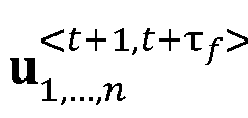

- The historic states s <t-τ
p ,t> are integrated along time interval [t -τ p , t] by a so-calledaugmented memory component 4. s <t-τp ,t> and a set of referencetrajectories 
deep networks 2. Thedeep networks 2 act as nonlinear function approximators for the automatic estimation of the desired futurestates 

- The future desired
states 
predictive controllers 3 for calculating future control actions. The output of an optimization iteration within multi-agent deep learning-based nonlinear model predictive control is a sequence of control actions for all agents An:

underlying motion controllers 5 of the agents An at the next time step, respectively. - Over the course of the last couple of years, deep learning has been established as the main technology behind many innovations, showing significant improvements in computer vision, robotics and natural language processing. Among the deep learning techniques, recurrent neural networks are especially good in processing temporal sequence data, such as text or video streams. Different from conventional neural networks, a recurrent neural network contains a time dependent feedback loop in its memory cell. Given a time dependent input sequence [ s <t-τ
p >,..., s <t>] and an output sequence [z <t-1>,...,z <t+τf >], a recurrent neural network can be unfolded τ p + τ f times to generate a loop-less network architecture matching the input length, as illustrated inFig. 3 . In the figure,Fig. 3a ) shows a folded recurrent neural network, whereasFig. 3b ) shows the corresponding unfolded recurrent neural network. t represents a temporal index, while τ ρ and τ f are the lengths of the input and output sequences, respectively. Over time t, both the input s <t-τp ,t> and output z <t+1,t+τf > sequences share the same weights w <·>. An unfolded network thus has τρ + τ f + 1 identical layers, i.e. each layer shares the same learned weights w <·>. Once unfolded, a recurrent neural network can be trained using the backpropagation through time algorithm. When compared to a conventional neural network, the only difference is that the learned weights in each unfolded copy of the network are averaged, thus enabling the network to share the same weights over time. - In the present implementation, a set of long short-term memory networks is used as non-linear function approximators for estimating temporal dependencies in dynamic system states sequences. As opposed to traditional recurrent neural networks, long short-term memories solve recurrent estimation by incorporating three gates, which control the input, output and memory state.
- A long short-term memory network Q is parametrized by Θ = [W i, U i , b i ], where W i represents the weights of the network's gates and memory cells multiplied with the input state, U i are the weights governing the activations, and b i denotes the set of neuron bias values.
- In a supervised learning setup, given a set of training sequences

f >, one can train the response of a long short-term memory network Q(·; Θ) using maximum likelihood estimation:
p ,t> = [s <t-τp >, ..., s <t-1>, s <t>] is composed of τ p consecutive data samples, l(·,·) is the logistic regression loss function, and t represents a temporal index. In the present document, a network output sequence is defined as a desired sate trajectory:

time t + 1. - In recurrent neural networks terminology, the optimization procedure in equation (13) is typically used for training "many-to-many" recurrent neural network architectures, where the input and output states are represented by temporal sequences of τ p and τ f data instances, respectively. This optimization problem is commonly solved using gradient based methods, like stochastic gradient descent (SGD), together with the backpropagation through time algorithm for calculating the network's gradients.
- Given a set of agents, a sequence of temporal dynamic environment states s <t-τ
p ,t>, and a set of referencetrajectories 

- The trajectory policy of agent i is encoded within the layers of the temporal
deep network 2 ofFig. 4 . The network receives as input RGB images

agents 
augmented memory 4, as well as the reference trajectory
- The RGB data is firstly processed by a set of convolutional filters, before its concatenation on top of the ultrasonic scan and trajectory state information. The predicted desired trajectory

neural network 8 and fed to a nonlinear modelpredictive controller 3 via an output layer 7 for calculating the optimal commands of the vehicle. - The
deep network 2 is trained based on the inverse reinforcement learning (IRL) principle. In classical reinforcement learning, an agent is taught actions through a cumulative reward, which describes how well the agent did performed its task, based on environment observations and its past actions. The goal here is to maximize the cumulative reward function. In inverse reinforcement learning the direction is reversed, meaning that the agent does not explicitly receive a reward for its actions. Instead, it tries to learn the reward function from expert demonstrations. - In the present work, trajectories acquired from manually driving the agents in the test environment are used as training examples. Within the layers of a temporal deep neural network an optimal action-value function

control actions 
trajectories 


- In the context of equation 15, a loss function is defined, which estimates how well the temporal deep network mimics given manual recorded trajectories, while penalizing the collision avoidance constraint in equation 9:

- The deep network's parameters are learned by minimizing the loss function of equation (16) in the maximum likelihood estimation setup of equation (13):

- The deep network of
Fig. 4 is trained only once and then applied for all agents. - On top of the temporal deep networks' predictions of future desired states, the cost function is defined to be optimized by the distributed nonlinear model predictive control in the discrete time interval [t + 1, t + τ o ] as:


- The objective of distributed nonlinear model predictive control is to find a set of control actions which optimize the agent's behavior over a given time horizon τ f , while satisfying a set of hard and/or soft constraints:

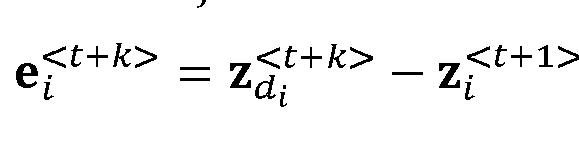


- Use is made of the quadratic cost function of equation (18) and the nonlinear optimization problem described above is solved using the Broyden-Fletcher-Goldfarb-Shanno algorithm [3]. The quadratic form allows applying the quasi-Newton optimization method, without the need to specify the Hessian matrix.
-
Fig. 5 schematically illustrates a method for training a temporal deep network according to the invention. In a first step, trajectories are acquired 10 from manually driving agents in a test environment. The temporal deep network is then trained 11 using inverse reinforcement learning based on the acquired trajectories. During training, parameters of the temporal deep network are preferably learned by minimizing a loss function in a maximum likelihood estimation setup. -
Fig. 6 schematically illustrates a block diagram of a first embodiment of anapparatus 20 for training a temporal deep network according to the invention. Theapparatus 20 has aninput 21 for receiving data, in particular trajectories acquired from manually driving agents in a test environment. Theapparatus 20 further has aprocessor 22, which is configured to train the temporal deep network using inverse reinforcement learning based on the acquired trajectories. During training, parameters of the temporal deep network are preferably learned by minimizing a loss function in a maximum likelihood estimation setup. Data generated by theprocessor 22 may be provided for further processing via anoutput 25. Alocal storage unit 24 is provided, e.g. for storing data during processing. Theoutput 25 may also be combined with theinput 21 into a single bidirectional interface. - The
processor 22 may be controlled by acontroller 23. Auser interface 26 may be provided for enabling a user to modify settings of theprocessor 22 or thecontroller 23. Theprocessor 22 and thecontroller 23 can be embodied as dedicated hardware units. Of course, they may likewise be fully or partially combined into a single unit or implemented as software running on a processor, e.g. a CPU or a GPU. - A block diagram of a second embodiment of an
apparatus 30 for training a temporal deep network according to the invention is illustrated inFig. 7 . Theapparatus 30 comprises aprocessing device 31 and amemory device 32. For example, theapparatus 30 may be a computer, a workstation or a distributed system. Thememory device 32 has stored instructions that, when executed by theprocessing device 31, cause theapparatus 30 to perform steps according to one of the described methods. The instructions stored in thememory device 32 thus tangibly embody a program of instructions executable by theprocessing device 31 to perform program steps as described herein according to the present principles. Theapparatus 30 has aninput 33 for receiving data. Data generated by theprocessing device 31 are made available via anoutput 34. In addition, such data may be stored in thememory device 32. Theinput 33 and theoutput 34 may be combined into a single bidirectional interface. - The
processing device 31 as used herein may include one or more processing units, such as microprocessors, digital signal processors, or a combination thereof. - The
local storage unit 24 and thememory device 32 may include volatile and/or non-volatile memory regions and storage devices such as hard disk drives, optical drives, and/or solid-state memories. -
- [1] M. Čáp et al.: "Multi-agent RRT*: Sampling-based cooperative pathfinding (extended abstract)", Proceedings of the 12th International Conference on Autonomous Agents and Multiagent Systems (AAMAS'13) (2013), https://arxiv.org/absZ1302.2828.
- [2] V. R. Desaraju et al.: "Decentralized path planning for multi-agent teams with complex constraints", Autonomous Robots, Vol. 32 (2012), pp. 385-403.
- [3] R. Fletcher: "Practical Methods of Optimization", 2nd ed., John Wiley & Sons, 1987.
Claims (13)
- A controller (1) for an agent (Ai) of a group of agents (An), the controller (1) comprising:- a temporal deep network (2) designed to calculate a desired trajectory for the agent (Ai);the controller (1) for the agent (Ai) further comprising:- a nonlinear model predictive controller (3) designed to calculate commands for the agent (Ai) based on the desired trajectory and desired trajectories of the other agents (An) of the group of agents (An); and- an augmented memory (4) designed to integrate historic system states of the group of agents (An) for the temporal deep network (2),wherein the nonlinear model predictive controller (3) is configured to take into account a collision avoidance constraint for each agent (An), andwherein the controller for the agent (Ai)(1) is configured to share the desired trajectory of the agent (Ai) and observations of the agent (Ai) with the other agents (An) of the group of agents (An), andwherein the temporal deep network (2) is designed to calculate a desired trajectory for the agent (Ai) based on historic observations of the agent (Ai), a reference trajectory for the agent (Ai), and historic states of all agents (An), andwherein the historic states are used to train the temporal deep network (2) of the agent (A i).
- The controller (1) for the Agent (Ai) according to claim 1, wherein the historic system states of the group of agents (An) comprise historic states and observations of the agents (An).
- The controller (1) for the Agent (Ai) according to claim 1 or 2, wherein the temporal deep network (2) comprises a long short-term memory recurrent neural network (8).
- A computer program code comprising instructions, which, when executed by at least one processor, cause the at least one processor to implement the controller (1) for the Agent (Ai) of any of claims 1 to 3.
- A temporal deep network (2) for a controller (1) according to any of claims 1 to 3 for an agent (Ai) of a group of agents (An), wherein the temporal deep network (2) is designed to calculate a desired trajectory for the agent (Ai) based on historic observations of the agent (Ai), a reference trajectory for the agent (Ai), and historic states of all agents (An).
- The temporal deep network (2) according to claim 5, wherein the temporal deep network (2) comprises a long short-term memory recurrent neural network (8).
- The temporal deep network (2) according to claim 5 or 6, wherein the temporal deep network (2) is trained based on inverse reinforcement learning.
- A computer program code comprising instructions, which, when executed by at least one processor, cause the at least one processor to implement the temporal deep network (2) of any of claims 5 to 7.
- A method for training a temporal deep network (2) of any of claims 5 to 7, the method comprising training (11) the temporal deep network (2) using inverse reinforcement learning based on trajectories acquired (10) from manually driving agents (An) in a test environment.
- The method according to claim 9, wherein parameters of the temporal deep network (2) are learned by minimizing a loss function in a maximum likelihood estimation setup.
- A computer program code comprising instructions, which, when executed by at least one processor, cause the at least one processor to perform the method of claim 9 or 10 for training a temporal deep network (2) of any of claims 5 to 7.
- An apparatus (30) for training a temporal deep network (2) of any of claims 5 to 7, the apparatus (30) comprising a processor (32) configured to train (11) the temporal deep network (2) using inverse reinforcement learning based on trajectories acquired (10) from manually driving agents (An) in a test environment.
- An autonomous or semi-autonomous vehicle, characterized in that the autonomous or semi-autonomous vehicle comprises a controller (1) according to any of claims 1 to 3.
Priority Applications (2)
| Application Number | Priority Date | Filing Date | Title |
|---|---|---|---|
| EP19465591.6A EP3832420B1 (en) | 2019-12-06 | 2019-12-06 | Deep learning based motion control of a group of autonomous vehicles |
| US17/106,436 US12105513B2 (en) | 2019-12-06 | 2020-11-30 | Deep learning based motion control of a group of autonomous vehicles |
Applications Claiming Priority (1)
| Application Number | Priority Date | Filing Date | Title |
|---|---|---|---|
| EP19465591.6A EP3832420B1 (en) | 2019-12-06 | 2019-12-06 | Deep learning based motion control of a group of autonomous vehicles |
Publications (2)
| Publication Number | Publication Date |
|---|---|
| EP3832420A1 EP3832420A1 (en) | 2021-06-09 |
| EP3832420B1 true EP3832420B1 (en) | 2024-02-07 |
Family
ID=68916467
Family Applications (1)
| Application Number | Title | Priority Date | Filing Date |
|---|---|---|---|
| EP19465591.6A Active EP3832420B1 (en) | 2019-12-06 | 2019-12-06 | Deep learning based motion control of a group of autonomous vehicles |
Country Status (2)
| Country | Link |
|---|---|
| US (1) | US12105513B2 (en) |
| EP (1) | EP3832420B1 (en) |
Families Citing this family (25)
| Publication number | Priority date | Publication date | Assignee | Title |
|---|---|---|---|---|
| CL2021002230A1 (en) * | 2020-08-27 | 2022-04-18 | Tech Resources Pty Ltd | Method and Apparatus for Coordinating Multiple Cooperative Vehicle Paths on Shared Highway Networks |
| US11927967B2 (en) * | 2020-08-31 | 2024-03-12 | Woven By Toyota, U.S., Inc. | Using machine learning models for generating human-like trajectories |
| CN113359771B (en) * | 2021-07-06 | 2022-09-30 | 贵州大学 | An intelligent automatic driving control method based on reinforcement learning |
| CN113353102B (en) * | 2021-07-08 | 2022-11-25 | 重庆大学 | Unprotected left-turn driving control method based on deep reinforcement learning |
| CN114355770B (en) * | 2021-11-30 | 2024-09-27 | 浙江大学 | Hypersonic vehicle reentry controller with optimized invasive weed population distribution |
| CN114594793B (en) * | 2022-03-07 | 2023-04-25 | 四川大学 | Route planning method of base station unmanned aerial vehicle |
| US20220236736A1 (en) * | 2022-04-02 | 2022-07-28 | Intel Corporation | Decentralized trajectory planning for multi-agent coordination |
| KR102445049B1 (en) * | 2022-04-15 | 2022-09-21 | 국방과학연구소 | Model predictive control method and model predictive control system for single neural network estimation autonomous vehicle |
| CN114889644B (en) * | 2022-05-07 | 2024-04-16 | 华南理工大学 | Decision-making system and method for driverless cars in complex scenarios |
| CN115027499B (en) * | 2022-06-24 | 2025-03-07 | 吉林大学 | Predictive control method for vehicle automatic driving based on dynamic neural network Hammerstein model |
| DE102022118901B3 (en) | 2022-07-28 | 2023-08-03 | Dr. Ing. H.C. F. Porsche Aktiengesellschaft | Control device for controlling a dynamic, moving system |
| JP2024044207A (en) * | 2022-09-20 | 2024-04-02 | オムロン株式会社 | Agent control device, learning device, agent control method, learning method, agent control program, and learning program |
| US12296857B2 (en) * | 2022-10-14 | 2025-05-13 | Motional Ad Llc | Path-based trajectory prediction |
| CN116069023B (en) * | 2022-12-20 | 2024-02-23 | 南京航空航天大学 | A multi-unmanned vehicle formation control method and system based on deep reinforcement learning |
| CN116047908B (en) * | 2023-01-16 | 2023-10-13 | 齐齐哈尔大学 | Mixed-order heterogeneous multi-intelligent system collaborative optimal formation control method and equipment |
| CN116068900B (en) * | 2023-03-16 | 2025-07-04 | 福州大学 | Reinforcement learning behavior control method for mobile robots with multiple nonholonomic constraints |
| CN116382077B (en) * | 2023-03-28 | 2023-11-07 | 燕山大学 | Design method of non-complete constraint wheel type robot fixed time controller |
| CN116578636B (en) * | 2023-05-15 | 2023-12-15 | 北京大学 | Distributed multi-agent cooperation method, system, medium and equipment |
| CN117163050B (en) * | 2023-10-11 | 2024-03-22 | 成都睿芯行科技有限公司 | Predictive control algorithm based on motion model |
| CN117434943B (en) * | 2023-10-17 | 2025-03-18 | 广州民航职业技术学院 | Path following controller for small vehicle and its implementation method |
| WO2025085139A1 (en) * | 2023-10-17 | 2025-04-24 | Latent Strategies LLC | Generating guidance data for agents using generative machine learning models |
| CN118885967B (en) * | 2024-07-18 | 2025-03-25 | 吉林大学 | A vehicle trajectory fusion prediction method based on deep learning and kinematic model |
| CN119105504B (en) * | 2024-09-19 | 2025-10-10 | 浙江大学 | A multi-mode predictive control method for unmanned surface vessels based on deep learning |
| CN119472657B (en) * | 2024-11-01 | 2025-11-28 | 西北工业大学 | Unmanned ship cluster collaborative tracking control method based on model predictive control and control law learning |
| CN120762273B (en) * | 2025-09-08 | 2025-11-14 | 青岛科技大学 | Distributed constraint optimization control method based on iterative learning control |
Family Cites Families (29)
| Publication number | Priority date | Publication date | Assignee | Title |
|---|---|---|---|---|
| US8364366B2 (en) * | 2005-06-24 | 2013-01-29 | Deere & Company | System and method for providing a safety zone associated with a vehicle |
| US9216745B2 (en) * | 2013-09-16 | 2015-12-22 | Disney Enterprises, Inc. | Shared control of semi-autonomous vehicles including collision avoidance in multi-agent scenarios |
| JP6391536B2 (en) * | 2015-06-12 | 2018-09-19 | 日立建機株式会社 | In-vehicle device, vehicle collision prevention method |
| US10402687B2 (en) * | 2017-07-05 | 2019-09-03 | Perceptive Automata, Inc. | System and method of predicting human interaction with vehicles |
| US20200174490A1 (en) * | 2017-07-27 | 2020-06-04 | Waymo Llc | Neural networks for vehicle trajectory planning |
| US10678241B2 (en) * | 2017-09-06 | 2020-06-09 | GM Global Technology Operations LLC | Unsupervised learning agents for autonomous driving applications |
| US10254759B1 (en) * | 2017-09-14 | 2019-04-09 | Waymo Llc | Interactive autonomous vehicle agent |
| US11216748B2 (en) * | 2018-06-11 | 2022-01-04 | Traxen, Inc. | Predictive control techniques for ground vehicles |
| US10671077B2 (en) * | 2018-04-17 | 2020-06-02 | Toyota Research Institute, Inc. | System and method for full-stack verification of autonomous agents |
| US20190332109A1 (en) * | 2018-04-27 | 2019-10-31 | GM Global Technology Operations LLC | Systems and methods for autonomous driving using neural network-based driver learning on tokenized sensor inputs |
| US20190354836A1 (en) * | 2018-05-17 | 2019-11-21 | International Business Machines Corporation | Dynamic discovery of dependencies among time series data using neural networks |
| US11256964B2 (en) * | 2018-10-11 | 2022-02-22 | Qualcomm Incorporated | Recursive multi-fidelity behavior prediction |
| US20190061771A1 (en) * | 2018-10-29 | 2019-02-28 | GM Global Technology Operations LLC | Systems and methods for predicting sensor information |
| US10940863B2 (en) * | 2018-11-01 | 2021-03-09 | GM Global Technology Operations LLC | Spatial and temporal attention-based deep reinforcement learning of hierarchical lane-change policies for controlling an autonomous vehicle |
| US11667301B2 (en) * | 2018-12-10 | 2023-06-06 | Perceptive Automata, Inc. | Symbolic modeling and simulation of non-stationary traffic objects for testing and development of autonomous vehicle systems |
| EP3706034A1 (en) * | 2019-03-06 | 2020-09-09 | Robert Bosch GmbH | Movement prediction of pedestrians useful for autonomous driving |
| DE112020001663T5 (en) * | 2019-03-29 | 2022-03-24 | Intel Corporation | Autonomous Vehicle System |
| US20200363800A1 (en) * | 2019-05-13 | 2020-11-19 | Great Wall Motor Company Limited | Decision Making Methods and Systems for Automated Vehicle |
| US12026624B2 (en) * | 2019-05-23 | 2024-07-02 | Cognizant Technology Solutions U.S. Corporation | System and method for loss function metalearning for faster, more accurate training, and smaller datasets |
| US11131993B2 (en) * | 2019-05-29 | 2021-09-28 | Argo AI, LLC | Methods and systems for trajectory forecasting with recurrent neural networks using inertial behavioral rollout |
| EP3977226B1 (en) * | 2019-06-03 | 2025-08-06 | Realtime Robotics, Inc. | Apparatus and method to facilitate motion planning in environments having dynamic obstacles |
| US11232296B2 (en) * | 2019-07-10 | 2022-01-25 | Hrl Laboratories, Llc | Action classification using deep embedded clustering |
| US20210089867A1 (en) * | 2019-09-24 | 2021-03-25 | Nvidia Corporation | Dual recurrent neural network architecture for modeling long-term dependencies in sequential data |
| EP4254122A3 (en) * | 2019-10-01 | 2024-02-14 | Elektrobit Automotive GmbH | Deep learning based motion control of a vehicle |
| CN114514758A (en) * | 2019-11-04 | 2022-05-17 | 英特尔公司 | Manoeuvring Coordination Services in Vehicle Networks |
| US11884302B2 (en) * | 2019-11-15 | 2024-01-30 | Massachusetts Institute Of Technology | Social behavior for autonomous vehicles |
| US11407431B2 (en) * | 2019-11-22 | 2022-08-09 | Samsung Electronics Co., Ltd. | System and method for object trajectory prediction in an autonomous scenario |
| US11579575B2 (en) * | 2019-12-03 | 2023-02-14 | Baidu Usa Llc | Inverse reinforcement learning with model predictive control |
| US20200324794A1 (en) * | 2020-06-25 | 2020-10-15 | Intel Corporation | Technology to apply driving norms for automated vehicle behavior prediction |
-
2019
- 2019-12-06 EP EP19465591.6A patent/EP3832420B1/en active Active
-
2020
- 2020-11-30 US US17/106,436 patent/US12105513B2/en active Active
Also Published As
| Publication number | Publication date |
|---|---|
| US20210171024A1 (en) | 2021-06-10 |
| US12105513B2 (en) | 2024-10-01 |
| EP3832420A1 (en) | 2021-06-09 |
Similar Documents
| Publication | Publication Date | Title |
|---|---|---|
| EP3832420B1 (en) | Deep learning based motion control of a group of autonomous vehicles | |
| Chiang et al. | RL-RRT: Kinodynamic motion planning via learning reachability estimators from RL policies | |
| EP3800521B1 (en) | Deep learning based motion control of a vehicle | |
| Liu et al. | A lifelong learning approach to mobile robot navigation | |
| Grigorescu et al. | Neurotrajectory: A neuroevolutionary approach to local state trajectory learning for autonomous vehicles | |
| Chiang et al. | Learning navigation behaviors end-to-end with autorl | |
| Pfeiffer et al. | Reinforced imitation: Sample efficient deep reinforcement learning for mapless navigation by leveraging prior demonstrations | |
| Zhang et al. | Cat: Closed-loop adversarial training for safe end-to-end driving | |
| Ramezani et al. | UAV path planning employing MPC-reinforcement learning method considering collision avoidance | |
| CN112162555A (en) | Vehicle control method based on reinforcement learning control strategy in mixed fleet | |
| CN113671942B (en) | Equipment and methods for controlling robots | |
| Botteghi et al. | On reward shaping for mobile robot navigation: A reinforcement learning and SLAM based approach | |
| Lee et al. | Adaptive and explainable deployment of navigation skills via hierarchical deep reinforcement learning | |
| US12579442B2 (en) | Training of a convolutional neural network | |
| US20210398014A1 (en) | Reinforcement learning based control of imitative policies for autonomous driving | |
| EP3955080B1 (en) | Method and device for socially aware model predictive control of a robotic device using machine learning | |
| Mohamed et al. | Gp-guided mppi for efficient navigation in complex unknown cluttered environments | |
| Fan et al. | Learning resilient behaviors for navigation under uncertainty | |
| Mitchell et al. | Multi-vehicle mixed-reality reinforcement learning for autonomous multi-lane driving | |
| Francis et al. | Stochastic functional gradient for motion planning in continuous occupancy maps | |
| Matsuzaki et al. | Dynamic window approach with human imitating collision avoidance | |
| Sun et al. | Attention-based value classification reinforcement learning for collision-free robot navigation | |
| Le et al. | Combining Graph Attention Networks and Distributed Optimization for Multi-Robot Mixed-Integer Convex Programming | |
| Lee et al. | Bayesian residual policy optimization:: Scalable bayesian reinforcement learning with clairvoyant experts | |
| Huy et al. | A practical and optimal path planning for autonomous parking using fast marching algorithm and support vector machine |
Legal Events
| Date | Code | Title | Description |
|---|---|---|---|
| PUAI | Public reference made under article 153(3) epc to a published international application that has entered the european phase |
Free format text: ORIGINAL CODE: 0009012 |
|
| STAA | Information on the status of an ep patent application or granted ep patent |
Free format text: STATUS: THE APPLICATION HAS BEEN PUBLISHED |
|
| AK | Designated contracting states |
Kind code of ref document: A1 Designated state(s): AL AT BE BG CH CY CZ DE DK EE ES FI FR GB GR HR HU IE IS IT LI LT LU LV MC MK MT NL NO PL PT RO RS SE SI SK SM TR |
|
| STAA | Information on the status of an ep patent application or granted ep patent |
Free format text: STATUS: REQUEST FOR EXAMINATION WAS MADE |
|
| 17P | Request for examination filed |
Effective date: 20211209 |
|
| RBV | Designated contracting states (corrected) |
Designated state(s): AL AT BE BG CH CY CZ DE DK EE ES FI FR GB GR HR HU IE IS IT LI LT LU LV MC MK MT NL NO PL PT RO RS SE SI SK SM TR |
|
| STAA | Information on the status of an ep patent application or granted ep patent |
Free format text: STATUS: EXAMINATION IS IN PROGRESS |
|
| 17Q | First examination report despatched |
Effective date: 20220914 |
|
| RIC1 | Information provided on ipc code assigned before grant |
Ipc: G06N 3/044 20230101ALI20230711BHEP Ipc: G06N 3/084 20230101ALI20230711BHEP Ipc: G06N 3/006 20230101ALI20230711BHEP Ipc: G05D 1/02 20200101AFI20230711BHEP |
|
| GRAP | Despatch of communication of intention to grant a patent |
Free format text: ORIGINAL CODE: EPIDOSNIGR1 |
|
| STAA | Information on the status of an ep patent application or granted ep patent |
Free format text: STATUS: GRANT OF PATENT IS INTENDED |
|
| INTG | Intention to grant announced |
Effective date: 20230920 |
|
| GRAS | Grant fee paid |
Free format text: ORIGINAL CODE: EPIDOSNIGR3 |
|
| P01 | Opt-out of the competence of the unified patent court (upc) registered |
Effective date: 20231018 |
|
| GRAA | (expected) grant |
Free format text: ORIGINAL CODE: 0009210 |
|
| STAA | Information on the status of an ep patent application or granted ep patent |
Free format text: STATUS: THE PATENT HAS BEEN GRANTED |
|
| AK | Designated contracting states |
Kind code of ref document: B1 Designated state(s): AL AT BE BG CH CY CZ DE DK EE ES FI FR GB GR HR HU IE IS IT LI LT LU LV MC MK MT NL NO PL PT RO RS SE SI SK SM TR |
|
| REG | Reference to a national code |
Ref country code: GB Ref legal event code: FG4D |
|
| REG | Reference to a national code |
Ref country code: CH Ref legal event code: EP |
|
| REG | Reference to a national code |
Ref country code: DE Ref legal event code: R096 Ref document number: 602019046146 Country of ref document: DE |
|
| REG | Reference to a national code |
Ref country code: IE Ref legal event code: FG4D |
|
| REG | Reference to a national code |
Ref country code: LT Ref legal event code: MG9D |
|
| REG | Reference to a national code |
Ref country code: NL Ref legal event code: MP Effective date: 20240207 |
|
| PG25 | Lapsed in a contracting state [announced via postgrant information from national office to epo] |
Ref country code: IS Free format text: LAPSE BECAUSE OF FAILURE TO SUBMIT A TRANSLATION OF THE DESCRIPTION OR TO PAY THE FEE WITHIN THE PRESCRIBED TIME-LIMIT Effective date: 20240607 |
|
| PG25 | Lapsed in a contracting state [announced via postgrant information from national office to epo] |
Ref country code: LT Free format text: LAPSE BECAUSE OF FAILURE TO SUBMIT A TRANSLATION OF THE DESCRIPTION OR TO PAY THE FEE WITHIN THE PRESCRIBED TIME-LIMIT Effective date: 20240207 |
|
| PG25 | Lapsed in a contracting state [announced via postgrant information from national office to epo] |
Ref country code: GR Free format text: LAPSE BECAUSE OF FAILURE TO SUBMIT A TRANSLATION OF THE DESCRIPTION OR TO PAY THE FEE WITHIN THE PRESCRIBED TIME-LIMIT Effective date: 20240508 |
|
| REG | Reference to a national code |
Ref country code: AT Ref legal event code: MK05 Ref document number: 1655775 Country of ref document: AT Kind code of ref document: T Effective date: 20240207 |
|
| PG25 | Lapsed in a contracting state [announced via postgrant information from national office to epo] |
Ref country code: RS Free format text: LAPSE BECAUSE OF FAILURE TO SUBMIT A TRANSLATION OF THE DESCRIPTION OR TO PAY THE FEE WITHIN THE PRESCRIBED TIME-LIMIT Effective date: 20240507 Ref country code: NL Free format text: LAPSE BECAUSE OF FAILURE TO SUBMIT A TRANSLATION OF THE DESCRIPTION OR TO PAY THE FEE WITHIN THE PRESCRIBED TIME-LIMIT Effective date: 20240207 Ref country code: HR Free format text: LAPSE BECAUSE OF FAILURE TO SUBMIT A TRANSLATION OF THE DESCRIPTION OR TO PAY THE FEE WITHIN THE PRESCRIBED TIME-LIMIT Effective date: 20240207 |
|
| PG25 | Lapsed in a contracting state [announced via postgrant information from national office to epo] |
Ref country code: ES Free format text: LAPSE BECAUSE OF FAILURE TO SUBMIT A TRANSLATION OF THE DESCRIPTION OR TO PAY THE FEE WITHIN THE PRESCRIBED TIME-LIMIT Effective date: 20240207 |
|
| PG25 | Lapsed in a contracting state [announced via postgrant information from national office to epo] |
Ref country code: AT Free format text: LAPSE BECAUSE OF FAILURE TO SUBMIT A TRANSLATION OF THE DESCRIPTION OR TO PAY THE FEE WITHIN THE PRESCRIBED TIME-LIMIT Effective date: 20240207 |
|
| PG25 | Lapsed in a contracting state [announced via postgrant information from national office to epo] |
Ref country code: RS Free format text: LAPSE BECAUSE OF FAILURE TO SUBMIT A TRANSLATION OF THE DESCRIPTION OR TO PAY THE FEE WITHIN THE PRESCRIBED TIME-LIMIT Effective date: 20240507 Ref country code: NO Free format text: LAPSE BECAUSE OF FAILURE TO SUBMIT A TRANSLATION OF THE DESCRIPTION OR TO PAY THE FEE WITHIN THE PRESCRIBED TIME-LIMIT Effective date: 20240507 Ref country code: NL Free format text: LAPSE BECAUSE OF FAILURE TO SUBMIT A TRANSLATION OF THE DESCRIPTION OR TO PAY THE FEE WITHIN THE PRESCRIBED TIME-LIMIT Effective date: 20240207 Ref country code: LT Free format text: LAPSE BECAUSE OF FAILURE TO SUBMIT A TRANSLATION OF THE DESCRIPTION OR TO PAY THE FEE WITHIN THE PRESCRIBED TIME-LIMIT Effective date: 20240207 Ref country code: IS Free format text: LAPSE BECAUSE OF FAILURE TO SUBMIT A TRANSLATION OF THE DESCRIPTION OR TO PAY THE FEE WITHIN THE PRESCRIBED TIME-LIMIT Effective date: 20240607 Ref country code: HR Free format text: LAPSE BECAUSE OF FAILURE TO SUBMIT A TRANSLATION OF THE DESCRIPTION OR TO PAY THE FEE WITHIN THE PRESCRIBED TIME-LIMIT Effective date: 20240207 Ref country code: GR Free format text: LAPSE BECAUSE OF FAILURE TO SUBMIT A TRANSLATION OF THE DESCRIPTION OR TO PAY THE FEE WITHIN THE PRESCRIBED TIME-LIMIT Effective date: 20240508 Ref country code: FI Free format text: LAPSE BECAUSE OF FAILURE TO SUBMIT A TRANSLATION OF THE DESCRIPTION OR TO PAY THE FEE WITHIN THE PRESCRIBED TIME-LIMIT Effective date: 20240207 Ref country code: ES Free format text: LAPSE BECAUSE OF FAILURE TO SUBMIT A TRANSLATION OF THE DESCRIPTION OR TO PAY THE FEE WITHIN THE PRESCRIBED TIME-LIMIT Effective date: 20240207 Ref country code: BG Free format text: LAPSE BECAUSE OF FAILURE TO SUBMIT A TRANSLATION OF THE DESCRIPTION OR TO PAY THE FEE WITHIN THE PRESCRIBED TIME-LIMIT Effective date: 20240207 Ref country code: AT Free format text: LAPSE BECAUSE OF FAILURE TO SUBMIT A TRANSLATION OF THE DESCRIPTION OR TO PAY THE FEE WITHIN THE PRESCRIBED TIME-LIMIT Effective date: 20240207 |
|
| PG25 | Lapsed in a contracting state [announced via postgrant information from national office to epo] |
Ref country code: PL Free format text: LAPSE BECAUSE OF FAILURE TO SUBMIT A TRANSLATION OF THE DESCRIPTION OR TO PAY THE FEE WITHIN THE PRESCRIBED TIME-LIMIT Effective date: 20240207 Ref country code: PT Free format text: LAPSE BECAUSE OF FAILURE TO SUBMIT A TRANSLATION OF THE DESCRIPTION OR TO PAY THE FEE WITHIN THE PRESCRIBED TIME-LIMIT Effective date: 20240607 |
|
| PG25 | Lapsed in a contracting state [announced via postgrant information from national office to epo] |
Ref country code: SE Free format text: LAPSE BECAUSE OF FAILURE TO SUBMIT A TRANSLATION OF THE DESCRIPTION OR TO PAY THE FEE WITHIN THE PRESCRIBED TIME-LIMIT Effective date: 20240207 Ref country code: PT Free format text: LAPSE BECAUSE OF FAILURE TO SUBMIT A TRANSLATION OF THE DESCRIPTION OR TO PAY THE FEE WITHIN THE PRESCRIBED TIME-LIMIT Effective date: 20240607 Ref country code: PL Free format text: LAPSE BECAUSE OF FAILURE TO SUBMIT A TRANSLATION OF THE DESCRIPTION OR TO PAY THE FEE WITHIN THE PRESCRIBED TIME-LIMIT Effective date: 20240207 Ref country code: LV Free format text: LAPSE BECAUSE OF FAILURE TO SUBMIT A TRANSLATION OF THE DESCRIPTION OR TO PAY THE FEE WITHIN THE PRESCRIBED TIME-LIMIT Effective date: 20240207 |
|
| PG25 | Lapsed in a contracting state [announced via postgrant information from national office to epo] |
Ref country code: DK Free format text: LAPSE BECAUSE OF FAILURE TO SUBMIT A TRANSLATION OF THE DESCRIPTION OR TO PAY THE FEE WITHIN THE PRESCRIBED TIME-LIMIT Effective date: 20240207 |
|
| PG25 | Lapsed in a contracting state [announced via postgrant information from national office to epo] |
Ref country code: SM Free format text: LAPSE BECAUSE OF FAILURE TO SUBMIT A TRANSLATION OF THE DESCRIPTION OR TO PAY THE FEE WITHIN THE PRESCRIBED TIME-LIMIT Effective date: 20240207 |
|
| PG25 | Lapsed in a contracting state [announced via postgrant information from national office to epo] |
Ref country code: CZ Free format text: LAPSE BECAUSE OF FAILURE TO SUBMIT A TRANSLATION OF THE DESCRIPTION OR TO PAY THE FEE WITHIN THE PRESCRIBED TIME-LIMIT Effective date: 20240207 Ref country code: EE Free format text: LAPSE BECAUSE OF FAILURE TO SUBMIT A TRANSLATION OF THE DESCRIPTION OR TO PAY THE FEE WITHIN THE PRESCRIBED TIME-LIMIT Effective date: 20240207 |
|
| PG25 | Lapsed in a contracting state [announced via postgrant information from national office to epo] |
Ref country code: SK Free format text: LAPSE BECAUSE OF FAILURE TO SUBMIT A TRANSLATION OF THE DESCRIPTION OR TO PAY THE FEE WITHIN THE PRESCRIBED TIME-LIMIT Effective date: 20240207 |
|
| PG25 | Lapsed in a contracting state [announced via postgrant information from national office to epo] |
Ref country code: SM Free format text: LAPSE BECAUSE OF FAILURE TO SUBMIT A TRANSLATION OF THE DESCRIPTION OR TO PAY THE FEE WITHIN THE PRESCRIBED TIME-LIMIT Effective date: 20240207 Ref country code: SK Free format text: LAPSE BECAUSE OF FAILURE TO SUBMIT A TRANSLATION OF THE DESCRIPTION OR TO PAY THE FEE WITHIN THE PRESCRIBED TIME-LIMIT Effective date: 20240207 Ref country code: RO Free format text: LAPSE BECAUSE OF FAILURE TO SUBMIT A TRANSLATION OF THE DESCRIPTION OR TO PAY THE FEE WITHIN THE PRESCRIBED TIME-LIMIT Effective date: 20240207 Ref country code: EE Free format text: LAPSE BECAUSE OF FAILURE TO SUBMIT A TRANSLATION OF THE DESCRIPTION OR TO PAY THE FEE WITHIN THE PRESCRIBED TIME-LIMIT Effective date: 20240207 Ref country code: DK Free format text: LAPSE BECAUSE OF FAILURE TO SUBMIT A TRANSLATION OF THE DESCRIPTION OR TO PAY THE FEE WITHIN THE PRESCRIBED TIME-LIMIT Effective date: 20240207 Ref country code: CZ Free format text: LAPSE BECAUSE OF FAILURE TO SUBMIT A TRANSLATION OF THE DESCRIPTION OR TO PAY THE FEE WITHIN THE PRESCRIBED TIME-LIMIT Effective date: 20240207 |
|
| REG | Reference to a national code |
Ref country code: DE Ref legal event code: R097 Ref document number: 602019046146 Country of ref document: DE |
|
| PG25 | Lapsed in a contracting state [announced via postgrant information from national office to epo] |
Ref country code: IT Free format text: LAPSE BECAUSE OF FAILURE TO SUBMIT A TRANSLATION OF THE DESCRIPTION OR TO PAY THE FEE WITHIN THE PRESCRIBED TIME-LIMIT Effective date: 20240207 |
|
| PLBE | No opposition filed within time limit |
Free format text: ORIGINAL CODE: 0009261 |
|
| STAA | Information on the status of an ep patent application or granted ep patent |
Free format text: STATUS: NO OPPOSITION FILED WITHIN TIME LIMIT |
|
| PG25 | Lapsed in a contracting state [announced via postgrant information from national office to epo] |
Ref country code: IT Free format text: LAPSE BECAUSE OF FAILURE TO SUBMIT A TRANSLATION OF THE DESCRIPTION OR TO PAY THE FEE WITHIN THE PRESCRIBED TIME-LIMIT Effective date: 20240207 |
|
| 26N | No opposition filed |
Effective date: 20241108 |
|
| PG25 | Lapsed in a contracting state [announced via postgrant information from national office to epo] |
Ref country code: SI Free format text: LAPSE BECAUSE OF FAILURE TO SUBMIT A TRANSLATION OF THE DESCRIPTION OR TO PAY THE FEE WITHIN THE PRESCRIBED TIME-LIMIT Effective date: 20240207 |
|
| PG25 | Lapsed in a contracting state [announced via postgrant information from national office to epo] |
Ref country code: MC Free format text: LAPSE BECAUSE OF FAILURE TO SUBMIT A TRANSLATION OF THE DESCRIPTION OR TO PAY THE FEE WITHIN THE PRESCRIBED TIME-LIMIT Effective date: 20240207 |
|
| REG | Reference to a national code |
Ref country code: CH Ref legal event code: PL |
|
| PG25 | Lapsed in a contracting state [announced via postgrant information from national office to epo] |
Ref country code: LU Free format text: LAPSE BECAUSE OF NON-PAYMENT OF DUE FEES Effective date: 20241206 |
|
| GBPC | Gb: european patent ceased through non-payment of renewal fee |
Effective date: 20241206 |
|
| REG | Reference to a national code |
Ref country code: BE Ref legal event code: MM Effective date: 20241231 |
|
| PG25 | Lapsed in a contracting state [announced via postgrant information from national office to epo] |
Ref country code: BE Free format text: LAPSE BECAUSE OF NON-PAYMENT OF DUE FEES Effective date: 20241231 Ref country code: GB Free format text: LAPSE BECAUSE OF NON-PAYMENT OF DUE FEES Effective date: 20241206 |
|
| PG25 | Lapsed in a contracting state [announced via postgrant information from national office to epo] |
Ref country code: CH Free format text: LAPSE BECAUSE OF NON-PAYMENT OF DUE FEES Effective date: 20241231 |
|
| PG25 | Lapsed in a contracting state [announced via postgrant information from national office to epo] |
Ref country code: IE Free format text: LAPSE BECAUSE OF NON-PAYMENT OF DUE FEES Effective date: 20241206 |
|
| PGFP | Annual fee paid to national office [announced via postgrant information from national office to epo] |
Ref country code: FR Payment date: 20251223 Year of fee payment: 7 |
|
| PG25 | Lapsed in a contracting state [announced via postgrant information from national office to epo] |
Ref country code: CY Free format text: LAPSE BECAUSE OF FAILURE TO SUBMIT A TRANSLATION OF THE DESCRIPTION OR TO PAY THE FEE WITHIN THE PRESCRIBED TIME-LIMIT; INVALID AB INITIO Effective date: 20191206 |
|
| PGFP | Annual fee paid to national office [announced via postgrant information from national office to epo] |
Ref country code: DE Payment date: 20251231 Year of fee payment: 7 |