EP3832262B1 - Methods and systems for determining an initial ego-pose for initialization of self-localization - Google Patents
Methods and systems for determining an initial ego-pose for initialization of self-localization Download PDFInfo
- Publication number
- EP3832262B1 EP3832262B1 EP19213740.4A EP19213740A EP3832262B1 EP 3832262 B1 EP3832262 B1 EP 3832262B1 EP 19213740 A EP19213740 A EP 19213740A EP 3832262 B1 EP3832262 B1 EP 3832262B1
- Authority
- EP
- European Patent Office
- Prior art keywords
- particles
- clusters
- implemented method
- cluster
- computer
- Prior art date
- Legal status (The legal status is an assumption and is not a legal conclusion. Google has not performed a legal analysis and makes no representation as to the accuracy of the status listed.)
- Active
Links
Images


Classifications
-
- G—PHYSICS
- G01—MEASURING; TESTING
- G01C—MEASURING DISTANCES, LEVELS OR BEARINGS; SURVEYING; NAVIGATION; GYROSCOPIC INSTRUMENTS; PHOTOGRAMMETRY OR VIDEOGRAMMETRY
- G01C21/00—Navigation; Navigational instruments not provided for in groups G01C1/00 - G01C19/00
- G01C21/26—Navigation; Navigational instruments not provided for in groups G01C1/00 - G01C19/00 specially adapted for navigation in a road network
- G01C21/28—Navigation; Navigational instruments not provided for in groups G01C1/00 - G01C19/00 specially adapted for navigation in a road network with correlation of data from several navigational instruments
- G01C21/30—Map- or contour-matching
-
- G—PHYSICS
- G01—MEASURING; TESTING
- G01S—RADIO DIRECTION-FINDING; RADIO NAVIGATION; DETERMINING DISTANCE OR VELOCITY BY USE OF RADIO WAVES; LOCATING OR PRESENCE-DETECTING BY USE OF THE REFLECTION OR RERADIATION OF RADIO WAVES; ANALOGOUS ARRANGEMENTS USING OTHER WAVES
- G01S13/00—Systems using the reflection or reradiation of radio waves, e.g. radar systems; Analogous systems using reflection or reradiation of waves whose nature or wavelength is irrelevant or unspecified
- G01S13/88—Radar or analogous systems specially adapted for specific applications
- G01S13/89—Radar or analogous systems specially adapted for specific applications for mapping or imaging
-
- G—PHYSICS
- G06—COMPUTING OR CALCULATING; COUNTING
- G06F—ELECTRIC DIGITAL DATA PROCESSING
- G06F18/00—Pattern recognition
- G06F18/20—Analysing
- G06F18/23—Clustering techniques
- G06F18/232—Non-hierarchical techniques
- G06F18/2321—Non-hierarchical techniques using statistics or function optimisation, e.g. modelling of probability density functions
-
- G—PHYSICS
- G01—MEASURING; TESTING
- G01C—MEASURING DISTANCES, LEVELS OR BEARINGS; SURVEYING; NAVIGATION; GYROSCOPIC INSTRUMENTS; PHOTOGRAMMETRY OR VIDEOGRAMMETRY
- G01C21/00—Navigation; Navigational instruments not provided for in groups G01C1/00 - G01C19/00
- G01C21/005—Navigation; Navigational instruments not provided for in groups G01C1/00 - G01C19/00 with correlation of navigation data from several sources, e.g. map or contour matching
-
- G—PHYSICS
- G01—MEASURING; TESTING
- G01C—MEASURING DISTANCES, LEVELS OR BEARINGS; SURVEYING; NAVIGATION; GYROSCOPIC INSTRUMENTS; PHOTOGRAMMETRY OR VIDEOGRAMMETRY
- G01C21/00—Navigation; Navigational instruments not provided for in groups G01C1/00 - G01C19/00
- G01C21/20—Instruments for performing navigational calculations
- G01C21/206—Instruments for performing navigational calculations specially adapted for indoor navigation
-
- G—PHYSICS
- G05—CONTROLLING; REGULATING
- G05D—SYSTEMS FOR CONTROLLING OR REGULATING NON-ELECTRIC VARIABLES
- G05D1/00—Control of position, course, altitude or attitude of land, water, air or space vehicles, e.g. using automatic pilots
- G05D1/02—Control of position or course in two dimensions
- G05D1/021—Control of position or course in two dimensions specially adapted to land vehicles
- G05D1/0231—Control of position or course in two dimensions specially adapted to land vehicles using optical position detecting means
- G05D1/0238—Control of position or course in two dimensions specially adapted to land vehicles using optical position detecting means using obstacle or wall sensors
- G05D1/024—Control of position or course in two dimensions specially adapted to land vehicles using optical position detecting means using obstacle or wall sensors in combination with a laser
-
- G—PHYSICS
- G05—CONTROLLING; REGULATING
- G05D—SYSTEMS FOR CONTROLLING OR REGULATING NON-ELECTRIC VARIABLES
- G05D1/00—Control of position, course, altitude or attitude of land, water, air or space vehicles, e.g. using automatic pilots
- G05D1/02—Control of position or course in two dimensions
- G05D1/021—Control of position or course in two dimensions specially adapted to land vehicles
- G05D1/0268—Control of position or course in two dimensions specially adapted to land vehicles using internal positioning means
- G05D1/0274—Control of position or course in two dimensions specially adapted to land vehicles using internal positioning means using mapping information stored in a memory device
Definitions
- the present disclosure relates to methods and systems for determining an initial ego-pose for initialization of self-localization, for example of a vehicle.
- GNSS Global Navigation Satellite Systems
- SLAM simultaneous localization and mapping
- the self-localization problem may be classified into two main groups of local self-localization and global self-localization.
- a global self-localization may be performed. Assuming a known initial ego-pose results in a local self-localization. For example, if GNSS signals are not available, the initial pose must be determined using other means.
- the present disclosure provides a computer implemented method, a computer system, and a non-transitory computer readable medium according to the independent claims. Embodiments are given in the subclaims, the description and the drawings.
- the present disclosure is directed at a computer implemented method for determining an initial ego-pose for initialization of self-localization the method comprising the following steps performed (in other words: carried out) by computer hardware components: providing a plurality of particles in a map; grouping the particles in a plurality of clusters, each cluster comprising a respective subset of the plurality of particles; during particle filtering, injecting particles (systematically) based on the plurality of clusters; and determining an initial ego-pose based on the particle filtering.
- particles may be (systematically) injected based on cluster tracking in the case of filter divergence.
- the computer implemented method further comprises the following step carried out by the computer hardware components: determining a mean value and a variance of the respective locations of the respective subject of particles for each of the clusters.
- tracking the mean value and the variance of each cluster provides for efficient data management, while keeping the processing effort low.
- information about the location (or area) of each cluster may be tracked efficiently. This may be even true for situations where the particles of the cluster are not present anymore, and where particle injection is necessary.
- the updated mean value and variance information is available about where the cluster would be, as if the particles would still be present, and thus, this information may be used for particle injection.
- Injecting particles based on the plurality of clusters comprises injecting the particles based on the respective mean value and the respective variance. For example, for each cluster, the particles may be injected at a location where the cluster would be according to the updated mean value of the cluster and the updated variance of the cluster, even if the particles of the cluster are no longer present.
- the computer implemented method further comprises the following step carried out by the computer hardware components: updating the respective mean value for each of the clusters based on a motion model.
- the motion of the vehicle may be used to update the location of the cluster, which may be represented by updating the mean value of the cluster (in other words: the center of gravity of the cluster).
- the computer implemented method further comprises the following step carried out by the computer hardware components: updating the respective variance for each of the clusters based on an uncertainty propagation law with respect to the ego-pose uncertainty.
- the variance for each of the clusters may increase over time (which may correspond to an increased area of the cluster), which may represent the uncertainty of the location.
- the plurality of particles are provided based on a random distribution over the map and/or based on an estimate of the ego-pose.
- a random distribution over the map may be provided. Otherwise, a distribution which is more focused on the estimate of the ego-pose may be used.
- performing the particle filtering comprises: sample distribution, prediction, updating, and re-sampling.
- predicting the particles a location of each of the particles in a next time step may be determined.
- updating the samples are weighted considering the map and sensor observation.
- re-sampling the locations of the particles may be represented by a suitable set of samples (in other words: particles) for the subsequent time step.
- the particles are grouped into the plurality of clusters based on a numbers of particles in a potential cluster. For example, clustering may be carried out repeatedly (or iteratively), until the number of particles in the potential clusters fulfils a pre-determined criterion, for example, until the number of particles in each of the clusters is above a pre-determined threshold (in other words: until each cluster includes at least a pre-determined number of particles).
- the particles are grouped into the plurality of clusters based on a numbers of potential clusters. For example, clustering may be carried out repeatedly (or iteratively), until the number of clusters fulfils a pre-determined criterion, for example, until the number of clusters is below a pre-determined threshold.
- the computer implemented method further comprises the following step carried out by the computer hardware components: exhausting a cluster if it is outside a region of interest. For example, if the cluster is outside the map, then it may be exhausted (in other words: the cluster may be deleted or removed from consideration). If a cluster is partially outside the region of interest, only the valid part of the cluster (in other words: the part of the cluster which is still inside the region of interest) may be used for particle injection.
- the computer implemented method further comprises the following steps carried out by the computer hardware components: receiving electromagnetic radiation emitted from at least one emitter of a sensor system of a vehicle and reflected in a vicinity of the vehicle towards the sensor system.
- the sensor system may include a radar sensor and/or a LiDAR sensor and/or an infrared sensor.
- the particle filtering is performed based on the received electromagnetic radiation and based on the map.
- estimates of the location may be obtained.
- the initial ego-position is determined based on entropy based monitoring based on a binary grid, wherein the particles are injected if an entropy change rate exceeds a predetermined threshold.
- the present disclosure is directed at a computer system, said computer system comprising a plurality of computer hardware components configured to carry out several or all steps of the computer implemented method described herein.
- the computer system can be part of a vehicle.
- the computer system may comprise a plurality of computer hardware components (for example a processing unit, at least one memory unit and at least one non-transitory data storage). It will be understood that further computer hardware components may be provided and used for carrying out steps of the computer implemented method in the computer system.
- the non-transitory data storage and/or the memory unit may comprise a computer program for instructing the computer to perform several or all steps or aspects of the computer implemented method described herein, for example using the processing unit and the at least one memory unit.
- the present disclosure is directed at vehicle equipped with a sensor system adapted to receive electromagnetic radiation emitted from at least one emitter of a sensor system and reflected in a vicinity of the vehicle towards the sensor system, and a computer system, for example a computer system as described above, for determining an initial ego-pose for initialization of self-localization of the vehicle.
- the present disclosure is directed at a non-transitory computer readable medium comprising instructions for carrying out several or all steps or aspects of the computer implemented method described herein.
- the computer readable medium may be configured as: an optical medium, such as a compact disc (CD) or a digital versatile disk (DVD); a magnetic medium, such as a hard disk drive (HDD); a solid state drive (SSD); a read only memory (ROM), such as a flash memory; or the like.
- the computer readable medium may be configured as a data storage that is accessible via a data connection, such as an internet connection.
- the computer readable medium may, for example, be an online data repository or a cloud storage.
- the present disclosure is also directed at a computer program for instructing a computer to perform several or all steps or aspects of the computer implemented method described herein.
- a map may be used for finding the initial pose of the vehicle, i.e., where the vehicle starts to move.
- the map may be an OpenStreetMap and/or an occupancy grid map.
- the map may include information on static objects, such as walls, pillars, trees, houses or guard rails.
- Information indicated by the map may be provided on a discrete grid (so that the map may also be referred to as a grid).
- Particle filtering may be used for finding the initial pose of the vehicle.
- a map may be input into the particle filter and then the filter may be initialized.
- the initialization process may be the distribution of the samples (in other words: particles) in the entire region, where the initial ego-pose is unknown. While theoretically the region could be the whole world, usually some coarse information about the initial ego-pose is available, such as "The vehicle is in a parking garage” or "The vehicle is in this area of the city”.
- samples may be distributed within the map of the area and particle filtering may be performed.
- Particle filtering may have the following steps: filter initialization (in other words: sample distribution), prediction, updating (in other words: weighting), and re-sampling, like will be described in more detail below.
- each particle may be predicted based on the vehicle movement information (for example yaw rate and velocity) and a vehicle model.
- each sample may be weighted based on a comparison between the sensor observation (for example radar, camera, or LiDAR) and the map. Due to this weighting, some samples may get a higher weight than the other samples.
- the domination of the particles with a higher weight to the other samples may lead to a problem, called "degeneracy".
- re-sampling may be performed which focuses the samples to the regions where the sample weights are higher, since the vehicle is more likely to be located in these regions.
- the particles are more concentrated in one region and the initial ego-pose is considered as found.
- the size of the recognized area can be defined by the user, for example the user can define an area of 5 m 2 for the initialization success. If all particles are concentrated in an area smaller or equal to that value, the filtering process for the initialization may be considered done.
- Some common problems, which may be faced during the filtering process are impoverishment (which refers to a fast and high concentration of the particles in a small region), degeneracy (which refers to a situation where the weights of many samples are close to zero, so that there is a large difference between sample weights), or filter divergence (which refers to a complete divergence of the filter, so that initialization fails).
- the source of particle divergence may be sparse and noisy measurements, for example in a case of using radars, when the observations are sparse.
- clustering of particles may be applied, which may overcome the divergence problem of the particle filtering in case of noisy and sparse measurements or inaccurate map.
- a binary grid may be provided over the entire region with a pre-determined resolution.
- a binary clustering may be performed for all particles in each sample time. Clusters which have a number of samples over a pre-determined threshold may be considered. All clusters may represent the map regions where the probability of the ego-pose is high according to the measurements until the clustering time.
- Fig. 1 shows an illustration 100 of particle clustering of a map 102 with particles according to various embodiments, and the generated clusters 106, 108, 110 for an example scene with several obstacles 112 (for example walls), so as to provide a clustered map 104.
- the particles of the map 102 may be clustered with a binary grid (for example with a resolution of 10 cm in x direction and 10 cm in y direction).
- the three clusters 106, 108, 110 may be generated after the clustering process.
- the particle filter may be monitored by its parameters such as effective sample size and entropy information.
- the clusters may be updated, for example by updating the Gaussian parameters representing the clusters.
- the particle filter is initialized, if the particles are concentrated in a certain area, for example 5 m 2 .
- the cluster may be used in case of particle injection only, and may not be used for any other part of the particle filtering.
- Fig. 2 shows an illustration 200 of a scenario of ego-pose initialization with particle filtering according to various embodiments in a parking lot with three generated clusters (denoted as “1", “2", and “3") as an example of the parallel filtering according to various embodiments.
- the samples are clustered in the middle-down figure.
- the symmetrical form of the initialization area for example in this scenario the parking lot, and accordingly the ambiguity of the observations in opposite side of the map presents a major challenge for the particle filtering.
- the symmetry leads to survival of the clusters within the re-sampling process.
- the effective sample size of the first cluster reduces continuously with time as it moves towards the map boundaries. Due to the affinity of the observations on two corners of the parking lot for the second cluster and the third cluster, their samples obtain almost alike weights within the clustering. With more dense measurements from the lower right corner of the map, an effective samples size increment is observed for the second cluster.
- the clusters may be used for cluster tracking of a particle filter for divergence avoidance using Gaussian parameters, for example mean value and variance (or standard deviation), like will be described in the following.
- Gaussian parameters for example mean value and variance (or standard deviation), like will be described in the following.
- injection methods based on different sensor system may be used, for example radars, LiDAR, camera or a combination of these sensors.
- systematic particle injection may be performed based on a clustering of the particles, in case of filter divergence.
- the number of clusters may have a threshold and if this threshold reaches a certain number, then the clusters are tracked in the following way.
- new samples may solely be injected in the areas related to the clusters (for example in an area with a width (or diameter) which is based on the variance, for example equal to the variance, around the mean value) to make the injection process efficient.
- cluster tracking based on their Gaussian distribution parameters may be carried out.
- the change rate of the entropy information is controlled to capture possible exceeding of the defined threshold. Significant changes appear not only by filter divergence but also after warm up process. By observing a considerable modification of ⁇ , the ⁇ and M eff are checked with respect to predefined thresholds.
- the entropy information reduces but an increment of M eff is detected. A filter divergence is likely to have occurred, if a significant reduction in ⁇ is monitored and M eff shifts away from M in addition to the falling of ⁇ below the threshold level. In such a case the particle deviate from the true belief which means a severe degeneracy and new particles are injected.
- the prerequisite of the injection is that the clustering is already performed, otherwise no injection will be performed. In such a case, clustering may be performed first, and then the injection may be carried out.
- each particle cluster is Gaussian distributed.
- the Gaussian distribution parameters (for example the mean value and the variance) of the clusters may be retained.
- the Gaussian distribution parameters may be predicted in each sample time using the vehicle model and the ego-pose covariance matrix.
- the variance of the cluster is enlarged with time due to the uncertainty of the ego-pose.
- the functionality of the particle filter may be monitored by the effective sample size and the entropy.
- the Gaussian clusters may be updated continuously. When recognizing a filter divergence, new particles are injected systematically solely into the clusters to recover the filter. In this way, the particle filter is not reset and the filter can be recovered with efficient particle injection.
- the update process of the clusters may be computationally efficient as solely two parameters per cluster may be updated in each sample time.
- Fig. 3 shows an illustration 300 of cluster tracking according to various embodiments.
- the left map 302 illustrates the particle clusters and their tracked route (indicated by white arrows) which is generated based on motion parameters and the vehicle model.
- the cluster variances (indicated by white circles in the right map 304) may be updated based on the ego-pose uncertaintiy with the error propagation principle.
- the updated cluster mean value (indicated by white dots) and variances (indicated by white circles) are shown.
- one or more (or all) of these updated clusters may be used for injecting new particles.
- this cluster is not used anymore for the injection. If this cluster is partly outside of the valid region, solely the valid part is filled with new injected particles.
- Fig. 4 shows an illustration 400, where particles are manually removed in order to analyze the method according to various embodiments. For testing purposes, a few sample times after clustering, the particles located in the correct vehicle ego-pose are eliminated manually. In this scenario, three clusters are generated and tracked for the potentially particle divergence.
- the monitoring filter parameters namely the effective sample size, entropy information and its change rate, are illustrated in Fig. 4 .
- Fig. 4 shows an illustration 400 of particle filter monitoring parameters according to various embodiments.
- a systematic injection is performed after recognition of filter divergence in the regions with high probability of the ego-pose, i.e., in the tracked clusters. After injection, parameters may be within the threshold bounds, possibly after deviations. Without a systematic injection and by resetting the filter, the time is increased by 100% to achieve the same sample distribution at the divergence time.
- Fig. 5 shows an illustration 500 of the injection process after recognizing the filter divergence into the tracked clusters according to various embodiments.
- the three levels of processing, including clustering 502, divergence recognition 504 and systematic particle injection 506 based on Gaussian parameters of the clusters are illustrated. It is to be noted that in the recognition stage 504, all particles of one cluster, which contains the true belief, are removed manually for demonstration purposes. In the particle injection stage 506, particles are injected at the location where the cluster is assumed to be (based on the updated mean value of the cluster and the updated variance of the cluster), even though the particles of the cluster are no longer present.
- Fig. 6 shows a flow diagram 600 illustrating a method for determining an initial ego-pose for initialization of self-localization according to various embodiments.
- a plurality of particles may be provided in a map.
- the particles may be grouped in a plurality of clusters, each cluster comprising a respective subset of the plurality of particles.
- cluster tracking may be performed, for example by updating the respective Gaussian parameters (like mean value and variance) of each of the clusters.
- particles may be injected based on the plurality of clusters.
- an initial ego-pose may be determined based on the particle filtering.
- steps 602, 604, 606, 608 and the further steps described above may be performed by computer hardware components.
Landscapes
- Engineering & Computer Science (AREA)
- Remote Sensing (AREA)
- Radar, Positioning & Navigation (AREA)
- Physics & Mathematics (AREA)
- General Physics & Mathematics (AREA)
- Automation & Control Theory (AREA)
- Data Mining & Analysis (AREA)
- Electromagnetism (AREA)
- Aviation & Aerospace Engineering (AREA)
- Theoretical Computer Science (AREA)
- Computer Networks & Wireless Communication (AREA)
- Artificial Intelligence (AREA)
- General Engineering & Computer Science (AREA)
- Evolutionary Computation (AREA)
- Evolutionary Biology (AREA)
- Computer Vision & Pattern Recognition (AREA)
- Bioinformatics & Computational Biology (AREA)
- Bioinformatics & Cheminformatics (AREA)
- Life Sciences & Earth Sciences (AREA)
- Probability & Statistics with Applications (AREA)
- Optics & Photonics (AREA)
- Traffic Control Systems (AREA)
- Image Analysis (AREA)
Description
- The present disclosure relates to methods and systems for determining an initial ego-pose for initialization of self-localization, for example of a vehicle.
- Self-localization is the most important part of many autonomous driving applications. There are various methods to solve the ego-localization problem such as using the Global Navigation Satellite Systems (GNSS), dead reckoning, or simultaneous localization and mapping (SLAM) methods.
- The self-localization problem may be classified into two main groups of local self-localization and global self-localization.
- If the initial ego-pose is unknown, then a global self-localization may be performed. Assuming a known initial ego-pose results in a local self-localization. For example, if GNSS signals are not available, the initial pose must be determined using other means.
- Accordingly, there is a need to provide efficient and reliable methods for determining the initial pose of a vehicle, even when GNSS signals are not available.
- Guanghui Cen et al., "Service robot localization using improved Particle filter", IEEE International Conference on Automation and Logistics, 2008, ISBN 978-1-4244-2502-0, pages 2454 - 2459, discloses application of a particle filter in position tracking and global localization.
- Zhibin Liu et al., "Mobile robots global localization using adaptive dynamic clustered particle filters", IEEE/RSJ International Conference on Intelligent Robots and Systems, 2007. doi:10.1109/IROS.2007.4399050, ISBN 978-1-4244-0911-2, pages 1059 - 1064, discloses using a set of clusters of particles to represent posterior distribution of a robot pose.
- Adam Milstein et al. AL, "Robust global localization using clustered particle filtering", Eighteenth National Conference on Artificial Intelligence, 2002, ISBN 978-0-262-51129-2, pages 581 - 586, discloses incorporating the idea of clusters of samples and modifying a proposal distribution considering the probability mass of those clusters.
- The present disclosure provides a computer implemented method, a computer system, and a non-transitory computer readable medium according to the independent claims. Embodiments are given in the subclaims, the description and the drawings.
- In one aspect, the present disclosure is directed at a computer implemented method for determining an initial ego-pose for initialization of self-localization the method comprising the following steps performed (in other words: carried out) by computer hardware components: providing a plurality of particles in a map; grouping the particles in a plurality of clusters, each cluster comprising a respective subset of the plurality of particles; during particle filtering, injecting particles (systematically) based on the plurality of clusters; and determining an initial ego-pose based on the particle filtering.
- In other words, particles may be (systematically) injected based on cluster tracking in the case of filter divergence.
- The computer implemented method further comprises the following step carried out by the computer hardware components: determining a mean value and a variance of the respective locations of the respective subject of particles for each of the clusters.
- It has been found that tracking the mean value and the variance of each cluster provides for efficient data management, while keeping the processing effort low. With updating the mean value and the variance, information about the location (or area) of each cluster may be tracked efficiently. This may be even true for situations where the particles of the cluster are not present anymore, and where particle injection is necessary. With the updated mean value and variance, information is available about where the cluster would be, as if the particles would still be present, and thus, this information may be used for particle injection.
- Injecting particles based on the plurality of clusters comprises injecting the particles based on the respective mean value and the respective variance. For example, for each cluster, the particles may be injected at a location where the cluster would be according to the updated mean value of the cluster and the updated variance of the cluster, even if the particles of the cluster are no longer present.
- According to another aspect, the computer implemented method further comprises the following step carried out by the computer hardware components: updating the respective mean value for each of the clusters based on a motion model.
- By using a motion model, for example of the vehicle for which self-localization is to be carried out, the motion of the vehicle may be used to update the location of the cluster, which may be represented by updating the mean value of the cluster (in other words: the center of gravity of the cluster).
- According to another aspect, the computer implemented method further comprises the following step carried out by the computer hardware components: updating the respective variance for each of the clusters based on an uncertainty propagation law with respect to the ego-pose uncertainty.
- By updating the respective variance for each of the clusters, the variance for each of the clusters may increase over time (which may correspond to an increased area of the cluster), which may represent the uncertainty of the location. According to another aspect, the plurality of particles are provided based on a random distribution over the map and/or based on an estimate of the ego-pose.
- If no information is available for the ego-pose, then a random distribution over the map may be provided. Otherwise, a distribution which is more focused on the estimate of the ego-pose may be used.
- According to another aspect, performing the particle filtering comprises: sample distribution, prediction, updating, and re-sampling. By predicting the particles, a location of each of the particles in a next time step may be determined. By updating, the samples are weighted considering the map and sensor observation. By re-sampling, the locations of the particles may be represented by a suitable set of samples (in other words: particles) for the subsequent time step.
- According to another aspect, the particles are grouped into the plurality of clusters based on a numbers of particles in a potential cluster. For example, clustering may be carried out repeatedly (or iteratively), until the number of particles in the potential clusters fulfils a pre-determined criterion, for example, until the number of particles in each of the clusters is above a pre-determined threshold (in other words: until each cluster includes at least a pre-determined number of particles).
- According to another aspect, the particles are grouped into the plurality of clusters based on a numbers of potential clusters. For example, clustering may be carried out repeatedly (or iteratively), until the number of clusters fulfils a pre-determined criterion, for example, until the number of clusters is below a pre-determined threshold.
- According to another aspect, the computer implemented method further comprises the following step carried out by the computer hardware components: exhausting a cluster if it is outside a region of interest. For example, if the cluster is outside the map, then it may be exhausted (in other words: the cluster may be deleted or removed from consideration). If a cluster is partially outside the region of interest, only the valid part of the cluster (in other words: the part of the cluster which is still inside the region of interest) may be used for particle injection.
- According to another aspect, the computer implemented method further comprises the following steps carried out by the computer hardware components: receiving electromagnetic radiation emitted from at least one emitter of a sensor system of a vehicle and reflected in a vicinity of the vehicle towards the sensor system. For example, the sensor system may include a radar sensor and/or a LiDAR sensor and/or an infrared sensor.
- According to another aspect, the particle filtering is performed based on the received electromagnetic radiation and based on the map. Illustratively, by performing the weighting (updating) process according to a comparison of the information, for example distance and/or angle information, obtained based on the electromagnetic radiation, with the information on static objects represented in the map, estimates of the location may be obtained.
- The initial ego-position is determined based on entropy based monitoring based on a binary grid, wherein the particles are injected if an entropy change rate exceeds a predetermined threshold.
- In another aspect, the present disclosure is directed at a computer system, said computer system comprising a plurality of computer hardware components configured to carry out several or all steps of the computer implemented method described herein. The computer system can be part of a vehicle.
- The computer system may comprise a plurality of computer hardware components (for example a processing unit, at least one memory unit and at least one non-transitory data storage). It will be understood that further computer hardware components may be provided and used for carrying out steps of the computer implemented method in the computer system. The non-transitory data storage and/or the memory unit may comprise a computer program for instructing the computer to perform several or all steps or aspects of the computer implemented method described herein, for example using the processing unit and the at least one memory unit.
- In another aspect, the present disclosure is directed at vehicle equipped with a sensor system adapted to receive electromagnetic radiation emitted from at least one emitter of a sensor system and reflected in a vicinity of the vehicle towards the sensor system, and a computer system, for example a computer system as described above, for determining an initial ego-pose for initialization of self-localization of the vehicle.
- In another aspect, the present disclosure is directed at a non-transitory computer readable medium comprising instructions for carrying out several or all steps or aspects of the computer implemented method described herein. The computer readable medium may be configured as: an optical medium, such as a compact disc (CD) or a digital versatile disk (DVD); a magnetic medium, such as a hard disk drive (HDD); a solid state drive (SSD); a read only memory (ROM), such as a flash memory; or the like. Furthermore, the computer readable medium may be configured as a data storage that is accessible via a data connection, such as an internet connection. The computer readable medium may, for example, be an online data repository or a cloud storage.
- The present disclosure is also directed at a computer program for instructing a computer to perform several or all steps or aspects of the computer implemented method described herein.
- Exemplary embodiments and functions of the present disclosure are described herein in conjunction with the following drawings, showing schematically:
- Fig. 1
- an illustration of particle clustering of a map with particles according to various embodiments;
- Fig. 2
- an illustration of a scenario of ego-pose initialization with particle filtering according to various embodiments in a parking lot with three generated clusters as an example of the parallel filtering according to various embodiments;
- Fig. 3
- an illustration of cluster tracking according to various embodiments;
- Fig. 4
- an illustration of particle filter monitoring parameters according to various embodiments;
- Fig. 5
- an illustration of the injection process after recognizing the filter divergence into the tracked clusters according to various embodiments; and
- Fig. 6
- a flow diagram illustrating a method for determining an initial egopose for initialization of self-localization according to various embodiments.
- According to various embodiments, a map may be used for finding the initial pose of the vehicle, i.e., where the vehicle starts to move. For example, the map may be an OpenStreetMap and/or an occupancy grid map. The map may include information on static objects, such as walls, pillars, trees, houses or guard rails.
- Information indicated by the map may be provided on a discrete grid (so that the map may also be referred to as a grid). Particle filtering may be used for finding the initial pose of the vehicle. A map may be input into the particle filter and then the filter may be initialized. The initialization process may be the distribution of the samples (in other words: particles) in the entire region, where the initial ego-pose is unknown. While theoretically the region could be the whole world, usually some coarse information about the initial ego-pose is available, such as "The vehicle is in a parking garage" or "The vehicle is in this area of the city".
- Based on this initial coarse information, samples may be distributed within the map of the area and particle filtering may be performed. Particle filtering may have the following steps: filter initialization (in other words: sample distribution), prediction, updating (in other words: weighting), and re-sampling, like will be described in more detail below.
- After initialization, the movement of each particle may be predicted based on the vehicle movement information (for example yaw rate and velocity) and a vehicle model. Based on the updated sample poses, each sample may be weighted based on a comparison between the sensor observation (for example radar, camera, or LiDAR) and the map. Due to this weighting, some samples may get a higher weight than the other samples. The domination of the particles with a higher weight to the other samples may lead to a problem, called "degeneracy". To avoid this problem, re-sampling may be performed which focuses the samples to the regions where the sample weights are higher, since the vehicle is more likely to be located in these regions. After some sample times, the particles are more concentrated in one region and the initial ego-pose is considered as found. The size of the recognized area can be defined by the user, for example the user can define an area of 5 m2 for the initialization success. If all particles are concentrated in an area smaller or equal to that value, the filtering process for the initialization may be considered done.
- However, some factors may lead to filtering problems or even filter divergence, which means that the filter converges to a wrong initial pose. Some common problems, which may be faced during the filtering process are impoverishment (which refers to a fast and high concentration of the particles in a small region), degeneracy (which refers to a situation where the weights of many samples are close to zero, so that there is a large difference between sample weights), or filter divergence (which refers to a complete divergence of the filter, so that initialization fails).
- The source of particle divergence may be sparse and noisy measurements, for example in a case of using radars, when the observations are sparse.
- For avoiding the particle filter divergence, strategies such as particle injection based on different sensor system may be used, for example based on radars, LiDAR, camera or a combination of these sensors. If the divergence is recognized, new particles are injected into the filter in the entire initialization area. However, this particle injection into the filter in the entire initialization area is considered a filter reset, which should be avoided.
- According to various embodiments, clustering of particles may be applied, which may overcome the divergence problem of the particle filtering in case of noisy and sparse measurements or inaccurate map. A binary grid may be provided over the entire region with a pre-determined resolution. A binary clustering may be performed for all particles in each sample time. Clusters which have a number of samples over a pre-determined threshold may be considered. All clusters may represent the map regions where the probability of the ego-pose is high according to the measurements until the clustering time.
-
Fig. 1 shows anillustration 100 of particle clustering of amap 102 with particles according to various embodiments, and the generatedclusters map 104. - The particles of the
map 102 may be clustered with a binary grid (for example with a resolution of 10 cm in x direction and 10 cm in y direction). The threeclusters - The particle filter may be monitored by its parameters such as effective sample size and entropy information. In parallel, the clusters may be updated, for example by updating the Gaussian parameters representing the clusters. The particle filter is initialized, if the particles are concentrated in a certain area, for example 5 m2. The cluster may be used in case of particle injection only, and may not be used for any other part of the particle filtering.
-
Fig. 2 shows anillustration 200 of a scenario of ego-pose initialization with particle filtering according to various embodiments in a parking lot with three generated clusters (denoted as "1", "2", and "3") as an example of the parallel filtering according to various embodiments. In the example shown inFig. 2 above, the samples are clustered in the middle-down figure. - The symmetrical form of the initialization area, for example in this scenario the parking lot, and accordingly the ambiguity of the observations in opposite side of the map presents a major challenge for the particle filtering. The symmetry leads to survival of the clusters within the re-sampling process. The effective sample size of the first cluster reduces continuously with time as it moves towards the map boundaries. Due to the affinity of the observations on two corners of the parking lot for the second cluster and the third cluster, their samples obtain almost alike weights within the clustering. With more dense measurements from the lower right corner of the map, an effective samples size increment is observed for the second cluster.
- In another embodiment, the clusters may be used for cluster tracking of a particle filter for divergence avoidance using Gaussian parameters, for example mean value and variance (or standard deviation), like will be described in the following.
- For recovering the filter after divergence, injection methods based on different sensor system may be used, for example radars, LiDAR, camera or a combination of these sensors.
- According to various embodiments, systematic particle injection may be performed based on a clustering of the particles, in case of filter divergence.
- The number of clusters may have a threshold and if this threshold reaches a certain number, then the clusters are tracked in the following way. In the case of filter divergence, new samples may solely be injected in the areas related to the clusters (for example in an area with a width (or diameter) which is based on the variance, for example equal to the variance, around the mean value) to make the injection process efficient.
- According to various embodiments, cluster tracking based on their Gaussian distribution parameters (for example mean value and variance) may be carried out.
- The change rate of the entropy information is controlled to capture possible exceeding of the defined threshold. Significant changes appear not only by filter divergence but also after warm up process. By observing a considerable modification of ε̇, the ε and Meff are checked with respect to predefined thresholds.
- The effective sample size and the entropy information must not fall below, k1·Meff and k2· ε max, respectively, with k1 and k2 as tuning parameters and
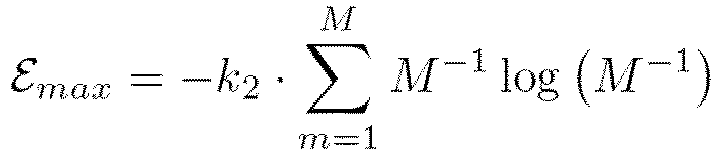
- The prerequisite of the injection is that the clustering is already performed, otherwise no injection will be performed. In such a case, clustering may be performed first, and then the injection may be carried out.
- According to various embodiments, it may be assumed that each particle cluster is Gaussian distributed. The Gaussian distribution parameters (for example the mean value and the variance) of the clusters may be retained. The Gaussian distribution parameters may be predicted in each sample time using the vehicle model and the ego-pose covariance matrix. Thus, the variance of the cluster is enlarged with time due to the uncertainty of the ego-pose. The functionality of the particle filter may be monitored by the effective sample size and the entropy. In parallel, the Gaussian clusters may be updated continuously. When recognizing a filter divergence, new particles are injected systematically solely into the clusters to recover the filter. In this way, the particle filter is not reset and the filter can be recovered with efficient particle injection.
- The update process of the clusters may be computationally efficient as solely two parameters per cluster may be updated in each sample time.
-
Fig. 3 shows anillustration 300 of cluster tracking according to various embodiments. Theleft map 302 illustrates the particle clusters and their tracked route (indicated by white arrows) which is generated based on motion parameters and the vehicle model. The cluster variances (indicated by white circles in the right map 304) may be updated based on the ego-pose uncertaintiy with the error propagation principle. In theright map 304, the updated cluster mean value (indicated by white dots) and variances (indicated by white circles) are shown. - In case of divergence, one or more (or all) of these updated clusters may be used for injecting new particles. In case that a cluster is completely outside of the valid region, this cluster is not used anymore for the injection. If this cluster is partly outside of the valid region, solely the valid part is filled with new injected particles.
-
Fig. 4 shows anillustration 400, where particles are manually removed in order to analyze the method according to various embodiments. For testing purposes, a few sample times after clustering, the particles located in the correct vehicle ego-pose are eliminated manually. In this scenario, three clusters are generated and tracked for the potentially particle divergence. The monitoring filter parameters, namely the effective sample size, entropy information and its change rate, are illustrated inFig. 4 . -
Fig. 4 shows anillustration 400 of particle filter monitoring parameters according to various embodiments. Asample size M 402, kM 404 (wherein k is a threshold), aneffective sample size 406, andentropy ε 408, a product of k and amaximum entropy 410, amaximum entropy 412,thresholds 414, and anentropy change rate 416 are illustrated. If the parameters exceed the corresponding thresholds after clustering process, a systematic injection is fulfilled into the tracked clusters. - During the warm up process and before the particles are clustered, no injection is fulfilled. As it can be considered, there are two sample times for significant parameter changes: Once at the initialization time and once after particle elimination.
- A systematic injection is performed after recognition of filter divergence in the regions with high probability of the ego-pose, i.e., in the tracked clusters. After injection, parameters may be within the threshold bounds, possibly after deviations. Without a systematic injection and by resetting the filter, the time is increased by 100% to achieve the same sample distribution at the divergence time.
-
Fig. 5 shows anillustration 500 of the injection process after recognizing the filter divergence into the tracked clusters according to various embodiments. The three levels of processing, includingclustering 502,divergence recognition 504 andsystematic particle injection 506 based on Gaussian parameters of the clusters are illustrated. It is to be noted that in therecognition stage 504, all particles of one cluster, which contains the true belief, are removed manually for demonstration purposes. In theparticle injection stage 506, particles are injected at the location where the cluster is assumed to be (based on the updated mean value of the cluster and the updated variance of the cluster), even though the particles of the cluster are no longer present. -
Fig. 6 shows a flow diagram 600 illustrating a method for determining an initial ego-pose for initialization of self-localization according to various embodiments. At 602, a plurality of particles may be provided in a map. At 604, the particles may be grouped in a plurality of clusters, each cluster comprising a respective subset of the plurality of particles. At 606, cluster tracking may be performed, for example by updating the respective Gaussian parameters (like mean value and variance) of each of the clusters. At 608, during particle filtering, particles may be injected based on the plurality of clusters. At 610, an initial ego-pose may be determined based on the particle filtering. - Each of the
steps -
- 100
- illustration of particle clustering
- 102
- map
- 104
- clustered map
- 106
- cluster
- 108
- cluster
- 110
- cluster
- 112
- obstacles
- 200
- illustration of a scenario of ego-pose initialization with particle filtering according to various embodiments
- 300
- illustration of cluster tracking according to various embodiments
- 302
- map at clustering time
- 304
- map after updating clusters with motion model
- 400
- illustration of particle filter monitoring parameters according to various embodiments
- 402
- sample size
- 404
- product of k and sample size
- 406
- effective sample size
- 408
- entropy
- 410
- product of k and entropy
- 412
- maximum entropy
- 414
- thresholds
- 416
- entropy change rate
- 500
- illustration of the injection process after recognizing the filter divergence into the tracked clusters according to various embodiments
- 502
- clustering stage
- 504
- divergence recognition stage
- 506
- particle injection stage
- 600
- flow diagram illustrating a method for determining an initial ego-pose for initialization of self-localization according to various embodiments
- 602
- step of providing a plurality of particles in a map
- 604
- step of grouping the particles in a plurality of clusters
- 606
- step of cluster tracking
- 608
- step of injecting particles
- 610
- step of determining an initial ego-pose
Claims (12)
- Computer implemented method for determining an initial ego-pose for initialization of self-localization,the method comprising the following steps carried out by computer hardware components:- providing (602) a plurality of particles in a map;- grouping (604) the particles in a plurality of clusters with a binary grid, each cluster comprising a respective subset of the plurality of particles;- during particle filtering, injecting particles (606) based on the plurality of clusters;- determining (608) an initial ego-pose based on the particle filtering; and- determining a mean value and a variance of the respective locations of the respective subject of particles for each of the clusters;characterised in thatinjecting particles (606) based on the plurality of clusters comprises injecting the particles based on the respective mean value and the respective variance;wherein the initial ego-position is determined based on entropy based monitoring based on the binary grid; andwherein the particles are injected if an entropy change rate exceeds a pre-determined threshold.
- The computer implemented method of claim 1, further comprising the following step carried out by the computer hardware components: updating the respective mean value for each of the clusters based on a motion model.
- The computer implemented method of any one of claims 1 to 2, further comprising the following step carried out by the computer hardware components: updating the respective variance for each of the clusters based on an uncertainty propagation law.
- The computer implemented method of any one of claims 1 to 3, wherein the plurality of particles are provided based on at least one of a random distribution over the map, or an estimate of the ego-pose.
- The computer implemented method of at least one of claims 1 to 4, wherein performing the particle filtering (606) comprises: sample distribution, prediction, updating, and re-sampling.
- The computer implemented method of at least one of claims 1 to 5, wherein the particles are grouped into the plurality of clusters based on at least one of a numbers of particles in a potential cluster, or a numbers of potential clusters.
- The computer implemented method of at least one of claims 1 to 6, further comprising at least one of the following steps carried out by the computer hardware components:exhausting a cluster if it is outside a region of interest; and/orexhausting a part of a cluster if the part of the cluster is outside a region of interest.
- The computer implemented method of at least one of claims 1 to 7, further comprising the following steps carried out by the computer hardware components:
receiving electromagnetic radiation emitted from at least one emitter of a sensor system of a vehicle and reflected in a vicinity of the vehicle towards the sensor system. - The computer implemented method of claim 8,
wherein the particle filtering (606) is performed based on the received electromagnetic radiation and based on the map. - Computer system, the computer system being configured to carry out the computer implemented method of at least one of claims 1 to 9.
- A vehicle equipped with a sensor system adapted to receive electromagnetic radiation emitted from at least one emitter of a sensor system and reflected in a vicinity of the vehicle towards the sensor system, and a computer system of claim 10 for determining an initial ego-pose for initialization of self-localization of the vehicle.
- Non-transitory computer readable medium comprising instructions for carrying out the computer implemented method of at least one of claims 1 to 9.
Priority Applications (3)
| Application Number | Priority Date | Filing Date | Title |
|---|---|---|---|
| EP19213740.4A EP3832262B1 (en) | 2019-12-05 | 2019-12-05 | Methods and systems for determining an initial ego-pose for initialization of self-localization |
| US17/106,710 US11668814B2 (en) | 2019-12-05 | 2020-11-30 | Methods and systems for determining an initial ego-pose for initialization of self-localization |
| CN202011393909.XA CN112926618B (en) | 2019-12-05 | 2020-12-03 | Method and system for determining initial self-pose of self-positioning initialization |
Applications Claiming Priority (1)
| Application Number | Priority Date | Filing Date | Title |
|---|---|---|---|
| EP19213740.4A EP3832262B1 (en) | 2019-12-05 | 2019-12-05 | Methods and systems for determining an initial ego-pose for initialization of self-localization |
Publications (2)
| Publication Number | Publication Date |
|---|---|
| EP3832262A1 EP3832262A1 (en) | 2021-06-09 |
| EP3832262B1 true EP3832262B1 (en) | 2022-09-14 |
Family
ID=68834949
Family Applications (1)
| Application Number | Title | Priority Date | Filing Date |
|---|---|---|---|
| EP19213740.4A Active EP3832262B1 (en) | 2019-12-05 | 2019-12-05 | Methods and systems for determining an initial ego-pose for initialization of self-localization |
Country Status (3)
| Country | Link |
|---|---|
| US (1) | US11668814B2 (en) |
| EP (1) | EP3832262B1 (en) |
| CN (1) | CN112926618B (en) |
Family Cites Families (12)
| Publication number | Priority date | Publication date | Assignee | Title |
|---|---|---|---|---|
| CN102818567A (en) * | 2012-08-08 | 2012-12-12 | 浙江大学 | AUV (autonomous underwater vehicle) integrated navigation method integrating Kalman filtering and particle filtering |
| US9226111B2 (en) * | 2012-11-21 | 2015-12-29 | Apple Inc. | Pathway matching |
| CN103644903B (en) * | 2013-09-17 | 2016-06-08 | 北京工业大学 | Synchronous superposition method based on the tasteless particle filter of distributed edge |
| CN106304334B (en) * | 2016-09-18 | 2019-10-29 | 中山大学 | Based on the WiFi/WSN hybrid locating method for improving particle filter |
| US9972067B2 (en) * | 2016-10-11 | 2018-05-15 | The Boeing Company | System and method for upsampling of sparse point cloud for 3D registration |
| CN107991683B (en) * | 2017-11-08 | 2019-10-08 | 华中科技大学 | A kind of robot autonomous localization method based on laser radar |
| CN108562287A (en) * | 2018-01-08 | 2018-09-21 | 哈尔滨工程大学 | A kind of Terrain-aided Underwater Navigation based on adaptively sampled particle filter |
| FR3078398B1 (en) * | 2018-02-27 | 2020-08-07 | Renault Sas | METHOD FOR ESTIMATING THE POSITION OF A VEHICLE ON A MAP |
| CN108489498A (en) * | 2018-06-15 | 2018-09-04 | 哈尔滨工程大学 | A kind of AUV collaborative navigation methods without mark particle filter based on maximum cross-correlation entropy |
| CN109579849B (en) * | 2019-01-14 | 2020-09-29 | 浙江大华技术股份有限公司 | Robot positioning method, robot positioning device, robot and computer storage medium |
| CN110531766B (en) * | 2019-08-27 | 2022-06-28 | 熵智科技(深圳)有限公司 | Continuous laser SLAM (Simultaneous laser mapping) composition positioning method based on known occupied grid map |
| US11262759B2 (en) * | 2019-10-16 | 2022-03-01 | Huawei Technologies Co., Ltd. | Method and system for localization of an autonomous vehicle in real time |
-
2019
- 2019-12-05 EP EP19213740.4A patent/EP3832262B1/en active Active
-
2020
- 2020-11-30 US US17/106,710 patent/US11668814B2/en active Active
- 2020-12-03 CN CN202011393909.XA patent/CN112926618B/en active Active
Also Published As
| Publication number | Publication date |
|---|---|
| US11668814B2 (en) | 2023-06-06 |
| EP3832262A1 (en) | 2021-06-09 |
| CN112926618A (en) | 2021-06-08 |
| CN112926618B (en) | 2024-03-26 |
| US20210173075A1 (en) | 2021-06-10 |
Similar Documents
| Publication | Publication Date | Title |
|---|---|---|
| Chen et al. | Automatic labeling to generate training data for online LiDAR-based moving object segmentation | |
| Carrilho et al. | Statistical outlier detection method for airborne LiDAR data | |
| Petrovskaya et al. | Model based vehicle tracking for autonomous driving in urban environments | |
| EP3639241B1 (en) | Voxel based ground plane estimation and object segmentation | |
| Mersch et al. | Building volumetric beliefs for dynamic environments exploiting map-based moving object segmentation | |
| US8649557B2 (en) | Method of mobile platform detecting and tracking dynamic objects and computer-readable medium thereof | |
| Chen et al. | Gaussian-process-based real-time ground segmentation for autonomous land vehicles | |
| KR101628155B1 (en) | Method for detecting and tracking unidentified multiple dynamic object in real time using Connected Component Labeling | |
| US20210173398A1 (en) | Methods and systems for determining an initial ego-pose for initialization of self-localization | |
| CN110286389A (en) | A kind of grid management method for obstacle recognition | |
| Baig et al. | A robust motion detection technique for dynamic environment monitoring: A framework for grid-based monitoring of the dynamic environment | |
| Schubert et al. | Generalized probabilistic data association for vehicle tracking under clutter | |
| US20260002784A1 (en) | Method of parsing an environment of an agent in a multi-dimensional space | |
| Skoglar et al. | Pedestrian tracking with an infrared sensor using road network information | |
| EP3832262B1 (en) | Methods and systems for determining an initial ego-pose for initialization of self-localization | |
| US11294384B2 (en) | Vehicle navigation using point cloud decimation | |
| Wang et al. | Simultaneous clustering classification and tracking on point clouds using Bayesian filter | |
| Coraluppi et al. | Recent advances in multi-INT track fusion | |
| Baig et al. | Using fast classification of static and dynamic environment for improving Bayesian occupancy filter (BOF) and tracking | |
| Dames et al. | Playing fetch with your robot: the ability of robots to locate and interact with objects | |
| Kim et al. | Online static probability map and odometry estimation using automotive LiDAR for urban autonomous driving | |
| US20220351623A1 (en) | Object recognition apparatus, object recognition method, and computer readable medium | |
| Wang et al. | A new grid map construction method for autonomous vehicles | |
| Beer et al. | Towards Feature-Based Low-Latency Localization with Rotating LiDARs | |
| Siew et al. | Simultaneous localization and mapping with moving object tracking in 3d range data using probability hypothesis density (phd) filter |
Legal Events
| Date | Code | Title | Description |
|---|---|---|---|
| PUAI | Public reference made under article 153(3) epc to a published international application that has entered the european phase |
Free format text: ORIGINAL CODE: 0009012 |
|
| STAA | Information on the status of an ep patent application or granted ep patent |
Free format text: STATUS: THE APPLICATION HAS BEEN PUBLISHED |
|
| AK | Designated contracting states |
Kind code of ref document: A1 Designated state(s): AL AT BE BG CH CY CZ DE DK EE ES FI FR GB GR HR HU IE IS IT LI LT LU LV MC MK MT NL NO PL PT RO RS SE SI SK SM TR |
|
| STAA | Information on the status of an ep patent application or granted ep patent |
Free format text: STATUS: REQUEST FOR EXAMINATION WAS MADE |
|
| 17P | Request for examination filed |
Effective date: 20211209 |
|
| RBV | Designated contracting states (corrected) |
Designated state(s): AL AT BE BG CH CY CZ DE DK EE ES FI FR GB GR HR HU IE IS IT LI LT LU LV MC MK MT NL NO PL PT RO RS SE SI SK SM TR |
|
| RIC1 | Information provided on ipc code assigned before grant |
Ipc: G01C 21/20 20060101ALI20220303BHEP Ipc: G05D 1/02 20200101ALI20220303BHEP Ipc: G01S 5/02 20100101ALI20220303BHEP Ipc: G01C 21/30 20060101AFI20220303BHEP |
|
| INTG | Intention to grant announced |
Effective date: 20220404 |
|
| GRAS | Grant fee paid |
Free format text: ORIGINAL CODE: EPIDOSNIGR3 |
|
| STAA | Information on the status of an ep patent application or granted ep patent |
Free format text: STATUS: GRANT OF PATENT IS INTENDED |
|
| GRAA | (expected) grant |
Free format text: ORIGINAL CODE: 0009210 |
|
| STAA | Information on the status of an ep patent application or granted ep patent |
Free format text: STATUS: THE PATENT HAS BEEN GRANTED |
|
| AK | Designated contracting states |
Kind code of ref document: B1 Designated state(s): AL AT BE BG CH CY CZ DE DK EE ES FI FR GB GR HR HU IE IS IT LI LT LU LV MC MK MT NL NO PL PT RO RS SE SI SK SM TR |
|
| REG | Reference to a national code |
Ref country code: GB Ref legal event code: FG4D |
|
| REG | Reference to a national code |
Ref country code: CH Ref legal event code: EP |
|
| REG | Reference to a national code |
Ref country code: DE Ref legal event code: R096 Ref document number: 602019019545 Country of ref document: DE |
|
| REG | Reference to a national code |
Ref country code: IE Ref legal event code: FG4D |
|
| REG | Reference to a national code |
Ref country code: AT Ref legal event code: REF Ref document number: 1518963 Country of ref document: AT Kind code of ref document: T Effective date: 20221015 |
|
| REG | Reference to a national code |
Ref country code: LT Ref legal event code: MG9D |
|
| REG | Reference to a national code |
Ref country code: NL Ref legal event code: MP Effective date: 20220914 |
|
| PG25 | Lapsed in a contracting state [announced via postgrant information from national office to epo] |
Ref country code: SE Free format text: LAPSE BECAUSE OF FAILURE TO SUBMIT A TRANSLATION OF THE DESCRIPTION OR TO PAY THE FEE WITHIN THE PRESCRIBED TIME-LIMIT Effective date: 20220914 Ref country code: RS Free format text: LAPSE BECAUSE OF FAILURE TO SUBMIT A TRANSLATION OF THE DESCRIPTION OR TO PAY THE FEE WITHIN THE PRESCRIBED TIME-LIMIT Effective date: 20220914 Ref country code: NO Free format text: LAPSE BECAUSE OF FAILURE TO SUBMIT A TRANSLATION OF THE DESCRIPTION OR TO PAY THE FEE WITHIN THE PRESCRIBED TIME-LIMIT Effective date: 20221214 Ref country code: LV Free format text: LAPSE BECAUSE OF FAILURE TO SUBMIT A TRANSLATION OF THE DESCRIPTION OR TO PAY THE FEE WITHIN THE PRESCRIBED TIME-LIMIT Effective date: 20220914 Ref country code: LT Free format text: LAPSE BECAUSE OF FAILURE TO SUBMIT A TRANSLATION OF THE DESCRIPTION OR TO PAY THE FEE WITHIN THE PRESCRIBED TIME-LIMIT Effective date: 20220914 Ref country code: FI Free format text: LAPSE BECAUSE OF FAILURE TO SUBMIT A TRANSLATION OF THE DESCRIPTION OR TO PAY THE FEE WITHIN THE PRESCRIBED TIME-LIMIT Effective date: 20220914 |
|
| REG | Reference to a national code |
Ref country code: AT Ref legal event code: MK05 Ref document number: 1518963 Country of ref document: AT Kind code of ref document: T Effective date: 20220914 |
|
| PG25 | Lapsed in a contracting state [announced via postgrant information from national office to epo] |
Ref country code: HR Free format text: LAPSE BECAUSE OF FAILURE TO SUBMIT A TRANSLATION OF THE DESCRIPTION OR TO PAY THE FEE WITHIN THE PRESCRIBED TIME-LIMIT Effective date: 20220914 Ref country code: GR Free format text: LAPSE BECAUSE OF FAILURE TO SUBMIT A TRANSLATION OF THE DESCRIPTION OR TO PAY THE FEE WITHIN THE PRESCRIBED TIME-LIMIT Effective date: 20221215 |
|
| RAP4 | Party data changed (patent owner data changed or rights of a patent transferred) |
Owner name: APTIV TECHNOLOGIES LIMITED |
|
| PG25 | Lapsed in a contracting state [announced via postgrant information from national office to epo] |
Ref country code: SM Free format text: LAPSE BECAUSE OF FAILURE TO SUBMIT A TRANSLATION OF THE DESCRIPTION OR TO PAY THE FEE WITHIN THE PRESCRIBED TIME-LIMIT Effective date: 20220914 Ref country code: RO Free format text: LAPSE BECAUSE OF FAILURE TO SUBMIT A TRANSLATION OF THE DESCRIPTION OR TO PAY THE FEE WITHIN THE PRESCRIBED TIME-LIMIT Effective date: 20220914 Ref country code: PT Free format text: LAPSE BECAUSE OF FAILURE TO SUBMIT A TRANSLATION OF THE DESCRIPTION OR TO PAY THE FEE WITHIN THE PRESCRIBED TIME-LIMIT Effective date: 20230116 Ref country code: ES Free format text: LAPSE BECAUSE OF FAILURE TO SUBMIT A TRANSLATION OF THE DESCRIPTION OR TO PAY THE FEE WITHIN THE PRESCRIBED TIME-LIMIT Effective date: 20220914 Ref country code: CZ Free format text: LAPSE BECAUSE OF FAILURE TO SUBMIT A TRANSLATION OF THE DESCRIPTION OR TO PAY THE FEE WITHIN THE PRESCRIBED TIME-LIMIT Effective date: 20220914 Ref country code: AT Free format text: LAPSE BECAUSE OF FAILURE TO SUBMIT A TRANSLATION OF THE DESCRIPTION OR TO PAY THE FEE WITHIN THE PRESCRIBED TIME-LIMIT Effective date: 20220914 |
|
| PG25 | Lapsed in a contracting state [announced via postgrant information from national office to epo] |
Ref country code: SK Free format text: LAPSE BECAUSE OF FAILURE TO SUBMIT A TRANSLATION OF THE DESCRIPTION OR TO PAY THE FEE WITHIN THE PRESCRIBED TIME-LIMIT Effective date: 20220914 Ref country code: PL Free format text: LAPSE BECAUSE OF FAILURE TO SUBMIT A TRANSLATION OF THE DESCRIPTION OR TO PAY THE FEE WITHIN THE PRESCRIBED TIME-LIMIT Effective date: 20220914 Ref country code: IS Free format text: LAPSE BECAUSE OF FAILURE TO SUBMIT A TRANSLATION OF THE DESCRIPTION OR TO PAY THE FEE WITHIN THE PRESCRIBED TIME-LIMIT Effective date: 20230114 Ref country code: EE Free format text: LAPSE BECAUSE OF FAILURE TO SUBMIT A TRANSLATION OF THE DESCRIPTION OR TO PAY THE FEE WITHIN THE PRESCRIBED TIME-LIMIT Effective date: 20220914 |
|
| P01 | Opt-out of the competence of the unified patent court (upc) registered |
Effective date: 20230424 |
|
| REG | Reference to a national code |
Ref country code: DE Ref legal event code: R097 Ref document number: 602019019545 Country of ref document: DE |
|
| PG25 | Lapsed in a contracting state [announced via postgrant information from national office to epo] |
Ref country code: NL Free format text: LAPSE BECAUSE OF FAILURE TO SUBMIT A TRANSLATION OF THE DESCRIPTION OR TO PAY THE FEE WITHIN THE PRESCRIBED TIME-LIMIT Effective date: 20220914 Ref country code: AL Free format text: LAPSE BECAUSE OF FAILURE TO SUBMIT A TRANSLATION OF THE DESCRIPTION OR TO PAY THE FEE WITHIN THE PRESCRIBED TIME-LIMIT Effective date: 20220914 |
|
| PLBE | No opposition filed within time limit |
Free format text: ORIGINAL CODE: 0009261 |
|
| STAA | Information on the status of an ep patent application or granted ep patent |
Free format text: STATUS: NO OPPOSITION FILED WITHIN TIME LIMIT |
|
| PG25 | Lapsed in a contracting state [announced via postgrant information from national office to epo] |
Ref country code: DK Free format text: LAPSE BECAUSE OF FAILURE TO SUBMIT A TRANSLATION OF THE DESCRIPTION OR TO PAY THE FEE WITHIN THE PRESCRIBED TIME-LIMIT Effective date: 20220914 |
|
| REG | Reference to a national code |
Ref country code: CH Ref legal event code: PL |
|
| 26N | No opposition filed |
Effective date: 20230615 |
|
| REG | Reference to a national code |
Ref country code: BE Ref legal event code: MM Effective date: 20221231 |
|
| PG25 | Lapsed in a contracting state [announced via postgrant information from national office to epo] |
Ref country code: SI Free format text: LAPSE BECAUSE OF FAILURE TO SUBMIT A TRANSLATION OF THE DESCRIPTION OR TO PAY THE FEE WITHIN THE PRESCRIBED TIME-LIMIT Effective date: 20220914 Ref country code: LU Free format text: LAPSE BECAUSE OF NON-PAYMENT OF DUE FEES Effective date: 20221205 |
|
| PG25 | Lapsed in a contracting state [announced via postgrant information from national office to epo] |
Ref country code: LI Free format text: LAPSE BECAUSE OF NON-PAYMENT OF DUE FEES Effective date: 20221231 Ref country code: IE Free format text: LAPSE BECAUSE OF NON-PAYMENT OF DUE FEES Effective date: 20221205 Ref country code: CH Free format text: LAPSE BECAUSE OF NON-PAYMENT OF DUE FEES Effective date: 20221231 |
|
| PG25 | Lapsed in a contracting state [announced via postgrant information from national office to epo] |
Ref country code: BE Free format text: LAPSE BECAUSE OF NON-PAYMENT OF DUE FEES Effective date: 20221231 |
|
| PG25 | Lapsed in a contracting state [announced via postgrant information from national office to epo] |
Ref country code: CY Free format text: LAPSE BECAUSE OF FAILURE TO SUBMIT A TRANSLATION OF THE DESCRIPTION OR TO PAY THE FEE WITHIN THE PRESCRIBED TIME-LIMIT Effective date: 20220914 |
|
| PG25 | Lapsed in a contracting state [announced via postgrant information from national office to epo] |
Ref country code: MK Free format text: LAPSE BECAUSE OF FAILURE TO SUBMIT A TRANSLATION OF THE DESCRIPTION OR TO PAY THE FEE WITHIN THE PRESCRIBED TIME-LIMIT Effective date: 20220914 Ref country code: IT Free format text: LAPSE BECAUSE OF FAILURE TO SUBMIT A TRANSLATION OF THE DESCRIPTION OR TO PAY THE FEE WITHIN THE PRESCRIBED TIME-LIMIT Effective date: 20220914 Ref country code: HU Free format text: LAPSE BECAUSE OF FAILURE TO SUBMIT A TRANSLATION OF THE DESCRIPTION OR TO PAY THE FEE WITHIN THE PRESCRIBED TIME-LIMIT; INVALID AB INITIO Effective date: 20191205 |
|
| PG25 | Lapsed in a contracting state [announced via postgrant information from national office to epo] |
Ref country code: MC Free format text: LAPSE BECAUSE OF FAILURE TO SUBMIT A TRANSLATION OF THE DESCRIPTION OR TO PAY THE FEE WITHIN THE PRESCRIBED TIME-LIMIT Effective date: 20220914 |
|
| PG25 | Lapsed in a contracting state [announced via postgrant information from national office to epo] |
Ref country code: MC Free format text: LAPSE BECAUSE OF FAILURE TO SUBMIT A TRANSLATION OF THE DESCRIPTION OR TO PAY THE FEE WITHIN THE PRESCRIBED TIME-LIMIT Effective date: 20220914 |
|
| PG25 | Lapsed in a contracting state [announced via postgrant information from national office to epo] |
Ref country code: BG Free format text: LAPSE BECAUSE OF FAILURE TO SUBMIT A TRANSLATION OF THE DESCRIPTION OR TO PAY THE FEE WITHIN THE PRESCRIBED TIME-LIMIT Effective date: 20220914 |
|
| PG25 | Lapsed in a contracting state [announced via postgrant information from national office to epo] |
Ref country code: MT Free format text: LAPSE BECAUSE OF FAILURE TO SUBMIT A TRANSLATION OF THE DESCRIPTION OR TO PAY THE FEE WITHIN THE PRESCRIBED TIME-LIMIT Effective date: 20220914 |
|
| REG | Reference to a national code |
Ref country code: DE Ref legal event code: R081 Ref document number: 602019019545 Country of ref document: DE Owner name: APTIV TECHNOLOGIES AG, CH Free format text: FORMER OWNER: APTIV TECHNOLOGIES LIMITED, ST. MICHAEL, BB |
|
| PG25 | Lapsed in a contracting state [announced via postgrant information from national office to epo] |
Ref country code: TR Free format text: LAPSE BECAUSE OF FAILURE TO SUBMIT A TRANSLATION OF THE DESCRIPTION OR TO PAY THE FEE WITHIN THE PRESCRIBED TIME-LIMIT Effective date: 20220914 |
|
| PGFP | Annual fee paid to national office [announced via postgrant information from national office to epo] |
Ref country code: DE Payment date: 20251117 Year of fee payment: 7 |
|
| PGFP | Annual fee paid to national office [announced via postgrant information from national office to epo] |
Ref country code: GB Payment date: 20251107 Year of fee payment: 7 |
|
| PGFP | Annual fee paid to national office [announced via postgrant information from national office to epo] |
Ref country code: FR Payment date: 20251112 Year of fee payment: 7 |