EP3831218A1 - Device for manufacturing flavoring-containing sheet and method for manufacturing flavoring-containing sheet - Google Patents
Device for manufacturing flavoring-containing sheet and method for manufacturing flavoring-containing sheet Download PDFInfo
- Publication number
- EP3831218A1 EP3831218A1 EP18928836.8A EP18928836A EP3831218A1 EP 3831218 A1 EP3831218 A1 EP 3831218A1 EP 18928836 A EP18928836 A EP 18928836A EP 3831218 A1 EP3831218 A1 EP 3831218A1
- Authority
- EP
- European Patent Office
- Prior art keywords
- flavorant
- slit
- containing sheet
- slits
- sheet
- Prior art date
- Legal status (The legal status is an assumption and is not a legal conclusion. Google has not performed a legal analysis and makes no representation as to the accuracy of the status listed.)
- Pending
Links
Images



Classifications
-
- A—HUMAN NECESSITIES
- A24—TOBACCO; CIGARS; CIGARETTES; SIMULATED SMOKING DEVICES; SMOKERS' REQUISITES
- A24B—MANUFACTURE OR PREPARATION OF TOBACCO FOR SMOKING OR CHEWING; TOBACCO; SNUFF
- A24B15/00—Chemical features or treatment of tobacco; Tobacco substitutes, e.g. in liquid form
- A24B15/10—Chemical features of tobacco products or tobacco substitutes
- A24B15/12—Chemical features of tobacco products or tobacco substitutes of reconstituted tobacco
- A24B15/14—Chemical features of tobacco products or tobacco substitutes of reconstituted tobacco made of tobacco and a binding agent not derived from tobacco
-
- A—HUMAN NECESSITIES
- A24—TOBACCO; CIGARS; CIGARETTES; SIMULATED SMOKING DEVICES; SMOKERS' REQUISITES
- A24B—MANUFACTURE OR PREPARATION OF TOBACCO FOR SMOKING OR CHEWING; TOBACCO; SNUFF
- A24B15/00—Chemical features or treatment of tobacco; Tobacco substitutes, e.g. in liquid form
- A24B15/18—Treatment of tobacco products or tobacco substitutes
- A24B15/28—Treatment of tobacco products or tobacco substitutes by chemical substances
- A24B15/281—Treatment of tobacco products or tobacco substitutes by chemical substances the action of the chemical substances being delayed
- A24B15/282—Treatment of tobacco products or tobacco substitutes by chemical substances the action of the chemical substances being delayed by indirect addition of the chemical substances, e.g. in the wrapper, in the case
-
- A—HUMAN NECESSITIES
- A24—TOBACCO; CIGARS; CIGARETTES; SIMULATED SMOKING DEVICES; SMOKERS' REQUISITES
- A24B—MANUFACTURE OR PREPARATION OF TOBACCO FOR SMOKING OR CHEWING; TOBACCO; SNUFF
- A24B15/00—Chemical features or treatment of tobacco; Tobacco substitutes, e.g. in liquid form
- A24B15/18—Treatment of tobacco products or tobacco substitutes
- A24B15/28—Treatment of tobacco products or tobacco substitutes by chemical substances
- A24B15/281—Treatment of tobacco products or tobacco substitutes by chemical substances the action of the chemical substances being delayed
- A24B15/283—Treatment of tobacco products or tobacco substitutes by chemical substances the action of the chemical substances being delayed by encapsulation of the chemical substances
-
- A—HUMAN NECESSITIES
- A24—TOBACCO; CIGARS; CIGARETTES; SIMULATED SMOKING DEVICES; SMOKERS' REQUISITES
- A24B—MANUFACTURE OR PREPARATION OF TOBACCO FOR SMOKING OR CHEWING; TOBACCO; SNUFF
- A24B15/00—Chemical features or treatment of tobacco; Tobacco substitutes, e.g. in liquid form
- A24B15/18—Treatment of tobacco products or tobacco substitutes
- A24B15/28—Treatment of tobacco products or tobacco substitutes by chemical substances
- A24B15/30—Treatment of tobacco products or tobacco substitutes by chemical substances by organic substances
-
- A—HUMAN NECESSITIES
- A24—TOBACCO; CIGARS; CIGARETTES; SIMULATED SMOKING DEVICES; SMOKERS' REQUISITES
- A24B—MANUFACTURE OR PREPARATION OF TOBACCO FOR SMOKING OR CHEWING; TOBACCO; SNUFF
- A24B3/00—Preparing tobacco in the factory
- A24B3/14—Forming reconstituted tobacco products, e.g. wrapper materials, sheets, imitation leaves, rods, cakes; Forms of such products
-
- A—HUMAN NECESSITIES
- A24—TOBACCO; CIGARS; CIGARETTES; SIMULATED SMOKING DEVICES; SMOKERS' REQUISITES
- A24D—CIGARS; CIGARETTES; TOBACCO SMOKE FILTERS; MOUTHPIECES OF CIGARS OR CIGARETTES; MANUFACTURE OF TOBACCO SMOKE FILTERS OR MOUTHPIECES
- A24D1/00—Cigars; Cigarettes
- A24D1/002—Cigars; Cigarettes with additives, e.g. for flavouring
Definitions
- the present invention relates to a flavorant-containing sheet manufacturing apparatus and a flavorant-containing sheet manufacturing method capable of manufacturing a flavorant-containing sheet.
- a method for manufacturing a flavorant-containing sheet for a smoking article is disclosed (Patent Literatures 1 to 3).
- the manufacturing method includes: (1) a step of spreading a raw material slurry containing a polysaccharide and a flavorant, having a moisture of 70 to 95% by weight, and being in a sol state at 60 to 90°C on a substrate; (2) a step of cooling the spread raw material slurry to a specimen temperature of 0 to 40°C to gel the raw material slurry; and (3) a heating and drying step of heating the gelled raw material to dry it at the specimen temperature of 70 to 100°C.
- a gelled material contains water and a flavorant between component gel cross-links
- the properties (viscosity and flavorant remaining amount) of the gelled material changes depending on the external environment such as the temperature and humidity, and the internal environment such as the composition of the gelled material and the amount of moisture in the gelling material. Therefore, it is difficult to control the qualities of the sheets formed of the gelled material to be uniform.
- An object of the present invention is to provide a flavorant-containing sheet manufacturing apparatus and a flavorant-containing sheet manufacturing method that can make uniform the quality of flavorant-containing sheets.
- a flavorant-containing sheet manufacturing apparatus includes: a feeding mechanism configured to feed a gelled flavorant-containing sheet; a slit-forming portion configured to form one or more slits having a depth corresponding to an entirety or part of a thickness of the flavorant-containing sheet along a feed direction of the flavorant-containing sheet; and a drying mechanism configured to dry the flavorant-containing sheet in which the slits are formed.
- a flavorant-containing sheet manufacturing method includes: shaping slurry containing a flavorant into a sheet shape by a shaping mechanism; forming a gelled sheet by gelling the slurry formed into the sheet shape fed in a feed direction by a gelling mechanism; forming one or more slits having a depth corresponding to an entirety or part of a thickness of the gelled sheet by a slit-forming portion; and drying the gelled sheet including the one or more slits by a drying mechanism.
- a flavorant-containing sheet manufacturing apparatus and a flavorant-containing sheet manufacturing method of the present invention it is possible to provide a flavorant-containing sheet manufacturing apparatus and a flavorant-containing sheet manufacturing method that can make uniform the quality of flavorant-containing sheets.
- the flavorant is coated with the polysaccharide thickener and held inside the sheet.
- the flavorant-containing sheet 12 has a high storage stability.
- the flavorant-containing sheet 12 is cut into fine pieces, and mixed with, for example, tobacco shreds of a smoking article, for use in enhancing flavor or the like.
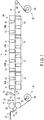
- the flavorant-containing sheet manufacturing apparatus 11 includes a supply path 13 (supply line) connected to an upstream slurry adjusting section, a dam section 15 configured to store flavorant-containing slurry 14 supplied from the supply path 13, a sheet-like substrate 16 (substrate film) provided over the entire length of a manufacturing line for the flavorant-containing sheet 12, a shaping mechanism 17 configured to form the slurry 14 stored in the dam section 15 into a sheet on the substrate 16, the sheet-like flavorant-containing sheet 12 (slurry 14) placed on the substrate 16 and fed in a feed direction A, a feeding mechanism 18 configured to feed the substrate 16 and the sheet-like flavorant-containing sheet 12 (slurry 14) in the feed direction A, a gelling mechanism 21 for cooling the sheet-like slurry 14 to form a gelled flavorant-containing sheet 12, a slit-forming portion 23 for forming one or more slits 22 in the gelled flavorant-containing sheet 12, and a drying mechanism 24 for drying the flavor
- the dam section 15 is formed in a box shape and can store flavorant-containing slurry 14 therein.
- the substrate 16 is formed of a synthetic resin material or the like, such as plastic, into a sheet-like elongated shape, that is, an elongated film-like shape.
- the substrate 16 is made of, for example, polyethylene terephthalate (PET) resin, but may be made of other relatively rigid and flexible plastic materials, paper materials, metal materials, or other materials.
- PET polyethylene terephthalate
- the gelling mechanism 21 is constituted by a general blower, such as a fan or a blower, and can send cooling air (wind) to the flavorant-containing sheet 12.
- the gelling mechanism 21 can promote gelling of the flavorant-containing sheet 12 by lowering the temperature of the flavorant-containing sheet 12 before gelling.
- the gelling mechanism 21 is not limited to a blower, and naturally may be a device that gels the flavorant-containing sheet 12, for example a device that applies a liquid of various molecular crosslinking agents, such as alcohol or aqueous cation (bivalent cation) solutions, to the flavorant-containing sheet 12, a device that irradiates the flavorant-containing sheet 12 with ultraviolet rays or the like to promote gelling, or a cooling device of a water-cooling type.
- a liquid of various molecular crosslinking agents such as alcohol or aqueous cation (bivalent cation) solutions
- the feeding mechanism 18 is disposed along a longitudinal direction of the substrate 16.
- the feeding mechanism 18 includes, for example, a feeding portion 25 (feeding roll) from which the substrate is fed, a winding portion 26 (wind-up roll) around which the substrate 16 is wound together with the flavorant-containing sheet 12, a first driven roller 27 disposed below the substrate 16 in the vicinity of the gelling mechanism 21, a second driven roller 28 disposed in the vicinity of the winding portion 26, and a plurality of other rollers (not shown) supporting the substrate 16.
- the winding portion 26 performs rotational driving by a motor or the like, and all the other rollers are driven rollers.
- the feeding method is not limited to the above.
- some of the driven rollers in the middle may be replaced by driving rollers, so that the substrate 16 may be actively fed in the feed direction by the driving rollers.
- the substrate 16 is wound around a core, and the substrate 16 can be fed therefrom.
- the substrate 16 is wound around a core, and the substrate 16 can be wound and collected together with the flavorant-containing sheet 12 by rotationally driving the core.
- the drying mechanism 24 includes, for example, four drying chambers 24A to 24D.
- the substrate 16 is passed through the four drying chambers 24A to 24D.
- Each drying chamber 24A is provided with a plurality of blowing nozzles 31.
- hot air at 70 to 100°C is supplied through the blowing nozzles 31, so that the flavorant-containing sheet 12 having the slits 22 formed therein and provided on the substrate 16 can be dried.
- the temperature conditions of the four drying chambers 24A may be common to each other, or may be different from each other.
- the shaping mechanism 17 is configured to form the flavorant-containing sheet 12 before gelling.
- the shaping mechanism 17 includes a comma roll 32 (comma roller, fixed roller) and a coating roll 33 (coating roller, rotating roller) that faces the comma roll 32.
- the coating roll 33 is formed in a cylindrical shape.
- the coating roll 33 has an outer peripheral surface 34 and a recessed portion 35 provided at a substantially intermediate part in the axial direction and recessed from the outer peripheral surface.
- the recessed portion 35 includes a pair of tapered portions 36 and a small-diameter portion 37 located between the pair of tapered portions 36.
- the small diameter portion 37 is formed, for example, at a depth of 10 to 100 ⁇ m from the outer peripheral surface 34, preferably at a depth of 20 to 80 ⁇ m from the outer peripheral surface 34, and more preferably at a depth of 40 to 60 ⁇ m from the outer peripheral surface 34.
- the coating roll 33 is a so-called driven roller and is rotated together with the substrate 16 along the feed direction A.
- the coating roll 33 is formed by, for example, machining (cutting, lathing) or the like.
- the comma roll 32 has a cross-sectional shape of a "comma", which is an English punctuation mark, and has a notched cylindrical shape formed by notching a part of a cylindrical shape.
- the comma roll 32 is fixedly disposed and cannot rotate about its central axis.
- the shaping mechanism 17 further includes a first gap region 17A and a second gap region 17B between the comma roll 32 and the coating roll 33.
- the first gap region 17A is provided at a substantially central portion in the width direction W of the flavorant-containing sheet 12.
- the second gap region 17B is provided at one end in the width direction W of the flavorant-containing sheet 12 before gelling.
- a pair of second gap regions 17B are provided on both sides of the first gap region 17A, but the second gap region 17B may be provided on only one side adjacent to the first gap region 17A.
- the first gap region 17A corresponds to the small-diameter portion 37 and the pair of tapered portions 36.
- the second gap regions 17B correspond to the outer peripheral surface 34. Therefore, the gap dimension (height) H2 of the second gap regions 17B is smaller than the gap dimension (height) H1 of the first gap region 17A.
- the slit-forming portion 23 includes one or more slit-forming parts 38 and one or more holding portions 41 that hold the one or more slit-forming parts 38.
- the one slit-forming part 38 can form one slit 22.
- Each of the slit-forming parts 38 can form a slit 22 having a depth corresponding to the entirety or a part of the thickness of the flavorant-containing sheet 12 along the feed direction A of the flavorant-containing sheet 12.
- the slits 22 extend continuously along the feed direction A of the flavorant-containing sheet 12.
- the present embodiment preferably includes, two, namely, a pair of slit-forming parts 38.
- One of the pair of slit-forming parts 38 is preferably disposed so as to be positioned in the vicinity of one end of the flavorant-containing sheet 12 in the width direction W, and the other of the pair of slit-forming parts 38 is preferably disposed so as to be positioned in the vicinity of the other end of the flavorant-containing sheet 12 in the width direction W.
- the slit-forming part 38 has a round tip so as not to damage the substrate 16. From the viewpoint of reuse of the substrate 16, it is preferable to use such a rounded slit-forming part 38.
- a cutting tool such as a pallet knife formed of a stainless steel material or the like can be preferably used.
- the slit-forming part 38 may be anything that is configured to form slits in the flavorant-containing sheet 12 (polysaccharide sheet) and does not damage the substrate 16 (base sheet).
- the slit-forming part 38 is not limited to a pallet knife, and may be, for example, a spatula, a plate, or the like.
- the slit-forming part 38 may be a disk-shaped rotary-type cutter or the like, the tip of which is rounded so as not to damage the substrate 16, and which is configured to apply its own weight to the flavorant-containing sheet 12.
- the thickness of the slit-forming part 38 is, for example, preferably 0.1 to 2 mm, and more preferably 0.3 to 1 mm. It is preferable that the slit-forming part 38 does not form a cutting edge perpendicular to the feed direction at a position in contact with the flavorant-containing sheet 12 on the upstream side in the feed direction, but is provided with a cutting edge inclined with respect to the feed direction (inclined such that the slit-forming part 38 is tapered toward the tip side of the slit-forming part 38). When the slit-forming part 38 is particularly thick, the configuration described above is particularly preferable. This ensures that no chips of flavorant-containing sheet 12 accumulate on the cutting edge.
- the slit-forming part 38 preferably has a shape that is not sharp on the substrate 16 (base sheet) side from the viewpoint of not damaging the substrate 16.
- the slit-forming part 38 preferably has a sharp shape on the flavorant-containing sheet 12 side. This is because it is possible to prevent chips of the slit-forming sheet 12 from accumulating on the cutting edge of the flavorant-containing part 38 or to prevent the slit-forming part 38 from being broken due to the chips or the like.
- two or more slit-forming parts 38 are disposed at positions that separate the flavorant-containing sheet 12 formed by the second gap region portions 17B from the flavorant-containing sheet 12 formed by the first gap region 17A.
- the number of the slit-forming parts 38 disposed in the slit-forming portion 23 is not limited to two, and may be three or more, or may be one.
- the number of the holding portions 41 is, for example, the same as the number of the slit-forming parts 38.
- the number of the holding portions 41 may be one, so that a plurality of slit-forming parts 38 can be held by one holding portion 41.
- Each of the holding portions 41 has, for example, a cylindrical or U-shaped holder, into which the handle part of the slit-forming part 38 is fitted with an allowance.
- the holder surrounds the handle part of the slit-forming part 38 to prevent the slit-forming part 38 from falling, and holds the slit-forming part 38 so that the weight of the slit-forming part 38 acts on the substrate 16 and the flavorant-containing sheet 12 from above.
- the slit-forming part 38 may be held in any manner as long as the weight of the slit-forming part 38 is applied to the flavorant-containing sheet 12.
- the containing sheet 12 may be naturally pushed and cut by the slit-forming part 38 having its own weight applied to the flavorant-containing sheet 12, on which the tip of the slit-forming part 38 abuts.
- the weight of the slit-forming part 38 is, for example, 10 to 400 g, preferably 20 to 200 g.
- the slit-forming part 38 preferably has such a weight that the substrate 16 is not greatly dented or the substrate 16 is not cut when the weight is applied.
- the depth of the slit 22 can be changed by using a slit-forming part made of stainless steel with a weight different from that of the slit-forming part 38 or by changing the slit-forming part 38 to a resin-made one.
- a slit 22 having a depth corresponding to the entire thickness of the flavorant-containing sheet 12 is formed; however, a slit 22 having a depth corresponding to a part of the thickness of the flavorant-containing sheet 12 can also be formed by changing the type of the slit-forming part 38.
- the slit 22 is formed in the flavorant-containing sheet 12, the flavorant-containing sheet 12 is not completely cut off at the slit 22.
- the depth of the slit 22 is preferably 60% or more, more preferably 75% or more, and most preferably 90% or more of the thickness of the flavorant-containing sheet 12.
- the slit-forming portion 23 forms slits 22 as a pair by means of the slit-forming part 38, each at a position of 1 to 10 mm, preferably a position of 2 to 8 mm, and more preferably a position of 3 to 6 mm from the end of the flavorant-containing sheet 12 in the width direction W.
- the flavorant-containing sheet 12 In a state before drying, the flavorant-containing sheet 12 has, for example, a width (length) of 500 mm in the width direction W and a thickness of 350 to 1300 ⁇ m. In a state after drying, the flavorant-containing sheet 12 has, for example, a width (length) of 480 mm in the width direction W and a thickness of 50 to 200 ⁇ m.
- the flavorant-containing sheet 12 contains polysaccharide polymers having a temperature-reversible gelling ability.
- the polysaccharide thickener contained in the flavorant-containing sheet 12 has a property of fixing and covering the flavorant dispersed in the sheet.
- the polysaccharide thickener is, for example, a single-component system of carrageenan, agar, xanthan gum, gellan gum, psyllium seed gum, or konjac glucomannan; or a composite system obtained by combining two or more components selected from the group consisting of carrageenan, locust bean gum, guar gum, agar, gellan gum, tamarind gum, xanthan gum, tara gum, konjac glucomannan, starch, cassia gum, and psyllium seed gum.
- the polysaccharide thickener is a single-component system of carrageenan, agar, xanthan gum, or gellan gum; or a composite system of carrageenan, agar, xanthan gum, or gellan gum combined with one or more components selected from the group consisting of locust bean gum, guar gum, tamarind gum, tara gum, konjac glucomannan, cassia gum, and psyllium seed gum.
- the polysaccharide thickener is selected from the group consisting of carrageenan, agar, xanthan gum, gellan gum, and a mixture of gellan gum and tamarind gum.
- An aqueous solution of carrageenan, agar, xanthan gum, or gellan gum has a property of gelling (in other words, it loses fluidity and solidifies) when cooled to a specific temperature or lower, and once it gels, it does not readily solate even when the temperature is raised to a temperature at which it transitioned to a gel, and can maintain the gelled state (hereinafter referred to as a "temperature-responsive sol-gel transition property").
- the raw material slurry contains any one of carrageenan, agar, xanthan gum, and gellan gum as the polysaccharide thickener, there is an advantage that a sheet can be manufactured in a short period of time by cooling the raw material slurry to be a gel and drying the gelled raw material at a high temperature.
- the polysaccharide thickener is selected from the group consisting of agar, gellan gum, and a mixture of gellan gum and tamarind gum.
- the mass ratio of gellan gum to tamarind gum is preferably in the range of 1:1 to 3:1.
- the blending amount of the polysaccharide thickener in the raw material slurry is preferably 10 to 35% by mass, and more preferably 12 to 25% by mass, with respect to the total mass of the components (that is, the mass of dry matter) other than water in the raw material slurry.
- the amount (% by mass) of the polysaccharide thickener can be calculated using the value of the blending amount of each component other than water in the raw material slurry.
- the flavorant contained in the flavorant-containing sheet 12 is not limited but any flavorant can be used, as long as it is a flavorant used in smoking articles.
- Main flavoants may be, menhtol, leaf-tobacco extract essence, natural plant flavoants (e.g., cinnamon, sage, herb, chamomile, kudzu (pueraria lobata), amacha (hydrangeae dulcis folium), clove, lavender, cardamom, caryophyllus, nutmeg, bergamot, geranium, honey essence, rose oil, lemon, orange, cassia bark, caraway, jasmine, ginger, coriander, vanilla extract, spearmint, peppermint, cassia, coffee, celery, cascarilla, sandalwood, cocoa, ylang ylang, fennel, anise, licorice, St John's bread, prune extract, and peach extract), saccharides (e.g., glucose, fructose,
- flavorants may be used in a solid form or dissolved or dispersed in a suitable solvent, such as propylene glycol, ethyl alcohol, benzyl alcohol, or triethyl citrate.
- a suitable solvent such as propylene glycol, ethyl alcohol, benzyl alcohol, or triethyl citrate.
- a flavorant such as a hydrophobic flavorant or an oil-soluble flavor, which is easily dispersed in a solvent by addition of an emulsifier can be used.
- a flavorant such as a hydrophobic flavorant or an oil-soluble flavor, which is easily dispersed in a solvent by addition of an emulsifier can be used.
- These flavorants may be used alone or in combination.
- the content of flavorant in the sheet is preferably less than 18% by mass, with respect to the total mass of the flavorant-containing sheet 12.
- the content of the flavorant in the sheet is more preferably 2.5% by mass or more and less than 18% by mass, still more preferably 2.5 to 12% by mass, and most preferably 3 to 6% by mass with respect to the total mass of the flavorant-containing sheet.
- any emulsifier can be used.
- lecithin specifically, Sun Lecithin A-1 (Taiyo Kagaku Co., Ltd.) can be used as the emulsifier.
- the content of the emulsifier in the sheet is preferably 0.5 to 5% by mass, more preferably 1.0 to 4.5% by mass, with respect to the mass of the polysaccharide thickener in the sheet.
- the content of the emulsifier in the sheet can be calculated using the values of the amounts of the emulsifier and the polysaccharide thickener in the raw material slurry.
- the flavorant-containing sheet 12 contains a bulking agent, which serves to increase the total mass (i.e., the mass of dry matter) of the components other than water in the raw material slurry and finally to increase the bulk of the flavorant-containing sheet.
- the bulking agent serves only to increase the bulk of the flavorant-containing sheet 12 and does not affect the original function of the flavorant-containing sheet 12.
- Bulking agents are materials that are acceptable in this field of art for addition to smoking articles as additives.
- the bulking agent is preferably a starch hydrolysate.
- Starch hydrolysate refers to a material obtained by a process including a step of hydrolyzing starch.
- the starch hydrolysate is, for example, a material obtained by directly hydrolyzing starch (i.e., dextrin) or a material obtained by hydrolyzing starch after heat treatment (i.e., indigestible dextrin).
- the bulking agent can be added in an amount that can perform the bulking agent function of increasing the bulk of the sheet and does not affect the smoking flavor of the smoking article.
- the content of the bulking agent in the sheet is preferably from 100 to 500% by mass, more preferably from 200 to 500% by mass, with respect to the mass of the polysaccharide thickener.
- the content of the bulking agent in the sheet can be calculated using the values of the blending amounts of the bulking agent and the polysaccharide thickener in the raw material slurry.
- the flavorant-containing sheet 12 can be stably produced under practical production conditions, even when the flavorant-containing sheet 12 has a composition in which the blending concentration of the flavorant is low.
- the bulking agent serves to increase the mass of the dry matter of the raw material slurry and increase the bulk of the sheet, the drying time required to produce a sheet having a desired thickness can be shortened.
- the bulking agent does not substantially increase the viscosity of the raw material slurry, the bulking agent does not hinder the kneading operation and the spreading operation of the raw material slurry.
- the flavorant-containing sheet 12 may also contain water. That is, the moisture contained in the raw material slurry may remain in the flavorant-containing sheet 12 after drying. If the moisture remains in the flavorant-containing sheet 12, the moisture content is preferably less than 10% by mass, more preferably 3 to 9% by mass, and still more preferably 3 to 6% by mass, with respect to the total mass of the sheet.
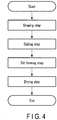
- the method for manufacturing the flavorant-containing sheet 12 using the flavorant-containing sheet manufacturing apparatus 11 of the embodiment includes four steps: a shaping step; a gelling step; a slit forming step; and a drying step.
- the flavorant-containing slurry 14 as a raw material is held at 60 to 100°C.
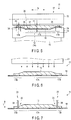
- the shaping step as shown in FIG. 5 , the slurry 14 is formed into a sheet shape by extruding the sol-like slurry 14 stored in the dam section 15 together with the substrate 16 through the first gap region 17A and the second gap region 17B of the shaping mechanism 17 in the feed direction A.
- the substrate 16 is fed between the comma roll 32 and the coating roll 33, and the slurry 14 is extruded together with the substrate 16 by the rotation of the coating roll 33.
- the sheet-shaped flavorant-containing sheet 12 is in a sol state and is not yet gelled.
- the flavorant-containing sheet 12 is placed on the substrate 16.
- cooling ari (wind) is blown from above through the nozzles of the gelling mechanism 21 to the flavorant-containing sheet 12 fed in the feed direction A to cool the flavorant-containing sheet 12 to a temperature of 0 to 40°C, thereby gelling the flavorant-containing sheet 12.
- the slit-forming portion 23 forms slits 22 having a depth corresponding to the entirety or a part of the thickness of the flavorant-containing sheet 12 in the flavorant-containing sheet 12 that has been fed in the feed direction A and gelled by the gelling mechanism 21.
- the number of the formed slits 22 is the same as the number of the slit-forming parts 38 provided in the slit-forming portion 23.
- the number of the slit-forming parts 38 is two, the number of the slits 22 is two; if the number of the slit-forming parts 38 is three or more, the number of the slits 22 is three or more; and if the number of the slit-forming parts 38 is one, the number of the slits is one.
- the slits 22 are formed so that the flavorant-containing sheet 12 is cut by the slit-forming parts 38.
- the depth of the slits 22 formed at this time may correspond to the entire thickness of the flavorant-containing sheet 12, namely, the depth at which the flavorant-containing sheet 12 is completely cut.
- the depth of the slits 22 may correspond to a part of the thickness of the flavorant-containing sheet 12, namely, a depth at which mere notches are formed on the flavorant-containing sheet 12 and the flavorant-containing sheet 12 is not completely cut.
- the slit-forming parts 38 are preferably fixed to the holding portions 41. It is preferable that the cutting depth of the slits 22 can be adjusted by adjusting the fixing positions of the slit-forming parts 38 and manipulating the distance (gap) from the tip of the slit-forming parts 38 to the substrate 16.
- the flavorant-containing sheet 12 Since the flavorant-containing sheet 12 has already been gelled prior to the slit forming step, the slit shape is memorized in the flavorant-containing sheet 12 as shown in FIG. 8 . Therefore, the flavorant-containing sheet 12 in which once the slits 22 have been formed does not recombine again to return to the original state of one flavorant-containing sheet 12.
- slits 22 are provided as a pair in the vicinity of both ends in the width direction W of the flavorant-containing sheet 12. More specifically, the slits 22 are provided at positions that separate the flavorant-containing sheet 12 formed by the second gap regions 17B from the flavorant-containing sheet 12 formed by the first gap region 17A. In the case where the number of the slit-forming parts 38 is one, the the slit-forming part 38 is provided in the vicinity of either end in the width direction W of the flavorant-containing sheet 12. Similarly, in this case, the slit 22 is provided at a position that separates the flavorant-containing sheet 12 formed by the second gap region 17B from the flavorant-containing sheet 12 formed by the first gap region 17A.
- two slits 22 are provided as a pair in the vicinity of both ends in the width direction W of the flavorant-containing sheet 12 as in the case where the two slit-forming sheets 12 are provided. Further, another slit 22 is provided at an arbitrary position (for example, a central portion) in the width direction W of the flavorant-containing sheet 12.
- the end portions having a large amount of moisture at both ends are separated from the body of the flavorant-containing sheet 12.
- the slits 22 are formed to a depth corresponding to a part of the thickness of the flavorant-containing sheet 12, stresses are concentrated around the slits 22 and the slits 22 grow in the process of shrinking of the flavorant-containing sheet 12 in the drying step, and as a result, the end portions are separated from the main body of the flavorant-containing sheet 12.
- the flavorant-containing sheet manufacturing apparatus 11 includes the feeding mechanism 18 for feeding the gelled flavorant-containing sheet 12, the slit-forming portion 23 for forming one or more slits 22 having a depth corresponding to the entirety or a part of the thickness of the flavorant-containing sheet 12 along the feed direction A of the flavorant-containing sheet 12, and the drying mechanism 24 for drying the flavorant-containing sheet 12 in which the slits 22 are formed.
- the flavorant-containing sheet manufacturing method includes shaping a flavorant-containing slurry 14 into a sheet shape by the shaping mechanism 17, cooling the sheet-shaped slurry 14 fed in the feed direction A by the gelling mechanism 21 to form a gelled sheet, forming one or more slits 22 having a depth corresponding to the entirety or a part of the thickness of the gelled sheet by the slit-forming portion 23, and drying the gelled sheet including the one or more slits 22 by the drying mechanism 24.
- the inventors have found that when the flavorant-containing sheet 12 is dried in the drying mechanism 24, a thin portion of the flavorant-containing sheet 12 is fixed to a portion of a base (for example, the substrate 16) supporting the thin portion in the early stage of drying to form a fixing point.
- the inventors have also found that when the sheet surface subsequently becomes a film and starts shrinking as the drying proceeds, a strong tension toward the central portion in the width direction W of the flavorant-containing sheet 12 is applied to the fixing point.
- the inventors have found that when the flavorant-containing sheet 12 is strongly fixed or bonded at the fixing point, the flavorant-containing sheet 12 is deformed by shrinkage, the fixing point or the periphery thereof is peeled or broken to be damaged, or the flavorant-containing sheet 12 itself is cracked or broken.
- the flavorant-containing sheet 12 thus deformed, broken, or cracked is naturally defective and cannot be used as a product.
- the shape of the slits can be memorized in the flavorant-containing sheet 12. Then, by passing through the drying mechanism 24, flavorant-containing sheets 12 having portions cut with the slits 22 can be manufactured. Accordingly, the flavorant-containing sheet 12 can be processed into a desired shape, and the slits 22 can release tension (stresses) generated in the flavorant-containing sheet 12. Thus, the flavorant-containing sheet 12 is prevented from cracking or breaking, and a flavorant-containing sheet 12 having a constant quality can be manufactured.
- the depth of the slits 22 is a depth corresponding to a part of the thickness of the flavorant-containing sheet 12, this does not cause a problem because the slits 22 grow in the subsequent drying step (drying by the drying mechanism) and the flavorant-containing sheet 12 is reliably cut with the slits 22.
- the one or more slits 22 are one slit
- the slit-forming portion 23 includes one slit-forming part 38
- the one slit-forming part 38 is provided at a position that allows the one slit 22 to be formed in the vicinity of one of the ends in the width direction W of the flavorant-containing sheet 12.
- the one or more slits 22 are one slit, and the one slit 22 is formed by the slit-forming portion 23 in the vicinity of one of the ends in the width direction W of the gel-like sheet.
- the end portion may be thickened due to shrinkage, and a portion having a large amount of moisture may be formed at the end portion. In such a portion having a large amount of moisture, gaps between gel crosslinks are large, and the flavorant contained in the sheet is easily volatilized together with the moisture.
- excessive drying may occur at the end portion of the flavorant-containing sheet 12 due to shrinkage during drying by the drying mechanism 24. This may cause the end portion of the flavorant-containing sheet 12 to curl and rise from the substrate 16, may cause the flavorant-containing sheet 12 to peel from the substrate 16 through the rising portion, or may result in cracking or breaking of the flavorant-containing sheet 12.
- the flavorant-containing sheet 12 it is necessary to remove, as an unnecessary portion, end portions (one end portion) in which rising, peeling, or cracking is likely to occur due to the large amount of moisture or, conversely, excessive drying.
- the flavorant-containing sheet 12 can be divided into two parts with a simple structure.
- the flavorant-containing sheet 12 can be processed into a desired state, for example, by removing an unnecessary portion provided at an end portion of the flavorant-containing sheet 12.
- the one or more slits 22 are two slits
- the slit-forming portion 23 includes two slit-forming parts 38
- one of the two slit-forming parts 38 is provided at a position that allows one of the two slits 22 to be formed in the vicinity of one of the ends in the width direction W of the flavorant-containing sheet 12, and the other of the two slit-forming parts 38 to be formed in the vicinity of the other of the ends in the width direction W of the flavorant-containing sheet 12.
- the one or more slits 22 are two slits, and the slit-forming portion 23 forms one of the two slits 22 in the vicinity of one of the ends in the width direction W of the flavorant-containing sheet 12, and the other of the two slits 22 in the vicinity of the other of the ends in the width direction W of the flavorant-containing sheet 12.
- the slits 22 are formed at both ends of the flavorant-containing sheet 12 in which the amount of moisture is increased or excessive drying occurs, and thus the end portions can be separated off. This makes it possible to easily process the flavorant-containing sheet 12 into a desired state by removing unnecessary portions of the flavorant-containing sheet 12.
- the flavorant-containing sheet manufacturing apparatus 11 includes the shaping mechanism 17 for shaping the flavorant-containing slurry 14 into a sheet shape to form the flavorant-containing sheet 12 before gelling. According to this configuration, the flavorant-containing sheet 12 before gelling can be formed into a predetermined shape in advance by the shaping mechanism 17.
- the shaping mechanism 17 includes the first gap region 17A, the first gap region 17A defining the thickness of the flavorant-containing sheet 12 before gelling that passes therethrough, and the second gap region 17B provided at one end in the width direction W of the flavorant-containing sheet 12 before gelling and having a dimension smaller than that of the first gap region 17A, the second gap 17B defining the thickness of the flavorant-containing sheet 12 before gelling that passes therethrough.
- the amount of moisture does not become too large at the portion provided at the end portion, and the area that can be used as a product can be increased.
- the step of removing this portion as a defective portion may be omitted.
- the flavorant-containing sheet manufacturing apparatus 11 includes the gelling mechanism 21, provided at a position between the shaping mechanism 17 and the slit-forming portion 23, for gelling the flavorant-containing sheet 12 before gelling. According to this configuration, the time required for gelling can be shortened and the manufacturing line for the flavorant-containing sheet 12 can be shortened as compared with the case of gelling by natural heat radiation.
- the slit-forming portion 23 includes one or more slit-forming parts 38 for forming the one or more slits 22, and one of the slit-forming parts 38 is provided at a position where the flavorant-containing sheet 12 formed in the second gap region 17B is separated from the flavorant-containing sheet 12 formed in the first gap region 17A by one slit 22.
- the thickness of the flavorant-containing sheet 12 can be substantially uniform, and the qualities of the flavorant-containing sheet 12, such as the thickness, the amount of the flavorant remaining therein, and the amount of moisture, can be maintained constant. Accordingly, it is possible to remove, as an unnecessary portion, end portions (one end portion) that are likely to rise, peel, or crack due to excessive drying.
- the flavorant-containing sheet manufacturing apparatus 11 includes the sheet-like substrate 16 on which the flavorant-containing sheet 12 is placed. With this configuration, the flavorant-containing sheet 12 before gelling and the gelled flavorant-containing sheet 12 can be stably fed in the feed direction A.
- the slit-forming portion 23 includes one slit-forming part 38 for forming one slit 22, and one or more holding portions 41 for holding one or more slit-forming parts 38 so that the weight of the slit-forming parts 38 acts on the flavorant-containing sheet 12.
- the configuration of the slit-forming portion 23 for forming one or more slits 22 can be realized with a simple structure.
- the slurry 14 is formed in the shaping mechanism 17 to form the flavorant-containing sheet 12 having a uniform thickness in the width direction W, and then through the gelling step by the gelling mechanism 21 and the drying step by the drying mechanism 24, the dried flavorant-containing sheet 12 is produced.
- shrinkage occurs at both ends of the flavorant-containing sheet 12 in the width direction W as indicated by arrows in FIG. 11 , and under certain conditions, thickened portions 12A may be formed at both ends as shown in FIG. 12 .
- the amount of moisture is larger than that in the other portions, so that the gaps between the gel crosslinks are large, and the flavorant contained in the sheet is easily volatilized together with the moisture.
- the inventors have found that the flavorant-containing sheet 12 having the thickened portions 12A may be a defective product, and it is necessary to remove the thickened portions 12A in the manufacturing process.
- a flavorant-containing sheet manufacturing apparatus 11 according to a first modification will be described with reference to FIG. 13 .
- the configuration of the shaping mechanism 17 and the configuration of the slit-forming portion 23 are different from those of the above-described embodiment.
- the shaping mechanism 17 includes a comma roll 32 and a coating roll 33 facing the comma roll 32. As shown in FIG. 2 and FIG. 13 , the coating roll 33 is formed in a cylindrical shape. In an outer peripheral portion of the coating roll 33, a recessed portion 35 recessed from the periphery is provided at a substantially intermediate part in the axial direction.
- the coating roll 33 is constituted by a stepped member (stepped roller) in order to partially reduce the coating thickness of the flavorant-containing sheet 12, as in the above-described embodiment.
- the stepped member includes the recessed portion 35 and a pair of large-diameter portions 42 provided outside the recessed portion 35.
- the recessed portion 35 is not provided with the pair of tapered portions 36.
- a small-diameter portion 37 is provided in the recessed portion 35.
- the pair of large-diameter portions 42 are provided outside the recess portion 35.
- the large-diameter portions 42 or the like may be formed by any method.
- each of the large-diameter portions 42 is formed of, for example, tape wound around a main body 33A (shaft portion) of the coating roll 33.
- the tape is bonded to the outer peripheral surface 34 of the main body 33A (shaft portion) of the coating roll 33.
- the large-diameter portion 42 is formed, for example, at a height of 10 to 100 ⁇ m from the outer peripheral surface 34, preferably at a height of 20 to 80 ⁇ m from the outer peripheral surface 34, and more preferably at a height of 40 to 60 ⁇ m from the outer peripheral surface 34. Therefore, in the present embodiment, the large-diameter portion 42 is formed by winding and adhering the tape having such a thickness to the main body 33A of the coating roll 33.
- the shaping mechanism 17 further includes a first gap region 17A and a second gap region 17B between the comma roll 32 and the coating roll 33.
- the first gap region 17A corresponds to the small-diameter portion 37.
- the second gap region 17B corresponds to the large-diameter portion 42. Therefore, the dimension H2 (height dimension) of the second gap regions 17B is smaller than the dimension H1 (height dimension) of the first gap region 17A.
- the second gap regions 17B are provided on both sides of the first gap region 17A as a pair; however, the second gap region 17B may be provided only on one side adjacent to the first gap region 17A.
- the slit-forming portion 23 includes one or more slit-forming parts 38 and holding portions 41 for holding the slit-forming parts 38.
- the slit-forming parts 38 are preferably provided as a pair so as to be positioned in the vicinity of both ends of the flavorant-containing sheet 12.
- the number of the slit-forming parts 38 provided in the slit-forming portion 23 is not limited to two, and may be three or more, or may be one.
- a slit 22 having a depth corresponding to the entire thickness of the flavorant-containing sheet 12 is formed; however, a slit 22 having a depth corresponding to a part of the thickness of the flavorant-containing sheet 12 can also be formed by changing the type of the slit-forming part 38.
- the slit-forming portion 23 forms slits 22 as a pair, each at a position of 1 to 10 mm, preferably a position of 2 to 8 mm, and more preferably a position of 3 to 6 mm from the end in the width direction W of the flavorant-containing sheet 12 by the slit-forming part 38.
- the pair of slit-forming parts 38 are provided at positions which allow the slits 22 to be formed in the flavorant-containing sheet 12 by the second gap region 17B.
- a slit 22 having a depth corresponding to the entirety or a part of the thickness of the flavorant-containing sheet 12 is formed by the slit-forming portion 23 in the flavorant-containing sheet 12 fed in the feed direction A and gelled by the gelling mechanism 21.
- the number of the formed slits 22 is the same as the number of the slit-forming parts 38 provided in the slit-forming portion 23.
- the slits 22 are formed so that the flavorant-containing sheet 12 is pressed and cut from above by the slit-forming parts 38. Since the flavorant-containing sheet 12 has already been gelled prior to the slit forming step, the shape of the slits is memorized in the flavorant-containing sheet 12.
- the slits 22 are provided as a pair in the vicinity of both ends in the width direction W of the flavorant-containing sheet 12. More specifically, the slits 22 are provided at positions corresponding to the flavorant-containing sheet 12 formed by the second gap regions 17B. In the case where the number of the slit-forming part 38 is one, the slit-forming part 38 is provided in the vicinity of either end in the width direction W of the flavorant-containing sheet 12. Similarly, in this case, the slit 22 is provided at a position corresponding to the flavorant-containing sheet 12 formed by the second gap region 17B.
- two slits 22 are provided as a pair in the vicinity of both ends in the width direction W of the flavorant-containing sheet 12 as in the case where the two slit-forming sheets 12 are provided. Further, another slit 22 is provided at an arbitrary position (for example, a central portion) in the width direction W of the flavorant-containing sheet 12.
- the slit-forming portion 23 includes one or more slit-forming parts 38, and one of the slit-forming parts 38 is provided at a position that allows the slit 22 to be formed in the flavorant-containing sheet 12 formed by the second gap region 17B.
- the slit 22 can be reliably formed at a predetermined position. Accordingly, the occurrence rate of defective products can be reduced in consideration of variation in the passing position of the flavorant-containing sheet 12 in the manufacturing process, and the yield of the flavorant-containing sheet 12 can be improved.
- a flavorant-containing sheet manufacturing apparatus 11 according to a second modification will be described with reference to FIG. 14 .
- the width of the flavorant-containing sheet 12, the configuration of the shaping mechanism 17 and the configuration of the slit-forming portion 23 are different from those of the above-described embodiment.
- a method for simultaneously manufacturing a plurality of flavorant-containing sheets 12 having substantially the same width and the same composition will be described.
- the shaping mechanism 17 includes a comma roll 32 and a coating roll 33 facing the comma roll 32. As shown in FIG. 2 and FIG. 14 , the coating roll 33 is formed in a cylindrical shape. In the present embodiment, no recess portion 35 is provided in the outer peripheral portion of the coating roll 33.
- the flavorant-containing sheet 12 In a state before drying, the flavorant-containing sheet 12 has, for example, a width (length) of 1000 mm in the width direction W and a thickness of 350 to 1300 ⁇ m. In a state after drying, the flavorant-containing sheet 12 has, for example, a width (length) of 960 mm in the width direction W and a thickness of 50 to 200 ⁇ m.
- the flavorant-containing sheet 12 of the second modification has the same thickness as that of the flavorant-containing sheet 12 of the above-described embodiment, and is formed to be longer in the width direction W, that is, wider than that of the above-described embodiment.
- the flavorant-containing sheet 12 may have a width (length) of 1000 mm or more in the width direction W before drying.
- the slit-forming portion 23 includes a plurality of (for example, two) slit-forming parts 38 that form a plurality of slits 22, and a plurality of holding portions 41 that hold the slit-forming parts 38.
- the slit-forming parts 38 are spaced apart from each other in the width direction W of the flavorant-containing sheet 12.
- the flavorant-containing sheet 12 includes a plurality of belt-like portions 12B separated by a plurality of slits 22.
- the slit-forming parts 38 of the slit-forming portion 23 be provided at positions which allow the slits 22 to be formed so that the respective lengths of the belt-like portions 12B are substantially equal to each other in the width direction W of the flavorant-containing sheet 12.
- the slit-forming portion 23 divides the flavorant-containing sheet 12 (into three) at substantially equal intervals by the slits 22.
- the holding portions 41 (holders) of the slit-forming portion 23 hold the slit-forming parts 38 so that the weight of the slit-forming parts 38 acts on the substrate 16 and the flavorant-containing sheet 12 from above.
- the number of the slit-forming parts 38 provided in the slit-forming portion 23 may be three or more. In the case where the number of the slit-forming parts 38 is three, the three slit-forming parts 38 are also provided at such positions that make the respective lengths of the belt-like portions 12B substantially equal. In this case, the slit-forming portion 23 divides the flavorant-containing sheet 12 (into four) at substantially equal intervals by the slits 22.
- the number of the slit-forming parts 38 and the number of the slits 22 may be further increased, namely, the number of the slit-forming parts 38 and the number of the slits 22 may be four or more. That is, in the present modification, the numbers of the slit-forming parts 38 and the number of the slits 22 are discretionary, and can be appropriately increased or decreased according to the length of the flavorant-containing sheet 12 in the width direction W.
- the flavorant-containing sheet 12 is formed to be wider than that in the above-described embodiment. Accordingly, in the drying step by the drying mechanism 24, the amount of shrinkage due to drying is larger than that in the above-described embodiment. Therefore, in the case where no slit 22 is provided for example, in contrast to the present modification, a fixing point is formed between a thin portion of the flavorant-containing sheet 12 and a base portion supporting the thin portion during the drying step. Then, a stress (tension) is generated between fixing points due to shrinkage caused by drying, and there is a possibility that a crack, a break, or the like will occur at any place where such a stress is concentrated.
- the flavorant-containing sheet 12 is divided by the slits 22 at substantially equal intervals. For this reason, the flavorant-containing sheet 12 can be slid over the substrate 16 where the slits 22 are provided. Therefore, in this modification, the tension (stress) generated in the drying step is released at the position of each slit 22.
- the one or more slits 22 are a plurality of slits
- the flavorant-containing sheet 12 includes the plurality of belt-like portions 12B separated by the plurality of slits 22
- the slit-forming portion 23 includes the plurality of slit-forming parts 38 configured to form the plurality of slits 22
- the plurality of slit-forming parts 38 are provided at positions that allow the plurality of slits 22 to be formed so that the respective lengths of the plurality of belt-like portions 12B are substantially equal to each other in the width direction W of the flavorant-containing sheet 12.
- the one or more slits 22 are a plurality of slits
- the flavorant-containing sheet 12 includes the plurality of belt-like portions 12B separated by the plurality of slits 22, and the slit-forming portion 23 forms the plurality of slits 22 so that the respective lengths in the width direction W of the plurality of belt-like portions 12B of the flavorant-containing sheet 12 are substantially equal to each other.
- the flavorant-containing sheet manufacturing apparatus 11 is not limited to the above embodiment and each modification and can be embodied by modifying structural elements in the implementation stage without departing from the gist thereof.
- some components may be deleted from all the structural elements shown in the embodiment and each modification, and it is also possible to configure one invention by appropriately combining the flavorant-containing sheet manufacturing apparatuses 11 or the flavorant-containing sheet manufacturing methods of any of the embodiment, the first modification, and the second modification.
- flavorant-containing sheet manufacturing apparatus 12... flavorant-containing sheet, 12B... belt-like portion, 14... slurry, 16... substrate, 17... shaping mechanism, 17A... first gap region, 17B... second gap region, 18... feeding mechanism, 21... gelling mechanism, 22... slit, 23... slit-forming portion, 24... drying mechanism, 38... slit-forming part, 41... holding portion.
Landscapes
- Chemical & Material Sciences (AREA)
- Chemical Kinetics & Catalysis (AREA)
- General Chemical & Material Sciences (AREA)
- Health & Medical Sciences (AREA)
- General Health & Medical Sciences (AREA)
- Toxicology (AREA)
- Disinfection, Sterilisation Or Deodorisation Of Air (AREA)
- Fats And Perfumes (AREA)
- General Preparation And Processing Of Foods (AREA)
- Manufacture Of Tobacco Products (AREA)
Abstract
Description
- The present invention relates to a flavorant-containing sheet manufacturing apparatus and a flavorant-containing sheet manufacturing method capable of manufacturing a flavorant-containing sheet.
- A method for manufacturing a flavorant-containing sheet for a smoking article is disclosed (Patent Literatures 1 to 3). The manufacturing method includes: (1) a step of spreading a raw material slurry containing a polysaccharide and a flavorant, having a moisture of 70 to 95% by weight, and being in a sol state at 60 to 90°C on a substrate; (2) a step of cooling the spread raw material slurry to a specimen temperature of 0 to 40°C to gel the raw material slurry; and (3) a heating and drying step of heating the gelled raw material to dry it at the specimen temperature of 70 to 100°C.
-
- [Patent Literature 1] International Publication No.
2012/118032 - [Patent Literature 2] International Publication No.
2012/118033 - [Patent Literature 3] International Publication No.
2012/118034 - Since a gelled material contains water and a flavorant between component gel cross-links, the properties (viscosity and flavorant remaining amount) of the gelled material changes depending on the external environment such as the temperature and humidity, and the internal environment such as the composition of the gelled material and the amount of moisture in the gelling material. Therefore, it is difficult to control the qualities of the sheets formed of the gelled material to be uniform.
- An object of the present invention is to provide a flavorant-containing sheet manufacturing apparatus and a flavorant-containing sheet manufacturing method that can make uniform the quality of flavorant-containing sheets.
- According to one aspect of the invention, a flavorant-containing sheet manufacturing apparatus includes: a feeding mechanism configured to feed a gelled flavorant-containing sheet; a slit-forming portion configured to form one or more slits having a depth corresponding to an entirety or part of a thickness of the flavorant-containing sheet along a feed direction of the flavorant-containing sheet; and a drying mechanism configured to dry the flavorant-containing sheet in which the slits are formed.
- According to one aspect of the invention, a flavorant-containing sheet manufacturing method includes: shaping slurry containing a flavorant into a sheet shape by a shaping mechanism; forming a gelled sheet by gelling the slurry formed into the sheet shape fed in a feed direction by a gelling mechanism; forming one or more slits having a depth corresponding to an entirety or part of a thickness of the gelled sheet by a slit-forming portion; and drying the gelled sheet including the one or more slits by a drying mechanism.
- With a flavorant-containing sheet manufacturing apparatus and a flavorant-containing sheet manufacturing method of the present invention, it is possible to provide a flavorant-containing sheet manufacturing apparatus and a flavorant-containing sheet manufacturing method that can make uniform the quality of flavorant-containing sheets.
-
-
FIG. 1 is a schematic diagram illustrating an example of a flavorant-containing sheet manufacturing apparatus according to an embodiment. -
FIG. 2 is an enlarged schematic view of a portion of a shaping mechanism, a gelling mechanism, a slit-forming portion, and a drying mechanism of the flavorant-containing sheet manufacturing apparatus illustrated inFIG. 1 . -
FIG. 3 is a perspective view illustrating one of a plurality of slit-forming parts provided in the slit-forming portion illustrated inFIG. 2 . -
FIG. 4 is a flowchart illustrating a flavorant-containing sheet manufacturing method using the flavorant-containing sheet manufacturing apparatus according to the embodiment. -
FIG. 5 is a front view of the shaping mechanism, the substrate, and the flavorant-containing sheet, which are illustrated inFIG. 2 . -
FIG. 6 is a cross-sectional view schematically illustrating a step (gelling step) in which the flavorant-containing sheet is cooled by the gelling mechanism illustrated inFIG. 2 . -
FIG. 7 is a cross-sectional view schematically illustrating a step (slit forming step) of forming slits by a pair of slit-forming parts which constitute the slit-forming portion illustrated inFIG. 2 . -
FIG. 8 is a cross-sectional view schematically illustrating a process in which the flavorant-containing sheet is shrunk by the drying mechanism illustrated inFIG. 2 . -
FIG. 9 is a cross-sectional view schematically illustrating a state after the flavorant-containing sheet is dried by the drying mechanism illustrated inFIG. 2 . -
FIG. 10 is a front view illustrating a shaping mechanism of a flavorant-containing sheet manufacturing apparatus according to a reference embodiment. -
FIG. 11 is a cross-sectional view schematically illustrating a process in which the flavorant-containing sheet formed by the shaping mechanism of the reference embodiment illustrated inFIG. 10 shrinks in a drying step. -
FIG. 12 is a cross-sectional view schematically illustrating a state after the flavorant-containing sheet formed by the shaping mechanism of the reference embodiment illustrated inFIG. 10 is dried in a drying step. -
FIG. 13 is a front view illustrating a shaping mechanism and a slit-forming portion of a flavorant-containing sheet manufacturing apparatus according to a first modification. -
FIG. 14 is a front view illustrating a shaping mechanism and a slit-forming portion of a flavorant-containing sheet manufacturing apparatus according to a second modification. - An embodiment of a flavorant-containing
sheet manufacturing apparatus 11 will be described below with reference toFIG. 1 to FIG. 9 . A flavorant-containingsheet 12 manufactured by this flavorant-containingsheet manufacturing apparatus 11 formed of, for example, a polysaccharide thickener, is shaped into a sheet, and contains a flavorant in a dispersed state inside. In the flavorant-containingsheet 12, the flavorant is coated with the polysaccharide thickener and held inside the sheet. Thus, the flavorant-containingsheet 12 has a high storage stability. The flavorant-containingsheet 12 is cut into fine pieces, and mixed with, for example, tobacco shreds of a smoking article, for use in enhancing flavor or the like. - As shown in
FIG. 1 andFIG. 2 , the flavorant-containingsheet manufacturing apparatus 11 includes a supply path 13 (supply line) connected to an upstream slurry adjusting section, adam section 15 configured to store flavorant-containingslurry 14 supplied from thesupply path 13, a sheet-like substrate 16 (substrate film) provided over the entire length of a manufacturing line for the flavorant-containingsheet 12, ashaping mechanism 17 configured to form theslurry 14 stored in thedam section 15 into a sheet on thesubstrate 16, the sheet-like flavorant-containing sheet 12 (slurry 14) placed on thesubstrate 16 and fed in a feed direction A, afeeding mechanism 18 configured to feed thesubstrate 16 and the sheet-like flavorant-containing sheet 12 (slurry 14) in the feed direction A, agelling mechanism 21 for cooling the sheet-like slurry 14 to form a gelled flavorant-containingsheet 12, a slit-formingportion 23 for forming one ormore slits 22 in the gelled flavorant-containingsheet 12, and adrying mechanism 24 for drying the flavorant-containingsheet 12 in which theslits 22 are formed. - The
dam section 15 is formed in a box shape and can store flavorant-containingslurry 14 therein. Thesubstrate 16 is formed of a synthetic resin material or the like, such as plastic, into a sheet-like elongated shape, that is, an elongated film-like shape. Thesubstrate 16 is made of, for example, polyethylene terephthalate (PET) resin, but may be made of other relatively rigid and flexible plastic materials, paper materials, metal materials, or other materials. - The
gelling mechanism 21 is constituted by a general blower, such as a fan or a blower, and can send cooling air (wind) to the flavorant-containingsheet 12. Thegelling mechanism 21 can promote gelling of the flavorant-containingsheet 12 by lowering the temperature of the flavorant-containingsheet 12 before gelling. Thegelling mechanism 21 is not limited to a blower, and naturally may be a device that gels the flavorant-containingsheet 12, for example a device that applies a liquid of various molecular crosslinking agents, such as alcohol or aqueous cation (bivalent cation) solutions, to the flavorant-containingsheet 12, a device that irradiates the flavorant-containingsheet 12 with ultraviolet rays or the like to promote gelling, or a cooling device of a water-cooling type. - The
feeding mechanism 18 is disposed along a longitudinal direction of thesubstrate 16. Thefeeding mechanism 18 includes, for example, a feeding portion 25 (feeding roll) from which the substrate is fed, a winding portion 26 (wind-up roll) around which thesubstrate 16 is wound together with the flavorant-containingsheet 12, a first drivenroller 27 disposed below thesubstrate 16 in the vicinity of thegelling mechanism 21, a second drivenroller 28 disposed in the vicinity of thewinding portion 26, and a plurality of other rollers (not shown) supporting thesubstrate 16. In the present embodiment, thewinding portion 26 performs rotational driving by a motor or the like, and all the other rollers are driven rollers. However, the feeding method is not limited to the above. For example, some of the driven rollers in the middle may be replaced by driving rollers, so that thesubstrate 16 may be actively fed in the feed direction by the driving rollers. - In the
feeding portion 25, thesubstrate 16 is wound around a core, and thesubstrate 16 can be fed therefrom. In thewinding portion 26, thesubstrate 16 is wound around a core, and thesubstrate 16 can be wound and collected together with the flavorant-containingsheet 12 by rotationally driving the core. - The
drying mechanism 24 includes, for example, fourdrying chambers 24A to 24D. Thesubstrate 16 is passed through the fourdrying chambers 24A to 24D. Eachdrying chamber 24A is provided with a plurality of blowingnozzles 31. In thedrying chamber 24A, hot air at 70 to 100°C is supplied through the blowingnozzles 31, so that the flavorant-containingsheet 12 having theslits 22 formed therein and provided on thesubstrate 16 can be dried. The temperature conditions of the fourdrying chambers 24A may be common to each other, or may be different from each other. - The
shaping mechanism 17 is configured to form the flavorant-containingsheet 12 before gelling. Theshaping mechanism 17 includes a comma roll 32 (comma roller, fixed roller) and a coating roll 33 (coating roller, rotating roller) that faces thecomma roll 32. As shown inFIG. 2 andFIG. 5 , thecoating roll 33 is formed in a cylindrical shape. Thecoating roll 33 has an outerperipheral surface 34 and a recessedportion 35 provided at a substantially intermediate part in the axial direction and recessed from the outer peripheral surface. The recessedportion 35 includes a pair oftapered portions 36 and a small-diameter portion 37 located between the pair oftapered portions 36. Thesmall diameter portion 37 is formed, for example, at a depth of 10 to 100 µm from the outerperipheral surface 34, preferably at a depth of 20 to 80 µm from the outerperipheral surface 34, and more preferably at a depth of 40 to 60 µm from the outerperipheral surface 34. Thecoating roll 33 is a so-called driven roller and is rotated together with thesubstrate 16 along the feed direction A. Thecoating roll 33 is formed by, for example, machining (cutting, lathing) or the like. - As shown in
FIG. 2 andFIG. 5 , thecomma roll 32 has a cross-sectional shape of a "comma", which is an English punctuation mark, and has a notched cylindrical shape formed by notching a part of a cylindrical shape. The comma roll 32 is fixedly disposed and cannot rotate about its central axis. - As shown in
FIG. 5 , theshaping mechanism 17 further includes afirst gap region 17A and asecond gap region 17B between thecomma roll 32 and thecoating roll 33. Thefirst gap region 17A is provided at a substantially central portion in the width direction W of the flavorant-containingsheet 12. Thesecond gap region 17B is provided at one end in the width direction W of the flavorant-containingsheet 12 before gelling. In the present embodiment, a pair ofsecond gap regions 17B are provided on both sides of thefirst gap region 17A, but thesecond gap region 17B may be provided on only one side adjacent to thefirst gap region 17A. - The
first gap region 17A corresponds to the small-diameter portion 37 and the pair of taperedportions 36. Thesecond gap regions 17B correspond to the outerperipheral surface 34. Therefore, the gap dimension (height) H2 of thesecond gap regions 17B is smaller than the gap dimension (height) H1 of thefirst gap region 17A. - As shown in
FIG. 2 andFIG. 7 , the slit-formingportion 23 includes one or more slit-formingparts 38 and one ormore holding portions 41 that hold the one or more slit-formingparts 38. The one slit-formingpart 38 can form one slit 22. Each of the slit-formingparts 38 can form aslit 22 having a depth corresponding to the entirety or a part of the thickness of the flavorant-containingsheet 12 along the feed direction A of the flavorant-containingsheet 12. Thus, theslits 22 extend continuously along the feed direction A of the flavorant-containingsheet 12. - The present embodiment preferably includes, two, namely, a pair of slit-forming
parts 38. One of the pair of slit-formingparts 38 is preferably disposed so as to be positioned in the vicinity of one end of the flavorant-containingsheet 12 in the width direction W, and the other of the pair of slit-formingparts 38 is preferably disposed so as to be positioned in the vicinity of the other end of the flavorant-containingsheet 12 in the width direction W. As shown inFIG. 3 , the slit-formingpart 38 has a round tip so as not to damage thesubstrate 16. From the viewpoint of reuse of thesubstrate 16, it is preferable to use such a rounded slit-formingpart 38. As the slit-formingpart 38, for example, a cutting tool such as a pallet knife formed of a stainless steel material or the like can be preferably used. The slit-formingpart 38 may be anything that is configured to form slits in the flavorant-containing sheet 12 (polysaccharide sheet) and does not damage the substrate 16 (base sheet). The slit-formingpart 38 is not limited to a pallet knife, and may be, for example, a spatula, a plate, or the like. Alternatively, the slit-formingpart 38 may be a disk-shaped rotary-type cutter or the like, the tip of which is rounded so as not to damage thesubstrate 16, and which is configured to apply its own weight to the flavorant-containingsheet 12. - In order to maintain a predetermined strength, the thickness of the slit-forming
part 38 is, for example, preferably 0.1 to 2 mm, and more preferably 0.3 to 1 mm. It is preferable that the slit-formingpart 38 does not form a cutting edge perpendicular to the feed direction at a position in contact with the flavorant-containingsheet 12 on the upstream side in the feed direction, but is provided with a cutting edge inclined with respect to the feed direction (inclined such that the slit-formingpart 38 is tapered toward the tip side of the slit-forming part 38). When the slit-formingpart 38 is particularly thick, the configuration described above is particularly preferable. This ensures that no chips of flavorant-containingsheet 12 accumulate on the cutting edge. - The slit-forming
part 38 preferably has a shape that is not sharp on the substrate 16 (base sheet) side from the viewpoint of not damaging thesubstrate 16. On the other hand, the slit-formingpart 38 preferably has a sharp shape on the flavorant-containingsheet 12 side. This is because it is possible to prevent chips of the slit-formingsheet 12 from accumulating on the cutting edge of the flavorant-containingpart 38 or to prevent the slit-formingpart 38 from being broken due to the chips or the like. - As shown in
FIG. 7 , two or more slit-formingparts 38 are disposed at positions that separate the flavorant-containingsheet 12 formed by the secondgap region portions 17B from the flavorant-containingsheet 12 formed by thefirst gap region 17A. The number of the slit-formingparts 38 disposed in the slit-formingportion 23 is not limited to two, and may be three or more, or may be one. The number of the holdingportions 41 is, for example, the same as the number of the slit-formingparts 38. The number of the holdingportions 41 may be one, so that a plurality of slit-formingparts 38 can be held by one holdingportion 41. - Each of the holding
portions 41 has, for example, a cylindrical or U-shaped holder, into which the handle part of the slit-formingpart 38 is fitted with an allowance. Thus, the holder surrounds the handle part of the slit-formingpart 38 to prevent the slit-formingpart 38 from falling, and holds the slit-formingpart 38 so that the weight of the slit-formingpart 38 acts on thesubstrate 16 and the flavorant-containingsheet 12 from above. The slit-formingpart 38 may be held in any manner as long as the weight of the slit-formingpart 38 is applied to the flavorant-containingsheet 12. For example, in a state in which the slit-formingpart 38 is suspended from above by a string, the containingsheet 12 may be naturally pushed and cut by the slit-formingpart 38 having its own weight applied to the flavorant-containingsheet 12, on which the tip of the slit-formingpart 38 abuts. - The weight of the slit-forming
part 38 is, for example, 10 to 400 g, preferably 20 to 200 g. Thus, the gelled flavorant-containingsheet 12 passing under the lower side of the slit-formingpart 38 can be pressed from above and cut off. The slit-formingpart 38 preferably has such a weight that thesubstrate 16 is not greatly dented or thesubstrate 16 is not cut when the weight is applied. Naturally, the depth of theslit 22 can be changed by using a slit-forming part made of stainless steel with a weight different from that of the slit-formingpart 38 or by changing the slit-formingpart 38 to a resin-made one. In the present embodiment, aslit 22 having a depth corresponding to the entire thickness of the flavorant-containingsheet 12 is formed; however, aslit 22 having a depth corresponding to a part of the thickness of the flavorant-containingsheet 12 can also be formed by changing the type of the slit-formingpart 38. - In this case, although the
slit 22 is formed in the flavorant-containingsheet 12, the flavorant-containingsheet 12 is not completely cut off at theslit 22. The depth of theslit 22 is preferably 60% or more, more preferably 75% or more, and most preferably 90% or more of the thickness of the flavorant-containingsheet 12. - As shown in
FIG. 7 , the slit-formingportion 23 forms slits 22 as a pair by means of the slit-formingpart 38, each at a position of 1 to 10 mm, preferably a position of 2 to 8 mm, and more preferably a position of 3 to 6 mm from the end of the flavorant-containingsheet 12 in the width direction W. - In a state before drying, the flavorant-containing
sheet 12 has, for example, a width (length) of 500 mm in the width direction W and a thickness of 350 to 1300 µm. In a state after drying, the flavorant-containingsheet 12 has, for example, a width (length) of 480 mm in the width direction W and a thickness of 50 to 200 µm. The flavorant-containingsheet 12 contains polysaccharide polymers having a temperature-reversible gelling ability. - The polysaccharide thickener contained in the flavorant-containing
sheet 12 has a property of fixing and covering the flavorant dispersed in the sheet. The polysaccharide thickener is, for example, a single-component system of carrageenan, agar, xanthan gum, gellan gum, psyllium seed gum, or konjac glucomannan; or a composite system obtained by combining two or more components selected from the group consisting of carrageenan, locust bean gum, guar gum, agar, gellan gum, tamarind gum, xanthan gum, tara gum, konjac glucomannan, starch, cassia gum, and psyllium seed gum. - Preferably, the polysaccharide thickener is a single-component system of carrageenan, agar, xanthan gum, or gellan gum; or a composite system of carrageenan, agar, xanthan gum, or gellan gum combined with one or more components selected from the group consisting of locust bean gum, guar gum, tamarind gum, tara gum, konjac glucomannan, cassia gum, and psyllium seed gum.
- More preferably, the polysaccharide thickener is selected from the group consisting of carrageenan, agar, xanthan gum, gellan gum, and a mixture of gellan gum and tamarind gum.
- An aqueous solution of carrageenan, agar, xanthan gum, or gellan gum has a property of gelling (in other words, it loses fluidity and solidifies) when cooled to a specific temperature or lower, and once it gels, it does not readily solate even when the temperature is raised to a temperature at which it transitioned to a gel, and can maintain the gelled state (hereinafter referred to as a "temperature-responsive sol-gel transition property"). Therefore, if the raw material slurry contains any one of carrageenan, agar, xanthan gum, and gellan gum as the polysaccharide thickener, there is an advantage that a sheet can be manufactured in a short period of time by cooling the raw material slurry to be a gel and drying the gelled raw material at a high temperature.
- More preferably, the polysaccharide thickener is selected from the group consisting of agar, gellan gum, and a mixture of gellan gum and tamarind gum.
- If a mixture of gellan gum and tamarind gum is used as the polysaccharide thickener, the mass ratio of gellan gum to tamarind gum is preferably in the range of 1:1 to 3:1.
- The blending amount of the polysaccharide thickener in the raw material slurry is preferably 10 to 35% by mass, and more preferably 12 to 25% by mass, with respect to the total mass of the components (that is, the mass of dry matter) other than water in the raw material slurry. The amount (% by mass) of the polysaccharide thickener can be calculated using the value of the blending amount of each component other than water in the raw material slurry.
- The flavorant contained in the flavorant-containing
sheet 12 is not limited but any flavorant can be used, as long as it is a flavorant used in smoking articles. Main flavoants may be, menhtol, leaf-tobacco extract essence, natural plant flavoants (e.g., cinnamon, sage, herb, chamomile, kudzu (pueraria lobata), amacha (hydrangeae dulcis folium), clove, lavender, cardamom, caryophyllus, nutmeg, bergamot, geranium, honey essence, rose oil, lemon, orange, cassia bark, caraway, jasmine, ginger, coriander, vanilla extract, spearmint, peppermint, cassia, coffee, celery, cascarilla, sandalwood, cocoa, ylang ylang, fennel, anise, licorice, St John's bread, prune extract, and peach extract), saccharides (e.g., glucose, fructose, isomerized saccharide, and caramel); cocoa (e.g., powder and extract); esters (e.g., isoamyl acetate, linalyl acetate, isoamyl propionate, and linalyl butyrate); ketones (e.g., menthone, ionone, damascenone, and ethyl maltol); alcohols (e.g., geraniol, linalool, anethole, and eugenol); aldehydes (e.g., vanillin, benzaldehyde, and anisaldehyde); lactones (e.g., γ-undecalactone and γ-nonalactone); animal flavoants (e.g., musk, ambergris, civet, and castoreum); and hydrocarbons (e.g., limonene and pinene). These flavorants may be used in a solid form or dissolved or dispersed in a suitable solvent, such as propylene glycol, ethyl alcohol, benzyl alcohol, or triethyl citrate. Preferably, a flavorant, such as a hydrophobic flavorant or an oil-soluble flavor, which is easily dispersed in a solvent by addition of an emulsifier can be used. These flavorants may be used alone or in combination. - The content of flavorant in the sheet is preferably less than 18% by mass, with respect to the total mass of the flavorant-containing
sheet 12. The content of the flavorant in the sheet is more preferably 2.5% by mass or more and less than 18% by mass, still more preferably 2.5 to 12% by mass, and most preferably 3 to 6% by mass with respect to the total mass of the flavorant-containing sheet. - As the emulsifier contained in the flavorant-containing
sheet 12, any emulsifier can be used. For example, lecithin, specifically, Sun Lecithin A-1 (Taiyo Kagaku Co., Ltd.) can be used as the emulsifier. - The content of the emulsifier in the sheet is preferably 0.5 to 5% by mass, more preferably 1.0 to 4.5% by mass, with respect to the mass of the polysaccharide thickener in the sheet. The content of the emulsifier in the sheet can be calculated using the values of the amounts of the emulsifier and the polysaccharide thickener in the raw material slurry.
- The flavorant-containing
sheet 12 contains a bulking agent, which serves to increase the total mass (i.e., the mass of dry matter) of the components other than water in the raw material slurry and finally to increase the bulk of the flavorant-containing sheet. In other words, the bulking agent serves only to increase the bulk of the flavorant-containingsheet 12 and does not affect the original function of the flavorant-containingsheet 12. Bulking agents are materials that are acceptable in this field of art for addition to smoking articles as additives. - The bulking agent is preferably a starch hydrolysate. Starch hydrolysate refers to a material obtained by a process including a step of hydrolyzing starch. The starch hydrolysate is, for example, a material obtained by directly hydrolyzing starch (i.e., dextrin) or a material obtained by hydrolyzing starch after heat treatment (i.e., indigestible dextrin).
- The bulking agent can be added in an amount that can perform the bulking agent function of increasing the bulk of the sheet and does not affect the smoking flavor of the smoking article. The content of the bulking agent in the sheet is preferably from 100 to 500% by mass, more preferably from 200 to 500% by mass, with respect to the mass of the polysaccharide thickener. The content of the bulking agent in the sheet can be calculated using the values of the blending amounts of the bulking agent and the polysaccharide thickener in the raw material slurry.
- By adding the bulking agent to the raw material of the flavorant-containing
sheet 12, the flavorant-containingsheet 12 can be stably produced under practical production conditions, even when the flavorant-containingsheet 12 has a composition in which the blending concentration of the flavorant is low. Specifically, since the bulking agent serves to increase the mass of the dry matter of the raw material slurry and increase the bulk of the sheet, the drying time required to produce a sheet having a desired thickness can be shortened. In addition, since the bulking agent does not substantially increase the viscosity of the raw material slurry, the bulking agent does not hinder the kneading operation and the spreading operation of the raw material slurry. - The flavorant-containing
sheet 12 may also contain water. That is, the moisture contained in the raw material slurry may remain in the flavorant-containingsheet 12 after drying. If the moisture remains in the flavorant-containingsheet 12, the moisture content is preferably less than 10% by mass, more preferably 3 to 9% by mass, and still more preferably 3 to 6% by mass, with respect to the total mass of the sheet. - Next, with reference to
FIG. 4 to FIG. 9 , the method for manufacturing the flavorant-containingsheet 12 using the flavorant-containingsheet manufacturing apparatus 11 of the embodiment will be described. As shown inFIG. 4 , the method for manufacturing the flavorant-containing sheet according to the present embodiment includes four steps: a shaping step; a gelling step; a slit forming step; and a drying step. - In the
dam section 15, the flavorant-containingslurry 14 as a raw material is held at 60 to 100°C. In the shaping step, as shown inFIG. 5 , theslurry 14 is formed into a sheet shape by extruding the sol-like slurry 14 stored in thedam section 15 together with thesubstrate 16 through thefirst gap region 17A and thesecond gap region 17B of theshaping mechanism 17 in the feed direction A. At this time, thesubstrate 16 is fed between thecomma roll 32 and thecoating roll 33, and theslurry 14 is extruded together with thesubstrate 16 by the rotation of thecoating roll 33. At this time, the sheet-shaped flavorant-containingsheet 12 is in a sol state and is not yet gelled. The flavorant-containingsheet 12 is placed on thesubstrate 16. - In the gelling step, as shown in
FIG. 6 , cooling ari (wind) is blown from above through the nozzles of thegelling mechanism 21 to the flavorant-containingsheet 12 fed in the feed direction A to cool the flavorant-containingsheet 12 to a temperature of 0 to 40°C, thereby gelling the flavorant-containingsheet 12. - In the slit forming step, as shown in
FIG. 7 , the slit-formingportion 23 forms slits 22 having a depth corresponding to the entirety or a part of the thickness of the flavorant-containingsheet 12 in the flavorant-containingsheet 12 that has been fed in the feed direction A and gelled by the gellingmechanism 21. The number of the formed slits 22 is the same as the number of the slit-formingparts 38 provided in the slit-formingportion 23. Therefore, if the number of the slit-formingparts 38 is two, the number of theslits 22 is two; if the number of the slit-formingparts 38 is three or more, the number of theslits 22 is three or more; and if the number of the slit-formingparts 38 is one, the number of the slits is one. - When the flavorant-containing
sheet 12 passes through the slit-formingparts 38 of the slit-formingportion 23, theslits 22 are formed so that the flavorant-containingsheet 12 is cut by the slit-formingparts 38. The depth of theslits 22 formed at this time may correspond to the entire thickness of the flavorant-containingsheet 12, namely, the depth at which the flavorant-containingsheet 12 is completely cut. Alternatively, the depth of theslits 22 may correspond to a part of the thickness of the flavorant-containingsheet 12, namely, a depth at which mere notches are formed on the flavorant-containingsheet 12 and the flavorant-containingsheet 12 is not completely cut. In this case, the slit-formingparts 38 are preferably fixed to the holdingportions 41. It is preferable that the cutting depth of theslits 22 can be adjusted by adjusting the fixing positions of the slit-formingparts 38 and manipulating the distance (gap) from the tip of the slit-formingparts 38 to thesubstrate 16. - Since the flavorant-containing
sheet 12 has already been gelled prior to the slit forming step, the slit shape is memorized in the flavorant-containingsheet 12 as shown inFIG. 8 . Therefore, the flavorant-containingsheet 12 in which once theslits 22 have been formed does not recombine again to return to the original state of one flavorant-containingsheet 12. - In the case where the number of the slit-forming
parts 38 is two, slits 22 are provided as a pair in the vicinity of both ends in the width direction W of the flavorant-containingsheet 12. More specifically, theslits 22 are provided at positions that separate the flavorant-containingsheet 12 formed by thesecond gap regions 17B from the flavorant-containingsheet 12 formed by thefirst gap region 17A. In the case where the number of the slit-formingparts 38 is one, the the slit-formingpart 38 is provided in the vicinity of either end in the width direction W of the flavorant-containingsheet 12. Similarly, in this case, theslit 22 is provided at a position that separates the flavorant-containingsheet 12 formed by thesecond gap region 17B from the flavorant-containingsheet 12 formed by thefirst gap region 17A. - In the case where the number of the slit-forming
parts 38 is three or more, twoslits 22 are provided as a pair in the vicinity of both ends in the width direction W of the flavorant-containingsheet 12 as in the case where the two slit-formingsheets 12 are provided. Further, another slit 22 is provided at an arbitrary position (for example, a central portion) in the width direction W of the flavorant-containingsheet 12. - In the drying step, as shown in
FIG. 1 andFIG. 9 , in the process of feeding the flavorant-containingsheet 12 from thefirst drying chamber 24A to thefourth chamber 24D, hot air of 70 to 100°C is blown from above and below to dry the flavorant-containingsheet 12. Thus, the moisture in the flavorant-containingsheet 12 is evaporated, and the moisture content of the flavorant-containingsheet 12 is adjusted to an appropriate amount. Although the flavorant-containingsheet 12 shrinks slightly due to drying, the upper surface of the shrunk flavorant-containingsheet 12 is formed flat. As a result, a flavorant-containingsheet 12 having the shape shown inFIG. 8 prior to drying is shrunk in the directions of the arrows to the shape shown inFIG. 9 . As a result, the end portions having a large amount of moisture at both ends are separated from the body of the flavorant-containingsheet 12. Even when theslits 22 are formed to a depth corresponding to a part of the thickness of the flavorant-containingsheet 12, stresses are concentrated around theslits 22 and theslits 22 grow in the process of shrinking of the flavorant-containingsheet 12 in the drying step, and as a result, the end portions are separated from the main body of the flavorant-containingsheet 12. - According to the first embodiment, the following is apparent. The flavorant-containing
sheet manufacturing apparatus 11 includes thefeeding mechanism 18 for feeding the gelled flavorant-containingsheet 12, the slit-formingportion 23 for forming one ormore slits 22 having a depth corresponding to the entirety or a part of the thickness of the flavorant-containingsheet 12 along the feed direction A of the flavorant-containingsheet 12, and thedrying mechanism 24 for drying the flavorant-containingsheet 12 in which theslits 22 are formed. - The flavorant-containing sheet manufacturing method includes shaping a flavorant-containing
slurry 14 into a sheet shape by theshaping mechanism 17, cooling the sheet-shapedslurry 14 fed in the feed direction A by the gellingmechanism 21 to form a gelled sheet, forming one ormore slits 22 having a depth corresponding to the entirety or a part of the thickness of the gelled sheet by the slit-formingportion 23, and drying the gelled sheet including the one ormore slits 22 by thedrying mechanism 24. - As a result of intensive studies on the method for manufacturing a flavorant-containing sheet, the inventors have found that when the flavorant-containing
sheet 12 is dried in thedrying mechanism 24, a thin portion of the flavorant-containingsheet 12 is fixed to a portion of a base (for example, the substrate 16) supporting the thin portion in the early stage of drying to form a fixing point. The inventors have also found that when the sheet surface subsequently becomes a film and starts shrinking as the drying proceeds, a strong tension toward the central portion in the width direction W of the flavorant-containingsheet 12 is applied to the fixing point. Furthermore, the inventors have found that when the flavorant-containingsheet 12 is strongly fixed or bonded at the fixing point, the flavorant-containingsheet 12 is deformed by shrinkage, the fixing point or the periphery thereof is peeled or broken to be damaged, or the flavorant-containingsheet 12 itself is cracked or broken. The flavorant-containingsheet 12 thus deformed, broken, or cracked is naturally defective and cannot be used as a product. - According to the above configuration, since the
slits 22 are formed in the gelled flavorant-containingsheet 12, the shape of the slits can be memorized in the flavorant-containingsheet 12. Then, by passing through thedrying mechanism 24, flavorant-containingsheets 12 having portions cut with theslits 22 can be manufactured. Accordingly, the flavorant-containingsheet 12 can be processed into a desired shape, and theslits 22 can release tension (stresses) generated in the flavorant-containingsheet 12. Thus, the flavorant-containingsheet 12 is prevented from cracking or breaking, and a flavorant-containingsheet 12 having a constant quality can be manufactured. Even if the depth of theslits 22 is a depth corresponding to a part of the thickness of the flavorant-containingsheet 12, this does not cause a problem because theslits 22 grow in the subsequent drying step (drying by the drying mechanism) and the flavorant-containingsheet 12 is reliably cut with theslits 22. - In the flavorant-containing
sheet manufacturing apparatus 11, the one ormore slits 22 are one slit, the slit-formingportion 23 includes one slit-formingpart 38, and the one slit-formingpart 38 is provided at a position that allows the one slit 22 to be formed in the vicinity of one of the ends in the width direction W of the flavorant-containingsheet 12. - In the flavorant-containing sheet manufacturing method, the one or
more slits 22 are one slit, and the one slit 22 is formed by the slit-formingportion 23 in the vicinity of one of the ends in the width direction W of the gel-like sheet. - Under certain conditions, in a dried finished product of the gelled flavorant-containing
sheet 12, the end portion may be thickened due to shrinkage, and a portion having a large amount of moisture may be formed at the end portion. In such a portion having a large amount of moisture, gaps between gel crosslinks are large, and the flavorant contained in the sheet is easily volatilized together with the moisture. In addition, under certain conditions, excessive drying may occur at the end portion of the flavorant-containingsheet 12 due to shrinkage during drying by thedrying mechanism 24. This may cause the end portion of the flavorant-containingsheet 12 to curl and rise from thesubstrate 16, may cause the flavorant-containingsheet 12 to peel from thesubstrate 16 through the rising portion, or may result in cracking or breaking of the flavorant-containingsheet 12. - For this reason, in the flavorant-containing
sheet 12, it is necessary to remove, as an unnecessary portion, end portions (one end portion) in which rising, peeling, or cracking is likely to occur due to the large amount of moisture or, conversely, excessive drying. According to the above two configurations, the flavorant-containingsheet 12 can be divided into two parts with a simple structure. Thus, the flavorant-containingsheet 12 can be processed into a desired state, for example, by removing an unnecessary portion provided at an end portion of the flavorant-containingsheet 12. - In the flavorant-containing
sheet manufacturing apparatus 11, the one ormore slits 22 are two slits, the slit-formingportion 23 includes two slit-formingparts 38, and one of the two slit-formingparts 38 is provided at a position that allows one of the twoslits 22 to be formed in the vicinity of one of the ends in the width direction W of the flavorant-containingsheet 12, and the other of the two slit-formingparts 38 to be formed in the vicinity of the other of the ends in the width direction W of the flavorant-containingsheet 12. In the flavorant-containing sheet manufacturing method, the one ormore slits 22 are two slits, and the slit-formingportion 23 forms one of the twoslits 22 in the vicinity of one of the ends in the width direction W of the flavorant-containingsheet 12, and the other of the twoslits 22 in the vicinity of the other of the ends in the width direction W of the flavorant-containingsheet 12. - According to these configurations, the
slits 22 are formed at both ends of the flavorant-containingsheet 12 in which the amount of moisture is increased or excessive drying occurs, and thus the end portions can be separated off. This makes it possible to easily process the flavorant-containingsheet 12 into a desired state by removing unnecessary portions of the flavorant-containingsheet 12. - The flavorant-containing
sheet manufacturing apparatus 11 includes theshaping mechanism 17 for shaping the flavorant-containingslurry 14 into a sheet shape to form the flavorant-containingsheet 12 before gelling. According to this configuration, the flavorant-containingsheet 12 before gelling can be formed into a predetermined shape in advance by theshaping mechanism 17. - In the flavorant-containing
sheet manufacturing apparatus 11, theshaping mechanism 17 includes thefirst gap region 17A, thefirst gap region 17A defining the thickness of the flavorant-containingsheet 12 before gelling that passes therethrough, and thesecond gap region 17B provided at one end in the width direction W of the flavorant-containingsheet 12 before gelling and having a dimension smaller than that of thefirst gap region 17A, thesecond gap 17B defining the thickness of the flavorant-containingsheet 12 before gelling that passes therethrough. According to this configuration, by reducing the thickness of the flavorant-containingsheet 12 passing through thesecond gap region 17B in advance, it is possible to prevent a thick portion having a large thickness from being formed in a portion formed by thesecond gap region 17B due to shrinkage during the drying performed by thedrying mechanism 24. As a result, the amount of moisture does not become too large at the portion provided at the end portion, and the area that can be used as a product can be increased. Alternatively, depending on the condition setting, the step of removing this portion as a defective portion may be omitted. - The flavorant-containing
sheet manufacturing apparatus 11 includes thegelling mechanism 21, provided at a position between the shapingmechanism 17 and the slit-formingportion 23, for gelling the flavorant-containingsheet 12 before gelling. According to this configuration, the time required for gelling can be shortened and the manufacturing line for the flavorant-containingsheet 12 can be shortened as compared with the case of gelling by natural heat radiation. - The slit-forming
portion 23 includes one or more slit-formingparts 38 for forming the one ormore slits 22, and one of the slit-formingparts 38 is provided at a position where the flavorant-containingsheet 12 formed in thesecond gap region 17B is separated from the flavorant-containingsheet 12 formed in thefirst gap region 17A by oneslit 22. With this configuration, by forming theslit 22 at the position where the flavorant-containingsheet 12 formed by thesecond gap region 17B is separated from the flavorant-containingsheet 12 formed by thefirst gap region 17A, the portion formed by thesecond gap region 17B, which is thin, can be separated from the portion formed by thefirst gap region 17A. Thus, the thickness of the flavorant-containingsheet 12 can be substantially uniform, and the qualities of the flavorant-containingsheet 12, such as the thickness, the amount of the flavorant remaining therein, and the amount of moisture, can be maintained constant. Accordingly, it is possible to remove, as an unnecessary portion, end portions (one end portion) that are likely to rise, peel, or crack due to excessive drying. - The flavorant-containing
sheet manufacturing apparatus 11 includes the sheet-like substrate 16 on which the flavorant-containingsheet 12 is placed. With this configuration, the flavorant-containingsheet 12 before gelling and the gelled flavorant-containingsheet 12 can be stably fed in the feed direction A. - The slit-forming
portion 23 includes one slit-formingpart 38 for forming oneslit 22, and one ormore holding portions 41 for holding one or more slit-formingparts 38 so that the weight of the slit-formingparts 38 acts on the flavorant-containingsheet 12. With this configuration, by the one or more slit-formingparts 38, it is possible to push and cut the flavorant-containingsheet 12 by the weight of the slit-formingparts 38. Thus, the configuration of the slit-formingportion 23 for forming one ormore slits 22 can be realized with a simple structure. - Next, a flavorant-containing sheet manufacturing apparatus 11' according to a reference embodiment will be described with reference to
FIG. 10 to FIG. 12 . As shown inFIG. 10 , theslurry 14 is formed in theshaping mechanism 17 to form the flavorant-containingsheet 12 having a uniform thickness in the width direction W, and then through the gelling step by the gellingmechanism 21 and the drying step by thedrying mechanism 24, the dried flavorant-containingsheet 12 is produced. However, in the drying step, shrinkage occurs at both ends of the flavorant-containingsheet 12 in the width direction W as indicated by arrows inFIG. 11 , and under certain conditions, thickenedportions 12A may be formed at both ends as shown inFIG. 12 . In the thickenedportions 12A thus formed, the amount of moisture is larger than that in the other portions, so that the gaps between the gel crosslinks are large, and the flavorant contained in the sheet is easily volatilized together with the moisture. As a result of intensive studies on the method for manufacturing a flavorant-containingsheet 12 of the embodiment described above, the inventors have found that the flavorant-containingsheet 12 having the thickenedportions 12A may be a defective product, and it is necessary to remove the thickenedportions 12A in the manufacturing process. - In the following modifications, parts different from those of the above embodiment will be mainly described, and illustration and description of parts that are the same as those of the above embodiment will be omitted.
- A flavorant-containing
sheet manufacturing apparatus 11 according to a first modification will be described with reference toFIG. 13 . In the first modification, the configuration of theshaping mechanism 17 and the configuration of the slit-formingportion 23 are different from those of the above-described embodiment. - The
shaping mechanism 17 includes acomma roll 32 and acoating roll 33 facing thecomma roll 32. As shown inFIG. 2 andFIG. 13 , thecoating roll 33 is formed in a cylindrical shape. In an outer peripheral portion of thecoating roll 33, a recessedportion 35 recessed from the periphery is provided at a substantially intermediate part in the axial direction. - In the present modification, the
coating roll 33 is constituted by a stepped member (stepped roller) in order to partially reduce the coating thickness of the flavorant-containingsheet 12, as in the above-described embodiment. The stepped member includes the recessedportion 35 and a pair of large-diameter portions 42 provided outside the recessedportion 35. The recessedportion 35 is not provided with the pair of taperedportions 36. A small-diameter portion 37 is provided in the recessedportion 35. The pair of large-diameter portions 42 are provided outside therecess portion 35. The large-diameter portions 42 or the like may be formed by any method. For example, the small-diameter portion 37 and the large-diameter portions 42 of the stepped member may be formed by machining (cutting, lathing) or the like as in the above-described embodiment. In the present modification, each of the large-diameter portions 42 is formed of, for example, tape wound around amain body 33A (shaft portion) of thecoating roll 33. The tape is bonded to the outerperipheral surface 34 of themain body 33A (shaft portion) of thecoating roll 33. - The large-
diameter portion 42 is formed, for example, at a height of 10 to 100 µm from the outerperipheral surface 34, preferably at a height of 20 to 80 µm from the outerperipheral surface 34, and more preferably at a height of 40 to 60 µm from the outerperipheral surface 34. Therefore, in the present embodiment, the large-diameter portion 42 is formed by winding and adhering the tape having such a thickness to themain body 33A of thecoating roll 33. - The
shaping mechanism 17 further includes afirst gap region 17A and asecond gap region 17B between thecomma roll 32 and thecoating roll 33. Thefirst gap region 17A corresponds to the small-diameter portion 37. Thesecond gap region 17B corresponds to the large-diameter portion 42. Therefore, the dimension H2 (height dimension) of thesecond gap regions 17B is smaller than the dimension H1 (height dimension) of thefirst gap region 17A. Thesecond gap regions 17B are provided on both sides of thefirst gap region 17A as a pair; however, thesecond gap region 17B may be provided only on one side adjacent to thefirst gap region 17A. - The slit-forming
portion 23 includes one or more slit-formingparts 38 and holdingportions 41 for holding the slit-formingparts 38. In the present embodiment, the slit-formingparts 38 are preferably provided as a pair so as to be positioned in the vicinity of both ends of the flavorant-containingsheet 12. The number of the slit-formingparts 38 provided in the slit-formingportion 23 is not limited to two, and may be three or more, or may be one. - In the present embodiment, a
slit 22 having a depth corresponding to the entire thickness of the flavorant-containingsheet 12 is formed; however, aslit 22 having a depth corresponding to a part of the thickness of the flavorant-containingsheet 12 can also be formed by changing the type of the slit-formingpart 38. - The slit-forming
portion 23 forms slits 22 as a pair, each at a position of 1 to 10 mm, preferably a position of 2 to 8 mm, and more preferably a position of 3 to 6 mm from the end in the width direction W of the flavorant-containingsheet 12 by the slit-formingpart 38. The pair of slit-formingparts 38 are provided at positions which allow theslits 22 to be formed in the flavorant-containingsheet 12 by thesecond gap region 17B. - Next, a method for manufacturing a flavorant-containing sheet using the flavorant-containing
sheet manufacturing apparatus 11 of the embodiment will be described with reference toFIG. 13 . In the method for manufacturing the flavorant-containingsheet 12 according to the present modification, only the slit forming step is different from that of the above-described embodiment, and therefore, will be described below. - In the slit forming step, a
slit 22 having a depth corresponding to the entirety or a part of the thickness of the flavorant-containingsheet 12 is formed by the slit-formingportion 23 in the flavorant-containingsheet 12 fed in the feed direction A and gelled by the gellingmechanism 21. The number of the formed slits 22 is the same as the number of the slit-formingparts 38 provided in the slit-formingportion 23. - When the flavorant-containing
sheet 12 passes through the slit-formingparts 38 of the slit-formingportion 23, theslits 22 are formed so that the flavorant-containingsheet 12 is pressed and cut from above by the slit-formingparts 38. Since the flavorant-containingsheet 12 has already been gelled prior to the slit forming step, the shape of the slits is memorized in the flavorant-containingsheet 12. - In the case where the number of the slit-forming
parts 38 is two, theslits 22 are provided as a pair in the vicinity of both ends in the width direction W of the flavorant-containingsheet 12. More specifically, theslits 22 are provided at positions corresponding to the flavorant-containingsheet 12 formed by thesecond gap regions 17B. In the case where the number of the slit-formingpart 38 is one, the slit-formingpart 38 is provided in the vicinity of either end in the width direction W of the flavorant-containingsheet 12. Similarly, in this case, theslit 22 is provided at a position corresponding to the flavorant-containingsheet 12 formed by thesecond gap region 17B. - In the case where the number of the slit-forming
parts 38 is three or more, twoslits 22 are provided as a pair in the vicinity of both ends in the width direction W of the flavorant-containingsheet 12 as in the case where the two slit-formingsheets 12 are provided. Further, another slit 22 is provided at an arbitrary position (for example, a central portion) in the width direction W of the flavorant-containingsheet 12. - According to the present modification, the slit-forming
portion 23 includes one or more slit-formingparts 38, and one of the slit-formingparts 38 is provided at a position that allows theslit 22 to be formed in the flavorant-containingsheet 12 formed by thesecond gap region 17B. In this manner, by forming theslit 22 in the flavorant-containingsheet 12 formed in thesecond gap region 17B, even when the position to which the flavorant-containingsheet 12 is fed is slightly shifted in the width direction W in the manufacturing process, theslit 22 can be reliably formed at a predetermined position. Accordingly, the occurrence rate of defective products can be reduced in consideration of variation in the passing position of the flavorant-containingsheet 12 in the manufacturing process, and the yield of the flavorant-containingsheet 12 can be improved. - A flavorant-containing
sheet manufacturing apparatus 11 according to a second modification will be described with reference toFIG. 14 . In the second modification, the width of the flavorant-containingsheet 12, the configuration of theshaping mechanism 17 and the configuration of the slit-formingportion 23 are different from those of the above-described embodiment. In this modification, a method for simultaneously manufacturing a plurality of flavorant-containingsheets 12 having substantially the same width and the same composition will be described. - The
shaping mechanism 17 includes acomma roll 32 and acoating roll 33 facing thecomma roll 32. As shown inFIG. 2 andFIG. 14 , thecoating roll 33 is formed in a cylindrical shape. In the present embodiment, norecess portion 35 is provided in the outer peripheral portion of thecoating roll 33. - In a state before drying, the flavorant-containing
sheet 12 has, for example, a width (length) of 1000 mm in the width direction W and a thickness of 350 to 1300 µm. In a state after drying, the flavorant-containingsheet 12 has, for example, a width (length) of 960 mm in the width direction W and a thickness of 50 to 200 µm. Thus, the flavorant-containingsheet 12 of the second modification has the same thickness as that of the flavorant-containingsheet 12 of the above-described embodiment, and is formed to be longer in the width direction W, that is, wider than that of the above-described embodiment. For example, the flavorant-containingsheet 12 may have a width (length) of 1000 mm or more in the width direction W before drying. - The slit-forming
portion 23 includes a plurality of (for example, two) slit-formingparts 38 that form a plurality ofslits 22, and a plurality of holdingportions 41 that hold the slit-formingparts 38. The slit-formingparts 38 are spaced apart from each other in the width direction W of the flavorant-containingsheet 12. In this modification, the flavorant-containingsheet 12 includes a plurality of belt-like portions 12B separated by a plurality ofslits 22. It is preferable that the slit-formingparts 38 of the slit-formingportion 23 be provided at positions which allow theslits 22 to be formed so that the respective lengths of the belt-like portions 12B are substantially equal to each other in the width direction W of the flavorant-containingsheet 12. In the present modification, the slit-formingportion 23 divides the flavorant-containing sheet 12 (into three) at substantially equal intervals by theslits 22. At this time, the holding portions 41 (holders) of the slit-formingportion 23 hold the slit-formingparts 38 so that the weight of the slit-formingparts 38 acts on thesubstrate 16 and the flavorant-containingsheet 12 from above. - When the flavorant-containing
sheet 12 is 1000 mm or more in the width direction W, the number of the slit-formingparts 38 provided in the slit-formingportion 23 may be three or more. In the case where the number of the slit-formingparts 38 is three, the three slit-formingparts 38 are also provided at such positions that make the respective lengths of the belt-like portions 12B substantially equal. In this case, the slit-formingportion 23 divides the flavorant-containing sheet 12 (into four) at substantially equal intervals by theslits 22. If the flavorant-containingsheet 12 is wider in the width direction W, the number of the slit-formingparts 38 and the number of theslits 22 may be further increased, namely, the number of the slit-formingparts 38 and the number of theslits 22 may be four or more. That is, in the present modification, the numbers of the slit-formingparts 38 and the number of theslits 22 are discretionary, and can be appropriately increased or decreased according to the length of the flavorant-containingsheet 12 in the width direction W. - Effects of this modification will be described. In this modification, the flavorant-containing
sheet 12 is formed to be wider than that in the above-described embodiment. Accordingly, in the drying step by thedrying mechanism 24, the amount of shrinkage due to drying is larger than that in the above-described embodiment. Therefore, in the case where no slit 22 is provided for example, in contrast to the present modification, a fixing point is formed between a thin portion of the flavorant-containingsheet 12 and a base portion supporting the thin portion during the drying step. Then, a stress (tension) is generated between fixing points due to shrinkage caused by drying, and there is a possibility that a crack, a break, or the like will occur at any place where such a stress is concentrated. In this modification, unlike the above embodiment, the flavorant-containingsheet 12 is divided by theslits 22 at substantially equal intervals. For this reason, the flavorant-containingsheet 12 can be slid over thesubstrate 16 where theslits 22 are provided. Therefore, in this modification, the tension (stress) generated in the drying step is released at the position of each slit 22. - According to the present modification, the following is apparent. In the flavorant-containing
sheet manufacturing apparatus 11, the one ormore slits 22 are a plurality of slits, the flavorant-containingsheet 12 includes the plurality of belt-like portions 12B separated by the plurality ofslits 22, the slit-formingportion 23 includes the plurality of slit-formingparts 38 configured to form the plurality ofslits 22, and the plurality of slit-formingparts 38 are provided at positions that allow the plurality ofslits 22 to be formed so that the respective lengths of the plurality of belt-like portions 12B are substantially equal to each other in the width direction W of the flavorant-containingsheet 12. - In the flavorant-containing sheet manufacturing method, the one or
more slits 22 are a plurality of slits, the flavorant-containingsheet 12 includes the plurality of belt-like portions 12B separated by the plurality ofslits 22, and the slit-formingportion 23 forms the plurality ofslits 22 so that the respective lengths in the width direction W of the plurality of belt-like portions 12B of the flavorant-containingsheet 12 are substantially equal to each other. - According to these configurations, for example, in a case where the flavorant-containing
sheet 12 is formed to be wide, even if tension (stresses) generated by shrinkage in the drying step becomes excessive, the tension can be released at the positions of theslits 22. Therefore, it is possible to prevent stress concentration from occurring at an unexpected point, and to prevent the flavorant-containingsheet 12 from cracking or breaking in the vicinity of the stress-concentration point. This can improve the yield of the flavorant-containingsheet 12. - The flavorant-containing
sheet manufacturing apparatus 11 is not limited to the above embodiment and each modification and can be embodied by modifying structural elements in the implementation stage without departing from the gist thereof. In addition, some components may be deleted from all the structural elements shown in the embodiment and each modification, and it is also possible to configure one invention by appropriately combining the flavorant-containingsheet manufacturing apparatuses 11 or the flavorant-containing sheet manufacturing methods of any of the embodiment, the first modification, and the second modification. - 11... flavorant-containing sheet manufacturing apparatus, 12... flavorant-containing sheet, 12B... belt-like portion, 14... slurry, 16... substrate, 17... shaping mechanism, 17A... first gap region, 17B... second gap region, 18... feeding mechanism, 21... gelling mechanism, 22... slit, 23... slit-forming portion, 24... drying mechanism, 38... slit-forming part, 41... holding portion.
Claims (16)
- A flavorant-containing sheet manufacturing apparatus comprising:a feeding mechanism configured to feed a gelled flavorant-containing sheet;a slit-forming portion configured to form one or more slits having a depth corresponding to an entirety or part of a thickness of the flavorant-containing sheet along a feed direction of the flavorant-containing sheet; anda drying mechanism configured to dry the flavorant-containing sheet in which the slits are formed.
- The flavorant-containing sheet manufacturing apparatus according to claim 1, wherein:the one or more slits are one slit,the slit-forming portion includes a slit-forming part configured to form the one slit, andthe slit-forming part is provided at a position that allows the one slit to be formed in a vicinity of one end in a width direction of the flavorant-containing sheet.
- The flavorant-containing sheet manufacturing apparatus according to claim 1 or 2, wherein:the one or more slits are two slits,the slit-forming portion includes two slit-forming parts configured to form the two slits,one of the two slit-forming parts is provided at a position that allows the one of the two slits to be formed in a vicinity of one end in a width direction of the flavorant-containing sheet, andthe other of the two slit-forming parts is provided at a position that allows the other of the two slits to be formed in a vicinity of another end in the width direction.
- The flavorant-containing sheet manufacturing apparatus according to any one of claims 1 to 3, wherein:the one or more slits are a plurality of slits,the slit-forming portion includes a plurality of slit-forming parts configured to form the plurality of slits,the plurality of slit-forming parts are provided to be spaced apart from each other in the width direction of the flavorant-containing sheet.
- The flavorant-containing sheet manufacturing apparatus according to claim 4, wherein:the flavorant-containing sheet includes a plurality of belt-like portions separated by the plurality of slits, andthe plurality of slit-forming parts are provided at positions that allow the plurality of slits to be formed so that lengths in the width direction of the plurality of belt-like portions of the flavorant-containing sheet are substantially equal to each other.
- The flavorant-containing sheet manufacturing apparatus according to any one of claims 1 to 5, further comprising a shaping mechanism configured to shape the flavorant-containing sheet before gelling by shaping slurry containing the flavorant into a sheet shape.
- The flavorant-containing sheet manufacturing apparatus according to claim 6, wherein the shaping mechanism includes:a first gap region defining a thickness of the flavorant-containing sheet before gelling which passes through the first gap region; anda second gap region provided at one end in a width direction of the flavorant-containing sheet before gelling and having a gap dimension smaller than that of the first gap region, the second gap region defining a thickness of the flavorant-containing sheet before gelling which passes through the second gap region.
- The flavorant-containing sheet manufacturing apparatus according to claim 6 or 7, further comprising a gelling mechanism provided at a position between the shaping mechanism and the slit-forming portion, the gelling mechanism being configured to gel the flavorant-containing sheet before gelling.
- The flavorant-containing sheet manufacturing apparatus according to claim 8, wherein:the slit-forming portion includes one or more slit-forming parts configured to form the one or more slits; andone of the one or more slit-forming parts is provided at a position configured to separete the flavorant-containing sheet formed by the second gap region and the flavorant-containing sheet formed by the first gap region by one of the slits, or at a position configured to form the slits in the flavorant-containing sheet formed by the second gap region.
- The flavorant-containing sheet manufacturing apparatus according to any one of claims 1 to 9, further comprising a sheet-like substrate on which the flavorant-containing sheet is placed.
- The flavorant-containing sheet manufacturing apparatus according to any one of claims 1 to 10, wherein the slit-forming portion includes:a slit-forming part configured to form the one slit, andone or more holding portions configured to hold the one or more slit-forming parts so that a weight of the slit-forming parts acts on the flavorant-containing sheet.
- A flavorant-containing sheet manufacturing method comprising:shaping slurry containing a flavorant into a sheet shape by a shaping mechanism;forming a gelled sheet by gelling the slurry solution formed into the sheet shape fed in a feed direction by a gelling mechanism;forming one or more slits having a depth corresponding to an entirety or part of a thickness of the gelled sheet by a slit-forming portion; anddrying the gelled sheet including the one or more slits by a drying mechanism.
- The flavorant-containing sheet manufacturing method according to claim 12, wherein:the one or more slits are one slit; andthe one slit is formed in a vicinity of one end in the width direction of the gelled sheet by the slit-forming portion.
- The flavorant-containing sheet manufacturing method according to claim 12, wherein:the one or more slits are two slits; andone of the two slits is formed in a vicinity of one end in the width direction of the sheet, and the other of the two slits is formed in a vicinity of another end in the width direction of the sheet by the slit-forming portion.
- The flavorant-containing sheet manufacturing method according to claim 12, wherein:the one or more slits are a plurality of slits;the sheet includes a plurality of belt-like portions separated by the plurality of slits; andthe plurality of slits are formed by the slit-forming portion so that lengths of the plurality of belt-like portions in the width direction of the sheet are substantially identical to each other.
- The flavorant-containing sheet manufacturing method according to claim 12 or 13, wherein the slit-forming portion includes one slit-forming part configured to form the one slit, and one or more holding portions configured to hold the one or more slit-forming parts so that the weight of the slit-forming parts acts on the sheet.
Applications Claiming Priority (1)
| Application Number | Priority Date | Filing Date | Title |
|---|---|---|---|
| PCT/JP2018/028487 WO2020026309A1 (en) | 2018-07-30 | 2018-07-30 | Device for manufacturing flavoring-containing sheet and method for manufacturing flavoring-containing sheet |
Publications (2)
| Publication Number | Publication Date |
|---|---|
| EP3831218A1 true EP3831218A1 (en) | 2021-06-09 |
| EP3831218A4 EP3831218A4 (en) | 2022-04-06 |
Family
ID=69231183
Family Applications (1)
| Application Number | Title | Priority Date | Filing Date |
|---|---|---|---|
| EP18928836.8A Pending EP3831218A4 (en) | 2018-07-30 | 2018-07-30 | APPARATUS AND METHOD FOR PRODUCTION OF AROMATIZED FOIL AND METHOD OF PRODUCTION OF AROMATIZED FOIL |
Country Status (7)
| Country | Link |
|---|---|
| US (1) | US20210145042A1 (en) |
| EP (1) | EP3831218A4 (en) |
| JP (1) | JP7000577B2 (en) |
| KR (1) | KR102591929B1 (en) |
| CN (1) | CN112512344B (en) |
| RU (1) | RU2765360C1 (en) |
| WO (1) | WO2020026309A1 (en) |
Families Citing this family (2)
| Publication number | Priority date | Publication date | Assignee | Title |
|---|---|---|---|---|
| GB202012723D0 (en) * | 2020-08-14 | 2020-09-30 | Nicoventures Holdings Ltd | Aerosol generation |
| CN113576018A (en) * | 2021-07-28 | 2021-11-02 | 湖南三匠人科技有限公司 | Tobacco sheet coating device and method |
Family Cites Families (25)
| Publication number | Priority date | Publication date | Assignee | Title |
|---|---|---|---|---|
| US2095119A (en) * | 1934-03-08 | 1937-10-05 | American Anode Inc | Method of making rubber strips |
| BE563430A (en) * | 1956-12-21 | |||
| GB1531463A (en) * | 1975-07-08 | 1978-11-08 | Molins Ltd | Manufacture of smokers' articles |
| US4473099A (en) * | 1979-08-20 | 1984-09-25 | Masaru Koike | Method and apparatus for drying veneer sheet |
| GB2058315B (en) * | 1979-08-20 | 1984-04-04 | Meinan Machinery Works | Method of and apparatus for drying veneer sheet |
| US4503866A (en) * | 1981-04-28 | 1985-03-12 | Molins Plc | Cigarette or filter rod cut-off device |
| US5307821A (en) * | 1990-04-27 | 1994-05-03 | Asahi Glass Company Ltd. | Tobacco raw material and method for its production |
| US5203354A (en) * | 1991-06-28 | 1993-04-20 | Philip Morris Incorporated | Restructured tobacco dryer |
| JP3681410B2 (en) * | 1992-04-09 | 2005-08-10 | フィリップ・モーリス・プロダクツ・インコーポレイテッド | Reconstituted tobacco sheet and method for producing and using the same |
| JP3325218B2 (en) * | 1998-02-13 | 2002-09-17 | 日本たばこ産業株式会社 | Manufacturing method of sheet tobacco chopping |
| US6089367A (en) * | 1999-06-11 | 2000-07-18 | Pac One, Inc. | Securement of a pad to the inside of a bag |
| US20050056294A1 (en) * | 2002-11-19 | 2005-03-17 | Wanna Joseph T. | Modified reconstituted tobacco sheet |
| US20050039767A1 (en) * | 2002-11-19 | 2005-02-24 | John-Paul Mua | Reconstituted tobacco sheet and smoking article therefrom |
| US7428905B2 (en) * | 2004-07-30 | 2008-09-30 | R.J. Reynolds Tobacco Company | Method of making smokeable tobacco substitute filler having an increased fill value |
| US20070193591A1 (en) * | 2006-01-19 | 2007-08-23 | Philip Morris Usa Inc. | Unknown |
| DE102008052209B4 (en) * | 2008-10-17 | 2016-05-12 | British American Tobacco (Germany) Gmbh | Modular tobacco preparation with extrusion |
| US9167835B2 (en) * | 2008-12-30 | 2015-10-27 | Philip Morris Usa Inc. | Dissolvable films impregnated with encapsulated tobacco, tea, coffee, botanicals, and flavors for oral products |
| JP5622543B2 (en) | 2010-12-03 | 2014-11-12 | Dowaテクノロジー株式会社 | Method for quantitative analysis of higher fatty acids contained in inorganic powders |
| JP2012118033A (en) | 2010-12-03 | 2012-06-21 | Toshiba Corp | Semiconductor device and inspection method thereof |
| UA109311C2 (en) * | 2011-03-02 | 2015-08-10 | FIELD OF THE PREPOSITION OF THE SMOKING PRODUCT | |
| UA116785C2 (en) * | 2012-12-04 | 2018-05-10 | Філіп Морріс Продактс С.А. | Smoking article with transparent wrapper |
| JP2016189700A (en) * | 2013-08-27 | 2016-11-10 | 日本たばこ産業株式会社 | Method for producing flavor-containing material for smoking article, flavor-containing material for smoking article produced by method, and smoking article containing the same |
| JP6683698B2 (en) * | 2014-11-03 | 2020-04-22 | フィリップ・モーリス・プロダクツ・ソシエテ・アノニム | Method and apparatus for producing crimped webs |
| KR102747165B1 (en) * | 2015-11-27 | 2024-12-27 | 필립모리스 프로덕츠 에스.에이. | Homogenized tobacco material production line and method for in-line production of homogenized tobacco material |
| JP6612806B2 (en) * | 2016-03-30 | 2019-11-27 | 住友化学株式会社 | Stretched film manufacturing method and stretched film manufacturing apparatus |
-
2018
- 2018-07-30 KR KR1020217000181A patent/KR102591929B1/en active Active
- 2018-07-30 WO PCT/JP2018/028487 patent/WO2020026309A1/en not_active Ceased
- 2018-07-30 RU RU2021102549A patent/RU2765360C1/en active
- 2018-07-30 JP JP2020533908A patent/JP7000577B2/en active Active
- 2018-07-30 EP EP18928836.8A patent/EP3831218A4/en active Pending
- 2018-07-30 CN CN201880096095.8A patent/CN112512344B/en not_active Expired - Fee Related
-
2021
- 2021-01-28 US US17/161,458 patent/US20210145042A1/en active Pending
Also Published As
| Publication number | Publication date |
|---|---|
| CN112512344A (en) | 2021-03-16 |
| CN112512344B (en) | 2023-01-13 |
| KR20210016031A (en) | 2021-02-10 |
| EP3831218A4 (en) | 2022-04-06 |
| KR102591929B1 (en) | 2023-10-20 |
| US20210145042A1 (en) | 2021-05-20 |
| JP7000577B2 (en) | 2022-01-19 |
| RU2765360C1 (en) | 2022-01-28 |
| JPWO2020026309A1 (en) | 2021-02-18 |
| WO2020026309A1 (en) | 2020-02-06 |
Similar Documents
| Publication | Publication Date | Title |
|---|---|---|
| EP2682008B1 (en) | Method for producing fragrance-containing sheet for smoking article | |
| JP7579999B2 (en) | Heated tobacco products | |
| CN108135250B (en) | A heated aerosol-generating article for generating respirable aerosols | |
| US11957156B2 (en) | Method for the preparation of a sheet including a homogenized material containing alkaloids and aerosol forming article comprising a component prepared from it | |
| EP4223148A1 (en) | Tobacco sheet | |
| US20210145042A1 (en) | Flavorant-containing sheet manufacturing apparatus and flavorant-containing sheet manufacturing method | |
| EP3731660B1 (en) | Method for the preparation of a material containing alkaloids | |
| KR102414656B1 (en) | A wrapper comprising metal particles | |
| EP4223149A1 (en) | Tobacco sheet | |
| US20240049769A1 (en) | Tobacco composition containing saturated fatty acid additive | |
| WO2024218988A1 (en) | Twisted yarn-like material for smoking article | |
| CN112334019B (en) | Casting apparatus and method for producing a cast web of alkaloid-containing material | |
| HK1259755A1 (en) | Homogenized tobacco material with improved volatile transfer | |
| HK1259755B (en) | Homogenized tobacco material with improved volatile transfer |
Legal Events
| Date | Code | Title | Description |
|---|---|---|---|
| STAA | Information on the status of an ep patent application or granted ep patent |
Free format text: STATUS: THE INTERNATIONAL PUBLICATION HAS BEEN MADE |
|
| PUAI | Public reference made under article 153(3) epc to a published international application that has entered the european phase |
Free format text: ORIGINAL CODE: 0009012 |
|
| STAA | Information on the status of an ep patent application or granted ep patent |
Free format text: STATUS: REQUEST FOR EXAMINATION WAS MADE |
|
| 17P | Request for examination filed |
Effective date: 20210114 |
|
| AK | Designated contracting states |
Kind code of ref document: A1 Designated state(s): AL AT BE BG CH CY CZ DE DK EE ES FI FR GB GR HR HU IE IS IT LI LT LU LV MC MK MT NL NO PL PT RO RS SE SI SK SM TR |
|
| DAV | Request for validation of the european patent (deleted) | ||
| DAX | Request for extension of the european patent (deleted) | ||
| A4 | Supplementary search report drawn up and despatched |
Effective date: 20220303 |
|
| RIC1 | Information provided on ipc code assigned before grant |
Ipc: A24B 3/14 20060101AFI20220225BHEP |
|
| STAA | Information on the status of an ep patent application or granted ep patent |
Free format text: STATUS: EXAMINATION IS IN PROGRESS |
|
| 17Q | First examination report despatched |
Effective date: 20250313 |