EP3829682B1 - An inhaler device - Google Patents
An inhaler device Download PDFInfo
- Publication number
- EP3829682B1 EP3829682B1 EP19755409.0A EP19755409A EP3829682B1 EP 3829682 B1 EP3829682 B1 EP 3829682B1 EP 19755409 A EP19755409 A EP 19755409A EP 3829682 B1 EP3829682 B1 EP 3829682B1
- Authority
- EP
- European Patent Office
- Prior art keywords
- peel
- gear
- index
- beak
- wheel
- Prior art date
- Legal status (The legal status is an assumption and is not a legal conclusion. Google has not performed a legal analysis and makes no representation as to the accuracy of the status listed.)
- Active
Links
Images















Classifications
-
- A—HUMAN NECESSITIES
- A61—MEDICAL OR VETERINARY SCIENCE; HYGIENE
- A61M—DEVICES FOR INTRODUCING MEDIA INTO, OR ONTO, THE BODY; DEVICES FOR TRANSDUCING BODY MEDIA OR FOR TAKING MEDIA FROM THE BODY; DEVICES FOR PRODUCING OR ENDING SLEEP OR STUPOR
- A61M11/00—Sprayers or atomisers specially adapted for therapeutic purposes
-
- A—HUMAN NECESSITIES
- A61—MEDICAL OR VETERINARY SCIENCE; HYGIENE
- A61M—DEVICES FOR INTRODUCING MEDIA INTO, OR ONTO, THE BODY; DEVICES FOR TRANSDUCING BODY MEDIA OR FOR TAKING MEDIA FROM THE BODY; DEVICES FOR PRODUCING OR ENDING SLEEP OR STUPOR
- A61M15/00—Inhalators
-
- A—HUMAN NECESSITIES
- A61—MEDICAL OR VETERINARY SCIENCE; HYGIENE
- A61M—DEVICES FOR INTRODUCING MEDIA INTO, OR ONTO, THE BODY; DEVICES FOR TRANSDUCING BODY MEDIA OR FOR TAKING MEDIA FROM THE BODY; DEVICES FOR PRODUCING OR ENDING SLEEP OR STUPOR
- A61M15/00—Inhalators
- A61M15/0001—Details of inhalators; Constructional features thereof
- A61M15/0021—Mouthpieces therefor
- A61M15/0025—Mouthpieces therefor with caps
-
- A—HUMAN NECESSITIES
- A61—MEDICAL OR VETERINARY SCIENCE; HYGIENE
- A61M—DEVICES FOR INTRODUCING MEDIA INTO, OR ONTO, THE BODY; DEVICES FOR TRANSDUCING BODY MEDIA OR FOR TAKING MEDIA FROM THE BODY; DEVICES FOR PRODUCING OR ENDING SLEEP OR STUPOR
- A61M15/00—Inhalators
- A61M15/0028—Inhalators using prepacked dosages, one for each application, e.g. capsules to be perforated or broken-up
- A61M15/003—Inhalators using prepacked dosages, one for each application, e.g. capsules to be perforated or broken-up using capsules, e.g. to be perforated or broken-up
- A61M15/0031—Inhalators using prepacked dosages, one for each application, e.g. capsules to be perforated or broken-up using capsules, e.g. to be perforated or broken-up by bursting or breaking the package, i.e. without cutting or piercing
-
- A—HUMAN NECESSITIES
- A61—MEDICAL OR VETERINARY SCIENCE; HYGIENE
- A61M—DEVICES FOR INTRODUCING MEDIA INTO, OR ONTO, THE BODY; DEVICES FOR TRANSDUCING BODY MEDIA OR FOR TAKING MEDIA FROM THE BODY; DEVICES FOR PRODUCING OR ENDING SLEEP OR STUPOR
- A61M15/00—Inhalators
- A61M15/0028—Inhalators using prepacked dosages, one for each application, e.g. capsules to be perforated or broken-up
- A61M15/003—Inhalators using prepacked dosages, one for each application, e.g. capsules to be perforated or broken-up using capsules, e.g. to be perforated or broken-up
- A61M15/0033—Details of the piercing or cutting means
- A61M15/0041—Details of the piercing or cutting means with movable piercing or cutting means
-
- A—HUMAN NECESSITIES
- A61—MEDICAL OR VETERINARY SCIENCE; HYGIENE
- A61M—DEVICES FOR INTRODUCING MEDIA INTO, OR ONTO, THE BODY; DEVICES FOR TRANSDUCING BODY MEDIA OR FOR TAKING MEDIA FROM THE BODY; DEVICES FOR PRODUCING OR ENDING SLEEP OR STUPOR
- A61M15/00—Inhalators
- A61M15/0028—Inhalators using prepacked dosages, one for each application, e.g. capsules to be perforated or broken-up
- A61M15/0045—Inhalators using prepacked dosages, one for each application, e.g. capsules to be perforated or broken-up using multiple prepacked dosages on a same carrier, e.g. blisters
-
- A—HUMAN NECESSITIES
- A61—MEDICAL OR VETERINARY SCIENCE; HYGIENE
- A61M—DEVICES FOR INTRODUCING MEDIA INTO, OR ONTO, THE BODY; DEVICES FOR TRANSDUCING BODY MEDIA OR FOR TAKING MEDIA FROM THE BODY; DEVICES FOR PRODUCING OR ENDING SLEEP OR STUPOR
- A61M15/00—Inhalators
- A61M15/0028—Inhalators using prepacked dosages, one for each application, e.g. capsules to be perforated or broken-up
- A61M15/0045—Inhalators using prepacked dosages, one for each application, e.g. capsules to be perforated or broken-up using multiple prepacked dosages on a same carrier, e.g. blisters
- A61M15/0046—Inhalators using prepacked dosages, one for each application, e.g. capsules to be perforated or broken-up using multiple prepacked dosages on a same carrier, e.g. blisters characterized by the type of carrier
- A61M15/0051—Inhalators using prepacked dosages, one for each application, e.g. capsules to be perforated or broken-up using multiple prepacked dosages on a same carrier, e.g. blisters characterized by the type of carrier the dosages being arranged on a tape, e.g. strips
Definitions
- the present invention relates to inhaler devices, in particular to devices provided with medicament carriers containing individual pockets or blisters of powdered medicament covered by a lidding sheet such as a lidding foil.
- the aerosol can either be in liquid or powder form.
- Dry powder devices often use the patient's inhalation air flow to aerosolize and deliver the dry powder drug.
- One benefit of this is that a user need not coordinate inspiration with another action, for example depressing a canister or pressing a button to release a propellant.
- a first group of devices holds the powdered drug in a reservoir and meters the dose prior to delivery. These devices often suffer from poor accuracy of dose metering and it can be difficult to protect the bulk powder from moisture.
- pre-metered dry powder devices in which accurate dose metering is carried out as part of the manufacturing process and each dose is independently protected from moisture.
- Capsule based inhaler devices can be simple and low-cost, but typically require the patient to load the inhaler with a capsule prior to each use.
- the environmental protection provided by the capsule is also not particularly effective. This generally necessitates the use of secondary, foil-based packaging, adding to the number and awkwardness of the steps in the use-sequence.
- Blister devices tend to provide better environmental protection due to the aluminium foil used in their construction. They can also be more convenient for users, because a blister pack can contain several doses, ideally enough for a month's usage.
- the blisters may be configured into a disk form or an elongate strip form.
- the individual blisters need to be opened before inhalation takes place, so that when the patient inhales the powdered drug is entrained in the patient's inspiratory airflow and carried out of the device into the patient's lungs.
- the pack Before, after, or during each inhalation, the pack must be also indexed by one blister so that the previously emptied blister is replaced by a fresh blister.
- US2005154491 describes a medicament dispense with multiple medicament carriers.
- US4627432 describes an inhaler device that uses a blister pack in disk form.
- the doses are arranged in a circular pattern, with each disk containing 8 blisters.
- a plunger is used to pierce each blister and enable the drug therein to be inhaled.
- a separate indexing mechanism rotates the disk to move a fresh blister into place.
- the elongate strip can be coiled within an inhaler device to minimise the necessary packaging space.
- Separate indexing and piercing mechanisms can be provided, or a single actuating lever may be provided to first index the blister-strip and then pierce the blister, preparing it for inhalation.
- pierceable blisters typically need to be 2 or 3 times larger than the required dose volume in order to provide space for the piercer and to allow the drug to move freely and be entrained in the airflow.
- An alternative approach is to use a blister-strip with a peelable lid, the inhaler device peeling the lid of each blister in turn prior to each inhalation.
- the mechanism for such inhalers is typically more complex, since it needs to manage both the used base sheet/foil and the used lid sheet or lidding foil.
- the blister need only be big enough to contain the powdered drug. Smaller blisters can therefore be used for a given dose size.
- a well-known peelable strip device is shown in US5590645 .
- the device contains a coil of sealed blisters, a coil of used base sheet and a separate coil of used lid sheet.
- the base and lid sheets are separated at an opening station, where the lid is peeled back from the base as the strip is indexed. Thus, all three coils move simultaneously.
- the main strip driver is a drum incorporating recesses that engage with the blisters in the base sheet, while the base and lid sheet coils are also driven to ensure that the used strips are coiled after use.
- the used base sheet/foil is loosely wound, while the used lid sheet is tightly coiled such that the tension needed to ensure separation from the base sheet is maintained.
- a user may then return the mouthpiece cover to its unopened position without being aware of the potential degradation of the now-exposed formulation. Subsequent complete opening of the cover and inhalation risks inhalation of a compromised dose. Even if a user becomes aware of the premature opening of a blister and rejects the associated dose, the dose will be wasted.
- US7434579 discloses a device with a strip comprising a base sheet and lid sheet permanently sealed to each other, and a further tear sheet glued to the lid sheet locally above each blister cavity such that it is able to tear a portion of the lid sheet away from the rest of the blister.
- the blister-strip is indexed but no tension is applied to the lid tear sheet until a breath-actuated trigger releases a spring that drives the lid tear sheet coiling mechanism.
- the lever or cover should be reversibly movable through most of its travel, with the point at which blister opening happens being close to the end of the actuation movement and clearly identifiable by the patient. It is an aim of the present invention to provide such an inhaler device, which mitigates or overcomes some or all of the abovementioned problems while ideally being suitable for use with conventional medicament carriers such as standard blister strips.
- an inhaler device as defined in the appended claim 1. Further optional features are recited in the associated dependent claims.
- the invention disconnects, or at least partially separates, the indexing and peeling operations during use of an inhaler device. For example, it allows the start of indexing and the start of peeling to occur at different times, and/or it allows one or more particular points in the peeling operation(s) (for example, a point at which the dose or doses are considered to be compromised, such as the point when the dose-pocket(s) begins to open) to be delayed until a more desirable point in the actuation of the device, without the indexing operation(s) necessarily being similarly delayed.
- points in the peeling operation(s) for example, a point at which the dose or doses are considered to be compromised, such as the point when the dose-pocket(s) begins to open
- the user's input to the device for example closing and/or opening the cap or operating a lever/button, can be used to first initiate indexing of the medicament carrier(s), and then to initiate peeling of the lidding sheet/foil(s) from individual blister(s) to present the formulation to the airway.
- the invention therefore allows the user to open the device up to a desirable 'commitment' point without initiating peeling of the lidding sheet/foil(s), or at least without exposing a blister-pocket of formulation. This means that there is less chance of wasted doses, and less chance of inhalation of degraded formulation.
- the commitment point will generally be arranged at or near the end of actuator operation, for example at or adjacent the end of motion during mouthpiece opening. However, it may be provided at any point after the indexing operation has commenced. For example, the operation of peeling open an individual blister of a medicament carrier may coincide or overlap with a portion of the indexing operation.
- a simple mechanical solution when designing a strip-based device of this type is to link the user input (usually either a lever/button, or the cap of the device) directly to a set of components that simultaneously index and peel the blister strip.
- the individual doses or blisters in one or more blister strips are thereby peeled and presented to a single/common airway for the user to inhale.
- part-opening the cap or part-depressing the lever/button
- release or return of the actuator can then cause the blister to be returned to its 'unpeeled' position, or left in the position that it has reached, without the user being informed of the potential degradation of the now-exposed formulation.
- a relevant part of the operation of peeling for example the part or phase of the operation that exposes a dose ready for inhalation, can be delayed relative to the initiation of an indexing operation .
- at least part of the operation of peeling is delayed relative to the equivalent part of the indexing operation.
- the initiation of peeling may be delayed relative to the initiation of indexing, and/or the point at which the peeling operation has been progressed by 30% may be delayed relative to the point at which the indexing operation has been progressed by 30%, etc.
- the point at which a dose is exposed may be delayed until the latest possible moment during cap-open or operation of an alternative actuator.
- indexing and peeling can only be achieved simultaneously.
- the operations of peeling and indexing are mechanically linked so that their progression is substantially proportional, and delaying one with respect to the other as described above is impossible.
- dissociating or separating the two actions disproportional movement of the indexing and peeling components/systems becomes possible from a single actuator.
- the benefits of a delayed peel operation can thus be combined with a smoother user experience and improved feedback, because indexing of the device can still take place across the entire operation of an actuator.
- the solutions can be broadly categorised as one of two main approaches: either regulation - i.e. absence or reduction, to some degree - of tension in the lidding sheet at the peel-front below the level of tension required for peeling, or maintenance of peel-front position relative to the medicament carrier through the use of a moving 'peel-beak'.
- the peel-front i.e. the location at which a lidding sheet or foil is removed from the medicament carrier
- the peeled lidding sheet may be folded back on top of the unopened blister(s) in the medicament carrier during initial indexing.
- a lidding sheet take-up system is then actuated or allowed to apply tension at the specified point in the operation of the actuator, peeling the lidding sheet under the airway and exposing the open blister to the airway.
- the tension on the lidding sheet should not be applied, or should be released, or 'backed off', during the indexing operation to ensure that peeling does not occur until the desired moment.
- This option involves the use of a specific component (per medicament carrier) that substantially travels with the medicament carrier, keeping the peel-front substantially stationary relative to the medicament carrier during indexing.
- This moving/movable peel-beak then moves relative to the medicament carrier, at a desirable point, allowing peeling/opening of a desired number of blisters/pockets.
- the peel-beak may be released, allowing tension in the lidding sheet to pull it back and thus effect peeling.
- including a moving peel-beak can create an associated problem that may need to be addressed.
- the space that the peel-beak must sweep through can result in a gap being provided between the newly-peeled blister and the airway. This can be solved in a variety of ways, including, but not limited to:
- the peel-beak movement and the movement of the indexing component may be linked by a single component or mechanism, or may be driven simultaneously.
- Both the peeling under the inhalation position of the airway option and the moving peel-beak option generally require that the lidding sheet take-up system is capable of allowing the peel-front to substantially move with the medicament carrier.
- One way of achieving this is to situate the lidding sheet take-up system in a place where the distances between the take-up system and the start and end position of the peel-front (during peeling) are substantially the same.
- the take-up system could be situated on (or near) the perpendicular bisecting line of the peel-front's movement.
- this effect could be achieved by situating the lidding sheet take-up system in a place where the distance between the take-up system and the start position of the peel-front (at the commencement of peeling) is greater than the distance between the take-up system and the end position of the peel-front (at the conclusion of peeling).
- the take-up system could be situated past (ie on the opposite side to the peel-front's start-position) a line that is both perpendicular to a line struck through the peel front's start position and end position, and struck through the peel-front's end position, it will only be required to operate (ie take up lidding sheet/foil) uni-directionally.
- lidding sheet take-up system is designed to be capable of 'releasing' some lidding sheet, for example one index-length of lidding sheet (the length of lidding sheet/foil associated with a single index step or dose). This requires the extra take-up of this released length of lidding sheet when the peeling event occurs, for example a length of lidding sheet equal to two index-lengths in total.
- Conventional take-up systems are unidirectional, and do not envisage the need to release tension and/or run in reverse. Providing this functionality can be achieved in various ways. Some examples are provided below.
- a spring element may be incorporated in the drive-train of the take-up system. The system will then automatically allow some lidding sheet to be released under sufficient tension from the indexing system. This forced release will generate extra spring potential energy, which will in turn effect the extra take-up required during peeling.
- the sprung biasing may be provided in various ways, for example:
- Spring-induced tension in the lidding sheet may be combined with active movement of the tensioning component, allowing the system to reduce the maximum force experienced by the lidding sheet/spring(s).
- This approach involves actively controlling (for example, reducing or releasing) the tension in the lidding sheet a sufficient amount to allow the peel-front to move substantially with the medicament carrier by the required amount to avoid substantial or undesirable peeling.
- actively controlling for example, reducing or releasing
- the tension in the lidding sheet a sufficient amount to allow the peel-front to move substantially with the medicament carrier by the required amount to avoid substantial or undesirable peeling.
- indexing and peeling Another advantage of separating indexing and peeling is that it allows some of the device's operations, such as indexing one or both wheels in a dual-strip device, to be carried out during cap-close (or another analogous reverse operation of the actuator).
- the required user input can then be distributed over an even greater range of motion, ie over more than one section of actuator operation, to further reduce the required force and further smooth operation.
- the inhaler device comprises an actuation mechanism having an indexing system for advancing a medicament carrier comprising a base with a plurality of medicament pockets or blisters and a peelable lidding sheet, such as a lidding foil, covering the blisters, an opening system for peeling the lidding sheet from the medicament carrier to open a blister, and a common actuator for the indexing system and the opening system, wherein the common actuator is movable between a first position and a second position via an intermediate position, and wherein progression of the opening system is disproportional to progression of the indexing system during movement of the common actuator.
- an actuation mechanism having an indexing system for advancing a medicament carrier comprising a base with a plurality of medicament pockets or blisters and a peelable lidding sheet, such as a lidding foil, covering the blisters, an opening system for peeling the lidding sheet from the medicament carrier to open a blister, and a common actuator for the indexing system and the opening system, wherein the common actuator is movable
- movement of the common actuator through a single defined range of motion causes movement or progression of the indexing system sufficient to advance a medicament carrier by a single dose and movement or progression of the opening system sufficient to completely remove the lidding sheet from a corresponding length of the medicament carrier, but the movements of the opening system and of the indexing system are not proportional. In other words, the speed ratio or percentage of total movement/progression of the opening system and indexing system are not constant during operation of the inhaler device.
- Movement of the common actuator through a first range of motion may cause operation of the indexing system and movement of the common actuator through a second range of motion causes operation the opening system, and the indexing system may be dissociated (eg decoupled or separated) from the opening system so that said first range of motion is not the same as said second range of motion.
- the dissociation of the opening system and indexing system enables one to move largely independently of the other so that their movement need not be proportional, as in the prior art.
- a defined movement of the common actuator may operate both the indexing system and the opening system, and the speed of movement of the opening system relative to the speed of movement of the actuator may vary during said defined movement of the actuator.
- a defined movement of the common actuator may cause operation of the indexing system to advance one dose of medicament and cause the opening system to move through a first phase of operation in which said peeling occurs without exposing medicament in a blister and a second phase of operation in which medicament in a blister is exposed by said peeling, to thereby present a dose of medicament ready for inhalation, and said second phase of operation of the peeling system may be delayed until said operation of the indexing system is 30% complete.
- the second, or critical, phase of operation of the opening system may be delayed until said operation of the indexing system is 50% complete, or 60%, 70%, 80%, 90%, 95% or 100% complete.
- the dose of medicament may be defined as the dose to be delivered by the inhaler device according to a particular dosage regime. This may comprise the contents of a single blister, or a pair of blisters, or more as required.
- the defined movement may be movement from the first position to the second position, or movement from the second position to the first position and back to the second position, for example.
- Movement of the common actuator from said first position may advance the indexing system, and only movement of the actuator beyond the intermediate position may actuate the opening system.
- Reverse movement of the actuator from a position between said first position and said intermediate position back to said first position may result in reversing of said advancement of the indexing system.
- This helps to avoid partially advancing and/or exposing doses during incorrect or incomplete actuation of the inhaler device.
- An actuator can be moved up to a point, for example the point of peeling or exposure of a dose, and then returned to its initial position without leaving a dose partially advanced or exposed. The next 'correct' or full operation of the inhaler device is, therefore, not compromised by an incorrect or incomplete actuation. This is particularly relevant where indexing begins immediately on movement of the actuator.
- Movement of the actuator between the second position and the first position may also result in advancement of the indexing system.
- the inhaler device may further comprise a central hub driven by the actuator.
- the inhaler device may further comprise a gear linkage or a cam system, for example a cam plate, to transmit drive from the hub to the index system.
- a gear linkage or a cam system for example a cam plate
- the actuation mechanism may further comprise a trigger component, movement of which triggers the opening system.
- the trigger component may be a linearly moving component such as a push rod or slider for releasing a sprung biased component within the opening system.
- Movement of the common actuator past the intermediate position may result in movement of the trigger component.
- the actuation mechanism may further comprise a cam for controlling the opening system.
- the actuation mechanism may further comprise a lidding sheet take-up component for receiving used lidding sheet peeled from a medicament carrier, and a drivetrain between the common actuator and the lidding sheet take-up component.
- the drive train may comprise the central hub.
- the actuation mechanism may comprise means for regulating tension generated in a lidding sheet during advancing of the indexing system.
- the system may be active (eg driven) or passive allow minimal tension in a lidding sheet when the device is left or stored with the actuator in the first position.
- a torsion spring may be provided between two rotating components provided on a common centre in the drivetrain.
- a torsion spring may be provided between two stacked gears in a geared drivetrain.
- the two rotating components may be within a central logic hub, or within a further driving element within the drivetrain, or may form a sprung idler.
- the torsion spring is charged due to tension in the used lidding sheet during advancing of the indexing system. This may provide a form of passive tension regulation in a lidding sheet.
- the drivetrain may actively move, for example rotate, the lidding sheet take-up component to regulate tension in the lidding sheet, for example reduce tension or create slack in a lidding sheet, before or during advancing of the indexing system.
- At least some of the peeled lidding sheet may be turned back over an unopened section of a medicament carrier during advancing of the indexing system.
- the inhaler device may further comprise a peel-beak component for regulating separation of a lidding sheet from a medicament carrier.
- the peel-beak component may, in particular, resist peeling/separation of a lidding sheet at a location on the medicament carrier which is adjacent the peel-beak in use.
- the peel-beak component is movable during or before advancement of the indexing system.
- the peel-beak may move with a component of the indexing system during indexing
- the peel-beak component may follow a path substantially coincident with or offset from the path of a medicament carrier.
- the peel-beak component may selectively engage with a component of the indexing system, for example with a moving indexer such as an index wheel.
- the peel-beak component may comprise a pawl or ratchet that selectively engages with said component of the indexing system.
- the indexing system may comprise means for indexing first and second medicament carriers each comprising a base with a plurality of medicament pockets or blisters and a peelable lidding sheet covering the blisters. Means may be provided for advancing more than two medicament carriers.
- the opening system may be configured for peeling the lidding sheet from each of the first and second medicament carriers, and movement of the common actuator from said first position may result in operation of the indexing system to advance the first medicament carrier, but only movement of the actuator beyond the intermediate position may result in actuation of the opening system to peel the lidding sheet from a blister of the second medicament carrier.
- the indexing system may comprise separate first and second indexers for indexing said first and second medicament carriers.
- the indexing system may advance the first and second indexers disproportionally, i.e. such that the progression of the first indexer is disproportional to the progression of the second indexer.
- An inhaler device comprising an actuation mechanism having an indexing system comprising first and second indexers for advancing first and second medicament carriers, and a common actuator for the first and second indexers, wherein the common actuator is movable between a first position and a second position via an intermediate position, and wherein progression of the first indexer is disproportional to progression of the second indexer.
- the progression may take place during or after movement of the common actuator, for example the progression may be driven by a spring force released after movement of the actuator is complete.
- the first indexer and the second indexer may, in particular, not be advanced simultaneously during movement of the common actuator, ie their movement may be mutually exclusive.
- Movement of the common actuator through a first range of motion may cause operation of the first indexer and movement of the common actuator through a second range of motion causes operation the second indexer, and the first indexer may be dissociated from the second indexer so that said first range of motion is not the same as said second range of motion.
- the indexing system may advance one of the first and second indexers as the common actuator is moved from said second position to said first position.
- At least one, and possibly both, of the first and second indexers may comprise an index wheel.
- the indexing system may alternatively comprise a single indexer, which may comprise an index wheel.
- the or each index wheel may be rotatable to advance a medicament carrier in the form of a blister strip, and may comprise cavities for receiving individual blisters of the blister strip.
- the opening system may be configured to simultaneously peel open a blister on each of said first and second medicament carriers.
- Said intermediate position of the common actuator may be closer to said second position of the common actuator than to said first position of the common actuator.
- the intermediate position may be within the final 45%, 35%, 25%, 20% or 15% of the total movement between said first and second positions, or of a full range of movement of the common actuator.
- Said intermediate position of the common actuator may be adjacent said second position of the common actuator, for example within 0-10% of the said movement of the common actuator, and/or within 10° where the actuator moves in an arc.
- the actuation mechanism may comprise one or more gears with intermittent drive and/or locking surfaces. This enables intermittent drive and/or locking of the elements of the actuation system (eg lidding sheet take-up components, individual indexers, moving peel-beaks, etc) during use.
- the elements of the actuation system eg lidding sheet take-up components, individual indexers, moving peel-beaks, etc
- the indexing system may comprise locking means for selectively preventing movement of one or more components, for example one or more indexers/index wheels, of the indexing system.
- the locking means may comprise one or more gears with locking surfaces, to provide a Geneva lock, and/or one or more pawls.
- the actuator may comprise a mouthpiece cover, and the first position may be a fully closed position of the mouthpiece cover, i.e. a position of the mouthpiece cover in which a mouthpiece of the inhaler is fully covered.
- the second position may be a fully open position of the mouthpiece cover, i.e. a position of the mouthpiece cover in which a mouthpiece of the device is fully uncovered.
- the actuator may comprise a separate lever, button or other actuator, and the first and/or second positions may be defined stop positions of the actuator.
- the inhaler device may further comprise a movable airway component, either as a unitary movable airway or as part of a split airway comprising a stationary airway component and the movable airway component.
- the movable airway component provides a peel-beak component for regulating separation of a lidding sheet from a medicament carrier.
- the movable airway component may follow a path that is not substantially coincident with or merely offset from the path of a medicament carrier.
- the movable airway component may follow a substantially linear path.
- a medicament carrier may, for example, follow a curved or circular path.
- This invention can be employed in a device containing two carriers, to release formulation for inhalation by the user in a mechanically advantageous fashion, while minimising the risk of accidental exposure of the formulation to the environment through unintended peeling.
- any of the essential or preferable features defined in relation to any one aspect of the invention may be applied to any further aspect. Accordingly, the invention may comprise various alternative configurations of the features defined above.
- Figure 1 shows the interior of an inhaler device 2 according to a first embodiment of the invention.
- the inhaler device 2 is configured to use elongate blister strips of medicament comprising a base sheet/foil, defining individual blister pockets of medicament, and a lidding sheet in the form of a lidding foil which is peeled from the base foil to open the pockets and expose the medicament for inhalation.
- a mid chassis 4 defines interior chambers and pathways of the device for receiving the and guiding the blister strips, and a rear chassis 6 provides mounting posts for various rotating components 12,14,22,24,30 within the device.
- First and second index wheels 12,14 each provide recesses 13,15 for receiving blister pockets of two separate blister strips and advancing them into place beneath openings 16 in the airway manifold 8 as the first and second index wheels 12,14 are rotated.
- the unopened blister strips are coiled and stored together in a storage chamber 18 defined by the mid chassis 4. From here, a first of the two blister strips is fed through a first passageway 20 in the mid chassis 4 and clockwise around the first index wheel 12, before the base foil is engaged with a first spool wheel 22.
- the second blister strip is fed from the storage chamber 18 through a second passageway 26 and anticlockwise round the second index wheel 14, before its base foil is attached to a second spool wheel 24.
- the lidding foil from each of the first and second blister strips is separated from the base foil at the first and second index wheels 12,14 respectively.
- the first and second spool wheels 22,24 rotate with the first and second index wheels 12,14 to coil the used base foils.
- the two lidding foils pass either side of a tension balancer 28, which is mounted to the mid chassis 4 at a pivot 29, before being engaged with a common take-up drum 30. Rotation of the take-up drum 30 generates tension in the lidding foils when required to peel open the blisters in the first and second blister strips. Since both lidding foils are wound onto the same drum 30, a small imbalance in the tension of the first and second lidding foils can arise.
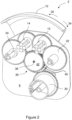
- FIG. 2 shows a similar view of the inhaler device interior with the mid chassis 4 and airway manifold 8 removed to expose the gearing between the various components of the inhaler device 2.
- closing and opening the mouthpiece cover 10 as indicated by arrows 32 and 34, actuates a mechanism to drive the index wheels 12,14, the spool wheels 22,24 and the take-up drum 30 in a predefined sequence to index and peel doses for inhalation.
- the sequence is controlled by a central logic hub 36, which is mounted on a spindle 38 extending from the rear chassis 6 and is directly driven by movement of the mouthpiece cover 10.
- the central logic hub 36 is mounted concentrically with three driving gears 40,42,44, which surround and are selectively engaged by the central logic hub 36.
- a take-up drum drive gear 40 can be seen engaging gearing on the base of the take-up drum 30, and a first index wheel drive gear 42 can be seen engaging gearing on the first index wheel 12 and first spool wheel 22.
- a second index wheel drive gear 44 is also provided to engage gearing on the second index wheel 14 and second spool wheel 24.
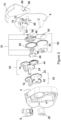
- Figure 3 is an exploded view of the inhaler device 2 of Figure 1 , in which the components making up the central logic hub 36 can be seen.
- the two main components of the central logic hub 36 are an index driving ratchet wheel 46, which engages with the first and second index wheel drive gears 42,44, and a peel driving ratchet wheel 48 which engages with the take-up drum drive gear 40 and with a take-up drum ratchet wheel 50 which, together with the take-up drum 30 and take-up drum drive gear 40, forms a take-up drum drive train 60.
- Figure 3 also indicates the components making up a first index wheel drive train 52 and a second index wheel drive train 54, as will be described more fully later.
- a torsion spring 56 is arranged between the index driving ratchet wheel 46 and peel driving ratchet wheel 48 in the central logic hub 36, and a slider 58 is provided to selectively resist rotation of one or other of the index driving ratchet wheel 46 and peel driving ratchet wheel 48.
- the rear chassis 6 also provides a channel 62 for receiving the slider 58, and a generally crescent shaped aperture 64.
- Inner and outer protrusions 66,68 formed on the mouthpiece cover 10 extend through the aperture 64.
- the aperture 64 also receives projections on the rear of the index driving ratchet wheel 46 and peel driving ratchet wheel 48 so that these components can be driven by rotational movement of the mouthpiece cover 10. More specifically, opening of the mouthpiece cover (clockwise movement from the position shown in Figure 1 ) will result in the inner protrusion 66 engaging with and driving the index driving ratchet wheel 46 in a clockwise direction, while closing the mouthpiece cover 10 will engage the outer protrusion 68 with the peel driving ratchet wheel 48 to drive it in an anticlockwise direction.
- the slider 58 allows one of the index driving ratchet wheel 46 and peel driving ratchet wheel 48 to be 'locked' while rotation of the mouthpiece cover 10 rotates the other. This builds a biasing force in the torsion spring 56, which can then be released by moving the slider 58 to release the previously locked component.
- the rear chassis 6 also provides first and second ratchet pawls 72,74 to selectively lock the first and second index wheels 12,14 respectively.
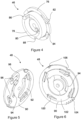
- the rear of the index driving ratchet wheel 46 from the central logic hub 36 is shown in Figure 4 .
- the wheel 46 comprises a generally circular plate 76 with a ring-shaped boss 78 extending from the rear face.
- a recess 80 is provided in the rear face of the plate 76 within the flange 78 for receiving an arm of the torsion spring 56.
- Around the periphery of the plate 76 are provided two circumferential ratchet pawls 82 and two axial ratchet pawls 84.
- the circumferential ratchet pawls 82 and axial ratchet pawls 84 are oriented so that they apply a driving force in opposite rotational directions.
- Figure 4 also shows a projection 86 extending from the end of the boss 78, and a recess 88 in its outer periphery.
- the projection 86 is for engagement with the inner protrusion 66 of the mouthpiece cover, and the recess 88 receives the slider 58 to lock the index driving ratchet wheel 46 against rotation.
- Figures 5 and 6 show the peel driving ratchet wheel 48 in greater detail.
- a rear view is provided in Figure 5 , showing a generally circular plate 90 with a large cut-out section 92 to one side, and a generally crescent-shaped slot 94 and two smaller cut-out sections 96 on the other.
- a projection 98 extends from the rear surface of the plate, adjacent the edge of the slot 94, for engagement with the outer protrusion 68 formed on the mouthpiece cover 10.
- a front view of the peel driving ratchet wheel 48 is shown in Figure 6 .
- Four radial ratchet pawls 100 are provided around the outer periphery of a ring-shaped boss 102 that extends from the front of the plate 90.
- the plate 90 does not prevent movement of the ratchet pawls 100, two are located in the region of the wheel 48 where the large cut-out section 92 is provided, and the other two correspond with the locations of the smaller cut-out sections 96.
- a small toothed section 104 is provided on the outer periphery of the plate 90, along with a pair of notches 106.
- the inner diameter of the ring-shaped boss 102 is large enough to receive the boss 78 of the index driving ratchet wheel 46 when the central logic hub 36 is assembled.
- the projection 86 extending from the end of the boss 78 on the index driving ratchet wheel 46 passes through the slot 94 to extend from the rear surface of the plate 90 of the peel driving ratchet wheel 48 to the same extent as the projection 98 formed directly on the plate 90 of the peel driving ratchet wheel 48.
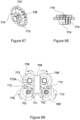
- Figure 7 shows the rear surface of the first index wheel drive gear 42.
- An internal cavity 110 is shown in a rear surface of the drive gear 42, with four radially extending notches 112 provided around the inner peripheral wall 114 of the cavity 110.
- the diameter of the cavity 110 is sufficient to receive the generally circular plate 76 of the index driving ratchet wheel 46 shown in Figure 4 , with the circumferential ratchet pawls 82 being received in two of the four notches 112.
- the assembly is shown, with the rest of the first index wheel drive train 52, in Figure 8 .
- the engagement of the circumferential ratchet pawls 82 in the notches 112 transmits drive from the index driving ratchet wheel 46 to the first index wheel drive gear 42 only in an anticlockwise direction 116 ( Figure 8 being a rear view of the assembly).
- the circumferential ratchet pawls 82 are able to flex out of the notches 112 permitting relative rotation between the index driving ratchet wheel 46 and the first index wheel drive gear 42.
- a boss 118 provided on a rear surface of the first index wheel 12 provides notches 122 for engagement with the first ratchet pawl 72 on the rear chassis 6 to resist rotation of the first index wheel 12 in the corresponding direction. Accordingly, the first index wheel drive train 52 provides drive to the first index wheel 12 and first spool wheel 22 only during mouthpiece cover closing.
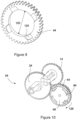
- Figure 9 shows the ring-shaped second index wheel drive gear 44 in greater detail.
- Four sloping recesses or notches 124 are provided in a front face of the drive gear 44 for engagement with the axial ratchet pawls 84 provided on the index driving ratchet wheel 46 when the boss 78 of the index driving ratchet wheel 46 is received within the ring.
- the inner diameter 120 of the index wheel drive gear 44 is the same as the inner diameter of the ring-shaped boss 102 of the peel driving ratchet wheel 48 to receive the boss 78 of the index driving ratchet wheel 46.
- Figure 10 shows a front view of the second index wheel drive train 54 incorporating the assembly of the second index wheel drive gear 44 and index driving ratchet wheel 46 as described above.
- the axial ratchet pawls 84 are shown engaged with two of the notches 124 so that clockwise drive 126 from the index driving ratchet wheel 46 is transmitted to the second index wheel drive gear 44.
- the index driving ratchet wheel 46 is driven clockwise 126 by engagement of projection 86 on the rear surface of the index driving ratchet wheel 46 with the inner protrusion 66 of the mouthpiece cover during opening the mouthpiece cover 10. Therefore, the second index wheel 14 and second spool wheel 24 are both driven when the mouthpiece 10 is opened.
- index driving ratchet wheel 46 results in the axial ratchet pawls 84 flexing out of the notches 124 permitting relative rotation between the index driving ratchet wheel 46 and the second index wheel drive gear 44.
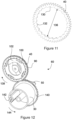
- Figure 11 shows the ring-shaped take-up drum drive gear 40 in greater detail.
- a number of notches 130 are provided in an inner peripheral wall 132 of the drive gear 40 to serve as ratchet teeth.
- the opening defined by the inner peripheral wall 132 has a diameter 136 sized to receive the boss 102 of the peel driving ratchet wheel 48.
- a front view of the take-up drum drive train 60 is shown in Figure 12 .
- the boss 102 of the peel driving ratchet wheel 48 has been inserted into the take-up drum drive gear 40 from behind such that the radial ratchet pawls 100 of the peel driving ratchet wheel 48 are engaged with the notches 130 to transmit clockwise rotation 138 of the peel driving ratchet wheel 48 to the take-up drum drive gear 40.
- the take-up drum drive gear 40 engages with gear teeth 140 provided around a base of the take-up drum 30 to transmit rotation to the take-up drum 30.
- a pair of retaining features 142 on one side of the take-up drum 30 retains the free ends of a pair of lidding foils such that, in use, anticlockwise rotation 144 of the take-up drum 30 applies tension to the lidding foils and winds them around the body of the take take-up drum 30.
- the plate 90 of the peel driving ratchet wheel 48 bears against a rear surface of the take-up drum drive gear 40, and its generally circular profile can be seen between the gear teeth of the take-up drum drive gear 40. Part of the take-up drum ratchet wheel 50 is also visible in the front view of Figure 12 , behind the take-up drum 30.
- Figure 13 shows a rear view of the take-up drum 30.
- the gear teeth 140 around the base of the take-up drum 30 are clearly visible, along with a ring of ratchet teeth 146 provided on the rear surface.
- the ratchet teeth 146 engage, in use, with a pair of ratchet pawls 148 provided on the opposite sides of the take-up drum ratchet wheel 50, extending from its front face which is shown in Figure 14 .
- Gear teeth 150 are provided on a section of the outer edge of the take-up drum ratchet wheel 50, adjacent an inwardly curved section 152.
- FIG. 15 A rear view of the take-up drum drive train 60 is shown in Figure 15 .
- the rear view shows the engagement of the ratchet pawls 148 and gear teeth 150 on the take-up drum ratchet wheel 50 with, respectively, the ratchet teeth 146 on the take-up drum 30 and the toothed section 104 on the peel driving ratchet wheel 48.
- clockwise rotation 138 of the peel driving ratchet wheel 48 will be transferred to the take-up drum ratchet wheel 50 while the gear teeth 150 remain engaged with the toothed section 104, and that the resulting anticlockwise rotation 144 will be transmitted to the take-up drum 30 via the ratchet pawls 148 and ratchet teeth 146.
- the inwardly curved section 152 of the take-up drum ratchet wheel 50 will receive the curved outer edge of the peel driving ratchet wheel 48, providing a Geneva style lock to hold the take-up drum ratchet wheel 50 against further rotation.
- the ratchet pawls 148 are able to flex past the ratchet teeth 146 to allow further anticlockwise rotation 144 of the take-up drum 30 driven by the peel driving ratchet wheel 48 and take-up drum drive gear 40 as previously described, but engage with the ratchet teeth 146 to resist any clockwise rotation of the take-up drum 30 while the take-up drum ratchet wheel 50 is static.
- Figure 16 shows a rear view of the entire mechanism of the inhaler device 2, including the central logic hub 36, take-up drum drive train 60 and first and second index wheel drive trains 52,54.
- the rear view also shows notches 134 on a boss 128 on the rear surface of the second index wheel 14, similar to the boss 118 and notches 122 provided on the rear surface of the first index wheel 12.
- the notches 134 on the second index wheel 14 are designed to engage with the second ratchet pawl 74 provided on the rear chassis 6 in the same way as the notches 122 on the first index wheel 12 engage with the first ratchet pawl 72. However, rotation is resisted in the opposite direction.
- the mouthpiece cover 10 is also shown in cross section, including the inner and outer protrusions 66,68 formed thereon.
- the inner protrusion 66 is shown abutting the projection 86 of the index driving ratchet wheel 46 that extends through the a generally crescent-shaped slot 94 in the peel driving ratchet wheel 48.
- the outer protrusion 68 is shown abutting the projection 98 on the peel driving ratchet wheel 48.
- the slider 58 is also shown, with a tab 154 provided on the obscured front face of the slider 58 illustrated in broken lines. The tab 154 engages with either the recess 88 (not shown) in the index driving ratchet wheel 46 or with a similar recess 156 provided in the peel driving ratchet wheel 48 to selectively lock one or other component against rotation.
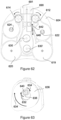
- the mouthpiece cover 10 is fully open, and a dose has just been inhaled from the inhaler device 2. The operation of the device 2 from this position will be explained in the following figures.
- Figure 17 shows the initial stage of mouthpiece cover closing.
- the mouthpiece 10 has been rotated by around 45° in the direction of arrow 32.
- the engagement of the outer protrusion 68 with the projection 98 on the peel driving ratchet wheel 48 directly drives the peel driving ratchet wheel 48 to rotate in the same direction 158, anticlockwise as the inhaler device 2 is viewed from the front, as the mouthpiece cover 10. None of the other components is rotated from the position shown in Figure 16 .
- the ratchet pawls 100 allow anticlockwise rotation of the peel driving ratchet wheel 48 within the take-up drum drive gear 40.
- the curved outer edge of the peel driving ratchet wheel 48 runs past the inwardly curved section 152 of the take-up drum ratchet wheel 50 until just after the point shown in Figure 17 , when the gear teeth 150 on the take-up drum ratchet wheel 50 are close to engagement with the toothed section 104 of the peel driving ratchet wheel 48.
- the tab 154 of the slider 58 is engaged with the recess 88 of the index driving ratchet wheel 46 to prevent its rotation, so that no indexing of either index wheel 12,14 takes place.
- the torsion spring 56 is charged by relative rotation between the peel driving ratchet wheel 48 and the index driving ratchet wheel 46.
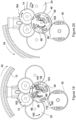
- Figure 19 shows that mouthpiece cover 10 in the fully closed position.
- the continued movement 32 of the mouthpiece cover 10 has further rotated the take-up drum 30 clockwise 160 to further reduce the tension on the lidding foils, and provide slack in the lidding foils between the take-up drum 30 and the first and second index wheels 12,14.
- the peel driving ratchet wheel 48 has also been further rotated, past a commitment point where the radial protrusion 153 and angled surfaces provided on the recess 88 of the index driving ratchet wheel 46 and the recess 156 provided in the peel driving ratchet wheel 48 guide/urge the slider 58 radially outwards to move the tab 154 from the recess 88 into the recess 156.
- the now freed index driving ratchet wheel 46 has been driven by the torsion spring to 'catch up' with the peel driving ratchet wheel 48 by rotating in an anticlockwise direction until the projection 86 of the index driving ratchet wheel 46 abuts the inner protrusion 66 of the mouthpiece cover 10.
- this anticlockwise rotation 116 of the index driving ratchet wheel 46 is transmitted through the first index wheel drive train 52 to advance or index the first index wheel 12, in a clockwise direction 162, by one recess 13 or one dose, and to similarly drive the first spool wheel 22 to take up the base foil.
- the pair of notches 106 in the peel driving ratchet wheel 48 are located to align with the ratchet pawls 72,74 on the rear chassis 6, allowing the ratchet pawls 72,74 to deflect so that the first ratchet pawl 72 does not inhibit rotation of the first index wheel.
- the indexing operation also applies tension to the first used lidding foil, but this only serves to take up the slack created by the clockwise rotation 160 of the take-up drum 30.
- the lidding foil is not peeled from the blister strip, but is instead doubled back over the unopened blister strip in a space provided between the first index wheel 12 and openings 16 in the airway manifold 8. This is shown in greater detail in Figure 23A .
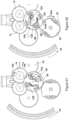
- Figure 20 shows the initial stage of opening the mouthpiece cover 10.
- the opening movement 34 of the mouthpiece cover 10 causes clockwise rotation 126 of the index driving ratchet wheel 46 through engagement of the inner protrusion 66 of the mouthpiece cover 10 with the projection 86 of the index driving ratchet wheel 46.
- This clockwise rotation 126 drives the second index wheel 14 and second spool wheel 24 as described in Figures 9 and 10 above, so that both rotate in an anticlockwise direction 164 to start advancing/indexing the second blister strip.
- the peel driving ratchet wheel 48 remains locked against rotation, so that no drive is provided to the take-up drum 30 and so that the notches 106 continue to allow movement of the ratchet pawls 72,74 so that the second ratchet pawl 74 does not impede anticlockwise rotation 164 of the second index wheel 14.
- Figure 21 illustrates further opening 34 of the mouthpiece cover, and the resulting further clockwise rotation 126 of the index driving ratchet wheel 46 and resulting anticlockwise rotation 164 of the second index wheel 14 and second spool wheel 24.
- the second index wheel 14 has now been advanced or indexed by one recess 15, or one dose, from the position shown in Figure 19 .
- the slack created in the lidding foils during mouthpiece closure avoids peeling of the lidding foil a from the second blister strip during indexing.
- the tab 154 is adjacent the recess 88 in the index driving ratchet wheel 46 in Figure 21 , so that any further movement will urge the tab 154 from the into the recess 156 in the peel driving ratchet wheel 48 into the recess 88 in the index driving ratchet wheel 46.
- the sudden rotation 144b of the take-up drum applies tension to both lidding foils simultaneously, to expose the next dose in each blister strip for inhalation.
- the anticlockwise rotation 144b of the take-up drum 30 will be greater than the anticlockwise rotation 144a of the take-up drum ratchet wheel 50. This allows the take-up drum 30 to release tension in the lidding foils on mouthpiece closure after a dose is dispensed, while still effectively peeling the lidding foils from the next dose on mouthpiece opening.
- the sudden rotation of the peel driving ratchet wheel 48 also moves the notches 106 out of alignment with the ratchet pawls 72,74 on the rear chassis 6, effectively locking the first and second index wheels 12,14 against rotation.
- the inhaler is back in the configuration shown and described in Figure 16 .
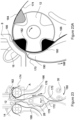
- Figure 23 schematically shows a front view of part of the inhaler mechanism, illustrating the paths of first and second blister strips 166,168 through the inhaler device 2.
- the mouthpiece cover 10 of the inhaler is fully closed, as described in relation to Figure 19 , so the take-up drum 30 has been rotated clockwise 160 to actively release tension in the separated first and second lidding foils 170,172.
- the clockwise rotation 162 of the first index wheel 12 has advanced the base foil 174 of the first blister strip 166, dragging the first lidding foil 170 around the first index wheel.
- the second index wheel 14 has not been rotated at this stage, so the second lidding foil 172 remains slack.
- any excess tension 176 that may be generated in the first lidding foil 170 by sudden movement of the first index wheel 12 can be accommodated by movement 178 of the tension balancer 28 towards the second lidding foil 172.
- the tension balancer 28 can thus acts as a further means to release or manage tension so that minimal tension is maintained in both lidding foils 170,172 with the mouthpiece cover 10 closed, even though the first index wheel 12 has already been advanced/indexed in this position.
- Figure 23A shows an enlarged view of the are marked ⁇ A' in Figure 23 .
- the first blister strip 166 is shown passing around the first index wheel 12, with first and second full blister pockets 180,182 and an empty blister pocket 184 illustrated.
- the second full blister pocket 182 has been advanced to a position under an opening 16 in the airway manifold 8.
- the first lidding foil 174 has been doubled back 186 over the second full blister pocket 182, in a space between the first index wheel 12 and the airway manifold 8.
- the operation of the mechanism of the inhaler device 2 comprises several separate actions that arise from a single actuation of the mechanism (movement of the mouthpiece cover 10), and that these actions encompass a number of commitment-points.
- Potential problems that may arise if some commitment points are passed while others remaining unreached during include, for example:
- This inhaler device 2 described above uses a 'catch-up' mechanism.
- the mouthpiece cover 10 drives the index driving ratchet wheel 46, which rotates by the opening-angle before releasing the slider 58.
- the slider 58 releases the peel driving ratchet wheel 48 to rotate until peeling is complete.
- the peel driving ratchet wheel 48 is driven back until it resets the slider 58. This in turn releases the index driving ratchet wheel 46 to rotate back until the first index wheel 12 has indexed.
- Ratchets/pawls link the index driving ratchet wheel 46 to both first and second index wheels 12,14, as well as linking both index wheels 12,14 to the rear chassis 6, and the take-up drum 30 to the take-up drum ratchet wheel 50.
- the inhaler device 2 aims to ensure that all of these ratchet reset points are ⁇ slaves' to the commitment points at which the slider 58 is released.
- the slider 58 is forced down, or radially inwards, into the index driving ratchet wheel 46 by the peel driving ratchet wheel 48 by the angled surfaces provided on recesses 88,156. This results in a small final rotation in the index driving ratchet wheel 46 when the slider 58 is released and the peel driving ratchet wheel 48 is allowed to rotate.
- This final rotation provides a window for the resetting of ratchets, specifically those associated with the movement of the second index wheel 14 and the movement of the index driving ratchet wheel 46 relative to the first index wheel drive gear 42. Since they occur in that final section of movement of the index driving ratchet wheel 46, they will be tied to the movement of the peel driving ratchet wheel 48, and will be impossible to actuate separately.
- the commitment point occurs when the peel driving ratchet wheel 48 has been rotated enough to push the slider 58 back out of engagement with the index driving ratchet wheel 46, causing it to rotate and effect the indexing of the first index wheel 12, with its associated ratchet-pawl reset.
- This indexing is thus tied to the commitment point, and neither can be actuated separately.
- first and second index wheels 12,14 may be selectively prevented by interacting curved Geneva lock surfaces provided on the first and second index wheels 12,14 and on the peel driving ratchet wheel 48, rather than by the first and second pawls 72,74 as described.
- the peeling of the lidding sheet/foil may also be achieved by alternative means.
- the index wheel may be arranged to move linearly while it turns and indexes the strip, effectively causing it to roll along the strip by one blister-pocket, before locking its rotation and translating its axle back to its original position. This would allow the lidding foil take-up system to peel the lidding foil as the index wheel translates.
- a movable peel beak may be provided to rotate with one of both of the first and second index wheels 12,14 during indexing, before being released to allow peeling of the lidding foil.
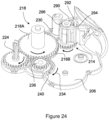
- FIG. 24 An example of a moving peel-beak arrangement is shown in Figure 24 .
- the Figure shows one side of a mechanism for an alternative inhaler device, with a single index wheel 214 visible.
- the illustrated mechanism also includes a central input hub gear 236, a take-up drum/hub 230 for used lidding sheet or foil, and a spool wheel 224 for receiving used base/base foil.
- a moving peel-beak component 290 is provided around the index wheel 214.
- the moving peel-beak component 290 defines the peel front, and comprises a ratchet pawl 292, which is shown in engagement with ratchet teeth 296 provided on or associated with the indexing wheel 214.
- a pin 294 is provided on the ratchet pawl 292 so that a sprung peel actuator (not shown) can disengage the ratchet pawl 292 from the ratchet teeth 296 when required.
- a storage hub 218, for storing the unused blister strip is also shown.
- the storage hub 218 comprises front, or inner, and rear, or outer, gears 218A,218B with a torsion spring arranged therebetween.
- the inner gear 218A is driven by rotation of the input hub gear 236 as shown, and this drive is directly transferred to the index wheel 214 and spool wheel 224 to advance the blister strip.
- the take-up drum/hub 230 is, instead, engaged with the outer gear 218B.
- the tension generated in the lidding foil rotates the take-up drum/hub 230 against the take-up direction, driving the outer gear 218B in the opposite direction to the inner gear 218A and charging the torsion spring in the storage hub 218.
- the peel actuator (not shown) engages with the pin 294 to release the ratchet pawl 292 from the ratchet teeth 296. This frees the moving peel-beak component 290 to rotate relative to the index wheel 214.
- the charged torsion spring then drives the rear/outer gear 218B to take up the lidding foil and peel the dose open as the index wheel 214 is held stationary.
- the moving peel-beak component 290 also includes an extra section of airway (not shown) to provide a passageway between a peeled dose/blister on the index wheel 214 and the mouthpiece of the inhaler device.
- the mechanism shown in Figure 24 is shown assembled against a rear plate 206 of an inhaler to make up the left-hand side of a complete mechanism.
- the input hub gear 236 is surrounded by a rear ratchet ring 240 which is connected through the rear plate 206 to a mouthpiece cover (not shown), so that the mechanism is only driven in the direction of arrow 234. This drive occurs when the mouthpiece is moved from a closed position to an open position.
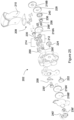
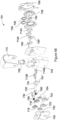
- FIG. 25 An exploded view of a complete inhaler 202 incorporating the moving peel-beak component 290, is shown in Figure 25 .
- the rear plate 206 is omitted from the exploded view, but the remaining components discussed in Figure 24 are shown, along with the torsion spring 256 provided between the front and rear gears 218A,218B of the storage hub 218.
- the mouthpiece and airway manifold 208, the mouthpiece cover 210, and a linearly moving peel actuator 258 are also shown.
- this second embodiment of an inhaler comprises a moving mouthpiece cover connected to a central hub comprising a pair of unidirectional ratchet wheels each associated with a separate gear train. This allows the action of closing the mouthpiece cover to advance a first index wheel, while opening the mouthpiece cover advances a second index wheel.
- the central hub also incorporates a cam track for controlling movement of the spring peel actuator.
- the peel actuator is released to free a pair of peel-beak components as described above when the mouthpiece cover is opened beyond an intermediate position or commitment point, and is reset on mouthpiece closure.
- the peel actuator is constrained to a linear motion.
- the right-hand side of the mechanism is the first to advance, so the right-hand side components will hereafter be referred to as the first index wheel 212, first spool wheel 222 etc.
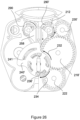
- FIG. 26 A front view of the assembled mechanism is shown in Figure 26 .
- the mouthpiece cover has been closed after a dose has been inhaled.
- the front ratchet ring 240' has rotated the front input gear 236' in the direction of arrow 232 as the mouthpiece was closed, advancing the right-hand side of the mechanism to rotate the first index wheel 212 by a single step/dose and rotating the first peel beak component 290' to the position shown.
- the input gear 236' directly drives inner gear 218A' of the storage hub 218', and this direct drive is transferred to the first index wheel 212 (via the additional gear 228 - see Figure 27 ) and first spool wheel 222 to advance the blister strip.
- the first take-up drum/hub 230' is engaged with the outer gear 218B'.
- the tension generated in the lidding sheet/foil rotates the take-up drum/hub 230 against the take-up direction, driving the outer gear 218B' in the opposite direction to the inner gear 218A' and charging the torsion spring 256' in the first storage hub 218.
- a peel actuator cam track 241 provided in the front ratchet ring 240' also moves the peel actuator 258 vertically downwards to the position shown, against the force of a biasing spring, so that the first peel-beak 290' is not disengaged from the first index wheel during rotation.
- the front ratchet ring 240' is rotated in the direction of arrow 234. This causes the ratchet pawls 250' to deflect, so that no drive is transmitted to the mechanism during mouthpiece opening.
- Figure 27 shows a rear view of the assembled mechanism.
- the rear faces of the components shown in Figure 25 are visible, along with the additional gear 228 which is engaged with the first index wheel 212.
- the additional gear 228 is directly connected to the inner gear 218A' of the first storage hub 218', so that rotation of this as the mouthpiece cover is closed directly drives the first index wheel 212 as described in Figure 26 .
- Rotating the rear ratchet ring 240 in the direction 234 by opening the mouthpiece cover drives the second index wheel 214, second spool wheel 224, etc as described in Figure 25 .
- the ratchet pawls 250 deflect to allow rotation of the rear ratchet ring 240 in the direction of arrow 234 without advancing the mechanism during mouthpiece closing.
- the additional gear 228 is not engaged with the rear input gear 236, and so is not driven by any movement of the rear ratchet ring 240.
- the two unidirectional ratchet rings 240,240' drive different halves of the mechanism on closing and opening of the mouthpiece.
- the first index wheel 212 is driven only during closure of the mouthpiece 210 and the second index wheel 214 is driven only during mouthpiece opening.
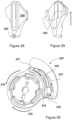
- the peel actuator 258 is shown in isolation in Figures 28 and 29 .
- the front view of Figure 28 shows a pin 260 at the lower end of the peel actuator 258 for engagement with the cam track 241 in the front ratchet ring 240'.
- Figure 29 shows a pair of prongs 262 on the rear of the peel actuator 258.
- the prongs 262 simultaneously engage with the pins 294 of the ratchet pawls 292 of both peel-beaks 290,290' to release the peel-beaks 290,290' and allow the take-up drums/hubs 230,230' to rotate and withdraw the lidding foil from each of two blister strips, exposing a dose for inhalation.
- Figure 30 shows the rear side of the front ratchet ring 240', providing detail of the cam track 241 for guiding the pin 260 of the peel actuator 258.
- the path of the pin 260 through the cam track is illustrated with arrows.
- a resilient divider 246 is provided between the outer and inner tracks 242,244 to provide the outer wall of the inner track 244.
- the divider 246 deflects as the pin 260 approaches the left end (as shown) of the cam track 241 during closure of the mouthpiece cover to allow the pin 260 to move from the outer track 242 to the inner track 244. This is the position shown in the front view of Figure 26 .
- the divider 246 then returns to the position shown in Figure 30 to prevent the pin 260 returning to the outer track 242 during subsequent opening of the mouthpiece cover.
- the pin 260 When the mouthpiece cover 210 is fully open, the pin 260 reaches the right end (as shown) of the cam track 241, and can then move into a straight part 248 of the cam track 241, which is arranged substantially vertically relative to the inhaler body in the fully open position.
- This provides a commitment point, occurring shortly after the second index wheel 214 has been advanced by one step/dose, at which the peel actuator 258 is freed to move vertically, under the force of its spring, and release the peel-beaks 290,290' to uncover a dose for inhalation by a patient.
- FIG. 31-35 A further embodiment of the present invention is illustrated in Figures 31-35 .
- This embodiment comprises a single double-height index wheel for receiving two blister strips, although it should be clear that the mechanism could be provided for a single blister strip if desired.
- a unidirectional ratchet wheel drives the indexing system as the mouthpiece cover is opened.
- a sprung idler comprising a torsion spring, and having a similar construction to the storage hub 218 described in Figure 24 , is provided in a drivetrain between the mouthpiece cover and a lidding sheet take-up component, and a moving peel-beak component similar to that described above is included.
- a cam track provided on the chassis of the inhaler engages with a pin on the ratchet pawl of the moving peel-beak component to free it when the index wheel and peel-beak component to rotate past a commitment point corresponding with an intermediate position of the mouthpiece cover during opening.
- Figure 31 shows an exploded view of this third embodiment.
- the exploded view is taken from the rear, and therefore shows the rear sides of the various components of the inhaler device 302 as they are arranged within an outer housing.
- the mechanism is formed from several geared components are held in place by a mid chassis 304 and a rear plate 306.
- Two blister strips 366,368 are also shown side by side so that the individual pockets of medicament in each strip sit side by side in recesses in an indexer 312 in the form of a double-height index wheel located towards the top of the inhaler.
- a moving peel-beak component 390 is also provided.
- a spool wheel 322 for advancing and receiving the used base sheets/foils of the blister strips 366,368, and a take-up drum 330 for receiving used lidding sheet/foil.
- a sprung idler 318 formed from front and rear gears 318A,318B with a torsion spring 356 arranged therebetween, along with first and second idler gears 352,354.
- a rear ratchet component 340 provides a connection to the mouthpiece cover 310, and fits within a cavity on the rear of a central input hub gear 336 to provide drive to the input hub gear 336 in only one direction.
- Figure 32 shows the assembly of the mechanism within the inhaler device 302.
- the input hub gear 336 is driven in the clockwise direction 334 when the mouthpiece cover 310 is opened, and directly drives the index wheel 312 and first and second idler gears 352,354.
- the first idler gear 352 transmits drive to the spool wheel 322, and the second idler gear 354 transmits drive to the front gear 318A of the sprung idler.
- Figure 33 shows a rear view of the inhaler mechanism.
- the moving peel-beak component 390 can be seen surrounding part of the index wheel 312, occupying a space between the index wheel 312 and the mouthpiece and airway manifold 308.
- the rear gear 318B of the sprung idler 318 is shown engaged with the take-up hub 330, so that the torsion spring 356 can accommodate required differences in rotation of the take-up hub 330 and other components in the mechanism.
- the engagement of the rear ratchet component 340 with the input hub gear 336 can be seen, and it will be understood that the ratchet component 340 will drive the hub gear 336 when rotated in the direction or arrow 334 during mouthpiece cover opening, but can rotate relative to hub gear 336 the when rotated in the opposite direction as the mouthpiece cover 310 is closed.
- Figure 34 shows a rear plan view of the index wheel 312 and moving peel-beak component 390 from the mechanism shown in Figure 33 .
- the pawl 392 on the peel-beak component 390 is shown engaged with one of a series of radially inwardly extending ratchet teeth 316 provided on the rear side of the index wheel 312, so that the peel-beak 390 rotates with the index wheel 312 in the direction of arrow 364 during cap opening.
- the peel front of the blister strips 366,368 moves with the index wheel. This generates tension in the lidding sheet/foil, which results in reverse rotation of the take-up hub 330 and charges the torsion spring 356 in the sprung idler 318.
- Figure 35 shows the rear plate 306 and the cam track 358 provided therein to act as a peel actuator.
- the pin 394 of the pawl 392 passes through the cam track 358 as indicated by arrows 344 and 348.
- the arc indicated by arrow 344 corresponds with the rotation required to advance the index wheel 312 by just less than one dose/step.
- Further rotation of the mouthpiece cover 310 beyond this commitment point causes the second, angled, part 348 of the cam track 358 to guide the pin 394 so that the pawl 392 on the peel-beak component 390 is moved radially inwards, as shown by arrow 378 in Figure 34 .
- the index wheel 312 continues to rotate in the anticlockwise direction 364 as the pawl 392 is withdrawn, so that the previously engaged ratchet tooth 316 on the index wheel 312 moves past the pawl 392. This frees the peel-beak component 390 to rotate clockwise relative to the index wheel 312, with the pin passing back through the cam track 358.
- the charged torsion spring 356 in the sprung idler 318 then rotates the take-up hub 330 to take up the lidding foil and peel a dose open as the peel-beak component 390 rotates.
- the torsion spring 356 is sufficiently charged to drive the take-up hub 330 the equivalent of two steps or doses. This ensures that the take-up hub re-coils the 'released' lidding sheet (necessary to allow movement of the peel-beak component 390) and also to peel open a new dose.
- the pawl 392 on the peel-beak component 390 automatically engages with the next ratchet tooth 316 of the index wheel during this movement.
- the rear plate 306 also provides a pawl 372 is a that engages with axial ratchet teeth 320 on the rear of the index wheel 312 to prevent reverse rotation of the index wheel 312 while a dose is peeled and to provide resistance to the ratchet component 340 as the mouthpiece is closed ready for the next use.
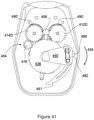
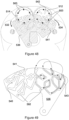
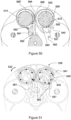
- FIGS 36-46 show another embodiment of the invention.
- a concentric pair of timing gear wheels are rotated by opening the mouthpiece cover to successively drive a pair of index wheels, using Geneva locking and intermittent gearing to effect the desired timing.
- a cam follower sprung with a torsion spring to effect bistability, transmits the rotation from the mouthpiece cover to the timing gear wheels, and is also advanced along a cam track in the inhaler chassis by this rotation.
- the cam track causes the follower to ⁇ flip' and actuate a push rod, which moves linearly to release the ratchet pawls provided on a pair of moving peel-beak components similar to those described above.
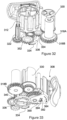
- FIG. 36 An exploded view of the inhaler 402, with the outermost housing/body components omitted, is shown in Figure 36 .
- a mid chassis 404 is shown, along with a front plate 405 and a rear plate 406.
- Various geared components are assembled between the rear plate 406 and mid chassis 404 to make up separate left-hand and right-hand drivetrains, as indicated by the recesses 407 shown on the rear plate 406.
- a sprung idler 418 which serves as a storage hub for the unused part of a blister strip 466, a first idler gear 452 and spool wheel 422 to advance the blister strip and coil the used base sheet, and a take-up drum 430 for receiving used lidding sheet/foil.
- the sprung idler 418 is formed from front and rear gears 418A,418B with a torsion spring 456 arranged therebetween, similar to the equivalent components 218,318 of the second and third embodiments. Also shown are front and rear index output gears 412A,412B which form part of a first indexer 412.
- a first index wheel 412C, with pockets for receiving individual blisters of a blister strip 466, and first index drive gear 412D make up the remainder of the first indexer 412, and are shown at the front of the exploded view.
- the rear index output gear 412B is received within the front index output gear 412A but is free to relate relative thereto.
- the front index output gear 412A is rigidly connected to the first index wheel 412C
- the first index drive gear 412D is rigidly connected to a pin 413 extending from the first index wheel 412C.
- a similar arrangement on the left-hand side of the inhaler 402 makes up a second indexer 414 for engagement with a second blister strip 368.
- the second index drive gear 414D is a simple tooted gear, whereas the first index drive gear 412D provides Geneva locking as will be explained later.
- a second idler 454 is also associated with the second index drive gear 414D.
- a first moving peel peak component 490 is arranged around the first index wheel 412C.
- the peel-beak component 490 includes a ratchet pawl 492 for selective engagement with recesses 416 in a front face of the first index wheel 412C. When assembled, the front face of the peel-beak component 490 is substantially flush with the front face of the front plate 405.
- a central input hub gear 436 is provided in front of the front plate 405.
- the central hub gear 436 is driven by a cam follower 480 which is moved by an arm 440 connected to the mouthpiece cover 410.
- a curved cam track 461 is provided in the front plate 405 to control movement of the cam follower 480 relative to the arm 440, as will be described later, against the force of a stabilising spring 482 provided between the cam follower 480 and a further part of the arm 440.
- a further guide channel 459 in the front plate 405 receives a peel actuator 458, in the form of a push rod, and constrains it to a linear movement.
- the peel actuator 458 has a drive pin 460 at its lower end and a pair of prongs 462 at its upper end.
- the prongs 462 are positioned just proud of the front face of the front plate 405 in the assembled inhaler 402 so that each prong 462 can engage a ratchet pawl 492 of a peel-beak component 490 when the peel actuator 458 moves vertically.
- the peel actuator 458 also has a guide pin 463 for engagement with a generally circular cam track 441 provided on the rear surface of the hub gear 436.
- Figure 37 shows a rear view of the central hub gear 436, which can be considered to comprise front and rear halves, each in the form of a generally circular plate.
- Four pairs of teeth 416 are provided at 90 degree spacings around the periphery of a front half, and four groups of three teeth 420 are provided at 90 degree spacings around the periphery of the rear half.
- Each half of the hub gear 436 therefore provides four isolated geared portions 416,420 separated by smooth radiused sections 417,421.
- the groups of gear teeth 416,420 on the front and rear halves are offset from one another circumferentially.
- a generally circular cam track 441 is also provided on the rear of central hub gear 436.
- the cam track 441 forms a closed loop with four quarters each having a straight angled section 442, a constant radius section 444 and a straight radially outwardly extending section 448.
- Each radially outwardly extending section 448 is located between the offset groups of teeth 416,420 on the front and rear halves of the central hub gear 436.
- Figure 38 shows detail of the cam follower 480.
- a pair of teeth 484 are provided for engagement with the groups of three teeth 420 on the rear half of the hub gear 436.
- a pin 486 is also provided for engagement with the curved cam track 461, and a recess 485 to engage with the peel actuator 458.
- the first index drive gear 412D and second idler 454 are shown in Figure 39 and Figure 40 respectively.
- the first index drive gear 412D has six isolated gear teeth 473, for engagement with the pairs of gear teeth 416 provided on the front half of the hub gear 436, separated by inwardly curved sections 472 around the periphery of the first index drive gear 412D.
- the radius of each curved section 472 matches the radius of the smooth sections 417 of the hub gear 436.
- rotation of the central hub gear 436 will advance the first index drive gear 412D when the teeth 416,473 of the components are in engagement, but when the curved sections 417,472 are in engagement the first index drive gear 412D will be held against rotation.
- Drive gear 412D therefore provides a Geneva lock with the hub gear 436.
- the second idler 454 comprises front and rear gear wheels separated by a reduced diameter central section and is shown from the rear in Figure 40 .
- the rear gear wheel comprises three pairs of gear teeth 475, for engagement with the groups of three teeth 420 on the rear of the central hub, and three inwardly curved sections 474 each having a radius equal to the curved section 421 of the central hub gear 436.
- the front gear wheel is a standard gear 476 with teeth for engagement with the second index drive gear 414D.
- the second idler gear 454 therefore provides a similar intermittent drive and locking function for the first index drive gear 414D as that provided by the first index drive gear 412D.
- FIG. 41 A front view of the assembled mechanism is shown in Figure 41 .
- the first index drive wheel 412D, and hence the first index is being held against rotation by the central drive hub.
- the front gear 476 of the second idler gear 454 sits proud of the central hub gear 436 and is engaged with the second index drive wheel 414D while the rear gear wheel (not shown) engages with the rear half of the central hub gear 436.
- the reduced diameter central portion of the second idler gear 454 spaces the front and rear gears so that no part of the second idler gear 454 engages with the front half of the central hub gear 436.
- the peel actuator 458 is at the top of the guide channel 459, with the prongs 462 sandwiched between the first and second index drive wheels 412D,414D and the first and second moving peel-beak components 490,490'.
- the cam follower 480 and spring 482 are assembled with the arm 440, which is moved in a clockwise direction 434 when the mouthpiece cover is opened, moving the cam follower 480 along the curved cam track 461. This movement will be explained in the following Figures, where hidden parts of the mechanism are shown in broken lines.
- Figure 42 shows a view of the mechanism with the mouthpiece cover opened slightly from the position shown in Figure 41 .
- the arm 440 has rotated clockwise 434, which rotates the central hub gear 436 due to the engagement of the pair of teeth 484 on the cam follower 480 with a group of three teeth 420 on the rear half of the central hub gear 436.
- the path of the guide pin 463 of the peel actuator 458 along the angled section 442 of the generally circular cam track 441 during this rotation is indicated, and results in a downward movement of the peel actuator 458, away from the top of the guide channel 459.
- a gear tooth 473 of the first index drive wheel 412D is engaged with a pair of teeth 416 on the hub gear 436 so that further rotation will drive the first indexer 412.
- the mechanism is shown after further rotation in Figure 43 .
- the guide pin 486 of the cam follower 480 has moved through an inner part 461A of the curved cam track 461 as indicated, continuing to drive the hub gear 436.
- the first index drive wheel 412D has been advanced by one step.
- a set of three teeth 420 on the front half of the hub gear 436 has moved into and out of engagement with a pair of teeth 475 on the second idler 454, rotating the second idler 454 to drive the second index drive wheel 414D, and thus the second indexer 414, one step.
- the first and second peel-beak components 490,490' rotate with their respective indexers 412,414 to provide a moving peel front during use, as previously described.
- the spacing of the groups of teeth 416,420 on the central hub gear 436 ensures that the second index drive wheel 414D is only advanced after the first after the index drive wheel 412D has been advanced by one step.
- the peel actuator 458 has been maintained in a withdrawn position during the rotation by engagement of its guide pin 463 with the constant radius section 444 of the generally circular cam track 441.
- the first and second index drive wheels 412D,414D have both been advanced one step from the position shown in Figure 42 . Both are held against rotation by the engagement of inwardly curved sections 472,474 of the first index drive wheel 412D and the second idler 454 respectively with a curved outer surface of the hub gear 436.
- the pin 463 of the peel actuator 458 is abutting a radially extending part 448 of the generally circular guide track 441 to resist further rotation of the hub gear 436.
- Figure 45 shows the mechanism being re-set by the movement 432 of closing the mouthpiece cover 410, during which the cam follower 480 is driven by movement of the arm 440.
- the guide pin 486 of the cam follower 480 passes along an outer part 461C of the curved guide track 461, avoiding any reverse driving of the central hub gear 436.
- the stabilising spring 482 helps to maintain the cam follower 480 in its second, disengaged, state during this movement.
- the pair of teeth 484 on the cam follower are adjacent a different group of three teeth 420 on the rear half of the central hub gear 436.
- Further movement of the arm 440 as the mouthpiece cover 410 is fully closed will move the guide pin 486 of the cam follower 480 through a final straight section 461D of the curved guide track 461.
- This serves to flip the cam follower 480 back to its first state, engaging the pair of teeth 484 with the group of three teeth 420 on the rear half of the central hub gear 436.
- the mechanism is thus returned to the position shown in Figure 41 , ready for the next actuation.
- Figure 46 shows the gearing on the rear of the inhaler device 402, ie a view from the rear of the device with the rear plat 406 removed.
- the first indexer 412 is engaged with the first take-up drum 430 and the first sprung idler 418.
- the first idler gear 452 is also engaged with the first sprung idler 418 and with the first spool wheel 422 to complete a first drivetrain on one side of the inhaler device 401.
- a second, separate, drivetrain, incorporating the second indexer 414, is also provided. Arrows have been added to Figure 46 to illustrate the movement of the drivetrains. For clarity, part of the total movement/drive is illustrated on each of the first and second drivetrains, with broken arrows indicating the engagement and movement of obscured components.
- the first index drive gear 412D is driven by rotation of the central hub gear 436 during opening of the mouthpiece cover 410. This causes the indicated rotation of the front index output gear 412A, which drives the front gear 418A of the sprung idler 418 as shown.
- the front gear 418A of the sprung idler 418 is engaged with the first idler gear 452, which in turn is engaged with the first spool wheel 422 to drive and coil the used base sheet.
- the second drive train operates similarly for the second indexer 414 and second spool wheel 422'.
- a strain is applied to the used lidding sheets as the first and second indexers 412,414 are advanced, due to the moving peel beak components 490,490', and this causes rotation of the first and second take-up drums 430,430'.
- the second take-up drum 430' is engaged with the rear index output gear 414B of the second indexer, which acts as an idler transmitting drive to the rear gear 418B' of the second sprung idler 418'.
- the counter rotation of the front and rear gears 418A',418B' stores energy in the torsion spring 456 during indexing. This energy is released when the peel actuator 458 releases the peel-beak components 490,490', and is sufficient to rotate the second take-up drum 430' to peel a dose.
- Figures 47-60 show a fifth embodiment of the invention where both the indexing and peeling operations are controlled by a cam plate.
- a cam track provided on the cam plate engages with pins on a pair of index wheels, and pins provided on the cam plate engage with cam tracks on a pair of moving peel-beak components associated with the index wheels.
- Torsion springs are provided between the moving peel-beak components and the index wheels. The moving peel-beaks are initially held against rotation while the index wheels are advanced by the cam plate during movement of the mouthpiece cover, and are released only when the mouthpiece cover is opened past an intermediate position or commitment point. No ratcheted components are used anywhere in the fifth embodiment.
- FIG. 47 An exploded view of the internal components of an inhaler 501 according to the fifth embodiment is shown in Figure 47 .
- a mid chassis 504 and front plate 505 are provided as part of the body of the inhaler 501, and first and second index wheels 512,514 are provided as indexers for first and second blister strips 566,568 respectively.
- Each of the first and second indexers 512,514 comprises a fixed front gear 518A,518A' and a rear gear 518B,518B' which is rotatable relative to the front gear 518A,518A'.
- a torsion spring 556 is connected between the rear gear 518B,518B' and the remainder of the indexer 512,514.
- a moving peel beak component 590,590' is provided surrounding each of the first and second indexers 512,514 to vary the position of the peel front, as described in other embodiments.
- first and second geared drivetrains To the rear side of the mid chassis 504 various geared components are shown which make up first and second geared drivetrains. Only the components making up the first drivetrain, namely a first spool wheel 522, first take-up drum 530 and first and second idlers 552,554 are shown.
- the geared parts of each of the first and second indexers 512,514 extend past the rear of the mid chassis 504 to engage with the first and second geared drivetrains respectively.
- Front faces of the first and second indexers 512,514 extend through cut-out sections in the front plate 505, and of the respective moving peel beak components 590,590' are located in front of the front plate 505 so that they are exposed to a cam plate 536.
- a hub component 538 connects the cam plate 536 to a movable mouthpiece cover (not shown).
- Figure 48 shows a cross section taken through a convoluted cam track 541 provided in the cam plate 536 to illustrate the engagement of the cam plate 536 with the first and second indexers 512,514.
- a first ring of six pins 553 is provided around the edge of the front face of the first indexer 512
- a second ring of six pins 563 is provided around the edge of the front face of the second indexer 514.
- the configuration shown in Figure 48 is where the mouthpiece cover of the inhaler device 501 has been fully closed, moving the cam plate in a generally anticlockwise direction as indicated by arrow 532.
- Three of each group of six pins 553,563 are engaged with the cam track 541, holding both the first and second indexers 512,514 against rotation.
- Figure 49 shows the path 543 taken by a pin 563 of the second indexer 514 through the cam track 541 during use of the inhaler device 501.
- the solid arrows indicate the path taken during movement of the cam plate 536 during opening 534 of the mouthpiece cover from the position shown in Figure 48 . This serves to drive the second indexer 514 during opening of the mouthpiece cover.
- the broken arrows indicate the path taken by the same pin 563 as the mouthpiece cover is closed 532, holding the second indexer 514 against rotation. Each pair of arrows relates to a single opening and closing of the mouthpiece cover.
- the rear surface of the cam plate 536 also comprises a driving pin 540 which engages with one of six slots 542 provided on the front face of the first indexer 512 to drive rotation of the first indexer 512 during closure 532 of the mouthpiece cover. Also provided are a pair of peel-beak pins 562 to control movement of the moving peel-beak components 590,590' during use of the inhaler device 501.
- Figure 50 shows a further cross section of the device, similar to that of Figure 48 , taken through a plane that intersects the six slots 542 in the first indexer 512. Also shown are first and second peel-beak cam tracks 551,561 in the first and second moving peel-beak components 590,590' respectively. Cross sections of the driving pin 540 and peel-beak pins 562 are also visible.
- the first and second moving peel-beak components 590,590' are free to rotate relative to the first and second indexers, with no engaging latch or ratchet pawl provided. Their movement is instead regulated by the engagement of the peel-beak pins 562 with the first peel-beak cam track 551 or second peel-beak cam track 561. Meshing gear teeth 596 provided on each of the moving peel-beak components 590,590' ensures that their movement is coupled, such that engagement of a peel-beak pin 562 with either peel-beak cam track 551,561 will control movement of both peel-beak components 590,590'.
- one peel-beak pin 562 is disengaged from the first peel-beak cam track 551, but movement of both peel-beak components 590,590' is still controlled by the engagement of the other peel-beak pin 562 with the second peel-beak cam track 561.
- one or both of the peel-beak pins 562 is engaged with a peel-beak cam track 551,561 in such a way as to either drive the peel-beak components 590,590' or hold them against rotation.
- the exception is where the peel-beak pins 562 are in actuation positions marked 592, when the moving peel-beak components 590,590' are free to rotate as shown by arrows 593 and 594, allowing a dose to peel.
- Figure 51 shows the cam plate 536 in position when the mouthpiece cover is in a fully open position.
- the peel-beak pins 562 are in the actuation positions 592 shown in Figure 50 , so the moving peel-beak components 590,590' are free to rotate as described above.
- the convoluted cam track 541 of the cam plate 536 is shown in broken lines, as are various features of the first and second indexers 512,514 obscured behind the cam plate 536.
- the driving pin 540 is positioned at the end of one of six slots 542 in the front face of the first indexer 512 so that movement of the cam plate 536 in the direction of arrow 532, during closing of the mouthpiece cover, will first move the driving pin 540 into the slot 542 and then advance the first indexer 512.
- Figure 52 shows the paths of the two blister strips 566,568 through the inhaler device.
- the first blister strip 566 runs around the first indexer 512, before the base used base sheet is taken up by the first spool wheel 522 and the used lidding sheet is taken up by the first take-up drum 530, having first passed around a peel-beak in the first moving peel-beak component 590.
- the second blister strip 568 takes a similar path around the second indexer 514, second spool wheel 524 and the second moving peel-beak component 590' and take-up drum 530'.
- the gearing on the rear of the inhaler device is shown in Figure 53 .
- the front gear 518A of the first indexer 512 drives the first spool wheel 522 via a first idler 552. Since the front gear 518A rotates with the first indexer 512, the first spool wheel 522 is driven as the first indexer is advanced by the cam plate 536.
- the first take-up drum 530 is driven, via a second idler 554, by the rear gear 518B of the first indexer 512.
- the torsion spring 556 between the front and rear gears 518A,518B accommodates changes of tension in the lidding sheet during operation, as described in previous embodiments, allowing movement of the peel fronts to control the peeling operation.
- a second similar drivetrain is provided for the second indexer 514, although a pair of second idlers 554' are provided between the rear gear 518B' of the second indexer 514 and the second take-up drum 530'.
- Figure 54 shows the inhaler 501 immediately after a dose has been released.
- the cam plate 536 is connected to the hub component 538 by a pin 537 which is offset from the axis of rotation of the hub component 538.
- the mouthpiece cover (not shown) is fully open at this point, and the first and second peel-beak components 590,590' are in an outwardly rotated position.
- the remaining figures 55 to 60 show movement of the cam plate 536 as the central hub component 538 rotates during opening 532 and closing 534 of the mouthpiece cover.
- peel-beak components 590,590' move first after actuation of the inhaler device 501, so that the peel front is always ahead of the next dose to be peeled from the inhaler device. No peeling action is then performed until a set commitment point, when the peel-beak pins 562 are in the actuation positions 592 within the cam tracks 551,561 of the first and second peel-beak components 590,590'.
- Figures 61-65 show an embodiment of the invention where the indexing and peeling operations are controlled by an intermittent ring-gear with a cam-track cut into it.
- the embodiment also features a split airway, half of which can reciprocate up and down (and also functions as a moving peel-beak) while the other half remains stationary.
- Torsion springs are provided between the take-up drum drive-gears and the take-up drums. Turning the intermittent ring-gear (via a cap-input-wheel with pawls that drive an input ratchet-wheel) rotates the first index wheel and thus indexes the first strip, while also translating the moving half of the airway/the moving peel-beak to maintain the position of the peel-front relative to the strip.
- FIG. 61 An exploded view of an inhaler 601 according to the sixth embodiment is shown in Figure 61 .
- a mid chassis 604, front plate 605 and rear chassis 606 are provided as part of the body of the inhaler 601.
- First and second index wheels 612,614 are provided to the rear of the mid chassis 604, and extend through the mid chassis 604 as indexers for first and second blister strips (not shown).
- First and second spool wheels 622,624, first and second take-up drums 630,630' and first and second idlers 652,654 are also provided.
- a drive gear 618,618' is provided for each of the first and second take-up drums 630,630', such that each drive gear 618,618' is rotatable relative to its respective take-up drum 630,630'.
- a torsion spring (not shown) is connected between each drive gear 618,618' and the respective take-up drum 630,630'.
- a mouthpiece and airway manifold 608 is provided in front of the mid chassis 604, and comprises a split airway with a first half 690 that can reciprocate vertically during use while a second half 691 remains stationary.
- a ring gear/cam plate 636 is provided as a means to control/drive the movement of all components of the inhaler device 601, and can therefore be considered a central logic hub.
- Inwardly extending gear teeth 616 on a ring gear drive the indexers 612,614, spool wheels 622,624 and take-up drums 630,630'.
- a cam track 651 is also provided to engage a pin 662 on the first half 690 of the airway to control its vertical movement.
- a unidirectional ratchet component 640 provides a connection to the mouthpiece cover (not shown) and fits within a cavity on the rear of a central input hub gear 638 to provide drive to the input hub gear 638 in only one direction.
- the hub gear 638 engages, in turn, with the rear of the ring gear/cam plate 636, so that movement of the mouthpiece cover is transmitted to the ring gear/cam plate 636.
- Figure 62 shows a front view of the assembled components.
- First and second storage chambers 619,620 are provided at the lower end of the mid chassis 604 to contain first and second peelable blister strips of medicament (not shown). From a storage chamber 619,620 each blister strip is fed over an indexer 612,614 before the lidding sheet is passed through a half of the airway 690,691 to a take-up drum 630,630', and the base sheet is coiled round a spool wheel 622,624.
- the vertical movement of the first half of the airway 690 is indicated by arrows 642 and 648.
- the first and second indexers 612,614 are rotated sequentially in the directions indicated during use.
- the first indexer 612 is advanced, the first half 690 of the split airway is moved upwards 642, moving the peel front in the same direction as the blister strip to delay the peeling operation.
- Subsequent downward movement 648 then serves to peel the lidding sheet from the base sheet to peel a dose of medicament.
- the linear movement of the first half 690 of the split airway therefore provides a moving peel beak component 690 to regulate the peeling operation as in other embodiments.
- FIG. 63 shows the interaction of the ratchet component 640, central input hub gear 638 and ring gear/cam plate 636. It should be clear that rotational drive in the direction of arrow 634, as would be caused by opening of a mouthpiece cover, will be transmitted to the ring gear/cam plate 636, but that drive in the opposite direction 632, caused when closing a mouthpiece cover, would not be transferred.
- the cross section passes through the inwardly extending gear teeth 616 and through the components that these teeth 616 engage, namely the first idler 652, the drive gear 618' of the second take-up drum 630' and the second indexer 614.
- a curved surface 672,673,674 of each of these components is engaged with a smooth sections 617 of the ring gear/cam plate 636 to provide a Geneva lock, holding each of the components against rotation.
- the first idler 652 is engaged with the first indexer 612 and first spool wheel 622
- the second idler 654 is engaged between the second indexer and the second spool wheel 624
- the second take-up drum drive gear 618' is engaged with the first take-up drum drive gear 618.
- the Geneva lock described thus holds all these components against rotation as shown in Figure 64 .
- Figure 65 shows a further cross section, again from the rear of the inhaler device 601, taken through the cam track 651 in the ring gear/cam plate 636, and through the pin 662 of the first half 690 of the split airway.
- the inwardly extending teeth 616 first engage with the first idler 652 to drive the first indexer 612 and the first spool wheel 622 to rotate.
- the cam track 651 simultaneously guides the movement of the pin 662 in as shown by arrow 642, which causes a vertical upwards movement of the first half 690 of the split airway during rotation.
- the first indexer 512 therefore advances a dose, while the upwards movement of the split airway 690 adjusts the peel front location so that a dose is not peeled. This creates tension in the lidding sheet of a first blister strip, which in turn rotates the first take-up drum 630 relative to its drive gear 618, storing energy in the torsion spring provided therebetween as the necessary length of lidding strip is released.
- the curved surface 672 of the first idler 652 again engages with a smooth section 617 of the ring gear/cam plate 636 to hold the first indexer stationary as the rotation 634 of the ring gear/cam plate 636 continues. Further inwardly extending teeth 616 then engage first with the second indexer 514 and then with the drive gear 618' of the second take-up drum 630' to advance these components and to index and peel a second blister strip as the mouthpiece cover continues to open.
- the split airway 690 is maintained in a raised position as the pin 662 moves through a section of the cam track 651 indicated by arrow 644. Gearing between the drive gear 618' of the second take-up drum 630' and the drive gear 618 of the first take-up drum 630 further charges the torsion spring of the first take-up drum 630.
- the curved surfaces 672,673,674 are again engaged with a smooth sections 617 of the ring gear/cam plate 636 so that both indexers 612,614 are held against rotation.
- the pin 662 is then at an actuation position or commitment point 692 in the cam track.
- the cam track 651 and actuation position 692 will be rotated to a position where movement of the pin 662 in the direction of arrow 648 provides the previously indicated downwards movement of the split airway 690.
- the torsion spring in the first take-up drum 630 pulls the first lidding sheet and split airway portion 690 downwards, peeling a dose from the first blister strip. Doses from both strips are thus exposed for inhalation once the cap is fully opened, but the second strip is only peeled after half of the opening operation has been completed, and the first strip is only peeled after a defined commitment point close to the end of the opening operation.
- FIG. 66 A seventh embodiment of an inhaler 701 according to the present invention is illustrated in Figures 66 to 79 .
- the inhaler 701 of Figure 66 separates the actions of index and peel, controlling the indexing and peeling using a geared system designed to function in the same manner as a Geneva mechanism, allowing first and second indexing systems to be advanced separately.
- a mid chassis 704, front plate 705 and rear chassis 706 are provided as part of the body of the inhaler 701.
- the components in front of the mid chassis 704 responsible for blister strip management.
- the mechanism of the inhaler 701 is driven by movement of a mouthpiece cover 710 which is connected to a unidirectional ratchet component 740 located in a recess in the rear side of a hub gear 738.
- the hub gear 738 drives a first input gear 736 which, in turn, drives a second input gear 736'.
- the first and second input gears 736,736' respectively intermittently drive first and second indexers 712,714 and the first and second peel beak components 790,790'.
- Each of the first and second indexers 712,714 comprises an index gear 712A,714A and an index drum 712B,714B assembled around a respective peel beak component 790,790'.
- the inhaler 701 also includes first and second slave beak components 791,791' which interact with the first and second peel beak components 790,790' as will be explained later.
- First and second spool wheels 722,724 are provided for the used base foils, and first and second take-up drums 730,730', each connected to a drive gear 718,718' via a torsion spring 756,756', are provided for the used lidding sheet/foils of a pair of blister strips.
- Figure 67 shows the first input gear 736 in greater detail.
- a boss 772 extends from a front surface of the input gear 736, and has a toothed section 773 extending the full height of the boss 772. Adjacent one end of the toothed section 773 is a cut-out 774 which extends only halfway down the boss 772 from its free end.
- a second ring of gear teeth 716 is provided to the rear of the first input gear 736, opposite the boss 772, to engage with the hub gear 738 in use. This can be seen in the top view of Figure 68 , where the cut-out 774 is again shown.
- Figure 69 shows the part of the mechanism including the first and second input gears 736,736', the movable airway 708 and the first and second peel beak components 790,790'.
- the design of the second input gear 736' is similar to that of the first input gear 736, except that it lacks the second ring of gear teeth 716 so is driven solely by engagement with the first input gear 736.
- the second input gear 736' also has a slightly longer cut-out 774', although the width is still only half the height of the boss on the second input gear 736'.
- the first and second peel beak components 790,790' both have toothed input sections 775,775' which engage with the toothed sections 773,773' of the first and second input gears 736,736' adjacent the end of the bosses 772,772'.
- Small recesses 776,776' are also provided in the outer edge of each peel beak component 790,790' on either side of the toothed input sections 775,775', and drive pins 762,762' for engagement with a slot 751 provided at the rear of the airway 708.
- first tooth 773A in the toothed section on the first input gear 736 is sculpted to increase efficiency during initial engagement when the first input gear 736 initially starts to drive the first peel beak component 790.
- similar sculpting is provided on a first tooth 773A' on the second input gear for the same reason.
- FIG. 70-75 Advancement of the mechanism shown in Figure 69 during use is illustrated in Figures 70-75 . Opening of the mouthpiece cover 710 advances both the first and second input gears 736,736' simultaneously in opposite directions as shown in Figure 70 .
- This rotation initially brings the toothed section 773 of the first input gear 736 into engagement with the toothed input section 775 of the first peel beak component 790 to transmit rotation drive as shown in Figure 71 .
- the first peel beak component 790 is rotated until the corresponding toothed sections 773,775 come to an end, at which point the recess 776 engages with the outer surface of the boss 772 as shown in Figure.
- the drive pin 762 on the drives down the airway 708 as indicated, to maintain the position of the peel-front relative to a blister strip.
- first peel beak component 790 has been advanced as described above, continued movement of the mouthpiece cover 710 then engages the toothed section 773' of the second input gear 736' with the toothed input section 775' of the second peel beak component 790'.
- the second peel beak component 790' is thus advanced by the further opening movement, while the recess 776 provides a Geneva holding surface for engagement of the with the outer surface of the boss 772 and holds the first peel beak component 790 against further rotation as shown in Figure 73 .
- Figure 74 shows the second peel beak component 790' is thus advanced to the end of the corresponding toothed sections 773',775'.
- the second drive pin 762' has engaged with the slot 751 of the airway 708 so that both peel beak components 790,790' are linked via the movable mouthpiece 708. Further rotation from the position shown in Figure 74 , which can be considered a commitment point for the mechanism, moves the cut-outs 774,774' of the first and second input gears 736,736' into a position above the first and second peel beak components 790,790'.
- the cut-outs 774,774' then provide space for the outer periphery of each peel beak component 790,790' to rotate past the boss 772,772' of its respective input gear 736,736'.
- advancing the mechanism also generates a spring biasing through a blister strip, and this drives the first and second peel beak components 790,790' to rotate back to their initial positions.
- the airway 708 is also moved vertically upwards as shown in Figure 75 . This release performs the peeling operation to open a dose of medicament from each of a pair of blister strips.
- Figure 74 also shows the peel beaks 790A,790A' of the first and second peel beak components 790,790' adjacent the drive pins 762,762'.
- the first and second slave beak components 791,791' (not shown) have been driven by the peel beaks 790A,790A' during rotation and now lie above the drive pins 762,762'. This allows a larger physical pee front to be provided without interfering with the drive pins 762,762' or the rear of the mouthpiece 708 providing the slot 751.
- first index gear 712A and first index hub 712B are assembled around the first peel beak component 790
- second index gear 712A and index hub 714B are assembled around the first peel beak component 790. Accordingly, the first and second index gears 712A,714A sit behind the first and second peel beak components 790,790' in the assembly shown in Figures 69-75 .
- Figures 76 and 77 correspond to the mechanism position shown in Figures 74 and 75 respectively, and show the first and second index gears 712A,714A in broken lines. Both index gears 712A,714A have a similar form, which will be described only once with reference to the first index gear 712A.
- Four toothed drive sections 777 are provided around the periphery of the first index gear 712A, each similar to the toothed input section 775 of the first peel beak component 790. Between the toothed drive sections 777 are provided locking recesses 778 similar to the recesses 776 of the first peel beak component 790.
- the first and second index gears 712A,714A are initially advanced by the first and second input gears 736,736' along with the first and second peel beak components 790,790' as described in relation to Figures 70 to 73 . However, because they sit behind the first and second peel beak components 790,790', their peripheries engage with a lower part of each boss 772,772' below the cut-out 774,774'. As such, the bosses 722,722' remain engaged with recesses 778,778' of the first and second index gears 712A,714A to hold them against rotation toward the end of mouthpiece opening. In other words, once a dose is indexed, the first and second indexers 712,714 are held stationary while the peeling operation is conducted.
- the mechanism as described provides an oscillating or reciprocating movement of the first and second peel beak components 790,790' and an intermittent rotation of the first and second indexers 712,714 from a common drive.
- the movement of the components, and of the moving airway 708, can be reliably synchronised.
- the first and second indexers 712,714 are advanced a quarter of a turn at a time to correspond to the four provided dose pockets for receiving drug pockets of a pair of blister strips.
- a similar functionality could be achieved using a pin Geneva mechanism, with both halves of the overall mechanism having a single pin driving a stack of two Geneva wheels with a release area for one of the layers (the peel beak layer) enabling the back-driving of the beaks.
- using a gear drive as described provides a less variable force-profile, and avoids the need for an unsupported pin which may be weak and vulnerable to snapping.
- the mechanism indexes a first side and drives the airway 708 down with the peel front, then indexes the second side moving that peel front to an opening of the mouthpiece 708 before both are released.
- the peel beak components 790,790' rotate back to their original position they are linked via the airway 708, which ensures simultaneous movement and drives the airway 708 into position in line with a revealed drug pocket of each blister strip.
- the input drive to the mechanism is illustrated in the rear view Figure 78 .
- the ratchet component 740 is shown received in a central recess in the hub gear 738 and is arranged to provide drive to the hub gear 738 during rotation 734 caused by opening of the mouthpiece cover (not shown) but not during closing 732.
- the hub gear 738 is shown engaged with the second ring of gear teeth 716 on the first input gear 736, and the first index gear 712A is labelled, along with the first peel beak component 790, which is largely obscured by the first index gear 712A from the rear.
- a non-return ratchet interacts with the gear-train to ensure the drive gearing is not driven backwards when the ratchet component 740 is rotated within the hub gear 738 during closing of the mouthpiece.
- Figure 79 shows the components of the inhaler 701 concerned with strip management.
- the view in Figure 79 is a front view, from the opposite side of the mid chassis 704 from Figure 78 .
- First and second output gears 752,754 are connected to the first and second index hubs 712B,714B to transfer rotational drive from the first and second indexers 712,714 to first and second spool wheels 722,724 and to the drive gears 718,718' of first and second take-up drums 730,730'.
- the first and second spool wheels 722,724 simply receive and wind in the used base sheets/foils of first and second blister strips, while the first and second take-up drums 730,730' receive the used lidding foils/sheets.
- the torsion springs 756,756' provided between the drive gears 718,718' and the take-up drums 730,730' act in the same way as in earlier embodiments, to initially allow movement of a lidding foil with an indexer 712,714 and peel beak component 790,790' while storing spring energy to subsequently drive the peeling operation, and to compensate for the increasing diameter of used lidding foil/sheets as the blister strips are used.
- the first and second take-up drums 730,730' are geared to rotate in the opposite direction to their corresponding indexers 712,714, which further charges the torsion springs 756,756' during indexing. This provides sufficient tension to move the lidding sheet/foils back past their peel-front and open the next dose on the strip when the peel beak components 790,790' are released.
- the inhaler 701 creates design freedom in terms of layout, timings, sequences, forces, torques, displacements, etc.
- the moving airway does not move on the same path (or offset from) as the blister-strips during use, because its movement is linear rather than rotational. This means that there is less chance of lidding foil being pinched between the moving airway 708 and the first and/or second index wheels 712,714, because they are only close to each other at the end of their travel during a peeling operation.
- the inhaler 801 of the eighth embodiment provides design freedom in terms of layout, timings, sequences, forces, torques, displacements, etc, and works by using a mouthpiece cover to turn a hub gear, via ratchet drive, against a spring (extension or torsion) to complete the indexing operation.
- a feature on the chassis releases the ratchet from the hub gear, and the spring returns it to its starting position. In this way, a one-way 120° movement of the mouthpiece-cover is translated into a reciprocating motion of the mechanism input.
- Figure 80 shows the components of the inhaler 801. Many of the components are similar to those described in previous embodiments, including the first and second spool wheels 822,824, first and second indexers 812,814, and first and second take-up hubs 830,830' with their respective drive gears 818,818'. First and second idler gears 852,854 are provided to link some of these components into a gear mechanism for strip management. Although not shown in Figure 80 , torsion springs are provided between each of the first and second take-up hubs 830,830' and its respective drive gear 818,818' to provide sprung hubs as described previously.
- the mechanism of the inhaler 801 is driven via the mouthpiece cover 810, which is directly coupled to a ratchet component 840 within a hub gear 838.
- the hub gear 838 permanently engages with and drives a first input gear 836, which extends through a front plate 805.
- the first input gear 836 engages with and drives a second input gear 836'.
- the first and second input gears 836,836' drive first and second peel beak components 890,890'.
- the peel beak components 890,890' of the mechanism are formed in two parts, so that the first peel beak component 890 comprises a front part 890A and a rear part 890B assembled from opposite sides of a mid chassis 804.
- the second peel beak component 890' comprises a front part 890A' and a rear part 890B' assembled from opposite sides of a mid chassis 804.
- a locking arm 866 with a projection 868 is also provided behind the rear plate of the inhaler 801.
- FIGS 81-83 Detail views of the first indexer 812 and front and rear parts 890A,890B of the first peel beak 890 are shown in Figures 81-83 .
- a recess 897 is provided in one end of the first indexer 812, shown in Figure 81 , to receive ratchet teeth 896 provided on a face of the front part 890A of the first peel beak component as shown in Figure 82 .
- the front part 890A of the first peel beak component also provides a drive slot 851 and a recess 899 for receiving a tab 898 provided on the rear part 890B of the peel beak component shown in Figure 83 during assembly.
- the second indexer 814 and front and rear parts 890A',890B' of the second peel beak component 890' comprise equivalent features.
- Figure 84 shows the initial stages of opening a mouthpiece cover, with a drive pin 862 provided on the rear surface of the first input gear 836 engaging the drive slot 851 of the first peel beak component 890.
- the first peel beak component 890 is initially prevented from rotating by a Geneva style locking between the first peel beak component 890 and a boss 872 on the rear of the first input gear 836, before being allowed to rotate by a cut-out 874 on one side of the boss 872 to the position shown in Figure 85 .
- the ratchet teeth 896 of the first peel beak component 890 engage with the recess 897 of the first indexer so that the first indexer is driven along with the first peel beak to advance a first blister strip.
- the second peel beak component 890' is held stationary by engagement with an outer surface of a boss 872' provided on the rear of the second input gear 836'.
- Figure 85 also shows a slot 855 in one side of the first input gear 836 for attaching one end of a tension spring (not shown).
- the other end of the tension spring is connected to a mounting point 857 on the front plate 805 shown in Figure 86 .
- the front plate 805 also comprises es a pair of cam slots 861 which receive projections 850 provided on the arms of the ratchet component 840 as illustrated in Figure 87 .
- One end 861A of each cam slot is angled so that the projections 850 are biased inwards toward the end of rotation 834 of the ratchet component 840 during cap opening.
- Figures 88 and 89 illustrate a locking mechanism to ensure that the first and second indexers 812,814 remain in their advanced positions during the peeling operation.
- the locking mechanism is shown from the rear of the inhaler 801, with the majority of the rear plate 806 omitted for clarity.
- a locking arm 866 is connected to the mouthpiece cover 808 to rotate with the mouthpiece cover. As the mouthpiece cover is rotated 834 to the open position, the locking arm is also rotated. Towards the end of this opening movement, a protrusion 886 (see Figure 80 ) on the locking arm 866 engages with a latch component 819 to drive it down into locking recesses 820,820' provided at the rear end of the first and second indexers 812,814, as shown in Figure 89 . The first and second indexers 812,814 are released again when the mouthpiece cover is closed.
- the engagement of the first indexer 812 with the drive gear 818 for the first take-up drum 830 and, via the first idler 852, the first spool wheel 822 is also shown in Figure 89 .
- the second side of the mechanism similarly arranged and driven via the second indexer 814.
- the sprung first and second take-up drums 830,830' are driven in the opposite direction to their respective drive gear 818,818' by the lidding-foil during indexing.
- FIG. 90 to 96 Another inhaler 901, according ninth embodiment of the invention, is illustrated in Figures 90 to 96 .
- the inhaler 901 uses a mouthpiece cover to turn a hub gear via ratchet component, which translates the reciprocating motion of the cover into single directional drive of the input drive mechanism.
- the drive of the hub gear results in the intermittent sequential non-concurrent motion of two indexers and therefore two blister strips through a geared Geneva style mechanism, which drives and positions the index wheels.
- Peel beaks are integrated single linear moving airway, are controlled using a split desmodromic cam, which is synchronised with the motion of the first strip to prevent peeling. This results in overlaying of the lid foil of the second strip.
- Figure 90 shows a rear exploded view of the inhaler 901 of the ninth embodiment with some components omitted.
- a ratchet component 940 is provided to transmit drive from a mouthpiece cover (not shown) to a hub gear 936 through a rear plate 906 of the inhaler body.
- a ring gear 938 is also provided to the rear of the rear plate 906.
- First and second indexers 912,914, spool wheels 922,924 and idler gears 952,954 are located between the rear plate 606 and a mid chassis 904, along with first and second take up drums 930,930' (with associated input gears 918,918').
- torsion springs (not shown) are provided to create sprung take up drums 930,930' providing the benefits previously described.
- a moving peel beak component 990 is illustrated in front of the mid chassis 904, and comprises a drive pin 962 which extends through a slot in the mid chassis to constrain the peel beak component 990 to linear motion.
- FIG. 91 A front perspective view of the hub gear 936 is shown in Figure 91 .
- the hub gear 936 comprises a front drive gear 936A, a central cam plate 936B and a rear intermittent drive gear 936C, and effectively provides a central logic hub for the inhaler 901, advancing the various components of the inhaler 901 in a predetermined sequence.
- the ratchet component 940 is received in a recess in the rear side of the hub gear 936 so that movement of the mouthpiece cover during opening drives the hub gear 936 in the direction of arrow 934.
- a cam track 951 on the edge of the cam plate 936B engages the drive pin 962 of the peel beak component 990 to drive it vertically upwards.
- the engagement of the same drive pin 962 with a lower part of the cam track 951, with the peel beak component in a lowered position resists counter rotation of the hub gear during closing of a mouthpiece cover.
- Figure 92 shows a moving airway 908 which is assembled with the moving peel beak component 990 to move therewith during use of the inhaler 901.
- the airway 908 comprises a further drive pin 963 which extends in an opposite direction to the drive pin 962 of the peel beak component 990 and engages, in use, with a further cam track 961 provided in an inner surface of the mouthpiece cover 910 shown in Figure 93 .
- the further cam track 961 includes an enlarged region 961A where the further drive pin 963 is received when the mouthpiece cover 910 is in its closed position.
- Figure 94 shows a point during the opening movement 934 where, as previously described, the peel beak component 990 (and connected airway 908) have been moved vertically upwards by the cam track 951 on the hub gear 936. Further rotation 934 of the mouthpiece cover 910 during opening causes the illustrated movement of the further drive pin 963 within the further cam track 961. This drives additional upwards movement of the airway 908, which is then held in elevated position as the mouthpiece cove 910 is fully opened.
- Figure 95 shows the mouthpiece cover 910 in a fully open position, at a commitment point for the inhaler device 901. From this position, the further drive pin 963 moves as indicated during rotation 932 of the mouthpiece cover 910 during closing.
- the airway 908 and peel beak component 990 are initially free to move vertically downwards, under a spring biasing force provided by the sprung take-up drums 930,930' which are charged by rotation of the hub gear 936 during opening, to perform a peeling operation.
- the peel beak component 990 is then held in a lower position, locking the hub gear against reverse rotation through engagement of its cam track 551 with the drive pin 962 of the peel beak component 990.
- Figure 96 shows a rear view of the gearing of the inhaler 901.
- the ratchet component 940 is shown, and the drive direction 934 during opening of the mouthpiece cover is indicated.
- toothed sections 916 of the intermittent drive gear 936C will first advance the first indexer 912 (via the first idler gear 952) and then subsequently advance the second indexer 914.
- first and second indexers 912,914 are held stationary by Geneva style locking between smooth sections 917 of the intermittent drive gear 936C and the first idler 952 or second indexer 914.
- the ring gear 938 (see Figure 90 ) transmits drive from the first and second indexers 912,914 to the first and second spool wheels 922,924 respectively via gear teeth provided on the interior of the ring gear 938.
- the ring gear 938 is indexed a tenth of a rotation per actuation, and could therefore be used as a dose counter or, with further development, the units wheel of the more complex dose counter mechanism.
- the drive gears 918,918' for the first and second take-up hubs 930,930' are driven constantly via the front drive gear 936A and second idler gear 954. This provides the required tension in a lid foil/sheet at the end of opening the mouthpiece cover 910, before the commitment point, ready for peeling, and spreads the work done by the user throughout the opening operation.
- cam tracks 951,961 ensures that the airway 908 moves synchronously with the first blister strip motion and is held in the forwards position until the second blister strip has been indexed into position, before a simultaneous peeling operation is performed at the commitment point shown in Figure 95 .
- the embodiments described above generally enables complex timing and sequencing to be provided with a low part-count, and provide inhalers that are tolerant of/resistant to misuse by a user without the need for a breath actuated mechanism.
- the use of ratchets within the mechanism is largely avoided to minimise complex or confounding ratchet-timing issues that might otherwise prevent the device from recovering from deviations from the expected use-sequence and the concurrent indexing of two strips of medicament (where used) is avoided.
- the use of commitment points built into the mechanisms helps to address over-compliance issues.
Landscapes
- Health & Medical Sciences (AREA)
- Engineering & Computer Science (AREA)
- Animal Behavior & Ethology (AREA)
- Anesthesiology (AREA)
- Biomedical Technology (AREA)
- Heart & Thoracic Surgery (AREA)
- Hematology (AREA)
- Life Sciences & Earth Sciences (AREA)
- General Health & Medical Sciences (AREA)
- Public Health (AREA)
- Veterinary Medicine (AREA)
- Pulmonology (AREA)
- Bioinformatics & Cheminformatics (AREA)
- Medical Preparation Storing Or Oral Administration Devices (AREA)
- Packages (AREA)
Description
- The present invention relates to inhaler devices, in particular to devices provided with medicament carriers containing individual pockets or blisters of powdered medicament covered by a lidding sheet such as a lidding foil.
- Delivery of drugs in aerosol form to the airways using an inhalation device is a well-known and effective method of treating diseases such as asthma and Chronic Obstructive Pulmonary Disease (COPD). The aerosol can either be in liquid or powder form.
- Dry powder devices often use the patient's inhalation air flow to aerosolize and deliver the dry powder drug. One benefit of this is that a user need not coordinate inspiration with another action, for example depressing a canister or pressing a button to release a propellant.
- Various different types of dry powder inhaler are known.
- A first group of devices holds the powdered drug in a reservoir and meters the dose prior to delivery. These devices often suffer from poor accuracy of dose metering and it can be difficult to protect the bulk powder from moisture.
- Also known are pre-metered dry powder devices, in which accurate dose metering is carried out as part of the manufacturing process and each dose is independently protected from moisture.
- The individual doses used in pre-metered devices are typically held in either a gelatine capsule or a foil blister. Capsule based inhaler devices can be simple and low-cost, but typically require the patient to load the inhaler with a capsule prior to each use. The environmental protection provided by the capsule is also not particularly effective. This generally necessitates the use of secondary, foil-based packaging, adding to the number and awkwardness of the steps in the use-sequence.
- Blister devices tend to provide better environmental protection due to the aluminium foil used in their construction. They can also be more convenient for users, because a blister pack can contain several doses, ideally enough for a month's usage.
- Since most current drugs for asthma or COPD are used once or twice a day, this means an inhaler should be able to contain 30 or 60 doses. To enable these doses to be packaged into a conveniently sized device, the blisters may be configured into a disk form or an elongate strip form. The individual blisters need to be opened before inhalation takes place, so that when the patient inhales the powdered drug is entrained in the patient's inspiratory airflow and carried out of the device into the patient's lungs. Before, after, or during each inhalation, the pack must be also indexed by one blister so that the previously emptied blister is replaced by a fresh blister.
- Various means of opening blisters and indexing are known from the prior art.
US2005154491 describes a medicament dispense with multiple medicament carriers. -
US4627432 describes an inhaler device that uses a blister pack in disk form. The doses are arranged in a circular pattern, with each disk containing 8 blisters. A plunger is used to pierce each blister and enable the drug therein to be inhaled. A separate indexing mechanism rotates the disk to move a fresh blister into place. Although mechanically simple, a problem with this device is that the number of doses is limited to eight in order to keep the device small in size and simple in operation. Configuring a disk-based device to contain 30 or 60 doses and still be of acceptable size requires modification of the pocket-shape, or a significantly more complicated device with either multiple disks, or dose cavities formed in (for example) concentric rings or a spiral pattern. - This problem can be partially addressed by providing a similar device with blisters in an elongate strip form. The elongate strip can be coiled within an inhaler device to minimise the necessary packaging space. Separate indexing and piercing mechanisms can be provided, or a single actuating lever may be provided to first index the blister-strip and then pierce the blister, preparing it for inhalation.
- A drawback that applies to blister-strip devices such as described so far, is that the action of piercing a blister tends to involve a piercing element that occupies and partially obstructs the blister. As a result, pierceable blisters typically need to be 2 or 3 times larger than the required dose volume in order to provide space for the piercer and to allow the drug to move freely and be entrained in the airflow.
- An alternative approach is to use a blister-strip with a peelable lid, the inhaler device peeling the lid of each blister in turn prior to each inhalation. The mechanism for such inhalers is typically more complex, since it needs to manage both the used base sheet/foil and the used lid sheet or lidding foil. However, because no piercer is entering the blister, and because the lid is removed completely, the blister need only be big enough to contain the powdered drug. Smaller blisters can therefore be used for a given dose size.
- A well-known peelable strip device is shown in
US5590645 . The device contains a coil of sealed blisters, a coil of used base sheet and a separate coil of used lid sheet. The base and lid sheets are separated at an opening station, where the lid is peeled back from the base as the strip is indexed. Thus, all three coils move simultaneously. The main strip driver is a drum incorporating recesses that engage with the blisters in the base sheet, while the base and lid sheet coils are also driven to ensure that the used strips are coiled after use. The used base sheet/foil is loosely wound, while the used lid sheet is tightly coiled such that the tension needed to ensure separation from the base sheet is maintained. - A variant of this device that incorporates two blister-strips indexed and opened in the same way is shown in
US8511304B . The two strips are arranged so that when opened two fresh blisters lie either side of a single airway manifold. Thus, the contents of both blisters can be inhaled simultaneously. The potential advantage of this is that two separate drugs or drug combinations can be stored in separate blisters yet inhaled together. - One significant use error that can occur in peelable strip devices arises from the blisters being opened as the strip is indexed, rather than in a separate action as with most pierceable blister devices. Typically, the user-input in such devices is linked directly to a set of components that simultaneously index and peel the strip to present an open blister-pocket up to the airway for the user to inhale. As a result, blister opening can occur when the actuating mechanism is only partially moved. This is a particular problem in devices where the actuating mechanism is driven by a mouthpiece cover of the device rather than by a separate actuation lever. If the patient part opens the cover, for example to inspect or clean the mouthpiece, then the blister may be partially or completely opened thus exposing the blister contents to environmental moisture. A user may then return the mouthpiece cover to its unopened position without being aware of the potential degradation of the now-exposed formulation. Subsequent complete opening of the cover and inhalation risks inhalation of a compromised dose. Even if a user becomes aware of the premature opening of a blister and rejects the associated dose, the dose will be wasted.
- The problem can be mitigated by providing an inhaler with a breath-actuation mechanism so that actuation of a lever or mouthpiece cover indexes a blister strip, but individual blisters are only opened on inhalation be a user.
US7434579 , for example, discloses a device with a strip comprising a base sheet and lid sheet permanently sealed to each other, and a further tear sheet glued to the lid sheet locally above each blister cavity such that it is able to tear a portion of the lid sheet away from the rest of the blister. When the device is actuated the blister-strip is indexed but no tension is applied to the lid tear sheet until a breath-actuated trigger releases a spring that drives the lid tear sheet coiling mechanism. Although effective, the inclusion of a breath-actuation mechanism adds significant complexity to the inhaler device, and the tear-strip feature is non-standard in blister strip manufacture. - One alternative approach, as discussed in
US8746242B , is to provide a delayed actuation mechanism, ie a mechanism where initial movement of a mouthpiece cover does not actuate the indexing and opening mechanism. By delaying the actuation, the likelihood of accidental actuation is reduced. However, it is still possible for an incomplete opening of the cover to partially actuate the device. There is therefore a need for an improved inhaler device, suitable for use with one or more medicament carriers, that has a simple means of enabling the actuating lever or cover to be moved by the patient without accidentally opening blisters to expose the medicament. Ideally the lever or cover should be reversibly movable through most of its travel, with the point at which blister opening happens being close to the end of the actuation movement and clearly identifiable by the patient. It is an aim of the present invention to provide such an inhaler device, which mitigates or overcomes some or all of the abovementioned problems while ideally being suitable for use with conventional medicament carriers such as standard blister strips. - According to a first aspect of the invention there is provided an inhaler device as defined in the appended claim 1. Further optional features are recited in the associated dependent claims.
- Further optional features are recited in the associated dependent claims.
- The invention disconnects, or at least partially separates, the indexing and peeling operations during use of an inhaler device. For example, it allows the start of indexing and the start of peeling to occur at different times, and/or it allows one or more particular points in the peeling operation(s) (for example, a point at which the dose or doses are considered to be compromised, such as the point when the dose-pocket(s) begins to open) to be delayed until a more desirable point in the actuation of the device, without the indexing operation(s) necessarily being similarly delayed.
- The user's input to the device, for example closing and/or opening the cap or operating a lever/button, can be used to first initiate indexing of the medicament carrier(s), and then to initiate peeling of the lidding sheet/foil(s) from individual blister(s) to present the formulation to the airway.
- The invention therefore allows the user to open the device up to a desirable 'commitment' point without initiating peeling of the lidding sheet/foil(s), or at least without exposing a blister-pocket of formulation. This means that there is less chance of wasted doses, and less chance of inhalation of degraded formulation.
- The commitment point will generally be arranged at or near the end of actuator operation, for example at or adjacent the end of motion during mouthpiece opening. However, it may be provided at any point after the indexing operation has commenced. For example, the operation of peeling open an individual blister of a medicament carrier may coincide or overlap with a portion of the indexing operation.
- There are known devices that use a series of geared components to deliver Active Pharmaceutical Ingredient (API) from two distinct blister-strips.
- A simple mechanical solution when designing a strip-based device of this type, is to link the user input (usually either a lever/button, or the cap of the device) directly to a set of components that simultaneously index and peel the blister strip. The individual doses or blisters in one or more blister strips are thereby peeled and presented to a single/common airway for the user to inhale.
- One common flaw with this system is that part-opening the cap (or part-depressing the lever/button) will partially advance a dose, and partially or fully open the associated blister-pocket. Release or return of the actuator can then cause the blister to be returned to its 'unpeeled' position, or left in the position that it has reached, without the user being informed of the potential degradation of the now-exposed formulation.
- This problem could be solved by charging a spring and releasing it at the end of cap-open or lever operation, simultaneously effecting indexing and peeling of the strip. However, this requires a very strong spring, not least because the force required to index a strip will be potentially variable if it snags within the device. This increases the required input force, and negatively impacts on user `feel' or feedback during use of the device.
- Another known solution is to delay the initiation of the operation (index and peel) until partway through the cap-open/actuation sequence. However, this reduces the range of motion across which the user can input the required energy to the system (the user must input all of the required energy in a single section of cap-opening or lever-operation), which causes similar problems to the incorporation of a strong spring as discussed above.
- In the system according to the present invention, a relevant part of the operation of peeling, for example the part or phase of the operation that exposes a dose ready for inhalation, can be delayed relative to the initiation of an indexing operation . In more general terms, at least part of the operation of peeling is delayed relative to the equivalent part of the indexing operation. For example, the initiation of peeling may be delayed relative to the initiation of indexing, and/or the point at which the peeling operation has been progressed by 30% may be delayed relative to the point at which the indexing operation has been progressed by 30%, etc. The point at which a dose is exposed may be delayed until the latest possible moment during cap-open or operation of an alternative actuator.
- With conventional systems, indexing and peeling can only be achieved simultaneously. The operations of peeling and indexing are mechanically linked so that their progression is substantially proportional, and delaying one with respect to the other as described above is impossible. By dissociating or separating the two actions, disproportional movement of the indexing and peeling components/systems becomes possible from a single actuator. The benefits of a delayed peel operation can thus be combined with a smoother user experience and improved feedback, because indexing of the device can still take place across the entire operation of an actuator.
- Significant development work was required to provide solutions to the problem of delaying at least the part of the `peel' operation that opens or exposes a dose for inhalation, and uncoupling or dissociating this from the indexing of the inhaler device. The solutions can be broadly categorised as one of two main approaches: either regulation - i.e. absence or reduction, to some degree - of tension in the lidding sheet at the peel-front below the level of tension required for peeling, or maintenance of peel-front position relative to the medicament carrier through the use of a moving 'peel-beak'.
- This involves initially indexing the medicament carrier under a position that the airway occupies during inhalation, with the peel-front (i.e. the location at which a lidding sheet or foil is removed from the medicament carrier) substantially moving with the next unopened blister of the medicament carrier. For example, the peeled lidding sheet may be folded back on top of the unopened blister(s) in the medicament carrier during initial indexing. A lidding sheet take-up system is then actuated or allowed to apply tension at the specified point in the operation of the actuator, peeling the lidding sheet under the airway and exposing the open blister to the airway.
- Because there is nothing actively maintaining the position of the peel front (the line of peeling separation) in this embodiment, the tension on the lidding sheet should not be applied, or should be released, or 'backed off', during the indexing operation to ensure that peeling does not occur until the desired moment.
- This option involves the use of a specific component (per medicament carrier) that substantially travels with the medicament carrier, keeping the peel-front substantially stationary relative to the medicament carrier during indexing. This moving/movable peel-beak then moves relative to the medicament carrier, at a desirable point, allowing peeling/opening of a desired number of blisters/pockets. For example, the peel-beak may be released, allowing tension in the lidding sheet to pull it back and thus effect peeling.
- In some instances, including a moving peel-beak can create an associated problem that may need to be addressed. The space that the peel-beak must sweep through can result in a gap being provided between the newly-peeled blister and the airway. This can be solved in a variety of ways, including, but not limited to:
- Moving part or all of the airway - the airway can move into the gap between it and the medicament carrier (previously occupied or swept through by the peel-beak); this can be achieved in a number of ways:
- ∘ Combined peel-beak and airway-section - the moving peel-beak component can include, or be attached to, a (possibly straight) section of airway (for example, an extra section of airway, or the entire airway) that moves (for example, rotates or translates) with the peel-beak to fill the gap previously occupied or swept through by the peel-beak;
- ∘ Separate moving airway - a section of airway (for example, an extra section of airway, or the entire airway) can move (for example, rotate or translate, or some other more complex movement) towards the medicament carrier after/as the peel-beak effects/allows peeling, closing the gap that the peel-beak has previously occupied or swept through.
- Moving medicament carrier - the medicament carrier can be moved (for example, translated) towards the airway after/as the peel-beak rotates, for example by the indexing component or another component, closing the gap that the peel-beak has previously occupied or swept through.
- The peel-beak movement and the movement of the indexing component may be linked by a single component or mechanism, or may be driven simultaneously.
- Both the peeling under the inhalation position of the airway option and the moving peel-beak option generally require that the lidding sheet take-up system is capable of allowing the peel-front to substantially move with the medicament carrier.
- One way of achieving this is to situate the lidding sheet take-up system in a place where the distances between the take-up system and the start and end position of the peel-front (during peeling) are substantially the same. For example, the take-up system could be situated on (or near) the perpendicular bisecting line of the peel-front's movement. Similarly, this effect could be achieved by situating the lidding sheet take-up system in a place where the distance between the take-up system and the start position of the peel-front (at the commencement of peeling) is greater than the distance between the take-up system and the end position of the peel-front (at the conclusion of peeling). For example, the take-up system could be situated past (ie on the opposite side to the peel-front's start-position) a line that is both perpendicular to a line struck through the peel front's start position and end position, and struck through the peel-front's end position, it will only be required to operate (ie take up lidding sheet/foil) uni-directionally.
- An alternative approach is to design the lidding sheet take-up system to be capable of 'releasing' some lidding sheet, for example one index-length of lidding sheet (the length of lidding sheet/foil associated with a single index step or dose). This requires the extra take-up of this released length of lidding sheet when the peeling event occurs, for example a length of lidding sheet equal to two index-lengths in total. Conventional take-up systems are unidirectional, and do not envisage the need to release tension and/or run in reverse. Providing this functionality can be achieved in various ways. Some examples are provided below.
- Where a moving peel-beak is provided, a spring element may be incorporated in the drive-train of the take-up system. The system will then automatically allow some lidding sheet to be released under sufficient tension from the indexing system. This forced release will generate extra spring potential energy, which will in turn effect the extra take-up required during peeling. The sprung biasing may be provided in various ways, for example:
- Sprung take-up drum or other take-up system (such as a coil spring incorporated into a take-up drum or hub);
- A sprung compound gear or other sprung element elsewhere in the drive-train;
- A lidding sheet material that can be elastically deformed to store energy; or
- Spring-induced tension in the lidding sheet, for example:
- ∘ One or more sprung tensioners acting on the lidding sheet
- ∘ A take-up system sprung away from the peel-beak, for example a take-up drum mounted on a sprung arm.
- Spring-induced tension in the lidding sheet may be combined with active movement of the tensioning component, allowing the system to reduce the maximum force experienced by the lidding sheet/spring(s).
- In known systems, the inclusion of a spring in the drive train of the take-up system has been purely to compensate for the growing diameter of a take-up drum as used sheet is wound on during use. Springs have not previously been considered as a means of allowing the take-up system to run in reverse during indexing.
- This approach involves actively controlling (for example, reducing or releasing) the tension in the lidding sheet a sufficient amount to allow the peel-front to move substantially with the medicament carrier by the required amount to avoid substantial or undesirable peeling. There are several ways in which this can be achieved, including:
- Take-up system movement - moving a take-up system (usually a take-up drum), for example translating it towards the peel-front by one index-distance, allowing the release or movement of enough lidding sheet for the peel-front to move by the same distance;
- Take-up system reverse - releasing a clutch or similar mechanism, for example disengaging the take-up system's ratchet-set, or actively reversing the take-up system by the required amount (for example mounting the take-up drum on a ratchet wheel that is turned by the appropriate angle to allow sufficient lidding sheet slackening, and then turned back in the opposite direction during peeling);
- Tensioner release - removing or moving a tensioning member from the lidding sheet tension-path, allowing the sheet to straighten out partially or fully, to the extent that some distance of the sheet (for example, one index-distance) is released to allow the peel-front to substantially move with the strip; or
- Keeping the strip and peel-front substantially stationary during indexing - effecting indexing without moving the strip or the peel-front, for example rotationally indexing the strip the required distance with an index wheel while moving the index wheel towards the take-up system by the same distance, effectively keeping the strip and peel-front stationary.
- Another advantage of separating indexing and peeling is that it allows some of the device's operations, such as indexing one or both wheels in a dual-strip device, to be carried out during cap-close (or another analogous reverse operation of the actuator). The required user input can then be distributed over an even greater range of motion, ie over more than one section of actuator operation, to further reduce the required force and further smooth operation.
- The inhaler device according to the first aspect comprises an actuation mechanism having an indexing system for advancing a medicament carrier comprising a base with a plurality of medicament pockets or blisters and a peelable lidding sheet, such as a lidding foil, covering the blisters, an opening system for peeling the lidding sheet from the medicament carrier to open a blister, and a common actuator for the indexing system and the opening system, wherein the common actuator is movable between a first position and a second position via an intermediate position, and wherein progression of the opening system is disproportional to progression of the indexing system during movement of the common actuator.
- In use, movement of the common actuator through a single defined range of motion causes movement or progression of the indexing system sufficient to advance a medicament carrier by a single dose and movement or progression of the opening system sufficient to completely remove the lidding sheet from a corresponding length of the medicament carrier, but the movements of the opening system and of the indexing system are not proportional. In other words, the speed ratio or percentage of total movement/progression of the opening system and indexing system are not constant during operation of the inhaler device.
- Movement of the common actuator through a first range of motion may cause operation of the indexing system and movement of the common actuator through a second range of motion causes operation the opening system, and the indexing system may be dissociated (eg decoupled or separated) from the opening system so that said first range of motion is not the same as said second range of motion. The dissociation of the opening system and indexing system enables one to move largely independently of the other so that their movement need not be proportional, as in the prior art.
- A defined movement of the common actuator may operate both the indexing system and the opening system, and the speed of movement of the opening system relative to the speed of movement of the actuator may vary during said defined movement of the actuator.
- Alternatively, a defined movement of the common actuator may cause operation of the indexing system to advance one dose of medicament and cause the opening system to move through a first phase of operation in which said peeling occurs without exposing medicament in a blister and a second phase of operation in which medicament in a blister is exposed by said peeling, to thereby present a dose of medicament ready for inhalation, and said second phase of operation of the peeling system may be delayed until said operation of the indexing system is 30% complete. Some peeling of the lidding sheet may take place early in the operation of a device, but a critical part of the operation, when a sheet is peeled over the edge of a blister pocket and a medicament is actually exposed, is delayed until later in the operation.
- The second, or critical, phase of operation of the opening system may be delayed until said operation of the indexing system is 50% complete, or 60%, 70%, 80%, 90%, 95% or 100% complete.
- The dose of medicament may be defined as the dose to be delivered by the inhaler device according to a particular dosage regime. This may comprise the contents of a single blister, or a pair of blisters, or more as required.
- The defined movement may be movement from the first position to the second position, or movement from the second position to the first position and back to the second position, for example.
- Movement of the common actuator from said first position, for example any movement away from the first position, may advance the indexing system, and only movement of the actuator beyond the intermediate position may actuate the opening system.
- Reverse movement of the actuator from a position between said first position and said intermediate position back to said first position may result in reversing of said advancement of the indexing system. This helps to avoid partially advancing and/or exposing doses during incorrect or incomplete actuation of the inhaler device. An actuator can be moved up to a point, for example the point of peeling or exposure of a dose, and then returned to its initial position without leaving a dose partially advanced or exposed. The next 'correct' or full operation of the inhaler device is, therefore, not compromised by an incorrect or incomplete actuation. This is particularly relevant where indexing begins immediately on movement of the actuator.
- Movement of the actuator between the second position and the first position, i.e. in a direction moving from the second position towards the first position, may also result in advancement of the indexing system.
- The inhaler device may further comprise a central hub driven by the actuator.
- The inhaler device may further comprise a gear linkage or a cam system, for example a cam plate, to transmit drive from the hub to the index system.
- The actuation mechanism may further comprise a trigger component, movement of which triggers the opening system. The trigger component may be a linearly moving component such as a push rod or slider for releasing a sprung biased component within the opening system.
- Movement of the common actuator past the intermediate position may result in movement of the trigger component.
- The actuation mechanism may further comprise a cam for controlling the opening system.
- The actuation mechanism may further comprise a lidding sheet take-up component for receiving used lidding sheet peeled from a medicament carrier, and a drivetrain between the common actuator and the lidding sheet take-up component. The drive train may comprise the central hub.
- The actuation mechanism may comprise means for regulating tension generated in a lidding sheet during advancing of the indexing system. The system may be active (eg driven) or passive allow minimal tension in a lidding sheet when the device is left or stored with the actuator in the first position.
- A torsion spring may be provided between two rotating components provided on a common centre in the drivetrain. For example, a torsion spring may be provided between two stacked gears in a geared drivetrain. The two rotating components may be within a central logic hub, or within a further driving element within the drivetrain, or may form a sprung idler.
- The torsion spring is charged due to tension in the used lidding sheet during advancing of the indexing system. This may provide a form of passive tension regulation in a lidding sheet.
- The drivetrain may actively move, for example rotate, the lidding sheet take-up component to regulate tension in the lidding sheet, for example reduce tension or create slack in a lidding sheet, before or during advancing of the indexing system.
- At least some of the peeled lidding sheet, for example slack generated by active tension regulation, may be turned back over an unopened section of a medicament carrier during advancing of the indexing system.
- The inhaler device may further comprise a peel-beak component for regulating separation of a lidding sheet from a medicament carrier. The peel-beak component may, in particular, resist peeling/separation of a lidding sheet at a location on the medicament carrier which is adjacent the peel-beak in use.
- The peel-beak component is movable during or before advancement of the indexing system. For example, the peel-beak may move with a component of the indexing system during indexing
- The peel-beak component may follow a path substantially coincident with or offset from the path of a medicament carrier.
- The peel-beak component may selectively engage with a component of the indexing system, for example with a moving indexer such as an index wheel.
- The peel-beak component may comprise a pawl or ratchet that selectively engages with said component of the indexing system.
- The indexing system may comprise means for indexing first and second medicament carriers each comprising a base with a plurality of medicament pockets or blisters and a peelable lidding sheet covering the blisters. Means may be provided for advancing more than two medicament carriers.
- The opening system may be configured for peeling the lidding sheet from each of the first and second medicament carriers, and movement of the common actuator from said first position may result in operation of the indexing system to advance the first medicament carrier, but only movement of the actuator beyond the intermediate position may result in actuation of the opening system to peel the lidding sheet from a blister of the second medicament carrier.
- The indexing system may comprise separate first and second indexers for indexing said first and second medicament carriers.
- The indexing system may advance the first and second indexers disproportionally, i.e. such that the progression of the first indexer is disproportional to the progression of the second indexer.
- An inhaler device is also provided comprising an actuation mechanism having an indexing system comprising first and second indexers for advancing first and second medicament carriers, and a common actuator for the first and second indexers, wherein the common actuator is movable between a first position and a second position via an intermediate position, and wherein progression of the first indexer is disproportional to progression of the second indexer. The progression may take place during or after movement of the common actuator, for example the progression may be driven by a spring force released after movement of the actuator is complete.
- The first indexer and the second indexer may, in particular, not be advanced simultaneously during movement of the common actuator, ie their movement may be mutually exclusive.
- Movement of the common actuator through a first range of motion may cause operation of the first indexer and movement of the common actuator through a second range of motion causes operation the second indexer, and the first indexer may be dissociated from the second indexer so that said first range of motion is not the same as said second range of motion.
- The indexing system may advance one of the first and second indexers as the common actuator is moved from said second position to said first position.
- At least one, and possibly both, of the first and second indexers may comprise an index wheel.
- The indexing system may alternatively comprise a single indexer, which may comprise an index wheel.
- The or each index wheel may be rotatable to advance a medicament carrier in the form of a blister strip, and may comprise cavities for receiving individual blisters of the blister strip.
- The opening system may be configured to simultaneously peel open a blister on each of said first and second medicament carriers.
- Said intermediate position of the common actuator may be closer to said second position of the common actuator than to said first position of the common actuator. For example, the intermediate position may be within the final 45%, 35%, 25%, 20% or 15% of the total movement between said first and second positions, or of a full range of movement of the common actuator.
- Said intermediate position of the common actuator may be adjacent said second position of the common actuator, for example within 0-10% of the said movement of the common actuator, and/or within 10° where the actuator moves in an arc.
- The actuation mechanism may comprise one or more gears with intermittent drive and/or locking surfaces. This enables intermittent drive and/or locking of the elements of the actuation system (eg lidding sheet take-up components, individual indexers, moving peel-beaks, etc) during use.
- The indexing system may comprise locking means for selectively preventing movement of one or more components, for example one or more indexers/index wheels, of the indexing system.
- The locking means may comprise one or more gears with locking surfaces, to provide a Geneva lock, and/or one or more pawls.
- The actuator may comprise a mouthpiece cover, and the first position may be a fully closed position of the mouthpiece cover, i.e. a position of the mouthpiece cover in which a mouthpiece of the inhaler is fully covered. The second position may be a fully open position of the mouthpiece cover, i.e. a position of the mouthpiece cover in which a mouthpiece of the device is fully uncovered. Alternatively, the actuator may comprise a separate lever, button or other actuator, and the first and/or second positions may be defined stop positions of the actuator. The inhaler device may further comprise a movable airway component, either as a unitary movable airway or as part of a split airway comprising a stationary airway component and the movable airway component. The movable airway component provides a peel-beak component for regulating separation of a lidding sheet from a medicament carrier.
- The movable airway component may follow a path that is not substantially coincident with or merely offset from the path of a medicament carrier. For example, the movable airway component may follow a substantially linear path. A medicament carrier may, for example, follow a curved or circular path.
- This invention can be employed in a device containing two carriers, to release formulation for inhalation by the user in a mechanically advantageous fashion, while minimising the risk of accidental exposure of the formulation to the environment through unintended peeling.
- Wherever practicable, any of the essential or preferable features defined in relation to any one aspect of the invention may be applied to any further aspect. Accordingly, the invention may comprise various alternative configurations of the features defined above.
- Practicable embodiments of the invention are described in further detail below by way of example only with reference to the accompanying drawings, of which:
-
Fig. 1 is a perspective view of the interior of an inhaler device according to a first embodiment of the present invention; -
Fig. 2 shows a similar view toFigure 1 , but with a component removed; -
Fig. 3 shows an exploded view of the device ofFigure 1 ; -
Fig. 4 shows a first component from a central hub of the inhaler device; -
Figs. 5 and 6 show a second component from a central hub of the inhaler device; -
Fig. 7 shows a gear component for linking the central hub to a first drive train assembly of the inhaler device; -
Fig. 8 shows the first drive train assembly; -
Fig. 9 shows a gear component for linking the central hub to a second drive train assembly of the inhaler device; -
Fig. 10 shows the second drive train assembly; -
Fig. 11 shows a gear component for linking the central hub to a third drive train assembly of the inhaler device; -
Fig. 12 shows a front view the third drive train assembly; -
Figs. 13 and 14 show components of the third drive train assembly -
Fig. 15 shows a rear view the third drive train assembly; -
Fig. 16 shows a rear view of the overall mechanism of the inhaler device ofFigure 1 ; -
Figs. 17 to 22 show the operation of the mechanism shown inFigure 16 ; -
Fig. 23 shows a front view of the mechanism, illustrating the paths of the blister strip, lidding foil and base foil; -
Fig. 23A shows a detail view of the area marked 'A' inFigure 23 ; -
Fig. 24 shows an example of an alternative peel mechanism; -
Fig. 25 shows an exploded view of an inhaler according to a second embodiment of the present invention, incorporating the alternative peel mechanism ofFigure 24 ; -
Fig. 26 shows a front view of the mechanism of the inhaler ofFigure 25 ; -
Fig. 27 shows a rear view of the mechanism of the inhaler ofFigure 25 ; -
Figs. 28 and 29 show a peel actuator component from the inhaler ofFigure 25 ; -
Fig. 30 shows a ratchet component from the inhaler ofFigure 25 ; -
Fig. 31 shows a rear exploded view of an inhaler according to a third embodiment of the invention; -
Fig. 32 shows a front perspective view of the mechanism of the inhaler ofFigure 31 ; -
Fig. 33 shows a rear perspective view of the mechanism of the inhaler ofFigure 31 ; -
Fig. 34 shows a rear detail view of the mechanism inFigure 33 ; -
Fig. 35 shows a rear view of a mounting plate from the inhaler ofFigure 31 ; -
Fig. 36 shows a front exploded view of an inhaler according to a fourth embodiment of the invention; -
Figs. 37 to 40 show perspective views of components from the inhaler ofFigure 36 ; -
Fig. 41 shows a front view of the assembled mechanism of the inhaler ofFigure 36 ; -
Figs. 42 to 45 show the operation of the inhaler ofFigure 36 ; -
Fig. 46 shows the gearing at the rear of the inhaler ofFigure 36 ; -
Fig. 47 shows an exploded view of an inhaler according to a fifth embodiment of the invention; -
Fig. 48 shows a cross section view of part of the inhaler ofFigure 47 in a first configuration; -
Fig. 49 shows a rear view of a cam plate from the inhaler ofFigure 47 ; -
Fig. 50 shows a further cross section view of the inhaler ofFigure 47 in a first configuration; -
Fig. 51 shows a front view with the inhalerFigure 47 in a second configuration; -
Fig. 52 shows the paths taken by a pair of blister strips through the inhaler ofFigure 47 ; -
Fig. 53 shows the gearing at the rear of the inhaler ofFigure 47 ; -
Fig. 54 to 60 show the operation of the inhaler ofFigure 47 ; -
Figure 61 shows an exploded view of an inhaler according to a sixth embodiment of the invention; -
Fig. 62 shows a front view of the assembled inhaler ofFigure 61 ; -
Fig. 63 shows a rear view of the inhaler ofFigure 62 ; -
Fig. 64 shows a first rear cross section view of the inhaler ofFigure 62 ; -
Fig. 65 shows a further rear view of the inhaler ofFigure 62 ; -
Fig. 66 shows an exploded view of an inhaler according to a seventh embodiment of the present invention; -
Fig. 67 shows a perspective view of an input gear from the inhaler ofFigure 66 ; -
Fig. 68 shows a top view of the drive gear fromFigure 67 ; -
Fig. 69 shows a front view of part of the mechanism of the inhaler ofFigure 66 ; -
Fig. 70-75 show the movement of one part of the mechanism during opening of the mouthpiece cover; -
Fig. 76-77 show movement of a further part of the mechanism during opening of the mouthpiece cover; -
Fig. 78 shows the drive mechanism of the inhaler ofFigure 66 ; -
Fig. 79 shows the strip management mechanism of the inhaler ofFigure 66 ; -
Fig. 80 shows an exploded view of an inhaler according to an eighth embodiment of the present invention; -
Fig. 81 shows a perspective view of an indexer from the inhaler ofFigure 80 ; -
Fig 82 . shows a perspective view of a first part of a peel beak from the inhaler ofFigure 80 ; -
Fig 83 . shows a perspective view of a second part of a peel beak from the inhaler ofFigure 80 ; -
Fig. 84-85 show operation of a locking mechanism of the inhaler ofFigure 80 ; -
Fig. 86 shows a front view of the front plate from the inhaler ofFigure 80 ; -
Fig. 87 shows a perspective view of an input ratchet from the inhaler ofFigure 80 ; -
Fig. 88-89 show opening of the mouthpiece of the inhaler ofFigure 80 ; -
Fig. 90 shows a rear exploded view of an inhaler according to a ninth embodiment of the present invention; -
Fig. 91 shows a perspective view of a hub gear from the inhaler ofFigure 90 ; -
Fig. 92 shows a perspective view of a moving airway component from the inhaler ofFigure 90 ; -
Fig. 93 shows a perspective view of a mouthpiece cover from the inhaler ofFigure 90 ; -
Fig. 94 shows the movement of the mouthpiece during opening of the mouthpiece cover; -
Fig. 95 shows the movement of the mouthpiece during closing of the mouthpiece cover; and -
Fig. 96 shows the drive mechanism of the inhaler ofFigure 90 . -
Figure 1 shows the interior of aninhaler device 2 according to a first embodiment of the invention. Theinhaler device 2 is configured to use elongate blister strips of medicament comprising a base sheet/foil, defining individual blister pockets of medicament, and a lidding sheet in the form of a lidding foil which is peeled from the base foil to open the pockets and expose the medicament for inhalation. - A
mid chassis 4 defines interior chambers and pathways of the device for receiving the and guiding the blister strips, and arear chassis 6 provides mounting posts for variousrotating components airway manifold 8, comprising a feature to allow interfacing with a mouthpiece, is received in an opening at the top of themid chassis 4, and a moveable mouthpiece cover 10 (of which, for clarity, only the rear half is shown) is also provided. - First and
second index wheels openings 16 in theairway manifold 8 as the first andsecond index wheels storage chamber 18 defined by themid chassis 4. From here, a first of the two blister strips is fed through afirst passageway 20 in themid chassis 4 and clockwise around thefirst index wheel 12, before the base foil is engaged with afirst spool wheel 22. Similarly, the second blister strip is fed from thestorage chamber 18 through asecond passageway 26 and anticlockwise round thesecond index wheel 14, before its base foil is attached to asecond spool wheel 24. - In use, the lidding foil from each of the first and second blister strips is separated from the base foil at the first and
second index wheels second spool wheels second index wheels tension balancer 28, which is mounted to themid chassis 4 at apivot 29, before being engaged with a common take-up drum 30. Rotation of the take-up drum 30 generates tension in the lidding foils when required to peel open the blisters in the first and second blister strips. Since both lidding foils are wound onto thesame drum 30, a small imbalance in the tension of the first and second lidding foils can arise. However, a greater tension in the lidding foil running down either side of thetension balancer 28 will serve to bias thetension balancer 28 about thepivot 29 towards the other foil. This effectively shortens the path followed by the higher tension foil and lengthens the path followed by the lower tension foil until the tensions in the two lidding foils are balanced. Thus, maintenance of the tension in the lidding-foil within an acceptable range of tensions could be performed. -
Figure 2 shows a similar view of the inhaler device interior with themid chassis 4 andairway manifold 8 removed to expose the gearing between the various components of theinhaler device 2. In use, closing and opening themouthpiece cover 10, as indicated byarrows index wheels spool wheels up drum 30 in a predefined sequence to index and peel doses for inhalation. The sequence is controlled by acentral logic hub 36, which is mounted on aspindle 38 extending from therear chassis 6 and is directly driven by movement of themouthpiece cover 10. - The
central logic hub 36 is mounted concentrically with three drivinggears central logic hub 36. A take-updrum drive gear 40 can be seen engaging gearing on the base of the take-up drum 30, and a first indexwheel drive gear 42 can be seen engaging gearing on thefirst index wheel 12 andfirst spool wheel 22. Although obscured inFigure 2 , a second indexwheel drive gear 44 is also provided to engage gearing on thesecond index wheel 14 andsecond spool wheel 24. -
Figure 3 is an exploded view of theinhaler device 2 ofFigure 1 , in which the components making up thecentral logic hub 36 can be seen. The two main components of thecentral logic hub 36 are an index drivingratchet wheel 46, which engages with the first and second index wheel drive gears 42,44, and a peel drivingratchet wheel 48 which engages with the take-updrum drive gear 40 and with a take-updrum ratchet wheel 50 which, together with the take-up drum 30 and take-updrum drive gear 40, forms a take-updrum drive train 60.Figure 3 also indicates the components making up a first indexwheel drive train 52 and a second indexwheel drive train 54, as will be described more fully later. Atorsion spring 56 is arranged between the index drivingratchet wheel 46 and peel drivingratchet wheel 48 in thecentral logic hub 36, and aslider 58 is provided to selectively resist rotation of one or other of the index drivingratchet wheel 46 and peel drivingratchet wheel 48. - The
rear chassis 6 also provides achannel 62 for receiving theslider 58, and a generally crescent shapedaperture 64. Inner andouter protrusions mouthpiece cover 10 extend through theaperture 64. Theaperture 64 also receives projections on the rear of the index drivingratchet wheel 46 and peel drivingratchet wheel 48 so that these components can be driven by rotational movement of themouthpiece cover 10. More specifically, opening of the mouthpiece cover (clockwise movement from the position shown inFigure 1 ) will result in theinner protrusion 66 engaging with and driving the index drivingratchet wheel 46 in a clockwise direction, while closing themouthpiece cover 10 will engage theouter protrusion 68 with the peel drivingratchet wheel 48 to drive it in an anticlockwise direction. - The
slider 58 allows one of the index drivingratchet wheel 46 and peel drivingratchet wheel 48 to be 'locked' while rotation of themouthpiece cover 10 rotates the other. This builds a biasing force in thetorsion spring 56, which can then be released by moving theslider 58 to release the previously locked component. - The
rear chassis 6 also provides first andsecond ratchet pawls second index wheels - The rear of the index driving
ratchet wheel 46 from thecentral logic hub 36 is shown inFigure 4 . Thewheel 46 comprises a generallycircular plate 76 with a ring-shapedboss 78 extending from the rear face. Arecess 80 is provided in the rear face of theplate 76 within theflange 78 for receiving an arm of thetorsion spring 56. Around the periphery of theplate 76 are provided two circumferential ratchet pawls 82 and twoaxial ratchet pawls 84. The circumferential ratchet pawls 82 andaxial ratchet pawls 84 are oriented so that they apply a driving force in opposite rotational directions.Figure 4 also shows aprojection 86 extending from the end of theboss 78, and arecess 88 in its outer periphery. Theprojection 86 is for engagement with theinner protrusion 66 of the mouthpiece cover, and therecess 88 receives theslider 58 to lock the index drivingratchet wheel 46 against rotation. -
Figures 5 and 6 show the peel drivingratchet wheel 48 in greater detail. A rear view is provided inFigure 5 , showing a generallycircular plate 90 with a large cut-outsection 92 to one side, and a generally crescent-shapedslot 94 and two smaller cut-outsections 96 on the other. Aprojection 98 extends from the rear surface of the plate, adjacent the edge of theslot 94, for engagement with theouter protrusion 68 formed on themouthpiece cover 10. A front view of the peel drivingratchet wheel 48 is shown inFigure 6 . Fourradial ratchet pawls 100 are provided around the outer periphery of a ring-shapedboss 102 that extends from the front of theplate 90. So that theplate 90 does not prevent movement of theratchet pawls 100, two are located in the region of thewheel 48 where the large cut-outsection 92 is provided, and the other two correspond with the locations of the smaller cut-outsections 96. A smalltoothed section 104 is provided on the outer periphery of theplate 90, along with a pair ofnotches 106. - The inner diameter of the ring-shaped
boss 102 is large enough to receive theboss 78 of the index drivingratchet wheel 46 when thecentral logic hub 36 is assembled. When assembled, theprojection 86 extending from the end of theboss 78 on the index drivingratchet wheel 46 passes through theslot 94 to extend from the rear surface of theplate 90 of the peel drivingratchet wheel 48 to the same extent as theprojection 98 formed directly on theplate 90 of the peel drivingratchet wheel 48. -
Figure 7 shows the rear surface of the first indexwheel drive gear 42. Aninternal cavity 110 is shown in a rear surface of thedrive gear 42, with four radially extendingnotches 112 provided around the innerperipheral wall 114 of thecavity 110. The diameter of thecavity 110 is sufficient to receive the generallycircular plate 76 of the index drivingratchet wheel 46 shown inFigure 4 , with thecircumferential ratchet pawls 82 being received in two of the fournotches 112. - The assembly is shown, with the rest of the first index
wheel drive train 52, inFigure 8 . The engagement of thecircumferential ratchet pawls 82 in thenotches 112 transmits drive from the index drivingratchet wheel 46 to the first indexwheel drive gear 42 only in an anticlockwise direction 116 (Figure 8 being a rear view of the assembly). During clockwise movement of the index drivingratchet wheel 46, as generated during mouthpiece opening by engagement ofprojection 86 with theinner protrusion 66 of the mouthpiece cover, thecircumferential ratchet pawls 82 are able to flex out of thenotches 112 permitting relative rotation between the index drivingratchet wheel 46 and the first indexwheel drive gear 42. Aboss 118 provided on a rear surface of thefirst index wheel 12 providesnotches 122 for engagement with thefirst ratchet pawl 72 on therear chassis 6 to resist rotation of thefirst index wheel 12 in the corresponding direction. Accordingly, the first indexwheel drive train 52 provides drive to thefirst index wheel 12 andfirst spool wheel 22 only during mouthpiece cover closing. -
Figure 9 shows the ring-shaped second indexwheel drive gear 44 in greater detail. Four sloping recesses ornotches 124 are provided in a front face of thedrive gear 44 for engagement with theaxial ratchet pawls 84 provided on the index drivingratchet wheel 46 when theboss 78 of the index drivingratchet wheel 46 is received within the ring. Theinner diameter 120 of the indexwheel drive gear 44 is the same as the inner diameter of the ring-shapedboss 102 of the peel drivingratchet wheel 48 to receive theboss 78 of the index drivingratchet wheel 46. -
Figure 10 shows a front view of the second indexwheel drive train 54 incorporating the assembly of the second indexwheel drive gear 44 and index drivingratchet wheel 46 as described above. Theaxial ratchet pawls 84 are shown engaged with two of thenotches 124 so that clockwise drive 126 from the index drivingratchet wheel 46 is transmitted to the second indexwheel drive gear 44. As discussed above, the index drivingratchet wheel 46 is driven clockwise 126 by engagement ofprojection 86 on the rear surface of the index drivingratchet wheel 46 with theinner protrusion 66 of the mouthpiece cover during opening themouthpiece cover 10. Therefore, thesecond index wheel 14 andsecond spool wheel 24 are both driven when themouthpiece 10 is opened. In contrast, anticlockwise rotation of the index drivingratchet wheel 46 results in theaxial ratchet pawls 84 flexing out of thenotches 124 permitting relative rotation between the index drivingratchet wheel 46 and the second indexwheel drive gear 44. -
Figure 11 shows the ring-shaped take-updrum drive gear 40 in greater detail. A number ofnotches 130 are provided in an innerperipheral wall 132 of thedrive gear 40 to serve as ratchet teeth. The opening defined by the innerperipheral wall 132 has adiameter 136 sized to receive theboss 102 of the peel drivingratchet wheel 48. - A front view of the take-up
drum drive train 60 is shown inFigure 12 . Theboss 102 of the peel drivingratchet wheel 48 has been inserted into the take-updrum drive gear 40 from behind such that theradial ratchet pawls 100 of the peel drivingratchet wheel 48 are engaged with thenotches 130 to transmitclockwise rotation 138 of the peel drivingratchet wheel 48 to the take-updrum drive gear 40. The take-updrum drive gear 40 engages withgear teeth 140 provided around a base of the take-up drum 30 to transmit rotation to the take-up drum 30. A pair of retaining features 142 on one side of the take-up drum 30 retains the free ends of a pair of lidding foils such that, in use,anticlockwise rotation 144 of the take-up drum 30 applies tension to the lidding foils and winds them around the body of the take take-up drum 30. - The
plate 90 of the peel drivingratchet wheel 48 bears against a rear surface of the take-updrum drive gear 40, and its generally circular profile can be seen between the gear teeth of the take-updrum drive gear 40. Part of the take-updrum ratchet wheel 50 is also visible in the front view ofFigure 12 , behind the take-up drum 30. -
Figure 13 shows a rear view of the take-up drum 30. Thegear teeth 140 around the base of the take-up drum 30 are clearly visible, along with a ring ofratchet teeth 146 provided on the rear surface. Theratchet teeth 146 engage, in use, with a pair ofratchet pawls 148 provided on the opposite sides of the take-updrum ratchet wheel 50, extending from its front face which is shown inFigure 14 .Gear teeth 150 are provided on a section of the outer edge of the take-updrum ratchet wheel 50, adjacent an inwardlycurved section 152. - A rear view of the take-up
drum drive train 60 is shown inFigure 15 . The rear view shows the engagement of the ratchet pawls 148 andgear teeth 150 on the take-updrum ratchet wheel 50 with, respectively, theratchet teeth 146 on the take-up drum 30 and thetoothed section 104 on the peel drivingratchet wheel 48. It will be understood thatclockwise rotation 138 of the peel drivingratchet wheel 48 will be transferred to the take-updrum ratchet wheel 50 while thegear teeth 150 remain engaged with thetoothed section 104, and that the resultinganticlockwise rotation 144 will be transmitted to the take-up drum 30 via the ratchet pawls 148 and ratchetteeth 146. When thegear teeth 150 reach the end of thetoothed section 104, the inwardlycurved section 152 of the take-updrum ratchet wheel 50 will receive the curved outer edge of the peel drivingratchet wheel 48, providing a Geneva style lock to hold the take-updrum ratchet wheel 50 against further rotation. The ratchet pawls 148 are able to flex past theratchet teeth 146 to allow furtheranticlockwise rotation 144 of the take-up drum 30 driven by the peel drivingratchet wheel 48 and take-updrum drive gear 40 as previously described, but engage with theratchet teeth 146 to resist any clockwise rotation of the take-up drum 30 while the take-updrum ratchet wheel 50 is static. -
Figure 16 shows a rear view of the entire mechanism of theinhaler device 2, including thecentral logic hub 36, take-updrum drive train 60 and first and second index wheel drive trains 52,54. The rear view also showsnotches 134 on aboss 128 on the rear surface of thesecond index wheel 14, similar to theboss 118 andnotches 122 provided on the rear surface of thefirst index wheel 12. Thenotches 134 on thesecond index wheel 14 are designed to engage with thesecond ratchet pawl 74 provided on therear chassis 6 in the same way as thenotches 122 on thefirst index wheel 12 engage with thefirst ratchet pawl 72. However, rotation is resisted in the opposite direction. - The
mouthpiece cover 10 is also shown in cross section, including the inner andouter protrusions inner protrusion 66 is shown abutting theprojection 86 of the index drivingratchet wheel 46 that extends through the a generally crescent-shapedslot 94 in the peel drivingratchet wheel 48. Theouter protrusion 68 is shown abutting theprojection 98 on the peel drivingratchet wheel 48. Theslider 58 is also shown, with atab 154 provided on the obscured front face of theslider 58 illustrated in broken lines. Thetab 154 engages with either the recess 88 (not shown) in the index drivingratchet wheel 46 or with asimilar recess 156 provided in the peel drivingratchet wheel 48 to selectively lock one or other component against rotation. - As illustrated in
Figure 16 , themouthpiece cover 10 is fully open, and a dose has just been inhaled from theinhaler device 2. The operation of thedevice 2 from this position will be explained in the following figures. -
Figure 17 shows the initial stage of mouthpiece cover closing. Themouthpiece 10 has been rotated by around 45° in the direction ofarrow 32. The engagement of theouter protrusion 68 with theprojection 98 on the peel drivingratchet wheel 48 directly drives the peel drivingratchet wheel 48 to rotate in thesame direction 158, anticlockwise as theinhaler device 2 is viewed from the front, as themouthpiece cover 10. None of the other components is rotated from the position shown inFigure 16 . The ratchet pawls 100 allow anticlockwise rotation of the peel drivingratchet wheel 48 within the take-updrum drive gear 40. The curved outer edge of the peel drivingratchet wheel 48 runs past the inwardlycurved section 152 of the take-updrum ratchet wheel 50 until just after the point shown inFigure 17 , when thegear teeth 150 on the take-updrum ratchet wheel 50 are close to engagement with thetoothed section 104 of the peel drivingratchet wheel 48. Thetab 154 of theslider 58 is engaged with therecess 88 of the index drivingratchet wheel 46 to prevent its rotation, so that no indexing of eitherindex wheel torsion spring 56 is charged by relative rotation between the peel drivingratchet wheel 48 and the index drivingratchet wheel 46. - The next stage in operation is shown in
Figure 18 . Continued closing 32 of themouthpiece cover 10 causes furtheranticlockwise rotation 158 of the peel drivingratchet wheel 48, engaging thetoothed section 104 with thegear teeth 150 on the take-updrum ratchet wheel 50. This results in clockwise rotation 160 (when viewed from the front) of the take-updrum ratchet wheel 50, and the associated take-up drum 30, which reduces the tension in both lidding foils as themouthpiece cover 10 is closed. Thetab 154 is still preventing rotation of the index drivingratchet wheel 46, but is now adjacent an edge of therecess 156 provided in the peel drivingratchet wheel 48. Aradial protrusion 153 on the peel drivingratchet wheel 48 is also adjacent the radially inner end of theslider 58. -
Figure 19 shows that mouthpiece cover 10 in the fully closed position. The continuedmovement 32 of themouthpiece cover 10 has further rotated the take-up drum 30 clockwise 160 to further reduce the tension on the lidding foils, and provide slack in the lidding foils between the take-up drum 30 and the first andsecond index wheels - The peel driving
ratchet wheel 48 has also been further rotated, past a commitment point where theradial protrusion 153 and angled surfaces provided on therecess 88 of the index drivingratchet wheel 46 and therecess 156 provided in the peel drivingratchet wheel 48 guide/urge theslider 58 radially outwards to move thetab 154 from therecess 88 into therecess 156. The now freed index drivingratchet wheel 46 has been driven by the torsion spring to 'catch up' with the peel drivingratchet wheel 48 by rotating in an anticlockwise direction until theprojection 86 of the index drivingratchet wheel 46 abuts theinner protrusion 66 of themouthpiece cover 10. As described in relation toFigure 8 above, thisanticlockwise rotation 116 of the index drivingratchet wheel 46 is transmitted through the first indexwheel drive train 52 to advance or index thefirst index wheel 12, in aclockwise direction 162, by onerecess 13 or one dose, and to similarly drive thefirst spool wheel 22 to take up the base foil. The pair ofnotches 106 in the peel drivingratchet wheel 48 are located to align with theratchet pawls rear chassis 6, allowing theratchet pawls first ratchet pawl 72 does not inhibit rotation of the first index wheel. - The indexing operation also applies tension to the first used lidding foil, but this only serves to take up the slack created by the
clockwise rotation 160 of the take-up drum 30. As a result, the lidding foil is not peeled from the blister strip, but is instead doubled back over the unopened blister strip in a space provided between thefirst index wheel 12 andopenings 16 in theairway manifold 8. This is shown in greater detail inFigure 23A . -
Figure 20 shows the initial stage of opening themouthpiece cover 10. Theopening movement 34 of themouthpiece cover 10 causesclockwise rotation 126 of the index drivingratchet wheel 46 through engagement of theinner protrusion 66 of themouthpiece cover 10 with theprojection 86 of the index drivingratchet wheel 46. Thisclockwise rotation 126 drives thesecond index wheel 14 andsecond spool wheel 24 as described inFigures 9 and 10 above, so that both rotate in ananticlockwise direction 164 to start advancing/indexing the second blister strip. The peel drivingratchet wheel 48 remains locked against rotation, so that no drive is provided to the take-up drum 30 and so that thenotches 106 continue to allow movement of theratchet pawls second ratchet pawl 74 does not impedeanticlockwise rotation 164 of thesecond index wheel 14. -
Figure 21 illustrates further opening 34 of the mouthpiece cover, and the resulting furtherclockwise rotation 126 of the index drivingratchet wheel 46 and resultinganticlockwise rotation 164 of thesecond index wheel 14 andsecond spool wheel 24. Thesecond index wheel 14 has now been advanced or indexed by onerecess 15, or one dose, from the position shown inFigure 19 . As before, the slack created in the lidding foils during mouthpiece closure avoids peeling of the lidding foil a from the second blister strip during indexing. Thetab 154 is adjacent therecess 88 in the index drivingratchet wheel 46 inFigure 21 , so that any further movement will urge thetab 154 from the into therecess 156 in the peel drivingratchet wheel 48 into therecess 88 in the index drivingratchet wheel 46. - In
Figure 22 , the mouthpiece cover has been moved 34 to its fully open position, through/past a further commitment point. The finalclockwise rotation 126 of the index drivingratchet wheel 46 allows thetab 154 to move radially inwards from therecess 156 in the peel drivingratchet wheel 48 into therecess 88 in the index drivingratchet wheel 46. This frees the peel drivingratchet wheel 48 to rotate clockwise 138 under the drive of thetorsion spring 56, and the rotation is transferred to both the take-updrum ratchet wheel 50 and the take-up drum 30. - The
sudden rotation 144b of the take-up drum applies tension to both lidding foils simultaneously, to expose the next dose in each blister strip for inhalation. As described in relation toFigures 12 to 15 above, theanticlockwise rotation 144b of the take-up drum 30 will be greater than theanticlockwise rotation 144a of the take-updrum ratchet wheel 50. This allows the take-up drum 30 to release tension in the lidding foils on mouthpiece closure after a dose is dispensed, while still effectively peeling the lidding foils from the next dose on mouthpiece opening. The sudden rotation of the peel drivingratchet wheel 48 also moves thenotches 106 out of alignment with theratchet pawls rear chassis 6, effectively locking the first andsecond index wheels - Once a user has inhaled the exposed dose, the inhaler is back in the configuration shown and described in
Figure 16 . -
Figure 23 schematically shows a front view of part of the inhaler mechanism, illustrating the paths of first and second blister strips 166,168 through theinhaler device 2. The mouthpiece cover 10 of the inhaler is fully closed, as described in relation toFigure 19 , so the take-up drum 30 has been rotated clockwise 160 to actively release tension in the separated first and second lidding foils 170,172. However, theclockwise rotation 162 of thefirst index wheel 12 has advanced thebase foil 174 of thefirst blister strip 166, dragging thefirst lidding foil 170 around the first index wheel. Theclockwise rotation 160 of the take-up drum 30, as previously described, creates slack equivalent to one index distance in each lidding foil 170,172, so there is little or no tension in thefirst lidding foil 170 as a result of advancing/indexing thefirst index wheel 12. - The
second index wheel 14 has not been rotated at this stage, so thesecond lidding foil 172 remains slack. As such, anyexcess tension 176 that may be generated in thefirst lidding foil 170 by sudden movement of thefirst index wheel 12 can be accommodated bymovement 178 of thetension balancer 28 towards thesecond lidding foil 172. Thetension balancer 28 can thus acts as a further means to release or manage tension so that minimal tension is maintained in both lidding foils 170,172 with themouthpiece cover 10 closed, even though thefirst index wheel 12 has already been advanced/indexed in this position. -
Figure 23A shows an enlarged view of the are marked `A' inFigure 23 . Thefirst blister strip 166 is shown passing around thefirst index wheel 12, with first and second full blister pockets 180,182 and anempty blister pocket 184 illustrated. The secondfull blister pocket 182 has been advanced to a position under anopening 16 in theairway manifold 8. Thefirst lidding foil 174 has been doubled back 186 over the secondfull blister pocket 182, in a space between thefirst index wheel 12 and theairway manifold 8. Whentension 188 is applied to the lidding foils 170,172 byanticlockwise rotation 144b of the take-up drum 30, thefirst lidding foil 170 will be pulled around a static peel-beak or end-stop 190 provided on themid chassis 4 and peeled from the secondfull blister pocket 182. - It will be understood, from the foregoing description, that the operation of the mechanism of the
inhaler device 2 comprises several separate actions that arise from a single actuation of the mechanism (movement of the mouthpiece cover 10), and that these actions encompass a number of commitment-points. Potential problems that may arise if some commitment points are passed while others remaining unreached during include, for example: - over-charging and under-charging springs;
- forcing the device out of sync;
- failing to peel blisters or adequately present the formulation for inhalation;
- incorrect dose-counting; or
- over-stressing of components leading to failure.
- It is therefore beneficial for such actions to be tied or linked together, so that they are no longer separable and have to occur with sufficient synchronisation to avoid these issues.
- This
inhaler device 2 described above uses a 'catch-up' mechanism. As themouthpiece cover 10 is opened it drives the index drivingratchet wheel 46, which rotates by the opening-angle before releasing theslider 58. Theslider 58 releases the peel drivingratchet wheel 48 to rotate until peeling is complete. During closure of themouthpiece cover 10, the peel drivingratchet wheel 48 is driven back until it resets theslider 58. This in turn releases the index drivingratchet wheel 46 to rotate back until thefirst index wheel 12 has indexed. - Ratchets/pawls link the index driving
ratchet wheel 46 to both first andsecond index wheels index wheels rear chassis 6, and the take-up drum 30 to the take-updrum ratchet wheel 50. Theinhaler device 2 aims to ensure that all of these ratchet reset points are `slaves' to the commitment points at which theslider 58 is released. - At the commitment point on mouthpiece opening, the
slider 58 is forced down, or radially inwards, into the index drivingratchet wheel 46 by the peel drivingratchet wheel 48 by the angled surfaces provided on recesses 88,156. This results in a small final rotation in the index drivingratchet wheel 46 when theslider 58 is released and the peel drivingratchet wheel 48 is allowed to rotate. This final rotation provides a window for the resetting of ratchets, specifically those associated with the movement of thesecond index wheel 14 and the movement of the index drivingratchet wheel 46 relative to the first indexwheel drive gear 42. Since they occur in that final section of movement of the index drivingratchet wheel 46, they will be tied to the movement of the peel drivingratchet wheel 48, and will be impossible to actuate separately. - On the return stroke, as the
mouthpiece cover 10 is closed, the commitment point occurs when the peel drivingratchet wheel 48 has been rotated enough to push theslider 58 back out of engagement with the index drivingratchet wheel 46, causing it to rotate and effect the indexing of thefirst index wheel 12, with its associated ratchet-pawl reset. This indexing is thus tied to the commitment point, and neither can be actuated separately. - Various modifications to the described inhaler device are possible without departing from the scope of the overall inventive concept. For example, rotation of the first and
second index wheels second index wheels ratchet wheel 48, rather than by the first andsecond pawls - The peeling of the lidding sheet/foil may also be achieved by alternative means. For example, the index wheel may be arranged to move linearly while it turns and indexes the strip, effectively causing it to roll along the strip by one blister-pocket, before locking its rotation and translating its axle back to its original position. This would allow the lidding foil take-up system to peel the lidding foil as the index wheel translates. Alternatively, a movable peel beak may be provided to rotate with one of both of the first and
second index wheels - An example of a moving peel-beak arrangement is shown in
Figure 24 . Briefly, the Figure shows one side of a mechanism for an alternative inhaler device, with asingle index wheel 214 visible. The illustrated mechanism also includes a centralinput hub gear 236, a take-up drum/hub 230 for used lidding sheet or foil, and aspool wheel 224 for receiving used base/base foil. - A moving peel-
beak component 290 is provided around theindex wheel 214. The moving peel-beak component 290 defines the peel front, and comprises aratchet pawl 292, which is shown in engagement withratchet teeth 296 provided on or associated with theindexing wheel 214. Apin 294 is provided on theratchet pawl 292 so that a sprung peel actuator (not shown) can disengage theratchet pawl 292 from theratchet teeth 296 when required. - A
storage hub 218, for storing the unused blister strip, is also shown. Thestorage hub 218 comprises front, or inner, and rear, or outer, gears 218A,218B with a torsion spring arranged therebetween. Theinner gear 218A is driven by rotation of theinput hub gear 236 as shown, and this drive is directly transferred to theindex wheel 214 andspool wheel 224 to advance the blister strip. The take-up drum/hub 230 is, instead, engaged with theouter gear 218B. As the moving peel-beak 290 rotates with theindex wheel 214, the tension generated in the lidding foil rotates the take-up drum/hub 230 against the take-up direction, driving theouter gear 218B in the opposite direction to theinner gear 218A and charging the torsion spring in thestorage hub 218. - When a dose is to be opened, the peel actuator (not shown) engages with the
pin 294 to release theratchet pawl 292 from theratchet teeth 296. This frees the moving peel-beak component 290 to rotate relative to theindex wheel 214. The charged torsion spring then drives the rear/outer gear 218B to take up the lidding foil and peel the dose open as theindex wheel 214 is held stationary. - The moving peel-
beak component 290 also includes an extra section of airway (not shown) to provide a passageway between a peeled dose/blister on theindex wheel 214 and the mouthpiece of the inhaler device. - The mechanism shown in
Figure 24 is shown assembled against arear plate 206 of an inhaler to make up the left-hand side of a complete mechanism. Theinput hub gear 236 is surrounded by arear ratchet ring 240 which is connected through therear plate 206 to a mouthpiece cover (not shown), so that the mechanism is only driven in the direction ofarrow 234. This drive occurs when the mouthpiece is moved from a closed position to an open position. - An exploded view of a
complete inhaler 202 incorporating the moving peel-beak component 290, is shown inFigure 25 . Therear plate 206 is omitted from the exploded view, but the remaining components discussed inFigure 24 are shown, along with thetorsion spring 256 provided between the front andrear gears storage hub 218. Also shown are the mouthpiece andairway manifold 208, themouthpiece cover 210, and a linearly movingpeel actuator 258. - Equivalent components making up the right-hand side of the mechanism are also shown in
Figure 25 . The right-hand side of the mechanism is driven by a front input hub gear 236', which is surrounded by a front ratchet ring 240'. The right-hand index wheel is given thereference 212, and the right-hand spool wheel 222, with other components given equivalent reference numerals to those on the left-hand side, distinguished with a prime symbol. The left and right halves of the mechanism are generally similar, but anadditional gear 228 is provided towards the rear of the assembly to form part of the right-hand storage hub 218'. - Briefly, this second embodiment of an inhaler according to the invention comprises a moving mouthpiece cover connected to a central hub comprising a pair of unidirectional ratchet wheels each associated with a separate gear train. This allows the action of closing the mouthpiece cover to advance a first index wheel, while opening the mouthpiece cover advances a second index wheel. The central hub also incorporates a cam track for controlling movement of the spring peel actuator. The peel actuator is released to free a pair of peel-beak components as described above when the mouthpiece cover is opened beyond an intermediate position or commitment point, and is reset on mouthpiece closure. The peel actuator is constrained to a linear motion.
- After a dose is inhaled, the right-hand side of the mechanism is the first to advance, so the right-hand side components will hereafter be referred to as the
first index wheel 212,first spool wheel 222 etc. - A front view of the assembled mechanism is shown in
Figure 26 . As shown the mouthpiece cover has been closed after a dose has been inhaled. The front ratchet ring 240' has rotated the front input gear 236' in the direction ofarrow 232 as the mouthpiece was closed, advancing the right-hand side of the mechanism to rotate thefirst index wheel 212 by a single step/dose and rotating the first peel beak component 290' to the position shown. - During closure of the
mouthpiece cover 210, the input gear 236' directly drivesinner gear 218A' of the storage hub 218', and this direct drive is transferred to the first index wheel 212 (via the additional gear 228 - seeFigure 27 ) andfirst spool wheel 222 to advance the blister strip. The first take-up drum/hub 230' is engaged with theouter gear 218B'. As the moving peel-beak 290' rotates with theindex wheel 214, the tension generated in the lidding sheet/foil rotates the take-up drum/hub 230 against the take-up direction, driving theouter gear 218B' in the opposite direction to theinner gear 218A' and charging the torsion spring 256' in thefirst storage hub 218. A peelactuator cam track 241 provided in the front ratchet ring 240' also moves thepeel actuator 258 vertically downwards to the position shown, against the force of a biasing spring, so that the first peel-beak 290' is not disengaged from the first index wheel during rotation. - When the
mouthpiece cover 210 is opened, the front ratchet ring 240' is rotated in the direction ofarrow 234. This causes the ratchet pawls 250' to deflect, so that no drive is transmitted to the mechanism during mouthpiece opening. -
Figure 27 shows a rear view of the assembled mechanism. The rear faces of the components shown inFigure 25 are visible, along with theadditional gear 228 which is engaged with thefirst index wheel 212. Theadditional gear 228 is directly connected to theinner gear 218A' of the first storage hub 218', so that rotation of this as the mouthpiece cover is closed directly drives thefirst index wheel 212 as described inFigure 26 . Rotating therear ratchet ring 240 in thedirection 234 by opening the mouthpiece cover drives thesecond index wheel 214,second spool wheel 224, etc as described inFigure 25 . The ratchet pawls 250 deflect to allow rotation of therear ratchet ring 240 in the direction ofarrow 234 without advancing the mechanism during mouthpiece closing. Theadditional gear 228 is not engaged with therear input gear 236, and so is not driven by any movement of therear ratchet ring 240. - It will be understood, therefore, that the two unidirectional ratchet rings 240,240' drive different halves of the mechanism on closing and opening of the mouthpiece. In particular, the
first index wheel 212 is driven only during closure of themouthpiece 210 and thesecond index wheel 214 is driven only during mouthpiece opening. - The
peel actuator 258 is shown in isolation inFigures 28 and 29 . The front view ofFigure 28 shows apin 260 at the lower end of thepeel actuator 258 for engagement with thecam track 241 in the front ratchet ring 240'.Figure 29 shows a pair ofprongs 262 on the rear of thepeel actuator 258. In use, theprongs 262 simultaneously engage with thepins 294 of theratchet pawls 292 of both peel-beaks 290,290' to release the peel-beaks 290,290' and allow the take-up drums/hubs 230,230' to rotate and withdraw the lidding foil from each of two blister strips, exposing a dose for inhalation. -
Figure 30 shows the rear side of the front ratchet ring 240', providing detail of thecam track 241 for guiding thepin 260 of thepeel actuator 258. The path of thepin 260 through the cam track is illustrated with arrows. When a dose has been released from the inhaler, anouter track 242 urges thepin 260 inwards relative to the front ratchet ring 240' duringrotation 232 caused by closure of themouthpiece cover 210. This moves thepeel actuator 258 downwards against the force of a spring until themouthpiece cover 210 is fully closed. During opening 234 of themouthpiece cover 210 thepin 260 is instead constrained by aninner track 244, which holds thepeel actuator 258 in a withdrawn position. Aresilient divider 246 is provided between the outer and inner tracks 242,244 to provide the outer wall of theinner track 244. Thedivider 246 deflects as thepin 260 approaches the left end (as shown) of thecam track 241 during closure of the mouthpiece cover to allow thepin 260 to move from theouter track 242 to theinner track 244. This is the position shown in the front view ofFigure 26 . Thedivider 246 then returns to the position shown inFigure 30 to prevent thepin 260 returning to theouter track 242 during subsequent opening of the mouthpiece cover. - When the
mouthpiece cover 210 is fully open, thepin 260 reaches the right end (as shown) of thecam track 241, and can then move into astraight part 248 of thecam track 241, which is arranged substantially vertically relative to the inhaler body in the fully open position. This provides a commitment point, occurring shortly after thesecond index wheel 214 has been advanced by one step/dose, at which thepeel actuator 258 is freed to move vertically, under the force of its spring, and release the peel-beaks 290,290' to uncover a dose for inhalation by a patient. - A further embodiment of the present invention is illustrated in
Figures 31-35 . This embodiment comprises a single double-height index wheel for receiving two blister strips, although it should be clear that the mechanism could be provided for a single blister strip if desired. A unidirectional ratchet wheel drives the indexing system as the mouthpiece cover is opened. A sprung idler comprising a torsion spring, and having a similar construction to thestorage hub 218 described inFigure 24 , is provided in a drivetrain between the mouthpiece cover and a lidding sheet take-up component, and a moving peel-beak component similar to that described above is included. A cam track provided on the chassis of the inhaler engages with a pin on the ratchet pawl of the moving peel-beak component to free it when the index wheel and peel-beak component to rotate past a commitment point corresponding with an intermediate position of the mouthpiece cover during opening. -
Figure 31 shows an exploded view of this third embodiment. The exploded view is taken from the rear, and therefore shows the rear sides of the various components of theinhaler device 302 as they are arranged within an outer housing. - The mechanism is formed from several geared components are held in place by a
mid chassis 304 and arear plate 306. - Two blister strips 366,368 are also shown side by side so that the individual pockets of medicament in each strip sit side by side in recesses in an
indexer 312 in the form of a double-height index wheel located towards the top of the inhaler. A moving peel-beak component 390 is also provided. - Also shown are a
spool wheel 322, for advancing and receiving the used base sheets/foils of the blister strips 366,368, and a take-up drum 330 for receiving used lidding sheet/foil. A sprung idler 318, formed from front andrear gears torsion spring 356 arranged therebetween, along with first and second idler gears 352,354. - A
rear ratchet component 340 provides a connection to themouthpiece cover 310, and fits within a cavity on the rear of a centralinput hub gear 336 to provide drive to theinput hub gear 336 in only one direction. -
Figure 32 shows the assembly of the mechanism within theinhaler device 302. Theinput hub gear 336 is driven in theclockwise direction 334 when themouthpiece cover 310 is opened, and directly drives theindex wheel 312 and first and second idler gears 352,354. Thefirst idler gear 352 transmits drive to thespool wheel 322, and thesecond idler gear 354 transmits drive to thefront gear 318A of the sprung idler. -
Figure 33 shows a rear view of the inhaler mechanism. The moving peel-beak component 390 can be seen surrounding part of theindex wheel 312, occupying a space between theindex wheel 312 and the mouthpiece andairway manifold 308. Therear gear 318B of the sprung idler 318 is shown engaged with the take-uphub 330, so that thetorsion spring 356 can accommodate required differences in rotation of the take-uphub 330 and other components in the mechanism. - The engagement of the
rear ratchet component 340 with theinput hub gear 336 can be seen, and it will be understood that theratchet component 340 will drive thehub gear 336 when rotated in the direction orarrow 334 during mouthpiece cover opening, but can rotate relative tohub gear 336 the when rotated in the opposite direction as themouthpiece cover 310 is closed. - It will also be understood that the clockwise rotation 334 (as viewed from the front of the inhaler) of the
input hub gear 336 caused by opening the mouthpiece will be transferred toanticlockwise rotation 364 of theindex wheel 312 as shown. A hook orpawl 392 can also be seen on the rear of the peel-beak component 390, and apin 394 is shown proud of the remainder of thepawl 392. -
Figure 34 shows a rear plan view of theindex wheel 312 and moving peel-beak component 390 from the mechanism shown inFigure 33 . Thepawl 392 on the peel-beak component 390 is shown engaged with one of a series of radially inwardly extending ratchetteeth 316 provided on the rear side of theindex wheel 312, so that the peel-beak 390 rotates with theindex wheel 312 in the direction ofarrow 364 during cap opening. As theindex wheel 312 and peel-beak component 390 rotate together, the peel front of the blister strips 366,368 moves with the index wheel. This generates tension in the lidding sheet/foil, which results in reverse rotation of the take-uphub 330 and charges thetorsion spring 356 in the sprungidler 318. -
Figure 35 shows therear plate 306 and thecam track 358 provided therein to act as a peel actuator. As the peel-beak 390 rotates indirection 364 with theindex wheel 312, thepin 394 of thepawl 392 passes through thecam track 358 as indicated byarrows arrow 344 corresponds with the rotation required to advance theindex wheel 312 by just less than one dose/step. Further rotation of themouthpiece cover 310 beyond this commitment point causes the second, angled,part 348 of thecam track 358 to guide thepin 394 so that thepawl 392 on the peel-beak component 390 is moved radially inwards, as shown byarrow 378 inFigure 34 . Theindex wheel 312 continues to rotate in theanticlockwise direction 364 as thepawl 392 is withdrawn, so that the previously engagedratchet tooth 316 on theindex wheel 312 moves past thepawl 392. This frees the peel-beak component 390 to rotate clockwise relative to theindex wheel 312, with the pin passing back through thecam track 358. The chargedtorsion spring 356 in the sprung idler 318 then rotates the take-uphub 330 to take up the lidding foil and peel a dose open as the peel-beak component 390 rotates. - Because of the counter rotation of the front and
rear gears torsion spring 356 is sufficiently charged to drive the take-uphub 330 the equivalent of two steps or doses. This ensures that the take-up hub re-coils the 'released' lidding sheet (necessary to allow movement of the peel-beak component 390) and also to peel open a new dose. - The
pawl 392 on the peel-beak component 390 automatically engages with thenext ratchet tooth 316 of the index wheel during this movement. Therear plate 306 also provides apawl 372 is a that engages withaxial ratchet teeth 320 on the rear of theindex wheel 312 to prevent reverse rotation of theindex wheel 312 while a dose is peeled and to provide resistance to theratchet component 340 as the mouthpiece is closed ready for the next use. -
Figures 36-46 show another embodiment of the invention. In this fourth embodiment, a concentric pair of timing gear wheels are rotated by opening the mouthpiece cover to successively drive a pair of index wheels, using Geneva locking and intermittent gearing to effect the desired timing. A cam follower, sprung with a torsion spring to effect bistability, transmits the rotation from the mouthpiece cover to the timing gear wheels, and is also advanced along a cam track in the inhaler chassis by this rotation. Once the mouthpiece cover is opened to an intermediate position, or commitment point, the cam track causes the follower to `flip' and actuate a push rod, which moves linearly to release the ratchet pawls provided on a pair of moving peel-beak components similar to those described above. This 'flipping' disengages the timing gear wheels. Closing of the mouthpiece cover fully resets the cam follower and re-engages it with the timing gear wheels, while a unidirectional ratchet prevents reverse rotation of the index wheels while the cam-follower is disengaged. A further cam track is provided on one of the pair of index wheels to reset the push rod during mouthpiece opening. The drive from the mouthpiece cover is transferred to the lidding sheet take-up components via sprung biased storage hubs, similar to the sprungbiased storage hub 218 ofFigure 24 . - An exploded view of the
inhaler 402, with the outermost housing/body components omitted, is shown inFigure 36 . Amid chassis 404 is shown, along with afront plate 405 and arear plate 406. Various geared components are assembled between therear plate 406 andmid chassis 404 to make up separate left-hand and right-hand drivetrains, as indicated by the recesses 407 shown on therear plate 406. - For clarity, only the components making up the right-hand drivetrain are labelled in
Figure 36 . Briefly, these comprise a sprung idler 418 which serves as a storage hub for the unused part of ablister strip 466, afirst idler gear 452 andspool wheel 422 to advance the blister strip and coil the used base sheet, and a take-up drum 430 for receiving used lidding sheet/foil. The sprung idler 418 is formed from front andrear gears torsion spring 456 arranged therebetween, similar to the equivalent components 218,318 of the second and third embodiments. Also shown are front and rear index output gears 412A,412B which form part of afirst indexer 412. - A
first index wheel 412C, with pockets for receiving individual blisters of ablister strip 466, and firstindex drive gear 412D make up the remainder of thefirst indexer 412, and are shown at the front of the exploded view. When assembled, the rearindex output gear 412B is received within the frontindex output gear 412A but is free to relate relative thereto. The frontindex output gear 412A is rigidly connected to thefirst index wheel 412C, and the firstindex drive gear 412D is rigidly connected to apin 413 extending from thefirst index wheel 412C. - A similar arrangement on the left-hand side of the
inhaler 402 makes up asecond indexer 414 for engagement with asecond blister strip 368. As illustrated inFigure 36 , one difference is that the secondindex drive gear 414D is a simple tooted gear, whereas the firstindex drive gear 412D provides Geneva locking as will be explained later. Asecond idler 454 is also associated with the secondindex drive gear 414D. - A first moving
peel peak component 490 is arranged around thefirst index wheel 412C. The peel-beak component 490 includes aratchet pawl 492 for selective engagement withrecesses 416 in a front face of thefirst index wheel 412C. When assembled, the front face of the peel-beak component 490 is substantially flush with the front face of thefront plate 405. - A central
input hub gear 436 is provided in front of thefront plate 405. Thecentral hub gear 436 is driven by acam follower 480 which is moved by anarm 440 connected to themouthpiece cover 410. Acurved cam track 461 is provided in thefront plate 405 to control movement of thecam follower 480 relative to thearm 440, as will be described later, against the force of a stabilisingspring 482 provided between thecam follower 480 and a further part of thearm 440. - A
further guide channel 459 in thefront plate 405 receives apeel actuator 458, in the form of a push rod, and constrains it to a linear movement. Thepeel actuator 458 has adrive pin 460 at its lower end and a pair ofprongs 462 at its upper end. Theprongs 462 are positioned just proud of the front face of thefront plate 405 in the assembledinhaler 402 so that eachprong 462 can engage aratchet pawl 492 of a peel-beak component 490 when thepeel actuator 458 moves vertically. Thepeel actuator 458 also has aguide pin 463 for engagement with a generallycircular cam track 441 provided on the rear surface of thehub gear 436. -
Figure 37 shows a rear view of thecentral hub gear 436, which can be considered to comprise front and rear halves, each in the form of a generally circular plate. Four pairs ofteeth 416 are provided at 90 degree spacings around the periphery of a front half, and four groups of threeteeth 420 are provided at 90 degree spacings around the periphery of the rear half. Each half of thehub gear 436 therefore provides four isolated geared portions 416,420 separated by smooth radiused sections 417,421. The groups of gear teeth 416,420 on the front and rear halves are offset from one another circumferentially. - A generally
circular cam track 441 is also provided on the rear ofcentral hub gear 436. Thecam track 441 forms a closed loop with four quarters each having a straightangled section 442, aconstant radius section 444 and a straight radially outwardly extendingsection 448. Each radially outwardly extendingsection 448 is located between the offset groups of teeth 416,420 on the front and rear halves of thecentral hub gear 436. -
Figure 38 shows detail of thecam follower 480. A pair ofteeth 484 are provided for engagement with the groups of threeteeth 420 on the rear half of thehub gear 436. Apin 486 is also provided for engagement with thecurved cam track 461, and arecess 485 to engage with thepeel actuator 458. - The first
index drive gear 412D andsecond idler 454 are shown inFigure 39 and Figure 40 respectively. The firstindex drive gear 412D has six isolatedgear teeth 473, for engagement with the pairs ofgear teeth 416 provided on the front half of thehub gear 436, separated by inwardlycurved sections 472 around the periphery of the firstindex drive gear 412D. The radius of eachcurved section 472 matches the radius of thesmooth sections 417 of thehub gear 436. In use, rotation of thecentral hub gear 436 will advance the firstindex drive gear 412D when the teeth 416,473 of the components are in engagement, but when the curved sections 417,472 are in engagement the firstindex drive gear 412D will be held against rotation.Drive gear 412D therefore provides a Geneva lock with thehub gear 436. - The
second idler 454 comprises front and rear gear wheels separated by a reduced diameter central section and is shown from the rear inFigure 40 . The rear gear wheel comprises three pairs ofgear teeth 475, for engagement with the groups of threeteeth 420 on the rear of the central hub, and three inwardlycurved sections 474 each having a radius equal to thecurved section 421 of thecentral hub gear 436. The front gear wheel is astandard gear 476 with teeth for engagement with the secondindex drive gear 414D. Thesecond idler gear 454 therefore provides a similar intermittent drive and locking function for the firstindex drive gear 414D as that provided by the firstindex drive gear 412D. - A front view of the assembled mechanism is shown in
Figure 41 . As illustrated, the firstindex drive wheel 412D, and hence the first index, is being held against rotation by the central drive hub. Thefront gear 476 of thesecond idler gear 454 sits proud of thecentral hub gear 436 and is engaged with the secondindex drive wheel 414D while the rear gear wheel (not shown) engages with the rear half of thecentral hub gear 436. The reduced diameter central portion of thesecond idler gear 454 spaces the front and rear gears so that no part of thesecond idler gear 454 engages with the front half of thecentral hub gear 436. - The
peel actuator 458 is at the top of theguide channel 459, with theprongs 462 sandwiched between the first and secondindex drive wheels cam follower 480 andspring 482 are assembled with thearm 440, which is moved in aclockwise direction 434 when the mouthpiece cover is opened, moving thecam follower 480 along thecurved cam track 461. This movement will be explained in the following Figures, where hidden parts of the mechanism are shown in broken lines. -
Figure 42 shows a view of the mechanism with the mouthpiece cover opened slightly from the position shown inFigure 41 . Thearm 440 has rotated clockwise 434, which rotates thecentral hub gear 436 due to the engagement of the pair ofteeth 484 on thecam follower 480 with a group of threeteeth 420 on the rear half of thecentral hub gear 436. The path of theguide pin 463 of thepeel actuator 458 along theangled section 442 of the generallycircular cam track 441 during this rotation is indicated, and results in a downward movement of thepeel actuator 458, away from the top of theguide channel 459. Agear tooth 473 of the firstindex drive wheel 412D is engaged with a pair ofteeth 416 on thehub gear 436 so that further rotation will drive thefirst indexer 412. - The mechanism is shown after further rotation in
Figure 43 . Theguide pin 486 of thecam follower 480 has moved through aninner part 461A of thecurved cam track 461 as indicated, continuing to drive thehub gear 436. As a result of this rotation, the firstindex drive wheel 412D has been advanced by one step. A set of threeteeth 420 on the front half of thehub gear 436 has moved into and out of engagement with a pair ofteeth 475 on thesecond idler 454, rotating thesecond idler 454 to drive the secondindex drive wheel 414D, and thus thesecond indexer 414, one step. The first and second peel-beak components 490,490' rotate with their respective indexers 412,414 to provide a moving peel front during use, as previously described. - The spacing of the groups of teeth 416,420 on the
central hub gear 436 ensures that the secondindex drive wheel 414D is only advanced after the first after theindex drive wheel 412D has been advanced by one step. Thepeel actuator 458 has been maintained in a withdrawn position during the rotation by engagement of itsguide pin 463 with theconstant radius section 444 of the generallycircular cam track 441. - As shown in
Figure 43 , the first and secondindex drive wheels Figure 42 . Both are held against rotation by the engagement of inwardly curved sections 472,474 of the firstindex drive wheel 412D and thesecond idler 454 respectively with a curved outer surface of thehub gear 436. Thepin 463 of thepeel actuator 458 is abutting aradially extending part 448 of the generallycircular guide track 441 to resist further rotation of thehub gear 436. - Further rotation of the
arm 440 from the position shown inFigure 43 , as the mouthpiece is fully opened, therefore results in relative movement of thecam follower 480 and thecentral hub gear 436. As shown inFigure 44 , anangled section 461B of thecurved guide track 461 urges theguide pin 486 of thecam follower 480 radially outwards during this movement. This causes thecam follower 480 to flip from a first stable state, as shown inFigures 41-43 , to a second stable state which disengages the pair ofteeth 484 from the group of threeteeth 420 on the rear half of thecentral hub gear 436. The flipping action allows the cam follower to move past thehub gear 436, and also causes therecess 485 to engagedrive pin 460 of thepeel actuator 458 and urge it vertically up to the top of theguide channel 459. This releases theratchet pawl 492 of each peel-beak component 490, peeling both advanced doses of medicament ready for inhalation. The position shown inFigure 43 can therefore be considered a commitment point, beyond which the peeling operation is performed. -
Figure 45 shows the mechanism being re-set by themovement 432 of closing themouthpiece cover 410, during which thecam follower 480 is driven by movement of thearm 440. Theguide pin 486 of thecam follower 480 passes along anouter part 461C of thecurved guide track 461, avoiding any reverse driving of thecentral hub gear 436. The stabilisingspring 482 helps to maintain thecam follower 480 in its second, disengaged, state during this movement. - As shown in
Figure 45 , the pair ofteeth 484 on the cam follower are adjacent a different group of threeteeth 420 on the rear half of thecentral hub gear 436. Further movement of thearm 440 as themouthpiece cover 410 is fully closed will move theguide pin 486 of thecam follower 480 through a finalstraight section 461D of thecurved guide track 461. This serves to flip thecam follower 480 back to its first state, engaging the pair ofteeth 484 with the group of threeteeth 420 on the rear half of thecentral hub gear 436. The mechanism is thus returned to the position shown inFigure 41 , ready for the next actuation. -
Figure 46 shows the gearing on the rear of theinhaler device 402, ie a view from the rear of the device with therear plat 406 removed. Thefirst indexer 412 is engaged with the first take-up drum 430 and the first sprungidler 418. Thefirst idler gear 452 is also engaged with the first sprung idler 418 and with thefirst spool wheel 422 to complete a first drivetrain on one side of the inhaler device 401. A second, separate, drivetrain, incorporating thesecond indexer 414, is also provided. Arrows have been added toFigure 46 to illustrate the movement of the drivetrains. For clarity, part of the total movement/drive is illustrated on each of the first and second drivetrains, with broken arrows indicating the engagement and movement of obscured components. - As previously described, the first
index drive gear 412D is driven by rotation of thecentral hub gear 436 during opening of themouthpiece cover 410. This causes the indicated rotation of the frontindex output gear 412A, which drives thefront gear 418A of the sprung idler 418 as shown. Thefront gear 418A of the sprung idler 418 is engaged with thefirst idler gear 452, which in turn is engaged with thefirst spool wheel 422 to drive and coil the used base sheet. It will be understood that the second drive train operates similarly for thesecond indexer 414 and second spool wheel 422'. - A strain is applied to the used lidding sheets as the first and second indexers 412,414 are advanced, due to the moving peel beak components 490,490', and this causes rotation of the first and second take-up drums 430,430'. As illustrated on the second drivetrain, the second take-up drum 430' is engaged with the rear
index output gear 414B of the second indexer, which acts as an idler transmitting drive to therear gear 418B' of the second sprung idler 418'. The counter rotation of the front andrear gears 418A',418B' stores energy in thetorsion spring 456 during indexing. This energy is released when thepeel actuator 458 releases the peel-beak components 490,490', and is sufficient to rotate the second take-up drum 430' to peel a dose. -
Figures 47-60 show a fifth embodiment of the invention where both the indexing and peeling operations are controlled by a cam plate. A cam track provided on the cam plate engages with pins on a pair of index wheels, and pins provided on the cam plate engage with cam tracks on a pair of moving peel-beak components associated with the index wheels. Torsion springs are provided between the moving peel-beak components and the index wheels. The moving peel-beaks are initially held against rotation while the index wheels are advanced by the cam plate during movement of the mouthpiece cover, and are released only when the mouthpiece cover is opened past an intermediate position or commitment point. No ratcheted components are used anywhere in the fifth embodiment. - An exploded view of the internal components of an
inhaler 501 according to the fifth embodiment is shown inFigure 47 . As in earlier embodiments, amid chassis 504 andfront plate 505 are provided as part of the body of theinhaler 501, and first and second index wheels 512,514 are provided as indexers for first and second blister strips 566,568 respectively. Each of the first and second indexers 512,514 comprises a fixedfront gear rear gear front gear torsion spring 556 is connected between therear gear - To the rear side of the
mid chassis 504 various geared components are shown which make up first and second geared drivetrains. Only the components making up the first drivetrain, namely afirst spool wheel 522, first take-up drum 530 and first and second idlers 552,554 are shown. The geared parts of each of the first and second indexers 512,514 extend past the rear of themid chassis 504 to engage with the first and second geared drivetrains respectively. Front faces of the first and second indexers 512,514 extend through cut-out sections in thefront plate 505, and of the respective moving peel beak components 590,590' are located in front of thefront plate 505 so that they are exposed to acam plate 536. Ahub component 538 connects thecam plate 536 to a movable mouthpiece cover (not shown). -
Figure 48 shows a cross section taken through aconvoluted cam track 541 provided in thecam plate 536 to illustrate the engagement of thecam plate 536 with the first and second indexers 512,514. A first ring of sixpins 553 is provided around the edge of the front face of thefirst indexer 512, and a second ring of sixpins 563 is provided around the edge of the front face of thesecond indexer 514. The configuration shown inFigure 48 is where the mouthpiece cover of theinhaler device 501 has been fully closed, moving the cam plate in a generally anticlockwise direction as indicated byarrow 532. Three of each group of six pins 553,563 are engaged with thecam track 541, holding both the first and second indexers 512,514 against rotation. -
Figure 49 shows thepath 543 taken by apin 563 of thesecond indexer 514 through thecam track 541 during use of theinhaler device 501. The solid arrows indicate the path taken during movement of thecam plate 536 during opening 534 of the mouthpiece cover from the position shown inFigure 48 . This serves to drive thesecond indexer 514 during opening of the mouthpiece cover. The broken arrows indicate the path taken by thesame pin 563 as the mouthpiece cover is closed 532, holding thesecond indexer 514 against rotation. Each pair of arrows relates to a single opening and closing of the mouthpiece cover. - The rear surface of the
cam plate 536 also comprises a drivingpin 540 which engages with one of sixslots 542 provided on the front face of thefirst indexer 512 to drive rotation of thefirst indexer 512 duringclosure 532 of the mouthpiece cover. Also provided are a pair of peel-beak pins 562 to control movement of the moving peel-beak components 590,590' during use of theinhaler device 501. -
Figure 50 shows a further cross section of the device, similar to that ofFigure 48 , taken through a plane that intersects the sixslots 542 in thefirst indexer 512. Also shown are first and second peel-beak cam tracks 551,561 in the first and second moving peel-beak components 590,590' respectively. Cross sections of the drivingpin 540 and peel-beak pins 562 are also visible. - The first and second moving peel-beak components 590,590' are free to rotate relative to the first and second indexers, with no engaging latch or ratchet pawl provided. Their movement is instead regulated by the engagement of the peel-
beak pins 562 with the first peel-beak cam track 551 or second peel-beak cam track 561.Meshing gear teeth 596 provided on each of the moving peel-beak components 590,590' ensures that their movement is coupled, such that engagement of a peel-beak pin 562 with either peel-beak cam track 551,561 will control movement of both peel-beak components 590,590'. - For example, as shown in
Figure 50 , one peel-beak pin 562 is disengaged from the first peel-beak cam track 551, but movement of both peel-beak components 590,590' is still controlled by the engagement of the other peel-beak pin 562 with the second peel-beak cam track 561. Indeed, in most positions of thecam plate 536, one or both of the peel-beak pins 562 is engaged with a peel-beak cam track 551,561 in such a way as to either drive the peel-beak components 590,590' or hold them against rotation. The exception is where the peel-beak pins 562 are in actuation positions marked 592, when the moving peel-beak components 590,590' are free to rotate as shown byarrows -
Figure 51 shows thecam plate 536 in position when the mouthpiece cover is in a fully open position. The peel-beak pins 562 are in the actuation positions 592 shown inFigure 50 , so the moving peel-beak components 590,590' are free to rotate as described above. Theconvoluted cam track 541 of thecam plate 536 is shown in broken lines, as are various features of the first and second indexers 512,514 obscured behind thecam plate 536. The drivingpin 540 is positioned at the end of one of sixslots 542 in the front face of thefirst indexer 512 so that movement of thecam plate 536 in the direction ofarrow 532, during closing of the mouthpiece cover, will first move thedriving pin 540 into theslot 542 and then advance thefirst indexer 512. -
Figure 52 shows the paths of the two blister strips 566,568 through the inhaler device. Thefirst blister strip 566 runs around thefirst indexer 512, before the base used base sheet is taken up by thefirst spool wheel 522 and the used lidding sheet is taken up by the first take-up drum 530, having first passed around a peel-beak in the first moving peel-beak component 590. Thesecond blister strip 568 takes a similar path around thesecond indexer 514,second spool wheel 524 and the second moving peel-beak component 590' and take-up drum 530'. - The gearing on the rear of the inhaler device is shown in
Figure 53 . In a first drivetrain, thefront gear 518A of thefirst indexer 512 drives thefirst spool wheel 522 via afirst idler 552. Since thefront gear 518A rotates with thefirst indexer 512, thefirst spool wheel 522 is driven as the first indexer is advanced by thecam plate 536. The first take-up drum 530 is driven, via asecond idler 554, by therear gear 518B of thefirst indexer 512. Thetorsion spring 556 between the front andrear gears - A second similar drivetrain is provided for the
second indexer 514, although a pair of second idlers 554' are provided between therear gear 518B' of thesecond indexer 514 and the second take-up drum 530'. - Movement of the various components is illustrated in
Figures 54 to 60. Figure 54 shows theinhaler 501 immediately after a dose has been released. Thecam plate 536 is connected to thehub component 538 by apin 537 which is offset from the axis of rotation of thehub component 538. The mouthpiece cover (not shown) is fully open at this point, and the first and second peel-beak components 590,590' are in an outwardly rotated position. The remainingfigures 55 to 60 show movement of thecam plate 536 as thecentral hub component 538 rotates duringopening 532 and closing 534 of the mouthpiece cover. - The initial stage of closing the mouthpiece cover, from
Figure 54 to 55 , starts to rotate the peel-beak components 590,590' inwards, and the rotation continues as thefirst indexer 512 is advanced fromFigure 55 to 56 . In the final part of closing, to the position shown inFigure 57 , tension generated in the lidding sheets by the chargedtorsion spring 556 biases the peel-beak components 590,590' to rotate outwards slightly, in the direction of arrows 593,594 inFigure 50 , as peel-beak pin 562 moves through lowest part of thecam track 561 in second peel-beak 590'. - Subsequent opening of the mouthpiece cover, as shown in
Figures 58 and 59 , advances thesecond indexer 514 as thehub component 538 is rotated as indicated at 534. In the position shown inFigure 59 , both indexers 512,514 and both moving peel-beak components 590,590' are held in position by thecam plate 536. During the final opening movement, as shown inFigure 60 , theconvoluted cam track 541 in thecam plate 536 continues to hold the indexers 512,514 stationary, while the peel-beak pins 562 move to the positions actuationpositions 592 shown inFigure 50 , allowing outward rotation of the peel-beak components 590,590'. - It will be understood that the peel-beak components 590,590' move first after actuation of the
inhaler device 501, so that the peel front is always ahead of the next dose to be peeled from the inhaler device. No peeling action is then performed until a set commitment point, when the peel-beak pins 562 are in the actuation positions 592 within the cam tracks 551,561 of the first and second peel-beak components 590,590'. -
Figures 61-65 show an embodiment of the invention where the indexing and peeling operations are controlled by an intermittent ring-gear with a cam-track cut into it. The embodiment also features a split airway, half of which can reciprocate up and down (and also functions as a moving peel-beak) while the other half remains stationary. Torsion springs are provided between the take-up drum drive-gears and the take-up drums. Turning the intermittent ring-gear (via a cap-input-wheel with pawls that drive an input ratchet-wheel) rotates the first index wheel and thus indexes the first strip, while also translating the moving half of the airway/the moving peel-beak to maintain the position of the peel-front relative to the strip. This pulls the corresponding take-up drum round against its torsion spring to release lidding sheet, allowing the movement of the peel-front. Continuing to turn the intermittent ring-gear then turns the second index-wheel and the second take-up drum, peeling the second strip. The second take-up drum is geared to the first take-up drum, which further charges its torsion spring. The cam-track then releases the moving airway/peel-beak, which allows it to be pulled back down by the tension in the first lidding sheet effecting peeling of the first strip. Closing the cap again resets the ratcheted drive gear. The position of the pin on the moving airway/peel-beak prevents the intermittent ring-gear, and thus the input ratchet-wheel, from rotating backwards. - An exploded view of an
inhaler 601 according to the sixth embodiment is shown inFigure 61 . Amid chassis 604,front plate 605 andrear chassis 606 are provided as part of the body of theinhaler 601. First and second index wheels 612,614 are provided to the rear of themid chassis 604, and extend through themid chassis 604 as indexers for first and second blister strips (not shown). First and second spool wheels 622,624, first and second take-up drums 630,630' and first and second idlers 652,654 are also provided. A drive gear 618,618' is provided for each of the first and second take-up drums 630,630', such that each drive gear 618,618' is rotatable relative to its respective take-up drum 630,630'. A torsion spring (not shown) is connected between each drive gear 618,618' and the respective take-up drum 630,630'. - A mouthpiece and
airway manifold 608 is provided in front of themid chassis 604, and comprises a split airway with afirst half 690 that can reciprocate vertically during use while asecond half 691 remains stationary. - A ring gear/
cam plate 636 is provided as a means to control/drive the movement of all components of theinhaler device 601, and can therefore be considered a central logic hub. Inwardly extendinggear teeth 616 on a ring gear drive the indexers 612,614, spool wheels 622,624 and take-up drums 630,630'. Acam track 651 is also provided to engage apin 662 on thefirst half 690 of the airway to control its vertical movement. - A
unidirectional ratchet component 640 provides a connection to the mouthpiece cover (not shown) and fits within a cavity on the rear of a centralinput hub gear 638 to provide drive to theinput hub gear 638 in only one direction. Thehub gear 638 engages, in turn, with the rear of the ring gear/cam plate 636, so that movement of the mouthpiece cover is transmitted to the ring gear/cam plate 636. -
Figure 62 shows a front view of the assembled components. First and second storage chambers 619,620 are provided at the lower end of themid chassis 604 to contain first and second peelable blister strips of medicament (not shown). From a storage chamber 619,620 each blister strip is fed over an indexer 612,614 before the lidding sheet is passed through a half of the airway 690,691 to a take-up drum 630,630', and the base sheet is coiled round a spool wheel 622,624. - The vertical movement of the first half of the
airway 690 is indicated byarrows first indexer 612 is advanced, thefirst half 690 of the split airway is moved upwards 642, moving the peel front in the same direction as the blister strip to delay the peeling operation. Subsequentdownward movement 648 then serves to peel the lidding sheet from the base sheet to peel a dose of medicament. The linear movement of thefirst half 690 of the split airway therefore provides a movingpeel beak component 690 to regulate the peeling operation as in other embodiments. - The rear view of
Figure 63 shows the interaction of theratchet component 640, centralinput hub gear 638 and ring gear/cam plate 636. It should be clear that rotational drive in the direction ofarrow 634, as would be caused by opening of a mouthpiece cover, will be transmitted to the ring gear/cam plate 636, but that drive in theopposite direction 632, caused when closing a mouthpiece cover, would not be transferred. - A first cross section of the inhaler device, looking from the rear side, is shown in
Figure 64 . The cross section passes through the inwardly extendinggear teeth 616 and through the components that theseteeth 616 engage, namely thefirst idler 652, the drive gear 618' of the second take-up drum 630' and thesecond indexer 614. As shown inFigure 64 , a curved surface 672,673,674 of each of these components is engaged with asmooth sections 617 of the ring gear/cam plate 636 to provide a Geneva lock, holding each of the components against rotation. Thefirst idler 652 is engaged with thefirst indexer 612 andfirst spool wheel 622, thesecond idler 654 is engaged between the second indexer and thesecond spool wheel 624, and the second take-up drum drive gear 618' is engaged with the first take-updrum drive gear 618. The Geneva lock described thus holds all these components against rotation as shown inFigure 64 . -
Figure 65 shows a further cross section, again from the rear of theinhaler device 601, taken through thecam track 651 in the ring gear/cam plate 636, and through thepin 662 of thefirst half 690 of the split airway. - The operation of the inhaler device will be described with reference to both
Figure 64 and Figure 65 . - As the ring gear/
cam plate 636 is rotated in the direction ofarrow 634, during opening of a mouthpiece cover, the inwardly extendingteeth 616 first engage with thefirst idler 652 to drive thefirst indexer 612 and thefirst spool wheel 622 to rotate. Thecam track 651 simultaneously guides the movement of thepin 662 in as shown byarrow 642, which causes a vertical upwards movement of thefirst half 690 of the split airway during rotation. Thefirst indexer 512 therefore advances a dose, while the upwards movement of thesplit airway 690 adjusts the peel front location so that a dose is not peeled. This creates tension in the lidding sheet of a first blister strip, which in turn rotates the first take-up drum 630 relative to itsdrive gear 618, storing energy in the torsion spring provided therebetween as the necessary length of lidding strip is released. - When the
first indexer 612 has been advanced by one step/dose, thecurved surface 672 of thefirst idler 652 again engages with asmooth section 617 of the ring gear/cam plate 636 to hold the first indexer stationary as therotation 634 of the ring gear/cam plate 636 continues. Further inwardly extendingteeth 616 then engage first with thesecond indexer 514 and then with the drive gear 618' of the second take-up drum 630' to advance these components and to index and peel a second blister strip as the mouthpiece cover continues to open. During advancement of thesecond indexer 614 thesplit airway 690 is maintained in a raised position as thepin 662 moves through a section of thecam track 651 indicated byarrow 644. Gearing between the drive gear 618' of the second take-up drum 630' and thedrive gear 618 of the first take-up drum 630 further charges the torsion spring of the first take-up drum 630. - When both indexers have been advanced by one step/dose, the curved surfaces 672,673,674 are again engaged with a
smooth sections 617 of the ring gear/cam plate 636 so that both indexers 612,614 are held against rotation. Thepin 662 is then at an actuation position orcommitment point 692 in the cam track. At this point, thecam track 651 andactuation position 692 will be rotated to a position where movement of thepin 662 in the direction ofarrow 648 provides the previously indicated downwards movement of thesplit airway 690. The torsion spring in the first take-up drum 630 pulls the first lidding sheet and splitairway portion 690 downwards, peeling a dose from the first blister strip. Doses from both strips are thus exposed for inhalation once the cap is fully opened, but the second strip is only peeled after half of the opening operation has been completed, and the first strip is only peeled after a defined commitment point close to the end of the opening operation. - Subsequent closing of the mouthpiece cover provides no drive to the mechanism, because of the
ratchet component 640. The engagement of thepin 662 with thecam track 651, and the Geneva locks previously described, help to ensure that there is no back rotation of any components so that the next actuation can be reliably performed. - A seventh embodiment of an
inhaler 701 according to the present invention is illustrated inFigures 66 to 79 . Briefly, theinhaler 701 ofFigure 66 separates the actions of index and peel, controlling the indexing and peeling using a geared system designed to function in the same manner as a Geneva mechanism, allowing first and second indexing systems to be advanced separately. - As shown in the exploded view of
Figure 66 , amid chassis 704,front plate 705 andrear chassis 706 are provided as part of the body of theinhaler 701. The components to the rear of themid chassis 704, including a movingairway 708 and moving peel beaks 790,790', form an indexing and peeling control mechanism with the movement of theairway 708 driven by the peel beak mechanism and therefore strictly linked to the peel function of theinhaler device 701. The components in front of themid chassis 704 responsible for blister strip management. - The mechanism of the
inhaler 701 is driven by movement of amouthpiece cover 710 which is connected to aunidirectional ratchet component 740 located in a recess in the rear side of ahub gear 738. Thehub gear 738 drives afirst input gear 736 which, in turn, drives a second input gear 736'. The first and second input gears 736,736' respectively intermittently drive first and second indexers 712,714 and the first and second peel beak components 790,790'. Each of the first and second indexers 712,714 comprises anindex gear index drum inhaler 701 also includes first and second slave beak components 791,791' which interact with the first and second peel beak components 790,790' as will be explained later. - The remaining components are largely similar to those described in previous embodiments. First and second spool wheels 722,724 are provided for the used base foils, and first and second take-up drums 730,730', each connected to a drive gear 718,718' via a torsion spring 756,756', are provided for the used lidding sheet/foils of a pair of blister strips.
-
Figure 67 shows thefirst input gear 736 in greater detail. Aboss 772 extends from a front surface of theinput gear 736, and has atoothed section 773 extending the full height of theboss 772. Adjacent one end of thetoothed section 773 is a cut-out 774 which extends only halfway down theboss 772 from its free end. A second ring ofgear teeth 716 is provided to the rear of thefirst input gear 736, opposite theboss 772, to engage with thehub gear 738 in use. This can be seen in the top view ofFigure 68 , where the cut-out 774 is again shown. -
Figure 69 shows the part of the mechanism including the first and second input gears 736,736', themovable airway 708 and the first and second peel beak components 790,790'. The design of the second input gear 736' is similar to that of thefirst input gear 736, except that it lacks the second ring ofgear teeth 716 so is driven solely by engagement with thefirst input gear 736. The second input gear 736' also has a slightly longer cut-out 774', although the width is still only half the height of the boss on the second input gear 736'. - The first and second peel beak components 790,790' both have toothed input sections 775,775' which engage with the toothed sections 773,773' of the first and second input gears 736,736' adjacent the end of the bosses 772,772'. Small recesses 776,776' are also provided in the outer edge of each peel beak component 790,790' on either side of the toothed input sections 775,775', and drive pins 762,762' for engagement with a
slot 751 provided at the rear of theairway 708. Arrows show the rotation direction of the components during use, and it should be noted that thefirst tooth 773A in the toothed section on thefirst input gear 736 is sculpted to increase efficiency during initial engagement when thefirst input gear 736 initially starts to drive the firstpeel beak component 790. Although not labelled, similar sculpting is provided on afirst tooth 773A' on the second input gear for the same reason. - Advancement of the mechanism shown in
Figure 69 during use is illustrated inFigures 70-75 . Opening of themouthpiece cover 710 advances both the first and second input gears 736,736' simultaneously in opposite directions as shown inFigure 70 . This rotation initially brings thetoothed section 773 of thefirst input gear 736 into engagement with thetoothed input section 775 of the firstpeel beak component 790 to transmit rotation drive as shown inFigure 71 . The firstpeel beak component 790 is rotated until the corresponding toothed sections 773,775 come to an end, at which point therecess 776 engages with the outer surface of theboss 772 as shown in Figure. During this rotation thedrive pin 762 on the drives down theairway 708 as indicated, to maintain the position of the peel-front relative to a blister strip. - Once the first
peel beak component 790 has been advanced as described above, continued movement of themouthpiece cover 710 then engages the toothed section 773' of the second input gear 736' with the toothed input section 775' of the second peel beak component 790'. The second peel beak component 790' is thus advanced by the further opening movement, while therecess 776 provides a Geneva holding surface for engagement of the with the outer surface of theboss 772 and holds the firstpeel beak component 790 against further rotation as shown inFigure 73 . -
Figure 74 shows the second peel beak component 790' is thus advanced to the end of the corresponding toothed sections 773',775'. The second drive pin 762' has engaged with theslot 751 of theairway 708 so that both peel beak components 790,790' are linked via themovable mouthpiece 708. Further rotation from the position shown inFigure 74 , which can be considered a commitment point for the mechanism, moves the cut-outs 774,774' of the first and second input gears 736,736' into a position above the first and second peel beak components 790,790'. The cut-outs 774,774' then provide space for the outer periphery of each peel beak component 790,790' to rotate past the boss 772,772' of its respective input gear 736,736'. As will be explained later, advancing the mechanism also generates a spring biasing through a blister strip, and this drives the first and second peel beak components 790,790' to rotate back to their initial positions. Theairway 708 is also moved vertically upwards as shown inFigure 75 . This release performs the peeling operation to open a dose of medicament from each of a pair of blister strips. -
Figure 74 also shows the peel beaks 790A,790A' of the first and second peel beak components 790,790' adjacent the drive pins 762,762'. The first and second slave beak components 791,791' (not shown) have been driven by the peel beaks 790A,790A' during rotation and now lie above the drive pins 762,762'. This allows a larger physical pee front to be provided without interfering with the drive pins 762,762' or the rear of themouthpiece 708 providing theslot 751. - As described above in relation to
Figure 66 , thefirst index gear 712A andfirst index hub 712B are assembled around the firstpeel beak component 790, and thesecond index gear 712A andindex hub 714B are assembled around the firstpeel beak component 790. Accordingly, the first and second index gears 712A,714A sit behind the first and second peel beak components 790,790' in the assembly shown inFigures 69-75 . -
Figures 76 and 77 correspond to the mechanism position shown inFigures 74 and 75 respectively, and show the first and second index gears 712A,714A in broken lines. Both index gears 712A,714A have a similar form, which will be described only once with reference to thefirst index gear 712A. Fourtoothed drive sections 777 are provided around the periphery of thefirst index gear 712A, each similar to thetoothed input section 775 of the firstpeel beak component 790. Between thetoothed drive sections 777 are provided lockingrecesses 778 similar to therecesses 776 of the firstpeel beak component 790. - The first and second index gears 712A,714A are initially advanced by the first and second input gears 736,736' along with the first and second peel beak components 790,790' as described in relation to
Figures 70 to 73 . However, because they sit behind the first and second peel beak components 790,790', their peripheries engage with a lower part of each boss 772,772' below the cut-out 774,774'. As such, the bosses 722,722' remain engaged with recesses 778,778' of the first and second index gears 712A,714A to hold them against rotation toward the end of mouthpiece opening. In other words, once a dose is indexed, the first and second indexers 712,714 are held stationary while the peeling operation is conducted. - The mechanism as described provides an oscillating or reciprocating movement of the first and second peel beak components 790,790' and an intermittent rotation of the first and second indexers 712,714 from a common drive. The movement of the components, and of the moving
airway 708, can be reliably synchronised. The first and second indexers 712,714 are advanced a quarter of a turn at a time to correspond to the four provided dose pockets for receiving drug pockets of a pair of blister strips. - A similar functionality could be achieved using a pin Geneva mechanism, with both halves of the overall mechanism having a single pin driving a stack of two Geneva wheels with a release area for one of the layers (the peel beak layer) enabling the back-driving of the beaks. However, using a gear drive as described provides a less variable force-profile, and avoids the need for an unsupported pin which may be weak and vulnerable to snapping.
- The mechanism indexes a first side and drives the
airway 708 down with the peel front, then indexes the second side moving that peel front to an opening of themouthpiece 708 before both are released. As the peel beak components 790,790' rotate back to their original position they are linked via theairway 708, which ensures simultaneous movement and drives theairway 708 into position in line with a revealed drug pocket of each blister strip. - The input drive to the mechanism is illustrated in the rear view
Figure 78 . Theratchet component 740 is shown received in a central recess in thehub gear 738 and is arranged to provide drive to thehub gear 738 duringrotation 734 caused by opening of the mouthpiece cover (not shown) but not during closing 732. Thehub gear 738 is shown engaged with the second ring ofgear teeth 716 on thefirst input gear 736, and thefirst index gear 712A is labelled, along with the firstpeel beak component 790, which is largely obscured by thefirst index gear 712A from the rear. Since, as already described, the entire indexing and peeling operation is completed during opening of themouthpiece cover 710, the motion during closing 732 of themouthpiece cover 710 does not need to be transmitted to the mechanism of theinhaler 701. A non-return ratchet interacts with the gear-train to ensure the drive gearing is not driven backwards when theratchet component 740 is rotated within thehub gear 738 during closing of the mouthpiece. -
Figure 79 shows the components of theinhaler 701 concerned with strip management. The view inFigure 79 is a front view, from the opposite side of themid chassis 704 fromFigure 78 . First and second output gears 752,754 are connected to the first andsecond index hubs - As in other embodiments the first and second spool wheels 722,724 simply receive and wind in the used base sheets/foils of first and second blister strips, while the first and second take-up drums 730,730' receive the used lidding foils/sheets. The torsion springs 756,756' provided between the drive gears 718,718' and the take-up drums 730,730' act in the same way as in earlier embodiments, to initially allow movement of a lidding foil with an indexer 712,714 and peel beak component 790,790' while storing spring energy to subsequently drive the peeling operation, and to compensate for the increasing diameter of used lidding foil/sheets as the blister strips are used. The first and second take-up drums 730,730' are geared to rotate in the opposite direction to their corresponding indexers 712,714, which further charges the torsion springs 756,756' during indexing. This provides sufficient tension to move the lidding sheet/foils back past their peel-front and open the next dose on the strip when the peel beak components 790,790' are released.
- The
inhaler 701 according to the seventh embodiment creates design freedom in terms of layout, timings, sequences, forces, torques, displacements, etc. The moving airway does not move on the same path (or offset from) as the blister-strips during use, because its movement is linear rather than rotational. This means that there is less chance of lidding foil being pinched between the movingairway 708 and the first and/or second index wheels 712,714, because they are only close to each other at the end of their travel during a peeling operation. - Unlike in the
inhaler 601 of the sixth embodiment, there is just a single movingairway 708, rather than separate moving and sections, which would necessitate a clearance gap between the two sections. A simpler piston-type seal can therefore be used between theairway 708 and a mouthpiece of theinhaler 701. - An eighth embodiment of the invention will now be described with reference to
Figures 80 to 89 . Again, theinhaler 801 of the eighth embodiment provides design freedom in terms of layout, timings, sequences, forces, torques, displacements, etc, and works by using a mouthpiece cover to turn a hub gear, via ratchet drive, against a spring (extension or torsion) to complete the indexing operation. A feature on the chassis releases the ratchet from the hub gear, and the spring returns it to its starting position. In this way, a one-way 120° movement of the mouthpiece-cover is translated into a reciprocating motion of the mechanism input. - The exploded view of
Figure 80 shows the components of theinhaler 801. Many of the components are similar to those described in previous embodiments, including the first and second spool wheels 822,824, first and second indexers 812,814, and first and second take-up hubs 830,830' with their respective drive gears 818,818'. First and second idler gears 852,854 are provided to link some of these components into a gear mechanism for strip management. Although not shown inFigure 80 , torsion springs are provided between each of the first and second take-up hubs 830,830' and its respective drive gear 818,818' to provide sprung hubs as described previously. - The mechanism of the
inhaler 801 is driven via themouthpiece cover 810, which is directly coupled to aratchet component 840 within ahub gear 838. Thehub gear 838 permanently engages with and drives afirst input gear 836, which extends through afront plate 805. Thefirst input gear 836 engages with and drives a second input gear 836'. - The first and second input gears 836,836' drive first and second peel beak components 890,890'. The peel beak components 890,890' of the mechanism are formed in two parts, so that the first
peel beak component 890 comprises afront part 890A and arear part 890B assembled from opposite sides of amid chassis 804. Similarly, the second peel beak component 890' comprises afront part 890A' and arear part 890B' assembled from opposite sides of amid chassis 804. A lockingarm 866 with aprojection 868 is also provided behind the rear plate of theinhaler 801. - Detail views of the
first indexer 812 and front andrear parts first peel beak 890 are shown inFigures 81-83 . Arecess 897 is provided in one end of thefirst indexer 812, shown inFigure 81 , to receive ratchetteeth 896 provided on a face of thefront part 890A of the first peel beak component as shown inFigure 82 . Thefront part 890A of the first peel beak component also provides adrive slot 851 and arecess 899 for receiving atab 898 provided on therear part 890B of the peel beak component shown inFigure 83 during assembly. Thesecond indexer 814 and front andrear parts 890A',890B' of the second peel beak component 890' comprise equivalent features. - Advancement of the mechanism during mouthpiece opening is illustrated in the front view of
Figures 84 and 85 . The rotation direction of the first and second input gears 836,836' is indicated. -
Figure 84 shows the initial stages of opening a mouthpiece cover, with adrive pin 862 provided on the rear surface of thefirst input gear 836 engaging thedrive slot 851 of the firstpeel beak component 890. The firstpeel beak component 890 is initially prevented from rotating by a Geneva style locking between the firstpeel beak component 890 and aboss 872 on the rear of thefirst input gear 836, before being allowed to rotate by a cut-out 874 on one side of theboss 872 to the position shown inFigure 85 . Theratchet teeth 896 of the firstpeel beak component 890 engage with therecess 897 of the first indexer so that the first indexer is driven along with the first peel beak to advance a first blister strip. During the described movement of firstpeel beak component 890, the second peel beak component 890' is held stationary by engagement with an outer surface of a boss 872' provided on the rear of the second input gear 836'. - Once rotation of the first
peel beak component 890 is complete, as shown inFigure 85 , it is again held in position by engagement with the outer surface of theboss 872. A drive pin 862' on the rear surface of the second input gear 836' then engages with a drive slot 851' to drive the second peel beak component 890' to rotate in a similar manner via a cut-out 874' in the boss 872' of the second input gear. Thesecond indexer 814 is driven during this movement as described above for thefirst indexer 812 to advance the second blister strip. The staggered positions of the drive pins 862,862' and cut-outs 874,874' ensure that the two strips are indexed sequentially rather than concurrently. -
Figure 85 also shows aslot 855 in one side of thefirst input gear 836 for attaching one end of a tension spring (not shown). The other end of the tension spring is connected to amounting point 857 on thefront plate 805 shown inFigure 86 . Thefront plate 805 also comprises es a pair ofcam slots 861 which receiveprojections 850 provided on the arms of theratchet component 840 as illustrated inFigure 87 . Oneend 861A of each cam slot is angled so that theprojections 850 are biased inwards toward the end ofrotation 834 of theratchet component 840 during cap opening. This allows thehub gear 838 to rotate past theratchet component 840 and re-set to its original position, driven by the tension spring and other spring forces within the system, for example from the sprung take-up drums 830,830'. The first and second peel beak components 890,890' also rotate back to their initial positions during this re-set operation, but theratchet teeth 896 and recesses 897 ensures that this reverse drive is not transmitted to the first and second indexers 812,814. A peeling operation is therefore achieved once a commitment point (corresponding to the angled ends 861A of the cam slots 861) is reached during opening of the mouthpiece. It will be understood that theratchet component 840 does not transmit drive duringrotation 832 when closing themouthpiece cover 810. -
Figures 88 and 89 illustrate a locking mechanism to ensure that the first and second indexers 812,814 remain in their advanced positions during the peeling operation. The locking mechanism is shown from the rear of theinhaler 801, with the majority of therear plate 806 omitted for clarity. A lockingarm 866 is connected to themouthpiece cover 808 to rotate with the mouthpiece cover. As the mouthpiece cover is rotated 834 to the open position, the locking arm is also rotated. Towards the end of this opening movement, a protrusion 886 (seeFigure 80 ) on thelocking arm 866 engages with alatch component 819 to drive it down into locking recesses 820,820' provided at the rear end of the first and second indexers 812,814, as shown inFigure 89 . The first and second indexers 812,814 are released again when the mouthpiece cover is closed. - The engagement of the
first indexer 812 with thedrive gear 818 for the first take-up drum 830 and, via thefirst idler 852, thefirst spool wheel 822 is also shown inFigure 89 . The second side of the mechanism similarly arranged and driven via thesecond indexer 814. As in other embodiments, the sprung first and second take-up drums 830,830' are driven in the opposite direction to their respective drive gear 818,818' by the lidding-foil during indexing. - Another
inhaler 901, according ninth embodiment of the invention, is illustrated inFigures 90 to 96 . Theinhaler 901 uses a mouthpiece cover to turn a hub gear via ratchet component, which translates the reciprocating motion of the cover into single directional drive of the input drive mechanism. The drive of the hub gear results in the intermittent sequential non-concurrent motion of two indexers and therefore two blister strips through a geared Geneva style mechanism, which drives and positions the index wheels. Peel beaks are integrated single linear moving airway, are controlled using a split desmodromic cam, which is synchronised with the motion of the first strip to prevent peeling. This results in overlaying of the lid foil of the second strip. -
Figure 90 shows a rear exploded view of theinhaler 901 of the ninth embodiment with some components omitted. Aratchet component 940 is provided to transmit drive from a mouthpiece cover (not shown) to ahub gear 936 through arear plate 906 of the inhaler body. Aring gear 938 is also provided to the rear of therear plate 906. - First and second indexers 912,914, spool wheels 922,924 and idler gears 952,954 are located between the
rear plate 606 and amid chassis 904, along with first and second take up drums 930,930' (with associated input gears 918,918'). As in other embodiments, torsion springs (not shown) are provided to create sprung take up drums 930,930' providing the benefits previously described. A movingpeel beak component 990 is illustrated in front of themid chassis 904, and comprises adrive pin 962 which extends through a slot in the mid chassis to constrain thepeel beak component 990 to linear motion. - A front perspective view of the
hub gear 936 is shown inFigure 91 . Thehub gear 936 comprises afront drive gear 936A, acentral cam plate 936B and a rearintermittent drive gear 936C, and effectively provides a central logic hub for theinhaler 901, advancing the various components of theinhaler 901 in a predetermined sequence. Theratchet component 940 is received in a recess in the rear side of thehub gear 936 so that movement of the mouthpiece cover during opening drives thehub gear 936 in the direction ofarrow 934. During this rotation, acam track 951 on the edge of thecam plate 936B engages thedrive pin 962 of thepeel beak component 990 to drive it vertically upwards. The engagement of thesame drive pin 962 with a lower part of thecam track 951, with the peel beak component in a lowered position, resists counter rotation of the hub gear during closing of a mouthpiece cover. -
Figure 92 shows a movingairway 908 which is assembled with the movingpeel beak component 990 to move therewith during use of theinhaler 901. Theairway 908 comprises afurther drive pin 963 which extends in an opposite direction to thedrive pin 962 of thepeel beak component 990 and engages, in use, with afurther cam track 961 provided in an inner surface of themouthpiece cover 910 shown inFigure 93 . Thefurther cam track 961 includes anenlarged region 961A where thefurther drive pin 963 is received when themouthpiece cover 910 is in its closed position. - The movement of the
peel beak component 990 andairway 908 during movement of themouthpiece cover 910 is further illustrated inFigures 94 and 95. Figure 94 shows a point during theopening movement 934 where, as previously described, the peel beak component 990 (and connected airway 908) have been moved vertically upwards by thecam track 951 on thehub gear 936.Further rotation 934 of themouthpiece cover 910 during opening causes the illustrated movement of thefurther drive pin 963 within thefurther cam track 961. This drives additional upwards movement of theairway 908, which is then held in elevated position as themouthpiece cove 910 is fully opened. -
Figure 95 shows themouthpiece cover 910 in a fully open position, at a commitment point for theinhaler device 901. From this position, thefurther drive pin 963 moves as indicated duringrotation 932 of themouthpiece cover 910 during closing. Theairway 908 and peelbeak component 990 are initially free to move vertically downwards, under a spring biasing force provided by the sprung take-up drums 930,930' which are charged by rotation of thehub gear 936 during opening, to perform a peeling operation. Thepeel beak component 990 is then held in a lower position, locking the hub gear against reverse rotation through engagement of itscam track 551 with thedrive pin 962 of thepeel beak component 990. -
Figure 96 shows a rear view of the gearing of theinhaler 901. Theratchet component 940 is shown, and thedrive direction 934 during opening of the mouthpiece cover is indicated. - Is should be clear that
toothed sections 916 of theintermittent drive gear 936C will first advance the first indexer 912 (via the first idler gear 952) and then subsequently advance thesecond indexer 914. When the first and second indexers 912,914 are not being advanced, they are held stationary by Geneva style locking betweensmooth sections 917 of theintermittent drive gear 936C and thefirst idler 952 orsecond indexer 914. This is similar to the operation described for the sixth embodiment inFigure 64 . The ring gear 938 (seeFigure 90 ) transmits drive from the first and second indexers 912,914 to the first and second spool wheels 922,924 respectively via gear teeth provided on the interior of thering gear 938. Thering gear 938 is indexed a tenth of a rotation per actuation, and could therefore be used as a dose counter or, with further development, the units wheel of the more complex dose counter mechanism. The drive gears 918,918' for the first and second take-up hubs 930,930' are driven constantly via thefront drive gear 936A andsecond idler gear 954. This provides the required tension in a lid foil/sheet at the end of opening themouthpiece cover 910, before the commitment point, ready for peeling, and spreads the work done by the user throughout the opening operation. - The previously described motion of the
airway 908 and peelbeak component 990 occurs during advancement of thefirst indexer 912 to prevent peeling of a first blister strip before a second blister strip is in the indexed position. This results in a lid foil/sheet of the second blister strip being overlaid (unspooled from the second take-up drum 930' prior to its motion and laid back over the base foil/sheet) and then recollected when indexed. - The design of the cam tracks 951,961 ensures that the
airway 908 moves synchronously with the first blister strip motion and is held in the forwards position until the second blister strip has been indexed into position, before a simultaneous peeling operation is performed at the commitment point shown inFigure 95 . - The embodiments described above generally enables complex timing and sequencing to be provided with a low part-count, and provide inhalers that are tolerant of/resistant to misuse by a user without the need for a breath actuated mechanism. In many cases, the use of ratchets within the mechanism is largely avoided to minimise complex or confounding ratchet-timing issues that might otherwise prevent the device from recovering from deviations from the expected use-sequence and the concurrent indexing of two strips of medicament (where used) is avoided. The use of commitment points built into the mechanisms helps to address over-compliance issues.
- It should be understood that, while the various embodiments described above provide their own individual features and benefits, they all achieve the same overall aim, namely disproportional progression of the opening system and indexing system of a single device during movement of the common actuator.
Claims (7)
- An inhaler device (701) comprising;an actuation mechanism having;an indexing system comprising first and second indexers (712,714) for advancing first and second medicament carriers (166,168); anda common actuator (710) for the first and second indexers (712,714);wherein the common actuator (710) is movable between a first position and a second position via an intermediate position;and characterised in that progression of the first indexer (712) is disproportional to progression of the second indexer (714).
- An inhaler device (701) according to claim 1, wherein movement of the common actuator (710) through a first range of motion results in operation of the first indexer (712) and movement of the common actuator (710) through a second range of motion results in operation the second indexer (714), and wherein the first indexer (712) is dissociated from the second indexer (714) so that said first range of motion is not the same as said second range of motion.
- An inhaler device (701) according to any of claims 1 or 2 wherein the opening system (730,730') is configured to simultaneously peel open a blister (184) on each of said first and second medicament carriers (166,168).
- An inhaler device (701) according to any preceding claim, wherein said intermediate position of the common actuator (710) is closer to said second position of the common actuator (710) than to said first position of the common actuator (710), for example wherein said intermediate position of the common actuator (710) is adjacent said second position of the common actuator (710).
- An inhaler device (701) according to any preceding claim, wherein the indexing system (736,712) comprises locking means, for example one or more gears with locking surfaces and/or one or more pawls, for selectively preventing movement of one or more components of the indexing system (736,712).
- An inhaler device (701) according to any preceding claim, further comprising a movable airway component (708).
- An inhaler device (701) according to claim 6, wherein the movable airway component (908) provides a peel-beak component (990) for regulating separation of a lidding sheet (170) from a medicament carrier (166).
Priority Applications (1)
| Application Number | Priority Date | Filing Date | Title |
|---|---|---|---|
| EP24217205.4A EP4494681A3 (en) | 2018-08-03 | 2019-08-02 | An inhaler device |
Applications Claiming Priority (2)
| Application Number | Priority Date | Filing Date | Title |
|---|---|---|---|
| GBGB1812671.4A GB201812671D0 (en) | 2018-08-03 | 2018-08-03 | An inhaler device |
| PCT/GB2019/052184 WO2020025977A1 (en) | 2018-08-03 | 2019-08-02 | An inhaler device |
Related Child Applications (1)
| Application Number | Title | Priority Date | Filing Date |
|---|---|---|---|
| EP24217205.4A Division EP4494681A3 (en) | 2018-08-03 | 2019-08-02 | An inhaler device |
Publications (3)
| Publication Number | Publication Date |
|---|---|
| EP3829682A1 EP3829682A1 (en) | 2021-06-09 |
| EP3829682C0 EP3829682C0 (en) | 2024-12-04 |
| EP3829682B1 true EP3829682B1 (en) | 2024-12-04 |
Family
ID=63518450
Family Applications (2)
| Application Number | Title | Priority Date | Filing Date |
|---|---|---|---|
| EP19755409.0A Active EP3829682B1 (en) | 2018-08-03 | 2019-08-02 | An inhaler device |
| EP24217205.4A Pending EP4494681A3 (en) | 2018-08-03 | 2019-08-02 | An inhaler device |
Family Applications After (1)
| Application Number | Title | Priority Date | Filing Date |
|---|---|---|---|
| EP24217205.4A Pending EP4494681A3 (en) | 2018-08-03 | 2019-08-02 | An inhaler device |
Country Status (14)
| Country | Link |
|---|---|
| US (1) | US12453826B2 (en) |
| EP (2) | EP3829682B1 (en) |
| JP (3) | JP2021532906A (en) |
| CN (1) | CN112789076B (en) |
| AU (1) | AU2019313476B2 (en) |
| CA (1) | CA3107901A1 (en) |
| ES (1) | ES3012855T3 (en) |
| GB (2) | GB201812671D0 (en) |
| IL (1) | IL280466B2 (en) |
| MX (2) | MX2021001369A (en) |
| PL (1) | PL3829682T3 (en) |
| SG (1) | SG11202101081VA (en) |
| WO (1) | WO2020025977A1 (en) |
| ZA (1) | ZA202100846B (en) |
Families Citing this family (13)
| Publication number | Priority date | Publication date | Assignee | Title |
|---|---|---|---|---|
| GB201421983D0 (en) * | 2014-12-10 | 2015-01-21 | Coalesce Product Dev Ltd | Improvements in counting devices |
| WO2020053878A1 (en) * | 2018-09-10 | 2020-03-19 | Cipla Limited | Single blister-strip based dispenser |
| ES3008186T3 (en) | 2020-06-15 | 2025-03-21 | Norton Waterford Ltd | Inhaler comprising a blister pack |
| KR20240045294A (en) | 2021-08-13 | 2024-04-05 | 노턴 (워터포드) 리미티드 | dry powder medication inhaler |
| GB202111658D0 (en) * | 2021-08-13 | 2021-09-29 | Norton Waterford Ltd | Dry powder medicament inhaler |
| EP4221793B1 (en) * | 2021-09-29 | 2025-04-30 | Norton (Waterford) Limited | Dry powder medicament inhaler |
| FI4221792T3 (en) * | 2021-09-29 | 2025-07-08 | Norton Waterford Ltd | Dry powder medicament inhaler |
| GB2613196B (en) * | 2021-11-29 | 2024-05-29 | Merxin Ltd | Medicament dispenser for holding elongate form medicament carrier and method of assembling thereof |
| US20250325759A1 (en) | 2021-12-17 | 2025-10-23 | Sandoz Ag | Inhaler device |
| CN114516067B (en) * | 2022-03-09 | 2024-05-31 | 清华大学 | Rope-driven switching device and rope-driven mechanical arm thereof |
| GB2628742B (en) * | 2022-07-06 | 2025-03-26 | Mhwirth As | Methods for removing and installing wind turbine blades |
| CN117398585A (en) * | 2023-11-27 | 2024-01-16 | 李小刚 | A sheath component of a Eustachian tube examination and treatment device |
| CN118304524B (en) * | 2024-04-28 | 2024-10-18 | 苏州新劢德医疗器械科技有限公司 | Tablet driver and medicine dispensing device |
Citations (15)
| Publication number | Priority date | Publication date | Assignee | Title |
|---|---|---|---|---|
| US4627432A (en) | 1982-10-08 | 1986-12-09 | Glaxo Group Limited | Devices for administering medicaments to patients |
| US5590645A (en) | 1990-03-02 | 1997-01-07 | Glaxo Group Limited | Inhalation device |
| WO2005002654A2 (en) | 2003-07-02 | 2005-01-13 | Pfizer Limited | Dispensing device |
| GB2407042A (en) | 2003-10-17 | 2005-04-20 | Vectura Ltd | Pocket blister inhaler with piercing actuator |
| US20050154491A1 (en) | 2002-01-25 | 2005-07-14 | Anderson Gregor J.M. | Medicament dispenser |
| WO2007012871A1 (en) | 2005-07-28 | 2007-02-01 | Glaxo Group Limited | Medicament dispenser |
| WO2007068896A1 (en) | 2005-12-12 | 2007-06-21 | Glaxo Group Limited | Manifold for use in medicament dispenser |
| US7434579B2 (en) | 2000-02-01 | 2008-10-14 | Valois S.A.S | Breath actuated dry powder inhaler and tape dose strip |
| US20090139516A1 (en) | 2004-02-16 | 2009-06-04 | Glaxo Group Limited | Counter for use with a medicament dispenser |
| EP2082761A1 (en) | 2008-01-24 | 2009-07-29 | Boehringer Ingelheim International GmbH | Inhaler |
| US20120291782A1 (en) | 2010-01-20 | 2012-11-22 | Pfizer Limited | Device for dispensing a plurality of unitary doses of dry powder, and inhaler comprising such device |
| US20130152928A1 (en) | 2010-07-07 | 2013-06-20 | Aptar France Sas | Device for dispensing a fluid product |
| US8931479B2 (en) | 2009-05-18 | 2015-01-13 | Norton Healthcare Limited | Dry-powder inhaler |
| WO2017125853A1 (en) | 2016-01-19 | 2017-07-27 | Novartis Ag | Multidose inhaler |
| WO2017203021A1 (en) | 2016-05-25 | 2017-11-30 | Vectura Delivery Devices Limited | Dry powder inhaler with blister bursting device |
Family Cites Families (6)
| Publication number | Priority date | Publication date | Assignee | Title |
|---|---|---|---|---|
| WO2003013633A1 (en) | 2001-08-09 | 2003-02-20 | Glaxo Group Limited | Inhalation device with a pharmaceutical composition |
| GB0317374D0 (en) | 2003-07-24 | 2003-08-27 | Glaxo Group Ltd | Medicament dispenser |
| GB2502350A (en) * | 2012-05-25 | 2013-11-27 | Vectura Delivery Devices Ltd | Inhaler having means to control the force applied to an actuating lever |
| JP2015037466A (en) | 2013-04-08 | 2015-02-26 | ニップファーマ株式会社 | Medicament inhalation device |
| TWI597079B (en) * | 2015-04-10 | 2017-09-01 | 微劑量醫療公司 | Bubble belt feeding mechanism |
| WO2018094392A1 (en) * | 2016-11-21 | 2018-05-24 | Lupin Inc. | Medicament dispenser |
-
2018
- 2018-08-03 GB GBGB1812671.4A patent/GB201812671D0/en not_active Ceased
-
2019
- 2019-08-02 IL IL280466A patent/IL280466B2/en unknown
- 2019-08-02 ES ES19755409T patent/ES3012855T3/en active Active
- 2019-08-02 AU AU2019313476A patent/AU2019313476B2/en active Active
- 2019-08-02 CN CN201980064550.0A patent/CN112789076B/en active Active
- 2019-08-02 US US17/264,404 patent/US12453826B2/en active Active
- 2019-08-02 GB GB1911102.0A patent/GB2577174A/en not_active Withdrawn
- 2019-08-02 CA CA3107901A patent/CA3107901A1/en active Pending
- 2019-08-02 JP JP2021505808A patent/JP2021532906A/en active Pending
- 2019-08-02 PL PL19755409.0T patent/PL3829682T3/en unknown
- 2019-08-02 EP EP19755409.0A patent/EP3829682B1/en active Active
- 2019-08-02 EP EP24217205.4A patent/EP4494681A3/en active Pending
- 2019-08-02 SG SG11202101081VA patent/SG11202101081VA/en unknown
- 2019-08-02 MX MX2021001369A patent/MX2021001369A/en unknown
- 2019-08-02 WO PCT/GB2019/052184 patent/WO2020025977A1/en not_active Ceased
-
2021
- 2021-02-02 MX MX2025006090A patent/MX2025006090A/en unknown
- 2021-02-08 ZA ZA2021/00846A patent/ZA202100846B/en unknown
-
2023
- 2023-06-28 JP JP2023105738A patent/JP2023123721A/en active Pending
-
2024
- 2024-10-11 JP JP2024178637A patent/JP2025011233A/en active Pending
Patent Citations (17)
| Publication number | Priority date | Publication date | Assignee | Title |
|---|---|---|---|---|
| US4627432A (en) | 1982-10-08 | 1986-12-09 | Glaxo Group Limited | Devices for administering medicaments to patients |
| US5590645A (en) | 1990-03-02 | 1997-01-07 | Glaxo Group Limited | Inhalation device |
| US7434579B2 (en) | 2000-02-01 | 2008-10-14 | Valois S.A.S | Breath actuated dry powder inhaler and tape dose strip |
| US8511304B2 (en) | 2002-01-25 | 2013-08-20 | Glaxo Group Limited | Medicament dispenser |
| US20050154491A1 (en) | 2002-01-25 | 2005-07-14 | Anderson Gregor J.M. | Medicament dispenser |
| WO2005002654A2 (en) | 2003-07-02 | 2005-01-13 | Pfizer Limited | Dispensing device |
| GB2407042A (en) | 2003-10-17 | 2005-04-20 | Vectura Ltd | Pocket blister inhaler with piercing actuator |
| US20090139516A1 (en) | 2004-02-16 | 2009-06-04 | Glaxo Group Limited | Counter for use with a medicament dispenser |
| US8746242B2 (en) | 2005-07-28 | 2014-06-10 | Glaxo Group Limited | Medicament dispenser |
| WO2007012871A1 (en) | 2005-07-28 | 2007-02-01 | Glaxo Group Limited | Medicament dispenser |
| WO2007068896A1 (en) | 2005-12-12 | 2007-06-21 | Glaxo Group Limited | Manifold for use in medicament dispenser |
| EP2082761A1 (en) | 2008-01-24 | 2009-07-29 | Boehringer Ingelheim International GmbH | Inhaler |
| US8931479B2 (en) | 2009-05-18 | 2015-01-13 | Norton Healthcare Limited | Dry-powder inhaler |
| US20120291782A1 (en) | 2010-01-20 | 2012-11-22 | Pfizer Limited | Device for dispensing a plurality of unitary doses of dry powder, and inhaler comprising such device |
| US20130152928A1 (en) | 2010-07-07 | 2013-06-20 | Aptar France Sas | Device for dispensing a fluid product |
| WO2017125853A1 (en) | 2016-01-19 | 2017-07-27 | Novartis Ag | Multidose inhaler |
| WO2017203021A1 (en) | 2016-05-25 | 2017-11-30 | Vectura Delivery Devices Limited | Dry powder inhaler with blister bursting device |
Also Published As
| Publication number | Publication date |
|---|---|
| IL280466B1 (en) | 2025-03-01 |
| CN112789076B (en) | 2023-08-15 |
| IL280466A (en) | 2021-03-01 |
| WO2020025977A1 (en) | 2020-02-06 |
| JP2021532906A (en) | 2021-12-02 |
| EP4494681A3 (en) | 2025-02-19 |
| BR112021001996A2 (en) | 2021-04-27 |
| IL280466B2 (en) | 2025-07-01 |
| CA3107901A1 (en) | 2020-02-06 |
| BR112021001996A8 (en) | 2023-05-09 |
| MX2025006090A (en) | 2025-07-01 |
| MX2021001369A (en) | 2021-06-23 |
| AU2019313476A1 (en) | 2021-03-04 |
| JP2025011233A (en) | 2025-01-23 |
| EP3829682C0 (en) | 2024-12-04 |
| SG11202101081VA (en) | 2021-03-30 |
| US12453826B2 (en) | 2025-10-28 |
| GB2577174A (en) | 2020-03-18 |
| JP2023123721A (en) | 2023-09-05 |
| GB201911102D0 (en) | 2019-09-18 |
| EP4494681A2 (en) | 2025-01-22 |
| EP3829682A1 (en) | 2021-06-09 |
| PL3829682T3 (en) | 2025-03-24 |
| GB201812671D0 (en) | 2018-09-19 |
| AU2019313476B2 (en) | 2025-06-05 |
| US20210386945A1 (en) | 2021-12-16 |
| ES3012855T3 (en) | 2025-04-10 |
| ZA202100846B (en) | 2025-11-26 |
| CN112789076A (en) | 2021-05-11 |
Similar Documents
| Publication | Publication Date | Title |
|---|---|---|
| AU2019313476B2 (en) | An inhaler device | |
| US11395889B2 (en) | Dose counter for inhaler having an anti-reverse rotation actuator | |
| RU2569706C2 (en) | Inhaler | |
| EP3852849B1 (en) | Dry powder inhaler | |
| TR201808143T4 (en) | Respirator. | |
| TW201404414A (en) | Inhaler | |
| EP3856303B1 (en) | Inhaler | |
| HK40045254B (en) | An inhaler device | |
| HK40045254A (en) | An inhaler device | |
| EP3955999B1 (en) | Medicament delivery device | |
| RU2796909C2 (en) | Inhaler device | |
| KR20240045294A (en) | dry powder medication inhaler | |
| US20240189525A1 (en) | Drive Mechanism | |
| BR112021001996B1 (en) | INHALER DEVICE | |
| AU2014265041A1 (en) | Dose counters for inhalers, inhalers and shafts thereof | |
| EP4622694A1 (en) | A medicament dispenser | |
| AU2024216557A1 (en) | Tensioning mechanisms for peeling a sheet from a blister strip for use in dry powder inhalers |
Legal Events
| Date | Code | Title | Description |
|---|---|---|---|
| STAA | Information on the status of an ep patent application or granted ep patent |
Free format text: STATUS: UNKNOWN |
|
| STAA | Information on the status of an ep patent application or granted ep patent |
Free format text: STATUS: THE INTERNATIONAL PUBLICATION HAS BEEN MADE |
|
| PUAI | Public reference made under article 153(3) epc to a published international application that has entered the european phase |
Free format text: ORIGINAL CODE: 0009012 |
|
| STAA | Information on the status of an ep patent application or granted ep patent |
Free format text: STATUS: REQUEST FOR EXAMINATION WAS MADE |
|
| 17P | Request for examination filed |
Effective date: 20210302 |
|
| AK | Designated contracting states |
Kind code of ref document: A1 Designated state(s): AL AT BE BG CH CY CZ DE DK EE ES FI FR GB GR HR HU IE IS IT LI LT LU LV MC MK MT NL NO PL PT RO RS SE SI SK SM TR |
|
| REG | Reference to a national code |
Ref country code: HK Ref legal event code: DE Ref document number: 40045254 Country of ref document: HK |
|
| DAV | Request for validation of the european patent (deleted) | ||
| DAX | Request for extension of the european patent (deleted) | ||
| RAP1 | Party data changed (applicant data changed or rights of an application transferred) |
Owner name: SANDOZ AG |
|
| STAA | Information on the status of an ep patent application or granted ep patent |
Free format text: STATUS: EXAMINATION IS IN PROGRESS |
|
| 17Q | First examination report despatched |
Effective date: 20230720 |
|
| GRAP | Despatch of communication of intention to grant a patent |
Free format text: ORIGINAL CODE: EPIDOSNIGR1 |
|
| STAA | Information on the status of an ep patent application or granted ep patent |
Free format text: STATUS: GRANT OF PATENT IS INTENDED |
|
| INTG | Intention to grant announced |
Effective date: 20240625 |
|
| GRAS | Grant fee paid |
Free format text: ORIGINAL CODE: EPIDOSNIGR3 |
|
| GRAA | (expected) grant |
Free format text: ORIGINAL CODE: 0009210 |
|
| STAA | Information on the status of an ep patent application or granted ep patent |
Free format text: STATUS: THE PATENT HAS BEEN GRANTED |
|
| RAP3 | Party data changed (applicant data changed or rights of an application transferred) |
Owner name: SANDOZ AG |
|
| AK | Designated contracting states |
Kind code of ref document: B1 Designated state(s): AL AT BE BG CH CY CZ DE DK EE ES FI FR GB GR HR HU IE IS IT LI LT LU LV MC MK MT NL NO PL PT RO RS SE SI SK SM TR |
|
| REG | Reference to a national code |
Ref country code: CH Ref legal event code: EP |
|
| REG | Reference to a national code |
Ref country code: DE Ref legal event code: R096 Ref document number: 602019062978 Country of ref document: DE |
|
| REG | Reference to a national code |
Ref country code: IE Ref legal event code: FG4D |
|
| U01 | Request for unitary effect filed |
Effective date: 20241223 |
|
| U07 | Unitary effect registered |
Designated state(s): AT BE BG DE DK EE FI FR IT LT LU LV MT NL PT RO SE SI Effective date: 20250114 |
|
| REG | Reference to a national code |
Ref country code: ES Ref legal event code: FG2A Ref document number: 3012855 Country of ref document: ES Kind code of ref document: T3 Effective date: 20250410 |
|
| PG25 | Lapsed in a contracting state [announced via postgrant information from national office to epo] |
Ref country code: HR Free format text: LAPSE BECAUSE OF FAILURE TO SUBMIT A TRANSLATION OF THE DESCRIPTION OR TO PAY THE FEE WITHIN THE PRESCRIBED TIME-LIMIT Effective date: 20241204 |
|
| PG25 | Lapsed in a contracting state [announced via postgrant information from national office to epo] |
Ref country code: NO Free format text: LAPSE BECAUSE OF FAILURE TO SUBMIT A TRANSLATION OF THE DESCRIPTION OR TO PAY THE FEE WITHIN THE PRESCRIBED TIME-LIMIT Effective date: 20250304 |
|
| PG25 | Lapsed in a contracting state [announced via postgrant information from national office to epo] |
Ref country code: GR Free format text: LAPSE BECAUSE OF FAILURE TO SUBMIT A TRANSLATION OF THE DESCRIPTION OR TO PAY THE FEE WITHIN THE PRESCRIBED TIME-LIMIT Effective date: 20250305 |
|
| PG25 | Lapsed in a contracting state [announced via postgrant information from national office to epo] |
Ref country code: RS Free format text: LAPSE BECAUSE OF FAILURE TO SUBMIT A TRANSLATION OF THE DESCRIPTION OR TO PAY THE FEE WITHIN THE PRESCRIBED TIME-LIMIT Effective date: 20250304 |
|
| PG25 | Lapsed in a contracting state [announced via postgrant information from national office to epo] |
Ref country code: SM Free format text: LAPSE BECAUSE OF FAILURE TO SUBMIT A TRANSLATION OF THE DESCRIPTION OR TO PAY THE FEE WITHIN THE PRESCRIBED TIME-LIMIT Effective date: 20241204 |
|
| PGFP | Annual fee paid to national office [announced via postgrant information from national office to epo] |
Ref country code: GB Payment date: 20250617 Year of fee payment: 7 |
|
| PG25 | Lapsed in a contracting state [announced via postgrant information from national office to epo] |
Ref country code: IS Free format text: LAPSE BECAUSE OF FAILURE TO SUBMIT A TRANSLATION OF THE DESCRIPTION OR TO PAY THE FEE WITHIN THE PRESCRIBED TIME-LIMIT Effective date: 20250404 |
|
| U20 | Renewal fee for the european patent with unitary effect paid |
Year of fee payment: 7 Effective date: 20250619 |
|
| PG25 | Lapsed in a contracting state [announced via postgrant information from national office to epo] |
Ref country code: SK Free format text: LAPSE BECAUSE OF FAILURE TO SUBMIT A TRANSLATION OF THE DESCRIPTION OR TO PAY THE FEE WITHIN THE PRESCRIBED TIME-LIMIT Effective date: 20241204 |
|
| PG25 | Lapsed in a contracting state [announced via postgrant information from national office to epo] |
Ref country code: CZ Free format text: LAPSE BECAUSE OF FAILURE TO SUBMIT A TRANSLATION OF THE DESCRIPTION OR TO PAY THE FEE WITHIN THE PRESCRIBED TIME-LIMIT Effective date: 20241204 |
|
| PLBI | Opposition filed |
Free format text: ORIGINAL CODE: 0009260 |
|
| PLAB | Opposition data, opponent's data or that of the opponent's representative modified |
Free format text: ORIGINAL CODE: 0009299OPPO |
|
| PLAX | Notice of opposition and request to file observation + time limit sent |
Free format text: ORIGINAL CODE: EPIDOSNOBS2 |
|
| 26 | Opposition filed |
Opponent name: KILBURN & STRODE LLP Effective date: 20250904 |
|
| PGFP | Annual fee paid to national office [announced via postgrant information from national office to epo] |
Ref country code: ES Payment date: 20250908 Year of fee payment: 7 |
|
| PGFP | Annual fee paid to national office [announced via postgrant information from national office to epo] |
Ref country code: PL Payment date: 20250527 Year of fee payment: 7 |
|
| R26 | Opposition filed (corrected) |
Opponent name: KILBURN & STRODE LLP Effective date: 20250904 |
|
| PLBB | Reply of patent proprietor to notice(s) of opposition received |
Free format text: ORIGINAL CODE: EPIDOSNOBS3 |
|
| REG | Reference to a national code |
Ref country code: CH Ref legal event code: H13 Free format text: ST27 STATUS EVENT CODE: U-0-0-H10-H13 (AS PROVIDED BY THE NATIONAL OFFICE) Effective date: 20260324 |
|
| PG25 | Lapsed in a contracting state [announced via postgrant information from national office to epo] |
Ref country code: MC Free format text: LAPSE BECAUSE OF FAILURE TO SUBMIT A TRANSLATION OF THE DESCRIPTION OR TO PAY THE FEE WITHIN THE PRESCRIBED TIME-LIMIT Effective date: 20241204 |
|
| PG25 | Lapsed in a contracting state [announced via postgrant information from national office to epo] |
Ref country code: CH Free format text: LAPSE BECAUSE OF NON-PAYMENT OF DUE FEES Effective date: 20250831 |