EP3828953B1 - Forced convection for cooling and gas detection in a battery system - Google Patents
Forced convection for cooling and gas detection in a battery system Download PDFInfo
- Publication number
- EP3828953B1 EP3828953B1 EP19212582.1A EP19212582A EP3828953B1 EP 3828953 B1 EP3828953 B1 EP 3828953B1 EP 19212582 A EP19212582 A EP 19212582A EP 3828953 B1 EP3828953 B1 EP 3828953B1
- Authority
- EP
- European Patent Office
- Prior art keywords
- bdu
- battery
- housing
- gas
- battery system
- Prior art date
- Legal status (The legal status is an assumption and is not a legal conclusion. Google has not performed a legal analysis and makes no representation as to the accuracy of the status listed.)
- Active
Links
Images





Classifications
-
- H—ELECTRICITY
- H01—ELECTRIC ELEMENTS
- H01M—PROCESSES OR MEANS, e.g. BATTERIES, FOR THE DIRECT CONVERSION OF CHEMICAL ENERGY INTO ELECTRICAL ENERGY
- H01M10/00—Secondary cells; Manufacture thereof
- H01M10/42—Methods or arrangements for servicing or maintenance of secondary cells or secondary half-cells
- H01M10/425—Structural combination with electronic components, e.g. electronic circuits integrated to the outside of the casing
- H01M10/4257—Smart batteries, e.g. electronic circuits inside the housing of the cells or batteries
-
- H—ELECTRICITY
- H01—ELECTRIC ELEMENTS
- H01M—PROCESSES OR MEANS, e.g. BATTERIES, FOR THE DIRECT CONVERSION OF CHEMICAL ENERGY INTO ELECTRICAL ENERGY
- H01M10/00—Secondary cells; Manufacture thereof
- H01M10/60—Heating or cooling; Temperature control
- H01M10/62—Heating or cooling; Temperature control specially adapted for specific applications
- H01M10/625—Vehicles
-
- H—ELECTRICITY
- H01—ELECTRIC ELEMENTS
- H01M—PROCESSES OR MEANS, e.g. BATTERIES, FOR THE DIRECT CONVERSION OF CHEMICAL ENERGY INTO ELECTRICAL ENERGY
- H01M10/00—Secondary cells; Manufacture thereof
- H01M10/60—Heating or cooling; Temperature control
- H01M10/65—Means for temperature control structurally associated with the cells
- H01M10/655—Solid structures for heat exchange or heat conduction
- H01M10/6556—Solid parts with flow channel passages or pipes for heat exchange
-
- H—ELECTRICITY
- H01—ELECTRIC ELEMENTS
- H01M—PROCESSES OR MEANS, e.g. BATTERIES, FOR THE DIRECT CONVERSION OF CHEMICAL ENERGY INTO ELECTRICAL ENERGY
- H01M10/00—Secondary cells; Manufacture thereof
- H01M10/60—Heating or cooling; Temperature control
- H01M10/65—Means for temperature control structurally associated with the cells
- H01M10/656—Means for temperature control structurally associated with the cells characterised by the type of heat-exchange fluid
- H01M10/6561—Gases
- H01M10/6563—Gases with forced flow, e.g. by blowers
- H01M10/6565—Gases with forced flow, e.g. by blowers with recirculation or U-turn in the flow path, i.e. back and forth
-
- H—ELECTRICITY
- H01—ELECTRIC ELEMENTS
- H01M—PROCESSES OR MEANS, e.g. BATTERIES, FOR THE DIRECT CONVERSION OF CHEMICAL ENERGY INTO ELECTRICAL ENERGY
- H01M10/00—Secondary cells; Manufacture thereof
- H01M10/60—Heating or cooling; Temperature control
- H01M10/66—Heat-exchange relationships between the cells and other systems, e.g. central heating systems or fuel cells
- H01M10/667—Heat-exchange relationships between the cells and other systems, e.g. central heating systems or fuel cells the system being an electronic component, e.g. a CPU, an inverter or a capacitor
-
- H—ELECTRICITY
- H01—ELECTRIC ELEMENTS
- H01M—PROCESSES OR MEANS, e.g. BATTERIES, FOR THE DIRECT CONVERSION OF CHEMICAL ENERGY INTO ELECTRICAL ENERGY
- H01M50/00—Constructional details or processes of manufacture of the non-active parts of electrochemical cells other than fuel cells, e.g. hybrid cells
- H01M50/20—Mountings; Secondary casings or frames; Racks, modules or packs; Suspension devices; Shock absorbers; Transport or carrying devices; Holders
-
- H—ELECTRICITY
- H01—ELECTRIC ELEMENTS
- H01M—PROCESSES OR MEANS, e.g. BATTERIES, FOR THE DIRECT CONVERSION OF CHEMICAL ENERGY INTO ELECTRICAL ENERGY
- H01M50/00—Constructional details or processes of manufacture of the non-active parts of electrochemical cells other than fuel cells, e.g. hybrid cells
- H01M50/50—Current conducting connections for cells or batteries
- H01M50/502—Interconnectors for connecting terminals of adjacent batteries; Interconnectors for connecting cells outside a battery casing
-
- H—ELECTRICITY
- H01—ELECTRIC ELEMENTS
- H01M—PROCESSES OR MEANS, e.g. BATTERIES, FOR THE DIRECT CONVERSION OF CHEMICAL ENERGY INTO ELECTRICAL ENERGY
- H01M10/00—Secondary cells; Manufacture thereof
- H01M10/42—Methods or arrangements for servicing or maintenance of secondary cells or secondary half-cells
- H01M10/425—Structural combination with electronic components, e.g. electronic circuits integrated to the outside of the casing
- H01M2010/4271—Battery management systems including electronic circuits, e.g. control of current or voltage to keep battery in healthy state, cell balancing
-
- H—ELECTRICITY
- H01—ELECTRIC ELEMENTS
- H01M—PROCESSES OR MEANS, e.g. BATTERIES, FOR THE DIRECT CONVERSION OF CHEMICAL ENERGY INTO ELECTRICAL ENERGY
- H01M2220/00—Batteries for particular applications
- H01M2220/20—Batteries in motive systems, e.g. vehicle, ship, plane
-
- Y—GENERAL TAGGING OF NEW TECHNOLOGICAL DEVELOPMENTS; GENERAL TAGGING OF CROSS-SECTIONAL TECHNOLOGIES SPANNING OVER SEVERAL SECTIONS OF THE IPC; TECHNICAL SUBJECTS COVERED BY FORMER USPC CROSS-REFERENCE ART COLLECTIONS [XRACs] AND DIGESTS
- Y02—TECHNOLOGIES OR APPLICATIONS FOR MITIGATION OR ADAPTATION AGAINST CLIMATE CHANGE
- Y02E—REDUCTION OF GREENHOUSE GAS [GHG] EMISSIONS, RELATED TO ENERGY GENERATION, TRANSMISSION OR DISTRIBUTION
- Y02E60/00—Enabling technologies; Technologies with a potential or indirect contribution to GHG emissions mitigation
- Y02E60/10—Energy storage using batteries
Definitions
- the present invention relates to a battery system, and particularly to a battery system that allows for cooling elements of the battery system, particularly elements of a battery disconnect unit, BDU, as well as for detecting an abnormal condition of the battery system by detection of gas in the battery system.
- the present invention further relates to a method for cooling and detecting an abnormal condition of such battery system as well as to a vehicle comprising the battery system of the present invention.
- a rechargeable or secondary battery differs from a primary battery in that it can be repeatedly charged and discharged, while the latter provides only irreversible conversion of chemical energy to electrical energy.
- Low-capacity rechargeable batteries are used as power supplies for small electronic devices, such as cellular phones, tablets, or notebook computers, while high-capacity rechargeable batteries are used as power supplies for vehicles and the like.
- rechargeable batteries include an electrode assembly including a positive electrode, a negative electrode, and a separator interposed between the positive and negative electrodes, a case receiving the electrode assembly, and an electrode terminal electrically connected to the electrode assembly.
- An electrolyte solution is injected into the case in order to enable charging and discharging of the battery via an electrochemical reaction of the positive electrode, the negative electrode, and the electrolyte solution.
- the shape of the case e.g. cylindrical or rectangular, depends on the battery's intended purpose.
- Rechargeable batteries may be used as a battery module formed of a plurality of unit battery cells coupled in series and/or in parallel so as to provide a high energy density, e.g. for motor driving of a hybrid vehicle. That is, the battery module is formed by interconnecting the electrode terminals of the plurality of unit battery cells depending on a required amount of power and in order to realize a high-power rechargeable battery, e.g. for an electric vehicle.
- Battery modules can be constructed either in block design or in modular design.
- each battery is coupled to a common current collector structure and a common battery management system and the unit thereof is arranged in a housing.
- pluralities of battery cells are connected to form submodules and several submodules are connected to form the battery module.
- battery systems often consist of a plurality of battery modules connected in series for providing a desired voltage.
- the battery modules may comprise submodules with a plurality of stacked battery cells, each stack comprising cells connected in parallel that are connected in series ( XpYs ) or multiple cells connected in series that are connected in parallel ( XsYp ) .
- battery systems usually comprise a battery management system, BMS, for obtaining and processing such information on system level and further a plurality of cell supervision circuits, CSCs, which are part of the system's battery modules and obtain and process relevant information on system level.
- BMS battery management system
- CSCs cell supervision circuits
- the BMS usually measures the system voltage, the system current, the local temperature at different places inside the system housing, and the insulation resistance between live components and the system housing.
- the CSCs usually measure individual the cell voltages and the temperatures of the battery modules.
- abnormal states like hot spots or corrosion.
- the BMS could detect abnormal states based only on the acquired measurements regarding e.g. voltage, current and temperature.
- abnormal states which do not change the voltage, current, temperature or electrical insulation value have not been detectable.
- such abnormal states can be due to electrolyte leakage, partial coolant intrusion, water intrusion, hot spots, smoldering insulation material and cables (pyrolysis, fire), moisture, condensation, corrosion, or electric arcing.
- the inside of battery packs is usually not subject to periodic visual inspections and hence the detection of abnormal operation states via the BMS has been the only option for detecting such states.
- corrosion, water intrusion, or deteriorating electric contacts may stay undetected until a catastrophic event actually occurs.
- a battery pack shall usually be disconnected from a load connected to a terminal of the battery pack.
- means providing such emergency cut-off may be exposed to high temperatures during charging of the battery pack and deteriorate, thus providing a decreased reliability for an emergency shut-off of the battery system.
- US 2012/085109 A1 discloses an uninterruptible power supply system that is housed within a container and comprises a plurality of batteries that are cooled via a HVAC unit and further comprises an H2 detection system for automatically disconnecting the batteries. However, the detection of H2 occurs with respect to the concentration of non-confined air streams.
- EP 3 579 326 A1 discloses a battery system with a gas conveyor for providing a gas flow circulation and with a gas sensor for detecting excess concentrations of at least one gas.
- a battery system that overcomes or reduces at least some of the disadvantages of the prior art and that comprises at least one battery module, which is interconnected between a first system terminal and a second system terminal by a plurality of high current connectors, and that further comprises a housing with a plurality of exterior walls enclosing the at least one battery module and the plurality of high current connectors and with at least one partition wall arranged within the housing.
- a flow channel loop is formed by the at least one partition wall and the exterior walls.
- the flow channel loop refers to a flow channel that forms a closed loop allowing for a controlled gas flow circulation, particularly for a spatially confined gas flow circulation, at least within the battery system housing.
- the gas flow circulation is confined solely within the battery system housing or within the battery system housing and connected components, i.e., the flow channel loop might extend into other housed components that are connected to the battery system housing, where the connection is substantially gastight.
- a gas conveyor that is configured for providing a gas flow circulation through the flow channel loop is arranged (disposed) in the flow channel loop.
- the gas conveyor is configured for effecting a circulation of gas, e.g. air, present in the housing to circulate in the flow channel loop in a circulatory manner. That is, the overall volume of the gas circulating in the flow channel loop should stay constant, except any gas species emitted by a battery cell in an abnormal state of the battery cell.
- at least one gas sensor that is configured for detecting an excess concentration, preferably a predetermined or learned excess concentration, of at least one gas species in the gas flow circulation is arranged in the flow channel loop. That is, the sensor can detect any gas species emitted by a battery cell in an abnormal state of the battery cell and a battery system.
- all components of the battery system that may cause a catastrophic event are positioned within the flow channel loop.
- an abnormal condition is reliably detected for all components of the battery system.
- the gas circulating inside the housing passes at least all high current connectors and all battery cells disposed within the housing and hence none of them is left unconsidered as the gas flow circulation will pick up any gas release from these critical components and transport it to the at least one gas sensor. Abnormal conditions of the battery system are thus reliably detected.
- An additional benefit of the forced gas flow circulation is that the whole inside of the battery system housing is vented and the condensation of water vapor at cold spots is thus inhibited.
- the battery system of the invention further comprises a battery disconnect unit, BDU, that is electrically connected between the at least one battery module and at least one of the first system terminal and the second system terminal.
- the BDU comprises BDU elements that are configured for selectively disconnecting at least one of the first and second system terminal and the at least one battery module.
- the BDU elements are configured to commonly provide the actual function of the BDU.
- the BDU is disposed within the gas flow circulation formed by the gas conveyor such that the BDU elements are cooled by the gas flow circulation.
- the battery system of the invention can be advantageously used for higher load applications, e.g., fast charging.
- the BDU elements e.g., BDU relays and busbars are actively cooled by a forced convection, higher loads can be applied to the battery system via the BDU elements.
- the BDU comprises a BDU housing that is enclosing the BDU elements.
- BDUs are known to the skilled person and are commonly used together with battery systems. However, known BDUs usually do not comprise any cooling and thus the components thereof are prone for overheating, particularly during fast charging processes.
- the BDU housing thus comprises at least one BDU venting opening, preferably two BDU venting openings or more BDU venting openings that are connecting a BDU housing interior with the flow channel loop.
- the BDU housing interior (inner space) is connected to the battery system housing interior (inner space) in a substantially gastight manner.
- the gas flow circulation provided by the gas conveyor advantageously extends into the BDU housing via the at least one BDU venting opening and cools the BDU elements disposed therein.
- the flow channel loop of the battery system is formed within the battery system housing and within the BDU housing.
- the flow channel loop is formed by the at least one partition wall and the exterior walls and, in the BDU housing, the flow channel loop is formed by BDU housing exterior walls and eventually by at least one BDU housing partition wall.
- the flow channel loop thus allows for a closed gas circulation through the battery system housing and the BDU housing, preferably without any gas exchange with the environment.
- at least one of the gas conveyor and the gas sensor is arranged within the BDU housing. As the flow channel loop extends through the battery system housing and the BDU housing, the gas conveyor and/or the gas sensor can be disposed in the battery system housing or in the BDU housing.
- arranging the gas conveyor and/or the gas sensor in the BDU housing allows providing the advantages of the present disclosure to existing battery system by applying a BDU comprising such gas sensor and/or gas conveyor to the battery system housing of such conventional battery system as set forth in detail below.
- the BDU housing is attached to an exterior wall of the battery system housing.
- the at least one venting opening is formed in the BDU housing and in the exterior wall of the battery system housing in an aligned manner.
- the BDU housing as well as the battery system housing comprise venting openings that are aligned with each other when the BDU housing is mounted to the battery system housing.
- the flow channel loop is extended from the battery system housing to the BDU housing via the vent openings.
- the BDU housing is disposed within the housing of the battery system. Then, an interior of the BDU housing is still connected to the flow channel loop via vent openings in the BDU housing for allowing the gas flow circulation to extend into the BDU housing for cooling the BDU components.
- minor adaptions to a BDU housing i.e., providing at least one vent opening therein, are sufficient for achieving the advantageous effect of the present disclosure, i.e., cooling of the BDU elements.
- the BDU elements are preferably disposed nakedly, i.e., unhoused (without housing) in the flow channel loop thus formed entirely within the battery system housing.
- BDU elements are disposed directly within the battery system housing and within the flow channel loop and thus cooled by the gas flow circulation.
- the BDU elements comprise a BDU control unit that is configured to control the operation of the BDU.
- the BDU control unit is configured to receive a signal indicative of a malfunction of the battery system and/or indicating that disconnecting the at least one battery module from a load is required and, in response to receiving such signal, is configured to control the further BDU elements to disconnect the at least one battery module from the respective system terminal (and consequently a downstream load).
- the BDU elements preferably also comprise at least one BDU fuse, BDU relay and/or BDU contactor. The functions of such components as part of a BDU are known to the skilled person.
- the at least one battery module preferably a plurality of battery modules, and the plurality of high current connectors are arranged entirely within the flow channel loop.
- the orientation and positions of these critical components and the dimensions of the flow channel loop are chosen such that none of these critical components are disposed within flow shade regions of the flow channel loop.
- the gas flow circulation circulates around the entire at least one battery module, the entire plurality of high current connectors and the at least one gas sensor.
- the plurality of high current connectors and the at least one battery module constitute a high current path between the first and second system terminal that runs in parallel to the gas flow circulation.
- the gas flow circulation follows the high current path.
- the BDU elements are arranged entirely within the flow channel loop and/or the gas flow circulation circulates around all of the BDU elements. Hence, the gas flow circulation takes up any gas concentration emitted by the BDU elements reliably as well.
- the housing of the battery system is essentially gastight.
- the housing may further comprise a pressure equalization filter disposed in one of the exterior walls of the housing for allowing a limited gas exchange with the environment.
- the gas flow circulation except the emitted gases indicative for an abnormal condition, may be an airflow within the housing.
- the exterior walls and the at least one partition wall of the housing are essentially gastight, except any vent openings eventually formed in the exterior walls of the battery system housing.
- the housing i.e. the exterior walls and the at least one partition wall, is formed of aluminum, such as e.g. casted aluminum. However plastic materials may also be used.
- the housing may be assembled from several parts, such as a bottom part comprising the exterior walls and the partition walls forming cell compartments and a top cover for covering the bottom part.
- the housing may further comprise sealing elements for providing controlled gas tightness to the environment.
- the flow channel loop comprises at least one cell compartment that is configured for receiving at least one battery module. Further preferred, the flow channel loop comprises an additional compartment that is configured for receiving at least one of the gas conveyor and the at least one gas sensor.
- the volume of the at least one cell compartment is adapted to the volume of the at least one battery module disposed therein. Exemplarily, the volume of the cell compartment is not greater than 150%, preferred not greater than 130%, and particularly preferred not greater than 120% of the at least one battery module therein.
- the flow channel loop comprises at least one BDU compartment configured for receiving the BDU elements.
- the BDU compartment is preferably disposed within the battery system housing. Otherwise, the BDU compartment preferably corresponds to the already described BDU housing. Therein in any case, a volume of the BDU compartment is preferably adapted to the BDU element's volume.
- the length of the cell compartment may be essentially equal, e.g. not more than 105%, of the length of the battery module
- the width of the cell compartment may be essentially equal, e.g. not more than 105%, of width of the wide side surfaces of the battery cells
- the height of the cell compartment may be slightly greater than, e.g. up to 110 % of, the height of the battery module.
- the gas flow circulation is mainly constricted to a volume above the upper side of battery module that may comprise all of the high current connectors between the cells and hence any flow paths bypassing the battery module can be prevented.
- At least one battery module is disposed within each cell compartment with one of a first and second module terminal proximate to a gas inlet of the cell compartment and another one of the first and second module terminal proximate to a gas outlet of the cell compartment.
- This arrangement advantageously allows for an easy interconnection of battery modules disposed in adjacent cell compartments.
- This arrangement further eases to provide a gas flow circulation above the entire battery module, as the first (positive) module terminal will usually be arranged at first terminal end of the battery module and the second (negative) module terminal will usually be arranged at a second terminal end of the battery module opposite to the first terminal end.
- a single one of the at least one cell compartments is fluidly connected to a gas outlet of an adjacent cell compartment or to the additional compartment via its gas inlet and is fluidly connected to a gas inlet of an adjacent cell compartment or to the additional compartment via its gas outlet.
- the cell compartments may be essentially gastight except for the gas inlets and gas outlets. Hence, by restricting the size of the gas inlets and gas outlets and by controlling the positions of the gas inlets and outlets the gas flow circulation may be controlled.
- a plurality of cell compartments may be arranged next to each other on a single level. However, cell compartments may also be stacked above each other in multiple levels.
- a gas outlet of one cell compartment or of the additional compartment is connected to a gas inlet (first venting opening) of the BDU housing or a BDU compartment.
- a gas outlet (second venting opening) of the BDU housing or BDU compartment may be connected to gas inlet of another cell compartment or the additional compartment.
- the first and second venting opening are arranged in the BDU housing such that the gas flow circulation flows over all the BDU elements disposed in the BDU housing.
- the gas conveyor is a fan.
- other gas conveying means such as pumps or compressors, can be utilized as well.
- the gas flow circulation can be conveyed by a rather small fan.
- the utilized fan preferably comprises a rather long service life (life time), particularly preferred a common service life of at least ten years.
- a gas flow cycle time is the time which a particle would need to make a full cycle, starting at the at least one gas sensor, going through the whole battery system along the flow channel loop and arriving again at the at least one sensor array.
- the gas flow cycling time together with the response time of the at least one sensor array define the reaction time of the battery system of the present invention to an abnormal condition occurring in the battery system. Therein, a more powerful fan will decrease the gas flow cycle time and the reaction time of the battery system.
- the gas conveyor may also be disposed in the BDU housing or BDU compartment.
- the battery system may comprise a gas sensor array with a plurality of gas sensors disposed within the flow channel loop, wherein each gas sensor is configured for detecting a concentration of at least one gas species in the gas flow circulation.
- each gas sensor is configured for detecting a concentration of at least one gas species in the gas flow circulation.
- different abnormal conditions of a battery system will result in the release of different gas species at different temperatures and with different gas release rates inside the housing of the battery system.
- each of these gases can be detected in the range of the respective gas concentration to be expected and hence different failure types or abnormal conditions can be reliably detected. This may further allow for effecting specific countermeasures based on the kind of detected abnormal condition.
- the gas sensor array comprises multiple gas sensors with complementary detection methods for one gas species for increasing the detection reliability.
- the gas sensor array may also be disposed within the BDU housing or BDU compartment.
- the gas sensor array comprises sensors capable of detecting at least the concentrations of the following gases or gases of the following gas species: carbon dioxide, carbon monoxide, hydrogen, oxygen, NO x , ozone, water vapor, and hydrocarbons (e.g. methane).
- the gas sensor array may further comprise a smoke detector, which actually is a particle detector.
- a smoke detector which actually is a particle detector.
- Each of these sensors may utilize a different measurement principle.
- multiple gas sensors for the same gas or gas species may be present in the gas sensor array, each of the multiple gas sensors using a complementary measurement principle for enhancing the measurement effectivity of the gas sensor array.
- the battery system comprises a battery management system, BMS, that is connected to the at least one gas sensor.
- BMS battery management system
- the BMS is configured to monitor the whole battery system, e.g. by measuring system voltage, system current, local temperature at different places inside the system housing, and the insulation resistance between live components and the housing.
- the at least one gas sensor is configured for transmitting at least one control signal to the BMS in response to detecting the excess concentration of at least one gas species in the gas flow circulation.
- the BMS is then configured for processing the at least one control signal and to detect abnormal conditions of the battery system based on the at least control signal.
- the BMS is configured for determining the presence of one or more of a plurality of abnormal conditions of the battery system in response to receiving one or more control signals of the gas sensor array.
- the BMS may determine different abnormal conditions of the battery system based on respective different received control signals.
- the BMS comprises a data interface to an exterior of the battery system that is configured for transmitting error codes or a battery status to external control devices.
- an error code or battery status may be related to an abnormal system condition.
- the BMS is configured to perform at least one countermeasure in response to the received at least one control signal and/or in response to the determination of at least one abnormal condition of the battery system.
- the BMS may be configured to control to: disconnect at least one of the first system terminal and the second terminal from the at least one battery module; switch to an emergency mode of the battery system; transmit a notification to a user of the battery system; increase cooling of the battery system; reduce emitted power of the battery system; and/or trigger a fire extinguisher for the battery system.
- the BMS is configured for transmitting a disconnect signal to the BDU in response to receiving the at least one control signal and/or in response to the determination of the at least one abnormal condition of the battery system.
- the BDU is configured for disconnecting at least one of the first and second system terminal from at least one battery module in response to receiving the disconnect signal.
- the at least one gas sensor, the BMS, and the BDU may together realize an emergency switch-off of the system.
- the battery system comprises a plurality of low current connectors constituting a data connection between the at least one battery module and the BMS arranged entirely within the flow channel loop.
- the low current connectors are preferably arranged entirely within the flow channel loop.
- the low current connectors form a low current path, e.g. a data connection, which runs in parallel to the gas flow circulation.
- each battery module comprises a cell supervision circuit, CSC, which is configured to measure the individual cell voltages and the temperatures of the modules and may further be configured to actively or passively balance the cells of a battery module.
- the low current connectors provide a data connection between the CSCs and the BMS via a daisy chain data connection that must not be a loop. Further preferred, the low current connectors, particularly other ones of the plurality of low current connectors, constitute another data connection between the BMS and BDU.
- each of the at least one battery module comprises a plurality of aligned battery cells that are electrically connected in series and/or parallel between a first (positive) module terminal and a second (negative) module terminal.
- a plurality of high current connectors connect a second (negative) system terminal to a second (negative) module terminal of a battery module and a first (positive) system terminal to a first (positive) module terminal of a battery module.
- the plurality of high current connectors comprises at least a first high current connector interconnecting the second system terminal with a second module terminal of at least one battery module and a second high current connector interconnecting a first system terminal with a first module terminal of at least one battery module.
- the battery system may further comprise a plurality of battery modules that are connected in series between the first system terminal and the second system terminal, and may then further comprise at least one third high current connector that is interconnecting a second module terminal of a first battery module with a first module terminal of a second battery module.
- the plurality of high current connectors may further comprise a plurality of fourth high current connectors that interconnect the battery cells within battery modules.
- the first to third high current interconnectors are preferably realized by high current cables and the fourth high current interconnectors are preferably realized by busbars.
- the BMS of the battery system is preferably data connected to a control unit of the vehicle, e.g. via a CAN bus. Further preferred, the BMS may be then configured to issue a warning to a driver of the vehicle in response to the at least one control signal and/or to request battery service for the vehicle from a service provider.
- Another aspect of the present invention relates to a method for cooling a battery disconnect unit, BDU, and for detecting an abnormal condition of a battery system
- the battery system at least comprises at least one battery module which is interconnected between a first system terminal and a second system terminal by a plurality of high current connectors, a housing with a plurality of exterior walls enclosing the at least one battery module and the plurality of high current connectors, at least one partition wall arranged within the housing.
- the battery system is further comprising the BDU that is having BDU elements which are configured for selectively disconnecting at least one of the first and second system terminal and the at least one battery module.
- the method of the present invention comprises at least the step of conveying a gas flow circulation through a flow channel loop formed by the at least one partition wall and the exterior walls such that the BDU elements are cooled by the gas flow circulation, the step of detecting a concentration of at least one gas species in the gas flow circulation, and the step of transmitting a control signal in response to detecting an excess concentration of the at least one gas species.
- the gas is conveyed on the flow channel loop by a gas conveyor disposed in the flow channel loop and the concentration of at least one gas species is detected by at least one gas sensor disposed in the flow channel loop.
- the at least one control signal is transmitted by the at least one gas sensor to a battery management system disposed inside or outside a housing of the battery system.
- the battery system of the invention may be utilized for performing the method of the invention.
- the method of the present invention may be employed in battery systems employed for different purposes, and preferably in battery systems employed in a vehicle. Independent of the actual application of the battery system, the transmission of the control signal may severely intervene with the normal operation of the battery system. Hence, false positive events that erroneously indicate an abnormal condition of the battery system shall be prevented at any costs. On the other side first signs of imminent failures of components within the battery system should not be ignored and the battery system should be brought to a safe state as early as possible in order to reliably prevent catastrophic events, e.g. a battery fire.
- the method of the present invention provides such a reliable solution for detecting early signs of an abnormal condition of a battery system as well as for estimating the state of health of safety critical components the battery system. Further, in the method of the present invention, the components responsible for actually disconnecting the battery system of any downstream load have an improved FIT rate due to their cooling, particularly during fast charging events.
- the state of the battery system is determined in dependence of the concentration of at least one gas species in the battery system.
- a control signal is transmitted if the gas concentration of at least one gas or gas species exceeds a predetermined or learned threshold for that gas or gas concentration.
- a specific control signal out of a plurality of control signals is transmitted in response to detecting a predetermined or learned excess concentration for one or more gases or gas species.
- a specific control signal out of a plurality of control signals is transmitted in response to detecting a predetermined combination of predetermined or learned excess concentrations for a plurality of gases or gas species.
- Table 1 hot spots, plastic smoldering electric arc between live components electrolysis, fluid intrusion, coolant leaks electrolyte leaks cell venting (overpressure) cell Venting (thermal runaway) fire carbon dioxide (CO2) X X X X X X carbon monoxide (CO) X X X hydrogen (H 2 ) X X oxygen (Os) X nitrogen oxides (NO x ) X ozone (Os) X water vapor (H 2 O) X X Hydrocarbons X X X X X smoke/ particles X X X X X X X
- the method of the present invention may further comprise the step of detecting a combination of excess gas concentrations or gas species concentrations in a forced gas flow circulation provided within a flow channel loop within the battery system's housing and preferably the step of detecting a combination one of the combinations of excess gas concentrations or gas species concentrations as indicated in table 1. This preferred step may be carried out by a gas sensor array disposed in the flow channel loop of the battery system.
- the method of the present invention may then further comprise the step of transmitting a combination of control signals associated with the detected combination of excess concentrations, preferably to a battery management system, BMS, or another control unit of the battery system.
- the method may also comprise the step of transmitting a single control signal associated with the detected combination of excess concentrations, preferably to the BMS or another control unit of the battery system.
- the method of the present invention may further comprise the step of receiving a combination of control signals or a single control signal associated with a detected combination of excess concentrations, and determining the presence of at least one of the abnormal conditions as indicated in table 1 within the battery system. This step is preferably carried out by the BMS of the battery system or any other control unit of the battery system.
- the method of the present invention may further comprise the step of, in response to the reception of the control signal(s) and/or the determination of the presence of an abnormal condition on the battery system, controlling, preferably controlling to perform, at least one countermeasure associated with the determined at least one abnormal condition of the battery system.
- the control signal(s) and/or the determination of the presence of an abnormal condition on the battery system in response to the reception of the control signal(s) and/or the determination of the presence of an abnormal condition on the battery system, it is controlled to disconnect at least one of the first system terminal and the second terminal from the at least one battery module, to switch to an emergency mode of the battery system, to transmit a notification to a user of the battery system, to increase a cooling of the battery system, to reduce a state of power, SOP, of the battery system, and/or to trigger a fire extinguishing system for the battery system.
- the step of controlling or controlling to perform a countermeasure may comprise the step of transmitting a countermeasure control signal to an entity that shall actually perform the countermeasure.
- the step of controlling or controlling to perform a countermeasure comprises the step of transmitting a countermeasure control signal via an interface of a battery management system to an exterior of the battery system.
- the step of controlling or controlling to perform a countermeasure comprises the step of transmitting, via an interface of the BMS, a disconnect signal as countermeasure control signal to a battery disconnect unit, BDU, for controlling the BDU to disconnect at least one of the first and second system terminal and the at least one battery module.
- the terms “substantially,” “about,” and similar terms are used as terms of approximation and not as terms of degree, and are intended to account for the inherent deviations in measured or calculated values that would be recognized by those of ordinary skill in the art. Further, if the term “substantially” is used in combination with a feature that could be expressed using a numeric value, the term “substantially” denotes a range of +/- 5% of the value centered around the value. In addition, the use of “may” when describing embodiments of the present invention refers to “one or more embodiments of the present invention.”
- the terms “upper” and “lower” are defined according to the z-axis. For example, the upper cover is positioned at the upper part of the z-axis, whereas the lower cover is positioned at the lower part thereof.
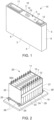
- Fig. 1 is a perspective view illustrating a battery cell according to an exemplary embodiment.
- a battery cell 10 may include an electrode assembly, and a case 2 for accommodating the electrode assembly, the case 2 containing an electrolyte.
- the battery cell 10 may also include a cap assembly 3 for sealing an opening of the case 2.
- the battery cell 10 will be described as a non-limiting example of a lithium ion secondary battery configured to have a prismatic shape.
- the case 2 may be configured to have a substantially cuboidal shape, and an opening may be formed at one side thereof.
- the case 2 may be formed of a metal, such as aluminum.
- the case 2 may include a bottom surface 4 having a substantially rectangular shape, and may include a pair of first lateral walls 5, that are wide side surfaces 5, and a pair of second lateral walls 6 connected vertically to end portions of the bottom surface 4, respectively, to form a space for accommodating the electrode assembly.
- the first lateral walls 5 may face each other, and the second lateral walls 6 may be positioned to face each other and may be connected to the first lateral walls 5.
- a length of an edge at which the bottom surface 4 and one of the first lateral walls 5 are connected to each other may be longer than that of an edge at which the bottom surface 4 and one of the second lateral walls 6 are connected to each other.
- adjacent first 4 and second 5 lateral walls enclose an angle of about 90°.
- the cap assembly 3 may include a cap plate 7 for covering the opening of the case 2 by being bonded to the case 2, and may include a positive terminal 11 (first terminal) and a negative terminal 12 (second terminal), which are externally protruded from the cap plate 7 to be electrically connected to the positive electrode and the negative electrode, respectively.
- the cap plate 7 may be configured to have a shape of a plate that may be extended in one direction, and that may be bonded to the opening of the case 2.
- the cap plate 7 may include an injection hole 13 and a vent hole 14 that communicate with an interior of the cap assembly 3.
- the injection hole 13 may be configured to allow injection of the electrolyte solution, and a sealing cap may be mounted thereon or therein.
- a vent member 16 including a notch 15, which may be opened due to a predetermined pressure, may be mounted to or in the vent hole 14.
- an exemplary embodiment of a conventional battery module 20 includes a plurality of battery cells 10, e.g. as illustrated in Fig. 1 , aligned in one direction and a heat exchange member 23 provided adjacent to a bottom surface of the plurality of battery cells 10.
- an elastic member 24 made of rubber or other elastic materials may be interposed between a support plate 25 and the heat exchange member 23.
- a pair of end plates 26 are provided to face wide surfaces 5 of the battery cells 10 at the outside of the battery cells 10, and a connection plate 27 is configured to connect the pair of end plates 26 to each other thereby fixing the plurality of battery cells 10 together.
- Fastening portions 28 on both sides of the battery module 20 are fastened to the support plate 25 by bolts 29.
- each battery cell 10 is a prismatic (or rectangular) cell, the wide flat surfaces 5 of the cells 10 being stacked together to form the battery module 20.
- the positive and negative electrode terminals 11 and 12 of neighboring battery cells 10 are electrically connected through a bus bar 63d, and the bus bar 63d may be fixed by a nut or the like.
- the battery module 20 may be used as power source unit by electrically connecting the plurality of battery cells 10 as one bundle.
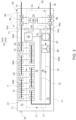
- Fig. 3 is a top view illustrating a battery system 50 according to a first embodiment.
- the battery system 50 illustrated in Figure 3 is a battery system 50 as utilized in an electric vehicle and has an overall dimension of about 0.6 m * 0.4 m * 0.13 m (width/depth/height) and is thus the battery system 50 with a single level.
- the battery system 50 comprises a housing 70 with a support plate (not shown), four lateral exterior walls 71 and a single linearly extended partition wall 72 arranged at a center of the housing 70.
- the housing 70 may be closed by a top cover (not shown) for providing an essentially gastight housing 70 for battery system 50.
- the partition wall 72 divides the housing 70 in a cell compartment 75 and an additional compartment 76, wherein the cell compartment 75 is connected to the additional compartment 76 via a gas inlet 77.
- the partition wall 72 is essentially gastight and extends along the whole height of the housing 70.
- the battery system 50 further comprises a BDU (Battery Disconnect Unit) 83 with a BDU housing 79 enclosing a plurality of BDU elements.
- the BDU elements comprises a BDU control unit 86, two plurality of BDU relays 87, two BDU fuses 88 and a plurality of BDU busbars 89.
- the BDU control unit 86 is configured to control the BDU relays 87, particularly to set a conductivity of the BDU relays 87.
- the BDU control unit 86 is further configured to control the BDU fuse 88, particularly to monitor a state of the BDU fuse 88.
- the BDU busbars 89 connect the module terminals 21, 22 of the battery module 20 of the battery system 50 with system terminals 51, 52, respectively, wherein these connections are provided via the BDU relays 87 and BDU fuses 88, respectively.
- the control signals of the BDU control unit 86 with respect to the BDU relays 87 and BDU fuses 88 are indicated in Figure 3 by lines with little circles disposed on these lines.
- the BDU housing 79 is connected to the battery system housing 70 via two venting openings 91 that are disposed in one of the exterior walls 71 of the battery system housing 70 and in an exterior wall 79a of the BDU housing 79.
- a first venting opening 91a connects the cell compartment 75 of the battery system housing 70 with the BDU housing 79 and a second venting opening 91b connects the additional compartment 76 of the battery system housing 70 with the BDU housing 79.
- a common flow channel loop 73 is formed within in the interior of the battery housing 70 and the interior of the BDU housing 79.
- the flow channel loop 73 extends from the additional compartment 76, via the gas inlet 77 into the cell compartment 75, from there via the first venting opening 91a into the BDU housing 79 and from there via the second venting opening 91b again into the additional compartment 76.
- a gas conveyor 80 e.g., a fan
- a gas sensor array 81 comprising a plurality of gas sensors, are arranged in the flow channel loop 73, particularly in the additional compartment 76 of the battery system housing 70.
- the fan 80 is configured for providing a gas flow circulation 74 along the flow channel loop 73 as indicated by the dashed line in Fig. 3 .
- the gas flow circulation 74 begins at the fan 80 and runs through the additional compartment 76, from there via the gas inlet 77 into the cell compartment 75, from there via the first venting opening 91a into the BDU housing 79 and from there via the second venting opening 91b to the gas sensor array 81 and fan 80 in the additional compartment 76 of the battery system housing 70.
- a battery module 20 is arranged in the cell compartment 75.
- the battery module 20 comprises ten aligned battery cells 10 that are stacked in a stacking direction with their wide side surfaces facing each other.
- the stacking direction of the battery module 20 is also the longitudinal direction of the battery module 20 along which the battery module 20 has its largest extension.
- the battery module 20 is positioned in the cell compartment 75 with its longitudinal direction being essentially parallel to the partition wall 72.
- each busbar 63d connects two first cell terminals 11 and two second cell terminals 12, i.e. a total of four cell terminals 11, 12 to each other.
- a second module terminal 22 of the battery module 20 is connected to a second (negative) system terminal 52 of the battery system 50 via a first high current connector 63a, particularly via a first high current cable 63a, and the BDU busbars 89 and the BDU elements 87, 88.
- a first module terminal 21 of the battery module 20 is connected to a first (positive) system terminal 51 of the battery system 50 via a second high current connector 63b, particularly via a second high current cable 63b, and the BDU busbars 89 and the BDU elements 87, 88.
- the first high current connector 63a and the second high current connector 63 extend from the battery system housing 70 into the BDU housing 79, i.e., through the exterior walls of the battery system housing 70 and the BDU housing 79 in an essentially gastight manner.
- the first and second high current connectors 63a, 63b could be disposed within the first and second venting openings 91a, 91b, respectively.
- a high current path is formed by the first high current connector 63a, the second high current connector 63b, the fourth high current busbars 63d, and the BDU busbars 89.
- This current path extends from the first system terminal 51 via the BDU busbars 89, BDU elements 87, 88 and via the first venting opening 91a into and through the cell compartment 75, from there via the gas inlet 77 into the additional compartment 76, and from there via the second venting opening 91b, the BDU busbars 89 and BDU elements 87, 88 to the second system terminal 52.
- the current path is disposed entirely within the flow channel loop 73 and follows the gas flow circulation 74.
- the gas flow circulation 74 flows around all components of the high current path, over all battery cells 10 of the battery module 20 and over all elements of the BDU 83. Hence, the gas flow circulation 74 will take up any gas or particle emission of any of the components of the current path, the BDU elements 86, 87, 88, 89 or the battery cells 10.
- gas flow circulation 74 cools the BDU elements 86, 87, 88, 89.
- the gas sensor array 81 is carefully positioned in the additional compartment 76 such that all of the gas flow 74 circulating in the flow channel loop 73 must pass through the gas sensor array 81.
- the gas sensor array 81 thus detects the concentration of at least one gas or gas species in the gas flow circulation 74. If the gas sensor array 81 detects that the concentration of at least one gas or gas species in the gas flow circulation 74 exceeds a predetermined or learned threshold, i.e. detects an excess concentration of at least one gas or gas species in the gas flow circulation 74, the gas sensor array 81 transmits a control signal, CS, to a battery management system, BMS, 82 located inside the housing 70 of the battery system 50.
- CS control signal
- the BMS 82 may then determine the presence of an abnormal condition in the battery system 50 and perform or control to perform at least one countermeasure associated with the determined abnormal condition, such as e.g. transmit a warning signal to the vehicle's driver.
- the BMS 82 transmits a disconnect signal DS to the BDU control unit 86 that, in response to receiving the disconnect signal DS, controls the BDU elements 87, 88 to disconnect the system terminals 51, 52 from the module terminals 21, 22, respectively.
- the BDU control unit 86 controls the conductivity state of the BDU relays 87 to be non-conductive, separate the current paths from the module terminals 21, 22 to the system terminals 51, 52.
- the BDU control unit 86 can detect, whether one of the BDU fuses 88 is blown in response to any eventual overcurrent of the battery module 20 and, if one or both of the BDU fuses 88 are blown, detect that the battery system 50 reached a safe state.
- Fig. 4 is a top view illustrating a battery system 50 according to a second embodiment.
- Like components of the battery system of Fig. 4 are denoted with like reference signs as in Fig. 3 and a description of the battery system 50 of Fig. 4 is omitted as far as it is equal to the battery system 50 of Fig. 3 .
- the battery system 50 of Fig. 4 differs from that of Fig. 3 as it comprises two partition walls that form a T-shaped partition wall 72.
- a first section 72a of the T-shaped partition wall 72 is positioned as the partition wall 72 of Fig. 3 and a second section 72b of the T-shaped partition wall 72 is positioned at a right angle to and in contact with the first section 72a.
- the second section 72b is shorter than the first section 72a.
- Two cell compartments 75a, 75b are formed on both sides of the first section 72a between exterior walls 71 and the partition wall 72 and two battery modules 20a, 20b are positioned in the cell compartments 75a, 75b.
- the longitudinal direction of the battery modules 20a, 20b is in parallel to the first section 72a.
- An additional compartment 76 is formed between the second section 72b and an exterior wall 71 and the fan 80 and the gas sensor array 81 are positioned in the additional compartment 76.
- Each of the battery modules 20a, 20b comprises ten aligned battery cells 10a, 10b that are stacked in the longitudinal direction with their wide side surfaces facing each other.
- the cells 10a, 10b are connected to each other in a 2p5s configuration by four busbars 63d, respectively.
- the BDU housing 79 of the BDU 83 is connected to one of the exterior walls 71 of the battery system housing 70 via a first venting opening 91a disposed in the second cell compartment 75b and a second venting opening 91b disposed in the additional compartment 76.
- the gas flow channel loop 73 and the gas flow circulation 74 are divided at the first venting opening 91a with a first branch of the flow channel loop 73 extending from the second cell compartment 75b directly in the additional compartment 76 and a second branch of the flow channel loop 73 extending from the second cell compartment 75b via the first venting opening 91a, the BDU housing 79 and the second venting opening 91b in the additional compartment 76.
- the gas flow circulation 74 also branches but is reunited upstream the gas sensor array 81 in the additional compartment 76. Hence, the functions of cooling the BDU elements 86, 87, 88, 89 via the second branch of the gas flow circulation 74 and uptaking any excess gas concentration via both branches of the gas flow circulation 74 are provided.
- a first system terminal 51 is connected to a first module terminal 21a of the first battery module 20a via BDU busbars 89, BDU elements 87, 88 and a second high current connector 63b.
- a second module terminal 22a of the first module 20a is connected to a first module terminal 21b of the second module 20b via a third high current connector 63c, and a second module terminal 22b of the second module 22b is connected to a second system terminal 52 via a first high current connector 63a, BDU busbars 89 and BDU elements 87, 88.
- the first, second, third and fourth high current connectors 63a, 63b, 63c, 63d, the BDU busbars 89 and the BDU elements 87. 88 form a current path that extends from the second system terminal 52 to the first system terminal 51 through the entirety of a flow channel loop 73 formed by the BDU housing 79, the additional compartment 76, the first cell compartment 75a, and the second cell compartment 75b and the BDU housing 79 again.
- the first cell compartment 75a is connected to the second cell compartment via a first gas outlet 78a that is also the second gas inlet 77b of the second cell compartment 75b.
- the gas flow circulation 74 is provided by the fan 80 within the flow channel loop 73 and follows the current path and flows around all battery cells 10 and all high current connectors 63 of the battery system 50 as well as around all BDU elements 86,87,88,89 of the BDU 83.
- the gas flow circulation 74 must pass the gas sensor array 81 that thus detects any excess gas or particle concentration therein.
- the gas sensor array 81 transmits a control signal CS to a battery management system 82 which is positioned outside the housing 70.
- the battery management system 82 may then determine the presence of an abnormal condition in the battery system 50 and perform or control to perform at least one countermeasure associated with the determined abnormal condition.
- the BMS 82 transmits a disconnect signal DS to the BDU control unit 86 for controlling the BDU 83 to disconnect at least one of the system terminals 51, 52 from the battery modules 20a, 20b and transmits a warning signal to the vehicle's driver.
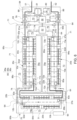
- Fig. 5 is a top view illustrating a battery system 50 according to a third embodiment. Like components of the battery system of Fig. 5 are denoted with like reference signs as in Figs. 3 and 4 and a description of the battery system 50 of Fig. 5 is omitted as far as it is equal to the battery systems 50 of Figs. 3 and 4 .
- the battery system 50 of Fig. 5 differs from Figs. 3 and 4 as housing 70 of the battery system 50 comprises three partition walls that form a double T-shaped partition wall 72.
- a first section 72a of the double T-shaped partition wall 72 is positioned as the first section 72a of Fig. 4 and a second section 72b of the T-shaped partition wall 72 is positioned as the second section 72b of Fig. 4 .
- a third section 72c of the partition wall 72 is positioned at a right angle to and in contact with the first section 72a and opposite and parallel to the second section 72b.
- the third section 72c is shorter than the first section 72a and longer than the second section 72b.
- Housing 70 further differs in that it comprises a pressure equalization filter 90 arranged within an exterior wall 71 that is configured to allow a limited gas communication between an interior and an exterior of the housing 70 in order to prevent over- or underpressure within housing 70.
- the filter 90 may block dust from entering the housing 70.
- Two cell compartments 75a, 75c are formed on both sides of the first section 72a between exterior walls 71 and the partition wall 72.
- Two battery modules 20a, 20c are positioned in the cell compartments 75a, 75c. Therein, the longitudinal direction of the battery modules 20a, 20c is in parallel to the first section 72a.
- Another cell compartment 75b is formed between the third section 72c and an exterior wall 71 and a battery module 20b is positioned in the cell compartment 75b.
- An additional compartment 76 is formed between the second section 72b and an exterior wall 71 and the BMS 82 is positioned in the additional compartment 76.
- the battery modules 20a, 20c each comprise ten aligned battery cells 10a, 10c that are stacked in the longitudinal direction with their wide side surfaces facing each other.
- the cells 10a, 10c are connected to each other in a 2p5s configuration by four busbars 63d, respectively.
- the battery module 20b comprises eight aligned battery cells 10b that are stacked in the longitudinal direction with their wide side surfaces facing each other.
- the cells 10b are connected to each other in a 2p4s configuration by three busbars 63d.
- the BDU housing 79 of the BDU 83 is connected to the battery system housing 70 via a first venting opening 91a disposed in the third cell compartment 75c and via a second venting opening 91b disposed in the first cell compartment 75a. Further, the gas sensor array 81 and the gas conveyor fan 80 are disposed in the BDU housing 79 and provide the gas flow circulation 74 through the flow channel loop 73 that both extend through the battery system housing 70 and the BDU housing 79.
- a first system terminal 51 is connected to a first module terminal 21a of the first battery module 20a via BDU busbars 89, BDU elements 87, 88 and a second high current connector 63b.
- a second module terminal 22a of the first module 20a is connected to a first module terminal 21b of the second module 20b via a third high current connector 63c.
- a second module terminal 22b of the second module 20b is connected to a first module terminal 21c of the third module 20c via another third high current connector 63c and a second module terminal 22c of the third module 20c is connected to a second system terminal 52 via a first high current connector 63a, BDU busbars 89 and BDU elements 87, 88.
- the first, second, third and fourth high current connectors 63a, 63b, 63c, 63d form a current path that extends from the second system terminal 52 to the first system terminal 51 through the entirety of a flow channel loop 73 formed by the BDU housing 79 and the cell compartments 75a, 75b, 75c, and by the additional compartment 76.
- a gas flow circulation 74 provided by the fan 80 within the flow channel loop 73 follows this current path and flows around all battery cells 10, all high current connectors 63 and all BDU elements 86, 87, 88, 89 of the battery system 50.
- the gas conveyor fan 80 is dimensioned such that the branch of the gas flow circulation 74 flowing through the additional compartment 76 via the BMS 82 is strong enough to cool the BMS 82 and uptake any excess gas concentration.
- the gas flow circulation 74 must pass the gas sensor array 81 in the BDU housing 79 that thus detect any excess gas or particle concentration therein.
- the gas sensor array 81 transmits a control signal CS to a BDU control unit 86 that forwards the control signal CS to the battery management system 82 which is positioned inside the housing 70.
- the BMS 82 may then determine the presence of an abnormal condition in the battery system 50 and perform or control to perform at least one countermeasure associated with the determined abnormal condition.
- the BMS 82 may transmit a warning signal to the vehicle's driver or shut off the system 50.
- the BDU control unit 86 may immediately control the BDU elements 87, 88 to shut off an electric connection between the system terminals 51, 52 and the module terminals 21, 22.
- Fig. 6 is a top view illustrating a battery system 50 according to a fourth embodiment. Like components of the battery system of Fig. 6 are denoted with like reference signs as in Fig. 5 and a description of the battery system 50 of Fig. 6 is omitted as far as it is equal to the battery systems 50 of Fig. 5 .
- the battery system of Fig. 6 differs from the battery system of Fig. 5 in that each of the battery modules 20a, 20b, 20c comprises a cell supervision circuit, CSC, 84a, 84b, 84c, respectively.
- the CSCs 84a, 84b, 84c are arranged on top of the battery modules 20a, 20b, 20c and are connected to at least some of the battery cells 10a, 10b, 10c of the respective battery module 20a, 20b, 20c in order to measure cell voltages of the connected battery cells 10a, 10b, 10c.
- the CSCs 84a, 84b, 84c may further be configured to measure temperatures of the individual battery modules 20a, 20b, 20c and/or to provide active or passive cell balancing between the battery cells 10a, 10b, 10c of the respective battery modules 20a, 20b, 20c.
- the CSCs 84a, 84b, 84c are connected to the battery management system, BMS, 82, via a plurality of low current connectors 64.
- Each of the CSCs 84a, 84b, 84c comprises two contact pads 85a, 85b, 85c for providing a connection to the low current connectors 64.
- a connection between the contact pads 85 of adjacent battery modules 20 or between a battery module 20 and the BMS 82 is thus established via low current connectors 64 connected to at least one of the contact pads 85.
- the plurality of low current connectors 64 form a data connection between the BMS 82 and the CSCs 84a, 84b, 84c, of the modules 20a, 20b, 20c.
- the data connection may be a looped or single ended data connection.
- the low current connectors 64 run through the flow channel loop 73 formed by the cell compartments 75a, 75b, 75c, and the additional compartment 76. Further, also the connections between the BDU control unit 83 and the BDU elements 87, 88 are formed by low current connectors 64.
- a gas flow circulation 74 provided by the fan 80 within the flow channel loop 73 thus also follows low current connectors 64, i.e., the data connection and flows around all battery cells 10, all high current connectors 63, all low current connectors 64 and the BDU elements 86, 87, 88, 89 of the battery system 50.
- the gas flow circulation 74 must pass the gas sensor array 81 disposed in the BDU housing 79 that thus detects any excess gas or particle concentration therein that was eventually emitted either in the BDU housing 79 or within the battery system housing 70.
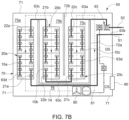
- Fig. 7A and Fig. 7B are top views illustrating battery systems 50 according to a fifth embodiment.
- Like components of the battery system of Fig. 5 are denoted with like reference signs as in Figs. 3 to 6 and a description of the battery system 50 of Fig. 7 is omitted as far as it is equal to the battery systems 50 of Figs. 3 to 6 .
- the battery system 50 of Fig. 7 differs from Figs. 3 to 6 as the housing 70 of the battery system 50 comprises a first U-shaped partition wall 72a arranged in the center of the housing 70 without contact to any exterior wall 71 and a second partition wall 72b that extends perpendicularly from a exterior wall 71 and into the U-shaped partition wall 72a.
- the lower horizontal section of the U-shaped partition wall 72a extends in parallel to an exterior wall 71 and an additional compartment 76 is formed between the lower horizontal section of the U-shaped partition wall 72a and the exterior wall 71. Further, three cell compartments 75a, 75b, 75c are formed between the two vertical sections of the U-shaped partition wall 72a and the second partition wall 72b. Respective battery modules 20a, 20b, 20c are positioned in the cell compartments 75a, 75b, 75c, with their longitudinal directions being parallel to the second partition wall 72b.
- the battery modules 20a, 20b, 20c each comprise eight aligned battery cells 10a, 10b, 10c that are stacked in the longitudinal direction with their wide side surfaces facing each other.
- the cells 10a, 10b, 10c are connected to each other in a 2p4s configuration by three busbars 63d, respectively.
- a first system terminal 51 is connected to a first module terminal 21a of the first battery module 20a via a BDU busbar 89, a BDU contactor 87 and second high current connector 63b.
- a second module terminal 22a of the first module 20a is connected to a first module terminal 21b of the second module 20b via a third high current connector 63c.
- a second module terminal 22b of the second module 20b is connected to a first module terminal 21c of the third module 20c via another third high current connector 63c and a second module terminal 22c of the third module 20c is connected to a second system terminal 52 via a first high current connector 63a.
- the BDU 83 is disposed within the battery system housing 70 and comprises a BDU housing 79 with a first and second venting opening 91, 91b through which the gas flow circulation 74 extends into an interior of the BDU housing 79.
- the BDU elements 86, 87, 88, 89 are cooled by the gas flow circulation 74 and any excess gas concentration emitted eventually in the battery system housing 70 or the BDU 82 is detected.
- the BDU elements 86, 87, 88, 89 are disposed nakedly, i.e., unhoused, within the battery system housing 70 and are thus cooled by the gas flow circulation 74 and emit any excess gas concentration to the gas flow circulation 74.
- the first, second, third and fourth high current connectors 63a, 63b, 63c, 63d form a current path that extends from the second system terminal 52 to the first system terminal 51 through the entirety of a flow channel loop 73 formed by the cell compartments 75a, 75b, 75c, the additional compartment 76, and the BDU housing 79.
- a gas flow circulation 74 provided by the fan 80 within the flow channel loop 73 follows this current path and flows around all battery cells 10, all high current connectors 63 and the BDU elements 86, 87, 89 of the battery system 50.
- the gas flow circulation 74 must pass the gas sensor array 81 that thus detects any excess gas or particle concentration therein.
- the gas sensor array 81 transmits a control signal, CS, to a battery management system 82, which is positioned inside the housing 70.
- the BMS 82 may then determine the presence of an abnormal condition in the battery system 50.
- the BMS 82 transmits a disconnect signal, DS, to the battery disconnect unit, BDU, 83, particularly the BDU control unit 86 that is interconnected between the first system terminal 51 and the second module terminal 22c of the battery module 20c.
- the BDU 83 disconnects the electrical connection between the module 20c and the first system terminal 51. Hence, an emergency shut down of the battery system 50 is performed.
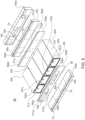
- Fig. 8 is a schematic perspective front view illustrating a battery system 50 according to a sixth embodiment. Like components are denoted with like reference signs as in Figs. 3 to 7 .
- the battery system housing 70 comprises of a plurality of components and the flow channel loop 73 is formed by the combination of these components.
- the battery system 50 comprises four battery modules 20a-20d that are enclosed by a module housing part 701.
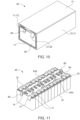
- the module housing part 701 is formed by a plurality of extruded aluminum profiles, each enclosing a single battery module as shown in more detail in Figs. 10 and 12 .
- Each extruded aluminum profile covers the top, bottom, and side surfaces of the respective battery modules 20a-20d.
- the walls of the extruded aluminum profiles form either exterior walls 71 or partition walls 72 depending on the position of the extruded aluminum profile in the module housing part 701.
- the walls of the extruded aluminum profiles comprise hollows in order to provide a lightweight battery system 50.
- extruded aluminum profiles are connected to each others via suitable connecting means (not shown) or a weld connection, such that the battery modules 20a-d are arranged next to each other with their front and end surfaces, each covered by an end plate 26, being parallel aligned to each other, respectively.
- a battery module 20 as depicted in Fig. 11 is disposed in each of the extrusion aluminum profiles as depicted in Figs. 10 and 12 .
- a gas flow channel 73 is left open between an upper side of the battery module 20 (i.e. all the cap assemblies 3 of the battery cells 10) such that a gas flow circulation 74 can pass over each of the battery cells 10.
- the battery system housing 70 further comprises pressure plates 702 that are disposed adjacent to the aligned front and end surfaces, respectively.
- a first pressure plate 702a is arranged adjacent to the aligned front surfaces of the battery modules 20a-d.
- a ground cover 703 is arranged adjacent to the first pressure plate 702a and a first side cover 704a is arranged adjacent to the ground cover 703 such that the ground cover 703 is arranged in between the first pressure plate 702a and the first side cover 704a.
- a second pressure plate 702b is arranged adjacent to the aligned end surfaces of the battery modules 20a-d and a second side cover 704b is arranged adjacent to the second pressure plate 702b such that the second pressure plate 702b is disposed between the battery modules 20a-d and the second side cover 704b.
- a gas conveyor 80, a gas sensor 81, a BMS 82, and a BDU 83 are disposed on a front side of the ground cover 703 and are configured to fit in a first additional compartment 761 formed as a recess on an inner (rear) surface of the first side cover 704a as illustrated in more detail in Fig. 13 .
- the BDU 83 comprises a BDU housing 79 and a first venting opening 91a and a second venting opening 91b within the BDU housing 79.
- a plurality of BDU elements, such as e.g., a BDU relay 87 and BDU busbars 89, are disposed in the BDU housing 79.
- the first additional compartment 761 constitutes a part of the flow channel loop 73.
- a first system terminal 51 and a second system terminal 52 emerge from the ground cover 703 and penetrate outwards through respective openings in the first side cover 704a.
- the first system terminal 51 is connected via a first high current connector 63a to a first module terminal 21a of a first battery module 20a. Therefore the first high current connector 63a passes through a first gas inlet 771a in the ground cover 703 and through a second gas inlet 772a in the first pressure plate 702a.
- the first module terminal 21a is connected to first cell terminals 11 of two outermost cells 10 and the second cell terminals 12 of these two outermost cells 10 are connected via a busbar 63d to two adjacent battery cells 10. These adjacent two battery cells 10 are again connected to another pair of adjacent battery cells 10 via a further busbar 63d and so forth until another pair of outermost battery cells 10 is reached.
- the second cell terminals 12 of this other pair or outermost battery cells 10 are connected to second module terminal 22.
- twelve battery cells 10 are so connected to each other in a 2p6s configuration.
- the second module terminal 22a of the first battery module 20a is connected via a third high current connector 63c, which is attached to the second pressure plate 702b, to the first module terminal 21b of an adjacent second battery module 20b.
- the second battery module 20b also has the configuration as shown in Fig. 11 .
- a second module terminal of the second battery module 20b is connected to the first module terminal 21c of an adjacent third battery module 20c via a third high current connector 63c, which is attached to the first pressure plate 702a.
- the third battery module 20c also has the configuration as shown in Fig. 11 .
- a second module terminal of the third battery module 20c is connected to the first module terminal 21d of an adjacent fourth battery module 20d via a third high current connector 63c, which is attached to the second pressure plate 702b.
- the fourth battery module 20d also has the configuration as shown in Fig. 11 .
- a second module terminal 22d of the fourth battery module 20d is connected to the second system terminal 52 via a second high current connector 63b that is connected to the ground cover 703.
- the second high current connector 63b passes through a second gas outlet 782d in the first pressure plate 702a and a third gas outlet 783d in the ground cover 703.
- a closed high current path between the first system terminal 51 and the second system terminal 52 is thus formed by the combination of the first to third high current connectors 63a-c and the busbars 63d.
- This high current path between the first and second system terminals 51, 52 is entirely within a flow channel loop 73 formed within the housing of the battery system 50 according to the sixth embodiment.
- a gas flow circulation 74 is actuated by gas conveyor 80 within the first additional compartment 761 of the first side cover 704a.
- the gas flow circulation 74 then passes through the first gas inlet 771a and the second gas inlet 772a described above into a third gas inlet 773a formed by the front cross section of the gap between the first battery module 20a and the extruded aluminum profile enclosing it (see also Fig. 11 ).
- the gas flow circulation 74 then passes over all battery cells 10 of the first battery module 20a and leaves the aluminum extrusion profile via the first gas outlet 781a formed by the rear cross section of the gap between the first battery module 20a and the extruded aluminum profile enclosing it as illustrated in Fig. 9 .
- the gas flow circulation 74 leaving the first battery module via first gas outlet 781a then passes through the second gas outlet 782a in the second pressure plate 702b into a second additional compartment 762 formed as a recess in a inner (front) side of the second side cover 704b.
- This second additional compartment 762 is in fluid connection with the second gas outlet 782a and with an adjacent first gas inlet 771b in the second pressure plate 702b and fluidly connects the second gas outlet 782a and the first gas inlet 771b as part of the flow channel loop 73.
- the gas flow circulation 74 passes through the first gas inlet 771b into a second gas inlet 772b, wherein the second gas inlet is formed by the rear gap between the second battery module 20b and the extruded aluminum profile enclosing it.
- the gas flow circulation 74 then passes through the whole second battery module 20b and flows over all battery cells 10 and busbars 63d of second battery module 20b.
- the gas flow circulation 74 leaves the second battery module 20b via a first gas outlet 781b formed by the front gap between the second battery module 20b and the enclosing aluminum profile and through a second gas outlet 782b formed in the first pressure plate 702a.
- a third additional compartment 763 is formed as a recess in an inner (rear) side of ground cover 703 and fluidly connects the first gas outlet 781b associated with the second battery module 20b and the first gas inlet 771c associated with the third battery module 20c.
- the gas flow circulation 74 passes through the first gas inlet 771c into a second gas inlet 772c, which is formed by the front gap between third battery module 20c and the extruded aluminum profile enclosing it.
- the gas flow circulation 74 then passes through the whole third battery module 20c and flows over all battery cells 10 and busbars 63d of third battery module 20c.
- the gas flow circulation 74 leaves the third battery module 20c via first gas outlet 781c formed by the rear gap between the third battery module 20c and the enclosing aluminum profile and through a second gas outlet 782c formed in the second pressure plate 702b.
- the gas flow circulation 74 then passes into a fourth additional compartment 764 formed as a recess in an inner (front) side of the second side cover 704b.
- This fourth additional compartment 764 is in fluid connection with the second gas outlet 782c and with a first gas inlet 771d in the second pressure plate 702b and fluidly connects the second gas outlet 782c and the first gas inlet 771d as part of the flow channel loop 73.
- the gas flow circulation 74 passes through the first gas inlet 771d into a second gas inlet 772d, which is formed by the rear gap between the fourth battery module 20d and the extruded aluminum profile enclosing it.
- the gas flow circulation 74 then passes through the whole fourth battery module 20d and flows over all battery cells 10 and busbars 63d of fourth battery module 20d.
- the gas flow circulation 74 leaves the fourth battery module 20d via a first gas outlet 781d formed by the front gap between the fourth battery module 20d and the enclosing aluminum profile, through a second gas outlet 782d formed in the first pressure plate 702a, and through a third gas outlet 783d formed in the ground cover 703.
- the gas flow circulation 74 then flows again into and through the first additional compartment 761 as part of the flow channel 73.
- the gas flow circulation enters the BDU 83, particularly the BDU housing 79, via a first venting opening 91a in the BDU housing 79 and exits the BDU 83, particularly the BDU housing 79, via a second venting opening 92a.
- the BDU elements of BDU 83 inside the BDU housing 79 are effectively cooled by the gas flow circulation 74.
- the gas flow circulation 74 finally passes the gas sensor 81 for gas concentration analysis.
- the gas flow circulation 74 is then again actuated by gas conveyor 80 for another loop through flow channel loop 73.
- the gas flow circulation 74 follows the high current path formed by the first to third high current connectors 63a-c and the busbars 64d through the multipart housing 70 of the battery system 50.
- any gas emitted by any part of the battery system 50 that is associated with the high current path is picked up the gas flow circulation 74 and is detected by gas sensor 81.
Landscapes
- Chemical & Material Sciences (AREA)
- Chemical Kinetics & Catalysis (AREA)
- Electrochemistry (AREA)
- General Chemical & Material Sciences (AREA)
- Engineering & Computer Science (AREA)
- Manufacturing & Machinery (AREA)
- Microelectronics & Electronic Packaging (AREA)
- Secondary Cells (AREA)
- Battery Mounting, Suspending (AREA)
Description
- The present invention relates to a battery system, and particularly to a battery system that allows for cooling elements of the battery system, particularly elements of a battery disconnect unit, BDU, as well as for detecting an abnormal condition of the battery system by detection of gas in the battery system. The present invention further relates to a method for cooling and detecting an abnormal condition of such battery system as well as to a vehicle comprising the battery system of the present invention.
- A rechargeable or secondary battery differs from a primary battery in that it can be repeatedly charged and discharged, while the latter provides only irreversible conversion of chemical energy to electrical energy. Low-capacity rechargeable batteries are used as power supplies for small electronic devices, such as cellular phones, tablets, or notebook computers, while high-capacity rechargeable batteries are used as power supplies for vehicles and the like.
- In general, rechargeable batteries include an electrode assembly including a positive electrode, a negative electrode, and a separator interposed between the positive and negative electrodes, a case receiving the electrode assembly, and an electrode terminal electrically connected to the electrode assembly. An electrolyte solution is injected into the case in order to enable charging and discharging of the battery via an electrochemical reaction of the positive electrode, the negative electrode, and the electrolyte solution. The shape of the case, e.g. cylindrical or rectangular, depends on the battery's intended purpose.
- Rechargeable batteries may be used as a battery module formed of a plurality of unit battery cells coupled in series and/or in parallel so as to provide a high energy density, e.g. for motor driving of a hybrid vehicle. That is, the battery module is formed by interconnecting the electrode terminals of the plurality of unit battery cells depending on a required amount of power and in order to realize a high-power rechargeable battery, e.g. for an electric vehicle.
- Battery modules can be constructed either in block design or in modular design. In block designs each battery is coupled to a common current collector structure and a common battery management system and the unit thereof is arranged in a housing. In modular designs, pluralities of battery cells are connected to form submodules and several submodules are connected to form the battery module. In automotive applications, battery systems often consist of a plurality of battery modules connected in series for providing a desired voltage. Therein, the battery modules may comprise submodules with a plurality of stacked battery cells, each stack comprising cells connected in parallel that are connected in series (XpYs) or multiple cells connected in series that are connected in parallel (XsYp).
- For meeting the dynamic power demands of various electrical consumers connected to the battery system, static control of battery power output and charging is not sufficient. Thus, steady exchange of information between the battery system and the controllers of the electrical consumers is required. This information includes the battery systems actual state of charge (SoC), potential electrical performance, charging ability and internal resistance as well as actual or predicted power demands or surpluses of the consumers. Therefore, battery systems usually comprise a battery management system, BMS, for obtaining and processing such information on system level and further a plurality of cell supervision circuits, CSCs, which are part of the system's battery modules and obtain and process relevant information on system level. Particularly, the BMS usually measures the system voltage, the system current, the local temperature at different places inside the system housing, and the insulation resistance between live components and the system housing. Additionally, the CSCs usually measure individual the cell voltages and the temperatures of the battery modules.
- The mechanical integration of such battery system requires appropriate mechanical connection of the individual battery system components among themselves and with structures of the electrical consumers, e.g. a vehicle. These connections must be designed to remain functional and safe during the average service life of the battery system and under the stresses provided during use of the consumers. Further, installation space, interchangeability and safety requirements must be met, especially in mobile applications. Safety requirements, including the protection of passengers of a vehicle of harmful effluents of the battery system, such as toxic gases, smoke, or the like, are usually provided by a gas tight housing enclosing the battery modules and BMS for restricting the emission of such effluents.
- However, while the system housing may protect the passengers from harmful fumes it complicates detection of critical states of the battery system that may lead to a catastrophic event, e.g. an explosion of the battery system. Such catastrophic events may be caused by abnormal states like hot spots or corrosion. So far, the BMS could detect abnormal states based only on the acquired measurements regarding e.g. voltage, current and temperature. Hence, abnormal states which do not change the voltage, current, temperature or electrical insulation value have not been detectable. Exemplarily, such abnormal states can be due to electrolyte leakage, partial coolant intrusion, water intrusion, hot spots, smoldering insulation material and cables (pyrolysis, fire), moisture, condensation, corrosion, or electric arcing.
- The inside of battery packs is usually not subject to periodic visual inspections and hence the detection of abnormal operation states via the BMS has been the only option for detecting such states. Hence according to the prior art, corrosion, water intrusion, or deteriorating electric contacts may stay undetected until a catastrophic event actually occurs. Further, in case of an abnormal operation state, a battery pack shall usually be disconnected from a load connected to a terminal of the battery pack. However, means providing such emergency cut-off may be exposed to high temperatures during charging of the battery pack and deteriorate, thus providing a decreased reliability for an emergency shut-off of the battery system.
-
US 2012/085109 A1 discloses an uninterruptible power supply system that is housed within a container and comprises a plurality of batteries that are cooled via a HVAC unit and further comprises an H2 detection system for automatically disconnecting the batteries. However, the detection of H2 occurs with respect to the concentration of non-confined air streams.EP 3 579 326 A1 - It is thus an object of the present invention to overcome or reduce at least some of the drawbacks of the prior art and to provide a battery system that allows for an improved detection of abnormal states of the battery system, particularly of such abnormal states that do not alter the voltage, current, or temperature of the battery system, and that further allows for safely disconnecting a load from the battery system in case of such an abnormal state.
- According to the present invention a battery system is provided, that overcomes or reduces at least some of the disadvantages of the prior art and that comprises at least one battery module, which is interconnected between a first system terminal and a second system terminal by a plurality of high current connectors, and that further comprises a housing with a plurality of exterior walls enclosing the at least one battery module and the plurality of high current connectors and with at least one partition wall arranged within the housing.
- According to the present invention, within the housing a flow channel loop is formed by the at least one partition wall and the exterior walls. Therein, the flow channel loop refers to a flow channel that forms a closed loop allowing for a controlled gas flow circulation, particularly for a spatially confined gas flow circulation, at least within the battery system housing. The gas flow circulation is confined solely within the battery system housing or within the battery system housing and connected components, i.e., the flow channel loop might extend into other housed components that are connected to the battery system housing, where the connection is substantially gastight.
- According to the present invention, a gas conveyor that is configured for providing a gas flow circulation through the flow channel loop is arranged (disposed) in the flow channel loop. In other words, the gas conveyor is configured for effecting a circulation of gas, e.g. air, present in the housing to circulate in the flow channel loop in a circulatory manner. That is, the overall volume of the gas circulating in the flow channel loop should stay constant, except any gas species emitted by a battery cell in an abnormal state of the battery cell. Further, at least one gas sensor that is configured for detecting an excess concentration, preferably a predetermined or learned excess concentration, of at least one gas species in the gas flow circulation is arranged in the flow channel loop. That is, the sensor can detect any gas species emitted by a battery cell in an abnormal state of the battery cell and a battery system.
- According to the present invention all components of the battery system that may cause a catastrophic event (if in an abnormal condition) are positioned within the flow channel loop. Hence, by analyzing a gas stream circulating in the flow channel loop for excess gas concentrations of at least one gas species indicative for an abnormal condition, an abnormal condition is reliably detected for all components of the battery system. Preferably, the gas circulating inside the housing passes at least all high current connectors and all battery cells disposed within the housing and hence none of them is left unconsidered as the gas flow circulation will pick up any gas release from these critical components and transport it to the at least one gas sensor. Abnormal conditions of the battery system are thus reliably detected. An additional benefit of the forced gas flow circulation is that the whole inside of the battery system housing is vented and the condensation of water vapor at cold spots is thus inhibited.
- The battery system of the invention further comprises a battery disconnect unit, BDU, that is electrically connected between the at least one battery module and at least one of the first system terminal and the second system terminal. The BDU comprises BDU elements that are configured for selectively disconnecting at least one of the first and second system terminal and the at least one battery module. In other words, the BDU elements are configured to commonly provide the actual function of the BDU. According to the present invention, the BDU is disposed within the gas flow circulation formed by the gas conveyor such that the BDU elements are cooled by the gas flow circulation. By cooling the BDU elements, the battery system of the invention can be advantageously used for higher load applications, e.g., fast charging. As the BDU elements, e.g., BDU relays and busbars are actively cooled by a forced convection, higher loads can be applied to the battery system via the BDU elements.
- The BDU comprises a BDU housing that is enclosing the BDU elements. Such BDUs are known to the skilled person and are commonly used together with battery systems. However, known BDUs usually do not comprise any cooling and thus the components thereof are prone for overheating, particularly during fast charging processes. According to the invention, the BDU housing thus comprises at least one BDU venting opening, preferably two BDU venting openings or more BDU venting openings that are connecting a BDU housing interior with the flow channel loop. Thus, the BDU housing interior (inner space) is connected to the battery system housing interior (inner space) in a substantially gastight manner. Hence, the gas flow circulation provided by the gas conveyor advantageously extends into the BDU housing via the at least one BDU venting opening and cools the BDU elements disposed therein.
- Particularly preferred, the flow channel loop of the battery system is formed within the battery system housing and within the BDU housing. In other words, in the battery system housing, the flow channel loop is formed by the at least one partition wall and the exterior walls and, in the BDU housing, the flow channel loop is formed by BDU housing exterior walls and eventually by at least one BDU housing partition wall. The flow channel loop thus allows for a closed gas circulation through the battery system housing and the BDU housing, preferably without any gas exchange with the environment. Further preferred, at least one of the gas conveyor and the gas sensor is arranged within the BDU housing. As the flow channel loop extends through the battery system housing and the BDU housing, the gas conveyor and/or the gas sensor can be disposed in the battery system housing or in the BDU housing.
- The preferred use of a separate BDU housing that is enclosing the BDU elements and comprising the at least one BDU venting opening connected to the gas flow circulation advantageously allows for the replacement of electric components of the BDU, e.g., BDU fuses, BDU busbars or the like (or even of the whole BDU) without disturbing the confinement of the battery modules in the system housing. Further, arranging the gas conveyor and/or the gas sensor in the BDU housing allows providing the advantages of the present disclosure to existing battery system by applying a BDU comprising such gas sensor and/or gas conveyor to the battery system housing of such conventional battery system as set forth in detail below.
- In a particularly preferred embodiment of the present invention, the BDU housing is attached to an exterior wall of the battery system housing. According to this embodiment, the at least one venting opening is formed in the BDU housing and in the exterior wall of the battery system housing in an aligned manner. In other words, the BDU housing as well as the battery system housing comprise venting openings that are aligned with each other when the BDU housing is mounted to the battery system housing. Thus the flow channel loop is extended from the battery system housing to the BDU housing via the vent openings. This embodiment advantageously provides a way for non-invasively upgrading even existing battery systems. The housing of a conventional battery system could be connected to a BDU comprising such gas conveyor and/or gas sensor by at least one venting opening provided in the housings.
- According to an embodiment, the BDU housing is disposed within the housing of the battery system. Then, an interior of the BDU housing is still connected to the flow channel loop via vent openings in the BDU housing for allowing the gas flow circulation to extend into the BDU housing for cooling the BDU components. According to this embodiment, minor adaptions to a BDU housing, i.e., providing at least one vent opening therein, are sufficient for achieving the advantageous effect of the present disclosure, i.e., cooling of the BDU elements. However, alternatively the BDU elements are preferably disposed nakedly, i.e., unhoused (without housing) in the flow channel loop thus formed entirely within the battery system housing. Hence, BDU elements are disposed directly within the battery system housing and within the flow channel loop and thus cooled by the gas flow circulation.
- Particularly preferred the BDU elements comprise a BDU control unit that is configured to control the operation of the BDU. Particularly, the BDU control unit is configured to receive a signal indicative of a malfunction of the battery system and/or indicating that disconnecting the at least one battery module from a load is required and, in response to receiving such signal, is configured to control the further BDU elements to disconnect the at least one battery module from the respective system terminal (and consequently a downstream load). The BDU elements preferably also comprise at least one BDU fuse, BDU relay and/or BDU contactor. The functions of such components as part of a BDU are known to the skilled person.
- Preferably, the at least one battery module, preferably a plurality of battery modules, and the plurality of high current connectors are arranged entirely within the flow channel loop. In other words, the orientation and positions of these critical components and the dimensions of the flow channel loop are chosen such that none of these critical components are disposed within flow shade regions of the flow channel loop. Hence, by arranging the at least one battery module and the plurality of high current connectors entirely within the flow channel loop; these components are also arranged entirely within the gas flow circulation. In other words, preferably the gas flow circulation circulates around the entire at least one battery module, the entire plurality of high current connectors and the at least one gas sensor. Further preferred, the plurality of high current connectors and the at least one battery module constitute a high current path between the first and second system terminal that runs in parallel to the gas flow circulation. Thus, the gas flow circulation follows the high current path. Further preferred also the BDU elements are arranged entirely within the flow channel loop and/or the gas flow circulation circulates around all of the BDU elements. Hence, the gas flow circulation takes up any gas concentration emitted by the BDU elements reliably as well.
- Preferably, the housing of the battery system is essentially gastight. In this embodiment, the housing may further comprise a pressure equalization filter disposed in one of the exterior walls of the housing for allowing a limited gas exchange with the environment. Hence, overpressure in the battery system housing may be reliably prevented. In this case, the gas flow circulation, except the emitted gases indicative for an abnormal condition, may be an airflow within the housing. Further preferred, the exterior walls and the at least one partition wall of the housing are essentially gastight, except any vent openings eventually formed in the exterior walls of the battery system housing. Particularly preferred, the housing, i.e. the exterior walls and the at least one partition wall, is formed of aluminum, such as e.g. casted aluminum. However plastic materials may also be used. The housing may be assembled from several parts, such as a bottom part comprising the exterior walls and the partition walls forming cell compartments and a top cover for covering the bottom part. The housing may further comprise sealing elements for providing controlled gas tightness to the environment.
- According to a particularly preferred embodiment of the battery system, the flow channel loop comprises at least one cell compartment that is configured for receiving at least one battery module. Further preferred, the flow channel loop comprises an additional compartment that is configured for receiving at least one of the gas conveyor and the at least one gas sensor. By providing at least one cell compartment, it can be more easily ensured that the gas flow circulation actually runs over all of the critical components of the battery system. Particularly preferred, the volume of the at least one cell compartment is adapted to the volume of the at least one battery module disposed therein. Exemplarily, the volume of the cell compartment is not greater than 150%, preferred not greater than 130%, and particularly preferred not greater than 120% of the at least one battery module therein.
- Further, preferred the flow channel loop comprises at least one BDU compartment configured for receiving the BDU elements. In the case of unhoused (naked) BDU elements, the BDU compartment is preferably disposed within the battery system housing. Otherwise, the BDU compartment preferably corresponds to the already described BDU housing. Therein in any case, a volume of the BDU compartment is preferably adapted to the BDU element's volume.
- Exemplarily, for a plurality of battery cells stacked together in a stacking direction with their wide side surfaces facing each other for forming a longitudinal battery module, the length of the cell compartment may be essentially equal, e.g. not more than 105%, of the length of the battery module, the width of the cell compartment may be essentially equal, e.g. not more than 105%, of width of the wide side surfaces of the battery cells, and the height of the cell compartment may be slightly greater than, e.g. up to 110 % of, the height of the battery module. In such cell compartments the gas flow circulation is mainly constricted to a volume above the upper side of battery module that may comprise all of the high current connectors between the cells and hence any flow paths bypassing the battery module can be prevented.
- Further preferred, at least one battery module, particularly preferred exactly one battery module, is disposed within each cell compartment with one of a first and second module terminal proximate to a gas inlet of the cell compartment and another one of the first and second module terminal proximate to a gas outlet of the cell compartment. This arrangement advantageously allows for an easy interconnection of battery modules disposed in adjacent cell compartments. This arrangement further eases to provide a gas flow circulation above the entire battery module, as the first (positive) module terminal will usually be arranged at first terminal end of the battery module and the second (negative) module terminal will usually be arranged at a second terminal end of the battery module opposite to the first terminal end.
- According to this preferred embodiment, a single one of the at least one cell compartments is fluidly connected to a gas outlet of an adjacent cell compartment or to the additional compartment via its gas inlet and is fluidly connected to a gas inlet of an adjacent cell compartment or to the additional compartment via its gas outlet. Further preferred, the cell compartments may be essentially gastight except for the gas inlets and gas outlets. Hence, by restricting the size of the gas inlets and gas outlets and by controlling the positions of the gas inlets and outlets the gas flow circulation may be controlled. According to such preferred embodiment, a plurality of cell compartments may be arranged next to each other on a single level. However, cell compartments may also be stacked above each other in multiple levels.
- Further preferred, a gas outlet of one cell compartment or of the additional compartment is connected to a gas inlet (first venting opening) of the BDU housing or a BDU compartment. Also, a gas outlet (second venting opening) of the BDU housing or BDU compartment may be connected to gas inlet of another cell compartment or the additional compartment. Further preferred, the first and second venting opening are arranged in the BDU housing such that the gas flow circulation flows over all the BDU elements disposed in the BDU housing.
- Further preferred, the gas conveyor is a fan. However, other gas conveying means, such as pumps or compressors, can be utilized as well. Advantageously, the gas flow circulation can be conveyed by a rather small fan. The utilized fan preferably comprises a rather long service life (life time), particularly preferred a common service life of at least ten years. A gas flow cycle time is the time which a particle would need to make a full cycle, starting at the at least one gas sensor, going through the whole battery system along the flow channel loop and arriving again at the at least one sensor array. The gas flow cycling time together with the response time of the at least one sensor array define the reaction time of the battery system of the present invention to an abnormal condition occurring in the battery system. Therein, a more powerful fan will decrease the gas flow cycle time and the reaction time of the battery system. The gas conveyor, may also be disposed in the BDU housing or BDU compartment.
- According to a particularly preferred embodiment, the battery system may comprise a gas sensor array with a plurality of gas sensors disposed within the flow channel loop, wherein each gas sensor is configured for detecting a concentration of at least one gas species in the gas flow circulation. Usually, different abnormal conditions of a battery system will result in the release of different gas species at different temperatures and with different gas release rates inside the housing of the battery system. By providing a gas sensor array, preferably each of these gases can be detected in the range of the respective gas concentration to be expected and hence different failure types or abnormal conditions can be reliably detected. This may further allow for effecting specific countermeasures based on the kind of detected abnormal condition. Also preferred, the gas sensor array comprises multiple gas sensors with complementary detection methods for one gas species for increasing the detection reliability. The gas sensor array may also be disposed within the BDU housing or BDU compartment.
- Particularly preferred, the gas sensor array comprises sensors capable of detecting at least the concentrations of the following gases or gases of the following gas species: carbon dioxide, carbon monoxide, hydrogen, oxygen, NOx, ozone, water vapor, and hydrocarbons (e.g. methane). The gas sensor array may further comprise a smoke detector, which actually is a particle detector. Each of these sensors may utilize a different measurement principle. Further preferred, multiple gas sensors for the same gas or gas species may be present in the gas sensor array, each of the multiple gas sensors using a complementary measurement principle for enhancing the measurement effectivity of the gas sensor array.
- According to a preferred embodiment, the battery system comprises a battery management system, BMS, that is connected to the at least one gas sensor. Usually, the BMS is configured to monitor the whole battery system, e.g. by measuring system voltage, system current, local temperature at different places inside the system housing, and the insulation resistance between live components and the housing. According to the present invention, the at least one gas sensor is configured for transmitting at least one control signal to the BMS in response to detecting the excess concentration of at least one gas species in the gas flow circulation. The BMS is then configured for processing the at least one control signal and to detect abnormal conditions of the battery system based on the at least control signal.
- Particularly preferred the BMS is configured for determining the presence of one or more of a plurality of abnormal conditions of the battery system in response to receiving one or more control signals of the gas sensor array. Therein, the BMS may determine different abnormal conditions of the battery system based on respective different received control signals. Further preferred the BMS comprises a data interface to an exterior of the battery system that is configured for transmitting error codes or a battery status to external control devices. Therein, an error code or battery status may be related to an abnormal system condition.
- Further preferred, the BMS is configured to perform at least one countermeasure in response to the received at least one control signal and/or in response to the determination of at least one abnormal condition of the battery system. Particularly, the BMS may be configured to control to: disconnect at least one of the first system terminal and the second terminal from the at least one battery module; switch to an emergency mode of the battery system; transmit a notification to a user of the battery system; increase cooling of the battery system; reduce emitted power of the battery system; and/or trigger a fire extinguisher for the battery system.
- According to a particularly preferred embodiment, the BMS is configured for transmitting a disconnect signal to the BDU in response to receiving the at least one control signal and/or in response to the determination of the at least one abnormal condition of the battery system. Further preferred, the BDU is configured for disconnecting at least one of the first and second system terminal from at least one battery module in response to receiving the disconnect signal. In other words, the at least one gas sensor, the BMS, and the BDU may together realize an emergency switch-off of the system.
- Further preferred, the battery system comprises a plurality of low current connectors constituting a data connection between the at least one battery module and the BMS arranged entirely within the flow channel loop. The low current connectors are preferably arranged entirely within the flow channel loop. In other words, the low current connectors form a low current path, e.g. a data connection, which runs in parallel to the gas flow circulation. Hence, also defects along the entire low current path can be sensed by the at least one gas sensor. Particularly preferred, each battery module comprises a cell supervision circuit, CSC, which is configured to measure the individual cell voltages and the temperatures of the modules and may further be configured to actively or passively balance the cells of a battery module. Further preferred, the low current connectors provide a data connection between the CSCs and the BMS via a daisy chain data connection that must not be a loop. Further preferred, the low current connectors, particularly other ones of the plurality of low current connectors, constitute another data connection between the BMS and BDU.
- Preferably, each of the at least one battery module comprises a plurality of aligned battery cells that are electrically connected in series and/or parallel between a first (positive) module terminal and a second (negative) module terminal. Further preferred, a plurality of high current connectors connect a second (negative) system terminal to a second (negative) module terminal of a battery module and a first (positive) system terminal to a first (positive) module terminal of a battery module. Particularly preferred, the plurality of high current connectors comprises at least a first high current connector interconnecting the second system terminal with a second module terminal of at least one battery module and a second high current connector interconnecting a first system terminal with a first module terminal of at least one battery module. The battery system may further comprise a plurality of battery modules that are connected in series between the first system terminal and the second system terminal, and may then further comprise at least one third high current connector that is interconnecting a second module terminal of a first battery module with a first module terminal of a second battery module. The plurality of high current connectors may further comprise a plurality of fourth high current connectors that interconnect the battery cells within battery modules. The first to third high current interconnectors are preferably realized by high current cables and the fourth high current interconnectors are preferably realized by busbars.
- Another aspect of the present invention relates to a vehicle, preferably an electric vehicle or a hybrid vehicle, which comprises the battery system of the present invention as described above. According to this embodiment, the BMS of the battery system is preferably data connected to a control unit of the vehicle, e.g. via a CAN bus. Further preferred, the BMS may be then configured to issue a warning to a driver of the vehicle in response to the at least one control signal and/or to request battery service for the vehicle from a service provider.
- Another aspect of the present invention relates to a method for cooling a battery disconnect unit, BDU, and for detecting an abnormal condition of a battery system, wherein the battery system at least comprises at least one battery module which is interconnected between a first system terminal and a second system terminal by a plurality of high current connectors, a housing with a plurality of exterior walls enclosing the at least one battery module and the plurality of high current connectors, at least one partition wall arranged within the housing. The battery system is further comprising the BDU that is having BDU elements which are configured for selectively disconnecting at least one of the first and second system terminal and the at least one battery module. The method of the present invention comprises at least the step of conveying a gas flow circulation through a flow channel loop formed by the at least one partition wall and the exterior walls such that the BDU elements are cooled by the gas flow circulation, the step of detecting a concentration of at least one gas species in the gas flow circulation, and the step of transmitting a control signal in response to detecting an excess concentration of the at least one gas species.
- In a preferred embodiment of the method the gas is conveyed on the flow channel loop by a gas conveyor disposed in the flow channel loop and the concentration of at least one gas species is detected by at least one gas sensor disposed in the flow channel loop. Further preferred, the at least one control signal is transmitted by the at least one gas sensor to a battery management system disposed inside or outside a housing of the battery system. The battery system of the invention may be utilized for performing the method of the invention.
- The method of the present invention may be employed in battery systems employed for different purposes, and preferably in battery systems employed in a vehicle. Independent of the actual application of the battery system, the transmission of the control signal may severely intervene with the normal operation of the battery system. Hence, false positive events that erroneously indicate an abnormal condition of the battery system shall be prevented at any costs. On the other side first signs of imminent failures of components within the battery system should not be ignored and the battery system should be brought to a safe state as early as possible in order to reliably prevent catastrophic events, e.g. a battery fire. The method of the present invention provides such a reliable solution for detecting early signs of an abnormal condition of a battery system as well as for estimating the state of health of safety critical components the battery system. Further, in the method of the present invention, the components responsible for actually disconnecting the battery system of any downstream load have an improved FIT rate due to their cooling, particularly during fast charging events.
- In the method of the present invention, the state of the battery system is determined in dependence of the concentration of at least one gas species in the battery system. Particularly, a control signal is transmitted if the gas concentration of at least one gas or gas species exceeds a predetermined or learned threshold for that gas or gas concentration. Preferably, a specific control signal out of a plurality of control signals is transmitted in response to detecting a predetermined or learned excess concentration for one or more gases or gas species. Particularly preferred, a specific control signal out of a plurality of control signals is transmitted in response to detecting a predetermined combination of predetermined or learned excess concentrations for a plurality of gases or gas species.
- The combination of excess gas concentrations that may occur in the battery system for a specific abnormal operation conditions are indicated in the following table 1 for a plurality of abnormal operation conditions.
Table 1 hot spots, plastic smoldering electric arc between live components electrolysis, fluid intrusion, coolant leaks electrolyte leaks cell venting (overpressure) cell Venting (thermal runaway) fire carbon dioxide (CO2) X X X X X carbon monoxide (CO) X X X hydrogen (H2 ) X X oxygen (Os) X nitrogen oxides (NOx) X ozone (Os) X water vapor (H2O) X X Hydrocarbons X X X X X smoke/ particles X X X X X - The method of the present invention may further comprise the step of detecting a combination of excess gas concentrations or gas species concentrations in a forced gas flow circulation provided within a flow channel loop within the battery system's housing and preferably the step of detecting a combination one of the combinations of excess gas concentrations or gas species concentrations as indicated in table 1. This preferred step may be carried out by a gas sensor array disposed in the flow channel loop of the battery system. The method of the present invention may then further comprise the step of transmitting a combination of control signals associated with the detected combination of excess concentrations, preferably to a battery management system, BMS, or another control unit of the battery system. However, the method may also comprise the step of transmitting a single control signal associated with the detected combination of excess concentrations, preferably to the BMS or another control unit of the battery system.
- The method of the present invention may further comprise the step of receiving a combination of control signals or a single control signal associated with a detected combination of excess concentrations, and determining the presence of at least one of the abnormal conditions as indicated in table 1 within the battery system. This step is preferably carried out by the BMS of the battery system or any other control unit of the battery system.
- The method of the present invention may further comprise the step of, in response to the reception of the control signal(s) and/or the determination of the presence of an abnormal condition on the battery system, controlling, preferably controlling to perform, at least one countermeasure associated with the determined at least one abnormal condition of the battery system.
- Particularly preferred, in response to the reception of the control signal(s) and/or the determination of the presence of an abnormal condition on the battery system, it is controlled to disconnect at least one of the first system terminal and the second terminal from the at least one battery module, to switch to an emergency mode of the battery system, to transmit a notification to a user of the battery system, to increase a cooling of the battery system, to reduce a state of power, SOP, of the battery system, and/or to trigger a fire extinguishing system for the battery system.
- Therein the step of controlling or controlling to perform a countermeasure may comprise the step of transmitting a countermeasure control signal to an entity that shall actually perform the countermeasure. Preferably, the step of controlling or controlling to perform a countermeasure comprises the step of transmitting a countermeasure control signal via an interface of a battery management system to an exterior of the battery system. Particularly preferred, the step of controlling or controlling to perform a countermeasure comprises the step of transmitting, via an interface of the BMS, a disconnect signal as countermeasure control signal to a battery disconnect unit, BDU, for controlling the BDU to disconnect at least one of the first and second system terminal and the at least one battery module.
- Further aspects of the present invention will be apparent from the dependent claims, the attached drawings and/or the following description of the attached drawings.
- Features will become apparent to those of ordinary skill in the art by describing exemplary embodiments in detail with reference to the attached drawings in which:
- Fig. 1
- illustrates a perspective view of a battery cell according to an embodiment;
- Fig. 2
- illustrates a perspective view of a conventional battery module;
- Fig. 3
- illustrates a top view of a battery system according to a first embodiment;
- Fig. 4
- illustrates a top view of a battery system according to a second embodiment;
- Fig. 5
- illustrates a top view of a battery system according to a third embodiment;
- Fig. 6
- illustrates a top view of a battery system according to a fourth embodiment;
- Fig. 7
- illustrates a top view of a battery system according to a fifth embodiment;
- Fig. 8
- illustrates a schematic front perspective view of a battery system according to a sixth embodiment;
- Fig. 9
- illustrates a schematic rear perspective view of the battery system according to the sixth embodiment;
- Fig. 10
- illustrates a detailed perspective view of a battery module housing according to the sixth embodiment;
- Fig. 11
- illustrates a detailed perspective view of a battery module according to the sixth embodiment;
- Fig. 12
- illustrates a cross section of a battery module according to the sixth embodiment; and
- Fig. 13;
- illustrates a detailed perspective view of housing parts of the battery system according to the sixth embodiment.
- Reference will now be made in detail to embodiments, examples of which are illustrated in the accompanying drawings. Effects and features of the exemplary embodiments, and implementation methods thereof will be described with reference to the accompanying drawings. In the drawings, like reference numerals denote like elements, and redundant descriptions are omitted. As used herein, the term "and/or" includes any and all combinations of one or more of the associated listed items. Further, the use of "may" when describing embodiments of the present invention refers to "one or more embodiments of the present invention."
- As used herein, the terms "substantially," "about," and similar terms are used as terms of approximation and not as terms of degree, and are intended to account for the inherent deviations in measured or calculated values that would be recognized by those of ordinary skill in the art. Further, if the term "substantially" is used in combination with a feature that could be expressed using a numeric value, the term "substantially" denotes a range of +/- 5% of the value centered around the value. In addition, the use of "may" when describing embodiments of the present invention refers to "one or more embodiments of the present invention." Herein, the terms "upper" and "lower" are defined according to the z-axis. For example, the upper cover is positioned at the upper part of the z-axis, whereas the lower cover is positioned at the lower part thereof.
-
Fig. 1 is a perspective view illustrating a battery cell according to an exemplary embodiment. - As shown in
Fig. 1 , abattery cell 10 according to an embodiment may include an electrode assembly, and acase 2 for accommodating the electrode assembly, thecase 2 containing an electrolyte. Thebattery cell 10 may also include acap assembly 3 for sealing an opening of thecase 2. The battery cell 10will be described as a non-limiting example of a lithium ion secondary battery configured to have a prismatic shape. - The
case 2 may be configured to have a substantially cuboidal shape, and an opening may be formed at one side thereof. Thecase 2 may be formed of a metal, such as aluminum. Thecase 2 may include abottom surface 4 having a substantially rectangular shape, and may include a pair of firstlateral walls 5, that arewide side surfaces 5, and a pair of secondlateral walls 6 connected vertically to end portions of thebottom surface 4, respectively, to form a space for accommodating the electrode assembly. The firstlateral walls 5 may face each other, and the secondlateral walls 6 may be positioned to face each other and may be connected to the firstlateral walls 5. A length of an edge at which thebottom surface 4 and one of the firstlateral walls 5 are connected to each other may be longer than that of an edge at which thebottom surface 4 and one of the secondlateral walls 6 are connected to each other. Preferably, adjacent first 4 and second 5 lateral walls enclose an angle of about 90°. - The
cap assembly 3 may include acap plate 7 for covering the opening of thecase 2 by being bonded to thecase 2, and may include a positive terminal 11 (first terminal) and a negative terminal 12 (second terminal), which are externally protruded from thecap plate 7 to be electrically connected to the positive electrode and the negative electrode, respectively. Thecap plate 7 may be configured to have a shape of a plate that may be extended in one direction, and that may be bonded to the opening of thecase 2. Thecap plate 7 may include aninjection hole 13 and avent hole 14 that communicate with an interior of thecap assembly 3. Theinjection hole 13 may be configured to allow injection of the electrolyte solution, and a sealing cap may be mounted thereon or therein. Further, avent member 16 including anotch 15, which may be opened due to a predetermined pressure, may be mounted to or in thevent hole 14. - Referring to
Fig. 2 , an exemplary embodiment of aconventional battery module 20 includes a plurality ofbattery cells 10, e.g. as illustrated inFig. 1 , aligned in one direction and aheat exchange member 23 provided adjacent to a bottom surface of the plurality ofbattery cells 10. In addition, anelastic member 24 made of rubber or other elastic materials may be interposed between asupport plate 25 and theheat exchange member 23. A pair ofend plates 26 are provided to facewide surfaces 5 of thebattery cells 10 at the outside of thebattery cells 10, and aconnection plate 27 is configured to connect the pair ofend plates 26 to each other thereby fixing the plurality ofbattery cells 10 together. Fasteningportions 28 on both sides of thebattery module 20 are fastened to thesupport plate 25 bybolts 29. - In the
battery module 20, eachbattery cell 10 is a prismatic (or rectangular) cell, the wideflat surfaces 5 of thecells 10 being stacked together to form thebattery module 20. The positive andnegative electrode terminals battery cells 10 are electrically connected through abus bar 63d, and thebus bar 63d may be fixed by a nut or the like. Hence, thebattery module 20 may be used as power source unit by electrically connecting the plurality ofbattery cells 10 as one bundle. -
Fig. 3 is a top view illustrating abattery system 50 according to a first embodiment. - The
battery system 50 illustrated inFigure 3 is abattery system 50 as utilized in an electric vehicle and has an overall dimension of about 0.6 m * 0.4 m * 0.13 m (width/depth/height) and is thus thebattery system 50 with a single level. Thebattery system 50 comprises ahousing 70 with a support plate (not shown), four lateralexterior walls 71 and a single linearly extendedpartition wall 72 arranged at a center of thehousing 70. Thehousing 70 may be closed by a top cover (not shown) for providing an essentiallygastight housing 70 forbattery system 50. Thepartition wall 72 divides thehousing 70 in acell compartment 75 and anadditional compartment 76, wherein thecell compartment 75 is connected to theadditional compartment 76 via agas inlet 77. Thepartition wall 72 is essentially gastight and extends along the whole height of thehousing 70. - The
battery system 50 further comprises a BDU (Battery Disconnect Unit) 83 with aBDU housing 79 enclosing a plurality of BDU elements. InFigure 3 , the BDU elements comprises aBDU control unit 86, two plurality of BDU relays 87, two BDU fuses 88 and a plurality ofBDU busbars 89. TheBDU control unit 86 is configured to control the BDU relays 87, particularly to set a conductivity of the BDU relays 87. TheBDU control unit 86 is further configured to control theBDU fuse 88, particularly to monitor a state of theBDU fuse 88. The BDU busbars 89 connect themodule terminals battery module 20 of thebattery system 50 withsystem terminals BDU control unit 86 with respect to the BDU relays 87 and BDU fuses 88 are indicated inFigure 3 by lines with little circles disposed on these lines. - The
BDU housing 79 is connected to thebattery system housing 70 via two ventingopenings 91 that are disposed in one of theexterior walls 71 of thebattery system housing 70 and in anexterior wall 79a of theBDU housing 79. Afirst venting opening 91a connects thecell compartment 75 of thebattery system housing 70 with theBDU housing 79 and a second venting opening 91b connects theadditional compartment 76 of thebattery system housing 70 with theBDU housing 79. Thus, a commonflow channel loop 73 is formed within in the interior of thebattery housing 70 and the interior of theBDU housing 79. Theflow channel loop 73 extends from theadditional compartment 76, via thegas inlet 77 into thecell compartment 75, from there via the first venting opening 91a into theBDU housing 79 and from there via the second venting opening 91b again into theadditional compartment 76. A gas conveyor 80 (e.g., a fan) and agas sensor array 81, comprising a plurality of gas sensors, are arranged in theflow channel loop 73, particularly in theadditional compartment 76 of thebattery system housing 70. - The
fan 80 is configured for providing agas flow circulation 74 along theflow channel loop 73 as indicated by the dashed line inFig. 3 . Thegas flow circulation 74 begins at thefan 80 and runs through theadditional compartment 76, from there via thegas inlet 77 into thecell compartment 75, from there via the first venting opening 91a into theBDU housing 79 and from there via the second venting opening 91b to thegas sensor array 81 andfan 80 in theadditional compartment 76 of thebattery system housing 70. - A
battery module 20 is arranged in thecell compartment 75. Thebattery module 20 comprises ten alignedbattery cells 10 that are stacked in a stacking direction with their wide side surfaces facing each other. The stacking direction of thebattery module 20 is also the longitudinal direction of thebattery module 20 along which thebattery module 20 has its largest extension. Thebattery module 20 is positioned in thecell compartment 75 with its longitudinal direction being essentially parallel to thepartition wall 72. - The
battery cells 10 of thebattery module 20 are connected to each other viabusbars 63d (fourth highcurrent connectors 63d) in a 2p5s configuration. Therefore, eachbusbar 63d connects twofirst cell terminals 11 and twosecond cell terminals 12, i.e. a total of fourcell terminals second module terminal 22 of thebattery module 20 is connected to a second (negative)system terminal 52 of thebattery system 50 via a first highcurrent connector 63a, particularly via a first highcurrent cable 63a, and theBDU busbars 89 and theBDU elements first module terminal 21 of thebattery module 20 is connected to a first (positive)system terminal 51 of thebattery system 50 via a second highcurrent connector 63b, particularly via a second highcurrent cable 63b, and theBDU busbars 89 and theBDU elements current connector 63a and the second high current connector 63 extend from thebattery system housing 70 into theBDU housing 79, i.e., through the exterior walls of thebattery system housing 70 and theBDU housing 79 in an essentially gastight manner. Alternatively, the first and second highcurrent connectors second venting openings - A high current path is formed by the first high
current connector 63a, the second highcurrent connector 63b, the fourth highcurrent busbars 63d, and theBDU busbars 89. This current path extends from thefirst system terminal 51 via theBDU busbars 89,BDU elements cell compartment 75, from there via thegas inlet 77 into theadditional compartment 76, and from there via the second venting opening 91b, theBDU busbars 89 andBDU elements second system terminal 52. Hence the current path is disposed entirely within theflow channel loop 73 and follows thegas flow circulation 74. In other words, thegas flow circulation 74 flows around all components of the high current path, over allbattery cells 10 of thebattery module 20 and over all elements of theBDU 83. Hence, thegas flow circulation 74 will take up any gas or particle emission of any of the components of the current path, theBDU elements battery cells 10. - Further, the
gas flow circulation 74 cools theBDU elements - The
gas sensor array 81 is carefully positioned in theadditional compartment 76 such that all of thegas flow 74 circulating in theflow channel loop 73 must pass through thegas sensor array 81. Thegas sensor array 81 thus detects the concentration of at least one gas or gas species in thegas flow circulation 74. If thegas sensor array 81 detects that the concentration of at least one gas or gas species in thegas flow circulation 74 exceeds a predetermined or learned threshold, i.e. detects an excess concentration of at least one gas or gas species in thegas flow circulation 74, thegas sensor array 81 transmits a control signal, CS, to a battery management system, BMS, 82 located inside thehousing 70 of thebattery system 50. TheBMS 82 may then determine the presence of an abnormal condition in thebattery system 50 and perform or control to perform at least one countermeasure associated with the determined abnormal condition, such as e.g. transmit a warning signal to the vehicle's driver. Particularly, theBMS 82 transmits a disconnect signal DS to theBDU control unit 86 that, in response to receiving the disconnect signal DS, controls theBDU elements system terminals module terminals BDU control unit 86 controls the conductivity state of the BDU relays 87 to be non-conductive, separate the current paths from themodule terminals system terminals BDU control unit 86 can detect, whether one of the BDU fuses 88 is blown in response to any eventual overcurrent of thebattery module 20 and, if one or both of the BDU fuses 88 are blown, detect that thebattery system 50 reached a safe state. -
Fig. 4 is a top view illustrating abattery system 50 according to a second embodiment. Like components of the battery system ofFig. 4 are denoted with like reference signs as inFig. 3 and a description of thebattery system 50 ofFig. 4 is omitted as far as it is equal to thebattery system 50 ofFig. 3 . Thebattery system 50 ofFig. 4 differs from that ofFig. 3 as it comprises two partition walls that form a T-shapedpartition wall 72. Afirst section 72a of the T-shapedpartition wall 72 is positioned as thepartition wall 72 ofFig. 3 and asecond section 72b of the T-shapedpartition wall 72 is positioned at a right angle to and in contact with thefirst section 72a. Thesecond section 72b is shorter than thefirst section 72a. - Two
cell compartments first section 72a betweenexterior walls 71 and thepartition wall 72 and twobattery modules cell compartments battery modules first section 72a. Anadditional compartment 76 is formed between thesecond section 72b and anexterior wall 71 and thefan 80 and thegas sensor array 81 are positioned in theadditional compartment 76. Each of thebattery modules battery cells cells busbars 63d, respectively. - The
BDU housing 79 of theBDU 83 is connected to one of theexterior walls 71 of thebattery system housing 70 via afirst venting opening 91a disposed in thesecond cell compartment 75b and a second venting opening 91b disposed in theadditional compartment 76. Hence, the gasflow channel loop 73 and thegas flow circulation 74 are divided at thefirst venting opening 91a with a first branch of theflow channel loop 73 extending from thesecond cell compartment 75b directly in theadditional compartment 76 and a second branch of theflow channel loop 73 extending from thesecond cell compartment 75b via thefirst venting opening 91a, theBDU housing 79 and the second venting opening 91b in theadditional compartment 76. Hence, thegas flow circulation 74 also branches but is reunited upstream thegas sensor array 81 in theadditional compartment 76. Hence, the functions of cooling theBDU elements gas flow circulation 74 and uptaking any excess gas concentration via both branches of thegas flow circulation 74 are provided. - A
first system terminal 51 is connected to afirst module terminal 21a of thefirst battery module 20a viaBDU busbars 89,BDU elements current connector 63b. Asecond module terminal 22a of thefirst module 20a is connected to afirst module terminal 21b of thesecond module 20b via a third highcurrent connector 63c, and asecond module terminal 22b of thesecond module 22b is connected to asecond system terminal 52 via a first highcurrent connector 63a,BDU busbars 89 andBDU elements - The first, second, third and fourth high
current connectors BDU busbars 89 and theBDU elements 87. 88 form a current path that extends from thesecond system terminal 52 to thefirst system terminal 51 through the entirety of aflow channel loop 73 formed by theBDU housing 79, theadditional compartment 76, thefirst cell compartment 75a, and thesecond cell compartment 75b and theBDU housing 79 again. Therein, thefirst cell compartment 75a is connected to the second cell compartment via afirst gas outlet 78a that is also thesecond gas inlet 77b of thesecond cell compartment 75b. Thegas flow circulation 74 is provided by thefan 80 within theflow channel loop 73 and follows the current path and flows around allbattery cells 10 and all high current connectors 63 of thebattery system 50 as well as around allBDU elements BDU 83. - The
gas flow circulation 74 must pass thegas sensor array 81 that thus detects any excess gas or particle concentration therein. In response to detecting an excess gas concentration, thegas sensor array 81 transmits a control signal CS to abattery management system 82 which is positioned outside thehousing 70. Thebattery management system 82 may then determine the presence of an abnormal condition in thebattery system 50 and perform or control to perform at least one countermeasure associated with the determined abnormal condition. Particularly, theBMS 82 transmits a disconnect signal DS to theBDU control unit 86 for controlling theBDU 83 to disconnect at least one of thesystem terminals battery modules -
Fig. 5 is a top view illustrating abattery system 50 according to a third embodiment. Like components of the battery system ofFig. 5 are denoted with like reference signs as inFigs. 3 and4 and a description of thebattery system 50 ofFig. 5 is omitted as far as it is equal to thebattery systems 50 ofFigs. 3 and4 . - The
battery system 50 ofFig. 5 differs fromFigs. 3 and4 ashousing 70 of thebattery system 50 comprises three partition walls that form a double T-shapedpartition wall 72. Afirst section 72a of the double T-shapedpartition wall 72 is positioned as thefirst section 72a ofFig. 4 and asecond section 72b of the T-shapedpartition wall 72 is positioned as thesecond section 72b ofFig. 4 . Athird section 72c of thepartition wall 72 is positioned at a right angle to and in contact with thefirst section 72a and opposite and parallel to thesecond section 72b. Thethird section 72c is shorter than thefirst section 72a and longer than thesecond section 72b.Housing 70 further differs in that it comprises apressure equalization filter 90 arranged within anexterior wall 71 that is configured to allow a limited gas communication between an interior and an exterior of thehousing 70 in order to prevent over- or underpressure withinhousing 70. Thefilter 90 may block dust from entering thehousing 70. - Two
cell compartments first section 72a betweenexterior walls 71 and thepartition wall 72. Twobattery modules cell compartments battery modules first section 72a. Anothercell compartment 75b is formed between thethird section 72c and anexterior wall 71 and abattery module 20b is positioned in thecell compartment 75b. Anadditional compartment 76 is formed between thesecond section 72b and anexterior wall 71 and theBMS 82 is positioned in theadditional compartment 76. - The
battery modules battery cells cells busbars 63d, respectively. Thebattery module 20b comprises eight alignedbattery cells 10b that are stacked in the longitudinal direction with their wide side surfaces facing each other. Thecells 10b are connected to each other in a 2p4s configuration by threebusbars 63d. - The
BDU housing 79 of theBDU 83 is connected to thebattery system housing 70 via afirst venting opening 91a disposed in thethird cell compartment 75c and via a second venting opening 91b disposed in thefirst cell compartment 75a. Further, thegas sensor array 81 and thegas conveyor fan 80 are disposed in theBDU housing 79 and provide thegas flow circulation 74 through theflow channel loop 73 that both extend through thebattery system housing 70 and theBDU housing 79. - A
first system terminal 51 is connected to afirst module terminal 21a of thefirst battery module 20a viaBDU busbars 89,BDU elements current connector 63b. Asecond module terminal 22a of thefirst module 20a is connected to afirst module terminal 21b of thesecond module 20b via a third highcurrent connector 63c. Asecond module terminal 22b of thesecond module 20b is connected to afirst module terminal 21c of thethird module 20c via another third highcurrent connector 63c and asecond module terminal 22c of thethird module 20c is connected to asecond system terminal 52 via a first highcurrent connector 63a,BDU busbars 89 andBDU elements - The first, second, third and fourth high
current connectors second system terminal 52 to thefirst system terminal 51 through the entirety of aflow channel loop 73 formed by theBDU housing 79 and thecell compartments additional compartment 76. Agas flow circulation 74 provided by thefan 80 within theflow channel loop 73 follows this current path and flows around allbattery cells 10, all high current connectors 63 and allBDU elements battery system 50. Further, thegas conveyor fan 80 is dimensioned such that the branch of thegas flow circulation 74 flowing through theadditional compartment 76 via theBMS 82 is strong enough to cool theBMS 82 and uptake any excess gas concentration. - The
gas flow circulation 74 must pass thegas sensor array 81 in theBDU housing 79 that thus detect any excess gas or particle concentration therein. In response to detecting an excess gas concentration, thegas sensor array 81 transmits a control signal CS to aBDU control unit 86 that forwards the control signal CS to thebattery management system 82 which is positioned inside thehousing 70. TheBMS 82 may then determine the presence of an abnormal condition in thebattery system 50 and perform or control to perform at least one countermeasure associated with the determined abnormal condition. Particularly, theBMS 82 may transmit a warning signal to the vehicle's driver or shut off thesystem 50. Further, theBDU control unit 86 may immediately control theBDU elements system terminals module terminals -
Fig. 6 is a top view illustrating abattery system 50 according to a fourth embodiment. Like components of the battery system ofFig. 6 are denoted with like reference signs as inFig. 5 and a description of thebattery system 50 ofFig. 6 is omitted as far as it is equal to thebattery systems 50 ofFig. 5 . - The battery system of
Fig. 6 differs from the battery system ofFig. 5 in that each of thebattery modules CSCs battery modules battery cells respective battery module battery cells CSCs individual battery modules battery cells respective battery modules - The
CSCs current connectors 64. Each of theCSCs contact pads current connectors 64. A connection between thecontact pads 85 ofadjacent battery modules 20 or between abattery module 20 and theBMS 82 is thus established via lowcurrent connectors 64 connected to at least one of thecontact pads 85. The plurality of lowcurrent connectors 64 form a data connection between theBMS 82 and theCSCs modules - As illustrated in
Figure 6 , the lowcurrent connectors 64 run through theflow channel loop 73 formed by thecell compartments additional compartment 76. Further, also the connections between theBDU control unit 83 and theBDU elements current connectors 64. Agas flow circulation 74 provided by thefan 80 within theflow channel loop 73 thus also follows lowcurrent connectors 64, i.e., the data connection and flows around allbattery cells 10, all high current connectors 63, all lowcurrent connectors 64 and theBDU elements battery system 50. Thegas flow circulation 74 must pass thegas sensor array 81 disposed in theBDU housing 79 that thus detects any excess gas or particle concentration therein that was eventually emitted either in theBDU housing 79 or within thebattery system housing 70. -
Fig. 7A andFig. 7B are top views illustratingbattery systems 50 according to a fifth embodiment. Like components of the battery system ofFig. 5 are denoted with like reference signs as inFigs. 3 to 6 and a description of thebattery system 50 ofFig. 7 is omitted as far as it is equal to thebattery systems 50 ofFigs. 3 to 6 . - The
battery system 50 ofFig. 7 differs fromFigs. 3 to 6 as thehousing 70 of thebattery system 50 comprises a firstU-shaped partition wall 72a arranged in the center of thehousing 70 without contact to anyexterior wall 71 and asecond partition wall 72b that extends perpendicularly from aexterior wall 71 and into theU-shaped partition wall 72a. - The lower horizontal section of the
U-shaped partition wall 72a extends in parallel to anexterior wall 71 and anadditional compartment 76 is formed between the lower horizontal section of theU-shaped partition wall 72a and theexterior wall 71. Further, threecell compartments U-shaped partition wall 72a and thesecond partition wall 72b.Respective battery modules cell compartments second partition wall 72b. - The
battery modules battery cells cells busbars 63d, respectively. - A
first system terminal 51 is connected to afirst module terminal 21a of thefirst battery module 20a via aBDU busbar 89, aBDU contactor 87 and second highcurrent connector 63b. Asecond module terminal 22a of thefirst module 20a is connected to afirst module terminal 21b of thesecond module 20b via a third highcurrent connector 63c. Asecond module terminal 22b of thesecond module 20b is connected to afirst module terminal 21c of thethird module 20c via another third highcurrent connector 63c and asecond module terminal 22c of thethird module 20c is connected to asecond system terminal 52 via a first highcurrent connector 63a. That is, theBDU 83 is disposed within thebattery system housing 70 and comprises aBDU housing 79 with a first and second venting opening 91, 91b through which thegas flow circulation 74 extends into an interior of theBDU housing 79. Hence, theBDU elements gas flow circulation 74 and any excess gas concentration emitted eventually in thebattery system housing 70 or theBDU 82 is detected. In the embodiment ofFig. 7B , theBDU elements battery system housing 70 and are thus cooled by thegas flow circulation 74 and emit any excess gas concentration to thegas flow circulation 74. - The first, second, third and fourth high
current connectors second system terminal 52 to thefirst system terminal 51 through the entirety of aflow channel loop 73 formed by thecell compartments additional compartment 76, and theBDU housing 79. Agas flow circulation 74 provided by thefan 80 within theflow channel loop 73 follows this current path and flows around allbattery cells 10, all high current connectors 63 and theBDU elements battery system 50. - The
gas flow circulation 74 must pass thegas sensor array 81 that thus detects any excess gas or particle concentration therein. In response to detecting an excess gas concentration, thegas sensor array 81 transmits a control signal, CS, to abattery management system 82, which is positioned inside thehousing 70. TheBMS 82 may then determine the presence of an abnormal condition in thebattery system 50. - In response to determining an abnormal condition in the
battery system 50, theBMS 82 transmits a disconnect signal, DS, to the battery disconnect unit, BDU, 83, particularly theBDU control unit 86 that is interconnected between thefirst system terminal 51 and thesecond module terminal 22c of thebattery module 20c. In response to receiving the disconnect signal, DS, theBDU 83 disconnects the electrical connection between themodule 20c and thefirst system terminal 51. Hence, an emergency shut down of thebattery system 50 is performed. -
Fig. 8 is a schematic perspective front view illustrating abattery system 50 according to a sixth embodiment. Like components are denoted with like reference signs as inFigs. 3 to 7 . In thebattery system 50 ofFig. 8 thebattery system housing 70 comprises of a plurality of components and theflow channel loop 73 is formed by the combination of these components. - The
battery system 50 comprises fourbattery modules 20a-20d that are enclosed by amodule housing part 701. Themodule housing part 701 is formed by a plurality of extruded aluminum profiles, each enclosing a single battery module as shown in more detail inFigs. 10 and12 . Each extruded aluminum profile covers the top, bottom, and side surfaces of therespective battery modules 20a-20d. The walls of the extruded aluminum profiles form eitherexterior walls 71 orpartition walls 72 depending on the position of the extruded aluminum profile in themodule housing part 701. The walls of the extruded aluminum profiles comprise hollows in order to provide alightweight battery system 50. The extruded aluminum profiles are connected to each others via suitable connecting means (not shown) or a weld connection, such that thebattery modules 20a-d are arranged next to each other with their front and end surfaces, each covered by anend plate 26, being parallel aligned to each other, respectively. - A
battery module 20 as depicted inFig. 11 is disposed in each of the extrusion aluminum profiles as depicted inFigs. 10 and12 . As illustrated inFig. 12 agas flow channel 73 is left open between an upper side of the battery module 20 (i.e. all thecap assemblies 3 of the battery cells 10) such that agas flow circulation 74 can pass over each of thebattery cells 10. - The
battery system housing 70 further comprises pressure plates 702 that are disposed adjacent to the aligned front and end surfaces, respectively. On a front side of thebattery system 50, afirst pressure plate 702a is arranged adjacent to the aligned front surfaces of thebattery modules 20a-d. Aground cover 703 is arranged adjacent to thefirst pressure plate 702a and afirst side cover 704a is arranged adjacent to theground cover 703 such that theground cover 703 is arranged in between thefirst pressure plate 702a and thefirst side cover 704a. On a rear side of thebattery system 50, asecond pressure plate 702b is arranged adjacent to the aligned end surfaces of thebattery modules 20a-d and asecond side cover 704b is arranged adjacent to thesecond pressure plate 702b such that thesecond pressure plate 702b is disposed between thebattery modules 20a-d and thesecond side cover 704b. - A
gas conveyor 80, agas sensor 81, aBMS 82, and aBDU 83 are disposed on a front side of theground cover 703 and are configured to fit in a firstadditional compartment 761 formed as a recess on an inner (rear) surface of thefirst side cover 704a as illustrated in more detail inFig. 13 . TheBDU 83 comprises aBDU housing 79 and afirst venting opening 91a and a second venting opening 91b within theBDU housing 79. A plurality of BDU elements, such as e.g., aBDU relay 87 andBDU busbars 89, are disposed in theBDU housing 79. The firstadditional compartment 761 constitutes a part of theflow channel loop 73. Afirst system terminal 51 and asecond system terminal 52 emerge from theground cover 703 and penetrate outwards through respective openings in thefirst side cover 704a. - The
first system terminal 51 is connected via a first highcurrent connector 63a to afirst module terminal 21a of afirst battery module 20a. Therefore the first highcurrent connector 63a passes through afirst gas inlet 771a in theground cover 703 and through asecond gas inlet 772a in thefirst pressure plate 702a. As illustrated inFig. 11 , thefirst module terminal 21a is connected tofirst cell terminals 11 of twooutermost cells 10 and thesecond cell terminals 12 of these twooutermost cells 10 are connected via abusbar 63d to twoadjacent battery cells 10. These adjacent twobattery cells 10 are again connected to another pair ofadjacent battery cells 10 via afurther busbar 63d and so forth until another pair ofoutermost battery cells 10 is reached. Thesecond cell terminals 12 of this other pair oroutermost battery cells 10 are connected tosecond module terminal 22. In thebattery module 20 ofFig. 11 twelvebattery cells 10 are so connected to each other in a 2p6s configuration. - As illustrated in
Fig. 9 , thesecond module terminal 22a of thefirst battery module 20a is connected via a third highcurrent connector 63c, which is attached to thesecond pressure plate 702b, to thefirst module terminal 21b of an adjacentsecond battery module 20b. Thesecond battery module 20b also has the configuration as shown inFig. 11 . A second module terminal of thesecond battery module 20b is connected to thefirst module terminal 21c of an adjacentthird battery module 20c via a third highcurrent connector 63c, which is attached to thefirst pressure plate 702a. Thethird battery module 20c also has the configuration as shown inFig. 11 . A second module terminal of thethird battery module 20c is connected to thefirst module terminal 21d of an adjacentfourth battery module 20d via a third highcurrent connector 63c, which is attached to thesecond pressure plate 702b. Thefourth battery module 20d also has the configuration as shown inFig. 11 . Asecond module terminal 22d of thefourth battery module 20d is connected to thesecond system terminal 52 via a second highcurrent connector 63b that is connected to theground cover 703. The second highcurrent connector 63b passes through asecond gas outlet 782d in thefirst pressure plate 702a and athird gas outlet 783d in theground cover 703. A closed high current path between thefirst system terminal 51 and thesecond system terminal 52 is thus formed by the combination of the first to third highcurrent connectors 63a-c and thebusbars 63d. - This high current path between the first and
second system terminals flow channel loop 73 formed within the housing of thebattery system 50 according to the sixth embodiment. Therein, agas flow circulation 74 is actuated bygas conveyor 80 within the firstadditional compartment 761 of thefirst side cover 704a. Thegas flow circulation 74 then passes through thefirst gas inlet 771a and thesecond gas inlet 772a described above into athird gas inlet 773a formed by the front cross section of the gap between thefirst battery module 20a and the extruded aluminum profile enclosing it (see alsoFig. 11 ). Thegas flow circulation 74 then passes over allbattery cells 10 of thefirst battery module 20a and leaves the aluminum extrusion profile via thefirst gas outlet 781a formed by the rear cross section of the gap between thefirst battery module 20a and the extruded aluminum profile enclosing it as illustrated inFig. 9 . - The
gas flow circulation 74 leaving the first battery module viafirst gas outlet 781a then passes through thesecond gas outlet 782a in thesecond pressure plate 702b into a secondadditional compartment 762 formed as a recess in a inner (front) side of thesecond side cover 704b. This secondadditional compartment 762 is in fluid connection with thesecond gas outlet 782a and with an adjacentfirst gas inlet 771b in thesecond pressure plate 702b and fluidly connects thesecond gas outlet 782a and thefirst gas inlet 771b as part of theflow channel loop 73. Thegas flow circulation 74 passes through thefirst gas inlet 771b into asecond gas inlet 772b, wherein the second gas inlet is formed by the rear gap between thesecond battery module 20b and the extruded aluminum profile enclosing it. - The
gas flow circulation 74 then passes through the wholesecond battery module 20b and flows over allbattery cells 10 andbusbars 63d ofsecond battery module 20b. Thegas flow circulation 74 leaves thesecond battery module 20b via afirst gas outlet 781b formed by the front gap between thesecond battery module 20b and the enclosing aluminum profile and through asecond gas outlet 782b formed in thefirst pressure plate 702a. A thirdadditional compartment 763 is formed as a recess in an inner (rear) side ofground cover 703 and fluidly connects thefirst gas outlet 781b associated with thesecond battery module 20b and thefirst gas inlet 771c associated with thethird battery module 20c. Thegas flow circulation 74 passes through thefirst gas inlet 771c into asecond gas inlet 772c, which is formed by the front gap betweenthird battery module 20c and the extruded aluminum profile enclosing it. - The
gas flow circulation 74 then passes through the wholethird battery module 20c and flows over allbattery cells 10 andbusbars 63d ofthird battery module 20c. Thegas flow circulation 74 leaves thethird battery module 20c viafirst gas outlet 781c formed by the rear gap between thethird battery module 20c and the enclosing aluminum profile and through asecond gas outlet 782c formed in thesecond pressure plate 702b. Thegas flow circulation 74 then passes into a fourthadditional compartment 764 formed as a recess in an inner (front) side of thesecond side cover 704b. This fourthadditional compartment 764 is in fluid connection with thesecond gas outlet 782c and with afirst gas inlet 771d in thesecond pressure plate 702b and fluidly connects thesecond gas outlet 782c and thefirst gas inlet 771d as part of theflow channel loop 73. Thegas flow circulation 74 passes through thefirst gas inlet 771d into a second gas inlet 772d, which is formed by the rear gap between thefourth battery module 20d and the extruded aluminum profile enclosing it. - The
gas flow circulation 74 then passes through the wholefourth battery module 20d and flows over allbattery cells 10 andbusbars 63d offourth battery module 20d. Thegas flow circulation 74 leaves thefourth battery module 20d via afirst gas outlet 781d formed by the front gap between thefourth battery module 20d and the enclosing aluminum profile, through asecond gas outlet 782d formed in thefirst pressure plate 702a, and through athird gas outlet 783d formed in theground cover 703. Thegas flow circulation 74 then flows again into and through the firstadditional compartment 761 as part of theflow channel 73. Therein, the gas flow circulation enters theBDU 83, particularly theBDU housing 79, via afirst venting opening 91a in theBDU housing 79 and exits theBDU 83, particularly theBDU housing 79, via a second venting opening 92a. Thus, the BDU elements ofBDU 83 inside theBDU housing 79 are effectively cooled by thegas flow circulation 74. Afterwards, thegas flow circulation 74 finally passes thegas sensor 81 for gas concentration analysis. Thegas flow circulation 74 is then again actuated bygas conveyor 80 for another loop throughflow channel loop 73. Hence, in thebattery system 50 according to the sixth embodiment, thegas flow circulation 74 follows the high current path formed by the first to third highcurrent connectors 63a-c and the busbars 64d through themultipart housing 70 of thebattery system 50. Thus, any gas emitted by any part of thebattery system 50 that is associated with the high current path is picked up thegas flow circulation 74 and is detected bygas sensor 81. -
- 2
- case
- 3
- cap assembly
- 4
- bottom surface
- 5
- first lateral walls (wide side surfaces)
- 6
- second lateral walls (narrow side surface)
- 7
- cap plate
- 10
- battery cell
- 11
- first cell terminal (positive)
- 12
- second cell terminal (negative)
- 13
- injection hole
- 14
- vent hole
- 15
- notch
- 16
- vent member
- 20a-d
- first to fourth battery module
- 21
- first module terminal (positive)
- 22
- second module terminal (negative)
- 23
- heat exchange member
- 24
- elastic member
- 25
- support plate
- 26
- end plates
- 27
- connection plate
- 28
- fastening portion
- 29
- bolt
- 50
- battery system
- 51
- first system terminal (positive)
- 52
- second system terminal (negative)
- 63
- high current connectors
- 63a
- first high current connector
- 63b
- second high current connector
- 63c
- third high current connector
- 63d
- busbars
- 64
- low current connector
- 70
- housing
- 701
- housing part
- 702
- pressure plate
- 703
- ground cover
- 704
- side cover
- 71
- exterior wall
- 72
- partition wall
- 73
- flow channel loop
- 74
- gas flow circulation
- 75
- cell compartment
- 76
- additional compartment
- 77
- gas inlet
- 78
- gas outlet
- 79
- BDU housing
- 80
- gas conveyor
- 81
- gas sensor
- 82
- battery management system (BMS)
- 83
- battery disconnect unit (BDU)
- 84
- cell supervision circuit (CSC)
- 85
- contact pad
- 86
- BDU control unit
- 87
- BDU relay/contactor
- 88
- BDU fuse
- 89
- BDU busbar
- CS
- control signal
- DS
- disconnect signal
- 90
- pressure equalization filter
- 91
- venting opening
Claims (13)
- A battery system (50), comprisingat least one battery module (20) interconnected between a first system terminal (51) and a second system terminal (52) by a plurality of high current connectors (63);a housing (70) with a plurality of exterior walls (71) enclosing the at least one battery module (20) and the plurality of high current connectors (63) and with at least one partition wall (72) arranged within the housing (70); anda battery disconnect unit, BDU, (83) electrically connected between at least one of the first and second system terminal (51, 52) and the at least one battery module (20),wherein within the housing (70) a flow channel loop (73) is formed by the at least one partition wall (72) and the exterior walls (71),wherein a gas conveyor (80) configured for providing a gas flow circulation (74) through the flow channel loop (73) and at least one gas sensor (81) configured for detecting an excess concentration of at least one gas species in the gas flow circulation (74) are arranged in the flow channel loop (73), andwherein the BDU (83) comprises BDU elements (86, 87, 88, 89) configured for selectively disconnecting at least one of the first and second system terminal (51, 52) and the at least one battery module (20) and is disposed within the gas flow circulation (74) such that the BDU elements (86, 87, 88, 89) are cooled by the gas flow circulation (74),wherein the gas flow circulation (74) is formed to follow a current path between the first and second system terminals (51, 52) by the at least one partition wall (72), andwherein the BDU (83) comprises a BDU housing (79) enclosing the BDU elements (86, 87, 88, 89) and comprising at least one BDU venting opening (91) connecting the BDU housing (79) interior with the flow channel loop (73) or wherein the BDU elements (86, 87, 88, 89) are disposed unhoused in the flow channel loop (73) formed within the housing (70).
- The battery system (50) of claim 1, wherein the flow channel loop (73) is formed within the housing (70) and within the BDU housing (79) and/or wherein at least one of the gas conveyor (80) and the gas sensor (81) is arranged within the BDU housing (79).
- The battery system (50) of claim 1 or 2, wherein the BDU housing (79) is attached to an exterior wall (71) of housing (70) and wherein the at least one venting opening (91) is formed in the BDU housing (79) and the exterior wall (71) of the housing (70).
- The battery system (50) of claim 1 or 2, wherein the BDU housing (79) is disposed within the housing (70).
- The battery system (50) of any one of claims 1 to 4, wherein the BDU elements comprise a BDU control unit (86) and at least one BDU relay (87), at least one BDU fuse (88) and/or at least one BDU busbar (89).
- The battery system (50) of any one of claims 1 to 5, wherein the at least one battery module (20), the plurality of high current connectors (63) are arranged entirely within the flow channel loop (73) and/or wherein the gas flow circulation (74) circulates around the entire at least one battery module (20), the entire plurality of high current connectors (63), the at least one gas sensor (81).
- The battery system (50) of any one of the preceding claims, comprising a gas sensor array (81) with a plurality of gas sensors, wherein each gas sensor is configured for detecting a concentration of at least one gas species in the gas flow circulation.
- The battery system (50) of any one of the preceding claims, further comprising a battery management system, BMS, (82) connected to the at least one gas sensor (81), wherein the at least one gas sensor (81) is configured for transmitting a control signal, CS, to the BMS (82) in response to detecting the excess concentration of at least one gas species in the gas flow circulation (74).
- The battery system (50) of claim 8, wherein the BMS (82) is configured for transmitting a disconnect signal, DS, to the BDU (83) in response to receiving the control signal, CS, and wherein the BDU (83) is configured for disconnecting at least one of the first and second system terminal (51, 52) and the at least one battery module (20) in response to the disconnect signal, DS.
- The battery system (50) of claim 8 or 9, further comprising a plurality of low current connectors (64) constituting a data connection between the at least one battery module (20) and the BMS (82) and/or between the BMS (82) and the BDU (83), the low current connectors (64) being arranged entirely within the flow channel loop (73).
- An electric vehicle comprising the battery system (50) of any one of the claims 1 to 10.
- Method for cooling a battery disconnect unit, BDU, (83) and detecting an abnormal condition of a battery system (50) comprising at least one battery module (20) interconnected between a first system terminal (51) and a second system terminal (52) by a plurality of high current connectors (63), a housing (70) with a plurality of exterior walls (71) enclosing the at least one battery module (20) and the plurality of high current connectors (63), at least one partition wall (72) arranged within the housing (70), and the BDU (83) having BDU elements (86, 87, 88, 89) configured for selectively disconnecting at least one of the first and second system terminal (51, 52) and the at least one battery module (20), the method comprising the steps:conveying a gas flow circulation (74) through a flow channel loop (73) formed by the exterior walls (71) and the at least one partition wall (72) such that the BDU elements (86, 87, 88, 89) are cooled by the gas flow circulation (74),detecting a concentration of at least one gas species in the gas flow circulation (74),transmitting at least one control signal, CS, in response to detecting an excess concentration of at least one gas species,wherein the gas flow circulation (74) is formed to follow a current path between the first and second system terminals (51, 52) by the at least one partition wall (72), andwherein the BDU (83) comprises a BDU housing (79) enclosing the BDU elements (86, 87, 88, 89) and comprising at least one BDU venting opening (91) connecting the BDU housing (79) interior with the flow channel loop (73) or wherein the BDU elements (86, 87, 88, 89) are disposed unhoused in the flow channel loop (73) formed within the housing (70).
- Method of claim 12, further comprises the steps:determining the presence of at least one abnormal condition in the battery system (50),controlling at least one countermeasure to the present at least one abnormal condition.
Priority Applications (3)
| Application Number | Priority Date | Filing Date | Title |
|---|---|---|---|
| EP19212582.1A EP3828953B1 (en) | 2019-11-29 | 2019-11-29 | Forced convection for cooling and gas detection in a battery system |
| HUE19212582A HUE062547T2 (en) | 2019-11-29 | 2019-11-29 | Forced convection for cooling and gas detection in a battery system |
| PL19212582.1T PL3828953T3 (en) | 2019-11-29 | 2019-11-29 | Forced convection for cooling and gas detection in a battery system |
Applications Claiming Priority (1)
| Application Number | Priority Date | Filing Date | Title |
|---|---|---|---|
| EP19212582.1A EP3828953B1 (en) | 2019-11-29 | 2019-11-29 | Forced convection for cooling and gas detection in a battery system |
Publications (2)
| Publication Number | Publication Date |
|---|---|
| EP3828953A1 EP3828953A1 (en) | 2021-06-02 |
| EP3828953B1 true EP3828953B1 (en) | 2023-04-05 |
Family
ID=68732959
Family Applications (1)
| Application Number | Title | Priority Date | Filing Date |
|---|---|---|---|
| EP19212582.1A Active EP3828953B1 (en) | 2019-11-29 | 2019-11-29 | Forced convection for cooling and gas detection in a battery system |
Country Status (3)
| Country | Link |
|---|---|
| EP (1) | EP3828953B1 (en) |
| HU (1) | HUE062547T2 (en) |
| PL (1) | PL3828953T3 (en) |
Families Citing this family (3)
| Publication number | Priority date | Publication date | Assignee | Title |
|---|---|---|---|---|
| JP7272166B2 (en) | 2019-08-08 | 2023-05-12 | スズキ株式会社 | vehicle battery pack |
| CN115295897A (en) * | 2022-08-19 | 2022-11-04 | 东风时代(武汉)电池系统有限公司 | Integrated thermal management device for battery pack disconnection unit |
| CN116190817B (en) * | 2023-01-30 | 2024-02-06 | 北京索科曼正卓智能电气有限公司 | An industrial lithium battery safety management method, device, electronic equipment and medium |
Family Cites Families (3)
| Publication number | Priority date | Publication date | Assignee | Title |
|---|---|---|---|---|
| DE102008043789A1 (en) * | 2008-11-17 | 2010-05-20 | Robert Bosch Gmbh | battery module |
| US20120085109A1 (en) * | 2010-10-07 | 2012-04-12 | Eaton Corporation | Contained UPS System with Temperature Control |
| HUE063836T2 (en) * | 2018-06-06 | 2024-02-28 | Samsung Sdi Co Ltd | Detecting abnormal battery system conditions |
-
2019
- 2019-11-29 HU HUE19212582A patent/HUE062547T2/en unknown
- 2019-11-29 EP EP19212582.1A patent/EP3828953B1/en active Active
- 2019-11-29 PL PL19212582.1T patent/PL3828953T3/en unknown
Also Published As
| Publication number | Publication date |
|---|---|
| EP3828953A1 (en) | 2021-06-02 |
| PL3828953T3 (en) | 2023-07-10 |
| HUE062547T2 (en) | 2023-11-28 |
Similar Documents
| Publication | Publication Date | Title |
|---|---|---|
| US11569553B2 (en) | Battery system configured to detect abnormal battery system conditions and method of the same | |
| EP3579326B1 (en) | Detecting abnormal battery system conditions | |
| EP3828953B1 (en) | Forced convection for cooling and gas detection in a battery system | |
| US8598884B2 (en) | Car battery system | |
| US11050105B2 (en) | Battery cell assembly | |
| EP3840083B1 (en) | Thermal runaway detection system and battery system | |
| US12362445B2 (en) | Battery system with advanced battery disconnecting unit | |
| US20230318066A1 (en) | Battery safety system and method | |
| US11707995B2 (en) | Battery pack for battery electric vehicle | |
| US20120319695A1 (en) | Car battery system | |
| US20180366791A1 (en) | Storage battery apparatus and vehicle | |
| US20210194072A1 (en) | Thermal runaway detection system and battery system | |
| US10673040B2 (en) | Vehicular battery pack | |
| KR20220024852A (en) | Battery module with monitoring of thermal runaway of individual cells | |
| US20130119941A1 (en) | System and Method for Assessing ADC Operation and Voltage of a Battery Pack | |
| KR102586103B1 (en) | Battery system, a method for leakage detection inside a battery system and a vehicle including a battery system | |
| CN114919457A (en) | Power battery system for vehicle and thermal evaluation method | |
| US20170187014A1 (en) | Housing for a plurality of battery cells, comprising three main components | |
| US20230187773A1 (en) | Battery system with a cover element forming a venting channel | |
| KR20230091038A (en) | Battery system with a cover element forming a venting channel | |
| KR102684679B1 (en) | Battery system sensing battery cell damaged and evaluating method for battery module | |
| EP3528315B1 (en) | Vehicle battery pack | |
| US12469892B2 (en) | Method for the diagnosis of thermal runaway in an electric battery | |
| KR20230151485A (en) | Battery system with cooler beams | |
| CN224110289U (en) | Battery devices, battery packs, energy storage devices and energy storage systems |
Legal Events
| Date | Code | Title | Description |
|---|---|---|---|
| STAA | Information on the status of an ep patent application or granted ep patent |
Free format text: STATUS: EXAMINATION IS IN PROGRESS |
|
| PUAI | Public reference made under article 153(3) epc to a published international application that has entered the european phase |
Free format text: ORIGINAL CODE: 0009012 |
|
| 17P | Request for examination filed |
Effective date: 20201112 |
|
| AK | Designated contracting states |
Kind code of ref document: A1 Designated state(s): AL AT BE BG CH CY CZ DE DK EE ES FI FR GB GR HR HU IE IS IT LI LT LU LV MC MK MT NL NO PL PT RO RS SE SI SK SM TR |
|
| REG | Reference to a national code |
Ref country code: DE Ref legal event code: R079 Ref document number: 602019027137 Country of ref document: DE Free format text: PREVIOUS MAIN CLASS: H01M0002100000 Ipc: H01M0050200000 |
|
| GRAP | Despatch of communication of intention to grant a patent |
Free format text: ORIGINAL CODE: EPIDOSNIGR1 |
|
| STAA | Information on the status of an ep patent application or granted ep patent |
Free format text: STATUS: GRANT OF PATENT IS INTENDED |
|
| RIC1 | Information provided on ipc code assigned before grant |
Ipc: H01M 50/502 20210101ALI20220929BHEP Ipc: H01M 50/20 20210101AFI20220929BHEP |
|
| INTG | Intention to grant announced |
Effective date: 20221021 |
|
| GRAS | Grant fee paid |
Free format text: ORIGINAL CODE: EPIDOSNIGR3 |
|
| GRAA | (expected) grant |
Free format text: ORIGINAL CODE: 0009210 |
|
| STAA | Information on the status of an ep patent application or granted ep patent |
Free format text: STATUS: THE PATENT HAS BEEN GRANTED |
|
| AK | Designated contracting states |
Kind code of ref document: B1 Designated state(s): AL AT BE BG CH CY CZ DE DK EE ES FI FR GB GR HR HU IE IS IT LI LT LU LV MC MK MT NL NO PL PT RO RS SE SI SK SM TR |
|
| REG | Reference to a national code |
Ref country code: GB Ref legal event code: FG4D |
|
| REG | Reference to a national code |
Ref country code: CH Ref legal event code: EP |
|
| REG | Reference to a national code |
Ref country code: AT Ref legal event code: REF Ref document number: 1558945 Country of ref document: AT Kind code of ref document: T Effective date: 20230415 |
|
| REG | Reference to a national code |
Ref country code: DE Ref legal event code: R096 Ref document number: 602019027137 Country of ref document: DE |
|
| REG | Reference to a national code |
Ref country code: IE Ref legal event code: FG4D |
|
| REG | Reference to a national code |
Ref country code: SE Ref legal event code: TRGR Ref country code: LT Ref legal event code: MG9D |
|
| REG | Reference to a national code |
Ref country code: NL Ref legal event code: MP Effective date: 20230405 |
|
| PG25 | Lapsed in a contracting state [announced via postgrant information from national office to epo] |
Ref country code: NL Free format text: LAPSE BECAUSE OF FAILURE TO SUBMIT A TRANSLATION OF THE DESCRIPTION OR TO PAY THE FEE WITHIN THE PRESCRIBED TIME-LIMIT Effective date: 20230405 |
|
| PG25 | Lapsed in a contracting state [announced via postgrant information from national office to epo] |
Ref country code: PT Free format text: LAPSE BECAUSE OF FAILURE TO SUBMIT A TRANSLATION OF THE DESCRIPTION OR TO PAY THE FEE WITHIN THE PRESCRIBED TIME-LIMIT Effective date: 20230807 Ref country code: NO Free format text: LAPSE BECAUSE OF FAILURE TO SUBMIT A TRANSLATION OF THE DESCRIPTION OR TO PAY THE FEE WITHIN THE PRESCRIBED TIME-LIMIT Effective date: 20230705 Ref country code: ES Free format text: LAPSE BECAUSE OF FAILURE TO SUBMIT A TRANSLATION OF THE DESCRIPTION OR TO PAY THE FEE WITHIN THE PRESCRIBED TIME-LIMIT Effective date: 20230405 |
|
| REG | Reference to a national code |
Ref country code: HU Ref legal event code: AG4A Ref document number: E062547 Country of ref document: HU |
|
| PG25 | Lapsed in a contracting state [announced via postgrant information from national office to epo] |
Ref country code: RS Free format text: LAPSE BECAUSE OF FAILURE TO SUBMIT A TRANSLATION OF THE DESCRIPTION OR TO PAY THE FEE WITHIN THE PRESCRIBED TIME-LIMIT Effective date: 20230405 Ref country code: LV Free format text: LAPSE BECAUSE OF FAILURE TO SUBMIT A TRANSLATION OF THE DESCRIPTION OR TO PAY THE FEE WITHIN THE PRESCRIBED TIME-LIMIT Effective date: 20230405 Ref country code: LT Free format text: LAPSE BECAUSE OF FAILURE TO SUBMIT A TRANSLATION OF THE DESCRIPTION OR TO PAY THE FEE WITHIN THE PRESCRIBED TIME-LIMIT Effective date: 20230405 Ref country code: IS Free format text: LAPSE BECAUSE OF FAILURE TO SUBMIT A TRANSLATION OF THE DESCRIPTION OR TO PAY THE FEE WITHIN THE PRESCRIBED TIME-LIMIT Effective date: 20230805 Ref country code: HR Free format text: LAPSE BECAUSE OF FAILURE TO SUBMIT A TRANSLATION OF THE DESCRIPTION OR TO PAY THE FEE WITHIN THE PRESCRIBED TIME-LIMIT Effective date: 20230405 Ref country code: GR Free format text: LAPSE BECAUSE OF FAILURE TO SUBMIT A TRANSLATION OF THE DESCRIPTION OR TO PAY THE FEE WITHIN THE PRESCRIBED TIME-LIMIT Effective date: 20230706 Ref country code: AL Free format text: LAPSE BECAUSE OF FAILURE TO SUBMIT A TRANSLATION OF THE DESCRIPTION OR TO PAY THE FEE WITHIN THE PRESCRIBED TIME-LIMIT Effective date: 20230405 |
|
| PG25 | Lapsed in a contracting state [announced via postgrant information from national office to epo] |
Ref country code: FI Free format text: LAPSE BECAUSE OF FAILURE TO SUBMIT A TRANSLATION OF THE DESCRIPTION OR TO PAY THE FEE WITHIN THE PRESCRIBED TIME-LIMIT Effective date: 20230405 |
|
| REG | Reference to a national code |
Ref country code: DE Ref legal event code: R097 Ref document number: 602019027137 Country of ref document: DE |
|
| PG25 | Lapsed in a contracting state [announced via postgrant information from national office to epo] |
Ref country code: SK Free format text: LAPSE BECAUSE OF FAILURE TO SUBMIT A TRANSLATION OF THE DESCRIPTION OR TO PAY THE FEE WITHIN THE PRESCRIBED TIME-LIMIT Effective date: 20230405 |
|
| PG25 | Lapsed in a contracting state [announced via postgrant information from national office to epo] |
Ref country code: SM Free format text: LAPSE BECAUSE OF FAILURE TO SUBMIT A TRANSLATION OF THE DESCRIPTION OR TO PAY THE FEE WITHIN THE PRESCRIBED TIME-LIMIT Effective date: 20230405 Ref country code: SK Free format text: LAPSE BECAUSE OF FAILURE TO SUBMIT A TRANSLATION OF THE DESCRIPTION OR TO PAY THE FEE WITHIN THE PRESCRIBED TIME-LIMIT Effective date: 20230405 Ref country code: RO Free format text: LAPSE BECAUSE OF FAILURE TO SUBMIT A TRANSLATION OF THE DESCRIPTION OR TO PAY THE FEE WITHIN THE PRESCRIBED TIME-LIMIT Effective date: 20230405 Ref country code: EE Free format text: LAPSE BECAUSE OF FAILURE TO SUBMIT A TRANSLATION OF THE DESCRIPTION OR TO PAY THE FEE WITHIN THE PRESCRIBED TIME-LIMIT Effective date: 20230405 Ref country code: DK Free format text: LAPSE BECAUSE OF FAILURE TO SUBMIT A TRANSLATION OF THE DESCRIPTION OR TO PAY THE FEE WITHIN THE PRESCRIBED TIME-LIMIT Effective date: 20230405 Ref country code: CZ Free format text: LAPSE BECAUSE OF FAILURE TO SUBMIT A TRANSLATION OF THE DESCRIPTION OR TO PAY THE FEE WITHIN THE PRESCRIBED TIME-LIMIT Effective date: 20230405 |
|
| PLBE | No opposition filed within time limit |
Free format text: ORIGINAL CODE: 0009261 |
|
| STAA | Information on the status of an ep patent application or granted ep patent |
Free format text: STATUS: NO OPPOSITION FILED WITHIN TIME LIMIT |
|
| 26N | No opposition filed |
Effective date: 20240108 |
|
| PG25 | Lapsed in a contracting state [announced via postgrant information from national office to epo] |
Ref country code: SI Free format text: LAPSE BECAUSE OF FAILURE TO SUBMIT A TRANSLATION OF THE DESCRIPTION OR TO PAY THE FEE WITHIN THE PRESCRIBED TIME-LIMIT Effective date: 20230405 |
|
| PG25 | Lapsed in a contracting state [announced via postgrant information from national office to epo] |
Ref country code: SI Free format text: LAPSE BECAUSE OF FAILURE TO SUBMIT A TRANSLATION OF THE DESCRIPTION OR TO PAY THE FEE WITHIN THE PRESCRIBED TIME-LIMIT Effective date: 20230405 Ref country code: IT Free format text: LAPSE BECAUSE OF FAILURE TO SUBMIT A TRANSLATION OF THE DESCRIPTION OR TO PAY THE FEE WITHIN THE PRESCRIBED TIME-LIMIT Effective date: 20230405 |
|
| REG | Reference to a national code |
Ref country code: CH Ref legal event code: PL |
|
| PG25 | Lapsed in a contracting state [announced via postgrant information from national office to epo] |
Ref country code: MC Free format text: LAPSE BECAUSE OF FAILURE TO SUBMIT A TRANSLATION OF THE DESCRIPTION OR TO PAY THE FEE WITHIN THE PRESCRIBED TIME-LIMIT Effective date: 20230405 |
|
| PG25 | Lapsed in a contracting state [announced via postgrant information from national office to epo] |
Ref country code: LU Free format text: LAPSE BECAUSE OF NON-PAYMENT OF DUE FEES Effective date: 20231129 |
|
| PG25 | Lapsed in a contracting state [announced via postgrant information from national office to epo] |
Ref country code: CH Free format text: LAPSE BECAUSE OF NON-PAYMENT OF DUE FEES Effective date: 20231130 |
|
| PG25 | Lapsed in a contracting state [announced via postgrant information from national office to epo] |
Ref country code: MC Free format text: LAPSE BECAUSE OF FAILURE TO SUBMIT A TRANSLATION OF THE DESCRIPTION OR TO PAY THE FEE WITHIN THE PRESCRIBED TIME-LIMIT Effective date: 20230405 Ref country code: LU Free format text: LAPSE BECAUSE OF NON-PAYMENT OF DUE FEES Effective date: 20231129 Ref country code: CH Free format text: LAPSE BECAUSE OF NON-PAYMENT OF DUE FEES Effective date: 20231130 |
|
| REG | Reference to a national code |
Ref country code: BE Ref legal event code: MM Effective date: 20231130 |
|
| REG | Reference to a national code |
Ref country code: IE Ref legal event code: MM4A |
|
| PG25 | Lapsed in a contracting state [announced via postgrant information from national office to epo] |
Ref country code: IE Free format text: LAPSE BECAUSE OF NON-PAYMENT OF DUE FEES Effective date: 20231129 |
|
| PG25 | Lapsed in a contracting state [announced via postgrant information from national office to epo] |
Ref country code: BE Free format text: LAPSE BECAUSE OF NON-PAYMENT OF DUE FEES Effective date: 20231130 |
|
| PG25 | Lapsed in a contracting state [announced via postgrant information from national office to epo] |
Ref country code: IE Free format text: LAPSE BECAUSE OF NON-PAYMENT OF DUE FEES Effective date: 20231129 Ref country code: BE Free format text: LAPSE BECAUSE OF NON-PAYMENT OF DUE FEES Effective date: 20231130 |
|
| PG25 | Lapsed in a contracting state [announced via postgrant information from national office to epo] |
Ref country code: BG Free format text: LAPSE BECAUSE OF FAILURE TO SUBMIT A TRANSLATION OF THE DESCRIPTION OR TO PAY THE FEE WITHIN THE PRESCRIBED TIME-LIMIT Effective date: 20230405 |
|
| REG | Reference to a national code |
Ref country code: AT Ref legal event code: UEP Ref document number: 1558945 Country of ref document: AT Kind code of ref document: T Effective date: 20230405 |
|
| PG25 | Lapsed in a contracting state [announced via postgrant information from national office to epo] |
Ref country code: BG Free format text: LAPSE BECAUSE OF FAILURE TO SUBMIT A TRANSLATION OF THE DESCRIPTION OR TO PAY THE FEE WITHIN THE PRESCRIBED TIME-LIMIT Effective date: 20230405 |
|
| PG25 | Lapsed in a contracting state [announced via postgrant information from national office to epo] |
Ref country code: CY Free format text: LAPSE BECAUSE OF FAILURE TO SUBMIT A TRANSLATION OF THE DESCRIPTION OR TO PAY THE FEE WITHIN THE PRESCRIBED TIME-LIMIT; INVALID AB INITIO Effective date: 20191129 |
|
| PG25 | Lapsed in a contracting state [announced via postgrant information from national office to epo] |
Ref country code: TR Free format text: LAPSE BECAUSE OF FAILURE TO SUBMIT A TRANSLATION OF THE DESCRIPTION OR TO PAY THE FEE WITHIN THE PRESCRIBED TIME-LIMIT Effective date: 20230405 |
|
| PGFP | Annual fee paid to national office [announced via postgrant information from national office to epo] |
Ref country code: HU Payment date: 20251127 Year of fee payment: 7 |
|
| PGFP | Annual fee paid to national office [announced via postgrant information from national office to epo] |
Ref country code: DE Payment date: 20251104 Year of fee payment: 7 |
|
| PGFP | Annual fee paid to national office [announced via postgrant information from national office to epo] |
Ref country code: GB Payment date: 20251030 Year of fee payment: 7 |
|
| PGFP | Annual fee paid to national office [announced via postgrant information from national office to epo] |
Ref country code: AT Payment date: 20251110 Year of fee payment: 7 |
|
| PGFP | Annual fee paid to national office [announced via postgrant information from national office to epo] |
Ref country code: FR Payment date: 20251117 Year of fee payment: 7 |
|
| PGFP | Annual fee paid to national office [announced via postgrant information from national office to epo] |
Ref country code: SE Payment date: 20251112 Year of fee payment: 7 |
|
| PGFP | Annual fee paid to national office [announced via postgrant information from national office to epo] |
Ref country code: PL Payment date: 20251103 Year of fee payment: 7 |