EP3828752A1 - Generation method, generation program, and information processing apparatus - Google Patents
Generation method, generation program, and information processing apparatus Download PDFInfo
- Publication number
- EP3828752A1 EP3828752A1 EP18927978.9A EP18927978A EP3828752A1 EP 3828752 A1 EP3828752 A1 EP 3828752A1 EP 18927978 A EP18927978 A EP 18927978A EP 3828752 A1 EP3828752 A1 EP 3828752A1
- Authority
- EP
- European Patent Office
- Prior art keywords
- word
- meaning
- polysemous
- text information
- word meaning
- Prior art date
- Legal status (The legal status is an assumption and is not a legal conclusion. Google has not performed a legal analysis and makes no representation as to the accuracy of the status listed.)
- Withdrawn
Links
Images





Classifications
-
- G—PHYSICS
- G06—COMPUTING OR CALCULATING; COUNTING
- G06F—ELECTRIC DIGITAL DATA PROCESSING
- G06F40/00—Handling natural language data
- G06F40/30—Semantic analysis
-
- G—PHYSICS
- G06—COMPUTING OR CALCULATING; COUNTING
- G06F—ELECTRIC DIGITAL DATA PROCESSING
- G06F16/00—Information retrieval; Database structures therefor; File system structures therefor
- G06F16/30—Information retrieval; Database structures therefor; File system structures therefor of unstructured textual data
- G06F16/33—Querying
- G06F16/3331—Query processing
- G06F16/334—Query execution
- G06F16/3347—Query execution using vector based model
-
- G—PHYSICS
- G06—COMPUTING OR CALCULATING; COUNTING
- G06F—ELECTRIC DIGITAL DATA PROCESSING
- G06F40/00—Handling natural language data
- G06F40/40—Processing or translation of natural language
- G06F40/58—Use of machine translation, e.g. for multi-lingual retrieval, for server-side translation for client devices or for real-time translation
-
- G—PHYSICS
- G06—COMPUTING OR CALCULATING; COUNTING
- G06N—COMPUTING ARRANGEMENTS BASED ON SPECIFIC COMPUTATIONAL MODELS
- G06N20/00—Machine learning
-
- G—PHYSICS
- G06—COMPUTING OR CALCULATING; COUNTING
- G06N—COMPUTING ARRANGEMENTS BASED ON SPECIFIC COMPUTATIONAL MODELS
- G06N3/00—Computing arrangements based on biological models
- G06N3/02—Neural networks
- G06N3/04—Architecture, e.g. interconnection topology
- G06N3/044—Recurrent networks, e.g. Hopfield networks
-
- G—PHYSICS
- G06—COMPUTING OR CALCULATING; COUNTING
- G06N—COMPUTING ARRANGEMENTS BASED ON SPECIFIC COMPUTATIONAL MODELS
- G06N3/00—Computing arrangements based on biological models
- G06N3/02—Neural networks
- G06N3/04—Architecture, e.g. interconnection topology
- G06N3/044—Recurrent networks, e.g. Hopfield networks
- G06N3/0442—Recurrent networks, e.g. Hopfield networks characterised by memory or gating, e.g. long short-term memory [LSTM] or gated recurrent units [GRU]
-
- G—PHYSICS
- G06—COMPUTING OR CALCULATING; COUNTING
- G06N—COMPUTING ARRANGEMENTS BASED ON SPECIFIC COMPUTATIONAL MODELS
- G06N3/00—Computing arrangements based on biological models
- G06N3/02—Neural networks
- G06N3/04—Architecture, e.g. interconnection topology
- G06N3/045—Combinations of networks
- G06N3/0455—Auto-encoder networks; Encoder-decoder networks
-
- G—PHYSICS
- G06—COMPUTING OR CALCULATING; COUNTING
- G06N—COMPUTING ARRANGEMENTS BASED ON SPECIFIC COMPUTATIONAL MODELS
- G06N3/00—Computing arrangements based on biological models
- G06N3/02—Neural networks
- G06N3/08—Learning methods
-
- G—PHYSICS
- G06—COMPUTING OR CALCULATING; COUNTING
- G06N—COMPUTING ARRANGEMENTS BASED ON SPECIFIC COMPUTATIONAL MODELS
- G06N3/00—Computing arrangements based on biological models
- G06N3/02—Neural networks
- G06N3/08—Learning methods
- G06N3/09—Supervised learning
-
- G—PHYSICS
- G06—COMPUTING OR CALCULATING; COUNTING
- G06N—COMPUTING ARRANGEMENTS BASED ON SPECIFIC COMPUTATIONAL MODELS
- G06N7/00—Computing arrangements based on specific mathematical models
- G06N7/01—Probabilistic graphical models, e.g. probabilistic networks
-
- G—PHYSICS
- G06—COMPUTING OR CALCULATING; COUNTING
- G06F—ELECTRIC DIGITAL DATA PROCESSING
- G06F40/00—Handling natural language data
- G06F40/20—Natural language analysis
- G06F40/237—Lexical tools
- G06F40/242—Dictionaries
-
- G—PHYSICS
- G06—COMPUTING OR CALCULATING; COUNTING
- G06F—ELECTRIC DIGITAL DATA PROCESSING
- G06F40/00—Handling natural language data
- G06F40/20—Natural language analysis
- G06F40/279—Recognition of textual entities
- G06F40/284—Lexical analysis, e.g. tokenisation or collocates
Definitions
- the present invention relates to a generating method and the like.
- neural machine translation is used when a first language is translated into a second language that is different from the first language.
- Various models are present in neural machine translation and, for example, there is a model constructed from an encoder, a recurrent neural network (RNN), and a decoder (decoder).
- the encoder is a processing unit that encodes a character string of an input sentence into words and assigns vectors to the words.
- the RNN converts the words that are input from the encoder and the vectors thereof based on the own parameter and outputs the converted vectors and the words.
- the decoder is a processing unit that decodes an output sentence based on the vectors and the words that are output from the RNN.
- parameters of the RNN are learned by using teacher data such that an appropriate output sentence written in the second language is output from an input sentence written in the first language.
- bias values and weights of an activation function are included.
- parameters of the RNN are learned by providing, as learning data, a combination of an input sentence "She drinks cool juice.” written in the first language and an output sentence "Kanojyo ha tumetai jyu-su wo nomu" written in the second language.
- Word2Vec it is not possible to calculate vectors in accordance with word meanings of words even in a case of using data in which tag information is attached to the words.
- generating method includes receiving text information, using a processor; extracting a plurality of words included in the received text information, using the processor; specifying, from among the plurality of extracted words, by referring to a storage unit that stores therein, for each of word meanings of the words each including a plurality of word meanings, co-occurrence information on another word with respect to the words, a word meaning of one of the words each including the plurality of word meanings based on the co-occurrence information on the other word with respect to the one of the words, using the processor; and generating word meaning postscript text information that includes the one of the words and a character that identifies the specified word meaning, using the processor.
- FIGS. 1 to 3 are diagrams each illustrating a process performed by an information processing apparatus according to the embodiment.
- the information processing apparatus splits, by performing a morphological analysis, a character string included in the input sentence 10 into words and generates a split input sentence 10a.
- a character string included in the input sentence 10 into words and generates a split input sentence 10a.
- each of the words is split by " ⁇ (space)".
- the words “She ⁇ ”, “drinks ⁇ ”, “cool ⁇ ”, “juice ⁇ ” are included.
- the words “kanojyo ⁇ ”, “ha ⁇ ”, “tumetai ⁇ ”, “jyu-su ⁇ ”, “wo ⁇ ”, and “nomu ⁇ ” are included.
- the words “He ⁇ ” , “has ⁇ ” , “cool ⁇ ”, are "think ⁇ ” included.
- the information processing apparatus compares each of the words included in the split input sentence 10a with a word meaning hidden Markov model (HMM) 150a, specifies a word acting as a polysemous word, and specifies a word meaning (word meaning ID) of the word acting as a polysemous word.
- HMM hidden Markov model
- the word acting as a polysemous word included in the split input sentence 10a is referred to as a "target word”.
- the word meaning HMM 150a associates polysemous words, word meaning IDs, and a plurality of co-occurrence words (co-occurrence rate).
- the polysemous words in the word meaning HMM 150a indicates the words each having a plurality of word meanings.
- the word meaning ID is information that uniquely identifies the word meaning included in the polysemous word.
- the co-occurrence word indicates the word that co-occurs with the polysemous word of a certain word meaning.
- the word meaning ID is indicated by a numeral in parentheses; however, the parentheses are used for convenience sake and it is assumed that, in practice, only a numeral that can identify the word meaning ID is attached.
- the co-occurrence word is associated with the co-occurrence rate.
- the information processing apparatus When the information processing apparatus specifies the target word acting as a polysemous word, the information processing apparatus generates a word meaning postscript input sentence 10b by adding a postscript of word meaning ID to the target word. For example, the information processing apparatus determines that "cool ⁇ ” is the target word by comparing the split input sentence 10a of "She ⁇ drinks ⁇ cool ⁇ juice ⁇ .” with the word meaning HMM 150a. Furthermore, because "juice" is included before the split input sentence 10a, the information processing apparatus determines that the word meaning ID of the target word "cool” is "(1)". Consequently, by adding, as a postscript, the word meaning ID "(1)" to the target word "cool ⁇ ", the information processing apparatus generates the word meaning postscript input sentence 10b "She ⁇ drinks ⁇ cool(1) ⁇ juice.”
- the information processing apparatus determines that "cool ⁇ ” is the target word by comparing the split input sentence 10a of "He has cool think.” with the word meaning HMM 150a. Furthermore, because "think” is included after the split input sentence 10a, the information processing apparatus determines that the word meaning ID of the target word "cool” is "(2)". Consequently, by adding, as a postscript, the word meaning ID "(2)" to the target word "cool ⁇ ", the information processing apparatus generates the word meaning postscript input sentence 10b "She ⁇ drinks ⁇ cool(2) ⁇ juice ⁇ .”
- FIG. 2 is a diagram illustrating a process of generating vectors of the words.
- the information processing apparatus uses a hash filter 15 and a vector table 16 and specifies vectors to be assigned to words.
- the hash filter 15 is a filter that associates hash values with pointers to the vector table 16.
- a vector is stored in each of areas in the vector table 16.
- the information processing apparatus calculates a hash value of "cool(1) ⁇ ” and specifies a pointer 15a associated with the hash value of "cool(1) ⁇ ".
- the information processing apparatus assigns a vector "Vec1-1" indicated by the pointer 15a as the vector of "cool(1) ⁇ ”.
- the information processing apparatus calculates a hash value of "cool(2) ⁇ ” and specifies a pointer 15b associated with the hash value of "cool(2) ⁇ ”.
- the information processing apparatus assigns a vector "Vec1-2" indicated by the pointer 15b as the vector of "cool(2) ⁇ ". In this way, different vectors are assigned by adding, as a postscript, the word meaning ID to the word,.
- the information processing apparatus includes an encoder 50, a recurrent neural network (RNN) 60, and a decoder 70.
- RNN recurrent neural network
- the encoder 50 By inputting a word meaning postscript input sentence generated from an input sentence written in the first language to the encoder 50, an output sentence written in the second language is output from the decoder 70 via the RNN 60.
- the encoder 50 is a processing unit that assigns a vector to each of the words included in the word meaning postscript input sentence 10b. For example, the encoder 50 compares a first vector table 150b with the words and converts the words to first vectors.
- the first vector table 150b is a table that associates the words with the first vectors.
- the first vector is information associated with distributed representation.
- the encoder 50 outputs each of the first vectors to the RNN 60.
- the encoder 50 inputs each of the first vectors of corresponding words 52-1 to 52-n to intermediate layers 61-1 to 61-n, respectively.
- the RNN 60 includes the intermediate layers (hidden layers) 61-1 to 61-n and 63-1 to 63-n and a conversion mechanism 62. Each of the intermediate layers 61-1 to 61-n and 63-1 to 63-n calculates a value based on its own set parameter and an input vector and then outputs the calculated value.
- the intermediate layer 61-1 receives an input of the first vector of the static code 53-1, calculates a value based on the received vector and its own set parameter, and outputs the calculated value to the conversion mechanism 62.
- each of the intermediate layers 61-2 to 61-n also receives an input of the first vectors associated with the static code, calculates a value based on the received vector and its own set parameter, and outputs the calculated value to the conversion mechanism 62.
- the conversion mechanism 62 takes a role in judging, by using each of the values input from the associated intermediate layers 61-1 to 61-n and the internal state of the decoder 70 or the like as a basis for judgement, a portion to pay attention when a next word is translated.
- the state is normalized such that the sum value of each of the probabilities is 1, such as the probability of focusing attention on the value of the intermediate layer 61-1 being set to 0.2, the probability of focusing attention on the intermediate layer 61-2 being set to 0.3, and the like.
- the conversion mechanism 62 calculates a weighted sum of the distributed representation by summing values obtained by multiplying the value output from each of the intermediate layers 61-1 to 61-n by pieces of associated attention (probabilities). This is called a context vector.
- the conversion mechanism 62 inputs the context vector to the intermediate layers 63-1 to 63-n.
- the probabilities that are used to calculate the associated context vectors that are input to the intermediate layers 63-1 to 63-n are re-calculated and the portion to be focused on varies each time.
- the intermediate layer 63-1 receives the context vector from the conversion mechanism 62, calculates a value based on the received context vector and its own set parameter, and outputs the calculated value to the decoder 70.
- each of the intermediate layers 63-2 to 63-n also receives the associated context vector, calculates a value based on the received vector and its own set parameter, and outputs the calculated value to the decoder 70.
- the decoder 70 compares each of the values (second vectors) output from the intermediate layers 63-1 to 63-n with a second vector table 150c and converts the second vectors to words.
- the second vector table 150c is a table that associates the words with the second vectors.
- the second vector is information corresponding to distributed representation.
- the decoder 70 compares the second vector output from the intermediate layer 63-1 with the second vector table 150c and generates a word 72-1. Similarly, the decoder 70 compares each of the second vectors output from the corresponding intermediate layers 63-2 to 63-n with the second vector table 150c and generates words 72-2 to 71-n. The decoder 70 generates an output sentence 20 by combining each of the words 72-1 to 72-n.
- the output sentence 20 is text information obtained by translating the input sentence.
- the information processing apparatus when the information processing apparatus according to the embodiment learns parameters of the RNN 60, the information processing apparatus receives a combination of an input sentence written in the first language and an output sentence written in the second language that act as teacher data.
- a description will be given with the assumption that the first language is the English language and the second language is the Japanese language; however, the languages are not limited to these.
- the information processing apparatus converts the input sentence of the teacher data to the word meaning postscript input sentence 10b and learns the parameters of the RNN 60 such that an output sentence of the teacher data is output from the decoder 70 when the input sentence is input to the encoder 50.
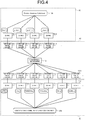
- FIG. 4 A description will be given here with reference to FIG. 4 .
- an input sentence of "She drinks cool juice.” and an output sentence of "Kanojyo ha tumetai jyu-su wo nomu.” are used as the teacher data.
- the information processing apparatus performs the process described below based on the teacher data of "She drinks cool juice.”, and calculates each of the first vectors that are input to the corresponding intermediate layers 61-1 to 61-n in the RNN 60.
- the information processing apparatus performs the process described with reference to FIG. 1 and converts the input sentence of "She drinks cool juice.” to the word meaning postscript input sentence 10b of "She ⁇ drinks ⁇ cool ⁇ juice ⁇ .”.
- the information processing apparatus specifies the first vector of "SheA” based on the word "SheA” in the word meaning postscript input sentence 10b and based on the first vector table 150b and sets the specified result to the first vector that is input to the intermediate layer 61-1.
- the information processing apparatus specified the first vector of "drinks ⁇ " based on the word “drinks ⁇ ” in the word meaning postscript input sentence 10b and based on the first vector table 150b and sets the specified result to the first vector that is input to the intermediate layer 61-2.
- the information processing apparatus specifies the first vector of "cool(1) ⁇ ” based on the word "cool(1) ⁇ ” in the word meaning postscript input sentence 10c and based on the first vector table 150b and sets the specified result to the first vector that is input to the intermediate layer 61-3.
- the information processing apparatus specifies the first vector of "juice ⁇ ” based on the word “juice ⁇ ” in the word meaning postscript input sentence 10c and based on the first vector table 150b and sets the specified result to the first vector that is input to the intermediate layer 61-4.
- the information processing apparatus performs the process described below based on the output sentence of "Kanojyo ha tumetai jyu-su wo nomu.” that is the teacher data and calculates "optimum second vectors" that are output from the associated intermediate layers 63-1 to 63-n in the RNN 60.
- the information processing apparatus converts the output sentence "Kanojyo ha tumetai jyu-su wo nomu.” to a word meaning postscript output sentence 20b of "kanojyo ⁇ ha ⁇ tumatai ⁇ jyu-su ⁇ wo ⁇ nomu ⁇ ".
- a polysemous word is not included in the output sentence "Kanojyo ha tumetai jyu-su wo nomu".
- the information processing apparatus specifies the second vector of "kanojyo ⁇ ” based on the word “kanojyo ⁇ ” in the word meaning postscript output sentence 20b and based on the second vector table 150c and sets the specified second vector to an ideal value of the second vector that is output from the intermediate layer 63-1.
- the information processing apparatus specifies the second vector of "ha ⁇ ” based on the word "ha ⁇ ” in the word meaning postscript output sentence 20b and based on the second vector table 150c and sets the specified second vector to an ideal value of the second vector that is output from the intermediate layer 63-2.
- the information processing apparatus specifies the second vector of "tumetai ⁇ ” based on the word "tumetai ⁇ ” in the word meaning postscript output sentence 20b and based on the second vector table 150c and sets the specified second vector to an ideal value of the second vector that is output from the intermediate layer 63-3.
- the information processing apparatus specifies the second vector of "jyu-su ⁇ " based on the word "jyu-su ⁇ ” in the word meaning postscript output sentence 20b and based on the second vector table 150c and sets the specified second vector to an ideal value of the second vector that is output from the intermediate layer 63-4.
- the information processing apparatus specifies the second vector of "wo ⁇ ” based on the word "wo ⁇ ” in the word meaning postscript output sentence 20b and based on the second vector table 150c and sets the specified second vector to an ideal value of the second vector that is output from the intermediate layer 63-5.
- the information processing apparatus specifies the second vector of "nomu ⁇ ” based on the word "nomu ⁇ ” in the word meaning postscript output sentence 20b and based on the second vector table 150c and sets the specified second vector to an ideal value of the second vector that is output from the intermediate layer 63-6.
- the information processing apparatus uses the teacher data and specifies each of the first vectors that is input to the corresponding intermediate layers 61-1 to 61-n in the RNN 60 and the ideal second vectors that are output from the corresponding intermediate layers 63-1 to 63-n in the RNN 60.
- the information processing apparatus performs a process of adjusting the parameters that are set in the RNN 60 such that the second vectors that are output from the corresponding intermediate layers 63-1 to 63-n approach the ideal second vector.
- the information processing apparatus determines whether a polysemous word (target word) is included in the teacher data based on the teacher data and the word meaning HMM 150a.
- the information processing apparatus specifies the word meaning ID of the target word and generates text information (a word meaning postscript input sentence and a word meaning postscript output sentence) in which a combination of the target word and the word meaning ID is set to a single word.
- the information processing apparatus learns the parameters of the RNN 60 by using the generated word meaning postscript input sentence and the word meaning postscript output sentence.
- a combination of the target word and the word meaning ID is considered as a single word and is converted to a vector, it is possible to perform learning in a state in which the word meaning of the word can be distinguished. Consequently, it is possible to improve translation accuracy of the text information.
- FIG. 5 is a functional block diagram illustrating a configuration of the information processing apparatus according to the embodiment.
- an information processing apparatus 100 includes a communication unit 110, an input unit 120, a display unit 130, a storage unit 150, and a control unit 160.
- the communication unit 110 is a processing unit that performs data communication with an external device via a network.
- the communication unit 110 is an example of a communication device.
- the information processing apparatus 100 may also be connected to the external device via the network and receive a teacher data table 150d or the like from the external device.
- the input unit 120 is an input device for inputting various kinds of information to the information processing apparatus 100.
- the input unit 120 corresponds to a keyboard, a mouse, a touch panel, or the like.
- the display unit 130 is a display device for displaying various kinds of information output from the control unit 160.
- the display unit 130 corresponds to a liquid crystal display, a touch panel, or the like.
- the storage unit 150 includes the word meaning HMM 150a, the first vector table 150b, the second vector table 150c, and the teacher data table 150d. Furthermore, the storage unit 150 includes RNN data 150g, input sentence data 150h, and output sentence data 150i.
- the storage unit 150 corresponds to a semiconductor memory device, such as a random access memory (RAM), a read only memory (ROM), and a flash memory, or a storage device, such as a hard disk drive (HDD).
- RAM random access memory
- ROM read only memory
- HDD hard disk drive
- the word meaning HMM 150a is information that associates a polysemous word, the word meaning ID, and a plurality of co-occurrence words (co-occurrence rate).
- the data structure of the word meaning HMM 150a corresponds to the data structure of the word meaning HMM 150a illustrated in FIG. 1 .
- the first vector table 150b is a table that associates a word of the first language with the first vector.
- the first vector is an example of the word meaning vector.
- FIG. 6 is a diagram illustrating an example of the data structure of the first vector table according to the embodiment. As illustrated in FIG. 6 , the first vector table 150b associates word written in the first language with the first vector. For example, the word "cool(1)" written in the first language is associated with a first vector "Ve1-1".
- the first vector is information associated with distributed representation.
- the second vector table 150c is a table that associates a word written in the second language with the second vector.
- the second vector is an example of a word meaning vector.
- FIG. 7 is a diagram illustrating an example of the data structure of the second vector table according to the embodiment. As illustrated in FIG. 7 , the second vector table 150c associates a word written in the second language with the second vector. For example, the word "tumetai" written in the second language is associated with a second vector "Ve2-1".
- the second vector is information associated with distributed representation.
- the teacher data table 150d is a table that holds a combination of an input sentence and an output sentence acting as the teacher data.
- FIG. 8 is a diagram illustrating an example of the data structure of the teacher data table according to the embodiment. As illustrated in FIG. 8 , the teacher data table 150d associates the input sentences with the output sentences. For example, an appropriate output sentence obtained when the input sentence "She drinks cool juice.” written in the first language is translated into the second language is "Kanojyo ha tumetai jyu-su wo nomu", which is indicated by the teacher data.
- the RNN data 150g is a table that holds parameters and the like that are set in each of the intermediate layers in the RNN 60 described with reference to FIGS. 3 and 4 .
- FIG. 9 is a diagram illustrating an example of the data structure of the RNN data according to the embodiment. As illustrated in FIG. 9 , the RNN data 150g associates RNN identification information with the parameters.
- the RNN identification information is information that uniquely identifies the intermediate layers in the RNN 60.
- the parameters indicates the parameters that are set in the corresponding intermediate layers.
- the parameters each correspond to bias values or weights that are used in an activation function and that are set in the intermediate layers.
- FIG. 10 is a diagram providing a supplementary explanation of parameters of an intermediate layer.
- FIG. 10 illustrates an input layer "x", an intermediate layer (hidden layer) "h", and an output layer "y".
- the intermediate layer “h” corresponds to the intermediate layers 61-1 to 61-n and 63-1 to 63-n illustrated in FIG. 3 or the like.
- Equation (1) The relationship between the intermediate layer “h” and the input layer “x” is defined by Equation (1) by using an activation function f, where W 1 and W 3 in Equation (1) denote weights that are adjusted to optimum values based on learning performed by the teacher data and t denotes time (how many words are read).
- h t f W 1 x t + W 3 h t ⁇ 1
- the input sentence data 150h is data of an input sentence acting as the translation target. For example, it is assumed that the input sentence data 150h is "She drinks cool juice.” or the like written in the first language.
- the output sentence data 150i is data obtained by translating the input sentence data 150h. For example, when the input sentence data is "She drinks cool juice.” and the parameter in the RNN data 150g is appropriately learned, the output sentence data is "Kanojyo ha tumetai jyu-su wo nomu".
- the control unit 160 includes a receiving unit 160a, a word meaning specifying unit 160b, a word meaning postscript text generating unit 160c, a word meaning vector specifying unit 160d, a learning unit 160e, a converting unit 160f, a text generating unit 160g, and a notifying unit 160h.
- the control unit 160 can be implemented by a central processing unit (CPU), a micro processing unit (MPU), or the like.
- the control unit 160 may also be implemented by hard-wired logic, such as an application specific integrated circuit (ASIC) or a field programmable gate array (FPGA).
- ASIC application specific integrated circuit
- FPGA field programmable gate array
- the information processing apparatus 100 learns the RNN data 150g corresponding to the parameters of the RNN 60.
- the receiving unit 160a, the word meaning specifying unit 160b, the word meaning postscript text generating unit 160c, the word meaning vector specifying unit 160d, and the learning unit 160e are operated from among the processing units included in the control unit 160.
- the receiving unit 160a receives the teacher data table 150d from an external device via a network.
- the receiving unit 160a stores the received teacher data table 150d in the storage unit 150.
- the receiving unit 160a may also receive the teacher data table 150d from the input unit 120.
- the word meaning specifying unit 160b specifies the word meaning of the word in the input sentence included in the teacher data table 150d based on the word meaning HMM 150a.
- the word meaning specifying unit 160b splits the input sentence into a plurality of words by performing morphological analysis on the input sentence included in the teacher data table 150d, and then, generates a split input sentence. For example, the word meaning specifying unit 160b generates the split input sentence "She ⁇ drinks ⁇ cool ⁇ juice.” based on "She drinks cool juice". In the split input sentence, each of the words is segmented by " ⁇ (space)".
- the word meaning specifying unit 160b compares each of the words included in the split input sentence with the word meaning HMM 150a and specifies a target word. Furthermore, the word meaning specifying unit 160b compares the words before and after the target word included in the split input sentence with the word meaning HMM 150a and specifies the word meaning ID of the target word. For example, the target word "cool ⁇ " is included in the split input sentence "She ⁇ drinks ⁇ cool ⁇ juice ⁇ .” and the word meaning ID of this target word is "(1)".
- the word meaning specifying unit 160b splits the output sentence into a plurality of words by performing morphological analysis on the output sentence and generates the split output sentence. For example, the word meaning specifying unit 160b generates the split output sentence "Kanojyo ⁇ ha ⁇ tumetai ⁇ jyu-su ⁇ wo ⁇ nomu ⁇ .” based on "Kanojyo ha tumetai jyu-su wo nomu".
- the word meaning specifying unit 160b compares each of the words included in the split output sentence with the word meaning HMM 150a and specifies a target word. Furthermore, the word meaning specifying unit 160b compares the words before and after the target word included in the split output sentence with the word meaning HMM 150a and specifies the word meaning ID of the target word. Furthermore, it is assumed that the target word is not included in the split output sentence "Kanojyo ⁇ ha ⁇ tumetai ⁇ jyu-su ⁇ wo ⁇ nomu ⁇ ".
- the word meaning specifying unit 160b outputs word meaning specified results of the input sentence and the output sentence to the word meaning postscript text generating unit 160c.
- the word meaning specified result includes therein a split input sentence and word meaning ID of each of the target word included in the split input sentence and the target word included in the split input sentence. Furthermore, the word meaning specified result includes therein the split output sentence and the word meaning ID of each of the target word included in the split output sentence and the target word included in the split output sentence. When the target word is not included, the information related to the target word and the word meaning ID is blank.
- the word meaning postscript text generating unit 160c is a processing unit that generates, based on the word meaning specified result acquired from the word meaning specifying unit 160b, text information in which the word meaning ID is added, as a postscript, to the target word.
- the word meaning postscript text generating unit 160c When a target word is included in the split input sentence, the word meaning postscript text generating unit 160c generates a word meaning postscript input sentence by adding, as a postscript, the word meaning ID after the target word. For example, when the word meaning ID of the target word "cool ⁇ " of the split input sentence "She ⁇ drinks ⁇ cool ⁇ juice ⁇ .” is "(1)", the word meaning postscript text generating unit 160c generates the word meaning postscript input sentence "She ⁇ drinks ⁇ cool(1) ⁇ juice ⁇ ".
- the word meaning postscript text generating unit 160c When the target word is included in the split output sentence, the word meaning postscript text generating unit 160c generates a word meaning postscript output sentence by adding, as a postscript, the word meaning ID after the target word. For example, when the word meaning ID of the target word "amai" in the split output sentence "Ringo ⁇ ga ⁇ amai ⁇ .” is "(1)", the word meaning postscript text generating unit 160c generates the word meaning postscript output sentence "Ringo ⁇ ga ⁇ amai(1) ⁇ ".
- the word meaning postscript text generating unit 160c treatses the split output sentence "Kanojyo ⁇ ha ⁇ tumetai ⁇ jyu-su ⁇ wo ⁇ nomu ⁇ .” in which the word meaning ID is not added as the word meaning postscript output sentence.
- the word meaning postscript text generating unit 160c performs the process described above and outputs the word meaning postscript input sentence and the word meaning postscript output sentence to the word meaning vector specifying unit 160d.
- the word meaning vector specifying unit 160d specifies the word meaning vector of each of the words included in the word meaning postscript input sentence and the word meaning vector of each of the words included in the word meaning postscript output sentence.
- the word meaning vector of the word in the word meaning postscript input sentence is referred to as the "first vector”.
- the word meaning vector of the word in the word meaning postscript output sentence is referred to as the "second vector”.
- the word meaning vector specifying unit 160d outputs the information on the first vector and the second vector of each of the words to the learning unit 160e.
- the word meaning vector specifying unit 160d specifies each of the first vectors associated with the corresponding words by comparing each of the words included in the word meaning postscript input sentence with the first vector table 150b.
- the word meaning vector specifying unit 160d specifies each of the second vectors associated with the corresponding words by comparing each of the words included in the word meaning postscript output sentence with the second vector table 150c.
- the word meaning vector specifying unit 160d generates information on each of the first vectors of the input sentence in the teacher data table 150d and each of the second vectors of the output sentence associated with this input sentence and outputs information on each of the first vectors and each of the second vectors to the learning unit 160e.
- the learning unit 160e uses the parameters of each of the intermediate layers registered in the RNN data 150g, inputs each of the first vectors to the corresponding intermediate layers 61-1 to 61-n in the RNN 60, and calculates each of the vectors that is output from the corresponding intermediate layers 63-1 to 63-n.
- the learning unit 160e learns the parameter of each of the intermediate layers registered in the RNN data 150g such that each of the vectors output from the corresponding intermediate layers 63-1 to 63-n in the RNN 60 approach the corresponding second vectors.
- the learning unit 160e may also perform learning by using a cost function in which a difference between each of the vectors output from the corresponding intermediate layers 63-1 to 63-n and the second vector is defined and adjusting the parameter of each of the intermediate layers so as to minimize the difference.
- the word meaning specifying unit 160b, the word meaning postscript text generating unit 160c, the word meaning vector specifying unit 160d, and the learning unit 160e learn the parameters in the RNN data 150g by repeatedly performing the process described above while changing the teacher data.
- the information processing apparatus 100 When a translation process is performed, the receiving unit 160a, the word meaning specifying unit 160b, the word meaning postscript text generating unit 160c, the word meaning vector specifying unit 160d, the converting unit 160f, the text generating unit 160g, and the notifying unit 160h are operated from among each of the processing units included in the control unit 160.
- the receiving unit 160a receives the input sentence data 150h from an external device via a network.
- the receiving unit 160a stores the received input sentence data 150h in the storage unit 150.
- the word meaning specifying unit 160b specifies the word meanings of the words included in the input sentence in the input sentence data 150h based on the word meaning HMM 150a.
- the word meaning specifying unit 160b splits the input sentence into a plurality of words by performing morphological analysis on the input sentence data (input sentence) 150h and generates a split input sentence.
- the word meaning specifying unit 160b compares each of the words included in the split input sentence with the word meaning HMM 150a and specifies a target word. Furthermore, the word meaning specifying unit 160b compares the words before and after the target word included in the split input sentence with the word meaning HMM 150a and specifies the word meaning ID of the target word.
- the word meaning specifying unit 160b outputs the word meaning specified result of the input sentence to the word meaning postscript text generating unit 160c.
- the word meaning specified result includes therein the split input sentence and the word meaning ID of each of the target word included in the split input sentence and the target word included in the split input sentence.
- the word meaning postscript text generating unit 160c is a processing unit that generates, based on the word meaning specified result acquired from the word meaning specifying unit 160b, text information in which the word meaning ID is added, as a postscript, to the target word.
- the word meaning postscript text generating unit 160c When the target word is included in the split input sentence, the word meaning postscript text generating unit 160c generates a word meaning postscript input sentence by adding, as a postscript, the word meaning ID after the target word.
- the word meaning postscript text generating unit 160c outputs the word meaning postscript input sentence to the word meaning vector specifying unit 160d.
- the word meaning vector specifying unit 160d specifies the word meaning vector of each of the words included in the word meaning postscript input sentence.
- the word meaning vector specifying unit 160d specifies each of the first vectors associated with the corresponding static codes by comparing each of the words in the word meaning postscript input sentence with the first vector table 150b.
- the word meaning vector specifying unit 160d outputs each of the specified first vectors to the converting unit 160f.
- the converting unit 160f uses the parameter of each of the intermediate layers 61-1 to 63-n registered in the RNN data 150g and inputs each of the first vectors to the corresponding intermediate layers 61-1 to 61-n in the RNN 60.
- the converting unit 160f converts each of the first vectors to the corresponding second vectors by acquiring each of the second vectors output from the corresponding intermediate layers 63-1 to 63-n in the RNN 60.
- the converting unit 160f outputs each of the converted second vectors to the text generating unit 160g.
- the text generating unit 160g is a processing unit that generates the output sentence data 150i by using each of the second vectors acquired from the converting unit 160f. In the following, an example of a process performed by the text generating unit 160g will be described.
- the text generating unit 160g compares each of the second vectors with the second vector table 150c and specifies the word associated with each of the second vectors.
- the text generating unit 160g generates the output sentence data 150i by arranging the specified words. Furthermore, when the word meaning ID is added, as a postscript, to the word included in the output sentence data 150i, the text generating unit 160g deletes the added word meaning ID.
- the generating unit 160g stores the generated output sentence data 150i in the storage unit 150.
- the notifying unit 160h is a processing unit that notifies the external device of the output sentence data 150i generated by the text generating unit 160g. For example, the notifying unit 160 notifies the external device corresponding to the transmission source of the input sentence data 150h of the output sentence data 150i.
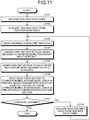
- FIG. 11 is a flowchart illustrating the flow of the learning process performed by the information processing apparatus according to the embodiment.
- the receiving unit 160a in the information processing apparatus 100 receives the teacher data table 150d (Step S101).
- the word meaning specifying unit 160b in the information processing apparatus 100 acquires the teacher data from the teacher data table 150d (Step S102).
- the word meaning specifying unit 160b and the word meaning postscript text generating unit 160c in the information processing apparatus 100 perform a word meaning postscript process (Step S103).
- the word meaning vector specifying unit 160d in the information processing apparatus 100 assigns each of the first vectors to the corresponding words included in the word meaning postscript input sentence (Step S104).
- the word meaning vector specifying unit 160d assigns each of the second vectors to the corresponding words included in the word meaning postscript output sentence (Step S105).
- the learning unit 160e in the information processing apparatus 100 inputs each of the first vectors to the corresponding intermediate layers in the RNN 60 and adjusts the parameters such that each of the vectors output from the corresponding intermediate layers in the RNN 60 approach the corresponding second vectors (Step S106).
- the information processing apparatus 100 determines whether or not to continue the learning (Step S107).
- the word meaning specifying unit 160b acquires new piece of teacher data from the teacher data table 150d (Step S108) and proceeds to Step S103.
- the information processing apparatus 100 ends the process.
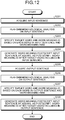
- FIG. 12 is a flowchart illustrating the flow of the word meaning postscript process.
- the word meaning specifying unit 160b in the information processing apparatus 100 acquires an input sentence (Step S201).
- the word meaning specifying unit 160b performs morphological analysis on the input sentence (Step S202).
- the word meaning specifying unit 160b specifies the target word and the word meaning ID based on each of the words included in the input sentence and the word meaning HMM 150a (Step S203) .
- the word meaning postscript text generating unit 160c in the information processing apparatus 100 generates a word meaning postscript input sentence by adding, as a postscript, the word meaning ID after the target word that is included in the input sentence (Step S204).
- the word meaning specifying unit 160b acquires the output sentence (Step S205).
- the word meaning specifying unit 160b performs morphological analysis on the output sentence (Step S206).
- the word meaning specifying unit 160b specifies the target words and the word meaning IDs based on each of the words included in the output sentence and the word meaning HMM 150a (Step S207).
- the word meaning postscript text generating unit 160c generates a word meaning postscript output sentence by adding, as a postscript, the word meaning ID after the target word included in the input sentence (Step S208).
- FIG. 13 is a flowchart illustrating the flow of the translation process performed by the information processing apparatus according to the embodiment.
- the receiving unit 160a in the information processing apparatus 100 receives the input sentence data 150h (Step S301).
- the word meaning specifying unit 160b in the information processing apparatus 100 performs morphological analysis on the input sentence (Step S302).
- the word meaning specifying unit 160b specifies the target words and the word meaning IDs based on each of the words in the input sentence and the word meaning HMM 150a (Step S303).
- the word meaning postscript text generating unit 160c in the information processing apparatus 100 generates a word meaning postscript input sentence by adding, as a postscript, the word meaning ID after the target word included in the input sentence (Step S304).
- the word meaning vector specifying unit 160d in the information processing apparatus 100 assigns each of the first vectors to the corresponding words included in the input sentence (Step S305).
- the converting unit 160f in the information processing apparatus 100 inputs each of the first vectors to the corresponding intermediate layers 61-1 to 61-n in the RNN 60 and acquires each of the second vectors output from the corresponding intermediate layers 63-1 to 63-n in the RNN 60 (Step S306).
- the text generating unit 160g in the information processing apparatus 100 refers to the second vector table 150c and converts each of the second vectors to words (Step S307).
- the text generating unit 160g generates the output sentence data 150i (Step S308).
- the notifying unit 160h in the information processing apparatus 100 notifies an external device of the output sentence data 150i (Step S309) .
- the information processing apparatus 100 determines whether a polysemous word (target word) is included in the teacher data based on the teacher data and the word meaning HMM 150a.
- target word a polysemous word
- the information processing apparatus 100 specifies the word meaning ID of the target word and generates the text information (a word meaning postscript input sentence and a word meaning postscript output sentence) in which a combination of the target word and the word meaning ID is set to a single word.
- the information processing apparatus 100 learns the parameters of the RNN 60 by using the generated word meaning postscript input sentence and the word meaning postscript output sentence.
- a combination of the target word and the word meaning ID is considered as a single word and is converted to a vector, it is possible to perform learning in a state in which the word meaning of the word can be distinguished. Consequently, it is possible to improve translation accuracy of the text information.
- the information processing apparatus 100 when the information processing apparatus 100 inputs the first vector generated from the word meaning postscript input sentence to the RNN 60, the information processing apparatus 100 adjusts the parameters of the RNN 60 such that each of the vectors output from the RNN 60 approaches the second vector generated from the word meaning postscript output sentence. In this way, by converting the teacher data to a word meaning vector that can distinguish the word meaning of a polysemous word, it is possible to efficiently learning parameters of the RNN 60.
- the information processing apparatus 100 determines whether a polysemous word (target word) is included in the input sentence.
- target word a polysemous word
- the information processing apparatus 100 specifies the word meaning ID of the target word and generates text information (word meaning postscript input sentence) in which a combination of the target word and the word meaning ID is set to a single word.
- word meaning postscript input sentence a polysemous word
- the information processing apparatus 100 can generate the output sentence data 150i corresponding to an optimum translation result.
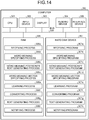
- FIG. 14 is a diagram illustrating an example of the hardware configuration of the computer that implements the same function as that performed by the information processing apparatus according to the embodiment.
- a computer 300 includes a CPU 301 that executes various kinds of arithmetic processing, an input device 302 that receives an input of data from a user, and a display 303. Furthermore, the computer 300 includes a reading device 304 that reads programs or the like from a storage medium and an interface device 305 that sends and receives data to and from an external device or the like via a wired or wireless network. The computer 300 includes a RAM 306 that temporarily stores therein various kinds of information and a hard disk device 307. Each of the devices 301 to 307 is connected to a bus 308.
- the hard disk device 307 includes a receiving program 307a, a word meaning specifying program 307b, a word meaning postscript text generating program 307c, a word meaning vector specifying program 307d, and a learning program 307e. Furthermore, the hard disk device 307 includes a converting program 307f, a text generating program 307g, and a notifying program 307h.
- the CPU 301 reads the receiving program 307a, the word meaning specifying program 307b, the word meaning postscript text generating program 307c, the word meaning vector specifying program 307d, and the learning program 307e and loads the programs in the RAM 306.
- the CPU 301 reads the converting program 307f, the text generating program 307g, and the notifying program 307h and loads the programs in the RAM 306.
- the receiving program 307a functions as a receiving process 306a.
- the word meaning specifying program 307b functions as a word meaning specifying process 306b.
- the word meaning postscript text generating program 307c functions as a word meaning postscript text generating process 306c.
- the word meaning vector specifying program 307d functions as a word meaning vector specifying process 306d.
- the learning program 307e functions as a learning process 306e.
- the converting program 307f functions as a converting process 306f.
- the text generating program 307g functions as a text generating process 306g.
- the notifying program 307h functions as a notifying process 306h.
- the process of the receiving process 306a corresponds to the process of the receiving unit 160a.
- the process of the word meaning specifying process 306b corresponds to the process of the word meaning specifying unit 160b.
- the process of the word meaning postscript text generating process 306c corresponds to the process of the word meaning postscript text generating unit 160c.
- the process of the word meaning vector specifying process 306d corresponds to the process of the word meaning vector specifying unit 160d.
- the process of the learning process 306e corresponds to the process of the learning unit 160e.
- the process of the converting process 306f corresponds to the process of the converting unit 160f.
- the process of the text generating process 306g corresponds to the process of the text generating unit 160g.
- the process of the notifying process 306h corresponds to the process of the notifying unit 160h.
- each of the programs 307a to 307h does not need to be stored in the hard disk device 307 in advance from the beginning.
- each of the programs is stored in a "portable physical medium", such as a flexible disk (FD), a CD-ROM, a DVD disk, a magneto-optic disk, an IC CARD, that is to be inserted into the computer 300.
- the computer 300 may also read each of the programs 307a to 307h from the portable physical medium and execute the programs.
Landscapes
- Engineering & Computer Science (AREA)
- Theoretical Computer Science (AREA)
- Physics & Mathematics (AREA)
- General Physics & Mathematics (AREA)
- General Engineering & Computer Science (AREA)
- Computational Linguistics (AREA)
- Artificial Intelligence (AREA)
- General Health & Medical Sciences (AREA)
- Health & Medical Sciences (AREA)
- Data Mining & Analysis (AREA)
- Software Systems (AREA)
- Evolutionary Computation (AREA)
- Computing Systems (AREA)
- Mathematical Physics (AREA)
- Molecular Biology (AREA)
- Biophysics (AREA)
- Biomedical Technology (AREA)
- Life Sciences & Earth Sciences (AREA)
- Audiology, Speech & Language Pathology (AREA)
- Databases & Information Systems (AREA)
- Pure & Applied Mathematics (AREA)
- Computational Mathematics (AREA)
- Mathematical Optimization (AREA)
- Mathematical Analysis (AREA)
- Probability & Statistics with Applications (AREA)
- Algebra (AREA)
- Computer Vision & Pattern Recognition (AREA)
- Medical Informatics (AREA)
- Machine Translation (AREA)
Abstract
Description
- The present invention relates to a generating method and the like.
- In recent years, neural machine translation (NMT) is used when a first language is translated into a second language that is different from the first language. Various models are present in neural machine translation and, for example, there is a model constructed from an encoder, a recurrent neural network (RNN), and a decoder (decoder).
- The encoder is a processing unit that encodes a character string of an input sentence into words and assigns vectors to the words. The RNN converts the words that are input from the encoder and the vectors thereof based on the own parameter and outputs the converted vectors and the words. The decoder is a processing unit that decodes an output sentence based on the vectors and the words that are output from the RNN.
- In the conventional technology, parameters of the RNN are learned by using teacher data such that an appropriate output sentence written in the second language is output from an input sentence written in the first language. In the parameters of the RNN, bias values and weights of an activation function are included. For example, in the conventional technology, parameters of the RNN are learned by providing, as learning data, a combination of an input sentence "She drinks cool juice." written in the first language and an output sentence "Kanojyo ha tumetai jyu-su wo nomu" written in the second language.
- Incidentally, because words included in a sentence each have a plurality of word meanings and take different word meanings in accordance with the context, there is a conventional technology for estimating a word meaning of a certain word held in the target sentence. In this conventional technology, a sentence that includes an example sentence is extracted from a corpus, tag information associated with a word meaning of an arbitrary word is attached to the extracted sentence, and the sentence is output.
-
- Patent Literature 1: Japanese Laid-open Patent Publication No.
2012-141679 - Patent Literature 2: Japanese National Publication of International Patent Application No.
2017-511914 - Patent Literature 3: Japanese Laid-open Patent Publication No.
2013-20431 - However, in the conventional technology described above, there is a problem in that it is not possible to improve translation accuracy of the text information.
- In the encoder used for neural machine translation, an operation of converting each word included in the input sentence to vectors formed of hundreds of dimensions called distributed representation is performed. This operation is called "embedding" in order to reduce dependence on languages, such as the English language, the Japanese language, and the like. In the conventional technology, when embedding is performed, word meanings of words are not distinguished. For example, word meanings are different between "cool" used in "She drinks cool juice." and "cool" used in "He likes cool think". Here, in order to distinguish each of the words "cool", for convenience sake, "cool" used in "She drinks cool juice." is referred to as "cool(1)", and "cool" used in "He likes cool think." is referred to as "cool(2)".
- Here, in the embedding technique used in the conventional technology, "cool(1)" and "cool(2)" are converted to a single piece of the same vector by Word2Vec. Consequently, in the conventional technology, because RNN machine learning is performed without distinguishing differences between the word meanings of "cool(1)" and "cool(2)", it is difficult to appropriately learn parameters with respect to words each including a plurality of word meanings. Thus, when words each including a plurality of word meanings are present in an input sentence, the input sentence is not translated into an appropriate output sentence, and therefore, the translation accuracy is reduced.
- Furthermore, in order to calculate vectors in accordance with word meanings of words by Word2Ve, there is a need to obtain data that is obtained by performing morphological analysis on a text, that includes information that can distinguish words and the word meanings of the words, and that is written with a space between the words. Therefore, in Word2Vec, it is not possible to calculate vectors in accordance with word meanings of words even in a case of using data in which tag information is attached to the words.
- Accordingly, it is an object in one aspect of an embodiment of the present invention to provide a generating method, a generating program, and an information processing apparatus that can generate vectors in accordance with word meanings of words and that can improve translation accuracy of text information.
- According to an aspect of the embodiment of the invention, generating method includes receiving text information, using a processor; extracting a plurality of words included in the received text information, using the processor; specifying, from among the plurality of extracted words, by referring to a storage unit that stores therein, for each of word meanings of the words each including a plurality of word meanings, co-occurrence information on another word with respect to the words, a word meaning of one of the words each including the plurality of word meanings based on the co-occurrence information on the other word with respect to the one of the words, using the processor; and generating word meaning postscript text information that includes the one of the words and a character that identifies the specified word meaning, using the processor.
- According to an aspect of an embodiment, it is possible to generate vectors in accordance with word meanings of words. Furthermore, according to an aspect of an embodiment, it is possible to improve translation accuracy of text information.
-
-
FIG. 1 is a diagram (1) illustrating a process performed by an information processing apparatus according to an embodiment. -
FIG. 2 is a diagram illustrating a process of generating vectors of words. -
FIG. 3 is a diagram (2) illustrating a process performed by the information processing apparatus according to the embodiment. -
FIG. 4 is a diagram (3) illustrating a process performed by the information processing apparatus according to the embodiment. -
FIG. 5 is a functional block diagram illustrating a configuration of the information processing apparatus according to the embodiment. -
FIG. 6 is a diagram illustrating an example of a data structure of a first vector table according to the embodiment. -
FIG. 7 is a diagram illustrating an example of a data structure of a second vector table according to the embodiment. -
FIG. 8 is a diagram illustrating an example of a data structure of a teacher data table according to the embodiment. -
FIG. 9 is a diagram illustrating an example of a data structure of RNN data according to the embodiment. -
FIG. 10 is a diagram providing supplementary explanation of parameters of an intermediate layer. -
FIG. 11 is a flowchart illustrating the flow of a process of a learning process performed by the information processing apparatus according to the embodiment. -
FIG. 12 is a flowchart illustrating the flow of a process of a word meaning postscript process. -
FIG. 13 is a flowchart illustrating the flow of a process of a translation process performed by the information processing apparatus according to the embodiment. -
FIG. 14 is a diagram illustrating an example of a hardware configuration of a computer that implements the same function as that performed by the information processing apparatus according to the embodiment. Description of Embodiments - Preferred embodiment of a generating method, a generating program, and an information processing apparatus disclosed in the present invention will be explained in detail below with reference to the accompanying drawings. Furthermore, the present invention is not limited to the embodiments.
-
FIGS. 1 to 3 are diagrams each illustrating a process performed by an information processing apparatus according to the embodiment. When aninput sentence 10 is provided, the information processing apparatus according to the embodiment splits, by performing a morphological analysis, a character string included in theinput sentence 10 into words and generates asplit input sentence 10a. For example, in thesplit input sentence 10a, each of the words is split by "Δ (space)". - For example, in the
split input sentence 10a associated with theinput sentence 10 of "She drinks cool juice.", the words "SheΔ", "drinksΔ", "coolΔ", "juiceΔ" are included. In thesplit input sentence 10a associated with theinput sentence 10 of "Kanojyo ha tumetai jyu-su wo nomu.", the words "kanojyoΔ", "haΔ", "tumetaiΔ", "jyu-suΔ", "woΔ", and "nomuΔ" are included. In thesplit input sentence 10a associated with theinput sentence 10 of "He has cool think.", the words "HeΔ" , "hasΔ" , "coolΔ", are "thinkΔ" included. In thesplit input sentence 10a associated with theinput sentence 10 of "Kare ha reisei-na kangae wo motte iru.", the words "kareΔ", "haΔ", "reisei-naΔ", "kangaeΔ", "woΔ", "motteΔ", and "iruΔ" are included. - The information processing apparatus compares each of the words included in the
split input sentence 10a with a word meaning hidden Markov model (HMM) 150a, specifies a word acting as a polysemous word, and specifies a word meaning (word meaning ID) of the word acting as a polysemous word. In a description below, the word acting as a polysemous word included in thesplit input sentence 10a is referred to as a "target word". The word meaning HMM 150a associates polysemous words, word meaning IDs, and a plurality of co-occurrence words (co-occurrence rate). - The polysemous words in the word meaning HMM 150a indicates the words each having a plurality of word meanings. The word meaning ID is information that uniquely identifies the word meaning included in the polysemous word. The co-occurrence word indicates the word that co-occurs with the polysemous word of a certain word meaning. In the embodiment, for convenience of description, the word meaning ID is indicated by a numeral in parentheses; however, the parentheses are used for convenience sake and it is assumed that, in practice, only a numeral that can identify the word meaning ID is attached. The co-occurrence word is associated with the co-occurrence rate. For example, when the polysemous word "cool" is used in the word meaning that is identified by the word meaning ID "(1)", information indicating that the probability of co-occurrence of "juice" before and after the polysemous word "cool" is "10%" is indicated. Although not illustrated, the word meaning of "cool" identified by the word meaning ID "(1)" is "tumetai".
- When the polysemous word "cool" is used in the word meaning that is identified by the word meaning ID "(2)", information indicating that the probability of co-occurrence of "think" before and after the polysemous word "cool" is "11%" is indicated. Although not illustrated, the word meaning of "cool" identified by the word meaning ID "(2)" is "reisei-na".
- When the information processing apparatus specifies the target word acting as a polysemous word, the information processing apparatus generates a word meaning
postscript input sentence 10b by adding a postscript of word meaning ID to the target word. For example, the information processing apparatus determines that "coolΔ" is the target word by comparing thesplit input sentence 10a of "SheΔdrinksΔcoolΔjuiceΔ." with the word meaning HMM 150a. Furthermore, because "juice" is included before thesplit input sentence 10a, the information processing apparatus determines that the word meaning ID of the target word "cool" is "(1)". Consequently, by adding, as a postscript, the word meaning ID "(1)" to the target word "coolΔ", the information processing apparatus generates the word meaningpostscript input sentence 10b "SheΔdrinksΔcool(1)Δjuice.". - The information processing apparatus determines that "coolΔ" is the target word by comparing the
split input sentence 10a of "He has cool think." with the word meaning HMM 150a. Furthermore, because "think" is included after thesplit input sentence 10a, the information processing apparatus determines that the word meaning ID of the target word "cool" is "(2)". Consequently, by adding, as a postscript, the word meaning ID "(2)" to the target word "coolΔ", the information processing apparatus generates the word meaningpostscript input sentence 10b "SheΔdrinksΔcool(2)ΔjuiceΔ.". -
FIG. 2 is a diagram illustrating a process of generating vectors of the words. Here, as an example, vectors assigned to "cool(1)A" and "cool(2)Δ" will be described. The information processing apparatus uses ahash filter 15 and a vector table 16 and specifies vectors to be assigned to words. Thehash filter 15 is a filter that associates hash values with pointers to the vector table 16. A vector is stored in each of areas in the vector table 16. - For example, the information processing apparatus calculates a hash value of "cool(1)Δ" and specifies a
pointer 15a associated with the hash value of "cool(1)Δ". The information processing apparatus assigns a vector "Vec1-1" indicated by thepointer 15a as the vector of "cool(1)Δ". The information processing apparatus calculates a hash value of "cool(2)Δ" and specifies apointer 15b associated with the hash value of "cool(2)Δ". The information processing apparatus assigns a vector "Vec1-2" indicated by thepointer 15b as the vector of "cool(2)Δ". In this way, different vectors are assigned by adding, as a postscript, the word meaning ID to the word,. - A description will be given here with reference to
FIG. 3 . In order to perform neural machine translation, the information processing apparatus according to the embodiment includes anencoder 50, a recurrent neural network (RNN) 60, and adecoder 70. By inputting a word meaning postscript input sentence generated from an input sentence written in the first language to theencoder 50, an output sentence written in the second language is output from thedecoder 70 via theRNN 60. - The
encoder 50 is a processing unit that assigns a vector to each of the words included in the word meaningpostscript input sentence 10b. For example, theencoder 50 compares a first vector table 150b with the words and converts the words to first vectors. The first vector table 150b is a table that associates the words with the first vectors. The first vector is information associated with distributed representation. Theencoder 50 outputs each of the first vectors to theRNN 60. - For example, the
encoder 50 inputs each of the first vectors of corresponding words 52-1 to 52-n to intermediate layers 61-1 to 61-n, respectively. - The
RNN 60 includes the intermediate layers (hidden layers) 61-1 to 61-n and 63-1 to 63-n and aconversion mechanism 62. Each of the intermediate layers 61-1 to 61-n and 63-1 to 63-n calculates a value based on its own set parameter and an input vector and then outputs the calculated value. - The intermediate layer 61-1 receives an input of the first vector of the static code 53-1, calculates a value based on the received vector and its own set parameter, and outputs the calculated value to the
conversion mechanism 62. Similarly, each of the intermediate layers 61-2 to 61-n also receives an input of the first vectors associated with the static code, calculates a value based on the received vector and its own set parameter, and outputs the calculated value to theconversion mechanism 62. - The
conversion mechanism 62 takes a role in judging, by using each of the values input from the associated intermediate layers 61-1 to 61-n and the internal state of thedecoder 70 or the like as a basis for judgement, a portion to pay attention when a next word is translated. For example, the state is normalized such that the sum value of each of the probabilities is 1, such as the probability of focusing attention on the value of the intermediate layer 61-1 being set to 0.2, the probability of focusing attention on the intermediate layer 61-2 being set to 0.3, and the like. - The
conversion mechanism 62 calculates a weighted sum of the distributed representation by summing values obtained by multiplying the value output from each of the intermediate layers 61-1 to 61-n by pieces of associated attention (probabilities). This is called a context vector. Theconversion mechanism 62 inputs the context vector to the intermediate layers 63-1 to 63-n. The probabilities that are used to calculate the associated context vectors that are input to the intermediate layers 63-1 to 63-n are re-calculated and the portion to be focused on varies each time. - The intermediate layer 63-1 receives the context vector from the
conversion mechanism 62, calculates a value based on the received context vector and its own set parameter, and outputs the calculated value to thedecoder 70. Similarly, each of the intermediate layers 63-2 to 63-n also receives the associated context vector, calculates a value based on the received vector and its own set parameter, and outputs the calculated value to thedecoder 70. - The
decoder 70 compares each of the values (second vectors) output from the intermediate layers 63-1 to 63-n with a second vector table 150c and converts the second vectors to words. The second vector table 150c is a table that associates the words with the second vectors. The second vector is information corresponding to distributed representation. - The
decoder 70 compares the second vector output from the intermediate layer 63-1 with the second vector table 150c and generates a word 72-1. Similarly, thedecoder 70 compares each of the second vectors output from the corresponding intermediate layers 63-2 to 63-n with the second vector table 150c and generates words 72-2 to 71-n. Thedecoder 70 generates anoutput sentence 20 by combining each of the words 72-1 to 72-n. Theoutput sentence 20 is text information obtained by translating the input sentence. - Here, when the information processing apparatus according to the embodiment learns parameters of the
RNN 60, the information processing apparatus receives a combination of an input sentence written in the first language and an output sentence written in the second language that act as teacher data. In the embodiment, a description will be given with the assumption that the first language is the English language and the second language is the Japanese language; however, the languages are not limited to these. The information processing apparatus converts the input sentence of the teacher data to the word meaningpostscript input sentence 10b and learns the parameters of theRNN 60 such that an output sentence of the teacher data is output from thedecoder 70 when the input sentence is input to theencoder 50. - A description will be given here with reference to
FIG. 4 . In the example illustrated inFIG. 4 , an input sentence of "She drinks cool juice." and an output sentence of "Kanojyo ha tumetai jyu-su wo nomu." are used as the teacher data. The information processing apparatus performs the process described below based on the teacher data of "She drinks cool juice.", and calculates each of the first vectors that are input to the corresponding intermediate layers 61-1 to 61-n in theRNN 60. The information processing apparatus performs the process described with reference toFIG. 1 and converts the input sentence of "She drinks cool juice." to the word meaningpostscript input sentence 10b of "SheΔdrinksΔcoolΔjuiceΔ.". - The information processing apparatus specifies the first vector of "SheA" based on the word "SheA" in the word meaning
postscript input sentence 10b and based on the first vector table 150b and sets the specified result to the first vector that is input to the intermediate layer 61-1. - The information processing apparatus specified the first vector of "drinksΔ" based on the word "drinksΔ" in the word meaning
postscript input sentence 10b and based on the first vector table 150b and sets the specified result to the first vector that is input to the intermediate layer 61-2. - The information processing apparatus specifies the first vector of "cool(1)Δ" based on the word "cool(1)Δ" in the word meaning postscript input sentence 10c and based on the first vector table 150b and sets the specified result to the first vector that is input to the intermediate layer 61-3.
- The information processing apparatus specifies the first vector of "juiceΔ" based on the word "juiceΔ" in the word meaning postscript input sentence 10c and based on the first vector table 150b and sets the specified result to the first vector that is input to the intermediate layer 61-4.
- Subsequently, the information processing apparatus performs the process described below based on the output sentence of "Kanojyo ha tumetai jyu-su wo nomu." that is the teacher data and calculates "optimum second vectors" that are output from the associated intermediate layers 63-1 to 63-n in the
RNN 60. Similarly to the process described with reference toFIG. 1 , the information processing apparatus converts the output sentence "Kanojyo ha tumetai jyu-su wo nomu." to a word meaningpostscript output sentence 20b of "kanojyoΔhaΔtumataiΔjyu-suΔwoΔnomuΔ". Here, as an example, it is assumed that a polysemous word is not included in the output sentence "Kanojyo ha tumetai jyu-su wo nomu". - The information processing apparatus specifies the second vector of "kanojyoΔ" based on the word "kanojyoΔ" in the word meaning
postscript output sentence 20b and based on the second vector table 150c and sets the specified second vector to an ideal value of the second vector that is output from the intermediate layer 63-1. - The information processing apparatus specifies the second vector of "haΔ" based on the word "haΔ" in the word meaning
postscript output sentence 20b and based on the second vector table 150c and sets the specified second vector to an ideal value of the second vector that is output from the intermediate layer 63-2. - The information processing apparatus specifies the second vector of "tumetaiΔ" based on the word "tumetaiΔ" in the word meaning
postscript output sentence 20b and based on the second vector table 150c and sets the specified second vector to an ideal value of the second vector that is output from the intermediate layer 63-3. - The information processing apparatus specifies the second vector of "jyu-suΔ" based on the word "jyu-suΔ" in the word meaning
postscript output sentence 20b and based on the second vector table 150c and sets the specified second vector to an ideal value of the second vector that is output from the intermediate layer 63-4. - The information processing apparatus specifies the second vector of "woΔ" based on the word "woΔ" in the word meaning
postscript output sentence 20b and based on the second vector table 150c and sets the specified second vector to an ideal value of the second vector that is output from the intermediate layer 63-5. - The information processing apparatus specifies the second vector of "nomuΔ" based on the word "nomuΔ" in the word meaning
postscript output sentence 20b and based on the second vector table 150c and sets the specified second vector to an ideal value of the second vector that is output from the intermediate layer 63-6. - As described above, the information processing apparatus uses the teacher data and specifies each of the first vectors that is input to the corresponding intermediate layers 61-1 to 61-n in the
RNN 60 and the ideal second vectors that are output from the corresponding intermediate layers 63-1 to 63-n in theRNN 60. By inputting each of the specified the first vector to the corresponding intermediate layers 61-1 to 61-n in theRNN 60, the information processing apparatus performs a process of adjusting the parameters that are set in theRNN 60 such that the second vectors that are output from the corresponding intermediate layers 63-1 to 63-n approach the ideal second vector. - Here, when the information processing apparatus according to the embodiment acquires the teacher data, the information processing apparatus determines whether a polysemous word (target word) is included in the teacher data based on the teacher data and the word meaning HMM 150a. When the target word is included, the information processing apparatus specifies the word meaning ID of the target word and generates text information (a word meaning postscript input sentence and a word meaning postscript output sentence) in which a combination of the target word and the word meaning ID is set to a single word. The information processing apparatus learns the parameters of the
RNN 60 by using the generated word meaning postscript input sentence and the word meaning postscript output sentence. In the embodiment, because a combination of the target word and the word meaning ID is considered as a single word and is converted to a vector, it is possible to perform learning in a state in which the word meaning of the word can be distinguished. Consequently, it is possible to improve translation accuracy of the text information. - In the following, a configuration of the information processing apparatus according to the embodiment will be described.
FIG. 5 is a functional block diagram illustrating a configuration of the information processing apparatus according to the embodiment. As illustrated inFIG. 5 , aninformation processing apparatus 100 includes acommunication unit 110, aninput unit 120, adisplay unit 130, astorage unit 150, and acontrol unit 160. - The
communication unit 110 is a processing unit that performs data communication with an external device via a network. Thecommunication unit 110 is an example of a communication device. For example, theinformation processing apparatus 100 may also be connected to the external device via the network and receive a teacher data table 150d or the like from the external device. - The
input unit 120 is an input device for inputting various kinds of information to theinformation processing apparatus 100. For example, theinput unit 120 corresponds to a keyboard, a mouse, a touch panel, or the like. - The
display unit 130 is a display device for displaying various kinds of information output from thecontrol unit 160. For example, thedisplay unit 130 corresponds to a liquid crystal display, a touch panel, or the like. - The
storage unit 150 includes the word meaning HMM 150a, the first vector table 150b, the second vector table 150c, and the teacher data table 150d. Furthermore, thestorage unit 150 includesRNN data 150g, input sentence data 150h, and output sentence data 150i. Thestorage unit 150 corresponds to a semiconductor memory device, such as a random access memory (RAM), a read only memory (ROM), and a flash memory, or a storage device, such as a hard disk drive (HDD). - The word meaning HMM 150a is information that associates a polysemous word, the word meaning ID, and a plurality of co-occurrence words (co-occurrence rate). The data structure of the word meaning HMM 150a corresponds to the data structure of the word meaning HMM 150a illustrated in
FIG. 1 . - The first vector table 150b is a table that associates a word of the first language with the first vector. The first vector is an example of the word meaning vector.
FIG. 6 is a diagram illustrating an example of the data structure of the first vector table according to the embodiment. As illustrated inFIG. 6 , the first vector table 150b associates word written in the first language with the first vector. For example, the word "cool(1)" written in the first language is associated with a first vector "Ve1-1". The first vector is information associated with distributed representation. - The second vector table 150c is a table that associates a word written in the second language with the second vector. The second vector is an example of a word meaning vector.
FIG. 7 is a diagram illustrating an example of the data structure of the second vector table according to the embodiment. As illustrated inFIG. 7 , the second vector table 150c associates a word written in the second language with the second vector. For example, the word "tumetai" written in the second language is associated with a second vector "Ve2-1". The second vector is information associated with distributed representation. - The teacher data table 150d is a table that holds a combination of an input sentence and an output sentence acting as the teacher data.
FIG. 8 is a diagram illustrating an example of the data structure of the teacher data table according to the embodiment. As illustrated inFIG. 8 , the teacher data table 150d associates the input sentences with the output sentences. For example, an appropriate output sentence obtained when the input sentence "She drinks cool juice." written in the first language is translated into the second language is "Kanojyo ha tumetai jyu-su wo nomu", which is indicated by the teacher data. - The
RNN data 150g is a table that holds parameters and the like that are set in each of the intermediate layers in theRNN 60 described with reference toFIGS. 3 and4 .FIG. 9 is a diagram illustrating an example of the data structure of the RNN data according to the embodiment. As illustrated inFIG. 9 , theRNN data 150g associates RNN identification information with the parameters. The RNN identification information is information that uniquely identifies the intermediate layers in theRNN 60. The parameters indicates the parameters that are set in the corresponding intermediate layers. The parameters each correspond to bias values or weights that are used in an activation function and that are set in the intermediate layers. -
FIG. 10 is a diagram providing a supplementary explanation of parameters of an intermediate layer.FIG. 10 illustrates an input layer "x", an intermediate layer (hidden layer) "h", and an output layer "y". The intermediate layer "h" corresponds to the intermediate layers 61-1 to 61-n and 63-1 to 63-n illustrated inFIG. 3 or the like. - The relationship between the intermediate layer "h" and the input layer "x" is defined by Equation (1) by using an activation function f, where W1 and W3 in Equation (1) denote weights that are adjusted to optimum values based on learning performed by the teacher data and t denotes time (how many words are read).

- The relationship between the intermediate layer "h" and the output layer "y" is defined by Equation (2) by using an activation function g, where W2 in Equation (2) denotes a weight that is adjusted to an optimum value based on learning performed by the teacher data. Furthermore, a softmax function may also be used as the activation function g.

- The input sentence data 150h is data of an input sentence acting as the translation target. For example, it is assumed that the input sentence data 150h is "She drinks cool juice." or the like written in the first language.
- The output sentence data 150i is data obtained by translating the input sentence data 150h. For example, when the input sentence data is "She drinks cool juice." and the parameter in the
RNN data 150g is appropriately learned, the output sentence data is "Kanojyo ha tumetai jyu-su wo nomu". - The
control unit 160 includes a receivingunit 160a, a wordmeaning specifying unit 160b, a word meaning postscripttext generating unit 160c, a word meaningvector specifying unit 160d, alearning unit 160e, a converting unit 160f, a text generating unit 160g, and a notifying unit 160h. Thecontrol unit 160 can be implemented by a central processing unit (CPU), a micro processing unit (MPU), or the like. Furthermore, thecontrol unit 160 may also be implemented by hard-wired logic, such as an application specific integrated circuit (ASIC) or a field programmable gate array (FPGA). For example, it is assumed that the processes performed by theencoder 50, theRNN 60, and thedecoder 70 are implemented by thecontrol unit 160. - First, a description will be given of a process performed when the
information processing apparatus 100 according to the embodiment learns theRNN data 150g corresponding to the parameters of theRNN 60. When theinformation processing apparatus 100 learns theRNN data 150g, the receivingunit 160a, the wordmeaning specifying unit 160b, the word meaning postscripttext generating unit 160c, the word meaningvector specifying unit 160d, and thelearning unit 160e are operated from among the processing units included in thecontrol unit 160. - The receiving
unit 160a receives the teacher data table 150d from an external device via a network. The receivingunit 160a stores the received teacher data table 150d in thestorage unit 150. The receivingunit 160a may also receive the teacher data table 150d from theinput unit 120. - The word
meaning specifying unit 160b specifies the word meaning of the word in the input sentence included in the teacher data table 150d based on the word meaning HMM 150a. The wordmeaning specifying unit 160b splits the input sentence into a plurality of words by performing morphological analysis on the input sentence included in the teacher data table 150d, and then, generates a split input sentence. For example, the wordmeaning specifying unit 160b generates the split input sentence "SheΔdrinksΔcoolΔjuice." based on "She drinks cool juice". In the split input sentence, each of the words is segmented by "Δ (space)". - The word
meaning specifying unit 160b compares each of the words included in the split input sentence with the word meaning HMM 150a and specifies a target word. Furthermore, the wordmeaning specifying unit 160b compares the words before and after the target word included in the split input sentence with the word meaning HMM 150a and specifies the word meaning ID of the target word. For example, the target word "coolΔ" is included in the split input sentence "SheΔdrinksΔcoolΔjuiceΔ." and the word meaning ID of this target word is "(1)". - Also, regarding the output sentence in the teacher data table 150d, the word
meaning specifying unit 160b splits the output sentence into a plurality of words by performing morphological analysis on the output sentence and generates the split output sentence. For example, the wordmeaning specifying unit 160b generates the split output sentence "KanojyoΔhaΔtumetaiΔjyu-suΔwoΔnomuΔ." based on "Kanojyo ha tumetai jyu-su wo nomu". - The word
meaning specifying unit 160b compares each of the words included in the split output sentence with the word meaning HMM 150a and specifies a target word. Furthermore, the wordmeaning specifying unit 160b compares the words before and after the target word included in the split output sentence with the word meaning HMM 150a and specifies the word meaning ID of the target word. Furthermore, it is assumed that the target word is not included in the split output sentence "KanojyoΔhaΔtumetaiΔjyu-suΔwoΔnomuΔ". - The word
meaning specifying unit 160b outputs word meaning specified results of the input sentence and the output sentence to the word meaning postscripttext generating unit 160c. The word meaning specified result includes therein a split input sentence and word meaning ID of each of the target word included in the split input sentence and the target word included in the split input sentence. Furthermore, the word meaning specified result includes therein the split output sentence and the word meaning ID of each of the target word included in the split output sentence and the target word included in the split output sentence. When the target word is not included, the information related to the target word and the word meaning ID is blank. - The word meaning postscript
text generating unit 160c is a processing unit that generates, based on the word meaning specified result acquired from the wordmeaning specifying unit 160b, text information in which the word meaning ID is added, as a postscript, to the target word. When a target word is included in the split input sentence, the word meaning postscripttext generating unit 160c generates a word meaning postscript input sentence by adding, as a postscript, the word meaning ID after the target word. For example, when the word meaning ID of the target word "coolΔ" of the split input sentence "SheΔdrinksΔcoolΔjuiceΔ." is "(1)", the word meaning postscripttext generating unit 160c generates the word meaning postscript input sentence "SheΔdrinksΔcool(1)ΔjuiceΔ". - When the target word is included in the split output sentence, the word meaning postscript
text generating unit 160c generates a word meaning postscript output sentence by adding, as a postscript, the word meaning ID after the target word. For example, when the word meaning ID of the target word "amai" in the split output sentence "RingoΔgaΔamaiΔ." is "(1)", the word meaning postscripttext generating unit 160c generates the word meaning postscript output sentence "RingoΔgaΔamai(1)Δ". Furthermore, when the target word is not present in the split output sentence, such as "KanojyoΔhaΔtumetaiΔjyu-suΔwoΔnomuΔ", the word meaning postscripttext generating unit 160c treates the split output sentence "KanojyoΔhaΔtumetaiΔjyu-suΔwoΔnomuΔ." in which the word meaning ID is not added as the word meaning postscript output sentence. - The word meaning postscript
text generating unit 160c performs the process described above and outputs the word meaning postscript input sentence and the word meaning postscript output sentence to the word meaningvector specifying unit 160d. - The word meaning
vector specifying unit 160d specifies the word meaning vector of each of the words included in the word meaning postscript input sentence and the word meaning vector of each of the words included in the word meaning postscript output sentence. In a description below, the word meaning vector of the word in the word meaning postscript input sentence is referred to as the "first vector". The word meaning vector of the word in the word meaning postscript output sentence is referred to as the "second vector". The word meaningvector specifying unit 160d outputs the information on the first vector and the second vector of each of the words to thelearning unit 160e. - An example of a process in which the word meaning
vector specifying unit 160d specifies the first vector will be described. The word meaningvector specifying unit 160d specifies each of the first vectors associated with the corresponding words by comparing each of the words included in the word meaning postscript input sentence with the first vector table 150b. - An example of a process in which the word meaning
vector specifying unit 160d specifies the second vector will be described. The word meaningvector specifying unit 160d specifies each of the second vectors associated with the corresponding words by comparing each of the words included in the word meaning postscript output sentence with the second vector table 150c. - By performing the process described above, the word meaning
vector specifying unit 160d generates information on each of the first vectors of the input sentence in the teacher data table 150d and each of the second vectors of the output sentence associated with this input sentence and outputs information on each of the first vectors and each of the second vectors to thelearning unit 160e. - The
learning unit 160e uses the parameters of each of the intermediate layers registered in theRNN data 150g, inputs each of the first vectors to the corresponding intermediate layers 61-1 to 61-n in theRNN 60, and calculates each of the vectors that is output from the corresponding intermediate layers 63-1 to 63-n. Thelearning unit 160e learns the parameter of each of the intermediate layers registered in theRNN data 150g such that each of the vectors output from the corresponding intermediate layers 63-1 to 63-n in theRNN 60 approach the corresponding second vectors. - For example, the
learning unit 160e may also perform learning by using a cost function in which a difference between each of the vectors output from the corresponding intermediate layers 63-1 to 63-n and the second vector is defined and adjusting the parameter of each of the intermediate layers so as to minimize the difference. - The word
meaning specifying unit 160b, the word meaning postscripttext generating unit 160c, the word meaningvector specifying unit 160d, and thelearning unit 160e learn the parameters in theRNN data 150g by repeatedly performing the process described above while changing the teacher data. - Subsequently, a description will be given of a process in which the
information processing apparatus 100 according to the embodiment generates the output sentence data 150i obtained by translating the input sentence data 150h using the learnedRNN data 150g. When a translation process is performed, the receivingunit 160a, the wordmeaning specifying unit 160b, the word meaning postscripttext generating unit 160c, the word meaningvector specifying unit 160d, the converting unit 160f, the text generating unit 160g, and the notifying unit 160h are operated from among each of the processing units included in thecontrol unit 160. - The receiving
unit 160a receives the input sentence data 150h from an external device via a network. The receivingunit 160a stores the received input sentence data 150h in thestorage unit 150. - The word
meaning specifying unit 160b specifies the word meanings of the words included in the input sentence in the input sentence data 150h based on the word meaning HMM 150a. The wordmeaning specifying unit 160b splits the input sentence into a plurality of words by performing morphological analysis on the input sentence data (input sentence) 150h and generates a split input sentence. - The word
meaning specifying unit 160b compares each of the words included in the split input sentence with the word meaning HMM 150a and specifies a target word. Furthermore, the wordmeaning specifying unit 160b compares the words before and after the target word included in the split input sentence with the word meaning HMM 150a and specifies the word meaning ID of the target word. - The word
meaning specifying unit 160b outputs the word meaning specified result of the input sentence to the word meaning postscripttext generating unit 160c. The word meaning specified result includes therein the split input sentence and the word meaning ID of each of the target word included in the split input sentence and the target word included in the split input sentence. - The word meaning postscript
text generating unit 160c is a processing unit that generates, based on the word meaning specified result acquired from the wordmeaning specifying unit 160b, text information in which the word meaning ID is added, as a postscript, to the target word. When the target word is included in the split input sentence, the word meaning postscripttext generating unit 160c generates a word meaning postscript input sentence by adding, as a postscript, the word meaning ID after the target word. The word meaning postscripttext generating unit 160c outputs the word meaning postscript input sentence to the word meaningvector specifying unit 160d. - The word meaning
vector specifying unit 160d specifies the word meaning vector of each of the words included in the word meaning postscript input sentence. The word meaningvector specifying unit 160d specifies each of the first vectors associated with the corresponding static codes by comparing each of the words in the word meaning postscript input sentence with the first vector table 150b. The word meaningvector specifying unit 160d outputs each of the specified first vectors to the converting unit 160f. - The converting unit 160f uses the parameter of each of the intermediate layers 61-1 to 63-n registered in the
RNN data 150g and inputs each of the first vectors to the corresponding intermediate layers 61-1 to 61-n in theRNN 60. The converting unit 160f converts each of the first vectors to the corresponding second vectors by acquiring each of the second vectors output from the corresponding intermediate layers 63-1 to 63-n in theRNN 60. The converting unit 160f outputs each of the converted second vectors to the text generating unit 160g. - The text generating unit 160g is a processing unit that generates the output sentence data 150i by using each of the second vectors acquired from the converting unit 160f. In the following, an example of a process performed by the text generating unit 160g will be described.
- The text generating unit 160g compares each of the second vectors with the second vector table 150c and specifies the word associated with each of the second vectors. The text generating unit 160g generates the output sentence data 150i by arranging the specified words. Furthermore, when the word meaning ID is added, as a postscript, to the word included in the output sentence data 150i, the text generating unit 160g deletes the added word meaning ID. The generating unit 160g stores the generated output sentence data 150i in the
storage unit 150. - The notifying unit 160h is a processing unit that notifies the external device of the output sentence data 150i generated by the text generating unit 160g. For example, the notifying
unit 160 notifies the external device corresponding to the transmission source of the input sentence data 150h of the output sentence data 150i. - In the following, an example of the flow of a process of learning parameters performed by the information processing apparatus according to the embodiment will be described.
FIG. 11 is a flowchart illustrating the flow of the learning process performed by the information processing apparatus according to the embodiment. As illustrated inFIG. 11 , the receivingunit 160a in theinformation processing apparatus 100 receives the teacher data table 150d (Step S101). - The word
meaning specifying unit 160b in theinformation processing apparatus 100 acquires the teacher data from the teacher data table 150d (Step S102). The wordmeaning specifying unit 160b and the word meaning postscripttext generating unit 160c in theinformation processing apparatus 100 perform a word meaning postscript process (Step S103). - The word meaning
vector specifying unit 160d in theinformation processing apparatus 100 assigns each of the first vectors to the corresponding words included in the word meaning postscript input sentence (Step S104). - The word meaning
vector specifying unit 160d assigns each of the second vectors to the corresponding words included in the word meaning postscript output sentence (Step S105). - The
learning unit 160e in theinformation processing apparatus 100 inputs each of the first vectors to the corresponding intermediate layers in theRNN 60 and adjusts the parameters such that each of the vectors output from the corresponding intermediate layers in theRNN 60 approach the corresponding second vectors (Step S106). - The
information processing apparatus 100 determines whether or not to continue the learning (Step S107). When theinformation processing apparatus 100 continue the learning (Yes at Step S107), the wordmeaning specifying unit 160b acquires new piece of teacher data from the teacher data table 150d (Step S108) and proceeds to Step S103. In contrast, when theinformation processing apparatus 100 does not continue the learning (No at Step S107), theinformation processing apparatus 100 ends the process. - In the following, an example of the flow of a word meaning postscript process indicated at Step S103 in
FIG. 11 .FIG. 12 is a flowchart illustrating the flow of the word meaning postscript process. As illustrated inFIG. 12 , the wordmeaning specifying unit 160b in theinformation processing apparatus 100 acquires an input sentence (Step S201). The wordmeaning specifying unit 160b performs morphological analysis on the input sentence (Step S202). The wordmeaning specifying unit 160b specifies the target word and the word meaning ID based on each of the words included in the input sentence and the word meaning HMM 150a (Step S203) . - The word meaning postscript
text generating unit 160c in theinformation processing apparatus 100 generates a word meaning postscript input sentence by adding, as a postscript, the word meaning ID after the target word that is included in the input sentence (Step S204). - The word
meaning specifying unit 160b acquires the output sentence (Step S205). The wordmeaning specifying unit 160b performs morphological analysis on the output sentence (Step S206). The wordmeaning specifying unit 160b specifies the target words and the word meaning IDs based on each of the words included in the output sentence and the word meaning HMM 150a (Step S207). - The word meaning postscript
text generating unit 160c generates a word meaning postscript output sentence by adding, as a postscript, the word meaning ID after the target word included in the input sentence (Step S208). - In the following, an example of the flow of a translation process performed by the information processing apparatus according to the embodiment will be described.
FIG. 13 is a flowchart illustrating the flow of the translation process performed by the information processing apparatus according to the embodiment. As illustrated inFIG. 13 , the receivingunit 160a in theinformation processing apparatus 100 receives the input sentence data 150h (Step S301). - The word
meaning specifying unit 160b in theinformation processing apparatus 100 performs morphological analysis on the input sentence (Step S302). The wordmeaning specifying unit 160b specifies the target words and the word meaning IDs based on each of the words in the input sentence and the word meaning HMM 150a (Step S303). - The word meaning postscript
text generating unit 160c in theinformation processing apparatus 100 generates a word meaning postscript input sentence by adding, as a postscript, the word meaning ID after the target word included in the input sentence (Step S304). - The word meaning
vector specifying unit 160d in theinformation processing apparatus 100 assigns each of the first vectors to the corresponding words included in the input sentence (Step S305). - The converting unit 160f in the
information processing apparatus 100 inputs each of the first vectors to the corresponding intermediate layers 61-1 to 61-n in theRNN 60 and acquires each of the second vectors output from the corresponding intermediate layers 63-1 to 63-n in the RNN 60 (Step S306). - The text generating unit 160g in the
information processing apparatus 100 refers to the second vector table 150c and converts each of the second vectors to words (Step S307). The text generating unit 160g generates the output sentence data 150i (Step S308). The notifying unit 160h in theinformation processing apparatus 100 notifies an external device of the output sentence data 150i (Step S309) . - In the following, the effects of the
information processing apparatus 100 according to the embodiment will be described. When theinformation processing apparatus 100 acquires the teacher data, theinformation processing apparatus 100 determines whether a polysemous word (target word) is included in the teacher data based on the teacher data and the word meaning HMM 150a. When the target word is included, theinformation processing apparatus 100 specifies the word meaning ID of the target word and generates the text information (a word meaning postscript input sentence and a word meaning postscript output sentence) in which a combination of the target word and the word meaning ID is set to a single word. Theinformation processing apparatus 100 learns the parameters of theRNN 60 by using the generated word meaning postscript input sentence and the word meaning postscript output sentence. In the embodiment, because a combination of the target word and the word meaning ID is considered as a single word and is converted to a vector, it is possible to perform learning in a state in which the word meaning of the word can be distinguished. Consequently, it is possible to improve translation accuracy of the text information. - For example, when the
information processing apparatus 100 inputs the first vector generated from the word meaning postscript input sentence to theRNN 60, theinformation processing apparatus 100 adjusts the parameters of theRNN 60 such that each of the vectors output from theRNN 60 approaches the second vector generated from the word meaning postscript output sentence. In this way, by converting the teacher data to a word meaning vector that can distinguish the word meaning of a polysemous word, it is possible to efficiently learning parameters of theRNN 60. - When the
information processing apparatus 100 receives an input sentence acting as a translation target after learning the parameters of the RNN, theinformation processing apparatus 100 determines whether a polysemous word (target word) is included in the input sentence. When a target word is included in the input sentence, theinformation processing apparatus 100 specifies the word meaning ID of the target word and generates text information (word meaning postscript input sentence) in which a combination of the target word and the word meaning ID is set to a single word. By inputting the generated word meaning postscript input sentence to theRNN 60, theinformation processing apparatus 100 can generate the output sentence data 150i corresponding to an optimum translation result. - In the following, a description will be given of an example of a hardware configuration of a computer that implements the same function as that performed by the
information processing apparatus 100 according to the embodiment.FIG. 14 is a diagram illustrating an example of the hardware configuration of the computer that implements the same function as that performed by the information processing apparatus according to the embodiment. - As illustrated in
FIG. 14 , acomputer 300 includes aCPU 301 that executes various kinds of arithmetic processing, aninput device 302 that receives an input of data from a user, and a display 303. Furthermore, thecomputer 300 includes areading device 304 that reads programs or the like from a storage medium and aninterface device 305 that sends and receives data to and from an external device or the like via a wired or wireless network. Thecomputer 300 includes a RAM 306 that temporarily stores therein various kinds of information and a hard disk device 307. Each of thedevices 301 to 307 is connected to a bus 308. - The hard disk device 307 includes a
receiving program 307a, a wordmeaning specifying program 307b, a word meaning postscript text generating program 307c, a word meaningvector specifying program 307d, and alearning program 307e. Furthermore, the hard disk device 307 includes a convertingprogram 307f, atext generating program 307g, and a notifyingprogram 307h. TheCPU 301 reads thereceiving program 307a, the wordmeaning specifying program 307b, the word meaning postscript text generating program 307c, the word meaningvector specifying program 307d, and thelearning program 307e and loads the programs in the RAM 306. TheCPU 301 reads the convertingprogram 307f, thetext generating program 307g, and the notifyingprogram 307h and loads the programs in the RAM 306. - The
receiving program 307a functions as areceiving process 306a. The wordmeaning specifying program 307b functions as a wordmeaning specifying process 306b. The word meaning postscript text generating program 307c functions as a word meaning postscripttext generating process 306c. The word meaningvector specifying program 307d functions as a word meaningvector specifying process 306d. Thelearning program 307e functions as alearning process 306e. The convertingprogram 307f functions as a convertingprocess 306f. Thetext generating program 307g functions as atext generating process 306g. The notifyingprogram 307h functions as a notifyingprocess 306h. - The process of the
receiving process 306a corresponds to the process of the receivingunit 160a. The process of the wordmeaning specifying process 306b corresponds to the process of the wordmeaning specifying unit 160b. The process of the word meaning postscripttext generating process 306c corresponds to the process of the word meaning postscripttext generating unit 160c. The process of the word meaningvector specifying process 306d corresponds to the process of the word meaningvector specifying unit 160d. The process of thelearning process 306e corresponds to the process of thelearning unit 160e. The process of the convertingprocess 306f corresponds to the process of the converting unit 160f. The process of thetext generating process 306g corresponds to the process of the text generating unit 160g. The process of the notifyingprocess 306h corresponds to the process of the notifying unit 160h. - Furthermore, each of the
programs 307a to 307h does not need to be stored in the hard disk device 307 in advance from the beginning. For example, each of the programs is stored in a "portable physical medium", such as a flexible disk (FD), a CD-ROM, a DVD disk, a magneto-optic disk, an IC CARD, that is to be inserted into thecomputer 300. Then, thecomputer 300 may also read each of theprograms 307a to 307h from the portable physical medium and execute the programs. -
- 100
- information processing apparatus
- 110
- communication unit
- 120
- input unit
- 130
- display unit
- 150
- storage unit
- 150a
- word meaning HMM
- 150b
- first vector table
- 150c
- second vector table
- 150d
- teacher data table
- 150e
- code conversion table
- 150f
- dictionary information
- 150g
- RNN data
- 150h
- input sentence data
- 150i
- output sentence data
Claims (15)
- A generating method that causes a computer to execute a process comprising:receiving text information;extracting a plurality of words included in the received text information;specifying, from among the plurality of extracted words, by referring to a storage unit that stores therein, for each of word meanings of the words each including a plurality of word meanings, co-occurrence information on another word with respect to the words, a word meaning of one of the words each including the plurality of word meanings based on the co-occurrence information on the other word with respect to the one of the words; andgenerating word meaning postscript text information that includes the one of the words and a character that identifies the specified word meaning.
- The generating method according to claim 1, wherein
the specifying specifies a polysemous word included in the text information and information that identifies a word meaning of the polysemous word, and
the generating the adds a character that identifies the word meaning of the polysemous word to the word acting as the polysemous word and generates the word meaning postscript text information in which a combination of the word acting as the polysemous word and the character that identifies the word meaning is a section of a single word. - The generating method according to claim 2, wherein
the receiving receives first text information written in a first language and second text information written in a second language,
the specifying specifies, from the first text information and the second text information, a polysemous word and information that identifies the polysemous word, and
the generatinggenerates, based on the polysemous word and the information that identifies the polysemous word that are specified from the first text information, first word meaning postscript text information in which a combination of a word acting as a polysemous word and a character that identifies the word meaning is a section of a single word, andgenerates, based on the polysemous word and the information that identifies the polysemous word specified from the second text information, second word meaning postscript text information in which a combination of a word acting as a polysemous word and a character that identifies the word meaning is a section of a single word. - The generating method according to claim 3, further comprising:specifying, by referring to a storage unit in which the polysemous word and the information that identifies the word meaning of the polysemous word are stored in association with a word meaning vector, a first word meaning vector of the word of the first word meaning postscript text information and a second word meaning vector of the word of the second word meaning postscript text information; andlearning parameters of a conversion model such that a word meaning vector that is output when the first word meaning vector specified from a first word included in the first word meaning postscript text information is input to the conversion model approaches a second word meaning vector specified from a second word that is similar to the first word and that is included in the second word meaning postscript text information.
- The generating method according to claim 4, wherein
the receiving receives third text information written in the first language,
the specifying specifies a polysemous word and information that identifies the polysemous word from the third text information,
the generating generates, based on the polysemous word and the information that identifies the polysemous word specified from the third text information, third word meaning postscript text information in which a combination of a word acting as a polysemous word and a character that identifies the word meaning is a section of a single word,
the specifying specifies, by referring to a storage unit in which the polysemous word and the information that identifies the word meaning of the polysemous word are stored in association with the word meaning vector, a third word meaning vector of the word of the third word meaning postscript text information, and the generating method further comprises:converting the third word meaning vector to a fourth word meaning vector by inputting the third word meaning vector to the learned conversion model; andgenerating fourth text information written in the second language based on the fourth word meaning vector. - A generating program that causes a computer to execute a process comprising:receiving text information;extracting a plurality of words included in the received text information;specifying, from among the plurality of extracted words, by referring to a storage unit that stores therein, for each of word meanings of the words each including a plurality of word meanings, co-occurrence information on another word with respect to the words, a word meaning of one of the words each including the plurality of word meanings based on the co-occurrence information on the other word with respect to the one of the words; andgenerating word meaning postscript text information that includes the one of the words and a character that identifies the specified word meaning.
- The generating program according to claim 6, wherein
the specifying specifies a polysemous word included in the text information and information that identifies a word meaning of the polysemous word, and
the generating adds a character that identifies the word meaning of the polysemous word to the word acting as the polysemous word and generates the word meaning postscript text information in which a combination of the word acting as the polysemous word and the character that identifies the word meaning is a section of a single word. - The generating program according to claim 7, wherein
the receiving receives first text information written in a first language and second text information written in a second language,
the specifying specifies, from the first text information and the second text information, a polysemous word and information that identifies the polysemous word, and
the generatinggenerates, based on the polysemous word and the information that identifies the polysemous word that are specified from the first text information, first word meaning postscript text information in which a combination of a word acting as a polysemous word and a character that identifies the word meaning is a section of a single word, andgenerates, based on the polysemous word and the information that identifies the polysemous word specified from the second text information, second word meaning postscript text information in which a combination of a word acting as a polysemous word and a character that identifies the word meaning is a section of a single word. - The generating program according to claim 8, further comprising:specifying, by referring to a storage unit in which the polysemous word and the information that identifies the word meaning of the polysemous word are stored in association with a word meaning vector, a first word meaning vector of the word of the first word meaning postscript text information and a second word meaning vector of the word of the second word meaning postscript text information; andlearning parameters of a conversion model such that a word meaning vector that is output when the first word meaning vector specified from a first word included in the first word meaning postscript text information is input to the conversion model approaches a second word meaning vector specified from a second word that is similar to the first word and that is included in the second word meaning postscript text information.
- The generating program according to claim 9, wherein
the receiving receives third text information written in the first language,
the specifying specifies a polysemous word and information that identifies the polysemous word from the third text information,
the generating generates, based on the polysemous word and the information that identifies the polysemous word specified from the third text information, third word meaning postscript text information in which a combination of a word acting as a polysemous word and a character that identifies the word meaning is a section of a single word,
the specifying specifies, by referring to a storage unit in which the polysemous word and the information that identifies the word meaning of the polysemous word are stored in association with the word meaning vector, a third word meaning vector of the word of the third word meaning postscript text information, and the generating program further comprises:converting the third word meaning vector to a fourth word meaning vector by inputting the third word meaning vector to the learned conversion model; andgenerating fourth text information written in the second language based on the fourth word meaning vector. - An information processing apparatus comprising:a receiving unit that receives text information;a word meaning specifying unit that extracts a plurality of words included in the received text information and that specifies, from among the plurality of extracted words, by referring to a storage unit that stores therein, for each of word meanings of the words each including a plurality of word meanings, co-occurrence information on another word with respect to the words, a word meaning of one of the words each including the plurality of word meanings based on the co-occurrence information on the other word with respect to the one of the words; anda word meaning postscript text generating unit that generates word meaning postscript text information that includes the one of the words and a character that identifies the specified word meaning.
- The information processing apparatus according to claim 11, wherein
the word meaning specifying unit specifies a polysemous word included in the text information and information that identifies a word meaning of the polysemous word, and
the word meaning postscript text generating unit adds a character that identifies the word meaning of the polysemous word to the word acting as the polysemous word and generates the word meaning postscript text information in which a combination of the word acting as the polysemous word and the character that identifies the word meaning is a section of a single word. - The information processing apparatus according to claim 12, wherein
the receiving unit receives first text information written in a first language and second text information written in a second language,
the word meaning specifying unit specifies, from the first text information and the second text information, a polysemous word and information that identifies the polysemous word, and
the word meaning postscript text generating unitgenerates, based on the polysemous word and the information that identifies the polysemous word specified from the first text information, first word meaning postscript text information in which a combination of a word acting as a polysemous word and a character that identifies the word meaning is a section of a single word, andgenerates, based on the polysemous word and the information that identifies the polysemous word specified from the second text information, second word meaning postscript text information in which a combination of a word acting as a polysemous word and a character that identifies the word meaning is a section of a single word. - The information processing apparatus according to claim 13, further comprising:a word meaning vector specifying unit that specifies, by referring to a storage unit in which the polysemous word and the information that identifies the word meaning of the polysemous word are stored in association with a word meaning vector, a first word meaning vector of the word of the first word meaning postscript text information and a second word meaning vector of the word of the second word meaning postscript text information; anda learning unit that learns parameters of a conversion model such that a word meaning vector that is output when the first word meaning vector specified from a first word included in the first word meaning postscript text information is input to the conversion model approaches a second word meaning vector specified from a second word that is similar to the first word and that is included in the second word meaning postscript text information.
- The information processing apparatus according to claim 14, wherein
the receiving unit receives third text information written in the first language,
the word meaning specifying unit specifies a polysemous word and information that identifies the polysemous word from the third text information,
the word meaning postscript text generating unit generates, based on the polysemous word and the information that identifies the polysemous word specified from the third text information, third word meaning postscript text information in which a combination of a word acting as a polysemous word and a character that identifies the word meaning is a section of a single word,
the word meaning vector specifying unit specifies, by referring to a storage unit in which the polysemous word and the information that identifies the word meaning of the polysemous word are stored in association with the word meaning vector, a third word meaning vector of the word of the third word meaning postscript text information, and the information processing apparatus further comprises:a converting unit that converts the third word meaning vector to a fourth word meaning vector by inputting the third word meaning vector to the conversion model learned by the learning unit; anda text generating unit that generates fourth text information written in the second language based on the fourth word meaning vector.
Applications Claiming Priority (1)
| Application Number | Priority Date | Filing Date | Title |
|---|---|---|---|
| PCT/JP2018/027571 WO2020021609A1 (en) | 2018-07-23 | 2018-07-23 | Generation method, generation program, and information processing apparatus |
Publications (2)
| Publication Number | Publication Date |
|---|---|
| EP3828752A1 true EP3828752A1 (en) | 2021-06-02 |
| EP3828752A4 EP3828752A4 (en) | 2021-07-28 |
Family
ID=69181533
Family Applications (1)
| Application Number | Title | Priority Date | Filing Date |
|---|---|---|---|
| EP18927978.9A Withdrawn EP3828752A4 (en) | 2018-07-23 | 2018-07-23 | GENERATION PROCESS, GENERATION PROGRAM AND INFORMATION PROCESSING APPARATUS |
Country Status (5)
| Country | Link |
|---|---|
| US (1) | US20210142006A1 (en) |
| EP (1) | EP3828752A4 (en) |
| JP (1) | JP7205542B2 (en) |
| AU (1) | AU2018433736B2 (en) |
| WO (1) | WO2020021609A1 (en) |
Families Citing this family (2)
| Publication number | Priority date | Publication date | Assignee | Title |
|---|---|---|---|---|
| JP2022054015A (en) * | 2020-09-25 | 2022-04-06 | 大日本印刷株式会社 | Output device, output program and output method |
| WO2022091359A1 (en) * | 2020-10-30 | 2022-05-05 | 富士通株式会社 | Information processing program, information processing method, and information processing device |
Family Cites Families (6)
| Publication number | Priority date | Publication date | Assignee | Title |
|---|---|---|---|---|
| JPH01314373A (en) * | 1988-06-15 | 1989-12-19 | Hitachi Ltd | Translated word selecting system in machine translating system |
| JP2012027723A (en) * | 2010-07-23 | 2012-02-09 | Sony Corp | Information processor, information processing method and information processing program |
| JP2012141679A (en) | 2010-12-28 | 2012-07-26 | Nippon Telegr & Teleph Corp <Ntt> | Training data acquiring device, training data acquiring method, and program thereof |
| JP5754018B2 (en) | 2011-07-11 | 2015-07-22 | 日本電気株式会社 | Polysemy extraction system, polysemy extraction method, and program |
| JP2017511914A (en) | 2014-01-28 | 2017-04-27 | ゾモル・ツォルツィン・ゲーエムベーハーSomol Zorzin GmbH | A method of automatically detecting the meaning of text and automatically measuring uniqueness |
| WO2018110096A1 (en) * | 2016-12-13 | 2018-06-21 | パナソニックIpマネジメント株式会社 | Translation device and translation method |
-
2018
- 2018-07-23 AU AU2018433736A patent/AU2018433736B2/en not_active Ceased
- 2018-07-23 EP EP18927978.9A patent/EP3828752A4/en not_active Withdrawn
- 2018-07-23 WO PCT/JP2018/027571 patent/WO2020021609A1/en not_active Ceased
- 2018-07-23 JP JP2020531852A patent/JP7205542B2/en active Active
-
2021
- 2021-01-19 US US17/152,071 patent/US20210142006A1/en not_active Abandoned
Also Published As
| Publication number | Publication date |
|---|---|
| JP7205542B2 (en) | 2023-01-17 |
| WO2020021609A1 (en) | 2020-01-30 |
| AU2018433736B2 (en) | 2022-05-12 |
| EP3828752A4 (en) | 2021-07-28 |
| US20210142006A1 (en) | 2021-05-13 |
| JPWO2020021609A1 (en) | 2021-08-02 |
| AU2018433736A1 (en) | 2021-02-11 |
Similar Documents
| Publication | Publication Date | Title |
|---|---|---|
| US11468244B2 (en) | Large-scale multilingual speech recognition with a streaming end-to-end model | |
| US11322136B2 (en) | System and method for multi-spoken language detection | |
| US10796105B2 (en) | Device and method for converting dialect into standard language | |
| US9824085B2 (en) | Personal language model for input method editor | |
| AU2019268092B2 (en) | Prototyping voice user interfaces for languages with non-phonetic alphabets | |
| US20180181486A1 (en) | Testing applications with a defined input format | |
| US10872207B2 (en) | Determining translation similarity of reverse translations for a plurality of languages | |
| US20210026874A1 (en) | Document classification device and trained model | |
| KR20190125863A (en) | Multilingual translation device and multilingual translation method | |
| KR20130038959A (en) | Transliteration device, program, recording medium, and method | |
| US20200311350A1 (en) | Generating method, learning method, generating apparatus, and non-transitory computer-readable storage medium for storing generating program | |
| US11227116B2 (en) | Translation device, translation method, and program | |
| CN115312034A (en) | Method, device and equipment for processing voice signal based on automaton and dictionary tree | |
| US20240346809A1 (en) | Procedural video assessment | |
| US12592223B2 (en) | Speech recognition method and apparatus | |
| JP7173149B2 (en) | Generating method, generating program and information processing device | |
| JP2019215660A (en) | Processing program, processing method, and information processing device | |
| EP3828752A1 (en) | Generation method, generation program, and information processing apparatus | |
| US20150199332A1 (en) | Browsing history language model for input method editor | |
| US20210142010A1 (en) | Learning method, translation method, information processing apparatus, and recording medium | |
| CN119226852A (en) | Multimodal data processing method, device, equipment, storage medium and program product | |
| KR20160116939A (en) | Apparatus providing customized service for learning foreign language and method thereof | |
| JP7836795B2 (en) | question generator | |
| US20250322178A1 (en) | System and method for preventing hallucinations | |
| US20250094739A1 (en) | Training method and apparatus for full atomic structure prediction model, and electronic device |
Legal Events
| Date | Code | Title | Description |
|---|---|---|---|
| STAA | Information on the status of an ep patent application or granted ep patent |
Free format text: STATUS: THE INTERNATIONAL PUBLICATION HAS BEEN MADE |
|
| PUAI | Public reference made under article 153(3) epc to a published international application that has entered the european phase |
Free format text: ORIGINAL CODE: 0009012 |
|
| STAA | Information on the status of an ep patent application or granted ep patent |
Free format text: STATUS: REQUEST FOR EXAMINATION WAS MADE |
|
| 17P | Request for examination filed |
Effective date: 20210118 |
|
| AK | Designated contracting states |
Kind code of ref document: A1 Designated state(s): AL AT BE BG CH CY CZ DE DK EE ES FI FR GB GR HR HU IE IS IT LI LT LU LV MC MK MT NL NO PL PT RO RS SE SI SK SM TR |
|
| REG | Reference to a national code |
Ref country code: DE Ref legal event code: R079 Free format text: PREVIOUS MAIN CLASS: G06F0040400000 Ipc: G06F0040300000 |
|
| A4 | Supplementary search report drawn up and despatched |
Effective date: 20210625 |
|
| RIC1 | Information provided on ipc code assigned before grant |
Ipc: G06F 40/30 20200101AFI20210621BHEP |
|
| DAV | Request for validation of the european patent (deleted) | ||
| DAX | Request for extension of the european patent (deleted) | ||
| STAA | Information on the status of an ep patent application or granted ep patent |
Free format text: STATUS: EXAMINATION IS IN PROGRESS |
|
| 17Q | First examination report despatched |
Effective date: 20230125 |
|
| STAA | Information on the status of an ep patent application or granted ep patent |
Free format text: STATUS: THE APPLICATION HAS BEEN WITHDRAWN |
|
| 18W | Application withdrawn |
Effective date: 20230522 |