EP3828430B1 - Rolling bearing unit - Google Patents
Rolling bearing unit Download PDFInfo
- Publication number
- EP3828430B1 EP3828430B1 EP19840013.7A EP19840013A EP3828430B1 EP 3828430 B1 EP3828430 B1 EP 3828430B1 EP 19840013 A EP19840013 A EP 19840013A EP 3828430 B1 EP3828430 B1 EP 3828430B1
- Authority
- EP
- European Patent Office
- Prior art keywords
- stationary
- ring member
- rotary
- electrode
- transmission part
- Prior art date
- Legal status (The legal status is an assumption and is not a legal conclusion. Google has not performed a legal analysis and makes no representation as to the accuracy of the status listed.)
- Active
Links
Images

Classifications
-
- B—PERFORMING OPERATIONS; TRANSPORTING
- B60—VEHICLES IN GENERAL
- B60B—VEHICLE WHEELS; CASTORS; AXLES FOR WHEELS OR CASTORS; INCREASING WHEEL ADHESION
- B60B35/00—Axle units; Parts thereof ; Arrangements for lubrication of axles
- B60B35/12—Torque-transmitting axles
- B60B35/121—Power-transmission from drive shaft to hub
-
- F—MECHANICAL ENGINEERING; LIGHTING; HEATING; WEAPONS; BLASTING
- F16—ENGINEERING ELEMENTS AND UNITS; GENERAL MEASURES FOR PRODUCING AND MAINTAINING EFFECTIVE FUNCTIONING OF MACHINES OR INSTALLATIONS; THERMAL INSULATION IN GENERAL
- F16C—SHAFTS; FLEXIBLE SHAFTS; ELEMENTS OR CRANKSHAFT MECHANISMS; ROTARY BODIES OTHER THAN GEARING ELEMENTS; BEARINGS
- F16C41/00—Other accessories, e.g. devices integrated in the bearing not relating to the bearing function as such
-
- B—PERFORMING OPERATIONS; TRANSPORTING
- B60—VEHICLES IN GENERAL
- B60B—VEHICLE WHEELS; CASTORS; AXLES FOR WHEELS OR CASTORS; INCREASING WHEEL ADHESION
- B60B27/00—Hubs
- B60B27/0047—Hubs characterised by functional integration of other elements
-
- B—PERFORMING OPERATIONS; TRANSPORTING
- B60—VEHICLES IN GENERAL
- B60B—VEHICLE WHEELS; CASTORS; AXLES FOR WHEELS OR CASTORS; INCREASING WHEEL ADHESION
- B60B27/00—Hubs
- B60B27/0047—Hubs characterised by functional integration of other elements
- B60B27/0068—Hubs characterised by functional integration of other elements the element being a sensor
-
- B—PERFORMING OPERATIONS; TRANSPORTING
- B60—VEHICLES IN GENERAL
- B60B—VEHICLE WHEELS; CASTORS; AXLES FOR WHEELS OR CASTORS; INCREASING WHEEL ADHESION
- B60B27/00—Hubs
- B60B27/0073—Hubs characterised by sealing means
-
- F—MECHANICAL ENGINEERING; LIGHTING; HEATING; WEAPONS; BLASTING
- F16—ENGINEERING ELEMENTS AND UNITS; GENERAL MEASURES FOR PRODUCING AND MAINTAINING EFFECTIVE FUNCTIONING OF MACHINES OR INSTALLATIONS; THERMAL INSULATION IN GENERAL
- F16C—SHAFTS; FLEXIBLE SHAFTS; ELEMENTS OR CRANKSHAFT MECHANISMS; ROTARY BODIES OTHER THAN GEARING ELEMENTS; BEARINGS
- F16C41/00—Other accessories, e.g. devices integrated in the bearing not relating to the bearing function as such
- F16C41/004—Electro-dynamic machines, e.g. motors, generators, actuators
-
- H—ELECTRICITY
- H02—GENERATION; CONVERSION OR DISTRIBUTION OF ELECTRIC POWER
- H02J—ELECTRIC POWER NETWORKS; CIRCUIT ARRANGEMENTS OR SYSTEMS FOR SUPPLYING OR DISTRIBUTING ELECTRIC POWER; SYSTEMS FOR STORING ELECTRIC ENERGY
- H02J50/00—Circuit arrangements or systems for wireless supply or distribution of electric power
- H02J50/05—Circuit arrangements or systems for wireless supply or distribution of electric power using capacitive coupling
-
- B—PERFORMING OPERATIONS; TRANSPORTING
- B60—VEHICLES IN GENERAL
- B60B—VEHICLE WHEELS; CASTORS; AXLES FOR WHEELS OR CASTORS; INCREASING WHEEL ADHESION
- B60B2900/00—Purpose of invention
- B60B2900/30—Increase in
- B60B2900/321—Lifetime
-
- B—PERFORMING OPERATIONS; TRANSPORTING
- B60—VEHICLES IN GENERAL
- B60B—VEHICLE WHEELS; CASTORS; AXLES FOR WHEELS OR CASTORS; INCREASING WHEEL ADHESION
- B60B2900/00—Purpose of invention
- B60B2900/90—Providing or changing
- B60B2900/931—Magnetic effects
-
- F—MECHANICAL ENGINEERING; LIGHTING; HEATING; WEAPONS; BLASTING
- F16—ENGINEERING ELEMENTS AND UNITS; GENERAL MEASURES FOR PRODUCING AND MAINTAINING EFFECTIVE FUNCTIONING OF MACHINES OR INSTALLATIONS; THERMAL INSULATION IN GENERAL
- F16C—SHAFTS; FLEXIBLE SHAFTS; ELEMENTS OR CRANKSHAFT MECHANISMS; ROTARY BODIES OTHER THAN GEARING ELEMENTS; BEARINGS
- F16C19/00—Bearings with rolling contact, for exclusively rotary movement
- F16C19/02—Bearings with rolling contact, for exclusively rotary movement with bearing balls essentially of the same size in one or more circular rows
- F16C19/14—Bearings with rolling contact, for exclusively rotary movement with bearing balls essentially of the same size in one or more circular rows for both radial and axial load
- F16C19/18—Bearings with rolling contact, for exclusively rotary movement with bearing balls essentially of the same size in one or more circular rows for both radial and axial load with two or more rows of balls
- F16C19/181—Bearings with rolling contact, for exclusively rotary movement with bearing balls essentially of the same size in one or more circular rows for both radial and axial load with two or more rows of balls with angular contact
- F16C19/183—Bearings with rolling contact, for exclusively rotary movement with bearing balls essentially of the same size in one or more circular rows for both radial and axial load with two or more rows of balls with angular contact with two rows at opposite angles
- F16C19/184—Bearings with rolling contact, for exclusively rotary movement with bearing balls essentially of the same size in one or more circular rows for both radial and axial load with two or more rows of balls with angular contact with two rows at opposite angles in O-arrangement
- F16C19/186—Bearings with rolling contact, for exclusively rotary movement with bearing balls essentially of the same size in one or more circular rows for both radial and axial load with two or more rows of balls with angular contact with two rows at opposite angles in O-arrangement with three raceways provided integrally on parts other than race rings, e.g. third generation hubs
-
- F—MECHANICAL ENGINEERING; LIGHTING; HEATING; WEAPONS; BLASTING
- F16—ENGINEERING ELEMENTS AND UNITS; GENERAL MEASURES FOR PRODUCING AND MAINTAINING EFFECTIVE FUNCTIONING OF MACHINES OR INSTALLATIONS; THERMAL INSULATION IN GENERAL
- F16C—SHAFTS; FLEXIBLE SHAFTS; ELEMENTS OR CRANKSHAFT MECHANISMS; ROTARY BODIES OTHER THAN GEARING ELEMENTS; BEARINGS
- F16C2326/00—Articles relating to transporting
- F16C2326/01—Parts of vehicles in general
- F16C2326/02—Wheel hubs or castors
-
- F—MECHANICAL ENGINEERING; LIGHTING; HEATING; WEAPONS; BLASTING
- F16—ENGINEERING ELEMENTS AND UNITS; GENERAL MEASURES FOR PRODUCING AND MAINTAINING EFFECTIVE FUNCTIONING OF MACHINES OR INSTALLATIONS; THERMAL INSULATION IN GENERAL
- F16C—SHAFTS; FLEXIBLE SHAFTS; ELEMENTS OR CRANKSHAFT MECHANISMS; ROTARY BODIES OTHER THAN GEARING ELEMENTS; BEARINGS
- F16C33/00—Parts of bearings; Special methods for making bearings or parts thereof
- F16C33/72—Sealings
- F16C33/723—Shaft end sealing means, e.g. cup-shaped caps or covers
-
- F—MECHANICAL ENGINEERING; LIGHTING; HEATING; WEAPONS; BLASTING
- F16—ENGINEERING ELEMENTS AND UNITS; GENERAL MEASURES FOR PRODUCING AND MAINTAINING EFFECTIVE FUNCTIONING OF MACHINES OR INSTALLATIONS; THERMAL INSULATION IN GENERAL
- F16C—SHAFTS; FLEXIBLE SHAFTS; ELEMENTS OR CRANKSHAFT MECHANISMS; ROTARY BODIES OTHER THAN GEARING ELEMENTS; BEARINGS
- F16C33/00—Parts of bearings; Special methods for making bearings or parts thereof
- F16C33/72—Sealings
- F16C33/76—Sealings of ball or roller bearings
- F16C33/78—Sealings of ball or roller bearings with a diaphragm, disc, or ring, with or without resilient members
- F16C33/784—Sealings of ball or roller bearings with a diaphragm, disc, or ring, with or without resilient members mounted to a groove in the inner surface of the outer race and extending toward the inner race
- F16C33/7843—Sealings of ball or roller bearings with a diaphragm, disc, or ring, with or without resilient members mounted to a groove in the inner surface of the outer race and extending toward the inner race with a single annular sealing disc
- F16C33/7853—Sealings of ball or roller bearings with a diaphragm, disc, or ring, with or without resilient members mounted to a groove in the inner surface of the outer race and extending toward the inner race with a single annular sealing disc with one or more sealing lips to contact the inner race
Definitions
- the present invention relates to a rolling bearing unit for supporting wheels.
- wheels of a vehicle are each supported by a suspension through a rolling bearing unit.
- a structure in which a non-contact power feeding device is provided in the rolling bearing unit has been known (see Patent Literature 1).
- a covering member is provided on the inner side of an outer ring on a stationary-side in a vehicle width direction to cover the inner side of an inner ring on a rotary-side in the vehicle width direction.
- the non-contact power feeding device is a magnetic field resonance coupling type power feeding device, and includes a power feeding coil disposed on the inner side of the covering member in the vehicle width direction and a power receiving coil disposed on the outer side of the covering member in the vehicle width direction.
- Patent Literature 1 Japanese Patent Application Laid-Open Publication No. 2018-1769 WO 2017/094420 A1 relates to a rolling bearing unit for drive wheel support.
- An internal gear constituting a transmission is supported and fixed in relation to a rotation-side flange provided to the outer end of a hub in the axial direction, and the hub is rotationally driven on the basis of the driving force inputted via the internal gear.
- a generator and a wireless communications device are disposed in a housing space that has a large space provided to the inner side of the hub in the axial direction.
- WO 2008/014766 A1 relates to a device for monitoring at least one operating variable of a wheel set bearing.
- the document relates to a device for monitoring at least one operating variable of a wheel set bearing, in particular for rail vehicles, which comprises at least one rotating bearing ring and a stationary wheel set bearing housing.
- a sensor which is arranged directly on the rotating bearing ring
- a transmitting unit which is arranged in a co-rotating manner with the bearing ring and which transmits the measured values delivered by the sensor wirelessly to a stationary receiving device
- a power supply unit comprising a first co-rotating and a second cooperating generator element arranged on the wheel bearing housing, said unit supplying the sensor and the transmitting unit with power.
- WO 2017/051881 A1 relates to a rolling bearing unit for supporting wheel.
- the provided ball bearing unit for supporting a wheel is equipped with: a bearing unit which has an outer race member, an inner race member, and multiple rolling bodies disposed therebetween in a freely rollable manner, wherein one of the outer race member and the inner race member is a stationary-side race member which does not rotate when in use, and the other is a rotating-side race member which rotates with the wheel; a power generator having a stator and a rotor, and generating electric power to be supplied to a sensor disposed on the wheel on the basis of relative rotation of the stator and the rotor; a battery for storing the electric power generated by the power generator; and a radio communication unit for radio communication of signals, including an output signal of the sensor, with an electronic device disposed on the vehicle side.
- the stator is supported on and fixed to the stationary-side race member, and the rotor, the battery, and the radio communication unit are supported on and fixed to the rotating-side race member.
- the non-contact power feeding device in Patent Literature 1 is of the magnetic field resonance coupling type, and has a problem of increase in size because a coil is required for each of the power feeding side and the power receiving side. Further, since the power feeding coil and the power receiving coil are disposed to face each other with the covering member therebetween, there is a problem that a distance between the power feeding side and the power receiving side is increased and a transmission efficiency is lowered.
- An object of the present invention is to provide a rolling bearing unit for supporting wheels including a non-contact power feeding device that is compact, has high mountability, and has high transmission efficiency.
- a rolling bearing unit includes: an inner ring member having a recess on a first side in an axial direction along a rotation axis, the recess being recessed toward a second side in the axial direction; an outer ring member disposed on an outer peripheral side of the inner ring member; a rolling body that is reliably provided between the inner ring member and the outer ring member and rotatably supports the inner ring member relative to the outer ring member; a non-contact transmitter using electric field coupling that is capable of transmitting at least one of an electric power or a signal and includes a stationary-side transmission part including a stationary-side electrode and a rotary-side transmission part including a rotary-side electrode disposed to face the stationary-side electrode at an axial distance therefrom; and a covering member that is supported by the first side of the outer ring member in the axial direction, covers the first side of the inner ring member in the axial direction, and fixes the stationary-side transmission part to the first side in the
- the entire non-contact transmitter using electric field coupling is disposed on the second side of the covering member in the axial direction. Therefore, as compared with the non-contact power feeding device of the magnetic field resonance coupling type in which the power feeding coil and the power receiving coil face each other with the covering member therebetween as in the conventional art, the aspect of the present invention has an advantage that a higher transmission efficiency can be easily obtained since the distance between the power feeding side and the power receiving side is shorter.
- the rotary-side transmission part and the stationary-side transmission part are housed inside the recess.
- a protrusion length of the transmitter protruding to a first side in the axial direction can be reduced. Therefore, an increase in the size of the entire rolling bearing unit can be hampered.
- the rotary-side transmission part is housed inside the recess, the inner ring member has a partition wall extending inward in a radial direction to serve as a bottom of the recess and provided with a through hole that penetrates in the axial direction, and the rotary-side transmission part abuts against the partition wall to seal the through hole.
- the rotary-side transmission part abuts against the partition wall to seal the through hole. Therefore, water can be hindered from entering the recess from the through hole with a simple structure.
- the stationary-side transmission part is an integrally molded product with the covering member.
- the stationary-side transmission part including the stationary-side electrode is integrally provided with the covering member, whereby water can be hindered from entering the stationary-side electrode. Further, the number of parts of the covering member can be reduced.
- the transmission efficiency of the non-contact power feeding device is improved as compared with the conventional art.
- a rotation axis of an inner ring member is referred to as AX
- a direction along the rotation axis AX is referred to as an "axial direction” or a "left-right direction”
- a direction orthogonal to the rotation axis AX is referred to as a "radial direction”.
- a "first side in the axial direction” is referred to as an “inner side (IN side) in a vehicle width direction”
- a “second side in the axial direction” is referred to as an “outer side (OUT side) in the vehicle width direction”.
- a front side of a vehicle is referred to as an FR side
- a rear side is referred to as an RR side.
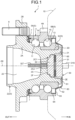
- FIG. 1 is a cross-sectional view illustrating an example of a rolling bearing unit (hub bearing) 1 according to an embodiment.
- the rolling bearing unit 1 is supported by a suspension 10 of a vehicle while rotatably supporting a wheel of the vehicle. That is, the wheel of the vehicle is supported by the suspension 10 through the rolling bearing unit 1.
- the rolling bearing unit 1 includes an inner ring member 23, an outer ring member 4 (outer ring), rolling bodies 5, a transmitter 30, and a first cover 60 (covering member).
- the inner ring member 23 is rotatable about the rotation axis AX.
- the outer ring member 4 (outer ring) has a cylindrical shape, is disposed on a radial outer side (outer peripheral side) of the inner ring member 23, and is supported in a stationary state.
- the rolling bodies 5 are disposed between the inner ring member 23 and the outer ring member 4.
- the transmitter 30 is a non-contact transmitter using electric field coupling, and includes a stationary-side transmission part 31 and a rotary-side transmission part 32.
- the first cover 60 (covering member) is supported by the outer ring member 4 and covers the inner side of the inner ring member 23 in the vehicle width direction. Further, a seal member 7 is provided to close a gap between the inner ring member 23 and the outer ring member 4.
- the inner ring member 23 includes a hub 2 and an inner ring 3.
- the hub 2 has a cylindrical hub main body 2A extending in the axial direction, a flange portion 2B extending toward the outer side in the radial direction from an outer peripheral surface of the hub main body 2A, and a partition wall 2C extending inward in the radial direction from an inner peripheral surface at a center of the hub main body 2A in the vehicle width direction.
- a groove portion 2D recessed inward in the radial direction is provided on an outer peripheral portion of the hub main body 2A on the inner side in the vehicle width direction.
- the annular inner ring 3 is fitted into the groove portion 2D, and the hub 2 and the inner ring 3 rotate about the rotation axis AX integrally.
- a wheel (not illustrated) is fixed to the flange portion 2B through a hub bolt 9.
- the hub 2 is provided with two recesses extending along the vehicle width direction.
- the hub 2 is provided with a first recess 21 (recess) that is open toward the inner side in the vehicle width direction and extends toward the outer side in the vehicle width direction, and a second recess 22 that is open toward the outer side in the vehicle width direction and extends inward in the vehicle width direction.
- the first recess 21 and the second recess 22 are adjacent to each other in the axial direction with the partition wall 2C therebetween. That is, an edge of the first recess 21 has an inner peripheral surface 2E on the inner side of the hub 2 in the vehicle width direction, a step 2F, and a side surface 2C1 of the partition wall 2C on the inner side in the vehicle width direction.
- a through hole 2C2 penetrates the partition wall 2C in the axial direction.
- the partition wall 2C extends inward in the radial direction and serves as a bottom of the first recess 21.
- the outer ring member 4 (outer ring) is non-rotatable and is disposed on the outer side (outer peripheral side), in the radial direction, of the hub 2 and the inner ring 3.
- the outer ring member 4 has a flange portion 4A, and the flange portion 4A is coupled to the suspension 10.
- the rolling bodies 5 are disposed between the inner ring member 23 and the outer ring member 4.
- the rolling bodies 5 include a plurality of rolling bodies 5A disposed between the hub main body 2A and the outer ring member 4, and a plurality of rolling bodies 5B disposed between the inner ring 3 and the outer ring member 4.
- the rolling bodies 5 are spheres, but may be rollers (tapered rollers).
- the tapered rollers may be used as the rolling bodies 5.
- the rolling bodies 5 are reliably provided between the inner ring member 23 and the outer ring member 4, and rotatably supports the inner ring member 23 relative to the outer ring member 4.
- An outer peripheral surface of the inner ring member 23 is provided with a first inner race 11 on which parts of outer surfaces of the rolling bodies 5A are located and a second inner race 13 on which parts of outer surfaces of the rolling bodies 5B are located.
- An inner peripheral surface of the outer ring member 4 is provided with a first outer race 14 on which parts of the outer surfaces of the rolling bodies 5A are located and a second outer race 15 on which parts of the outer surfaces of the rolling bodies 5B are located.
- the rolling bodies 5A are disposed between the first inner race 11 and the first outer race 14, and the rolling bodies 5B are disposed between the second inner race 13 and the second outer race 15.
- a gap extending in a circumferential direction is provided between an end of the outer ring member 4 on the outer side in the vehicle width direction and the outer peripheral surface of the hub main body 2A to separate therebetween in the axial direction and the radial direction.
- the gap is closed by provision of the seal member 7 at an end of the outer ring member 4 on the outer side in the axial direction.
- the first cover 60 (covering member) has a first portion 61, a second portion 62, a third portion 63, and a fourth portion 64.
- the first portion 61 has a disk-like shape and is disposed on the inner side in the radial direction. From an outer end of the first portion in the radial direction toward the outer side in the radial direction, the second portion 62 is inclined to be directed toward the outer side in the vehicle width direction.
- the third portion 63 enlarges and extends toward the outer side in the radial direction from an outer end of the second portion 62 in the radial direction and has an annular shape.
- the fourth portion 64 extends from an outer end of the third portion 63 in the radial direction toward the outer side in the vehicle width direction.
- a circular through hole 65 is provided in the center portion, in the radial direction, of the first portion 61.
- the first cover 60 is assembled to the outer ring member 4 by fitting the fourth portion 64 to an inner peripheral surface of the end of the outer ring member 4 on the inner side in the vehicle width direction.
- the first cover 60 is made of resin.
- FIG. 2 is an enlarged cross-sectional view of a part of FIG. 1 .
- FIG. 3 is a side view of the stationary-side transmission part 31 of FIG. 1 as viewed from the inner side in the vehicle width direction, and a covering portion 314 is not illustrated.
- the transmitter 30 is a non-contact transmitter using electric field coupling, and as illustrated in FIG. 2 , the transmitter 30 includes a stationary-side transmission part 31 and a rotary-side transmission part 32. In the transmitter 30, a signal indicative of a tire pressure or the like and electric power are transmitted between the stationary-side transmission part 31 and the rotary-side transmission part 32.
- the transmitter 30 has a function of transmitting both the electric power and the signal, but may have only a function of transmitting one of the electric power and the signal.
- the transmitter 30 is housed inside the first recess 21 (recess) of the hub 2 along the axial direction. Hereinafter, the transmitter 30 will be described in detail.
- the stationary-side transmission part 31 is a transmission part on a stationary side, and is integrally joined (fixed) to the first cover 60. Therefore, the stationary-side transmission part 31 is supported by the outer ring member 4 through the first cover 60.
- the stationary-side transmission part 31 includes a stationary-side main body 310, the covering portion 314, a stationary-side first electrode 311 (stationary-side electrode), a stationary-side second electrode 312 (stationary-side electrode), and a stationary-side third electrode 313 (stationary-side electrode).
- the stationary-side main body 310 has a columnar shape and is made of resin.
- the covering portion 314 is joined to an outer end 318 of the stationary-side main body 310 in the vehicle width direction, and is made of resin.
- the stationary-side first electrode 311 (stationary-side electrode), the stationary-side second electrode 312 (stationary-side electrode), and the stationary-side third electrode 313 (stationary-side electrode) are embedded in the covering portion 314.
- the stationary-side main body 310 is provided with a flange portion 315 that extends toward the outer side in the radial direction and has an annular shape along a circumferential direction, and a fitting portion 316 is provided at a portion on the inner side of the flange portion 315 in the vehicle width direction.
- the fitting portion 316 is a portion of the stationary-side main body 310 between an inner end 317 in the vehicle width direction and an inner end of the flange portion 315 in the vehicle width direction.
- An outer peripheral surface of the fitting portion 316 is fitted and joined to an inner peripheral surface of the through hole 65 of the first cover 60.
- the flange portion 315 is joined to an end of the first portion 61 of the first cover 60 on the inner side in the radial direction.
- a connector 319 is integrally joined to the stationary-side main body 310 while extending toward the inner side in the vehicle width direction.
- the stationary-side transmission portion 31 is an integrally molded product in which the stationary-side main body 310 and the covering portion 314 are integrally joined to each other. Further, the stationary-side transmission part 31 and the first cover 60 are also integrally joined to each other as an integrally molded product.
- the stationary-side first electrode 311, the stationary-side second electrode 312, and the stationary-side third electrode 313 are formed concentrically around the rotation axis. Specifically, each electrode is substantially the same in area and is formed in a C shape in which a part of a circle is nicked.
- the rotary-side transmission part 32 is a transmission part on a rotary side and is integrally fixed to the hub 2.
- the rotary-side transmission part 32 includes a rotary-side main body 320, a covering portion 324, a rotary-side first electrode 321 (rotary-side electrode), a rotary-side second electrode 322 (rotary-side electrode), and a rotary-side third electrode 323 (rotary-side electrode).
- the rotary-side main body 320 has a cylindrical shape and is made of resin.
- the covering portion 324 is joined to the inner side of the rotary-side main body 320 in the vehicle width direction and is made of resin.
- the rotary-side first electrode 321 (rotary-side electrode), the rotary-side second electrode 322 (rotary-side electrode), and the rotary-side third electrode 323 (rotary-side electrode) are embedded inside the covering portion 324.
- a portion of the rotary-side main body 320 on the outer side in the vehicle width direction serves as a fitting portion 326.
- the fitting portion 326 is fitted to a step 2F which is a part of the edge of the first recess 21.
- the fitting portion 326 and the step 2F have an inlay structure.
- the rotary-side first electrode 321, the rotary-side second electrode 322, and the rotary-side third electrode 323 are formed so as to be substantially equal in shape and area to the stationary-side first electrode 311, the stationary-side second electrode 312, and the stationary-side third electrode 313 described with reference to FIG. 3 , respectively, and are embedded inside the covering portion 324.
- An O-ring (not illustrated) may be disposed between the fitting portion 326 and the inlay portion of the step 2F to improve the sealing performance.
- the first electrodes, the second electrodes, and the third electrodes are formed so as to be substantially equal in area to one another as described above so that capacitances between the first electrodes, the second electrodes, and the third electrodes can be set equally.
- the covering portions 314 and 324 are made of a type of resin having a high dielectric constant, the capacitances can be set large.
- the stationary-side first electrode 311 and the rotary-side first electrode 321 are disposed to face each other
- the stationary-side second electrode 312 and the rotary-side second electrode 322 are disposed to face each other
- the stationary-side third electrode 313 and the rotary-side third electrode 323 are disposed to face each other.
- An end face 328 of the rotary-side transmission part 32 on the outer side in the vehicle width direction abuts against a side surface 2C1 of the partition wall 2C to seal the through hole 2C2.
- wiring 327 is connected to the rotary-side transmission part 32, and the wiring 327 is wired through the through hole 2C2.
- An O-ring (not illustrated) may be disposed between the end face 328 and the side surface 2C1, or a flexible material may be formed integrally with the end face 328 to improve the sealing performance.
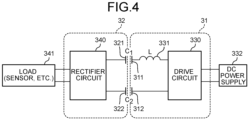
- FIG. 4 is a diagram illustrating a circuit configuration of the transmitter according to the embodiment.
- the stationary-side transmission part 31 on a fixed side provided on the first cover 60 includes a drive circuit 330 connected to a DC power supply 332 such as a battery and including a semiconductor switching element, an inductor 331 connected to the drive circuit 330, the stationary-side first electrode 311, and the stationary-side second electrode 312.
- the stationary-side third electrode 313 is omitted for convenience.
- the rotary-side transmission part 32 provided in the hub 2 includes a load 341 such as a sensor provided on a tire or a wheel, a rectifier circuit 340 connected to the load 341, and the rotary-side first electrode 321 and the rotary-side second electrode 322, which are connected to the rectifier circuit 340.
- the rotary-side third electrode 323 is omitted for convenience.
- the stationary-side first electrode 311 and the rotary-side first electrode 321 are disposed to be separated from each other in the axial direction and face each other to form a capacitor C1.
- the stationary-side second electrode 312 and the rotary-side second electrode 322 are disposed to be separated from each other in the axial direction and face each other to form a capacitor C2.
- the capacitor C1 and an inductor 331 are connected in series to form an LC series resonant circuit.
- the drive circuit 330 is driven at a resonance frequency, whereby the stationary-side transmission part 31 can transmit an electric power to the rotary-side transmission part 32 on the rotary-side with high efficiency.
- the rotary-side transmission part 32 can rectify a high frequency current to supply a DC current to the load 341.
- a circuit can be provided for performing an information communication (signal transmission) with an increase in the number of electrodes.
- the circuit can be operated at a high frequency and the high frequency can be modulated for performing a communication.
- a modulation method such as amplitude shift modulation can be used.
- the entire non-contact transmitter 30 using electric field coupling is disposed on the outer side of the first cover 60 (covering member) in the vehicle width direction (the second side in the axial direction). Therefore, as compared with the non-contact power feeding device of the magnetic field resonance coupling type in which the power feeding coil and the power receiving coil are disposed to face each other with the covering member therebetween in the conventional art, the present embodiment has an advantage that a high transmission efficiency can be easily obtained since the distance between the power feeding side and the power receiving side is short.
- the first cover 60 is not provided between a pair of electrodes included in the transmitter using electric field coupling, the distance between the pair of electrodes can be reduced as much as the thickness of the first cover 60, thereby improving the transmission efficiency.
- the transmitter 30 including the pair of electrodes can be disposed inside the first cover 60. Therefore, the structure of the present invention is further simplified as compared with the power feeding device in which the power feeding coil and the power receiving coil are respectively disposed inside and outside the covering member as in the conventional non-contact power feeding device.
- the rotary-side transmission part 32 and the stationary-side transmission part 31 are housed inside the first recess 21 (recess). Therefore, a protrusion length of the transmitter 30 protruding toward the inner side in the vehicle width direction (first side in the axial direction) can be set small. Therefore, the increase in size of the entire rolling bearing unit 1 can be hampered.
- the rotary-side transmission part 32 abuts against the partition wall 2C, whereby the through hole 2C2 is sealed. Consequently, water can be hindered from entering the inside of the first recess 21 (recess) from the through hole 2C2 with a simple structure.
- the stationary-side transmission part 31 including the stationary-side first electrode 311, the stationary-side second electrode 312, and the stationary-side third electrode 313 is integrally provided with the first cover 60 (covering member), whereby water can be hindered from entering the stationary-side electrodes. Further, the number of parts of the first cover 60 can be reduced.
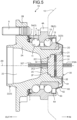
- wiring 319A may be directly connected to the stationary-side main body 310. That is, as illustrated in FIG. 1 , in the rolling bearing unit 1 according to the embodiment, the connector 319 is integrally joined with the stationary-side main body 310. However, it is not required to integrally join (connect) the connector 319 thereto, and the wiring 319A may be connected from the stationary-side main body 310.
- the stationary-side transmission part 31 is an integrally molded product in which the stationary-side main body 310 and the covering portion 314 are integrally joined to each other, and the stationary-side transmission part 31 and the first cover 60 are integrally joined to each other.
- the stationary-side first electrode 311, the stationary-side second electrode 312, and the stationary-side third electrode 313 may be molded with resin so that the entirety of the stationary-side main body 310, the covering portion 314, and the first cover 60 is integrally molded with the same resin.
Landscapes
- Engineering & Computer Science (AREA)
- Mechanical Engineering (AREA)
- General Engineering & Computer Science (AREA)
- Computer Networks & Wireless Communication (AREA)
- Power Engineering (AREA)
- Rolling Contact Bearings (AREA)
Description
- The present invention relates to a rolling bearing unit for supporting wheels.
- Conventionally, wheels of a vehicle are each supported by a suspension through a rolling bearing unit. A structure in which a non-contact power feeding device is provided in the rolling bearing unit has been known (see Patent Literature 1).
- In the rolling bearing unit disclosed in
Patent Literature 1, a covering member is provided on the inner side of an outer ring on a stationary-side in a vehicle width direction to cover the inner side of an inner ring on a rotary-side in the vehicle width direction. Further, the non-contact power feeding device is a magnetic field resonance coupling type power feeding device, and includes a power feeding coil disposed on the inner side of the covering member in the vehicle width direction and a power receiving coil disposed on the outer side of the covering member in the vehicle width direction. - Patent Literature 1:
Japanese Patent Application Laid-Open Publication No. 2018-1769
WO 2017/094420 A1 relates to a rolling bearing unit for drive wheel support. An internal gear constituting a transmission is supported and fixed in relation to a rotation-side flange provided to the outer end of a hub in the axial direction, and the hub is rotationally driven on the basis of the driving force inputted via the internal gear. As a result, it is not necessary to connect the driving shaft that rotationally drives the hub to the center hole of the hub, and thus a generator and a wireless communications device are disposed in a housing space that has a large space provided to the inner side of the hub in the axial direction.
WO 2008/014766 A1 relates to a device for monitoring at least one operating variable of a wheel set bearing. The document relates to a device for monitoring at least one operating variable of a wheel set bearing, in particular for rail vehicles, which comprises at least one rotating bearing ring and a stationary wheel set bearing housing. In order to reliably monitor and transmit at least one operating variable of the co-rotating wheel bearing part of a wheel set bearing with little outlay and without the vehicle's power supply requiring maintenance, the following are provided: a sensor, which is arranged directly on the rotating bearing ring, a transmitting unit, which is arranged in a co-rotating manner with the bearing ring and which transmits the measured values delivered by the sensor wirelessly to a stationary receiving device, and a power supply unit comprising a first co-rotating and a second cooperating generator element arranged on the wheel bearing housing, said unit supplying the sensor and the transmitting unit with power.
WO 2017/051881 A1 relates to a rolling bearing unit for supporting wheel. The provided ball bearing unit for supporting a wheel is equipped with: a bearing unit which has an outer race member, an inner race member, and multiple rolling bodies disposed therebetween in a freely rollable manner, wherein one of the outer race member and the inner race member is a stationary-side race member which does not rotate when in use, and the other is a rotating-side race member which rotates with the wheel; a power generator having a stator and a rotor, and generating electric power to be supplied to a sensor disposed on the wheel on the basis of relative rotation of the stator and the rotor; a battery for storing the electric power generated by the power generator; and a radio communication unit for radio communication of signals, including an output signal of the sensor, with an electronic device disposed on the vehicle side. The stator is supported on and fixed to the stationary-side race member, and the rotor, the battery, and the radio communication unit are supported on and fixed to the rotating-side race member. - As described above, the non-contact power feeding device in
Patent Literature 1 is of the magnetic field resonance coupling type, and has a problem of increase in size because a coil is required for each of the power feeding side and the power receiving side. Further, since the power feeding coil and the power receiving coil are disposed to face each other with the covering member therebetween, there is a problem that a distance between the power feeding side and the power receiving side is increased and a transmission efficiency is lowered. - An object of the present invention is to provide a rolling bearing unit for supporting wheels including a non-contact power feeding device that is compact, has high mountability, and has high transmission efficiency.
- In order to achieve the above-mentioned object, there is provided a rolling bearing unit according to
claim 1. Advantageous embodiments are defined by the dependent claims. - A rolling bearing unit according to a first aspect of the present invention, includes: an inner ring member having a recess on a first side in an axial direction along a rotation axis, the recess being recessed toward a second side in the axial direction; an outer ring member disposed on an outer peripheral side of the inner ring member; a rolling body that is reliably provided between the inner ring member and the outer ring member and rotatably supports the inner ring member relative to the outer ring member; a non-contact transmitter using electric field coupling that is capable of transmitting at least one of an electric power or a signal and includes a stationary-side transmission part including a stationary-side electrode and a rotary-side transmission part including a rotary-side electrode disposed to face the stationary-side electrode at an axial distance therefrom; and a covering member that is supported by the first side of the outer ring member in the axial direction, covers the first side of the inner ring member in the axial direction, and fixes the stationary-side transmission part to the first side in the axial direction.
- According to the first aspect of the present invention, the entire non-contact transmitter using electric field coupling is disposed on the second side of the covering member in the axial direction. Therefore, as compared with the non-contact power feeding device of the magnetic field resonance coupling type in which the power feeding coil and the power receiving coil face each other with the covering member therebetween as in the conventional art, the aspect of the present invention has an advantage that a higher transmission efficiency can be easily obtained since the distance between the power feeding side and the power receiving side is shorter.
- In a rolling bearing unit according to a second aspect of the present invention, the rotary-side transmission part and the stationary-side transmission part are housed inside the recess.
- According to the second aspect of the present invention, a protrusion length of the transmitter protruding to a first side in the axial direction can be reduced. Therefore, an increase in the size of the entire rolling bearing unit can be hampered.
- In a rolling bearing unit according to a third aspect of the present invention, the rotary-side transmission part is housed inside the recess, the inner ring member has a partition wall extending inward in a radial direction to serve as a bottom of the recess and provided with a through hole that penetrates in the axial direction, and the rotary-side transmission part abuts against the partition wall to seal the through hole.
- According to the third aspect of the present invention, the rotary-side transmission part abuts against the partition wall to seal the through hole. Therefore, water can be hindered from entering the recess from the through hole with a simple structure.
- In a rolling bearing unit according to a fourth aspect of the present invention, the stationary-side transmission part is an integrally molded product with the covering member.
- According to the fourth aspect of the present invention, the stationary-side transmission part including the stationary-side electrode is integrally provided with the covering member, whereby water can be hindered from entering the stationary-side electrode. Further, the number of parts of the covering member can be reduced. Advantageous Effects of Invention
- According to the rolling bearing unit of an aspect of the present invention, the transmission efficiency of the non-contact power feeding device is improved as compared with the conventional art.
-
-
FIG. 1 is a cross-sectional view illustrating a rolling bearing unit according to an embodiment. -
FIG. 2 is an enlarged cross-sectional view of a part ofFIG. 1 . -
FIG. 3 is a side view of a first transmission part inFIG. 1 as viewed from an inner side in a vehicle width direction and in which a coating portion is not illustrated. -
FIG. 4 is a diagram illustrating a circuit configuration according to the embodiment. -
FIG. 5 is a cross-sectional view illustrating a rolling bearing unit according to a modification. - Hereinafter, embodiments according to the present invention will be described with reference to the drawings, but the present invention is not limited to the embodiments. The requirements of each embodiment to be described below can be combined as appropriate. In addition, some components may not be used. In the following description, a rotation axis of an inner ring member is referred to as AX, a direction along the rotation axis AX is referred to as an "axial direction" or a "left-right direction", and a direction orthogonal to the rotation axis AX is referred to as a "radial direction". Furthermore, a "first side in the axial direction" is referred to as an "inner side (IN side) in a vehicle width direction", and a "second side in the axial direction" is referred to as an "outer side (OUT side) in the vehicle width direction". Further, a front side of a vehicle is referred to as an FR side, and a rear side is referred to as an RR side.
-
FIG. 1 is a cross-sectional view illustrating an example of a rolling bearing unit (hub bearing) 1 according to an embodiment. - As illustrated in
FIG. 1 , the rollingbearing unit 1 is supported by asuspension 10 of a vehicle while rotatably supporting a wheel of the vehicle. That is, the wheel of the vehicle is supported by thesuspension 10 through the rollingbearing unit 1. - The rolling
bearing unit 1 includes aninner ring member 23, an outer ring member 4 (outer ring),rolling bodies 5, atransmitter 30, and a first cover 60 (covering member). Theinner ring member 23 is rotatable about the rotation axis AX. The outer ring member 4 (outer ring) has a cylindrical shape, is disposed on a radial outer side (outer peripheral side) of theinner ring member 23, and is supported in a stationary state. - The
rolling bodies 5 are disposed between theinner ring member 23 and the outer ring member 4. Thetransmitter 30 is a non-contact transmitter using electric field coupling, and includes a stationary-side transmission part 31 and a rotary-side transmission part 32. The first cover 60 (covering member) is supported by the outer ring member 4 and covers the inner side of theinner ring member 23 in the vehicle width direction. Further, aseal member 7 is provided to close a gap between theinner ring member 23 and the outer ring member 4. - The
inner ring member 23 includes ahub 2 and aninner ring 3. Thehub 2 has a cylindrical hubmain body 2A extending in the axial direction, aflange portion 2B extending toward the outer side in the radial direction from an outer peripheral surface of the hubmain body 2A, and apartition wall 2C extending inward in the radial direction from an inner peripheral surface at a center of the hubmain body 2A in the vehicle width direction. Agroove portion 2D recessed inward in the radial direction is provided on an outer peripheral portion of the hubmain body 2A on the inner side in the vehicle width direction. The annularinner ring 3 is fitted into thegroove portion 2D, and thehub 2 and theinner ring 3 rotate about the rotation axis AX integrally. A wheel (not illustrated) is fixed to theflange portion 2B through ahub bolt 9. - Further, the
hub 2 is provided with two recesses extending along the vehicle width direction. Specifically, thehub 2 is provided with a first recess 21 (recess) that is open toward the inner side in the vehicle width direction and extends toward the outer side in the vehicle width direction, and asecond recess 22 that is open toward the outer side in the vehicle width direction and extends inward in the vehicle width direction. Thefirst recess 21 and thesecond recess 22 are adjacent to each other in the axial direction with thepartition wall 2C therebetween. That is, an edge of thefirst recess 21 has an innerperipheral surface 2E on the inner side of thehub 2 in the vehicle width direction, astep 2F, and a side surface 2C1 of thepartition wall 2C on the inner side in the vehicle width direction. A through hole 2C2 penetrates thepartition wall 2C in the axial direction. As described above, thepartition wall 2C extends inward in the radial direction and serves as a bottom of thefirst recess 21. - The outer ring member 4 (outer ring) is non-rotatable and is disposed on the outer side (outer peripheral side), in the radial direction, of the
hub 2 and theinner ring 3. The outer ring member 4 has aflange portion 4A, and theflange portion 4A is coupled to thesuspension 10. - The rolling
bodies 5 are disposed between theinner ring member 23 and the outer ring member 4. The rollingbodies 5 include a plurality of rollingbodies 5A disposed between the hubmain body 2A and the outer ring member 4, and a plurality of rollingbodies 5B disposed between theinner ring 3 and the outer ring member 4. - In the present embodiment, the rolling
bodies 5 are spheres, but may be rollers (tapered rollers). For example, when the rollingbearing unit 1 is applied to a heavy vehicle, the tapered rollers may be used as the rollingbodies 5. In this way, the rollingbodies 5 are reliably provided between theinner ring member 23 and the outer ring member 4, and rotatably supports theinner ring member 23 relative to the outer ring member 4. - An outer peripheral surface of the
inner ring member 23 is provided with a firstinner race 11 on which parts of outer surfaces of the rollingbodies 5A are located and a secondinner race 13 on which parts of outer surfaces of the rollingbodies 5B are located. An inner peripheral surface of the outer ring member 4 is provided with a firstouter race 14 on which parts of the outer surfaces of the rollingbodies 5A are located and a secondouter race 15 on which parts of the outer surfaces of the rollingbodies 5B are located. The rollingbodies 5A are disposed between the firstinner race 11 and the firstouter race 14, and the rollingbodies 5B are disposed between the secondinner race 13 and the secondouter race 15. - A gap extending in a circumferential direction is provided between an end of the outer ring member 4 on the outer side in the vehicle width direction and the outer peripheral surface of the hub
main body 2A to separate therebetween in the axial direction and the radial direction. In the present embodiment, the gap is closed by provision of theseal member 7 at an end of the outer ring member 4 on the outer side in the axial direction. - The first cover 60 (covering member) has a
first portion 61, asecond portion 62, athird portion 63, and afourth portion 64. Thefirst portion 61 has a disk-like shape and is disposed on the inner side in the radial direction. From an outer end of the first portion in the radial direction toward the outer side in the radial direction, thesecond portion 62 is inclined to be directed toward the outer side in the vehicle width direction. Thethird portion 63 enlarges and extends toward the outer side in the radial direction from an outer end of thesecond portion 62 in the radial direction and has an annular shape. Thefourth portion 64 extends from an outer end of thethird portion 63 in the radial direction toward the outer side in the vehicle width direction. - A circular through
hole 65 is provided in the center portion, in the radial direction, of thefirst portion 61. Thefirst cover 60 is assembled to the outer ring member 4 by fitting thefourth portion 64 to an inner peripheral surface of the end of the outer ring member 4 on the inner side in the vehicle width direction. Thefirst cover 60 is made of resin. -
FIG. 2 is an enlarged cross-sectional view of a part ofFIG. 1 .FIG. 3 is a side view of the stationary-side transmission part 31 ofFIG. 1 as viewed from the inner side in the vehicle width direction, and a covering portion 314 is not illustrated. - The
transmitter 30 is a non-contact transmitter using electric field coupling, and as illustrated inFIG. 2 , thetransmitter 30 includes a stationary-side transmission part 31 and a rotary-side transmission part 32. In thetransmitter 30, a signal indicative of a tire pressure or the like and electric power are transmitted between the stationary-side transmission part 31 and the rotary-side transmission part 32. - The
transmitter 30 according to the embodiment has a function of transmitting both the electric power and the signal, but may have only a function of transmitting one of the electric power and the signal. Thetransmitter 30 is housed inside the first recess 21 (recess) of thehub 2 along the axial direction. Hereinafter, thetransmitter 30 will be described in detail. - The stationary-
side transmission part 31 is a transmission part on a stationary side, and is integrally joined (fixed) to thefirst cover 60. Therefore, the stationary-side transmission part 31 is supported by the outer ring member 4 through thefirst cover 60. The stationary-side transmission part 31 includes a stationary-sidemain body 310, the covering portion 314, a stationary-side first electrode 311 (stationary-side electrode), a stationary-side second electrode 312 (stationary-side electrode), and a stationary-side third electrode 313 (stationary-side electrode). The stationary-sidemain body 310 has a columnar shape and is made of resin. The covering portion 314 is joined to anouter end 318 of the stationary-sidemain body 310 in the vehicle width direction, and is made of resin. The stationary-side first electrode 311 (stationary-side electrode), the stationary-side second electrode 312 (stationary-side electrode), and the stationary-side third electrode 313 (stationary-side electrode) are embedded in the covering portion 314. - Further, the stationary-side
main body 310 is provided with aflange portion 315 that extends toward the outer side in the radial direction and has an annular shape along a circumferential direction, and afitting portion 316 is provided at a portion on the inner side of theflange portion 315 in the vehicle width direction. Thefitting portion 316 is a portion of the stationary-sidemain body 310 between aninner end 317 in the vehicle width direction and an inner end of theflange portion 315 in the vehicle width direction. An outer peripheral surface of thefitting portion 316 is fitted and joined to an inner peripheral surface of the throughhole 65 of thefirst cover 60. - Further, the
flange portion 315 is joined to an end of thefirst portion 61 of thefirst cover 60 on the inner side in the radial direction. In the stationary-sidemain body 310, aconnector 319 is integrally joined to the stationary-sidemain body 310 while extending toward the inner side in the vehicle width direction. As described above, the stationary-side transmission portion 31 is an integrally molded product in which the stationary-sidemain body 310 and the covering portion 314 are integrally joined to each other. Further, the stationary-side transmission part 31 and thefirst cover 60 are also integrally joined to each other as an integrally molded product. - As illustrated in
FIG. 3 , the stationary-sidefirst electrode 311, the stationary-sidesecond electrode 312, and the stationary-sidethird electrode 313 are formed concentrically around the rotation axis. Specifically, each electrode is substantially the same in area and is formed in a C shape in which a part of a circle is nicked. - As illustrated in
FIG. 2 , the rotary-side transmission part 32 is a transmission part on a rotary side and is integrally fixed to thehub 2. The rotary-side transmission part 32 includes a rotary-sidemain body 320, a covering portion 324, a rotary-side first electrode 321 (rotary-side electrode), a rotary-side second electrode 322 (rotary-side electrode), and a rotary-side third electrode 323 (rotary-side electrode). The rotary-sidemain body 320 has a cylindrical shape and is made of resin. The covering portion 324 is joined to the inner side of the rotary-sidemain body 320 in the vehicle width direction and is made of resin. The rotary-side first electrode 321 (rotary-side electrode), the rotary-side second electrode 322 (rotary-side electrode), and the rotary-side third electrode 323 (rotary-side electrode) are embedded inside the covering portion 324. - Further, a portion of the rotary-side
main body 320 on the outer side in the vehicle width direction serves as afitting portion 326. Thefitting portion 326 is fitted to astep 2F which is a part of the edge of thefirst recess 21. In other words, thefitting portion 326 and thestep 2F have an inlay structure. The rotary-sidefirst electrode 321, the rotary-sidesecond electrode 322, and the rotary-sidethird electrode 323 are formed so as to be substantially equal in shape and area to the stationary-sidefirst electrode 311, the stationary-sidesecond electrode 312, and the stationary-sidethird electrode 313 described with reference toFIG. 3 , respectively, and are embedded inside the covering portion 324. An O-ring (not illustrated) may be disposed between thefitting portion 326 and the inlay portion of thestep 2F to improve the sealing performance. - The first electrodes, the second electrodes, and the third electrodes are formed so as to be substantially equal in area to one another as described above so that capacitances between the first electrodes, the second electrodes, and the third electrodes can be set equally. When the covering portions 314 and 324 are made of a type of resin having a high dielectric constant, the capacitances can be set large.
- Further, the stationary-side
first electrode 311 and the rotary-sidefirst electrode 321 are disposed to face each other, the stationary-sidesecond electrode 312 and the rotary-sidesecond electrode 322 are disposed to face each other, and the stationary-sidethird electrode 313 and the rotary-sidethird electrode 323 are disposed to face each other. Anend face 328 of the rotary-side transmission part 32 on the outer side in the vehicle width direction abuts against a side surface 2C1 of thepartition wall 2C to seal the through hole 2C2. As illustrated inFIG. 1 ,wiring 327 is connected to the rotary-side transmission part 32, and thewiring 327 is wired through the through hole 2C2. An O-ring (not illustrated) may be disposed between theend face 328 and the side surface 2C1, or a flexible material may be formed integrally with theend face 328 to improve the sealing performance. -
FIG. 4 is a diagram illustrating a circuit configuration of the transmitter according to the embodiment. - The stationary-
side transmission part 31 on a fixed side provided on thefirst cover 60 includes adrive circuit 330 connected to aDC power supply 332 such as a battery and including a semiconductor switching element, aninductor 331 connected to thedrive circuit 330, the stationary-sidefirst electrode 311, and the stationary-sidesecond electrode 312. The stationary-sidethird electrode 313 is omitted for convenience. - The rotary-
side transmission part 32 provided in thehub 2 includes aload 341 such as a sensor provided on a tire or a wheel, arectifier circuit 340 connected to theload 341, and the rotary-sidefirst electrode 321 and the rotary-sidesecond electrode 322, which are connected to therectifier circuit 340. The rotary-sidethird electrode 323 is omitted for convenience. The stationary-sidefirst electrode 311 and the rotary-sidefirst electrode 321 are disposed to be separated from each other in the axial direction and face each other to form a capacitor C1. - Further, the stationary-side
second electrode 312 and the rotary-sidesecond electrode 322 are disposed to be separated from each other in the axial direction and face each other to form a capacitor C2. The capacitor C1 and aninductor 331 are connected in series to form an LC series resonant circuit. Thedrive circuit 330 is driven at a resonance frequency, whereby the stationary-side transmission part 31 can transmit an electric power to the rotary-side transmission part 32 on the rotary-side with high efficiency. The rotary-side transmission part 32 can rectify a high frequency current to supply a DC current to theload 341. - Although a configuration of transmitting the electric power has been described with reference to
FIG. 4 , a circuit can be provided for performing an information communication (signal transmission) with an increase in the number of electrodes. When the information communication is performed, the circuit can be operated at a high frequency and the high frequency can be modulated for performing a communication. For example, a modulation method such as amplitude shift modulation can be used. - As described above, according to the present embodiment, the entire
non-contact transmitter 30 using electric field coupling is disposed on the outer side of the first cover 60 (covering member) in the vehicle width direction (the second side in the axial direction). Therefore, as compared with the non-contact power feeding device of the magnetic field resonance coupling type in which the power feeding coil and the power receiving coil are disposed to face each other with the covering member therebetween in the conventional art, the present embodiment has an advantage that a high transmission efficiency can be easily obtained since the distance between the power feeding side and the power receiving side is short. - Further, since the
first cover 60 is not provided between a pair of electrodes included in the transmitter using electric field coupling, the distance between the pair of electrodes can be reduced as much as the thickness of thefirst cover 60, thereby improving the transmission efficiency. In the present invention, thetransmitter 30 including the pair of electrodes can be disposed inside thefirst cover 60. Therefore, the structure of the present invention is further simplified as compared with the power feeding device in which the power feeding coil and the power receiving coil are respectively disposed inside and outside the covering member as in the conventional non-contact power feeding device. - Further, the rotary-
side transmission part 32 and the stationary-side transmission part 31 are housed inside the first recess 21 (recess). Therefore, a protrusion length of thetransmitter 30 protruding toward the inner side in the vehicle width direction (first side in the axial direction) can be set small. Therefore, the increase in size of the entirerolling bearing unit 1 can be hampered. - Further, according to the present embodiment, the rotary-
side transmission part 32 abuts against thepartition wall 2C, whereby the through hole 2C2 is sealed. Consequently, water can be hindered from entering the inside of the first recess 21 (recess) from the through hole 2C2 with a simple structure. - Further, according to the present embodiment, the stationary-
side transmission part 31 including the stationary-sidefirst electrode 311, the stationary-sidesecond electrode 312, and the stationary-side third electrode 313 (stationary-side electrodes) is integrally provided with the first cover 60 (covering member), whereby water can be hindered from entering the stationary-side electrodes. Further, the number of parts of thefirst cover 60 can be reduced. - Although the embodiment has been described above, the embodiment is not limited by the details described above.
- For example, as illustrated in a rolling
bearing unit 1A in a modification ofFIG. 5 ,wiring 319A may be directly connected to the stationary-sidemain body 310. That is, as illustrated inFIG. 1 , in the rollingbearing unit 1 according to the embodiment, theconnector 319 is integrally joined with the stationary-sidemain body 310. However, it is not required to integrally join (connect) theconnector 319 thereto, and thewiring 319A may be connected from the stationary-sidemain body 310. - Further, in the embodiment, the stationary-
side transmission part 31 is an integrally molded product in which the stationary-sidemain body 310 and the covering portion 314 are integrally joined to each other, and the stationary-side transmission part 31 and thefirst cover 60 are integrally joined to each other. However, the stationary-sidefirst electrode 311, the stationary-sidesecond electrode 312, and the stationary-sidethird electrode 313 may be molded with resin so that the entirety of the stationary-sidemain body 310, the covering portion 314, and thefirst cover 60 is integrally molded with the same resin. -
- 1, 1A ROLLING BEARING UNIT
- 2C PARTITION WALL
- 2C2 THROUGH HOLE
- 4 OUTER RING MEMBER
- 5 ROLLING BODY
- 21 FIRST RECESS (RECESS)
- 23 INNER RING MEMBER
- 30 TRANSMITTER
- 31 STATIONARY-SIDE TRANSMISSION PART
- 32 ROTARY-SIDE TRANSMISSION PART
- 60 FIRST COVER (COVERING MEMBER)
- 311 STATIONARY-SIDE FIRST ELECTRODE (STATIONARY-SIDE ELECTRODE)
- 312 STATIONARY-SIDE SECOND ELECTRODE (STATIONARY-SIDE ELECTRODE)
- 313 STATIONARY-SIDE THIRD ELECTRODE (STATIONARY-SIDE ELECTRODE)
- 321 ROTARY-SIDE FIRST ELECTRODE (ROTARY-SIDE ELECTRODE)
- 322 ROTARY-SIDE SECOND ELECTRODE (ROTARY-SIDE ELECTRODE)
- 323 ROTARY-SIDE THIRD ELECTRODE (ROTARY-SIDE ELECTRODE)
- AX ROTATION AXIS
Claims (3)
- A rolling bearing unit (1, 1A) comprising:an inner ring member (23) having a recess (21) on a first side in an axial direction along a rotation axis (AX), the recess (21) being recessed toward a second side in the axial direction;an outer ring member (4) disposed on an outer peripheral side of the inner ring member (23);a rolling body (5) that is rollably provided between the inner ring member (23) and the outer ring member (4) and rotatably supports the inner ring member (23) relative to the outer ring member (4);a non-contact transmitter (30) using electric field coupling that is capable of transmitting at least one of an electric power or a signal and includes a stationary-side transmission part (31) including a stationary-side electrode (311, 312, 313) and a rotary-side transmission part (32) including a rotary-side electrode disposed to face the rotary-side electrode (321, 322, 323) at an axial distance therefrom; anda covering member (60) that is supported by the first side of the outer ring member (4) in the axial direction, covers the first side of the inner ring member (23) in the axial direction, and fixes the stationary-side transmission part (31) to the first side in the axial direction,wherein the entire non-contact transmitter (30) using electric field coupling is disposed on the second side of the covering member (60) in the axial direction, the unit being characterised in thatthe rotary-side transmission part (32) and the stationary-side transmission part (31) are housed inside the recess (21).
- The rolling bearing unit according to claim 1, whereinthe inner ring member (23) has a partition wall (2C) extending inward in a radial direction to serve as a bottom of the recess (21) and provided with a through hole (2C2) that penetrates in the axial direction, andthe rotary-side transmission part (32) abuts against the partition wall (2C) to seal the through hole (2C2).
- The rolling bearing unit according to any one of claims 1 or 2, wherein
the stationary-side transmission part (31) is an integrally molded product with the covering member (60).
Applications Claiming Priority (2)
| Application Number | Priority Date | Filing Date | Title |
|---|---|---|---|
| JP2018140216 | 2018-07-26 | ||
| PCT/JP2019/028655 WO2020022267A1 (en) | 2018-07-26 | 2019-07-22 | Rolling bearing unit |
Publications (3)
| Publication Number | Publication Date |
|---|---|
| EP3828430A1 EP3828430A1 (en) | 2021-06-02 |
| EP3828430A4 EP3828430A4 (en) | 2022-05-18 |
| EP3828430B1 true EP3828430B1 (en) | 2024-05-01 |
Family
ID=69182037
Family Applications (1)
| Application Number | Title | Priority Date | Filing Date |
|---|---|---|---|
| EP19840013.7A Active EP3828430B1 (en) | 2018-07-26 | 2019-07-22 | Rolling bearing unit |
Country Status (4)
| Country | Link |
|---|---|
| US (1) | US11365764B2 (en) |
| EP (1) | EP3828430B1 (en) |
| JP (1) | JP7347422B2 (en) |
| WO (1) | WO2020022267A1 (en) |
Family Cites Families (11)
| Publication number | Priority date | Publication date | Assignee | Title |
|---|---|---|---|---|
| JP2003278779A (en) | 2002-03-20 | 2003-10-02 | Ntn Corp | Power generator-equipped wheel bearing device |
| DE102006035703A1 (en) * | 2006-08-01 | 2008-02-07 | Schaeffler Kg | Device for monitoring at least one operating variable of a wheelset bearing |
| JP2008051683A (en) * | 2006-08-25 | 2008-03-06 | Ntn Corp | Bearing device for wheel fitted with rotation sensor |
| JP5102083B2 (en) * | 2008-03-25 | 2012-12-19 | Ntn株式会社 | Rotation sensor unit |
| JP2014023298A (en) * | 2012-07-19 | 2014-02-03 | Casio Comput Co Ltd | Non-contact power transmission/reception apparatus |
| KR102097936B1 (en) * | 2013-11-19 | 2020-04-07 | 현대모비스 주식회사 | Integrated Wheel Speed Measuring Device |
| JPWO2017051881A1 (en) * | 2015-09-24 | 2018-07-12 | 日本精工株式会社 | Rolling bearing unit for wheel support |
| JP6772465B2 (en) | 2015-12-04 | 2020-10-21 | 日本精工株式会社 | Rolling bearing unit for driving wheel support |
| WO2017094420A1 (en) * | 2015-12-04 | 2017-06-08 | 日本精工株式会社 | Rolling bearing unit for drive wheel support |
| JP2018001769A (en) | 2016-06-27 | 2018-01-11 | 日本精工株式会社 | Rolling bearing unit for supporting wheel |
| KR102490076B1 (en) * | 2018-10-05 | 2023-01-19 | 주식회사 일진글로벌 | Sensing device for vehicle, wheel bearing assembly, and method for manufacturing sensing device for vehicle |
-
2019
- 2019-07-22 US US17/262,911 patent/US11365764B2/en active Active
- 2019-07-22 JP JP2020532384A patent/JP7347422B2/en active Active
- 2019-07-22 EP EP19840013.7A patent/EP3828430B1/en active Active
- 2019-07-22 WO PCT/JP2019/028655 patent/WO2020022267A1/en not_active Ceased
Also Published As
| Publication number | Publication date |
|---|---|
| WO2020022267A1 (en) | 2020-01-30 |
| US20210254661A1 (en) | 2021-08-19 |
| EP3828430A4 (en) | 2022-05-18 |
| US11365764B2 (en) | 2022-06-21 |
| JPWO2020022267A1 (en) | 2021-08-26 |
| JP7347422B2 (en) | 2023-09-20 |
| EP3828430A1 (en) | 2021-06-02 |
Similar Documents
| Publication | Publication Date | Title |
|---|---|---|
| US6879149B2 (en) | Wheel support bearing assembly | |
| JP4963006B2 (en) | Wireless sensor system and wheel bearing device with wireless sensor | |
| US6585420B2 (en) | Wheel support bearing assembly and anti-skid brake device using the same | |
| US9859672B2 (en) | Electric machine and connecting unit for an electric machine | |
| EP3385089B1 (en) | Rolling bearing unit for drive wheel support | |
| EP3843245B1 (en) | In-wheel motor | |
| US10502753B2 (en) | Rolling bearing unit for wheel support | |
| WO2005024750A1 (en) | Wireless sensor system, and bearing apparatus with wireless sensor | |
| US10218243B2 (en) | Motor structure for electrolytic corrosion protection of bearing | |
| EP4106149B1 (en) | Bearing device, and manufacturing method | |
| JP2002372548A (en) | Bearing device for wheel | |
| US12202349B2 (en) | Wheel structure including hub bearing and vehicle including the same | |
| EP3828430B1 (en) | Rolling bearing unit | |
| CN106567310A (en) | Device for detecting the motion of compactor roller | |
| JP2020049982A (en) | Hub bearing device with signal transmission function | |
| JP5085173B2 (en) | Wheel bearing with power transmission device | |
| JP2018001769A (en) | Rolling bearing unit for supporting wheel | |
| JP2008271644A (en) | Generator-equipped bearing for wheel | |
| JP2005092555A (en) | Wireless sensor system and bearing device with wireless sensor | |
| KR101484138B1 (en) | Wheel bearing | |
| JP2002349558A (en) | Rolling bearing unit equipped with sensor | |
| JP2003269477A (en) | Rolling bearing with generator | |
| JP2005304154A (en) | Rectenna and bearing device fitted with rectenna | |
| EP3819516B1 (en) | Rolling bearing unit | |
| US20260009190A1 (en) | Construction machine |
Legal Events
| Date | Code | Title | Description |
|---|---|---|---|
| STAA | Information on the status of an ep patent application or granted ep patent |
Free format text: STATUS: THE INTERNATIONAL PUBLICATION HAS BEEN MADE |
|
| PUAI | Public reference made under article 153(3) epc to a published international application that has entered the european phase |
Free format text: ORIGINAL CODE: 0009012 |
|
| STAA | Information on the status of an ep patent application or granted ep patent |
Free format text: STATUS: REQUEST FOR EXAMINATION WAS MADE |
|
| 17P | Request for examination filed |
Effective date: 20210202 |
|
| AK | Designated contracting states |
Kind code of ref document: A1 Designated state(s): AL AT BE BG CH CY CZ DE DK EE ES FI FR GB GR HR HU IE IS IT LI LT LU LV MC MK MT NL NO PL PT RO RS SE SI SK SM TR |
|
| DAV | Request for validation of the european patent (deleted) | ||
| DAX | Request for extension of the european patent (deleted) | ||
| A4 | Supplementary search report drawn up and despatched |
Effective date: 20220422 |
|
| RIC1 | Information provided on ipc code assigned before grant |
Ipc: B60B 27/00 20060101ALI20220414BHEP Ipc: H02J 50/05 20160101ALI20220414BHEP Ipc: F16C 33/76 20060101ALI20220414BHEP Ipc: F16C 19/18 20060101ALI20220414BHEP Ipc: B60B 35/18 20060101ALI20220414BHEP Ipc: F16C 41/00 20060101AFI20220414BHEP |
|
| GRAP | Despatch of communication of intention to grant a patent |
Free format text: ORIGINAL CODE: EPIDOSNIGR1 |
|
| STAA | Information on the status of an ep patent application or granted ep patent |
Free format text: STATUS: GRANT OF PATENT IS INTENDED |
|
| INTG | Intention to grant announced |
Effective date: 20240110 |
|
| GRAS | Grant fee paid |
Free format text: ORIGINAL CODE: EPIDOSNIGR3 |
|
| GRAA | (expected) grant |
Free format text: ORIGINAL CODE: 0009210 |
|
| STAA | Information on the status of an ep patent application or granted ep patent |
Free format text: STATUS: THE PATENT HAS BEEN GRANTED |
|
| AK | Designated contracting states |
Kind code of ref document: B1 Designated state(s): AL AT BE BG CH CY CZ DE DK EE ES FI FR GB GR HR HU IE IS IT LI LT LU LV MC MK MT NL NO PL PT RO RS SE SI SK SM TR |
|
| REG | Reference to a national code |
Ref country code: GB Ref legal event code: FG4D |
|
| REG | Reference to a national code |
Ref country code: CH Ref legal event code: EP |
|
| REG | Reference to a national code |
Ref country code: DE Ref legal event code: R096 Ref document number: 602019051601 Country of ref document: DE |
|
| REG | Reference to a national code |
Ref country code: IE Ref legal event code: FG4D |
|
| REG | Reference to a national code |
Ref country code: LT Ref legal event code: MG9D |
|
| REG | Reference to a national code |
Ref country code: NL Ref legal event code: MP Effective date: 20240501 |
|
| PG25 | Lapsed in a contracting state [announced via postgrant information from national office to epo] |
Ref country code: IS Free format text: LAPSE BECAUSE OF FAILURE TO SUBMIT A TRANSLATION OF THE DESCRIPTION OR TO PAY THE FEE WITHIN THE PRESCRIBED TIME-LIMIT Effective date: 20240901 |
|
| PG25 | Lapsed in a contracting state [announced via postgrant information from national office to epo] |
Ref country code: BG Free format text: LAPSE BECAUSE OF FAILURE TO SUBMIT A TRANSLATION OF THE DESCRIPTION OR TO PAY THE FEE WITHIN THE PRESCRIBED TIME-LIMIT Effective date: 20240501 |
|
| PG25 | Lapsed in a contracting state [announced via postgrant information from national office to epo] |
Ref country code: FI Free format text: LAPSE BECAUSE OF FAILURE TO SUBMIT A TRANSLATION OF THE DESCRIPTION OR TO PAY THE FEE WITHIN THE PRESCRIBED TIME-LIMIT Effective date: 20240501 Ref country code: HR Free format text: LAPSE BECAUSE OF FAILURE TO SUBMIT A TRANSLATION OF THE DESCRIPTION OR TO PAY THE FEE WITHIN THE PRESCRIBED TIME-LIMIT Effective date: 20240501 |
|
| PG25 | Lapsed in a contracting state [announced via postgrant information from national office to epo] |
Ref country code: GR Free format text: LAPSE BECAUSE OF FAILURE TO SUBMIT A TRANSLATION OF THE DESCRIPTION OR TO PAY THE FEE WITHIN THE PRESCRIBED TIME-LIMIT Effective date: 20240802 |
|
| PG25 | Lapsed in a contracting state [announced via postgrant information from national office to epo] |
Ref country code: PT Free format text: LAPSE BECAUSE OF FAILURE TO SUBMIT A TRANSLATION OF THE DESCRIPTION OR TO PAY THE FEE WITHIN THE PRESCRIBED TIME-LIMIT Effective date: 20240902 |
|
| REG | Reference to a national code |
Ref country code: AT Ref legal event code: MK05 Ref document number: 1682716 Country of ref document: AT Kind code of ref document: T Effective date: 20240501 |
|
| PG25 | Lapsed in a contracting state [announced via postgrant information from national office to epo] |
Ref country code: NL Free format text: LAPSE BECAUSE OF FAILURE TO SUBMIT A TRANSLATION OF THE DESCRIPTION OR TO PAY THE FEE WITHIN THE PRESCRIBED TIME-LIMIT Effective date: 20240501 |
|
| PG25 | Lapsed in a contracting state [announced via postgrant information from national office to epo] |
Ref country code: ES Free format text: LAPSE BECAUSE OF FAILURE TO SUBMIT A TRANSLATION OF THE DESCRIPTION OR TO PAY THE FEE WITHIN THE PRESCRIBED TIME-LIMIT Effective date: 20240501 |
|
| PG25 | Lapsed in a contracting state [announced via postgrant information from national office to epo] |
Ref country code: AT Free format text: LAPSE BECAUSE OF FAILURE TO SUBMIT A TRANSLATION OF THE DESCRIPTION OR TO PAY THE FEE WITHIN THE PRESCRIBED TIME-LIMIT Effective date: 20240501 |
|
| PG25 | Lapsed in a contracting state [announced via postgrant information from national office to epo] |
Ref country code: PL Free format text: LAPSE BECAUSE OF FAILURE TO SUBMIT A TRANSLATION OF THE DESCRIPTION OR TO PAY THE FEE WITHIN THE PRESCRIBED TIME-LIMIT Effective date: 20240501 |
|
| PG25 | Lapsed in a contracting state [announced via postgrant information from national office to epo] |
Ref country code: LV Free format text: LAPSE BECAUSE OF FAILURE TO SUBMIT A TRANSLATION OF THE DESCRIPTION OR TO PAY THE FEE WITHIN THE PRESCRIBED TIME-LIMIT Effective date: 20240501 |
|
| PG25 | Lapsed in a contracting state [announced via postgrant information from national office to epo] |
Ref country code: PT Free format text: LAPSE BECAUSE OF FAILURE TO SUBMIT A TRANSLATION OF THE DESCRIPTION OR TO PAY THE FEE WITHIN THE PRESCRIBED TIME-LIMIT Effective date: 20240902 Ref country code: PL Free format text: LAPSE BECAUSE OF FAILURE TO SUBMIT A TRANSLATION OF THE DESCRIPTION OR TO PAY THE FEE WITHIN THE PRESCRIBED TIME-LIMIT Effective date: 20240501 Ref country code: NO Free format text: LAPSE BECAUSE OF FAILURE TO SUBMIT A TRANSLATION OF THE DESCRIPTION OR TO PAY THE FEE WITHIN THE PRESCRIBED TIME-LIMIT Effective date: 20240801 Ref country code: NL Free format text: LAPSE BECAUSE OF FAILURE TO SUBMIT A TRANSLATION OF THE DESCRIPTION OR TO PAY THE FEE WITHIN THE PRESCRIBED TIME-LIMIT Effective date: 20240501 Ref country code: LV Free format text: LAPSE BECAUSE OF FAILURE TO SUBMIT A TRANSLATION OF THE DESCRIPTION OR TO PAY THE FEE WITHIN THE PRESCRIBED TIME-LIMIT Effective date: 20240501 Ref country code: IS Free format text: LAPSE BECAUSE OF FAILURE TO SUBMIT A TRANSLATION OF THE DESCRIPTION OR TO PAY THE FEE WITHIN THE PRESCRIBED TIME-LIMIT Effective date: 20240901 Ref country code: HR Free format text: LAPSE BECAUSE OF FAILURE TO SUBMIT A TRANSLATION OF THE DESCRIPTION OR TO PAY THE FEE WITHIN THE PRESCRIBED TIME-LIMIT Effective date: 20240501 Ref country code: GR Free format text: LAPSE BECAUSE OF FAILURE TO SUBMIT A TRANSLATION OF THE DESCRIPTION OR TO PAY THE FEE WITHIN THE PRESCRIBED TIME-LIMIT Effective date: 20240802 Ref country code: FI Free format text: LAPSE BECAUSE OF FAILURE TO SUBMIT A TRANSLATION OF THE DESCRIPTION OR TO PAY THE FEE WITHIN THE PRESCRIBED TIME-LIMIT Effective date: 20240501 Ref country code: ES Free format text: LAPSE BECAUSE OF FAILURE TO SUBMIT A TRANSLATION OF THE DESCRIPTION OR TO PAY THE FEE WITHIN THE PRESCRIBED TIME-LIMIT Effective date: 20240501 Ref country code: BG Free format text: LAPSE BECAUSE OF FAILURE TO SUBMIT A TRANSLATION OF THE DESCRIPTION OR TO PAY THE FEE WITHIN THE PRESCRIBED TIME-LIMIT Effective date: 20240501 Ref country code: AT Free format text: LAPSE BECAUSE OF FAILURE TO SUBMIT A TRANSLATION OF THE DESCRIPTION OR TO PAY THE FEE WITHIN THE PRESCRIBED TIME-LIMIT Effective date: 20240501 Ref country code: RS Free format text: LAPSE BECAUSE OF FAILURE TO SUBMIT A TRANSLATION OF THE DESCRIPTION OR TO PAY THE FEE WITHIN THE PRESCRIBED TIME-LIMIT Effective date: 20240801 |
|
| PG25 | Lapsed in a contracting state [announced via postgrant information from national office to epo] |
Ref country code: DK Free format text: LAPSE BECAUSE OF FAILURE TO SUBMIT A TRANSLATION OF THE DESCRIPTION OR TO PAY THE FEE WITHIN THE PRESCRIBED TIME-LIMIT Effective date: 20240501 |
|
| PG25 | Lapsed in a contracting state [announced via postgrant information from national office to epo] |
Ref country code: EE Free format text: LAPSE BECAUSE OF FAILURE TO SUBMIT A TRANSLATION OF THE DESCRIPTION OR TO PAY THE FEE WITHIN THE PRESCRIBED TIME-LIMIT Effective date: 20240501 |
|
| PG25 | Lapsed in a contracting state [announced via postgrant information from national office to epo] |
Ref country code: CZ Free format text: LAPSE BECAUSE OF FAILURE TO SUBMIT A TRANSLATION OF THE DESCRIPTION OR TO PAY THE FEE WITHIN THE PRESCRIBED TIME-LIMIT Effective date: 20240501 |
|
| PG25 | Lapsed in a contracting state [announced via postgrant information from national office to epo] |
Ref country code: RO Free format text: LAPSE BECAUSE OF FAILURE TO SUBMIT A TRANSLATION OF THE DESCRIPTION OR TO PAY THE FEE WITHIN THE PRESCRIBED TIME-LIMIT Effective date: 20240501 Ref country code: SK Free format text: LAPSE BECAUSE OF FAILURE TO SUBMIT A TRANSLATION OF THE DESCRIPTION OR TO PAY THE FEE WITHIN THE PRESCRIBED TIME-LIMIT Effective date: 20240501 |
|
| PG25 | Lapsed in a contracting state [announced via postgrant information from national office to epo] |
Ref country code: SM Free format text: LAPSE BECAUSE OF FAILURE TO SUBMIT A TRANSLATION OF THE DESCRIPTION OR TO PAY THE FEE WITHIN THE PRESCRIBED TIME-LIMIT Effective date: 20240501 |
|
| PG25 | Lapsed in a contracting state [announced via postgrant information from national office to epo] |
Ref country code: SM Free format text: LAPSE BECAUSE OF FAILURE TO SUBMIT A TRANSLATION OF THE DESCRIPTION OR TO PAY THE FEE WITHIN THE PRESCRIBED TIME-LIMIT Effective date: 20240501 Ref country code: SK Free format text: LAPSE BECAUSE OF FAILURE TO SUBMIT A TRANSLATION OF THE DESCRIPTION OR TO PAY THE FEE WITHIN THE PRESCRIBED TIME-LIMIT Effective date: 20240501 Ref country code: RO Free format text: LAPSE BECAUSE OF FAILURE TO SUBMIT A TRANSLATION OF THE DESCRIPTION OR TO PAY THE FEE WITHIN THE PRESCRIBED TIME-LIMIT Effective date: 20240501 Ref country code: EE Free format text: LAPSE BECAUSE OF FAILURE TO SUBMIT A TRANSLATION OF THE DESCRIPTION OR TO PAY THE FEE WITHIN THE PRESCRIBED TIME-LIMIT Effective date: 20240501 Ref country code: DK Free format text: LAPSE BECAUSE OF FAILURE TO SUBMIT A TRANSLATION OF THE DESCRIPTION OR TO PAY THE FEE WITHIN THE PRESCRIBED TIME-LIMIT Effective date: 20240501 Ref country code: CZ Free format text: LAPSE BECAUSE OF FAILURE TO SUBMIT A TRANSLATION OF THE DESCRIPTION OR TO PAY THE FEE WITHIN THE PRESCRIBED TIME-LIMIT Effective date: 20240501 |
|
| REG | Reference to a national code |
Ref country code: DE Ref legal event code: R097 Ref document number: 602019051601 Country of ref document: DE |
|
| PG25 | Lapsed in a contracting state [announced via postgrant information from national office to epo] |
Ref country code: IT Free format text: LAPSE BECAUSE OF FAILURE TO SUBMIT A TRANSLATION OF THE DESCRIPTION OR TO PAY THE FEE WITHIN THE PRESCRIBED TIME-LIMIT Effective date: 20240501 Ref country code: MC Free format text: LAPSE BECAUSE OF FAILURE TO SUBMIT A TRANSLATION OF THE DESCRIPTION OR TO PAY THE FEE WITHIN THE PRESCRIBED TIME-LIMIT Effective date: 20240501 |
|
| REG | Reference to a national code |
Ref country code: CH Ref legal event code: PL |
|
| PLBE | No opposition filed within time limit |
Free format text: ORIGINAL CODE: 0009261 |
|
| STAA | Information on the status of an ep patent application or granted ep patent |
Free format text: STATUS: NO OPPOSITION FILED WITHIN TIME LIMIT |
|
| PG25 | Lapsed in a contracting state [announced via postgrant information from national office to epo] |
Ref country code: LU Free format text: LAPSE BECAUSE OF NON-PAYMENT OF DUE FEES Effective date: 20240722 |
|
| PG25 | Lapsed in a contracting state [announced via postgrant information from national office to epo] |
Ref country code: LU Free format text: LAPSE BECAUSE OF NON-PAYMENT OF DUE FEES Effective date: 20240722 |
|
| 26N | No opposition filed |
Effective date: 20250204 |
|
| GBPC | Gb: european patent ceased through non-payment of renewal fee |
Effective date: 20240801 |
|
| PG25 | Lapsed in a contracting state [announced via postgrant information from national office to epo] |
Ref country code: SI Free format text: LAPSE BECAUSE OF FAILURE TO SUBMIT A TRANSLATION OF THE DESCRIPTION OR TO PAY THE FEE WITHIN THE PRESCRIBED TIME-LIMIT Effective date: 20240501 Ref country code: BE Free format text: LAPSE BECAUSE OF NON-PAYMENT OF DUE FEES Effective date: 20240731 Ref country code: CH Free format text: LAPSE BECAUSE OF NON-PAYMENT OF DUE FEES Effective date: 20240731 |
|
| PG25 | Lapsed in a contracting state [announced via postgrant information from national office to epo] |
Ref country code: FR Free format text: LAPSE BECAUSE OF NON-PAYMENT OF DUE FEES Effective date: 20240731 |
|
| REG | Reference to a national code |
Ref country code: BE Ref legal event code: MM Effective date: 20240731 |
|
| PG25 | Lapsed in a contracting state [announced via postgrant information from national office to epo] |
Ref country code: GB Free format text: LAPSE BECAUSE OF NON-PAYMENT OF DUE FEES Effective date: 20240801 |
|
| PG25 | Lapsed in a contracting state [announced via postgrant information from national office to epo] |
Ref country code: IE Free format text: LAPSE BECAUSE OF NON-PAYMENT OF DUE FEES Effective date: 20240722 |
|
| PG25 | Lapsed in a contracting state [announced via postgrant information from national office to epo] |
Ref country code: SE Free format text: LAPSE BECAUSE OF FAILURE TO SUBMIT A TRANSLATION OF THE DESCRIPTION OR TO PAY THE FEE WITHIN THE PRESCRIBED TIME-LIMIT Effective date: 20240501 |
|
| PGFP | Annual fee paid to national office [announced via postgrant information from national office to epo] |
Ref country code: DE Payment date: 20250528 Year of fee payment: 7 |
|
| PG25 | Lapsed in a contracting state [announced via postgrant information from national office to epo] |
Ref country code: CY Free format text: LAPSE BECAUSE OF FAILURE TO SUBMIT A TRANSLATION OF THE DESCRIPTION OR TO PAY THE FEE WITHIN THE PRESCRIBED TIME-LIMIT; INVALID AB INITIO Effective date: 20190722 |
|
| PG25 | Lapsed in a contracting state [announced via postgrant information from national office to epo] |
Ref country code: HU Free format text: LAPSE BECAUSE OF FAILURE TO SUBMIT A TRANSLATION OF THE DESCRIPTION OR TO PAY THE FEE WITHIN THE PRESCRIBED TIME-LIMIT; INVALID AB INITIO Effective date: 20190722 |