EP3828162B1 - Novel p62 ligand compound, and composition for preventing, ameliorating, or treating proteinopathies comprising the same - Google Patents
Novel p62 ligand compound, and composition for preventing, ameliorating, or treating proteinopathies comprising the same Download PDFInfo
- Publication number
- EP3828162B1 EP3828162B1 EP19840339.6A EP19840339A EP3828162B1 EP 3828162 B1 EP3828162 B1 EP 3828162B1 EP 19840339 A EP19840339 A EP 19840339A EP 3828162 B1 EP3828162 B1 EP 3828162B1
- Authority
- EP
- European Patent Office
- Prior art keywords
- yok
- phenoxy
- bis
- amino
- propan
- Prior art date
- Legal status (The legal status is an assumption and is not a legal conclusion. Google has not performed a legal analysis and makes no representation as to the accuracy of the status listed.)
- Active
Links
Images




Classifications
-
- C—CHEMISTRY; METALLURGY
- C07—ORGANIC CHEMISTRY
- C07C—ACYCLIC OR CARBOCYCLIC COMPOUNDS
- C07C217/00—Compounds containing amino and etherified hydroxy groups bound to the same carbon skeleton
- C07C217/54—Compounds containing amino and etherified hydroxy groups bound to the same carbon skeleton having etherified hydroxy groups bound to carbon atoms of at least one six-membered aromatic ring and amino groups bound to acyclic carbon atoms or to carbon atoms of rings other than six-membered aromatic rings of the same carbon skeleton
- C07C217/56—Compounds containing amino and etherified hydroxy groups bound to the same carbon skeleton having etherified hydroxy groups bound to carbon atoms of at least one six-membered aromatic ring and amino groups bound to acyclic carbon atoms or to carbon atoms of rings other than six-membered aromatic rings of the same carbon skeleton with amino groups linked to the six-membered aromatic ring, or to the condensed ring system containing that ring, by carbon chains not further substituted by singly-bound oxygen atoms
- C07C217/58—Compounds containing amino and etherified hydroxy groups bound to the same carbon skeleton having etherified hydroxy groups bound to carbon atoms of at least one six-membered aromatic ring and amino groups bound to acyclic carbon atoms or to carbon atoms of rings other than six-membered aromatic rings of the same carbon skeleton with amino groups linked to the six-membered aromatic ring, or to the condensed ring system containing that ring, by carbon chains not further substituted by singly-bound oxygen atoms with amino groups and the six-membered aromatic ring, or the condensed ring system containing that ring, bound to the same carbon atom of the carbon chain
-
- A—HUMAN NECESSITIES
- A23—FOODS OR FOODSTUFFS; TREATMENT THEREOF, NOT COVERED BY OTHER CLASSES
- A23L—FOODS, FOODSTUFFS OR NON-ALCOHOLIC BEVERAGES, NOT OTHERWISE PROVIDED FOR; PREPARATION OR TREATMENT THEREOF
- A23L33/00—Modifying nutritive qualities of foods; Dietetic products; Preparation or treatment thereof
- A23L33/10—Modifying nutritive qualities of foods; Dietetic products; Preparation or treatment thereof using additives
-
- A—HUMAN NECESSITIES
- A61—MEDICAL OR VETERINARY SCIENCE; HYGIENE
- A61K—PREPARATIONS FOR MEDICAL, DENTAL OR TOILETRY PURPOSES
- A61K31/00—Medicinal preparations containing organic active ingredients
- A61K31/12—Ketones
-
- A—HUMAN NECESSITIES
- A61—MEDICAL OR VETERINARY SCIENCE; HYGIENE
- A61K—PREPARATIONS FOR MEDICAL, DENTAL OR TOILETRY PURPOSES
- A61K31/00—Medicinal preparations containing organic active ingredients
- A61K31/13—Amines
- A61K31/135—Amines having aromatic rings, e.g. ketamine, nortriptyline
-
- A—HUMAN NECESSITIES
- A61—MEDICAL OR VETERINARY SCIENCE; HYGIENE
- A61K—PREPARATIONS FOR MEDICAL, DENTAL OR TOILETRY PURPOSES
- A61K31/00—Medicinal preparations containing organic active ingredients
- A61K31/13—Amines
- A61K31/135—Amines having aromatic rings, e.g. ketamine, nortriptyline
- A61K31/138—Aryloxyalkylamines, e.g. propranolol, tamoxifen, phenoxybenzamine
-
- A—HUMAN NECESSITIES
- A61—MEDICAL OR VETERINARY SCIENCE; HYGIENE
- A61K—PREPARATIONS FOR MEDICAL, DENTAL OR TOILETRY PURPOSES
- A61K31/00—Medicinal preparations containing organic active ingredients
- A61K31/13—Amines
- A61K31/155—Amidines (), e.g. guanidine (H2N—C(=NH)—NH2), isourea (N=C(OH)—NH2), isothiourea (—N=C(SH)—NH2)
-
- A—HUMAN NECESSITIES
- A61—MEDICAL OR VETERINARY SCIENCE; HYGIENE
- A61K—PREPARATIONS FOR MEDICAL, DENTAL OR TOILETRY PURPOSES
- A61K31/00—Medicinal preparations containing organic active ingredients
- A61K31/16—Amides, e.g. hydroxamic acids
- A61K31/165—Amides, e.g. hydroxamic acids having aromatic rings, e.g. colchicine, atenolol, progabide
-
- A—HUMAN NECESSITIES
- A61—MEDICAL OR VETERINARY SCIENCE; HYGIENE
- A61K—PREPARATIONS FOR MEDICAL, DENTAL OR TOILETRY PURPOSES
- A61K31/00—Medicinal preparations containing organic active ingredients
- A61K31/16—Amides, e.g. hydroxamic acids
- A61K31/165—Amides, e.g. hydroxamic acids having aromatic rings, e.g. colchicine, atenolol, progabide
- A61K31/166—Amides, e.g. hydroxamic acids having aromatic rings, e.g. colchicine, atenolol, progabide having the carbon of a carboxamide group directly attached to the aromatic ring, e.g. procainamide, procarbazine, metoclopramide, labetalol
-
- A—HUMAN NECESSITIES
- A61—MEDICAL OR VETERINARY SCIENCE; HYGIENE
- A61K—PREPARATIONS FOR MEDICAL, DENTAL OR TOILETRY PURPOSES
- A61K31/00—Medicinal preparations containing organic active ingredients
- A61K31/16—Amides, e.g. hydroxamic acids
- A61K31/17—Amides, e.g. hydroxamic acids having the group >N—C(O)—N< or >N—C(S)—N<, e.g. urea, thiourea, carmustine
-
- A—HUMAN NECESSITIES
- A61—MEDICAL OR VETERINARY SCIENCE; HYGIENE
- A61K—PREPARATIONS FOR MEDICAL, DENTAL OR TOILETRY PURPOSES
- A61K31/00—Medicinal preparations containing organic active ingredients
- A61K31/275—Nitriles; Isonitriles
- A61K31/277—Nitriles; Isonitriles having a ring, e.g. verapamil
-
- A—HUMAN NECESSITIES
- A61—MEDICAL OR VETERINARY SCIENCE; HYGIENE
- A61K—PREPARATIONS FOR MEDICAL, DENTAL OR TOILETRY PURPOSES
- A61K31/00—Medicinal preparations containing organic active ingredients
- A61K31/33—Heterocyclic compounds
- A61K31/335—Heterocyclic compounds having oxygen as the only ring hetero atom, e.g. fungichromin
- A61K31/336—Heterocyclic compounds having oxygen as the only ring hetero atom, e.g. fungichromin having three-membered rings, e.g. oxirane, fumagillin
-
- A—HUMAN NECESSITIES
- A61—MEDICAL OR VETERINARY SCIENCE; HYGIENE
- A61K—PREPARATIONS FOR MEDICAL, DENTAL OR TOILETRY PURPOSES
- A61K31/00—Medicinal preparations containing organic active ingredients
- A61K31/33—Heterocyclic compounds
- A61K31/335—Heterocyclic compounds having oxygen as the only ring hetero atom, e.g. fungichromin
- A61K31/35—Heterocyclic compounds having oxygen as the only ring hetero atom, e.g. fungichromin having six-membered rings with one oxygen as the only ring hetero atom
- A61K31/352—Heterocyclic compounds having oxygen as the only ring hetero atom, e.g. fungichromin having six-membered rings with one oxygen as the only ring hetero atom condensed with carbocyclic rings, e.g. methantheline
- A61K31/353—3,4-Dihydrobenzopyrans, e.g. chroman, catechin
- A61K31/355—Tocopherols, e.g. vitamin E
-
- A—HUMAN NECESSITIES
- A61—MEDICAL OR VETERINARY SCIENCE; HYGIENE
- A61K—PREPARATIONS FOR MEDICAL, DENTAL OR TOILETRY PURPOSES
- A61K31/00—Medicinal preparations containing organic active ingredients
- A61K31/33—Heterocyclic compounds
- A61K31/395—Heterocyclic compounds having nitrogen as a ring hetero atom, e.g. guanethidine or rifamycins
- A61K31/40—Heterocyclic compounds having nitrogen as a ring hetero atom, e.g. guanethidine or rifamycins having five-membered rings with one nitrogen as the only ring hetero atom, e.g. sulpiride, succinimide, tolmetin, buflomedil
- A61K31/4015—Heterocyclic compounds having nitrogen as a ring hetero atom, e.g. guanethidine or rifamycins having five-membered rings with one nitrogen as the only ring hetero atom, e.g. sulpiride, succinimide, tolmetin, buflomedil having oxo groups directly attached to the heterocyclic ring, e.g. piracetam, ethosuximide
-
- A—HUMAN NECESSITIES
- A61—MEDICAL OR VETERINARY SCIENCE; HYGIENE
- A61K—PREPARATIONS FOR MEDICAL, DENTAL OR TOILETRY PURPOSES
- A61K31/00—Medicinal preparations containing organic active ingredients
- A61K31/33—Heterocyclic compounds
- A61K31/395—Heterocyclic compounds having nitrogen as a ring hetero atom, e.g. guanethidine or rifamycins
- A61K31/41—Heterocyclic compounds having nitrogen as a ring hetero atom, e.g. guanethidine or rifamycins having five-membered rings with two or more ring hetero atoms, at least one of which being nitrogen, e.g. tetrazole
- A61K31/415—1,2-Diazoles
- A61K31/4155—1,2-Diazoles non condensed and containing further heterocyclic rings
-
- A—HUMAN NECESSITIES
- A61—MEDICAL OR VETERINARY SCIENCE; HYGIENE
- A61K—PREPARATIONS FOR MEDICAL, DENTAL OR TOILETRY PURPOSES
- A61K31/00—Medicinal preparations containing organic active ingredients
- A61K31/33—Heterocyclic compounds
- A61K31/395—Heterocyclic compounds having nitrogen as a ring hetero atom, e.g. guanethidine or rifamycins
- A61K31/41—Heterocyclic compounds having nitrogen as a ring hetero atom, e.g. guanethidine or rifamycins having five-membered rings with two or more ring hetero atoms, at least one of which being nitrogen, e.g. tetrazole
- A61K31/4164—1,3-Diazoles
- A61K31/4184—1,3-Diazoles condensed with carbocyclic rings, e.g. benzimidazoles
-
- A—HUMAN NECESSITIES
- A61—MEDICAL OR VETERINARY SCIENCE; HYGIENE
- A61K—PREPARATIONS FOR MEDICAL, DENTAL OR TOILETRY PURPOSES
- A61K31/00—Medicinal preparations containing organic active ingredients
- A61K31/33—Heterocyclic compounds
- A61K31/395—Heterocyclic compounds having nitrogen as a ring hetero atom, e.g. guanethidine or rifamycins
- A61K31/41—Heterocyclic compounds having nitrogen as a ring hetero atom, e.g. guanethidine or rifamycins having five-membered rings with two or more ring hetero atoms, at least one of which being nitrogen, e.g. tetrazole
- A61K31/42—Oxazoles
- A61K31/421—1,3-Oxazoles, e.g. pemoline, trimethadione
-
- A—HUMAN NECESSITIES
- A61—MEDICAL OR VETERINARY SCIENCE; HYGIENE
- A61K—PREPARATIONS FOR MEDICAL, DENTAL OR TOILETRY PURPOSES
- A61K31/00—Medicinal preparations containing organic active ingredients
- A61K31/33—Heterocyclic compounds
- A61K31/395—Heterocyclic compounds having nitrogen as a ring hetero atom, e.g. guanethidine or rifamycins
- A61K31/41—Heterocyclic compounds having nitrogen as a ring hetero atom, e.g. guanethidine or rifamycins having five-membered rings with two or more ring hetero atoms, at least one of which being nitrogen, e.g. tetrazole
- A61K31/425—Thiazoles
- A61K31/428—Thiazoles condensed with carbocyclic rings
-
- A—HUMAN NECESSITIES
- A61—MEDICAL OR VETERINARY SCIENCE; HYGIENE
- A61K—PREPARATIONS FOR MEDICAL, DENTAL OR TOILETRY PURPOSES
- A61K31/00—Medicinal preparations containing organic active ingredients
- A61K31/33—Heterocyclic compounds
- A61K31/395—Heterocyclic compounds having nitrogen as a ring hetero atom, e.g. guanethidine or rifamycins
- A61K31/435—Heterocyclic compounds having nitrogen as a ring hetero atom, e.g. guanethidine or rifamycins having six-membered rings with one nitrogen as the only ring hetero atom
- A61K31/44—Non condensed pyridines; Hydrogenated derivatives thereof
- A61K31/445—Non condensed piperidines, e.g. piperocaine
- A61K31/4523—Non condensed piperidines, e.g. piperocaine containing further heterocyclic ring systems
- A61K31/4535—Non condensed piperidines, e.g. piperocaine containing further heterocyclic ring systems containing a heterocyclic ring having sulfur as a ring hetero atom, e.g. pizotifen
-
- A—HUMAN NECESSITIES
- A61—MEDICAL OR VETERINARY SCIENCE; HYGIENE
- A61K—PREPARATIONS FOR MEDICAL, DENTAL OR TOILETRY PURPOSES
- A61K31/00—Medicinal preparations containing organic active ingredients
- A61K31/33—Heterocyclic compounds
- A61K31/395—Heterocyclic compounds having nitrogen as a ring hetero atom, e.g. guanethidine or rifamycins
- A61K31/435—Heterocyclic compounds having nitrogen as a ring hetero atom, e.g. guanethidine or rifamycins having six-membered rings with one nitrogen as the only ring hetero atom
- A61K31/47—Quinolines; Isoquinolines
- A61K31/4709—Non-condensed quinolines and containing further heterocyclic rings
-
- A—HUMAN NECESSITIES
- A61—MEDICAL OR VETERINARY SCIENCE; HYGIENE
- A61K—PREPARATIONS FOR MEDICAL, DENTAL OR TOILETRY PURPOSES
- A61K31/00—Medicinal preparations containing organic active ingredients
- A61K31/33—Heterocyclic compounds
- A61K31/395—Heterocyclic compounds having nitrogen as a ring hetero atom, e.g. guanethidine or rifamycins
- A61K31/435—Heterocyclic compounds having nitrogen as a ring hetero atom, e.g. guanethidine or rifamycins having six-membered rings with one nitrogen as the only ring hetero atom
- A61K31/47—Quinolines; Isoquinolines
- A61K31/4738—Quinolines; Isoquinolines ortho- or peri-condensed with heterocyclic ring systems
- A61K31/4745—Quinolines; Isoquinolines ortho- or peri-condensed with heterocyclic ring systems condensed with ring systems having nitrogen as a ring hetero atom, e.g. phenantrolines
-
- A—HUMAN NECESSITIES
- A61—MEDICAL OR VETERINARY SCIENCE; HYGIENE
- A61K—PREPARATIONS FOR MEDICAL, DENTAL OR TOILETRY PURPOSES
- A61K31/00—Medicinal preparations containing organic active ingredients
- A61K31/33—Heterocyclic compounds
- A61K31/395—Heterocyclic compounds having nitrogen as a ring hetero atom, e.g. guanethidine or rifamycins
- A61K31/495—Heterocyclic compounds having nitrogen as a ring hetero atom, e.g. guanethidine or rifamycins having six-membered rings with two or more nitrogen atoms as the only ring heteroatoms, e.g. piperazine or tetrazines
- A61K31/496—Non-condensed piperazines containing further heterocyclic rings, e.g. rifampin, thiothixene or sparfloxacin
-
- A—HUMAN NECESSITIES
- A61—MEDICAL OR VETERINARY SCIENCE; HYGIENE
- A61K—PREPARATIONS FOR MEDICAL, DENTAL OR TOILETRY PURPOSES
- A61K31/00—Medicinal preparations containing organic active ingredients
- A61K31/33—Heterocyclic compounds
- A61K31/395—Heterocyclic compounds having nitrogen as a ring hetero atom, e.g. guanethidine or rifamycins
- A61K31/495—Heterocyclic compounds having nitrogen as a ring hetero atom, e.g. guanethidine or rifamycins having six-membered rings with two or more nitrogen atoms as the only ring heteroatoms, e.g. piperazine or tetrazines
- A61K31/50—Pyridazines; Hydrogenated pyridazines
-
- A—HUMAN NECESSITIES
- A61—MEDICAL OR VETERINARY SCIENCE; HYGIENE
- A61K—PREPARATIONS FOR MEDICAL, DENTAL OR TOILETRY PURPOSES
- A61K31/00—Medicinal preparations containing organic active ingredients
- A61K31/33—Heterocyclic compounds
- A61K31/395—Heterocyclic compounds having nitrogen as a ring hetero atom, e.g. guanethidine or rifamycins
- A61K31/495—Heterocyclic compounds having nitrogen as a ring hetero atom, e.g. guanethidine or rifamycins having six-membered rings with two or more nitrogen atoms as the only ring heteroatoms, e.g. piperazine or tetrazines
- A61K31/50—Pyridazines; Hydrogenated pyridazines
- A61K31/5025—Pyridazines; Hydrogenated pyridazines ortho- or peri-condensed with heterocyclic ring systems
-
- A—HUMAN NECESSITIES
- A61—MEDICAL OR VETERINARY SCIENCE; HYGIENE
- A61K—PREPARATIONS FOR MEDICAL, DENTAL OR TOILETRY PURPOSES
- A61K31/00—Medicinal preparations containing organic active ingredients
- A61K31/33—Heterocyclic compounds
- A61K31/395—Heterocyclic compounds having nitrogen as a ring hetero atom, e.g. guanethidine or rifamycins
- A61K31/495—Heterocyclic compounds having nitrogen as a ring hetero atom, e.g. guanethidine or rifamycins having six-membered rings with two or more nitrogen atoms as the only ring heteroatoms, e.g. piperazine or tetrazines
- A61K31/505—Pyrimidines; Hydrogenated pyrimidines, e.g. trimethoprim
- A61K31/506—Pyrimidines; Hydrogenated pyrimidines, e.g. trimethoprim not condensed and containing further heterocyclic rings
-
- A—HUMAN NECESSITIES
- A61—MEDICAL OR VETERINARY SCIENCE; HYGIENE
- A61K—PREPARATIONS FOR MEDICAL, DENTAL OR TOILETRY PURPOSES
- A61K31/00—Medicinal preparations containing organic active ingredients
- A61K31/33—Heterocyclic compounds
- A61K31/395—Heterocyclic compounds having nitrogen as a ring hetero atom, e.g. guanethidine or rifamycins
- A61K31/495—Heterocyclic compounds having nitrogen as a ring hetero atom, e.g. guanethidine or rifamycins having six-membered rings with two or more nitrogen atoms as the only ring heteroatoms, e.g. piperazine or tetrazines
- A61K31/505—Pyrimidines; Hydrogenated pyrimidines, e.g. trimethoprim
- A61K31/517—Pyrimidines; Hydrogenated pyrimidines, e.g. trimethoprim ortho- or peri-condensed with carbocyclic ring systems, e.g. quinazoline, perimidine
-
- A—HUMAN NECESSITIES
- A61—MEDICAL OR VETERINARY SCIENCE; HYGIENE
- A61K—PREPARATIONS FOR MEDICAL, DENTAL OR TOILETRY PURPOSES
- A61K31/00—Medicinal preparations containing organic active ingredients
- A61K31/33—Heterocyclic compounds
- A61K31/395—Heterocyclic compounds having nitrogen as a ring hetero atom, e.g. guanethidine or rifamycins
- A61K31/535—Heterocyclic compounds having nitrogen as a ring hetero atom, e.g. guanethidine or rifamycins having six-membered rings with at least one nitrogen and one oxygen as the ring hetero atoms, e.g. 1,2-oxazines
- A61K31/5375—1,4-Oxazines, e.g. morpholine
- A61K31/5377—1,4-Oxazines, e.g. morpholine not condensed and containing further heterocyclic rings, e.g. timolol
-
- A—HUMAN NECESSITIES
- A61—MEDICAL OR VETERINARY SCIENCE; HYGIENE
- A61K—PREPARATIONS FOR MEDICAL, DENTAL OR TOILETRY PURPOSES
- A61K31/00—Medicinal preparations containing organic active ingredients
- A61K31/33—Heterocyclic compounds
- A61K31/395—Heterocyclic compounds having nitrogen as a ring hetero atom, e.g. guanethidine or rifamycins
- A61K31/54—Heterocyclic compounds having nitrogen as a ring hetero atom, e.g. guanethidine or rifamycins having six-membered rings with at least one nitrogen and one sulfur as the ring hetero atoms, e.g. sulthiame
- A61K31/5415—Heterocyclic compounds having nitrogen as a ring hetero atom, e.g. guanethidine or rifamycins having six-membered rings with at least one nitrogen and one sulfur as the ring hetero atoms, e.g. sulthiame ortho- or peri-condensed with carbocyclic ring systems, e.g. phenothiazine, chlorpromazine, piroxicam
-
- A—HUMAN NECESSITIES
- A61—MEDICAL OR VETERINARY SCIENCE; HYGIENE
- A61K—PREPARATIONS FOR MEDICAL, DENTAL OR TOILETRY PURPOSES
- A61K31/00—Medicinal preparations containing organic active ingredients
- A61K31/33—Heterocyclic compounds
- A61K31/395—Heterocyclic compounds having nitrogen as a ring hetero atom, e.g. guanethidine or rifamycins
- A61K31/55—Heterocyclic compounds having nitrogen as a ring hetero atom, e.g. guanethidine or rifamycins having seven-membered rings, e.g. azelastine, pentylenetetrazole
- A61K31/551—Heterocyclic compounds having nitrogen as a ring hetero atom, e.g. guanethidine or rifamycins having seven-membered rings, e.g. azelastine, pentylenetetrazole having two nitrogen atoms, e.g. dilazep
-
- A—HUMAN NECESSITIES
- A61—MEDICAL OR VETERINARY SCIENCE; HYGIENE
- A61K—PREPARATIONS FOR MEDICAL, DENTAL OR TOILETRY PURPOSES
- A61K31/00—Medicinal preparations containing organic active ingredients
- A61K31/56—Compounds containing cyclopenta[a]hydrophenanthrene ring systems; Derivatives thereof, e.g. steroids
- A61K31/565—Compounds containing cyclopenta[a]hydrophenanthrene ring systems; Derivatives thereof, e.g. steroids not substituted in position 17 beta by a carbon atom, e.g. estrane, estradiol
-
- A—HUMAN NECESSITIES
- A61—MEDICAL OR VETERINARY SCIENCE; HYGIENE
- A61K—PREPARATIONS FOR MEDICAL, DENTAL OR TOILETRY PURPOSES
- A61K39/00—Medicinal preparations containing antigens or antibodies
- A61K39/395—Antibodies; Immunoglobulins; Immune serum, e.g. antilymphocytic serum
- A61K39/39533—Antibodies; Immunoglobulins; Immune serum, e.g. antilymphocytic serum against materials from animals
- A61K39/3955—Antibodies; Immunoglobulins; Immune serum, e.g. antilymphocytic serum against materials from animals against proteinaceous materials, e.g. enzymes, hormones, lymphokines
-
- A—HUMAN NECESSITIES
- A61—MEDICAL OR VETERINARY SCIENCE; HYGIENE
- A61K—PREPARATIONS FOR MEDICAL, DENTAL OR TOILETRY PURPOSES
- A61K47/00—Medicinal preparations characterised by the non-active ingredients used, e.g. carriers or inert additives; Targeting or modifying agents chemically bound to the active ingredient
- A61K47/50—Medicinal preparations characterised by the non-active ingredients used, e.g. carriers or inert additives; Targeting or modifying agents chemically bound to the active ingredient the non-active ingredient being chemically bound to the active ingredient, e.g. polymer-drug conjugates
- A61K47/51—Medicinal preparations characterised by the non-active ingredients used, e.g. carriers or inert additives; Targeting or modifying agents chemically bound to the active ingredient the non-active ingredient being chemically bound to the active ingredient, e.g. polymer-drug conjugates the non-active ingredient being a modifying agent
- A61K47/54—Medicinal preparations characterised by the non-active ingredients used, e.g. carriers or inert additives; Targeting or modifying agents chemically bound to the active ingredient the non-active ingredient being chemically bound to the active ingredient, e.g. polymer-drug conjugates the non-active ingredient being a modifying agent the modifying agent being an organic compound
-
- A—HUMAN NECESSITIES
- A61—MEDICAL OR VETERINARY SCIENCE; HYGIENE
- A61K—PREPARATIONS FOR MEDICAL, DENTAL OR TOILETRY PURPOSES
- A61K47/00—Medicinal preparations characterised by the non-active ingredients used, e.g. carriers or inert additives; Targeting or modifying agents chemically bound to the active ingredient
- A61K47/50—Medicinal preparations characterised by the non-active ingredients used, e.g. carriers or inert additives; Targeting or modifying agents chemically bound to the active ingredient the non-active ingredient being chemically bound to the active ingredient, e.g. polymer-drug conjugates
- A61K47/51—Medicinal preparations characterised by the non-active ingredients used, e.g. carriers or inert additives; Targeting or modifying agents chemically bound to the active ingredient the non-active ingredient being chemically bound to the active ingredient, e.g. polymer-drug conjugates the non-active ingredient being a modifying agent
- A61K47/54—Medicinal preparations characterised by the non-active ingredients used, e.g. carriers or inert additives; Targeting or modifying agents chemically bound to the active ingredient the non-active ingredient being chemically bound to the active ingredient, e.g. polymer-drug conjugates the non-active ingredient being a modifying agent the modifying agent being an organic compound
- A61K47/55—Medicinal preparations characterised by the non-active ingredients used, e.g. carriers or inert additives; Targeting or modifying agents chemically bound to the active ingredient the non-active ingredient being chemically bound to the active ingredient, e.g. polymer-drug conjugates the non-active ingredient being a modifying agent the modifying agent being an organic compound the modifying agent being also a pharmacologically or therapeutically active agent, i.e. the entire conjugate being a codrug
-
- A—HUMAN NECESSITIES
- A61—MEDICAL OR VETERINARY SCIENCE; HYGIENE
- A61K—PREPARATIONS FOR MEDICAL, DENTAL OR TOILETRY PURPOSES
- A61K47/00—Medicinal preparations characterised by the non-active ingredients used, e.g. carriers or inert additives; Targeting or modifying agents chemically bound to the active ingredient
- A61K47/50—Medicinal preparations characterised by the non-active ingredients used, e.g. carriers or inert additives; Targeting or modifying agents chemically bound to the active ingredient the non-active ingredient being chemically bound to the active ingredient, e.g. polymer-drug conjugates
- A61K47/51—Medicinal preparations characterised by the non-active ingredients used, e.g. carriers or inert additives; Targeting or modifying agents chemically bound to the active ingredient the non-active ingredient being chemically bound to the active ingredient, e.g. polymer-drug conjugates the non-active ingredient being a modifying agent
- A61K47/68—Medicinal preparations characterised by the non-active ingredients used, e.g. carriers or inert additives; Targeting or modifying agents chemically bound to the active ingredient the non-active ingredient being chemically bound to the active ingredient, e.g. polymer-drug conjugates the non-active ingredient being a modifying agent the modifying agent being an antibody, an immunoglobulin or a fragment thereof, e.g. an Fc-fragment
- A61K47/6801—Drug-antibody or immunoglobulin conjugates defined by the pharmacologically or therapeutically active agent
- A61K47/6803—Drugs conjugated to an antibody or immunoglobulin, e.g. cisplatin-antibody conjugates
-
- A—HUMAN NECESSITIES
- A61—MEDICAL OR VETERINARY SCIENCE; HYGIENE
- A61K—PREPARATIONS FOR MEDICAL, DENTAL OR TOILETRY PURPOSES
- A61K47/00—Medicinal preparations characterised by the non-active ingredients used, e.g. carriers or inert additives; Targeting or modifying agents chemically bound to the active ingredient
- A61K47/50—Medicinal preparations characterised by the non-active ingredients used, e.g. carriers or inert additives; Targeting or modifying agents chemically bound to the active ingredient the non-active ingredient being chemically bound to the active ingredient, e.g. polymer-drug conjugates
- A61K47/51—Medicinal preparations characterised by the non-active ingredients used, e.g. carriers or inert additives; Targeting or modifying agents chemically bound to the active ingredient the non-active ingredient being chemically bound to the active ingredient, e.g. polymer-drug conjugates the non-active ingredient being a modifying agent
- A61K47/68—Medicinal preparations characterised by the non-active ingredients used, e.g. carriers or inert additives; Targeting or modifying agents chemically bound to the active ingredient the non-active ingredient being chemically bound to the active ingredient, e.g. polymer-drug conjugates the non-active ingredient being a modifying agent the modifying agent being an antibody, an immunoglobulin or a fragment thereof, e.g. an Fc-fragment
- A61K47/6835—Medicinal preparations characterised by the non-active ingredients used, e.g. carriers or inert additives; Targeting or modifying agents chemically bound to the active ingredient the non-active ingredient being chemically bound to the active ingredient, e.g. polymer-drug conjugates the non-active ingredient being a modifying agent the modifying agent being an antibody, an immunoglobulin or a fragment thereof, e.g. an Fc-fragment the modifying agent being an antibody or an immunoglobulin bearing at least one antigen-binding site
- A61K47/6849—Medicinal preparations characterised by the non-active ingredients used, e.g. carriers or inert additives; Targeting or modifying agents chemically bound to the active ingredient the non-active ingredient being chemically bound to the active ingredient, e.g. polymer-drug conjugates the non-active ingredient being a modifying agent the modifying agent being an antibody, an immunoglobulin or a fragment thereof, e.g. an Fc-fragment the modifying agent being an antibody or an immunoglobulin bearing at least one antigen-binding site the antibody targeting a receptor, a cell surface antigen or a cell surface determinant
-
- A—HUMAN NECESSITIES
- A61—MEDICAL OR VETERINARY SCIENCE; HYGIENE
- A61P—SPECIFIC THERAPEUTIC ACTIVITY OF CHEMICAL COMPOUNDS OR MEDICINAL PREPARATIONS
- A61P25/00—Drugs for disorders of the nervous system
-
- A—HUMAN NECESSITIES
- A61—MEDICAL OR VETERINARY SCIENCE; HYGIENE
- A61P—SPECIFIC THERAPEUTIC ACTIVITY OF CHEMICAL COMPOUNDS OR MEDICINAL PREPARATIONS
- A61P25/00—Drugs for disorders of the nervous system
- A61P25/28—Drugs for disorders of the nervous system for treating neurodegenerative disorders of the central nervous system, e.g. nootropic agents, cognition enhancers, drugs for treating Alzheimer's disease or other forms of dementia
-
- A—HUMAN NECESSITIES
- A61—MEDICAL OR VETERINARY SCIENCE; HYGIENE
- A61P—SPECIFIC THERAPEUTIC ACTIVITY OF CHEMICAL COMPOUNDS OR MEDICINAL PREPARATIONS
- A61P27/00—Drugs for disorders of the senses
- A61P27/02—Ophthalmic agents
-
- A—HUMAN NECESSITIES
- A61—MEDICAL OR VETERINARY SCIENCE; HYGIENE
- A61P—SPECIFIC THERAPEUTIC ACTIVITY OF CHEMICAL COMPOUNDS OR MEDICINAL PREPARATIONS
- A61P3/00—Drugs for disorders of the metabolism
- A61P3/08—Drugs for disorders of the metabolism for glucose homeostasis
- A61P3/10—Drugs for disorders of the metabolism for glucose homeostasis for hyperglycaemia, e.g. antidiabetics
-
- A—HUMAN NECESSITIES
- A61—MEDICAL OR VETERINARY SCIENCE; HYGIENE
- A61P—SPECIFIC THERAPEUTIC ACTIVITY OF CHEMICAL COMPOUNDS OR MEDICINAL PREPARATIONS
- A61P35/00—Antineoplastic agents
-
- C—CHEMISTRY; METALLURGY
- C07—ORGANIC CHEMISTRY
- C07C—ACYCLIC OR CARBOCYCLIC COMPOUNDS
- C07C217/00—Compounds containing amino and etherified hydroxy groups bound to the same carbon skeleton
- C07C217/02—Compounds containing amino and etherified hydroxy groups bound to the same carbon skeleton having etherified hydroxy groups and amino groups bound to acyclic carbon atoms of the same carbon skeleton
- C07C217/04—Compounds containing amino and etherified hydroxy groups bound to the same carbon skeleton having etherified hydroxy groups and amino groups bound to acyclic carbon atoms of the same carbon skeleton the carbon skeleton being acyclic and saturated
- C07C217/28—Compounds containing amino and etherified hydroxy groups bound to the same carbon skeleton having etherified hydroxy groups and amino groups bound to acyclic carbon atoms of the same carbon skeleton the carbon skeleton being acyclic and saturated having one amino group and at least two singly-bound oxygen atoms, with at least one being part of an etherified hydroxy group, bound to the carbon skeleton, e.g. ethers of polyhydroxy amines
- C07C217/30—Compounds containing amino and etherified hydroxy groups bound to the same carbon skeleton having etherified hydroxy groups and amino groups bound to acyclic carbon atoms of the same carbon skeleton the carbon skeleton being acyclic and saturated having one amino group and at least two singly-bound oxygen atoms, with at least one being part of an etherified hydroxy group, bound to the carbon skeleton, e.g. ethers of polyhydroxy amines having the oxygen atom of at least one of the etherified hydroxy groups further bound to a carbon atom of a six-membered aromatic ring
- C07C217/32—Compounds containing amino and etherified hydroxy groups bound to the same carbon skeleton having etherified hydroxy groups and amino groups bound to acyclic carbon atoms of the same carbon skeleton the carbon skeleton being acyclic and saturated having one amino group and at least two singly-bound oxygen atoms, with at least one being part of an etherified hydroxy group, bound to the carbon skeleton, e.g. ethers of polyhydroxy amines having the oxygen atom of at least one of the etherified hydroxy groups further bound to a carbon atom of a six-membered aromatic ring the six-membered aromatic ring or condensed ring system containing that ring being further substituted
- C07C217/34—Compounds containing amino and etherified hydroxy groups bound to the same carbon skeleton having etherified hydroxy groups and amino groups bound to acyclic carbon atoms of the same carbon skeleton the carbon skeleton being acyclic and saturated having one amino group and at least two singly-bound oxygen atoms, with at least one being part of an etherified hydroxy group, bound to the carbon skeleton, e.g. ethers of polyhydroxy amines having the oxygen atom of at least one of the etherified hydroxy groups further bound to a carbon atom of a six-membered aromatic ring the six-membered aromatic ring or condensed ring system containing that ring being further substituted by halogen atoms, by trihalomethyl, nitro or nitroso groups, or by singly-bound oxygen atoms
-
- C—CHEMISTRY; METALLURGY
- C07—ORGANIC CHEMISTRY
- C07C—ACYCLIC OR CARBOCYCLIC COMPOUNDS
- C07C229/00—Compounds containing amino and carboxyl groups bound to the same carbon skeleton
- C07C229/02—Compounds containing amino and carboxyl groups bound to the same carbon skeleton having amino and carboxyl groups bound to acyclic carbon atoms of the same carbon skeleton
- C07C229/04—Compounds containing amino and carboxyl groups bound to the same carbon skeleton having amino and carboxyl groups bound to acyclic carbon atoms of the same carbon skeleton the carbon skeleton being acyclic and saturated
- C07C229/06—Compounds containing amino and carboxyl groups bound to the same carbon skeleton having amino and carboxyl groups bound to acyclic carbon atoms of the same carbon skeleton the carbon skeleton being acyclic and saturated having only one amino and one carboxyl group bound to the carbon skeleton
- C07C229/10—Compounds containing amino and carboxyl groups bound to the same carbon skeleton having amino and carboxyl groups bound to acyclic carbon atoms of the same carbon skeleton the carbon skeleton being acyclic and saturated having only one amino and one carboxyl group bound to the carbon skeleton the nitrogen atom of the amino group being further bound to acyclic carbon atoms or to carbon atoms of rings other than six-membered aromatic rings
- C07C229/12—Compounds containing amino and carboxyl groups bound to the same carbon skeleton having amino and carboxyl groups bound to acyclic carbon atoms of the same carbon skeleton the carbon skeleton being acyclic and saturated having only one amino and one carboxyl group bound to the carbon skeleton the nitrogen atom of the amino group being further bound to acyclic carbon atoms or to carbon atoms of rings other than six-membered aromatic rings to carbon atoms of acyclic carbon skeletons
-
- C—CHEMISTRY; METALLURGY
- C07—ORGANIC CHEMISTRY
- C07C—ACYCLIC OR CARBOCYCLIC COMPOUNDS
- C07C235/00—Carboxylic acid amides, the carbon skeleton of the acid part being further substituted by oxygen atoms
- C07C235/02—Carboxylic acid amides, the carbon skeleton of the acid part being further substituted by oxygen atoms having carbon atoms of carboxamide groups bound to acyclic carbon atoms and singly-bound oxygen atoms bound to the same carbon skeleton
- C07C235/04—Carboxylic acid amides, the carbon skeleton of the acid part being further substituted by oxygen atoms having carbon atoms of carboxamide groups bound to acyclic carbon atoms and singly-bound oxygen atoms bound to the same carbon skeleton the carbon skeleton being acyclic and saturated
- C07C235/06—Carboxylic acid amides, the carbon skeleton of the acid part being further substituted by oxygen atoms having carbon atoms of carboxamide groups bound to acyclic carbon atoms and singly-bound oxygen atoms bound to the same carbon skeleton the carbon skeleton being acyclic and saturated having the nitrogen atoms of the carboxamide groups bound to hydrogen atoms or to acyclic carbon atoms
-
- C—CHEMISTRY; METALLURGY
- C07—ORGANIC CHEMISTRY
- C07C—ACYCLIC OR CARBOCYCLIC COMPOUNDS
- C07C235/00—Carboxylic acid amides, the carbon skeleton of the acid part being further substituted by oxygen atoms
- C07C235/02—Carboxylic acid amides, the carbon skeleton of the acid part being further substituted by oxygen atoms having carbon atoms of carboxamide groups bound to acyclic carbon atoms and singly-bound oxygen atoms bound to the same carbon skeleton
- C07C235/04—Carboxylic acid amides, the carbon skeleton of the acid part being further substituted by oxygen atoms having carbon atoms of carboxamide groups bound to acyclic carbon atoms and singly-bound oxygen atoms bound to the same carbon skeleton the carbon skeleton being acyclic and saturated
- C07C235/08—Carboxylic acid amides, the carbon skeleton of the acid part being further substituted by oxygen atoms having carbon atoms of carboxamide groups bound to acyclic carbon atoms and singly-bound oxygen atoms bound to the same carbon skeleton the carbon skeleton being acyclic and saturated having the nitrogen atom of at least one of the carboxamide groups bound to an acyclic carbon atom of a hydrocarbon radical substituted by singly-bound oxygen atoms
-
- C—CHEMISTRY; METALLURGY
- C07—ORGANIC CHEMISTRY
- C07C—ACYCLIC OR CARBOCYCLIC COMPOUNDS
- C07C235/00—Carboxylic acid amides, the carbon skeleton of the acid part being further substituted by oxygen atoms
- C07C235/02—Carboxylic acid amides, the carbon skeleton of the acid part being further substituted by oxygen atoms having carbon atoms of carboxamide groups bound to acyclic carbon atoms and singly-bound oxygen atoms bound to the same carbon skeleton
- C07C235/32—Carboxylic acid amides, the carbon skeleton of the acid part being further substituted by oxygen atoms having carbon atoms of carboxamide groups bound to acyclic carbon atoms and singly-bound oxygen atoms bound to the same carbon skeleton the carbon skeleton containing six-membered aromatic rings
- C07C235/34—Carboxylic acid amides, the carbon skeleton of the acid part being further substituted by oxygen atoms having carbon atoms of carboxamide groups bound to acyclic carbon atoms and singly-bound oxygen atoms bound to the same carbon skeleton the carbon skeleton containing six-membered aromatic rings having the nitrogen atoms of the carboxamide groups bound to hydrogen atoms or to acyclic carbon atoms
-
- C—CHEMISTRY; METALLURGY
- C07—ORGANIC CHEMISTRY
- C07C—ACYCLIC OR CARBOCYCLIC COMPOUNDS
- C07C237/00—Carboxylic acid amides, the carbon skeleton of the acid part being further substituted by amino groups
- C07C237/02—Carboxylic acid amides, the carbon skeleton of the acid part being further substituted by amino groups having the carbon atoms of the carboxamide groups bound to acyclic carbon atoms of the carbon skeleton
- C07C237/04—Carboxylic acid amides, the carbon skeleton of the acid part being further substituted by amino groups having the carbon atoms of the carboxamide groups bound to acyclic carbon atoms of the carbon skeleton the carbon skeleton being acyclic and saturated
- C07C237/06—Carboxylic acid amides, the carbon skeleton of the acid part being further substituted by amino groups having the carbon atoms of the carboxamide groups bound to acyclic carbon atoms of the carbon skeleton the carbon skeleton being acyclic and saturated having the nitrogen atoms of the carboxamide groups bound to hydrogen atoms or to acyclic carbon atoms
-
- C—CHEMISTRY; METALLURGY
- C07—ORGANIC CHEMISTRY
- C07C—ACYCLIC OR CARBOCYCLIC COMPOUNDS
- C07C237/00—Carboxylic acid amides, the carbon skeleton of the acid part being further substituted by amino groups
- C07C237/02—Carboxylic acid amides, the carbon skeleton of the acid part being further substituted by amino groups having the carbon atoms of the carboxamide groups bound to acyclic carbon atoms of the carbon skeleton
- C07C237/20—Carboxylic acid amides, the carbon skeleton of the acid part being further substituted by amino groups having the carbon atoms of the carboxamide groups bound to acyclic carbon atoms of the carbon skeleton the carbon skeleton containing six-membered aromatic rings
-
- C—CHEMISTRY; METALLURGY
- C07—ORGANIC CHEMISTRY
- C07C—ACYCLIC OR CARBOCYCLIC COMPOUNDS
- C07C275/00—Derivatives of urea, i.e. compounds containing any of the groups, the nitrogen atoms not being part of nitro or nitroso groups
- C07C275/04—Derivatives of urea, i.e. compounds containing any of the groups, the nitrogen atoms not being part of nitro or nitroso groups having nitrogen atoms of urea groups bound to acyclic carbon atoms
- C07C275/06—Derivatives of urea, i.e. compounds containing any of the groups, the nitrogen atoms not being part of nitro or nitroso groups having nitrogen atoms of urea groups bound to acyclic carbon atoms of an acyclic and saturated carbon skeleton
- C07C275/10—Derivatives of urea, i.e. compounds containing any of the groups, the nitrogen atoms not being part of nitro or nitroso groups having nitrogen atoms of urea groups bound to acyclic carbon atoms of an acyclic and saturated carbon skeleton being further substituted by singly-bound oxygen atoms
-
- C—CHEMISTRY; METALLURGY
- C07—ORGANIC CHEMISTRY
- C07C—ACYCLIC OR CARBOCYCLIC COMPOUNDS
- C07C275/00—Derivatives of urea, i.e. compounds containing any of the groups, the nitrogen atoms not being part of nitro or nitroso groups
- C07C275/04—Derivatives of urea, i.e. compounds containing any of the groups, the nitrogen atoms not being part of nitro or nitroso groups having nitrogen atoms of urea groups bound to acyclic carbon atoms
- C07C275/20—Derivatives of urea, i.e. compounds containing any of the groups, the nitrogen atoms not being part of nitro or nitroso groups having nitrogen atoms of urea groups bound to acyclic carbon atoms of an unsaturated carbon skeleton
- C07C275/24—Derivatives of urea, i.e. compounds containing any of the groups, the nitrogen atoms not being part of nitro or nitroso groups having nitrogen atoms of urea groups bound to acyclic carbon atoms of an unsaturated carbon skeleton containing six-membered aromatic rings
-
- C—CHEMISTRY; METALLURGY
- C07—ORGANIC CHEMISTRY
- C07C—ACYCLIC OR CARBOCYCLIC COMPOUNDS
- C07C279/00—Derivatives of guanidine, i.e. compounds containing the group, the singly-bound nitrogen atoms not being part of nitro or nitroso groups
- C07C279/04—Derivatives of guanidine, i.e. compounds containing the group, the singly-bound nitrogen atoms not being part of nitro or nitroso groups having nitrogen atoms of guanidine groups bound to acyclic carbon atoms of a carbon skeleton
- C07C279/08—Derivatives of guanidine, i.e. compounds containing the group, the singly-bound nitrogen atoms not being part of nitro or nitroso groups having nitrogen atoms of guanidine groups bound to acyclic carbon atoms of a carbon skeleton being further substituted by singly-bound oxygen atoms
-
- C—CHEMISTRY; METALLURGY
- C07—ORGANIC CHEMISTRY
- C07C—ACYCLIC OR CARBOCYCLIC COMPOUNDS
- C07C279/00—Derivatives of guanidine, i.e. compounds containing the group, the singly-bound nitrogen atoms not being part of nitro or nitroso groups
- C07C279/04—Derivatives of guanidine, i.e. compounds containing the group, the singly-bound nitrogen atoms not being part of nitro or nitroso groups having nitrogen atoms of guanidine groups bound to acyclic carbon atoms of a carbon skeleton
- C07C279/10—Derivatives of guanidine, i.e. compounds containing the group, the singly-bound nitrogen atoms not being part of nitro or nitroso groups having nitrogen atoms of guanidine groups bound to acyclic carbon atoms of a carbon skeleton being further substituted by doubly-bound oxygen atoms
-
- C—CHEMISTRY; METALLURGY
- C07—ORGANIC CHEMISTRY
- C07C—ACYCLIC OR CARBOCYCLIC COMPOUNDS
- C07C279/00—Derivatives of guanidine, i.e. compounds containing the group, the singly-bound nitrogen atoms not being part of nitro or nitroso groups
- C07C279/04—Derivatives of guanidine, i.e. compounds containing the group, the singly-bound nitrogen atoms not being part of nitro or nitroso groups having nitrogen atoms of guanidine groups bound to acyclic carbon atoms of a carbon skeleton
- C07C279/12—Derivatives of guanidine, i.e. compounds containing the group, the singly-bound nitrogen atoms not being part of nitro or nitroso groups having nitrogen atoms of guanidine groups bound to acyclic carbon atoms of a carbon skeleton being further substituted by nitrogen atoms not being part of nitro or nitroso groups
-
- C—CHEMISTRY; METALLURGY
- C07—ORGANIC CHEMISTRY
- C07C—ACYCLIC OR CARBOCYCLIC COMPOUNDS
- C07C403/00—Derivatives of cyclohexane or of a cyclohexene or of cyclohexadiene, having a side-chain containing an acyclic unsaturated part of at least four carbon atoms, this part being directly attached to the cyclohexane or cyclohexene or cyclohexadiene rings, e.g. vitamin A, beta-carotene, beta-ionone
- C07C403/18—Derivatives of cyclohexane or of a cyclohexene or of cyclohexadiene, having a side-chain containing an acyclic unsaturated part of at least four carbon atoms, this part being directly attached to the cyclohexane or cyclohexene or cyclohexadiene rings, e.g. vitamin A, beta-carotene, beta-ionone having side-chains substituted by nitrogen atoms
-
- C—CHEMISTRY; METALLURGY
- C07—ORGANIC CHEMISTRY
- C07C—ACYCLIC OR CARBOCYCLIC COMPOUNDS
- C07C43/00—Ethers; Compounds having groups, groups or groups
- C07C43/02—Ethers
- C07C43/20—Ethers having an ether-oxygen atom bound to a carbon atom of a six-membered aromatic ring
- C07C43/23—Ethers having an ether-oxygen atom bound to a carbon atom of a six-membered aromatic ring containing hydroxy or O-metal groups
-
- C—CHEMISTRY; METALLURGY
- C07—ORGANIC CHEMISTRY
- C07C—ACYCLIC OR CARBOCYCLIC COMPOUNDS
- C07C47/00—Compounds having —CHO groups
- C07C47/52—Compounds having —CHO groups bound to carbon atoms of six—membered aromatic rings
- C07C47/575—Compounds having —CHO groups bound to carbon atoms of six—membered aromatic rings containing ether groups, groups, groups, or groups
-
- C—CHEMISTRY; METALLURGY
- C07—ORGANIC CHEMISTRY
- C07D—HETEROCYCLIC COMPOUNDS
- C07D263/00—Heterocyclic compounds containing 1,3-oxazole or hydrogenated 1,3-oxazole rings
- C07D263/02—Heterocyclic compounds containing 1,3-oxazole or hydrogenated 1,3-oxazole rings not condensed with other rings
- C07D263/30—Heterocyclic compounds containing 1,3-oxazole or hydrogenated 1,3-oxazole rings not condensed with other rings having two or three double bonds between ring members or between ring members and non-ring members
- C07D263/34—Heterocyclic compounds containing 1,3-oxazole or hydrogenated 1,3-oxazole rings not condensed with other rings having two or three double bonds between ring members or between ring members and non-ring members with hetero atoms or with carbon atoms having three bonds to hetero atoms with at the most one bond to halogen, e.g. ester or nitrile radicals, directly attached to ring carbon atoms
- C07D263/44—Two oxygen atoms
-
- C—CHEMISTRY; METALLURGY
- C07—ORGANIC CHEMISTRY
- C07D—HETEROCYCLIC COMPOUNDS
- C07D303/00—Compounds containing three-membered rings having one oxygen atom as the only ring hetero atom
- C07D303/02—Compounds containing oxirane rings
- C07D303/12—Compounds containing oxirane rings with hydrocarbon radicals, substituted by singly or doubly bound oxygen atoms
- C07D303/18—Compounds containing oxirane rings with hydrocarbon radicals, substituted by singly or doubly bound oxygen atoms by etherified hydroxyl radicals
-
- C—CHEMISTRY; METALLURGY
- C07—ORGANIC CHEMISTRY
- C07D—HETEROCYCLIC COMPOUNDS
- C07D405/00—Heterocyclic compounds containing both one or more hetero rings having oxygen atoms as the only ring hetero atoms, and one or more rings having nitrogen as the only ring hetero atom
- C07D405/02—Heterocyclic compounds containing both one or more hetero rings having oxygen atoms as the only ring hetero atoms, and one or more rings having nitrogen as the only ring hetero atom containing two hetero rings
- C07D405/04—Heterocyclic compounds containing both one or more hetero rings having oxygen atoms as the only ring hetero atoms, and one or more rings having nitrogen as the only ring hetero atom containing two hetero rings directly linked by a ring-member-to-ring-member bond
-
- C—CHEMISTRY; METALLURGY
- C07—ORGANIC CHEMISTRY
- C07D—HETEROCYCLIC COMPOUNDS
- C07D405/00—Heterocyclic compounds containing both one or more hetero rings having oxygen atoms as the only ring hetero atoms, and one or more rings having nitrogen as the only ring hetero atom
- C07D405/14—Heterocyclic compounds containing both one or more hetero rings having oxygen atoms as the only ring hetero atoms, and one or more rings having nitrogen as the only ring hetero atom containing three or more hetero rings
-
- C—CHEMISTRY; METALLURGY
- C07—ORGANIC CHEMISTRY
- C07B—GENERAL METHODS OF ORGANIC CHEMISTRY; APPARATUS THEREFOR
- C07B2200/00—Indexing scheme relating to specific properties of organic compounds
- C07B2200/07—Optical isomers
-
- Y—GENERAL TAGGING OF NEW TECHNOLOGICAL DEVELOPMENTS; GENERAL TAGGING OF CROSS-SECTIONAL TECHNOLOGIES SPANNING OVER SEVERAL SECTIONS OF THE IPC; TECHNICAL SUBJECTS COVERED BY FORMER USPC CROSS-REFERENCE ART COLLECTIONS [XRACs] AND DIGESTS
- Y02—TECHNOLOGIES OR APPLICATIONS FOR MITIGATION OR ADAPTATION AGAINST CLIMATE CHANGE
- Y02A—TECHNOLOGIES FOR ADAPTATION TO CLIMATE CHANGE
- Y02A50/00—TECHNOLOGIES FOR ADAPTATION TO CLIMATE CHANGE in human health protection, e.g. against extreme weather
- Y02A50/30—Against vector-borne diseases, e.g. mosquito-borne, fly-borne, tick-borne or waterborne diseases whose impact is exacerbated by climate change
Definitions
- the present invention relates to a novel p62 ligand compound, and a pharmaceutical composition for preventing or treating proteinopathies comprising the same.
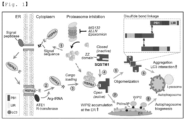
- the N-end rule pathway is a proteolytic system where a specific N-terminal residue of a protein acts as a degradation signal ( FIG. 1 ).
- the N-end rule degradation signal is exemplified by type I basic residues including N-terminal arginine (Nt-Arg), lysine (Nt-Lys) and histidine (Nt-His); and type II hydrophobic residues including phenylalanine (Nt-Phe), leucine (Nt-Leu), tryptophan (Nt-Trp), tyrosine (Nt-Tyr) and isoleucine (Nt-Ile).
- N-ligands specific N-recognins
- the present inventors have first discovered or cloned previously known N-recognins, namely UBR1, UBR2, UBR4, and UBR5, and found that they utilize the UBR box as a substrate recognition domain ( Tasaki, T. et al., Mol Cell Biol 25, 7120-36 (2005 )).
- the present inventors have also found that the UBR box binds to type-I N-end rule ligands (Nt-Arg, Nt-Lys, Nt-His) such as N-terminal arginine residue to recognize a substrate and to link a ubiquitin chain to the substrate.
- UBR1 and UBR2 have an N-domain which plays an important role in the binding of type-2 N-end rule ligands (Nt-Trp, Nt-Phe, Nt-Tyr, Nt-Leu, and Nt-Ile) ( Sriram, S.M., Kim, B.Y. & Kwon, Y.T., Nat Rev Mol Cell Biol 12, 735-47 (2011 )).
- Nt-Trp, Nt-Phe, Nt-Tyr, Nt-Leu, and Nt-Ile type-2 N-end rule ligands
- the ubiquitinized substrate produced from the binding between N-recognins and N-end rule ligands is delivered to proteasome where it is degraded into a short peptide.
- N-terminal residues are the essential determinants of binding since N-recognins provide most of the hydrogen bonds needed to target the N-end rule substrate ( Sriram, S.M. & Kwon, Y.T., Nat Struct Mol Biol 17, 1164-5 (2010 )).
- misfolded proteins that are poorly folded in cells linger for a prolonged time, they are aggregated and block proteasome functions or reduce other cellular functions which cause cytotoxic substances, and therefore, misfolded proteins are ubiquitinated by ubiquitin ligases and delivered to proteasomes for degradation ( Ji, C.H. & Kwon, Y.T., Mol Cells 40, 441-449 (2017 )).
- this process is smooth and minimizes damage caused by misfolded proteins, whereas in aged neurons, this process is slowed so that the ubiquitinated misfolded proteins accumulate and these surplus protein wastes are converted back into aggregates ( Ciechanover, A.
- neuronal cells of patients with degenerative brain diseases such as Huntington's disease, Parkinson's disease, human mad cow disease, and Lou Gehrig's disease even among proteinopathies, have strong properties that specific mutant proteins are transformed into aggregates, and thus are not degraded by the proteasome described above. The reason is that since the proteasome has a narrow inner diameter of about 13 Angstroms, the misfolded proteins must be unfolded, and when the proteins are aggregated, they will not be unfolded.
- autophagy is a major intracellular protein degradation system along with the ubiquitin-proteasome system.
- Autophagy is a protein degradation process essential to maintain cell homeostasis and genetic stability by degrading aged or impaired cellular organelles or damaged or abnormally folded proteins ( Ji, C.H. & Kwon, Mol Cells 40, 441-449 (2017 )).
- Ji, C.H. & Kwon, Mol Cells 40, 441-449 (2017 ) Ji, C.H. & Kwon, Mol Cells 40, 441-449 (2017 )
- misfolded protein aggregates are accumulated in a cytoplasm, they can become cytotoxic substances, and thus, should be received and degraded by autophagy.
- the mechanism for autophagy is largely divided into macroautophagy, microautophagy and chaperone-mediated autophagy, and it is divided into bulk autophagy and selective autophagy, depending on the purpose of degrading the intracellular substrate ( Dikic, I. & Elazar, Z., Nat Rev Mol Cell Biol 19, 349-364 (2018 )).
- selective autophagy and chaperone-mediated autophagy cause selective degradation of unwanted intracellular proteins and dysfunctional organelles.
- p62/SQSTM1/Sequestosome-1 protein is important for initiating the formation of autophagosome which is a mediator in the mechanism of selective autophagy, and delivering the contents.
- p62/SQRSM1/Sequestosome-1 bind to the misfolded proteins and their aggregates, which are delivered to autophagosome.
- P62 undergoes self-oligomerization as a key process when delivering misfolded proteins to autophagosomes ( Ji and Kwon, Y.T., Mol Cells 40, 441-449 (2017 )). At this time, the misfolded proteins are concentrated together to reduce the volume, thereby facilitating degradation by autophagy.
- PB1 domain mediates the self-oligomerization of p62, but the regulatory mechanism thereof is not well known.
- the misfolded protein-p62 conjugate delivered to autophagosome can be degraded by lysosomal enzymes as the autophagosome binds to a lysosome.
- autophagy is important for maintaining cell homeostasis by regulating intracellular changes in damaged proteins and cellular organelles.
- autophagic function is weakened, it leads to the accumulation and aggregation of the misfolded proteins, which results in proteinopathies ( Ciechanover, A. & Kwon, Y.T., Exp Mol Med 47, e147 (2015 )).
- a key technique of the present invention is to provide a method for effectively eliminating misfolded proteins or its aggregates, which cause proteinopathies. For this purpose, it is necessary to activate only selective autophagy without activating bulk autophagy that have a wide range of effects on various biological pathways.
- a regulator that normally inhibits bulk autophagy is mTOR.
- a method of activating autophagy using mTOR inhibitors is most widely used ( Jung, C. H., Ro, S. H., Cao, J., Otto, N. M. & Kim, D. H., FEBS Lett 584, 1287-95 (2010 )).
- rapamycin treatment amyloid beta (Ab) and tau were eliminated and simultaneously cognitive ability was improved in an AD animal model over-expressing APP ( Caccamo, A., Majumder, S., Richardson, A., Strong, R.
- tau was eliminated in an AD animal model over-expressing tau ( Rodriguez-Navarro, J.A. et al., Neurobiol Dis 39, 423-38 (2010 )); and the over-expressed mutant alpha-synuclein protein aggregate was eliminated in a PD mouse model ( Webb, J.L., Ravikumar, B., Atkins, J., Skepper, J.N. & Rubinsztein, D.C., J Biol Chem 278, 25009-13 (2003 )).
- mTOR plays a very important role in various intracellular pathways including NF-kB. Therefore, although it exhibits excellent activity to eliminate the misfolded protein aggregate of proteinopathic diseases, there is a limitation in that these bulk autophagy activators, which are known that mTOR is a drug target, are used as therapeutic agents.
- ubiquitin ligase ligand for the elimination of misfolded proteins which are the main cause, it is difficult to eliminate them when the misfolded proteins are aggregated.
- mTOR inhibitors which are the most commonly used compounds as bulk autophagy activators, play a wide role in regulating overall gene expression in cells in response to stimuli from a variety of external environments in addition to the regulation of autophagy, and thus, they have the disadvantage in terms of being unsuitable as a therapeutic agent. Therefore, there is a need to develop a method for eliminating misfolded protein aggregates by activating p62, a key regulator of selective autophagy, without lowering the activity of mTOR, a regulator of the bulk autophagy.
- KR 2017 0021525 A describes a pharmaceutical composition for preventing and treating neurodegenerative diseases comprising ligands bound to a ZZ domain of p62 protein as an active ingredient and, more specifically, to a composition for preventing and treating neurodegenerative diseases through autophage activity mediated by ligands bound to a p62 ZZ domain or arginylated BiP.
- this document describes a pharmaceutical composition containing a stereocenter, merely a racemic structure is described.
- the present inventors have conducted intensive studies to discover a prophylactic and therapeutic agent for proteinopathies using a material that activates autophagy independently of mTOR, and as a result, have found that ligands binding to p62, more specifically to the ZZ domain of p62, bind to LC3 and activate autophagy, resulting in the effective elimination of the pathogenic protein aggregates such as mutant huntingtin and alpha-synuclein, and thereby, it can be used for the prevention, amelioration or treatment of various proteinopathies.
- the present invention has been completed on the basis of such findings.
- FIG. 1 The pharmacokinetics and key techniques of the present invention are summarized in FIG. 1 .
- p62 protein is important for initiating the formation of autophagosome, which is a mediator in the mechanism for selective autophagy, and delivering the contents. It was observed that significant p62 activation of the novel p62 ligand according to the present invention induces p62 self-oligomerization. Further, in light of the fact that autophagosome targeting of p62 through this self-oligomerization is increased, this demonstrates that the novel p62 ligands according to the present invention can induce the targeting and degradation of p62 protein by intracellular autophagy. These results mean that the novel p62 ligand compounds according to the present invention can be utilized as more effective or supplemental alternative to existing anti-protein disease drugs.
- novel compound according to the present invention acts as a ligand binding to the ZZ domain of p62 protein, enhances the delivery of p62 to an autophagosome, activates autophagy, and eliminates misfolded protein aggregates, and therefore, is useful as a drug for preventing, ameliorating and treating various proteinopathies.
- halo includes fluoro, chloro, bromo and iodo.
- alkyl refers to a linear or branched aliphatic hydrocarbon radical, and may be preferably an alkyl having 1 to 6 carbon atoms, more preferably an alkyl having 1 to 4 carbon atoms.
- alkyl include methyl, ethyl, propyl, isopropyl, butyl, isobutyl, sec-butyl, tert-butyl, pentyl, isopentyl, neopentyl, 1-ethylpropyl, hexyl, isohexyl, 1,1-dimethylbutyl, 2,2-dimethylbutyl, 3,3-dimethylbutyl and 2-ethylbutyl.
- the W is phenyl.
- the n1 may be 1 or 2.
- the R' 1 may be phenyl that is unsubstituted or substituted by hydroxy, fluoro, chloro, bromo, methyl, ethyl, methoxy, ethoxy, nitro, amino or dimethylamino.
- the n2 may be an integer of 1 to 4.
- the R b may be hydroxy, or -O-(CH 2 ) n3 -R' 2 .
- the R' 2 may be phenyl which is unsubstituted or substituted by hydroxy, fluoro, chloro, bromo, methyl, ethyl, methoxy, ethoxy, nitro, amino or dimethylamino.
- the n3 may be an integer of 1 to 4.
- the n4 may be an integer of 2 to 3.
- the n5 may be an integer of 1 to 3.
- the R 4 may be hydrogen or methyl.
- the compounds of the present invention may exist in the form of a pharmaceutically acceptable salt.
- an addition salt formed by pharmaceutically acceptable free acids may be useful.
- pharmaceutically acceptable salt used herein refers to any organic or inorganic addition salt of the compounds represented by Chemical Formulae 1 to 3, in which the adverse effect caused by the salt does not impair the beneficial effect of the compounds at a concentration exhibiting relatively non-toxic and non-harmful effective activity to a patient.
- the acid addition salt may be prepared by a common method, for example, by dissolving a compound in an excess amount of aqueous acid solution and precipitating the resulting salt using a water-miscible organic solvent, such as methanol, ethanol, acetone or acetonitrile.
- a water-miscible organic solvent such as methanol, ethanol, acetone or acetonitrile.
- an equimolar amount of a compound and an acid in water or alcohol e.g., glycol monomethyl ether
- the resulting mixture can be dried by evaporating, or precipitated salts can be filtered under suction.
- the free acid may be an inorganic acid or an organic acid.
- the inorganic acids include, but are not limited to, hydrochloric acid, phosphoric acid, sulfuric acid, nitric acid and stannic acid.
- the organic acids include, but are not limited to, methanesulfonic acid, p-toluenesulfonic acid, acetic acid, trifluoroacetic acid, maleic acid, succinic acid, oxalic acid, benzoic acid, tartaric acid, fumaric acid, mandelic acid, propionic acid, citric acid, lactic acid, glycolic acid, gluconic acid, galacturonic acid, glutamic acid, glutaric acid, glucuronic acid, aspartic acid, ascorbic acid, carbonic acid, vanillic acid, and hydroiodic acid.
- a pharmaceutically acceptable metal salt may be prepared using a base.
- An alkali metal or alkaline earth metal salt may be obtained, for example, by dissolving a compound in an excess amount of alkali metal hydroxide or alkaline earth metal hydroxide solution, filtering the undissolved compound salt, and then evaporating the filtrate until dry.
- the metal salts particularly sodium, potassium or calcium salts are pharmaceutically suitable, but the present invention is not limited thereto.
- the corresponding silver salts may be obtained by reacting an alkali metal or alkaline earth metal salt with a proper silver salt (e.g., silver nitrate).
- proteinopathy or “disease linked to protein aggregation” as used herein, refers to those diseases which are characterized by the presence of aggregated proteins, Examples thereof include, but are not limited to, neurodegenerative diseases, alpha-1 antitrypsin deficiency, keratopathy, retinitis pigmentosa, type 2 diabetes, cystic fibrosis, and the like.
- the neurodegenerative diseases herein are preferably selected from the group consisting of Lyme borreliosis, fatal familial insomnia, Creutzfeldt-Jakob Disease (CJD), multiple sclerosis (MS), dementia, Alzheimer's disease, epilepsy, Parkinson's disease, stroke, Huntington's disease, Picks disease, amyotrophic lateral sclerosis (ALS), spinocerebellar ataxias, other Poly-Q diseases, hereditary cerebral amyloid angiopathy, familial amyloid polyneuropathy, primary systemic amyloidosis (AL amyloidosis), reactive systemic amyloidosis (AA amyloidosis), injection-localized amyloidosis, beta-2 microglobulin amyloidosis, hereditary non-neuropathic amyloidosis, Alexander disease and Finnish hereditary systemic amyloidosis.
- CJD Creutzfeldt-Jakob Disease
- MS multiple sclerosis
- dementia Alzheimer's disease
- the dosage of the pharmaceutical composition of the present invention may vary with a broad range depending on weight, age, gender, or health condition a patient, diet, administration period, administration method, excretion and severity of disease.
- the effective dosage is generally about 1 ng to 10 mg/day and particularly about 1 ng to 1 mg/day for an adult (60kg).
- the dosage may vary depending on various conditions, it would be evident to a person skilled in the pertinent art that the dosage may be increased or decreased. Accordingly, the scope of the present invention is not limited by the aforementioned dosage in any way.
- the administration can be made either once or several divided times per day within a desired range, and the administration period is not particularly limited, either.
- treatment refers to all actions that alleviate or beneficially change the symptoms of various diseases linked to misfolded protein aggregation, such as proteinopathies by administering the pharmaceutical composition of the present invention.
- a liquid formulation for oral administration can be illustrated as suspensions, solutions, emulsions, syrups and the like, and can include various excipients such as humectants, sweeteners, fragrances, preservatives and the like, in addition to water and liquid paraffin which are commonly used diluents.
- a formulation for parenteral administration includes sterilized aqueous solutions, non-aqueous solvents, suspension agents, emulsion agents, lyophilizing agents and suppository agents.
- Non-aqueous solvent and suspending agent may include propylene glycol, polyethylene glycol, vegetable oil such as olive oil, and injectable esters such as ethyl oleate.
- injectable esters such as ethyl oleate.
- Witepsol, Macrogol, Tween 61, cacao butter, laurin butter, glycerogelatin or the like may be used.
- injections may include conventional additives such as solubilizing agents, isotonic agents, suspending agents, emulsifiers, stabilizers, or preservatives.
- the formulation may be prepared according to conventional mixing, granulation or coating methods, and contains an active ingredient in an amount effective for medical treatment, specifically for the prevention, amelioration or treatment of diseases linked to misfolded protein aggregation.
- the dosage may be increased or decreased depending on administration route, the severity of a disease, gender, weight, age and the like, and the scope of the present invention is not limited by the aforementioned dosage in any way.
- a preferred dose of the compound according to the present invention may be varied according to the condition and weight of a patient, the severity of a disease, the type of a drug, and the route and duration of administration, but it may be suitably selected by those skilled in the art.
- the term "subject” refers to all animals comprising human, monkey, cow, horse, sheep, pig, chicken, turkey, quail, cat, dog, mouse, rat, rabbit, or guinea pig, which have diseases linked to misfolded protein aggregation.
- the diseases linked to misfolded protein aggregation can be effectively prevented, ameliorated or treated by administrating the pharmaceutical composition of the present invention to the subject.
- the term "administration" means introduction of a prescribed amount of a substance into a patient in certain appropriate method, and the composition of the present invention can be administrated via any of the general routes as long as it can reach a target tissue.
- intraperitoneal administration, intravenous administration, intramuscular administration, subcutaneous administration, intradermal administration, oral administration, topical administration, intranasal administration, intrapulmonary administration and intrarectal administration may be performed, but the present invention is not limited to these exemplified administration modes.
- the pharmaceutical composition of the present invention can be administered using any device capable of delivering the active ingredients to target cells.
- Preferable administration mode and formulation are an intravenous injection, a subcutaneous injection, an intradermal injection, an intramuscular injection, intravenous drip injection, or the like.
- Injectable formulations may be prepared using saline, aqueous solutions such as Ringer's solution, and non-aqueous solutions, such as vegetable oils, high fatty acid esters (e.g., ethyl oleic acid, etc.), alcohols (e.g., ethanol, benzyl alcohol, propylene glycol, glycerin, etc.).
- the injectable preparations may include pharmaceutical carriers, including a stabilizer for preventing degeneration (e.g., ascorbic acid, sodium hydrogen sulfite, sodium pyrosulfite, BHA, tocopherol, EDTA, etc.), an emulsifier, a buffering agent for pH control, and a preservative for inhibiting microbial growth (e.g., phenylmercuric nitrate, thimerosal, benzalkonium chloride, phenol, cresol, benzylalcohol, etc.).
- a stabilizer for preventing degeneration e.g., ascorbic acid, sodium hydrogen sulfite, sodium pyrosulfite, BHA, tocopherol, EDTA, etc.
- an emulsifier e.g., emulsifier
- a buffering agent for pH control e.g., a preservative for inhibiting microbial growth
- the compounds of Chemical Formula 1 of the present invention may also be applied in a food composition.
- the food composition is a health functional food and it can be used through formulation itself or be comprised in other health functional foods as an additive of health functional food.
- the health functional food means food having body modulating function such as prevention or amelioration of diseases, biodefense, immunity, recovery of convalescence, aging inhibition, etc., and it should be harmless to human body when taking in a long term.
- the mixing amount of active ingredients can be properly decided depending on purpose of use (prevention, health or therapeutic treatment) .
- the kind of the food is not particularly limited.
- Examples of food where the above substances can be added are meat, sausage, bread, chocolates, candies, snack, cookies, pizza, ramen, other noodles, gum, dairy products including ice cream, sorts of soup, beverages, tea, drinks, alcohol beverages and vitamin complex, etc., and it includes all the health functional foods in the common sense.
- the food composition can comprise common ingredients used in preparation of food or food additives, specifically, a flavoring agent; a natural sweetener such as monosaccharides like glucose, fructose, disaccharides like maltose, sucrose, and dextrin, cyclodextrin as a natural carbohydrate, or a synthetic sweetener such as saccharin, aspartame; a nutrient; vitamin; electrolyte; a coloring agent; an organic acid; a protective colloid viscosity agent; pH regulator; a stabilizer; a preservative; glycerin; alcohol; a carbonating agent which is used on carbonated drinks, etc.
- a natural sweetener such as monosaccharides like glucose, fructose, disaccharides like maltose, sucrose, and dextrin, cyclodextrin as a natural carbohydrate, or a synthetic sweetener such as saccharin, aspartame
- a nutrient such as a
- the compounds of Examples 1 to 19, which are novel p62 ligands represented by Chemical Formula 1 were newly synthesized.
- HeLa cell lines which are cell lines derived from cervical cancer patients, were treated with the novel p62 ligand compound according to the present invention and cultured, and then autophagy activity in cultured cells was confirmed by immunoblotting.
- the compounds of the present invention can be prepared from readily available starting materials using the following general methods and procedures.
- process conditions i.e., reaction temperature, time, molar ratio of reactants, solvents, pressure
- other process conditions may also be used unless stated otherwise.
- the optimal reaction state may vary depending on the specific reactants or solvent used. Such conditions can be determined by one skilled in the art by conventional optimization procedures.
- the filtered solution was concentrated and then dissolved again in methanol (10ml), and 6N NaOH was added and stirred at room temperature for 30 minutes. 4N HCl solution was added to the reaction, and further stirred for 30 minutes.
- the reaction mixture was diluted with ethyl acetate (50 ml), washed with brine, and then dehydrated with anhydrous sodium sulfate, and filtrated under reduced pressure.
- Step 3 R-2-((3,4-bis(benzyloxy)phenoxy)methyl)oxirane (1103, 9 mg, 25 nmol) was diluted with anhydrous ethanol (1 ml), and then 2-aminoethan-1-ol (7.6 ⁇ L, 125 nmol) was added thereto and stirred at room temperature for 4 hours. After confirming the reaction by TLC, the reaction solvent was concentrated under reduced pressure, water was added to the concentrated reaction product, and extracted with dichloromethane (3 ⁇ 5 mL). The extracted organic layer was dehydrated with anhydrous sodium sulfate and then filtered under reduced pressure.
- Step 1) After R-2-((3,4-bis(benzyloxy)phenoxy)methyl)oxirane (1103, 500 mg, 1.38 mmol) was dissolved in methanol (10 ml), tert-butyl 2-aminoethylcarbamate (442 mg, 2.76 mmol) was added thereto and stirred at 50°C for 10 hours. When the reaction was completed, the reaction solvent is concentrated under reduced pressure.
- Step 2 After tert-butyl (R)-(2-((3-(3,4-bis(benzyloxy)phenoxy)-2-hydroxypropyl)amino)ethyl)carmamate (1105, 600 mg, 1.15 mmol) was dissolved in methanol (3 ml), methanol/hydrochloric acid (3N, 2 ml) was added thereto, and then stirred at room temperature for 4 hours. When the reaction was completed, the reaction mixture was concentrated under reduced pressure (white solid, 1106) and used as a starting material in the next step without purification.
- Step 3 (R)-1-((2-aminoethyl)amino)-3-(3,4-bis(benzyloxy)phenoxy)propan-2-ol (1106, 400 g, 0.95 mmol) was dissolved in DMF(3ml), and then 1H-pyrazole-1-carboxamidine hydrochloride (553 mg, 3.8 mmol) and diisopropylethylamine (0.3 g, 2.4 mmol) were further added thereto.
- Step 2 (R)-1-amino-3-(3,4-bis(benzyloxy)phenoxy)propan-2-ol (1107, 300 mg, 0.8 mmol) was dissolved in DMF (3 ml), and then 1H-pyrazole-1-carboxamidine hydrochloride (570 mg, 3.9 mmol) and diisopropylethylamine (0.3 g, 2.4 mmol) were added sequentially. The reaction mixture was stirred at 30°C for 12 hours, concentrated under reduced pressure and purified by high resolution liquid chromatography to synthesize (R)-1-(3-(3,4-bis(benzyloxy)phenoxy)-2-hydroxypropyl)guanidine (YOK-1107, 23 mg).
- Step 1) 1,3-Dihydroxybenzene (5.0 g, 45.4 mmol) was dissolved in acetonitrile (100 ml) and then K 2 CO 3 was added thereto. Then, 1-(bromomethyl)-4-chlorobenzene (9.3 g, 45.4 mmol) was added to the reaction and then stirred at 80°C for 16 hours. After cooling to room temperature, the reaction solvent was concentrated under reduced pressure. Water was added to the concentrated residue, followed by extraction with ethyl acetate. The organic layer was dehydrated with anhydrous sodium sulfate and filtered under reduced pressure.
- Step 2 After 3-((4-chlorobenzyl)oxy)phenol (2011, 1.0 g, 4.2 mmol) was dissolved in ethanol (10 ml), (R)-2-(chloromethyl)oxirane (1.17 g, 12.7 mmol), purified water (1 ml), and KOH (0.24 g, 4.2 mmol) were added, and then stirred at room temperature for 16 hours. Water (30 ml) was added to the reaction and extracted with ethyl acetate (30 ml). The aqueous layer was extracted twice more with ethyl acetate, and then the organic layer was dehydrated with anhydrous sodium sulfate and filtered under reduced pressure.
- Step 3 (R)-2-((3-((4-chlorobenzyl)oxy)phenoxy)methyl)oxirane (3011, 300 mg, 1.03 mmol) was dissolved in methanol (5 ml), and then 2-aminoethanol (189 mg, 3.09 mmol) was added thereto. The reaction mixture was stirred at 65°C for 5 hours. After cooling to room temperature, the reaction solvent was concentrated under reduced pressure and purified by high resolution liquid chromatography to synthesize (R)-1-(3-((4-chlorobenzyl)oxy)phenoxy)-3-((2-hydroxyethyl)amino)propan-2-ol (YT-6-7, 15 mg) as a white solid.
- Step 1) After 4-(benzyloxy)-3-phenethoxybenzaldehyde (1201, 332 mg, 1.0 mmol) was dissolved in dichloromethane, m-chloroperbenzoic acid (mCPBA, 260 mg, 1.5 mmol) is added thereto and then stirred at room temperature for 4 hours. An excess of ethyl acetate was added to the reaction, and then washed with saturated aqueous sodium carbonate solution, and the organic layer was separated. The organic layer was washed with an aqueous sodium chloride solution, then dehydrated with anhydrous sodium sulfate and filtered under reduced pressure.
- mCPBA m-chloroperbenzoic acid
- the filtered solution was concentrated and dissolved again in methanol (10 ml), then 6N NaOH was added and stirred at room temperature for 30 minutes. 4N HCl solution was added to the reaction and then further stirred for 30 minutes.
- the reaction mixture was diluted with ethyl acetate (50 ml), then washed with brine, dehydrated with anhydrous sodium sulfate, and filtrated under reduced pressure.
- Step 3 After R-2-((4-(benzyloxy)-3-phenethoxyphenoxy)methyl)oxirane (1203, 9.4 mg, 25 nmol) was diluted with anhydrous ethanol (1 ml), isopropylamine (10 ⁇ L, 125 nmol) was added thereto and stirred at room temperature for 4 hours. After confirming the reaction by TLC, the reaction solvent was concentrated under reduced pressure, and water was added to the concentrated reaction product and extracted with dichloromethane (3 ⁇ 5 mL). The extracted organic layer was dehydrated with anhydrous sodium sulfate and then filtered under reduced pressure.
- HEK293 cell line which is human embryonic kidney-derived cell, was collected.
- YOK-1104, YOK-2204, YOK-3304, YOK-1204, YOK-4404, YOK-1107, YOK-1109, YOK-2207, YOK-2209, YT-4-1, YT-4-2, YT-6-1, YT-6-2, YT-6-7, YT-6-8, YT-9-1, YT-9-2 were selected.
- the aforementioned compounds were confirmed by treatment at different concentrations and for different times, and immunoblotting showed representative results from three or more independent experiments. The results are shown in FIG. 5 . As shown in FIG. 5 , it was confirmed that the control compounds did not increase the level of LC3, a marker of macroautophagy activity, regardless of the treatment time or concentration.
- a cover glass was placed on a 24-well plate, cells were dispensed, cultured for 24 hours, and then treated with 5 uM of the novel p62 ligands according to the present invention.
- additional cultures were performed for 24 hours, and then the medium was removed.
- Cells were fixed using formaldehyde at room temperature.
- the cells were allowed to react with a blocking solution at room temperature for 1 hour, and then treated with LC3 antibody diluted at a certain ratio using the blocking solution, and allowed to reacted at room temperature for 1 hour.
- the antibody-treated cells were washed three times with PBS, and goat-derived secondary antibody was diluted at a certain ratio using the blocking solution, and then allowed to react at room temperature for 30 minutes.
- the cells were washed again with PBS three times, and for intracellular nuclear staining, the expression level, intracellular puncta formation and intracellular coexistence level of p62 and LC3 were observed through a confocal microscopy after DAPI staining. The results are shown in FIG. 5 . Immunofluorescence staining showed representative results from three or more independent experiments.
- YOK-A-1104 and YOK-G-1104 are compounds having the following structures. [Table 3] No.
- FIGS. 8a and 8b it was confirmed that after treatment with the p62 ligand compounds according to the present invention, intracellular punctae of FK2, markers of p62 protein and ubiquitination protein, were formed and the local co-existence of the punctae were increased.
Landscapes
- Health & Medical Sciences (AREA)
- Chemical & Material Sciences (AREA)
- Organic Chemistry (AREA)
- Life Sciences & Earth Sciences (AREA)
- Medicinal Chemistry (AREA)
- General Health & Medical Sciences (AREA)
- Pharmacology & Pharmacy (AREA)
- Veterinary Medicine (AREA)
- Public Health (AREA)
- Animal Behavior & Ethology (AREA)
- Epidemiology (AREA)
- Engineering & Computer Science (AREA)
- Bioinformatics & Cheminformatics (AREA)
- Nuclear Medicine, Radiotherapy & Molecular Imaging (AREA)
- General Chemical & Material Sciences (AREA)
- Chemical Kinetics & Catalysis (AREA)
- Diabetes (AREA)
- Neurosurgery (AREA)
- Neurology (AREA)
- Biomedical Technology (AREA)
- Endocrinology (AREA)
- Obesity (AREA)
- Emergency Medicine (AREA)
- Hematology (AREA)
- Immunology (AREA)
- Ophthalmology & Optometry (AREA)
- Mycology (AREA)
- Microbiology (AREA)
- Polymers & Plastics (AREA)
- Food Science & Technology (AREA)
- Cell Biology (AREA)
- Hospice & Palliative Care (AREA)
- Psychiatry (AREA)
- Nutrition Science (AREA)
- Pharmaceuticals Containing Other Organic And Inorganic Compounds (AREA)
- Acyclic And Carbocyclic Compounds In Medicinal Compositions (AREA)
- Organic Low-Molecular-Weight Compounds And Preparation Thereof (AREA)
- Coloring Foods And Improving Nutritive Qualities (AREA)
- Medicinal Preparation (AREA)
- Medicines That Contain Protein Lipid Enzymes And Other Medicines (AREA)
Description
- The present invention relates to a novel p62 ligand compound, and a pharmaceutical composition for preventing or treating proteinopathies comprising the same.
- The N-end rule pathway is a proteolytic system where a specific N-terminal residue of a protein acts as a degradation signal (
FIG. 1 ). The N-end rule degradation signal is exemplified by type I basic residues including N-terminal arginine (Nt-Arg), lysine (Nt-Lys) and histidine (Nt-His); and type II hydrophobic residues including phenylalanine (Nt-Phe), leucine (Nt-Leu), tryptophan (Nt-Trp), tyrosine (Nt-Tyr) and isoleucine (Nt-Ile). These N-terminal residues bind to specific N-recognins (hereinafter referred to as N-ligands). - The present inventors have first discovered or cloned previously known N-recognins, namely UBR1, UBR2, UBR4, and UBR5, and found that they utilize the UBR box as a substrate recognition domain (Tasaki, T. et al., Mol Cell Biol 25, 7120-36 (2005)). The present inventors have also found that the UBR box binds to type-I N-end rule ligands (Nt-Arg, Nt-Lys, Nt-His) such as N-terminal arginine residue to recognize a substrate and to link a ubiquitin chain to the substrate. It has further been found that UBR1 and UBR2 have an N-domain which plays an important role in the binding of type-2 N-end rule ligands (Nt-Trp, Nt-Phe, Nt-Tyr, Nt-Leu, and Nt-Ile) (Sriram, S.M., Kim, B.Y. & Kwon, Y.T., Nat Rev Mol Cell Biol 12, 735-47 (2011)). The ubiquitinized substrate produced from the binding between N-recognins and N-end rule ligands is delivered to proteasome where it is degraded into a short peptide. In this process, specific N-terminal residues (Nt-Arg, Nt-His, Nt-Lys, Nt-Trp, Nt-Phe, Nt-Tyr, Nt-Leu, Nt-Leu) are the essential determinants of binding since N-recognins provide most of the hydrogen bonds needed to target the N-end rule substrate (Sriram, S.M. & Kwon, Y.T., Nat Struct Mol Biol 17, 1164-5 (2010)).
- If misfolded proteins that are poorly folded in cells linger for a prolonged time, they are aggregated and block proteasome functions or reduce other cellular functions which cause cytotoxic substances, and therefore, misfolded proteins are ubiquitinated by ubiquitin ligases and delivered to proteasomes for degradation (Ji, C.H. & Kwon, Y.T., Mol Cells 40, 441-449 (2017)). In normal cells, this process is smooth and minimizes damage caused by misfolded proteins, whereas in aged neurons, this process is slowed so that the ubiquitinated misfolded proteins accumulate and these surplus protein wastes are converted back into aggregates (Ciechanover, A. & Kwon, Y.T., Exp Mol Med 47, e147 (2015)). In addition, neuronal cells of patients with degenerative brain diseases such as Huntington's disease, Parkinson's disease, human mad cow disease, and Lou Gehrig's disease even among proteinopathies, have strong properties that specific mutant proteins are transformed into aggregates, and thus are not degraded by the proteasome described above. The reason is that since the proteasome has a narrow inner diameter of about 13 Angstroms, the misfolded proteins must be unfolded, and when the proteins are aggregated, they will not be unfolded.
- Meanwhile, autophagy is a major intracellular protein degradation system along with the ubiquitin-proteasome system. Autophagy is a protein degradation process essential to maintain cell homeostasis and genetic stability by degrading aged or impaired cellular organelles or damaged or abnormally folded proteins (Ji, C.H. & Kwon, Mol Cells 40, 441-449 (2017)). In particular, when misfolded protein aggregates are accumulated in a cytoplasm, they can become cytotoxic substances, and thus, should be received and degraded by autophagy. The mechanism for autophagy is largely divided into macroautophagy, microautophagy and chaperone-mediated autophagy, and it is divided into bulk autophagy and selective autophagy, depending on the purpose of degrading the intracellular substrate (Dikic, I. & Elazar, Z., Nat Rev Mol Cell Biol 19, 349-364 (2018)). Of these, selective autophagy and chaperone-mediated autophagy cause selective degradation of unwanted intracellular proteins and dysfunctional organelles. By inducing selective autophagy, the development of new therapies for diseases based on the accumulation of pathologically misfolded proteins and dysfunctional organelles is currently building a new paradigm. p62/SQSTM1/Sequestosome-1 protein is important for initiating the formation of autophagosome which is a mediator in the mechanism of selective autophagy, and delivering the contents. At this time, p62/SQRSM1/Sequestosome-1 bind to the misfolded proteins and their aggregates, which are delivered to autophagosome. P62 undergoes self-oligomerization as a key process when delivering misfolded proteins to autophagosomes (Ji and Kwon, Y.T., Mol Cells 40, 441-449 (2017)). At this time, the misfolded proteins are concentrated together to reduce the volume, thereby facilitating degradation by autophagy. PB1 domain mediates the self-oligomerization of p62, but the regulatory mechanism thereof is not well known. The misfolded protein-p62 conjugate delivered to autophagosome can be degraded by lysosomal enzymes as the autophagosome binds to a lysosome. Through the mechanism described above, autophagy is important for maintaining cell homeostasis by regulating intracellular changes in damaged proteins and cellular organelles. When autophagic function is weakened, it leads to the accumulation and aggregation of the misfolded proteins, which results in proteinopathies (Ciechanover, A. & Kwon, Y.T., Exp Mol Med 47, e147 (2015)). A key technique of the present invention is to provide a method for effectively eliminating misfolded proteins or its aggregates, which cause proteinopathies. For this purpose, it is necessary to activate only selective autophagy without activating bulk autophagy that have a wide range of effects on various biological pathways.
- Studies on the activation of autophagy to treat proteinopathies have been actively conducted. A regulator that normally inhibits bulk autophagy is mTOR. A method of activating autophagy using mTOR inhibitors is most widely used (Jung, C. H., Ro, S. H., Cao, J., Otto, N. M. & Kim, D. H., FEBS Lett 584, 1287-95 (2010)). Specifically, by using rapamycin treatment, amyloid beta (Ab) and tau were eliminated and simultaneously cognitive ability was improved in an AD animal model over-expressing APP (Caccamo, A., Majumder, S., Richardson, A., Strong, R. & Oddo, S., J Biol Chem 285, 13107-20 (2010)); tau was eliminated in an AD animal model over-expressing tau (Rodriguez-Navarro, J.A. et al., Neurobiol Dis 39, 423-38 (2010)); and the over-expressed mutant alpha-synuclein protein aggregate was eliminated in a PD mouse model (Webb, J.L., Ravikumar, B., Atkins, J., Skepper, J.N. & Rubinsztein, D.C., J Biol Chem 278, 25009-13 (2003)). It was confirmed that in a HD mouse, huntingtin aggregates were efficiently eliminated by using CCI-779, a rapamycin-like substance, improving animal behavior and cognitive ability (Ravikumar, B., Duden, R. & Rubinsztein, D.C., Hum Mol Genet 11, 1107-17 (2002)). However, mTOR plays a very important role in various intracellular pathways including NF-kB. Therefore, although it exhibits excellent activity to eliminate the misfolded protein aggregate of proteinopathic diseases, there is a limitation in that these bulk autophagy activators, which are known that mTOR is a drug target, are used as therapeutic agents.
- As described above, currently, there is no effective therapeutic agent to treat most proteinopathies. In the case of ubiquitin ligase ligand for the elimination of misfolded proteins which are the main cause, it is difficult to eliminate them when the misfolded proteins are aggregated. In addition, mTOR inhibitors, which are the most commonly used compounds as bulk autophagy activators, play a wide role in regulating overall gene expression in cells in response to stimuli from a variety of external environments in addition to the regulation of autophagy, and thus, they have the disadvantage in terms of being unsuitable as a therapeutic agent. Therefore, there is a need to develop a method for eliminating misfolded protein aggregates by activating p62, a key regulator of selective autophagy, without lowering the activity of mTOR, a regulator of the bulk autophagy.
-
KR 2017 0021525 A - Under these circumstances, the present inventors have conducted intensive studies to discover a prophylactic and therapeutic agent for proteinopathies using a material that activates autophagy independently of mTOR, and as a result, have found that ligands binding to p62, more specifically to the ZZ domain of p62, bind to LC3 and activate autophagy, resulting in the effective elimination of the pathogenic protein aggregates such as mutant huntingtin and alpha-synuclein, and thereby, it can be used for the prevention, amelioration or treatment of various proteinopathies. The present invention has been completed on the basis of such findings.
- It is an object of the present invention to provide a novel p62 ligand compound which induces activation and oligomerization of p62 protein.
- It is another object of the present invention to provide a method for delivering p62 and a misfolded protein to which p62 is bound, to an autophagosome and finally delivering them to a lysosome for elimination by using the aforementioned novel compound.
- It is another object of the present invention to provide a method for increasing macroautophagy activity through p62 protein by using the aforementioned novel compound.
- It is still another object of the present invention to provide a pharmaceutical composition for eliminating a misfolded protein aggregate comprising the aforementioned novel compound as an active ingredient.
- It is the other object of the present invention to provide a pharmaceutical composition for the prevention, amelioration or treatment of proteinopathies comprising the aforementioned novel compound as an active ingredient.
- In order to achieve the above objects, one embodiment of the present invention provides a novel compound that acts as a ligand of the p62 protein. Preferably, the novel p62 ligand according to the invention binds to the ZZ domain of p62.
- Another embodiment of the present invention provides a pharmaceutical composition for the prevention and treatment of proteinopathies such as neurodegenerative diseases, comprising a ligand binding to the ZZ domain of p62 protein as an active ingredient.
- Another embodiment of the present invention provides (1) a method of inducing p62 oligomerization and structural activation; (2) a method of increasing p62-LC3 binding; (3) a method of increasing the delivery of p62 to autophagosome; (4) a method of activating autophagy; and (5) a method of eliminating misfolded protein aggregates, the method including the step of treating a cell or a p62 protein with the ligand that binds to the ZZ domain of p62.
- Still another embodiment of the present invention provides a technique for eliminating misfolded protein aggregates, which are a causative factor of degenerative brain diseases, by activating p62 which delivers the misfolded protein aggregates directly to an autophagosome.
- A key technique of the present invention is to effectively eliminate misfolded protein aggregates, which cause degenerative brain diseases, by simultaneously activating p62 and autophagy.
- The pharmacokinetics and key techniques of the present invention are summarized in
FIG. 1 . - Specifically, as shown in
FIG. 1 , major pathogenic proteins of proteinopathies such as mutant huntingtin and alpha-synuclein are converted to misfolded proteins which are insoluble in water, and then aggregated with each other and grow into oligomeric aggregates. These misfolded proteins grow further while acting as cytotoxic substances in neurons, and then grow into large oligomeric or fibrillar aggregates, eventually forming an inclusion body. In the above process, endoplasmic reticulum chaperones (①) such as BiP produce a large amount of Nt-Arg through N-terminal argination (②) by ATE1 R-transferase, and then the arginylated BiP (R-BiP) is translocated into the cytoplasm and binds to the misfolded huntingtin or alpha-synuclein (③). As a ligand, the Nt-Arg of R-BiP binds to the ZZ domain of p62. Due to the binding, the normally inactivated closed form of p62 is changed to an open form, leading to structural activation (④), and as a result, PB1 and LC3-binding domains are exposed. This activation results in the formation of oligomers and high molecular weight aggregates due to disulfide bonds of p62 (⑤), and increased binding to the autophagosome marker LC3 is finally delivered to autolysosome (⑥). In addition, p62 bound with N-terminal arginine migrates to the endoplasmic reticulum membrane and activates PI3P-mediated autophagosome biogenesis (⑦), thereby increasing intracellular autophagy (⑧). - p62 is a first-in-class target for autophagy activation proposed by the present inventors (
FIG. 1 , ⑧). In addition, no previous studies proposing p62 as a drug target for autophagy activation or the elimination of protein aggregates in degenerative brain diseases have been done. - Autophagy is a mechanism that acts to degrade or recycle cellular components that are unwanted or exhausted in cells, and in conditions such as nutrient and energy deficiencies, it can act for the production of energy and metabolites to be used in biosynthetic processes. The mechanism for autophagy is largely divided into macroautophagy, microautophagy and chaperone-mediated autophagy, and it is divided into bulk autophagy and selective autophagy, depending on the purpose of degrading the intracellular substrate. Of these, selective autophagy and chaperone-mediated autophagy cause selective degradation of unwanted intracellular proteins and dysfunctional organelles. By inducing selective autophagy, the development of new therapies for diseases based on the accumulation of misfolded proteins and dysfunctional organelles is currently building a new paradigm.
- p62 protein is important for initiating the formation of autophagosome, which is a mediator in the mechanism for selective autophagy, and delivering the contents. It was observed that significant p62 activation of the novel p62 ligand according to the present invention induces p62 self-oligomerization. Further, in light of the fact that autophagosome targeting of p62 through this self-oligomerization is increased, this demonstrates that the novel p62 ligands according to the present invention can induce the targeting and degradation of p62 protein by intracellular autophagy. These results mean that the novel p62 ligand compounds according to the present invention can be utilized as more effective or supplemental alternative to existing anti-protein disease drugs.
- PROTAC (PROteolysis Targeting Chimera) is a compound chimera of a ligand that recognizes a target protein and a ligand that recognizes an E3 ubiquitin enzyme. Since the paradigm of existing therapeutic agents for diseases is to inhibit protein enzymes, it is very important to develop a new therapeutic agent against protein-misfolding diseases that cannot be targeted with the existing therapeutic agent. From these viewpoints, PROTAC is an attractive new therapeutic development method by enabling selective degradation under ubiquitin-proteasome system with respect to proteins that cannot be targeted by a conventional enzyme inhibition method. However, currently, studies on PROTAC are limited only to the ubiquitin-proteasome system by utilizing only ligands that recognize the E3 ubiquitin enzyme, and thus has the folding problem associated with misfolded proteins in the aforementioned proteasome system. In contrast, since the novel p62 ligand according to the present invention can not only induce intracellular autophagy but also induce autophagosome targeting of cargo substrate proteins interacting with p62, it can provide a novel therapeutic agent that enables selective degradation under autophagy mechanisms of proteins that cannot be targeted by conventional enzyme inhibition methods.
- The novel compound according to the present invention acts as a ligand binding to the ZZ domain of p62 protein, enhances the delivery of p62 to an autophagosome, activates autophagy, and eliminates misfolded protein aggregates, and therefore, is useful as a drug for preventing, ameliorating and treating various proteinopathies.
-
-
FIG. 1 is a schematic diagram illustrating that the proteins arginylated by N-terminal rule binds to the p62 ZZ domain and degrades intracellular substances such as proteins through intracellular autophagy activity. -
FIG. 2 is an immunoblot assay result showing the effect of increasing the p62 protein oligomerization activity of p62 ligand compounds (YOK-1104, YOK-2204, YOK-3304, YOK-1204, YOK-4404, YOK-1107, YOK-1109, YOK-2207, YOK-2209, YT-4-1, YT-4-2, YT-6-1, YT-6-2, YT-6-7, YT-6-8, YT-9-1 and YT-9-2) according to the present invention. -
FIG. 3 is an immunoblot assay result showing the effect of increasing the autophagy activity of p62 ligand compounds (YOK-1107, YOK-4404, 3301, 3302 and YOK-1104) according to the present invention. -
FIG. 4 is an immunoblot assay result showing the effect of increasing the autophagy activity of p62 ligand compounds (YOK-1106, YOK-1107, YOK-1204, YOK-1304, YOK-2204, YOK-4404) according to the present invention. -
FIG. 5 is an immunoblot assay result confirming that control compounds (1101, 1102, 1103, 1201, 1202, 1203, 1301, 1302, YTK-1105-1, 4402, 1401, 1402, 2201 and 2202) do not increase autophagy activity. -
FIGS. 6a and6b are immunofluorescence staining assay results confirming that the p62 ligand compounds (YOK-1106, YOK-1204, YOK-1504, YOK-2204, YOK-3304 and YOK-4404) according to the present invention allow the activation and oligomerization of p62 proteins, and then show the efficacy of delivering them to autophagosome and simultaneously increasing autophagy activity. -
FIG. 7 is immunofluorescence staining assay results confirming that the control compounds (YOK-A-1104, YOK-G-1104, YTK-1005 and YTK-1105-1) allow the activation and oligomerization of p62 proteins and then show the efficacy of delivering them to autophagosome and simultaneously increasing autophagy activity. -
FIGS. 8a and8b , andFIGS. 9a and9b are immunofluorescence staining assay results showing the efficacy of delivering target proteins to autophagy. This is the result showing that after treatment with the compounds, markers of target proteins, FK2 (FIGS. 8a and8b ) or HuntingtinQ103-GFP (FIGS. 9a and9b ), gradually increase in terms of the co-existence of p62 protein with intracellular puncta. - Hereinafter, the present invention will be described in more detail.
- The definition of groups used herein are described in detail. Unless otherwise indicated, each group has the following definition.
- As used herein, the term "halo" includes fluoro, chloro, bromo and iodo.
- As used herein, the "alkyl" refers to a linear or branched aliphatic hydrocarbon radical, and may be preferably an alkyl having 1 to 6 carbon atoms, more preferably an alkyl having 1 to 4 carbon atoms. Examples of such alkyl include methyl, ethyl, propyl, isopropyl, butyl, isobutyl, sec-butyl, tert-butyl, pentyl, isopentyl, neopentyl, 1-ethylpropyl, hexyl, isohexyl, 1,1-dimethylbutyl, 2,2-dimethylbutyl, 3,3-dimethylbutyl and 2-ethylbutyl.
- In one aspect of the invention, there is provided a compound represented by the following
Chemical Formula 1, a pharmaceutically acceptable salt, stereoisomer, hydrate, or solvate thereof:

Chemical Formula 1, - W is C6 aryl;
- n1 is an integer of 1 to 4;
- m is an integer of 0 to 2;
- Ra is R1 or -OR1,
- where R1 is hydrogen or-(CH2)n2-R'1,
- R'1 is phenyl which is unsubstituted or substituted by hydroxy, halogen, C1-4 alkyl, C1-4 alkoxy, nitro, amino, (C1-4 alkyl) amino, or di (C1-4 alkyl)amino,
- n2 is an integer of 1 to 6;
- Rb is -OR2,
- where R2 is hydrogen or-(CH2)n3-R'2,
- R'2 is phenyl which is unsubstituted or substituted by hydroxy, halogen, C1-4 alkyl, C1-4 alkoxy, nitro, amino, (C1-4 alkyl) amino, or di (C1-4 alkyl)amino,
- n3 is an integer of 1 to 6;
- Rc is -(CH2)n4-OH, -(CH2)n4-NH-C(=NH)NH2, - C(=NH)NH2, C1-6 alkyl, -CH(R3)-COO-R4, or -CH(COO-R4)-CH2CH2CH2-NH-C(=NH)NH2, -(CH2)n4-O-(CH2)n4-OR4, - CONH(CH2)n4-OR4, -CO(CH2)n5-OR4, -(CH2)n5-CH(NH2)-COOR4, -(CH2)n5-CONHR4,
- n4 is an integer of 2 to 4,
- n5 is an integer of 1 to 4,
- R3 is hydrogen or C1-4 alkyl,
- R4 is hydrogen, or C1-4 alkyl, and
- wherein the p62 ligand compound is (R) form.
- The W is phenyl.
- Preferably, the n1 may be 1 or 2.
- Preferably, the Ra may be hydrogen or -O-(CH2)n2-R'1.
- Preferably, the R'1 may be phenyl that is unsubstituted or substituted by hydroxy, fluoro, chloro, bromo, methyl, ethyl, methoxy, ethoxy, nitro, amino or dimethylamino.
- Preferably, the n2 may be an integer of 1 to 4.
- Preferably, the Rb may be hydroxy, or -O-(CH2)n3-R'2.
- Preferably, the R'2 may be phenyl which is unsubstituted or substituted by hydroxy, fluoro, chloro, bromo, methyl, ethyl, methoxy, ethoxy, nitro, amino or dimethylamino.
- Preferably, the n3 may be an integer of 1 to 4.
- Preferably, the Rc may be -(CH2)n4-OH, -(CH2)n4-NH-C(=NH)NH2, -C(=NH)NH2, methyl, ethyl or isopropyl.
- Preferably, the n4 may be an integer of 2 to 3.
- Preferably, the n5 may be an integer of 1 to 3. Preferably, the R4 may be hydrogen or methyl.
- Specifically, representative examples of the compound represented by
Chemical Formula 1 are as follows: - 1) (R)-1-(3,4-(bis(benzyloxy)phenoxy)-3-((2-hydroxyethyl) amino)propan-2-ol (YOK-1106);
- 2) (R)-1-(3,4-(bis((4-chlorobenzyl)oxy)phenoxy)-3-((2-hydroxyethyl)amino)propan-2-ol (YT-6-1);
- 3) (R)-1-(3,4-(bis((4-fluorobenzyl)oxy)phenoxy)-3-((2-hydroxyethyl)amino)propan-2-ol (YT-6-2);
- 4) (R)-1-(3-((4-chlorobenzyl)oxy)phenoxy)-3-((2-hydroxyethyl)amino)propan-2-ol (YT-6-7);
- 5) (R)-1-(3-((4-fluorobenzyl)oxy)phenoxy)-3-((2-hydroxyethyl)amino)propan-2-ol (YT-6-8);
- 6) (R)-1-(2-((3-(3,4-bis(benzyloxy)phenoxy)-2-hydroxypropyl)amino)ethyl)guanidine (YOK-1109);
- 7) (R)-1-(2-((3-(3,4-diphenethoxyphenoxy)-2-hydroxypropyl)amino)ethyl)guanidine (YOK-2209);
- 8) (R)-1-(2-((3-(3,4-bis(4-chlorobenzyl)oxy)phenoxy)-2-hydroxypropyl)amino)ethyl)guanidine (YT-9-1);
- 9) (R)-1-(2-((3-(3,4-bis(4-fluorobenzyl)oxy)phenoxy)-2-hydroxypropyl)amino)ethyl)guanidine (YT-9-2);
- 10) (R)-1-(3-(3,4-bis(benzyloxy)phenoxy)-2-hydroxypropyl)guanidine (YOK-1107);
- 11) (R)-1-(3-(3,4-diphenethoxyphenoxy)-2-hydroxypropyl)guanidine (YOK-2207);
- 12) (R)-1-(3,4-bis(benzyloxy)phenoxy)-3-(isopropylamino)propan-2-ol (YOK-1104);
- 13) (R)-1-(3,4-diphenethoxyphenoxy)-3-(isopropylamino)propan-2-ol (YOK-2204);
- 14) (R)-1-(3,4-bis(3-phenylpropoxy)phenoxy)-3-(isopropylamino)propan-2-ol (YOK-3304);
- 15) (R)-1-(3,4-bis(4-phenylbutoxy)phenoxy)-3-(isopropylamino)propan-2-ol (YOK-4404);
- 16) (R)-1-(4-(benzyloxy)-3-phenethoxyphenoxy)-3-(isopropylamino)propan-2-ol (YOK-1204);
- 17) (R)-1-(4-(benzyloxy)-3-(3-phenylpropoxy)phenoxy)-3-(isopropylamino)propan-2-ol (YOK-1304);
- 18) (R)-1-(3,4-bis((4-chlorobenzyl)oxy)phenoxy)-3-(isopropylamino)propan-2-ol (YT-4-1); and
- 19) (R)-1-(3,4-bis((4-fluorobenzyl)oxy)phenoxy)-3-(isopropylamino)propan-2-ol (YT-4-2).
- Meanwhile, the compounds of the present invention may exist in the form of a pharmaceutically acceptable salt. As the salt, an addition salt formed by pharmaceutically acceptable free acids may be useful. The term "pharmaceutically acceptable salt" used herein refers to any organic or inorganic addition salt of the compounds represented by
Chemical Formulae 1 to 3, in which the adverse effect caused by the salt does not impair the beneficial effect of the compounds at a concentration exhibiting relatively non-toxic and non-harmful effective activity to a patient. - The acid addition salt may be prepared by a common method, for example, by dissolving a compound in an excess amount of aqueous acid solution and precipitating the resulting salt using a water-miscible organic solvent, such as methanol, ethanol, acetone or acetonitrile. Alternatively, an equimolar amount of a compound and an acid in water or alcohol (e.g., glycol monomethyl ether) can be heated, and subsequently, the resulting mixture can be dried by evaporating, or precipitated salts can be filtered under suction.
- In this case, the free acid may be an inorganic acid or an organic acid. Examples of the inorganic acids include, but are not limited to, hydrochloric acid, phosphoric acid, sulfuric acid, nitric acid and stannic acid. Examples of the organic acids include, but are not limited to, methanesulfonic acid, p-toluenesulfonic acid, acetic acid, trifluoroacetic acid, maleic acid, succinic acid, oxalic acid, benzoic acid, tartaric acid, fumaric acid, mandelic acid, propionic acid, citric acid, lactic acid, glycolic acid, gluconic acid, galacturonic acid, glutamic acid, glutaric acid, glucuronic acid, aspartic acid, ascorbic acid, carbonic acid, vanillic acid, and hydroiodic acid.
- In addition, a pharmaceutically acceptable metal salt may be prepared using a base. An alkali metal or alkaline earth metal salt may be obtained, for example, by dissolving a compound in an excess amount of alkali metal hydroxide or alkaline earth metal hydroxide solution, filtering the undissolved compound salt, and then evaporating the filtrate until dry. At this time, as the metal salts, particularly sodium, potassium or calcium salts are pharmaceutically suitable, but the present invention is not limited thereto. Also, the corresponding silver salts may be obtained by reacting an alkali metal or alkaline earth metal salt with a proper silver salt (e.g., silver nitrate).
- Pharmaceutically acceptable salts of the compound of the present invention, unless otherwise indicated herein, include salts of acidic or basic groups, which may be present in the compound of
Chemical Formula 1. For example, the pharmaceutically acceptable salts include sodium, calcium and potassium salts of hydroxy group, and other pharmaceutically acceptable salts of amino group, including hydrobromide, sulfate, hydrogen sulfate, phosphate, hydrogen phosphate, dihydrogen phosphate, acetate, succinate, citrate, tartrate, lactate, mandelate, methanesulfonate (mesylate) and p-toluenesulfonate (tosylate). The salts may be prepared using a salt preparation method known in the art. - Salts of the compounds of
Chemical Formula 1 of the present invention are pharmaceutically acceptable salts, and can be used without particular limitation as long as they are salts of the compounds ofChemical Formula 1 which can exhibit pharmacological activities equivalent to those of the compound ofChemical Formula 1, for example, can prevent or treat neurodegenerative diseases by inducing autophagic degradation of intracellular neurodegenerative disease and tumor-associated proteins through a ligand of p62. - In addition, the compounds represented by
Chemical Formula 1 according to the present invention include, but are not limited thereto, not only pharmaceutically acceptable salts thereof, but also all solvates or hydrates and all possible stereoisomers that can be prepared therefrom. All stereoisomers of the present compounds (e.g., those which may exist due to asymmetric carbons on various substituents) are contemplated within the scope of this invention, provided that the stereocenter inFormula 1 has the R configuration as defined by the IUPAC 1974 Recommendations. Individual stereoisomers of the compounds of the present invention may, for example, be substantially free of other isomers or may be admixed with other stereoisomers. Racemic forms can be analyzed by physical methods, such as fractional crystallization, separation or crystallization of diastereomeric derivatives or separation by chiral column chromatography. The individual optical isomers can be obtained from the racemates by any suitable method, including without limitation, salt formation with an optically active acid followed by crystallization. - The solvate and stereoisomer of the compound represented by
Chemical Formula 1 may be prepared from the compound represented byChemical Formula 1 using methods known in the art. - Furthermore, the compound represented by
Chemical Formula 1 according to the present invention may be prepared either in a crystalline form or in a non-crystalline form, When the compound is prepared in a crystalline form, it may be optionally hydrated or solvated. In the present invention, the compound ofChemical Formula 1 may not only include a stoichiometric hydrate, but also include a compound containing various amounts of water. The solvate of the compound ofChemical Formula 1 according to the present invention includes both stoichiometric solvates and non-stoichiometric solvates. - The compound of
Chemical Formula 1 according to the present invention may be prepared by the same method as inReaction Schemes 1 to 5, which are the following exemplary methods, and specific examples thereof are the same as those described in the following Examples.


- In the preparation method of the present invention, the reactants used in Reaction Schemes may be commercially available compounds, or may be synthesized by performing one or more reactions known in the art as they are or by appropriately modifying the reactions. For example, in consideration of the presence, type and/or position of reactive functional groups and/or hetero elements contained in the skeletal structure, the reactants may be synthesized by performing one or more reactions in a series of order, but are not limited thereto.
- The compound of
Chemical Formula 1 according to the present invention is characterized by functioning as a ligand that binds to the ZZ domain of p62 and thus activating the function of p62. By activating the function of p62, the compound ofChemical Formula 1 according to the present invention can activate autophagy. - Therefore, in another aspect, the present invention provides a compound of
Chemical Formula 1, a pharmaceutically acceptable salt, stereoisomer, hydrate, or solvate thereof for use in increasing the autophagy activity of misfolded proteins. - The compound of
Chemical Formula 1 according to the present invention can eliminate aggregated proteins linked to misfolded protein aggregation-related diseases due to the activating action of autophagy. In addition, the compound ofChemical Formula 1 is a p62 ligand, which binds to the p62 ZZ domain and activates PB1 domain and LIR domain of p62 protein, so that it induces p62 oligomerization and aggregate formation and also increases autophagosome formation by inducing p62 aggregate formation. By the processes above, misfolded proteins can be efficiently eliminated (seeFIG. 1 ). Such protein may be a major protein of proteinopathies, more preferably at least one selected from the group consisting of prion protein, amyloid precursor protein (APP), alpha-synuclein,superoxide dismutase 1, tau, immunoglobulin, amyloid-A, transthyretin, beta2-microglobulin, cystatin C, apolipoprotein A1, TDP-43, islet amyloid polypeptide, ANF, gelsolin, insulin, lysozyme, fibrinogen, huntingtin, alpha-1-antitrypsin Z, crystallin, c9 open reading frame 72 (c9orf72), glial fibrillary acidic protein, cystic fibrosis transmembrane conductance regulator protein, rhodopsin, and ataxin, and other proteins with a poly-Q stretch. - Therefore, in still another aspect, the present invention provides a p62 ligand compound of
Chemical Formula 1, a pharmaceutically acceptable salt, stereoisomer, hydrate, or solvate thereof for use in prevention, amelioration or treatment of proteinopathy. - The term "aggregation", in accordance with the present invention, refers to the formation of oligomeric or multimeric complexes of typically one or more types of proteins, which may be accompanied by the integration of additional biomolecules, like carbohydrates, nucleic acids and lipids, into the complexes. Such aggregated proteins may form deposits in specific tissue, more preferably in nerve tissue or tissue of the brain. The extent of aggregation depends on the particular disease.
- The term "proteinopathy" or "disease linked to protein aggregation" as used herein, refers to those diseases which are characterized by the presence of aggregated proteins, Examples thereof include, but are not limited to, neurodegenerative diseases, alpha-1 antitrypsin deficiency, keratopathy, retinitis pigmentosa,
type 2 diabetes, cystic fibrosis, and the like. - The neurodegenerative diseases herein are preferably selected from the group consisting of Lyme borreliosis, fatal familial insomnia, Creutzfeldt-Jakob Disease (CJD), multiple sclerosis (MS), dementia, Alzheimer's disease, epilepsy, Parkinson's disease, stroke, Huntington's disease, Picks disease, amyotrophic lateral sclerosis (ALS), spinocerebellar ataxias, other Poly-Q diseases, hereditary cerebral amyloid angiopathy, familial amyloid polyneuropathy, primary systemic amyloidosis (AL amyloidosis), reactive systemic amyloidosis (AA amyloidosis), injection-localized amyloidosis, beta-2 microglobulin amyloidosis, hereditary non-neuropathic amyloidosis, Alexander disease and Finnish hereditary systemic amyloidosis.
- The dosage of the pharmaceutical composition of the present invention may vary with a broad range depending on weight, age, gender, or health condition a patient, diet, administration period, administration method, excretion and severity of disease. However, the effective dosage is generally about 1 ng to 10 mg/day and particularly about 1 ng to 1 mg/day for an adult (60kg). As the dosage may vary depending on various conditions, it would be evident to a person skilled in the pertinent art that the dosage may be increased or decreased. Accordingly, the scope of the present invention is not limited by the aforementioned dosage in any way. As for the number of administration, the administration can be made either once or several divided times per day within a desired range, and the administration period is not particularly limited, either.
- As used herein, the term "treatment" refers to all actions that alleviate or beneficially change the symptoms of various diseases linked to misfolded protein aggregation, such as proteinopathies by administering the pharmaceutical composition of the present invention.
- As described above, the compound of the present invention exhibits the effects of (1) inducing p62 oligomerization and structural activation, (2) increasing p62-LC3 binding, and (3) increasing the delivery of p62 to autophagosomes, (4) activating autophagy, and finally (5) eliminating misfolded protein aggregates. Therefore, the pharmaceutical composition containing this compound as an active ingredient can be used for the prevention, amelioration or treatment of diseases linked to various misfolded protein aggregation.
- For example, the composition of the present invention may further include pharmaceutically acceptable carriers, diluents or excipients. The composition can be used in the various forms such as oral dosage forms of powders, granules, tablets, capsules, suspensions, emulsions, syrups, aerosols and injections of a sterile injectable solution, which are formulated by the conventional method according to the purpose of each of the intended use. The composition can be administered through various routes including oral administration or intravenous, intraperitoneal, subcutaneous, rectal and topical administration. Examples of suitable carriers, excipients or diluents which can be included in this composition may include lactose, dextrose, sucrose, sorbitol, mannitol, xylitol, erythritol, maltitol, starch, acacia rubber, alginate, gelatin, calcium phosphate, calcium silicate, cellulose, methyl cellulose, microcrystalline cellulose, polyvinyl pyrrolidone, water, methyl hydroxy benzoate, propylhydroxy benzoate, talc, magnesium stearate, mineral oil, and the like. In addition, the composition of the present invention may further include fillers, anti-coagulants, lubricants, humectants, fragrances, emulsifiers, preservatives, and the like.
- A solid formulation for oral administration includes tablets, pills, powders, granules, capsules and the like, and such solid dosage forms are formulated by mixing the composition of the present invention with one or more excipients, such as starch, calcium carbonate, sucrose, lactose, gelatin and the like. Also, lubricants such as magnesium stearate and talc can be used in addition to simple excipients.
- A liquid formulation for oral administration can be illustrated as suspensions, solutions, emulsions, syrups and the like, and can include various excipients such as humectants, sweeteners, fragrances, preservatives and the like, in addition to water and liquid paraffin which are commonly used diluents.
- A formulation for parenteral administration includes sterilized aqueous solutions, non-aqueous solvents, suspension agents, emulsion agents, lyophilizing agents and suppository agents. Non-aqueous solvent and suspending agent may include propylene glycol, polyethylene glycol, vegetable oil such as olive oil, and injectable esters such as ethyl oleate. As a substrate for the suppository agent, Witepsol, Macrogol, Tween 61, cacao butter, laurin butter, glycerogelatin or the like may be used. On the other hand, injections may include conventional additives such as solubilizing agents, isotonic agents, suspending agents, emulsifiers, stabilizers, or preservatives.
- The formulation may be prepared according to conventional mixing, granulation or coating methods, and contains an active ingredient in an amount effective for medical treatment, specifically for the prevention, amelioration or treatment of diseases linked to misfolded protein aggregation.
- In this case, the composition of the present invention is administrated in a pharmaceutically effective amount. The term "pharmaceutically effective amount" as used herein refers to an amount which is sufficient to treat the disease at a reasonable benefit/risk ratio applicable for any medical treatment, and also which is enough to not cause side effects. The level of effective amount can be determined depending on patient's health condition, disease type, severity of the disease, activity of the drug, sensitivity on the drug, administration method, administration time, administration route, excretion rate, treatment duration, combination, factors including other medicines used at the same time and other factors well-known in the medical field. The composition of the present invention may be administered as individual therapy or in combination with other therapies, and it can be administered simultaneously with or sequentially to conventional therapies, and once or multiple times. It is important to administer the minimum amount which can provide the maximum effect without the side effects in consideration of all the above factors, which can be easily determined by those skilled in the art.
- For example, the dosage may be increased or decreased depending on administration route, the severity of a disease, gender, weight, age and the like, and the scope of the present invention is not limited by the aforementioned dosage in any way.
- A preferred dose of the compound according to the present invention may be varied according to the condition and weight of a patient, the severity of a disease, the type of a drug, and the route and duration of administration, but it may be suitably selected by those skilled in the art.
- As used herein, the term "subject" refers to all animals comprising human, monkey, cow, horse, sheep, pig, chicken, turkey, quail, cat, dog, mouse, rat, rabbit, or guinea pig, which have diseases linked to misfolded protein aggregation. The diseases linked to misfolded protein aggregation can be effectively prevented, ameliorated or treated by administrating the pharmaceutical composition of the present invention to the subject. In addition, since the pharmaceutical composition of the present invention functions as a p62 ligand to activate autophagy, eliminates aggregates of misfolded proteins due to the autophagy activation, and thus exhibits a prophylactic or therapeutic effect of diseases linked to these aggregated proteins, it can exhibit synergistic effects by administration in combination with existing therapeutic agents.
- As used herein, the term "administration" means introduction of a prescribed amount of a substance into a patient in certain appropriate method, and the composition of the present invention can be administrated via any of the general routes as long as it can reach a target tissue. For example, intraperitoneal administration, intravenous administration, intramuscular administration, subcutaneous administration, intradermal administration, oral administration, topical administration, intranasal administration, intrapulmonary administration and intrarectal administration may be performed, but the present invention is not limited to these exemplified administration modes. Also, the pharmaceutical composition of the present invention can be administered using any device capable of delivering the active ingredients to target cells. Preferable administration mode and formulation are an intravenous injection, a subcutaneous injection, an intradermal injection, an intramuscular injection, intravenous drip injection, or the like. Injectable formulations may be prepared using saline, aqueous solutions such as Ringer's solution, and non-aqueous solutions, such as vegetable oils, high fatty acid esters (e.g., ethyl oleic acid, etc.), alcohols (e.g., ethanol, benzyl alcohol, propylene glycol, glycerin, etc.). The injectable preparations may include pharmaceutical carriers, including a stabilizer for preventing degeneration (e.g., ascorbic acid, sodium hydrogen sulfite, sodium pyrosulfite, BHA, tocopherol, EDTA, etc.), an emulsifier, a buffering agent for pH control, and a preservative for inhibiting microbial growth (e.g., phenylmercuric nitrate, thimerosal, benzalkonium chloride, phenol, cresol, benzylalcohol, etc.).
- The compounds of
Chemical Formula 1 of the present invention may also be applied in a food composition. The food composition is a health functional food and it can be used through formulation itself or be comprised in other health functional foods as an additive of health functional food. The health functional food means food having body modulating function such as prevention or amelioration of diseases, biodefense, immunity, recovery of convalescence, aging inhibition, etc., and it should be harmless to human body when taking in a long term. The mixing amount of active ingredients can be properly decided depending on purpose of use (prevention, health or therapeutic treatment) . - The kind of the food is not particularly limited. Examples of food where the above substances can be added are meat, sausage, bread, chocolates, candies, snack, cookies, pizza, ramen, other noodles, gum, dairy products including ice cream, sorts of soup, beverages, tea, drinks, alcohol beverages and vitamin complex, etc., and it includes all the health functional foods in the common sense.
- The food composition can comprise common ingredients used in preparation of food or food additives, specifically, a flavoring agent; a natural sweetener such as monosaccharides like glucose, fructose, disaccharides like maltose, sucrose, and dextrin, cyclodextrin as a natural carbohydrate, or a synthetic sweetener such as saccharin, aspartame; a nutrient; vitamin; electrolyte; a coloring agent; an organic acid; a protective colloid viscosity agent; pH regulator; a stabilizer; a preservative; glycerin; alcohol; a carbonating agent which is used on carbonated drinks, etc.
- In a specific embodiment of the present invention, the compounds of Examples 1 to 19, which are novel p62 ligands represented by
Chemical Formula 1, were newly synthesized. In addition, in order to evaluate whether the novel p62 ligand compounds according to the present invention can increase the phenomenon of autophagy in cultured cells, HeLa cell lines, which are cell lines derived from cervical cancer patients, were treated with the novel p62 ligand compound according to the present invention and cultured, and then autophagy activity in cultured cells was confirmed by immunoblotting. As a result, it was confirmed that the level of LC3, which is a marker of autophagy activity, increased gradually according to the time of treatment with the p62 ligand compounds of the present invention, and that the p62 ligand compounds according to the present invention activated and oligomerized p62 proteins and delivered to autophagosome and simultaneously increased autophagy activity, thereby effectively eliminating misfolded protein aggregates. - Hereinafter, the present invention will be described in more detail with reference to Examples. However, these Examples are provided for illustrative purposes only, and the present invention is not intended to be limited by these Examples.
- The compounds shown in Table 1 below were prepared by the methods according to the following Examples 1 to 19.
[Table 1] Example Code No. Compound Name 1 YOK-1106 (R)-1-(3,4-(bis(benzyloxy)phenoxy)-3-((2-hydroxyethyl)amino)propan-2-ol 2 YT-6-1 (R)-1-(3,4-(bis((4-chlorobenzyl)oxy)phenoxy)-3-((2-hydroxyethyl)amino)propan-2-ol 3 YT-6-2 (R)-1-(3,4-(bis((4-fluorobenzyl)oxy)phenoxy)-3-((2-hydroxyethyl)amino)propan-2-ol 4 YT-6-7 (R)-1-(3-((4-chlorobenzyl)oxy)phenoxy)-3-((2-hydroxyethyl)amino)propan-2-ol 5 YT-6-8 (R)-1-(3-((4-fluorobenzyl)oxy)phenoxy)-3-((2-hydroxyethyl)amino)propan-2-ol 6 YOK-1109 (R)-1-(2-((3-(3,4-bis(benzyloxy)phenoxy)-2-hydroxypropyl)amino)ethyl)guanidine 7 YOK-2209 (R)-1-(2-((3-(3,4-diphenethoxyphenoxy)-2-hydroxypropyl)amino)ethyl)guanidine 8 YT-9-1 (R)-1-(2-((3-(3,4-bis(4-chlorobenzyl)oxy)phenoxy)-2-hydroxypropyl)amino)ethyl)guanidine 9 YT- (R)-1-(2-((3-(3,4-bis(4- 9-2 fluorobenzyl)oxy)phenoxy)-2-hydroxypropyl)amino)ethyl)guanidine 10 YOK-1107 (R)-1-(3-(3,4-bis(benzyloxy)phenoxy)-2-hydroxypropyl) guanidine 11 YOK-2207 (R)-1-(3-(3,4-diphenethoxyphenoxy)-2-hydroxypropyl) guanidine 12 YOK-1104 (R)-1-(3,4-bis(benzyloxy)phenoxy)-3-(isopropylamino)propan-2-ol 13 YOK-2204 (R)-1-(3,4-diphenethoxyphenoxy)-3-(isopropylamino)propan-2-ol 14 YOK-3304 (R)-1-(3,4-bis(3-phenylpropoxy)phenoxy)-3-(isopropylamino)propan-2-ol 15 YOK-4404 (R)-1-(3,4-bis(4-phenylbutoxy)phenoxy)-3-(isopropylamino)propan-2-ol 16 YOK-1204 (R)-1-(4-(benzyloxy)-3-phenethoxyphenoxy)-3-(isopropylamino)propan-2-ol 17 YOK-1304 (R)-1-(4-(benzyloxy)-3-(3-phenylpropoxy)phenoxy)-3-(isopropylamino)propan-2-ol 18 YT-4-1 (R)-1-(3,4-bis((4-chlorobenzyl)oxy)phenoxy)-3-(isopropylamino)propan-2-ol 19 YT-4-2 (R)-1-(3,4-bis((4-fluorobenzyl)oxy)phenoxy)-3-(isopropylamino)propan-2-ol - In the case of the starting materials for synthesizing the compounds of the present invention, various synthesis methods have been known, and if available on the market, the starting materials may be purchased from the providers. Examples of the reagents suppliers include Sigma-Aldrich, TCI, Wako, Kanto, Fluorchem, Acros, Alfa, Fluka, and the like, but are not limited thereto.
- The compounds of the present invention can be prepared from readily available starting materials using the following general methods and procedures. As for typical or preferred process conditions (i.e., reaction temperature, time, molar ratio of reactants, solvents, pressure) and the like, other process conditions may also be used unless stated otherwise. The optimal reaction state may vary depending on the specific reactants or solvent used. Such conditions can be determined by one skilled in the art by conventional optimization procedures.
- Hereinafter, the preparation methods of Examples 1 to 19 are described.
- Preparation Example 1) Compounds of Examples 1, 2, 3, 12, 13, 14, 15, 18 and 19 were synthesized by the method shown in
Reaction Scheme 1 below.

- After dichloromethane (15 ml) was added to and dissolved in 3,4-bis(benzyloxy)benzaldehyde (1101, 1.00 g, 3.0 mmol, 1 eq.), mCPBA (0.78 g, 4.5 mmol, 1.5 eq.) was added to the reaction and stirred at room temperature for 4 hours. The reaction mixture was diluted with ethyl acetate, and washed with a saturated aqueous sodium carbonate solution, and the organic layer was separated. The organic layer was washed with an aqueous sodium chloride solution, then dehydrated with anhydrous sodium sulfate and filtered under reduced pressure. The filtered solution was concentrated and then dissolved again in methanol (10ml), and 6N NaOH was added and stirred at room temperature for 30 minutes. 4N HCl solution was added to the reaction, and further stirred for 30 minutes. The reaction mixture was diluted with ethyl acetate (50 ml), washed with brine, and then dehydrated with anhydrous sodium sulfate, and filtrated under reduced pressure. The filtered solution was concentrated and then purified by column chromatography (hexane/ethyl acetate ratio = 7/3) to give 3,4-bis(benzyloxy)phenol (1102, 0.87g, yield: 90%).
- 1H-NMR (CDCl3, 300 MHz): δ 7.25-7.42 (m, 10H), 6.80 (d, 1H, J =9.0 Hz), 6.48 (d, 1H, J = 3.0 Hz), 6.29 (dd, 1H, J = 3.0 and 9.0 Hz), 5.08 (d, 4H, J = 15 Hz), 4.55 (s, 1H); ESIMS m/z: 307.25 [M+H]+.
- 3,4-Dibenzyloxyphenol (1102, 306 mg, 1.0 mmol) was diluted with ethanol (10 ml), and then KOH aqueous solution (KOH 66 mg, 1.2 mmol, 1 ml) and (R)-2- (chloromethyl) oxirane (410 ul, 5.0 mmol) were added sequentially. The reaction mixture was stirred at room temperature for 5 hours, and then the organic solvent was removed under reduced pressure. The concentrated reaction mixture was diluted again with ethyl acetate, washed with water and then washed with brine. The extracted organic layer was dehydrated with anhydrous sodium sulfate and then filtered under reduced pressure. The filtered organic layer was concentrated and purified by column chromatography to give pure R-2-((3,4-bis(benzyloxy)phenoxy)methyl)oxirane (1103, 297 mg, yield: 82%). ESIMS m/z: 363.5 [M+H]+.
- Step 3) R-2-((3,4-bis(benzyloxy)phenoxy)methyl)oxirane (1103, 9 mg, 25 nmol) was diluted with anhydrous ethanol (1 ml), and then 2-aminoethan-1-ol (7.6 µL, 125 nmol) was added thereto and stirred at room temperature for 4 hours. After confirming the reaction by TLC, the reaction solvent was concentrated under reduced pressure, water was added to the concentrated reaction product, and extracted with dichloromethane (3 × 5 mL). The extracted organic layer was dehydrated with anhydrous sodium sulfate and then filtered under reduced pressure. The filtered organic layer was concentrated and purified by column chromatography (dichloromethane: methanol = 19: 1) to give (R)-1-(3,4-(bis(benzyloxy)phenoxy)-3-((2-hydroxyethyl)amino)propan-2-ol (YOK-1106, 9.0 mg, yield: 85%). 1H NMR (CDCl3, 300 MHz):δ 7.42-7.40 (m, 2H), 7.33-7.27 (m, 8H), 6.82 (d, 1H, J = 9.0 Hz), 6.42 (d, 1H, J = 3.0 Hz), 6.28 (dd, 1H, J = 3.0 and 9.0 Hz), 5.09 (d, 1H, J = 12.9 Hz), 5.06 (s, 2H), 4.93 (d, 1H, J = 12.9 Hz), 4.35-4.25 (m, 1H), 3.94 (dd, 1H, J = 3.6 and 9.9 Hz), 3.89-3.72 (m, 3H), 3.34 (t, 1H, J = 11.4 Hz), 2.93 (brS, 2H), 2.80 (d, 1H, J = 10.8 Hz);ESIMS m/z: 424.67[M+H]+.
- (R)-1-(3,4-(Bis((4-chlorobenzyl)oxy)phenoxy)-3-((2-hydroxyethyl)amino)propan-2-ol (YT-6-1) was synthesized in the same manner as in the preparation method of Example 19 by using 3,4-bis((4-chlorobenzyl)oxy)benzaldehyde (1101-1) instead of 3,4-bis(benzyloxy)benzaldehyde (1101) as a starting material. 1H NMR (400 MHz, DMSO-d6) δ (ppm) 2.59 (m, 4H), 3.45 (s, 2H), 3.81 (m, 3H), 4.50 (b, 1H), 4.85 (b, 1H), 5.01 (s, 2H), 5.11 (s, 2H), 6.42 (dd, J=8Hz and 2.8Hz, 1H), 6.66 (d, J=2.8Hz, 1H), 6.92 (d, J=8Hz, 1H), 7.42 (s, 4H), 7.45 (s, 4H); ESI-MS Calcd m/z for C25H27Cl2NO5 [M+2]+ 493.90 Found 492.39
- (R)-1-(3,4-(Bis((4-fluorobenzyl)oxy)phenoxy)-3-((2-hydroxyethyl)amino)propan-2-ol (YT-6-2) was synthesized in the same manner as in as the preparation method of Example 19 by using 3,4-bis((4-fluorobenzyl)oxy)benzaldehyde (1101-2) instead of 3,4-bis(benzyloxy)benzaldehyde (1101) as a starting material. 1H NMR (400 MHz, CDCl3 ) δ (ppm) 2.82 ( m, 4H ), 3.69 ( t, J=5.2Hz, 2H ), 3.91 ( m, 2H ), 4.05 ( m, 1H ), 5.00 ( s, 2H ), 5.06 ( s, 2H ), 6.41( m, 1H ), 6.58 ( d, J=2.8Hz, 1H ), 6.84 ( d, J=8Hz, 1H ), 7.03 ( m, 4H ), 7.37 ( m, 4H ); ESI-MS Calcd m/z for C25H27F2NO5 [M+2]+ 461.0 Found 459.49
- (R)-1-(3,4-Bis(benzyloxy)phenoxy)-3-(isopropylamino)propan-2-ol (YOK-1104) was synthesized by using isopropyl amine instead of 2-aminoethan-1-ol in the
preparation step 3 of Example 1. 1H NMR (300 MHz, CDCl3) is (ppm) 1.12 (d, J=6 Hz, 6H), 2.81 (m, 5H), 3.88 (d, J=3 Hz, 2H), 4.04 (m, 1H), 5.09 (d, J=15 Hz), 6.38 (dd, J=9 Hz and 3 Hz, 1H), 6.59 (s, 1H), 6.85 (d, J=9 Hz, 1H), 7.35 (m, 10H ; ESI-MS Calcd m/z for C26H31NO4 [M+H]+ 422.42 Found 421.54 - (R)-1-(3,4-diphenethoxyphenoxy)-3-(isopropylamino)propan-2-ol (YOK-2204) was synthesized in the same manner as in the preparation method of Example 1, except that in
step 1 of the preparation method of Example 1, 3,4-diphenethoxybenzaldehyde (2201) was used as a starting material instead of 3,4-bis(benzyloxy)benzaldehyde (1101), and instep 3, isopropylamine was used instead of 2-aminoethan-1-ol. 1H NMR (300 MHz, CDCl3) δ (ppm) 1.17 (d, J=6Hz, 6H), 2.79 (dd, J=9Hz and 3Hz, 1H), 2.95 (m, 2H), 3.08 (m, 4H), 3.34 (b, 2H), 3.89 (m, 2H), 4.13 (m, 5H), 6.37 (dd, J=6Hz and 3Hz, 1H), 6.52 (d, J=3Hz, 1H), 6.78 (d, J=9Hz, 1H), 7.25 (m, 10H) ; ESI-MS Calcd m/z for C28H35NO4 [M+H]+ 451.00 Found 449.59 - (R)-1-(3,4-bis(3-phenylpropoxy)phenoxy)-3-(isopropylamino)propan-2-ol (YOK-3304) was synthesized in the same manner as in the preparation method of Example 1, except that in
step 1 of the preparation method of Example 1, 3,4-bis(3-phenylpropoxy)benzaldehyde (3301) was used as a starting material instead of 3,4-bis(benzyloxy)benzaldehyde (1101), andstep 3, isopropylamine was used instead of 2-aminoethan-1-ol. 1H NMR (300 MHz, CDCl3) δ (ppm) 1.21 (d, J=6Hz, 6H), 2.12 (m, 4H), 2.83 (t, J=9Hz, 5H), 3.01 (m, 2H), 3.30 (b, 3H), 3.93 (m, 6H), 4.18 (m, 1H), 6.38 (dd, J=6Hz and 3Hz, 1H), 6.52 (d, J=3Hz, 1H), 6.80 (d, J=9Hz, 1H), 7.25 (m, 10H); ESI-MS Calcd m/z for C30H39NO4 [M+H]+ 479.09 Found 477.65 - (R)-1-(3,4-bis(4-phenylbutoxy)phenoxy)-3-(isopropylamino)propan-2-ol (YOK-4404) was synthesized in the same manner as in the preparation method of Example 1, except that in
step 1 of the preparation method of Example 1, 3,4-bis(4-phenylbutoxy)benzaldehyde (4401) was used as a starting material instead of 3,4-bis(benzyloxy)benzaldehyde (1101), and instep 3, isopropylamine was used instead of 2-aminoethan-1-ol. 1H NMR (300 MHz, CDCl3 ) δ (ppm) 1.26 ( dd, J=6Hz and 3Hz, 8H ), 1.81 ( m, 7H ), 2.66 ( t, J=6Hz, 4H ), 2.85 ( m, 1H ), 3.06 ( m, 2H ), 3.46 ( b, 2H ), 3.93 ( m, 6H ), 4.24 ( m, 1H ), 6.36 ( dd, J=6Hz and 3Hz, 1H ), 6.52 ( d, J=3Hz, 1H ), 6.78 ( d, J=9Hz, 1H ), 7.23 ( m, 10H ), ESI-MS Calcd m/z for C32H43NO4 [M+H]+ 505.70 Found 503.45 - (R)-1-(3,4-bis((4-chlorobenzyl)oxy)phenoxy)-3-(isopropylamino)propan-2-ol (YT-4-1) was synthesized in the same manner as in the preparation method of Example 1, except that in
step 1 of the preparation method of Example 1, 3,4-bis(4-chlorobenzyloxy)benzaldehyde (1101-1) was used as a starting material instead of 3,4-bis(benzyloxy)benzaldehyde (1101), and instep 3, isopropyl amine was used instead of 2-aminoethan-1-ol. 1H NMR (400 MHz, CDCl3) δ (ppm) 1.08 (d, J=6.4Hz, 6H), 2.68 (dd, J=12Hz and 8Hz, 1H), 2.83 (m, 2H), 3.88 (d, J=5.2Hz, 2H), 3.95 (m, 1H), 5.01 (s, 2H), 5.06 (s, 2H), 6.40 (dd, J=8Hz and 4Hz, 1H), 6.56 (d, J=2.8Hz, 1H), 6.82 (d, J=8Hz, 1H), 7.31 (m, 8H); ESI-MS Calcd m/z for C26H29Cl2NO4 [M+H]+ 491.40 Found 490.42 - (R)-1-(3,4-bis((4-fluorobenzyl)oxy)phenoxy)-3-(isopropylamino)propan-2-ol (YT-4-2) was synthesized in the same manner as in the preparation method of Example 1, except that in
step 1 of the preparation method of Example 1, 3,4-bis(4-fluorobenzyloxy)benzaldehyde (1101-2) was used as a starting material instead of 3,4-bis(benzyloxy)benzaldehyde (1101), and instep 3, isopropyl amine was used instead of 2-aminoethan-1-ol. 1H NMR (400 MHz, CDCl3) δ (ppm) 1.08 (d, J=6.4Hz, 6H), 2.68 (dd, J=12Hz and 8Hz, 1H), 2.83 (m, 2H), 3.89 (d, J=4Hz, 2H), 3.95 (m, 1H), 5.00 (s, 2H), 5.05 (s, 2H), 6.40 ( dd, J=8Hz and 2.8Hz, 1H), 6.59 (d, J=2.8Hz, 1H), 6.83 (d, J=9.6Hz, 1H), 7.03 (m, 4H), 7.37 (m, 4H); ESI-MS Calcd m/z for C26H29F2NO4 [M+H]+ 457.90 Found 457.52 - Preparation Example 2) The compounds of Examples 6 to 11 were synthesized according to the process shown in
Reaction Scheme 2 below.

- Step 1) After R-2-((3,4-bis(benzyloxy)phenoxy)methyl)oxirane (1103, 500 mg, 1.38 mmol) was dissolved in methanol (10 ml), tert-butyl 2-aminoethylcarbamate (442 mg, 2.76 mmol) was added thereto and stirred at 50°C for 10 hours. When the reaction was completed, the reaction solvent is concentrated under reduced pressure.
- Step 2) After tert-butyl (R)-(2-((3-(3,4-bis(benzyloxy)phenoxy)-2-hydroxypropyl)amino)ethyl)carmamate (1105, 600 mg, 1.15 mmol) was dissolved in methanol (3 ml), methanol/hydrochloric acid (3N, 2 ml) was added thereto, and then stirred at room temperature for 4 hours. When the reaction was completed, the reaction mixture was concentrated under reduced pressure (white solid, 1106) and used as a starting material in the next step without purification.
- Step 3) (R)-1-((2-aminoethyl)amino)-3-(3,4-bis(benzyloxy)phenoxy)propan-2-ol (1106, 400 g, 0.95 mmol) was dissolved in DMF(3ml), and then 1H-pyrazole-1-carboxamidine hydrochloride (553 mg, 3.8 mmol) and diisopropylethylamine (0.3 g, 2.4 mmol) were further added thereto. The reaction mixture was stirred at 30°C for 12 hours, concentrated under reduced pressure and purified by high resolution liquid chromatography to synthesize (R)-1-(2-((3-(3,4-bis(benzyloxy)phenoxy)-2-hydroxypropyl)amino)ethyl)guanidine (YOK-1109, 22 mg) as a white solid. 1H NMR (400 MHz, DMSO+D2O) δ (ppm) 3.13 (m, 4H), 3.47 (s, 2H), 3.89 (s, 2H), 5.04 (s, 2H), 5.12 (s, 2H), 6.46 (d, J=8Hz, 1H), 6.67 (s, 1H), 6.97 (d, J=8Hz, 1H), 7.39 (m, 10H); ESI-MS Calcd m/z for C26H32N4O4 [M+H]+ 465.00 Found 464.57.
- (R)-1-(2-((3-(3,4-diphenethoxyphenoxy)-2-hydroxypropyl)amino)ethyl)guanidine (YOK-2209) was synthesized in the same manner as in the preparation method of Example 6, except that R-2-((3,4-diphenethoxyphenoxy)methyl)oxirane (2203) was used instead of R-2-((3,4-bis(benzyloxy)phenoxy)methyl)oxirane (1103) in
step 1 of the preparation method of Example 6. 1H NMR (400 MHz, CD3OD) δ (ppm) 3.00 (t, J=6.8Hz, 2H), 3.06 (t, J=6.8Hz, 2H), 3.23 (m, 1H), 3.28 (m, 3H), 3.62 (t, J=6.4Hz, 2H), 6.46 (dd, J=8Hz and 2.8Hz, 1H), 6.60 (d, J=2.8Hz, 1H), 6.85 (d, J=8Hz, 1H), 7.25 (m, 10H); ESI-MS Calcd m/z for C28H36N4O4 [M+H]+ 493.00 Found 492.62 - (R)-1-(2-((3-(3,4-bis(4-chlorobenzyl)oxy)phenoxy)-2-hydroxypropyl)amino)ethyl)guanidine (YT-9-1) was synthesized in the same manner as in the preparation method of Example 6, except that R-2-((3,4-bis(4-chlorobenzyl)oxy)phenoxy)methyl)oxirane (1103-1) was used instead of 1103 in
step 1 of the preparation method of Example 6. 1H NMR (400 MHz, DMSO+D2O) δ (ppm) 3.13 (m, 4H), 3.47 (t, J=6Hz, 2H), 3.90 (m, 2H), 4.13 (m, 1H), 5.03 (s, 2H), 5.10 (s, 2H), 6.47 (dd, J=8Hz and 2Hz, 1H), 6.66 (d, J=2.4Hz, 1H), 6.97 (d, J=8.8Hz, 1H), 7.42 (s, 4H), 7.45 (s, 4H); ESI-MS Calcd m/z for C26H30Cl2N4O4 [M+H]+ 532.90 Found 533.45 - (R)-1-(2-((3-(3,4-bis(4-fluorobenzyl)oxy)phenoxy)-2-hydroxypropyl)amino)ethyl)guanidine (YT-9-2) was synthesized in the same manner as in the preparation method of Example 6, except that R-2-((3,4-bis(4-fluorobenzyl)oxy)phenoxy)methyl)oxirane (1103-2) was used instead of 1103 in
step 1 of the preparation method of Example 6. 1H NMR (400 MHz, DMSO-d6) δ (ppm) 3.13 (m, 4H), 3.45 (t, J=6Hz, 2H), 3.89 (m, 2H), 4.15 (m, 1H), 5.01 (s, 2H), 5.09 (s, 2H), 6.46 (dd, J=8Hz and 2.8Hz, 1H), 6.68 (d, J=2.8Hz, 1H), 6.96 (d, J=9.2Hz, 1H), 7.20 (m, 4H), 7.46 (m, 4H); ESI-MS Calcd m/z for C26H30Cl2N4O4 [M+H]+ 501.00 Found 500.55 - Step 1) After R-2-((3,4-bis(benzyloxy)phenoxy)methyl)oxirane (1103, 500 mg, 1.38 mmol) was dissolved in methanol (10 ml), ammonia/methanol (2N, 3 ml) was added thereto and stirred at 50°C for 10 hours. When the reaction was completed, the reaction solvent was concentrated under reduced pressure.
- Step 2) (R)-1-amino-3-(3,4-bis(benzyloxy)phenoxy)propan-2-ol (1107, 300 mg, 0.8 mmol) was dissolved in DMF (3 ml), and then 1H-pyrazole-1-carboxamidine hydrochloride (570 mg, 3.9 mmol) and diisopropylethylamine (0.3 g, 2.4 mmol) were added sequentially. The reaction mixture was stirred at 30°C for 12 hours, concentrated under reduced pressure and purified by high resolution liquid chromatography to synthesize (R)-1-(3-(3,4-bis(benzyloxy)phenoxy)-2-hydroxypropyl)guanidine (YOK-1107, 23 mg). 1H NMR (400 MHz, DMSO-d6 ) δ (ppm) 3.20 ( m, 1H ), 3.31 ( m, 1H ), 5.03 ( s, 2H ), 5.12 ( s, 2H ), 6.44 ( dd, J=8.8Hz and 2.8Hz, 1H ), 6.68 ( d, J=2.8Hz, 1H ), 6.95 ( d, J=8Hz, 1H ), 7.38 ( m, 10H ); ESI-MS Calcd m/z for C24H27N3O4 [M+H]+ 422.00 Found 421.50.
- (R)-1-(3-(3,4-diphenethoxyphenoxy)-2-hydroxypropyl)guanidine (YOK-2207, 25 mg) was synthesized in the same manner as in the preparation method of Example 10, except that R-2-((3,4-diphenoxyphenoxy)methyl)oxirane (2203) was used instead of 1103 in
step 1 of the preparation method of Example 10. 1H NMR ( 400 MHz, CD3OD ) δ (ppm) 3.00 ( t, J=8Hz, 2H ), 3.06 ( t, J=8Hz, 2H ), 3.33 ( m, 1H ), 3.42 ( dd, J=24Hz and 4Hz, 1H ), 3.91 ( m, 2H ), 4.08 ( m, 3H ), 4.16 ( t, J=6.4Hz, 2H ), 6.46 ( dd, J=8Hz and 2Hz, 1H ), 6.60 ( d, J=2.8Hz, 1H ), 6.84 ( d, J=8Hz, 1H ), 7.25 ( m, 10H ); ESI-MS Calcd m/z for C26H31N3O4 [M+H]+ 450.00 Found 449.55. - Preparation Example 3) Compounds of Examples 4 and 5 were synthesized by the method shown in
Reaction Scheme 3 below.

- Step 1) 1,3-Dihydroxybenzene (5.0 g, 45.4 mmol) was dissolved in acetonitrile (100 ml) and then K2CO3 was added thereto. Then, 1-(bromomethyl)-4-chlorobenzene (9.3 g, 45.4 mmol) was added to the reaction and then stirred at 80°C for 16 hours. After cooling to room temperature, the reaction solvent was concentrated under reduced pressure. Water was added to the concentrated residue, followed by extraction with ethyl acetate. The organic layer was dehydrated with anhydrous sodium sulfate and filtered under reduced pressure. The filtrate was taken, concentrated under reduced pressure, and then purified by column chromatography (ethyl acetate/petroleum ether 1:15 to 1: 8) to synthesize 3-((4-chlorobenzyl)oxy)phenol (2011, 2.3 g) as a light yellow oil. 1H NMR (400 MHz, CD3OD) δ (ppm) 5.03(s, 2H), 6.35-6.43(m, 3H), 7.04 (t, 1H), 7.45(s, 4H), 9.41(s, 1H).
- Step 2) After 3-((4-chlorobenzyl)oxy)phenol (2011, 1.0 g, 4.2 mmol) was dissolved in ethanol (10 ml), (R)-2-(chloromethyl)oxirane (1.17 g, 12.7 mmol), purified water (1 ml), and KOH (0.24 g, 4.2 mmol) were added, and then stirred at room temperature for 16 hours. Water (30 ml) was added to the reaction and extracted with ethyl acetate (30 ml). The aqueous layer was extracted twice more with ethyl acetate, and then the organic layer was dehydrated with anhydrous sodium sulfate and filtered under reduced pressure. The filtered solution was concentrated under reduced pressure and purified by column chromatography (ethyl acetate/petroleum ether 1:15 to 1: 8) to synthesize (R)-2-((3-((4-chlorobenzyl)oxy)phenoxy)methyl)oxirane (3011, 0.85 g) as a colorless oil. 1H NMR (400 MHz, CD3OD) δ (ppm) 2.74(m, 1H), 2.90(m, 1H), 3.34(m, 1H), 3.91-3.95(m, 1H), 4.18-4.22(m, 1H), 5.01(s, 2H), 6.52-6.59(m, 3H), 7.16-7.26(m, 1H), 7.35(s, 4H).
- Step 3) (R)-2-((3-((4-chlorobenzyl)oxy)phenoxy)methyl)oxirane (3011, 300 mg, 1.03 mmol) was dissolved in methanol (5 ml), and then 2-aminoethanol (189 mg, 3.09 mmol) was added thereto. The reaction mixture was stirred at 65°C for 5 hours. After cooling to room temperature, the reaction solvent was concentrated under reduced pressure and purified by high resolution liquid chromatography to synthesize (R)-1-(3-((4-chlorobenzyl)oxy)phenoxy)-3-((2-hydroxyethyl)amino)propan-2-ol (YT-6-7, 15 mg) as a white solid. 1H NMR (400 MHz, CDCl3) δ (ppm) 2.83 ( m, 4H ), 3.69 ( m, 2H ), 2.96 ( m, 2H ), 4.08 ( m, 1H ), 5.00 ( s, 2H ), 6.55 ( m, 3H ), 7.18 ( t, J=8Hz, 1H ), 7.35 ( s, 4H ); ESI-MS Calcd m/z for C18H22ClNO4 [M]+ 352.00 Found 351.83
- (R)-1-(3-((4-fluorobenzyl)oxy)phenoxy)-3-((2-hydroxyethyl)amino)propan-2-ol (YT-6-8, 20 mg) was synthesized in the same manner as in the preparation method of Example 4, except that 1-(bromomethyl)-4-fluorobenzene was used instead of 1-(bromomethyl)-4-chlorobenzene in
step 1 of the preparation method of Example 4. 1H NMR (400 MHz, CDCl3) δ (ppm) 2.03 ( b, 3H ), 2.83 ( m, 4H ), 3.69 ( t, J=4.8Hz, 2H ), 3.96 ( m, 2H ), 4.08 ( m, 1H ), 4.99 ( s, 2H ), 6.56 ( m, 3H ), 7.07 ( m, 2H ), 7.18 ( t, J=8Hz, 1H ), 7.40 ( m, 2H ); ESI-MS Calcd m/z for C18H22FNO4 [M+H]+ 336.00 Found 335.38 - Preparation Example 4) The compounds of Examples 16 and 17 were synthesized by the method shown
Reaction Scheme 4 below.
- Step 1) After 4-(benzyloxy)-3-phenethoxybenzaldehyde (1201, 332 mg, 1.0 mmol) was dissolved in dichloromethane, m-chloroperbenzoic acid (mCPBA, 260 mg, 1.5 mmol) is added thereto and then stirred at room temperature for 4 hours. An excess of ethyl acetate was added to the reaction, and then washed with saturated aqueous sodium carbonate solution, and the organic layer was separated. The organic layer was washed with an aqueous sodium chloride solution, then dehydrated with anhydrous sodium sulfate and filtered under reduced pressure. The filtered solution was concentrated and dissolved again in methanol (10 ml), then 6N NaOH was added and stirred at room temperature for 30 minutes. 4N HCl solution was added to the reaction and then further stirred for 30 minutes. The reaction mixture was diluted with ethyl acetate (50 ml), then washed with brine, dehydrated with anhydrous sodium sulfate, and filtrated under reduced pressure. The filtered solution was concentrated and then purified by column chromatography (hexane/ethyl acetate ratio=7/3) to give 4-(benzyloxy)-3-phenethoxyphenol (1202, 310 mg, yield: 90%). 1H NMR (CDCl3, 300 MHz) δ (ppm): 7.23-7.42 (m, 10H), 6.77 (d, 1H, J=9.0 Hz), 6.46(d, 1H), 6.28 (dd, 1H, J=3.0 and 9.0 Hz), 4.98(s, 2H), 4.58 (s, 1H), 4.20(t, 2H, J=6 Hz), 3.14(t, 2H, J=6 Hz).
- Step 2) 4-(Benzyloxy)-3-phenethoxyphenol (1202, 320 mg, 1.0 mmol) was diluted with ethanol (5 ml), and then KOH aqueous solution (KOH 66 mg, 1.2 mmol, 1 ml) and (R)-2-(chloromethyl)oxirane (410 ul, 5.0 mmol) were added sequentially. The reaction mixture was stirred at room temperature for 5 hours, and then the organic solvent was removed under reduced pressure. The concentrated reaction mixture was diluted again with ethyl acetate, washed with water and then with brine. The extracted organic layer was dehydrated with anhydrous sodium sulfate and then filtered under reduced pressure. The filtered organic layer was concentrated and purified by column chromatography to give pure R-2-((4-(benzyloxy)-3-phenethoxyphenoxy)methyl)oxirane (1203, 308 mg, yield: 82%). 1H NMR (300 MHz, CDCl3) δ (ppm) 7.44-7.47(m, 2H), 7.26-7.39(m, 5H), 7.19-7.22(m, 3H), 6.84(d, 1H, J=6.0 Hz), 6.54(d, 1H, J=3.0 Hz), 6.36(dd, 1H), 5.07(s, 2H), 4.15(dd, 1H), 4.00(t, 2H, J=6.0 Hz), 2.84 (t, 2H, J=9.0 Hz), 2.73 (dd, 1H), 2.10-2.19 (m, 2H);ESIMS m/z: 363.5 [M+H]+.
- Step 3) After R-2-((4-(benzyloxy)-3-phenethoxyphenoxy)methyl)oxirane (1203, 9.4 mg, 25 nmol) was diluted with anhydrous ethanol (1 ml), isopropylamine (10 µL, 125 nmol) was added thereto and stirred at room temperature for 4 hours. After confirming the reaction by TLC, the reaction solvent was concentrated under reduced pressure, and water was added to the concentrated reaction product and extracted with dichloromethane (3 × 5 mL). The extracted organic layer was dehydrated with anhydrous sodium sulfate and then filtered under reduced pressure. The filtered organic layer was concentrated and purified by column chromatography (dichloromethane: methanol = 19: 1) to give (R)-1-(4-(benzyloxy)-3-phenethoxyphenoxy)-3-(isopropylamino)propan-2-ol (YOK-1204, 9.3 mg, yield: 86%). 1H NMR (300 MHz, CDCl3) δ (ppm) 1.15 (d, J=6Hz, 6H), 2.71 ( m, 4H ), 2.80 ( m, 2H ), 3.14 ( t, J=6Hz, 2H ), 3.91 ( d, J=3Hz, 2H ), 4.09 ( m, 1H ), 4.21 ( t, J=6Hz, 2H ), 4.99 ( s, 2H ), 6.35 ( dd, J=6Hz and 3Hz, 1H ), 6.54 ( d, J=3Hz, 1H ), 6.82 ( d, J=9Hz, 1H ), 7.26 ( m, 10H ); ESI-MS Calcd m/z for C27H33NO4 [M+H]+ 437.00 Found 435.56.
- (R)-1-(4-(benzyloxy)-3-(3-phenylpropoxy)phenoxy)-3-(isopropylamino)propan-2-ol (YOK-1304, 9.5 mg, yield: 85%) as a while solid was synthesized in the same manner as in the preparation method of Example 16, by using 4-(benzyloxy)-3-(3-phenylpropoxy)benzaldehyde (1301, 346 mg, 1.0 mmol) instead of 4-(benzyloxy)-3-phenethoxybenzaldehyde (1201) as a starting material in
step 1 of the preparation method of Example 16. 1H NMR (300 MHz, CDCl3) δ (ppm) 1.13 (d, J=6Hz, 6H), 2.15 ( m, 2H ), 2.33 ( b, 3H ), 2.80 ( m, 5H ), 3.91 ( d, J=6Hz, 2H ), 4.01 ( m, 3H ), 5.07 ( s, 2H ), 6.36 ( dd, J=6Hz and 3Hz, 1H ), 6.53 ( d, J=3Hz, 1H ), 6.84 ( d, J=9Hz, 1H ), 7.33 ( m, 10H ); ESI-MS Calcd m/z for C28H35NO4 [M+H]+ 451.00 Found 449.59. - Preparation Example 5) The compounds of Comparative Examples 1 and 2 were synthesized by the method shown in
Reaction Scheme 5 below.
- Methyl (R)-(3-(3,4-bis(benzyloxy)phenoxy)-2-hydroxypropyl)glycineate (YOK-G-1104) was synthesized in the same manner as in the preparation method of Example 19, except that glycine methyl ester was used instead of 2-aminoethan-1-ol in
step 3 of the preparation method of Example 19. 1H NMR (300 MHz, DMSO-d6) δ (ppm) 2.55(m, 1H), 2.81(m, 1H ), 3.51 (s, 2H), 3.66(s, 3H), 4.05(m, 1H), 4.20(m, 2H), 5.16(s, 2H), 5.18(s, 2H), 5.37(br s, 1H), 5.52(br s, 1H), 6.57 (s, 1H), 6.67(d, 1H), 6.96(d, 1H), 7.32-7.48 (m, 10H) . - Ethyl (R)-(3-(3,4-bis(benzyloxy)phenoxy)-2-hydroxypropyl)alanineate (YOK-A-1104) was synthesized in the same manner as in the preparation method of Example 19, except that alanine ethyl ester was used instead of 2-aminoethan-1-ol in
step 3 of the preparation method of Example 19. 1H NMR (300 MHz, DMSO-d6) δ (ppm) 1.21(t, 3H), 1.27(m, 3H), 2.56-2.81(m, 2H), 3.56(m, 1H), 4.05(m, 1H), 3.95-4.20(m, 4H), 5.16(s, 2H), 5.18(s, 2H), 5.37 (br s, 1H), 6.57 (s, 1H), 6.67(d, 1H), 6.96(d, 1H), 7.32-7.48(m, 10H). - In order to evaluate the p62 protein oligomerization activity efficacy by the compounds (Examples 1-19), HEK293 cell line, which is human embryonic kidney-derived cell, was collected. As representative compounds among the present compounds, YOK-1104, YOK-2204, YOK-3304, YOK-1204, YOK-4404, YOK-1107, YOK-1109, YOK-2207, YOK-2209, YT-4-1, YT-4-2, YT-6-1, YT-6-2, YT-6-7, YT-6-8, YT-9-1, YT-9-2 were selected. In order to measure intracellular p62 protein activation and oligomerization according to the treatment with these selected representative compounds, the respective cells were dispensed into a 100 pi dish. The cells were collected after further culturing for 24 hours so that the cells were completely attached to the surface of the plate. 100 ul of lysis buffer (20 mM Tris, pH 7.4), 150 mM NaCl, 1% Triton X-100, 2 mM NaF, 2 mM EDTA, 2 mM beta-glycerophosphate, 5 mM sodium orthovanadate, 1 mM PMSF, leupeptin, aprotinin) were injected into each sample and the cells were lysed. Based on the measured total protein concentration, each sample was treated with test compounds at room temperature for 2 hours, and then a sample buffer was added and allowed to react at 95°C for 10 minutes. 25 ul was taken from the samples after the reaction, and dispensed into each well of acrylamide gel, and then immunoblotting was performed. Immunoblotting showed representative results from three or more independent experiments. The results are shown in
FIG. 2 . - As seen in
FIG. 2 , when treated with the p62 ligand compounds according to the present invention, it was confirmed that the treatment with the compounds resulted in a decrease of the monomer of p62 protein and simultaneously an increase in oligomers and high-molecular aggregates. - In order to evaluate the autophagy activity efficacy by the compounds (Examples 1-19), HeLa cell line, which is a cell line derived from a cervical cancer patient, was cultured using a DMEM medium containing 10% FBS and 1% streptomycin/penicillin in an incubator with 5% carbon dioxide. As representative compounds among the present compounds, YOK-1107, YOK-4404 and YOK-1104 were selected. In order to measure autophagy activity according to the treatment with these selected representative compounds, the respective cells were dispensed into 6 well plates. Additional cultures were performed for 24 hours so that the cells were completely attached to the surface of the plate. To find the concentration at which the respective compounds could increase the phenomenon of autophagy, the test compounds were diluted at 1, 2, 5, 10 and 20 µM and treated. After treatment with the respective compounds, the cells were cultured again in a cell incubator for 24 hours, and then the cells were collected. To extract proteins from the collected cells, 100 ul of lysis buffer (20 mM Tris (pH 7.4), 150 mM NaCl, 1% Triton X-100, 2 mM NaF, 2 mM EDTA, 2 mM beta-glycerophosphate, 5 mM sodium orthovanadate, 1 mM PMSF, leupeptin, aprotinin) was injected into each sample, and cells were lysed. Based on the measured total protein concentration, a sample buffer was added to each sample and allowed to react at 100°C for 5 minutes. 5 ul was taken from the samples after the reaction, and dispensed into each well of acrylamide gel, and then immunoblotting was performed. Immunoblotting showed representative results from three or more independent experiments. The results are shown in
FIG. 3 . - As seen in
FIG. 3 , when treated with the p62 ligand compounds according to the present invention, it was confirmed that the level of LC3, a marker of macroautophagy activity, gradually increased according to the concentration of the compounds. - In order to investigate the autophagy activity efficacy by the compounds (Examples 1-19), immunoblotting was performed in the same manner as in Experimental Example 2 using LC3 as a marker. As for the difference, in order to evaluate the treatment time required for activation and the activity retention time, as the representative compounds selected among the present compounds, 5 µM of YOK-1107, YOK-1204, YOK-1304, YOK-2204, YOK-3304, YOK-4404 were treated for 1, 3, 6, 12, 24, 48 hours, . On the other hand, as the representative compounds selected among the compounds of the present invention, 10 µM of YOK-1107, YOK-1109, YOK-2207, YOK-2209, YT-4-1, YT-4-2, YT-6-1, YT-6-2, YT-6-8, YT-6-7, YT-9-1, YT-9-2 were treated for 24 hours. Immunoblotting showed representative results from three or more independent experiments. The results are shown in
FIG. 4 . As seen inFIG. 4 , when treated with the p62 ligand compounds according to the present invention, it was confirmed that the level of LC3, a marker of macroautophagy activity, gradually increased according to the treatment with the compounds. - In order to investigate the autophagy activity efficacy of control compounds, immunoblotting was performed in the same manner as in Experimental Example 2 by using LC3 as a marker. As the control compounds, compounds having the following structure were used.
[Table 2] No. Structure Name of Compound 1101 
3,4-bis(benzyloxy) benzaldehyde 1102 
3,4-bis(benzyloxy) phenol 1103 
(R)-2-((3,4-bis (benzyloxy) phenoxy) methyl) oxirane 1201 
4-(benzyloxy)-3- phenethoxybenzaldehyde 1202 
4-(benzyloxy)-3-phenethoxyphenol 1203 
(R)-2-((4-(benzyloxy)-3-phenethoxyphenoxy)methyl) oxirane 1301 
4-(benzyloxy)-3-(3-phenylpropoxy) benzaldehyde 1302 
4-(benzyloxy)-3-(3-phenylpropoxy)phenol YTK-1105 -1 
4-(3,4-bis(benzyloxy)phenyl)butan-1- ol 4402 
3,4-bis(4-phenylbutoxy) phenol 1401 
4-(benzyloxy)-3-(4-phenylbutoxy)benzaldehyde 140 2 
4-(benzyloxy)-3-(4-phenylbutoxy)phenol 220 1 
3,4-diphenethoxybenzaldehyde 220 2 
3,4-diphenethoxyphenol - The aforementioned compounds were confirmed by treatment at different concentrations and for different times, and immunoblotting showed representative results from three or more independent experiments. The results are shown in
FIG. 5 . As shown inFIG. 5 , it was confirmed that the control compounds did not increase the level of LC3, a marker of macroautophagy activity, regardless of the treatment time or concentration. - In order to confirm the p62 protein activity and the activity level of autophagy phenomenon by the compounds (Examples 1-19), immunofluorescence staining was performed using p62 and LC3 as markers. In order to confirm the p62 activity and the activity level of autophagy phenomenon by new p62 ligands and isomers thereof in cultured cells, HeLa cell line, which is a cell line derived from cervical cancer patient, was treated with the novel p62 ligand compounds (YOK-1106, YOK-1204, YOK-1504, YOK-2204, YOK-3304, YOK-4404, YOK-1107, YOK-1109, YOK-2207, YOK-2209, YT-4-1, YT-4-2, YT-6-1, YT-9-1 and YT-9-2) and cultured. Thereafter, as markers of the autophagy phenomenon, the expression level and location of LC3 puncta and the local co-existence with p62 puncta were observed.
- For immunofluorescence staining, a cover glass was placed on a 24-well plate, cells were dispensed, cultured for 24 hours, and then treated with 5 uM of the novel p62 ligands according to the present invention. For the action of the compounds, additional cultures were performed for 24 hours, and then the medium was removed. Cells were fixed using formaldehyde at room temperature. In order to prevent non-specific staining, the cells were allowed to react with a blocking solution at room temperature for 1 hour, and then treated with LC3 antibody diluted at a certain ratio using the blocking solution, and allowed to reacted at room temperature for 1 hour. The antibody-treated cells were washed three times with PBS, and goat-derived secondary antibody was diluted at a certain ratio using the blocking solution, and then allowed to react at room temperature for 30 minutes. The cells were washed again with PBS three times, and for intracellular nuclear staining, the expression level, intracellular puncta formation and intracellular coexistence level of p62 and LC3 were observed through a confocal microscopy after DAPI staining. The results are shown in
FIG. 5 . Immunofluorescence staining showed representative results from three or more independent experiments. - As seen in
FIG. 6 , it was confirmed that after treatment with p62 ligand compounds according to the present invention, the intracellular puncta of p62 protein was formed, the intracellular puncta and local coexistence of LC3 as an autophagosome marker were increased, and the intracellular puncta formation of LC3 was increased. - In order to confirm p62 protein activity and the activity level of autophagy phenomenon of control compounds (YOK-A-1104, YOK-G-1104, YTK-1005, YTK-1105-1), immunofluorescence staining was performed in the same manner as in Experimental Example 4 by using p62 and LC3 as markers. YOK-A-1104 and YOK-G-1104 are compounds having the following structures.
[Table 3] No. Structure Name of Compound YOK-A-1104 
Ethyl (R)-(3-(3,4-bis(benzyloxy)phenoxy)-2-hydroxypropyl)alanineate YOK-G-1104 
Methyl (R)-(3-(3,4-bis(benzyloxy)phenoxy)-2-hydroxypropyl)glycineate - The compounds were treated at different concentrations, and intracellular puncta of p62 or LC3, that is, the degree to which autophagosome was formed and p62 was delivered was observed by a confocal microscopy. The results are shown in
FIG.7 . Immunofluorescence staining showed representative results from three or more independent experiments. - As shown in
FIG. 7 , it was confirmed that regardless of the concentration treated with the control compounds, the intracellular puncta of p62 protein was formed, the intracellular puncta and local co-existence of LC3 as an autophagosome marker were increased, and the intracellular puncta formation of LC3 was not increased. - In order to confirm the activity level of P62-mediated delivery of ubiquitinylated proteins to autophagy in cultured cells after treatment with the compounds (Examples 1-19), immunofluorescence staining was performed in the same manner as in Experimental Example 4 by using p62 and FK2 as markers. As the compounds, YT-4-1, YT-4-2, YT-6-1, YT-6-7, YT-6-8, YOK-4404, YOK-1106, YOK-1107, YOK-1109, YOK-1204 and YOK-1204 were used. After treatment with the compounds, the intracellular puncta of p62 or FK2, that is, the extent to which p62 and ubiquitinated proteins were delivered to autophagosome, were observed by confocal microscopy. The results are shown in
FIGS. 8a and8b . Immunofluorescence staining showed representative results from three or more independent experiments. - As shown in
FIGS. 8a and8b , it was confirmed that after treatment with the p62 ligand compounds according to the present invention, intracellular punctae of FK2, markers of p62 protein and ubiquitination protein, were formed and the local co-existence of the punctae were increased. - In order to confirm the activity level of P62-mediated delivery of misfolded huntingtin (Htt-Q103), a major protein of Huntington's disease, degenerative brain disease after treatment with the compounds (Examples 1-19), immunofluorescence staining was performed in the same manner as in Experimental Example 4 by using p62 and Htt-Q103-GFP as markers. As the compounds, YOK-1106, YOK-1107, YOK-1109, YOK-1204, YOK-2204, YOK-4404, YT-4-1, YT-4-2, YT-6-1, YT-6-7 and YT-9-1 were used. After treatment with the compounds, the intracellular puncta of p62 or Htt-Q103-GFP, that is, the extent to which p62 and misfolded huntingtin proteins were delivered to autophagosome, were observed by confocal microscopy. The results are shown in
FIGS. 9a and9b . Immunofluorescence staining showed representative results from three or more independent experiments. - As shown in
FIGS. 9a and9b , after treatment with the p62 compounds according to the present invention, intracellular puncta formation of FK2, markers of p62 protein and ubiquitination protein, and an increase in the local co-existence of the punctae were confirmed.
Claims (12)
- A p62 ligand compound represented by the following Chemical Formula 1, a pharmaceutically acceptable salt, stereoisomer, hydrate or solvate thereof:
 W is C6 aryl;n1 is an integer of 1 to 4;m is an integer of 0 to 2;Ra is R1 or -OR1,where R1 is hydrogen or -(CH2)n2-R'1,R'1 is phenyl which is unsubstituted or substituted by hydroxy, halogen, C1-4 alkyl', C1-4 alkoxy, nitro, amino, (C1-4 alkyl)amino, or di(C1-4 alkyl)amino,n2 is an integer of 1 to 6;Rb is -OR2,where R2 is hydrogen or -(CH2)n3-R'2,R'2 is phenyl which is unsubstituted or substituted by hydroxy, halogen, C1-4 alkyl, C1-4 alkoxy, nitro, amino, (C1-4 alkyl)amino, or di(C1-4 alkyl)amino,n3 is an integer of 1 to 6;Rc is -(CH2)n4-OH, -(CH2)n4-NH-C(=NH)NH2, -C(=NH)NH2, C1-6 alkyl, -CH(R3)-COO-R4, or -CH(COO-R4)-CH2CH2CH2-NH-C(=NH)NH2, -(CH2)n4-O-(CH2)n4-OR4, -CONH(CH2)n4-OR4, -CO(CH2)n5-OR4, -(CH2)n5-CH(NH2)-COOR4, -(CH2)n5-CONHR4,n4 is an integer of 2 to 4,n5 is an integer of 1 to 4,R3 is hydrogen or C1-4 alkyl, andR4 is hydrogen, or C1-4 alkyl, andwherein the p62 ligand compound is (R) form.
 - The compound, a pharmaceutically acceptable salt, stereoisomer, hydrate or solvate thereof according to claim 1, wherein the n1 is 1 or 2.
- The compound, a pharmaceutically acceptable salt, stereoisomer, hydrate or solvate thereof according to claim 1, wherein the Ra is hydrogen or -O-(CH2)n2-R'1, R'1 is phenyl that is unsubstituted or substituted by hydroxy, fluoro, chloro, bromo, methyl, ethyl, methoxy, ethoxy, nitro, amino or dimethylamino, and n2 is an integer of 1 to 4.
- The compound, a pharmaceutically acceptable salt, stereoisomer, hydrate or solvate thereof according to claim 1, wherein the Rb is hydroxy, or -O-(CH2)n3-R'2, R'2 is phenyl which is unsubstituted or substituted by hydroxy, fluoro, chloro, bromo, methyl, ethyl, methoxy, ethoxy, nitro, amino or dimethylamino, and n3 is an integer of 1 to 4.
- The compound, a pharmaceutically acceptable salt, stereoisomer, hydrate or solvate thereof according to claim 1, wherein the Rc is -(CH2)n4-OH, -(CH2)n4-NH-C(=NH)NH2, -C(=NH)NH2, methyl, ethyl or isopropyl, and n4 is an integer of 2 to 3.
- The compound, a pharmaceutically acceptable salt, stereoisomer, hydrate or solvate thereof according to claim 1, wherein the compound of Chemical Formula 1 is selected from the group consisting of the following compounds 1) to 19:1) (R)-1-(3,4-(bis(benzyloxy)phenoxy)-3-((2-hydroxyethyl)amino)propan-2-ol (YOK-1106);2) (R)-1-(3,4-(bis((4-chlorobenzyl)oxy)phenoxy)-3-((2-hydroxyethyl)amino)propan-2-ol (YT-6-1);3) (R)-1-(3,4-(bis((4-fluorobenzyl)oxy)phenoxy)-3-((2-hydroxyethyl)amino)propan-2-ol (YT-6-2);4) (R)-1-(3-((4-chlorobenzyl)oxy)phenoxy)-3-((2-hydroxyethyl)amino)propan-2-ol (YT-6-7);5) (R)-1-(3-((4-fluorobenzyl)oxy)phenoxy)-3-((2-hydroxyethyl)amino)propan-2-ol (YT-6-8);6) (R)-1-(2-((3-(3,4-bis(benzyloxy)phenoxy)-2-hydroxypropyl)amino)ethyl)guanidine (YOK-1109);7) (R)-1-(2-((3-(3,4-diphenethoxyphenoxy)-2-hydroxypropyl)amino)ethyl)guanidine (YOK-2209);8) (R)-1-(2-((3-(3,4-bis(4-chlorobenzyl)oxy)phenoxy)-2-hydroxypropyl)amino)ethyl)guanidine (YT-9-1);9) (R)-1-(2-((3-(3,4-bis(4-fluorobenzyl)oxy)phenoxy)-2-hydroxypropyl)amino)ethyl)guanidine (YT-9-2);10) (R)-1-(3-(3,4-bis(benzyloxy)phenoxy)-2-hydroxypropyl)guanidine (YOK-1107);11) (R)-1-(3-(3,4-diphenethoxyphenoxy)-2-hydroxypropyl)guanidine (YOK-2207);12) (R)-1-(3,4-bis(benzyloxy)phenoxy)-3-(isopropylamino)propan-2-ol (YOK-1104);13) (R)-1-(3,4-diphenethoxyphenoxy)-3-(isopropylamino)propan-2-ol (YOK-2204);14) (R)-1-(3,4-bis(3-phenylpropoxy)phenoxy)-3-(isopropylamino)propan-2-ol (YOK-3304);15) (R)-1-(3,4-bis(4-phenylbutoxy)phenoxy)-3-(isopropylamino)propan-2-ol (YOK-4404);16) (R)-1-(4-(benzyloxy)-3-phenethoxyphenoxy)-3-(isopropylamino)propan-2-ol (YOK-1204);17) (R)-1-(4-(benzyloxy)-3-(3-phenylpropoxy)phenoxy)-3-(isopropylamino)propan-2-ol (YOK-1304);18) (R)-1-(3,4-bis((4-chlorobenzyl)oxy)phenoxy)-3-(isopropylamino)propan-2-ol (YT-4-1); and19) (R)-1-(3,4-bis((4-fluorobenzyl)oxy)phenoxy)-3-(isopropylamino)propan-2-ol (YT-4-2).
- A compound of Chemical Formula 1 according to any one of claims 1 to 6, a pharmaceutically acceptable salt, stereoisomer, hydrate or solvate thereof for use in prevention, amelioration or treatment of proteinopathy.
- The compound for use according to claim 7, wherein the proteinopathy is neurodegenerative diseases, alpha-1 antitrypsin deficiency, keratopathy, retinitis pigmentosa, type 2 diabetes, or cystic fibrosis.
- The compound for use according to claim 8, wherein the neurodegenerative diseases are at least one selected from the group consisting of Lyme borreliosis, fatal familial insomnia, Creutzfeldt-Jakob Disease (CJD), multiple sclerosis (MS), dementia, Alzheimer's disease, epilepsy, Parkinson's disease, stroke, Huntington's disease, Picks disease, amyotrophic lateral sclerosis (ALS), spinocerebellar ataxias, other Poly-Q diseases, hereditary cerebral amyloid angiopathy, familial amyloid polyneuropathy, primary systemic amyloidosis (AL amyloidosis), reactive systemic amyloidosis (AA amyloidosis), type 2 diabetes, injection-localized amyloidosis, beta-2 microglobulin amyloidosis, hereditary non-neuropathic amyloidosis, and Finnish hereditary systemic amyloidosis.
- A compound of Chemical Formula 1 according to any one of claims 1 to 6, a pharmaceutically acceptable salt, stereoisomer, hydrate or solvate thereof for use in increasing the autophagy activity of misfolded proteins.
- The compound for use according to claim 10, wherein the protein is at least one selected from the group consisting of cancer-inducing protein, prion protein, amyloid precursor protein (APP), alpha-synuclein, superoxide dismutase 1, tau, immunoglobulin, amyloid-A, transthyretin, beta2-microglobulin, cystatin C, apolipoprotein A1, TDP-43, islet amyloid polypeptide, ANF, gelsolin, insulin, lysozyme, fibrinogen, huntingtin and ataxin, and other proteins with a poly-Q stretch.
- A compound of Chemical Formula 1 according to any one of claims 1 to 6, a pharmaceutically acceptable salt, stereoisomer, hydrate or solvate thereof for use as a medicament.
Applications Claiming Priority (2)
| Application Number | Priority Date | Filing Date | Title |
|---|---|---|---|
| US201862702473P | 2018-07-24 | 2018-07-24 | |
| PCT/KR2019/009203 WO2020022783A1 (en) | 2018-07-24 | 2019-07-24 | Novel p62 ligand compound, and composition containing same for preventing, alleviating, or treating protein abnormality disorders |
Publications (4)
| Publication Number | Publication Date |
|---|---|
| EP3828162A1 EP3828162A1 (en) | 2021-06-02 |
| EP3828162A4 EP3828162A4 (en) | 2022-05-18 |
| EP3828162C0 EP3828162C0 (en) | 2025-07-09 |
| EP3828162B1 true EP3828162B1 (en) | 2025-07-09 |
Family
ID=69180680
Family Applications (3)
| Application Number | Title | Priority Date | Filing Date |
|---|---|---|---|
| EP19840830.4A Active EP3828164B1 (en) | 2018-07-24 | 2019-07-24 | Novel autophagy-targeting chimera (autotac) compound, and composition for preventing, alleviating, or treating diseases through target protein degradation comprising same |
| EP19841869.1A Active EP3828163B1 (en) | 2018-07-24 | 2019-07-24 | Novel P62 ligand compound and composition for the prevention, relief or treatment of proteinopathias. |
| EP19840339.6A Active EP3828162B1 (en) | 2018-07-24 | 2019-07-24 | Novel p62 ligand compound, and composition for preventing, ameliorating, or treating proteinopathies comprising the same |
Family Applications Before (2)
| Application Number | Title | Priority Date | Filing Date |
|---|---|---|---|
| EP19840830.4A Active EP3828164B1 (en) | 2018-07-24 | 2019-07-24 | Novel autophagy-targeting chimera (autotac) compound, and composition for preventing, alleviating, or treating diseases through target protein degradation comprising same |
| EP19841869.1A Active EP3828163B1 (en) | 2018-07-24 | 2019-07-24 | Novel P62 ligand compound and composition for the prevention, relief or treatment of proteinopathias. |
Country Status (11)
| Country | Link |
|---|---|
| US (3) | US11981618B2 (en) |
| EP (3) | EP3828164B1 (en) |
| JP (5) | JP2021532132A (en) |
| KR (5) | KR102227352B1 (en) |
| CN (3) | CN112424160B (en) |
| AU (2) | AU2019312065A1 (en) |
| ES (1) | ES3056015T3 (en) |
| IL (1) | IL280358B1 (en) |
| PL (1) | PL3828164T3 (en) |
| TW (3) | TWI748212B (en) |
| WO (3) | WO2020022783A1 (en) |
Families Citing this family (18)
| Publication number | Priority date | Publication date | Assignee | Title |
|---|---|---|---|---|
| US11666661B2 (en) | 2018-03-23 | 2023-06-06 | The Regents Of The University Of California | Methods and compounds for targeted autophagy |
| KR102227352B1 (en) * | 2018-07-24 | 2021-03-12 | 주식회사 프로텍바이오 | Novel AUTOTAC chimera compound, composition for preventing, improving or treating diseases by degrading target proteins comprising the same |
| US12383624B2 (en) | 2018-07-24 | 2025-08-12 | Seoul National University R&Db Foundation | Cargo delivery system and composition comprising the same |
| JP2022538013A (en) * | 2019-06-18 | 2022-08-31 | プロテック・インコーポレイテッド | p62 ligand compounds and their use in promoting ER-phagy |
| CN115677831B (en) * | 2021-07-22 | 2026-03-17 | 杭州和正医药有限公司 | Peptide-like STAT-degrading drugs, compositions and applications |
| WO2023014006A1 (en) * | 2021-08-02 | 2023-02-09 | 서울대학교산학협력단 | Compound for targeted degradation of ras |
| KR20230045671A (en) * | 2021-09-27 | 2023-04-05 | 서울대학교산학협력단 | Anti-bacterial composition |
| KR102661189B1 (en) * | 2021-10-07 | 2024-04-26 | 서울대학교산학협력단 | Composition for anti-coronavirus |
| CN113896642A (en) * | 2021-11-22 | 2022-01-07 | 山西永津集团有限公司 | Synthetic method of 2- ((3, 4-bis (benzyloxy) benzyl) amino) ethanol |
| CN116622650A (en) * | 2022-02-10 | 2023-08-22 | 中国科学院深圳先进技术研究院 | A kind of autophagy-lysosome targeting virus and its preparation method and application |
| CN114573570B (en) * | 2022-02-21 | 2023-05-30 | 中山大学 | Alpha-synuclein targeting compound, and preparation method and application thereof |
| US20250195669A1 (en) * | 2022-03-22 | 2025-06-19 | Wisconsin Alumni Research Foundation | Folate-antibody conjugates as lysosome targeting degraders |
| CN115650957B (en) * | 2022-09-16 | 2023-12-15 | 中山大学 | Proteolytic chimeras targeting alpha-synuclein and application thereof |
| TW202434604A (en) * | 2023-01-20 | 2024-09-01 | 中國商北京泰德製藥股份有限公司 | Chimeric compounds for targeted protein degradation |
| WO2025064942A1 (en) * | 2023-09-22 | 2025-03-27 | The Regents Of The University Of California | Synthetic autophagy receptors and uses thereof |
| CN117586235B (en) * | 2023-11-27 | 2025-08-22 | 广东省人民医院 | Chimeric molecules for enhancing mitochondrial autophagy and their applications |
| CN120248128A (en) * | 2024-01-16 | 2025-07-04 | 清华大学 | Directed degradation system, screening method and use thereof |
| CN119462690B (en) * | 2024-11-08 | 2026-02-06 | 西安交通大学 | A class of selective mTORC1 degraders based on the autophagy-lysosome pathway, their preparation methods and applications |
Family Cites Families (17)
| Publication number | Priority date | Publication date | Assignee | Title |
|---|---|---|---|---|
| US4167581A (en) * | 1972-12-15 | 1979-09-11 | Imperial Chemical Industries Limited | Alkanolamine derivatives and pharmaceutical compositions and uses thereof |
| US4471116A (en) | 1982-07-28 | 1984-09-11 | Hoffmann-La Roche Inc. | Substituted (10H-phenothiazin-10-L)-propyl-1-piperazines |
| US4857522A (en) | 1988-03-21 | 1989-08-15 | E. R. Squibb & Sons, Inc. | Derivatives of pravastatin for inhibiting cholesterol biosynthesis |
| US20040009932A1 (en) | 2002-04-26 | 2004-01-15 | Kathleen Phelan | Antibacterial compounds with activity against penicillin-resistant streptococcus pneumoniae |
| CN102229602A (en) | 2011-05-13 | 2011-11-02 | 中山大学 | Tacrine heterocomplex, preparation method and use in medicines for curing neurodegenerative diseases thereof |
| CN103930166B (en) * | 2011-08-08 | 2018-07-06 | 解向群 | P62 small-molecule chemical inhibitor |
| US8890745B2 (en) * | 2011-10-27 | 2014-11-18 | Raytheon Company | RF gun barrel detection system |
| JP2015508414A (en) * | 2012-01-12 | 2015-03-19 | イエール ユニバーシティ | Compounds and methods for enhanced degradation of target proteins and other polypeptides by E3 ubiquitin ligase |
| CN107074839A (en) | 2013-08-29 | 2017-08-18 | 贝勒医学院 | Composition and method for treating the metabolism illness related to body weight |
| KR101594168B1 (en) * | 2013-10-02 | 2016-02-15 | 서울대학교산학협력단 | Method for modulating autophagy mediated by p62 through ZZ domain and its use |
| CA2988405A1 (en) | 2015-06-11 | 2016-12-15 | University Of Pittsburgh - Of The Commonwealth System Of Higher Education | P62-zz chemical inhibitor |
| KR101731908B1 (en) * | 2015-08-18 | 2017-05-11 | 서울대학교산학협력단 | Autophagy stimulation using p62 ZZ domain binding compounds or arginylated BiP for the prevention or treatment of neurodegenerative disease |
| AU2016349781A1 (en) | 2015-11-02 | 2018-05-10 | Yale University | Proteolysis targeting chimera compounds and methods of preparing and using same |
| KR20170023045A (en) | 2017-02-20 | 2017-03-02 | 서울대학교산학협력단 | Autophagy stimulation using p62 ZZ domain binding compounds or arginylated BiP for the prevention or treatment of neurodegenerative disease |
| KR102054399B1 (en) | 2018-03-26 | 2019-12-10 | 주식회사 프로텍바이오 | Novel compound and pharmaceutical composition for preventing or treating obesity or metabolic syndrome comprising thereof |
| KR102227352B1 (en) * | 2018-07-24 | 2021-03-12 | 주식회사 프로텍바이오 | Novel AUTOTAC chimera compound, composition for preventing, improving or treating diseases by degrading target proteins comprising the same |
| JP2022538013A (en) * | 2019-06-18 | 2022-08-31 | プロテック・インコーポレイテッド | p62 ligand compounds and their use in promoting ER-phagy |
-
2019
- 2019-07-24 KR KR1020190089903A patent/KR102227352B1/en active Active
- 2019-07-24 EP EP19840830.4A patent/EP3828164B1/en active Active
- 2019-07-24 CN CN201980047607.6A patent/CN112424160B/en active Active
- 2019-07-24 TW TW108126217A patent/TWI748212B/en active
- 2019-07-24 KR KR1020190089876A patent/KR102154294B1/en active Active
- 2019-07-24 WO PCT/KR2019/009203 patent/WO2020022783A1/en not_active Ceased
- 2019-07-24 CN CN201980047606.1A patent/CN112424159B/en active Active
- 2019-07-24 IL IL280358A patent/IL280358B1/en unknown
- 2019-07-24 US US17/262,129 patent/US11981618B2/en active Active
- 2019-07-24 JP JP2021503892A patent/JP2021532132A/en active Pending
- 2019-07-24 CN CN201980047924.8A patent/CN112672993B/en active Active
- 2019-07-24 KR KR1020190089894A patent/KR102149539B1/en active Active
- 2019-07-24 JP JP2021503891A patent/JP7224685B2/en active Active
- 2019-07-24 US US17/262,082 patent/US12427346B2/en active Active
- 2019-07-24 EP EP19841869.1A patent/EP3828163B1/en active Active
- 2019-07-24 JP JP2021503886A patent/JP7313726B2/en active Active
- 2019-07-24 WO PCT/KR2019/009204 patent/WO2020022784A1/en not_active Ceased
- 2019-07-24 EP EP19840339.6A patent/EP3828162B1/en active Active
- 2019-07-24 PL PL19840830.4T patent/PL3828164T3/en unknown
- 2019-07-24 WO PCT/KR2019/009205 patent/WO2020022785A1/en not_active Ceased
- 2019-07-24 US US17/262,157 patent/US12129218B2/en active Active
- 2019-07-24 AU AU2019312065A patent/AU2019312065A1/en not_active Abandoned
- 2019-07-24 TW TW108126236A patent/TWI722503B/en active
- 2019-07-24 ES ES19840830T patent/ES3056015T3/en active Active
- 2019-07-24 TW TW108126238A patent/TWI727377B/en active
-
2020
- 2020-07-24 KR KR1020200092536A patent/KR102591326B1/en active Active
- 2020-08-12 KR KR1020200101379A patent/KR20200101881A/en not_active Ceased
-
2022
- 2022-11-28 AU AU2022279386A patent/AU2022279386C1/en active Active
-
2023
- 2023-03-22 JP JP2023045691A patent/JP2023076525A/en active Pending
- 2023-05-02 JP JP2023075946A patent/JP7733394B2/en active Active
Also Published As
Similar Documents
| Publication | Publication Date | Title |
|---|---|---|
| US11981618B2 (en) | P62 ligand compound, and composition for preventing, ameliorating or treating proteinopathies comprising the same | |
| US20230190938A1 (en) | Novel cargo delivery system and composition comprising the same | |
| US11753376B2 (en) | Benzyloxy pyridine derivatives and uses thereof | |
| US20220402873A1 (en) | Novel p62 ligand compound, and composition containing same for preventing, ameliorating, or treating proteinopathies |
Legal Events
| Date | Code | Title | Description |
|---|---|---|---|
| STAA | Information on the status of an ep patent application or granted ep patent |
Free format text: STATUS: THE INTERNATIONAL PUBLICATION HAS BEEN MADE |
|
| PUAI | Public reference made under article 153(3) epc to a published international application that has entered the european phase |
Free format text: ORIGINAL CODE: 0009012 |
|
| STAA | Information on the status of an ep patent application or granted ep patent |
Free format text: STATUS: REQUEST FOR EXAMINATION WAS MADE |
|
| 17P | Request for examination filed |
Effective date: 20210119 |
|
| AK | Designated contracting states |
Kind code of ref document: A1 Designated state(s): AL AT BE BG CH CY CZ DE DK EE ES FI FR GB GR HR HU IE IS IT LI LT LU LV MC MK MT NL NO PL PT RO RS SE SI SK SM TR |
|
| DAV | Request for validation of the european patent (deleted) | ||
| DAX | Request for extension of the european patent (deleted) | ||
| A4 | Supplementary search report drawn up and despatched |
Effective date: 20220422 |
|
| RIC1 | Information provided on ipc code assigned before grant |
Ipc: C07D 405/04 20060101ALI20220414BHEP Ipc: C07D 303/18 20060101ALI20220414BHEP Ipc: C07D 263/44 20060101ALI20220414BHEP Ipc: A61P 3/10 20060101ALI20220414BHEP Ipc: A61P 25/00 20060101ALI20220414BHEP Ipc: A61K 31/17 20060101ALI20220414BHEP Ipc: A61K 31/165 20060101ALI20220414BHEP Ipc: A61K 31/135 20060101ALI20220414BHEP Ipc: C07C 275/24 20060101ALI20220414BHEP Ipc: C07C 279/12 20060101ALI20220414BHEP Ipc: C07C 235/34 20060101AFI20220414BHEP |
|
| STAA | Information on the status of an ep patent application or granted ep patent |
Free format text: STATUS: EXAMINATION IS IN PROGRESS |
|
| 17Q | First examination report despatched |
Effective date: 20240215 |
|
| RAP1 | Party data changed (applicant data changed or rights of an application transferred) |
Owner name: AUTOTAC INC. |
|
| GRAP | Despatch of communication of intention to grant a patent |
Free format text: ORIGINAL CODE: EPIDOSNIGR1 |
|
| STAA | Information on the status of an ep patent application or granted ep patent |
Free format text: STATUS: GRANT OF PATENT IS INTENDED |
|
| GRAJ | Information related to disapproval of communication of intention to grant by the applicant or resumption of examination proceedings by the epo deleted |
Free format text: ORIGINAL CODE: EPIDOSDIGR1 |
|
| STAA | Information on the status of an ep patent application or granted ep patent |
Free format text: STATUS: EXAMINATION IS IN PROGRESS |
|
| GRAP | Despatch of communication of intention to grant a patent |
Free format text: ORIGINAL CODE: EPIDOSNIGR1 |
|
| STAA | Information on the status of an ep patent application or granted ep patent |
Free format text: STATUS: GRANT OF PATENT IS INTENDED |
|
| INTG | Intention to grant announced |
Effective date: 20241016 |
|
| INTC | Intention to grant announced (deleted) | ||
| INTG | Intention to grant announced |
Effective date: 20241120 |
|
| GRAJ | Information related to disapproval of communication of intention to grant by the applicant or resumption of examination proceedings by the epo deleted |
Free format text: ORIGINAL CODE: EPIDOSDIGR1 |
|
| STAA | Information on the status of an ep patent application or granted ep patent |
Free format text: STATUS: EXAMINATION IS IN PROGRESS |
|
| GRAP | Despatch of communication of intention to grant a patent |
Free format text: ORIGINAL CODE: EPIDOSNIGR1 |
|
| STAA | Information on the status of an ep patent application or granted ep patent |
Free format text: STATUS: GRANT OF PATENT IS INTENDED |
|
| INTC | Intention to grant announced (deleted) | ||
| INTG | Intention to grant announced |
Effective date: 20250403 |
|
| GRAS | Grant fee paid |
Free format text: ORIGINAL CODE: EPIDOSNIGR3 |
|
| GRAA | (expected) grant |
Free format text: ORIGINAL CODE: 0009210 |
|
| STAA | Information on the status of an ep patent application or granted ep patent |
Free format text: STATUS: THE PATENT HAS BEEN GRANTED |
|
| AK | Designated contracting states |
Kind code of ref document: B1 Designated state(s): AL AT BE BG CH CY CZ DE DK EE ES FI FR GB GR HR HU IE IS IT LI LT LU LV MC MK MT NL NO PL PT RO RS SE SI SK SM TR |
|
| REG | Reference to a national code |
Ref country code: GB Ref legal event code: FG4D |
|
| REG | Reference to a national code |
Ref country code: CH Ref legal event code: EP |
|
| REG | Reference to a national code |
Ref country code: IE Ref legal event code: FG4D |
|
| U01 | Request for unitary effect filed |
Effective date: 20250714 |
|
| U07 | Unitary effect registered |
Designated state(s): AT BE BG DE DK EE FI FR IT LT LU LV MT NL PT RO SE SI Effective date: 20250718 |
|
| U20 | Renewal fee for the european patent with unitary effect paid |
Year of fee payment: 7 Effective date: 20250728 |
|
| REG | Reference to a national code |
Ref country code: CH Ref legal event code: U11 Free format text: ST27 STATUS EVENT CODE: U-0-0-U10-U11 (AS PROVIDED BY THE NATIONAL OFFICE) Effective date: 20251001 |
|
| PGFP | Annual fee paid to national office [announced via postgrant information from national office to epo] |
Ref country code: GB Payment date: 20250901 Year of fee payment: 7 |
|
| PG25 | Lapsed in a contracting state [announced via postgrant information from national office to epo] |
Ref country code: IS Free format text: LAPSE BECAUSE OF FAILURE TO SUBMIT A TRANSLATION OF THE DESCRIPTION OR TO PAY THE FEE WITHIN THE PRESCRIBED TIME-LIMIT Effective date: 20251109 |
|
| PG25 | Lapsed in a contracting state [announced via postgrant information from national office to epo] |
Ref country code: NO Free format text: LAPSE BECAUSE OF FAILURE TO SUBMIT A TRANSLATION OF THE DESCRIPTION OR TO PAY THE FEE WITHIN THE PRESCRIBED TIME-LIMIT Effective date: 20251009 |
|
| PG25 | Lapsed in a contracting state [announced via postgrant information from national office to epo] |
Ref country code: HR Free format text: LAPSE BECAUSE OF FAILURE TO SUBMIT A TRANSLATION OF THE DESCRIPTION OR TO PAY THE FEE WITHIN THE PRESCRIBED TIME-LIMIT Effective date: 20250709 |
|
| PG25 | Lapsed in a contracting state [announced via postgrant information from national office to epo] |
Ref country code: GR Free format text: LAPSE BECAUSE OF FAILURE TO SUBMIT A TRANSLATION OF THE DESCRIPTION OR TO PAY THE FEE WITHIN THE PRESCRIBED TIME-LIMIT Effective date: 20251010 |
|
| PGFP | Annual fee paid to national office [announced via postgrant information from national office to epo] |
Ref country code: CH Payment date: 20251001 Year of fee payment: 7 |
|
| PG25 | Lapsed in a contracting state [announced via postgrant information from national office to epo] |
Ref country code: PL Free format text: LAPSE BECAUSE OF FAILURE TO SUBMIT A TRANSLATION OF THE DESCRIPTION OR TO PAY THE FEE WITHIN THE PRESCRIBED TIME-LIMIT Effective date: 20250709 |
|
| PG25 | Lapsed in a contracting state [announced via postgrant information from national office to epo] |
Ref country code: RS Free format text: LAPSE BECAUSE OF FAILURE TO SUBMIT A TRANSLATION OF THE DESCRIPTION OR TO PAY THE FEE WITHIN THE PRESCRIBED TIME-LIMIT Effective date: 20251009 |
|
| PG25 | Lapsed in a contracting state [announced via postgrant information from national office to epo] |
Ref country code: ES Free format text: LAPSE BECAUSE OF FAILURE TO SUBMIT A TRANSLATION OF THE DESCRIPTION OR TO PAY THE FEE WITHIN THE PRESCRIBED TIME-LIMIT Effective date: 20250709 |
|
| PG25 | Lapsed in a contracting state [announced via postgrant information from national office to epo] |
Ref country code: SM Free format text: LAPSE BECAUSE OF FAILURE TO SUBMIT A TRANSLATION OF THE DESCRIPTION OR TO PAY THE FEE WITHIN THE PRESCRIBED TIME-LIMIT Effective date: 20250709 |
|
| PG25 | Lapsed in a contracting state [announced via postgrant information from national office to epo] |
Ref country code: CZ Free format text: LAPSE BECAUSE OF FAILURE TO SUBMIT A TRANSLATION OF THE DESCRIPTION OR TO PAY THE FEE WITHIN THE PRESCRIBED TIME-LIMIT Effective date: 20250709 |
|
| PG25 | Lapsed in a contracting state [announced via postgrant information from national office to epo] |
Ref country code: SK Free format text: LAPSE BECAUSE OF FAILURE TO SUBMIT A TRANSLATION OF THE DESCRIPTION OR TO PAY THE FEE WITHIN THE PRESCRIBED TIME-LIMIT Effective date: 20250709 |
|
| PLBE | No opposition filed within time limit |
Free format text: ORIGINAL CODE: 0009261 |
|
| STAA | Information on the status of an ep patent application or granted ep patent |
Free format text: STATUS: NO OPPOSITION FILED WITHIN TIME LIMIT |