EP3827690A1 - Shoe and shoe production method - Google Patents
Shoe and shoe production method Download PDFInfo
- Publication number
- EP3827690A1 EP3827690A1 EP19897567.4A EP19897567A EP3827690A1 EP 3827690 A1 EP3827690 A1 EP 3827690A1 EP 19897567 A EP19897567 A EP 19897567A EP 3827690 A1 EP3827690 A1 EP 3827690A1
- Authority
- EP
- European Patent Office
- Prior art keywords
- layer
- yarns
- shoe
- bottom portion
- body portion
- Prior art date
- Legal status (The legal status is an assumption and is not a legal conclusion. Google has not performed a legal analysis and makes no representation as to the accuracy of the status listed.)
- Pending
Links
Images







Classifications
-
- A—HUMAN NECESSITIES
- A43—FOOTWEAR
- A43B—CHARACTERISTIC FEATURES OF FOOTWEAR; PARTS OF FOOTWEAR
- A43B23/00—Uppers; Boot legs; Stiffeners; Other single parts of footwear
- A43B23/02—Uppers; Boot legs
- A43B23/04—Uppers made of one piece; Uppers with inserted gussets
- A43B23/042—Uppers made of one piece
-
- A—HUMAN NECESSITIES
- A43—FOOTWEAR
- A43B—CHARACTERISTIC FEATURES OF FOOTWEAR; PARTS OF FOOTWEAR
- A43B7/00—Footwear with health or hygienic arrangements
- A43B7/14—Footwear with health or hygienic arrangements with foot-supporting parts
- A43B7/18—Joint supports, e.g. instep supports
-
- A—HUMAN NECESSITIES
- A43—FOOTWEAR
- A43B—CHARACTERISTIC FEATURES OF FOOTWEAR; PARTS OF FOOTWEAR
- A43B1/00—Footwear characterised by the material
- A43B1/02—Footwear characterised by the material made of fibres or fabrics made therefrom
- A43B1/028—Synthetic or artificial fibres
-
- A—HUMAN NECESSITIES
- A43—FOOTWEAR
- A43B—CHARACTERISTIC FEATURES OF FOOTWEAR; PARTS OF FOOTWEAR
- A43B1/00—Footwear characterised by the material
- A43B1/02—Footwear characterised by the material made of fibres or fabrics made therefrom
- A43B1/04—Footwear characterised by the material made of fibres or fabrics made therefrom braided, knotted, knitted or crocheted
-
- A—HUMAN NECESSITIES
- A43—FOOTWEAR
- A43B—CHARACTERISTIC FEATURES OF FOOTWEAR; PARTS OF FOOTWEAR
- A43B1/00—Footwear characterised by the material
- A43B1/14—Footwear characterised by the material made of plastics
-
- A—HUMAN NECESSITIES
- A43—FOOTWEAR
- A43B—CHARACTERISTIC FEATURES OF FOOTWEAR; PARTS OF FOOTWEAR
- A43B23/00—Uppers; Boot legs; Stiffeners; Other single parts of footwear
- A43B23/02—Uppers; Boot legs
- A43B23/0205—Uppers; Boot legs characterised by the material
- A43B23/0235—Different layers of different material
-
- A—HUMAN NECESSITIES
- A43—FOOTWEAR
- A43B—CHARACTERISTIC FEATURES OF FOOTWEAR; PARTS OF FOOTWEAR
- A43B23/00—Uppers; Boot legs; Stiffeners; Other single parts of footwear
- A43B23/02—Uppers; Boot legs
- A43B23/0205—Uppers; Boot legs characterised by the material
- A43B23/024—Different layers of the same material
-
- A—HUMAN NECESSITIES
- A43—FOOTWEAR
- A43B—CHARACTERISTIC FEATURES OF FOOTWEAR; PARTS OF FOOTWEAR
- A43B23/00—Uppers; Boot legs; Stiffeners; Other single parts of footwear
- A43B23/02—Uppers; Boot legs
- A43B23/0245—Uppers; Boot legs characterised by the constructive form
-
- A—HUMAN NECESSITIES
- A43—FOOTWEAR
- A43B—CHARACTERISTIC FEATURES OF FOOTWEAR; PARTS OF FOOTWEAR
- A43B23/00—Uppers; Boot legs; Stiffeners; Other single parts of footwear
- A43B23/02—Uppers; Boot legs
- A43B23/0245—Uppers; Boot legs characterised by the constructive form
- A43B23/025—Uppers; Boot legs characterised by the constructive form assembled by stitching
-
- A—HUMAN NECESSITIES
- A43—FOOTWEAR
- A43D—MACHINES, TOOLS, EQUIPMENT OR METHODS FOR MANUFACTURING OR REPAIRING FOOTWEAR
- A43D3/00—Lasts
- A43D3/14—Stretching or spreading lasts; Boot-trees; Fillers; Devices for maintaining the shape of the shoe
- A43D3/1408—Devices for heating or drying shoes
-
- D—TEXTILES; PAPER
- D04—BRAIDING; LACE-MAKING; KNITTING; TRIMMINGS; NON-WOVEN FABRICS
- D04B—KNITTING
- D04B21/00—Warp knitting processes for the production of fabrics or articles not dependent on the use of particular machines; Fabrics or articles defined by such processes
- D04B21/14—Fabrics characterised by the incorporation by knitting, in one or more thread, fleece, or fabric layers, of reinforcing, binding, or decorative threads; Fabrics incorporating small auxiliary elements, e.g. for decorative purposes
- D04B21/16—Fabrics characterised by the incorporation by knitting, in one or more thread, fleece, or fabric layers, of reinforcing, binding, or decorative threads; Fabrics incorporating small auxiliary elements, e.g. for decorative purposes incorporating synthetic threads
-
- D—TEXTILES; PAPER
- D10—INDEXING SCHEME ASSOCIATED WITH SUBLASSES OF SECTION D, RELATING TO TEXTILES
- D10B—INDEXING SCHEME ASSOCIATED WITH SUBLASSES OF SECTION D, RELATING TO TEXTILES
- D10B2401/00—Physical properties
- D10B2401/04—Heat-responsive characteristics
- D10B2401/041—Heat-responsive characteristics thermoplastic; thermosetting
-
- D—TEXTILES; PAPER
- D10—INDEXING SCHEME ASSOCIATED WITH SUBLASSES OF SECTION D, RELATING TO TEXTILES
- D10B—INDEXING SCHEME ASSOCIATED WITH SUBLASSES OF SECTION D, RELATING TO TEXTILES
- D10B2403/00—Details of fabric structure established in the fabric forming process
- D10B2403/02—Cross-sectional features
- D10B2403/021—Lofty fabric with equidistantly spaced front and back plies, e.g. spacer fabrics
- D10B2403/0213—Lofty fabric with equidistantly spaced front and back plies, e.g. spacer fabrics with apertures, e.g. with one or more mesh fabric plies
-
- D—TEXTILES; PAPER
- D10—INDEXING SCHEME ASSOCIATED WITH SUBLASSES OF SECTION D, RELATING TO TEXTILES
- D10B—INDEXING SCHEME ASSOCIATED WITH SUBLASSES OF SECTION D, RELATING TO TEXTILES
- D10B2501/00—Wearing apparel
- D10B2501/04—Outerwear; Protective garments
- D10B2501/043—Footwear
Definitions
- the present invention relates to a shoe including a fabric upper, and a method for producing the shoe.
- a last (shoe last), on which fabric for forming an upper is placed, is used to, for example, form the upper into a certain shape.
- an upper When an upper is shaped, it is important to conform the upper to a shape of a last. Specifically, in the case where the last has a shape taken from the shape of a foot of an ordering person, conforming the upper to the shape of the last is important in making the last well conform to the shape of the foot of the ordering person and thereby applying such a last for customization. For the last for mass produced shoes, conforming the upper to the shape of the last is important in eliminating variation in shape of the mass produced shoes. Regarding these important aspects, for example, if the upper is shaped with a gap relative to the surface of the last on a lateral side of the foot, the shoe would lack the ability of holding the foot of the wearer since the foot moves toward the lateral side during the wearing of the shoe. The thus caused gap may be filled with stuffing or the like, but the feeling of wearing may be deteriorated.
- US 2017/325546 A discloses an upper that expands in a molding die.
- US 2018/125165 A discloses thermoforming for fabric.
- WO 2017/115806 A discloses a shoe upper material using a fiber sheet having a heat shrinkability.
- WO 2013/108506 discloses a knitted fabric using heat fusible yarns and being excellent in shape retention ability.
- An object of the present invention is to provide a shoe including an upper that is easily conformed to a shape of a last when the upper is shaped, and a method for producing the shoe.
- a shoe including: an upper that includes a first layer made of knitted fabric and a second layer made of knitted fabric arranged inside the first layer, wherein at least one of the first layer and the second layer includes first yarns and second yarns as yarns for forming the knitted fabric, wherein the first yarns have a heat shrinkability, wherein the second yarns have a higher fusion point than that of the first yarns, and wherein the at least one of the first layer and the second layer including the first yarns and the second yarns has a higher heat shrinkage rate in a width direction than in a longitudinal direction.
- Each of the right and left shoes 1 of this embodiment mainly includes a sole 2 and an upper 3, and the upper 3 is attached to the sole 2 as shown in Fig. 1 .
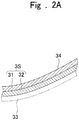
- the upper 3 has an at least two layer structure, and includes, as shown in Fig. 2A , a first layer 31 having a sheet shape and a second layer 32 having a sheet shape layered on the first layer 31.
- the upper 3 in the process of the production may be also referred to as an unshaped upper 3A or a shaped upper 3B for identification of separate state.
- the first layer 31 includes first yarns 3f having a heat shrinkability and second yarns 3s having a higher fusion point than that of the first yarns 3f (specifically, the fusion point of a sheath 3f2 in the first yarns 3f made of a core-sheath material shown in Fig. 4A ).
- the second yarns have no heat shrinkability or a lower heat shrinkage rate than that of the first yarns 3f.
- the fusion point of the first yarns 3f is 150 °C and the fusion point of the second yarns 3s is 230 °C (these values are merely examples without limitation thereto).
- the heat shrinkage rate of the first yarns 3f is two times or more the heat shrinkage rate of the second yarns 3s.
- the heat shrinkage rate (the maximum value) of the first yarns 3f is 40% and the heat shrinkage rate (the maximum value) of the second yarns 3s is 10% (these values are merely examples without limitation thereto).
- These heat shrinkage rates respectively are those in the longitudinal direction of the yarns 3f, 3s.
- the ratio of the heat shrinkage rate of the first yarns 3f to the heat shrinkage rate of the second yarns 3s can be appropriately set to be two times or more, so that the upper 3 can be easily shaped by heating.
- the first layer 31 is made of knitted fabric 3k that is formed by knitting yarns with certain gaps 3k1 opening through a surface (an outer surface when it is arranged in the shaped upper 3) (see Fig. 3A and Fig. 3B ).
- the gaps 3k1 are spaces each existing between the rows of fibers composed of, for example, the yarns 3f, 3s that form the knitted fabric 3k having a mesh structure.
- the gaps 3k1 are spaces each extending through in the normal direction of the plane in which the knitted fabric extends, or spaces in bottomed recesses having opening in the normal direction.
- the openings of the mesh in the surface of the knitted fabric 3k sometimes appear like windows.
- the shape of the opening is, for example, a circle shape, an oval shape, an elliptical shape, a square shape with rounded corners, or a rhombus shape (see Fig. 1 and Fig. 3A ).
- the second layer 32 may be made of knitted fabric having no gaps, but preferably made of knitted fabric 3k having gaps 3k1 in the same manner as the first layer 31.
- the knitting method of the knitted fabric is not specifically limited, but may be raschel knitting or tricot knitting, for example.
- the knitting method of the knitted fabric in this embodiment is double raschel knitting.
- Fig. 3A is a plan view of the knitted fabric 3k in a flat state.
- the knitted fabric 3k has a cross-sectional shape as schematically shown in Fig. 3B , through which the gaps 3k1 extend in the thickness direction.
- At least the first layer 31 is made of the knitted fabric 3k having gaps 3k1 to thereby provide spaces, which can impart breathability and flexibility to the upper 3.
- the gaps 3k1 serve as margins to shrink when the upper 3 is shaped by heating, and therefore margins to shrink are reliably provided in the upper 3 (the unshaped upper 3A).
- the layer (the first layer 31 in this embodiment) including the first yarns 3f having a heat shrinkability the layer (the first layer 31) including the first yarns 3f and the second yarns 3s is easily deformed when the upper 3 is shaped by heating.
- the upper 3 can be easily conformed to the shape of the last 4.
- the first layer 31 has a higher heat shrinkage rate in the width direction Y (see Fig.1 ) of the upper 3 than in the longitudinal direction X (see Fig.1 ).
- the "heat shrinkage rate" is evaluated by the average value in the direction X and the average value in the direction Y, of the entirety of the first layer 31.
- the longitudinal direction X is a direction in which a virtual line connecting an extreme toe end of the upper 3 and an extreme heel end extends.
- the width direction Y is a horizontal direction and is a direction orthogonal to the longitudinal direction X.
- the dimension of the gaps 3k1 included in the knitted fabric 3k that forms the first layer 31 is longer in the longitudinal direction X of the upper 3 than in the width direction Y of the upper 3 as shown in Fig. 1 .
- This dimensional relationship is caused because the yarns 3f (see Fig. 4A to Fig. 4D ) having a heat shrinkability are arranged substantially along the width direction Y (see Fig. 1 ) of the upper 3, which will be later described, then the upper is shaped by heating, and at the time of heating, the areas around the gaps 3K1 shrink more largely in the width direction Y than the longitudinal direction X.
- the second layer 32 of this embodiment includes only the second yarns 3s.
- the second layer 32 is arranged inside the first layer 31 (on the side close to the foot of the wearer during the wearing, and on the lower side in Fig. 2A ) when these layers are arranged in the upper 3. That is, the first layer 31 is an outer layer and the second layer 32 is an inner layer.
- the second layer 32 including only the second yarns 3s is located inside the upper 3, which gives a good touch feeling to the foot of the wearer of the shoe.
- the first layer 31 or the second layer 32 may include the first yarns 3f and the second yarns 3s as the yarns for forming the knitted fabric.
- the first layer 31 includes both yarns to meet this condition.
- only the second layer 32 may include both yarns (that is, the case where the first layer 31 includes only the second yarns 3s, while the second layer 32 includes the first layer 3f and the second layer 3s) to meet this condition.
- both of the first layer 31 and the second layer 32 may include both yarns to meet the condition.
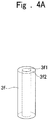
- the first yarns 3f having a heat shrinkability included in the first layer 31 may be made of a core-sheath material that is formed by integrating a core 3f1 (inner circumference part) with a sheath 3f2 (outer circumference part) as schematically shown in Fig. 4A .
- the second yarns 3s are not made of the core-sheath material.
- the first yarns 3f are fusible yarns that are fused together by heating, and the core 3f1 and the sheath 3f2 have different fusion points.
- the sheath 3f2 has a lower fusion point than that of the core 3f1 in the first yarns 3f.
- first yarns 3f having a heat shrinkability
- yarns including polyester resin can be used.
- a core-sheath material including the core 3f1 and the sheath 3f2 both made of polyester thermoplastic elastomer, or a core-sheath material including the core 3f1 made of polyester thermoplastic elastomer and the sheath 3f2 made of polyamide thermoplastic elastomer can be used.
- the layer (the first layer 31 in this embodiment) including the first yarns 3f having a heat shrinkability can be formed of knitted fabric, 10 % or more of which is composed of the first yarns 3f.
- Fig. 4A to Fig. 4D schematically show a structure where the first yarns 3f and the second yarns 3f extend orthogonal to each other.
- the first yarns 3f extending in the horizontal direction of the drawing sheet are shrinked in the longitudinal direction as shown in Fig. 4C by heating the first layer 31.
- the shrinkage in the direction represented by the arrows changes the distance between the adjacent second yarns 3s, 3s extending in the longitudinal direction of the drawing sheet to thereby shorten the distance therebetween.
- the sheaths 3f2 of the first yarns 3f made of the core-sheath material are fused and fixedly attached to the second yarns 3s (at fixing points 3b shown as black circles in Fig. 4D ).
- the first layer 31 is thus deformed.
- the upper 3 can be appropriately shaped to have a desired shape, specifically, to conform to the shape of the last (shoe last) 4.
- the upper 3 can be easily conformed to the shape of the last 4, the upper 3 is not given such a shape as to cause a gap relative to the surface of the last on the lateral side of the foot.
- the foot of the wearer is less likely to move during the wearing of the shoe and thereby the upper 3 provides excellent holding properties. Further, there is no need to fill the caused gap with stuffing or fitting, and thus the feeling of wearing is good.
- the upper 3 can be formed into a three layer structure further including a third layer 33 arranged inside the second layer 32, as shown by dashed-two dotted lines in Fig. 2A .
- the third layer 33 can be formed of knitted fabric in the same manner as the first layer 31 and the second layer 32, or made of woven fabric.
- the weaving method for the woven fabric is not specifically limited, but may be plain-weaving or twill-weaving, for example.
- the third layer 33 preferably has a high shrinkability to exhibit larger shrinkage rate than the first layer 31 and the second layer 32.
- the "shrinkage rate" is evaluated by the average values in the respective directions (for example, the average value in the direction X and the average value in the direction Y) of the entirety of each of the layers.
- high shrinkability can be imparted by making the fabric using spandex fiber, crimped textured yarn, stockinet stitch, neoprene material, or the like. According to this configuration, even after the first layer 31 and the second layer 32 are shrinked when the upper 3 is shaped by heating, the third layer 33 is hardly wrinkled because the third layer 33 follows the shrinkage due to the high shrinkability, so that the touch feeling of the foot of the wearer of the shoe can be improved.
- the third layer 33 When the third layer 33 is thus provided, desired characteristics can be imparted to the produced shoe 1 by setting the material and the layer thickness of the third layer 33.
- the third layer 33 can be entirely or partly provided on the second layer 32. In the case where the third layer 33 is partly provided, the third layer 33 can be used, for example, to reinforce a peripheral edge of a wearing opening 11 through which the wearer places the foot into and out of the shoe, or to reinforce a part for installing an eyelet.
- the reinforcement is not limited to the upper 3 having a three layer structure with the third layer 33 arranged therein as described above, and may be applied to the upper 3 having a two layer structure composed of the first layer 31 and the second layer 32.
- the upper 3 can include a body portion 34 located on the upper side in the vertical direction Z (see Fig. 1 ) after the unshaped upper 3A is sewn, and a bottom portion 35 continuous with the lower end of the body portion 34.
- the upper 3 can include only the body portion 34, while not including the bottom portion 35. Further, the bottom portion 35 that has been made can be removed later (separated from the body portion 34) as described later.
- the body portion can include a layer including the first yarns 3f and the second yarns 3s on at least an instep region of a forefoot portion.
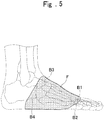
- the "forefoot portion” is intended to be a portion of the human foot anatomy as encircled in Fig. 5 , that is, an area from the proximal phalanx B1 of the fingers (the middle phalanx B2 for the fifth finger) to the anterior parts of the talus B3 and the calcaneus B4, and corresponding to the aforementioned area of the wearer's foot anatomy in the body portion 34 of the upper 3 during the wearing.
- the "instep region” is a region of the forefoot portion F in contact with the instep of the wearer, and is located on the upper side of the portion encircled in Fig. 5 .
- the forefoot portion F is an important portion because it has great influence on the feeling of wearing or the athletic performance of the wearer during the wearing. Therefore, a great effect corresponding to the aforementioned influence can be obtained by reliably conforming the shape of the instep region of the forefoot portion F to the last 4.
- the body portion 34 may have a multilayer structure (a two layer structure (shown by solid lines) or a three layer structure (additionally shown in dashed two doted lines) in this embodiment) including both of the first yarns 3f and the second yarns 3s as shown in Fig. 2A
- the bottom portion 35 may have a single layer structure of only the second layer 32 without providing a layer including both of the first yarns 3f and the second yarns 3s as shown in Fig. 2B . That is, the bottom portion 35 may not include the first yarns 3f having a heat shrinkability.
- This configuration enables the bottom portion 35 to be hardly deformed when the upper 3 is shaped by heating. By configuring the bottom portion 35 to be hardly deformed, the bottom portion 35 can be easily adjusted in position relative to the sole 2. Thus, the sole 2 and the upper 3 can be reliably adhered to each other with accurate positioning therebetween.
- the bottom portion 35 may include the first layer 31.
- an additional layer may be further provided inside the first layer 31 (a layer similar to the third layer 33 of the body portion 34 shown in Fig. 2A ). This configuration enables the additional layer to suppress the deformation when the upper 3 is shaped by heating. Thus, the bottom portion 35 is hardly deformed.
- This production method mainly includes a cutting step, a joining step, a first shaping step, a second shaping step, and a sole attaching step. In addition to the above, further steps can be appropriately added.
- the first layer 31 and the second layer 32 each having a sheet shape are cut into certain sizes and shapes to have the shapes as shown in Fig. 6 in which the body portion 34 and the bottom portion 35 are developed.
- the first layer 31 and the second layer 32 are layered and joined together, for example, by sewing at least the outer edges of the layers 31, 32 to make an unshaped upper 3A having a shape corresponding to the upper 3 (see Fig. 7 ).
- the order of the cutting step and the joining step is not limited to this and may be reversed.
- the unshaped upper 3A may be made by integrally knitting or weaving the first layer 31 and the second layer 32.
- the first layer 31 and the second layer 32 may be integrally knitted, while gaps are provided therebetween.
- the joining step i.e., the step of making the layers 31, 32 also serves as the joining step
- the joining step is performed prior to the cutting step. Further, in this case, not only the outer edges but also the entirety of the layers 31, 32 are joined.
- a cushion material or a reinforcement material may be appropriately inserted between the first layer 31 and the second layer 32.
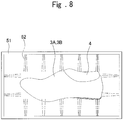
- the unshaped upper 3A is placed on the last 4 (see Fig. 8 ).
- the second shaping step the unshaped upper 3Ais deformed to conform to the shape of the last 4 by heating from a peripheral area of the unshaped upper 3A, to make a shaped upper 3B (see Fig. 1 ).
- the heating temperature and the heating time in the second shaping step can be appropriately set in accordance with the configuration of the unshaped upper 3A.
- the heating means used in the second shaping step is steam heating.
- the unshaped upper 3A is stored in a heating box 51 and heated by vapor 52 at a high temperature discharged from an inner surface of the heating box 51.
- the entirety of the unshaped upper 3A can be evenly heated by steam heating.
- the unshaped upper 3A can be uniformly deformed to conform to the last 4 to obtain the shaped upper 3B.
- Other than the steam heating for example, hot air heating or hot water heating can be employed in the second shaping step.
- the unshaped upper 3A can be partly heated instead of being heated entirely.
- the sole attaching step the shaped upper 3B is attached to the sole 2 that has been made separately, for example, by adhesion. Other than adhesion, the sole attaching step can be performed simultaneously with the second shaping step by heat fusion, for example.
- the shoe 1 is produced by taking a series of the aforementioned steps. Forming a shoe tongue, processing the wearing opening 11, installing eyelets for putting a shoelace (shoestring) therethrough, decorating with ornaments or tags, printing a logo, or attaching an insole (sockliner) may be appropriately performed during any of these steps or after all the steps have been finished.
- the unshaped upper 3A has a mesh structure formed of the knitted fabric that is included in each of the first layer 31 and the second layer 32, and one of the first layer 31 and the second layer 32, which includes both of the first yarns 3f and the second yarns 3s, has a gap ratio greater than the other layer (the layer that does not include both of the first yarns 3f and the second yarns 3s).
- the "gap ratio" means a ratio of the area of gaps (openings) to the area of knitted fabric when the knitted fabric of the layers 31, 32 are viewed in plan view.
- the layer including the first yarns 3f and the second yarns 3s to have a gap ratio greater than the other layer, shrinkage of the unshaped upper 3A when the upper 3 is shaped by heating is hardly blocked, and the shaped upper 3B can be appropriately made in the second shaping step.
- the bottom portion 35 can avoid application of heat in the second shaping step.
- a jig such as a shield having heat insulating properties, or the last 4 having heat insulating properties on its bottom surface can be used so that the heat reaching the bottom portion 35 can be reduced.
- the bottom portion 35 is hardly deformed when it is heated. Therefore, the bottom portion 35 can be precisely adhered to the sole 2 in the adhering step.
- a bottom portion removing step for removing the bottom portion 35 by applying the heat to the bottom portion 35 in the second shaping step can be included after the second shaping step.
- the bottom portion removing step the bottom portion 35 having a shape as shown in the right side of Fig. 6 is removed from the body portion 34 to form a through hole (not shown) on the lower side of the shaped upper 3B.
- the edge of the through hole of the shaped upper 3B subjected to the bottom portion removing step is attached to the sole 2.
- the unshaped upper 3A is reliably conformed to the shape of the last 4 in the second shaping step, and thereafter the bottom portion 35, which is likely to be hardened by heat shrinking when it is adhered to the sole 2, is removed from the shaped upper 3B.
- the shoe 1 including the sole 2 having an appropriate hardness can be produced with the sole 2 subjected to no influence from the heated bottom portion 35.
- the bottom portion 35 may be hardened when the adhesive agent is applied to the bottom portion 35.
- the bottom portion removing step may be performed even when the heat is not applied to the bottom portion 35.
- the upper 3 is easily conformed to the shape of the last 4 when the upper 3 is shaped in the second shaping step.
- the shoe 1 that is conformed to the shape of the last 4 can be produced.
- the shoe of this embodiment includes an upper that includes: a first layer made of knitted fabric; and a second layer made of knitted fabric arranged inside the first layer, wherein at least one of the first layer and the second layer includes first yarns and second yarns as yarns for forming the knitted fabric, wherein the first yarns have a heat shrinkability, wherein the second yarns have a higher fusion point than that of the first yarns, and wherein the at least one of the first layer and the second layer including the first yarns and the second yarns has a higher heat shrinkage rate in a width direction than in a longitudinal direction.
- the layer including the first yarns having a heat shrinkability by providing the layer including the first yarns having a heat shrinkability, the layer including the first yarns and the second yarns is easily deformed when the upper is shaped by heating, so that the upper is easily conformed to the shape of the last.
- the first layer includes the first yarns and the second yarns
- the second layer includes only the second yarns
- the heat shrinkage rate of the first yarns is two times or more the heat shrinkage rate of the second yarns.
- the ratio of the heat shrinkage rate of the first yarns to the heat shrinkage rate of the second yarns can be appropriately set, which enables to easily mold the upper by heating. Further, the second layer including only the second yarns is located inside the upper, which gives a good touch feeling to the foot of the wearer of the shoe.
- the first layer includes only the second yarns
- the second layer includes the first yarns and the second yarns
- the heat shrinkage rate of the first yarns is two times or more the heat shrinkage rate of the second yarns.
- the ratio of the heat shrinkage rate of the first yarns to the heat shrinkage rate of the second yarns can be appropriately set, which enables to easily mold the upper by heating. Further, the second layer including the first yarns is located inside the upper, so that the upper is more easily conformed to the last when the upper is placed on the last.
- the knitted fabric that forms at least the first layer includes certain gaps opening through its surface, and a size of the gaps is longer in the longitudinal direction of the upper than in the width direction of the upper.
- the thus provided gaps can impart breathability and flexibility to the upper. Further, margins to shrink when the upper is shaped by heating are reliably provided in the upper.
- the upper includes a third layer arranged inside the second layer, wherein the third layer has a higher shrinkability than the first layer and the second layer.
- the third layer is hardly wrinkled even after the upper is shaped by heating, so that an improved touch feeling can be given to the foot of the wearer of the shoe.
- the upper includes a body portion located on an upper side and a bottom portion continuous with a lower end of the body portion, and the body portion includes a layer including the first yarns and the second yarns in at least an instep region of a forefoot portion.
- the moldability of the instep region of the upper can be improved.
- the upper includes a body portion located on an upper side and a bottom portion continuous with a lower end of the body portion, the body portion includes a layer including the first yarns and the second yarns in at least a part thereof, and the bottom portion does not include a layer including the first yarns and the second yarns.
- the bottom portion is hardly deformed when the upper is shaped by heating.
- the first yarns may be made of a core-sheath material.
- both of the shape retaining action by a sheath portion and the elastic action by a core portion can be simultaneously provided.
- the method for producing a shoe of this embodiment is a method for producing a shoe that is the aforementioned shoe including: a joining step of joining the first layer and the second layer at least along outer edges of the first layer and the second layer to make an unshaped upper; a first shaping step of placing the unshaped upper on a last; and a second shaping step of heating the unshaped upper to make it conform to a shape of the last to thereby provide the shaped upper.
- a heating means used in the second shaping step may be steam heating.
- the entirety of the unshaped upper can be evenly heated.
- the unshaped upper has a mesh structure formed of the knitted fabric included in the first layer and the second layer, and, and a gap ratio of one of the first layer and the second layer including the first yarns and the second yarns is greater than a gap ratio of the other layer.
- the layer including the first yarns 3f and the second yarns 3s is configured to have a gap ratio greater than the other layer, so that the shrinkage of the unshaped upper when the upper is shaped by heating is hardly blocked and the shaped upper can be appropriately made in the second shaping step.
- the unshaped upper includes a body portion located on an upper side and a bottom portion continuous with a lower end of the body portion, the method including a bottom portion removing step of removing the bottom portion after the second shaping step.
- the unshaped upper is conformed to the shape of the last in the second shaping step, and thereafter the bottom portion, which is likely to be hardened by heating when it is adhered to the sole, is removed from the shaped upper.
- the shoe including the sole having an appropriate hardness can be produced.
- the upper is easily conformed to the shape of the last when the upper is shaped by heating. Therefore, it is possible to provide a shoe including an upper that is easily conformed to the shape of a last when it is shaped, and a method for producing the shoe.
- the present invention is described above by way of embodiments, but the foregoing description is merely an example.
- the shoe 1 and the method for producing the shoe 1 according to the present invention are not limited to the aforementioned embodiments.
- the shoe 1 and the method for producing the shoe 1 according to the present invention can be subjected to various modifications within the gist of the present invention. Such modifications include, for example, replacement of a part or omission of a part of a plurality of elements constituting the aforementioned embodiments, or appropriate combination of elements belonging to the separate examples. Further, the matters belonging to the common technical knowledge in relation to the shoe 1 or the method for producing the shoe 1 are also included.
Landscapes
- Engineering & Computer Science (AREA)
- Chemical & Material Sciences (AREA)
- Materials Engineering (AREA)
- Textile Engineering (AREA)
- Health & Medical Sciences (AREA)
- Epidemiology (AREA)
- General Health & Medical Sciences (AREA)
- Public Health (AREA)
- Footwear And Its Accessory, Manufacturing Method And Apparatuses (AREA)
- Knitting Of Fabric (AREA)
Abstract
Description
- The present invention relates to a shoe including a fabric upper, and a method for producing the shoe.
- When a shoe is produced, a last (shoe last), on which fabric for forming an upper is placed, is used to, for example, form the upper into a certain shape.
-
- Patent Literature 1:
US 2017/325546 A - Patent Literature 2:
US 2018/125165 A - Patent Literature 3:
WO 2017/115806 A - Patent Literature 4:
WO 2013/108506 A - When an upper is shaped, it is important to conform the upper to a shape of a last. Specifically, in the case where the last has a shape taken from the shape of a foot of an ordering person, conforming the upper to the shape of the last is important in making the last well conform to the shape of the foot of the ordering person and thereby applying such a last for customization. For the last for mass produced shoes, conforming the upper to the shape of the last is important in eliminating variation in shape of the mass produced shoes. Regarding these important aspects, for example, if the upper is shaped with a gap relative to the surface of the last on a lateral side of the foot, the shoe would lack the ability of holding the foot of the wearer since the foot moves toward the lateral side during the wearing of the shoe. The thus caused gap may be filled with stuffing or the like, but the feeling of wearing may be deteriorated.
-
US 2017/325546 A discloses an upper that expands in a molding die.US 2018/125165 A discloses thermoforming for fabric.WO 2017/115806 A discloses a shoe upper material using a fiber sheet having a heat shrinkability.WO 2013/108506 discloses a knitted fabric using heat fusible yarns and being excellent in shape retention ability. - An object of the present invention is to provide a shoe including an upper that is easily conformed to a shape of a last when the upper is shaped, and a method for producing the shoe.
- A shoe including: an upper that includes a first layer made of knitted fabric and a second layer made of knitted fabric arranged inside the first layer, wherein at least one of the first layer and the second layer includes first yarns and second yarns as yarns for forming the knitted fabric, wherein the first yarns have a heat shrinkability, wherein the second yarns have a higher fusion point than that of the first yarns, and wherein the at least one of the first layer and the second layer including the first yarns and the second yarns has a higher heat shrinkage rate in a width direction than in a longitudinal direction.
- A method for producing a shoe that is the shoe according to
claim 1, the method including: a joining step of joining the first layer and the second layer at least along outer edges of the first layer and the second layer to make an unshaped upper; a first shaping step of placing the unshaped upper on a last; and a second shaping step of heating the unshaped upper to make it conform to a shape of the last to thereby provide the shaped upper. -
-
Fig. 1 is an exploded perspective view of a sole and an upper of a shoe according to one embodiment of the present invention. -
Fig. 2A is a cross-sectional view showing an example of a layer structure of a body portion of the upper in a portion surrounded by circle A inFig. 1 . -
Fig. 2B is a cross-sectional view showing an example of a layer structure of a bottom portion of the upper in a portion surrounded by circle B inFig. 1 . -
Fig. 3A is a plan view showing an example of double raschel fabric. -
Fig. 3B is a schematic partial enlarged cross-sectional view as viewed from the arrows III-III. -
Fig. 4A is a perspective view schematically showing a structure of a yarn made of a core-sheath material. -
Fig. 4B is a schematic view showing the original state of fabric. -
Fig. 4C is a schematic view showing a state in which first yarns are shurunk from the state ofFig. 4B . -
Fig. 4D is a schematic view showing a state in which the first yarns and second yarns are fused with each other from the state ofFig. 4C . -
Fig. 5 is a side view showing a relationship between a forefoot part (shown by solid lines) and a structure of human foot anatomy (shown by two-dot chain lines). -
Fig. 6 is a plan view showing the body portion (opening areas are not shown) and the bottom portion which are materials of the upper in a state after a cutting process. -
Fig. 7 is a side view showing an unshaped upper with the body portion (opening areas are not shown) and the bottom portion sewn together. -
Fig. 8 is a side view showing a state in which the unshaped upper (opening areas are not shown) is placed on a last and steam heated in a heating box. - The present invention will be described by way of embodiments with reference to the drawings. Each of the right and
left shoes 1 of this embodiment mainly includes a sole 2 and an upper 3, and the upper 3 is attached to the sole 2 as shown inFig. 1 . The upper 3 has an at least two layer structure, and includes, as shown inFig. 2A , afirst layer 31 having a sheet shape and asecond layer 32 having a sheet shape layered on thefirst layer 31. The upper 3 in the process of the production (before or after the upper 3 is given a shape) may be also referred to as an unshaped upper 3A or a shaped upper 3B for identification of separate state. - The
first layer 31 includesfirst yarns 3f having a heat shrinkability andsecond yarns 3s having a higher fusion point than that of thefirst yarns 3f (specifically, the fusion point of a sheath 3f2 in thefirst yarns 3f made of a core-sheath material shown inFig. 4A ). The second yarns have no heat shrinkability or a lower heat shrinkage rate than that of thefirst yarns 3f. In this embodiment, the fusion point of thefirst yarns 3f is 150 °C and the fusion point of thesecond yarns 3s is 230 °C (these values are merely examples without limitation thereto). Regarding the heat shrinkability of each of theyarns first yarns 3f is two times or more the heat shrinkage rate of thesecond yarns 3s. In this embodiment, the heat shrinkage rate (the maximum value) of thefirst yarns 3f is 40% and the heat shrinkage rate (the maximum value) of thesecond yarns 3s is 10% (these values are merely examples without limitation thereto). These heat shrinkage rates respectively are those in the longitudinal direction of theyarns first yarns 3f to the heat shrinkage rate of thesecond yarns 3s can be appropriately set to be two times or more, so that the upper 3 can be easily shaped by heating. - The
first layer 31 is made of knittedfabric 3k that is formed by knitting yarns with certain gaps 3k1 opening through a surface (an outer surface when it is arranged in the shaped upper 3) (seeFig. 3A andFig. 3B ). The gaps 3k1 are spaces each existing between the rows of fibers composed of, for example, theyarns fabric 3k having a mesh structure. Also, the gaps 3k1 are spaces each extending through in the normal direction of the plane in which the knitted fabric extends, or spaces in bottomed recesses having opening in the normal direction. In the gaps 3k1, the openings of the mesh in the surface of the knittedfabric 3k sometimes appear like windows. The shape of the opening is, for example, a circle shape, an oval shape, an elliptical shape, a square shape with rounded corners, or a rhombus shape (seeFig. 1 andFig. 3A ). - On the other hand, the
second layer 32 may be made of knitted fabric having no gaps, but preferably made ofknitted fabric 3k having gaps 3k1 in the same manner as thefirst layer 31. The knitting method of the knitted fabric is not specifically limited, but may be raschel knitting or tricot knitting, for example. The knitting method of the knitted fabric in this embodiment is double raschel knitting.Fig. 3A is a plan view of the knittedfabric 3k in a flat state. Theknitted fabric 3k has a cross-sectional shape as schematically shown inFig. 3B , through which the gaps 3k1 extend in the thickness direction. At least thefirst layer 31 is made of the knittedfabric 3k having gaps 3k1 to thereby provide spaces, which can impart breathability and flexibility to the upper 3. Further, the gaps 3k1 serve as margins to shrink when the upper 3 is shaped by heating, and therefore margins to shrink are reliably provided in the upper 3 (the unshaped upper 3A). By thus providing a layer (thefirst layer 31 in this embodiment) including thefirst yarns 3f having a heat shrinkability, the layer (the first layer 31) including thefirst yarns 3f and thesecond yarns 3s is easily deformed when the upper 3 is shaped by heating. Thus, the upper 3 can be easily conformed to the shape of the last 4. - The
first layer 31 has a higher heat shrinkage rate in the width direction Y (seeFig.1 ) of the upper 3 than in the longitudinal direction X (seeFig.1 ). Here, the "heat shrinkage rate" is evaluated by the average value in the direction X and the average value in the direction Y, of the entirety of thefirst layer 31. The longitudinal direction X is a direction in which a virtual line connecting an extreme toe end of the upper 3 and an extreme heel end extends. The width direction Y is a horizontal direction and is a direction orthogonal to the longitudinal direction X. The dimension of the gaps 3k1 included in theknitted fabric 3k that forms thefirst layer 31 is longer in the longitudinal direction X of the upper 3 than in the width direction Y of the upper 3 as shown inFig. 1 . This dimensional relationship is caused because theyarns 3f (seeFig. 4A to Fig. 4D ) having a heat shrinkability are arranged substantially along the width direction Y (seeFig. 1 ) of the upper 3, which will be later described, then the upper is shaped by heating, and at the time of heating, the areas around the gaps 3K1 shrink more largely in the width direction Y than the longitudinal direction X. - The
second layer 32 of this embodiment includes only thesecond yarns 3s. Thesecond layer 32 is arranged inside the first layer 31 (on the side close to the foot of the wearer during the wearing, and on the lower side inFig. 2A ) when these layers are arranged in the upper 3. That is, thefirst layer 31 is an outer layer and thesecond layer 32 is an inner layer. Thesecond layer 32 including only thesecond yarns 3s is located inside the upper 3, which gives a good touch feeling to the foot of the wearer of the shoe. - Here, at least either the
first layer 31 or thesecond layer 32 may include thefirst yarns 3f and thesecond yarns 3s as the yarns for forming the knitted fabric. In this embodiment, thefirst layer 31 includes both yarns to meet this condition. Contrarily, only thesecond layer 32 may include both yarns (that is, the case where thefirst layer 31 includes only thesecond yarns 3s, while thesecond layer 32 includes thefirst layer 3f and thesecond layer 3s) to meet this condition. In this case, since thesecond layer 32 including thefirst yarns 3f having a heat shrinkability is located on the inner side of the upper 3, the upper 3 can be more easily conformed to the last 4 and shaped by heating when it is placed on the last 4 than the configuration in which a layer including thefirst yarns 3f is located on the outer side of the upper 3. Further, both of thefirst layer 31 and thesecond layer 32 may include both yarns to meet the condition. - In this embodiment, the
first yarns 3f having a heat shrinkability included in thefirst layer 31 may be made of a core-sheath material that is formed by integrating a core 3f1 (inner circumference part) with a sheath 3f2 (outer circumference part) as schematically shown inFig. 4A . On the other hand, thesecond yarns 3s are not made of the core-sheath material. Thefirst yarns 3f are fusible yarns that are fused together by heating, and the core 3f1 and the sheath 3f2 have different fusion points. The sheath 3f2 has a lower fusion point than that of the core 3f1 in thefirst yarns 3f. Thus, it is possible to shrink the entirety of thefirst yarns 3f, while fusing only the sheaths 3f2 therein, by heating the unshaped upper 3A when the upper 3 is shaped. Thereby, both of the shape retaining action by the sheath 3f2 and the elastic action by the core 3f1 can be simultaneously provided. As thefirst yarns 3f having a heat shrinkability, for example, yarns including polyester resin can be used. More specifically, a core-sheath material including the core 3f1 and the sheath 3f2 both made of polyester thermoplastic elastomer, or a core-sheath material including the core 3f1 made of polyester thermoplastic elastomer and the sheath 3f2 made of polyamide thermoplastic elastomer can be used. - The layer (the
first layer 31 in this embodiment) including thefirst yarns 3f having a heat shrinkability can be formed of knitted fabric, 10 % or more of which is composed of thefirst yarns 3f.Fig. 4A to Fig. 4D schematically show a structure where thefirst yarns 3f and thesecond yarns 3f extend orthogonal to each other. In this schematically illustrated structure, thefirst yarns 3f extending in the horizontal direction of the drawing sheet are shrinked in the longitudinal direction as shown inFig. 4C by heating thefirst layer 31. At this time, the shrinkage in the direction represented by the arrows changes the distance between the adjacentsecond yarns first yarns 3f made of the core-sheath material are fused and fixedly attached to thesecond yarns 3s (at fixingpoints 3b shown as black circles inFig. 4D ). Thefirst layer 31 is thus deformed. By utilizing this deformation, the upper 3 can be appropriately shaped to have a desired shape, specifically, to conform to the shape of the last (shoe last) 4. - Because the upper 3 can be easily conformed to the shape of the last 4, the upper 3 is not given such a shape as to cause a gap relative to the surface of the last on the lateral side of the foot. Thus, the foot of the wearer is less likely to move during the wearing of the shoe and thereby the upper 3 provides excellent holding properties. Further, there is no need to fill the caused gap with stuffing or fitting, and thus the feeling of wearing is good.
- Also, the upper 3 can be formed into a three layer structure further including a
third layer 33 arranged inside thesecond layer 32, as shown by dashed-two dotted lines inFig. 2A . Thethird layer 33 can be formed of knitted fabric in the same manner as thefirst layer 31 and thesecond layer 32, or made of woven fabric. The weaving method for the woven fabric is not specifically limited, but may be plain-weaving or twill-weaving, for example. Thethird layer 33 preferably has a high shrinkability to exhibit larger shrinkage rate than thefirst layer 31 and thesecond layer 32. Here, the "shrinkage rate" is evaluated by the average values in the respective directions (for example, the average value in the direction X and the average value in the direction Y) of the entirety of each of the layers. As an example, high shrinkability can be imparted by making the fabric using spandex fiber, crimped textured yarn, stockinet stitch, neoprene material, or the like. According to this configuration, even after thefirst layer 31 and thesecond layer 32 are shrinked when the upper 3 is shaped by heating, thethird layer 33 is hardly wrinkled because thethird layer 33 follows the shrinkage due to the high shrinkability, so that the touch feeling of the foot of the wearer of the shoe can be improved. When thethird layer 33 is thus provided, desired characteristics can be imparted to the producedshoe 1 by setting the material and the layer thickness of thethird layer 33. Thethird layer 33 can be entirely or partly provided on thesecond layer 32. In the case where thethird layer 33 is partly provided, thethird layer 33 can be used, for example, to reinforce a peripheral edge of a wearingopening 11 through which the wearer places the foot into and out of the shoe, or to reinforce a part for installing an eyelet. - As the method for the reinforcement, sewing, needle punching, or hot melt sheet can be employed. The reinforcement is not limited to the upper 3 having a three layer structure with the
third layer 33 arranged therein as described above, and may be applied to the upper 3 having a two layer structure composed of thefirst layer 31 and thesecond layer 32. - The upper 3 can include a
body portion 34 located on the upper side in the vertical direction Z (seeFig. 1 ) after the unshaped upper 3A is sewn, and abottom portion 35 continuous with the lower end of thebody portion 34. The upper 3 can include only thebody portion 34, while not including thebottom portion 35. Further, thebottom portion 35 that has been made can be removed later (separated from the body portion 34) as described later. - The body portion can include a layer including the
first yarns 3f and thesecond yarns 3s on at least an instep region of a forefoot portion. According to this configuration, the moldability of the instep region of the upper 3 can be improved. Herein, the "forefoot portion" is intended to be a portion of the human foot anatomy as encircled inFig. 5 , that is, an area from the proximal phalanx B1 of the fingers (the middle phalanx B2 for the fifth finger) to the anterior parts of the talus B3 and the calcaneus B4, and corresponding to the aforementioned area of the wearer's foot anatomy in thebody portion 34 of the upper 3 during the wearing. The "instep region" is a region of the forefoot portion F in contact with the instep of the wearer, and is located on the upper side of the portion encircled inFig. 5 . The forefoot portion F is an important portion because it has great influence on the feeling of wearing or the athletic performance of the wearer during the wearing. Therefore, a great effect corresponding to the aforementioned influence can be obtained by reliably conforming the shape of the instep region of the forefoot portion F to the last 4. - When the upper 3 includes the
bottom portion 35, at least a part of thebody portion 34 may have a multilayer structure (a two layer structure (shown by solid lines) or a three layer structure (additionally shown in dashed two doted lines) in this embodiment) including both of thefirst yarns 3f and thesecond yarns 3s as shown inFig. 2A , while thebottom portion 35 may have a single layer structure of only thesecond layer 32 without providing a layer including both of thefirst yarns 3f and thesecond yarns 3s as shown inFig. 2B . That is, thebottom portion 35 may not include thefirst yarns 3f having a heat shrinkability. This configuration enables thebottom portion 35 to be hardly deformed when the upper 3 is shaped by heating. By configuring thebottom portion 35 to be hardly deformed, thebottom portion 35 can be easily adjusted in position relative to the sole 2. Thus, the sole 2 and the upper 3 can be reliably adhered to each other with accurate positioning therebetween. - Contrary to the above, the
bottom portion 35 may include thefirst layer 31. In this case, an additional layer may be further provided inside the first layer 31 (a layer similar to thethird layer 33 of thebody portion 34 shown inFig. 2A ). This configuration enables the additional layer to suppress the deformation when the upper 3 is shaped by heating. Thus, thebottom portion 35 is hardly deformed. - Next, the description will be made for a method for producing the
shoe 1 provided with the upper 3 including thefirst layer 31 and thesecond layer 32 layered on thefirst layer 31. This production method mainly includes a cutting step, a joining step, a first shaping step, a second shaping step, and a sole attaching step. In addition to the above, further steps can be appropriately added. - In the cutting step, the
first layer 31 and thesecond layer 32 each having a sheet shape are cut into certain sizes and shapes to have the shapes as shown inFig. 6 in which thebody portion 34 and thebottom portion 35 are developed. In the joining step, thefirst layer 31 and thesecond layer 32 are layered and joined together, for example, by sewing at least the outer edges of thelayers Fig. 7 ). The order of the cutting step and the joining step is not limited to this and may be reversed. For example, the unshaped upper 3A may be made by integrally knitting or weaving thefirst layer 31 and thesecond layer 32. Thefirst layer 31 and thesecond layer 32 may be integrally knitted, while gaps are provided therebetween. In this case, the joining step (i.e., the step of making thelayers layers first layer 31 and thesecond layer 32. In the first shaping step, the unshaped upper 3A is placed on the last 4 (seeFig. 8 ). In the second shaping step, the unshaped upper 3Ais deformed to conform to the shape of the last 4 by heating from a peripheral area of the unshaped upper 3A, to make a shaped upper 3B (seeFig. 1 ). The heating temperature and the heating time in the second shaping step can be appropriately set in accordance with the configuration of the unshaped upper 3A. The heating means used in the second shaping step is steam heating. As schematically shown inFig. 8 , for example, the unshaped upper 3A is stored in aheating box 51 and heated byvapor 52 at a high temperature discharged from an inner surface of theheating box 51. The entirety of the unshaped upper 3A can be evenly heated by steam heating. Thus, the unshaped upper 3A can be uniformly deformed to conform to the last 4 to obtain the shaped upper 3B. Other than the steam heating, for example, hot air heating or hot water heating can be employed in the second shaping step. Further, the unshaped upper 3A can be partly heated instead of being heated entirely. In the sole attaching step, the shaped upper 3B is attached to the sole 2 that has been made separately, for example, by adhesion. Other than adhesion, the sole attaching step can be performed simultaneously with the second shaping step by heat fusion, for example. - The
shoe 1 is produced by taking a series of the aforementioned steps. Forming a shoe tongue, processing the wearingopening 11, installing eyelets for putting a shoelace (shoestring) therethrough, decorating with ornaments or tags, printing a logo, or attaching an insole (sockliner) may be appropriately performed during any of these steps or after all the steps have been finished. - The unshaped upper 3A has a mesh structure formed of the knitted fabric that is included in each of the
first layer 31 and thesecond layer 32, and one of thefirst layer 31 and thesecond layer 32, which includes both of thefirst yarns 3f and thesecond yarns 3s, has a gap ratio greater than the other layer (the layer that does not include both of thefirst yarns 3f and thesecond yarns 3s). The "gap ratio" means a ratio of the area of gaps (openings) to the area of knitted fabric when the knitted fabric of thelayers first yarns 3f and thesecond yarns 3s to have a gap ratio greater than the other layer, shrinkage of the unshaped upper 3A when the upper 3 is shaped by heating is hardly blocked, and the shaped upper 3B can be appropriately made in the second shaping step. - When the unshaped upper 3A includes the
body portion 34 located on the upper side and thebottom portion 35 continuous with the lower end of thebody portion 34, thebottom portion 35 can avoid application of heat in the second shaping step. In order not to apply the heat to thebottom portion 35, for example, a jig such as a shield having heat insulating properties, or the last 4 having heat insulating properties on its bottom surface can be used so that the heat reaching thebottom portion 35 can be reduced. Thus, thebottom portion 35 is hardly deformed when it is heated. Therefore, thebottom portion 35 can be precisely adhered to the sole 2 in the adhering step. - Separately from the aforementioned description, when the
body portion 34 located on the upper side and thebottom portion 35 continuous with the lower end of thebody portion 34 are provided, a bottom portion removing step for removing thebottom portion 35 by applying the heat to thebottom portion 35 in the second shaping step can be included after the second shaping step. In the bottom portion removing step, thebottom portion 35 having a shape as shown in the right side ofFig. 6 is removed from thebody portion 34 to form a through hole (not shown) on the lower side of the shaped upper 3B. The edge of the through hole of the shaped upper 3B subjected to the bottom portion removing step is attached to the sole 2. The unshaped upper 3A is reliably conformed to the shape of the last 4 in the second shaping step, and thereafter thebottom portion 35, which is likely to be hardened by heat shrinking when it is adhered to the sole 2, is removed from the shaped upper 3B. Thereby, theshoe 1 including the sole 2 having an appropriate hardness can be produced with the sole 2 subjected to no influence from theheated bottom portion 35. - Even in the case where the heat is not applied to the
bottom portion 35 as described above, thebottom portion 35 may be hardened when the adhesive agent is applied to thebottom portion 35. Thus, the bottom portion removing step may be performed even when the heat is not applied to thebottom portion 35. - According to the production method of this embodiment, the upper 3 is easily conformed to the shape of the last 4 when the upper 3 is shaped in the second shaping step. Thus, the
shoe 1 that is conformed to the shape of the last 4 can be produced. - Hereinafter, configurations according to the embodiment of the present application and effects produced thereby will be summarized. The shoe of this embodiment includes an upper that includes: a first layer made of knitted fabric; and a second layer made of knitted fabric arranged inside the first layer, wherein at least one of the first layer and the second layer includes first yarns and second yarns as yarns for forming the knitted fabric, wherein the first yarns have a heat shrinkability, wherein the second yarns have a higher fusion point than that of the first yarns, and wherein the at least one of the first layer and the second layer including the first yarns and the second yarns has a higher heat shrinkage rate in a width direction than in a longitudinal direction.
- According to this configuration, by providing the layer including the first yarns having a heat shrinkability, the layer including the first yarns and the second yarns is easily deformed when the upper is shaped by heating, so that the upper is easily conformed to the shape of the last.
- It may be configured such that the first layer includes the first yarns and the second yarns, the second layer includes only the second yarns, and the heat shrinkage rate of the first yarns is two times or more the heat shrinkage rate of the second yarns.
- According to this configuration, the ratio of the heat shrinkage rate of the first yarns to the heat shrinkage rate of the second yarns can be appropriately set, which enables to easily mold the upper by heating. Further, the second layer including only the second yarns is located inside the upper, which gives a good touch feeling to the foot of the wearer of the shoe.
- It may be configured such that the first layer includes only the second yarns, the second layer includes the first yarns and the second yarns, and the heat shrinkage rate of the first yarns is two times or more the heat shrinkage rate of the second yarns.
- According to this configuration, the ratio of the heat shrinkage rate of the first yarns to the heat shrinkage rate of the second yarns can be appropriately set, which enables to easily mold the upper by heating. Further, the second layer including the first yarns is located inside the upper, so that the upper is more easily conformed to the last when the upper is placed on the last.
- It may be configured such that the knitted fabric that forms at least the first layer includes certain gaps opening through its surface, and a size of the gaps is longer in the longitudinal direction of the upper than in the width direction of the upper.
- According to this configuration, the thus provided gaps can impart breathability and flexibility to the upper. Further, margins to shrink when the upper is shaped by heating are reliably provided in the upper.
- It may be configured such that the upper includes a third layer arranged inside the second layer, wherein the third layer has a higher shrinkability than the first layer and the second layer.
- According to this configuration, because of the good shrinkability of the third layer, the third layer is hardly wrinkled even after the upper is shaped by heating, so that an improved touch feeling can be given to the foot of the wearer of the shoe.
- It may be configured such that the upper includes a body portion located on an upper side and a bottom portion continuous with a lower end of the body portion, and the body portion includes a layer including the first yarns and the second yarns in at least an instep region of a forefoot portion.
- According to this configuration, the moldability of the instep region of the upper can be improved.
- It may be configured such that the upper includes a body portion located on an upper side and a bottom portion continuous with a lower end of the body portion, the body portion includes a layer including the first yarns and the second yarns in at least a part thereof, and the bottom portion does not include a layer including the first yarns and the second yarns.
- According to this configuration, the bottom portion is hardly deformed when the upper is shaped by heating.
- The first yarns may be made of a core-sheath material.
- According to this configuration, both of the shape retaining action by a sheath portion and the elastic action by a core portion can be simultaneously provided.
- The method for producing a shoe of this embodiment is a method for producing a shoe that is the aforementioned shoe including: a joining step of joining the first layer and the second layer at least along outer edges of the first layer and the second layer to make an unshaped upper; a first shaping step of placing the unshaped upper on a last; and a second shaping step of heating the unshaped upper to make it conform to a shape of the last to thereby provide the shaped upper.
- According to this configuration, a shoe that is conformed to the last can be produced.
- A heating means used in the second shaping step may be steam heating.
- According to this configuration, the entirety of the unshaped upper can be evenly heated.
- It may be also configured such that the unshaped upper has a mesh structure formed of the knitted fabric included in the first layer and the second layer, and, and a gap ratio of one of the first layer and the second layer including the first yarns and the second yarns is greater than a gap ratio of the other layer.
- According to this configuration, the layer including the
first yarns 3f and thesecond yarns 3s is configured to have a gap ratio greater than the other layer, so that the shrinkage of the unshaped upper when the upper is shaped by heating is hardly blocked and the shaped upper can be appropriately made in the second shaping step. - It may be configured such that the unshaped upper includes a body portion located on an upper side and a bottom portion continuous with a lower end of the body portion, the method including a bottom portion removing step of removing the bottom portion after the second shaping step.
- According to this configuration, the unshaped upper is conformed to the shape of the last in the second shaping step, and thereafter the bottom portion, which is likely to be hardened by heating when it is adhered to the sole, is removed from the shaped upper. Thereby, the shoe including the sole having an appropriate hardness can be produced.
- According to this embodiment, the upper is easily conformed to the shape of the last when the upper is shaped by heating. Therefore, it is possible to provide a shoe including an upper that is easily conformed to the shape of a last when it is shaped, and a method for producing the shoe.
- The present invention is described above by way of embodiments, but the foregoing description is merely an example. The
shoe 1 and the method for producing theshoe 1 according to the present invention are not limited to the aforementioned embodiments. Thus, theshoe 1 and the method for producing theshoe 1 according to the present invention can be subjected to various modifications within the gist of the present invention. Such modifications include, for example, replacement of a part or omission of a part of a plurality of elements constituting the aforementioned embodiments, or appropriate combination of elements belonging to the separate examples. Further, the matters belonging to the common technical knowledge in relation to theshoe 1 or the method for producing theshoe 1 are also included. -
- 1: Shoe
- 11: Wearing opening
- 2: Sole
- 3: Upper
- 31: First layer
- 32: Second layer
- 33: Third layer
- 34: Body portion
- 35: Bottom portion
- 3A: Unshaped upper
- 3B: Shaped upper
- 3f: First yarn
- 3f1: Core of core-sheath material
- 3f2: Sheath of core-sheath material
- 3s: Second yarn
- 3b: Fixing point
- 3k: Knitted fabric having gaps
- 3k1: Gap
- 4: Last
- F: Forefoot portion
Claims (12)
- A shoe comprising:an upper that comprises a first layer made of knitted fabric and a second layer made of knitted fabric arranged inside the first layer,wherein at least one of the first layer and the second layer comprises first yarns and second yarns as yarns for forming the knitted fabric,wherein the first yarns have a heat shrinkability,wherein the second yarns have a higher fusion point than that of the first yarns, andwherein the at least one of the first layer and the second layer comprising the first yarns and the second yarns has a higher heat shrinkage rate in a width direction than in a longitudinal direction.
- The shoe according to claim 1,
wherein the first layer comprises the first yarns and the second yarns,
the second layer comprises only the second yarns, and
the heat shrinkage rate of the first yarns is two times or more the heat shrinkage rate of the second yarns. - The shoe according to claim 1,
wherein the first layer comprises only the second yarns,
the second layer comprises the first yarns and the second yarns, and
the heat shrinkage rate of the first yarns is two times or more the heat shrinkage rate of the second yarns. - The shoe according to any one of claims 1 to 3,
wherein the knitted fabric that forms at least the first layer comprises certain gaps opening through its surface, and
a size of the gaps is longer in the longitudinal direction of the upper than in the width direction of the upper. - The shoe according to any one of claims 1 to 4,
wherein the upper comprises a third layer arranged inside the second layer,
wherein the third layer has a higher shrinkability than the first layer and the second layer. - The shoe according to any one of claims 1 to 5,
wherein the upper comprises a body portion located on an upper side and a bottom portion continuous with a lower end of the body portion, and
the body portion comprises a layer comprising the first yarns and the second yarns in at least an instep region of a forefoot portion. - The shoe according to any one of claims 1 to 5,
wherein the upper comprises a body portion located on an upper side and a bottom portion continuous with a lower end of the body portion,
the body portion comprises a layer comprising the first yarns and the second yarns in at least a part thereof, and
the bottom portion does not comprise a layer comprising the first yarns and the second yarns. - The shoe according to any one of claims 1 to 7,
wherein the first yarns are made of a core-sheath material. - A method for producing a shoe that is the shoe according to claim 1, the method comprising:a joining step of joining the first layer and the second layer at least along outer edges of the first layer and the second layer to make an unshaped upper;a first shaping step of placing the unshaped upper on a last; anda second shaping step of heating the unshaped upper to make it conform to a shape of the last to thereby provide the shaped upper.
- The method according to claim 9,
wherein a heating means used in the second shaping step is steam heating. - The method according to claim 9 or 10,
wherein the unshaped upper has a mesh structure formed of the knitted fabric included in the first layer and the second layer, and
a gap ratio of one of the first layer and the second layer comprising the first yarns and the second yarns is greater than a gap ratio of the other layer. - The method according to any one of claims 9 to 11,
wherein the unshaped upper comprises a body portion located on an upper side and a bottom portion continuous with a lower end of the body portion,
the method comprising a bottom portion removing step of removing the bottom portion after the second shaping step.
Applications Claiming Priority (1)
| Application Number | Priority Date | Filing Date | Title |
|---|---|---|---|
| PCT/JP2019/038481 WO2021064782A1 (en) | 2019-09-30 | 2019-09-30 | Shoe and shoe production method |
Publications (2)
| Publication Number | Publication Date |
|---|---|
| EP3827690A4 EP3827690A4 (en) | 2021-06-02 |
| EP3827690A1 true EP3827690A1 (en) | 2021-06-02 |
Family
ID=75337759
Family Applications (1)
| Application Number | Title | Priority Date | Filing Date |
|---|---|---|---|
| EP19897567.4A Pending EP3827690A1 (en) | 2019-09-30 | 2019-09-30 | Shoe and shoe production method |
Country Status (5)
| Country | Link |
|---|---|
| US (1) | US12108832B2 (en) |
| EP (1) | EP3827690A1 (en) |
| JP (1) | JP6917524B1 (en) |
| CN (1) | CN112888337B (en) |
| WO (1) | WO2021064782A1 (en) |
Cited By (1)
| Publication number | Priority date | Publication date | Assignee | Title |
|---|---|---|---|---|
| US12048356B2 (en) | 2020-09-04 | 2024-07-30 | Asics Corporation | Data generating apparatus, shoe manufacturing system and data generating method |
Families Citing this family (4)
| Publication number | Priority date | Publication date | Assignee | Title |
|---|---|---|---|---|
| JPWO2022157875A1 (en) * | 2021-01-21 | 2022-07-28 | ||
| WO2022097380A1 (en) * | 2021-09-17 | 2022-05-12 | 株式会社アシックス | Data generation device, shoe production system, and data generation method |
| EP4520215A4 (en) * | 2022-06-10 | 2025-07-02 | Asics Corp | SHOE |
| USD1058598S1 (en) * | 2023-02-16 | 2025-01-21 | Asics Corporation | Display screen with an icon |
Family Cites Families (32)
| Publication number | Priority date | Publication date | Assignee | Title |
|---|---|---|---|---|
| US2995838A (en) * | 1960-10-19 | 1961-08-15 | Robert Hosiery Mills Inc | Slipper |
| US4133191A (en) * | 1976-04-09 | 1979-01-09 | Phillips Fibers Corporation | Knitted fabric having open areas |
| CA1247393A (en) * | 1986-11-27 | 1988-12-28 | Andre Cournoyer | Double knit fabric with holes therethrough and knitted color bands |
| US6910288B2 (en) | 2002-12-18 | 2005-06-28 | Nike, Inc. | Footwear incorporating a textile with fusible filaments and fibers |
| CA2522075A1 (en) * | 2003-06-23 | 2004-12-29 | Teijin Fibers Limited | Woven or knitted fabric containing two different yarns and clothing comprising the same |
| US7047668B2 (en) * | 2003-07-24 | 2006-05-23 | Nike, Inc. | Article of footwear having an upper with a polymer layer |
| US7347011B2 (en) * | 2004-03-03 | 2008-03-25 | Nike, Inc. | Article of footwear having a textile upper |
| US8544191B2 (en) * | 2007-04-10 | 2013-10-01 | Reebok International Limited | Smooth shoe uppers and methods for producing them |
| US9150986B2 (en) * | 2011-05-04 | 2015-10-06 | Nike, Inc. | Knit component bonding |
| WO2013108506A1 (en) | 2012-01-20 | 2013-07-25 | 株式会社島精機製作所 | Footwear, and knitting method for knit fabric |
| DE102012206062B4 (en) * | 2012-04-13 | 2019-09-12 | Adidas Ag | SHOE UPPER PART |
| TWI592102B (en) * | 2013-04-15 | 2017-07-21 | 島精機製作所股份有限公司 | Upper manufacturing method and upper |
| DE102013207163B4 (en) * | 2013-04-19 | 2022-09-22 | Adidas Ag | shoe upper |
| US9538803B2 (en) * | 2013-05-31 | 2017-01-10 | Nike, Inc. | Method of knitting a knitted component for an article of footwear |
| US20150059209A1 (en) * | 2013-08-29 | 2015-03-05 | Nike, Inc. | Article Of Footwear Incorporating A Knitted Component With An Integral Knit Ankle Cuff |
| US8701232B1 (en) * | 2013-09-05 | 2014-04-22 | Nike, Inc. | Method of forming an article of footwear incorporating a trimmed knitted upper |
| US9145629B2 (en) * | 2014-02-03 | 2015-09-29 | Nike, Inc. | Article of footwear including a monofilament knit element with a fusible strand |
| DE102014202432B4 (en) | 2014-02-11 | 2017-07-27 | Adidas Ag | Improved football boot |
| US10194711B2 (en) * | 2014-05-06 | 2019-02-05 | Nike, Inc. | Packaged dyed knitted component |
| US9877536B2 (en) * | 2014-05-30 | 2018-01-30 | Nike, Inc. | Method of making an article of footwear including knitting a knitted component of warp knit construction forming a seamless bootie with wrap-around portion |
| JP2018522686A (en) * | 2015-08-13 | 2018-08-16 | ダブリュ.エル.ゴア アンド アソシエイツ,インコーポレイティドW.L. Gore & Associates, Incorporated | Booties and footwear assemblies comprising seamless stretchable films and methods therefor |
| US11160327B2 (en) | 2015-12-28 | 2021-11-02 | Asics Corporation | Shoe |
| WO2017115806A1 (en) | 2015-12-28 | 2017-07-06 | 株式会社アシックス | Shoe |
| US11324282B2 (en) | 2016-05-16 | 2022-05-10 | Adidas Ag | Three-dimensionally thermo-molded footwear |
| US10327511B2 (en) * | 2016-07-08 | 2019-06-25 | Cole Haan Llc | Shoe having knit wingtip upper |
| EP3981281B1 (en) | 2016-11-09 | 2024-03-27 | NIKE Innovate C.V. | An article comprising a reflowed material and a printed element, and processes for making the same |
| CN107048603B (en) * | 2017-04-27 | 2020-08-25 | 朱晓英 | Manufacturing method of waterproof breathable shoes |
| US20200337409A1 (en) * | 2017-11-17 | 2020-10-29 | Stedfast Inc. | Multilayer Textile Assembly for Use in Footwear |
| EP3742915A4 (en) * | 2018-01-26 | 2021-10-27 | Knitmasters, LLC | SHOE ELEMENTS WITH VARIABLE MODULE ZONES |
| US11220766B2 (en) * | 2018-07-23 | 2022-01-11 | Nike, Inc. | Knitted article with raised structure and methods of manufacture |
| DE102018212632B4 (en) * | 2018-07-27 | 2024-03-14 | Adidas Ag | Knitted or knitted upper for a shoe and process for making the same |
| DE102019208734B4 (en) * | 2019-06-14 | 2026-05-07 | Adidas Ag | Method for producing an abrasion-resistant material |
-
2019
- 2019-09-30 CN CN201980006144.9A patent/CN112888337B/en active Active
- 2019-09-30 US US16/959,123 patent/US12108832B2/en active Active
- 2019-09-30 JP JP2020523469A patent/JP6917524B1/en active Active
- 2019-09-30 WO PCT/JP2019/038481 patent/WO2021064782A1/en not_active Ceased
- 2019-09-30 EP EP19897567.4A patent/EP3827690A1/en active Pending
Cited By (1)
| Publication number | Priority date | Publication date | Assignee | Title |
|---|---|---|---|---|
| US12048356B2 (en) | 2020-09-04 | 2024-07-30 | Asics Corporation | Data generating apparatus, shoe manufacturing system and data generating method |
Also Published As
| Publication number | Publication date |
|---|---|
| US12108832B2 (en) | 2024-10-08 |
| CN112888337A (en) | 2021-06-01 |
| EP3827690A4 (en) | 2021-06-02 |
| JPWO2021064782A1 (en) | 2021-10-21 |
| US20220000219A1 (en) | 2022-01-06 |
| WO2021064782A1 (en) | 2021-04-08 |
| CN112888337B (en) | 2024-10-29 |
| JP6917524B1 (en) | 2021-08-11 |
Similar Documents
| Publication | Publication Date | Title |
|---|---|---|
| US12108832B2 (en) | Shoe, and method for producing shoe | |
| CN108135327B (en) | Method of making an article of footwear with graded protrusions | |
| TWI609642B (en) | Last system for articles with braided components and method of making an upper for an article of footwear | |
| CN208573113U (en) | Shoes | |
| TWI594708B (en) | Method for weaving a knitted component for a footwear article and footwear article | |
| EP3346865B1 (en) | Article of footwear with knitted component having plurality of graduated projections | |
| KR101754141B1 (en) | Shoes upper part knitting method | |
| US11957214B2 (en) | Shoe, method for producing shoe, and method for producing shoe upper | |
| EP3346863B1 (en) | Shrink shoe or sock device | |
| CN105307530A (en) | Manufacturing method of shoe upper and shoe upper | |
| US20210052033A1 (en) | Shoe and method for producing shoe | |
| JP7026084B2 (en) | How to make shoes | |
| JP7641749B2 (en) | DESIGN ASSISTANCE DEVICE, PROGRAM, AND UPPER MANUFACTURING SYSTEM | |
| JP6983210B2 (en) | How to make shoes, uppers for shoes, how to make shoes | |
| HK1208135B (en) | Method of knitting a knitted component for an article of footwear |
Legal Events
| Date | Code | Title | Description |
|---|---|---|---|
| STAA | Information on the status of an ep patent application or granted ep patent |
Free format text: STATUS: UNKNOWN |
|
| STAA | Information on the status of an ep patent application or granted ep patent |
Free format text: STATUS: THE INTERNATIONAL PUBLICATION HAS BEEN MADE |
|
| PUAI | Public reference made under article 153(3) epc to a published international application that has entered the european phase |
Free format text: ORIGINAL CODE: 0009012 |
|
| STAA | Information on the status of an ep patent application or granted ep patent |
Free format text: STATUS: REQUEST FOR EXAMINATION WAS MADE |
|
| 17P | Request for examination filed |
Effective date: 20200626 |
|
| A4 | Supplementary search report drawn up and despatched |
Effective date: 20201117 |
|
| AK | Designated contracting states |
Kind code of ref document: A1 Designated state(s): AL AT BE BG CH CY CZ DE DK EE ES FI FR GB GR HR HU IE IS IT LI LT LU LV MC MK MT NL NO PL PT RO RS SE SI SK SM TR |
|
| RIN1 | Information on inventor provided before grant (corrected) |
Inventor name: BESSHO, AYU Inventor name: ABE, SATORU Inventor name: TANIGUCHI, NORIHIKO |
|
| DAV | Request for validation of the european patent (deleted) | ||
| DAX | Request for extension of the european patent (deleted) | ||
| STAA | Information on the status of an ep patent application or granted ep patent |
Free format text: STATUS: EXAMINATION IS IN PROGRESS |
|
| 17Q | First examination report despatched |
Effective date: 20231220 |