EP3827468B1 - Cylindrical battery cell with overmolded glass feedthrough - Google Patents
Cylindrical battery cell with overmolded glass feedthrough Download PDFInfo
- Publication number
- EP3827468B1 EP3827468B1 EP19772952.8A EP19772952A EP3827468B1 EP 3827468 B1 EP3827468 B1 EP 3827468B1 EP 19772952 A EP19772952 A EP 19772952A EP 3827468 B1 EP3827468 B1 EP 3827468B1
- Authority
- EP
- European Patent Office
- Prior art keywords
- annular channel
- layers
- insulator
- feedthrough
- enclosure
- Prior art date
- Legal status (The legal status is an assumption and is not a legal conclusion. Google has not performed a legal analysis and makes no representation as to the accuracy of the status listed.)
- Active
Links
Images

Classifications
-
- H—ELECTRICITY
- H01—ELECTRIC ELEMENTS
- H01M—PROCESSES OR MEANS, e.g. BATTERIES, FOR THE DIRECT CONVERSION OF CHEMICAL ENERGY INTO ELECTRICAL ENERGY
- H01M50/00—Constructional details or processes of manufacture of the non-active parts of electrochemical cells other than fuel cells, e.g. hybrid cells
- H01M50/10—Primary casings; Jackets or wrappings
- H01M50/183—Sealing members
- H01M50/186—Sealing members characterised by the disposition of the sealing members
-
- H—ELECTRICITY
- H01—ELECTRIC ELEMENTS
- H01M—PROCESSES OR MEANS, e.g. BATTERIES, FOR THE DIRECT CONVERSION OF CHEMICAL ENERGY INTO ELECTRICAL ENERGY
- H01M10/00—Secondary cells; Manufacture thereof
- H01M10/05—Accumulators with non-aqueous electrolyte
- H01M10/058—Construction or manufacture
- H01M10/0587—Construction or manufacture of accumulators having only wound construction elements, i.e. wound positive electrodes, wound negative electrodes and wound separators
-
- H—ELECTRICITY
- H01—ELECTRIC ELEMENTS
- H01M—PROCESSES OR MEANS, e.g. BATTERIES, FOR THE DIRECT CONVERSION OF CHEMICAL ENERGY INTO ELECTRICAL ENERGY
- H01M10/00—Secondary cells; Manufacture thereof
- H01M10/04—Construction or manufacture in general
- H01M10/0422—Cells or battery with cylindrical casing
-
- H—ELECTRICITY
- H01—ELECTRIC ELEMENTS
- H01M—PROCESSES OR MEANS, e.g. BATTERIES, FOR THE DIRECT CONVERSION OF CHEMICAL ENERGY INTO ELECTRICAL ENERGY
- H01M10/00—Secondary cells; Manufacture thereof
- H01M10/04—Construction or manufacture in general
- H01M10/0431—Cells with wound or folded electrodes
-
- H—ELECTRICITY
- H01—ELECTRIC ELEMENTS
- H01M—PROCESSES OR MEANS, e.g. BATTERIES, FOR THE DIRECT CONVERSION OF CHEMICAL ENERGY INTO ELECTRICAL ENERGY
- H01M50/00—Constructional details or processes of manufacture of the non-active parts of electrochemical cells other than fuel cells, e.g. hybrid cells
- H01M50/10—Primary casings; Jackets or wrappings
- H01M50/102—Primary casings; Jackets or wrappings characterised by their shape or physical structure
- H01M50/107—Primary casings; Jackets or wrappings characterised by their shape or physical structure having curved cross-section, e.g. round or elliptic
-
- H—ELECTRICITY
- H01—ELECTRIC ELEMENTS
- H01M—PROCESSES OR MEANS, e.g. BATTERIES, FOR THE DIRECT CONVERSION OF CHEMICAL ENERGY INTO ELECTRICAL ENERGY
- H01M50/00—Constructional details or processes of manufacture of the non-active parts of electrochemical cells other than fuel cells, e.g. hybrid cells
- H01M50/10—Primary casings; Jackets or wrappings
- H01M50/147—Lids or covers
- H01M50/166—Lids or covers characterised by the methods of assembling casings with lids
- H01M50/169—Lids or covers characterised by the methods of assembling casings with lids by welding, brazing or soldering
-
- H—ELECTRICITY
- H01—ELECTRIC ELEMENTS
- H01M—PROCESSES OR MEANS, e.g. BATTERIES, FOR THE DIRECT CONVERSION OF CHEMICAL ENERGY INTO ELECTRICAL ENERGY
- H01M50/00—Constructional details or processes of manufacture of the non-active parts of electrochemical cells other than fuel cells, e.g. hybrid cells
- H01M50/10—Primary casings; Jackets or wrappings
- H01M50/183—Sealing members
- H01M50/19—Sealing members characterised by the material
- H01M50/191—Inorganic material
-
- H—ELECTRICITY
- H01—ELECTRIC ELEMENTS
- H01M—PROCESSES OR MEANS, e.g. BATTERIES, FOR THE DIRECT CONVERSION OF CHEMICAL ENERGY INTO ELECTRICAL ENERGY
- H01M50/00—Constructional details or processes of manufacture of the non-active parts of electrochemical cells other than fuel cells, e.g. hybrid cells
- H01M50/50—Current conducting connections for cells or batteries
- H01M50/543—Terminals
- H01M50/547—Terminals characterised by the disposition of the terminals on the cells
- H01M50/548—Terminals characterised by the disposition of the terminals on the cells on opposite sides of the cell
-
- H—ELECTRICITY
- H01—ELECTRIC ELEMENTS
- H01M—PROCESSES OR MEANS, e.g. BATTERIES, FOR THE DIRECT CONVERSION OF CHEMICAL ENERGY INTO ELECTRICAL ENERGY
- H01M50/00—Constructional details or processes of manufacture of the non-active parts of electrochemical cells other than fuel cells, e.g. hybrid cells
- H01M50/50—Current conducting connections for cells or batteries
- H01M50/543—Terminals
- H01M50/552—Terminals characterised by their shape
- H01M50/559—Terminals adapted for cells having curved cross-section, e.g. round, elliptic or button cells
-
- H—ELECTRICITY
- H01—ELECTRIC ELEMENTS
- H01M—PROCESSES OR MEANS, e.g. BATTERIES, FOR THE DIRECT CONVERSION OF CHEMICAL ENERGY INTO ELECTRICAL ENERGY
- H01M10/00—Secondary cells; Manufacture thereof
- H01M10/05—Accumulators with non-aqueous electrolyte
- H01M10/052—Li-accumulators
-
- Y—GENERAL TAGGING OF NEW TECHNOLOGICAL DEVELOPMENTS; GENERAL TAGGING OF CROSS-SECTIONAL TECHNOLOGIES SPANNING OVER SEVERAL SECTIONS OF THE IPC; TECHNICAL SUBJECTS COVERED BY FORMER USPC CROSS-REFERENCE ART COLLECTIONS [XRACs] AND DIGESTS
- Y02—TECHNOLOGIES OR APPLICATIONS FOR MITIGATION OR ADAPTATION AGAINST CLIMATE CHANGE
- Y02E—REDUCTION OF GREENHOUSE GAS [GHG] EMISSIONS, RELATED TO ENERGY GENERATION, TRANSMISSION OR DISTRIBUTION
- Y02E60/00—Enabling technologies; Technologies with a potential or indirect contribution to GHG emissions mitigation
- Y02E60/10—Energy storage using batteries
-
- Y—GENERAL TAGGING OF NEW TECHNOLOGICAL DEVELOPMENTS; GENERAL TAGGING OF CROSS-SECTIONAL TECHNOLOGIES SPANNING OVER SEVERAL SECTIONS OF THE IPC; TECHNICAL SUBJECTS COVERED BY FORMER USPC CROSS-REFERENCE ART COLLECTIONS [XRACs] AND DIGESTS
- Y02—TECHNOLOGIES OR APPLICATIONS FOR MITIGATION OR ADAPTATION AGAINST CLIMATE CHANGE
- Y02P—CLIMATE CHANGE MITIGATION TECHNOLOGIES IN THE PRODUCTION OR PROCESSING OF GOODS
- Y02P70/00—Climate change mitigation technologies in the production process for final industrial or consumer products
- Y02P70/50—Manufacturing or production processes characterised by the final manufactured product
Definitions
- the present disclosure relates generally to cylindrical battery cells, and more particularly, to a cylindrical battery cell with an overmolded glass feedthrough.
- Battery cells are used to provide power to a wide variety of portable electronic devices, including laptop computers, tablet computers, mobile phones, personal digital assistants (PDAs), digital music players, watches, and wearable devices.
- a commonly used type of battery is a lithium battery, which can include a lithium-ion or a lithium-polymer battery.
- Lithium batteries often include cells that are made of alternating layers of anode and cathode electrodes, with a separator disposed there-between.
- the layers may be packaged in an cylindrical enclosure.
- Anode electrodes of the cell may be electrically coupled to a wall of the enclosure where the enclosure is itself, made of a conductive material.
- the cathode electrodes may require an electrical feedthrough to enable an electrical connection, through the enclosure, to the cathode electrodes.
- electrical feedthroughs must insulate the electrical connection to the cathode electrodes from the enclosure to prevent shorting of the battery cell.
- the enclosure enclosing the electrodes may be filled with electrolyte thereby requiring the electrical feedthrough to also provide a hermetically seal to prevent unwanted leakage or failure.
- feedthroughs for cylindrical battery cells may utilize a crimping operation to attach the feedthrough to the enclosure.
- Such crimping operations may require additional space on the enclosure to accommodate the crimp and to ensure a proper seal, thereby reducing packaging efficiency.
- the disclosed embodiments provide for a battery cell that utilizes an overmolded glass feedthrough to prevent electrical contact or shorting of electrodes to the feedthrough.
- the battery cell includes a wound set of layers that include a cathode layer, an anode layer, and a separator layer disposed between the cathode layer and the anode layer.
- the set of layers are enclosed within a cylindrical enclosure having an opening for receiving a feedthrough.
- the feedthrough includes an annular channel having an outer sidewall, an inner sidewall, and a base; an insulator formed of glass; and a pin extending through the insulator.
- the insulator is bonded to the inner sidewall of the annular channel and a portion of the base of the annular channel.
- the insulator also includes an overmold portion that extends between the base of the annular channel and the set of layers.
- the overmold portion is configured to prevent electrical contact between the set of layers and the annular channel.
- the pin is electrically coupled to the set of layers to form an external battery terminal.
- a battery feedthrough includes an annular channel, an insulator, and a pin.
- the annular channel may include an outer sidewall, an inner sidewall, and a base.
- the insulator may be formed of glass, and bonded to the inner sidewall of the annular channel and a portion of the base of the annular channel.
- the insulator further includes an overmold portion that extends from the base of the annular channel.
- the pin is configured to form an external battery terminal.
- a method for manufacturing a battery cell includes inserting a set of layers within a cylindrical enclosure through an opening.
- the set of layers include a cathode layer, an anode layer, and a separator layer disposed between the cathode layer and the anode layer.
- the method also includes welding a tab extending from the set of layers to a pin, the pin electrically coupled to the set of layers to form an external battery terminal.
- the method further includes folding the tab within the cylindrical enclosure and disposing a feedthrough within the opening of the cylindrical enclosure.
- the feedthrough includes an annular channel having an outer sidewall, an inner sidewall, and a base.
- the feedthrough also includes an insulator formed of glass that is bonded to the inner sidewall of the annular channel and a portion of the base of the annular channel.
- the insulator includes an overmold portion that extends from the base of the annular channel. The overmold portion is configured to prevent electrical contact between the set of layers and the annular channel.
- the feedthrough also includes the pin extending through the insulator.
- Rechargeable batteries for portable electronic devices often include cells that are made of alternating layers of anode and cathode electrodes, with a separator disposed there-between.
- the layers may be packaged in an enclosure and may utilize an electrical feedthrough to make an electrical connection to cathode electrodes through the enclosure.
- the enclosure enclosing the electrodes may be filled with electrolyte thereby requiring the feedthrough to hermetically seal the enclosure to prevent unwanted leakage or failure.
- electrical feedthroughs must insulate the electrical connection from the enclosure to prevent shorting of the battery cell.
- feedthroughs for cylindrical battery cells may utilize a crimping operation to attach the feedthrough to the enclosure.
- Such crimping operations require additional space on the enclosure to accommodate the crimp and to ensure a proper seal, thereby reducing packaging efficiency. Accordingly, there is a need for certain embodiments of a compact and robust feedthrough for use in small or thin cylindrical battery cells that improves packaging efficiency and increases energy capacity.
- the disclosed technology addresses the foregoing limitations of conventional feedthroughs for cylindrical battery cells by utilizing a glass feedthrough that utilizes an overmold to insulate the feedthrough from the electrodes, thereby improving packaging efficiency and increasing energy capacity by eliminating the need for a crimping operation and associated components.
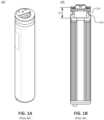
- FIGS. 1A and 1B illustrate views of a conventional cylindrical battery cell 100.
- the conventional cylindrical battery cell 100 utilizes a crimping operation to create a crimp 110 at a feedthrough.
- the crimp 110 requires use of an insert 120 that creates a mechanical stop for the crimping operation, and when crimped, creates a seal between an enclosure of the battery cell 100 and the feedthrough.
- the insert 120 and other components associated with a successful crimping operation results in a distance H1 between a set of layers or jelly roll, and an end of the battery cell 100.
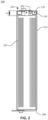
- FIG. 2 illustrates a cross-section view of a cylindrical battery cell 200 with an overmolded glass feedthrough, in accordance with various aspects of the subject technology.
- the battery cell 200 comprises a cylindrical enclosure 210 having a first opening 270, a wound set of layers 250 enclosed within the cylindrical enclosure 210, and a feedthrough 220.
- the enclosure 210 may be formed of a rigid material, such as a metal alloy which may, for example, include stainless steel, aluminum, aluminum alloy, or other sufficiently rigid materials as would be known by a person of ordinary skill in the art.
- the enclosure 210 may have a non-corrosive coating line the interior of the enclosure 210 and is configured to enclose and protect one or more sets of electrodes or layers disposed within the enclosure.
- the enclosure 210 may have a cylindrical, cuboid, prism, conical, or pyramid shape. In one aspect, the enclosure 210 may be drawn from tube stock to form a cylinder having the first opening 270 and a second opening 280. In other aspects, the enclosure 210 may have a closed end opposite the first opening 270. The first opening 270 and/or the second opening 280 may each be configured to receive the feedthrough 220.
- the wound set of layers 250 may comprise at least one cathode layer with an active coating, a separator, and at least one anode layer with an active coating, as discussed below with reference to FIG. 4 .
- a tab (as shown in FIG. 3 ) may extend from the anode and/or cathode layers, as discussed further below.
- the feedthrough 220 may comprise an annular channel 230, an insulator 240, and a pin 260.
- the feedthrough 220 is configured to seal the set of layers 250 within the enclosure 210 and to provide an electrical connection to the anode or cathode layer of the set of layers 250 via the pin 260.
- the feedthrough 220 may be disposed within the first opening 270 and bonded, glued, welded, or coupled, to the enclosure 210. As shown in FIG. 2 , the feedthrough 220 eliminates the need for a crimping operation by utilizing a bonding, gluing, welding, or coupling operation, and utilizes an overmolded insulator 240 to prevent inadvertent electrical contact between the annular channel 230 and the set of layers 250.
- a distance H2 between the set of layers 250 (e.g., jelly roll) and an end of the battery cell 200 is reduced when compared to the conventional battery cell 100 of FIG. 1B , thereby improving packaging efficiency and increasing energy capacity by eliminating the need for a crimping operation and associated components.
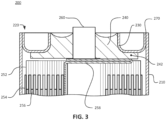
- FIG. 3 illustrates a detailed cross-section view of the cylindrical battery cell 200 with the overmolded glass feedthrough 220, in accordance with various aspects of the subject technology.
- the annular channel 230 of the feedthrough 220 comprises an outer sidewall, an inner sidewall, and a base.
- the outer sidewall of the annular channel 230 contacts a corresponding sidewall of the enclosure 210, and after a bonding, gluing, welding, or coupling operation, creates a hermetic seal between the feedthrough 220 and the enclosure 210.
- the annular channel 230 may be welded to the opening 270 of the enclosure 210 along a periphery by welding the outer sidewall of the annular channel 230 to the sidewall of the enclosure 210.
- the annular channel 230 may be made of a rigid material, and may further be made of a material that is adequate for welding to the enclosure 210.
- the annular channel 230 may also be formed of a stainless steel material to enable welding of the annular channel 230 and enclosure 210.
- the insulator 240 is formed of an electrically insulating material, such as glass, and includes an overmold portion 242 to prevent electrical contact between the cathode 254 or anode 256 of the set of layers, and the annular channel 230.
- the insulator 240 may be bonded to the inner sidewall of the annular channel 230 and a portion of the base of the annular channel 230.
- the insulator 240 is also bonded to the pin 260 and surrounds the pin 260.
- the overmold portion 242 of the insulator 240 extends between the base of the annular channel 230 and the separator 252 of the set of layers. As discussed above, the overmold portion 242 prevents electrical contact between the set of layers and the annular channel 230.
- the pin 260 extends through the insulator 240 and is electrically coupled to the cathode 254 or anode 256 of the set of layers to form an external battery terminal.
- the pin may comprise a metal or alloy, or material that is capable of conducting electricity, such as molybdenum.
- the pin 260 may be spot welded to a tab 258 extending from the cathode 254 or anode 256 of the set of layers.
- the tab 258 may extend from the opening 270 to facilitate a spot welding operation to the pin 260.
- the tab 258 When coupled to the tab 258 extending from the set of layers, electrical energy from the cathode 254 or anode 256, for example, passes through the tab 258 and to the pin 260, to thereby provide an external terminal for the battery cell 200.
- the tab 258 may be configured to be stowed or folded within the enclosure 210, proximal to the feedthrough 220, and more specifically, proximal to the annular channel 230.
- the overmold portion 242 of the insulator 240 is further configured to prevent electrical contact between the fold of the tab 258 and the annular channel 230. For example, by extending a diameter of the overmold portion 242 to extend radially beyond the fold of the tab 258, electrical contact between the fold of the tab 258 and the annular channel 230 is prevented.
- the battery cell 200 may further comprise a second feedthrough disposed at the second opening 280 (as shown in FIG. 2 ).
- the second opening 280 may be disposed opposite the first opening 270.
- the second feedthrough may comprise the same components as the feedthrough 220, which may include a second annular channel (similar to annular channel 230), a second insulator (similar to insulator 240), and a second pin (similar to pin 260).
- the second feedthrough is configured to electrically couple the cathode 254 or anode 256 of the set of layers to form a second external battery terminal.
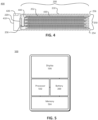
- FIG. 4 illustrates a cross-section view of an assembled battery 400, in accordance with various aspects of the subject technology.
- the assembled battery 400 includes the battery cell 200, enclosure 210, feedthrough 220, a battery management unit 410, and battery terminals 420.
- the battery management unit 410 is configured to manage recharging of the battery cell 200.
- the terminals 420 are configured to engage with corresponding connectors on a portable electronic device to provide power to components of the portable electronic device.
- the battery cell 200 includes a plurality of layers 250 comprising a cathode with an active coating 254, a separator 252, and an anode with an active coating 256.
- the cathode 254 may be an aluminum foil coated with a lithium compound (e.g., LiCoO 2 , LiNCoMn, LiCoAl or LiMn 2 O 4 ) and the anode 256 may be a copper foil coated with carbon or graphite.
- the separator 252 may include polyethylene (PE), polypropylene (PP), and/or a combination of PE and PP, such as PE/PP or PP/PE/PP.
- the separator 252 comprises a micro-porous membrane that also provides a "thermal shut down" mechanism. If the battery cell reaches the melting point of these materials, the pores shut down which prevents ion flow through the membrane.
- the plurality of layers 250 may be wound to form a jelly roll structure or can be stacked to form a stacked-cell structure.
- the plurality of layers 250 are enclosed within enclosure 210 and immersed in an electrolyte 430, which for example, can be a LiPF6-based electrolyte that can include Ethylene Carbonate (EC), Polypropylene Carbonate (PC), Ethyl Methyl Carbonate (EMC) or DiMethyl Carbonate (DMC).
- the electrolyte can also include additives such as Vinyl carbonate (VC) or Polyethylene Soltone (PS).
- the electrolyte can additionally be in the form of a solution or a gel.
- the anode layers 256 of the plurality of layers 250 may be coupled to the enclosure 210 or may be coupled to a second feedthrough via a second tab (not shown) extending from the anode layers 256.
- the cathode layers 254 of the plurality of layers 250 may be coupled to a first tab 258, which may include intermediate tabs 440 extending from each cathode layer 254.
- the first tab 258 and the second tab extend from the plurality of layers 250 for electrical connection to other battery cells, the battery management unit 410, or other components as desired.
- FIG. 5 illustrates a portable electronic device 500, in accordance with various aspects of the subject technology.
- the above-described rechargeable battery 200 can generally be used in any type of electronic device.
- FIG. 5 illustrates a portable electronic device 500 which includes a processor 502, a memory 504 and a display 506, which are all powered by the battery 200.
- Portable electronic device 500 may correspond to a laptop computer, tablet computer, mobile phone, personal digital assistant (PDA), digital music player, watch, and wearable device, and/or other type of battery-powered electronic device.
- Battery 200 may correspond to a battery pack that includes one or more battery cells.
- Each battery cell may include a set of layers sealed in an enclosure, including a cathode with an active coating, a separator, an anode with an active coating, and utilize an electrical feedthrough that maximizes packaging efficiency and increases reliability by preventing accidental or inadvertent electrical shortage through implementation of a feedthrough 220 having an overmolded insulator 240, as described above.
- FIG. 6 illustrates an example method 600 for manufacturing a battery cell, in accordance with various aspects of the subject technology. It should be understood that, for any process discussed herein, there can be additional, fewer, or alternative steps performed in similar or alternative orders, or in parallel, within the scope of the various embodiments unless otherwise stated.
- a set of layers are inserted within a cylindrical enclosure through an opening in the enclosure.
- the set of layers comprise a cathode layer, an anode layer, and a separator layer disposed between the cathode layer and the anode layer.
- a tab extending from the set of layers is welded to a pin of a feedthrough.
- the pin is electrically coupled to the set of layers to form an external battery terminal.
- the tab is folded within the cylindrical enclosure.
- a feedthrough is disposed within the opening of the cylindrical enclosure. As described above, the feedthrough comprises an annular channel having an outer sidewall, an inner sidewall, and a base.
- the feedthrough also comprises an insulator formed of glass, the insulator bonded to the inner sidewall of the annular channel and a portion of the base of the annular channel.
- the insulator further comprises an overmold portion that extends from the base of the annular channel to prevent electrical contact between the set of layers and the annular channel, as well as prevent electrical contact between the tab and the annular channel.
- the feedthrough also comprises the pin, where the pin extends through the insulator.
- the feedthrough is welded to the cylindrical enclosure by welding the outer sidewall of the annular channel to the cylindrical enclosure along a periphery of the opening.
- the cylindrical enclosure is filled with electrolyte.
- the method 600 may further include disposing a second feedthrough within a second opening of the cylindrical enclosure.
- the second feedthrough may include a second annular channel comprising an outer sidewall, an inner sidewall, and a base.
- the second feedthrough may also comprise a second insulator formed of glass, the second insulator bonded to the inner sidewall of the second annular channel and a portion of the base of the second annular channel.
- the second insulator also comprises an overmold portion that extends from the base of the second annular channel to prevent electrical contact between the set of layers and the second annular channel, as well as prevent electrical contact between a second tab extending from the set of layers and the second annular channel.
- the second feedthrough also comprises a second pin extending through the second insulator, the second pin electrically coupled to the set of layers to form a second external battery terminal.
- the second pin may be coupled to the second tab via a welding operation, as discussed above with respect to operation 620.
- the method 600 may further include welding the outer sidewall of the second annular channel to the cylindrical enclosure along a periphery of the second opening to thereby create a hermetic seal at the second opening of the cylindrical enclosure.
Landscapes
- Chemical & Material Sciences (AREA)
- Chemical Kinetics & Catalysis (AREA)
- Electrochemistry (AREA)
- General Chemical & Material Sciences (AREA)
- Engineering & Computer Science (AREA)
- Manufacturing & Machinery (AREA)
- Inorganic Chemistry (AREA)
- Sealing Battery Cases Or Jackets (AREA)
- Connection Of Batteries Or Terminals (AREA)
Description
- This application claims the benefit of
U.S. Patent Application Serial No. 16/211,433, entitled "CYLINDRICAL BATTERY CELL WITH OVERMOLDED GLASS FEEDTHROUGH," filed on December 6, 2018 U.S. Provisional Patent Application Serial No. 62/727,778, entitled "CYLINDRICAL BATTERY CELL WITH OVERMOLDED GLASS FEEDTHROUGH," filed on September 6, 2018 - The present disclosure relates generally to cylindrical battery cells, and more particularly, to a cylindrical battery cell with an overmolded glass feedthrough.
- Battery cells are used to provide power to a wide variety of portable electronic devices, including laptop computers, tablet computers, mobile phones, personal digital assistants (PDAs), digital music players, watches, and wearable devices. A commonly used type of battery is a lithium battery, which can include a lithium-ion or a lithium-polymer battery.
- Lithium batteries often include cells that are made of alternating layers of anode and cathode electrodes, with a separator disposed there-between. The layers may be packaged in an cylindrical enclosure. Anode electrodes of the cell may be electrically coupled to a wall of the enclosure where the enclosure is itself, made of a conductive material. The cathode electrodes, however, may require an electrical feedthrough to enable an electrical connection, through the enclosure, to the cathode electrodes. In addition, electrical feedthroughs must insulate the electrical connection to the cathode electrodes from the enclosure to prevent shorting of the battery cell. The enclosure enclosing the electrodes may be filled with electrolyte thereby requiring the electrical feedthrough to also provide a hermetically seal to prevent unwanted leakage or failure.
- Conventional feedthroughs for cylindrical battery cells may utilize a crimping operation to attach the feedthrough to the enclosure. Such crimping operations, however, may require additional space on the enclosure to accommodate the crimp and to ensure a proper seal, thereby reducing packaging efficiency.
- Relevant prior art is for example known form documents
US 2017/162838 A1 andEP 1 620 907 A1 . - The disclosed embodiments provide for a battery cell that utilizes an overmolded glass feedthrough to prevent electrical contact or shorting of electrodes to the feedthrough. The battery cell includes a wound set of layers that include a cathode layer, an anode layer, and a separator layer disposed between the cathode layer and the anode layer. The set of layers are enclosed within a cylindrical enclosure having an opening for receiving a feedthrough. The feedthrough includes an annular channel having an outer sidewall, an inner sidewall, and a base; an insulator formed of glass; and a pin extending through the insulator. The insulator is bonded to the inner sidewall of the annular channel and a portion of the base of the annular channel. The insulator also includes an overmold portion that extends between the base of the annular channel and the set of layers. The overmold portion is configured to prevent electrical contact between the set of layers and the annular channel. The pin is electrically coupled to the set of layers to form an external battery terminal.
- In some embodiments, a battery feedthrough includes an annular channel, an insulator, and a pin. The annular channel may include an outer sidewall, an inner sidewall, and a base. The insulator may be formed of glass, and bonded to the inner sidewall of the annular channel and a portion of the base of the annular channel. The insulator further includes an overmold portion that extends from the base of the annular channel. The pin is configured to form an external battery terminal.
- In some embodiments, a method for manufacturing a battery cell is disclosed. The method includes inserting a set of layers within a cylindrical enclosure through an opening. The set of layers include a cathode layer, an anode layer, and a separator layer disposed between the cathode layer and the anode layer. The method also includes welding a tab extending from the set of layers to a pin, the pin electrically coupled to the set of layers to form an external battery terminal. The method further includes folding the tab within the cylindrical enclosure and disposing a feedthrough within the opening of the cylindrical enclosure. The feedthrough includes an annular channel having an outer sidewall, an inner sidewall, and a base. The feedthrough also includes an insulator formed of glass that is bonded to the inner sidewall of the annular channel and a portion of the base of the annular channel. The insulator includes an overmold portion that extends from the base of the annular channel. The overmold portion is configured to prevent electrical contact between the set of layers and the annular channel. The feedthrough also includes the pin extending through the insulator.
- The embodiments herein may be better understood by referring to the following description in conjunction with the accompanying drawings in which like reference numerals indicate identical or functionally similar elements. Understanding that these drawings depict only exemplary embodiments of the disclosure and are not therefore to be considered to be limiting of its scope, the principles herein are described and explained with additional specificity and detail through the use of the accompanying drawings in which:
-
FIG. 1A illustrates a perspective view of a conventional cylindrical battery cell; -
FIG. 1B illustrates a cross-section view of a conventional cylindrical battery cell; -
FIG. 2 illustrates a cross-section view of a cylindrical battery cell with an overmolded glass feedthrough, in accordance with various aspects of the subject technology; -
FIG. 3 illustrates a detailed cross-section view of a cylindrical battery cell with an overmolded glass feedthrough, in accordance with various aspects of the subject technology; -
FIG. 4 illustrates a cross-section view of an assembled battery cell, in accordance with various aspects of the subject technology; -
FIG. 5 illustrates a portable electronic device, in accordance with various aspects of the subject technology; and -
FIG. 6 illustrates an example method for manufacturing a battery cell, in accordance with various aspects of the subject technology. - Various embodiments of the disclosure are discussed in detail below. While specific implementations are discussed, it should be understood that this is done for illustration purposes only. A person skilled in the relevant art will recognize that other components and configurations may be used without parting from the spirit and scope of the disclosure.
- Rechargeable batteries for portable electronic devices often include cells that are made of alternating layers of anode and cathode electrodes, with a separator disposed there-between. The layers may be packaged in an enclosure and may utilize an electrical feedthrough to make an electrical connection to cathode electrodes through the enclosure. The enclosure enclosing the electrodes may be filled with electrolyte thereby requiring the feedthrough to hermetically seal the enclosure to prevent unwanted leakage or failure. In addition, electrical feedthroughs must insulate the electrical connection from the enclosure to prevent shorting of the battery cell.
- Conventional feedthroughs for cylindrical battery cells may utilize a crimping operation to attach the feedthrough to the enclosure. Such crimping operations, however, require additional space on the enclosure to accommodate the crimp and to ensure a proper seal, thereby reducing packaging efficiency. Accordingly, there is a need for certain embodiments of a compact and robust feedthrough for use in small or thin cylindrical battery cells that improves packaging efficiency and increases energy capacity.
- The disclosed technology addresses the foregoing limitations of conventional feedthroughs for cylindrical battery cells by utilizing a glass feedthrough that utilizes an overmold to insulate the feedthrough from the electrodes, thereby improving packaging efficiency and increasing energy capacity by eliminating the need for a crimping operation and associated components.
-
FIGS. 1A and 1B illustrate views of a conventionalcylindrical battery cell 100. The conventionalcylindrical battery cell 100 utilizes a crimping operation to create acrimp 110 at a feedthrough. Thecrimp 110 requires use of aninsert 120 that creates a mechanical stop for the crimping operation, and when crimped, creates a seal between an enclosure of thebattery cell 100 and the feedthrough. As shown inFIG. 1B , theinsert 120 and other components associated with a successful crimping operation results in a distance H1 between a set of layers or jelly roll, and an end of thebattery cell 100. Specifically, in order to adequately crimp sidewalls of the enclosure to theinsert 120, there must be sufficient area surrounding thecrimp 110 to allow a crimping operation to be performed. -
FIG. 2 illustrates a cross-section view of acylindrical battery cell 200 with an overmolded glass feedthrough, in accordance with various aspects of the subject technology. Thebattery cell 200 comprises acylindrical enclosure 210 having afirst opening 270, a wound set oflayers 250 enclosed within thecylindrical enclosure 210, and afeedthrough 220. Theenclosure 210 may be formed of a rigid material, such as a metal alloy which may, for example, include stainless steel, aluminum, aluminum alloy, or other sufficiently rigid materials as would be known by a person of ordinary skill in the art. Theenclosure 210 may have a non-corrosive coating line the interior of theenclosure 210 and is configured to enclose and protect one or more sets of electrodes or layers disposed within the enclosure. Theenclosure 210 may have a cylindrical, cuboid, prism, conical, or pyramid shape. In one aspect, theenclosure 210 may be drawn from tube stock to form a cylinder having thefirst opening 270 and asecond opening 280. In other aspects, theenclosure 210 may have a closed end opposite thefirst opening 270. Thefirst opening 270 and/or thesecond opening 280 may each be configured to receive thefeedthrough 220. - The wound set of
layers 250 may comprise at least one cathode layer with an active coating, a separator, and at least one anode layer with an active coating, as discussed below with reference toFIG. 4 . A tab (as shown inFIG. 3 ) may extend from the anode and/or cathode layers, as discussed further below. - The
feedthrough 220 may comprise anannular channel 230, aninsulator 240, and apin 260. Thefeedthrough 220 is configured to seal the set oflayers 250 within theenclosure 210 and to provide an electrical connection to the anode or cathode layer of the set oflayers 250 via thepin 260. Thefeedthrough 220 may be disposed within thefirst opening 270 and bonded, glued, welded, or coupled, to theenclosure 210. As shown inFIG. 2 , thefeedthrough 220 eliminates the need for a crimping operation by utilizing a bonding, gluing, welding, or coupling operation, and utilizes anovermolded insulator 240 to prevent inadvertent electrical contact between theannular channel 230 and the set oflayers 250. As a result, a distance H2 between the set of layers 250 (e.g., jelly roll) and an end of thebattery cell 200 is reduced when compared to theconventional battery cell 100 ofFIG. 1B , thereby improving packaging efficiency and increasing energy capacity by eliminating the need for a crimping operation and associated components. -
FIG. 3 illustrates a detailed cross-section view of thecylindrical battery cell 200 with theovermolded glass feedthrough 220, in accordance with various aspects of the subject technology. Theannular channel 230 of thefeedthrough 220 comprises an outer sidewall, an inner sidewall, and a base. The outer sidewall of theannular channel 230 contacts a corresponding sidewall of theenclosure 210, and after a bonding, gluing, welding, or coupling operation, creates a hermetic seal between thefeedthrough 220 and theenclosure 210. For example, theannular channel 230 may be welded to theopening 270 of theenclosure 210 along a periphery by welding the outer sidewall of theannular channel 230 to the sidewall of theenclosure 210. Theannular channel 230 may be made of a rigid material, and may further be made of a material that is adequate for welding to theenclosure 210. For example, if theenclosure 210 is formed of a stainless steel material, theannular channel 230 may also be formed of a stainless steel material to enable welding of theannular channel 230 andenclosure 210. - The
insulator 240 is formed of an electrically insulating material, such as glass, and includes anovermold portion 242 to prevent electrical contact between thecathode 254 oranode 256 of the set of layers, and theannular channel 230. Theinsulator 240 may be bonded to the inner sidewall of theannular channel 230 and a portion of the base of theannular channel 230. Theinsulator 240 is also bonded to thepin 260 and surrounds thepin 260. Theovermold portion 242 of theinsulator 240 extends between the base of theannular channel 230 and theseparator 252 of the set of layers. As discussed above, theovermold portion 242 prevents electrical contact between the set of layers and theannular channel 230. - The
pin 260 extends through theinsulator 240 and is electrically coupled to thecathode 254 oranode 256 of the set of layers to form an external battery terminal. The pin may comprise a metal or alloy, or material that is capable of conducting electricity, such as molybdenum. In one aspect, thepin 260 may be spot welded to atab 258 extending from thecathode 254 oranode 256 of the set of layers. Thetab 258 may extend from theopening 270 to facilitate a spot welding operation to thepin 260. When coupled to thetab 258 extending from the set of layers, electrical energy from thecathode 254 oranode 256, for example, passes through thetab 258 and to thepin 260, to thereby provide an external terminal for thebattery cell 200. After welding, thetab 258 may be configured to be stowed or folded within theenclosure 210, proximal to thefeedthrough 220, and more specifically, proximal to theannular channel 230. Theovermold portion 242 of theinsulator 240 is further configured to prevent electrical contact between the fold of thetab 258 and theannular channel 230. For example, by extending a diameter of theovermold portion 242 to extend radially beyond the fold of thetab 258, electrical contact between the fold of thetab 258 and theannular channel 230 is prevented. - In some aspects, the
battery cell 200 may further comprise a second feedthrough disposed at the second opening 280 (as shown inFIG. 2 ). Thesecond opening 280 may be disposed opposite thefirst opening 270. The second feedthrough may comprise the same components as thefeedthrough 220, which may include a second annular channel (similar to annular channel 230), a second insulator (similar to insulator 240), and a second pin (similar to pin 260). The second feedthrough is configured to electrically couple thecathode 254 oranode 256 of the set of layers to form a second external battery terminal. -
FIG. 4 illustrates a cross-section view of an assembledbattery 400, in accordance with various aspects of the subject technology. The assembledbattery 400 includes thebattery cell 200,enclosure 210,feedthrough 220, abattery management unit 410, andbattery terminals 420. Thebattery management unit 410 is configured to manage recharging of thebattery cell 200. Theterminals 420 are configured to engage with corresponding connectors on a portable electronic device to provide power to components of the portable electronic device. - The
battery cell 200 includes a plurality oflayers 250 comprising a cathode with anactive coating 254, aseparator 252, and an anode with anactive coating 256. For example, thecathode 254 may be an aluminum foil coated with a lithium compound (e.g., LiCoO2, LiNCoMn, LiCoAl or LiMn2O4) and theanode 256 may be a copper foil coated with carbon or graphite. Theseparator 252 may include polyethylene (PE), polypropylene (PP), and/or a combination of PE and PP, such as PE/PP or PP/PE/PP. Theseparator 252 comprises a micro-porous membrane that also provides a "thermal shut down" mechanism. If the battery cell reaches the melting point of these materials, the pores shut down which prevents ion flow through the membrane. - The plurality of
layers 250 may be wound to form a jelly roll structure or can be stacked to form a stacked-cell structure. The plurality oflayers 250 are enclosed withinenclosure 210 and immersed in anelectrolyte 430, which for example, can be a LiPF6-based electrolyte that can include Ethylene Carbonate (EC), Polypropylene Carbonate (PC), Ethyl Methyl Carbonate (EMC) or DiMethyl Carbonate (DMC). The electrolyte can also include additives such as Vinyl carbonate (VC) or Polyethylene Soltone (PS). The electrolyte can additionally be in the form of a solution or a gel. - The anode layers 256 of the plurality of
layers 250 may be coupled to theenclosure 210 or may be coupled to a second feedthrough via a second tab (not shown) extending from the anode layers 256. The cathode layers 254 of the plurality oflayers 250 may be coupled to afirst tab 258, which may includeintermediate tabs 440 extending from eachcathode layer 254. Thefirst tab 258 and the second tab extend from the plurality oflayers 250 for electrical connection to other battery cells, thebattery management unit 410, or other components as desired. -
FIG. 5 illustrates a portableelectronic device 500, in accordance with various aspects of the subject technology. The above-describedrechargeable battery 200 can generally be used in any type of electronic device. For example,FIG. 5 illustrates a portableelectronic device 500 which includes aprocessor 502, amemory 504 and adisplay 506, which are all powered by thebattery 200. Portableelectronic device 500 may correspond to a laptop computer, tablet computer, mobile phone, personal digital assistant (PDA), digital music player, watch, and wearable device, and/or other type of battery-powered electronic device.Battery 200 may correspond to a battery pack that includes one or more battery cells. Each battery cell may include a set of layers sealed in an enclosure, including a cathode with an active coating, a separator, an anode with an active coating, and utilize an electrical feedthrough that maximizes packaging efficiency and increases reliability by preventing accidental or inadvertent electrical shortage through implementation of afeedthrough 220 having anovermolded insulator 240, as described above. -
FIG. 6 illustrates anexample method 600 for manufacturing a battery cell, in accordance with various aspects of the subject technology. It should be understood that, for any process discussed herein, there can be additional, fewer, or alternative steps performed in similar or alternative orders, or in parallel, within the scope of the various embodiments unless otherwise stated. - At
operation 610, a set of layers are inserted within a cylindrical enclosure through an opening in the enclosure. The set of layers comprise a cathode layer, an anode layer, and a separator layer disposed between the cathode layer and the anode layer. Atoperation 620, a tab extending from the set of layers is welded to a pin of a feedthrough. The pin is electrically coupled to the set of layers to form an external battery terminal. Atoperation 630, the tab is folded within the cylindrical enclosure. Atoperation 640, a feedthrough is disposed within the opening of the cylindrical enclosure. As described above, the feedthrough comprises an annular channel having an outer sidewall, an inner sidewall, and a base. The feedthrough also comprises an insulator formed of glass, the insulator bonded to the inner sidewall of the annular channel and a portion of the base of the annular channel. The insulator further comprises an overmold portion that extends from the base of the annular channel to prevent electrical contact between the set of layers and the annular channel, as well as prevent electrical contact between the tab and the annular channel. The feedthrough also comprises the pin, where the pin extends through the insulator. - At
operation 650, the feedthrough is welded to the cylindrical enclosure by welding the outer sidewall of the annular channel to the cylindrical enclosure along a periphery of the opening. Atoperation 660, the cylindrical enclosure is filled with electrolyte. - The
method 600 may further include disposing a second feedthrough within a second opening of the cylindrical enclosure. The second feedthrough may include a second annular channel comprising an outer sidewall, an inner sidewall, and a base. The second feedthrough may also comprise a second insulator formed of glass, the second insulator bonded to the inner sidewall of the second annular channel and a portion of the base of the second annular channel. The second insulator also comprises an overmold portion that extends from the base of the second annular channel to prevent electrical contact between the set of layers and the second annular channel, as well as prevent electrical contact between a second tab extending from the set of layers and the second annular channel. The second feedthrough also comprises a second pin extending through the second insulator, the second pin electrically coupled to the set of layers to form a second external battery terminal. In one aspect, the second pin may be coupled to the second tab via a welding operation, as discussed above with respect tooperation 620. - The
method 600 may further include welding the outer sidewall of the second annular channel to the cylindrical enclosure along a periphery of the second opening to thereby create a hermetic seal at the second opening of the cylindrical enclosure. - Although a variety of examples and other information was used to explain aspects within the scope of the appended claims, no limitation of the claims should be implied based on particular features or arrangements in such examples, as one of ordinary skill would be able to use these examples to derive a wide variety of implementations. Further and although some subject matter may have been described in language specific to examples of structural features and/or method steps, it is to be understood that the subject matter defined in the appended claims is not necessarily limited to these described features or acts. For example, such functionality can be distributed differently or performed in components other than those identified herein. Rather, the described features and steps are disclosed as examples of components of systems and methods within the scope of the appended claims.
Claims (14)
- A battery cell, comprising:a wound set of layers comprising a cathode layer, an anode layer, and a separator layer disposed between the cathode layer and the anode layer;a cylindrical enclosure enclosing the set of layers, the enclosure comprising an opening for receiving a feedthrough, the feedthrough comprising:an annular channel comprising an outer sidewall, an inner sidewall, and a base;an insulator formed of glass, the insulator bonded to the inner sidewall of the annular channel and a portion of the base of the annular channel, the insulator further comprising an overmold portion that extends between the base of the annular channel and the set of layers, the overmold portion configured to prevent electrical contact between the set of layers and the annular channel; anda pin extending through the insulator, the pin electrically coupled to the set of layers to form an external battery terminal.
- The battery cell of claim 1, wherein the outer sidewall of the annular channel is welded to the enclosure along a periphery of the opening.
- The battery cell of claim 1, further comprising a tab extending from the set of layers, wherein the pin is welded to the tab proximal to the opening.
- The battery cell of claim 3, wherein the tab comprises a fold proximal to the annular channel, and wherein the insulator prevents electrical contact between the fold of the tab and the annular channel.
- The battery cell of claim 4, wherein the overmold portion of the insulator has a diameter that extends radially beyond the fold of the tab.
- The battery cell of claim 1, wherein the cylindrical enclosure further comprises a second opening disposed opposite the first opening, the second opening configured to receive a second feedthrough, the second feedthrough comprising:a second annular channel comprising an outer sidewall, an inner sidewall, and a base;a second insulator formed of glass, the second insulator bonded to the inner sidewall of the second annular channel and a portion of the base of the second annular channel, the second insulator further comprising an overmold portion that extends between the base of the second annular channel and the set of layers, the overmold portion configured to prevent electrical contact between the set of layers and the second annular channel; anda second pin extending through the second insulator, the second pin electrically coupled to the set of layers to form a second external battery terminal.
- The battery cell of claim 6, wherein the outer sidewall of the second annular channel is welded to the enclosure along a periphery of the second opening.
- A battery feedthrough, comprising:an annular channel comprising an outer sidewall, an inner sidewall, and a base;an insulator formed of glass, the insulator bonded to the inner sidewall of the annular channel and a portion of the base of the annular channel, the insulator further comprising an overmold portion that extends from the base of the annular channel; anda pin extending through the insulator, the pin configured to form an external battery terminal.
- The battery feedthrough of claim 8, wherein the outer sidewall of the annular channel is configured to be welded to a battery cell enclosure along a periphery of the enclosure.
- The battery feedthrough of claim 8, wherein a material of the annular channel comprises stainless steel.
- The battery feedthrough of claim 8, wherein a material of the pin comprises molybdenum.
- A method for manufacturing a battery cell, the method comprising:inserting a set of layers within a cylindrical enclosure through an opening, the set of layers comprising a cathode layer, an anode layer, and a separator layer disposed between the cathode layer and the anode layer;welding a tab extending from the set of layers to a pin, the pin electrically coupled to the set of layers to form an external battery terminal;folding the tab within the cylindrical enclosure;disposing the battery feedthrough of claim 8 within the opening of the cylindrical enclosure.
- The method of claim 12, further comprising disposing a second feedthrough within a second opening of the cylindrical enclosure, the second feedthrough comprising:a second annular channel comprising an outer sidewall, an inner sidewall, and a base;a second insulator formed of glass, the second insulator bonded to the inner sidewall of the second annular channel and a portion of the base of the second annular channel, the second insulator further comprising an overmold portion that extends from the base of the second annular channel, the overmold portion configured to prevent electrical contact between the set of layers and the second annular channel; anda second pin extending through the second insulator, the second pin electrically coupled to the set of layers to form a second external battery terminal.
- The method of claim 13, further comprising welding the outer sidewall of the second annular channel to the cylindrical enclosure along a periphery of the second opening.
Priority Applications (1)
| Application Number | Priority Date | Filing Date | Title |
|---|---|---|---|
| EP23192814.4A EP4270629B1 (en) | 2018-09-06 | 2019-09-06 | Cylindrical battery cell with overmolded glass feedthrough |
Applications Claiming Priority (3)
| Application Number | Priority Date | Filing Date | Title |
|---|---|---|---|
| US201862727778P | 2018-09-06 | 2018-09-06 | |
| US16/211,433 US11145925B2 (en) | 2018-09-06 | 2018-12-06 | Cylindrical battery cell with overmolded glass feedthrough |
| PCT/US2019/049917 WO2020051430A1 (en) | 2018-09-06 | 2019-09-06 | Cylindrical battery cell with overmolded glass feedthrough |
Related Child Applications (2)
| Application Number | Title | Priority Date | Filing Date |
|---|---|---|---|
| EP23192814.4A Division EP4270629B1 (en) | 2018-09-06 | 2019-09-06 | Cylindrical battery cell with overmolded glass feedthrough |
| EP23192814.4A Division-Into EP4270629B1 (en) | 2018-09-06 | 2019-09-06 | Cylindrical battery cell with overmolded glass feedthrough |
Publications (2)
| Publication Number | Publication Date |
|---|---|
| EP3827468A1 EP3827468A1 (en) | 2021-06-02 |
| EP3827468B1 true EP3827468B1 (en) | 2024-03-20 |
Family
ID=69719716
Family Applications (2)
| Application Number | Title | Priority Date | Filing Date |
|---|---|---|---|
| EP23192814.4A Active EP4270629B1 (en) | 2018-09-06 | 2019-09-06 | Cylindrical battery cell with overmolded glass feedthrough |
| EP19772952.8A Active EP3827468B1 (en) | 2018-09-06 | 2019-09-06 | Cylindrical battery cell with overmolded glass feedthrough |
Family Applications Before (1)
| Application Number | Title | Priority Date | Filing Date |
|---|---|---|---|
| EP23192814.4A Active EP4270629B1 (en) | 2018-09-06 | 2019-09-06 | Cylindrical battery cell with overmolded glass feedthrough |
Country Status (4)
| Country | Link |
|---|---|
| US (1) | US11145925B2 (en) |
| EP (2) | EP4270629B1 (en) |
| CN (1) | CN112703630B (en) |
| WO (1) | WO2020051430A1 (en) |
Families Citing this family (4)
| Publication number | Priority date | Publication date | Assignee | Title |
|---|---|---|---|---|
| US11431047B2 (en) | 2018-05-07 | 2022-08-30 | Apple Inc. | Feedthrough with integrated insulator |
| US11145925B2 (en) | 2018-09-06 | 2021-10-12 | Apple Inc. | Cylindrical battery cell with overmolded glass feedthrough |
| US11417926B2 (en) * | 2018-11-29 | 2022-08-16 | Apple Inc. | Feedthroughs for thin battery cells |
| US12191511B2 (en) | 2019-06-20 | 2025-01-07 | Apple Inc. | Battery cell with serpentine tab |
Citations (2)
| Publication number | Priority date | Publication date | Assignee | Title |
|---|---|---|---|---|
| EP1620907B1 (en) * | 2003-03-24 | 2007-08-22 | Medtronic Inc. | Polymide protected battery feedthrough |
| EP3179532A1 (en) * | 2015-12-07 | 2017-06-14 | Commissariat À L'Énergie Atomique Et Aux Énergies Alternatives | Glass-metal sealed feed-through, use as lithium electrochemical battery, associated production method |
Family Cites Families (35)
| Publication number | Priority date | Publication date | Assignee | Title |
|---|---|---|---|---|
| US4178164A (en) * | 1978-05-11 | 1979-12-11 | Gte Sylvania Incorporated | Method for making a glass-to-metal seal for electrochemical cells |
| US4358514A (en) | 1981-03-27 | 1982-11-09 | Honeywell Inc. | Header device for electrochemical cells |
| US4350747A (en) | 1981-06-16 | 1982-09-21 | Union Carbide Corporation | Electrochemical cell with externally coated hermetic seals |
| US4559283A (en) | 1984-08-21 | 1985-12-17 | Raychem Corporation | Battery casing |
| JPS61224263A (en) | 1985-03-28 | 1986-10-04 | Shin Kobe Electric Mach Co Ltd | Battery |
| US5004656A (en) | 1988-08-29 | 1991-04-02 | Hitachi Maxell, Ltd. | Flat type sealed battery with hermetic sealing structure |
| EP0655793B1 (en) * | 1993-11-19 | 2003-04-02 | Medtronic, Inc. | High-reliability electrochemical cell and electrode assembly therefor |
| US5811206A (en) * | 1997-10-31 | 1998-09-22 | Medtronic, Inc. | Feedthrough pin insulator, assembly and method for electrochemical cell |
| US6977124B2 (en) | 2001-07-19 | 2005-12-20 | Wilson Greatbatch Technologies, Inc. | Contoured casing for an electrochemical cell |
| US20030096162A1 (en) | 2001-11-09 | 2003-05-22 | Lasater Brian J. | Lithium-ion battery seal |
| JP4817217B2 (en) | 2004-04-08 | 2011-11-16 | 東芝電池株式会社 | Liquid active substance battery |
| CA2915847C (en) | 2005-10-21 | 2019-01-08 | Stryker Corporation | System and method for recharging a battery exposed to a harsh environment |
| US7749651B2 (en) | 2005-11-28 | 2010-07-06 | Greatbatch Ltd. | Terminal connector for connecting an electrochemical cell to a medical device |
| JP2008192552A (en) | 2007-02-07 | 2008-08-21 | Toyota Motor Corp | electrode |
| KR100929033B1 (en) * | 2007-10-05 | 2009-11-26 | 삼성에스디아이 주식회사 | Cap assembly and secondary battery having the same |
| JP5292843B2 (en) | 2008-02-13 | 2013-09-18 | 株式会社Gsユアサ | battery |
| US8883341B2 (en) | 2009-05-19 | 2014-11-11 | Toyota Jidosha Kabushiki Kaisha | Battery, vehicle mounted with the battery, and device mounted with the battery |
| CN105118954A (en) | 2009-05-19 | 2015-12-02 | 丰田自动车株式会社 | Battery, vehicle with same and equipment |
| JP5119277B2 (en) | 2010-01-12 | 2013-01-16 | 株式会社日立製作所 | ELECTRODE FOR LITHIUM SECONDARY BATTERY AND METHOD FOR PRODUCING THE SAME |
| JP5920650B2 (en) | 2010-12-28 | 2016-05-18 | 株式会社Gsユアサ | Electricity storage element |
| JP5987320B2 (en) | 2011-02-03 | 2016-09-07 | 株式会社Gsユアサ | Electricity storage element |
| KR101981811B1 (en) * | 2011-02-18 | 2019-05-23 | 쇼오트 아게 | Feed-through, in particular for batteries and method for integrating said feed-through in a housing by means of ultrasonic welding |
| US10224521B2 (en) * | 2011-02-18 | 2019-03-05 | Schott Ag | Feed-through |
| CA2755597C (en) | 2011-10-20 | 2015-01-20 | Engineered Power Services Inc. | High temperature lithium battery, having initial low temperature use capability |
| US11552377B2 (en) | 2012-11-26 | 2023-01-10 | Vehicle Energy Japan Inc. | Rectangular secondary battery |
| JP2015099681A (en) | 2013-11-19 | 2015-05-28 | 日立マクセル株式会社 | Sealed battery |
| US10811669B2 (en) | 2015-02-17 | 2020-10-20 | Nec Corporation | Battery and method for manufacturing same |
| KR102360013B1 (en) | 2015-04-21 | 2022-02-07 | 삼성에스디아이 주식회사 | Rechargeable battery |
| US10541391B2 (en) | 2015-09-30 | 2020-01-21 | Apple Inc. | Electrical feedthroughs for battery housings |
| WO2018057704A1 (en) | 2016-09-22 | 2018-03-29 | Apple Inc. | Integrated electrical feedthroughs for walls of battery housings |
| EP3459129B1 (en) * | 2016-11-16 | 2023-11-08 | Pacesetter, Inc. | Battery with enhanced resistance to dendrite formation |
| CN111684622B (en) | 2018-02-21 | 2023-08-11 | 松下控股株式会社 | Square secondary battery |
| US11431047B2 (en) | 2018-05-07 | 2022-08-30 | Apple Inc. | Feedthrough with integrated insulator |
| US11145925B2 (en) | 2018-09-06 | 2021-10-12 | Apple Inc. | Cylindrical battery cell with overmolded glass feedthrough |
| US11417926B2 (en) | 2018-11-29 | 2022-08-16 | Apple Inc. | Feedthroughs for thin battery cells |
-
2018
- 2018-12-06 US US16/211,433 patent/US11145925B2/en active Active
-
2019
- 2019-09-06 EP EP23192814.4A patent/EP4270629B1/en active Active
- 2019-09-06 WO PCT/US2019/049917 patent/WO2020051430A1/en not_active Ceased
- 2019-09-06 EP EP19772952.8A patent/EP3827468B1/en active Active
- 2019-09-06 CN CN201980058036.6A patent/CN112703630B/en active Active
Patent Citations (2)
| Publication number | Priority date | Publication date | Assignee | Title |
|---|---|---|---|---|
| EP1620907B1 (en) * | 2003-03-24 | 2007-08-22 | Medtronic Inc. | Polymide protected battery feedthrough |
| EP3179532A1 (en) * | 2015-12-07 | 2017-06-14 | Commissariat À L'Énergie Atomique Et Aux Énergies Alternatives | Glass-metal sealed feed-through, use as lithium electrochemical battery, associated production method |
Also Published As
| Publication number | Publication date |
|---|---|
| EP3827468A1 (en) | 2021-06-02 |
| WO2020051430A1 (en) | 2020-03-12 |
| US20200083498A1 (en) | 2020-03-12 |
| US11145925B2 (en) | 2021-10-12 |
| EP4270629A2 (en) | 2023-11-01 |
| EP4270629B1 (en) | 2025-05-07 |
| CN112703630A (en) | 2021-04-23 |
| CN112703630B (en) | 2023-08-18 |
| EP4270629A3 (en) | 2024-01-03 |
Similar Documents
| Publication | Publication Date | Title |
|---|---|---|
| CN209947930U (en) | Battery cell and battery feedthrough | |
| US11936053B2 (en) | Feedthroughs for thin battery cells | |
| US20250096380A1 (en) | Battery cell with serpentine tab | |
| US8993148B2 (en) | Rechargeable lithium ion button cell battery | |
| EP3827468B1 (en) | Cylindrical battery cell with overmolded glass feedthrough | |
| US9147869B2 (en) | Rechargeable battery | |
| KR20210021841A (en) | Rechargeable battery | |
| JP2004349243A (en) | Pouch type lithium secondary battery and method of manufacturing the same | |
| EP3993143A1 (en) | Pouch-type battery case and pouch-type secondary battery | |
| US11394093B2 (en) | Secondary battery and battery module | |
| KR20220072503A (en) | Rechargeable battery | |
| KR20200099392A (en) | The Secondary Battery And The Battery Module | |
| US20230088564A1 (en) | Looped battery tab with oxide coating | |
| KR102819933B1 (en) | Rechargeable battery and manufacturing method thereof | |
| CN115298898B (en) | Secondary batteries and battery modules | |
| KR20040005242A (en) | Jelly-roll type battery unit forming short prevention means and the lithium secondary battery applying the same | |
| US20200099106A1 (en) | Battery pack | |
| US20230092789A1 (en) | Non-rectangular metal batteries | |
| KR20150045182A (en) | Secondary battery |
Legal Events
| Date | Code | Title | Description |
|---|---|---|---|
| STAA | Information on the status of an ep patent application or granted ep patent |
Free format text: STATUS: UNKNOWN |
|
| STAA | Information on the status of an ep patent application or granted ep patent |
Free format text: STATUS: THE INTERNATIONAL PUBLICATION HAS BEEN MADE |
|
| PUAI | Public reference made under article 153(3) epc to a published international application that has entered the european phase |
Free format text: ORIGINAL CODE: 0009012 |
|
| STAA | Information on the status of an ep patent application or granted ep patent |
Free format text: STATUS: REQUEST FOR EXAMINATION WAS MADE |
|
| 17P | Request for examination filed |
Effective date: 20210226 |
|
| AK | Designated contracting states |
Kind code of ref document: A1 Designated state(s): AL AT BE BG CH CY CZ DE DK EE ES FI FR GB GR HR HU IE IS IT LI LT LU LV MC MK MT NL NO PL PT RO RS SE SI SK SM TR |
|
| DAV | Request for validation of the european patent (deleted) | ||
| DAX | Request for extension of the european patent (deleted) | ||
| REG | Reference to a national code |
Ref country code: DE Ref legal event code: R079 Free format text: PREVIOUS MAIN CLASS: H01M0002060000 Ipc: H01M0010052000 Ref country code: DE Ref legal event code: R079 Ref document number: 602019048646 Country of ref document: DE Free format text: PREVIOUS MAIN CLASS: H01M0002060000 Ipc: H01M0010052000 |
|
| GRAP | Despatch of communication of intention to grant a patent |
Free format text: ORIGINAL CODE: EPIDOSNIGR1 |
|
| STAA | Information on the status of an ep patent application or granted ep patent |
Free format text: STATUS: GRANT OF PATENT IS INTENDED |
|
| RIC1 | Information provided on ipc code assigned before grant |
Ipc: H01M 50/559 20210101ALI20230706BHEP Ipc: H01M 50/548 20210101ALI20230706BHEP Ipc: H01M 50/191 20210101ALI20230706BHEP Ipc: H01M 50/186 20210101ALI20230706BHEP Ipc: H01M 50/169 20210101ALI20230706BHEP Ipc: H01M 50/107 20210101ALI20230706BHEP Ipc: H01M 10/04 20060101ALI20230706BHEP Ipc: H01M 10/0587 20100101ALI20230706BHEP Ipc: H01M 10/052 20100101AFI20230706BHEP |
|
| INTG | Intention to grant announced |
Effective date: 20230720 |
|
| GRAJ | Information related to disapproval of communication of intention to grant by the applicant or resumption of examination proceedings by the epo deleted |
Free format text: ORIGINAL CODE: EPIDOSDIGR1 |
|
| STAA | Information on the status of an ep patent application or granted ep patent |
Free format text: STATUS: REQUEST FOR EXAMINATION WAS MADE |
|
| GRAP | Despatch of communication of intention to grant a patent |
Free format text: ORIGINAL CODE: EPIDOSNIGR1 |
|
| STAA | Information on the status of an ep patent application or granted ep patent |
Free format text: STATUS: GRANT OF PATENT IS INTENDED |
|
| INTC | Intention to grant announced (deleted) | ||
| INTG | Intention to grant announced |
Effective date: 20231019 |
|
| GRAS | Grant fee paid |
Free format text: ORIGINAL CODE: EPIDOSNIGR3 |
|
| GRAA | (expected) grant |
Free format text: ORIGINAL CODE: 0009210 |
|
| STAA | Information on the status of an ep patent application or granted ep patent |
Free format text: STATUS: THE PATENT HAS BEEN GRANTED |
|
| AK | Designated contracting states |
Kind code of ref document: B1 Designated state(s): AL AT BE BG CH CY CZ DE DK EE ES FI FR GB GR HR HU IE IS IT LI LT LU LV MC MK MT NL NO PL PT RO RS SE SI SK SM TR |
|
| REG | Reference to a national code |
Ref country code: GB Ref legal event code: FG4D |
|
| REG | Reference to a national code |
Ref country code: CH Ref legal event code: EP |
|
| REG | Reference to a national code |
Ref country code: DE Ref legal event code: R096 Ref document number: 602019048646 Country of ref document: DE |
|
| REG | Reference to a national code |
Ref country code: IE Ref legal event code: FG4D |
|
| PG25 | Lapsed in a contracting state [announced via postgrant information from national office to epo] |
Ref country code: LT Free format text: LAPSE BECAUSE OF FAILURE TO SUBMIT A TRANSLATION OF THE DESCRIPTION OR TO PAY THE FEE WITHIN THE PRESCRIBED TIME-LIMIT Effective date: 20240320 |
|
| REG | Reference to a national code |
Ref country code: LT Ref legal event code: MG9D |
|
| PG25 | Lapsed in a contracting state [announced via postgrant information from national office to epo] |
Ref country code: GR Free format text: LAPSE BECAUSE OF FAILURE TO SUBMIT A TRANSLATION OF THE DESCRIPTION OR TO PAY THE FEE WITHIN THE PRESCRIBED TIME-LIMIT Effective date: 20240621 |
|
| PG25 | Lapsed in a contracting state [announced via postgrant information from national office to epo] |
Ref country code: HR Free format text: LAPSE BECAUSE OF FAILURE TO SUBMIT A TRANSLATION OF THE DESCRIPTION OR TO PAY THE FEE WITHIN THE PRESCRIBED TIME-LIMIT Effective date: 20240320 Ref country code: RS Free format text: LAPSE BECAUSE OF FAILURE TO SUBMIT A TRANSLATION OF THE DESCRIPTION OR TO PAY THE FEE WITHIN THE PRESCRIBED TIME-LIMIT Effective date: 20240620 |
|
| REG | Reference to a national code |
Ref country code: NL Ref legal event code: MP Effective date: 20240320 |
|
| PG25 | Lapsed in a contracting state [announced via postgrant information from national office to epo] |
Ref country code: RS Free format text: LAPSE BECAUSE OF FAILURE TO SUBMIT A TRANSLATION OF THE DESCRIPTION OR TO PAY THE FEE WITHIN THE PRESCRIBED TIME-LIMIT Effective date: 20240620 Ref country code: NO Free format text: LAPSE BECAUSE OF FAILURE TO SUBMIT A TRANSLATION OF THE DESCRIPTION OR TO PAY THE FEE WITHIN THE PRESCRIBED TIME-LIMIT Effective date: 20240620 Ref country code: LT Free format text: LAPSE BECAUSE OF FAILURE TO SUBMIT A TRANSLATION OF THE DESCRIPTION OR TO PAY THE FEE WITHIN THE PRESCRIBED TIME-LIMIT Effective date: 20240320 Ref country code: HR Free format text: LAPSE BECAUSE OF FAILURE TO SUBMIT A TRANSLATION OF THE DESCRIPTION OR TO PAY THE FEE WITHIN THE PRESCRIBED TIME-LIMIT Effective date: 20240320 Ref country code: GR Free format text: LAPSE BECAUSE OF FAILURE TO SUBMIT A TRANSLATION OF THE DESCRIPTION OR TO PAY THE FEE WITHIN THE PRESCRIBED TIME-LIMIT Effective date: 20240621 Ref country code: FI Free format text: LAPSE BECAUSE OF FAILURE TO SUBMIT A TRANSLATION OF THE DESCRIPTION OR TO PAY THE FEE WITHIN THE PRESCRIBED TIME-LIMIT Effective date: 20240320 Ref country code: BG Free format text: LAPSE BECAUSE OF FAILURE TO SUBMIT A TRANSLATION OF THE DESCRIPTION OR TO PAY THE FEE WITHIN THE PRESCRIBED TIME-LIMIT Effective date: 20240320 |
|
| REG | Reference to a national code |
Ref country code: AT Ref legal event code: MK05 Ref document number: 1668636 Country of ref document: AT Kind code of ref document: T Effective date: 20240320 |
|
| PG25 | Lapsed in a contracting state [announced via postgrant information from national office to epo] |
Ref country code: SE Free format text: LAPSE BECAUSE OF FAILURE TO SUBMIT A TRANSLATION OF THE DESCRIPTION OR TO PAY THE FEE WITHIN THE PRESCRIBED TIME-LIMIT Effective date: 20240320 Ref country code: LV Free format text: LAPSE BECAUSE OF FAILURE TO SUBMIT A TRANSLATION OF THE DESCRIPTION OR TO PAY THE FEE WITHIN THE PRESCRIBED TIME-LIMIT Effective date: 20240320 |
|
| PG25 | Lapsed in a contracting state [announced via postgrant information from national office to epo] |
Ref country code: NL Free format text: LAPSE BECAUSE OF FAILURE TO SUBMIT A TRANSLATION OF THE DESCRIPTION OR TO PAY THE FEE WITHIN THE PRESCRIBED TIME-LIMIT Effective date: 20240320 |
|
| PG25 | Lapsed in a contracting state [announced via postgrant information from national office to epo] |
Ref country code: NL Free format text: LAPSE BECAUSE OF FAILURE TO SUBMIT A TRANSLATION OF THE DESCRIPTION OR TO PAY THE FEE WITHIN THE PRESCRIBED TIME-LIMIT Effective date: 20240320 |
|
| PG25 | Lapsed in a contracting state [announced via postgrant information from national office to epo] |
Ref country code: IS Free format text: LAPSE BECAUSE OF FAILURE TO SUBMIT A TRANSLATION OF THE DESCRIPTION OR TO PAY THE FEE WITHIN THE PRESCRIBED TIME-LIMIT Effective date: 20240720 |
|
| PG25 | Lapsed in a contracting state [announced via postgrant information from national office to epo] |
Ref country code: PT Free format text: LAPSE BECAUSE OF FAILURE TO SUBMIT A TRANSLATION OF THE DESCRIPTION OR TO PAY THE FEE WITHIN THE PRESCRIBED TIME-LIMIT Effective date: 20240722 Ref country code: SM Free format text: LAPSE BECAUSE OF FAILURE TO SUBMIT A TRANSLATION OF THE DESCRIPTION OR TO PAY THE FEE WITHIN THE PRESCRIBED TIME-LIMIT Effective date: 20240320 |
|
| PG25 | Lapsed in a contracting state [announced via postgrant information from national office to epo] |
Ref country code: ES Free format text: LAPSE BECAUSE OF FAILURE TO SUBMIT A TRANSLATION OF THE DESCRIPTION OR TO PAY THE FEE WITHIN THE PRESCRIBED TIME-LIMIT Effective date: 20240320 |
|
| PG25 | Lapsed in a contracting state [announced via postgrant information from national office to epo] |
Ref country code: CZ Free format text: LAPSE BECAUSE OF FAILURE TO SUBMIT A TRANSLATION OF THE DESCRIPTION OR TO PAY THE FEE WITHIN THE PRESCRIBED TIME-LIMIT Effective date: 20240320 Ref country code: EE Free format text: LAPSE BECAUSE OF FAILURE TO SUBMIT A TRANSLATION OF THE DESCRIPTION OR TO PAY THE FEE WITHIN THE PRESCRIBED TIME-LIMIT Effective date: 20240320 |
|
| PG25 | Lapsed in a contracting state [announced via postgrant information from national office to epo] |
Ref country code: AT Free format text: LAPSE BECAUSE OF FAILURE TO SUBMIT A TRANSLATION OF THE DESCRIPTION OR TO PAY THE FEE WITHIN THE PRESCRIBED TIME-LIMIT Effective date: 20240320 |
|
| PG25 | Lapsed in a contracting state [announced via postgrant information from national office to epo] |
Ref country code: PL Free format text: LAPSE BECAUSE OF FAILURE TO SUBMIT A TRANSLATION OF THE DESCRIPTION OR TO PAY THE FEE WITHIN THE PRESCRIBED TIME-LIMIT Effective date: 20240320 |
|
| PG25 | Lapsed in a contracting state [announced via postgrant information from national office to epo] |
Ref country code: SK Free format text: LAPSE BECAUSE OF FAILURE TO SUBMIT A TRANSLATION OF THE DESCRIPTION OR TO PAY THE FEE WITHIN THE PRESCRIBED TIME-LIMIT Effective date: 20240320 |
|
| PG25 | Lapsed in a contracting state [announced via postgrant information from national office to epo] |
Ref country code: SM Free format text: LAPSE BECAUSE OF FAILURE TO SUBMIT A TRANSLATION OF THE DESCRIPTION OR TO PAY THE FEE WITHIN THE PRESCRIBED TIME-LIMIT Effective date: 20240320 Ref country code: SK Free format text: LAPSE BECAUSE OF FAILURE TO SUBMIT A TRANSLATION OF THE DESCRIPTION OR TO PAY THE FEE WITHIN THE PRESCRIBED TIME-LIMIT Effective date: 20240320 Ref country code: RO Free format text: LAPSE BECAUSE OF FAILURE TO SUBMIT A TRANSLATION OF THE DESCRIPTION OR TO PAY THE FEE WITHIN THE PRESCRIBED TIME-LIMIT Effective date: 20240320 Ref country code: PT Free format text: LAPSE BECAUSE OF FAILURE TO SUBMIT A TRANSLATION OF THE DESCRIPTION OR TO PAY THE FEE WITHIN THE PRESCRIBED TIME-LIMIT Effective date: 20240722 Ref country code: PL Free format text: LAPSE BECAUSE OF FAILURE TO SUBMIT A TRANSLATION OF THE DESCRIPTION OR TO PAY THE FEE WITHIN THE PRESCRIBED TIME-LIMIT Effective date: 20240320 Ref country code: IS Free format text: LAPSE BECAUSE OF FAILURE TO SUBMIT A TRANSLATION OF THE DESCRIPTION OR TO PAY THE FEE WITHIN THE PRESCRIBED TIME-LIMIT Effective date: 20240720 Ref country code: ES Free format text: LAPSE BECAUSE OF FAILURE TO SUBMIT A TRANSLATION OF THE DESCRIPTION OR TO PAY THE FEE WITHIN THE PRESCRIBED TIME-LIMIT Effective date: 20240320 Ref country code: EE Free format text: LAPSE BECAUSE OF FAILURE TO SUBMIT A TRANSLATION OF THE DESCRIPTION OR TO PAY THE FEE WITHIN THE PRESCRIBED TIME-LIMIT Effective date: 20240320 Ref country code: CZ Free format text: LAPSE BECAUSE OF FAILURE TO SUBMIT A TRANSLATION OF THE DESCRIPTION OR TO PAY THE FEE WITHIN THE PRESCRIBED TIME-LIMIT Effective date: 20240320 Ref country code: AT Free format text: LAPSE BECAUSE OF FAILURE TO SUBMIT A TRANSLATION OF THE DESCRIPTION OR TO PAY THE FEE WITHIN THE PRESCRIBED TIME-LIMIT Effective date: 20240320 |
|
| PG25 | Lapsed in a contracting state [announced via postgrant information from national office to epo] |
Ref country code: IT Free format text: LAPSE BECAUSE OF FAILURE TO SUBMIT A TRANSLATION OF THE DESCRIPTION OR TO PAY THE FEE WITHIN THE PRESCRIBED TIME-LIMIT Effective date: 20240320 |
|
| REG | Reference to a national code |
Ref country code: DE Ref legal event code: R097 Ref document number: 602019048646 Country of ref document: DE |
|
| PG25 | Lapsed in a contracting state [announced via postgrant information from national office to epo] |
Ref country code: IT Free format text: LAPSE BECAUSE OF FAILURE TO SUBMIT A TRANSLATION OF THE DESCRIPTION OR TO PAY THE FEE WITHIN THE PRESCRIBED TIME-LIMIT Effective date: 20240320 |
|
| PG25 | Lapsed in a contracting state [announced via postgrant information from national office to epo] |
Ref country code: DK Free format text: LAPSE BECAUSE OF FAILURE TO SUBMIT A TRANSLATION OF THE DESCRIPTION OR TO PAY THE FEE WITHIN THE PRESCRIBED TIME-LIMIT Effective date: 20240320 |
|
| PLBE | No opposition filed within time limit |
Free format text: ORIGINAL CODE: 0009261 |
|
| STAA | Information on the status of an ep patent application or granted ep patent |
Free format text: STATUS: NO OPPOSITION FILED WITHIN TIME LIMIT |
|
| PG25 | Lapsed in a contracting state [announced via postgrant information from national office to epo] |
Ref country code: DK Free format text: LAPSE BECAUSE OF FAILURE TO SUBMIT A TRANSLATION OF THE DESCRIPTION OR TO PAY THE FEE WITHIN THE PRESCRIBED TIME-LIMIT Effective date: 20240320 |
|
| 26N | No opposition filed |
Effective date: 20241223 |
|
| REG | Reference to a national code |
Ref country code: DE Ref legal event code: R119 Ref document number: 602019048646 Country of ref document: DE |
|
| PG25 | Lapsed in a contracting state [announced via postgrant information from national office to epo] |
Ref country code: SI Free format text: LAPSE BECAUSE OF FAILURE TO SUBMIT A TRANSLATION OF THE DESCRIPTION OR TO PAY THE FEE WITHIN THE PRESCRIBED TIME-LIMIT Effective date: 20240320 Ref country code: MC Free format text: LAPSE BECAUSE OF FAILURE TO SUBMIT A TRANSLATION OF THE DESCRIPTION OR TO PAY THE FEE WITHIN THE PRESCRIBED TIME-LIMIT Effective date: 20240320 |
|
| REG | Reference to a national code |
Ref country code: CH Ref legal event code: PL |
|
| PG25 | Lapsed in a contracting state [announced via postgrant information from national office to epo] |
Ref country code: LU Free format text: LAPSE BECAUSE OF NON-PAYMENT OF DUE FEES Effective date: 20240906 |
|
| GBPC | Gb: european patent ceased through non-payment of renewal fee |
Effective date: 20240906 |
|
| PG25 | Lapsed in a contracting state [announced via postgrant information from national office to epo] |
Ref country code: DE Free format text: LAPSE BECAUSE OF NON-PAYMENT OF DUE FEES Effective date: 20250401 |
|
| PG25 | Lapsed in a contracting state [announced via postgrant information from national office to epo] |
Ref country code: GB Free format text: LAPSE BECAUSE OF NON-PAYMENT OF DUE FEES Effective date: 20240906 |
|
| REG | Reference to a national code |
Ref country code: BE Ref legal event code: MM Effective date: 20240930 |
|
| PG25 | Lapsed in a contracting state [announced via postgrant information from national office to epo] |
Ref country code: BE Free format text: LAPSE BECAUSE OF NON-PAYMENT OF DUE FEES Effective date: 20240930 |
|
| PG25 | Lapsed in a contracting state [announced via postgrant information from national office to epo] |
Ref country code: FR Free format text: LAPSE BECAUSE OF NON-PAYMENT OF DUE FEES Effective date: 20240930 |
|
| PG25 | Lapsed in a contracting state [announced via postgrant information from national office to epo] |
Ref country code: CH Free format text: LAPSE BECAUSE OF NON-PAYMENT OF DUE FEES Effective date: 20240930 |
|
| PG25 | Lapsed in a contracting state [announced via postgrant information from national office to epo] |
Ref country code: IE Free format text: LAPSE BECAUSE OF NON-PAYMENT OF DUE FEES Effective date: 20240906 |
|
| PG25 | Lapsed in a contracting state [announced via postgrant information from national office to epo] |
Ref country code: CY Free format text: LAPSE BECAUSE OF FAILURE TO SUBMIT A TRANSLATION OF THE DESCRIPTION OR TO PAY THE FEE WITHIN THE PRESCRIBED TIME-LIMIT; INVALID AB INITIO Effective date: 20190906 |
|
| PG25 | Lapsed in a contracting state [announced via postgrant information from national office to epo] |
Ref country code: HU Free format text: LAPSE BECAUSE OF FAILURE TO SUBMIT A TRANSLATION OF THE DESCRIPTION OR TO PAY THE FEE WITHIN THE PRESCRIBED TIME-LIMIT; INVALID AB INITIO Effective date: 20190906 |