EP3826122B1 - Liquid discharge structure - Google Patents
Liquid discharge structure Download PDFInfo
- Publication number
- EP3826122B1 EP3826122B1 EP20205419.3A EP20205419A EP3826122B1 EP 3826122 B1 EP3826122 B1 EP 3826122B1 EP 20205419 A EP20205419 A EP 20205419A EP 3826122 B1 EP3826122 B1 EP 3826122B1
- Authority
- EP
- European Patent Office
- Prior art keywords
- wall
- casing
- bottom wall
- liquid
- rib wall
- Prior art date
- Legal status (The legal status is an assumption and is not a legal conclusion. Google has not performed a legal analysis and makes no representation as to the accuracy of the status listed.)
- Active
Links
Images

Classifications
-
- H—ELECTRICITY
- H02—GENERATION; CONVERSION OR DISTRIBUTION OF ELECTRIC POWER
- H02G—INSTALLATION OF ELECTRIC CABLES OR LINES, OR OF COMBINED OPTICAL AND ELECTRIC CABLES OR LINES
- H02G3/00—Installations of electric cables or lines or protective tubing therefor in or on buildings, equivalent structures or vehicles
- H02G3/02—Details
- H02G3/08—Distribution boxes; Connection or junction boxes
- H02G3/088—Dustproof, splashproof, drip-proof, waterproof, or flameproof casings or inlets
-
- B—PERFORMING OPERATIONS; TRANSPORTING
- B60—VEHICLES IN GENERAL
- B60R—VEHICLES, VEHICLE FITTINGS, OR VEHICLE PARTS, NOT OTHERWISE PROVIDED FOR
- B60R13/00—Elements for body-finishing, identifying, or decorating; Arrangements or adaptations for advertising purposes
- B60R13/07—Water drainage or guide means not integral with roof structure
-
- B—PERFORMING OPERATIONS; TRANSPORTING
- B62—LAND VEHICLES FOR TRAVELLING OTHERWISE THAN ON RAILS
- B62D—MOTOR VEHICLES; TRAILERS
- B62D25/00—Superstructure or monocoque structure sub-units; Parts or details thereof not otherwise provided for
- B62D25/24—Superstructure sub-units with access or drainage openings having movable or removable closures; Sealing means therefor
-
- B—PERFORMING OPERATIONS; TRANSPORTING
- B60—VEHICLES IN GENERAL
- B60R—VEHICLES, VEHICLE FITTINGS, OR VEHICLE PARTS, NOT OTHERWISE PROVIDED FOR
- B60R16/00—Electric or fluid circuits specially adapted for vehicles and not otherwise provided for; Arrangement of elements of electric or fluid circuits specially adapted for vehicles and not otherwise provided for
- B60R16/02—Electric or fluid circuits specially adapted for vehicles and not otherwise provided for; Arrangement of elements of electric or fluid circuits specially adapted for vehicles and not otherwise provided for electric constitutive elements
-
- B—PERFORMING OPERATIONS; TRANSPORTING
- B60—VEHICLES IN GENERAL
- B60R—VEHICLES, VEHICLE FITTINGS, OR VEHICLE PARTS, NOT OTHERWISE PROVIDED FOR
- B60R16/00—Electric or fluid circuits specially adapted for vehicles and not otherwise provided for; Arrangement of elements of electric or fluid circuits specially adapted for vehicles and not otherwise provided for
- B60R16/02—Electric or fluid circuits specially adapted for vehicles and not otherwise provided for; Arrangement of elements of electric or fluid circuits specially adapted for vehicles and not otherwise provided for electric constitutive elements
- B60R16/0207—Wire harnesses
- B60R16/0215—Protecting, fastening and routing means therefor
-
- B—PERFORMING OPERATIONS; TRANSPORTING
- B60—VEHICLES IN GENERAL
- B60R—VEHICLES, VEHICLE FITTINGS, OR VEHICLE PARTS, NOT OTHERWISE PROVIDED FOR
- B60R16/00—Electric or fluid circuits specially adapted for vehicles and not otherwise provided for; Arrangement of elements of electric or fluid circuits specially adapted for vehicles and not otherwise provided for
- B60R16/02—Electric or fluid circuits specially adapted for vehicles and not otherwise provided for; Arrangement of elements of electric or fluid circuits specially adapted for vehicles and not otherwise provided for electric constitutive elements
- B60R16/023—Electric or fluid circuits specially adapted for vehicles and not otherwise provided for; Arrangement of elements of electric or fluid circuits specially adapted for vehicles and not otherwise provided for electric constitutive elements for transmission of signals between vehicle parts or subsystems
- B60R16/0238—Electrical distribution centers
Definitions
- the present invention relates to a liquid discharge structure which is configured to discharge liquid collected inside a casing installed in a vehicle.
- an electrical junction box such as a relay box, and/or a protector for wire harness protection are installed in a vehicle.
- some of such components are intended to be disposed in a lower portion of the vehicle, wherein liquid, such as rain water from the outside of the vehicle and/or washing water, may enter such components in the lower portion. Therefore, a liquid discharge structure is oft provided in a casing, e.g. for an electrical junction box and/or a protector, wherein the liquid discharge structure is configured to discharge liquid collected inside the casing (see e.g. Patent Document 1).
- Such a liquid discharge structure itself which is provided in the casing may form an access passage for the liquid from the outside. Therefore, a liquid discharge structure is proposed which discharges liquid collected inside the casing and further suppresses liquid being introduced from the outside (e.g. see Patent Document 2).
- Document US 2013/0335889 A1 discloses an electrical junction box including a box body in which electrical parts are mounted and that has a water draining hole provided at a bottom wall part of the box body and a waterproof wall that is provided inside the box body along a periphery of an opening of the water draining hole.
- the waterproof wall includes a spherical cover wall part standing from the periphery of the water draining hole to cover the water draining hole with an inner spherical surface, and a draining opening part formed at a portion of the spherical cover wall part to allow water exist in the box body to drain to the outside of the box body through the water draining hole.
- JP H08 322124 A it is known a waterproof structure of an electric connection box.
- a square water-draining hole is opened at a central part of a lower case bottom wall.
- Vertical walls protrude upwards at an inner side from the peripheries of three sides. That is, this document shows a tubular rib wall which projects upwards and the draining hole is provided.
- Document JP S 63172215 U discloses a discharge opening provided at a bottom of a casing.
- a casing e.g. for an electrical junction box and/or a protector may be installed in a vehicle, with a bottom wall of the casing being tilted relative to a horizontal plane.
- the casing being tilted may make it difficult to discharge liquid within the casing through a discharge opening and/or to suppress liquid being introduced from the outside. In these points, it is found that such a liquid discharge structure has room for improvement.
- an objective of the present invention is to provide a liquid discharge structure which can improve a discharge capacity for liquid within a casing and a suppression capacity for liquid being introduced from the outside, with the casing being installed in a tilted state.
- the discharge opening is disposed at the end of the lateral wall closer to the bottom wall, wherein the lateral wall is arranged vertically on the end edge of the bottom wall which represents the lower end edge when the bottom wall is tilted.
- the discharge opening thus arranged facilitates that liquid within the casing is moved along the tilted bottom wall and collected to the discharge opening to be discharged, which can enable the discharge capacity to be improved.
- the tubular rib wall surrounding the discharge opening and the partitioning rib wall extending intersecting the center axis of the tubular rib wall provide for blocking liquid which attempts to enter the casing from the outside through the discharge opening, which can enable the suppression capacity for liquid entering to be improved. This means that the liquid discharge structure as described above can improve the discharge capacity for liquid within a casing and the suppression capacity for liquid entering from the outside, the casing being installed in a tilted state.
- Fig.1 shows a liquid discharge structure according to an embodiment in a perspective view from the inside of a casing.
- Fig.2 shows the liquid discharge structure according to Fig.1 in a perspective view on a discharge opening from the outside of the casing.
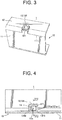
- Fig.3 shows the liquid discharge structure according to Figs.1 and 2 in a perspective view from the outside of the casing, wherein a discharge opening is viewed from downwards;
- the liquid discharge structure 10 is provided in a casing, such as a casing 1, as described below:
- the casing 1 is a casing for an electrical junction box or a protector to be installed in a vehicle, wherein the electrical junction box provides an electrical connection between wire harnesses or between a wire harness and another electric device, wherein the protector covers a wire harness and protects it, although the casing 1 is not limited here.
- the liquid discharge structure 10 is a structure for discharging liquid collected within such a casing 1, and includes a bottom wall 11 of the casing 1, a lateral wall 12 of the casing 1, a tubular rib wall 13, and a partitioning rib wall 14.
- a horizontal plane P11 and a plumb plane P12 are shown together with the casing 1, wherein the plumb plane P12 extends orthogonally to the horizontal plane P11.
- the bottom wall 11 is a wall having a rectangular plate shape which is arranged tilted upwards relative to the horizontal plane P11, as indicated by an arrow D11.
- the lateral wall 12 is a wall which is arranged vertically on a lower end edge 111 of the bottom wall 11 so as to extend orthogonally to the bottom wall 11, wherein it is configured so that the lower end edge 111 is located on a lower side of the bottom wall 11 being tilted. Due to the bottom wall 11 being tilted upwards relative to the horizontal plane P11, the lateral wall 12 is positioned tilted downwards relative to the plumb plane P12. At this time, the lateral wall 12 has a discharge opening 121 for liquid collected within the casing 1 which is located at an end of the lateral wall 12 closer to the bottom wall 11.
- the tubular rib wall 13 is a wall having a tubular shape which projects towards both of the inside and the outside of the casing 1 from the lateral wall 12 so as to surround the discharge opening 121, wherein the tubular rib wall 13 includes an inner rib wall 131 and an outer rib wall 132, the inner rib wall 131 extending inwardly from the lateral wall 12 and the outer rib wall 132 extending outwardly from the lateral wall 12.
- the discharge opening 121 is a quadrilateral hole, and the tubular rib wall 13 has a quadrilateral tubular shape.
- the partitioning rib wall 14 is arranged vertically on an inner surface of the bottom wall 11. This partitioning rib wall 14 extends intersecting a center axis 13a of the tubular rib wall 13.
- the partitioning rib wall 14 is further connected at one end edge 141 to an opening end edge of the tubular rib wall 13 inside the casing 1 i.e. to an opening end edge 131a of the inner rib wall 131.
- the partitioning rib wall 14 extends at a distance from the opening end edge 131a, wherein the distance is increased from the one end edge 141 to another end edge 142.
- Fig.4 is a sectional view of the liquid discharge structure according to Figs.1 to 3 along the line V11-V11 in Fig.1 which extends through the inner rib wall.
- the discharge opening 121 in this liquid discharge structure 10 is defined on a side inside the casing 1 facing the bottom wall 11 by the inner surface of the bottom wall 11 to form a quadrilateral hole.
- the inner rib wall 131 of the tubular rib wall 13 is formed so as to surround the quadrilateral hole on three sides other than the side facing the bottom wall 11, wherein the inner rib wall 131 is connected to the bottom wall 11 at a pair of end edges 131b facing the bottom wall 11, wherein the inner rib wall 131 forms a tubular shape together with the bottom wall 11.
- the partitioning rib wall 14 is a plate-shaped wall which extends obliquely from one end edge 131a-1 of a pair of end edges of the quadrilateral opening end edge 131a of the inner rib wall 131 as a part of the tubular rib wall 13 to extend intersecting the center axis 13a, the pair of end edges being opposed to each other and intersecting the inner surface of the bottom wall 11.
- the outer rib wall 132 as a part of the tubular rib wall 13 is formed in a tubular shape by cutting off a portion of the bottom wall 11 in a recessed form towards the lateral wall 12.
- liquid discharge structure 10 is configured by integrally moulding the bottom wall 11, the lateral wall 12, the tubular rib wall 13 and the partitioning rib wall 14 from resin.
- the liquid discharge structure 10 as described above can achieve effects as described later. Before describing the effects, a reference for comparison with this liquid discharge structure 10 will be described first.
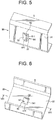
- Fig.5 shows a liquid discharge structure according to the reference for comparison with the liquid discharge structure according to Figs.1 to 4 in a perspective view from the outside of a casing.
- Fig.6 shows the liquid discharge structure according to the reference as shown in Fig.5 in a perspective view from the inside of the casing.
- the liquid discharge structure 50 is a structure for discharging liquid collected within a casing 5, the casing 5 being installed in the vehicle, wherein the liquid discharge structure 50 includes a bottom wall 51 of the casing 5, a blocking wall 52, and a pair of vertical walls 53.
- the bottom wall 51 is a wall having a flat plate shape, and provided with a discharge opening 511 for liquid which is collected within the casing.
- the blocking wall 52 is a tilted wall extending obliquely towards the outside of the casing 5 from an edge of the discharge opening 511.
- the vertical walls 53 are a pair of walls, each of the walls having a triangular shape, wherein the vertical walls 53 connect a pair of inner edges of the discharge opening 511 to a pair of lateral edges of the blocking wall 52, the pair of inner edges of the discharge opening 511 being opposed to each other.
- the blocking wall 52 and the pair of vertical walls 53 define the above-described discharge opening 511 which opens inwardly in the casing 5.
- a discharge path 54 is defined with an external discharge opening 541 which is oriented externally from the casing 5, wherein the external discharge opening 541 is defined by the blocking wall 52, the pair of vertical walls 53 and a rear end edge of the discharge opening 511.
- the liquid discharge structure 50 according to this reference, liquid collected within the casing 5 is discharged, while external liquid is prevented from entering, as described below.
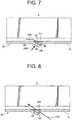
- Fig.7 is a sectional view along the line V51-V51 in Fig.6 illustrating how liquid is discharged and prevented from being introduced in the liquid discharge structure according to the reference as shown in Figs.5 and 6 ;
- liquid collected within the casing 5 flows through the discharge opening 511 in the bottom wall 51 into the discharge path 54, as indicated by an arrow D53. Then, the liquid flows through this discharge path 54 and is discharged in one direction through the external discharge opening 541.
- liquid attempts to enter in another direction as indicated by an arrow D54, wherein the liquid is prevented from entering the casing 5 by blocking the liquid with the blocking wall 52 and the pair of vertical walls 53.
- the liquid discharge structure 50 has room for further improvement of the discharge capacity, since the discharge opening 511 is located substantially at a center in the bottom wall 51, which makes it difficult to direct liquid within the casing 5 towards the discharge opening 511 when the bottom wall 51 is positioned in a tilted state. Also in view of suppressing liquid entering from the outside, there is also room for improvement as follows:
- Fig.8 is a sectional view similar to Fig.7 , wherein it is shown that there is a room for improvement in view of suppressing liquid entering from the outside in the liquid discharge structure according to the reference as shown in Figs. 5 and 6 .
- liquid discharge structure 50 As mentioned above, with the liquid discharge structure 50 according to the reference, it is prevented that liquid enters the casing 5 from the outside with regard to one direction. On the other hand, it may be allowed for liquid to enter the casing 5 via the external discharge opening 541, the discharge path 54, and the discharge opening 511 with regard to a direction as indicated by an arrow D55. As such, it can be also seen that the liquid discharge structure 50 according to the reference has room for further improvement in view of suppressing liquid entering from the outside.
- the liquid discharge structure 10 as shown in Figs.1 to 4 can achieve effects as described below.
- the liquid discharge structure 10 can achieve improvement effects in view of the liquid discharge capacity as follows:
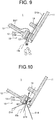
- Fig.9 is a sectional view along the line V12-V12 in Fig.4 illustrating how the discharge capacity for liquid is increased in the liquid discharge structure according to Figs.1 to 4 .
- the discharge opening 121 is disposed at the end of the lateral wall 12 closer to the bottom wall 11, wherein the lateral wall 12 is arranged vertically on the lower end edge 111 of the bottom wall 11 being tilted.
- the discharge opening 121 arranged in this manner facilitates that liquid within the casing 1 is moved along the tilted bottom wall 11 and collected to the discharge opening 121 to be discharged as indicated by an arrow D13, which can enable the discharge capacity to be improved.
- Fig.10 is a sectional view similar to Fig.9 , wherein it is shown how the suppression capacity for liquid being introduced from the outside is increased in the liquid discharge structure according to Figs.1 to 4 .
- liquid coming from the outside in a plurality of directions attempts to enter the casing 1 through the discharge opening 121, as indicated by arrows D14 to D16, wherein the liquid is blocked in these directions by the tubular rib wall 13 and the partitioning rib wall 14 which surround the discharge opening 121.
- the liquid discharge structure 10 can enable the increased suppression capacity for liquid being introduced.
- the liquid discharge structure 10 can improve the discharge capacity for liquid within the casing 1 installed in a tilted state as well as the suppression capacity for liquid entering from the outside.
- the lateral wall 12 is positioned tilted relative to the plumb plane P12 so that the discharge opening 121 is oriented downwards of the vehicle. With positioning the lateral wall 12 tilted in this manner, liquid within the casing 1 can be more easily moved additionally along the tilted lateral wall 12 and collected to the discharge opening 121, as indicated by an arrow D17. In addition, the collected liquid can be more easily discharged through the discharge opening 121 oriented downwards.
- the partitioning rib wall 14 is connected at one end edge 141 to the opening end edge 131a of the tubular rib wall 13 within the casing 1, and extends at a distance from the opening end edge 131a, wherein the distance is increased towards the other end 142.
- Such an extension course can facilitate collecting liquid within the casing 1 to the discharge opening 121 by guiding the liquid with the partitioning rib wall 14, which can further increase the discharge capacity for liquid.
- the discharge opening 121 is defined on a side facing the bottom wall 11 by the inner surface of the bottom wall 11, wherein the inner rib wall 131 of the tubular rib wall 13 forms a tubular shape together with the bottom wall 11.
- the inner rib wall 131 of the tubular rib wall 13 forms a tubular shape together with the bottom wall 11.
- the tubular rib wall 13 additionally projects from the lateral wall 12 towards the outside of the casing 1.
- the tubular rib wall 13 with the outer rib wall 132 projecting towards the outside facilitates blocking liquid flowing towards the discharge opening 121 from the outside, and further increase the suppression capacity for liquid intrusion.
- the outer rib wall 132 of the tubular rib wall 13 is formed in a tubular shape by cutting off a portion of the outer rib wall 132 facing the bottom wall 11 in a recessed form towards the lateral wall 12. According to the present embodiment, liquid exiting the discharge opening 121 can be more easily discharged downwards due to the outer rib wall 132 being cut off on the bottom wall 11 side, i.e. on a lower side, which can further increase the discharge capacity.
- the discharge opening 121 is a quadrilateral hole
- the tubular rib wall 13 has a quadrilateral tubular shape
- the partitioning rib wall 14 is a plate-shaped wall which extends obliquely from one end edge 131a-1 of the quadrilateral opening end edge 131a of the inner rib wall 131 to intersect the center axis 13a, the one end edge 131a-1 intersecting the inner surface of the bottom wall 11.
- the plate-shaped partitioning rib wall 14 extending obliquely from the one end edge 131a-1 of the tubular rib wall 13 can block liquid better which attempts to pass through the discharge opening 121 into the inside from the outside, which can further increase the suppression capacity for liquid intrusion.
- the oblique plate-shaped partitioning rib wall 14 guides liquid within its inside to the discharge opening 121 better, which can further the discharge capacity.
- the bottom wall 11, the lateral wall 12, the tubular rib wall 13 and the partitioning rib wall 14 are integrally moulded from resin. This configuration can reduce the number of components for the casing 1 including the liquid discharge structure 10, which can reduce the component costs for the casing 1.
- the casing 1 is a casing for an electrical junction box or for a protector which protects a wire harness.
- the above-described liquid discharge structure 10 is applied to a casing for an electrical junction box or a protector which is oft disposed in a lower portion of a vehicle and thus subject to liquid intrusion from the outside. With such application, the effects and the capacities of this liquid discharge structure 10 can be utilized effectively.
- the embodiment as described above schematically shows the casing 1 and omits description e.g. of its detailed shape.
- any concrete shape etc. may be selected which has a plate-shaped bottom wall to be disposed tilted relative to a horizontal plane and a lateral wall arranged vertically at a lower end edge of the bottom wall.
- the embodiment as described above shows by way of example that the lateral wall 12 is arranged at the casing 1 on the lower end edge 111 of the bottom wall 11 at a right angle with the bottom wall 11 so that the discharge opening 121 is tilted relative to the plumb plane P12 to be oriented downwards of the vehicle.
- the lateral wall and the discharge opening are not limited thereto.
- the lateral wall may be arranged vertically at an acute angle with the bottom wall to stand along the plumb plane, wherein the discharge opening may be formed in such a lateral wall so as to be opened exactly horizontally.
- by tilting the lateral wall 12 so as to position the discharge opening 121 oriented downwards can further facilitate collecting liquid to the discharge opening 121, and additionally discharging the collected liquid through the discharge opening 121.
- the embodiment as described above shows the partitioning rib wall 14 by way of example which includes the one end edge 141 connected to the opening end edge 131a of the tubular rib wall 13, wherein the partitioning rib wall 14 extends at a distance from the opening end edge 131a, wherein the distance is increased towards the other end edge 142 of the partitioning rib wall 14.
- the partitioning rib wall is not limited thereto, but may be e.g. separate and provided spaced from the opening end edge of the tubular rib wall as far as the partitioning rib wall is arranged vertically on the inner surface of the bottom wall at a position closer to the lateral wall so as to extend intersecting to the center axis of the tubular rib wall.
- the extension course of the partitioning rib wall 14 connected to the opening end edge 131a of the tubular rib wall 13 as described above can further improve the discharge capacity for liquid.
- the embodiment as described above shows by way of example that the discharge opening 121 is partially defined by the inner surface of the bottom wall 11 and the inner rib wall 131 is formed so as to surround the discharge opening 121 on three of its sides, wherein the inner rib wall 131 forms a tubular shape together with the bottom wall 11.
- the discharge opening and the inner rib wall are not limited thereto, but the discharge opening may e.g. extend through the lateral wall at a position spaced away from the bottom wall, wherein the inner rib wall may be e.g. formed in a tubular shape which surrounds an entire circumference of the discharge opening alone.
- the inner rib wall 131 surrounding the discharge opening 121 on three sides and the discharge opening 121 being partially defined by the inner surface of the bottom wall 11, it can be facilitated that liquid flows into the discharge opening 121, which can further increase the discharge capacity, as described above as well.
- the embodiment as described above shows by way of example the tubular rib wall 13 which additionally projects from the lateral wall 12 to the outside of the casing 1.
- the tubular rib wall is not limited thereto, but may project only to the inside of the casing.
- the suppression capacity for liquid entering can be further increased by the tubular rib wall 13 which additionally projects to the outside of the casing 1.
- the embodiment as described above shows by way of example that the outer rib wall 132 is formed in a tubular shape by cutting off a portion of the outer rib wall 132 facing the bottom wall 11 in a recessed form towards the lateral wall 12.
- the outer rib wall is not limited thereto, but may be e.g. formed in a tubular shape without a cut-off portion as described above.
- the discharge opening 121 is a quadrilateral hole
- the tubular rib wall 13 is a quadrilateral tube
- the partitioning rib wall 14 is a plate-shaped wall which extends obliquely from the one end edge 131a-1 of the opening end edge 131a of the inner rib wall 131.
- the discharge opening, the tubular rib wall and the partitioning rib wall are not limited thereto, but may have any concrete shape respectively.
- the discharge opening 121, the tubular rib wall 13 and the partitioning rib wall 14 having the above-described shapes respectively can further improve the suppression capacity for liquid entering and the discharge capacity, as described above as well.
- the present embodiment shows by way of example that the bottom wall 11, the lateral wall 12, the tubular rib wall 13 and the partitioning rib wall 14 are integrally moulded from resin.
- the configuration of the bottom wall, the lateral wall, the tubular rib wall and the partitioning rib wall is not limited thereto, but may be formed e.g. separately from each other and combined by means of adhesive or the like.
- the integral moulding can reduce the number of components and thus the component costs.
- the embodiment as described above shows by way of example that the casing 1 is a casing for an electrical junction box or a protector for protecting a wire harness.
- the casing may be configured for any concrete element as far as it is to be installed in a vehicle.
- the liquid discharge structure 10 to an electrical junction box and/or a protector which is subject to liquid intrusion from the outside, it is possible to effectively utilize the effects and capacities of the liquid discharge structure 10, as described above as well.
Landscapes
- Engineering & Computer Science (AREA)
- Mechanical Engineering (AREA)
- Chemical & Material Sciences (AREA)
- Combustion & Propulsion (AREA)
- Transportation (AREA)
- Architecture (AREA)
- Civil Engineering (AREA)
- Structural Engineering (AREA)
- Casings For Electric Apparatus (AREA)
- Details Of Indoor Wiring (AREA)
- Connection Or Junction Boxes (AREA)
Description
- The present invention relates to a liquid discharge structure which is configured to discharge liquid collected inside a casing installed in a vehicle.
- Conventionally, e.g. an electrical junction box, such as a relay box, and/or a protector for wire harness protection are installed in a vehicle. In this case, some of such components are intended to be disposed in a lower portion of the vehicle, wherein liquid, such as rain water from the outside of the vehicle and/or washing water, may enter such components in the lower portion. Therefore, a liquid discharge structure is oft provided in a casing, e.g. for an electrical junction box and/or a protector, wherein the liquid discharge structure is configured to discharge liquid collected inside the casing (see e.g. Patent Document 1).
- Such a liquid discharge structure itself which is provided in the casing may form an access passage for the liquid from the outside. Therefore, a liquid discharge structure is proposed which discharges liquid collected inside the casing and further suppresses liquid being introduced from the outside (e.g. see Patent Document 2).
-
- Patent Document 1:
JPH 09-093757 A - Patent Document 2:
JPH 09-036559 A - Document
US 2013/0335889 A1 discloses an electrical junction box including a box body in which electrical parts are mounted and that has a water draining hole provided at a bottom wall part of the box body and a waterproof wall that is provided inside the box body along a periphery of an opening of the water draining hole. The waterproof wall includes a spherical cover wall part standing from the periphery of the water draining hole to cover the water draining hole with an inner spherical surface, and a draining opening part formed at a portion of the spherical cover wall part to allow water exist in the box body to drain to the outside of the box body through the water draining hole. - From
JP H08 322124 A - Document
JP S 63172215 U - A casing e.g. for an electrical junction box and/or a protector may be installed in a vehicle, with a bottom wall of the casing being tilted relative to a horizontal plane. In the liquid discharge structure as mentioned above, the casing being tilted may make it difficult to discharge liquid within the casing through a discharge opening and/or to suppress liquid being introduced from the outside. In these points, it is found that such a liquid discharge structure has room for improvement.
- Therefore, the present invention is focused on such a problem, and an objective of the present invention is to provide a liquid discharge structure which can improve a discharge capacity for liquid within a casing and a suppression capacity for liquid being introduced from the outside, with the casing being installed in a tilted state.
- The object is solved by the subject matter of
claim 1. - With the liquid discharge structure as described above, the discharge opening is disposed at the end of the lateral wall closer to the bottom wall, wherein the lateral wall is arranged vertically on the end edge of the bottom wall which represents the lower end edge when the bottom wall is tilted. The discharge opening thus arranged facilitates that liquid within the casing is moved along the tilted bottom wall and collected to the discharge opening to be discharged, which can enable the discharge capacity to be improved. Further, the tubular rib wall surrounding the discharge opening and the partitioning rib wall extending intersecting the center axis of the tubular rib wall provide for blocking liquid which attempts to enter the casing from the outside through the discharge opening, which can enable the suppression capacity for liquid entering to be improved. This means that the liquid discharge structure as described above can improve the discharge capacity for liquid within a casing and the suppression capacity for liquid entering from the outside, the casing being installed in a tilted state.
-
-
Fig.1 shows a liquid discharge structure according to an embodiment in a perspective view from the inside of a casing; -
Fig.2 shows the liquid discharge structure according toFig.1 in a perspective view on a discharge opening from the outside of the casing; -
Fig.3 shows the liquid discharge structure according toFigs.1 and 2 in a perspective view from the outside of the casing, wherein a discharge opening is viewed from downwards; -
Fig.4 is a sectional view of the liquid discharge structure according toFigs.1 to 3 along the line V11-V11 inFig.1 which extends through an inner rib wall; -
Fig.5 shows a liquid discharge structure according to a reference for comparison with the liquid discharge structure according toFigs.1 to 4 in a perspective view from the outside of a casing; -
Fig.6 shows the liquid discharge structure according to the reference as shown inFig.5 in a perspective view from the inside of the casing; -
Fig.7 is a sectional view along the line V51-V51 inFig.6 illustrating how liquid is discharged and prevented from being introduced in the liquid discharge structure according to the reference as shown inFigs.5 and 6 ; -
Fig.8 is a sectional view similar toFig.7 , wherein it is shown that there is a room for improvement in view of suppressing liquid entering from the outside in the liquid discharge structure according to the reference as shown inFigs. 5 and 6 ; -
Fig.9 is a sectional view along the line V12-V12 inFig.4 illustrating how the discharge capacity for liquid is increased in the liquid discharge structure according toFigs.1 to 4 ; and -
Fig.10 is a sectional view similar toFig.9 , wherein it is shown how the suppression capacity for liquid being introduced from the outside is increased in the liquid discharge structure according toFigs.1 to 4 . - Hereinafter, an embodiment of a liquid discharge structure will be described.
-
Fig.1 shows a liquid discharge structure according to an embodiment in a perspective view from the inside of a casing.Fig.2 shows the liquid discharge structure according toFig.1 in a perspective view on a discharge opening from the outside of the casing.Fig.3 shows the liquid discharge structure according toFigs.1 and 2 in a perspective view from the outside of the casing, wherein a discharge opening is viewed from downwards; - The
liquid discharge structure 10 according to the present embodiment is provided in a casing, such as acasing 1, as described below: As used herein, thecasing 1 is a casing for an electrical junction box or a protector to be installed in a vehicle, wherein the electrical junction box provides an electrical connection between wire harnesses or between a wire harness and another electric device, wherein the protector covers a wire harness and protects it, although thecasing 1 is not limited here. Theliquid discharge structure 10 is a structure for discharging liquid collected within such acasing 1, and includes abottom wall 11 of thecasing 1, alateral wall 12 of thecasing 1, atubular rib wall 13, and a partitioningrib wall 14. InFigs.1 and 2 , a horizontal plane P11 and a plumb plane P12 are shown together with thecasing 1, wherein the plumb plane P12 extends orthogonally to the horizontal plane P11. - The
bottom wall 11 is a wall having a rectangular plate shape which is arranged tilted upwards relative to the horizontal plane P11, as indicated by an arrow D11. Thelateral wall 12 is a wall which is arranged vertically on alower end edge 111 of thebottom wall 11 so as to extend orthogonally to thebottom wall 11, wherein it is configured so that thelower end edge 111 is located on a lower side of thebottom wall 11 being tilted. Due to thebottom wall 11 being tilted upwards relative to the horizontal plane P11, thelateral wall 12 is positioned tilted downwards relative to the plumb plane P12. At this time, thelateral wall 12 has a discharge opening 121 for liquid collected within thecasing 1 which is located at an end of thelateral wall 12 closer to thebottom wall 11. Due to thelateral wall 12 tilted as described above, thedischarge opening 121 is oriented downwards of the vehicle. Thetubular rib wall 13 is a wall having a tubular shape which projects towards both of the inside and the outside of thecasing 1 from thelateral wall 12 so as to surround thedischarge opening 121, wherein thetubular rib wall 13 includes aninner rib wall 131 and anouter rib wall 132, theinner rib wall 131 extending inwardly from thelateral wall 12 and theouter rib wall 132 extending outwardly from thelateral wall 12. The discharge opening 121 is a quadrilateral hole, and thetubular rib wall 13 has a quadrilateral tubular shape. The partitioningrib wall 14 is arranged vertically on an inner surface of thebottom wall 11. This partitioningrib wall 14 extends intersecting acenter axis 13a of thetubular rib wall 13. The partitioningrib wall 14 is further connected at oneend edge 141 to an opening end edge of thetubular rib wall 13 inside thecasing 1 i.e. to anopening end edge 131a of theinner rib wall 131. Furthermore, the partitioningrib wall 14 extends at a distance from theopening end edge 131a, wherein the distance is increased from the oneend edge 141 to anotherend edge 142. -
Fig.4 is a sectional view of the liquid discharge structure according toFigs.1 to 3 along the line V11-V11 inFig.1 which extends through the inner rib wall. - As shown in this
Fig.4 , the discharge opening 121 in thisliquid discharge structure 10 is defined on a side inside thecasing 1 facing thebottom wall 11 by the inner surface of thebottom wall 11 to form a quadrilateral hole. Theinner rib wall 131 of thetubular rib wall 13 is formed so as to surround the quadrilateral hole on three sides other than the side facing thebottom wall 11, wherein theinner rib wall 131 is connected to thebottom wall 11 at a pair ofend edges 131b facing thebottom wall 11, wherein theinner rib wall 131 forms a tubular shape together with thebottom wall 11. - The partitioning
rib wall 14 is a plate-shaped wall which extends obliquely from oneend edge 131a-1 of a pair of end edges of the quadrilateralopening end edge 131a of theinner rib wall 131 as a part of thetubular rib wall 13 to extend intersecting thecenter axis 13a, the pair of end edges being opposed to each other and intersecting the inner surface of thebottom wall 11. - Further, as shown in
Figs.2 and3 , theouter rib wall 132 as a part of thetubular rib wall 13 is formed in a tubular shape by cutting off a portion of thebottom wall 11 in a recessed form towards thelateral wall 12. - Furthermore, the
liquid discharge structure 10 according to the present embodiment is configured by integrally moulding thebottom wall 11, thelateral wall 12, thetubular rib wall 13 and the partitioningrib wall 14 from resin. - The
liquid discharge structure 10 as described above can achieve effects as described later. Before describing the effects, a reference for comparison with thisliquid discharge structure 10 will be described first. -
Fig.5 shows a liquid discharge structure according to the reference for comparison with the liquid discharge structure according toFigs.1 to 4 in a perspective view from the outside of a casing.Fig.6 shows the liquid discharge structure according to the reference as shown inFig.5 in a perspective view from the inside of the casing. - Likewise, the
liquid discharge structure 50 according to the reference is a structure for discharging liquid collected within acasing 5, thecasing 5 being installed in the vehicle, wherein theliquid discharge structure 50 includes abottom wall 51 of thecasing 5, a blockingwall 52, and a pair ofvertical walls 53. - The
bottom wall 51 is a wall having a flat plate shape, and provided with adischarge opening 511 for liquid which is collected within the casing. The blockingwall 52 is a tilted wall extending obliquely towards the outside of thecasing 5 from an edge of thedischarge opening 511. Thevertical walls 53 are a pair of walls, each of the walls having a triangular shape, wherein thevertical walls 53 connect a pair of inner edges of thedischarge opening 511 to a pair of lateral edges of the blockingwall 52, the pair of inner edges of thedischarge opening 511 being opposed to each other. The blockingwall 52 and the pair ofvertical walls 53 define the above-describeddischarge opening 511 which opens inwardly in thecasing 5. As such, adischarge path 54 is defined with an external discharge opening 541 which is oriented externally from thecasing 5, wherein theexternal discharge opening 541 is defined by the blockingwall 52, the pair ofvertical walls 53 and a rear end edge of thedischarge opening 511. With theliquid discharge structure 50 according to this reference, liquid collected within thecasing 5 is discharged, while external liquid is prevented from entering, as described below. -
Fig.7 is a sectional view along the line V51-V51 inFig.6 illustrating how liquid is discharged and prevented from being introduced in the liquid discharge structure according to the reference as shown inFigs.5 and 6 ; - In the
liquid discharge structure 50 according to the reference, liquid collected within thecasing 5 flows through thedischarge opening 511 in thebottom wall 51 into thedischarge path 54, as indicated by an arrow D53. Then, the liquid flows through thisdischarge path 54 and is discharged in one direction through theexternal discharge opening 541. In theliquid discharge structure 50 according to this reference, liquid attempts to enter in another direction as indicated by an arrow D54, wherein the liquid is prevented from entering thecasing 5 by blocking the liquid with the blockingwall 52 and the pair ofvertical walls 53. - It can be seen that the
liquid discharge structure 50 according to the reference has room for further improvement of the discharge capacity, since thedischarge opening 511 is located substantially at a center in thebottom wall 51, which makes it difficult to direct liquid within thecasing 5 towards thedischarge opening 511 when thebottom wall 51 is positioned in a tilted state. Also in view of suppressing liquid entering from the outside, there is also room for improvement as follows: -
Fig.8 is a sectional view similar toFig.7 , wherein it is shown that there is a room for improvement in view of suppressing liquid entering from the outside in the liquid discharge structure according to the reference as shown inFigs. 5 and 6 . - As mentioned above, with the
liquid discharge structure 50 according to the reference, it is prevented that liquid enters thecasing 5 from the outside with regard to one direction. On the other hand, it may be allowed for liquid to enter thecasing 5 via theexternal discharge opening 541, thedischarge path 54, and thedischarge opening 511 with regard to a direction as indicated by an arrow D55. As such, it can be also seen that theliquid discharge structure 50 according to the reference has room for further improvement in view of suppressing liquid entering from the outside. - In contrast, the
liquid discharge structure 10 as shown inFigs.1 to 4 can achieve effects as described below. First, theliquid discharge structure 10 can achieve improvement effects in view of the liquid discharge capacity as follows: -
Fig.9 is a sectional view along the line V12-V12 inFig.4 illustrating how the discharge capacity for liquid is increased in the liquid discharge structure according toFigs.1 to 4 . - With this
liquid discharge structure 10, thedischarge opening 121 is disposed at the end of thelateral wall 12 closer to thebottom wall 11, wherein thelateral wall 12 is arranged vertically on thelower end edge 111 of thebottom wall 11 being tilted. Thedischarge opening 121 arranged in this manner facilitates that liquid within thecasing 1 is moved along the tiltedbottom wall 11 and collected to thedischarge opening 121 to be discharged as indicated by an arrow D13, which can enable the discharge capacity to be improved. -
Fig.10 is a sectional view similar toFig.9 , wherein it is shown how the suppression capacity for liquid being introduced from the outside is increased in the liquid discharge structure according toFigs.1 to 4 . - According to this
liquid discharge structure 10, liquid coming from the outside in a plurality of directions attempts to enter thecasing 1 through thedischarge opening 121, as indicated by arrows D14 to D16, wherein the liquid is blocked in these directions by thetubular rib wall 13 and thepartitioning rib wall 14 which surround thedischarge opening 121. This means that theliquid discharge structure 10 can enable the increased suppression capacity for liquid being introduced. - As described above with reference to
Figs.9 and 10 , theliquid discharge structure 10 according to the present embodiment can improve the discharge capacity for liquid within thecasing 1 installed in a tilted state as well as the suppression capacity for liquid entering from the outside. - According to the present embodiment, the
lateral wall 12 is positioned tilted relative to the plumb plane P12 so that thedischarge opening 121 is oriented downwards of the vehicle. With positioning thelateral wall 12 tilted in this manner, liquid within thecasing 1 can be more easily moved additionally along the tiltedlateral wall 12 and collected to thedischarge opening 121, as indicated by an arrow D17. In addition, the collected liquid can be more easily discharged through thedischarge opening 121 oriented downwards. - Further, according to the present embodiment, the
partitioning rib wall 14 is connected at oneend edge 141 to the openingend edge 131a of thetubular rib wall 13 within thecasing 1, and extends at a distance from the openingend edge 131a, wherein the distance is increased towards theother end 142. Such an extension course can facilitate collecting liquid within thecasing 1 to thedischarge opening 121 by guiding the liquid with thepartitioning rib wall 14, which can further increase the discharge capacity for liquid. - Here, the
discharge opening 121 according to the present embodiment is defined on a side facing thebottom wall 11 by the inner surface of thebottom wall 11, wherein theinner rib wall 131 of thetubular rib wall 13 forms a tubular shape together with thebottom wall 11. With this configuration, liquid flowing along the inner surface of thebottom wall 11 is guided by theinner rib wall 131 which forms the tubular shape together with thebottom wall 11, which facilitates directing the liquid to thedischarge opening 121 defined by the inner surface of thebottom wall 11 and can further increase the discharge capacity. - Furthermore, according to the present embodiment, the
tubular rib wall 13 additionally projects from thelateral wall 12 towards the outside of thecasing 1. Thetubular rib wall 13 with theouter rib wall 132 projecting towards the outside facilitates blocking liquid flowing towards the discharge opening 121 from the outside, and further increase the suppression capacity for liquid intrusion. - Moreover, according to the present embodiment, the
outer rib wall 132 of thetubular rib wall 13 is formed in a tubular shape by cutting off a portion of theouter rib wall 132 facing thebottom wall 11 in a recessed form towards thelateral wall 12. According to the present embodiment, liquid exiting thedischarge opening 121 can be more easily discharged downwards due to theouter rib wall 132 being cut off on thebottom wall 11 side, i.e. on a lower side, which can further increase the discharge capacity. - Further, the
discharge opening 121 according to the present embodiment is a quadrilateral hole, and thetubular rib wall 13 has a quadrilateral tubular shape. Additionally, thepartitioning rib wall 14 is a plate-shaped wall which extends obliquely from oneend edge 131a-1 of the quadrilateral openingend edge 131a of theinner rib wall 131 to intersect thecenter axis 13a, the oneend edge 131a-1 intersecting the inner surface of thebottom wall 11. With this configuration, the plate-shapedpartitioning rib wall 14 extending obliquely from the oneend edge 131a-1 of thetubular rib wall 13 can block liquid better which attempts to pass through thedischarge opening 121 into the inside from the outside, which can further increase the suppression capacity for liquid intrusion. In addition, the oblique plate-shapedpartitioning rib wall 14 guides liquid within its inside to thedischarge opening 121 better, which can further the discharge capacity. - Further, according to the present embodiment, the
bottom wall 11, thelateral wall 12, thetubular rib wall 13 and thepartitioning rib wall 14 are integrally moulded from resin. This configuration can reduce the number of components for thecasing 1 including theliquid discharge structure 10, which can reduce the component costs for thecasing 1. - Moreover, according to the present embodiment, the
casing 1 is a casing for an electrical junction box or for a protector which protects a wire harness. With this configuration, the above-describedliquid discharge structure 10 is applied to a casing for an electrical junction box or a protector which is oft disposed in a lower portion of a vehicle and thus subject to liquid intrusion from the outside. With such application, the effects and the capacities of thisliquid discharge structure 10 can be utilized effectively. - It is to be noted that the embodiment as described above merely shows representative configurations for the liquid discharge structure, and the liquid discharge structure is not limited thereto, wherein various modifications may be carried out for implementation.
- For example, the embodiment as described above schematically shows the
casing 1 and omits description e.g. of its detailed shape. For the casing, any concrete shape etc. may be selected which has a plate-shaped bottom wall to be disposed tilted relative to a horizontal plane and a lateral wall arranged vertically at a lower end edge of the bottom wall. - Further, the embodiment as described above shows by way of example that the
lateral wall 12 is arranged at thecasing 1 on thelower end edge 111 of thebottom wall 11 at a right angle with thebottom wall 11 so that thedischarge opening 121 is tilted relative to the plumb plane P12 to be oriented downwards of the vehicle. However, the lateral wall and the discharge opening are not limited thereto. For example, the lateral wall may be arranged vertically at an acute angle with the bottom wall to stand along the plumb plane, wherein the discharge opening may be formed in such a lateral wall so as to be opened exactly horizontally. However, as described above, by tilting thelateral wall 12 so as to position thedischarge opening 121 oriented downwards can further facilitate collecting liquid to thedischarge opening 121, and additionally discharging the collected liquid through thedischarge opening 121. - Furthermore, the embodiment as described above shows the
partitioning rib wall 14 by way of example which includes the oneend edge 141 connected to the openingend edge 131a of thetubular rib wall 13, wherein thepartitioning rib wall 14 extends at a distance from the openingend edge 131a, wherein the distance is increased towards theother end edge 142 of thepartitioning rib wall 14. However, the partitioning rib wall is not limited thereto, but may be e.g. separate and provided spaced from the opening end edge of the tubular rib wall as far as the partitioning rib wall is arranged vertically on the inner surface of the bottom wall at a position closer to the lateral wall so as to extend intersecting to the center axis of the tubular rib wall. However, as described above as well, the extension course of thepartitioning rib wall 14 connected to the openingend edge 131a of thetubular rib wall 13 as described above can further improve the discharge capacity for liquid. - Furthermore, the embodiment as described above shows by way of example that the
discharge opening 121 is partially defined by the inner surface of thebottom wall 11 and theinner rib wall 131 is formed so as to surround the discharge opening 121 on three of its sides, wherein theinner rib wall 131 forms a tubular shape together with thebottom wall 11. However, the discharge opening and the inner rib wall are not limited thereto, but the discharge opening may e.g. extend through the lateral wall at a position spaced away from the bottom wall, wherein the inner rib wall may be e.g. formed in a tubular shape which surrounds an entire circumference of the discharge opening alone. However, by forming a tubular shape with theinner rib wall 131 and thebottom wall 11, theinner rib wall 131 surrounding the discharge opening 121 on three sides and thedischarge opening 121 being partially defined by the inner surface of thebottom wall 11, it can be facilitated that liquid flows into thedischarge opening 121, which can further increase the discharge capacity, as described above as well. - Further, the embodiment as described above shows by way of example the
tubular rib wall 13 which additionally projects from thelateral wall 12 to the outside of thecasing 1. However, the tubular rib wall is not limited thereto, but may project only to the inside of the casing. However, as described above as well, the suppression capacity for liquid entering can be further increased by thetubular rib wall 13 which additionally projects to the outside of thecasing 1. - Moreover, the embodiment as described above shows by way of example that the
outer rib wall 132 is formed in a tubular shape by cutting off a portion of theouter rib wall 132 facing thebottom wall 11 in a recessed form towards thelateral wall 12. However, the outer rib wall is not limited thereto, but may be e.g. formed in a tubular shape without a cut-off portion as described above. However, by forming theouter rib wall 132 in a tubular shape by cutting off a portion of theouter rib wall 132 facing thebottom wall 11 in a recessed form towards thelateral wall 12, it is possible to facilitate the downward discharge of liquid and to further increase the discharge capacity, as described above as well. - The embodiment as described above further shows by way of example that the
discharge opening 121 is a quadrilateral hole, thetubular rib wall 13 is a quadrilateral tube, and thepartitioning rib wall 14 is a plate-shaped wall which extends obliquely from the oneend edge 131a-1 of the openingend edge 131a of theinner rib wall 131. However, the discharge opening, the tubular rib wall and the partitioning rib wall are not limited thereto, but may have any concrete shape respectively. However, thedischarge opening 121, thetubular rib wall 13 and thepartitioning rib wall 14 having the above-described shapes respectively can further improve the suppression capacity for liquid entering and the discharge capacity, as described above as well. - Moreover, the present embodiment as described above shows by way of example that the
bottom wall 11, thelateral wall 12, thetubular rib wall 13 and thepartitioning rib wall 14 are integrally moulded from resin. However, the configuration of the bottom wall, the lateral wall, the tubular rib wall and the partitioning rib wall is not limited thereto, but may be formed e.g. separately from each other and combined by means of adhesive or the like. However, as described above as well, the integral moulding can reduce the number of components and thus the component costs. - Moreover, the embodiment as described above shows by way of example that the
casing 1 is a casing for an electrical junction box or a protector for protecting a wire harness. However, the casing may be configured for any concrete element as far as it is to be installed in a vehicle. However, by applying theliquid discharge structure 10 to an electrical junction box and/or a protector which is subject to liquid intrusion from the outside, it is possible to effectively utilize the effects and capacities of theliquid discharge structure 10, as described above as well. -
- 1
- Casing
- 10
- Liquid discharge structure
- 11
- Bottom wall
- 12
- Lateral wall
- 13
- Tubular rib wall
- 13a
- Center axis
- 14
- Partitioning rib wall
- 111
- Lower end edge
- 121
- Discharge opening
- 131
- Inner rib wall
- 131a
- Opening end edge
- 131a-1, 131b
- End edges
- 132
- Outer rib wall
- 141
- One end edge
- 142
- Other end edge
- P11
- Horizontal plane
- P12
- Plumb plane
Claims (9)
- A liquid discharge structure (10) comprising:
a casing (1) configured to be installed in a vehicle, including:a plate-shaped bottom wall (11) to be disposed tilted relative to a horizontal plane (P11); anda lateral wall (12) which is a plate-shaped wall arranged vertically at a lower end edge of the bottom wall (11) so as to extend orthogonally to said bottom wall (11), wherein the lower end edge is configured to be located on a lower side of the bottom wall (11) when the bottom wall (11) is disposed tilted relative to the horizontal plane (P11), wherein the lateral wall (12) has a discharge opening (121) for liquid collected within the casing (1), the discharge opening (121) being located at an end of the lateral wall (12) closer to the bottom wall (11);a tubular rib wall (13) projecting at least inwardly within the casing (1) from the lateral wall (12) so as to surround the discharge opening (121); anda partitioning rib wall (14) which is arranged vertically on an inner surface of the bottom wall (11) at a position closer to the lateral wall (12) so that the partitioning rib wall (14) extends intersecting a center axis (13a) of the tubular rib wall (13). - The liquid discharge structure (10) according to claim 1,
wherein the lateral wall (12) is configured to be positioned tilted relative to a plumb plane (P12) so that the discharge opening (121) is oriented downwards of the vehicle, wherein the plumb plane (P12) extends orthogonally to the horizontal plane (P11). - The liquid discharge structure (10) according to claim 1 or 2, wherein the partitioning rib wall (14) is connected at one end edge (141) to an opening end edge (131a) of the tubular rib wall (13) within the casing (1), and extends at a distance from the opening end edge (131a), wherein the distance is increased towards another end (142).
- The liquid discharge structure (10) according to any one of claims 1 to 3, wherein the discharge opening (121) is defined on a side facing the bottom wall (11) within the casing (1) by the inner surface of the bottom wall (11), and
wherein an inner rib wall (131) of the tubular rib wall (13) which projects inwardly from the lateral wall (12) surrounds the discharge opening (121) on three sides other than the side facing the bottom wall (11), wherein the inner rib wall (131) is connected to the bottom wall (11) at a pair of end edges facing the bottom wall (11), the inner rib wall (131) forming a tubular shape together with the bottom wall (11). - The liquid discharge structure (10) according to any one of claims 1 to 4, wherein the tubular rib wall (13) additionally projects from the lateral wall (12) outside the casing (1).
- The liquid discharge structure (10) according to claim 5,
wherein an outer rib wall (132) of the tubular rib wall (13) projecting outside the casing (1) has a tubular shape by cutting off a portion of the outer rib wall (132) facing the bottom wall (11) in a recessed form towards the lateral wall (12). - The liquid discharge structure (10) according to any one of claims 1 to 6,wherein the discharge opening (121) is a quadrilateral hole,wherein the tubular rib wall (13) is a quadrilateral tubular wall, andwherein the partitioning rib wall (14) is a plate-shaped wall which extends obliquely from one of a pair of end edges of a quadrilateral opening end edge of the tubular rib wall (13) within the casing (1) to intersect the center axis (13a), the pair of end edges (141, 142) being opposed to each other and intersecting the inner surface of the bottom wall (11).
- The liquid discharge structure (10) according to any one of claims 1 to 7, wherein the bottom wall (11), the lateral wall (12), the tubular rib wall (13) and the partitioning rib wall (14) are integrally molded from resin.
- The liquid discharge structure (10) according to any one of claims 1 to 8, wherein the casing (1) is a casing (1) for an electrical junction box or a protector to be installed in a vehicle, wherein the electrical junction box provides an electrical connection between wire harnesses or between a wire harness and another electric device, wherein the protector to configured to cover and protect a wire harness.
Applications Claiming Priority (1)
| Application Number | Priority Date | Filing Date | Title |
|---|---|---|---|
| JP2019209522A JP6999629B2 (en) | 2019-11-20 | 2019-11-20 | Liquid discharge structure |
Publications (2)
| Publication Number | Publication Date |
|---|---|
| EP3826122A1 EP3826122A1 (en) | 2021-05-26 |
| EP3826122B1 true EP3826122B1 (en) | 2021-12-01 |
Family
ID=73198085
Family Applications (1)
| Application Number | Title | Priority Date | Filing Date |
|---|---|---|---|
| EP20205419.3A Active EP3826122B1 (en) | 2019-11-20 | 2020-11-03 | Liquid discharge structure |
Country Status (4)
| Country | Link |
|---|---|
| US (1) | US11679815B2 (en) |
| EP (1) | EP3826122B1 (en) |
| JP (1) | JP6999629B2 (en) |
| CN (1) | CN112824155B (en) |
Families Citing this family (2)
| Publication number | Priority date | Publication date | Assignee | Title |
|---|---|---|---|---|
| JP7016849B2 (en) * | 2019-11-18 | 2022-02-07 | 矢崎総業株式会社 | Liquid discharge structure |
| DE102020111356A1 (en) * | 2020-04-27 | 2021-10-28 | Bayerische Motoren Werke Aktiengesellschaft | Underbody arrangement and method for providing an underbody arrangement |
Family Cites Families (13)
| Publication number | Priority date | Publication date | Assignee | Title |
|---|---|---|---|---|
| JPH0353538Y2 (en) * | 1987-04-27 | 1991-11-22 | ||
| JPH08322124A (en) * | 1995-05-23 | 1996-12-03 | Sumitomo Wiring Syst Ltd | Waterproof structure of electric connection box |
| JP3054726B2 (en) | 1995-07-21 | 2000-06-19 | 矢崎総業株式会社 | Electrical junction box |
| JPH0993757A (en) | 1995-09-25 | 1997-04-04 | Yazaki Corp | Heat dissipation structure of electrical junction box |
| JP3404459B2 (en) | 1998-10-19 | 2003-05-06 | 矢崎総業株式会社 | Waterproof structure of electrical junction box |
| JP4176005B2 (en) * | 2003-12-22 | 2008-11-05 | 矢崎総業株式会社 | Waterproof structure of electrical junction box |
| JP5145808B2 (en) * | 2007-07-31 | 2013-02-20 | 日産自動車株式会社 | Vehicle drainage structure |
| JP4689686B2 (en) * | 2008-01-15 | 2011-05-25 | ダイキョーニシカワ株式会社 | Opening / closing body drain structure |
| DE102010019700A1 (en) * | 2010-05-07 | 2011-11-10 | Emitec Gesellschaft Für Emissionstechnologie Mbh | Container with a sampling line for a working fluid of a motor vehicle |
| JP5435140B2 (en) * | 2010-09-22 | 2014-03-05 | トヨタ車体株式会社 | Vehicle drainage structure |
| JP2012085473A (en) * | 2010-10-13 | 2012-04-26 | Sumitomo Wiring Syst Ltd | Drain structure of on-vehicle protector |
| JP5961884B2 (en) | 2012-06-07 | 2016-08-03 | 矢崎総業株式会社 | Electrical junction box |
| JP6767919B2 (en) | 2017-04-25 | 2020-10-14 | 矢崎総業株式会社 | Electrical junction box and wire harness |
-
2019
- 2019-11-20 JP JP2019209522A patent/JP6999629B2/en active Active
-
2020
- 2020-11-03 EP EP20205419.3A patent/EP3826122B1/en active Active
- 2020-11-04 US US17/089,057 patent/US11679815B2/en active Active
- 2020-11-19 CN CN202011304262.9A patent/CN112824155B/en active Active
Also Published As
| Publication number | Publication date |
|---|---|
| EP3826122A1 (en) | 2021-05-26 |
| CN112824155B (en) | 2024-03-01 |
| CN112824155A (en) | 2021-05-21 |
| US11679815B2 (en) | 2023-06-20 |
| US20210147005A1 (en) | 2021-05-20 |
| JP6999629B2 (en) | 2022-01-18 |
| JP2021083233A (en) | 2021-05-27 |
Similar Documents
| Publication | Publication Date | Title |
|---|---|---|
| JP4901374B2 (en) | Drainage structure of electrical junction box | |
| US6166327A (en) | Wiring box with shielded water outlet | |
| JP5811464B2 (en) | Electrical junction box | |
| US10283949B2 (en) | Weather resistant floor box with draining chamber | |
| EP2879254A1 (en) | Waterproof box and electric junction box equipped with same | |
| CN101874332A (en) | Electrical connection box | |
| EP3826122B1 (en) | Liquid discharge structure | |
| KR20130086184A (en) | Charging stations for use in charging electrically powered vehicles and related methods | |
| JP6275475B2 (en) | Electrical junction box | |
| EP3823116B1 (en) | Liquid discharge structure | |
| JP2007068312A (en) | Resin molded structure with water-stop structure in wire harness path | |
| JP2017108493A (en) | Electrical junction box and wire harness | |
| JP5242294B2 (en) | Electrical junction box for vehicles | |
| US7683258B2 (en) | Wire harness that prevents water ingress | |
| JP2009207222A (en) | Vehicle-mounting electrical connection box | |
| JP7408238B2 (en) | Connector drip-proof member and wire harness | |
| CN215890145U (en) | A protection casing structure for urea case | |
| JP2025086050A (en) | Protector | |
| JP5299219B2 (en) | Electrical junction box | |
| JP5732650B2 (en) | Vehicle charging device | |
| KR200153290Y1 (en) | Drain Cover for Fuse Box | |
| JP2023169000A (en) | Electric connection box | |
| JP6313603B2 (en) | cover | |
| JP2015104205A (en) | Electrical junction box |
Legal Events
| Date | Code | Title | Description |
|---|---|---|---|
| PUAI | Public reference made under article 153(3) epc to a published international application that has entered the european phase |
Free format text: ORIGINAL CODE: 0009012 |
|
| STAA | Information on the status of an ep patent application or granted ep patent |
Free format text: STATUS: REQUEST FOR EXAMINATION WAS MADE |
|
| 17P | Request for examination filed |
Effective date: 20201103 |
|
| AK | Designated contracting states |
Kind code of ref document: A1 Designated state(s): AL AT BE BG CH CY CZ DE DK EE ES FI FR GB GR HR HU IE IS IT LI LT LU LV MC MK MT NL NO PL PT RO RS SE SI SK SM TR |
|
| RBV | Designated contracting states (corrected) |
Designated state(s): AL AT BE BG CH CY CZ DE DK EE ES FI FR GB GR HR HU IE IS IT LI LT LU LV MC MK MT NL NO PL PT RO RS SE SI SK SM TR |
|
| GRAP | Despatch of communication of intention to grant a patent |
Free format text: ORIGINAL CODE: EPIDOSNIGR1 |
|
| STAA | Information on the status of an ep patent application or granted ep patent |
Free format text: STATUS: GRANT OF PATENT IS INTENDED |
|
| INTG | Intention to grant announced |
Effective date: 20210928 |
|
| GRAS | Grant fee paid |
Free format text: ORIGINAL CODE: EPIDOSNIGR3 |
|
| GRAA | (expected) grant |
Free format text: ORIGINAL CODE: 0009210 |
|
| STAA | Information on the status of an ep patent application or granted ep patent |
Free format text: STATUS: THE PATENT HAS BEEN GRANTED |
|
| AK | Designated contracting states |
Kind code of ref document: B1 Designated state(s): AL AT BE BG CH CY CZ DE DK EE ES FI FR GB GR HR HU IE IS IT LI LT LU LV MC MK MT NL NO PL PT RO RS SE SI SK SM TR |
|
| REG | Reference to a national code |
Ref country code: GB Ref legal event code: FG4D |
|
| REG | Reference to a national code |
Ref country code: AT Ref legal event code: REF Ref document number: 1452694 Country of ref document: AT Kind code of ref document: T Effective date: 20211215 Ref country code: CH Ref legal event code: EP |
|
| REG | Reference to a national code |
Ref country code: IE Ref legal event code: FG4D |
|
| REG | Reference to a national code |
Ref country code: DE Ref legal event code: R096 Ref document number: 602020001168 Country of ref document: DE |
|
| REG | Reference to a national code |
Ref country code: LT Ref legal event code: MG9D |
|
| REG | Reference to a national code |
Ref country code: NL Ref legal event code: MP Effective date: 20211201 |
|
| REG | Reference to a national code |
Ref country code: AT Ref legal event code: MK05 Ref document number: 1452694 Country of ref document: AT Kind code of ref document: T Effective date: 20211201 |
|
| PG25 | Lapsed in a contracting state [announced via postgrant information from national office to epo] |
Ref country code: RS Free format text: LAPSE BECAUSE OF FAILURE TO SUBMIT A TRANSLATION OF THE DESCRIPTION OR TO PAY THE FEE WITHIN THE PRESCRIBED TIME-LIMIT Effective date: 20211201 Ref country code: LT Free format text: LAPSE BECAUSE OF FAILURE TO SUBMIT A TRANSLATION OF THE DESCRIPTION OR TO PAY THE FEE WITHIN THE PRESCRIBED TIME-LIMIT Effective date: 20211201 Ref country code: FI Free format text: LAPSE BECAUSE OF FAILURE TO SUBMIT A TRANSLATION OF THE DESCRIPTION OR TO PAY THE FEE WITHIN THE PRESCRIBED TIME-LIMIT Effective date: 20211201 Ref country code: BG Free format text: LAPSE BECAUSE OF FAILURE TO SUBMIT A TRANSLATION OF THE DESCRIPTION OR TO PAY THE FEE WITHIN THE PRESCRIBED TIME-LIMIT Effective date: 20220301 Ref country code: AT Free format text: LAPSE BECAUSE OF FAILURE TO SUBMIT A TRANSLATION OF THE DESCRIPTION OR TO PAY THE FEE WITHIN THE PRESCRIBED TIME-LIMIT Effective date: 20211201 |
|
| PG25 | Lapsed in a contracting state [announced via postgrant information from national office to epo] |
Ref country code: SE Free format text: LAPSE BECAUSE OF FAILURE TO SUBMIT A TRANSLATION OF THE DESCRIPTION OR TO PAY THE FEE WITHIN THE PRESCRIBED TIME-LIMIT Effective date: 20211201 Ref country code: PL Free format text: LAPSE BECAUSE OF FAILURE TO SUBMIT A TRANSLATION OF THE DESCRIPTION OR TO PAY THE FEE WITHIN THE PRESCRIBED TIME-LIMIT Effective date: 20211201 Ref country code: NO Free format text: LAPSE BECAUSE OF FAILURE TO SUBMIT A TRANSLATION OF THE DESCRIPTION OR TO PAY THE FEE WITHIN THE PRESCRIBED TIME-LIMIT Effective date: 20220301 Ref country code: LV Free format text: LAPSE BECAUSE OF FAILURE TO SUBMIT A TRANSLATION OF THE DESCRIPTION OR TO PAY THE FEE WITHIN THE PRESCRIBED TIME-LIMIT Effective date: 20211201 Ref country code: HR Free format text: LAPSE BECAUSE OF FAILURE TO SUBMIT A TRANSLATION OF THE DESCRIPTION OR TO PAY THE FEE WITHIN THE PRESCRIBED TIME-LIMIT Effective date: 20211201 Ref country code: GR Free format text: LAPSE BECAUSE OF FAILURE TO SUBMIT A TRANSLATION OF THE DESCRIPTION OR TO PAY THE FEE WITHIN THE PRESCRIBED TIME-LIMIT Effective date: 20220302 |
|
| PG25 | Lapsed in a contracting state [announced via postgrant information from national office to epo] |
Ref country code: NL Free format text: LAPSE BECAUSE OF FAILURE TO SUBMIT A TRANSLATION OF THE DESCRIPTION OR TO PAY THE FEE WITHIN THE PRESCRIBED TIME-LIMIT Effective date: 20211201 |
|
| PG25 | Lapsed in a contracting state [announced via postgrant information from national office to epo] |
Ref country code: SM Free format text: LAPSE BECAUSE OF FAILURE TO SUBMIT A TRANSLATION OF THE DESCRIPTION OR TO PAY THE FEE WITHIN THE PRESCRIBED TIME-LIMIT Effective date: 20211201 Ref country code: SK Free format text: LAPSE BECAUSE OF FAILURE TO SUBMIT A TRANSLATION OF THE DESCRIPTION OR TO PAY THE FEE WITHIN THE PRESCRIBED TIME-LIMIT Effective date: 20211201 Ref country code: RO Free format text: LAPSE BECAUSE OF FAILURE TO SUBMIT A TRANSLATION OF THE DESCRIPTION OR TO PAY THE FEE WITHIN THE PRESCRIBED TIME-LIMIT Effective date: 20211201 Ref country code: PT Free format text: LAPSE BECAUSE OF FAILURE TO SUBMIT A TRANSLATION OF THE DESCRIPTION OR TO PAY THE FEE WITHIN THE PRESCRIBED TIME-LIMIT Effective date: 20220401 Ref country code: ES Free format text: LAPSE BECAUSE OF FAILURE TO SUBMIT A TRANSLATION OF THE DESCRIPTION OR TO PAY THE FEE WITHIN THE PRESCRIBED TIME-LIMIT Effective date: 20211201 Ref country code: EE Free format text: LAPSE BECAUSE OF FAILURE TO SUBMIT A TRANSLATION OF THE DESCRIPTION OR TO PAY THE FEE WITHIN THE PRESCRIBED TIME-LIMIT Effective date: 20211201 Ref country code: CZ Free format text: LAPSE BECAUSE OF FAILURE TO SUBMIT A TRANSLATION OF THE DESCRIPTION OR TO PAY THE FEE WITHIN THE PRESCRIBED TIME-LIMIT Effective date: 20211201 |
|
| REG | Reference to a national code |
Ref country code: DE Ref legal event code: R097 Ref document number: 602020001168 Country of ref document: DE |
|
| PG25 | Lapsed in a contracting state [announced via postgrant information from national office to epo] |
Ref country code: IS Free format text: LAPSE BECAUSE OF FAILURE TO SUBMIT A TRANSLATION OF THE DESCRIPTION OR TO PAY THE FEE WITHIN THE PRESCRIBED TIME-LIMIT Effective date: 20220401 |
|
| PLBE | No opposition filed within time limit |
Free format text: ORIGINAL CODE: 0009261 |
|
| STAA | Information on the status of an ep patent application or granted ep patent |
Free format text: STATUS: NO OPPOSITION FILED WITHIN TIME LIMIT |
|
| PG25 | Lapsed in a contracting state [announced via postgrant information from national office to epo] |
Ref country code: DK Free format text: LAPSE BECAUSE OF FAILURE TO SUBMIT A TRANSLATION OF THE DESCRIPTION OR TO PAY THE FEE WITHIN THE PRESCRIBED TIME-LIMIT Effective date: 20211201 Ref country code: AL Free format text: LAPSE BECAUSE OF FAILURE TO SUBMIT A TRANSLATION OF THE DESCRIPTION OR TO PAY THE FEE WITHIN THE PRESCRIBED TIME-LIMIT Effective date: 20211201 |
|
| 26N | No opposition filed |
Effective date: 20220902 |
|
| PG25 | Lapsed in a contracting state [announced via postgrant information from national office to epo] |
Ref country code: IT Free format text: LAPSE BECAUSE OF FAILURE TO SUBMIT A TRANSLATION OF THE DESCRIPTION OR TO PAY THE FEE WITHIN THE PRESCRIBED TIME-LIMIT Effective date: 20211201 |
|
| PG25 | Lapsed in a contracting state [announced via postgrant information from national office to epo] |
Ref country code: MC Free format text: LAPSE BECAUSE OF FAILURE TO SUBMIT A TRANSLATION OF THE DESCRIPTION OR TO PAY THE FEE WITHIN THE PRESCRIBED TIME-LIMIT Effective date: 20211201 |
|
| REG | Reference to a national code |
Ref country code: BE Ref legal event code: MM Effective date: 20221130 |
|
| PG25 | Lapsed in a contracting state [announced via postgrant information from national office to epo] |
Ref country code: LU Free format text: LAPSE BECAUSE OF NON-PAYMENT OF DUE FEES Effective date: 20221103 |
|
| PG25 | Lapsed in a contracting state [announced via postgrant information from national office to epo] |
Ref country code: IE Free format text: LAPSE BECAUSE OF NON-PAYMENT OF DUE FEES Effective date: 20221103 |
|
| PG25 | Lapsed in a contracting state [announced via postgrant information from national office to epo] |
Ref country code: FR Free format text: LAPSE BECAUSE OF NON-PAYMENT OF DUE FEES Effective date: 20221130 Ref country code: BE Free format text: LAPSE BECAUSE OF NON-PAYMENT OF DUE FEES Effective date: 20221130 |
|
| PG25 | Lapsed in a contracting state [announced via postgrant information from national office to epo] |
Ref country code: CY Free format text: LAPSE BECAUSE OF FAILURE TO SUBMIT A TRANSLATION OF THE DESCRIPTION OR TO PAY THE FEE WITHIN THE PRESCRIBED TIME-LIMIT Effective date: 20211201 |
|
| PG25 | Lapsed in a contracting state [announced via postgrant information from national office to epo] |
Ref country code: MK Free format text: LAPSE BECAUSE OF FAILURE TO SUBMIT A TRANSLATION OF THE DESCRIPTION OR TO PAY THE FEE WITHIN THE PRESCRIBED TIME-LIMIT Effective date: 20211201 |
|
| REG | Reference to a national code |
Ref country code: CH Ref legal event code: PL |
|
| PG25 | Lapsed in a contracting state [announced via postgrant information from national office to epo] |
Ref country code: CH Free format text: LAPSE BECAUSE OF NON-PAYMENT OF DUE FEES Effective date: 20231130 |
|
| PG25 | Lapsed in a contracting state [announced via postgrant information from national office to epo] |
Ref country code: HU Free format text: LAPSE BECAUSE OF FAILURE TO SUBMIT A TRANSLATION OF THE DESCRIPTION OR TO PAY THE FEE WITHIN THE PRESCRIBED TIME-LIMIT; INVALID AB INITIO Effective date: 20201103 Ref country code: CH Free format text: LAPSE BECAUSE OF NON-PAYMENT OF DUE FEES Effective date: 20231130 |
|
| PG25 | Lapsed in a contracting state [announced via postgrant information from national office to epo] |
Ref country code: MT Free format text: LAPSE BECAUSE OF FAILURE TO SUBMIT A TRANSLATION OF THE DESCRIPTION OR TO PAY THE FEE WITHIN THE PRESCRIBED TIME-LIMIT Effective date: 20211201 |
|
| GBPC | Gb: european patent ceased through non-payment of renewal fee |
Effective date: 20241103 |
|
| PG25 | Lapsed in a contracting state [announced via postgrant information from national office to epo] |
Ref country code: GB Free format text: LAPSE BECAUSE OF NON-PAYMENT OF DUE FEES Effective date: 20241103 |
|
| PG25 | Lapsed in a contracting state [announced via postgrant information from national office to epo] |
Ref country code: TR Free format text: LAPSE BECAUSE OF FAILURE TO SUBMIT A TRANSLATION OF THE DESCRIPTION OR TO PAY THE FEE WITHIN THE PRESCRIBED TIME-LIMIT Effective date: 20211201 |
|
| PGFP | Annual fee paid to national office [announced via postgrant information from national office to epo] |
Ref country code: DE Payment date: 20250930 Year of fee payment: 6 |
|
| PG25 | Lapsed in a contracting state [announced via postgrant information from national office to epo] |
Ref country code: SI Free format text: LAPSE BECAUSE OF FAILURE TO SUBMIT A TRANSLATION OF THE DESCRIPTION OR TO PAY THE FEE WITHIN THE PRESCRIBED TIME-LIMIT Effective date: 20211201 |