EP3825921B1 - Method and device for processing sensor data - Google Patents
Method and device for processing sensor data Download PDFInfo
- Publication number
- EP3825921B1 EP3825921B1 EP19211130.0A EP19211130A EP3825921B1 EP 3825921 B1 EP3825921 B1 EP 3825921B1 EP 19211130 A EP19211130 A EP 19211130A EP 3825921 B1 EP3825921 B1 EP 3825921B1
- Authority
- EP
- European Patent Office
- Prior art keywords
- determining
- sensor data
- state
- computer
- neural network
- Prior art date
- Legal status (The legal status is an assumption and is not a legal conclusion. Google has not performed a legal analysis and makes no representation as to the accuracy of the status listed.)
- Active
Links
Images


Classifications
-
- G—PHYSICS
- G06—COMPUTING OR CALCULATING; COUNTING
- G06N—COMPUTING ARRANGEMENTS BASED ON SPECIFIC COMPUTATIONAL MODELS
- G06N3/00—Computing arrangements based on biological models
- G06N3/02—Neural networks
- G06N3/08—Learning methods
- G06N3/084—Backpropagation, e.g. using gradient descent
-
- G—PHYSICS
- G06—COMPUTING OR CALCULATING; COUNTING
- G06F—ELECTRIC DIGITAL DATA PROCESSING
- G06F30/00—Computer-aided design [CAD]
- G06F30/20—Design optimisation, verification or simulation
- G06F30/28—Design optimisation, verification or simulation using fluid dynamics, e.g. using Navier-Stokes equations or computational fluid dynamics [CFD]
-
- G—PHYSICS
- G06—COMPUTING OR CALCULATING; COUNTING
- G06N—COMPUTING ARRANGEMENTS BASED ON SPECIFIC COMPUTATIONAL MODELS
- G06N3/00—Computing arrangements based on biological models
- G06N3/02—Neural networks
- G06N3/08—Learning methods
-
- B—PERFORMING OPERATIONS; TRANSPORTING
- B25—HAND TOOLS; PORTABLE POWER-DRIVEN TOOLS; MANIPULATORS
- B25J—MANIPULATORS; CHAMBERS PROVIDED WITH MANIPULATION DEVICES
- B25J9/00—Program-controlled manipulators
- B25J9/16—Program controls
- B25J9/1602—Program controls characterised by the control system, structure, architecture
- B25J9/161—Hardware, e.g. neural networks, fuzzy logic, interfaces, processor
-
- B—PERFORMING OPERATIONS; TRANSPORTING
- B25—HAND TOOLS; PORTABLE POWER-DRIVEN TOOLS; MANIPULATORS
- B25J—MANIPULATORS; CHAMBERS PROVIDED WITH MANIPULATION DEVICES
- B25J9/00—Program-controlled manipulators
- B25J9/16—Program controls
- B25J9/1628—Program controls characterised by the control loop
- B25J9/163—Program controls characterised by the control loop learning, adaptive, model based, rule based expert control
-
- B—PERFORMING OPERATIONS; TRANSPORTING
- B60—VEHICLES IN GENERAL
- B60W—CONJOINT CONTROL OF VEHICLE SUB-UNITS OF DIFFERENT TYPE OR DIFFERENT FUNCTION; CONTROL SYSTEMS SPECIALLY ADAPTED FOR HYBRID VEHICLES; ROAD VEHICLE DRIVE CONTROL SYSTEMS FOR PURPOSES NOT RELATED TO THE CONTROL OF A PARTICULAR SUB-UNIT
- B60W50/00—Details of control systems for road vehicle drive control not related to the control of a particular sub-unit, e.g. process diagnostic or vehicle driver interfaces
-
- G—PHYSICS
- G05—CONTROLLING; REGULATING
- G05B—CONTROL OR REGULATING SYSTEMS IN GENERAL; FUNCTIONAL ELEMENTS OF SUCH SYSTEMS; MONITORING OR TESTING ARRANGEMENTS FOR SUCH SYSTEMS OR ELEMENTS
- G05B13/00—Adaptive control systems, i.e. systems automatically adjusting themselves to have a performance which is optimum according to some preassigned criterion
- G05B13/02—Adaptive control systems, i.e. systems automatically adjusting themselves to have a performance which is optimum according to some preassigned criterion electric
- G05B13/0265—Adaptive control systems, i.e. systems automatically adjusting themselves to have a performance which is optimum according to some preassigned criterion electric the criterion being a learning criterion
- G05B13/027—Adaptive control systems, i.e. systems automatically adjusting themselves to have a performance which is optimum according to some preassigned criterion electric the criterion being a learning criterion using neural networks only
-
- G—PHYSICS
- G06—COMPUTING OR CALCULATING; COUNTING
- G06F—ELECTRIC DIGITAL DATA PROCESSING
- G06F18/00—Pattern recognition
- G06F18/20—Analysing
- G06F18/29—Graphical models, e.g. Bayesian networks
-
- G—PHYSICS
- G06—COMPUTING OR CALCULATING; COUNTING
- G06N—COMPUTING ARRANGEMENTS BASED ON SPECIFIC COMPUTATIONAL MODELS
- G06N3/00—Computing arrangements based on biological models
- G06N3/02—Neural networks
- G06N3/04—Architecture, e.g. interconnection topology
- G06N3/045—Combinations of networks
-
- G—PHYSICS
- G06—COMPUTING OR CALCULATING; COUNTING
- G06N—COMPUTING ARRANGEMENTS BASED ON SPECIFIC COMPUTATIONAL MODELS
- G06N3/00—Computing arrangements based on biological models
- G06N3/02—Neural networks
- G06N3/04—Architecture, e.g. interconnection topology
- G06N3/047—Probabilistic or stochastic networks
-
- G—PHYSICS
- G06—COMPUTING OR CALCULATING; COUNTING
- G06N—COMPUTING ARRANGEMENTS BASED ON SPECIFIC COMPUTATIONAL MODELS
- G06N3/00—Computing arrangements based on biological models
- G06N3/02—Neural networks
- G06N3/04—Architecture, e.g. interconnection topology
- G06N3/0499—Feedforward networks
-
- G—PHYSICS
- G06—COMPUTING OR CALCULATING; COUNTING
- G06N—COMPUTING ARRANGEMENTS BASED ON SPECIFIC COMPUTATIONAL MODELS
- G06N3/00—Computing arrangements based on biological models
- G06N3/02—Neural networks
- G06N3/08—Learning methods
- G06N3/09—Supervised learning
-
- B—PERFORMING OPERATIONS; TRANSPORTING
- B60—VEHICLES IN GENERAL
- B60W—CONJOINT CONTROL OF VEHICLE SUB-UNITS OF DIFFERENT TYPE OR DIFFERENT FUNCTION; CONTROL SYSTEMS SPECIALLY ADAPTED FOR HYBRID VEHICLES; ROAD VEHICLE DRIVE CONTROL SYSTEMS FOR PURPOSES NOT RELATED TO THE CONTROL OF A PARTICULAR SUB-UNIT
- B60W50/00—Details of control systems for road vehicle drive control not related to the control of a particular sub-unit, e.g. process diagnostic or vehicle driver interfaces
- B60W2050/0001—Details of the control system
- B60W2050/0002—Automatic control, details of type of controller or control system architecture
- B60W2050/0004—In digital systems, e.g. discrete-time systems involving sampling
- B60W2050/0005—Processor details or data handling, e.g. memory registers or chip architecture
-
- B—PERFORMING OPERATIONS; TRANSPORTING
- B60—VEHICLES IN GENERAL
- B60Y—INDEXING SCHEME RELATING TO ASPECTS CROSS-CUTTING VEHICLE TECHNOLOGY
- B60Y2400/00—Special features of vehicle units
- B60Y2400/30—Sensors
-
- G—PHYSICS
- G06—COMPUTING OR CALCULATING; COUNTING
- G06F—ELECTRIC DIGITAL DATA PROCESSING
- G06F2113/00—Details relating to the application field
- G06F2113/08—Fluids
-
- G—PHYSICS
- G06—COMPUTING OR CALCULATING; COUNTING
- G06F—ELECTRIC DIGITAL DATA PROCESSING
- G06F2119/00—Details relating to the type or aim of the analysis or the optimisation
- G06F2119/14—Force analysis or force optimisation, e.g. static or dynamic forces
-
- G—PHYSICS
- G06—COMPUTING OR CALCULATING; COUNTING
- G06N—COMPUTING ARRANGEMENTS BASED ON SPECIFIC COMPUTATIONAL MODELS
- G06N7/00—Computing arrangements based on specific mathematical models
- G06N7/01—Probabilistic graphical models, e.g. probabilistic networks
Definitions
- the present disclosure relates to methods and devices for processing sensor data.
- the result of a regression analysis of sensor data may be applied for various control tasks.
- a vehicle may perform regression analysis of sensor data indicating a curvature of the road to derive a maximum speed.
- a vehicle controller should take into account whether the prediction of a maximum possible maximum speed has sufficient certainty before controlling the vehicle accordingly.
- the method and the device with the features of the independent claims 1 and 9 allow achieving improved robustness compared to a deterministic approach by modelling the flow dynamics as a stochastic differential equation (SDE) and quantifying prediction uncertainty.
- robustness is improved by assigning Bayesian neural networks (BNNs) on the drift and diffusion terms of the SDE.
- BNNs Bayesian neural networks
- the method and device according to the independent claims do not require manual dropout rate tuning and provides a richer solution family than fixed-rate dropout.
- Figure 1 shows an example for regression in an autonomous driving scenario.
- a vehicle 101 for example a car, van or motorcycle is provided with a vehicle controller 102.
- the vehicle controller 102 includes data processing components, e.g. a processor (e.g. a CPU (central processing unit)) 103 and a memory 104 for storing control software according to which the vehicle controller 102 operates and data on which the processor 103 operates.
- a processor e.g. a CPU (central processing unit)
- memory 104 for storing control software according to which the vehicle controller 102 operates and data on which the processor 103 operates.
- the stored control software comprises instructions that, when executed by the processor 103, make the processor implement a regression algorithm 105.
- the data stored in memory 104 can include input sensor data from one or more sensors 107.
- the one or more sensors 107 may include a sensor measuring the speed of the vehicle 101 and a sensor data representing the curvature of the road (which may for example be derived from image sensor data processed by object detection for determining the direction of the road), condition of the road, etc.
- the sensor data may for example be multi-dimensional (curvature, road condition, ).
- the regression result may for example be one-dimensional.
- the vehicle controller 102 processes the sensor data and determines a regression result, e.g. a maximum speed, and may control the vehicle using the regression result. For example, it may actuate a break 108 if the regression result indicates a maximum speed that is higher than a measured current speed of the vehicle 101.
- a regression result e.g. a maximum speed
- the regression algorithm 105 may include a machine learning model 106.
- the machine learning model 106 may be trained using training data to make predictions (such as a maximum speed). Due to the safety issues related to the control task, a machine learning model 106 may be selected which not only outputs a regression result but also an indication of its certainty of the regression result. The controller 102 may take this certainty into account when controlling the vehicle 101, for example brake even if it is below the predicted maximum speed in case the certainty of the prediction is low (e.g. below a predetermined threshold).
- a widely used machine learning model is a deep neural network.
- a deep neural network is trained to implement a function that non-linearly transforms input data (in other words an input pattern) to output data (an output pattern). If the neural network is as residual neural network, its processing pipeline can be viewed as an ODE (ordinary differential equation) system discretized across even time intervals. Rephrasing this model in terms of a continuous-time ODE is referred to as a Neural ODE.
- a generic Bayesian neural model is provided (which may for example be used as machine learning model 106) that includes solving a SDE (statistical differential equation) as an intermediate step to model the flow of activation maps.
- SDE statistical differential equation
- the drift function and the diffusion function of the SDE are implemented as Bayesian neural nets (BNN).
- X t + 1 X t + f X t 0 , where 0 reflects the parameters of the neural network and h t +1 is the output of layer t +1.
- 0 reflects the parameters of the neural network
- h t +1 is the output of layer t +1. This can be interpreted as the explicit Euler-scheme for solving ODEs with step size 1.
- ODE calculus may be used for propagating through the neural network.
- variable x i is a vector x ⁇ R D .
- the diffusion term is a matrix-valued function of the input and time ⁇ x i t i ⁇ R D ⁇ P and corresponding ⁇ W is modelled as P independent Wiener processes ⁇ W ⁇ (0, ⁇ tIP )with I P as the P-dimensional identity matrix.
- ⁇ ( x i , t i ) and a ( x i , t i ) are each provided by a respective Bayesian Neural Network (BNN), wherein the weights of the BNN calculating ⁇ ( x i , t i ) are denoted by ⁇ 1 and the weights of the BNN calculating a ( x i , t i ) are denoted by ⁇ 2 .
- the weights may be at least partially shared between the BNNs, i.e. ⁇ 1 ⁇ ⁇ 2 ⁇ 0 ⁇ .
- the resulting probabilistic machine learning model can be described by ⁇ 1 , ⁇ 2 ⁇ p ⁇ 1 p ⁇ 2 , h t ⁇ p h t ⁇ 1 , ⁇ 2 , y h T , x ⁇ p y h T . s . t . h 0 ⁇ ⁇ x .
- the first line is a prior on the SDE parameters (weights of the BNNs in this case)
- the second line is the solution of an SDE
- the last line is a likelihood suitable to the output space of the machine learning model.
- T is the duration of the flow corresponding to the model capacity.
- Figure 2 shows an illustration of the machine learning model.
- the input is a vector x.
- a realization of a stochastic process 201 representing the continuous time activation maps h(t) is determined as solution of an SDE.
- the part of machine learning model doing this determination is referred to as Differential Bayesian Neural Net (DBNN). It includes BNNs 202, 203 providing the mean term and the diffusion term, respectively, of the SDE (each taking h(t) and t as input).
- the DBNN outputs an output value h(T) (which may be a vector of same dimension as the input vector x ).
- an additional (e.g. linear) layer 204 calculates the output y of the model, e.g. a regression result for the input sensor data vector x.
- This additional layer 204 may particular reduce the dimension of h(T) (which can be seen as end state) to a desired output dimension, e.g. generate a real number y from the vector h(T).
- the model may be trained by approximate posterior inference problem on p ( 0 1 , 0 2
- SGLD Stochastic Gradient Langevin Dynamics
- a training algorithm for the model i.e. an algorithm for supervised learning to determine ⁇ 1 and ⁇ 2 from training data (comprising a plurality of minibatches), is described.
- the gradient ⁇ log p ⁇ y k ⁇ 1 i ⁇ 1 ⁇ 2 i ⁇ 1 x k may be determined using back propagation. It should further be noted that a probability distribution of ⁇ 1 and a probability distribution of ⁇ 2 may be determined by storing the values of the latest iterations (e.g. for the last 100 i) to arrive at trained BNNs 202, 203.
- an additional linear layer 204 is placed above h ( T ) in order to match the output dimensionality. Since the properties of the distribution p ( h ( T )
- x ) can be estimated in terms of a mean m( ⁇ 1 ) and (a Cholesky decompose of) a covariance L( ⁇ 2 ) L( ⁇ 2 ) T ⁇ ( ⁇ 2 ). Both moments can be determined and then propagated through the linear layer 204.
- the predictive mean is thus modelled as ⁇ a i m ⁇ 1 , i + b i and the predictive variance as ⁇ a i a j ⁇ ⁇ 2 , i , j . It is possible to design L ⁇ 2 as a diagonal matrix assuming uncorrelated activation map dimensions.
- L ⁇ 2 can be parameterized by assigning the DBNN output on its Cholesky decomposition or can take any other structure of the form R D ⁇ P .
- P ⁇ D it is possible to heavily reduce the number of learnable parameters for high dimensional inputs.
- a method is provided as illustrated in figure 3 .
- Figure 3 shows a flow diagram 300 illustrating a method for processing sensor data according to an embodiment.
- an end state probability distribution is determined from the determined plurality of end states.
- a processing result of the input sensor data is determined from the end state probability distribution.
- BNNs are used to provide the drift term and diffusion term at each step of solving a stochastic differential equation.
- the uncertainty information provided by the BNNs (by sampling the BNN weights) in addition to the uncertainty information provided by solving the stochastic differential equation (by sampling the Brownian motion) provides information for the processing result, which is for example a regression result, e.g. for controlling a device depending on the sensor data.
- Sensor data may comprise image data from an imaging sensor like e.g. a camera or other types of sensors which may produce image-like data such as a LIDAR (light detection and ranging) sensor, an ultrasonic sensor or a radar sensor.
- the sensor data may also comprise other types of sensor data like sensor data of a kinematic sensor (e.g. an acceleration sensor).
- Each state may be seen as a latent representation of the input pattern, i.e. the input sensor data which gives the initial state, at a respective time instant t.
- the state at time instant t can be seen as the initial state (of time instant zero) after being processed by a process represented by the stochastic differential equation for a time period of length t. From a neural network perspective, each state may be seen as an activation map.
- the approach of figure 3 can be used as a generic building block in all learning systems that map an input pattern to an output pattern. It can serve as an intermediate processing step that provides a rich mapping family, the parameters of which can then be tuned to a particular data set. Wherever a feed-forward neural network can be used, the approach of figure 3 can be used. Further, it is especially useful in safety-critical applications where the predictions of a computer system need to be justified or their uncertainty need to be considered before taking downstream actions depending on this prediction.
- the approach of figure 3 may be applied in all supervised learning setups where a likelihood distribution can be expressed for outputs (e.g. normal distribution for continuous outputs, multinomial distribution for discrete outputs). Further, it may be applied in any generative method where the latent representation has the same dimensionality as the observation. It may further be applied in hypernets that use the resultant BNN weight distribution as an approximate distribution in an inference problem, such as variational inference. Examples for applications are image segmentation and reinforcement learning.
- the method of figure 3 may be performed by one or more computers including one or more data processing units.
- data processing unit can be understood as any type of entity that allows the processing of data or signals.
- the data or signals may be treated according to at least one (i.e., one or more than one) specific function performed by the data processing unit.
- a data processing unit may include an analogue circuit, a digital circuit, a composite signal circuit, a logic circuit, a microprocessor, a micro controller, a central processing unit (CPU), a graphics processing unit (GPU), a digital signal processor (DSP), a programmable gate array (FPGA) integrated circuit or any combination thereof or be formed from it.
- CPU central processing unit
- GPU graphics processing unit
- DSP digital signal processor
- FPGA programmable gate array
- the first Bayesian neural network and the second Bayesian neural network may be trained by comparing, for each of a plurality of training data units, the processing result for input sensor training data of the training data unit with a reference values of the training data unit.
- control data e.g. one or more control values
- input sensor data e.g. data for controlling a robot.
- robot can be understood to refer to any physical system or technical system (with a mechanical part whose movement is controlled), such as a computer-controlled machine, a vehicle, a household appliance, a power tool, a manufacturing machine, a personal assistant or an access control system.
- the neural network can be used to regress or classify data.
- classification is understood to include semantic segmentation, e.g. of an image (which can be regarded as pixel-by-pixel classification).
- classification is also understood to include a detection, e.g. of an object (which can be regarded as classification whether the object exists or not).
- Regression in particular includes time-series modelling.
Landscapes
- Engineering & Computer Science (AREA)
- Physics & Mathematics (AREA)
- Theoretical Computer Science (AREA)
- Artificial Intelligence (AREA)
- Evolutionary Computation (AREA)
- General Physics & Mathematics (AREA)
- Software Systems (AREA)
- Mathematical Physics (AREA)
- General Engineering & Computer Science (AREA)
- Data Mining & Analysis (AREA)
- Health & Medical Sciences (AREA)
- Life Sciences & Earth Sciences (AREA)
- Computing Systems (AREA)
- Biomedical Technology (AREA)
- Molecular Biology (AREA)
- General Health & Medical Sciences (AREA)
- Computational Linguistics (AREA)
- Biophysics (AREA)
- Automation & Control Theory (AREA)
- Mechanical Engineering (AREA)
- Probability & Statistics with Applications (AREA)
- Robotics (AREA)
- Computer Vision & Pattern Recognition (AREA)
- Medical Informatics (AREA)
- Fuzzy Systems (AREA)
- Human Computer Interaction (AREA)
- Transportation (AREA)
- Evolutionary Biology (AREA)
- Bioinformatics & Computational Biology (AREA)
- Bioinformatics & Cheminformatics (AREA)
- Algebra (AREA)
- Fluid Mechanics (AREA)
- Mathematical Analysis (AREA)
- Mathematical Optimization (AREA)
- Pure & Applied Mathematics (AREA)
- Computer Hardware Design (AREA)
- Geometry (AREA)
- Feedback Control In General (AREA)
- Image Analysis (AREA)
Description
- The present disclosure relates to methods and devices for processing sensor data.
- The result of a regression analysis of sensor data may be applied for various control tasks. For example, in an autonomous driving scenario, a vehicle may perform regression analysis of sensor data indicating a curvature of the road to derive a maximum speed.
- However, in many applications, it is not only relevant what the result is (e.g. maximum speed in the above example) but also how certain the result is. For example, in an autonomous driving scenario, a vehicle controller should take into account whether the prediction of a maximum possible maximum speed has sufficient certainty before controlling the vehicle accordingly.
- The publication by Ricky T. Q. Chen, Yulia Rubanova, Jesse Bettencourt, David Duvenaud, "Neural Ordinary Differential Equations", NeurIPS, 2018 introduces a neural network that governs the dynamics of an Ordinary Differential Equation (ODE) as a generic building block in learning systems. The input pattern is set as an initial value for this ODE. However, this is a fully deterministic dynamical system, hence it cannot express uncertainties.
- The publication by PHILIPP BATZ ET AL: "Approximate Bayes learning of stochastic differential equations", DOI: 10.1103/PHYSREVE.98.022109, introduces nonparametric approach for estimating drift and diffusion functions in systems of stochastic differential equations from observations of the state vector. Gaussian processes are used for these functions and estimates are calculated directly from dense data sets using Gaussian process regression.
- The publication by FENG DI ET AL: "Towards Safe Autonomous Driving: Capture Uncertainty in the Deep Neural Network For Lidar 3D Vehicle Detection", DOI: 10.1109/ITSC.2018.8569814, ISBN: 978-1-7281-0321-1, introduces practical methods to capture uncertainties in a 3D vehicle detector for Lidar point clouds.
- The publication by MARINO DANIEL L ET AL: "Modeling and Planning Under EPO Form 1703 01 .91 TRI Uncertainty Using Deep Neural Networks", ISSN: 1551-3203, DOI: 10.1109/T11.2019.2917520, introduces a stochastic modeling and planning approach using deep Bayesian neural networks (DBNNs).
- The publication by KEUNTAEK LEE ET AL: "Safe end-to-end imitation learning for model predictive control", ARXIV.ORG, CORNELL UNIVERSITY LIBRARY, 201 OLIN LIBRARY CORNELL UNIVERSITY ITHACA, NY 14853, 27 March 2018 (2018-03-27), introduces the use of Bayesian networks, which provide both a mean value and an uncertainty estimate as output, to enhance the safety of learned control policies under circumstances in which a test-time input differs significantly from the training set.
- The publication by Chunyuan Li ET AL: "Preconditioned Stochastic Gradient Langevin Dynamics for Deep Neural Networks", 23 December 2015 (2015-12-23), retrieved from the Internet: URL:https://arxiv.org/pdf/1512.07666.pdf, proposes combining adaptive preconditioners with Stochastic Gradient Langevin Dynamics (SGLD).
- In view of the above, flexible machine learning approaches which provide uncertainty information for an output are desirable.
- The present invention is defined in the appended independent claims to which reference should be made. Advantageous features are set out in the appended dependent claims.
- The method and the device with the features of the independent claims 1 and 9 allow achieving improved robustness compared to a deterministic approach by modelling the flow dynamics as a stochastic differential equation (SDE) and quantifying prediction uncertainty. Specifically, robustness is improved by assigning Bayesian neural networks (BNNs) on the drift and diffusion terms of the SDE. By using the BNNs in this manner a second source of stochasticity (in addition to the Wiener process for the diffusion) coming from the BNN weights is introduced which improves robustness and the quality of prediction uncertainty assignments.
- Additionally, compared to approaches based on dropout, the method and device according to the independent claims do not require manual dropout rate tuning and provides a richer solution family than fixed-rate dropout.
- In the drawings, like reference characters generally refer to the same parts throughout the different views. The drawings are not necessarily to scale, emphasis instead generally being placed upon illustrating the principles of the invention, as defined by the appended claims. In the following description, various aspects are described with reference to the following drawings, in which:
-
Figure 1 shows an example for regression in an autonomous driving scenario. -
Figure 2 shows an illustration of a machine learning model according to an embodiment. -
Figure 3 shows a flow diagram illustrating a method for processing sensor data according to an embodiment. - In the following, various examples will be described in more detail.
-
Figure 1 shows an example for regression in an autonomous driving scenario. - In the example of
figure 1 , avehicle 101, for example a car, van or motorcycle is provided with avehicle controller 102. - The
vehicle controller 102 includes data processing components, e.g. a processor (e.g. a CPU (central processing unit)) 103 and amemory 104 for storing control software according to which thevehicle controller 102 operates and data on which theprocessor 103 operates. - In this example, the stored control software comprises instructions that, when executed by the
processor 103, make the processor implement aregression algorithm 105. - The data stored in
memory 104 can include input sensor data from one ormore sensors 107. For example, the one ormore sensors 107 may include a sensor measuring the speed of thevehicle 101 and a sensor data representing the curvature of the road (which may for example be derived from image sensor data processed by object detection for determining the direction of the road), condition of the road, etc. Thus, the sensor data may for example be multi-dimensional (curvature, road condition, ...). The regression result may for example be one-dimensional. - The
vehicle controller 102 processes the sensor data and determines a regression result, e.g. a maximum speed, and may control the vehicle using the regression result. For example, it may actuate abreak 108 if the regression result indicates a maximum speed that is higher than a measured current speed of thevehicle 101. - The
regression algorithm 105 may include amachine learning model 106. Themachine learning model 106 may be trained using training data to make predictions (such as a maximum speed). Due to the safety issues related to the control task, amachine learning model 106 may be selected which not only outputs a regression result but also an indication of its certainty of the regression result. Thecontroller 102 may take this certainty into account when controlling thevehicle 101, for example brake even if it is below the predicted maximum speed in case the certainty of the prediction is low (e.g. below a predetermined threshold). - A widely used machine learning model is a deep neural network. A deep neural network is trained to implement a function that non-linearly transforms input data (in other words an input pattern) to output data (an output pattern). If the neural network is as residual neural network, its processing pipeline can be viewed as an ODE (ordinary differential equation) system discretized across even time intervals. Rephrasing this model in terms of a continuous-time ODE is referred to as a Neural ODE.
- According to various embodiments, a generic Bayesian neural model is provided (which may for example be used as machine learning model 106) that includes solving a SDE (statistical differential equation) as an intermediate step to model the flow of activation maps. The drift function and the diffusion function of the SDE are implemented as Bayesian neural nets (BNN).
- According to a Neural-ODE approach the processing of a neural network is formulated as:

- With this interpretation, the above equation can be reformulated as:

- Thus, ODE calculus may be used for propagating through the neural network. For making this equation stochastic, stochastic ordinary differential equations are considered. In general form they are given as:

- The equation is governed by the drift µ(x(t)), which models the deterministic part, and the diffusion σ(x(t)), which models the stochastic part. For a(Xt ,t)=0 a standard ODE is obtained. Solving the above equation requires integrating over the Brownian motion dBt , which reflects the stochastic part of the differential equation. One common and easy approximation method of this differential equation is the Euler-Maruyama scheme: Xt+1 =Xt +µ(Xt )Δt+a(Xt )ΔW
- ΔW is Gaussian random variable with the
- property: ΔW=W2-W1 ~N(0,t 2 -t 1)
- This approximation also holds when the variable xi is a vector

 (0, ΔtIP)with IP as the P-dimensional identity matrix.
- As stated above, according to various embodiments, µ(xi , ti ) and a(xi , ti ) are each provided by a respective Bayesian Neural Network (BNN), wherein the weights of the BNN calculating µ(xi , ti ) are denoted by θ1 and the weights of the BNN calculating a(xi , ti ) are denoted by θ2. The weights may be at least partially shared between the
BNNs, i.e. θ 1 ∩ θ 2 ≠ 0̸. - The resulting probabilistic machine learning model can be described by


- The first line is a prior on the SDE parameters (weights of the BNNs in this case), the second line is the solution of an SDE, and the last line is a likelihood suitable to the output space of the machine learning model. T is the duration of the flow corresponding to the model capacity.
-
Figure 2 shows an illustration of the machine learning model. - The input is a vector x.
- For the (input observation) vector x as initial condition, a realization of a
stochastic process 201 representing the continuous time activation maps h(t) is determined as solution of an SDE. The h(t) for all t from 1 to T (with e.g. h(0) = x) can be seen as latent representations of the input pattern x at every time instant t. The part of machine learning model doing this determination is referred to as Differential Bayesian Neural Net (DBNN). It includesBNNs - Depending on the application an additional (e.g. linear)
layer 204 calculates the output y of the model, e.g. a regression result for the input sensor data vector x. Thisadditional layer 204 may particular reduce the dimension of h(T) (which can be seen as end state) to a desired output dimension, e.g. generate a real number y from the vector h(T). - The probability distribution of the stochastic process is given by

- where B(t) is the Brownian motion corresponding to the Wiener process W(t). It should be noted that the second integral on the right hand side of the equation is an Ito integral, unlike the first one. The related SDE is

- where m(.,.) is the drift term governing the flow of the dynamics and L(.,.) is the diffusion term that jitters the motion at every instant. The probability p(h(t)|0 1,0 2) does not have a closed-form expression that generalizes across all neural net architectures.
- However, it is possible to take approximate samples from it by a discretization rule such as Euler-Maruyama.
- According to one embodiment, as a work-around, the stochastic process is marginalized out of the likelihood by Monte Carlo integration according to


- In the following a training algorithm for the model, i.e. an algorithm for supervised learning to determine θ 1 and θ 2 from training data (comprising a plurality of minibatches), is described.
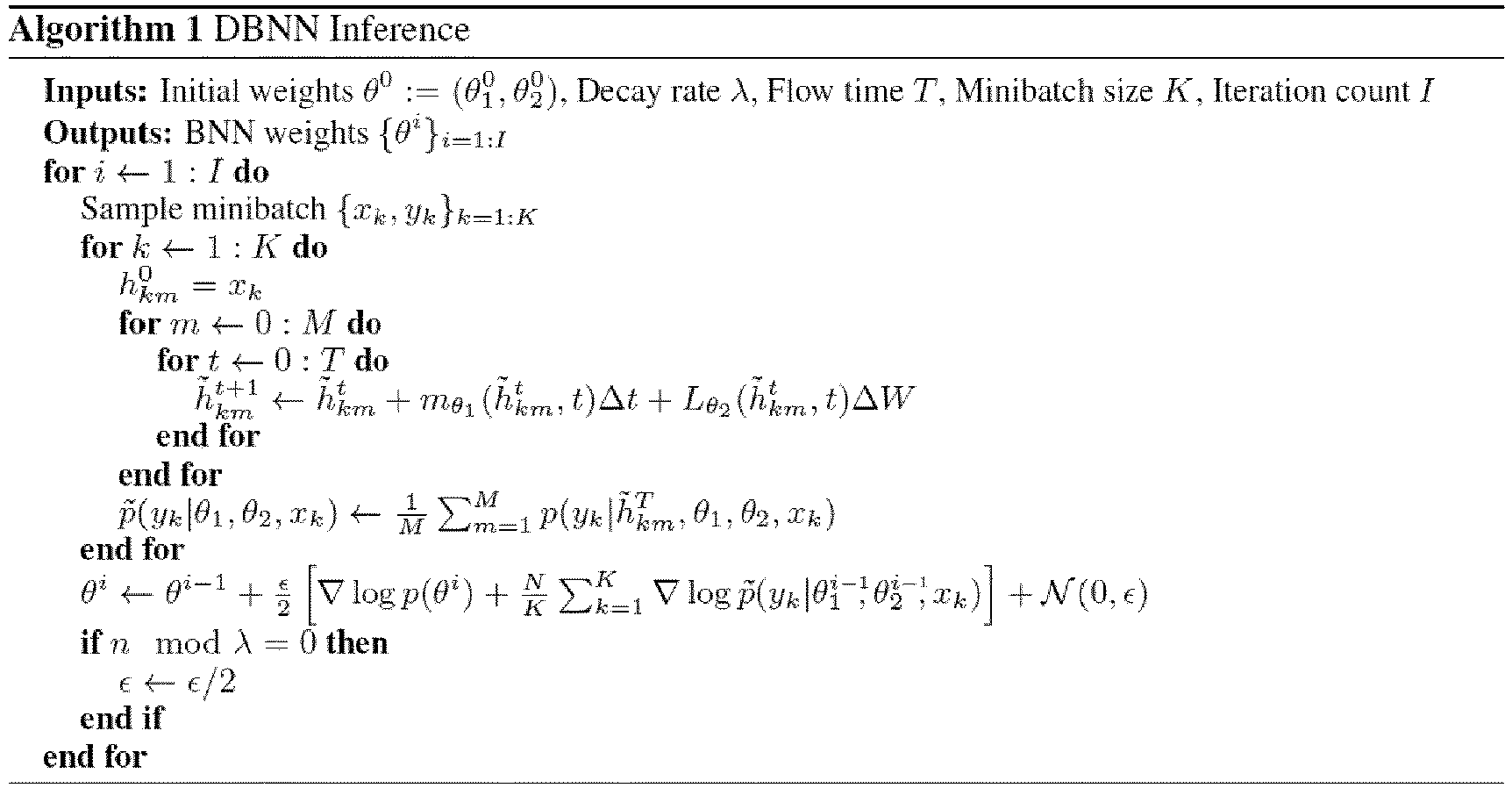
- It should be noted that the gradient

BNNs - For regression, an additional
linear layer 204 is placed above h(T) in order to match the output dimensionality. Since the properties of the distribution p(h(T)|x) can be estimated in terms of a mean m(θ 1) and (a Cholesky decompose of) a covariance L(θ 2) L(θ 2)T = Σ(θ 2). Both moments can be determined and then propagated through the linear
layer 204. The predictive mean is thus modelled as

2 as a diagonal matrix assuming uncorrelated activation map dimensions. - Further, L θ
2 can be parameterized by assigning the DBNN output on its Cholesky decomposition or can take any other structure of the form
- In summary, according to various embodiments, a method is provided as illustrated in
figure 3 . -
Figure 3 shows a flow diagram 300 illustrating a method for processing sensor data according to an embodiment. - In 301, input sensor data is received.
- In 302, starting from the input sensor data as initial state, a plurality of end states, is determined.
- This includes determining, for each end state, a sequence of states, wherein determining the sequence of states comprises, for each state of the sequence beginning with the initial state until the end state,
- a first Bayesian neural network determining a sample of a drift term in response to inputting the respective state;
- a second Bayesian neural network determining a sample of a diffusion term in response to inputting the respective state; and
- determining a subsequent state by sampling a stochastic differential equation comprising the sample of the drift term as drift term and the sample of the diffusion term as diffusion term.
- In 303, an end state probability distribution is determined from the determined plurality of end states.
- In 304, a processing result of the input sensor data is determined from the end state probability distribution.
- According to various embodiments, in other words, BNNs are used to provide the drift term and diffusion term at each step of solving a stochastic differential equation. The uncertainty information provided by the BNNs (by sampling the BNN weights) in addition to the uncertainty information provided by solving the stochastic differential equation (by sampling the Brownian motion) provides information for the processing result, which is for example a regression result, e.g. for controlling a device depending on the sensor data.
- Sensor data may comprise image data from an imaging sensor like e.g. a camera or other types of sensors which may produce image-like data such as a LIDAR (light detection and ranging) sensor, an ultrasonic sensor or a radar sensor. The sensor data may also comprise other types of sensor data like sensor data of a kinematic sensor (e.g. an acceleration sensor).
- Each state may be seen as a latent representation of the input pattern, i.e. the input sensor data which gives the initial state, at a respective time instant t. Illustratively, the state at time instant t can be seen as the initial state (of time instant zero) after being processed by a process represented by the stochastic differential equation for a time period of length t. From a neural network perspective, each state may be seen as an activation map.
- The approach of
figure 3 can be used as a generic building block in all learning systems that map an input pattern to an output pattern. It can serve as an intermediate processing step that provides a rich mapping family, the parameters of which can then be tuned to a particular data set. Wherever a feed-forward neural network can be used, the approach offigure 3 can be used. Further, it is especially useful in safety-critical applications where the predictions of a computer system need to be justified or their uncertainty need to be considered before taking downstream actions depending on this prediction. - In particular, the approach of
figure 3 may be applied in all supervised learning setups where a likelihood distribution can be expressed for outputs (e.g. normal distribution for continuous outputs, multinomial distribution for discrete outputs). Further, it may be applied in any generative method where the latent representation has the same dimensionality as the observation. It may further be applied in hypernets that use the resultant BNN weight distribution as an approximate distribution in an inference problem, such as variational inference. Examples for applications are image segmentation and reinforcement learning. - The method of
figure 3 may be performed by one or more computers including one or more data processing units. The term "data processing unit" can be understood as any type of entity that allows the processing of data or signals. For example, the data or signals may be treated according to at least one (i.e., one or more than one) specific function performed by the data processing unit. A data processing unit may include an analogue circuit, a digital circuit, a composite signal circuit, a logic circuit, a microprocessor, a micro controller, a central processing unit (CPU), a graphics processing unit (GPU), a digital signal processor (DSP), a programmable gate array (FPGA) integrated circuit or any combination thereof or be formed from it. Any other way of implementing the respective functions, which will be described in more detail below, may also be understood as data processing unit or logic circuitry. It will be understood that one or more of the method steps described in detail herein may be executed (e.g., implemented) by a data processing unit through one or more specific functions performed by the data processing unit. - The first Bayesian neural network and the second Bayesian neural network may be trained by comparing, for each of a plurality of training data units, the processing result for input sensor training data of the training data unit with a reference values of the training data unit.
- Generally, the approach of
figure 3 may be used to generate control data (e.g. one or more control values) from input sensor data, e.g. data for controlling a robot. The term "robot" can be understood to refer to any physical system or technical system (with a mechanical part whose movement is controlled), such as a computer-controlled machine, a vehicle, a household appliance, a power tool, a manufacturing machine, a personal assistant or an access control system. - The neural network can be used to regress or classify data. The term classification is understood to include semantic segmentation, e.g. of an image (which can be regarded as pixel-by-pixel classification). The term classification is also understood to include a detection, e.g. of an object (which can be regarded as classification whether the object exists or not). Regression in particular includes time-series modelling.
Claims (11)
- A computer-implemented method (300) for processingsensor data, the method comprising: receiving (301) input sensor data;determining (302), starting from the input sensor data as initial state, a plurality of end states, comprising determining, for each end state, a sequence of states, wherein determining the sequence of states comprises, for each state of the sequence beginning with the initial state until the end state,a first Bayesian neural network (202) determining a sample of a drift term in response to inputting the respective state;a second Bayesian neural network (203) determining a sample of a diffusion term in response to inputting the respective state; and determining a subsequent state by sampling a stochastic differential equation comprising the sample of the drift term as drift term and the sample of the diffusion term as diffusion term;determining (303) an end state probability distribution from the determined plurality of end states; anddetermining (304) a processing result of the input sensor data from the end state probability distribution and controlling a movement of a mechanical part of a technical system according to the processing result.
- The method according to claim 1, further comprising:
training the first Bayesian neural network (202) and the second Bayesian neural network (203) using stochastic gradient Langevin dynamics. - The method according to claim 1 or 2, wherein the technical system is a robot, and wherein the processing result includes
a control value for controlling the robot in function of the input sensor data and uncertainty information about the control value. - The method of claim 3, further comprising controlling the robot in accordance with the control value if the uncertainty given by the uncertainty information is below a predetermined uncertainty threshold.
- The method according to claim 3 or 4, wherein determining the end state probability distribution comprises estimating a mean vector and a covariance matrix of the end states and wherein determining the processing result from the end state probability distribution comprises determining a predictive mean from the estimated mean vector of the end states and determining a predictive variance from the estimated covariance matrix of the end states.
- The method according to claim 5, wherein determining the processing result comprises processing the estimated mean vector and the estimated covariance matrix by a linear layer which performs an affine mapping of the estimated mean vector to a one-dimensional predictive mean and a linear mapping of the estimated covariance matrix to a one-dimensional predictive variance.
- The method according to any one of claims 1 to 6, comprising controlling an actuator using the processing result.
- The method of any one of claims 1 to 7, wherein each state is associated with a respective time starting from an initial time of the initial state and represents the input sensor data processed for the associated time by a process given by the stochastic differential equation.
- An apparatus (103) configured to carry out the method according to any one of claims 1 to 8.
- A computer program comprising computer instructions which, when executed by a computer, make the computer perform a method according to any one of claims 1 to 8.
- A computer-readable medium (104) comprising computer instructions which, when executed by a computer, make the computer perform a method according to any one of claims 1 to 8.
Priority Applications (4)
| Application Number | Priority Date | Filing Date | Title |
|---|---|---|---|
| EP19211130.0A EP3825921B1 (en) | 2019-11-25 | 2019-11-25 | Method and device for processing sensor data |
| US17/086,057 US20210158158A1 (en) | 2019-11-25 | 2020-10-30 | Method and device for processing sensor data |
| KR1020200155146A KR20210064070A (en) | 2019-11-25 | 2020-11-19 | Method and device for processing sensor data |
| CN202011329844.2A CN112836439B (en) | 2019-11-25 | 2020-11-24 | Method and apparatus for processing sensor data |
Applications Claiming Priority (1)
| Application Number | Priority Date | Filing Date | Title |
|---|---|---|---|
| EP19211130.0A EP3825921B1 (en) | 2019-11-25 | 2019-11-25 | Method and device for processing sensor data |
Publications (2)
| Publication Number | Publication Date |
|---|---|
| EP3825921A1 EP3825921A1 (en) | 2021-05-26 |
| EP3825921B1 true EP3825921B1 (en) | 2025-05-21 |
Family
ID=68655319
Family Applications (1)
| Application Number | Title | Priority Date | Filing Date |
|---|---|---|---|
| EP19211130.0A Active EP3825921B1 (en) | 2019-11-25 | 2019-11-25 | Method and device for processing sensor data |
Country Status (4)
| Country | Link |
|---|---|
| US (1) | US20210158158A1 (en) |
| EP (1) | EP3825921B1 (en) |
| KR (1) | KR20210064070A (en) |
| CN (1) | CN112836439B (en) |
Families Citing this family (2)
| Publication number | Priority date | Publication date | Assignee | Title |
|---|---|---|---|---|
| CN113361596B (en) * | 2021-06-04 | 2022-10-04 | 安徽农业大学 | Sensor data augmentation method, system and storage medium |
| US20230057100A1 (en) * | 2021-08-20 | 2023-02-23 | Robert Bosch Gmbh | Method and system for a continuous discrete recurrent kalman network |
Family Cites Families (6)
| Publication number | Priority date | Publication date | Assignee | Title |
|---|---|---|---|---|
| KR102449377B1 (en) * | 2016-07-19 | 2022-09-30 | 아킬리 인터랙티브 랩스 인크. | Platforms for implementing signal detection metrics in adaptive response deadline procedures |
| CN107194478B (en) * | 2017-06-21 | 2020-10-27 | 中国人民解放军国防科学技术大学 | A single-machine residual life prediction method combining life data and performance degradation data |
| CN107688687A (en) * | 2017-07-10 | 2018-02-13 | 山东科技大学 | One kind considers time-length interrelation and the probabilistic life-span prediction method of part |
| WO2019018533A1 (en) * | 2017-07-18 | 2019-01-24 | Neubay Inc | Neuro-bayesian architecture for implementing artificial general intelligence |
| CN109902801B (en) * | 2019-01-22 | 2020-11-17 | 华中科技大学 | Flood collective forecasting method based on variational reasoning Bayesian neural network |
| CN110309919A (en) * | 2019-07-09 | 2019-10-08 | 西北工业大学 | Neural network compression method based on structuring Bayesian posterior probability estimation |
-
2019
- 2019-11-25 EP EP19211130.0A patent/EP3825921B1/en active Active
-
2020
- 2020-10-30 US US17/086,057 patent/US20210158158A1/en not_active Abandoned
- 2020-11-19 KR KR1020200155146A patent/KR20210064070A/en active Pending
- 2020-11-24 CN CN202011329844.2A patent/CN112836439B/en active Active
Non-Patent Citations (1)
| Title |
|---|
| "Gaussian Processes for Machine Learning", vol. 1, 1 January 2006, MIT PRESS, Berlin, Heidelberg, ISBN: 978-0-26-218253-9, article CARL EDWARD RASMUSSEN ET AL: "Gaussian Processes for Machine Learning", XP055153328 * |
Also Published As
| Publication number | Publication date |
|---|---|
| US20210158158A1 (en) | 2021-05-27 |
| EP3825921A1 (en) | 2021-05-26 |
| CN112836439A (en) | 2021-05-25 |
| CN112836439B (en) | 2025-12-09 |
| KR20210064070A (en) | 2021-06-02 |
Similar Documents
| Publication | Publication Date | Title |
|---|---|---|
| Du et al. | Evolutional deep neural network | |
| Mishra et al. | Enhancing accuracy of deep learning algorithms by training with low-discrepancy sequences | |
| Zhai et al. | Parameter estimation and modeling of nonlinear dynamical systems based on Runge–Kutta physics-informed neural network | |
| Osband et al. | (More) efficient reinforcement learning via posterior sampling | |
| Murray et al. | On disturbance state-space models and the particle marginal Metropolis-Hastings sampler | |
| Brach et al. | Single shot MC dropout approximation | |
| Wang et al. | Physics informed deep kernel learning | |
| CN114722995A (en) | Apparatus and method for training neural drift network and neural diffusion network of neural random differential equation | |
| US20240177392A1 (en) | Collision detection for object rearrangement using a 3d scene representation | |
| EP3825921B1 (en) | Method and device for processing sensor data | |
| EP3467836A2 (en) | Particle simulation method, simulation apparatus, and program | |
| Nagano et al. | Sequence pattern extraction by segmenting time series data using gp-hsmm with hierarchical dirichlet process | |
| CN112418432B (en) | System, method and apparatus for analyzing interactions between multiple physical objects | |
| US11195116B2 (en) | Dynamic boltzmann machine for predicting general distributions of time series datasets | |
| Acharya et al. | Learning to forecast aleatoric and epistemic uncertainties over long horizon trajectories | |
| Narayanan et al. | Introduction to deep learning | |
| Atcheson et al. | Gaussian process regression for continuous emotion recognition with global temporal invariance | |
| Herbst et al. | Online Recognition of fuzzy time series patterns | |
| Dai et al. | Investigating the dynamic memory effect of human drivers via ON-LSTM | |
| Utkin et al. | Uncertainty interpretation of the machine learning survival model predictions | |
| US20250217659A1 (en) | A device and a computer-implemented method for continuous-time interaction modeling of agents | |
| US11410042B2 (en) | Dynamic Boltzmann machine for estimating time-varying second moment | |
| Tharzeen et al. | Neural SDE-Based Epistemic Uncertainty Quantification in Deep Neural Networks | |
| WO2024189414A1 (en) | Method for real-time uncertainty quantification and decomposition in perceptional models for autonomous driving | |
| Zhang et al. | Cluster prediction for opinion dynamics from partial observations |
Legal Events
| Date | Code | Title | Description |
|---|---|---|---|
| PUAI | Public reference made under article 153(3) epc to a published international application that has entered the european phase |
Free format text: ORIGINAL CODE: 0009012 |
|
| STAA | Information on the status of an ep patent application or granted ep patent |
Free format text: STATUS: THE APPLICATION HAS BEEN PUBLISHED |
|
| AK | Designated contracting states |
Kind code of ref document: A1 Designated state(s): AL AT BE BG CH CY CZ DE DK EE ES FI FR GB GR HR HU IE IS IT LI LT LU LV MC MK MT NL NO PL PT RO RS SE SI SK SM TR |
|
| STAA | Information on the status of an ep patent application or granted ep patent |
Free format text: STATUS: REQUEST FOR EXAMINATION WAS MADE |
|
| 17P | Request for examination filed |
Effective date: 20211126 |
|
| RBV | Designated contracting states (corrected) |
Designated state(s): AL AT BE BG CH CY CZ DE DK EE ES FI FR GB GR HR HU IE IS IT LI LT LU LV MC MK MT NL NO PL PT RO RS SE SI SK SM TR |
|
| STAA | Information on the status of an ep patent application or granted ep patent |
Free format text: STATUS: EXAMINATION IS IN PROGRESS |
|
| 17Q | First examination report despatched |
Effective date: 20230412 |
|
| REG | Reference to a national code |
Ref country code: DE Free format text: PREVIOUS MAIN CLASS: G06N0003040000 Ipc: G06N0003084000 Ref country code: DE Ref legal event code: R079 Ref document number: 602019070189 Country of ref document: DE Free format text: PREVIOUS MAIN CLASS: G06N0003040000 Ipc: G06N0003084000 |
|
| GRAP | Despatch of communication of intention to grant a patent |
Free format text: ORIGINAL CODE: EPIDOSNIGR1 |
|
| STAA | Information on the status of an ep patent application or granted ep patent |
Free format text: STATUS: GRANT OF PATENT IS INTENDED |
|
| RIC1 | Information provided on ipc code assigned before grant |
Ipc: G06N 7/00 20060101ALN20250207BHEP Ipc: G06N 3/047 20230101ALI20250207BHEP Ipc: G06N 3/045 20230101ALI20250207BHEP Ipc: G06N 3/084 20230101AFI20250207BHEP |
|
| RIC1 | Information provided on ipc code assigned before grant |
Ipc: G06N 7/00 20060101ALN20250226BHEP Ipc: G06N 3/047 20230101ALI20250226BHEP Ipc: G06N 3/045 20230101ALI20250226BHEP Ipc: G06N 3/084 20230101AFI20250226BHEP |
|
| INTG | Intention to grant announced |
Effective date: 20250306 |
|
| GRAS | Grant fee paid |
Free format text: ORIGINAL CODE: EPIDOSNIGR3 |
|
| GRAA | (expected) grant |
Free format text: ORIGINAL CODE: 0009210 |
|
| STAA | Information on the status of an ep patent application or granted ep patent |
Free format text: STATUS: THE PATENT HAS BEEN GRANTED |
|
| AK | Designated contracting states |
Kind code of ref document: B1 Designated state(s): AL AT BE BG CH CY CZ DE DK EE ES FI FR GB GR HR HU IE IS IT LI LT LU LV MC MK MT NL NO PL PT RO RS SE SI SK SM TR |
|
| REG | Reference to a national code |
Ref country code: GB Ref legal event code: FG4D |
|
| REG | Reference to a national code |
Ref country code: CH Ref legal event code: EP |
|
| REG | Reference to a national code |
Ref country code: DE Ref legal event code: R096 Ref document number: 602019070189 Country of ref document: DE |
|
| REG | Reference to a national code |
Ref country code: IE Ref legal event code: FG4D |
|
| REG | Reference to a national code |
Ref country code: NL Ref legal event code: MP Effective date: 20250521 |
|
| PG25 | Lapsed in a contracting state [announced via postgrant information from national office to epo] |
Ref country code: FI Free format text: LAPSE BECAUSE OF FAILURE TO SUBMIT A TRANSLATION OF THE DESCRIPTION OR TO PAY THE FEE WITHIN THE PRESCRIBED TIME-LIMIT Effective date: 20250521 Ref country code: PT Free format text: LAPSE BECAUSE OF FAILURE TO SUBMIT A TRANSLATION OF THE DESCRIPTION OR TO PAY THE FEE WITHIN THE PRESCRIBED TIME-LIMIT Effective date: 20250922 Ref country code: ES Free format text: LAPSE BECAUSE OF FAILURE TO SUBMIT A TRANSLATION OF THE DESCRIPTION OR TO PAY THE FEE WITHIN THE PRESCRIBED TIME-LIMIT Effective date: 20250521 |
|
| REG | Reference to a national code |
Ref country code: LT Ref legal event code: MG9D |
|
| PG25 | Lapsed in a contracting state [announced via postgrant information from national office to epo] |
Ref country code: NO Free format text: LAPSE BECAUSE OF FAILURE TO SUBMIT A TRANSLATION OF THE DESCRIPTION OR TO PAY THE FEE WITHIN THE PRESCRIBED TIME-LIMIT Effective date: 20250821 Ref country code: GR Free format text: LAPSE BECAUSE OF FAILURE TO SUBMIT A TRANSLATION OF THE DESCRIPTION OR TO PAY THE FEE WITHIN THE PRESCRIBED TIME-LIMIT Effective date: 20250822 |
|
| PG25 | Lapsed in a contracting state [announced via postgrant information from national office to epo] |
Ref country code: PL Free format text: LAPSE BECAUSE OF FAILURE TO SUBMIT A TRANSLATION OF THE DESCRIPTION OR TO PAY THE FEE WITHIN THE PRESCRIBED TIME-LIMIT Effective date: 20250521 Ref country code: NL Free format text: LAPSE BECAUSE OF FAILURE TO SUBMIT A TRANSLATION OF THE DESCRIPTION OR TO PAY THE FEE WITHIN THE PRESCRIBED TIME-LIMIT Effective date: 20250521 |
|
| PG25 | Lapsed in a contracting state [announced via postgrant information from national office to epo] |
Ref country code: BG Free format text: LAPSE BECAUSE OF FAILURE TO SUBMIT A TRANSLATION OF THE DESCRIPTION OR TO PAY THE FEE WITHIN THE PRESCRIBED TIME-LIMIT Effective date: 20250521 |
|
| PG25 | Lapsed in a contracting state [announced via postgrant information from national office to epo] |
Ref country code: HR Free format text: LAPSE BECAUSE OF FAILURE TO SUBMIT A TRANSLATION OF THE DESCRIPTION OR TO PAY THE FEE WITHIN THE PRESCRIBED TIME-LIMIT Effective date: 20250521 |
|
| PG25 | Lapsed in a contracting state [announced via postgrant information from national office to epo] |
Ref country code: RS Free format text: LAPSE BECAUSE OF FAILURE TO SUBMIT A TRANSLATION OF THE DESCRIPTION OR TO PAY THE FEE WITHIN THE PRESCRIBED TIME-LIMIT Effective date: 20250821 |
|
| PG25 | Lapsed in a contracting state [announced via postgrant information from national office to epo] |
Ref country code: IS Free format text: LAPSE BECAUSE OF FAILURE TO SUBMIT A TRANSLATION OF THE DESCRIPTION OR TO PAY THE FEE WITHIN THE PRESCRIBED TIME-LIMIT Effective date: 20250921 |
|
| PG25 | Lapsed in a contracting state [announced via postgrant information from national office to epo] |
Ref country code: LV Free format text: LAPSE BECAUSE OF FAILURE TO SUBMIT A TRANSLATION OF THE DESCRIPTION OR TO PAY THE FEE WITHIN THE PRESCRIBED TIME-LIMIT Effective date: 20250521 |
|
| REG | Reference to a national code |
Ref country code: AT Ref legal event code: MK05 Ref document number: 1797402 Country of ref document: AT Kind code of ref document: T Effective date: 20250521 |
|
| PG25 | Lapsed in a contracting state [announced via postgrant information from national office to epo] |
Ref country code: SM Free format text: LAPSE BECAUSE OF FAILURE TO SUBMIT A TRANSLATION OF THE DESCRIPTION OR TO PAY THE FEE WITHIN THE PRESCRIBED TIME-LIMIT Effective date: 20250521 Ref country code: DK Free format text: LAPSE BECAUSE OF FAILURE TO SUBMIT A TRANSLATION OF THE DESCRIPTION OR TO PAY THE FEE WITHIN THE PRESCRIBED TIME-LIMIT Effective date: 20250521 Ref country code: AT Free format text: LAPSE BECAUSE OF FAILURE TO SUBMIT A TRANSLATION OF THE DESCRIPTION OR TO PAY THE FEE WITHIN THE PRESCRIBED TIME-LIMIT Effective date: 20250521 |
|
| PG25 | Lapsed in a contracting state [announced via postgrant information from national office to epo] |
Ref country code: CZ Free format text: LAPSE BECAUSE OF FAILURE TO SUBMIT A TRANSLATION OF THE DESCRIPTION OR TO PAY THE FEE WITHIN THE PRESCRIBED TIME-LIMIT Effective date: 20250521 |
|
| PG25 | Lapsed in a contracting state [announced via postgrant information from national office to epo] |
Ref country code: EE Free format text: LAPSE BECAUSE OF FAILURE TO SUBMIT A TRANSLATION OF THE DESCRIPTION OR TO PAY THE FEE WITHIN THE PRESCRIBED TIME-LIMIT Effective date: 20250521 |
|
| PG25 | Lapsed in a contracting state [announced via postgrant information from national office to epo] |
Ref country code: SK Free format text: LAPSE BECAUSE OF FAILURE TO SUBMIT A TRANSLATION OF THE DESCRIPTION OR TO PAY THE FEE WITHIN THE PRESCRIBED TIME-LIMIT Effective date: 20250521 Ref country code: RO Free format text: LAPSE BECAUSE OF FAILURE TO SUBMIT A TRANSLATION OF THE DESCRIPTION OR TO PAY THE FEE WITHIN THE PRESCRIBED TIME-LIMIT Effective date: 20250521 |
|
| PG25 | Lapsed in a contracting state [announced via postgrant information from national office to epo] |
Ref country code: IT Free format text: LAPSE BECAUSE OF FAILURE TO SUBMIT A TRANSLATION OF THE DESCRIPTION OR TO PAY THE FEE WITHIN THE PRESCRIBED TIME-LIMIT Effective date: 20250521 |
|
| REG | Reference to a national code |
Ref country code: DE Ref legal event code: R097 Ref document number: 602019070189 Country of ref document: DE |
|
| PLBE | No opposition filed within time limit |
Free format text: ORIGINAL CODE: 0009261 |
|
| STAA | Information on the status of an ep patent application or granted ep patent |
Free format text: STATUS: NO OPPOSITION FILED WITHIN TIME LIMIT |
|
| REG | Reference to a national code |
Ref country code: CH Ref legal event code: L10 Free format text: ST27 STATUS EVENT CODE: U-0-0-L10-L00 (AS PROVIDED BY THE NATIONAL OFFICE) Effective date: 20260402 |
|
| PGFP | Annual fee paid to national office [announced via postgrant information from national office to epo] |
Ref country code: DE Payment date: 20260126 Year of fee payment: 7 |
|
| 26N | No opposition filed |
Effective date: 20260224 |