EP3825696A1 - Standard calibration solution - Google Patents
Standard calibration solution Download PDFInfo
- Publication number
- EP3825696A1 EP3825696A1 EP20208682.3A EP20208682A EP3825696A1 EP 3825696 A1 EP3825696 A1 EP 3825696A1 EP 20208682 A EP20208682 A EP 20208682A EP 3825696 A1 EP3825696 A1 EP 3825696A1
- Authority
- EP
- European Patent Office
- Prior art keywords
- standard calibration
- calibration solution
- volume
- alcoholic solvent
- solution
- Prior art date
- Legal status (The legal status is an assumption and is not a legal conclusion. Google has not performed a legal analysis and makes no representation as to the accuracy of the status listed.)
- Pending
Links
- 239000012482 calibration solution Substances 0.000 title claims abstract description 58
- 239000002904 solvent Substances 0.000 claims abstract description 55
- 230000001476 alcoholic effect Effects 0.000 claims abstract description 33
- 238000004949 mass spectrometry Methods 0.000 claims abstract description 27
- XLYOFNOQVPJJNP-UHFFFAOYSA-N water Substances O XLYOFNOQVPJJNP-UHFFFAOYSA-N 0.000 claims abstract description 27
- 239000003270 steroid hormone Substances 0.000 claims abstract description 26
- 238000005259 measurement Methods 0.000 claims abstract description 13
- WEVYAHXRMPXWCK-UHFFFAOYSA-N Acetonitrile Chemical group CC#N WEVYAHXRMPXWCK-UHFFFAOYSA-N 0.000 claims description 66
- 229930003316 Vitamin D Natural products 0.000 claims description 19
- QYSXJUFSXHHAJI-XFEUOLMDSA-N Vitamin D3 Natural products C1(/[C@@H]2CC[C@@H]([C@]2(CCC1)C)[C@H](C)CCCC(C)C)=C/C=C1\C[C@@H](O)CCC1=C QYSXJUFSXHHAJI-XFEUOLMDSA-N 0.000 claims description 19
- 235000019166 vitamin D Nutrition 0.000 claims description 19
- 239000011710 vitamin D Substances 0.000 claims description 19
- 150000003710 vitamin D derivatives Chemical class 0.000 claims description 19
- 229940046008 vitamin d Drugs 0.000 claims description 19
- 150000001875 compounds Chemical class 0.000 claims description 16
- MUMGGOZAMZWBJJ-DYKIIFRCSA-N Testostosterone Chemical class O=C1CC[C@]2(C)[C@H]3CC[C@](C)([C@H](CC4)O)[C@@H]4[C@@H]3CCC2=C1 MUMGGOZAMZWBJJ-DYKIIFRCSA-N 0.000 claims description 14
- 239000002207 metabolite Substances 0.000 claims description 14
- 125000004093 cyano group Chemical group *C#N 0.000 claims description 7
- 229960003604 testosterone Drugs 0.000 claims description 7
- 125000004432 carbon atom Chemical group C* 0.000 claims description 5
- 125000002915 carbonyl group Chemical group [*:2]C([*:1])=O 0.000 claims description 3
- 125000001033 ether group Chemical group 0.000 claims description 3
- 125000000475 sulfinyl group Chemical group [*:2]S([*:1])=O 0.000 claims description 3
- 150000003515 testosterones Chemical class 0.000 claims description 2
- 238000011088 calibration curve Methods 0.000 description 25
- 238000011084 recovery Methods 0.000 description 23
- 210000002966 serum Anatomy 0.000 description 21
- 239000007864 aqueous solution Substances 0.000 description 13
- 239000000126 substance Substances 0.000 description 13
- 238000004445 quantitative analysis Methods 0.000 description 11
- LFQSCWFLJHTTHZ-UHFFFAOYSA-N Ethanol Chemical compound CCO LFQSCWFLJHTTHZ-UHFFFAOYSA-N 0.000 description 9
- OKKJLVBELUTLKV-UHFFFAOYSA-N Methanol Chemical compound OC OKKJLVBELUTLKV-UHFFFAOYSA-N 0.000 description 9
- 238000004458 analytical method Methods 0.000 description 9
- 239000012491 analyte Substances 0.000 description 8
- 238000002552 multiple reaction monitoring Methods 0.000 description 8
- 239000012925 reference material Substances 0.000 description 8
- JWUBBDSIWDLEOM-DTOXIADCSA-N calcidiol Chemical compound C1(/[C@@H]2CC[C@@H]([C@]2(CCC1)C)[C@@H](CCCC(C)(C)O)C)=C\C=C1\C[C@@H](O)CCC1=C JWUBBDSIWDLEOM-DTOXIADCSA-N 0.000 description 7
- 239000000243 solution Substances 0.000 description 7
- 230000000694 effects Effects 0.000 description 6
- 229940088597 hormone Drugs 0.000 description 6
- 239000005556 hormone Substances 0.000 description 6
- 238000001294 liquid chromatography-tandem mass spectrometry Methods 0.000 description 6
- 230000002349 favourable effect Effects 0.000 description 5
- 239000007788 liquid Substances 0.000 description 5
- 238000004895 liquid chromatography mass spectrometry Methods 0.000 description 5
- 238000000034 method Methods 0.000 description 5
- 210000002381 plasma Anatomy 0.000 description 5
- IJGRMHOSHXDMSA-UHFFFAOYSA-N Atomic nitrogen Chemical compound N#N IJGRMHOSHXDMSA-UHFFFAOYSA-N 0.000 description 4
- RJKFOVLPORLFTN-LEKSSAKUSA-N Progesterone Chemical compound C1CC2=CC(=O)CC[C@]2(C)[C@@H]2[C@@H]1[C@@H]1CC[C@H](C(=O)C)[C@@]1(C)CC2 RJKFOVLPORLFTN-LEKSSAKUSA-N 0.000 description 4
- VYPSYNLAJGMNEJ-UHFFFAOYSA-N Silicium dioxide Chemical compound O=[Si]=O VYPSYNLAJGMNEJ-UHFFFAOYSA-N 0.000 description 4
- 239000003163 gonadal steroid hormone Substances 0.000 description 4
- JYGXADMDTFJGBT-VWUMJDOOSA-N hydrocortisone Chemical compound O=C1CC[C@]2(C)[C@H]3[C@@H](O)C[C@](C)([C@@](CC4)(O)C(=O)CO)[C@@H]4[C@@H]3CCC2=C1 JYGXADMDTFJGBT-VWUMJDOOSA-N 0.000 description 4
- 150000002500 ions Chemical group 0.000 description 4
- 238000012986 modification Methods 0.000 description 4
- 230000004048 modification Effects 0.000 description 4
- 241001465754 Metazoa Species 0.000 description 3
- ZMXDDKWLCZADIW-UHFFFAOYSA-N N,N-Dimethylformamide Chemical compound CN(C)C=O ZMXDDKWLCZADIW-UHFFFAOYSA-N 0.000 description 3
- 238000011156 evaluation Methods 0.000 description 3
- 238000002474 experimental method Methods 0.000 description 3
- 238000004128 high performance liquid chromatography Methods 0.000 description 3
- 238000004519 manufacturing process Methods 0.000 description 3
- 239000011159 matrix material Substances 0.000 description 3
- 239000000203 mixture Substances 0.000 description 3
- 238000002360 preparation method Methods 0.000 description 3
- 238000000926 separation method Methods 0.000 description 3
- 238000003860 storage Methods 0.000 description 3
- 238000012360 testing method Methods 0.000 description 3
- CSCPPACGZOOCGX-UHFFFAOYSA-N Acetone Chemical compound CC(C)=O CSCPPACGZOOCGX-UHFFFAOYSA-N 0.000 description 2
- IAZDPXIOMUYVGZ-UHFFFAOYSA-N Dimethylsulphoxide Chemical compound CS(C)=O IAZDPXIOMUYVGZ-UHFFFAOYSA-N 0.000 description 2
- 241000282414 Homo sapiens Species 0.000 description 2
- WYURNTSHIVDZCO-UHFFFAOYSA-N Tetrahydrofuran Chemical compound C1CCOC1 WYURNTSHIVDZCO-UHFFFAOYSA-N 0.000 description 2
- 230000009471 action Effects 0.000 description 2
- 230000002411 adverse Effects 0.000 description 2
- 230000015572 biosynthetic process Effects 0.000 description 2
- 210000004369 blood Anatomy 0.000 description 2
- 239000008280 blood Substances 0.000 description 2
- 238000006073 displacement reaction Methods 0.000 description 2
- 238000010828 elution Methods 0.000 description 2
- 238000000605 extraction Methods 0.000 description 2
- 229960000890 hydrocortisone Drugs 0.000 description 2
- 238000001727 in vivo Methods 0.000 description 2
- 238000004811 liquid chromatography Methods 0.000 description 2
- 229910052757 nitrogen Inorganic materials 0.000 description 2
- 239000003960 organic solvent Substances 0.000 description 2
- 238000001556 precipitation Methods 0.000 description 2
- 102000004169 proteins and genes Human genes 0.000 description 2
- 108090000623 proteins and genes Proteins 0.000 description 2
- 238000000746 purification Methods 0.000 description 2
- 238000011002 quantification Methods 0.000 description 2
- 230000035945 sensitivity Effects 0.000 description 2
- 239000000377 silicon dioxide Substances 0.000 description 2
- 238000012795 verification Methods 0.000 description 2
- JWUBBDSIWDLEOM-XHQRYOPUSA-N (3e)-3-[(2e)-2-[1-(6-hydroxy-6-methylheptan-2-yl)-7a-methyl-2,3,3a,5,6,7-hexahydro-1h-inden-4-ylidene]ethylidene]-4-methylidenecyclohexan-1-ol Chemical compound C1CCC2(C)C(C(CCCC(C)(C)O)C)CCC2\C1=C\C=C1/CC(O)CCC1=C JWUBBDSIWDLEOM-XHQRYOPUSA-N 0.000 description 1
- GMRQFYUYWCNGIN-ZVUFCXRFSA-N 1,25-dihydroxy vitamin D3 Chemical compound C1([C@@H]2CC[C@@H]([C@]2(CCC1)C)[C@@H](CCCC(C)(C)O)C)=CC=C1C[C@@H](O)C[C@H](O)C1=C GMRQFYUYWCNGIN-ZVUFCXRFSA-N 0.000 description 1
- RYHBNJHYFVUHQT-UHFFFAOYSA-N 1,4-Dioxane Chemical compound C1COCCO1 RYHBNJHYFVUHQT-UHFFFAOYSA-N 0.000 description 1
- FUFLCEKSBBHCMO-UHFFFAOYSA-N 11-dehydrocorticosterone Natural products O=C1CCC2(C)C3C(=O)CC(C)(C(CC4)C(=O)CO)C4C3CCC2=C1 FUFLCEKSBBHCMO-UHFFFAOYSA-N 0.000 description 1
- DBPWSSGDRRHUNT-CEGNMAFCSA-N 17α-hydroxyprogesterone Chemical compound C1CC2=CC(=O)CC[C@]2(C)[C@@H]2[C@@H]1[C@@H]1CC[C@@](C(=O)C)(O)[C@@]1(C)CC2 DBPWSSGDRRHUNT-CEGNMAFCSA-N 0.000 description 1
- AVUQGOKVXPENDG-UHFFFAOYSA-N 4-[4-(dimethylamino)phenyl]-1,2,4-triazole-3,5-dione Chemical compound C1=CC(N(C)C)=CC=C1N1C(=O)N=NC1=O AVUQGOKVXPENDG-UHFFFAOYSA-N 0.000 description 1
- PQSUYGKTWSAVDQ-ZVIOFETBSA-N Aldosterone Chemical compound C([C@@]1([C@@H](C(=O)CO)CC[C@H]1[C@@H]1CC2)C=O)[C@H](O)[C@@H]1[C@]1(C)C2=CC(=O)CC1 PQSUYGKTWSAVDQ-ZVIOFETBSA-N 0.000 description 1
- PQSUYGKTWSAVDQ-UHFFFAOYSA-N Aldosterone Natural products C1CC2C3CCC(C(=O)CO)C3(C=O)CC(O)C2C2(C)C1=CC(=O)CC2 PQSUYGKTWSAVDQ-UHFFFAOYSA-N 0.000 description 1
- 235000021318 Calcifediol Nutrition 0.000 description 1
- OYPRJOBELJOOCE-UHFFFAOYSA-N Calcium Chemical compound [Ca] OYPRJOBELJOOCE-UHFFFAOYSA-N 0.000 description 1
- MFYSYFVPBJMHGN-ZPOLXVRWSA-N Cortisone Chemical compound O=C1CC[C@]2(C)[C@H]3C(=O)C[C@](C)([C@@](CC4)(O)C(=O)CO)[C@@H]4[C@@H]3CCC2=C1 MFYSYFVPBJMHGN-ZPOLXVRWSA-N 0.000 description 1
- MFYSYFVPBJMHGN-UHFFFAOYSA-N Cortisone Natural products O=C1CCC2(C)C3C(=O)CC(C)(C(CC4)(O)C(=O)CO)C4C3CCC2=C1 MFYSYFVPBJMHGN-UHFFFAOYSA-N 0.000 description 1
- QMMFVYPAHWMCMS-UHFFFAOYSA-N Dimethyl sulfide Chemical compound CSC QMMFVYPAHWMCMS-UHFFFAOYSA-N 0.000 description 1
- 239000012901 Milli-Q water Substances 0.000 description 1
- FXHOOIRPVKKKFG-UHFFFAOYSA-N N,N-Dimethylacetamide Chemical compound CN(C)C(C)=O FXHOOIRPVKKKFG-UHFFFAOYSA-N 0.000 description 1
- 206010036790 Productive cough Diseases 0.000 description 1
- 229930182558 Sterol Natural products 0.000 description 1
- 239000003470 adrenal cortex hormone Substances 0.000 description 1
- 229960002478 aldosterone Drugs 0.000 description 1
- 239000003098 androgen Substances 0.000 description 1
- AEMFNILZOJDQLW-QAGGRKNESA-N androst-4-ene-3,17-dione Chemical compound O=C1CC[C@]2(C)[C@H]3CC[C@](C)(C(CC4)=O)[C@@H]4[C@@H]3CCC2=C1 AEMFNILZOJDQLW-QAGGRKNESA-N 0.000 description 1
- 229960005471 androstenedione Drugs 0.000 description 1
- AEMFNILZOJDQLW-UHFFFAOYSA-N androstenedione Natural products O=C1CCC2(C)C3CCC(C)(C(CC4)=O)C4C3CCC2=C1 AEMFNILZOJDQLW-UHFFFAOYSA-N 0.000 description 1
- 230000008901 benefit Effects 0.000 description 1
- GMRQFYUYWCNGIN-NKMMMXOESA-N calcitriol Chemical compound C1(/[C@@H]2CC[C@@H]([C@]2(CCC1)C)[C@@H](CCCC(C)(C)O)C)=C\C=C1\C[C@@H](O)C[C@H](O)C1=C GMRQFYUYWCNGIN-NKMMMXOESA-N 0.000 description 1
- 239000011575 calcium Substances 0.000 description 1
- 229910052791 calcium Inorganic materials 0.000 description 1
- 230000003913 calcium metabolism Effects 0.000 description 1
- 229910052799 carbon Inorganic materials 0.000 description 1
- 238000004113 cell culture Methods 0.000 description 1
- 230000024245 cell differentiation Effects 0.000 description 1
- 230000010261 cell growth Effects 0.000 description 1
- 238000005119 centrifugation Methods 0.000 description 1
- 210000001175 cerebrospinal fluid Anatomy 0.000 description 1
- 230000008859 change Effects 0.000 description 1
- 238000006243 chemical reaction Methods 0.000 description 1
- 238000005352 clarification Methods 0.000 description 1
- 239000000431 corpus luteum hormone Substances 0.000 description 1
- 229960004544 cortisone Drugs 0.000 description 1
- 238000001514 detection method Methods 0.000 description 1
- 230000006866 deterioration Effects 0.000 description 1
- 238000000502 dialysis Methods 0.000 description 1
- 238000010790 dilution Methods 0.000 description 1
- 239000012895 dilution Substances 0.000 description 1
- 238000004821 distillation Methods 0.000 description 1
- 229940079593 drug Drugs 0.000 description 1
- 239000003814 drug Substances 0.000 description 1
- 230000005684 electric field Effects 0.000 description 1
- 238000001962 electrophoresis Methods 0.000 description 1
- 239000000262 estrogen Substances 0.000 description 1
- 229940011871 estrogen Drugs 0.000 description 1
- 238000001914 filtration Methods 0.000 description 1
- 239000012530 fluid Substances 0.000 description 1
- 239000003862 glucocorticoid Substances 0.000 description 1
- 125000002887 hydroxy group Chemical group [H]O* 0.000 description 1
- 229960002899 hydroxyprogesterone Drugs 0.000 description 1
- 230000008105 immune reaction Effects 0.000 description 1
- 238000003018 immunoassay Methods 0.000 description 1
- 239000012535 impurity Substances 0.000 description 1
- 125000000654 isopropylidene group Chemical group C(C)(C)=* 0.000 description 1
- 238000011068 loading method Methods 0.000 description 1
- 230000010534 mechanism of action Effects 0.000 description 1
- 244000005700 microbiome Species 0.000 description 1
- 239000002395 mineralocorticoid Substances 0.000 description 1
- 210000003205 muscle Anatomy 0.000 description 1
- 210000000056 organ Anatomy 0.000 description 1
- 230000010287 polarization Effects 0.000 description 1
- XOFYZVNMUHMLCC-ZPOLXVRWSA-N prednisone Chemical compound O=C1C=C[C@]2(C)[C@H]3C(=O)C[C@](C)([C@@](CC4)(O)C(=O)CO)[C@@H]4[C@@H]3CCC2=C1 XOFYZVNMUHMLCC-ZPOLXVRWSA-N 0.000 description 1
- 229960004618 prednisone Drugs 0.000 description 1
- 239000000186 progesterone Substances 0.000 description 1
- 229960003387 progesterone Drugs 0.000 description 1
- 239000002994 raw material Substances 0.000 description 1
- 238000001223 reverse osmosis Methods 0.000 description 1
- 210000003296 saliva Anatomy 0.000 description 1
- 230000028327 secretion Effects 0.000 description 1
- 238000002553 single reaction monitoring Methods 0.000 description 1
- 210000003802 sputum Anatomy 0.000 description 1
- 208000024794 sputum Diseases 0.000 description 1
- 150000003432 sterols Chemical class 0.000 description 1
- 235000003702 sterols Nutrition 0.000 description 1
- 239000000725 suspension Substances 0.000 description 1
- 238000004885 tandem mass spectrometry Methods 0.000 description 1
- YLQBMQCUIZJEEH-UHFFFAOYSA-N tetrahydrofuran Natural products C=1C=COC=1 YLQBMQCUIZJEEH-UHFFFAOYSA-N 0.000 description 1
- 210000001519 tissue Anatomy 0.000 description 1
- 238000001195 ultra high performance liquid chromatography Methods 0.000 description 1
- 238000000108 ultra-filtration Methods 0.000 description 1
- 210000002700 urine Anatomy 0.000 description 1
- 229940088594 vitamin Drugs 0.000 description 1
- 229930003231 vitamin Natural products 0.000 description 1
- 235000013343 vitamin Nutrition 0.000 description 1
- 239000011782 vitamin Substances 0.000 description 1
- 150000003722 vitamin derivatives Chemical class 0.000 description 1
- 239000003643 water by type Substances 0.000 description 1
Images



Classifications
-
- G—PHYSICS
- G01—MEASURING; TESTING
- G01N—INVESTIGATING OR ANALYSING MATERIALS BY DETERMINING THEIR CHEMICAL OR PHYSICAL PROPERTIES
- G01N1/00—Sampling; Preparing specimens for investigation
- G01N1/28—Preparing specimens for investigation including physical details of (bio-)chemical methods covered elsewhere, e.g. G01N33/50, C12Q
-
- G—PHYSICS
- G01—MEASURING; TESTING
- G01N—INVESTIGATING OR ANALYSING MATERIALS BY DETERMINING THEIR CHEMICAL OR PHYSICAL PROPERTIES
- G01N33/00—Investigating or analysing materials by specific methods not covered by groups G01N1/00 - G01N31/00
- G01N33/48—Biological material, e.g. blood, urine; Haemocytometers
- G01N33/50—Chemical analysis of biological material, e.g. blood, urine; Testing involving biospecific ligand binding methods; Immunological testing
- G01N33/74—Chemical analysis of biological material, e.g. blood, urine; Testing involving biospecific ligand binding methods; Immunological testing involving hormones or other non-cytokine intercellular protein regulatory factors such as growth factors, including receptors to hormones and growth factors
- G01N33/743—Steroid hormones
-
- G—PHYSICS
- G01—MEASURING; TESTING
- G01N—INVESTIGATING OR ANALYSING MATERIALS BY DETERMINING THEIR CHEMICAL OR PHYSICAL PROPERTIES
- G01N33/00—Investigating or analysing materials by specific methods not covered by groups G01N1/00 - G01N31/00
- G01N33/48—Biological material, e.g. blood, urine; Haemocytometers
- G01N33/50—Chemical analysis of biological material, e.g. blood, urine; Testing involving biospecific ligand binding methods; Immunological testing
- G01N33/82—Chemical analysis of biological material, e.g. blood, urine; Testing involving biospecific ligand binding methods; Immunological testing involving vitamins or their receptors
-
- G—PHYSICS
- G01—MEASURING; TESTING
- G01N—INVESTIGATING OR ANALYSING MATERIALS BY DETERMINING THEIR CHEMICAL OR PHYSICAL PROPERTIES
- G01N1/00—Sampling; Preparing specimens for investigation
- G01N1/28—Preparing specimens for investigation including physical details of (bio-)chemical methods covered elsewhere, e.g. G01N33/50, C12Q
- G01N2001/2893—Preparing calibration standards
-
- Y—GENERAL TAGGING OF NEW TECHNOLOGICAL DEVELOPMENTS; GENERAL TAGGING OF CROSS-SECTIONAL TECHNOLOGIES SPANNING OVER SEVERAL SECTIONS OF THE IPC; TECHNICAL SUBJECTS COVERED BY FORMER USPC CROSS-REFERENCE ART COLLECTIONS [XRACs] AND DIGESTS
- Y10—TECHNICAL SUBJECTS COVERED BY FORMER USPC
- Y10T—TECHNICAL SUBJECTS COVERED BY FORMER US CLASSIFICATION
- Y10T436/00—Chemistry: analytical and immunological testing
- Y10T436/10—Composition for standardization, calibration, simulation, stabilization, preparation or preservation; processes of use in preparation for chemical testing
- Y10T436/104165—Lipid, cholesterol, or triglyceride standard or control
Definitions
- the present invention relates to a standard calibration solution suitable for quantitative measurement using a mass spectrometry device.
- MS mass spectrometer
- HPLC high performance liquid chromatography
- MS/MS tandem mass spectrometer
- SRM selected or multiple reaction monitoring
- Quantitative analysis by a MS is generally carried out based on a calibration curve using a standard calibration solution, which is referred to as a calibrator.
- a calibrator including an isotope of a dihydroxyvitamin D metabolite as an internal reference material
- a calibration standard curve based on one or more peaks of the internal reference material is formed.
- This patent documents further discloses that the peak obtained from measurement of the dihydroxyvitamin D metabolite is converted to an absolute amount based on such a calibration standard curve, thereby performing quantitative analysis.
- the calibrator including the internal reference material as disclosed in JP-A-2019-179036 is supplied as a liquid using serum as a solvent.
- serum is preferably sufficiently purified for use.
- the invention is able to provide a standard calibration solution having stable quality capable of performing calibration with high precision in quantitative measurement using a mass spectrometry device.
- a standard calibration solution including:
- the invention was completed in order to solve at least a part of the problem, and can be implemented as the following applied example.
- a standard calibration solution including:
- the standard calibration solution is favorable in stability of the quality, and can perform high-precision calibration in quantitative measurement using a mass spectrometry device.
- the standard calibration solution in accordance with one embodiment of the invention includes water, a non-alcoholic solvent to be mixed with water, and a steroid hormone. Then, the content of the non-alcoholic solvent is 10% by volume or more and 50% by volume or less for every 100% by volume of the total amount of the standard calibration solution.
- the standard calibration solution of the present embodiment is used for quantitative measurement using a mass spectrometry device, and can be used as a "calibrator" for mass spectroscopy. Below, the components and uses of the standard calibration solution of the present embodiment will be successively described.
- the standard calibration solution in accordance with the present embodiment includes water.
- water for example, ion exchanged water, ultrafiltration water, reverse osmosis water, or Milli-Q water can be used.
- the water preferably has the minimum amount of impurities, and preferably satisfies the standards of, for example, water for analysis experiment, and biomedical water.
- the content of water in the standard calibration solution is preferably 50% by volume or more and 90% by volume or less, more preferably 60% by volume or more and 80% by volume or less, and further preferably 65% by volume or more and 75% by volume or less based on the total amount (100% by volume) of the standard calibration solution.
- the content of water is about 50% by volume or more and 90% by volume or less, various steroid hormones can be dissolved therein.
- the standard calibration solution in accordance with the present embodiment includes a non-alcoholic solvent.
- the non-alcoholic solvent is a compound not having an alcoholic hydroxy group.
- the non-alcoholic solvent is mixed with the water at an arbitrary ratio. Namely, the non-alcoholic solvent and water are fully dissolved in each other in an arbitrary concentration, and can form a uniform solution.
- the content of the non-alcoholic solvent in the standard calibration solution is 10% by volume or more and 50% by volume or less. Further, the content of the non-alcoholic solvent in the standard calibration solution can be adjusted in consideration of the properties (such as water solubility and fat solubility), and the like of the steroid hormone included in the standard calibration solution. For example, when the fat solubility of the steroid hormone is relatively strong, the content of the non-alcoholic solvent is more preferably 20% by volume or more and 50% by volume or less, and further preferably 20% by volume or more and 40% by volume or less.
- the content of the non-alcoholic solvent is more preferably 10% by volume or more and 40% by volume or less, and still more preferably 10% by volume or more and 35% by volume or less.
- the content of the non-alcoholic solvent in the standard calibration solution can be adjusted by the properties of the included steroid hormone, or the like.
- a small content thereof tends to be suitable for a steroid hormone with strong water solubility, and a large content thereof tends to be suitable for a steroid hormone with strong fat solubility.
- non-alcoholic solvent may include a compound having 5 or less carbon atoms and having at least one group selected from a cyano group, a carbonyl group, an ether group, and a sulfinyl group. Further, such a compound may include one or a plurality of the same kind of or different kinds of groups of a cyano group, a carbonyl group, an ether group, and a sulfinyl group.
- the number of carbons of the compound is more preferably 1 or more and 4 or less, and further preferably 1 or more and 2 or less.
- the non-alcoholic solvent is further preferably a compound having 2 or less carbon atoms, and having one cyano group.
- the cyano group is a group with high degree of polarization, and can efficiently impart the polarity to the compound by being coordinated to a carbon atom.
- the non-alcoholic solvent is especially preferably acetonitrile.
- the standard calibration solution of the present embodiment includes a steroid hormone.
- steroid hormones such as aldosterone (mineral corticoid), testosterone, cortisol (hydrocortisone), cortisone, progesterone, hydroxy progesterone, prednisone, androstenedione, glucocorticoid, androgen (male sex hormone), estrogen (female sex hormone), or corpus luteum hormone, and vitamin D, and a metabolite, a derivative, and an isotope-labelled product thereof.
- vitamin D is fat-soluble vitamin essential for adjustment of calcium metabolism, and has an action of increasing the calcium (Ca 2+ ) concentration in blood as the active form of vitamin D (1 ⁇ ,25-dihydroxyvitamin D).
- an in vivo metabolite such as 1,25-dihydroxyvitamin D or 25-hydroxyvitamin D plays an important role in control of expression of protein involved in differentiation/growth of cell, production/secretion of hormone, an immune reaction, or the like.
- vitamin D, the derivative of vitamin D, the metabolite of vitamin D, and the isotope-labelled product of vitamin D are regarded as steroid hormones although they are sterol in terms of chemical structure.
- the standard calibration solution of the present embodiment may include one or a plurality of steroid hormones.
- the steroid hormone included in the standard calibration solution of the present embodiment is more preferably fat soluble, and is further preferably at least one selected from vitamin D and the metabolite of vitamin D, and testosterone and the metabolite of testosterone of the fat soluble steroid hormones.
- the steroid hormone included in the standard calibration solution is set at a specific concentration for use as a standard calibration solution.
- a specific concentration is set according to the necessity in forming the calibration curve of mass spectrometry, and the range of the configurable concentration has no particular restriction.
- the standard calibration solution of the present embodiment is used for the quantitative measurement using a mass spectrometry device.
- Mass spectrometry is a method for separating, detecting, and measuring ions based on the mass electric charge ratio or "Da/e".
- the analyte compound is ionized, and is loaded into a mass spectrometry device.
- the method of ionization has no particular restriction.
- ions follow the path in the space according to the mass and the electric charges by the combination of the magnetic field and the electric field. Then, by observing the mass, the electric charge, the behavior, and the like of the ions in the mass spectrometry device, it is possible to perform detection and quantification of the analyte compound.
- specimens to be subjected to mass spectrometry mention may be made of the components obtained from biological sources such as animals, cell culture, and organ culture. More specifically, mention may be made of the samples obtained from human, for example, blood, plasma, deproteinized plasma, serum, sputum, muscle, urine, saliva, lachrymal fluid, cerebrospinal fluid, swab from the body portion, a microorganism suspension, or a tissue sample.
- the mass spectrometry may be performed by combining various separation and purification means.
- mass spectrometry can be combined with the operations of filtration, extraction, precipitation, centrifugation, dilution, and the like.
- purification or clarification may be performed, and the analyte compound may be more enriched than other compounds to be subjected to mass spectrometry.
- the means for performing this may include, but not limited to, liquid chromatography, HPLC, UHPLC, precipitation, dialysis, affinity/capture, electrophoresis, or proper methods known in the technical field. Examples of the device undergoing such a combination may include "LC/MS" of a combination with HPLC, and "LC/MS/MS" obtained by forming a mass spectrometry part in a tandem model.
- the standard calibration solution of the present embodiment can be preferably used for such calibration.
- the standard calibration solution of the present embodiment can be used for forming the calibration curve of a mass spectrometer, and can be used, for example, for obtaining the calibration curve of the dependency of the signal intensity on the concentration of a steroid hormone before the measurement of the steroid hormone.
- a solution of a calibration substance dissolved in the same medium as the measurement specimen (biological preparation) such as serum or plasma, or a solution of calibration substance dissolved in an artificial medium such as hydrous ethanol or hydrous methanol has been used.
- the former has an advantage that the measurement environment is close to an organism.
- an originally endogenous analyte such as a hormone
- the analyte is added to be valued.
- the endogenous substance like hormone is not required to be considered.
- the matrix effect has become a problem in terms of the similarity to the medium of the specimen such as serum.
- the standard calibration solution of the present embodiment includes the non-alcoholic solvent, and a steroid hormone.
- a content of the non-alcoholic solvent of 10% by volume or more and 50% by volume or less enables the formation of the calibration curve serving as the basis of quantification by the clinical examination field, particularly the mass spectrometry of in vivo hormone/drug with ease and with good reproducibility.
- the solvent a non-alcoholic solvent is used. For this reason, the composition of the standard calibration solution less changes with time, and the quality of the raw material is stable. Accordingly, the restriction on the freshness, the storage period, or the like is relaxed.
- the standard calibration solution of the present embodiment can be preferably used for calibration of each device irrespective of the difference in manufacturer of the mass spectrometry device, the variations among individual devices and components, and the like. Further, the standard calibration solution of the present embodiment can readily form a calibration curve with good precision as with the case using a favorably controlled solution of a calibration substance (biological preparation) using serum, plasma, or the like as the medium conventionally used.
- the standard calibration solution of the present embodiment is also further preferably applicable to an analysis system including a mass spectrometry device such as LC/MS/MS.
- the solution of calibration substance dissolved in artificial medium such as hydrous ethanol or hydrous methanol conventionally used has a strong elution force with respect to a reversed-phase silica column generally for use in LC, and may not be adsorbed on the column, or may cause deterioration of peak separation due to peak broadening. For this reason, it has been necessary to once distill away alcohol (solvent displacement), and redissolve the extract in the solvent of the initial conditions of LC.
- the standard calibration solution of the present embodiment can be loaded into LC without performing the operation such as distillation, and can form an excellent calibration curve.
- the medium of the mobile phase of LC has a difference object from that of the standard calibration solution of the present embodiment. Even when a liquid with the same composition as that of the standard calibration solution of the present embodiment is generated in the LC column, the liquid cannot function as a standard calibration solution. Further, the standard calibration solution of the present embodiment is different from the liquid present in the mobile phase in the LC column in terms of being able to be accommodated and stored in an appropriate container.
- the standard calibration solution of the present embodiment can make the difference among the production lots smaller, can keep stable quality, and can perform calibration of a mass spectrometry device with ease and with good reproducibility as compared with the calibration solution using the medium derived from an organism such as serum.
- the standard calibration solution of the present embodiment includes a non-alcoholic solvent, and hence has a gentler elution force with respect to the reversed-phase silica column than that of an alcoholic solvent such as ethanol or methanol, and can be loaded as it is into a LC/MS or a LC/MS/MS without performing solvent displacement.
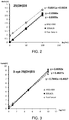
- the calibration curves obtained above are illustrated in FIGS. 2 to 5 .
- the effect on the calibration curve (change in gradient) due to the difference in solvent was not observed.
- FIGS. 6 to 9 are each a graph illustrating the correlation between the quantitative analysis values of the clinical specimens obtained by two different calibration curves. As illustrated in FIGS. 6 to 9 , the correlation between the quantitative values obtained from the two different calibration curves was checked, indicating the favorable correlation and the agreement between the quantitative values.
- FIG. 10 illustrates a calibration curve for quantitative analysis formed using testosterone (male sex hormone).
- testosterone male sex hormone
- the quantitative analysis of testosterone has also proven that a good agreement is shown between the case using a standard calibration solution of a serum-based solvent and the case using a standard calibration solution of a 30% acetonitrile aqueous solution as with the vitamin D metabolite.
- FIG. 11 is a graph illustrating the dependency of the recovery of the internal reference material (IS) of 25(OH)D 3 on the acetonitrile concentration. It has been indicated as follows. When the acetonitrile concentration in the solvent is 10% or more, the recovery is favorable. When the acetonitrile concentration in the solvent exceeds 20%, the recovery becomes even more favorable. Further, a higher concentration of the organic solvent than that of the mobile phase in loading to a LC adversely affects the separation. From this viewpoint, it is considered that the concentration of acetonitrile in the solvent is desirably 50% or less.
- the invention includes configurations that are substantially the same (for example, in function and method) as the configurations described in the embodiments.
- the invention also includes configurations in which non-essential elements described in the embodiments are replaced by other elements.
- the invention further includes configurations obtained by adding known art to the configurations described in the embodiments.
Landscapes
- Life Sciences & Earth Sciences (AREA)
- Health & Medical Sciences (AREA)
- Engineering & Computer Science (AREA)
- Molecular Biology (AREA)
- Chemical & Material Sciences (AREA)
- Immunology (AREA)
- Biomedical Technology (AREA)
- Hematology (AREA)
- Urology & Nephrology (AREA)
- Analytical Chemistry (AREA)
- Physics & Mathematics (AREA)
- Biochemistry (AREA)
- General Health & Medical Sciences (AREA)
- General Physics & Mathematics (AREA)
- Pathology (AREA)
- Microbiology (AREA)
- Cell Biology (AREA)
- Food Science & Technology (AREA)
- Medicinal Chemistry (AREA)
- Biotechnology (AREA)
- Endocrinology (AREA)
- Other Investigation Or Analysis Of Materials By Electrical Means (AREA)
Abstract
Description
- The present invention relates to a standard calibration solution suitable for quantitative measurement using a mass spectrometry device.
- In clinical examinations at hospitals, or the like, an analysis method using a mass spectrometer (which will be hereinafter also referred to as "MS") is known. Particularly, analysis of a substance derived from an organism, such as a hormone, by a liquid chromatography/mass spectrometer (which will be hereinafter also referred to as "LC/MS") that separates a compound by high performance liquid chromatography (HPLC), and ionizes the separated substance by a MS in order to implement analysis exhibits higher sensitivity and higher specificity than those of conventionally used immunoassay, or the like, and moreover is capable of simultaneous analysis of multiple items. Hence, this analysis has become a mainstream rapidly. In quantitative analysis by LC/MS/MS using, in particular, a tandem mass spectrometer (which will be hereinafter also referred to as "MS/MS") as a MS from among LC/MSs, use of a selected or multiple reaction monitoring (which will be hereinafter also referred to as "SRM" or "MRM") mode, which exhibits higher sensitivity than that of a LC/MS, enables selective quantitative analysis of a plurality of substances.
- Quantitative analysis by a MS is generally carried out based on a calibration curve using a standard calibration solution, which is referred to as a calibrator. For example, in
JP-A-2019-179036 - However, the calibrator including the internal reference material as disclosed in
JP-A-2019-179036 - With serum and plasma that derive from animals being supplied, it is difficult to eliminate individual differences among animals and variations in quality among production lots, and moreover protein contained therein may be deteriorated. Variation in quality may adversely affect the calibration for quantitative analysis.
- The invention is able to provide a standard calibration solution having stable quality capable of performing calibration with high precision in quantitative measurement using a mass spectrometry device.
- According to one aspect of the invention, there is provided a standard calibration solution including:
- water;
- a non-alcoholic solvent that is mixed with the water; and
- a steroid hormone,
- a content of the non-alcoholic solvent being 10% by volume or more and 50% by volume or less, and
- the standard calibration solution being used for quantitative measurement using a mass spectrometry device.
-
-
FIG. 1 illustrates an MRM chromatogram of a vitamin D metabolite in accordance with Experimental Example. -
FIG. 2 is a graph of a calibration curve of 25(OH)D3 in accordance with Experimental Example. -
FIG. 3 is a graph of a calibration curve of 3-epi-25(OH)D3 in accordance with Experimental Example. -
FIG. 4 is a graph of a calibration curve of 25(OH)D2 in accordance with Experimental Example. -
FIG. 5 is a graph of a calibration curve of 24,25(OH)2D3 in accordance with Experimental Example. -
FIG. 6 is a graph illustrating the correlation of the quantitative results in a clinical specimen (of 25(OH)D3) between when an acetonitrile aqueous solution is used as a medium and when serum is used as a medium. -
FIG. 7 is a graph illustrating the correlation of the quantitative results in a clinical specimen (of 3-epi-25(OH)D3) between when an acetonitrile aqueous solution is used as a medium and when serum is used as a medium. -
FIG. 8 is a graph illustrating the correlation of the quantitative results in a clinical specimen (of 25(OH)D2) between when an acetonitrile aqueous solution is used as a medium and when serum is used as a medium. -
FIG. 9 is a graph illustrating the correlation of the quantitative results in a clinical specimen (of 24,25(OH)2D3) between when an acetonitrile aqueous solution is used as a medium and when serum is used as a medium. -
FIG. 10 is a graph of the calibration curve of testosterone in accordance with Experimental Example. -
FIG. 11 is a graph illustrating the acetonitrile concentration dependency of the recovery of the internal reference material of 25(OH)D3 (longitudinal axis). - The invention was completed in order to solve at least a part of the problem, and can be implemented as the following applied example.
- According to one embodiment of the invention, there is provided a standard calibration solution including:
- water;
- a non-alcoholic solvent that is mixed with the water; and
- a steroid hormone,
- a content of the non-alcoholic solvent being 10% by volume or more and 50% by volume or less, and
- the standard calibration solution being used for quantitative measurement using a mass spectrometry device.
- The standard calibration solution is favorable in stability of the quality, and can perform high-precision calibration in quantitative measurement using a mass spectrometry device.
- Some embodiments of the invention will be described below. The embodiments below describe examples of the invention. The invention is not limited to the following embodiments at all, and also includes various modifications to be executed without changing the scope of the invention. In addition, all of the elements described below are not necessarily essential requirements of the invention.
- The standard calibration solution in accordance with one embodiment of the invention includes water, a non-alcoholic solvent to be mixed with water, and a steroid hormone. Then, the content of the non-alcoholic solvent is 10% by volume or more and 50% by volume or less for every 100% by volume of the total amount of the standard calibration solution. The standard calibration solution of the present embodiment is used for quantitative measurement using a mass spectrometry device, and can be used as a "calibrator" for mass spectroscopy. Below, the components and uses of the standard calibration solution of the present embodiment will be successively described.
- The standard calibration solution in accordance with the present embodiment includes water. As water, for example, ion exchanged water, ultrafiltration water, reverse osmosis water, or Milli-Q water can be used. The water preferably has the minimum amount of impurities, and preferably satisfies the standards of, for example, water for analysis experiment, and biomedical water.
- The content of water in the standard calibration solution is preferably 50% by volume or more and 90% by volume or less, more preferably 60% by volume or more and 80% by volume or less, and further preferably 65% by volume or more and 75% by volume or less based on the total amount (100% by volume) of the standard calibration solution. When the content of water is about 50% by volume or more and 90% by volume or less, various steroid hormones can be dissolved therein.
- The standard calibration solution in accordance with the present embodiment includes a non-alcoholic solvent. The non-alcoholic solvent is a compound not having an alcoholic hydroxy group. The non-alcoholic solvent is mixed with the water at an arbitrary ratio. Namely, the non-alcoholic solvent and water are fully dissolved in each other in an arbitrary concentration, and can form a uniform solution.
- The content of the non-alcoholic solvent in the standard calibration solution is 10% by volume or more and 50% by volume or less. Further, the content of the non-alcoholic solvent in the standard calibration solution can be adjusted in consideration of the properties (such as water solubility and fat solubility), and the like of the steroid hormone included in the standard calibration solution. For example, when the fat solubility of the steroid hormone is relatively strong, the content of the non-alcoholic solvent is more preferably 20% by volume or more and 50% by volume or less, and further preferably 20% by volume or more and 40% by volume or less. Whereas, conversely, when the water solubility of the steroid hormone is relatively strong, the content of the non-alcoholic solvent is more preferably 10% by volume or more and 40% by volume or less, and still more preferably 10% by volume or more and 35% by volume or less.
- Thus, the content of the non-alcoholic solvent in the standard calibration solution can be adjusted by the properties of the included steroid hormone, or the like. A small content thereof tends to be suitable for a steroid hormone with strong water solubility, and a large content thereof tends to be suitable for a steroid hormone with strong fat solubility.
- More specific examples of the non-alcoholic solvent may include a compound having 5 or less carbon atoms and having at least one group selected from a cyano group, a carbonyl group, an ether group, and a sulfinyl group. Further, such a compound may include one or a plurality of the same kind of or different kinds of groups of a cyano group, a carbonyl group, an ether group, and a sulfinyl group. Specific examples of such a compound may include acetonitrile (CH3-CN), acetone ((CH3)2C=O), dimethylformamide ((CH3)2N-CHO), dimethylacetamide ((CH3)2N-COCH3), tetrahydrofuran, dioxane, and dimethyl sulfoxide ((CH3)2S=O). Further, the number of carbons of the compound is more preferably 1 or more and 4 or less, and further preferably 1 or more and 2 or less.
- As demonstrated in Experimental Example described later, the non-alcoholic solvent is further preferably a compound having 2 or less carbon atoms, and having one cyano group. The cyano group is a group with high degree of polarization, and can efficiently impart the polarity to the compound by being coordinated to a carbon atom. Also, from such a reason, the non-alcoholic solvent is especially preferably acetonitrile.
- The standard calibration solution of the present embodiment includes a steroid hormone. As steroid hormones, mention may be made of adrenal cortical hormone or sex hormone such as aldosterone (mineral corticoid), testosterone, cortisol (hydrocortisone), cortisone, progesterone, hydroxy progesterone, prednisone, androstenedione, glucocorticoid, androgen (male sex hormone), estrogen (female sex hormone), or corpus luteum hormone, and vitamin D, and a metabolite, a derivative, and an isotope-labelled product thereof.
- Herein, vitamin D is fat-soluble vitamin essential for adjustment of calcium metabolism, and has an action of increasing the calcium (Ca2+) concentration in blood as the active form of vitamin D (1α,25-dihydroxyvitamin D). In addition to this action, an in vivo metabolite such as 1,25-dihydroxyvitamin D or 25-hydroxyvitamin D plays an important role in control of expression of protein involved in differentiation/growth of cell, production/secretion of hormone, an immune reaction, or the like. For this reason, from the viewpoint of the mechanism of action and function, in the present specification, vitamin D, the derivative of vitamin D, the metabolite of vitamin D, and the isotope-labelled product of vitamin D are regarded as steroid hormones although they are sterol in terms of chemical structure.
- The standard calibration solution of the present embodiment may include one or a plurality of steroid hormones.
- Further, the steroid hormone included in the standard calibration solution of the present embodiment is more preferably fat soluble, and is further preferably at least one selected from vitamin D and the metabolite of vitamin D, and testosterone and the metabolite of testosterone of the fat soluble steroid hormones.
- The steroid hormone included in the standard calibration solution is set at a specific concentration for use as a standard calibration solution. Such a specific concentration is set according to the necessity in forming the calibration curve of mass spectrometry, and the range of the configurable concentration has no particular restriction.
- The standard calibration solution of the present embodiment is used for the quantitative measurement using a mass spectrometry device.
- Mass spectrometry is a method for separating, detecting, and measuring ions based on the mass electric charge ratio or "Da/e". Generally, the analyte compound is ionized, and is loaded into a mass spectrometry device. The method of ionization has no particular restriction. In the mass spectrometry device, ions follow the path in the space according to the mass and the electric charges by the combination of the magnetic field and the electric field. Then, by observing the mass, the electric charge, the behavior, and the like of the ions in the mass spectrometry device, it is possible to perform detection and quantification of the analyte compound.
- As the specimens to be subjected to mass spectrometry, mention may be made of the components obtained from biological sources such as animals, cell culture, and organ culture. More specifically, mention may be made of the samples obtained from human, for example, blood, plasma, deproteinized plasma, serum, sputum, muscle, urine, saliva, lachrymal fluid, cerebrospinal fluid, swab from the body portion, a microorganism suspension, or a tissue sample.
- The mass spectrometry may be performed by combining various separation and purification means. For example, mass spectrometry can be combined with the operations of filtration, extraction, precipitation, centrifugation, dilution, and the like. Particularly, before analysis by mass spectrometry, purification or clarification may be performed, and the analyte compound may be more enriched than other compounds to be subjected to mass spectrometry. The means for performing this may include, but not limited to, liquid chromatography, HPLC, UHPLC, precipitation, dialysis, affinity/capture, electrophoresis, or proper methods known in the technical field. Examples of the device undergoing such a combination may include "LC/MS" of a combination with HPLC, and "LC/MS/MS" obtained by forming a mass spectrometry part in a tandem model.
- When quantitative analysis by a mass spectrometry device is performed, careful calibration is necessary for isolating and identifying the analyte compound. The standard calibration solution of the present embodiment can be preferably used for such calibration.
- The standard calibration solution of the present embodiment can be used for forming the calibration curve of a mass spectrometer, and can be used, for example, for obtaining the calibration curve of the dependency of the signal intensity on the concentration of a steroid hormone before the measurement of the steroid hormone.
- Conventionally, for calibration in LC/MS/MS of a hormone, a solution of a calibration substance dissolved in the same medium as the measurement specimen (biological preparation) such as serum or plasma, or a solution of calibration substance dissolved in an artificial medium such as hydrous ethanol or hydrous methanol has been used.
- The former has an advantage that the measurement environment is close to an organism. However, in the case of an originally endogenous analyte such as a hormone, after once removing it, the analyte is added to be valued. In this case, undesirably, it was difficult to remove the endogenous substance with reliability, and it was difficult to guarantee the precision of the calibrator. In the latter case, the endogenous substance like hormone is not required to be considered. Instead, the matrix effect has become a problem in terms of the similarity to the medium of the specimen such as serum.
- The standard calibration solution of the present embodiment includes the non-alcoholic solvent, and a steroid hormone. A content of the non-alcoholic solvent of 10% by volume or more and 50% by volume or less enables the formation of the calibration curve serving as the basis of quantification by the clinical examination field, particularly the mass spectrometry of in vivo hormone/drug with ease and with good reproducibility. Further, as the solvent, a non-alcoholic solvent is used. For this reason, the composition of the standard calibration solution less changes with time, and the quality of the raw material is stable. Accordingly, the restriction on the freshness, the storage period, or the like is relaxed. Further, for this reason, the standard calibration solution of the present embodiment can be preferably used for calibration of each device irrespective of the difference in manufacturer of the mass spectrometry device, the variations among individual devices and components, and the like. Further, the standard calibration solution of the present embodiment can readily form a calibration curve with good precision as with the case using a favorably controlled solution of a calibration substance (biological preparation) using serum, plasma, or the like as the medium conventionally used.
- On the other hand, the standard calibration solution of the present embodiment is also further preferably applicable to an analysis system including a mass spectrometry device such as LC/MS/MS. The solution of calibration substance dissolved in artificial medium such as hydrous ethanol or hydrous methanol conventionally used has a strong elution force with respect to a reversed-phase silica column generally for use in LC, and may not be adsorbed on the column, or may cause deterioration of peak separation due to peak broadening. For this reason, it has been necessary to once distill away alcohol (solvent displacement), and redissolve the extract in the solvent of the initial conditions of LC.
- In contrast, the standard calibration solution of the present embodiment can be loaded into LC without performing the operation such as distillation, and can form an excellent calibration curve. Incidentally, the medium of the mobile phase of LC has a difference object from that of the standard calibration solution of the present embodiment. Even when a liquid with the same composition as that of the standard calibration solution of the present embodiment is generated in the LC column, the liquid cannot function as a standard calibration solution. Further, the standard calibration solution of the present embodiment is different from the liquid present in the mobile phase in the LC column in terms of being able to be accommodated and stored in an appropriate container.
- The standard calibration solution of the present embodiment can make the difference among the production lots smaller, can keep stable quality, and can perform calibration of a mass spectrometry device with ease and with good reproducibility as compared with the calibration solution using the medium derived from an organism such as serum. Further, the standard calibration solution of the present embodiment includes a non-alcoholic solvent, and hence has a gentler elution force with respect to the reversed-phase silica column than that of an alcoholic solvent such as ethanol or methanol, and can be loaded as it is into a LC/MS or a LC/MS/MS without performing solvent displacement.
- Below, the invention will be specifically described by way of Experimental Examples. However, the invention is not limited to the Experimental Examples. Below, "%" regarding the solvent is on a volume basis unless otherwise specified. Incidentally, the evaluation was performed under environment of a temperature of 25°C, and a relative humidity of 40% unless otherwise specified.
- Whether the difference in solvent (matrix) affected the calibration curve or not for preparing a standard calibration solution was verified by the following experiments.
- The following solvents a) to c) were prepared.
- a) MSG1000 (available from Golden West Diagnostics, LLC) vitamin D free serum
- b) 30% acetonitrile aqueous solution
- c) Pooled serum (available from Chiba University Hospital healthy volunteer)
- (1) The samples of the steroid hormone (metabolite of vitamin D) described in Table 1 were dissolved in the respective solvents, thereby preparing respective calibrators so as to achieve the respective calibrator concentrations shown in Table 1.
Table 1: Calibrator concentration (each sample added) 25(OH)D3 3-epi-25(OH)D3 25(OH)D2 24,25-(OH)2D3 Concentration (ng/mL) 1 0.1 0.1 0.1 10 1 1 1 50 5 5 5 100 10 10 10 - 25(OH)D3-13C5
- 3-epi-25(OH)D3-13C5
- 25(OH)D2-13C3
- 24,25(OH)2D3-d 6
- The calibration curves obtained above are illustrated in
FIGS. 2 to 5 . Referring toFIGS. 2 to 5 , with four kinds of vitamin D metabolites, the effect on the calibration curve (change in gradient) due to the difference in solvent was not observed. - A sample was added to a pooled serum, thereby conducting a recovery test. With two ways using MSG1000 and a 30% acetonitrile aqueous solution as the solvent of the calibrator, calibration curves were formed. The effects on the quantitative value by the difference in calibrator solvent were verified. Tables 3 to 6 show the results.
Table 3: 25(OH)D3 MSG1000.Cal Spiked conc. Expected conc. (pg/mL) Measured conc. (pg/mL) Recovery conc. (pg/mL) Recovery (%) Endogenous baseline - 23.9 - - 10 ng/mL 33.9 34.6 10.7 107 50 ng/mL 73.9 72.1 48.2 96.4 100 ng/mL 123.9 120.6 96.7 96.7 30%ACN.Cal Spiked conc. Expected conc. (pg/mL) Measured conc. (pg/mL) Recovery conc. (pg/mL) Recovery (%) Endogenous baseline - 23.1 - - 10 ng/mL 33.9 33.5 10.4 104 50 ng/mL 73.9 69.8 46.7 93.4 100 ng/mL 123.9 116.9 93.8 93.8 Table 4: 3-epi-25(OH)D3 MSG1000.Cal Spiked conc. Expected conc. (pg/mL) Measured conc. (pg/mL) Recovery conc. (pg/mL) Recovery (%) Endogenous baseline - 0.523 - - 1 ng/mL 1.52 1.44 0.92 92 5 ng/mL 5.52 4.98 4.5 90 10 ng/mL 10.52 9.64 9.1 91 30%ACN.Cal Spiked conc. Expected conc. (pg/mL) Measured conc. (pg/mL) Recovery conc. (pg/mL) Recovery (%) Endogenous baseline - 0.5 - - 1 ng/mL 1.5 1.39 0.89 89 5 ng/mL 5.5 4.8 4.3 86 10 ng/mL 10.5 9.3 8.8 88 Table 5: 25(OH)D2 MSG1000.Cal Spiked conc. Expected conc. (pg/mL) Measured conc. (pg/mL) Recovery conc. (pg/mL) Recovery (%) Endogenous baseline - 0.257 - - 1 ng/mL 1.26 1.31 1.05 105 5 ng/mL 5.26 5.17 4.91 98.2 10 ng/mL 10.26 10.14 9.89 98.9 30%ACN.Cal Spiked conc. Expected conc. (pg/mL) Measured conc. (pg/mL) Recovery conc. (pg/mL) Recovery (%) Endogenous baseline - 0.255 - - 1 ng/mL 1.255 1.3 1.05 104.6 5 ng/mL 5.255 5.14 4.88 97.6 10 ng/mL 10.255 10.08 9.82 98.2 Table 6: 24,25(OH)2D3 MSG1000.Cal Spiked conc. Expected conc. (pg/mL) Measured conc. (pg/mL) Recovery conc. (pg/mL) Recovery (%) Endogenous baseline - 0.759 - - 1 ng/mL 1.76 1.7 0.94 94 5 ng/mL 5.76 5.7 4.95 99 10 ng/mL 10.76 10.63 9.88 98.8 30%ACN.Cal Spiked conc. Expected conc. (pg/mL) Measured conc. (pg/mL) Recovery conc. (pg/mL) Recovery (%) Endogenous baseline - 0.652 - - 1 ng/mL 1.652 1.48 0.837 83.7 5 ng/mL 5.652 4.99 4.34 86.8 10 ng/mL 10.652 9.31 8.65 86.5 - Referring to Tables 3 to 6, it has been indicated as follows: use of either calibration curve formed by two different calibrators using MSG1000 and a 30% acetonitrile aqueous solution as the solvent of the calibrator does not cause a big difference in quantitative value, and can provide a favorable recovery rate.
- The vitamin D metabolites in the serums of the clinical specimens (32 examples) were quantitatively analyzed by two different calibration curves using different calibrator solvents (MSG1000 and a 30% acetonitrile aqueous solution).
FIGS. 6 to 9 are each a graph illustrating the correlation between the quantitative analysis values of the clinical specimens obtained by two different calibration curves. As illustrated inFIGS. 6 to 9 , the correlation between the quantitative values obtained from the two different calibration curves was checked, indicating the favorable correlation and the agreement between the quantitative values. -
FIG. 10 illustrates a calibration curve for quantitative analysis formed using testosterone (male sex hormone). The quantitative analysis of testosterone has also proven that a good agreement is shown between the case using a standard calibration solution of a serum-based solvent and the case using a standard calibration solution of a 30% acetonitrile aqueous solution as with the vitamin D metabolite. -
FIG. 11 is a graph illustrating the dependency of the recovery of the internal reference material (IS) of 25(OH)D3 on the acetonitrile concentration. It has been indicated as follows. When the acetonitrile concentration in the solvent is 10% or more, the recovery is favorable. When the acetonitrile concentration in the solvent exceeds 20%, the recovery becomes even more favorable. Further, a higher concentration of the organic solvent than that of the mobile phase in loading to a LC adversely affects the separation. From this viewpoint, it is considered that the concentration of acetonitrile in the solvent is desirably 50% or less. - The results of the experiments proved the following.
- The 30% acetonitrile aqueous solution-based calibrator showed a very good agreement with the serum-based calibrator. This indicated that the 30% acetonitrile aqueous solution had almost the same matrix effect as that of serum. Namely, it has been indicated that the 30% acetonitrile aqueous solution sufficiently has the performance as the calibrator medium for mass spectrometry.
- The 30% acetonitrile aqueous solution includes water present therein in an amount of 70%, and hence is expected to be capable of reducing influence of the concentration due to volatilization of the solvent during storage as compared with the case using a 100% organic solvent, and is considered to be excellent in storage stability.
- The invention is not limited to the above-described embodiments, and various modifications can be made. For example, the invention includes configurations that are substantially the same (for example, in function and method) as the configurations described in the embodiments. The invention also includes configurations in which non-essential elements described in the embodiments are replaced by other elements. The invention further includes configurations obtained by adding known art to the configurations described in the embodiments.
- Some embodiments of the invention have been described in detail above, but a person skilled in the art will readily appreciate that various modifications can be made from the embodiments without materially departing from the novel teachings and effects of the invention as defined by the claims. Accordingly, all such modifications are assumed to be included in the scope of the invention.
(4) Ethanol was added thereto, and after terminating the reaction, the solution was evaporated to dryness under nitrogen.
(5) The resulting residue was redissolved in a 30% acetonitrile solution, to be used as a specimen for LC/MS analysis.
(6) The resulting specimen was loaded to a LC/MS/MS (Xevo TQ-XS, Waters), and quantitative analysis was performed using the multiple reaction monitoring (MRM) parameters described in Table 2.
(7) The calibration curve was formed using the peak area ratio of the internal reference material in the calibrator and an analyte compound.
| Test substance | MRM(m/z) |
| 25(OH)D3 | 619.4<341.2 |
| 3-epi-25(OH)D3 | 631.4<341.2 |
| 25(OH)D2 | 635.2<341.2 |
| 24,25-(OH)2D3 | 619.4<341.2 |
Claims (7)
- A standard calibration solution comprising:water;a non-alcoholic solvent that is mixed with the water; anda steroid hormone,a content of the non-alcoholic solvent being 10% by volume or more and 50% by volume or less, andthe standard calibration solution being used in quantitative measurement using a mass spectrometry device.
- The standard calibration solution according to claim 1, wherein the non-alcoholic solvent includes a compound having 5 or less carbon atoms and having at least one group selected from a cyano group, a carbonyl group, an ether group, and a sulfinyl group.
- The standard calibration solution according to claim 1, wherein the non-alcoholic solvent is a compound having 3 or less carbon atoms and having a cyano group.
- The standard calibration solution according to any one of claims 1 to 3, wherein the non-alcoholic solvent is acetonitrile.
- The standard calibration solution according to any one of claims 1 to 4, wherein
the steroid hormone is fat soluble, and
a content of the non-alcoholic solvent is 20% by volume or more and 50% by volume or less. - The standard calibration solution according to claim 5, wherein the steroid hormone is at least one selected from vitamin D and a metabolite of vitamin D, and testosterone and a metabolite of testosterone.
- The standard calibration solution according to claim 6, wherein the content of the non-alcoholic solvent is 20% by volume or more and 40% by volume or less.
Applications Claiming Priority (1)
| Application Number | Priority Date | Filing Date | Title |
|---|---|---|---|
| JP2019210188A JP7083799B2 (en) | 2019-11-21 | 2019-11-21 | Standard calibration solution |
Publications (1)
| Publication Number | Publication Date |
|---|---|
| EP3825696A1 true EP3825696A1 (en) | 2021-05-26 |
Family
ID=73497639
Family Applications (1)
| Application Number | Title | Priority Date | Filing Date |
|---|---|---|---|
| EP20208682.3A Pending EP3825696A1 (en) | 2019-11-21 | 2020-11-19 | Standard calibration solution |
Country Status (3)
| Country | Link |
|---|---|
| US (1) | US11927510B2 (en) |
| EP (1) | EP3825696A1 (en) |
| JP (1) | JP7083799B2 (en) |
Families Citing this family (1)
| Publication number | Priority date | Publication date | Assignee | Title |
|---|---|---|---|---|
| CN115096977A (en) * | 2022-05-07 | 2022-09-23 | 天津国科医工科技发展有限公司 | Preparation for mass spectrometric detection of vitamin D and metabolites thereof, method and application thereof |
Citations (1)
| Publication number | Priority date | Publication date | Assignee | Title |
|---|---|---|---|---|
| JP2019179036A (en) | 2007-11-28 | 2019-10-17 | クエスト ダイアグノスティックス インヴェストメンツ インコーポレイテッド | Methods of detecting dihydroxyvitamin d metabolites by mass spectrometry |
Family Cites Families (5)
| Publication number | Priority date | Publication date | Assignee | Title |
|---|---|---|---|---|
| US6326209B1 (en) * | 2000-01-07 | 2001-12-04 | Univera Pharmaceuticals, Inc. | Measurement and quantification of 17 ketosteroid-sulfates as a biomarker of biological age |
| US7628901B2 (en) | 2005-08-03 | 2009-12-08 | Horiba, Ltd. | Reference electrode, salt bridge and ionic concentration measuring device by the use of reference electrode and salt bridge |
| CN104215716B (en) * | 2014-09-19 | 2016-07-06 | 沈阳金域医学检验所有限公司 | A kind of detect the method for total testosterone in human serum |
| CN106908554A (en) * | 2017-03-24 | 2017-06-30 | 北京爱普益医学检验中心有限公司 | The detection method of vitamin D content in a kind of dry blood cake |
| CN109470791A (en) * | 2018-11-29 | 2019-03-15 | 广东省中医院(广州中医药大学第二附属医院、广州中医药大学第二临床医学院、广东省中医药科学院) | A method and kit for detecting serum estrogen by high performance liquid chromatography-tandem mass spectrometry |
-
2019
- 2019-11-21 JP JP2019210188A patent/JP7083799B2/en active Active
-
2020
- 2020-11-19 EP EP20208682.3A patent/EP3825696A1/en active Pending
- 2020-11-20 US US16/953,502 patent/US11927510B2/en active Active
Patent Citations (1)
| Publication number | Priority date | Publication date | Assignee | Title |
|---|---|---|---|---|
| JP2019179036A (en) | 2007-11-28 | 2019-10-17 | クエスト ダイアグノスティックス インヴェストメンツ インコーポレイテッド | Methods of detecting dihydroxyvitamin d metabolites by mass spectrometry |
Non-Patent Citations (5)
| Title |
|---|
| HAUSER ET AL: "Development of a liquid chromatography-tandem mass spectrometry method for the determination of 23 endogenous steroids in small quantities of primate urine", JOURNAL OF CHROMATOGRAPHY B, ELSEVIER, AMSTERDAM, NL, vol. 862, no. 1-2, 19 November 2007 (2007-11-19), pages 100 - 112, XP022440900, ISSN: 1570-0232, DOI: 10.1016/J.JCHROMB.2007.11.009 * |
| LATREILLE PIERRE-LUC ET AL: "A simple method for the subnanomolar quantitation of seven ophthalmic drugs in the rabbit eye", ANALYTICAL AND BIOANALYTICAL CHEMISTRY, SPRINGER BERLIN HEIDELBERG, DE, vol. 407, no. 13, 8 March 2015 (2015-03-08), pages 3567 - 3578, XP035485767, ISSN: 1618-2642, [retrieved on 20150308], DOI: 10.1007/S00216-015-8574-9 * |
| MÁRTA ZOLTÁN ET AL: "Simultaneous determination of thirteen different steroid hormones using micro UHPLC-MS/MS with on-line SPE system", JOURNAL OF PHARMACEUTICAL AND BIOMEDICAL ANALYSIS, vol. 150, 1 February 2018 (2018-02-01), AMSTERDAM, NL, pages 258 - 267, XP055966572, ISSN: 0731-7085, DOI: 10.1016/j.jpba.2017.12.014 * |
| XIE WEI: "In-Tip Solid Phase Microextraction for High Throughput Drug Analysis", 12 September 2011 (2011-09-12), XP055795512, Retrieved from the Internet <URL:https://uwspace.uwaterloo.ca/bitstream/handle/10012/6338/Xie_Wei.pdf?sequence=1&isAllowed=y> [retrieved on 20210415] * |
| ZUEHLKE SEBASTIAN ET AL: "Determination of estrogenic steroids in surface water and wastewater by liquid chromatography-electrospray tandem mass spectrometry", JOURNAL OF SEPARATION SCIENCE., vol. 28, no. 1, 2005, DE, pages 52 - 58, XP055795516, ISSN: 1615-9306, DOI: 10.1002/jssc.200301727 * |
Also Published As
| Publication number | Publication date |
|---|---|
| US20210156770A1 (en) | 2021-05-27 |
| US11927510B2 (en) | 2024-03-12 |
| JP2021081351A (en) | 2021-05-27 |
| JP7083799B2 (en) | 2022-06-13 |
Similar Documents
| Publication | Publication Date | Title |
|---|---|---|
| US12066446B2 (en) | Methods for detecting dihydroxyvitamin D metabolites by mass spectrometry | |
| McWhinney et al. | Measurement of cortisol, cortisone, prednisolone, dexamethasone and 11-deoxycortisol with ultra high performance liquid chromatography–tandem mass spectrometry: application for plasma, plasma ultrafiltrate, urine and saliva in a routine laboratory | |
| Ding et al. | Quantitative determination of vitamin D metabolites in plasma using UHPLC-MS/MS | |
| US20170328921A1 (en) | Methods for detecting hormones and other analytes | |
| AU2011320345C1 (en) | LC-MS configuration for purification and detection of analytes having a broad range of hydrophobicities | |
| Wang et al. | Simultaneous measurement of plasma vitamin D3 metabolites, including 4β, 25-dihydroxyvitamin D3, using liquid chromatography–tandem mass spectrometry | |
| US9719970B2 (en) | Methods and apparatus for the analysis of vitamin D metabolites | |
| CN116519850B (en) | Method for rapidly detecting 16 hormone concentrations in serum sample | |
| WO2014152502A1 (en) | Method for determining derivatized analytes in a separated biological fluid | |
| Koskivuori et al. | A quantitative ultra-performance liquid chromatography high-resolution mass spectrometry analysis of steroids from human scalp hair | |
| Nilsson et al. | Phospholipid removal combined with a semi-automated 96-well SPE application for determination of budesonide in human plasma with LC–MS/MS | |
| Moretti et al. | Multiclass screening method to detect more than fifty banned substances in bovine bile and urine | |
| CN114200038A (en) | Method for determination of compounds in Huoxiangzhengqi oral liquid by liquid chromatography-mass spectrometry | |
| US11927510B2 (en) | Standard calibration solution | |
| Kamemura et al. | Sample-multiplexing by derivatization using multiple analogous reagents for enhancing throughput in LC/ESI-MS/MS assay of steroids: plasma 17α-hydroxyprogesterone as an example | |
| KR101505064B1 (en) | Discrimination of sitosterolemia in a dried blood spot | |
| He et al. | Simultaneous determination of 22 residual steroid hormones in milk by liquid chromatography–tandem mass spectrometry | |
| CN112162043A (en) | Liquid chromatography tandem mass spectrometry detection method for glucocorticoid in biological body fluid | |
| Selvadurai et al. | Determination of deflazacort in human plasma by liquid chromatography-mass spectrometry after liquid-liquid extraction and its application in human pharmacokinetics studies | |
| CN113009036A (en) | Kit for detecting sex hormone, sex hormone sample pretreatment method and method for simultaneously detecting multiple sex hormones | |
| CN118169296B (en) | A method for detecting ellagic acid and its metabolites | |
| CN114280192B (en) | Method for detecting vitamin D and metabolite thereof | |
| CN116399982A (en) | Biological analysis method for detecting concentration of cefaclor in blood plasma | |
| Gao et al. | Determination of Pseudoginsengenin DQ in rat plasma by UPLC–MS/MS and application of the method in a pharmacokinetic study | |
| CN114910578A (en) | Method for determining procyanidine C1 in grape seed extract |
Legal Events
| Date | Code | Title | Description |
|---|---|---|---|
| PUAI | Public reference made under article 153(3) epc to a published international application that has entered the european phase |
Free format text: ORIGINAL CODE: 0009012 |
|
| STAA | Information on the status of an ep patent application or granted ep patent |
Free format text: STATUS: THE APPLICATION HAS BEEN PUBLISHED |
|
| AK | Designated contracting states |
Kind code of ref document: A1 Designated state(s): AL AT BE BG CH CY CZ DE DK EE ES FI FR GB GR HR HU IE IS IT LI LT LU LV MC MK MT NL NO PL PT RO RS SE SI SK SM TR |
|
| STAA | Information on the status of an ep patent application or granted ep patent |
Free format text: STATUS: REQUEST FOR EXAMINATION WAS MADE |
|
| 17P | Request for examination filed |
Effective date: 20210929 |
|
| RBV | Designated contracting states (corrected) |
Designated state(s): AL AT BE BG CH CY CZ DE DK EE ES FI FR GB GR HR HU IE IS IT LI LT LU LV MC MK MT NL NO PL PT RO RS SE SI SK SM TR |
|
| STAA | Information on the status of an ep patent application or granted ep patent |
Free format text: STATUS: EXAMINATION IS IN PROGRESS |
|
| 17Q | First examination report despatched |
Effective date: 20221007 |