EP3825449B1 - Non-woven structure with fibres catalyzed by a metallocene catalyst - Google Patents
Non-woven structure with fibres catalyzed by a metallocene catalyst Download PDFInfo
- Publication number
- EP3825449B1 EP3825449B1 EP20211118.3A EP20211118A EP3825449B1 EP 3825449 B1 EP3825449 B1 EP 3825449B1 EP 20211118 A EP20211118 A EP 20211118A EP 3825449 B1 EP3825449 B1 EP 3825449B1
- Authority
- EP
- European Patent Office
- Prior art keywords
- product
- fibers
- bonding
- product according
- entangled
- Prior art date
- Legal status (The legal status is an assumption and is not a legal conclusion. Google has not performed a legal analysis and makes no representation as to the accuracy of the status listed.)
- Active
Links
Images

Classifications
-
- D—TEXTILES; PAPER
- D04—BRAIDING; LACE-MAKING; KNITTING; TRIMMINGS; NON-WOVEN FABRICS
- D04H—MAKING TEXTILE FABRICS, e.g. FROM FIBRES OR FILAMENTARY MATERIAL; FABRICS MADE BY SUCH PROCESSES OR APPARATUS, e.g. FELTS, NON-WOVEN FABRICS; COTTON-WOOL; WADDING ; NON-WOVEN FABRICS FROM STAPLE FIBRES, FILAMENTS OR YARNS, BONDED WITH AT LEAST ONE WEB-LIKE MATERIAL DURING THEIR CONSOLIDATION
- D04H1/00—Non-woven fabrics formed wholly or mainly of staple fibres or like relatively short fibres
- D04H1/40—Non-woven fabrics formed wholly or mainly of staple fibres or like relatively short fibres from fleeces or layers composed of fibres without existing or potential cohesive properties
- D04H1/44—Non-woven fabrics formed wholly or mainly of staple fibres or like relatively short fibres from fleeces or layers composed of fibres without existing or potential cohesive properties the fleeces or layers being consolidated by mechanical means, e.g. by rolling
- D04H1/46—Non-woven fabrics formed wholly or mainly of staple fibres or like relatively short fibres from fleeces or layers composed of fibres without existing or potential cohesive properties the fleeces or layers being consolidated by mechanical means, e.g. by rolling by needling or like operations to cause entanglement of fibres
- D04H1/48—Non-woven fabrics formed wholly or mainly of staple fibres or like relatively short fibres from fleeces or layers composed of fibres without existing or potential cohesive properties the fleeces or layers being consolidated by mechanical means, e.g. by rolling by needling or like operations to cause entanglement of fibres in combination with at least one other method of consolidation
- D04H1/488—Non-woven fabrics formed wholly or mainly of staple fibres or like relatively short fibres from fleeces or layers composed of fibres without existing or potential cohesive properties the fleeces or layers being consolidated by mechanical means, e.g. by rolling by needling or like operations to cause entanglement of fibres in combination with at least one other method of consolidation in combination with bonding agents
-
- D—TEXTILES; PAPER
- D06—TREATMENT OF TEXTILES OR THE LIKE; LAUNDERING; FLEXIBLE MATERIALS NOT OTHERWISE PROVIDED FOR
- D06N—WALL, FLOOR, OR LIKE COVERING MATERIALS, e.g. LINOLEUM, OILCLOTH, ARTIFICIAL LEATHER, ROOFING FELT, CONSISTING OF A FIBROUS WEB COATED WITH A LAYER OF MACROMOLECULAR MATERIAL; FLEXIBLE SHEET MATERIAL NOT OTHERWISE PROVIDED FOR
- D06N7/00—Flexible sheet materials not otherwise provided for, e.g. textile threads, filaments, yarns or tow, glued on macromolecular material
- D06N7/0063—Floor covering on textile basis comprising a fibrous top layer being coated at the back with at least one polymer layer, e.g. carpets, rugs, synthetic turf
- D06N7/0068—Floor covering on textile basis comprising a fibrous top layer being coated at the back with at least one polymer layer, e.g. carpets, rugs, synthetic turf characterised by the primary backing or the fibrous top layer
-
- B—PERFORMING OPERATIONS; TRANSPORTING
- B01—PHYSICAL OR CHEMICAL PROCESSES OR APPARATUS IN GENERAL
- B01D—SEPARATION
- B01D39/00—Filtering material for liquid or gaseous fluids
- B01D39/14—Other self-supporting filtering material ; Other filtering material
- B01D39/16—Other self-supporting filtering material ; Other filtering material of organic material, e.g. synthetic fibres
- B01D39/1607—Other self-supporting filtering material ; Other filtering material of organic material, e.g. synthetic fibres the material being fibrous
- B01D39/1623—Other self-supporting filtering material ; Other filtering material of organic material, e.g. synthetic fibres the material being fibrous of synthetic origin
- B01D39/163—Other self-supporting filtering material ; Other filtering material of organic material, e.g. synthetic fibres the material being fibrous of synthetic origin sintered or bonded
-
- D—TEXTILES; PAPER
- D04—BRAIDING; LACE-MAKING; KNITTING; TRIMMINGS; NON-WOVEN FABRICS
- D04H—MAKING TEXTILE FABRICS, e.g. FROM FIBRES OR FILAMENTARY MATERIAL; FABRICS MADE BY SUCH PROCESSES OR APPARATUS, e.g. FELTS, NON-WOVEN FABRICS; COTTON-WOOL; WADDING ; NON-WOVEN FABRICS FROM STAPLE FIBRES, FILAMENTS OR YARNS, BONDED WITH AT LEAST ONE WEB-LIKE MATERIAL DURING THEIR CONSOLIDATION
- D04H1/00—Non-woven fabrics formed wholly or mainly of staple fibres or like relatively short fibres
- D04H1/40—Non-woven fabrics formed wholly or mainly of staple fibres or like relatively short fibres from fleeces or layers composed of fibres without existing or potential cohesive properties
- D04H1/42—Non-woven fabrics formed wholly or mainly of staple fibres or like relatively short fibres from fleeces or layers composed of fibres without existing or potential cohesive properties characterised by the use of certain kinds of fibres insofar as this use has no preponderant influence on the consolidation of the fleece
- D04H1/4282—Addition polymers
- D04H1/4291—Olefin series
-
- D—TEXTILES; PAPER
- D04—BRAIDING; LACE-MAKING; KNITTING; TRIMMINGS; NON-WOVEN FABRICS
- D04H—MAKING TEXTILE FABRICS, e.g. FROM FIBRES OR FILAMENTARY MATERIAL; FABRICS MADE BY SUCH PROCESSES OR APPARATUS, e.g. FELTS, NON-WOVEN FABRICS; COTTON-WOOL; WADDING ; NON-WOVEN FABRICS FROM STAPLE FIBRES, FILAMENTS OR YARNS, BONDED WITH AT LEAST ONE WEB-LIKE MATERIAL DURING THEIR CONSOLIDATION
- D04H1/00—Non-woven fabrics formed wholly or mainly of staple fibres or like relatively short fibres
- D04H1/40—Non-woven fabrics formed wholly or mainly of staple fibres or like relatively short fibres from fleeces or layers composed of fibres without existing or potential cohesive properties
- D04H1/42—Non-woven fabrics formed wholly or mainly of staple fibres or like relatively short fibres from fleeces or layers composed of fibres without existing or potential cohesive properties characterised by the use of certain kinds of fibres insofar as this use has no preponderant influence on the consolidation of the fleece
- D04H1/4326—Condensation or reaction polymers
- D04H1/4334—Polyamides
-
- D—TEXTILES; PAPER
- D04—BRAIDING; LACE-MAKING; KNITTING; TRIMMINGS; NON-WOVEN FABRICS
- D04H—MAKING TEXTILE FABRICS, e.g. FROM FIBRES OR FILAMENTARY MATERIAL; FABRICS MADE BY SUCH PROCESSES OR APPARATUS, e.g. FELTS, NON-WOVEN FABRICS; COTTON-WOOL; WADDING ; NON-WOVEN FABRICS FROM STAPLE FIBRES, FILAMENTS OR YARNS, BONDED WITH AT LEAST ONE WEB-LIKE MATERIAL DURING THEIR CONSOLIDATION
- D04H1/00—Non-woven fabrics formed wholly or mainly of staple fibres or like relatively short fibres
- D04H1/40—Non-woven fabrics formed wholly or mainly of staple fibres or like relatively short fibres from fleeces or layers composed of fibres without existing or potential cohesive properties
- D04H1/42—Non-woven fabrics formed wholly or mainly of staple fibres or like relatively short fibres from fleeces or layers composed of fibres without existing or potential cohesive properties characterised by the use of certain kinds of fibres insofar as this use has no preponderant influence on the consolidation of the fleece
- D04H1/4326—Condensation or reaction polymers
- D04H1/435—Polyesters
-
- D—TEXTILES; PAPER
- D04—BRAIDING; LACE-MAKING; KNITTING; TRIMMINGS; NON-WOVEN FABRICS
- D04H—MAKING TEXTILE FABRICS, e.g. FROM FIBRES OR FILAMENTARY MATERIAL; FABRICS MADE BY SUCH PROCESSES OR APPARATUS, e.g. FELTS, NON-WOVEN FABRICS; COTTON-WOOL; WADDING ; NON-WOVEN FABRICS FROM STAPLE FIBRES, FILAMENTS OR YARNS, BONDED WITH AT LEAST ONE WEB-LIKE MATERIAL DURING THEIR CONSOLIDATION
- D04H1/00—Non-woven fabrics formed wholly or mainly of staple fibres or like relatively short fibres
- D04H1/40—Non-woven fabrics formed wholly or mainly of staple fibres or like relatively short fibres from fleeces or layers composed of fibres without existing or potential cohesive properties
- D04H1/44—Non-woven fabrics formed wholly or mainly of staple fibres or like relatively short fibres from fleeces or layers composed of fibres without existing or potential cohesive properties the fleeces or layers being consolidated by mechanical means, e.g. by rolling
- D04H1/46—Non-woven fabrics formed wholly or mainly of staple fibres or like relatively short fibres from fleeces or layers composed of fibres without existing or potential cohesive properties the fleeces or layers being consolidated by mechanical means, e.g. by rolling by needling or like operations to cause entanglement of fibres
-
- D—TEXTILES; PAPER
- D04—BRAIDING; LACE-MAKING; KNITTING; TRIMMINGS; NON-WOVEN FABRICS
- D04H—MAKING TEXTILE FABRICS, e.g. FROM FIBRES OR FILAMENTARY MATERIAL; FABRICS MADE BY SUCH PROCESSES OR APPARATUS, e.g. FELTS, NON-WOVEN FABRICS; COTTON-WOOL; WADDING ; NON-WOVEN FABRICS FROM STAPLE FIBRES, FILAMENTS OR YARNS, BONDED WITH AT LEAST ONE WEB-LIKE MATERIAL DURING THEIR CONSOLIDATION
- D04H1/00—Non-woven fabrics formed wholly or mainly of staple fibres or like relatively short fibres
- D04H1/40—Non-woven fabrics formed wholly or mainly of staple fibres or like relatively short fibres from fleeces or layers composed of fibres without existing or potential cohesive properties
- D04H1/44—Non-woven fabrics formed wholly or mainly of staple fibres or like relatively short fibres from fleeces or layers composed of fibres without existing or potential cohesive properties the fleeces or layers being consolidated by mechanical means, e.g. by rolling
- D04H1/46—Non-woven fabrics formed wholly or mainly of staple fibres or like relatively short fibres from fleeces or layers composed of fibres without existing or potential cohesive properties the fleeces or layers being consolidated by mechanical means, e.g. by rolling by needling or like operations to cause entanglement of fibres
- D04H1/48—Non-woven fabrics formed wholly or mainly of staple fibres or like relatively short fibres from fleeces or layers composed of fibres without existing or potential cohesive properties the fleeces or layers being consolidated by mechanical means, e.g. by rolling by needling or like operations to cause entanglement of fibres in combination with at least one other method of consolidation
- D04H1/485—Non-woven fabrics formed wholly or mainly of staple fibres or like relatively short fibres from fleeces or layers composed of fibres without existing or potential cohesive properties the fleeces or layers being consolidated by mechanical means, e.g. by rolling by needling or like operations to cause entanglement of fibres in combination with at least one other method of consolidation in combination with weld-bonding
-
- D—TEXTILES; PAPER
- D04—BRAIDING; LACE-MAKING; KNITTING; TRIMMINGS; NON-WOVEN FABRICS
- D04H—MAKING TEXTILE FABRICS, e.g. FROM FIBRES OR FILAMENTARY MATERIAL; FABRICS MADE BY SUCH PROCESSES OR APPARATUS, e.g. FELTS, NON-WOVEN FABRICS; COTTON-WOOL; WADDING ; NON-WOVEN FABRICS FROM STAPLE FIBRES, FILAMENTS OR YARNS, BONDED WITH AT LEAST ONE WEB-LIKE MATERIAL DURING THEIR CONSOLIDATION
- D04H1/00—Non-woven fabrics formed wholly or mainly of staple fibres or like relatively short fibres
- D04H1/40—Non-woven fabrics formed wholly or mainly of staple fibres or like relatively short fibres from fleeces or layers composed of fibres without existing or potential cohesive properties
- D04H1/44—Non-woven fabrics formed wholly or mainly of staple fibres or like relatively short fibres from fleeces or layers composed of fibres without existing or potential cohesive properties the fleeces or layers being consolidated by mechanical means, e.g. by rolling
- D04H1/46—Non-woven fabrics formed wholly or mainly of staple fibres or like relatively short fibres from fleeces or layers composed of fibres without existing or potential cohesive properties the fleeces or layers being consolidated by mechanical means, e.g. by rolling by needling or like operations to cause entanglement of fibres
- D04H1/492—Non-woven fabrics formed wholly or mainly of staple fibres or like relatively short fibres from fleeces or layers composed of fibres without existing or potential cohesive properties the fleeces or layers being consolidated by mechanical means, e.g. by rolling by needling or like operations to cause entanglement of fibres by fluid jet
-
- D—TEXTILES; PAPER
- D04—BRAIDING; LACE-MAKING; KNITTING; TRIMMINGS; NON-WOVEN FABRICS
- D04H—MAKING TEXTILE FABRICS, e.g. FROM FIBRES OR FILAMENTARY MATERIAL; FABRICS MADE BY SUCH PROCESSES OR APPARATUS, e.g. FELTS, NON-WOVEN FABRICS; COTTON-WOOL; WADDING ; NON-WOVEN FABRICS FROM STAPLE FIBRES, FILAMENTS OR YARNS, BONDED WITH AT LEAST ONE WEB-LIKE MATERIAL DURING THEIR CONSOLIDATION
- D04H1/00—Non-woven fabrics formed wholly or mainly of staple fibres or like relatively short fibres
- D04H1/40—Non-woven fabrics formed wholly or mainly of staple fibres or like relatively short fibres from fleeces or layers composed of fibres without existing or potential cohesive properties
- D04H1/54—Non-woven fabrics formed wholly or mainly of staple fibres or like relatively short fibres from fleeces or layers composed of fibres without existing or potential cohesive properties by welding together the fibres, e.g. by partially melting or dissolving
- D04H1/541—Composite fibres, e.g. sheath-core, sea-island or side-by-side; Mixed fibres
- D04H1/5412—Composite fibres, e.g. sheath-core, sea-island or side-by-side; Mixed fibres sheath-core
-
- D—TEXTILES; PAPER
- D04—BRAIDING; LACE-MAKING; KNITTING; TRIMMINGS; NON-WOVEN FABRICS
- D04H—MAKING TEXTILE FABRICS, e.g. FROM FIBRES OR FILAMENTARY MATERIAL; FABRICS MADE BY SUCH PROCESSES OR APPARATUS, e.g. FELTS, NON-WOVEN FABRICS; COTTON-WOOL; WADDING ; NON-WOVEN FABRICS FROM STAPLE FIBRES, FILAMENTS OR YARNS, BONDED WITH AT LEAST ONE WEB-LIKE MATERIAL DURING THEIR CONSOLIDATION
- D04H1/00—Non-woven fabrics formed wholly or mainly of staple fibres or like relatively short fibres
- D04H1/40—Non-woven fabrics formed wholly or mainly of staple fibres or like relatively short fibres from fleeces or layers composed of fibres without existing or potential cohesive properties
- D04H1/54—Non-woven fabrics formed wholly or mainly of staple fibres or like relatively short fibres from fleeces or layers composed of fibres without existing or potential cohesive properties by welding together the fibres, e.g. by partially melting or dissolving
- D04H1/541—Composite fibres, e.g. sheath-core, sea-island or side-by-side; Mixed fibres
- D04H1/5418—Mixed fibres, e.g. at least two chemically different fibres or fibre blends
-
- D—TEXTILES; PAPER
- D04—BRAIDING; LACE-MAKING; KNITTING; TRIMMINGS; NON-WOVEN FABRICS
- D04H—MAKING TEXTILE FABRICS, e.g. FROM FIBRES OR FILAMENTARY MATERIAL; FABRICS MADE BY SUCH PROCESSES OR APPARATUS, e.g. FELTS, NON-WOVEN FABRICS; COTTON-WOOL; WADDING ; NON-WOVEN FABRICS FROM STAPLE FIBRES, FILAMENTS OR YARNS, BONDED WITH AT LEAST ONE WEB-LIKE MATERIAL DURING THEIR CONSOLIDATION
- D04H1/00—Non-woven fabrics formed wholly or mainly of staple fibres or like relatively short fibres
- D04H1/40—Non-woven fabrics formed wholly or mainly of staple fibres or like relatively short fibres from fleeces or layers composed of fibres without existing or potential cohesive properties
- D04H1/54—Non-woven fabrics formed wholly or mainly of staple fibres or like relatively short fibres from fleeces or layers composed of fibres without existing or potential cohesive properties by welding together the fibres, e.g. by partially melting or dissolving
- D04H1/542—Adhesive fibres
- D04H1/544—Olefin series
-
- E—FIXED CONSTRUCTIONS
- E02—HYDRAULIC ENGINEERING; FOUNDATIONS; SOIL SHIFTING
- E02D—FOUNDATIONS; EXCAVATIONS; EMBANKMENTS; UNDERGROUND OR UNDERWATER STRUCTURES
- E02D17/00—Excavations; Bordering of excavations; Making embankments
- E02D17/20—Securing of slopes or inclines
- E02D17/202—Securing of slopes or inclines with flexible securing means
-
- B—PERFORMING OPERATIONS; TRANSPORTING
- B01—PHYSICAL OR CHEMICAL PROCESSES OR APPARATUS IN GENERAL
- B01D—SEPARATION
- B01D2239/00—Aspects relating to filtering material for liquid or gaseous fluids
- B01D2239/02—Types of fibres, filaments or particles, self-supporting or supported materials
- B01D2239/0216—Bicomponent or multicomponent fibres
-
- B—PERFORMING OPERATIONS; TRANSPORTING
- B01—PHYSICAL OR CHEMICAL PROCESSES OR APPARATUS IN GENERAL
- B01D—SEPARATION
- B01D2239/00—Aspects relating to filtering material for liquid or gaseous fluids
- B01D2239/02—Types of fibres, filaments or particles, self-supporting or supported materials
- B01D2239/0283—Types of fibres, filaments or particles, self-supporting or supported materials comprising filter materials made from waste or recycled materials
-
- B—PERFORMING OPERATIONS; TRANSPORTING
- B01—PHYSICAL OR CHEMICAL PROCESSES OR APPARATUS IN GENERAL
- B01D—SEPARATION
- B01D2239/00—Aspects relating to filtering material for liquid or gaseous fluids
- B01D2239/06—Filter cloth, e.g. knitted, woven non-woven; self-supported material
- B01D2239/0604—Arrangement of the fibres in the filtering material
- B01D2239/064—The fibres being mixed
-
- D—TEXTILES; PAPER
- D06—TREATMENT OF TEXTILES OR THE LIKE; LAUNDERING; FLEXIBLE MATERIALS NOT OTHERWISE PROVIDED FOR
- D06N—WALL, FLOOR, OR LIKE COVERING MATERIALS, e.g. LINOLEUM, OILCLOTH, ARTIFICIAL LEATHER, ROOFING FELT, CONSISTING OF A FIBROUS WEB COATED WITH A LAYER OF MACROMOLECULAR MATERIAL; FLEXIBLE SHEET MATERIAL NOT OTHERWISE PROVIDED FOR
- D06N2201/00—Chemical constitution of the fibres, threads or yarns
- D06N2201/02—Synthetic macromolecular fibres
- D06N2201/0254—Polyolefin fibres
-
- D—TEXTILES; PAPER
- D06—TREATMENT OF TEXTILES OR THE LIKE; LAUNDERING; FLEXIBLE MATERIALS NOT OTHERWISE PROVIDED FOR
- D06N—WALL, FLOOR, OR LIKE COVERING MATERIALS, e.g. LINOLEUM, OILCLOTH, ARTIFICIAL LEATHER, ROOFING FELT, CONSISTING OF A FIBROUS WEB COATED WITH A LAYER OF MACROMOLECULAR MATERIAL; FLEXIBLE SHEET MATERIAL NOT OTHERWISE PROVIDED FOR
- D06N2201/00—Chemical constitution of the fibres, threads or yarns
- D06N2201/02—Synthetic macromolecular fibres
- D06N2201/0263—Polyamide fibres
-
- D—TEXTILES; PAPER
- D06—TREATMENT OF TEXTILES OR THE LIKE; LAUNDERING; FLEXIBLE MATERIALS NOT OTHERWISE PROVIDED FOR
- D06N—WALL, FLOOR, OR LIKE COVERING MATERIALS, e.g. LINOLEUM, OILCLOTH, ARTIFICIAL LEATHER, ROOFING FELT, CONSISTING OF A FIBROUS WEB COATED WITH A LAYER OF MACROMOLECULAR MATERIAL; FLEXIBLE SHEET MATERIAL NOT OTHERWISE PROVIDED FOR
- D06N2201/00—Chemical constitution of the fibres, threads or yarns
- D06N2201/10—Conjugate fibres, e.g. core-sheath, side-by-side
-
- D—TEXTILES; PAPER
- D06—TREATMENT OF TEXTILES OR THE LIKE; LAUNDERING; FLEXIBLE MATERIALS NOT OTHERWISE PROVIDED FOR
- D06N—WALL, FLOOR, OR LIKE COVERING MATERIALS, e.g. LINOLEUM, OILCLOTH, ARTIFICIAL LEATHER, ROOFING FELT, CONSISTING OF A FIBROUS WEB COATED WITH A LAYER OF MACROMOLECULAR MATERIAL; FLEXIBLE SHEET MATERIAL NOT OTHERWISE PROVIDED FOR
- D06N2205/00—Condition, form or state of the materials
- D06N2205/18—Scraps or recycled materials
Definitions
- the present invention relates to bonded and entangled non-woven structures for use in a geotextile, a filtration product, thermal insulation, an acoustic absorption product, an acoustic dampening product, or a lining product.
- a non-woven structure is a fabric-like material made from fibers, e.g. bonded by chemical, mechanical, heat or solvent treatment, which are neither woven nor knitted.
- a textile floor covering is known being a needled non-woven structure which can be flat or have a structured surface or can be tufted and can be used as a temporary (e.g. single use, or limited duration) floor covering or carpet in trade fairs, congresses and other events, or can be for long term use, e.g. in contract or industrial carpets, or domestic carpets.
- Such a carpet can have a pile portion comprising pile fibers in a needle punched non-woven fabric.
- a primary backing can be applied.
- a latex can be used to impregnate the back surface of the carpet and can be used as a bonding agent.
- Plastics are used for single-use disposable applications, such as packaging, agricultural films and disposable consumer items, for long-term infrastructure such as pipes, cable coatings and structural materials, and for durable consumer applications with intermediate lifespan, such as in electronic goods, furniture, carpets, vehicles, etc.
- polymers and other materials such as metals (e.g. clips), paper, pigments, inks and adhesives are used in polymeric based products.
- Primary recycling is most practical when the polymer materials can be separated easily from sources of contamination.
- multi-layer/multi-component articles such as carpets because these result in contamination between polymer types such as contamination by incompatible polymers.
- US 2006/223405 A1 discloses hydroentangled, thermally bonded nonwovens comprising polyethylene-polyamide bicomponent fibers.
- the present invention provides in one aspect a product comprising a bonded and entangled non-woven structure made of at least 50% staple fibers by weight of the bonded and entangled non-woven structure, and at least a partial bonding of the fibers of the non-woven structure, the at least partial bonding comprising thermally activated bonds between a first polyolefin material produced with a catalyst comprising at least one metallocene catalyst and having a melting point in the range of 130-170°C (or 130-155°C) and a second material having a melting point which is at least 10°C higher than the melting point of the first material, the weight of the first material in the non-woven structure being at least 3% of the weight of the nonwoven structure, wherein the nature of the product is one of: a geotextile, a filtration product, thermal insulation, an acoustic absorption product, an acoustic dampening product, and a lining product.
- the staple fibers can be solid or hollow, be round or shaped, e.g. multilobal such as trilobal.
- Bonded and entangled nonwoven structures as used in embodiments of the present invention can be used in fabrics to provide specific functions such as absorbency, liquid repellence, resilience, stretch, softness, strength, flame retardancy, washability, cushioning, thermal insulation, acoustic insulation, filtration, bacterial barrier and sterility.
- bonded and entangled nonwoven structures as used in embodiments of the present invention provide a spectrum of products with diverse properties, and can be used alone or as components of apparel (e.g. disposable clothing), , engineering or industrial (e.g. geotextile; filtration; isolation; automotive components.
- apparel e.g. disposable clothing
- engineering or industrial e.g. geotextile; filtration; isolation; automotive components.
- the bonded and entangled non-woven structure can be entangled by needled punching or by hydroentanglement.
- the total staple fiber content can be at least 60%, preferably at least 70% and up to 100% by weight of the non-woven structure.
- the bonded and entangled non-woven structure as used in embodiments of the present invention preferably has a normalized stiffness higher than 150N/ % as determined by a corrected stiffness derived from a tensile test according to EN ISO 13934-1 (see definitions section).
- the second material can be selected from synthetic or natural materials.
- the second material can be selected from a polyolefin such as polyethylene or polypropylene, or can be a polyamide, or a polyester (e.g. PET).
- At least the first or the second material can comprise polypropylene or a polypropylene copolymer.
- the at least partial bonding is preferably a pressureless bonding made without pressuring the nonwoven structure during heating and thermal activation of bonds. This leaves the non-woven structure in an open state and compressible.
- the fibers may be split between first staple fibers made of the first material and second staple fibers made of the second material.
- the amount of first fibers is between 3 and 30% of the total staple fiber content of the bonded and entangled non-woven structure.
- the linear mass density of the first fibers is preferably lower than the linear mass density of the second fibers.
- the linear mass density of the second fibers can be at least 1.5 higher than the linear mass density of the first fibers.
- the first and second materials can be included, together, in bicomponent fibers.
- the bicomponent fiber has at least some of the first material exposed on the surface of the fiber and is bonded to some of the second material of the same fiber.
- the bicomponent fiber can be a sheath/core bicomponent fiber, wherein the first material is present in the sheath.
- An advantage of bonded and entangled non-woven structures as used in some embodiments of the present invention is a reduction weight and/or cost, while keeping or improving mechanical performance such as stiffness or modulus.
- An advantage of bonded and entangled non-woven structures according to some embodiments of the present invention is a low weight but a good coverage and abrasion resistance.
- Entangled and bonded nonwoven structures as used in embodiments of the present invention can be needle punched and can be produced using an industrial scale needle punch carpet production line.
- staple fibers are mixed and formed into a bat or mat using carding and cross-lapping.
- the mat can be pre-needled using plain barbed needles to form a carpet face layer.
- a product according to some embodiments of the present invention is preferably 100% recyclable.
- Another advantage is that a higher stiffness or modulus can be achieved with the same stitch density, needling efficiency effect, and a higher fiber-fiber friction can also be achieved compared to conventional non-woven structures, especially when using multilobal such as trilobal fiber.
- An advantage of embodiments of the present invention can be a lower or no precoat weight of a backing material such as a latex, a lower or no absorption of precoat backing material leading to lower overall carpet weight and less problems with recycling. The effect of these differences can lead to significant lower weight of the end product.
- An advantage of embodiments of the present invention can be a lower end weight for other backing methods.
- An advantage of embodiments of the present invention can be a lower carbon footprint compared to current versions.
- the second fiber is preferably made of polypropylene (PP), polyamide or polyester (e.g. PET).
- fiber and filament refer to filamentous material that can be used in yarn fabric and non-woven textile fabrication.
- staple means fiber or yarn or strands of short and definite length, such as substantially between 20-120 mm, or between 50-80 mm.
- a "non-woven" which can be used with the present invention may be a staple nonwoven made by providing cut fibers of a few centimetres length, putting these into bales, placing on a conveyor belt and dispersed, e.g. spread in a uniform web by a wetlaid, airlaid, or carding/crosslapping process.
- Preferred entanglement methods are:
- non-wovens are excluded from the nonwoven structure according to the present invention:
- Non-wovens bonded as follows are less preferred:
- a “ needle felt” as used in embodiments of the present invention is a staple fiber based needle punched nonwoven. It is preferred if a separate backing such as a latex compound, or impregnation with a binder powder is not used. A strippable backing layer made by extrusion can be.
- needle punched means a nonwoven which is consolidated by passing it though one or more needleboards carrying several thousands of needles that penetrate the nonwovens repeatedly, forming a mechanically entangled structure.
- integral refers to maintaining structural integrity of a staple fiber, there being sufficient amount of an original fiber being present for structural integrity even if thinner than the original form and even if the cross-sectional form of the fiber is no longer similar to the original one. It is preferred that at least 50%, more preferably at least 60%, still more preferred if at least 75% of the fibers maintain their integrity after thermally activated bonding.
- Fibers 6.7 to 110 dtex, pref 6.7 to 33 dtex
- the weight range is 60 to 500 g/m 2 and a fiber range with the second material being 1.5 dtex to 38 dtex and a range of 1.2 dtex to 25 dtex for bonding fibres having some of the first material.
- Weight range is preferably 60 to 1000 g/m 2 and fiber range 1.5 dtex to 17 dtex for fibres of the second material and 1.2 dtex to 6.7 dtex for bonding fibres having the first material.
- Preferred weight range is 60 to 500 gsm, and fiber range 1.5 dtex to 38 dtex for fibers with the second material and 1.2 dtex to 6.7 dtex for bonding fibers with the first material.
- Preferred weight range is 150 to 500 g/m 2
- Preferred weight range is 60 to 500 g/m 2 , and a fiber range of 1.5 dtex to 38 dtex for fibers made with the second material and 1.2 dtex to 6.7 dtex for fibers having the first material for bonding.
- trilobal refers to a fiber cross-section which comprises of three lobes.
- Multilobal refers to a fiber cross-section which comprises of a plurality of lobes.
- the "core" of staple fiber can be hollow and can include an axial hole or void, or the core can be of solid material.
- metallocene Many metallocenes and their derivative are active catalysts for olefin polymerization.
- Polymeric materials made using a metallocene catalyst include polyolefin polymers, e.g. made using a single-site metallocene catalyst system such as a homogeneously branched ethylene polymer, a substantially linear ethylene interpolymer or a homogeneously branched linear ethylene interpolymer, including a polypropylene polymer.
- the polyolfin can be made only with a metallocene catalyst or a combination of a metallocene catalyst and another catalyst, e.g. metallocene and Ziegler-Natta catalysts provided that the melting point is depressed sufficiently to be 10°C lower than the second material.
- a metallocene catalyst or a combination of a metallocene catalyst and another catalyst, e.g. metallocene and Ziegler-Natta catalysts provided that the melting point is depressed sufficiently to be 10°C lower than the second material.
- Metallocene catalysts defined in WO2012/126973 pages 10 to 13 are incorporated herewith by reference and can be used with any of the embodiments of the present invention.
- the polypropylene compositions defined in WO2012/126973 pages 7 to 9 are incorporated by reference and can be used with any of the embodiments of the present invention.
- the fibers defined in WO2012/126973 pages 6 and 7 are incorporated by reference and can be used with any of the embodiments of the present invention.
- Melting temperatures Tmelt are determined according to ISO 3146, e.g. on a DSC Q2000 instrument by TA Instruments. To erase the thermal history the samples can be first heated to 200 °C and kept at 200 °C for a period of 3 minutes. The reported melting temperatures (“melting points”) are then determined with heating and cooling rates of 20°C/min.
- Examples of products according to embodiments of the present invention are Automotive linings, Geotextile, Filtration products, Thermal insulation (clothing and pipe wrapping), Acoustic absorption (airborne), Acoustic dampening (contact sound) products, Linings (shoe, luggage, clothing ..)
- Embodiments of the present invention comprise an entangled and bonded non-woven structure which can be low in weight but having good abrasion resistance and good coverage.
- Entangled and bonded non-woven structures used in some embodiments comprise polyolefin fibers such as polypropylene fibers, or comprise polyester or polyamide fibers.
- the present invention provides in one aspect a product comprising an entangled and bonded non-woven structure made of at least 50% staple fibers based on the weight of the bonded and entangled non-woven structure, and at least a partial bonding of the fibers of the bonded and entangled non-woven structure, the at least partial bonding comprising thermally activated bonds between a first polyolefin material produced with a catalyst of which one is a metallocene catalyst and having a melting point in the range of 130-170°C (or 130-155°C) and a second material having a melting point which is at least 10°C higher than the melting point of the first material, the weight of the first material in the bonded and entangled non-woven structure being at least 3% of the weight of the bonded and entangled nonwoven structure.
- the second material can have a melting point of 160-165°C for example.
- the staple fibers can be solid or hollow or a mixture of the two or can have any suitable cross-sectional shape.
- the catalyst for first polyolefin material can be a metallocene catalyst alone or a combination of a metallocene catalyst with another, e.g. a combination of a Ziegler Natta catalyst and a metallocene catalyst or can be a mixture of materials each one made by either a Ziegler Natta catalyst or a metallocene catalyst.
- Fig. 1 shows a schematic cross-section of a carpet 1 comprising at least a facing layer 2 which is an entangled and bonding non-woven structure such as a needle punched layer.
- the carpet according to some embodiments of the present invention can comprise only the facing layer 2 bonded by a bonding material within the facing layer.
- the carpet can include an optional backing layer 3, but it is preferred if this backing layer 3 can be easily removed if it is made of polymer materials not compatible with recycling of the carpet.
- Embodiments of the present invention include a combination of the needle punched facing layer 2 according to embodiments of the present invention with an at least a partial thermally activated pressureless bonding between fibers which are located in the needle punched facing layer 2.
- This bonding is preferably activated by heat alone, e.g. in an oven which is run at a temperature that is lower by at least 5°C than the melting point of second material and without pressure when hot.
- the time should be set in the oven so that the bonding fibers (having the first material made with a metallocene catalyst) or bicomponent fibers (having both first and second materials) form bonds but these fibers or any other fiber do not completely melt away as keeping the integrity of the fibers or keeping them intact gives a stronger nonwoven with a higher modulus/stiffness.
- the time in the oven is usually one or a few minutes. Infrared heating, or hot air can also be used alone or in combination with an air circulating oven. It is preferred that at least 50%, more preferably at least 60%, still more preferred if at least 75% of the fibers maintain their integrity after thermally activated bonding.
- one or more backing layers 3 can be applied such as a porous backing layer or a single backing layer, provided the backing can be recycled with other components in the carpet or the backing can be stripped off easily in recycling, e.g. that the penetration is low.
- the backing 3 may comprise one or more layers such as for instance a latex layer, thermoplastic film layer, a thermoplastic extrusion layer, a foam layer or felt layer such as a needle felt layer.
- an adhesive layer 4 can be used to bind the needle punch facing layer 2 to other layers.
- a combination of these layers can be assembled, e.g. by needle punching, by lamination, or adhering layer together.
- Such a multilayer backing can be formed to improve coverage or to enhance acoustic properties.
- the staple fiber content of the facing layer can be at least 60%, 70, 80 or 90% by weight of the total fiber content, preferably up to 100% by weight of the total fiber content of the facing layer.
- a bonded and entangled non-woven structure as used in some embodiments of the present invention is a staple fiber based needlepunched nonwoven structure which is subsequently provided with a binding by internal thermally activated pressureless bonding.
- a backing can be used.
- the weight of the bonded and entangled non-woven structure for use as a top or facing layer (base weight) for a carpet may be between 100 and 350 grams per square meter, for example between 150-275 grams per square meter. Fiber linear mass density and weights for a complete list of products are given in the definition section.
- a bicomponent fiber can be made of the second material such as a polyolefin, e.g. polypropylene, whereby on the surface of the bicomponent fibers there is exposed a first material different from the second material. There is a difference in melting point between the first material and the second material.
- the second material can be a conventional PP having a melting point of 160-165°C, while the first material is, for example a specific polyolefin.
- the first material is preferably a polyolefin, e.g.
- the melting point of the first material is selected to be lower than the second material, e.g. at least 10°C lower.
- the melting point of the first material can be in the range of 130-170°C (or 130-155°C).
- the bicomponent fiber can have a sheath of the first material and a core of the second material.
- the bicomponent fibers are bonded to each other, an optionally to other fibers, by a thermal pressureless bonding process.
- An entangled non-woven structure is made as described above with the bicomponent fibers and the structure is placed in an oven and heated without pressure at a temperature at least 5° C below the melting point of the second material.
- the bicomponent fibers can be constructed in a variety of ways, e.g. each half of the fiber is made of the second material, the other half being the first material, alternate sectors of the bicomponent fiber are made of the first or second material, a multicore is made of the second material set in a matrix of the first material, strips of first material may be formed along a fiber made of the second material, a fiber made of the second material can be segmented with layers of the first material, etc.
- First an entangled non-woven structure is made such as a needlefelt.
- the fibers of this entangled non-woven structure such as a needlefelt can comprise 100% of the bicomponent fibers mentioned above.
- the fibers of this entangled non-woven structure such as the needlefelt can comprise mix of these bicomponent fibers with other types of fibers.
- the entangled non-woven structure such as the needlefelt is bonded by passing it through an oven or equivalent heating device.
- the temperature profile of the oven or alternative device is chosen in such a way that the first material of the bicomponent fibres at least partially melts and bonds to an adjacent fiber while the second material does not melt and/or the bicomponent fibers keep their integrity or their original form.
- the temperature profile of the oven or alternative device is such that it is 5°C below the melting point of the second material. In this way, a material is produced which is bonded without losing all of its softness/carpet feeling. It is preferred that at least 50%, more preferably at least 60%, still more preferred if at least 75% of the fibers maintain their integrity after thermally activated bonding.
- the stiffness should be at least 150 N/% to be certain that the bonding strength is sufficient.
- Nominal values of normalized stiffness for different bonding methods (each time for a carpet of 300 g/m 2 ) Latex bonding - 50 g/m 2 latex (dry weight): 180-200 N/ % Powder bonding - 40 g/m 2 PO powder: 140-160 N/ % Low temperature melt fibre - 50 g/m 2 fibres: 100-120 N/ %
- a first staple fiber is made of a second material such as a polyolefin, e.g. polypropylene
- a first staple fiber is made of a first material such as a polyolefin, e.g. polypropylene.
- the second material can be conventional PP having a melting point of 160-165°C
- the first material is, for example a specific polyolefin.
- the first material is preferably a polyolefin, e.g. polypropylene produced with one or more catalysts wherein one of the catalysts is a metallocene catalyst.
- the melting point of the first material is selected to be lower than the second material, e.g. at least 10°C lower.
- the melting point of the first material can be in the range of 130-170°C (or 130-155°C).
- the first fibers are bonded to the second fibers by a thermal pressureless bonding process.
- An entangled non-woven structure is made as described above the structure is placed in an oven and heated without pressure at a temperature at least 5° C below the melting point of the second material.
- a mix is made of first (bonding) fibers and second fibers made of regular PP fibers (melting point 160-165°C).
- the amount of bonding fibers necessary is between 3 and 30% by weight of the total weight of the non-woven structure, preferably between 10 and 20%, more preferably 15%.
- the non-woven structure is then entangled, e.g. by needling or by hydro-entanglement.
- the entangled non-woven structure is bonded by passing it through an oven.
- the temperature profile of the oven is chosen in such a way that the first fiber, i.e. the bonding fiber can at least partially melt while the second fibers which are conventional PP-fibers keep their integrity or their original form.
- the temperature in the oven can be set to 5°C below the melting point of the second fibers. It is preferred that at least 50%, more preferably at least 60%, still more preferred if at least 75% of the fibers maintain their integrity after thermally activated bonding.
- This entangled and bonded non-woven structure is then used for the production of a needlefelt carpet, for example. In this way, a bonded entangled non-woven structure is formed which is sufficiently bonded without losing all of its softness/carpet feeling.
- Two types of fibers were produced:
- An event carpet was made of a needle punched nonwoven structure, which was made entirely out of bicomponent fibers. Thermal bonding was performed at an oven temperature of 145°C (preferably by a thermal pressureless bonding process).
- Needle punched nonwoven structure with Type 1 fibres tested for stiffness 70/30 Weight (g/m 2 ) Thickness (mm) Normalized Stiffness CD 236.2 2.05 251.5 MD 237.0 1.94 196.2 Average 236.6 2.00 223.8
- Type 2 fibres 80/20 Weight (g/m 2 ) Thickness (mm) Normalized Stiffness N/% CD 232.6 2.33 230.8 MD 233.1 2.08 209.8 Average 232.9 2.20 220.3
- a carpet made using a bonded entangled non-woven structure according to this embodiment can comprise 100% of polyolefins. As a result, the carpet is 100% recycleable. As explained above the bonding strength better than with other bonding methods.
- the stiffness of a bonded entangled non-woven structure in a carpet is an indication for the bonding strength.
- the normalized stiffness should be at least 150 N/% to be certain that the bonding strength is sufficient.
- Nominal values of normalized stiffness for different bonding methods (each time for a carpet of 300 g/m 2 ) Latex bonding - 50 g/m 2 latex (dry weight): 180-200 N/% Powder bonding - 40 g/m 2 PO powder: 140-160 N/% Low temperature melt fiber - 50 g/m 2 fibers: 100-120 N/% PO melt fiber - 50 g/m 2 PO fibers: 190-210 N/%
- the bonding strength for low temperature melt fibers (below 130°C) is much lower than the needed 150 N/ %. Bonding strength with Latex, powder or PO melt fiber is sufficient. No need for higher amount of bonding material; as this would only increase price.
- results with the new PO melt fiber are superior to those with PE melt fiber. This could be caused by a better compatibility between the PO and the PP fibers according to embodiments of the present invention (e.g. similar surface tension).
- an event carpet made of a needle punched nonwoven structure.
- the nonwoven structure was made using 250 g/m 2 of fibers made of polypropylene (Polychim HB12XF) with a melting point of 160°C and 50 g/m 2 of bonding fibers made of polypropylene-based copolymer made with metallocene catalyst (Lumicene ® MR10MX0 with a melting point of 140°C according to ISO 3146).
- Polypropylene Polychim HB12XF
- bonding fibers made of polypropylene-based copolymer made with metallocene catalyst (Lumicene ® MR10MX0 with a melting point of 140°C according to ISO 3146).
- the event carpet was made according to a carpet-making process as described hereinbefore.
- the bonding of the fibers was done by passing the nonwoven structure through an oven for 1,5 minutes.
- the table shows results of normalized stiffness (see definitions section), obtained at 2 temperatures used in the oven. Oven Temperature CD MD Stiffness 145°C 138,6 174,1 156,4 150°C 192,3 224,6 208,5
- the compatibility between PP (second material) and the proposed PO melt fibers (comprising first material made with at least a metallocene catalyst) according to embodiments of the present invention is much better. As a result, the recycled material can be used for more demanding applications as well.
- Powder process Process is very sensitive to humidity variations of both the environment and the carpets to be treated. Even though the impregnation and bonding are carried out in a room with humidity control, this sensitivity still leads to important fluctuations of the bonding strength.
- the bonded and entangled non-woven according to embodiments of the present invention does not suffer from such variations in bonding strength.
- An additional advantage of the use of PO bonding fibers is an improved coverage of the floor below it.
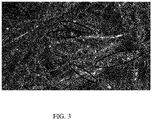
- the additional coverage is a result of the partial melting of the PO fibers during the oven treatment: fibers melt enough to bond to fibers in the non-woven structure at the contact points but retain their fiber shape in the areas between the bonding points: see Figure 3 .
Landscapes
- Engineering & Computer Science (AREA)
- Textile Engineering (AREA)
- Chemical & Material Sciences (AREA)
- Chemical Kinetics & Catalysis (AREA)
- Mechanical Engineering (AREA)
- Mining & Mineral Resources (AREA)
- Paleontology (AREA)
- General Life Sciences & Earth Sciences (AREA)
- Life Sciences & Earth Sciences (AREA)
- Civil Engineering (AREA)
- General Engineering & Computer Science (AREA)
- Structural Engineering (AREA)
- Nonwoven Fabrics (AREA)
- Laminated Bodies (AREA)
- Carpets (AREA)
- Catalysts (AREA)
Description
- The present invention relates to bonded and entangled non-woven structures for use in a geotextile, a filtration product, thermal insulation, an acoustic absorption product, an acoustic dampening product, or a lining product.
- A non-woven structure is a fabric-like material made from fibers, e.g. bonded by chemical, mechanical, heat or solvent treatment, which are neither woven nor knitted.
- A textile floor covering is known being a needled non-woven structure which can be flat or have a structured surface or can be tufted and can be used as a temporary (e.g. single use, or limited duration) floor covering or carpet in trade fairs, congresses and other events, or can be for long term use, e.g. in contract or industrial carpets, or domestic carpets. Such a carpet can have a pile portion comprising pile fibers in a needle punched non-woven fabric. A primary backing can be applied. Alternatively or additionally, a latex can be used to impregnate the back surface of the carpet and can be used as a bonding agent.
- There is an interest to supply polymeric based products with minimal effect on the environment. There are four major options for disposal of plastics: landfilling, incineration, recycling, and biodegradation. Plastics are used for single-use disposable applications, such as packaging, agricultural films and disposable consumer items, for long-term infrastructure such as pipes, cable coatings and structural materials, and for durable consumer applications with intermediate lifespan, such as in electronic goods, furniture, carpets, vehicles, etc.
- It is hoped that recycling can be used to reduce plastic waste, oil usage and carbon dioxide emissions. There are four categories of recycling:
- a) Primary or closed-loop recycling, such as mechanical reprocessing into a product with equivalent properties,
- b) secondary recycling downgrading such as mechanical reprocessing into products having less exacting properties,
- c) tertiary or chemical or feedstock recycling when the polymer is de-polymerized to its chemical constituents or when biodegradable plastics are composted, and
- d) quaternary recycling such as recovery of energy.
- A wide variety of different polymers and other materials such as metals (e.g. clips), paper, pigments, inks and adhesives are used in polymeric based products. Primary recycling is most practical when the polymer materials can be separated easily from sources of contamination. Preferably, there should only be one or a very limited range of polymer grades in any one product if the aim is to recycle the product and to replace virgin materials with recycled materials. It is often not technically feasible to add recycled plastic materials to raw polymer without decreasing at least some quality attributes of the plastic such as color, clarity or mechanical properties such as impact strength. Hence, there is limited recycling of multi-layer/multi-component articles such as carpets because these result in contamination between polymer types such as contamination by incompatible polymers.
- Hence, although recycling may be perceived as the best option, only a limited range of plastics can be recycled. Waste must be sorted thoroughly, which increases the cost. Contamination of different plastics streams results in lower quality materials. It is difficult if not impossible to produce recycled plastics of the same quality as virgin polymer because sorting systems are imperfect and the raw materials used to produce recycled product are impure. Although recycled polymers are cheaper to produce, their quality decreases due to contamination with each recycling cycle. Price of oil and of landfill disposal is not high enough to make use of recycled materials economical.
- One potential way to reduce use of plastic in the first place is:
- a) Omit parts of a carpet such as laminated materials or latexes. However, to omit such structural materials is accompanied with a reduction in various important properties of carpets such as the strength and stiffness of these carpets.
- b) Increase the use of natural fibers or biodegradable fibers. Natural fibers contaminate the plastic materials. Biodegradable plastics tend to be too expensive.
-
US 2006/223405 A1 discloses hydroentangled, thermally bonded nonwovens comprising polyethylene-polyamide bicomponent fibers. - The present invention provides in one aspect a product comprising a bonded and entangled non-woven structure made of at least 50% staple fibers by weight of the bonded and entangled non-woven structure, and at least a partial bonding of the fibers of the non-woven structure, the at least partial bonding comprising thermally activated bonds between a first polyolefin material produced with a catalyst comprising at least one metallocene catalyst and having a melting point in the range of 130-170°C (or 130-155°C) and a second material having a melting point which is at least 10°C higher than the melting point of the first material, the weight of the first material in the non-woven structure being at least 3% of the weight of the nonwoven structure, wherein the nature of the product is one of: a geotextile, a filtration product, thermal insulation, an acoustic absorption product, an acoustic dampening product, and a lining product.
- The staple fibers can be solid or hollow, be round or shaped, e.g. multilobal such as trilobal.
- Bonded and entangled nonwoven structures as used in embodiments of the present invention can be used in fabrics to provide specific functions such as absorbency, liquid repellence, resilience, stretch, softness, strength, flame retardancy, washability, cushioning, thermal insulation, acoustic insulation, filtration, bacterial barrier and sterility.
- In combination with other materials, bonded and entangled nonwoven structures as used in embodiments of the present invention provide a spectrum of products with diverse properties, and can be used alone or as components of apparel (e.g. disposable clothing), , engineering or industrial (e.g. geotextile; filtration; isolation; automotive components.
- The bonded and entangled non-woven structure can be entangled by needled punching or by hydroentanglement.
- The total staple fiber content can be at least 60%, preferably at least 70% and up to 100% by weight of the non-woven structure.
- The bonded and entangled non-woven structure as used in embodiments of the present invention preferably has a normalized stiffness higher than 150N/ % as determined by a corrected stiffness derived from a tensile test according to EN ISO 13934-1 (see definitions section).
- The second material can be selected from synthetic or natural materials. For example the second material can be selected from a polyolefin such as polyethylene or polypropylene, or can be a polyamide, or a polyester (e.g. PET).
- At least the first or the second material can comprise polypropylene or a polypropylene copolymer.
- The at least partial bonding is preferably a pressureless bonding made without pressuring the nonwoven structure during heating and thermal activation of bonds. This leaves the non-woven structure in an open state and compressible.
- The fibers may be split between first staple fibers made of the first material and second staple fibers made of the second material. The amount of first fibers is between 3 and 30% of the total staple fiber content of the bonded and entangled non-woven structure.
- The linear mass density of the first fibers is preferably lower than the linear mass density of the second fibers. For example the linear mass density of the second fibers can be at least 1.5 higher than the linear mass density of the first fibers.
- The first and second materials can be included, together, in bicomponent fibers. The bicomponent fiber has at least some of the first material exposed on the surface of the fiber and is bonded to some of the second material of the same fiber. Preferably, the bicomponent fiber can be a sheath/core bicomponent fiber, wherein the first material is present in the sheath.
- An advantage of bonded and entangled non-woven structures as used in some embodiments of the present invention is a reduction weight and/or cost, while keeping or improving mechanical performance such as stiffness or modulus. An advantage of bonded and entangled non-woven structures according to some embodiments of the present invention is a low weight but a good coverage and abrasion resistance.
- Entangled and bonded nonwoven structures as used in embodiments of the present invention can be needle punched and can be produced using an industrial scale needle punch carpet production line. For example, staple fibers are mixed and formed into a bat or mat using carding and cross-lapping. The mat can be pre-needled using plain barbed needles to form a carpet face layer.
- A product according to some embodiments of the present invention is preferably 100% recyclable.
- Also the coverage (ability to prevent see-through) is good.
- Another advantage is that a higher stiffness or modulus can be achieved with the same stitch density, needling efficiency effect, and a higher fiber-fiber friction can also be achieved compared to conventional non-woven structures, especially when using multilobal such as trilobal fiber.
- An advantage of embodiments of the present invention can be a lower or no precoat weight of a backing material such as a latex, a lower or no absorption of precoat backing material leading to lower overall carpet weight and less problems with recycling. The effect of these differences can lead to significant lower weight of the end product. An advantage of embodiments of the present invention can be a lower end weight for other backing methods.
- An advantage of embodiments of the present invention can be a lower carbon footprint compared to current versions.
- The second fiber is preferably made of polypropylene (PP), polyamide or polyester (e.g. PET).
- Further embodiments of the invention are defined in the dependent claims.
-
-
Fig. 1 shows a schematic cross-section of a carpet comprising an entangled and bonded non-woven structure such as the one present in a product according to an embodiment of the present invention. -
Fig. 2 shows various types of bicomponent fibres designs that can be used with embodiments of the present invention. -
Fig. 3 shows an entanglement of fibers as can be used with embodiments of the present invention. - The terms "fiber" and "filament" refer to filamentous material that can be used in yarn fabric and non-woven textile fabrication. The term "staple" means fiber or yarn or strands of short and definite length, such as substantially between 20-120 mm, or between 50-80 mm.
- A "non-woven" which can be used with the present invention may be a staple nonwoven made by providing cut fibers of a few centimetres length, putting these into bales, placing on a conveyor belt and dispersed, e.g. spread in a uniform web by a wetlaid, airlaid, or carding/crosslapping process.
- Preferred entanglement methods are:
- needle punching (preferred method): mechanical intertwining of fibers by needles
- hydro-entanglement: mechanical intertwining of fibers by high pressure water jets
- The following types of non-wovens are excluded from the nonwoven structure according to the present invention:
- Spunlaid nonwovens made in one continuous process by spinning and then directly dispersing the fibers into a web by deflectors or can be directed with air streams.
- Spunbonded non-wovens optionally combined with meltblown nonwovens.
- Non-wovens bonded as follows are less preferred:
- use of a heat sealer
- calendered through heated rollers (called spunbond when combined with spunlaid webs) belt calendered, or compressive belt heat bonded
- ultrasonic pattern bonding.
- chemical bonding processes: such as impregnation with powders, or latex emulsion or solution polymers to chemically join the fibers or use of powders that soften and melt.
- A "needle felt" as used in embodiments of the present invention is a staple fiber based needle punched nonwoven. It is preferred if a separate backing such as a latex compound, or impregnation with a binder powder is not used. A strippable backing layer made by extrusion can be.
- The term "needle punched" means a nonwoven which is consolidated by passing it though one or more needleboards carrying several thousands of needles that penetrate the nonwovens repeatedly, forming a mechanically entangled structure.
- Keeping the "integrity" of fibers refers to maintaining structural integrity of a staple fiber, there being sufficient amount of an original fiber being present for structural integrity even if thinner than the original form and even if the cross-sectional form of the fiber is no longer similar to the original one. It is preferred that at least 50%, more preferably at least 60%, still more preferred if at least 75% of the fibers maintain their integrity after thermally activated bonding.
- Fibers: 6.7 to 110 dtex, pref 6.7 to 33 dtex
- Fibers 3.3 dtex to 45 dtex to form a matrix of fibers made of the second material whereas for bonding fibers made of the first material the fibers can be 3.3 dtex to 17dtex
- Preferably the weight range is 60 to 500 g/m2 and a fiber range with the second material being 1.5 dtex to 38 dtex and a range of 1.2 dtex to 25 dtex for bonding fibres having some of the first material.
- Weight range is preferably 60 to 1000 g/m2 and fiber range 1.5 dtex to 17 dtex for fibres of the second material and 1.2 dtex to 6.7 dtex for bonding fibres having the first material.
- Preferred weight range is 60 to 500 gsm, and fiber range 1.5 dtex to 38 dtex for fibers with the second material and 1.2 dtex to 6.7 dtex for bonding fibers with the first material.
- Preferred weight range is 150 to 500 g/m2, and fiber range 3.3 dtex to 25 dtex for fibers with the second material and 3.3 dtex to 13 dtex for fibers having the first material for bonding
- Preferred weight range is 60 to 500 g/m2, and a fiber range of 1.5 dtex to 38 dtex for fibers made with the second material and 1.2 dtex to 6.7 dtex for fibers having the first material for bonding.
- The term "trilobal" refers to a fiber cross-section which comprises of three lobes.
- The term "Multilobal" refers to a fiber cross-section which comprises of a plurality of lobes.
- The "core" of staple fiber can be hollow and can include an axial hole or void, or the core can be of solid material.
- The catalyst "metallocene":
Many metallocenes and their derivative are active catalysts for olefin polymerization. Polymeric materials made using a metallocene catalyst include polyolefin polymers, e.g. made using a single-site metallocene catalyst system such as a homogeneously branched ethylene polymer, a substantially linear ethylene interpolymer or a homogeneously branched linear ethylene interpolymer, including a polypropylene polymer. - The polyolfin can be made only with a metallocene catalyst or a combination of a metallocene catalyst and another catalyst, e.g. metallocene and Ziegler-Natta catalysts provided that the melting point is depressed sufficiently to be 10°C lower than the second material.
- Metallocene catalysts defined in
WO2012/126973 pages 10 to 13 are incorporated herewith by reference and can be used with any of the embodiments of the present invention. The polypropylene compositions defined inWO2012/126973 pages 7 to 9 are incorporated by reference and can be used with any of the embodiments of the present invention. The fibers defined inWO2012/126973 pages 6 and 7 are incorporated by reference and can be used with any of the embodiments of the present invention. - The following test methods are to be used.
- Melting temperatures Tmelt ("melting point") are determined according to ISO 3146, e.g. on a DSC Q2000 instrument by TA Instruments. To erase the thermal history the samples can be first heated to 200 °C and kept at 200 °C for a period of 3 minutes. The reported melting temperatures ("melting points") are then determined with heating and cooling rates of 20°C/min.
- Dimensions: CEN/TS 14159
- Total thickness mm: ISO 1765 whereby the tolerance is nominally ± 15 %
- Total mass per unit area g/m2: ISO 8543 whereby the tolerance is nominally the mass ± 15 %
- Stiffness:
- Sampling
- According to Norm NBN EN ISO 9862
- Minimum number of samples: 5 in machine direction (MD) and 5 in cross direction (CD)
- Width of the samples: 200 mm ± 0.5 mm
- Length of the sample: long enough to allow a gauge length of 100 mm.
- Tensile test
- According to EN ISO 13934-1
- (sample size deviates from the norm for better accuracy, cfr. 'Sampling'; as well as the gauge length and the rate of extension)
- Parameters:
- Gauge length = 100 mm
- Rate of extension = 50 mm/min
- Pretension = IN
- Calculation of Stiffness
- Determine the force (F) on samples with a width of 200 mm that was necessary for 0.5% and 1.5% of strain (ε).

- Force in N
- Difference in strain Δε = 1 %
- Correction for weight of the non-woven
- The stiffness shows a linear relation with the weight of a non-woven.
- It is preferred to compare samples with similar weights. e.
- The stiffness is corrected for weight by determining a normalized stiffness given by the following normalized to 300 g/m2:
Normalized Stiffness = stiffness x 300 gram per square meter divided by the weight of the measured sample in gram per square meter. - The formula for stiffness itself is given above.
- Examples of products according to embodiments of the present invention are Automotive linings, Geotextile, Filtration products, Thermal insulation (clothing and pipe wrapping), Acoustic absorption (airborne), Acoustic dampening (contact sound) products, Linings (shoe, luggage, clothing ..)
- Embodiments of the present invention comprise an entangled and bonded non-woven structure which can be low in weight but having good abrasion resistance and good coverage. Entangled and bonded non-woven structures used in some embodiments comprise polyolefin fibers such as polypropylene fibers, or comprise polyester or polyamide fibers.
- The present invention provides in one aspect a product comprising an entangled and bonded non-woven structure made of at least 50% staple fibers based on the weight of the bonded and entangled non-woven structure, and at least a partial bonding of the fibers of the bonded and entangled non-woven structure, the at least partial bonding comprising thermally activated bonds between a first polyolefin material produced with a catalyst of which one is a metallocene catalyst and having a melting point in the range of 130-170°C (or 130-155°C) and a second material having a melting point which is at least 10°C higher than the melting point of the first material, the weight of the first material in the bonded and entangled non-woven structure being at least 3% of the weight of the bonded and entangled nonwoven structure. The second material can have a melting point of 160-165°C for example. The staple fibers can be solid or hollow or a mixture of the two or can have any suitable cross-sectional shape.
- The catalyst for first polyolefin material can be a metallocene catalyst alone or a combination of a metallocene catalyst with another, e.g. a combination of a Ziegler Natta catalyst and a metallocene catalyst or can be a mixture of materials each one made by either a Ziegler Natta catalyst or a metallocene catalyst.
- Some aspects of the present invention will be elucidated hereinafter by reference to examples of carpets, not according to the invention, which comprise an entangled and bonded non-woven structure having the same features as the entangled and bonded nonwoven structure comprised in embodiments of the products according to the invention.
-
Fig. 1 shows a schematic cross-section of acarpet 1 comprising at least a facinglayer 2 which is an entangled and bonding non-woven structure such as a needle punched layer. The carpet according to some embodiments of the present invention can comprise only the facinglayer 2 bonded by a bonding material within the facing layer. The carpet can include anoptional backing layer 3, but it is preferred if thisbacking layer 3 can be easily removed if it is made of polymer materials not compatible with recycling of the carpet. - As shown in
Figure 3 , the bonding between fibers gives the bonded and entangled nonwoven structure a mechanical stability. Embodiments of the present invention include a combination of the needle punched facinglayer 2 according to embodiments of the present invention with an at least a partial thermally activated pressureless bonding between fibers which are located in the needle punched facinglayer 2. This bonding is preferably activated by heat alone, e.g. in an oven which is run at a temperature that is lower by at least 5°C than the melting point of second material and without pressure when hot. The time should be set in the oven so that the bonding fibers (having the first material made with a metallocene catalyst) or bicomponent fibers (having both first and second materials) form bonds but these fibers or any other fiber do not completely melt away as keeping the integrity of the fibers or keeping them intact gives a stronger nonwoven with a higher modulus/stiffness. The time in the oven is usually one or a few minutes. Infrared heating, or hot air can also be used alone or in combination with an air circulating oven. It is preferred that at least 50%, more preferably at least 60%, still more preferred if at least 75% of the fibers maintain their integrity after thermally activated bonding. - Alternatively, one or
more backing layers 3 can be applied such as a porous backing layer or a single backing layer, provided the backing can be recycled with other components in the carpet or the backing can be stripped off easily in recycling, e.g. that the penetration is low. Thebacking 3 may comprise one or more layers such as for instance a latex layer, thermoplastic film layer, a thermoplastic extrusion layer, a foam layer or felt layer such as a needle felt layer. For example anadhesive layer 4 can be used to bind the needlepunch facing layer 2 to other layers. A combination of these layers can be assembled, e.g. by needle punching, by lamination, or adhering layer together. Such a multilayer backing can be formed to improve coverage or to enhance acoustic properties. - In the bonded and entangled non-woven structure the staple fiber content of the facing layer can be at least 60%, 70, 80 or 90% by weight of the total fiber content, preferably up to 100% by weight of the total fiber content of the facing layer.
- A bonded and entangled non-woven structure as used in some embodiments of the present invention is a staple fiber based needlepunched nonwoven structure which is subsequently provided with a binding by internal thermally activated pressureless bonding. Optionally a backing can be used.
- The weight of the bonded and entangled non-woven structure for use as a top or facing layer (base weight) for a carpet may be between 100 and 350 grams per square meter, for example between 150-275 grams per square meter. Fiber linear mass density and weights for a complete list of products are given in the definition section.
- This embodiment provides an entangled and bonded non-woven structure which relies on the use of staple fibers of which some or all are bicomponent fibers. A bicomponent fiber can be made of the second material such as a polyolefin, e.g. polypropylene, whereby on the surface of the bicomponent fibers there is exposed a first material different from the second material. There is a difference in melting point between the first material and the second material. For example the second material can be a conventional PP having a melting point of 160-165°C, while the first material is, for example a specific polyolefin. The first material is preferably a polyolefin, e.g. polypropylene produced with one or more catalysts wherein one of the catalysts is a metallocene catalyst. The melting point of the first material is selected to be lower than the second material, e.g. at least 10°C lower. For example the melting point of the first material can be in the range of 130-170°C (or 130-155°C). The bicomponent fiber can have a sheath of the first material and a core of the second material.
- The bicomponent fibers are bonded to each other, an optionally to other fibers, by a thermal pressureless bonding process. An entangled non-woven structure is made as described above with the bicomponent fibers and the structure is placed in an oven and heated without pressure at a temperature at least 5° C below the melting point of the second material.
- The bicomponent fibers can be constructed in a variety of ways, e.g. each half of the fiber is made of the second material, the other half being the first material, alternate sectors of the bicomponent fiber are made of the first or second material, a multicore is made of the second material set in a matrix of the first material, strips of first material may be formed along a fiber made of the second material, a fiber made of the second material can be segmented with layers of the first material, etc.
- Some examples are shown in
Figure 2 but possibilities are not limited to the designs shown inFigure 2 . - In an exemplary process: First an entangled non-woven structure is made such as a needlefelt.
- The fibers of this entangled non-woven structure such as a needlefelt can comprise 100% of the bicomponent fibers mentioned above.
- Alternatively the fibers of this entangled non-woven structure such as the needlefelt can comprise mix of these bicomponent fibers with other types of fibers.
- In a second step, the entangled non-woven structure such as the needlefelt is bonded by passing it through an oven or equivalent heating device. The temperature profile of the oven or alternative device is chosen in such a way that the first material of the bicomponent fibres at least partially melts and bonds to an adjacent fiber while the second material does not melt and/or the bicomponent fibers keep their integrity or their original form.
- For example, the temperature profile of the oven or alternative device is such that it is 5°C below the melting point of the second material. In this way, a material is produced which is bonded without losing all of its softness/carpet feeling. It is preferred that at least 50%, more preferably at least 60%, still more preferred if at least 75% of the fibers maintain their integrity after thermally activated bonding.
- This choice of polymer in this embodiment in combination with the bonding process has the following advantages over existing bonding methods:
- ∘ Comparison with latex bonding:
- Materials that consist 100% of one thermoplastic polymeric material or comprise a mixture of polyolefins can be recycled s. Latex is not recycleable though. As a result, needlefelt carpet that is bonded with latex can no longer be recycled at a reasonable cost.
- The bonded and entangled non-woven structure of this embodiment, e.g. when used as a carpet comprises 100% of one or more polyolfins. As a result, the carpet is 100% recyclable.
- ∘ Low temperature melting fibers (melt temperature below 130°C)
- For a needlefelt carpet (e.g. with a weight of 300 g/m2), the stiffness should be at least 150 N/% to be certain that the bonding strength is sufficient.
- Nominal values of normalized stiffness for different bonding methods:
(each time for a carpet of 300 g/m2)Latex bonding - 50 g/m2 latex (dry weight): 180-200 N/ % Powder bonding - 40 g/m2 PO powder: 140-160 N/ % Low temperature melt fibre - 50 g/m2 fibres: 100-120 N/ % - This embodiment provides an entangled non-woven structure which relies on the use of staple fibers. A first staple fiber is made of a second material such as a polyolefin, e.g. polypropylene, and a first staple fiber is made of a first material such as a polyolefin, e.g. polypropylene. There is a difference in melting point between the first and second materials. For example the second material can be conventional PP having a melting point of 160-165°C, while the first material is, for example a specific polyolefin. The first material is preferably a polyolefin, e.g. polypropylene produced with one or more catalysts wherein one of the catalysts is a metallocene catalyst. The melting point of the first material is selected to be lower than the second material, e.g. at least 10°C lower. For example the melting point of the first material can be in the range of 130-170°C (or 130-155°C).
- The first fibers are bonded to the second fibers by a thermal pressureless bonding process. An entangled non-woven structure is made as described above the structure is placed in an oven and heated without pressure at a temperature at least 5° C below the melting point of the second material.
- In a first step, a mix is made of first (bonding) fibers and second fibers made of regular PP fibers (melting point 160-165°C). The amount of bonding fibers necessary is between 3 and 30% by weight of the total weight of the non-woven structure, preferably between 10 and 20%, more preferably 15%. The non-woven structure is then entangled, e.g. by needling or by hydro-entanglement. The entangled non-woven structure is bonded by passing it through an oven. The temperature profile of the oven is chosen in such a way that the first fiber, i.e. the bonding fiber can at least partially melt while the second fibers which are conventional PP-fibers keep their integrity or their original form. The temperature in the oven can be set to 5°C below the melting point of the second fibers. It is preferred that at least 50%, more preferably at least 60%, still more preferred if at least 75% of the fibers maintain their integrity after thermally activated bonding. This entangled and bonded non-woven structure is then used for the production of a needlefelt carpet, for example. In this way, a bonded entangled non-woven structure is formed which is sufficiently bonded without losing all of its softness/carpet feeling.
- Bicomponent fibers of sheath/core type with the core made of polypropylene (Polychim, PP HB12XF polypropylene with a melting point of 160°C according to ISO 3146) and a sheath of polypropylene-based copolymer made with a metallocene catalyst (Total, Lumicene® MR10MX0 with a melting point of 140°C according to ISO 3146). Two types of fibers were produced:
- Type 1: 70% by weight in the core - 30% by weight in the sheath
- Type 2: 80% by weight in the core - 20% by weight in the sheath.
- Properties of the fibres produced are given below.
Ratio Thickness Tenacity Elongation Type 1 70/30 5.2 dtex 32 cN/tex 154 % Type 2 80/20 5.2 dtex 32 cN/tex 161% - An event carpet was made of a needle punched nonwoven structure, which was made entirely out of bicomponent fibers. Thermal bonding was performed at an oven temperature of 145°C (preferably by a thermal pressureless bonding process).
- Needle punched nonwoven structure with
Type 1 fibres tested for stiffness:70/30 Weight (g/m2) Thickness (mm) Normalized Stiffness CD 236.2 2.05 251.5 MD 237.0 1.94 196.2 Average 236.6 2.00 223.8 - Needle punched
nonwoven structure Type 2 fibres:80/20 Weight (g/m2) Thickness (mm) Normalized Stiffness N/% CD 232.6 2.33 230.8 MD 233.1 2.08 209.8 Average 232.9 2.20 220.3 - The two carpets showed good results for normalized stiffness (above 150 N/%) and also showed very good results on a Taber abrasion test (expert scoring). The following tests were performed:
Standard test with 200 cycles: score 5/5
Modified test to 1000 cycles: score 4.5/5
Details of Taber test:Weight per arm: 250 g (arm itself) + 500 g additional weight Type abrading wheels: Type CS-0 Rubber - As explained above a needlefelt carpet that is bonded with latex can no longer be recycled.
- A carpet made using a bonded entangled non-woven structure according to this embodiment can comprise 100% of polyolefins. As a result, the carpet is 100% recycleable. As explained above the bonding strength better than with other bonding methods.
- The stiffness of a bonded entangled non-woven structure in a carpet is an indication for the bonding strength.
- This stiffness is measured during a tensile test (see definitions section).
- For a needlefelt carpet with a weight of 300 g/m2, the normalized stiffness should be at least 150 N/% to be certain that the bonding strength is sufficient.
- Nominal values of normalized stiffness for different bonding methods: (each time for a carpet of 300 g/m2)
Latex bonding - 50 g/m2 latex (dry weight): 180-200 N/% Powder bonding - 40 g/m2 PO powder: 140-160 N/% Low temperature melt fiber - 50 g/m2 fibers: 100-120 N/% PO melt fiber - 50 g/m2 PO fibers: 190-210 N/% - The bonding strength for low temperature melt fibers (below 130°C) is much lower than the needed 150 N/ %. Bonding strength with Latex, powder or PO melt fiber is sufficient. No need for higher amount of bonding material; as this would only increase price.
- Results with the new PO melt fiber (comprising first material made with at least a metallocene catalyst) are superior to those with PE melt fiber. This could be caused by a better compatibility between the PO and the PP fibers according to embodiments of the present invention (e.g. similar surface tension).
- For example, an event carpet made of a needle punched nonwoven structure.
- The nonwoven structure was made using 250 g/m2 of fibers made of polypropylene (Polychim HB12XF) with a melting point of 160°C and 50 g/m2 of bonding fibers made of polypropylene-based copolymer made with metallocene catalyst (Lumicene® MR10MX0 with a melting point of 140°C according to ISO 3146).
- The event carpet was made according to a carpet-making process as described hereinbefore. The bonding of the fibers was done by passing the nonwoven structure through an oven for 1,5 minutes. The table shows results of normalized stiffness (see definitions section), obtained at 2 temperatures used in the oven.
Oven Temperature CD MD Stiffness 145°C 138,6 174,1 156,4 150° C 192,3 224,6 208,5 - It is possible to recycle a PP-carpet bonded with PE fibers. Unfortunately, this recycled material can only be used for low end applications since the compatibility between PP and PE isn't very good.
- The compatibility between PP (second material) and the proposed PO melt fibers (comprising first material made with at least a metallocene catalyst) according to embodiments of the present invention is much better. As a result, the recycled material can be used for more demanding applications as well.
- Powder process:
Process is very sensitive to humidity variations of both the environment and the carpets to be treated. Even though the impregnation and bonding are carried out in a room with humidity control, this sensitivity still leads to important fluctuations of the bonding strength. - The bonded and entangled non-woven according to embodiments of the present invention does not suffer from such variations in bonding strength.
- An additional advantage of the use of PO bonding fibers is an improved coverage of the floor below it.
- The additional coverage is a result of the partial melting of the PO fibers during the oven treatment: fibers melt enough to bond to fibers in the non-woven structure at the contact points but retain their fiber shape in the areas between the bonding points: see
Figure 3 . - Other bonding methods don't have this advantage:
- ∘ PE melt fibres: melt completely, molten material goes to the contact points
→ hardly any extra coverage - ∘ Powder bonding: powder is located at the contact points
→ hardly any extra coverage - ∘ Latex: material is mostly located at the contact points + white color of the latex leads to a discoloration of the carpet.
Claims (15)
- A product comprising an entangled and bonded non-woven structure made of at least 50% staple fibers by weight of the entangled and bonded non-woven structure, and at least a partial bonding of the staple fibers of the non-woven structure, the at least partial bonding comprising thermally activated bonds between a first polyolefin material produced with at least one catalyst being a metallocene catalyst and having a melting point in the range 130-170°C and a second material having a melting point which is at least 10°C higher than the melting point of the first material, the weight of the first material in the non-woven structure being at least 3% of the weight of the entangled and bonded nonwoven structure;
wherein the nature of the product is one of:- a geotextile,- a filtration product,- thermal insulation,- an acoustic absorption product,- an acoustic dampening product, and- a lining product. - The product according to claim 1, wherein the nature of the product is thermal insulation, and the product is a pipe wrapping product.
- The product according to claim 1, wherein the nature of the product is an acoustic dampening product, and the product is a contact sound dampening product.
- The product according to claim 1, wherein the nature of the product is a lining product, and the product is one of an automotive lining product, a lining of shoes, and a lining of luggage.
- The product according to any of the preceding claims, wherein the second material can be selected from synthetic or natural fibers.
- The product according to claim 5, wherein the second material can be selected from a polyolefin, polyamide, or polyester.
- The product according to any of the preceding claims, wherein at least the first or the second material comprises polypropylene or a polypropylene copolymer.
- The product according to any of the preceding claims, wherein the bonding is a pressureless bonding made without applying pressure during heating and bonding of the entangled nonwoven structure.
- The product according to any of the preceding claims, comprising first staple fibers made of the first material and second staple fibers made of the second material.
- The product according to claim 9, wherein the amount of first fibers is between 3 and 30% of the total staple fiber content of the bonded and entangled non-woven structure.
- The product according to any of the preceding claims, wherein the first and second material are included, together, in bicomponent fibers.
- The product according to claim 11, wherein the bicomponent fiber is a sheath/core bicomponent fiber, and wherein the first material is present in the sheath.
- The product according to any of the preceding claims, wherein the total staple fiber content is at least 60%, preferably at least 70% and up to 100% by weight of the structure.
- The product according to any of the preceding claims, having a normalized stiffness higher than 150N/%.
- The product according to any of the preceding claims, wherein entanglement is provided by needle punching or hydro entanglement.
Priority Applications (4)
| Application Number | Priority Date | Filing Date | Title |
|---|---|---|---|
| EP22203629.5A EP4198193B1 (en) | 2016-03-24 | 2017-03-17 | Carpet comprising a nonwoven structure with fibres catalyzed by a metallocene catalyst |
| EP24178602.9A EP4417743A3 (en) | 2016-03-24 | 2017-03-17 | Non-woven structure with fibers catalyzed by a metallocene catalyst |
| DK22203629.5T DK4198193T3 (en) | 2016-03-24 | 2017-03-17 | CARPET COMPRISING A NONWOVEN STRUCTURE WITH FIBERS PRODUCED USING A METALLOCENE CATALYST |
| EP22203627.9A EP4159908B1 (en) | 2016-03-24 | 2017-03-17 | Non-woven structure with fibres catalyzed by a metallocene catalyst |
Applications Claiming Priority (3)
| Application Number | Priority Date | Filing Date | Title |
|---|---|---|---|
| BE2016/5213A BE1023505B1 (en) | 2016-03-24 | 2016-03-24 | Non-woven structure with fibers catalyzed by a metallocene catalyst |
| PCT/EP2017/056438 WO2017162540A1 (en) | 2016-03-24 | 2017-03-17 | Non-woven structure with fibers catalyzed by a metallocene catalyst |
| EP17716139.5A EP3433404B1 (en) | 2016-03-24 | 2017-03-17 | Carpet comprising a non-woven structure with fibers catalyzed by a metallocene catalyst |
Related Parent Applications (2)
| Application Number | Title | Priority Date | Filing Date |
|---|---|---|---|
| EP17716139.5A Division EP3433404B1 (en) | 2016-03-24 | 2017-03-17 | Carpet comprising a non-woven structure with fibers catalyzed by a metallocene catalyst |
| EP17716139.5A Division-Into EP3433404B1 (en) | 2016-03-24 | 2017-03-17 | Carpet comprising a non-woven structure with fibers catalyzed by a metallocene catalyst |
Related Child Applications (3)
| Application Number | Title | Priority Date | Filing Date |
|---|---|---|---|
| EP24178602.9A Division EP4417743A3 (en) | 2016-03-24 | 2017-03-17 | Non-woven structure with fibers catalyzed by a metallocene catalyst |
| EP22203627.9A Division EP4159908B1 (en) | 2016-03-24 | 2017-03-17 | Non-woven structure with fibres catalyzed by a metallocene catalyst |
| EP22203629.5A Division EP4198193B1 (en) | 2016-03-24 | 2017-03-17 | Carpet comprising a nonwoven structure with fibres catalyzed by a metallocene catalyst |
Publications (2)
| Publication Number | Publication Date |
|---|---|
| EP3825449A1 EP3825449A1 (en) | 2021-05-26 |
| EP3825449B1 true EP3825449B1 (en) | 2022-10-26 |
Family
ID=56289254
Family Applications (5)
| Application Number | Title | Priority Date | Filing Date |
|---|---|---|---|
| EP22203627.9A Active EP4159908B1 (en) | 2016-03-24 | 2017-03-17 | Non-woven structure with fibres catalyzed by a metallocene catalyst |
| EP24178602.9A Pending EP4417743A3 (en) | 2016-03-24 | 2017-03-17 | Non-woven structure with fibers catalyzed by a metallocene catalyst |
| EP22203629.5A Active EP4198193B1 (en) | 2016-03-24 | 2017-03-17 | Carpet comprising a nonwoven structure with fibres catalyzed by a metallocene catalyst |
| EP17716139.5A Active EP3433404B1 (en) | 2016-03-24 | 2017-03-17 | Carpet comprising a non-woven structure with fibers catalyzed by a metallocene catalyst |
| EP20211118.3A Active EP3825449B1 (en) | 2016-03-24 | 2017-03-17 | Non-woven structure with fibres catalyzed by a metallocene catalyst |
Family Applications Before (4)
| Application Number | Title | Priority Date | Filing Date |
|---|---|---|---|
| EP22203627.9A Active EP4159908B1 (en) | 2016-03-24 | 2017-03-17 | Non-woven structure with fibres catalyzed by a metallocene catalyst |
| EP24178602.9A Pending EP4417743A3 (en) | 2016-03-24 | 2017-03-17 | Non-woven structure with fibers catalyzed by a metallocene catalyst |
| EP22203629.5A Active EP4198193B1 (en) | 2016-03-24 | 2017-03-17 | Carpet comprising a nonwoven structure with fibres catalyzed by a metallocene catalyst |
| EP17716139.5A Active EP3433404B1 (en) | 2016-03-24 | 2017-03-17 | Carpet comprising a non-woven structure with fibers catalyzed by a metallocene catalyst |
Country Status (14)
| Country | Link |
|---|---|
| US (2) | US11913150B2 (en) |
| EP (5) | EP4159908B1 (en) |
| JP (1) | JP2019510889A (en) |
| KR (1) | KR20180122011A (en) |
| CN (1) | CN108884614A (en) |
| BE (1) | BE1023505B1 (en) |
| DK (1) | DK4198193T3 (en) |
| ES (3) | ES2851828T3 (en) |
| FI (2) | FI4198193T3 (en) |
| HR (1) | HRP20260093T1 (en) |
| HU (2) | HUE068200T2 (en) |
| MX (1) | MX2018011586A (en) |
| PL (3) | PL3433404T3 (en) |
| WO (1) | WO2017162540A1 (en) |
Families Citing this family (10)
| Publication number | Priority date | Publication date | Assignee | Title |
|---|---|---|---|---|
| US12016515B2 (en) * | 2016-03-17 | 2024-06-25 | Eurofilters N.V. | Vacuum cleaner filter bag with recycled textile materials and/or cotton liners |
| CN110863301B (en) * | 2019-11-14 | 2022-03-18 | 天鼎丰聚丙烯材料技术有限公司 | High-elasticity waterproof geotextile and preparation method and application thereof |
| CN111165956B (en) * | 2020-03-09 | 2023-01-17 | 嘉兴学院 | A washable mask for effectively blocking virus bacteria and preparation method thereof |
| KR102519717B1 (en) | 2020-12-23 | 2023-04-06 | 부경대학교 산학협력단 | Apparatus and method for detecting welding bead with improved accuracy |
| ES2897525B2 (en) * | 2021-10-08 | 2022-10-03 | Egana Arrieta Joseba | BAND FOR ITS JOINT TO A POLYESTER TEXTILE THAT IS FIXED ON A FRAME AND PROCEDURE FOR OBTAINING IT |
| CN114438666A (en) * | 2022-02-16 | 2022-05-06 | 山东道恩斯维特科技有限公司 | Method for producing bicomponent spun-bonded nonwoven fabric |
| ES2957063B2 (en) * | 2022-05-30 | 2024-10-22 | Arrieta Joseba Egana | BAND FOR JOINING A POLYESTER TEXTILE THAT IS FIXED ON A FRAME AND PROCEDURE FOR OBTAINING IT |
| WO2025129342A1 (en) * | 2023-12-21 | 2025-06-26 | 1552818 Ontario Limited | Pipeline wrap and pipeline protection system |
| EP4610416A1 (en) * | 2024-02-29 | 2025-09-03 | Beaulieu International Group NV | Polyolefin-based nonwoven structure |
| BE1032747B1 (en) | 2024-07-04 | 2026-02-09 | Beaulieu Int Group | Non-woven structures, carpets, their use and production method. |
Citations (10)
| Publication number | Priority date | Publication date | Assignee | Title |
|---|---|---|---|---|
| JPH1136141A (en) | 1997-07-14 | 1999-02-09 | Chisso Corp | Bulky conjugate fiber, and fibrous form using the same |
| US20020034637A1 (en) | 2000-08-04 | 2002-03-21 | Kami Shoji Co. Ltd. | Natural feathered fiber insulator |
| JP2003201657A (en) | 2001-12-27 | 2003-07-18 | Nissan Motor Co Ltd | Sound absorbing material |
| EP1169500B1 (en) | 1999-03-30 | 2004-02-18 | ATOFINA Research | Polypropylene fibres |
| JP2004346476A (en) | 2003-04-28 | 2004-12-09 | Daiwabo Co Ltd | Propylene short fiber, fiber aggregate using the same, and heat-sealed nonwoven fabric |
| JP2005068566A (en) | 2003-08-20 | 2005-03-17 | Ube Nitto Kasei Co Ltd | Sheath-core composite fiber for pulp nonwoven fabric and pulp nonwoven fabric using the same |
| CA2214596C (en) | 1996-08-29 | 2006-10-31 | Hoechst Aktiengesellschaft | Polyolefin molding composition for producing nonwovens |
| KR20120048148A (en) | 2010-11-05 | 2012-05-15 | 한국생산기술연구원 | Kapok nonwoven using bicomponent fiber and manufacturing method thereof |
| WO2014192976A1 (en) | 2013-05-31 | 2014-12-04 | Es Fibervisions Co., Ltd. | Heat-bondable conjugate fiber with excellent softness and nonwoven fabric using the same |
| EP2372005B1 (en) | 2010-04-02 | 2016-10-05 | JNC Corporation | Processing apparatus for hot-air treatment of fiber constituting nonwoven fabric to produce nonwoven fabric, and processing process for the same |
Family Cites Families (21)
| Publication number | Priority date | Publication date | Assignee | Title |
|---|---|---|---|---|
| EP0518690B1 (en) * | 1991-06-13 | 1995-07-26 | Chisso Corporation | Needle punched carpet |
| JPH06330444A (en) * | 1993-05-21 | 1994-11-29 | Ube Nitto Kasei Co Ltd | Polypropylene fiber mat |
| US5437909A (en) * | 1994-05-20 | 1995-08-01 | Minnesota Mining And Manufacturing Company | Multilayer nonwoven thermal insulating batts |
| BR9607761A (en) * | 1995-03-17 | 1999-01-19 | Amoco Corp | Fuzzy carpet lining optimized for rugs and process for making a fuzzy rug |
| JPH10298824A (en) * | 1997-04-22 | 1998-11-10 | Chisso Corp | Fiber and fibrous formed product using the same |
| GB2342362B (en) * | 1998-10-02 | 2002-12-24 | Rawson Carpets Ltd | Floor covering |
| US7018492B1 (en) * | 1999-10-29 | 2006-03-28 | Propex Fabrics, Inc. | Carpets with improved fuzz-resistance |
| DE10126126B4 (en) * | 2000-05-29 | 2017-03-09 | Jnc Corporation | Fleece made of polyethylene composite fiber and its use |
| GB0113109D0 (en) * | 2001-05-30 | 2001-07-18 | Du Pont | A floor covering |
| JP2005517577A (en) * | 2002-02-15 | 2005-06-16 | コルボント ベスローテン フェンノートシャップ | Primary carpet lining |
| WO2004059050A1 (en) | 2002-12-24 | 2004-07-15 | Kao Corporation | Hot-melt conjugate fiber |
| JP4294394B2 (en) * | 2003-06-25 | 2009-07-08 | 呉羽テック株式会社 | Floor cushioning material |
| AU2005207923B2 (en) * | 2004-01-26 | 2008-08-07 | The Procter & Gamble Company | Fibers and nonwovens comprising polypropylene blends and mixtures |
| US7438777B2 (en) * | 2005-04-01 | 2008-10-21 | North Carolina State University | Lightweight high-tensile, high-tear strength bicomponent nonwoven fabrics |
| US20070172630A1 (en) * | 2005-11-30 | 2007-07-26 | Jones David M | Primary carpet backings composed of bi-component fibers and methods of making and using thereof |
| EP2034056A1 (en) * | 2007-09-04 | 2009-03-11 | Total Petrochemicals Research Feluy | Metallocene polypropylene fibers and nonwovens with improved mechanical properties. |
| US8007699B2 (en) * | 2008-08-20 | 2011-08-30 | Fina Technology, Inc. | Process of making bicomponent fiber |
| WO2012126973A1 (en) | 2011-03-24 | 2012-09-27 | Total Research & Technology Feluy | Fine polypropylene fibers and a method for their production |
| JP6133035B2 (en) * | 2012-10-03 | 2017-05-24 | ダイワボウホールディングス株式会社 | Electrostatic filter |
| DE102013014919A1 (en) * | 2013-07-15 | 2015-01-15 | Ewald Dörken Ag | Bicomponent fiber for the production of spunbonded nonwovens |
| CN104095505B (en) | 2014-07-24 | 2016-05-25 | 江苏中联地毯有限公司 | The manufacture method of napping composite needled carpet capable of molding |
-
2016
- 2016-03-24 BE BE2016/5213A patent/BE1023505B1/en active
-
2017
- 2017-03-17 EP EP22203627.9A patent/EP4159908B1/en active Active
- 2017-03-17 US US16/087,373 patent/US11913150B2/en active Active
- 2017-03-17 EP EP24178602.9A patent/EP4417743A3/en active Pending
- 2017-03-17 PL PL17716139T patent/PL3433404T3/en unknown
- 2017-03-17 WO PCT/EP2017/056438 patent/WO2017162540A1/en not_active Ceased
- 2017-03-17 HU HUE22203627A patent/HUE068200T2/en unknown
- 2017-03-17 FI FIEP22203629.5T patent/FI4198193T3/en active
- 2017-03-17 HR HRP20260093TT patent/HRP20260093T1/en unknown
- 2017-03-17 MX MX2018011586A patent/MX2018011586A/en unknown
- 2017-03-17 DK DK22203629.5T patent/DK4198193T3/en active
- 2017-03-17 FI FIEP20211118.3T patent/FI3825449T3/en active
- 2017-03-17 EP EP22203629.5A patent/EP4198193B1/en active Active
- 2017-03-17 JP JP2018549895A patent/JP2019510889A/en active Pending
- 2017-03-17 ES ES17716139T patent/ES2851828T3/en active Active
- 2017-03-17 PL PL20211118.3T patent/PL3825449T3/en unknown
- 2017-03-17 PL PL22203627.9T patent/PL4159908T3/en unknown
- 2017-03-17 EP EP17716139.5A patent/EP3433404B1/en active Active
- 2017-03-17 ES ES20211118T patent/ES2936272T3/en active Active
- 2017-03-17 EP EP20211118.3A patent/EP3825449B1/en active Active
- 2017-03-17 ES ES22203627T patent/ES2992816T3/en active Active
- 2017-03-17 HU HUE20211118A patent/HUE061009T2/en unknown
- 2017-03-17 KR KR1020187030182A patent/KR20180122011A/en not_active Ceased
- 2017-03-17 CN CN201780019507.3A patent/CN108884614A/en active Pending
-
2024
- 2024-01-26 US US18/424,234 patent/US20250179702A2/en active Pending
Patent Citations (10)
| Publication number | Priority date | Publication date | Assignee | Title |
|---|---|---|---|---|
| CA2214596C (en) | 1996-08-29 | 2006-10-31 | Hoechst Aktiengesellschaft | Polyolefin molding composition for producing nonwovens |
| JPH1136141A (en) | 1997-07-14 | 1999-02-09 | Chisso Corp | Bulky conjugate fiber, and fibrous form using the same |
| EP1169500B1 (en) | 1999-03-30 | 2004-02-18 | ATOFINA Research | Polypropylene fibres |
| US20020034637A1 (en) | 2000-08-04 | 2002-03-21 | Kami Shoji Co. Ltd. | Natural feathered fiber insulator |
| JP2003201657A (en) | 2001-12-27 | 2003-07-18 | Nissan Motor Co Ltd | Sound absorbing material |
| JP2004346476A (en) | 2003-04-28 | 2004-12-09 | Daiwabo Co Ltd | Propylene short fiber, fiber aggregate using the same, and heat-sealed nonwoven fabric |
| JP2005068566A (en) | 2003-08-20 | 2005-03-17 | Ube Nitto Kasei Co Ltd | Sheath-core composite fiber for pulp nonwoven fabric and pulp nonwoven fabric using the same |
| EP2372005B1 (en) | 2010-04-02 | 2016-10-05 | JNC Corporation | Processing apparatus for hot-air treatment of fiber constituting nonwoven fabric to produce nonwoven fabric, and processing process for the same |
| KR20120048148A (en) | 2010-11-05 | 2012-05-15 | 한국생산기술연구원 | Kapok nonwoven using bicomponent fiber and manufacturing method thereof |
| WO2014192976A1 (en) | 2013-05-31 | 2014-12-04 | Es Fibervisions Co., Ltd. | Heat-bondable conjugate fiber with excellent softness and nonwoven fabric using the same |
Also Published As
| Publication number | Publication date |
|---|---|
| FI4198193T3 (en) | 2026-01-30 |
| PL4159908T3 (en) | 2024-10-28 |
| US20250179702A2 (en) | 2025-06-05 |
| ES2992816T3 (en) | 2024-12-18 |
| HUE061009T2 (en) | 2023-05-28 |
| PL3433404T3 (en) | 2021-06-28 |
| WO2017162540A1 (en) | 2017-09-28 |
| US20200157716A1 (en) | 2020-05-21 |
| HRP20260093T1 (en) | 2026-03-13 |
| EP4159908C0 (en) | 2024-06-05 |
| US11913150B2 (en) | 2024-02-27 |
| PL3825449T3 (en) | 2023-03-06 |
| ES2936272T3 (en) | 2023-03-15 |
| EP4198193A1 (en) | 2023-06-21 |
| JP2019510889A (en) | 2019-04-18 |
| MX2018011586A (en) | 2019-02-20 |
| CA3017267A1 (en) | 2017-09-28 |
| EP4159908B1 (en) | 2024-06-05 |
| KR20180122011A (en) | 2018-11-09 |
| ES2851828T3 (en) | 2021-09-09 |
| CN108884614A (en) | 2018-11-23 |
| EP4159908A1 (en) | 2023-04-05 |
| EP4417743A2 (en) | 2024-08-21 |
| EP4417743A3 (en) | 2024-11-20 |
| FI3825449T3 (en) | 2023-01-31 |
| EP3433404A1 (en) | 2019-01-30 |
| EP4198193B1 (en) | 2025-10-29 |
| HUE068200T2 (en) | 2024-12-28 |
| US20240158965A1 (en) | 2024-05-16 |
| BE1023505B1 (en) | 2017-04-11 |
| DK4198193T3 (en) | 2026-02-02 |
| EP3825449A1 (en) | 2021-05-26 |
| EP3433404B1 (en) | 2021-01-06 |
Similar Documents
| Publication | Publication Date | Title |
|---|---|---|
| US20250179702A2 (en) | Non-woven structure with fibers catalyzed by a metallocene catalyst | |
| KR101403302B1 (en) | Tufted nonwoven and bonded nonwoven | |
| RU2691293C1 (en) | Fireproof lining for upholstered furniture | |
| EP3543397B1 (en) | Method for manufacturing a carpet or a rug | |
| EP3034667A1 (en) | Nonwoven fabric laminate for foaming molding, method for producing nonwoven fabric laminate for foaming molding, urethane foaming molding composite using nonwoven fabric laminate, vehicle seat, and chair | |
| US20220333300A1 (en) | Recyclable tufted carpet product | |
| JP4623833B2 (en) | Tufted carpet | |
| EP3354453B1 (en) | Acoustic carpet for vehicles | |
| CN113195819A (en) | Nonwoven fabric, laminated nonwoven fabric of the nonwoven fabric, and composite sound absorbing material using the same as skin material | |
| CA3017267C (en) | Non-woven structure with fibers catalyzed by a metallocene catalyst | |
| WO2024213934A1 (en) | Nonwoven fabric and method of forming the same | |
| CA3093366C (en) | Method for manufacturing a carpet or a rug and a carpet or rug obtained thereby |
Legal Events
| Date | Code | Title | Description |
|---|---|---|---|
| PUAI | Public reference made under article 153(3) epc to a published international application that has entered the european phase |
Free format text: ORIGINAL CODE: 0009012 |
|
| STAA | Information on the status of an ep patent application or granted ep patent |
Free format text: STATUS: THE APPLICATION HAS BEEN PUBLISHED |
|
| AC | Divisional application: reference to earlier application |
Ref document number: 3433404 Country of ref document: EP Kind code of ref document: P |
|
| AK | Designated contracting states |
Kind code of ref document: A1 Designated state(s): AL AT BE BG CH CY CZ DE DK EE ES FI FR GB GR HR HU IE IS IT LI LT LU LV MC MK MT NL NO PL PT RO RS SE SI SK SM TR |
|
| STAA | Information on the status of an ep patent application or granted ep patent |
Free format text: STATUS: REQUEST FOR EXAMINATION WAS MADE |
|
| 17P | Request for examination filed |
Effective date: 20210806 |
|
| RBV | Designated contracting states (corrected) |
Designated state(s): AL AT BE BG CH CY CZ DE DK EE ES FI FR GB GR HR HU IE IS IT LI LT LU LV MC MK MT NL NO PL PT RO RS SE SI SK SM TR |
|
| RIC1 | Information provided on ipc code assigned before grant |
Ipc: E02D 17/20 20060101ALI20210831BHEP Ipc: D06N 7/00 20060101ALI20210831BHEP Ipc: B01D 39/16 20060101ALI20210831BHEP Ipc: D04H 1/544 20120101ALI20210831BHEP Ipc: D04H 1/541 20120101ALI20210831BHEP Ipc: D04H 1/4291 20120101ALI20210831BHEP Ipc: D04H 1/485 20120101AFI20210831BHEP |
|
| GRAP | Despatch of communication of intention to grant a patent |
Free format text: ORIGINAL CODE: EPIDOSNIGR1 |
|
| STAA | Information on the status of an ep patent application or granted ep patent |
Free format text: STATUS: GRANT OF PATENT IS INTENDED |
|
| INTG | Intention to grant announced |
Effective date: 20211025 |
|
| GRAJ | Information related to disapproval of communication of intention to grant by the applicant or resumption of examination proceedings by the epo deleted |
Free format text: ORIGINAL CODE: EPIDOSDIGR1 |
|
| STAA | Information on the status of an ep patent application or granted ep patent |
Free format text: STATUS: REQUEST FOR EXAMINATION WAS MADE |
|
| INTC | Intention to grant announced (deleted) | ||
| GRAP | Despatch of communication of intention to grant a patent |
Free format text: ORIGINAL CODE: EPIDOSNIGR1 |
|
| STAA | Information on the status of an ep patent application or granted ep patent |
Free format text: STATUS: GRANT OF PATENT IS INTENDED |
|
| INTG | Intention to grant announced |
Effective date: 20220509 |
|
| GRAS | Grant fee paid |
Free format text: ORIGINAL CODE: EPIDOSNIGR3 |
|
| GRAA | (expected) grant |
Free format text: ORIGINAL CODE: 0009210 |
|
| STAA | Information on the status of an ep patent application or granted ep patent |
Free format text: STATUS: THE PATENT HAS BEEN GRANTED |
|
| AC | Divisional application: reference to earlier application |
Ref document number: 3433404 Country of ref document: EP Kind code of ref document: P |
|
| AK | Designated contracting states |
Kind code of ref document: B1 Designated state(s): AL AT BE BG CH CY CZ DE DK EE ES FI FR GB GR HR HU IE IS IT LI LT LU LV MC MK MT NL NO PL PT RO RS SE SI SK SM TR |
|
| REG | Reference to a national code |
Ref country code: GB Ref legal event code: FG4D |
|
| REG | Reference to a national code |
Ref country code: CH Ref legal event code: EP |
|
| REG | Reference to a national code |
Ref country code: DE Ref legal event code: R096 Ref document number: 602017063189 Country of ref document: DE |
|
| REG | Reference to a national code |
Ref country code: AT Ref legal event code: REF Ref document number: 1527090 Country of ref document: AT Kind code of ref document: T Effective date: 20221115 |
|
| REG | Reference to a national code |
Ref country code: IE Ref legal event code: FG4D |
|
| REG | Reference to a national code |
Ref country code: DK Ref legal event code: T3 Effective date: 20221221 |
|
| REG | Reference to a national code |
Ref country code: NL Ref legal event code: FP |
|
| REG | Reference to a national code |
Ref country code: FI Ref legal event code: FGE |
|
| REG | Reference to a national code |
Ref country code: SE Ref legal event code: TRGR |
|
| REG | Reference to a national code |
Ref country code: GR Ref legal event code: EP Ref document number: 20220402429 Country of ref document: GR Effective date: 20230110 |
|
| REG | Reference to a national code |
Ref country code: LT Ref legal event code: MG9D |
|
| REG | Reference to a national code |
Ref country code: NO Ref legal event code: T2 Effective date: 20221026 |
|
| REG | Reference to a national code |
Ref country code: ES Ref legal event code: FG2A Ref document number: 2936272 Country of ref document: ES Kind code of ref document: T3 Effective date: 20230315 |
|
| PG25 | Lapsed in a contracting state [announced via postgrant information from national office to epo] |
Ref country code: PT Free format text: LAPSE BECAUSE OF FAILURE TO SUBMIT A TRANSLATION OF THE DESCRIPTION OR TO PAY THE FEE WITHIN THE PRESCRIBED TIME-LIMIT Effective date: 20230227 Ref country code: LT Free format text: LAPSE BECAUSE OF FAILURE TO SUBMIT A TRANSLATION OF THE DESCRIPTION OR TO PAY THE FEE WITHIN THE PRESCRIBED TIME-LIMIT Effective date: 20221026 |
|
| REG | Reference to a national code |
Ref country code: HU Ref legal event code: AG4A Ref document number: E061009 Country of ref document: HU |
|
| PG25 | Lapsed in a contracting state [announced via postgrant information from national office to epo] |
Ref country code: RS Free format text: LAPSE BECAUSE OF FAILURE TO SUBMIT A TRANSLATION OF THE DESCRIPTION OR TO PAY THE FEE WITHIN THE PRESCRIBED TIME-LIMIT Effective date: 20221026 Ref country code: LV Free format text: LAPSE BECAUSE OF FAILURE TO SUBMIT A TRANSLATION OF THE DESCRIPTION OR TO PAY THE FEE WITHIN THE PRESCRIBED TIME-LIMIT Effective date: 20221026 Ref country code: IS Free format text: LAPSE BECAUSE OF FAILURE TO SUBMIT A TRANSLATION OF THE DESCRIPTION OR TO PAY THE FEE WITHIN THE PRESCRIBED TIME-LIMIT Effective date: 20230226 Ref country code: HR Free format text: LAPSE BECAUSE OF FAILURE TO SUBMIT A TRANSLATION OF THE DESCRIPTION OR TO PAY THE FEE WITHIN THE PRESCRIBED TIME-LIMIT Effective date: 20221026 |
|
| P01 | Opt-out of the competence of the unified patent court (upc) registered |
Effective date: 20230602 |
|
| REG | Reference to a national code |
Ref country code: DE Ref legal event code: R026 Ref document number: 602017063189 Country of ref document: DE |
|
| PG25 | Lapsed in a contracting state [announced via postgrant information from national office to epo] |
Ref country code: SM Free format text: LAPSE BECAUSE OF FAILURE TO SUBMIT A TRANSLATION OF THE DESCRIPTION OR TO PAY THE FEE WITHIN THE PRESCRIBED TIME-LIMIT Effective date: 20221026 Ref country code: RO Free format text: LAPSE BECAUSE OF FAILURE TO SUBMIT A TRANSLATION OF THE DESCRIPTION OR TO PAY THE FEE WITHIN THE PRESCRIBED TIME-LIMIT Effective date: 20221026 Ref country code: EE Free format text: LAPSE BECAUSE OF FAILURE TO SUBMIT A TRANSLATION OF THE DESCRIPTION OR TO PAY THE FEE WITHIN THE PRESCRIBED TIME-LIMIT Effective date: 20221026 |
|
| PLBI | Opposition filed |
Free format text: ORIGINAL CODE: 0009260 |
|
| PG25 | Lapsed in a contracting state [announced via postgrant information from national office to epo] |
Ref country code: SK Free format text: LAPSE BECAUSE OF FAILURE TO SUBMIT A TRANSLATION OF THE DESCRIPTION OR TO PAY THE FEE WITHIN THE PRESCRIBED TIME-LIMIT Effective date: 20221026 Ref country code: AL Free format text: LAPSE BECAUSE OF FAILURE TO SUBMIT A TRANSLATION OF THE DESCRIPTION OR TO PAY THE FEE WITHIN THE PRESCRIBED TIME-LIMIT Effective date: 20221026 |
|
| 26 | Opposition filed |
Opponent name: TOTALENERGIES ONETECH Effective date: 20230726 |
|
| REG | Reference to a national code |
Ref country code: AT Ref legal event code: UEP Ref document number: 1527090 Country of ref document: AT Kind code of ref document: T Effective date: 20221026 |
|
| PG25 | Lapsed in a contracting state [announced via postgrant information from national office to epo] |
Ref country code: MC Free format text: LAPSE BECAUSE OF FAILURE TO SUBMIT A TRANSLATION OF THE DESCRIPTION OR TO PAY THE FEE WITHIN THE PRESCRIBED TIME-LIMIT Effective date: 20221026 |
|
| PG25 | Lapsed in a contracting state [announced via postgrant information from national office to epo] |
Ref country code: SI Free format text: LAPSE BECAUSE OF FAILURE TO SUBMIT A TRANSLATION OF THE DESCRIPTION OR TO PAY THE FEE WITHIN THE PRESCRIBED TIME-LIMIT Effective date: 20221026 |
|
| PG25 | Lapsed in a contracting state [announced via postgrant information from national office to epo] |
Ref country code: LU Free format text: LAPSE BECAUSE OF NON-PAYMENT OF DUE FEES Effective date: 20230317 |
|
| PG25 | Lapsed in a contracting state [announced via postgrant information from national office to epo] |
Ref country code: BG Free format text: LAPSE BECAUSE OF FAILURE TO SUBMIT A TRANSLATION OF THE DESCRIPTION OR TO PAY THE FEE WITHIN THE PRESCRIBED TIME-LIMIT Effective date: 20221026 |
|
| PG25 | Lapsed in a contracting state [announced via postgrant information from national office to epo] |
Ref country code: BG Free format text: LAPSE BECAUSE OF FAILURE TO SUBMIT A TRANSLATION OF THE DESCRIPTION OR TO PAY THE FEE WITHIN THE PRESCRIBED TIME-LIMIT Effective date: 20221026 |
|
| PGFP | Annual fee paid to national office [announced via postgrant information from national office to epo] |
Ref country code: PL Payment date: 20250308 Year of fee payment: 9 |
|
| PGFP | Annual fee paid to national office [announced via postgrant information from national office to epo] |
Ref country code: IT Payment date: 20250325 Year of fee payment: 9 |
|
| PGFP | Annual fee paid to national office [announced via postgrant information from national office to epo] |
Ref country code: ES Payment date: 20250429 Year of fee payment: 9 |
|
| PGFP | Annual fee paid to national office [announced via postgrant information from national office to epo] |
Ref country code: CH Payment date: 20250401 Year of fee payment: 9 |
|
| PG25 | Lapsed in a contracting state [announced via postgrant information from national office to epo] |
Ref country code: CY Free format text: LAPSE BECAUSE OF FAILURE TO SUBMIT A TRANSLATION OF THE DESCRIPTION OR TO PAY THE FEE WITHIN THE PRESCRIBED TIME-LIMIT; INVALID AB INITIO Effective date: 20170317 |
|
| PG25 | Lapsed in a contracting state [announced via postgrant information from national office to epo] |
Ref country code: TR Free format text: LAPSE BECAUSE OF FAILURE TO SUBMIT A TRANSLATION OF THE DESCRIPTION OR TO PAY THE FEE WITHIN THE PRESCRIBED TIME-LIMIT Effective date: 20221026 |
|
| PLAB | Opposition data, opponent's data or that of the opponent's representative modified |
Free format text: ORIGINAL CODE: 0009299OPPO |
|
| REG | Reference to a national code |
Ref country code: CH Ref legal event code: L11 Free format text: ST27 STATUS EVENT CODE: U-0-0-L10-L11 (AS PROVIDED BY THE NATIONAL OFFICE) Effective date: 20260204 |
|
| PLAB | Opposition data, opponent's data or that of the opponent's representative modified |
Free format text: ORIGINAL CODE: 0009299OPPO |
|
| REG | Reference to a national code |
Ref country code: CH Ref legal event code: L10 Free format text: ST27 STATUS EVENT CODE: U-0-0-L10-L00 (AS PROVIDED BY THE NATIONAL OFFICE) Effective date: 20260218 |
|
| R26 | Opposition filed (corrected) |
Opponent name: TOTALENERGIES ONE TECH BELGIUM Effective date: 20230726 |
|
| R26 | Opposition filed (corrected) |
Opponent name: TOTALENERGIES ONETECH BELGIUM Effective date: 20230726 |
|
| REG | Reference to a national code |
Ref country code: CH Ref legal event code: U11 Free format text: ST27 STATUS EVENT CODE: U-0-0-U10-U11 (AS PROVIDED BY THE NATIONAL OFFICE) Effective date: 20260401 |
|
| PGFP | Annual fee paid to national office [announced via postgrant information from national office to epo] |
Ref country code: SE Payment date: 20260323 Year of fee payment: 10 |
|
| PGFP | Annual fee paid to national office [announced via postgrant information from national office to epo] |
Ref country code: GB Payment date: 20260324 Year of fee payment: 10 |
|
| PGFP | Annual fee paid to national office [announced via postgrant information from national office to epo] |
Ref country code: NO Payment date: 20260320 Year of fee payment: 10 Ref country code: DE Payment date: 20260320 Year of fee payment: 10 Ref country code: DK Payment date: 20260323 Year of fee payment: 10 Ref country code: IE Payment date: 20260323 Year of fee payment: 10 |
|
| PGFP | Annual fee paid to national office [announced via postgrant information from national office to epo] |
Ref country code: AT Payment date: 20260319 Year of fee payment: 10 |
|
| PGFP | Annual fee paid to national office [announced via postgrant information from national office to epo] |
Ref country code: BE Payment date: 20260323 Year of fee payment: 10 Ref country code: FI Payment date: 20260320 Year of fee payment: 10 |
|
| PGFP | Annual fee paid to national office [announced via postgrant information from national office to epo] |
Ref country code: NL Payment date: 20260323 Year of fee payment: 10 Ref country code: HU Payment date: 20260317 Year of fee payment: 10 |
|
| PGFP | Annual fee paid to national office [announced via postgrant information from national office to epo] |
Ref country code: FR Payment date: 20260324 Year of fee payment: 10 |
|
| PGFP | Annual fee paid to national office [announced via postgrant information from national office to epo] |
Ref country code: CZ Payment date: 20260305 Year of fee payment: 10 |
|
| PGFP | Annual fee paid to national office [announced via postgrant information from national office to epo] |
Ref country code: GR Payment date: 20260319 Year of fee payment: 10 |