EP3825350A1 - Composites with reduced weight and improved interfacial strength - Google Patents
Composites with reduced weight and improved interfacial strength Download PDFInfo
- Publication number
- EP3825350A1 EP3825350A1 EP19210539.3A EP19210539A EP3825350A1 EP 3825350 A1 EP3825350 A1 EP 3825350A1 EP 19210539 A EP19210539 A EP 19210539A EP 3825350 A1 EP3825350 A1 EP 3825350A1
- Authority
- EP
- European Patent Office
- Prior art keywords
- fiber
- thermoplastic polymer
- reactive
- composite
- poly
- Prior art date
- Legal status (The legal status is an assumption and is not a legal conclusion. Google has not performed a legal analysis and makes no representation as to the accuracy of the status listed.)
- Withdrawn
Links
- 239000002131 composite material Substances 0.000 title claims abstract description 138
- 239000000835 fiber Substances 0.000 claims abstract description 250
- 229920001169 thermoplastic Polymers 0.000 claims abstract description 200
- 239000011230 binding agent Substances 0.000 claims abstract description 120
- 239000000203 mixture Substances 0.000 claims abstract description 65
- 125000000524 functional group Chemical group 0.000 claims abstract description 53
- 229920013730 reactive polymer Polymers 0.000 claims abstract description 49
- 239000000047 product Substances 0.000 claims abstract description 17
- 239000007795 chemical reaction product Substances 0.000 claims abstract description 8
- -1 polyethylene Polymers 0.000 claims description 128
- RTZKZFJDLAIYFH-UHFFFAOYSA-N Diethyl ether Chemical compound CCOCC RTZKZFJDLAIYFH-UHFFFAOYSA-N 0.000 claims description 66
- 239000004417 polycarbonate Substances 0.000 claims description 57
- 229920000515 polycarbonate Polymers 0.000 claims description 57
- 229920000642 polymer Polymers 0.000 claims description 42
- 229920001577 copolymer Polymers 0.000 claims description 22
- 150000002148 esters Chemical class 0.000 claims description 22
- 238000000034 method Methods 0.000 claims description 22
- 230000015572 biosynthetic process Effects 0.000 claims description 21
- 229920000049 Carbon (fiber) Polymers 0.000 claims description 18
- 239000004917 carbon fiber Substances 0.000 claims description 18
- 238000010438 heat treatment Methods 0.000 claims description 17
- XSQUKJJJFZCRTK-UHFFFAOYSA-N Urea Chemical compound NC(N)=O XSQUKJJJFZCRTK-UHFFFAOYSA-N 0.000 claims description 16
- 239000004202 carbamide Substances 0.000 claims description 16
- 238000005227 gel permeation chromatography Methods 0.000 claims description 16
- 239000000654 additive Substances 0.000 claims description 15
- VNWKTOKETHGBQD-UHFFFAOYSA-N methane Chemical compound C VNWKTOKETHGBQD-UHFFFAOYSA-N 0.000 claims description 15
- BVKZGUZCCUSVTD-UHFFFAOYSA-L Carbonate Chemical compound [O-]C([O-])=O BVKZGUZCCUSVTD-UHFFFAOYSA-L 0.000 claims description 14
- 229920000728 polyester Polymers 0.000 claims description 14
- 238000012668 chain scission Methods 0.000 claims description 13
- 230000000996 additive effect Effects 0.000 claims description 12
- 229920000412 polyarylene Polymers 0.000 claims description 12
- 229920002451 polyvinyl alcohol Polymers 0.000 claims description 12
- 239000004952 Polyamide Substances 0.000 claims description 11
- 229920002647 polyamide Polymers 0.000 claims description 11
- 238000003856 thermoforming Methods 0.000 claims description 11
- 239000004372 Polyvinyl alcohol Substances 0.000 claims description 10
- VYPSYNLAJGMNEJ-UHFFFAOYSA-N Silicium dioxide Chemical compound O=[Si]=O VYPSYNLAJGMNEJ-UHFFFAOYSA-N 0.000 claims description 9
- 229910052799 carbon Inorganic materials 0.000 claims description 9
- 239000003365 glass fiber Substances 0.000 claims description 9
- 229920006324 polyoxymethylene Polymers 0.000 claims description 9
- 229920002635 polyurethane Polymers 0.000 claims description 9
- 239000004814 polyurethane Substances 0.000 claims description 9
- JOYRKODLDBILNP-UHFFFAOYSA-N Ethyl urethane Chemical compound CCOC(N)=O JOYRKODLDBILNP-UHFFFAOYSA-N 0.000 claims description 8
- 229920002396 Polyurea Polymers 0.000 claims description 8
- 150000001408 amides Chemical class 0.000 claims description 8
- 238000004519 manufacturing process Methods 0.000 claims description 8
- 239000004642 Polyimide Substances 0.000 claims description 7
- 238000006243 chemical reaction Methods 0.000 claims description 7
- 125000002887 hydroxy group Chemical group [H]O* 0.000 claims description 7
- 229920001721 polyimide Polymers 0.000 claims description 7
- 239000004593 Epoxy Substances 0.000 claims description 6
- 239000004793 Polystyrene Substances 0.000 claims description 6
- 125000003178 carboxy group Chemical group [H]OC(*)=O 0.000 claims description 6
- 238000000748 compression moulding Methods 0.000 claims description 6
- 239000011490 mineral wool Substances 0.000 claims description 6
- 229920002223 polystyrene Polymers 0.000 claims description 6
- 229920001343 polytetrafluoroethylene Polymers 0.000 claims description 6
- 229920001230 polyarylate Polymers 0.000 claims description 5
- 239000004810 polytetrafluoroethylene Substances 0.000 claims description 5
- 150000003568 thioethers Chemical class 0.000 claims description 5
- 229920002554 vinyl polymer Polymers 0.000 claims description 5
- 229930040373 Paraformaldehyde Natural products 0.000 claims description 4
- 239000004696 Poly ether ether ketone Substances 0.000 claims description 4
- 239000004962 Polyamide-imide Substances 0.000 claims description 4
- 229920002732 Polyanhydride Polymers 0.000 claims description 4
- 239000004698 Polyethylene Substances 0.000 claims description 4
- 239000004734 Polyphenylene sulfide Substances 0.000 claims description 4
- 239000004743 Polypropylene Substances 0.000 claims description 4
- 229910000831 Steel Inorganic materials 0.000 claims description 4
- UCKMPCXJQFINFW-UHFFFAOYSA-N Sulphide Chemical compound [S-2] UCKMPCXJQFINFW-UHFFFAOYSA-N 0.000 claims description 4
- 229920003235 aromatic polyamide Polymers 0.000 claims description 4
- 150000001244 carboxylic acid anhydrides Chemical class 0.000 claims description 4
- 230000001413 cellular effect Effects 0.000 claims description 4
- 238000010276 construction Methods 0.000 claims description 4
- 238000005034 decoration Methods 0.000 claims description 4
- 238000004146 energy storage Methods 0.000 claims description 4
- 125000005067 haloformyl group Chemical group 0.000 claims description 4
- 229920001982 poly(ester urethane) Polymers 0.000 claims description 4
- 229920001643 poly(ether ketone) Polymers 0.000 claims description 4
- 229920001652 poly(etherketoneketone) Polymers 0.000 claims description 4
- 229920000636 poly(norbornene) polymer Polymers 0.000 claims description 4
- 229920002492 poly(sulfone) Polymers 0.000 claims description 4
- 229920002401 polyacrylamide Polymers 0.000 claims description 4
- 229920002312 polyamide-imide Polymers 0.000 claims description 4
- 229920002577 polybenzoxazole Polymers 0.000 claims description 4
- 229920006393 polyether sulfone Polymers 0.000 claims description 4
- 229920002530 polyetherether ketone Polymers 0.000 claims description 4
- 229920001601 polyetherimide Polymers 0.000 claims description 4
- 229920000573 polyethylene Polymers 0.000 claims description 4
- 229920000139 polyethylene terephthalate Polymers 0.000 claims description 4
- 229920000098 polyolefin Polymers 0.000 claims description 4
- 229920000069 polyphenylene sulfide Polymers 0.000 claims description 4
- 229920001155 polypropylene Polymers 0.000 claims description 4
- 229920001709 polysilazane Polymers 0.000 claims description 4
- 229920001296 polysiloxane Polymers 0.000 claims description 4
- 239000005077 polysulfide Substances 0.000 claims description 4
- 229920001021 polysulfide Polymers 0.000 claims description 4
- 150000008117 polysulfides Polymers 0.000 claims description 4
- 229920001290 polyvinyl ester Polymers 0.000 claims description 4
- 229920001289 polyvinyl ether Polymers 0.000 claims description 4
- 229920001291 polyvinyl halide Polymers 0.000 claims description 4
- 229920006215 polyvinyl ketone Polymers 0.000 claims description 4
- 229920002981 polyvinylidene fluoride Polymers 0.000 claims description 4
- SCPYDCQAZCOKTP-UHFFFAOYSA-N silanol Chemical compound [SiH3]O SCPYDCQAZCOKTP-UHFFFAOYSA-N 0.000 claims description 4
- 239000010959 steel Substances 0.000 claims description 4
- 150000003457 sulfones Chemical class 0.000 claims description 4
- NIXOWILDQLNWCW-UHFFFAOYSA-M Acrylate Chemical compound [O-]C(=O)C=C NIXOWILDQLNWCW-UHFFFAOYSA-M 0.000 claims description 3
- 229920002972 Acrylic fiber Polymers 0.000 claims description 3
- 235000017166 Bambusa arundinacea Nutrition 0.000 claims description 3
- 235000017491 Bambusa tulda Nutrition 0.000 claims description 3
- 229920002748 Basalt fiber Polymers 0.000 claims description 3
- 244000025254 Cannabis sativa Species 0.000 claims description 3
- 235000012766 Cannabis sativa ssp. sativa var. sativa Nutrition 0.000 claims description 3
- 235000012765 Cannabis sativa ssp. sativa var. spontanea Nutrition 0.000 claims description 3
- 240000000491 Corchorus aestuans Species 0.000 claims description 3
- 235000011777 Corchorus aestuans Nutrition 0.000 claims description 3
- 235000010862 Corchorus capsularis Nutrition 0.000 claims description 3
- 229920000742 Cotton Polymers 0.000 claims description 3
- 241000196324 Embryophyta Species 0.000 claims description 3
- 240000000797 Hibiscus cannabinus Species 0.000 claims description 3
- 240000006240 Linum usitatissimum Species 0.000 claims description 3
- 235000004431 Linum usitatissimum Nutrition 0.000 claims description 3
- CERQOIWHTDAKMF-UHFFFAOYSA-M Methacrylate Chemical compound CC(=C)C([O-])=O CERQOIWHTDAKMF-UHFFFAOYSA-M 0.000 claims description 3
- 239000002033 PVDF binder Substances 0.000 claims description 3
- 244000082204 Phyllostachys viridis Species 0.000 claims description 3
- 235000015334 Phyllostachys viridis Nutrition 0.000 claims description 3
- 229930182556 Polyacetal Natural products 0.000 claims description 3
- 239000004695 Polyether sulfone Substances 0.000 claims description 3
- 239000004697 Polyetherimide Substances 0.000 claims description 3
- PNEYBMLMFCGWSK-UHFFFAOYSA-N aluminium oxide Inorganic materials [O-2].[O-2].[O-2].[Al+3].[Al+3] PNEYBMLMFCGWSK-UHFFFAOYSA-N 0.000 claims description 3
- 239000011425 bamboo Substances 0.000 claims description 3
- 235000009120 camo Nutrition 0.000 claims description 3
- 235000005607 chanvre indien Nutrition 0.000 claims description 3
- 239000011491 glass wool Substances 0.000 claims description 3
- 239000011487 hemp Substances 0.000 claims description 3
- 229920006277 melamine fiber Polymers 0.000 claims description 3
- 239000002557 mineral fiber Substances 0.000 claims description 3
- 229920000747 poly(lactic acid) Polymers 0.000 claims description 3
- 239000005020 polyethylene terephthalate Substances 0.000 claims description 3
- 239000004626 polylactic acid Substances 0.000 claims description 3
- 239000010453 quartz Substances 0.000 claims description 3
- HBMJWWWQQXIZIP-UHFFFAOYSA-N silicon carbide Chemical compound [Si+]#[C-] HBMJWWWQQXIZIP-UHFFFAOYSA-N 0.000 claims description 3
- 229910010271 silicon carbide Inorganic materials 0.000 claims description 3
- 239000000377 silicon dioxide Substances 0.000 claims description 3
- 239000004575 stone Substances 0.000 claims description 3
- 229920002994 synthetic fiber Polymers 0.000 claims description 3
- 239000012209 synthetic fiber Substances 0.000 claims description 3
- 210000002268 wool Anatomy 0.000 claims description 3
- IISBACLAFKSPIT-UHFFFAOYSA-N bisphenol A Chemical compound C=1C=C(O)C=CC=1C(C)(C)C1=CC=C(O)C=C1 IISBACLAFKSPIT-UHFFFAOYSA-N 0.000 description 25
- 125000003118 aryl group Chemical group 0.000 description 23
- 239000002243 precursor Substances 0.000 description 18
- 230000000052 comparative effect Effects 0.000 description 16
- 150000001875 compounds Chemical class 0.000 description 16
- 239000011159 matrix material Substances 0.000 description 12
- KKEYFWRCBNTPAC-UHFFFAOYSA-N Terephthalic acid Chemical compound OC(=O)C1=CC=C(C(O)=O)C=C1 KKEYFWRCBNTPAC-UHFFFAOYSA-N 0.000 description 10
- 125000004435 hydrogen atom Chemical group [H]* 0.000 description 10
- QQVIHTHCMHWDBS-UHFFFAOYSA-N perisophthalic acid Natural products OC(=O)C1=CC=CC(C(O)=O)=C1 QQVIHTHCMHWDBS-UHFFFAOYSA-N 0.000 description 10
- 235000019422 polyvinyl alcohol Nutrition 0.000 description 10
- 229910052705 radium Inorganic materials 0.000 description 10
- 229910052701 rubidium Inorganic materials 0.000 description 10
- 229930185605 Bisphenol Natural products 0.000 description 9
- 125000000732 arylene group Chemical group 0.000 description 9
- 125000004432 carbon atom Chemical group C* 0.000 description 9
- 239000001257 hydrogen Substances 0.000 description 9
- 229910052739 hydrogen Inorganic materials 0.000 description 9
- 125000001997 phenyl group Chemical group [H]C1=C([H])C([H])=C(*)C([H])=C1[H] 0.000 description 9
- 125000004400 (C1-C12) alkyl group Chemical group 0.000 description 8
- 125000002947 alkylene group Chemical group 0.000 description 8
- 230000007423 decrease Effects 0.000 description 8
- 229910052736 halogen Inorganic materials 0.000 description 8
- 125000002496 methyl group Chemical group [H]C([H])([H])* 0.000 description 8
- 238000003825 pressing Methods 0.000 description 8
- 150000002367 halogens Chemical class 0.000 description 7
- 239000000463 material Substances 0.000 description 7
- 238000012545 processing Methods 0.000 description 7
- 238000001878 scanning electron micrograph Methods 0.000 description 7
- 125000001424 substituent group Chemical group 0.000 description 7
- 125000004169 (C1-C6) alkyl group Chemical group 0.000 description 6
- OKTJSMMVPCPJKN-UHFFFAOYSA-N Carbon Chemical compound [C] OKTJSMMVPCPJKN-UHFFFAOYSA-N 0.000 description 6
- 239000000853 adhesive Substances 0.000 description 6
- 230000001070 adhesive effect Effects 0.000 description 6
- 125000005587 carbonate group Chemical group 0.000 description 6
- 230000008859 change Effects 0.000 description 6
- 239000003795 chemical substances by application Substances 0.000 description 6
- GHMLBKRAJCXXBS-UHFFFAOYSA-N resorcinol Chemical compound OC1=CC=CC(O)=C1 GHMLBKRAJCXXBS-UHFFFAOYSA-N 0.000 description 6
- 125000004429 atom Chemical group 0.000 description 5
- 238000000576 coating method Methods 0.000 description 5
- 125000002993 cycloalkylene group Chemical group 0.000 description 5
- 125000005842 heteroatom Chemical group 0.000 description 5
- 238000001746 injection moulding Methods 0.000 description 5
- 238000009413 insulation Methods 0.000 description 5
- 229910052760 oxygen Inorganic materials 0.000 description 5
- 125000000008 (C1-C10) alkyl group Chemical group 0.000 description 4
- 125000004178 (C1-C4) alkyl group Chemical group 0.000 description 4
- MYRTYDVEIRVNKP-UHFFFAOYSA-N 1,2-Divinylbenzene Chemical compound C=CC1=CC=CC=C1C=C MYRTYDVEIRVNKP-UHFFFAOYSA-N 0.000 description 4
- 125000000217 alkyl group Chemical group 0.000 description 4
- QVGXLLKOCUKJST-UHFFFAOYSA-N atomic oxygen Chemical group [O] QVGXLLKOCUKJST-UHFFFAOYSA-N 0.000 description 4
- PXKLMJQFEQBVLD-UHFFFAOYSA-N bisphenol F Chemical compound C1=CC(O)=CC=C1CC1=CC=C(O)C=C1 PXKLMJQFEQBVLD-UHFFFAOYSA-N 0.000 description 4
- 125000004122 cyclic group Chemical group 0.000 description 4
- 230000003247 decreasing effect Effects 0.000 description 4
- 125000005843 halogen group Chemical group 0.000 description 4
- 229920001519 homopolymer Polymers 0.000 description 4
- 239000001301 oxygen Chemical group 0.000 description 4
- 230000009257 reactivity Effects 0.000 description 4
- 229920005989 resin Polymers 0.000 description 4
- 239000011347 resin Substances 0.000 description 4
- CXMXRPHRNRROMY-UHFFFAOYSA-N sebacic acid Chemical compound OC(=O)CCCCCCCCC(O)=O CXMXRPHRNRROMY-UHFFFAOYSA-N 0.000 description 4
- 238000012360 testing method Methods 0.000 description 4
- 125000004642 (C1-C12) alkoxy group Chemical group 0.000 description 3
- CHRJZRDFSQHIFI-UHFFFAOYSA-N 1,2-bis(ethenyl)benzene;styrene Chemical compound C=CC1=CC=CC=C1.C=CC1=CC=CC=C1C=C CHRJZRDFSQHIFI-UHFFFAOYSA-N 0.000 description 3
- VPWNQTHUCYMVMZ-UHFFFAOYSA-N 4,4'-sulfonyldiphenol Chemical class C1=CC(O)=CC=C1S(=O)(=O)C1=CC=C(O)C=C1 VPWNQTHUCYMVMZ-UHFFFAOYSA-N 0.000 description 3
- PEDCQBHIVMGVHV-UHFFFAOYSA-N Glycerine Chemical compound OCC(O)CO PEDCQBHIVMGVHV-UHFFFAOYSA-N 0.000 description 3
- WMFOQBRAJBCJND-UHFFFAOYSA-M Lithium hydroxide Chemical compound [Li+].[OH-] WMFOQBRAJBCJND-UHFFFAOYSA-M 0.000 description 3
- ABLZXFCXXLZCGV-UHFFFAOYSA-N Phosphorous acid Chemical compound OP(O)=O ABLZXFCXXLZCGV-UHFFFAOYSA-N 0.000 description 3
- KWYUFKZDYYNOTN-UHFFFAOYSA-M Potassium hydroxide Chemical compound [OH-].[K+] KWYUFKZDYYNOTN-UHFFFAOYSA-M 0.000 description 3
- HEMHJVSKTPXQMS-UHFFFAOYSA-M Sodium hydroxide Chemical compound [OH-].[Na+] HEMHJVSKTPXQMS-UHFFFAOYSA-M 0.000 description 3
- YXFVVABEGXRONW-UHFFFAOYSA-N Toluene Chemical compound CC1=CC=CC=C1 YXFVVABEGXRONW-UHFFFAOYSA-N 0.000 description 3
- 125000001931 aliphatic group Chemical group 0.000 description 3
- 125000003545 alkoxy group Chemical group 0.000 description 3
- 125000001797 benzyl group Chemical group [H]C1=C([H])C([H])=C(C([H])=C1[H])C([H])([H])* 0.000 description 3
- 239000003054 catalyst Substances 0.000 description 3
- 239000011248 coating agent Substances 0.000 description 3
- 125000000392 cycloalkenyl group Chemical group 0.000 description 3
- 238000009408 flooring Methods 0.000 description 3
- 150000002430 hydrocarbons Chemical group 0.000 description 3
- PXZQEOJJUGGUIB-UHFFFAOYSA-N isoindolin-1-one Chemical compound C1=CC=C2C(=O)NCC2=C1 PXZQEOJJUGGUIB-UHFFFAOYSA-N 0.000 description 3
- 125000000654 isopropylidene group Chemical group C(C)(C)=* 0.000 description 3
- 239000004611 light stabiliser Substances 0.000 description 3
- 229910052751 metal Inorganic materials 0.000 description 3
- 239000002184 metal Substances 0.000 description 3
- 238000006116 polymerization reaction Methods 0.000 description 3
- 229910052717 sulfur Inorganic materials 0.000 description 3
- 150000003573 thiols Chemical class 0.000 description 3
- 125000006273 (C1-C3) alkyl group Chemical group 0.000 description 2
- 125000004739 (C1-C6) alkylsulfonyl group Chemical group 0.000 description 2
- 125000006652 (C3-C12) cycloalkyl group Chemical group 0.000 description 2
- 125000006654 (C3-C12) heteroaryl group Chemical group 0.000 description 2
- 125000001140 1,4-phenylene group Chemical group [H]C1=C([H])C([*:2])=C([H])C([H])=C1[*:1] 0.000 description 2
- DTFQULSULHRJOA-UHFFFAOYSA-N 2,3,5,6-tetrabromobenzene-1,4-diol Chemical compound OC1=C(Br)C(Br)=C(O)C(Br)=C1Br DTFQULSULHRJOA-UHFFFAOYSA-N 0.000 description 2
- VJIDDJAKLVOBSE-UHFFFAOYSA-N 2-ethylbenzene-1,4-diol Chemical compound CCC1=CC(O)=CC=C1O VJIDDJAKLVOBSE-UHFFFAOYSA-N 0.000 description 2
- YBLBHSSRHHJKEK-UHFFFAOYSA-N 3,3-bis(4-hydroxyphenyl)-2-phenylisoindol-1-one Chemical compound C1=CC(O)=CC=C1C1(C=2C=CC(O)=CC=2)C2=CC=CC=C2C(=O)N1C1=CC=CC=C1 YBLBHSSRHHJKEK-UHFFFAOYSA-N 0.000 description 2
- URFNSYWAGGETFK-UHFFFAOYSA-N 4,4'-Dihydroxybibenzyl Chemical compound C1=CC(O)=CC=C1CCC1=CC=C(O)C=C1 URFNSYWAGGETFK-UHFFFAOYSA-N 0.000 description 2
- 125000004203 4-hydroxyphenyl group Chemical group [H]OC1=C([H])C([H])=C(*)C([H])=C1[H] 0.000 description 2
- IJGRMHOSHXDMSA-UHFFFAOYSA-N Atomic nitrogen Chemical group N#N IJGRMHOSHXDMSA-UHFFFAOYSA-N 0.000 description 2
- 125000000041 C6-C10 aryl group Chemical group 0.000 description 2
- HEDRZPFGACZZDS-UHFFFAOYSA-N Chloroform Chemical compound ClC(Cl)Cl HEDRZPFGACZZDS-UHFFFAOYSA-N 0.000 description 2
- XFXPMWWXUTWYJX-UHFFFAOYSA-N Cyanide Chemical compound N#[C-] XFXPMWWXUTWYJX-UHFFFAOYSA-N 0.000 description 2
- QIGBRXMKCJKVMJ-UHFFFAOYSA-N Hydroquinone Chemical compound OC1=CC=C(O)C=C1 QIGBRXMKCJKVMJ-UHFFFAOYSA-N 0.000 description 2
- 239000004609 Impact Modifier Substances 0.000 description 2
- 238000012695 Interfacial polymerization Methods 0.000 description 2
- OFOBLEOULBTSOW-UHFFFAOYSA-N Malonic acid Chemical compound OC(=O)CC(O)=O OFOBLEOULBTSOW-UHFFFAOYSA-N 0.000 description 2
- JCXJVPUVTGWSNB-UHFFFAOYSA-N Nitrogen dioxide Chemical compound O=[N]=O JCXJVPUVTGWSNB-UHFFFAOYSA-N 0.000 description 2
- 229910019142 PO4 Inorganic materials 0.000 description 2
- ISWSIDIOOBJBQZ-UHFFFAOYSA-N Phenol Chemical compound OC1=CC=CC=C1 ISWSIDIOOBJBQZ-UHFFFAOYSA-N 0.000 description 2
- CDBYLPFSWZWCQE-UHFFFAOYSA-L Sodium Carbonate Chemical compound [Na+].[Na+].[O-]C([O-])=O CDBYLPFSWZWCQE-UHFFFAOYSA-L 0.000 description 2
- WQDUMFSSJAZKTM-UHFFFAOYSA-N Sodium methoxide Chemical compound [Na+].[O-]C WQDUMFSSJAZKTM-UHFFFAOYSA-N 0.000 description 2
- NINIDFKCEFEMDL-UHFFFAOYSA-N Sulfur Chemical group [S] NINIDFKCEFEMDL-UHFFFAOYSA-N 0.000 description 2
- 239000002253 acid Substances 0.000 description 2
- 230000002411 adverse Effects 0.000 description 2
- 229910052784 alkaline earth metal Inorganic materials 0.000 description 2
- 125000003342 alkenyl group Chemical group 0.000 description 2
- 125000004391 aryl sulfonyl group Chemical group 0.000 description 2
- QMKYBPDZANOJGF-UHFFFAOYSA-N benzene-1,3,5-tricarboxylic acid Chemical compound OC(=O)C1=CC(C(O)=O)=CC(C(O)=O)=C1 QMKYBPDZANOJGF-UHFFFAOYSA-N 0.000 description 2
- 238000000071 blow moulding Methods 0.000 description 2
- 238000007664 blowing Methods 0.000 description 2
- 239000006085 branching agent Substances 0.000 description 2
- 125000001246 bromo group Chemical group Br* 0.000 description 2
- 239000003990 capacitor Substances 0.000 description 2
- 239000011203 carbon fibre reinforced carbon Substances 0.000 description 2
- YCIMNLLNPGFGHC-UHFFFAOYSA-N catechol Chemical compound OC1=CC=CC=C1O YCIMNLLNPGFGHC-UHFFFAOYSA-N 0.000 description 2
- 125000001309 chloro group Chemical group Cl* 0.000 description 2
- 239000004567 concrete Substances 0.000 description 2
- 125000004093 cyano group Chemical group *C#N 0.000 description 2
- FRNQLQRBNSSJBK-UHFFFAOYSA-N divarinol Chemical compound CCCC1=CC(O)=CC(O)=C1 FRNQLQRBNSSJBK-UHFFFAOYSA-N 0.000 description 2
- 230000000694 effects Effects 0.000 description 2
- 238000005516 engineering process Methods 0.000 description 2
- 239000005038 ethylene vinyl acetate Substances 0.000 description 2
- 238000001125 extrusion Methods 0.000 description 2
- 239000000945 filler Substances 0.000 description 2
- 125000001153 fluoro group Chemical group F* 0.000 description 2
- 239000011521 glass Substances 0.000 description 2
- 230000009477 glass transition Effects 0.000 description 2
- 239000012760 heat stabilizer Substances 0.000 description 2
- 125000000592 heterocycloalkyl group Chemical group 0.000 description 2
- 230000001965 increasing effect Effects 0.000 description 2
- PQNFLJBBNBOBRQ-UHFFFAOYSA-N indane Chemical compound C1=CC=C2CCCC2=C1 PQNFLJBBNBOBRQ-UHFFFAOYSA-N 0.000 description 2
- 239000012528 membrane Substances 0.000 description 2
- 125000000325 methylidene group Chemical group [H]C([H])=* 0.000 description 2
- 238000012986 modification Methods 0.000 description 2
- 230000004048 modification Effects 0.000 description 2
- 239000003607 modifier Substances 0.000 description 2
- 239000006082 mold release agent Substances 0.000 description 2
- 125000000449 nitro group Chemical group [O-][N+](*)=O 0.000 description 2
- OIPPWFOQEKKFEE-UHFFFAOYSA-N orcinol Chemical compound CC1=CC(O)=CC(O)=C1 OIPPWFOQEKKFEE-UHFFFAOYSA-N 0.000 description 2
- 125000000962 organic group Chemical group 0.000 description 2
- 239000008188 pellet Substances 0.000 description 2
- AHWALFGBDFAJAI-UHFFFAOYSA-N phenyl carbonochloridate Chemical compound ClC(=O)OC1=CC=CC=C1 AHWALFGBDFAJAI-UHFFFAOYSA-N 0.000 description 2
- 230000000704 physical effect Effects 0.000 description 2
- 229920001200 poly(ethylene-vinyl acetate) Polymers 0.000 description 2
- 229920002037 poly(vinyl butyral) polymer Polymers 0.000 description 2
- SCVFZCLFOSHCOH-UHFFFAOYSA-M potassium acetate Chemical compound [K+].CC([O-])=O SCVFZCLFOSHCOH-UHFFFAOYSA-M 0.000 description 2
- BWHMMNNQKKPAPP-UHFFFAOYSA-L potassium carbonate Chemical compound [K+].[K+].[O-]C([O-])=O BWHMMNNQKKPAPP-UHFFFAOYSA-L 0.000 description 2
- 239000000843 powder Substances 0.000 description 2
- 230000008569 process Effects 0.000 description 2
- 239000012744 reinforcing agent Substances 0.000 description 2
- 230000008439 repair process Effects 0.000 description 2
- GDESWOTWNNGOMW-UHFFFAOYSA-N resorcinol monobenzoate Chemical compound OC1=CC=CC(OC(=O)C=2C=CC=CC=2)=C1 GDESWOTWNNGOMW-UHFFFAOYSA-N 0.000 description 2
- 238000001175 rotational moulding Methods 0.000 description 2
- 229910052710 silicon Inorganic materials 0.000 description 2
- AJPJDKMHJJGVTQ-UHFFFAOYSA-M sodium dihydrogen phosphate Chemical compound [Na+].OP(O)([O-])=O AJPJDKMHJJGVTQ-UHFFFAOYSA-M 0.000 description 2
- 238000005507 spraying Methods 0.000 description 2
- 239000003381 stabilizer Substances 0.000 description 2
- 239000011593 sulfur Chemical group 0.000 description 2
- 230000009182 swimming Effects 0.000 description 2
- 125000005031 thiocyano group Chemical group S(C#N)* 0.000 description 2
- CNHDIAIOKMXOLK-UHFFFAOYSA-N toluquinol Chemical compound CC1=CC(O)=CC=C1O CNHDIAIOKMXOLK-UHFFFAOYSA-N 0.000 description 2
- 125000002088 tosyl group Chemical group [H]C1=C([H])C(=C([H])C([H])=C1C([H])([H])[H])S(*)(=O)=O 0.000 description 2
- ARCGXLSVLAOJQL-UHFFFAOYSA-N trimellitic acid Chemical compound OC(=O)C1=CC=C(C(O)=O)C(C(O)=O)=C1 ARCGXLSVLAOJQL-UHFFFAOYSA-N 0.000 description 2
- 238000007666 vacuum forming Methods 0.000 description 2
- 125000000391 vinyl group Chemical group [H]C([*])=C([H])[H] 0.000 description 2
- MGAXYKDBRBNWKT-UHFFFAOYSA-N (5-oxooxolan-2-yl)methyl 4-methylbenzenesulfonate Chemical compound C1=CC(C)=CC=C1S(=O)(=O)OCC1OC(=O)CC1 MGAXYKDBRBNWKT-UHFFFAOYSA-N 0.000 description 1
- 125000003837 (C1-C20) alkyl group Chemical group 0.000 description 1
- 125000003161 (C1-C6) alkylene group Chemical group 0.000 description 1
- 125000004737 (C1-C6) haloalkoxy group Chemical group 0.000 description 1
- 125000000171 (C1-C6) haloalkyl group Chemical group 0.000 description 1
- DIQLMURKXNKOCO-UHFFFAOYSA-N 1,1,1',1'-tetramethyl-3,3'-spirobi[3a,7a-dihydro-2H-indene]-5,5'-diol Chemical compound CC1(C)CC2(CC(C)(C)C3C=CC(O)=CC23)C2C=C(O)C=CC12 DIQLMURKXNKOCO-UHFFFAOYSA-N 0.000 description 1
- HCNHNBLSNVSJTJ-UHFFFAOYSA-N 1,1-Bis(4-hydroxyphenyl)ethane Chemical compound C=1C=C(O)C=CC=1C(C)C1=CC=C(O)C=C1 HCNHNBLSNVSJTJ-UHFFFAOYSA-N 0.000 description 1
- YKPAABNCNAGAAJ-UHFFFAOYSA-N 1,1-Bis(4-hydroxyphenyl)propane Chemical compound C=1C=C(O)C=CC=1C(CC)C1=CC=C(O)C=C1 YKPAABNCNAGAAJ-UHFFFAOYSA-N 0.000 description 1
- 150000005207 1,3-dihydroxybenzenes Chemical class 0.000 description 1
- PXGZQGDTEZPERC-UHFFFAOYSA-N 1,4-cyclohexanedicarboxylic acid Chemical compound OC(=O)C1CCC(C(O)=O)CC1 PXGZQGDTEZPERC-UHFFFAOYSA-N 0.000 description 1
- 125000004955 1,4-cyclohexylene group Chemical group [H]C1([H])C([H])([H])C([H])([*:1])C([H])([H])C([H])([H])C1([H])[*:2] 0.000 description 1
- 150000005208 1,4-dihydroxybenzenes Chemical class 0.000 description 1
- ISNSMFRWEZSCRU-UHFFFAOYSA-N 1,6-bis(4-hydroxyphenyl)hexane-1,6-dione Chemical compound C1=CC(O)=CC=C1C(=O)CCCCC(=O)C1=CC=C(O)C=C1 ISNSMFRWEZSCRU-UHFFFAOYSA-N 0.000 description 1
- VXNZUUAINFGPBY-UHFFFAOYSA-N 1-Butene Chemical group CCC=C VXNZUUAINFGPBY-UHFFFAOYSA-N 0.000 description 1
- RNFJDJUURJAICM-UHFFFAOYSA-N 2,2,4,4,6,6-hexaphenoxy-1,3,5-triaza-2$l^{5},4$l^{5},6$l^{5}-triphosphacyclohexa-1,3,5-triene Chemical compound N=1P(OC=2C=CC=CC=2)(OC=2C=CC=CC=2)=NP(OC=2C=CC=CC=2)(OC=2C=CC=CC=2)=NP=1(OC=1C=CC=CC=1)OC1=CC=CC=C1 RNFJDJUURJAICM-UHFFFAOYSA-N 0.000 description 1
- UNIVUTHKVHUXCT-UHFFFAOYSA-N 2,2-bis(4-hydroxyphenyl)acetonitrile Chemical compound C1=CC(O)=CC=C1C(C#N)C1=CC=C(O)C=C1 UNIVUTHKVHUXCT-UHFFFAOYSA-N 0.000 description 1
- ZSDAMBJDFDRLSS-UHFFFAOYSA-N 2,3,5,6-tetrafluorobenzene-1,4-diol Chemical compound OC1=C(F)C(F)=C(O)C(F)=C1F ZSDAMBJDFDRLSS-UHFFFAOYSA-N 0.000 description 1
- GFZYRCFPKBWWEK-UHFFFAOYSA-N 2,3,5,6-tetratert-butylbenzene-1,4-diol Chemical compound CC(C)(C)C1=C(O)C(C(C)(C)C)=C(C(C)(C)C)C(O)=C1C(C)(C)C GFZYRCFPKBWWEK-UHFFFAOYSA-N 0.000 description 1
- JGJKHOVONFSHBV-UHFFFAOYSA-N 2,4,5,6-tetrabromobenzene-1,3-diol Chemical compound OC1=C(Br)C(O)=C(Br)C(Br)=C1Br JGJKHOVONFSHBV-UHFFFAOYSA-N 0.000 description 1
- NLQBQVXMWOFCAU-UHFFFAOYSA-N 2,4,5,6-tetrafluorobenzene-1,3-diol Chemical compound OC1=C(F)C(O)=C(F)C(F)=C1F NLQBQVXMWOFCAU-UHFFFAOYSA-N 0.000 description 1
- LUELYTMQTXRXOI-UHFFFAOYSA-N 2-(2-phenylpropan-2-yl)benzene-1,4-diol Chemical compound C=1C(O)=CC=C(O)C=1C(C)(C)C1=CC=CC=C1 LUELYTMQTXRXOI-UHFFFAOYSA-N 0.000 description 1
- VXLIZRNHJIWWGV-UHFFFAOYSA-N 2-[1-(2-hydroxyphenyl)cyclopentyl]phenol Chemical compound OC1=CC=CC=C1C1(C=2C(=CC=CC=2)O)CCCC1 VXLIZRNHJIWWGV-UHFFFAOYSA-N 0.000 description 1
- MFGOFGRYDNHJTA-UHFFFAOYSA-N 2-amino-1-(2-fluorophenyl)ethanol Chemical compound NCC(O)C1=CC=CC=C1F MFGOFGRYDNHJTA-UHFFFAOYSA-N 0.000 description 1
- XCUMMFDPFFDQEX-UHFFFAOYSA-N 2-butan-2-yl-4-[2-(3-butan-2-yl-4-hydroxyphenyl)propan-2-yl]phenol Chemical compound C1=C(O)C(C(C)CC)=CC(C(C)(C)C=2C=C(C(O)=CC=2)C(C)CC)=C1 XCUMMFDPFFDQEX-UHFFFAOYSA-N 0.000 description 1
- XRCRJFOGPCJKPF-UHFFFAOYSA-N 2-butylbenzene-1,4-diol Chemical compound CCCCC1=CC(O)=CC=C1O XRCRJFOGPCJKPF-UHFFFAOYSA-N 0.000 description 1
- WKVWOPDUENJKAR-UHFFFAOYSA-N 2-cyclohexyl-4-[2-(3-cyclohexyl-4-hydroxyphenyl)propan-2-yl]phenol Chemical compound C=1C=C(O)C(C2CCCCC2)=CC=1C(C)(C)C(C=1)=CC=C(O)C=1C1CCCCC1 WKVWOPDUENJKAR-UHFFFAOYSA-N 0.000 description 1
- XQOAPEATHLRJMI-UHFFFAOYSA-N 2-ethyl-4-[2-(3-ethyl-4-hydroxyphenyl)propan-2-yl]phenol Chemical compound C1=C(O)C(CC)=CC(C(C)(C)C=2C=C(CC)C(O)=CC=2)=C1 XQOAPEATHLRJMI-UHFFFAOYSA-N 0.000 description 1
- XCZKKZXWDBOGPA-UHFFFAOYSA-N 2-phenylbenzene-1,4-diol Chemical compound OC1=CC=C(O)C(C=2C=CC=CC=2)=C1 XCZKKZXWDBOGPA-UHFFFAOYSA-N 0.000 description 1
- NJRNUAVVFBHIPT-UHFFFAOYSA-N 2-propylbenzene-1,4-diol Chemical compound CCCC1=CC(O)=CC=C1O NJRNUAVVFBHIPT-UHFFFAOYSA-N 0.000 description 1
- WJQOZHYUIDYNHM-UHFFFAOYSA-N 2-tert-Butylphenol Chemical compound CC(C)(C)C1=CC=CC=C1O WJQOZHYUIDYNHM-UHFFFAOYSA-N 0.000 description 1
- ZDRSNHRWLQQICP-UHFFFAOYSA-N 2-tert-butyl-4-[2-(3-tert-butyl-4-hydroxyphenyl)propan-2-yl]phenol Chemical compound C1=C(O)C(C(C)(C)C)=CC(C(C)(C)C=2C=C(C(O)=CC=2)C(C)(C)C)=C1 ZDRSNHRWLQQICP-UHFFFAOYSA-N 0.000 description 1
- YMTYZTXUZLQUSF-UHFFFAOYSA-N 3,3'-Dimethylbisphenol A Chemical compound C1=C(O)C(C)=CC(C(C)(C)C=2C=C(C)C(O)=CC=2)=C1 YMTYZTXUZLQUSF-UHFFFAOYSA-N 0.000 description 1
- CKNCVRMXCLUOJI-UHFFFAOYSA-N 3,3'-dibromobisphenol A Chemical compound C=1C=C(O)C(Br)=CC=1C(C)(C)C1=CC=C(O)C(Br)=C1 CKNCVRMXCLUOJI-UHFFFAOYSA-N 0.000 description 1
- NZBJFCOVJHEOMP-UHFFFAOYSA-N 3,3-bis(4-hydroxyphenyl)butan-2-one Chemical compound C=1C=C(O)C=CC=1C(C)(C(=O)C)C1=CC=C(O)C=C1 NZBJFCOVJHEOMP-UHFFFAOYSA-N 0.000 description 1
- UAVUNEWOYVVSEF-UHFFFAOYSA-N 3,5-dihydroxybiphenyl Chemical compound OC1=CC(O)=CC(C=2C=CC=CC=2)=C1 UAVUNEWOYVVSEF-UHFFFAOYSA-N 0.000 description 1
- ZFXDUWYVZMVVQT-UHFFFAOYSA-N 3-[2-(4-hydroxyphenyl)propan-2-yl]phenol Chemical compound C=1C=CC(O)=CC=1C(C)(C)C1=CC=C(O)C=C1 ZFXDUWYVZMVVQT-UHFFFAOYSA-N 0.000 description 1
- YNNMNWHCQGBNFH-UHFFFAOYSA-N 3-tert-butyl-4-[1-(2-tert-butyl-4-hydroxyphenyl)propyl]phenol Chemical compound C=1C=C(O)C=C(C(C)(C)C)C=1C(CC)C1=CC=C(O)C=C1C(C)(C)C YNNMNWHCQGBNFH-UHFFFAOYSA-N 0.000 description 1
- GXDIDDARPBFKNG-UHFFFAOYSA-N 4,4'-(Butane-1,1-diyl)diphenol Chemical compound C=1C=C(O)C=CC=1C(CCC)C1=CC=C(O)C=C1 GXDIDDARPBFKNG-UHFFFAOYSA-N 0.000 description 1
- VWGKEVWFBOUAND-UHFFFAOYSA-N 4,4'-thiodiphenol Chemical compound C1=CC(O)=CC=C1SC1=CC=C(O)C=C1 VWGKEVWFBOUAND-UHFFFAOYSA-N 0.000 description 1
- VGPPHDKAFHZVCF-UHFFFAOYSA-N 4,4-bis(4-hydroxyphenyl)-3ah-isoindole-1,3-dione Chemical compound C1=CC(O)=CC=C1C1(C=2C=CC(O)=CC=2)C(C(=O)NC2=O)C2=CC=C1 VGPPHDKAFHZVCF-UHFFFAOYSA-N 0.000 description 1
- UITKHKNFVCYWNG-UHFFFAOYSA-N 4-(3,4-dicarboxybenzoyl)phthalic acid Chemical compound C1=C(C(O)=O)C(C(=O)O)=CC=C1C(=O)C1=CC=C(C(O)=O)C(C(O)=O)=C1 UITKHKNFVCYWNG-UHFFFAOYSA-N 0.000 description 1
- WVDRSXGPQWNUBN-UHFFFAOYSA-N 4-(4-carboxyphenoxy)benzoic acid Chemical compound C1=CC(C(=O)O)=CC=C1OC1=CC=C(C(O)=O)C=C1 WVDRSXGPQWNUBN-UHFFFAOYSA-N 0.000 description 1
- NEQFBGHQPUXOFH-UHFFFAOYSA-N 4-(4-carboxyphenyl)benzoic acid Chemical compound C1=CC(C(=O)O)=CC=C1C1=CC=C(C(O)=O)C=C1 NEQFBGHQPUXOFH-UHFFFAOYSA-N 0.000 description 1
- NZGQHKSLKRFZFL-UHFFFAOYSA-N 4-(4-hydroxyphenoxy)phenol Chemical compound C1=CC(O)=CC=C1OC1=CC=C(O)C=C1 NZGQHKSLKRFZFL-UHFFFAOYSA-N 0.000 description 1
- RQCACQIALULDSK-UHFFFAOYSA-N 4-(4-hydroxyphenyl)sulfinylphenol Chemical compound C1=CC(O)=CC=C1S(=O)C1=CC=C(O)C=C1 RQCACQIALULDSK-UHFFFAOYSA-N 0.000 description 1
- BATCUENAARTUKW-UHFFFAOYSA-N 4-[(4-hydroxyphenyl)-diphenylmethyl]phenol Chemical compound C1=CC(O)=CC=C1C(C=1C=CC(O)=CC=1)(C=1C=CC=CC=1)C1=CC=CC=C1 BATCUENAARTUKW-UHFFFAOYSA-N 0.000 description 1
- QHSCVNPSSKNMQL-UHFFFAOYSA-N 4-[(4-hydroxyphenyl)-naphthalen-1-ylmethyl]phenol Chemical compound C1=CC(O)=CC=C1C(C=1C2=CC=CC=C2C=CC=1)C1=CC=C(O)C=C1 QHSCVNPSSKNMQL-UHFFFAOYSA-N 0.000 description 1
- RSSGMIIGVQRGDS-UHFFFAOYSA-N 4-[(4-hydroxyphenyl)-phenylmethyl]phenol Chemical compound C1=CC(O)=CC=C1C(C=1C=CC(O)=CC=1)C1=CC=CC=C1 RSSGMIIGVQRGDS-UHFFFAOYSA-N 0.000 description 1
- SVOBELCYOCEECO-UHFFFAOYSA-N 4-[1-(4-hydroxy-3-methylphenyl)cyclohexyl]-2-methylphenol Chemical compound C1=C(O)C(C)=CC(C2(CCCCC2)C=2C=C(C)C(O)=CC=2)=C1 SVOBELCYOCEECO-UHFFFAOYSA-N 0.000 description 1
- WLTGHDOBXDJSSX-UHFFFAOYSA-N 4-[1-(4-hydroxyphenyl)-2-methylprop-1-enyl]phenol Chemical compound C=1C=C(O)C=CC=1C(=C(C)C)C1=CC=C(O)C=C1 WLTGHDOBXDJSSX-UHFFFAOYSA-N 0.000 description 1
- BHWMWBACMSEDTE-UHFFFAOYSA-N 4-[1-(4-hydroxyphenyl)cyclododecyl]phenol Chemical compound C1=CC(O)=CC=C1C1(C=2C=CC(O)=CC=2)CCCCCCCCCCC1 BHWMWBACMSEDTE-UHFFFAOYSA-N 0.000 description 1
- HCUNREWMFYCWAQ-UHFFFAOYSA-N 4-[2-(4-carboxyphenyl)ethyl]benzoic acid Chemical compound C1=CC(C(=O)O)=CC=C1CCC1=CC=C(C(O)=O)C=C1 HCUNREWMFYCWAQ-UHFFFAOYSA-N 0.000 description 1
- XILNKQWGKMTFFA-UHFFFAOYSA-N 4-[2-(4-hydroxy-2-methylphenyl)propan-2-yl]-3-methylphenol Chemical compound CC1=CC(O)=CC=C1C(C)(C)C1=CC=C(O)C=C1C XILNKQWGKMTFFA-UHFFFAOYSA-N 0.000 description 1
- QZXMNADTEUPJOV-UHFFFAOYSA-N 4-[2-(4-hydroxy-3-methoxyphenyl)propan-2-yl]-2-methoxyphenol Chemical compound C1=C(O)C(OC)=CC(C(C)(C)C=2C=C(OC)C(O)=CC=2)=C1 QZXMNADTEUPJOV-UHFFFAOYSA-N 0.000 description 1
- WOCGGVRGNIEDSZ-UHFFFAOYSA-N 4-[2-(4-hydroxy-3-prop-2-enylphenyl)propan-2-yl]-2-prop-2-enylphenol Chemical compound C=1C=C(O)C(CC=C)=CC=1C(C)(C)C1=CC=C(O)C(CC=C)=C1 WOCGGVRGNIEDSZ-UHFFFAOYSA-N 0.000 description 1
- IJWIRZQYWANBMP-UHFFFAOYSA-N 4-[2-(4-hydroxy-3-propan-2-ylphenyl)propan-2-yl]-2-propan-2-ylphenol Chemical compound C1=C(O)C(C(C)C)=CC(C(C)(C)C=2C=C(C(O)=CC=2)C(C)C)=C1 IJWIRZQYWANBMP-UHFFFAOYSA-N 0.000 description 1
- MUUFFRHLUZZMLK-UHFFFAOYSA-N 4-[2-(4-hydroxy-3-propylphenyl)propan-2-yl]-2-propylphenol Chemical compound C1=C(O)C(CCC)=CC(C(C)(C)C=2C=C(CCC)C(O)=CC=2)=C1 MUUFFRHLUZZMLK-UHFFFAOYSA-N 0.000 description 1
- CLMNUWIUDGZFCN-UHFFFAOYSA-N 4-[2-(4-hydroxyphenoxy)ethoxy]phenol Chemical compound C1=CC(O)=CC=C1OCCOC1=CC=C(O)C=C1 CLMNUWIUDGZFCN-UHFFFAOYSA-N 0.000 description 1
- WEFHJJXWZHDCCM-UHFFFAOYSA-N 4-[2-(4-hydroxyphenyl)-2-adamantyl]phenol Chemical compound C1=CC(O)=CC=C1C1(C=2C=CC(O)=CC=2)C(C2)CC3CC2CC1C3 WEFHJJXWZHDCCM-UHFFFAOYSA-N 0.000 description 1
- QHJPJZROUNGTRJ-UHFFFAOYSA-N 4-[2-(4-hydroxyphenyl)octan-2-yl]phenol Chemical compound C=1C=C(O)C=CC=1C(C)(CCCCCC)C1=CC=C(O)C=C1 QHJPJZROUNGTRJ-UHFFFAOYSA-N 0.000 description 1
- PREWTCFQARLUPB-UHFFFAOYSA-N 4-[2-[3,5-bis[2-(4-hydroxyphenyl)propan-2-yl]phenyl]propan-2-yl]phenol Chemical compound C=1C(C(C)(C)C=2C=CC(O)=CC=2)=CC(C(C)(C)C=2C=CC(O)=CC=2)=CC=1C(C)(C)C1=CC=C(O)C=C1 PREWTCFQARLUPB-UHFFFAOYSA-N 0.000 description 1
- CVNOWLNNPYYEOH-UHFFFAOYSA-N 4-cyanophenol Chemical compound OC1=CC=C(C#N)C=C1 CVNOWLNNPYYEOH-UHFFFAOYSA-N 0.000 description 1
- LLLVZDVNHNWSDS-UHFFFAOYSA-N 4-methylidene-3,5-dioxabicyclo[5.2.2]undeca-1(9),7,10-triene-2,6-dione Chemical compound C1(C2=CC=C(C(=O)OC(=C)O1)C=C2)=O LLLVZDVNHNWSDS-UHFFFAOYSA-N 0.000 description 1
- CYYZDBDROVLTJU-UHFFFAOYSA-N 4-n-Butylphenol Chemical compound CCCCC1=CC=C(O)C=C1 CYYZDBDROVLTJU-UHFFFAOYSA-N 0.000 description 1
- GQJVFURWXXBJDD-UHFFFAOYSA-N 5-(2-phenylpropan-2-yl)benzene-1,3-diol Chemical compound C=1C(O)=CC(O)=CC=1C(C)(C)C1=CC=CC=C1 GQJVFURWXXBJDD-UHFFFAOYSA-N 0.000 description 1
- JOZMGUQZTOWLAS-UHFFFAOYSA-N 5-butylbenzene-1,3-diol Chemical compound CCCCC1=CC(O)=CC(O)=C1 JOZMGUQZTOWLAS-UHFFFAOYSA-N 0.000 description 1
- MSFGJICDOLGZQK-UHFFFAOYSA-N 5-ethylbenzene-1,3-diol Chemical compound CCC1=CC(O)=CC(O)=C1 MSFGJICDOLGZQK-UHFFFAOYSA-N 0.000 description 1
- XOIZPYZCDNKYBW-UHFFFAOYSA-N 5-tert-butylbenzene-1,3-diol Chemical compound CC(C)(C)C1=CC(O)=CC(O)=C1 XOIZPYZCDNKYBW-UHFFFAOYSA-N 0.000 description 1
- SBPDUBBJCYMXTB-UHFFFAOYSA-N 9,10-dimethyl-5h-phenazine-2,7-diol Chemical compound OC1=CC(C)=C2N(C)C3=CC(O)=CC=C3NC2=C1 SBPDUBBJCYMXTB-UHFFFAOYSA-N 0.000 description 1
- KNLNMGIBGGIFJK-UHFFFAOYSA-N 9h-carbazole-2,7-diol Chemical compound OC1=CC=C2C3=CC=C(O)C=C3NC2=C1 KNLNMGIBGGIFJK-UHFFFAOYSA-N 0.000 description 1
- 239000004953 Aliphatic polyamide Substances 0.000 description 1
- VOWWYDCFAISREI-UHFFFAOYSA-N Bisphenol AP Chemical compound C=1C=C(O)C=CC=1C(C=1C=CC(O)=CC=1)(C)C1=CC=CC=C1 VOWWYDCFAISREI-UHFFFAOYSA-N 0.000 description 1
- HTVITOHKHWFJKO-UHFFFAOYSA-N Bisphenol B Chemical compound C=1C=C(O)C=CC=1C(C)(CC)C1=CC=C(O)C=C1 HTVITOHKHWFJKO-UHFFFAOYSA-N 0.000 description 1
- SDDLEVPIDBLVHC-UHFFFAOYSA-N Bisphenol Z Chemical compound C1=CC(O)=CC=C1C1(C=2C=CC(O)=CC=2)CCCCC1 SDDLEVPIDBLVHC-UHFFFAOYSA-N 0.000 description 1
- WKBOTKDWSSQWDR-UHFFFAOYSA-N Bromine atom Chemical compound [Br] WKBOTKDWSSQWDR-UHFFFAOYSA-N 0.000 description 1
- 125000000882 C2-C6 alkenyl group Chemical group 0.000 description 1
- 125000003601 C2-C6 alkynyl group Chemical group 0.000 description 1
- VEXZGXHMUGYJMC-UHFFFAOYSA-M Chloride anion Chemical compound [Cl-] VEXZGXHMUGYJMC-UHFFFAOYSA-M 0.000 description 1
- 229920001634 Copolyester Polymers 0.000 description 1
- RYGMFSIKBFXOCR-UHFFFAOYSA-N Copper Chemical compound [Cu] RYGMFSIKBFXOCR-UHFFFAOYSA-N 0.000 description 1
- 229920001651 Cyanoacrylate Polymers 0.000 description 1
- 229920000089 Cyclic olefin copolymer Polymers 0.000 description 1
- VGGSQFUCUMXWEO-UHFFFAOYSA-N Ethene Chemical compound C=C VGGSQFUCUMXWEO-UHFFFAOYSA-N 0.000 description 1
- 239000005977 Ethylene Substances 0.000 description 1
- PXGOKWXKJXAPGV-UHFFFAOYSA-N Fluorine Chemical compound FF PXGOKWXKJXAPGV-UHFFFAOYSA-N 0.000 description 1
- UFHFLCQGNIYNRP-UHFFFAOYSA-N Hydrogen Chemical compound [H][H] UFHFLCQGNIYNRP-UHFFFAOYSA-N 0.000 description 1
- 239000007836 KH2PO4 Substances 0.000 description 1
- 229920004142 LEXAN™ Polymers 0.000 description 1
- 239000004418 Lexan Substances 0.000 description 1
- 229920000877 Melamine resin Polymers 0.000 description 1
- 229920009204 Methacrylate-butadiene-styrene Polymers 0.000 description 1
- MWCLLHOVUTZFKS-UHFFFAOYSA-N Methyl cyanoacrylate Chemical compound COC(=O)C(=C)C#N MWCLLHOVUTZFKS-UHFFFAOYSA-N 0.000 description 1
- 229910004879 Na2S2O5 Inorganic materials 0.000 description 1
- 229920003171 Poly (ethylene oxide) Polymers 0.000 description 1
- 239000004954 Polyphthalamide Substances 0.000 description 1
- XUIMIQQOPSSXEZ-UHFFFAOYSA-N Silicon Chemical group [Si] XUIMIQQOPSSXEZ-UHFFFAOYSA-N 0.000 description 1
- PMZURENOXWZQFD-UHFFFAOYSA-L Sodium Sulfate Chemical compound [Na+].[Na+].[O-]S([O-])(=O)=O PMZURENOXWZQFD-UHFFFAOYSA-L 0.000 description 1
- VMHLLURERBWHNL-UHFFFAOYSA-M Sodium acetate Chemical compound [Na+].CC([O-])=O VMHLLURERBWHNL-UHFFFAOYSA-M 0.000 description 1
- 239000004280 Sodium formate Substances 0.000 description 1
- QAOWNCQODCNURD-UHFFFAOYSA-L Sulfate Chemical compound [O-]S([O-])(=O)=O QAOWNCQODCNURD-UHFFFAOYSA-L 0.000 description 1
- LSNNMFCWUKXFEE-UHFFFAOYSA-N Sulfurous acid Chemical compound OS(O)=O LSNNMFCWUKXFEE-UHFFFAOYSA-N 0.000 description 1
- OUUQCZGPVNCOIJ-UHFFFAOYSA-M Superoxide Chemical compound [O-][O] OUUQCZGPVNCOIJ-UHFFFAOYSA-M 0.000 description 1
- BGNXCDMCOKJUMV-UHFFFAOYSA-N Tert-Butylhydroquinone Chemical compound CC(C)(C)C1=CC(O)=CC=C1O BGNXCDMCOKJUMV-UHFFFAOYSA-N 0.000 description 1
- 229920001807 Urea-formaldehyde Polymers 0.000 description 1
- IUHFWCGCSVTMPG-UHFFFAOYSA-N [C].[C] Chemical class [C].[C] IUHFWCGCSVTMPG-UHFFFAOYSA-N 0.000 description 1
- 150000007513 acids Chemical class 0.000 description 1
- 150000001252 acrylic acid derivatives Chemical class 0.000 description 1
- NIXOWILDQLNWCW-UHFFFAOYSA-N acrylic acid group Chemical group C(C=C)(=O)O NIXOWILDQLNWCW-UHFFFAOYSA-N 0.000 description 1
- 239000004676 acrylonitrile butadiene styrene Substances 0.000 description 1
- HFBMWMNUJJDEQZ-UHFFFAOYSA-N acryloyl chloride Chemical compound ClC(=O)C=C HFBMWMNUJJDEQZ-UHFFFAOYSA-N 0.000 description 1
- 125000002015 acyclic group Chemical group 0.000 description 1
- 125000002252 acyl group Chemical group 0.000 description 1
- 125000005073 adamantyl group Chemical group C12(CC3CC(CC(C1)C3)C2)* 0.000 description 1
- DCBMHXCACVDWJZ-UHFFFAOYSA-N adamantylidene Chemical group C1C(C2)CC3[C]C1CC2C3 DCBMHXCACVDWJZ-UHFFFAOYSA-N 0.000 description 1
- 125000002723 alicyclic group Chemical group 0.000 description 1
- 229920003231 aliphatic polyamide Polymers 0.000 description 1
- 239000003513 alkali Substances 0.000 description 1
- 150000004703 alkoxides Chemical class 0.000 description 1
- 125000001118 alkylidene group Chemical group 0.000 description 1
- 125000000304 alkynyl group Chemical group 0.000 description 1
- 239000000956 alloy Substances 0.000 description 1
- 229910045601 alloy Inorganic materials 0.000 description 1
- 150000008064 anhydrides Chemical class 0.000 description 1
- 239000004599 antimicrobial Substances 0.000 description 1
- 239000003963 antioxidant agent Substances 0.000 description 1
- 230000003078 antioxidant effect Effects 0.000 description 1
- 239000002216 antistatic agent Substances 0.000 description 1
- 125000002029 aromatic hydrocarbon group Chemical group 0.000 description 1
- 125000003710 aryl alkyl group Chemical group 0.000 description 1
- 125000005228 aryl sulfonate group Chemical group 0.000 description 1
- 230000000712 assembly Effects 0.000 description 1
- 238000000429 assembly Methods 0.000 description 1
- RQPZNWPYLFFXCP-UHFFFAOYSA-L barium dihydroxide Chemical compound [OH-].[OH-].[Ba+2] RQPZNWPYLFFXCP-UHFFFAOYSA-L 0.000 description 1
- 229910001863 barium hydroxide Inorganic materials 0.000 description 1
- PYGSFJHAOJNADQ-UHFFFAOYSA-N benzene-1,3-dicarboxylic acid;phenol;terephthalic acid Chemical compound OC1=CC=CC=C1.OC1=CC=CC=C1.OC(=O)C1=CC=C(C(O)=O)C=C1.OC(=O)C1=CC=CC(C(O)=O)=C1 PYGSFJHAOJNADQ-UHFFFAOYSA-N 0.000 description 1
- VCCBEIPGXKNHFW-UHFFFAOYSA-N biphenyl-4,4'-diol Chemical group C1=CC(O)=CC=C1C1=CC=C(O)C=C1 VCCBEIPGXKNHFW-UHFFFAOYSA-N 0.000 description 1
- ZFVMWEVVKGLCIJ-UHFFFAOYSA-N bisphenol AF Chemical compound C1=CC(O)=CC=C1C(C(F)(F)F)(C(F)(F)F)C1=CC=C(O)C=C1 ZFVMWEVVKGLCIJ-UHFFFAOYSA-N 0.000 description 1
- GDTBXPJZTBHREO-UHFFFAOYSA-N bromine Substances BrBr GDTBXPJZTBHREO-UHFFFAOYSA-N 0.000 description 1
- 229910052794 bromium Inorganic materials 0.000 description 1
- WWNGFHNQODFIEX-UHFFFAOYSA-N buta-1,3-diene;methyl 2-methylprop-2-enoate;styrene Chemical compound C=CC=C.COC(=O)C(C)=C.C=CC1=CC=CC=C1 WWNGFHNQODFIEX-UHFFFAOYSA-N 0.000 description 1
- ATZQZZAXOPPAAQ-UHFFFAOYSA-M caesium formate Chemical compound [Cs+].[O-]C=O ATZQZZAXOPPAAQ-UHFFFAOYSA-M 0.000 description 1
- HUCVOHYBFXVBRW-UHFFFAOYSA-M caesium hydroxide Inorganic materials [OH-].[Cs+] HUCVOHYBFXVBRW-UHFFFAOYSA-M 0.000 description 1
- AXCZMVOFGPJBDE-UHFFFAOYSA-L calcium dihydroxide Chemical compound [OH-].[OH-].[Ca+2] AXCZMVOFGPJBDE-UHFFFAOYSA-L 0.000 description 1
- 239000000920 calcium hydroxide Substances 0.000 description 1
- 229910001861 calcium hydroxide Inorganic materials 0.000 description 1
- 238000003490 calendering Methods 0.000 description 1
- 150000004649 carbonic acid derivatives Chemical class 0.000 description 1
- ZUUULBSJFLTGNC-UHFFFAOYSA-N carbonic acid;1h-indole-2,3-dione Chemical group OC(O)=O.C1=CC=C2C(=O)C(=O)NC2=C1 ZUUULBSJFLTGNC-UHFFFAOYSA-N 0.000 description 1
- KMOHYLHXSATLNP-UHFFFAOYSA-N carbonochloridic acid;toluene Chemical compound OC(Cl)=O.CC1=CC=CC=C1 KMOHYLHXSATLNP-UHFFFAOYSA-N 0.000 description 1
- 125000002915 carbonyl group Chemical group [*:2]C([*:1])=O 0.000 description 1
- 150000007942 carboxylates Chemical class 0.000 description 1
- 238000005266 casting Methods 0.000 description 1
- 238000012993 chemical processing Methods 0.000 description 1
- 150000001805 chlorine compounds Chemical class 0.000 description 1
- AOGYCOYQMAVAFD-UHFFFAOYSA-N chlorocarbonic acid Chemical class OC(Cl)=O AOGYCOYQMAVAFD-UHFFFAOYSA-N 0.000 description 1
- 238000003776 cleavage reaction Methods 0.000 description 1
- 239000003086 colorant Substances 0.000 description 1
- 230000006835 compression Effects 0.000 description 1
- 238000007906 compression Methods 0.000 description 1
- 239000011889 copper foil Substances 0.000 description 1
- 230000008878 coupling Effects 0.000 description 1
- 238000010168 coupling process Methods 0.000 description 1
- 238000005859 coupling reaction Methods 0.000 description 1
- 125000000753 cycloalkyl group Chemical group 0.000 description 1
- 125000000113 cyclohexyl group Chemical group [H]C1([H])C([H])([H])C([H])([H])C([H])(*)C([H])([H])C1([H])[H] 0.000 description 1
- FNIATMYXUPOJRW-UHFFFAOYSA-N cyclohexylidene Chemical group [C]1CCCCC1 FNIATMYXUPOJRW-UHFFFAOYSA-N 0.000 description 1
- 125000001511 cyclopentyl group Chemical group [H]C1([H])C([H])([H])C([H])([H])C([H])(*)C1([H])[H] 0.000 description 1
- 238000011161 development Methods 0.000 description 1
- QNSNRZKZPUIPED-UHFFFAOYSA-N dibenzo-p-dioxin-1,7-diol Chemical compound C1=CC=C2OC3=CC(O)=CC=C3OC2=C1O QNSNRZKZPUIPED-UHFFFAOYSA-N 0.000 description 1
- LMFFOBGNJDSSOI-UHFFFAOYSA-N dibenzofuran-3,6-diol Chemical compound C1=CC=C2C3=CC=C(O)C=C3OC2=C1O LMFFOBGNJDSSOI-UHFFFAOYSA-N 0.000 description 1
- TUPADZRYMFYHRB-UHFFFAOYSA-N dibenzothiophene-3,6-diol Chemical compound C1=CC=C2C3=CC=C(O)C=C3SC2=C1O TUPADZRYMFYHRB-UHFFFAOYSA-N 0.000 description 1
- 150000001991 dicarboxylic acids Chemical class 0.000 description 1
- 238000007598 dipping method Methods 0.000 description 1
- KPUWHANPEXNPJT-UHFFFAOYSA-N disiloxane Chemical class [SiH3]O[SiH3] KPUWHANPEXNPJT-UHFFFAOYSA-N 0.000 description 1
- 238000005553 drilling Methods 0.000 description 1
- SUNVJLYYDZCIIK-UHFFFAOYSA-N durohydroquinone Chemical compound CC1=C(C)C(O)=C(C)C(C)=C1O SUNVJLYYDZCIIK-UHFFFAOYSA-N 0.000 description 1
- 239000008393 encapsulating agent Substances 0.000 description 1
- 230000002708 enhancing effect Effects 0.000 description 1
- 239000003822 epoxy resin Substances 0.000 description 1
- 150000002170 ethers Chemical class 0.000 description 1
- 125000001495 ethyl group Chemical group [H]C([H])([H])C([H])([H])* 0.000 description 1
- 239000003063 flame retardant Substances 0.000 description 1
- 239000005357 flat glass Substances 0.000 description 1
- 125000003983 fluorenyl group Chemical group C1(=CC=CC=2C3=CC=CC=C3CC12)* 0.000 description 1
- 229910052731 fluorine Inorganic materials 0.000 description 1
- 239000011737 fluorine Substances 0.000 description 1
- 239000006260 foam Substances 0.000 description 1
- 239000011888 foil Substances 0.000 description 1
- 125000002485 formyl group Chemical class [H]C(*)=O 0.000 description 1
- 239000000446 fuel Substances 0.000 description 1
- 239000002828 fuel tank Substances 0.000 description 1
- 125000004438 haloalkoxy group Chemical group 0.000 description 1
- LNEPOXFFQSENCJ-UHFFFAOYSA-N haloperidol Chemical compound C1CC(O)(C=2C=CC(Cl)=CC=2)CCN1CCCC(=O)C1=CC=C(F)C=C1 LNEPOXFFQSENCJ-UHFFFAOYSA-N 0.000 description 1
- 125000004404 heteroalkyl group Chemical group 0.000 description 1
- 125000001072 heteroaryl group Chemical group 0.000 description 1
- 125000004446 heteroarylalkyl group Chemical group 0.000 description 1
- BHEPBYXIRTUNPN-UHFFFAOYSA-N hydridophosphorus(.) (triplet) Chemical group [PH] BHEPBYXIRTUNPN-UHFFFAOYSA-N 0.000 description 1
- 125000001183 hydrocarbyl group Chemical group 0.000 description 1
- XLYOFNOQVPJJNP-UHFFFAOYSA-M hydroxide Chemical compound [OH-] XLYOFNOQVPJJNP-UHFFFAOYSA-M 0.000 description 1
- 238000005470 impregnation Methods 0.000 description 1
- 125000003392 indanyl group Chemical group C1(CCC2=CC=CC=C12)* 0.000 description 1
- 238000002347 injection Methods 0.000 description 1
- 239000007924 injection Substances 0.000 description 1
- 229910052500 inorganic mineral Inorganic materials 0.000 description 1
- 238000007689 inspection Methods 0.000 description 1
- 125000002346 iodo group Chemical group I* 0.000 description 1
- 230000001788 irregular Effects 0.000 description 1
- 239000012948 isocyanate Substances 0.000 description 1
- 150000002513 isocyanates Chemical class 0.000 description 1
- 125000001449 isopropyl group Chemical group [H]C([H])([H])C([H])(*)C([H])([H])[H] 0.000 description 1
- 150000002576 ketones Chemical class 0.000 description 1
- 238000010030 laminating Methods 0.000 description 1
- XIXADJRWDQXREU-UHFFFAOYSA-M lithium acetate Chemical compound [Li+].CC([O-])=O XIXADJRWDQXREU-UHFFFAOYSA-M 0.000 description 1
- XGZVUEUWXADBQD-UHFFFAOYSA-L lithium carbonate Chemical compound [Li+].[Li+].[O-]C([O-])=O XGZVUEUWXADBQD-UHFFFAOYSA-L 0.000 description 1
- 229910052808 lithium carbonate Inorganic materials 0.000 description 1
- JILPJDVXYVTZDQ-UHFFFAOYSA-N lithium methoxide Chemical compound [Li+].[O-]C JILPJDVXYVTZDQ-UHFFFAOYSA-N 0.000 description 1
- AZVCGYPLLBEUNV-UHFFFAOYSA-N lithium;ethanolate Chemical compound [Li+].CC[O-] AZVCGYPLLBEUNV-UHFFFAOYSA-N 0.000 description 1
- XKPJKVVZOOEMPK-UHFFFAOYSA-M lithium;formate Chemical compound [Li+].[O-]C=O XKPJKVVZOOEMPK-UHFFFAOYSA-M 0.000 description 1
- XAVQZBGEXVFCJI-UHFFFAOYSA-M lithium;phenoxide Chemical compound [Li+].[O-]C1=CC=CC=C1 XAVQZBGEXVFCJI-UHFFFAOYSA-M 0.000 description 1
- 238000011068 loading method Methods 0.000 description 1
- 239000000314 lubricant Substances 0.000 description 1
- VTHJTEIRLNZDEV-UHFFFAOYSA-L magnesium dihydroxide Chemical compound [OH-].[OH-].[Mg+2] VTHJTEIRLNZDEV-UHFFFAOYSA-L 0.000 description 1
- 239000000347 magnesium hydroxide Substances 0.000 description 1
- 229910001862 magnesium hydroxide Inorganic materials 0.000 description 1
- AWNVVAMWLMUZOZ-UHFFFAOYSA-J magnesium;disodium;2-[2-[bis(carboxylatomethyl)amino]ethyl-(carboxylatomethyl)amino]acetate Chemical compound [Na+].[Na+].[Mg+2].[O-]C(=O)CN(CC([O-])=O)CCN(CC([O-])=O)CC([O-])=O AWNVVAMWLMUZOZ-UHFFFAOYSA-J 0.000 description 1
- 239000000155 melt Substances 0.000 description 1
- 150000002734 metacrylic acid derivatives Chemical class 0.000 description 1
- 239000011707 mineral Substances 0.000 description 1
- 238000002156 mixing Methods 0.000 description 1
- 125000002950 monocyclic group Chemical group 0.000 description 1
- 229910000402 monopotassium phosphate Inorganic materials 0.000 description 1
- 239000004570 mortar (masonry) Substances 0.000 description 1
- 238000000465 moulding Methods 0.000 description 1
- 125000004108 n-butyl group Chemical group [H]C([H])([H])C([H])([H])C([H])([H])C([H])([H])* 0.000 description 1
- 125000000740 n-pentyl group Chemical group [H]C([H])([H])C([H])([H])C([H])([H])C([H])([H])C([H])([H])* 0.000 description 1
- 125000004123 n-propyl group Chemical group [H]C([H])([H])C([H])([H])C([H])([H])* 0.000 description 1
- KYTZHLUVELPASH-UHFFFAOYSA-N naphthalene-1,2-dicarboxylic acid Chemical compound C1=CC=CC2=C(C(O)=O)C(C(=O)O)=CC=C21 KYTZHLUVELPASH-UHFFFAOYSA-N 0.000 description 1
- FZZQNEVOYIYFPF-UHFFFAOYSA-N naphthalene-1,6-diol Chemical compound OC1=CC=CC2=CC(O)=CC=C21 FZZQNEVOYIYFPF-UHFFFAOYSA-N 0.000 description 1
- RXOHFPCZGPKIRD-UHFFFAOYSA-N naphthalene-2,6-dicarboxylic acid Chemical class C1=C(C(O)=O)C=CC2=CC(C(=O)O)=CC=C21 RXOHFPCZGPKIRD-UHFFFAOYSA-N 0.000 description 1
- MNZMMCVIXORAQL-UHFFFAOYSA-N naphthalene-2,6-diol Chemical compound C1=C(O)C=CC2=CC(O)=CC=C21 MNZMMCVIXORAQL-UHFFFAOYSA-N 0.000 description 1
- 125000001624 naphthyl group Chemical group 0.000 description 1
- 238000006386 neutralization reaction Methods 0.000 description 1
- 150000002825 nitriles Chemical class 0.000 description 1
- 229910052757 nitrogen Inorganic materials 0.000 description 1
- UMRZSTCPUPJPOJ-UHFFFAOYSA-N norbornane Chemical compound C1CC2CCC1C2 UMRZSTCPUPJPOJ-UHFFFAOYSA-N 0.000 description 1
- 125000003518 norbornenyl group Chemical group C12(C=CC(CC1)C2)* 0.000 description 1
- 239000003921 oil Substances 0.000 description 1
- 230000003287 optical effect Effects 0.000 description 1
- 125000004430 oxygen atom Chemical group O* 0.000 description 1
- SJDACOMXKWHBOW-UHFFFAOYSA-N oxyphenisatine Chemical compound C1=CC(O)=CC=C1C1(C=2C=CC(O)=CC=2)C2=CC=CC=C2NC1=O SJDACOMXKWHBOW-UHFFFAOYSA-N 0.000 description 1
- QBDSZLJBMIMQRS-UHFFFAOYSA-N p-Cumylphenol Chemical compound C=1C=C(O)C=CC=1C(C)(C)C1=CC=CC=C1 QBDSZLJBMIMQRS-UHFFFAOYSA-N 0.000 description 1
- NKTOLZVEWDHZMU-UHFFFAOYSA-N p-cumyl phenol Natural products CC1=CC=C(C)C(O)=C1 NKTOLZVEWDHZMU-UHFFFAOYSA-N 0.000 description 1
- NWVVVBRKAWDGAB-UHFFFAOYSA-N p-methoxyphenol Chemical compound COC1=CC=C(O)C=C1 NWVVVBRKAWDGAB-UHFFFAOYSA-N 0.000 description 1
- 239000003973 paint Substances 0.000 description 1
- 238000005191 phase separation Methods 0.000 description 1
- 150000002989 phenols Chemical class 0.000 description 1
- 229920006287 phenoxy resin Polymers 0.000 description 1
- 239000013034 phenoxy resin Substances 0.000 description 1
- NBIIXXVUZAFLBC-UHFFFAOYSA-K phosphate Chemical compound [O-]P([O-])([O-])=O NBIIXXVUZAFLBC-UHFFFAOYSA-K 0.000 description 1
- 239000010452 phosphate Substances 0.000 description 1
- UEZVMMHDMIWARA-UHFFFAOYSA-M phosphonate Chemical compound [O-]P(=O)=O UEZVMMHDMIWARA-UHFFFAOYSA-M 0.000 description 1
- 239000000049 pigment Substances 0.000 description 1
- 239000004014 plasticizer Substances 0.000 description 1
- 238000013001 point bending Methods 0.000 description 1
- 229920002285 poly(styrene-co-acrylonitrile) Polymers 0.000 description 1
- 229920000058 polyacrylate Polymers 0.000 description 1
- 229920000768 polyamine Polymers 0.000 description 1
- 229920001707 polybutylene terephthalate Polymers 0.000 description 1
- 229920006289 polycarbonate film Polymers 0.000 description 1
- 125000003367 polycyclic group Chemical group 0.000 description 1
- 229920000647 polyepoxide Polymers 0.000 description 1
- 229920001955 polyphenylene ether Polymers 0.000 description 1
- 229920012287 polyphenylene sulfone Polymers 0.000 description 1
- 229920006375 polyphtalamide Polymers 0.000 description 1
- 235000011056 potassium acetate Nutrition 0.000 description 1
- 229910000027 potassium carbonate Inorganic materials 0.000 description 1
- GNSKLFRGEWLPPA-UHFFFAOYSA-M potassium dihydrogen phosphate Chemical compound [K+].OP(O)([O-])=O GNSKLFRGEWLPPA-UHFFFAOYSA-M 0.000 description 1
- RPDAUEIUDPHABB-UHFFFAOYSA-N potassium ethoxide Chemical compound [K+].CC[O-] RPDAUEIUDPHABB-UHFFFAOYSA-N 0.000 description 1
- WFIZEGIEIOHZCP-UHFFFAOYSA-M potassium formate Chemical compound [K+].[O-]C=O WFIZEGIEIOHZCP-UHFFFAOYSA-M 0.000 description 1
- BDAWXSQJJCIFIK-UHFFFAOYSA-N potassium methoxide Chemical compound [K+].[O-]C BDAWXSQJJCIFIK-UHFFFAOYSA-N 0.000 description 1
- OTYBMLCTZGSZBG-UHFFFAOYSA-L potassium sulfate Chemical compound [K+].[K+].[O-]S([O-])(=O)=O OTYBMLCTZGSZBG-UHFFFAOYSA-L 0.000 description 1
- 229910052939 potassium sulfate Inorganic materials 0.000 description 1
- 235000011151 potassium sulphates Nutrition 0.000 description 1
- GHKGUEZUGFJUEJ-UHFFFAOYSA-M potassium;4-methylbenzenesulfonate Chemical compound [K+].CC1=CC=C(S([O-])(=O)=O)C=C1 GHKGUEZUGFJUEJ-UHFFFAOYSA-M 0.000 description 1
- XWIJIXWOZCRYEL-UHFFFAOYSA-M potassium;methanesulfonate Chemical compound [K+].CS([O-])(=O)=O XWIJIXWOZCRYEL-UHFFFAOYSA-M 0.000 description 1
- ZGJADVGJIVEEGF-UHFFFAOYSA-M potassium;phenoxide Chemical compound [K+].[O-]C1=CC=CC=C1 ZGJADVGJIVEEGF-UHFFFAOYSA-M 0.000 description 1
- 238000010248 power generation Methods 0.000 description 1
- QQONPFPTGQHPMA-UHFFFAOYSA-N propylene Natural products CC=C QQONPFPTGQHPMA-UHFFFAOYSA-N 0.000 description 1
- 125000004805 propylene group Chemical group [H]C([H])([H])C([H])([*:1])C([H])([H])[*:2] 0.000 description 1
- 230000001681 protective effect Effects 0.000 description 1
- QKYIPVJKWYKQLX-UHFFFAOYSA-N pyrene-2,7-diol Chemical compound C1=C(O)C=C2C=CC3=CC(O)=CC4=CC=C1C2=C43 QKYIPVJKWYKQLX-UHFFFAOYSA-N 0.000 description 1
- 230000005855 radiation Effects 0.000 description 1
- 238000007363 ring formation reaction Methods 0.000 description 1
- 229920006395 saturated elastomer Polymers 0.000 description 1
- 230000007017 scission Effects 0.000 description 1
- 238000005201 scrubbing Methods 0.000 description 1
- 238000007789 sealing Methods 0.000 description 1
- 125000002914 sec-butyl group Chemical group [H]C([H])([H])C([H])([H])C([H])(*)C([H])([H])[H] 0.000 description 1
- 239000004065 semiconductor Substances 0.000 description 1
- 239000010703 silicon Chemical group 0.000 description 1
- 239000011734 sodium Substances 0.000 description 1
- 239000001632 sodium acetate Substances 0.000 description 1
- 235000017281 sodium acetate Nutrition 0.000 description 1
- 229910000029 sodium carbonate Inorganic materials 0.000 description 1
- HRZFUMHJMZEROT-UHFFFAOYSA-L sodium disulfite Chemical compound [Na+].[Na+].[O-]S(=O)S([O-])(=O)=O HRZFUMHJMZEROT-UHFFFAOYSA-L 0.000 description 1
- QDRKDTQENPPHOJ-UHFFFAOYSA-N sodium ethoxide Chemical compound [Na+].CC[O-] QDRKDTQENPPHOJ-UHFFFAOYSA-N 0.000 description 1
- HLBBKKJFGFRGMU-UHFFFAOYSA-M sodium formate Chemical compound [Na+].[O-]C=O HLBBKKJFGFRGMU-UHFFFAOYSA-M 0.000 description 1
- 235000019254 sodium formate Nutrition 0.000 description 1
- 229910000162 sodium phosphate Inorganic materials 0.000 description 1
- 229910052938 sodium sulfate Inorganic materials 0.000 description 1
- GEHJYWRUCIMESM-UHFFFAOYSA-L sodium sulfite Chemical compound [Na+].[Na+].[O-]S([O-])=O GEHJYWRUCIMESM-UHFFFAOYSA-L 0.000 description 1
- 235000011152 sodium sulphate Nutrition 0.000 description 1
- KVCGISUBCHHTDD-UHFFFAOYSA-M sodium;4-methylbenzenesulfonate Chemical compound [Na+].CC1=CC=C(S([O-])(=O)=O)C=C1 KVCGISUBCHHTDD-UHFFFAOYSA-M 0.000 description 1
- KKVTYAVXTDIPAP-UHFFFAOYSA-M sodium;methanesulfonate Chemical compound [Na+].CS([O-])(=O)=O KKVTYAVXTDIPAP-UHFFFAOYSA-M 0.000 description 1
- 241000894007 species Species 0.000 description 1
- 238000003892 spreading Methods 0.000 description 1
- 230000007480 spreading Effects 0.000 description 1
- 238000003860 storage Methods 0.000 description 1
- 229920001909 styrene-acrylic polymer Polymers 0.000 description 1
- 238000006467 substitution reaction Methods 0.000 description 1
- 238000003786 synthesis reaction Methods 0.000 description 1
- KKEYFWRCBNTPAC-UHFFFAOYSA-L terephthalate(2-) Chemical compound [O-]C(=O)C1=CC=C(C([O-])=O)C=C1 KKEYFWRCBNTPAC-UHFFFAOYSA-L 0.000 description 1
- 125000000999 tert-butyl group Chemical group [H]C([H])([H])C(*)(C([H])([H])[H])C([H])([H])[H] 0.000 description 1
- 239000004416 thermosoftening plastic Substances 0.000 description 1
- KOJDPIMLHMVCDM-UHFFFAOYSA-N thianthrene-1,7-diol Chemical compound C1=CC=C2SC3=CC(O)=CC=C3SC2=C1O KOJDPIMLHMVCDM-UHFFFAOYSA-N 0.000 description 1
- 125000003396 thiol group Chemical class [H]S* 0.000 description 1
- 150000007944 thiolates Chemical class 0.000 description 1
- 125000005425 toluyl group Chemical group 0.000 description 1
- SRPWOOOHEPICQU-UHFFFAOYSA-N trimellitic anhydride Chemical compound OC(=O)C1=CC=C2C(=O)OC(=O)C2=C1 SRPWOOOHEPICQU-UHFFFAOYSA-N 0.000 description 1
- NJMOHBDCGXJLNJ-UHFFFAOYSA-N trimellitic anhydride chloride Chemical compound ClC(=O)C1=CC=C2C(=O)OC(=O)C2=C1 NJMOHBDCGXJLNJ-UHFFFAOYSA-N 0.000 description 1
- QVWDCTQRORVHHT-UHFFFAOYSA-N tropone Chemical compound O=C1C=CC=CC=C1 QVWDCTQRORVHHT-UHFFFAOYSA-N 0.000 description 1
- 238000004065 wastewater treatment Methods 0.000 description 1
- XLYOFNOQVPJJNP-UHFFFAOYSA-N water Substances O XLYOFNOQVPJJNP-UHFFFAOYSA-N 0.000 description 1
- 238000004804 winding Methods 0.000 description 1
- 239000002759 woven fabric Substances 0.000 description 1
- 239000004711 α-olefin Substances 0.000 description 1
Images


Classifications
-
- C—CHEMISTRY; METALLURGY
- C08—ORGANIC MACROMOLECULAR COMPOUNDS; THEIR PREPARATION OR CHEMICAL WORKING-UP; COMPOSITIONS BASED THEREON
- C08J—WORKING-UP; GENERAL PROCESSES OF COMPOUNDING; AFTER-TREATMENT NOT COVERED BY SUBCLASSES C08B, C08C, C08F, C08G or C08H
- C08J5/00—Manufacture of articles or shaped materials containing macromolecular substances
- C08J5/04—Reinforcing macromolecular compounds with loose or coherent fibrous material
- C08J5/06—Reinforcing macromolecular compounds with loose or coherent fibrous material using pretreated fibrous materials
-
- C—CHEMISTRY; METALLURGY
- C08—ORGANIC MACROMOLECULAR COMPOUNDS; THEIR PREPARATION OR CHEMICAL WORKING-UP; COMPOSITIONS BASED THEREON
- C08J—WORKING-UP; GENERAL PROCESSES OF COMPOUNDING; AFTER-TREATMENT NOT COVERED BY SUBCLASSES C08B, C08C, C08F, C08G or C08H
- C08J2369/00—Characterised by the use of polycarbonates; Derivatives of polycarbonates
Definitions
- This disclosure is directed to methods for improving the interfacial strength and reducing the weight of a composite, and the composites formed by the methods.
- Composite laminates can be used to form structures having advantageous structural characteristics, such as high strengths, high stiffnesses, or the like, as well as relatively low weights when compared to similar structures formed from conventional materials. As a result, composite laminates are used in a variety of applications across a wide range of industries, including the automotive, aerospace, and consumer electronics industries.
- Structural characteristics of a laminate can depend heavily on interfacial properties of the fibers and the matrix material, such as wettability and adhesion.
- poor wettability can cause insufficient impregnation of the fibers with the matrix material during production of the laminate, resulting in unpredictable or undesirable characteristics in the laminate.
- poor adhesion can reduce the strength or stiffness of the laminate by, for example, encouraging debonding between the fibers and the polymeric matrix material under stress or external forces.
- a composite including a product of a reactive fiber system and a reactive polymer composition
- the reactive fiber system includes: a non-woven fiber; and a binder including a binder reactive functional group
- the reactive polymer composition includes a thermoplastic polymer reactive with the binder reactive functional group
- the composite includes a modified thermoplastic polymer including a reaction product of the thermoplastic polymer and the binder reactive functional group.
- Also provided is a method of making the composite including: heating the reactive fiber system and the reactive polymer composition under conditions effective to form the modified thermoplastic polymer.
- the present disclosure relates to composites derived from a reactive fiber system and a thermoplastic polymer, methods of preparing these composites, and articles including these composites.
- the reactive fiber system is obtained from a non-woven fiber and a reactive binder.
- the composite is processed to form a covalent bond between the reactive fiber system and the thermoplastic polymer via polymer chain scission, resulting in the formation of a modified thermoplastic polymer.
- the covalent bond increases the compatibility and interfacial adhesion between the thermoplastic polymer composition (i.e., the matrix) and the reactive fiber system thereby enhancing the performance of the composite under stress forces.
- This improved adhesion between the fibers and the matrix also gives a better strength to density ratio, which is highly desired in technologies where the weight of the part is important such as in automotive, aircraft, and rail applications.
- the reactive fiber system includes a non-woven fiber and a binder including a binder reactive functional group.
- the reactive polymer composition includes a thermoplastic polymer that is reactive with the binder reactive functional group.
- the composite includes a modified thermoplastic polymer including a reaction product of the thermoplastic polymer and the binder reactive functional group.
- the modified thermoplastic polymer can be covalently bonded to the reactive fiber system.
- the modified thermoplastic polymer can be derived from the reaction of the thermoplastic polymer and the binder reactive functional group via chain scission of the thermoplastic polymer backbone to form the covalent bond.
- the covalent bond can be formed between, or can be between, a residue derived from the binder reactive functional group and the polymer backbone of the thermoplastic polymer.
- the composite can include both the thermoplastic polymer and the modified thermoplastic polymer. It is to be understood that when the thermoplastic polymer is reacted with the binder reactive functional group to form the modified thermoplastic polymer, the binder including the binder reactive functional group is disposed on, for example is coated on, the non-woven fiber in the fiber reactive system.
- the covalent bond formed is between the modified thermoplastic polymer and the fiber reactive system, which increases the compatibility and interfacial adhesion between the matrix (i.e., the reactive polymer composition and the modified thermoplastic polymer) and the reactive fiber system of the composite.
- the composite further includes a cleaved thermoplastic polymer that is derived from the thermoplastic polymer via chain scission and that is not covalently bonded to the reactive fiber system.
- the binder reactive functional group can react with the thermoplastic polymer to cleave a polymer chain to form a first cleaved polymer chain and a second cleaved polymer chain.
- the first cleaved polymer chain can further react with the binder reactive functional group to form the modified thermoplastic
- the second cleaved polymer chain is the cleaved thermoplastic polymer that is not covalently bonded to the reactive fiber system.
- the composite includes the modified thermoplastic polymer, the cleaved thermoplastic polymer, and the thermoplastic polymer. It is to be understood that the thermoplastic polymer in the composite is unreacted via chain scission, whereas the modified thermoplastic polymer and the cleaved thermoplastic polymer are each derived via chain scission of the thermoplastic polymer of a composite precursor.
- the "composite precursor" is a combination of the reactive fiber system and the reactive polymer composition before forming the modified thermoplastic polymer.
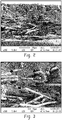
- FIG. 1 schematically shows a composite precursor (left side) including a reactive fiber system and the thermoplastic polymer of a reactive polymer composition in accordance with an exemplary aspect.
- the thermoplastic polymer is a polycarbonate and the reactive fiber system includes polyvinyl alcohol.
- subsequent processing of the composite precursor using the conditions described herein results in the formation of the composite (right side) that includes the modified thermoplastic polymer and the cleaved thermoplastic polymer. For simplicity, the unreacted thermoplastic polymer in the composite is not shown.
- a weight average molecular weight (M w ) of the cleaved thermoplastic polymer and the thermoplastic polymer after composite formation can be less than a M w of the thermoplastic polymer prior to composite formation, as determined by gel permeation chromatography (GPC).
- M w of the cleaved thermoplastic polymer and the thermoplastic polymer after composite formation can be 3 to 30 weight percent (wt%), or 5 to 30 wt%, or 8 to 30 wt%, or 10 to 30 wt% less than the M w of the thermoplastic polymer prior to composite formation, as determined by gel permeation chromatography (GPC).
- GPC can be performed a crosslinked divinyl benzene column and polystyrene standards. It is to be understood that the change in M w also can be described as the M w of a polymer composition including the cleaved thermoplastic polymer and the thermoplastic polymer after composite formation relative to the M w of the reactive polymer composition including the thermoplastic polymer prior to composite formation.
- 5 to 90 wt%, or 15 to 90 wt% of the composite can be the modified thermoplastic polymer, based on the total weight of the modified thermoplastic polymer, the thermoplastic polymer, and optionally the cleaved thermoplastic polymer.
- 5 to 90 wt%, or 15 to 90 wt% of the composite can be the modified thermoplastic polymer, based on the total weight of the modified thermoplastic polymer, the cleaved thermoplastic polymer, and the thermoplastic polymer. It is to be understood that the amount of the modified thermoplastic polymer is based on the total weight of all of the polymer components in the composite after formation.
- the total amount of the thermoplastic polymer and the modified thermoplastic polymer in the composite can be substantially the same as the amount of thermoplastic polymer in the composite precursor, or for example the same amount.
- the total amount of the thermoplastic polymer, the modified thermoplastic polymer, and the cleaved thermoplastic polymer in the composite can be substantially the same as the amount of thermoplastic polymer in the composite precursor, or for example the same amount.
- thermoplastic polymer of the reactive polymer composition in the composite precursor reacts with, or has been reacted with, the binder reactive functional group via chain scission to form a first cleaved polymer chain and the corresponding remaining part of the polymer backbone, herein referred to as the second cleaved polymer chain or cleaved thermoplastic polymer.
- the first cleaved polymer chain corresponds to the modified thermoplastic polymer.
- 5 to 90 wt%, or 15 to 90 wt% of the thermoplastic polymer present in the reactive polymer composition of a composite precursor reacts with the binder reactive functional group to form the modified thermoplastic polymer of the composite.
- the modified thermoplastic polymer described in this paragraph can also be referred to as the "first modified thermoplastic polymer”.
- the composite can further include a product of a reaction between the second cleaved polymer chain, i.e. the cleaved thermoplastic polymer, and another component of the composite.
- the cleaved thermoplastic polymer can react with a second thermoplastic polymer, an additive, the non-woven fiber, another component, or a combination thereof, to form an additional modified thermoplastic polymer, which can also be referred to herein as the "second modified thermoplastic polymer".
- the total amount of the thermoplastic polymer, the first modified thermoplastic polymer, and the second modified thermoplastic polymer in the composite can be substantially the same as the amount of the reactive polymer composition of the composite precursor, or for example the same amount.
- the total amount of the thermoplastic polymer, the first modified thermoplastic polymer, and the second modified thermoplastic polymer in the composite can be substantially the same as the amount of thermoplastic polymer in the composite precursor, or for example the same amount.
- the first modified thermoplastic polymer or the second modified thermoplastic polymer can be reactive with, or further react with, the binder reactive functional group, a second thermoplastic polymer, an additive, the non-woven fiber, another component, or a combination thereof, to form another modified thermoplastic polymer, for example a third, a fourth, a fifth, or the like modified thermoplastic polymer(s).
- the total amount of the thermoplastic polymer, the first modified thermoplastic polymer, the second modified thermoplastic polymer, and the third, fourth, fifth, or more modified thermoplastic polymer(s) in the composite can be substantially the same as the amount of the reactive polymer composition in the composite precursor, or for example the same amount.
- the total amount of the thermoplastic polymer, the first modified thermoplastic polymer, the second modified thermoplastic polymer, and the third, fourth, fifth, or more modified thermoplastic polymer(s) in the composite can be substantially the same as the amount of the thermoplastic polymer in the composite precursor, or for example the same amount.
- the composite precursor can include 10 to 80 wt% of the reactive fiber system, based on the total weight of the composite precursor.
- the composite precursor can include 10 to 60 wt% or 10 to 50 wt% of the reactive fiber system, based on the total weight of the composite precursor.
- the product of the reactive fiber system and the reactive polymer composition can be derived from 10 to 80 wt% of the reactive fiber system, based on the total weight of the reactive fiber system and the reactive polymer composition used to prepare the product.
- the product can be derived from 10 to 60 wt% or 10 to 50 wt% of the reactive fiber system.
- the surface density (i.e., areal density) of the reactive fiber system is not particularly limited.
- the reactive fiber system can have a surface density of 30 to 200 grams per square meter (g/m 2 ), or 40 to 180 g/m 2 , or 40 to 150 g/m 2 .
- the reactive fiber system includes a non-woven fiber. It is to be understood herein that the reactive fiber system includes a plurality of non-woven fibers that have been preprocessed with the binder including the binder reactive functional group.
- the reactive fiber system can be derived from 80 to 99 wt%, or 85 to 97 wt%, or 85 to 95 wt% of the non-woven fiber, based on the total weight of the non-woven fiber and the binder.
- non-woven fiber can be used interchangeably with the term "plurality of non-woven fibers”.
- the non-woven fiber can be a mineral fiber, a plant fiber, a synthetic fiber, or a combination thereof.
- Exemplary non-woven fiber includes, but is not limited to, glass fiber, glass wool fiber, mineral wool fiber, slag wool fiber, stone wool fiber, basalt fiber, silica fiber, quartz fiber, alumina fiber, steel fiber, silicon carbide fiber, acrylic fiber, carbon fiber, melamine fiber, polyester fiber, polyethylene fiber, polyethylene terephthalate fiber, polylactic acid fiber, polypropylene fiber, polyamide fiber, polyaramid fiber, polyimide fiber, polyphenylene sulfide fiber, polytetrafluoroethylene fiber, cellulosic fiber, cotton fiber, jute fiber, kenaf fiber, bamboo fiber, hemp fiber, linen fiber, and flax fiber.
- a combination of two or more non-woven fibers can be used.
- the non-woven fiber can be a carbon fiber.
- the glass fiber can be E, A, C, ECR, R, S, D, or NE glass, or the like, or a combination thereof.
- the glass fibers can be made by standard processes, e.g., by steam or air blowing, flame blowing, and mechanical pulling. Exemplary glass fibers are made by mechanical pulling.
- the fiber can be continuous or chopped. Fibers in the form of chopped strands can have a length of 0.3 millimeters (mm) to 10 centimeters (cm), or 0.5 mm to 5 cm, or 1.0 mm to 2.5 cm. For example, the fiber can have a length from 0.2-20 mm, or 0.2-10 mm, or 0.7-7 mm.
- the fibers can have any cross-section, such as a round (or circular), flat, or irregular cross-section. For example, the fiber has a circular cross-section.
- the diameter of the fiber can be from 1-25 micrometers ( ⁇ m), or 3-20 ⁇ m, or 4-18 ⁇ m, or 5-17 ⁇ m.
- the fiber can be a short glass fiber having a diameter of 10 ⁇ m.
- Flat glass or bilobe fibers can be used to provide, for example, low warp-high strength articles.
- the non-woven fiber is processed with, or coated with, a binder including a binder reactive functional group to form the reactive fiber system.
- the reactive fiber system can be a wet laid mat of non-woven fibers and binder.
- the choice of binder is not particularly limited, provided the binder compound includes the binder reactive functional group.
- the binder reactive functional group can be hydroxyl, carboxyl, carboxylic anhydride, haloformyl, epoxy, silanol, amino, mercapto, vinyl, or a combination thereof.
- the binder reactive functional group, and the corresponding binder compound can be selected based on the thermoplastic polymer of the reactive polymer composition and its associated reactivity. Commercially available fiber/binder systems can be used.
- the binder can be a polymer or resin such as polyurethanes, siloxane resins, polyacrylates, polyvinyl alcohols, polyamines, epoxy resins, phenoxy resins, melamine resins, urea resins, mercapto-containing polymers, carboxyl-containing polymers, and the like, or combinations thereof.
- the binder can be polyvinyl alcohol.
- the reactive fiber system can be derived from the non-woven fiber and 1 to 20 wt% of the binder, based on the total weight of the non-woven fiber and the binder.
- the reactive fiber system is derived from the non-woven fiber and 3 to 15 wt% or 5 to 15 wt% of the binder, based on the total weight of the non-woven fiber and the binder.
- thermoplastic polymer is not particularly limited and can be any thermoplastic polymer or copolymer that is reactive with the functional group of the binder by polymer chain scission to form a modified thermoplastic polymer.
- Thermoplastic polymers include polycarbonate, polyacetal, poly(C 1-6 alkyl)acrylate, polyacrylamide, polyamide, polyamideimide, polyanhydride, polyarylate, polyarylene ether, polyarylene sulfide, polyarylene sulfone, polybenzothiazole, polybenzoxazole, polyester, polyetheretherketone, polyetherimide, polyetherketoneketone, polyetherketone, polyethersulfone, polyimide, poly(C 1-6 alkyl)methacrylate, polymethacrylamide, polynorbornene, polyolefin, polyoxadiazole, polyoxymethylene, polyphthalide, polysilazane, polysiloxane, polystyrene, polysulfide, polysulfonamide, polysulfonate, polysulfone, polythioester, polytriazine, polyurea, polyurethane, polyvinyl alcohol, polyvinyl ester, poly
- the thermoplastic polymer can be polyester, polycarbonate, polyamide, polyurethane, polyurea, a random or block poly(carbonate ester), poly(carbonate ether), poly(ester ether), poly(carbonate ether ester), poly(ester amide), poly(ester ether amide), poly(carbonate amide), poly(carbonate amide), poly(carbonate ether amide), poly(ester urethane), poly(ester ether-urethane), poly(carbonate urethane), poly(carbonate ether urethane), poly(ester urea), poly(ester ether urea), poly(carbonate urea), poly(carbonate ether urea), poly(ether amide), poly(amide urethane), poly(amide urea), poly(urethane urea), poly(arylene ether), or a combination thereof.
- thermoplastic polymer is a polycarbonate.
- Polycarbonate as used herein means a polymer having repeating structural carbonate units of formula (1) in which at least 60 percent of the total number of R 1 groups contain aromatic moieties and the balance thereof are aliphatic, alicyclic, or aromatic.
- each R 1 is a C 6-30 aromatic group, that is, contains at least one aromatic moiety.
- R 1 can be derived from an aromatic dihydroxy compound of the formula HO-R 1 -OH, of formula (2) HO-A 1 -Y 1 -A 2 -OH (2) wherein each of A 1 and A 2 is a monocyclic divalent aromatic group and Y 1 is a single bond or a bridging group having one or more atoms that separate A 1 from A 2 . In an aspect, one atom separates A 1 from A 2 .
- Each R 1 can be derived from a bisphenol of formula (3) wherein R a and R b are each independently a halogen, C 1-12 alkoxy, or C 1-12 alkyl, and p and q are each independently integers of 0 to 4.
- X a is a bridging group connecting the two hydroxy-substituted aromatic groups, where the bridging group and the hydroxy substituent of each C6 arylene group are disposed ortho, meta, or para to each other on the C6 arylene group.
- the bridging group X a is single bond, -O-, -S-, -S(O)-, -S(O) 2 -, -C(O)-, or a C 1-60 organic group.
- the organic bridging group can be cyclic or acyclic, aromatic or non-aromatic, and can further include heteroatoms such as halogens, oxygen, nitrogen, sulfur, silicon, or phosphorous.
- the 1-60 organic group can be disposed such that the C6 arylene groups connected thereto are each connected to a common alkylidene carbon or to different carbons of the C 1-60 organic bridging group.
- p and q is each 1
- R a and R b are each a C 1-3 alkyl group, for example methyl, disposed meta to the hydroxy group on each arylene group.
- Groups of these types include methylene, cyclohexylmethylidene, ethylidene, neopentylidene, and isopropylidene, as well as 2-[2.2.1]-bicycloheptylidene, cyclohexylidene, 3,3-dimethyl-5-methylcyclohexylidene, cyclopentylidene, cyclododecylidene, and adamantylidene.
- X a is a C 1-18 alkylene, a C 3-18 cycloalkylene, a fused C 6-18 cycloalkylene, or a group of the formula -J 1 -G-J 2 - wherein J 1 and J 2 are the same or different C 1-6 alkylene and G is a C 3-12 cycloalkylidene or a C 6-16 arylene.
- X a can be a substituted C 3-18 cycloalkylidene of formula (4) wherein R r , R p , R q , and R t are each independently hydrogen, halogen, oxygen, or C 1-12 hydrocarbon groups; Q is a direct bond, a carbon, or a divalent oxygen, sulfur, or -N(Z)- where Z is hydrogen, halogen, hydroxy, C 1-12 alkyl, C 1-12 alkoxy, C 6-12 aryl, or C 1-12 acyl; r is 0 to 2, t is 1 or 2, q is 0 or 1, and k is 0 to 3, with the proviso that at least two of R r , R p , R q , and R t taken together are a fused cycloaliphatic, aromatic, or heteroaromatic ring.
- the ring as shown in formula (4) will have an unsaturated carbon-carbon linkage where the ring is fused.
- the ring as shown in formula (4) contains 4 carbon atoms
- the ring as shown in formula (4) contains 5 carbon atoms
- the ring contains 6 carbon atoms.
- two adjacent groups e.g., R q and R t taken together
- R q and R t taken together form one aromatic group
- R r and R p taken together form a second aromatic group.
- R p can be a double-bonded oxygen atom, i.e., a ketone, or Q can be -N(Z)- wherein Z is phenyl.
- Bisphenols wherein X a is a cycloalkylidene of formula (4) can be used in the manufacture of polycarbonates containing phthalimidine carbonate units of formula (1a) wherein R a , R b , p, and q are as in formula (3), R 3 is each independently a C 1-6 alkyl, j is 0 to 4, and R 4 is hydrogen, C 1-6 alkyl, or a substituted or unsubstituted phenyl, for example a phenyl substituted with up to five C 1-6 alkyls.
- the phthalimidine carbonate units are of formula (1b) wherein R 5 is hydrogen, phenyl optionally substituted with up to five 5 C 1-6 alkyls, or C 1-4 alkyl.
- R 5 is hydrogen, methyl, or phenyl.
- Carbonate units (1b) wherein R 5 is phenyl can be derived from 2-phenyl-3,3'-bis(4-hydroxy phenyl)phthalimidine (also known as 3,3-bis(4-hydroxyphenyl)-2-phenylisoindolin-1-one, or N-phenyl phenolphthalein bisphenol (“PPPBP”)).
- R a and R b are each independently a halogen, C 1-12 alkoxy, or C 1-12 alkyl, p and q are each independently 0 to 4, and R i is C 1-12 alkyl, phenyl optionally substituted with 1 to 5 C 1-10 alkyl, or benzyl optionally substituted with 1 to 5 C 1-10 alkyl.
- R a and R b are each methyl, p and q are each independently 0 or 1, and R i is C 1-4 alkyl or phenyl.
- bisphenol carbonate units derived from of bisphenols (3) wherein X a is a substituted or unsubstituted C 3-18 cycloalkylidene include the cyclohexylidene-bridged bisphenol of formula (1e) wherein R a and R b are each independently C 1-12 alkyl, R g is C 1-12 alkyl, p and q are each independently 0 to 4, and t is 0 to 10.
- at least one of each of R a and R b are disposed meta to the cyclohexylidene bridging group.
- R a and R b are each independently C 1-4 alkyl, R g is C 1-4 alkyl, p and q are each 0 or 1, and t is 0 to 5.
- R a , R b , and R g are each methyl, p and q are each 0 or 1, and t is 0 or 3.
- t can be 0.
- p and q are each 0, each R g is methyl, and t is 3, such that X a is 3,3-dimethyl-5-methyl cyclohexylidene.
- Examples of other bisphenol carbonate units derived from bisphenol (3) wherein X a is a substituted or unsubstituted C 3-18 cycloalkylidene include adamantyl units of formula (If) and fluorenyl units of formula (1g) wherein R a and R b are each independently C 1-12 alkyl, and p and q are each independently 1 to 4.
- at least one of each of R a and R b are disposed meta to the cycloalkylidene bridging group.
- R a and R b are each independently C 1-3 alkyl, and p and q are each 0 or 1.
- R a , R b are each methyl, p and q are each 0 or 1, and when p and q are 1, the methyl group is disposed meta to the cycloalkylidene bridging group.
- Carbonates containing units (1a) to (1g) are useful for making polycarbonates with high glass transition temperatures (Tg) and high heat distortion temperatures.
- R h is independently a halogen atom, C 1-10 hydrocarbyl group such as a C 1-10 alkyl, a halogen-substituted C 1-10 alkyl, a C 6-10 aryl, or a halogen-substituted C 6-10 aryl, and n is 0 to 4.
- the halogen is usually bromine.
- dihydroxy compounds include the following: 4,4'-dihydroxybiphenyl, 1,6-dihydroxynaphthalene, 2,6-dihydroxynaphthalene, bis(4-hydroxyphenyl)methane, bis(4-hydroxyphenyl)diphenylmethane, bis(4-hydroxyphenyl)-1-naphthylmethane, 1,2-bis(4-hydroxyphenyl)ethane, 1,1-bis(4-hydroxyphenyl)-1-phenylethane, 2-(4-hydroxyphenyl)-2-(3-hydroxyphenyl)propane, bis(4-hydroxyphenyl)phenylmethane, 2,2-bis(4-hydroxy-3-bromophenyl)propane, 1,1-bis (hydroxyphenyl)cyclopentane, 1,1-bis(4-hydroxyphenyl)cyclohexane, 1,1-bis(4-hydroxyphenyl)isobutene, 1,1-
- bisphenol compounds of formula (3) include 1,1-bis(4-hydroxyphenyl) methane, 1,1-bis(4-hydroxyphenyl) ethane, 2,2-bis(4-hydroxyphenyl) propane (hereinafter "bisphenol A” or "BPA”), 2,2-bis(4-hydroxyphenyl) butane, 2,2-bis(4-hydroxyphenyl) octane, 1,1-bis(4-hydroxyphenyl) propane, 1,1-bis(4-hydroxyphenyl) n-butane, 2,2-bis(4-hydroxy-2-methylphenyl) propane, 1,1-bis(4-hydroxy-t-butylphenyl)propane, 3,3-bis(4-hydroxyphenyl) phthalimidine, 2-phenyl-3,3-bis(4-hydroxyphenyl) phthalimidine (PPPBP), and 1,1-bis(4-hydroxy-3-methylphenyl)cyclohexane (DMBPC).
- BPA 2,2-bis(4-hydroxypheny
- the polycarbonate is a linear homopolymer derived from bisphenol A, in which each of A 1 and A 2 is p-phenylene and Y 1 is isopropylidene in formula (3).
- the polycarbonate can be a linear homopolymer derived from bisphenol A, in which each of A 1 and A 2 is p-phenylene and Y 1 is isopropylidene.
- the polycarbonates can have an intrinsic viscosity, as determined in chloroform at 25°C, of 0.3 to 1.5 deciliters per gram (dL/g), for example 0.45 to 1.0 dL/g.
- the polycarbonates can have a weight average molecular weight (M w ) of 10,000 to 100,000 grams per mole (g/mol), as measured by GPC using a crosslinked styrene-divinyl benzene column with polycarbonate standards.
- the polycarbonate has an M w of 15,000 to 55,000 g/mol.
- the polycarbonate has an M w of 18,000 to 40,000 g/mol.
- Polycarbonate includes homopolycarbonates (wherein each R 1 in the polymer is the same), copolymers including different R 1 moieties in the carbonate (“copolycarbonates”), and copolymers including carbonate units and other types of polymer units, such as ester units or siloxane units.
- a specific type of copolymer is a poly(ester-carbonate), also known as a polyester-polycarbonate.
- Such copolymers further contain, in addition to recurring carbonate units of formula (1), repeating units of formula (7) wherein J is a divalent group derived from a dihydroxy compound (including a reactive derivative thereof), and can be, for example, a C 1-10 alkylene, a C 6-20 cycloalkylene, a C 5-20 arylene, or a polyoxyalkylene in which the alkylene groups contain 2 to 6 carbon atoms, such as 2, 3, or 4 carbon atoms; and T is a divalent group derived from a dicarboxylic acid (including a reactive derivative thereof), and can be, for example, a C 2-20 alkylene, a C 5-20 cycloalkylene, or a C 6-20 arylene.
- Copolyesters containing a combination of different T or J groups can be used.
- the polyester units can be branched
- J is a C 2-30 alkylene group having a straight chain, branched chain, or cyclic (including polycyclic) structure, for example ethylene, n-propylene, i-proplyene, 1,4-butylene, 1,4-cyclohexylene, or 1,4-methylenecyclohexane.
- J is derived from a bisphenol of formula (3), e.g., bisphenol A.
- J is derived from an aromatic dihydroxy compound of formula (6), e.g., resorcinol.
- Aromatic dicarboxylic acids that can be used to prepare the polyester units include isophthalic or terephthalic acid, 1,2-di(p-carboxyphenyl)ethane, 4,4'-dicarboxydiphenyl ether, 4,4'-bisbenzoic acid, or a combination thereof. Acids containing fused rings can also be present, such as in 1,4-, 1,5-, or 2,6-naphthalenedicarboxylic acids.
- Specific dicarboxylic acids include terephthalic acid, isophthalic acid, naphthalene dicarboxylic acid, 1,4-cyclohexane dicarboxylic acid, or a combination thereof.
- a specific dicarboxylic acid includes a combination of isophthalic acid and terephthalic acid wherein the weight ratio of isophthalic acid to terephthalic acid is 91:9 to 2:98.
- ester units include ethylene terephthalate, n-propylene terephthalate, n-butylene terephthalate, 1,4-cyclohexanedimethylene terephthalate, and ester units derived from isophthalic acid, terephthalic acid, and resorcinol (ITR)).
- the molar ratio of ester units to carbonate units in the copolymers can vary broadly, for example 1:99 to 99:1, or 10:90 to 90:10, more preferably 25:75 to 75:25, or 2:98 to 15:85, depending on the desired properties of the final composition.
- poly(ester-carbonate)s are those including bisphenol A carbonate units and isophthalate-terephthalate-bisphenol A ester units, also commonly referred to as poly(carbonate-ester)s (PCE) poly(phthalate-carbonate)s (PPC) depending on the molar ratio of carbonate units and ester units.
- PCE poly(carbonate-ester)s
- PPC poly(phthalate-carbonate)s
- Polyester-polycarbonate copolymers can have a M w of 1,500 to 100,000 g/mol, including, for example 1,700 to 50,000 g/mol, as measured by GPC using a crosslinked styrene-divinyl benzene column with polycarbonate standards.
- poly(aliphatic ester)-polycarbonates have a M w of 15,000 to 45,000 g/mol.
- Polycarbonates can be manufactured by processes such as interfacial polymerization and melt polymerization, which are known, and are described, for example, in WO 2013/175448 A1 and WO 2014/072923 A1 .
- An end-capping agent also referred to as a chain stopper agent or chain terminating agent
- Branched polycarbonate blocks can be prepared by adding a branching agent during polymerization, for example trimellitic acid, trimellitic anhydride, trimellitic trichloride, tris-p-hydroxyphenylethane, isatin-bis-phenol, tris-phenol TC (1,3,5-tris((p-hydroxyphenyl)isopropyl)benzene), tris-phenol PA (4(4(1,1-bis(p-hydroxyphenyl)-ethyl) alpha, alpha-dimethyl benzyl)phenol), 4-chloroformyl phthalic anhydride, trimesic acid, and benzophenone tetracarboxylic acid.
- the branching agents can be added at a level of 0.05 to 2.0 wt%.
- a combination of a linear polycarbonate and a branched polycarbonate can be used.
- the polycarbonate is a homopolymer.
- the homopolymer includes repeating units derived from bisphenol A (BPA).
- the polycarbonate is a copolymer.
- the copolymer includes repeating units derived from BPA.
- the copolymer includes repeating units derived from sebacic acid.
- the copolymer includes repeating units derived from sebacic acid and BPA.
- the polycarbonate includes a blend of at least two polycarbonate polymers. In a further aspect, the polycarbonate includes a first polycarbonate polymer component and a second polycarbonate polymer component.
- An additive composition can be used, including one or more additives selected to achieve a desired property, with the proviso that the additive(s) are also selected to not significantly adversely affect a desired property of the reactive polymer composition.
- the additive composition or individual additives can be mixed at a suitable time during the mixing of the components for forming the composition.
- the additive composition can include an impact modifier, flow modifier, filler (e.g., a particulate polytetrafluoroethylene (PTFE), glass, carbon, mineral, or metal), reinforcing agent (e.g., glass fibers), antioxidant, heat stabilizer, light stabilizer, ultraviolet (UV) light stabilizer, UV absorbing additive, plasticizer, lubricant, release agent (such as a mold release agent), antistatic agent, anti-fog agent, antimicrobial agent, colorant (e.g., a dye or pigment), surface effect additive, radiation stabilizer, flame retardant, anti-drip agent (e.g., a PTFE-encapsulated styrene-acrylonitrile copolymer (TSAN)), or a combination thereof.
- filler e.g., a particulate polytetrafluoroethylene (PTFE), glass, carbon, mineral, or metal
- reinforcing agent e.g., glass fibers
- antioxidant heat stabilizer, light stabilizer, ultraviolet
- a combination of a heat stabilizer, mold release agent, and ultraviolet light stabilizer can be used.
- the additives can be used in the amounts known to be effective.
- the total amount of the additive composition (other than any impact modifier, filler, or reinforcing agent) can be 0.001 to 10.0 wt%, or 0.01 to 5 wt%, each based on the total weight of the reactive polymer composition.
- the reactive polymer composition can optionally include an additional thermoplastic polymer different from thermoplastic polymer reactive with the binder reactive functional group.
- additional thermoplastic polymers include polyacetals (e.g., polyoxyethylene and polyoxymethylene), poly(C 1-6 alkyl)acrylates, polyacrylamides, polyamides, (e.g., aliphatic polyamides, polyphthalamides, and polyaramides), polyamideimides, polyanhydrides, polyarylates, polyarylene ethers (e.g., polyphenylene ethers), polyarylene sulfides (e.g., polyphenylene sulfides), polyarylene sulfones (e.g., polyphenylene sulfones), polybenzothiazoles, polybenzoxazoles, polycarbonates (including polycarbonate copolymers such as polycarbonate-siloxanes, polycarbonate-esters, and polycarbonate-ester-siloxanes), polyesters (e
- the reactive polymer composition can include a catalyst.
- the catalyst can be an alkali or alkaline earth metal salt of hydroxide, superoxide, thiolate, sulfide, C 1-20 alkoxide, C 6-20 aryloxide, C 1-20 carboxylate, phosphate, phosphonate, phosphite, sulfate, C 1-20 alkyl or aryl sulfonate, sulfite, or a combination thereof.
- Exemplary catalysts include, but are not limited to, lithium hydroxide, sodium hydroxide, potassium hydroxide, cesium hydroxide, magnesium hydroxide, calcium hydroxide, barium hydroxide, lithium formate, sodium formate, potassium formate, cesium formate, lithium acetate, sodium acetate, potassium acetate, lithium carbonate, sodium carbonate, potassium carbonate, lithium methoxide, sodium methoxide, potassium methoxide, lithium ethoxide, sodium ethoxide, potassium ethoxide, lithium phenoxide, sodium phenoxide, potassium phenoxide, sodium sulfate, potassium sulfate, NaH 2 PO 3 , NaH 2 PO 4 , Na 2 H 2 PO 3 , KH 2 PO 4 , CsH 2 PO 4 , Na 2 SO 3 , Na 2 S 2 O 5 , sodium mesylate, potassium mesylate, sodium tosylate, potassium tosylate, magnesium disodium ethylenediamine tetraacetate
- the method for making the composite includes optionally forming a composite precursor including the reactive fiber system and the reactive polymer composition; and heating the reactive fiber system and the reactive polymer composition under conditions effective to form the modified thermoplastic polymer.
- the heating can include thermoforming, compression molding, or a combination thereof.
- the heating does not include extruding, blow molding, rotational molding, or injection molding. It has been discovered that heating by extruding, blow molding, rotational molding, or injection molding does not provide the modified thermoplastic polymer.
- the heating can be at a temperature of 200 to 370°C, at a pressure of 80 to 200 kilopascals (kPa), and for a time of 200 to 900 seconds (s).
- the temperature can be 200 to 270°C, or 210 to 270°C, or 220 to 260°C;
- the pressure can be 80 to 180 kPa, or 90 to 180 kPa, or 100 to 180 kPa;
- the time can be 200 to 800 s, or 200 to 700 s, or 250 to 620 s.
- the temperature can be 220 to 260°C
- the pressure can be 110 to 160 kPa
- the time can be 200 to 400 s.
- the temperature can be 220 to 260°C
- the pressure can be 110 to 160 kPa
- the time can be 400 to 700 s.
- the temperature can be 240 to 260°C
- the pressure can be 120 to 160 kPa
- the time can be 200 to 700 s.
- Coating can be by any suitable method, including immersing the reactive fiber system into the reactive polymer composition, spraying the reactive polymer composition onto the reactive fiber system; powder coating the reactive fiber system with the reactive polymer composition, layering a film of the reactive polymer composition on the reactive fiber system; or a combination thereof.
- the prepreg can be prepared in any form, where the form can be determined by the shape of the reactive fiber system.
- the reactive fiber system can be arranged or shaped into a fiber preform.
- fiber preform refers to the reactive fiber system being arranged in a specified configuration prior to being subjected to the operation or operations that will coat the reactive fiber system with the reactive polymer composition.
- fiber preforms include, but are not limited to, a woven fabric, a unidirectional tape, a tailored fiber preform, a fiber layup structure, one or more wound filaments, an automatic tape laying structure, or a shaped fiber structure member.
- Prepregs can be prepared by contacting at least two layers of a laminate under conditions of heat and pressure sufficient to consolidate the prepreg.
- a prepreg includes from one to one hundred layers of the laminate.
- all the layers of the laminate are formed from the prepreg.
- the laminate can include other layers, for example a different prepreg.
- all the prepreg layers used to form the laminate are the prepregs produced as described herein.
- a non-prepreg layer can be present such as a release layer, a copper foil, or an adhesive to enhance bonding between two layers.
- the adhesive can be applied using any suitable method, for example, spreading, spraying, and dipping.
- the adhesive can be any adhesive that provides the desired adhesion between layer(s) of the prepregs or tapes.
- An adhesive can be polyvinylbutyral (PVB), ethylene-vinyl acetate copolymer (EVA), an epoxy, an ultraviolet (UV) or water-curable adhesive such as a cyanoacrylate or other acrylic, or a combination thereof.
- the prepreg is a tape that includes a plurality of unidirectional fibers of the reactive fiber system.
- the tape can include continuous unidirectional fibers.
- the continuous unidirectional fibers of the tapes can be oriented with substantially parallel fibers, where the fibers of one layer are parallel, or more parallel than perpendicular with the fibers of another layer.
- the continuous unidirectional fiber tapes can be oriented with substantially non-parallel fibers, where the fibers of one layer are less parallel than perpendicular with the fibers of another layer.
- the laminate or prepreg is added to the surface of a foam or honeycomb structure, and can also include a decorative foil or film.
- the composite is as laminate and the forming includes contacting the reactive fiber system with the reactive polymer composition, thermoforming to form a prepreg, and laminating a plurality of prepregs by thermoforming.
- the modified thermoplastic polymer can be formed during prepreg formation, during laminate formation, or both.
- thermoforming is used to describe a method that can include the sequential or simultaneous heating and forming of a material onto a mold, wherein the material is originally in the form of a film, sheet, layer, or the like, and can then be formed into a desired shape. Once the desired shape has been obtained, the formed article (e.g., a composite, a prepreg, or a laminate) is cooled below its melt or glass transition temperature.
- thermoforming methods can include, but are not limited to, mechanical forming such as matched tool forming, calendaring rolls, double belt laminators, indexing presses, multiple daylight presses or the like, membrane assisted pressure/vacuum forming, membrane assisted pressure/vacuum forming with a plug assist, or a combination thereof.
- the flexural modulus of the composite is greater than the flexural modulus of a comparable composite that does not include the modified thermoplastic polymer. In an aspect, the flexural modulus of the composite is 120 to 200% greater than, or 130 to 200% greater than, or 140 to 200% greater than the flexural modulus of the comparable composite that does not include the modified thermoplastic polymer.
- the composite can have a flexural modulus of 7,500 to 20,000 megapascal (MPa), or 8,500 to 20,000 MPa, or 9,000 to 16,000 MPa, as determined according to ISO 527.
- the maximum stress of the composite is greater than the maximum stress of a comparable composite that does not include the modified thermoplastic polymer. In an aspect, the maximum stress of the composite is 130 to 200% greater than, or 135 to 200% greater than, or 140 to 200% greater than the maximum stress of the comparable composite that does not include the modified thermoplastic polymer.
- the composite can have a maximum stress of 140 to 300 megapascal (MPa), or 150 to 275 MPa, or 160 to 250 MPa, as determined according to ISO 527.
- the "comparable composite” refers to a composite prepared from fiber system and the thermoplastic polymer, where the fiber system includes the non-woven fiber and a binder, where the thermoplastic polymer is the same as in the reactive polymer composition, where the binder does not include a binder reactive functional group, and the comparable composite is prepared under the same conditions as the disclosed composite. Accordingly, the comparable composite does not include the modified thermoplastic polymer.
- the article can be a mass transit component, an energy storage device, a computer device, a household appliance, an electrical component, a recreational component, a decoration device, an electromagnetic interference device, a printed circuit, a cellular antenna device, a cellphone component, an automotive component, a military component, an industrial component, a building component, a construction component, a marine component, an aerospace component, a medical component, a sensor component, a shielding component, an RF component, or a combination thereof. It is to be understand that the descriptions for the articles above may overlap, and thus, for example, an article can be both an RF component and a sensor component.
- Exemplary articles that can be prepared from the composites include, for example, acid bath containers; neutralization tanks; aircraft components; bridge beams; bridge deckings; electrolytic cells; exhaust stacks; scrubbers; sporting equipment; stair cases; walkways; automobile exterior panels such as hoods and trunk lids; floor pans; air scoops; pipes and ducts, including heater ducts; industrial fans, fan housings, and blowers; industrial mixers; boat hulls and decks; marine terminal fenders; tiles and coatings; building panels; business machine housings; trays, including cable trays; concrete modifiers; dishwasher and refrigerator parts; electrical encapsulants; electrical panels; tanks, including electrorefining tanks, water softener tanks, fuel tanks, and various filament-wound tanks and tank linings; furniture; garage doors; gratings; protective body gear; luggage; outdoor motor vehicles; pressure tanks; printed circuit boards; optical waveguides; radomes; railings; railroad parts such as tank cars; hopper car covers; car doors; truck bed liners; satellite dishes;
- a composite includes the product of the reactive fiber system and the reactive polymer composition derived from 10 to 80 wt%, preferably 10 to 60 wt%, more preferably 10 to 50 wt% of the reactive fiber system, each based on the total weight of the reactive fiber system and the reactive polymer composition used to prepare the product.
- the reactive fiber system includes the non-woven fiber and the binder including the binder reactive functional group, preferably wherein the binder reactive functional group is hydroxyl, carboxyl, carboxylic anhydride, haloformyl, epoxy, silanol, amino, mercapto, vinyl, or a combination thereof.
- the reactive fiber system is derived from a non-woven fiber and 1 to 20 wt%, preferably 3 to 15 wt%, more preferably 5 to 15 wt% of the binder, based on the total weight of the non-woven fiber and the binder.
- the modified thermoplastic polymer is covalently bonded to the reactive fiber system, and the M w of the modified thermoplastic polymer is 3 to 30 wt%, preferably 5 to 30 wt%, more preferably 8 to 30 wt%, still more preferably 10 to 30 wt% less than the M w of the thermoplastic polymer, as determined by GPC with a crosslinked divinyl benzene column and polystyrene standards.
- thermoplastic polymer is preferably a polyester, polycarbonate, polyamide, polyurethane, polyurea, a random or block poly(carbonate ester), poly(carbonate ether), poly(ester ether), poly(carbonate ether ester), poly(ester amide), poly(ester ether amide), poly(carbonate amide), poly(carbonate amide), poly(carbonate ether amide), poly(ester urethane), poly(ester ether-urethane), poly(carbonate urethane), poly(carbonate ether urethane), poly(ester urea), poly(ester ether urea), poly(carbonate urea), poly(carbonate ether urea), poly(ether amide), poly(amide urethane), poly(amide urea), poly(urethane urea), poly(arylene ether), or a combination thereof.
- the reactive fiber system and the reactive polymer composition are heated by thermoforming, compression molding, or a combination thereof at a temperature of 200 to 280°C, a pressure of 80 to 200 kPa, and for a time of 200 to 900 seconds, to form the modified thermoplastic polymer, i.e., conditions effective to react the binder reactive functional group and the thermoplastic polymer to cleave a polymer chain of the thermoplastic polymer to form the modified thermoplastic polymer, wherein the modified thermoplastic polymer includes a covalent bond to the reactive fiber system.
- reacting can include reacting a first cleaved polymer chain with the binder reactive functional group to form the modified thermoplastic polymer; and reacting a second cleaved polymer chain with a second thermoplastic polymer, an additive, the non-woven fiber, or a combination thereof.
- Preferred articles including the composite of these aspects, or made by the foregoing method include a mass transit component, an energy storage device, a computer device, a household appliance, an electrical component, a recreational component, a decoration device, an electromagnetic interference device, a printed circuit, a cellular antenna device, a cellphone component, an automotive component, a military component, an industrial component, a building component, a construction component, a marine component, an aerospace component, a medical component, a sensor component, a shielding component, or an RF component.
- the reactive polymer composition includes a thermoplastic polymer comprising a polymer reactive group, wherein the polymer reactive group is reactive with the binder reactive functional group.
- the polymer reactive group can be attached to the thermoplastic polymer, and as a residue of the corresponding modified thermoplastic polymer, as an end group, as a pendant moiety, as a functional group of the polymer backbone, or a combination thereof.
- the polymer reactive group can be anhydride, amino, hydroxyl, halogen, thiol, aldehyde, C 1-6 alkyl ester, carboxyl, epoxy, isocyanate, vinyl, alkynyl, or a combination thereof.
- the modified thermoplastic polymer can be derived from reaction of the polymer reactive group and the binder reactive functional group to form a covalent bond.
- the modified thermoplastic polymer includes a reaction product of the polymer reactive group and the binder reactive functional group, a reaction product of the thermoplastic polymer and the binder reactive functional group, or a combination thereof.
- Table 1 Material Description Source PC1 BPA-polycarbonate film, having a thickness of 125 ⁇ m and a Mw of 29,400 g/mol by GPC (obtained as LEXAN 8010MC-112) SABIC PC2 Amorphous BPA-polycarbonate prepared by interfacial polymerization, having a M w of 21,000 to 22,000 g/mol by GPC SABIC CF1A Wet-laid non-woven carbon fiber mat, having a surface density of 50 g/m 2 , a fiber diameter of 7 ⁇ m, and containing 10-15 wt% of a polyvinyl alcohol binder (obtained as OPTIMAT 20301A) Technical Fibre Products CF1B Wet-laid non-woven carbon fiber mat, having a surface density of 80 g/m 2 , a fiber diameter of 7 ⁇ m, and containing 10-15 wt% of a polyvinyl alcohol binder (obtained as OPTIMAT
- Izod notched impact strength (INI ASTM) was determined at 23°C using 3.2 mm bars in accordance with ASTM D256-02. Izod notched impact strength (INI ISO) was determined at 23°C using notched 4 mm ISO bars in accordance with the ISO-180:2000. Vicat softening temperature was measured using 4 mm ISO bars at a load of 50 N and a speed of 120 °C/h (B120) in accordance with ISO-306. Heat distortion temperature (HDT) was measured using the flat side of 4 mm ISO bars and a load of 1.8 MPa (A/f), in accordance with the ISO-75 with a 5.5 J hammer. Melt volume flow rate (MVR) was measured at 300°C/1.2 kg with a 300 or 900 second dwell time in accordance with ISO-1133. Puncture-impact (MAI) testing was determined in accordance with ISO-6603.
- Laminate composite samples were prepared by sandwiching a non-woven carbon fiber mat between two polycarbonate (PC1, M w of 29,400 g/mol) films to form a laminate.
- the laminate was subsequently thermoformed using a film laminator (OASYS TECHNOLOGIES LTD) according to the multi-step press conditions in Table 2.
- Table 3 shows the molecular weights (g/mol) of the polycarbonates of Examples 1-4 after pressing, the change in molecular weight after pressing, and the processing conditions when using the carbon fiber mat having a reactive binder (CF1A) having a surface density of 50 g/m 2 .
- Table 3 Example Fiber M w M n ⁇ M w Press Conditions Fiber weight (g) Total laminate weight (g) Fiber Amount (wt%) 1 CF1A 27800 10900 -1600 3 0.26 1.96 13.27 2 CF1A 26200 10500 -3200 4 0.26 1.98 13.13 3 CF1A 26000 10400 -3400 5 0.26 1.98 13.13 4 CF1A 23200 9700 -6200 6 0.27 1.98 13.64
- Table 4 shows the molecular weights (g/mol) of the polycarbonates of Examples 5-8 after pressing, the change in molecular weight after pressing, and the processing conditions when using the carbon fiber mat having a reactive binder (CF1B) having a surface density of 80 g/m 2 .
- Table 4 Example Fiber M w M n ⁇ M w Press Conditions Fiber weight (g) Total laminate weight (g) Fiber Amount (wt%) 5 CF1B 28200 11100 -1200 3 0.45 2.15 20.93 6 CF1B 26600 10600 -2800 4 0.44 2.12 20.75 7 CF1B 26400 10600 -3000 5 0.43 2.11 20.38 8 CF1B 22800 9600 -6600 6 0.44 2.11 20.85
- Table 5 shows the molecular weights (g/mol) of the polycarbonates of Comparative Examples 9-12, the change in molecular weight after pressing, and the processing conditions when using the carbon fiber mat having the non-reactive binder (CF2).
- Table 5 Comparative Example Fiber M w M n ⁇ M w Press Conditions Fiber weight (g) Total laminate weight (g) Fiber Amount (wt%) 9 CF2 29000 11300 -400 3 0.27 1.98 13.64 10 CF2 28400 11200 -1000 4 0.26 1.93 13.47 11 CF2 28600 11200 -800 5 0.27 1.99 13.57 12 CF2 28200 11100 -1200 6 0.26 1.96 13.27
- Table 6 shows the mechanical properties of Examples 3-4 and Comparative Examples 11-12.
- Table 6 Units 3 4 11 12 Binder Type - reactive reactive non-reactive non-reactive ⁇ M w g/mol -3400 -6200 -800 -1200 Flexural Modulus (FM) MPa 10868 9617 6765 7192 Maximum Stress (Stress) MPa 186 170 122 130 ⁇ FM vs.
- the further decreases in M w are the result of covalent bonding between the binder and the polycarbonate via cleavage of the backbone, in addition to the reactivity between the carbon fiber surface functionality with the polycarbonate or the reaction of a newly formed phenol-functionalized polycarbonate with the resin itself. This reactivity and the resulting connection between the polycarbonate and the fiber/binder system provide the improved the flexural properties.
- FIGS. 2-5 demonstrate the improved adhesion achieved using the reactive binders.
- FIGS. 2 and 3 are SEM images of the composite derived from the non-reactive binder, which shows poor adhesion between CF2 and the polycarbonate matrix. In these images with the non-reactive binder, the fibers are observed to extend from the polymer matrix, which indicates the fibers have been pulled out from the matrix when the composite is fractured.
- FIGS. 4 and 5 are SEM images of the composite derived from the reactive binder, which shows improved adhesion between CF1A and the polycarbonate matrix. In these images with the reactive binder, the number of fibers extending out of the polymer matrix is greatly decreased, which indicates the fibers are broken when the composite is fractured.
- the improved tensile properties for Examples 3 and 4 are a result of the improved adhesion between the reactive binder-containing CF1A and the polycarbonate matrix.
- Comparative Examples 13-14 were prepared using polycarbonate and chopped carbon fibers having either a reactive binder (CF3) or a non-reactive binder (CF4), where the samples were prepared by extruding and injection molding, rather than by thermoforming.
- Polycarbonate powder and phosphite stabilizer were combined using a paint shaker and then fed through a feeder to an extruder. The glass fibers were fed separately through the hopper on a downstream side-feeder.
- Samples were extruded on a 25 mm twin screw extruder at a melt temperature of 270-300°C and a rotation of 300 revolutions per minute (rpm), and then pelletized. The pellets were dried for 3-5 hours at 90-100°C. Dried pellets were injection molded at temperatures of 280-300°C. Thin-wall parts (0.8 mm) were molded at 290-315°C.
- Table 7 shows the compositions and properties of Comparative Examples 13-14.
- Table 7 Component Amount 13 14 PC2 wt% 79.95 79.95 Phosphite wt% 0.05 0.05 CF3 wt% 20 - CF4 wt% - 20 Property Units ⁇ * (%) MVR - 300s cm 3 /10 min 50.6 8.2 516 MVR - 900s cm 3 /10 min 128.1 8.5 1410 HDT - 1.8MPa - Flat °C 137 142 -4 VICAT - B/120 °C 144 150 -4 Flexural Modulus MPa 10859 11957 -9 Flexural Strength MPa 162 220 -26 Stress at Break-Avg MPa 160 219 -27 Tensile Modulus MPa 12726 14309 -11 Tensile Stress at break MPa 113 152 -26 INI ISO kJ/m 2 4.7 7.4 -37 INI ASTM J/m 38 76 -50 MAI: Puncture energy-
- a composite including a product of a reactive fiber system and a reactive polymer composition wherein the reactive fiber system includes: a non-woven fiber; and a binder including a binder reactive functional group, and the reactive polymer composition includes a thermoplastic polymer reactive with the binder reactive functional group; and wherein the composite includes a modified thermoplastic polymer including a reaction product of the thermoplastic polymer and the binder reactive functional group.
- Aspect 2 The composite of Aspect 1, wherein the modified thermoplastic polymer is covalently bonded to the reactive fiber system.
- Aspect 3 The composite of any one of the preceding Aspects, wherein the modified thermoplastic polymer is derived from the thermoplastic polymer via chain scission and reaction with the binder reactive functional group to form a covalent bond.
- Aspect 4 The composite of any one of the preceding Aspects, wherein a flexural modulus of the composite is greater than a flexural modulus of a comparable composite prepared from a binder that does not comprise the binder reactive functional group and that does not comprise the modified thermoplastic polymer, as determined according to ISO 527.
- Aspect 5 The composite of any one of the preceding Aspects, further comprising a cleaved thermoplastic polymer that is derived from the thermoplastic polymer via chain scission and is not covalently bonded to the reactive fiber system, wherein a weight average molecular weight of the cleaved thermoplastic polymer and the thermoplastic polymer after composite formation is less than a weight average molecular weight of the thermoplastic polymer prior to composite formation, as determined by GPC; preferably wherein the weight average molecular weight of the cleaved thermoplastic polymer and the thermoplastic polymer after composite formation is 3 to 30 wt%, preferably 5 to 30 wt%, more preferably 8 to 30 wt%, still more preferably 10 to 30 wt% less than the weight average molecular weight of the thermoplastic polymer prior to composite formation, as determined by GPC.
- non-woven fiber is a mineral fiber, a plant fiber, a synthetic fiber, or a combination thereof; preferably wherein the non-woven fiber is glass fiber, glass wool fiber, mineral wool fiber, slag wool fiber, stone wool fiber, basalt fiber, silica fiber, quartz fiber, alumina fiber, steel fiber, silicon carbide fiber, acrylic fiber, carbon fiber, melamine fiber, polyester fiber, polyethylene fiber, polyethylene terephthalate fiber, polylactic acid fiber, polypropylene fiber, polyamide fiber, polyaramid fiber, polyimide fiber, polyphenylene sulfide fiber, polytetrafluoroethylene fiber, cellulosic fiber, cotton fiber, jute fiber, kenaf fiber, bamboo fiber, hemp fiber, linen fiber, flax fiber, or a combination thereof.
- Aspect 7 The composite of any one of the preceding Aspects, wherein the binder reactive functional group is hydroxyl, carboxyl, carboxylic anhydride, haloformyl, epoxy, silanol, amino, mercapto, vinyl, or a combination thereof; preferably wherein the binder includes a polyvinyl alcohol.
- Aspect 8 The composite of any one of the preceding Aspects, wherein the composite includes 20 to 90 wt% of the modified thermoplastic polymer, preferably 30 to 90 wt% of the modified thermoplastic polymer, each based on the total weight of the reactive polymer composition and the modified thermoplastic polymer.
- Aspect 9 The composite of any one of the preceding Aspects, wherein the product of the reactive fiber system and the reactive polymer composition is derived from 10 to 80 wt%, preferably 10 to 60 wt%, more preferably 10 to 50 wt% of the reactive fiber system, each based on the total weight of the reactive fiber system and the reactive polymer composition used to prepare the product.
- Aspect 10 The composite of any one of the preceding Aspects, wherein the reactive fiber system is derived from the non-woven fiber and 1 to 20 wt%, preferably 3 to 15 wt%, more preferably 5 to 15 wt% of the binder, each based on the total weight of the non-woven fiber and the binder.
- thermoplastic polymer is a thermoplastic polymer or copolymer that is reactive with the binder reactive functional group via chain scission, preferably wherein the thermoplastic polymer is polycarbonate, polyacetal, poly(C 1-6 alkyl)acrylate, polyacrylamide, polyamide, polyamideimide, polyanhydride, polyarylate, polyarylene ether, polyarylene sulfide, polyarylene sulfone, polybenzothiazole, polybenzoxazole, polyester, polyetheretherketone, polyetherimide, polyetherketoneketone, polyetherketone, polyethersulfone, polyimide, poly(C 1-6 alkyl)methacrylate, polymethacrylamide, polynorbornene, polyolefin, polyoxadiazole, polyoxymethylene, polyphthalide, polysilazane, polysiloxane, polystyrene, polysulfide, polysul
- Aspect 12 A method of making the composite of any one of the preceding Aspects, the method including: heating the reactive fiber system and the reactive polymer composition under conditions effective to form the modified thermoplastic polymer.
- Aspect 13 The method of Aspect 12, wherein the heating is effective to react the binder reactive functional group and the thermoplastic polymer to cleave a polymer chain of the thermoplastic polymer to form the modified thermoplastic polymer, wherein the modified thermoplastic polymer includes a covalent bond to the reactive fiber system; preferably wherein the heating includes thermoforming, compression molding, or a combination thereof; more preferably wherein the heating includes thermoforming, compression molding, or a combination thereof at a temperature of 200 to 280°C, a pressure of 80 to 200 kPa, and for a time of 200 to 900 seconds.
- Aspect 14 The method of Aspect 13, wherein the heating is further effective to react a first cleaved polymer chain with the binder reactive functional group to form the modified thermoplastic polymer; and react a second cleaved polymer chain with a second thermoplastic polymer, an additive, the non-woven fiber, or a combination thereof.
- Aspect 15 An article including the composite of any one of Aspects 1-11 or made by the method of any one of Aspects 12-14; preferably wherein the article is a mass transit component, an energy storage device, a computer device, a household appliance, an electrical component, a recreational component, a decoration device, an electromagnetic interference device, a printed circuit, a cellular antenna device, a cellphone component, an automotive component, a military component, an industrial component, a building component, a construction component, a marine component, an aerospace component, a medical component, a sensor component, a shielding component, an RF component, or a combination thereof.
- compositions, methods, and articles can alternatively comprise, consist of, or consist essentially of, any appropriate materials, steps, or components herein disclosed.
- the compositions, methods, and articles can additionally, or alternatively, be formulated to be devoid, or substantially free, of any materials (or species), steps, or components, that are otherwise not necessary to the achievement of the function or objectives of the compositions, methods, and articles.
- test standards are the most recent standard in effect as of the filing date of this application, or, if priority is claimed, the filing date of the earliest priority application in which the test standard appears.
- alkyl means a branched or straight chain, unsaturated aliphatic hydrocarbon group, e.g., methyl, ethyl, n-propyl, i-propyl, n-butyl, s-butyl, t-butyl, n-pentyl, s-pentyl, and n- and s-hexyl.
- Alkoxy means an alkyl group that is linked via an oxygen (i.e., alkyl-O-), for example methoxy, ethoxy, and sec-butyloxy groups.
- Alkylene means a straight or branched chain, saturated, divalent aliphatic hydrocarbon group (e.g., methylene (-CH 2 -) or, propylene (-(CH 2 ) 3 -)).
- Cycloalkylene means a divalent cyclic alkylene group, -C n H 2n-x , wherein x is the number of hydrogens replaced by cyclization(s).
- Cycloalkenyl means a monovalent group having one or more rings and one or more carbon-carbon double bonds in the ring, wherein all ring members are carbon (e.g., cyclopentyl and cyclohexyl).
- Aryl means an aromatic hydrocarbon group containing the specified number of carbon atoms, such as phenyl, tropone, indanyl, or naphthyl.
- Arylene means a divalent aryl group.
- Alkylarylene means an arylene group substituted with an alkyl group.
- Arylalkylene means an alkylene group substituted with an aryl group (e.g., benzyl).
- halo means a group or compound including one more of a fluoro, chloro, bromo, or iodo substituent. A combination of different halo groups (e.g., bromo and fluoro), or only chloro groups can be present.
- hetero means that the compound or group includes at least one ring member that is a heteroatom (e.g., 1, 2, or 3 heteroatom(s)), wherein the heteroatom(s) is each independently N, O, S, Si, or P.
- each of the foregoing groups can be unsubstituted or substituted, provided that the substitution does not significantly adversely affect synthesis, stability, or use of the compound.
- “Substituted” means that the compound, group, or atom is substituted with at least one (e.g., 1, 2, 3, or 4) substituents instead of hydrogen, where each substituent is independently nitro (-NO 2 ), cyano (-CN), hydroxy (-OH), halogen, thiol (-SH), thiocyano (-SCN), C 1-6 alkyl, C 2-6 alkenyl, C 2-6 alkynyl, C 1-6 haloalkyl, C 1-9 alkoxy, C 1-6 haloalkoxy, C 3-12 cycloalkyl, C 5-18 cycloalkenyl, C 6-12 aryl, C 7-13 arylalkylene (e.g., benzyl), C 7-12 alkylarylene (e.g.,
Landscapes
- Chemical & Material Sciences (AREA)
- Engineering & Computer Science (AREA)
- Materials Engineering (AREA)
- Manufacturing & Machinery (AREA)
- Health & Medical Sciences (AREA)
- Chemical Kinetics & Catalysis (AREA)
- Medicinal Chemistry (AREA)
- Polymers & Plastics (AREA)
- Organic Chemistry (AREA)
- Compositions Of Macromolecular Compounds (AREA)
Abstract
A composite including a product of a reactive fiber system and a reactive polymer composition, wherein the reactive fiber system includes: a non-woven fiber; and a binder including a binder reactive functional group, and the reactive polymer composition includes a thermoplastic polymer reactive with the binder reactive functional group; and wherein the composite includes a modified thermoplastic polymer including a reaction product of the thermoplastic polymer and the binder reactive functional group.
Description
- This disclosure is directed to methods for improving the interfacial strength and reducing the weight of a composite, and the composites formed by the methods.
- Composite laminates can be used to form structures having advantageous structural characteristics, such as high strengths, high stiffnesses, or the like, as well as relatively low weights when compared to similar structures formed from conventional materials. As a result, composite laminates are used in a variety of applications across a wide range of industries, including the automotive, aerospace, and consumer electronics industries.
- Structural characteristics of a laminate can depend heavily on interfacial properties of the fibers and the matrix material, such as wettability and adhesion. For example, poor wettability can cause insufficient impregnation of the fibers with the matrix material during production of the laminate, resulting in unpredictable or undesirable characteristics in the laminate. For further example, poor adhesion can reduce the strength or stiffness of the laminate by, for example, encouraging debonding between the fibers and the polymeric matrix material under stress or external forces.
- Provided is a composite including a product of a reactive fiber system and a reactive polymer composition, wherein the reactive fiber system includes: a non-woven fiber; and a binder including a binder reactive functional group, and the reactive polymer composition includes a thermoplastic polymer reactive with the binder reactive functional group; and wherein the composite includes a modified thermoplastic polymer including a reaction product of the thermoplastic polymer and the binder reactive functional group.
- Also provided is a method of making the composite, including: heating the reactive fiber system and the reactive polymer composition under conditions effective to form the modified thermoplastic polymer.
- Further provided is an article including the composite.
- The above described and other features are exemplified by the following figures and detailed description.
-
-
FIG. 1 schematically shows a composite precursor including a reactive fiber system and a reactive polymer composition, and the formation of a composite including a modified thermoplastic polymer in accordance with one or more aspects of the disclosure. -
FIG. 2 is a scanning electron microscope (SEM) image of a composite prepared from a non-reactive binder. -
FIG. 3 is a close-up SEM image of the SEM image inFIG. 1 . -
FIG. 4 is an SEM image of a composite prepared from a reactive binder in accordance with one or more aspects of the disclosure. -
FIG. 5 is a close-up SEM image of the SEM image ofFIG. 3 . - The present disclosure relates to composites derived from a reactive fiber system and a thermoplastic polymer, methods of preparing these composites, and articles including these composites. The reactive fiber system is obtained from a non-woven fiber and a reactive binder. The composite is processed to form a covalent bond between the reactive fiber system and the thermoplastic polymer via polymer chain scission, resulting in the formation of a modified thermoplastic polymer. The covalent bond increases the compatibility and interfacial adhesion between the thermoplastic polymer composition (i.e., the matrix) and the reactive fiber system thereby enhancing the performance of the composite under stress forces. This improved adhesion between the fibers and the matrix also gives a better strength to density ratio, which is highly desired in technologies where the weight of the part is important such as in automotive, aircraft, and rail applications.
- Disclosed in various aspects herein is a composite including a reactive fiber system and a reactive polymer composition. In the composite, the reactive fiber system includes a non-woven fiber and a binder including a binder reactive functional group. The reactive polymer composition includes a thermoplastic polymer that is reactive with the binder reactive functional group. The composite includes a modified thermoplastic polymer including a reaction product of the thermoplastic polymer and the binder reactive functional group.
- The modified thermoplastic polymer can be covalently bonded to the reactive fiber system. For example, the modified thermoplastic polymer can be derived from the reaction of the thermoplastic polymer and the binder reactive functional group via chain scission of the thermoplastic polymer backbone to form the covalent bond. For example, the covalent bond can be formed between, or can be between, a residue derived from the binder reactive functional group and the polymer backbone of the thermoplastic polymer. The composite can include both the thermoplastic polymer and the modified thermoplastic polymer. It is to be understood that when the thermoplastic polymer is reacted with the binder reactive functional group to form the modified thermoplastic polymer, the binder including the binder reactive functional group is disposed on, for example is coated on, the non-woven fiber in the fiber reactive system. Thus, the covalent bond formed is between the modified thermoplastic polymer and the fiber reactive system, which increases the compatibility and interfacial adhesion between the matrix (i.e., the reactive polymer composition and the modified thermoplastic polymer) and the reactive fiber system of the composite.
- In some aspects, the composite further includes a cleaved thermoplastic polymer that is derived from the thermoplastic polymer via chain scission and that is not covalently bonded to the reactive fiber system. Thus, the binder reactive functional group can react with the thermoplastic polymer to cleave a polymer chain to form a first cleaved polymer chain and a second cleaved polymer chain. The first cleaved polymer chain can further react with the binder reactive functional group to form the modified thermoplastic, and the second cleaved polymer chain is the cleaved thermoplastic polymer that is not covalently bonded to the reactive fiber system. In an aspect, the composite includes the modified thermoplastic polymer, the cleaved thermoplastic polymer, and the thermoplastic polymer. It is to be understood that the thermoplastic polymer in the composite is unreacted via chain scission, whereas the modified thermoplastic polymer and the cleaved thermoplastic polymer are each derived via chain scission of the thermoplastic polymer of a composite precursor. The "composite precursor" is a combination of the reactive fiber system and the reactive polymer composition before forming the modified thermoplastic polymer.
-
FIG. 1 schematically shows a composite precursor (left side) including a reactive fiber system and the thermoplastic polymer of a reactive polymer composition in accordance with an exemplary aspect. In the exemplary aspect ofFIG. 1 , the thermoplastic polymer is a polycarbonate and the reactive fiber system includes polyvinyl alcohol. In this aspect, subsequent processing of the composite precursor using the conditions described herein results in the formation of the composite (right side) that includes the modified thermoplastic polymer and the cleaved thermoplastic polymer. For simplicity, the unreacted thermoplastic polymer in the composite is not shown. - In the composite, a weight average molecular weight (Mw) of the cleaved thermoplastic polymer and the thermoplastic polymer after composite formation can be less than a Mw of the thermoplastic polymer prior to composite formation, as determined by gel permeation chromatography (GPC). For example, the Mw of the cleaved thermoplastic polymer and the thermoplastic polymer after composite formation can be 3 to 30 weight percent (wt%), or 5 to 30 wt%, or 8 to 30 wt%, or 10 to 30 wt% less than the Mw of the thermoplastic polymer prior to composite formation, as determined by gel permeation chromatography (GPC). GPC can be performed a crosslinked divinyl benzene column and polystyrene standards. It is to be understood that the change in Mw also can be described as the Mw of a polymer composition including the cleaved thermoplastic polymer and the thermoplastic polymer after composite formation relative to the Mw of the reactive polymer composition including the thermoplastic polymer prior to composite formation.
- In an aspect, 5 to 90 wt%, or 15 to 90 wt% of the composite can be the modified thermoplastic polymer, based on the total weight of the modified thermoplastic polymer, the thermoplastic polymer, and optionally the cleaved thermoplastic polymer. For example, 5 to 90 wt%, or 15 to 90 wt% of the composite can be the modified thermoplastic polymer, based on the total weight of the modified thermoplastic polymer, the cleaved thermoplastic polymer, and the thermoplastic polymer. It is to be understood that the amount of the modified thermoplastic polymer is based on the total weight of all of the polymer components in the composite after formation.
- The total amount of the thermoplastic polymer and the modified thermoplastic polymer in the composite can be substantially the same as the amount of thermoplastic polymer in the composite precursor, or for example the same amount. In an aspect, the total amount of the thermoplastic polymer, the modified thermoplastic polymer, and the cleaved thermoplastic polymer in the composite can be substantially the same as the amount of thermoplastic polymer in the composite precursor, or for example the same amount.
- At least a portion, or an amount, of the thermoplastic polymer of the reactive polymer composition in the composite precursor reacts with, or has been reacted with, the binder reactive functional group via chain scission to form a first cleaved polymer chain and the corresponding remaining part of the polymer backbone, herein referred to as the second cleaved polymer chain or cleaved thermoplastic polymer. Accordingly, the first cleaved polymer chain corresponds to the modified thermoplastic polymer. In an aspect, 5 to 90 wt%, or 15 to 90 wt% of the thermoplastic polymer present in the reactive polymer composition of a composite precursor reacts with the binder reactive functional group to form the modified thermoplastic polymer of the composite. It is to be understood that the modified thermoplastic polymer described in this paragraph can also be referred to as the "first modified thermoplastic polymer".
- In an aspect, the composite can further include a product of a reaction between the second cleaved polymer chain, i.e. the cleaved thermoplastic polymer, and another component of the composite. For example, the cleaved thermoplastic polymer can react with a second thermoplastic polymer, an additive, the non-woven fiber, another component, or a combination thereof, to form an additional modified thermoplastic polymer, which can also be referred to herein as the "second modified thermoplastic polymer". In an aspect, the total amount of the thermoplastic polymer, the first modified thermoplastic polymer, and the second modified thermoplastic polymer in the composite can be substantially the same as the amount of the reactive polymer composition of the composite precursor, or for example the same amount. In an aspect, the total amount of the thermoplastic polymer, the first modified thermoplastic polymer, and the second modified thermoplastic polymer in the composite can be substantially the same as the amount of thermoplastic polymer in the composite precursor, or for example the same amount.
- In an aspect, the first modified thermoplastic polymer or the second modified thermoplastic polymer can be reactive with, or further react with, the binder reactive functional group, a second thermoplastic polymer, an additive, the non-woven fiber, another component, or a combination thereof, to form another modified thermoplastic polymer, for example a third, a fourth, a fifth, or the like modified thermoplastic polymer(s). In an aspect, the total amount of the thermoplastic polymer, the first modified thermoplastic polymer, the second modified thermoplastic polymer, and the third, fourth, fifth, or more modified thermoplastic polymer(s) in the composite can be substantially the same as the amount of the reactive polymer composition in the composite precursor, or for example the same amount. In an aspect, the total amount of the thermoplastic polymer, the first modified thermoplastic polymer, the second modified thermoplastic polymer, and the third, fourth, fifth, or more modified thermoplastic polymer(s) in the composite can be substantially the same as the amount of the thermoplastic polymer in the composite precursor, or for example the same amount.
- The composite precursor can include 10 to 80 wt% of the reactive fiber system, based on the total weight of the composite precursor. For example, the composite precursor can include 10 to 60 wt% or 10 to 50 wt% of the reactive fiber system, based on the total weight of the composite precursor.
- In an aspect, the product of the reactive fiber system and the reactive polymer composition can be derived from 10 to 80 wt% of the reactive fiber system, based on the total weight of the reactive fiber system and the reactive polymer composition used to prepare the product. For example, the product can be derived from 10 to 60 wt% or 10 to 50 wt% of the reactive fiber system.
- The surface density (i.e., areal density) of the reactive fiber system is not particularly limited. For example, the reactive fiber system can have a surface density of 30 to 200 grams per square meter (g/m2), or 40 to 180 g/m2, or 40 to 150 g/m2.
- The reactive fiber system includes a non-woven fiber. It is to be understood herein that the reactive fiber system includes a plurality of non-woven fibers that have been preprocessed with the binder including the binder reactive functional group. For example, the reactive fiber system can be derived from 80 to 99 wt%, or 85 to 97 wt%, or 85 to 95 wt% of the non-woven fiber, based on the total weight of the non-woven fiber and the binder. The term "non-woven fiber" can be used interchangeably with the term "plurality of non-woven fibers".
- The non-woven fiber can be a mineral fiber, a plant fiber, a synthetic fiber, or a combination thereof. Exemplary non-woven fiber includes, but is not limited to, glass fiber, glass wool fiber, mineral wool fiber, slag wool fiber, stone wool fiber, basalt fiber, silica fiber, quartz fiber, alumina fiber, steel fiber, silicon carbide fiber, acrylic fiber, carbon fiber, melamine fiber, polyester fiber, polyethylene fiber, polyethylene terephthalate fiber, polylactic acid fiber, polypropylene fiber, polyamide fiber, polyaramid fiber, polyimide fiber, polyphenylene sulfide fiber, polytetrafluoroethylene fiber, cellulosic fiber, cotton fiber, jute fiber, kenaf fiber, bamboo fiber, hemp fiber, linen fiber, and flax fiber. A combination of two or more non-woven fibers can be used. The non-woven fiber can be a carbon fiber.
- The glass fiber can be E, A, C, ECR, R, S, D, or NE glass, or the like, or a combination thereof. The glass fibers can be made by standard processes, e.g., by steam or air blowing, flame blowing, and mechanical pulling. Exemplary glass fibers are made by mechanical pulling.
- The fiber can be continuous or chopped. Fibers in the form of chopped strands can have a length of 0.3 millimeters (mm) to 10 centimeters (cm), or 0.5 mm to 5 cm, or 1.0 mm to 2.5 cm. For example, the fiber can have a length from 0.2-20 mm, or 0.2-10 mm, or 0.7-7 mm. The fibers can have any cross-section, such as a round (or circular), flat, or irregular cross-section. For example, the fiber has a circular cross-section. The diameter of the fiber can be from 1-25 micrometers (µm), or 3-20 µm, or 4-18 µm, or 5-17 µm. For example, the fiber can be a short glass fiber having a diameter of 10 µm. Flat glass or bilobe fibers can be used to provide, for example, low warp-high strength articles.
- The non-woven fiber is processed with, or coated with, a binder including a binder reactive functional group to form the reactive fiber system. For example, the reactive fiber system can be a wet laid mat of non-woven fibers and binder. The choice of binder is not particularly limited, provided the binder compound includes the binder reactive functional group. The binder reactive functional group can be hydroxyl, carboxyl, carboxylic anhydride, haloformyl, epoxy, silanol, amino, mercapto, vinyl, or a combination thereof. The binder reactive functional group, and the corresponding binder compound, can be selected based on the thermoplastic polymer of the reactive polymer composition and its associated reactivity. Commercially available fiber/binder systems can be used.
- The binder can be a polymer or resin such as polyurethanes, siloxane resins, polyacrylates, polyvinyl alcohols, polyamines, epoxy resins, phenoxy resins, melamine resins, urea resins, mercapto-containing polymers, carboxyl-containing polymers, and the like, or combinations thereof. For example, the binder can be polyvinyl alcohol.
- The reactive fiber system can be derived from the non-woven fiber and 1 to 20 wt% of the binder, based on the total weight of the non-woven fiber and the binder. For example, the reactive fiber system is derived from the non-woven fiber and 3 to 15 wt% or 5 to 15 wt% of the binder, based on the total weight of the non-woven fiber and the binder.
- The thermoplastic polymer is not particularly limited and can be any thermoplastic polymer or copolymer that is reactive with the functional group of the binder by polymer chain scission to form a modified thermoplastic polymer.
- Thermoplastic polymers include polycarbonate, polyacetal, poly(C1-6 alkyl)acrylate, polyacrylamide, polyamide, polyamideimide, polyanhydride, polyarylate, polyarylene ether, polyarylene sulfide, polyarylene sulfone, polybenzothiazole, polybenzoxazole, polyester, polyetheretherketone, polyetherimide, polyetherketoneketone, polyetherketone, polyethersulfone, polyimide, poly(C1-6 alkyl)methacrylate, polymethacrylamide, polynorbornene, polyolefin, polyoxadiazole, polyoxymethylene, polyphthalide, polysilazane, polysiloxane, polystyrene, polysulfide, polysulfonamide, polysulfonate, polysulfone, polythioester, polytriazine, polyurea, polyurethane, polyvinyl alcohol, polyvinyl ester, polyvinyl ether, polyvinyl halide, polyvinyl ketone, polyvinyl thioether, polyvinylidene fluoride, a copolymer thereof, or a combination thereof. For example, the thermoplastic polymer can be polyester, polycarbonate, polyamide, polyurethane, polyurea, a random or block poly(carbonate ester), poly(carbonate ether), poly(ester ether), poly(carbonate ether ester), poly(ester amide), poly(ester ether amide), poly(carbonate amide), poly(carbonate ether amide), poly(ester urethane), poly(ester ether-urethane), poly(carbonate urethane), poly(carbonate ether urethane), poly(ester urea), poly(ester ether urea), poly(carbonate urea), poly(carbonate ether urea), poly(ether amide), poly(amide urethane), poly(amide urea), poly(urethane urea), poly(arylene ether), or a combination thereof.
- In an aspect, the thermoplastic polymer is a polycarbonate. "Polycarbonate" as used herein means a polymer having repeating structural carbonate units of formula (1)

HO-A1-Y1-A2-OH (2)
wherein each of A1 and A2 is a monocyclic divalent aromatic group and Y1 is a single bond or a bridging group having one or more atoms that separate A1 from A2. In an aspect, one atom separates A1 from A2. Each R1 can be derived from a bisphenol of formula (3)
- In an aspect, Xa is a C3-18 cycloalkylidene, a C1-25 alkylidene of formula - C(Rc)(Rd) - wherein Rc and Rd are each independently hydrogen, C1-12 alkyl, C1-12 cycloalkyl, C7-12 arylalkyl, C1-12 heteroalkyl, or cyclic C7-12 heteroarylalkyl, or a group of the formula - C(=Re)- wherein Re is a divalent C1-12 hydrocarbon group. Groups of these types include methylene, cyclohexylmethylidene, ethylidene, neopentylidene, and isopropylidene, as well as 2-[2.2.1]-bicycloheptylidene, cyclohexylidene, 3,3-dimethyl-5-methylcyclohexylidene, cyclopentylidene, cyclododecylidene, and adamantylidene.
- In another aspect, Xa is a C1-18 alkylene, a C3-18 cycloalkylene, a fused C6-18 cycloalkylene, or a group of the formula -J1-G-J2- wherein J1 and J2 are the same or different C1-6 alkylene and G is a C3-12 cycloalkylidene or a C6-16 arylene.
- For example, Xa can be a substituted C3-18 cycloalkylidene of formula (4)

- Bisphenols wherein Xa is a cycloalkylidene of formula (4) can be used in the manufacture of polycarbonates containing phthalimidine carbonate units of formula (1a)
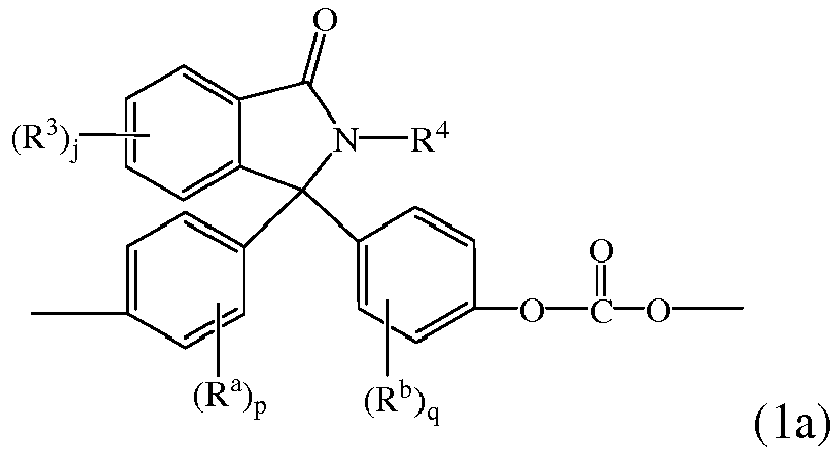

- Other bisphenol carbonate repeating units of this type are the isatin carbonate units of formula (1c) and (1d)

- Other examples of bisphenol carbonate units derived from of bisphenols (3) wherein Xa is a substituted or unsubstituted C3-18 cycloalkylidene include the cyclohexylidene-bridged bisphenol of formula (1e)

- Examples of other bisphenol carbonate units derived from bisphenol (3) wherein Xa is a substituted or unsubstituted C3-18 cycloalkylidene include adamantyl units of formula (If) and fluorenyl units of formula (1g)

- Other useful dihydroxy compounds of the formula HO-R1-OH include aromatic dihydroxy compounds of formula (6)

- Some illustrative examples of specific dihydroxy compounds include the following: 4,4'-dihydroxybiphenyl, 1,6-dihydroxynaphthalene, 2,6-dihydroxynaphthalene, bis(4-hydroxyphenyl)methane, bis(4-hydroxyphenyl)diphenylmethane, bis(4-hydroxyphenyl)-1-naphthylmethane, 1,2-bis(4-hydroxyphenyl)ethane, 1,1-bis(4-hydroxyphenyl)-1-phenylethane, 2-(4-hydroxyphenyl)-2-(3-hydroxyphenyl)propane, bis(4-hydroxyphenyl)phenylmethane, 2,2-bis(4-hydroxy-3-bromophenyl)propane, 1,1-bis (hydroxyphenyl)cyclopentane, 1,1-bis(4-hydroxyphenyl)cyclohexane, 1,1-bis(4-hydroxyphenyl)isobutene, 1,1-bis(4-hydroxyphenyl)cyclododecane, trans-2,3-bis(4-hydroxyphenyl)-2-butene, 2,2-bis(4-hydroxyphenyl)adamantane, alpha, alpha'-bis(4-hydroxyphenyl)toluene, bis(4-hydroxyphenyl)acetonitrile, 2,2-bis(3-methyl-4-hydroxyphenyl)propane, 2,2-bis(3-ethyl-4-hydroxyphenyl)propane, 2,2-bis(3-n-propyl-4-hydroxyphenyl)propane, 2,2-bis(3-isopropyl-4-hydroxyphenyl)propane, 2,2-bis(3-sec-butyl-4-hydroxyphenyl)propane, 2,2-bis(3-t-butyl-4-hydroxyphenyl)propane, 2,2-bis(3-cyclohexyl-4-hydroxyphenyl)propane, 2,2-bis(3-allyl-4-hydroxyphenyl)propane, 2,2-bis(3-methoxy-4-hydroxyphenyl)propane, 2,2-bis(4-hydroxyphenyl)hexafluoropropane, 1,1-dichloro-2,2-bis(4-hydroxyphenyl)ethylene, 1,1-dibromo-2,2-bis(4-hydroxyphenyl)ethylene, 1,1-dichloro-2,2-bis(5-phenoxy-4-hydroxyphenyl)ethylene, 4,4'-dihydroxybenzophenone, 3,3-bis(4-hydroxyphenyl)-2-butanone, 1,6-bis(4-hydroxyphenyl)-1,6-hexanedione, ethylene glycol bis(4-hydroxyphenyl)ether, bis(4-hydroxyphenyl)ether, bis(4-hydroxyphenyl)sulfide, bis(4-hydroxyphenyl)sulfoxide, bis(4-hydroxyphenyl)sulfone, 9,9-bis(4-hydroxyphenyl)fluorine, 2,7-dihydroxypyrene, 6,6'-dihydroxy-3,3,3',3'- tetramethylspiro(bis)indane ("spirobiindane bisphenol"), 3,3-bis(4-hydroxyphenyl)phthalimide, 2,6-dihydroxydibenzo-p-dioxin, 2,6-dihydroxythianthrene, 2,7-dihydroxyphenoxathin, 2,7-dihydroxy-9,10-dimethylphenazine, 3,6-dihydroxydibenzofuran, 3,6-dihydroxydibenzothiophene, and 2,7-dihydroxycarbazole, resorcinol, substituted resorcinol compounds such as 5-methyl resorcinol, 5-ethyl resorcinol, 5-propyl resorcinol, 5-butyl resorcinol, 5-t-butyl resorcinol, 5-phenyl resorcinol, 5-cumyl resorcinol, 2,4,5,6-tetrafluoro resorcinol, 2,4,5,6-tetrabromo resorcinol, or the like; catechol; hydroquinone; substituted hydroquinones such as 2-methyl hydroquinone, 2-ethyl hydroquinone, 2-propyl hydroquinone, 2-butyl hydroquinone, 2-t-butyl hydroquinone, 2-phenyl hydroquinone, 2-cumyl hydroquinone, 2,3,5,6-tetramethyl hydroquinone, 2,3,5,6-tetra-t-butyl hydroquinone, 2,3,5,6-tetrafluoro hydroquinone, 2,3,5,6-tetrabromo hydroquinone, or the like, or a combination thereof.
- Specific examples of bisphenol compounds of formula (3) include 1,1-bis(4-hydroxyphenyl) methane, 1,1-bis(4-hydroxyphenyl) ethane, 2,2-bis(4-hydroxyphenyl) propane (hereinafter "bisphenol A" or "BPA"), 2,2-bis(4-hydroxyphenyl) butane, 2,2-bis(4-hydroxyphenyl) octane, 1,1-bis(4-hydroxyphenyl) propane, 1,1-bis(4-hydroxyphenyl) n-butane, 2,2-bis(4-hydroxy-2-methylphenyl) propane, 1,1-bis(4-hydroxy-t-butylphenyl)propane, 3,3-bis(4-hydroxyphenyl) phthalimidine, 2-phenyl-3,3-bis(4-hydroxyphenyl) phthalimidine (PPPBP), and 1,1-bis(4-hydroxy-3-methylphenyl)cyclohexane (DMBPC). A combination can also be used. In a specific aspect, the polycarbonate is a linear homopolymer derived from bisphenol A, in which each of A1 and A2 is p-phenylene and Y1 is isopropylidene in formula (3).
- In a further aspect, the polycarbonate can be a linear homopolymer derived from bisphenol A, in which each of A1 and A2 is p-phenylene and Y1 is isopropylidene. The polycarbonates can have an intrinsic viscosity, as determined in chloroform at 25°C, of 0.3 to 1.5 deciliters per gram (dL/g), for example 0.45 to 1.0 dL/g. The polycarbonates can have a weight average molecular weight (Mw) of 10,000 to 100,000 grams per mole (g/mol), as measured by GPC using a crosslinked styrene-divinyl benzene column with polycarbonate standards. In a yet further aspect, the polycarbonate has an Mw of 15,000 to 55,000 g/mol. In an even further aspect, the polycarbonate has an Mw of 18,000 to 40,000 g/mol.
- "Polycarbonate" includes homopolycarbonates (wherein each R1 in the polymer is the same), copolymers including different R1 moieties in the carbonate ("copolycarbonates"), and copolymers including carbonate units and other types of polymer units, such as ester units or siloxane units.
- A specific type of copolymer is a poly(ester-carbonate), also known as a polyester-polycarbonate. Such copolymers further contain, in addition to recurring carbonate units of formula (1), repeating units of formula (7)

- In an aspect, J is a C2-30 alkylene group having a straight chain, branched chain, or cyclic (including polycyclic) structure, for example ethylene, n-propylene, i-proplyene, 1,4-butylene, 1,4-cyclohexylene, or 1,4-methylenecyclohexane. In another aspect, J is derived from a bisphenol of formula (3), e.g., bisphenol A. In still another aspect, J is derived from an aromatic dihydroxy compound of formula (6), e.g., resorcinol.
- Aromatic dicarboxylic acids that can be used to prepare the polyester units include isophthalic or terephthalic acid, 1,2-di(p-carboxyphenyl)ethane, 4,4'-dicarboxydiphenyl ether, 4,4'-bisbenzoic acid, or a combination thereof. Acids containing fused rings can also be present, such as in 1,4-, 1,5-, or 2,6-naphthalenedicarboxylic acids. Specific dicarboxylic acids include terephthalic acid, isophthalic acid, naphthalene dicarboxylic acid, 1,4-cyclohexane dicarboxylic acid, or a combination thereof. A specific dicarboxylic acid includes a combination of isophthalic acid and terephthalic acid wherein the weight ratio of isophthalic acid to terephthalic acid is 91:9 to 2:98.
- Specific ester units include ethylene terephthalate, n-propylene terephthalate, n-butylene terephthalate, 1,4-cyclohexanedimethylene terephthalate, and ester units derived from isophthalic acid, terephthalic acid, and resorcinol (ITR)). The molar ratio of ester units to carbonate units in the copolymers can vary broadly, for example 1:99 to 99:1, or 10:90 to 90:10, more preferably 25:75 to 75:25, or 2:98 to 15:85, depending on the desired properties of the final composition. Specific poly(ester-carbonate)s are those including bisphenol A carbonate units and isophthalate-terephthalate-bisphenol A ester units, also commonly referred to as poly(carbonate-ester)s (PCE) poly(phthalate-carbonate)s (PPC) depending on the molar ratio of carbonate units and ester units.
- Polyester-polycarbonate copolymers can have a Mw of 1,500 to 100,000 g/mol, including, for example 1,700 to 50,000 g/mol, as measured by GPC using a crosslinked styrene-divinyl benzene column with polycarbonate standards. In an aspect, poly(aliphatic ester)-polycarbonates have a Mw of 15,000 to 45,000 g/mol.
- Polycarbonates can be manufactured by processes such as interfacial polymerization and melt polymerization, which are known, and are described, for example, in
WO 2013/175448 A1 andWO 2014/072923 A1 . An end-capping agent (also referred to as a chain stopper agent or chain terminating agent) can be included during polymerization to provide end groups, for example monocyclic phenols such as phenol, p-cyanophenol, and C1-22 alkyl-substituted phenols such as p-cumyl-phenol, resorcinol monobenzoate, and p-and tertiarybutyl phenol, monoethers of diphenols, such as p-methoxyphenol, monoesters of diphenols such as resorcinol monobenzoate, functionalized chlorides of aliphatic monocarboxylic acids such as acryloyl chloride and methacryoyl chloride, and mono-chloroformates such as phenyl chloroformate, alkyl-substituted phenyl chloroformates, p-cumyl phenyl chloroformate, and toluene chloroformate. Combinations of different end groups can be used. Branched polycarbonate blocks can be prepared by adding a branching agent during polymerization, for example trimellitic acid, trimellitic anhydride, trimellitic trichloride, tris-p-hydroxyphenylethane, isatin-bis-phenol, tris-phenol TC (1,3,5-tris((p-hydroxyphenyl)isopropyl)benzene), tris-phenol PA (4(4(1,1-bis(p-hydroxyphenyl)-ethyl) alpha, alpha-dimethyl benzyl)phenol), 4-chloroformyl phthalic anhydride, trimesic acid, and benzophenone tetracarboxylic acid. The branching agents can be added at a level of 0.05 to 2.0 wt%. A combination of a linear polycarbonate and a branched polycarbonate can be used. - In an aspect, the polycarbonate is a homopolymer. In a further aspect, the homopolymer includes repeating units derived from bisphenol A (BPA).
- In an aspect, the polycarbonate is a copolymer. In a further aspect, the copolymer includes repeating units derived from BPA. In yet a further aspect, the copolymer includes repeating units derived from sebacic acid. In an even further aspect, the copolymer includes repeating units derived from sebacic acid and BPA.
- In an aspect, the polycarbonate includes a blend of at least two polycarbonate polymers. In a further aspect, the polycarbonate includes a first polycarbonate polymer component and a second polycarbonate polymer component.
- An additive composition can be used, including one or more additives selected to achieve a desired property, with the proviso that the additive(s) are also selected to not significantly adversely affect a desired property of the reactive polymer composition. The additive composition or individual additives can be mixed at a suitable time during the mixing of the components for forming the composition. The additive composition can include an impact modifier, flow modifier, filler (e.g., a particulate polytetrafluoroethylene (PTFE), glass, carbon, mineral, or metal), reinforcing agent (e.g., glass fibers), antioxidant, heat stabilizer, light stabilizer, ultraviolet (UV) light stabilizer, UV absorbing additive, plasticizer, lubricant, release agent (such as a mold release agent), antistatic agent, anti-fog agent, antimicrobial agent, colorant (e.g., a dye or pigment), surface effect additive, radiation stabilizer, flame retardant, anti-drip agent (e.g., a PTFE-encapsulated styrene-acrylonitrile copolymer (TSAN)), or a combination thereof. For example, a combination of a heat stabilizer, mold release agent, and ultraviolet light stabilizer can be used. The additives can be used in the amounts known to be effective. For example, the total amount of the additive composition (other than any impact modifier, filler, or reinforcing agent) can be 0.001 to 10.0 wt%, or 0.01 to 5 wt%, each based on the total weight of the reactive polymer composition.
- The reactive polymer composition can optionally include an additional thermoplastic polymer different from thermoplastic polymer reactive with the binder reactive functional group. Examples of additional thermoplastic polymers that can be used include polyacetals (e.g., polyoxyethylene and polyoxymethylene), poly(C1-6 alkyl)acrylates, polyacrylamides, polyamides, (e.g., aliphatic polyamides, polyphthalamides, and polyaramides), polyamideimides, polyanhydrides, polyarylates, polyarylene ethers (e.g., polyphenylene ethers), polyarylene sulfides (e.g., polyphenylene sulfides), polyarylene sulfones (e.g., polyphenylene sulfones), polybenzothiazoles, polybenzoxazoles, polycarbonates (including polycarbonate copolymers such as polycarbonate-siloxanes, polycarbonate-esters, and polycarbonate-ester-siloxanes), polyesters (e.g., polyethylene terephthalates, polybutylene terephthalates, polyarylates, and polyester copolymers such as polyester-ethers), polyetheretherketones, polyetherimides (including copolymers such as polyetherimide-siloxane copolymers), polyetherketoneketones, polyetherketones, polyethersulfones, polyimides (including copolymers such as polyimide-siloxane copolymers), poly(C1-6 alkyl)methacrylates, polymethacrylamides, polynorbornenes (including copolymers containing norbornenyl units), polyolefins (e.g., polyethylenes, polypropylenes, polytetrafluoroethylenes, and their copolymers, for example ethylene-alpha-olefin copolymers), polyoxadiazoles, polyoxymethylenes, polyphthalides, polysilazanes, polysiloxanes, polystyrenes (including copolymers such as acrylonitrile-butadiene-styrene (ABS) and methyl methacrylate-butadiene-styrene (MBS)), polysulfides, polysulfonamides, polysulfonates, polysulfones, polythioesters, polytriazines, polyureas, polyurethanes, polyvinyl alcohols, polyvinyl esters, polyvinyl ethers, polyvinyl halides, polyvinyl ketones, polyvinyl thioethers, polyvinylidene fluorides, or the like, or a combination thereof.
- In an aspect, the reactive polymer composition can include a catalyst. The catalyst can be an alkali or alkaline earth metal salt of hydroxide, superoxide, thiolate, sulfide, C1-20 alkoxide, C6-20 aryloxide, C1-20 carboxylate, phosphate, phosphonate, phosphite, sulfate, C1-20 alkyl or aryl sulfonate, sulfite, or a combination thereof. Exemplary catalysts include, but are not limited to, lithium hydroxide, sodium hydroxide, potassium hydroxide, cesium hydroxide, magnesium hydroxide, calcium hydroxide, barium hydroxide, lithium formate, sodium formate, potassium formate, cesium formate, lithium acetate, sodium acetate, potassium acetate, lithium carbonate, sodium carbonate, potassium carbonate, lithium methoxide, sodium methoxide, potassium methoxide, lithium ethoxide, sodium ethoxide, potassium ethoxide, lithium phenoxide, sodium phenoxide, potassium phenoxide, sodium sulfate, potassium sulfate, NaH2PO3, NaH2PO4, Na2H2PO3, KH2PO4, CsH2PO4, Na2SO3, Na2S2O5, sodium mesylate, potassium mesylate, sodium tosylate, potassium tosylate, magnesium disodium ethylenediamine tetraacetate, and combinations thereof.
- The method for making the composite includes optionally forming a composite precursor including the reactive fiber system and the reactive polymer composition; and heating the reactive fiber system and the reactive polymer composition under conditions effective to form the modified thermoplastic polymer. The heating can include thermoforming, compression molding, or a combination thereof. In an aspect, the heating does not include extruding, blow molding, rotational molding, or injection molding. It has been discovered that heating by extruding, blow molding, rotational molding, or injection molding does not provide the modified thermoplastic polymer.
- The heating can be at a temperature of 200 to 370°C, at a pressure of 80 to 200 kilopascals (kPa), and for a time of 200 to 900 seconds (s). Within this combination of parameters, the temperature can be 200 to 270°C, or 210 to 270°C, or 220 to 260°C; the pressure can be 80 to 180 kPa, or 90 to 180 kPa, or 100 to 180 kPa; and the time can be 200 to 800 s, or 200 to 700 s, or 250 to 620 s. For example, the temperature can be 220 to 260°C, the pressure can be 110 to 160 kPa, and the time can be 200 to 400 s. For example, the temperature can be 220 to 260°C, the pressure can be 110 to 160 kPa, and the time can be 400 to 700 s. For example, the temperature can be 240 to 260°C, the pressure can be 120 to 160 kPa, and the time can be 200 to 700 s.
- Also provided is a method of manufacturing a prepreg, including coating the reactive fiber system with the reactive polymer composition. Coating can be by any suitable method, including immersing the reactive fiber system into the reactive polymer composition, spraying the reactive polymer composition onto the reactive fiber system; powder coating the reactive fiber system with the reactive polymer composition, layering a film of the reactive polymer composition on the reactive fiber system; or a combination thereof.
- The prepreg can be prepared in any form, where the form can be determined by the shape of the reactive fiber system. In an aspect, the reactive fiber system can be arranged or shaped into a fiber preform. As used herein, the term "fiber preform" refers to the reactive fiber system being arranged in a specified configuration prior to being subjected to the operation or operations that will coat the reactive fiber system with the reactive polymer composition. Examples of fiber preforms include, but are not limited to, a woven fabric, a unidirectional tape, a tailored fiber preform, a fiber layup structure, one or more wound filaments, an automatic tape laying structure, or a shaped fiber structure member.
- Prepregs can be prepared by contacting at least two layers of a laminate under conditions of heat and pressure sufficient to consolidate the prepreg. In an aspect, a prepreg includes from one to one hundred layers of the laminate. In another aspect, all the layers of the laminate are formed from the prepreg. In still another aspect, the laminate can include other layers, for example a different prepreg. In some aspects, all the prepreg layers used to form the laminate are the prepregs produced as described herein.
- In an aspect, a non-prepreg layer can be present such as a release layer, a copper foil, or an adhesive to enhance bonding between two layers. The adhesive can be applied using any suitable method, for example, spreading, spraying, and dipping. The adhesive can be any adhesive that provides the desired adhesion between layer(s) of the prepregs or tapes. An adhesive can be polyvinylbutyral (PVB), ethylene-vinyl acetate copolymer (EVA), an epoxy, an ultraviolet (UV) or water-curable adhesive such as a cyanoacrylate or other acrylic, or a combination thereof.
- In an aspect, the prepreg is a tape that includes a plurality of unidirectional fibers of the reactive fiber system. In aspect, the tape can include continuous unidirectional fibers. In forming laminates from the tapes, the continuous unidirectional fibers of the tapes can be oriented with substantially parallel fibers, where the fibers of one layer are parallel, or more parallel than perpendicular with the fibers of another layer. Alternatively, the continuous unidirectional fiber tapes can be oriented with substantially non-parallel fibers, where the fibers of one layer are less parallel than perpendicular with the fibers of another layer.
- In an aspect, the laminate or prepreg is added to the surface of a foam or honeycomb structure, and can also include a decorative foil or film.
- In an aspect, the composite is as laminate and the forming includes contacting the reactive fiber system with the reactive polymer composition, thermoforming to form a prepreg, and laminating a plurality of prepregs by thermoforming. The modified thermoplastic polymer can be formed during prepreg formation, during laminate formation, or both.
- The term "thermoforming" is used to describe a method that can include the sequential or simultaneous heating and forming of a material onto a mold, wherein the material is originally in the form of a film, sheet, layer, or the like, and can then be formed into a desired shape. Once the desired shape has been obtained, the formed article (e.g., a composite, a prepreg, or a laminate) is cooled below its melt or glass transition temperature.
- Exemplary thermoforming methods can include, but are not limited to, mechanical forming such as matched tool forming, calendaring rolls, double belt laminators, indexing presses, multiple daylight presses or the like, membrane assisted pressure/vacuum forming, membrane assisted pressure/vacuum forming with a plug assist, or a combination thereof.
- In an aspect, the flexural modulus of the composite is greater than the flexural modulus of a comparable composite that does not include the modified thermoplastic polymer. In an aspect, the flexural modulus of the composite is 120 to 200% greater than, or 130 to 200% greater than, or 140 to 200% greater than the flexural modulus of the comparable composite that does not include the modified thermoplastic polymer. For example, the composite can have a flexural modulus of 7,500 to 20,000 megapascal (MPa), or 8,500 to 20,000 MPa, or 9,000 to 16,000 MPa, as determined according to ISO 527.
- In an aspect, the maximum stress of the composite is greater than the maximum stress of a comparable composite that does not include the modified thermoplastic polymer. In an aspect, the maximum stress of the composite is 130 to 200% greater than, or 135 to 200% greater than, or 140 to 200% greater than the maximum stress of the comparable composite that does not include the modified thermoplastic polymer. For example, the composite can have a maximum stress of 140 to 300 megapascal (MPa), or 150 to 275 MPa, or 160 to 250 MPa, as determined according to ISO 527.
- As used herein, the "comparable composite" refers to a composite prepared from fiber system and the thermoplastic polymer, where the fiber system includes the non-woven fiber and a binder, where the thermoplastic polymer is the same as in the reactive polymer composition, where the binder does not include a binder reactive functional group, and the comparable composite is prepared under the same conditions as the disclosed composite. Accordingly, the comparable composite does not include the modified thermoplastic polymer.
- Also provided is an article including the composite as described herein. In an aspect, the article can be a mass transit component, an energy storage device, a computer device, a household appliance, an electrical component, a recreational component, a decoration device, an electromagnetic interference device, a printed circuit, a cellular antenna device, a cellphone component, an automotive component, a military component, an industrial component, a building component, a construction component, a marine component, an aerospace component, a medical component, a sensor component, a shielding component, an RF component, or a combination thereof. It is to be understand that the descriptions for the articles above may overlap, and thus, for example, an article can be both an RF component and a sensor component.
- Exemplary articles that can be prepared from the composites include, for example, acid bath containers; neutralization tanks; aircraft components; bridge beams; bridge deckings; electrolytic cells; exhaust stacks; scrubbers; sporting equipment; stair cases; walkways; automobile exterior panels such as hoods and trunk lids; floor pans; air scoops; pipes and ducts, including heater ducts; industrial fans, fan housings, and blowers; industrial mixers; boat hulls and decks; marine terminal fenders; tiles and coatings; building panels; business machine housings; trays, including cable trays; concrete modifiers; dishwasher and refrigerator parts; electrical encapsulants; electrical panels; tanks, including electrorefining tanks, water softener tanks, fuel tanks, and various filament-wound tanks and tank linings; furniture; garage doors; gratings; protective body gear; luggage; outdoor motor vehicles; pressure tanks; printed circuit boards; optical waveguides; radomes; railings; railroad parts such as tank cars; hopper car covers; car doors; truck bed liners; satellite dishes; signs; solar energy panels; telephone switchgear housings; tractor parts; transformer covers; truck parts such as fenders, hoods, bodies, cabs, and beds; insulation for rotating machines including ground insulation, turn insulation, and phase separation insulation; commutators; core insulation and cords and lacing tape; drive shaft couplings; propeller blades; missile components; rocket motor cases; wing sections; sucker rods; fuselage sections; wing skins and flarings; engine narcelles; cargo doors; tennis racquets; golf club shafts; fishing rods; skis and ski poles; bicycle parts; transverse leaf springs; pumps, such as automotive smog pumps; electrical components, embedding, and tooling, such as electrical cable joints; wire windings and densely packed multi-element assemblies; sealing of electromechanical devices; battery cases; resistors; fuses and thermal cutoff devices; coatings for printed wiring boards; casting items such as capacitors, transformers, crankcase heaters; small molded electronic parts including coils, capacitors, resistors, and semiconductors; as a replacement for steel in chemical processing, pulp and paper, power generation, and wastewater treatment; scrubbing towers; pultruded parts for structural applications, including structural members, gratings, and safety rails; swimming pools, swimming pool slides, hot-tubs, and saunas; drive shafts for under the hood applications; dry toners for copying machines; marine tooling and composites; heat shields; submarine hulls; prototype generation; development of experimental models; laminated trim; drilling fixtures; bonding jigs; inspection fixtures; industrial metal forming dies; aircraft stretch block and hammer forms; vacuum molding tools; flooring, including flooring for production and assembly areas, clean rooms, machine shops, control rooms, laboratories, parking garages, freezers, coolers, and outdoor loading docks; electrically conductive compositions for antistatic applications; for decorative flooring; expansion joints for bridges; injectable mortars for patch and repair of cracks in structural concrete; grouting for tile; machinery rails; metal dowels; bolts and posts; repair of oil and fuel storage tanks, and numerous other articles.
- In an aspect, a composite includes the product of the reactive fiber system and the reactive polymer composition derived from 10 to 80 wt%, preferably 10 to 60 wt%, more preferably 10 to 50 wt% of the reactive fiber system, each based on the total weight of the reactive fiber system and the reactive polymer composition used to prepare the product. In this aspect, the reactive fiber system includes the non-woven fiber and the binder including the binder reactive functional group, preferably wherein the binder reactive functional group is hydroxyl, carboxyl, carboxylic anhydride, haloformyl, epoxy, silanol, amino, mercapto, vinyl, or a combination thereof. In this aspect, the reactive fiber system is derived from a non-woven fiber and 1 to 20 wt%, preferably 3 to 15 wt%, more preferably 5 to 15 wt% of the binder, based on the total weight of the non-woven fiber and the binder. In this aspect, the modified thermoplastic polymer is covalently bonded to the reactive fiber system, and the Mw of the modified thermoplastic polymer is 3 to 30 wt%, preferably 5 to 30 wt%, more preferably 8 to 30 wt%, still more preferably 10 to 30 wt% less than the Mw of the thermoplastic polymer, as determined by GPC with a crosslinked divinyl benzene column and polystyrene standards. In this aspect, PVA is a preferred binder and the thermoplastic polymer is preferably a polyester, polycarbonate, polyamide, polyurethane, polyurea, a random or block poly(carbonate ester), poly(carbonate ether), poly(ester ether), poly(carbonate ether ester), poly(ester amide), poly(ester ether amide), poly(carbonate amide), poly(carbonate ether amide), poly(ester urethane), poly(ester ether-urethane), poly(carbonate urethane), poly(carbonate ether urethane), poly(ester urea), poly(ester ether urea), poly(carbonate urea), poly(carbonate ether urea), poly(ether amide), poly(amide urethane), poly(amide urea), poly(urethane urea), poly(arylene ether), or a combination thereof.
- In a method of making the composite of these aspects, the reactive fiber system and the reactive polymer composition are heated by thermoforming, compression molding, or a combination thereof at a temperature of 200 to 280°C, a pressure of 80 to 200 kPa, and for a time of 200 to 900 seconds, to form the modified thermoplastic polymer, i.e., conditions effective to react the binder reactive functional group and the thermoplastic polymer to cleave a polymer chain of the thermoplastic polymer to form the modified thermoplastic polymer, wherein the modified thermoplastic polymer includes a covalent bond to the reactive fiber system. For example, reacting can include reacting a first cleaved polymer chain with the binder reactive functional group to form the modified thermoplastic polymer; and reacting a second cleaved polymer chain with a second thermoplastic polymer, an additive, the non-woven fiber, or a combination thereof.
- Preferred articles including the composite of these aspects, or made by the foregoing method, include a mass transit component, an energy storage device, a computer device, a household appliance, an electrical component, a recreational component, a decoration device, an electromagnetic interference device, a printed circuit, a cellular antenna device, a cellphone component, an automotive component, a military component, an industrial component, a building component, a construction component, a marine component, an aerospace component, a medical component, a sensor component, a shielding component, or an RF component.
- In other aspects, the reactive polymer composition includes a thermoplastic polymer comprising a polymer reactive group, wherein the polymer reactive group is reactive with the binder reactive functional group. The polymer reactive group can be attached to the thermoplastic polymer, and as a residue of the corresponding modified thermoplastic polymer, as an end group, as a pendant moiety, as a functional group of the polymer backbone, or a combination thereof. For example, the polymer reactive group can be anhydride, amino, hydroxyl, halogen, thiol, aldehyde, C1-6 alkyl ester, carboxyl, epoxy, isocyanate, vinyl, alkynyl, or a combination thereof. Thus, the modified thermoplastic polymer can be derived from reaction of the polymer reactive group and the binder reactive functional group to form a covalent bond. In an aspect, the modified thermoplastic polymer includes a reaction product of the polymer reactive group and the binder reactive functional group, a reaction product of the thermoplastic polymer and the binder reactive functional group, or a combination thereof.
- This disclosure is further illustrated by the following examples, which are nonlimiting.
- The materials listed in Table 1 were used in the examples.
Table 1 Material Description Source PC1 BPA-polycarbonate film, having a thickness of 125 µm and a Mw of 29,400 g/mol by GPC (obtained as LEXAN 8010MC-112) SABIC PC2 Amorphous BPA-polycarbonate prepared by interfacial polymerization, having a Mw of 21,000 to 22,000 g/mol by GPC SABIC CF1A Wet-laid non-woven carbon fiber mat, having a surface density of 50 g/m2, a fiber diameter of 7 µm, and containing 10-15 wt% of a polyvinyl alcohol binder (obtained as OPTIMAT 20301A) Technical Fibre Products CF1B Wet-laid non-woven carbon fiber mat, having a surface density of 80 g/m2, a fiber diameter of 7 µm, and containing 10-15 wt% of a polyvinyl alcohol binder (obtained as OPTIMAT 20301 A) Technical Fibre Products CF2 Wet-laid non-woven carbon fiber mat, having a surface density of 50 g/m2, a fiber diameter of 7 µm, and containing 10-15 wt% of a styrene-acrylic binder (obtained as OPTIMAT 20352A) Technical Fibre Products CF3 Chopped carbon fibers, having a fiber diameter of 7 µm, and containing 4 wt% of a glycerol binder (obtained as SIGRAFIL C G100) SGL Carbon CF4 Chopped carbon fibers, having a fiber diameter of 7 µm, and containing 3 wt% of a polycarbonate-suitable binder (obtained as SIGRAFIL C C6-4.0/240-T160) SGL Carbon Phosphite Tris(di-t-butylphenyl)phosphite Sigma - Molecular weight was determined by gel permeation chromatography (GPC) using a cross-linked styrene-divinylbenzene column. Molecular weight was calibrated to polycarbonate references using an ultraviolet-visible detector at 254 nm. For the composite laminates, a three point bending tests were performed on parts having a length of 50 mm, a width of 10 mm and a thickness of 4 mm. The cross-head speed was 2 mm/min. Flexural properties were determined at 23°C in accordance with ISO-178. Tensile properties were measured according to ISO-527 on a sample having a thickness of 4 mm. Izod notched impact strength (INI ASTM) was determined at 23°C using 3.2 mm bars in accordance with ASTM D256-02. Izod notched impact strength (INI ISO) was determined at 23°C using notched 4 mm ISO bars in accordance with the ISO-180:2000. Vicat softening temperature was measured using 4 mm ISO bars at a load of 50 N and a speed of 120 °C/h (B120) in accordance with ISO-306. Heat distortion temperature (HDT) was measured using the flat side of 4 mm ISO bars and a load of 1.8 MPa (A/f), in accordance with the ISO-75 with a 5.5 J hammer. Melt volume flow rate (MVR) was measured at 300°C/1.2 kg with a 300 or 900 second dwell time in accordance with ISO-1133. Puncture-impact (MAI) testing was determined in accordance with ISO-6603.
- Laminate composite samples were prepared by sandwiching a non-woven carbon fiber mat between two polycarbonate (PC1, Mw of 29,400 g/mol) films to form a laminate. The laminate was subsequently thermoformed using a film laminator (OASYS TECHNOLOGIES LTD) according to the multi-step press conditions in Table 2.
Table 2 Press Conditions 3 Press Conditions 4 Step Temp (°C) Pressure (kPa) Time (s) Step Temp (°C) Pressure (kPa) Time (s) 1 245 69 1 1 245 69 1 2 235 138 300 2 235 138 600 3 235 138 1 3 235 138 1 4 235 138 1 4 235 138 1 5 40 207 - 5 40 138 - Press Conditions 5 Press Conditions 6 Step Temp (°C) Pressure (kPa) Time (s) Step Temp (°C) Pressure (kPa) Time (s) 1 260 69 1 1 260 69 1 2 250 138 300 2 250 138 600 3 250 138 1 3 250 138 1 4 250 138 1 4 250 138 1 5 250 138 1 5 250 138 1 6 40 207 - 6 40 207 - - Table 3 shows the molecular weights (g/mol) of the polycarbonates of Examples 1-4 after pressing, the change in molecular weight after pressing, and the processing conditions when using the carbon fiber mat having a reactive binder (CF1A) having a surface density of 50 g/m2.
Table 3 Example Fiber Mw Mn ΔMw Press Conditions Fiber weight (g) Total laminate weight (g) Fiber Amount (wt%) 1 CF1A 27800 10900 -1600 3 0.26 1.96 13.27 2 CF1A 26200 10500 -3200 4 0.26 1.98 13.13 3 CF1A 26000 10400 -3400 5 0.26 1.98 13.13 4 CF1A 23200 9700 -6200 6 0.27 1.98 13.64 - Table 4 shows the molecular weights (g/mol) of the polycarbonates of Examples 5-8 after pressing, the change in molecular weight after pressing, and the processing conditions when using the carbon fiber mat having a reactive binder (CF1B) having a surface density of 80 g/m2.
Table 4 Example Fiber Mw Mn ΔMw Press Conditions Fiber weight (g) Total laminate weight (g) Fiber Amount (wt%) 5 CF1B 28200 11100 -1200 3 0.45 2.15 20.93 6 CF1B 26600 10600 -2800 4 0.44 2.12 20.75 7 CF1B 26400 10600 -3000 5 0.43 2.11 20.38 8 CF1B 22800 9600 -6600 6 0.44 2.11 20.85 - The results in Tables 3 and 4 show that Mw is decreased at all press conditions when using the carbon fiber mat having a reactive binder . The results of Examples 2, 4, 6, and 8 demonstrate that increased pressing temperature and longer pressing times favorably result in a further decrease in Mw. The fiber density does not change the relative trend for decreased Mw, which indicates the reactive binder, rather than the fiber density, provides the decreases in Mw.
- Table 5 shows the molecular weights (g/mol) of the polycarbonates of Comparative Examples 9-12, the change in molecular weight after pressing, and the processing conditions when using the carbon fiber mat having the non-reactive binder (CF2).
Table 5 Comparative Example Fiber Mw Mn ΔMw Press Conditions Fiber weight (g) Total laminate weight (g) Fiber Amount (wt%) 9 CF2 29000 11300 -400 3 0.27 1.98 13.64 10 CF2 28400 11200 -1000 4 0.26 1.93 13.47 11 CF2 28600 11200 -800 5 0.27 1.99 13.57 12 CF2 28200 11100 -1200 6 0.26 1.96 13.27 - These results show that a slight decrease in Mw is observed at all press conditions when using the carbon fiber mat having the non-reactive binder (CF2). Modifying the processing conditions by increasing the temperature, time, or both, resulted in a modest decrease in Mw. The data in Table 3-5 shows the substantial decrease of Mw is achieved when using the reactive binders under all pressing conditions, whereas the non-reactive binder is unable achieve these same results.
- Table 6 shows the mechanical properties of Examples 3-4 and Comparative Examples 11-12.
Table 6 Units 3 4 11 12 Binder Type - reactive reactive non-reactive non-reactive ΔMw g/mol -3400 -6200 -800 -1200 Flexural Modulus (FM) MPa 10868 9617 6765 7192 Maximum Stress (Stress) MPa 186 170 122 130 ΔFM vs. Comparative Example 11 % 61 42 - 6 ΔStress vs. Comparative Example 11 % 53 40 - 6 ΔStr at strain vs. Comparative Example 11 % 47 43 - 9 - These results show the relative increases in flexural modulus, maximum stress, and maximum stress at strain for Examples 3-4 and Comparative Example 12 when compared to the properties of Comparative Example 11. For Examples 3 and 4, which included the reactive binder, a considerable increase in flexural properties was achieved relative to Comparative Examples 11-12. The decreased molecular weight of Comparative Examples 11-12, which include the non-reactive binder, is a result of the reactivity between the carbon fiber surface functionality with the polycarbonate or the reaction of a newly formed phenol-functionalized polycarbonate with the resin itself, which provides a decrease to Mw and only a slight increase in physical properties. For Examples 3-4, which include the reactive binder, the further decreases in Mw are the result of covalent bonding between the binder and the polycarbonate via cleavage of the backbone, in addition to the reactivity between the carbon fiber surface functionality with the polycarbonate or the reaction of a newly formed phenol-functionalized polycarbonate with the resin itself. This reactivity and the resulting connection between the polycarbonate and the fiber/binder system provide the improved the flexural properties.
-
FIGS. 2-5 demonstrate the improved adhesion achieved using the reactive binders.FIGS. 2 and 3 are SEM images of the composite derived from the non-reactive binder, which shows poor adhesion between CF2 and the polycarbonate matrix. In these images with the non-reactive binder, the fibers are observed to extend from the polymer matrix, which indicates the fibers have been pulled out from the matrix when the composite is fractured.FIGS. 4 and 5 are SEM images of the composite derived from the reactive binder, which shows improved adhesion between CF1A and the polycarbonate matrix. In these images with the reactive binder, the number of fibers extending out of the polymer matrix is greatly decreased, which indicates the fibers are broken when the composite is fractured. The improved tensile properties for Examples 3 and 4 are a result of the improved adhesion between the reactive binder-containing CF1A and the polycarbonate matrix. - Comparative Examples 13-14 were prepared using polycarbonate and chopped carbon fibers having either a reactive binder (CF3) or a non-reactive binder (CF4), where the samples were prepared by extruding and injection molding, rather than by thermoforming. Polycarbonate powder and phosphite stabilizer were combined using a paint shaker and then fed through a feeder to an extruder. The glass fibers were fed separately through the hopper on a downstream side-feeder. Samples were extruded on a 25 mm twin screw extruder at a melt temperature of 270-300°C and a rotation of 300 revolutions per minute (rpm), and then pelletized. The pellets were dried for 3-5 hours at 90-100°C. Dried pellets were injection molded at temperatures of 280-300°C. Thin-wall parts (0.8 mm) were molded at 290-315°C.
- Table 7 shows the compositions and properties of Comparative Examples 13-14.
Table 7 Component Amount 13 14 PC2 wt% 79.95 79.95 Phosphite wt% 0.05 0.05 CF3 wt% 20 - CF4 wt% - 20 Property Units Δ* (%) MVR - 300s cm3/10 min 50.6 8.2 516 MVR - 900s cm3/10 min 128.1 8.5 1410 HDT - 1.8MPa - Flat °C 137 142 -4 VICAT - B/120 °C 144 150 -4 Flexural Modulus MPa 10859 11957 -9 Flexural Strength MPa 162 220 -26 Stress at Break-Avg MPa 160 219 -27 Tensile Modulus MPa 12726 14309 -11 Tensile Stress at break MPa 113 152 -26 INI ISO kJ/m2 4.7 7.4 -37 INI ASTM J/m 38 76 -50 MAI: Puncture energy-Avg J 4 7 -51 MAI: Energy at max force-Avg J 3.1 6.4 -51 *Δ is the percent change from Comparative Example 14 (non-reactive binder) to Comparative Example 13 (reactive binder) - These results show the reactive binder reacts unfavorably with polycarbonate when processing by extrusion and injection molding. Unlike the compression molded samples in Examples 1-8, processing by extrusion and injection molding in Comparative Example 13 resulted in a decrease to all measured physical properties relative to Comparative Example 14, which was prepared with a non-reactive binder.
- This disclosure further encompasses the following Aspects.
- Aspect 1. A composite including a product of a reactive fiber system and a reactive polymer composition, wherein the reactive fiber system includes: a non-woven fiber; and a binder including a binder reactive functional group, and the reactive polymer composition includes a thermoplastic polymer reactive with the binder reactive functional group; and wherein the composite includes a modified thermoplastic polymer including a reaction product of the thermoplastic polymer and the binder reactive functional group.
- Aspect 2. The composite of Aspect 1, wherein the modified thermoplastic polymer is covalently bonded to the reactive fiber system.
- Aspect 3. The composite of any one of the preceding Aspects, wherein the modified thermoplastic polymer is derived from the thermoplastic polymer via chain scission and reaction with the binder reactive functional group to form a covalent bond.
- Aspect 4. The composite of any one of the preceding Aspects, wherein a flexural modulus of the composite is greater than a flexural modulus of a comparable composite prepared from a binder that does not comprise the binder reactive functional group and that does not comprise the modified thermoplastic polymer, as determined according to ISO 527.
- Aspect 5. The composite of any one of the preceding Aspects, further comprising a cleaved thermoplastic polymer that is derived from the thermoplastic polymer via chain scission and is not covalently bonded to the reactive fiber system, wherein a weight average molecular weight of the cleaved thermoplastic polymer and the thermoplastic polymer after composite formation is less than a weight average molecular weight of the thermoplastic polymer prior to composite formation, as determined by GPC; preferably wherein the weight average molecular weight of the cleaved thermoplastic polymer and the thermoplastic polymer after composite formation is 3 to 30 wt%, preferably 5 to 30 wt%, more preferably 8 to 30 wt%, still more preferably 10 to 30 wt% less than the weight average molecular weight of the thermoplastic polymer prior to composite formation, as determined by GPC.
- Aspect 6. The composite of any one of the preceding Aspects, wherein the non-woven fiber is a mineral fiber, a plant fiber, a synthetic fiber, or a combination thereof; preferably wherein the non-woven fiber is glass fiber, glass wool fiber, mineral wool fiber, slag wool fiber, stone wool fiber, basalt fiber, silica fiber, quartz fiber, alumina fiber, steel fiber, silicon carbide fiber, acrylic fiber, carbon fiber, melamine fiber, polyester fiber, polyethylene fiber, polyethylene terephthalate fiber, polylactic acid fiber, polypropylene fiber, polyamide fiber, polyaramid fiber, polyimide fiber, polyphenylene sulfide fiber, polytetrafluoroethylene fiber, cellulosic fiber, cotton fiber, jute fiber, kenaf fiber, bamboo fiber, hemp fiber, linen fiber, flax fiber, or a combination thereof.
- Aspect 7. The composite of any one of the preceding Aspects, wherein the binder reactive functional group is hydroxyl, carboxyl, carboxylic anhydride, haloformyl, epoxy, silanol, amino, mercapto, vinyl, or a combination thereof; preferably wherein the binder includes a polyvinyl alcohol.
- Aspect 8. The composite of any one of the preceding Aspects, wherein the composite includes 20 to 90 wt% of the modified thermoplastic polymer, preferably 30 to 90 wt% of the modified thermoplastic polymer, each based on the total weight of the reactive polymer composition and the modified thermoplastic polymer.
- Aspect 9. The composite of any one of the preceding Aspects, wherein the product of the reactive fiber system and the reactive polymer composition is derived from 10 to 80 wt%, preferably 10 to 60 wt%, more preferably 10 to 50 wt% of the reactive fiber system, each based on the total weight of the reactive fiber system and the reactive polymer composition used to prepare the product.
- Aspect 10. The composite of any one of the preceding Aspects, wherein the reactive fiber system is derived from the non-woven fiber and 1 to 20 wt%, preferably 3 to 15 wt%, more preferably 5 to 15 wt% of the binder, each based on the total weight of the non-woven fiber and the binder.
- Aspect 11. The composite of any one of the preceding Aspects, wherein the thermoplastic polymer is a thermoplastic polymer or copolymer that is reactive with the binder reactive functional group via chain scission, preferably wherein the thermoplastic polymer is polycarbonate, polyacetal, poly(C1-6 alkyl)acrylate, polyacrylamide, polyamide, polyamideimide, polyanhydride, polyarylate, polyarylene ether, polyarylene sulfide, polyarylene sulfone, polybenzothiazole, polybenzoxazole, polyester, polyetheretherketone, polyetherimide, polyetherketoneketone, polyetherketone, polyethersulfone, polyimide, poly(C1-6 alkyl)methacrylate, polymethacrylamide, polynorbornene, polyolefin, polyoxadiazole, polyoxymethylene, polyphthalide, polysilazane, polysiloxane, polystyrene, polysulfide, polysulfonamide, polysulfonate, polysulfone, polythioester, polytriazine, polyurea, polyurethane, polyvinyl alcohol, polyvinyl ester, polyvinyl ether, polyvinyl halide, polyvinyl ketone, polyvinyl thioether, polyvinylidene fluoride, a copolymer thereof, or a combination thereof; more preferably wherein the thermoplastic polymer is polyester, polycarbonate, polyamide, polyurethane, polyurea, a random or block poly(carbonate ester), poly(carbonate ether), poly(ester ether), poly(carbonate ether ester), poly(ester amide), poly(ester ether amide), poly(carbonate amide), poly(carbonate ether amide), poly(ester urethane), poly(ester ether-urethane), poly(carbonate urethane), poly(carbonate ether urethane), poly(ester urea), poly(ester ether urea), poly(carbonate urea), poly(carbonate ether urea), poly(ether amide), poly(amide urethane), poly(amide urea), poly(urethane urea), poly(arylene ether), or a combination thereof; even more preferably wherein the thermoplastic polymer is polycarbonate.
- Aspect 12. A method of making the composite of any one of the preceding Aspects, the method including: heating the reactive fiber system and the reactive polymer composition under conditions effective to form the modified thermoplastic polymer.
- Aspect 13. The method of Aspect 12, wherein the heating is effective to react the binder reactive functional group and the thermoplastic polymer to cleave a polymer chain of the thermoplastic polymer to form the modified thermoplastic polymer, wherein the modified thermoplastic polymer includes a covalent bond to the reactive fiber system; preferably wherein the heating includes thermoforming, compression molding, or a combination thereof; more preferably wherein the heating includes thermoforming, compression molding, or a combination thereof at a temperature of 200 to 280°C, a pressure of 80 to 200 kPa, and for a time of 200 to 900 seconds.
- Aspect 14. The method of Aspect 13, wherein the heating is further effective to react a first cleaved polymer chain with the binder reactive functional group to form the modified thermoplastic polymer; and react a second cleaved polymer chain with a second thermoplastic polymer, an additive, the non-woven fiber, or a combination thereof.
- Aspect 15. An article including the composite of any one of Aspects 1-11 or made by the method of any one of Aspects 12-14; preferably wherein the article is a mass transit component, an energy storage device, a computer device, a household appliance, an electrical component, a recreational component, a decoration device, an electromagnetic interference device, a printed circuit, a cellular antenna device, a cellphone component, an automotive component, a military component, an industrial component, a building component, a construction component, a marine component, an aerospace component, a medical component, a sensor component, a shielding component, an RF component, or a combination thereof.
- The compositions, methods, and articles can alternatively comprise, consist of, or consist essentially of, any appropriate materials, steps, or components herein disclosed. The compositions, methods, and articles can additionally, or alternatively, be formulated to be devoid, or substantially free, of any materials (or species), steps, or components, that are otherwise not necessary to the achievement of the function or objectives of the compositions, methods, and articles.
- All ranges disclosed herein are inclusive of the endpoints, and the endpoints are independently combinable with each other (e.g., ranges of "up to 25 wt%, or, more specifically, 5 to 20 wt%", is inclusive of the endpoints and all intermediate values of the ranges of "5 to 25 wt%," etc.). "Combinations" is inclusive of blends, mixtures, alloys, reaction products, and the like. The terms "first," "second," and the like, do not denote any order, quantity, or importance, but rather are used to distinguish one element from another. The terms "a" and "an" and "the" do not denote a limitation of quantity and are to be construed to cover both the singular and the plural, unless otherwise indicated herein or clearly contradicted by context. "Or" means "and/or" unless clearly stated otherwise. Reference throughout the specification to "some aspects", "an aspect", and so forth, means that a particular element described in connection with the aspect is included in at least one aspect described herein, and may or may not be present in other aspects. In addition, it is to be understood that the described elements may be combined in any suitable manner in the various aspects. A "combination thereof' is open and includes any combination including at least one of the listed components or properties optionally together with a like or equivalent component or property not listed.
- Unless specified to the contrary herein, all test standards are the most recent standard in effect as of the filing date of this application, or, if priority is claimed, the filing date of the earliest priority application in which the test standard appears.
- Unless defined otherwise, technical and scientific terms used herein have the same meaning as is commonly understood by one of skill in the art to which this application belongs. All cited patents, patent applications, and other references are incorporated herein by reference in their entirety. However, if a term in the present application contradicts or conflicts with a term in the incorporated reference, the term from the present application takes precedence over the conflicting term from the incorporated reference.
- Compounds are described using standard nomenclature. For example, any position not substituted by any indicated group is understood to have its valency filled by a bond as indicated, or a hydrogen atom. A dash ("-") that is not between two letters or symbols is used to indicate a point of attachment for a substituent. For example, -CHO is attached through carbon of the carbonyl group.
- The term "alkyl" means a branched or straight chain, unsaturated aliphatic hydrocarbon group, e.g., methyl, ethyl, n-propyl, i-propyl, n-butyl, s-butyl, t-butyl, n-pentyl, s-pentyl, and n- and s-hexyl. "Alkenyl" means a straight or branched chain, monovalent hydrocarbon group having at least one carbon-carbon double bond (e.g., ethenyl (-HC=CH2)). "Alkoxy" means an alkyl group that is linked via an oxygen (i.e., alkyl-O-), for example methoxy, ethoxy, and sec-butyloxy groups. "Alkylene" means a straight or branched chain, saturated, divalent aliphatic hydrocarbon group (e.g., methylene (-CH2-) or, propylene (-(CH2)3-)). "Cycloalkylene" means a divalent cyclic alkylene group, -CnH2n-x, wherein x is the number of hydrogens replaced by cyclization(s). "Cycloalkenyl" means a monovalent group having one or more rings and one or more carbon-carbon double bonds in the ring, wherein all ring members are carbon (e.g., cyclopentyl and cyclohexyl). "Aryl" means an aromatic hydrocarbon group containing the specified number of carbon atoms, such as phenyl, tropone, indanyl, or naphthyl. "Arylene" means a divalent aryl group. "Alkylarylene" means an arylene group substituted with an alkyl group. "Arylalkylene" means an alkylene group substituted with an aryl group (e.g., benzyl). The prefix "halo" means a group or compound including one more of a fluoro, chloro, bromo, or iodo substituent. A combination of different halo groups (e.g., bromo and fluoro), or only chloro groups can be present. The prefix "hetero" means that the compound or group includes at least one ring member that is a heteroatom (e.g., 1, 2, or 3 heteroatom(s)), wherein the heteroatom(s) is each independently N, O, S, Si, or P. "Substituted" means that the compound or group is substituted with at least one (e.g., 1, 2, 3, or 4) substituents that can each independently be a C1-9 alkoxy, a C1-9 haloalkoxy, a nitro (-NO2), a cyano (-CN), a C1-6 alkyl sulfonyl (-S(=O)2-alkyl), a C6-12 aryl sulfonyl (-S(=O)2-aryl)a thiol (-SH), a thiocyano (-SCN), a tosyl (CH3C6H4SO2-), a C3-12 cycloalkyl, a C2-12 alkenyl, a C5-12 cycloalkenyl, a C6-12 aryl, a C7-13 arylalkylene, a C4-12 heterocycloalkyl, and a C3-12 heteroaryl instead of hydrogen, provided that the substituted atom's normal valence is not exceeded. The number of carbon atoms indicated in a group is exclusive of any substituents. For example -CH2CH2CN is a C2 alkyl group substituted with a nitrile.
- Unless substituents are otherwise specifically indicated, each of the foregoing groups can be unsubstituted or substituted, provided that the substitution does not significantly adversely affect synthesis, stability, or use of the compound. "Substituted" means that the compound, group, or atom is substituted with at least one (e.g., 1, 2, 3, or 4) substituents instead of hydrogen, where each substituent is independently nitro (-NO2), cyano (-CN), hydroxy (-OH), halogen, thiol (-SH), thiocyano (-SCN), C1-6 alkyl, C2-6 alkenyl, C2-6 alkynyl, C1-6 haloalkyl, C1-9 alkoxy, C1-6 haloalkoxy, C3-12 cycloalkyl, C5-18 cycloalkenyl, C6-12 aryl, C7-13 arylalkylene (e.g., benzyl), C7-12 alkylarylene (e.g., toluyl), C4-12 heterocycloalkyl, C3-12 heteroaryl, C1-6 alkyl sulfonyl (-S(=O)2-alkyl), C6-12 arylsulfonyl (-S(=O)2-aryl), or tosyl (CH3C6H4SO2-), provided that the substituted atom's normal valence is not exceeded. When a compound is substituted, the indicated number of carbon atoms is the total number of carbon atoms in the compound or group, including those of any substituents.
- While particular aspects have been described, alternatives, modifications, variations, improvements, and substantial equivalents that are or may be presently unforeseen may arise to applicants or others skilled in the art. Accordingly, the appended claims as filed and as they may be amended are intended to embrace all such alternatives, modifications variations, improvements, and substantial equivalents.
Claims (15)
- A composite comprising a product of a reactive fiber system and a reactive polymer composition, wherein
the reactive fiber system comprises:a non-woven fiber; anda binder comprising a binder reactive functional group, andthe reactive polymer composition comprises a thermoplastic polymer reactive with the binder reactive functional group; and
wherein the composite comprises a modified thermoplastic polymer comprising a reaction product of the thermoplastic polymer and the binder reactive functional group. - The composite of claim 1, wherein the modified thermoplastic polymer is covalently bonded to the reactive fiber system.
- The composite of any one of the preceding claims, wherein the modified thermoplastic polymer is derived from the thermoplastic polymer via chain scission and reaction with the binder reactive functional group to form a covalent bond.
- The composite of any one of the preceding claims, wherein a flexural modulus of the composite is greater than a flexural modulus of a comparable composite prepared from a binder that does not comprise the binder reactive functional group and that does not comprise the modified thermoplastic polymer, as determined according to ISO 527.
- The composite of any one of the preceding claims, further comprising a cleaved thermoplastic polymer that is derived from the thermoplastic polymer via chain scission and is not covalently bonded to the reactive fiber system,
wherein a weight average molecular weight of the cleaved thermoplastic polymer and the thermoplastic polymer after composite formation is less than a weight average molecular weight of the thermoplastic polymer prior to composite formation, as determined by gel permeation chromatography;
preferably wherein the weight average molecular weight of the cleaved thermoplastic polymer and the thermoplastic polymer after composite formation is 3 to 30 wt%, preferably 5 to 30 wt%, more preferably 8 to 30 wt%, still more preferably 10 to 30 wt% less than the weight average molecular weight of the thermoplastic polymer prior to composite formation, as determined by gel permeation chromatography. - The composite of any one of the preceding claims, wherein the non-woven fiber is a mineral fiber, a plant fiber, a synthetic fiber, or a combination thereof;
preferably wherein the non-woven fiber is glass fiber, glass wool fiber, mineral wool fiber, slag wool fiber, stone wool fiber, basalt fiber, silica fiber, quartz fiber, alumina fiber, steel fiber, silicon carbide fiber, acrylic fiber, carbon fiber, melamine fiber, polyester fiber, polyethylene fiber, polyethylene terephthalate fiber, polylactic acid fiber, polypropylene fiber, polyamide fiber, polyaramid fiber, polyimide fiber, polyphenylene sulfide fiber, polytetrafluoroethylene fiber, cellulosic fiber, cotton fiber, jute fiber, kenaf fiber, bamboo fiber, hemp fiber, linen fiber, flax fiber, or a combination thereof. - The composite of any one of the preceding claims, wherein the binder reactive functional group is hydroxyl, carboxyl, carboxylic anhydride, haloformyl, epoxy, silanol, amino, mercapto, vinyl, or a combination thereof; preferably wherein the binder comprises a polyvinyl alcohol.
- The composite of any one of the preceding claims, wherein the composite comprises 5 to 90 wt% of the modified thermoplastic polymer, preferably 15 to 90 wt% of the modified thermoplastic polymer, based on the total weight of the modified thermoplastic polymer, the reactive polymer composition, and optionally the cleaved thermoplastic polymer.
- The composite of any one of the preceding claims, wherein the product of the reactive fiber system and the reactive polymer composition is derived from 10 to 80 wt%, preferably 10 to 60 wt%, more preferably 10 to 50 wt% of the reactive fiber system, based on the total weight of the reactive fiber system and the reactive polymer composition used to prepare the product.
- The composite of any one of the preceding claims, wherein the reactive fiber system is derived from the non-woven fiber and 1 to 20 wt%, preferably 3 to 15 wt%, more preferably 5 to 15 wt% of the binder, based on the total weight of the non-woven fiber and the binder.
- The composite of any one of the preceding claims, wherein the thermoplastic polymer is
a thermoplastic polymer or copolymer that is reactive with the binder reactive functional group via chain scission,
preferably wherein the thermoplastic polymer is polycarbonate, polyacetal, poly(C1-6 alkyl)acrylate, polyacrylamide, polyamide, polyamideimide, polyanhydride, polyarylate, polyarylene ether, polyarylene sulfide, polyarylene sulfone, polybenzothiazole, polybenzoxazole, polyester, polyetheretherketone, polyetherimide, polyetherketoneketone, polyetherketone, polyethersulfone, polyimide, poly(C1-6 alkyl)methacrylate, polymethacrylamide, polynorbornene, polyolefin, polyoxadiazole, polyoxymethylene, polyphthalide, polysilazane, polysiloxane, polystyrene, polysulfide, polysulfonamide, polysulfonate, polysulfone, polythioester, polytriazine, polyurea, polyurethane, polyvinyl alcohol, polyvinyl ester, polyvinyl ether, polyvinyl halide, polyvinyl ketone, polyvinyl thioether, polyvinylidene fluoride, a copolymer thereof, or a combination thereof;
more preferably wherein the thermoplastic polymer is polyester, polycarbonate, polyamide, polyurethane, polyurea, a random or block poly(carbonate ester), poly(carbonate ether), poly(ester ether), poly(carbonate ether ester), poly(ester amide), poly(ester ether amide), poly(carbonate amide), poly(carbonate ether amide), poly(ester urethane), poly(ester ether-urethane), poly(carbonate urethane), poly(carbonate ether urethane), poly(ester urea), poly(ester ether urea), poly(carbonate urea), poly(carbonate ether urea), poly(ether amide), poly(amide urethane), poly(amide urea), poly(urethane urea), poly(arylene ether), or a combination thereof;
even more preferably wherein the thermoplastic polymer is polycarbonate. - A method of making the composite of any one of the preceding claims, the method comprising: heating the reactive fiber system and the reactive polymer composition under conditions effective to form the modified thermoplastic polymer.
- The method of claim 12, wherein the heating is effective to react the binder reactive functional group and the thermoplastic polymer to cleave a polymer chain of the thermoplastic polymer to form the modified thermoplastic polymer, and wherein the modified thermoplastic polymer comprises a covalent bond to the reactive fiber system;
preferably wherein the heating comprises thermoforming, compression molding, or a combination thereof; more preferably wherein the heating comprises thermoforming, compression molding, or a combination thereof at a temperature of 200 to 370°C, at a pressure of 80 to 200 kPa, and for a time of 200 to 900 seconds. - The method of claim 13, wherein the heating is further effective to
react a first cleaved polymer chain with the binder reactive functional group to form the modified thermoplastic polymer; and
react a second cleaved polymer chain with a second thermoplastic polymer, an additive, the non-woven fiber, or a combination thereof. - An article comprising the composite of any one of claims 1 to 11 or made by the method of any one of claims 12 to 14; preferably wherein the article is a mass transit component, an energy storage device, a computer device, a household appliance, an electrical component, a recreational component, a decoration device, an electromagnetic interference device, a printed circuit, a cellular antenna device, a cellphone component, an automotive component, a military component, an industrial component, a building component, a construction component, a marine component, an aerospace component, a medical component, a sensor component, a shielding component, an RF component, or a combination thereof.
Priority Applications (1)
| Application Number | Priority Date | Filing Date | Title |
|---|---|---|---|
| EP19210539.3A EP3825350A1 (en) | 2019-11-21 | 2019-11-21 | Composites with reduced weight and improved interfacial strength |
Applications Claiming Priority (1)
| Application Number | Priority Date | Filing Date | Title |
|---|---|---|---|
| EP19210539.3A EP3825350A1 (en) | 2019-11-21 | 2019-11-21 | Composites with reduced weight and improved interfacial strength |
Publications (1)
| Publication Number | Publication Date |
|---|---|
| EP3825350A1 true EP3825350A1 (en) | 2021-05-26 |
Family
ID=68653321
Family Applications (1)
| Application Number | Title | Priority Date | Filing Date |
|---|---|---|---|
| EP19210539.3A Withdrawn EP3825350A1 (en) | 2019-11-21 | 2019-11-21 | Composites with reduced weight and improved interfacial strength |
Country Status (1)
| Country | Link |
|---|---|
| EP (1) | EP3825350A1 (en) |
Cited By (3)
| Publication number | Priority date | Publication date | Assignee | Title |
|---|---|---|---|---|
| CN111518375A (en) * | 2020-06-09 | 2020-08-11 | 中船重工鹏力(南京)塑造科技有限公司 | Biological cooling and heating forming cup and preparation method thereof |
| CN114276689A (en) * | 2022-01-04 | 2022-04-05 | 上海赞瑞实业有限公司 | Carbon fiber modified polysilazane composite material for fire fighting helmet and preparation method thereof |
| CN121378825A (en) * | 2025-12-23 | 2026-01-23 | 华中科技大学 | A method for preparing an all-organic small-molecule composite polymer film and the product thereof. |
Citations (5)
| Publication number | Priority date | Publication date | Assignee | Title |
|---|---|---|---|---|
| EP0491204A2 (en) * | 1990-12-05 | 1992-06-24 | Ppg Industries, Inc. | Wet laid fibrous thermoplastic material and aqueous dispersion for producing same |
| US20130224470A1 (en) * | 2012-02-28 | 2013-08-29 | Ut-Battelle, Llc | Method of improving adhesion of carbon fibers with a polymeric matrix |
| EP2876134A2 (en) * | 2013-11-22 | 2015-05-27 | Johns Manville | Fiber-reinforced composites made with thermoplastic resin compositions and reactive coupling fibers |
| WO2018138229A1 (en) * | 2017-01-25 | 2018-08-02 | Sabic Global Technologies Bv. | Polycarbonates with improved carbon fiber-matrix interphase |
| WO2018176067A2 (en) * | 2017-08-07 | 2018-09-27 | Zoltek Corporation | Polyvinyl alcohol-sized fillers for reinforcing plastics |
-
2019
- 2019-11-21 EP EP19210539.3A patent/EP3825350A1/en not_active Withdrawn
Patent Citations (5)
| Publication number | Priority date | Publication date | Assignee | Title |
|---|---|---|---|---|
| EP0491204A2 (en) * | 1990-12-05 | 1992-06-24 | Ppg Industries, Inc. | Wet laid fibrous thermoplastic material and aqueous dispersion for producing same |
| US20130224470A1 (en) * | 2012-02-28 | 2013-08-29 | Ut-Battelle, Llc | Method of improving adhesion of carbon fibers with a polymeric matrix |
| EP2876134A2 (en) * | 2013-11-22 | 2015-05-27 | Johns Manville | Fiber-reinforced composites made with thermoplastic resin compositions and reactive coupling fibers |
| WO2018138229A1 (en) * | 2017-01-25 | 2018-08-02 | Sabic Global Technologies Bv. | Polycarbonates with improved carbon fiber-matrix interphase |
| WO2018176067A2 (en) * | 2017-08-07 | 2018-09-27 | Zoltek Corporation | Polyvinyl alcohol-sized fillers for reinforcing plastics |
Cited By (3)
| Publication number | Priority date | Publication date | Assignee | Title |
|---|---|---|---|---|
| CN111518375A (en) * | 2020-06-09 | 2020-08-11 | 中船重工鹏力(南京)塑造科技有限公司 | Biological cooling and heating forming cup and preparation method thereof |
| CN114276689A (en) * | 2022-01-04 | 2022-04-05 | 上海赞瑞实业有限公司 | Carbon fiber modified polysilazane composite material for fire fighting helmet and preparation method thereof |
| CN121378825A (en) * | 2025-12-23 | 2026-01-23 | 华中科技大学 | A method for preparing an all-organic small-molecule composite polymer film and the product thereof. |
Similar Documents
| Publication | Publication Date | Title |
|---|---|---|
| TWI844650B (en) | Resin composition, hardened molded product, fiber-reinforced plastic molding material, and fiber-reinforced plastic | |
| TWI843097B (en) | Capped bisphenol polyether oligomer and composition, method of manufacture, and articles made therefrom | |
| JP2024516417A (en) | Capped bisphenol polyindane oligomers and compositions, methods of manufacture, and articles made therefrom | |
| CN110408006A (en) | Curing agent composition for thermosetting epoxy resin composition | |
| KR20110020241A (en) | Lightweight, highly rigid composite with class A surface treatment | |
| US20230183477A1 (en) | Curable thermosetting composition including poly(arylene ether) copolymer | |
| EP3825351A1 (en) | Composites with improved adhesion and mechanical performance | |
| WO2021245625A1 (en) | Poly(arylene ether) copolymer, method to prepare the same, and article derived therefrom | |
| US20250122328A1 (en) | Copolymers derived from dicyclopentadiene | |
| US20240376240A1 (en) | Phenylene ether oligomer and curable thermosetting composition comprising the phenylene ether oligomer | |
| CN114616263A (en) | Curing composition for toughening epoxy resins | |
| TWI885298B (en) | Linear block copolymer and curable thermosetting composition comprising the linear block copolymer | |
| WO2023135460A1 (en) | Capped poly(phenylene ether) and curable thermosetting composition comprising the same | |
| JP2024539196A (en) | Graft copolymer and curable thermosetting composition containing same | |
| TWI868602B (en) | Copolymers derived from dicyclopentadiene | |
| TWI843264B (en) | Copolymer for cross-linkable networks | |
| WO2025224624A1 (en) | Curable composition and cured compositions derived therefrom | |
| WO2025224628A1 (en) | Polyfunctional poly(arylene ethers) and curable compositions thereof | |
| EP3539949A1 (en) | Thermoset 3-oxo-isoindoline diphthalonitrile polymers, method of manufacture, and uses thereof |
Legal Events
| Date | Code | Title | Description |
|---|---|---|---|
| PUAI | Public reference made under article 153(3) epc to a published international application that has entered the european phase |
Free format text: ORIGINAL CODE: 0009012 |
|
| STAA | Information on the status of an ep patent application or granted ep patent |
Free format text: STATUS: THE APPLICATION HAS BEEN PUBLISHED |
|
| AK | Designated contracting states |
Kind code of ref document: A1 Designated state(s): AL AT BE BG CH CY CZ DE DK EE ES FI FR GB GR HR HU IE IS IT LI LT LU LV MC MK MT NL NO PL PT RO RS SE SI SK SM TR |
|
| STAA | Information on the status of an ep patent application or granted ep patent |
Free format text: STATUS: THE APPLICATION IS DEEMED TO BE WITHDRAWN |
|
| 18D | Application deemed to be withdrawn |
Effective date: 20211127 |