EP3825347A1 - Fiber composites and methods for making the same - Google Patents
Fiber composites and methods for making the same Download PDFInfo
- Publication number
- EP3825347A1 EP3825347A1 EP19210707.6A EP19210707A EP3825347A1 EP 3825347 A1 EP3825347 A1 EP 3825347A1 EP 19210707 A EP19210707 A EP 19210707A EP 3825347 A1 EP3825347 A1 EP 3825347A1
- Authority
- EP
- European Patent Office
- Prior art keywords
- resin composition
- hdpe
- hdpe resin
- polymer
- aspects
- Prior art date
- Legal status (The legal status is an assumption and is not a legal conclusion. Google has not performed a legal analysis and makes no representation as to the accuracy of the status listed.)
- Granted
Links
Images
Classifications
-
- C—CHEMISTRY; METALLURGY
- C08—ORGANIC MACROMOLECULAR COMPOUNDS; THEIR PREPARATION OR CHEMICAL WORKING-UP; COMPOSITIONS BASED THEREON
- C08J—WORKING-UP; GENERAL PROCESSES OF COMPOUNDING; AFTER-TREATMENT NOT COVERED BY SUBCLASSES C08B, C08C, C08F, C08G or C08H
- C08J5/00—Manufacture of articles or shaped materials containing macromolecular substances
- C08J5/04—Reinforcing macromolecular compounds with loose or coherent fibrous material
-
- C—CHEMISTRY; METALLURGY
- C08—ORGANIC MACROMOLECULAR COMPOUNDS; THEIR PREPARATION OR CHEMICAL WORKING-UP; COMPOSITIONS BASED THEREON
- C08L—COMPOSITIONS OF MACROMOLECULAR COMPOUNDS
- C08L23/00—Compositions of homopolymers or copolymers of unsaturated aliphatic hydrocarbons having only one carbon-to-carbon double bond; Compositions of derivatives of such polymers
- C08L23/02—Compositions of homopolymers or copolymers of unsaturated aliphatic hydrocarbons having only one carbon-to-carbon double bond; Compositions of derivatives of such polymers not modified by chemical after-treatment
- C08L23/04—Homopolymers or copolymers of ethene
- C08L23/06—Polyethylene
-
- C—CHEMISTRY; METALLURGY
- C08—ORGANIC MACROMOLECULAR COMPOUNDS; THEIR PREPARATION OR CHEMICAL WORKING-UP; COMPOSITIONS BASED THEREON
- C08F—MACROMOLECULAR COMPOUNDS OBTAINED BY REACTIONS ONLY INVOLVING CARBON-TO-CARBON UNSATURATED BONDS
- C08F110/00—Homopolymers of unsaturated aliphatic hydrocarbons having only one carbon-to-carbon double bond
- C08F110/02—Ethene
-
- C—CHEMISTRY; METALLURGY
- C08—ORGANIC MACROMOLECULAR COMPOUNDS; THEIR PREPARATION OR CHEMICAL WORKING-UP; COMPOSITIONS BASED THEREON
- C08J—WORKING-UP; GENERAL PROCESSES OF COMPOUNDING; AFTER-TREATMENT NOT COVERED BY SUBCLASSES C08B, C08C, C08F, C08G or C08H
- C08J2323/00—Characterised by the use of homopolymers or copolymers of unsaturated aliphatic hydrocarbons having only one carbon-to-carbon double bond; Derivatives of such polymers
- C08J2323/02—Characterised by the use of homopolymers or copolymers of unsaturated aliphatic hydrocarbons having only one carbon-to-carbon double bond; Derivatives of such polymers not modified by chemical after treatment
- C08J2323/04—Homopolymers or copolymers of ethene
- C08J2323/06—Polyethene
Definitions
- the present invention generally concerns fiber composites.
- the invention concerns fiber composites containing at least 60 wt. %, preferably 60 wt. % to 80 wt. % of a fiber material and a high density polyethylene (HDPE) resin composition containing a HDPE polymer and a metallocene polyethylene wax, and methods for producing the same.
- HDPE high density polyethylene
- Fiber composites such as unidirectional fiber tapes (“UD tapes”) can be used to make structures having advantageous structural characteristics, such as high stiffness and high strength, as well as low weight, when compared to structures formed from conventional materials.
- UD tapes are used in a variety of applications across a wide range of industries, including the automotive, aerospace, and consumer electronics industries.
- a UD tape may need to meet a number of criteria, including those relating to strength, stiffness, size, weight, and/or the like.
- Other fiber composites with high stiffness, high strength and low weight also have use in electronic and electrical devices such as notebook personal computers, e-books, and tablet personal computers, where metallic body panels are being replaced by materials that are lighter in weight but offer a robust combination of mechanical properties.
- Fiber composites made with conventional production techniques are unable to meet the desired criteria.
- UD tape made with conventional solvent based and aqueous based impregnation techniques are undesirably expensive and/or are complicated to make.
- UD tape made with conventional melt impregnation technology may have low fiber weight fraction, uneven density, and high weight.
- a matrix material with low viscosity but high melt strength is required for melt impregnation techniques.
- Melt impregnation with a matrix material having relatively high viscosity and/or low melt strength can result in necking and breakage of the molten matrix material film formed during casting and can result in a UD tape with dry spot, incorrect position and amount of the matrix material.
- Various attempts have been made to produce materials that address the quality of the matrix material.
- US Patent Publication 20100261835A1 discloses a relatively low viscosity polymer mixture.
- the polymer mixture can include two polymers with similar monomer units but different properties.
- the ratio of the two polymers in the mixture depends of the melt flow index of the polymers.
- fiber composites containing greater than 60 wt. % of a fiber material and a matrix with a HDPE resin composition containing a HDPE polymer and a metallocene polyethylene wax exhibit many desirable properties.
- the fiber composites such as UD tapes, can be made by a melt impregnation process.
- a fiber composite in one aspect of the present invention, can contain at least 60 wt. % of a fiber material based on total weight of the composite, and a HDPE resin composition.
- the fiber composite can include 60 wt. % to 80 wt. %, or 70 wt. % to 80 wt. %, or 75 wt. % to 80 wt. % of the fiber material based on total weight of the composite.
- the fiber composite can include 20 wt. % to 40 wt. %, or 20 wt. % to 30 wt. %, or 20 wt. % to 25 wt.
- the HDPE resin composition can contain a HDPE polymer and a polyethylene wax.
- the polyethylene wax can be a microcrystalline polyethylene wax.
- the polyethylene wax can be a metallocene polyethylene wax.
- the HDPE resin composition can include 50 wt. % to 99 wt. %, or 50 wt. % to 98.5 wt. %, or 50 wt. % to 98 wt. %, or 50 wt. % to 97 wt. % of the HDPE polymer and/or 0.01 wt. % to 20 wt. %, or 0.01 wt.
- the HDPE polymer can have a melt flow index (MFI) of 15 to 60 g/10 min at 190 °C and 2.16 kg as measured by ISO 1133 and/or a density of 0.925 g/cm 3 to 1.00 g/cm 3 as measured by ASTM D 1505. In some aspects, the HDPE polymer can have a MFI of 15 to 45 g/10 min, or 25 to 35 g/10 min at 190 °C and 2.16 kg as measured by ISO 1133.
- MFI melt flow index
- the HDPE polymer can have a density of 0.925 g/cm 3 to 0.975 g/cm 3 , or 0.930 g/cm 3 to 0.970 g/cm 3 as measured by ASTM D 1505.
- the metallocene polyethylene wax can have a drop point of 115 °C to 145 °C as measured by ASTM 3954, a viscosity of 40 mPa.s to 500 mPa.s at 140 °C as measured by DIN 53019 at 140 °C, and/or a density of 0.95 g/cm 3 to 1.00 g/cm 3 as measured by ISO 1183.
- the metallocene polyethylene wax can have a drop point of 120 °C to 140 °C, or 120 °C to 135 °C, or 125 °C to 130 °C as measured by ASTM 3954. In some aspects, the metallocene polyethylene wax can have a density of 0.96 g/cm 3 to 0.99 g/cm 3 , or 0.965 g/cm 3 to 0.98 g/cm 3 , or about 0.97 g/cm 3 , at about 23 °C as measured by ISO 1183.
- the metallocene polyethylene wax can have a viscosity of 40 mPa.s to 400 mPa.s, or 40 mPa.s to 300 mPa.s, or 40 mPa.s to 200 mPa.s, or 40 mPa.s to 100 mPa.s, or 40 mPa.s to 80 mPa.s at 140 °C as measured by DIN 53019.
- the HDPE resin composition can include 0.5 wt. % to 25 wt. % of a low density polyethylene (LDPE) polymer based on total weight of the HDPE resin composition.
- the HDPE resin composition can include 50 wt.
- the HDPE polymer % to 99 wt. % of the HDPE polymer, 0.01 wt. % to 5 wt. % of the metallocene polyethylene wax and 0.5 wt. % to 25 wt. % of the LDPE polymer based on total weight of the HDPE resin composition.
- the LDPE polymer can have a density of 0.913 g/cm 3 to 1.19 g/cm 3 as measured by ASTM D 1505, a melting point of 100 °C to 140 °C, as measured by DIN 53765, a MFI of 50 g/10 min to 100 g/10 min at 190 °C and 2.16 kg as measured by ISO 1133, and/or a Vicat softening temperature of 68 °C to 89 °C at 10N and 50 °C/h as measured by A50, ISO306.
- the LDPE polymer can have a density of 0.913 g/cm 3 to 0.94 g/cm 3 , or 0.915 g/cm 3 to 0.925 g/cm 3 , or 0.918 g/cm 3 to 0.92 g/cm 3 , or about 0.919 g/cm 3 as measured by ASTM D 1505.
- the LDPE polymer can have a melting point of 100 °C to 130 °C, or 100 °C to 120 °C, or 100 °C to 110 °C, or 102 °C to 106 °C or about 104 °C, as measured by DIN 53765.
- the LDPE polymer can have a MFI of 55 g/10 min to 90 g/10 min, or 60 g/10 min to 80 g/10 min, or 60 g/10 min to 70 g/10 min, or 62 g/10 min to 68 g/10 min, or about 65 g/10 min at 190 °C and 2.16 kg as measured by ISO 1133.
- the LDPE polymer can have a Vicat softening temperature of 72 °C to 80 °C or about 75 °C at 10N and 50 °C/h as measured by A50, ISO306.
- the LDPE polymer can be a branched LDPE polymer.
- the LDPE polymer can be a highly branched LDPE polymer.
- the HDPE resin composition can include 0.5 wt. % to 35 wt. % of an ethylene-vinyl acetate (EVA) polymer based on total weight of the HDPE resin composition.
- the HDPE resin composition can include 50 wt. % to 99 wt. % of the HDPE polymer, 0.01 wt. % to 5 wt. % of the metallocene polyethylene wax and 0.5 wt. % to 35 wt. % of the EVA polymer based on total weight of the HDPE resin composition.
- the HDPE resin composition can include 50 wt.
- the EVA polymer can have a MFI of 150 g/10 min to 800 g/10 min, or 200 g/10 min to 500 g/10 min, or 250 g/10 min to 450 g/10 min, or 300 g/10 min to 400 g/10 min at 190 °C and 2.16 kg as measured by ISO 1133.
- the HDPE resin composition can include 0.5 wt. % to 30 wt. %, or 0.5 wt. % to 25 wt. % of a linear low density polyethylene (LLDPE) polymer based on total weight of the HDPE resin composition.
- the HDPE resin composition can include 50 wt. % to 99 wt. % of the HDPE polymer, 0.01 wt. % to 5 wt. % of the metallocene polyethylene wax and 0.5 wt. % to 25 wt. %, or 0.5 wt. % to 30 wt. % of the LLDPE polymer based on total weight of the HDPE resin composition.
- the LLDPE polymer can have a density of 0.870 g/cm 3 to 0.963 g/cm 3 as measured by ASTM D 1505, a MFI of 40 g/10 min to 800 g/10 min, or 40 g/10 min to 100 g/10 min at 190 °C and 2.16 kg as measured by ISO 1133 and/or a Vicat softening temperature of 41 °C to 130 °C at 10 N and 50 °C/h as measured by A50, ASTMD1525.
- the LLDPE polymer can have a density of 0.880 g/cm 3 to 0.95 g/cm 3 , or 0.9 g/cm 3 to 0.94 g/cm 3 , or 0.910 g/cm 3 to 0.930 g/cm 3 or 0.920 g/cm 3 to 0.930 g/cm 3 or about 0.926 g/cm 3 as measured by ASTM D 1505.
- the LLDPE polymer can have a MFI of 50 g/10 min to 100 g/10 min, 50 g/10 min to 90 g/10 min, or 50 g/10 min to 80 g/10 min, 50 g/10 min to 70 g/10 min, or 50 g/10 min to 60 g/10 min, or about 50 g/10 min at 190 °C and 2.16 kg as measured by ISO 1133.
- the LLDPE polymer can have a Vicat softening temperature of 50 °C to 110 °C, or 60 °C to 100 °C, or 70 °C to 95 °C, or 80 °C to 90 °C, or about 88 °C at 10 N and 50 °C/h as measured by A50, ASTMD1525.
- the LLDPE polymer can be an ethylene-alpha olefin polymer, such as ethylene-alpha butene polymer, ethylene-alpha hexene polymer, or an ethylene-alpha octene polymer, or any combination thereof.
- the LLDPE polymer can be an ethylene-alpha hexene polymer.
- the HDPE resin composition can include an ethylene-alpha olefin polymer. In some aspects, the HDPE resin composition can include 0.5 wt. % to 30 wt. % of an ethylene-alpha olefin polymer based on total weight of the HDPE resin composition. In some aspects, the ethylene-alpha olefin polymer can be an ethylene-alpha butene polymer, an ethylene-alpha hexene polymer, or an ethylene-alpha octene polymer, or any combination thereof.
- the total wt.% of the ethylene-alpha butene polymer, an ethylene-alpha hexene polymer, and the ethylene-alpha octene polymer in the HDPE resin composition can be 0.5 wt. % to 30 wt. % based on total weight of the HDPE resin composition.
- the HDPE resin composition can include 50 wt. % to 99 wt. % of the HDPE polymer, 0.01 wt. % to 5 wt. % of the metallocene polyethylene wax and 0.5 wt. % to 30 wt. % of the ethylene-alpha olefin polymer based on total weight of the HDPE resin composition.
- the HDPE resin composition can include 0.01 wt. % to 5 wt. % of a hydrogenated paraffin oil and 0.01 wt. % to 30 wt. % of a styrenic block copolymer based on total weight of the HDPE resin composition.
- the HDPE resin composition can include 50 wt. % to 99 wt. % of the HDPE polymer, 0.01 wt. % to 5 wt. % of the metallocene polyethylene wax, 0.01 wt. % to 5 wt. % of the hydrogenated paraffin oil and 0.01 wt. % to 30 wt.
- the hydrogenated paraffin oil can have a density of 0.848 g/cm 3 to 0.866 g/cm 3 and/or a kinematic viscosity of 15 mm 2 /s to 70 mm 2 /s at 40 °C and 3.5 mm 2 /s to 10 mm 2 /s at 100 °C.
- the styrenic block copolymer can be a styrene-butadiene-styrene (SBS) block copolymer, a styrene-isoprene-styrene (SIS) block copolymer, a styrene-ethylene/propylene (SEP) block copolymer, a styrene-ethylene/propylene-styrene (SEPS) block copolymer, a styrene-ethylene/butylene (SEB) block copolymer, a styrene-ethylene/butylene-styrene (SEBS) block copolymer, a styrene-[ethylene-(ethylenepropylene)]-styrene (SEEPS) block copolymer, or any combination thereof.
- SBS styrene-butadiene-styrene
- SIS styrene-iso
- the styrenic block copolymer can be a SBS block copolymer, a SEBS block copolymer, SEPS block copolymer or any combination thereof.
- the HDPE resin composition can include 0.01 wt. % to 5 wt. % of an internal lubricant based on total weight of the HDPE resin composition.
- the HDPE resin composition can include 50 wt. % to 99 wt. % of the HDPE polymer, 0.01 wt. % to 5 wt. % of the metallocene polyethylene wax, and 0.01 wt. % to 5 wt. % of the internal lubricant based on total weight of the HDPE resin composition.
- the internal lubricant can be a metal stearate, erucamide, oleamide, ethylene bis-stearamide, glycolmonostearate, or any combination thereof.
- the metal stearate can be a zinc stearate.
- the internal lubricant can be erucamide.
- the HDPE resin composition can include 0.01 wt. % to 5 wt. % of a fluoropolymer based on total weight of the HDPE resin composition.
- the HDPE resin composition can include 50 wt. % to 99 wt. % of the HDPE polymer, 0.01 wt. % to 5 wt.
- the fluoropolymer can be polytetrafluoroethylene.
- the fluoropolymer can have a density of 1.85 g/ cm 3 to 2.00 g/ cm 3 , a melting point of 100 °C to 135 °C, and/or a MFI 5 g/10 min to 40 g/10 min at 265 °C and 5 kg.
- the fluoropolymer can have a density of 1.9 g/ cm 3 to 1.96 g/ cm 3 .
- the fluoropolymer can have a melting point of 110 °C to 126 °C. In some aspects, the fluoropolymer can have a MFI 5 to 25 g/10 min at 265 °C and 5 kg.
- the HDPE resin composition comprises 0.01 wt. % to 5 wt. % of a high molecular weight polysiloxane mixed with an amorphous silica based on total weight of the HDPE resin composition. In some aspects, the HDPE resin composition can include 50 wt. % to 99 wt. % of the HDPE polymer, 0.01 wt. % to 5 wt. % of the metallocene polyethylene wax, and 0.01 wt.
- the high molecular weight polysiloxane mixed with an amorphous silica has a density of 0.965 g/ cm 3 to 1.25 g/ cm 3 , or 0.965 g/ cm 3 to 1.15 g/ cm 3 or about 1.15 g/ cm 3 at 25 °C.
- the HDPE resin composition can include 0.01 wt. % to 5 wt. % or 0.01 wt. % to 0.05 wt.
- the HDPE resin composition can include 50 wt. % to 99 wt. % of the HDPE polymer, 0.01 wt. % to 5 wt. % of the metallocene polyethylene wax, and 0.01 wt. % to 5 wt. %, or 0.01 wt. % to 0.05 wt. % of the quaterrylenetetracarboxylic diimide based on total weight of the HDPE resin composition.
- the quaterrylenetetracarboxylic diimide can be a near IR (NIR) absorber.
- the HDPE resin composition can include 1 wt. % to 20 wt. %, or 1 wt. % to 10 wt. %, or 2 wt. % to 5 wt. %, of a maleic anhydride grafted polyethylene based on total weight of the HDPE resin composition.
- the HDPE resin composition can include 50 wt. % to 98.5 wt. %, or 50 wt. % to 97 wt. % of the HDPE polymer, 0.01 wt. % to 20 wt. %, or 0.01 wt. % to 5 wt. % of the metallocene polyethylene wax, and 1 wt.
- maleic anhydride content in the maleic anhydride grafted polyethylene can be 1 wt. % to 5 wt. %, or 2.5 wt. % to 4 wt. %.
- the maleic anhydride grafted polyethylene can contain 0.1 wt. % to 5 wt. % of a grafted high density polyethylene with relative high MFI.
- the HDPE resin composition can contain a maleic anhydride grafted metallocene wax.
- the maleic anhydride grafted metallocene wax can be formed by combining maleic anhydride grafted high density polyethylene with metallocene wax.
- the HDPE resin composition can include 50 wt. % to 98.5 wt. % of the HDPE polymer, 0.01 wt. % to 20 wt. % of the metallocene polyethylene wax, and 1 wt. % to 20 wt. % of the maleic anhydride grafted metallocene wax based on total weight of the HDPE resin composition.
- the HDPE resin composition can have a MFI of 9 to 90 g/10 min at 190 °C and 2.16 kg as measured by ISO 1133, a drawing ratio of 1.8 to 4.5, and/or a crystallinity temperature of 100 °C to 140 °C.
- the HDPE resin composition can have a MFI of 40 g/10 min to 90 g/10 min, or 50 g/10 min to 90 g/10 min, or 60 g/10 min to 90 g/10 min, or 70 g/10 min to 90 g/10 min, or 80 g/10 min to 90 g/10 min, or 85 g/10 min to 90 g/10 min at 190 °C and 2.16 kg as measured by ISO 1133.
- the HDPE resin composition can have a crystallinity temperature of 110 °C to 136 °C, or 122 °C to 133 °C.
- Crystallinity temperature can be obtained by DSC measurements performed using a DSC TA Q20 (TA Instruments, USA) and an intracooler or chiller capable of reaching -90 °C. The measurements can be performed under inert atmosphere (e.g., nitrogen gas flow) to avoid degradation.
- DSC methodology can include heating the sample to 25 °C to 220 °C at a rate of 10 °C/min, holding for 1 to 4 (about 3) min at the final temperature, cooling the sample from 220 °C to 25 °C at a rate of 10 °C/min, and then heating the sample against from 25 °C to 220 °C at the same rate. Measurements can be cycled twice to ensure that the sample does not change during the measurement.
- the crystallinity temperature can be peak crystallization temperature as measured using the DSC procedure according to ASTM ISO11357-1, 2, and/or 3.
- the fiber material can be a continuous fiber material.
- the continuous fiber material can be a continuous glass, carbon, ceramic, aramid, basalt or polymeric fiber material, or any combination thereof.
- the fiber composite can be a UD tape.
- the UD tape can have a thickness 0.1 mm to 0.5 mm.
- the UD tape can have a thickness 0.1 mm to 0.3 mm.
- the UD tape can have thickness greater than 0.3 mm to 0.5 mm.
- the UD tape can have a mean relative fiber area coverages (%) ("RFAC”) of 65 to 90.
- the UD tape can have a coefficients of variance (%) ("COV”) of 3 to 20.
- the fiber composite can be an UD tape.
- the fiber composite can be made by a melt impregnation process.
- the melt impregnation process can include, impregnating the HDPE resin composition with the fiber material.
- the melt impregnation process can include casting molten HDPE resin composition as a film on a moving bed of continuous fibers.
- the moving bed of continuous fibers can be moved at a line speed of 10 m/min to 15 m/min.
- the melt impregnation process can include, spreading a first set of one or more bundles of the fiber material into a first spread fiber layer, spreading a second set of one or more bundles of the fiber material into a second spread fiber layer, casting the molten HDPE resin composition into the second spread fiber layer, and pressing together the first and second spread fiber layers.
- the molten HDPE resin composition can be casted into the second spread fiber layer by moving the second spread fiber layer in a first direction underneath and relative to an outlet of a die of an extruder while the molten HDPE resin composition is extruded as a film through the outlet in an extrusion direction that is perpendicular to or has a component that is counter to the first direction.
- the second spread layer can be moved at a line speed of 10 m/min to 15 m/min in the first direction.
- the second spread fiber layer can have at least 10% more fibers than the first spread fiber layer.
- the first spread fiber layer and/or the second spread fiber layer can contain continuous fibers.
- the second spread fiber layer contacts or comes in close proximity to (e.g., within 5 mm of) the die.
- the second spread fiber layer is passed underneath a scraper, which may be part of the die, the scraper can have a downstream portion and an upstream portion, where a distance between the second spread fiber layer and the upstream portion is larger than a corresponding (i.e., measured in the same direction) distance between the second spread fiber layer and the downstream portion such that the molten HDPE resin composition accumulates between the scraper and the second spread fiber layer.
- the molten HDPE resin composition from the die can be pushed into the second spread fiber layer, thereby facilitating impregnation of the second spread fiber layer.
- A, B, and/or C includes: A alone, B alone, C alone, a combination of A and B, a combination of A and C, a combination of B and C, or a combination of A, B, and C. In other words, "and/or" operates as an inclusive or.
- wt.% refers to a weight percentage of a component, a volume percentage of a component, or molar percentage of a component, respectively, based on the total weight, the total volume of material, or total moles, that includes the component.
- 10 grams of component in 100 grams of the material is 10 wt.% of component.
- Coupled is defined as connected, although not necessarily directly, and not necessarily mechanically; two items that are “coupled” may be unitary with each other.
- a device or system that is configured in a certain way is configured in at least that way, but it can also be configured in other ways than those specifically described.
- drawing ratio is a value obtained by dividing the die gap thickness by the average thickness of the final solidified film.
- an effective amount refers to an amount of a compound where addition of such amount produces a desired or intended effect.
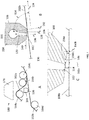
- FIG. 1 A melt impregnation system and a process for preparing a fiber composite according to an example of the current invention.
- fiber composites containing greater than 60 wt.% of a fiber material and a HDPE resin composition containing a HDPE polymer and a polyethylene wax shows relatively uniform densities, low dry spot, correct position and amount of the matrix material.
- the HDPE resin composition of the current invention can have relatively low viscosity and high melt strength.
- the HDPE resin composition of the current invention can have (1) a MFI of 9 g/10 min to 90 g/10 min, or at least any one of, equal to any one of, or between any two of 9g/10 min, 10 g/10 min, 20 g/10 min, 30 g/10 min, 40 g/10 min, 50 g/10 min, 60 g/10 min, 70 g/10 min, 80 g/10 min, 85 g/10 min and 90 g/10 min at 190 °C and 2.16 kg as measured by ISO 1133, (2) a drawing ratio 1.8 to 4.5, or at least any one of, equal to any one of, or between any two of 1.8, 1.9, 2, 2.1, 2.2, 2.3, 2.4, 2.5, 2.6, 2.7, 2.8, 2.9, 3, 3.1, 3.2, 3.3, 3.4, 3.5, 3.6, 3.7, 3.8, 3.9, 4, 4.1, 4.2, 4.3, 4.4
- the HDPE resin composition can include a HDPE polymer and a polyethylene wax.
- the HDPE resin composition can include 50 wt. % to 99 wt. % or at least any one of, equal to any one of, or between any two of 50 wt. %, 55 wt. %, 60 wt. %, 65 wt. %, 70 wt. %, 75 wt. %, 80 wt. %, 85 wt. %, 90 wt. %, 95 wt. %, 96 wt. %, 97 wt. %, 98 wt. %, 98.5 wt. %, and 99 wt.
- % of the HDPE polymer and 0.01 wt. % to 20 wt. % or at least any one of, equal to any one of, or between any two of 0.01 wt. %, 0.1 wt. %, 0.5 wt. %, 1 wt. %, 1.5 wt. %, 2 wt. %, 2.5 wt. %, 3 wt. %, 3.5 wt. %, 4 wt. %, 4.5 wt. %, 5 wt. %, 6 wt. %, 7 wt. %, 8 wt. %, 9 wt. %, 10 wt. %, 11 wt.
- the metallocene polyethylene wax can be added to the HDPE polymer by a suitable means known in the art.
- the polyethylene wax in a powder of granulate form can be added with the HDPE polymer to obtain the HDPE resin composition.
- the polyethylene wax can be a microcrystalline polyethylene wax.
- the polyethylene wax can be preferably a metallocene polyethylene wax.
- a metallocene polyethylene wax may result in a composition with viscosity lower than the HDPE polymer. Since melt strength of a metallocene polyethylene wax is higher than conventional polyethylene waxes, addition of an effective amount of a metallocene polyethylene wax may decrease viscosity of the HDPE polymer without any or substantial decrease of melt strength, and thus may not substantially influence tensile strength, impact strength, sensibility for environmental stress cracking and sealability of the HDPE polymer.
- metallocene polyethylene wax can contain less amount low or very low molecular weight components compared to conventional polyethylene waxes. Low or very low molecular weight part of wax can plate out in the final application of the tape.
- the HDPE polymer can have (1) a MFI of 15 g/10 min to 60 g/10 min, or at least any one of, equal to any one of, or between any two of 15 g/10 min, 20 g/10 min, 25 g/10 min, 26 g/10 min, 27 g/10 min, 28 g/10 min, 29 g/10 min, 30 g/10 min, 31 g/10 min, 32 g/10 min, 33 g/10 min, 34 g/10 min, 35 g/10 min, 40 g/10 min, 45 g/10 min, 50 g/10 min, 55 g/10 min, and 60 g/10 min at 190 °C and 2.16 kg as measured by ISO 1133 and/or (2) a density of 0.925 g/cm 3 to 1.00 g/cm 3 , or at least any one of, equal to any one of, or between any two of 0.925 g/cm 3 , 0.930 g/cm 3 , 0.935 g/cm 3 , 0.940 g/c
- the weight average molecular weight of the HDPE polymer can be 42000 Daltons to 60000 Daltons or at least any one of, equal to any one of, or between any two of 42000 Daltons, 44000 Daltons, 46000 Daltons, 48000 Daltons, 50000 Daltons, 52000 Daltons, 54000 Daltons, 56000 Daltons, 58000 Daltons, and 60000 Daltons.
- HDPE polymers that are useful in the current invention includes but are not limited to HDPE polymers those are commercially available under the brand name SABIC® HDPE CC3054 sold by SABIC, SABIC® HDPE F0863 sold by SABIC, SABIC® HDPE A4046 sold by SABIC, SABIC® HDPE PCG300054 sold by SABIC, BAPOLENE® GRADE HD3292 sold by Bamberger Polymers, DOW HDPE DMDA-8007 NT 7 sold by Dow, DOW HDPE DMDA-8940 NT 7 sold by Dow, SCLAIR® 2815 sold by Nova chemicals, and/or SCLAIR® 2714 sold by Nova chemicals.
- the HDPE polymer can contain two or more HDPE polymers with different molecular weight ranges.
- the HDPE polymer can be a contain a low MFI HDPE polymer and a high MFI HDPE polymer.
- the low MFI HDPE polymer can have MFI of 5 g/10 min to less than 25 g/10 min at 190 °C and 2.16 kg as measured by ISO 1133.
- the high MFI HDPE polymer can have MFI of 25 g/10 min to 60 g/10 min at 190 °C and 2.16 kg as measured by ISO 1133.
- the HDPE polymer can contain 5 wt. % to 35 wt. % of the low MFI HDPE polymer and 65 wt. % to 95 wt. % of the high MFI HDPE polymer.
- the metallocene polyethylene wax can have (1) a drop point of 115 °C to 145 °C, or at least any one of, equal to any one of, or between any two of 115 °C, 120 °C, 125 °C, 126 °C, 127 °C, 128 °C, 129 °C, 130 °C, 135 °C, 140 °C, and 145 °C, as measured by ASTM D 3954, (2) a viscosity of 40 mPa.s to 500 mPa.s or at least any one of, equal to any one of, or between any two of 40 mPa.s, 45 mPa.s, 50 mPa.s, 55 mPa.s, 60 mPa.s, 65 mPa.s, 70 mPa.s, 75 mPa.s, 80 mPa.s, 90 mPa.s, 100 mPa.s, 150 m
- the metallocene wax can be maleic anhydride modified metallocene wax.
- Metallocene polyethylene waxes that are useful in the current invention includes but are not limited to Metallocene polyethylene waxes those are commercially available under the brand name LICOCENE® PE 4201, sold by Clariant, LICOCENE® PE 5301, sold by Clariant, and/or EXCEREX TM 40800T, sold by Mitsui Chemicals.
- the HDPE resin composition can include a LDPE polymer.
- the HDPE resin composition can include 0.5 wt. % to 25 wt. % or at least any one of, equal to any one of, or between any two of 0.5 wt. %, 1 wt. %, 2 wt. %, 3 wt. %, 4 wt. %, 5 wt. %, 6 wt. %, 7 wt. %, 8 wt. %, 9 wt. %, 10 wt. %, 11 wt. %, 12 wt. %, 13 wt. %, 14 wt. %, 15 wt.
- the HDPE resin composition can include the HDPE polymer, the metallocene polyethylene wax and the LDPE polymer.
- the HDPE resin composition can include 50 wt. % to 99 wt. % or at least any one of, equal to any one of, or between any two of 50 wt.
- wt. % 55 wt. %, 60 wt. %, 65 wt. %, 70 wt. %, 75 wt. %, 80 wt. %, 85 wt. %, 90 wt. %, 95 wt. %, and 99 wt. % of the HDPE polymer, 0.01 wt. % to 5 wt. % or at least any one of, equal to any one of, or between any two of 0.01 wt. %, 0.5 wt. %, 1 wt. %, 1.5 wt. %, 2 wt. %, 2.5 wt. %, 2 wt. %, 2.5 wt.
- wt. % 3 wt. %, 3.5 wt. %, 4 wt. %, 4.5 wt. %, and 5 wt. % of the metallocene polyethylene wax, and 0.5 wt. % to 25 wt. % or at least any one of, equal to any one of, or between any two of 0.5 wt. %, 1 wt. %, 2 wt. %, 3 wt. %, 4 wt. %, 5 wt. %, 6 wt. %, 7 wt. %, 8 wt. %, 9 wt. %, 10 wt. %, 11 wt. %, 12 wt.
- LDPE polymer based on total weight of the HDPE resin composition.
- the LDPE polymer can have (1) a density of 0.913 g/cm 3 to 1.19 g/cm 3 , or at least any one of, equal to any one of, or between any two of 0.913 g/cm 3 , 0.915 g/cm 3 , 0.917 g/cm 3 , 0.918 g/cm 3 , 0.919 g/cm 3 , 0.92 g/cm 3 , 0.925 g/cm 3 , 0.93 g/cm 3 , 0.935 g/cm 3 , 0.94 g/cm 3 , 0.95 g/cm 3 , 0.96 g/cm 3 , 0.97 g/cm 3 , 0.98 g/cm 3 , 0.99 g/cm 3 , 1.00 g/cm 3 , 1.10 g/cm 3 and 1.19 g/cm 3 , as measured by ASTM D 1505, (2) a melting point of
- the LDPE polymer can be a branched polymer.
- the LDPE polymer can be a highly branched LDPE polymer.
- addition of an effective amount of a LDPE polymer with a HDPE polymer may result in a composition with viscosity lower than the HDPE polymer.
- Addition of an effective amount of a branched and/or highly branched LDPE polymer with a HDPE polymer may result in a composition with viscosity lower and melt strength higher than the HDPE polymer.
- the LDPE polymer can be added to the HDPE polymer and the metallocene polyethylene wax by a suitable means known in the art.
- the LDPE polymer can be added with the HDPE polymer and the metallocene polyethylene wax by dry blending in pelletized form followed by melt blending in a extruder or a mixer.
- LDPE polymer that are useful in the current invention includes but are not limited to LDPE polymers those are commercially available under the brand name SABIC® LDPE 1965NO sold by SABIC, RIBLENE MV 10R, and/or RIBLENE MT 10R.
- the HDPE resin composition can include an ethylene-vinyl acetate (EVA) polymer.
- the HDPE resin composition can include 0.5 wt. % to 35 wt. %, or at least any one of, equal to any one of, or between any two of 0.5 wt. %, 1 wt. %, 2 wt. %, 3 wt. %, 4 wt. %, 5 wt. %, 6 wt. %, 7 wt. %, 8 wt. %, 9 wt. %, 10 wt. %, 11 wt. %, 12 wt. %, 13 wt. %, 14 wt.
- EVA ethylene-vinyl acetate
- the HDPE resin composition can include the HDPE polymer, the metallocene polyethylene wax and the EVA polymer.
- the HDPE resin composition can include 50 wt. % to 99 wt. % or at least any one of, equal to any one of, or between any two of 50 wt. %, 55 wt. %, 60 wt. %, 65 wt. %, 70 wt. %, 75 wt. %, 80 wt. %, 85 wt. %, 90 wt. %, 95 wt. %, and 99 wt. % of the HDPE polymer, 0.01 wt. % to 5 wt.
- % or at least any one of, equal to any one of, or between any two of 0.01 wt. %, 0.5 wt. %, 1 wt. %, 1.5 wt. %, 2 wt. %, 2.5 wt. %, 2 wt. %, 2.5 wt. %, 3 wt. %, 3.5 wt. %, 4 wt. %, 4.5 wt. %, and 5 wt. % of the metallocene polyethylene wax, and 0.5 wt. % to 35 wt. %, or at least any one of, equal to any one of, or between any two of 0.5 wt. %, 1 wt.
- the HDPE resin composition can include the HDPE polymer, the metallocene polyethylene wax, the LDPE polymer and the EVA polymer. In some aspects, the HDPE resin composition can include 50 wt. % to 98.5 wt. % or at least any one of, equal to any one of, or between any two of 50 wt.
- wt. % 55 wt. %, 60 wt. %, 65 wt. %, 70 wt. %, 75 wt. %, 80 wt. %, 85 wt. %, 90 wt. %, 95 wt. %, and 98.5 wt. % of the HDPE polymer, 0.01 wt. % to 5 wt. % or at least any one of, equal to any one of, or between any two of 0.01 wt. %, 0.5 wt. %, 1 wt. %, 1.5 wt. %, 2 wt. %, 2.5 wt. %, 2 wt. %, 2.5 wt.
- metallocene polyethylene wax 0.5 wt. % to 25 wt. % or at least any one of, equal to any one of, or between any two of 0.5 wt. %, 1 wt. %, 2 wt. %, 3 wt. %, 4 wt. %, 5 wt. %, 6 wt. %, 7 wt. %, 8 wt. %, 9 wt. %, 10 wt. %, 11 wt. %, 12 wt.
- EVA polymer based on total weight of the HDPE resin composition.
- the EVA polymer can have a MFI of 150 g/10 min to 800 g/10 min, or at least any one of, equal to any one of, or between any two of 150 g/10 min, 200 g/10 min, 250 g/10 min, 300 g/10 min, 320 g/10 min, 340 g/10 min, 360 g/10 min, 380 g/10 min, 400 g/10 min, 450 g/10 min, 500 g/10 min, 650 g/10 min and 800 g/10 min at 190 °C and 2.16 kg as measured by ISO 1133.
- an effective amount of an EVA polymer with a HDPE polymer may result in a composition with lower crystallinity than the HDPE polymer. Since crystallization process can reduce the wettability of the continuous fibers, polymer compositions with lower crystallinity during melt impregnation process might be advantageous.
- EVA polymer that are useful in the current invention includes but are not limited to EVA polymers those are commercially available under the brand name DUPONT ELVAX 4310 sold by Dupont, DUPONT ELVAX 4320 sold by Dupont, DUPONT ELVAX 22 sold by Dupont, ARKEMA EVATANE 28-150 sold by Arkema, ARKEMA EVATANE 28-420 sold by Arkema, and/or ARKEMA EVATANE 28-800 sold by Arkema.
- the HDPE resin composition can include a LLDPE polymer. In some aspects, the HDPE resin composition can include 0.5 wt. % to 25 wt. % or at least any one of, equal to any one of, or between any two of 0.5 wt. %, 1 wt. %, 2 wt. %, 3 wt. %, 4 wt. %, 5 wt. %, 6 wt. %, 7 wt. %, 8 wt. %, 9 wt. %, 10 wt. %, 11 wt. %, 12 wt. %, 13 wt. %, 14 wt. %, 15 wt.
- the HDPE resin composition can include the HDPE polymer, the metallocene polyethylene wax and the LLDPE polymer.
- the HDPE resin composition can include 50 wt. % to 99 wt. % or at least any one of, equal to any one of, or between any two of 50 wt. %, 55 wt.
- wt. % 60 wt. %, 65 wt. %, 70 wt. %, 75 wt. %, 80 wt. %, 85 wt. %, 90 wt. %, 95 wt. %, and 99 wt. % of the HDPE polymer, 0.01 wt. % to 5 wt. % or at least any one of, equal to any one of, or between any two of 0.01 wt. %, 0.5 wt. %, 1 wt. %, 1.5 wt. %, 2 wt. %, 2.5 wt. %, 2 wt. %, 2.5 wt. %, 3 wt.
- wt. % %, 3.5 wt. %, 4 wt. %, 4.5 wt. %, and 5 wt. % of the metallocene polyethylene wax, and 0.5 wt. % to 25 wt. % or at least any one of, equal to any one of, or between any two of 0.5 wt. %, 1 wt. %, 2 wt. %, 3 wt. %, 4 wt. %, 5 wt. %, 6 wt. %, 7 wt. %, 8 wt. %, 9 wt. %, 10 wt. %, 11 wt. %, 12 wt. %, 13 wt.
- the LLDPE polymer can have (1) a density of 0.87 g/cm 3 to 0.963 g/cm 3 , or at least any one of, equal to any one of, or between any two of 0.87 g/cm 3 , 0.88 g/cm 3 , 0.89 g/cm 3 , 0.90 g/cm 3 , 0.91 g/cm 3 , 0.915 g/cm 3 , 0.920 g/cm 3 , 0.925 g/cm 3 , 0.926 g/cm 3 , 0.93 g/cm 3 , 0.935 g/cm 3 , 0.94 g/cm 3 , 0.945 g/cm 3 , 0.95 g/cm 3 , 0.96 g/cm 3 , and 0.963 g/cm 3 as measured by ASTM D1505, (2) a MFI of 40 g/10 min to 800 g/10 min, or at least any one of, equal to
- the LLDPE polymer can be a hexene linear low-density polyethylene polymer.
- LLDPE polymer that are useful in the current invention includes but are not limited to LLDPE polymers those are commercially available under the brand name SABIC LLDPE 1965MO sold by Sabic, PETROTHENE GA594189 sold by LyondellBasell, MICROTHENE MP574189 sold by LyondellBasell, EXXONMOBILTM LLDPE LL 6201.19 sold by Exxonmobil, DOW - AFFINITY GA1875POE sold by Dow, DOW - AFFINITY GA1950POE sold by Dow, and/or DOW - AFFINITY GA100RPOE sold by Dow.
- the HDPE resin composition can include an ethylene-alpha olefin polymer. In some aspects, the HDPE resin composition can include 0.5 wt. % to 30 wt. %, or at least any one of, equal to any one of, or between any two of 0.5 wt. %, 1 wt. %, 2 wt. %, 3 wt. %, 4 wt. %, 5 wt. %, 6 wt. %, 7 wt. %, 8 wt. %, 9 wt. %, 10 wt. %, 11 wt. %, 12 wt. %, 13 wt. %, 14 wt.
- the HDPE resin composition can include the HDPE polymer, the metallocene polyethylene wax and the ethylene-alpha olefin polymer. In some aspects, the HDPE resin composition can include 50 wt. % to 99 wt. % or at least any one of, equal to any one of, or between any two of 50 wt. %, 55 wt. %, 60 wt. %, 65 wt. %, 70 wt. %, 75 wt. %, 80 wt. %, 85 wt. %, 90 wt. %, 95 wt. %, and 99 wt. % of the HDPE polymer, 0.01 wt.
- % to 5 wt. % or at least any one of, equal to any one of, or between any two of 0.01 wt. %, 0.5 wt. %, 1 wt. %, 1.5 wt. %, 2 wt. %, 2.5 wt. %, 2 wt. %, 2.5 wt. %, 3 wt. %, 3.5 wt. %, 4 wt. %, 4.5 wt. %, and 5 wt. % of the metallocene polyethylene wax, and 0.5 wt. % to 30 wt. %, or at least any one of, equal to any one of, or between any two of 0.5 wt.
- the ethylene-alpha olefin polymer can be an ethylene-alpha butene polymer, an ethylene-alpha hexene polymer, or an ethylene-alpha octene polymer, or any combination thereof.
- an effective amount of an ethylene-alpha butene polymer, an ethylene-alpha hexene polymer and/or an ethylene-alpha octene polymer with a HDPE polymer may reduce some of the problems associated with relatively fast crystallization and sharp melting point of some HDPE polymers.
- Relatively fast crystallization and sharp melting point of a HDPE polymer may result in a relatively small processing window with respect to sealability for a fiber composite, such as UD tape, made by melt impregnation of the HDPE polymer with a fiber material.
- Ethylene-alpha olefin polymer that are useful in the current invention includes but are not limited to ethylene-alpha olefin polymers those are commercially available under the brand name EXXONMOBILE - EXACT 0230 sold by Exxonmobile, and/or TAFMER A20085S sold by Mitsui chemicals.
- the HDPE resin composition can include a hydrogenated paraffin oil and a styrenic block copolymer.
- the HDPE resin composition can include 0.01 wt. % to 5 wt. % or at least any one of, equal to any one of, or between any two of 0.01 wt. %, 0.5 wt. %, 1 wt. %, 1.5 wt. %, 2 wt. %, 2.5 wt. %, 2 wt. %, 2.5 wt. %, 3 wt. %, 3.5 wt. %, 4 wt. %, 4.5 wt. %, and 5 wt.
- % of the hydrogenated paraffin oil and 0.01 wt. % to 30 wt. %, or at least any one of, equal to any one of, or between any two of 0.01 wt. %, 0.1 wt. %, 0.5 wt. %, 1 wt. %, 2 wt. %, 3 wt. %, 4 wt. %, 5 wt. %, 6 wt. %, 7 wt. %, 8 wt. %, 9 wt. %, 10 wt. %, 11 wt. %, 12 wt. %, 13 wt. %, 14 wt. %, 15 wt.
- the HDPE resin composition can include the HDPE polymer, the metallocene polyethylene wax, the hydrogenated paraffin oil and the styrenic block copolymer.
- the HDPE resin composition can include 50 wt. % to 99 wt. % or at least any one of, equal to any one of, or between any two of 50 wt. %, 55 wt. %, 60 wt. %, 65 wt. %, 70 wt. %, 75 wt. %, 80 wt. %, 85 wt. %, 90 wt. %, 95 wt. %, and 99 wt. % of the HDPE polymer, 0.01 wt.
- wt. % 0.5 wt. %, 1 wt. %, 1.5 wt. %, 2 wt. %, 2.5 wt. %, 2 wt. %, 2.5 wt. %, 3 wt. %, 3.5 wt. %, 4 wt. %, 4.5 wt. %, and 5 wt. % of the hydrogenated paraffin oil and 0.01 wt. % to 30 wt. %, or at least any one of, equal to any one of, or between any two of 0.01 wt. %, 0.1 wt. %, 0.5 wt. %, 1 wt. %, 2 wt.
- the hydrogenated paraffin oil can have (1) a density of 0.848 g/cm 3 to 0.866 g/cm 3 , or at least any one of, equal to any one of, or between any two of 0.848 g/cm 3 , 0.85 g/cm 3 , 0.852 g/cm 3 , 0.854 g/cm 3 , 0.856 g/cm 3 , 0.858 g/cm 3 , 0.86 g/cm 3 , 0.862 g/cm 3 , 0.864 g/cm 3 , and 0.866 g/cm 3 , and/or (2) a kinematic viscosity of 15 to 70 mm 2 /s or at least any one of
- the styrenic block copolymer can be a styrene-butadiene-styrene (SBS) block copolymer, a styrene-isoprene-styrene (SIS) block copolymer, a styrene-ethylene/propylene (SEP) block copolymer, a styrene-ethylene/propylene-styrene (SEPS) block copolymer, a styrene-ethylene/butylene (SEB) block copolymer, a styrene-ethylene/butylene-styrene (SEBS) block copolymer, a styrene-[ethylene-(ethylenepropylene)]-styrene (SEEPS) block copolymer, or any combination thereof, preferably a SBS block copolymer, a SEBS block copolymer, SEPS block copolymer or any combination thereof,
- an effective amount of a hydrogenated paraffin oil added to an HDPE polymer may function as a plasticizer for HDPE polymer. Addition of an effective amount of a styrenic block copolymer with an HDPE polymer and an hydrogenated paraffin oil may increase viscosity of the resulting composition and may reduce leaching of hydrogenated paraffin oil from the resulting composition.
- the HDPE resin composition can include an internal lubricant.
- the HDPE resin composition can include 0.01 wt. % to 5 wt. % or at least any one of, equal to any one of, or between any two of 0.01 wt. %, 0.5 wt. %, 1 wt. %, 1.5 wt. %, 2 wt. %, 2.5 wt. %, 2 wt. %, 2.5 wt. %, 3 wt. %, 3.5 wt. %, 4 wt. %, 4.5 wt. %, and 5 wt. % of the internal lubricant based on total weight of the HDPE resin composition.
- the HDPE resin composition can include the HDPE polymer, the metallocene polyethylene wax, and the internal lubricant.
- the HDPE resin composition can include 50 wt. % to 99 wt. % or at least any one of, equal to any one of, or between any two of 50 wt. %, 55 wt. %, 60 wt. %, 65 wt. %, 70 wt. %, 75 wt. %, 80 wt. %, 85 wt. %, 90 wt. %, 95 wt. %, and 99 wt. % of the HDPE polymer, 0.01 wt. % to 5 wt.
- % or at least any one of, equal to any one of, or between any two of 0.01 wt. %, 0.5 wt. %, 1 wt. %, 1.5 wt. %, 2 wt. %, 2.5 wt. %, 2 wt. %, 2.5 wt. %, 3 wt. %, 3.5 wt. %, 4 wt. %, 4.5 wt. %, and 5 wt. % of the metallocene polyethylene wax, and 0.01 wt. % to 5 wt. % or at least any one of, equal to any one of, or between any two of 0.01 wt. %, 0.5 wt.
- the internal lubricant can be a metal stearate, erucamide, oleamide, ethylene bis-stearamide, glycolmonostearate, or any combination thereof.
- the metal stearate can be a zinc stearate.
- the internal lubricant can be erucamide. Without intending to be limited by theory, it is believed that an effective amount of an internal lubricant added to an HDPE polymer may result in a composition with reduced melt viscosity and screw torque compared to the HDPE polymer. Such composition may require less processing energy compared to the HDPE polymer for mixing and plastification.
- the HDPE resin composition can include an fluoropolymer.
- the HDPE resin composition can include 0.01 wt. % to 5 wt. % or at least any one of, equal to any one of, or between any two of 0.01 wt. %, 0.5 wt. %, 1 wt. %, 1.5 wt. %, 2 wt. %, 2.5 wt. %, 2 wt. %, 2.5 wt. %, 3 wt. %, 3.5 wt. %, 4 wt. %, 4.5 wt. %, and 5 wt. % of the fluoropolymer based on total weight of the HDPE resin composition.
- the HDPE resin composition can include the HDPE polymer, the metallocene polyethylene wax, and the fluoropolymer.
- the HDPE resin composition can include 50 wt. % to 99 wt. % or at least any one of, equal to any one of, or between any two of 50 wt. %, 55 wt. %, 60 wt. %, 65 wt. %, 70 wt. %, 75 wt. %, 80 wt. %, 85 wt. %, 90 wt. %, 95 wt. %, and 99 wt. % of the HDPE polymer, 0.01 wt. % to 5 wt.
- % or at least any one of, equal to any one of, or between any two of 0.01 wt. %, 0.5 wt. %, 1 wt. %, 1.5 wt. %, 2 wt. %, 2.5 wt. %, 2 wt. %, 2.5 wt. %, 3 wt. %, 3.5 wt. %, 4 wt. %, 4.5 wt. %, and 5 wt. % of the metallocene polyethylene wax, and 0.01 wt. % to 5 wt. % or at least any one of, equal to any one of, or between any two of 0.01 wt. %, 0.5 wt.
- the fluoropolymer can have (1) a density of 1.9 g/cm 3 to 1.96 g/cm 3 , or at least any one of, equal to any one of, or between any two of 1.9 g/cm 3 , 1.905 g/cm 3 , 1.91 g/cm 3 , 1.915 g/cm 3 , 1.92 g/cm 3 , 1.925 g/cm 3 , 1.93 g/cm 3 , 1.935 g/cm 3 , 1.94 g/cm 3 , 1.945 g/cm 3 , 1.95 g/cm 3 , 1.955 g/cm 3 , and 1.96 g/cm 3 , and/or (2) a MFI of 5 g/10 min to 25 g/10 min, or at least any one of, equal to any one of, or between any two of 5 g/10 min, 7 g/10 min, 9 g/10 min, 11 g/10 min,
- the fluoropolymer can be a polytetrafluoroethylene.
- compositions obtained by addition of a HDPE polymer and an effective amount of a fluoropolymer may show reduced die buildup and melt fracture compared to the HDPE polymer during a melt impregnation process.
- a fiber composite obtained by melt impregnation using such composition may have relatively higher gloss, compared to a fiber composite obtained by melt impregnation using the HDPE polymer.
- Fluoropolymer that are useful in the current invention includes but are not limited to fluoropolymers those are commercially available under the brand name DYNAMAR 5929 sold by 3M, Dynamar FX5911 sold by 3M, VITON FREEFLOW Z200 sold by Dupont, and/or VITON FREEFLOW Z210 sold by Dupont,
- the HDPE resin composition can include a high molecular weight polysiloxane mixed with an amorphous silica.
- the HDPE resin composition can include 0.01 wt. % to 5 wt. % or at least any one of, equal to any one of, or between any two of 0.01 wt. %, 0.5 wt. %, 1 wt. %, 1.5 wt. %, 2 wt. %, 2.5 wt. %, 2 wt. %, 2.5 wt. %, 3 wt. %, 3.5 wt. %, 4 wt. %, 4.5 wt. %, and 5 wt.
- the HDPE resin composition can include the HDPE polymer, the metallocene polyethylene wax, and the high molecular weight polysiloxane mixed with an amorphous silica.
- the HDPE resin composition can include 50 wt. % to 99 wt. % or at least any one of, equal to any one of, or between any two of 50 wt. %, 55 wt. %, 60 wt. %, 65 wt. %, 70 wt. %, 75 wt. %, 80 wt. %, 85 wt.
- % 90 wt. %, 95 wt. %, and 99 wt. % of the HDPE polymer, 0.01 wt. % to 5 wt. % or at least any one of, equal to any one of, or between any two of 0.01 wt. %, 0.5 wt. %, 1 wt. %, 1.5 wt. %, 2 wt. %, 2.5 wt. %, 2 wt. %, 2.5 wt. %, 3 wt. %, 3.5 wt. %, 4 wt. %, 4.5 wt. %, and 5 wt.
- % of the metallocene polyethylene wax and 0.01 wt. % to 5 wt. % or at least any one of, equal to any one of, or between any two of 0.01 wt. %, 0.5 wt. %, 1 wt. %, 1.5 wt. %, 2 wt. %, 2.5 wt. %, 2 wt. %, 2.5 wt. %, 3 wt. %, 3.5 wt. %, 4 wt. %, 4.5 wt. %, and 5 wt. % of the high molecular weight polysiloxane mixed with an amorphous silica based on total weight of the HDPE resin composition.
- the high molecular weight polysiloxane mixed with an amorphous silica can have a density of 0.965 g/cm 3 to 1.25 g/cm 3 , or at least any one of, equal to any one of, or between any two of 0.965 g/cm 3 , 0.975 g/cm 3 , 0.98 g/cm 3 , 0.985 g/cm 3 , 0.99 g/cm 3 , 0.995 g/cm 3 , 1.00 g/cm 3 , 1.05 g/cm 3 , 1.1 g/cm 3 , 1.15 g/cm 3 , 1.2 g/cm 3 , 1.
- compositions obtained by addition of a HDPE polymer and an effective amount of a high molecular weight polysiloxane mixed with an amorphous silica may show increased flowability compared to the HDPE polymer, which might be beneficial during melt impregnation process.
- a fiber composite obtained by melt impregnation using such composition may have relatively better surface finish, compared to a fiber composite obtained by melt impregnation using the HDPE polymer.
- the HDPE resin composition can include a maleic anhydride grafted polyethylene.
- the HDPE resin composition can include 1 wt. % to 20 wt. % or at least any one of, equal to any one of, or between any two of 1 wt. %, 2 wt. %, 3 wt. %, 4 wt. %, 5 wt. %, 6 wt. %, 7 wt. %, 8 wt. %, 9 wt. %, 10 wt. %, 11 wt. %, 12 wt. %, 13 wt. %, 14 wt. %, 15 wt.
- the HDPE resin composition can include the HDPE polymer, the metallocene polyethylene wax, and the maleic anhydride grafted polyethylene.
- the HDPE resin composition can include 50 wt. % to 98.5 wt. % or at least any one of, equal to any one of, or between any two of 50 wt. %, 55 wt. %, 60 wt. %, 65 wt.
- wt. % 70 wt. %, 75 wt. %, 80 wt. %, 85 wt. %, 90 wt. %, 95 wt. %, and 98.5 wt. % of the HDPE polymer and 0.01 wt. % to 20 wt. % or at least any one of, equal to any one of, or between any two of 0.01 wt. %, 0.1 wt. %, 0.5 wt. %, 1 wt. %, 1.5 wt. %, 2 wt. %, 2.5 wt. %, 3 wt. %, 3.5 wt. %, 4 wt. %, 4.5 wt.
- the HDPE resin composition can include a quaterrylenetetracarboxylic diimide.
- the HDPE resin composition can include 0.01 wt. % to 5 wt. % or at least any one of, equal to any one of, or between any two of 0.01 wt. %, 0.02 wt. %, 0.03 wt. %, 0.04 wt. %, 0.05 wt. %, 0.1 wt. %, 0.5 wt. %, 1 wt. %, 1.5 wt. %, 2 wt. %, 2.5 wt. %, 2 wt. %, 2.5 wt. %, 3 wt.
- the HDPE resin composition can include the HDPE polymer, the metallocene polyethylene wax, and the quaterrylenetetracarboxylic diimide.
- the HDPE resin composition can include 50 wt. % to 99 wt. % or at least any one of, equal to any one of, or between any two of 50 wt. %, 55 wt. %, 60 wt. %, 65 wt. %, 70 wt.
- wt. % 0.01 wt. % to 5 wt. % or at least any one of, equal to any one of, or between any two of 0.01 wt. %, 0.5 wt. %, 1 wt. %, 1.5 wt. %, 2 wt. %, 2.5 wt. %, 2 wt. %, 2.5 wt. %, 3 wt. %, 3.5 wt. %, 4 wt. %, 4.5 wt.
- wt. % 0.01 wt. % to 5 wt. % or at least any one of, equal to any one of, or between any two of 0.01 wt. %, 0.02 wt. %, 0.03 wt. %, 0.04 wt. %, 0.05 wt. %, 0.1 wt. %, 0.5 wt. %, 1 wt. %, 1.5 wt. %, 2 wt. %, 2.5 wt. %, 2 wt. %, 2.5 wt. %, 3 wt. %, 3.5 wt. %, 4 wt.
- the quaterrylenetetracarboxylic diimide can be a near IR (NIR) absorber, and improve interlayer adhesion in fiber composite contain the HDPE resin composition.
- NIR near IR
- Fiber composites of the current invention can include at least 60 wt. % of a fiber material and a HDPE resin composition.
- the fiber composite can include 60 wt. % to 80 wt. % or at least any one of, equal to any one of, or between any two of 60 wt. %, 61 wt. %, 62 wt. %, 63 wt. %, 64 wt. %, 65 wt. %, 66 wt. %, 67 wt. %, 68 wt. %, 69 wt. %, 70 wt. %, 71 wt. %, 72 wt. %, 73 wt.
- wt. % 20 wt. % to 40 wt. % or at least any one of, equal to any one of, or between any two of 20 wt. %, 21 wt. %, 22 wt. %, 23 wt. %, 24 wt. %, 25 wt. %, 26 wt. %, 27 wt. %, 28 wt. %, 29 wt. %, 30 wt.
- the HDPE resin composition can be one or more HDPE resin compositions as discussed above.
- the fiber material can be a continuous fiber.
- the continuous fiber can be a continuous glass, carbon, ceramic, aramid, basalt or polymeric fiber, or any combination thereof.
- the fiber composite can be a UD tape.
- the UD tape can have thickness 0.1 mm to 0.5 mm or at least any one of, equal to any one of, or between any two of 0.1 mm, 0.15 mm, 0.2 mm, 0.25 mm, 0.3 mm, 0.35 mm, 0.4 mm, 0.45 mm, and 0.5 mm.
- the UD tape can have (1) a mean "RFAC" % of 65 to 90 or at least any one of, equal to any one of, or between any two of 65, 70, 75, 80, 85 and 90 and/or (2) a COV % of 3 to 20 or at least any one of, equal to any one of, or between any two of 3, 4, 5, 6, 7, 8, 9, 10, 11, 12, 13, 14, 15, 16, 17, 18, 19 and 20.
- Fiber composites of the current invention can be made by impregnating a HDPE resin composition of the current invention with a fiber material.
- the fiber composite can be made by a melt impregnation process.
- the fiber composite can be a UD tape and the melt impregnation process can include, spreading one or more bundles of the fiber material in a spreaded fiber layer, casting a molten HDPE resin composition in to a moving bed of the spreaded fiber layer.
- the spreaded fiber layer can be moved at a line speed of 10 m/min to 15 m/min or at least any one of, equal to any one of, or between any two of 10 m/min, 10.5 m/min, 11 m/min, 11.5 m/min, 12 m/min, 12.5 m/min, 13 m/min, 13.5 m/min, 14 m/min, 14.5 m/min, and 15 m/min.
- a fiber composite such as a UD can be made by a melt impregnation technology as disclosed in Patent Application Publication No. PCT/IB2018/051673 to Ratouit et al. , which is included herein by reference in its entirety.
- Fig. 1 illustrates a melt impregnation system 100 and an example of a melt impregnation process for producing a UD tape.
- the system 100 can include one or more guiding elements 164a-164d and an extruder 104.
- the melt impregnation process can include, spreading (not shown) a first set of one or more bundles of a fiber material into a first spread fiber layer (102a), spreading (not shown) a second set of one or more bundles of a fiber material into a second spread fiber layer (102b).
- the HDPE resin composition can be melted and the molten HDPE resin composition can be introduced into the second spread fiber layer using an extruder 104.
- the second spread fiber layer can be moved underneath and relative to an outlet 112 of a die 108 of the extruder while molten HDPE resin composition is extruded through the outlet.
- a pressure within extruder 104 e.g., within die 108 can be a suitable pressure, such as, for example, a pressure that is greater than or substantially equal to any one of, or between any two of: 5, 6, 7, 8, 9, 10, 12, 14, 16, 18, 20, or 25 bar gauge (e.g., between approximately 5 bar gauge and approximately 25 bar gauge).
- a temperature within extruder 104 can be a temperature that is greater than or substantially equal to any one of, or between any two of: 190°C, 200°C, 210°C, 220°C, 230°C or 240°C.
- the molten HDPE resin composition from die 108 can be provided as a sheet or film; for example, outlet 112 can be an elongated slit.
- the outlet 112 can have a width 114 that is less than or substantially equal to any one of, or between any two of: 0.2, 0.3, 0.4, 0.5, or 0.6 mm (e.g., between approximately 0.2 mm and approximately 0.6 mm).
- a length of outlet 112 (measured perpendicularly to width 114) can be substantially equal to a width of a portion of the second spread fiber layer that underlies the outlet.
- Die 108 can include an interior passageway 120 that extends to outlet 112 and through which the molten HDPE resin composition can be provided to the outlet.
- Interior passageway 120 can be in fluid communication with a manifold or conduit 116 of die 108 such that the molten HDPE resin composition can be provided from the manifold or conduit, through the interior passageway, and to outlet 112.
- the second spread fiber layer can be in contact with or in close proximity to die 108 (e.g., within 1, 2, 3, 4, or 5 mm of the die), and more particularly, the portion of the die that defines outlet 112.
- die 108 e.g., within 1, 2, 3, 4, or 5 mm of the die
- Such placement of the second spread fiber layer relative to die 108 can facilitate extruder 104 in pushing the molten HDPE resin composition into the second spread fiber layer, thereby enhancing impregnation of the second spread fiber layer.
- the second spread fiber layer can be moved in a first direction 124 underneath and relative to outlet 112, and the molten HDPE resin composition can be extruded through the outlet in an extrusion direction 128 that is perpendicular to, or has a component 132 that is counter to, the first direction.
- the second spread fiber layer can be moved in the first direction 124 at a line speed of 8 m/min to 20 m/min or 10 m/min to 15 m/min or at least any one of, equal to any one of, or between any two of 8 m/min, 8.5 m/min, 9 m/min, 9.5 m/min, 10 m/min, 10.5 m/min, 11 m/min, 11.5 m/min, 12 m/min, 12.5 m/min, 13 m/min, 13.5 m/min, 14 m/min, 14.5 m/min, 15 m/min, 15.5 m/min, 16 m/min, 16.5 m/min, 17 m/min, 17.5 m/min, 18 m/min, 18.5 m/min, 19 m/min, 19.5 m/min, and 20 m/min.
- Extrusion direction 128 can be parallel to a longitudinal axis 136 of interior passageway 120 and/or perpendicular to a plane 140 of outlet 112 (e.g., a plane in which at least a majority of the perimeter of the outlet lies).
- an angle 134 between first direction 124 and extrusion direction 128 can be less than or substantially equal to any one of, or between any two of: 70, 71, 72, 73, 74, 75, 76, 77, 78, 79, 80, 81, 82, 83, 84, 85, 86, 87, 88, 89, or 90 degrees (e.g., between approximately 85 degrees and 90 degrees).
- movement of the second spread fiber layer relative to die 108 can be used to encourage (or at least not discourage) urging of the molten HDPE resin composition exiting the die into the second spread fiber layer.
- System 100 can include a scraper 144 disposed downstream of die outlet 112 and under which the second spread fiber layer can be passed.
- Scraper 144 can include an upstream portion 156a and a downstream portion 156b, where a distance 160a between the second spread fiber layer and the upstream portion is larger than a corresponding (i.e., measured in the same direction) distance 160b between the second spread fiber layer and the downstream portion.
- the second spread fiber layer can be in contact with or in close proximity to scraper 144 (e.g., within 1, 2, 3, 4, or 5 mm of the scraper).
- the molten HDPE resin composition can accumulate between scraper 144 and the second spread fiber layer, and, via the inclined orientation of the scraper relative to the second spread fiber layer, be urged into the second spread fiber layer.
- scraper 144 is coupled to (e.g., forms part of) die 108; however, in other embodiments, a scraper and a die can be separate components.
- a surface of scraper 144 that faces the second spread fiber layer is planar; however, in other embodiments, such a surface of a scraper can be curved (e.g., concave or convex).
- System 100 can include one or more guiding elements, 164a-164d, for guiding the first and second spread fiber layers relative to die 108; for example: guiding elements 164c and 164d can guide the second spread fiber layer underneath outlet 112 of the die; and guiding elements 164a-164c can guide the first spread fiber layer over the die.
- guiding elements can comprise bars, plates, rollers, and/or the like.
- Guiding elements 164a and 164d can be spreading elements.
- Guiding element 164c can be a pressing element.
- Scraper 144 to the extent that it influences the path of the second spreaded fiber layer underneath die 108, can be characterized as a guiding element.
- At least one of guiding elements 164a-164d can be heated at a temperature of the guiding element can be greater than or substantially equal to any one of, or between any two of: 80, 90, 100, 110, 120, 130, 140, 150, 160, 170, 180, 190, or 200 °C (e.g., between approximately 100 °C and approximately 180 °C).
- a heat source 176 such as an infrared heater, can be positioned to heat the spread fiber layers, which can enhance impregnation of the spreaded fiber layers.
- a temperature of heat source 176 can be a suitable temperature, such as, for example, a temperature described above for a heated guiding element.
- Embodiments of the impregnation systems are referenced to illustrate methods of FIG. 1 however, these systems are not limiting on those methods, which can be performed using suitable systems.
- Embodiment 1 is directed to a fiber composite comprising at least 60 wt. %, preferably 60 wt. % to 80 wt.% of a fiber material based on total weight of the composite and a high density polyethylene (HDPE) resin composition comprising a HDPE polymer and a metallocene polyethylene wax.
- Embodiment 2 is directed to embodiment 1, wherein the fiber composite comprises 20 wt. % to 40 wt.% of the HDPE resin composition, based on total weight of the composite.
- Embodiment 3 is directed to embodiment 1 or 2, wherein the HDPE resin composition comprises 50 wt. % to 99 wt. %, or 50 wt.
- Embodiment 4 is directed to any one of embodiments 1 to 3, wherein the HDPE polymer has a melt flow index (MFI) of 15 to 65 g/10 min, or 25 to 35 g/10 min at 190 °C and 2.16 kg as measured by ISO 1133 and/or a density of 0.925 g/cm 3 to 1 g/cm 3 , or 0.925 g/cm 3 to 0.975 g/cm 3 , and/or the metallocene polyethylene wax has a drop point of 115 °C to 145 °C, or 125 °C to 130 °C as measured by ASTM 3954, a viscosity of 40 mPa.s to 500 mPa.s at 140 °C as measured by DIN 53019, and/or a density of 0.95 g/cm 3 to 1.00 g/cm 3 .
- MFI melt flow index
- Embodiment 5 is directed to any one of embodiments 1 to 4, wherein the HDPE resin composition comprises 0.5 wt. % to 25 wt. % of a low density polyethylene (LDPE) polymer based on total weight of the HDPE resin composition, wherein the LDPE polymer has a density of 0.913 g/cm 3 to 1.19 g/cm 3 , a melting point of 100 °C to 140 °C, a MFI of 50 g/10 min to 100 g/10 min at 190 °C and 2.16 kg as measured by ISO 1133, and/or a Vicat softening temperature of 68 °C to 89 °C at 10N and 50 °C/h as measured by A50, ISO306.
- LDPE low density polyethylene
- Embodiment 6 is directed to any one of embodiments 1 to 5, wherein the HDPE resin composition comprises 0.5 wt. % to 35 wt. % of an ethylene-vinyl acetate (EVA) polymer based on total weight of the HDPE resin composition, wherein the EVA polymer has a MFI 150 g/10 to 800 g/10 min at 190 °C and 2.16 kg as measured by ISO 1133.
- Embodiment 7 is directed to any one of embodiments 1 to 6, wherein the HDPE resin composition comprises 0.5 wt. % to 30 wt. %, or 0.5 wt. % to 25 wt.
- EVA ethylene-vinyl acetate
- LLDPE polymer linear low density polyethylene
- the LLDPE polymer has a density of 0.870 g/cm 3 to 0.963 g/cm 3 , a MFI of 40 g/10 min to 800 g/10 min, or 50 g/10 min to 100 g/10 min at 190 °C and 2.16 kg as measured by ISO 1133 and/or a Vicat softening temperature of 41 °C to 130 °C at 10N and 50 °C/h as measured by A50, ASTMD1525.
- LLDPE polymer linear low density polyethylene
- Embodiment 8 is directed to any one of embodiments 1 to 7, wherein the HDPE resin composition comprises an ethylene-alpha butene copolymer, ethylene-alpha hexene copolymer and an ethylene-alpha octene copolymer, wherein the total wt.% of the ethylene-alpha butene copolymer, ethylene-alpha hexene copolymer and the ethylene-alpha octene copolymer is 0.5 wt. % to 30 wt. % based on total weight of the HDPE resin composition.
- Embodiment 9 is directed to any one of embodiments 1 to 8, wherein the HDPE resin composition comprises 0.01 wt. % to 5 wt.
- % of a hydrogenated paraffin oil based on total weight of the HDPE resin composition wherein the hydrogenated paraffin oil has a density of 0.848 g/cm3 to 0.866 g/cm 3 and/or a kinematic viscosity of 15 to 70 mm 2 /s at 40 °C and 3.5 to 10 mm 2 /s at 100 °C; and 0.01 wt. % to 30 wt.
- styrenic block copolymer a styrene-butadiene-styrene (SBS) block copolymer, a styrene-isoprene-styrene (SIS) block copolymer, a styrene-ethylene/propylene (SEP) block copolymer, a styrene-ethylene/propylene-styrene (SEPS) block copolymer, a styrene-ethylene/butylene (SEB) block copolymer, a styrene-ethylene/butylene-styrene (SEBS) block copolymer, a styrene-[ethylene-(ethylene-propylene)]-styrene (SEEPS) block copolymer, or any combination thereof, preferably a SBS block copolymer, a styrene-[ethylene-(ethylene-propylene)]-sty
- Embodiment 10 is directed to any one of embodiments 1 to 9, wherein the HDPE resin composition comprises 0.01 wt. % to 5 wt. % of an internal lubricant based on total weight of the HDPE resin composition, wherein the internal lubricant is a metal stearate, erucamide, oleamide, ethylene bis-stearamide, glycolmonostearate, or any combination thereof, preferably erucamide.
- Embodiment 11 is directed to any one of embodiments 1 to 10, wherein the HDPE resin composition comprises 0.01 wt. % to 5 wt.
- Embodiment 12 is directed to any one of embodiments 1 to 11, wherein the HDPE resin composition comprises 0.01 wt. % to 5 wt.
- Embodiment 13 is directed to any one of embodiments 1 to 12, wherein the HDPE resin composition can include 0.01 wt. % to 5 wt. % or 0.01 wt. % to 0.05 wt.
- Embodiment 14 is directed to any one of embodiments 1 to 13, wherein the HDPE resin composition comprises 0.01 wt. % to 20 wt. % of a maleic anhydride grafted polyethylene, based on total weight of the HDPE resin composition.
- Embodiment 15 is directed to any one of embodiments 1 to 14, wherein the HDPE resin composition has a MFI of 9 to 90 g/10 min at 190 °C and 2.16 kg as measured by ISO 1133, a drawing ratio of 1.8 to 4.5, and/or a crystallinity temperature of 100 °C to 140 °C, or 122 °C to 133 °C.
- Embodiment 16 is directed to any one of embodiments 1 to 15, wherein the fiber material is a continuous fiber, preferably a continuous glass, carbon, ceramic, aramid, basalt fiber, or polymeric fiber, or any combination thereof.
- Embodiment 17 is directed to any one of embodiments 1 to 16, wherein the fiber composite is a unidirectional tape with a thickness 0.1 mm to 0.5 mm.
- Embodiment 18 is directed to a method for making the fiber composite of any one of embodiments 1 to 17, the method comprising impregnating the HDPE resin composition with the fiber material, wherein the method preferably comprises casting the HDPE resin composition on a moving bed of continuous fibers, wherein the moving bed has a line speed of 10 m/min to 15 m/min.
Landscapes
- Chemical & Material Sciences (AREA)
- Health & Medical Sciences (AREA)
- Chemical Kinetics & Catalysis (AREA)
- Medicinal Chemistry (AREA)
- Polymers & Plastics (AREA)
- Organic Chemistry (AREA)
- Engineering & Computer Science (AREA)
- Manufacturing & Machinery (AREA)
- Materials Engineering (AREA)
- Compositions Of Macromolecular Compounds (AREA)
Abstract
Description
- The present invention generally concerns fiber composites. In particular, the invention concerns fiber composites containing at least 60 wt. %, preferably 60 wt. % to 80 wt. % of a fiber material and a high density polyethylene (HDPE) resin composition containing a HDPE polymer and a metallocene polyethylene wax, and methods for producing the same.
- Fiber composites such as unidirectional fiber tapes ("UD tapes") can be used to make structures having advantageous structural characteristics, such as high stiffness and high strength, as well as low weight, when compared to structures formed from conventional materials. As a result, UD tapes are used in a variety of applications across a wide range of industries, including the automotive, aerospace, and consumer electronics industries. Depending on its application, a UD tape may need to meet a number of criteria, including those relating to strength, stiffness, size, weight, and/or the like. Other fiber composites with high stiffness, high strength and low weight also have use in electronic and electrical devices such as notebook personal computers, e-books, and tablet personal computers, where metallic body panels are being replaced by materials that are lighter in weight but offer a robust combination of mechanical properties.
- Fiber composites made with conventional production techniques are unable to meet the desired criteria. For example, UD tape made with conventional solvent based and aqueous based impregnation techniques are undesirably expensive and/or are complicated to make. UD tape made with conventional melt impregnation technology may have low fiber weight fraction, uneven density, and high weight. A matrix material with low viscosity but high melt strength is required for melt impregnation techniques. Melt impregnation with a matrix material having relatively high viscosity and/or low melt strength can result in necking and breakage of the molten matrix material film formed during casting and can result in a UD tape with dry spot, incorrect position and amount of the matrix material. Various attempts have been made to produce materials that address the quality of the matrix material.
US Patent Publication 20100261835A1 discloses a relatively low viscosity polymer mixture. The polymer mixture can include two polymers with similar monomer units but different properties. The ratio of the two polymers in the mixture depends of the melt flow index of the polymers. - While various fiber composites are known, there is a continuing interest in developing fiber composites which have advantageous physical and chemical properties such as relatively less dry spot and uniform density.
- Solutions to at least some of the deficiencies noted above have been discovered. In particular, it has been discovered that fiber composites containing greater than 60 wt. % of a fiber material and a matrix with a HDPE resin composition containing a HDPE polymer and a metallocene polyethylene wax exhibit many desirable properties. In some aspects, the fiber composites, such as UD tapes, can be made by a melt impregnation process.
- In one aspect of the present invention, a fiber composite is described. The fiber composite can contain at least 60 wt. % of a fiber material based on total weight of the composite, and a HDPE resin composition. In some aspects, the fiber composite can include 60 wt. % to 80 wt. %, or 70 wt. % to 80 wt. %, or 75 wt. % to 80 wt. % of the fiber material based on total weight of the composite. In some aspects, the fiber composite can include 20 wt. % to 40 wt. %, or 20 wt. % to 30 wt. %, or 20 wt. % to 25 wt. % of the HDPE resin composition based on total weight of the composite. The HDPE resin composition can contain a HDPE polymer and a polyethylene wax. In some aspects, the polyethylene wax can be a microcrystalline polyethylene wax. In some aspects, the polyethylene wax can be a metallocene polyethylene wax. In some aspects, the HDPE resin composition can include 50 wt. % to 99 wt. %, or 50 wt. % to 98.5 wt. %, or 50 wt. % to 98 wt. %, or 50 wt. % to 97 wt. % of the HDPE polymer and/or 0.01 wt. % to 20 wt. %, or 0.01 wt. % to 10 wt. %, or 0.01 wt. % to 5 wt. % of the metallocene polyethylene wax, based on total weight of the HDPE resin composition. In some aspects, the HDPE polymer can have a melt flow index (MFI) of 15 to 60 g/10 min at 190 °C and 2.16 kg as measured by ISO 1133 and/or a density of 0.925 g/cm3 to 1.00 g/cm3 as measured by ASTM D 1505. In some aspects, the HDPE polymer can have a MFI of 15 to 45 g/10 min, or 25 to 35 g/10 min at 190 °C and 2.16 kg as measured by ISO 1133. In some aspects, the HDPE polymer can have a density of 0.925 g/cm3 to 0.975 g/cm3, or 0.930 g/cm3 to 0.970 g/cm3 as measured by ASTM D 1505. In some aspects, the metallocene polyethylene wax can have a drop point of 115 °C to 145 °C as measured by ASTM 3954, a viscosity of 40 mPa.s to 500 mPa.s at 140 °C as measured by DIN 53019 at 140 °C, and/or a density of 0.95 g/cm3 to 1.00 g/cm3 as measured by ISO 1183. In some aspects, the metallocene polyethylene wax can have a drop point of 120 °C to 140 °C, or 120 °C to 135 °C, or 125 °C to 130 °C as measured by ASTM 3954. In some aspects, the metallocene polyethylene wax can have a density of 0.96 g/cm3 to 0.99 g/cm3, or 0.965 g/cm3 to 0.98 g/cm3, or about 0.97 g/cm3 , at about 23 °C as measured by ISO 1183. In some aspects, the metallocene polyethylene wax can have a viscosity of 40 mPa.s to 400 mPa.s, or 40 mPa.s to 300 mPa.s, or 40 mPa.s to 200 mPa.s, or 40 mPa.s to 100 mPa.s, or 40 mPa.s to 80 mPa.s at 140 °C as measured by DIN 53019. In some aspects, the HDPE resin composition can include 0.5 wt. % to 25 wt. % of a low density polyethylene (LDPE) polymer based on total weight of the HDPE resin composition. In some aspects, the HDPE resin composition can include 50 wt. % to 99 wt. % of the HDPE polymer, 0.01 wt. % to 5 wt. % of the metallocene polyethylene wax and 0.5 wt. % to 25 wt. % of the LDPE polymer based on total weight of the HDPE resin composition. In some particular aspects, the LDPE polymer can have a density of 0.913 g/cm3 to 1.19 g/cm3 as measured by ASTM D 1505, a melting point of 100 °C to 140 °C, as measured by DIN 53765, a MFI of 50 g/10 min to 100 g/10 min at 190 °C and 2.16 kg as measured by ISO 1133, and/or a Vicat softening temperature of 68 °C to 89 °C at 10N and 50 °C/h as measured by A50, ISO306. In some particular aspects, the LDPE polymer can have a density of 0.913 g/cm3 to 0.94 g/cm3, or 0.915 g/cm3 to 0.925 g/cm3, or 0.918 g/cm3 to 0.92 g/cm3, or about 0.919 g/cm3 as measured by ASTM D 1505. In some particular aspects, the LDPE polymer can have a melting point of 100 °C to 130 °C, or 100 °C to 120 °C, or 100 °C to 110 °C, or 102 °C to 106 °C or about 104 °C, as measured by DIN 53765. In some particular aspects, the LDPE polymer can have a MFI of 55 g/10 min to 90 g/10 min, or 60 g/10 min to 80 g/10 min, or 60 g/10 min to 70 g/10 min, or 62 g/10 min to 68 g/10 min, or about 65 g/10 min at 190 °C and 2.16 kg as measured by ISO 1133. In some particular aspects, the LDPE polymer can have a Vicat softening temperature of 72 °C to 80 °C or about 75 °C at 10N and 50 °C/h as measured by A50, ISO306. In some particular aspects, the LDPE polymer can be a branched LDPE polymer. In some particular aspects, the LDPE polymer can be a highly branched LDPE polymer. In some aspects, the HDPE resin composition can include 0.5 wt. % to 35 wt. % of an ethylene-vinyl acetate (EVA) polymer based on total weight of the HDPE resin composition. In some aspects, the HDPE resin composition can include 50 wt. % to 99 wt. % of the HDPE polymer, 0.01 wt. % to 5 wt. % of the metallocene polyethylene wax and 0.5 wt. % to 35 wt. % of the EVA polymer based on total weight of the HDPE resin composition. In some aspects, the HDPE resin composition can include 50 wt. % to 98.5 wt. % of the HDPE polymer, 0.01 wt. % to 5 wt. % of the metallocene polyethylene wax, 0.5 wt. % to 25 wt. % of the LDPE polymer and 0.5 wt. % to 35 wt. % of the EVA polymer based on total weight of the HDPE resin composition. In some aspects, the EVA polymer can have a MFI of 150 g/10 min to 800 g/10 min, or 200 g/10 min to 500 g/10 min, or 250 g/10 min to 450 g/10 min, or 300 g/10 min to 400 g/10 min at 190 °C and 2.16 kg as measured by ISO 1133. In some aspects, the HDPE resin composition can include 0.5 wt. % to 30 wt. %, or 0.5 wt. % to 25 wt. % of a linear low density polyethylene (LLDPE) polymer based on total weight of the HDPE resin composition. In some aspects, the HDPE resin composition can include 50 wt. % to 99 wt. % of the HDPE polymer, 0.01 wt. % to 5 wt. % of the metallocene polyethylene wax and 0.5 wt. % to 25 wt. %, or 0.5 wt. % to 30 wt. % of the LLDPE polymer based on total weight of the HDPE resin composition. In some aspects, the LLDPE polymer can have a density of 0.870 g/cm3 to 0.963 g/cm3 as measured by ASTM D 1505, a MFI of 40 g/10 min to 800 g/10 min, or 40 g/10 min to 100 g/10 min at 190 °C and 2.16 kg as measured by ISO 1133 and/or a Vicat softening temperature of 41 °C to 130 °C at 10 N and 50 °C/h as measured by A50, ASTMD1525. In some aspects, the LLDPE polymer can have a density of 0.880 g/cm3 to 0.95 g/cm3, or 0.9 g/cm3 to 0.94 g/cm3, or 0.910 g/cm3 to 0.930 g/cm3 or 0.920 g/cm3 to 0.930 g/cm3 or about 0.926 g/cm3 as measured by ASTM D 1505. In some aspects, the LLDPE polymer can have a MFI of 50 g/10 min to 100 g/10 min, 50 g/10 min to 90 g/10 min, or 50 g/10 min to 80 g/10 min, 50 g/10 min to 70 g/10 min, or 50 g/10 min to 60 g/10 min, or about 50 g/10 min at 190 °C and 2.16 kg as measured by ISO 1133. In some aspects, the LLDPE polymer can have a Vicat softening temperature of 50 °C to 110 °C, or 60 °C to 100 °C, or 70 °C to 95 °C, or 80 °C to 90 °C, or about 88 °C at 10 N and 50 °C/h as measured by A50, ASTMD1525. In some aspects, the LLDPE polymer can be an ethylene-alpha olefin polymer, such as ethylene-alpha butene polymer, ethylene-alpha hexene polymer, or an ethylene-alpha octene polymer, or any combination thereof. In some aspects, the LLDPE polymer can be an ethylene-alpha hexene polymer. In some aspects, the HDPE resin composition can include an ethylene-alpha olefin polymer. In some aspects, the HDPE resin composition can include 0.5 wt. % to 30 wt. % of an ethylene-alpha olefin polymer based on total weight of the HDPE resin composition. In some aspects, the ethylene-alpha olefin polymer can be an ethylene-alpha butene polymer, an ethylene-alpha hexene polymer, or an ethylene-alpha octene polymer, or any combination thereof. In some particular aspects, the total wt.% of the ethylene-alpha butene polymer, an ethylene-alpha hexene polymer, and the ethylene-alpha octene polymer in the HDPE resin composition can be 0.5 wt. % to 30 wt. % based on total weight of the HDPE resin composition. In some aspects, the HDPE resin composition can include 50 wt. % to 99 wt. % of the HDPE polymer, 0.01 wt. % to 5 wt. % of the metallocene polyethylene wax and 0.5 wt. % to 30 wt. % of the ethylene-alpha olefin polymer based on total weight of the HDPE resin composition. In some aspects, the HDPE resin composition can include 0.01 wt. % to 5 wt. % of a hydrogenated paraffin oil and 0.01 wt. % to 30 wt. % of a styrenic block copolymer based on total weight of the HDPE resin composition. In some aspects, the HDPE resin composition can include 50 wt. % to 99 wt. % of the HDPE polymer, 0.01 wt. % to 5 wt. % of the metallocene polyethylene wax, 0.01 wt. % to 5 wt. % of the hydrogenated paraffin oil and 0.01 wt. % to 30 wt. % of the styrenic block copolymer based on total weight of the HDPE resin composition. In some particular aspects, the hydrogenated paraffin oil can have a density of 0.848 g/cm3 to 0.866 g/cm3 and/or a kinematic viscosity of 15 mm2/s to 70 mm2/s at 40 °C and 3.5 mm2/s to 10 mm2/s at 100 °C. In some aspects, the styrenic block copolymer can be a styrene-butadiene-styrene (SBS) block copolymer, a styrene-isoprene-styrene (SIS) block copolymer, a styrene-ethylene/propylene (SEP) block copolymer, a styrene-ethylene/propylene-styrene (SEPS) block copolymer, a styrene-ethylene/butylene (SEB) block copolymer, a styrene-ethylene/butylene-styrene (SEBS) block copolymer, a styrene-[ethylene-(ethylenepropylene)]-styrene (SEEPS) block copolymer, or any combination thereof. In some aspects, the styrenic block copolymer can be a SBS block copolymer, a SEBS block copolymer, SEPS block copolymer or any combination thereof. In some aspects, the HDPE resin composition can include 0.01 wt. % to 5 wt. % of an internal lubricant based on total weight of the HDPE resin composition. In some aspects, the HDPE resin composition can include 50 wt. % to 99 wt. % of the HDPE polymer, 0.01 wt. % to 5 wt. % of the metallocene polyethylene wax, and 0.01 wt. % to 5 wt. % of the internal lubricant based on total weight of the HDPE resin composition. In some particular aspects, the internal lubricant can be a metal stearate, erucamide, oleamide, ethylene bis-stearamide, glycolmonostearate, or any combination thereof. In some particular aspects, the metal stearate can be a zinc stearate. In some aspects, the internal lubricant can be erucamide. In some aspects, the HDPE resin composition can include 0.01 wt. % to 5 wt. % of a fluoropolymer based on total weight of the HDPE resin composition. In some aspects, the HDPE resin composition can include 50 wt. % to 99 wt. % of the HDPE polymer, 0.01 wt. % to 5 wt. % of the metallocene polyethylene wax, and 0.01 wt. % to 5 wt. % of the fluoropolymer based on total weight of the HDPE resin composition. In some aspects, the fluoropolymer can be polytetrafluoroethylene. In some aspects, the fluoropolymer can have a density of 1.85 g/ cm3 to 2.00 g/ cm3, a melting point of 100 °C to 135 °C, and/or a MFI 5 g/10 min to 40 g/10 min at 265 °C and 5 kg. In some aspects, the fluoropolymer can have a density of 1.9 g/ cm3 to 1.96 g/ cm3. In some aspects, the fluoropolymer can have a melting point of 110 °C to 126 °C. In some aspects, the fluoropolymer can have a MFI 5 to 25 g/10 min at 265 °C and 5 kg. In some aspects, the HDPE resin composition comprises 0.01 wt. % to 5 wt. % of a high molecular weight polysiloxane mixed with an amorphous silica based on total weight of the HDPE resin composition. In some aspects, the HDPE resin composition can include 50 wt. % to 99 wt. % of the HDPE polymer, 0.01 wt. % to 5 wt. % of the metallocene polyethylene wax, and 0.01 wt. % to 5 wt. % of the high molecular weight polysiloxane mixed with an amorphous silica based on total weight of the HDPE resin composition. In some particular aspects, the high molecular weight polysiloxane mixed with an amorphous silica has a density of 0.965 g/ cm3 to 1.25 g/ cm3, or 0.965 g/ cm3 to 1.15 g/ cm3 or about 1.15 g/ cm3 at 25 °C. In some aspects, the HDPE resin composition can include 0.01 wt. % to 5 wt. % or 0.01 wt. % to 0.05 wt. % of a quaterrylenetetracarboxylic diimide based on total weight of the HDPE resin composition. In some aspects, the HDPE resin composition can include 50 wt. % to 99 wt. % of the HDPE polymer, 0.01 wt. % to 5 wt. % of the metallocene polyethylene wax, and 0.01 wt. % to 5 wt. %, or 0.01 wt. % to 0.05 wt. % of the quaterrylenetetracarboxylic diimide based on total weight of the HDPE resin composition. In some aspects, the quaterrylenetetracarboxylic diimide can be a near IR (NIR) absorber. In some aspects, the HDPE resin composition can include 1 wt. % to 20 wt. %, or 1 wt. % to 10 wt. %, or 2 wt. % to 5 wt. %, of a maleic anhydride grafted polyethylene based on total weight of the HDPE resin composition. In some aspects, the HDPE resin composition can include 50 wt. % to 98.5 wt. %, or 50 wt. % to 97 wt. % of the HDPE polymer, 0.01 wt. % to 20 wt. %, or 0.01 wt. % to 5 wt. % of the metallocene polyethylene wax, and 1 wt. % to 20 wt. %, or 1 wt. % to 10 wt. %, or 2 wt. % to 5 wt. % of the maleic anhydride grafted polyethylene based on total weight of the HDPE resin composition. In some aspects, maleic anhydride content in the maleic anhydride grafted polyethylene can be 1 wt. % to 5 wt. %, or 2.5 wt. % to 4 wt. %. In some aspects, the maleic anhydride grafted polyethylene can contain 0.1 wt. % to 5 wt. % of a grafted high density polyethylene with relative high MFI. In some aspects, the HDPE resin composition can contain a maleic anhydride grafted metallocene wax. In some aspects, the maleic anhydride grafted metallocene wax can be formed by combining maleic anhydride grafted high density polyethylene with metallocene wax. In some aspects, the HDPE resin composition can include 50 wt. % to 98.5 wt. % of the HDPE polymer, 0.01 wt. % to 20 wt. % of the metallocene polyethylene wax, and 1 wt. % to 20 wt. % of the maleic anhydride grafted metallocene wax based on total weight of the HDPE resin composition.
- In some aspects, the HDPE resin composition can have a MFI of 9 to 90 g/10 min at 190 °C and 2.16 kg as measured by ISO 1133, a drawing ratio of 1.8 to 4.5, and/or a crystallinity temperature of 100 °C to 140 °C. In some aspects, the HDPE resin composition can have a MFI of 40 g/10 min to 90 g/10 min, or 50 g/10 min to 90 g/10 min, or 60 g/10 min to 90 g/10 min, or 70 g/10 min to 90 g/10 min, or 80 g/10 min to 90 g/10 min, or 85 g/10 min to 90 g/10 min at 190 °C and 2.16 kg as measured by ISO 1133. In some aspects, the HDPE resin composition can have a crystallinity temperature of 110 °C to 136 °C, or 122 °C to 133 °C. Crystallinity temperature can be obtained by DSC measurements performed using a DSC TA Q20 (TA Instruments, USA) and an intracooler or chiller capable of reaching -90 °C. The measurements can be performed under inert atmosphere (e.g., nitrogen gas flow) to avoid degradation. DSC methodology can include heating the sample to 25 °C to 220 °C at a rate of 10 °C/min, holding for 1 to 4 (about 3) min at the final temperature, cooling the sample from 220 °C to 25 °C at a rate of 10 °C/min, and then heating the sample against from 25 °C to 220 °C at the same rate. Measurements can be cycled twice to ensure that the sample does not change during the measurement. In some aspects, the crystallinity temperature can be peak crystallization temperature as measured using the DSC procedure according to ASTM ISO11357-1, 2, and/or 3. In some aspects, the fiber material can be a continuous fiber material. In some particular aspects, the continuous fiber material can be a continuous glass, carbon, ceramic, aramid, basalt or polymeric fiber material, or any combination thereof.
- In some aspects, the fiber composite can be a UD tape. In some aspects, the UD tape can have a thickness 0.1 mm to 0.5 mm. In some aspects, the UD tape can have a thickness 0.1 mm to 0.3 mm. In some aspects, the UD tape can have thickness greater than 0.3 mm to 0.5 mm. In some aspects, the UD tape can have a mean relative fiber area coverages (%) ("RFAC") of 65 to 90. In some aspects, the UD tape can have a coefficients of variance (%) ("COV") of 3 to 20.
- In one aspect of the present invention, a method for making a fiber composite of the current invention is described. In some particular aspects, the fiber composite can be an UD tape. In some aspects, the fiber composite can be made by a melt impregnation process. In some aspects, the melt impregnation process can include, impregnating the HDPE resin composition with the fiber material. In some particular aspects, the melt impregnation process can include casting molten HDPE resin composition as a film on a moving bed of continuous fibers. In some aspects, the moving bed of continuous fibers can be moved at a line speed of 10 m/min to 15 m/min. In some particular aspects, the melt impregnation process can include, spreading a first set of one or more bundles of the fiber material into a first spread fiber layer, spreading a second set of one or more bundles of the fiber material into a second spread fiber layer, casting the molten HDPE resin composition into the second spread fiber layer, and pressing together the first and second spread fiber layers. The molten HDPE resin composition can be casted into the second spread fiber layer by moving the second spread fiber layer in a first direction underneath and relative to an outlet of a die of an extruder while the molten HDPE resin composition is extruded as a film through the outlet in an extrusion direction that is perpendicular to or has a component that is counter to the first direction. In some aspects, the second spread layer can be moved at a line speed of 10 m/min to 15 m/min in the first direction. In some aspects, the second spread fiber layer can have at least 10% more fibers than the first spread fiber layer. In some aspects, the first spread fiber layer and/or the second spread fiber layer can contain continuous fibers. In some methods, the second spread fiber layer contacts or comes in close proximity to (e.g., within 5 mm of) the die. In some aspects, the second spread fiber layer is passed underneath a scraper, which may be part of the die, the scraper can have a downstream portion and an upstream portion, where a distance between the second spread fiber layer and the upstream portion is larger than a corresponding (i.e., measured in the same direction) distance between the second spread fiber layer and the downstream portion such that the molten HDPE resin composition accumulates between the scraper and the second spread fiber layer. In some aspects, the molten HDPE resin composition from the die can be pushed into the second spread fiber layer, thereby facilitating impregnation of the second spread fiber layer.
- The following includes definitions of various terms and phrases used throughout this specification.
- The terms "about" or "approximately" are defined as being close to as understood by one of ordinary skill in the art. In one non-limiting embodiment, the terms are defined to be within 10%, preferably within 5%, more preferably within 1%, and most preferably within 0.5%. The phrase "and/or" means and or or. To illustrate, A, B, and/or C includes: A alone, B alone, C alone, a combination of A and B, a combination of A and C, a combination of B and C, or a combination of A, B, and C. In other words, "and/or" operates as an inclusive or.
- The terms "wt.%", "vol.%", or "mol.%" refers to a weight percentage of a component, a volume percentage of a component, or molar percentage of a component, respectively, based on the total weight, the total volume of material, or total moles, that includes the component. In a non-limiting example, 10 grams of component in 100 grams of the material is 10 wt.% of component.
- The term "substantially" and its variations are defined to include ranges within 10%, within 5%, within 1%, or within 0.5%.
- The terms "inhibiting" or "reducing" or "preventing" or "avoiding" or any variation of these terms, when used in the claims and/or the specification includes any measurable decrease or complete inhibition to achieve a desired result.
- The term "effective," as that term is used in the specification and/or claims, means adequate to accomplish a desired, expected, or intended result.
- The term "coupled" is defined as connected, although not necessarily directly, and not necessarily mechanically; two items that are "coupled" may be unitary with each other.
- Further, a device or system that is configured in a certain way is configured in at least that way, but it can also be configured in other ways than those specifically described.
- The use of the words "a" or "an" when used in conjunction with any of the terms "comprising," "including," "containing," or "having" in the claims, or the specification, may mean "one," but it is also consistent with the meaning of "one or more," "at least one," and "one or more than one."
- The term "drawing ratio" as described herein, is a value obtained by dividing the die gap thickness by the average thickness of the final solidified film.
- The words "comprising" (and any form of comprising, such as "comprise" and "comprises"), "having" (and any form of having, such as "have" and "has"), "including" (and any form of including, such as "includes" and "include") or "containing" (and any form of containing, such as "contains" and "contain") are inclusive or open-ended and do not exclude additional, unrecited elements or method steps.
- The term "effective amount" refers to an amount of a compound where addition of such amount produces a desired or intended effect.
- Other objects, features and advantages of the present invention will become apparent from the following detailed description and examples. It should be understood, however, that the detailed description and examples, while indicating specific embodiments of the invention, are given by way of illustration only and are not meant to be limiting. Additionally, it is contemplated that changes and modifications within the spirit and scope of the invention will become apparent to those skilled in the art from this detailed description. In further embodiments, features from specific embodiments may be combined with features from other embodiments. For example, features from one embodiment may be combined with features from any of the other embodiments. In further embodiments, additional features may be added to the specific embodiments described herein.
- The following drawings illustrate by way of example and not limitation. For the sake of brevity and clarity, every feature of a given structure is not always labeled in every figure in which that structure appears. Identical reference numbers do not necessarily indicate an identical structure. Rather, the same reference number may be used to indicate a similar feature or a feature with similar functionality, as may non-identical reference numbers. Each of the figures, unless identified as a schematic view, is drawn to scale, meaning the sizes of the elements depicted in the figure are accurate relative to each other for at least the embodiment depicted in the figure.
-
FIG. 1 . A melt impregnation system and a process for preparing a fiber composite according to an example of the current invention. - A discovery has been made that provides a solution to at least some of the aforementioned problems. It has been discovered fiber composites containing greater than 60 wt.% of a fiber material and a HDPE resin composition containing a HDPE polymer and a polyethylene wax shows relatively uniform densities, low dry spot, correct position and amount of the matrix material.
- The HDPE resin composition of the current invention can have relatively low viscosity and high melt strength. The HDPE resin composition of the current invention can have (1) a MFI of 9 g/10 min to 90 g/10 min, or at least any one of, equal to any one of, or between any two of 9g/10 min, 10 g/10 min, 20 g/10 min, 30 g/10 min, 40 g/10 min, 50 g/10 min, 60 g/10 min, 70 g/10 min, 80 g/10 min, 85 g/10 min and 90 g/10 min at 190 °C and 2.16 kg as measured by ISO 1133, (2) a drawing ratio 1.8 to 4.5, or at least any one of, equal to any one of, or between any two of 1.8, 1.9, 2, 2.1, 2.2, 2.3, 2.4, 2.5, 2.6, 2.7, 2.8, 2.9, 3, 3.1, 3.2, 3.3, 3.4, 3.5, 3.6, 3.7, 3.8, 3.9, 4, 4.1, 4.2, 4.3, 4.4, and 4.5, and/or (3) a crystallinity temperature of 100 °C to 140 °C, or at least any one of, equal to any one of, or between any two of 100 °C, 110 °C, 120 °C, 122 °C, 123 °C, 124 °C, 125 °C, 126 °C, 127 °C, 128 °C, 129 °C, 130 °C, 131 °C, 132 °C, 133 °C, 135 °C, 136 °C, and 140 °C, or any combination thereof.
- In some aspects, the HDPE resin composition can include a HDPE polymer and a polyethylene wax. In some aspects, the HDPE resin composition can include 50 wt. % to 99 wt. % or at least any one of, equal to any one of, or between any two of 50 wt. %, 55 wt. %, 60 wt. %, 65 wt. %, 70 wt. %, 75 wt. %, 80 wt. %, 85 wt. %, 90 wt. %, 95 wt. %, 96 wt. %, 97 wt. %, 98 wt. %, 98.5 wt. %, and 99 wt. % of the HDPE polymer and 0.01 wt. % to 20 wt. % or at least any one of, equal to any one of, or between any two of 0.01 wt. %, 0.1 wt. %, 0.5 wt. %, 1 wt. %, 1.5 wt. %, 2 wt. %, 2.5 wt. %, 3 wt. %, 3.5 wt. %, 4 wt. %, 4.5 wt. %, 5 wt. %, 6 wt. %, 7 wt. %, 8 wt. %, 9 wt. %, 10 wt. %, 11 wt. %, 12 wt. %, 13 wt. %, 14 wt. %, 15 wt. %, 16 wt. %, %, 17 wt. %, 18 wt. %, 19 wt. %, and 20 wt. % of the polyethylene wax, based on total weight of the HDPE resin composition. The metallocene polyethylene wax can be added to the HDPE polymer by a suitable means known in the art. In some aspects, the polyethylene wax in a powder of granulate form can be added with the HDPE polymer to obtain the HDPE resin composition. In some aspects, the polyethylene wax can be a microcrystalline polyethylene wax. In some aspects, the polyethylene wax can be preferably a metallocene polyethylene wax. Without intending to be limited by theory, it is believed that addition of an effective amount of a polyethylene wax with a HDPE polymer, may result in a composition with viscosity lower than the HDPE polymer. Since melt strength of a metallocene polyethylene wax is higher than conventional polyethylene waxes, addition of an effective amount of a metallocene polyethylene wax may decrease viscosity of the HDPE polymer without any or substantial decrease of melt strength, and thus may not substantially influence tensile strength, impact strength, sensibility for environmental stress cracking and sealability of the HDPE polymer. In addition, metallocene polyethylene wax can contain less amount low or very low molecular weight components compared to conventional polyethylene waxes. Low or very low molecular weight part of wax can plate out in the final application of the tape.
- In some aspects, the HDPE polymer can have (1) a MFI of 15 g/10 min to 60 g/10 min, or at least any one of, equal to any one of, or between any two of 15 g/10 min, 20 g/10 min, 25 g/10 min, 26 g/10 min, 27 g/10 min, 28 g/10 min, 29 g/10 min, 30 g/10 min, 31 g/10 min, 32 g/10 min, 33 g/10 min, 34 g/10 min, 35 g/10 min, 40 g/10 min, 45 g/10 min, 50 g/10 min, 55 g/10 min, and 60 g/10 min at 190 °C and 2.16 kg as measured by ISO 1133 and/or (2) a density of 0.925 g/cm3 to 1.00 g/cm3, or at least any one of, equal to any one of, or between any two of 0.925 g/cm3, 0.930 g/cm3, 0.935 g/cm3, 0.940 g/cm3, 0.945 g/cm3, 0.950 g/cm3, 0.955 g/cm3, 0.960 g/cm3, 0.965 g/cm3, 0.970 g/cm3, 0.975 g/cm3, 0.980 g/cm3, 0.985 g/cm3, 0.990 g/cm3, 0.995 g/cm3, and 1.00 g/cm3, as measured by ASTM D 1505. In some aspects, the weight average molecular weight of the HDPE polymer can be 42000 Daltons to 60000 Daltons or at least any one of, equal to any one of, or between any two of 42000 Daltons, 44000 Daltons, 46000 Daltons, 48000 Daltons, 50000 Daltons, 52000 Daltons, 54000 Daltons, 56000 Daltons, 58000 Daltons, and 60000 Daltons. HDPE polymers that are useful in the current invention includes but are not limited to HDPE polymers those are commercially available under the brand name SABIC® HDPE CC3054 sold by SABIC, SABIC® HDPE F0863 sold by SABIC, SABIC® HDPE A4046 sold by SABIC, SABIC® HDPE PCG300054 sold by SABIC, BAPOLENE® GRADE HD3292 sold by Bamberger Polymers, DOW HDPE DMDA-8007 NT 7 sold by Dow, DOW HDPE DMDA-8940 NT 7 sold by Dow, SCLAIR® 2815 sold by Nova chemicals, and/or SCLAIR® 2714 sold by Nova chemicals.
- In some aspects, the HDPE polymer can contain two or more HDPE polymers with different molecular weight ranges. In some aspects, the HDPE polymer can be a contain a low MFI HDPE polymer and a high MFI HDPE polymer. In some aspects, the low MFI HDPE polymer can have MFI of 5 g/10 min to less than 25 g/10 min at 190 °C and 2.16 kg as measured by ISO 1133. In some aspects, the high MFI HDPE polymer can have MFI of 25 g/10 min to 60 g/10 min at 190 °C and 2.16 kg as measured by ISO 1133. In some aspects, the HDPE polymer can contain 5 wt. % to 35 wt. % of the low MFI HDPE polymer and 65 wt. % to 95 wt. % of the high MFI HDPE polymer.
- In some aspects, the metallocene polyethylene wax can have (1) a drop point of 115 °C to 145 °C, or at least any one of, equal to any one of, or between any two of 115 °C, 120 °C, 125 °C, 126 °C, 127 °C, 128 °C, 129 °C, 130 °C, 135 °C, 140 °C, and 145 °C, as measured by ASTM D 3954, (2) a viscosity of 40 mPa.s to 500 mPa.s or at least any one of, equal to any one of, or between any two of 40 mPa.s, 45 mPa.s, 50 mPa.s, 55 mPa.s, 60 mPa.s, 65 mPa.s, 70 mPa.s, 75 mPa.s, 80 mPa.s, 90 mPa.s, 100 mPa.s, 150 mPa.s, 200 mPa.s, 250 mPa.s, 300 mPa.s, 350 mPa.s, 400 mPa.s, 450 mPa.s, and 500 mPa.s, at 140 °C as measured by DIN 53019, and/or (3) a density of 0.95 g/cm3 to 1.00 g/cm3, or at least any one of, equal to any one of, or between any two of 0.950 g/cm3, 0.955 g/cm3, 0.960 g/cm3, 0.965 g/cm3, 0.970 g/cm3, 0.975 g/cm3, 0.980 g/cm3, 0.985 g/cm3, 0.990 g/cm3, 0.995 g/cm3, and 1.00 g/cm3, at 23 °C as measured by ISO 1183. In some aspect, the metallocene wax can be maleic anhydride modified metallocene wax. Metallocene polyethylene waxes that are useful in the current invention includes but are not limited to Metallocene polyethylene waxes those are commercially available under the brand name LICOCENE® PE 4201, sold by Clariant, LICOCENE® PE 5301, sold by Clariant, and/or EXCEREX ™ 40800T, sold by Mitsui Chemicals.
- In some aspects, the HDPE resin composition can include a LDPE polymer. In some aspects, the HDPE resin composition can include 0.5 wt. % to 25 wt. % or at least any one of, equal to any one of, or between any two of 0.5 wt. %, 1 wt. %, 2 wt. %, 3 wt. %, 4 wt. %, 5 wt. %, 6 wt. %, 7 wt. %, 8 wt. %, 9 wt. %, 10 wt. %, 11 wt. %, 12 wt. %, 13 wt. %, 14 wt. %, 15 wt. %, 16 wt. %, 17 wt. %, 18 wt. %, 19 wt. %, 20 wt. %, 21 wt. %, 22 wt. %, 23 wt. %, 24 wt. % and 25 wt. %, of the LDPE polymer, based on total weight of the HDPE resin composition. In some aspects, the HDPE resin composition can include the HDPE polymer, the metallocene polyethylene wax and the LDPE polymer. In some aspects, the HDPE resin composition can include 50 wt. % to 99 wt. % or at least any one of, equal to any one of, or between any two of 50 wt. %, 55 wt. %, 60 wt. %, 65 wt. %, 70 wt. %, 75 wt. %, 80 wt. %, 85 wt. %, 90 wt. %, 95 wt. %, and 99 wt. % of the HDPE polymer, 0.01 wt. % to 5 wt. % or at least any one of, equal to any one of, or between any two of 0.01 wt. %, 0.5 wt. %, 1 wt. %, 1.5 wt. %, 2 wt. %, 2.5 wt. %, 2 wt. %, 2.5 wt. %, 3 wt. %, 3.5 wt. %, 4 wt. %, 4.5 wt. %, and 5 wt. % of the metallocene polyethylene wax, and 0.5 wt. % to 25 wt. % or at least any one of, equal to any one of, or between any two of 0.5 wt. %, 1 wt. %, 2 wt. %, 3 wt. %, 4 wt. %, 5 wt. %, 6 wt. %, 7 wt. %, 8 wt. %, 9 wt. %, 10 wt. %, 11 wt. %, 12 wt. %, 13 wt. %, 14 wt. %, 15 wt. %, 16 wt. %, 17 wt. %, 18 wt. %, 19 wt. %, 20 wt. %, 21 wt. %, 22 wt. %, 23 wt. %, 24 wt. % and 25 wt. %, of the LDPE polymer based on total weight of the HDPE resin composition. In some particular aspects, the LDPE polymer can have (1) a density of 0.913 g/cm3 to 1.19 g/cm3, or at least any one of, equal to any one of, or between any two of 0.913 g/cm3, 0.915 g/cm3, 0.917 g/cm3, 0.918 g/cm3, 0.919 g/cm3, 0.92 g/cm3, 0.925 g/cm3, 0.93 g/cm3, 0.935 g/cm3, 0.94 g/cm3, 0.95 g/cm3, 0.96 g/cm3, 0.97 g/cm3, 0.98 g/cm3, 0.99 g/cm3, 1.00 g/cm3, 1.10 g/cm3 and 1.19 g/cm3, as measured by ASTM D 1505, (2) a melting point of 100 °C to 140 °C, or at least any one of, equal to any one of, or between any two of 100 °C, 101 °C, 102 °C, 103 °C, 104 °C, 105 °C, 106 °C, 107 °C, 108 °C, 109 °C, 110 °C, 115 °C,120 °C, 125 °C, 130 °C, 135 °C, 140 °C, 145 °C, and 150 °C, as measured by DIN 53765 (3) a MFI of 50 g/10 min to 100 g/10 min, or at least any one of, equal to any one of, or between any two of 50 g/10 min, 55 g/10 min, 60 g/10 min, 65 g/10 min, 70 g/10 min, 75 g/10 min, 80 g/10 min, 85 g/10 min, 90 g/10 min, 95 g/10 min, and 100 g/10 min at 190 °C and 2.16 kg as measured by ISO 1133, and/or (4) a Vicat softening temperature of 68 °C to 89 °C, or at least any one of, equal to any one of, or between any two of 68 °C, 69 °C, 71 °C, 72 °C, 73 °C, 74 °C, 75 °C, 76 °C, 77 °C, 78 °C, 79 °C, 80 °C, 81 °C, 82 °C, 83 °C, 84 °C, 85 °C, 86 °C, 87 °C, 88 °C, and 89 °C at 10N and 50 °C/h as measured by A50, ISO306. The LDPE polymer can be a branched polymer. In some particular aspects, the LDPE polymer can be a highly branched LDPE polymer. Without intending to be limited by theory, it is believed that addition of an effective amount of a LDPE polymer with a HDPE polymer, may result in a composition with viscosity lower than the HDPE polymer. Addition of an effective amount of a branched and/or highly branched LDPE polymer with a HDPE polymer, may result in a composition with viscosity lower and melt strength higher than the HDPE polymer. The LDPE polymer can be added to the HDPE polymer and the metallocene polyethylene wax by a suitable means known in the art. In some aspects, the LDPE polymer can be added with the HDPE polymer and the metallocene polyethylene wax by dry blending in pelletized form followed by melt blending in a extruder or a mixer. LDPE polymer that are useful in the current invention includes but are not limited to LDPE polymers those are commercially available under the brand name SABIC® LDPE 1965NO sold by SABIC, RIBLENE MV 10R, and/or RIBLENE MT 10R.
- In some aspects, the HDPE resin composition can include an ethylene-vinyl acetate (EVA) polymer. In some aspects, the HDPE resin composition can include 0.5 wt. % to 35 wt. %, or at least any one of, equal to any one of, or between any two of 0.5 wt. %, 1 wt. %, 2 wt. %, 3 wt. %, 4 wt. %, 5 wt. %, 6 wt. %, 7 wt. %, 8 wt. %, 9 wt. %, 10 wt. %, 11 wt. %, 12 wt. %, 13 wt. %, 14 wt. %, 15 wt. %, 16 wt. %, 17 wt. %, 18 wt. %, 19 wt. %, 20 wt. %, 21 wt. %, 22 wt. %, 23 wt. %, 24 wt. %, 25 wt. %, 26 wt. %, 27 wt. %, 28 wt. %, 29 wt. %, 30 wt. %, 31 wt. %, 32 wt. %, 33 wt. %, 34 wt. % and 35 wt. %, of the EVA polymer based on total weight of the HDPE resin composition. In some aspects, the HDPE resin composition can include the HDPE polymer, the metallocene polyethylene wax and the EVA polymer. In some aspects, the HDPE resin composition can include 50 wt. % to 99 wt. % or at least any one of, equal to any one of, or between any two of 50 wt. %, 55 wt. %, 60 wt. %, 65 wt. %, 70 wt. %, 75 wt. %, 80 wt. %, 85 wt. %, 90 wt. %, 95 wt. %, and 99 wt. % of the HDPE polymer, 0.01 wt. % to 5 wt. % or at least any one of, equal to any one of, or between any two of 0.01 wt. %, 0.5 wt. %, 1 wt. %, 1.5 wt. %, 2 wt. %, 2.5 wt. %, 2 wt. %, 2.5 wt. %, 3 wt. %, 3.5 wt. %, 4 wt. %, 4.5 wt. %, and 5 wt. % of the metallocene polyethylene wax, and 0.5 wt. % to 35 wt. %, or at least any one of, equal to any one of, or between any two of 0.5 wt. %, 1 wt. %, 2 wt. %, 3 wt. %, 4 wt. %, 5 wt. %, 6 wt. %, 7 wt. %, 8 wt. %, 9 wt. %, 10 wt. %, 11 wt. %, 12 wt. %, 13 wt. %, 14 wt. %, 15 wt. %, 16 wt. %, 17 wt. %, 18 wt. %, 19 wt. %, 20 wt. %, 21 wt. %, 22 wt. %, 23 wt. %, 24 wt. %, 25 wt. %, 26 wt. %, 27 wt. %, 28 wt. %, 29 wt. %, 30 wt. %, 31 wt. %, 32 wt. %, 33 wt. %, 34 wt. % and 35 wt. %, of the EVA polymer based on total weight of the HDPE resin composition. In some aspects, the HDPE resin composition can include the HDPE polymer, the metallocene polyethylene wax, the LDPE polymer and the EVA polymer. In some aspects, the HDPE resin composition can include 50 wt. % to 98.5 wt. % or at least any one of, equal to any one of, or between any two of 50 wt. %, 55 wt. %, 60 wt. %, 65 wt. %, 70 wt. %, 75 wt. %, 80 wt. %, 85 wt. %, 90 wt. %, 95 wt. %, and 98.5 wt. % of the HDPE polymer, 0.01 wt. % to 5 wt. % or at least any one of, equal to any one of, or between any two of 0.01 wt. %, 0.5 wt. %, 1 wt. %, 1.5 wt. %, 2 wt. %, 2.5 wt. %, 2 wt. %, 2.5 wt. %, 3 wt. %, 3.5 wt. %, 4 wt. %, 4.5 wt. %, and 5 wt. % of the metallocene polyethylene wax, 0.5 wt. % to 25 wt. % or at least any one of, equal to any one of, or between any two of 0.5 wt. %, 1 wt. %, 2 wt. %, 3 wt. %, 4 wt. %, 5 wt. %, 6 wt. %, 7 wt. %, 8 wt. %, 9 wt. %, 10 wt. %, 11 wt. %, 12 wt. %, 13 wt. %, 14 wt. %, 15 wt. %, 16 wt. %, 17 wt. %, 18 wt. %, 19 wt. %, 20 wt. %, 21 wt. %, 22 wt. %, 23 wt. %, 24 wt. % and 25 wt. %, of the LDPE polymer, and 0.5 wt. % to 35 wt. %, or at least any one of, equal to any one of, or between any two of 0.5 wt. %, 1 wt. %, 2 wt. %, 3 wt. %, 4 wt. %, 5 wt. %, 6 wt. %, 7 wt. %, 8 wt. %, 9 wt. %, 10 wt. %, 11 wt. %, 12 wt. %, 13 wt. %, 14 wt. %, 15 wt. %, 16 wt. %, 17 wt. %, 18 wt. %, 19 wt. %, 20 wt. %, 21 wt. %, 22 wt. %, 23 wt. %, 24 wt. %, 25 wt. %, 26 wt. %, 27 wt. %, 28 wt. %, 29 wt. %, 30 wt. %, 31 wt. %, 32 wt. %, 33 wt. %, 34 wt. % and 35 wt. %, of the EVA polymer based on total weight of the HDPE resin composition. In some aspects, the EVA polymer can have a MFI of 150 g/10 min to 800 g/10 min, or at least any one of, equal to any one of, or between any two of 150 g/10 min, 200 g/10 min, 250 g/10 min, 300 g/10 min, 320 g/10 min, 340 g/10 min, 360 g/10 min, 380 g/10 min, 400 g/10 min, 450 g/10 min, 500 g/10 min, 650 g/10 min and 800 g/10 min at 190 °C and 2.16 kg as measured by ISO 1133. Without intended to be limited by the theory it is believed that addition of an effective amount of an EVA polymer with a HDPE polymer, may result in a composition with lower crystallinity than the HDPE polymer. Since crystallization process can reduce the wettability of the continuous fibers, polymer compositions with lower crystallinity during melt impregnation process might be advantageous. EVA polymer that are useful in the current invention includes but are not limited to EVA polymers those are commercially available under the brand name DUPONT ELVAX 4310 sold by Dupont, DUPONT ELVAX 4320 sold by Dupont, DUPONT ELVAX 22 sold by Dupont, ARKEMA EVATANE 28-150 sold by Arkema, ARKEMA EVATANE 28-420 sold by Arkema, and/or ARKEMA EVATANE 28-800 sold by Arkema.
- In some aspects, the HDPE resin composition can include a LLDPE polymer. In some aspects, the HDPE resin composition can include 0.5 wt. % to 25 wt. % or at least any one of, equal to any one of, or between any two of 0.5 wt. %, 1 wt. %, 2 wt. %, 3 wt. %, 4 wt. %, 5 wt. %, 6 wt. %, 7 wt. %, 8 wt. %, 9 wt. %, 10 wt. %, 11 wt. %, 12 wt. %, 13 wt. %, 14 wt. %, 15 wt. %, 16 wt. %, 17 wt. %, 18 wt. %, 19 wt. %, 20 wt. %, 21 wt. %, 22 wt. %, 23 wt. %, 24 wt. % and 25 wt. %, of the LLDPE polymer based on total weight of the HDPE resin composition. In some aspects, the HDPE resin composition can include the HDPE polymer, the metallocene polyethylene wax and the LLDPE polymer. In some aspects, the HDPE resin composition can include 50 wt. % to 99 wt. % or at least any one of, equal to any one of, or between any two of 50 wt. %, 55 wt. %, 60 wt. %, 65 wt. %, 70 wt. %, 75 wt. %, 80 wt. %, 85 wt. %, 90 wt. %, 95 wt. %, and 99 wt. % of the HDPE polymer, 0.01 wt. % to 5 wt. % or at least any one of, equal to any one of, or between any two of 0.01 wt. %, 0.5 wt. %, 1 wt. %, 1.5 wt. %, 2 wt. %, 2.5 wt. %, 2 wt. %, 2.5 wt. %, 3 wt. %, 3.5 wt. %, 4 wt. %, 4.5 wt. %, and 5 wt. % of the metallocene polyethylene wax, and 0.5 wt. % to 25 wt. % or at least any one of, equal to any one of, or between any two of 0.5 wt. %, 1 wt. %, 2 wt. %, 3 wt. %, 4 wt. %, 5 wt. %, 6 wt. %, 7 wt. %, 8 wt. %, 9 wt. %, 10 wt. %, 11 wt. %, 12 wt. %, 13 wt. %, 14 wt. %, 15 wt. %, 16 wt. %, 17 wt. %, 18 wt. %, 19 wt. %, 20 wt. %, 21 wt. %, 22 wt. %, 23 wt. %, 24 wt. % and 25 wt. %, of the LLDPE polymer based on total weight of the HDPE resin composition. In some particular aspects, the LLDPE polymer can have (1) a density of 0.87 g/cm3 to 0.963 g/cm3, or at least any one of, equal to any one of, or between any two of 0.87 g/cm3, 0.88 g/cm3, 0.89 g/cm3, 0.90 g/cm3, 0.91 g/cm3, 0.915 g/cm3, 0.920 g/cm3, 0.925 g/cm3, 0.926 g/cm3, 0.93 g/cm3, 0.935 g/cm3, 0.94 g/cm3, 0.945 g/cm3, 0.95 g/cm3, 0.96 g/cm3, and 0.963 g/cm3 as measured by ASTM D1505, (2) a MFI of 40 g/10 min to 800 g/10 min, or at least any one of, equal to any one of, or between any two of 40 g/10 min, 45 g/10 min, 50 g/10 min, 55 g/10 min, 60 g/10 min, 65 g/10 min, 70 g/10 min, 75 g/10 min, 80 g/10 min, 85 g/10 min, 90 g/10 min, 95 g/10 min, 100 g/10 min, 200 g/10 min, 400 g/10 min, 600 g/10 min, and 800 g/10 min, at 190 °C and 2.16 kg as measured by ISO 1133, and/or (3) a Vicat softening temperature of 41 °C to 130 °C, or at least any one of, equal to any one of, or between any two of 50 °C, 60 °C, 70 °C, 80 °C, 82 °C, 84 °C, 86 °C, 88 °C, 90 °C, 92 °C, 94 °C, 96 °C, 98 °C, 100 °C, 110 °C, 120 °C and 130 °C at 10 N and 50 °C/h as measured by A50, ISO306. In some aspects, the LLDPE polymer can be a hexene linear low-density polyethylene polymer. LLDPE polymer that are useful in the current invention includes but are not limited to LLDPE polymers those are commercially available under the brand name SABIC LLDPE 1965MO sold by Sabic, PETROTHENE GA594189 sold by LyondellBasell, MICROTHENE MP574189 sold by LyondellBasell, EXXONMOBIL™ LLDPE LL 6201.19 sold by Exxonmobil, DOW - AFFINITY GA1875POE sold by Dow, DOW - AFFINITY GA1950POE sold by Dow, and/or DOW - AFFINITY GA100RPOE sold by Dow.
- In some aspects, the HDPE resin composition can include an ethylene-alpha olefin polymer. In some aspects, the HDPE resin composition can include 0.5 wt. % to 30 wt. %, or at least any one of, equal to any one of, or between any two of 0.5 wt. %, 1 wt. %, 2 wt. %, 3 wt. %, 4 wt. %, 5 wt. %, 6 wt. %, 7 wt. %, 8 wt. %, 9 wt. %, 10 wt. %, 11 wt. %, 12 wt. %, 13 wt. %, 14 wt. %, 15 wt. %, 16 wt. %, 17 wt. %, 18 wt. %, 19 wt. %, 20 wt. %, 21 wt. %, 22 wt. %, 23 wt. %, 24 wt. %, 25 wt. %, 26 wt. %, 27 wt. %, 28 wt. %, 29 wt. %, and 30 wt. %, of the ethylene-alpha olefin polymer based on total weight of the HDPE resin composition. In some aspects, the HDPE resin composition can include the HDPE polymer, the metallocene polyethylene wax and the ethylene-alpha olefin polymer. In some aspects, the HDPE resin composition can include 50 wt. % to 99 wt. % or at least any one of, equal to any one of, or between any two of 50 wt. %, 55 wt. %, 60 wt. %, 65 wt. %, 70 wt. %, 75 wt. %, 80 wt. %, 85 wt. %, 90 wt. %, 95 wt. %, and 99 wt. % of the HDPE polymer, 0.01 wt. % to 5 wt. % or at least any one of, equal to any one of, or between any two of 0.01 wt. %, 0.5 wt. %, 1 wt. %, 1.5 wt. %, 2 wt. %, 2.5 wt. %, 2 wt. %, 2.5 wt. %, 3 wt. %, 3.5 wt. %, 4 wt. %, 4.5 wt. %, and 5 wt. % of the metallocene polyethylene wax, and 0.5 wt. % to 30 wt. %, or at least any one of, equal to any one of, or between any two of 0.5 wt. %, 1 wt. %, 2 wt. %, 3 wt. %, 4 wt. %, 5 wt. %, 6 wt. %, 7 wt. %, 8 wt. %, 9 wt. %, 10 wt. %, 11 wt. %, 12 wt. %, 13 wt. %, 14 wt. %, 15 wt. %, 16 wt. %, 17 wt. %, 18 wt. %, 19 wt. %, 20 wt. %, 21 wt. %, 22 wt. %, 23 wt. %, 24 wt. %, 25 wt. %, 26 wt. %, 27 wt. %, 28 wt. %, 29 wt. %, and 30 wt. %, of an ethylene-alpha olefin polymer based on total weight of the HDPE resin composition. In some aspects, the ethylene-alpha olefin polymer can be an ethylene-alpha butene polymer, an ethylene-alpha hexene polymer, or an ethylene-alpha octene polymer, or any combination thereof. Without intending to be limited by theory, it is believed that addition of an effective amount of an ethylene-alpha butene polymer, an ethylene-alpha hexene polymer and/or an ethylene-alpha octene polymer with a HDPE polymer, may reduce some of the problems associated with relatively fast crystallization and sharp melting point of some HDPE polymers. Relatively fast crystallization and sharp melting point of a HDPE polymer may result in a relatively small processing window with respect to sealability for a fiber composite, such as UD tape, made by melt impregnation of the HDPE polymer with a fiber material. Addition of an effective amount of an alpha butene polymer, an ethylene-alpha hexene polymer and/or the ethylene-alpha octene polymer with the HDPE polymer may increase the sealing window for a fiber composite made by melt impregnation of the resulting composition with a fiber material. Ethylene-alpha olefin polymer that are useful in the current invention includes but are not limited to ethylene-alpha olefin polymers those are commercially available under the brand name EXXONMOBILE - EXACT 0230 sold by Exxonmobile, and/or TAFMER A20085S sold by Mitsui chemicals.
- In some aspects, the HDPE resin composition can include a hydrogenated paraffin oil and a styrenic block copolymer. In some aspects, the HDPE resin composition can include 0.01 wt. % to 5 wt. % or at least any one of, equal to any one of, or between any two of 0.01 wt. %, 0.5 wt. %, 1 wt. %, 1.5 wt. %, 2 wt. %, 2.5 wt. %, 2 wt. %, 2.5 wt. %, 3 wt. %, 3.5 wt. %, 4 wt. %, 4.5 wt. %, and 5 wt. % of the hydrogenated paraffin oil and 0.01 wt. % to 30 wt. %, or at least any one of, equal to any one of, or between any two of 0.01 wt. %, 0.1 wt. %, 0.5 wt. %, 1 wt. %, 2 wt. %, 3 wt. %, 4 wt. %, 5 wt. %, 6 wt. %, 7 wt. %, 8 wt. %, 9 wt. %, 10 wt. %, 11 wt. %, 12 wt. %, 13 wt. %, 14 wt. %, 15 wt. %, 16 wt. %, 17 wt. %, 18 wt. %, 19 wt. %, 20 wt. %, 21 wt. %, 22 wt. %, 23 wt. %, 24 wt. %, 25 wt. %, 26 wt. %, 27 wt. %, 28 wt. %, 29 wt. %, and 30 wt. %, of the styrenic block copolymer based on total weight of the HDPE resin composition. In some aspects, the HDPE resin composition can include the HDPE polymer, the metallocene polyethylene wax, the hydrogenated paraffin oil and the styrenic block copolymer. In some aspects, the HDPE resin composition can include 50 wt. % to 99 wt. % or at least any one of, equal to any one of, or between any two of 50 wt. %, 55 wt. %, 60 wt. %, 65 wt. %, 70 wt. %, 75 wt. %, 80 wt. %, 85 wt. %, 90 wt. %, 95 wt. %, and 99 wt. % of the HDPE polymer, 0.01 wt. % to 5 wt. % or at least any one of, equal to any one of, or between any two of 0.01 wt. %, 0.5 wt. %, 1 wt. %, 1.5 wt. %, 2 wt. %, 2.5 wt. %, 2 wt. %, 2.5 wt. %, 3 wt. %, 3.5 wt. %, 4 wt. %, 4.5 wt. %, and 5 wt. % of the metallocene polyethylene wax, 0.01 wt. % to 5 wt. % or at least any one of, equal to any one of, or between any two of 0.01 wt. %, 0.5 wt. %, 1 wt. %, 1.5 wt. %, 2 wt. %, 2.5 wt. %, 2 wt. %, 2.5 wt. %, 3 wt. %, 3.5 wt. %, 4 wt. %, 4.5 wt. %, and 5 wt. % of the hydrogenated paraffin oil and 0.01 wt. % to 30 wt. %, or at least any one of, equal to any one of, or between any two of 0.01 wt. %, 0.1 wt. %, 0.5 wt. %, 1 wt. %, 2 wt. %, 3 wt. %, 4 wt. %, 5 wt. %, 6 wt. %, 7 wt. %, 8 wt. %, 9 wt. %, 10 wt. %, 11 wt. %, 12 wt. %, 13 wt. %, 14 wt. %, 15 wt. %, 16 wt. %, 17 wt. %, 18 wt. %, 19 wt. %, 20 wt. %, 21 wt. %, 22 wt. %, 23 wt. %, 24 wt. %, 25 wt. %, 26 wt. %, 27 wt. %, 28 wt. %, 29 wt. %, and 30 wt. %, of the styrenic block copolymer based on total weight of the HDPE resin composition. In some particular aspects, the hydrogenated paraffin oil can have (1) a density of 0.848 g/cm3 to 0.866 g/cm3, or at least any one of, equal to any one of, or between any two of 0.848 g/cm3, 0.85 g/cm3, 0.852 g/cm3, 0.854 g/cm3, 0.856 g/cm3, 0.858 g/cm3, 0.86 g/cm3, 0.862 g/cm3, 0.864 g/cm3, and 0.866 g/cm3, and/or (2) a kinematic viscosity of 15 to 70 mm2/s or at least any one of, equal to any one of, or between any two of 15 mm2/s, 20 mm2/s, 25 mm2/s, 30 mm2/s, 35 mm2/s, 40 mm2/s, 45 mm2/s, 50 mm2/s, 55 mm2/s, 60 mm2/s, 65 mm2/s, and 70 mm2/s, at 40 °C and 3.5 to 10 mm2/s or at least any one of, equal to any one of, or between any two of 3.5 mm2/s, 4.0 mm2/s, 4.5 mm2/s, 5.0 mm2/s, 5.5 mm2/s, 6.0 mm2/s, 6.5 mm2/s, 7.0 mm2/s, 7.5 mm2/s, 8.0 mm2/s, 8.5 mm2/s, 9.0 mm2/s, 9.5 mm2/s and 10 mm2/s at 100 °C. In some aspects, the styrenic block copolymer can be a styrene-butadiene-styrene (SBS) block copolymer, a styrene-isoprene-styrene (SIS) block copolymer, a styrene-ethylene/propylene (SEP) block copolymer, a styrene-ethylene/propylene-styrene (SEPS) block copolymer, a styrene-ethylene/butylene (SEB) block copolymer, a styrene-ethylene/butylene-styrene (SEBS) block copolymer, a styrene-[ethylene-(ethylenepropylene)]-styrene (SEEPS) block copolymer, or any combination thereof, preferably a SBS block copolymer, a SEBS block copolymer, SEPS block copolymer or any combination thereof. Without intending to be limited by theory, it is believed that, an effective amount of a hydrogenated paraffin oil added to an HDPE polymer may function as a plasticizer for HDPE polymer. Addition of an effective amount of a styrenic block copolymer with an HDPE polymer and an hydrogenated paraffin oil may increase viscosity of the resulting composition and may reduce leaching of hydrogenated paraffin oil from the resulting composition.
- In some aspects, the HDPE resin composition can include an internal lubricant. In some aspects, the HDPE resin composition can include 0.01 wt. % to 5 wt. % or at least any one of, equal to any one of, or between any two of 0.01 wt. %, 0.5 wt. %, 1 wt. %, 1.5 wt. %, 2 wt. %, 2.5 wt. %, 2 wt. %, 2.5 wt. %, 3 wt. %, 3.5 wt. %, 4 wt. %, 4.5 wt. %, and 5 wt. % of the internal lubricant based on total weight of the HDPE resin composition. In some aspects, the HDPE resin composition can include the HDPE polymer, the metallocene polyethylene wax, and the internal lubricant. In some aspects, the HDPE resin composition can include 50 wt. % to 99 wt. % or at least any one of, equal to any one of, or between any two of 50 wt. %, 55 wt. %, 60 wt. %, 65 wt. %, 70 wt. %, 75 wt. %, 80 wt. %, 85 wt. %, 90 wt. %, 95 wt. %, and 99 wt. % of the HDPE polymer, 0.01 wt. % to 5 wt. % or at least any one of, equal to any one of, or between any two of 0.01 wt. %, 0.5 wt. %, 1 wt. %, 1.5 wt. %, 2 wt. %, 2.5 wt. %, 2 wt. %, 2.5 wt. %, 3 wt. %, 3.5 wt. %, 4 wt. %, 4.5 wt. %, and 5 wt. % of the metallocene polyethylene wax, and 0.01 wt. % to 5 wt. % or at least any one of, equal to any one of, or between any two of 0.01 wt. %, 0.5 wt. %, 1 wt. %, 1.5 wt. %, 2 wt. %, 2.5 wt. %, 2 wt. %, 2.5 wt. %, 3 wt. %, 3.5 wt. %, 4 wt. %, 4.5 wt. %, and 5 wt. % of the internal lubricant based on total weight of the HDPE resin composition. In some particular aspects, the internal lubricant can be a metal stearate, erucamide, oleamide, ethylene bis-stearamide, glycolmonostearate, or any combination thereof. In some particular aspects, the metal stearate can be a zinc stearate. In some aspects, the internal lubricant can be erucamide. Without intending to be limited by theory, it is believed that an effective amount of an internal lubricant added to an HDPE polymer may result in a composition with reduced melt viscosity and screw torque compared to the HDPE polymer. Such composition may require less processing energy compared to the HDPE polymer for mixing and plastification.
- In some aspects, the HDPE resin composition can include an fluoropolymer. In some aspects, the HDPE resin composition can include 0.01 wt. % to 5 wt. % or at least any one of, equal to any one of, or between any two of 0.01 wt. %, 0.5 wt. %, 1 wt. %, 1.5 wt. %, 2 wt. %, 2.5 wt. %, 2 wt. %, 2.5 wt. %, 3 wt. %, 3.5 wt. %, 4 wt. %, 4.5 wt. %, and 5 wt. % of the fluoropolymer based on total weight of the HDPE resin composition. In some aspects, the HDPE resin composition can include the HDPE polymer, the metallocene polyethylene wax, and the fluoropolymer. In some aspects, the HDPE resin composition can include 50 wt. % to 99 wt. % or at least any one of, equal to any one of, or between any two of 50 wt. %, 55 wt. %, 60 wt. %, 65 wt. %, 70 wt. %, 75 wt. %, 80 wt. %, 85 wt. %, 90 wt. %, 95 wt. %, and 99 wt. % of the HDPE polymer, 0.01 wt. % to 5 wt. % or at least any one of, equal to any one of, or between any two of 0.01 wt. %, 0.5 wt. %, 1 wt. %, 1.5 wt. %, 2 wt. %, 2.5 wt. %, 2 wt. %, 2.5 wt. %, 3 wt. %, 3.5 wt. %, 4 wt. %, 4.5 wt. %, and 5 wt. % of the metallocene polyethylene wax, and 0.01 wt. % to 5 wt. % or at least any one of, equal to any one of, or between any two of 0.01 wt. %, 0.5 wt. %, 1 wt. %, 1.5 wt. %, 2 wt. %, 2.5 wt. %, 2 wt. %, 2.5 wt. %, 3 wt. %, 3.5 wt. %, 4 wt. %, 4.5 wt. %, and 5 wt. % of the fluoropolymer based on total weight of the HDPE resin composition. In some particular aspects, the fluoropolymer can have (1) a density of 1.9 g/cm3 to 1.96 g/cm3, or at least any one of, equal to any one of, or between any two of 1.9 g/cm3, 1.905 g/cm3, 1.91 g/cm3, 1.915 g/cm3, 1.92 g/cm3, 1.925 g/cm3, 1.93 g/cm3, 1.935 g/cm3, 1.94 g/cm3, 1.945 g/cm3, 1.95 g/cm3, 1.955 g/cm3, and 1.96 g/cm3, and/or (2) a MFI of 5 g/10 min to 25 g/10 min, or at least any one of, equal to any one of, or between any two of 5 g/10 min, 7 g/10 min, 9 g/10 min, 11 g/10 min, 13 g/10 min, 15 g/10 min, 17 g/10 min, 19 g/10 min, 21 g/10 min, 23 g/10 min, and 25 g/10 min at 265 °C and 5 kg as measured by ISO 1133. In some aspects, the fluoropolymer can be a polytetrafluoroethylene. Without intending to be limited by theory, it is believed that, compositions obtained by addition of a HDPE polymer and an effective amount of a fluoropolymer may show reduced die buildup and melt fracture compared to the HDPE polymer during a melt impregnation process. A fiber composite obtained by melt impregnation using such composition may have relatively higher gloss, compared to a fiber composite obtained by melt impregnation using the HDPE polymer. Fluoropolymer that are useful in the current invention includes but are not limited to fluoropolymers those are commercially available under the brand name DYNAMAR 5929 sold by 3M, Dynamar FX5911 sold by 3M, VITON FREEFLOW Z200 sold by Dupont, and/or VITON FREEFLOW Z210 sold by Dupont,
- In some aspects, the HDPE resin composition can include a high molecular weight polysiloxane mixed with an amorphous silica. In some aspects, the HDPE resin composition can include 0.01 wt. % to 5 wt. % or at least any one of, equal to any one of, or between any two of 0.01 wt. %, 0.5 wt. %, 1 wt. %, 1.5 wt. %, 2 wt. %, 2.5 wt. %, 2 wt. %, 2.5 wt. %, 3 wt. %, 3.5 wt. %, 4 wt. %, 4.5 wt. %, and 5 wt. % of the high molecular weight polysiloxane mixed with an amorphous silica based on total weight of the HDPE resin composition. In some aspects, the HDPE resin composition can include the HDPE polymer, the metallocene polyethylene wax, and the high molecular weight polysiloxane mixed with an amorphous silica. In some aspects, the HDPE resin composition can include 50 wt. % to 99 wt. % or at least any one of, equal to any one of, or between any two of 50 wt. %, 55 wt. %, 60 wt. %, 65 wt. %, 70 wt. %, 75 wt. %, 80 wt. %, 85 wt. %, 90 wt. %, 95 wt. %, and 99 wt. % of the HDPE polymer, 0.01 wt. % to 5 wt. % or at least any one of, equal to any one of, or between any two of 0.01 wt. %, 0.5 wt. %, 1 wt. %, 1.5 wt. %, 2 wt. %, 2.5 wt. %, 2 wt. %, 2.5 wt. %, 3 wt. %, 3.5 wt. %, 4 wt. %, 4.5 wt. %, and 5 wt. % of the metallocene polyethylene wax, and 0.01 wt. % to 5 wt. % or at least any one of, equal to any one of, or between any two of 0.01 wt. %, 0.5 wt. %, 1 wt. %, 1.5 wt. %, 2 wt. %, 2.5 wt. %, 2 wt. %, 2.5 wt. %, 3 wt. %, 3.5 wt. %, 4 wt. %, 4.5 wt. %, and 5 wt. % of the high molecular weight polysiloxane mixed with an amorphous silica based on total weight of the HDPE resin composition. In some particular aspects, the high molecular weight polysiloxane mixed with an amorphous silica can have a density of 0.965 g/cm3 to 1.25 g/cm3, or at least any one of, equal to any one of, or between any two of 0.965 g/cm3, 0.975 g/cm3, 0.98 g/cm3, 0.985 g/cm3, 0.99 g/cm3, 0.995 g/cm3, 1.00 g/cm3, 1.05 g/cm3, 1.1 g/cm3, 1.15 g/cm3, 1.2 g/cm3, 1. g/cm3, 1.935 g/cm3, 1.94 g/cm3, 1.945 g/cm3, 1.95 g/cm3, 1.955 g/cm3, and 1.25 g/cm3 at 25 °C. Without intending to be limited by theory, it is believed that compositions obtained by addition of a HDPE polymer and an effective amount of a high molecular weight polysiloxane mixed with an amorphous silica may show increased flowability compared to the HDPE polymer, which might be beneficial during melt impregnation process. A fiber composite obtained by melt impregnation using such composition may have relatively better surface finish, compared to a fiber composite obtained by melt impregnation using the HDPE polymer.
- In some aspects, the HDPE resin composition can include a maleic anhydride grafted polyethylene. In some aspects, the HDPE resin composition can include 1 wt. % to 20 wt. % or at least any one of, equal to any one of, or between any two of 1 wt. %, 2 wt. %, 3 wt. %, 4 wt. %, 5 wt. %, 6 wt. %, 7 wt. %, 8 wt. %, 9 wt. %, 10 wt. %, 11 wt. %, 12 wt. %, 13 wt. %, 14 wt. %, 15 wt. %, 16 wt. %, %, 17 wt. %, 18 wt. %, 19 wt. %, and 20 wt. % of the of the maleic anhydride grafted polyethylene based on total weight of the HDPE resin composition. In some aspects, the HDPE resin composition can include the HDPE polymer, the metallocene polyethylene wax, and the maleic anhydride grafted polyethylene. In some aspects, the HDPE resin composition can include 50 wt. % to 98.5 wt. % or at least any one of, equal to any one of, or between any two of 50 wt. %, 55 wt. %, 60 wt. %, 65 wt. %, 70 wt. %, 75 wt. %, 80 wt. %, 85 wt. %, 90 wt. %, 95 wt. %, and 98.5 wt. % of the HDPE polymer and 0.01 wt. % to 20 wt. % or at least any one of, equal to any one of, or between any two of 0.01 wt. %, 0.1 wt. %, 0.5 wt. %, 1 wt. %, 1.5 wt. %, 2 wt. %, 2.5 wt. %, 3 wt. %, 3.5 wt. %, 4 wt. %, 4.5 wt. %, 5 wt. %, 6 wt. %, 7 wt. %, 8 wt. %, 9 wt. %, 10 wt. %, 11 wt. %, 12 wt. %, 13 wt. %, 14 wt. %, 15 wt. %, 16 wt. %, %, 17 wt. %, 18 wt. %, 19 wt. %, and 20 wt. % of the polyethylene wax, and 1 wt. % to 20 wt. % or at least any one of, equal to any one of, or between any two of 1 wt. %, 2 wt. %, 3 wt. %, 4 wt. %, 5 wt. %, 6 wt. %, 7 wt. %, 8 wt. %, 9 wt. %, 10 wt. %, 11 wt. %, 12 wt. %, 13 wt. %, 14 wt. %, 15 wt. %, 16 wt. %, %, 17 wt. %, 18 wt. %, 19 wt. %, and 20 wt. % of the maleic anhydride grafted polyethylene based on total weight of the HDPE resin composition.
- In some aspects, the HDPE resin composition can include a quaterrylenetetracarboxylic diimide. In some aspects, the HDPE resin composition can include 0.01 wt. % to 5 wt. % or at least any one of, equal to any one of, or between any two of 0.01 wt. %, 0.02 wt. %, 0.03 wt. %, 0.04 wt. %, 0.05 wt. %, 0.1 wt. %, 0.5 wt. %, 1 wt. %, 1.5 wt. %, 2 wt. %, 2.5 wt. %, 2 wt. %, 2.5 wt. %, 3 wt. %, 3.5 wt. %, 4 wt. %, 4.5 wt. %, and 5 wt. % of the quaterrylenetetracarboxylic diimide based on total weight of the HDPE resin composition. In some aspects, the HDPE resin composition can include the HDPE polymer, the metallocene polyethylene wax, and the quaterrylenetetracarboxylic diimide. In some aspects, the HDPE resin composition can include 50 wt. % to 99 wt. % or at least any one of, equal to any one of, or between any two of 50 wt. %, 55 wt. %, 60 wt. %, 65 wt. %, 70 wt. %, 75 wt. %, 80 wt. %, 85 wt. %, 90 wt. %, 95 wt. %, and 99 wt. % of the HDPE polymer, 0.01 wt. % to 5 wt. % or at least any one of, equal to any one of, or between any two of 0.01 wt. %, 0.5 wt. %, 1 wt. %, 1.5 wt. %, 2 wt. %, 2.5 wt. %, 2 wt. %, 2.5 wt. %, 3 wt. %, 3.5 wt. %, 4 wt. %, 4.5 wt. %, and 5 wt. % of the metallocene polyethylene wax, and 0.01 wt. % to 5 wt. % or at least any one of, equal to any one of, or between any two of 0.01 wt. %, 0.02 wt. %, 0.03 wt. %, 0.04 wt. %, 0.05 wt. %, 0.1 wt. %, 0.5 wt. %, 1 wt. %, 1.5 wt. %, 2 wt. %, 2.5 wt. %, 2 wt. %, 2.5 wt. %, 3 wt. %, 3.5 wt. %, 4 wt. %, 4.5 wt. %, and 5 wt. % of the quaterrylenetetracarboxylic diimide based on total weight of the HDPE resin composition. In some aspects, the quaterrylenetetracarboxylic diimide can be a near IR (NIR) absorber, and improve interlayer adhesion in fiber composite contain the HDPE resin composition.
- Fiber composites of the current invention can include at least 60 wt. % of a fiber material and a HDPE resin composition. In some aspects, the fiber composite can include 60 wt. % to 80 wt. % or at least any one of, equal to any one of, or between any two of 60 wt. %, 61 wt. %, 62 wt. %, 63 wt. %, 64 wt. %, 65 wt. %, 66 wt. %, 67 wt. %, 68 wt. %, 69 wt. %, 70 wt. %, 71 wt. %, 72 wt. %, 73 wt. %, 74 wt. %, 75 wt. %, 76 wt. %, 77 wt. %, 78 wt. %, 79 wt. %, and 80 wt. % of the fiber material and 20 wt. % to 40 wt. % or at least any one of, equal to any one of, or between any two of 20 wt. %, 21 wt. %, 22 wt. %, 23 wt. %, 24 wt. %, 25 wt. %, 26 wt. %, 27 wt. %, 28 wt. %, 29 wt. %, 30 wt. %, 31 wt. %, 32 wt. %, 33 wt. %, 34 wt. %, 35 wt. %, 36 wt. %, 37 wt. %, 38 wt. %, 39 wt. %, and 40 wt. % of the HDPE resin composition based on total weight of the composite. In some aspects, the HDPE resin composition can be one or more HDPE resin compositions as discussed above. In some aspects, the fiber material can be a continuous fiber. In some particular aspects, the continuous fiber can be a continuous glass, carbon, ceramic, aramid, basalt or polymeric fiber, or any combination thereof. In some aspects, the fiber composite can be a UD tape. In some aspects, the UD tape can have thickness 0.1 mm to 0.5 mm or at least any one of, equal to any one of, or between any two of 0.1 mm, 0.15 mm, 0.2 mm, 0.25 mm, 0.3 mm, 0.35 mm, 0.4 mm, 0.45 mm, and 0.5 mm. In some aspects, the UD tape can have (1) a mean "RFAC" % of 65 to 90 or at least any one of, equal to any one of, or between any two of 65, 70, 75, 80, 85 and 90 and/or (2) a COV % of 3 to 20 or at least any one of, equal to any one of, or between any two of 3, 4, 5, 6, 7, 8, 9, 10, 11, 12, 13, 14, 15, 16, 17, 18, 19 and 20.
- Fiber composites of the current invention can be made by impregnating a HDPE resin composition of the current invention with a fiber material. In some aspects, the fiber composite can be made by a melt impregnation process. In some aspects, the fiber composite can be a UD tape and the melt impregnation process can include, spreading one or more bundles of the fiber material in a spreaded fiber layer, casting a molten HDPE resin composition in to a moving bed of the spreaded fiber layer. In some aspects, the spreaded fiber layer can be moved at a line speed of 10 m/min to 15 m/min or at least any one of, equal to any one of, or between any two of 10 m/min, 10.5 m/min, 11 m/min, 11.5 m/min, 12 m/min, 12.5 m/min, 13 m/min, 13.5 m/min, 14 m/min, 14.5 m/min, and 15 m/min. In some aspects, a fiber composite such as a UD can be made by a melt impregnation technology as disclosed in Patent Application Publication No.
PCT/IB2018/051673 to Ratouit et al. , which is included herein by reference in its entirety. -
Fig. 1 illustrates amelt impregnation system 100 and an example of a melt impregnation process for producing a UD tape. Thesystem 100 can include one ormore guiding elements 164a-164d and anextruder 104. The melt impregnation process can include, spreading (not shown) a first set of one or more bundles of a fiber material into a first spread fiber layer (102a), spreading (not shown) a second set of one or more bundles of a fiber material into a second spread fiber layer (102b). The HDPE resin composition can be melted and the molten HDPE resin composition can be introduced into the second spread fiber layer using anextruder 104. The second spread fiber layer can be moved underneath and relative to anoutlet 112 of adie 108 of the extruder while molten HDPE resin composition is extruded through the outlet. A pressure within extruder 104 (e.g., within die 108) can be a suitable pressure, such as, for example, a pressure that is greater than or substantially equal to any one of, or between any two of: 5, 6, 7, 8, 9, 10, 12, 14, 16, 18, 20, or 25 bar gauge (e.g., between approximately 5 bar gauge and approximately 25 bar gauge). A temperature within extruder 104 (e.g., within die 108) can be a temperature that is greater than or substantially equal to any one of, or between any two of: 190°C, 200°C, 210°C, 220°C, 230°C or 240°C. The molten HDPE resin composition fromdie 108 can be provided as a sheet or film; for example,outlet 112 can be an elongated slit. Theoutlet 112 can have awidth 114 that is less than or substantially equal to any one of, or between any two of: 0.2, 0.3, 0.4, 0.5, or 0.6 mm (e.g., between approximately 0.2 mm and approximately 0.6 mm). A length of outlet 112 (measured perpendicularly to width 114) can be substantially equal to a width of a portion of the second spread fiber layer that underlies the outlet. Die 108 can include aninterior passageway 120 that extends tooutlet 112 and through which the molten HDPE resin composition can be provided to the outlet.Interior passageway 120 can be in fluid communication with a manifold orconduit 116 ofdie 108 such that the molten HDPE resin composition can be provided from the manifold or conduit, through the interior passageway, and tooutlet 112. During introduction of the molten HDPE resin composition into the second spread fiber layer, the second spread fiber layer can be in contact with or in close proximity to die 108 (e.g., within 1, 2, 3, 4, or 5 mm of the die), and more particularly, the portion of the die that definesoutlet 112. Such placement of the second spread fiber layer relative to die 108 can facilitateextruder 104 in pushing the molten HDPE resin composition into the second spread fiber layer, thereby enhancing impregnation of the second spread fiber layer. - During introduction of the molten HDPE resin composition into the second spread fiber layer, the second spread fiber layer can be moved in a
first direction 124 underneath and relative tooutlet 112, and the molten HDPE resin composition can be extruded through the outlet in anextrusion direction 128 that is perpendicular to, or has acomponent 132 that is counter to, the first direction. In some aspects, the second spread fiber layer can be moved in thefirst direction 124 at a line speed of 8 m/min to 20 m/min or 10 m/min to 15 m/min or at least any one of, equal to any one of, or between any two of 8 m/min, 8.5 m/min, 9 m/min, 9.5 m/min, 10 m/min, 10.5 m/min, 11 m/min, 11.5 m/min, 12 m/min, 12.5 m/min, 13 m/min, 13.5 m/min, 14 m/min, 14.5 m/min, 15 m/min, 15.5 m/min, 16 m/min, 16.5 m/min, 17 m/min, 17.5 m/min, 18 m/min, 18.5 m/min, 19 m/min, 19.5 m/min, and 20 m/min.Extrusion direction 128 can be parallel to alongitudinal axis 136 ofinterior passageway 120 and/or perpendicular to aplane 140 of outlet 112 (e.g., a plane in which at least a majority of the perimeter of the outlet lies). To illustrate, anangle 134 betweenfirst direction 124 andextrusion direction 128 can be less than or substantially equal to any one of, or between any two of: 70, 71, 72, 73, 74, 75, 76, 77, 78, 79, 80, 81, 82, 83, 84, 85, 86, 87, 88, 89, or 90 degrees (e.g., between approximately 85 degrees and 90 degrees). In at least this way, movement of the second spread fiber layer relative to die 108 can be used to encourage (or at least not discourage) urging of the molten HDPE resin composition exiting the die into the second spread fiber layer. -
System 100 can include ascraper 144 disposed downstream ofdie outlet 112 and under which the second spread fiber layer can be passed.Scraper 144 can include anupstream portion 156a and adownstream portion 156b, where adistance 160a between the second spread fiber layer and the upstream portion is larger than a corresponding (i.e., measured in the same direction)distance 160b between the second spread fiber layer and the downstream portion. The second spread fiber layer can be in contact with or in close proximity to scraper 144 (e.g., within 1, 2, 3, 4, or 5 mm of the scraper). In these ways, the molten HDPE resin composition can accumulate betweenscraper 144 and the second spread fiber layer, and, via the inclined orientation of the scraper relative to the second spread fiber layer, be urged into the second spread fiber layer. As shown,scraper 144 is coupled to (e.g., forms part of) die 108; however, in other embodiments, a scraper and a die can be separate components. Inimpregnation system 100, a surface ofscraper 144 that faces the second spread fiber layer is planar; however, in other embodiments, such a surface of a scraper can be curved (e.g., concave or convex). -
System 100 can include one or more guiding elements, 164a-164d, for guiding the first and second spread fiber layers relative to die 108; for example: guidingelements outlet 112 of the die; and guidingelements 164a-164c can guide the first spread fiber layer over the die. Such guiding elements can comprise bars, plates, rollers, and/or the like. Guidingelements element 164c can be a pressing element.Scraper 144, to the extent that it influences the path of the second spreaded fiber layer underneath die 108, can be characterized as a guiding element. In some aspects, at least one of guidingelements 164a-164d can be heated at a temperature of the guiding element can be greater than or substantially equal to any one of, or between any two of: 80, 90, 100, 110, 120, 130, 140, 150, 160, 170, 180, 190, or 200 °C (e.g., between approximately 100 °C and approximately 180 °C). Inimpregnation system 100, aheat source 176, such as an infrared heater, can be positioned to heat the spread fiber layers, which can enhance impregnation of the spreaded fiber layers. A temperature ofheat source 176 can be a suitable temperature, such as, for example, a temperature described above for a heated guiding element. - Embodiments of the impregnation systems (e.g., 100) are referenced to illustrate methods of
FIG. 1 however, these systems are not limiting on those methods, which can be performed using suitable systems. - The above specification and examples provide a complete description of the structure and use of illustrative embodiments. Although certain embodiments have been described above with a certain degree of particularity, or with reference to one or more individual embodiments, those skilled in the art could make numerous alterations to the disclosed embodiments without departing from the scope of this invention. As such, the various illustrative embodiments of the methods and systems are not intended to be limited to the particular forms disclosed. Rather, they include all modifications and alternatives falling within the scope of the claims, and embodiments other than the one shown may include some or all of the features of the depicted embodiment. For example, elements may be omitted or combined as a unitary structure, and/or connections may be substituted. Further, where appropriate, aspects of any of the examples described above may be combined with aspects of any of the other examples described to form further examples having comparable or different properties and/or functions, and addressing the same or different problems. Similarly, it will be understood that the benefits and advantages described above may relate to one embodiment or may relate to several embodiments.
- The claims are not intended to include, and should not be interpreted to include, means-plus- or step-plus-function limitations, unless such a limitation is explicitly recited in a given claim using the phrase(s) "means for" or "step for," respectively.
- In the context of the present invention, at least the following 18 embodiments are described. Embodiment 1 is directed to a fiber composite comprising at least 60 wt. %, preferably 60 wt. % to 80 wt.% of a fiber material based on total weight of the composite and a high density polyethylene (HDPE) resin composition comprising a HDPE polymer and a metallocene polyethylene wax. Embodiment 2 is directed to embodiment 1, wherein the fiber composite comprises 20 wt. % to 40 wt.% of the HDPE resin composition, based on total weight of the composite. Embodiment 3 is directed to embodiment 1 or 2, wherein the HDPE resin composition comprises 50 wt. % to 99 wt. %, or 50 wt. % to 98.5 wt. %, or 50 wt. % to 98 wt. %, or 50 wt. % to 97 wt. % of the HDPE polymer and 0.01 wt. % to 20 wt. %, or 0.01 wt. % to 10 wt. %, or 0.01 wt. % to 5 wt. % of the metallocene polyethylene wax, based on total weight of the HDPE resin composition. Embodiment 4 is directed to any one of embodiments 1 to 3, wherein the HDPE polymer has a melt flow index (MFI) of 15 to 65 g/10 min, or 25 to 35 g/10 min at 190 °C and 2.16 kg as measured by ISO 1133 and/or a density of 0.925 g/cm3 to 1 g/cm3, or 0.925 g/cm3 to 0.975 g/cm3, and/or the metallocene polyethylene wax has a drop point of 115 °C to 145 °C, or 125 °C to 130 °C as measured by ASTM 3954, a viscosity of 40 mPa.s to 500 mPa.s at 140 °C as measured by DIN 53019, and/or a density of 0.95 g/cm3 to 1.00 g/cm3. Embodiment 5 is directed to any one of embodiments 1 to 4, wherein the HDPE resin composition comprises 0.5 wt. % to 25 wt. % of a low density polyethylene (LDPE) polymer based on total weight of the HDPE resin composition, wherein the LDPE polymer has a density of 0.913 g/cm3 to 1.19 g/cm3, a melting point of 100 °C to 140 °C, a MFI of 50 g/10 min to 100 g/10 min at 190 °C and 2.16 kg as measured by ISO 1133, and/or a Vicat softening temperature of 68 °C to 89 °C at 10N and 50 °C/h as measured by A50, ISO306. Embodiment 6 is directed to any one of embodiments 1 to 5, wherein the HDPE resin composition comprises 0.5 wt. % to 35 wt. % of an ethylene-vinyl acetate (EVA) polymer based on total weight of the HDPE resin composition, wherein the EVA polymer has a MFI 150 g/10 to 800 g/10 min at 190 °C and 2.16 kg as measured by ISO 1133. Embodiment 7 is directed to any one of embodiments 1 to 6, wherein the HDPE resin composition comprises 0.5 wt. % to 30 wt. %, or 0.5 wt. % to 25 wt. % of a linear low density polyethylene (LLDPE polymer) based on total weight of the HDPE resin composition, wherein the LLDPE polymer has a density of 0.870 g/cm3 to 0.963 g/cm3, a MFI of 40 g/10 min to 800 g/10 min, or 50 g/10 min to 100 g/10 min at 190 °C and 2.16 kg as measured by ISO 1133 and/or a Vicat softening temperature of 41 °C to 130 °C at 10N and 50 °C/h as measured by A50, ASTMD1525. Embodiment 8 is directed to any one of embodiments 1 to 7, wherein the HDPE resin composition comprises an ethylene-alpha butene copolymer, ethylene-alpha hexene copolymer and an ethylene-alpha octene copolymer, wherein the total wt.% of the ethylene-alpha butene copolymer, ethylene-alpha hexene copolymer and the ethylene-alpha octene copolymer is 0.5 wt. % to 30 wt. % based on total weight of the HDPE resin composition. Embodiment 9 is directed to any one of embodiments 1 to 8, wherein the HDPE resin composition comprises 0.01 wt. % to 5 wt. % of a hydrogenated paraffin oil based on total weight of the HDPE resin composition, wherein the hydrogenated paraffin oil has a density of 0.848 g/cm3 to 0.866 g/cm3 and/or a kinematic viscosity of 15 to 70 mm2/s at 40 °C and 3.5 to 10 mm2/s at 100 °C; and 0.01 wt. % to 30 wt. % of a styrenic block copolymer based on total weight of the HDPE resin composition, wherein the styrenic block copolymer is a styrene-butadiene-styrene (SBS) block copolymer, a styrene-isoprene-styrene (SIS) block copolymer, a styrene-ethylene/propylene (SEP) block copolymer, a styrene-ethylene/propylene-styrene (SEPS) block copolymer, a styrene-ethylene/butylene (SEB) block copolymer, a styrene-ethylene/butylene-styrene (SEBS) block copolymer, a styrene-[ethylene-(ethylene-propylene)]-styrene (SEEPS) block copolymer, or any combination thereof, preferably a SBS block copolymer, a SEBS block copolymer, SEPS block copolymer, or any combination thereof. Embodiment 10 is directed to any one of embodiments 1 to 9, wherein the HDPE resin composition comprises 0.01 wt. % to 5 wt. % of an internal lubricant based on total weight of the HDPE resin composition, wherein the internal lubricant is a metal stearate, erucamide, oleamide, ethylene bis-stearamide, glycolmonostearate, or any combination thereof, preferably erucamide. Embodiment 11 is directed to any one of embodiments 1 to 10, wherein the HDPE resin composition comprises 0.01 wt. % to 5 wt. % of a fluoropolymer based on total weight of the HDPE resin composition, wherein the fluoropolymer has a density of 1.85 g/ cm3 to 2 g/ cm3, or 1.9 g/ cm3 to 1.96 g/ cm3, a melting point of 100 °C to 135 °C, or 110 °C to 126 °C, and/or a MFI 5 to 40 g/10 min, or 5 to 25 g/10 min at 265 °C and 5 kg. Embodiment 12 is directed to any one of embodiments 1 to 11, wherein the HDPE resin composition comprises 0.01 wt. % to 5 wt. % of a high molecular weight polysiloxane mixed with an amorphous silica based on total weight of the HDPE resin composition, wherein the high molecular weight polysiloxane mixed with an amorphous silica has a density 0.965 g/ cm3 to 1.25 g/ cm3, or 0.965 g/ cm3 to 1.15 g/ cm3 at 25 °C. Embodiment 13 is directed to any one of embodiments 1 to 12, wherein the HDPE resin composition can include 0.01 wt. % to 5 wt. % or 0.01 wt. % to 0.05 wt. % of a quaterrylenetetracarboxylic diimide, based on total weight of the HDPE resin composition. Embodiment 14 is directed to any one of embodiments 1 to 13, wherein the HDPE resin composition comprises 0.01 wt. % to 20 wt. % of a maleic anhydride grafted polyethylene, based on total weight of the HDPE resin composition. Embodiment 15 is directed to any one of embodiments 1 to 14, wherein the HDPE resin composition has a MFI of 9 to 90 g/10 min at 190 °C and 2.16 kg as measured by ISO 1133, a drawing ratio of 1.8 to 4.5, and/or a crystallinity temperature of 100 °C to 140 °C, or 122 °C to 133 °C. Embodiment 16 is directed to any one of embodiments 1 to 15, wherein the fiber material is a continuous fiber, preferably a continuous glass, carbon, ceramic, aramid, basalt fiber, or polymeric fiber, or any combination thereof. Embodiment 17 is directed to any one of embodiments 1 to 16, wherein the fiber composite is a unidirectional tape with a thickness 0.1 mm to 0.5 mm. Embodiment 18 is directed to a method for making the fiber composite of any one of embodiments 1 to 17, the method comprising impregnating the HDPE resin composition with the fiber material, wherein the method preferably comprises casting the HDPE resin composition on a moving bed of continuous fibers, wherein the moving bed has a line speed of 10 m/min to 15 m/min.
Claims (15)
- A fiber composite comprising at least 60 wt. %, preferably 60 wt. % to 80 wt.% of a fiber material based on total weight of the composite and a high density polyethylene (HDPE) resin composition comprising a HDPE polymer and a metallocene polyethylene wax.
- The fiber composite of claim 1, wherein the HDPE resin composition comprises 50 wt. % to 99 wt. % of the HDPE polymer and 0.01 wt. % to 10 wt. % of the metallocene polyethylene wax, based on total weight of the HDPE resin composition.
- The fiber composite of any one of claims 1 or 2, wherein the HDPE polymer has a melt flow index (MFI) of 25 to 35 g/10 min at 190 °C and 2.16 kg as measured by ISO 1133 and/or a density of 0.925 g/cm3 to 0.975 g/cm3, and/or the metallocene polyethylene wax has a drop point of 125 °C to 130 °C as measured by ASTM 3954, a viscosity of 40 mPa.s to 500 mPa.s at 140 °C as measured by DIN 53019, and/or a density of 0.95 g/cm3 to 1.00 g/cm3.
- The fiber composite of any one of claims 1 to 3, wherein the HDPE resin composition comprises 0.5 wt. % to 25 wt. % of a low density polyethylene (LDPE) polymer based on total weight of the HDPE resin composition, wherein the LDPE polymer has a density of 0.913 g/cm3 to 1.19 g/cm3, a melting point of 100 °C to 140 °C, a MFI of 50 g/10 min to 100 g/10 min at 190 °C and 2.16 kg as measured by ISO 1133, and/or a Vicat softening temperature of 68 °C to 86 °C at 10N and 50 °C/h as measured by A50, ISO306.
- The fiber composite of any one of claims 1 to 4, wherein the HDPE resin composition comprises 0.5 wt. % to 35 wt. % of an ethylene-vinyl acetate (EVA) polymer based on total weight of the HDPE resin composition, wherein the EVA polymer has a MFI 150 g/10 to 800 g/10 min at 190 °C and 2.16 kg as measured by ISO 1133.
- The fiber composite of any one of claims 1 to 5, wherein the HDPE resin composition comprises 0.5 wt. % to 25 wt. % of a linear low density polyethylene (LLDPE polymer) based on total weight of the HDPE resin composition, wherein the LLDPE polymer has a density of 0.870 g/cm3 to 0.963 g/cm3, a MFI of 50 g/10 min to 100 g/10 min at 190 °C and 2.16 kg as measured by ISO 1133 and/or a Vicat softening temperature of 41 °C to 130 °C at 10N and 50 °C/h as measured by A50, ASTMD1525.
- The fiber composite of any one of claims 1 to 6, wherein the HDPE resin composition comprises an ethylene-alpha butene copolymer, an ethylene-alpha hexene copolymer and an ethylene-alpha octene copolymer, wherein the total wt.% of the ethylene-alpha butene copolymer, ethylene-alpha hexene copolymer and the ethylene-alpha octene copolymer is 0.5 wt. % to 30 wt. % based on total weight of the HDPE resin composition.
- The fiber composite of any one of claims 1 to 7, wherein the HDPE resin composition comprises:0.01 wt. % to 5 wt. % of a hydrogenated paraffin oil based on total weight of the HDPE resin composition, wherein the hydrogenated paraffin oil has a density of 0.848 g/cm3 to 0.866 g/cm3 and/or a kinematic viscosity of 15 to 70 mm2/s at 40 °C and 3.5 to 10 mm2/s at 100 °C; and0.01 wt. % to 30 wt. % of a styrenic block copolymer based on total weight of the HDPE resin composition, wherein the styrenic block copolymer is a styrene-butadiene-styrene (SBS) block copolymer, a styrene-isoprene-styrene (SIS) block copolymer, a styrene-ethylene/propylene (SEP) block copolymer, a styrene-ethylene/propylene-styrene (SEPS) block copolymer, a styrene-ethylene/butylene (SEB) block copolymer, a styrene-ethylene/butylene-styrene (SEBS) block copolymer, a styrene-[ethylene-(ethylene-propylene)]-styrene (SEEPS) block copolymer, or any combination thereof, preferably a SBS block copolymer, a SEBS block copolymer, SEPS block copolymer, or any combination thereof.
- The fiber composite of any one of claims 1 to 8, wherein the HDPE resin composition comprises 0.01 wt. % to 5 wt. % of an internal lubricant based on total weight of the HDPE resin composition, wherein the internal lubricant is a metal stearate, erucamide, oleamide, ethylene bis-stearamide, glycolmonostearate, or any combination thereof, preferably erucamide.
- The fiber composite of any one of claims 1 to 9, wherein the HDPE resin composition comprises 0.01 wt. % to 5 wt. % of a fluoropolymer based on total weight of the HDPE resin composition, wherein the fluoropolymer has a density of 1.9 g/ cm3 to 1.96 g/ cm3, a melting point of 110 °C to 126 °C, and/or a MFI 5 to 25 g/10 min at 265 °C and 5 kg.
- The fiber composite of any one of claims 1 to 10, wherein the HDPE resin composition comprises 0.01 wt. % to 5 wt. % of a high molecular weight polysiloxane mixed with an amorphous silica based on total weight of the HDPE resin composition, wherein the high molecular weight polysiloxane mixed with an amorphous silica has a density 0.965 g/ cm3 to 1.15 g/ cm3 at 25 °C.
- The fiber composite of any one of claims 1 to 11, wherein the HDPE resin composition has a MFI of 9 to 90 g/10 min at 190 °C and 2.16 kg as measured by ISO 1133, and/or a crystallinity temperature of 122 °C to 133 °C.
- The fiber composite of any one of claims 1 to 12, wherein the fiber material is a continuous fiber, preferably a continuous glass, carbon, ceramic, aramid, basalt fiber, or polymeric fiber, or any combination thereof.
- The fiber composite of any one of claims 1 to 13, wherein the fiber composite is a unidirectional tape with a thickness 0.1 mm to 0.5 mm.
- A method for making the fiber composite of any one of claims 1 to 14, the method comprising impregnating the HDPE resin composition with the fiber material, wherein the method preferably comprises casting the HDPE resin composition on a moving bed of continuous fibers, wherein the moving bed has a line speed of 10 m/min to 15 m/min.
Priority Applications (1)
| Application Number | Priority Date | Filing Date | Title |
|---|---|---|---|
| EP19210707.6A EP3825347B1 (en) | 2019-11-21 | 2019-11-21 | Fiber composites and methods for making the same |
Applications Claiming Priority (1)
| Application Number | Priority Date | Filing Date | Title |
|---|---|---|---|
| EP19210707.6A EP3825347B1 (en) | 2019-11-21 | 2019-11-21 | Fiber composites and methods for making the same |
Publications (2)
| Publication Number | Publication Date |
|---|---|
| EP3825347A1 true EP3825347A1 (en) | 2021-05-26 |
| EP3825347B1 EP3825347B1 (en) | 2024-10-09 |
Family
ID=68653377
Family Applications (1)
| Application Number | Title | Priority Date | Filing Date |
|---|---|---|---|
| EP19210707.6A Active EP3825347B1 (en) | 2019-11-21 | 2019-11-21 | Fiber composites and methods for making the same |
Country Status (1)
| Country | Link |
|---|---|
| EP (1) | EP3825347B1 (en) |
Citations (5)
| Publication number | Priority date | Publication date | Assignee | Title |
|---|---|---|---|---|
| US20100261835A1 (en) | 2007-03-23 | 2010-10-14 | Innogel Ag | Low viscosity polymer mixture |
| CN103374312A (en) * | 2012-04-23 | 2013-10-30 | 泰州现代塑料有限公司 | Polyolefin bonding resin for ultra-high molecular weight polyethylene (UHMWPE) composite |
| CN103724791A (en) * | 2014-01-02 | 2014-04-16 | 苏州艾兴无纺布制品有限公司 | Ultrahigh-performance plastic film as well as preparation method and composite material thereof |
| CN105153531A (en) * | 2015-09-17 | 2015-12-16 | 安徽玉发塑业有限公司 | High-temperature-resistant PE (polyethylene) corrugated pipe filling master batch and preparation method thereof |
| CN108164784A (en) * | 2017-12-13 | 2018-06-15 | 南京聚隆科技股份有限公司 | A kind of lightweight ski helmets material and preparation method thereof |
-
2019
- 2019-11-21 EP EP19210707.6A patent/EP3825347B1/en active Active
Patent Citations (5)
| Publication number | Priority date | Publication date | Assignee | Title |
|---|---|---|---|---|
| US20100261835A1 (en) | 2007-03-23 | 2010-10-14 | Innogel Ag | Low viscosity polymer mixture |
| CN103374312A (en) * | 2012-04-23 | 2013-10-30 | 泰州现代塑料有限公司 | Polyolefin bonding resin for ultra-high molecular weight polyethylene (UHMWPE) composite |
| CN103724791A (en) * | 2014-01-02 | 2014-04-16 | 苏州艾兴无纺布制品有限公司 | Ultrahigh-performance plastic film as well as preparation method and composite material thereof |
| CN105153531A (en) * | 2015-09-17 | 2015-12-16 | 安徽玉发塑业有限公司 | High-temperature-resistant PE (polyethylene) corrugated pipe filling master batch and preparation method thereof |
| CN108164784A (en) * | 2017-12-13 | 2018-06-15 | 南京聚隆科技股份有限公司 | A kind of lightweight ski helmets material and preparation method thereof |
Non-Patent Citations (4)
| Title |
|---|
| DATABASE WPI Week 201427, Derwent World Patents Index; AN 2014-A57995, XP002798427 * |
| DATABASE WPI Week 201438, Derwent World Patents Index; AN 2014-L12786, XP002798428 * |
| DATABASE WPI Week 201610, Derwent World Patents Index; AN 2015-83179P, XP002798426 * |
| DATABASE WPI Week 201854, Derwent World Patents Index; AN 2018-491977, XP002798425 * |
Also Published As
| Publication number | Publication date |
|---|---|
| EP3825347B1 (en) | 2024-10-09 |
Similar Documents
| Publication | Publication Date | Title |
|---|---|---|
| EP3794262B1 (en) | Improving rheological properties of thermoplastic polyolefin compositions | |
| US8247053B2 (en) | Adhesive composition containing grafted polyethylene | |
| TWI572658B (en) | Polypropylene-polyethylene blend with improved properties | |
| CN101990559B (en) | Low emission polymer composition | |
| US20110193008A1 (en) | Method for producing a phase-change material composition | |
| CN102171278A (en) | Polylactic acid-based film or sheet | |
| KR102637398B1 (en) | Composition comprising semi-crystalline polyolefin and sulfonyl-azide, resulting foam and method for producing the same | |
| CN113896991A (en) | Sprayable low-temperature impact-resistant polypropylene composite material and preparation method and application thereof | |
| EP2077296B1 (en) | Extrusion Coating Polyethylene Composition | |
| CN102333632A (en) | Extrusion coated article | |
| CN117203055B (en) | Thermo-weld laminated films | |
| JP7526744B2 (en) | Multi-layer blown film | |
| CN105873989B (en) | Direct feed of carbon black in the production of black compounds for pipe and wire and cable applications | |
| KR20170105039A (en) | Adhesive composition | |
| EP3825347B1 (en) | Fiber composites and methods for making the same | |
| CN114502633B (en) | Biaxially oriented tube | |
| Park et al. | Improved processability for ultra‐high molecular weight polyethylene/polyolefin elastomer composites: effect of ethylenevinyl acetate copolymer | |
| Najarzadeh et al. | Interfacial self-adhesion of polyethylene blends: the role of long chain branching and extensional rheology | |
| JP7624032B2 (en) | COMPOSITIONS CONTAINING ETHYLENE-BASED POLYMERS AND CYCLOANILINE INTERPOLYMERS, AND FILMS FORMED THEREOF - Patent application | |
| EP4371768A1 (en) | Thermally fusible multilayer film | |
| WO2009105070A1 (en) | Ultra high molecular weight polyethylene articles | |
| US20080051515A1 (en) | Ultra high molecular weight polyethylene articles | |
| JP3978346B2 (en) | Electric wires and cables with an adhesive olefin-based resin composition as a coating layer | |
| JP5375454B2 (en) | Polypropylene resin composition and stretched film | |
| CN104220513B (en) | It is deposited with film polyolefin resin composite and the evaporation polyolefin film comprising it |
Legal Events
| Date | Code | Title | Description |
|---|---|---|---|
| PUAI | Public reference made under article 153(3) epc to a published international application that has entered the european phase |
Free format text: ORIGINAL CODE: 0009012 |
|
| STAA | Information on the status of an ep patent application or granted ep patent |
Free format text: STATUS: THE APPLICATION HAS BEEN PUBLISHED |
|
| AK | Designated contracting states |
Kind code of ref document: A1 Designated state(s): AL AT BE BG CH CY CZ DE DK EE ES FI FR GB GR HR HU IE IS IT LI LT LU LV MC MK MT NL NO PL PT RO RS SE SI SK SM TR |
|
| RAP1 | Party data changed (applicant data changed or rights of an application transferred) |
Owner name: SABIC GLOBAL TECHNOLOGIES B.V. |
|
| STAA | Information on the status of an ep patent application or granted ep patent |
Free format text: STATUS: REQUEST FOR EXAMINATION WAS MADE |
|
| 17P | Request for examination filed |
Effective date: 20211125 |
|
| RBV | Designated contracting states (corrected) |
Designated state(s): AL AT BE BG CH CY CZ DE DK EE ES FI FR GB GR HR HU IE IS IT LI LT LU LV MC MK MT NL NO PL PT RO RS SE SI SK SM TR |
|
| STAA | Information on the status of an ep patent application or granted ep patent |
Free format text: STATUS: EXAMINATION IS IN PROGRESS |
|
| 17Q | First examination report despatched |
Effective date: 20220309 |
|
| GRAP | Despatch of communication of intention to grant a patent |
Free format text: ORIGINAL CODE: EPIDOSNIGR1 |
|
| STAA | Information on the status of an ep patent application or granted ep patent |
Free format text: STATUS: GRANT OF PATENT IS INTENDED |
|
| INTG | Intention to grant announced |
Effective date: 20240510 |
|
| GRAS | Grant fee paid |
Free format text: ORIGINAL CODE: EPIDOSNIGR3 |
|
| GRAA | (expected) grant |
Free format text: ORIGINAL CODE: 0009210 |
|
| STAA | Information on the status of an ep patent application or granted ep patent |
Free format text: STATUS: THE PATENT HAS BEEN GRANTED |
|
| AK | Designated contracting states |
Kind code of ref document: B1 Designated state(s): AL AT BE BG CH CY CZ DE DK EE ES FI FR GB GR HR HU IE IS IT LI LT LU LV MC MK MT NL NO PL PT RO RS SE SI SK SM TR |
|
| REG | Reference to a national code |
Ref country code: CH Ref legal event code: EP |
|
| REG | Reference to a national code |
Ref country code: DE Ref legal event code: R096 Ref document number: 602019059973 Country of ref document: DE |
|
| REG | Reference to a national code |
Ref country code: IE Ref legal event code: FG4D |
|
| REG | Reference to a national code |
Ref country code: LT Ref legal event code: MG9D |
|
| REG | Reference to a national code |
Ref country code: NL Ref legal event code: MP Effective date: 20241009 |
|
| P01 | Opt-out of the competence of the unified patent court (upc) registered |
Free format text: CASE NUMBER: APP_3364/2025 Effective date: 20250121 |
|
| REG | Reference to a national code |
Ref country code: AT Ref legal event code: MK05 Ref document number: 1730554 Country of ref document: AT Kind code of ref document: T Effective date: 20241009 |
|
| PG25 | Lapsed in a contracting state [announced via postgrant information from national office to epo] |
Ref country code: NL Free format text: LAPSE BECAUSE OF FAILURE TO SUBMIT A TRANSLATION OF THE DESCRIPTION OR TO PAY THE FEE WITHIN THE PRESCRIBED TIME-LIMIT Effective date: 20241009 |
|
| PG25 | Lapsed in a contracting state [announced via postgrant information from national office to epo] |
Ref country code: NL Free format text: LAPSE BECAUSE OF FAILURE TO SUBMIT A TRANSLATION OF THE DESCRIPTION OR TO PAY THE FEE WITHIN THE PRESCRIBED TIME-LIMIT Effective date: 20241009 |
|
| PG25 | Lapsed in a contracting state [announced via postgrant information from national office to epo] |
Ref country code: HR Free format text: LAPSE BECAUSE OF FAILURE TO SUBMIT A TRANSLATION OF THE DESCRIPTION OR TO PAY THE FEE WITHIN THE PRESCRIBED TIME-LIMIT Effective date: 20241009 Ref country code: PT Free format text: LAPSE BECAUSE OF FAILURE TO SUBMIT A TRANSLATION OF THE DESCRIPTION OR TO PAY THE FEE WITHIN THE PRESCRIBED TIME-LIMIT Effective date: 20250210 Ref country code: IS Free format text: LAPSE BECAUSE OF FAILURE TO SUBMIT A TRANSLATION OF THE DESCRIPTION OR TO PAY THE FEE WITHIN THE PRESCRIBED TIME-LIMIT Effective date: 20250209 |
|
| PG25 | Lapsed in a contracting state [announced via postgrant information from national office to epo] |
Ref country code: FI Free format text: LAPSE BECAUSE OF FAILURE TO SUBMIT A TRANSLATION OF THE DESCRIPTION OR TO PAY THE FEE WITHIN THE PRESCRIBED TIME-LIMIT Effective date: 20241009 |
|
| PG25 | Lapsed in a contracting state [announced via postgrant information from national office to epo] |
Ref country code: BG Free format text: LAPSE BECAUSE OF FAILURE TO SUBMIT A TRANSLATION OF THE DESCRIPTION OR TO PAY THE FEE WITHIN THE PRESCRIBED TIME-LIMIT Effective date: 20241009 |
|
| PG25 | Lapsed in a contracting state [announced via postgrant information from national office to epo] |
Ref country code: ES Free format text: LAPSE BECAUSE OF FAILURE TO SUBMIT A TRANSLATION OF THE DESCRIPTION OR TO PAY THE FEE WITHIN THE PRESCRIBED TIME-LIMIT Effective date: 20241009 |
|
| PG25 | Lapsed in a contracting state [announced via postgrant information from national office to epo] |
Ref country code: NO Free format text: LAPSE BECAUSE OF FAILURE TO SUBMIT A TRANSLATION OF THE DESCRIPTION OR TO PAY THE FEE WITHIN THE PRESCRIBED TIME-LIMIT Effective date: 20250109 |
|
| PG25 | Lapsed in a contracting state [announced via postgrant information from national office to epo] |
Ref country code: AT Free format text: LAPSE BECAUSE OF FAILURE TO SUBMIT A TRANSLATION OF THE DESCRIPTION OR TO PAY THE FEE WITHIN THE PRESCRIBED TIME-LIMIT Effective date: 20241009 Ref country code: LV Free format text: LAPSE BECAUSE OF FAILURE TO SUBMIT A TRANSLATION OF THE DESCRIPTION OR TO PAY THE FEE WITHIN THE PRESCRIBED TIME-LIMIT Effective date: 20241009 Ref country code: GR Free format text: LAPSE BECAUSE OF FAILURE TO SUBMIT A TRANSLATION OF THE DESCRIPTION OR TO PAY THE FEE WITHIN THE PRESCRIBED TIME-LIMIT Effective date: 20250110 |
|
| PG25 | Lapsed in a contracting state [announced via postgrant information from national office to epo] |
Ref country code: PL Free format text: LAPSE BECAUSE OF FAILURE TO SUBMIT A TRANSLATION OF THE DESCRIPTION OR TO PAY THE FEE WITHIN THE PRESCRIBED TIME-LIMIT Effective date: 20241009 |
|
| PG25 | Lapsed in a contracting state [announced via postgrant information from national office to epo] |
Ref country code: RS Free format text: LAPSE BECAUSE OF FAILURE TO SUBMIT A TRANSLATION OF THE DESCRIPTION OR TO PAY THE FEE WITHIN THE PRESCRIBED TIME-LIMIT Effective date: 20250109 |
|
| REG | Reference to a national code |
Ref country code: CH Ref legal event code: PL |
|
| PG25 | Lapsed in a contracting state [announced via postgrant information from national office to epo] |
Ref country code: SM Free format text: LAPSE BECAUSE OF FAILURE TO SUBMIT A TRANSLATION OF THE DESCRIPTION OR TO PAY THE FEE WITHIN THE PRESCRIBED TIME-LIMIT Effective date: 20241009 |
|
| PG25 | Lapsed in a contracting state [announced via postgrant information from national office to epo] |
Ref country code: MC Free format text: LAPSE BECAUSE OF FAILURE TO SUBMIT A TRANSLATION OF THE DESCRIPTION OR TO PAY THE FEE WITHIN THE PRESCRIBED TIME-LIMIT Effective date: 20241009 |
|
| PG25 | Lapsed in a contracting state [announced via postgrant information from national office to epo] |
Ref country code: DK Free format text: LAPSE BECAUSE OF FAILURE TO SUBMIT A TRANSLATION OF THE DESCRIPTION OR TO PAY THE FEE WITHIN THE PRESCRIBED TIME-LIMIT Effective date: 20241009 |
|
| REG | Reference to a national code |
Ref country code: DE Ref legal event code: R097 Ref document number: 602019059973 Country of ref document: DE |
|
| PG25 | Lapsed in a contracting state [announced via postgrant information from national office to epo] |
Ref country code: LU Free format text: LAPSE BECAUSE OF NON-PAYMENT OF DUE FEES Effective date: 20241121 |
|
| REG | Reference to a national code |
Ref country code: CH Ref legal event code: PL |
|
| PG25 | Lapsed in a contracting state [announced via postgrant information from national office to epo] |
Ref country code: EE Free format text: LAPSE BECAUSE OF FAILURE TO SUBMIT A TRANSLATION OF THE DESCRIPTION OR TO PAY THE FEE WITHIN THE PRESCRIBED TIME-LIMIT Effective date: 20241009 |
|
| PG25 | Lapsed in a contracting state [announced via postgrant information from national office to epo] |
Ref country code: CH Free format text: LAPSE BECAUSE OF NON-PAYMENT OF DUE FEES Effective date: 20241130 |
|
| PG25 | Lapsed in a contracting state [announced via postgrant information from national office to epo] |
Ref country code: RO Free format text: LAPSE BECAUSE OF FAILURE TO SUBMIT A TRANSLATION OF THE DESCRIPTION OR TO PAY THE FEE WITHIN THE PRESCRIBED TIME-LIMIT Effective date: 20241009 |
|
| PG25 | Lapsed in a contracting state [announced via postgrant information from national office to epo] |
Ref country code: SK Free format text: LAPSE BECAUSE OF FAILURE TO SUBMIT A TRANSLATION OF THE DESCRIPTION OR TO PAY THE FEE WITHIN THE PRESCRIBED TIME-LIMIT Effective date: 20241009 |
|
| PG25 | Lapsed in a contracting state [announced via postgrant information from national office to epo] |
Ref country code: CZ Free format text: LAPSE BECAUSE OF FAILURE TO SUBMIT A TRANSLATION OF THE DESCRIPTION OR TO PAY THE FEE WITHIN THE PRESCRIBED TIME-LIMIT Effective date: 20241009 |
|
| PG25 | Lapsed in a contracting state [announced via postgrant information from national office to epo] |
Ref country code: IT Free format text: LAPSE BECAUSE OF FAILURE TO SUBMIT A TRANSLATION OF THE DESCRIPTION OR TO PAY THE FEE WITHIN THE PRESCRIBED TIME-LIMIT Effective date: 20241009 |
|
| PLBE | No opposition filed within time limit |
Free format text: ORIGINAL CODE: 0009261 |
|
| STAA | Information on the status of an ep patent application or granted ep patent |
Free format text: STATUS: NO OPPOSITION FILED WITHIN TIME LIMIT |
|
| REG | Reference to a national code |
Ref country code: BE Ref legal event code: MM Effective date: 20241130 |
|
| PG25 | Lapsed in a contracting state [announced via postgrant information from national office to epo] |
Ref country code: SE Free format text: LAPSE BECAUSE OF FAILURE TO SUBMIT A TRANSLATION OF THE DESCRIPTION OR TO PAY THE FEE WITHIN THE PRESCRIBED TIME-LIMIT Effective date: 20241009 |
|
| 26N | No opposition filed |
Effective date: 20250710 |
|
| PG25 | Lapsed in a contracting state [announced via postgrant information from national office to epo] |
Ref country code: BE Free format text: LAPSE BECAUSE OF NON-PAYMENT OF DUE FEES Effective date: 20241130 |
|
| PG25 | Lapsed in a contracting state [announced via postgrant information from national office to epo] |
Ref country code: IE Free format text: LAPSE BECAUSE OF NON-PAYMENT OF DUE FEES Effective date: 20241121 |
|
| PGFP | Annual fee paid to national office [announced via postgrant information from national office to epo] |
Ref country code: DE Payment date: 20251128 Year of fee payment: 7 |
|
| PGFP | Annual fee paid to national office [announced via postgrant information from national office to epo] |
Ref country code: GB Payment date: 20251127 Year of fee payment: 7 |
|
| PGFP | Annual fee paid to national office [announced via postgrant information from national office to epo] |
Ref country code: FR Payment date: 20251125 Year of fee payment: 7 |
|
| PG25 | Lapsed in a contracting state [announced via postgrant information from national office to epo] |
Ref country code: HU Free format text: LAPSE BECAUSE OF FAILURE TO SUBMIT A TRANSLATION OF THE DESCRIPTION OR TO PAY THE FEE WITHIN THE PRESCRIBED TIME-LIMIT; INVALID AB INITIO Effective date: 20191121 |
|
| PG25 | Lapsed in a contracting state [announced via postgrant information from national office to epo] |
Ref country code: CY Free format text: LAPSE BECAUSE OF FAILURE TO SUBMIT A TRANSLATION OF THE DESCRIPTION OR TO PAY THE FEE WITHIN THE PRESCRIBED TIME-LIMIT; INVALID AB INITIO Effective date: 20191121 |