EP3825322B1 - Polypeptide compound, pharmaceutical composition, preparation method and application thereof - Google Patents
Polypeptide compound, pharmaceutical composition, preparation method and application thereof Download PDFInfo
- Publication number
- EP3825322B1 EP3825322B1 EP20206521.5A EP20206521A EP3825322B1 EP 3825322 B1 EP3825322 B1 EP 3825322B1 EP 20206521 A EP20206521 A EP 20206521A EP 3825322 B1 EP3825322 B1 EP 3825322B1
- Authority
- EP
- European Patent Office
- Prior art keywords
- int
- esi
- phe
- preparation
- compound
- Prior art date
- Legal status (The legal status is an assumption and is not a legal conclusion. Google has not performed a legal analysis and makes no representation as to the accuracy of the status listed.)
- Active
Links
Classifications
-
- C—CHEMISTRY; METALLURGY
- C07—ORGANIC CHEMISTRY
- C07K—PEPTIDES
- C07K5/00—Peptides containing up to four amino acids in a fully defined sequence; Derivatives thereof
- C07K5/04—Peptides containing up to four amino acids in a fully defined sequence; Derivatives thereof containing only normal peptide links
- C07K5/10—Tetrapeptides
- C07K5/1002—Tetrapeptides with the first amino acid being neutral
- C07K5/1016—Tetrapeptides with the first amino acid being neutral and aromatic or cycloaliphatic
-
- A—HUMAN NECESSITIES
- A61—MEDICAL OR VETERINARY SCIENCE; HYGIENE
- A61P—SPECIFIC THERAPEUTIC ACTIVITY OF CHEMICAL COMPOUNDS OR MEDICINAL PREPARATIONS
- A61P1/00—Drugs for disorders of the alimentary tract or the digestive system
-
- A—HUMAN NECESSITIES
- A61—MEDICAL OR VETERINARY SCIENCE; HYGIENE
- A61P—SPECIFIC THERAPEUTIC ACTIVITY OF CHEMICAL COMPOUNDS OR MEDICINAL PREPARATIONS
- A61P11/00—Drugs for disorders of the respiratory system
- A61P11/14—Antitussive agents
-
- A—HUMAN NECESSITIES
- A61—MEDICAL OR VETERINARY SCIENCE; HYGIENE
- A61P—SPECIFIC THERAPEUTIC ACTIVITY OF CHEMICAL COMPOUNDS OR MEDICINAL PREPARATIONS
- A61P17/00—Drugs for dermatological disorders
- A61P17/04—Antipruritics
-
- A—HUMAN NECESSITIES
- A61—MEDICAL OR VETERINARY SCIENCE; HYGIENE
- A61P—SPECIFIC THERAPEUTIC ACTIVITY OF CHEMICAL COMPOUNDS OR MEDICINAL PREPARATIONS
- A61P27/00—Drugs for disorders of the senses
- A61P27/02—Ophthalmic agents
- A61P27/06—Antiglaucoma agents or miotics
-
- A—HUMAN NECESSITIES
- A61—MEDICAL OR VETERINARY SCIENCE; HYGIENE
- A61P—SPECIFIC THERAPEUTIC ACTIVITY OF CHEMICAL COMPOUNDS OR MEDICINAL PREPARATIONS
- A61P29/00—Non-central analgesic, antipyretic or antiinflammatory agents, e.g. antirheumatic agents; Non-steroidal antiinflammatory drugs [NSAID]
-
- A—HUMAN NECESSITIES
- A61—MEDICAL OR VETERINARY SCIENCE; HYGIENE
- A61P—SPECIFIC THERAPEUTIC ACTIVITY OF CHEMICAL COMPOUNDS OR MEDICINAL PREPARATIONS
- A61P3/00—Drugs for disorders of the metabolism
- A61P3/12—Drugs for disorders of the metabolism for electrolyte homeostasis
-
- A—HUMAN NECESSITIES
- A61—MEDICAL OR VETERINARY SCIENCE; HYGIENE
- A61P—SPECIFIC THERAPEUTIC ACTIVITY OF CHEMICAL COMPOUNDS OR MEDICINAL PREPARATIONS
- A61P7/00—Drugs for disorders of the blood or the extracellular fluid
- A61P7/10—Antioedematous agents; Diuretics
-
- C—CHEMISTRY; METALLURGY
- C07—ORGANIC CHEMISTRY
- C07K—PEPTIDES
- C07K5/00—Peptides containing up to four amino acids in a fully defined sequence; Derivatives thereof
- C07K5/02—Peptides containing up to four amino acids in a fully defined sequence; Derivatives thereof containing at least one abnormal peptide link
- C07K5/0202—Peptides containing up to four amino acids in a fully defined sequence; Derivatives thereof containing at least one abnormal peptide link containing the structure -NH-X-X-C(=0)-, X being an optionally substituted carbon atom or a heteroatom, e.g. beta-amino acids
-
- A—HUMAN NECESSITIES
- A61—MEDICAL OR VETERINARY SCIENCE; HYGIENE
- A61K—PREPARATIONS FOR MEDICAL, DENTAL OR TOILETRY PURPOSES
- A61K38/00—Medicinal preparations containing peptides
-
- Y—GENERAL TAGGING OF NEW TECHNOLOGICAL DEVELOPMENTS; GENERAL TAGGING OF CROSS-SECTIONAL TECHNOLOGIES SPANNING OVER SEVERAL SECTIONS OF THE IPC; TECHNICAL SUBJECTS COVERED BY FORMER USPC CROSS-REFERENCE ART COLLECTIONS [XRACs] AND DIGESTS
- Y02—TECHNOLOGIES OR APPLICATIONS FOR MITIGATION OR ADAPTATION AGAINST CLIMATE CHANGE
- Y02P—CLIMATE CHANGE MITIGATION TECHNOLOGIES IN THE PRODUCTION OR PROCESSING OF GOODS
- Y02P20/00—Technologies relating to chemical industry
- Y02P20/50—Improvements relating to the production of bulk chemicals
- Y02P20/55—Design of synthesis routes, e.g. reducing the use of auxiliary or protecting groups
Definitions
- the present invention relates to the field of medicine, in particular to a polypeptide compound, a pharmaceutical composition and application thereof.
- Analgesics are drugs that mainly act on the central or peripheral nervous system, selectively inhibit and relieve various pains, and relieve fear, tension, and anxiety caused by pain.
- the global analgesic market is dominated by opioids and non-steroidal anti-inflammatory drugs, which together accounted for more than 52% of the total market revenue in 2015.
- the global analgesic market will reach 88.2 billion US dollars by the end of 2025.
- Opioid receptors are a major type of G protein-coupled receptors, which are the binding targets of endogenous opioid peptides and opioids.
- the activation of opioid receptors has a regulatory effect on the immunity of the nervous system and the endocrine system. It is currently the strongest and commonly used central analgesic.
- Endogenous opioid peptides are opioid active substances naturally produced in mammals.
- the currently known endogenous opioid peptides can be roughly divided into enkephalins, endorphins, dynorphins and neorphins.
- the ⁇ receptor has the strongest analgesic activity and the strongest addiction, which is the main cause of side effects.
- the ⁇ receptor is less addictive, and its analgesic effect is not obvious.
- the analgesic activity of ⁇ receptor (KOR) lies between the former two. KOR provides a natural addiction control mechanism, therefore, drugs as KOR receptor agonists have the potential to treat drug addiction.
- ⁇ opioid receptor agonists are the main drugs for clinical relief of severe pain, and are the most used powerful analgesic in the world. They are the most effective drugs for treating chronic arthritis, inflammatory neuralgia, postoperative pain, and moderate to severe pain caused by various cancers. However, systemic administration of traditional ⁇ opioid analgesics can cause side effects, such as respiratory depression, drug addiction, constipation, nausea, confusion, and tolerance.
- Piperidines pethidine, fentanyl, etc.
- ⁇ opioid receptor agonists which have the same pharmacological effects as morphine and the same clinical application as morphine.
- pethidine has less sedative and anesthetic effects, and has weaker respiratory depression than morphine, and has less adverse rections than morphine.
- Other common ⁇ opioid receptor agonists include aminoketones (methadone, dextropropoxyphene), cyclohexane derivatives (tramadol), and aminotetralins (dazocine). There are still many ⁇ opioid receptor agonists in preclinical and clinical stages.
- the x-opioid receptor (KOR) consists of 380 amino acids, and dynorphin is its endogenous ligand. It is expressed in sensory neurons, dorsal root ganglion cells and the terminals of primary afferent neurons, and is related to major physiological activities such as pain, neuroendocrine, emotional behavior and cognition.
- ⁇ -opioid receptor agonists are different from ⁇ opioid receptor agonists in that they do not cause respiratory depression and constipation, and studies have shown that they are less addictive.
- Peripheral administration of opioid receptor agonists does not have any analgesic effect under normal conditions of the body. When there is inflammation or tissue damage, the function of peripheral opioid receptors is enhanced, and it exerts an analgesic effect after the administration of an opioid receptor agonist. In addition, the body is not easily tolerated by ⁇ -opioid receptor agonists.
- the blood-brain barrier consists of several parts, mainly including endothelial cells (including a special basement membrane) arranged along the walls of brain capillaries, continuous tight junctions and no-paracellular-transport, as well as adjacent cells and active transport molecules. Due to the nature of this barrier, small lipophilic molecules are more likely to enter the central nervous system, while large lipophilic compounds are less likely to enter the brain. Therefore, the aim of achieving analgesia while avoiding central nervous system penetration is focused on finding large/hydrophilic pharmacophores.
- Patent CN101535336A discloses a synthetic peptide amide ligand for ⁇ -opioid receptor.
- the synthetic peptide amide has high selectivity to the x-opioid receptor.
- the pharmaceutical composition containing the compound can be used to prevent and treat pain and inflammation related to various diseases, and has a certain potential for preparing medicine.
- Patent WO2013184794 discloses a novel polypeptide ⁇ -opioid receptor agonist.
- a tetrapeptide with D configuration amino acids is contained in the molecular structure, and has shown strong analgesic activity in clinical trials.
- the clinical indications that have been initiated include: acute pain, uremia, itching, pain after abdominal surgery, osteoarthritis, sciatic and musculoskeletal diseases, rheumatic diseases, postoperative pain, pruritus, chronic kidney disease and the like.
- Such peptide drugs have a brand-new mechanism of action, providing an improved treatment method for moderate to severe pain.
- clinical Phase III trials have shown that it can cause some side effects such as hypernatremia.
- the purpose of the present invention is to provide a polypeptide compound selected from TM1-3, TM5, TM7-9, TM12-15, TM22, TM25-26 and TM31, which, as a ⁇ -opioid receptor agonist, has the advantages of better activity and potential to become a clinical candidate compound.
- the present invention also provides compounds prepared from the above-mentioned polypeptide compounds, pharmaceutical compositions and applications of the polypeptide compounds.
- the invention provides a polypeptide compound selected from TM1-3, TM5, TM7-9, TM12-15, TM22, TM25-26 and TM31, having a structural formula as shown below:
- polypeptide compounds of the present invention are novel polypeptide derivatives containing boric acid structural fragments, wherein boron-containing compounds have delicate characteristics, which can reversibly interact with protein targets.
- polypeptide derivatives obtained by combining boric acid groups with polypeptides as a x-opioid receptor agonist drug has better analgesic activity.
- the boric acid pinacol ester includes Int-2, Int-3, Int-4, and Int-5, and other boric acid pinacol ester. wherein the preparation methods of the other boronic acid pinacol esters are similar to those of Int-2, Int-3, Int-4 and Int-5.
- the invention provides a compound prepared from the polypeptide compound selected from TM1-3, TM5, TM7-9, TM12-15, TM22, TM25-26 and TM31, wherein the compound includes stereoisomers, polymorphs, solvates, metabolites, prodrugs, or pharmaceutically acceptable salts or esters, or boronic acid polymers (cyclic or acyclic boric acid esters formed from intermolecular dimerization or trimerization) of the polypeptide compound.
- Pharmaceutically acceptable salts include inorganic or organic acid salts of basic residues of amines, and alkali metal salts or organic salts of acidic residues such as boric acid or carboxylic acid.
- Inorganic or organic acid salts of basic residues of amines include the following specific examples: a salt of an inorganic acid such as hydrochloride salt, hydrobromide salt, sulfate, hydrogensulfate, sulfamate, borate, carbonate, and hydrogencarbonate, phosphate, hexafluorophosphate and nitrate , and a salt of an organic acid such as formate, acetate, trifluoroacetate, propionate, succinate, adipate, glycolate, stearate, lactate, malate, tartrate, stearate, citrate, ascorbate, pamoate, hydrochloride, oxalate, maleate, hydroxymaleate, tartrate, phenylacetate, glutamate, camphorsul
- Alkali metal salts or organic salts of acidic residues such as boric acid or carboxylic acid include the following specific examples: aluminum salt, potassium salt, calcium salt, magnesium salt, zinc salt, argininate, choline salt, diethylamine salt, ethanolamine salt, diethanolamine salt, glycinate, lysinate, meglumine salt and tromethamine salt and the like. These salts can be prepared by methods known in the art.
- the invention provides a pharmaceutical composition
- a pharmaceutical composition comprising the compound selected from TM1-3, TM5, TM7-9, TM12-15, TM22, TM25-26 and TM31 or the compound prepared from the polypeptide compound selected from TM1-3, TM5, TM7-9, TM12-15, TM22, TM25-26 and TM31.
- the invention provides the polypeptide compound selected from TM1-3, TM5, TM7-9, TM12-15, TM22, TM25-26 and TM31 for use in treating diseases associated with ⁇ -opioid receptor, wherein the disease associated with ⁇ -opioid receptor is selected from pain, inflammation, itching, edema, hyponatremia and hypopotassaemia.
- the pain is selected from neuropathic pain, somatic pain, visceral pain, skin pain, arthritis pain, nephrolith pain, hysterotrismus, dysmenorrhea, endometriosis, post-surgical pain, pain after medical treatment, headache, toothache, cervical pain, eye pain, otitis pain, chest pain, abdominal pain, low back and leg pain, gout, rheumatism, rheumatoid, cancer pain and pain associated with gastrointestinal dysfunction and the like.
- the polypeptide compounds of the present invention are novel polypeptide derivatives containing boric acid structural fragments, wherein boron-containing compounds have delicate characteristics, which can reversibly interact with protein targets.
- polypeptide derivatives obtained by combining boric acid groups with polypeptides as a x-opioid receptor agonist drug has better analgesic activity.
- This example was based on example 1 except that: The amount of Int-1 was 0.093 g; Int-4 was replaced with pyrrole-3-boronic acid pinacol ester; the synthesis of pyrrole-3-boronic acid pinacol ester was similar to Int-4, and was achieved by removing the protective group of N-tert-butoxycarbonyl-pyrrole-3-boronic acid pinacol ester under acidic conditions.
- the obtained crude product was purified by Prep-HPLC to obtain two isomers of the trifluoroacetate salt of the target compound TM-2, TM-2A (10.5 mg) and TM-2B (12.2 mg).
- the structures were identified as (R)-1-(D-Phe-D-Phe-D-Leu-D-Lys)-3-pyrrolidineboronic acid and (S)-1-(D-Phe-D-Phe-D-Leu-D-Lys)-3-pyrrolidineboronic acid, respectively.
- This example was based on example 1 except that: The amount of Int-1 was 0.090 g; Int-4 was replaced with 2,5-dihydro-1H-pyrrole-3-boronic acid pinacol ester; the synthesis of 2,5-dihydro-1H-pyrrole-3-boronic acid pinacol ester was similar to Int-4, and was achieved by removing the protective group of N-tert-butoxycarbonyl-2,5-dihydro-1H-pyrrole-3-boronic acid pinacol ester under acidic conditions. The obtained crude product was purified by Prep-HPLC to obtain 13.3 mg of the trifluoroacetate salt of the target compound TM-3.
- This example was based on example 1 except that: The amount of Int-1 was 0.057 g; Int-4 was replaced with aminomethylphenylboronic acid pinacol ester. The amount of aminomethylphenylboronic acid pinacol ester was 18 mg.
- the obtained crude product was purified by Prep-HPLC to obtain 20.1 mg of the trifluoroacetate salt of the target compound TM-4.
- This example was based on example 1 except that: The amount of Int-1 was 0.075 g; Int-4 was replaced with 3,6-dihydro-2H-pyridine-5-boronic acid pinacol ester; the synthesis of 3,6-dihydro-2H-pyridine-5-boronic acid pinacol ester was similar to Int-4, and was achieved by removing the protective group of N-tert-butoxycarbonyl-3,6-dihydro-2H-pyridine-5-boronic acid pinacol ester under acidic conditions. The obtained crude product was purified by Prep-HPLC to obtain 22.0 mg of the trifluoroacetate salt of the target compound TM-5.
- This example was based on example 1 except that: The amount of Int-1 was 0.075 g; Int-4 was replaced with p-aminophenylboronic acid pinacol ester. The amount of p-aminophenylboronic acid pinacol ester was 22 mg. The obtained crude product was purified by Prep-HPLC to obtain 3.0 mg of the trifluoroacetate salt of the target compound TM-6.
- This example was based on example 1 except that: The amount of Int-1 was 0.190 g; Int-4 was replaced with Int-2. The obtained crude product was purified by Prep-HPLC to obtain 33.0 mg of the trifluoroacetate salt of the target compound TM-7.
- Reaction flask B Int-2-2 (0.12 g) and magnesium bromide diethyl ether complex (0.129 g) were dissolved in anhydrous THF (3 mL) under nitrogen protection at 0°C, and then nickel chloride hexahydrate (0.012 g), 4,4'-dimethoxy-2,2'-bipyridine (0.014 g) and anhydrous THF (3 mL) were added with stirring for 0.5 h until the reaction system turned pale green.
- reaction flask A The solution in reaction flask A was one-time added to reaction flask B at 0°C, and the reaction system turns brown. The mixture was stirred at 0°C for 1 h, and then warmed to room temperature and stirred for 1 h. TLC was used to monitor the completion of the Int-2-2 reaction. The reaction mixture was added to 20 mL of saturated ammonium chloride solution, and the mixture was stirred for 10 min.
- This example was based on example 1 except that: The amount of Int-1 was 0.220 g; Int-4 was replaced with Int-3. The obtained crude product was purified by Prep-HPLC to obtain 6.5 mg of the trifluoroacetate salt of the target compound TM-8.
- Reaction flask B Int-3-2 (1.29 g) and magnesium bromide diethyl ether complex (0.545g, 1eq) were dissolved in anhydrous THF (3 mL) under nitrogen protection at 0°C, and then nickel chloride hexahydrate (0.05g, 0.1eq), 4,4'-dimethoxy-2,2'-bipyridine (0.06g, 0.13eq) and anhydrous THF (7 mL) were added with stirring for 0.5 h until the reaction system turned pale green.
- reaction flask A The solution in reaction flask A was one-time added to reaction flask B at 0°C, and the reaction system turned brown. The mixture was stirred at 0°C for 1 h, and then warmed to room temperature and stirred for 1 h. TLC was used to monitor the completion of the Int-3-2 reaction. The reaction mixture was added to 50 mL of saturated ammonium chloride solution, and the mixture was stirred for 10 min.
- Step 2-3-3 Int-3-3 (0.08g, 0.146mmol) and methylamine methanol solution (4M, 4mL) were stirred at room temperature for 0.5h, and concentrated to dryness under reduced pressure. The crude product oil obtained was Int-3, which was directly used into the next reaction; ESI-MS (m/z): 327.2 (M+H + ).
- This example was based on example 1 except that: Int-4 was replaced with pyrrole-2-boronic acid pinacol ester.
- the obtained crude product was purified by Prep-HPLC to obtain two isomers TM-9A (58.1 mg) and TM-9B (60.2 mg) of the trifluoroacetate salt of the target compound TM-9.
- the structures were identified as (R)-1-(D-Phe-D-Phe-D-Leu-D-Lys)-2-pyrrolidineboronic acid and (S)-1-(D-Phe-D-Phe-D-Leu-D-Lys)-2-pyrrolidineboronic acid.
- the method in this example was similar to that of example 10 except that pinacol was replaced with citric acid.
- two isomers of the target compound, TM-11A (7.2 mg) and TM-11B (9.1 mg) were obtained, and their structures were identified as (R)-1-(D-Phe-D-Phe-D-Leu-D-Lys)-3-pyrrolidineboronic acid citrate and (S)-1-(D-Phe-D-Phe-D-Leu-D-Lys)-3-pyrrolidineboronic acid citrate, respectively.
- This example was based on example 1 except that: Int-4 was replaced with piperidine-3-boronic acid pinacol ester.
- the obtained crude product was purified by Prep-HPLC to obtain two isomers TM-12A (15.1 mg) and TM-12B (20.2 mg) of the trifluoroacetate salt of the target compound TM-12.
- the structures were identified as (R)-1-(D-Phe-D-Phe-D-Leu-D-Lys)-3-piperidine boronic acid and (S)-1-(D-Phe-D-Phe-D-Leu-D-Lys)-3-piperidine boronic acid, respectively.
- This example was based on example 1 except that: Int-4 was replaced with piperidine-2-boronic acid pinacol ester.
- the obtained crude product was purified by Prep-HPLC to obtain two isomers TM-13A (12.2 mg) and TM-13B (10.0 mg) of the trifluoroacetate salt of the target compound TM-13.
- the structures were identified as (R)-1-(D-Phe-D-Phe-D-Leu-D-Lys)-2-piperidine boronic acid and (S)-1-(D-Phe-D-Phe-D-Leu-D-Lys)-2-piperidine boronic acid, respectively.
- This example was based on example 1 except that: Int-4 was replaced with 1-tert-butoxycarbonyl-3,6-dihydro-2H-pyridine-5-boronic acid pinacol ester.
- the obtained crude product was purified by Prep-HPLC to obtain 15.0 mg of trifluoroacetate salt of the target compound TM-14.
- This example was based on example 1 except that: Int-4 was replaced with tert-butyl 4-[(4,4,5,5-tetramethyl-1,3,2-dioxaborolan-2-yl)methylene]piperidine-1-carboxylate.
- the obtained crude product was purified by Prep-HPLC to obtain 22.6 mg of the trifluoroacetate salt of the target compound TM-15.
- the method in this example was similar to that of example 10 except that TM-2A or TM-2B was replaced with TM-12. After filtration and concentration, the crude product was purified by Prep-HPLC to obtain two isomers, TM-16A (8.1 mg) and TM-16B (12.2 mg), respectively.
- the structures were identified as (R)-1-(D-Phe- D-Phe-D-Leu-D-Lys)-3-piperidine boronic acid pinacol ester and (S)-1-(D-Phe-D-Phe-D-Leu-D-Lys)-3-piperidine boronic acid pinacol ester, respectively.
- the synthesis method of this example made reference to example 10. After filtration and concentration, the crude product was purified by Prep-HPLC to obtain the target product TM-17 (8.1 mg).
- This example was based on example 5 except that: Int-2-1 was replaced with 1-(tert-butoxycarbonyl)azetidine-3-carboxylic acid.
- the obtained crude product was purified by Prep-HPLC to obtain 12.1 mg of the trifluoroacetate salt of the target compound TM-18.
- the synthesis method of this example made reference to example 2 except that the protective amino acid reagent N-tert-butoxycarbonyl-D-phenylalanine in the synthesis of the corresponding polypeptide intermediate was replaced with (S)-2-benzyl-3-N-tert-butoxycarbonylaminopropionic acid.
- the obtained crude product was purified by Prep-HPLC to obtain the two isomers of trifluoroacetate salt of the target compound TM-19, TM-19A (9.5 mg) and TM-19B (8.0 mg).
- the synthesis method of this example made reference to example 2 except that the protective amino acid reagent N-tert-butoxycarbonyl-D-phenylalanine in the synthesis of the corresponding polypeptide intermediate was replaced with (R)-N-tert-butoxycarbonyl-N-(2-phenylpropyl)alanine.
- the obtained crude product was purified by Prep-HPLC to obtain the two isomers of trifluoroacetate salt of the target compound TM-20, TM-20A (21.2 mg) and TM-20B (15.0 mg).
- the synthesis method of this example made reference to example 2 except that the protective amino acid reagent N-fluorenylmethyloxycarbonyl-D-leucine in the synthesis of the corresponding polypeptide intermediate was replaced with N-fluorenylmethyloxycarbonyl-D-norleucine.
- the obtained crude product was purified by Prep-HPLC to obtain the two isomers of trifluoroacetate salt of the target compound TM-21, TM-21A (7.2 mg) and TM-21B (8.5 mg).
- the synthesis method of this example made reference to example 2 except that the protective amino acid reagent Fmoc-D-lysine in the synthesis of the corresponding polypeptide intermediate was replaced with N2-(9-fluorenylmethoxycarbonyl)-N6-butoxycarbonyl-N6-(2-(2-methoxyethoxy)ethyl)-D-lysine (referring to patent WO2018059331 ).
- the obtained crude product was purified by Prep-HPLC to obtain the two enantiomers of trifluoroacetate salt of the target compound TM-22, TM-22A (13.9 mg) and TM-22B (17.1 mg).
- This example was based on example 1 except that: Int-4 was replaced with 1H-indazole-5-boronic acid pinacol ester.
- the obtained crude product was purified by Prep-HPLC to obtain 10.5 mg of the trifluoroacetate salt of the target compound TM-23.
- This example was based on example 1 except that: Int-4 was replaced with 1-amino-4-cyclohexylboronic acid pinacol ester.
- the obtained crude product was purified by Prep-HPLC to obtain 11.2 mg of the trifluoroacetate salt of the target compound TM-25.
- This example was based on example 1 except that: Int-4 was replaced with 2-aminoethylboronic acid pinacol ester. The obtained crude product was purified by Prep-HPLC to obtain 11.2 mg of the trifluoroacetate salt of the target compound TM-26.
- This example was based on example 5 except that: Int-2-1 was replaced with 1-tert-butyloxycarbonyl-4-methyl-4-piperidinecarboxylic acid.
- the obtained crude product was purified by Prep-HPLC to obtain 23.1 mg of the trifluoroacetate salt of the target compound TM-28.
- the method in this example was similar to that of example 10 except that TM-2A or TM-2B was replaced with TM-1, and pinacol was replaced with isopropanol. After purified by Prep-HPLC, the trifluoroacetate salt of the target compound TM-29 (9.0 mg) was obtained.
- This example was based on example 5 except that: Int-2-1 was replaced with 1-(tert-butoxycarbonyl)indoline-3-carboxylic acid.
- the obtained crude product was purified by Prep-HPLC to obtain trifluoroacetate salt of the two isomers TM-30A (7.2 mg) and TM-30B (9.0 mg) of the target compound TM-30.
- the structures were identified as (R)-1-(D-Phe-D-Phe-D-Leu-D-Lys)-3-indoline boronic acid and (S)-1-(D-Phe-D-Phe-D-Leu-D- Lys)-3-indoline boronic acid.
- This example was based on example 5 except that: Int-2-1 was replaced with 1-tert-butoxycarbonyl-azepane-4-carboxylic acid.
- the obtained crude product was purified by Prep-HPLC to obtain trifluoroacetate salt of the two isomers TM-31A (18.8 mg) and TM-31B (12.0 mg) of the target compound TM-31.
- the structures were identified as (R)-1-(D-Phe-D-Phe-D-Leu-D-Lys)-4-azacycloheptylboronic acid and (S)-1-(D-Phe-D-Phe-D-Leu- D-Lys)-4-azacycloheptylboronic acid.
- This example was based on example 1 except that: Int-4 was replaced with Int-5.
- the obtained crude product was purified by Prep-HPLC to obtain 22.3 mg of trifluoroacetate salt of the target compound TM-32.
- This example was based on example 5 except that: Int-2-1 was replaced with 1-tert-butoxycarbonyl-4-hydroxy-4-carboxypiperidine.
- the obtained crude product was purified by Prep-HPLC to obtain 9.5 mg of trifluoroacetate salt of the target compound TM-34.
- the synthesis method of this example made reference to example 1 except that the protective amino acid reagent N-tert-butoxycarbonyl-D-lysine in the synthesis of the corresponding polypeptide intermediate was replaced with N-fluorenylmethoxycarbonyl-R-4-tert-butoxycarbonylaminophenylglycine.
- the obtained crude product was purified by Prep-HPLC to obtain trifluoroacetate salt of the target compound TM-35 (10.2 mg).
- the synthesis method of this example made reference to example 1 except that the protective amino acid reagent N-tert-butoxycarbonyl-D-phenylalanine in the synthesis of the corresponding polypeptide intermediate was replaced with N-tert-butoxycarbonyl-D-1,2,3,4-tetrahydroisoquinoline-3-carboxylic acid.
- the obtained crude product was purified by Prep-HPLC to obtain trifluoroacetate salt of the target compound TM-36 (13.5 mg).
- the solvent used for swelling CTC resin, the solvent used for washing the resin and the solvent used in the condensation condition in the present invention include but not limited to one or more solvents selected from DCM, THF, DMF, DMA, NMP, DMSO; the amino acid protecting group and side chain protecting group, in addition to fluorenylmethoxycarbonyl and tert-butoxycarbonyl, includes benzyloxycarbonyl, methoxycarbonyl, ethoxycarbonyl, trifluoroacetyl, p-methoxybenzyl, allyloxycarbonyl and the like; the condensation agent includes but not limited to HATU, HBTU, HCTU, EDCI, PyBOP, CDI, HOBT and the like.
- Forskolin can stimulate the release of cAMP from HEK293 cells with high expression of human ⁇ (or ⁇ , or ⁇ )-opioid receptors.
- the x-opioid receptor agonists can inhibit the release of cAMP from the HEK293 cells with high expression of human ⁇ -opioid receptors stimulated by Forskolin, but do not affect the release of cAMP from the HEK293 cells with high expression of human ⁇ (or ⁇ )-opioid receptors stimulated by Forskolin.
- the efficacy of the compounds of the invention as ⁇ -opioid receptor agonists was determined by measuring the ability of the compounds of Examples to inhibit adenylate cyclase activity.
- the HEK293 cell line highly expressing human ⁇ (or ⁇ , or ⁇ )-opioid receptor were cultured in DMEM medium containing 10% FBS.
- test compound was 4-fold diluted in a gradient manner to obtain 10 concentrations, and 50 nl of each was transferred to a 384-well plate, and then 10 nl Forskolin was added; the cells were digested, re-suspended, and counted; and then 10 ⁇ l of cell suspension (5 ⁇ 10 5 cell/mL) was added, and the cells were mixed gently, and incubated at 23°C for 60 minutes.
- cAMP Assay Kit (Cisbio) was used, cAMPD2 and Anti-cAMP conjugate were added, and the resultant mixture was incubated for 1 h at room temperature. The plate was read using envision (Perkin Elmer) and EC 50 was obtained by means of fitting with a four-parameter equation.
- the human liver microsomes (0.253mg/mL protein) containing cytochrome P 450 , test compounds (0.05-50 ⁇ M), CYPs substrates (10 ⁇ M p-acetaminophen, 5 ⁇ M diclofenac, 30 ⁇ M mephenytoin, 5 ⁇ M dextromethorphan hydrobromide, 2 ⁇ M midazolam), 1.0 mM NADP were incubated at 37°C for 10 minutes. Naflavone, sulfafenpyrazole, N-3-benzylnivan, quinidine, and ketoconazole were used as reference inhibitors. The results are shown in Table 3. The IC 50 of the test compounds are all greater than 50 ⁇ M.
- the Caco-2 cell line is a human colon adenocarcinoma cell line that differentiates in culture and is used to model the epithelial lining of the human small intestine.
- Compounds of the present invention were tested in a membrane permeability assay using Caco-2 cell membrane layer in a standard assay.
- the apparent permeability coefficient (Papp) can be determined in the apical-to-basolateral (A-B) direction across cell monolayers cultured on 96-well polycarbonate membrane filters.
- the compound was maintained at pH 7.4 on the acceptor side at a concentration of 5 ⁇ M, and the test plate was gently shaken and incubated at 37°C for 120 minutes.
- Papp VA ⁇ drug acceptor / Area ⁇ Time ⁇ drug initial , donor wherein Papp is the apparent permeability; VA is the volume of the acceptor side, Area is the surface area of the membrane, [drug] initial, donor is the concentration on the donor side at time zero, [drug] acceptor is the concentration of the compounds on the recipient side at the end of the incubation period, Time is the total incubation time.
- the analgesic effect of the compound of the invention was evaluated by measuring the analgesic ED 50 of the compounds of Examples in the acetic acid writhing test in mice.
- mice (18-25g) were randomly separated into the drug group and the model group. 15 minutes after IV administration, 0.6% (v/v) acetic acid solution was intraperitoneally injected at 10 mL/kg. The number of writhes of the mice within 15 min was counted. The inhibition rate on the writhes was calculated based on the number of writhes. The ED 50 of the compound to be tested was calculated based on inhibition rate according to a four-parameter equation. Compounds ED 50 ( ⁇ g/kg) TM-2A 0.679 TM-9A 0.377
Landscapes
- Health & Medical Sciences (AREA)
- Chemical & Material Sciences (AREA)
- Organic Chemistry (AREA)
- Medicinal Chemistry (AREA)
- Life Sciences & Earth Sciences (AREA)
- General Health & Medical Sciences (AREA)
- Chemical Kinetics & Catalysis (AREA)
- Veterinary Medicine (AREA)
- Public Health (AREA)
- Animal Behavior & Ethology (AREA)
- Pharmacology & Pharmacy (AREA)
- Nuclear Medicine, Radiotherapy & Molecular Imaging (AREA)
- General Chemical & Material Sciences (AREA)
- Engineering & Computer Science (AREA)
- Bioinformatics & Cheminformatics (AREA)
- Biochemistry (AREA)
- Genetics & Genomics (AREA)
- Biophysics (AREA)
- Proteomics, Peptides & Aminoacids (AREA)
- Molecular Biology (AREA)
- Hematology (AREA)
- Ophthalmology & Optometry (AREA)
- Diabetes (AREA)
- Crystallography & Structural Chemistry (AREA)
- Rheumatology (AREA)
- Pain & Pain Management (AREA)
- Obesity (AREA)
- Pulmonology (AREA)
- Dermatology (AREA)
- Peptides Or Proteins (AREA)
- Medicines That Contain Protein Lipid Enzymes And Other Medicines (AREA)
Description
- The present invention relates to the field of medicine, in particular to a polypeptide compound, a pharmaceutical composition and application thereof.
- Analgesics are drugs that mainly act on the central or peripheral nervous system, selectively inhibit and relieve various pains, and relieve fear, tension, and anxiety caused by pain. At present, the global analgesic market is dominated by opioids and non-steroidal anti-inflammatory drugs, which together accounted for more than 52% of the total market revenue in 2015. According to a report based on US Transparency Market Research, the global analgesic market will reach 88.2 billion US dollars by the end of 2025.
- Opioid receptors are a major type of G protein-coupled receptors, which are the binding targets of endogenous opioid peptides and opioids. The activation of opioid receptors has a regulatory effect on the immunity of the nervous system and the endocrine system. It is currently the strongest and commonly used central analgesic. Endogenous opioid peptides are opioid active substances naturally produced in mammals. The currently known endogenous opioid peptides can be roughly divided into enkephalins, endorphins, dynorphins and neorphins. There are corresponding opioid receptors in the central nervous system, namely µ, δ and κ receptors. The µ receptor has the strongest analgesic activity and the strongest addiction, which is the main cause of side effects. The δ receptor is less addictive, and its analgesic effect is not obvious. The analgesic activity of κ receptor (KOR) lies between the former two. KOR provides a natural addiction control mechanism, therefore, drugs as KOR receptor agonists have the potential to treat drug addiction.
- Traditional µ opioid receptor agonists (such as morphine and its derivatives) are the main drugs for clinical relief of severe pain, and are the most used powerful analgesic in the world. They are the most effective drugs for treating chronic arthritis, inflammatory neuralgia, postoperative pain, and moderate to severe pain caused by various cancers. However, systemic administration of traditional µ opioid analgesics can cause side effects, such as respiratory depression, drug addiction, constipation, nausea, confusion, and tolerance. Piperidines (pethidine, fentanyl, etc.) are also µ opioid receptor agonists, which have the same pharmacological effects as morphine and the same clinical application as morphine. However, pethidine has less sedative and anesthetic effects, and has weaker respiratory depression than morphine, and has less adverse rections than morphine. Other common µ opioid receptor agonists include aminoketones (methadone, dextropropoxyphene), cyclohexane derivatives (tramadol), and aminotetralins (dazocine). There are still many µ opioid receptor agonists in preclinical and clinical stages.
- The x-opioid receptor (KOR) consists of 380 amino acids, and dynorphin is its endogenous ligand. It is expressed in sensory neurons, dorsal root ganglion cells and the terminals of primary afferent neurons, and is related to major physiological activities such as pain, neuroendocrine, emotional behavior and cognition. κ-opioid receptor agonists are different from µ opioid receptor agonists in that they do not cause respiratory depression and constipation, and studies have shown that they are less addictive. Peripheral administration of opioid receptor agonists does not have any analgesic effect under normal conditions of the body. When there is inflammation or tissue damage, the function of peripheral opioid receptors is enhanced, and it exerts an analgesic effect after the administration of an opioid receptor agonist. In addition, the body is not easily tolerated by κ-opioid receptor agonists.
- The blood-brain barrier consists of several parts, mainly including endothelial cells (including a special basement membrane) arranged along the walls of brain capillaries, continuous tight junctions and no-paracellular-transport, as well as adjacent cells and active transport molecules. Due to the nature of this barrier, small lipophilic molecules are more likely to enter the central nervous system, while large lipophilic compounds are less likely to enter the brain. Therefore, the aim of achieving analgesia while avoiding central nervous system penetration is focused on finding large/hydrophilic pharmacophores.
- Patent
CN101535336A discloses a synthetic peptide amide ligand for κ-opioid receptor. The synthetic peptide amide has high selectivity to the x-opioid receptor. The pharmaceutical composition containing the compound can be used to prevent and treat pain and inflammation related to various diseases, and has a certain potential for preparing medicine. - Patent
WO2013184794 discloses a novel polypeptide κ-opioid receptor agonist. A tetrapeptide with D configuration amino acids is contained in the molecular structure, and has shown strong analgesic activity in clinical trials. The clinical indications that have been initiated include: acute pain, uremia, itching, pain after abdominal surgery, osteoarthritis, sciatic and musculoskeletal diseases, rheumatic diseases, postoperative pain, pruritus, chronic kidney disease and the like. Such peptide drugs have a brand-new mechanism of action, providing an improved treatment method for moderate to severe pain. However, clinical Phase III trials have shown that it can cause some side effects such as hypernatremia. - The purpose of the present invention is to provide a polypeptide compound selected from TM1-3, TM5, TM7-9, TM12-15, TM22, TM25-26 and TM31, which, as a κ-opioid receptor agonist, has the advantages of better activity and potential to become a clinical candidate compound.
- In addition, the present invention also provides compounds prepared from the above-mentioned polypeptide compounds, pharmaceutical compositions and applications of the polypeptide compounds.
- The invention provides a polypeptide compound selected from TM1-3, TM5, TM7-9, TM12-15, TM22, TM25-26 and TM31, having a structural formula as shown below:


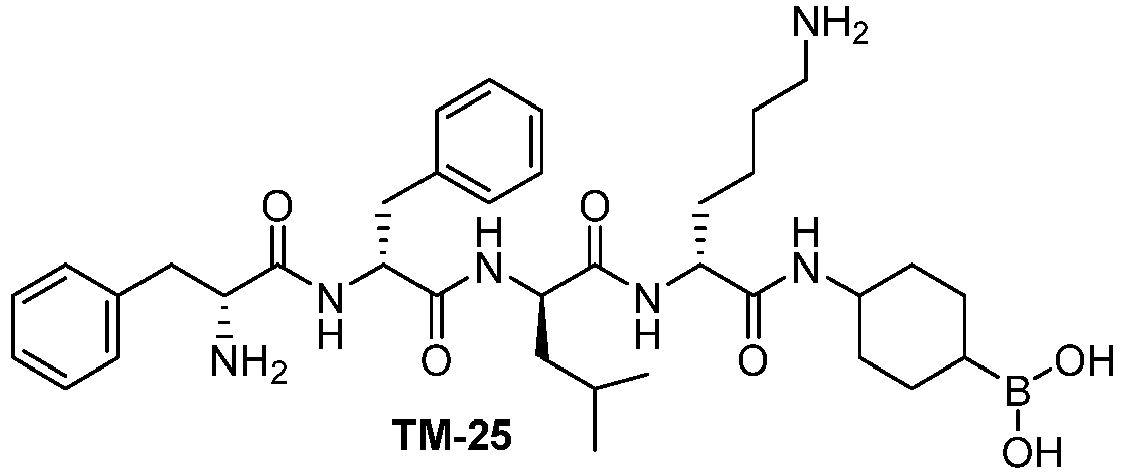


- The polypeptide compounds of the present invention are novel polypeptide derivatives containing boric acid structural fragments, wherein boron-containing compounds have delicate characteristics, which can reversibly interact with protein targets. Using polypeptide derivatives obtained by combining boric acid groups with polypeptides as a x-opioid receptor agonist drug has better analgesic activity.
- Described is a method for preparing the polypeptide compound, the method comprises the following steps:
- step 1: preparation of a tetrapeptide intermediate Int-1, wherein the preparation process is as follows:
- step 1-1: synthesis of intermediate Int-1-1: swelling 2-CTC Resin using DCM, and then removing solvent to obtain a swelled resin; adding a mixed solution of Fmoc-D-Lys(Boc)-OH and DIEA in DCM to the swelled resin, and performing a reaction at room temperature, and then adding methanol and DIEA to continue the reaction, removing solvent until dryness, and then washing the resulting mixture with DCM to obtain a resin;
- step 1-2: synthesis of intermediate Int-1-2: adding piperidine/DMF to the resin obtained in step 1-1, performing a reaction at room temperature, adding piperidine/DMF again, performing a reaction at room temperature, and then removing solvent until dryness, and washing the resulting mixture with DMF; adding Fmoc-D-Leu-OH, HOBT and HBTU respectively to DMF under ice bath conditions for activation, and then adding DIEA, and performing a reaction to obtain an activation solution; and finally adding the activation solution to the resin, and performing a reaction at room temperature, and treating the resin with 5% ninhydrin solution until the color didn't change;, removing solvent from the resin and washing with DMF, and removing solvent to obtain an intermediate Int-1-2;
- step 1-3: synthesis of intermediate Int-1-3: repeating step 1-2 using the intermediate Int-1-2 obtained in step 1-2;
- step 1-4: synthesis of intermediate Int-1-4: repeating step 1-2 using the intermediate Int-1-3 obtained in step 1-3;
- step 1-5: synthesis of intermediate Int-1-5: adding Int-1-4 to trifluoroethanol/DCM at room temperature, performing a reaction, and then preforming suction filtration, washing and concentration in sequence, and adding the concentrated solution dropwise to methyl tert-butyl ether with stirring and settling the mixture to obtain tetrapeptide intermediate Int-1;
- step 2: preparation of intermediate boric acid pinacol ester: removing a protective group of N-protected boric acid pinacol ester under acidic or alkaline conditions to obtain the boronic acid pinacol ester; wherein the N-protected boric acid pinacol ester can be purchased directly (such as Int-4, Int-5), or can be obtained by one-pot decarboxylated boronation reaction of the corresponding N-protected carboxylic acid (such as Int-2, Int-3);
- step 3: preparation of polypeptide compounds:
- step 3-1: stirring a solution of Int-1, HOBT, HBTU and DIEA in DCM at room temperature, then adding the boric acid pinacol ester prepared in step 2, and performing a reaction at room temperature, washing, drying, filtering and concentrating the reaction solution to obtain intermediate compound 1-1; and
- step 3-2: adding an acid (TFA or HCl solution) dropwise to a solution of the intermediate compound 1-1 in DCM, stirring at room temperature, concentrating and purifying the mixture to obtain a polypeptide compound.
- The boric acid pinacol ester includes Int-2, Int-3, Int-4, and Int-5, and other boric acid pinacol ester.
wherein the preparation methods of the other boronic acid pinacol esters are similar to those of Int-2, Int-3, Int-4 and Int-5. - The invention provides a compound prepared from the polypeptide compound selected from TM1-3, TM5, TM7-9, TM12-15, TM22, TM25-26 and TM31, wherein the compound includes stereoisomers, polymorphs, solvates, metabolites, prodrugs, or pharmaceutically acceptable salts or esters, or boronic acid polymers (cyclic or acyclic boric acid esters formed from intermolecular dimerization or trimerization) of the polypeptide compound.
- Pharmaceutically acceptable salts include inorganic or organic acid salts of basic residues of amines, and alkali metal salts or organic salts of acidic residues such as boric acid or carboxylic acid. Inorganic or organic acid salts of basic residues of amines include the following specific examples: a salt of an inorganic acid such as hydrochloride salt, hydrobromide salt, sulfate, hydrogensulfate, sulfamate, borate, carbonate, and hydrogencarbonate, phosphate, hexafluorophosphate and nitrate , and a salt of an organic acid such as formate, acetate, trifluoroacetate, propionate, succinate, adipate, glycolate, stearate, lactate, malate, tartrate, stearate, citrate, ascorbate, pamoate, hydrochloride, oxalate, maleate, hydroxymaleate, tartrate, phenylacetate, glutamate, camphorsulfonate, benzoate, salicylate, sulfamate, 2-acetoxybenzoate, fumarate, toluenesulfonate, methanesulfonate, ethanedisulfonate, oxalate, isethionate, aspartate, cyclohexanoate sulfonate, fumarate. Alkali metal salts or organic salts of acidic residues such as boric acid or carboxylic acid include the following specific examples: aluminum salt, potassium salt, calcium salt, magnesium salt, zinc salt, argininate, choline salt, diethylamine salt, ethanolamine salt, diethanolamine salt, glycinate, lysinate, meglumine salt and tromethamine salt and the like. These salts can be prepared by methods known in the art.
- The invention provides a pharmaceutical composition comprising the compound selected from TM1-3, TM5, TM7-9, TM12-15, TM22, TM25-26 and TM31 or the compound prepared from the polypeptide compound selected from TM1-3, TM5, TM7-9, TM12-15, TM22, TM25-26 and TM31.
- The invention provides the polypeptide compound selected from TM1-3, TM5, TM7-9, TM12-15, TM22, TM25-26 and TM31 for use in treating diseases associated with κ-opioid receptor, wherein the disease associated with κ-opioid receptor is selected from pain, inflammation, itching, edema, hyponatremia and hypopotassaemia.
- The pain is selected from neuropathic pain, somatic pain, visceral pain, skin pain, arthritis pain, nephrolith pain, hysterotrismus, dysmenorrhea, endometriosis, post-surgical pain, pain after medical treatment, headache, toothache, cervical pain, eye pain, otitis pain, chest pain, abdominal pain, low back and leg pain, gout, rheumatism, rheumatoid, cancer pain and pain associated with gastrointestinal dysfunction and the like.
- Compared with the prior art, the present invention has the following advantages and beneficial effects:
The polypeptide compounds of the present invention are novel polypeptide derivatives containing boric acid structural fragments, wherein boron-containing compounds have delicate characteristics, which can reversibly interact with protein targets. Using polypeptide derivatives obtained by combining boric acid groups with polypeptides as a x-opioid receptor agonist drug has better analgesic activity. - In order to make the objectives, technical solutions and advantages of the present invention clearer, the present invention will be further described in detail below in conjunction with examples.
-
- Step 3-1: A solution of Int-1 (0.545 g, 0.622 mmol), HOBT (0.201 g, 1.492 mmol), HBTU (0.566 g, 1.492 mmol), and DIEA (0.320 g, 2.488 mmol) in DCM (15 mL) were stirred at room temperature for 0.5 h, and then crude Int-4 was added. The mixture was reacted at room temperature for 2 h. The reaction solution was washed with saturated ammonium chloride solution, water and saturated brine, and dried over anhydrous sodium sulfate. After filtration and concentration, the crude product was purified by Prep-HPLC to obtain an intermediate compound 1-1;
- Step 3-2: TFA (1 mL) was added dropwise to a solution of 1-1 (500 mg) in DCM (2 mL), and the mixture was stirred at room temperature for 1 h. After concentrating and drying, the crude product was purified by Prep-HPLC to obtain a trifluoroacetate salt of polypeptide compound TM- 1.
- The mass spectrum and nuclear magnetic resonance characterization of the prepared TM-1 are as follows:
- ESI-MS (m/z): 665.4 (M+H+)
- 1H NMR (400 MHz, DMSO-d6+D2O): δ 7.28 - 7.21 (m, 10H), 4.70-4.59 (m, 2H), 4.42 - 4.36 (m, 1H), 4.18-4.11 (m, 1H), 3.98 (s, 1H), 3.13 - 2.87 (m, 4H), 2.86 - 2.59 (m, 4H), 1.74 - 1.09 (m, 14H), 1.00-0.91 (m, 1H), 0.89-0.84 (m, 6H).
- The preparation process of Int-1 is as follows:
- Step 1-1: Synthesis of Intermediate Int-1-1: 2-CTC Resin (degree of substitution was 0.993mmol/g, 2.000g) was swelled using DCM (20 mL) at room temperature for 15 min, and the solvent was removed. The mixed solution of Fmoc-D-Lys(Boc)-OH (1.120 g, 2.4 mmol) and DIEA (0.516 g, 4.0 mmol) in DCM (15 mL) was added to the swollen resin and the mixture was reacted at room temperature for 2 h; then methanol (2 mL) and DIEA (1 mL) were added to continue the reaction for 0.5 h. The solvent was removed until dryness and the resulting mixture was washed with DCM (30 mL) for three times, and finally washed with DMF (30 mL) for three times, and after that the resin was directly put into the next reaction;
- Step 1-2: Piperidine/DMF (V/V=1/4, 20 mL) was added to the product obtained in step 1-1, and the mixture was reacted for 10 min at room temperature, and then removed of solvent until dryness. Piperidine/DMF (V/V= 1/4, 20 mL) was added again, and the mixture was reacted for 10 min at room temperature, and then removed of solvent until dryness, and washed with DMF (30 mL) for 5 times. After the last washing, the pH of the waste liquid was tested to be neutral; Fmoc-D- Leu-OH (1.809 g, 4.0 mmol), HOBT (0.543 g, 4.0 mmol) and HBTU (1.521 g, 4.0 mmol) were added to DMF (20 mL) under ice bath conditions for activation for 10 min, and then DIEA (0.780 g, 6 mmol) was added and the mixture was reacted for 5 min. Finally, the activation solution was added to the resin and the mixture was reacted at room temperature for 2 h. The resin was treated with 5% ninhydrin solution (heated at 100°C for 10 min) and the color did not change. The solution was removed until dryness and washed with DMF (30 mL) for 5 times. After the last washing, the pH of the waste liquid was tested to be neutral. After removing solvent until dryness, the resulting mixture was directly used in the next reaction;
- Step 1-3: Piperidine/DMF (V/V=1/4, 20 mL) was added to the product obtained in step 1-2, and the mixture was reacted for 10 min at room temperature, and then removed of solvent until dryness. Piperidine/DMF (V/V= 1/4, 20 mL) was added again, and the mixture was reacted for 10 min at room temperature, and then removed of solvent until dryness, and washed with DMF (30 mL) for 5 times. After the last washing, the pH of the waste liquid was tested to be neutral; Fmoc-D- Phe-OH (1.547 g, 4.0 mmol), HOBT (0.543 g, 4.0 mmol) and HBTU (1.521 g, 4.0 mmol) were added to DMF (20 mL) under ice bath conditions for activation for 10 min, and then DIEA (0.780 g, 6 mmol) was added and the mixture was reacted for 5 min. Finally, the activation solution was added to the resin and the mixture was reacted at room temperature for 2 h. The resin was treated with 5% ninhydrin solution (heated at 100°C for 10 min) and the color did not change. The solution was removed until dryness and washed with DMF (30 mL) for 5 times. After the last washing, the pH of the waste liquid was tested to be neutral. After removing solvent until dryness, the resulting mixture was directly used in the next reaction;
- Step 1-4: Synthesis of Intermediate Int-1-4: Piperidine/DMF (V/V=1/4, 20 mL) was added to the product obtained in step 1-3, and the mixture was reacted for 10 min at room temperature, and then removed of solvent until dryness. Piperidine/DMF (V/V= 1/4, 20 mL) was added again, and the mixture was reacted for 10 min at room temperature, and then removed of solvent until dryness, and washed with DMF (30 mL) for 5 times. After the last washing, the pH of the waste liquid was tested to be neutral; Boc-D- Phe-OH (1.547 g, 4.0 mmol), HOBT (0.543 g, 4.0 mmol) and HBTU (1.521 g, 4.0 mmol) were added to DMF (20 mL) under ice bath conditions for activation for 10 min, and then DIEA (0.780 g, 6 mmol) was added and the mixture was reacted for 5 min. Finally, the activation solution was added to the resin and the mixture was reacted at room temperature for 2 h. The resin was treated with 5% ninhydrin solution (heated at 100°C for 10 min) and the color did not change.The solution was removed until dryness and washed with DMF (30 mL) for 5 times. After the last washing, the pH of the waste liquid was tested to be neutral. After removing solvent until dryness, the resulting mixture was directly used in the next reaction;
- Step 1-5: Int-1-4 (4.2 g) was added to trifluoroethanol/DCM (50 mL, V=/V=1/4) at room temperature, and the mixture was reacted for 2 h at room temperature. The resulting mixture was filtered with suction, and washed twice with DCM (30 mL), and the organic phase was concentrated to about 5 mL. The concentrated solution was added dropwise to 100 mL of methyl tert-butyl ether with stirring and the mixture was settled to obtain 2.10 g of product, which was detected by LCMS as target product Int-1. ESI-MS (m/z): 754.4 (M+H+)
- The preparation process of Int-4 is as follows:
- TFA (1 mL) was added dropwise to a solution of 1-N-tert-butoxycarbonylpiperidine-4-boronic acid pinacol ester (0.045 g, 1.1 eq) in DCM (2 mL), and the mixture was stirred at room temperature for 0.5 h. The mixture was concentrated to dryness under reduced pressure, and the obtained transparent oil was directly used for the next reaction.
- ESI-MS (m/z): 212.3 (M+H+)
- This example was based on example 1 except that:
The amount of Int-1 was 0.093 g; Int-4 was replaced with pyrrole-3-boronic acid pinacol ester; the synthesis of pyrrole-3-boronic acid pinacol ester was similar to Int-4, and was achieved by removing the protective group of N-tert-butoxycarbonyl-pyrrole-3-boronic acid pinacol ester under acidic conditions. The obtained crude product was purified by Prep-HPLC to obtain two isomers of the trifluoroacetate salt of the target compound TM-2, TM-2A (10.5 mg) and TM-2B (12.2 mg). The structures were identified as (R)-1-(D-Phe-D-Phe-D-Leu-D-Lys)-3-pyrrolidineboronic acid and (S)-1-(D-Phe-D-Phe-D-Leu-D-Lys)-3-pyrrolidineboronic acid, respectively. - The mass spectrum and nuclear magnetic resonance characterization of the prepared TM-2A were as follows:
- ESI-MS (m/z):651.4 (M+H+)
- 1H NMR (400 MHz, DMSO) : δ8.76-8.73(m, 1H), 8.38-8.16 (m, 2H), 8.02 (s, 3H), 7.70 (s, 3H), 7.39-7.13 (m, 10H), 4.69-4.64 (m, 1H), 4.52-4.43 (m, 2H), 4.02 (s, 1H), 3.44-3.25 (m,3H), 3.14-3.02 (m, 3H), 2.96-2.90 (m, 1H), 2.87-2.66 (m, 3H), 2.01-1.92 (m,1H), 1.71-1.29 (m,11H), 0.92-0.87 (m,6H).
- The mass spectrum and nuclear magnetic resonance characterization of the prepared TM-2B were as follows:
- ESI-MS (m/z):651.4 (M+H+)
- 1H NMR (400 MHz, DMSO) : δ8.76-8.70(m, 1H), 8.39-8.21 (m, 2H), 8.03 (s, 3H), 7.70 (s, 3H), 7.41-7.15 (m, 10H), 4.69-4.66 (m, 1H), 4.55-4.44 (m, 2H), 4.05 (s, 1H), 3.48-3.30 (m,3H), 3.18-3.02 (m, 3H), 3.01-2.90 (m, 1H), 2.92-2.71 (m, 3H), 2.03-1.97 (m,1H), 1.70-1.20 (m,11H), 0.90-0.85 (m,6H).
- This example was based on example 1 except that:
The amount of Int-1 was 0.090 g; Int-4 was replaced with 2,5-dihydro-1H-pyrrole-3-boronic acid pinacol ester; the synthesis of 2,5-dihydro-1H-pyrrole-3-boronic acid pinacol ester was similar to Int-4, and was achieved by removing the protective group of N-tert-butoxycarbonyl-2,5-dihydro-1H-pyrrole-3-boronic acid pinacol ester under acidic conditions. The obtained crude product was purified by Prep-HPLC to obtain 13.3 mg of the trifluoroacetate salt of the target compound TM-3. - The mass spectrum and nuclear magnetic resonance characterization of the prepared TM-3 were as follows:
- ESI-MS (m/z):649.4 (M+H+)
- 1H NMR (400 MHz, CD3OD):δ 7.44-7.12 (m, 10H), 6.58-6.34 (m, 1H), 4.77-4.52 (m, 3H), 4.48-4.25 (m, 4H), 4.11-4.06 (m, 1H), 3.28-3.18 (m, 1H), 3.06-2.89 (m, 4H), 1.88-1.80 (m, 1H), 1.79-1.38 (m, 8H), 1.02-0.91 (m, 6H).
- This example was based on example 1 except that:
The amount of Int-1 was 0.057 g; Int-4 was replaced with aminomethylphenylboronic acid pinacol ester. The amount of aminomethylphenylboronic acid pinacol ester was 18 mg. The obtained crude product was purified by Prep-HPLC to obtain 20.1 mg of the trifluoroacetate salt of the target compound TM-4. - The mass spectrum and nuclear magnetic resonance characterization of the prepared TM-4 were as follows:
- ESI-MS (m/z):687.4 (M+H+)
- 1H NMR (400 MHz, DMSO):δ 8.77-8.72(m,1H), 8.49-8.33 (m, 2H), 8.11-7.95 (m, 5H), 7.66 (d, J= 8.8 Hz, 4H), 7.40-7.06 (m, 12H), 4.69-4.64 (m, 1H), 4.49-4.35 (m, 1H), 4.34-4.23 (m, 3H), 4.01 (s, 1H), 3.19-3.03 (m, 2H), 2.98-2.87 (m, 1H), 2.86-2.69 (m, 3H), 1.78-1.45 (m, 7H), 1.36-1.25 (m, 2H), 0.97-0.74 (m, 6H).
- This example was based on example 1 except that:
The amount of Int-1 was 0.075 g; Int-4 was replaced with 3,6-dihydro-2H-pyridine-5-boronic acid pinacol ester; the synthesis of 3,6-dihydro-2H-pyridine-5-boronic acid pinacol ester was similar to Int-4, and was achieved by removing the protective group of N-tert-butoxycarbonyl-3,6-dihydro-2H-pyridine-5-boronic acid pinacol ester under acidic conditions. The obtained crude product was purified by Prep-HPLC to obtain 22.0 mg of the trifluoroacetate salt of the target compound TM-5. - The mass spectrum and nuclear magnetic resonance characterization of the prepared TM-5 were as follows:
- ESI-MS (m/z):663.4 (M+H+)
- 1H NMR (400 MHz, MeOD) : δ 7.52 - 7.15 (m, 10H), 6.59-6.40 (m, 1H), 4.79- 4.64 (m, 1H), 4.42 (dt, J = 10.2, 6.1 Hz, 1H), 4.30-3.94 (m, 3H), 3.85- 3.53 (m, 2H), 3.32-3.12 (m, 2H), 3.04-2.91 (m, 4H), 2.27 (s, 2H), 1.97 - 1.55 (m, 7H), 1.54 - 1.32 (m, 2H),1.00-0.95 (m, 6H).
- This example was based on example 1 except that:
The amount of Int-1 was 0.075 g; Int-4 was replaced with p-aminophenylboronic acid pinacol ester. The amount of p-aminophenylboronic acid pinacol ester was 22 mg. The obtained crude product was purified by Prep-HPLC to obtain 3.0 mg of the trifluoroacetate salt of the target compound TM-6. - The mass spectrum and nuclear magnetic resonance characterization of the prepared TM-6 were as follows:
- ESI-MS (m/z):755.4 (M+H+)
- 1H NMR (400 MHz, CD3OD) : δ 7.79 - 7.47 (m, 4H), 7.44 - 7.12 (m, 10H), 4.79 - 4.66 (m, 1H), 4.58 - 4.35 (m, 2H),4.09-4.06 (m, 1H), 3.05-2.90 (m, 4H), 2.09 -1.89 (m, 1H), 1.88-1.61 (m, 6H), 1.61-1.45 (m, 2H), 1.41-1.34 (m, 2H), 1.06- 0.92 (m, 6H).
- This example was based on example 1 except that:
The amount of Int-1 was 0.190 g; Int-4 was replaced with Int-2. The obtained crude product was purified by Prep-HPLC to obtain 33.0 mg of the trifluoroacetate salt of the target compound TM-7. - The mass spectrum and nuclear magnetic resonance characterization of the prepared TM-7 were as follows:
- ESI-MS (m/z): 705.4 (M+H+)
- 1H NMR (400 MHz, DMSO-d6) : δ 8.58 (dd, J = 160.0, 8.2 Hz, 1H), 8.18 - 7.84 (m, 3H), 7.69 (s, 2H), 7.43 - 7.14 (m, 10H), 4.83 - 4.40 (m, 2H), 4.40 - 4.20 (m, 1H), 4.19 - 3.66 (m, 2H), 3.18-3.03 (m, 3H), 2.96 - 2.60 (m, 5H), 1.87 - 1.58 (m, 6H), 1.57 - 1.41 (m, 6H), 1.41 - 1.22 (m, 10H),0.92-0.84 (m, 6H).
- The preparation process of Int-2 is as follows:
- Step 2-2-1: DIC (0.070 g, 0.55 mmol), DMAP (0.006, 0.05 mmol), N-hydroxyphthalimide (0.098 g, 0.6 mmol) were added to a solution of Int-2-1 (0.135 g, 0.5mmol) in DCM (15 mL) at room temperature and the mixture was stirred at room temperature for 2 h. The reaction solution was diluted with 20 mL DCM and respectively washed with 1N HCl and water twice. The organic phases were combined, dried over anhydrous sodium sulfate, filtered, and concentrated to obtain a white solid Int-2-2 (0.120 g), which was directly used in the next reaction. Int-2-1 was 7-(tert-butoxycarbonyl)-7-azaspiro[3.5]nonane-2-carboxylic acid;
- Step 2-2-2: Reaction flask A: Under the protection of nitrogen at 0°C, MeLi (1.6M, 1 mL) was slowly added to a solution of bis(pinacolato)diboron (0.420 g, 1.65 mmol) in anhydrous THF (7 mL). After addition, the mixture was continued to be stirred at 0°C for 0.5 h, and then at room temperature for 0.5 h.
- Reaction flask B: Int-2-2 (0.12 g) and magnesium bromide diethyl ether complex (0.129 g) were dissolved in anhydrous THF (3 mL) under nitrogen protection at 0°C, and then nickel chloride hexahydrate (0.012 g), 4,4'-dimethoxy-2,2'-bipyridine (0.014 g) and anhydrous THF (3 mL) were added with stirring for 0.5 h until the reaction system turned pale green.
- The solution in reaction flask A was one-time added to reaction flask B at 0°C, and the reaction system turns brown. The mixture was stirred at 0°C for 1 h, and then warmed to room temperature and stirred for 1 h. TLC was used to monitor the completion of the Int-2-2 reaction. The reaction mixture was added to 20 mL of saturated ammonium chloride solution, and the mixture was stirred for 10 min. 25 mL of ethyl acetate was added for extraction, and the aqueous phase was extracted with 15 mL of ethyl acetate; the combined organic phase was washed with saturated sodium chloride solution twice, dried over anhydrous sodium sulfate, filtered and concentrated to obtain 0.550 g crude product; the crude product was purified by column chromatography to obtain 0.11 g of transparent oily substance, ESI-MS (m/z): 352.3 (M+H+);
Step 2-2-3: Int-2-3 (0.11 g, 0.313 mmol) was added to DCM (4 mL), and then TFA (2 mL) was added. The mixture was stirred at room temperature for 0.5 h and then concentrated to dryness to obtain crude product oil (Int-2), which was directly used in the next reaction, ESI-MS (m/z): 252.3 (M+H+). - This example was based on example 1 except that:
The amount of Int-1 was 0.220 g; Int-4 was replaced with Int-3. The obtained crude product was purified by Prep-HPLC to obtain 6.5 mg of the trifluoroacetate salt of the target compound TM-8. - The mass spectrum and nuclear magnetic resonance characterization of the prepared TM-8 were as follows:
- ESI-MS(m/z): 680.4(M+H+)
- 1H NMR (400 MHz, DMSO-d6+D2O) : δ 7.41- 7.22 (m, 10H), 4.79 - 4.69 (m, 1H), 4.44-4.42 (m, 1H),4.11- 4.09 (m, 2H), 3.95 - 3.57 (m, 4H),2.99-2.92 (m, 4H), 2.20 - 2.00 (m, 2H), 1.85 - 1.33 (m, 13H),1.02-0.96 (m, , 6H).
- The preparation process of Int-3 is as follows:
- Step 2-3-1: DIC (0.3 g,1.1eq), DMAP (0.027 g,0.1eq), N-hydroxyphthalimide (0.42 g,1.2eq) were added to a solution of Int-3-1 (1.0g,1eq) in DCM (15 mL) at room temperature and the mixture was stirred at room temperature for 2 h. The reaction solution was diluted with 20 mL DCM and washed with 1N HCl and water twice, respectively. The organic phases were dried over anhydrous sodium sulfate, filtered, and concentrated to obtain a white solid Int-3-2 (1.29 g), which was directly used in the next reaction. Int-3-1 was 4-(tert-butoxycarbonylamino)-1-fluorenylmethoxycarbonylpiperidine-4-carboxylic acid; ESI-MS (m/z): 612.2 (M+H+).
- Step 2-3-2: Reaction flask A: Under the protection of nitrogen at 0°C, MeLi (1.6M, 4ml, 3eq) was slowly added to a solution of bis(pinacolato)diboron (1.798g, 3.3eq) in anhydrous THF (7 mL). After addition, the mixture was continued to be stirred at 0°C for 0.5 h, and then at room temperature for 0.5 h.
- Reaction flask B: Int-3-2 (1.29 g) and magnesium bromide diethyl ether complex (0.545g, 1eq) were dissolved in anhydrous THF (3 mL) under nitrogen protection at 0°C, and then nickel chloride hexahydrate (0.05g, 0.1eq), 4,4'-dimethoxy-2,2'-bipyridine (0.06g, 0.13eq) and anhydrous THF (7 mL) were added with stirring for 0.5 h until the reaction system turned pale green.
- The solution in reaction flask A was one-time added to reaction flask B at 0°C, and the reaction system turned brown. The mixture was stirred at 0°C for 1 h, and then warmed to room temperature and stirred for 1 h. TLC was used to monitor the completion of the Int-3-2 reaction. The reaction mixture was added to 50 mL of saturated ammonium chloride solution, and the mixture was stirred for 10 min. 25 mL of ethyl acetate was added for extraction, and the aqueous phase was extracted with 25 mL of ethyl acetate; the combined organic phase was washed with saturated sodium chloride solution twice, dried over anhydrous sodium sulfate, filtered and concentrated to obtain 3.00 g crude product; the crude product was purified by column chromatography to obtain 0.650g of transparent oily substance, (yield: 55%) ESI-MS (m/z):549.3 (M+H+)
- Step 2-3-3: Int-3-3 (0.08g, 0.146mmol) and methylamine methanol solution (4M, 4mL) were stirred at room temperature for 0.5h, and concentrated to dryness under reduced pressure. The crude product oil obtained was Int-3, which was directly used into the next reaction; ESI-MS (m/z): 327.2 (M+H+).
- This example was based on example 1 except that: Int-4 was replaced with pyrrole-2-boronic acid pinacol ester. The obtained crude product was purified by Prep-HPLC to obtain two isomers TM-9A (58.1 mg) and TM-9B (60.2 mg) of the trifluoroacetate salt of the target compound TM-9. The structures were identified as (R)-1-(D-Phe-D-Phe-D-Leu-D-Lys)-2-pyrrolidineboronic acid and (S)-1-(D-Phe-D-Phe-D-Leu-D-Lys)-2-pyrrolidineboronic acid.
- The mass spectrum and nuclear magnetic resonance characterization of the prepared TM-9A were as follows:
- ESI-MS(m/z):651.5(M+H+)
- 1H NMR (400 MHz, DMSO) : δ 8.87-8.75(m, 1H), 8.39-8.16 (m, 2H), 8.05 (s, 3H), 7.72 (s, 3H), 7.41-7.13 (m, 10H), 4.68-4.65 (m, 2H), 4.52-4.40 (m, 1H), 4.08-4.02 (m, 1H), 3.74-3.55 (m,2H), 3.34-3.22 (m, 2H), 3.06-2.80 (m, 5H), 2.25-1.26 (m, 7H), 0.92-0.87 (m,6H).
- The mass spectrum and nuclear magnetic resonance characterization of the prepared TM-9B were as follows:
- ESI-MS(m/z):651.5(M+H+)
- 1H NMR (400 MHz, DMSO) : δ 8.88-8.75(m, 1H), 8.42-8.16 (m, 2H), 8.05 (s, 3H), 7.75 (s, 3H), 7.4--7.10 (m, 10H), 4.69-4.64 (m, 2H), 4.50-4.41 (m, 1H), 4.09-4.03 (m, 1H), 3.75-3.55 (m,2H), 3.38-3.22 (m, 2H), 3.09-2.80 (m, 5H), 2.20-1.20 (m, 7H), 0.93-0.89 (m,6H).
- Anhydrous magnesium sulfate (10 eq) and pinacol (5 eq) were added to a solution of TM-2A (20 mg) or TM-2B (20 mg) in THF, and the mixture was stirred overnight at room temperature. After filtration and concentration, the crude product was purified by Prep-HPLC to obtain two isomers of the target compound, TM-10A (5.1 mg) and TM-10B (5.7 mg). The structures were identified as (R)-1-(D)-Phe-D-Phe-D-Leu-D-Lys)-3-pyrrolidine borate pinacol ester and (S)-1-(D-Phe-D-Phe-D-Leu-D-Lys)-3-pyrrolidine borate pinacol ester, respectively.
- The mass spectrum and nuclear magnetic resonance characterization of the prepared TM-10A were as follows:
- ESI-MS (m/z):733.5 (M+H+)
- 1H NMR (400 MHz, DMSO) : δ8.76-8.73(m, 1H), 8.38-8.16 (m, 2H), 8.02 (s, 3H), 7.70 (s, 3H), 7.39-7.13 (m, 10H), 4.69-4.64 (m, 1H), 4.52-4.43 (m, 2H), 4.02 (s, 1H), 3.44-3.25 (m,3H), 3.14-3.02 (m, 3H), 2.96-2.90 (m, 1H), 2.87-2.66 (m, 3H), 2.01-1.92 (m,1H), 1.71-1.29 (m,11H), 1.20 (s, 12H), 0.92-0.87 (m,6H).
- The mass spectrum and nuclear magnetic resonance characterization of the prepared TM-10B were as follows:
- ESI-MS (m/z):733.5(M+H+)
- 1H NMR (400 MHz, DMSO) : δ8.76-8.70(m, 1H), 8.39-8.21 (m, 2H), 8.03 (s, 3H), 7.70 (s, 3H), 7.41-7.15 (m, 10H), 4.69-4.66 (m, 1H), 4.55-4.44 (m, 2H), 4.05 (s, 1H), 3.48-3.30 (m,3H), 3.18-3.02 (m, 3H), 3.01-2.90 (m, 1H), 2.92-2.71 (m, 3H), 2.03-1.97 (m,1H), 1.70-1.20 (m,11H), 1.20 (s, 12H), 0.90-0.85 (m,6H).
- The method in this example was similar to that of example 10 except that pinacol was replaced with citric acid. After purified by Prep-HPLC, two isomers of the target compound, TM-11A (7.2 mg) and TM-11B (9.1 mg), were obtained, and their structures were identified as (R)-1-(D-Phe-D-Phe-D-Leu-D-Lys)-3-pyrrolidineboronic acid citrate and (S)-1-(D-Phe-D-Phe-D-Leu-D-Lys)-3-pyrrolidineboronic acid citrate, respectively.
- The mass spectrum and nuclear magnetic resonance characterization of the prepared TM-11A were as follows:
- ESI-MS(m/z):807.5(M+H+)
- 1H NMR (400 MHz, DMSO) : δ 13.5 (s, 2H), 8.76-8.73(m, 1H), 8.38-8.16 (m, 2H), 8.02 (s, 2H), 7.70 (s, 2H), 7.39-7.13 (m, 10H), 4.69-4.64 (m, 1H), 4.52-4.43 (m, 2H), 4.02 (s, 1H), 3.44-3.25 (m,3H), 3.14-3.02 (m, 3H), 2.96-2.90 (m, 1H), 2.87-2.66 (m, 3H), 2.61 (s, 4H), 2.01-1.92 (m,1H), 1.71-1.29 (m,11H), 1.20 (s, 12H), 0.92-0.87 (m,6H).
- The mass spectrum and nuclear magnetic resonance characterization of the prepared TM-11B were as follows:
- ESI-MS(m/z):807.5(M+H+)
- 1H NMR (400 MHz, DMSO) : δ 13.5 (s, 2H), 8.76-8.70(m, 1H), 8.39-8.21 (m, 2H), 8.03 (s, 2H), 7.70 (s, 2H), 7.41-7.15 (m, 10H), 4.69-4.66 (m, 1H), 4.55-4.44 (m, 2H), 4.05 (s, 1H), 3.48-3.30 (m,3H), 3.18-3.02 (m, 3H), 3.01-2.90 (m, 1H), 2.92-2.71 (m, 3H), 2.61 (s, 4H), 2.03-1.97 (m,1H), 1.70-1.20 (m,11H), 1.20 (s, 12H), 0.90-0.85 (m,6H).
- This example was based on example 1 except that: Int-4 was replaced with piperidine-3-boronic acid pinacol ester. The obtained crude product was purified by Prep-HPLC to obtain two isomers TM-12A (15.1 mg) and TM-12B (20.2 mg) of the trifluoroacetate salt of the target compound TM-12. The structures were identified as (R)-1-(D-Phe-D-Phe-D-Leu-D-Lys)-3-piperidine boronic acid and (S)-1-(D-Phe-D-Phe-D-Leu-D-Lys)-3-piperidine boronic acid, respectively.
- The mass spectrum and nuclear magnetic resonance characterization of the prepared TM-12A were as follows:
- ESI-MS(m/z): 665.4(M+H+)
- 1H NMR (400 MHz, DMSO-d6+D2O) : δ 7.28-7.21 (m, 10H), 4.71-4.59 (m, 2H), 4.45-4.40 (m, 1H), 4.18-4.10 (m, 1H), 4.01-3.90 (m, 1H), 3.13-2.87 (m, 4H), 2.86-2.59 (m, 4H), 1.74-1.11 (m, 13H), 1.02-0.90 (m, 1H), 0.90-0.84 (m, 6H).
- The mass spectrum and nuclear magnetic resonance characterization of the prepared TM-12B were as follows:
- ESI-MS(m/z): 665.4(M+H+)
- 1H NMR (400 MHz, DMSO-d6+D2O) : δ 7.33-7.25 (m, 10H), 4.72-4.59 (m, 2H), 4.43-4.36 (m, 1H), 4.19-4.13 (m, 1H), 4.11-3.92 (s, 1H), 3.12-2.87 (m, 4H), 2.80-2.51 (m, 4H), 1.70-1.03 (m, 13H), 1.05-0.90 (m, 1H), 0.88-0.84 (m, 6H).
- This example was based on example 1 except that: Int-4 was replaced with piperidine-2-boronic acid pinacol ester. The obtained crude product was purified by Prep-HPLC to obtain two isomers TM-13A (12.2 mg) and TM-13B (10.0 mg) of the trifluoroacetate salt of the target compound TM-13. The structures were identified as (R)-1-(D-Phe-D-Phe-D-Leu-D-Lys)-2-piperidine boronic acid and (S)-1-(D-Phe-D-Phe-D-Leu-D-Lys)-2-piperidine boronic acid, respectively.
- The mass spectrum and nuclear magnetic resonance characterization of the prepared TM-13A were as follows:
- ESI-MS (m/z): 665.4 (M+H+)
- 1H NMR (400 MHz, DMSO-d6+D2O) : δ 7.32-7.20 (m, 10H), 4.70-4.58 (m, 2H), 4.48-4.42 (m, 1H), 4.18-4.07 (m, 1H), 4.00-3.92 (m, 1H), 3.13-2.83 (m, 4H), 2.89-2.61 (m, 4H), 1.77-1.13 (m, 13H), 1.00-0.81 (m, 1H), 0.90-0.84 (m, 6H).
- The mass spectrum and nuclear magnetic resonance characterization of the prepared TM-13B were as follows:
- ESI-MS (m/z): 665.4 (M+H+)
- 1H NMR (400 MHz, DMSO-d6+D2O) : δ 7.30-7.20 (m, 10H), 4.72-4.58 (m, 2H), 4.44-4.42 (m, 1H), 4.16-4.05 (m, 1H), 4.01-3.93 (m, 1H), 3.15-2.83 (m, 4H), 2.92-2.60 (m, 4H), 1.78-1.15 (m, 13H), 1.05-0.80 (m, 1H), 0.97-0.85 (m, 6H).
- This example was based on example 1 except that: Int-4 was replaced with 1-tert-butoxycarbonyl-3,6-dihydro-2H-pyridine-5-boronic acid pinacol ester. The obtained crude product was purified by Prep-HPLC to obtain 15.0 mg of trifluoroacetate salt of the target compound TM-14.
- The mass spectrum and nuclear magnetic resonance characterization of the prepared TM-14 were as follows:
- ESI-MS(m/z):663.4(M+H+)
- 1H NMR (400 MHz, d6-DMSO) : δ 8.77 - 8.70 (m, 1H), 8.38-8.29 (m, 1H), 8.20-8.00 (m, 3H), 7.75-7.50 (brs, 4H), 7.25-7.06 (m, 10H), 6.30-6.28 (m, 1H), 4.79- 4.60 (m, 2H), 4.47-4.31 (m, 1H), 4.150-3.90 (m, 3H), 3.85- 3.53 (m, 2H), 3.22-3.01 (m, 3H), 2.84-2.71 (m, 3H), 2.27-2.15 (m, 2H), 1.67 - 1.35 (m, 7H), 1.34 - 1.22 (m, 3H), 0.90-0.77 (m, 6H).
- This example was based on example 1 except that: Int-4 was replaced with tert-butyl 4-[(4,4,5,5-tetramethyl-1,3,2-dioxaborolan-2-yl)methylene]piperidine-1-carboxylate. The obtained crude product was purified by Prep-HPLC to obtain 22.6 mg of the trifluoroacetate salt of the target compound TM-15.
- The mass spectrum and nuclear magnetic resonance characterization of the prepared TM-15 were as follows:
- ESI-MS(m/z):677.4(M+H+)
- 1H NMR (400 MHz, CD3OD) : δ 7.40 - 7.20 (m, 10H), 5.38-5.29 (m, 1H), 4.70-4.60 (m, 1H), 4.15-4.00 (m, 1H), 3.85-3.66 (m, 2H), 3.50-3.28 (m, 3H), 3.25- 3.10 (m, 2H), 3.00-2.81 (m, 4H), 2.75-2.25 (m, 4H), 1.90-1.70 (m, 1H), 1.70- 1.63 (m, 6H), 1.52-1.31 (m, 2H), 1.30-1.21 (m, 1H), 0.99-0.82 (m, 6H).
- The method in this example was similar to that of example 10 except that TM-2A or TM-2B was replaced with TM-12. After filtration and concentration, the crude product was purified by Prep-HPLC to obtain two isomers, TM-16A (8.1 mg) and TM-16B (12.2 mg), respectively. The structures were identified as (R)-1-(D-Phe- D-Phe-D-Leu-D-Lys)-3-piperidine boronic acid pinacol ester and (S)-1-(D-Phe-D-Phe-D-Leu-D-Lys)-3-piperidine boronic acid pinacol ester, respectively.
- The mass spectrum and nuclear magnetic resonance characterization of the prepared TM-16A were as follows:
- ESI-MS(m/z): 747.4(M+H+)
- 1H NMR (400 MHz, DMSO-d6+D2O) : δ 7.29-7.21 (m, 10H), 4.71-4.58 (m, 2H), 4.46-4.40 (m, 1H), 4.18-4.12 (m, 1H), 4.01-3.93 (m, 1H), 3.13-2.88 (m, 4H), 2.86-2.61 (m, 4H), 1.77-1.11 (m, 13H), 1.22 (s, 12H), 1.02-0.88 (m, 1H), 0.90-0.84 (m, 6H).
- The mass spectrum and nuclear magnetic resonance characterization of the prepared TM-16B were as follows:
- ESI-MS(m/z): 747.4(M+H+)
- 1H NMR (400 MHz, DMSO-d6+D2O) : δ 7.35-7.25 (m, 10H), 4.72-4.59 (m, 2H), 4.43-4.36 (m, 1H), 4.19-4.13 (m, 1H), 4.11-3.92 (s, 1H), 3.13-2.87 (m, 4H), 2.83-2.51 (m, 4H), 1.75-1.03 (m, 13H), 1.21 (s, 12H), 1.05-0.90 (m, 1H), 0.88-0.84 (m, 6H).
- The synthesis method of this example made reference to example 10. After filtration and concentration, the crude product was purified by Prep-HPLC to obtain the target product TM-17 (8.1 mg).
- The mass spectrum and nuclear magnetic resonance characterization of the prepared TM-17 were as follows:
- ESI-MS (m/z):745.5 (M+H+)
- 1H NMR (400 MHz, d6-DMSO) : δ 8.78 - 8.60 (m, 1H), 8.48-8.29 (m, 1H), 8.20-8.00 (m, 3H), 7.75-7.52 (brs, 4H), 7.28-7.07 (m, 10H), 6.32-6.28 (m, 1H), 4.82- 4.61 (m, 2H), 4.48-4.32 (m, 1H), 4.150-3.92 (m, 3H), 3.86- 3.56 (m, 2H), 3.23-3.02 (m, 3H), 2.84-2.75 (m, 3H), 2.32-2.17 (m, 2H), 1.69 - 1.36 (m, 7H), 1.35 - 1.22 (m, 3H), 0.92-0.78 (m, 6H).
- This example was based on example 5 except that: Int-2-1 was replaced with 1-(tert-butoxycarbonyl)azetidine-3-carboxylic acid. The obtained crude product was purified by Prep-HPLC to obtain 12.1 mg of the trifluoroacetate salt of the target compound TM-18.
- The mass spectrum and nuclear magnetic resonance characterization of the prepared TM-18 were as follows:
- ESI-MS(m/z):637.5(M+H+)
- 1H NMR (400 MHz, DMSO-d6) : δ 8.58 (m, 3H), 8.18 - 7.86 (m, 3H), 7.72 (s, 3H), 7.53 - 7.16 (m, 10H), 4.86 - 4.41 (m, 2H), 4.42 - 4.25 (m, 1H), 4.21 - 3.76 (m, 2H), 3.28-3.05 (m, 3H), 2.92 - 2.62 (m, 5H), 1.89 - 1.68 (m, 6H), 1.52 - 1.40 (m, 6H), 1.40 - 1.20 (m, 10H),0.91-0.7 (m, 6H).
- The synthesis method of this example made reference to example 2 except that the protective amino acid reagent N-tert-butoxycarbonyl-D-phenylalanine in the synthesis of the corresponding polypeptide intermediate was replaced with (S)-2-benzyl-3-N-tert-butoxycarbonylaminopropionic acid. The obtained crude product was purified by Prep-HPLC to obtain the two isomers of trifluoroacetate salt of the target compound TM-19, TM-19A (9.5 mg) and TM-19B (8.0 mg). The structures were identified as (R)-1-((S-2-benzylaminopropionic acid)-D-Phe-D-Leu-D-Lys)-3-pyrrolidineboronic acid and (S)-1-((S-2-benzylaminopropionic acid)-D-Phe-D-Leu-D-Lys)-3-pyrrolidineboronic acid, respectively.
- The mass spectrum and nuclear magnetic resonance characterization of the prepared TM-19A were as follows:
- ESI-MS(m/z):665.5(M+H+)
- 1H NMR (400 MHz, DMSO) : δ 8.86-8.73(m, 1H), 8.48-8.20 (m, 2H), 8.05 (brs, 3H), 7.80 (s, 3H), 7.38-7.10 (m, 10H), 4.52-4.43 (m, 2H), 4.02 (s, 1H), 3.66-3.60 (m, 2H), 3.44-3.25 (m,3H), 3.14-3.02 (m, 3H), 2.97-2.90 (m, 1H), 2.88-2.66 (m, 3H), 2.77-2.73 (m, 1H), 2.05-1.92 (m,1H), 1.70-1.28 (m,11H), 0.92-0.89 (m,6H).
- The mass spectrum and nuclear magnetic resonance characterization of the prepared TM-19B were as follows:
- ESI-MS (m/z) :665.5 (M+H+)
- 1H NMR (400 MHz, DMSO) : δ 8.86-8.76 (m, 1H), 8.49-8.20 (m, 2H), 8.10 (brs, 3H), 7.90 (s, 3H), 7.45-7.01 (m, 10H), 4.53-4.42 (m, 2H), 4.05 (s, 1H), 3.69-3.60 (m, 2H), 3.47-3.25 (m,3H), 3.11-3.00 (m, 3H), 2.92-2.84 (m, 1H), 2.84-2.66 (m, 3H), 2.79-2.73 (m, 1H), 2.01-1.92 (m,1H), 1.73-1.29 (m,11H), 0.91-0.89 (m,6H).
- The synthesis method of this example made reference to example 2 except that the protective amino acid reagent N-tert-butoxycarbonyl-D-phenylalanine in the synthesis of the corresponding polypeptide intermediate was replaced with (R)-N-tert-butoxycarbonyl-N-(2-phenylpropyl)alanine. The obtained crude product was purified by Prep-HPLC to obtain the two isomers of trifluoroacetate salt of the target compound TM-20, TM-20A (21.2 mg) and TM-20B (15.0 mg). The structures were identified as (R)-1-((R-2-phenylpropyl-Gly)-D-Phe-D-Leu-D-Lys)-3-pyrrolidineboronic acid and (S)-1-((R-2-phenylpropyl-Gly)-D-Phe-D-Leu-D-Lys)-3-pyrrolidineboronic acid.
- The mass spectrum and nuclear magnetic resonance characterization of the prepared TM-20A were as follows:
- ESI-MS(m/z):679.4(M+H+)
- 1H NMR (400 MHz, DMSO) : δ 8.86-8.73(m, 1H), 8.48-8.20 (m, 2H), 8.05 (brs, 3H), 7.80 (s, 3H), 7.38-7.10 (m, 10H), 4.52-4.43 (m, 2H), 4.38-4.16 (m, 2H), 4.02 (s, 1H), 3.66-3.60 (m, 2H), 3.44-3.25 (m,3H), 3.14-3.02 (m, 3H), 2.97-2.80 (m, 3H), 2.88-2.66 (m, 1H), 2.77-2.73 (m, 1H), 2.05-1.92 (m,1H), 1.70-1.28 (m,14H), 0.92-0.89 (m,6H).
- The mass spectrum and nuclear magnetic resonance characterization of the prepared TM-20B were as follows:
- ESI-MS (m/z):679.4 (M+H+)
- 1H NMR (400 MHz, DMSO) : δ 9.06-8.80(m, 1H), 8.58-8.30 (m, 2H), 8.00 (brs, 3H), 7.90 (brs, 3H), 7.48-7.20 (m, 10H), 4.50-4.45 (m, 2H), 4.39-4.26 (m, 2H), 4.05 (s, 1H), 3.68-3.60 (m, 2H), 3.49-3.22 (m,3H), 3.17-3.02 (m, 3H), 2.99-2.83 (m, 3H), 2.88-2.60 (m, 1H), 2.81-2.72 (m, 1H), 2.01-1.90 (m,1H), 1.75-1.28 (m,14H), 0.96-0.89 (m,6H).
- The synthesis method of this example made reference to example 2 except that the protective amino acid reagent N-fluorenylmethyloxycarbonyl-D-leucine in the synthesis of the corresponding polypeptide intermediate was replaced with N-fluorenylmethyloxycarbonyl-D-norleucine. The obtained crude product was purified by Prep-HPLC to obtain the two isomers of trifluoroacetate salt of the target compound TM-21, TM-21A (7.2 mg) and TM-21B (8.5 mg). The structures were identified as (R)-1-(D-Phe-D-Phe-D-Nle-D-Lys)-3-pyrrolidineboronic acid and (S)-1-(D-Phe-D-Phe-D-Nle-D- Lys )-3-pyrrolidineboronic acid, respectively.
- The mass spectrum and nuclear magnetic resonance characterization of the prepared TM-21A were as follows:
- ESI-MS (m/z):651.4 (M+H+)
- 1H NMR (400 MHz, DMSO) : δ 8.86-8.75(m, 1H), 8.39-8.12 (m, 2H), 8.00 (s, 3H), 7.87 (s, 3H), 7.41-7.13 (m, 10H), 4.72-4.62 (m, 1H), 4.55-4.41 (m, 2H), 4.03 (s, 1H), 3.48-3.22 (m,3H), 3.19-3.00 (m, 3H), 2.91-2.83 (m, 1H), 2.88-2.67 (m, 3H), 2.00-1.92 (m,1H), 1.71-1.20 (m,14H), 0.90-0.89 (m,3H).
- The mass spectrum and nuclear magnetic resonance characterization of the prepared TM-21B were as follows:
- ESI-MS(m/z):651.4(M+H+)
- 1H NMR (400 MHz, DMSO) : δ 8.86-8.76(m, 1H), 8.34-8.10 (m, 2H), 8.01 (s, 3H), 7.88 (s, 3H), 7.42-7.10 (m, 10H), 4.73-4.62 (m, 1H), 4.56-4.40 (m, 2H), 4.02 (s, 1H), 3.49-3.22 (m,3H), 3.23-3.00 (m, 3H), 2.95-2.82 (m, 1H), 2.89-2.61 (m, 3H), 2.01-1.90 (m,1H), 1.72-1.17 (m,14H), 0.93-0.86 (m,3H).
- The synthesis method of this example made reference to example 2 except that the protective amino acid reagent Fmoc-D-lysine in the synthesis of the corresponding polypeptide intermediate was replaced with N2-(9-fluorenylmethoxycarbonyl)-N6-butoxycarbonyl-N6-(2-(2-methoxyethoxy)ethyl)-D-lysine (referring to patent
WO2018059331 ). The obtained crude product was purified by Prep-HPLC to obtain the two enantiomers of trifluoroacetate salt of the target compound TM-22, TM-22A (13.9 mg) and TM-22B (17.1 mg). The structures were identified as (R)-1-(N2-D-Phe-D-Phe-D-Leu-N6-(2-(2-methoxyethoxy)ethyl)-D-Lys)-3-pyrrolidineboronic acid and (S)-1-(N2-D-Phe-D-Phe-D-Leu-N6-(2-(2-methoxyethoxy)ethyl)-D-Lys)-3-pyrrolidineboronic acid, respectively. - The mass spectrum and nuclear magnetic resonance characterization of the prepared TM-22A were as follows:
- ESI-MS(m/z):753.5(M+H+)
- 1H NMR (400 MHz, DMSO) : δ 8.77-8.74(m, 1H), 8.39-8.16 (m, 2H), 8.03 (brs, 2H), 7.72 (brs, 3H), 7.43-7.13 (m, 10H), 4.67-4.66 (m, 1H), 4.52-4.40 (m, 2H), 4.02 (s, 1H), 3.58-3.35 (m,9H), 3.30 (s, 3H), 3.14-3.02 (m, 3H), 2.96-2.90 (m, 1H), 2.88-2.66 (m, 5H), 2.01-1.92 (m,1H), 1.71-1.29 (m,11H), 0.92-0.87 (m,6H).
- The mass spectrum and nuclear magnetic resonance characterization of the prepared TM-22B were as follows:
- ESI-MS(m/z) :753.5(M+H+)
- 1H NMR (400 MHz, DMSO) : δ 8.81-8.75(m, 1H), 8.38-8.13 (m, 2H), 8.05 (brs, 2H), 7.70 (brs, 3H), 7.49-7.12 (m, 10H), 4.63-4.61 (m, 1H), 4.57-4.41 (m, 2H), 4.03 (s, 1H), 3.50-3.30 (m,9H), 3.28 (s, 3H), 3.15-3.02 (m, 3H), 2.94-2.90 (m, 1H), 2.85-2.66 (m, 5H), 2.04-1.92 (m,1H), 1.71-1.29 (m,11H), 0.92-0.88 (m,6H).
- This example was based on example 1 except that: Int-4 was replaced with 1H-indazole-5-boronic acid pinacol ester. The obtained crude product was purified by Prep-HPLC to obtain 10.5 mg of the trifluoroacetate salt of the target compound TM-23.
- The mass spectrum and nuclear magnetic resonance characterization of the prepared TM-23 were as follows:
- ESI-MS (m/z):698.4 (M+H+)
- 1H NMR (400 MHz, DMSO):δ 8.70-8.42 (m,2H), 8.19-8.02 (m, 1H), 7.65 (m, 1H), 7.44-7.03 (m, 12H), 4.68-4.60 (m, 1H), 4.53-4.35 (m, 1H), 4.37-4.23 (m, 3H), 4.05 (s, 1H), 3.18-3.06 (m, 2H), 2.97-2.83 (m, 1H), 2.80-2.60 (m, 3H), 1.79-1.43 (m, 7H), 1.34-1.22 (m, 2H), 0.98-0.74 (m, 6H).
- This example was based on example 5 except that: Int-2-1 was replaced with (1S,4R)-7-(tert-butoxycarbonyl)-7-azabicyclo[2.2.1]heptane-2-carboxylic acid. The obtained crude product was purified by Prep-HPLC to obtain 17.7 mg of the trifluoroacetate salt of the target compound TM-24.
- The mass spectrum and nuclear magnetic resonance characterization of the prepared TM-24 were as follows:
- ESI-MS (m/z):677.5 (M+H+)
- 1H NMR (400 MHz, DMSO-d6) : δ 8.59 (m, 3H), 8.17 - 7.80 (m, 3H), 7.71 (s, 3H), 7.55 - 7.16 (m, 10H), 4.82 - 4.40 (m, 1H), 4.49 - 4.24 (m, 1H), 4.20 - 3.76 (m, 3H), 3.20-3.05 (m, 3H), 2.92 - 2.61 (m, 5H), 1.95 - 1.69 (m, 8H), 1.50- 1.40 (m, 8H), 1.42 - 1.20 (m, 10H),0.93-0.71 (m, 6H).
- This example was based on example 1 except that: Int-4 was replaced with 1-amino-4-cyclohexylboronic acid pinacol ester. The obtained crude product was purified by Prep-HPLC to obtain 11.2 mg of the trifluoroacetate salt of the target compound TM-25.
- The mass spectrum and nuclear magnetic resonance characterization of the prepared TM-25 were as follows:
- ESI-MS(m/z):679.4(M+H+)
- 1H NMR (400 MHz, DMSO-d6+D2O) : δ 7.29-7.20 (m, 10H), 4.74-4.58 (m, 2H), 4.45-4.33 (m, 1H), 4.18-4.10 (m, 1H), 3.95 (s, 1H), 3.16-2.86 (m, 1H), 2.86-2.59 (m, 4H), 1.75-1.12 (m, 18H), 1.00-0.90 (m, 1H), 0.90-0.84 (m, 6H).
- This example was based on example 1 except that: Int-4 was replaced with 2-aminoethylboronic acid pinacol ester. The obtained crude product was purified by Prep-HPLC to obtain 11.2 mg of the trifluoroacetate salt of the target compound TM-26.
- ESI-MS (m/z):607.4 (M-18+H+)
- 1H NMR (400 MHz, DMSO) δ 8.79 - 8.75 (m, 1H), 8.40 - 8.38 (m, 1H), 8.03 (s, 3H), 7.852- 7.73 (m, 4H), 7.61 (s, 2H), 7.32 - 7.20 (m, 10H), 4.69 - 4.63 (m, 1H), 4.39 - 4.32 (m, 1H), 4.20 - 4.18 (m, 1H), 4.01 (s, 1H), 3.18 - 3.01 (m, 4H), 2.95 - 2.90 (m, 1H), 2.86 - 2.70 (m, 3H), 1.71 - 1.58 (m, 2H), 1.56 - 1.43 (m, 5H), 1.31 - 1.25 (m, 2H), 0.99 - 0.87 (m, 6H), 0.84 - 0.79 (m, 2H).
- This example was based on example 1 except that: Int-4 was replaced with 3-azabicyclo[3.1.0]hexyl-1-boronic acid pinacol ester (the synthesis of this fragment made reference to Org. Lett . 2017, 19, 9, 2450-2453). The obtained crude product was purified by Prep-HPLC to obtain trifluoroacetate salt of two isomers TM-27A (6.1 mg) and TM-27B (5.0 mg) of the target compound TM-13. The structures were identified as ((R)-1-(D-Phe-D-Phe-D-Leu-D-Lys)-3-azabicyclo[3.1.0]hexylboronic acid and ((S)-1-(D-Phe-D- Phe-D-Leu-D-Lys)-3-azabicyclo[3.1.0]hexylboronic acid, respectively.
- The mass spectrum and nuclear magnetic resonance characterization of the prepared TM-27A were as follows:
- ESI-MS (m/z):663.4 (M+H+)
- 1H NMR (400 MHz, DMSO) : δ 8.73-8.75 (m, 1H), 8.39-8.12 (m, 2H), 8.02 (s, 3H), 7.76 (s, 3H), 7.38-7.13 (m, 10H), 4.66-4.60 (m, 1H), 4.52-4.41 (m, 2H), 4.04 (s, 1H), 3.41-3.25 (m,3H), 3.14-3.00 (m, 3H), 2.98-2.90 (m, 1H), 2.82-2.60 (m, 3H), 2.00-1.92 (m,1H), 1.70-1.29 (m,12H), 0.91-0.85 (m,6H).
- The mass spectrum and nuclear magnetic resonance characterization of the prepared TM-27B were as follows:
- ESI-MS (m/z):663.4 (M+H+)
- 1H NMR (400 MHz, DMSO) : δ 8.81-8.72 (m, 1H), 8.38-8.10 (m, 2H), 8.00(s, 3H), 7.79 (s, 3H), 7.39-7.12 (m, 10H), 4.66-4.61 (m, 1H), 4.52-4.43 (m, 2H), 4.05 (s, 1H), 3.42-3.22 (m,3H), 3.14-3.01 (m, 3H), 3.01-2.90 (m, 1H), 2.85-2.60 (m, 3H), 2.03-1.91 (m,1H), 1.77-1.29 (m,12H), 0.91-0.86 (m,6H).
- This example was based on example 5 except that: Int-2-1 was replaced with 1-tert-butyloxycarbonyl-4-methyl-4-piperidinecarboxylic acid. The obtained crude product was purified by Prep-HPLC to obtain 23.1 mg of the trifluoroacetate salt of the target compound TM-28.
- The mass spectrum and nuclear magnetic resonance characterization of the prepared TM-28 were as follows:
- ESI-MS(m/z):679.5(M+H+)
- 1H NMR (400 MHz, DMSO-d6+D2O) : δ 7.31-7.20 (m, 10H), 4.75-4.59 (m, 2H), 4.46-4.36 (m, 1H), 4.18-4.11 (m, 1H), 3.98 (s, 1H), 3.13-2.87 (m, 4H), 2.86-2.59 (m, 4H), 1.74-1.09 (m, 14H), 1.53 (s, 3H), 0.89-0.84 (m, 6H).
- The method in this example was similar to that of example 10 except that TM-2A or TM-2B was replaced with TM-1, and pinacol was replaced with isopropanol. After purified by Prep-HPLC, the trifluoroacetate salt of the target compound TM-29 (9.0 mg) was obtained.
- The mass spectrum and nuclear magnetic resonance characterization of the prepared TM-29 were as follows:
- ESI-MS(m/z):749.5(M+H+)
- 1H NMR (400 MHz, DMSO-d6+D2O) : δ 7.28-7.21 (m, 10H), 4.70-4.59 (m, 2H), 4.42-4.36 (m, 1H), 4.18-4.11 (m, 1H), 3.98 (s, 1H), 3.82-3.77 (m, 2H), 3.13-2.87 (m, 4H), 2.86-2.59 (m, 4H), 1.74-1.09 (m, 14H), 1.00-0.91 (m, 13H), 0.89-0.84 (m, 6H).
- This example was based on example 5 except that: Int-2-1 was replaced with 1-(tert-butoxycarbonyl)indoline-3-carboxylic acid. The obtained crude product was purified by Prep-HPLC to obtain trifluoroacetate salt of the two isomers TM-30A (7.2 mg) and TM-30B (9.0 mg) of the target compound TM-30. The structures were identified as (R)-1-(D-Phe-D-Phe-D-Leu-D-Lys)-3-indoline boronic acid and (S)-1-(D-Phe-D-Phe-D-Leu-D- Lys)-3-indoline boronic acid.
- The mass spectrum and nuclear magnetic resonance characterization of the prepared TM-30A were as follows:
- ESI-MS(m/z):699.4(M+H+)
- 1H NMR (400 MHz, DMSO+D2O):δ 7.67-7.00 (m, 14H), 4.69-4.64 (m, 1H), 4.49-4.35 (m, 1H), 4.34-4.23 (m, 3H), 4.01 (s, 1H), 2.98-2.87 (m, 1H), 2.86-2.69 (m, 3H), 2.39-2.23 (m, 2H),1.78-1.45 (m, 7H), 1.36-1.25 (m, 3H), 0.97-0.74 (m, 6H).
- The mass spectrum and nuclear magnetic resonance characterization of the prepared TM-30B were as follows:
- ESI-MS(m/z):699.4(M+H+)
- 1H NMR (400 MHz, DMSO+D2O):δ 7.67-7.03 (m, 14H), 4.70-4.65 (m, 1H), 4.49-4.33 (m, 1H), 4.34-4.20 (m, 3H), 4.00 (s, 1H), 2.99-2.81 (m, 1H), 2.86-2.68 (m, 3H), 2.34-2.20 (m, 2H),1.80-1.40 (m, 7H), 1.36-1.25 (m, 3H), 0.99-0.75 (m, 6H).
- This example was based on example 5 except that: Int-2-1 was replaced with 1-tert-butoxycarbonyl-azepane-4-carboxylic acid. The obtained crude product was purified by Prep-HPLC to obtain trifluoroacetate salt of the two isomers TM-31A (18.8 mg) and TM-31B (12.0 mg) of the target compound TM-31. The structures were identified as (R)-1-(D-Phe-D-Phe-D-Leu-D-Lys)-4-azacycloheptylboronic acid and (S)-1-(D-Phe-D-Phe-D-Leu- D-Lys)-4-azacycloheptylboronic acid.
- The mass spectrum and nuclear magnetic resonance characterization of the prepared TM-31A were as follows:
- ESI-MS(m/z):679.5(M+H+)
- 1H NMR (400 MHz, DMSO-d6+D2O) : δ 7.32-7.21 (m, 10H), 4.80-4.55 (m, 2H), 4.40-4.36 (m, 1H), 4.18-4.10 (m, 1H), 3.92 (s, 1H), 3.23-2.67 (m, 4H), 2.76-2.58 (m, 4H), 1.79-1.02 (m, 16H), 1.00-0.90 (m, 1H), 0.88-0.84 (m, 6H).
- The mass spectrum and nuclear magnetic resonance characterization of the prepared TM-31B were as follows:
- ESI-MS (m/z):679.5 (M+H+)
- 1H NMR (400 MHz, DMSO-d6+D2O) : δ 7.33-7.22 (m, 10H), 4.84-4.50 (m, 2H), 4.41-4.36 (m, 1H), 4.21-4.12 (m, 1H), 3.93 (s, 1H), 3.26-2.67 (m, 4H), 2.72-2.58 (m, 4H), 1.78-1.00 (m, 16H), 1.07-0.91 (m, 1H), 0.89-0.85 (m, 6H).
- This example was based on example 1 except that: Int-4 was replaced with Int-5. The obtained crude product was purified by Prep-HPLC to obtain 22.3 mg of trifluoroacetate salt of the target compound TM-32.
- The mass spectrum and nuclear magnetic resonance characterization of the prepared TM-32 were as follows:
- ESI-MS(m/z):768.5(M+H+)
- 1H NMR (400 MHz, DMSO-d6+D2O) : δ 7.29-7.18 (m, 10H), 4.70-4.57 (m, 2H), 4.40-4.33 (m, 1H), 4.22-4.10 (m, 1H), 3.95 (s, 1H), 3.20-2.85 (m, 6H), 2.86-2.44 (m, 5H), 1.74-1.09 (m, 14H), 1.10-0.93 (m, 2H), 0.87-0.80 (m, 6H).
- Among them, the preparation process of Int-5 was as follows:
- A solution of Int-5-1, HATU and DIEA in DMF was stirred at room temperature for 30 minutes, and then 2-aminoethylboronic acid pinacol ester was added. The mixture was reacted at room temperature for 30 minutes, and then the reaction solution was poured into water, and ethyl acetate was added to extract the solution for three times. The organic phase was dried with anhydrous sodium sulfate, filtered and concentrated to obtain the intermediate compound Int-5-2;
- ESI-MS (m/z): 383.3 (M+H+)
- TFA was added dropwise to the solution of Int-5-2 in DCM and the mixture was stirred at room temperature for 30 minutes. The mixture was concentrated to dryness under reduced pressure, and the target compound Int-5 was obtained as a transparent oil, which was directly used in the next reaction.
- ESI-MS (m/z): 283.3 (M+H+)
- Reference Example 18
- Preparation of polypeptide compound TM-33
- This example was based on example 5 except that: Int-2-1 was replaced with 5-tert-butoxycarbonyl-4,5,6,7-tetrahydrothieno[3,2-c]pyridine-2-carboxylic acid. The obtained crude product was purified by Prep-HPLC to obtain 22.1 mg of trifluoroacetate salt of the target compound TM-33.
- The mass spectrum and nuclear magnetic resonance characterization of the prepared TM-33 were as follows:
- ESI-MS(m/z):719.4(M+H+)
- 1H NMR (400 MHz, DMSO-d6+D2O) : δ 7.32-7.11 (m, 11H), 4.80-4.55 (m, 4H), 4.40-4.36 (m, 1H), 4.18-4.10 (m, 1H), 3.92 (s, 1H), 3.23-2.67 (m, 6H), 2.76-2.58 (m, 4H), 1.79-1.02 (m, 12H), 0.88-0.84 (m, 6H).
- This example was based on example 5 except that: Int-2-1 was replaced with 1-tert-butoxycarbonyl-4-hydroxy-4-carboxypiperidine. The obtained crude product was purified by Prep-HPLC to obtain 9.5 mg of trifluoroacetate salt of the target compound TM-34.
- The mass spectrum and nuclear magnetic resonance characterization of the prepared TM-34 were as follows:
- ESI-MS (m/z):681.4 (M+H+)
- 1H NMR (400 MHz, DMSO-d6+D2O) : δ7.45-7.22 (m, 10H), 4.72-4.61 (m, 1H), 4.47-4.42 (m, 1H),4.12- 4.06 (m, 2H), 3.99-3.59 (m, 4H), 2.97-2.91 (m, 4H), 2.22-2.06 (m, 2H), 1.83-1.30 (m, 13H),1.00-0.96 (m, , 6H).
- The synthesis method of this example made reference to example 1 except that the protective amino acid reagent N-tert-butoxycarbonyl-D-lysine in the synthesis of the corresponding polypeptide intermediate was replaced with N-fluorenylmethoxycarbonyl-R-4-tert-butoxycarbonylaminophenylglycine. The obtained crude product was purified by Prep-HPLC to obtain trifluoroacetate salt of the target compound TM-35 (10.2 mg).
- The mass spectrum and nuclear magnetic resonance characterization of the prepared TM-35 were as follows:
- ESI-MS(m/z):685.4(M+H+)
- 1H NMR (400 MHz, DMSO-d6+D2O) : δ7.29-7.21 (m, 14H), 4.77-4.58 (m, 2H), 4.46-4.32 (m, 1H), 4.19-4.12 (m, 1H), 3.99 (s, 1H), 3.12-2.87 (m, 2H), 2.82-2.56 (m, 4H), 1.74-1.09 (m, 8H), 1.01-0.92 (m, 1H), 0.86-0.80 (m, 6H).
- The synthesis method of this example made reference to example 1 except that the protective amino acid reagent N-tert-butoxycarbonyl-D-phenylalanine in the synthesis of the corresponding polypeptide intermediate was replaced with N-tert-butoxycarbonyl-D-1,2,3,4-tetrahydroisoquinoline-3-carboxylic acid. The obtained crude product was purified by Prep-HPLC to obtain trifluoroacetate salt of the target compound TM-36 (13.5 mg).
- ESI-MS (nVz) :697.3 (M+H+)
- 1H NMR (400 MHz, DMSO-d6+D2O):δ7.30-7.23 (m, 9H), 4.73-4.57 (m, 2H), 4.46-4.39 (m, 1H), 4.22-4.10 (m, 3H), 3.95 (s, 1H), 3.10-2.86 (m, 4H), 2.80-2.54 (m, 4H), 1.74-1.05 (m, 14H), 1.00-0.92 (m, 1H), 0.87-0.81 (m, 6H).
- The solvent used for swelling CTC resin, the solvent used for washing the resin and the solvent used in the condensation condition in the present invention include but not limited to one or more solvents selected from DCM, THF, DMF, DMA, NMP, DMSO; the amino acid protecting group and side chain protecting group, in addition to fluorenylmethoxycarbonyl and tert-butoxycarbonyl, includes benzyloxycarbonyl, methoxycarbonyl, ethoxycarbonyl, trifluoroacetyl, p-methoxybenzyl, allyloxycarbonyl and the like; the condensation agent includes but not limited to HATU, HBTU, HCTU, EDCI, PyBOP, CDI, HOBT and the like.
- The preparation process of the tetrapeptide intermediate Int-1 was as follows:

- The general synthesis scheme used in the preparation of boronic acid intermediates Int-2, Int-3 and Int-4 was as follows:


- The preparation scheme of boronic acid intermediates Int-5 was as follows:

- The general synthesis scheme used in the preparation of target compounds TM-1 to TM-36 was shown as follows:

- The general synthesis scheme used in the preparation of target compounds TM-10, 11, 16, 17 and 29 was shown as follows:

- The meanings of the abbreviations of the materials used in the present invention were shown in Table 1:
English abbreviation Full name Boc tert-butyloxycarbonyl Fmoc fluorenylmethoxycarbonyl DIEA diisopropylethylamine HBTU O-(benzotriazol-1-yl)-N,N,N,N-tetramethyluroniumhexafluorophosphate HOBt 1-hydroxybenzotriazole DIC N,N'-diisopropylcarbodiimide DCM dichloromethane 2-CTC Resin 2-chlorotritylchloride resin DMF N,N-dimethylformamide LCMS liquid chromatography-mass spectrometer hKOR Human κ-opioid receptor DOR δ-opioid receptor MOR µ-opioid receptor - Biological evaluation of some polypeptide derivatives prepared in the above examples were carried out.
- Forskolin can stimulate the release of cAMP from HEK293 cells with high expression of human κ (or µ, or δ)-opioid receptors. The x-opioid receptor agonists can inhibit the release of cAMP from the HEK293 cells with high expression of human κ-opioid receptors stimulated by Forskolin, but do not affect the release of cAMP from the HEK293 cells with high expression of human µ (or δ)-opioid receptors stimulated by Forskolin. The efficacy of the compounds of the invention as κ-opioid receptor agonists was determined by measuring the ability of the compounds of Examples to inhibit adenylate cyclase activity.
- Cell culture: The HEK293 cell line highly expressing human κ (or µ, or δ)-opioid receptor were cultured in DMEM medium containing 10% FBS.
- Stimulation: the test compound was 4-fold diluted in a gradient manner to obtain 10 concentrations, and 50 nl of each was transferred to a 384-well plate, and then 10 nl Forskolin was added; the cells were digested, re-suspended, and counted; and then 10 µl of cell suspension (5×10⁵ cell/mL) was added, and the cells were mixed gently, and incubated at 23°C for 60 minutes.
- Detection: cAMP Assay Kit (Cisbio) was used, cAMPD2 and Anti-cAMP conjugate were added, and the resultant mixture was incubated for 1 h at room temperature. The plate was read using envision (Perkin Elmer) and EC50 was obtained by means of fitting with a four-parameter equation.
- Experimental results: As shown in Table 2, the agonistic activity (EC50) of all the tested compounds are below the nM level, and they have excellent selectivity for the x-opioid receptor.
Table 2 Agonistic activity and selectivity of the compounds on κ-opioid receptors (EC50) Compounds KOR (EC50, nM) DOR (EC50, nM) MOR (EC50, nM) TM-1 0.0984 > 10000 > 10000 TM-2A 0.0331 > 10000 > 10000 TM-3 0.0547 > 10000 > 10000 TM-5 0.0270 > 10000 > 10000 TM-7 0.0087 > 10000 > 10000 TM-8 0.0846 > 10000 > 10000 TM-9A 0.0012 > 10000 > 10000 TM-13A 0.0946 > 10000 > 10000 TM-22B 0.0095 > 10000 > 10000 TM-26 0.0082 > 10000 > 10000 - The human liver microsomes (0.253mg/mL protein) containing cytochrome P450, test compounds (0.05-50µM), CYPs substrates (10µM p-acetaminophen, 5µM diclofenac, 30µM mephenytoin, 5µM dextromethorphan hydrobromide, 2µM midazolam), 1.0 mM NADP were incubated at 37°C for 10 minutes. Naflavone, sulfafenpyrazole, N-3-benzylnivan, quinidine, and ketoconazole were used as reference inhibitors. The results are shown in Table 3. The IC50 of the test compounds are all greater than 50 µM.

- The Caco-2 cell line is a human colon adenocarcinoma cell line that differentiates in culture and is used to model the epithelial lining of the human small intestine. Compounds of the present invention were tested in a membrane permeability assay using Caco-2 cell membrane layer in a standard assay. The apparent permeability coefficient (Papp) can be determined in the apical-to-basolateral (A-B) direction across cell monolayers cultured on 96-well polycarbonate membrane filters. The compound was maintained at pH 7.4 on the acceptor side at a concentration of 5 µM, and the test plate was gently shaken and incubated at 37°C for 120 minutes. Samples were taken at time zero from the donor side and at the end of the incubation period from both the donor and acceptor sides. Samples were analyzed by HPLC-MS/MS. The Papp value (expressed as 106 cm/sec) was then calculated based on the appearance rate of compound on the recipient side. Papp can be calculated by the following equation:

Table 4 membrane permeability of the compounds Compounds Mean permeability (Papp) (10-6, cm/s) TM-2A <0.05 TM-3 <0.20 TM-8 <0.10 TM-9A <0.05 TM-22B <0.10 TM-26 <0.10 - The analgesic effect of the compound of the invention was evaluated by measuring the analgesic ED50 of the compounds of Examples in the acetic acid writhing test in mice.
- The ICR male mice (18-25g) were randomly separated into the drug group and the model group. 15 minutes after IV administration, 0.6% (v/v) acetic acid solution was intraperitoneally injected at 10 mL/kg. The number of writhes of the mice within 15 min was counted. The inhibition rate on the writhes was calculated based on the number of writhes. The ED50 of the compound to be tested was calculated based on inhibition rate according to a four-parameter equation.
Compounds ED50 (µg/kg) TM-2A 0.679 TM-9A 0.377 - The specific embodiments described above further describe the purpose, technical solutions and beneficial effects of the present invention in detail.
Claims (4)
- A polypeptide compound selected from TM1-3, TM5, TM7-9, TM12-15, TM22, TM25-26 and TM31, having a structural formula as shown below:


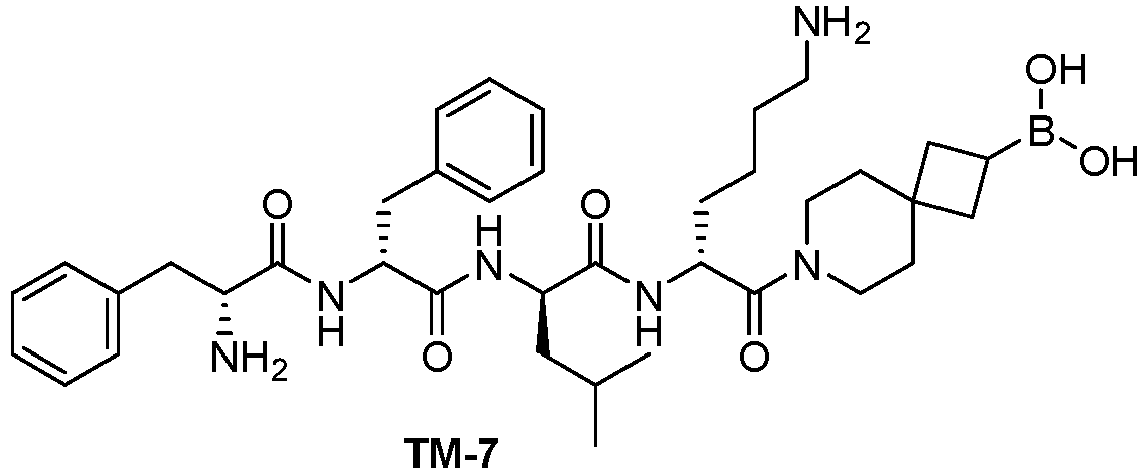


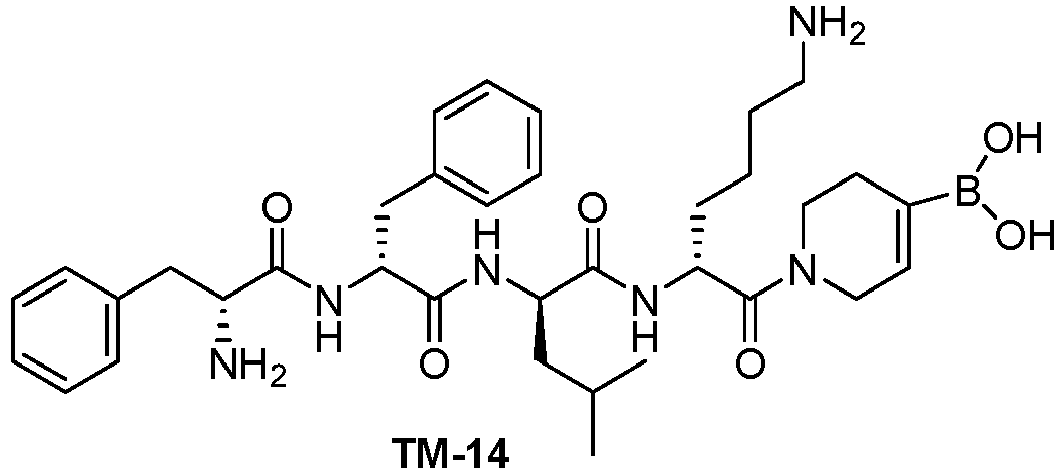


- A compound prepared from the polypeptide compound according to claim 1, wherein the compound includes stereoisomers, polymorphs, solvates, or pharmaceutically acceptable salts or esters, or boronic acid polymers of the polypeptide compound.
- A pharmaceutical composition comprising the polypeptide compound according to claim 1 or the compound according to claim 2.
- The polypeptide compound according to claim 1 for use in treating diseases associated with κ-opioid receptor, wherein the diseases associated with κ-opioid receptor is selected from pain, inflammation, itching, edema, hyponatremia and hypopotassaemia.
Applications Claiming Priority (2)
| Application Number | Priority Date | Filing Date | Title |
|---|---|---|---|
| CN201911100565.6A CN110790817A (en) | 2019-11-12 | 2019-11-12 | Polypeptide compound, preparation, pharmaceutical composition, preparation method and application |
| CN202010165892.6A CN111233974B (en) | 2019-11-12 | 2020-03-11 | Polypeptide compound, pharmaceutical composition, preparation method and application |
Publications (3)
| Publication Number | Publication Date |
|---|---|
| EP3825322A1 EP3825322A1 (en) | 2021-05-26 |
| EP3825322B1 true EP3825322B1 (en) | 2024-03-20 |
| EP3825322C0 EP3825322C0 (en) | 2024-03-20 |
Family
ID=69444342
Family Applications (1)
| Application Number | Title | Priority Date | Filing Date |
|---|---|---|---|
| EP20206521.5A Active EP3825322B1 (en) | 2019-11-12 | 2020-11-09 | Polypeptide compound, pharmaceutical composition, preparation method and application thereof |
Country Status (4)
| Country | Link |
|---|---|
| US (1) | US11643436B2 (en) |
| EP (1) | EP3825322B1 (en) |
| CN (2) | CN110790817A (en) |
| WO (1) | WO2021093695A1 (en) |
Families Citing this family (10)
| Publication number | Priority date | Publication date | Assignee | Title |
|---|---|---|---|---|
| CN110790817A (en) * | 2019-11-12 | 2020-02-14 | 成都诺和晟泰生物科技有限公司 | Polypeptide compound, preparation, pharmaceutical composition, preparation method and application |
| CN113493490B (en) * | 2020-04-03 | 2024-03-12 | 成都诺和晟泰生物科技有限公司 | Synthetic peptide amide compound and application thereof in medical field |
| CN113024588A (en) * | 2021-03-22 | 2021-06-25 | 成都诺和晟泰生物科技有限公司 | Preparation method of chiral N-Boc-pyrrolidine-3-boric acid compound |
| CN113072617B (en) * | 2021-03-30 | 2023-08-08 | 成都诺和晟泰生物科技有限公司 | Polypeptide compound and application thereof |
| JP2024517396A (en) * | 2021-04-12 | 2024-04-22 | シーザン ハイスーク ファーマシューティカル カンパニー リミテッド | Use of peptide amide compounds in the manufacture of a medicament for treating pruritus |
| CN115677830A (en) * | 2021-07-27 | 2023-02-03 | 天地恒一制药股份有限公司 | Peptide amide compound and its preparation method and application |
| CN115707711A (en) * | 2021-08-18 | 2023-02-21 | 天地恒一制药股份有限公司 | Peptide amide compound, pharmaceutically acceptable salt, stereoisomer and application thereof |
| CN113624898B (en) * | 2021-08-23 | 2023-08-25 | 成都诺和晟泰生物科技有限公司 | Purification method of chiral analgesic polypeptide medicine |
| CN113461775A (en) * | 2021-08-23 | 2021-10-01 | 成都诺和晟泰生物科技有限公司 | Preparation method of polypeptide compound |
| CN116712399A (en) * | 2023-06-09 | 2023-09-08 | 浙江美华鼎昌医药科技有限公司 | Preparation process of proteasome inhibitor capsules for treating multiple myeloma |
Family Cites Families (15)
| Publication number | Priority date | Publication date | Assignee | Title |
|---|---|---|---|---|
| IL153688A0 (en) * | 2000-06-28 | 2003-07-06 | Teva Pharma | Carvedilol |
| CA2484551A1 (en) | 2002-04-30 | 2003-11-13 | Trustees Of Tufts College | Smart pro-drugs of serine protease inhibitors |
| EP1943257A2 (en) | 2005-05-19 | 2008-07-16 | Genentech, Inc. | Fibroblast activation protein inhibitor compounds and methods |
| AU2006201635A1 (en) * | 2005-10-20 | 2007-05-10 | Ludwig Institute For Cancer Research | Novel inhibitors and methods for their preparation |
| US7842662B2 (en) * | 2006-11-10 | 2010-11-30 | Cara Therapeutics, Inc. | Synthetic peptide amide dimers |
| US20150150935A1 (en) * | 2012-06-05 | 2015-06-04 | Cara Therapeutics, Inc. | Peripheral kappa receptor agonists for reducing pain and inflammation |
| MX2016001927A (en) | 2013-08-14 | 2016-09-08 | Rqx Pharmaceuticals Inc | Linear peptide antibiotcs. |
| JP6651546B2 (en) * | 2015-05-11 | 2020-02-19 | カディラ・ヘルスケア・リミテッド | Novel short-chain peptides as kappa (κ) opioid receptor (KOR) agonists |
| CN107098871B (en) * | 2016-02-23 | 2021-07-02 | 江苏恒瑞医药股份有限公司 | Phenyl propionamide derivative, preparation method and medical application thereof |
| CN107098876B (en) * | 2016-02-23 | 2021-04-06 | 江苏恒瑞医药股份有限公司 | Phenyl propionamide derivative, preparation method and medical application thereof |
| US11518783B2 (en) | 2016-06-06 | 2022-12-06 | The Johns Hopkins University | Peptides having tetrahedral mimicking groups as inhibitors of rhomboid proteases |
| CN114940700A (en) * | 2016-06-07 | 2022-08-26 | 江苏恒瑞医药股份有限公司 | Phenyl propionamide derivative, preparation method and medical application thereof |
| US11084847B2 (en) | 2016-09-27 | 2021-08-10 | Sichuan Kelun-Biotech Biopharmaceutical Co., Ltd. | Polyamide compound and use thereof |
| CN109879934B (en) * | 2017-12-06 | 2020-12-08 | 江苏恒瑞医药股份有限公司 | Salt of phenylpropionamide derivative and preparation method thereof |
| CN110790817A (en) | 2019-11-12 | 2020-02-14 | 成都诺和晟泰生物科技有限公司 | Polypeptide compound, preparation, pharmaceutical composition, preparation method and application |
-
2019
- 2019-11-12 CN CN201911100565.6A patent/CN110790817A/en not_active Withdrawn
-
2020
- 2020-03-11 CN CN202010165892.6A patent/CN111233974B/en active Active
- 2020-11-09 WO PCT/CN2020/127402 patent/WO2021093695A1/en not_active Ceased
- 2020-11-09 EP EP20206521.5A patent/EP3825322B1/en active Active
- 2020-11-09 US US17/093,607 patent/US11643436B2/en active Active
Also Published As
| Publication number | Publication date |
|---|---|
| EP3825322C0 (en) | 2024-03-20 |
| CN111233974B (en) | 2021-02-26 |
| CN111233974A (en) | 2020-06-05 |
| EP3825322A1 (en) | 2021-05-26 |
| US11643436B2 (en) | 2023-05-09 |
| US20210139537A1 (en) | 2021-05-13 |
| WO2021093695A1 (en) | 2021-05-20 |
| CN110790817A (en) | 2020-02-14 |
Similar Documents
| Publication | Publication Date | Title |
|---|---|---|
| US11643436B2 (en) | Polypeptide compound, pharmaceutical composition, preparation method and application thereof | |
| US6458790B2 (en) | Substituted piperidines as melanocortin receptor agonists | |
| AU2017306164B2 (en) | Spiro-lactam NMDA modulators and methods of using same | |
| CN110637025B (en) | Peptide amide compound and its preparation method and application in medicine | |
| RU2451684C2 (en) | Substituted imidazopyridine derivatives as melanocortin-4 receptor antagonists | |
| EP2951182B1 (en) | Spiro-lactam nmda receptor modulators and uses thereof | |
| CA3104298A1 (en) | Wd40 repeat domain protein 5 (wdr5) degradation / disruption compounds and methods of use | |
| RS58092B1 (en) | Tetrahydropyridopyrazines modulators of gpr6 | |
| CA3186771A1 (en) | Small molecule modulators of il-17 | |
| AU2021201006A1 (en) | N-methyl-D-aspartate receptor modulators and methods of making and using same | |
| CA2477943A1 (en) | Heterocyclic amides with alpha-4 integrin antagonist activity | |
| HRP960494A2 (en) | Process for the preparation of a growth hormone secretagogue | |
| TWI888808B (en) | Polyamide compound, preparation method thereof and medical use thereof | |
| CA2460646A1 (en) | Antibacterial macrocycles | |
| NO144604B (en) | ANALOGY PROCEDURE FOR THE PREPARATION OF THERAPEUTICALLY EFFECTIVE HISTORY INGREDIATES | |
| WO2019241496A1 (en) | Peptidomimetic inhibitors of the peptidyl-prolyl cis/trans isomerase (pin1) | |
| WO2021197283A1 (en) | Synthetic peptide amide compound and its use in the field of medicine | |
| IL318001A (en) | Bifunctional compound and pharmaceutical composition comprising the bifunctional compound, and method for treating androgen receptor related diseases by using the same | |
| CN117769541A (en) | Protease inhibitors as antiviral agents | |
| CA3136106A1 (en) | Bivalent antagonists of inhibitors of apoptosis proteins | |
| KR101162100B1 (en) | Novel pyrazinone derivatives for inducing the apoptosis on cells and pharmaceutical composition comprising the same | |
| CN115677830A (en) | Peptide amide compound and its preparation method and application | |
| HK40011806B (en) | Peptide amide compounds, preparation method thereof and use in medicine | |
| EA040570B1 (en) | PEPTIDE AMIDE COMPOUNDS, METHOD FOR THEIR PRODUCTION AND MEDICAL APPLICATION | |
| HK40011806A (en) | Peptide amide compounds, preparation method thereof and use in medicine |
Legal Events
| Date | Code | Title | Description |
|---|---|---|---|
| PUAI | Public reference made under article 153(3) epc to a published international application that has entered the european phase |
Free format text: ORIGINAL CODE: 0009012 |
|
| STAA | Information on the status of an ep patent application or granted ep patent |
Free format text: STATUS: THE APPLICATION HAS BEEN PUBLISHED |
|
| AK | Designated contracting states |
Kind code of ref document: A1 Designated state(s): AL AT BE BG CH CY CZ DE DK EE ES FI FR GB GR HR HU IE IS IT LI LT LU LV MC MK MT NL NO PL PT RO RS SE SI SK SM TR |
|
| STAA | Information on the status of an ep patent application or granted ep patent |
Free format text: STATUS: REQUEST FOR EXAMINATION WAS MADE |
|
| 17P | Request for examination filed |
Effective date: 20210723 |
|
| RBV | Designated contracting states (corrected) |
Designated state(s): AL AT BE BG CH CY CZ DE DK EE ES FI FR GB GR HR HU IE IS IT LI LT LU LV MC MK MT NL NO PL PT RO RS SE SI SK SM TR |
|
| RIN1 | Information on inventor provided before grant (corrected) |
Inventor name: LI, SIJUN Inventor name: LI, YUANBO Inventor name: YUAN, YU Inventor name: HU, XI Inventor name: HU, HAI Inventor name: ZHOU, HAIBO Inventor name: ZHONG, GUOQING Inventor name: FU, XIAOPING Inventor name: GAO, JIAN |
|
| STAA | Information on the status of an ep patent application or granted ep patent |
Free format text: STATUS: EXAMINATION IS IN PROGRESS |
|
| 17Q | First examination report despatched |
Effective date: 20220906 |
|
| GRAP | Despatch of communication of intention to grant a patent |
Free format text: ORIGINAL CODE: EPIDOSNIGR1 |
|
| STAA | Information on the status of an ep patent application or granted ep patent |
Free format text: STATUS: GRANT OF PATENT IS INTENDED |
|
| INTG | Intention to grant announced |
Effective date: 20231020 |
|
| GRAS | Grant fee paid |
Free format text: ORIGINAL CODE: EPIDOSNIGR3 |
|
| GRAA | (expected) grant |
Free format text: ORIGINAL CODE: 0009210 |
|
| STAA | Information on the status of an ep patent application or granted ep patent |
Free format text: STATUS: THE PATENT HAS BEEN GRANTED |
|
| AK | Designated contracting states |
Kind code of ref document: B1 Designated state(s): AL AT BE BG CH CY CZ DE DK EE ES FI FR GB GR HR HU IE IS IT LI LT LU LV MC MK MT NL NO PL PT RO RS SE SI SK SM TR |
|
| REG | Reference to a national code |
Ref country code: GB Ref legal event code: FG4D |
|
| REG | Reference to a national code |
Ref country code: CH Ref legal event code: EP |
|
| REG | Reference to a national code |
Ref country code: IE Ref legal event code: FG4D |
|
| REG | Reference to a national code |
Ref country code: DE Ref legal event code: R096 Ref document number: 602020027449 Country of ref document: DE |
|
| U01 | Request for unitary effect filed |
Effective date: 20240325 |
|
| U07 | Unitary effect registered |
Designated state(s): AT BE BG DE DK EE FI FR IT LT LU LV MT NL PT SE SI Effective date: 20240405 |
|
| PG25 | Lapsed in a contracting state [announced via postgrant information from national office to epo] |
Ref country code: GR Free format text: LAPSE BECAUSE OF FAILURE TO SUBMIT A TRANSLATION OF THE DESCRIPTION OR TO PAY THE FEE WITHIN THE PRESCRIBED TIME-LIMIT Effective date: 20240621 |
|
| PG25 | Lapsed in a contracting state [announced via postgrant information from national office to epo] |
Ref country code: RS Free format text: LAPSE BECAUSE OF FAILURE TO SUBMIT A TRANSLATION OF THE DESCRIPTION OR TO PAY THE FEE WITHIN THE PRESCRIBED TIME-LIMIT Effective date: 20240620 Ref country code: HR Free format text: LAPSE BECAUSE OF FAILURE TO SUBMIT A TRANSLATION OF THE DESCRIPTION OR TO PAY THE FEE WITHIN THE PRESCRIBED TIME-LIMIT Effective date: 20240320 |
|
| PG25 | Lapsed in a contracting state [announced via postgrant information from national office to epo] |
Ref country code: RS Free format text: LAPSE BECAUSE OF FAILURE TO SUBMIT A TRANSLATION OF THE DESCRIPTION OR TO PAY THE FEE WITHIN THE PRESCRIBED TIME-LIMIT Effective date: 20240620 Ref country code: NO Free format text: LAPSE BECAUSE OF FAILURE TO SUBMIT A TRANSLATION OF THE DESCRIPTION OR TO PAY THE FEE WITHIN THE PRESCRIBED TIME-LIMIT Effective date: 20240620 Ref country code: HR Free format text: LAPSE BECAUSE OF FAILURE TO SUBMIT A TRANSLATION OF THE DESCRIPTION OR TO PAY THE FEE WITHIN THE PRESCRIBED TIME-LIMIT Effective date: 20240320 Ref country code: GR Free format text: LAPSE BECAUSE OF FAILURE TO SUBMIT A TRANSLATION OF THE DESCRIPTION OR TO PAY THE FEE WITHIN THE PRESCRIBED TIME-LIMIT Effective date: 20240621 |
|
| PG25 | Lapsed in a contracting state [announced via postgrant information from national office to epo] |
Ref country code: IS Free format text: LAPSE BECAUSE OF FAILURE TO SUBMIT A TRANSLATION OF THE DESCRIPTION OR TO PAY THE FEE WITHIN THE PRESCRIBED TIME-LIMIT Effective date: 20240720 |
|
| PG25 | Lapsed in a contracting state [announced via postgrant information from national office to epo] |
Ref country code: SM Free format text: LAPSE BECAUSE OF FAILURE TO SUBMIT A TRANSLATION OF THE DESCRIPTION OR TO PAY THE FEE WITHIN THE PRESCRIBED TIME-LIMIT Effective date: 20240320 |
|
| PG25 | Lapsed in a contracting state [announced via postgrant information from national office to epo] |
Ref country code: ES Free format text: LAPSE BECAUSE OF FAILURE TO SUBMIT A TRANSLATION OF THE DESCRIPTION OR TO PAY THE FEE WITHIN THE PRESCRIBED TIME-LIMIT Effective date: 20240320 |
|
| PG25 | Lapsed in a contracting state [announced via postgrant information from national office to epo] |
Ref country code: CZ Free format text: LAPSE BECAUSE OF FAILURE TO SUBMIT A TRANSLATION OF THE DESCRIPTION OR TO PAY THE FEE WITHIN THE PRESCRIBED TIME-LIMIT Effective date: 20240320 |
|
| PG25 | Lapsed in a contracting state [announced via postgrant information from national office to epo] |
Ref country code: PL Free format text: LAPSE BECAUSE OF FAILURE TO SUBMIT A TRANSLATION OF THE DESCRIPTION OR TO PAY THE FEE WITHIN THE PRESCRIBED TIME-LIMIT Effective date: 20240320 |
|
| PG25 | Lapsed in a contracting state [announced via postgrant information from national office to epo] |
Ref country code: SK Free format text: LAPSE BECAUSE OF FAILURE TO SUBMIT A TRANSLATION OF THE DESCRIPTION OR TO PAY THE FEE WITHIN THE PRESCRIBED TIME-LIMIT Effective date: 20240320 |
|
| PG25 | Lapsed in a contracting state [announced via postgrant information from national office to epo] |
Ref country code: SM Free format text: LAPSE BECAUSE OF FAILURE TO SUBMIT A TRANSLATION OF THE DESCRIPTION OR TO PAY THE FEE WITHIN THE PRESCRIBED TIME-LIMIT Effective date: 20240320 Ref country code: SK Free format text: LAPSE BECAUSE OF FAILURE TO SUBMIT A TRANSLATION OF THE DESCRIPTION OR TO PAY THE FEE WITHIN THE PRESCRIBED TIME-LIMIT Effective date: 20240320 Ref country code: RO Free format text: LAPSE BECAUSE OF FAILURE TO SUBMIT A TRANSLATION OF THE DESCRIPTION OR TO PAY THE FEE WITHIN THE PRESCRIBED TIME-LIMIT Effective date: 20240320 Ref country code: PL Free format text: LAPSE BECAUSE OF FAILURE TO SUBMIT A TRANSLATION OF THE DESCRIPTION OR TO PAY THE FEE WITHIN THE PRESCRIBED TIME-LIMIT Effective date: 20240320 Ref country code: IS Free format text: LAPSE BECAUSE OF FAILURE TO SUBMIT A TRANSLATION OF THE DESCRIPTION OR TO PAY THE FEE WITHIN THE PRESCRIBED TIME-LIMIT Effective date: 20240720 Ref country code: ES Free format text: LAPSE BECAUSE OF FAILURE TO SUBMIT A TRANSLATION OF THE DESCRIPTION OR TO PAY THE FEE WITHIN THE PRESCRIBED TIME-LIMIT Effective date: 20240320 Ref country code: CZ Free format text: LAPSE BECAUSE OF FAILURE TO SUBMIT A TRANSLATION OF THE DESCRIPTION OR TO PAY THE FEE WITHIN THE PRESCRIBED TIME-LIMIT Effective date: 20240320 |
|
| REG | Reference to a national code |
Ref country code: DE Ref legal event code: R097 Ref document number: 602020027449 Country of ref document: DE |
|
| U20 | Renewal fee for the european patent with unitary effect paid |
Year of fee payment: 5 Effective date: 20241118 |
|
| PLBE | No opposition filed within time limit |
Free format text: ORIGINAL CODE: 0009261 |
|
| STAA | Information on the status of an ep patent application or granted ep patent |
Free format text: STATUS: NO OPPOSITION FILED WITHIN TIME LIMIT |
|
| 26N | No opposition filed |
Effective date: 20241223 |
|
| REG | Reference to a national code |
Ref country code: CH Ref legal event code: PL |
|
| PG25 | Lapsed in a contracting state [announced via postgrant information from national office to epo] |
Ref country code: MC Free format text: LAPSE BECAUSE OF FAILURE TO SUBMIT A TRANSLATION OF THE DESCRIPTION OR TO PAY THE FEE WITHIN THE PRESCRIBED TIME-LIMIT Effective date: 20240320 |
|
| REG | Reference to a national code |
Ref country code: CH Ref legal event code: PL |
|
| PG25 | Lapsed in a contracting state [announced via postgrant information from national office to epo] |
Ref country code: CH Free format text: LAPSE BECAUSE OF NON-PAYMENT OF DUE FEES Effective date: 20241130 |
|
| PG25 | Lapsed in a contracting state [announced via postgrant information from national office to epo] |
Ref country code: IE Free format text: LAPSE BECAUSE OF NON-PAYMENT OF DUE FEES Effective date: 20241109 |
|
| U20 | Renewal fee for the european patent with unitary effect paid |
Year of fee payment: 6 Effective date: 20251117 |
|
| PGFP | Annual fee paid to national office [announced via postgrant information from national office to epo] |
Ref country code: GB Payment date: 20251117 Year of fee payment: 6 |
|
| PG25 | Lapsed in a contracting state [announced via postgrant information from national office to epo] |
Ref country code: HU Free format text: LAPSE BECAUSE OF FAILURE TO SUBMIT A TRANSLATION OF THE DESCRIPTION OR TO PAY THE FEE WITHIN THE PRESCRIBED TIME-LIMIT; INVALID AB INITIO Effective date: 20201109 |
|
| PG25 | Lapsed in a contracting state [announced via postgrant information from national office to epo] |
Ref country code: CY Free format text: LAPSE BECAUSE OF FAILURE TO SUBMIT A TRANSLATION OF THE DESCRIPTION OR TO PAY THE FEE WITHIN THE PRESCRIBED TIME-LIMIT; INVALID AB INITIO Effective date: 20201109 |