EP3825170B1 - Vehicle seat and angle adjustment device thereof - Google Patents
Vehicle seat and angle adjustment device thereof Download PDFInfo
- Publication number
- EP3825170B1 EP3825170B1 EP18926685.1A EP18926685A EP3825170B1 EP 3825170 B1 EP3825170 B1 EP 3825170B1 EP 18926685 A EP18926685 A EP 18926685A EP 3825170 B1 EP3825170 B1 EP 3825170B1
- Authority
- EP
- European Patent Office
- Prior art keywords
- elastic piece
- adjustment device
- angle adjustment
- unlocking
- expansion
- Prior art date
- Legal status (The legal status is an assumption and is not a legal conclusion. Google has not performed a legal analysis and makes no representation as to the accuracy of the status listed.)
- Active
Links
Images



Classifications
-
- B—PERFORMING OPERATIONS; TRANSPORTING
- B60—VEHICLES IN GENERAL
- B60N—SEATS SPECIALLY ADAPTED FOR VEHICLES; VEHICLE PASSENGER ACCOMMODATION NOT OTHERWISE PROVIDED FOR
- B60N2/00—Seats specially adapted for vehicles; Arrangement or mounting of seats in vehicles
- B60N2/02—Seats specially adapted for vehicles; Arrangement or mounting of seats in vehicles the seat or part thereof being movable, e.g. adjustable
- B60N2/22—Seats specially adapted for vehicles; Arrangement or mounting of seats in vehicles the seat or part thereof being movable, e.g. adjustable the back-rest being adjustable
- B60N2/235—Seats specially adapted for vehicles; Arrangement or mounting of seats in vehicles the seat or part thereof being movable, e.g. adjustable the back-rest being adjustable by gear-pawl type mechanisms
- B60N2/2356—Seats specially adapted for vehicles; Arrangement or mounting of seats in vehicles the seat or part thereof being movable, e.g. adjustable the back-rest being adjustable by gear-pawl type mechanisms with internal pawls
- B60N2/2362—Seats specially adapted for vehicles; Arrangement or mounting of seats in vehicles the seat or part thereof being movable, e.g. adjustable the back-rest being adjustable by gear-pawl type mechanisms with internal pawls rotatably movable
-
- B—PERFORMING OPERATIONS; TRANSPORTING
- B60—VEHICLES IN GENERAL
- B60N—SEATS SPECIALLY ADAPTED FOR VEHICLES; VEHICLE PASSENGER ACCOMMODATION NOT OTHERWISE PROVIDED FOR
- B60N2/00—Seats specially adapted for vehicles; Arrangement or mounting of seats in vehicles
- B60N2/02—Seats specially adapted for vehicles; Arrangement or mounting of seats in vehicles the seat or part thereof being movable, e.g. adjustable
- B60N2/22—Seats specially adapted for vehicles; Arrangement or mounting of seats in vehicles the seat or part thereof being movable, e.g. adjustable the back-rest being adjustable
- B60N2/235—Seats specially adapted for vehicles; Arrangement or mounting of seats in vehicles the seat or part thereof being movable, e.g. adjustable the back-rest being adjustable by gear-pawl type mechanisms
- B60N2/2356—Seats specially adapted for vehicles; Arrangement or mounting of seats in vehicles the seat or part thereof being movable, e.g. adjustable the back-rest being adjustable by gear-pawl type mechanisms with internal pawls
- B60N2/236—Seats specially adapted for vehicles; Arrangement or mounting of seats in vehicles the seat or part thereof being movable, e.g. adjustable the back-rest being adjustable by gear-pawl type mechanisms with internal pawls linearly movable
-
- B—PERFORMING OPERATIONS; TRANSPORTING
- B60—VEHICLES IN GENERAL
- B60N—SEATS SPECIALLY ADAPTED FOR VEHICLES; VEHICLE PASSENGER ACCOMMODATION NOT OTHERWISE PROVIDED FOR
- B60N2/00—Seats specially adapted for vehicles; Arrangement or mounting of seats in vehicles
- B60N2/02—Seats specially adapted for vehicles; Arrangement or mounting of seats in vehicles the seat or part thereof being movable, e.g. adjustable
- B60N2/22—Seats specially adapted for vehicles; Arrangement or mounting of seats in vehicles the seat or part thereof being movable, e.g. adjustable the back-rest being adjustable
- B60N2/2227—Seats specially adapted for vehicles; Arrangement or mounting of seats in vehicles the seat or part thereof being movable, e.g. adjustable the back-rest being adjustable and provided with braking systems
Definitions
- the present application relates to the technical field of mechanical design, and in particular to a vehicle seat and an angle adjustment device thereof.
- an existing vehicle angle adjustment device includes a ratchet wheel fixedly connected with the seat back and provided with internal teeth, and a sliding groove plate fixed with the seat and provided with a sliding groove.
- Multiple sliding blocks with external teeth are arranged on the sliding groove plate, and each sliding block is controlled to extend in the radial direction through an expansion and contraction mechanism, so as to realize the engagement of the internal teeth of the ratchet wheel and the external teeth of the sliding block.
- a return spring is arranged between the sliding blocks, and both ends of each return spring in the axial direction respectively abut against a flange on the sliding groove plate and the expansion and contraction mechanism, so as to realize the synchronous expansion and contraction of each sliding block in the radial direction.
- the locking torque of the return spring is usually set to a relatively large value, which causes an unlocking torque to be also relatively large when the unlocking is performed, thus making the people uncomfortable.
- US20160075261A1 discloses a hinge mechanism for a vehicle seat, allowing adjustment of the tilt of a seat backrest relative to a seat cushion.
- the hinge mechanism has two plates, the first plate containing base gear teeth on an edge directed inward, a set of first elements cooperating with a first control cam biased by first springs, a set of second elements cooperating with a second control cam biased by second springs, and a control hub for moving the control cams toward an unlocking position against the biasing of the first and second springs.
- the set of first elements have teeth offset angularly by at most a half-tooth relative to teeth of the set of second elements, thereby obtaining a small locking pitch.
- an angle adjustment device as defined in claim 1 is provided. It includes an unlocking cam, a ratchet wheel provided with internal teeth and multiple sliding blocks distributed along the circumferential direction and provided with external teeth.
- the angle adjustment device further includes multiple expansion and contraction blocks corresponding to the multiple sliding blocks, and the multiple expansion and contraction blocks can drive the multiple sliding blocks to move outwards in radial directions, so as to allow the internal teeth to be meshed with the external teeth; a second elastic piece is arranged between adjacent expansion and contraction blocks, and two ends of the second elastic piece along the deformation direction are respectively connected with the unlocking cam and the multiple expansion and contraction blocks.
- the angle adjustment device further includes a first elastic piece and a sliding groove plate that rotates relative to the ratchet wheel. One end of the first elastic piece is connected to the sliding groove plate, and the other end of the first elastic piece is directly or indirectly connected to the unlocking cam so as to allow the torque of the unlocking cam to be transmitted.
- the expansion and contraction blocks are used for driving the multiple sliding block to extend out in radial directions, so as to realize the engagement of the multiple sliding block and the ratchet wheel.
- the multiple sliding blocks can be separated from the ratchet wheel.
- an unlocking torque needs to be provided from the outside to drive the unlocking cam to rotate in the unlocking direction, and only when the unlocking torque reaches a certain value, can the unlocking cam be driven to overcome the locking force to rotate in the unlocking direction.
- the second elastic piece which is in a compressed state and connected with the unlocking cam and the multiple expansion and contraction blocks can act on the unlocking cam and the multiple expansion and contraction blocks.
- the elastic force of the second elastic piece on the unlocking cam faces the unlocking direction
- the elastic force on the multiple expansion and contraction blocks faces the locking direction. Therefore, the elastic force of the second elastic piece on the unlocking cam in the unlocking direction can reduce the unlocking torque that needs to be provided by the outside world to act on the unlocking cam when the angle adjustment device is unlocked.
- the angle adjustment device can realize the unlocking process with only a small unlocking torque, and the comfort when the angle adjustment device is unlocked is improved.
- the second elastic piece can provide enough elastic force to drive the expansion and contraction block to rotate, thus ensuring the reliability of the locking process.
- the second elastic piece can provide enough elastic force to drive the expansion and contraction block to rotate, thus ensuring the reliability of the locking process.
- the angle adjustment device further includes a central shaft, the unlocking cam has a central hole, the central shaft is matched with the central hole, and the central shaft can drive the unlocking cam to rotate in the unlocking direction when the central shaft rotates in the unlocking direction;
- the first elastic piece is connected to the central shaft so as to be indirectly connected to the unlocking cam.
- the unlocking cam has multiple first protrusions, matching grooves are provided on the expansion and contraction blocks, and two ends of the second elastic piece along the deformation direction are respectively abutted against the corresponding first protrusions and the matching grooves.
- multiple mounting holes are provided on the unlocking cam, an upside down edge is provided on a side wall of each of the multiple mounting holes, and the upside down edge is the first protrusion.
- the expansion and contraction block has a second protrusion
- the unlocking cam is provided with a groove
- two ends of the second elastic piece in the deformation direction respectively abut against the second protrusion and a side wall of the groove.
- the first elastic piece is a flat spiral spring, and an outer end of the flat spiral spring is fixed to the sliding groove plate, and an inner end of the flat spiral spring is fixed to the central shaft so as to allow the torque of the central shaft to be transmitted.
- the sliding groove plate is provided with a fixing column, an outer end of the first elastic piece is hooked with the fixing column, and when the central shaft drives the inner end of the first elastic piece to rotate in the unlocking direction, the fixing column can restrict the outer end of the first elastic piece from moving.
- a flange is provided on a middle part of the sliding groove plate, and the expansion and contraction block can move along an outer peripheral surface of the flange.
- the flange is integrally formed with the sliding groove plate, or the flange is fixedly connected with the sliding groove plate.
- the present application further provides a vehicle seat, as defined in claim 9, including a seat and a seat back, and further includes an angle adjustment device for adjusting the angle of the seat back relative to the seat.
- the angle adjustment device is the angle adjustment device described above.
- Figure 1 is an exploded view of the angle adjustment device provided by the present application
- Figure 2 is a schematic structural diagram of a core component of an angle adjustment device provided by the present application
- Figure 3 is a structural schematic diagram of the core component in Figure 2 with the sliding groove plate removed
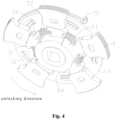
- Figure 4 is a structural schematic diagram of the core component in Figure 3 from another perspective
- Figure 5 is a back view of the core component in Figure 3
- Figure 6 is a structural schematic diagram of the core component in Figure 3 without a first elastic piece and a sliding block.
- the present application provides an angle adjustment device.
- the angle adjustment device includes a sheath 1, a ratchet wheel 2 and a sliding groove plate 8.
- the sheath 1 is used for fixing the ratchet wheel 2 and the sliding groove plate 8 with each other in an axial direction, and the ratchet wheel 2 can rotate relative to the sliding groove plate 8.
- the ratchet wheel 2 is fixed to a seat back of a vehicle seat.
- the angle adjustment device further includes a core component that can realize angle adjustment.
- the core component includes an unlocking cam 3 and multiple sliding blocks 4 distributed along the circumference of the sliding groove plate 8 and provided with external teeth 42.
- the external teeth 42 of the sliding block 4 can mesh with the internal teeth of the ratchet wheel 2, and the external teeth 42 and the internal teeth have at least three meshing relationships, namely, tooth to tooth (non-meshing) state, semi-meshing state and complete meshing state.
- the angle adjustment device is in an unlocked state.
- the angle adjustment device is in a locked state.
- the angle adjustment device is in a process of movement from unlocking to locking.
- a clockwise direction in Figures 2 , 3 and 6 is an unlocking direction
- a counterclockwise direction is the locking direction. Since Figures 4 and 5 are back views of Figures 2 , 3 and 6 , the counterclockwise direction is a unlocking direction and the clockwise direction is the locking direction.
- the sliding block 4 needs to be able to move in the radial direction. Moreover, the external teeth 42 can mesh with the internal teeth of the ratchet wheel 2 when it moves radially outward, and the external teeth 42 can disengage from the internal teeth when it moves radially inward. In order to realize the radial movement of the sliding block 4, an expansion and contraction mechanism is provided on the angle adjustment device.
- the expansion and contraction mechanism includes multiple expansion and contraction blocks 6, and the multiple expansion and contraction blocks 6 are distributed along the circumferential direction of the sliding groove plate 8, and each expansion and contraction block 6 is located in a same diameter direction of the sliding groove plate 8 as each sliding block 4.
- An inner ring of the sliding block 4 has a first mating surface
- an outer ring of the expansion and contraction block 6 has a second mating surface, both of which are arc surfaces and have opposite bending directions; or, one of the first mating surface and the second mating surface is a flat surface, and the other of the first mating surface and the second mating surface is an arc surface protruding toward the one.
- the second mating surface of the expansion and contraction block 6 is an arc surface protruding outward
- the first mating surface of the sliding block 4 is a flat surface.
- a second elastic piece 52 in a compressed state is arranged between two adjacent expansion and contraction blocks 6.
- the second elastic piece 52 is used for driving the expansion and contraction block 6 to move in the circumferential direction, thereby changing the position where the second mating surface of the expansion and contraction block 6 abuts against the first mating surface of the sliding block 4, so as to drive the sliding block 4 to move outward in the radial direction, thus realizing the engagement between the external teeth 42 of the sliding block 4 and the internal teeth of the ratchet wheel 2.
- the unlocking cam 3 is provided with multiple sliding block control grooves 31, which are arc-shaped grooves.
- the sliding block 4 has multiple sliding block bosses 41, and the sliding block bosses 41 are located in the sliding block control groove 31 and can slide relative to the sliding block control groove 31.
- the expansion and contraction block 6 rotates in the locking direction under the action of the second elastic piece 52.
- the corresponding sliding block 4 can be driven to extend radially outward until the external teeth 42 are completely engaged with the internal teeth to reach the locking state.
- the expansion and contraction block 6 is in the self-locking position.
- the external torque drives the unlocking cam 3 to rotate in the unlocking direction
- the second elastic piece 52 drives the expansion and contraction block 6 to leave the self-locking position
- the sliding block 4 is driven to move radially inward during the rotation of the sliding block control groove 31 until the external teeth 42 are completely separated from the internal teeth, thus reaching the unlocking state.
- a flange 84 is provided on the middle of the sliding groove plate 8, and the expansion and contraction blocks 6 are evenly distributed on the outer periphery of the flange 84. Driven by the second elastic piece 52, the expansion and contraction blocks 6 can rotate circumferentially along the outer peripheral wall of the flange 84.
- the flange 84 can be integrally formed with the sliding groove plate 8, or can be fixedly connected with the sliding groove plate 8.
- the flange 84 and the sliding groove plate 8 are of separate structures, and they have mutually matched hooks and grooves so as to realize clamping and fixing.
- the sliding groove plate 8 has multiple sliding grooves 81 that are matched with the sliding blocks 4, and the sliding blocks 4 can move radially in the corresponding sliding grooves 81.
- the sliding groove plate 8 has multiple sector bosses 82 evenly distributed along the circumferential direction, and each sliding groove 81 is formed between adjacent sector bosses 82.
- each second elastic piece 52 along the deformation direction are respectively connected to the unlocking cam 3 and the expansion and contraction block 6.
- the expansion and contraction block 6 is used for driving the sliding block 4 to extend in the radial direction, so as to realize the engagement of the sliding block 4 and the ratchet wheel 2.
- the sliding block 4 can be separated from the ratchet wheel 2.
- an unlocking torque needs to be provided from the outside for driving the unlocking cam 3 to rotate in the unlocking direction, and only when the unlocking torque reaches a certain value, can the unlocking cam 3 be driven to overcome the locking force to rotate in the unlocking direction.
- the second elastic piece 52 which is in a compressed state and connected with the unlocking cam 3 and the expansion and contraction block 6 can act on the unlocking cam 3 and the expansion and contraction block 6.
- the elastic force of the second elastic piece 52 on the unlocking cam faces the unlocking direction (the counterclockwise direction shown in Figure 4 )
- the elastic force on the expansion and contraction block 6 faces the locking direction (the clockwise direction shown in Figure 4 ). Therefore, the elastic force of the second elastic piece 6 on the unlocking cam 3 in the unlocking direction can reduce the unlocking torque that needs to be provided by the outside world to act on the unlocking cam 3 when the angle adjustment device is unlocked.
- the angle adjustment device can realize the unlocking process by only a small unlocking torque, and the comfort is improved when the angle adjustment device is unlocked.
- the second elastic piece 52 can provide enough elastic force to drive the expansion and contraction block 6 to rotate, thus ensuring the reliability of the locking process.
- the locking torque is determined by the second elastic piece 52, which can be arbitrarily designed. When a relatively larger number of sliding blocks 4 are provided, it still has high unlocking comfort and locking reliability.
- the angle adjustment device further includes a first elastic piece 51.
- One end of the first elastic piece 51 is connected to the sliding groove plate 8, and the other end of the first elastic piece 51 is directly or indirectly connected to the unlocking cam 3, so that the unlocking torque applied by the outside is transmitted to the unlocking cam 3.
- the unlocking cam 3 is driven to rotate relative to the sliding groove plate 8, and the first elastic piece 51 can transmit the unlocking torque applied by the outside to the unlocking cam 3. Therefore, the unlocking torque required by the unlocking cam 3 is represented by the torque transmitted by the first elastic piece 51. Meanwhile, the elastic force of the second elastic piece 52 on the unlocking cam 3 can reduce the torque transmitted by the first elastic piece 51, thereby reducing the required unlocking torque.
- the unlocking force required by the outside can be reduced, thereby improving the comfort when the angle adjustment device is unlocked.
- the angle adjustment device further includes a central shaft 7.
- the unlocking cam 3 has a central hole 32, which is a flat hole with an arc section and a straight section.
- the central shaft 7 has a flat step 71 matched with the central hole 32, and the flat step 71 is closely matched with the central hole 32, so that when an external handle drives the central shaft 7 to rotate, the unlocking cam 3 can be driven to rotate.
- the unlocking torque acting on the central shaft 7 is the torque provided by the external handle, and the torque received by the unlocking cam 3 (the torque provided by the outside) is the torque of the first elastic piece 51 to the unlocking cam 3 minus the torque of the second elastic piece 52 to the unlocking cam 3.
- the first elastic piece 51 is connected to the central shaft 7 so as to be indirectly connected to the unlocking cam 3.
- the first elastic piece 51 is a flat spiral spring
- the flat spiral spring can transmit torque
- an inner end of the flat spiral spring is fixed to the central shaft 7, and can rotate with the central shaft 7, and an outer end of the flat spiral spring is fixed to the sliding groove plate 8.
- the central shaft 7 has a matching section 72
- the cross section of the matching section 72 is square
- the inner end of the flat spiral spring forms a square hole
- the square hole is sleeved on the matching section 72, so as to realize the connection between the flat spiral spring and the central shaft 7.
- the sector boss 82 of the sliding groove plate 8 is provided with a fixing column 83, an outer end of the first elastic piece 51 is hooked with the fixing column 83, and when the central shaft 7 drives an inner end of the first elastic piece 51 to rotate in the unlocking direction, the fixing column 83 can restrict the outer end of the first elastic piece 51 from moving. Therefore, the outer end of the flat spiral spring is secured, and the inner end of the flat spiral spring bears and transmits torque.
- the fixing between the first elastic piece 51 and the sliding groove plate 8 does not necessarily need to be achieved by the fixing column 83, and other fixing methods in the art, such as welding, can also be used.
- the unlocking cam 3 has multiple first protrusions 34 extending towards the expansion and contraction block 6, and the expansion and contraction block 6 is provided with a matching groove 61 along a circumferential side wall portion.
- the two ends of the second elastic piece 52 along the deformation direction respectively abut against the corresponding first protrusion 34 and the matching groove 61, so as to realize the connection of the second elastic piece 52 with the unlocking cam 3 and the expansion and contraction block 6.
- multiple mounting holes 33 are provided on the unlocking cam 3, and the mounting holes 33 are used for mounting various components of the angle adjustment device, and upside down edges are respectively provided on the side walls of the mounting holes 33, and the upside down edges are namely the first protrusions 34.
- each of the first protrusions 34 may also be a structure welded to the surface of the unlocking cam 3.
- the expansion and contraction block 6 has a second protrusion extending towards the unlocking cam 3
- the unlocking cam 3 is provided with a groove
- two ends of the second elastic piece 52 in the deformation direction respectively abut against the second protrusion and the side wall of the groove, so as to realize the connection of the second elastic piece 52 with the unlocking cam 3 and the expansion and contraction block 6.
- connection structure of the three is not limited.
- the expansion and contraction block 6 is a wedge-shaped block.
- the angle adjustment device in the present application can be used for adjusting the seat back of the vehicle seat, or it can also be used for adjusting the relative angle of other structures.
- the present application further provides a vehicle seat, including a seat and a seat back, and further including an angle adjustment device for adjusting the angle of the seat back relative to the seat, where, the angle adjustment device is the angle adjustment device described in any of the above embodiments.
- the vehicle seat including the angle adjustment device should also have corresponding technical effects, which will not be repeated here.
Landscapes
- Engineering & Computer Science (AREA)
- Aviation & Aerospace Engineering (AREA)
- Transportation (AREA)
- Mechanical Engineering (AREA)
- Seats For Vehicles (AREA)
- Chairs For Special Purposes, Such As Reclining Chairs (AREA)
Description
- The present application claims the priority to
Chinese Patent Application No. 201810806392.9 Chinese Patent Application No. 201821164386.X, titled "VEHICLE SEAT AND ANGLE ADJUSTMENT DEVICE THEREOF", filed with the China National Intellectual Property Administration on July 20, 2018 - The present application relates to the technical field of mechanical design, and in particular to a vehicle seat and an angle adjustment device thereof.
- When a vehicle seat is in use, it is necessary to adjust the angle of a seat back relative to a seat for meeting the requirements of different users, so as to improve the seating comfort of the seat.
- At present, an existing vehicle angle adjustment device includes a ratchet wheel fixedly connected with the seat back and provided with internal teeth, and a sliding groove plate fixed with the seat and provided with a sliding groove. Multiple sliding blocks with external teeth are arranged on the sliding groove plate, and each sliding block is controlled to extend in the radial direction through an expansion and contraction mechanism, so as to realize the engagement of the internal teeth of the ratchet wheel and the external teeth of the sliding block. Meanwhile, a return spring is arranged between the sliding blocks, and both ends of each return spring in the axial direction respectively abut against a flange on the sliding groove plate and the expansion and contraction mechanism, so as to realize the synchronous expansion and contraction of each sliding block in the radial direction.
- In the above angle adjustment process, when the seat is locked, the radially extending locking torque of the sliding block is provided by the return spring. Correspondingly, when the seat is unlocked, the external unlocking torque also needs to overcome the locking torque to achieve unlocking. Generally, in order to ensure the locking reliability, the locking torque of the return spring is usually set to a relatively large value, which causes an unlocking torque to be also relatively large when the unlocking is performed, thus making the people uncomfortable.
- In view of this, how to provide an angle adjustment device that can improve the comfort of unlocking while ensuring high locking reliability is a technical problem to be solved by those skilled in the art.
-
US20160075261A1 discloses a hinge mechanism for a vehicle seat, allowing adjustment of the tilt of a seat backrest relative to a seat cushion. The hinge mechanism has two plates, the first plate containing base gear teeth on an edge directed inward, a set of first elements cooperating with a first control cam biased by first springs, a set of second elements cooperating with a second control cam biased by second springs, and a control hub for moving the control cams toward an unlocking position against the biasing of the first and second springs. The set of first elements have teeth offset angularly by at most a half-tooth relative to teeth of the set of second elements, thereby obtaining a small locking pitch. - To solve the above technical problem, an angle adjustment device as defined in claim 1 is provided. It includes an unlocking cam, a ratchet wheel provided with internal teeth and multiple sliding blocks distributed along the circumferential direction and provided with external teeth. The angle adjustment device further includes multiple expansion and contraction blocks corresponding to the multiple sliding blocks, and the multiple expansion and contraction blocks can drive the multiple sliding blocks to move outwards in radial directions, so as to allow the internal teeth to be meshed with the external teeth; a second elastic piece is arranged between adjacent expansion and contraction blocks, and two ends of the second elastic piece along the deformation direction are respectively connected with the unlocking cam and the multiple expansion and contraction blocks. The angle adjustment device further includes a first elastic piece and a sliding groove plate that rotates relative to the ratchet wheel. One end of the first elastic piece is connected to the sliding groove plate, and the other end of the first elastic piece is directly or indirectly connected to the unlocking cam so as to allow the torque of the unlocking cam to be transmitted.
- The expansion and contraction blocks are used for driving the multiple sliding block to extend out in radial directions, so as to realize the engagement of the multiple sliding block and the ratchet wheel. When the unlocking cam rotates in the unlocking direction, the multiple sliding blocks can be separated from the ratchet wheel. When the angle adjustment device is unlocked, an unlocking torque needs to be provided from the outside to drive the unlocking cam to rotate in the unlocking direction, and only when the unlocking torque reaches a certain value, can the unlocking cam be driven to overcome the locking force to rotate in the unlocking direction.
- In the present application, when the unlocking cam rotates in the unlocking direction, the second elastic piece which is in a compressed state and connected with the unlocking cam and the multiple expansion and contraction blocks can act on the unlocking cam and the multiple expansion and contraction blocks. Moreover, the elastic force of the second elastic piece on the unlocking cam faces the unlocking direction, and the elastic force on the multiple expansion and contraction blocks faces the locking direction. Therefore, the elastic force of the second elastic piece on the unlocking cam in the unlocking direction can reduce the unlocking torque that needs to be provided by the outside world to act on the unlocking cam when the angle adjustment device is unlocked. Thus, the angle adjustment device can realize the unlocking process with only a small unlocking torque, and the comfort when the angle adjustment device is unlocked is improved.
- Meanwhile, in the locking process, after the unlocking torque disappears, the second elastic piece can provide enough elastic force to drive the expansion and contraction block to rotate, thus ensuring the reliability of the locking process. When a relatively large number of sliding blocks are provided, it still has high unlocking comfort and locking reliability.
- Preferably, the angle adjustment device further includes a central shaft, the unlocking cam has a central hole, the central shaft is matched with the central hole, and the central shaft can drive the unlocking cam to rotate in the unlocking direction when the central shaft rotates in the unlocking direction;
- The first elastic piece is connected to the central shaft so as to be indirectly connected to the unlocking cam.
- Preferably, the unlocking cam has multiple first protrusions, matching grooves are provided on the expansion and contraction blocks, and two ends of the second elastic piece along the deformation direction are respectively abutted against the corresponding first protrusions and the matching grooves.
- Preferably, multiple mounting holes are provided on the unlocking cam, an upside down edge is provided on a side wall of each of the multiple mounting holes, and the upside down edge is the first protrusion.
- Preferably, the expansion and contraction block has a second protrusion, the unlocking cam is provided with a groove, and two ends of the second elastic piece in the deformation direction respectively abut against the second protrusion and a side wall of the groove.
- Preferably, the first elastic piece is a flat spiral spring, and an outer end of the flat spiral spring is fixed to the sliding groove plate, and an inner end of the flat spiral spring is fixed to the central shaft so as to allow the torque of the central shaft to be transmitted.
- Preferably, the sliding groove plate is provided with a fixing column, an outer end of the first elastic piece is hooked with the fixing column, and when the central shaft drives the inner end of the first elastic piece to rotate in the unlocking direction, the fixing column can restrict the outer end of the first elastic piece from moving.
- Preferably, a flange is provided on a middle part of the sliding groove plate, and the expansion and contraction block can move along an outer peripheral surface of the flange.
- The flange is integrally formed with the sliding groove plate, or the flange is fixedly connected with the sliding groove plate.
- Meanwhile, the present application further provides a vehicle seat, as defined in claim 9, including a seat and a seat back, and further includes an angle adjustment device for adjusting the angle of the seat back relative to the seat. The angle adjustment device is the angle adjustment device described above.
-
-
Figure 1 is an exploded view of an angle adjustment device provided by the present application; -
Figure 2 is a schematic structural diagram of a core component of the angle adjustment device provided by the present application; -
Figure 3 is a structural schematic diagram of the core component inFigure 2 with a sliding groove plate removed; -
Figure 4 is a structural schematic diagram of the core component inFigure 3 from another perspective; -
Figure 5 is a back view of the core component inFigure 3 ; -
Figure 6 is a structural schematic diagram of the core component inFigure 3 without a first elastic piece and a sliding block. - In
Figures 1 to 6 :
1 sheath 2 ratchet wheel 3 unlocking cam 31 sliding block control groove 32 central hole 33 mounting hole 34 first protrusion 4 sliding block 41 sliding block boss 42 external teeth 51 first elastic piece 52 second elastic piece 6 expansion and contraction block 61 matching groove 7 central shaft 71 flat step 72 matching section 8 sliding groove plate 81 sliding groove 82 sector boss 83 fixing column 84 flange - In order to provide those skilled in the art a better understanding of the solutions of the present application, the present application is described hereinafter in further detail in conjunction with the drawings and embodiments.
- Referring to
Figure1 to Figure 6 , where,Figure 1 is an exploded view of the angle adjustment device provided by the present application;Figure 2 is a schematic structural diagram of a core component of an angle adjustment device provided by the present application;Figure 3 is a structural schematic diagram of the core component inFigure 2 with the sliding groove plate removed;Figure 4 is a structural schematic diagram of the core component inFigure 3 from another perspective;Figure 5 is a back view of the core component inFigure 3 ;Figure 6 is a structural schematic diagram of the core component inFigure 3 without a first elastic piece and a sliding block. - In a specific embodiment, the present application provides an angle adjustment device. As shown in
Figure 1 , the angle adjustment device includes a sheath 1, aratchet wheel 2 and asliding groove plate 8. The sheath 1 is used for fixing theratchet wheel 2 and thesliding groove plate 8 with each other in an axial direction, and theratchet wheel 2 can rotate relative to thesliding groove plate 8. When the angle adjustment device is used in a vehicle seat, theratchet wheel 2 is fixed to a seat back of a vehicle seat. - The angle adjustment device further includes a core component that can realize angle adjustment. The core component includes an
unlocking cam 3 and multiplesliding blocks 4 distributed along the circumference of thesliding groove plate 8 and provided withexternal teeth 42. Theexternal teeth 42 of thesliding block 4 can mesh with the internal teeth of theratchet wheel 2, and theexternal teeth 42 and the internal teeth have at least three meshing relationships, namely, tooth to tooth (non-meshing) state, semi-meshing state and complete meshing state. When theexternal teeth 42 and the internal teeth are in a tooth to tooth state, the angle adjustment device is in an unlocked state. When theexternal teeth 42 and the internal teeth are completely meshed, the angle adjustment device is in a locked state. When theexternal teeth 42 and the internal teeth are in a semi-meshing state, the angle adjustment device is in a process of movement from unlocking to locking. - As for
Figures 2 to 6 , a clockwise direction inFigures 2 ,3 and6 is an unlocking direction, and a counterclockwise direction is the locking direction. SinceFigures 4 and5 are back views ofFigures 2 ,3 and6 , the counterclockwise direction is a unlocking direction and the clockwise direction is the locking direction. - Meanwhile, in order to achieve the above three states between the
external teeth 42 of the slidingblock 4 and the internal teeth of theratchet wheel 2, the slidingblock 4 needs to be able to move in the radial direction. Moreover, theexternal teeth 42 can mesh with the internal teeth of theratchet wheel 2 when it moves radially outward, and theexternal teeth 42 can disengage from the internal teeth when it moves radially inward. In order to realize the radial movement of the slidingblock 4, an expansion and contraction mechanism is provided on the angle adjustment device. - Specifically, the expansion and contraction mechanism includes multiple expansion and
contraction blocks 6, and the multiple expansion andcontraction blocks 6 are distributed along the circumferential direction of the slidinggroove plate 8, and each expansion andcontraction block 6 is located in a same diameter direction of the slidinggroove plate 8 as each slidingblock 4. An inner ring of the slidingblock 4 has a first mating surface, and an outer ring of the expansion andcontraction block 6 has a second mating surface, both of which are arc surfaces and have opposite bending directions; or, one of the first mating surface and the second mating surface is a flat surface, and the other of the first mating surface and the second mating surface is an arc surface protruding toward the one. In the embodiment shown inFigure 5 , the second mating surface of the expansion andcontraction block 6 is an arc surface protruding outward, and the first mating surface of the slidingblock 4 is a flat surface. - A second
elastic piece 52 in a compressed state is arranged between two adjacent expansion and contraction blocks 6. The secondelastic piece 52 is used for driving the expansion andcontraction block 6 to move in the circumferential direction, thereby changing the position where the second mating surface of the expansion andcontraction block 6 abuts against the first mating surface of the slidingblock 4, so as to drive the slidingblock 4 to move outward in the radial direction, thus realizing the engagement between theexternal teeth 42 of the slidingblock 4 and the internal teeth of theratchet wheel 2. - Meanwhile, the unlocking
cam 3 is provided with multiple slidingblock control grooves 31, which are arc-shaped grooves. At the same time, the slidingblock 4 has multiple slidingblock bosses 41, and the slidingblock bosses 41 are located in the slidingblock control groove 31 and can slide relative to the slidingblock control groove 31. - When the angle adjustment device is locked, the expansion and
contraction block 6 rotates in the locking direction under the action of the secondelastic piece 52. During the rotation, the corresponding slidingblock 4 can be driven to extend radially outward until theexternal teeth 42 are completely engaged with the internal teeth to reach the locking state. At this time, the expansion andcontraction block 6 is in the self-locking position. When the angle adjustment device is unlocked, the external torque drives the unlockingcam 3 to rotate in the unlocking direction, the secondelastic piece 52 drives the expansion andcontraction block 6 to leave the self-locking position, and the slidingblock 4 is driven to move radially inward during the rotation of the slidingblock control groove 31 until theexternal teeth 42 are completely separated from the internal teeth, thus reaching the unlocking state. - Specifically, a
flange 84 is provided on the middle of the slidinggroove plate 8, and the expansion andcontraction blocks 6 are evenly distributed on the outer periphery of theflange 84. Driven by the secondelastic piece 52, the expansion andcontraction blocks 6 can rotate circumferentially along the outer peripheral wall of theflange 84. Theflange 84 can be integrally formed with the slidinggroove plate 8, or can be fixedly connected with the slidinggroove plate 8. In the embodiment shown inFigure 1 , theflange 84 and the slidinggroove plate 8 are of separate structures, and they have mutually matched hooks and grooves so as to realize clamping and fixing. - Further, the sliding
groove plate 8 hasmultiple sliding grooves 81 that are matched with the slidingblocks 4, and the slidingblocks 4 can move radially in the corresponding slidinggrooves 81. Specifically, the slidinggroove plate 8 hasmultiple sector bosses 82 evenly distributed along the circumferential direction, and each slidinggroove 81 is formed betweenadjacent sector bosses 82. - In the above embodiments, the two ends of each second
elastic piece 52 along the deformation direction are respectively connected to the unlockingcam 3 and the expansion andcontraction block 6. - As described above, the expansion and
contraction block 6 is used for driving the slidingblock 4 to extend in the radial direction, so as to realize the engagement of the slidingblock 4 and theratchet wheel 2. When the unlockingcam 3 rotates towards the unlocking direction, the slidingblock 4 can be separated from theratchet wheel 2. When the angle adjustment device is unlocked, an unlocking torque needs to be provided from the outside for driving the unlockingcam 3 to rotate in the unlocking direction, and only when the unlocking torque reaches a certain value, can the unlockingcam 3 be driven to overcome the locking force to rotate in the unlocking direction. - In the present application, when the unlocking
cam 3 rotates towards the unlocking direction inFigures 2 to 6 , the secondelastic piece 52 which is in a compressed state and connected with the unlockingcam 3 and the expansion andcontraction block 6 can act on the unlockingcam 3 and the expansion andcontraction block 6. Moreover, the elastic force of the secondelastic piece 52 on the unlocking cam faces the unlocking direction (the counterclockwise direction shown inFigure 4 ), and the elastic force on the expansion andcontraction block 6 faces the locking direction (the clockwise direction shown inFigure 4 ). Therefore, the elastic force of the secondelastic piece 6 on the unlockingcam 3 in the unlocking direction can reduce the unlocking torque that needs to be provided by the outside world to act on the unlockingcam 3 when the angle adjustment device is unlocked. Thus the angle adjustment device can realize the unlocking process by only a small unlocking torque, and the comfort is improved when the angle adjustment device is unlocked. - Meanwhile, in the locking process, after the unlocking torque disappears, the second
elastic piece 52 can provide enough elastic force to drive the expansion andcontraction block 6 to rotate, thus ensuring the reliability of the locking process. The locking torque is determined by the secondelastic piece 52, which can be arbitrarily designed. When a relatively larger number of slidingblocks 4 are provided, it still has high unlocking comfort and locking reliability. - Further, as shown in
Figures 1 to 6 , the angle adjustment device further includes a firstelastic piece 51. One end of the firstelastic piece 51 is connected to the slidinggroove plate 8, and the other end of the firstelastic piece 51 is directly or indirectly connected to the unlockingcam 3, so that the unlocking torque applied by the outside is transmitted to the unlockingcam 3. - As described above, when the angle adjustment device is unlocked, the unlocking
cam 3 is driven to rotate relative to the slidinggroove plate 8, and the firstelastic piece 51 can transmit the unlocking torque applied by the outside to the unlockingcam 3. Therefore, the unlocking torque required by the unlockingcam 3 is represented by the torque transmitted by the firstelastic piece 51. Meanwhile, the elastic force of the secondelastic piece 52 on the unlockingcam 3 can reduce the torque transmitted by the firstelastic piece 51, thereby reducing the required unlocking torque. - In this embodiment, as the first
elastic piece 51 and the secondelastic piece 52 are both connected (directly or indirectly connected) with the unlockingcam 3, and the unlocking forces of the firstelastic piece 51 and the secondelastic piece 52 on the unlockingcam 3 are in opposite directions during the unlocking process, the unlocking force required by the outside can be reduced, thereby improving the comfort when the angle adjustment device is unlocked. - Further, as shown in
Figure 1 , the angle adjustment device further includes acentral shaft 7. The unlockingcam 3 has acentral hole 32, which is a flat hole with an arc section and a straight section. Thecentral shaft 7 has aflat step 71 matched with thecentral hole 32, and theflat step 71 is closely matched with thecentral hole 32, so that when an external handle drives thecentral shaft 7 to rotate, the unlockingcam 3 can be driven to rotate. The unlocking torque acting on thecentral shaft 7 is the torque provided by the external handle, and the torque received by the unlocking cam 3 (the torque provided by the outside) is the torque of the firstelastic piece 51 to the unlockingcam 3 minus the torque of the secondelastic piece 52 to the unlockingcam 3. - Specifically, the first
elastic piece 51 is connected to thecentral shaft 7 so as to be indirectly connected to the unlockingcam 3. - In this embodiment, that indirectly connecting the first
elastic piece 51 to the unlockingcam 3 through thecentral shaft 7 has the advantage of saving the mounting space of the core component, and facilitates the arrangement of the firstelastic piece 51 without changing the arrangement of the secondelastic piece 52. - More specifically, as shown in
Figure 1 , the firstelastic piece 51 is a flat spiral spring, the flat spiral spring can transmit torque, and an inner end of the flat spiral spring is fixed to thecentral shaft 7, and can rotate with thecentral shaft 7, and an outer end of the flat spiral spring is fixed to the slidinggroove plate 8. As shown inFigure 1 , thecentral shaft 7 has amatching section 72, the cross section of thematching section 72 is square, correspondingly, the inner end of the flat spiral spring forms a square hole, the square hole is sleeved on thematching section 72, so as to realize the connection between the flat spiral spring and thecentral shaft 7. - Meanwhile, the
sector boss 82 of the slidinggroove plate 8 is provided with a fixingcolumn 83, an outer end of the firstelastic piece 51 is hooked with the fixingcolumn 83, and when thecentral shaft 7 drives an inner end of the firstelastic piece 51 to rotate in the unlocking direction, the fixingcolumn 83 can restrict the outer end of the firstelastic piece 51 from moving. Therefore, the outer end of the flat spiral spring is secured, and the inner end of the flat spiral spring bears and transmits torque. - Of course, the fixing between the first
elastic piece 51 and the slidinggroove plate 8 does not necessarily need to be achieved by the fixingcolumn 83, and other fixing methods in the art, such as welding, can also be used. - In the above embodiments, as shown in
Figure 4 , the unlockingcam 3 has multiplefirst protrusions 34 extending towards the expansion andcontraction block 6, and the expansion andcontraction block 6 is provided with a matchinggroove 61 along a circumferential side wall portion. The two ends of the secondelastic piece 52 along the deformation direction respectively abut against the correspondingfirst protrusion 34 and the matchinggroove 61, so as to realize the connection of the secondelastic piece 52 with the unlockingcam 3 and the expansion andcontraction block 6. - Specifically, as shown in
Figure 5 , multiple mountingholes 33 are provided on the unlockingcam 3, and the mountingholes 33 are used for mounting various components of the angle adjustment device, and upside down edges are respectively provided on the side walls of the mountingholes 33, and the upside down edges are namely thefirst protrusions 34. - Of course, each of the
first protrusions 34 may also be a structure welded to the surface of the unlockingcam 3. - In another embodiment, the expansion and
contraction block 6 has a second protrusion extending towards the unlockingcam 3, the unlockingcam 3 is provided with a groove, and two ends of the secondelastic piece 52 in the deformation direction respectively abut against the second protrusion and the side wall of the groove, so as to realize the connection of the secondelastic piece 52 with the unlockingcam 3 and the expansion andcontraction block 6. - Therefore, in the present application, as long as the second
elastic piece 52 can be connected with the unlockingcam 3 and the expansion andcontraction block 6, the connection structure of the three is not limited. - Specifically, in the above embodiments, the expansion and
contraction block 6 is a wedge-shaped block. - It should be noted that, the angle adjustment device in the present application can be used for adjusting the seat back of the vehicle seat, or it can also be used for adjusting the relative angle of other structures.
- Further, the present application further provides a vehicle seat, including a seat and a seat back, and further including an angle adjustment device for adjusting the angle of the seat back relative to the seat, where, the angle adjustment device is the angle adjustment device described in any of the above embodiments.
- Since the angle adjustment device has the above technical effects, the vehicle seat including the angle adjustment device should also have corresponding technical effects, which will not be repeated here.
- The vehicle seat and angle adjustment device thereof according to the present application are described in detail hereinbefore. The principle and embodiments of the present application are described through specific examples herein. The description of the above-described embodiments is merely used to facilitate understanding the method and core idea of the present application. It should be noted that, for those skilled in the art, various improvements and modifications may be further made to the present application without departing from the protection scope defined by the claims of the present application.
Claims (9)
- An angle adjustment device, comprising:an unlocking cam (3),a ratchet wheel (2) provided with internal teeth,a plurality of sliding blocks (4) distributed along the circumferential direction and provided with external teeth,a plurality of expansion and contraction blocks (6) corresponding to the plurality of sliding blocks (4), anda first elastic piece (51) and a sliding groove plate (8) that is rotatable relative to the ratchet wheel (2);wherein the plurality of expansion and contraction blocks (6) is configured to respectively drive the plurality of sliding blocks (4) to move outwards in radial directions so as to allow the internal teeth to be meshed with the external teeth; and a second elastic piece (52) is arranged between adjacent expansion and contraction blocks, and two ends of the second elastic piece (52) along a deformation direction are respectively connected with the unlocking cam (3) and the plurality of expansion and contraction blocks (6), andwherein one end of the first elastic piece (51) is connected to the sliding groove plate (8), and the other end of the first elastic piece (51) is directly or indirectly connected to the unlocking cam (3) so as to allow the torque of the unlocking cam (3) to be transmitted.
- The angle adjustment device according to claim 1, further comprising a central shaft (7), wherein the unlocking cam (3) has a central hole (32), the central shaft (7) is matched with the central hole (32), and the central shaft (7) is configured to drive the unlocking cam (3) to rotate in an unlocking direction when the central shaft (7) rotates in an unlocking direction; and
the first elastic piece (51) is connected to the central shaft (7) so as to be indirectly connected to the unlocking cam (3). - The angle adjustment device according to claim 1, wherein, the unlocking cam (3) has a plurality of first protrusions (34), each of the plurality of expansion and contraction blocks (61) is provided with a matching groove (61), and two ends of the second elastic piece (52) along the deformation direction respectively abut against a corresponding first protrusion (34) and the matching groove (61).
- The angle adjustment device according to claim 3, wherein, a plurality of mounting holes (33) is provided on the unlocking cam (3), an upside down edge is provided on a side wall of each of the plurality of mounting holes (33), and the upside down edge is the first protrusion (34).
- The angle adjustment device according to claim 1, wherein, the expansion and contraction block (6) has a second protrusion, the unlocking cam (3) is provided with a groove, and two ends of the second elastic piece (52) in the deformation direction respectively abut against the second protrusion and a side wall of the groove.
- The angle adjustment device according to any one of claims 2 to 5, wherein, the first elastic piece (51) is a flat spiral spring, and an outer end of the flat spiral spring is fixed to the sliding groove plate (8), and an inner end of the flat spiral spring is fixed to the central shaft (7) so as to allow the torque of the central shaft (7) to be transmitted.
- The angle adjustment device according to claim 6, wherein, the sliding groove plate (8) is provided with a fixing column (83), an outer end of the first elastic piece (51) is hooked with the fixing column (83), and when the central shaft (7) drives an inner end of the first elastic piece (51) to rotate in the unlocking direction, the fixing column (83) is configured to restrict the outer end of the first elastic piece (51) from moving.
- The angle adjustment device according to any one of claims 1 to 5, wherein, a flange (84) is provided on a middle part of the sliding groove plate (8), and the expansion and contraction block (6) is configured to move along an outer peripheral surface of the flange (84); and
the flange (84) is integrally formed with the sliding groove plate (8), or the flange (84) is fixedly connected with the sliding groove plate (8). - A vehicle seat, comprising a seat and a seat back, and further comprising an angle adjustment device for adjusting the angle of the seat back relative to the seat, wherein, the angle adjustment device is the angle adjustment device according to any one of claims 1 to 8.
Applications Claiming Priority (3)
| Application Number | Priority Date | Filing Date | Title |
|---|---|---|---|
| CN201821164386.XU CN208593319U (en) | 2018-07-20 | 2018-07-20 | Vehicle seat and its angle adjustment device |
| CN201810806392.9A CN108657032B (en) | 2018-07-20 | 2018-07-20 | Vehicle seat and angle adjusting device thereof |
| PCT/CN2018/098499 WO2020015024A1 (en) | 2018-07-20 | 2018-08-03 | Vehicle seat and angle adjustment device thereof |
Publications (3)
| Publication Number | Publication Date |
|---|---|
| EP3825170A1 EP3825170A1 (en) | 2021-05-26 |
| EP3825170A4 EP3825170A4 (en) | 2022-01-12 |
| EP3825170B1 true EP3825170B1 (en) | 2023-02-08 |
Family
ID=69163944
Family Applications (1)
| Application Number | Title | Priority Date | Filing Date |
|---|---|---|---|
| EP18926685.1A Active EP3825170B1 (en) | 2018-07-20 | 2018-08-03 | Vehicle seat and angle adjustment device thereof |
Country Status (4)
| Country | Link |
|---|---|
| US (1) | US11247587B2 (en) |
| EP (1) | EP3825170B1 (en) |
| MY (1) | MY207719A (en) |
| WO (1) | WO2020015024A1 (en) |
Families Citing this family (4)
| Publication number | Priority date | Publication date | Assignee | Title |
|---|---|---|---|---|
| CN108657032B (en) * | 2018-07-20 | 2023-08-25 | 湖北中航精机科技有限公司 | Vehicle seat and angle adjusting device thereof |
| CN116461395B (en) * | 2022-01-12 | 2025-11-07 | 诺博汽车系统有限公司上海分公司 | Adjustment mechanism and have its vehicle |
| CN114771368B (en) * | 2022-05-17 | 2025-01-03 | 诺博汽车系统有限公司 | Seat back adjustment mechanism and seat |
| CN115138755B (en) * | 2022-08-22 | 2023-01-03 | 安徽弘伟环境装备有限公司 | Punching mechanism for producing condensed water disc |
Family Cites Families (7)
| Publication number | Priority date | Publication date | Assignee | Title |
|---|---|---|---|---|
| JP5917985B2 (en) * | 2012-04-05 | 2016-05-18 | シロキ工業株式会社 | Reclining device |
| FR3025758B1 (en) * | 2014-09-12 | 2016-10-21 | Faurecia Sieges Automobile | ANGLE ADJUSTING DEVICE NOT REDUCED FOR VEHICLE SEAT |
| US9586503B1 (en) * | 2015-08-28 | 2017-03-07 | Faurecia Automotive Seating Llc | Vehicle seat and torsion bar |
| KR101690041B1 (en) | 2015-09-25 | 2016-12-28 | 현대다이모스(주) | Seat recliner for vehicle |
| CN205416112U (en) | 2016-02-25 | 2016-08-03 | 安徽佳通乘用子午线轮胎有限公司 | Rail mounted complex tire vulcanization die sleeve |
| CN106314219B (en) * | 2016-09-09 | 2019-03-08 | 湖北中航精机科技有限公司 | A kind of angle adjustment device and the seat with the angle adjustment device |
| CN106627269B (en) * | 2016-12-22 | 2023-08-22 | 湖北中航精机科技有限公司 | Seat angle adjuster and seat with same |
-
2018
- 2018-08-03 US US17/254,133 patent/US11247587B2/en not_active Expired - Fee Related
- 2018-08-03 WO PCT/CN2018/098499 patent/WO2020015024A1/en not_active Ceased
- 2018-08-03 EP EP18926685.1A patent/EP3825170B1/en active Active
- 2018-08-03 MY MYPI2020006813A patent/MY207719A/en unknown
Also Published As
| Publication number | Publication date |
|---|---|
| EP3825170A1 (en) | 2021-05-26 |
| MY207719A (en) | 2025-03-14 |
| US11247587B2 (en) | 2022-02-15 |
| US20210268940A1 (en) | 2021-09-02 |
| WO2020015024A1 (en) | 2020-01-23 |
Similar Documents
| Publication | Publication Date | Title |
|---|---|---|
| EP3825170B1 (en) | Vehicle seat and angle adjustment device thereof | |
| JP4589360B2 (en) | Seat angle adjustment device | |
| CN103182961B (en) | Seat back angle adjusting device | |
| US9199557B2 (en) | Seat angle adjustment device and seat having the same | |
| JP6692142B2 (en) | Rotational force transmission control mechanism and seat structure | |
| CN106627269B (en) | Seat angle adjuster and seat with same | |
| EP2823993B1 (en) | Reclining apparatus for vehicle seat | |
| JP6232983B2 (en) | Deceleration device and seat drive device | |
| CN107757435B (en) | Discontinuous angle adjuster | |
| JP7259712B2 (en) | Lifter device | |
| EP3293041A1 (en) | Angle adjusting device and seat having the same | |
| WO2013002943A1 (en) | Dual cam recliner | |
| CN112026600B (en) | Angle adjusting mechanism | |
| JP2022525032A (en) | Seat height adjustment actuator | |
| CN108657032B (en) | Vehicle seat and angle adjusting device thereof | |
| JP3804000B2 (en) | Reclining device | |
| CN212555918U (en) | Cross-shaped sliding block type angle adjusting mechanism | |
| CN216861231U (en) | A seat recliner and slider | |
| CN216861232U (en) | Seat angle adjuster and ratchet wheel for same | |
| CN217347562U (en) | Locking mechanism and seat height adjuster | |
| CN201729081U (en) | Automobile seat backrest angle adjusting device | |
| CN114604144B (en) | Seat angle adjuster and slider | |
| KR101073457B1 (en) | A reclinning devece for seats for vehicles | |
| CN221340313U (en) | Recliner, seat and vehicle having the same | |
| JP7436561B2 (en) | seat angle adjuster |
Legal Events
| Date | Code | Title | Description |
|---|---|---|---|
| STAA | Information on the status of an ep patent application or granted ep patent |
Free format text: STATUS: THE INTERNATIONAL PUBLICATION HAS BEEN MADE |
|
| PUAI | Public reference made under article 153(3) epc to a published international application that has entered the european phase |
Free format text: ORIGINAL CODE: 0009012 |
|
| STAA | Information on the status of an ep patent application or granted ep patent |
Free format text: STATUS: REQUEST FOR EXAMINATION WAS MADE |
|
| 17P | Request for examination filed |
Effective date: 20201218 |
|
| AK | Designated contracting states |
Kind code of ref document: A1 Designated state(s): AL AT BE BG CH CY CZ DE DK EE ES FI FR GB GR HR HU IE IS IT LI LT LU LV MC MK MT NL NO PL PT RO RS SE SI SK SM TR |
|
| DAV | Request for validation of the european patent (deleted) | ||
| DAX | Request for extension of the european patent (deleted) | ||
| A4 | Supplementary search report drawn up and despatched |
Effective date: 20211210 |
|
| RIC1 | Information provided on ipc code assigned before grant |
Ipc: B60N 2/235 20060101AFI20211206BHEP |
|
| GRAP | Despatch of communication of intention to grant a patent |
Free format text: ORIGINAL CODE: EPIDOSNIGR1 |
|
| STAA | Information on the status of an ep patent application or granted ep patent |
Free format text: STATUS: GRANT OF PATENT IS INTENDED |
|
| INTG | Intention to grant announced |
Effective date: 20220812 |
|
| RAP3 | Party data changed (applicant data changed or rights of an application transferred) |
Owner name: HUBEI AVIATION PRECISION MACHINERY TECHNOLOGY CO., LTD. |
|
| GRAS | Grant fee paid |
Free format text: ORIGINAL CODE: EPIDOSNIGR3 |
|
| GRAA | (expected) grant |
Free format text: ORIGINAL CODE: 0009210 |
|
| STAA | Information on the status of an ep patent application or granted ep patent |
Free format text: STATUS: THE PATENT HAS BEEN GRANTED |
|
| AK | Designated contracting states |
Kind code of ref document: B1 Designated state(s): AL AT BE BG CH CY CZ DE DK EE ES FI FR GB GR HR HU IE IS IT LI LT LU LV MC MK MT NL NO PL PT RO RS SE SI SK SM TR |
|
| REG | Reference to a national code |
Ref country code: GB Ref legal event code: FG4D |
|
| REG | Reference to a national code |
Ref country code: CH Ref legal event code: EP Ref country code: AT Ref legal event code: REF Ref document number: 1547391 Country of ref document: AT Kind code of ref document: T Effective date: 20230215 |
|
| REG | Reference to a national code |
Ref country code: IE Ref legal event code: FG4D |
|
| REG | Reference to a national code |
Ref country code: DE Ref legal event code: R096 Ref document number: 602018046071 Country of ref document: DE |
|
| REG | Reference to a national code |
Ref country code: LT Ref legal event code: MG9D |
|
| REG | Reference to a national code |
Ref country code: NL Ref legal event code: MP Effective date: 20230208 |
|
| REG | Reference to a national code |
Ref country code: AT Ref legal event code: MK05 Ref document number: 1547391 Country of ref document: AT Kind code of ref document: T Effective date: 20230208 |
|
| PG25 | Lapsed in a contracting state [announced via postgrant information from national office to epo] |
Ref country code: RS Free format text: LAPSE BECAUSE OF FAILURE TO SUBMIT A TRANSLATION OF THE DESCRIPTION OR TO PAY THE FEE WITHIN THE PRESCRIBED TIME-LIMIT Effective date: 20230208 Ref country code: PT Free format text: LAPSE BECAUSE OF FAILURE TO SUBMIT A TRANSLATION OF THE DESCRIPTION OR TO PAY THE FEE WITHIN THE PRESCRIBED TIME-LIMIT Effective date: 20230609 Ref country code: NO Free format text: LAPSE BECAUSE OF FAILURE TO SUBMIT A TRANSLATION OF THE DESCRIPTION OR TO PAY THE FEE WITHIN THE PRESCRIBED TIME-LIMIT Effective date: 20230508 Ref country code: NL Free format text: LAPSE BECAUSE OF FAILURE TO SUBMIT A TRANSLATION OF THE DESCRIPTION OR TO PAY THE FEE WITHIN THE PRESCRIBED TIME-LIMIT Effective date: 20230208 Ref country code: LV Free format text: LAPSE BECAUSE OF FAILURE TO SUBMIT A TRANSLATION OF THE DESCRIPTION OR TO PAY THE FEE WITHIN THE PRESCRIBED TIME-LIMIT Effective date: 20230208 Ref country code: LT Free format text: LAPSE BECAUSE OF FAILURE TO SUBMIT A TRANSLATION OF THE DESCRIPTION OR TO PAY THE FEE WITHIN THE PRESCRIBED TIME-LIMIT Effective date: 20230208 Ref country code: HR Free format text: LAPSE BECAUSE OF FAILURE TO SUBMIT A TRANSLATION OF THE DESCRIPTION OR TO PAY THE FEE WITHIN THE PRESCRIBED TIME-LIMIT Effective date: 20230208 Ref country code: ES Free format text: LAPSE BECAUSE OF FAILURE TO SUBMIT A TRANSLATION OF THE DESCRIPTION OR TO PAY THE FEE WITHIN THE PRESCRIBED TIME-LIMIT Effective date: 20230208 Ref country code: AT Free format text: LAPSE BECAUSE OF FAILURE TO SUBMIT A TRANSLATION OF THE DESCRIPTION OR TO PAY THE FEE WITHIN THE PRESCRIBED TIME-LIMIT Effective date: 20230208 |
|
| PG25 | Lapsed in a contracting state [announced via postgrant information from national office to epo] |
Ref country code: SE Free format text: LAPSE BECAUSE OF FAILURE TO SUBMIT A TRANSLATION OF THE DESCRIPTION OR TO PAY THE FEE WITHIN THE PRESCRIBED TIME-LIMIT Effective date: 20230208 Ref country code: PL Free format text: LAPSE BECAUSE OF FAILURE TO SUBMIT A TRANSLATION OF THE DESCRIPTION OR TO PAY THE FEE WITHIN THE PRESCRIBED TIME-LIMIT Effective date: 20230208 Ref country code: IS Free format text: LAPSE BECAUSE OF FAILURE TO SUBMIT A TRANSLATION OF THE DESCRIPTION OR TO PAY THE FEE WITHIN THE PRESCRIBED TIME-LIMIT Effective date: 20230608 Ref country code: GR Free format text: LAPSE BECAUSE OF FAILURE TO SUBMIT A TRANSLATION OF THE DESCRIPTION OR TO PAY THE FEE WITHIN THE PRESCRIBED TIME-LIMIT Effective date: 20230509 Ref country code: FI Free format text: LAPSE BECAUSE OF FAILURE TO SUBMIT A TRANSLATION OF THE DESCRIPTION OR TO PAY THE FEE WITHIN THE PRESCRIBED TIME-LIMIT Effective date: 20230208 |
|
| PG25 | Lapsed in a contracting state [announced via postgrant information from national office to epo] |
Ref country code: SM Free format text: LAPSE BECAUSE OF FAILURE TO SUBMIT A TRANSLATION OF THE DESCRIPTION OR TO PAY THE FEE WITHIN THE PRESCRIBED TIME-LIMIT Effective date: 20230208 Ref country code: RO Free format text: LAPSE BECAUSE OF FAILURE TO SUBMIT A TRANSLATION OF THE DESCRIPTION OR TO PAY THE FEE WITHIN THE PRESCRIBED TIME-LIMIT Effective date: 20230208 Ref country code: EE Free format text: LAPSE BECAUSE OF FAILURE TO SUBMIT A TRANSLATION OF THE DESCRIPTION OR TO PAY THE FEE WITHIN THE PRESCRIBED TIME-LIMIT Effective date: 20230208 Ref country code: DK Free format text: LAPSE BECAUSE OF FAILURE TO SUBMIT A TRANSLATION OF THE DESCRIPTION OR TO PAY THE FEE WITHIN THE PRESCRIBED TIME-LIMIT Effective date: 20230208 Ref country code: CZ Free format text: LAPSE BECAUSE OF FAILURE TO SUBMIT A TRANSLATION OF THE DESCRIPTION OR TO PAY THE FEE WITHIN THE PRESCRIBED TIME-LIMIT Effective date: 20230208 |
|
| REG | Reference to a national code |
Ref country code: DE Ref legal event code: R097 Ref document number: 602018046071 Country of ref document: DE |
|
| PG25 | Lapsed in a contracting state [announced via postgrant information from national office to epo] |
Ref country code: SK Free format text: LAPSE BECAUSE OF FAILURE TO SUBMIT A TRANSLATION OF THE DESCRIPTION OR TO PAY THE FEE WITHIN THE PRESCRIBED TIME-LIMIT Effective date: 20230208 |
|
| PLBE | No opposition filed within time limit |
Free format text: ORIGINAL CODE: 0009261 |
|
| STAA | Information on the status of an ep patent application or granted ep patent |
Free format text: STATUS: NO OPPOSITION FILED WITHIN TIME LIMIT |
|
| 26N | No opposition filed |
Effective date: 20231109 |
|
| PG25 | Lapsed in a contracting state [announced via postgrant information from national office to epo] |
Ref country code: SI Free format text: LAPSE BECAUSE OF FAILURE TO SUBMIT A TRANSLATION OF THE DESCRIPTION OR TO PAY THE FEE WITHIN THE PRESCRIBED TIME-LIMIT Effective date: 20230208 |
|
| PG25 | Lapsed in a contracting state [announced via postgrant information from national office to epo] |
Ref country code: MC Free format text: LAPSE BECAUSE OF FAILURE TO SUBMIT A TRANSLATION OF THE DESCRIPTION OR TO PAY THE FEE WITHIN THE PRESCRIBED TIME-LIMIT Effective date: 20230208 |
|
| REG | Reference to a national code |
Ref country code: CH Ref legal event code: PL |
|
| PG25 | Lapsed in a contracting state [announced via postgrant information from national office to epo] |
Ref country code: MC Free format text: LAPSE BECAUSE OF FAILURE TO SUBMIT A TRANSLATION OF THE DESCRIPTION OR TO PAY THE FEE WITHIN THE PRESCRIBED TIME-LIMIT Effective date: 20230208 |
|
| PG25 | Lapsed in a contracting state [announced via postgrant information from national office to epo] |
Ref country code: LU Free format text: LAPSE BECAUSE OF NON-PAYMENT OF DUE FEES Effective date: 20230803 |
|
| GBPC | Gb: european patent ceased through non-payment of renewal fee |
Effective date: 20230803 |
|
| PG25 | Lapsed in a contracting state [announced via postgrant information from national office to epo] |
Ref country code: LU Free format text: LAPSE BECAUSE OF NON-PAYMENT OF DUE FEES Effective date: 20230803 Ref country code: CH Free format text: LAPSE BECAUSE OF NON-PAYMENT OF DUE FEES Effective date: 20230831 |
|
| REG | Reference to a national code |
Ref country code: BE Ref legal event code: MM Effective date: 20230831 |
|
| REG | Reference to a national code |
Ref country code: IE Ref legal event code: MM4A |
|
| PG25 | Lapsed in a contracting state [announced via postgrant information from national office to epo] |
Ref country code: IT Free format text: LAPSE BECAUSE OF FAILURE TO SUBMIT A TRANSLATION OF THE DESCRIPTION OR TO PAY THE FEE WITHIN THE PRESCRIBED TIME-LIMIT Effective date: 20230208 |
|
| PG25 | Lapsed in a contracting state [announced via postgrant information from national office to epo] |
Ref country code: IE Free format text: LAPSE BECAUSE OF NON-PAYMENT OF DUE FEES Effective date: 20230803 |
|
| PG25 | Lapsed in a contracting state [announced via postgrant information from national office to epo] |
Ref country code: GB Free format text: LAPSE BECAUSE OF NON-PAYMENT OF DUE FEES Effective date: 20230803 |
|
| PG25 | Lapsed in a contracting state [announced via postgrant information from national office to epo] |
Ref country code: IE Free format text: LAPSE BECAUSE OF NON-PAYMENT OF DUE FEES Effective date: 20230803 Ref country code: GB Free format text: LAPSE BECAUSE OF NON-PAYMENT OF DUE FEES Effective date: 20230803 |
|
| PG25 | Lapsed in a contracting state [announced via postgrant information from national office to epo] |
Ref country code: BE Free format text: LAPSE BECAUSE OF NON-PAYMENT OF DUE FEES Effective date: 20230831 |
|
| PGFP | Annual fee paid to national office [announced via postgrant information from national office to epo] |
Ref country code: DE Payment date: 20240925 Year of fee payment: 7 |
|
| PGFP | Annual fee paid to national office [announced via postgrant information from national office to epo] |
Ref country code: FR Payment date: 20240830 Year of fee payment: 7 |
|
| PG25 | Lapsed in a contracting state [announced via postgrant information from national office to epo] |
Ref country code: BG Free format text: LAPSE BECAUSE OF FAILURE TO SUBMIT A TRANSLATION OF THE DESCRIPTION OR TO PAY THE FEE WITHIN THE PRESCRIBED TIME-LIMIT Effective date: 20230208 |
|
| PG25 | Lapsed in a contracting state [announced via postgrant information from national office to epo] |
Ref country code: BG Free format text: LAPSE BECAUSE OF FAILURE TO SUBMIT A TRANSLATION OF THE DESCRIPTION OR TO PAY THE FEE WITHIN THE PRESCRIBED TIME-LIMIT Effective date: 20230208 |
|
| PG25 | Lapsed in a contracting state [announced via postgrant information from national office to epo] |
Ref country code: CY Free format text: LAPSE BECAUSE OF FAILURE TO SUBMIT A TRANSLATION OF THE DESCRIPTION OR TO PAY THE FEE WITHIN THE PRESCRIBED TIME-LIMIT; INVALID AB INITIO Effective date: 20180803 |
|
| PG25 | Lapsed in a contracting state [announced via postgrant information from national office to epo] |
Ref country code: HU Free format text: LAPSE BECAUSE OF FAILURE TO SUBMIT A TRANSLATION OF THE DESCRIPTION OR TO PAY THE FEE WITHIN THE PRESCRIBED TIME-LIMIT; INVALID AB INITIO Effective date: 20180803 |
|
| PG25 | Lapsed in a contracting state [announced via postgrant information from national office to epo] |
Ref country code: TR Free format text: LAPSE BECAUSE OF FAILURE TO SUBMIT A TRANSLATION OF THE DESCRIPTION OR TO PAY THE FEE WITHIN THE PRESCRIBED TIME-LIMIT Effective date: 20230208 |
|
| REG | Reference to a national code |
Ref country code: DE Ref legal event code: R119 Ref document number: 602018046071 Country of ref document: DE |