EP3824914A1 - Medical rubber composition and medical rubber component - Google Patents
Medical rubber composition and medical rubber component Download PDFInfo
- Publication number
- EP3824914A1 EP3824914A1 EP20203926.9A EP20203926A EP3824914A1 EP 3824914 A1 EP3824914 A1 EP 3824914A1 EP 20203926 A EP20203926 A EP 20203926A EP 3824914 A1 EP3824914 A1 EP 3824914A1
- Authority
- EP
- European Patent Office
- Prior art keywords
- rubber
- medical
- medical rubber
- rubber composition
- group
- Prior art date
- Legal status (The legal status is an assumption and is not a legal conclusion. Google has not performed a legal analysis and makes no representation as to the accuracy of the status listed.)
- Granted
Links
Images


Classifications
-
- C—CHEMISTRY; METALLURGY
- C08—ORGANIC MACROMOLECULAR COMPOUNDS; THEIR PREPARATION OR CHEMICAL WORKING-UP; COMPOSITIONS BASED THEREON
- C08L—COMPOSITIONS OF MACROMOLECULAR COMPOUNDS
- C08L15/00—Compositions of rubber derivatives
- C08L15/02—Rubber derivatives containing halogen
-
- A—HUMAN NECESSITIES
- A61—MEDICAL OR VETERINARY SCIENCE; HYGIENE
- A61B—DIAGNOSIS; SURGERY; IDENTIFICATION
- A61B5/00—Measuring for diagnostic purposes; Identification of persons
- A61B5/15—Devices for taking samples of blood
- A61B5/150007—Details
- A61B5/150351—Caps, stoppers or lids for sealing or closing a blood collection vessel or container, e.g. a test-tube or syringe barrel
-
- A—HUMAN NECESSITIES
- A61—MEDICAL OR VETERINARY SCIENCE; HYGIENE
- A61L—METHODS OR APPARATUS FOR STERILISING MATERIALS OR OBJECTS IN GENERAL; DISINFECTION, STERILISATION OR DEODORISATION OF AIR; CHEMICAL ASPECTS OF BANDAGES, DRESSINGS, ABSORBENT PADS OR SURGICAL ARTICLES; MATERIALS FOR BANDAGES, DRESSINGS, ABSORBENT PADS OR SURGICAL ARTICLES
- A61L29/00—Materials for catheters, medical tubing, cannulae, or endoscopes or for coating catheters
- A61L29/04—Macromolecular materials
- A61L29/041—Macromolecular materials obtained by reactions only involving carbon-to-carbon unsaturated bonds
- A61L29/042—Rubbers
-
- A—HUMAN NECESSITIES
- A61—MEDICAL OR VETERINARY SCIENCE; HYGIENE
- A61L—METHODS OR APPARATUS FOR STERILISING MATERIALS OR OBJECTS IN GENERAL; DISINFECTION, STERILISATION OR DEODORISATION OF AIR; CHEMICAL ASPECTS OF BANDAGES, DRESSINGS, ABSORBENT PADS OR SURGICAL ARTICLES; MATERIALS FOR BANDAGES, DRESSINGS, ABSORBENT PADS OR SURGICAL ARTICLES
- A61L31/00—Materials for other surgical articles, e.g. stents, stent-grafts, shunts, surgical drapes, guide wires, materials for adhesion prevention, occluding devices, surgical gloves, tissue fixation devices
- A61L31/04—Macromolecular materials
- A61L31/048—Macromolecular materials obtained by reactions only involving carbon-to-carbon unsaturated bonds
- A61L31/049—Rubbers
-
- A—HUMAN NECESSITIES
- A61—MEDICAL OR VETERINARY SCIENCE; HYGIENE
- A61M—DEVICES FOR INTRODUCING MEDIA INTO, OR ONTO, THE BODY; DEVICES FOR TRANSDUCING BODY MEDIA OR FOR TAKING MEDIA FROM THE BODY; DEVICES FOR PRODUCING OR ENDING SLEEP OR STUPOR
- A61M5/00—Devices for bringing media into the body in a subcutaneous, intra-vascular or intramuscular way; Accessories therefor, e.g. filling or cleaning devices, arm-rests
- A61M5/178—Syringes
- A61M5/31—Details
- A61M5/315—Pistons; Piston-rods; Guiding, blocking or restricting the movement of the rod or piston; Appliances on the rod for facilitating dosing ; Dosing mechanisms
- A61M5/31501—Means for blocking or restricting the movement of the rod or piston
-
- A—HUMAN NECESSITIES
- A61—MEDICAL OR VETERINARY SCIENCE; HYGIENE
- A61M—DEVICES FOR INTRODUCING MEDIA INTO, OR ONTO, THE BODY; DEVICES FOR TRANSDUCING BODY MEDIA OR FOR TAKING MEDIA FROM THE BODY; DEVICES FOR PRODUCING OR ENDING SLEEP OR STUPOR
- A61M5/00—Devices for bringing media into the body in a subcutaneous, intra-vascular or intramuscular way; Accessories therefor, e.g. filling or cleaning devices, arm-rests
- A61M5/178—Syringes
- A61M5/31—Details
- A61M5/32—Needles; Details of needles pertaining to their connection with syringe or hub; Accessories for bringing the needle into, or holding the needle on, the body; Devices for protection of needles
- A61M5/3202—Devices for protection of the needle before use, e.g. caps
-
- C—CHEMISTRY; METALLURGY
- C08—ORGANIC MACROMOLECULAR COMPOUNDS; THEIR PREPARATION OR CHEMICAL WORKING-UP; COMPOSITIONS BASED THEREON
- C08K—Use of inorganic or non-macromolecular organic substances as compounding ingredients
- C08K3/00—Use of inorganic substances as compounding ingredients
- C08K3/02—Elements
- C08K3/06—Sulfur
-
- C—CHEMISTRY; METALLURGY
- C08—ORGANIC MACROMOLECULAR COMPOUNDS; THEIR PREPARATION OR CHEMICAL WORKING-UP; COMPOSITIONS BASED THEREON
- C08K—Use of inorganic or non-macromolecular organic substances as compounding ingredients
- C08K5/00—Use of organic ingredients
- C08K5/16—Nitrogen-containing compounds
- C08K5/34—Heterocyclic compounds having nitrogen in the ring
- C08K5/3467—Heterocyclic compounds having nitrogen in the ring having more than two nitrogen atoms in the ring
- C08K5/3477—Six-membered rings
- C08K5/3492—Triazines
-
- C—CHEMISTRY; METALLURGY
- C08—ORGANIC MACROMOLECULAR COMPOUNDS; THEIR PREPARATION OR CHEMICAL WORKING-UP; COMPOSITIONS BASED THEREON
- C08L—COMPOSITIONS OF MACROMOLECULAR COMPOUNDS
- C08L23/00—Compositions of homopolymers or copolymers of unsaturated aliphatic hydrocarbons having only one carbon-to-carbon double bond; Compositions of derivatives of such polymers
- C08L23/26—Compositions of homopolymers or copolymers of unsaturated aliphatic hydrocarbons having only one carbon-to-carbon double bond; Compositions of derivatives of such polymers modified by chemical after-treatment
- C08L23/28—Compositions of homopolymers or copolymers of unsaturated aliphatic hydrocarbons having only one carbon-to-carbon double bond; Compositions of derivatives of such polymers modified by chemical after-treatment by reaction with halogens or halogen-containing compounds
- C08L23/283—Iso-olefin halogenated homopolymers or copolymers
-
- C—CHEMISTRY; METALLURGY
- C08—ORGANIC MACROMOLECULAR COMPOUNDS; THEIR PREPARATION OR CHEMICAL WORKING-UP; COMPOSITIONS BASED THEREON
- C08L—COMPOSITIONS OF MACROMOLECULAR COMPOUNDS
- C08L2201/00—Properties
- C08L2201/14—Gas barrier composition
Definitions
- the present invention relates to a medical rubber composition and a medical rubber component, more specifically relates to a technology for improving gas permeation resistance of a medical rubber component.
- a medical rubber product for a pharmaceutical container is required to have high quality properties and physical properties.
- qualities and properties required for a medical rubber stopper sealing or plugging an opening of a vial storing a formulation of antibiotics or the like should comply with the infusion rubber stopper test of Japanese Pharmacopoeia, 17th Editi on.
- several items such as gas permeation resistance, non-elution, high cleanability, chemical resistance, needle penetration resistance, self-sealability and high slidability are required for a medical rubber stopper sealing an opening of a vial.
- JP 2013-112703 A discloses a thermoplastic elastomer composition used for a medical rubber product, including a dynamically crosslinked butyl rubber and a thermoplastic resin, and having the thermoplastic resin in an amount of 8 mass % or less.
- JP 2001-340425 A discloses a medical rubber stopper applied to an opening of a medical container and having a penetration portion through which an injection needle of an injector can be penetrated, wherein a nylon film layer with a thickness of from 20 to 200 ⁇ m is provided on a top face of the medical rubber stopper.
- JP 2015-62564 A discloses a medical rubber member, obtained by press molding a stacked sheet of an unvulcanized rubber mainly containing a rubber for forming a liquid-contacting portion and an unvulcanized rubber mainly containing a butyl rubber for forming a non-liquid-contacting portion, wherein a color difference dE between the liquid-contacting portion and the non-liquid-contacting portion is 6.0 or more in NBS units.
- JP 3193895 B discloses a rubber stopper for a pharmaceutical container, obtained by vulcanizing a halogenated butyl rubber blended with a super high molecular weight polyethylene fine powder in an amount of from 5 to 25 parts by weight relative to 100 parts by weight of the halogenated butyl rubber, without the presence of a zinc compound and using at least one kind of 2-substitute-4,6-dithiol-s-triazine derivative or an organic peroxide.
- a product formed by crosslinking a rubber composition containing a butyl rubber is used for a medical rubber product, in light of its excellent gas permeation resistance and the like.
- gas permeation resistance of a medical rubber product formed by crosslinking a rubber composition containing a conventional butyl rubber there is room for improvement in gas permeation resistance of a medical rubber product formed by crosslinking a rubber composition containing a conventional butyl rubber.
- An object of the present invention is to provide a medical rubber composition providing excellent gas permeation resistance.
- Another object of the present invention is to provide a medical rubber component having excellent gas permeation resistance.
- the present invention provides a medical rubber composition containing (a) a base polymer containing a halogenated butyl rubber, and (b) a liquid polymer.
- the present invention further provides a medical rubber member formed from the medical rubber composition according to the present invention.
- the present invention has been accomplished based on the findings of the inventors that blending (b) the liquid polymer in (a) the base polymer containing the halogenated butyl rubber instead of an ordinary oil improves gas permeation resistance of the obtained medical rubber component.
- the medical rubber composition according to the present invention contains (a) a base polymer containing a halogenated butyl rubber and (b) a liquid polymer.
- the base polymer containing the halogenated butyl rubber will be explained.
- the halogenated butyl rubber include a chlorinated butyl rubber, a brominated butyl rubber, and a bromide of a copolymer of isobutylene and p-methylstyrene.
- the halogenated butyl rubber the chlorinated butyl rubber or the brominated butyl rubber is preferable.
- the chlorinated butyl rubber or brominated butyl rubber is, for example, obtained by an addition reaction or substitution reaction between chlorine or bromine and an isoprene moiety in a butyl rubber, specifically a double bond and/or a carbon atom adjacent to a double bond of the isoprene moiety. It is noted that the butyl rubber is a copolymer obtained by polymerizing isobutylene and a small amount of isoprene.
- the base polymer containing the halogenated butyl rubber differs from (b) the liquid polymer in the point that (a) the base polymer containing the halogenated butyl rubber is a solid at normal temperature (23 °C).
- the amount of halogen in the halogenated butyl rubber is preferably 0.5 mass % or more, more preferably 1 mass % or more, and even more preferably 1.5 mass % or more, and is preferably 5 mass % or less, more preferably 4 mass % or less, and even more preferably 3 mass % or less.
- chlorinated butyl rubber examples include at least one member selected from CHLOROBUTYL 1066 (stabilizer: NS, halogen content: 1.26%, Mooney viscosity: 38 ML 1+8 (125 °C), specific gravity: 0.92) available from Japan Butyl Co. Ltd. and LANXESS X_BUTYL CB1240 available from LANXESS Co. Ltd.
- brominated butyl rubber examples include at least one member selected from BROMOBUTYL 2255 (stabilizer: NS, halogen content: 2.0%, Mooney viscosity: 46 ML 1+8 (125 °C), specific gravity: 0.93) available from Japan Butyl Co. Ltd. and LANXESS X_BUTYL BBX2 available from LANXESS Co. Ltd.
- the base polymer may further contain a rubber component other than the halogenated butyl rubber.
- the other rubber component include butyl rubber, isoprene rubber, butadiene rubber, styrene-butadiene rubber, natural rubber, chloroprene rubber, nitrile rubber such as acrylonitrile-butadiene rubber, hydrogenated nitrile rubber, norbornene rubber, ethylene-propylene rubber, ethylene -propylene-diene rubber, acrylic rubber, ethylene-acrylate rubber, fluororubber, chlorosulfonated polyethylene rubber, epichlorohydrin rubber, silicone rubber, urethane rubber, polysulfide rubber, phosphazene rubber, and 1,2-polybutadiene.
- These rubber components may be used solely, or two or more of them may be used in combination.
- the amount of the halogenated butyl rubber in (a) the base polymer is preferably 90 mass % or more, more preferably 95 mass % or more, and even more preferably 98 mass % or more.
- the base polymer consists of the halogenated butyl rubber.
- the liquid polymer is a liquid polymer at the room temperature (23 °C).
- the liquid polymer include liquid polybutene, liquid polyisoprene, liquid polybutadiene, liquid poly- ⁇ -olefin, liquid ethylene/ ⁇ -olefin copolymer, liquid ethylene/propylene copolymer, and liquid ethylene/butylene copolymer.
- the liquid polybutene or the liquid polybutadiene is preferable, the liquid polybutene is more preferable.
- the liquid polybutene is not particularly limited, as long as it is a polymer primarily composed of butene, and examples thereof include a polymer having 1-butene as its main constituent component, and a polymer having isobutene as its main constituent component (liquid polyisobutene).
- the liquid polybutene the liquid polyisobutene is preferably used as the liquid polybutene.
- the liquid polyisobutene is not particularly limited, as long as it is a polymer primarily composed of isobutene, and may be a polymer consisting of isobutene.
- the liquid polyisobutene for example, a copolymer obtained by reacting a main component of isobutene with normal butene, and having a molecular structure with a long chain hydrocarbon (e.g. Polybutene HV available from JXTG Energy Corporation), is suitably used.
- liquid polybutene a hydrogenated product of the polybutene (hydrogenated liquid polybutene) may also be used.
- liquid polymer may be used solely, or two or more of them may be used in combination.
- the dynamic viscosity of (b) the liquid polymer at the temperature of 40 °C is preferably 900 mm 2 /s or more, more preferably 2000 mm 2 /s or more, and even more preferably 3000 mm 2 /s or more, and is preferably 100000 mm 2 /s or less, more preferably 50000 mm 2 /s or less, and even more preferably 30000 mm 2 /s or less. If the dynamic viscosity at the temperature of 40 °C falls within the above range, a better rubber can be obtained without bleeding of the low molecular weight component and problem on the process.
- the dynamic viscosity of (b) the liquid polymer at the temperature of 100 °C is preferably 50 mm 2 /s or more, more preferably 60 mm 2 /s or more, even more preferably 70 mm 2 /s or more, and most preferably 150 mm 2 /s or more, and is preferably 4000 mm 2 /s or less, more preferably 3000 mm 2 /s or less, and even more preferably 2000 mm 2 /s or less. If the dynamic viscosity at the temperature of 100 °C falls within the above range, a better rubber can be obtained without bleeding of the low molecular weight component and problem on the process.
- the dynamic viscosity of (b) the liquid polymer is a value measured at the temperature of 100 °C or 40 °C according to JIS K2283-2000.
- the number average molecular weight of (b) the liquid polymer is preferably 650 or more, more preferably 700 or more, and even more preferably 750 or more, and is preferably 2800 or less, more preferably 2500 or less, and even more preferably 2000 or less. It is noted that the measurement of the number average molecular weight is conducted by gel permeation chromatography ("HLC-8120GPC", available from Tosoh Corporation) using a differential refractometer as a detector under the conditions of column: GMHHXL (available from Tosoh Corporation), column temperature: 40 °C, and mobile phase: tetrahydrofuran, and calculated by converting based on polystyrene standard.
- HEC-8120GPC gel permeation chromatography
- the amount of (b) the liquid polymer in the medical rubber composition according to the present invention is preferably 1 part by mass or more, more preferably 3 parts by mass or more, and even more preferably 5 parts by mass or more, and is preferably 20 parts by mass or less, more preferably 18 parts by mass or less, and even more preferably 15 parts by mass or less, with respect to 100 parts by mass of (a) the base polymer component. If the amount of (b) the liquid polymer falls within the above range, a rubber having lower gas permeability and better processability can be obtained.
- the medical rubber composition according to the present invention preferably contains (c) a crosslinking agent.
- the crosslinking agent is blended for crosslinking the halogenated butyl rubber component contained in (a) the base polymer.
- the crosslinking agent is not particularly limited, as long as it is a crosslinking agent capable of crosslinking the halogenated butyl rubber. Examples of (c) the crosslinking agent include sulfur, a metal oxide, a resin crosslinking agent, an organic peroxide, and a triazine derivative. These crosslinking agents may be used solely, or two or more of them may be used in combination.
- sulfur used as the crosslinking agent examples include powder sulfur, fine powder sulfur, precipitated sulfur, colloidal sulfur, and chlorinated sulfur.
- metal oxide used as the crosslinking agent examples include magnesium oxide, calcium oxide, zinc oxide, and copper oxide.
- the resin crosslinking agent examples include alkyl phenol formaldehyde resins such as an alkyl phenol formaldehyde resin, a thermo-reactive phenol resin, a phenol dialcohol-based resin, a bisphenol resin, and a thermo-reactive bromomethylalkylated phenol resin.
- alkyl phenol formaldehyde resins such as an alkyl phenol formaldehyde resin, a thermo-reactive phenol resin, a phenol dialcohol-based resin, a bisphenol resin, and a thermo-reactive bromomethylalkylated phenol resin.
- the organic peroxide examples include a dialkyl peroxide, a peroxy ester, a peroxy ketal, and a hydroperoxide.
- the dialkyl peroxide examples include di(2-t-butylperoxyisopropyl) benzene, dicumyl peroxide, 2,5-dimethyl-2,5-di(t-butylperoxy) hexane, t-butylcumyl peroxy, di-t-hexylperoxy, di-t-butylperoxy, and 2,5-dimethyl-2,5-di(t-butylperoxy) hexyne-3.
- peroxy ester examples include t-butylperoxy maleate, t-butylperoxy-3,3,5-trimethyl cyclohexanoate, t-butylperoxy laurate, t-butylperoxyisopropyl monocarbonate, t-hexylperoxy benzoate, 2,5-dimethyl-2,5-di(benzoylperoxy) hexane, t-butylperoxy acetate, and t-butylperoxy benzoate.
- Examples of the peroxy ketal include 1,1-di(t-hexylperoxy)-3,3,5-trimethylcyclohexane, 1,1-di(t-hexylperoxy) cyclohexane, 1,1-di(t-butylperoxy)-2-methylcyclohexane, 1,1-di(t-butylperoxy) cyclohexane, 2,2-di(t-butylperoxy) butane, n-butyl-4,4-di(t-butylperoxy) valerate, and 2,2-di(4,4-di(t-butylperoxy) cyclohexyl) propane.
- Examples of the hydroperoxide include p-menthane hydroperoxide, and diisopropylbenzene hydroperoxide. These organic peroxides may be used solely, or two or more of them may be used in combination.
- Examples of the triazine derivative used as the crosslinking agent include a compound represented by the general formula (1).
- R is -SH, -OR 1 , -SR 2 , -NHR 3 or -NR 4 R 5
- R 1 , R 2 , R 3 , R 4 and R 5 represent an alkyl group, an alkenyl group, an aryl group, an aralkyl group, an alkylaryl group or a cycloalkyl group, and R 4 and R 5 may be identical to or different from each other.
- M 1 and M 2 are H, Na, Li, K, 1/2Mg, 1/2Ba, 1/2Ca, an aliphatic primary amine, secondary amine or tertiary amine, a quaternary ammonium salt or a phosphonium salt; and M 1 and M 2 may be identical to or different from each other.
- examples of the alkyl group include an alkyl group having 1 to 12 carbon atoms such as methyl group, ethyl group, n-propyl group, isopropyl group, n-butyl group, isobutyl group, tert-butyl group, n-pentyl group, isopentyl group, tert-pentyl group, n-hexyl group, 1,1-dimethylpropyl group, octyl group, isooctyl group, 2-ethylhexyl group, decyl group, and dodecyl group.
- alkyl group having 1 to 12 carbon atoms such as methyl group, ethyl group, n-propyl group, isopropyl group, n-butyl group, isobutyl group, tert-butyl group, n-pentyl group, isopentyl group, tert-pentyl group,
- alkenyl group examples include an alkenyl group having 1 to 12 carbon atoms such as vinyl group, allyl group, 1-propenyl group, isopropenyl group, 2-butenyl group, 1,3-butadienyl group, and 2-pentenyl group.
- aryl group examples include a monocyclic or condensed polycyclic aromatic hydrocarbon group, and specific examples thereof include an aryl group having 6 to 14 carbon atoms such as phenyl group, naphthyl group, anthryl group, phenanthryl group, and acenaphthylenyl group.
- Examples of the aralkyl group include an aralkyl group having 7 to 19 carbon atoms such as benzyl group, phenethyl group, diphenylmethyl group, 1-naphthylmethyl group, 2-naphthylmethyl group, 2,2-diphenylethyl group, 3-phenylpropyl group, 4-phenylbutyl group, 5-phenylpentyl group, 2-biphenylylmethyl group, 3-biphenylylmethyl group, and 4-biphenylylmethyl group.
- Examples of the alkylaryl group include an alkylaryl group having 7 to 19 carbon atoms such as tolyl group, xylyl group, and octylphenyl group.
- cycloalkyl group examples include a cycloalkyl group having 3 to 9 carbon atoms such as cyclopropyl group, cyclobutyl group, cyclopentyl group, cyclohexyl group, cycloheptyl group, cyclooctyl group and cyclononyl group.
- triazine derivative represented by the general formula (1) examples include 2,4,6-trimercapto-s-triazine, 2-methylamino-4,6-dimercapto-s-triazine, 2-(n-butylamino)-4,6-dimercapto-s-triazine, 2-octylamino-4,6-dimercapto-s-triazine, 2-propylamino-4,6-dimercapto-s-triazine, 2-diallylamino-4,6-dimercapto-s-triazine, 2-dimethylamino-4,6-dimercapto-s-triazine, 2-dibutylamino-4,6-dimercapto-s-triazine, 2-di(iso-butylamino)-4,6-dimercapto-s-triazine, 2-dipropylamino-4,6-dimercapto-s-triazine, 2-
- 2,4,6-trimercapto-s-triazine, 2-dialkylamino-4,6-dimercapto-s-triazine, and 2-anilino-4,6-dimercapto-s-triazine are preferable, and 2-dibutylamino-4,6-dimercapto-s-triazine is most preferable in view of easy availability.
- the triazine derivative may be used solely, or two or more of the triazine derivatives may be used in combination.
- the medical rubber composition according to the present invention preferably contains the triazine derivative as (c) the crosslinking agent when containing the chlorinated butyl rubber as the halogenated butyl rubber.
- the medical rubber composition according to the present invention preferably contains the metal oxide as (c) the crosslinking agent when containing the brominated butyl rubber as the halogenated butyl rubber.
- the amount of (c) the crosslinking agent in the medical rubber composition according to the present invention is preferably 0.2 part by mass or more, more preferably 0.4 part by mass or more, and even more preferably 0.6 part by mass or more, and is preferably 20 parts by mass or less, more preferably 15 parts by mass or less, and even more preferably 10 parts by mass or less, with respect to 100 parts by mass of (a) the base polymer component. If the amount of (c) the crosslinking agent falls within the above range, a rubber having better rubber properties (hardness, tension, Cset) and better processability (little burn) can be obtained.
- the amount of (c) the crosslinking agent in the medical rubber composition is preferably 0.2 part by mass or more, more preferably 0.4 part by mass or more, and even more preferably 0.6 part by mass or more, and is preferably 4 parts by mass or less, more preferably 3 parts by mass or less, and even more preferably 2 parts by mass or less, with respect to 100 parts by mass of (a) the base polymer component. If the amount of (c) the crosslinking agent falls within the above range, a rubber having better rubber properties (hardness, tension, Cset) and better processability (little burn) can be obtained.
- the amount of (c) the crosslinking agent in the medical rubber composition is preferably 1 part by mass or more, more preferably 1.5 parts by mass or more, and even more preferably 2 parts by mass or more, and is preferably 20 parts by mass or less, more preferably 15 parts by mass or less, and even more preferably 10 parts by mass or less, with respect to 100 parts by mass of (a) the base polymer component. If the amount of (c) the crosslinking agent falls within the above range, a rubber having better rubber properties (hardness, tension, Cset) and better processability (little burn) can be obtained.
- the medical rubber composition according to the present invention preferably does not contain a vulcanization accelerator.
- the vulcanization accelerator may remain in the final rubber product, and dissolve into the pharmaceutical liquid in a syringe or vial.
- the vulcanization accelerator include a guanidine accelerator (e.g. diphenylguanidine), a thiuram accelerator (e.g. tetramethylthiuram disulfide, tetramethylthiuram monosulfide), a dithiocarbamate accelerator (e.g. zinc dimethyldithiocarbamate), a thiazole accelerator (e.g.
- 2-mercaptobenzothiazole, dibenzothiazyl disulfide), and a sulfonamide accelerator e.g. N-cyclohexyl-2-benzothiazole sulfenamide, N-t-butyl-2-benzothiazole sulfenamide.
- the medical rubber composition according to the present invention may contain a hydrotalcite.
- the hydrotalcite functions as an anti-scorching agent when crosslinking the halogenated butyl rubber, and also functions as an agent to prevent increase in compression permanent strain of the medical rubber member. Further, the hydrotalcite also functions as an acid acceptor to absorb chlorine-based gas or bromine-based gas happening when crosslinking the halogenated butyl rubber and prevent occurrence of crosslinking inhibition caused by these gases. It is noted that the above-mentioned magnesium oxide is also capable of functioning as an acid acceptor.
- hydrotalcite examples include one or at least two members selected from a Mg-AI hydrotalcite such as Mg 4.5 Al 2 (OH) 13 CO 3 ⁇ 3.5H 2 O, Mg 4.5 Al 2 (OH) 13 CO 3 , Mg 4 Al 2 (OH) 12 CO 3 ⁇ 3.5H 2 O, Mg 6 Al 2 (OH) 16 CO 3 ⁇ 4H 2 O, Mg 5 Al 2 (OH) 14 CO 3 ⁇ 4H 2 O and Mg 3 Al 2 (OH) 10 CO 3 ⁇ 1.7H 2 O.
- a Mg-AI hydrotalcite such as Mg 4.5 Al 2 (OH) 13 CO 3 ⁇ 3.5H 2 O, Mg 4.5 Al 2 (OH) 13 CO 3 , Mg 4 Al 2 (OH) 12 CO 3 ⁇ 3.5H 2 O, Mg 6 Al 2 (OH) 16 CO 3 ⁇ 4H 2 O, Mg 5 Al 2 (OH) 14 CO 3 ⁇ 4H 2 O and Mg 3 Al 2 (OH) 10 CO 3 ⁇ 1.7H 2 O.
- hydrotalcite examples include DHT-4A (registered trademark)-2 available from Kyowa Chemical Industry Co. Ltd.
- the hydrotalcite when used as the acid acceptor, the hydrotalcite is preferably used together with MgO.
- the amount of the hydrotalcite is preferably considered as the total amount of the acid acceptor (hydrotalcite and MgO).
- the total amount of the acid acceptor (hydrotalcite and MgO) is preferably 0.5 part by mass or more, more preferably 1 part by mass or more, and is preferably 15 parts by mass or less, more preferably 10 parts by mass or less, with respect to 100 parts by mass of (a) the base polymer component. If the total amount of the acid acceptor (hydrotalcite and MgO) falls within the above range, rusting of a mold or the like can be suppressed, and defects that the materials themselves become white spot of foreign material can be reduced.
- the medical rubber composition according to the present invention may further contain (d) a filler.
- a filler examples include an inorganic filler such as clay and talc, and a resin powder of an olefin resin, styrene elastomer or ultrahigh molecular weight polyethylene (UHMWPE).
- the filler is preferable, clay or talc is more preferable.
- the filler functions as adjusting the rubber hardness of the medical rubber member, and also functions as a weight increasing material to reduce the production cost of the medical rubber component.
- Examples of the clay include burned clay and kaolin clay.
- Specific examples of the clay include SILLITIN (registered trademark) Z available from Hoffmann Mineral Corporation, SATINTONE (registered trademark) W available from Engelhard Corporation, NN Kaolin Clay available from Tsuchiya Kaolin Industry Co. Ltd., and PoleStar 200R available from IMERYS Specialities Japan K.K.
- talc examples include Hytron A available from Takehara Kagaku Kogyo Co., Ltd., MICRO ACE (registered trademark) K-1 available from Nippon Talc Co. Ltd., and Mistron (registered trademark) Vapor available from IMERYS Specialities Japan K.K.
- the amount of (d) the filler in the medical rubber composition according to the present invention is preferably appropriately set according to the desired rubber hardness or the like of the medical rubber component.
- the amount of (d) the filler in the medical rubber composition according to the present invention is, for example, preferably 5 parts by mass or more, more preferably 10 parts by mass or more, and even more preferably 20 parts by mass or more, and is preferably 200 parts by mass or less, more preferably 150 parts by mass or less, and even more preferably 100 parts by mass or less, with respect to 100 parts by mass of (a) the base polymer.
- the medical rubber composition according to the present invention may further contain a coloring agent such as titanium oxide and carbon black, a lubricant such as stearic acid and low density polyethylene (LDPE), a processing aid, polyethylene glycol acting as a crosslinking activator, or the like, in an appropriate proportion.
- a coloring agent such as titanium oxide and carbon black
- a lubricant such as stearic acid and low density polyethylene (LDPE)
- LDPE low density polyethylene
- processing aid polyethylene glycol acting as a crosslinking activator, or the like
- the medical rubber composition according to the present invention preferably does not contain an oil component because (b) the liquid polymer contained therein is used instead of the oil component.
- the crosslinked product of the medical rubber composition according to the present invention differs from a dynamically crosslinked thermoplastic elastomer (TPV) obtained by dynamically crosslinking a mixture of a thermoplastic component and a rubber component with a crosslinking agent.
- TPV dynamically crosslinked thermoplastic elastomer
- the medical rubber composition according to the present invention is obtained by kneading (a) the base polymer, (b) the liquid polymer, and other materials which are added where necessary.
- the kneading can be performed, for example, using an open roll, a closed kneader, or the like.
- the kneaded mixture is preferably molded into a ribbon shape, a sheet shape, a pellet shape, or the like, and is more preferably molded into the sheet shape.
- a medical rubber component having a desired shape is obtained by press molding the kneaded mixture in the ribbon shape, sheet shape or pellet shape.
- the crosslinking reaction of the medical rubber composition proceeds during the pressing.
- the molding temperature is, for example, preferably 130 °C or more, more preferably 140 °C or more, and is preferably 200 °C or less, more preferably 190 °C or less.
- the molding time is preferably 2 minutes or more, more preferably 3 minutes or more, and is preferably 60 minutes or less, more preferably 30 minutes or less.
- the molding pressure is preferably 0.1 MPa or more, more preferably 0.2 MPa or more, and is preferably 10 MPa or less, more preferably 8 MPa or less.
- the extra part is cut off and removed from the molded product obtained by the press molding to obtain a predetermined shape.
- the obtained molded product is washed, sterilized, dried and packed to produce the medical rubber component.
- a resin film may be laminated on and integrated with the medical rubber component according to the present invention.
- the resin film include a film of an inactive resin such as polytetrafluoroethylene (PTFE), tetrafluoroethylene-ethylene copolymer (ETFE), their modified products, and ultra-high density polyethylene (UHDPE).
- PTFE polytetrafluoroethylene
- ETFE tetrafluoroethylene-ethylene copolymer
- UHDPE ultra-high density polyethylene
- the resin film may be integrated with the medical rubber component formed by press molding, for example, by press molding the resin film in a state of being laminating on the sheet shaped rubber composition.
- Examples of the medical rubber component according to the present invention include a rubber stopper or sealing component of a container for various medical preparations such as a liquid preparation, a powder preparation and a freeze-dried preparation, a sliding or sealing component such as a rubber stopper for a vacuum blood collecting tube, a plunger stopper or a nozzle cap of a prefilled syringe.
- the rubber hardness of the rubber stopper or sealing component for a vial, an infusion preparation container or the like is preferably 35 or more and is preferably 60 or less in Durometer type A hardness (Shore A hardness) measured in accordance with the measuring method described in " Durometer hardness, Part III, Measuring method of hardness, Vulcanized rubber and thermoplastic rubber" of Japan Industry Specification JIS K 6253-3: 2012 .
- the above Shore A hardness of a sliding or sealing component such as a plunger stopper or a nozzle cap of a prefilled syringe is preferably 40 or more and is preferably 70 or less.
- the rubber hardness of the medical rubber component can be adjusted by varying the mixing ratio of the raw materials.
- Fig. 1 is an exploded view showing a medical syringe using the medical rubber component according to the present invention, i.e. a syringe called a prefilled syringe.
- a syringe called a prefilled syringe.
- half of a syringe barrel 11 and a plunger stopper 13 are shown by a cross-section.
- the prefilled syringe 10 includes the cylindrical syringe barrel 11, a plunger 12 combined with the syringe barrel 11 and capable of reciprocating in the syringe barrel 11, and the plunger stopper 13 provided on the tip of the plunger 12.
- the plunger stopper 13 is molded from the medical rubber composition according to the present invention.
- a laminating film for improving slidability may be laminated on the surface of the plunger stopper 13.
- the plunger 12 is, for example, composed of a resin plates having a cross-shape in a transverse sectional view and has a head portion 18 on the tip of the plunger 12.
- the plunger stopper 13 is connected to the head portion 18.
- the head portion 18 is integrally formed with the plunger 12, made of a resin, and processed into a male screw shape.
- the plunger stopper 13 has a roughly columnar shape with a short axis, and the tip surface of the plunger stopper 13, for example, has a mountain shape with an obtuse angle where the central axis of the columnar shape is protruding.
- the plunger stopper 13 has a fitting recessed portion 15 in a female screw shape engraved in the axis direction thereof from the rear surface thereof.
- the head portion 18 of the plunger 12 is screwed into the fitting recessed portion 15 of the plunger stopper 13, to assemble the plunger stopper 13 on the tip of the plunger 12.
- Fig. 2 is a schematic cross-sectional view of one specific example of a medical rubber stopper 20 that is the medical rubber component according to the present invention.
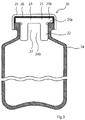
- Fig. 3 shows the medical rubber stopper 20 in a state that an opening 24b of a container 24 having a pharmaceutical product filled therein is sealed with a medical rubber stopper 20.
- the medical rubber stopper 20 comprises a top plate 21 and a stopper leg 22.
- the top plate 21 has a penetration portion 23 through which a syringe needle of a syringe can be penetrated, and a flange 21b contacting the upper edge surface 24a of the container mouth of the medical container 24.
- the stopper leg 22 protrudes from the lower surface of the top plate 21, and is inserted in the mouth of the medical container. Further, the stopper leg 22 has a roughly cylindrical shape, and has a cut out space 27.
- a nylon film layer 26 is provided on the top face of the top plate 21 of the medical rubber stopper 20. If the nylon film layer 26 is provided on the top face of the medical rubber stopper 20, the mechanical transportability when manufacturing the pharmaceutical product can be ensured. Further, the nylon film layer 26 is provided on the top face of the medical rubber stopper 20, the surface smoothness of the top face can be improved, and occurrence of needle penetration fragment when penetrating the syringe needle can be prevented.
- a vial storing a freeze-dried preparation is used as the container 24.
- the liquid pharmaceutical product to be kept in the container 24 is a pharmaceutical liquid for a syringe
- the needle of the syringe is penetrated through the penetration portion 23 of the top plate 21, to suck the pharmaceutical liquid for syringe into the syringe without opening the medical rubber stopper 20.
- the medical rubber stopper 20 is not opened to avoid a foreign material from entering the pharmaceutical liquid for syringe in the container 24.
- a metallic or resinous cap 25 capable of covering the opening 24b of the container 24 and the medical rubber stopper 20 is provided on the top plate 21. Sealing the medical rubber stopper 20 and the opening 24b with the cap 25 is to prevent mycete from adhering to the penetration portion 23 at the site where the needle of the syringe is penetrated and prevent mycete from entering the pharmaceutical liquid for syringe through the syringe needle.
- Examples of the type of the cap 25 include a flip-off cap, a pull-top cap, and a clean cap. In a case of a hospital where a large amount of a pharmaceutical liquid for syringe is used, the clean cap which can be opened with one hand and provides easy handling is preferably used.
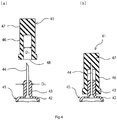
- Fig. 4(a) is a cross-sectional view showing one example of a nozzle cap of a medical syringe and a nozzle of a syringe barrel. The nozzle is covered with the nozzle cap.
- Fig. 4(b) is a cross-sectional view showing a state of covering the nozzle with the nozzle cap.
- the nozzle cap 41 in this example is used for a needle-attached syringe 45 where the needle 44 is buried into the nozzle 43 of the syringe barrel 42 in advance.
- the nozzle cap is integrally formed from the medical rubber composition according to the present invention.
- the nozzle cap comprises a cylindrical portion 46 having an inner diameter D1 slightly less than the outer diameter D2 of the nozzle 43, and a needle penetration portion 47 connecting to one end side (upper end side in the figure) of the cylindrical portion 46.
- the needle penetration portion 47 is formed into a columnar shape having an outer surface continuous to the cylindrical portion 46.
- An opening 48 for inserting the nozzle 43 in the cylindrical portion 46 and covering the nozzle 43 with the nozzle cap 41, is formed on another end side (lower end side in the figure) of the cylindrical portion 46.
- Fig. 5 is an illustrating figure showing one example of a vacuum blood collecting tube.
- the vacuum blood collecting tube 50 is composed of a tube 51 with bottom and a rubber stopper 53 sealing the opening of the tube 51 with bottom.
- the rubber stopper 53 is formed from the medical rubber composition according to the present invention. It is designed that blood can be automatically collected by reducing pressure in the blood collecting tube.
- a testing piece for measuring gas permeation coefficient was prepared from the obtained medical rubber composition, and the gas permeation coefficient was measured.
- the measurement was performed according to JIS-K 6275-1 by a differential pressure method, using GTR-30XASR available from GTR Corporation.
- the rubber composition No.1 was adopted as a standard formulation and the gas permeation coefficient thereof was defined as 100, and the gas permeation coefficient of each rubber composition was represented by converting the gas permeation coefficient of each rubber composition into this index.
- Testing sample A slab with a thickness of 2 mm was prepared by press molding the above-blended rubber composition at a temperature of 180 °C for 6 minutes. The slab was punched with a punch having ⁇ 17 mm to obtain a testing sample.
Landscapes
- Health & Medical Sciences (AREA)
- Chemical & Material Sciences (AREA)
- Life Sciences & Earth Sciences (AREA)
- Chemical Kinetics & Catalysis (AREA)
- Veterinary Medicine (AREA)
- Public Health (AREA)
- General Health & Medical Sciences (AREA)
- Animal Behavior & Ethology (AREA)
- Heart & Thoracic Surgery (AREA)
- Organic Chemistry (AREA)
- Polymers & Plastics (AREA)
- Medicinal Chemistry (AREA)
- Vascular Medicine (AREA)
- Epidemiology (AREA)
- Biomedical Technology (AREA)
- Hematology (AREA)
- Engineering & Computer Science (AREA)
- Surgery (AREA)
- Anesthesiology (AREA)
- General Chemical & Material Sciences (AREA)
- Physics & Mathematics (AREA)
- Biophysics (AREA)
- Pathology (AREA)
- Medical Informatics (AREA)
- Molecular Biology (AREA)
- Compositions Of Macromolecular Compounds (AREA)
- Medical Preparation Storing Or Oral Administration Devices (AREA)
- Infusion, Injection, And Reservoir Apparatuses (AREA)
Abstract
Description
- The present invention relates to a medical rubber composition and a medical rubber component, more specifically relates to a technology for improving gas permeation resistance of a medical rubber component.
- A medical rubber product for a pharmaceutical container is required to have high quality properties and physical properties. For example, qualities and properties required for a medical rubber stopper sealing or plugging an opening of a vial storing a formulation of antibiotics or the like should comply with the infusion rubber stopper test of Japanese Pharmacopoeia, 17th Edition. Further, several items such as gas permeation resistance, non-elution, high cleanability, chemical resistance, needle penetration resistance, self-sealability and high slidability are required for a medical rubber stopper sealing an opening of a vial.
- For example,
JP 2013-112703 A -
JP 2001-340425 A -
JP 2015-62564 A -
JP 3193895 B - A product formed by crosslinking a rubber composition containing a butyl rubber is used for a medical rubber product, in light of its excellent gas permeation resistance and the like. However, there is room for improvement in gas permeation resistance of a medical rubber product formed by crosslinking a rubber composition containing a conventional butyl rubber.
- The present invention has been made in view of the above problems. An object of the present invention is to provide a medical rubber composition providing excellent gas permeation resistance. Another object of the present invention is to provide a medical rubber component having excellent gas permeation resistance.
- The present invention provides a medical rubber composition containing (a) a base polymer containing a halogenated butyl rubber, and (b) a liquid polymer. The present invention further provides a medical rubber member formed from the medical rubber composition according to the present invention. The present invention has been accomplished based on the findings of the inventors that blending (b) the liquid polymer in (a) the base polymer containing the halogenated butyl rubber instead of an ordinary oil improves gas permeation resistance of the obtained medical rubber component.
- If the medical rubber composition according to the present invention is used, a medical rubber product having excellent gas permeation resistance is obtained.
-
-
Fig. 1 is a figure illustrating an embodiment of the medical rubber component according to the present invention (plunger stopper); -
Fig. 2 is a figure illustrating an embodiment of the medical rubber component according to the present invention (rubber stopper); -
Fig. 3 is a figure illustrating an embodiment of the medical rubber component according to the present invention (rubber stopper for a vial); -
Fig. 4 is a figure illustrating an embodiment of the medical rubber component according to the present invention (nozzle cap); and -
Fig. 5 is a figure illustrating an embodiment of the medical rubber component according to the present invention (rubber stopper for a vacuum blood collecting tube). - The medical rubber composition according to the present invention contains (a) a base polymer containing a halogenated butyl rubber and (b) a liquid polymer.
- First, (a) the base polymer containing the halogenated butyl rubber will be explained. Examples of the halogenated butyl rubber include a chlorinated butyl rubber, a brominated butyl rubber, and a bromide of a copolymer of isobutylene and p-methylstyrene. As the halogenated butyl rubber, the chlorinated butyl rubber or the brominated butyl rubber is preferable. The chlorinated butyl rubber or brominated butyl rubber is, for example, obtained by an addition reaction or substitution reaction between chlorine or bromine and an isoprene moiety in a butyl rubber, specifically a double bond and/or a carbon atom adjacent to a double bond of the isoprene moiety. It is noted that the butyl rubber is a copolymer obtained by polymerizing isobutylene and a small amount of isoprene.
- It is noted that (a) the base polymer containing the halogenated butyl rubber differs from (b) the liquid polymer in the point that (a) the base polymer containing the halogenated butyl rubber is a solid at normal temperature (23 °C).
- The amount of halogen in the halogenated butyl rubber is preferably 0.5 mass % or more, more preferably 1 mass % or more, and even more preferably 1.5 mass % or more, and is preferably 5 mass % or less, more preferably 4 mass % or less, and even more preferably 3 mass % or less.
- Specific examples of the chlorinated butyl rubber include at least one member selected from CHLOROBUTYL 1066 (stabilizer: NS, halogen content: 1.26%, Mooney viscosity: 38 ML1+8 (125 °C), specific gravity: 0.92) available from Japan Butyl Co. Ltd. and LANXESS X_BUTYL CB1240 available from LANXESS Co. Ltd.
- Specific examples of the brominated butyl rubber include at least one member selected from BROMOBUTYL 2255 (stabilizer: NS, halogen content: 2.0%, Mooney viscosity: 46 ML1+8 (125 °C), specific gravity: 0.93) available from Japan Butyl Co. Ltd. and LANXESS X_BUTYL BBX2 available from LANXESS Co. Ltd.
- (a) The base polymer may further contain a rubber component other than the halogenated butyl rubber. Examples of the other rubber component include butyl rubber, isoprene rubber, butadiene rubber, styrene-butadiene rubber, natural rubber, chloroprene rubber, nitrile rubber such as acrylonitrile-butadiene rubber, hydrogenated nitrile rubber, norbornene rubber, ethylene-propylene rubber, ethylene -propylene-diene rubber, acrylic rubber, ethylene-acrylate rubber, fluororubber, chlorosulfonated polyethylene rubber, epichlorohydrin rubber, silicone rubber, urethane rubber, polysulfide rubber, phosphazene rubber, and 1,2-polybutadiene. These rubber components may be used solely, or two or more of them may be used in combination.
- In case of using the other rubber components, the amount of the halogenated butyl rubber in (a) the base polymer is preferably 90 mass % or more, more preferably 95 mass % or more, and even more preferably 98 mass % or more. In addition, it is also preferable that (a) the base polymer consists of the halogenated butyl rubber.
- Next, (b) the liquid polymer used in the present invention will be explained. (b) The liquid polymer is a liquid polymer at the room temperature (23 °C). Examples of (b) the liquid polymer include liquid polybutene, liquid polyisoprene, liquid polybutadiene, liquid poly-α-olefin, liquid ethylene/α-olefin copolymer, liquid ethylene/propylene copolymer, and liquid ethylene/butylene copolymer. Among them, the liquid polybutene or the liquid polybutadiene is preferable, the liquid polybutene is more preferable.
- The liquid polybutene is not particularly limited, as long as it is a polymer primarily composed of butene, and examples thereof include a polymer having 1-butene as its main constituent component, and a polymer having isobutene as its main constituent component (liquid polyisobutene). In the present invention, as the liquid polybutene, the liquid polyisobutene is preferably used.
- The liquid polyisobutene is not particularly limited, as long as it is a polymer primarily composed of isobutene, and may be a polymer consisting of isobutene. As the liquid polyisobutene, for example, a copolymer obtained by reacting a main component of isobutene with normal butene, and having a molecular structure with a long chain hydrocarbon (e.g. Polybutene HV available from JXTG Energy Corporation), is suitably used.
- As the liquid polybutene, a hydrogenated product of the polybutene (hydrogenated liquid polybutene) may also be used.
- (b) The liquid polymer may be used solely, or two or more of them may be used in combination.
- The dynamic viscosity of (b) the liquid polymer at the temperature of 40 °C is preferably 900 mm2/s or more, more preferably 2000 mm2/s or more, and even more preferably 3000 mm2/s or more, and is preferably 100000 mm2/s or less, more preferably 50000 mm2/s or less, and even more preferably 30000 mm2/s or less. If the dynamic viscosity at the temperature of 40 °C falls within the above range, a better rubber can be obtained without bleeding of the low molecular weight component and problem on the process.
- The dynamic viscosity of (b) the liquid polymer at the temperature of 100 °C is preferably 50 mm2/s or more, more preferably 60 mm2/s or more, even more preferably 70 mm2/s or more, and most preferably 150 mm2/s or more, and is preferably 4000 mm2/s or less, more preferably 3000 mm2/s or less, and even more preferably 2000 mm2/s or less. If the dynamic viscosity at the temperature of 100 °C falls within the above range, a better rubber can be obtained without bleeding of the low molecular weight component and problem on the process.
- The dynamic viscosity of (b) the liquid polymer is a value measured at the temperature of 100 °C or 40 °C according to JIS K2283-2000.
- The number average molecular weight of (b) the liquid polymer is preferably 650 or more, more preferably 700 or more, and even more preferably 750 or more, and is preferably 2800 or less, more preferably 2500 or less, and even more preferably 2000 or less. It is noted that the measurement of the number average molecular weight is conducted by gel permeation chromatography ("HLC-8120GPC", available from Tosoh Corporation) using a differential refractometer as a detector under the conditions of column: GMHHXL (available from Tosoh Corporation), column temperature: 40 °C, and mobile phase: tetrahydrofuran, and calculated by converting based on polystyrene standard.
- The amount of (b) the liquid polymer in the medical rubber composition according to the present invention is preferably 1 part by mass or more, more preferably 3 parts by mass or more, and even more preferably 5 parts by mass or more, and is preferably 20 parts by mass or less, more preferably 18 parts by mass or less, and even more preferably 15 parts by mass or less, with respect to 100 parts by mass of (a) the base polymer component. If the amount of (b) the liquid polymer falls within the above range, a rubber having lower gas permeability and better processability can be obtained.
- The medical rubber composition according to the present invention preferably contains (c) a crosslinking agent. (c) The crosslinking agent is blended for crosslinking the halogenated butyl rubber component contained in (a) the base polymer. (c) The crosslinking agent is not particularly limited, as long as it is a crosslinking agent capable of crosslinking the halogenated butyl rubber. Examples of (c) the crosslinking agent include sulfur, a metal oxide, a resin crosslinking agent, an organic peroxide, and a triazine derivative. These crosslinking agents may be used solely, or two or more of them may be used in combination.
- Examples of the sulfur used as the crosslinking agent include powder sulfur, fine powder sulfur, precipitated sulfur, colloidal sulfur, and chlorinated sulfur.
- Examples of the metal oxide used as the crosslinking agent include magnesium oxide, calcium oxide, zinc oxide, and copper oxide.
- Examples of the resin crosslinking agent include alkyl phenol formaldehyde resins such as an alkyl phenol formaldehyde resin, a thermo-reactive phenol resin, a phenol dialcohol-based resin, a bisphenol resin, and a thermo-reactive bromomethylalkylated phenol resin.
- Specific examples of the organic peroxide include a dialkyl peroxide, a peroxy ester, a peroxy ketal, and a hydroperoxide. Examples of the dialkyl peroxide include di(2-t-butylperoxyisopropyl) benzene, dicumyl peroxide, 2,5-dimethyl-2,5-di(t-butylperoxy) hexane, t-butylcumyl peroxy, di-t-hexylperoxy, di-t-butylperoxy, and 2,5-dimethyl-2,5-di(t-butylperoxy) hexyne-3. Examples of the peroxy ester include t-butylperoxy maleate, t-butylperoxy-3,3,5-trimethyl cyclohexanoate, t-butylperoxy laurate, t-butylperoxyisopropyl monocarbonate, t-hexylperoxy benzoate, 2,5-dimethyl-2,5-di(benzoylperoxy) hexane, t-butylperoxy acetate, and t-butylperoxy benzoate. Examples of the peroxy ketal include 1,1-di(t-hexylperoxy)-3,3,5-trimethylcyclohexane, 1,1-di(t-hexylperoxy) cyclohexane, 1,1-di(t-butylperoxy)-2-methylcyclohexane, 1,1-di(t-butylperoxy) cyclohexane, 2,2-di(t-butylperoxy) butane, n-butyl-4,4-di(t-butylperoxy) valerate, and 2,2-di(4,4-di(t-butylperoxy) cyclohexyl) propane. Examples of the hydroperoxide include p-menthane hydroperoxide, and diisopropylbenzene hydroperoxide. These organic peroxides may be used solely, or two or more of them may be used in combination.
- Examples of the triazine derivative used as the crosslinking agent include a compound represented by the general formula (1).

- [In the formula, R is -SH, -OR1, -SR2, -NHR3 or -NR4R5 (R1, R2, R3, R4 and R5 represent an alkyl group, an alkenyl group, an aryl group, an aralkyl group, an alkylaryl group or a cycloalkyl group, and R4 and R5 may be identical to or different from each other.); M1 and M2 are H, Na, Li, K, 1/2Mg, 1/2Ba, 1/2Ca, an aliphatic primary amine, secondary amine or tertiary amine, a quaternary ammonium salt or a phosphonium salt; and M1 and M2 may be identical to or different from each other.]
- In the general formula (1), examples of the alkyl group include an alkyl group having 1 to 12 carbon atoms such as methyl group, ethyl group, n-propyl group, isopropyl group, n-butyl group, isobutyl group, tert-butyl group, n-pentyl group, isopentyl group, tert-pentyl group, n-hexyl group, 1,1-dimethylpropyl group, octyl group, isooctyl group, 2-ethylhexyl group, decyl group, and dodecyl group. Examples of the alkenyl group include an alkenyl group having 1 to 12 carbon atoms such as vinyl group, allyl group, 1-propenyl group, isopropenyl group, 2-butenyl group, 1,3-butadienyl group, and 2-pentenyl group. Examples of the aryl group include a monocyclic or condensed polycyclic aromatic hydrocarbon group, and specific examples thereof include an aryl group having 6 to 14 carbon atoms such as phenyl group, naphthyl group, anthryl group, phenanthryl group, and acenaphthylenyl group. Examples of the aralkyl group include an aralkyl group having 7 to 19 carbon atoms such as benzyl group, phenethyl group, diphenylmethyl group, 1-naphthylmethyl group, 2-naphthylmethyl group, 2,2-diphenylethyl group, 3-phenylpropyl group, 4-phenylbutyl group, 5-phenylpentyl group, 2-biphenylylmethyl group, 3-biphenylylmethyl group, and 4-biphenylylmethyl group. Examples of the alkylaryl group include an alkylaryl group having 7 to 19 carbon atoms such as tolyl group, xylyl group, and octylphenyl group. Examples of the cycloalkyl group include a cycloalkyl group having 3 to 9 carbon atoms such as cyclopropyl group, cyclobutyl group, cyclopentyl group, cyclohexyl group, cycloheptyl group, cyclooctyl group and cyclononyl group.
- Specific examples of the triazine derivative represented by the general formula (1) include 2,4,6-trimercapto-s-triazine, 2-methylamino-4,6-dimercapto-s-triazine, 2-(n-butylamino)-4,6-dimercapto-s-triazine, 2-octylamino-4,6-dimercapto-s-triazine, 2-propylamino-4,6-dimercapto-s-triazine, 2-diallylamino-4,6-dimercapto-s-triazine, 2-dimethylamino-4,6-dimercapto-s-triazine, 2-dibutylamino-4,6-dimercapto-s-triazine, 2-di(iso-butylamino)-4,6-dimercapto-s-triazine, 2-dipropylamino-4,6-dimercapto-s-triazine, 2-di(2-ethylhexyl) amino-4,6-dimercapto-s-triazine, 2-dioleylamino-4,6-dimercapto-s-triazine, 2-laurylamino-4,6-dimercapto-s-triazine, 2-anilino-4,6-dimercapto-s-triazine, and sodium salt or disodium salt thereof.
- Among them, 2,4,6-trimercapto-s-triazine, 2-dialkylamino-4,6-dimercapto-s-triazine, and 2-anilino-4,6-dimercapto-s-triazine are preferable, and 2-dibutylamino-4,6-dimercapto-s-triazine is most preferable in view of easy availability.
- In the present invention, the triazine derivative may be used solely, or two or more of the triazine derivatives may be used in combination.
- Since the chlorinated butyl rubber and the brominated butyl rubber have different crosslinking mechanisms, a suitable crosslinking component is preferably chosen and used for the crosslinking. The medical rubber composition according to the present invention preferably contains the triazine derivative as (c) the crosslinking agent when containing the chlorinated butyl rubber as the halogenated butyl rubber. In addition, the medical rubber composition according to the present invention preferably contains the metal oxide as (c) the crosslinking agent when containing the brominated butyl rubber as the halogenated butyl rubber.
- The amount of (c) the crosslinking agent in the medical rubber composition according to the present invention is preferably 0.2 part by mass or more, more preferably 0.4 part by mass or more, and even more preferably 0.6 part by mass or more, and is preferably 20 parts by mass or less, more preferably 15 parts by mass or less, and even more preferably 10 parts by mass or less, with respect to 100 parts by mass of (a) the base polymer component. If the amount of (c) the crosslinking agent falls within the above range, a rubber having better rubber properties (hardness, tension, Cset) and better processability (little burn) can be obtained.
- In case of using the chlorinated butyl rubber as the halogenated butyl rubber and using the triazine derivative as (c) the crosslinking agent, the amount of (c) the crosslinking agent in the medical rubber composition is preferably 0.2 part by mass or more, more preferably 0.4 part by mass or more, and even more preferably 0.6 part by mass or more, and is preferably 4 parts by mass or less, more preferably 3 parts by mass or less, and even more preferably 2 parts by mass or less, with respect to 100 parts by mass of (a) the base polymer component. If the amount of (c) the crosslinking agent falls within the above range, a rubber having better rubber properties (hardness, tension, Cset) and better processability (little burn) can be obtained.
- In case of using the brominated butyl rubber as the halogenated butyl rubber and using the metal oxide as (c) the crosslinking agent, the amount of (c) the crosslinking agent in the medical rubber composition is preferably 1 part by mass or more, more preferably 1.5 parts by mass or more, and even more preferably 2 parts by mass or more, and is preferably 20 parts by mass or less, more preferably 15 parts by mass or less, and even more preferably 10 parts by mass or less, with respect to 100 parts by mass of (a) the base polymer component. If the amount of (c) the crosslinking agent falls within the above range, a rubber having better rubber properties (hardness, tension, Cset) and better processability (little burn) can be obtained.
- The medical rubber composition according to the present invention preferably does not contain a vulcanization accelerator. This is because the vulcanization accelerator may remain in the final rubber product, and dissolve into the pharmaceutical liquid in a syringe or vial. Examples of the vulcanization accelerator include a guanidine accelerator (e.g. diphenylguanidine), a thiuram accelerator (e.g. tetramethylthiuram disulfide, tetramethylthiuram monosulfide), a dithiocarbamate accelerator (e.g. zinc dimethyldithiocarbamate), a thiazole accelerator (e.g. 2-mercaptobenzothiazole, dibenzothiazyl disulfide), and a sulfonamide accelerator (e.g. N-cyclohexyl-2-benzothiazole sulfenamide, N-t-butyl-2-benzothiazole sulfenamide).
- The medical rubber composition according to the present invention may contain a hydrotalcite. The hydrotalcite functions as an anti-scorching agent when crosslinking the halogenated butyl rubber, and also functions as an agent to prevent increase in compression permanent strain of the medical rubber member. Further, the hydrotalcite also functions as an acid acceptor to absorb chlorine-based gas or bromine-based gas happening when crosslinking the halogenated butyl rubber and prevent occurrence of crosslinking inhibition caused by these gases. It is noted that the above-mentioned magnesium oxide is also capable of functioning as an acid acceptor.
- Examples of the hydrotalcite include one or at least two members selected from a Mg-AI hydrotalcite such as Mg4.5Al2(OH)13CO3·3.5H2O, Mg4.5Al2(OH)13CO3, Mg4Al2(OH)12CO3·3.5H2O, Mg6Al2(OH)16CO3·4H2O, Mg5Al2(OH)14CO3·4H2O and Mg3Al2(OH)10CO3·1.7H2O.
- Specific examples of the hydrotalcite include DHT-4A (registered trademark)-2 available from Kyowa Chemical Industry Co. Ltd.
- In the medical rubber composition, when the hydrotalcite is used as the acid acceptor, the hydrotalcite is preferably used together with MgO. In this case, the amount of the hydrotalcite is preferably considered as the total amount of the acid acceptor (hydrotalcite and MgO). The total amount of the acid acceptor (hydrotalcite and MgO) is preferably 0.5 part by mass or more, more preferably 1 part by mass or more, and is preferably 15 parts by mass or less, more preferably 10 parts by mass or less, with respect to 100 parts by mass of (a) the base polymer component. If the total amount of the acid acceptor (hydrotalcite and MgO) falls within the above range, rusting of a mold or the like can be suppressed, and defects that the materials themselves become white spot of foreign material can be reduced.
- The medical rubber composition according to the present invention may further contain (d) a filler. Examples of (d) the filler include an inorganic filler such as clay and talc, and a resin powder of an olefin resin, styrene elastomer or ultrahigh molecular weight polyethylene (UHMWPE). Among them, as the filler, the inorganic filler is preferable, clay or talc is more preferable. The filler functions as adjusting the rubber hardness of the medical rubber member, and also functions as a weight increasing material to reduce the production cost of the medical rubber component.
- Examples of the clay include burned clay and kaolin clay. Specific examples of the clay include SILLITIN (registered trademark) Z available from Hoffmann Mineral Corporation, SATINTONE (registered trademark) W available from Engelhard Corporation, NN Kaolin Clay available from Tsuchiya Kaolin Industry Co. Ltd., and PoleStar 200R available from IMERYS Specialities Japan K.K.
- Specific examples of the talc include Hytron A available from Takehara Kagaku Kogyo Co., Ltd., MICRO ACE (registered trademark) K-1 available from Nippon Talc Co. Ltd., and Mistron (registered trademark) Vapor available from IMERYS Specialities Japan K.K.
- The amount of (d) the filler in the medical rubber composition according to the present invention is preferably appropriately set according to the desired rubber hardness or the like of the medical rubber component. The amount of (d) the filler in the medical rubber composition according to the present invention is, for example, preferably 5 parts by mass or more, more preferably 10 parts by mass or more, and even more preferably 20 parts by mass or more, and is preferably 200 parts by mass or less, more preferably 150 parts by mass or less, and even more preferably 100 parts by mass or less, with respect to 100 parts by mass of (a) the base polymer.
- The medical rubber composition according to the present invention may further contain a coloring agent such as titanium oxide and carbon black, a lubricant such as stearic acid and low density polyethylene (LDPE), a processing aid, polyethylene glycol acting as a crosslinking activator, or the like, in an appropriate proportion.
- The medical rubber composition according to the present invention preferably does not contain an oil component because (b) the liquid polymer contained therein is used instead of the oil component. In addition, the crosslinked product of the medical rubber composition according to the present invention differs from a dynamically crosslinked thermoplastic elastomer (TPV) obtained by dynamically crosslinking a mixture of a thermoplastic component and a rubber component with a crosslinking agent.
- The medical rubber composition according to the present invention is obtained by kneading (a) the base polymer, (b) the liquid polymer, and other materials which are added where necessary. The kneading can be performed, for example, using an open roll, a closed kneader, or the like. The kneaded mixture is preferably molded into a ribbon shape, a sheet shape, a pellet shape, or the like, and is more preferably molded into the sheet shape.
- A medical rubber component having a desired shape is obtained by press molding the kneaded mixture in the ribbon shape, sheet shape or pellet shape. The crosslinking reaction of the medical rubber composition proceeds during the pressing. The molding temperature is, for example, preferably 130 °C or more, more preferably 140 °C or more, and is preferably 200 °C or less, more preferably 190 °C or less. The molding time is preferably 2 minutes or more, more preferably 3 minutes or more, and is preferably 60 minutes or less, more preferably 30 minutes or less. The molding pressure is preferably 0.1 MPa or more, more preferably 0.2 MPa or more, and is preferably 10 MPa or less, more preferably 8 MPa or less.
- The extra part is cut off and removed from the molded product obtained by the press molding to obtain a predetermined shape. The obtained molded product is washed, sterilized, dried and packed to produce the medical rubber component.
- In addition, as conventionally done, a resin film may be laminated on and integrated with the medical rubber component according to the present invention. Examples of the resin film include a film of an inactive resin such as polytetrafluoroethylene (PTFE), tetrafluoroethylene-ethylene copolymer (ETFE), their modified products, and ultra-high density polyethylene (UHDPE).
- The resin film may be integrated with the medical rubber component formed by press molding, for example, by press molding the resin film in a state of being laminating on the sheet shaped rubber composition.
- Examples of the medical rubber component according to the present invention include a rubber stopper or sealing component of a container for various medical preparations such as a liquid preparation, a powder preparation and a freeze-dried preparation, a sliding or sealing component such as a rubber stopper for a vacuum blood collecting tube, a plunger stopper or a nozzle cap of a prefilled syringe.
- Among them, the rubber hardness of the rubber stopper or sealing component for a vial, an infusion preparation container or the like is preferably 35 or more and is preferably 60 or less in Durometer type A hardness (Shore A hardness) measured in accordance with the measuring method described in "Durometer hardness, Part III, Measuring method of hardness, Vulcanized rubber and thermoplastic rubber" of Japan Industry Specification JIS K 6253-3: 2012.
- In addition, the above Shore A hardness of a sliding or sealing component such as a plunger stopper or a nozzle cap of a prefilled syringe is preferably 40 or more and is preferably 70 or less.
- The rubber hardness of the medical rubber component can be adjusted by varying the mixing ratio of the raw materials.
-
Fig. 1 is an exploded view showing a medical syringe using the medical rubber component according to the present invention, i.e. a syringe called a prefilled syringe. InFig. 1 , half of asyringe barrel 11 and aplunger stopper 13 are shown by a cross-section. Theprefilled syringe 10 includes thecylindrical syringe barrel 11, aplunger 12 combined with thesyringe barrel 11 and capable of reciprocating in thesyringe barrel 11, and theplunger stopper 13 provided on the tip of theplunger 12. Theplunger stopper 13 is molded from the medical rubber composition according to the present invention. A laminating film for improving slidability may be laminated on the surface of theplunger stopper 13. - The
plunger 12 is, for example, composed of a resin plates having a cross-shape in a transverse sectional view and has ahead portion 18 on the tip of theplunger 12. Theplunger stopper 13 is connected to thehead portion 18. Thehead portion 18 is integrally formed with theplunger 12, made of a resin, and processed into a male screw shape. Theplunger stopper 13 has a roughly columnar shape with a short axis, and the tip surface of theplunger stopper 13, for example, has a mountain shape with an obtuse angle where the central axis of the columnar shape is protruding. Further, theplunger stopper 13 has a fitting recessedportion 15 in a female screw shape engraved in the axis direction thereof from the rear surface thereof. Thehead portion 18 of theplunger 12 is screwed into the fitting recessedportion 15 of theplunger stopper 13, to assemble theplunger stopper 13 on the tip of theplunger 12. -
Fig. 2 is a schematic cross-sectional view of one specific example of amedical rubber stopper 20 that is the medical rubber component according to the present invention.Fig. 3 shows themedical rubber stopper 20 in a state that anopening 24b of acontainer 24 having a pharmaceutical product filled therein is sealed with amedical rubber stopper 20. - The
medical rubber stopper 20 comprises atop plate 21 and astopper leg 22. Thetop plate 21 has apenetration portion 23 through which a syringe needle of a syringe can be penetrated, and aflange 21b contacting theupper edge surface 24a of the container mouth of themedical container 24. Thestopper leg 22 protrudes from the lower surface of thetop plate 21, and is inserted in the mouth of the medical container. Further, thestopper leg 22 has a roughly cylindrical shape, and has a cut outspace 27. Anylon film layer 26 is provided on the top face of thetop plate 21 of themedical rubber stopper 20. If thenylon film layer 26 is provided on the top face of themedical rubber stopper 20, the mechanical transportability when manufacturing the pharmaceutical product can be ensured. Further, thenylon film layer 26 is provided on the top face of themedical rubber stopper 20, the surface smoothness of the top face can be improved, and occurrence of needle penetration fragment when penetrating the syringe needle can be prevented. - In the embodiment shown in
Fig. 3 , a vial storing a freeze-dried preparation is used as thecontainer 24. In a case that the liquid pharmaceutical product to be kept in thecontainer 24 is a pharmaceutical liquid for a syringe, the needle of the syringe is penetrated through thepenetration portion 23 of thetop plate 21, to suck the pharmaceutical liquid for syringe into the syringe without opening themedical rubber stopper 20. As such, themedical rubber stopper 20 is not opened to avoid a foreign material from entering the pharmaceutical liquid for syringe in thecontainer 24. - A metallic or
resinous cap 25 capable of covering theopening 24b of thecontainer 24 and themedical rubber stopper 20 is provided on thetop plate 21. Sealing themedical rubber stopper 20 and theopening 24b with thecap 25 is to prevent mycete from adhering to thepenetration portion 23 at the site where the needle of the syringe is penetrated and prevent mycete from entering the pharmaceutical liquid for syringe through the syringe needle. Examples of the type of thecap 25 include a flip-off cap, a pull-top cap, and a clean cap. In a case of a hospital where a large amount of a pharmaceutical liquid for syringe is used, the clean cap which can be opened with one hand and provides easy handling is preferably used. -
Fig. 4(a) is a cross-sectional view showing one example of a nozzle cap of a medical syringe and a nozzle of a syringe barrel. The nozzle is covered with the nozzle cap.Fig. 4(b) is a cross-sectional view showing a state of covering the nozzle with the nozzle cap. Thenozzle cap 41 in this example is used for a needle-attachedsyringe 45 where theneedle 44 is buried into thenozzle 43 of thesyringe barrel 42 in advance. The nozzle cap is integrally formed from the medical rubber composition according to the present invention. The nozzle cap comprises acylindrical portion 46 having an inner diameter D1 slightly less than the outer diameter D2 of thenozzle 43, and aneedle penetration portion 47 connecting to one end side (upper end side in the figure) of thecylindrical portion 46. Theneedle penetration portion 47 is formed into a columnar shape having an outer surface continuous to thecylindrical portion 46. Anopening 48 for inserting thenozzle 43 in thecylindrical portion 46 and covering thenozzle 43 with thenozzle cap 41, is formed on another end side (lower end side in the figure) of thecylindrical portion 46. -
Fig. 5 is an illustrating figure showing one example of a vacuum blood collecting tube. The vacuumblood collecting tube 50 is composed of atube 51 with bottom and arubber stopper 53 sealing the opening of thetube 51 with bottom. Therubber stopper 53 is formed from the medical rubber composition according to the present invention. It is designed that blood can be automatically collected by reducing pressure in the blood collecting tube. - Next, the present invention will be described in detail by way of examples. However, the present invention is not limited to the examples described below. Various changes and modifications without departing from the spirit of the present invention are included in the scope of the present invention.
- Materials shown in Table 1 were kneaded to prepare medical rubber compositions. The kneading was performed at 20 °C for about 10 minutes using an open roll.


- Details of the materials used above are as follows.
- Chlorinated butyl rubber: HT-1066 available from Exxon Mobil Corporation
- Brominated butyl rubber: X_Butyl BB 2030 available from LANXESS Co. Ltd.
- Liquid polybutene 1: Polybutene HV35 (dynamic viscosity at 100 °C: 85 mm2/s) available from JXTG Energy Corporation
- Liquid polybutene 2: Polybutene HV50 (dynamic viscosity at 100 °C: 110 mm2/s) available from JXTG Energy Corporation
- Liquid polybutene 3: Polybutene HV100 (dynamic viscosity at 100 °C: 220 mm2/s) available from JXTG Energy Corporation
- Liquid polybutene 4: Polybutene HV300 (dynamic viscosity at 100 °C: 590 mm2/s) available from JXTG Energy Corporation
- Liquid polybutene 5: Polybutene Indopol H-100 (dynamic viscosity at 100 °C: 170 mm2/s) available from Ineos Co. Ltd.
- Liquid polybutadiene: Ricon 131 (Brookfield type viscosity: 2750 mPa·s (25 °C)) available from Cray Valley Corporation
- Hydrotalcite: ALCAMIZER 1 available from Kyowa Chemical Industry Co. Ltd.
- Magnesium oxide: MAGSARAT 150s available from Kyowa Chemical Industry Co. Ltd.
- Titanium oxide: KR-380 available from Titan Kogyo, Ltd.
- Talc: Mistron Vapor available from IMERYS Specialities K.K
- Carbon black: Diablack G available from Mitsubishi Chemical Corporation
- Oil: PW380 available from Idemitsu Kosan Co., Ltd.
- Triazine derivative: Disnet DB available from Sankyo Kasei Sangyo Co., Ltd.
- Sulfur: sulfur including 5% of oil available from Tsurumi Chemical Industry Co., Ltd.
- A testing piece for measuring gas permeation coefficient was prepared from the obtained medical rubber composition, and the gas permeation coefficient was measured. The measurement was performed according to JIS-K 6275-1 by a differential pressure method, using GTR-30XASR available from GTR Corporation.
- Testing gas: N2, O2, air (75% of N2 + 25% of O2)
- Testing sample: A slab with a thickness of from 0.5 mm to 1.0 mm was prepared by press molding the rubber composition at the temperature of 180 °C for 6 minutes.
- The rubber composition No.1 was adopted as a standard formulation and the gas permeation coefficient thereof was defined as 100, and the gas permeation coefficient of each rubber composition was represented by converting the gas permeation coefficient of each rubber composition into this index.
- E(Excellent): 80 or less
- G(Good): more than 80 and not less than 90
- P(Poor): more than 90
- Testing sample: A slab with a thickness of 2 mm was prepared by press molding the above-blended rubber composition at a temperature of 180 °C for 6 minutes. The slab was punched with a punch having ϕ17 mm to obtain a testing sample.
- Regarding the produced sample, "Eluting Material Test" described in "7.03 Test method for an infusion rubber stopper" of Japanese Pharmacopoeia, 17th Edition, was performed. The optimized conditions were as follows.
- State of testing liquid: colorless and transparent
- UV transmittance: transmittances in a layer length of 10 mm at a wave length of 430 nm and a wave length of 650 nm were not lower than 99.0%.
- Ultraviolet absorption spectrum: absorption at a wave length of 220 nm to 350 nm was not higher than 0.20.
- pH: difference between the testing liquid and a blank testing liquid was not higher than 1.0.
- Zinc: absorption of the testing liquid was not higher than that of the standard liquid.
- Potassium permanganate reducing substance: not higher than 2.0 mL/100 mL (Specification of Japanese Pharmacopoeia)
- Evaporation residue: not higher than 2.0 mg
- In the Table, it is described as "G(Good)" when the concentration of potassium permanganate reducing substance was not higher than 0.5 mL/100 mL, and it is described as "F(Fair)" when the concentration of potassium permanganate reducing substance was higher than 0.5 mL/100 mL.
-
- G(Good): The liquid polymer has a low viscosity, and is easily handled.
- P(Poor): The liquid polymer has a high viscosity, and is hardly handled.
- The gas permeation coefficient and results of the eluting material test are shown in Tables 1 and 2.
- It is apparent from Table 1 that the medical rubber component formed from the medical rubber composition according to the present invention has excellent gas permeation resistance.
- This application is based on Japanese Patent application No.
2019-209030 filed on November 19, 2019
Claims (11)
- A medical rubber composition containing (a) a base polymer containing a halogenated butyl rubber, and (b) a liquid polymer.
- The medical rubber composition according to claim 1, wherein (a) the halogenated butyl rubber includes a chlorinated butyl rubber or a brominated butyl rubber.
- The medical rubber composition according to claim 1 or 2, wherein (b) the liquid polymer contains a liquid polybutene or a liquid polybutadiene.
- The medical rubber composition according to any one of claims 1 to 3, wherein (b) the liquid polymer has a dynamic viscosity (100 °C) of from 50 mm2/s to 4000 mm2/s.
- The medical rubber composition according to any one of claims 1 to 4, wherein the medical rubber composition contains (b) the liquid polymer in an amount of from 1 part by mass to 20 parts by mass with respect to 100 parts by mass of (a) the base polymer.
- The medical rubber composition according to any one of claims 1 to 5, further containing (c) a crosslinking agent.
- The medical rubber composition according to claim 6, wherein (a) the halogenated butyl rubber contains a chlorinated butyl rubber, and (c) the crosslinking agent contains a triazine derivative.
- The medical rubber composition according to claim 6, wherein (a) the halogenated butyl rubber contains a brominated butyl rubber, and (c) the crosslinking agent contains a metal oxide.
- The medical rubber composition according to any one of claims 1 to 8, further containing (d) a filler.
- A medical rubber component formed from the medical rubber composition according to any one of claims 1 to 9.
- The medical rubber component according to claim 10, wherein the medical rubber component is a cap or a plunger stopper of a syringe, or a rubber stopper for a vacuum blood collecting tube.
Applications Claiming Priority (1)
| Application Number | Priority Date | Filing Date | Title |
|---|---|---|---|
| JP2019209030A JP7424001B2 (en) | 2019-11-19 | 2019-11-19 | Medical rubber compositions and medical rubber parts |
Publications (2)
| Publication Number | Publication Date |
|---|---|
| EP3824914A1 true EP3824914A1 (en) | 2021-05-26 |
| EP3824914B1 EP3824914B1 (en) | 2026-04-29 |
Family
ID=73020113
Family Applications (1)
| Application Number | Title | Priority Date | Filing Date |
|---|---|---|---|
| EP20203926.9A Active EP3824914B1 (en) | 2019-11-19 | 2020-10-26 | Medical rubber composition and medical rubber component |
Country Status (4)
| Country | Link |
|---|---|
| US (1) | US20210147657A1 (en) |
| EP (1) | EP3824914B1 (en) |
| JP (1) | JP7424001B2 (en) |
| CN (1) | CN112898693A (en) |
Families Citing this family (9)
| Publication number | Priority date | Publication date | Assignee | Title |
|---|---|---|---|---|
| EP4429738A4 (en) * | 2021-11-11 | 2025-06-25 | PRP Technologies, Inc. | SAMPLE COLLECTION DEVICE |
| JP7690880B2 (en) * | 2021-12-22 | 2025-06-11 | 住友ゴム工業株式会社 | Medical rubber composition, medical rubber part, and package of medical rubber part |
| JP2023093154A (en) * | 2021-12-22 | 2023-07-04 | 住友ゴム工業株式会社 | Sterilization method for medical rubber parts |
| WO2024009959A1 (en) * | 2022-07-08 | 2024-01-11 | 川口化学工業株式会社 | Crosslinking agent for chlorinated butyl rubber |
| CN115058087A (en) * | 2022-08-03 | 2022-09-16 | 东莞市贝克摩尔高性能材料有限公司 | Medical rubber composition and rubber part |
| JP2024155234A (en) | 2023-04-21 | 2024-10-31 | 住友ゴム工業株式会社 | Medical rubber composition and medical rubber product |
| CN116902371A (en) * | 2023-07-18 | 2023-10-20 | 浙江欧尔赛斯科技有限公司 | Freeze-drying-resistant diagnostic bottle and manufacturing method thereof |
| CN117070030B (en) * | 2023-09-28 | 2025-04-29 | 应城市恒天药业包装有限公司 | Brominated butyl rubber plug and preparation method and treatment method thereof |
| JP2025105086A (en) * | 2023-12-28 | 2025-07-10 | 住友ゴム工業株式会社 | Syringe Gasket |
Citations (6)
| Publication number | Priority date | Publication date | Assignee | Title |
|---|---|---|---|---|
| JP3193895B2 (en) | 1996-11-07 | 2001-07-30 | 株式会社大協精工 | Rubber stoppers for drug containers and drug injectors |
| JP2001340425A (en) | 2000-06-06 | 2001-12-11 | Ohtsu Tire & Rubber Co Ltd :The | Medical rubber stopper |
| US20030100696A1 (en) * | 2001-01-30 | 2003-05-29 | Tomoyasu Muraki | Rubber composition used for a rubber stopper for a medicament or for a medical treatment or its crosslinked product |
| US20130137825A1 (en) * | 2011-11-25 | 2013-05-30 | Kazuo Hochi | Thermoplastic elastomer composition and medical rubber product |
| JP2015062564A (en) | 2013-09-25 | 2015-04-09 | 住友ゴム工業株式会社 | Medical rubber parts |
| JP2019209030A (en) | 2018-06-08 | 2019-12-12 | 株式会社三共 | Game machine |
Family Cites Families (11)
| Publication number | Priority date | Publication date | Assignee | Title |
|---|---|---|---|---|
| US3076456A (en) * | 1960-03-07 | 1963-02-05 | Elsie B Hunt | Hypodermic syringe |
| NL266379A (en) * | 1960-06-27 | |||
| EP0476224A1 (en) * | 1990-08-21 | 1992-03-25 | Ricon Resins, Inc. | Adhesive rubber compositions |
| JPH09118346A (en) * | 1995-08-18 | 1997-05-06 | Naniwa Gomme Kogyo Kk | Rubber plug for powdery medicine |
| JP2000044730A (en) * | 1998-07-31 | 2000-02-15 | Yokohama Rubber Co Ltd:The | Rubber composition |
| BR0114751A (en) * | 2000-10-18 | 2004-02-10 | Exxonmobil Chem Patents Inc | Elastomeric Composition |
| JP4732720B2 (en) * | 2004-07-15 | 2011-07-27 | 東海ゴム工業株式会社 | Refrigerant transport hose |
| US20080188592A1 (en) * | 2004-12-29 | 2008-08-07 | Walter Harvey Waddell | Select Elastomeric Blends and Their Use in Articles |
| US10435547B2 (en) * | 2015-07-28 | 2019-10-08 | Nok Corporation | Halogenated butyl rubber composition and vibration-insulating grommet |
| JP6899071B2 (en) | 2016-11-18 | 2021-07-07 | 住友ゴム工業株式会社 | Nozzle cap and prefilled syringe using the nozzle cap |
| JP7058466B2 (en) | 2017-01-06 | 2022-04-22 | 住友ゴム工業株式会社 | Nozzle cap and medical prefilled syringe |
-
2019
- 2019-11-19 JP JP2019209030A patent/JP7424001B2/en active Active
-
2020
- 2020-05-06 CN CN202010371665.9A patent/CN112898693A/en active Pending
- 2020-10-26 EP EP20203926.9A patent/EP3824914B1/en active Active
- 2020-11-18 US US16/951,305 patent/US20210147657A1/en not_active Abandoned
Patent Citations (7)
| Publication number | Priority date | Publication date | Assignee | Title |
|---|---|---|---|---|
| JP3193895B2 (en) | 1996-11-07 | 2001-07-30 | 株式会社大協精工 | Rubber stoppers for drug containers and drug injectors |
| JP2001340425A (en) | 2000-06-06 | 2001-12-11 | Ohtsu Tire & Rubber Co Ltd :The | Medical rubber stopper |
| US20030100696A1 (en) * | 2001-01-30 | 2003-05-29 | Tomoyasu Muraki | Rubber composition used for a rubber stopper for a medicament or for a medical treatment or its crosslinked product |
| US20130137825A1 (en) * | 2011-11-25 | 2013-05-30 | Kazuo Hochi | Thermoplastic elastomer composition and medical rubber product |
| JP2013112703A (en) | 2011-11-25 | 2013-06-10 | Sumitomo Rubber Ind Ltd | Thermoplastic elastomer composition and medical rubber product |
| JP2015062564A (en) | 2013-09-25 | 2015-04-09 | 住友ゴム工業株式会社 | Medical rubber parts |
| JP2019209030A (en) | 2018-06-08 | 2019-12-12 | 株式会社三共 | Game machine |
Non-Patent Citations (2)
| Title |
|---|
| "Durometer hardness, Part III, Measuring method of hardness, Vulcanized rubber and thermoplastic rubber", JAPAN INDUSTRY SPECIFICATION J IS K, vol. 3, 2012, pages 6253 |
| "Japanese Pharmacopoeia", article "Eluting Material Test'' described in ''7.03 Test method for an infusion rubber stopper" |
Also Published As
| Publication number | Publication date |
|---|---|
| JP7424001B2 (en) | 2024-01-30 |
| EP3824914B1 (en) | 2026-04-29 |
| JP2021080370A (en) | 2021-05-27 |
| CN112898693A (en) | 2021-06-04 |
| US20210147657A1 (en) | 2021-05-20 |
Similar Documents
| Publication | Publication Date | Title |
|---|---|---|
| EP3824914B1 (en) | Medical rubber composition and medical rubber component | |
| US11572464B2 (en) | Medical rubber composition, medical rubber component, and prefilled syringe | |
| WO2016052037A1 (en) | Nozzle cap | |
| EP4197518B1 (en) | Medical rubber plug | |
| EP2208753B1 (en) | Thermoplastic elastomer composition and production process | |
| US12006391B2 (en) | Medical rubber composition, medical rubber part, and pre-fillable syringe | |
| EP4450556B1 (en) | Medical rubber composition and medical rubber product | |
| US12622985B2 (en) | Sterilization method for medical rubber part | |
| JP7726263B2 (en) | Method for manufacturing medical rubber articles | |
| JP2025105083A (en) | Method for manufacturing medical rubber articles | |
| WO2025142219A1 (en) | Medical rubber article and production method therefor | |
| WO2025142220A1 (en) | Syringe gasket |
Legal Events
| Date | Code | Title | Description |
|---|---|---|---|
| PUAI | Public reference made under article 153(3) epc to a published international application that has entered the european phase |
Free format text: ORIGINAL CODE: 0009012 |
|
| STAA | Information on the status of an ep patent application or granted ep patent |
Free format text: STATUS: THE APPLICATION HAS BEEN PUBLISHED |
|
| AK | Designated contracting states |
Kind code of ref document: A1 Designated state(s): AL AT BE BG CH CY CZ DE DK EE ES FI FR GB GR HR HU IE IS IT LI LT LU LV MC MK MT NL NO PL PT RO RS SE SI SK SM TR |
|
| STAA | Information on the status of an ep patent application or granted ep patent |
Free format text: STATUS: REQUEST FOR EXAMINATION WAS MADE |
|
| 17P | Request for examination filed |
Effective date: 20211125 |
|
| RBV | Designated contracting states (corrected) |
Designated state(s): AL AT BE BG CH CY CZ DE DK EE ES FI FR GB GR HR HU IE IS IT LI LT LU LV MC MK MT NL NO PL PT RO RS SE SI SK SM TR |
|
| STAA | Information on the status of an ep patent application or granted ep patent |
Free format text: STATUS: EXAMINATION IS IN PROGRESS |
|
| 17Q | First examination report despatched |
Effective date: 20230201 |
|
| P01 | Opt-out of the competence of the unified patent court (upc) registered |
Effective date: 20230510 |
|
| GRAP | Despatch of communication of intention to grant a patent |
Free format text: ORIGINAL CODE: EPIDOSNIGR1 |
|
| STAA | Information on the status of an ep patent application or granted ep patent |
Free format text: STATUS: GRANT OF PATENT IS INTENDED |
|
| INTG | Intention to grant announced |
Effective date: 20260120 |
|
| GRAS | Grant fee paid |
Free format text: ORIGINAL CODE: EPIDOSNIGR3 |
|
| GRAA | (expected) grant |
Free format text: ORIGINAL CODE: 0009210 |
|
| STAA | Information on the status of an ep patent application or granted ep patent |
Free format text: STATUS: THE PATENT HAS BEEN GRANTED |
|
| AK | Designated contracting states |
Kind code of ref document: B1 Designated state(s): AL AT BE BG CH CY CZ DE DK EE ES FI FR GB GR HR HU IE IS IT LI LT LU LV MC MK MT NL NO PL PT RO RS SE SI SK SM TR |
|
| REG | Reference to a national code |
Ref country code: CH Ref legal event code: F10 Free format text: ST27 STATUS EVENT CODE: U-0-0-F10-F00 (AS PROVIDED BY THE NATIONAL OFFICE) Effective date: 20260429 Ref country code: GB Ref legal event code: FG4D |