EP3823856B1 - Endothermic/electric hybrid propulsion system for a vehicle - Google Patents
Endothermic/electric hybrid propulsion system for a vehicle Download PDFInfo
- Publication number
- EP3823856B1 EP3823856B1 EP19761966.1A EP19761966A EP3823856B1 EP 3823856 B1 EP3823856 B1 EP 3823856B1 EP 19761966 A EP19761966 A EP 19761966A EP 3823856 B1 EP3823856 B1 EP 3823856B1
- Authority
- EP
- European Patent Office
- Prior art keywords
- electric machine
- propulsion
- combustion engine
- internal combustion
- transmission
- Prior art date
- Legal status (The legal status is an assumption and is not a legal conclusion. Google has not performed a legal analysis and makes no representation as to the accuracy of the status listed.)
- Active
Links
Images




Classifications
-
- B—PERFORMING OPERATIONS; TRANSPORTING
- B60—VEHICLES IN GENERAL
- B60L—PROPULSION OF ELECTRICALLY-PROPELLED VEHICLES; SUPPLYING ELECTRIC POWER FOR AUXILIARY EQUIPMENT OF ELECTRICALLY-PROPELLED VEHICLES; ELECTRODYNAMIC BRAKE SYSTEMS FOR VEHICLES IN GENERAL; MAGNETIC SUSPENSION OR LEVITATION FOR VEHICLES; MONITORING OPERATING VARIABLES OF ELECTRICALLY-PROPELLED VEHICLES; ELECTRIC SAFETY DEVICES FOR ELECTRICALLY-PROPELLED VEHICLES
- B60L50/00—Electric propulsion with power supplied within the vehicle
- B60L50/10—Electric propulsion with power supplied within the vehicle using propulsion power supplied by engine-driven generators, e.g. generators driven by combustion engines
- B60L50/16—Electric propulsion with power supplied within the vehicle using propulsion power supplied by engine-driven generators, e.g. generators driven by combustion engines with provision for separate direct mechanical propulsion
-
- B—PERFORMING OPERATIONS; TRANSPORTING
- B60—VEHICLES IN GENERAL
- B60K—ARRANGEMENT OR MOUNTING OF PROPULSION UNITS OR OF TRANSMISSIONS IN VEHICLES; ARRANGEMENT OR MOUNTING OF PLURAL DIVERSE PRIME-MOVERS IN VEHICLES; AUXILIARY DRIVES FOR VEHICLES; INSTRUMENTATION OR DASHBOARDS FOR VEHICLES; ARRANGEMENTS IN CONNECTION WITH COOLING, AIR INTAKE, GAS EXHAUST OR FUEL SUPPLY OF PROPULSION UNITS IN VEHICLES
- B60K1/00—Arrangement or mounting of electrical propulsion units
- B60K1/02—Arrangement or mounting of electrical propulsion units comprising more than one electric motor
-
- B—PERFORMING OPERATIONS; TRANSPORTING
- B60—VEHICLES IN GENERAL
- B60K—ARRANGEMENT OR MOUNTING OF PROPULSION UNITS OR OF TRANSMISSIONS IN VEHICLES; ARRANGEMENT OR MOUNTING OF PLURAL DIVERSE PRIME-MOVERS IN VEHICLES; AUXILIARY DRIVES FOR VEHICLES; INSTRUMENTATION OR DASHBOARDS FOR VEHICLES; ARRANGEMENTS IN CONNECTION WITH COOLING, AIR INTAKE, GAS EXHAUST OR FUEL SUPPLY OF PROPULSION UNITS IN VEHICLES
- B60K6/00—Arrangement or mounting of plural diverse prime-movers for mutual or common propulsion, e.g. hybrid propulsion systems comprising electric motors and internal combustion engines
- B60K6/20—Arrangement or mounting of plural diverse prime-movers for mutual or common propulsion, e.g. hybrid propulsion systems comprising electric motors and internal combustion engines the prime-movers consisting of electric motors and internal combustion engines, e.g. HEVs
- B60K6/22—Arrangement or mounting of plural diverse prime-movers for mutual or common propulsion, e.g. hybrid propulsion systems comprising electric motors and internal combustion engines the prime-movers consisting of electric motors and internal combustion engines, e.g. HEVs characterised by apparatus, components or means specially adapted for HEVs
- B60K6/24—Arrangement or mounting of plural diverse prime-movers for mutual or common propulsion, e.g. hybrid propulsion systems comprising electric motors and internal combustion engines the prime-movers consisting of electric motors and internal combustion engines, e.g. HEVs characterised by apparatus, components or means specially adapted for HEVs characterised by the combustion engines
-
- B—PERFORMING OPERATIONS; TRANSPORTING
- B60—VEHICLES IN GENERAL
- B60K—ARRANGEMENT OR MOUNTING OF PROPULSION UNITS OR OF TRANSMISSIONS IN VEHICLES; ARRANGEMENT OR MOUNTING OF PLURAL DIVERSE PRIME-MOVERS IN VEHICLES; AUXILIARY DRIVES FOR VEHICLES; INSTRUMENTATION OR DASHBOARDS FOR VEHICLES; ARRANGEMENTS IN CONNECTION WITH COOLING, AIR INTAKE, GAS EXHAUST OR FUEL SUPPLY OF PROPULSION UNITS IN VEHICLES
- B60K6/00—Arrangement or mounting of plural diverse prime-movers for mutual or common propulsion, e.g. hybrid propulsion systems comprising electric motors and internal combustion engines
- B60K6/20—Arrangement or mounting of plural diverse prime-movers for mutual or common propulsion, e.g. hybrid propulsion systems comprising electric motors and internal combustion engines the prime-movers consisting of electric motors and internal combustion engines, e.g. HEVs
- B60K6/22—Arrangement or mounting of plural diverse prime-movers for mutual or common propulsion, e.g. hybrid propulsion systems comprising electric motors and internal combustion engines the prime-movers consisting of electric motors and internal combustion engines, e.g. HEVs characterised by apparatus, components or means specially adapted for HEVs
- B60K6/26—Arrangement or mounting of plural diverse prime-movers for mutual or common propulsion, e.g. hybrid propulsion systems comprising electric motors and internal combustion engines the prime-movers consisting of electric motors and internal combustion engines, e.g. HEVs characterised by apparatus, components or means specially adapted for HEVs characterised by the motors or the generators
-
- B—PERFORMING OPERATIONS; TRANSPORTING
- B60—VEHICLES IN GENERAL
- B60K—ARRANGEMENT OR MOUNTING OF PROPULSION UNITS OR OF TRANSMISSIONS IN VEHICLES; ARRANGEMENT OR MOUNTING OF PLURAL DIVERSE PRIME-MOVERS IN VEHICLES; AUXILIARY DRIVES FOR VEHICLES; INSTRUMENTATION OR DASHBOARDS FOR VEHICLES; ARRANGEMENTS IN CONNECTION WITH COOLING, AIR INTAKE, GAS EXHAUST OR FUEL SUPPLY OF PROPULSION UNITS IN VEHICLES
- B60K6/00—Arrangement or mounting of plural diverse prime-movers for mutual or common propulsion, e.g. hybrid propulsion systems comprising electric motors and internal combustion engines
- B60K6/20—Arrangement or mounting of plural diverse prime-movers for mutual or common propulsion, e.g. hybrid propulsion systems comprising electric motors and internal combustion engines the prime-movers consisting of electric motors and internal combustion engines, e.g. HEVs
- B60K6/22—Arrangement or mounting of plural diverse prime-movers for mutual or common propulsion, e.g. hybrid propulsion systems comprising electric motors and internal combustion engines the prime-movers consisting of electric motors and internal combustion engines, e.g. HEVs characterised by apparatus, components or means specially adapted for HEVs
- B60K6/28—Arrangement or mounting of plural diverse prime-movers for mutual or common propulsion, e.g. hybrid propulsion systems comprising electric motors and internal combustion engines the prime-movers consisting of electric motors and internal combustion engines, e.g. HEVs characterised by apparatus, components or means specially adapted for HEVs characterised by the electric energy storing means, e.g. batteries or capacitors
-
- B—PERFORMING OPERATIONS; TRANSPORTING
- B60—VEHICLES IN GENERAL
- B60K—ARRANGEMENT OR MOUNTING OF PROPULSION UNITS OR OF TRANSMISSIONS IN VEHICLES; ARRANGEMENT OR MOUNTING OF PLURAL DIVERSE PRIME-MOVERS IN VEHICLES; AUXILIARY DRIVES FOR VEHICLES; INSTRUMENTATION OR DASHBOARDS FOR VEHICLES; ARRANGEMENTS IN CONNECTION WITH COOLING, AIR INTAKE, GAS EXHAUST OR FUEL SUPPLY OF PROPULSION UNITS IN VEHICLES
- B60K6/00—Arrangement or mounting of plural diverse prime-movers for mutual or common propulsion, e.g. hybrid propulsion systems comprising electric motors and internal combustion engines
- B60K6/20—Arrangement or mounting of plural diverse prime-movers for mutual or common propulsion, e.g. hybrid propulsion systems comprising electric motors and internal combustion engines the prime-movers consisting of electric motors and internal combustion engines, e.g. HEVs
- B60K6/22—Arrangement or mounting of plural diverse prime-movers for mutual or common propulsion, e.g. hybrid propulsion systems comprising electric motors and internal combustion engines the prime-movers consisting of electric motors and internal combustion engines, e.g. HEVs characterised by apparatus, components or means specially adapted for HEVs
- B60K6/36—Arrangement or mounting of plural diverse prime-movers for mutual or common propulsion, e.g. hybrid propulsion systems comprising electric motors and internal combustion engines the prime-movers consisting of electric motors and internal combustion engines, e.g. HEVs characterised by apparatus, components or means specially adapted for HEVs characterised by the transmission gearings
-
- B—PERFORMING OPERATIONS; TRANSPORTING
- B60—VEHICLES IN GENERAL
- B60K—ARRANGEMENT OR MOUNTING OF PROPULSION UNITS OR OF TRANSMISSIONS IN VEHICLES; ARRANGEMENT OR MOUNTING OF PLURAL DIVERSE PRIME-MOVERS IN VEHICLES; AUXILIARY DRIVES FOR VEHICLES; INSTRUMENTATION OR DASHBOARDS FOR VEHICLES; ARRANGEMENTS IN CONNECTION WITH COOLING, AIR INTAKE, GAS EXHAUST OR FUEL SUPPLY OF PROPULSION UNITS IN VEHICLES
- B60K6/00—Arrangement or mounting of plural diverse prime-movers for mutual or common propulsion, e.g. hybrid propulsion systems comprising electric motors and internal combustion engines
- B60K6/20—Arrangement or mounting of plural diverse prime-movers for mutual or common propulsion, e.g. hybrid propulsion systems comprising electric motors and internal combustion engines the prime-movers consisting of electric motors and internal combustion engines, e.g. HEVs
- B60K6/42—Arrangement or mounting of plural diverse prime-movers for mutual or common propulsion, e.g. hybrid propulsion systems comprising electric motors and internal combustion engines the prime-movers consisting of electric motors and internal combustion engines, e.g. HEVs characterised by the architecture of the hybrid electric vehicle
- B60K6/44—Series-parallel type
- B60K6/442—Series-parallel switching type
-
- B—PERFORMING OPERATIONS; TRANSPORTING
- B60—VEHICLES IN GENERAL
- B60K—ARRANGEMENT OR MOUNTING OF PROPULSION UNITS OR OF TRANSMISSIONS IN VEHICLES; ARRANGEMENT OR MOUNTING OF PLURAL DIVERSE PRIME-MOVERS IN VEHICLES; AUXILIARY DRIVES FOR VEHICLES; INSTRUMENTATION OR DASHBOARDS FOR VEHICLES; ARRANGEMENTS IN CONNECTION WITH COOLING, AIR INTAKE, GAS EXHAUST OR FUEL SUPPLY OF PROPULSION UNITS IN VEHICLES
- B60K6/00—Arrangement or mounting of plural diverse prime-movers for mutual or common propulsion, e.g. hybrid propulsion systems comprising electric motors and internal combustion engines
- B60K6/20—Arrangement or mounting of plural diverse prime-movers for mutual or common propulsion, e.g. hybrid propulsion systems comprising electric motors and internal combustion engines the prime-movers consisting of electric motors and internal combustion engines, e.g. HEVs
- B60K6/50—Architecture of the driveline characterised by arrangement or kind of transmission units
- B60K6/54—Transmission for changing ratio
- B60K6/547—Transmission for changing ratio the transmission being a stepped gearing
-
- B—PERFORMING OPERATIONS; TRANSPORTING
- B60—VEHICLES IN GENERAL
- B60L—PROPULSION OF ELECTRICALLY-PROPELLED VEHICLES; SUPPLYING ELECTRIC POWER FOR AUXILIARY EQUIPMENT OF ELECTRICALLY-PROPELLED VEHICLES; ELECTRODYNAMIC BRAKE SYSTEMS FOR VEHICLES IN GENERAL; MAGNETIC SUSPENSION OR LEVITATION FOR VEHICLES; MONITORING OPERATING VARIABLES OF ELECTRICALLY-PROPELLED VEHICLES; ELECTRIC SAFETY DEVICES FOR ELECTRICALLY-PROPELLED VEHICLES
- B60L15/00—Methods, circuits, or devices for controlling the traction-motor speed of electrically-propelled vehicles
- B60L15/20—Methods, circuits, or devices for controlling the traction-motor speed of electrically-propelled vehicles for control of the vehicle or its driving motor to achieve a desired performance, e.g. speed, torque, programmed variation of speed
-
- B—PERFORMING OPERATIONS; TRANSPORTING
- B60—VEHICLES IN GENERAL
- B60L—PROPULSION OF ELECTRICALLY-PROPELLED VEHICLES; SUPPLYING ELECTRIC POWER FOR AUXILIARY EQUIPMENT OF ELECTRICALLY-PROPELLED VEHICLES; ELECTRODYNAMIC BRAKE SYSTEMS FOR VEHICLES IN GENERAL; MAGNETIC SUSPENSION OR LEVITATION FOR VEHICLES; MONITORING OPERATING VARIABLES OF ELECTRICALLY-PROPELLED VEHICLES; ELECTRIC SAFETY DEVICES FOR ELECTRICALLY-PROPELLED VEHICLES
- B60L15/00—Methods, circuits, or devices for controlling the traction-motor speed of electrically-propelled vehicles
- B60L15/20—Methods, circuits, or devices for controlling the traction-motor speed of electrically-propelled vehicles for control of the vehicle or its driving motor to achieve a desired performance, e.g. speed, torque, programmed variation of speed
- B60L15/2045—Methods, circuits, or devices for controlling the traction-motor speed of electrically-propelled vehicles for control of the vehicle or its driving motor to achieve a desired performance, e.g. speed, torque, programmed variation of speed for optimising the use of energy
-
- B—PERFORMING OPERATIONS; TRANSPORTING
- B60—VEHICLES IN GENERAL
- B60K—ARRANGEMENT OR MOUNTING OF PROPULSION UNITS OR OF TRANSMISSIONS IN VEHICLES; ARRANGEMENT OR MOUNTING OF PLURAL DIVERSE PRIME-MOVERS IN VEHICLES; AUXILIARY DRIVES FOR VEHICLES; INSTRUMENTATION OR DASHBOARDS FOR VEHICLES; ARRANGEMENTS IN CONNECTION WITH COOLING, AIR INTAKE, GAS EXHAUST OR FUEL SUPPLY OF PROPULSION UNITS IN VEHICLES
- B60K6/00—Arrangement or mounting of plural diverse prime-movers for mutual or common propulsion, e.g. hybrid propulsion systems comprising electric motors and internal combustion engines
- B60K6/20—Arrangement or mounting of plural diverse prime-movers for mutual or common propulsion, e.g. hybrid propulsion systems comprising electric motors and internal combustion engines the prime-movers consisting of electric motors and internal combustion engines, e.g. HEVs
- B60K6/50—Architecture of the driveline characterised by arrangement or kind of transmission units
- B60K6/52—Driving a plurality of drive axles, e.g. four-wheel drive
-
- B—PERFORMING OPERATIONS; TRANSPORTING
- B60—VEHICLES IN GENERAL
- B60L—PROPULSION OF ELECTRICALLY-PROPELLED VEHICLES; SUPPLYING ELECTRIC POWER FOR AUXILIARY EQUIPMENT OF ELECTRICALLY-PROPELLED VEHICLES; ELECTRODYNAMIC BRAKE SYSTEMS FOR VEHICLES IN GENERAL; MAGNETIC SUSPENSION OR LEVITATION FOR VEHICLES; MONITORING OPERATING VARIABLES OF ELECTRICALLY-PROPELLED VEHICLES; ELECTRIC SAFETY DEVICES FOR ELECTRICALLY-PROPELLED VEHICLES
- B60L2220/00—Electrical machine types; Structures or applications thereof
- B60L2220/40—Electrical machine applications
- B60L2220/42—Electrical machine applications with use of more than one motor
-
- B—PERFORMING OPERATIONS; TRANSPORTING
- B60—VEHICLES IN GENERAL
- B60L—PROPULSION OF ELECTRICALLY-PROPELLED VEHICLES; SUPPLYING ELECTRIC POWER FOR AUXILIARY EQUIPMENT OF ELECTRICALLY-PROPELLED VEHICLES; ELECTRODYNAMIC BRAKE SYSTEMS FOR VEHICLES IN GENERAL; MAGNETIC SUSPENSION OR LEVITATION FOR VEHICLES; MONITORING OPERATING VARIABLES OF ELECTRICALLY-PROPELLED VEHICLES; ELECTRIC SAFETY DEVICES FOR ELECTRICALLY-PROPELLED VEHICLES
- B60L2240/00—Control parameters of input or output; Target parameters
- B60L2240/40—Drive Train control parameters
- B60L2240/50—Drive Train control parameters related to clutches
-
- B—PERFORMING OPERATIONS; TRANSPORTING
- B60—VEHICLES IN GENERAL
- B60L—PROPULSION OF ELECTRICALLY-PROPELLED VEHICLES; SUPPLYING ELECTRIC POWER FOR AUXILIARY EQUIPMENT OF ELECTRICALLY-PROPELLED VEHICLES; ELECTRODYNAMIC BRAKE SYSTEMS FOR VEHICLES IN GENERAL; MAGNETIC SUSPENSION OR LEVITATION FOR VEHICLES; MONITORING OPERATING VARIABLES OF ELECTRICALLY-PROPELLED VEHICLES; ELECTRIC SAFETY DEVICES FOR ELECTRICALLY-PROPELLED VEHICLES
- B60L2260/00—Operating Modes
- B60L2260/20—Drive modes; Transition between modes
- B60L2260/26—Transition between different drive modes
-
- B—PERFORMING OPERATIONS; TRANSPORTING
- B60—VEHICLES IN GENERAL
- B60Y—INDEXING SCHEME RELATING TO ASPECTS CROSS-CUTTING VEHICLE TECHNOLOGY
- B60Y2200/00—Type of vehicle
- B60Y2200/90—Vehicles comprising electric prime movers
- B60Y2200/92—Hybrid vehicles
-
- B—PERFORMING OPERATIONS; TRANSPORTING
- B60—VEHICLES IN GENERAL
- B60Y—INDEXING SCHEME RELATING TO ASPECTS CROSS-CUTTING VEHICLE TECHNOLOGY
- B60Y2300/00—Purposes or special features of road vehicle drive control systems
- B60Y2300/18—Propelling the vehicle
-
- Y—GENERAL TAGGING OF NEW TECHNOLOGICAL DEVELOPMENTS; GENERAL TAGGING OF CROSS-SECTIONAL TECHNOLOGIES SPANNING OVER SEVERAL SECTIONS OF THE IPC; TECHNICAL SUBJECTS COVERED BY FORMER USPC CROSS-REFERENCE ART COLLECTIONS [XRACs] AND DIGESTS
- Y02—TECHNOLOGIES OR APPLICATIONS FOR MITIGATION OR ADAPTATION AGAINST CLIMATE CHANGE
- Y02T—CLIMATE CHANGE MITIGATION TECHNOLOGIES RELATED TO TRANSPORTATION
- Y02T10/00—Road transport of goods or passengers
- Y02T10/60—Other road transportation technologies with climate change mitigation effect
- Y02T10/62—Hybrid vehicles
-
- Y—GENERAL TAGGING OF NEW TECHNOLOGICAL DEVELOPMENTS; GENERAL TAGGING OF CROSS-SECTIONAL TECHNOLOGIES SPANNING OVER SEVERAL SECTIONS OF THE IPC; TECHNICAL SUBJECTS COVERED BY FORMER USPC CROSS-REFERENCE ART COLLECTIONS [XRACs] AND DIGESTS
- Y02—TECHNOLOGIES OR APPLICATIONS FOR MITIGATION OR ADAPTATION AGAINST CLIMATE CHANGE
- Y02T—CLIMATE CHANGE MITIGATION TECHNOLOGIES RELATED TO TRANSPORTATION
- Y02T10/00—Road transport of goods or passengers
- Y02T10/60—Other road transportation technologies with climate change mitigation effect
- Y02T10/64—Electric machine technologies in electromobility
-
- Y—GENERAL TAGGING OF NEW TECHNOLOGICAL DEVELOPMENTS; GENERAL TAGGING OF CROSS-SECTIONAL TECHNOLOGIES SPANNING OVER SEVERAL SECTIONS OF THE IPC; TECHNICAL SUBJECTS COVERED BY FORMER USPC CROSS-REFERENCE ART COLLECTIONS [XRACs] AND DIGESTS
- Y02—TECHNOLOGIES OR APPLICATIONS FOR MITIGATION OR ADAPTATION AGAINST CLIMATE CHANGE
- Y02T—CLIMATE CHANGE MITIGATION TECHNOLOGIES RELATED TO TRANSPORTATION
- Y02T10/00—Road transport of goods or passengers
- Y02T10/60—Other road transportation technologies with climate change mitigation effect
- Y02T10/7072—Electromobility specific charging systems or methods for batteries, ultracapacitors, supercapacitors or double-layer capacitors
-
- Y—GENERAL TAGGING OF NEW TECHNOLOGICAL DEVELOPMENTS; GENERAL TAGGING OF CROSS-SECTIONAL TECHNOLOGIES SPANNING OVER SEVERAL SECTIONS OF THE IPC; TECHNICAL SUBJECTS COVERED BY FORMER USPC CROSS-REFERENCE ART COLLECTIONS [XRACs] AND DIGESTS
- Y02—TECHNOLOGIES OR APPLICATIONS FOR MITIGATION OR ADAPTATION AGAINST CLIMATE CHANGE
- Y02T—CLIMATE CHANGE MITIGATION TECHNOLOGIES RELATED TO TRANSPORTATION
- Y02T10/00—Road transport of goods or passengers
- Y02T10/60—Other road transportation technologies with climate change mitigation effect
- Y02T10/72—Electric energy management in electromobility
Definitions
- the present invention is therefore particularly applicable to the automotive sector and, more precisely, to the production of hybrid propulsion vehicles.
- the automobile industry has, in fact, in recent years committed more and more resources to the design and production of propulsion systems that could reduce the consumption of fossil fuel and the resulting emissions into the atmosphere.
- hybrid in which the internal combustion engine, which is deliberately small in size, is used in combination with a propulsion system of another kind, typically an electric one.
- the P3 design envisages the electric machine as connected to the output shaft of the mechanical transmission, in any case in the presence of a clutch that allows the internal combustion engine to be uncoupled from the electric machine.
- one purpose of the present invention is to provide an endothermic/electric hybrid propulsion system for a vehicle that is versatile and simple to produce.
- one purpose of the present invention is to provide an endothermic/electric hybrid propulsion system at a reduced cost that can easily be applied to a wide range of vehicles without substantial modifications.
- the propulsion system also comprises a coupling member operatively interposed between the output shaft of the second propulsion unit and the transmission shaft of the first propulsion unit.
- the transmission device comprises at least a first, a second and a third gearset defining a first, a second and a third transmission ratio, respectively, between the input shaft and the output shaft.
- a first selector member is provided, operatively interposed between the input shaft and said first gearset.
- the first, second and third transmission ratios are ordered according to decreasing value, from a maximum value corresponding to a gearing down of the input shaft speed (i.e. low gear) to a minimum value corresponding to a high gearing up of the input shaft speed (i.e. high gear).
- transmission ratio in the present text means a value corresponding to the ratio between the input shaft rotation speed and the output shaft rotation speed ( ⁇ in / ⁇ out ), or to the ratio between the output shaft torque and the input shaft torque (T out /T in ).
- the first electric machine is larger than the second electric machine.
- control unit is configured to direct the first and the second propulsion units in at least one hybrid propulsion configuration, wherein the coupling member is in said engagement condition, said first electric machine transmits torque to the transmission shaft and said second electric machine transmits torque to said output shaft of the second propulsion unit.
- the first propulsion unit 2 is directly coupled to a differential AD of the vehicle V through a transmission shaft 5.
- the first electric machine EM1 is connected to the transmission shaft 5 by at least one appropriately sized gearset 6.
- the gearset 6 of the first propulsion unit 2 has a transmission ratio of more than 1, more preferably of between 2 and 4.
- the "second electric machine EM2" like the first, can also be of any type and is connected to a battery pack, which can be the same as the first electric machine or a dedicated one; in the preferred embodiments, the first and second electric machine EM1, EM2 are of the same type.
- the second electric machine EM2 has a rotation axis that is coaxial (i.e. aligned) with the input shaft 11.
- This coupling device 16 can be selectively switched between a first configuration, wherein it directly couples the input shaft with the second electric machine EM2, and a second configuration, wherein it disengages the input shaft from the second electric machine EM2.
- This transmission device 10 has at least one first operating condition wherein it allows the transmission of torque between the second electric machine EM2 and the internal combustion engine ICE and vice versa.
- the coupling member 4 is preferably in the disengagement condition, in order to allow the transfer of torque between the power sources of the second propulsion unit 3 without involving (at least directly) the first propulsion unit 2.
- the insertion of at least one toothed wheel is, preferably, provided to transmit the motion between the rotor shaft of the first EM1 and/or the second EM2 electric machine and the transmission shaft 5 and/or the transmission device 10.
- Each gearset 12, 13, 14 is defined by a first toothed wheel fitted to the input shaft 11 and a second toothed wheel fitted to the output shaft 9.
- transmission ratios preferably decrease from first to third.
- the first transmission ratio, produced by the first gearset 14 corresponds to a high gearing down ratio, which can mainly be used at low speeds and during breakaway.
- the transmission device 10 also comprises at least two selector members 15 that are operatively interposed between the input shaft 11 (or output shaft 9) and said gearsets 12, 13, 14.
- the transmission device 10 comprises, preferably, a first selector member 15b operatively interposed between the input shaft 11 and said first gearset 14.
- the transmission device 10 also comprises a second selector member 15a operatively interposed between the input shaft 11 and said second 13 and third gearsets 12 in order to alternately select the second or third reduction ratio.
- the second electric machine EM2 is rigidly coupled to the first gearset 14; in this embodiment, the first selector member 15b corresponds to the coupling device 16 between the input shaft 11 and the second electric machine EM2.
- the second electric machine EM2 is coupled to the first gearset 14 by means of the second idler wheel 19a.
- the second electric machine EM2 is disengaged from any gearset.
- the first selector member 15b is operatively interposed between the input shaft 11 and the first gearset 14 (or possibly to another).
- the coupling device 16 is instead operatively interposed between the second electric machine EM2 (or one of its drive shafts) and the input shaft 11.
- the coupling device 16 is a selector member coupled to the second electric machine EM2 and can be selectively switched between a first condition, in which it couples the second electric machine EM2 to the (first) gearset, and a second condition, in which it directly couples the second electric machine EM2 to the input shaft 11.
- the input shaft 11 is engaged with the first gearset 14 by means of the second selector member and, at the same time, the second electric machine EM2 is connected to the same gearset 14.
- control unit ECU is configured to direct the first 2 and the second 3 propulsion unit in a first electric propulsion configuration ( Figure 4 ), wherein the coupling member 4 is in said disengagement condition and said first electric machine EM1 transmits torque to the transmission shaft 5.
- control unit ECU is preferably programmed to set the first and/or the second electric propulsion configuration for low speeds, below a predetermined threshold (e.g. below 80 km/h), and for sufficiently high battery pack charge levels (i.e. above a threshold).
- a predetermined threshold e.g. below 80 km/h
- sufficiently high battery pack charge levels i.e. above a threshold
- control unit ECU is configured to:
- This synchronisation mode can be used by the control unit ECU not only during electric-hybrid transition, but also during the transmission ratio change ( Figure 13 ), thus obviating the need for traditional synchronisers or clutches on the transmission device 10.
- the second electric machine EM2 also, preferably, transmits torque to the output shaft 9.
- the ECU control unit is preferably programmed to set the hybrid propulsion configuration (or a possible endothermic propulsion configuration) for high speeds, above a predetermined threshold (e.g. 80 km/h) and/or for particularly low battery pack charge levels (e.g. above a threshold) and/or for acceleration demands above a certain threshold.
- a predetermined threshold e.g. 80 km/h
- particularly low battery pack charge levels e.g. above a threshold
- acceleration demands above a certain threshold.
- the internal combustion engine is thus used under conditions of maximum efficiency, i.e. when the power demand is high and stable.
- Figure 16 shows the propulsion system 1 wherein the second propulsion unit can be coupled independently from the first to the only rear differential.
Landscapes
- Engineering & Computer Science (AREA)
- Transportation (AREA)
- Mechanical Engineering (AREA)
- Chemical & Material Sciences (AREA)
- Combustion & Propulsion (AREA)
- Power Engineering (AREA)
- Hybrid Electric Vehicles (AREA)
- Electric Propulsion And Braking For Vehicles (AREA)
- Automatic Cycles, And Cycles In General (AREA)
Description
- The present invention concerns a propulsion system for a vehicle, in particular for a hybrid endothermic/electric propulsion vehicle.
- The present invention is therefore particularly applicable to the automotive sector and, more precisely, to the production of hybrid propulsion vehicles. The automobile industry has, in fact, in recent years committed more and more resources to the design and production of propulsion systems that could reduce the consumption of fossil fuel and the resulting emissions into the atmosphere.
- The solution that is currently the most industrially developed is undoubtedly the so-called "hybrid", in which the internal combustion engine, which is deliberately small in size, is used in combination with a propulsion system of another kind, typically an electric one.
- The endothermic/electric hybrid propulsion type designs known today are numerous, beginning with those developed and put on the market at the beginning of the century up to those of more recent manufacture.
- The designs, to date, are commonly classified according to codes ranging from P0 to P4, each one representing a peculiar combination between the endothermic source and the electric one.
- For example, on the one hand, the P0 design envisages the electric machine as connected to the internal combustion engine by the auxiliary timing belt (i.e. the service belt).
- The P1 design, on the other hand, envisages the electric machine as connected directly to the crankshaft of the internal combustion engine. Disadvantageously, in addition to the reduced deliverable torque, these designs do not allow the uncoupling of the electric machine from the internal combustion engine, which significantly limits the applications. Better performing solutions include, for example, those identified by the code P2 and those that follow.
- The P2 design is very similar to the P1 design, but it envisages the electric machine as connected either laterally or in series, but always downstream of a clutch or uncoupling member and operatively upstream of the transmission.
- The P3 design, on the other hand, envisages the electric machine as connected to the output shaft of the mechanical transmission, in any case in the presence of a clutch that allows the internal combustion engine to be uncoupled from the electric machine.
- The P4 design has a different configuration, wherein the electric machine is uncoupled from the internal combustion engine and is located on the drive axle (typically rear).
- Another well-known solution is the one commonly called eCVT or Powersplit, which was developed by Toyota, wherein two electric machines and an internal combustion engine can be selectively coupled together by means of an epicyclic gear, which allows power to be supplied to the wheels by using the energy of the most appropriate source(s).
- Some prior art solutions involving the use of planetary gears or clutches are disclosed in patent documents
US2015/046011 ,US2017/349157 andUS2008/067973 . Also,US2008041653 describes a propulsion system for a hybrid endothermic/electric propulsion vehicle with a first and second propulsion units, the second propulsion unit including one internal combustion engine and one electric machine which can provide torque to the wheels or between them. - As can be immediately deduced from the brief summary above, all the known solutions have drawbacks, which result in performance limits or excessive construction complexity (i.e. cost).
- In fact, the arrangement of an electric machine directly coupled to the internal combustion engine gives the system a reduced efficiency and prevents the optimal use of both sources of power.
- In addition, the solutions known today do not allow totally independent driving, even in the presence of clutches or uncoupling members.
- In light of the above, one purpose of the present invention is to provide an endothermic/electric hybrid propulsion system for a vehicle that is capable of avoiding the drawbacks of the prior art mentioned above. The invention is defined by the subject-matter of
independent system claim 1. - In particular, one purpose of the present invention is to provide an endothermic/electric hybrid propulsion system for a vehicle that is versatile and simple to produce.
- In addition, one purpose of the present invention is to provide an endothermic/electric hybrid propulsion system for a vehicle that is capable of optimising the efficiency of its traction members.
- Furthermore, one purpose of the present invention is to provide an endothermic/electric hybrid propulsion system at a reduced cost that can easily be applied to a wide range of vehicles without substantial modifications.
- Said purposes are achieved by an endothermic/electric hybrid propulsion system for a vehicle having the features of one or more of the following claims.
- In particular, said purposes are obtained from an endothermic/electric hybrid propulsion system for a vehicle comprising a first propulsion unit, of the electrical type, provided with at least a first electric machine coupled to a transmission shaft.
- Said transmission shaft is coupled to a differential of said vehicle.
- The propulsion system also comprises a second propulsion unit of the hybrid type.
- The second propulsion unit is provided with an output shaft and comprises at least one internal combustion engine and at least a second electric machine.
- The internal combustion engine and the second electric machine can be selectively coupled together to provide torque to said output shaft independently or in combination.
- The propulsion system also comprises a coupling member operatively interposed between the output shaft of the second propulsion unit and the transmission shaft of the first propulsion unit.
- The coupling member can be selectively switched between an engagement condition, in which it couples said first and said second propulsion unit, and a disengagement condition, in which it disengages the second propulsion unit from the first propulsion unit.
- Advantageously, the first and the second propulsion units can thus be selectively coupled so as to manage the torque transfer in a plurality of different modes.
- In fact, thanks to the design of the propulsion system that is the object of the invention, it is possible to combine the benefits, and limit the defects, of many hybrid designs known today, ensuring maximum versatility of driving and a reduced complexity of construction.
- The second propulsion unit comprises a transmission device operatively interposed between the internal combustion engine and the second electric machine.
- The transmission device has at least one first operating condition wherein it allows the transmission of torque from the second electric machine to the internal combustion engine and vice versa.
- Preferably, moreover, the transmission device has at least one second operating condition wherein it disengages the internal combustion engine from the second electric machine in order to allow the transmission of torque from the second electric machine to the output shaft.
- In the first operating condition, the transmission device allows the transmission of torque between the second electric machine and the internal combustion engine through said output shaft. It is the presence of the coupling member that allows this since, when it is in a disengaged condition, it enables you to direct the second propulsion unit independently of the vehicle's wheels.
- The transmission device comprises a plurality of gearsets defining a corresponding plurality of transmission ratios between an input shaft and said output shaft of the second propulsion unit. Note that the internal combustion engine is coupled to the input shaft, preferably without the aid of any clutch.
- More preferably, the transmission device comprises at least a first, a second and a third gearset defining a first, a second and a third transmission ratio, respectively, between the input shaft and the output shaft.
- At least two selector members are provided, operatively interposed between the input shaft and said gearsets.
- Preferably, a first selector member is provided, operatively interposed between the input shaft and said first gearset.
- In addition, a second selector member is provided, operatively interposed between the input shaft and said second and third gearsets, so as to couple the shaft with one of the gearsets or to disengage it from them.
- Note that, preferably, the first, second and third transmission ratios are ordered according to decreasing value, from a maximum value corresponding to a gearing down of the input shaft speed (i.e. low gear) to a minimum value corresponding to a high gearing up of the input shaft speed (i.e. high gear).
- Note that "transmission ratio" in the present text means a value corresponding to the ratio between the input shaft rotation speed and the output shaft rotation speed (ωin/ωout), or to the ratio between the output shaft torque and the input shaft torque (Tout/Tin).
- Preferably, moreover, the transmission device comprises at least one coupling device operatively interposed between said input shaft and said second electric machine.
- This coupling device can be selectively switched between a first configuration, wherein it directly couples the input shaft with the second electric machine, and a second configuration, wherein it disengages the input shaft from the second electric machine.
- Advantageously, the second electric machine can thus be coupled to the endothermic engine either directly, through the input shaft, or indirectly, through the output shaft.
- This means that the transmission ratio between the second electric machine and the internal combustion engine can be varied appropriately, according to requirements.
- In this respect, note that, preferably, the first electric machine is larger than the second electric machine.
- In particular, the ability to gear up or down the transmission ratio between the input shaft and the second electric machine allows a reduced size for the second electric machine itself, the breakaway torque of which may be considerably lower than that required by the starting of the internal combustion engine.
- Preferably, the second electric machine has a rotation axis coaxial with said input shaft.
- The propulsion system therefore comprises a control unit configured to direct said first and second propulsion units in a plurality of operating configurations.
- Preferably, the control unit is configured to direct the first and second propulsion units in at least one first electric propulsion configuration, wherein the coupling member is in said disengagement condition and said first electric machine transmits torque to the transmission shaft.
- Preferably, the control unit is configured to direct the first and the second propulsion units in at least a second electric propulsion configuration, wherein the coupling member is in said engagement condition, said first electric machine transmits torque to the transmission shaft, said second electric machine transmits torque to said output shaft of the second propulsion unit and said internal combustion engine is uncoupled from said output shaft.
- Preferably, the control unit is configured to direct the first and second propulsion units in at least one electric-hybrid transition configuration, wherein the coupling member is in said disengagement condition and said second electric machine transmits torque to the internal combustion engine.
- Advantageously, the second electric machine can thus start the internal combustion engine and/or synchronise the rotation speed of the output shaft with the transmission shaft, without necessarily requiring the presence of synchronisers and clutch.
- Preferably, in this transition configuration, the control unit is configured to direct the coupling device in said second configuration and the second selector member so as to engage the third gearset with said input shaft and maximise the transmission ratio between the second electric machine and the internal combustion engine.
- Advantageously, it is thus possible to reduce the size of the second electric machine, all to the benefit of the system's compactness and cost.
- Moreover, in the transition configuration, the control unit is preferably configured to direct the second electric machine and the internal combustion engine so as to bring the output shaft of the second propulsion unit to the same rotation speed as the transmission shaft of the first propulsion unit.
- Advantageously, a synchronisation step is thus carried out, which is completely managed by the second electric machine, without necessarily requiring the aid of the synchronisation devices and clutch.
- Preferably, moreover, the control unit is configured to direct the first and the second propulsion units in at least one hybrid propulsion configuration, wherein the coupling member is in said engagement condition, said first electric machine transmits torque to the transmission shaft and said second electric machine transmits torque to said output shaft of the second propulsion unit.
- Note that, advantageously, the ability to supplement the torque supplied by the internal combustion engine with that of the second electric machine, allows the internal combustion engine to be kept within its optimal operating zone, with high efficiency (low consumption), compensating for the differences with respect to it, in positive or negative terms, thanks to the electric machines.
- In this respect, the control unit is preferably configured to direct the first and second propulsion units in at least one regeneration configuration, wherein:
- the coupling member is in said disengagement condition,
- the internal combustion engine transmits torque to the second electric machine;
- the second electric machine transmits electrical energy to the battery pack or directly to the first electric machine;
- the first electric machine transmits torque to the transmission shaft.
- These and other characteristics, together with the related benefits, will be clearer from the following illustrative, and therefore non-limiting, description of a preferred, and thus non-exclusive, embodiment of an endothermic-electric propulsion system for a vehicle according to what is shown in the attached drawings, wherein:
-
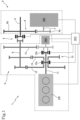
Figure 1 schematically shows an endothermic/electric hybrid propulsion system for a vehicle, in a first embodiment; -
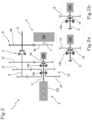
Figure 2 schematically shows an endothermic/electric hybrid propulsion system for a vehicle, in a second embodiment; -
Figures 2a and 2b schematically show two details of the Figure; -
Figure 3 schematically shows an endothermic/electric hybrid propulsion system for a vehicle, in a third embodiment -
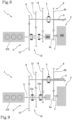
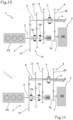
Figures 4 to 13 show the endothermic/electric hybrid propulsion system inFigure 1 in a plurality of operating configurations; -
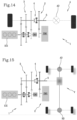
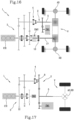
Figures 14 to 18 show an endothermic/electric hybrid propulsion system according to the invention, schematically placed in a hybrid vehicle according to a plurality of alternative configurations; -
Figure 19 schematically shows an endothermic/electric hybrid propulsion system for a vehicle according to the present invention, in another embodiment. - With reference to the attached Figures,
number 1 indicates an endothermic/electric hybrid propulsion system for a vehicle V according to the present invention. - This
propulsion system 1 is of the endothermic/electric hybrid type and fits operatively upstream of a front differential AD and/or a rear differential RD of the vehicle V. - The
propulsion system 1 comprises afirst propulsion unit 2, of the electrical type, and asecond propulsion unit 3, of the hybrid type, which are connected by means of acoupling member 4 that can be selectively switched between an engagement condition (for example inFigure 5 ), wherein it couples the first 2 and the second 3 propulsion unit, and a disengagement condition (for example inFigure 1 ), wherein it disengages thesecond propulsion unit 3 from thefirst propulsion unit 2. - The
coupling member 4 is preferably defined by a straight or oblique dog clutch. However, thiscoupling member 4 could also assume other configurations, more or less complex, as long as they are suitable for enabling a selective coupling and uncoupling of the twopropulsion units - For example, alternative solutions to the dog clutch could be synchronisers.
- The
first propulsion unit 2 is directly coupled to a differential AD of the vehicle V through atransmission shaft 5. - This
first propulsion unit 2 therefore comprises at least one first electric machine EM1 coupled to thetransmission shaft 5 so as to transmit torque. In order to power the first electric machine EM1, thefirst propulsion unit 2 comprises a battery pack (not shown), which can be dedicated or shared with thesecond propulsion unit 3. - Note that the term "electric machine" means any electric motor, which can preferably be directed in both drive and power generation modes, and which is adapted for automotive applications.
- Therefore, in the present text, the expression "electric machine" refers in a generic way to the actuator/electronics set that supplies (or receives) torque to the drive shaft.
- The first electric machine EM1 can therefore be defined by a direct current motor, for example of the brushless type, or by an alternating current motor, both synchronous and asynchronous, according to the design specifications and without deviating from the object of the present invention.
- Preferably, the first electric machine EM1 is connected to the
transmission shaft 5 by at least one appropriatelysized gearset 6. - In particular, the
gearset 6 of thefirst propulsion unit 2 comprises at least a firsttoothed wheel 6a, which is rotatably engaged to adrive shaft 7 of the first electric machine EM1, and a secondtoothed wheel 6b, which is coupled to the first 6a and rotatably engaged to thetransmission shaft 5. - Note that, with reference to the embodiments shown, the first electric machine EM1 is permanently coupled to the
gearset 6. - Alternatively, however, an uncoupling device (e.g. a disconnect clutch) between the first electric machine EM1 and the
gearset 6 could be provided, in particular between thedrive shaft 7 and the firsttoothed wheel 6a. Such a second configuration could be useful for reasons of efficiency or safety, without however diverging from the inventive concept of the present invention. - In its preferred embodiment, the
gearset 6 of thefirst propulsion unit 2 has a transmission ratio of more than 1, more preferably of between 2 and 4. - In some embodiments (
Figures 3 ,17 ,18 ), thetransmission shaft 5 of thefirst propulsion unit 2 is connected to the second propulsion unit 3 (and to the coupling member 4) through an additional shaft 8. - Advantageously, it is thus possible to provide the
first propulsion unit 2 with at least two gearsets and at least one selector device in order to allow a variation of the transmission ratio between the additional shaft 8, which receives torque from the hybrid propulsion unit (i.e. the second propulsion unit 3), and thetransmission shaft 5. - In the embodiment shown in
Figure 3 , thefirst propulsion unit 2 comprises thedrive shaft 7 of the first electric machine EM1, the additional shaft 8 and thetransmission shaft 5, which are parallel and distinct. - The
second propulsion unit 3, as said of the hybrid type, is provided with at least one internal combustion engine ICE and at least one second electric machine EM2, both coupled, or able to coupled, to anoutput shaft 9. - The "second electric machine EM2", like the first, can also be of any type and is connected to a battery pack, which can be the same as the first electric machine or a dedicated one; in the preferred embodiments, the first and second electric machine EM1, EM2 are of the same type.
- Note that, as will be better explained below, the first electric machine EM1 is larger than the second electric machine EM2.
- For example, in one embodiment, the first electric machine EM1 is designed to deliver a torque of 120Nm (65kW power), while the second electric machine is designed to deliver a torque of 50 Nm (25kW power). According to one aspect of the present invention, the second electric machine EM2 and the internal combustion engine ICE can be selectively coupled together to provide torque to said
output shaft 9 independently or in combination. - In other words, the internal combustion engine ICE and the second electric machine EM2 can be directed to provide torque to the
output shaft 9 in a complementary or alternative way. - The
output shaft 9 of thesecond propulsion unit 3 can, in turn, be selectively connected to thefirst propulsion unit 2, preferably to thetransmission shaft 5, through thecoupling member 4 as described above. Advantageously, therefore, thesecond propulsion unit 3 can be selectively coupled or uncoupled from thefirst propulsion unit 2 depending on the operating conditions of the vehicle V and on the battery pack's charge. - Moreover, when the
coupling member 4 is in said disengagement condition, the second electric machine EM2 and the internal combustion engine ICE can exchange torque between them. - Preferably, the
second propulsion unit 3 comprises at least oneinput shaft 11 associated with the internal combustion engine ICE that can be coupled to theoutput shaft 9. - In the embodiment shown, the second electric machine EM2 has a rotation axis that is coaxial (i.e. aligned) with the
input shaft 11. Advantageously, it is thus possible to limit the number of components/gears to couple the machines of thesecond propulsion unit 3 to one another. - Preferably, moreover, the
second propulsion unit 3 comprises at least onecoupling device 16 that is operatively interposed between saidinput shaft 11 and the second electric machine EM2. - This
coupling device 16 can be selectively switched between a first configuration, wherein it directly couples the input shaft with the second electric machine EM2, and a second configuration, wherein it disengages the input shaft from the second electric machine EM2. - Advantageously, it is thus possible to either directly couple the second electric machine EM2 to the internal combustion engine ICE, or to disengage them, so as to independently power the
output shaft 9 or so as to couple them indirectly through, for example, atransmission device 10. - Therefore, the
second propulsion unit 3 comprises atransmission device 10 operatively interposed between the internal combustion engine ICE and the second electric machine EM2. - This
transmission device 10 has at least one first operating condition wherein it allows the transmission of torque between the second electric machine EM2 and the internal combustion engine ICE and vice versa. - In other words, in the first operating condition, the
transmission device 10 allows torque/power to be transferred between the second electric machine EM2 and the internal combustion engine ICE. - In this first condition, the
coupling member 4 is preferably in the disengagement condition, in order to allow the transfer of torque between the power sources of thesecond propulsion unit 3 without involving (at least directly) thefirst propulsion unit 2. - In the first operating condition, the
transmission device 10 allows the transmission of torque between the second electric machine EM2 and the internal combustion engine ICE through saidoutput shaft 9. Thetransmission device 10 also has at least one second operating condition, in which it disengages the internal combustion engine ICE from the second electric machine EM2 in order to allow the transmission of torque from the second electric machine EM2 to theoutput shaft 9. - The internal combustion engine ICE can be coupled to the
output shaft 9 through saidtransmission device 10. - Note that, in another embodiment (
figure 19 ), the insertion of at least one toothed wheel (or idler wheel) is, preferably, provided to transmit the motion between the rotor shaft of the first EM1 and/or the second EM2 electric machine and thetransmission shaft 5 and/or thetransmission device 10. - As exemplified by
Figure 19 , in fact, afirst idler wheel 19a is positioned between the first electric machine EM1 and thetransmission shaft 5. - In particular, the
first idler wheel 19a is interposed between the first 6a and the secondtoothed wheel 6b of thefirst gearset 6. - In addition, a
second idler wheel 19b is, preferably, positioned between the second electric machine EM2 and thetransmission device 10. Advantageously, this embodiment allows greater freedom in designing the propulsion system. - In its preferred embodiment, the transmission device comprises a plurality of
gearsets input shaft 11 and theoutput shaft 9. - Preferably, the number of transmission ratios is reduced compared to the number traditionally used in current vehicles (typically from 5 to 7).
- Advantageously, the mechanical part of the transmission, which is supplemented where necessary by the contribution of the electric machines EM1, EM2 (as will be better explained below), is thus simplified as much as possible.
- Preferably, the transmission device comprises at least a first 14, a second 13 and a
third gearset 12 defining a first, a second and a third transmission ratio respectively between theinput shaft 11 and theoutput shaft 9. - Each
gearset input shaft 11 and a second toothed wheel fitted to theoutput shaft 9. - Note that transmission ratios preferably decrease from first to third. In other words, the first transmission ratio, produced by the
first gearset 14, corresponds to a high gearing down ratio, which can mainly be used at low speeds and during breakaway. - The second transmission ratio, produced by the
second gearset 13, corresponds to an average ratio that is lower than the first. - The third transmission ratio, produced by the
third gearset 12, corresponds to a reduced gearing down ratio, which can be used to transmit torque from the internal combustion engine ICE to theoutput shaft 9 at high speeds. - In the embodiment shown:
- the first transmission ratio is between 2.5 and 3.7;
- the second transmission ratio is between 1.3 and 1.9;
- the third transmission ratio is between 0.7 and 0.9.
- The
transmission device 10 also comprises at least two selector members 15 that are operatively interposed between the input shaft 11 (or output shaft 9) and saidgearsets - The
transmission device 10 comprises, preferably, afirst selector member 15b operatively interposed between theinput shaft 11 and saidfirst gearset 14. - The
first selector member 15b can therefore be selectively switched between at least two operating conditions: one coupling condition, with thefirst gearset 14, and one neutral one. - The
transmission device 10 also comprises asecond selector member 15a operatively interposed between theinput shaft 11 and said second 13 andthird gearsets 12 in order to alternately select the second or third reduction ratio. - Therefore, the
second selector member 15a can be selectively switched between three operating conditions: one of coupling with thethird gearset 12, one of coupling with thesecond gearset 13, and one neutral condition. Note that the expression "selector member" is used in the present text to define any type of device capable of coupling/uncoupling and synchronising the input shaft 11 (or output shaft 9) with the relative toothed wheel of the coupling. - For example, dog clutches, synchronisers and other types of selectors known today could be used.
- With reference to the embodiment in
Figure 1 , the second electric machine EM2 is rigidly coupled to thefirst gearset 14; in this embodiment, thefirst selector member 15b corresponds to thecoupling device 16 between theinput shaft 11 and the second electric machine EM2. - In the variant of this embodiment shown in
Figure 19 , the second electric machine EM2 is coupled to thefirst gearset 14 by means of thesecond idler wheel 19a. - Alternatively, with reference to the embodiment in
Figure 2 , thefirst selector member 15b and thecoupling device 16 are distinct members and can be directed independently. - More precisely, in its preferred embodiment, the second electric machine EM2 is disengaged from any gearset. The
first selector member 15b is operatively interposed between theinput shaft 11 and the first gearset 14 (or possibly to another). Thecoupling device 16 is instead operatively interposed between the second electric machine EM2 (or one of its drive shafts) and theinput shaft 11. - More precisely, in this embodiment, the
coupling device 16 is a selector member coupled to the second electric machine EM2 and can be selectively switched between a first condition, in which it couples the second electric machine EM2 to the (first) gearset, and a second condition, in which it directly couples the second electric machine EM2 to theinput shaft 11. - Advantageously, it is thus possible to adopt a plurality of different operating configurations simply by directing the 15a, 15b, 16 selector members.
- For example (
Figure 2a ), by coupling the internal combustion engine with the second 13 or third 12 gearset and directing thecoupling device 16 in the first condition, it is possible to supply torque to theoutput shaft 9 in parallel, both through the internal combustion engine ICE, with the second or third transmission ratio, and through the second electric machine EM2, with the first transmission ratio. - Alternatively (
Figure 2b ), it is possible to disengage theinput shaft 11 from all thegearsets - In another alternative configuration, the
input shaft 11 is engaged with thefirst gearset 14 by means of the second selector member and, at the same time, the second electric machine EM2 is connected to thesame gearset 14. - Note that the presence of the selector 15 and the
coupling 4 members allows theinput shaft 11 of thesecond propulsion unit 3 to be completely disengaged from both theoutput shaft 9 and, above all, from thetransmission shaft 5. - Advantageously, the need for a clutch between the internal combustion engine ICE and the input shaft, which in its preferred embodiment is rigidly connected to the drive shaft, is thus eliminated.
- For the purpose of moving/directing all (or part of) the embodiments, the propulsion system comprises, or is associated with, a control unit ECU.
- This control unit ECU is configured to direct the first 2 and the second 3 propulsion unit in a plurality of operating configurations by appropriately actuating the first electric machine EM1, the second electric machine EM2, the internal combustion engine ICE, the
coupling member 4 and/or the selector members and any other actuators present in the system. - For example, the control unit ECU is configured to direct the first 2 and the second 3 propulsion unit in a first electric propulsion configuration (
Figure 4 ), wherein thecoupling member 4 is in said disengagement condition and said first electric machine EM1 transmits torque to thetransmission shaft 5. - In this full electric configuration, traction is only created by the first electric machine EM1.
- Advantageously, since the first electric machine EM1 is directly coupled to the differential, the first electric propulsion configuration is particularly efficient both in accelerating and in regenerative braking, in that the kinematic chain's number of mechanical parts is minimised.
- In addition, the control unit ECU is, preferably, configured to direct the first 2 and the second 3 propulsion unit in a second electric propulsion configuration (
Figure 5 ), wherein: - the
coupling member 4 is in said engagement condition; - the first electric machine EM1 transmits torque to the
transmission shaft 5; - the second electric machine EM2 transmits torque to said
output shaft 9 of thesecond propulsion unit 2; - the internal combustion engine ICE is uncoupled from said output shaft 9 (and preferably switched off); in particular, the selector members 15 are both in a neutral position in order to prevent the transmission of torque from the
input shaft 11 to theoutput shaft 9. - Therefore, in this configuration, which is also full electric, the traction is created in a combined way by the first EM1 and the second EM2 electric machine.
- In this respect, note that the control unit ECU is preferably programmed to set the first and/or the second electric propulsion configuration for low speeds, below a predetermined threshold (e.g. below 80 km/h), and for sufficiently high battery pack charge levels (i.e. above a threshold).
- Advantageously, the natural readiness of electric motors, in terms of acceleration, is thus exploited in the urban cycle, while also improving comfort for the driver and/or passengers thanks to the lack of gear changes.
- Moreover, the control unit ECU is preferably configured to direct the first 2 and the second 3 propulsion unit in an electric-hybrid transition configuration (
Figure 6-7 ), wherein: - the
coupling member 4 is in said disengagement condition; - the second electric machine EM2 transmits torque to the internal combustion engine ICE.
- Advantageously, the second electric machine EM2 is thus used to start the internal combustion engine ICE (cranking).
- Preferably, in this transition configuration the control unit ECU is configured to:
- direct the
coupling device 16 between theinput shaft 11 of thesecond propulsion unit 2 and the second electric machine EM2 in the second configuration, in order to uncouple them; - direct the
second selector member 15a in order to engage the second 13 or thethird gearset 12 with saidinput shaft 11, in order to increase the transmission ratio between the second electric machine EM2 and the internal combustion engine ICE. - In this configuration, the control unit ECU is preferably configured to direct the
second selector member 15a in order to engage thethird gearset 12 with theinput shaft 11, in order to maximise the reduction ratio. - Advantageously, the transmission device is thus used to transmit torque from the second electric machine EM2 to the
input shaft 11, and therefore, indirectly, to the internal combustion engine ICE, advantageously using the multiple transmission ratios. - In fact, the rotation of the second electric machine EM2, coupled with the first wheel of the
first gearset 14, causes the rotation of the same to be transmitted with a reduced rotation speed to theoutput shaft 9. - Since the
output shaft 9 is uncoupled from the first propulsion unit 2 (coupling member 4 disengaged) the torque is transmitted from the first gearset to the third 12 (or possibly to the second 13). - Therefore, in consideration of the fact that this
third gearset 12 has a high transmission ratio from theinput shaft 11 to theoutput shaft 9, travelling the same from the second to the first toothed wheel, it is possible to significantly reduce the rotation speed that is transmitted and, therefore, the torque that is required by the second electric machine EM2 to start the internal combustion engine. - Advantageously, therefore, by using the
transmission device 10 and thecoupling member 4 it is possible to design a propulsion system wherein the second electric machine EM2 has a reduced size, to the benefit of the system's compactness and its adaptability to various conditions of use. - Moreover, in the transition configuration, the control unit ECU is preferably configured to direct the second electric machine EM2 and the internal combustion engine ICE in such a way as to bring the
output shaft 9 of thesecond propulsion unit 3 to the same rotation speed as thetransmission shaft 5 of thefirst propulsion unit 2. - In other words, in the transition configuration, the control unit ECU is programmed to direct the
second propulsion unit 3 in a first mode (Figure 6 ) - the ignition mode - and in a subsequent second mode (Figure 7 ) - the synchronisation mode. - Note that, the selector members 15 and the
coupling device 16 preferably remain in the same condition both in the ignition mode and in the synchronisation mode. - In fact, the difference between the two modes is mainly defined by the torque flow associated with the internal combustion engine ICE, which is absorbed in the ignition mode while it is generated in the synchronisation mode.
- This synchronisation mode can be used by the control unit ECU not only during electric-hybrid transition, but also during the transmission ratio change (
Figure 13 ), thus obviating the need for traditional synchronisers or clutches on thetransmission device 10. - Another configuration wherein the control unit ECU can direct the system is a hybrid propulsion configuration (
Figures 8-11 ), which can preferably be set following the transition configuration described above. - In this configuration:
- the
coupling member 4 is in said engagement condition; - the first electric machine EM1 transmits torque to the
transmission shaft 5; - the internal combustion engine ICE transmits torque to said
output shaft 9 of thesecond propulsion unit 3. - The second electric machine EM2 also, preferably, transmits torque to the
output shaft 9. - Therefore, depending on the operating conditions and on the battery pack's state of charge, the control unit ECU can appropriately modulate the intervention of the electric machines EM1, EM2 and of the internal combustion engine ICE, operating both on their driving and on the
transmission device 10. - For example, the internal combustion engine ICE could in fact transmit torque to the
output shaft 9 through the second 13 or third 12 gearset, while the second electric machine EM2 could be switched off (Figure 8 ) or transmit torque through the first gearset 14 (Figure 10-11 ). - Alternatively, the internal combustion engine ICE and the second electric machine EM2 could transmit torque simultaneously through the third gearset, thus providing maximum agility and flexibility of operation (
Figure 9 ). - Advantageously, the ability to modulate the intervention of the electric machines EM1, EM2 as much as possible allows the speed of the internal combustion engine ICE to be kept within the scope of maximum efficiency, enabling both the maximising of performance and the limiting, as much as possible, of consumption.
- This, in addition to maximising the efficiency of the
propulsion system 1, allows the manufacturer to standardise, as much as possible, the structure of the same, for example using a single type of internal combustion engine ICE, possibly modifying only the electric motors depending on the model (or vice versa). - In this respect, note that the ECU control unit is preferably programmed to set the hybrid propulsion configuration (or a possible endothermic propulsion configuration) for high speeds, above a predetermined threshold (e.g. 80 km/h) and/or for particularly low battery pack charge levels (e.g. above a threshold) and/or for acceleration demands above a certain threshold.
- Advantageously, the internal combustion engine is thus used under conditions of maximum efficiency, i.e. when the power demand is high and stable.
- In another embodiment, the control unit ECU is configured for directing the first 2 and the second 3 propulsion unit in at least one regeneration configuration (
Figure 12 ), wherein: - the
coupling member 4 is in said disengagement condition; - the internal combustion engine ICE transmits torque to the second electric machine EM2;
- the second electric machine EM2 transmits electrical energy to the battery pack or directly to the first electric machine EM1;
- the first electric machine EM1 transmits torque to the
transmission shaft 5. - In this configuration, therefore, the internal combustion engine ICE is used at least in part to power the second electric machine EM2 and, indirectly, the first electric machine EM1. In this way, the internal combustion engine ICE is driven at speed, in conditions of maximum efficiency, effectively transferring all the driving variations linked to its driving to the first electric machine EM1.
- Advantageously, the design of the system that is described above allows you to connect the power sources (ICE, EM1, EM2) to the kinematics of the vehicle V in a variety of modes that basically cover the entire product range.
- For example, with reference to
Figure 14 it is possible to appreciate thepropulsion system 1 oriented transversely in a vehicle's direction of travel with thetransmission shaft 5 directly engaged in the front differential AV. Alternatively, inFigure 15 it can be seen how the same propulsion system can be connected to an all-wheel drive system's central differential. -
Figure 16 , on the other hand, shows thepropulsion system 1 wherein the second propulsion unit can be coupled independently from the first to the only rear differential. - This solution, while requiring another
shaft 17 and anothercoupling member 18, allows considerable flexibility of use in front-wheel drive, in rear-wheel drive, or in all-wheel drive mode. -
Figure 17 shows thepropulsion system 1 ofFigure 3 , which is oriented longitudinally towards the direction of travel. - Another option is shown in
Figure 18 , wherein thepropulsion system 1 is oriented longitudinally but allows, in a similar way to that shown inFigure 16 , the independent coupling of the first 2 and thesecond propulsion units 3 to the front and rear axles. - The invention achieves its pre-established purposes and significant benefits are thus obtained.
- In fact, the structure of the system, which is divided into two distinct subunits, allows maximum flexibility and driving efficiency.
- In particular, the presence of an electric propulsion unit directly connected to the differential makes the system more ready and reduces losses.
- Moreover, the ability to uncouple the electric sub-unit from the hybrid one facilitates the driving of the latter, both during ignition and synchronisation. In particular, the presence of an hybrid sub-unit that can be isolated and driven independently allows the use of mechanical clutches and/or synchronisers to be reduced or avoided, thus considerably simplifying the structure of the system.
- Furthermore, the presence of a multi-ratio transmission device, at the ends of which the internal combustion engine and the second electric machine are connected, allows the minimisation of the machine's size, while maximising the transmission ratio during ignition and appropriately modulating the ratios during synchronisation.
Claims (14)
- An endothermic/electric hybrid propulsion system for a vehicle, comprising:- a first propulsion unit (2), of the electrical type, provided with at least a first electric machine (EM1) coupled to a transmission shaft (5), in which said transmission shaft (5) is coupled to a differential (AD) of said vehicle (V);- a second propulsion unit (3), of the hybrid type, provided with an output shaft (9) and comprising at least one internal combustion engine (ICE) and at least a second electric machine (EM2) which is configured to be selectively coupled together to provide torque to said output shaft (9) in an independent or combined manner;- a coupling member (4) operatively interposed between the output shaft (9) of the second propulsion unit (3) and the transmission shaft (5) of the first propulsion unit (2), wherein said coupling member (4) is configured to be selectively switched between an engagement condition in which it couples said first and said second propulsion unit (3), and a disengagement condition, in which it disengages the second propulsion unit (3) from the first propulsion unit (2),wherein the second propulsion unit (3) comprises a transmission device (10) operatively interposed between the internal combustion engine (ICE), the output shaft (9) and the second electric machine (EM2)the system being characterized in that the trnsmission device hasat least a first operating condition in which it allows the transmission of torque between the second electric machine (EM2) and the internal combustion engine (ICE) through said output shaft (9); said transmission device (10) comprising a plurality of gearsets (12, 13, 14) defining a corresponding plurality of transmission ratios between an input shaft (11) and said output shaft (9) of the second propulsion unit (3), wherein said internal combustion engine (ICE) is coupled to said input shaft (11).
- The propulsion system according to any one of the preceding claims, wherein the transmission device has at least a second operating condition in which it disengages the internal combustion engine (ICE) from the second electric machine (EM2) in order to allow the transmission of torque from the second electric machine (EM2) to the output shaft (9).
- The propulsion system according to claim 1 or 2, wherein the transmission device comprises at least one coupling device (16) operatively interposed between said input shaft (11) and said second electric machine (EM2) and is configured to be selectively switched between a first configuration, in which it directly couples the input shaft (11) to the second electric machine (EM2), and a second configuration, in which it disengages the input shaft (11) from the second electric machine (EM2).
- The propulsion system according to any of the foregoing claims, wherein the transmission device (10) comprises:- at least a first (14), a second (13), and a third gearset (12) defining a first, a second, and a third transmission ratio respectively, decreasing in value, between the input shaft (11) and the output shaft (9);- at least two selector members (15a, 15b) operatively interposed between the input shaft (11) and said gearsets (12, 13, 14).
- The propulsion system according to claim 4, wherein said at least two selector members comprise:- a first selector member (15b) operatively interposed between the input shaft (11) and said first gearset (14);- a second selector member (15a) operatively interposed between the input shaft (11) and said second (13) and third (12) gearsets.
- The propulsion system according to claim 5, wherein said second electric machine (EM2) is rigidly coupled to the first gearset (14) and wherein said first selector member (15b) corresponds to said coupling device (16) between the input shaft (11) and the second electric machine (EM2).
- The propulsion system according to any one of the preceding claims, wherein the first electric machine (EM1) is connected to the transmission shaft (5) through a respective gearset (6).
- The propulsion system according to any one of the preceding claims, wherein the first electric machine (EM1) is larger than the second electric machine (EM2).
- The propulsion system according to any one of the preceding claims, wherein the second electric machine (EM2) has a rotation axis coaxial with said input shaft (11).
- The propulsion system according to any one of the preceding claims, comprising at least one battery pack connected to said first (EM1) and said second electric machine (EM2) and configured to exchange energy therewith.
- The propulsion system according to any one of the preceding claims, comprising a control unit (ECU) configured to direct said first (2) and second (3) propulsion units into at least:- a first electric propulsion configuration, in which the coupling member (4) is in said disengagement condition, and said first electric machine (EM1) transmits torque to the transmission shaft (5);- a second electric propulsion configuration, in which the coupling member (4) is in said engagement condition, said first electric machine (EM1) transmits torque to the transmission shaft, said second electric machine (EM2) transmits torque to said output shaft (9) of the second propulsion unit, and said internal combustion engine (ICE) is uncoupled from said output shaft (9);- an electric-hybrid transition configuration, in which the coupling member (4) is in said disengagement condition and said second electric machine (EM2) transmits torque to the internal combustion engine (ICE);- a hybrid propulsion configuration, in which the coupling member (4) is in said engagement condition, said first electric machine (EM1) transmits torque to the transmission shaft (5), and said internal combustion engine (ICE) transmits torque to said output shaft (9) of the second propulsion unit.
- The propulsion system according to claim 11, wherein the control unit (ECU) is configured to direct said first (2) and second (3) propulsion units into at least one regeneration configuration, wherein:- the coupling member (4) is in said disengagement condition;- the internal combustion engine (ICE) transmits torque to the second electric machine (EM2);- the second electric machine (EM2) transmits electrical energy to the battery pack or directly to the first electric machine (EM1);- the first electric machine (EM1) transmits torque to the transmission shaft (5).
- The propulsion system according to claim 11 or 12, wherein, in said transition configuration, the control unit (ECU) is configured to direct the coupling device (16) into said second configuration and the second selector member (15a) so as to engage the third gearset (12) with said input shaft (11), in order to maximize the transmission ratio between the second electric machine (EM2) and the internal combustion engine (ICE).
- The propulsion system according to any one of claims from 11 to 13, wherein, in said transition configuration, the control unit (ECU) is configured to direct the second electric machine (EM2) and the internal combustion engine (ICE) in order to bring the output shaft (9) of the second propulsion unit (3) to the same rotation speed as the transmission shaft (5) of the first propulsion unit (2).
Applications Claiming Priority (2)
| Application Number | Priority Date | Filing Date | Title |
|---|---|---|---|
| IT102018000007329A IT201800007329A1 (en) | 2018-07-19 | 2018-07-19 | HYBRID ENDOTHERMAL / ELECTRIC PROPULSION SYSTEM FOR A VEHICLE |
| PCT/IB2019/056092 WO2020016793A1 (en) | 2018-07-19 | 2019-07-17 | Endothermic/electric hybrid propulsion system for a vehicle |
Publications (2)
| Publication Number | Publication Date |
|---|---|
| EP3823856A1 EP3823856A1 (en) | 2021-05-26 |
| EP3823856B1 true EP3823856B1 (en) | 2023-09-06 |
Family
ID=63834522
Family Applications (1)
| Application Number | Title | Priority Date | Filing Date |
|---|---|---|---|
| EP19761966.1A Active EP3823856B1 (en) | 2018-07-19 | 2019-07-17 | Endothermic/electric hybrid propulsion system for a vehicle |
Country Status (5)
| Country | Link |
|---|---|
| US (1) | US11738648B2 (en) |
| EP (1) | EP3823856B1 (en) |
| CN (1) | CN112805173B (en) |
| IT (1) | IT201800007329A1 (en) |
| WO (1) | WO2020016793A1 (en) |
Families Citing this family (1)
| Publication number | Priority date | Publication date | Assignee | Title |
|---|---|---|---|---|
| WO2020070882A1 (en) * | 2018-10-05 | 2020-04-09 | 日産自動車株式会社 | Hybrid vehicle |
Citations (1)
| Publication number | Priority date | Publication date | Assignee | Title |
|---|---|---|---|---|
| US20080041653A1 (en) * | 2006-07-05 | 2008-02-21 | Jungheinrich Aktiengesellschaft | Drive system for an industrial truck with an internal combustion engine |
Family Cites Families (5)
| Publication number | Priority date | Publication date | Assignee | Title |
|---|---|---|---|---|
| JP2006050779A (en) * | 2004-08-04 | 2006-02-16 | Toyota Motor Corp | Motor driving device |
| DE102008032320A1 (en) * | 2008-07-09 | 2010-01-14 | Magna Steyr Fahrzeugtechnik Ag & Co Kg | Hybrid powertrain for a motor vehicle |
| DE102011005531B4 (en) * | 2011-03-15 | 2023-12-14 | Zf Friedrichshafen Ag | Hybrid drive of a motor vehicle |
| KR101519807B1 (en) * | 2012-03-26 | 2015-05-12 | 도요타지도샤가부시키가이샤 | Vehicle control device |
| JP6404856B2 (en) * | 2016-06-03 | 2018-10-17 | トヨタ自動車株式会社 | Hybrid car |
-
2018
- 2018-07-19 IT IT102018000007329A patent/IT201800007329A1/en unknown
-
2019
- 2019-07-17 WO PCT/IB2019/056092 patent/WO2020016793A1/en not_active Ceased
- 2019-07-17 EP EP19761966.1A patent/EP3823856B1/en active Active
- 2019-07-17 US US17/257,289 patent/US11738648B2/en active Active
- 2019-07-17 CN CN201980048016.0A patent/CN112805173B/en active Active
Patent Citations (1)
| Publication number | Priority date | Publication date | Assignee | Title |
|---|---|---|---|---|
| US20080041653A1 (en) * | 2006-07-05 | 2008-02-21 | Jungheinrich Aktiengesellschaft | Drive system for an industrial truck with an internal combustion engine |
Also Published As
| Publication number | Publication date |
|---|---|
| CN112805173A (en) | 2021-05-14 |
| WO2020016793A1 (en) | 2020-01-23 |
| CN112805173B (en) | 2024-03-01 |
| US20210229558A1 (en) | 2021-07-29 |
| IT201800007329A1 (en) | 2020-01-19 |
| EP3823856A1 (en) | 2021-05-26 |
| US11738648B2 (en) | 2023-08-29 |
Similar Documents
| Publication | Publication Date | Title |
|---|---|---|
| JP6517865B2 (en) | Hybrid transmission for motor vehicles | |
| CN101070051B (en) | Hybrid electric vehicle powertrain with four-wheel drive characteristics | |
| CN100460710C (en) | Hybrid electromechanical transmission and drive train | |
| CN107215203B (en) | Variable speed transmission system for hybrid electric vehicle | |
| CN104602940B (en) | Drive arrangement for hybrid-drive motor vehicle | |
| US20090301800A1 (en) | Power output apparatus and hybrid vehicle | |
| EP4077007B1 (en) | A gearbox for an electric powertrain | |
| EP2060429A1 (en) | Power output device and hybrid vehicle | |
| CN102062191A (en) | Vehicle power transmission device and control system for power transmission | |
| CN101988567A (en) | Power transmission device and power transmission system | |
| CN109050236A (en) | Hybrid vehicle and hybrid system | |
| US12449027B2 (en) | Transmission for E-axle | |
| CN108944411A (en) | Hybrid modules and vehicles | |
| CN110576730A (en) | Hybrid Transmissions and Vehicles | |
| CN108001186A (en) | Power drive system and there is its vehicle | |
| WO2023000144A1 (en) | Electric vehicle drive system and electric vehicle | |
| EP3823856B1 (en) | Endothermic/electric hybrid propulsion system for a vehicle | |
| CN110582422A (en) | Drive train for hybrid vehicles, in particular for temporary four-wheel drive motor vehicles | |
| JPH09123773A (en) | Hybrid drive | |
| CN105459803B (en) | Parallel transmission mechanism for hybrid electric vehicle | |
| CN118833037A (en) | Hybrid power system, control method of hybrid power system and automobile | |
| CN113543999A (en) | Hybrid transmission for motor vehicle powertrain, motor vehicle powertrain and motor vehicle with motor vehicle powertrain | |
| RU2470800C1 (en) | Combined serial/parallel power plant of transport facility | |
| RU2457959C2 (en) | Hybrid automobile combined power plant | |
| CN114537126A (en) | Power system of vehicle |
Legal Events
| Date | Code | Title | Description |
|---|---|---|---|
| STAA | Information on the status of an ep patent application or granted ep patent |
Free format text: STATUS: UNKNOWN |
|
| STAA | Information on the status of an ep patent application or granted ep patent |
Free format text: STATUS: THE INTERNATIONAL PUBLICATION HAS BEEN MADE |
|
| PUAI | Public reference made under article 153(3) epc to a published international application that has entered the european phase |
Free format text: ORIGINAL CODE: 0009012 |
|
| STAA | Information on the status of an ep patent application or granted ep patent |
Free format text: STATUS: REQUEST FOR EXAMINATION WAS MADE |
|
| 17P | Request for examination filed |
Effective date: 20201228 |
|
| AK | Designated contracting states |
Kind code of ref document: A1 Designated state(s): AL AT BE BG CH CY CZ DE DK EE ES FI FR GB GR HR HU IE IS IT LI LT LU LV MC MK MT NL NO PL PT RO RS SE SI SK SM TR |
|
| DAV | Request for validation of the european patent (deleted) | ||
| DAX | Request for extension of the european patent (deleted) | ||
| GRAP | Despatch of communication of intention to grant a patent |
Free format text: ORIGINAL CODE: EPIDOSNIGR1 |
|
| STAA | Information on the status of an ep patent application or granted ep patent |
Free format text: STATUS: GRANT OF PATENT IS INTENDED |
|
| INTG | Intention to grant announced |
Effective date: 20230215 |
|
| RIN1 | Information on inventor provided before grant (corrected) |
Inventor name: FORTE, PASQUALE Inventor name: LUCA, ZAI |
|
| GRAS | Grant fee paid |
Free format text: ORIGINAL CODE: EPIDOSNIGR3 |
|
| GRAA | (expected) grant |
Free format text: ORIGINAL CODE: 0009210 |
|
| STAA | Information on the status of an ep patent application or granted ep patent |
Free format text: STATUS: THE PATENT HAS BEEN GRANTED |
|
| AK | Designated contracting states |
Kind code of ref document: B1 Designated state(s): AL AT BE BG CH CY CZ DE DK EE ES FI FR GB GR HR HU IE IS IT LI LT LU LV MC MK MT NL NO PL PT RO RS SE SI SK SM TR |
|
| REG | Reference to a national code |
Ref country code: GB Ref legal event code: FG4D |
|
| REG | Reference to a national code |
Ref country code: CH Ref legal event code: EP |
|
| REG | Reference to a national code |
Ref country code: IE Ref legal event code: FG4D |
|
| REG | Reference to a national code |
Ref country code: DE Ref legal event code: R096 Ref document number: 602019036873 Country of ref document: DE |
|
| REG | Reference to a national code |
Ref country code: LT Ref legal event code: MG9D |
|
| REG | Reference to a national code |
Ref country code: NL Ref legal event code: MP Effective date: 20230906 |
|
| PG25 | Lapsed in a contracting state [announced via postgrant information from national office to epo] |
Ref country code: GR Free format text: LAPSE BECAUSE OF FAILURE TO SUBMIT A TRANSLATION OF THE DESCRIPTION OR TO PAY THE FEE WITHIN THE PRESCRIBED TIME-LIMIT Effective date: 20231207 |
|
| PG25 | Lapsed in a contracting state [announced via postgrant information from national office to epo] |
Ref country code: SE Free format text: LAPSE BECAUSE OF FAILURE TO SUBMIT A TRANSLATION OF THE DESCRIPTION OR TO PAY THE FEE WITHIN THE PRESCRIBED TIME-LIMIT Effective date: 20230906 Ref country code: RS Free format text: LAPSE BECAUSE OF FAILURE TO SUBMIT A TRANSLATION OF THE DESCRIPTION OR TO PAY THE FEE WITHIN THE PRESCRIBED TIME-LIMIT Effective date: 20230906 Ref country code: NO Free format text: LAPSE BECAUSE OF FAILURE TO SUBMIT A TRANSLATION OF THE DESCRIPTION OR TO PAY THE FEE WITHIN THE PRESCRIBED TIME-LIMIT Effective date: 20231206 Ref country code: LV Free format text: LAPSE BECAUSE OF FAILURE TO SUBMIT A TRANSLATION OF THE DESCRIPTION OR TO PAY THE FEE WITHIN THE PRESCRIBED TIME-LIMIT Effective date: 20230906 Ref country code: LT Free format text: LAPSE BECAUSE OF FAILURE TO SUBMIT A TRANSLATION OF THE DESCRIPTION OR TO PAY THE FEE WITHIN THE PRESCRIBED TIME-LIMIT Effective date: 20230906 Ref country code: HR Free format text: LAPSE BECAUSE OF FAILURE TO SUBMIT A TRANSLATION OF THE DESCRIPTION OR TO PAY THE FEE WITHIN THE PRESCRIBED TIME-LIMIT Effective date: 20230906 Ref country code: GR Free format text: LAPSE BECAUSE OF FAILURE TO SUBMIT A TRANSLATION OF THE DESCRIPTION OR TO PAY THE FEE WITHIN THE PRESCRIBED TIME-LIMIT Effective date: 20231207 Ref country code: FI Free format text: LAPSE BECAUSE OF FAILURE TO SUBMIT A TRANSLATION OF THE DESCRIPTION OR TO PAY THE FEE WITHIN THE PRESCRIBED TIME-LIMIT Effective date: 20230906 |
|
| REG | Reference to a national code |
Ref country code: AT Ref legal event code: MK05 Ref document number: 1608114 Country of ref document: AT Kind code of ref document: T Effective date: 20230906 |
|
| PG25 | Lapsed in a contracting state [announced via postgrant information from national office to epo] |
Ref country code: NL Free format text: LAPSE BECAUSE OF FAILURE TO SUBMIT A TRANSLATION OF THE DESCRIPTION OR TO PAY THE FEE WITHIN THE PRESCRIBED TIME-LIMIT Effective date: 20230906 |
|
| PG25 | Lapsed in a contracting state [announced via postgrant information from national office to epo] |
Ref country code: IS Free format text: LAPSE BECAUSE OF FAILURE TO SUBMIT A TRANSLATION OF THE DESCRIPTION OR TO PAY THE FEE WITHIN THE PRESCRIBED TIME-LIMIT Effective date: 20240106 |
|
| PG25 | Lapsed in a contracting state [announced via postgrant information from national office to epo] |
Ref country code: AT Free format text: LAPSE BECAUSE OF FAILURE TO SUBMIT A TRANSLATION OF THE DESCRIPTION OR TO PAY THE FEE WITHIN THE PRESCRIBED TIME-LIMIT Effective date: 20230906 |
|
| PG25 | Lapsed in a contracting state [announced via postgrant information from national office to epo] |
Ref country code: ES Free format text: LAPSE BECAUSE OF FAILURE TO SUBMIT A TRANSLATION OF THE DESCRIPTION OR TO PAY THE FEE WITHIN THE PRESCRIBED TIME-LIMIT Effective date: 20230906 |
|
| PG25 | Lapsed in a contracting state [announced via postgrant information from national office to epo] |
Ref country code: SM Free format text: LAPSE BECAUSE OF FAILURE TO SUBMIT A TRANSLATION OF THE DESCRIPTION OR TO PAY THE FEE WITHIN THE PRESCRIBED TIME-LIMIT Effective date: 20230906 Ref country code: RO Free format text: LAPSE BECAUSE OF FAILURE TO SUBMIT A TRANSLATION OF THE DESCRIPTION OR TO PAY THE FEE WITHIN THE PRESCRIBED TIME-LIMIT Effective date: 20230906 Ref country code: IS Free format text: LAPSE BECAUSE OF FAILURE TO SUBMIT A TRANSLATION OF THE DESCRIPTION OR TO PAY THE FEE WITHIN THE PRESCRIBED TIME-LIMIT Effective date: 20240106 Ref country code: ES Free format text: LAPSE BECAUSE OF FAILURE TO SUBMIT A TRANSLATION OF THE DESCRIPTION OR TO PAY THE FEE WITHIN THE PRESCRIBED TIME-LIMIT Effective date: 20230906 Ref country code: EE Free format text: LAPSE BECAUSE OF FAILURE TO SUBMIT A TRANSLATION OF THE DESCRIPTION OR TO PAY THE FEE WITHIN THE PRESCRIBED TIME-LIMIT Effective date: 20230906 Ref country code: CZ Free format text: LAPSE BECAUSE OF FAILURE TO SUBMIT A TRANSLATION OF THE DESCRIPTION OR TO PAY THE FEE WITHIN THE PRESCRIBED TIME-LIMIT Effective date: 20230906 Ref country code: AT Free format text: LAPSE BECAUSE OF FAILURE TO SUBMIT A TRANSLATION OF THE DESCRIPTION OR TO PAY THE FEE WITHIN THE PRESCRIBED TIME-LIMIT Effective date: 20230906 Ref country code: PT Free format text: LAPSE BECAUSE OF FAILURE TO SUBMIT A TRANSLATION OF THE DESCRIPTION OR TO PAY THE FEE WITHIN THE PRESCRIBED TIME-LIMIT Effective date: 20240108 Ref country code: SK Free format text: LAPSE BECAUSE OF FAILURE TO SUBMIT A TRANSLATION OF THE DESCRIPTION OR TO PAY THE FEE WITHIN THE PRESCRIBED TIME-LIMIT Effective date: 20230906 |
|
| PG25 | Lapsed in a contracting state [announced via postgrant information from national office to epo] |
Ref country code: PL Free format text: LAPSE BECAUSE OF FAILURE TO SUBMIT A TRANSLATION OF THE DESCRIPTION OR TO PAY THE FEE WITHIN THE PRESCRIBED TIME-LIMIT Effective date: 20230906 |
|
| REG | Reference to a national code |
Ref country code: DE Ref legal event code: R097 Ref document number: 602019036873 Country of ref document: DE |
|
| PG25 | Lapsed in a contracting state [announced via postgrant information from national office to epo] |
Ref country code: DK Free format text: LAPSE BECAUSE OF FAILURE TO SUBMIT A TRANSLATION OF THE DESCRIPTION OR TO PAY THE FEE WITHIN THE PRESCRIBED TIME-LIMIT Effective date: 20230906 |
|
| PLBE | No opposition filed within time limit |
Free format text: ORIGINAL CODE: 0009261 |
|
| STAA | Information on the status of an ep patent application or granted ep patent |
Free format text: STATUS: NO OPPOSITION FILED WITHIN TIME LIMIT |
|
| PG25 | Lapsed in a contracting state [announced via postgrant information from national office to epo] |
Ref country code: DK Free format text: LAPSE BECAUSE OF FAILURE TO SUBMIT A TRANSLATION OF THE DESCRIPTION OR TO PAY THE FEE WITHIN THE PRESCRIBED TIME-LIMIT Effective date: 20230906 Ref country code: SI Free format text: LAPSE BECAUSE OF FAILURE TO SUBMIT A TRANSLATION OF THE DESCRIPTION OR TO PAY THE FEE WITHIN THE PRESCRIBED TIME-LIMIT Effective date: 20230906 |
|
| 26N | No opposition filed |
Effective date: 20240607 |
|
| PG25 | Lapsed in a contracting state [announced via postgrant information from national office to epo] |
Ref country code: BG Free format text: LAPSE BECAUSE OF FAILURE TO SUBMIT A TRANSLATION OF THE DESCRIPTION OR TO PAY THE FEE WITHIN THE PRESCRIBED TIME-LIMIT Effective date: 20230906 |
|
| PG25 | Lapsed in a contracting state [announced via postgrant information from national office to epo] |
Ref country code: BG Free format text: LAPSE BECAUSE OF FAILURE TO SUBMIT A TRANSLATION OF THE DESCRIPTION OR TO PAY THE FEE WITHIN THE PRESCRIBED TIME-LIMIT Effective date: 20230906 |
|
| PG25 | Lapsed in a contracting state [announced via postgrant information from national office to epo] |
Ref country code: MC Free format text: LAPSE BECAUSE OF FAILURE TO SUBMIT A TRANSLATION OF THE DESCRIPTION OR TO PAY THE FEE WITHIN THE PRESCRIBED TIME-LIMIT Effective date: 20230906 |
|
| REG | Reference to a national code |
Ref country code: CH Ref legal event code: PL |
|
| PG25 | Lapsed in a contracting state [announced via postgrant information from national office to epo] |
Ref country code: LU Free format text: LAPSE BECAUSE OF NON-PAYMENT OF DUE FEES Effective date: 20240717 |
|
| GBPC | Gb: european patent ceased through non-payment of renewal fee |
Effective date: 20240717 |
|
| PG25 | Lapsed in a contracting state [announced via postgrant information from national office to epo] |
Ref country code: LU Free format text: LAPSE BECAUSE OF NON-PAYMENT OF DUE FEES Effective date: 20240717 |
|
| PG25 | Lapsed in a contracting state [announced via postgrant information from national office to epo] |
Ref country code: BE Free format text: LAPSE BECAUSE OF NON-PAYMENT OF DUE FEES Effective date: 20240731 Ref country code: CH Free format text: LAPSE BECAUSE OF NON-PAYMENT OF DUE FEES Effective date: 20240731 |
|
| PG25 | Lapsed in a contracting state [announced via postgrant information from national office to epo] |
Ref country code: FR Free format text: LAPSE BECAUSE OF NON-PAYMENT OF DUE FEES Effective date: 20240731 |
|
| PG25 | Lapsed in a contracting state [announced via postgrant information from national office to epo] |
Ref country code: GB Free format text: LAPSE BECAUSE OF NON-PAYMENT OF DUE FEES Effective date: 20240717 |
|
| REG | Reference to a national code |
Ref country code: BE Ref legal event code: MM Effective date: 20240731 |
|
| PG25 | Lapsed in a contracting state [announced via postgrant information from national office to epo] |
Ref country code: IE Free format text: LAPSE BECAUSE OF NON-PAYMENT OF DUE FEES Effective date: 20240717 |
|
| PGFP | Annual fee paid to national office [announced via postgrant information from national office to epo] |
Ref country code: DE Payment date: 20250731 Year of fee payment: 7 |
|
| PGFP | Annual fee paid to national office [announced via postgrant information from national office to epo] |
Ref country code: IT Payment date: 20250731 Year of fee payment: 7 |
|
| PG25 | Lapsed in a contracting state [announced via postgrant information from national office to epo] |
Ref country code: CY Free format text: LAPSE BECAUSE OF FAILURE TO SUBMIT A TRANSLATION OF THE DESCRIPTION OR TO PAY THE FEE WITHIN THE PRESCRIBED TIME-LIMIT; INVALID AB INITIO Effective date: 20190717 |
|
| PG25 | Lapsed in a contracting state [announced via postgrant information from national office to epo] |
Ref country code: HU Free format text: LAPSE BECAUSE OF FAILURE TO SUBMIT A TRANSLATION OF THE DESCRIPTION OR TO PAY THE FEE WITHIN THE PRESCRIBED TIME-LIMIT; INVALID AB INITIO Effective date: 20190717 |