EP3823061B1 - Active material coating method for secondary battery and coating apparatus - Google Patents
Active material coating method for secondary battery and coating apparatus Download PDFInfo
- Publication number
- EP3823061B1 EP3823061B1 EP20744650.1A EP20744650A EP3823061B1 EP 3823061 B1 EP3823061 B1 EP 3823061B1 EP 20744650 A EP20744650 A EP 20744650A EP 3823061 B1 EP3823061 B1 EP 3823061B1
- Authority
- EP
- European Patent Office
- Prior art keywords
- active material
- guide member
- coating
- current collector
- electrode current
- Prior art date
- Legal status (The legal status is an assumption and is not a legal conclusion. Google has not performed a legal analysis and makes no representation as to the accuracy of the status listed.)
- Active
Links
Images


Classifications
-
- B—PERFORMING OPERATIONS; TRANSPORTING
- B05—SPRAYING OR ATOMISING IN GENERAL; APPLYING FLUENT MATERIALS TO SURFACES, IN GENERAL
- B05B—SPRAYING APPARATUS; ATOMISING APPARATUS; NOZZLES
- B05B12/00—Arrangements for controlling delivery; Arrangements for controlling the spray area
- B05B12/16—Arrangements for controlling delivery; Arrangements for controlling the spray area for controlling the spray area
- B05B12/20—Masking elements, i.e. elements defining uncoated areas on an object to be coated
- B05B12/22—Masking elements, i.e. elements defining uncoated areas on an object to be coated movable relative to the spray area
-
- B—PERFORMING OPERATIONS; TRANSPORTING
- B05—SPRAYING OR ATOMISING IN GENERAL; APPLYING FLUENT MATERIALS TO SURFACES, IN GENERAL
- B05C—APPARATUS FOR APPLYING FLUENT MATERIALS TO SURFACES, IN GENERAL
- B05C1/00—Apparatus in which liquid or other fluent material is applied to the surface of the work by contact with a member carrying the liquid or other fluent material, e.g. a porous member loaded with a liquid to be applied as a coating
- B05C1/04—Apparatus in which liquid or other fluent material is applied to the surface of the work by contact with a member carrying the liquid or other fluent material, e.g. a porous member loaded with a liquid to be applied as a coating for applying liquid or other fluent material to work of indefinite length
- B05C1/08—Apparatus in which liquid or other fluent material is applied to the surface of the work by contact with a member carrying the liquid or other fluent material, e.g. a porous member loaded with a liquid to be applied as a coating for applying liquid or other fluent material to work of indefinite length using a roller or other rotating member which contacts the work along a generating line
- B05C1/0804—Apparatus in which liquid or other fluent material is applied to the surface of the work by contact with a member carrying the liquid or other fluent material, e.g. a porous member loaded with a liquid to be applied as a coating for applying liquid or other fluent material to work of indefinite length using a roller or other rotating member which contacts the work along a generating line the material being applied without contact with the roller
-
- B—PERFORMING OPERATIONS; TRANSPORTING
- B05—SPRAYING OR ATOMISING IN GENERAL; APPLYING FLUENT MATERIALS TO SURFACES, IN GENERAL
- B05C—APPARATUS FOR APPLYING FLUENT MATERIALS TO SURFACES, IN GENERAL
- B05C11/00—Component parts, details or accessories not specifically provided for in groups B05C1/00 - B05C9/00
-
- B—PERFORMING OPERATIONS; TRANSPORTING
- B05—SPRAYING OR ATOMISING IN GENERAL; APPLYING FLUENT MATERIALS TO SURFACES, IN GENERAL
- B05C—APPARATUS FOR APPLYING FLUENT MATERIALS TO SURFACES, IN GENERAL
- B05C13/00—Means for manipulating or holding work, e.g. for separate articles
- B05C13/02—Means for manipulating or holding work, e.g. for separate articles for particular articles
-
- B—PERFORMING OPERATIONS; TRANSPORTING
- B05—SPRAYING OR ATOMISING IN GENERAL; APPLYING FLUENT MATERIALS TO SURFACES, IN GENERAL
- B05C—APPARATUS FOR APPLYING FLUENT MATERIALS TO SURFACES, IN GENERAL
- B05C21/00—Accessories or implements for use in connection with applying liquids or other fluent materials to surfaces, not provided for in groups B05C1/00 - B05C19/00
- B05C21/005—Masking devices
-
- B—PERFORMING OPERATIONS; TRANSPORTING
- B05—SPRAYING OR ATOMISING IN GENERAL; APPLYING FLUENT MATERIALS TO SURFACES, IN GENERAL
- B05C—APPARATUS FOR APPLYING FLUENT MATERIALS TO SURFACES, IN GENERAL
- B05C5/00—Apparatus in which liquid or other fluent material is projected, poured or allowed to flow on to the surface of the work
- B05C5/02—Apparatus in which liquid or other fluent material is projected, poured or allowed to flow on to the surface of the work the liquid or other fluent material being discharged through an outlet orifice by pressure, e.g. from an outlet device in contact or almost in contact, with the work
- B05C5/0245—Apparatus in which liquid or other fluent material is projected, poured or allowed to flow on to the surface of the work the liquid or other fluent material being discharged through an outlet orifice by pressure, e.g. from an outlet device in contact or almost in contact, with the work for applying liquid or other fluent material to a moving work of indefinite length, e.g. to a moving web
- B05C5/025—Apparatus in which liquid or other fluent material is projected, poured or allowed to flow on to the surface of the work the liquid or other fluent material being discharged through an outlet orifice by pressure, e.g. from an outlet device in contact or almost in contact, with the work for applying liquid or other fluent material to a moving work of indefinite length, e.g. to a moving web only at particular part of the work
-
- B—PERFORMING OPERATIONS; TRANSPORTING
- B05—SPRAYING OR ATOMISING IN GENERAL; APPLYING FLUENT MATERIALS TO SURFACES, IN GENERAL
- B05C—APPARATUS FOR APPLYING FLUENT MATERIALS TO SURFACES, IN GENERAL
- B05C5/00—Apparatus in which liquid or other fluent material is projected, poured or allowed to flow on to the surface of the work
- B05C5/02—Apparatus in which liquid or other fluent material is projected, poured or allowed to flow on to the surface of the work the liquid or other fluent material being discharged through an outlet orifice by pressure, e.g. from an outlet device in contact or almost in contact, with the work
- B05C5/0254—Coating heads with slot-shaped outlet
-
- H—ELECTRICITY
- H01—ELECTRIC ELEMENTS
- H01M—PROCESSES OR MEANS, e.g. BATTERIES, FOR THE DIRECT CONVERSION OF CHEMICAL ENERGY INTO ELECTRICAL ENERGY
- H01M10/00—Secondary cells; Manufacture thereof
- H01M10/04—Construction or manufacture in general
-
- H—ELECTRICITY
- H01—ELECTRIC ELEMENTS
- H01M—PROCESSES OR MEANS, e.g. BATTERIES, FOR THE DIRECT CONVERSION OF CHEMICAL ENERGY INTO ELECTRICAL ENERGY
- H01M4/00—Electrodes
- H01M4/02—Electrodes composed of, or comprising, active material
- H01M4/04—Processes of manufacture in general
- H01M4/0402—Methods of deposition of the material
- H01M4/0404—Methods of deposition of the material by coating on electrode collectors
-
- H—ELECTRICITY
- H01—ELECTRIC ELEMENTS
- H01M—PROCESSES OR MEANS, e.g. BATTERIES, FOR THE DIRECT CONVERSION OF CHEMICAL ENERGY INTO ELECTRICAL ENERGY
- H01M4/00—Electrodes
- H01M4/02—Electrodes composed of, or comprising, active material
- H01M4/04—Processes of manufacture in general
- H01M4/0402—Methods of deposition of the material
- H01M4/0409—Methods of deposition of the material by a doctor blade method, slip-casting or roller coating
-
- B—PERFORMING OPERATIONS; TRANSPORTING
- B05—SPRAYING OR ATOMISING IN GENERAL; APPLYING FLUENT MATERIALS TO SURFACES, IN GENERAL
- B05B—SPRAYING APPARATUS; ATOMISING APPARATUS; NOZZLES
- B05B12/00—Arrangements for controlling delivery; Arrangements for controlling the spray area
- B05B12/16—Arrangements for controlling delivery; Arrangements for controlling the spray area for controlling the spray area
- B05B12/20—Masking elements, i.e. elements defining uncoated areas on an object to be coated
- B05B12/24—Masking elements, i.e. elements defining uncoated areas on an object to be coated made at least partly of flexible material, e.g. sheets of paper or fabric
-
- B—PERFORMING OPERATIONS; TRANSPORTING
- B05—SPRAYING OR ATOMISING IN GENERAL; APPLYING FLUENT MATERIALS TO SURFACES, IN GENERAL
- B05C—APPARATUS FOR APPLYING FLUENT MATERIALS TO SURFACES, IN GENERAL
- B05C5/00—Apparatus in which liquid or other fluent material is projected, poured or allowed to flow on to the surface of the work
- B05C5/005—Curtain coaters
-
- Y—GENERAL TAGGING OF NEW TECHNOLOGICAL DEVELOPMENTS; GENERAL TAGGING OF CROSS-SECTIONAL TECHNOLOGIES SPANNING OVER SEVERAL SECTIONS OF THE IPC; TECHNICAL SUBJECTS COVERED BY FORMER USPC CROSS-REFERENCE ART COLLECTIONS [XRACs] AND DIGESTS
- Y02—TECHNOLOGIES OR APPLICATIONS FOR MITIGATION OR ADAPTATION AGAINST CLIMATE CHANGE
- Y02E—REDUCTION OF GREENHOUSE GAS [GHG] EMISSIONS, RELATED TO ENERGY GENERATION, TRANSMISSION OR DISTRIBUTION
- Y02E60/00—Enabling technologies; Technologies with a potential or indirect contribution to GHG emissions mitigation
- Y02E60/10—Energy storage using batteries
-
- Y—GENERAL TAGGING OF NEW TECHNOLOGICAL DEVELOPMENTS; GENERAL TAGGING OF CROSS-SECTIONAL TECHNOLOGIES SPANNING OVER SEVERAL SECTIONS OF THE IPC; TECHNICAL SUBJECTS COVERED BY FORMER USPC CROSS-REFERENCE ART COLLECTIONS [XRACs] AND DIGESTS
- Y02—TECHNOLOGIES OR APPLICATIONS FOR MITIGATION OR ADAPTATION AGAINST CLIMATE CHANGE
- Y02P—CLIMATE CHANGE MITIGATION TECHNOLOGIES IN THE PRODUCTION OR PROCESSING OF GOODS
- Y02P70/00—Climate change mitigation technologies in the production process for final industrial or consumer products
- Y02P70/50—Manufacturing or production processes characterised by the final manufactured product
Definitions
- a secondary battery can be formed by inserting an electrode assembly composed of a positive electrode plate, a negative electrode plate and a separator into a case and then sealing the electrode assembly.
- Each of the positive electrode plate or the negative electrode plate (hereinafter referred to as "electrode plate”) is produced by coating active material slurries onto a positive electrode conductive current collector or a negative electrode conductive current collector at a fixed thickness, and an electrode assembly can be formed by interposing a separator between the both conductive current collectors, followed by winding multiple times in a jelly-roll or cylindrical shape.
- the electrode plate may be formed of an active material coated portion having the active material slurry coated thereon, and a non-coated portion not having the active material slurry coated thereon.
- the active material coated portion is subjected to rolling to have an increased adhesiveness with respect to an electrode current collector and to increase the capacity density of the active material.
- the rolled electrode plate may be dried and then cut into a predetermined size using a cutter of a predetermined width, to be then used.
- a first active material layer 20a formed on one surface of the electrode current collector 10 and a second active material layer 20b formed on another surface are slightly changed in the coating width due to surface tension when rolling occurs. Therefore, a gap may be formed at a distance between the respective active material layers from one side end of the electrode current collector 10. This gap may increase the risk of ignition by contacting the active materials of different polarities with each other in the subsequent lamination process.
- EP 1 887 641 A1 discloses a method for applying an electrode mixture paste to a core material.
- a method of coating an active material for a secondary battery in which the active material is coated onto an electrode current collector of a secondary battery as defined in the appended set of claims comprising the steps of: disposing a guide member on each of the left and right sides based on a moving direction of the electrode current collector, and coating the active material onto the electrode current collector between the two guide members.
- the moving direction of the electrode current collector moves in a linear direction by a first roller rotating in a first rotating direction.
- the method of coating an active material for a secondary battery further includes a step in which the guide member is rotated and moved by a second roller that rotates along a second rotating direction that is the opposite direction to the first rotating direction, wherein the second roller allows the guide member to rotate in place by a roller located at each of both ends of the guide member.
- the method of coating an active material for a secondary battery may further include a step in which a cleaner disposed in the guide member sucks a remaining active material of the guide member while the guide member rotates.
- the guide member from which the remaining active material is removed may be redisposed in an area where the active material is not coated.
- One side surface forming a boundary with the coated portion among both side surfaces of the guide member may be perpendicular to an upper surface of the electrode current collector.
- one surface of the electrode current collector may be coated with the active material, and another surface of the electrode current collector may be coated in the same manner as in the method of coating one surface of the electrode current collector with the active material.
- the method of coating an active material for a secondary battery may, after the step of coating the active material onto the electrode current collector, further comprise a step of removing the guide member from the electrode current collector, and a step of rolling the electrode current collector.
- the guide member may be formed of one of a rubber belt and a cloth-based belt.
- An area in which the guide member is disposed may correspond to a non-coated portion.
- an apparatus for coating an active material for a secondary battery comprising: a first roller for moving an electrode current collector, a guide member disposed to correspond to a non-coated portion of the electrode current collector, a second roller located respectively at both ends of the guide member to rotate the guide member in place, and a coating machine for coating the active material onto a coated portion of the electrode current collector, wherein the rotating direction of the first roller and the rotating direction of the second roller are opposite to each other.
- the apparatus for coating an active material for a secondary battery further includes a cleaner disposed in the guide member, wherein the cleaner can suck a remaining active material of the guide member.
- One side surface forming a boundary with the coated portion among both side surfaces of the guide member may be perpendicular to an upper surface of the electrode current collector.
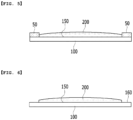
- FIGS. 3 to 8 are views showing a method of coating an active material for a secondary battery according to one embodiment of the present disclosure.
- a fine unevenness may be formed on a surface of the electrode current collector 100 to increase the binding force of the active material, and the electrode current collector 100 may have various shapes such as a film, a sheet, a foil, a net, a porous body, a foam body and a non-woven fabric.
- the guide member 50 may be formed of one of a rubber belt and a cloth-based belt.
- the guide member 50 allows the coated portion of the electrode current collector 100 to be uniformly coated in the process of coating the active material in a subsequent process.
- FIG. 4 shows a state in which the guide member 50 is disposed on both side surfaces of the electrode current collector 100 before coating the active material.
- one side surface 50s forming a boundary with the coated portion among both side surfaces of the guide member 50 may be perpendicular to an upper surface of the electrode current collector 100.
- the two guide members 50 are positioned to be spaced apart from each other, and the active material may be coated between the two guide members 50 in a process described hereinafter.
- the side surface of the guide member 50 forming a boundary with the coated portion 150 in which the active material is coated refers to a side surface of the guide member 50 which is exposed to the side of the coated portion 150.
- an electrode slurry is coated between two guide members 50 spaced apart from each other to form an active material layer 200.
- the electrode slurry may include a mixture of an active material, a conductive material and a binder.
- the electrode slurry can be coated onto the coated portion 150, while the electrode current collector 100 moves linearly in the direction of the arrow in FIG. 1 .
- the electrode slurry can be continuously coated onto the electrode current collector 100 in a direction opposite to the arrow in FIG. 1 .
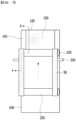
- FIG. 7 is a view showing an apparatus for coating an active material for a secondary battery including a cleaner.
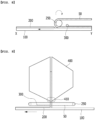
- FIG. 8 is a cross-sectional view taken along the cutting line X-Y of FIG. 7 .
- the method of coating an active material for a secondary battery according to the present embodiment may further include a step in which the guide member 50 is rotated and moved by a second roller 250 that rotates along a second rotating direction that is the opposite direction to the first rotating direction of the first roller 150 shown in FIG. 3 .
- the second roller 250 may allow the guide member 50 to rotate in place by a roller located respectively at both ends of the guide member 50.
- the both ends of the guide member 50 indicate both ends of the guide member 50 spaced apart from each other along the moving direction of the electrode current collector 100.
- the method may further include a step in which a cleaner 300 disposed in the guide member 50 sucks a remaining active material of the guide member 50 while the guide member 50 rotates.
- the guide member 50 from which remaining active materials are removed may be redisposed in an area of a non-coated portion where the active material is not coated.
- the active material is coated between two guide members 50 by using an active material coating machine 400 shown in FIG. 9 to be described later in a state where the guide member 50 is disposed, a portion of the active materials remains on the guide member 50 as well.
- the guide member 50 can be continuously used without replacement, and therefore, the process efficiency can be improved.
- the guide member 50 can rotate in place even though the electrode current collector 100 moves linearly along the direction of the arrow in FIG. 8 .
- One surface of the electrode current collector 100 can be coated with an active material by using the coating method described above, and then the other surface of the electrode current collector 100 can also be coated in the same manner as in the coating method described above.
- the guide member 50 is used to clarify a coating area and to reduce a difference in distortion occurring on both side surfaces of the electrode current collector 100 according to an end shape generated by a surface tension, whereby the risk of ignition can be reduced.
- the coated end portion may be distorted for various reasons.
- the guide member 50 can reduce an error due to surface tension and minimize a difference in two-stage coating of the upper and lower surfaces of the electrode current collector 100.
- FIG. 9 is a view showing an apparatus for coating an active material for a secondary battery according to another embodiment of the present disclosure.
- the apparatus for coating an active material for a secondary battery according to the present embodiment may be an exemplary means for performing the method of coating an active material for a secondary battery as described above.
- the apparatus for coating an active material for a secondary battery according to the present embodiment comprises: a first roller 150 for moving an electrode current collector 100, a guide member 50 disposed to correspond to a non-coated portion 160 of the electrode current collector 100, a second roller 250 located respectively at both ends of the guide member 50 to rotate the guide member 50 in place, and a coating machine 400 for coating the active material onto the coated portion 150 of the electrode current collector 100.
- the rotating direction of the first roller 150 and the rotating direction of the second roller 250 are opposite to each other.
- the coating machine 400 may be provided with a coating injection port 410 for injecting an active material onto the electrode current collector 100.
- the coating apparatus further includes a cleaner 300 disposed in the guide member 50, wherein the cleaner 300 can suck the remaining active material of the guide member 50.
- One side surface forming a boundary with the coated portion 150 among both side surfaces of the guide member 50 may be perpendicular to an upper surface of the electrode current collector 100.
Landscapes
- Engineering & Computer Science (AREA)
- Manufacturing & Machinery (AREA)
- Chemical & Material Sciences (AREA)
- Chemical Kinetics & Catalysis (AREA)
- Electrochemistry (AREA)
- General Chemical & Material Sciences (AREA)
- Battery Electrode And Active Subsutance (AREA)
Description
- This application claims the benefit of
Korean Patent Application No. 10-2019-0008260 filed on January 22, 2019 - The present disclosure relates to a method and an apparatus for coating an active material for a secondary battery, and more particularly, to a method and an apparatus for coating an active material for a secondary battery which prevents distortions at coating boundaries during double-sided coating of an electrode current collector.
- A secondary battery can be formed by inserting an electrode assembly composed of a positive electrode plate, a negative electrode plate and a separator into a case and then sealing the electrode assembly. Each of the positive electrode plate or the negative electrode plate (hereinafter referred to as "electrode plate") is produced by coating active material slurries onto a positive electrode conductive current collector or a negative electrode conductive current collector at a fixed thickness, and an electrode assembly can be formed by interposing a separator between the both conductive current collectors, followed by winding multiple times in a jelly-roll or cylindrical shape.
- The electrode plate may be formed of an active material coated portion having the active material slurry coated thereon, and a non-coated portion not having the active material slurry coated thereon. The active material coated portion is subjected to rolling to have an increased adhesiveness with respect to an electrode current collector and to increase the capacity density of the active material. The rolled electrode plate may be dried and then cut into a predetermined size using a cutter of a predetermined width, to be then used.
-
FIG. 1 is a view showing a conventional electrode current collector.FIG. 2 is a view showing a coating imbalance occurring during double-sided coating of the electrode current collector. - Referring to
FIG. 1 , a coatedportion 15 on which anactive material layer 20 formed by coating an active material onto anelectrode current collector 10 is located, and a non-coatedportion 16 wherein the active material is not coated onto the electrodecurrent collector 10, are formed. However, a difference in coating loading level is generated by surface tension in the process of coating the active material, which causes a problem that the thickness of theactive material layer 20 is not uniform. In other words, the end portion of theactive material layer 20 corresponding to a boundary between the non-coatedportion 16 and the coatedportion 15 is formed not vertically but is formed in a droplet shape, and thus, theactive material layer 20 may have a difference in height as a whole. This difference in height can be alleviated in the rolling process, but it may be problematic during double-sided coating of the electrode current collector described hereinafter. - Referring to
FIG. 2 , a firstactive material layer 20a formed on one surface of theelectrode current collector 10 and a secondactive material layer 20b formed on another surface are slightly changed in the coating width due to surface tension when rolling occurs. Therefore, a gap may be formed at a distance between the respective active material layers from one side end of the electrodecurrent collector 10. This gap may increase the risk of ignition by contacting the active materials of different polarities with each other in the subsequent lamination process. -
EP 1 887 641 A1 discloses a method for applying an electrode mixture paste to a core material. - It is an object of the present disclosure to provide a method and an apparatus for coating an active material for a secondary battery, which prevents coating imbalance that may occur during double-sided coating of an electrode current collector.
- However, the problem to be solved by the embodiments of the present disclosure is not limited to the above-described problems, and can be variously expanded within the scope of the technical idea included in the present disclosure.
- According to one embodiment of the present disclosure, there is provided a method of coating an active material for a secondary battery in which the active material is coated onto an electrode current collector of a secondary battery as defined in the appended set of claims, the method comprising the steps of: disposing a guide member on each of the left and right sides based on a moving direction of the electrode current collector, and coating the active material onto the electrode current collector between the two guide members.
- The moving direction of the electrode current collector moves in a linear direction by a first roller rotating in a first rotating direction.
- The method of coating an active material for a secondary battery further includes a step in which the guide member is rotated and moved by a second roller that rotates along a second rotating direction that is the opposite direction to the first rotating direction, wherein the second roller allows the guide member to rotate in place by a roller located at each of both ends of the guide member.
- The method of coating an active material for a secondary battery may further include a step in which a cleaner disposed in the guide member sucks a remaining active material of the guide member while the guide member rotates.
- Along with the movement of the electrode current collector and the guide member and the suction of the cleaner, the guide member from which the remaining active material is removed may be redisposed in an area where the active material is not coated.
- One side surface forming a boundary with the coated portion among both side surfaces of the guide member may be perpendicular to an upper surface of the electrode current collector.
- By using the coating method described above, one surface of the electrode current collector may be coated with the active material, and another surface of the electrode current collector may be coated in the same manner as in the method of coating one surface of the electrode current collector with the active material.
- The method of coating an active material for a secondary battery may, after the step of coating the active material onto the electrode current collector, further comprise a step of removing the guide member from the electrode current collector, and a step of rolling the electrode current collector.
- The guide member may be formed of one of a rubber belt and a cloth-based belt.
- An area in which the guide member is disposed may correspond to a non-coated portion.
- According to another embodiment of the present disclosure, there is provided an apparatus for coating an active material for a secondary battery, the apparatus comprising: a first roller for moving an electrode current collector, a guide member disposed to correspond to a non-coated portion of the electrode current collector, a second roller located respectively at both ends of the guide member to rotate the guide member in place, and a coating machine for coating the active material onto a coated portion of the electrode current collector, wherein the rotating direction of the first roller and the rotating direction of the second roller are opposite to each other.
- The apparatus for coating an active material for a secondary battery further includes a cleaner disposed in the guide member, wherein the cleaner can suck a remaining active material of the guide member.
- One side surface forming a boundary with the coated portion among both side surfaces of the guide member may be perpendicular to an upper surface of the electrode current collector.
- The guide member may be formed of one of a rubber belt and a cloth-based belt.
- According to the embodiments, by disposing a guide member on an electrode current collector during the coating process, coating imbalance can be prevented during double-sided coating of the electrode current collector.
- In addition, since cleaning is performed while the guide member rotates, coating can be continuously performed without replacing the guide member.
-
-
FIG. 1 is a view showing a conventional electrode current collector. -
FIG. 2 is a view showing a coating imbalance occurring during double-sided coating of an electrode current collector. -
FIGS. 3 to 8 are views showing a method of coating an active material for a secondary battery according to one embodiment of the present disclosure. -
FIG. 9 is a view showing an apparatus for coating an active material for a secondary battery according to another embodiment of the present disclosure. - Hereinafter, various embodiments of the present disclosure will be described in detail with reference to the accompanying drawings so that those skilled in the art can easily implement them. The present disclosure may be modified in various different ways, and is not limited to the embodiments set forth herein.
- Parts that are irrelevant to the description will be omitted to clearly describe the present disclosure, and like reference numerals designate like elements throughout the specification.
- Further, in the drawings, the size and thickness of each element are arbitrarily illustrated for convenience of description, and the present disclosure is not necessarily limited to those illustrated in the drawings. In the drawings, the thickness of layers, regions, etc. are exaggerated for clarity. In the drawings, for convenience of description, the thicknesses of some layers and regions are exaggerated.
- Further, throughout the specification, when a part is referred to as "including" a certain component, it means that it can further include other components, without excluding the other components, unless otherwise stated.
-
FIGS. 3 to 8 are views showing a method of coating an active material for a secondary battery according to one embodiment of the present disclosure. - Referring to
FIG. 3 , a method of coating an active material for a secondary battery according to one embodiment of the present disclosure is a method of coating an active material on an electrode current collector of a secondary battery, the method comprising the step of disposing aguide member 50 on each of the left and right sides based on a moving direction of the electrodecurrent collector 100. The electrodecurrent collector 100 may move in a linear direction by rotation of afirst roller 150. Theelectrode current collector 100 is not particularly limited as long as it has high conductivity without causing a chemical change in an electrode for a secondary battery according to the present embodiment. A fine unevenness may be formed on a surface of the electrodecurrent collector 100 to increase the binding force of the active material, and theelectrode current collector 100 may have various shapes such as a film, a sheet, a foil, a net, a porous body, a foam body and a non-woven fabric. - The
guide member 50 may be formed of one of a rubber belt and a cloth-based belt. Theguide member 50 allows the coated portion of the electrodecurrent collector 100 to be uniformly coated in the process of coating the active material in a subsequent process. -
FIG. 4 shows a state in which theguide member 50 is disposed on both side surfaces of the electrodecurrent collector 100 before coating the active material. Referring toFIG. 4 , oneside surface 50s forming a boundary with the coated portion among both side surfaces of theguide member 50 may be perpendicular to an upper surface of the electrodecurrent collector 100. In other words, the twoguide members 50 are positioned to be spaced apart from each other, and the active material may be coated between the twoguide members 50 in a process described hereinafter. At this time, the side surface of theguide member 50 forming a boundary with the coatedportion 150 in which the active material is coated refers to a side surface of theguide member 50 which is exposed to the side of the coatedportion 150. - Referring to
FIG. 5 , an electrode slurry is coated between twoguide members 50 spaced apart from each other to form anactive material layer 200. The electrode slurry may include a mixture of an active material, a conductive material and a binder. In this case, referring toFIGS. 1 and5 , as afirst roller 150 rotates in a first rotating direction, the electrode slurry can be coated onto thecoated portion 150, while the electrodecurrent collector 100 moves linearly in the direction of the arrow inFIG. 1 . In other words, the electrode slurry can be continuously coated onto the electrodecurrent collector 100 in a direction opposite to the arrow inFIG. 1 . - Referring to
FIG. 6 , when theactive material layer 200 is formed and then dried, theguide member 50 may be removed. After removing theguide member 50, an electrode for a secondary battery can be formed by passing through a rolling process. -
FIG. 7 is a view showing an apparatus for coating an active material for a secondary battery including a cleaner.FIG. 8 is a cross-sectional view taken along the cutting line X-Y ofFIG. 7 . - Referring to
FIGS. 7 and8 , while including most of the embodiments illustrated inFIGS. 3 to 6 , the following contents may be further included. - The method of coating an active material for a secondary battery according to the present embodiment may further include a step in which the
guide member 50 is rotated and moved by asecond roller 250 that rotates along a second rotating direction that is the opposite direction to the first rotating direction of thefirst roller 150 shown inFIG. 3 . In this case, thesecond roller 250 may allow theguide member 50 to rotate in place by a roller located respectively at both ends of theguide member 50. Here, the both ends of theguide member 50 indicate both ends of theguide member 50 spaced apart from each other along the moving direction of the electrodecurrent collector 100. - Further, according to the present embodiment, the method may further include a step in which a cleaner 300 disposed in the
guide member 50 sucks a remaining active material of theguide member 50 while theguide member 50 rotates. Along with the movement of the electrodecurrent collector 100 and theguide member 50 and the suction of the cleaner 300, theguide member 50 from which remaining active materials are removed may be redisposed in an area of a non-coated portion where the active material is not coated. In other words, when the active material is coated between twoguide members 50 by using an activematerial coating machine 400 shown inFIG. 9 to be described later in a state where theguide member 50 is disposed, a portion of the active materials remains on theguide member 50 as well. When such remaining active materials are sucked through the cleaner 300 and theguide member 50 is redisposed on the electrodecurrent collector 100 through the rotational movement, theguide member 50 can be continuously used without replacement, and therefore, the process efficiency can be improved. - Referring to
FIG. 8 , if a rotation speed along the second rotating direction of thesecond roller 250 conforms to a rotation speed along the first rotating direction of thefirst roller 150 inFIG. 3 , theguide member 50 can rotate in place even though the electrodecurrent collector 100 moves linearly along the direction of the arrow inFIG. 8 . - One surface of the electrode
current collector 100 can be coated with an active material by using the coating method described above, and then the other surface of the electrodecurrent collector 100 can also be coated in the same manner as in the coating method described above. In this case, theguide member 50 is used to clarify a coating area and to reduce a difference in distortion occurring on both side surfaces of the electrodecurrent collector 100 according to an end shape generated by a surface tension, whereby the risk of ignition can be reduced. In particular, if there is no guide member as in the present embodiment, the coated end portion may be distorted for various reasons. According to the present embodiment, theguide member 50 can reduce an error due to surface tension and minimize a difference in two-stage coating of the upper and lower surfaces of the electrodecurrent collector 100. -
FIG. 9 is a view showing an apparatus for coating an active material for a secondary battery according to another embodiment of the present disclosure. - The apparatus for coating an active material for a secondary battery according to the present embodiment may be an exemplary means for performing the method of coating an active material for a secondary battery as described above. Referring to
FIGS. 3 to 8 described above andFIG. 9 , the apparatus for coating an active material for a secondary battery according to the present embodiment comprises: afirst roller 150 for moving an electrodecurrent collector 100, aguide member 50 disposed to correspond to anon-coated portion 160 of the electrodecurrent collector 100, asecond roller 250 located respectively at both ends of theguide member 50 to rotate theguide member 50 in place, and acoating machine 400 for coating the active material onto thecoated portion 150 of the electrodecurrent collector 100. In this case, the rotating direction of thefirst roller 150 and the rotating direction of thesecond roller 250 are opposite to each other. Thecoating machine 400 may be provided with acoating injection port 410 for injecting an active material onto the electrodecurrent collector 100. - The coating apparatus according to the present embodiment further includes a cleaner 300 disposed in the
guide member 50, wherein the cleaner 300 can suck the remaining active material of theguide member 50. One side surface forming a boundary with thecoated portion 150 among both side surfaces of theguide member 50 may be perpendicular to an upper surface of the electrodecurrent collector 100.
Claims (12)
- A method of coating an active material for a secondary battery in which the active material is coated onto an electrode current collector (100) of the secondary battery, the method comprising the steps of:disposing a guide member (50) on each of the left and right sides based on a moving direction of the electrode current collector (100), andcoating the active material onto the electrode current collector between the two guide members,wherein the moving direction of the electrode current collector (100) moves in a linear direction by a first roller (150) rotating in a first rotating direction, andthe method further comprises a step in which the guide member (50) is rotated and moved by a second roller (250) that rotates along a second rotating direction that is the opposite direction to the first rotating direction; andwherein the second roller (250) allows the guide member (50) to rotate in place by rollers located respectively at both ends of the guide member (50).
- The method of coating an active material for a secondary battery according to claim 1, wherein the method further comprises a step in which remaining active materials of the guide member (50) are sucked by a cleaner (300) disposed in the guide member (50) while the guide member rotates.
- The method of coating an active material for a secondary battery according to claim 2, wherein the guide member (50) from which the remaining active material is removed is redisposed in an area where the active material is not coated.
- The method of coating an active material for a secondary battery according to claim 1, wherein one side surface forming a boundary with the coated portion among both side surfaces of the guide member (50) is perpendicular to an upper surface of the electrode current collector (100).
- The method of coating an active material for a secondary battery according to claim 1, wherein one surface of the electrode current collector (100) is coated with the active material by using the coating method of claim 1, and another surface of the electrode current collector (100) is coated in the same manner as in the method of coating one surface of the electrode current collector (100) with the active material.
- The method of coating an active material for a secondary battery according to claim 1, wherein after the step of coating the active material onto the electrode current collector (100), the method further comprises:a step of removing the guide member (50) from the electrode current collector (100), anda step of rolling the electrode current collector (100).
- The method of coating an active material for a secondary battery according to claim 1, wherein the guide member (50) is formed of one of a rubber belt and a cloth-based belt.
- The method of coating an active material for a secondary battery according to claim 1, wherein an area in which the guide member (50) is disposed corresponds to a non-coated portion.
- An apparatus for coating an active material for a secondary battery, the apparatus comprising:a first roller (150) for moving an electrode current collector,a guide member disposed to correspond to a non-coated portion of the electrode current collector,a second roller (250) located respectively at both ends of the guide member (50) to rotate the guide member (50) in place, anda coating machine for coating the active material on a coated portion of the electrode current collector (100),wherein the rotating direction of the first roller (150) and the rotating direction of the second roller (250) are opposite to each other.
- The apparatus for coating an active material for a secondary battery according to claim 9, further comprising a cleaner disposed in the guide member (50),
wherein cleaner (300) is configured to suck the remaining active materials of the guide member (50). - The apparatus for coating an active material for a secondary battery according to claim 9, wherein the one side surface forming a boundary with the coated portion among both side surfaces of the guide member (50) is perpendicular to an upper surface of the electrode current collector (100).
- The apparatus for coating an active material for a secondary battery according to claim 9, wherein the guide member (50) is formed of one of a rubber belt and a cloth-based belt.
Applications Claiming Priority (2)
| Application Number | Priority Date | Filing Date | Title |
|---|---|---|---|
| KR1020190008260A KR102622629B1 (en) | 2019-01-22 | 2019-01-22 | Active material coating method for secondary battery and coating apparatus |
| PCT/KR2020/001011 WO2020153711A1 (en) | 2019-01-22 | 2020-01-21 | Secondary battery active material coating method and coating apparatus |
Publications (3)
| Publication Number | Publication Date |
|---|---|
| EP3823061A1 EP3823061A1 (en) | 2021-05-19 |
| EP3823061A4 EP3823061A4 (en) | 2021-11-24 |
| EP3823061B1 true EP3823061B1 (en) | 2025-04-30 |
Family
ID=71735556
Family Applications (1)
| Application Number | Title | Priority Date | Filing Date |
|---|---|---|---|
| EP20744650.1A Active EP3823061B1 (en) | 2019-01-22 | 2020-01-21 | Active material coating method for secondary battery and coating apparatus |
Country Status (7)
| Country | Link |
|---|---|
| US (2) | US11811042B2 (en) |
| EP (1) | EP3823061B1 (en) |
| KR (1) | KR102622629B1 (en) |
| CN (1) | CN112470305B (en) |
| ES (1) | ES3029132T3 (en) |
| HU (1) | HUE071457T2 (en) |
| WO (1) | WO2020153711A1 (en) |
Families Citing this family (8)
| Publication number | Priority date | Publication date | Assignee | Title |
|---|---|---|---|---|
| KR102900626B1 (en) * | 2020-10-29 | 2025-12-15 | 주식회사 엘지에너지솔루션 | Electrode manufacturing apparatus including coating guide |
| KR102952942B1 (en) * | 2021-07-08 | 2026-04-14 | 주식회사 엘지에너지솔루션 | Electrode and method for manufacturing the same |
| CN113967560B (en) * | 2021-12-23 | 2022-03-04 | 广州雅策锐设备制造有限公司 | Lithium battery coating equipment |
| US20250149639A1 (en) * | 2022-02-16 | 2025-05-08 | Apb Corporation | Battery electrode manufacturing device and battery electrode manufacturing method |
| CN115254495B (en) * | 2022-07-29 | 2023-07-28 | 杭州英希捷科技有限责任公司 | Automatic coating system and method for metal composite conductive coating current collector |
| CA3276021A1 (en) * | 2022-12-06 | 2024-06-13 | AM Batteries, Inc. | System and method for battery electrode fabrication |
| KR102892910B1 (en) * | 2022-12-26 | 2025-11-27 | 주식회사 엘지에너지솔루션 | Manufacturing method and device for electrode of secondary battery |
| DE102024102672A1 (en) * | 2024-01-31 | 2025-07-31 | Bayerische Motoren Werke Aktiengesellschaft | Method for coating a carrier film, method for producing an electrode and electrode |
Family Cites Families (18)
| Publication number | Priority date | Publication date | Assignee | Title |
|---|---|---|---|---|
| US3564785A (en) * | 1969-06-19 | 1971-02-23 | John W Kephart Jr | Building structure |
| KR19990028142A (en) | 1997-09-30 | 1999-04-15 | 왕중일 | Manufacturing method of battery pole plate |
| JP4461734B2 (en) * | 2003-07-29 | 2010-05-12 | Tdk株式会社 | Electrode manufacturing method |
| JP4857548B2 (en) * | 2004-11-17 | 2012-01-18 | パナソニック株式会社 | Secondary battery electrode paste coating method and secondary battery electrode paste coating and drying apparatus |
| JP5073924B2 (en) * | 2005-04-25 | 2012-11-14 | パナソニック株式会社 | Electrode mixture paste coating method and coating apparatus |
| JP5008561B2 (en) * | 2005-05-09 | 2012-08-22 | パナソニック株式会社 | Method and apparatus for applying electrode mixture paste |
| JP5100153B2 (en) * | 2007-03-01 | 2012-12-19 | 三洋電機株式会社 | Method for producing electrode of non-aqueous electrolyte secondary battery |
| JP2008237968A (en) * | 2007-03-26 | 2008-10-09 | Jm Energy Corp | Coating method |
| KR101222310B1 (en) * | 2011-02-18 | 2013-01-15 | 삼성에스디아이 주식회사 | Continuous Evaporating Device |
| KR20120126303A (en) * | 2011-05-11 | 2012-11-21 | 삼성에스디아이 주식회사 | Electrode plate and secondary battery having the electrode plate and method for manufacturing the electrode plate |
| JP2013062223A (en) | 2011-09-15 | 2013-04-04 | Toppan Printing Co Ltd | Method of manufacturing electrode |
| KR101537386B1 (en) * | 2013-12-26 | 2015-07-17 | 주식회사 포스코 | Device for manufacturing coating electrode for secondary battery |
| KR101797800B1 (en) * | 2014-05-30 | 2017-11-14 | 주식회사 엘지화학 | Apparatus for substance removing of pole plate used in battery and method for the same |
| JP2016046196A (en) * | 2014-08-26 | 2016-04-04 | 株式会社豊田自動織機 | Gravure coating apparatus |
| KR101767636B1 (en) | 2015-01-13 | 2017-08-11 | 주식회사 엘지화학 | Press roll for electode sheet |
| KR101830287B1 (en) * | 2015-06-01 | 2018-02-20 | 주식회사 엘지화학 | Electrode Rolling Device Capable of Preventing Swell or Wrinkle of Electrode Sheet by Rolling Work |
| KR101710169B1 (en) * | 2015-09-24 | 2017-02-24 | 롯데케미칼 주식회사 | Manufacturing apparatus for coated electrode |
| KR101991934B1 (en) | 2016-07-15 | 2019-06-24 | 주식회사 엘지화학 | Electrode and manufacturing method for the electrode |
-
2019
- 2019-01-22 KR KR1020190008260A patent/KR102622629B1/en active Active
-
2020
- 2020-01-21 ES ES20744650T patent/ES3029132T3/en active Active
- 2020-01-21 EP EP20744650.1A patent/EP3823061B1/en active Active
- 2020-01-21 CN CN202080004038.XA patent/CN112470305B/en active Active
- 2020-01-21 HU HUE20744650A patent/HUE071457T2/en unknown
- 2020-01-21 WO PCT/KR2020/001011 patent/WO2020153711A1/en not_active Ceased
- 2020-01-21 US US17/263,660 patent/US11811042B2/en active Active
-
2023
- 2023-04-13 US US18/134,249 patent/US12021214B2/en active Active
Also Published As
| Publication number | Publication date |
|---|---|
| CN112470305B (en) | 2024-05-28 |
| US11811042B2 (en) | 2023-11-07 |
| US20230253540A1 (en) | 2023-08-10 |
| WO2020153711A1 (en) | 2020-07-30 |
| ES3029132T3 (en) | 2025-06-23 |
| EP3823061A4 (en) | 2021-11-24 |
| HUE071457T2 (en) | 2025-08-28 |
| US20210313553A1 (en) | 2021-10-07 |
| KR102622629B1 (en) | 2024-01-08 |
| KR20200091233A (en) | 2020-07-30 |
| US12021214B2 (en) | 2024-06-25 |
| CN112470305A (en) | 2021-03-09 |
| EP3823061A1 (en) | 2021-05-19 |
Similar Documents
| Publication | Publication Date | Title |
|---|---|---|
| EP3823061B1 (en) | Active material coating method for secondary battery and coating apparatus | |
| KR102309536B1 (en) | Electrode notching apparatus and method | |
| KR101099903B1 (en) | Battery pole plate, battery pole plate group, lithium secondary battery, manufacturing method of battery electrode plate, and battery electrode plate manufacturing apparatus | |
| US7891313B2 (en) | Gravure coating apparatus | |
| EP4342623A1 (en) | Electrode manufacturing device used for laser notching of electrode | |
| EP3396767B1 (en) | Unit cell for secondary battery with improved wettability and method for manufacturing the same | |
| KR102713214B1 (en) | electrode sheet notching apparatus and notching method | |
| KR20230109896A (en) | Electrode tab notching device | |
| US12337494B2 (en) | Method and apparatus for manufacturing unit cells | |
| KR101717392B1 (en) | Method for producing separator and method for slitting | |
| CN108258173A (en) | The manufacturing method of diaphragm and the manufacturing device of diaphragm | |
| JP7732171B2 (en) | Electrode Etching Equipment | |
| KR101717004B1 (en) | Method for producing separator and method for slitting | |
| CN214505544U (en) | A device for preparing battery pole pieces | |
| CN115380396B (en) | Electrode forming device with slotted positioning pins and electrode forming method using the same | |
| EP4636833A1 (en) | Electrode manufacturing apparatus and electrode manufacturing method using same | |
| EP4645404A1 (en) | Electrode production apparatus and battery cells comprising electrodes produced thereby, and battery pack and vehicle comprising battery cells | |
| JP7638245B2 (en) | Battery manufacturing method | |
| JP7785211B2 (en) | Battery manufacturing method | |
| JP2014006965A (en) | Manufacturing method and manufacturing apparatus of battery | |
| KR20260039199A (en) | Metal Foreign Matter Removal Device for Electrode Sheet | |
| CN117337501A (en) | Electrode assembly, its manufacturing equipment and its manufacturing method | |
| JP2019079767A (en) | Electrode manufacturing device |
Legal Events
| Date | Code | Title | Description |
|---|---|---|---|
| STAA | Information on the status of an ep patent application or granted ep patent |
Free format text: STATUS: THE INTERNATIONAL PUBLICATION HAS BEEN MADE |
|
| PUAI | Public reference made under article 153(3) epc to a published international application that has entered the european phase |
Free format text: ORIGINAL CODE: 0009012 |
|
| STAA | Information on the status of an ep patent application or granted ep patent |
Free format text: STATUS: REQUEST FOR EXAMINATION WAS MADE |
|
| 17P | Request for examination filed |
Effective date: 20210209 |
|
| AK | Designated contracting states |
Kind code of ref document: A1 Designated state(s): AL AT BE BG CH CY CZ DE DK EE ES FI FR GB GR HR HU IE IS IT LI LT LU LV MC MK MT NL NO PL PT RO RS SE SI SK SM TR |
|
| A4 | Supplementary search report drawn up and despatched |
Effective date: 20211025 |
|
| RIC1 | Information provided on ipc code assigned before grant |
Ipc: B05C 5/00 20060101ALI20211019BHEP Ipc: B05B 12/22 20180101ALI20211019BHEP Ipc: H01M 10/04 20060101ALI20211019BHEP Ipc: B05C 13/02 20060101ALI20211019BHEP Ipc: B05C 1/08 20060101ALI20211019BHEP Ipc: B05C 5/02 20060101ALI20211019BHEP Ipc: H01M 4/04 20060101AFI20211019BHEP |
|
| RAP1 | Party data changed (applicant data changed or rights of an application transferred) |
Owner name: LG ENERGY SOLUTION LTD. |
|
| RAP3 | Party data changed (applicant data changed or rights of an application transferred) |
Owner name: LG ENERGY SOLUTION, LTD. |
|
| DAV | Request for validation of the european patent (deleted) | ||
| DAX | Request for extension of the european patent (deleted) | ||
| GRAP | Despatch of communication of intention to grant a patent |
Free format text: ORIGINAL CODE: EPIDOSNIGR1 |
|
| STAA | Information on the status of an ep patent application or granted ep patent |
Free format text: STATUS: GRANT OF PATENT IS INTENDED |
|
| INTG | Intention to grant announced |
Effective date: 20250102 |
|
| P01 | Opt-out of the competence of the unified patent court (upc) registered |
Free format text: CASE NUMBER: APP_575/2025 Effective date: 20250107 |
|
| GRAS | Grant fee paid |
Free format text: ORIGINAL CODE: EPIDOSNIGR3 |
|
| GRAA | (expected) grant |
Free format text: ORIGINAL CODE: 0009210 |
|
| STAA | Information on the status of an ep patent application or granted ep patent |
Free format text: STATUS: THE PATENT HAS BEEN GRANTED |
|
| AK | Designated contracting states |
Kind code of ref document: B1 Designated state(s): AL AT BE BG CH CY CZ DE DK EE ES FI FR GB GR HR HU IE IS IT LI LT LU LV MC MK MT NL NO PL PT RO RS SE SI SK SM TR |
|
| REG | Reference to a national code |
Ref country code: CH Ref legal event code: EP Ref country code: GB Ref legal event code: FG4D |
|
| REG | Reference to a national code |
Ref country code: DE Ref legal event code: R096 Ref document number: 602020050414 Country of ref document: DE |
|
| REG | Reference to a national code |
Ref country code: IE Ref legal event code: FG4D |
|
| REG | Reference to a national code |
Ref country code: ES Ref legal event code: FG2A Ref document number: 3029132 Country of ref document: ES Kind code of ref document: T3 Effective date: 20250623 |
|
| REG | Reference to a national code |
Ref country code: HU Ref legal event code: AG4A Ref document number: E071457 Country of ref document: HU |
|
| REG | Reference to a national code |
Ref country code: NL Ref legal event code: MP Effective date: 20250430 |
|
| REG | Reference to a national code |
Ref country code: AT Ref legal event code: MK05 Ref document number: 1790910 Country of ref document: AT Kind code of ref document: T Effective date: 20250430 |
|
| PG25 | Lapsed in a contracting state [announced via postgrant information from national office to epo] |
Ref country code: FI Free format text: LAPSE BECAUSE OF FAILURE TO SUBMIT A TRANSLATION OF THE DESCRIPTION OR TO PAY THE FEE WITHIN THE PRESCRIBED TIME-LIMIT Effective date: 20250430 Ref country code: PT Free format text: LAPSE BECAUSE OF FAILURE TO SUBMIT A TRANSLATION OF THE DESCRIPTION OR TO PAY THE FEE WITHIN THE PRESCRIBED TIME-LIMIT Effective date: 20250901 |
|
| REG | Reference to a national code |
Ref country code: LT Ref legal event code: MG9D |
|
| PG25 | Lapsed in a contracting state [announced via postgrant information from national office to epo] |
Ref country code: NO Free format text: LAPSE BECAUSE OF FAILURE TO SUBMIT A TRANSLATION OF THE DESCRIPTION OR TO PAY THE FEE WITHIN THE PRESCRIBED TIME-LIMIT Effective date: 20250730 Ref country code: GR Free format text: LAPSE BECAUSE OF FAILURE TO SUBMIT A TRANSLATION OF THE DESCRIPTION OR TO PAY THE FEE WITHIN THE PRESCRIBED TIME-LIMIT Effective date: 20250731 |
|
| PG25 | Lapsed in a contracting state [announced via postgrant information from national office to epo] |
Ref country code: NL Free format text: LAPSE BECAUSE OF FAILURE TO SUBMIT A TRANSLATION OF THE DESCRIPTION OR TO PAY THE FEE WITHIN THE PRESCRIBED TIME-LIMIT Effective date: 20250430 Ref country code: PL Free format text: LAPSE BECAUSE OF FAILURE TO SUBMIT A TRANSLATION OF THE DESCRIPTION OR TO PAY THE FEE WITHIN THE PRESCRIBED TIME-LIMIT Effective date: 20250430 |
|
| PG25 | Lapsed in a contracting state [announced via postgrant information from national office to epo] |
Ref country code: BG Free format text: LAPSE BECAUSE OF FAILURE TO SUBMIT A TRANSLATION OF THE DESCRIPTION OR TO PAY THE FEE WITHIN THE PRESCRIBED TIME-LIMIT Effective date: 20250430 |
|
| PG25 | Lapsed in a contracting state [announced via postgrant information from national office to epo] |
Ref country code: HR Free format text: LAPSE BECAUSE OF FAILURE TO SUBMIT A TRANSLATION OF THE DESCRIPTION OR TO PAY THE FEE WITHIN THE PRESCRIBED TIME-LIMIT Effective date: 20250430 |
|
| PG25 | Lapsed in a contracting state [announced via postgrant information from national office to epo] |
Ref country code: AT Free format text: LAPSE BECAUSE OF FAILURE TO SUBMIT A TRANSLATION OF THE DESCRIPTION OR TO PAY THE FEE WITHIN THE PRESCRIBED TIME-LIMIT Effective date: 20250430 |
|
| PG25 | Lapsed in a contracting state [announced via postgrant information from national office to epo] |
Ref country code: RS Free format text: LAPSE BECAUSE OF FAILURE TO SUBMIT A TRANSLATION OF THE DESCRIPTION OR TO PAY THE FEE WITHIN THE PRESCRIBED TIME-LIMIT Effective date: 20250731 |
|
| PG25 | Lapsed in a contracting state [announced via postgrant information from national office to epo] |
Ref country code: IS Free format text: LAPSE BECAUSE OF FAILURE TO SUBMIT A TRANSLATION OF THE DESCRIPTION OR TO PAY THE FEE WITHIN THE PRESCRIBED TIME-LIMIT Effective date: 20250830 |
|
| PG25 | Lapsed in a contracting state [announced via postgrant information from national office to epo] |
Ref country code: LV Free format text: LAPSE BECAUSE OF FAILURE TO SUBMIT A TRANSLATION OF THE DESCRIPTION OR TO PAY THE FEE WITHIN THE PRESCRIBED TIME-LIMIT Effective date: 20250430 |
|
| PGFP | Annual fee paid to national office [announced via postgrant information from national office to epo] |
Ref country code: GB Payment date: 20251222 Year of fee payment: 7 |
|
| PG25 | Lapsed in a contracting state [announced via postgrant information from national office to epo] |
Ref country code: SM Free format text: LAPSE BECAUSE OF FAILURE TO SUBMIT A TRANSLATION OF THE DESCRIPTION OR TO PAY THE FEE WITHIN THE PRESCRIBED TIME-LIMIT Effective date: 20250430 Ref country code: DK Free format text: LAPSE BECAUSE OF FAILURE TO SUBMIT A TRANSLATION OF THE DESCRIPTION OR TO PAY THE FEE WITHIN THE PRESCRIBED TIME-LIMIT Effective date: 20250430 |
|
| PGFP | Annual fee paid to national office [announced via postgrant information from national office to epo] |
Ref country code: FR Payment date: 20251223 Year of fee payment: 7 |
|
| PGFP | Annual fee paid to national office [announced via postgrant information from national office to epo] |
Ref country code: BE Payment date: 20251229 Year of fee payment: 7 |
|
| PG25 | Lapsed in a contracting state [announced via postgrant information from national office to epo] |
Ref country code: CZ Free format text: LAPSE BECAUSE OF FAILURE TO SUBMIT A TRANSLATION OF THE DESCRIPTION OR TO PAY THE FEE WITHIN THE PRESCRIBED TIME-LIMIT Effective date: 20250430 |
|
| PG25 | Lapsed in a contracting state [announced via postgrant information from national office to epo] |
Ref country code: EE Free format text: LAPSE BECAUSE OF FAILURE TO SUBMIT A TRANSLATION OF THE DESCRIPTION OR TO PAY THE FEE WITHIN THE PRESCRIBED TIME-LIMIT Effective date: 20250430 |
|
| PG25 | Lapsed in a contracting state [announced via postgrant information from national office to epo] |
Ref country code: RO Free format text: LAPSE BECAUSE OF FAILURE TO SUBMIT A TRANSLATION OF THE DESCRIPTION OR TO PAY THE FEE WITHIN THE PRESCRIBED TIME-LIMIT Effective date: 20250430 Ref country code: SK Free format text: LAPSE BECAUSE OF FAILURE TO SUBMIT A TRANSLATION OF THE DESCRIPTION OR TO PAY THE FEE WITHIN THE PRESCRIBED TIME-LIMIT Effective date: 20250430 |
|
| PG25 | Lapsed in a contracting state [announced via postgrant information from national office to epo] |
Ref country code: IT Free format text: LAPSE BECAUSE OF FAILURE TO SUBMIT A TRANSLATION OF THE DESCRIPTION OR TO PAY THE FEE WITHIN THE PRESCRIBED TIME-LIMIT Effective date: 20250430 |
|
| REG | Reference to a national code |
Ref country code: DE Ref legal event code: R097 Ref document number: 602020050414 Country of ref document: DE |
|
| PGFP | Annual fee paid to national office [announced via postgrant information from national office to epo] |
Ref country code: HU Payment date: 20260129 Year of fee payment: 7 |
|
| PLBE | No opposition filed within time limit |
Free format text: ORIGINAL CODE: 0009261 |
|
| STAA | Information on the status of an ep patent application or granted ep patent |
Free format text: STATUS: NO OPPOSITION FILED WITHIN TIME LIMIT |
|
| REG | Reference to a national code |
Ref country code: CH Ref legal event code: L10 Free format text: ST27 STATUS EVENT CODE: U-0-0-L10-L00 (AS PROVIDED BY THE NATIONAL OFFICE) Effective date: 20260311 |
|
| 26N | No opposition filed |
Effective date: 20260202 |
|
| PGFP | Annual fee paid to national office [announced via postgrant information from national office to epo] |
Ref country code: ES Payment date: 20260212 Year of fee payment: 7 |
|
| PGFP | Annual fee paid to national office [announced via postgrant information from national office to epo] |
Ref country code: DE Payment date: 20251222 Year of fee payment: 7 |