EP3822917A1 - Using convolutional neural network style transfer to automate graphic design creation - Google Patents
Using convolutional neural network style transfer to automate graphic design creation Download PDFInfo
- Publication number
- EP3822917A1 EP3822917A1 EP20204787.4A EP20204787A EP3822917A1 EP 3822917 A1 EP3822917 A1 EP 3822917A1 EP 20204787 A EP20204787 A EP 20204787A EP 3822917 A1 EP3822917 A1 EP 3822917A1
- Authority
- EP
- European Patent Office
- Prior art keywords
- image
- neural network
- convolutional neural
- layers
- style
- Prior art date
- Legal status (The legal status is an assumption and is not a legal conclusion. Google has not performed a legal analysis and makes no representation as to the accuracy of the status listed.)
- Granted
Links
Images






Classifications
-
- G—PHYSICS
- G06—COMPUTING OR CALCULATING; COUNTING
- G06T—IMAGE DATA PROCESSING OR GENERATION, IN GENERAL
- G06T5/00—Image enhancement or restoration
- G06T5/50—Image enhancement or restoration using two or more images, e.g. averaging or subtraction
-
- G—PHYSICS
- G06—COMPUTING OR CALCULATING; COUNTING
- G06N—COMPUTING ARRANGEMENTS BASED ON SPECIFIC COMPUTATIONAL MODELS
- G06N3/00—Computing arrangements based on biological models
- G06N3/02—Neural networks
- G06N3/08—Learning methods
- G06N3/084—Backpropagation, e.g. using gradient descent
-
- G—PHYSICS
- G06—COMPUTING OR CALCULATING; COUNTING
- G06N—COMPUTING ARRANGEMENTS BASED ON SPECIFIC COMPUTATIONAL MODELS
- G06N3/00—Computing arrangements based on biological models
- G06N3/02—Neural networks
- G06N3/04—Architecture, e.g. interconnection topology
-
- G—PHYSICS
- G06—COMPUTING OR CALCULATING; COUNTING
- G06N—COMPUTING ARRANGEMENTS BASED ON SPECIFIC COMPUTATIONAL MODELS
- G06N3/00—Computing arrangements based on biological models
- G06N3/02—Neural networks
- G06N3/04—Architecture, e.g. interconnection topology
- G06N3/045—Combinations of networks
-
- G—PHYSICS
- G06—COMPUTING OR CALCULATING; COUNTING
- G06N—COMPUTING ARRANGEMENTS BASED ON SPECIFIC COMPUTATIONAL MODELS
- G06N3/00—Computing arrangements based on biological models
- G06N3/02—Neural networks
- G06N3/04—Architecture, e.g. interconnection topology
- G06N3/0464—Convolutional networks [CNN, ConvNet]
-
- G—PHYSICS
- G06—COMPUTING OR CALCULATING; COUNTING
- G06T—IMAGE DATA PROCESSING OR GENERATION, IN GENERAL
- G06T11/00—Two-dimensional [2D] image generation
- G06T11/10—Texturing; Colouring; Generation of textures or colours
-
- G—PHYSICS
- G06—COMPUTING OR CALCULATING; COUNTING
- G06T—IMAGE DATA PROCESSING OR GENERATION, IN GENERAL
- G06T7/00—Image analysis
- G06T7/90—Determination of colour characteristics
-
- G—PHYSICS
- G06—COMPUTING OR CALCULATING; COUNTING
- G06T—IMAGE DATA PROCESSING OR GENERATION, IN GENERAL
- G06T2207/00—Indexing scheme for image analysis or image enhancement
- G06T2207/20—Special algorithmic details
- G06T2207/20081—Training; Learning
-
- G—PHYSICS
- G06—COMPUTING OR CALCULATING; COUNTING
- G06T—IMAGE DATA PROCESSING OR GENERATION, IN GENERAL
- G06T2207/00—Indexing scheme for image analysis or image enhancement
- G06T2207/20—Special algorithmic details
- G06T2207/20084—Artificial neural networks [ANN]
Definitions
- a silhouette image is input to a convolutional neural network to produce a content feature layer.
- a style image is input to the convolutional neural network to produce pattern feature layers.
- a reference image is input to the convolutional neural network to determine reference feature layers.
- a combination loss of the convolutional neural network is minimized to obtain an output image comprising an abstraction of the style image within confines of the silhouette image.
- the combination loss includes: a content loss between the content feature layer and corresponding one of the reference feature layers; and a style loss between the pattern feature layers and a corresponding set of the reference feature layers.
- the output image is utilized in a graphic design product.
- silhouette image and a style image are input to a convolutional neural network to respectively produce a content feature layer and pattern feature layers.
- the content feature layers and patter feature layers are combined in the convolutional neural network to obtain an output image comprising an abstraction of the style image within confines of the silhouette image.
- the combination is based on minimizing a content loss between the content feature layer and a corresponding reference feature layer and minimizing a style loss between the pattern feature layers and a corresponding set of other reference feature layers.
- the output image is utilized in a graphic design product.
- the present disclosure relates to automated graphic design creation.
- a system is described that uses an integrated procedural generation and neural style transfer algorithms to produce multiple unique graphic design patterns.
- the system takes in two kinds of input: a content picture and a style picture, and utilizes user-selected attributes to produce aesthetically pleasing design patterns.
- this kind of graphic design generation is created manually by artists using proprietary software such as Adobe Photoshop® or Adobe Illustrator®, and each artwork can take several hours to days to create.
- This system describe herein can produce similar artwork at scale within seconds. A prototype of this system has already been implemented.
- FIG. 1 a set of images shows a pattern input 100 and an example of employing this simple "cut-out" 102 technique applied to a silhouette.
- the system proposed herein not only produces unique patterns at scale but also improves the current generation techniques to create aesthetically pleasing artwork that fits and aligns within the given shape by utilizing the aspects of the neural style transfer algorithm. An example of this can be seen by image 104 in FIG. 1 .
- the system can also be easily personalized as it has several user-defined parameters.
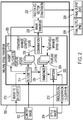
- FIG. 2 a block diagram shows a system 200 according to an example embodiment.
- the system 200 takes two input images, a content image 202 and a style image 204.
- the content image 202 could be a silhouette and/or a picture from which a silhouette can be extracted, e.g., via image to silhouette convertor 210.
- the style image 204 could be a pattern, picture, or any other image that has some desirable stylistic properties.
- Optional image-to-silhouette 210 module and procedural generation 212 module can be selected if the input images are pictures (e.g., photographic images) instead of a silhouette and a pattern.
- These are input to a neural style transfer processor 2056 that processes the input images 202, 204 to produce output images 206, 208.
- the system 200 is operable to fit unique patterns within a shape/outline, thus neural style transfer processor 205 takes a silhouette 214 as input, the silhouette being based on the content input image 202.
- the system also provides an option for users to give a picture as content.
- the image is first converted into a 'black and white' mode via module 210.
- a contour method is used to select thresholds in the 'near black' range (for example, color values less than 100 is used as the default threshold value) and solid black color is assigned for those, and solid white for the rest.
- the default threshold generally works for most images, but it can be adjusted if the user needs a higher or lower threshold for a specific image. Examples of the images provided by the silhouette module 210 according to an example embodiment are shown in FIG. 3 .
- the user provides a pattern to the system to use as a base to generate a new graphic design.
- a procedural generation module 212 can be used.
- the user can give any picture as input and choose the procedural generation module to generate a unique pattern.
- Procedural generation technique is used in computer graphics to generate textures.
- a specific symmetry generation technique may be used as described in " Creating Symmetry: The Artful Mathematics of Wallpaper Patterns," 2015, Princeton University Press by F.A. Farris . In this approach, a particular set of pixels is randomly chosen in a given picture to repeat symmetrically and generate wallpaper-like designs.
- a hexagonal symmetric generation algorithm is used. This symmetric design acts as a "pattern" input when it goes into the neural processor 205.
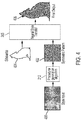
- images show an artistic output pattern 402 generated via the procedural generation module 212 based on a seemingly simple picture 400, which is further used to produce a unique graphic design 406 as described in greater detail below.
- the neural style transfer processor is based on an approach described in " Image Style Transfer Using Convolutional Neural Networks," Computer Vision and Pattern Recognition, 2016, by Gatys et al. (hereinafter Gatys), with modifications.
- the content and style images are passed through a deep convolutional neural network to obtain the feature layers 218, 224 for both the silhouette 214 and pattern 222.
- One example neural network that can be used for this purpose is referred to as VGGNet as described in " Very Deep Convolutional Networks for Large-Scale Image Recognition," International Conference on Learning Algorithms, 2015, by Simoyan et al.).
- the VGGNet network uses a stack of 19 filter layers (16 convolutional layers and three fully connected layers) and five pooling layers. Weights from a pre-trained neural network model are used for initializing the algorithm.
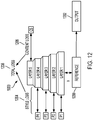
- FIGS. 10-12 block diagrams show how neural style transfer may be performed according to an example embodiment.
- a neural network 1000 with sequential convolutional layers is initialized, typically, with pre-trained weights.
- the weights are obtained from neural network trained on photographic images (e.g., ImageNet pictures).
- the content and style features are then run through a neural network 1000, that has five convolutional layer blocks (LAYERS 1-5)-which include two or more convolutional layers, followed by a pooling function, and an activation function.
- LAYERS 1-5) convolutional layer blocks
- a pattern image 1002 is input to the neural network 1000 and one respective sublayer (P1-P4) of each layer is stored to represent the style. In other embodiments, more than one sublayer from each layer may be stored.
- a single sublayer (C5) of the content representation is stored.
- a reference image 1200 (e.g., white noise image, one of the style or content images) is passed through the neural network 1000 and a style loss 1204 over multiple sublayers is calculated based on comparing (e.g., determining mean-squared difference between) the stored style sublayers P1-P5 and the corresponding layers of the neural network 1000 that result from processing the reference image.
- a content loss 1206 is found by comparing the stored content layer with the corresponding layer of the neural network the result from processing the reference image.
- a combination of the style and content loss is used as a total loss 1208, and a derivative ⁇ of the total loss can be found using error backpropagation.
- the derivative ⁇ is used to iteratively update the reference image 1200 until its style and content features match that of the style and content images, thereby forming an output image 1202.
- the illustrated system uses a silhouette as the content image and dense repeatable patterns as the style image.
- the illustrated system also differs in the way the combination image is prepared.
- the highest-level convolutional feature layer e.g., the fifth convolutional layer
- a few selected lower level convolutional feature layers that are determined through trial and error to speed up the process without compromising the artistic quality
- a loss function called the Gram matrix is defined to measure style loss and content loss, with respect to the original content and style images.
- This combined loss e.g., a weighted combination of the style loss and content loss
- the allowable value of the combined loss may be set to minimize iterations through the neural network.
- two different algorithm variations may be presented to the user, which can be selected depending on the resolution and computation speed preferred by the user. These variations are based on the selection of feature layers and the number of iterations for loss minimization.
- One option is a regular style transfer, which includes all the sub-layers of lower level feature layers (layers one to four) for patterns, and the highest-level feature layer for content. This is slightly different from algorithms where all the five convolutional layers are utilized (e.g., Gatys). This is done to accommodate the lower level "patterns" to the boundaries of the silhouette.
- the combination loss is minimized for ten iterations.
- the approximate time taken for the design generation is around 45 seconds when using a NVIDIA 1080x GPU.
- Another option is optimized style transfer. This alternative is chosen when the user needs a quick turnaround of the design generation.
- the feature layers include one sub-layer from each convolutional layer (layers one to four), and the algorithm is optimized for three iterations.
- the approximate time taken for the design generation using the optimized style transfer is around 15 seconds when using a NVIDIA 1080x GPU.
- an optional randomize module 220 is used for producing variety in the generated graphic design. This can be used when the user wants to produce multiple graphic design patterns from the same content and style images.
- this module 220 the randomization happens in two ways. In one way, the silhouette color is randomly chosen on the RGB scale. As dark colors work well for silhouette style transfer, the color ranges in each RGB scale are chosen on the dark end of the spectrum. Different color choices produce a completely different set of fitted designs for the same input pattern, as shown in FIG. 5 .
- Image processing operations e.g., geometric transforms such as horizontal flip, vertical flip, transpose, etc.
- Other geometric transforms may include stretching, skewing/shearing, rounding, rotation, etc. This produces variations to the output as shown in FIG. 6 .
- the randomize module does both the random selection of silhouette color and the image processing operations simultaneously, so the output produced by the algorithm each time is uniquely generated.
- an invert silhouette module 216 is used to produce a mask for post-processing.
- the silhouette input 214 either generated from image to silhouette module or directly given by the user, is inverted in this module 228. This approach involves replacing the black color pixels with white and vice-versa.
- the resulting inverted silhouette is used in the mask transfer module 228 to clean up the generated image 226.
- the mask transfer module 228 is used on the final generated image to produce a clean output.
- the neural style transfer approach as described above, is used on the silhouette image 214. Although this approach works very well to align the patterns inside the edges of the silhouette 214, the algorithm also transfers patterns around the silhouette 214. These patterns appear faintly due to the white background around the silhouette and can spoil the aesthetic of the entire image. Therefore, a mask transfer using the inverted silhouette output (obtained from module 226) is applied to the generated image.
- the inverted silhouette image is used as a filter to identify which patterns in the output can pass through at pixel level. For example, using a pixel by pixel comparison, patterns in the output image are selected only if the corresponding pixel is of solid white color in the inverted silhouette image. Otherwise, a solid white color is assigned to the pixel. This results in a graphic design output with a white background. The user can also choose a different color background in the mask transfer module if desired.
- An optional raster-to-vector conversion module 230 can be useful for some graphic design applications.
- the neural style transfer algorithm works at a pixel level; therefore, the output is produced as a raster file. This may work well for digital distribution, but if the generated graphic design is to be printed in a large banner or brochure, the resolution produced by the algorithm may not be sufficient. In such cases, the raster-to-vector conversion module 230 converts a raster image to vector format. When this option is selected, the generated output goes through two processes simultaneously: color quantization and tracing.
- the color quantization process quantifies the number of colors present in the image to a particular value. As default, the system uses 25 colors, and this can be modified by the user to increase or decrease the number of colors depending on the desired output. Software such as 'imagemagick' can be used for color quantization.
- the image can be traced using a python package called 'potrace'. This is used for tracing the identifiable edges in the raster and transforms it into a vector image with smooth lines.
- the final output consists of stacked images produced from color quantization and tracing to produce a scalable vector image.
- the images in FIG. 7 show the increase in resolution of raster to vector output, which now has better defined and smooth edges and is ideal for printing.
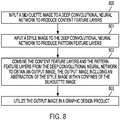
- FIG. 8 a flowchart shows a method according to an example embodiment.
- the method involves inputting 800 a silhouette image to a deep convolutional neural network to produce content feature layers.
- a style image is input 801 to the deep convolutional neural network to produce pattern feature layers.
- the content feature layers and the pattern feature layers from the deep convolutional neural network are combined 802 to obtain an output image.
- the output image includes an abstraction of the style image within confines of the silhouette image.
- the output image is utilized 803 in a graphic design product.
- the output image may be used in a printed publication, decorative design on a product, electronic publication (e.g., web site, document file), three-dimensional sculpture, etc.
- FIG. 9 a block diagram shows an apparatus 900 that may be used to implement methods according to an example embodiment.
- the apparatus 900 includes one or more processors 902 such as a central processing unit, co-processor, digital signal processor, etc.
- the processor 902 is coupled to memory, which may include both random access memory 904 and persistent storage 906, via one or more input/output busses 908.
- Other general-purpose or special-purpose hardware may be coupled to the bus 908, such as graphics processing unit (GPU) 911 and network interface 912.
- GPU graphics processing unit
- the functions of the apparatus 900 described below may be implemented via multiple devices, e.g., via client-server arrangement, clustered computing, cloud computing, etc.
- the network interface 912 facilitates communications via a network 914 with a graphic design production system 916, using wired or wireless media.
- the graphic design production system 916 may produce physical media (e.g., printouts, three-dimensional objects) and electronic media (e.g., raster and/or vector files).
- the graphic design production system 916 may include pre-processors, formatters, user interfaces, etc., that prepare data for use by machines that are part of the system 916. Data may also be transferred to the graphic design production system 916 using non-network transport, e.g., via portable data storage drives, point-to-point communication, etc.
- the apparatus 900 includes software 920 that facilitates automatically generating decorative graphics.
- the software 920 includes an operating system 922 and drivers 924 that facilitate communications between user-level programs and the hardware.
- the software 920 may also include a style pre-processor 926 that facilitates selection of style images (e.g., using text or visual search algorithms) and preparation of style images (e.g., procedural generation, randomization, etc.).
- a content pre-processor analysis module 928 facilitates selection of content images (e.g., using text or visual search algorithms) and preparation of content images (e.g., converting greyscale or color images to silhouette images).
- a neural network 930 e.g., a deep, convolutional neural network
- the content feature layers and pattern feature layers can be stored in the memory 904 and or persistent storage 906.
- a combination module 932 inputs a reference image to the neural network and compares the layer representations of the reference image with the stored style and content layers.
- a loss function is calculated based on this comparison and is used to adapt the neural network 930 through backpropagation to reduce the style and content loss in the reference image. This is repeated for a number of iterations until a stopping criterion is met (e.g., user-selected settings to emphasize speed or quality) at which point the reference image will represent an abstraction of the style image within confines of the silhouette image.
- a post-processing module 934 can perform additional operations on the combination image. For example, the post-processing module 934 can invert the silhouette to mask the combination edges thereby providing sharper borders. The post-processing module 934 may also covert the combination image (which is a raster image) to a vector graphics format. Because the system may provide a number of user-selectable options, user interface hardware 936 may facilitate providing user inputs to the software 920, e.g., via a graphical user interface, command line instructions, configuration files, etc.
- the system described above provides a way of generating graphic designs which not only saves time and manual effort but can also produce multiple, unique aesthetically pleasing artwork at scale.
- This architecture can use style transfer approaches have been used, e.g., for producing images that look like a painting, but used here to generate graphic designs using silhouette and mask transfer.
- a procedural generation algorithm is used in the context of deep neural style transfer. This allows the user to generate a unique artwork from a simple picture. Different algorithm variations allow the user to choose between fast design generation, e.g., producing graphic design patterns within seconds, or a higher-quality generation scheme that uses more iterations to reduce style and content loss. Randomization modules can be used to produce variety in the output images.
Landscapes
- Engineering & Computer Science (AREA)
- Physics & Mathematics (AREA)
- Theoretical Computer Science (AREA)
- General Physics & Mathematics (AREA)
- General Health & Medical Sciences (AREA)
- General Engineering & Computer Science (AREA)
- Biophysics (AREA)
- Computational Linguistics (AREA)
- Data Mining & Analysis (AREA)
- Evolutionary Computation (AREA)
- Artificial Intelligence (AREA)
- Molecular Biology (AREA)
- Computing Systems (AREA)
- Biomedical Technology (AREA)
- Life Sciences & Earth Sciences (AREA)
- Mathematical Physics (AREA)
- Software Systems (AREA)
- Health & Medical Sciences (AREA)
- Computer Vision & Pattern Recognition (AREA)
- Image Analysis (AREA)
- Image Processing (AREA)
Abstract
Description
- The present disclosure is directed to automated design generation for subtractive manufacturing utilizing accessibility constraint. In one embodiment, a silhouette image is input to a convolutional neural network to produce a content feature layer. A style image is input to the convolutional neural network to produce pattern feature layers. A reference image is input to the convolutional neural network to determine reference feature layers. For each of a plurality of iterations, a combination loss of the convolutional neural network is minimized to obtain an output image comprising an abstraction of the style image within confines of the silhouette image. The combination loss includes: a content loss between the content feature layer and corresponding one of the reference feature layers; and a style loss between the pattern feature layers and a corresponding set of the reference feature layers. The output image is utilized in a graphic design product.
- In another embodiment, silhouette image and a style image are input to a convolutional neural network to respectively produce a content feature layer and pattern feature layers. The content feature layers and patter feature layers are combined in the convolutional neural network to obtain an output image comprising an abstraction of the style image within confines of the silhouette image. The combination is based on minimizing a content loss between the content feature layer and a corresponding reference feature layer and minimizing a style loss between the pattern feature layers and a corresponding set of other reference feature layers. The output image is utilized in a graphic design product.
- These and other features and aspects of various embodiments may be understood in view of the following detailed discussion and accompanying drawings.
- The discussion below makes reference to the following figures, wherein the same reference number may be used to identify the similar/same component in multiple figures. The drawings are not necessarily to scale.
-
FIG. 1 is a set of images showing results of design generation according to an example embodiment; -
FIGS 2 is a block diagram showing a processing system according to an example embodiment; -
FIG. 3 is a diagram showing example inputs and outputs of a silhouette conversion module according to an example embodiment; -
FIG. 4 is a diagram showing an output pattern generated via the procedural generation module according to an example embodiment; -
FIG. 5 is a set of images showing outputs of a randomization module based on different RGB values according to an example embodiment; -
FIG. 6 is a set of images showing effects of using different image processing operations to randomize outputs according to an example embodiment; -
FIG. 7 is a diagram showing an example of raster-to-vector conversion according to an example embodiment; -
FIG. 8 is a flowchart of a method according to an example embodiment; -
FIG. 9 is a block diagram of an apparatus according to an example embodiment; and -
FIGS. 10-12 are block diagrams showing how neural style transfer may be performed according to an example embodiment. - The present disclosure relates to automated graphic design creation. A system is described that uses an integrated procedural generation and neural style transfer algorithms to produce multiple unique graphic design patterns. The system takes in two kinds of input: a content picture and a style picture, and utilizes user-selected attributes to produce aesthetically pleasing design patterns. Currently, this kind of graphic design generation is created manually by artists using proprietary software such as Adobe Photoshop® or Adobe Illustrator®, and each artwork can take several hours to days to create. This system describe herein can produce similar artwork at scale within seconds. A prototype of this system has already been implemented.
- Personalized designs are increasingly being preferred by companies to enhance the attractiveness of their products and logos. This requires generating unique patterns, which is typically done manually by graphic artists. This process takes considerable effort and time, and it is hard to produce quality output at scale. A few workarounds that exist commercially to increase the production speed include cutting an existing design into different shapes at random places of the pattern. Though this may produce unique output for users, the quality may not be aesthetically appealing, as this might lead to an "unfinished look." In
FIG. 1 a set of images shows apattern input 100 and an example of employing this simple "cut-out" 102 technique applied to a silhouette. - The system proposed herein not only produces unique patterns at scale but also improves the current generation techniques to create aesthetically pleasing artwork that fits and aligns within the given shape by utilizing the aspects of the neural style transfer algorithm. An example of this can be seen by
image 104 inFIG. 1 . The system can also be easily personalized as it has several user-defined parameters. - The system includes several modules that facilitate the generation of graphic design patterns. In
FIG. 2 , a block diagram shows asystem 200 according to an example embodiment. Thesystem 200 takes two input images, acontent image 202 and astyle image 204. Thecontent image 202 could be a silhouette and/or a picture from which a silhouette can be extracted, e.g., via image tosilhouette convertor 210. Thestyle image 204 could be a pattern, picture, or any other image that has some desirable stylistic properties. Optional image-to-silhouette 210 module andprocedural generation 212 module can be selected if the input images are pictures (e.g., photographic images) instead of a silhouette and a pattern. These are input to a neural style transfer processor 2056 that processes theinput images output images - The
system 200 is operable to fit unique patterns within a shape/outline, thus neuralstyle transfer processor 205 takes asilhouette 214 as input, the silhouette being based on thecontent input image 202. Although users can provide silhouettes directly as a content image, the system also provides an option for users to give a picture as content. In this case, the image is first converted into a 'black and white' mode viamodule 210. A contour method is used to select thresholds in the 'near black' range (for example, color values less than 100 is used as the default threshold value) and solid black color is assigned for those, and solid white for the rest. The default threshold generally works for most images, but it can be adjusted if the user needs a higher or lower threshold for a specific image. Examples of the images provided by thesilhouette module 210 according to an example embodiment are shown inFIG. 3 . - Typically, the user provides a pattern to the system to use as a base to generate a new graphic design. In cases where the user does not have a pattern input, a procedural generation module 212 (see
FIG. 2 ) can be used. Here, the user can give any picture as input and choose the procedural generation module to generate a unique pattern. Procedural generation technique is used in computer graphics to generate textures. In various embodiments, a specific symmetry generation technique may be used as described in "Creating Symmetry: The Artful Mathematics of Wallpaper Patterns," 2015, Princeton University Press by F.A. Farris. In this approach, a particular set of pixels is randomly chosen in a given picture to repeat symmetrically and generate wallpaper-like designs. - In one embodiment, a hexagonal symmetric generation algorithm is used. This symmetric design acts as a "pattern" input when it goes into the
neural processor 205. InFIG. 4 , images show anartistic output pattern 402 generated via theprocedural generation module 212 based on a seeminglysimple picture 400, which is further used to produce a uniquegraphic design 406 as described in greater detail below. - In reference again to
FIG. 2 , the neural style transfer processor is based on an approach described in "Image Style Transfer Using Convolutional Neural Networks," Computer Vision and Pattern Recognition, 2016, by Gatys et al. (hereinafter Gatys), with modifications. First, the content and style images are passed through a deep convolutional neural network to obtain the feature layers 218, 224 for both thesilhouette 214 andpattern 222. One example neural network that can be used for this purpose is referred to as VGGNet as described in "Very Deep Convolutional Networks for Large-Scale Image Recognition," International Conference on Learning Algorithms, 2015, by Simoyan et al.). The VGGNet network uses a stack of 19 filter layers (16 convolutional layers and three fully connected layers) and five pooling layers. Weights from a pre-trained neural network model are used for initializing the algorithm. - In
FIGS. 10-12 , block diagrams show how neural style transfer may be performed according to an example embodiment. To perform "style transfer" of one image to another, aneural network 1000 with sequential convolutional layers is initialized, typically, with pre-trained weights. Generally, the weights are obtained from neural network trained on photographic images (e.g., ImageNet pictures). The content and style features are then run through aneural network 1000, that has five convolutional layer blocks (LAYERS 1-5)-which include two or more convolutional layers, followed by a pooling function, and an activation function. As seen inFIG. 10 , apattern image 1002 is input to theneural network 1000 and one respective sublayer (P1-P4) of each layer is stored to represent the style. In other embodiments, more than one sublayer from each layer may be stored. As seen inFIG. 11 , a single sublayer (C5) of the content representation is stored. - As seen in
FIG. 12 , a reference image 1200 (e.g., white noise image, one of the style or content images) is passed through theneural network 1000 and astyle loss 1204 over multiple sublayers is calculated based on comparing (e.g., determining mean-squared difference between) the stored style sublayers P1-P5 and the corresponding layers of theneural network 1000 that result from processing the reference image. Similarly, acontent loss 1206 is found by comparing the stored content layer with the corresponding layer of the neural network the result from processing the reference image. A combination of the style and content loss is used as atotal loss 1208, and a derivative δ of the total loss can be found using error backpropagation. The derivative δ is used to iteratively update thereference image 1200 until its style and content features match that of the style and content images, thereby forming anoutput image 1202. - Unlike algorithms where artistic paintings are used as style image and photographic images are used as content, the illustrated system uses a silhouette as the content image and dense repeatable patterns as the style image. The illustrated system also differs in the way the combination image is prepared. For example, the highest-level convolutional feature layer (e.g., the fifth convolutional layer) is used for content, and a few selected lower level convolutional feature layers (that are determined through trial and error to speed up the process without compromising the artistic quality) are used for the style. A loss function called the Gram matrix (see Gatys) is defined to measure style loss and content loss, with respect to the original content and style images. This combined loss (e.g., a weighted combination of the style loss and content loss) is minimized at every iteration by using the gradient of the combined loss. The allowable value of the combined loss may be set to minimize iterations through the neural network.
- In this system, two different algorithm variations may be presented to the user, which can be selected depending on the resolution and computation speed preferred by the user. These variations are based on the selection of feature layers and the number of iterations for loss minimization. One option is a regular style transfer, which includes all the sub-layers of lower level feature layers (layers one to four) for patterns, and the highest-level feature layer for content. This is slightly different from algorithms where all the five convolutional layers are utilized (e.g., Gatys). This is done to accommodate the lower level "patterns" to the boundaries of the silhouette. The combination loss is minimized for ten iterations. The approximate time taken for the design generation is around 45 seconds when using a NVIDIA 1080x GPU.
- Another option is optimized style transfer. This alternative is chosen when the user needs a quick turnaround of the design generation. The feature layers include one sub-layer from each convolutional layer (layers one to four), and the algorithm is optimized for three iterations. The approximate time taken for the design generation using the optimized style transfer is around 15 seconds when using a NVIDIA 1080x GPU.
- In reference again to
FIG. 2 , anoptional randomize module 220 is used for producing variety in the generated graphic design. This can be used when the user wants to produce multiple graphic design patterns from the same content and style images. When thismodule 220 is chosen, the randomization happens in two ways. In one way, the silhouette color is randomly chosen on the RGB scale. As dark colors work well for silhouette style transfer, the color ranges in each RGB scale are chosen on the dark end of the spectrum. Different color choices produce a completely different set of fitted designs for the same input pattern, as shown inFIG. 5 . - Image processing operations, e.g., geometric transforms such as horizontal flip, vertical flip, transpose, etc., can be applied on the input pattern image before it goes into the neural
style transfer processor 205. Other geometric transforms may include stretching, skewing/shearing, rounding, rotation, etc. This produces variations to the output as shown inFIG. 6 . The randomize module does both the random selection of silhouette color and the image processing operations simultaneously, so the output produced by the algorithm each time is uniquely generated. - In reference again to
FIG. 2 , aninvert silhouette module 216 is used to produce a mask for post-processing. Thesilhouette input 214, either generated from image to silhouette module or directly given by the user, is inverted in thismodule 228. This approach involves replacing the black color pixels with white and vice-versa. The resulting inverted silhouette is used in themask transfer module 228 to clean up the generatedimage 226. - The
mask transfer module 228 is used on the final generated image to produce a clean output. The neural style transfer approach, as described above, is used on thesilhouette image 214. Although this approach works very well to align the patterns inside the edges of thesilhouette 214, the algorithm also transfers patterns around thesilhouette 214. These patterns appear faintly due to the white background around the silhouette and can spoil the aesthetic of the entire image. Therefore, a mask transfer using the inverted silhouette output (obtained from module 226) is applied to the generated image. Here, the inverted silhouette image is used as a filter to identify which patterns in the output can pass through at pixel level. For example, using a pixel by pixel comparison, patterns in the output image are selected only if the corresponding pixel is of solid white color in the inverted silhouette image. Otherwise, a solid white color is assigned to the pixel. This results in a graphic design output with a white background. The user can also choose a different color background in the mask transfer module if desired. - An optional raster-to-
vector conversion module 230 can be useful for some graphic design applications. The neural style transfer algorithm works at a pixel level; therefore, the output is produced as a raster file. This may work well for digital distribution, but if the generated graphic design is to be printed in a large banner or brochure, the resolution produced by the algorithm may not be sufficient. In such cases, the raster-to-vector conversion module 230 converts a raster image to vector format. When this option is selected, the generated output goes through two processes simultaneously: color quantization and tracing. - The color quantization process quantifies the number of colors present in the image to a particular value. As default, the system uses 25 colors, and this can be modified by the user to increase or decrease the number of colors depending on the desired output. Software such as 'imagemagick' can be used for color quantization. Next, the image can be traced using a python package called 'potrace'. This is used for tracing the identifiable edges in the raster and transforms it into a vector image with smooth lines. The final output consists of stacked images produced from color quantization and tracing to produce a scalable vector image. The images in
FIG. 7 show the increase in resolution of raster to vector output, which now has better defined and smooth edges and is ideal for printing. - In
FIG. 8 , a flowchart shows a method according to an example embodiment. The method involves inputting 800 a silhouette image to a deep convolutional neural network to produce content feature layers. A style image isinput 801 to the deep convolutional neural network to produce pattern feature layers. The content feature layers and the pattern feature layers from the deep convolutional neural network are combined 802 to obtain an output image. The output image includes an abstraction of the style image within confines of the silhouette image. The output image is utilized 803 in a graphic design product. For example, the output image may be used in a printed publication, decorative design on a product, electronic publication (e.g., web site, document file), three-dimensional sculpture, etc. - The methods and processes described above can be implemented on computer hardware, e.g., workstations, servers, as known in the art. In
FIG. 9 , a block diagram shows anapparatus 900 that may be used to implement methods according to an example embodiment. Theapparatus 900 includes one ormore processors 902 such as a central processing unit, co-processor, digital signal processor, etc. Theprocessor 902 is coupled to memory, which may include bothrandom access memory 904 andpersistent storage 906, via one or more input/output busses 908. Other general-purpose or special-purpose hardware may be coupled to thebus 908, such as graphics processing unit (GPU) 911 andnetwork interface 912. Note that the functions of theapparatus 900 described below may be implemented via multiple devices, e.g., via client-server arrangement, clustered computing, cloud computing, etc. - The
network interface 912 facilitates communications via anetwork 914 with a graphicdesign production system 916, using wired or wireless media. The graphicdesign production system 916 may produce physical media (e.g., printouts, three-dimensional objects) and electronic media (e.g., raster and/or vector files). In addition to producing media, the graphicdesign production system 916 may include pre-processors, formatters, user interfaces, etc., that prepare data for use by machines that are part of thesystem 916. Data may also be transferred to the graphicdesign production system 916 using non-network transport, e.g., via portable data storage drives, point-to-point communication, etc. - The
apparatus 900 includessoftware 920 that facilitates automatically generating decorative graphics. Thesoftware 920 includes anoperating system 922 anddrivers 924 that facilitate communications between user-level programs and the hardware. Thesoftware 920 may also include astyle pre-processor 926 that facilitates selection of style images (e.g., using text or visual search algorithms) and preparation of style images (e.g., procedural generation, randomization, etc.). A contentpre-processor analysis module 928 facilitates selection of content images (e.g., using text or visual search algorithms) and preparation of content images (e.g., converting greyscale or color images to silhouette images). A neural network 930 (e.g., a deep, convolutional neural network) uses the silhouette image to produce content feature layers and uses the style image to produce pattern feature layers. The content feature layers and pattern feature layers can be stored in thememory 904 and orpersistent storage 906. - A
combination module 932 inputs a reference image to the neural network and compares the layer representations of the reference image with the stored style and content layers. A loss function is calculated based on this comparison and is used to adapt theneural network 930 through backpropagation to reduce the style and content loss in the reference image. This is repeated for a number of iterations until a stopping criterion is met (e.g., user-selected settings to emphasize speed or quality) at which point the reference image will represent an abstraction of the style image within confines of the silhouette image. - A
post-processing module 934 can perform additional operations on the combination image. For example, thepost-processing module 934 can invert the silhouette to mask the combination edges thereby providing sharper borders. Thepost-processing module 934 may also covert the combination image (which is a raster image) to a vector graphics format. Because the system may provide a number of user-selectable options,user interface hardware 936 may facilitate providing user inputs to thesoftware 920, e.g., via a graphical user interface, command line instructions, configuration files, etc. - In summary, the system described above provides a way of generating graphic designs which not only saves time and manual effort but can also produce multiple, unique aesthetically pleasing artwork at scale. This architecture can use style transfer approaches have been used, e.g., for producing images that look like a painting, but used here to generate graphic designs using silhouette and mask transfer. A procedural generation algorithm is used in the context of deep neural style transfer. This allows the user to generate a unique artwork from a simple picture. Different algorithm variations allow the user to choose between fast design generation, e.g., producing graphic design patterns within seconds, or a higher-quality generation scheme that uses more iterations to reduce style and content loss. Randomization modules can be used to produce variety in the output images.
- The various embodiments described above may be implemented using circuitry, firmware, and/or software modules that interact to provide particular results. One of skill in the arts can readily implement such described functionality, either at a modular level or as a whole, using knowledge generally known in the art. For example, the flowcharts and control diagrams illustrated herein may be used to create computer-readable instructions/code for execution by a processor. Such instructions may be stored on a non-transitory computer-readable medium and transferred to the processor for execution as is known in the art. The structures and procedures shown above are only a representative example of embodiments that can be used to provide the functions described hereinabove.
- Unless otherwise indicated, all numbers expressing feature sizes, amounts, and physical properties used in the specification and claims are to be understood as being modified in all instances by the term "about." Accordingly, unless indicated to the contrary, the numerical parameters set forth in the foregoing specification and attached claims are approximations that can vary depending upon the desired properties sought to be obtained by those skilled in the art utilizing the teachings disclosed herein. The use of numerical ranges by endpoints includes all numbers within that range (e.g. 1 to 5 includes 1, 1.5, 2, 2.75, 3, 3.80, 4, and 5) and any range within that range.
- The foregoing description of the example embodiments has been presented for the purposes of illustration and description. It is not intended to be exhaustive or to limit the embodiments to the precise form disclosed. Many modifications and variations are possible in light of the above teaching. Any or all features of the disclosed embodiments can be applied individually or in any combination and are not meant to be limiting, but purely illustrative. It is intended that the scope of the invention be limited not with this detailed description, but rather determined by the claims appended hereto.
Claims (20)
- A method comprising:inputting a silhouette image to a convolutional neural network to produce a content feature layer;inputting a style image to the convolutional neural network to produce pattern feature layers;inputting a reference image into the convolutional neural network to determine reference feature layers, and for each of a plurality of iterations, minimizing a combination loss of the convolutional neural network to obtain an output image comprising an abstraction of the style image within confines of the silhouette image, the combination loss comprising:a content loss between the content feature layer and corresponding one of the reference feature layers; anda style loss between the pattern feature layers and a corresponding set of the reference feature layers; andutilizing the output image in a graphic design product.
- The method of claim 1, wherein the content features layers are taken from a highest-level layer of the convolutional neural network.
- The method of claim 1, wherein the pattern feature layers are taken from lowest layers of the convolutional neural network.
- The method of claim 1, further comprising pre-processing the style image through a procedural generational module to produce one or more patterns that are input to the convolutional neural network.
- The method of claim 1, further comprising varying the abstraction of the style image in multiple, different, output images by performing one or more of:randomly varying a color of the silhouette; andapplying random geometric transforms to the style image.
- The method of claim 1, wherein further comprising receiving a user selection between two different style options, a first option utilizing all sublayers of the lower layers of the convolutional neural network for the pattern feature layers and performing more than five iterations, the second option utilizing only one sublayer of each lower layer of the convolutional neural network for the pattern feature layers and performing fewer than five iterations.
- The method of claim 1, further comprising converting an input content image to the silhouette image based on a threshold color value of the input content image.
- The method of claim 1, further comprising masking the output image with an inverse of the silhouette image.
- The method of claim 1, further comprising converting the output image from a raster image to a vector image.
- The method of claim 1, wherein the convolutional neural network is initialized with weights from a pre-trained neural network model.
- A system comprising:an apparatus comprising a processor and a memory, the processor operable via instructions to:process a silhouette image through a convolutional neural network to produce a content feature layer and store the content feature layer in a memory;process a style image through the convolutional neural network to produce pattern feature layers and store the pattern feature layer in the memory;process a reference image through the convolutional neural network to determine reference feature layers; andfor each of a plurality of iterations, minimize a combination loss of the convolutional neural network to obtain an output image comprising an abstraction of the style image within confines of the silhouette image, the combination loss comprising: a content loss between the content feature layer and corresponding one of the reference feature layers; and a style loss between the pattern feature layers and a corresponding set of the reference feature layers; anda graphic design production system utilizing the output image to produce a graphic design product.
- The system of claim 11, wherein the content features layers are taken from a highest-level layer of the convolutional neural network and the pattern feature layers are taken from lowest layers of the convolutional neural network.
- The system of claim 11, wherein the processor is further operable to pre-process the style image through a procedural generational module to produce one or more patterns that are input to the convolutional neural network.
- The system of claim 11, wherein the processor is further operable to vary the abstraction of the style image in multiple, different, output images by performing one or more of:randomly varying a color of the silhouette; andapplying random geometric transforms to the style image.
- The system of claim 11, wherein the processor is further operable to receive a user selection between two different style options, a first option utilizing all sublayers of the lower layers of the convolutional neural network for the pattern feature layers and performing more than five iterations, the second option utilizing only one sublayer of each lower layer of the convolutional neural network for the pattern feature layers and performing fewer than five iterations.
- The system of claim 11, wherein the processor is further operable to convert an input content image to the silhouette image based on a threshold color value of the input content image.
- The system of claim 11, wherein the convolutional neural network is initialized with weights from a pre-trained neural network model.
- A method comprising:inputting a silhouette image and a style image to a convolutional neural network to respectively produce a content feature layer and pattern feature layers;combining the content feature layers and the pattern feature layers from the deep convolutional neural network to obtain an output image, the combination being based on minimizing a content loss between the content feature layer and a corresponding reference feature layer and minimizing a style loss between the pattern feature layers and a corresponding set of other reference feature layers, the output image including an abstraction of the style image within confines of the silhouette image; andand utilizing the output image in a graphic design product.
- The method of claim 18, wherein the content features layers are taken from a highest-level layer of the convolutional neural network.
- The method of claim 18, wherein the pattern feature layers are taken from lowest layers of the convolutional neural network.
Applications Claiming Priority (1)
| Application Number | Priority Date | Filing Date | Title |
|---|---|---|---|
| US16/681,198 US11145042B2 (en) | 2019-11-12 | 2019-11-12 | Using convolutional neural network style transfer to automate graphic design creation |
Publications (2)
| Publication Number | Publication Date |
|---|---|
| EP3822917A1 true EP3822917A1 (en) | 2021-05-19 |
| EP3822917B1 EP3822917B1 (en) | 2023-05-10 |
Family
ID=73039940
Family Applications (1)
| Application Number | Title | Priority Date | Filing Date |
|---|---|---|---|
| EP20204787.4A Active EP3822917B1 (en) | 2019-11-12 | 2020-10-29 | Using convolutional neural network style transfer to automate graphic design creation |
Country Status (3)
| Country | Link |
|---|---|
| US (1) | US11145042B2 (en) |
| EP (1) | EP3822917B1 (en) |
| JP (1) | JP7488436B2 (en) |
Cited By (1)
| Publication number | Priority date | Publication date | Assignee | Title |
|---|---|---|---|---|
| GB2606253A (en) * | 2021-01-27 | 2022-11-02 | Nvidia Corp | Image synthesis using one or more neural networks |
Families Citing this family (9)
| Publication number | Priority date | Publication date | Assignee | Title |
|---|---|---|---|---|
| US10963748B1 (en) * | 2018-08-31 | 2021-03-30 | Snap Inc. | Generative neural network distillation |
| US11080834B2 (en) * | 2019-12-26 | 2021-08-03 | Ping An Technology (Shenzhen) Co., Ltd. | Image processing method and electronic device |
| CN112766079B (en) * | 2020-12-31 | 2023-05-26 | 北京航空航天大学 | Unsupervised image-to-image translation method based on content style separation |
| US20230018995A1 (en) * | 2021-06-11 | 2023-01-19 | Zoho Corporation Private Limited | Neural style transfer based slider puzzle captcha |
| JP2023019221A (en) * | 2021-07-28 | 2023-02-09 | 株式会社スクウェア・エニックス | Style Transfer Program and Style Transfer Method |
| US12430468B2 (en) * | 2021-08-24 | 2025-09-30 | Zoho Corporation Private Limited | Method and system for masking personally identifiable information (PII) using neural style transfer |
| KR20250002414A (en) * | 2022-05-17 | 2025-01-07 | 구글 엘엘씨 | Fusion of optically zoomed images into a single digitally zoomed image |
| US12536722B2 (en) * | 2023-04-20 | 2026-01-27 | Adobe Inc. | Utilizing a diffusion neural network for mask aware image and typography editing |
| WO2025024370A2 (en) * | 2023-07-21 | 2025-01-30 | Matthews International Corporation | Automated systems and methods for production of 3d molds |
Family Cites Families (30)
| Publication number | Priority date | Publication date | Assignee | Title |
|---|---|---|---|---|
| US6556691B1 (en) * | 1997-02-10 | 2003-04-29 | Lindmark Development Corporation | System for measuring curved surfaces |
| US20040037475A1 (en) * | 2002-08-26 | 2004-02-26 | Avinash Gopal B. | Method and apparatus for processing annotated screen capture images by automated selection of image regions |
| US8638993B2 (en) * | 2010-04-05 | 2014-01-28 | Flashfoto, Inc. | Segmenting human hairs and faces |
| EP3507773A1 (en) | 2016-09-02 | 2019-07-10 | Artomatix Ltd. | Systems and methods for providing convolutional neural network based image synthesis using stable and controllable parametric models, a multiscale synthesis framework and novel network architectures |
| WO2018048507A1 (en) * | 2016-09-06 | 2018-03-15 | Han Xiao | Neural network for generating synthetic medical images |
| WO2018075927A1 (en) * | 2016-10-21 | 2018-04-26 | Google Llc | Stylizing input images |
| US10565757B2 (en) * | 2017-06-09 | 2020-02-18 | Adobe Inc. | Multimodal style-transfer network for applying style features from multi-resolution style exemplars to input images |
| US10832387B2 (en) * | 2017-07-19 | 2020-11-10 | Petuum Inc. | Real-time intelligent image manipulation system |
| CN109993716B (en) * | 2017-12-29 | 2023-04-14 | 微软技术许可有限责任公司 | Image Fusion Transformation |
| US10872399B2 (en) * | 2018-02-02 | 2020-12-22 | Nvidia Corporation | Photorealistic image stylization using a neural network model |
| US10950021B2 (en) * | 2018-04-23 | 2021-03-16 | Accenture Global Solutions Limited | AI-driven design platform |
| JP7008845B2 (en) * | 2018-05-02 | 2022-01-25 | コーニンクレッカ フィリップス エヌ ヴェ | Generation of simulation images for newborns |
| US11435460B2 (en) * | 2018-05-07 | 2022-09-06 | Fujifilm Sonosite, Inc. | Ultrasound imaging system with style transfer image enhancement |
| US10650495B2 (en) * | 2018-06-04 | 2020-05-12 | Adobe Inc. | High resolution style transfer |
| US10657676B1 (en) * | 2018-06-28 | 2020-05-19 | Snap Inc. | Encoding and decoding a stylized custom graphic |
| CN110660037B (en) * | 2018-06-29 | 2023-02-10 | 京东方科技集团股份有限公司 | Method, apparatus, system and computer program product for face exchange between images |
| KR102640234B1 (en) * | 2018-09-28 | 2024-02-23 | 삼성전자주식회사 | Method for controlling of a display apparatus and display apparatus thereof |
| US10891969B2 (en) * | 2018-10-19 | 2021-01-12 | Microsoft Technology Licensing, Llc | Transforming audio content into images |
| US10929392B1 (en) * | 2018-11-16 | 2021-02-23 | Amazon Technologies, Inc. | Artificial intelligence system for automated generation of realistic question and answer pairs |
| KR102708715B1 (en) * | 2018-11-16 | 2024-09-24 | 삼성전자주식회사 | Image processing apparatus and operating method for the same |
| CN109636886B (en) * | 2018-12-19 | 2020-05-12 | 网易(杭州)网络有限公司 | Image processing method and device, storage medium and electronic device |
| US11354791B2 (en) * | 2018-12-19 | 2022-06-07 | General Electric Company | Methods and system for transforming medical images into different styled images with deep neural networks |
| US10839493B2 (en) * | 2019-01-11 | 2020-11-17 | Adobe Inc. | Transferring image style to content of a digital image |
| US10769830B2 (en) * | 2019-01-28 | 2020-09-08 | Adobe Inc. | Transferring vector style properties to a vector artwork |
| US10818050B2 (en) * | 2019-02-08 | 2020-10-27 | Adobe Inc. | Vector graphic font character generation techniques |
| US10769764B2 (en) * | 2019-02-08 | 2020-09-08 | Adobe Inc. | Hierarchical scale matching and patch estimation for image style transfer with arbitrary resolution |
| US11836612B2 (en) * | 2019-06-18 | 2023-12-05 | Sap Se | Maintaining master data using hierarchical classification |
| US11681911B2 (en) * | 2019-10-15 | 2023-06-20 | Naver Corporation | Method and system for training neural sequence-to-sequence models by incorporating global features |
| US11170270B2 (en) * | 2019-10-17 | 2021-11-09 | International Business Machines Corporation | Automatic generation of content using multimedia |
| US11343412B2 (en) * | 2019-10-22 | 2022-05-24 | Intel Corporation | User detection and user attention detection using multi-zone depth sensing |
-
2019
- 2019-11-12 US US16/681,198 patent/US11145042B2/en active Active
-
2020
- 2020-10-27 JP JP2020179358A patent/JP7488436B2/en active Active
- 2020-10-29 EP EP20204787.4A patent/EP3822917B1/en active Active
Non-Patent Citations (4)
| Title |
|---|
| "Advanced Applied Deep Learning : Convolutional Neural Networks and Object Detection", 29 September 2019, article UMBERTO MICHELUCCI: "Chapter 5: Cost Functions and Style Transfer", pages: 161 - 193, XP009526381, DOI: 10.1007/978-1-4842-4976-5_5 * |
| GANTUGS ATARSAIKHAN ET AL: "Constrained Neural Style Transfer for Decorated Logo Generation", ARXIV.ORG, CORNELL UNIVERSITY LIBRARY, 201 OLIN LIBRARY CORNELL UNIVERSITY ITHACA, NY 14853, 2 March 2018 (2018-03-02), XP081239894 * |
| GATYS: "Image Style Transfer Using Convolutional Neural Networks", COMPUTER VISION AND PATTERN RECOGNITION, 2016 |
| SIMOYAN: "Very Deep Convolutional Networks for Large-Scale Image Recognition", INTERNATIONAL CONFERENCE ON LEARNING ALGORITHMS, 2015 |
Cited By (1)
| Publication number | Priority date | Publication date | Assignee | Title |
|---|---|---|---|---|
| GB2606253A (en) * | 2021-01-27 | 2022-11-02 | Nvidia Corp | Image synthesis using one or more neural networks |
Also Published As
| Publication number | Publication date |
|---|---|
| JP7488436B2 (en) | 2024-05-22 |
| US20210142454A1 (en) | 2021-05-13 |
| JP2021077365A (en) | 2021-05-20 |
| EP3822917B1 (en) | 2023-05-10 |
| US11145042B2 (en) | 2021-10-12 |
Similar Documents
| Publication | Publication Date | Title |
|---|---|---|
| EP3822917B1 (en) | Using convolutional neural network style transfer to automate graphic design creation | |
| US11532173B2 (en) | Transformation of hand-drawn sketches to digital images | |
| CN108352083B (en) | 2D image processing for stretching into 3D objects | |
| WO2021140510A2 (en) | Large-scale generation of photorealistic 3d models | |
| CN109523603B (en) | A painting method, device, terminal equipment and storage medium based on the Cunfa style | |
| Kim et al. | Feature detection of triangular meshes based on tensor voting theory | |
| CN105719327B (en) | A kind of artistic style image processing method | |
| CA2565600C (en) | Dynamic wrinkle mapping | |
| EP4128168A1 (en) | Generative nonlinear human shape models | |
| JP2006114024A (en) | Caricature character generating system and method | |
| Zhao et al. | Research on the application of computer image processing technology in painting creation | |
| CN106652037B (en) | Face mapping processing method and device | |
| CN108510562A (en) | Digital camouflage method for generating pattern based on image fractal texture | |
| Zhang et al. | Computer‐assisted relief modelling: A comprehensive survey | |
| CN108305311A (en) | A kind of digitized image wash painting style technology | |
| CN104781847B (en) | Optical illusion analysis device and method, reference optical illusion image generation device and method | |
| CN110363804A (en) | A method for generating flower bas-relief relief based on deformation model | |
| CN113269888A (en) | Hairstyle three-dimensional modeling method, character three-dimensional modeling method and system | |
| CN107784626B (en) | Three-dimensional digital concave-convex relief generating method based on single image | |
| CN109102482B (en) | Processing method for obtaining relief antique effect image suitable for laser engraving | |
| CN103198520A (en) | Individuation portrait product design method based on control point and control line neighborhood deformation | |
| Uasmith et al. | Low-poly image stylization | |
| CN112915544B (en) | Sticker production method, sticker production device, storage medium, and electronic device | |
| JP7814294B2 (en) | System and method for image transformation based on API calls | |
| KR20210060162A (en) | Method of generating digital image basd on bigdata and apparatus performing the same |
Legal Events
| Date | Code | Title | Description |
|---|---|---|---|
| PUAI | Public reference made under article 153(3) epc to a published international application that has entered the european phase |
Free format text: ORIGINAL CODE: 0009012 |
|
| STAA | Information on the status of an ep patent application or granted ep patent |
Free format text: STATUS: THE APPLICATION HAS BEEN PUBLISHED |
|
| AK | Designated contracting states |
Kind code of ref document: A1 Designated state(s): AL AT BE BG CH CY CZ DE DK EE ES FI FR GB GR HR HU IE IS IT LI LT LU LV MC MK MT NL NO PL PT RO RS SE SI SK SM TR |
|
| STAA | Information on the status of an ep patent application or granted ep patent |
Free format text: STATUS: REQUEST FOR EXAMINATION WAS MADE |
|
| 17P | Request for examination filed |
Effective date: 20211119 |
|
| RBV | Designated contracting states (corrected) |
Designated state(s): AL AT BE BG CH CY CZ DE DK EE ES FI FR GB GR HR HU IE IS IT LI LT LU LV MC MK MT NL NO PL PT RO RS SE SI SK SM TR |
|
| RIC1 | Information provided on ipc code assigned before grant |
Ipc: G06N 3/08 20060101ALI20221026BHEP Ipc: G06N 3/04 20060101ALI20221026BHEP Ipc: G06T 11/00 20060101AFI20221026BHEP |
|
| GRAP | Despatch of communication of intention to grant a patent |
Free format text: ORIGINAL CODE: EPIDOSNIGR1 |
|
| STAA | Information on the status of an ep patent application or granted ep patent |
Free format text: STATUS: GRANT OF PATENT IS INTENDED |
|
| INTG | Intention to grant announced |
Effective date: 20221202 |
|
| GRAS | Grant fee paid |
Free format text: ORIGINAL CODE: EPIDOSNIGR3 |
|
| GRAA | (expected) grant |
Free format text: ORIGINAL CODE: 0009210 |
|
| STAA | Information on the status of an ep patent application or granted ep patent |
Free format text: STATUS: THE PATENT HAS BEEN GRANTED |
|
| AK | Designated contracting states |
Kind code of ref document: B1 Designated state(s): AL AT BE BG CH CY CZ DE DK EE ES FI FR GB GR HR HU IE IS IT LI LT LU LV MC MK MT NL NO PL PT RO RS SE SI SK SM TR |
|
| REG | Reference to a national code |
Ref country code: GB Ref legal event code: FG4D |
|
| REG | Reference to a national code |
Ref country code: AT Ref legal event code: REF Ref document number: 1567457 Country of ref document: AT Kind code of ref document: T Effective date: 20230515 Ref country code: CH Ref legal event code: EP |
|
| REG | Reference to a national code |
Ref country code: DE Ref legal event code: R096 Ref document number: 602020010689 Country of ref document: DE |
|
| REG | Reference to a national code |
Ref country code: IE Ref legal event code: FG4D |
|
| REG | Reference to a national code |
Ref country code: LT Ref legal event code: MG9D |
|
| REG | Reference to a national code |
Ref country code: NL Ref legal event code: MP Effective date: 20230510 |
|
| REG | Reference to a national code |
Ref country code: AT Ref legal event code: MK05 Ref document number: 1567457 Country of ref document: AT Kind code of ref document: T Effective date: 20230510 |
|
| PG25 | Lapsed in a contracting state [announced via postgrant information from national office to epo] |
Ref country code: SE Free format text: LAPSE BECAUSE OF FAILURE TO SUBMIT A TRANSLATION OF THE DESCRIPTION OR TO PAY THE FEE WITHIN THE PRESCRIBED TIME-LIMIT Effective date: 20230510 Ref country code: PT Free format text: LAPSE BECAUSE OF FAILURE TO SUBMIT A TRANSLATION OF THE DESCRIPTION OR TO PAY THE FEE WITHIN THE PRESCRIBED TIME-LIMIT Effective date: 20230911 Ref country code: NO Free format text: LAPSE BECAUSE OF FAILURE TO SUBMIT A TRANSLATION OF THE DESCRIPTION OR TO PAY THE FEE WITHIN THE PRESCRIBED TIME-LIMIT Effective date: 20230810 Ref country code: NL Free format text: LAPSE BECAUSE OF FAILURE TO SUBMIT A TRANSLATION OF THE DESCRIPTION OR TO PAY THE FEE WITHIN THE PRESCRIBED TIME-LIMIT Effective date: 20230510 Ref country code: ES Free format text: LAPSE BECAUSE OF FAILURE TO SUBMIT A TRANSLATION OF THE DESCRIPTION OR TO PAY THE FEE WITHIN THE PRESCRIBED TIME-LIMIT Effective date: 20230510 Ref country code: AT Free format text: LAPSE BECAUSE OF FAILURE TO SUBMIT A TRANSLATION OF THE DESCRIPTION OR TO PAY THE FEE WITHIN THE PRESCRIBED TIME-LIMIT Effective date: 20230510 |
|
| PG25 | Lapsed in a contracting state [announced via postgrant information from national office to epo] |
Ref country code: RS Free format text: LAPSE BECAUSE OF FAILURE TO SUBMIT A TRANSLATION OF THE DESCRIPTION OR TO PAY THE FEE WITHIN THE PRESCRIBED TIME-LIMIT Effective date: 20230510 Ref country code: PL Free format text: LAPSE BECAUSE OF FAILURE TO SUBMIT A TRANSLATION OF THE DESCRIPTION OR TO PAY THE FEE WITHIN THE PRESCRIBED TIME-LIMIT Effective date: 20230510 Ref country code: LV Free format text: LAPSE BECAUSE OF FAILURE TO SUBMIT A TRANSLATION OF THE DESCRIPTION OR TO PAY THE FEE WITHIN THE PRESCRIBED TIME-LIMIT Effective date: 20230510 Ref country code: LT Free format text: LAPSE BECAUSE OF FAILURE TO SUBMIT A TRANSLATION OF THE DESCRIPTION OR TO PAY THE FEE WITHIN THE PRESCRIBED TIME-LIMIT Effective date: 20230510 Ref country code: IS Free format text: LAPSE BECAUSE OF FAILURE TO SUBMIT A TRANSLATION OF THE DESCRIPTION OR TO PAY THE FEE WITHIN THE PRESCRIBED TIME-LIMIT Effective date: 20230910 Ref country code: HR Free format text: LAPSE BECAUSE OF FAILURE TO SUBMIT A TRANSLATION OF THE DESCRIPTION OR TO PAY THE FEE WITHIN THE PRESCRIBED TIME-LIMIT Effective date: 20230510 Ref country code: GR Free format text: LAPSE BECAUSE OF FAILURE TO SUBMIT A TRANSLATION OF THE DESCRIPTION OR TO PAY THE FEE WITHIN THE PRESCRIBED TIME-LIMIT Effective date: 20230811 |
|
| PG25 | Lapsed in a contracting state [announced via postgrant information from national office to epo] |
Ref country code: FI Free format text: LAPSE BECAUSE OF FAILURE TO SUBMIT A TRANSLATION OF THE DESCRIPTION OR TO PAY THE FEE WITHIN THE PRESCRIBED TIME-LIMIT Effective date: 20230510 |
|
| PG25 | Lapsed in a contracting state [announced via postgrant information from national office to epo] |
Ref country code: SK Free format text: LAPSE BECAUSE OF FAILURE TO SUBMIT A TRANSLATION OF THE DESCRIPTION OR TO PAY THE FEE WITHIN THE PRESCRIBED TIME-LIMIT Effective date: 20230510 |
|
| PG25 | Lapsed in a contracting state [announced via postgrant information from national office to epo] |
Ref country code: SM Free format text: LAPSE BECAUSE OF FAILURE TO SUBMIT A TRANSLATION OF THE DESCRIPTION OR TO PAY THE FEE WITHIN THE PRESCRIBED TIME-LIMIT Effective date: 20230510 Ref country code: SK Free format text: LAPSE BECAUSE OF FAILURE TO SUBMIT A TRANSLATION OF THE DESCRIPTION OR TO PAY THE FEE WITHIN THE PRESCRIBED TIME-LIMIT Effective date: 20230510 Ref country code: RO Free format text: LAPSE BECAUSE OF FAILURE TO SUBMIT A TRANSLATION OF THE DESCRIPTION OR TO PAY THE FEE WITHIN THE PRESCRIBED TIME-LIMIT Effective date: 20230510 Ref country code: EE Free format text: LAPSE BECAUSE OF FAILURE TO SUBMIT A TRANSLATION OF THE DESCRIPTION OR TO PAY THE FEE WITHIN THE PRESCRIBED TIME-LIMIT Effective date: 20230510 Ref country code: DK Free format text: LAPSE BECAUSE OF FAILURE TO SUBMIT A TRANSLATION OF THE DESCRIPTION OR TO PAY THE FEE WITHIN THE PRESCRIBED TIME-LIMIT Effective date: 20230510 Ref country code: CZ Free format text: LAPSE BECAUSE OF FAILURE TO SUBMIT A TRANSLATION OF THE DESCRIPTION OR TO PAY THE FEE WITHIN THE PRESCRIBED TIME-LIMIT Effective date: 20230510 |
|
| REG | Reference to a national code |
Ref country code: DE Ref legal event code: R097 Ref document number: 602020010689 Country of ref document: DE |
|
| PLBE | No opposition filed within time limit |
Free format text: ORIGINAL CODE: 0009261 |
|
| STAA | Information on the status of an ep patent application or granted ep patent |
Free format text: STATUS: NO OPPOSITION FILED WITHIN TIME LIMIT |
|
| 26N | No opposition filed |
Effective date: 20240213 |
|
| REG | Reference to a national code |
Ref country code: DE Ref legal event code: R119 Ref document number: 602020010689 Country of ref document: DE |
|
| PG25 | Lapsed in a contracting state [announced via postgrant information from national office to epo] |
Ref country code: SI Free format text: LAPSE BECAUSE OF FAILURE TO SUBMIT A TRANSLATION OF THE DESCRIPTION OR TO PAY THE FEE WITHIN THE PRESCRIBED TIME-LIMIT Effective date: 20230510 |
|
| PG25 | Lapsed in a contracting state [announced via postgrant information from national office to epo] |
Ref country code: SI Free format text: LAPSE BECAUSE OF FAILURE TO SUBMIT A TRANSLATION OF THE DESCRIPTION OR TO PAY THE FEE WITHIN THE PRESCRIBED TIME-LIMIT Effective date: 20230510 Ref country code: IT Free format text: LAPSE BECAUSE OF FAILURE TO SUBMIT A TRANSLATION OF THE DESCRIPTION OR TO PAY THE FEE WITHIN THE PRESCRIBED TIME-LIMIT Effective date: 20230510 Ref country code: MC Free format text: LAPSE BECAUSE OF FAILURE TO SUBMIT A TRANSLATION OF THE DESCRIPTION OR TO PAY THE FEE WITHIN THE PRESCRIBED TIME-LIMIT Effective date: 20230510 |
|
| REG | Reference to a national code |
Ref country code: CH Ref legal event code: PL |
|
| REG | Reference to a national code |
Ref country code: BE Ref legal event code: MM Effective date: 20231031 |
|
| PG25 | Lapsed in a contracting state [announced via postgrant information from national office to epo] |
Ref country code: LU Free format text: LAPSE BECAUSE OF NON-PAYMENT OF DUE FEES Effective date: 20231029 |
|
| PG25 | Lapsed in a contracting state [announced via postgrant information from national office to epo] |
Ref country code: LU Free format text: LAPSE BECAUSE OF NON-PAYMENT OF DUE FEES Effective date: 20231029 |
|
| PG25 | Lapsed in a contracting state [announced via postgrant information from national office to epo] |
Ref country code: CH Free format text: LAPSE BECAUSE OF NON-PAYMENT OF DUE FEES Effective date: 20231031 |
|
| PG25 | Lapsed in a contracting state [announced via postgrant information from national office to epo] |
Ref country code: FR Free format text: LAPSE BECAUSE OF NON-PAYMENT OF DUE FEES Effective date: 20231031 Ref country code: DE Free format text: LAPSE BECAUSE OF NON-PAYMENT OF DUE FEES Effective date: 20240501 Ref country code: CH Free format text: LAPSE BECAUSE OF NON-PAYMENT OF DUE FEES Effective date: 20231031 |
|
| PG25 | Lapsed in a contracting state [announced via postgrant information from national office to epo] |
Ref country code: BE Free format text: LAPSE BECAUSE OF NON-PAYMENT OF DUE FEES Effective date: 20231031 |
|
| PG25 | Lapsed in a contracting state [announced via postgrant information from national office to epo] |
Ref country code: IE Free format text: LAPSE BECAUSE OF NON-PAYMENT OF DUE FEES Effective date: 20231029 |
|
| PG25 | Lapsed in a contracting state [announced via postgrant information from national office to epo] |
Ref country code: IE Free format text: LAPSE BECAUSE OF NON-PAYMENT OF DUE FEES Effective date: 20231029 |
|
| PG25 | Lapsed in a contracting state [announced via postgrant information from national office to epo] |
Ref country code: BG Free format text: LAPSE BECAUSE OF FAILURE TO SUBMIT A TRANSLATION OF THE DESCRIPTION OR TO PAY THE FEE WITHIN THE PRESCRIBED TIME-LIMIT Effective date: 20230510 |
|
| PG25 | Lapsed in a contracting state [announced via postgrant information from national office to epo] |
Ref country code: BG Free format text: LAPSE BECAUSE OF FAILURE TO SUBMIT A TRANSLATION OF THE DESCRIPTION OR TO PAY THE FEE WITHIN THE PRESCRIBED TIME-LIMIT Effective date: 20230510 |
|
| GBPC | Gb: european patent ceased through non-payment of renewal fee |
Effective date: 20241029 |
|
| PG25 | Lapsed in a contracting state [announced via postgrant information from national office to epo] |
Ref country code: GB Free format text: LAPSE BECAUSE OF NON-PAYMENT OF DUE FEES Effective date: 20241029 |
|
| PG25 | Lapsed in a contracting state [announced via postgrant information from national office to epo] |
Ref country code: CY Free format text: LAPSE BECAUSE OF FAILURE TO SUBMIT A TRANSLATION OF THE DESCRIPTION OR TO PAY THE FEE WITHIN THE PRESCRIBED TIME-LIMIT; INVALID AB INITIO Effective date: 20201029 |
|
| PG25 | Lapsed in a contracting state [announced via postgrant information from national office to epo] |
Ref country code: HU Free format text: LAPSE BECAUSE OF FAILURE TO SUBMIT A TRANSLATION OF THE DESCRIPTION OR TO PAY THE FEE WITHIN THE PRESCRIBED TIME-LIMIT; INVALID AB INITIO Effective date: 20201029 |
|
| PG25 | Lapsed in a contracting state [announced via postgrant information from national office to epo] |
Ref country code: TR Free format text: LAPSE BECAUSE OF FAILURE TO SUBMIT A TRANSLATION OF THE DESCRIPTION OR TO PAY THE FEE WITHIN THE PRESCRIBED TIME-LIMIT Effective date: 20230510 |