EP3822280A1 - Organic electroluminescence device and organometallic compound for organic electroluminescence device - Google Patents
Organic electroluminescence device and organometallic compound for organic electroluminescence device Download PDFInfo
- Publication number
- EP3822280A1 EP3822280A1 EP20206532.2A EP20206532A EP3822280A1 EP 3822280 A1 EP3822280 A1 EP 3822280A1 EP 20206532 A EP20206532 A EP 20206532A EP 3822280 A1 EP3822280 A1 EP 3822280A1
- Authority
- EP
- European Patent Office
- Prior art keywords
- group
- substituted
- carbon atoms
- ring
- unsubstituted
- Prior art date
- Legal status (The legal status is an assumption and is not a legal conclusion. Google has not performed a legal analysis and makes no representation as to the accuracy of the status listed.)
- Granted
Links
- 0 CCC(C)C(C*(*1)=CC=*)C1N Chemical compound CCC(C)C(C*(*1)=CC=*)C1N 0.000 description 4
- XPIVHPAKSIPKHQ-UHFFFAOYSA-N CC(C)C(C)C(C=N)NC Chemical compound CC(C)C(C)C(C=N)NC XPIVHPAKSIPKHQ-UHFFFAOYSA-N 0.000 description 1
Images

Classifications
-
- H—ELECTRICITY
- H10—SEMICONDUCTOR DEVICES; ELECTRIC SOLID-STATE DEVICES NOT OTHERWISE PROVIDED FOR
- H10K—ORGANIC ELECTRIC SOLID-STATE DEVICES
- H10K85/00—Organic materials used in the body or electrodes of devices covered by this subclass
- H10K85/30—Coordination compounds
- H10K85/341—Transition metal complexes, e.g. Ru(II)polypyridine complexes
- H10K85/346—Transition metal complexes, e.g. Ru(II)polypyridine complexes comprising platinum
-
- C—CHEMISTRY; METALLURGY
- C07—ORGANIC CHEMISTRY
- C07F—ACYCLIC, CARBOCYCLIC OR HETEROCYCLIC COMPOUNDS CONTAINING ELEMENTS OTHER THAN CARBON, HYDROGEN, HALOGEN, OXYGEN, NITROGEN, SULFUR, SELENIUM OR TELLURIUM
- C07F15/00—Compounds containing elements of Groups 8, 9, 10 or 18 of the Periodic Table
- C07F15/0006—Compounds containing elements of Groups 8, 9, 10 or 18 of the Periodic Table compounds of the platinum group
- C07F15/0086—Platinum compounds
-
- C—CHEMISTRY; METALLURGY
- C09—DYES; PAINTS; POLISHES; NATURAL RESINS; ADHESIVES; COMPOSITIONS NOT OTHERWISE PROVIDED FOR; APPLICATIONS OF MATERIALS NOT OTHERWISE PROVIDED FOR
- C09K—MATERIALS FOR MISCELLANEOUS APPLICATIONS, NOT PROVIDED FOR ELSEWHERE
- C09K11/00—Luminescent materials, e.g. electroluminescent or chemiluminescent
- C09K11/06—Luminescent materials, e.g. electroluminescent or chemiluminescent containing organic luminescent materials
-
- H—ELECTRICITY
- H10—SEMICONDUCTOR DEVICES; ELECTRIC SOLID-STATE DEVICES NOT OTHERWISE PROVIDED FOR
- H10K—ORGANIC ELECTRIC SOLID-STATE DEVICES
- H10K50/00—Organic light-emitting devices
- H10K50/10—OLEDs or polymer light-emitting diodes [PLED]
- H10K50/11—OLEDs or polymer light-emitting diodes [PLED] characterised by the electroluminescent [EL] layers
- H10K50/12—OLEDs or polymer light-emitting diodes [PLED] characterised by the electroluminescent [EL] layers comprising dopants
-
- C—CHEMISTRY; METALLURGY
- C09—DYES; PAINTS; POLISHES; NATURAL RESINS; ADHESIVES; COMPOSITIONS NOT OTHERWISE PROVIDED FOR; APPLICATIONS OF MATERIALS NOT OTHERWISE PROVIDED FOR
- C09K—MATERIALS FOR MISCELLANEOUS APPLICATIONS, NOT PROVIDED FOR ELSEWHERE
- C09K2211/00—Chemical nature of organic luminescent or tenebrescent compounds
- C09K2211/18—Metal complexes
- C09K2211/185—Metal complexes of the platinum group, i.e. Os, Ir, Pt, Ru, Rh or Pd
-
- H—ELECTRICITY
- H10—SEMICONDUCTOR DEVICES; ELECTRIC SOLID-STATE DEVICES NOT OTHERWISE PROVIDED FOR
- H10K—ORGANIC ELECTRIC SOLID-STATE DEVICES
- H10K2101/00—Properties of the organic materials covered by group H10K85/00
- H10K2101/10—Triplet emission
-
- H—ELECTRICITY
- H10—SEMICONDUCTOR DEVICES; ELECTRIC SOLID-STATE DEVICES NOT OTHERWISE PROVIDED FOR
- H10K—ORGANIC ELECTRIC SOLID-STATE DEVICES
- H10K50/00—Organic light-emitting devices
- H10K50/10—OLEDs or polymer light-emitting diodes [PLED]
- H10K50/11—OLEDs or polymer light-emitting diodes [PLED] characterised by the electroluminescent [EL] layers
Definitions
- One or more aspects of embodiments of the present disclosure relate to an organic electroluminescence device and an organometallic compound used therein.
- Organic electroluminescence devices are being actively developed for image display apparatuses (e.g., organic electroluminescence displays).
- An organic electroluminescence device is a so-called self-luminescent display apparatus, in which holes and electrons respectively injected from a first electrode and a second electrode recombine in an emission layer to produce excitons, and a luminescent material (which may be an organic compound) included in the emission layer utilizes the excitons to emit light.
- An example organic electroluminescence device includes a first electrode, a hole transport layer disposed on the first electrode, an emission layer disposed on the hole transport layer, an electron transport layer disposed on the emission layer, and a second electrode disposed on the electron transport layer. Holes may be injected from the first electrode, and the injected holes may move through the hole transport layer to be injected into the emission layer. Meanwhile, electrons may be injected from the second electrode, and the injected electrons may move through the electron transport layer to be injected into the emission layer. The holes and electrons injected into the emission layer may recombine to form excitons in the emission layer. The organic electroluminescence device may emit light when these excitons fall back (e.g., transition) to the ground state.
- One or more aspects of embodiments of the present disclosure are directed toward an organic electroluminescence device having high efficiency, low driving voltage, high luminance, and/or long life (long lifespan) characteristics, and an organometallic compound used therein.
- an organic electroluminescence device including a first electrode, a hole transport region, an emission layer, an electron transport region, and a second electrode.
- the hole transport region is disposed on the first electrode.
- the emission layer is disposed on the hole transport region.
- the electron transport region is disposed on the emission layer.
- the second electrode is disposed on the electron transport region.
- the emission layer includes an organometallic compound.
- the organometallic compound include a metal atom, and four ligands binding to the metal atom. At least one of the four ligands is a substituted or unsubstituted mesoionic carbene (MIC) group having 1 to 20 ring-forming carbon atoms.
- MIC substituted or unsubstituted mesoionic carbene
- the four ligands are each independently a substituted or unsubstituted mesoionic carbene group having 1 to 20 ring-forming carbon atoms, a substituted or unsubstituted aryl group having 6 to 30 ring-forming carbon atoms, or a substituted or unsubstituted heteroaryl group having 2 to 30 ring-forming carbon atoms.
- Each of the four ligands may be a tetradentate ligand linked with at least one of adjacent ligands by a linking group.
- the metal atom may be a platinum (Pt) atom.
- the mesoionic carbene group may be derived from at least one selected from a substituted or unsubstituted imidazole precursor, a substituted or unsubstituted triazole precursor, a substituted or unsubstituted tetrazole precursor, a substituted or unsubstituted pyridine precursor, and a substituted or unsubstituted pyrazoline precursor.
- the emission layer may include a host and a dopant.
- the dopant may include the organometallic compound.
- the emission layer may be to emit green light having a center wavelength of about 500 nm to about 600 nm.
- the emission layer may be to emit green light through phosphorescence.
- the organometallic compound is represented by Formula 1:
- A1 to A4 are each independently a substituted or unsubstituted mesoionic carbene group having 1 to 20 ring-forming carbon atoms, a substituted or unsubstituted aryl group having 6 to 30 ring-forming carbon atoms, or a substituted or unsubstituted heteroaryl group having 2 to 30 ring-forming carbon atoms. At least one of A1 to A4 is the substituted or unsubstituted mesoionic carbene group.
- X 1 to X 4 are each independently a carbon atom or a nitrogen atom.
- R 1 to R 4 are each independently a hydrogen atom, a deuterium atom, a cyano group, a substituted or unsubstituted alkyl group having 1 to 20 carbon atoms, a substituted or unsubstituted aryl group having 6 to 30 ring-forming carbon atoms, or a substituted or unsubstituted heteroaryl group having 2 to 30 ring-forming carbon atoms, and/or bonded to an adjacent group to form a ring.
- a1 to a4 are each independently an integer of 0 to 4.
- L 1 to L 4 are each independently a direct linkage, *-O-*, *-S-*, a substituted or unsubstituted divalent alkyl group having 1 to 20 carbon atoms, a substituted or unsubstituted arylene group having 6 to 30 ring-forming carbon atoms, or a substituted or unsubstituted heteroarylene group having 2 to 30 ring-forming carbon atoms.
- R 5 to R 8 are each independently a substituted or unsubstituted alkyl group having 1 to 20 carbon atoms, a substituted or unsubstituted aryl group having 6 to 30 ring-forming carbon atoms or a substituted or unsubstituted heteroaryl group having 2 to 30 ring-forming carbon atoms, and/or bonded to an adjacent group to form a ring.
- m1 to m4 are each independently 0 or 1.
- T 1 to T 4 are each independently a direct linkage, an oxygen (O) atom, or a sulfur (S) atom.
- M is platinum (Pt), palladium (Pd), copper (Cu), silver (Ag), gold (Au), rhodium (Rh), iridium (Ir), ruthenium (Ru), osmium (Os), titanium (Ti), zirconium (Zr), hafnium (Hf), europium (Eu), terbium (Tb), or thulium (Tm).
- the organometallic compound represented by Formula 1 may be represented by Formula 2.
- A1 to A4, X 1 to X 4 , R 1 to R 4 , a1 to a4, and L 2 are each independently the same as defined in connection with Formula 1.
- At least one of A1 and A4 may be a mesoionic carbene group represented by any one of 1-1 to 1-6:
- one of Y 1 and Y 2 is CH and the other is NR 24 .
- -* is a position of binding to M.
- A11 is a substituted or unsubstituted aryl group having 6 to 30 ring-forming carbon atoms or a substituted or unsubstituted heteroaryl group having 2 to 30 ring-forming carbon atoms. Any one of Y 3 and Y 4 is and the other is C-*.
- Y 5 is NR 26 or
- R 11 to R 15 are each independently a hydrogen atom, a deuterium atom, a cyano group, a substituted or unsubstituted alkyl group having 1 to 20 carbon atoms, a substituted or unsubstituted aryl group having 6 to 30 ring-forming carbon atoms, or a substituted or unsubstituted heteroaryl group having 2 to 30 ring-forming carbon atoms, and/or bonded to an adjacent group to form a ring.
- R 21 to R 26 are each independently a substituted or unsubstituted alkyl group having 1 to 20 carbon atoms, a substituted or unsubstituted aryl group having 6 to 30 ring-forming carbon atoms, or a substituted or unsubstituted heteroaryl group having 2 to 30 ring-forming carbon atoms.
- a11 to a13 are each independently an integer of 0 to 2.
- a14 is an integer of 0 to 4.
- the mesoionic carbene group represented by 1-6 may be represented by 1-6-1:
- Y 3 , Y 4 , R 15 , R 26 , and a14 are each independently the same as defined in connection with 1-6.
- At least one of A1 and A4 may be represented by any one of 1-1 to 1-6, and A2, A3, and the remaining ligand of A1 and A4 that is not represented by 1-1 to 1-6 among A1 and A4 may each independently be represented by any one of 2-1 to 2-4:
- Y 11 is a carbon atom or a nitrogen atom.
- Y 12 is CR 31 or .
- Y 13 to Y 19 are each independently CR35 or a nitrogen atom.
- R 31 to R 41 are each independently a hydrogen atom, a deuterium atom, a cyano group, a substituted or unsubstituted alkyl group having 1 to 20 carbon atoms, a substituted or unsubstituted aryl group having 6 to 30 ring-forming carbon atoms, or a substituted or unsubstituted heteroaryl group having 2 to 30 ring-forming carbon atoms, and/or bonded to an adjacent group to form a ring.
- the organometallic compound represented by Formula 1 may be represented by at least one of Formulae 3-1 to 3-7:
- A1 is represented by any one of 1-1 to 1-5.
- A1 and A4 is represented by any one of 1-1 to 1-5.
- A1 and A3 is represented by any one of 1-1 to 1-5.
- A1 is represented by 1-6.
- R 51 to R 64 are each independently a hydrogen atom, a deuterium atom, a cyano group, a substituted or unsubstituted alkyl group having 1 to 20 carbon atoms, a substituted or unsubstituted aryl group having 6 to 30 ring-forming carbon atoms, or a substituted or unsubstituted heteroaryl group having 2 to 30 ring-forming carbon atoms, and/or bonded to an adjacent group to form a ring.
- Z is a carbon atom or a nitrogen atom.
- a21, a23, a24, a26, a27, a29, a30, a32, a33, and a34 are each independently an integer of 0 to 3.
- a22, a28, and a31 are each independently an integer of 0 to 4.
- a25 is an integer of 0 to 2.
- Y 13 to Y 19 are each independently the same as defined in connection with 2-2, and L 2 is the same as defined in connection with Formula 2.
- the emission layer may include at least one of the compounds represented by Compound Group 1 and Compound Group 2.
- One or more example embodiments of the present disclosure provide the organometallic compound described above.
- a layer, a film, a region, a plate, etc. when referred to as being “on” or “above” another part, it can be “directly on” the other part, or intervening layers may also be present.
- a layer, a film, a region, a plate, etc. when referred to as being “under” or “beneath” another part, it can be “directly under”, and one or more intervening layers may also be present.
- a plate is referred to as being disposed “above” another part, it can be disposed above or beneath another part.
- substituted or unsubstituted may indicate that e.g., a group or position, is either unsubstituted or substituted with at least one substituent selected from the group consisting of a deuterium atom, a halogen atom, a cyano group, a nitro group, an amino group, a silyl group, oxy group, thio group, sulfinyl group, sulfonyl group, carbonyl group, a boron group, a phosphine oxide group, a phosphine sulfide group, an alkyl group, an alkenyl group, an alkoxy group, a hydrocarbon ring group, an aryl group, and a heterocyclic group.
- each of the substituents may be further substituted or unsubstituted.
- a biphenyl group may be interpreted as an aryl group or as a phenyl group substitute
- the term "bonded to an adjacent group to form a ring” may indicate that the element is bonded to an adjacent group to form a substituted or unsubstituted hydrocarbon ring, or a substituted or unsubstituted heterocycle.
- the hydrocarbon ring may be an aliphatic hydrocarbon ring or an aromatic hydrocarbon ring.
- the heterocycle may be an aliphatic heterocycle or an aromatic heterocycle.
- the hydrocarbon ring and heterocycle may each independently be monocyclic or polycyclic. In some embodiments, the rings formed by being bonded to each other may be connected to another ring to form a spiro structure.
- an adjacent group may refer to a substituent on the same atom or point, a substituent on an atom that is directly connected to the base atom or point, or a substituent sterically positioned (e.g., within intramolecular bonding distance) to the corresponding substituent.
- two methyl groups in 1,2-dimethylbenzene may be interpreted as mutually “adjacent groups” and two ethyl groups in 1,1-diethylcyclopentane may be interpreted as mutually "adjacent groups”.
- non-limiting examples of the halogen atom include a fluorine atom, a chlorine atom, a bromine atom, and an iodine atom.
- alkyl group may refer to a linear, branched or cyclic alkyl group.
- the number of carbon atoms in the alkyl group may be 1 to 50, 1 to 30, 1 to 20, 1 to 10, or 1 to 6.
- Non-limiting examples of the alkyl group include methyl group, ethyl group, n-propyl group, isopropyl group, n-butyl group, s-butyl group, t-butyl group, i-butyl group, 2-ethylbutyl group, 3,3-dimethylbutyl group, n-pentyl group, i-pentyl group, neopentyl group, t-pentyl group, cyclopentyl group, 1-methylpentyl group, 3-methylpentyl group, 2-ethylpentyl group, 4-methyl-2-pentyl group, n-hexyl group, 1-methylhexyl group, 2-ethyl group,
- hydrocarbon ring may refer to any functional group or substituent derived from an aliphatic hydrocarbon ring.
- the hydrocarbon ring group may be a saturated hydrocarbon ring group having 5 to 20 ring-forming carbon atoms.
- aryl group may refer to any functional group or substituent derived from an aromatic hydrocarbon ring.
- the aryl group may be a monocyclic aryl group or a polycyclic aryl group.
- the number of ring-forming carbon atoms in the aryl group may be 6 to 36, 6 to 30, 6 to 20, or 6 to 15.
- Non-limiting examples of the aryl group include a phenyl group, a naphthyl group, a fluorenyl group, an anthracenyl group, a phenanthryl group, a biphenyl group, a terphenyl group, a quaterphenyl group, a quinquephenyl group, a sexiphenyl group, a triphenylenyl group, a pyrenyl group, a benzofluoranthenyl group, a chrysenyl group, etc.
- heteroaryl group may refer to a functional group or substituent derived from a ring including one or more boron (B), oxygen (O), nitrogen (N), phosphorus (P), silicon (Si), or sulfur (S) atoms as heteroatoms.
- B boron
- O oxygen
- N nitrogen
- P phosphorus
- Si silicon
- S sulfur
- the heteroaryl group may be a monocyclic heteroaryl group or a polycyclic heteroaryl group.
- the number of ring-forming carbon atoms in the heteroaryl group may be 2 to 30, 2 to 20, or 2 to 10.
- Non-limiting examples of the heteroaryl group include a thiophene group, a furan group, a pyrrole group, an imidazole group, a thiazole group, an oxazole group, an oxadiazole group, a triazole group, a pyridine group, a bipyridine group, a pyrimidine group, a triazine group, an acridyl group, a pyridazine group, a pyrazinyl group, a quinoline group, a quinazoline group, a quinoxaline group, a phenoxazine group, a phthalazine group, a pyrido pyrimidine group, a pyrido pyrazine group, a pyrazino pyrazine group, an isoquinoline group, an indole group, a carbazole group, an N-arylcarbazole group, an N-heter
- the aromatic heterocyclic carbenyl group may be an aromatic N-heterocyclic carbenyl group.
- the N-heterocyclic carbenyl group may be, for example, an imidazole-2-ylidenyl group.
- arylene group may have the same description as the aryl group, except that the arylene group may be a divalent group.
- heteroarylene group may have the same description as the heteroaryl group, except that the heteroarylene group may be a divalent group.
- silyl group may be an alkyl silyl group or an aryl silyl group.
- Non-limiting examples of the silyl group include a trimethylsilyl group, a triethylsilyl group, a t-butyldimethylsilyl group, a vinyldimethylsilyl group, a propyldimethylsilyl group, a triphenylsilyl group, a diphenylsilyl group, a phenylsilyl group, etc.
- thio group may refer to an alkyl thio group and an aryl thio group.
- oxy group may refer to an alkoxy group or an aryl oxy group.
- the alkoxy group may include a linear, branched or cyclic alkyl chain.
- the number of carbon atoms in the alkoxy group may be, for example, 1 to 20, or 1 to 10, but is not particularly limited thereto.
- Non-limiting examples of the oxy group include methoxy, ethoxy, n-propoxy, isopropoxy, butoxy, pentyloxy, hexyloxy, octyloxy, nonyloxy, decyloxy, benzyloxy, etc.
- boron group may refer to an alkyl boron group or an aryl boron group.
- Non-limiting examples of the boron group include a trimethylboron group, a triethylboron group, a t-butyldimethylboron group, a triphenylboron group, a diphenylboron group, a phenylboron group, etc.
- alkenyl group may refer to a linear or branched chain.
- the number of carbon atoms is not specifically limited, and may be 2 to 30, 2 to 20, or 2 to 10.
- Non-limiting examples of the alkenyl group include a vinyl group, a 1-butenyl group, a 1-pentenyl group, a 1,3-butadienyl aryl group, a styrenyl group, a styryl vinyl group, etc.
- the number of carbon atoms in an amine group is not particularly limited, and may be 1 to 30.
- the term "amine group” or “amino group” may refer to an alkyl amine group or an aryl amine group.
- Non-limiting examples of the amine group include a methylamine group, a dimethylamine group, a phenylamine group, a diphenylamine group, a naphthylamine group, a 9-methyl-anthracenylamine group, a triphenylamine group, etc.
- the phosphine oxide group may be substituted with, for example, at least one of alkyl or aryl.
- the phosphine sulfide group may be substituted with, for example, at least one of alkyl or aryl.
- examples of the alkyl group within the alkylthio group, the alkyl sulfoxy group, the alkylaryl group, the alkylamino group, the alkyl boron group, the alkyl silyl group, and the alkyl amine group may be the same as the alkyl group described above.
- examples of the aryl group within the aryloxy group, arylthio group, aryl sulfoxy group, arylamino group, aryl boron group, aryl silyl group, and aryl amine group may be the same as the aryl group described above.
- direct linkage or bond may refer to a single linkage or bond.
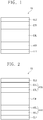
- FIG. 1 is a schematic cross-sectional view illustrating an organic electroluminescence device according to an embodiment of the present disclosure.
- An organic electroluminescence device 10 according to an embodiment includes a first electrode EL1, a hole transport region HTR, an emission layer EML, an electron transport region ETR, and a second electrode EL2 that are sequentially stacked.
- FIG. 2 illustrates a cross-sectional view of an organic electroluminescence device 10 of an embodiment, in which the hole transport region HTR includes a hole injection layer HIL and a hole transport layer HTL, and the electron transport region ETR includes an electron injection layer EIL and an electron transport layer ETL.
- FIG. 3 illustrates a cross-sectional view of an organic electroluminescence device 10 of an embodiment, in which the hole transport region HTR includes the hole injection layer HIL, the hole transport layer HTL, and an electron blocking layer EBL, and the electron transport region ETR includes the electron injection layer EIL, the electron transport layer ETL, and a hole blocking layer HBL.
- At least one of the hole transport region HTR, the emission layer EML, or the electron transport region ETR may include an organometallic compound of an embodiment.
- the organometallic compound of an embodiment will be described later in more detail.
- the first electrode EL1 may have conductivity (e.g., may be conductive).
- the first electrode EL1 may be formed of a metal alloy or a conductive compound.
- the first electrode EL1 may be an anode.
- the first electrode EL1 may be a pixel electrode.
- the first electrode EL1 may be a transmissive electrode, a transflective electrode, or a reflective electrode.
- the first electrode EL1 may include a transparent metal oxide (such as indium tin oxide (ITO), indium zinc oxide (IZO), zinc oxide (ZnO), and/or indium tin zinc oxide (ITZO)).
- the first electrode EL1 is a transflective electrode or a reflective electrode
- the first electrode EL1 may include silver (Ag), magnesium
- Mg copper (Cu), aluminium (Al), platinum (Pt), palladium (Pd), gold (Au), nickel (Ni), neodymium (Nd), iridium (Ir), chromium (Cr), lithium (Li), calcium (Ca), LiF/Ca, LiF/Al, molybdenum (Mo), titanium (Ti), a compound thereof, or a mixture thereof (for example, a mixture of Ag and Mg).
- the first electrode EL1 may have a multilayer structure including a reflective film or a transflective film, and a transparent conductive film formed of indium tin oxide (ITO), indium zinc oxide (IZO), zinc oxide (ZnO), or indium tin zinc oxide (ITZO), etc.
- the first electrode EL1 may have a three-layer structure of ITO/Ag/ITO, but is not limited thereto.
- the thickness of the first electrode EL1 may be about 1,000 ⁇ to about 10,000 ⁇ , for example, about 1,000 ⁇ to about 3,000 ⁇ .
- the hole transport region HTR is disposed on the first electrode EL1.
- the hole transport region HTR may include at least one of a hole injection layer HIL, a hole transport layer HTL, a hole buffer layer, or an electron blocking layer EBL.
- the hole transport region HTR may have a single layer formed of a single material, a single layer formed of a plurality of different materials, or a multilayer structure including a plurality of layers formed of a plurality of different materials.
- the hole transport region HTR may have a single layer structure of a hole injection layer HIL or a hole transport layer HTL, and may have a single layer structure formed of a hole injection material or a hole transport material.
- the hole transport region HTR may have a single layer structure formed of a plurality of different materials, or a structure in which a hole injection layer HIL/hole transport layer HTL, a hole injection layer HIL/hole transport layer HTL/hole buffer layer, a hole injection layer HIL/hole buffer layer, a hole transport layer HTL/hole buffer layer, or a hole injection layer HIL/hole transport layer HTL/electron blocking layer EBL are stacked in order from the first electrode EL1, but an embodiment is not limited thereto.
- the hole transport region HTR may be formed using various methods (such as a vacuum deposition method, a spin coating method, a cast method, a Langmuir-Blodgett (LB) method, an inkjet printing method, a laser printing method, and/or a laser induced thermal imaging (LITI) method).
- various methods such as a vacuum deposition method, a spin coating method, a cast method, a Langmuir-Blodgett (LB) method, an inkjet printing method, a laser printing method, and/or a laser induced thermal imaging (LITI) method).
- the hole injection layer HIL may include, for example, a phthalocyanine compound (such as copper phthalocyanine); N,N'-diphenyl-N,N'-bis-[4-(phenyl-m-tolyl-amino)-phenyl]-biphenyl-4,4'-diamine (DNTPD), 4,4',4"-[tris(3-methylphenyl)phenylamino]triphenylamine] (m-MTDATA), 4,4',4"-tris(N,N-diphenylamino)triphenylamine (TDATA), 4,4',4"-tris(N,-(2-naphthyl)-N-phenylamino)-triphenylamine (2-TNATA), poly(3,4-ethylene dioxythiophene)/poly(4-styrenesulfonate) (PEDOT/PSS), polyaniline/dodecylbenzenesulfonic acid (PANI/DB
- the hole transport layer HTL may further include, for example, carbazole derivatives (such as N-phenyl carbazole and/or polyvinyl carbazole), fluorene derivatives, N,N'-bis(3-methylphenyl)-N,N'-diphenyl-[1,1-biphenyl]-4,4'-diamine (TPD), triphenylamine derivatives (such as 4,4',4"-tris(N-carbazolyl)triphenylamine (TCTA)), N,N'-di(naphthalene-1-yl)-N,N'-diphenyl-benzidine (NPB), 4,4'-cyclohexylidene bis[N,N-bis(4-methylphenyl)benzenamine] (TAPC), 4,4'-bis[N,N'-(3-tolyl)amino]-3,3'-dimethylbiphenyl (HMTPD), 1,3-bis(N-carbazolyl)
- the thickness of the hole transport region HTR may be about 100 ⁇ to about 10,000 ⁇ , for example, about 100 ⁇ to about 5,000 ⁇ .
- the thickness of the hole injection layer HIL may be, for example, about 30 ⁇ to about 1,000 ⁇ , and the thickness of the hole transport layer HTL may be about 30 ⁇ to about 1,000 ⁇ .
- the thickness of the electron blocking layer EBL may be about 10 ⁇ to about 1,000 ⁇ .
- the hole transport region HTR may further include, in addition to the above-described materials, a charge generating material to increase conductivity.
- the charge generating material may be dispersed substantially uniformly or non-uniformly in the hole transport region HTR.
- the charge generating material may be, for example, a p-dopant.
- the p-dopant may be a quinone derivative, metal oxide, or cyano group-containing compound, but is not limited thereto.
- Non-limiting examples of the p-dopant include quinone derivatives (such as tetracyanoquinodimethane (TCNQ) and/or 2,3,5,6-tetrafluoro-7,7,8,8-tetracyanoquinodimethane (F4-TCNQ)), metal oxides (such as tungsten oxide and/or molybdenum oxide), etc.
- quinone derivatives such as tetracyanoquinodimethane (TCNQ) and/or 2,3,5,6-tetrafluoro-7,7,8,8-tetracyanoquinodimethane (F4-TCNQ)
- metal oxides such as tungsten oxide and/or molybdenum oxide
- the hole transport region HTR may further include at least one of a hole buffer layer or an electron blocking layer EBL in addition to the hole injection layer HIL and the hole transport layer HTL.
- the hole buffer layer may compensate for a resonance distance according to the wavelength of light emitted from an emission layer EML, and may increase light emission efficiency. Materials that may be included in the hole transport region HTR may be used as materials included in the hole buffer layer.
- the electron blocking layer EBL may prevent or reduce electrons from being injected from the electron transport region ETR to the hole transport region HTR.
- the emission layer EML is disposed on the hole transport region HTR.
- the thickness of the emission layer EML may be, for example, about 100 ⁇ to about 1000 ⁇ or about 100 ⁇ to about 300 ⁇ .
- the emission layer EML may have a single layer formed of a single material, a single layer formed of a plurality of different materials, or a multilayer structure having a plurality of layers formed of a plurality of different materials.
- the emission layer EML includes an organometallic compound of an embodiment.
- the organometallic compound of an embodiment includes a metal atom and a ligand binding to the metal atom.
- the organometallic compound includes a metal atom and four ligands binding to the metal atom.
- the metal atoms and ligands bind to each other via coordinate bonds.
- At least one of the four ligands includes a mesoionic carbene group.
- the mesoionic carbene group is a substituted or unsubstituted mesoionic carbene group having 1 to 20 ring-forming carbon atoms.
- the metal atom is platinum (Pt), palladium (Pd), copper (Cu), silver (Ag), gold (Au), rhodium (Rh), iridium (Ir), ruthenium (Ru), osmium (Os), titanium (Ti), zirconium (Zr), hafnium (Hf), europium (Eu), terbium (Tb), or thulium (Tm).
- the metal atom may be a platinum (Pt) atom.
- the mesoionic carbene group may be an aromatic mesoionic carbene group.
- the aromatic mesoionic carbene group may be derived from a nitrogen-containing heterocyclic group.
- the mesoionic carbene group may be derived from at least one of a substituted or unsubstituted imidazole precursor, a substituted or unsubstituted triazole precursor, a substituted or unsubstituted tetrazole precursor, a substituted or unsubstituted pyridine precursor, or a substituted or unsubstituted pyrazoline precursor.
- the mesoionic carbene group may be imidazolin-4-ylidene derivatives, 1,2,3-triazolylidene derivatives, tetrazol-5-ylidene derivatives, pyridin-3-ylidene derivatives, pyrazolin-5-ylidene derivatives, imidazo [1,2 -a] pyridin-2-ylidene or imidazo [1,2-a] pyridin-3-ylidene derivatives.
- the mesoionic carbene group may be a substituted or unsubstituted imidazolin-4-ylidene group, a substituted or unsubstituted 1,2,3-triazolylidene group, a substituted or unsubstituted tetrazol-5-ylidene group, a substituted or unsubstituted pyridin-3-ylidene group, a substituted or unsubstituted pyrazolin-5-ylidene group, an imidazo [1,2-a] pyridin-2-ylidene group, or an imidazo [1,2-a] pyridin-3-ylidene group.
- the substituted pyrazolin-5-ylidene group may be a substituted benzopyrazolin-5-ylidene group.
- the four ligands are each independently a mesoionic carbene group, an aryl group, or a heteroaryl group.
- the mesoionic carbene group is a substituted or unsubstituted mesoionic carbene group having 1 to 20 ring-forming carbon atoms;
- the aryl group is a substituted or unsubstituted aryl group having 6 to 30 ring-forming carbon atoms;
- the heteroaryl group is a substituted or unsubstituted heteroaryl group having 2 to 30 ring-forming carbon atoms.
- Each of the four ligands may be or form part of a tetradentate ligand by linking with at least one of the adjacent ligands via a linking group. That is, the four ligands may be one tetradentate ligand linked to each other.
- the first ligand and the second ligand may be connected via a linking group
- the second ligand and the third ligand may be connected via a linking group
- the third ligand and the fourth ligand may be connected via a linking group.
- the linking group may be a direct linkage or a divalent linking group.
- the organometallic compound of an embodiment is represented by Formula 1.
- A1 to A4 represent four ligands.
- A1 to A4 are each independently a mesoionic carbene group, an aryl group, or a heteroaryl group.
- the mesoionic carbene group is a substituted or unsubstituted mesoionic carbene group having 1 to 20 ring-forming carbon atoms.
- the mesoionic carbene group may be a substituted or unsubstituted mesoionic carbene group having 1 to 15 ring-forming carbon atoms.
- the mesoionic carbene group may be a substituted or unsubstituted mesoionic carbene group having 1 to 10 ring-forming carbon atoms.
- the aryl group is a substituted or unsubstituted aryl group having 6 to 30 ring-forming carbon atoms.
- the aryl group may be a substituted or unsubstituted aryl group having 6 to 20 ring-forming carbon atoms.
- the aryl group may be a substituted or unsubstituted aryl group having 6 to 15 ring-forming carbon atoms.
- the aryl group may be a substituted or unsubstituted aryl group having 6 to 10 ring-forming carbon atoms.
- the heteroaryl group is a substituted or unsubstituted heteroaryl group having 2 to 30 ring-forming carbon atoms.
- the heteroaryl group may be a substituted or unsubstituted heteroaryl group having 2 to 20 ring-forming carbon atoms.
- the heteroaryl group may be a substituted or unsubstituted heteroaryl group having 2 to 15 ring-forming carbon atoms.
- the heteroaryl group may be a substituted or unsubstituted heteroaryl group having 2 to 10 ring-forming carbon atoms.
- At least one of A1 to A4 is a mesoionic carbene group.
- the aryl group may be, for example, a substituted or unsubstituted phenyl group.
- the heteroaryl group may be, for example, a substituted or unsubstituted pyridine group, a substituted or unsubstituted carbazole group, or a substituted or unsubstituted heterocyclic carbene group.
- the heterocyclic carbene group may be a normal (e.g., standard or canonical) N-heterocyclic carbene group.
- the heterocyclic carbene group may be a substituted or unsubstituted imidazolin-2-ylidene group.
- X 1 to X 4 are each independently a carbon atom or a nitrogen atom.
- R 1 to R 4 are each independently a hydrogen atom, a deuterium atom, a cyano group, an alkyl group, an aryl group, or a heteroaryl group, and/or bonded to an adjacent group to form a ring.
- the alkyl group is a substituted or unsubstituted alkyl group having 1 to 20 carbon atoms.
- the alkyl group may be a substituted or unsubstituted alkyl group having 1 to 10 carbon atoms.
- the alkyl group may be a substituted or unsubstituted alkyl group having 1 to 5 carbon atoms.
- the aryl group is a substituted or unsubstituted aryl group having 6 to 30 ring-forming carbon atoms.
- the aryl group may be a substituted or unsubstituted aryl group having 6 to 20 ring-forming carbon atoms.
- the aryl group may be a substituted or unsubstituted aryl group having 6 to 15 ring-forming carbon atoms.
- the aryl group may be a substituted or unsubstituted aryl group having 6 to 10 ring-forming carbon atoms.
- the heteroaryl group is a substituted or unsubstituted heteroaryl group having 2 to 30 ring-forming carbon atoms.
- the heteroaryl group may be a substituted or unsubstituted heteroaryl group having 2 to 20 ring-forming carbon atoms.
- the heteroaryl group may be a substituted or unsubstituted heteroaryl group having 2 to 15 ring-forming carbon atoms.
- the heteroaryl group may be a substituted or unsubstituted heteroaryl group having 2 to 10 ring-forming carbon atoms.
- the alkyl group may be a methyl group or a t-butyl group.
- the aryl group may be a substituted or unsubstituted phenyl group.
- R 1 to R 4 may bind to an adjacent group to form a substituted or unsubstituted phenyl group or a substituted or unsubstituted pyrazine group.
- a1 to a4 are each independently an integer of 0 to 4.
- a1 is an integer of 2 or more
- a plurality of R 1 's may be the same as or different from each other.
- the same description of a1 may also be applied to a2 to a4.
- L 1 to L 4 are each independently a direct linkage, *-O-*, *-S-*, a divalent alkyl group, a arylene group, or a heteroarylene group.
- the divalent alkyl group is a substituted or unsubstituted alkyl group having 1 to 20 carbon atoms.
- the divalent alkyl group may be a substituted or unsubstituted alkyl group having 1 to 10 carbon atoms.
- the divalent alkyl group may be a substituted or unsubstituted alkyl group having 1 to 5 carbon atoms.
- the arylene group is a substituted or unsubstituted arylene group having 6 to 30 ring-forming carbon atoms.
- the arylene group may be a substituted or unsubstituted arylene group having 6 to 20 ring-forming carbon atoms.
- the arylene group may be a substituted or unsubstituted arylene group having 6 to 15 ring-forming carbon atoms.
- the arylene group may be a substituted or unsubstituted arylene group having 6 to 10 ring-forming carbon atoms.
- the heteroarylene group is a substituted or unsubstituted heteroarylene group having 2 to 30 ring-forming carbon atoms.
- the heteroarylene group may be a substituted or unsubstituted heteroarylene group having 2 to 20 ring-forming carbon atoms.
- the heteroarylene group may be a substituted or unsubstituted heteroarylene group having 2 to 15 ring-forming carbon atoms.
- the heteroarylene group may be a substituted or unsubstituted heteroarylene group having 2 to 10 ring-forming carbon atoms.
- L 1 and L 3 may each be a direct linkage and L 2 may be any one of *-O-*, *-S-*,
- -* refers to a position to be connected.
- -* may refer to positions connected to A1 to A4.
- R 5 to R 8 are each independently an alkyl group, an aryl group, or a heteroaryl group, and/or bonded to an adjacent group to form a ring.
- the alkyl group is a substituted or unsubstituted alkyl group having 1 to 20 carbon atoms.
- the alkyl group may be a substituted or unsubstituted alkyl group having 1 to 10 carbon atoms.
- the alkyl group may be a substituted or unsubstituted alkyl group having 1 to 5 carbon atoms.
- the aryl group is a substituted or unsubstituted aryl group having 6 to 30 ring-forming carbon atoms.
- the aryl group may be a substituted or unsubstituted aryl group having 6 to 20 ring-forming carbon atoms.
- the aryl group may be a substituted or unsubstituted aryl group having 6 to 15 ring-forming carbon atoms.
- the aryl group may be a substituted or unsubstituted aryl group having 6 to 10 ring-forming carbon atoms.
- the heteroaryl group is a substituted or unsubstituted heteroaryl group having 2 to 30 ring-forming carbon atoms.
- the heteroaryl group may be a substituted or unsubstituted heteroaryl group having 2 to 20 ring-forming carbon atoms.
- the heteroaryl group may be a substituted or unsubstituted heteroaryl group having 2 to 15 ring-forming carbon atoms.
- the heteroaryl group may be a substituted or unsubstituted heteroaryl group having 2 to 10 ring-forming carbon atoms.
- R 5 to R 8 may be a methyl group or a substituted or unsubstituted phenyl group.
- R 6 and R 7 may bind to each other to form a ring.
- R 6 and R 7 may bind to each other to form a dibenzosilyl group:
- n1 to m4 are each independently 0 or 1.
- m1 to m3 may be 1 and m4 may be 0.
- T 1 to T 4 are each independently a direct linkage, an oxygen atom, or a sulfur atom.
- all of T 1 to T 4 may be a direct linkage.
- M is platinum (Pt), palladium (Pd), copper (Cu), silver (Ag), gold (Au), rhodium (Rh), iridium (Ir), ruthenium (Ru), osmium (Os), titanium (Ti), zirconium (Zr), hafnium (Hf), europium (Eu), terbium (Tb), or thulium (Tm).
- M may be a platinum (Pt) atom, a palladium (Pd) atom, a rhodium (Rh) atom, or an osmium (Os) atom.
- M may be a platinum (Pt) atom.
- Formula 1 may be represented by Formula 2:
- Formula 2 is an embodiment of Formula 1 in which L 1 , L 3 , L 4 , m1 to m4, T 1 to T 4 , and M are specified.
- a 1 to A 4 , X 1 to X 4 , R 1 to R 4 , a1 to a4, and L 2 are each independently the same as defined in Formula 1.
- At least one of A1 and A4 may be a mesoionic carbene group represented by any one of 1-1 to 1-6:
- one of Y 1 and Y 2 is CH and the other is NR 24 .
- -* is a position of binding to a metal atom, M.
- A11 is a substituted or unsubstituted aryl group having 6 to 30 ring-forming carbon atoms or a substituted or unsubstituted heteroaryl group having 2 to 30 ring-forming carbon atoms.
- A11 may be a substituted or unsubstituted aryl group having 6 to 20 ring-forming carbon atoms or a substituted or unsubstituted heteroaryl group having 2 to 20 ring-forming carbon atoms.
- A11 may be a substituted or unsubstituted aryl group having 6 to 15 ring-forming carbon atoms or a substituted or unsubstituted heteroaryl group having 2 to 15 ring-forming carbon atoms.
- A11 may be a substituted or unsubstituted aryl group having 6 to 10 ring-forming carbon atoms or a substituted or unsubstituted heteroaryl group having 2 to 10 ring-forming carbon atoms. Either of Y 3 and Y 4 is and the other is C-*.
- Y 5 is NR 26 or .
- R 11 to R 15 are each independently a hydrogen atom, a deuterium atom, a cyano group, an alkyl group, an aryl group, or a heteroaryl group, and/or bonded to an adjacent group to form a ring.
- the alkyl group is a substituted or unsubstituted alkyl group having 1 to 20 carbon atoms.
- the alkyl group may be a substituted or unsubstituted alkyl group having 1 to 10 carbon atoms.
- the alkyl group may be a substituted or unsubstituted alkyl group having 1 to 5 carbon atoms.
- the aryl group is a substituted or unsubstituted aryl group having 6 to 30 ring-forming carbon atoms.
- the aryl group may be a substituted or unsubstituted aryl group having 6 to 20 ring-forming carbon atoms.
- the aryl group may be a substituted or unsubstituted aryl group having 6 to 15 ring-forming carbon atoms.
- the aryl group may be a substituted or unsubstituted aryl group having 6 to 10 ring-forming carbon atoms.
- the heteroaryl group is a substituted or unsubstituted heteroaryl group having 2 to 30 ring-forming carbon atoms.
- the heteroaryl group may be a substituted or unsubstituted heteroaryl group having 2 to 20 ring-forming carbon atoms.
- the heteroaryl group may be a substituted or unsubstituted heteroaryl group having 2 to 15 ring-forming carbon atoms.
- the heteroaryl group may be a substituted or unsubstituted heteroaryl group having 2 to 10 ring-forming carbon atoms.
- R 11 to R 15 may each independently be a hydrogen atom, an unsubstituted methyl group, an unsubstituted isopropyl group, an unsubstituted t-butyl group, a CD 3 group (trideuterated methyl group), or a substituted or unsubstituted phenyl group.
- R 11 to R 15 bind to an adjacent group to form a ring, a substituted or unsubstituted phenyl group may be formed.
- a11 to a13 are each independently an integer of 0 to 2.
- a14 is an integer of 0 to 4.
- a11 is an integer of 2
- a plurality of R 11 's may be the same as or different from each other.
- the same description of a11 may also be applied to a12 and a13.
- a14 is an integer of 2 or more
- a plurality of R 14 's may be the same as or different from each other
- R 21 to R 26 are each independently an alkyl group, an aryl group, or a heteroaryl group.
- the alkyl group is a substituted or unsubstituted alkyl group having 1 to 20 carbon atoms.
- the alkyl group may be a substituted or unsubstituted alkyl group having 1 to 10 carbon atoms.
- the alkyl group may be a substituted or unsubstituted alkyl group having 1 to 5 carbon atoms.
- the aryl group is a substituted or unsubstituted aryl group having 6 to 30 ring-forming carbon atoms.
- the aryl group may be a substituted or unsubstituted aryl group having 6 to 20 ring-forming carbon atoms.
- the aryl group may be a substituted or unsubstituted aryl group having 6 to 15 ring-forming carbon atoms.
- the aryl group may be a substituted or unsubstituted aryl group having 6 to 10 ring-forming carbon atoms.
- the heteroaryl group is a substituted or unsubstituted heteroaryl group having 2 to 30 ring-forming carbon atoms.
- the heteroaryl group may be a substituted or unsubstituted heteroaryl group having 2 to 20 ring-forming carbon atoms.
- the heteroaryl group may be a substituted or unsubstituted heteroaryl group having 2 to 15 ring-forming carbon atoms.
- the heteroaryl group may be a substituted or unsubstituted heteroaryl group having 2 to 10 ring-forming carbon atoms.
- R 21 to R 26 may each independently be an unsubstituted methyl group or a substituted or unsubstituted phenyl group.
- one or two selected from A1 and A4 may be a mesoionic carbene group represented by any one of 1-1 to 1-6.
- A1 and A4 may be the same as or different from each other.
- A1 and A4 may each independently be a mesoionic carbene group represented by any one of 1-1 to 1-6, and any one of A1 and A4 may be a mesoionic carbene group represented by any one of 1-1 to 1-6.
- 1-5 may be represented by 1-5-1.
- R 14 , a13 and R 25 are each independently the same as defined in 1-5.
- 1-6 may be represented by 1-6-1.
- Y 3 , Y 4 , R 15 , R 26 , and a14 are each independently the same as defined in 1-6.
- At least one of A1 and A4 may be represented by any one of 1-1 to 1-6, and the remaining ligand that is not represented by 1-1 to 1-6 may be represented by any one of 2-1 to 2-4.
- A2 and A3 may each independently be represented by any one of 2-1 to 2-4:
- Y 11 is a carbon atom or a nitrogen atom.
- Y 12 is CR 31 or .
- Y 13 to Y 19 are each independently CR35 or a nitrogen atom.
- R 31 to R 41 are each independently a hydrogen atom, a deuterium atom, a cyano group, an alkyl group, an aryl group, or a heteroaryl group, and/or bonded to an adjacent group to form a ring.
- the alkyl group is a substituted or unsubstituted alkyl group having 1 to 20 carbon atoms.
- the alkyl group may be a substituted or unsubstituted alkyl group having 1 to 10 carbon atoms.
- the alkyl group may be a substituted or unsubstituted alkyl group having 1 to 5 carbon atoms.
- the aryl group is a substituted or unsubstituted aryl group having 6 to 30 ring-forming carbon atoms.
- the aryl group may be a substituted or unsubstituted aryl group having 6 to 20 ring-forming carbon atoms.
- the aryl group may be a substituted or unsubstituted aryl group having 6 to 15 ring-forming carbon atoms.
- the aryl group may be a substituted or unsubstituted aryl group having 6 to 10 ring-forming carbon atoms.
- the heteroaryl group is a substituted or unsubstituted heteroaryl group having 2 to 30 ring-forming carbon atoms.
- the heteroaryl group may be a substituted or unsubstituted heteroaryl group having 2 to 20 ring-forming carbon atoms.
- the heteroaryl group may be a substituted or unsubstituted heteroaryl group having 2 to 15 ring-forming carbon atoms.
- the heteroaryl group may be a substituted or unsubstituted heteroaryl group having 2 to 10 ring-forming carbon atoms.
- R 31 to R 41 may each independently be a hydrogen atom, an unsubstituted methyl group, an unsubstituted t-butyl group or a substituted or unsubstituted phenyl group, and/or bonded to an adjacent group to form a substituted or unsubstituted benzene ring or a substituted or unsubstituted pyrazine ring.
- Formula 1 may be represented by at least one of Formulae 3-1 to 3-7:
- A1 is represented by any one of 1-1 to 1-5.
- At least one of A1 and A4 is represented by any one of 1-1 to 1-5.
- At least one of A1 and A3 is represented by any one of 1-1 to 1-5.
- A1 is represented by 1-6.
- R 51 to R 64 are each independently a hydrogen atom, a deuterium atom, a cyano group, an alkyl group, an aryl group, or a heteroaryl group, and/or bonded to an adjacent group to form a ring.
- the alkyl group is a substituted or unsubstituted alkyl group having 1 to 20 carbon atoms.
- the alkyl group may be a substituted or unsubstituted alkyl group having 1 to 10 carbon atoms.
- the alkyl group may be a substituted or unsubstituted alkyl group having 1 to 5 carbon atoms.
- the aryl group is a substituted or unsubstituted aryl group having 6 to 30 ring-forming carbon atoms.
- the aryl group may be a substituted or unsubstituted aryl group having 6 to 20 ring-forming carbon atoms.
- the aryl group may be a substituted or unsubstituted aryl group having 6 to 15 ring-forming carbon atoms.
- the aryl group may be a substituted or unsubstituted aryl group having 6 to 10 ring-forming carbon atoms.
- the heteroaryl group is a substituted or unsubstituted heteroaryl group having 2 to 30 ring-forming carbon atoms.
- the heteroaryl group may be a substituted or unsubstituted heteroaryl group having 2 to 20 ring-forming carbon atoms.
- the heteroaryl group may be a substituted or unsubstituted heteroaryl group having 2 to 15 ring-forming carbon atoms.
- the heteroaryl group may be a substituted or unsubstituted heteroaryl group having 2 to 10 ring-forming carbon atoms.
- Z is a carbon atom or a nitrogen atom.
- a21, a23, a24, a26, a27, a29, a30, a32, a33, and a34 are each independently an integer of 0 to 3.
- a22, a28, and a31 are each independently an integer of 0 to 4.
- a25 is an integer of 0 to 2.
- Y 13 to Y 19 are each independently the same as defined in connection with 2-2.
- L 2 is the same as defined in connection with Formula 2.
- the plurality of R 51 's may be the same as or different from each other. Similar explanations may be applied to R 52 to R 64 .
- two R 55 's may bind to each other to form a benzene ring.
- A1 may be any one of 1-1 to 1-3 and 1-5.
- A1 may be any one of 1-1 to 1-5.
- A4 may be any one of 1-1 to 1-3.
- A1 and A4 may be the same as or different from each other.
- A1 may be 1-5.
- A4 may be 2-1.
- A1 may be any one of 2-1 to 2-4, and A3 may be 1-4.
- A1 may be any one of 2-3 to 2-4.
- A1 may be any one of 2-1 to 2-4, and A4 may be 1-4.
- A1 may be any one of 2-3 and 2-4.
- A1 may be 1-6.
- Formula 3-6 may be represented by at least one of Formulae 3-6-1 and 3-6-2.
- Formulae 3-6-1 and 3-6-2 are embodiments of Formula 3-6 in which A1 is specified.
- R 26 is the same as defined in connection with 1-6.
- Y 13 to Y 19 , R 60 , R 61 , a30, and a31 are each independently the same as defined in connection with Formula 3-6.
- Formula 3-7 may be represented by at least one of Formulae 3-7-1 and 3-7-2.
- Formulae 3-7-1 and 3-7-2 are embodiments of Formula 3-7 in which A1 is specified.
- R 26 is the same as defined in connection with 1-6.
- R 62 to R 64 , and a32 to a34 are each independently the same as defined in connection with Formula 3-7.
- the organometallic compound of an embodiment may be any one of the compounds represented by Compound Group 1 and Compound Group 2:
- the emission layer EML may include a host and a dopant, and the emission layer EML may include an organometallic compound of an embodiment as a dopant material.
- the emission layer EML may include the organometallic compound of an embodiment as a dopant material to emit green light.
- the emission layer EML may be to emit green light having a center wavelength of about 500 nm to about 600 nm through phosphorescence.
- the emission layer EML may further include an anthracene derivative, a pyrene derivative, a fluoranthene derivative, a chrysene derivative, a dihydrobenzanthracene derivative, or a triphenylene derivative.
- the emission layer EML may further include an anthracene derivative or a pyrene derivative.
- the emission layer EML may include a general material known in the art as a host material.
- the emission layer EML may include at least one of bis[2-(diphenylphosphino)phenyl]ether oxide (DPEPO), 4,4'-bis(N-carbazolyl)-1,1'-biphenyl (CBP), 1,3-bis(carbazolyl-9-yl)benzene (mCP), tris(4-carbazol-9-ylphenyl)amine (TCTA), or 1,3,5-tris(1-phenyl-1H-benzo[d]imidazol-2-yl)benzene (TPBi), but is not limited thereto.
- DPEPO bis[2-(diphenylphosphino)phenyl]ether oxide
- CBP 4,4'-bis(N-carbazolyl)-1,1'-biphenyl
- mCP 1,3-bis(carbazolyl-9-yl)benzene
- TCTA
- the host material may be or include tris(8-hydroxyquinolino)aluminium (Alq 3 ), 4,4'-bis(N-carbazolyl)-1,1'-biphenyl (CBP), poly(N-vinylcarbazole) (PVK), 9,10-di(naphthalene-2-yl)anthracene (ADN), 4,4',4"-tris (carbazol-9-yl) triphenylamine (TCTA), 1,3,5-tris(N-phenylbenzimidazole-2-yl)benzene (TPBi), 2-tert-butyl-9,10-di(naphth-2-yl)anthracene (TBADN), distyrylarylene (DSA), 4,4-bis(9-carbazolyl)-2,2-dimethyl-biphenyl (CDBP), 2-methyl-9,10-bis(naphthalen-2-yl)anthracene (MA)-
- the emission layer EML may further include any suitable dopant material.
- the dopant may be or include a styryl derivative (e.g., 1,4-bis[2-(3-N-ethylcarbazolyl)vinyl]benzene (BCzVB), 4-(di-p-tolylamino)-4"-[(di-p-tolylamino)styryl]stilbene (DPAVB), and/or N-(4-((E)-2-(6-((E)-4-(diphenylamino)styryl)naphthalen-2-yl)vinyl)phenyl)-N-phenylbenzenamine (N-BDAVBi)), perylene and derivatives thereof (e.g., 2,5,8,11-tetra-t-butylperylene (TBP)), pyrene and derivatives thereof (e.g., 1,1-dipyrene, 1,4-dipyrenylbenzen
- the electron transport region ETR is disposed on the emission layer EML.
- the electron transport region ETR may include at least one of a hole blocking layer HBL, an electron transport layer ETL, or an electron injection layer EIL, but is not limited thereto.
- the electron transport region ETR may have a single layer formed of a single material, a single layer formed of a plurality of different materials, or a multilayer structure including a plurality of layers formed of a plurality of different materials.
- the electron transport region ETR may have a single layer structure of an electron injection layer EIL or an electron transport layer ETL, and may have a single layer structure formed of an electron injection material or an electron transport material.
- the electron transport region ETR may have a single layer structure formed of a plurality of different materials, or may have a structure in which an electron transport layer ETL/electron injection layer EIL and a hole blocking layer HBL/electron transport layer ETL/electron injection layer EIL are stacked in order from the emission layer EML, but is not limited thereto.
- the thickness of the electron transport region ETR may be, for example, about 100 ⁇ to about 1,500 ⁇ .
- the electron transport region ETR may be formed using any suitable method, such as a vacuum deposition method, a spin coating method, a cast method, a Langmuir-Blodgett (LB) method, an inkjet printing method, a laser printing method, a laser induced thermal imaging (LITI) method, etc.
- a vacuum deposition method such as a vacuum deposition method, a spin coating method, a cast method, a Langmuir-Blodgett (LB) method, an inkjet printing method, a laser printing method, a laser induced thermal imaging (LITI) method, etc.
- LB Langmuir-Blodgett
- LITI laser induced thermal imaging
- the electron transport layer ETL may include, for example, tris(8-hydroxyquinolinato)aluminium (Alq 3 ), 1,3,5-tri[(3-pyridyl)-phen-3-yl]benzene, 2,4,6-tris(3'-(pyridin-3-yl)biphenyl-3-yl)-1 ,3,5-triazine, 2-(4-(N-phenylbenzoimidazole-1-ylphenyl)-9,10-dinaphthylanthracene, 1,3,5-tri(1-phenyl-1H-benzo[d]imidazol-2-yl)benzene (TPBi), 2,9-dimethyl-4,7-diphenyl-1,10-phenanthroline (BCP), 4,7-diphenyl-1,10-phenanthroline (Bphen), 3-(4-biphenylyl)-4-phenyl-5-tert
- Alq 3 tris(8-hydroxyquinolinato
- the thickness of the electron transport layer ETL may be about 100 ⁇ to about 1,000 ⁇ and may be, for example, about 150 ⁇ to about 500 ⁇ . When the thickness of the electron transport layer ETL satisfies the above-described range, satisfactory electron transport properties may be obtained without a substantial increase in driving voltage.
- the electron injection layer EIL may be a halogenated metal (such as LiF, NaCl, CsF, RbCI, and/or Rbl), a lanthanide metal (such as ytterbium (Yb)), a metal oxide (such as Li 2 O, and/or BaO), or 8-hydroxyl lithium quinolate (LiQ), but is not limited thereto.
- the electron injection layer EIL may also be formed of a mixture material of an electron transport material and an insulating organo-metal salt.
- the organo-metal salt may be a material having an energy band gap of about 4 eV or more.
- the organo-metal salt may include, for example, metal acetates, metal benzoates, metal acetoacetates, metal acetylacetonates, and/or metal stearates.
- the thickness of the electron injection layer EIL may be about 1 ⁇ to about 100 ⁇ , and about 3 ⁇ to about 90 ⁇ . When the thickness of the electron injection layer EIL satisfies the above-described range, satisfactory electron injection properties may be obtained without a substantial increase in driving voltage.
- the electron transport region ETR may include a hole blocking layer HBL as described above.
- the hole blocking layer HBL may include, for example, at least one of 2,9-dimethyl-4,7-diphenyl-1,10-phenanthroline (BCP) and 4,7-diphenyl-1,10-phenanthroline (Bphen), but is not limited thereto.
- the thickness of the hole blocking layer HBL is not particularly limited, but may be, for example, about 10 ⁇ to about 300 ⁇ .
- the second electrode EL2 is disposed on the electron transport region ETR.
- the second electrode EL2 may be a common electrode or a cathode.
- the second electrode EL2 may be a transmissive electrode, a transflective electrode, or a reflective electrode.
- the second electrode EL2 may include a transparent metal oxide, for example, indium tin oxide (ITO), indium zinc oxide (IZO), zinc oxide (ZnO), or indium tin zinc oxide (ITZO).
- the second electrode EL2 may include Ag, Mg, Cu, Al, Pt, Pd, Au, Ni, Nd, Ir, Cr, Li, Ca, LiF/Ca, LiF/Al, Mo, Ti, a compound thereof, or a mixture thereof (e.g., a mixture of Ag and Mg).
- the second electrode EL2 may have a multilayer structure including a reflective film or a transflective film formed of the above-described materials, and a transparent conductive film formed of indium tin oxide (ITO), indium zinc oxide (IZO), zinc oxide (ZnO), or indium tin zinc oxide (ITZO).
- the thickness of the second electrode EL1 may be about 1000 ⁇ to about 10000 ⁇ , for example, about 1500 ⁇ to about 5000 ⁇ .
- the second electrode EL2 may be connected with an auxiliary electrode.
- the resistance of the second electrode EL2 may decrease.
- the organic electroluminescence device 10 may further include a capping layer CPL on the second electrode EL2.
- the capping layer CPL may include, for example, ⁇ -NPD, NPB, TPD, m-MTDATA, Alq 3 , CuPc, N4,N4,N4',N4'-tetra(biphenyl-4-yl) biphenyl-4,4'-diamine (TPD15), 4,4',4"-tris(carbazol-9-yl)triphenylamine (TCTA), N, N'-bis(naphthalen-1-yl), etc.
- the organometallic compound of the above-described embodiment may be included as a material for an organic electroluminescence device 10 in an organic layer other than the emission layer EML.
- the organic electroluminescence device 10 according to an embodiment of the present disclosure may include the above-described organometallic compound in at least one organic layer disposed between the first electrode EL1 and the second electrode EL2, or in a capping layer disposed on the second electrode EL2.
- the organic electroluminescence device 10 when a voltage is applied across the first electrode EL1 and the second electrode EL2, holes injected from the first electrode EL1 may move through the hole transport region HTR to the emission layer EML, and electrons injected from the second electrode EL2 may move through the electron transport region ETR to the emission layer EML.
- the electrons and holes may recombine in the emission layer EML to form excitons, and these excitons may transition from an excited state to the ground state to emit light.
- organometallic compound according to an embodiment of this present disclosure and an organic electroluminescence device of an embodiment including the organometallic compound according to an embodiment will be described in more detail.
- the Examples shown below are illustrated only for the understanding of this present disclosure, and the scope of the present disclosure is not limited thereto.
- the organometallic compound according to an embodiment of the present disclosure may be synthesized, for example, as follows. However, the synthesis process of the organometallic compound according to an embodiment of the present disclosure is not limited thereto.
- An organometallic Compound 9 of an embodiment of the present disclosure may be synthesized, for example, by Reaction Formula 1:
- 2-methoxycarbazole (9.9 g, 50 mmol), bromobenzene (11.8 g, 75 mmol), potassium phosphate tribasic (23 g, 100 mmol), Cul (1.83 g, 10 mmol), and picolinic acid (1.17 g, 10 mmol) were placed in a reaction vessel and suspended in dimethyl sulfoxide (100 mL). The reaction mixture was warmed and stirred at 160 °C for 24 hours. After completing the reaction, the mixture was cooled to room temperature and extracted using ethyl acetate after adding distilled water (300 mL). The extracted organic layer was washed with saturated sodium chloride aqueous solution and dried over sodium sulfate. The residue after removal of the solvent was separated using column chromatography to obtain a target compound (12.3 g, 45 mmol).
- organometallic compound 1-1 of an embodiment of the present disclosure may be synthesized by, for example, Reaction Formula 1-A:
- Intermediate 1-D was dissolved in a mixed solvent of methanol and distilled water in a ratio of 4:1 and ammonium hexafluorophosphate (1.05 equiv) was added. The resulting solid was stirred at room temperature for 12 hours. Filtration and washing with distilled water and diethyl ether were conducted to obtain Intermediate 1-E (yield: 90%).
- Compound 1-87 was obtained in substantially the same manner as used for the synthesis of Compound 1-53, except that 3',5'-dibromo-2,4,6-triisopropyl-1,1'-diphenyl was used instead of 1,3-dibromo-5-(t-butyl)-benzene, and deuterium-substituted methyl iodide was used instead of methyl iodide.
- Compound 1-111 was obtained in the substantially same manner as used for the synthesis of Compound 1-1, except that 3-(t-butyl)-5-(3,5-dimethyl-1-H-pyrazol-1-yl)phenol was used instead of Intermediate 1-B.
- Compound 1-148 was obtained in substantially the same manner as used for the synthesis of Compound 1-124, except that 5-(3,5-dimethyl)-1H-pyrazol-1-yl)pyridin-3-ol was used instead of Intermediate 53-B.
- Example Compounds 9, 16, 46, 71, 87, 96, 98, 113, 1-1, 1-53, 1-87, 1-110, 1-124, 1-148, and Comparative Compounds C1 to C5 were used as an emission layer EML dopant material, respectively, to manufacture the organic electroluminescence devices of Examples 1 to 14 and Comparative Examples 1 to 5.
- Comparative Compound C1 is Ir(PPy) 3 , which is a green phosphorescent dopant
- Comparative Compound C2 is a green phosphorescent dopant that does not include a carbene group
- Comparative Compounds C3 to C5 are green phosphorescent dopants that do not include a mesoionic carbene group.
- ITO (Corning) glass substrate was cut into about 50 mm x 50 mm x 0.7 mm in size, subjected to ultrasonic cleaning using isopropyl alcohol and distilled water for 5 minutes each and ultraviolet irradiation for about 30 minutes, and then exposed to ozone for cleaning to form a first electrode EL1 having a thickness of about 1200 ⁇ .
- a hole injection layer HIL having a thickness of about 600 ⁇ was formed of 2-TNATA, and a hole transport layer HTL having a thickness of about 300 ⁇ was formed of NPB.
- a 300 ⁇ thick emission layer EML having 10% doped Example Compounds or Comparative Compounds was formed of mCBP, a 50 ⁇ thick hole blocking layer HBL was formed of diphenyl [4-(triphenylsilyl) phenyl] phosphine oxide (TSPO1), and a 300 ⁇ thick electron transport layer ETL was formed of Alq 3 . Then, an electron injection layer EIL having a thickness of 10 ⁇ was formed of LiF and a second electrode EL2 having a thickness of 3000 ⁇ was formed of Al. Each layer was formed by vacuum evaporation.
- the characteristic evaluation of the manufactured organic electroluminescence devices was performed using a luminance alignment measuring apparatus.
- the driving voltage, luminance, efficiency, emission wavelength, and lifetime (T 80 ) were measured for each of the organic electroluminescence devices according to the Examples and Comparative Examples.
- Table 2 shows the driving voltage (V), current efficiency (cd/A) and luminance (cd/m 2 ) at a current density of 50 mA/cm 2 for the manufactured organic electroluminescence devices.
- device life (T 80 ) which is the time taken for the luminance to decrease to 80% level at the luminance 1000 nit, is shown.
- the device life (Tso) was measured by continuous drive at a current density of 40 mA/cm 2 .
- Example 1 5.14 4225 8.26 545 411
- Example 2 5.25 4134 7.95 534 385
- Example 3 5.34 4012 7.85 525 344
- Example 4 5.45 4122 8.25 514 355
- Example 5 6.01 4001 7.77 555 345
- Example 6 5.35 4025 8.05 533 325
- Example 7 5.19 4065 8.13 525 344
- Example 8 5.15 4085 8.17 526 340
- Example 9 5.13 4075 8.15 531 392
- Example 10 5.18 4530 8.85 529 462
- Example 11 5.12 4710 8.96 528 458
- Example 12 5.05 4050 7.98 549 387
- Example 13 5.30 4415 8.35 538 430
- Example 14 5.01 4650 8.54 532 371 Comparative
- the Examples including an organometallic compound of an embodiment having a mesoionic carbene in an emission layer achieved high efficiency, high luminance, low driving voltage, and long lifetime when compared to the Comparative Examples including an organometallic compound without a mesoionic carbene.
- Comparative Example 1 it is seen that the Examples have superior effects compared to the device using Ir(PPy) 3 , which is a green phosphorescent dopant material.
- Comparative Example 2 it is seen that the Examples have superior effects compared to the device of Comparative Example 2, which used an organometallic compound including a metal atom bound to four non-mesoionic carbene ligands as an emission layer material.
- Comparative Examples 3 to 5 it is seen that the Examples have superior effects compared to the device of Comparative Example 3, which used an organometallic compound including a metal atom bound to four ligands, one of which is a normal carbene but not a mesoionic carbene.
- FIG. 4 is a resonance structure diagram showing an imidazolin-4-ylidene as an example of mesoionic carbene.
- the mesoionic carbene has localized electrons in the molecule when compared to normal carbene (e.g., the electron lone pair of the mesoionic carbene is less delocalized than in a normal carbene). Accordingly, the mesoionic carbene is relatively unstable compared to a normal carbene, in which the electrons are more delocalized and therefore provide a more stable structure.
- the carbene group of the mesoionic carbene has a stronger ⁇ (sigma) donor characteristic than the carbene group of the normal carbene, such that the unshared electron pair of the carbene group binds more strongly to a metal atom.
- an organometallic compound of an embodiment may have a stronger bond (e.g., metal-ligand bond) than Comparative Compounds C3 to C5 including normal carbene, and thus is resistant to moisture and air and is not easily oxidized. Therefore, the organometallic compound of an embodiment may be used as an emission layer material of an organic electroluminescence device having a long lifespan.
- d-d* transitions of the metal atom of the organometallic compound may be reduced due to the strong bonding properties, and the organic electroluminescence device including the organometallic compound of an embodiment may achieve low driving voltage, high luminance, and/or high efficiency.
- An organometallic compound of an embodiment includes a metal atom, and four ligands binding to the metal atom, where at least one of the four ligands includes a mesoionic carbene group.
- the organometallic compound of an embodiment has strong bonding properties between the mesoionic carbene ligand and the metal atom. Therefore, the organometallic compound of an embodiment may be applied to an emission layer of an organic electroluminescence device to achieve high efficiency, low driving voltage, high luminance, and/or long lifespan.
- An organic electroluminescence device may achieve high efficiency, low driving voltage, high luminance, and/or long life.
- An organometallic compound according to an embodiment of the present disclosure may be used in an organic electroluminescence device to achieve high efficiency, low driving voltage, high luminance, and/or long life.
- any numerical range recited herein is intended to include all sub-ranges of the same numerical precision subsumed within the recited range.
- a range of "1.0 to 10.0" is intended to include all subranges between (and including) the recited minimum value of 1.0 and the recited maximum value of 10.0, that is, having a minimum value equal to or greater than 1.0 and a maximum value equal to or less than 10.0, such as, for example, 2.4 to 7.6.
- Any maximum numerical limitation recited herein is intended to include all lower numerical limitations subsumed therein and any minimum numerical limitation recited in this specification is intended to include all higher numerical limitations subsumed therein.
Landscapes
- Chemical & Material Sciences (AREA)
- Engineering & Computer Science (AREA)
- Materials Engineering (AREA)
- Organic Chemistry (AREA)
- Crystallography & Structural Chemistry (AREA)
- Inorganic Chemistry (AREA)
- Physics & Mathematics (AREA)
- Optics & Photonics (AREA)
- Electroluminescent Light Sources (AREA)
Abstract
Description
- One or more aspects of embodiments of the present disclosure relate to an organic electroluminescence device and an organometallic compound used therein.
- Organic electroluminescence devices are being actively developed for image display apparatuses (e.g., organic electroluminescence displays). An organic electroluminescence device is a so-called self-luminescent display apparatus, in which holes and electrons respectively injected from a first electrode and a second electrode recombine in an emission layer to produce excitons, and a luminescent material (which may be an organic compound) included in the emission layer utilizes the excitons to emit light.
- An example organic electroluminescence device includes a first electrode, a hole transport layer disposed on the first electrode, an emission layer disposed on the hole transport layer, an electron transport layer disposed on the emission layer, and a second electrode disposed on the electron transport layer. Holes may be injected from the first electrode, and the injected holes may move through the hole transport layer to be injected into the emission layer. Meanwhile, electrons may be injected from the second electrode, and the injected electrons may move through the electron transport layer to be injected into the emission layer. The holes and electrons injected into the emission layer may recombine to form excitons in the emission layer. The organic electroluminescence device may emit light when these excitons fall back (e.g., transition) to the ground state.
- In the application of an organic electroluminescence device to a display device, there is a demand for an organic electroluminescence device having a long life, and thus there is an ongoing demand for development of materials for an organic electroluminescence device capable of stably attaining such a feature.
- One or more aspects of embodiments of the present disclosure are directed toward an organic electroluminescence device having high efficiency, low driving voltage, high luminance, and/or long life (long lifespan) characteristics, and an organometallic compound used therein.
- One or more example embodiments of the present disclosure provide an organic electroluminescence device including a first electrode, a hole transport region, an emission layer, an electron transport region, and a second electrode. The hole transport region is disposed on the first electrode. The emission layer is disposed on the hole transport region. The electron transport region is disposed on the emission layer. The second electrode is disposed on the electron transport region. The emission layer includes an organometallic compound. The organometallic compound include a metal atom, and four ligands binding to the metal atom. At least one of the four ligands is a substituted or unsubstituted mesoionic carbene (MIC) group having 1 to 20 ring-forming carbon atoms.
- The four ligands are each independently a substituted or unsubstituted mesoionic carbene group having 1 to 20 ring-forming carbon atoms, a substituted or unsubstituted aryl group having 6 to 30 ring-forming carbon atoms, or a substituted or unsubstituted heteroaryl group having 2 to 30 ring-forming carbon atoms.
- Each of the four ligands may be a tetradentate ligand linked with at least one of adjacent ligands by a linking group.
- The metal atom may be a platinum (Pt) atom.
- The mesoionic carbene group may be derived from at least one selected from a substituted or unsubstituted imidazole precursor, a substituted or unsubstituted triazole precursor, a substituted or unsubstituted tetrazole precursor, a substituted or unsubstituted pyridine precursor, and a substituted or unsubstituted pyrazoline precursor. The emission layer may include a host and a dopant. The dopant may include the organometallic compound.
- The emission layer may be to emit green light having a center wavelength of about 500 nm to about 600 nm. The emission layer may be to emit green light through phosphorescence.
- The organometallic compound is represented by Formula 1:

- In Formula 1, A1 to A4 are each independently a substituted or unsubstituted mesoionic carbene group having 1 to 20 ring-forming carbon atoms, a substituted or unsubstituted aryl group having 6 to 30 ring-forming carbon atoms, or a substituted or unsubstituted heteroaryl group having 2 to 30 ring-forming carbon atoms. At least one of A1 to A4 is the substituted or unsubstituted mesoionic carbene group. X1 to X4 are each independently a carbon atom or a nitrogen atom. R1 to R4 are each independently a hydrogen atom, a deuterium atom, a cyano group, a substituted or unsubstituted alkyl group having 1 to 20 carbon atoms, a substituted or unsubstituted aryl group having 6 to 30 ring-forming carbon atoms, or a substituted or unsubstituted heteroaryl group having 2 to 30 ring-forming carbon atoms, and/or bonded to an adjacent group to form a ring. a1 to a4 are each independently an integer of 0 to 4.
- L1 to L4 are each independently a direct linkage, *-O-*, *-S-*,

- In some embodiments, the organometallic compound represented by Formula 1 may be represented by Formula 2.


- In Formula 2, A1 to A4, X1 to X4, R1 to R4, a1 to a4, and L2 are each independently the same as defined in connection with Formula 1.
- At least one of A1 and A4 may be a mesoionic carbene group represented by any one of 1-1 to 1-6:


- In 1-1 to 1-6, one of Y1 and Y2 is CH and the other is NR24.is a connection point to any one of L1 to L4, or a position of binding to a neighboring ligand. -* is a position of binding to M. A11 is a substituted or unsubstituted aryl group having 6 to 30 ring-forming carbon atoms or a substituted or unsubstituted heteroaryl group having 2 to 30 ring-forming carbon atoms. Any one of Y3 and Y4 is
 and the other is C-*. Y5 is NR26 or

- R11 to R15 are each independently a hydrogen atom, a deuterium atom, a cyano group, a substituted or unsubstituted alkyl group having 1 to 20 carbon atoms, a substituted or unsubstituted aryl group having 6 to 30 ring-forming carbon atoms, or a substituted or unsubstituted heteroaryl group having 2 to 30 ring-forming carbon atoms, and/or bonded to an adjacent group to form a ring. R21 to R26 are each independently a substituted or unsubstituted alkyl group having 1 to 20 carbon atoms, a substituted or unsubstituted aryl group having 6 to 30 ring-forming carbon atoms, or a substituted or unsubstituted heteroaryl group having 2 to 30 ring-forming carbon atoms. a11 to a13 are each independently an integer of 0 to 2. a14 is an integer of 0 to 4.
- The mesoionic carbene group represented by 1-6 may be represented by 1-6-1:
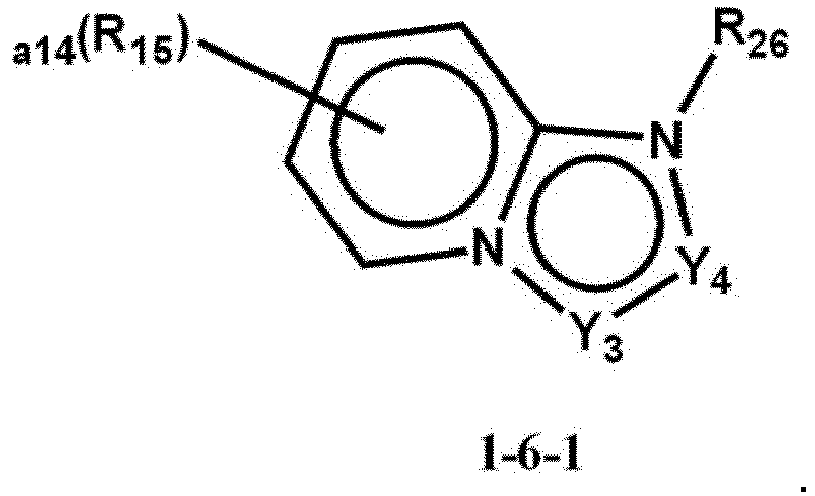
- In Formula 1-6-1, Y3, Y4, R15, R26, and a14 are each independently the same as defined in connection with 1-6.
- At least one of A1 and A4 may be represented by any one of 1-1 to 1-6, and A2, A3, and the remaining ligand of A1 and A4 that is not represented by 1-1 to 1-6 among A1 and A4 may each independently be represented by any one of 2-1 to 2-4:

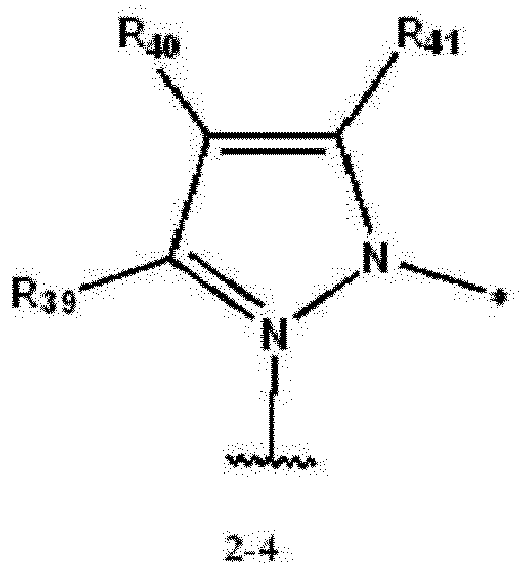
- In 2-1 to 2-4, Y11 is a carbon atom or a nitrogen atom. Y12 is CR31 or. Y13 to Y19 are each independently CR35 or a nitrogen atom. R31 to R41 are each independently a hydrogen atom, a deuterium atom, a cyano group, a substituted or unsubstituted alkyl group having 1 to 20 carbon atoms, a substituted or unsubstituted aryl group having 6 to 30 ring-forming carbon atoms, or a substituted or unsubstituted heteroaryl group having 2 to 30 ring-forming carbon atoms, and/or bonded to an adjacent group to form a ring.

- The organometallic compound represented by Formula 1 may be represented by at least one of Formulae 3-1 to 3-7:


- In Formulae 3-1 and 3-2, A1 is represented by any one of 1-1 to 1-5. In Formulae 3-3 and 3-5, at least one of A1 and A4 is represented by any one of 1-1 to 1-5. In Formula 3-4, at least one of A1 and A3 is represented by any one of 1-1 to 1-5. In Formulae 3-6 and 3-7, A1 is represented by 1-6.
- In Formulae 3-1 to 3-7, R51 to R64 are each independently a hydrogen atom, a deuterium atom, a cyano group, a substituted or unsubstituted alkyl group having 1 to 20 carbon atoms, a substituted or unsubstituted aryl group having 6 to 30 ring-forming carbon atoms, or a substituted or unsubstituted heteroaryl group having 2 to 30 ring-forming carbon atoms, and/or bonded to an adjacent group to form a ring. Z is a carbon atom or a nitrogen atom. a21, a23, a24, a26, a27, a29, a30, a32, a33, and a34 are each independently an integer of 0 to 3. a22, a28, and a31 are each independently an integer of 0 to 4. a25 is an integer of 0 to 2. Y13 to Y19 are each independently the same as defined in connection with 2-2, and L2 is the same as defined in connection with Formula 2.
- The emission layer may include at least one of the compounds represented by Compound Group 1 and Compound Group 2.
- At least some of the above and other features of the invention are set out in the claims.
- One or more example embodiments of the present disclosure provide the organometallic compound described above.
- The accompanying drawings are included to provide a further understanding of the present disclosure, and are incorporated in and constitute a part of this specification. The drawings illustrate embodiments of the present disclosure and, together with the description, serve to explain principles of the present disclosure. In the drawings:
-
FIG. 1 is a schematic cross-sectional view illustrating an organic electroluminescence device according to an embodiment of the present disclosure; -
FIG. 2 is a schematic cross-sectional view illustrating an organic electroluminescence device according to an embodiment of the present disclosure; and -
FIG. 3 is a schematic cross-sectional view illustrating an organic electroluminescence device according to an embodiment of the present disclosure. -
FIG. 4 is a resonance structure diagram showing an imidazolin-4-ylidene as an example of mesoionic carbene - The present disclosure may have various modifications and may be embodied in different forms, and example embodiments will be explained in detail with reference to the accompany drawings. The present disclosure may, however, be embodied in different forms and should not be construed as limited to the embodiments set forth herein. Rather, all modifications, equivalents, and substituents which are included in the technical scope of the present disclosure should be included in the present disclosure.
- In the drawings, like reference numerals refer to like elements throughout, and duplicative descriptions thereof may not be provided. The dimensions of structures may be exaggerated for clarity of illustration. It will be understood that although the terms first, second, etc. may be used herein to describe various elements, these elements should not be limited by these terms. These terms are only used to distinguish one element from another element. For example, a first element could be alternatively termed a second element without departing from the teachings of the present disclosure. Similarly, a second element could be alternatively termed a first element. As used herein, the singular forms are intended to include the plural forms as well, unless the context clearly indicates otherwise.
- It will be further understood that the terms "includes," "including," "comprises," and/or "comprising," when used in this specification, specify the presence of stated features, numerals, steps, operations, elements, parts, or the combination thereof, but do not preclude the presence or addition of one or more other features, numerals, steps, operations, elements, parts, or the combination thereof.
- In the present disclosure, when a layer, a film, a region, a plate, etc. is referred to as being "on" or "above" another part, it can be "directly on" the other part, or intervening layers may also be present. In contrast, it will be understood that when a layer, a film, a region, a plate, etc. is referred to as being "under" or "beneath" another part, it can be "directly under", and one or more intervening layers may also be present. In addition, it will also be understood that when a plate is referred to as being disposed "above" another part, it can be disposed above or beneath another part.
- As used herein, the singular forms "a," "an," and "the" are intended to include the plural forms as well, unless the context clearly indicates otherwise. As used herein, expressions such as "at least one of," "one of," and "selected from," when preceding a list of elements, modify the entire list of elements and do not modify the individual elements of the list.
- As used herein, the term "and/or" includes any and all combinations of one or more of the associated listed items. Further, the use of "may" when describing embodiments of the present disclosure refers to "one or more embodiments of the present disclosure".
- In the description, the term "substituted or unsubstituted" may indicate that e.g., a group or position, is either unsubstituted or substituted with at least one substituent selected from the group consisting of a deuterium atom, a halogen atom, a cyano group, a nitro group, an amino group, a silyl group, oxy group, thio group, sulfinyl group, sulfonyl group, carbonyl group, a boron group, a phosphine oxide group, a phosphine sulfide group, an alkyl group, an alkenyl group, an alkoxy group, a hydrocarbon ring group, an aryl group, and a heterocyclic group. In addition, each of the substituents may be further substituted or unsubstituted. For example, a biphenyl group may be interpreted as an aryl group or as a phenyl group substituted with a phenyl group.
- In the description, the term "bonded to an adjacent group to form a ring" may indicate that the element is bonded to an adjacent group to form a substituted or unsubstituted hydrocarbon ring, or a substituted or unsubstituted heterocycle. The hydrocarbon ring may be an aliphatic hydrocarbon ring or an aromatic hydrocarbon ring. The heterocycle may be an aliphatic heterocycle or an aromatic heterocycle. The hydrocarbon ring and heterocycle may each independently be monocyclic or polycyclic. In some embodiments, the rings formed by being bonded to each other may be connected to another ring to form a spiro structure.
- In the description, the term "an adjacent group" may refer to a substituent on the same atom or point, a substituent on an atom that is directly connected to the base atom or point, or a substituent sterically positioned (e.g., within intramolecular bonding distance) to the corresponding substituent. For example, two methyl groups in 1,2-dimethylbenzene may be interpreted as mutually "adjacent groups" and two ethyl groups in 1,1-diethylcyclopentane may be interpreted as mutually "adjacent groups".
- In the description, non-limiting examples of the halogen atom include a fluorine atom, a chlorine atom, a bromine atom, and an iodine atom.
- In the description, the term "alkyl group" may refer to a linear, branched or cyclic alkyl group. The number of carbon atoms in the alkyl group may be 1 to 50, 1 to 30, 1 to 20, 1 to 10, or 1 to 6. Non-limiting examples of the alkyl group include methyl group, ethyl group, n-propyl group, isopropyl group, n-butyl group, s-butyl group, t-butyl group, i-butyl group, 2-ethylbutyl group, 3,3-dimethylbutyl group, n-pentyl group, i-pentyl group, neopentyl group, t-pentyl group, cyclopentyl group, 1-methylpentyl group, 3-methylpentyl group, 2-ethylpentyl group, 4-methyl-2-pentyl group, n-hexyl group, 1-methylhexyl group, 2-ethylhexyl group, 2-butylhexyl group, cyclohexyl group, 4-methylcyclohexyl group, 4-t-butylcyclohexyl group, n-heptyl group, 1-methylheptyl group, 2,2-dimethylheptyl group, 2-ethylheptyl group, 2-butylheptyl group, n-octyl group, t-octyl group, 2-ethyloctyl group, 2-butyloctyl group, 2-hexyloctyl group, 3,7-dimethyloctyl group, cyclooctyl group, n-nonyl group, n-decyl group, adamantyl group, 2-ethyldecyl group, 2-butyldecyl group, 2-hexyldecyl group, 2-octyldecyl group, n-undecyl group, n-dodecyl group, 2-ethyldodecyl group, 2-butyldodecyl group, 2-hexyldocecyl group, 2-octyldodecyl group, n-tridecyl group, n-tetradecyl group, n-pentadecyl group, n-hexadecyl group, 2-ethylhexadecyl group, 2-butylhexadecyl group, 2-hexylhexadecyl group, 2-octylhexadecyl group, n-heptadecyl group, n-octadecyl group, n-nonadecyl group, n-eicosyl group, 2-ethyleicosyl group, 2-butyleicosyl group, 2-hexyleicosyl group, 2-octyleicosyl group, n-heneicosyl group, n-docosyl group, n-tricosyl group, n-tetracosyl group, n-pentacosyl group, n-hexacosyl group, n-heptacosyl group, n-octacosyl group, n-nonacosyl group, n-triacontyl group, etc.
- In the description, the term "hydrocarbon ring" may refer to any functional group or substituent derived from an aliphatic hydrocarbon ring. The hydrocarbon ring group may be a saturated hydrocarbon ring group having 5 to 20 ring-forming carbon atoms.
- In the description, the term "aryl group" may refer to any functional group or substituent derived from an aromatic hydrocarbon ring. The aryl group may be a monocyclic aryl group or a polycyclic aryl group. The number of ring-forming carbon atoms in the aryl group may be 6 to 36, 6 to 30, 6 to 20, or 6 to 15. Non-limiting examples of the aryl group include a phenyl group, a naphthyl group, a fluorenyl group, an anthracenyl group, a phenanthryl group, a biphenyl group, a terphenyl group, a quaterphenyl group, a quinquephenyl group, a sexiphenyl group, a triphenylenyl group, a pyrenyl group, a benzofluoranthenyl group, a chrysenyl group, etc.
- In the description, the term "heteroaryl group" may refer to a functional group or substituent derived from a ring including one or more boron (B), oxygen (O), nitrogen (N), phosphorus (P), silicon (Si), or sulfur (S) atoms as heteroatoms. When the heteroaryl group contains two or more heteroatoms, the two or more heteroatoms may be the same as or different from each other. The heteroaryl group may be a monocyclic heteroaryl group or a polycyclic heteroaryl group. The number of ring-forming carbon atoms in the heteroaryl group may be 2 to 30, 2 to 20, or 2 to 10. Non-limiting examples of the heteroaryl group include a thiophene group, a furan group, a pyrrole group, an imidazole group, a thiazole group, an oxazole group, an oxadiazole group, a triazole group, a pyridine group, a bipyridine group, a pyrimidine group, a triazine group, an acridyl group, a pyridazine group, a pyrazinyl group, a quinoline group, a quinazoline group, a quinoxaline group, a phenoxazine group, a phthalazine group, a pyrido pyrimidine group, a pyrido pyrazine group, a pyrazino pyrazine group, an isoquinoline group, an indole group, a carbazole group, an N-arylcarbazole group, an N-heteroarylcarbazole group, an N-alkylcarbazole group, a benzoxazole group, a benzimidazole group, a benzothiazole group, a benzocarbazole group, a benzothiophene group, a dibenzothiophene group, a thienothiophene group, a benzofuran group, a phenanthroline group, an isooxazole group, an oxadiazole group, a thiadiazole group, a phenothiazine group, a dibenzosilole group, a dibenzofuran group, an aromatic heterocyclic carbenyl group, etc. In some embodiments, the aromatic heterocyclic carbenyl group may be an aromatic N-heterocyclic carbenyl group. The N-heterocyclic carbenyl group may be, for example, an imidazole-2-ylidenyl group.
- In the description, the term "arylene group" may have the same description as the aryl group, except that the arylene group may be a divalent group. The term "heteroarylene group" may have the same description as the heteroaryl group, except that the heteroarylene group may be a divalent group.
- In the description, a term "silyl group" may be an alkyl silyl group or an aryl silyl group. Non-limiting examples of the silyl group include a trimethylsilyl group, a triethylsilyl group, a t-butyldimethylsilyl group, a vinyldimethylsilyl group, a propyldimethylsilyl group, a triphenylsilyl group, a diphenylsilyl group, a phenylsilyl group, etc.
- In the description, the term "thio group" may refer to an alkyl thio group and an aryl thio group.
- In the description, the term "oxy group" may refer to an alkoxy group or an aryl oxy group. The alkoxy group may include a linear, branched or cyclic alkyl chain. The number of carbon atoms in the alkoxy group may be, for example, 1 to 20, or 1 to 10, but is not particularly limited thereto. Non-limiting examples of the oxy group include methoxy, ethoxy, n-propoxy, isopropoxy, butoxy, pentyloxy, hexyloxy, octyloxy, nonyloxy, decyloxy, benzyloxy, etc.
- In the description, the term "boron group" may refer to an alkyl boron group or an aryl boron group. Non-limiting examples of the boron group include a trimethylboron group, a triethylboron group, a t-butyldimethylboron group, a triphenylboron group, a diphenylboron group, a phenylboron group, etc.
- In the description, the term "alkenyl group" may refer to a linear or branched chain. The number of carbon atoms is not specifically limited, and may be 2 to 30, 2 to 20, or 2 to 10. Non-limiting examples of the alkenyl group include a vinyl group, a 1-butenyl group, a 1-pentenyl group, a 1,3-butadienyl aryl group, a styrenyl group, a styryl vinyl group, etc.
- In the description, the number of carbon atoms in an amine group is not particularly limited, and may be 1 to 30. The term "amine group" or "amino group" may refer to an alkyl amine group or an aryl amine group. Non-limiting examples of the amine group include a methylamine group, a dimethylamine group, a phenylamine group, a diphenylamine group, a naphthylamine group, a 9-methyl-anthracenylamine group, a triphenylamine group, etc.
- In the description, the phosphine oxide group may be substituted with, for example, at least one of alkyl or aryl.
- In the description, the phosphine sulfide group may be substituted with, for example, at least one of alkyl or aryl.
- In the description, examples of the alkyl group within the alkylthio group, the alkyl sulfoxy group, the alkylaryl group, the alkylamino group, the alkyl boron group, the alkyl silyl group, and the alkyl amine group may be the same as the alkyl group described above.
- In the description, examples of the aryl group within the aryloxy group, arylthio group, aryl sulfoxy group, arylamino group, aryl boron group, aryl silyl group, and aryl amine group may be the same as the aryl group described above.
- In the description, the term "direct linkage or bond" may refer to a single linkage or bond.
-
FIG. 1 is a schematic cross-sectional view illustrating an organic electroluminescence device according to an embodiment of the present disclosure. Anorganic electroluminescence device 10 according to an embodiment includes a first electrode EL1, a hole transport region HTR, an emission layer EML, an electron transport region ETR, and a second electrode EL2 that are sequentially stacked. - Compared to
FIG. 1, FIG. 2 illustrates a cross-sectional view of anorganic electroluminescence device 10 of an embodiment, in which the hole transport region HTR includes a hole injection layer HIL and a hole transport layer HTL, and the electron transport region ETR includes an electron injection layer EIL and an electron transport layer ETL. Compared toFIG. 1 ,FIG. 3 illustrates a cross-sectional view of anorganic electroluminescence device 10 of an embodiment, in which the hole transport region HTR includes the hole injection layer HIL, the hole transport layer HTL, and an electron blocking layer EBL, and the electron transport region ETR includes the electron injection layer EIL, the electron transport layer ETL, and a hole blocking layer HBL. - At least one of the hole transport region HTR, the emission layer EML, or the electron transport region ETR may include an organometallic compound of an embodiment. The organometallic compound of an embodiment will be described later in more detail.
- The first electrode EL1 may have conductivity (e.g., may be conductive). The first electrode EL1 may be formed of a metal alloy or a conductive compound. The first electrode EL1 may be an anode. In some embodiments, the first electrode EL1 may be a pixel electrode. The first electrode EL1 may be a transmissive electrode, a transflective electrode, or a reflective electrode. When the first electrode EL1 is a transmissive electrode, the first electrode EL1 may include a transparent metal oxide (such as indium tin oxide (ITO), indium zinc oxide (IZO), zinc oxide (ZnO), and/or indium tin zinc oxide (ITZO)). When the first electrode EL1 is a transflective electrode or a reflective electrode, the first electrode EL1 may include silver (Ag), magnesium
- (Mg), copper (Cu), aluminium (Al), platinum (Pt), palladium (Pd), gold (Au), nickel (Ni), neodymium (Nd), iridium (Ir), chromium (Cr), lithium (Li), calcium (Ca), LiF/Ca, LiF/Al, molybdenum (Mo), titanium (Ti), a compound thereof, or a mixture thereof (for example, a mixture of Ag and Mg). In some embodiments, the first electrode EL1 may have a multilayer structure including a reflective film or a transflective film, and a transparent conductive film formed of indium tin oxide (ITO), indium zinc oxide (IZO), zinc oxide (ZnO), or indium tin zinc oxide (ITZO), etc. For example, the first electrode EL1 may have a three-layer structure of ITO/Ag/ITO, but is not limited thereto. The thickness of the first electrode EL1 may be about 1,000 Å to about 10,000 Å, for example, about 1,000 Å to about 3,000 Å.
- The hole transport region HTR is disposed on the first electrode EL1. The hole transport region HTR may include at least one of a hole injection layer HIL, a hole transport layer HTL, a hole buffer layer, or an electron blocking layer EBL.
- The hole transport region HTR may have a single layer formed of a single material, a single layer formed of a plurality of different materials, or a multilayer structure including a plurality of layers formed of a plurality of different materials.
- For example, the hole transport region HTR may have a single layer structure of a hole injection layer HIL or a hole transport layer HTL, and may have a single layer structure formed of a hole injection material or a hole transport material. In some embodiments, the hole transport region HTR may have a single layer structure formed of a plurality of different materials, or a structure in which a hole injection layer HIL/hole transport layer HTL, a hole injection layer HIL/hole transport layer HTL/hole buffer layer, a hole injection layer HIL/hole buffer layer, a hole transport layer HTL/hole buffer layer, or a hole injection layer HIL/hole transport layer HTL/electron blocking layer EBL are stacked in order from the first electrode EL1, but an embodiment is not limited thereto.
- The hole transport region HTR may be formed using various methods (such as a vacuum deposition method, a spin coating method, a cast method, a Langmuir-Blodgett (LB) method, an inkjet printing method, a laser printing method, and/or a laser induced thermal imaging (LITI) method).
- The hole injection layer HIL may include, for example, a phthalocyanine compound (such as copper phthalocyanine); N,N'-diphenyl-N,N'-bis-[4-(phenyl-m-tolyl-amino)-phenyl]-biphenyl-4,4'-diamine (DNTPD), 4,4',4"-[tris(3-methylphenyl)phenylamino]triphenylamine] (m-MTDATA), 4,4',4"-tris(N,N-diphenylamino)triphenylamine (TDATA), 4,4',4"-tris(N,-(2-naphthyl)-N-phenylamino)-triphenylamine (2-TNATA), poly(3,4-ethylene dioxythiophene)/poly(4-styrenesulfonate) (PEDOT/PSS), polyaniline/dodecylbenzenesulfonic acid (PANI/DBSA), polyaniline/camphor sulfonic acid (PANI/CSA), polyaniline/poly(4-styrenesulfonate) (PANI/PSS), N,N'-di(naphthalene-1-yl)-N,N'-diphenyl-benzidine (NPB), triphenylamine-containing polyether ketone (TPAPEK), 4-isopropyl-4'-methyldiphenyliodonium tetrakis(pentafluorophenyl)borate, dipyrazino[2,3-f: 2',3'-h]quinoxaline-2,3,6,7,10,11-hexacarbonitrile (HAT-CN), etc.
- The hole transport layer HTL may further include, for example, carbazole derivatives (such as N-phenyl carbazole and/or polyvinyl carbazole), fluorene derivatives, N,N'-bis(3-methylphenyl)-N,N'-diphenyl-[1,1-biphenyl]-4,4'-diamine (TPD), triphenylamine derivatives (such as 4,4',4"-tris(N-carbazolyl)triphenylamine (TCTA)), N,N'-di(naphthalene-1-yl)-N,N'-diphenyl-benzidine (NPB), 4,4'-cyclohexylidene bis[N,N-bis(4-methylphenyl)benzenamine] (TAPC), 4,4'-bis[N,N'-(3-tolyl)amino]-3,3'-dimethylbiphenyl (HMTPD), 1,3-bis(N-carbazolyl)benzene (mCP), etc.
- The thickness of the hole transport region HTR may be about 100 Å to about 10,000 Å, for example, about 100 Å to about 5,000 Å. The thickness of the hole injection layer HIL may be, for example, about 30 Å to about 1,000 Å, and the thickness of the hole transport layer HTL may be about 30 Å to about 1,000 Å. For example, the thickness of the electron blocking layer EBL may be about 10 Å to about 1,000 Å. When the thicknesses of the hole transport region HTR, the hole injection layer HIL, the hole transport layer HTL, and the electron blocking layer EBL satisfy the above-described ranges, satisfactory hole transport properties may be achieved without a substantial increase in driving voltage.
- The hole transport region HTR may further include, in addition to the above-described materials, a charge generating material to increase conductivity. The charge generating material may be dispersed substantially uniformly or non-uniformly in the hole transport region HTR. The charge generating material may be, for example, a p-dopant. The p-dopant may be a quinone derivative, metal oxide, or cyano group-containing compound, but is not limited thereto. Non-limiting examples of the p-dopant include quinone derivatives (such as tetracyanoquinodimethane (TCNQ) and/or 2,3,5,6-tetrafluoro-7,7,8,8-tetracyanoquinodimethane (F4-TCNQ)), metal oxides (such as tungsten oxide and/or molybdenum oxide), etc.
- As described above, the hole transport region HTR may further include at least one of a hole buffer layer or an electron blocking layer EBL in addition to the hole injection layer HIL and the hole transport layer HTL. The hole buffer layer may compensate for a resonance distance according to the wavelength of light emitted from an emission layer EML, and may increase light emission efficiency. Materials that may be included in the hole transport region HTR may be used as materials included in the hole buffer layer. The electron blocking layer EBL may prevent or reduce electrons from being injected from the electron transport region ETR to the hole transport region HTR.
- The emission layer EML is disposed on the hole transport region HTR. The thickness of the emission layer EML may be, for example, about 100 Å to about 1000 Å or about 100 Å to about 300 Å. The emission layer EML may have a single layer formed of a single material, a single layer formed of a plurality of different materials, or a multilayer structure having a plurality of layers formed of a plurality of different materials.
- The emission layer EML includes an organometallic compound of an embodiment.
- The organometallic compound of an embodiment includes a metal atom and a ligand binding to the metal atom. For example, the organometallic compound includes a metal atom and four ligands binding to the metal atom. For example, the metal atoms and ligands bind to each other via coordinate bonds. At least one of the four ligands includes a mesoionic carbene group. The mesoionic carbene group is a substituted or unsubstituted mesoionic carbene group having 1 to 20 ring-forming carbon atoms.
- The metal atom is platinum (Pt), palladium (Pd), copper (Cu), silver (Ag), gold (Au), rhodium (Rh), iridium (Ir), ruthenium (Ru), osmium (Os), titanium (Ti), zirconium (Zr), hafnium (Hf), europium (Eu), terbium (Tb), or thulium (Tm). For example, the metal atom may be a platinum (Pt) atom.
- The mesoionic carbene group may be an aromatic mesoionic carbene group. The aromatic mesoionic carbene group may be derived from a nitrogen-containing heterocyclic group. For example, the mesoionic carbene group may be derived from at least one of a substituted or unsubstituted imidazole precursor, a substituted or unsubstituted triazole precursor, a substituted or unsubstituted tetrazole precursor, a substituted or unsubstituted pyridine precursor, or a substituted or unsubstituted pyrazoline precursor. For example, the mesoionic carbene group may be imidazolin-4-ylidene derivatives, 1,2,3-triazolylidene derivatives, tetrazol-5-ylidene derivatives, pyridin-3-ylidene derivatives, pyrazolin-5-ylidene derivatives, imidazo [1,2 -a] pyridin-2-ylidene or imidazo [1,2-a] pyridin-3-ylidene derivatives. In some embodiments, the mesoionic carbene group may be a substituted or unsubstituted imidazolin-4-ylidene group, a substituted or unsubstituted 1,2,3-triazolylidene group, a substituted or unsubstituted tetrazol-5-ylidene group, a substituted or unsubstituted pyridin-3-ylidene group, a substituted or unsubstituted pyrazolin-5-ylidene group, an imidazo [1,2-a] pyridin-2-ylidene group, or an imidazo [1,2-a] pyridin-3-ylidene group. The substituted pyrazolin-5-ylidene group may be a substituted benzopyrazolin-5-ylidene group.
- The four ligands are each independently a mesoionic carbene group, an aryl group, or a heteroaryl group. The mesoionic carbene group is a substituted or unsubstituted mesoionic carbene group having 1 to 20 ring-forming carbon atoms; the aryl group is a substituted or unsubstituted aryl group having 6 to 30 ring-forming carbon atoms; and the heteroaryl group is a substituted or unsubstituted heteroaryl group having 2 to 30 ring-forming carbon atoms.
- Each of the four ligands may be or form part of a tetradentate ligand by linking with at least one of the adjacent ligands via a linking group. That is, the four ligands may be one tetradentate ligand linked to each other. For example, the first ligand and the second ligand may be connected via a linking group, the second ligand and the third ligand may be connected via a linking group, and the third ligand and the fourth ligand may be connected via a linking group. The linking group may be a direct linkage or a divalent linking group.
- The organometallic compound of an embodiment is represented by Formula 1.

- In Formula 1, A1 to A4 represent four ligands. A1 to A4 are each independently a mesoionic carbene group, an aryl group, or a heteroaryl group. The mesoionic carbene group is a substituted or unsubstituted mesoionic carbene group having 1 to 20 ring-forming carbon atoms. For example, the mesoionic carbene group may be a substituted or unsubstituted mesoionic carbene group having 1 to 15 ring-forming carbon atoms. For example, the mesoionic carbene group may be a substituted or unsubstituted mesoionic carbene group having 1 to 10 ring-forming carbon atoms. The aryl group is a substituted or unsubstituted aryl group having 6 to 30 ring-forming carbon atoms. For example, the aryl group may be a substituted or unsubstituted aryl group having 6 to 20 ring-forming carbon atoms. For example, the aryl group may be a substituted or unsubstituted aryl group having 6 to 15 ring-forming carbon atoms. For example, the aryl group may be a substituted or unsubstituted aryl group having 6 to 10 ring-forming carbon atoms. The heteroaryl group is a substituted or unsubstituted heteroaryl group having 2 to 30 ring-forming carbon atoms. For example, the heteroaryl group may be a substituted or unsubstituted heteroaryl group having 2 to 20 ring-forming carbon atoms. For example, the heteroaryl group may be a substituted or unsubstituted heteroaryl group having 2 to 15 ring-forming carbon atoms. For example, the heteroaryl group may be a substituted or unsubstituted heteroaryl group having 2 to 10 ring-forming carbon atoms. At least one of A1 to A4 is a mesoionic carbene group.
- The aryl group may be, for example, a substituted or unsubstituted phenyl group. The heteroaryl group may be, for example, a substituted or unsubstituted pyridine group, a substituted or unsubstituted carbazole group, or a substituted or unsubstituted heterocyclic carbene group. The heterocyclic carbene group may be a normal (e.g., standard or canonical) N-heterocyclic carbene group. For example, the heterocyclic carbene group may be a substituted or unsubstituted imidazolin-2-ylidene group.
- X1 to X4 are each independently a carbon atom or a nitrogen atom.
- R1 to R4 are each independently a hydrogen atom, a deuterium atom, a cyano group, an alkyl group, an aryl group, or a heteroaryl group, and/or bonded to an adjacent group to form a ring. The alkyl group is a substituted or unsubstituted alkyl group having 1 to 20 carbon atoms. For example, the alkyl group may be a substituted or unsubstituted alkyl group having 1 to 10 carbon atoms. For example, the alkyl group may be a substituted or unsubstituted alkyl group having 1 to 5 carbon atoms. The aryl group is a substituted or unsubstituted aryl group having 6 to 30 ring-forming carbon atoms. For example, the aryl group may be a substituted or unsubstituted aryl group having 6 to 20 ring-forming carbon atoms. For example, the aryl group may be a substituted or unsubstituted aryl group having 6 to 15 ring-forming carbon atoms. For example, the aryl group may be a substituted or unsubstituted aryl group having 6 to 10 ring-forming carbon atoms. The heteroaryl group is a substituted or unsubstituted heteroaryl group having 2 to 30 ring-forming carbon atoms. For example, the heteroaryl group may be a substituted or unsubstituted heteroaryl group having 2 to 20 ring-forming carbon atoms. For example, the heteroaryl group may be a substituted or unsubstituted heteroaryl group having 2 to 15 ring-forming carbon atoms. For example, the heteroaryl group may be a substituted or unsubstituted heteroaryl group having 2 to 10 ring-forming carbon atoms.
- For example, the alkyl group may be a methyl group or a t-butyl group. The aryl group may be a substituted or unsubstituted phenyl group. R1 to R4 may bind to an adjacent group to form a substituted or unsubstituted phenyl group or a substituted or unsubstituted pyrazine group.
- a1 to a4 are each independently an integer of 0 to 4. When a1 is an integer of 2 or more, a plurality of R1's may be the same as or different from each other. The same description of a1 may also be applied to a2 to a4.
- L1 to L4 are each independently a direct linkage, *-O-*, *-S-*,

- For example, L1 and L3 may each be a direct linkage and L2 may be any one of *-O-*, *-S-*,

- In the description, "-*" refers to a position to be connected. For example, in L1 to L4, "-*" may refer to positions connected to A1 to A4.
- R5 to R8 are each independently an alkyl group, an aryl group, or a heteroaryl group, and/or bonded to an adjacent group to form a ring. The alkyl group is a substituted or unsubstituted alkyl group having 1 to 20 carbon atoms. For example, the alkyl group may be a substituted or unsubstituted alkyl group having 1 to 10 carbon atoms. For example, the alkyl group may be a substituted or unsubstituted alkyl group having 1 to 5 carbon atoms. The aryl group is a substituted or unsubstituted aryl group having 6 to 30 ring-forming carbon atoms. For example, the aryl group may be a substituted or unsubstituted aryl group having 6 to 20 ring-forming carbon atoms. For example, the aryl group may be a substituted or unsubstituted aryl group having 6 to 15 ring-forming carbon atoms. For example, the aryl group may be a substituted or unsubstituted aryl group having 6 to 10 ring-forming carbon atoms. The heteroaryl group is a substituted or unsubstituted heteroaryl group having 2 to 30 ring-forming carbon atoms. For example, the heteroaryl group may be a substituted or unsubstituted heteroaryl group having 2 to 20 ring-forming carbon atoms. For example, the heteroaryl group may be a substituted or unsubstituted heteroaryl group having 2 to 15 ring-forming carbon atoms. For example, the heteroaryl group may be a substituted or unsubstituted heteroaryl group having 2 to 10 ring-forming carbon atoms. For example, R5 to R8 may be a methyl group or a substituted or unsubstituted phenyl group. For example, R6 and R7 may bind to each other to form a ring. For example, R6 and R7 may bind to each other to form a dibenzosilyl group:

- m1 to m4 are each independently 0 or 1. For example, m1 to m3 may be 1 and m4 may be 0.
- T1 to T4 are each independently a direct linkage, an oxygen atom, or a sulfur atom. For example, all of T1 to T4 may be a direct linkage.
- M is platinum (Pt), palladium (Pd), copper (Cu), silver (Ag), gold (Au), rhodium (Rh), iridium (Ir), ruthenium (Ru), osmium (Os), titanium (Ti), zirconium (Zr), hafnium (Hf), europium (Eu), terbium (Tb), or thulium (Tm). For example, M may be a platinum (Pt) atom, a palladium (Pd) atom, a rhodium (Rh) atom, or an osmium (Os) atom. For example, M may be a platinum (Pt) atom.
- Formula 1 may be represented by Formula 2:

- Formula 2 is an embodiment of Formula 1 in which L1, L3, L4, m1 to m4, T1 to T4, and M are specified. In Formula 2, A1 to A4, X1 to X4, R1 to R4, a1 to a4, and L2 are each independently the same as defined in Formula 1.
- At least one of A1 and A4 may be a mesoionic carbene group represented by any one of 1-1 to 1-6:


- In 1-1 to 1-6, one of Y1 and Y2 is CH and the other is NR24.is a connection point to any one of L1 to L4, or a position of binding to a neighboring ligand. -* is a position of binding to a metal atom, M. Hereinafter, unless stated otherwise,
 refers to a position linked with a ligand or L1 to L4, and -* is a position linked with a metal atom. A11 is a substituted or unsubstituted aryl group having 6 to 30 ring-forming carbon atoms or a substituted or unsubstituted heteroaryl group having 2 to 30 ring-forming carbon atoms. For example, A11 may be a substituted or unsubstituted aryl group having 6 to 20 ring-forming carbon atoms or a substituted or unsubstituted heteroaryl group having 2 to 20 ring-forming carbon atoms. For example, A11 may be a substituted or unsubstituted aryl group having 6 to 15 ring-forming carbon atoms or a substituted or unsubstituted heteroaryl group having 2 to 15 ring-forming carbon atoms. For example, A11 may be a substituted or unsubstituted aryl group having 6 to 10 ring-forming carbon atoms or a substituted or unsubstituted heteroaryl group having 2 to 10 ring-forming carbon atoms. Either of Y3 and Y4 is
 and the other is C-*. Y5 is NR26 or
 .
.
- R11 to R15 are each independently a hydrogen atom, a deuterium atom, a cyano group, an alkyl group, an aryl group, or a heteroaryl group, and/or bonded to an adjacent group to form a ring. The alkyl group is a substituted or unsubstituted alkyl group having 1 to 20 carbon atoms. For example, the alkyl group may be a substituted or unsubstituted alkyl group having 1 to 10 carbon atoms. For example, the alkyl group may be a substituted or unsubstituted alkyl group having 1 to 5 carbon atoms. The aryl group is a substituted or unsubstituted aryl group having 6 to 30 ring-forming carbon atoms. For example, the aryl group may be a substituted or unsubstituted aryl group having 6 to 20 ring-forming carbon atoms. For example, the aryl group may be a substituted or unsubstituted aryl group having 6 to 15 ring-forming carbon atoms. For example, the aryl group may be a substituted or unsubstituted aryl group having 6 to 10 ring-forming carbon atoms. The heteroaryl group is a substituted or unsubstituted heteroaryl group having 2 to 30 ring-forming carbon atoms. For example, the heteroaryl group may be a substituted or unsubstituted heteroaryl group having 2 to 20 ring-forming carbon atoms. For example, the heteroaryl group may be a substituted or unsubstituted heteroaryl group having 2 to 15 ring-forming carbon atoms. For example, the heteroaryl group may be a substituted or unsubstituted heteroaryl group having 2 to 10 ring-forming carbon atoms. For example, R11 to R15 may each independently be a hydrogen atom, an unsubstituted methyl group, an unsubstituted isopropyl group, an unsubstituted t-butyl group, a CD3 group (trideuterated methyl group), or a substituted or unsubstituted phenyl group. When R11 to R15 bind to an adjacent group to form a ring, a substituted or unsubstituted phenyl group may be formed.
- a11 to a13 are each independently an integer of 0 to 2. a14 is an integer of 0 to 4.
- When a11 is an integer of 2, a plurality of R11's may be the same as or different from each other. The same description of a11 may also be applied to a12 and a13. When a14 is an integer of 2 or more, a plurality of R14's may be the same as or different from each other
- R21 to R26 are each independently an alkyl group, an aryl group, or a heteroaryl group. The alkyl group is a substituted or unsubstituted alkyl group having 1 to 20 carbon atoms. For example, the alkyl group may be a substituted or unsubstituted alkyl group having 1 to 10 carbon atoms. For example, the alkyl group may be a substituted or unsubstituted alkyl group having 1 to 5 carbon atoms. The aryl group is a substituted or unsubstituted aryl group having 6 to 30 ring-forming carbon atoms. For example, the aryl group may be a substituted or unsubstituted aryl group having 6 to 20 ring-forming carbon atoms. For example, the aryl group may be a substituted or unsubstituted aryl group having 6 to 15 ring-forming carbon atoms. For example, the aryl group may be a substituted or unsubstituted aryl group having 6 to 10 ring-forming carbon atoms. The heteroaryl group is a substituted or unsubstituted heteroaryl group having 2 to 30 ring-forming carbon atoms. For example, the heteroaryl group may be a substituted or unsubstituted heteroaryl group having 2 to 20 ring-forming carbon atoms. For example, the heteroaryl group may be a substituted or unsubstituted heteroaryl group having 2 to 15 ring-forming carbon atoms. For example, the heteroaryl group may be a substituted or unsubstituted heteroaryl group having 2 to 10 ring-forming carbon atoms. For example, R21 to R26 may each independently be an unsubstituted methyl group or a substituted or unsubstituted phenyl group.
- For example, one or two selected from A1 and A4 may be a mesoionic carbene group represented by any one of 1-1 to 1-6. When both A1 and A4 are mesoionic carbene groups, A1 and A4 may be the same as or different from each other. For example, A1 and A4 may each independently be a mesoionic carbene group represented by any one of 1-1 to 1-6, and any one of A1 and A4 may be a mesoionic carbene group represented by any one of 1-1 to 1-6.
- In an embodiment, 1-5 may be represented by 1-5-1.
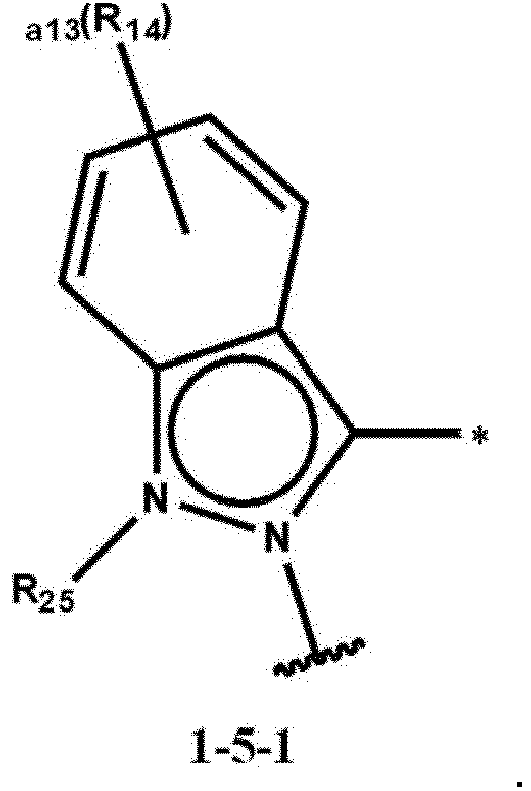
- In 1-5-1, R14, a13 and R25 are each independently the same as defined in 1-5.
- In some embodiments, 1-6 may be represented by 1-6-1.

- In 1-6-1, Y3, Y4, R15, R26, and a14 are each independently the same as defined in 1-6. At least one of A1 and A4 may be represented by any one of 1-1 to 1-6, and the remaining ligand that is not represented by 1-1 to 1-6 may be represented by any one of 2-1 to 2-4. A2 and A3 may each independently be represented by any one of 2-1 to 2-4:


- In 2-1 to 2-4, Y11 is a carbon atom or a nitrogen atom. Y12 is CR31 or. Y13 to Y19 are each independently CR35 or a nitrogen atom. For example, R31 to R41 are each independently a hydrogen atom, a deuterium atom, a cyano group, an alkyl group, an aryl group, or a heteroaryl group, and/or bonded to an adjacent group to form a ring. The alkyl group is a substituted or unsubstituted alkyl group having 1 to 20 carbon atoms. For example, the alkyl group may be a substituted or unsubstituted alkyl group having 1 to 10 carbon atoms. For example, the alkyl group may be a substituted or unsubstituted alkyl group having 1 to 5 carbon atoms. The aryl group is a substituted or unsubstituted aryl group having 6 to 30 ring-forming carbon atoms. For example, the aryl group may be a substituted or unsubstituted aryl group having 6 to 20 ring-forming carbon atoms. For example, the aryl group may be a substituted or unsubstituted aryl group having 6 to 15 ring-forming carbon atoms. For example, the aryl group may be a substituted or unsubstituted aryl group having 6 to 10 ring-forming carbon atoms. The heteroaryl group is a substituted or unsubstituted heteroaryl group having 2 to 30 ring-forming carbon atoms. For example, the heteroaryl group may be a substituted or unsubstituted heteroaryl group having 2 to 20 ring-forming carbon atoms. For example, the heteroaryl group may be a substituted or unsubstituted heteroaryl group having 2 to 15 ring-forming carbon atoms. For example, the heteroaryl group may be a substituted or unsubstituted heteroaryl group having 2 to 10 ring-forming carbon atoms. For example, R31 to R41 may each independently be a hydrogen atom, an unsubstituted methyl group, an unsubstituted t-butyl group or a substituted or unsubstituted phenyl group, and/or bonded to an adjacent group to form a substituted or unsubstituted benzene ring or a substituted or unsubstituted pyrazine ring.
- For example, Formula 1 may be represented by at least one of Formulae 3-1 to 3-7:


- In Formulae 3-1 and 3-2, A1 is represented by any one of 1-1 to 1-5.
- In Formulae 3-3 and 3-5, at least one of A1 and A4 is represented by any one of 1-1 to 1-5.
- In Formula 3-4, at least one of A1 and A3 is represented by any one of 1-1 to 1-5.
- In Formulae 3-6 and 3-7, A1 is represented by 1-6.
- In Formulae 3-1 to 3-7, R51 to R64 are each independently a hydrogen atom, a deuterium atom, a cyano group, an alkyl group, an aryl group, or a heteroaryl group, and/or bonded to an adjacent group to form a ring. The alkyl group is a substituted or unsubstituted alkyl group having 1 to 20 carbon atoms. For example, the alkyl group may be a substituted or unsubstituted alkyl group having 1 to 10 carbon atoms. For example, the alkyl group may be a substituted or unsubstituted alkyl group having 1 to 5 carbon atoms. The aryl group is a substituted or unsubstituted aryl group having 6 to 30 ring-forming carbon atoms. For example, the aryl group may be a substituted or unsubstituted aryl group having 6 to 20 ring-forming carbon atoms. For example, the aryl group may be a substituted or unsubstituted aryl group having 6 to 15 ring-forming carbon atoms. For example, the aryl group may be a substituted or unsubstituted aryl group having 6 to 10 ring-forming carbon atoms. The heteroaryl group is a substituted or unsubstituted heteroaryl group having 2 to 30 ring-forming carbon atoms. For example, the heteroaryl group may be a substituted or unsubstituted heteroaryl group having 2 to 20 ring-forming carbon atoms. For example, the heteroaryl group may be a substituted or unsubstituted heteroaryl group having 2 to 15 ring-forming carbon atoms. For example, the heteroaryl group may be a substituted or unsubstituted heteroaryl group having 2 to 10 ring-forming carbon atoms.
- Z is a carbon atom or a nitrogen atom.
- a21, a23, a24, a26, a27, a29, a30, a32, a33, and a34 are each independently an integer of 0 to 3. a22, a28, and a31 are each independently an integer of 0 to 4. a25 is an integer of 0 to 2. Y13 to Y19 are each independently the same as defined in connection with 2-2. L2 is the same as defined in connection with Formula 2.
- When there are a plurality of R51's, the plurality of R51's may be the same as or different from each other. Similar explanations may be applied to R52 to R64.
- When a25 is 2, two R55's may bind to each other to form a benzene ring.
- In Formulae 3-1 and 3-3, A1 may be any one of 1-1 to 1-3 and 1-5.
- In Formula 3-2, A1 may be any one of 1-1 to 1-5.
- In Formula 3-3, A4 may be any one of 1-1 to 1-3. A1 and A4 may be the same as or different from each other.
- In Formula 3-3, A1 may be 1-5. A4 may be 2-1.
- In Formula 3-4, A1 may be any one of 2-1 to 2-4, and A3 may be 1-4. For example, A1 may be any one of 2-3 to 2-4.
- In Formula 3-5, A1 may be any one of 2-1 to 2-4, and A4 may be 1-4. For example, A1 may be any one of 2-3 and 2-4.
- In Formulae 3-6 and 3-7, A1 may be 1-6.
- Formula 3-6 may be represented by at least one of Formulae 3-6-1 and 3-6-2.


- Formulae 3-6-1 and 3-6-2 are embodiments of Formula 3-6 in which A1 is specified. In Formulae 3-6-1 and 3-6-2, R26 is the same as defined in connection with 1-6. Y13 to Y19, R60, R61, a30, and a31 are each independently the same as defined in connection with Formula 3-6.
- Formula 3-7 may be represented by at least one of Formulae 3-7-1 and 3-7-2.


- Formulae 3-7-1 and 3-7-2 are embodiments of Formula 3-7 in which A1 is specified. In Formulae 3-7-1 and 3-7-2, R26 is the same as defined in connection with 1-6. R62 to R64, and a32 to a34 are each independently the same as defined in connection with Formula 3-7.
- The organometallic compound of an embodiment may be any one of the compounds represented by Compound Group 1 and Compound Group 2:


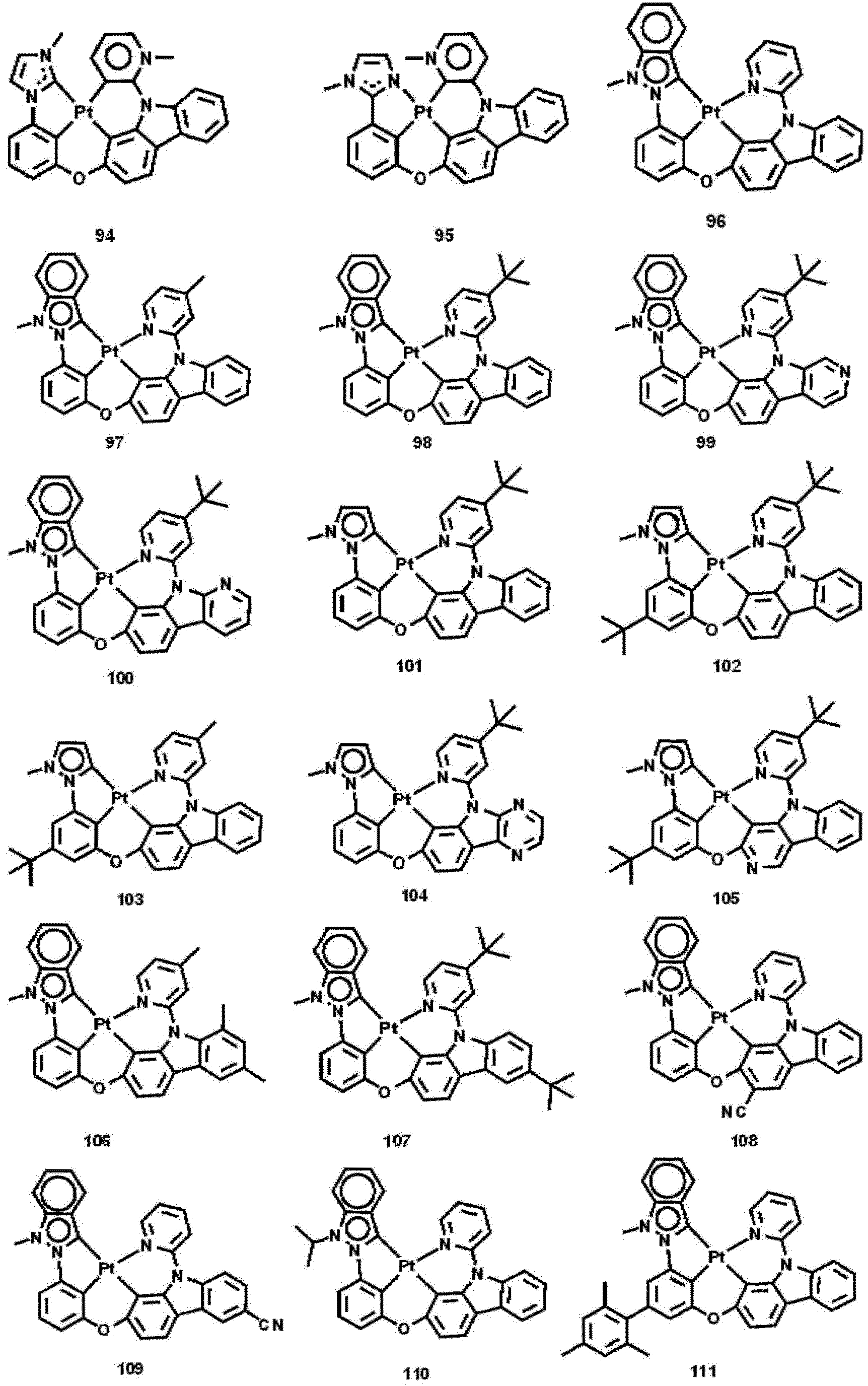


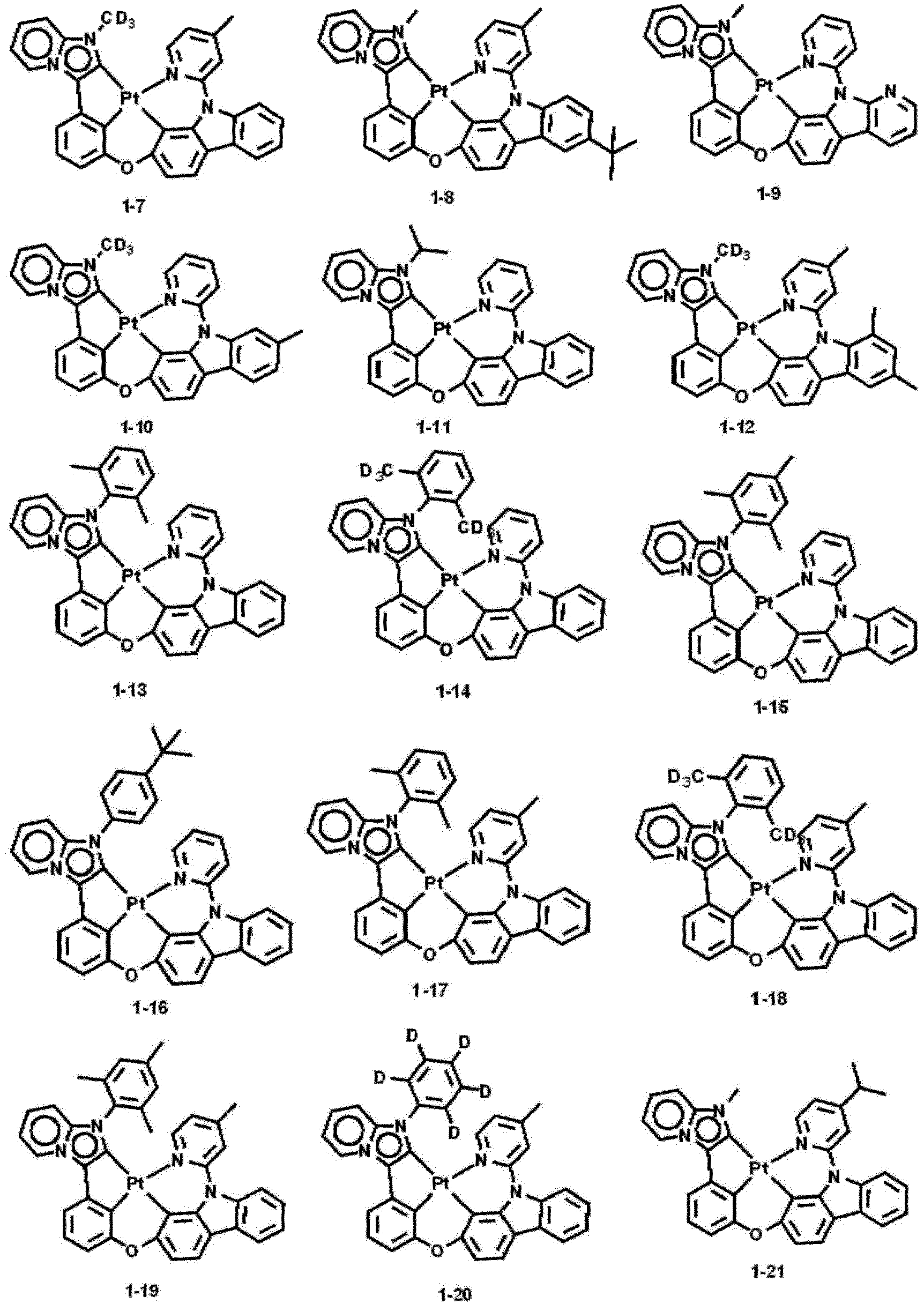


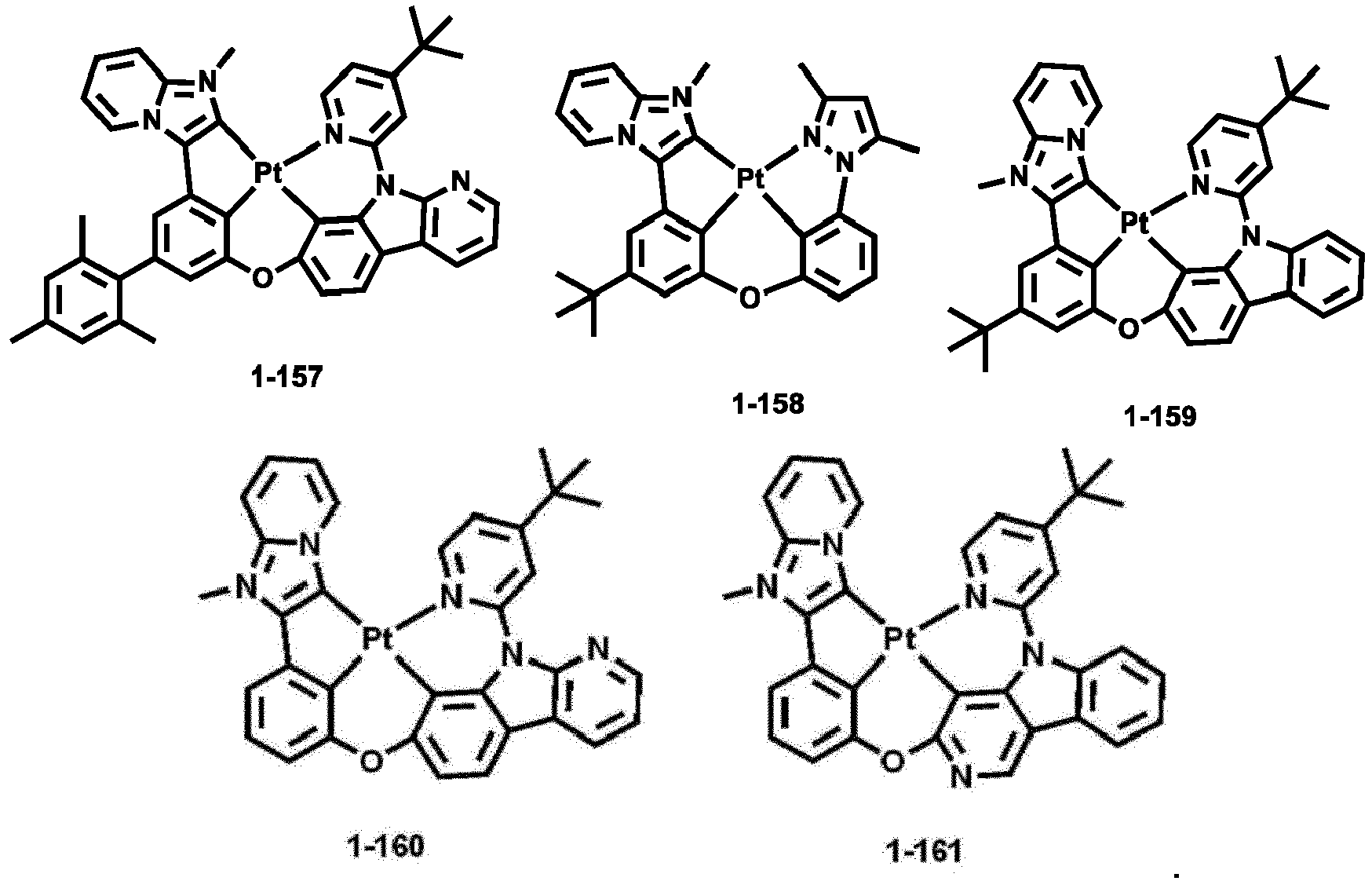
- In the
organic electroluminescence device 10 of an embodiment illustrated inFIGS. 1 to 3 , the emission layer EML may include a host and a dopant, and the emission layer EML may include an organometallic compound of an embodiment as a dopant material. - The emission layer EML may include the organometallic compound of an embodiment as a dopant material to emit green light. For example, the emission layer EML may be to emit green light having a center wavelength of about 500 nm to about 600 nm through phosphorescence.
- In the
organic electroluminescence device 10 of an embodiment, the emission layer EML may further include an anthracene derivative, a pyrene derivative, a fluoranthene derivative, a chrysene derivative, a dihydrobenzanthracene derivative, or a triphenylene derivative. For example, the emission layer EML may further include an anthracene derivative or a pyrene derivative. - The emission layer EML may include a general material known in the art as a host material. For example, the emission layer EML may include at least one of bis[2-(diphenylphosphino)phenyl]ether oxide (DPEPO), 4,4'-bis(N-carbazolyl)-1,1'-biphenyl (CBP), 1,3-bis(carbazolyl-9-yl)benzene (mCP), tris(4-carbazol-9-ylphenyl)amine (TCTA), or 1,3,5-tris(1-phenyl-1H-benzo[d]imidazol-2-yl)benzene (TPBi), but is not limited thereto. For example, the host material may be or include tris(8-hydroxyquinolino)aluminium (Alq3), 4,4'-bis(N-carbazolyl)-1,1'-biphenyl (CBP), poly(N-vinylcarbazole) (PVK), 9,10-di(naphthalene-2-yl)anthracene (ADN), 4,4',4"-tris (carbazol-9-yl) triphenylamine (TCTA), 1,3,5-tris(N-phenylbenzimidazole-2-yl)benzene (TPBi), 2-tert-butyl-9,10-di(naphth-2-yl)anthracene (TBADN), distyrylarylene (DSA), 4,4-bis(9-carbazolyl)-2,2-dimethyl-biphenyl (CDBP), 2-methyl-9,10-bis(naphthalen-2-yl)anthracene (MADN), bis[2-(diphenylphosphino)phenyl]ether oxide (DPEPO), hexaphenyl cyclotriphosphazene (CP1), 1,4-bis(triphenylsilyl)benzene (UGH2), hexaphenylcyclotrisiloxane (DPSiO3), octaphenylcyclotetrasiloxane (DPSiO4), 2,8-bis(diphenylphosphoryl)dibenzofuran (PPF), etc.
- In an embodiment, the emission layer EML may further include any suitable dopant material. For example the dopant may be or include a styryl derivative (e.g., 1,4-bis[2-(3-N-ethylcarbazolyl)vinyl]benzene (BCzVB), 4-(di-p-tolylamino)-4"-[(di-p-tolylamino)styryl]stilbene (DPAVB), and/or N-(4-((E)-2-(6-((E)-4-(diphenylamino)styryl)naphthalen-2-yl)vinyl)phenyl)-N-phenylbenzenamine (N-BDAVBi)), perylene and derivatives thereof (e.g., 2,5,8,11-tetra-t-butylperylene (TBP)), pyrene and derivatives thereof (e.g., 1,1-dipyrene, 1,4-dipyrenylbenzene, and/or 1,4-bis(N,N-diphenylamino)pyrene), etc. In some embodiments, the emission layer EML may further include a thermally activated delayed fluorescence dopant.
- In the
organic electroluminescence device 10 of an embodiment illustrated inFIGS. 1 to 3 , the electron transport region ETR is disposed on the emission layer EML. The electron transport region ETR may include at least one of a hole blocking layer HBL, an electron transport layer ETL, or an electron injection layer EIL, but is not limited thereto. - The electron transport region ETR may have a single layer formed of a single material, a single layer formed of a plurality of different materials, or a multilayer structure including a plurality of layers formed of a plurality of different materials.
- For example, the electron transport region ETR may have a single layer structure of an electron injection layer EIL or an electron transport layer ETL, and may have a single layer structure formed of an electron injection material or an electron transport material. In addition, the electron transport region ETR may have a single layer structure formed of a plurality of different materials, or may have a structure in which an electron transport layer ETL/electron injection layer EIL and a hole blocking layer HBL/electron transport layer ETL/electron injection layer EIL are stacked in order from the emission layer EML, but is not limited thereto. The thickness of the electron transport region ETR may be, for example, about 100 Å to about 1,500 Å.
- The electron transport region ETR may be formed using any suitable method, such as a vacuum deposition method, a spin coating method, a cast method, a Langmuir-Blodgett (LB) method, an inkjet printing method, a laser printing method, a laser induced thermal imaging (LITI) method, etc.
- When the electron transport region ETR includes the electron transport layer ETL, the electron transport layer ETL may include, for example, tris(8-hydroxyquinolinato)aluminium (Alq3), 1,3,5-tri[(3-pyridyl)-phen-3-yl]benzene, 2,4,6-tris(3'-(pyridin-3-yl)biphenyl-3-yl)-1 ,3,5-triazine, 2-(4-(N-phenylbenzoimidazole-1-ylphenyl)-9,10-dinaphthylanthracene, 1,3,5-tri(1-phenyl-1H-benzo[d]imidazol-2-yl)benzene (TPBi), 2,9-dimethyl-4,7-diphenyl-1,10-phenanthroline (BCP), 4,7-diphenyl-1,10-phenanthroline (Bphen), 3-(4-biphenylyl)-4-phenyl-5-tert-butylphenyl-1,2,4-triazole (TAZ), 4-(naphthalen-1-yl)-3,5-diphenyl-4H-1,2,4-triazole (NTAZ), 2-(4-biphenylyl)-5-(4-tert-butylphenyl)-1,3,4-oxadiazole (tBu-PBD), bis(2-methyl-8-quinolinolato-N1,O8)-(1,1'-biphenyl-4-olato)aluminium (BAlq), beryllium bis(benzoquinolin-10-olate) (Bebq2), 9,10-di(naphthalene-2-yl)anthracene (ADN), or a mixture thereof. The thickness of the electron transport layer ETL may be about 100 Å to about 1,000 Å and may be, for example, about 150 Å to about 500 Å. When the thickness of the electron transport layer ETL satisfies the above-described range, satisfactory electron transport properties may be obtained without a substantial increase in driving voltage.
- When the electron transport region ETR includes the electron injection layer EIL, the electron injection layer EIL may be a halogenated metal (such as LiF, NaCl, CsF, RbCI, and/or Rbl), a lanthanide metal (such as ytterbium (Yb)), a metal oxide (such as Li2O, and/or BaO), or 8-hydroxyl lithium quinolate (LiQ), but is not limited thereto. The electron injection layer EIL may also be formed of a mixture material of an electron transport material and an insulating organo-metal salt. The organo-metal salt may be a material having an energy band gap of about 4 eV or more. For example, the organo-metal salt may include, for example, metal acetates, metal benzoates, metal acetoacetates, metal acetylacetonates, and/or metal stearates. The thickness of the electron injection layer EIL may be about 1 Å to about 100 Å, and about 3 Å to about 90 Å. When the thickness of the electron injection layer EIL satisfies the above-described range, satisfactory electron injection properties may be obtained without a substantial increase in driving voltage.
- The electron transport region ETR may include a hole blocking layer HBL as described above. The hole blocking layer HBL may include, for example, at least one of 2,9-dimethyl-4,7-diphenyl-1,10-phenanthroline (BCP) and 4,7-diphenyl-1,10-phenanthroline (Bphen), but is not limited thereto. The thickness of the hole blocking layer HBL is not particularly limited, but may be, for example, about 10 Å to about 300 Å.
- The second electrode EL2 is disposed on the electron transport region ETR. The second electrode EL2 may be a common electrode or a cathode. The second electrode EL2 may be a transmissive electrode, a transflective electrode, or a reflective electrode. When the second electrode EL2 is a transmissive electrode, the second electrode EL2 may include a transparent metal oxide, for example, indium tin oxide (ITO), indium zinc oxide (IZO), zinc oxide (ZnO), or indium tin zinc oxide (ITZO).
- When the second electrode EL2 is a transflective electrode or a reflective electrode, the second electrode EL2 may include Ag, Mg, Cu, Al, Pt, Pd, Au, Ni, Nd, Ir, Cr, Li, Ca, LiF/Ca, LiF/Al, Mo, Ti, a compound thereof, or a mixture thereof (e.g., a mixture of Ag and Mg). In some embodiments, the second electrode EL2 may have a multilayer structure including a reflective film or a transflective film formed of the above-described materials, and a transparent conductive film formed of indium tin oxide (ITO), indium zinc oxide (IZO), zinc oxide (ZnO), or indium tin zinc oxide (ITZO). The thickness of the second electrode EL1 may be about 1000 Å to about 10000 Å, for example, about 1500 Å to about 5000 Å.
- In some embodiments, the second electrode EL2 may be connected with an auxiliary electrode. When the second electrode EL2 is connected with the auxiliary electrode, the resistance of the second electrode EL2 may decrease.
- In some embodiments, the
organic electroluminescence device 10 according to an embodiment may further include a capping layer CPL on the second electrode EL2. The capping layer CPL may include, for example, α-NPD, NPB, TPD, m-MTDATA, Alq3, CuPc, N4,N4,N4',N4'-tetra(biphenyl-4-yl) biphenyl-4,4'-diamine (TPD15), 4,4',4"-tris(carbazol-9-yl)triphenylamine (TCTA), N, N'-bis(naphthalen-1-yl), etc. - The organometallic compound of the above-described embodiment may be included as a material for an
organic electroluminescence device 10 in an organic layer other than the emission layer EML. Theorganic electroluminescence device 10 according to an embodiment of the present disclosure may include the above-described organometallic compound in at least one organic layer disposed between the first electrode EL1 and the second electrode EL2, or in a capping layer disposed on the second electrode EL2. - In the
organic electroluminescence device 10, when a voltage is applied across the first electrode EL1 and the second electrode EL2, holes injected from the first electrode EL1 may move through the hole transport region HTR to the emission layer EML, and electrons injected from the second electrode EL2 may move through the electron transport region ETR to the emission layer EML. The electrons and holes may recombine in the emission layer EML to form excitons, and these excitons may transition from an excited state to the ground state to emit light. - Hereinafter, with reference to Examples and Comparative Examples, an organometallic compound according to an embodiment of this present disclosure and an organic electroluminescence device of an embodiment including the organometallic compound according to an embodiment will be described in more detail. The Examples shown below are illustrated only for the understanding of this present disclosure, and the scope of the present disclosure is not limited thereto.
- The organometallic compound according to an embodiment of the present disclosure may be synthesized, for example, as follows. However, the synthesis process of the organometallic compound according to an embodiment of the present disclosure is not limited thereto.
- An organometallic Compound 9 of an embodiment of the present disclosure may be synthesized, for example, by Reaction Formula 1:

- 2-phenyl-1H-imidazole (7.2 g, 50 mmol), 3-bromoanisole (14.0 g, 75 mmol), potassium phosphate tribasic (23 g, 100 mmol), Cul (1.83 g, 10 mmol), and picolinic acid (1.17 g, 10 mmol) were placed in a reaction vessel and suspended in dimethyl sulfoxide (100 mL). The reaction mixture was warmed and stirred at 160 °C for 24 hours. After completing the reaction, the mixture was cooled to room temperature, and extracted using ethyl acetate after adding distilled water (300 mL). The extracted organic layer was washed with saturated sodium chloride aqueous solution and dried over sodium sulfate. The residue after removal of the solvent was separated using column chromatography to obtain a target compound (10.5 g, 42 mmol).
- Intermediate 9-1 (10.5 g, 42 mmol) was suspended in a solution of excess bromic acid (HBr). The reaction mixture was warmed and stirred at 110 °C for 24 hours. After completing the reaction, the mixture was cooled to room temperature and neutralized by adding an appropriate amount of sodium bicarbonate. Distilled water (300 mL) was added and extraction was conducted using ethyl acetate. The extracted organic layer was washed with saturated sodium chloride aqueous solution and dried over sodium sulfate. The residue after removal of the solvent was separated using column chromatography to obtain a target compound (8.5 g, 36 mmol).
- 2-bromocarbazole (14.8 g, 60 mmol), 2-bromopyridine (14.2 g, 90 mmol), potassium phosphate tribasic (27.6 g, 120 mmol), Cul (2.2 g, 12 mmol), and picolinic acid (1.4 g, 12 mmol) were placed in a reaction vessel and suspended in dimethyl sulfoxide (120 mL). The reaction mixture was warmed and stirred at 160 °C for 24 hours. After completing the reaction, the mixture was cooled to room temperature and extracted using ethyl acetate after adding distilled water (300 mL). The extracted organic layer was washed with saturated sodium chloride aqueous solution and dried with sodium sulfate. The residue after removal of the solvent was separated using column chromatography to obtain a target compound (15.5 g, 48 mmol).
- Intermediate 9-2 (8.5 g, 36 mmol), Intermediate 9-3 (15.5 g. 48 mmol), potassium phosphate tribasic (16.6 g, 72 mmol), Cul (1.3 g, 7.2 mmol), and picolinic acid (0.8 g, 7.2 mmol) were placed in a reaction vessel and suspended in dimethyl sulfoxide (100 mL). The reaction mixture was warmed and stirred at 160 °C for 72 hours. After completing the reaction, the mixture was cooled to room temperature, and extracted using ethyl acetate after adding distilled water (300 mL). The extracted organic layer was washed with saturated sodium chloride aqueous solution and dried over sodium sulfate. The residue after removal of the solvent was separated using column chromatography to obtain a target compound (13.1 g, 27 mmol).
- Intermediate 9-4 (13.1 g, 27 mmol) was suspended in excess methyl iodide. The reaction mixture was warmed and stirred at 110 °C for 24 hours. After completing the reaction, the mixture was cooled to room temperature, and the resulting solid was filtered and washed with ether. The washed solid was separated using column chromatography to obtain a target compound (10.7 g, 17 mmol).
- Intermediate 9-5 (10.7 g, 17 mmol) and ammonium hexafluorophosphate (8.3 g, 51 mmol) were placed in a reaction vessel and suspended in a mixed solution of methyl alcohol (150 mL) and water (150 mL). The reaction mixture was stirred at room temperature for 24 hours. After completing the reaction, the resulting solid was filtered and washed with ether. The washed solid was dried to obtain a target compound (9.0 g, 14 mmol).
- Intermediate 9-6 (9.0 g, 14 mmol), dichloro(1,5-cyclooctadiene) platinum (5.8 g, 15.4 mmol), and sodium acetate (3.4 g, 42 mmol) were suspended in dioxane (220 mL). The reaction mixture was warmed and stirred at 110 °C for 72 hours. After completing the reaction, the mixture was cooled to room temperature, and extracted using ethyl acetate after adding distilled water (100 mL). The extracted organic layer was washed with saturated sodium chloride aqueous solution and dried over sodium sulfate. The residue after removal of the solvent was separated using column chromatography to obtain a target compound (0.9 g, 1.3 mmol).
-

- Compound 16 (0.7 g, 1.2 mmol) was obtained in substantially the same manner as used for the synthesis of Compound 9, except that 1H-1,2,3-triazole was used instead of 2-phenyl-1H-imidazole.
-

- Compound 46 (0.6 g, 0.9 mmol) was obtained in substantially the same manner as used for the synthesis of Compound 9, except that 1 H-tetrazole was used instead of 2-phenyl-1 H-imidazole.
-


- Imidazole (3.4 g, 50 mmol), 3-bromoanisole (14.0 g, 75 mmol), potassium phosphate tribasic (23 g, 100 mmol), CuI (1.83 g, 10 mmol), and picolinic acid (1.17 g, 10 mmol) were placed in a reaction vessel and suspended in dimethyl sulfoxide (100 mL). The reaction mixture was warmed and stirred at 160 °C for 24 hours. After completing the reaction, the mixture was cooled to room temperature and extracted using ethyl acetate after adding distilled water (100 mL). The extracted organic layer was washed with saturated sodium chloride aqueous solution and dried over sodium sulfate. The residue after removal of the solvent was separated using column chromatography to obtain a target compound (7.8 g, 45 mmol).
- Intermediate 71-1 (7.8 g, 45 mmol) was suspended in a solution of excess bromic acid (HBr). The reaction mixture was warmed and stirred at 110 °C for 24 hours. After completing the reaction, the mixture was cooled to room temperature and neutralized by adding an appropriate amount of sodium bicarbonate. Distilled water (300 mL) was added and extraction was conducted using ethyl acetate. The extracted organic layer was washed with saturated sodium chloride aqueous solution and dried over sodium sulfate. The residue after removal of the solvent was separated using column chromatography to obtain a target compound (6.2 g, 39 mmol).
- 1H-1,2,3-triazole (3.5 g, 50 mmol), 1,3-dibromobenzene (17.7 g, 75 mmol), potassium phosphate tribasic (23 g, 100 mmol), Cul (1.83 g, 10 mmol), and picolinic acid (1.17 g, 10 mmol) were placed in a reaction vessel and suspended in dimethyl sulfoxide (100 mL). The reaction mixture was warmed and stirred at 160 °C for 24 hours. After completing the reaction, the mixture was cooled to room temperature and extracted using ethyl acetate after adding distilled water (300 mL). The extracted organic layer was washed with saturated sodium chloride aqueous solution and dried over sodium sulfate. The residue after removal of the solvent was separated using column chromatography to obtain a target compound (9.9 g, 44 mmol).
- Intermediate 71-2 (6.2 g, 39 mmol), Intermediate 71-3 (9.9 g, 44 mmol), potassium phosphate tribasic (18.0 g, 78 mmol), Cul (1.4 g, 7.8 mmol), and picolinic acid (0.9 g, 7.8 mmol) were placed in a reaction vessel and suspended in dimethyl sulfoxide (100 mL). The reaction mixture was warmed and stirred at 160 °C for 72 hours. After completing the reaction, the mixture was cooled to room temperature and extracted using ethyl acetate after adding distilled water (300 mL). The extracted organic layer was washed with saturated sodium chloride aqueous solution and dried over sodium sulfate. The residue after removal of the solvent was separated using column chromatography to obtain a target compound (9.3 g, 31 mmol).
- Intermediate 71-4 (9.3 g, 31 mmol) was suspended in excess methyl iodide. The reaction mixture was warmed and stirred at 110 °C for 24 hours. After completing the reaction, the mixture was cooled to room temperature and the resulting solid was filtered and washed with ether. The washed solid was separated using recrystallization to obtain a target compound (10.9 g, 19 mmol).
- Intermediate 71-5 (10.9 g, 19 mmol) and ammonium hexafluorophosphate (12.4 g, 76 mmol) were placed in a reaction vessel and suspended in a mixed solution of methyl alcohol (200 mL) and water (200 mL). The reaction mixture was stirred at room temperature for 24 hours. After completing the reaction, the generated solid was filtered and washed with ether. The washed solid was dried to obtain a target compound (8.2 g, 13 mmol).
- Intermediate 71-6 (8.2 g, 13 mmol), dichloro(1,5-cyclooctadiene) platinum (5.4 g, 14.3 mmol), and sodium acetate (6.3 g, 78 mmol) were suspended in dioxane (200 mL). The reaction mixture was warmed and stirred at 110 °C for 72 hours. After completing the reaction, the mixture was cooled to room temperature and extracted using ethyl acetate after adding distilled water (100 mL). The extracted organic layer was washed with saturated sodium chloride aqueous solution and dried over sodium sulfate. The residue after removal of the solvent was separated using column chromatography to obtain a target compound (0.4 g, 0.7 mmol).
-

- Imidazole (3.4 g, 50 mmol), 3,5-dibromopyridine (17.8 g, 75 mmol), potassium phosphate tribasic (23 g, 100 mmol), Cul (1.83 g, 10 mmol), and picolinic acid (1.17 g, 10 mmol) were placed in a reaction vessel and suspended in dimethyl sulfoxide (100 mL). The reaction mixture was warmed and stirred at 160 °C for 24 hours. After completing the reaction, the mixture was cooled to room temperature and extracted using ethyl acetate after adding distilled water (300 mL). The extracted organic layer was washed with saturated sodium chloride aqueous solution and dried over sodium sulfate. The residue after removal of the solvent was separated using column chromatography to obtain a target compound (9.6 g, 43 mmol).
- 2-methoxycarbazole (9.9 g, 50 mmol), bromobenzene (11.8 g, 75 mmol), potassium phosphate tribasic (23 g, 100 mmol), Cul (1.83 g, 10 mmol), and picolinic acid (1.17 g, 10 mmol) were placed in a reaction vessel and suspended in dimethyl sulfoxide (100 mL). The reaction mixture was warmed and stirred at 160 °C for 24 hours. After completing the reaction, the mixture was cooled to room temperature and extracted using ethyl acetate after adding distilled water (300 mL). The extracted organic layer was washed with saturated sodium chloride aqueous solution and dried over sodium sulfate. The residue after removal of the solvent was separated using column chromatography to obtain a target compound (12.3 g, 45 mmol).
- Intermediate 87-3 (12.3 g, 45 mmol) was suspended in a solution of excess bromic acid (HBr). The reaction mixture was warmed and stirred at 110 °C for 24 hours. After completing the reaction, the mixture was cooled to room temperature and neutralized by adding an appropriate amount of sodium bicarbonate. Distilled water (300 mL) was added and extraction was conducted using ethyl acetate. The extracted organic layer was washed with saturated sodium chloride aqueous solution and dried over sodium sulfate. The residue after removal of the solvent was separated using column chromatography to obtain a target compound (9.1 g, 35 mmol).
- Intermediate 87-1 (9.6 g, 43 mmol), Intermediate 87-3 (9.1 g, 35 mmol), potassium phosphate tribasic (16.2 g, 70 mmol), Cul (1.3 g, 7.0 mmol), and picolinic acid (0.8 g, 7.0 mmol) were placed in a reaction vessel and suspended in dimethyl sulfoxide (100 mL). The reaction mixture was warmed and stirred at 160 °C for 72 hours. After completing the reaction, the mixture was cooled to room temperature and extracted using ethyl acetate after adding distilled water (300 mL). The extracted organic layer was washed with saturated sodium chloride aqueous solution and dried over sodium sulfate. The residue after removal of the solvent was separated using column chromatography to obtain a target compound (10.5 g, 26 mmol).
- Intermediate 87-4 (10.5 g, 26 mmol) was suspended in excess methyl iodide. The reaction mixture was warmed and stirred at 110 °C for 24 hours. After completing the reaction, the mixture was cooled to room temperature, and the resulting solid was filtered and washed with ether. The washed solid was separated using recrystallization to obtain a target compound (9.6 g, 14 mmol).
- Intermediate 87-5 (9.6 g, 14 mmol) and ammonium hexafluorophosphate (9.1 g, 56 mmol) were placed in a reaction vessel and suspended in a mixed solution of methyl alcohol (120 mL) and water (120 mL). The reaction mixture was stirred at room temperature for 24 hours. After completing the reaction, the resulting solid was filtered and washed with ether. The washed solid was dried to obtain a target compound (6.5 g, 9 mmol).
- Intermediate 87-6 (6.5 g, 9 mmol), dichloro(1,5-cyclooctadiene) platinum (3.7 g, 9.9 mmol), and sodium acetate (4.4 g, 54 mmol) were suspended in dioxane (140 mL). The reaction mixture was warmed and stirred at 110 °C for 72 hours. After completing the reaction, the mixture was cooled to room temperature and extracted using ethyl acetate after adding distilled water (100 mL). The extracted organic layer was washed with saturated sodium chloride aqueous solution and dried over sodium sulfate. The residue after removal of the solvent was separated using column chromatography to obtain a target compound (0.6 g, 0.9 mmol).
-
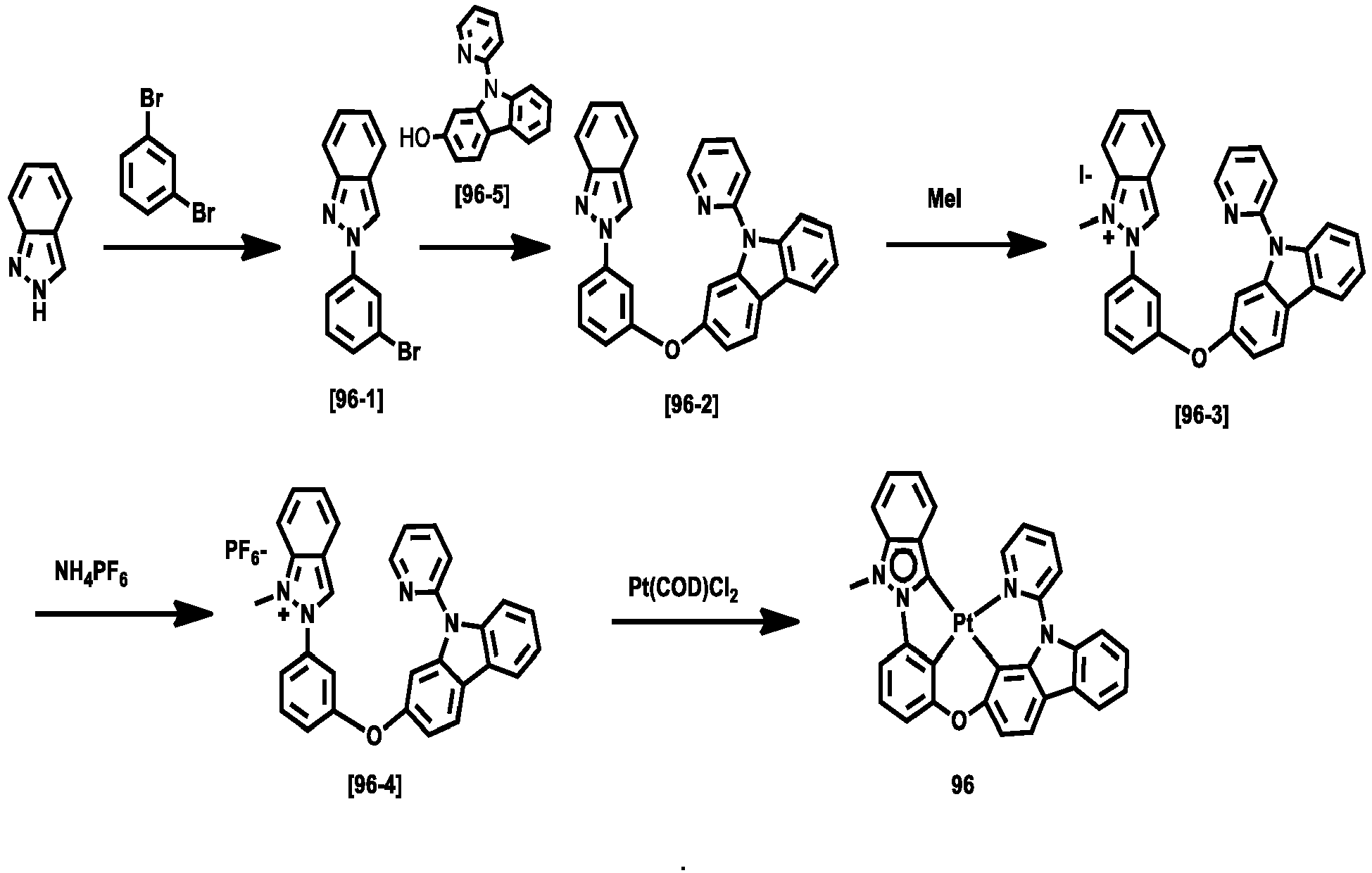
- 2H-indazole (5.9 g, 50 mmol), 1,3-dibromobenzene (17.7 g, 75 mmol), potassium phosphate tribasic (23 g, 100 mmol), Cul (1.83 g, 10 mmol), and picolinic acid (1.17 g, 10 mmol) were placed in a reaction vessel and suspended in dimethyl sulfoxide (100 mL). The reaction mixture was warmed and stirred at 160 °C for 24 hours. After completing the reaction, the mixture was cooled to room temperature and extracted using ethyl acetate after adding distilled water (300 mL). The extracted organic layer was washed with saturated sodium chloride aqueous solution and dried over sodium sulfate. The residue after removal of the solvent was separated using column chromatography to obtain Intermediate 96-1 (yield: 69%).
- Intermediate 96-1 (11.7 g, 43 mmol), Intermediate 96-5 (9.1 g, 35 mmol), potassium phosphate tribasic (16.2 g, 70 mmol), Cul (1.3 g, 7.0 mmol), and picolinic acid (0.8 g, 7.0 mmol) were placed in a reaction vessel and suspended in dimethyl sulfoxide (100 mL). The reaction mixture was warmed and stirred at 160 °C for 72 hours. After completing the reaction, the mixture was cooled to room temperature and extracted using ethyl acetate after adding distilled water (300 mL). The extracted organic layer was washed with saturated sodium chloride aqueous solution and dried over sodium sulfate. The residue after removal of the solvent was separated using column chromatography to obtain Intermediate 96-2 (yield: 55%).
- Intermediate 96-2 (9.0 g, 20 mmol) was suspended in excess methyl iodide. The reaction mixture was warmed and stirred at 110 °C for 24 hours. After completing the reaction, the mixture was cooled to room temperature, and the resulting solid was filtered and washed with ether. The washed solid was separated using recrystallization to obtain Intermediate 96-3 (yield: 55%).
- Intermediate 96-3 (8.3 g, 14 mmol) and ammonium hexafluorophosphate (9.1 g, 56 mmol) were placed in a reaction vessel and suspended in a mixed solution of methyl alcohol (120 mL) and water (120 mL). The reaction mixture was stirred at room temperature for 24 hours. After completing the reaction, the resulting solid was filtered and washed with ether. The washed solid was dried to obtain Intermediate 96-4 (yield: 90%).
- Intermediate 96-4 (5.5 g, 9 mmol), dichloro(1,5-cyclooctadiene) platinum (3.7 g, 9.9 mmol), and sodium acetate (4.4 g, 54 mmol) were suspended in dioxane (140 mL). The reaction mixture was warmed and stirred at 110 °C for 72 hours. After completing the reaction, the mixture was cooled to room temperature and extracted using ethyl acetate after adding distilled water (100 mL). The extracted organic layer was washed with saturated sodium chloride aqueous solution and dried over sodium sulfate. The residue after removal of the solvent was separated using column chromatography to obtain Compound 96 (yield: 35%).
-
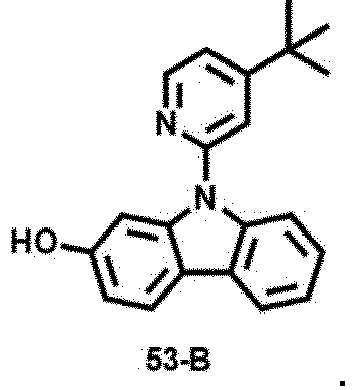
- Compound 98 was obtained in substantially the same manner as used for the synthesis of Compound 96, except that Intermediate 53-B was used instead of Intermediate 87-3. (yield: 48%)
-

- Compound 113 was obtained in substantially the same manner as used for the synthesis of compound 98, except that Intermediate 113-1 was used instead of 1,3-dibromobenzene. (yield: 41%)
- 1H NMR and MS-FAB of the Compounds synthesized through the above-described Synthesis Examples are shown in Table 1:
Table 1 No. of Compound 1H NMR (CDCl3, 400 MHz) MS/FAB found calc. 9 8.74 (m, 1H), 8.40 (m, 1H), 8.27-8.26 (m, 2H), 8.20-8.15 (m, 2H), 8.01 (m, 1H), 7.57-7.49 (m, 5H), 7.32-7.29 (m, 3H), 7.20-7.18 (m, 2H), 6.99-6.79 (m, 2H), 3.72 (s, 3H) 685.1443 685.1441 16 8.75 (m, 1H), 8.40-8.25 (m, 2H), 8.18-8.16 (m, 2H), 8.01 (m, 1H), 7.56-7.51 (m, 2H), 7.34-7.19 (m, 4H), 6.99 (m, 1H), 6.70 (m, 1H), 3.78 (s, 3H) 610.1085 610.1081 46 8.73 (m, 1H), 8.40 (m, 1H), 8.20-8.14 (m, 2H), 8.00 (m, 1H), 7.59-7.49 (m, 2H), 7.34-7.19 (m, 4H), 6.89-6.71 (m, 2H), 3.67 (s, 3H) 611.1029 611.1033 71 8.77 (m, 1H), 8.32 (m, 1H), 7.32-7.29 (m, 2H), 7.05-6.95 (m, 2H), 6.55-6.45 (m, 3H), 3.67 (s, 3H), 3.64 (s, 3H) 524.0927 524.0924 87 8.65 (m, 1H), 8.26-8.18 (m, 2H), 8.03-7.94 (m, 2H), 7.74-7.46 (m, 5H), 7.30-7.19 (m, 2H), 6.49-6.44 (m, 2H), 4.28 (s, 3H), 3.65 (s, 3H) 623.1283 623.1285 96 8.73 (m, 1H), 8.39-8.32 (m, 2H), 8.19 (m, 1H), 7.92-7.55 (m, 5H), 7.33-7.15 (m, 6H), 7.00 (d, 1H), 6.69 (d, 1H), 3.95 (s, 3H) 659.1284 659.1285 98 8.74 (d, 1H), 8.39 (d, 1H), 8.32-8.30 (m, 2H), 7.92 (d, 1H), 7.65-7.40 (m, 5H), 7.33-7.17 (m, 4H), 7.01 (m, 1H), 6.68 (dd, 1H), 3.96 (s, 3H), 1.33 (s, 9H) 715.1913 715.1911 113 8.73 (d, 1H), 8.38 (d, 1H), 8.35-8.32 (m, 1H), 8.19-8.16 (m, 1H), 7.92 (d, 1H), 7.65-7.40 (m, 6H), 7.33-7.17 (m, 5H), 6.68 (dd, 1H), 3.96 (s, 3H), 2.93 (s, 6H), 2.48 (s, 3H), 1.33 (s, 9H) 833.2692 833.2693 - An organometallic compound 1-1 of an embodiment of the present disclosure may be synthesized by, for example, Reaction Formula 1-A:

- Imidazo[1,2-a]pyridine (1.89 g, 16.0 mmol), 1,3-dibromobenzene (3.77 g, 16.0 mmol), palladium acetate (0.18 g, 0.8 mmol), and potassium acetate (3.14 g, 32.0 mmol) were suspended in dimethylacetamide solvent (60 mL), heated at 140 °C, and stirred for one day. The reaction mixture was extracted using methylene chloride and distilled water. The organic layer was washed three times with distilled water, dried over magnesium sulfate, filtered and concentrated under reduced pressure. The concentrate was purified by column chromatography to obtain Intermediate 1-A (yield: 68%).
- Synthesized Intermediate 1-A and Intermediate 1-B (1.0 equiv), (0.1 equiv), potassium phosphate (2.0 equiv), and L-proline (0.1 equiv) were suspended in dimethyl formamide solvent (100 mL), heated at 160 °C, and stirred for 12 hours. After completing the reaction, the solvent was removed under reduced pressure, and extracted using methylene chloride and distilled water. The organic layer was washed three times with distilled water, dried over magnesium sulfate, filtered, and concentrated under reduced pressure. The concentrate was purified by column chromatography to obtain Intermediate 1-C (yield: 76%).
- Intermediate 1-C was dissolved in toluene, heated at 110 °C and stirred for 12 hours after adding methyl iodide (1.2 equiv). After completing the reaction, the solvent was removed under reduced pressure, and the concentrate was purified by column chromatography to obtain Intermediate 1-D (yield: 88%).
- Intermediate 1-D was dissolved in a mixed solvent of methanol and distilled water in a ratio of 4:1 and ammonium hexafluorophosphate (1.05 equiv) was added. The resulting solid was stirred at room temperature for 12 hours. Filtration and washing with distilled water and diethyl ether were conducted to obtain Intermediate 1-E (yield: 90%).
- The synthesized Intermediate 1-E, sodium acetate (3.0 equiv), and Pt (COD)Cl2 (1.05 equiv) were suspended in 1,4-dioxane solvent. The reaction mixture was heated at 120 °C and stirred for 36 hours. After completing the reaction, the solvent was removed under reduced pressure. Compound 1-1 was obtained by column chromatography purification (yield: 40%).
-

- Intermediate 53-A was obtained in substantially the same manner as used for the synthesis of Intermediate 1-A, except that 1,3-dibromo-5-(t-butyl)benzene was used instead of 1,3-dibromobenzene. (yield: 69%)
- Intermediate 53-C was obtained in substantially the same manner as used for the synthesis of Intermediate 1-C, except that Intermediate 53-B was used instead of Intermediate 1-B. (yield: 66%)
- Intermediate 53-D was obtained in substantially the same manner as used for the synthesis of Intermediate 1-D, except that Intermediate 53-C was used instead of Intermediate 1-C. (yield: 83%)
- Intermediate 53-E was obtained in substantially the same manner as used for the synthesis of Intermediate 1-E, except that Intermediate 53-D was used instead of Intermediate 1-D. (yield: 95%)
- Compound 1-53 was obtained in substantially the same manner as used for the synthesis of Compound 1-1, except that Intermediate 53-E was used instead of Intermediate 1-E. (yield: 45%)
-

- Compound 1-87 was obtained in substantially the same manner as used for the synthesis of Compound 1-53, except that 3',5'-dibromo-2,4,6-triisopropyl-1,1'-diphenyl was used instead of 1,3-dibromo-5-(t-butyl)-benzene, and deuterium-substituted methyl iodide was used instead of methyl iodide.
-
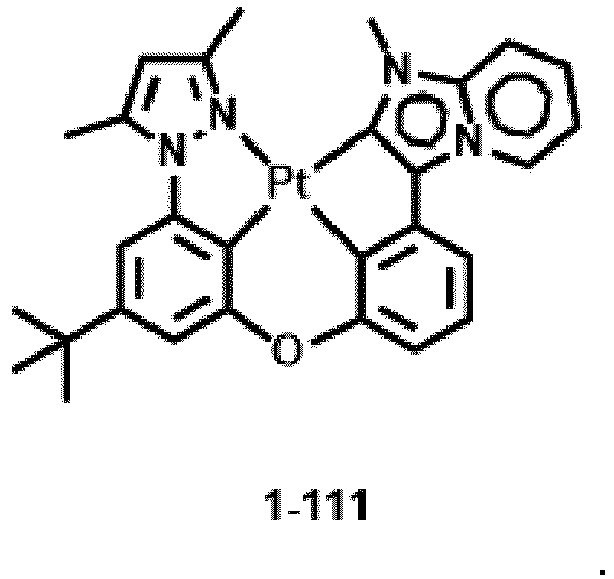
- Compound 1-111 was obtained in the substantially same manner as used for the synthesis of Compound 1-1, except that 3-(t-butyl)-5-(3,5-dimethyl-1-H-pyrazol-1-yl)phenol was used instead of Intermediate 1-B.
-

- 2-aminopyridine (1.13 g, 12.0 mmol), 1-(3-bromophenyl) ethane-1-one (1.99 g, 10.0 mmol), and copper iodide (2.0 mmol) were suspended in 1,4-dioxane solvent (30 mL), heated at 100 °C, and stirred for 14 hours. The reaction mixture was concentrated under reduced pressure. The concentrate was purified by column chromatography to obtain Intermediate 124-A. (yield: 68%)
- Intermediate 124-C was obtained in substantially the same manner as used for Intermediate 53-C in the synthesis of Compound 1-53, except that Intermediate 124-A was used instead of Intermediate 53-A. (yield: 62%)
- Intermediate 124-D was obtained in substantially the same manner as used for Intermediate 53-D in the synthesis of Compound 1-53, except that Intermediate 124-C was used instead of Intermediate 53-C. (yield: 81%)
- Intermediate 124-E was obtained in substantially the same manner as used for Intermediate 53-E in the synthesis of Compound 1-53, except that Intermediate 124-D was used instead of Intermediate 53-D. (yield: 92%)
- Compound 1-124 was obtained in the same manner as used for the synthesis of Compound 1-53, except that Intermediate 124-E was used instead of Intermediate 53-E. (yield: 41%)
-

- Compound 1-148 was obtained in substantially the same manner as used for the synthesis of Compound 1-124, except that 5-(3,5-dimethyl)-1H-pyrazol-1-yl)pyridin-3-ol was used instead of Intermediate 53-B.
- Example Compounds 9, 16, 46, 71, 87, 96, 98, 113, 1-1, 1-53, 1-87, 1-110, 1-124, 1-148, and Comparative Compounds C1 to C5 were used as an emission layer EML dopant material, respectively, to manufacture the organic electroluminescence devices of Examples 1 to 14 and Comparative Examples 1 to 5. Comparative Compound C1 is Ir(PPy)3, which is a green phosphorescent dopant, Comparative Compound C2 is a green phosphorescent dopant that does not include a carbene group, and Comparative Compounds C3 to C5 are green phosphorescent dopants that do not include a mesoionic carbene group.
-


-

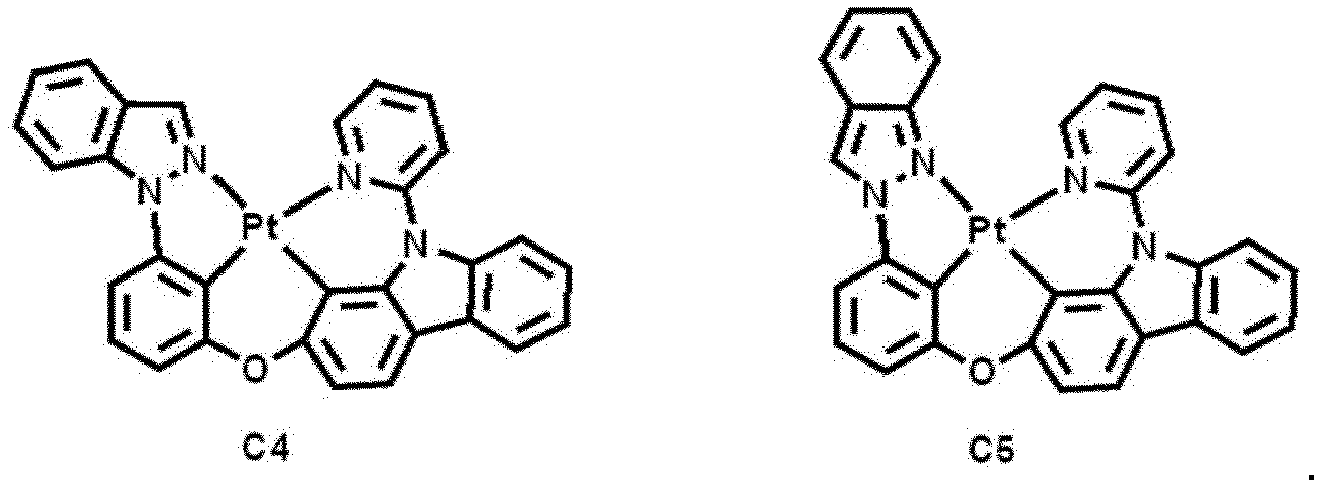
- To manufacture the organic electroluminescence devices of Examples 1 to 14 and Comparative Examples 1 to 5, ITO (Corning) glass substrate was cut into about 50 mm x 50 mm x 0.7 mm in size, subjected to ultrasonic cleaning using isopropyl alcohol and distilled water for 5 minutes each and ultraviolet irradiation for about 30 minutes, and then exposed to ozone for cleaning to form a first electrode EL1 having a thickness of about 1200 Å. A hole injection layer HIL having a thickness of about 600 Å was formed of 2-TNATA, and a hole transport layer HTL having a thickness of about 300 Å was formed of NPB. Thereafter, a 300 Å thick emission layer EML having 10% doped Example Compounds or Comparative Compounds was formed of mCBP, a 50 Å thick hole blocking layer HBL was formed of diphenyl [4-(triphenylsilyl) phenyl] phosphine oxide (TSPO1), and a 300 Å thick electron transport layer ETL was formed of Alq3. Then, an electron injection layer EIL having a thickness of 10 Å was formed of LiF and a second electrode EL2 having a thickness of 3000 Å was formed of Al. Each layer was formed by vacuum evaporation.
- The characteristic evaluation of the manufactured organic electroluminescence devices was performed using a luminance alignment measuring apparatus. The driving voltage, luminance, efficiency, emission wavelength, and lifetime (T80) were measured for each of the organic electroluminescence devices according to the Examples and Comparative Examples. Table 2 shows the driving voltage (V), current efficiency (cd/A) and luminance (cd/m2) at a current density of 50 mA/cm2 for the manufactured organic electroluminescence devices. In addition, device life (T80), which is the time taken for the luminance to decrease to 80% level at the luminance 1000 nit, is shown. The device life (Tso) was measured by continuous drive at a current density of 40 mA/cm2. In addition, the luminance spectrum of Examples and Comparative Examples was measured using a spectroradiometer. The emission peak, which is the maximum emission wavelength, was measured from the measured luminance spectrum.
Table 2 Device Driving voltage (V) Luminance (cd/m2) Current efficiency, (cd/A) Emission wavelength (nm) Lifetime (T80) Example 1 5.14 4225 8.26 545 411 Example 2 5.25 4134 7.95 534 385 Example 3 5.34 4012 7.85 525 344 Example 4 5.45 4122 8.25 514 355 Example 5 6.01 4001 7.77 555 345 Example 6 5.35 4025 8.05 533 325 Example 7 5.19 4065 8.13 525 344 Example 8 5.15 4085 8.17 526 340 Example 9 5.13 4075 8.15 531 392 Example 10 5.18 4530 8.85 529 462 Example 11 5.12 4710 8.96 528 458 Example 12 5.05 4050 7.98 549 387 Example 13 5.30 4415 8.35 538 430 Example 14 5.01 4650 8.54 532 371 Comparative Example 1 6.74 3870 7.74 516 278 Comparative Example 2 6.68 3790 7.58 515 194 Comparative Example 3 6.72 3535 7.07 537 307 Comparative Example 4 6.20 3985 8.02 553 306 Comparative Example 5 6.33 3840 7.89 551 320 - Referring to the results of Table 2, it is seen that when an organometallic compound according to an embodiment of the present disclosure was applied to an
organic electroluminescent device 10 as an emission layer EML material for emitting green light, high efficiency, high luminance, low driving voltage, and long lifetime of the device were achieved. - Referring to the results of Examples 1 to 14 and Comparative Examples 1 to 5, the Examples including an organometallic compound of an embodiment having a mesoionic carbene in an emission layer achieved high efficiency, high luminance, low driving voltage, and long lifetime when compared to the Comparative Examples including an organometallic compound without a mesoionic carbene.
- Referring to Comparative Example 1, it is seen that the Examples have superior effects compared to the device using Ir(PPy)3, which is a green phosphorescent dopant material.
- Referring to Comparative Example 2, it is seen that the Examples have superior effects compared to the device of Comparative Example 2, which used an organometallic compound including a metal atom bound to four non-mesoionic carbene ligands as an emission layer material.
- Referring to Comparative Examples 3 to 5, it is seen that the Examples have superior effects compared to the device of Comparative Example 3, which used an organometallic compound including a metal atom bound to four ligands, one of which is a normal carbene but not a mesoionic carbene.
-
FIG. 4 is a resonance structure diagram showing an imidazolin-4-ylidene as an example of mesoionic carbene. The mesoionic carbene has localized electrons in the molecule when compared to normal carbene (e.g., the electron lone pair of the mesoionic carbene is less delocalized than in a normal carbene). Accordingly, the mesoionic carbene is relatively unstable compared to a normal carbene, in which the electrons are more delocalized and therefore provide a more stable structure. - Therefore, the carbene group of the mesoionic carbene has a stronger σ (sigma) donor characteristic than the carbene group of the normal carbene, such that the unshared electron pair of the carbene group binds more strongly to a metal atom. Accordingly, an organometallic compound of an embodiment may have a stronger bond (e.g., metal-ligand bond) than Comparative Compounds C3 to C5 including normal carbene, and thus is resistant to moisture and air and is not easily oxidized. Therefore, the organometallic compound of an embodiment may be used as an emission layer material of an organic electroluminescence device having a long lifespan. In addition, d-d* transitions of the metal atom of the organometallic compound may be reduced due to the strong bonding properties, and the organic electroluminescence device including the organometallic compound of an embodiment may achieve low driving voltage, high luminance, and/or high efficiency.
- An organometallic compound of an embodiment includes a metal atom, and four ligands binding to the metal atom, where at least one of the four ligands includes a mesoionic carbene group. Thus, the organometallic compound of an embodiment has strong bonding properties between the mesoionic carbene ligand and the metal atom. Therefore, the organometallic compound of an embodiment may be applied to an emission layer of an organic electroluminescence device to achieve high efficiency, low driving voltage, high luminance, and/or long lifespan.
- An organic electroluminescence device according to an embodiment of the present disclosure may achieve high efficiency, low driving voltage, high luminance, and/or long life.
- An organometallic compound according to an embodiment of the present disclosure may be used in an organic electroluminescence device to achieve high efficiency, low driving voltage, high luminance, and/or long life.
- As used herein, the terms "substantially," "about," and similar terms are used as terms of approximation and not as terms of degree, and are intended to account for the inherent deviations in measured or calculated values that would be recognized by those of ordinary skill in the art.
- Any numerical range recited herein is intended to include all sub-ranges of the same numerical precision subsumed within the recited range. For example, a range of "1.0 to 10.0" is intended to include all subranges between (and including) the recited minimum value of 1.0 and the recited maximum value of 10.0, that is, having a minimum value equal to or greater than 1.0 and a maximum value equal to or less than 10.0, such as, for example, 2.4 to 7.6. Any maximum numerical limitation recited herein is intended to include all lower numerical limitations subsumed therein and any minimum numerical limitation recited in this specification is intended to include all higher numerical limitations subsumed therein.
- Although the exemplary embodiments of the present invention have been described, it is understood that the present invention should not be limited to these exemplary embodiments but various changes and modifications can be made by one ordinary skilled in the art within the scope of the present invention as set forth in the following claims and their equivalents.
Claims (10)
- An organometallic compound represented by Formula 1:
 A1 to A4 are each independently a substituted or unsubstituted mesoionic carbene group having 1 to 20 ring-forming carbon atoms, a substituted or unsubstituted aryl group having 6 to 30 ring-forming carbon atoms, or a substituted or unsubstituted heteroaryl group having 2 to 30 ring-forming carbon atoms, and at least one of A1 to A4 is a substituted or unsubstituted mesoionic carbene group having 1 to 20 ring-forming carbon atoms,X1 to X4 are each independently a carbon atom or a nitrogen atom,R1 to R4 are each independently a hydrogen atom, a deuterium atom, a cyano group, a substituted or unsubstituted alkyl group having 1 to 20 carbon atoms, a substituted or unsubstituted aryl group having 6 to 30 ring-forming carbon atoms, or a substituted or unsubstituted heteroaryl group having 2 to 30 ring-forming carbon atoms, and/or bonded to an adjacent group to form a ring,a1 to a4 are each independently an integer of 0 to 4,L1 to L4 are each independently a direct linkage, *-o-* , *-s-*,
 R5 to R8 are each independently a substituted or unsubstituted alkyl group having 1 to 20 carbon atoms, a substituted or unsubstituted aryl group having 6 to 30 ring-forming carbon atoms or a substituted or unsubstituted heteroaryl group having 2 to 30 ring-forming carbon atoms, and/or bonded to an adjacent group to form a ring,m1 to m4 are each independently 0 or 1,T1 to T4 are each independently a direct linkage, an oxygen atom, or a sulfur atom, andM is platinum (Pt), palladium (Pd), copper (Cu), silver (Ag), gold (Au), rhodium (Rh), iridium (Ir), ruthenium (Ru), osmium (Os), titanium (Ti), zirconium (Zr), hafnium (Hf), europium (Eu), terbium (Tb), or thulium (Tm).
 - An organometallic compound according to claim 1, wherein the organometallic compound represented by Formula 1 is represented by Formula 2:


A1 to A4, X1 to X4, R1 to R4, a1 to a4, and L2 are each independently the same as defined in connection with Formula 1. - An organometallic compound according to claim 1 or claim 2, wherein at least one of A1 and A4 is a mesoionic carbene group represented by any one of 1-1 to 1-5:

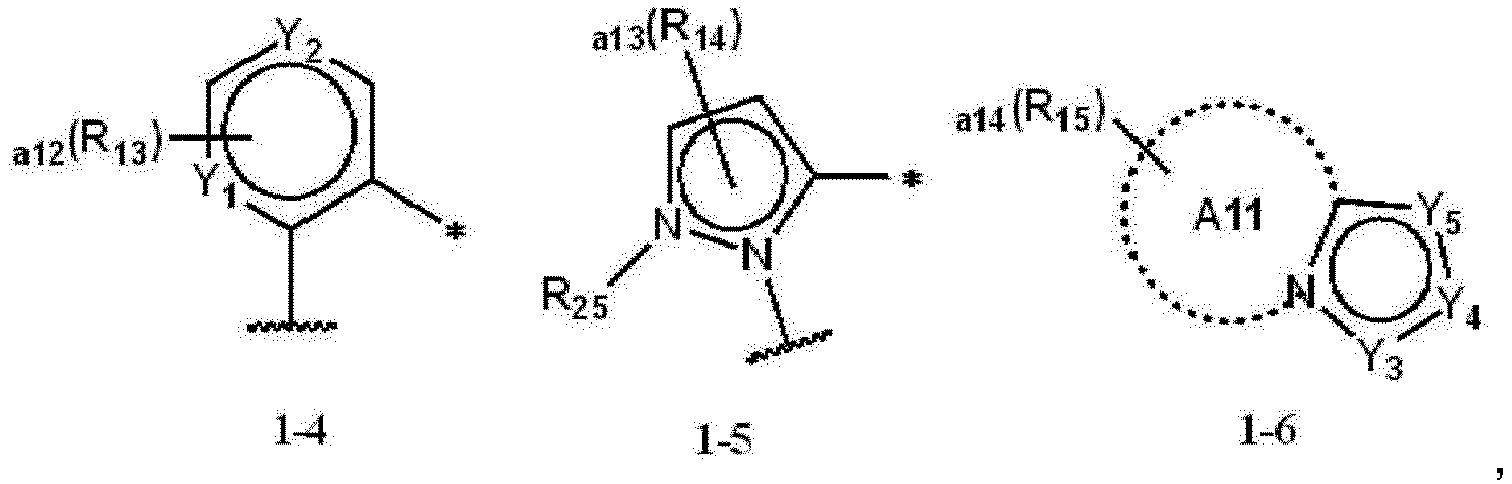 any one of Y1 and Y2 is CH and the other is NR24,is a connection point to any one of L1 to L4, or a position of binding to a neighboring ligand,
 -* is a position of binding to M,A11 is a substituted or unsubstituted aryl group having 6 to 30 ring-forming carbon atoms or a substituted or unsubstituted heteroaryl group having 2 to 30 ring-forming carbon atoms,any one of Y3 and Y4 isand the other is c-*,
 Y5 is NR26 or,
 R11 to R15 are each independently a hydrogen atom, a deuterium atom, a cyano group, a substituted or unsubstituted alkyl group having 1 to 20 carbon atoms, a substituted or unsubstituted aryl group having 6 to 30 ring-forming carbon atoms, or a substituted or unsubstituted heteroaryl group having 2 to 30 ring-forming carbon atoms, and/or bonded to an adjacent group to form a ring,R21 to R26 are each independently a substituted or unsubstituted alkyl group having 1 to 20 carbon atoms, a substituted or unsubstituted aryl group having 6 to 30 ring-forming carbon atoms, or a substituted or unsubstituted heteroaryl group having 2 to 30 ring-forming carbon atoms,a11 to a13 are each independently an integer of 0 to 2, anda14 is an integer of 0 to 4.
 - An organometallic compound according to claim 3, wherein 1-6 is represented 1-6-1:
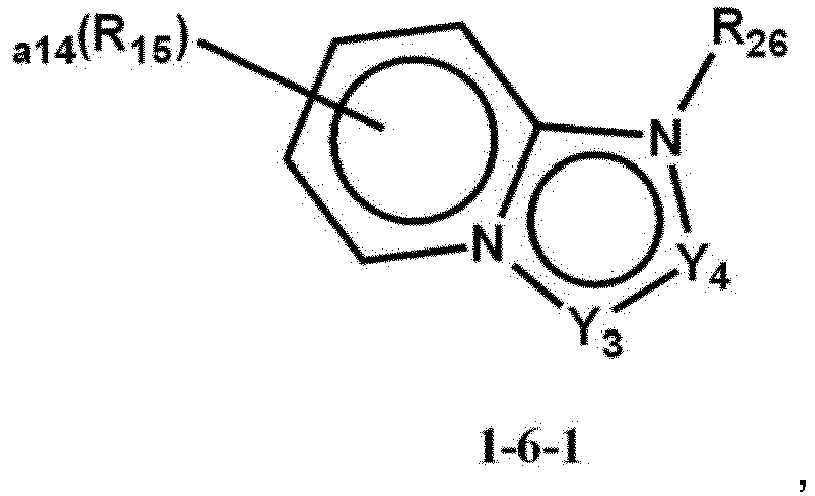
Y3, Y4, R15, R26, and a14 are each independently the same as defined in connection with Formula 1-6. - An organometallic compound according to claim 3 or claim 4, wherein at least one of A1 and A4 is represented by any one of 1-1 to 1-6, and
A2, A3, and the remaining ligand of A1 and A4 are each independently represented by any one of 2-1 to 2-4:
 Y11 is a carbon atom or a nitrogen atom,Y12 is CR31 or,
 Y13 to Y19 are each independently CR35 or a nitrogen atom, andR31 to R41 are each independently a hydrogen atom, a deuterium atom, a cyano group, a substituted or unsubstituted alkyl group having 1 to 20 carbon atoms, a substituted or unsubstituted aryl group having 6 to 30 ring-forming carbon atoms, or a substituted or unsubstituted heteroaryl group having 2 to 30 ring-forming carbon atoms, and/or bonded to an adjacent group to form a ring.
 - An organometallic compound according to claim 5, wherein the organometallic compound represented by Formula 1 is represented by at least one of Formulae 3-1 to 3-7:


 in Formulae 3-3 and 3-5, at least one of A1 and A4 is represented by any one of 1-1 to 1-5,in Formula 3-4, at least one of A1 and A3 is represented by any one of 1-1 to 1-5,in Formulae 3-6 and 3-7, A1 is represented by 1-6,in Formulae 3-1 to 3-7,R51 to R64 are each independently a hydrogen atom, a deuterium atom, a cyano group, a substituted or unsubstituted alkyl group having 1 to 20 carbon atoms, a substituted or unsubstituted aryl group having 6 to 30 ring-forming carbon atoms, or a substituted or unsubstituted heteroaryl group having 2 to 30 ring-forming carbon atoms, and/or bonded to an adjacent group to form a ring,Z is a carbon atom or a nitrogen atom,a21, a23, a24, a26, a27, a29, a30, a32, a33, and a34 are each independently an integer of 0 to 3,a22, a28, and a31 are each independently an integer of 0 to 4,a25 is an integer of 0 to 2,Y13 to Y19 are each independently the same as defined in connection with 2-2, andL2 is the same as defined in connection with Formula 2.
 - An organometallic compound according to claim 1, wherein the organometallic compound represented by Formula 1 is any one of the compounds represented by Compound Group 1 and Compound Group 2:


- An organic electroluminescence device, comprising:a first electrode;a hole transport region on the first electrode;an emission layer on the hole transport region;an electron transport region on the emission layer; anda second electrode on the electron transport region,wherein the emission layer comprises an organometallic compound according to any one of claims 1 to 7.
- An organic electroluminescence device according to claim 8, wherein:the emission layer comprises a host and a dopant, andthe dopant comprises the organometallic compound.
- An organic electroluminescence device according to claim 8 or claim 9, wherein the emission layer is to emit green light having a center wavelength of 500 nm to 600 nm through phosphorescence.
Applications Claiming Priority (1)
| Application Number | Priority Date | Filing Date | Title |
|---|---|---|---|
| KR1020190145882A KR102922637B1 (en) | 2019-11-14 | 2019-11-14 | Organic electroluminescence device and organometallic compound for organic electroluminescence device |
Publications (2)
| Publication Number | Publication Date |
|---|---|
| EP3822280A1 true EP3822280A1 (en) | 2021-05-19 |
| EP3822280B1 EP3822280B1 (en) | 2025-07-23 |
Family
ID=73198216
Family Applications (1)
| Application Number | Title | Priority Date | Filing Date |
|---|---|---|---|
| EP20206532.2A Active EP3822280B1 (en) | 2019-11-14 | 2020-11-09 | Organic electroluminescence device and organometallic compound for organic electroluminescence device |
Country Status (5)
| Country | Link |
|---|---|
| US (1) | US12382824B2 (en) |
| EP (1) | EP3822280B1 (en) |
| JP (1) | JP7617726B2 (en) |
| KR (1) | KR102922637B1 (en) |
| CN (1) | CN112794869A (en) |
Cited By (1)
| Publication number | Priority date | Publication date | Assignee | Title |
|---|---|---|---|---|
| EP4299692A1 (en) * | 2022-06-30 | 2024-01-03 | Samsung Electronics Co., Ltd. | Organometallic compound, organic light-emitting device including the same, and electronic apparatus including the organic light-emitting device |
Families Citing this family (5)
| Publication number | Priority date | Publication date | Assignee | Title |
|---|---|---|---|---|
| CN112920209B (en) * | 2021-01-29 | 2025-05-30 | 上海弗屈尔光电科技有限公司 | An organic metal complex and an organic photoelectric element containing the same |
| GB2609716B (en) * | 2021-05-27 | 2023-10-04 | Lg Display Co Ltd | Organometallic compound and organic electroluminescent device including the same |
| US20230147616A1 (en) * | 2021-10-08 | 2023-05-11 | Universal Display Corporation | Organic electroluminescent materials and devices |
| CN116574136A (en) * | 2022-01-29 | 2023-08-11 | 南京佳诺霖光电科技有限公司 | A kind of divalent platinum complex and its preparation method and application |
| WO2024080842A1 (en) * | 2022-10-13 | 2024-04-18 | 에스케이 주식회사 | Organometallic compound and organic electroluminescent device comprising same |
Citations (5)
| Publication number | Priority date | Publication date | Assignee | Title |
|---|---|---|---|---|
| US20130168656A1 (en) * | 2012-01-03 | 2013-07-04 | Universal Display Corporation | Cyclometallated tetradentate platinum complexes |
| EP3431482A1 (en) * | 2017-07-21 | 2019-01-23 | Samsung Display Co., Ltd. | Organometallic compound and organic light-emitting device including the same |
| US20190036042A1 (en) * | 2017-07-27 | 2019-01-31 | Samsung Display Co., Ltd. | Organometallic compound and organic light-emitting device including the same |
| US20190280222A1 (en) * | 2018-03-09 | 2019-09-12 | Samsung Display Co., Ltd. | Organometallic compound and organic light-emitting device including the same |
| EP3539972A1 (en) * | 2018-03-13 | 2019-09-18 | Samsung Display Co., Ltd | Organometallic compound and organic light-emitting device including the same |
Family Cites Families (20)
| Publication number | Priority date | Publication date | Assignee | Title |
|---|---|---|---|---|
| EP1683804B1 (en) | 2003-11-04 | 2013-07-31 | Takasago International Corporation | Platinum complex and luminescent element |
| JP4399382B2 (en) | 2005-03-16 | 2010-01-13 | 富士フイルム株式会社 | Organic electroluminescence device |
| TWI391027B (en) | 2005-04-25 | 2013-03-21 | Fujifilm Corp | Organic electroluminescent device |
| JP2008037848A (en) | 2006-08-10 | 2008-02-21 | Takasago Internatl Corp | Platinum complex and light emitting device |
| JP2009272339A (en) | 2008-04-30 | 2009-11-19 | Fujifilm Corp | Organic electric field light-emitting element |
| WO2011050003A2 (en) | 2009-10-19 | 2011-04-28 | University Of Mississippi | Air-stable, blue light emitting chemical compounds |
| WO2012116231A2 (en) | 2011-02-23 | 2012-08-30 | Universal Display Corporation | Novel tetradentate platinum complexes |
| KR102091393B1 (en) | 2012-01-16 | 2020-03-23 | 메르크 파텐트 게엠베하 | Organic metal complexes |
| US9318725B2 (en) | 2012-02-27 | 2016-04-19 | Jian Li | Microcavity OLED device with narrow band phosphorescent emitters |
| CN105073763B (en) | 2013-04-29 | 2019-03-01 | Udc 爱尔兰有限责任公司 | Transition metal complexes with carbene ligands and their use in OLEDs |
| KR102349659B1 (en) | 2013-06-10 | 2022-01-11 | 아리조나 보드 오브 리젠츠 온 비하프 오브 아리조나 스테이트 유니버시티 | Phosphorescent tetradentate metal complexes having modified emission spectra |
| JP6804823B2 (en) | 2013-10-14 | 2020-12-23 | アリゾナ・ボード・オブ・リージェンツ・オン・ビハーフ・オブ・アリゾナ・ステイト・ユニバーシティーArizona Board of Regents on behalf of Arizona State University | Platinum complex and device |
| US10135008B2 (en) | 2014-01-07 | 2018-11-20 | Universal Display Corporation | Organic electroluminescent materials and devices |
| US9923155B2 (en) | 2014-07-24 | 2018-03-20 | Arizona Board Of Regents On Behalf Of Arizona State University | Tetradentate platinum (II) complexes cyclometalated with functionalized phenyl carbene ligands and their analogues |
| US10177323B2 (en) | 2016-08-22 | 2019-01-08 | Arizona Board Of Regents On Behalf Of Arizona State University | Tetradentate platinum (II) and palladium (II) complexes and octahedral iridium complexes employing azepine functional groups and their analogues |
| US11725022B2 (en) | 2017-06-23 | 2023-08-15 | Universal Display Corporation | Organic electroluminescent materials and devices |
| KR102606281B1 (en) | 2017-07-14 | 2023-11-27 | 삼성디스플레이 주식회사 | Organometallic compound and organic light-emitting device including the same |
| US11239433B2 (en) * | 2017-07-26 | 2022-02-01 | Universal Display Corporation | Organic electroluminescent materials and devices |
| CN107474074A (en) | 2017-08-30 | 2017-12-15 | 烟台显华光电材料研究院有限公司 | One kind is used as transient metal complex, its preparation method and the application of phosphor material |
| KR102725259B1 (en) | 2018-12-17 | 2024-11-04 | 삼성디스플레이 주식회사 | Organometallic compound and organic light emitting device comprising the same |
-
2019
- 2019-11-14 KR KR1020190145882A patent/KR102922637B1/en active Active
-
2020
- 2020-08-20 US US16/998,878 patent/US12382824B2/en active Active
- 2020-11-09 EP EP20206532.2A patent/EP3822280B1/en active Active
- 2020-11-11 JP JP2020188325A patent/JP7617726B2/en active Active
- 2020-11-12 CN CN202011259976.2A patent/CN112794869A/en active Pending
Patent Citations (5)
| Publication number | Priority date | Publication date | Assignee | Title |
|---|---|---|---|---|
| US20130168656A1 (en) * | 2012-01-03 | 2013-07-04 | Universal Display Corporation | Cyclometallated tetradentate platinum complexes |
| EP3431482A1 (en) * | 2017-07-21 | 2019-01-23 | Samsung Display Co., Ltd. | Organometallic compound and organic light-emitting device including the same |
| US20190036042A1 (en) * | 2017-07-27 | 2019-01-31 | Samsung Display Co., Ltd. | Organometallic compound and organic light-emitting device including the same |
| US20190280222A1 (en) * | 2018-03-09 | 2019-09-12 | Samsung Display Co., Ltd. | Organometallic compound and organic light-emitting device including the same |
| EP3539972A1 (en) * | 2018-03-13 | 2019-09-18 | Samsung Display Co., Ltd | Organometallic compound and organic light-emitting device including the same |
Non-Patent Citations (4)
| Title |
|---|
| BRATERMAN PAUL S. ET AL: "Electrochemistry and spectroelectrochemistry (EPR, UV-visible-near-IR) of platinum(II) 2,2'-bipyridine and ring-metalated bipyridine complexes: PtII(L-) and PtI(L-) but not PtI(L)", INORGANIC CHEMISTRY, vol. 31, no. 24, 1 November 1992 (1992-11-01), Easton , US, pages 5084 - 5088, XP055779631, ISSN: 0020-1669, DOI: 10.1021/ic00050a030 * |
| BRATERMAN PAUL S. ET AL: "Spectroelectrochemical studies of bipyridyl and ring-metallated bipyridyl complexes; evidence for mononuclear Pt(I) derivatives", INORGANICA CHIMICA ACTA, vol. 189, no. 1, 1 November 1991 (1991-11-01), NL, pages 7 - 9, XP055779632, ISSN: 0020-1693, DOI: 10.1016/S0020-1693(00)80381-3 * |
| LEI Y ET AL: "Electro- and spectroelectrochemistry of platinum(II) bipyridine complexes and related species", JOURNAL OF ORGANOMETALLIC CHEMISTRY, ELSEVIER, AMSTERDAM, NL, vol. 525, no. 1-2, 15 November 1996 (1996-11-15), pages 1 - 8, XP004071367, ISSN: 0022-328X, DOI: 10.1016/S0022-328X(96)06412-1 * |
| WU YONG ET AL: "Forward molecular design for highly efficient OLED emitters: A theoretical analysis of photophysical properties of platinum(ii) complexes with N-heterocyclic carbene ligands", DALTON TRANSACTIONS, vol. 40, no. 17, 1 January 2011 (2011-01-01), Cambridge, pages 4480, XP055779629, ISSN: 1477-9226, DOI: 10.1039/c0dt01299h * |
Cited By (1)
| Publication number | Priority date | Publication date | Assignee | Title |
|---|---|---|---|---|
| EP4299692A1 (en) * | 2022-06-30 | 2024-01-03 | Samsung Electronics Co., Ltd. | Organometallic compound, organic light-emitting device including the same, and electronic apparatus including the organic light-emitting device |
Also Published As
| Publication number | Publication date |
|---|---|
| KR102922637B1 (en) | 2026-02-06 |
| CN112794869A (en) | 2021-05-14 |
| US20210151696A1 (en) | 2021-05-20 |
| US12382824B2 (en) | 2025-08-05 |
| KR20210059126A (en) | 2021-05-25 |
| EP3822280B1 (en) | 2025-07-23 |
| JP2021080248A (en) | 2021-05-27 |
| JP7617726B2 (en) | 2025-01-20 |
Similar Documents
| Publication | Publication Date | Title |
|---|---|---|
| EP3543230B1 (en) | Organic electroluminescence device and polycyclic compound for organic electroluminescence device | |
| EP3587415B1 (en) | Organic electroluminescence device and heterocyclic compound for organic electroluminescence device | |
| EP3754736B1 (en) | Organic electroluminescence device and fused polycyclic compound for organic electroluminescence device | |
| US20200044159A1 (en) | Organic electroluminescence device and polycyclic compound for organic electroluminescence device | |
| EP3822280B1 (en) | Organic electroluminescence device and organometallic compound for organic electroluminescence device | |
| EP3806175B1 (en) | Organic electroluminescence device and polycyclic compound for organic electroluminescence device | |
| EP3476842B1 (en) | Compound including nitrogen and organic electroluminescence device including the same | |
| EP3627579B1 (en) | Organic electroluminescence device and manufacturing method of the same | |
| EP3653606A1 (en) | Organic electroluminescence device and compound for organic electroluminescence device | |
| EP3798223A1 (en) | Luminescence device and polycyclic compound for luminescence device | |
| KR20210038785A (en) | Organic electroluminescence device and compound for organic electroluminescence device | |
| EP3502104B1 (en) | Organic electroluminescence device and compound including nitrogen for organic electroluminescence device | |
| EP3628673A1 (en) | Organic electroluminescence device and amine compound for organic electroluminescence device | |
| KR20210019621A (en) | Organic electroluminescence device and fused polycyclic compound for organic electroluminescence device | |
| EP3476847B1 (en) | Nitrogen-containing compound and organic electroluminescence device including the same | |
| EP3663300B1 (en) | Organic electroluminescence device and polycyclic compound for organic electroluminescence device | |
| KR102904115B1 (en) | Organic electroluminescence device and polycyclic compound for organic electroluminescence device | |
| EP3831807A2 (en) | Organic electroluminescence device and amine compound for organic electroluminescence device | |
| CN112786795A (en) | Organic electroluminescent device and aromatic compound for organic electroluminescent device | |
| KR102811543B1 (en) | Organic electroluminescence device and polycyclic compound for organic electroluminescence device | |
| EP3812389B1 (en) | Organic electroluminescence device and organometallic compound for organic electroluminescence device | |
| KR102810395B1 (en) | Organic electroluminescence device and organometallic compound for organic electroluminescence device | |
| KR20200053007A (en) | Organic electroluminescence device and polycyclic compound for organic electroluminescence device | |
| KR102784238B1 (en) | Organic electroluminescence device and organometallic complex for organic electroluminescence device | |
| KR102810570B1 (en) | Organic electroluminescence device and organometallic compound for organic electroluminescence device |
Legal Events
| Date | Code | Title | Description |
|---|---|---|---|
| PUAI | Public reference made under article 153(3) epc to a published international application that has entered the european phase |
Free format text: ORIGINAL CODE: 0009012 |
|
| STAA | Information on the status of an ep patent application or granted ep patent |
Free format text: STATUS: THE APPLICATION HAS BEEN PUBLISHED |
|
| AK | Designated contracting states |
Kind code of ref document: A1 Designated state(s): AL AT BE BG CH CY CZ DE DK EE ES FI FR GB GR HR HU IE IS IT LI LT LU LV MC MK MT NL NO PL PT RO RS SE SI SK SM TR |
|
| STAA | Information on the status of an ep patent application or granted ep patent |
Free format text: STATUS: REQUEST FOR EXAMINATION WAS MADE |
|
| 17P | Request for examination filed |
Effective date: 20211115 |
|
| RBV | Designated contracting states (corrected) |
Designated state(s): AL AT BE BG CH CY CZ DE DK EE ES FI FR GB GR HR HU IE IS IT LI LT LU LV MC MK MT NL NO PL PT RO RS SE SI SK SM TR |
|
| STAA | Information on the status of an ep patent application or granted ep patent |
Free format text: STATUS: EXAMINATION IS IN PROGRESS |
|
| 17Q | First examination report despatched |
Effective date: 20220614 |
|
| P01 | Opt-out of the competence of the unified patent court (upc) registered |
Effective date: 20230516 |
|
| GRAP | Despatch of communication of intention to grant a patent |
Free format text: ORIGINAL CODE: EPIDOSNIGR1 |
|
| STAA | Information on the status of an ep patent application or granted ep patent |
Free format text: STATUS: GRANT OF PATENT IS INTENDED |
|
| RIC1 | Information provided on ipc code assigned before grant |
Ipc: H10K 85/30 20230101ALI20250127BHEP Ipc: C09K 11/06 20060101ALI20250127BHEP Ipc: C07F 15/00 20060101AFI20250127BHEP |
|
| INTG | Intention to grant announced |
Effective date: 20250218 |
|
| RIN1 | Information on inventor provided before grant (corrected) |
Inventor name: LEE, HYUN JUNG Inventor name: LEE, JAESUNG Inventor name: AHN, EUNSOO Inventor name: SHIN, SUJIN Inventor name: JEON, MINA Inventor name: KIM, HAEJIN Inventor name: KIM, SUNGBUM Inventor name: KO, SOO-BYUNG Inventor name: HAN, JUNGHOON Inventor name: LEE, EUNYOUNG |
|
| GRAS | Grant fee paid |
Free format text: ORIGINAL CODE: EPIDOSNIGR3 |
|
| GRAA | (expected) grant |
Free format text: ORIGINAL CODE: 0009210 |
|
| STAA | Information on the status of an ep patent application or granted ep patent |
Free format text: STATUS: THE PATENT HAS BEEN GRANTED |
|
| AK | Designated contracting states |
Kind code of ref document: B1 Designated state(s): AL AT BE BG CH CY CZ DE DK EE ES FI FR GB GR HR HU IE IS IT LI LT LU LV MC MK MT NL NO PL PT RO RS SE SI SK SM TR |
|
| REG | Reference to a national code |
Ref country code: GB Ref legal event code: FG4D |
|
| REG | Reference to a national code |
Ref country code: CH Ref legal event code: EP |
|
| REG | Reference to a national code |
Ref country code: DE Ref legal event code: R096 Ref document number: 602020054926 Country of ref document: DE |
|
| REG | Reference to a national code |
Ref country code: IE Ref legal event code: FG4D |
|
| REG | Reference to a national code |
Ref country code: NL Ref legal event code: MP Effective date: 20250723 |
|
| PG25 | Lapsed in a contracting state [announced via postgrant information from national office to epo] |
Ref country code: PT Free format text: LAPSE BECAUSE OF FAILURE TO SUBMIT A TRANSLATION OF THE DESCRIPTION OR TO PAY THE FEE WITHIN THE PRESCRIBED TIME-LIMIT Effective date: 20251124 |
|
| PG25 | Lapsed in a contracting state [announced via postgrant information from national office to epo] |
Ref country code: NL Free format text: LAPSE BECAUSE OF FAILURE TO SUBMIT A TRANSLATION OF THE DESCRIPTION OR TO PAY THE FEE WITHIN THE PRESCRIBED TIME-LIMIT Effective date: 20250723 |
|
| REG | Reference to a national code |
Ref country code: AT Ref legal event code: MK05 Ref document number: 1816361 Country of ref document: AT Kind code of ref document: T Effective date: 20250723 |
|
| PG25 | Lapsed in a contracting state [announced via postgrant information from national office to epo] |
Ref country code: IS Free format text: LAPSE BECAUSE OF FAILURE TO SUBMIT A TRANSLATION OF THE DESCRIPTION OR TO PAY THE FEE WITHIN THE PRESCRIBED TIME-LIMIT Effective date: 20251123 |
|
| PGFP | Annual fee paid to national office [announced via postgrant information from national office to epo] |
Ref country code: DE Payment date: 20251020 Year of fee payment: 6 |
|
| PGFP | Annual fee paid to national office [announced via postgrant information from national office to epo] |
Ref country code: GB Payment date: 20251023 Year of fee payment: 6 |
|
| PG25 | Lapsed in a contracting state [announced via postgrant information from national office to epo] |
Ref country code: NO Free format text: LAPSE BECAUSE OF FAILURE TO SUBMIT A TRANSLATION OF THE DESCRIPTION OR TO PAY THE FEE WITHIN THE PRESCRIBED TIME-LIMIT Effective date: 20251023 |
|
| REG | Reference to a national code |
Ref country code: LT Ref legal event code: MG9D |
|
| PG25 | Lapsed in a contracting state [announced via postgrant information from national office to epo] |
Ref country code: AT Free format text: LAPSE BECAUSE OF FAILURE TO SUBMIT A TRANSLATION OF THE DESCRIPTION OR TO PAY THE FEE WITHIN THE PRESCRIBED TIME-LIMIT Effective date: 20250723 |
|
| PG25 | Lapsed in a contracting state [announced via postgrant information from national office to epo] |
Ref country code: FI Free format text: LAPSE BECAUSE OF FAILURE TO SUBMIT A TRANSLATION OF THE DESCRIPTION OR TO PAY THE FEE WITHIN THE PRESCRIBED TIME-LIMIT Effective date: 20250723 |
|
| PG25 | Lapsed in a contracting state [announced via postgrant information from national office to epo] |
Ref country code: HR Free format text: LAPSE BECAUSE OF FAILURE TO SUBMIT A TRANSLATION OF THE DESCRIPTION OR TO PAY THE FEE WITHIN THE PRESCRIBED TIME-LIMIT Effective date: 20250723 |
|
| PG25 | Lapsed in a contracting state [announced via postgrant information from national office to epo] |
Ref country code: GR Free format text: LAPSE BECAUSE OF FAILURE TO SUBMIT A TRANSLATION OF THE DESCRIPTION OR TO PAY THE FEE WITHIN THE PRESCRIBED TIME-LIMIT Effective date: 20251024 |
|
| PG25 | Lapsed in a contracting state [announced via postgrant information from national office to epo] |
Ref country code: SE Free format text: LAPSE BECAUSE OF FAILURE TO SUBMIT A TRANSLATION OF THE DESCRIPTION OR TO PAY THE FEE WITHIN THE PRESCRIBED TIME-LIMIT Effective date: 20250723 |
|
| PG25 | Lapsed in a contracting state [announced via postgrant information from national office to epo] |
Ref country code: LV Free format text: LAPSE BECAUSE OF FAILURE TO SUBMIT A TRANSLATION OF THE DESCRIPTION OR TO PAY THE FEE WITHIN THE PRESCRIBED TIME-LIMIT Effective date: 20250723 |
|
| PG25 | Lapsed in a contracting state [announced via postgrant information from national office to epo] |
Ref country code: BG Free format text: LAPSE BECAUSE OF FAILURE TO SUBMIT A TRANSLATION OF THE DESCRIPTION OR TO PAY THE FEE WITHIN THE PRESCRIBED TIME-LIMIT Effective date: 20250723 Ref country code: PL Free format text: LAPSE BECAUSE OF FAILURE TO SUBMIT A TRANSLATION OF THE DESCRIPTION OR TO PAY THE FEE WITHIN THE PRESCRIBED TIME-LIMIT Effective date: 20250723 |
|
| PG25 | Lapsed in a contracting state [announced via postgrant information from national office to epo] |
Ref country code: RS Free format text: LAPSE BECAUSE OF FAILURE TO SUBMIT A TRANSLATION OF THE DESCRIPTION OR TO PAY THE FEE WITHIN THE PRESCRIBED TIME-LIMIT Effective date: 20251023 |
|
| PG25 | Lapsed in a contracting state [announced via postgrant information from national office to epo] |
Ref country code: ES Free format text: LAPSE BECAUSE OF FAILURE TO SUBMIT A TRANSLATION OF THE DESCRIPTION OR TO PAY THE FEE WITHIN THE PRESCRIBED TIME-LIMIT Effective date: 20250723 |
|
| PG25 | Lapsed in a contracting state [announced via postgrant information from national office to epo] |
Ref country code: RO Free format text: LAPSE BECAUSE OF FAILURE TO SUBMIT A TRANSLATION OF THE DESCRIPTION OR TO PAY THE FEE WITHIN THE PRESCRIBED TIME-LIMIT Effective date: 20250723 |
|
| PG25 | Lapsed in a contracting state [announced via postgrant information from national office to epo] |
Ref country code: SM Free format text: LAPSE BECAUSE OF FAILURE TO SUBMIT A TRANSLATION OF THE DESCRIPTION OR TO PAY THE FEE WITHIN THE PRESCRIBED TIME-LIMIT Effective date: 20250723 |
|
| PG25 | Lapsed in a contracting state [announced via postgrant information from national office to epo] |
Ref country code: DK Free format text: LAPSE BECAUSE OF FAILURE TO SUBMIT A TRANSLATION OF THE DESCRIPTION OR TO PAY THE FEE WITHIN THE PRESCRIBED TIME-LIMIT Effective date: 20250723 |
|
| PG25 | Lapsed in a contracting state [announced via postgrant information from national office to epo] |
Ref country code: IT Free format text: LAPSE BECAUSE OF FAILURE TO SUBMIT A TRANSLATION OF THE DESCRIPTION OR TO PAY THE FEE WITHIN THE PRESCRIBED TIME-LIMIT Effective date: 20250723 |
|
| PG25 | Lapsed in a contracting state [announced via postgrant information from national office to epo] |
Ref country code: CZ Free format text: LAPSE BECAUSE OF FAILURE TO SUBMIT A TRANSLATION OF THE DESCRIPTION OR TO PAY THE FEE WITHIN THE PRESCRIBED TIME-LIMIT Effective date: 20250723 |
|
| PG25 | Lapsed in a contracting state [announced via postgrant information from national office to epo] |
Ref country code: SK Free format text: LAPSE BECAUSE OF FAILURE TO SUBMIT A TRANSLATION OF THE DESCRIPTION OR TO PAY THE FEE WITHIN THE PRESCRIBED TIME-LIMIT Effective date: 20250723 Ref country code: EE Free format text: LAPSE BECAUSE OF FAILURE TO SUBMIT A TRANSLATION OF THE DESCRIPTION OR TO PAY THE FEE WITHIN THE PRESCRIBED TIME-LIMIT Effective date: 20250723 |