EP3822272A1 - Fused tri-cyclic compound as pde3/pde4 dual inhibitor - Google Patents
Fused tri-cyclic compound as pde3/pde4 dual inhibitor Download PDFInfo
- Publication number
- EP3822272A1 EP3822272A1 EP19834834.4A EP19834834A EP3822272A1 EP 3822272 A1 EP3822272 A1 EP 3822272A1 EP 19834834 A EP19834834 A EP 19834834A EP 3822272 A1 EP3822272 A1 EP 3822272A1
- Authority
- EP
- European Patent Office
- Prior art keywords
- group
- alkyl
- hydroxy
- optionally
- compound
- Prior art date
- Legal status (The legal status is an assumption and is not a legal conclusion. Google has not performed a legal analysis and makes no representation as to the accuracy of the status listed.)
- Granted
Links
- 0 CN(C(*)(C(*)(O1)I)I)C1=O Chemical compound CN(C(*)(C(*)(O1)I)I)C1=O 0.000 description 9
- RRQWGRFQGSXTSP-XLVZBRSZSA-N CCOc(c(OC)c1)cc(CCCN2C(N3CCN)=O)c1C2=C/C3=N\c1c(C)cc(C)cc1C Chemical compound CCOc(c(OC)c1)cc(CCCN2C(N3CCN)=O)c1C2=C/C3=N\c1c(C)cc(C)cc1C RRQWGRFQGSXTSP-XLVZBRSZSA-N 0.000 description 1
- VCMFLYAKDSEROL-MHTZHOPKSA-N CCOc(c(OC)c1)cc(CCN2C(N3CCNC(c4ncc[o]4)=O)=O)c1C2=C/C3=N\c1c(C)cc(C)cc1C Chemical compound CCOc(c(OC)c1)cc(CCN2C(N3CCNC(c4ncc[o]4)=O)=O)c1C2=C/C3=N\c1c(C)cc(C)cc1C VCMFLYAKDSEROL-MHTZHOPKSA-N 0.000 description 1
- FAYROBGHSXEFOU-AWQADKOQSA-N CCOc(cc(CCCN(C1=C/C(/N2CCNC(c3cnc[nH]3)=O)=N\c3c(C)cc(C)cc3C)C2=O)c1c1)c1OC Chemical compound CCOc(cc(CCCN(C1=C/C(/N2CCNC(c3cnc[nH]3)=O)=N\c3c(C)cc(C)cc3C)C2=O)c1c1)c1OC FAYROBGHSXEFOU-AWQADKOQSA-N 0.000 description 1
- LZTVIYGEKIYHOV-MHTZHOPKSA-N CCOc(cc(CCCN(C1=C/C(/N2CCNc3n[nH]cn3)=N\c3c(C)cc(C)cc3C)C2=O)c1c1)c1OC Chemical compound CCOc(cc(CCCN(C1=C/C(/N2CCNc3n[nH]cn3)=N\c3c(C)cc(C)cc3C)C2=O)c1c1)c1OC LZTVIYGEKIYHOV-MHTZHOPKSA-N 0.000 description 1
- VTRHPKLJAIKCSU-KZLGZZSBSA-N CCOc(cc(CCN(C1=C/C(/N2CCN/C(/N)=C/NN)=N\c3c(C)cc(C)cc3C)C2=O)c1c1)c1OC Chemical compound CCOc(cc(CCN(C1=C/C(/N2CCN/C(/N)=C/NN)=N\c3c(C)cc(C)cc3C)C2=O)c1c1)c1OC VTRHPKLJAIKCSU-KZLGZZSBSA-N 0.000 description 1
- VLLAAWXLCHSGFE-QVAGMWBUSA-N CCOc(cc(CCN(C1=C/C(/N2CCNC(C(N(C)N3)=CN3O)=O)=N\c3c(C)cc(C)cc3C)C2=O)c1c1)c1OC Chemical compound CCOc(cc(CCN(C1=C/C(/N2CCNC(C(N(C)N3)=CN3O)=O)=N\c3c(C)cc(C)cc3C)C2=O)c1c1)c1OC VLLAAWXLCHSGFE-QVAGMWBUSA-N 0.000 description 1
- IKGSMEYTMPILCK-MHTZHOPKSA-N CCOc(cc(CCN(C1=C/C(/N2CCNC(c3c[nH]nc3O)=O)=N\c3c(C)cc(C)cc3C)C2=O)c1c1)c1OC Chemical compound CCOc(cc(CCN(C1=C/C(/N2CCNC(c3c[nH]nc3O)=O)=N\c3c(C)cc(C)cc3C)C2=O)c1c1)c1OC IKGSMEYTMPILCK-MHTZHOPKSA-N 0.000 description 1
- OJJIBQPHWUYHRE-DNGXXSEMSA-N CCOc(cc(CCN(C1=C/C(/N2CCNC(c3cnc[nH]3)=O)=N\c3c(C)cc(C)cc3C)C2=O)c1c1)c1OC Chemical compound CCOc(cc(CCN(C1=C/C(/N2CCNC(c3cnc[nH]3)=O)=N\c3c(C)cc(C)cc3C)C2=O)c1c1)c1OC OJJIBQPHWUYHRE-DNGXXSEMSA-N 0.000 description 1
- LUIYJEPMBFIZRC-WGPBWIAQSA-N CCOc(cc(CCN(C1=C/C(/N2CCNC(c3n[o]cn3)=O)=N\c3c(C)cc(C)cc3C)C2=O)c1c1)c1OC Chemical compound CCOc(cc(CCN(C1=C/C(/N2CCNC(c3n[o]cn3)=O)=N\c3c(C)cc(C)cc3C)C2=O)c1c1)c1OC LUIYJEPMBFIZRC-WGPBWIAQSA-N 0.000 description 1
- KTTONJCDKOPQCV-INKHBPHZSA-N CCOc(cc(CCN(C1=C/C(/N2CCNC(c3nnc[nH]3)=O)=N\c3c(C)cc(C)cc3C)C2=O)c1c1)c1OC Chemical compound CCOc(cc(CCN(C1=C/C(/N2CCNC(c3nnc[nH]3)=O)=N\c3c(C)cc(C)cc3C)C2=O)c1c1)c1OC KTTONJCDKOPQCV-INKHBPHZSA-N 0.000 description 1
- MNGULZDDFGMURG-MUGXBBEHSA-N CCOc(cc(CCN(C1=C/C(/N2CCNc3c[nH]nc3)=N\c3c(C)cc(C)cc3C)C2=O)c1c1)c1OC Chemical compound CCOc(cc(CCN(C1=C/C(/N2CCNc3c[nH]nc3)=N\c3c(C)cc(C)cc3C)C2=O)c1c1)c1OC MNGULZDDFGMURG-MUGXBBEHSA-N 0.000 description 1
- XOVVXBLRWNBEFQ-WGPBWIAQSA-N CCOc(cc(CCN(C1=C/C(/N2CCNc3n[nH]cn3)=N\c3c(C)cc(C)cc3C)C2=O)c1c1)c1OC Chemical compound CCOc(cc(CCN(C1=C/C(/N2CCNc3n[nH]cn3)=N\c3c(C)cc(C)cc3C)C2=O)c1c1)c1OC XOVVXBLRWNBEFQ-WGPBWIAQSA-N 0.000 description 1
- RCRVYJHDBGVBLQ-UHFFFAOYSA-O CCOc(cc(CCN(C1=CC(N2CCNC(C(N[NH3+])=C(NC)Cl)=O)=Nc3c(C)cc(C)cc3C)C2=O)c1c1)c1OC Chemical compound CCOc(cc(CCN(C1=CC(N2CCNC(C(N[NH3+])=C(NC)Cl)=O)=Nc3c(C)cc(C)cc3C)C2=O)c1c1)c1OC RCRVYJHDBGVBLQ-UHFFFAOYSA-O 0.000 description 1
- JDRJVZLWVKYSJJ-UHFFFAOYSA-O CCOc(cc(CCN(C1=CC(N2CCNC(C3=C(C(F)(F)F)N[NH2+]N3)=O)=NC3=C(C)C=C(C)CC3C)C2=O)c1c1)c1OC Chemical compound CCOc(cc(CCN(C1=CC(N2CCNC(C3=C(C(F)(F)F)N[NH2+]N3)=O)=NC3=C(C)C=C(C)CC3C)C2=O)c1c1)c1OC JDRJVZLWVKYSJJ-UHFFFAOYSA-O 0.000 description 1
- QLJVZZQTSFOCSG-UHFFFAOYSA-O CCOc(cc(CCN(C1=CC(N2CCNC(C3=C(C(N)O)N[NH2+]N3)=O)=Nc3c(C)cc(C)cc3C)C2=O)c1c1)c1OC Chemical compound CCOc(cc(CCN(C1=CC(N2CCNC(C3=C(C(N)O)N[NH2+]N3)=O)=Nc3c(C)cc(C)cc3C)C2=O)c1c1)c1OC QLJVZZQTSFOCSG-UHFFFAOYSA-O 0.000 description 1
- KSFINKNHAUQFRT-UHFFFAOYSA-N Cc([s]1)nnc1I Chemical compound Cc([s]1)nnc1I KSFINKNHAUQFRT-UHFFFAOYSA-N 0.000 description 1
- VCFOEWURSYAGKP-UHFFFAOYSA-N Cc1c(C(O)=O)[nH]nn1 Chemical compound Cc1c(C(O)=O)[nH]nn1 VCFOEWURSYAGKP-UHFFFAOYSA-N 0.000 description 1
- HNJOAIYFUCQZAA-UHFFFAOYSA-N Cc1n[o]c(C)n1 Chemical compound Cc1n[o]c(C)n1 HNJOAIYFUCQZAA-UHFFFAOYSA-N 0.000 description 1
- OJMKAQZLZNNVTG-UHFFFAOYSA-N Nc1n[s]nc1C(O)=O Chemical compound Nc1n[s]nc1C(O)=O OJMKAQZLZNNVTG-UHFFFAOYSA-N 0.000 description 1
- LXVFIDCEBQLDPQ-UHFFFAOYSA-N OC(c([nH]nn1)c1O)=O Chemical compound OC(c([nH]nn1)c1O)=O LXVFIDCEBQLDPQ-UHFFFAOYSA-N 0.000 description 1
- NKWCGTOZTHZDHB-UHFFFAOYSA-N OC(c1cnc[nH]1)=O Chemical compound OC(c1cnc[nH]1)=O NKWCGTOZTHZDHB-UHFFFAOYSA-N 0.000 description 1
Images

Classifications
-
- C—CHEMISTRY; METALLURGY
- C07—ORGANIC CHEMISTRY
- C07D—HETEROCYCLIC COMPOUNDS
- C07D471/00—Heterocyclic compounds containing nitrogen atoms as the only ring hetero atoms in the condensed system, at least one ring being a six-membered ring with one nitrogen atom, not provided for by groups C07D451/00 - C07D463/00
- C07D471/02—Heterocyclic compounds containing nitrogen atoms as the only ring hetero atoms in the condensed system, at least one ring being a six-membered ring with one nitrogen atom, not provided for by groups C07D451/00 - C07D463/00 in which the condensed system contains two hetero rings
- C07D471/04—Ortho-condensed systems
-
- A—HUMAN NECESSITIES
- A61—MEDICAL OR VETERINARY SCIENCE; HYGIENE
- A61K—PREPARATIONS FOR MEDICAL, DENTAL OR TOILETRY PURPOSES
- A61K31/00—Medicinal preparations containing organic active ingredients
- A61K31/33—Heterocyclic compounds
- A61K31/395—Heterocyclic compounds having nitrogen as a ring hetero atom, e.g. guanethidine or rifamycins
- A61K31/495—Heterocyclic compounds having nitrogen as a ring hetero atom, e.g. guanethidine or rifamycins having six-membered rings with two or more nitrogen atoms as the only ring heteroatoms, e.g. piperazine or tetrazines
- A61K31/505—Pyrimidines; Hydrogenated pyrimidines, e.g. trimethoprim
- A61K31/517—Pyrimidines; Hydrogenated pyrimidines, e.g. trimethoprim ortho- or peri-condensed with carbocyclic ring systems, e.g. quinazoline, perimidine
-
- A—HUMAN NECESSITIES
- A61—MEDICAL OR VETERINARY SCIENCE; HYGIENE
- A61K—PREPARATIONS FOR MEDICAL, DENTAL OR TOILETRY PURPOSES
- A61K31/00—Medicinal preparations containing organic active ingredients
- A61K31/33—Heterocyclic compounds
- A61K31/395—Heterocyclic compounds having nitrogen as a ring hetero atom, e.g. guanethidine or rifamycins
- A61K31/495—Heterocyclic compounds having nitrogen as a ring hetero atom, e.g. guanethidine or rifamycins having six-membered rings with two or more nitrogen atoms as the only ring heteroatoms, e.g. piperazine or tetrazines
- A61K31/505—Pyrimidines; Hydrogenated pyrimidines, e.g. trimethoprim
- A61K31/519—Pyrimidines; Hydrogenated pyrimidines, e.g. trimethoprim ortho- or peri-condensed with heterocyclic rings
-
- A—HUMAN NECESSITIES
- A61—MEDICAL OR VETERINARY SCIENCE; HYGIENE
- A61K—PREPARATIONS FOR MEDICAL, DENTAL OR TOILETRY PURPOSES
- A61K31/00—Medicinal preparations containing organic active ingredients
- A61K31/33—Heterocyclic compounds
- A61K31/395—Heterocyclic compounds having nitrogen as a ring hetero atom, e.g. guanethidine or rifamycins
- A61K31/55—Heterocyclic compounds having nitrogen as a ring hetero atom, e.g. guanethidine or rifamycins having seven-membered rings, e.g. azelastine, pentylenetetrazole
-
- A—HUMAN NECESSITIES
- A61—MEDICAL OR VETERINARY SCIENCE; HYGIENE
- A61K—PREPARATIONS FOR MEDICAL, DENTAL OR TOILETRY PURPOSES
- A61K31/00—Medicinal preparations containing organic active ingredients
- A61K31/33—Heterocyclic compounds
- A61K31/395—Heterocyclic compounds having nitrogen as a ring hetero atom, e.g. guanethidine or rifamycins
- A61K31/55—Heterocyclic compounds having nitrogen as a ring hetero atom, e.g. guanethidine or rifamycins having seven-membered rings, e.g. azelastine, pentylenetetrazole
- A61K31/553—Heterocyclic compounds having nitrogen as a ring hetero atom, e.g. guanethidine or rifamycins having seven-membered rings, e.g. azelastine, pentylenetetrazole having at least one nitrogen and one oxygen as ring hetero atoms, e.g. loxapine, staurosporine
-
- A—HUMAN NECESSITIES
- A61—MEDICAL OR VETERINARY SCIENCE; HYGIENE
- A61P—SPECIFIC THERAPEUTIC ACTIVITY OF CHEMICAL COMPOUNDS OR MEDICINAL PREPARATIONS
- A61P11/00—Drugs for disorders of the respiratory system
-
- A—HUMAN NECESSITIES
- A61—MEDICAL OR VETERINARY SCIENCE; HYGIENE
- A61P—SPECIFIC THERAPEUTIC ACTIVITY OF CHEMICAL COMPOUNDS OR MEDICINAL PREPARATIONS
- A61P11/00—Drugs for disorders of the respiratory system
- A61P11/06—Antiasthmatics
-
- A—HUMAN NECESSITIES
- A61—MEDICAL OR VETERINARY SCIENCE; HYGIENE
- A61P—SPECIFIC THERAPEUTIC ACTIVITY OF CHEMICAL COMPOUNDS OR MEDICINAL PREPARATIONS
- A61P11/00—Drugs for disorders of the respiratory system
- A61P11/08—Bronchodilators
-
- C—CHEMISTRY; METALLURGY
- C07—ORGANIC CHEMISTRY
- C07D—HETEROCYCLIC COMPOUNDS
- C07D487/00—Heterocyclic compounds containing nitrogen atoms as the only ring hetero atoms in the condensed system, not provided for by groups C07D451/00 - C07D477/00
- C07D487/02—Heterocyclic compounds containing nitrogen atoms as the only ring hetero atoms in the condensed system, not provided for by groups C07D451/00 - C07D477/00 in which the condensed system contains two hetero rings
- C07D487/04—Ortho-condensed systems
-
- C—CHEMISTRY; METALLURGY
- C07—ORGANIC CHEMISTRY
- C07D—HETEROCYCLIC COMPOUNDS
- C07D498/00—Heterocyclic compounds containing in the condensed system at least one hetero ring having nitrogen and oxygen atoms as the only ring hetero atoms
- C07D498/02—Heterocyclic compounds containing in the condensed system at least one hetero ring having nitrogen and oxygen atoms as the only ring hetero atoms in which the condensed system contains two hetero rings
- C07D498/04—Ortho-condensed systems
-
- C—CHEMISTRY; METALLURGY
- C07—ORGANIC CHEMISTRY
- C07D—HETEROCYCLIC COMPOUNDS
- C07D513/00—Heterocyclic compounds containing in the condensed system at least one hetero ring having nitrogen and sulfur atoms as the only ring hetero atoms, not provided for in groups C07D463/00, C07D477/00 or C07D499/00 - C07D507/00
- C07D513/02—Heterocyclic compounds containing in the condensed system at least one hetero ring having nitrogen and sulfur atoms as the only ring hetero atoms, not provided for in groups C07D463/00, C07D477/00 or C07D499/00 - C07D507/00 in which the condensed system contains two hetero rings
- C07D513/04—Ortho-condensed systems
Definitions
- the present application relates to a tricyclic compound as a PDE3/PDE4 dual inhibitor, a preparation method thereof, a pharmaceutical composition containing the compound, and use thereof in treating a disease related to PDE3/PDE4, in particular chronic obstructive pulmonary disease (COPD).
- COPD chronic obstructive pulmonary disease
- PDEs Phosphodiesterases
- ASM human airway smooth muscle
- PDE4 plays a major regulatory role in the expression of proinflammatory and anti-inflammatory mediators, and a PDE4 inhibitor can inhibit the release of harmful mediators from inflammatory cells.
- an inhibitor that inhibits both PDE3 and PDE4 would have both the bronchodilation of a beta-adrenoreceptor agonist and the anti-inflammatory action of an inhaled glucocorticoid.
- the complementation of dual targeting functions is theoretically more effective than single targeting, and the treatment effect which can be achieved only by combined medication at present is achieved by a single medicament, thus the defect that the physicochemical properties of the ingredients of medicaments used in the combined medication cannot be completely matched is eliminated, the administration mode is simplified, and convenient determination of administration dosage is realized. It has been reported by Victoria Boswell et al., J. Pharmaco. Experi. Therap.
- the present application provides a compound of formula (I), an isomer thereof or a pharmaceutically acceptable salt thereof, wherein,
- ring Cy is 5 membered heteroaryl, wherein the 5 membered heteroaryl is optionally substituted by one or more of the following groups: amino, hydroxy, fluoro, chloro, bromo, iodo, cyano, C 1-3 alkyl, -C(O)NH 2 , -C(O)O(C 1-3 alkyl), C 1-3 alkoxy, or C 1-3 alkyl substituted by one or more halogens; in some embodiments, ring Cy is selected from the group consisting of imidazolyl, pyrazolyl, oxazolyl, triazolyl, oxadiazolyl, tetrazolyl, thiadiazolyl and isoxazolyl, wherein the imidazolyl, pyrazolyl, oxazolyl, triazolyl, oxadiazolyl, tetrazolyl, thiadiazolyl or isoxazolyl is optionally substituted
- ring Cy is 5-membered heteroaryl, wherein the 5-membered heteroaryl is optionally substituted by one or more of the following groups: amino, hydroxy, fluoro, chloro, cyano, methyl, -C(O)NH 2 , -C(O)OCH 3 , methoxy or trifluoromethyl; in some embodiments, ring Cy is selected from the group consisting of imidazolyl, pyrazolyl, oxazolyl, triazolyl, oxadiazolyl, tetrazolyl, thiadiazolyl and isoxazolyl, wherein the imidazolyl, pyrazolyl, oxazolyl, triazolyl, oxadiazolyl, tetrazolyl, thiadiazolyl or isoxazolyl is optionally substituted by one or more of the following groups: amino, hydroxy, fluoro, chloro, cyano, methyl, -C(O)NH 2
- ring Cy is selected from the group consisting of structural units and wherein,
- ring Cy is the structural unit wherein,
- T 1 is selected from the group consisting of C(R 1 ) and N
- T 1 is selected from the group consisting of C(R 1 ) and N
- T 2 , T 3 and T 4 are each independently selected from the group consisting of C(R 1 ), O, N(R 2 ), N and S.
- T 1 is selected from the group consisting of C(R 1 ) and N
- T 2 , T 3 and T 4 are each independently selected from the group consisting of C(R 1 ), O, N(R 2 ) and N.
- At least one of T 1 , T 2 , T 3 , and T 4 is selected from the group consisting of N(R 2 ) and N.
- T 1 is C(R 1 ) 2
- each R 1 is independently selected from the group consisting of hydrogen, amino, hydroxy, halogen, cyano, C 1-6 alkyl, -C(O)NH 2 , -C(O)NH(C 1-3 alkyl), -C(O)N(C 1 -3 alkyl) 2 , -COOH, -C(O)O(C 1-3 alkyl) and C 1-6 alkoxy, wherein the C 1-6 alkyl or C 1-6 alkoxy is optionally substituted by one or more groups selected from the group consisting of halogen, amino and hydroxy; in some embodiments, each R 1 is independently selected from the group consisting of hydrogen, amino, hydroxy, halogen, cyano, C 1-6 alkyl, -C(O)NH 2 , -C(O)O(C 1-3 alkyl) and C 1-3 alkoxy, wherein the C 1-6 alkyl or C 1-3 alkoxy is optionally substituted by one or more groups selected from the group
- each R 1 is independently selected from the group consisting of hydrogen, amino, hydroxy, C 1-6 alkyl and C 1-6 alkoxy, wherein the C 1-6 alkyl or C 1-6 alkoxy is optionally substituted by one or more groups selected from the group consisting of halogen, amino and hydroxy; in some embodiments, each R 1 is independently selected from the group consisting of hydrogen, amino, hydroxy, C 1-3 alkyl and C 1-3 alkoxy; in some embodiments, each R 1 is independently selected from the group consisting of hydrogen, amino, hydroxy, methyl and methoxy.
- each R 2 is independently selected from the group consisting of hydrogen, hydroxy and C 1-3 alkyl, wherein the C 1-3 alkyl is optionally substituted by one or more halogens, amino or hydroxy; in some embodiments, each R 2 is independently selected from the group consisting of hydrogen, hydroxy and C 1-3 alkyl, wherein the C 1-3 alkyl is optionally substituted by 1, 2 or 3 halogens, amino or hydroxy; in some embodiments, each R 2 is independently selected from the group consisting of hydrogen, hydroxy and methyl; in some embodiments, each R 2 is independently selected from the group consisting of hydrogen and methyl.
- the structural unit is preferably, the structural unit is selected from the group consisting of more preferably, the structural unit is selected from the group consisting of even more preferably, the structural unit is selected from the group consisting of and still more preferably, the structural unit is selected from the group consisting of and
- the structural unit is preferably, the structural unit is and more preferably, the structural unit is
- L is selected from the group consisting of -N(R 6 )-, -N(R 6 )C(O)-, -C(O)N(R 6 )-, -CH 2 N(R 6 )C(O)-, -CH 2 C(O)N(R 6 )-, -S(O) 2 NH-, -NHS(O) 2 -or a single bond; in some embodiments, L is selected from the group consisting of -N(R 6 )-, -N(R 6 )C(O)-, -C(O)N(R 6 )-, -CH 2 N(R 6 )C(O)-, -S(O) 2 NH- and a single bond; in some embodiments, L is selected from the group consisting of -N(R 6 )-, -N(R 6 )C(O)-, -C(O)N(R 6 )- and -S(O) 2 NH- and
- n is selected from the group consisting of 1, 2 and 3; in some embodiments, n is selected from the group consisting of 1 and 2; in some embodiments, n is 2.
- the structural unit is preferably, the structural unit is selected from the group consisting of more preferably, the structural unit is selected from the group consisting of even more preferably, the structural unit is selected from the group consisting of still more preferably, the structural unit is selected from the group consisting of and still even more preferably, the structural unit is selected from the group consisting of
- the structural unit is preferably, the structural unit is and more preferably, the structural unit is
- the structural unit is selected from the group consisting of
- R 3 , R 4 and R 5 are each independently selected from the group consisting of halogen and C 1-3 alkyl, wherein the C 1-3 alkyl is optionally substituted by 1, 2, or 3 halogens, amino, or hydroxy; in some embodiments, R 3 , R 4 and R 5 are each independently selected from the group consisting of halogen and methyl, wherein the methyl is optionally substituted by 1, 2, or 3 halogens, amino, or hydroxy; in some embodiments, R 3 , R 4 and R 5 are each independently selected from methyl.
- each R 6 is independently selected from the group consisting of hydrogen, hydroxy and methyl, wherein the methyl is optionally substituted by 1, 2 or 3 halogens, amino or hydroxy; in some embodiments, each R 6 is independently selected from the group consisting of hydrogen, hydroxy and methyl; in some embodiments, each R 6 is independently selected from the group consisting of hydrogen and hydroxy.
- E 1 is selected from the group consisting of -(CH 2 ) 2 - and -(CH 2 ) 3 -.
- E 2 is selected from the group consisting of -O- and a bond.
- the structural unit -E 1 -E 2 - is selected from the group consisting of -(CH 2 ) 2 - , -(CH 2 ) 3 - and -(CH 2 ) 2 -O-.
- the compound of formula (I), the isomer thereof or the pharmaceutically acceptable salt thereof is a compound of formula (II), an isomer thereof or a pharmaceutically acceptable salt thereof, wherein, T 1 , T 2 , T 3 , T 4 , E 1 , E 2 , L, and the structural unit are as defined above.
- the structural unit in the compound of formula (II) is as defined above.
- the structural unit -E 1 -E 2 - in the compound of formula (II) is as defined above.
- the compound of formula (II), the isomer thereof or the pharmaceutically acceptable salt thereof is a compound of formula (11-1), a compound of formula (II-2) or a compound of formula (II-3), an isomer thereof or a pharmaceutically acceptable salt thereof, wherein,
- the structural units in the compound of formula (11-1), formula (II-2), or formula (II-3) are as defined above.
- the structural unit -E 1 -E 2 - in the compound of formula (11-1), formula (II-2), or formula (II-3) is as defined above.
- the present application also provides a compound of a formula, an isomer thereof or a pharmaceutically acceptable salt thereof, wherein the compound of the formula is selected from the group consisting of: an isomer thereof or a pharmaceutically acceptable salt thereof.
- the present application also provides a pharmaceutical composition
- a pharmaceutical composition comprising the compound of formula (I), the compound of formula (II), the compound of formula (11-1), the compound of formula (II-2), the compound of formula (II-3) or the specific compound described above, the isomer thereof or the pharmaceutically acceptable salt thereof.
- the pharmaceutical composition disclosed herein also comprises a pharmaceutically acceptable excipient, carrier or diluent.
- the present application also provides a method for treating a disease related to PDE3 and/or PDE4 in a mammal, comprising administering to the mammal, preferably a human, in need of the treatment a therapeutically effective amount of the compound of formula (I), the compound of formula (II), the compound of formula (11-1), the compound of formula (II-2), the compound of formula (II-3) or the specific compound described above, the isomer thereof or the pharmaceutically acceptable salt thereof, or the pharmaceutical composition thereof.
- the present application also provides use of the compound of formula (I), the compound of formula (II), the compound of formula (11-1), the compound of formula (II-2), the compound of formula (II-3) or the specific compound, the isomer thereof or the pharmaceutically acceptable salt thereof, or the pharmaceutical composition thereof described above, in preparing a medicament for preventing or treating a disease related to PDE3 and/or PDE4.
- the present application also provides use of the compound of formula (I), the compound of formula (II), the compound of formula (11-1), the compound of formula (II-2), the compound of formula (II-3) or the specific compound described above, the isomer thereof or the pharmaceutically acceptable salt thereof, or the pharmaceutical composition thereof in preventing or treating a disease related to PDE3 and/or PDE4.
- the present application also provides the compound of formula (I), the compound of formula (II), the compound of formula (11-1), the compound of formula (II-2), the compound of formula (II-3) or the specific compound described above, the isomer thereof or the pharmaceutically acceptable salt thereof, or the pharmaceutical composition thereof for preventing or treating a disease related to PDE3 and/or PDE4.
- the disease related to PDE3 and/or PDE4 is selected from asthma and chronic obstructive pulmonary disease (COPD).
- COPD chronic obstructive pulmonary disease
- the compound disclosed herein has remarkable dual inhibition effect on PDE3 and PDE4, has significant inhibition effect on TNF- ⁇ in human peripheral blood mononuclear cells (hPBMC), and also shows excellent anti-inflammatory action in model of rat acute lung injury induced by lipopolysaccharide (LPS).
- the compound has high in vivo plasma clearance, low systemic exposure in plasma by oral administration and low oral bioavailability, and good safety in administration via a local route. Its inhibition effect is low on 5 isozymes (CYP1A2, CYP2C9, CYP2C19, CYP2D6 and CYP3A4) of human liver microsomal cytochrome P450, and the risk of drug-drug interaction is avoided.
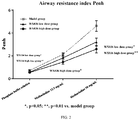
- the compound reduces the total white blood cells in BALF, has remarkable anti-inflammatory effect, takes effect at a low dose, and reduces the airway resistance index Penh.
- the valence of each atom is normal in the compound formed by connecting each group, and the formed compound can exist stably.
- the listed linking groups in the present application have the direction for linking.
- the linking group L is -N(R 6 )C(O)-
- the -N(R 6 )C(O)- links two ends in a direction same as left-to-right reading order to form
- L is -C(O)N(R 6 )-
- the -C(O)N(R 6 )- links two ends in a direction same as left-to-right reading order to form
- a combination of the linking group, a substituent and/or a variant thereof is permissible only if the combination can result in a stable compound.
- pharmaceutically acceptable is used herein for those compounds, materials, compositions, and/or dosage forms which are, within the scope of sound medical judgment, suitable for use in contact with the tissues of human beings and animals without excessive toxicity, irritation, allergic response, or other problems or complications, and commensurate with a reasonable benefit/risk ratio.
- a pharmaceutically acceptable salt may be a metal salt, an ammonium salt, a salt formed with an organic base, a salt formed with an inorganic acid, a salt formed with an organic acid, a salt formed with a basic or acidic amino acid, and the like.
- the pharmaceutically acceptable salts disclosed herein can be synthesized from a parent compound having an acidic or basic group by conventional chemical methods.
- such salts are prepared by the following method: the free acid or base form of the compound reacting with a stoichiometric amount of the appropriate base or acid in water or an organic solvent or a mixture thereof.
- the compounds disclosed herein can be in the form of a geometric isomer or stereoisomer. All such compounds are contemplated herein, including cis-isomers and trans-isomers, (-)- and (+)- enantiomers, (R)- and (S)- enantiomers, diastereomers, (D)-isomers, (L)-isomers, and racemic mixtures and other mixtures thereof, such as an enantiomer or diastereomer enriched mixture, all of which are included within the scope of the present application. Substituents such as alkyl may have an additional asymmetric carbon atom. All these isomers and mixtures thereof are encompassed within the scope of the present application.
- tautomer or "tautomeric form” refers to structural isomers of different energies that can interconvert via a low energy barrier.
- a proton tautomer also referred to as prototropic tautomer
- proton transfer such as keto-enol isomerization and imine-enamine isomerization.
- a specific example of the proton tautomer is an imidazole moiety where a proton can transfer between two ring nitrogens.
- a valence tautomer includes the interconversion via recombination of some bonding electrons.
- the compound disclosed herein can be asymmetrical, for example, has one or more stereoisomers. Unless otherwise stated, all stereoisomers are included, for example, enantiomers and diastereoisomers.
- the compound with asymmetric carbon atoms disclosed herein can be separated in an optically pure form or in a racemic form.
- the optically pure form can be separated from a racemic mixture or can be synthesized using a chiral raw material or a chiral reagent.
- Optically active (R)- and (S)-isomers and D and L isomers can be prepared by chiral synthesis or chiral reagents or other conventional techniques.
- An enantiomer of certain compound disclosed herein can be prepared by asymmetric synthesis or derivatization using a chiral auxiliary, wherein the resulting diastereomeric mixture is separated and the auxiliary group is cleaved so as to provide the desired pure enantiomer.
- the compound when the molecule contains a basic functional group (such as amino) or an acidic functional group (such as carboxyl), the compound reacts with an appropriate optically active acid or base to form a salt of the diastereoisomer, which is then subjected to diastereomeric resolution through conventional methods in the art to get the pure enantiomer.
- the enantiomer and the diastereomer are generally isolated through chromatography using a chiral stationary phase, optionally in combination with chemical derivatization (e.g., carbamate formation from amines).
- the present application also comprises isotopically-labeled compounds which are identical to those recited herein but one or more atoms thereof are replaced by an atom having an atomic mass or mass number different from the atomic mass or mass number usually found in nature.
- isotopes that can be incorporated into the compounds disclosed herein include isotopes of hydrogen, carbon, nitrogen, oxygen, phosphorus, sulfur, fluorine, iodine, and chlorine, such as 2 H, 3 H, 11 C, 13 C, 14 C, 13 N, 15 N, 15 O, 17 O, 18 O, 31 P, 32 P, 35 S, 18 F, 123 I, 125 I and 36 Cl.
- the compound disclosed herein may contain an unnatural proportion of atomic isotope at one or more of the atoms that constitute the compound.
- the compound may be labeled with a radioisotope, such as tritium ( 3 H), iodine-125 ( 125 I), or C-14 ( 14 C).
- a radioisotope such as tritium ( 3 H), iodine-125 ( 125 I), or C-14 ( 14 C).
- hydrogen can be substituted by deuterium to form a deuterated drug, and the bond formed by deuterium and carbon is firmer than that formed by common hydrogen and carbon.
- the deuterated drug Compared with an un-deuterated drug, the deuterated drug has the advantages of reduced toxic side effect, increased stability, enhanced efficacy, prolonged biological half-life and the like. All isotopic variations of the compound described herein, whether radioactive or not, are encompassed within the scope of the present application.
- substitution with heavier isotopes such as deuterium may provide certain therapeutic advantages (e.g., increased in vivo half-life or reduced dosage requirement) resulting from greater metabolic stability and hence may be preferred in some circumstances in which deuterium substitution may be partial or complete, wherein partial deuterium substitution refers to substitution of at least one hydrogen with at least one deuterium.
- substituted means that one or more hydrogen atoms on a specific atom are substituted by substituents which may include deuterium and hydrogen variants, as long as the valence of the specific atom is normal and the compound after substitution is stable.
- substituents which may include deuterium and hydrogen variants, as long as the valence of the specific atom is normal and the compound after substitution is stable.
- Substitution by oxygen does not occur on aromatic groups.
- variable e.g., R
- the definition of the variable in each case is independent.
- the group can be optionally substituted by two R at most, and the definition of R in each case is independent.
- a combination of a substituent and/or a variant thereof is permissible only if the combination can result in a stable compound.
- variable When a variable is a single bond, it means that the two groups are directly linked. For example, in A-L-Z, when L represents a single bond, it means that the structure is actually A-Z.
- substituent When a bond of a substituent is cross-linked to two atoms on a ring, the substituent can be bonded to any atom on the ring.
- structural unit represents that substitution may occur at any position of cyclohexyl or cyclohexadienyl.
- halo- or halogen refers to fluorine, chlorine, bromine and iodine.
- hydroxy refers to -OH group.
- cyano refers to -CN group.
- amino refers to -NH 2 group.
- substituent When a substituent is absent, it means that the substituent does not exist. For example, when X is absent in A-X, the structure of A-X is actually A. When it is not specified by which atom the listed substituent is linked to the group to be substituted, the substituent can be linked via any atom of the group. For example, pyridinyl as a substituent can be linked to the group to be substituted through any carbon atom on the pyridine ring.
- alkyl refers to hydrocarbyl with a general formula of C n H 2n+1 .
- the alkyl can be linear or branched.
- C 1-6 alkyl refers to alkyl with 1-6 carbon atoms (for example, methyl, ethyl, n -propyl, isopropyl, n -butyl, isobutyl, sec -butyl, tert -butyl, n -pentyl, 1-methylbutyl, 2-methylbutyl, 3-methylbutyl, neopentyl, hexyl, 2-methylpentyl, etc .).
- the alkyl moiety (namely alkyl) of alkoxy, alkylamino, dialkylamino, alkylsulfonyl and alkylthio is similarly defined as above.
- alkoxy refers to -O-alkyl
- C n-n+m or C n- C n+m includes any one of the specific cases of n to n+m carbons; for example, C 1-12 includes C 1 , C 2 , C 3 , C 4 , C 5 , C 6 , C 7 , C 8 , C 9 , C 10 , C 11 and C 12 ; C n-n+m or C n -C n+m also includes any one of the ranges of n to n+m; for example, C 1-12 includes C 1-3 , C 1-6 , C 1-9 , C 3-6 , C 3-9 , C 3-12 , C 6-9 , C 6-12 , C 9-12 , etc.
- n-n+m membered represents the number of atoms on the ring is n to n+m; for example, 3-12 membered ring includes 3 membered ring, 4 membered ring, 5 membered ring, 6 membered ring, 7 membered ring, 8 membered ring, 9 membered ring , 10 membered ring, 11 membered ring and 12 membered ring; n-n+m membered also represents any range in n to n+m; for example, 3-12 membered ring includes 3-6 membered ring, 3-9 membered ring, 5-6 membered ring, 5-7 membered ring, 6-7 membered ring, 6-8 membered ring, 6-10 membered ring, etc.
- heterocyclyl refers to a fully saturated or partially unsaturated (but not fully unsaturated heteroaromatic group) nonaromatic ring which may exist in the form of a monocyclic, bridged cyclic or spiro structure. Unless otherwise specified, the heterocyclyl is usually a 3-7 membered ring containing 1-3 heteroatoms (preferably 1 or 2 heteroatoms) independently selected from the group consisting of sulfur, oxygen and/or nitrogen.
- heterocyclyl examples include, but are not limited to, oxiranyl, tetrahydrofuranyl, dihydrofuranyl, pyrrolidinyl, N -methylpyrrolidinyl, dihydropyrrolyl, piperidinyl, piperazinyl, pyrazolidinyl, 4 H -pyranyl, morpholinyl, thiomorpholinyl, tetrahydrothienyl, dihydropyridazinyl, dihydropyrimidinyl, dihydropyridinyl, dihydroimidazolyl, dihydroisoxazolyl, dihydrotriazolyl, and dihydropyridazinyl.
- the heterocyclyl is a monocyclic heterocyclyl with 5 ring atoms.
- heteroaryl refers to a monocyclic or fused polycyclic system which comprises at least one ring atom selected from the group consisting of N, O and S, with the remaining ring atoms being C, and which has at least one aromatic ring.
- the heteroaryl has a single 4-8 membered ring, in particular, a 5-8 membered ring, or is a plurality of fused rings comprising 6-14 ring atoms, in particular 6-10 ring atoms.
- heteroaryl include, but are not limited to, pyrrolyl, furanyl, thienyl, imidazolyl, oxazolyl, pyrazolyl, pyridinyl, pyrimidinyl, pyrazinyl, quinolyl, isoquinolyl, tetrazolyl, triazolyl, triazinyl, benzofuranyl, benzothienyl, indolyl, isoindolyl, isoxazolyl, oxadiazolyl, thiadiazolyl, and thiazolyl.
- treating refers to administering the compound or formulation described herein to prevent, ameliorate or eliminate a disease or one or more symptoms associated with the disease, and includes:
- terapéuticaally effective amount refers to an amount of the compound disclosed herein for (i) treating or preventing a specific disease, condition or disorder, (ii) alleviating, improving or eliminating one or more symptoms of a specific disease, condition or disorder, or (iii) preventing or delaying onset of one or more symptoms of a specific disease, condition or disorder described herein.
- the amount of the compound disclosed herein composing the “therapeutically effective amount” varies dependently on the compound, the disease state and its severity, the administration regimen, and the age of the mammal to be treated, but can be determined routinely by those skilled in the art in accordance with their knowledge and the present disclosure.
- pharmaceutical composition refers to a mixture consisting of one or more of the compounds or pharmaceutically acceptable salts thereof disclosed herein and a pharmaceutically acceptable excipient.
- the pharmaceutical composition is intended to facilitate the administration of the compound disclosed herein to an organic entity.
- pharmaceutically acceptable excipients refers to those excipients which do not have a significant irritating effect on an organic entity and do not impair the biological activity and properties of the active compound. Suitable excipients are well known to those skilled in the art, such as carbohydrate, wax, water-soluble and/or water-swellable polymers, hydrophilic or hydrophobic material, gelatin, oil, solvent, water.
- the pharmaceutical composition disclosed herein can be prepared by combining the compound disclosed herein with a suitable pharmaceutically acceptable excipient, and can be formulated.
- a suitable pharmaceutically acceptable excipient for example, it can be formulated into a solid, semisolid, liquid, or gaseous formulation, such as tablet, pill, capsule, powder, granule, ointment, emulsion, suspension, suppository, injection, inhalant, gel, microsphere and aerosol.
- Typical routes of administration of a compound or a pharmaceutically acceptable salt thereof or a pharmaceutical composition thereof disclosed herein include, but are not limited to, oral, rectal, local, inhalation, parenteral, sublingual, intravaginal, intranasal, intraocular, intraperitoneal, intramuscular, subcutaneous and intravenous administration.
- composition disclosed herein can be manufactured by methods well known in the art, such as by conventional mixing, dissolving, granulating, dragee-making, levigating, emulsifying and lyophilizing.
- the pharmaceutical composition is in an oral form.
- the pharmaceutical composition can be formulated by mixing the active compounds with pharmaceutically acceptable excipients well known in the art. These excipients enable the compounds disclosed herein to be formulated into tablets, pills, pastilles, dragees, capsules, liquids, gels, slurries, suspensions and the like for oral administration to a patient.
- a solid oral composition can be prepared by conventional mixing, filling or tableting. For example, it can be obtained by the following method: mixing the active compounds with solid excipients, optionally grinding the resulting mixture, adding additional suitable excipients if desired, and processing the mixture into granules to get the core parts of tablets or dragees.
- suitable excipients include, but are not limited to, binders, diluents, disintegrants, lubricants, glidants, sweeteners or flavoring agents.
- compositions may also be suitable for parenteral administration, such as sterile solutions, suspensions or lyophilized products in suitable unit dosage forms.
- the daily dose administered is from 0.01-200 mg/kg body weight.
- the compounds disclosed herein can be prepared by a variety of synthetic methods well known to those skilled in the art, including the specific embodiments listed below, embodiments formed by combinations thereof with other chemical synthetic methods, and equivalents thereof known to those skilled in the art.
- the preferred embodiments include, but are not limited to, the examples disclosed herein.
- the compound of formula (I) disclosed herein may be prepared by one skilled in the art of organic synthesis using standard methods in the art by the following routes: Preparation of intermediates:
- HATU O-(7-azabenzotriazol-1-yl)- N,N',N'- tetramethyluronium hexafluorophosphate
- DMF N,N -dimethylformamide
- DMSO dimethyl sulfoxide
- Boc for t -butoxycarbonyl, an amine protecting group
- DIPEA diisopropylethylamine
- Me for methyl
- SEM for Me 3 SiCH 2 CH 2 OCH 2
- LHMDS lithium bis(trimethylsilyl)amide
- prep-TLC for preparative thin-layer chromatography
- T 3 P for 1- n -propylphosphonic anhydride
- Tris-HCI Tris(hydroxymethyl)aminomethane-hydrochloric acid
- AMP for adenylic acid
- GMP guanylic acid
- TNF-acid for tumor necrosis factor ⁇
- ED ED
- Step 1 synthesis of compound BB-1-2
- Step 2 synthesis of compound BB-1-3
- Phosphorus oxychloride (379.50 g, 230.00 ml) was heated to 85 °C under nitrogen atmosphere and compound BB-1-2 (26.00 g) was added in portions. The reaction mixture was stirred at 85 °C for 2 hours. After the reaction was completed, most of the phosphorus oxychloride was removed by reduced pressure distillation. To the residue was added dichloromethane (200 ml) and the mixture was washed with water (100 ml x 2). The organic phase was dried over anhydrous sodium sulfate, filtered to remove the desiccant, and then concentrated under reduced pressure. The resulting crude product was purified by slurrying with ethyl acetate (20 ml) to give compound BB-1-3.
- Step 3 synthesis of compound BB-1-4
- Step 4 synthesis of compound BB-1-5
- Step 5 synthesis of compound BB-1-6
- Step 6 synthesis of compound BB-1
- Step 1 synthesis of compound BB-2-2
- Step 2 synthesis of compound BB-2-3
- Step 3 synthesis of compound BB-2-4
- Step 4 synthesis of compound BB-2
- Step 1 synthesis of compound BB-3-2
- Step 2 synthesis of compound BB-3-3
- Step 3 synthesis of compound BB-3-4
- Step 4 synthesis of compound BB-3
- Step 1 synthesis of compound BB-4-1
- Step 2 synthesis of compound BB-4
- Step 1 synthesis of compound BB-7
- Step 1 synthesis of compound WX005-2
- Step 1 synthesis of compound WX010-1
- Step 1 synthesis of compound WX015
- Example Fragment 1 Fragment 2 Structure of compound Compound number 19 BB-4 WX016 20 BB-4 WX017 21 BB-4 WX018 22 BB-4 WX019 23 BB-4 WX020 24 BB-4 WX021 25 BB-4 WX022 26 BB-4 WX023 27 BB-4 WX024 28 BB-4 WX025 29 BB-4 WX026 30 BB-4 WX027 31 BB-4 WX028 32 BB-4 WX029 33 BB-4 WX030 34 BB-4 WX031 35 BB-4 WX032 36 BB-4 WX033 37 BB-4 WX034 38 BB-4 WX035 39 BB-4 WX036 40 BB-4 WX037 41 BB-4 WX038 42 BB-4 WX039 43 BB-4 WX040 44 BB-4 WX041 45 BB-4 WX042 46 BB-4 WX037 41 BB-4 WX038 42 BB-4 WX0
- Step 1 synthesis of compound WX054-2
- the compound WX054-1 (174.4 mg) was dissolved in THF (4 ml) at room temperature, and then the mixture was cooled to 0 °C, followed by adding LHMDS (1 mol/L, 1.02 ml) dropwise. The resulting mixture was kept at 0 °C and stirred for 0.5 hour, and then a solution of compound BB-7 (200 mg) in THF (2 ml) was added dropwise. Then the mixture was allowed to warm to 30 °C naturally after the addition, and stirred for an additional 2 hours. The reaction was quenched with water (10 ml), and ethyl acetate (10 ml ⁇ 3) was added for extraction.
- Step 1 synthesis of compound WX058-1
- Step 1 synthesis of compound WX064-2
- Step 1 synthesis of compound WX065-5
- Experimental objective to determine the AMP/GMP expression based on fluorescence polarization, i.e. , to trace binding of AMP/GMP to antibody so as to indicate enzyme activity.
- Experimental buffer solution 10 mm Tris-HCI (pH 7.5), 5 mm MgCl 2 , 0.01% Brij 35, 1 mm Dithiothreitol (DTT), and 1% DMSO.
- Enzyme recombinant human PDE3A (Gene accession number: NM_000921; amino acid 669-end) was expressed by baculovirus in Sf9 insect cells using an N-terminal GST tag, with molecularweight being 84 kDa.
- Enzyme substrate 1 ⁇ M cAMP Detection: Transcreener®AMP2/GMP2 antibody and AMP2/GMP2 AlexaFluor633 tracer.
- Experimental objective to determine the AMP/GMP expression based on fluorescence polarization, i.e. , to trace binding of AMP/GMP to antibody so as to indicate enzyme activity.
- Experimental buffer solution 10 mm Tris-HCI (pH 7.5), 5 mm MgCl 2 , 0.01% Brij 35, 1 mm DTT, and 1% DMSO.
- Enzyme recombinant human PDE4B (Gene accession number: NM_002600; amino acid 305-end) was expressed by baculovirus in Sf9 insect cells using an N-terminal GST tag, with molecularweight being 78 kDa.
- Enzyme substrate 1 ⁇ M cAMP
- mice peripheral blood mononuclear cells
- LC-MS/MS liquid chromatography-tandem mass spectrometry
- the animals were all subjected to approximately 500 ⁇ L of blood collection each time from peripheral veins at 0.0333, 0.0833, 0.25, 0.5, 1, 2, 4, 6, 8, and 24 hours post-dose, and the blood was transferred into commercial centrifuge tubes containing 0.85-1.15 mg of K 2 EDTA*2H 2 O anticoagulant, and plasma was taken by centrifugation at 3000 g for 10 minutes at 4 °C.
- the plasma concentration was measured by LC-MS/MS method, and the relevant pharmacokinetic parameters were calculated by WinNonlinTM Version 6.3 (Pharsight, Mountain View, CA) pharmacokinetic software using non-compartmental model linear logarithmic trapezoid method. Table 3.
- a total of 5 specific probe substrates of 5 isoenzymes of CYP namely phenacetin (CYP1A2), diclofenac (CYP2C9), (S)-mephenytoin (CYP2C19), dextromethorphan (CYP2D6) and midazolam (CYP3A4) are each co-incubated with human liver microsomes and test compound, and then reduced nicotinamide adenine dinucleotide phosphate (NADPH) was added to initiate the reaction.
- CYP1A2 phenacetin
- CYP2C9 diclofenac
- S S-mephenytoin
- CYP2D6 dextromethorphan
- CYP3A4 midazolam
Landscapes
- Chemical & Material Sciences (AREA)
- Organic Chemistry (AREA)
- Health & Medical Sciences (AREA)
- Medicinal Chemistry (AREA)
- Pharmacology & Pharmacy (AREA)
- Life Sciences & Earth Sciences (AREA)
- Animal Behavior & Ethology (AREA)
- General Health & Medical Sciences (AREA)
- Public Health (AREA)
- Veterinary Medicine (AREA)
- Pulmonology (AREA)
- Epidemiology (AREA)
- Engineering & Computer Science (AREA)
- Bioinformatics & Cheminformatics (AREA)
- Chemical Kinetics & Catalysis (AREA)
- General Chemical & Material Sciences (AREA)
- Nuclear Medicine, Radiotherapy & Molecular Imaging (AREA)
- Pharmaceuticals Containing Other Organic And Inorganic Compounds (AREA)
- Nitrogen Condensed Heterocyclic Rings (AREA)
- Nitrogen And Oxygen Or Sulfur-Condensed Heterocyclic Ring Systems (AREA)
Abstract
Description
- The present application claims the benefit and priority to the Chinese Patent No.
201810772374.3 - The present application relates to a tricyclic compound as a PDE3/PDE4 dual inhibitor, a preparation method thereof, a pharmaceutical composition containing the compound, and use thereof in treating a disease related to PDE3/PDE4, in particular chronic obstructive pulmonary disease (COPD).
- Phosphodiesterases (PDEs) are a superfamily of enzyme systems and comprise 11 families, each of which is involved in different signaling and regulates different physiological processes. Among them, PDE3 is a major phosphodiesterase in human airway smooth muscle (ASM), and inhibition of PDE3 increases intracellular cAMP concentration and thus slackening bronchial smooth muscle. PDE4 plays a major regulatory role in the expression of proinflammatory and anti-inflammatory mediators, and a PDE4 inhibitor can inhibit the release of harmful mediators from inflammatory cells. Thus, in theory, an inhibitor that inhibits both PDE3 and PDE4 would have both the bronchodilation of a beta-adrenoreceptor agonist and the anti-inflammatory action of an inhaled glucocorticoid. The complementation of dual targeting functions is theoretically more effective than single targeting, and the treatment effect which can be achieved only by combined medication at present is achieved by a single medicament, thus the defect that the physicochemical properties of the ingredients of medicaments used in the combined medication cannot be completely matched is eliminated, the administration mode is simplified, and convenient determination of administration dosage is realized. It has been reported by Victoria Boswell et al., J. Pharmaco. Experi. Therap. 2006, 318, 840-848 and
WO200005830 
- In one aspect, the present application provides a compound of formula (I), an isomer thereof or a pharmaceutically acceptable salt thereof,

- ring Cy is selected from the group consisting of 5 membered heterocyclyl and 5 membered heteroaryl, wherein the 5 membered heterocyclyl or 5 membered heteroaryl is optionally substituted by one or more of the following groups: amino, hydroxy, =O, halogen, cyano, C1-12 alkyl, -C(O)NH2, -C(O)NH(C1-6 alkyl), -C(O)N(C1-6 alkyl)2, -COOH, -C(O)O(C1-6 alkyl) or C1-12 alkoxy, wherein the C1-12 alkyl or C1-12 alkoxy is optionally substituted by one or more groups selected from the group consisting of halogen, amino and hydroxy;
- ring atoms of the ring Cy comprise at least one nitrogen atom;
- L is selected from the group consisting of -N(R6)-, -N(R6)C(O)-, -C(O)N(R6)-, -O-, -S-, -OC(O)-, -C(O)O-, -CH2N(R6)C(O)-, -CH2C(O)N(R6)-, -S(O)2NH-, -NHS(O)2- and a single bond;
- n is 1, 2, 3 or 4;
- E1 is -(CH2)m-, wherein m is 1, 2 or 3;
- E2 is selected from the group consisting of -O-, -NH-, -S- and a single bond;
- R3, R4 and R5 are each independently selected from the group consisting of hydrogen, halogen and C1-6 alkyl, wherein the C1-6 alkyl is optionally substituted by one or more groups selected from the group consisting of halogen, amino and hydroxy; and
- each R6 is independently selected from the group consisting of hydrogen, hydroxy and C1-3 alkyl, wherein the C1-3 alkyl is optionally substituted by one or more groups selected from the group consisting of halogen, amino and hydroxy.
- In some embodiments, ring Cy is selected from the group consisting of 5 membered heterocyclyl and 5 membered heteroaryl, wherein the 5 membered heteroaryl or 5 membered heteroaryl is optionally substituted by one or more of the following groups: amino, hydroxy, =O, halogen, cyano, C1-6 alkyl, -C(O)NH2, -C(O)NH(C1-3 alkyl), -C(O)N(C1-3 alkyl)2, -COOH, -C(O)O(C1-3 alkyl), C1-6 alkoxy, or C1-6 alkyl substituted by one or more halogens; in some embodiments, ring Cy is selected from the group consisting of 5 membered heterocyclyl and 5 membered heteroaryl, wherein the 5 membered heteroaryl is optionally substituted by one or more of the following groups: amino, hydroxy, halogen, cyano, C1-6 alkyl, -C(O)NH2, -C(O)NH(C1-3 alkyl), -C(O)N(C1-3 alkyl)2, -COOH, - C(O)O(C1-3 alkyl), C1-6 alkoxy, or C1-6 alkyl substituted by one or more halogens, wherein the 5 membered heterocyclyl is optionally substituted by one or more =O; in some embodiments, ring Cy is selected from the group consisting of oxazolidin-2-one, imidazolyl, pyrazolyl, oxazolyl, triazolyl, oxadiazolyl, tetrazolyl, thiadiazolyl and isoxazolyl, wherein the imidazolyl, pyrazolyl, oxazolyl, triazolyl, oxadiazolyl, tetrazolyl, thiadiazolyl or isoxazolyl is optionally substituted by one or more of the following groups: amino, hydroxy, halogen, cyano, C1-6 alkyl, -C(O)NH2, -C(O)NH(C1-3 alkyl), -C(O)N(C1-3 alkyl)2, -COOH, -C(O)O(C1-3 alkyl), C1-6 alkoxy, or C1-6 alkyl substituted by one or more halogens.
- In some embodiments, ring Cy is 5 membered heteroaryl, wherein the 5 membered heteroaryl is optionally substituted by one or more of the following groups: amino, hydroxy, fluoro, chloro, bromo, iodo, cyano, C1-3 alkyl, -C(O)NH2, -C(O)O(C1-3 alkyl), C1-3 alkoxy, or C1-3 alkyl substituted by one or more halogens; in some embodiments, ring Cy is selected from the group consisting of imidazolyl, pyrazolyl, oxazolyl, triazolyl, oxadiazolyl, tetrazolyl, thiadiazolyl and isoxazolyl, wherein the imidazolyl, pyrazolyl, oxazolyl, triazolyl, oxadiazolyl, tetrazolyl, thiadiazolyl or isoxazolyl is optionally substituted by one or more of the following groups: amino, hydroxy, fluoro, chloro, bromo, iodo, cyano, C1-3 alkyl, -C(O)NH2, -C(O)O(C1-3 alkyl), C1-3 alkoxy, or C1-3 alkyl substituted by one or more halogens.
- In some embodiments, ring Cy is 5-membered heteroaryl, wherein the 5-membered heteroaryl is optionally substituted by one or more of the following groups: amino, hydroxy, fluoro, chloro, cyano, methyl, -C(O)NH2, -C(O)OCH3, methoxy or trifluoromethyl; in some embodiments, ring Cy is selected from the group consisting of imidazolyl, pyrazolyl, oxazolyl, triazolyl, oxadiazolyl, tetrazolyl, thiadiazolyl and isoxazolyl, wherein the imidazolyl, pyrazolyl, oxazolyl, triazolyl, oxadiazolyl, tetrazolyl, thiadiazolyl or isoxazolyl is optionally substituted by one or more of the following groups: amino, hydroxy, fluoro, chloro, cyano, methyl, -C(O)NH2, -C(O)OCH3, methoxy or trifluoromethyl.
- In some embodiments, ring Cy is selected from the group consisting of structural units


- represents a single bond or double bond;

- T1, T2, T3 and T4 are each independently selected from the group consisting of C=O, C(R1), C(R1)2, O, N(R2), N and S;
- each R1 is independently selected from the group consisting of hydrogen, amino, hydroxy, halogen, cyano, C1-12 alkyl, -C(O)NH2, -C(O)NH(C1-6 alkyl), -C(O)N(C1-6 alkyl)2, -COOH, -C(O)O(C1-6 alkyl) and C1-12 alkoxy, wherein the C1-12 alkyl or C1-12 alkoxy is optionally substituted by one or more groups selected from the group consisting of halogen, amino and hydroxy; and each R2 is independently selected from the group consisting of hydrogen, hydroxy and C1-3 alkyl, wherein the C1-3 alkyl is optionally substituted by one or more groups selected from the group consisting of halogen, amino and hydroxy.
- In some embodiments, ring Cy is the structural unit

- represents a single bond or double bond;
- T1, T2, T3 and T4 are each independently selected from the group consisting of C(R1), C(R1)2, O, N(R2), N and S;
- each R1 is independently selected from the group consisting of hydrogen, amino, hydroxy, halogen, cyano, C1-12 alkyl, -C(O)NH2, -C(O)NH(C1-6 alkyl), -C(O)N(C1-6 alkyl)2, -COOH, -C(O)O(C1-6 alkyl) and C1-12 alkoxy, wherein the C1-12 alkyl or C1-12 alkoxy is optionally substituted by one or more groups selected from the group consisting of halogen, amino and hydroxy; and each R2 is independently selected from the group consisting of hydrogen, hydroxy and C1-3 alkyl, wherein the C1-3 alkyl is optionally substituted by one or more groups selected from the group consisting of halogen, amino and hydroxy. In some embodiments, ring Cy is the structural unit

- T1, T2, T3 and T4 are each independently selected from the group consisting of C=O, C(R1)2, O, N(R2) and S;
- each R1 is independently selected from the group consisting of hydrogen, amino, hydroxy, halogen, cyano, C1-12 alkyl, -C(O)NH2, -C(O)NH(C1-6 alkyl), -C(O)N(C1-6 alkyl)2, -COOH, -C(O)O(C1-6 alkyl) and C1-12 alkoxy, wherein the C1-12 alkyl or C1-12 alkoxy is optionally substituted by one or more groups selected from the group consisting of halogen, amino and hydroxy; and each R2 is independently selected from the group consisting of hydrogen, hydroxy and C1-3 alkyl, wherein the C1-3 alkyl is optionally substituted by one or more groups selected from the group consisting of halogen, amino and hydroxy. In some embodiments, T1 is selected from the group consisting of C(R1), C(R1)2 and N, and T2, T3 and T4 are each independently selected from the group consisting of C=O, C(R1), C(R1)2, O, N(R2), N and S.
- In some embodiments, T1 is selected from the group consisting of C(R1) and N, and T2, T3 and T4 are each independently selected from the group consisting of C=O, C(R1), O, N(R2), N and S.
- In some embodiments, T1 is selected from the group consisting of C(R1) and N, and T2, T3 and T4 are each independently selected from the group consisting of C(R1), O, N(R2), N and S.
- In some embodiments, in the structural unit

- In some embodiments, in the structural unit
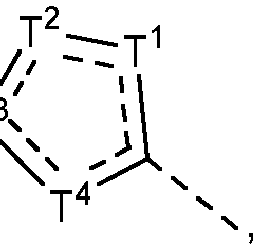
- In some embodiments, in the structural unit

- In some embodiments, each R1 is independently selected from the group consisting of hydrogen, amino, hydroxy, halogen, cyano, C1-6 alkyl, -C(O)NH2, -C(O)NH(C1-3 alkyl), -C(O)N(C1-3 alkyl)2, -COOH, -C(O)O(C1-3 alkyl) and C1-6 alkoxy, wherein the C1-6 alkyl or C1-6 alkoxy is optionally substituted by one or more groups selected from the group consisting of halogen, amino and hydroxy; in some embodiments, each R1 is independently selected from the group consisting of hydrogen, amino, hydroxy, halogen, cyano, C1-6 alkyl, -C(O)NH2, -C(O)O(C1-3 alkyl) and C1-3 alkoxy, wherein the C1-6 alkyl or C1-3 alkoxy is optionally substituted by one or more groups selected from the group consisting of halogen, amino and hydroxy; in some embodiments, each R1 is independently selected from the group consisting of hydrogen, amino, hydroxy, halogen, cyano, C1-6 alkyl, -C(O)NH2, -C(O)O(C1-3 alkyl) and C1-3 alkoxy, wherein the C1-6 alkyl is optionally substituted by one or more groups selected from the group consisting of halogen, amino and hydroxy; in some embodiments, each R1 is independently selected from the group consisting of hydrogen, amino, hydroxy, halogen, cyano, C1-3 alkyl, -C(O)NH2, -C(O)OCH3 and C1-3 alkoxy, wherein the C1-3 alkyl or C1-3 alkoxy is optionally substituted by one or more groups selected from the group consisting of halogen, amino and hydroxy; in some embodiments, each R1 is independently selected from hydrogen, amino, hydroxy, halogen, cyano, C1-3 alkyl, -C(O)NH2, -C(O)OCH3 and C1-3 alkoxy, wherein the C1-3 alkyl is optionally substituted by one or more groups selected from the group consisting of halogen, amino and hydroxy; in some embodiments, each R1 is independently selected from the group consisting of hydrogen, amino, hydroxy, halogen, cyano, C1-3 alkyl, -C(O)NH2, -C(O)OCH3 and C1-3 alkoxy, wherein the C1-3 alkyl is optionally substituted by 1, 2, or 3 halogens, amino, or hydroxy; in some embodiments, each R1 is independently selected from the group consisting of hydrogen, amino, hydroxy, fluoro, chloro, cyano, methyl, -C(O)NH2, -C(O)OCH3, methoxy and trifluoromethyl. In some embodiments, each R1 is independently selected from the group consisting of hydrogen, amino, hydroxy, C1-6 alkyl and C1-6 alkoxy, wherein the C1-6 alkyl or C1-6 alkoxy is optionally substituted by one or more groups selected from the group consisting of halogen, amino and hydroxy; in some embodiments, each R1 is independently selected from the group consisting of hydrogen, amino, hydroxy, C1-3 alkyl and C1-3 alkoxy; in some embodiments, each R1 is independently selected from the group consisting of hydrogen, amino, hydroxy, methyl and methoxy.
- In some embodiments, each R2 is independently selected from the group consisting of hydrogen, hydroxy and C1-3 alkyl, wherein the C1-3 alkyl is optionally substituted by one or more halogens, amino or hydroxy; in some embodiments, each R2 is independently selected from the group consisting of hydrogen, hydroxy and C1-3 alkyl, wherein the C1-3 alkyl is optionally substituted by 1, 2 or 3 halogens, amino or hydroxy; in some embodiments, each R2 is independently selected from the group consisting of hydrogen, hydroxy and methyl; in some embodiments, each R2 is independently selected from the group consisting of hydrogen and methyl.
- In some embodiments, the structural unit





- In some embodiments, the structural unit


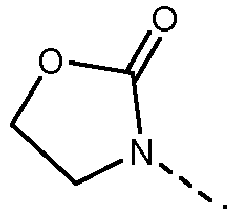
- In some embodiments, L is selected from the group consisting of -N(R6)-, -N(R6)C(O)-, -C(O)N(R6)-, -CH2N(R6)C(O)-, -CH2C(O)N(R6)-, -S(O)2NH-, -NHS(O)2-or a single bond; in some embodiments, L is selected from the group consisting of -N(R6)-, -N(R6)C(O)-, -C(O)N(R6)-, -CH2N(R6)C(O)-, -S(O)2NH- and a single bond; in some embodiments, L is selected from the group consisting of -N(R6)-, -N(R6)C(O)-, -C(O)N(R6)- and -S(O)2NH-; in some embodiments, L is selected from the group consisting of -N(R6)-, -N(R6)C(O)- and -C(O)N(R6)-; in some embodiments, L is selected from the group consisting of -NH-, -NHC(O)-, -C(O)NH-, -C(O)N(OH)-, -S(O)2NH- and a single bond; in some embodiments, L is selected from the group consisting of -NH-, -NHC(O)-, -C(O)NH- and -C(O)N(OH)-.
- In some embodiments, n is selected from the group consisting of 1, 2 and 3; in some embodiments, n is selected from the group consisting of 1 and 2; in some embodiments, n is 2.
- In some embodiments, the structural unit





- In some embodiments, the structural unit


- In some embodiments, the structural unit


- In some embodiments, R3, R4 and R5 are each independently selected from the group consisting of halogen and C1-3 alkyl, wherein the C1-3 alkyl is optionally substituted by 1, 2, or 3 halogens, amino, or hydroxy; in some embodiments, R3, R4 and R5 are each independently selected from the group consisting of halogen and methyl, wherein the methyl is optionally substituted by 1, 2, or 3 halogens, amino, or hydroxy; in some embodiments, R3, R4 and R5 are each independently selected from methyl.
- In some embodiments, each R6 is independently selected from the group consisting of hydrogen, hydroxy and methyl, wherein the methyl is optionally substituted by 1, 2 or 3 halogens, amino or hydroxy; in some embodiments, each R6 is independently selected from the group consisting of hydrogen, hydroxy and methyl; in some embodiments, each R6 is independently selected from the group consisting of hydrogen and hydroxy.
- In some embodiments, E1 is selected from the group consisting of -(CH2)2- and -(CH2)3-.
- In some embodiments, E2 is selected from the group consisting of -O- and a bond.
- In some embodiments, the structural unit -E1-E2- is selected from the group consisting of -(CH2)2- , -(CH2)3- and -(CH2)2-O-.
- In some embodiments of the present application, the compound of formula (I), the isomer thereof or the pharmaceutically acceptable salt thereof is a compound of formula (II), an isomer thereof or a pharmaceutically acceptable salt thereof,

T1, T2, T3, T4, E1, E2, L, and the structural unit
- In some embodiments, the structural unit

- In some embodiments, the structural unit -E1-E2- in the compound of formula (II) is as defined above.
- In some embodiments of the present application, the compound of formula (II), the isomer thereof or the pharmaceutically acceptable salt thereof is a compound of formula (11-1), a compound of formula (II-2) or a compound of formula (II-3), an isomer thereof or a pharmaceutically acceptable salt thereof,


- R6 is selected from the group consisting of hydrogen and hydroxy;
- T1, T2, T3, T4, E1, E2, and the structural unit

- In some embodiments, the structural units

- In some embodiments, the structural unit -E1-E2- in the compound of formula (11-1), formula (II-2), or formula (II-3) is as defined above.
- In another aspect, the present application also provides a compound of a formula, an isomer thereof or a pharmaceutically acceptable salt thereof, wherein the compound of the formula is selected from the group consisting of:








- In another aspect, the present application also provides a pharmaceutical composition comprising the compound of formula (I), the compound of formula (II), the compound of formula (11-1), the compound of formula (II-2), the compound of formula (II-3) or the specific compound described above, the isomer thereof or the pharmaceutically acceptable salt thereof. In some embodiments, the pharmaceutical composition disclosed herein also comprises a pharmaceutically acceptable excipient, carrier or diluent.
- In another aspect, the present application also provides a method for treating a disease related to PDE3 and/or PDE4 in a mammal, comprising administering to the mammal, preferably a human, in need of the treatment a therapeutically effective amount of the compound of formula (I), the compound of formula (II), the compound of formula (11-1), the compound of formula (II-2), the compound of formula (II-3) or the specific compound described above, the isomer thereof or the pharmaceutically acceptable salt thereof, or the pharmaceutical composition thereof.
- In another aspect, the present application also provides use of the compound of formula (I), the compound of formula (II), the compound of formula (11-1), the compound of formula (II-2), the compound of formula (II-3) or the specific compound, the isomer thereof or the pharmaceutically acceptable salt thereof, or the pharmaceutical composition thereof described above, in preparing a medicament for preventing or treating a disease related to PDE3 and/or PDE4.
- In another aspect, the present application also provides use of the compound of formula (I), the compound of formula (II), the compound of formula (11-1), the compound of formula (II-2), the compound of formula (II-3) or the specific compound described above, the isomer thereof or the pharmaceutically acceptable salt thereof, or the pharmaceutical composition thereof in preventing or treating a disease related to PDE3 and/or PDE4.
- In another aspect, the present application also provides the compound of formula (I), the compound of formula (II), the compound of formula (11-1), the compound of formula (II-2), the compound of formula (II-3) or the specific compound described above, the isomer thereof or the pharmaceutically acceptable salt thereof, or the pharmaceutical composition thereof for preventing or treating a disease related to PDE3 and/or PDE4.
- In some embodiments of the present application, the disease related to PDE3 and/or PDE4 is selected from asthma and chronic obstructive pulmonary disease (COPD).
- The compound disclosed herein has remarkable dual inhibition effect on PDE3 and PDE4, has significant inhibition effect on TNF-α in human peripheral blood mononuclear cells (hPBMC), and also shows excellent anti-inflammatory action in model of rat acute lung injury induced by lipopolysaccharide (LPS). The compound has high in vivo plasma clearance, low systemic exposure in plasma by oral administration and low oral bioavailability, and good safety in administration via a local route. Its inhibition effect is low on 5 isozymes (CYP1A2, CYP2C9, CYP2C19, CYP2D6 and CYP3A4) of human liver microsomal cytochrome P450, and the risk of drug-drug interaction is avoided. Besides, the compound reduces the total white blood cells in BALF, has remarkable anti-inflammatory effect, takes effect at a low dose, and reduces the airway resistance index Penh.
- Unless otherwise stated, the following terms and phrases used herein are intended to have the following meanings. A particular term or phrase, unless otherwise specifically defined, should not be considered as uncertain or unclear, but construed according to its common meaning. When referring to a trade name, it is intended to refer to its corresponding commercial product or its active ingredient.
- The valence of each atom is normal in the compound formed by connecting each group, and the formed compound can exist stably.
- The listed linking groups in the present application have the direction for linking. For example, in


- The term "pharmaceutically acceptable" is used herein for those compounds, materials, compositions, and/or dosage forms which are, within the scope of sound medical judgment, suitable for use in contact with the tissues of human beings and animals without excessive toxicity, irritation, allergic response, or other problems or complications, and commensurate with a reasonable benefit/risk ratio.
- A pharmaceutically acceptable salt, for example, may be a metal salt, an ammonium salt, a salt formed with an organic base, a salt formed with an inorganic acid, a salt formed with an organic acid, a salt formed with a basic or acidic amino acid, and the like.
- The pharmaceutically acceptable salts disclosed herein can be synthesized from a parent compound having an acidic or basic group by conventional chemical methods. In general, such salts are prepared by the following method: the free acid or base form of the compound reacting with a stoichiometric amount of the appropriate base or acid in water or an organic solvent or a mixture thereof.
- The compounds disclosed herein can be in the form of a geometric isomer or stereoisomer. All such compounds are contemplated herein, including cis-isomers and trans-isomers, (-)- and (+)- enantiomers, (R)- and (S)- enantiomers, diastereomers, (D)-isomers, (L)-isomers, and racemic mixtures and other mixtures thereof, such as an enantiomer or diastereomer enriched mixture, all of which are included within the scope of the present application. Substituents such as alkyl may have an additional asymmetric carbon atom. All these isomers and mixtures thereof are encompassed within the scope of the present application.
- The compounds and intermediates disclosed herein may also exist in different tautomeric forms, and all such forms are included within the scope of the present application. The term "tautomer" or "tautomeric form" refers to structural isomers of different energies that can interconvert via a low energy barrier. For example, a proton tautomer (also referred to as prototropic tautomer) includes interconversion via proton transfer, such as keto-enol isomerization and imine-enamine isomerization. A specific example of the proton tautomer is an imidazole moiety where a proton can transfer between two ring nitrogens. A valence tautomer includes the interconversion via recombination of some bonding electrons.
- The compound disclosed herein can be asymmetrical, for example, has one or more stereoisomers. Unless otherwise stated, all stereoisomers are included, for example, enantiomers and diastereoisomers. The compound with asymmetric carbon atoms disclosed herein can be separated in an optically pure form or in a racemic form. The optically pure form can be separated from a racemic mixture or can be synthesized using a chiral raw material or a chiral reagent.
- Optically active (R)- and (S)-isomers and D and L isomers can be prepared by chiral synthesis or chiral reagents or other conventional techniques. An enantiomer of certain compound disclosed herein can be prepared by asymmetric synthesis or derivatization using a chiral auxiliary, wherein the resulting diastereomeric mixture is separated and the auxiliary group is cleaved so as to provide the desired pure enantiomer. Alternatively, when the molecule contains a basic functional group (such as amino) or an acidic functional group (such as carboxyl), the compound reacts with an appropriate optically active acid or base to form a salt of the diastereoisomer, which is then subjected to diastereomeric resolution through conventional methods in the art to get the pure enantiomer. Furthermore, the enantiomer and the diastereomer are generally isolated through chromatography using a chiral stationary phase, optionally in combination with chemical derivatization (e.g., carbamate formation from amines).
- The present application also comprises isotopically-labeled compounds which are identical to those recited herein but one or more atoms thereof are replaced by an atom having an atomic mass or mass number different from the atomic mass or mass number usually found in nature. Examples of isotopes that can be incorporated into the compounds disclosed herein include isotopes of hydrogen, carbon, nitrogen, oxygen, phosphorus, sulfur, fluorine, iodine, and chlorine, such as 2H, 3H, 11C, 13C, 14C, 13N, 15N, 15O, 17O, 18O, 31P, 32P, 35S, 18F, 123I, 125I and 36Cl.
- The compound disclosed herein may contain an unnatural proportion of atomic isotope at one or more of the atoms that constitute the compound. For example, the compound may be labeled with a radioisotope, such as tritium (3H), iodine-125 (125I), or C-14 (14C). For another example, hydrogen can be substituted by deuterium to form a deuterated drug, and the bond formed by deuterium and carbon is firmer than that formed by common hydrogen and carbon. Compared with an un-deuterated drug, the deuterated drug has the advantages of reduced toxic side effect, increased stability, enhanced efficacy, prolonged biological half-life and the like. All isotopic variations of the compound described herein, whether radioactive or not, are encompassed within the scope of the present application.
- Furthermore, substitution with heavier isotopes such as deuterium (i.e., 2H) may provide certain therapeutic advantages (e.g., increased in vivo half-life or reduced dosage requirement) resulting from greater metabolic stability and hence may be preferred in some circumstances in which deuterium substitution may be partial or complete, wherein partial deuterium substitution refers to substitution of at least one hydrogen with at least one deuterium.
- "Optional" or "optionally" means that the subsequently described event or circumstance may, but not necessarily, occur, and the description includes instances where the event or circumstance occurs and instances where it does not.
- The term "substituted" means that one or more hydrogen atoms on a specific atom are substituted by substituents which may include deuterium and hydrogen variants, as long as the valence of the specific atom is normal and the compound after substitution is stable. When the substituent is oxygen (i.e., =O), it means that two hydrogen atoms are substituted. Substitution by oxygen does not occur on aromatic groups.
- The term "optionally substituted" means that an atom can be or cannot be substituted by a substituent. Unless otherwise specified, the type and number of the substituent may be arbitrary as long as being chemically achievable.
- When any variable (e.g., R) occurs more than once in the constitution or structure of a compound, the definition of the variable in each case is independent. Thus, for example, if a group is substituted by 0-2 R, the group can be optionally substituted by two R at most, and the definition of R in each case is independent. Furthermore, a combination of a substituent and/or a variant thereof is permissible only if the combination can result in a stable compound.
- When a variable is a single bond, it means that the two groups are directly linked. For example, in A-L-Z, when L represents a single bond, it means that the structure is actually A-Z.
- When a bond of a substituent is cross-linked to two atoms on a ring, the substituent can be bonded to any atom on the ring. For example, structural unit

- The term "halo-" or "halogen" refers to fluorine, chlorine, bromine and iodine.
- The term "hydroxy" refers to -OH group.
- The term "cyano" refers to -CN group.
- The term "amino" refers to -NH2 group.
- When a substituent is absent, it means that the substituent does not exist. For example, when X is absent in A-X, the structure of A-X is actually A. When it is not specified by which atom the listed substituent is linked to the group to be substituted, the substituent can be linked via any atom of the group. For example, pyridinyl as a substituent can be linked to the group to be substituted through any carbon atom on the pyridine ring.
- The term "alkyl" refers to hydrocarbyl with a general formula of CnH2n+1. The alkyl can be linear or branched. For example, the term "C1-6 alkyl" refers to alkyl with 1-6 carbon atoms (for example, methyl, ethyl, n-propyl, isopropyl, n-butyl, isobutyl, sec-butyl, tert-butyl, n-pentyl, 1-methylbutyl, 2-methylbutyl, 3-methylbutyl, neopentyl, hexyl, 2-methylpentyl, etc.). The alkyl moiety (namely alkyl) of alkoxy, alkylamino, dialkylamino, alkylsulfonyl and alkylthio is similarly defined as above.
- The term "alkoxy" refers to -O-alkyl.
- Unless otherwise specified, Cn-n+m or Cn-Cn+m includes any one of the specific cases of n to n+m carbons; for example, C1-12 includes C1, C2, C3, C4, C5, C6, C7, C8, C9, C10, C11 and C12; Cn-n+m or Cn-Cn+m also includes any one of the ranges of n to n+m; for example, C1-12 includes C1-3, C1-6, C1-9, C3-6, C3-9, C3-12, C6-9, C6-12, C9-12, etc. Similarly, n-n+m membered represents the number of atoms on the ring is n to n+m; for example, 3-12 membered ring includes 3 membered ring, 4 membered ring, 5 membered ring, 6 membered ring, 7 membered ring, 8 membered ring, 9 membered ring , 10 membered ring, 11 membered ring and 12 membered ring; n-n+m membered also represents any range in n to n+m; for example, 3-12 membered ring includes 3-6 membered ring, 3-9 membered ring, 5-6 membered ring, 5-7 membered ring, 6-7 membered ring, 6-8 membered ring, 6-10 membered ring, etc.
- The term "heterocyclyl" refers to a fully saturated or partially unsaturated (but not fully unsaturated heteroaromatic group) nonaromatic ring which may exist in the form of a monocyclic, bridged cyclic or spiro structure. Unless otherwise specified, the heterocyclyl is usually a 3-7 membered ring containing 1-3 heteroatoms (preferably 1 or 2 heteroatoms) independently selected from the group consisting of sulfur, oxygen and/or nitrogen. Non-limiting examples of heterocyclyl include, but are not limited to, oxiranyl, tetrahydrofuranyl, dihydrofuranyl, pyrrolidinyl, N-methylpyrrolidinyl, dihydropyrrolyl, piperidinyl, piperazinyl, pyrazolidinyl, 4H-pyranyl, morpholinyl, thiomorpholinyl, tetrahydrothienyl, dihydropyridazinyl, dihydropyrimidinyl, dihydropyridinyl, dihydroimidazolyl, dihydroisoxazolyl, dihydrotriazolyl, and dihydropyridazinyl. Preferably, the heterocyclyl is a monocyclic heterocyclyl with 5 ring atoms.
- The term "heteroaryl" refers to a monocyclic or fused polycyclic system which comprises at least one ring atom selected from the group consisting of N, O and S, with the remaining ring atoms being C, and which has at least one aromatic ring. Preferably, the heteroaryl has a single 4-8 membered ring, in particular, a 5-8 membered ring, or is a plurality of fused rings comprising 6-14 ring atoms, in particular 6-10 ring atoms. Non-limiting examples of heteroaryl include, but are not limited to, pyrrolyl, furanyl, thienyl, imidazolyl, oxazolyl, pyrazolyl, pyridinyl, pyrimidinyl, pyrazinyl, quinolyl, isoquinolyl, tetrazolyl, triazolyl, triazinyl, benzofuranyl, benzothienyl, indolyl, isoindolyl, isoxazolyl, oxadiazolyl, thiadiazolyl, and thiazolyl.
- The term "treating" refers to administering the compound or formulation described herein to prevent, ameliorate or eliminate a disease or one or more symptoms associated with the disease, and includes:
- (i) preventing the occurrence of the disease or disease state in a mammal, particularly when such a mammal is predisposed to the disease state but has not yet been diagnosed as having it;
- (ii) inhibiting a disease or disease state, i.e., arresting its development; and
- (iii) alleviating a disease or disease state, i.e., causing its regression.
- The term "therapeutically effective amount" refers to an amount of the compound disclosed herein for (i) treating or preventing a specific disease, condition or disorder, (ii) alleviating, improving or eliminating one or more symptoms of a specific disease, condition or disorder, or (iii) preventing or delaying onset of one or more symptoms of a specific disease, condition or disorder described herein. The amount of the compound disclosed herein composing the "therapeutically effective amount" varies dependently on the compound, the disease state and its severity, the administration regimen, and the age of the mammal to be treated, but can be determined routinely by those skilled in the art in accordance with their knowledge and the present disclosure.
- The term "pharmaceutical composition" refers to a mixture consisting of one or more of the compounds or pharmaceutically acceptable salts thereof disclosed herein and a pharmaceutically acceptable excipient. The pharmaceutical composition is intended to facilitate the administration of the compound disclosed herein to an organic entity.
- The term "pharmaceutically acceptable excipients" refers to those excipients which do not have a significant irritating effect on an organic entity and do not impair the biological activity and properties of the active compound. Suitable excipients are well known to those skilled in the art, such as carbohydrate, wax, water-soluble and/or water-swellable polymers, hydrophilic or hydrophobic material, gelatin, oil, solvent, water.
- The word "comprise" and variations thereof such as "comprises" or "comprising" will be understood in an open, non-exclusive sense, i.e., "including but not limited to".
- The pharmaceutical composition disclosed herein can be prepared by combining the compound disclosed herein with a suitable pharmaceutically acceptable excipient, and can be formulated. For example, it can be formulated into a solid, semisolid, liquid, or gaseous formulation, such as tablet, pill, capsule, powder, granule, ointment, emulsion, suspension, suppository, injection, inhalant, gel, microsphere and aerosol.
- Typical routes of administration of a compound or a pharmaceutically acceptable salt thereof or a pharmaceutical composition thereof disclosed herein include, but are not limited to, oral, rectal, local, inhalation, parenteral, sublingual, intravaginal, intranasal, intraocular, intraperitoneal, intramuscular, subcutaneous and intravenous administration.
- The pharmaceutical composition disclosed herein can be manufactured by methods well known in the art, such as by conventional mixing, dissolving, granulating, dragee-making, levigating, emulsifying and lyophilizing.
- In some embodiments, the pharmaceutical composition is in an oral form. For oral administration, the pharmaceutical composition can be formulated by mixing the active compounds with pharmaceutically acceptable excipients well known in the art. These excipients enable the compounds disclosed herein to be formulated into tablets, pills, pastilles, dragees, capsules, liquids, gels, slurries, suspensions and the like for oral administration to a patient.
- A solid oral composition can be prepared by conventional mixing, filling or tableting. For example, it can be obtained by the following method: mixing the active compounds with solid excipients, optionally grinding the resulting mixture, adding additional suitable excipients if desired, and processing the mixture into granules to get the core parts of tablets or dragees. Suitable excipients include, but are not limited to, binders, diluents, disintegrants, lubricants, glidants, sweeteners or flavoring agents.
- The pharmaceutical compositions may also be suitable for parenteral administration, such as sterile solutions, suspensions or lyophilized products in suitable unit dosage forms.
- In all of the administration methods of the compound of general formula I described herein, the daily dose administered is from 0.01-200 mg/kg body weight.
- The compounds disclosed herein can be prepared by a variety of synthetic methods well known to those skilled in the art, including the specific embodiments listed below, embodiments formed by combinations thereof with other chemical synthetic methods, and equivalents thereof known to those skilled in the art. The preferred embodiments include, but are not limited to, the examples disclosed herein.
- The chemical reactions of the embodiments disclosed herein are carried out in a suitable solvent that must be suitable for the chemical changes in the present application and the reagents and materials required therefor. In order to acquire the compounds disclosed herein, it is sometimes necessary for one skilled in the art to modify or select a synthesis procedure or a reaction scheme based on the existing embodiments.
- An important consideration in synthesis route planning in the art is the selection of suitable protecting groups for reactive functional groups (e.g., amino in the present application). For example, reference may be made to Greene's Protective Groups in Organic Synthesis (4th Ed.) Hoboken, New Jersey: John Wiley & Sons, Inc. All references cited herein are incorporated by reference in their entirety.
- In some embodiments, the compound of formula (I) disclosed herein may be prepared by one skilled in the art of organic synthesis using standard methods in the art by the following routes: Preparation of intermediates:

- Preparation of compound of formula (I):
- <route 1>

- <
route 2>
- <route 3>

- <
route 4>
- The solvents used herein can be commercially available. The following abbreviations are used herein: HATU for O-(7-azabenzotriazol-1-yl)-N,N',N'-tetramethyluronium hexafluorophosphate; DMF for N,N-dimethylformamide; DMSO for dimethyl sulfoxide; Boc for t-butoxycarbonyl, an amine protecting group; DIPEA for diisopropylethylamine; Me for methyl; SEM for Me3SiCH2CH2OCH2; LHMDS for lithium bis(trimethylsilyl)amide; prep-TLC for preparative thin-layer chromatography; T3P for 1-n-propylphosphonic anhydride; Tris-HCI for Tris(hydroxymethyl)aminomethane-hydrochloric acid; AMP for adenylic acid; GMP for guanylic acid; TNF-acid for tumor necrosis factor α; EDTA for ethylenediamine tetraacetic acid; THP for tetrahydropyranyl; OTs for p-toluenesulfonyl; NMP for N-methylpyrrolidone; THF for tetrahydrofuran; MeCN for acetonitrile; PyBop for benzotriazol-1-yl-oxytripyrrolidinophosphonium hexafluorophosphate; and Et for ethyl.
-
-
FIG. 1 shows the total white blood cells in bronchoalveolar lavage fluid (BALF); and -
FIG. 2 shows the methacholine- (Mch-) induced detection of pulmonary function (airway resistance index Penh). - The present application is described in detail below by way of examples. However, this is by no means disadvantageously limiting the scope of the present application. Although the present application has been described in detail herein and specific examples have also been disclosed, it will be apparent to those skilled in the art that various changes and modifications can be made to the specific embodiments without departing from the spirit and scope of the present application.
-
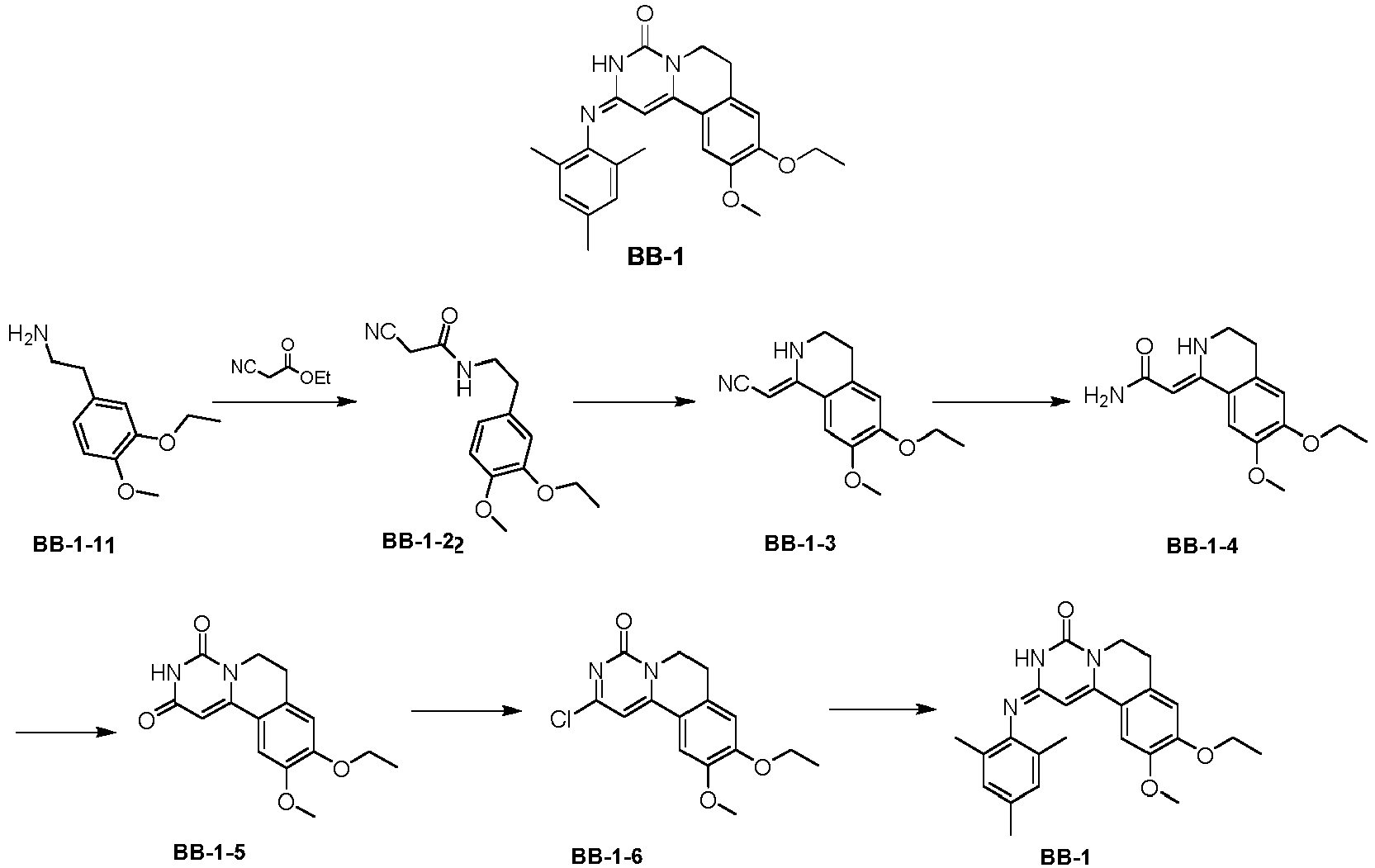
- A mixture of compound BB-1-1 (21.10 g) and ethyl cyanoacetate (11.00 g, 10.38 ml) was stirred at 100 °C for 16 hours under nitrogen atmosphere. After the reaction was completed, the mixture was cooled to 70 °C and ethanol (30 ml) was slowly added dropwise, and a large amount of solid was precipitated. The resulting mixture was filtered, and the filter cake was dried under reduced pressure to give product BB-1-2.
1H NMR (400MHz, DMSO-d6)δ = 8.26 (t, J = 5.2 Hz, 1H), 6.86 (d, J = 8.0 Hz, 1H), 6.79 (br s, 1H), 6.71 (d, 8.0 Hz, 1H),4.00 (q, J = 6.8 Hz, 2H), 3.72 (s, 3H), 3.59 (s, 2H), 3.31 - 3.23 (m, 2H), 2.64 (t, J = 7.2 Hz, 2H), 1.32 (t, J = 6.8 Hz, 3H). MS-ESI m/z: 263.1[M+H]+. - Phosphorus oxychloride (379.50 g, 230.00 ml) was heated to 85 °C under nitrogen atmosphere and compound BB-1-2 (26.00 g) was added in portions. The reaction mixture was stirred at 85 °C for 2 hours. After the reaction was completed, most of the phosphorus oxychloride was removed by reduced pressure distillation. To the residue was added dichloromethane (200 ml) and the mixture was washed with water (100 ml x 2). The organic phase was dried over anhydrous sodium sulfate, filtered to remove the desiccant, and then concentrated under reduced pressure. The resulting crude product was purified by slurrying with ethyl acetate (20 ml) to give compound BB-1-3.
1H NMR (400MHz, CD3OD)δ = 7.16 (s, 1H), 6.83 (s, 1H), 4.62 (s, 1H), 4.12 (q, J = 6.8 Hz, 2H), 3.86 (s, 3H), 3.35 (d, J = 6.4 Hz, 2H), 2.84 (t, J = 6.4 Hz, 2H), 1.44 (t, J = 6.8 Hz, 3H). MS-ESI m/z: 245.1[M+H]+. - Compound BB-1-3 (1.00 g) was added in portions to 98% concentrated sulfuric acid (12.88 g, 128.69 mmol, 7.00 ml) at 0 °C. The reaction mixture was stirred at 27 °C for 3 hours. After the reaction was completed, the mixture was added to cold water (15 ml), and then aqueous sodium hydroxide solution (4 mol/L, 32 ml) was added dropwise to adjust the pH to neutral, followed by extraction with ethyl acetate (100 ml x 3). Then the organic phases were combined, dried over anhydrous sodium sulfate, filtered to remove the desiccant, and concentrated under reduced pressure to give compound BB-1-4.
MS-ESI m/z: 263.1[M+H]+. - Sodium (2.42 g) was added to ethanol (80 ml) in portions at 0 °C. After the mixture was stirred at 28 °C for 0.5 hour, compound BB-1-4 (6.90 g) was added to the solution in portions, and the mixture was stirred at 80 °C for 0.5 hour. Diethyl carbonate (9.32 g, 9.51 ml) was then added in one portion and the mixture was stirred for an additional 5 hours at 80 °C. After the reaction was completed, the mixture was cooled to room temperature, ice water (30 ml) was slowly added, and then diluted hydrochloric acid (2 mol/L, 53 ml) was added to adjust the pH to neutral. A large amount of solid was precipitated. The mixture was filtered, and the resulting filter cake was purified by slurrying with ethanol (10 ml) to give compound BB-1-5.
1H NMR (400MHz, DMSO-d6)δ = 11.22 (br s, 1H), 7.35 (s, 1H), 6.95 (s, 1H), 6.22 (s, 1H), 4.09 (q, J = 6.8 Hz, 2H), 3.90 (br s, 2H), 3.83 (s, 3H), 2.89 (br s, 2H), 1.35 (t, J = 6.8 Hz, 3H). MS-ESI m/z: 289.1[M+H]+. - Compound BB-1-5 (5.00 g) was dissolved in phosphorus oxychloride (30 ml) at room temperature. The reaction mixture was stirred at 100 °C for 16 hours under nitrogen atmosphere. After the reaction was completed, most of the solvent was removed by reduced pressure distillation. Water (100 ml) was added and the resulting mixture was extracted with dichloromethane (150 ml x 2). Then the organic phases were combined, dried over anhydrous sodium sulfate, filtered to remove the desiccant, and concentrated under reduced pressure to give compound BB-1-6. MS-ESI m/z: 306.9[M+H]+.
- Compound BB-1-6 (925.67 mg) was dissolved in isopropanol (8 ml) at room temperature, and then 2,4,6-trimethylaniline (2.10 g) was added. The reaction mixture was stirred at 90 °C for 15 hours under nitrogen atmosphere. After the reaction was completed, the mixture was cooled to room temperature and concentrated under reduced pressure, and the resulting residue was purified by slurrying with ethanol (6 ml) to give compound BB-1.
1H NMR (400MHz, DMSO-d6)δ = 8.85 (br s, 1H), 7.27 (s, 1H), 6.97 (s, 1H), 6.90 (s, 2H), 6.45 (s, 1H), 4.10 (q, J = 6.8 Hz, 2H), 3.90 (t, J = 6.0 Hz, 2H), 3.86 (s, 3H), 2.87 (t, J = 6.0 Hz, 2H), 2.45 (s, 3H), 2.11 (s, 6H), 1.37 (t, J = 6.8 Hz, 3H). MS-ESI m/z: 406.2[M+H]+. -


- Compound BB-2-1 (8 g) and urea (9.18 g) were dissolved in water (80 ml) at room temperature and then concentrated hydrochloric acid (12 mol/L, 9.56 ml) was added dropwise, and the mixture was stirred at 110 °C for 24 hours. After the reaction was completed, the reaction solution was cooled to room temperature and filtered. Then the filter cake was washed with water (50 ml x 2) and dried in vacuum to give compound BB-2-2.
1H NMR (400 MHz, DMSO-d6)δ = 6.84 (br d, J = 8.0 Hz, 1H), 6.78 (br s, 1H), 6.69 (br d, J = 8.0 Hz, 1H), 6.02 (br t, J = 5.2 Hz, 1H), 5.43 (br s, 2H), 4.04 - 3.94 (m, 2H), 3.71 (s, 3H), 2.95 (q, J = 6.4 Hz, 2H), 2.50 - 2.40 (m, 2H), 1.66 - 1.59 (m, 2H), 1.35 - 1.25 (m, 3H). MS-ESI m/z: 253.2[M+H]+. - Sodium (6.38 g) was added to anhydrous ethanol (150 ml) in portions under nitrogen atmosphere, and the mixture was stirred until the sodium was completely dissolved to give a freshly prepared sodium ethoxide solution. Compound BB-2-2 (7 g) and diethyl malonate (11.11 g) were added and the mixture was stirred at reflux for 16 hours. The reaction solution was cooled to room temperature and concentrated under reduced pressure to remove ethanol. Water was added to dissolve the residue, and then 2 mol/L hydrochloric acid was added dropwise under an ice bath to adjust the pH to 5. The mixture was filtered with diatomite, and the filtrate was extracted with ethyl acetate (150 ml x 2). The organic phases were combined, washed with saturated brine (150 ml), drying over anhydrous sodium sulfate, filtered to remove the desiccant, and concentrated under reduced pressure. The resulting residue was purified by flash silica gel column chromatography (eluent: petroleum ether/ethyl acetate = 5/1-1/1; dichloromethane/methanol = 50/1-20/1) to give compound BB-2-3.
1H NMR (400 MHz, CD3OD)δ = 6.90 - 6.82 (m, 2H), 6.78 - 6.72 (m, 1H), 4.07 (q, J = 6.8 Hz, 2H), 3.89 - 3.84 (m, 2H), 3.81 (s, 3H), 3.37 (s, 2H), 2.62 (t, J = 7.2 Hz, 2H), 1.94 (q, J = 7.2 Hz, 2H), 1.39 (t, J = 6.8 Hz, 3H). MS-ESI m/z :321.2[M+H]+. - The compound BB-2-3 (2.4 g) was added to phosphorus oxychloride (26.40 g) under nitrogen atmosphere, and the mixture was heated to 80 °C and stirred for 12 hours. The reaction solution was cooled to room temperature and concentrated under reduced pressure to remove phosphorus oxychloride so as to give compound BB-2-4, which was used directly in next step. MS-ESI m/z: 321.1[M+H]+.
- To a solution of compound BB-2-4 (2.4 g) in THF (24 ml) was added dropwise a solution of 2,4,6-trimethylaniline (2.02 g) in THF (10 ml) at 20 °C. The mixture was stirred at 20 °C for 3 hours, and then heated to 50 °C and stirred for 2 hours. After the reaction was completed, the reaction mixture was concentrated under reduced pressure to remove most of the solvent. The residue was dissolved in ethyl acetate (50 ml), and the mixture was washed with water (50 ml) and saturated brine (50 ml) successively, dried over anhydrous sodium sulfate, filtered to remove the desiccant, and concentrated under reduced pressure. The concentrate was purified by flash silica gel column chromatography (eluent: dichloromethane/methanol = 100/1-20/1) to give compound BB-2.
1H NMR (400 MHz, CD3OD)δ = 7.26 (s, 1H), 7.11 (br s, 2H), 6.97 (s, 1H), 6.31 (s, 1H), 4.20 - 4.14 (m, 2H), 4.03 - 4.01 (m, 2H), 3.95 (s, 3H), 2.84 - 2.82 (m, 2H), 2.37 (s, 3H), 2.29 (s, 6H), 1.90-1.78 (m, 2H), 1.49 -1.42 (m, 3H). MS-ESI m/z: 420.3[M+H]+. -

- Compound BB-3-1 (2 g) was dissolved in 1,2-dichloroethane (20 ml) at room temperature, trimethylsilyl isocyanate (3.82 g) was then added dropwise, and the mixture was heated to 90 °C and stirred for 18 hours. After the reaction was completed, the reaction solution was cooled to room temperature and concentrated under reduced pressure. The resulting residue was slurried with methyl t-butyl ether (10 ml) to give compound BB-3-2.
MS-ESI m/z: 255.1[M+H]+. - Sodium (1.13 g) was added to anhydrous ethanol (85 ml) in portions under nitrogen atmosphere, and the mixture was stirred until the sodium was completely dissolved to give a freshly prepared sodium ethoxide solution. Compound BB-3-2 (2.5 g) and diethyl malonate (3.94 g) were added and the mixture was stirred at reflux for 12 hours. The reaction solution was cooled to room temperature and concentrated to remove ethanol. Water was added to dissolve the residue and then 2 mol/L hydrochloric acid was added dropwise under an ice bath to adjust the pH to 5. The mixture was filtered with diatomite, and the filtrate was extracted with ethyl acetate (50 ml × 2). The organic phases were combined, washed with saturated brine (50 ml), dried over anhydrous sodium sulfate, filtered to remove the desiccant, and concentrated under reduced pressure to give compound BB-3-3.
1H NMR (400 MHz, CD3OD)δ = 6.83 (dd,J = 8.8 Hz, 2.4 Hz, 1H), 6.58 (d, J = 3.2 Hz, 1H), 6.44 (dd,J= 8.8 Hz, 3.2 Hz, 1H), 4.19 - 4.15 (m, 2H), 4.11 - 4.09 (m, 2H), 4.04- 4.00 (m, 2H), 3.76 (s, 3H),3.35 (s, 2H), 1.39 (t, J = 6.8 Hz, 3H). MS-ESI m/z: 323.1 [M+H]+. - The compound BB-3-3 (1.3 g) was added to phosphorus oxychloride (12.37 g) under nitrogen atmosphere, and the mixture was heated to 80 °C and stirred for 12 hours. The reaction solution was cooled to room temperature and concentrated under reduced pressure to remove phosphorus oxychloride so as to give compound BB-3-4, which was used directly in next step. MS-ESI m/z: 323.1[M+H]+.
- To a solution of compound BB-3-4 (1.2 g) in THF (20 ml) was added 2,4,6-trimethylaniline (1.01 g) dropwise at 20 °C. The mixture was stirred at 25 °C for 12 hours, and then heated to 40 °C and stirred for 3 hours. After the reaction was completed, the reaction mixture was concentrated under reduced pressure to remove most of the solvent. The residue was dissolved in ethyl acetate (50 ml), and the mixture was washed with water (50 ml) and saturated brine (50 ml) successively, dried over anhydrous sodium sulfate, filtered to remove the desiccant, and concentrated under reduced pressure. The concentrate was purified by flash silica gel column chromatography (eluent: dichloromethane/methanol = 200/1-30/1) to give compound BB-3.
1H NMR (400 MHz, DMSO-d6)δ = 8.89 (s, 1 H), 7.11 (s, 1H), 6.92 (br s, 2H), 6.81 (s, 1H), 6.05 (s, 1H), 4.28 (t, J = 5.6 Hz, 2H), 4.11 - 4.04 (m, 4H), 3.84 (s, 3H), 2.26 (s, 3H), 2.13 (br s, 6H), 1.38 - 1.32 (m, 3H). MS-ESI m/z: 422.2[M+H]+. -

- Compound BB-1 (1.00 g) was dissolved in 2-butanone (35 ml) at room temperature, and 2-(2-bromoethyl)isoindoline-1,3-dione (3.76 g), potassium carbonate (3.07 g) and sodium iodide (2.22 g) were added successively. The reaction mixture was stirred at 85 °C for 72 hours under nitrogen atmosphere. After the reaction was completed, the mixture was concentrated to remove most of the organic solvent and then water (30 ml) was added, and the resulting mixture was extracted with ethyl acetate (25 ml × 3). The organic phases were combined, dried over anhydrous sodium sulfate, and then filtered to remove the desiccant and concentrated under reduced pressure. The resulting residue was purified by flash silica gel column chromatography (eluent: petroleum ether/ethyl acetate = 15/1-3/1) to give compound BB-4-1.
MS-ESI m/z: 579.3[M+H]+. - Compound BB-4-1 (500.00 mg) was dissolved in trichloromethane (3 ml) and ethanol (3 ml) at room temperature, and hydrazine hydrate (152.67 mg, 85% purity) was added. The mixture was stirred at 28 °C for 16 hours under nitrogen atmosphere. After the reaction was completed, the mixture was concentrated to remove most of the organic solvent and then water (15 ml) was added, and the resulting mixture was extracted with dichloromethane (15 ml × 3). Then the organic phases were combined, dried over anhydrous sodium sulfate, filtered to remove the desiccant, and concentrated under reduced pressure to give compound BB-4.
1H NMR (400MHz, DMSO-d6)δ= 6.95 (s, 1H), 6.85 (br s, 2H), 6.66 (s, 1H), 5.31 (s, 1H), 4.14 (t, J = 6.8 Hz, 2H), 4.05 (q, J = 6.8 Hz, 2H), 3.91 (t, J = 6.4 Hz, 2H), 3.62 (s, 3H), 2.90 - 2.86 (m, 4H), 2.22 (s, 3H), 1.95 (br s, 6H), 1.33 (t, J = 6.8 Hz, 3H). MS-ESI m/z: 449.2[M+H]+.
Examples in the following table were synthesized with reference to the synthesis method of Example 4.Example Fragment 1 Fragment 2Structure of compound Compound number 5 
BB-2 
BB-5 6 
BB-3 
BB-6 -

- Compound BB-1 (1.0 g) was dissolved in 2-butanone (50 ml) at room temperature, and then methyl 3-bromopropionate (2.47 g), sodium iodide (2.22 g) and potassium phosphate (4.71 g) were added successively. The reaction solution was heated to 95 °C and stirred for 40 hours. The reaction solution was then cooled to room temperature, and water (50 ml) and ethyl acetate (50 ml) were added, and the mixture was subjected to liquid separation. The organic phases were washed with saturated brine (50 ml), dried over anhydrous sodium sulfate, and then filtered and concentrated under reduced pressure. The resulting residue was purified by flash silica gel column chromatography (eluent: petroleum ether/ethyl acetate = 10/1-2/1) to give compound BB-7.
1H NMR (400MHz, CDCl3)δ = 6.85 (br s, 2H), 6.72 (s, 1H), 6.63 (s, 1H), 5.44 (s, 1H), 4.58 - 4.51 (m, 2H), 4.13 - 4.06 (m, 2H), 4.03 - 4.00 (m, 2H), 3.74 (s, 3H), 3.67 (s, 3H), 2.90 - 2.83 (m, 4H), 2.25 (s, 3H), 2.02 (s, 6H), 1.46 (t, J = 6.8 Hz, 3H). MS-ESI m/z: 492.1[M+H]+. -

- Compound BB-1 (100.00 mg) was dissolved in DMF (2 ml) at room temperature, and 4-methylbenzenesulfonic acid-2-(2-oxazolidinone-3-yl)ethyl ester (422.19 mg), potassium carbonate (306.76 mg) and sodium iodide (221.79 mg) were added successively. The reaction mixture was stirred at 80 °C for 72 hours under nitrogen atmosphere. After the reaction was completed, the reaction mixture was filtered, and the filtrate was concentrated, diluted with water (6 ml) and extracted with ethyl acetate (6 ml x 3). The organic phases were combined, dried over anhydrous sodium sulfate, filtered to remove the desiccant, and concentrated under reduced pressure, and the resulting residue was purified by high performance liquid chromatography (HPLC) to give compound WX001.
1H NMR (400MHz, CDCIs)δ = 6.93 (s, 2H), 6.62 (s, 1H), 6.56 (s, 1H), 5.31 (s, 1H), 4.27 (br s, 2H), 4.15 - 4.01 (m, 6H), 3.91 (br s, 2H), 3.65 (s, 3H), 3.52 (br s, 2H), 2.84 (br s, 2H), 2.26 (s, 3H), 2.15 (br s, 6H), 1.41 (t, J = 6.8 Hz, 3H). MS-ESI m/z: 519.0[M+H]+. -

- Compound BB-1 (4.5 g) was dissolved in 2-butanone (120 ml) at room temperature, and 3-bromo-propionitrile (8.92 g), potassium carbonate (13.8 g), and potassium iodide (11.05 g) were added successively. The reaction mixture was stirred at 85 °C for 60 hours under nitrogen atmosphere. After the reaction was completed, the reaction mixture was filtered and the filtrate was concentrated. Then water (100 ml) was added and the resulting mixture was extracted with ethyl acetate (150 ml × 3). The organic phases were combined, dried over anhydrous sodium sulfate, and then filtered to remove the desiccant and concentrated under reduced pressure. The resulting residue was purified by silica gel column chromatography (eluent: petroleum ether/ethyl acetate = 3/1-1/1) to give compound WX002-1.
1H NMR (400MHz, CDCl3)δ = 6.79 (br s, 2H), 6.66 (s, 1H), 6.59 (s, 1H), 5.39 (s, 1H), 4.51 (t, J = 6.8 Hz, 2H), 4.24 (q, J = 6.8 Hz, 2H), 3.98 (t, J = 6.0 Hz, 2H), 3.70 (s, 3H), 2.90 (t, J = 6.8 Hz, 2H), 2.84 (t, J = 6.0 Hz, 2H), 2.20 (s, 3H), 1.98 (br s, 6H), 1.41 (t, J = 6.8 Hz, 3H). MS-ESI m/z: 459.5[M+H]+. - Compound WX002-1 (160.00 mg) was dissolved in toluene (4 ml) at room temperature, and trimethylsilylmethyl azide (120.60 mg) and dibutyltin oxide (300.00 mg) were added successively. The reaction mixture was stirred at 110 °C for 12 hours under nitrogen atmosphere. After the reaction was completed, the mixture was cooled to 25 °C and concentrated. Then water (5 ml) was added and the resulting mixture was extracted with ethyl acetate (5 ml x 3). The organic phases were combined, dried over anhydrous sodium sulfate, filtered to remove the desiccant, and concentrated under reduced pressure, and the resulting residue was purified by HPLC to give compound WX002.
1H NMR (400MHz, CD3OD)δ = 7.18 (br s, 2H), 7.00 (s, 1H), 6.83 (br s, 1H), 5.70 (br s, 1H), 4.76 (t, J = 6.8 Hz, 2H), 4.19 - 4.12 (m, 4H), 3.72 (s, 3H), 3.60 (t, J = 6.8 Hz, 2H), 3.06 (t, J = 6.8 Hz, 2H), 2.40 (s, 3H), 2.30 (br s, 6H), 1.45 (t, J = 6.8 Hz, 3H). MS-ESI m/z: 502.1[M+H]+. -

- Compound BB-4 (500.00 mg) and WX003-1 (413.91 mg) were dissolved in t-butanol (20 ml) at room temperature, and to the above solution were added tris(dibenzylideneacetone)dipalladium (81.66 mg), 2-di-t-butylphosphino-3,4,5,6-tetramethyl-2,4,6-triisopropyl-1,1-biphenyl (85.74 mg) and anhydrous potassium phosphate (378.58 mg). The reaction mixture was stirred at 110 °C for 12 hours under nitrogen atmosphere. After the reaction was completed, the reaction mixture was cooled to room temperature, and water (30 ml) and ethyl acetate (50 ml) were added to quench the reaction. The mixture was subjected to liquid separation to get an organic phase, which was washed with saturated brine (20 ml), dried over anhydrous sodium sulfate, filtered to remove the desiccant, and concentrated under reduced pressure. The resulting residue was purified by flash silica gel column chromatography (eluent: dichloromethane/methanol = 50/1-10/1) to give compound WX003-2. MS-ESI m/z: 600.3[M+H]+.
- Compound WX003-2 (0.22 g) and hydrochloric acid-ethyl acetate solution (3 ml, 4 mol/L) were dissolved in ethyl acetate (20 ml) at room temperature. The reaction mixture was stirred at 25 °C for 1 hour under nitrogen atmosphere. The mixture was concentrated under reduced pressure, and the resulting residue was purified by HPLC to give compound WX003.
1H NMR (400 MHz, CD3OD-d4)δ= 8.26 (br s, 1H), 7.19 (s, 2H), 7.00 (s, 1H), 6.82 (s, 1H), 5.70 (s, 1H), 4.62 (t, J = 6.0 Hz, 2H), 4.21 - 4.16 (m, 4H), 3.86 (t, J = 6.0 Hz, 2H), 3.72 (s, 3H), 3.07 (t, J = 6.4 Hz, 2H), 2.40 (s, 3H), 2.31 (s, 6H), 1.45 (t, J= 6.8 Hz, 3H). MS-ESI m/z: 516.2[M+H]+. Examples in the following table were synthesized with reference to the synthesis method of Example 10.Example Fragment 1 Fragment 2Structure of compound Compound number 11 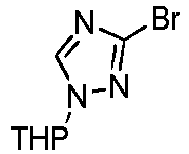
BB-5 
WX004 14 
BB-4 
WX007 15 
BB-4 
WX008 16 
BB-4 
WX009 -

- Compound BB-1 (3.22 g) was dissolved in DMF (30 ml) at room temperature, and WX005-1 (9.00 g), potassium carbonate (9.88 g) and sodium iodide (7.14 g) were added successively. The reaction mixture was stirred at 83 °C for 72 hours under nitrogen atmosphere. After the reaction was completed, the mixture was concentrated to remove most of the organic solvent and then water (70 ml) was added, and the resulting mixture was extracted with ethyl acetate (70 ml x 3). The organic phases were combined, dried over anhydrous sodium sulfate, and then filtered to remove the desiccant and concentrated under reduced pressure. The resulting residue was purified by flash silica gel column chromatography (eluent: petroleum ether/ethyl acetate = 4/1-3/2) to give compound WX005-2. MS-ESI m/z: 494.3[M+H]+.
- Compound WX005-2 (0.42 g) and concentrated hydrochloric acid (1 ml, 12 mol/L) were dissolved in 1,4-dioxane (3 ml) at room temperature. The reaction mixture was stirred at 25 °C for 12 hours under nitrogen atmosphere. To the mixture was added saturated aqueous sodium carbonate solution (3 ml) to adjust the pH to 7-8, followed by addition of water (3 ml) and extraction with ethyl acetate (5 ml × 3). Then the organic phases were combined, dried over anhydrous sodium sulfate, filtered to remove the desiccant, and concentrated under reduced pressure to give compound WX005-3, which was used directly in next step.
MS-ESI m/z: 448.0[M+H]+. - Compound WX005-3 (100.00 mg) and 2-amino-1,3,4-thiadiazole (45.19 mg) were dissolved in ethanol (2 ml) at room temperature. After being stirred at 78 °C for 12 hours under nitrogen atmosphere, the mixture was cooled to room temperature. NaBH4 (67.62 mg) and methanol (0.5 ml) were added, and the resulting mixture was heated to 78 °C and stirred for an additional 12 hours. Water (1 ml) was added to quench the reaction, and then the mixture was concentrated under reduced pressure. The resulting residue was purified by HPLC to give compound WX005.
1H NMR (400 MHz, CDCl3)δ= 8.26 (s, 1H), 6.92 (br s, 1H), 6.82 (s, 2H), 6.64 (s, 1H), 6.59 (s, 1H), 5.41 (s, 1H), 4.61 - 4.54 (m, 2H), 4.08 - 3.94 (m, 4H), 3.81 - 3.73 (m, 2H), 3.68 (s, 3H), 2.82 (t, J = 6.0 Hz, 2H), 2.22 (s, 3H), 2.00 (s, 6H), 1.41 (t, J = 6.8 Hz, 3H). MS-ESI m/z: 533.0[M+H]+. Examples in the following table were synthesized with reference to the synthesis method of Example 12.Example Fragment 1 Fragment 2Structure of compound Compound number 13 
WX005-3 
WX006 -

- Compound BB-1 (5.00 g) was dissolved in 2-butanone (100 ml) at room temperature, and 2-(3-bromopropyl)isoindoline-1,3-dione (13.22 g), potassium carbonate (10.23 g) and sodium iodide (7.39 g) were added successively. The reaction mixture was stirred at 80 °C for 30 hours under nitrogen atmosphere. After the reaction was completed, the mixture was concentrated to remove most of the organic solvent and then water (50 ml) was added, and the resulting mixture was extracted with dichloromethane (50 ml x 3). The organic phases were combined, dried over anhydrous sodium sulfate, and then filtered to remove the desiccant and concentrated under reduced pressure. The resulting residue was purified by flash silica gel column chromatography (eluent: petroleum ether/ethyl acetate = 5/1-1/1) to give compound WX010-1. MS-ESI m/z: 593.2[M+H]+.
- Compound WX010-1 (1.30 g) was dissolved in trichloromethane (10 ml) and ethanol (10 ml) at room temperature, and hydrazine hydrate (5.15 g, 85% purity) was added. The mixture was stirred at 70 °C for 10 hours under nitrogen atmosphere. After the reaction was completed, the mixture was concentrated to remove most of the organic solvent and then water (30 ml) was added, and the resulting mixture was extracted with ethyl acetate (15 ml × 2). Then the organic phases were combined, dried over anhydrous sodium sulfate, filtered to remove the desiccant, and concentrated under reduced pressure to give compound WX010-2. MS-ESI m/z: 463.2[M+H]+.
- Compound WX010-2 (900.00 mg) and WX003-1 (903.06 mg) were dissolved in t-butanol (5 ml) at room temperature, and to the above solution were added tris(dibenzylideneacetone)dipalladium (356.32 mg), 2-di-t-butylphosphino-3,4,5,6-tetramethyl-2,4,6-triisopropyl-1,1-biphenyl (187.07 mg) and anhydrous potassium phosphate (825.98 mg). The reaction mixture was stirred at 100 °C for 12 hours under nitrogen atmosphere. After the reaction was completed, the reaction mixture was cooled to the room temperature and filtered. The filtrate was concentrated under reduced pressure, and the resulting residue was purified by flash silica gel column chromatography (eluent: petroleum ether/ethyl acetate = 20/1-1/1) to give compound WX010-4. MS-ESI m/z: 614.1[M+H]+.
- Compound WX010-4 (1.00 g) and hydrochloric acid-ethyl acetate solution (5 ml, 4 mol/L) were dissolved in ethyl acetate (5 ml) at room temperature. The reaction mixture was stirred at 25 °C for 10 minutes under nitrogen atmosphere. The mixture was concentrated under reduced pressure, and the resulting residue was purified by HPLC to give compound WX010.
1H NMR (400MHz, CD3OD)δ = 8.27 (s, 1H), 7.18 (s, 2H), 6.99 (s, 1H), 6.81 (s, 1H), 5.68 (s, 1H), 4.49 (t, J = 6.8 Hz, 2H), 4.25-4.13 (m, 4H), 3.71 (s, 3H), 3.63 (t, J = 6.8 Hz, 2H), 3.08 (t, J = 6.4 Hz, 2H), 2.40 (s, 3H), 2.32-2.16 (m, 8H), 1.45 (t, J = 6.8 Hz, 3H). MS-ESI m/z: 530.1[M+H]+. -

- Compound BB-4 (50.0 mg) and 4H-1,2,4-triazole-3-carboxylic acid (12.6 mg) were dissolved in DMF (2 ml) at room temperature, and then HATU (50.86 mg) and DIPEA (28.81 mg) were added. The mixture was stirred at 25 °C for 24 hours. After the reaction was completed, the mixture was concentrated under reduced pressure, and the resulting residue was purified by HPLC to give compound WX015.
1H NMR (400 MHz, CD3OD)δ =8.39 (br s, 1H), 6.91 (s, 2H), 6.85 (s, 1H), 6.76 (s, 1H), 5.50 (s, 1H), 4.54 - 4.51 (m, 2H), 4.11 (q, J = 6.8 Hz, 2H), 3.98 (t, J =6.0 Hz, 2H), 3.90 (t, J =5.6 Hz, 2H), 3.69 (s, 3H), 2.91 (t, J = 6.0 Hz, 2H), 2.29 (s, 3H), 2.03 (s, 6H), 1.42 (t, J = 6.8 Hz, 3H). MS-ESI m/z: 544.5[M+H]+. - Examples in the following table were synthesized with reference to the synthesis method of Example 18.
Example Fragment 1 Fragment 2Structure of compound Compound number 19 
BB-4 
WX016 20 
BB-4 
WX017 21 
BB-4 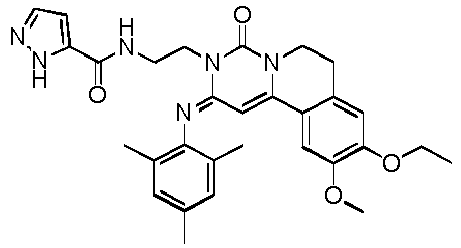
WX018 22 
BB-4 
WX019 23 
BB-4 
WX020 24 
BB-4 
WX021 25 
BB-4 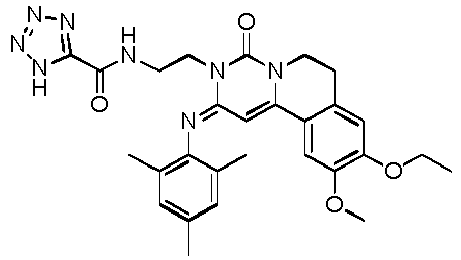
WX022 26 
BB-4 
WX023 27 
BB-4 
WX024 28 
BB-4 
WX025 29 
BB-4 
WX026 30 
BB-4 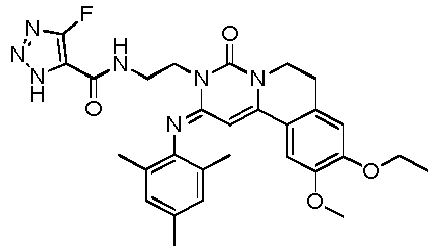
WX027 31 
BB-4 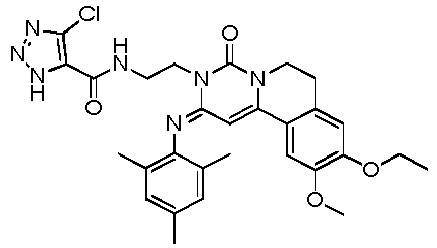
WX028 32 
BB-4 
WX029 33 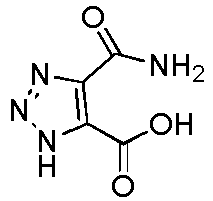
BB-4 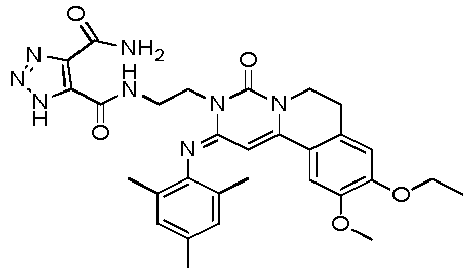
WX030 34 
BB-4 
WX031 35 
BB-4 
WX032 36 
BB-4 
WX033 37 
BB-4 
WX034 38 
BB-4 
WX035 39 
BB-4 
WX036 40 
BB-4 
WX037 41 
BB-4 
WX038 42 
BB-4 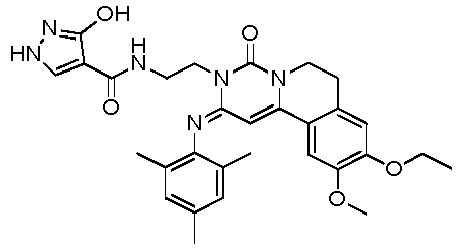
WX039 43 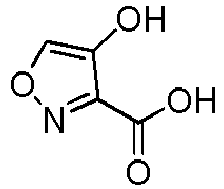
BB-4 
WX040 44 
BB-4 
WX041 45 
BB-4 
WX042 46 
BB-4 
WX043 47 
BB-4 
WX044 48 
BB-4 
WX045 49 
BB-4 
WX046 50 
BB-5 
WX047 51 
BB-5 
WX048 52 
BB-5 
WX049 53 
BB-5 
WX050 54 
BB-5 
WX051 55 
BB-6 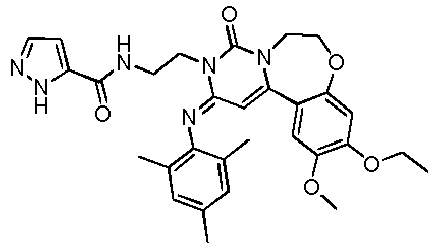
WX052 56 
BB-6 
WX053 -

- The compound WX054-1 (174.4 mg) was dissolved in THF (4 ml) at room temperature, and then the mixture was cooled to 0 °C, followed by adding LHMDS (1 mol/L, 1.02 ml) dropwise. The resulting mixture was kept at 0 °C and stirred for 0.5 hour, and then a solution of compound BB-7 (200 mg) in THF (2 ml) was added dropwise. Then the mixture was allowed to warm to 30 °C naturally after the addition, and stirred for an additional 2 hours. The reaction was quenched with water (10 ml), and ethyl acetate (10 ml × 3) was added for extraction. The organic phases were combined, washed successively with water (10 ml) and saturated brine (10 ml), dried over anhydrous sodium sulfate, filtered, and concentrated under reduced pressure, and the resulting residue was purified by HPLC to give compound WX054-2.
MS-ESI m/z: 674.6[M+H]+. - Compound WX054-2 (20 mg) was dissolved in dichloromethane (5 ml) under nitrogen atmosphere, and then trifluoroacetic acid (1.54 g) was added, and the mixture was stirred at 25 °C for 3 hours. After the reaction was completed, the mixture was concentrated under reduced pressure to remove most of the solvent, and the resulting residue was purified by HPLC to give compound WX054.
1H NMR (400 MHz, CD3OD)δ =8.75 (br s, 1H), 7.14 (s, 2H), 6.96 (s, 1H), 6.77 (s, 1H), 5.65 (s, 1H), 4.70 - 4.62 (m, 2H), 4.20 - 4.10 (m, 4H), 3.68 (s, 3H), 3.20 - 3.10 (m, 2H), 3.04 (t, J = 6.4 Hz, 2H), 2.36 (s, 3H), 2.26 (s, 6H), 1.41 (t, J = 6.8 Hz, 3H). MS-ESI m/z: 544.3[M+H]+.
Examples in the following table were synthesized with reference to the synthesis method of Example 57.Example Fragment 1 Fragment 2Structure of compound Compound number 58 
BB-7 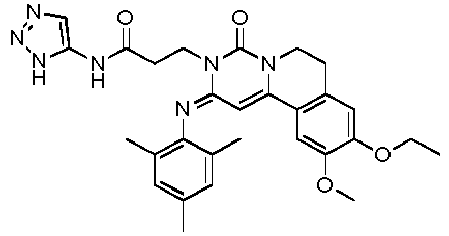
WX055 59 
BB-7 
WX056 60 
BB-7 
WX057 -

- Compound BB-1 (5.00 g) was dissolved in 2-butanone (20 ml) at room temperature, and then ethyl 2-bromoacetate (4.12 g), sodium iodide (0.37 g) and potassium carbonate (3.41 g) were added successively. The reaction solution was stirred at 80 °C for 12 hours. The reaction solution was cooled to room temperature, diluted with dichloromethane (50 ml) and filtered. The filtrate was concentrated under reduced pressure, and the resulting residue was purified by flash silica gel column chromatography (eluent: petroleum ether/ethyl acetate = 100/1-10/1) to give compound WX058-1.
1H NMR (400 MHz, CDCl3)δ= 6.77 (s, 2H), 6.69 (s, 1H), 6.58 (s, 1H), 5.42 (s, 1H), 4.93 (br s, 2H), 4.16 (q, J = 7.2 Hz, 2H), 4.05 - 3.96 (m, 4H), 3.69 (s, 3H), 2.82 (t, J = 6.0 Hz, 2H), 2.19 (s, 3H), 1.93 (s, 6H), 1.40 (t, J = 7.2 Hz, 3H), 1.21 (t, J = 7.2 Hz, 3H). - Compound WX058-1 (0.30 g) was dissolved in ethanol (10 ml), water (4 ml) and tetrahydrofuran (6 ml) at room temperature, and then lithium hydroxide monohydrate (0.10 g) was added. The reaction solution was stirred at 25 °C for 8 hours. Then the reaction solution was concentrated under reduced pressure, followed by adding of water (10 ml). The aqueous phase was adjusted to pH = 3-4 with 4 mol/L HCI, and solid was precipitated. The mixture was filtered and dried to give compound WX058-2. MS-ESI m/z: 464.2[M+H]+.
- Compound 58-1A (2.50 g) was dissolved in ethyl acetate (20 ml) at room temperature, followed by successive addition of (Boc)2O (9.19 g), glacial acetic acid (8 ml) and Pd/C (0.25 g, 10% purity), and the reaction solution was stirred at 30 °C for 12 hours under 25 psi hydrogen atmosphere. Then the reaction solution was filtered and the filtrate was concentrated under reduced pressure, and the resulting residue was purified by flash silica gel column chromatography (eluent: petroleum ether/ethyl acetate = 10/1-2/1) to give compound 58-2A.
1H NMR (400 MHz, CDCl3)δ= 8.20 (s, 1H), 5.42 - 5.39 (m, 1H), 5.24 (br s, 1H), 4.44 (d, J = 5.2 Hz, 2H), 4.08 - 4.06 (m, 1H), 3.74 - 3.70 (m, 1H), 2.10 - 2.04 (m, 4H), 1.70 - 1.63 (m, 2H), 1.46 (s, 9H). Compound 58-2A (0.60 g) and hydrochloric acid-ethyl acetate solution (1 ml, 4 mol/L) were dissolved in ethyl acetate (2 ml) at room temperature. The reaction mixture was stirred at 30 °C for 30 minutes under nitrogen atmosphere. The solid was precipitated. The mixture was filtered, and the filter cake was washed with ethyl acetate (2 ml) and dried to give compound WX058-3. 1H NMR (400 MHz, CD3OD) δ= 9.06 (s, 1H), 4.39 (s, 2H). - Compound WX058-2 (0.15 g) and WX058-3 (0.43 g) were dissolved in DMF (2 ml) at room temperature, followed by successive addition of triethylamine (0.1 ml) and HATU (0.18 g), and the reaction solution was stirred at 30 °C for 10 hours, then poured into water (20 ml), and extracted with ethyl acetate (20 ml x 2). The organic phases were combined, dried over anhydrous sodium sulfate, filtered to remove the desiccant, and concentrated under reduced pressure, and the resulting residue was purified by HPLC to give compound WX058.
1H NMR (400 MHz, CD3OD)δ = 8.64 (s, 1H), 7.14 (s, 2H), 6.99 (s, 1H), 6.83 (s, 1H), 5.70 (s, 1H), 5.18 (s, 2H), 4.69 (s, 2H), 4.28 - 4.11 (m, 4H), 3.71 (s, 3H), 3.07 (t, J = 6.4 Hz, 2H), 2.38 (s, 3H), 2.22 (br s, 6H), 1.53 - 1.39 (m, 3H). MS-ESI m/z: 544.1[M+H]+. -

- Compound BB-4 (30 mg) and 1H-1,2,3-triazole-5-sulfonyl chloride (22.42 mg) were dissolved in DMF (1 ml) at room temperature, followed by addition of triethylamine (13.54 mg), and the mixture was stirred at 20 °C. After the reaction was completed, the mixture was poured into saturated brine (30 ml) and extracted with ethyl acetate (15 ml x 3). The organic phases were combined, washed once with water (50 ml) and saturated brine (50 ml) successively, dried over anhydrous sodium sulfate and filtered to remove the desiccant. The filtrate was concentrated under reduced pressure, and the resulting residue was purified by HPLC to give compound WX059.
1H NMR (400 MHz, CD3OD)δ = 8.29 (br s, 1H), 7.14 (br s, 2H), 6.98 (s, 1H), 6.79 (s, 1H), 5.66 (s, 1H), 4.51 (br s, 2H), 4.24 - 4.10 (m, 4H), 3.70 (s, 3H), 3.64 (br s, 2H), 3.06 (br s, 2H), 2.37 (s, 3H), 2.29 (s, 6H), 1.43 (t, J = 6.8 Hz, 3H). MS-ESI m/z: 580.0[M+H]+.
Examples in the following table were synthesized with reference to the synthesis method of Example 62.Example Fragment 1 Fragment 2Structure of compound Compound number 63 
BB-4 
WX060 -

- Compound WX064-1 (20 g) was dissolved in DMF (300 ml) at room temperature, and then sodium hydride (4.30 g, 60% purity) was added. After the mixture was stirred for 0.5 hour, 1,2-dibromoethane (100.97 g) was added rapidly, and then the mixture was heated to 60 °C and stirred for 11.5 hours. The mixture was cooled to room temperature, the reaction was quenched with saturated brine (600 ml), and ethyl acetate (200 ml × 3) was added for extraction. The organic phases were combined, washed with water (600 ml) and saturated saline (600 ml) successively, dried over anhydrous sodium sulfate, filtered, and concentrated under reduced pressure. The resulting residue was purified by flash silica gel column chromatography (eluent: petroleum ether/ethyl acetate = 20/1-50/1) to give compound WX064-2.
MS-ESI m/z: 231.8[M-100+2+H]+. - Compound WX064-2 (3.66 g) and compound BB-1 (1.5 g) were dissolved in DMF (20 ml) under nitrogen atmosphere, and then anhydrous potassium phosphate (4.71 g) and sodium iodide (3.33 g) were added. The reaction was then heated to 100 °C and stirred for 48 hours. Then the mixture was cooled to room temperature, the reaction was quenched with saturated brine (100 ml), and ethyl acetate (40 ml × 3) was then added for extraction. The organic phases were combined, washed with water (200 ml × 2), dried over anhydrous sodium sulfate, filtered, and concentrated under reduced pressure. The resulting residue was stirred in ethyl acetate (25 ml) for 5 minutes, the insolubles were removed by filtration, and the filtrate was concentrated and purified by prep-TLC (eluent: dichloromethane/methanol = 10/1) to give compound WX064-3.
MS-ESI m/z: 655.6[M+H]+. - Compound WX064-3 (700 mg) was dissolved in hydrogen chloride-ethyl acetate solution (4M, 7.67 ml) at room temperature, and the mixture was stirred at 40 °C for 3 hours. The reaction was quenched with saturated sodium bicarbonate solution (50 ml) and the reaction solution was extracted with dichloromethane (10 ml × 4). The organic phases were combined, washed with saturated brine (40 ml), dried over anhydrous sodium sulfate, filtered and concentrated under reduced pressure to give compound WX064-4, which was used directly in next step.
MS-ESI m/z: 555.1[M+H]+. - Compound WX064-4 (410 mg) was dissolved in methanol (10 ml) under nitrogen atmosphere, and then wet palladium on carbon (200 mg, 10% purity) was added. The mixture was then stirred under hydrogen balloon (15 psi) atmosphere at room temperature for 8 hours. The reaction solution was filtered (diatomite assisted filtration) to remove the catalyst, and the filtrate was concentrated under reduced pressure to give a crude product. The crude product was stirred in a mixed solvent of petroleum ether (15 ml) and ethyl acetate (0.5 ml) for 30 minutes and the mixture was filtered to give compound WX064-5.
MS-ESI m/z: 465.3[M+H]+. - Compound WX064-5 (100 mg), 1,2,3-triazole-5-carboxylic acid (48.68 mg) and triethylamine (65.35 mg) were dissolved in dichloromethane (2 ml) at room temperature, and then T3P (273.97 mg) was added. The mixture was heated to 40 °C and stirred for 6 hours. The reaction solution was diluted with dichloromethane (13 ml), washed with water (20 ml x 3), dried over anhydrous sodium sulfate, filtered and concentrated under reduced pressure, and the resulting residue was purified by HPLC to give compound WX064.
1H NMR (400 MHz, CDCl3)δ = 8.25 (s, 1H), 7.00 (s, 2H), 6.71 (s, 1H), 6.67 (s, 1H), 5.46 (s, 1H), 4.24 (t, J = 5.6 Hz, 2H), 4.14 (q, J = 6.8 Hz, 2H), 4.04 - 3.97 (m, 2H), 3.80 (br s, 2H), 3.74 (s, 3H), 2.94 (t, J = 6.0 Hz, 2H), 2.34 (s, 3H), 2.17 (br s, 6H), 1.49 (t, J = 6.8 Hz, 3H). MS-ESI m/z: 560.3[M+H]+. -

- To a solution of compound 65-1A (2.00 g) and p-toluenesulfonic acid (1.10 g) in tetrahydrofuran (50 ml) was added dropwise DHP (2.15 g) at room temperature, and then the mixture was stirred at 20 °C for 12 hours. The reaction mixture was concentrated under reduced pressure, and the concentrate was dissolved in ethyl acetate (100 ml), washed once with saturated sodium bicarbonate (80 ml) and saturated brine (80 ml) successively, dried over anhydrous sodium sulfate, filtered, and concentrated under reduced pressure to give compound 65-2A. MS-ESI m/z: 241.2[M+H]+.
To a mixture of compound 65-2A (0.80 g) and potassium carbonate (2.30 g) in DMF (10 ml) was added dropwise methyl iodide (0.95 g) at 0 °C, and then the resulting mixture was stirred at 25 °C for 12 hours. The reaction solution was poured into water (20 ml) and extracted with ethyl acetate (10 ml × 2). The organic phases were combined, washed with saturated brine (20 ml), dried over anhydrous sodium sulfate, filtered, and then concentrated under reduced pressure to give compound 65-3A. MS-ESI m/z: 255.2[M+H]+.
To a solution of compound 65-3A (0.80 g) in tetrahydrofuran (4 ml) was added dropwise a solution of sodium hydroxide (0.38 g) in water (8 ml) at 0 °C , and then the mixture was stirred at 25 °C for 12 hours. The reaction solution was adjusted to pH = 4 with 2 mol/L hydrochloric acid under an ice bath, and then extracted with ethyl acetate (20 ml × 2). The organic phases were combined, washed with saturated brine (20 ml), dried over anhydrous sodium sulfate, filtered, and then concentrated under reduced pressure to give compound WX065-5. MS-ESI m/z: 227.0[M+H]+. - Compound WX064-5 (60.0 mg), WX065-5 (58.44 mg) and triethylamine (65.35 mg) were dissolved in DMF (1 ml) at room temperature, and then PyBOP (201.64 mg) was added. The mixture was then stirred at 20 °C for 12 hours. The mixture was purified by HPLC to give compound WX065-6. MS-ESI m/z: 673.4[M+H]+.
- Compound WX065-6 (40 mg) was dissolved in hydrogen chloride-ethyl acetate solution (4M, 1 ml), and the mixture was stirred at 20 °C for 1 hour. The reaction solution was concentrated under reduced pressure, and the concentrate was purified by HPLC to give compound WX065.
1H NMR (400 MHz, CD3OD)δ = 7.95 (s, 1H), 7.12 (s, 2H), 6.98 (s, 1H), 6.80 (s, 1H), 5.68 (s, 1H), 4.69 - 4.66 (m, 2H), 4.45 (br s, 2H), 4.21 (t, J = 6.4 Hz, 2H), 4.16 (q, J = 7.2 Hz, 2H), 3.99 (br s, 3H), 3.70 (s, 3H), 3.07 (t, J = 6.4 Hz, 2H), 2.36 (s, 3H), 2.24 (s, 6H), 1.43 (t, J = 7.2 Hz, 3H). MS-ESI m/z: 589.1[M+H]+.
Examples in the following table were synthesized with reference to the synthesis method of Example 65.Example Fragment 1 Fragment 2Structure of compound Compound number 66 


WX066 WX065-4 67 


WX067 WX065-4 68 


WX068 WX065-4 NMR and MS data of the examples Example Compound 1H-NMR MS m/z [M+H]+ 11 WX004 1H NMR (400MHz, DMSO-d6)δ = 8.39 (br s, 1H), 7.08 (br s, 2H), 7.02 (s, 1H), 6.70 (s, 1H), 5.26 (s, 1H), 4.57 (br s, 2H), 4.09 (q, J = 6.8 Hz, 2H), 3.85 (br s, 2H), 3.69 (s, 3H), 3.52 (br s, 2H), 2.78 (br s, 2H), 2.29 (s, 3H), 2.23 (br s, 6H), 2.15 (br s, 2H), 1.41 (t, J = 6.8 Hz, 3H). 530.0 13 WX006 1H NMR (400MHz, CDCl3)δ= 6.81 (s, 2H), 6.63 (s, 1H), 6.59 (s, 1H), 5.42 (s, 1H), 5.13 (br s, 1H), 4.40 - 4.29 (m, 2H), 4.05 (q, J = 7.2 Hz, 2H), 3.99-3.85 (m, 2H), 3.68 (s, 3H), 3.61 - 3.45 (m, 2H), 2.84-2.82 (m, 2H), 2.20 (s, 3H), 2.15 (s, 3H), 2.00 (s, 6H), 1.41 (t, J = 7.2 Hz, 3H). 530.1 14 WX007 1H NMR (400 MHz, CD3OD)δ = 7.91 (d, J = 2.0 Hz, 1H), 7.18 (s, 2H), 7.00 (s, 1H), 6.81 (s, 1H), 6.04 (d, J = 2.0 Hz, 1H), 5.69 (s, 1H), 4.59 (t, J = 6.4 Hz, 2H), 4.26 - 4.11 (m, 4H), 3.78 (t, J = 6.0 Hz, 2H), 3.71 (s, 3H), 3.08 (t, J = 6.4 Hz, 2H), 2.40 (s, 3H), 2.30 (s, 6H), 1.45 (t, J = 6.8 Hz, 3H). 515.1 15 WX008 1H NMR (400 MHz, CD3OD)δ = 8.05 (s, 2H), 7.17 (s, 2H), 7.00 (s, 1H), 6.83 (s, 1H), 5.71 (s, 1H), 4.80 (br s, 2H), 4.25 (br s, 2H), 4.18 (q, J = 6.8 Hz, 2H), 3.82 (br s, 2H), 3.72 (s, 3H), 3.11 (br s, 2H), 2.39 (s, 3H), 2.32 (s, 6H), 1.45 (t, J = 6.8 Hz, 1H). 515.1 16 WX009 1H NMR (400 MHz, CD3OD)δ = 7.60 (s, 1H), 7.17 (s, 2H), 7.00 (s, 1H), 6.81 (s, 1H), 5.68 (s, 1H), 4.59 (t, J = 6.0 Hz, 2H), 4.21-4.17 (m, 4H), 3.78 (t, J = 6.0 Hz, 2H), 3.71 (s, 3H), 3.08 (t, J = 6.40 Hz, 2H), 2.40 (s, 3H), 2.29 (s, 6H), 1.45 (t, J = 6.8 Hz, 3H). 516.1 19 WX016 1H NMR (400MHz, CD3OD)δ = 8.29 (s, 1H), 7.16 (s, 2H), 6.98 (s, 1H), 6.82 (s, 1 H), 5.69 (s, 1H), 4.58 (t, J = 6.4 Hz, 2H), 4.19 - 4.13 (m, 4H), 3.92 (t, J = 6.0 Hz, 2H), 3.72 (s, 3H), 3.03 (t, J = 6.0 Hz, 2H), 2.40 (s, 3H), 2.28 (s, 6H), 1.45 (t, J = 6.8 Hz, 3H). 544.1 20 WX017 1H NMR (400 MHz, CD3OD)δ = 7.67 (br s, 2H), 7.18 (s, 2H), 6.99 (s, 1H), 6.82 (s, 1H), 5.70 (s, 1H), 4.65 (t. J = 5.6 Hz, 2H), 4.18 - 4.11 (m, 4H), 3.99 (t. J = 5.6 Hz, 2H), 3.72 (s, 3H), 3.06 (t. J = 6.0 Hz, 2H), 2.40 (s, 3H), 2.31 (s, 6H), 1.45 (t, J = 6.8 Hz, 3H). 543.2 21 WX018 1H NMR (400 MHz, CD3OD)δ = 7.71 (d. J = 2.0 Hz, 1H), 7.16 (s, 2H), 6.99 (s, 1H), 6.83 (s, 1H), 6.76 (d. J = 2.0 Hz, 1H), 5.70 (s, 1H), 4.55 (t. J = 6.4 Hz, 2H), 4.20 - 4.13 (m, 4H), 3.90 (t. J = 6.0 Hz, 2H), 3.72 (s, 3H), 3.03 (t. J = 6.4 Hz, 2H), 2.40 (s, 3H), 2.28 (s, 6H), 1.45 (t, J = 6.8 Hz, 3H). 543.2 22 WX019 1H NMR (400 MHz, CD3OD)δ = 8.11 (s, 1H), 7.39 (s, 1H), 7.17 (s, 2H), 6.99 (s, 1H), 6.82 (s, 1H), 5.69 (s, 1H), 4.58 (t. J = 6.4 Hz, 2H), 4.20 - 4.11 (m, 4H), 3.91 (t. J = 6.0 Hz, 2H), 3.72 (s, 3H), 3.04 (t. J = 6.4 Hz, 2H), 2.40 (s, 3H), 2.28 (s, 6H), 1.45 (t, J = 6.8 Hz, 3H). 544.0 23 WX020 1H NMR (400 MHz, CD3OD)δ = 9.47 (s, 1H), 7.18 (s, 2H), 6.99 (s, 1H), 6.83 (s, 1H), 5.70 (s, 1H), 4.62 (t. J = 6.0 Hz, 2H), 4.20 - 4.13 (m, 4H), 3.96 (t. J = 6.0 Hz, 2H), 3.72 (s, 3H), 3.04 (t. J = 6.4 Hz, 2H), 2.40 (s, 3H), 2.31 (s, 6H), 1.45 (t, J = 6.8 Hz, 3H). 545.0 24 WX021 1H NMR (400 MHz, DMSO-d6)δ = 8.03 (t, J = 5.6 Hz, 1H),7.68 (s, 1H), 7.57 (s, 1H), 6.94 (s, 1H), 6.84 (s, 2H), 6.66 (s, 1H), 5.32 (s, 1H), 4.36 (t. J = 6.0 Hz, 2H), 4.06 (q, J = 6.8 Hz, 2H), 3.89 (t. J = 6.0 Hz, 2H), 3.68 - 3.58 (m, 5H), 2.87 (t. J = 5.6 Hz, 2H), 2.22 (s, 3H), 1.95 (s, 6H), 1.33 (t, J = 6.8 Hz, 3H). 543.1 25 WX022 1H NMR (400MHz, DMSO-d6)δ = 8.79 (br s, 1H), 6.96 (s, 1H),6.88 (s, 2H), 6.68 (s, 1H), 5.36 (s, 1H), 4.40 (t, J = 6.0 Hz, 2H), 4.07 (q, J = 6.8 Hz, 2H), 3.89 (t, J = 6.0 Hz, 2H), 3.72 - 3.62 (m, 2H), 3.63 (s, 3H), 2.87 (t, J = 6.4 Hz, 2H), 2.23 (s, 3H), 1.96 (s, 6H), 1.34 (t, J = 6.8 Hz, 3H). 545.4 26 WX023 1H NMR (400 MHz, CD3OD)δ = 9.06 (s, 1H), 7.16 (s, 2H), 6.97 (s, 1H), 6.81 (s, 1H), 5.69 (s, 1H), 4.59 (t, J = 6.0 Hz, 2H), 4.19 - 4.09 (m, 4H), 3.93 (t, J = 6.4 Hz, 2H), 3.70 (s, 3H), 3.01 (t, J = 6.4 Hz, 2H), 2.38 (s, 3H), 2.27 (s, 6H), 1.43 (t, J = 6.8 Hz, 3H). 561.2 27 WX024 1H NMR (400 MHz, CD3OD)δ = 6.89 (s, 2H), 6.85 (s, 1H), 6.75 (s, 1H), 5.49 (s, 1H), 4.50 (t, J = 6.0 Hz, 2H), 4.09 (q, J = 6.8 Hz, 2H), 3.98 (t, J = 6.0 Hz, 2H), 3.84 (t, J = 6.0 Hz, 2H), 3.70 (s, 3H), 2.90 (t, J = 6.0 Hz, 2H), 2.48 (s, 3H), 2.27 (s, 3H), 2.01 (s, 6H), 1.41 (t, J = 6.8 Hz, 3H). 558.3 28 WX025 1H NMR (400MHz, CDCl3)δ = 6.90 (br s, 2H), 6.72 (s, 1H), 6.66 (s, 1H), 5.48 (s, 1H), 5.21 (br s, 2H), 4.58 (br s, 2H), 4.16 - 4.06 (m, 4H), 3.87 (br s, 2H), 3.76 (s, 3H), 2.89 (br s, 2H), 2.30 (s, 3H), 2.04 (s, 6H), 1.48 (br t, J = 6.8 Hz, 3H). 559.2 29 WX026 1H NMR (400MHz, CDCl3)δ = 8.17 (br s, 1H), 6.94 (s, 2H), 6.72 (s, 1H), 6.59 (s, 1H), 5.51 (s, 1H), 4.72 (br s, 2H), 4.24 - 4.12 (m, 4H), 4.05 - 3.98 (m, 2H), 3.97 (s, 3H), 3.71 (s, 3H), 2.99 (br s, 2H), 2.30 (s, 3H), 2.08 (s, 6H), 1.49 (t, J = 6.8 Hz, 3H). 574.0 30 WX027 1H NMR (400 MHz, CD3OD)δ = 7.15 (s, 2H), 6.97 (s, 1H), 6.81 (s, 1H), 5.68 (s, 1H), 4.56 (t, J = 6.0 Hz, 2H), 4.20 - 4.08 (m, 4H), 3.88 (t, J = 6.0 Hz, 2H), 3.70 (s, 3H), 3.02 (t, J = 6.4 Hz, 2H), 2.38 (s, 3H), 2.27 (s, 6H), 1.43 (t, J = 6.8 Hz, 3H). 562.2 31 WX028 1H NMR (400 MHz, CD3OD)δ = 7.17 (s, 2H), 6.99 (s, 1H), 6.83 (s, 1H), 5.70 (s, 1H), 4.57 (t, J = 6.0 Hz, 2H), 4.21 - 4.13 (m, 4H), 3.90 (t, J = 5.6 Hz, 2H), 3.72 (s, 3H), 3.05 (t, J = 6.4 Hz, 2H), 2.40 (s, 3 H), 2.28 (s, 6 H), 1.45 (t, J = 6.8 Hz, 3H). 578.1 32 WX029 1H NMR (400 MHz, CD3OD)δ = 7.02 (s, 2H), 6.92 (s, 1H), 6.76 (s, 1H), 5.57 (s, 1H), 4.51 (t, J = 6.0 Hz, 2H), 4.17 - 4.05 (m, 4H), 3.88 (t, J = 6.0 Hz, 2H), 3.68 (s, 3H), 2.97 (br s, 2H), 2.32 (s, 3H), 2.09 (s, 6H), 1.42 (t, J = 6.8 Hz, 3H). 612.3 33 WX030 1H NMR (400MHz, CD3OD)δ = 7.15 (s, 2H), 6.97 (s, 1H), 6.80 (s, 1H), 5.68 (s, 1H), 4.68 - 4.51 (m, 2H), 4.15 (q, J = 6.8 Hz, 2H), 4.10 (t, J = 6.0 Hz, 2H), 4.02 - 3.92 (m, 2H), 3.70 (s, 3H), 3.00 (t, J = 6.0 Hz, 2H), 2.38 (s, 3H), 2.26 (s, 6H), 1.43 (t, J = 6.8 Hz, 3H). 586.9 34 WX031 1H NMR (400MHz, CD3OD)δ = 7.16 (s, 2H), 6.97 (s, 1H), 6.82 (s, 1H), 5.70 (s, 1H), 4.60 (t, J = 6.0 Hz, 2H), 4.20 - 4.10 (m, 4H), 3.97 (t, J = 6.0 Hz, 2H), 3.94 (s, 3H), 3.70 (s, 3H), 3.02 (t, J = 6.4 Hz, 2H), 2.38 (s, 3H), 2.28 (s, 6H), 1.43 (t, J = 6.8 Hz, 3H). 602.1 35 WX032 1H NMR (400MHz, CD3OD)δ = 7.15 (s, 2H), 6.96 (s, 1H), 6.81 (s, 1H), 5.69 (s, 1H), 4.57 (t, J = 6.0 Hz, 2H), 4.23 - 4.06 (m, 4H), 3.90 (t, J = 6.0 Hz, 2H), 3.70 (s, 3H), 3.03 (t, J = 6.4 Hz, 2H), 2.38 (s, 3H), 2.27 (s, 6H), 1.43 (t, J = 6.8 Hz, 3H). 569.3 36 WX033 1H NMR (400MHz, CD3OD)δ = 7.16 (s, 2H), 6.98 (s, 1H), 6.82 (s, 1H), 5.69 (s, 1H), 4.55 (t, J = 6.0 Hz, 2H), 4.21 - 4.13 (m, 4H), 3.92 (t, J = 6.0 Hz, 2H), 3.71 (s, 3H), 3.04 (t, J = 6.4 Hz, 2H), 2.39 (s, 3H), 2.27 (s, 6H), 1.45 (t, J = 6.8 Hz, 3H). 560.2 37 WX034 1H NMR (400MHz, CDCI3)δ = 7.79 (s, 1H), 6.86 (s, 2H), 6.68 (s, 1H), 6.65 (s, 1H), 5.46 (s, 1H), 4.61 (br s, 2H), 4.13 (q, J = 6.8 Hz, 2H), 4.06 (br s, 2H), 3.88 (br s, 2H), 3.73 (s, 3H), 2.89 (br s, 2H), 2.27 (s, 3H), 2.01 (s, 6H), 1.49 (t, J = 6.8 Hz, 3H). 560.3 38 WX035 1H NMR (400MHz, CD3OD)δ = 8.40 (s, 1H), 7.15 (s, 2H), 6.98 (s, 1H), 6.80 (s, 1H), 5.66 (s, 1H), 4.56 (t, J = 6.0 Hz, 2H), 4.23 - 4.10 (m, 4H), 3.96 (t, J = 6.0 Hz, 2H), 3.70 (s, 3H), 3.04 (t, J = 6.4 Hz, 2H), 2.38 (s, 3H), 2.25 (s, 6H), 1.44 (t, J = 6.8 Hz, 3H). 560.1 39 WX036 1H NMR (400 MHz, CD3OD)δ = 6.94 (s, 2H), 6.87 (s, 1H), 6.77 (s, 1H), 5.52 (s, 1H), 4.48 (t, J = 6.0 Hz, 2H), 4.15 (s, 3H), 4.12 - 4.08 (m, 2H), 4.01 (t, J = 6.0 Hz, 2H), 3.87 (t, J = 6.0 Hz, 2H), 3.69 (s, 3H), 2.94 (t, J = 6.0 Hz, 2H), 2.29 (s, 3H), 2.06 (s, 6H), 1.41 (t, J = 6.8 Hz, 3H). 574.1 40 WX037 1H NMR (400 MHz, CD3OD)δ = 7.53 (br s, 1H), 7.14 (s, 2H), 6.97 (s, 1H), 6.80 (s, 1H), 5.67 (s, 1H), 4.54 (t, J = 6.0 Hz, 2H), 4.18 - 4.12 (m, 4H), 3.94 - 3.89 (m, 5H), 3.69 (s, 3H), 3.02 (t, J = 6.4 Hz, 2H), 2.37 (s, 3H), 2.25 (s, 6H), 1.43 (t, J = 6.8 Hz, 3H). 573.3 41 WX038 1H NMR (400 MHz, CD3OD)δ = 7.22 (s, 1H), 7.14 (s, 2H), 6.97 (s, 1H), 6.80 (s, 1H), 5.68 (s, 1H), 4.53 (t, J = 6.4 Hz, 2H), 4.16 -4.14 (m, 4H), 3.90 (t, J = 6.4 Hz, 2H), 3.70 (s, 3H), 3.02 (t, J = 6.4 Hz, 2H), 2.37 (s, 3H), 2.26 (s, 6H), 1.43 (t, J = 6.8 Hz, 3H). 559.2 42 WX039 1H NMR (400 MHz, CD3OD)δ = 7.88 (s, 1H), 7.15 (s, 2H), 6.97 (s, 1H), 6.80 (s, 1H), 5.67 (s, 1H), 4.50 (t, J = 6.4 Hz, 2H), 4.19 - 4.12 (m, 4H), 3.85 (t, J = 559.3 6.4 Hz, 2H), 3.70 (s, 3H), 3.02 (t, J = 6.4 Hz, 2H), 2.38 (s, 3H), 2.27 (s, 6H), 1.43 (t, J = 6.8 Hz, 3H). 43 WX040 1H NMR (400 MHz, CD3OD)δ = 8.34 (s, 1H), 6.90 (s, 2H), 6.84 (s, 1H), 6.75 (s, 1H), 5.49 (s, 1H), 4.50 (t, J = 6.0 Hz, 2H), 4.09 (q, J = 6.8 Hz, 2H), 3.97 (t, J = 6.0 Hz, 2H), 3.89 (t, J = 6.0 Hz, 2H), 3.68 (s, 3H), 2.90 (t, J = 6.4 Hz, 2H), 2.27 (s, 3H), 2.04 (s, 6H), 1.41 (t, J = 6.8 Hz, 3H). 560.1 44 WX041 1H NMR (400 MHz, CD3OD)δ = 7.86 (s, 1H), 6.91 (s, 2H), 6.84 (s, 1H), 6.75 (s, 1H), 5.49 (s, 1H), 4.47 (t, J = 5.6 Hz, 2H), 4.09 (q, J = 6.8 Hz, 2H), 3.99 (t, J = 6.0 Hz, 2H), 3.84 - 3.78 (m, 5H), 3.68 (s, 3H), 2.90 (t, J = 6.0 Hz, 2H), 2.27 (s, 3H), 2.02 (s, 6H), 1.40 (t, J = 6.8 Hz, 3H). 573.3 45 WX042 1H NMR (400 MHz, DMSO-d6)δ = 8.00 (br s, 1H), 7.12 (s, 2H), 7.07 (s, 1H), 6.76 (s, 1H), 5.56 (s, 1H), 4.35 (br s, 2H), 4.17 - 4.06 (m, 4H), 3.68 (m, 2H), 3.64 (s, 3H), 2.97 (br s, 2H), 2.32 (s, 3H), 2.19 (s, 6H), 1.35 (t, J = 6.8 Hz, 3H). 559.2 46 WX043 1H NMR (400 MHz, CD3OD)δ = 6.99 (s, 1H), 6.90 (br s, 2H), 6.84 (s, 1H), 6.74 (s, 1H), 5.48 (s, 1H), 4.44 (br s, 2H), 4.08 (br d, J = 6.8 Hz, 2H), 3.97 (br s, 2H), 3.77 (br s, 2H), 3.68 (s, 3H), 2.89 (br s, 2H), 2.27 (s, 3H), 2.04 (s, 6H), 1.40 (t, J = 6.8 Hz, 3H). 559.1 47 WX044 1H NMR (400MHz, CDCI3)δ = 8.29 (br s, 1H), 6.88 (br s, 2H), 6.72 (s, 1H), 6.67 (s, 1H), 6.46 (s, 1H), 5.50 (s, 1H), 4.60 (t, J = 5.6 Hz, 2H), 4.12 (q, J = 6.8 Hz, 2H), 4.06 (t, J = 6.0 Hz, 2H), 3.87 (t, J = 5.6 Hz, 2H), 3.76 (s, 3H), 2.90 (t, J = 6.0 Hz, 2H), 2.28 (s, 3H), 2.04 (s, 6H), 1.49 (t, J = 6.8 Hz, 3H). 560.0 48 WX045 1H NMR (400 MHz, CD3OD)δ = 7.15 (s, 2H), 6.98 (s, 1H), 6.80 (s, 1H), 5.67 (s, 1H), 4.53 (t, J = 6.0 Hz, 2H), 4.25 - 4.07 (m, 4H), 3.85 (t, J = 6.0 Hz, 2H), 3.70 (s, 3H), 3.03 (t, J = 6.4 Hz, 2H), 2.37 (s, 3H), 2.27 (s, 6H), 1.43 (t, J = 6.8 Hz, 3H). 560.0 49 WX046 1H NMR (400 MHz, CD3OD)δ = 7.15 (br s, 2H), 6.97 (s, 1H), 6.79 (s, 1H), 5.67 (s, 1H), 4.56 (t, J = 6.0 Hz, 2H), 4.21 - 4.08 (m, 4H), 3.90 (t, J = 6.0 Hz, 2H), 3.69 (s, 3H), 3.01 (t, J = 6.4 Hz, 2H), 2.37 (s, 3H), 2.24 (s, 6H), 1.43 (t, J = 6.8 Hz, 3H). 576.2 50 WX047 1H NMR (400 MHz, CD3OD)δ = 8.52 (s, 1H), 7.12 (br s, 2H), 6.95 (s, 1H), 6.80 (s, 1H), 5.41 (s, 1H), 4.80 (br s, 2H), 4.61 (br s, 2H), 4.14 (q, J = 6.8 Hz, 2H), 4.06 - 3.88 (m, 2H), 3.76 (s, 3H), 2.73 (t, J = 6.8 Hz, 2H), 2.36 (s, 3H), 2.30 (br s, 6H), 2.05 (br s, 2H), 1.43 (t, J = 6.8 Hz, 3H). 558.0 51 WX048 1H NMR (400 MHz, CD3OD)δ = 8.35 (br s, 1H), 7.13 (br s, 2H), 6.95 (s, 1H), 6.80 (s, 1H), 5.42 (s, 1H), 4.80 (br s, 2H), 4.59 (br s, 2H), 4.14 (q, J = 6.8 Hz, 2H), 4.05 - 3.84 (m, 2H), 3.77 (s, 3H), 2.71 (br s, 2H), 2.37 (s, 3H), 2.30 (br s, 6H), 2.10 - 1.95 (m, 2H), 1.43 (t, J = 6.8 Hz, 3H). 558.4 52 WX049 1H NMR (400MHz, CD3OD)δ = 7.70 (br s, 1H), 7.63 (br s, 1H), 6.86 (br s, 2H), 6.83 (s, 1H), 6.71 (s, 1H), 5.12 (s, 1H), 4.80 (br s, 2H), 4.52 (t, J = 5.6 Hz, 2H), 4.09 (q, J = 6.8 Hz, 2H), 4.02 - 3.81 (m, 2H), 3.74 (s, 3H), 2.68 - 2.60 (m, 2H), 2.25 (s, 3H), 2.05 (br s, 8H), 1.41 (t, J = 6.8 Hz, 3H). 557.3 53 WX050 1H NMR (400MHz, CD3OD)δ = 7.74 (br s, 1H), 7.13 (br s, 2H), 6.95 (s, 1H), 6.81 - 6.77 (m, 2H), 5.41 (s, 1H), 4.90 - 4.80 (m, 2H), 4.70 - 4.50 (m, 2H), 4.14 (q, J = 6.8 Hz, 2H), 4.02 - 3.85 (m, 2H), 3.76 (s, 3H), 2.72 - 2.66 (m, 2H), 2.36 (s, 3H), 2.30 (br s, 6H), 2.07 - 1.90 (m, 2H), 1.43 (t, J = 6.8 Hz, 3H). 557.3 54 WX051 1H NMR (400MHz, CD3OD)δ = 7.09 (br s, 2H), 6.92 (s, 1H), 6.75 (s, 1H), 5.39 (s, 1H), 4.80 (br s, 2H), 4.61 (br s, 2H), 4.11 (q, J = 6.8 Hz, 2H), 3.94 (br s, 2H), 3.73 (s, 3H), 2.68 (t, J = 6.4 Hz, 2H), 2.33 (s, 3H), 2.26 (br s, 6H), 2.07 - 1.90 (m, 2 H), 1.40 (t, J = 6.8 Hz, 3H). 559.3 55 WX052 1H NMR (400 MHz, CD3OD)δ = 7.69 (br s, 1H), 7.08 (br s, 2H), 6.75 (br s, 2H), 6.64 (s, 1H), 5.23 (s, 1H), 4.44 (t, J = 5.6 Hz, 2H), 4.26 (t, J = 5.6 Hz, 2H), 4.11 - 4.07 (m, 4H), 3.74 - 3.70 (m, 5H), 2.34 (s, 3H), 2.20 (br s, 6H), 1.42 (t, J = 6.8 Hz, 3H). 559.3 56 WX053 1H NMR (400MHz, CD3OD)δ = 8.18 (br s, 1H), 7.06 (s, 2H), 6.73 (s, 1H), 6.62 (s, 1H), 5.21 (s, 1H), 4.42 (t, J = 6.0 Hz, 2H), 4.24 (t, J = 5.2 Hz, 2H), 4.10 - 4.05 (m, 4H), 3.75 - 3.70 (m, 5H), 2.32 (s, 3H), 2.18 (s, 6H), 1.40 (t, J = 6.8 Hz, 3H). 560.3 58 WX055 1H NMR (400 MHz, DMSO-d6)δ = 8.34 (br s, 1H), 7.85 (br s, 1H), 6.94 (s, 1H), 6.85 (s, 2H), 6.67 (s, 1H), 5.33 (s, 1H), 4.41 (br s, 2H), 4.06 (q, J = 7.2 Hz, 2H), 3.91 (br s, 2H), 3.62 (s, 3H), 2.89 (br s, 2H), 2.82 (t, J = 8.0 Hz, 2H), 2.22 (s, 3H), 1.96 (br s, 6H), 1.33 (t, J = 7.2 Hz, 3H). 544.3 59 WX056 1H NMR (400 MHz, CDCl3)δ = 7.29 (s, 1H), 6.96 (s, 1H), 6.89 (s, 2H), 6.73 (s, 1H), 6.67 (s, 1H), 5.51 (s, 1H), 4.62 (t, J = 6.4 Hz, 2H), 4.20 - 4.06 (m, 4H), 3.77 (s, 3H), 3.07 (t, J = 6.4 Hz, 2H), 2.91 (t, J = 6.4 Hz, 2H), 2.30 (s, 3H), 2.06 (s, 6H), 1.49 (t, J = 6.8 Hz, 3H). 544.3 60 WX057 1H NMR (400 MHz, DMSO-d6)δ =12.52 (br s, 1H), 10.01 (s, 1H), 7.82 (br s, 1H), 7.46 (br s, 1H), 6.94 (s, 1H), 6.86 (s, 2H), 6.67 (s, 1H), 5.33 (s, 1H), 4.40 (t, J = 8.0 Hz, 2H), 4.04 (q, J = 7.2 Hz, 2H), 3.92 (t, J = 6.4 Hz, 2H), 3.62 (s, 3H), 2.89 (t, J = 6.4 Hz, 2H), 2.73 (t, J = 8.0 Hz, 2H), 2.22 (s, 3H), 1.97 (s, 6H), 1.33 (t, J = 7.2 Hz, 3H). 543.3 63 WX060 1H NMR (400 MHz, CD3OD)δ = 8.26 (br s, 1H), 7.85 (br s, 1H), 7.14 (s, 2H), 6.97 (s, 1H), 6.78 (s, 1H), 5.66 (s, 1H), 4.47 (br s, 2H), 4.23 - 4.09 (m, 4H), 3.69 (s, 3H), 3.57 (br s, 2H), 3.05 (br s, 2H), 2.36 (s, 3H), 2.29 (s, 6H), 1.42 (t, J = 6.8 Hz, 3H). 579.0 66 WX066 1H NMR (400 MHz, CD3OD)δ = 6.98 (s, 2H), 6.90 (s, 1H), 6.77 (s, 1H), 5.57 (s, 1H), 4.62 (t, J = 4.4 Hz, 2H), 4.36 (t, J = 4.4 Hz, 2H), 4.16 (s, 3H), 4.14 - 4.07 (m, 4H), 3.69 (s, 3H), 2.98 (t, J = 6.0 Hz, 2H), 2.30 (s, 3H), 2.11 (s, 6H), 1.42 (t, J = 6.8 Hz, 3H). 590.3 67 WX067 1H NMR (400 MHz, CD3OD)δ = 7.12 (s, 2H), 6.98 (s, 1H), 6.80 (s, 1H), 5.68 (s, 1H), 4.68 (t, J = 4.4 Hz, 2H), 4.46 (t, J = 4.4 Hz, 2H), 4.22 - 4.16 (m, 4H), 4.01 (s, 3H), 3.70 (s, 3H), 3.07 (t, J = 6.4 Hz, 2H), 2.36 (s, 3H), 2.24 (s, 6H), 1.43 (t, J = 6.8 Hz, 3H). 590.1 68 WX068 1H NMR (400 MHz, CD3OD)δ = 7.17 (br s, 1H), 6.92 (s, 2H), 6.88 (s, 1H), 6.78 (s, 1H), 5.53 (s, 1H), 4.62 (br s, 2H), 4.33 (br s, 2H), 4.16 - 4.03 (m, 4H), 3.71 (s, 3H), 2.96 (t, J = 5.6 Hz, 2H), 2.29 (s, 3H), 2.06 (s, 6H), 1.43 (t, J = 6.8 Hz, 3H). 575.2 - Experimental objective: to determine the AMP/GMP expression based on fluorescence polarization, i.e., to trace binding of AMP/GMP to antibody so as to indicate enzyme activity.
- Experimental buffer solution: 10 mm Tris-HCI (pH 7.5), 5 mm MgCl2, 0.01% Brij 35, 1 mm Dithiothreitol (DTT), and 1% DMSO.
Enzyme: recombinant human PDE3A (Gene accession number: NM_000921; amino acid 669-end) was expressed by baculovirus in Sf9 insect cells using an N-terminal GST tag, with molecularweight being 84 kDa.
Enzyme substrate: 1 µM cAMP
Detection: Transcreener®AMP2/GMP2 antibody and AMP2/GMP2 AlexaFluor633 tracer. -
- 1. The recombinant human PDE3A enzyme and enzyme substrate (1 µM cAMP) were each dissolved in newly-prepared experimental buffer solution;
- 2. The PDE3A enzyme buffer solution was transferred into reaction wells;
- 3. The compound which was dissolved in 100% DMSO was added to the reaction wells containing PDE3A enzyme buffer solution by acoustic technique (echo 550; millilambda range) and the mixture was incubated for 10 minutes at room temperature;
- 4. The enzyme substrate buffer solution was added to the above reaction wells to initiate reaction;
- 5. The resulting mixture was incubated at room temperature for 1 hour;
- 6. The detection mixture (Transcreener®AMP2/GMP2 antibody and AMP2/GMP2 AlexaFluor633 tracer) was added to stop the reaction, and the resulting mixture was incubated for 90 minutes while slowly mixing. The measurement range of fluorescence polarization was Ex/Em = 620/688.
- Data analysis: the fluorescence polarization signal was converted to nM based on AMP/GMP standard curve and the percentage enzyme activity relative to DMSO control calculated by Excel. GraphPad Prism was used for curve fitting (drawing medical icon). The experimental results are shown in Table 1.
- Experimental objective: to determine the AMP/GMP expression based on fluorescence polarization, i.e., to trace binding of AMP/GMP to antibody so as to indicate enzyme activity.
- Experimental buffer solution: 10 mm Tris-HCI (pH 7.5), 5 mm MgCl2, 0.01% Brij 35, 1 mm DTT, and 1% DMSO.
Enzyme: recombinant human PDE4B (Gene accession number: NM_002600; amino acid 305-end) was expressed by baculovirus in Sf9 insect cells using an N-terminal GST tag, with molecularweight being 78 kDa. - Detection: Transcreener®AMP2/GMP2 antibody and AMP2/GMP2 AlexaFluor633 tracer.
-
- 1. The recombinant human PDE4B enzyme and enzyme substrate (1 µM cAMP) were each dissolved in newly prepared experimental buffer solution;
- 2. The PDE4B enzyme buffer solution was transferred into reaction wells;
- 3. The compound which was dissolved in 100% DMSO was added to the reaction wells containing PDE4B enzyme buffer solution by acoustic technique (echo 550; millilambda range) and the mixture was incubated for 10 minutes at room temperature;
- 4. The enzyme substrate buffer solution was added to the above reaction wells to initiate reaction;
- 5. The resulting mixture was incubated at room temperature for 1 hour;
- 6. The detection mixture (Transcreener®AMP2/GMP2 antibody and AMP2/GMP2 AlexaFluor633 tracer) was added to stop the reaction, and the resulting mixture was incubated for 90 minutes while slowly mixing. The measurement range of fluorescence polarization was Ex/Em = 620/688.
- Experimental objective: to express the anti-inflammatory activity at the cellular level of the test compound based on the level of TNF-α in human peripheral blood mononuclear cells (hPBMCs).
-
- 1. Normal human whole blood was collected into an EDTA anticoagulation tube;
- 2. The PBMCs were separated by Ficoll density gradient centrifugation, and then counted. The cell concentration was adjusted to 2 × 10⁶/ml;
- 3. To each well of a U-bottomed 96-well plate were added 2 × 10⁵ cells, 1 ng/ml LPS, and DMSO solutions of compound at concentrations of 100 µM, 10 µM, 1 µM, 100 nM, 10 nM, 1n M, 100 pM and 10 pM, 200 µL per well;
- 4. The mixture was incubated for 24 hours, and then the supernatant was collected;
- 5. The level of TNF-α in supernatant was detected by ELIZA, Graphpad Prism software was used to fit inhibition curves and IC50 was calculated.
- In this study, male beagle dogs were selected as test animals, and liquid chromatography-tandem mass spectrometry (LC-MS/MS) method was used for quantitatively measuring the drug concentration in plasma of beagle dogs at different time points after intravenous injection or oral administration of compound WX036 so as to evaluate the pharmacokinetic characteristics of the compound WX036 in beagle dogs.
The clear solution of compound WX036 was injected into two 10-12 kg beagle dogs via the cephalic vein or saphenous vein, and the clear solution of test compound was administered intragastrically to two 10-12 kg beagle dogs (overnight fasted). The animals were all subjected to approximately 500 µL of blood collection each time from peripheral veins at 0.0333, 0.0833, 0.25, 0.5, 1, 2, 4, 6, 8, and 24 hours post-dose, and the blood was transferred into commercial centrifuge tubes containing 0.85-1.15 mg of K2 EDTA*2H2O anticoagulant, and plasma was taken by centrifugation at 3000 g for 10 minutes at 4 °C. The plasma concentration was measured by LC-MS/MS method, and the relevant pharmacokinetic parameters were calculated by WinNonlin™ Version 6.3 (Pharsight, Mountain View, CA) pharmacokinetic software using non-compartmental model linear logarithmic trapezoid method.Table 3. Pharmacokinetic parameters of compound WX036 in beagle dogs Pharmacokinetic parameters in beagle dogs Intravenous injection (0.5 mg/kg) Oral administration (3 mg/kg) Plasma clearance (ml/min/k g) Half life (h) Area under plasma concentration-time curve (0-inf, nM.h) Peak concentration (nM) Time to peak (h) Area under plasma concentration-time curve (0-inf, nM.h) Bioavailability (%) WX036 70.3 0.3 210 59.4 0.6 123 7.5 - A total of 5 specific probe substrates of 5 isoenzymes of CYP, namely phenacetin (CYP1A2), diclofenac (CYP2C9), (S)-mephenytoin (CYP2C19), dextromethorphan (CYP2D6) and midazolam (CYP3A4) are each co-incubated with human liver microsomes and test compound, and then reduced nicotinamide adenine dinucleotide phosphate (NADPH) was added to initiate the reaction. After the reaction was completed, samples were treated, and the concentrations of 5 metabolites (acetaminophen, 4'-hydroxydiclofenac, 4'-hydroxymephenytoin, dextrorphan and 1'-hydroxymidazolam) generated by the specific substrates were quantitatively detected by LC-MS/MS to calculate the corresponding half inhibitory concentrations (IC 50).
Table 4. Inhibition against five CYP enzymes by compounds WX026 and WX036 Compound number IC50 (µM) CYP1A2 CYP2C9 CYP2C19 CYP2D6 CYP3A4 WX026 50 20 50 50 16 WX036 50 31 50 50 50 - Male Sprague-Dawley rats (supplied by Shanghai SLAC Laboratory Animal Co., Ltd.), SPF grade, approximately 200 g.
-
- 1. Animals were randomly divided into 3 groups according to weight after one-week adaptive feed;
- 2. On days 1-3 of the experiment, the corresponding compound of each group was atomized for 30 minutes. Then the animals in the model group and each compound-treated group were exposed to cigarette smoke for 1 hour, and after a 4-hour interval, the animals were exposed to cigarette smoke again for 1 hour. Cigarette smoke was exposed twice daily for 3 consecutive days. Control animals were exposed to room air;
- 3. On
day 4 of the experiment, the corresponding compound of each group was atomized for 30 minutes, and then the animals in the model group and each compound-treated group inhaled the atomized 150 µg/ml LPS for 15 minutes. Three hours later (from the time starting atomization), the animals were exposed to cigarette smoke for 1 hour, and then the lung function (Penh) of the animals was examined; bronchoalveolar lavage fluid (BALF) was collected for cell counting after the animals were euthanized with CO2. - 4. Administration
Administration mode: atomizing the test compound at the maximum atomization rate (approximately 12 ml) with the whole-body exposure atomization device for 30 minutes.
Administration frequency: atomizing the drug or solvent 30 minutes per day in the morning before exposure to cigarette smoke, and performing administration before the inhalation of the atomized LPS onday 4. - 5. Measurements of pharmacodynamic endpoints
- (1) Total white blood cells in BALF;
- (2) Mch-induced detection of pulmonary function (airway resistance index Penh);
The experimental results are shown in Table 1:
| Compound | PDE3A IC50(nM) | PDE4B IC50(nM) | Compound | PDE3A IC50(nM) | PDE4B IC50(nM) |
| WX001 | 0.041 | 6.5 | WX026 | 0.01 | 2.5 |
| WX002 | <0.02 | 5 | WX036 | 0.03 | 0.41 |
| WX003 | 0.66 | 2.2 | WX037 | 0.51 | 1.7 |
| WX004 | 0.63 | 0.12 | WX047 | 0.10 | 0.16 |
| WX005 | 0.18 | 5.7 | WX048 | 0.03 | 0.27 |
| WX010 | 0.65 | 9.8 | WX049 | 0.30 | 0.05 |
| WX015 | 0.26 | 0.56 | WX050 | 1.1 | 0.24 |
| WX016 | 0.01 | 0.24 | WX052 | 0.50 | 0.18 |
| WX017 | 0.28 | 0.43 | WX053 | 0.57 | 1.9 |
| WX018 | 0.28 | 0.05 | WX054 | 0.03 | 2.7 |
| WX019 | 0.53 | 0.48 | WX055 | 0.04 | 2.1 |
| WX020 | 0.65 | 0.47 | WX056 | 0.14 | 9.1 |
| WX021 | 0.25 | 1.1 | WX057 | 0.31 | 5.4 |
| WX024 | 0.04 | 0.04 | WX064 | 0.01 | 1.4 |
| WX025 | 0.09 | 0.44 |
| Compound | hPBMC IC50(nM) | Compound | hPBMC IC50(nM) |
| WX003 | 3.1 | WX018 | 0.09 |
| WX004 | 0.33 | WX047 | 0.25 |
| WX015 | 0.36 | WX054 | 1.8 |
| WX016 | 2.8 |
| Group | Number of animals | Compound concentration of atomized solution | Time of administration |
| Model group | 10 | - | 30 minutes before the first cigarette smoke exposure every day |
| WX036 | 10 | 0.05 mg/ml | 30 minutes before the first cigarette smoke exposure every day |
| WX036 | 10 | 0.15 mg/ml | 30 minutes before the first cigarette smoke exposure every day |
Claims (15)
- A compound of formula (I), an isomer thereof or a pharmaceutically acceptable salt thereof,
 a ring Cy is selected from the group consisting of 5-membered heterocyclyl and 5-membered heteroaryl, wherein the 5-membered heterocyclyl or 5-membered heteroaryl is optionally substituted by one or more of the following groups: amino, hydroxy, =O, halogen, cyano, C1-12 alkyl, -C(O)NH2, -C(O)NH(C1-6 alkyl), -C(O)N(C1-6 alkyl)2, -COOH, -C(O)O(C1-6 alkyl) or C1-12 alkoxy, wherein the C1-12 alkyl or C1-12 alkoxy is optionally substituted by one or more groups selected from the group consisting of halogen, amino and hydroxy;ring atoms of the ring Cy comprise at least one nitrogen atom;L is selected from the group consisting of -N(R6)-, -N(R6)C(O)-, -C(O)N(R6)-, -O-, -S-, -OC(O)-, -C(O)O-, -CH2N(R6)C(O)-, -CH2C(O)N(R6)-, -S(O)2NH-, -NHS(O)2- and a single bond;n is 1, 2, 3 or 4;E1 is -(CH2)m-, wherein m is 1, 2 or 3;E2 is selected from the group consisting of -O-, -NH-, -S- and a single bond;R3, R4 and R5 are each independently selected from the group consisting of hydrogen, halogen and C1-6 alkyl, wherein the C1-6 alkyl is optionally substituted by one or more groups selected from the group consisting of halogen, amino and hydroxy; andeach R6 is independently selected from the group consisting of hydrogen, hydroxy and C1-3 alkyl, wherein the C1-3 alkyl is optionally substituted by one or more groups selected from the group consisting of halogen, amino and hydroxy.
 - The compound of formula (I), the isomer thereof or the pharmaceutically acceptable salt thereof according to claim 1, wherein the ring Cy is selected from the group consisting of 5-membered heterocyclyl and 5-membered heteroaryl, wherein the 5-membered heterocyclyl or 5-membered heteroaryl is optionally substituted by one or more of the following groups:amino, hydroxy, =O, halogen, cyano, C1-6 alkyl, -C(O)NH2, -C(O)NH(C1-3 alkyl), -C(O)N(C1-3 alkyl)2, -COOH, -C(O)O(C1-3 alkyl), C1-6 alkoxy, or C1-6 alkyl substituted by one or more halogens;optionally, the ring Cy is selected from the group consisting of 5-membered heterocyclyl and 5-membered heteroaryl, wherein the 5-membered heteroaryl is optionally substituted by one or more of the following groups: amino, hydroxy, halogen, cyano, C1-6 alkyl, - C(O)NH2, -C(O)NH(C1-3 alkyl), -C(O)N(C1-3 alkyl)2, -COOH, -C(O)O(C1-3 alkyl), C1-6 alkoxy, or C1-6 alkyl substituted by one or more halogens, wherein the 5-membered heterocyclyl is optionally substituted by one or more =O;optionally, the ring Cy is selected from the group consisting of oxazolidin-2-one, imidazolyl, pyrazolyl, oxazolyl, triazolyl, oxadiazolyl, tetrazolyl, thiadiazolyl and isoxazolyl, wherein the imidazolyl, pyrazolyl, oxazolyl, triazolyl, oxadiazolyl, tetrazolyl, thiadiazolyl or isoxazolyl is optionally substituted by one or more of the following groups: amino, hydroxy, halogen, cyano, C1-6 alkyl, -C(O)NH2, -C(O)NH(C1-3 alkyl), -C(O)N(C1-3 alkyl)2, -COOH, -C(O)O(C1-3 alkyl), C1-6 alkoxy, or C1-6 alkyl substituted by one or more halogens;optionally, the ring Cy is 5-membered heteroaryl, wherein the 5-membered heteroaryl is optionally substituted by one or more of the following groups: amino, hydroxy, fluoro, chloro, bromo, iodo, cyano, C1-3 alkyl, -C(O)NH2, -C(O)O(C1-3 alkyl), C1-3 alkoxy, or C1-3 alkyl substituted by one or more halogens;optionally, the ring Cy is selected from the group consisting of imidazolyl, pyrazolyl, oxazolyl, triazolyl, oxadiazolyl, tetrazolyl, thiadiazolyl and isoxazolyl, wherein the imidazolyl, pyrazolyl, oxazolyl, triazolyl, oxadiazolyl, tetrazolyl, thiadiazolyl or isoxazolyl is optionally substituted by one or more of the following groups: amino, hydroxy, fluoro, chloro, bromo, iodo, cyano, C1-3 alkyl, -C(O)NH2, -C(O)O(C1-3 alkyl), C1-3 alkoxy, or C1-3 alkyl substituted by one or more halogens;optionally, the ring Cy is 5-membered heteroaryl, wherein the 5-membered heteroaryl is optionally substituted by one or more of the following groups: amino, hydroxy, fluoro, chloro, cyano, methyl, -C(O)NH2, -C(O)OCH3, methoxy or trifluoromethyl; andoptionally, the ring Cy is selected from the group consisting of imidazolyl, pyrazolyl, oxazolyl, triazolyl, oxadiazolyl, tetrazolyl, thiadiazolyl and isoxazolyl, wherein the imidazolyl, pyrazolyl, oxazolyl, triazolyl, oxadiazolyl, tetrazolyl, thiadiazolyl or isoxazolyl is optionally substituted by one or more of the following groups: amino, hydroxy, fluoro, chloro, cyano, methyl, - C(O)NH2, -C(O)OCH3, methoxy or trifluoromethyl.
- The compound of formula (I), the isomer thereof or the pharmaceutically acceptable salt thereof according to claim 1, wherein the ring Cy is selected from the group consisting of structural units
 represents a single bond or double bond;
 T1, T2, T3 and T4 are each independently selected from the group consisting of C=O, C(R1), C(R1)2, O, N(R2), N and S;each R1 is independently selected from the group consisting of hydrogen, amino, hydroxy, halogen, cyano, C1-12 alkyl, -C(O)NH2, -C(O)NH(C1-6 alkyl), -C(O)N(C1-6 alkyl)2, -COOH, - C(O)O(C1-6 alkyl) and C1-12 alkoxy, wherein the C1-12 alkyl or C1-12 alkoxy is optionally substituted by one or more groups selected from the group consisting of halogen, amino and hydroxy;each R2 is independently selected from the group consisting of hydrogen, hydroxy and C1-3 alkyl, wherein the C1-3 alkyl is optionally substituted by one or more groups selected from the group consisting of halogen, amino and hydroxy;optionally, T1 is selected from the group consisting of C(R1), C(R1)2 and N, and T2, T3 and T4 are each independently selected from the group consisting of C=O, C(R1), C(R1)2, O, N(R2), N and S;optionally, T1 is selected from the group consisting of C(R1) and N, and T2, T3 and T4 are each independently selected from the group consisting of C=O, C(R1), O, N(R2), N and S; optionally, T1 is selected from the group consisting of C(R1) and N, and T2, T3 and T4 are each independently selected from the group consisting of C(R1), O, N(R2), N and S;optionally, in the structural unit
 optionally, in the structural unit
 optionally, each R1 is independently selected from the group consisting of hydrogen, amino, hydroxy, halogen, cyano, C1-6 alkyl, -C(O)NH2, -C(O)NH(C1-3 alkyl), -C(O)N(C1-3 alkyl)2, - COOH, -C(O)O(C1-3 alkyl) and C1-6 alkoxy, wherein the C1-6 alkyl or C1-6 alkoxy is optionally substituted by one or more groups selected from the group consisting of halogen, amino and hydroxy;optionally, each R1 is independently selected from the group consisting of hydrogen, amino, hydroxy, halogen, cyano, C1-6 alkyl, -C(O)NH2, -C(O)O(C1-3 alkyl) and C1-3 alkoxy, wherein the C1-6 alkyl or C1-3 alkoxy is optionally substituted by one or more groups selected from the group consisting of halogen, amino and hydroxy;optionally, each R1 is independently selected from the group consisting of hydrogen, amino, hydroxy, halogen, cyano, C1-6 alkyl, -C(O)NH2, -C(O)O(C1-3 alkyl) and C1-3 alkoxy, wherein the C1-6 alkyl is optionally substituted by one or more groups selected from the group consisting of halogen, amino and hydroxy;optionally, each R1 is independently selected from the group consisting of hydrogen, amino, hydroxy, halogen, cyano, C1-3 alkyl, -C(O)NH2, -C(O)OCH3 and C1-3 alkoxy, wherein the C1-3 alkyl or C1-3 alkoxy is optionally substituted by one or more groups selected from the group consisting of halogen, amino and hydroxy;optionally, each R1 is independently selected from the group consisting of hydrogen, amino, hydroxy, halogen, cyano, C1-3 alkyl, -C(O)NH2, -C(O)OCH3 and C1-3 alkoxy, wherein the C1-3 alkyl is optionally substituted by one or more groups selected from the group consisting of halogen, amino and hydroxy;optionally, each R1 is independently selected from the group consisting of hydrogen, amino, hydroxy, halogen, cyano, C1-3 alkyl, -C(O)NH2, -C(O)OCH3 and C1-3 alkoxy, wherein the C1-p3 alkyl is optionally substituted by 1, 2, or 3 halogens, amino or hydroxy;optionally, each R1 is independently selected from the group consisting of hydrogen, amino, hydroxy, fluoro, chloro, cyano, methyl, -C(O)NH2, -C(O)OCH3, methoxy and trifluoromethyl; optionally, each R1 is independently selected from the group consisting of hydrogen, amino, hydroxy, C1-6 alkyl and C1-6 alkoxy, wherein the C1-6 alkyl or C1-6 alkoxy is optionally substituted by one or more groups selected from the group consisting of halogen, amino and hydroxy;optionally, each R1 is independently selected from the group consisting of hydrogen, amino, hydroxy, C1-3 alkyl and C1-3 alkoxy;optionally, each R1 is independently selected from the group consisting of hydrogen, amino, hydroxy, methyl and methoxy;optionally, each R2 is independently selected from the group consisting of hydrogen, hydroxy and C1-3 alkyl, wherein the C1-3 alkyl is optionally substituted by one or more halogens, amino or hydroxy;optionally, each R2 is independently selected from the group consisting of hydrogen, hydroxy and C1-3 alkyl, wherein the C1-3 alkyl is optionally substituted by 1, 2 or 3 halogens, amino or hydroxy;optionally, each R2 is independently selected from the group consisting of hydrogen, hydroxy and methyl; andoptionally, each R2 is independently selected from the group consisting of hydrogen and methyl.
 - The compound of formula (I), the isomer thereof or the pharmaceutically acceptable salt thereof according to claim 3, wherein the structural unit


- The compound of formula(I), the isomer thereof or the pharmaceutically acceptable salt thereof according to any one of claims 1-4, wherein L is selected from the group consisting of -N(R6)-, -N(R6)C(O)-, -C(O)N(R6)-, -CH2N(R6)C(O)-, -CH2C(O)N(R6)-, -S(O)2NH-, -NHS(O)2- and a single bond;
optionally, L is selected from the group consisting of -N(R6)-, -N(R6)C(O)-, -C(O)N(R6)- , -CH2N(R6)C(O)-, -S(O)2NH- and a single bond;
optionally, L is selected from the group consisting of -N(R6)-, -N(R6)C(O)-, -C(O)N(R6)- and -S(O)2NH-;
optionally, L is selected from the group consisting of -N(R6)-, -N(R6)C(O)- and -C(O)N(R6)-; optionally, L is selected from the group consisting of -NH-, -NHC(O)-, -C(O)NH-, -C(O)N(OH)-, -S(O)2NH- and a single bond; and
optionally, L is selected from the group consisting of -NH-, -NHC(O)-, -C(O)NH- and -C(O)N(OH)-. - The compound of formula (I), the isomer thereof or the pharmaceutically acceptable salt thereof according to any one of claims 1-4, wherein n is selected from the group consisting of 1, 2 and 3;
optionally, n is selected from the group consisting of 1 and 2; and
optionally, n is 2. - The compound of formula (I), the isomer thereof or the pharmaceutically acceptable salt thereof according to any one of claims 1-4, wherein R3, R4 and R5 are each independently selected from the group consisting of halogen and C1-3 alkyl, wherein the C1-3 alkyl is optionally substituted by 1, 2 or 3 halogens, amino or hydroxy;
optionally, R3, R4 and R5 are each independently selected from the group consisting of halogen and methyl, wherein the methyl is optionally substituted by 1, 2 or 3 halogens, amino or hydroxy; and
optionally, R3, R4 and R5 are each independently selected from methyl. - The compound of formula (I), the isomer thereof or the pharmaceutically acceptable salt thereof according to any one of claims 1-4, wherein each R6 is independently selected from the group consisting of hydrogen, hydroxy and methyl, wherein the methyl is optionally substituted by 1, 2 or 3 halogens, amino or hydroxy;
optionally, each R6 is independently selected from the group consisting of hydrogen, hydroxy and methyl; and
optionally, each R6 is independently selected from the group consisting of hydrogen and hydroxy. - The compound of formula (I), the isomer thereof or the pharmaceutically acceptable salt thereof according to any one of claims 1-4, wherein E1 is selected from the group consisting of -(CH2)2- and -(CH2)3-.
- The compound of formula (I), the isomer thereof or the pharmaceutically acceptable salt thereof according to any one of claims 1-4, wherein E2 is selected from the group consisting of -O- and a bond.
- The compound of formula (I), the isomer thereof or the pharmaceutically acceptable salt thereof according to claim 1, wherein the compound of formula (I) is a compound of formula (II)
 wherein E1, E2 and L are as defined in any one of claims 1, 5, 9 and 10; andT1, T2, T3, T4 and structural unit
- A compound selected from


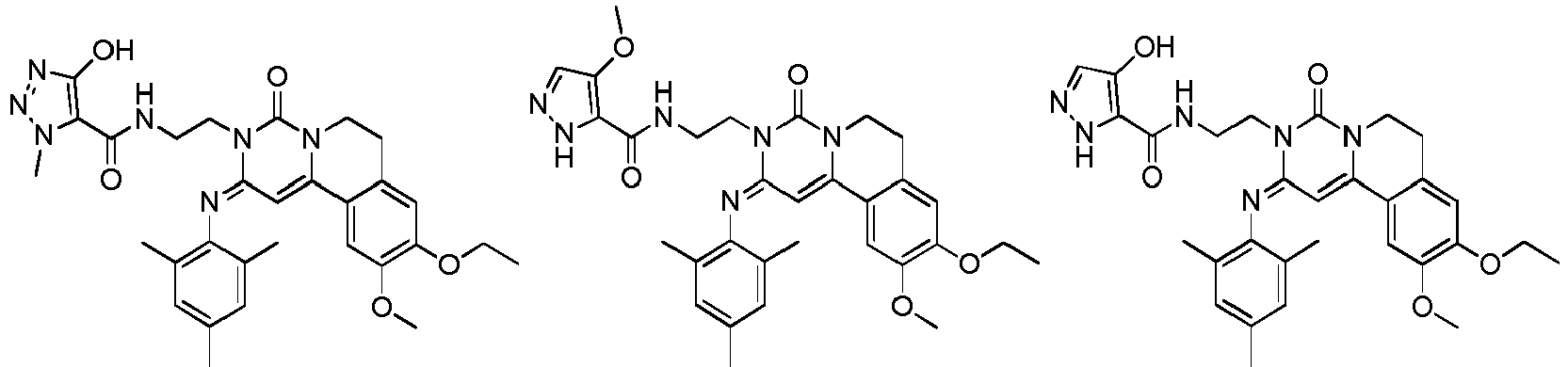



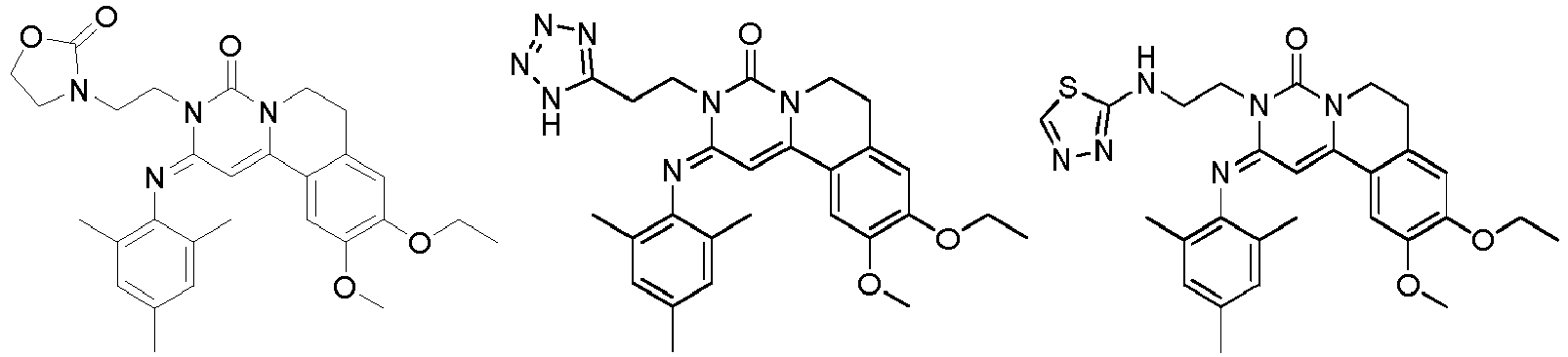
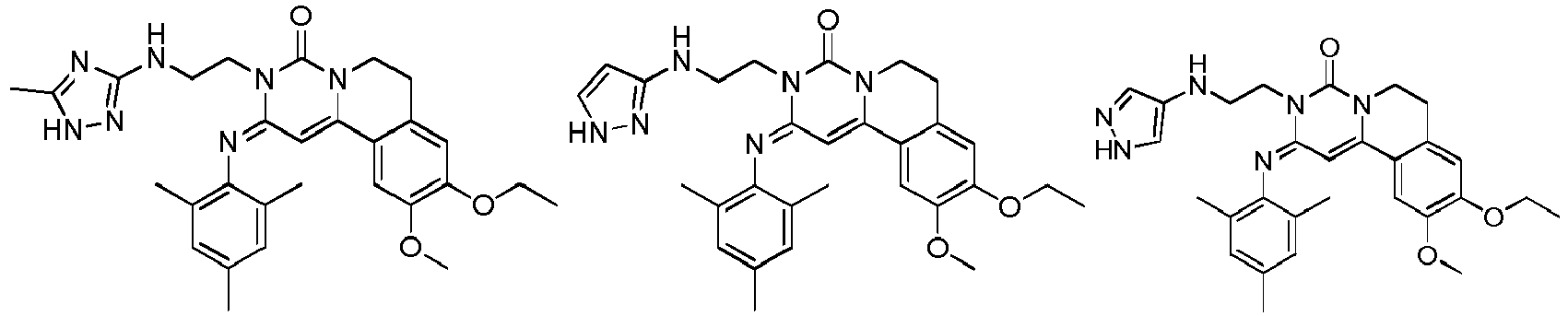








- A pharmaceutical composition comprising the compound or the pharmaceutically acceptable salt thereof according to any one of claims 1-12 and a pharmaceutically acceptable excipient, carrier or diluent.
- Use of the compound or the pharmaceutically acceptable salt thereof according to any one of claims 1-12 or the pharmaceutical composition according to claim 13 in preparing a medicament for treating a disease related to PDE3 and/or PDE4, optionally, wherein the disease related to PDE3 and/or PDE4 is selected from chronic obstructive pulmonary disease and asthma.
- A method for treating a disease related to PDE3 and/or PDE4 in a mammal, comprising administering to the mammal in need thereof a therapeutically effective amount of the compound or the pharmaceutically acceptable salt thereof according to any one of claims 1-12 or the pharmaceutical composition thereof according to claim 13, optionally, wherein the disease related to PDE3 and/or PDE4 is selected from chronic obstructive pulmonary disease and asthma.
Priority Applications (2)
| Application Number | Priority Date | Filing Date | Title |
|---|---|---|---|
| SI201930911T SI3822272T1 (en) | 2018-07-13 | 2019-07-12 | Fused tri-cyclic compound as pde3/pde4 dual inhibitor |
| HRP20250282TT HRP20250282T1 (en) | 2018-07-13 | 2019-07-12 | FUSION TRI-CYCLIC COMPOUND AS A DUAL PDE3/PDE4 INHIBITOR |
Applications Claiming Priority (2)
| Application Number | Priority Date | Filing Date | Title |
|---|---|---|---|
| CN201810772374 | 2018-07-13 | ||
| PCT/CN2019/095826 WO2020011254A1 (en) | 2018-07-13 | 2019-07-12 | Fused tri-cyclic compound as pde3/pde4 dual inhibitor |
Publications (3)
| Publication Number | Publication Date |
|---|---|
| EP3822272A1 true EP3822272A1 (en) | 2021-05-19 |
| EP3822272A4 EP3822272A4 (en) | 2022-04-06 |
| EP3822272B1 EP3822272B1 (en) | 2024-12-18 |
Family
ID=69143182
Family Applications (1)
| Application Number | Title | Priority Date | Filing Date |
|---|---|---|---|
| EP19834834.4A Active EP3822272B1 (en) | 2018-07-13 | 2019-07-12 | Fused tri-cyclic compound as pde3/pde4 dual inhibitor |
Country Status (20)
| Country | Link |
|---|---|
| US (2) | US11993596B2 (en) |
| EP (1) | EP3822272B1 (en) |
| JP (2) | JP7491896B2 (en) |
| KR (2) | KR20250111408A (en) |
| CN (2) | CN112368281B (en) |
| AU (2) | AU2019302610B2 (en) |
| CA (1) | CA3106052A1 (en) |
| DK (1) | DK3822272T5 (en) |
| ES (1) | ES3003857T3 (en) |
| FI (1) | FI3822272T3 (en) |
| HR (1) | HRP20250282T1 (en) |
| HU (1) | HUE070622T2 (en) |
| IL (1) | IL280075B2 (en) |
| LT (1) | LT3822272T (en) |
| MX (1) | MX2021000456A (en) |
| PL (1) | PL3822272T4 (en) |
| PT (1) | PT3822272T (en) |
| SI (1) | SI3822272T1 (en) |
| WO (1) | WO2020011254A1 (en) |
| ZA (1) | ZA202100221B (en) |
Cited By (3)
| Publication number | Priority date | Publication date | Assignee | Title |
|---|---|---|---|---|
| WO2021143841A1 (en) | 2020-01-15 | 2021-07-22 | 正大天晴药业集团股份有限公司 | Pharmaceutical composition of tricyclic pde3/pde4 dual inhibitor compound |
| WO2023109802A1 (en) | 2021-12-14 | 2023-06-22 | 海思科医药集团股份有限公司 | Tricyclic fused heterocyclic pde3/4 dual inhibitor and use thereof |
| EP4643947A3 (en) * | 2020-01-15 | 2025-11-19 | Chia Tai Tianqing Pharmaceutical Group Co., Ltd | Crystal of pde3/pde4 dual inhibitor and use thereof |
Families Citing this family (12)
| Publication number | Priority date | Publication date | Assignee | Title |
|---|---|---|---|---|
| IL280075B2 (en) * | 2018-07-13 | 2024-06-01 | Chia Tai Tianqing Pharmaceutical Group Co Ltd | Fused tri-cyclic compound as pde3/pde4 dual inhibitor |
| GB201905721D0 (en) | 2019-04-24 | 2019-06-05 | Univ Dundee | Compounds |
| KR20240004495A (en) * | 2021-04-29 | 2024-01-11 | 쑤저우 선카디아 바이오파마수티컬즈 컴퍼니 리미티드 | Isoquinolone compounds and their uses |
| WO2023138676A1 (en) | 2022-01-21 | 2023-07-27 | 四川海思科制药有限公司 | Tricyclic fused heterocyclic pde3/4 dual inhibitor and use thereof |
| WO2024088402A1 (en) * | 2022-10-28 | 2024-05-02 | 江苏恒瑞医药股份有限公司 | Crystal form of isoquinolinone compound and preparation method therefor |
| CN117946099A (en) * | 2022-10-28 | 2024-04-30 | 江苏恒瑞医药股份有限公司 | A pharmaceutically acceptable salt of isoquinolinone compound, crystal form and preparation method thereof |
| CN120136868A (en) * | 2023-12-13 | 2025-06-13 | 石家庄以岭药业股份有限公司 | Tricyclic fused heterocyclic PDE3/4 dual inhibitors and preparation method and application thereof |
| WO2025124462A1 (en) * | 2023-12-13 | 2025-06-19 | 石家庄以岭药业股份有限公司 | Tricyclic fused heterocyclic pde3/4 dual inhibitor and preparation and use therefor |
| WO2026002106A1 (en) * | 2024-06-28 | 2026-01-02 | 辽宁海思科制药有限公司 | Method for preparing key intermediate of tricyclic fused heterocyclic pde3/4 dual inhibitor |
| WO2026052051A1 (en) * | 2024-09-06 | 2026-03-12 | 正大天晴药业集团股份有限公司 | Use of heterocyclic compound in treatment of pulmonary disease |
| CN119241534B (en) * | 2024-09-18 | 2025-12-05 | 武汉九州钰民医药科技有限公司 | A method for preparing encefenidine |
| CN120699016A (en) * | 2025-06-20 | 2025-09-26 | 济南大学 | A preparation method of Ensefentin |
Family Cites Families (7)
| Publication number | Priority date | Publication date | Assignee | Title |
|---|---|---|---|---|
| NZ185900A (en) | 1976-12-10 | 1981-04-24 | Hoechst Ag | Pyrimido (6,1-a) isoquinolin-4-ones medicaments intermediate isoquinolines |
| FI64370C (en) * | 1977-05-05 | 1983-11-10 | Hoechst Ag | PROCEDURE FOR THE FRAMEWORK OF THERAPEUTIC ANALYZA PYIMIDO- (6,1-A) Isoquinoline-2-IMINO-4-ONDERIVAT |
| ZW6284A1 (en) | 1983-05-05 | 1985-10-30 | Hoffmann La Roche | Novel pyrimidone derivatives |
| EP1022868B1 (en) | 1998-07-22 | 2004-11-24 | Mitsubishi Denki Kabushiki Kaisha | Mobile communication system and mobile communication method |
| CA2368413C (en) | 1999-03-31 | 2008-07-29 | Verona Pharma Plc | Derivatives of pyrimido[6,1-a]isoquinolin-4-one |
| PT2603509E (en) | 2010-08-09 | 2014-08-29 | Verona Pharma Plc | Crystalline form of pyrimido[6,1-a] isoquinolin-4-one compound |
| IL280075B2 (en) * | 2018-07-13 | 2024-06-01 | Chia Tai Tianqing Pharmaceutical Group Co Ltd | Fused tri-cyclic compound as pde3/pde4 dual inhibitor |
-
2019
- 2019-07-12 IL IL280075A patent/IL280075B2/en unknown
- 2019-07-12 KR KR1020257023758A patent/KR20250111408A/en active Pending
- 2019-07-12 PT PT198348344T patent/PT3822272T/en unknown
- 2019-07-12 CN CN201980045308.9A patent/CN112368281B/en active Active
- 2019-07-12 SI SI201930911T patent/SI3822272T1/en unknown
- 2019-07-12 WO PCT/CN2019/095826 patent/WO2020011254A1/en not_active Ceased
- 2019-07-12 LT LTEPPCT/CN2019/095826T patent/LT3822272T/en unknown
- 2019-07-12 KR KR1020217004102A patent/KR102836158B1/en active Active
- 2019-07-12 ES ES19834834T patent/ES3003857T3/en active Active
- 2019-07-12 CN CN202210301047.6A patent/CN114644630A/en active Pending
- 2019-07-12 HR HRP20250282TT patent/HRP20250282T1/en unknown
- 2019-07-12 JP JP2021501020A patent/JP7491896B2/en active Active
- 2019-07-12 FI FIEP19834834.4T patent/FI3822272T3/en active
- 2019-07-12 CA CA3106052A patent/CA3106052A1/en active Pending
- 2019-07-12 AU AU2019302610A patent/AU2019302610B2/en active Active
- 2019-07-12 US US17/259,089 patent/US11993596B2/en active Active
- 2019-07-12 EP EP19834834.4A patent/EP3822272B1/en active Active
- 2019-07-12 MX MX2021000456A patent/MX2021000456A/en unknown
- 2019-07-12 DK DK19834834.4T patent/DK3822272T5/en active
- 2019-07-12 HU HUE19834834A patent/HUE070622T2/en unknown
- 2019-07-12 PL PL19834834.4T patent/PL3822272T4/en unknown
-
2021
- 2021-01-13 ZA ZA2021/00221A patent/ZA202100221B/en unknown
-
2024
- 2024-02-21 AU AU2024201135A patent/AU2024201135B2/en active Active
- 2024-04-22 US US18/641,912 patent/US20240294526A1/en active Pending
- 2024-05-16 JP JP2024080444A patent/JP2024105613A/en active Pending
Cited By (5)
| Publication number | Priority date | Publication date | Assignee | Title |
|---|---|---|---|---|
| WO2021143841A1 (en) | 2020-01-15 | 2021-07-22 | 正大天晴药业集团股份有限公司 | Pharmaceutical composition of tricyclic pde3/pde4 dual inhibitor compound |
| EP4643947A3 (en) * | 2020-01-15 | 2025-11-19 | Chia Tai Tianqing Pharmaceutical Group Co., Ltd | Crystal of pde3/pde4 dual inhibitor and use thereof |
| WO2023109802A1 (en) | 2021-12-14 | 2023-06-22 | 海思科医药集团股份有限公司 | Tricyclic fused heterocyclic pde3/4 dual inhibitor and use thereof |
| EP4606427A3 (en) * | 2021-12-14 | 2025-10-15 | Xizang Haisco Pharmaceutical Co., Ltd. | Tricyclic fused heterocyclic pde3/4 dual inhibitor and use thereof |
| EP4450500A4 (en) * | 2021-12-14 | 2025-10-15 | Xizang Haisco Pharmaceutical Co Ltd | Tricyclic condensed heterocyclic PDE3/4 double inhibitor and use thereof |
Also Published As
Similar Documents
| Publication | Publication Date | Title |
|---|---|---|
| EP3822272B1 (en) | Fused tri-cyclic compound as pde3/pde4 dual inhibitor | |
| EP4556481A1 (en) | Piperazine bridge-substituted heterocyclic pyrimidine compound | |
| CN111315744B (en) | Heteroaryltetrahydropyridine compounds, their preparation method, pharmaceutical composition and application | |
| WO2021213317A1 (en) | Hpk1 inhibitor, preparation method therefor and use thereof | |
| EP4215523A1 (en) | Isochroman compound | |
| EP4092022A1 (en) | Crystal of pde3/pde4 dual inhibitor and use thereof | |
| EP4155304B1 (en) | Compound used as ret kinase inhibitor and application thereof | |
| CN116390728A (en) | Quinazoline derivatives and their preparation and use | |
| CN115925694B (en) | PAK4 kinase inhibitor and preparation method and application thereof | |
| EP3712139A1 (en) | Anti-hbv tetrahydroisoxazolo[4,3-c]pyridine compounds | |
| EP2448584B1 (en) | Substituted 4-hydroxypyrimidine-5-carboxamides | |
| CN120271607A (en) | RAS inhibitors | |
| US20240383906A1 (en) | 5-substituted pyridine-2(1h)-ketone compound and use thereof | |
| EP4144731B1 (en) | Compounds containing benzosultam | |
| RU2827863C2 (en) | Condensed tricyclic compound as double inhibitor of pde3/pde4 | |
| EP4455139A1 (en) | Compound as fak inhibitor and use thereof | |
| WO2022257047A1 (en) | Diazaspirobicylic compounds as protein-protein interaction inhibitors and applications thereof | |
| HK40038640B (en) | Fused tri-cyclic compound as pde3/pde4 dual inhibitor | |
| HK40038640A (en) | Fused tri-cyclic compound as pde3/pde4 dual inhibitor | |
| HK40085080A (en) | Crystal of pde3/pde4 dual inhibitor and use thereof | |
| HK40090211B (en) | Compound used as ret kinase inhibitor and application thereof | |
| CN111377922A (en) | Fused tricyclic compounds and uses thereof |
Legal Events
| Date | Code | Title | Description |
|---|---|---|---|
| REG | Reference to a national code |
Ref country code: HR Ref legal event code: TUEP Ref document number: P20250282T Country of ref document: HR |
|
| STAA | Information on the status of an ep patent application or granted ep patent |
Free format text: STATUS: THE INTERNATIONAL PUBLICATION HAS BEEN MADE |
|
| PUAI | Public reference made under article 153(3) epc to a published international application that has entered the european phase |
Free format text: ORIGINAL CODE: 0009012 |
|
| STAA | Information on the status of an ep patent application or granted ep patent |
Free format text: STATUS: REQUEST FOR EXAMINATION WAS MADE |
|
| 17P | Request for examination filed |
Effective date: 20210128 |
|
| AK | Designated contracting states |
Kind code of ref document: A1 Designated state(s): AL AT BE BG CH CY CZ DE DK EE ES FI FR GB GR HR HU IE IS IT LI LT LU LV MC MK MT NL NO PL PT RO RS SE SI SK SM TR |
|
| DAV | Request for validation of the european patent (deleted) | ||
| DAX | Request for extension of the european patent (deleted) | ||
| A4 | Supplementary search report drawn up and despatched |
Effective date: 20220310 |
|
| RIC1 | Information provided on ipc code assigned before grant |
Ipc: A61P 11/08 20060101ALI20220303BHEP Ipc: A61K 31/519 20060101ALI20220303BHEP Ipc: A61K 31/517 20060101ALI20220303BHEP Ipc: C07D 471/04 20060101AFI20220303BHEP |
|
| TPAC | Observations filed by third parties |
Free format text: ORIGINAL CODE: EPIDOSNTIPA |
|
| STAA | Information on the status of an ep patent application or granted ep patent |
Free format text: STATUS: EXAMINATION IS IN PROGRESS |
|
| 17Q | First examination report despatched |
Effective date: 20230717 |
|
| TPAC | Observations filed by third parties |
Free format text: ORIGINAL CODE: EPIDOSNTIPA |
|
| GRAP | Despatch of communication of intention to grant a patent |
Free format text: ORIGINAL CODE: EPIDOSNIGR1 |
|
| STAA | Information on the status of an ep patent application or granted ep patent |
Free format text: STATUS: GRANT OF PATENT IS INTENDED |
|
| INTG | Intention to grant announced |
Effective date: 20240711 |
|
| GRAS | Grant fee paid |
Free format text: ORIGINAL CODE: EPIDOSNIGR3 |
|
| P01 | Opt-out of the competence of the unified patent court (upc) registered |
Free format text: CASE NUMBER: APP_53395/2024 Effective date: 20240925 |
|
| GRAA | (expected) grant |
Free format text: ORIGINAL CODE: 0009210 |
|
| STAA | Information on the status of an ep patent application or granted ep patent |
Free format text: STATUS: THE PATENT HAS BEEN GRANTED |
|
| AK | Designated contracting states |
Kind code of ref document: B1 Designated state(s): AL AT BE BG CH CY CZ DE DK EE ES FI FR GB GR HR HU IE IS IT LI LT LU LV MC MK MT NL NO PL PT RO RS SE SI SK SM TR |
|
| REG | Reference to a national code |
Ref country code: CH Ref legal event code: EP |
|
| REG | Reference to a national code |
Ref country code: DE Ref legal event code: R096 Ref document number: 602019063753 Country of ref document: DE |
|
| REG | Reference to a national code |
Ref country code: IE Ref legal event code: FG4D |
|
| REG | Reference to a national code |
Ref country code: DK Ref legal event code: T3 Effective date: 20250113 |
|
| REG | Reference to a national code |
Ref country code: FI Ref legal event code: FGE |
|
| REG | Reference to a national code |
Ref country code: PT Ref legal event code: SC4A Ref document number: 3822272 Country of ref document: PT Date of ref document: 20250122 Kind code of ref document: T Free format text: AVAILABILITY OF NATIONAL TRANSLATION Effective date: 20250116 |
|
| REG | Reference to a national code |
Ref country code: SE Ref legal event code: TRGR |
|
| REG | Reference to a national code |
Ref country code: NL Ref legal event code: FP |
|
| REG | Reference to a national code |
Ref country code: GR Ref legal event code: EP Ref document number: 20250400084 Country of ref document: GR Effective date: 20250211 |
|
| REG | Reference to a national code |
Ref country code: ES Ref legal event code: FG2A Ref document number: 3003857 Country of ref document: ES Kind code of ref document: T3 Effective date: 20250311 |
|
| REG | Reference to a national code |
Ref country code: HR Ref legal event code: T1PR Ref document number: P20250282 Country of ref document: HR |
|
| PG25 | Lapsed in a contracting state [announced via postgrant information from national office to epo] |
Ref country code: RS Free format text: LAPSE BECAUSE OF FAILURE TO SUBMIT A TRANSLATION OF THE DESCRIPTION OR TO PAY THE FEE WITHIN THE PRESCRIBED TIME-LIMIT Effective date: 20250318 |
|
| REG | Reference to a national code |
Ref country code: SK Ref legal event code: T3 Ref document number: E 46114 Country of ref document: SK |
|
| REG | Reference to a national code |
Ref country code: HU Ref legal event code: AG4A Ref document number: E070622 Country of ref document: HU |
|
| PG25 | Lapsed in a contracting state [announced via postgrant information from national office to epo] |
Ref country code: SM Free format text: LAPSE BECAUSE OF FAILURE TO SUBMIT A TRANSLATION OF THE DESCRIPTION OR TO PAY THE FEE WITHIN THE PRESCRIBED TIME-LIMIT Effective date: 20241218 |
|
| PGFP | Annual fee paid to national office [announced via postgrant information from national office to epo] |
Ref country code: PL Payment date: 20250612 Year of fee payment: 7 |
|
| PGFP | Annual fee paid to national office [announced via postgrant information from national office to epo] |
Ref country code: GB Payment date: 20250612 Year of fee payment: 7 |
|
| PGFP | Annual fee paid to national office [announced via postgrant information from national office to epo] |
Ref country code: LT Payment date: 20250618 Year of fee payment: 7 |
|
| PG25 | Lapsed in a contracting state [announced via postgrant information from national office to epo] |
Ref country code: IS Free format text: LAPSE BECAUSE OF FAILURE TO SUBMIT A TRANSLATION OF THE DESCRIPTION OR TO PAY THE FEE WITHIN THE PRESCRIBED TIME-LIMIT Effective date: 20250418 |
|
| PGFP | Annual fee paid to national office [announced via postgrant information from national office to epo] |
Ref country code: LU Payment date: 20250625 Year of fee payment: 7 Ref country code: NL Payment date: 20250613 Year of fee payment: 7 Ref country code: BE Payment date: 20250619 Year of fee payment: 7 |
|
| PGFP | Annual fee paid to national office [announced via postgrant information from national office to epo] |
Ref country code: LV Payment date: 20250619 Year of fee payment: 7 Ref country code: PT Payment date: 20250618 Year of fee payment: 7 |
|
| PG25 | Lapsed in a contracting state [announced via postgrant information from national office to epo] |
Ref country code: EE Free format text: LAPSE BECAUSE OF FAILURE TO SUBMIT A TRANSLATION OF THE DESCRIPTION OR TO PAY THE FEE WITHIN THE PRESCRIBED TIME-LIMIT Effective date: 20241218 |
|
| PGFP | Annual fee paid to national office [announced via postgrant information from national office to epo] |
Ref country code: FR Payment date: 20250610 Year of fee payment: 7 |
|
| PGFP | Annual fee paid to national office [announced via postgrant information from national office to epo] |
Ref country code: GR Payment date: 20250618 Year of fee payment: 7 Ref country code: BG Payment date: 20250613 Year of fee payment: 7 |
|
| REG | Reference to a national code |
Ref country code: DK Ref legal event code: T5 Effective date: 20250714 |
|
| PGFP | Annual fee paid to national office [announced via postgrant information from national office to epo] |
Ref country code: RO Payment date: 20250624 Year of fee payment: 7 |
|
| PGFP | Annual fee paid to national office [announced via postgrant information from national office to epo] |
Ref country code: SK Payment date: 20250612 Year of fee payment: 7 |
|
| PGFP | Annual fee paid to national office [announced via postgrant information from national office to epo] |
Ref country code: CZ Payment date: 20250618 Year of fee payment: 7 |
|
| PGFP | Annual fee paid to national office [announced via postgrant information from national office to epo] |
Ref country code: IE Payment date: 20250610 Year of fee payment: 7 |
|
| PGFP | Annual fee paid to national office [announced via postgrant information from national office to epo] |
Ref country code: SE Payment date: 20250610 Year of fee payment: 7 Ref country code: SI Payment date: 20250613 Year of fee payment: 7 |
|
| PGFP | Annual fee paid to national office [announced via postgrant information from national office to epo] |
Ref country code: HU Payment date: 20250630 Year of fee payment: 7 |
|
| REG | Reference to a national code |
Ref country code: HR Ref legal event code: ODRP Ref document number: P20250282 Country of ref document: HR Payment date: 20250702 Year of fee payment: 7 |
|
| REG | Reference to a national code |
Ref country code: DE Ref legal event code: R097 Ref document number: 602019063753 Country of ref document: DE |
|
| PGFP | Annual fee paid to national office [announced via postgrant information from national office to epo] |
Ref country code: FI Payment date: 20250715 Year of fee payment: 7 Ref country code: ES Payment date: 20250807 Year of fee payment: 7 |
|
| PGFP | Annual fee paid to national office [announced via postgrant information from national office to epo] |
Ref country code: DE Payment date: 20250611 Year of fee payment: 7 Ref country code: DK Payment date: 20250714 Year of fee payment: 7 |
|
| PGFP | Annual fee paid to national office [announced via postgrant information from national office to epo] |
Ref country code: NO Payment date: 20250709 Year of fee payment: 7 |
|
| PGFP | Annual fee paid to national office [announced via postgrant information from national office to epo] |
Ref country code: TR Payment date: 20250703 Year of fee payment: 7 Ref country code: IT Payment date: 20250623 Year of fee payment: 7 |
|
| PGFP | Annual fee paid to national office [announced via postgrant information from national office to epo] |
Ref country code: HR Payment date: 20250702 Year of fee payment: 7 |
|
| PGFP | Annual fee paid to national office [announced via postgrant information from national office to epo] |
Ref country code: AT Payment date: 20250625 Year of fee payment: 7 |
|
| PGFP | Annual fee paid to national office [announced via postgrant information from national office to epo] |
Ref country code: CH Payment date: 20250801 Year of fee payment: 7 |
|
| PLBE | No opposition filed within time limit |
Free format text: ORIGINAL CODE: 0009261 |
|
| STAA | Information on the status of an ep patent application or granted ep patent |
Free format text: STATUS: NO OPPOSITION FILED WITHIN TIME LIMIT |
|
| 26N | No opposition filed |
Effective date: 20250919 |
|
| REG | Reference to a national code |
Ref country code: SK Ref legal event code: T4 Ref document number: E 46114 Country of ref document: SK |
|
| REG | Reference to a national code |
Ref country code: SK Ref legal event code: T4 Ref document number: E 46114 Country of ref document: SK |
|
| REG | Reference to a national code |
Ref country code: AT Ref legal event code: UEP Ref document number: 1752192 Country of ref document: AT Kind code of ref document: T Effective date: 20241218 |