EP3822137B1 - Vehicle control method and device - Google Patents
Vehicle control method and device Download PDFInfo
- Publication number
- EP3822137B1 EP3822137B1 EP19853716.9A EP19853716A EP3822137B1 EP 3822137 B1 EP3822137 B1 EP 3822137B1 EP 19853716 A EP19853716 A EP 19853716A EP 3822137 B1 EP3822137 B1 EP 3822137B1
- Authority
- EP
- European Patent Office
- Prior art keywords
- wheel
- flat tire
- wheels
- torque
- absolute value
- Prior art date
- Legal status (The legal status is an assumption and is not a legal conclusion. Google has not performed a legal analysis and makes no representation as to the accuracy of the status listed.)
- Active
Links
Images









Classifications
-
- B—PERFORMING OPERATIONS; TRANSPORTING
- B60—VEHICLES IN GENERAL
- B60W—CONJOINT CONTROL OF VEHICLE SUB-UNITS OF DIFFERENT TYPE OR DIFFERENT FUNCTION; CONTROL SYSTEMS SPECIALLY ADAPTED FOR HYBRID VEHICLES; ROAD VEHICLE DRIVE CONTROL SYSTEMS FOR PURPOSES NOT RELATED TO THE CONTROL OF A PARTICULAR SUB-UNIT
- B60W40/00—Estimation or calculation of non-directly measurable driving parameters for road vehicle drive control systems not related to the control of a particular sub unit, e.g. by using mathematical models
- B60W40/10—Estimation or calculation of non-directly measurable driving parameters for road vehicle drive control systems not related to the control of a particular sub unit, e.g. by using mathematical models related to vehicle motion
- B60W40/114—Yaw movement
-
- B—PERFORMING OPERATIONS; TRANSPORTING
- B60—VEHICLES IN GENERAL
- B60W—CONJOINT CONTROL OF VEHICLE SUB-UNITS OF DIFFERENT TYPE OR DIFFERENT FUNCTION; CONTROL SYSTEMS SPECIALLY ADAPTED FOR HYBRID VEHICLES; ROAD VEHICLE DRIVE CONTROL SYSTEMS FOR PURPOSES NOT RELATED TO THE CONTROL OF A PARTICULAR SUB-UNIT
- B60W30/00—Purposes of road vehicle drive control systems not related to the control of a particular sub-unit, e.g. of systems using conjoint control of vehicle sub-units
- B60W30/02—Control of vehicle driving stability
-
- B—PERFORMING OPERATIONS; TRANSPORTING
- B60—VEHICLES IN GENERAL
- B60W—CONJOINT CONTROL OF VEHICLE SUB-UNITS OF DIFFERENT TYPE OR DIFFERENT FUNCTION; CONTROL SYSTEMS SPECIALLY ADAPTED FOR HYBRID VEHICLES; ROAD VEHICLE DRIVE CONTROL SYSTEMS FOR PURPOSES NOT RELATED TO THE CONTROL OF A PARTICULAR SUB-UNIT
- B60W40/00—Estimation or calculation of non-directly measurable driving parameters for road vehicle drive control systems not related to the control of a particular sub unit, e.g. by using mathematical models
- B60W40/10—Estimation or calculation of non-directly measurable driving parameters for road vehicle drive control systems not related to the control of a particular sub unit, e.g. by using mathematical models related to vehicle motion
- B60W40/1005—Driving resistance
-
- B—PERFORMING OPERATIONS; TRANSPORTING
- B60—VEHICLES IN GENERAL
- B60W—CONJOINT CONTROL OF VEHICLE SUB-UNITS OF DIFFERENT TYPE OR DIFFERENT FUNCTION; CONTROL SYSTEMS SPECIALLY ADAPTED FOR HYBRID VEHICLES; ROAD VEHICLE DRIVE CONTROL SYSTEMS FOR PURPOSES NOT RELATED TO THE CONTROL OF A PARTICULAR SUB-UNIT
- B60W50/00—Details of control systems for road vehicle drive control not related to the control of a particular sub-unit, e.g. process diagnostic or vehicle driver interfaces
- B60W50/0098—Details of control systems ensuring comfort, safety or stability not otherwise provided for
-
- B—PERFORMING OPERATIONS; TRANSPORTING
- B60—VEHICLES IN GENERAL
- B60W—CONJOINT CONTROL OF VEHICLE SUB-UNITS OF DIFFERENT TYPE OR DIFFERENT FUNCTION; CONTROL SYSTEMS SPECIALLY ADAPTED FOR HYBRID VEHICLES; ROAD VEHICLE DRIVE CONTROL SYSTEMS FOR PURPOSES NOT RELATED TO THE CONTROL OF A PARTICULAR SUB-UNIT
- B60W50/00—Details of control systems for road vehicle drive control not related to the control of a particular sub-unit, e.g. process diagnostic or vehicle driver interfaces
- B60W2050/0001—Details of the control system
- B60W2050/0002—Automatic control, details of type of controller or control system architecture
- B60W2050/0008—Feedback, closed loop systems or details of feedback error signal
-
- B—PERFORMING OPERATIONS; TRANSPORTING
- B60—VEHICLES IN GENERAL
- B60W—CONJOINT CONTROL OF VEHICLE SUB-UNITS OF DIFFERENT TYPE OR DIFFERENT FUNCTION; CONTROL SYSTEMS SPECIALLY ADAPTED FOR HYBRID VEHICLES; ROAD VEHICLE DRIVE CONTROL SYSTEMS FOR PURPOSES NOT RELATED TO THE CONTROL OF A PARTICULAR SUB-UNIT
- B60W50/00—Details of control systems for road vehicle drive control not related to the control of a particular sub-unit, e.g. process diagnostic or vehicle driver interfaces
- B60W2050/0001—Details of the control system
- B60W2050/0019—Control system elements or transfer functions
- B60W2050/0022—Gains, weighting coefficients or weighting functions
- B60W2050/0024—Variable gains
-
- B—PERFORMING OPERATIONS; TRANSPORTING
- B60—VEHICLES IN GENERAL
- B60W—CONJOINT CONTROL OF VEHICLE SUB-UNITS OF DIFFERENT TYPE OR DIFFERENT FUNCTION; CONTROL SYSTEMS SPECIALLY ADAPTED FOR HYBRID VEHICLES; ROAD VEHICLE DRIVE CONTROL SYSTEMS FOR PURPOSES NOT RELATED TO THE CONTROL OF A PARTICULAR SUB-UNIT
- B60W50/00—Details of control systems for road vehicle drive control not related to the control of a particular sub-unit, e.g. process diagnostic or vehicle driver interfaces
- B60W2050/0001—Details of the control system
- B60W2050/0019—Control system elements or transfer functions
- B60W2050/0028—Mathematical models, e.g. for simulation
- B60W2050/0031—Mathematical model of the vehicle
-
- B—PERFORMING OPERATIONS; TRANSPORTING
- B60—VEHICLES IN GENERAL
- B60W—CONJOINT CONTROL OF VEHICLE SUB-UNITS OF DIFFERENT TYPE OR DIFFERENT FUNCTION; CONTROL SYSTEMS SPECIALLY ADAPTED FOR HYBRID VEHICLES; ROAD VEHICLE DRIVE CONTROL SYSTEMS FOR PURPOSES NOT RELATED TO THE CONTROL OF A PARTICULAR SUB-UNIT
- B60W2520/00—Input parameters relating to overall vehicle dynamics
- B60W2520/12—Lateral speed
- B60W2520/125—Lateral acceleration
-
- B—PERFORMING OPERATIONS; TRANSPORTING
- B60—VEHICLES IN GENERAL
- B60W—CONJOINT CONTROL OF VEHICLE SUB-UNITS OF DIFFERENT TYPE OR DIFFERENT FUNCTION; CONTROL SYSTEMS SPECIALLY ADAPTED FOR HYBRID VEHICLES; ROAD VEHICLE DRIVE CONTROL SYSTEMS FOR PURPOSES NOT RELATED TO THE CONTROL OF A PARTICULAR SUB-UNIT
- B60W2520/00—Input parameters relating to overall vehicle dynamics
- B60W2520/14—Yaw
-
- B—PERFORMING OPERATIONS; TRANSPORTING
- B60—VEHICLES IN GENERAL
- B60W—CONJOINT CONTROL OF VEHICLE SUB-UNITS OF DIFFERENT TYPE OR DIFFERENT FUNCTION; CONTROL SYSTEMS SPECIALLY ADAPTED FOR HYBRID VEHICLES; ROAD VEHICLE DRIVE CONTROL SYSTEMS FOR PURPOSES NOT RELATED TO THE CONTROL OF A PARTICULAR SUB-UNIT
- B60W2520/00—Input parameters relating to overall vehicle dynamics
- B60W2520/28—Wheel speed
-
- B—PERFORMING OPERATIONS; TRANSPORTING
- B60—VEHICLES IN GENERAL
- B60W—CONJOINT CONTROL OF VEHICLE SUB-UNITS OF DIFFERENT TYPE OR DIFFERENT FUNCTION; CONTROL SYSTEMS SPECIALLY ADAPTED FOR HYBRID VEHICLES; ROAD VEHICLE DRIVE CONTROL SYSTEMS FOR PURPOSES NOT RELATED TO THE CONTROL OF A PARTICULAR SUB-UNIT
- B60W2520/00—Input parameters relating to overall vehicle dynamics
- B60W2520/30—Wheel torque
-
- B—PERFORMING OPERATIONS; TRANSPORTING
- B60—VEHICLES IN GENERAL
- B60W—CONJOINT CONTROL OF VEHICLE SUB-UNITS OF DIFFERENT TYPE OR DIFFERENT FUNCTION; CONTROL SYSTEMS SPECIALLY ADAPTED FOR HYBRID VEHICLES; ROAD VEHICLE DRIVE CONTROL SYSTEMS FOR PURPOSES NOT RELATED TO THE CONTROL OF A PARTICULAR SUB-UNIT
- B60W2530/00—Input parameters relating to vehicle conditions or values, not covered by groups B60W2510/00 or B60W2520/00
- B60W2530/20—Tyre data
-
- B—PERFORMING OPERATIONS; TRANSPORTING
- B60—VEHICLES IN GENERAL
- B60W—CONJOINT CONTROL OF VEHICLE SUB-UNITS OF DIFFERENT TYPE OR DIFFERENT FUNCTION; CONTROL SYSTEMS SPECIALLY ADAPTED FOR HYBRID VEHICLES; ROAD VEHICLE DRIVE CONTROL SYSTEMS FOR PURPOSES NOT RELATED TO THE CONTROL OF A PARTICULAR SUB-UNIT
- B60W2552/00—Input parameters relating to infrastructure
- B60W2552/40—Coefficient of friction
-
- B—PERFORMING OPERATIONS; TRANSPORTING
- B60—VEHICLES IN GENERAL
- B60W—CONJOINT CONTROL OF VEHICLE SUB-UNITS OF DIFFERENT TYPE OR DIFFERENT FUNCTION; CONTROL SYSTEMS SPECIALLY ADAPTED FOR HYBRID VEHICLES; ROAD VEHICLE DRIVE CONTROL SYSTEMS FOR PURPOSES NOT RELATED TO THE CONTROL OF A PARTICULAR SUB-UNIT
- B60W2720/00—Output or target parameters relating to overall vehicle dynamics
- B60W2720/14—Yaw
-
- B—PERFORMING OPERATIONS; TRANSPORTING
- B60—VEHICLES IN GENERAL
- B60W—CONJOINT CONTROL OF VEHICLE SUB-UNITS OF DIFFERENT TYPE OR DIFFERENT FUNCTION; CONTROL SYSTEMS SPECIALLY ADAPTED FOR HYBRID VEHICLES; ROAD VEHICLE DRIVE CONTROL SYSTEMS FOR PURPOSES NOT RELATED TO THE CONTROL OF A PARTICULAR SUB-UNIT
- B60W2720/00—Output or target parameters relating to overall vehicle dynamics
- B60W2720/30—Wheel torque
-
- B—PERFORMING OPERATIONS; TRANSPORTING
- B60—VEHICLES IN GENERAL
- B60W—CONJOINT CONTROL OF VEHICLE SUB-UNITS OF DIFFERENT TYPE OR DIFFERENT FUNCTION; CONTROL SYSTEMS SPECIALLY ADAPTED FOR HYBRID VEHICLES; ROAD VEHICLE DRIVE CONTROL SYSTEMS FOR PURPOSES NOT RELATED TO THE CONTROL OF A PARTICULAR SUB-UNIT
- B60W2720/00—Output or target parameters relating to overall vehicle dynamics
- B60W2720/40—Torque distribution
-
- B—PERFORMING OPERATIONS; TRANSPORTING
- B60—VEHICLES IN GENERAL
- B60W—CONJOINT CONTROL OF VEHICLE SUB-UNITS OF DIFFERENT TYPE OR DIFFERENT FUNCTION; CONTROL SYSTEMS SPECIALLY ADAPTED FOR HYBRID VEHICLES; ROAD VEHICLE DRIVE CONTROL SYSTEMS FOR PURPOSES NOT RELATED TO THE CONTROL OF A PARTICULAR SUB-UNIT
- B60W2720/00—Output or target parameters relating to overall vehicle dynamics
- B60W2720/40—Torque distribution
- B60W2720/403—Torque distribution between front and rear axle
-
- B—PERFORMING OPERATIONS; TRANSPORTING
- B60—VEHICLES IN GENERAL
- B60W—CONJOINT CONTROL OF VEHICLE SUB-UNITS OF DIFFERENT TYPE OR DIFFERENT FUNCTION; CONTROL SYSTEMS SPECIALLY ADAPTED FOR HYBRID VEHICLES; ROAD VEHICLE DRIVE CONTROL SYSTEMS FOR PURPOSES NOT RELATED TO THE CONTROL OF A PARTICULAR SUB-UNIT
- B60W2720/00—Output or target parameters relating to overall vehicle dynamics
- B60W2720/40—Torque distribution
- B60W2720/406—Torque distribution between left and right wheel
Definitions
- This application relates to the field of computer technologies, and in particular, to a vehicle control method and device, and a computer-readable storage medium.
- a vehicle flat tire is a common dangerous situation.
- a large proportion of traffic accidents are caused by vehicle flat tires every year.
- a flat tire that occurs when a vehicle is travelling at a high speed easily causes the vehicle to deviate from a normal travelling track, causing a major traffic accident.
- compensation for a yaw moment generated by a longitudinal force of an automobile after a flat tire occurs is mainly considered. After the yaw moment generated by the longitudinal force is obtained through calculation, a braking moment is applied to a wheel in which no flat tire occurs, so that the vehicle travels in a direction as desired by a driver.
- a lateral force is also an important factor that affects vehicle travelling.
- a flat tire of a vehicle affects performance of the vehicle, but a controller is designed based on vehicle parameters obtained when no flat tire occurs, and a problem of a delayed response of a yaw rate caused by the flat tire is not considered. Consequently, the applied braking moment may not enable the vehicle to travel in the direction as desired by the driver, and a control effect is poor.
- CN 108248454A relates to a stability control system for a vehicle body and a stability control method for the vehicle body.
- a tyre pressure, a longitudinal acceleration, a lateral acceleration, a yaw rate, a steering wheel angle and a wheel speed of a tyre of a wheel of a vehicle are collected.
- a control yaw moment is calculated based on the tyre pressure, the longitudinal acceleration, the lateral acceleration, the steering wheel angle, the wheel speed and the yaw rate, wherein the control yaw moment is used for eliminating the difference between an estimated yaw moment and an actual yaw moment.
- the deviation direction of the vehicle is determined based on the yaw rate
- the rollover degree of the vehicle is determined based on the tire pressure, the longitudinal acceleration, the lateral acceleration, the steering wheel angle, the wheel speed and the yaw rate.
- whether the vehicle is in the stable zone is determined based on the yaw rate, the steering wheel angle, the wheel speed, and the tire pressure.
- the control yaw moment is distributed to four wheels according to the vehicle body stability condition, the deviation direction and the rollover degree so as to realize the stability control of the vehicle body.
- Embodiments of this application provide a vehicle flat tire control method and device, to quickly compensate for a yaw moment generated by a flat tire, and reduce a yaw degree of a vehicle, so that the vehicle travels in a direction as desired by a driver.
- an embodiment of this application provides a vehicle control method, where the method includes: calculating a longitudinal force interference compensation torque and a lateral force interference compensation torque of a vehicle when a flat tire occurs in the vehicle; calculating a feedback control torque of the vehicle; determining an additional yaw moment based on the longitudinal force interference compensation torque, the feedback control torque, and the lateral force interference compensation torque; and controlling, based on the additional yaw moment, a wheel in which the flat tire occurs.
- the lateral force interference compensation torque is added to the additional yaw moment, so that the additional yaw moment more accurately represents a torque required for controlling the vehicle in which the flat tire occurs, and a response time for adjusting a yaw rate of the vehicle in which the flat tire occurs to a desired yaw rate is reduced.
- a yaw moment generated by the flat tire can be quickly compensated, and a yaw degree of the vehicle can be reduced, so that the vehicle travels in a direction as desired by a driver.
- the calculating a feedback control torque of the vehicle includes: calculating an absolute value of a desired yaw angular acceleration of the vehicle, and calculating a feedback gain based on the absolute value of the desired yaw angular acceleration; and calculating the feedback control torque based on the feedback gain.
- a feedback gain of a proportional-integral controller is adjusted based on the absolute value of the desired yaw angular acceleration, so that a problem of a delayed response of the yaw rate of the vehicle in which the flat tire occurs can be alleviated, and the response time for adjusting the yaw rate of the vehicle in which the flat tire occurs to the desired yaw rate can be reduced.
- the yaw moment generated by the flat tire can be quickly compensated, and the yaw degree of the vehicle can be reduced, so that the vehicle travels in the direction as desired by the driver.
- the calculating a feedback gain based on the absolute value of the desired yaw angular acceleration includes: determining, in a first preset relationship, an adjustment coefficient corresponding to the absolute value of the desired yaw angular acceleration, where the first preset relationship indicates a mapping relationship between absolute values of a plurality of desired yaw angular accelerations and a plurality of adjustment coefficients; and calculating the feedback gain based on the determined adjustment coefficient.
- the calculating the feedback gain based on the determined adjustment coefficient includes: multiplying a basic feedback gain by the adjustment coefficient to obtain the feedback gain.
- the first preset relationship is: if the absolute value of the desired yaw angular acceleration falls within [0, n 1 ], a corresponding adjustment coefficient is a, where a is a value in [2, 5]; or if the absolute value of the desired yaw angular acceleration falls within [n 1 , n 2 ], a corresponding adjustment coefficient increases as the absolute value of the desired yaw angular acceleration increases, where the adjustment coefficient falls within [a, b ]; or if the absolute value of the desired yaw angular acceleration falls within [n 2 , n th ], the adjustment coefficient is b; or if the absolute value of the desired yaw angular acceleration falls within [n 2 , n 3 ], a corresponding adjustment coefficient decreases as the absolute value of the desired yaw angular acceleration increases, where the adjustment coefficient falls within [b, c], and c is a value in [0, 1]; or if
- the controlling, based on the additional yaw moment, a wheel in which the flat tire occurs includes: determining a distribution order and an action mode of a wheel torque required for control based on a value of the additional yaw moment, a position of the wheel in which the flat tire occurs, and vertical forces of wheels in which no flat tire occurs, where a value of the wheel torque required for control is a quotient obtained by dividing a product of the additional yaw moment and a wheel diameter by an average track of wheels; determining that an absolute value of a wheel torque distributed to a first wheel in the distribution order is a smaller value in an absolute value of the wheel torque required for control and a maximum road surface friction torque of the first wheel; when the absolute value of the wheel torque distributed to the first wheel is the maximum road surface friction torque of the first wheel, determining that an absolute value of a wheel torque distributed to a second wheel in the distribution order is a smaller value in a
- wheels in which no flat tire occurs may be sequentially driven or braked in the distribution order, so that the vehicle can quickly compensate for the yaw moment generated by the flat tire, and the vehicle runs more stably in a process of compensating for the yaw moment generated by the flat tire.
- the method further includes: skipping distributing the wheel torques to the second wheel and the third wheel when the absolute value of the wheel torque distributed to the first wheel is the absolute value of the wheel torque required for control; and controlling the wheel in which the flat tire occurs, based on the distribution order and the action mode of the wheel torque required for control and the absolute value of the wheel torque distributed to the first wheel.
- wheels in which no flat tire occurs may be sequentially driven or braked in the distribution order, so that the vehicle can quickly compensate for the yaw moment generated by the flat tire, and the vehicle runs more stably in a process of compensating for the yaw moment generated by the flat tire.
- the determining a distribution order and an action mode of a wheel torque required for control based on a value of the additional yaw moment, a position of the wheel in which the flat tire occurs, and a vertical force of a wheel in which no flat tire occurs includes: when the additional yaw moment is less than zero, determining that, in wheels in which no flat tire occurs, a wheel with a greater vertical force in wheels on a right side of a vehicle traveling direction is the first wheel, where an action mode of the wheel torque distributed to the first wheel is braking; and if in the wheels in which no flat tire occurs, there are two wheels on the right side of the vehicle traveling direction, determining that a wheel other than the first wheel in the wheels on the right side of the vehicle traveling direction is the second wheel, where an action mode of the wheel torque distributed to the second wheel is braking, and determining that a remaining wheel other than the first wheel and the second wheel in the wheels in which no flat tire occurs is the third wheel, where an action mode of the
- the determining a distribution order and an action mode of a wheel torque required for control based on a value of the additional yaw moment, a position of the wheel in which the flat tire occurs, and a vertical force of a wheel in which no flat tire occurs includes: when the additional yaw moment is greater than zero, determining that, in wheels in which no flat tire occurs, a wheel with a greater vertical force in wheels on a left side of a vehicle traveling direction is the first wheel, where an action mode of the wheel torque distributed to the first wheel is braking; and if in the wheels in which no flat tire occurs, there are two wheels on the left side of the vehicle traveling direction, determining that a wheel other than the first wheel in the wheels on the left side of the vehicle traveling direction is the second wheel, where an action mode of the wheel torque distributed to the second wheel is braking, and determining that a remaining wheel other than the first wheel and the second wheel in the wheels in which no flat tire occurs is the third wheel, where an action mode of the
- the controlling, based on the additional yaw moment, a wheel in which the flat tire occurs includes: determining a distribution order and an action mode of a wheel torque required for control based on a value of the additional yaw moment, positions of the wheels in which the flat tire occurs, and a vertical force of a wheel in which no flat tire occurs, where a value of the wheel torque required for control is a quotient obtained by dividing a product of the additional yaw moment and a wheel diameter by an average track of wheels; determining that an absolute value of a wheel torque distributed to a first wheel in the distribution order is a smaller value in an absolute value of the wheel torque required for control and a maximum road surface friction torque of the first wheel; when the absolute value of the wheel torque distributed to the first wheel is the maximum road surface friction torque of the first wheel, determining that an absolute value of a wheel torque distributed to a second wheel in the distribution order is a smaller value
- wheels in which no flat tire occurs may be sequentially driven or braked in the distribution order, so that the vehicle can quickly compensate for the yaw moment generated by the flat tire, and the vehicle runs more stably in a process of compensating for the yaw moment generated by the flat tire.
- the method further includes: skipping distributing the wheel torque to the second wheel when the absolute value of the wheel torque distributed to the first wheel is the absolute value of the wheel torque required for control; and controlling the wheel in which the flat tire occurs, based on the distribution order and the action mode of the wheel torque required for control and the absolute value of the wheel torque distributed to the first wheel.
- wheels in which no flat tire occurs may be sequentially driven or braked in the distribution order, so that the vehicle can quickly compensate for the yaw moment generated by the flat tire, and the vehicle runs more stably in a process of compensating for the yaw moment generated by the flat tire.
- the determining a distribution order and an action mode of a wheel torque required for control based on a value of the additional yaw moment, a position of the wheel in which the flat tire occurs, and a vertical force of a wheel in which no flat tire occurs includes: when the additional yaw moment is less than zero, if both the wheels in which the flat tire occurs are wheels on a left side of a vehicle traveling direction, determining that, in the wheels in which no flat tire occurs, a wheel with a greater vertical force is the first wheel, where an action mode of the wheel torque distributed to the first wheel is braking, and determining that a remaining wheel other than the first wheel in the wheels in which no flat tire occurs is the second wheel, where an action mode of the wheel torque distributed to the second wheel is braking; or if both the wheels in which the flat tire occurs are wheels on a right side of a vehicle traveling direction, determining that, in the wheels in which no flat tire occurs, a wheel with a greater vertical force is the first
- the determining a distribution order and an action mode of a wheel torque required for control based on a value of the additional yaw moment, a position of the wheel in which the flat tire occurs, and a vertical force of a wheel in which no flat tire occurs includes: when the additional yaw moment is greater than zero, if both the wheels in which the flat tire occurs are wheels on a left side of a vehicle traveling direction, determining that, in the wheels in which no flat tire occurs, a wheel with a greater vertical force is the first wheel, where an action mode of the wheel torque distributed to the first wheel is driving, and determining that a remaining wheel other than the first wheel in the wheels in which no flat tire occurs is the second wheel, where an action mode of the wheel torque distributed to the second wheel is driving; or if both the wheels in which the flat tire occurs are wheels on a right side of a vehicle traveling direction, determining that, in the wheels in which no flat tire occurs, a wheel with a greater vertical force is the first wheel,
- the controlling, based on the additional yaw moment, a wheel in which the flat tire occurs includes: determining an action mode of a wheel torque required for control based on a value of the additional yaw moment and a position of a wheel in which no flat tire occurs, where a value of the wheel torque required for control is a quotient obtained by dividing a product of the additional yaw moment and a wheel diameter by an average track of wheels; determining that an absolute value of a wheel torque distributed to the wheel in which no flat tire occurs is a smaller value in an absolute value of the wheel torque required for control and a maximum road surface friction torque of the wheel in which no flat tire occurs; and controlling, based on the action mode of the wheel torque required for control and the absolute value of the wheel torque distributed to the wheel in which no flat tire occurs, the wheels in which the flat tire occurs.
- the determining an action mode of a wheel torque required for control based on a value of the additional yaw moment and a position of a wheel in which no flat tire occurs includes: when the additional yaw moment is less than zero, if the wheel in which no flat tire occurs is a wheel on a left side of a vehicle traveling direction, determining that an action mode of the wheel torque distributed to the wheel in which no flat tire occurs is driving, or if the wheel in which no flat tire occurs is a wheel on a right side of a vehicle traveling direction, determining that an action mode of the wheel torque distributed to the wheel in which no flat tire occurs is braking; or when the additional yaw moment is greater than zero, if the wheel in which no flat tire occurs is a wheel on a left side of a vehicle traveling direction, determining that an action mode of the wheel torque distributed to the wheel in which no flat tire occurs is braking, or if the wheel in which no flat tire occurs is a wheel on a right side of
- an embodiment of this application provides a vehicle control device, including a processor and a memory, where the processor and the memory are connected to each other, the memory is configured to store a program instruction, and the processor is configured to invoke the program instruction in the memory to perform the method described in any one of the first aspect or the possible implementations of the first aspect.
- an embodiment of this application provides a computer-readable storage medium, where the computer storage medium stores a program instruction, and when the program instruction is run by a processor, the processor performs the method described in any one of the first aspect or the possible implementations of the first aspect.
- an embodiment of this application provides a computer program.
- the processor When the computer program is run on a processor, the processor performs the method described in any one of the first aspect or the possible implementations of the first aspect.
- the lateral force interference compensation torque is added to the additional yaw moment of the vehicle in which the flat tire occurs, so that the additional yaw moment more accurately represents the torque required for controlling the vehicle in which the flat tire occurs, and the feedback gain is calculated based on the absolute value of the desired yaw angular acceleration, so that the problem of the delayed response of the yaw rate of the vehicle in which the flat tire occurs can be alleviated. Therefore, the response time for adjusting the yaw rate of the vehicle in which the flat tire occurs to the desired yaw rate can be reduced. In this way, the yaw moment generated by the flat tire can be quickly compensated, and the yaw degree of the vehicle can be reduced, so that the vehicle travels in the direction as desired by the driver.
- FIG. 1 is a schematic diagram of an architecture of a vehicle control system according to an embodiment of this application.
- the system includes devices such as an on-board sensor, an input module, an advanced driver assistant system (advanced driver assistant system, ADAS), a vehicle control unit (vehicle control unit, VCU), a vehicle electronic stability program (electronic stability program, ESP), and a torque execution module.
- ADAS advanced driver assistant system
- VCU vehicle control unit
- ESP vehicle electronic stability program
- ESP electronic stability program
- the on-board sensor collects status information of a vehicle.
- the status information of the vehicle includes information such as a longitudinal acceleration, a lateral acceleration, a yaw rate, tire pressures of four wheels, wheel speeds of the four wheels, and a suspension travel distance.
- the input module may be used by a driver to input control information of the vehicle, for example, information such as a steering wheel angle, a driving gear, and driving and braking.
- the advanced driver assistant system ADAS uses sensors such as cameras, radars, lasers, and ultrasonic waves to collect environment data inside and outside a vehicle, identifies static and dynamic objects, and senses a driver intention of the vehicle through technical processing such as detection and tracking.
- the vehicle control unit VCU is a control unit for implementing vehicle control decision-making, and may determine a driver intention of a driver by collecting signals of an accelerator pedal, a gear, a brake pedal, a steering wheel angle, and the like.
- the VCU monitors information about a vehicle status (such as a vehicle speed and a temperature), sends a running status control instruction to a power system and a power battery system after determining and processing the information, and controls a working mode of an electronic control system of a vehicle accessory.
- the VCU has fault diagnosis, protection, and storage functions for an entire vehicle system.
- the vehicle electronic stability system ESP may analyze vehicle travelling status information sent by a vehicle sensor, and then send a correction instruction to an anti-lock brake system (anti-lock brake system, ABS), an electrical brake distribution (EBD), and the like, to help the vehicle maintain a dynamic balance.
- ABS anti-lock brake system
- ELD electrical brake distribution
- the torque execution module may receive a wheel torque requirement from the VCU, and apply a braking or driving torque to a wheel, to implement vehicle stability control.
- a vehicle control device in this embodiment of this application may be the vehicle control unit VCU, or may be an independent controller added to the vehicle control system, or may be the vehicle electronic stability program ESP.
- the vehicle device identifies a tire in which a flat tire occurs, calculates a control value, and then converts the control value into a braking or driving torque of a wheel, so that the vehicle travels based on the driver intention.
- the driver intention of the vehicle may be determined by collecting signals of an accelerator pedal, a gear, a brake pedal, a steering wheel angle, and the like.
- the advanced driver assistant system controls travelling of the vehicle, and analyzes and calculates the driver intention of the vehicle.
- FIG. 2 is a flowchart of a vehicle control method according to an embodiment of this application. The method may be implemented based on the architecture shown in FIG. 1 .
- a vehicle control device described below may be the vehicle control unit VCU shown in FIG. 1 , or may be an independent controller added to the vehicle control system shown in FIG. 1 , or may be a vehicle electronic stability program ESP. The method includes but is not limited to the following steps.
- the vehicle control device calculates a longitudinal force interference compensation torque and a lateral force interference compensation torque of a vehicle when a flat tire occurs in the vehicle.
- the vehicle control device determines a wheel in which the flat tire occurs.
- the following describes a manner of determining, by the vehicle control device, the wheel in which the flat tire occurs. Specifically, the vehicle control device identifies and marks the wheel in which the flat tire occurs by using a threshold determining method based on a tire pressure, a wheel speed, and a deviation of a desired yaw rate from an actual value.
- the manner of determining the wheel in which the flat tire occurs includes but is not limited to the following steps.
- ⁇ th is a wheel speed difference threshold, is a preset value, and may be obtained through calibration. If the formula 1-1 is satisfied, it indicates that the wheel speed of the tire with the abnormal tire pressure exceeds the average wheel speed of the other three wheels, and the wheel speed abnormality flag ⁇ i_flag of the tire with the abnormal tire pressure is set to 1.
- the desired yaw rate can represent a vehicle traveling track desired by a driver, and is mainly calculated based on a steering wheel input of the driver, a vehicle speed, and a road surface restriction.
- Parameters used for calculation are parameters of a vehicle in which no flat tire occurs.
- Formula 1-2 may be used for calculation.
- ⁇ is a time constant, and is obtained through calibration.
- ⁇ is a wheel steering angle.
- v x is a longitudinal vehicle speed.
- m is vehicle quality.
- C f,r are cornering stiffnesses of front and rear wheels of the vehicle in which no flat tire occurs.
- l is a distance between front and rear axles.
- l f,r are distances respectively from the front and rear axles to a centroid.
- ⁇ is a road surface attachment coefficient.
- g
- ⁇ ⁇ th is a yaw rate deviation threshold, is a preset value, and may be obtained through calibration.
- step (1), step (2), and step (3) are the same as step (1), step (2), and step (3) in the foregoing method, and step (4) is as follows: If each of the tire pressure abnormality flag p i_flag , the wheel speed abnormality flag ⁇ i_flag , and the yaw rate abnormality flag ⁇ i_flag is 1, set a flat tire flag Tire i_flag to 1, and determine that the wheel in which the flat tire occurs is i .
- step (1) and step (2) are the same as step (1) and step (2) in the foregoing method, and step (3) is as follows: If each of the tire pressure abnormality flag p i_flag and the wheel speed abnormality flag ⁇ i_flag is 1, and the vehicle speed exceeds 30 km/h, set a flat tire flag Tire i_flag to 1, and determine that the wheel in which the flat tire occurs is i .
- the vehicle control device After the vehicle control device determines the wheel in which the flat tire occurs, the vehicle control device calculates the longitudinal force interference compensation torque and the lateral force interference compensation torque of the vehicle.
- the following first describes a method for calculating the longitudinal force interference compensation torque of the vehicle.
- FIG. 3 is a schematic diagram of a normal vehicle affected by a toe angle according to an embodiment of this application. When the vehicle travels straight, toe angles of a wheel on a left side and a wheel on a right side that are along a vehicle traveling direction are equal and are in opposite directions. When the vehicle turns, a slip angle of the wheel is obtained through addition on this basis.
- the toe angles of the wheels change.
- the toe angles of the four wheels are denoted as ⁇ i
- slip angles ⁇ i of the four wheels may be obtained.
- a formula for calculating the slip angles ⁇ i of the four wheels is shown in 2-3.
- ⁇ is the wheel steering angle
- ⁇ is a centroid slip angle
- v x is the longitudinal vehicle speed
- ⁇ is the yaw rate
- C i is a cornering stiffness of each wheel
- a yaw motion equation may be obtained by substituting formula 2-3 and formula 2-4 into formula 2-1, as shown in formula 2-5:
- I z ⁇ ⁇ l f C 1 + C 2 ⁇ ⁇ ⁇ ⁇ l f ⁇ v x ⁇ l r C 3 + C 4 ⁇ ⁇ + l f ⁇ v x + b 2 R ⁇ T + b 2 T r ⁇ 1 R ⁇ T r ⁇ 2 R + T r ⁇ 3 R ⁇ T r ⁇ 4 R + l f C 2 ⁇ 2 ⁇ C 1 ⁇ 1 + l r C 3 ⁇ 3 ⁇ C 4 ⁇ 4
- ⁇ T -T 1 + T 2 - T 3 + T 4
- ⁇ T is a wheel torque difference of the four wheels, may be applied by a motor or hydraulic pressure, and is a control value.
- the yaw moment is considered to be compensated for vehicle control after the flat tire to quickly reduce a yaw degree of the vehicle.
- a flat tire occurs in a left front wheel in the vehicle traveling direction, and impact of a rolling resistance of a wheel in which no flat tire occurs is ignored, and a manner of calculating the longitudinal force interference compensation torque is shown in formula 2-8:
- ⁇ M fx ⁇ ⁇ M dx ⁇ ⁇ b 2 T r ⁇ 1
- R ⁇ b 2 k roll F z 1
- k roll is a rolling resistance coefficient obtained in a flat tire experiment
- F z 1 is a vertical force of the left front wheel in the vehicle traveling direction.
- k y is a ratio of a tire cornering stiffness obtained in a flat tire experiment to that of a normal tire
- C f,r are cornering stiffnesses of front and rear wheels of a vehicle in which no flat tire occurs.
- the ratio of the tire cornering stiffness obtained in the flat tire experiment to that of the normal tire is approximately 25%, and a value of k y may be 0.25. It should be noted that, in a manner of calculating the lateral force interference compensation torque, k y is multiplied by the toe angle ⁇ i of the wheel in which the flat tire occurs.
- the feedback control is mainly completed by a proportional-integral controller (proportional-integral controller, PI controller).
- K P0 ( v x ) and K I0 ( v x ) are feedback gains of the PI controller.
- the two values are values related to a longitudinal vehicle speed of a vehicle, and may be calibrated by using parameters of a vehicle in which no flat tire occurs.
- the vehicle control device calculates the feedback control torque based on the feedback gains.
- ⁇ M fb K P 0 v x ⁇ d ⁇ ⁇ + K I 0 v x ⁇ t 0 t ⁇ d ⁇ ⁇
- ⁇ M ⁇ M fx + ⁇ M fb + ⁇ M fy
- a manner of controlling the wheel in which the flat tire occurs, based on the additional yaw moment is as follows: First, a distribution order and an action mode of a wheel torque required for control are determined based on a distribution principle. Then, values of wheel torques distributed to wheels in which no flat tire occurs are determined. Then, the wheel torques are sequentially applied to the wheels in which no flat tire occurs based on the distribution order by using the values of the distributed wheel torques and the action mode.
- the distribution principle is as follows: (1) No control is imposed on the wheel in which the flat tire occurs. (2) After the flat tire occurs, the vehicle should be controlled to slow down as soon as possible. Therefore, priority is given to wheel braking. (3) Due to the flat tire, a vertical force of the wheel in which the flat tire occurs and a wheel diagonal to the wheel in which the flat tire occurs decreases, and a vertical force of the other two wheels diagonal to each other increases. Therefore, priority is given to the vertical force.
- the following describes in detail the manner of controlling the wheel in which the flat tire occurs, based on the additional yaw moment in three cases in which there is one wheel in which the flat tire occurs, there are two wheels in which the flat tire occurs, and there are three wheels in which the flat tire occurs.
- the manner of controlling the wheel in which the flat tire occurs, based on the additional yaw moment includes but is not limited to the following steps.
- ⁇ M is the additional yaw moment
- R is a wheel radius
- b is the average track of the four wheels.
- the additional yaw moment is less than zero. It is determined that, in the wheels in which no flat tire occurs, a wheel with a greater vertical force in wheels on a right side of a vehicle traveling direction is the first wheel, where an action mode of the wheel torque distributed to the first wheel is braking. That the additional yaw moment is less than zero indicates that the required additional yaw moment is clockwise.
- FIG. 4A is a schematic diagram of a distribution order and an action mode of a wheel torque required for control according to an embodiment of this application. In the figure, an upward arrow indicates driving, and a downward arrow indicates braking.
- FIG. 4B is a schematic diagram of a distribution order and an action mode of another wheel torque required for control according to an embodiment of this application.
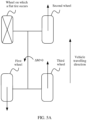
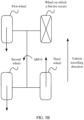
- the additional yaw moment is greater than zero. It is determined that, in the wheels in which no flat tire occurs, a wheel with a greater vertical force in wheels on a left side of a vehicle traveling direction is the first wheel, where an action mode of the wheel torque distributed to the first wheel is braking. That the additional yaw moment is greater than zero indicates that the required additional yaw moment is counterclockwise.
- FIG. 5A is a schematic diagram of a distribution order and an action mode of another wheel torque required for control according to an embodiment of this application.
- FIG. 5B is a schematic diagram of a distribution order and an action mode of another wheel torque required for control according to an embodiment of this application.
- an absolute value of a wheel torque distributed to a first wheel in the distribution order is a smaller value in an absolute value of the wheel torque required for control and a maximum road surface friction torque of the first wheel.
- ⁇ F zx R is the maximum road surface friction torque of the first wheel
- F zx is a vertical force exerted on the first wheel
- ⁇ is a ground attachment coefficient
- R is a wheel radius.
- ⁇ F zx R is the maximum road surface friction torque of the first wheel
- F zx is a vertical force exerted on the first wheel
- ⁇ is a ground attachment coefficient
- R is a wheel radius.
- ⁇ F zz R is the maximum road surface friction torque of the third wheel
- F zz is a vertical force exerted on the third wheel
- ⁇ is a ground attachment coefficient
- R is a wheel radius.
- the wheel in which the flat tire occurs is controlled based on the distribution order and the action mode of the wheel torque required for control, the absolute value of the wheel torque distributed to the first wheel, the absolute value of the wheel torque distributed to the second wheel, and the absolute value of the wheel torque distributed to the third wheel.
- the following describes a specific manner of controlling, in this case, the wheel in which the flat tire occurs.
- the wheels in which no flat tire occurs may be sequentially driven or braked in the distribution order, so that the vehicle can quickly compensate for the yaw moment generated by the flat tire, and the vehicle runs more stably in a process of compensating for the yaw moment generated by the flat tire.
- the wheel in which the flat tire occurs is controlled based on the distribution order and the action mode of the wheel torque required for control and the absolute value of the wheel torque distributed to the first wheel.
- the following describes a specific manner of controlling, in this case, the wheel in which the flat tire occurs.
- a method for determining the absolute values of the wheel torques distributed to the first wheel and the second wheel in the distribution order is the same as that in the first manner.
- the method further includes: skipping distributing the wheel torque to the third wheel when the absolute value of the wheel torque distributed to the second wheel is the absolute value of the difference between the absolute value of the wheel torque required for control and the maximum road surface friction torque of the first wheel. This case indicates that the yaw moment generated by the flat tire can be compensated by applying the wheel torques to the first wheel and the second wheel.
- the wheel in which the flat tire occurs is controlled based on the distribution order and the action mode of the wheel torque required for control, the absolute value of the wheel torque distributed to the first wheel, and the absolute value of the wheel torque distributed to the second wheel.
- the wheel torque is applied to the first wheel based on the action mode of the wheel torque of the first wheel by using the absolute value of the wheel torque distributed to the first wheel as a value of the torque.
- the wheel torque is applied to the second wheel based on the action mode of the wheel torque of the second wheel by using the absolute value of the wheel torque distributed to the second wheel as a value of the torque.
- the first wheel and the second wheel may be sequentially driven or braked in the distribution order, so that the vehicle can quickly compensate for the yaw moment generated by the flat tire, and the vehicle runs more stably in a process of compensating for the yaw moment generated by the flat tire.
- the manner of controlling, based on the additional yaw moment, the wheels in which the flat tire occurs includes but is not limited to the following steps.
- a value of the wheel torque required for control is a quotient obtained by dividing a product of the additional yaw moment and a wheel diameter by an average track of the wheels.
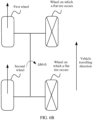
- the additional yaw moment is less than zero. If both the wheels in which the flat tire occurs are wheels on a left side of a vehicle traveling direction, it is determined that, in the wheels in which no flat tire occurs, a wheel with a greater vertical force is a first wheel, where an action mode of the wheel torque distributed to the first wheel is braking, and it is determined that a remaining wheel other than the first wheel in the wheels in which no flat tire occurs is the second wheel, where an action mode of the wheel torque distributed to the second wheel is braking.
- FIG. 6A is a schematic diagram of a distribution order and an action mode of another wheel torque required for control according to an embodiment of this application.
- the vertical force of the first wheel is greater than a vertical force of the second wheel.
- vertical forces of the two wheels in which no flat tire occurs are equal, either of the two wheels is selected as the first wheel, and the other remaining wheel in which no flat tire occurs is the second wheel.
- both the wheels in which the flat tire occurs are wheels on a right side of a vehicle traveling direction, it is determined that, in the wheels in which no flat tire occurs, a wheel with a greater vertical force is a first wheel, where an action mode of the wheel torque distributed to the first wheel is driving, and it is determined that a remaining wheel other than the first wheel in the wheels in which no flat tire occurs is the second wheel, where an action mode of the wheel torque distributed to the second wheel is driving.
- FIG. 6B is a schematic diagram of a distribution order and an action mode of another wheel torque required for control according to an embodiment of this application.
- the vertical force of the first wheel is greater than a vertical force of the second wheel.
- vertical forces of the two wheels in which no flat tire occurs are equal, either of the two wheels is selected as the first wheel, and the other remaining wheel in which no flat tire occurs is the second wheel.
- FIG. 6C is a schematic diagram of a distribution order and an action mode of another wheel torque required for control according to an embodiment of this application.
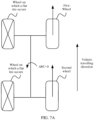
- the additional yaw moment is greater than zero. If both the wheels in which the flat tire occurs are wheels on a left side of a vehicle traveling direction, it is determined that, in the wheels in which no flat tire occurs, a wheel with a greater vertical force is a first wheel, where an action mode of the wheel torque distributed to the first wheel is driving, and it is determined that a remaining wheel other than the first wheel in the wheels in which no flat tire occurs is the second wheel, where an action mode of the wheel torque distributed to the second wheel is driving.
- FIG. 7A is a schematic diagram of a distribution order and an action mode of another wheel torque required for control according to an embodiment of this application.
- the vertical force of the first wheel is greater than a vertical force of the second wheel.
- vertical forces of the two wheels in which no flat tire occurs are equal, either of the two wheels is selected as the first wheel, and the other remaining wheel in which no flat tire occurs is the second wheel.
- both the wheels in which the flat tire occurs are wheels on a right side of a vehicle traveling direction, it is determined that, in the wheels in which no flat tire occurs, a wheel with a greater vertical force is a first wheel, where an action mode of the wheel torque distributed to the first wheel is braking, and it is determined that a remaining wheel other than the first wheel in the wheels in which no flat tire occurs is the second wheel, where an action mode of the wheel torque distributed to the second wheel is braking.
- FIG. 7B is a schematic diagram of a distribution order and an action mode of another wheel torque required for control according to an embodiment of this application.
- the vertical force of the first wheel is greater than a vertical force of the second wheel.
- vertical forces of the two wheels in which no flat tire occurs are equal, either of the two wheels is selected as the first wheel, and the other remaining wheel in which no flat tire occurs is the second wheel.
- FIG. 7C is a schematic diagram of a distribution order and an action mode of another wheel torque required for control according to an embodiment of this application.
- an absolute value of a wheel torque distributed to a first wheel in the distribution order is a smaller value in an absolute value of the wheel torque required for control and a maximum road surface friction torque of the first wheel.
- an absolute value of a wheel torque distributed to a second wheel in the distribution order is a smaller value in a maximum road surface friction torque of the second wheel and an absolute value of a difference between the absolute value of the wheel torque required for control and the maximum road surface friction torque of the first wheel.
- the wheels in which the flat tire occurs are controlled based on the distribution order and the action mode of the wheel torque required for control, the absolute value of the wheel torque distributed to the first wheel, and the absolute value of the wheel torque distributed to the second wheel.
- the following describes a specific manner of controlling, in this case, the wheels in which the flat tire occurs.
- the wheel torque is applied to the first wheel based on the action mode of the wheel torque of the first wheel by using the absolute value of the wheel torque distributed to the first wheel as a value of the torque.
- the wheel torque is applied to the second wheel based on the action mode of the wheel torque of the second wheel by using the absolute value of the wheel torque distributed to the second wheel as a value of the torque.
- the wheels in which no flat tire occurs may be sequentially driven or braked in the distribution order, so that the vehicle can quickly compensate for the yaw moment generated by the flat tire, and the vehicle runs more stably in a process of compensating for the yaw moment generated by the flat tire.
- a method for determining the absolute value of the wheel torque distributed to the first wheel in the distribution order is the same as that in the first manner. After the determining that an absolute value of a wheel torque distributed to a first wheel in the distribution order is a smaller value in an absolute value of the wheel torque required for control and a maximum road surface friction torque of the first wheel, the method further includes: skipping distributing the wheel torque to the second wheel when the absolute value of the wheel torque distributed to the first wheel is the absolute value of the wheel torque required for control. This case indicates that the yaw moment generated by the flat tire can be compensated by applying the wheel torque to the first tire.
- the wheels in which the flat tire occurs are controlled based on the distribution order and the action mode of the wheel torque required for control and the absolute value of the wheel torque distributed to the first wheel.
- the following describes a specific manner of controlling, in this case, the wheels in which the flat tire occurs.
- the wheel torque is applied to the first wheel based on the action mode of the wheel torque of the first wheel by using the absolute value of the wheel torque distributed to the first wheel as a value of the torque.
- the vehicle can quickly compensate for the yaw moment generated by the flat tire, and the vehicle runs more stably in a process of compensating for the yaw moment generated by the flat tire.
- the manner of controlling, based on the additional yaw moment, the wheels in which the flat tire occurs includes but is not limited to the following steps.
- a value of the wheel torque required for control is a quotient obtained by dividing a product of the additional yaw moment and a wheel diameter by an average track of the wheels.
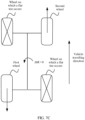
- FIG. 8A is a schematic diagram of determining an action mode of a wheel torque required for control according to an embodiment of this application.
- FIG. 8B is another schematic diagram of determining an action mode of a wheel torque required for control according to an embodiment of this application.
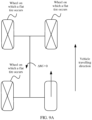
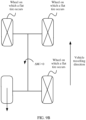
- FIG. 9A is another schematic diagram of determining an action mode of a wheel torque required for control according to an embodiment of this application.
- FIG. 9B is another schematic diagram of determining an action mode of a wheel torque required for control according to an embodiment of this application.
- the lateral force interference compensation torque is added to the additional yaw moment of the vehicle in which the flat tire occurs, so that the additional yaw moment more accurately represents a torque required for controlling the vehicle in which the flat tire occurs. Therefore, a response time for adjusting a yaw rate of the vehicle in which the flat tire occurs to a desired yaw rate is reduced. In this way, the yaw moment generated by the flat tire can be quickly compensated, and a yaw degree of the vehicle can be reduced, so that the vehicle travels in a direction as desired by a driver.
- FIG. 10 is a flowchart of another vehicle control method according to an embodiment of this application. The method may be implemented based on the architecture shown in FIG. 1 .
- a vehicle control device described below may be the vehicle control unit VCU shown in FIG. 1 , or may be an independent controller added to the vehicle control system shown in FIG. 1 , or may be a vehicle electronic stability program ESP.
- the method includes but is not limited to the following steps.
- the vehicle control device calculates a longitudinal force interference compensation torque of a vehicle when a flat tire occurs in the vehicle. For an implementation of this step, refer to the implementation of calculating the longitudinal interference compensation torque described in step S201. Details are not described herein again.
- the feedback control is mainly completed by a proportional-integral controller (proportional-integral controller, PI controller).
- K P0 ( v x ) and K I0 ( v x ) are basic feedback gains of the PI controller.
- the two values are values related to a longitudinal vehicle speed of a vehicle, and may be calibrated by using parameters of a vehicle in which no flat tire occurs.
- the calculating a feedback gain based on the absolute value of the desired yaw angular acceleration includes: determining, in a first preset relationship, an adjustment coefficient corresponding to the absolute value of the desired yaw angular acceleration, where the first preset relationship indicates a mapping relationship between absolute values of a plurality of desired yaw angular accelerations and a plurality of adjustment coefficients; and calculating the feedback gain based on the determined adjustment coefficient.
- the following describes in detail a manner of calculating the feedback gain based on the absolute value of the desired yaw angular acceleration. The manner includes but is not limited to the following steps.
- the first preset relationship indicates a mapping relationship between absolute values of a plurality of desired yaw angular accelerations and a plurality of adjustment coefficients. Specifically, the first preset relationship is: if the absolute value of the desired yaw angular acceleration falls within [0, n 1 ], a corresponding adjustment coefficient is a, where a is a value in [2, 5], and specifically, n 1 is a value in [0.2, 0.3].
- n 1 , n 2 a corresponding adjustment coefficient increases as the absolute value of the desired yaw angular acceleration increases, where the adjustment coefficient falls within [a, b ], and specifically, n 2 is a value in [0.5, 0.6], and b is a value in [8, 10].
- the adjustment coefficient is b, and specifically, n th is a value in [0.8, 1].
- a corresponding adjustment coefficient decreases as the absolute value of the desired yaw angular acceleration increases, where the adjustment coefficient falls within [ b, c ], specifically, n 3 is a value in [3, 4], and c is a value in [0, 1].
- the adjustment coefficient is c.
- values of n 1 , n 2 , n th , and n 3 may be calibrated through an experiment, and values of b and c may also be calibrated through an experiment.
- values of the foregoing values may be different.
- values of the foregoing values may also be different.
- FIG. 11 is a schematic diagram of a first preset relationship according to an embodiment of this application. It should be noted that, a change that "the adjustment coefficient increases as the absolute value of the desired yaw angular acceleration increases" and a change that "the adjustment coefficient decreases as the absolute value of the desired yaw angular acceleration increases” that are shown in FIG. 11 do not represent a linear change of a correspondence between the adjustment coefficient and the absolute value of the desired yaw angular acceleration, but only show change trends, and changes that "the adjustment coefficient increases as the absolute value of the desired yaw angular acceleration increases” and “the adjustment coefficient decreases as the absolute value of the desired yaw angular acceleration increases” that are shown in FIG. 11 may be non-linear changes.
- a change trend of the adjustment coefficient is that the adjustment coefficient increases as
- is greater than the threshold n th and is less than n 3
- the change trend of the adjustment coefficient is that the adjustment coefficient decreases as
- ) is the adjustment coefficient corresponding to the absolute value of the desired yaw angular acceleration.
- Manner 1 The adjustment coefficient corresponding to the absolute value of the desired yaw angular acceleration is determined from a second preset relationship, where the second preset relationship indicates a mapping relationship between absolute values of a plurality of desired yaw angular accelerations and a plurality of adjustment coefficients.
- the feedback gain is divided by the adjustment coefficient to obtain the adjusted feedback gain.
- the adjustment coefficient corresponding to the absolute value of the desired yaw angular acceleration is determined from a third preset relationship, where the third preset relationship is a functional relationship in which the absolute value
- of the desired yaw angular acceleration and the longitudinal speed v x of the vehicle are substituted into the third preset relationship for calculation, to obtain the adjusted feedback gain.
- ⁇ M fb K P v x ⁇ d ⁇ ⁇ + K I v x ⁇ t 0 t ⁇ d ⁇ ⁇
- the applied additional yaw moment is a sum of the longitudinal force interference compensation torque and the feedback control torque.
- step S1005. Control a wheel in which the flat tire occurs, based on the additional yaw moment.
- this step refer to the implementation of controlling the vehicle based on the additional yaw moment described in step S205. Details are not described herein again.
- a feedback gain is calculated based on an absolute value of a desired yaw angular acceleration of a vehicle in which a flat tire occurs, so that a problem of a delayed response of a yaw rate of the vehicle in which the flat tire occurs can be alleviated. Therefore, a response time for adjusting the yaw rate of the vehicle in which the flat tire occurs to a desired yaw rate is reduced. In this way, a yaw moment generated by the flat tire can be quickly compensated, and a yaw degree of the vehicle can be reduced, so that the vehicle travels in a direction as desired by a driver.
- the vehicle control device may control, with reference to the vehicle control methods shown in FIG. 2 and FIG. 10 , a vehicle in which a flat tire occurs.
- a manner of calculating the feedback control torque of the vehicle refer to the manner described in step S1002 and step S1003 in FIG. 10 .
- a manner of calculating the additional yaw moment of the vehicle refer to the manner described in step S203 in FIG. 2 .
- the lateral force interference compensation torque may be added to the additional yaw moment of the vehicle in which the flat tire occurs, so that the additional yaw moment more accurately represents the torque required for controlling the vehicle in which the flat tire occurs, and the feedback gain is calculated based on the absolute value of the desired yaw angular acceleration of the vehicle in which the flat tire occurs, so that the problem of the delayed response of the yaw rate of the vehicle in which the flat tire occurs can be alleviated. Therefore, the response time for adjusting the yaw rate of the vehicle in which the flat tire occurs to the desired yaw rate can be reduced. In this way, the yaw moment generated by the flat tire can be quickly compensated, and the yaw degree of the vehicle can be reduced, so that the vehicle travels in the direction as desired by the driver.
- FIG. 12 is a schematic diagram of a vehicle control device according to an embodiment of this application.
- the vehicle control device 50 includes a calculation unit 1201, a determining unit 1202, and a control unit 1203. The following describes the calculation unit 1201, the determining unit 1202, and the control unit 1203.
- the calculation unit 1201 is configured to calculate a longitudinal force interference compensation torque and a lateral force interference compensation torque of a vehicle when a flat tire occurs in the vehicle.
- the calculation unit 1201 is further configured to calculate a feedback control torque of the vehicle.
- the determining unit 1202 is configured to determine an additional yaw moment based on the longitudinal force interference compensation torque, the feedback control torque, and the lateral force interference compensation torque.
- the control unit 1203 is configured to control, based on the additional yaw moment, a wheel in which the flat tire occurs.
- the calculation unit 1201 may receive status information (for example, a longitudinal acceleration, a lateral acceleration, a yaw rate, a steering wheel angle, tire pressure, a wheel speed, and a suspension travel distance) of the vehicle, and may obtain vehicle control related parameters (for example, a longitudinal vehicle speed, a centroid slip angle, a road surface attachment coefficient, and a wheel vertical force) by processing the status information.
- vehicle control device further includes an identification unit, configured to identify whether a flat tire occurs in the vehicle and a location of the flat tire of the wheel.
- the calculation unit 1201 calculates the longitudinal force interference compensation torque, the lateral force interference compensation torque, and the feedback control torque of the vehicle, the determining unit 1202 then determines the additional yaw moment based on the longitudinal force interference compensation torque, the feedback control torque, and the lateral force interference compensation torque, and then the control unit 1203 controls (for example, through motor control or hydraulic control), based on the additional yaw moment, the wheel on which the flat tire occurred.
- the lateral force interference compensation torque is added to the additional yaw moment, so that the additional yaw moment more accurately represents a torque required for controlling the vehicle in which the flat tire occurs, and a response time for adjusting the yaw rate of the vehicle in which the flat tire occurs to a desired yaw rate is reduced.
- a yaw moment generated by the flat tire can be quickly compensated, and a yaw degree of the vehicle can be reduced, so that the vehicle travels in the direction as desired by a driver.
- the calculation unit 1201 is specifically configured to calculate an absolute value of a desired yaw angular acceleration of the vehicle, and calculate a feedback gain based on the absolute value of the desired yaw angular acceleration; and calculate the feedback control torque based on the feedback gain.
- the feedback gain may be calculated based on the absolute value of the desired yaw angular acceleration, so that a problem of a delayed response of the yaw rate of the vehicle in which the flat tire occurs can be alleviated, and the response time for adjusting the yaw rate of the vehicle in which the flat tire occurs to the desired yaw rate can be reduced. In this way, the yaw moment generated by the flat tire can be quickly compensated, and the yaw degree of the vehicle can be reduced, so that the vehicle travels in a direction as desired by the driver.
- the calculation unit 1201 further includes a determining subunit and a calculation subunit, where the determining subunit is configured to determine, in a first preset relationship, an adjustment coefficient corresponding to the absolute value of the desired yaw angular acceleration, where the first preset relationship indicates a mapping relationship between absolute values of a plurality of desired yaw angular accelerations and a plurality of adjustment coefficients; and the calculating subunit is configured to calculate the feedback gain based on the determined adjustment coefficient.
- the calculation subunit is specifically configured to multiply a basic feedback gain by the adjustment coefficient to obtain the feedback gain.
- the first preset relationship is: if the absolute value of the desired yaw angular acceleration falls within [0, n 1 ], the corresponding adjustment coefficient is a, where a is a value in [2, 5]; if the absolute value of the desired yaw angular acceleration falls within [n 1 , n 2 ], the corresponding adjustment coefficient increases as the absolute value of the desired yaw angular acceleration increases, where the adjustment coefficient falls within [a, b ]; if the absolute value of the desired yaw angular acceleration falls within [n 2 , n th ], the adjustment coefficient is b; if the absolute value of the desired yaw angular acceleration falls within [n th , n 3 ], the corresponding adjustment coefficient decreases as the absolute value of the desired yaw angular acceleration increases, where the adjustment coefficient falls within [b, c], and c is a value in [0, 1]; or if the absolute value of the desired yaw angular
- a change trend of the adjustment coefficient is that the adjustment coefficient increases as
- is greater than the threshold n th and is less than n 3
- the change trend of the adjustment coefficient is that the adjustment coefficient decreases as
- the control unit 1203 when there is one wheel in which the flat tire occurs, is specifically configured to: determine a distribution order and an action mode of a wheel torque required for control based on a value of the additional yaw moment, a position of the wheel in which the flat tire occurs, and vertical forces of wheels in which no flat tire occurs, where a value of the wheel torque required for control is a quotient obtained by dividing a product of the additional yaw moment and a wheel diameter by an average track of the wheels; determine that an absolute value of a wheel torque distributed to a first wheel in the distribution order is a smaller value in an absolute value of the wheel torque required for control and a maximum road surface friction torque of the first wheel; when the absolute value of the wheel torque distributed to the first wheel is the maximum road surface friction torque of the first wheel, determine that an absolute value of a wheel torque distributed to a second wheel in the distribution order is a smaller value in a maximum road surface friction torque of the second wheel and an absolute value of a difference between the absolute value of the wheel
- the wheels in which no flat tire occurs may be sequentially driven or braked in the distribution order, so that the vehicle can quickly compensate for the yaw moment generated by the flat tire, and the vehicle runs more stably in a process of compensating for the yaw moment generated by the flat tire.
- control unit 1203 is further configured to: skip distributing the wheel torques to the second wheel and the third wheel when the absolute value of the wheel torque distributed to the first wheel is the absolute value of the wheel torque required for control; and control the wheel in which the flat tire occurs, based on the distribution order and the action mode of the wheel torque required for control and the absolute value of the wheel torque distributed to the first wheel.
- control unit 1203 is further configured to: skip distributing the wheel torque to the third wheel when the absolute value of the wheel torque distributed to the second wheel is the absolute value of the difference between the absolute value of the wheel torque required for control and the maximum road surface friction torque of the first wheel; and control the wheel in which the flat tire occurs, based on the distribution order and the action mode of the wheel torque required for control, the absolute value of the wheel torque distributed to the first wheel, and the absolute value of the wheel torque distributed to the second wheel.
- control unit 1203 is further configured to: when the additional yaw moment is less than zero, determine that, in the wheels in which no flat tire occurs, a wheel with a greater vertical force in wheels on a right side of a vehicle traveling direction is the first wheel, where an action mode of the wheel torque distributed to the first wheel is braking; and if in the wheels in which no flat tire occurs, there are two wheels on the right side of the vehicle traveling direction, determine that a wheel other than the first wheel in the wheels on the right side of the vehicle traveling direction is the second wheel, where an action mode of the wheel torque distributed to the second wheel is braking, and determine that a remaining wheel other than the first wheel and the second wheel in the wheels in which no flat tire occurs is the third wheel, where an action mode of the wheel torque distributed to the third wheel is driving; or if in the wheels in which no flat tire occurs, there is one wheel on the right side of the vehicle traveling direction, determine that, in the wheels in which no flat tire occurs, a wheel that is diagonal to the first wheel is the second
- control unit 1203 is further configured to: when the additional yaw moment is greater than zero, determine that, in the wheels in which no flat tire occurs, a wheel with a greater vertical force in wheels on a left side of a vehicle traveling direction is the first wheel, where an action mode of the wheel torque distributed to the first wheel is braking; and if in the wheels in which no flat tire occurs, there are two wheels on the left side of the vehicle traveling direction, determine that a wheel other than the first wheel in the wheels on the left side of the vehicle traveling direction is the second wheel, where an action mode of the wheel torque distributed to the second wheel is braking, and determine that a remaining wheel other than the first wheel and the second wheel in the wheels in which no flat tire occurs is the third wheel, where an action mode of the wheel torque distributed to the third wheel is driving; or if in the wheels in which no flat tire occurs, there is one wheel on the left side of the vehicle traveling direction, determine that, in the wheels in which no flat tire occurs, a wheel that is diagonal to the first wheel is the second
- the control unit 1203 is specifically configured to: determine a distribution order and an action mode of a wheel torque required for control based on a value of the additional yaw moment, positions of the wheels in which no flat tire occurs, and vertical forces of wheels in which no flat tire occurs, where a value of the wheel torque required for control is a quotient obtained by dividing a product of the additional yaw moment and a wheel diameter by an average track of the wheels; determine that an absolute value of a wheel torque distributed to a first wheel in the distribution order is a smaller value in an absolute value of the wheel torque required for control and a maximum road surface friction torque of the first wheel; when the absolute value of the wheel torque distributed to the first wheel is the maximum road surface friction torque of the first wheel, determine that an absolute value of a wheel torque distributed to a second wheel in the distribution order is a smaller value in a maximum road surface friction torque of the second wheel and an absolute value of a difference between the absolute value of the wheel torque
- control unit 1203 is further configured to: skip distributing the wheel torque to the second wheel when the absolute value of the wheel torque distributed to the first wheel is the absolute value of the wheel torque required for control; and control the wheels in which the flat tire occurs, based on the distribution order and the action mode of the wheel torque required for control and the absolute value of the wheel torque distributed to the first wheel.
- control unit 1203 is further configured to: when the additional yaw moment is less than zero, if both the wheels in which the flat tire occurs are wheels on a left side of a vehicle traveling direction, determine that, in the wheels in which no flat tire occurs, a wheel with a greater vertical force is the first wheel, where an action mode of the wheel torque distributed to the first wheel is braking, and determine that a remaining wheel other than the first wheel in the wheels in which no flat tire occurs is the second wheel, where an action mode of the wheel torque distributed to the second wheel is braking; if both the wheels in which the flat tire occurs are wheels on a right side of a vehicle traveling direction, determine that, in the wheels in which no flat tire occurs, a wheel with a greater vertical force is the first wheel, where an action mode of the wheel torque distributed to the first wheel is driving, and determine that a remaining wheel other than the first wheel in the wheels in which no flat tire occurs is the second wheel, where an action mode of the wheel torque distributed to the second wheel is driving; or if the wheels
- control unit 1203 is further configured to: when the additional yaw moment is greater than zero, if both the wheels in which the flat tire occurs are wheels on a left side of a vehicle traveling direction, determine that, in the wheels in which no flat tire occurs, a wheel with a greater vertical force is the first wheel, where an action mode of the wheel torque distributed to the first wheel is driving, and determine that a remaining wheel other than the first wheel in the wheels in which no flat tire occurs is the second wheel, where an action mode of the wheel torque distributed to the second wheel is driving; if both the wheels in which the flat tire occurs are wheels on a right side of a vehicle traveling direction, determine that, in the wheels in which no flat tire occurs, a wheel with a greater vertical force is the first wheel, where an action mode of the wheel torque distributed to the first wheel is braking, and determine that a remaining wheel other than the first wheel in the wheels in which no flat tire occurs is the second wheel, where an action mode of the wheel torque distributed to the second wheel is braking; or if the wheels
- control unit 1203 when there are three wheels in which the flat tire occurs, and the control unit 1203 is specifically configured to: determine an action mode of a wheel torque required for control based on a value of the additional yaw moment and a position of a wheel in which no flat tire occurs, where a value of the wheel torque required for control is a quotient obtained by dividing a product of the additional yaw moment and a wheel diameter by an average track of the wheels; determine that an absolute value of a wheel torque distributed to the wheel in which no flat tire occurs is a smaller value in an absolute value of the wheel torque required for control and a maximum road surface friction torque of the wheel in which no flat tire occurs; and control the wheels in which the flat tire occurs, based on the action mode of the wheel torque required for control and the absolute value of the wheel torque distributed to the wheel in which no flat tire occurs.
- control unit 1203 is further configured to: when the additional yaw moment is less than zero, if the wheel in which no flat tire occurs is a wheel on a left side of a vehicle traveling direction, determine that an action mode of the wheel torque distributed to the wheel in which no flat tire occurs is driving, or if the wheel in which no flat tire occurs is a wheel on a right side of a vehicle traveling direction, determine that an action mode of the wheel torque distributed to the wheel in which no flat tire occurs is braking; or when the additional yaw moment is greater than zero, if the wheel in which no flat tire occurs is a wheel on a left side of a vehicle traveling direction, determine that an action mode of the wheel torque distributed to the wheel in which no flat tire occurs is braking, or if the wheel in which no flat tire occurs is a wheel on a right side of a vehicle traveling direction, determine that an action mode of the wheel torque distributed to the wheel in which no flat tire occurs is driving.
- the lateral force interference compensation torque is added to the additional yaw moment of the vehicle in which the flat tire occurs, so that the additional yaw moment more accurately represents the torque required for controlling the vehicle in which the flat tire occurs, and the feedback gain is calculated based on the absolute value of the desired yaw angular acceleration, so that the problem of the delayed response of the yaw rate of the vehicle in which the flat tire occurs can be alleviated. Therefore, the response time for adjusting the yaw rate of the vehicle in which the flat tire occurs to the desired yaw rate can be reduced. In this way, the yaw moment generated by the flat tire can be quickly compensated, and the yaw degree of the vehicle can be reduced, so that the vehicle travels in the direction as desired by the driver.
- FIG. 13 is a schematic diagram of another vehicle control device according to an embodiment of this application.
- the first device 130 may include one or more processors 1301, one or more input devices 1302, one or more output devices 1303, and a memory 1304.
- the processor 1301, the input device 1302, the output device 1303, and the memory 1304 are connected by using a bus 1305.
- the memory 1302 is configured to store an instruction.
- the processor 1301 may be a central processing unit, or the processor may be another general purpose processor, a digital signal processor, an application-specific integrated circuit, another programmable logic device, or the like.
- the general purpose processor may be a microprocessor, or the processor may be any conventional processor or the like.
- the input device 1302 may include a communications interface, a data line, and the like.
- the output device 1303 may include a data line, a communications interface, and the like.
- the memory 1304 may include a read-only memory and a random access memory, and provide an instruction and data to the processor 1301.
- a part of the memory 1304 may further include a non-volatile random access memory.
- the memory 1304 may further store information of a storage device type.
- the processor 1301 is configured to run the instruction stored in the memory 1304 to perform the following operations:
- the lateral force interference compensation torque is added to the additional yaw moment, so that the additional yaw moment more accurately represents a torque required for controlling the vehicle in which the flat tire occurs, and a response time for adjusting a yaw rate of the vehicle in which the flat tire occurs to a desired yaw rate is reduced.
- a yaw moment generated by the flat tire can be quickly compensated, and a yaw degree of the vehicle can be reduced, so that the vehicle travels in a direction as desired by a driver.
- the processor 1301 is further configured to calculate an absolute value of a desired yaw angular acceleration of the vehicle, and calculate a feedback gain based on the absolute value of the desired yaw angular acceleration; and calculate the feedback control torque based on the feedback gain.
- a feedback gain of a proportional-integral controller may be adjusted based on the absolute value of the desired yaw angular acceleration, so that a problem of a delayed response of the yaw rate of the vehicle in which the flat tire occurs can be alleviated, and the response time for adjusting the yaw rate of the vehicle in which the flat tire occurs to the desired yaw rate can be reduced.
- the yaw moment generated by the flat tire can be quickly compensated, and the yaw degree of the vehicle can be reduced, so that the vehicle travels in the direction as desired by the driver.
- the processor 1301 is further configured to: determine, in a first preset relationship, an adjustment coefficient corresponding to the absolute value of the desired yaw angular acceleration, where the first preset relationship indicates a mapping relationship between absolute values of a plurality of desired yaw angular accelerations and a plurality of adjustment coefficients; and calculating the feedback gain based on the determined adjustment coefficient.
- the processor 1301 is further configured to multiply a basic feedback gain by the adjustment coefficient to obtain the feedback gain.
- the first preset relationship is: if the absolute value of the desired yaw angular acceleration falls within [0, n 1 ], the corresponding adjustment coefficient is a, where a is a value in [2, 5]; if the absolute value of the desired yaw angular acceleration falls within [n 1 , n 2 ], the corresponding adjustment coefficient increases as the absolute value of the desired yaw angular acceleration increases, where the adjustment coefficient falls within [a, b]; if the absolute value of the desired yaw angular acceleration falls within [n 2 , n th ], the adjustment coefficient is b; if the absolute value of the desired yaw angular acceleration falls within [n 2 , n 3 ], the corresponding adjustment coefficient decreases as the absolute value of the desired yaw angular acceleration increases, where the adjustment coefficient falls within [b, c], and c is a value in [0, 1]; or if the absolute value of the desired yaw angular acceleration
- the processor 1301 when there is one wheel in which the flat tire occurs, is further configured to: determine a distribution order and an action mode of a wheel torque required for control based on a value of the additional yaw moment, a position of the wheel in which the flat tire occurs, and vertical forces of wheels in which no flat tire occurs, where a value of the wheel torque required for control is a quotient obtained by dividing a product of the additional yaw moment and a wheel diameter by an average track of the wheels; determine that an absolute value of a wheel torque distributed to a first wheel in the distribution order is a smaller value in an absolute value of the wheel torque required for control and a maximum road surface friction torque of the first wheel; when the absolute value of the wheel torque distributed to the first wheel is the maximum road surface friction torque of the first wheel, determine that an absolute value of a wheel torque distributed to a second wheel in the distribution order is a smaller value in a maximum road surface friction torque of the second wheel and an absolute value of a difference between the absolute value of the wheel torque
- the wheels in which no flat tire occurs may be sequentially driven or braked in the distribution order, so that the vehicle can quickly compensate for the yaw moment generated by the flat tire, and the vehicle runs more stably in a process of compensating for the yaw moment generated by the flat tire.
- the processor 1301 determines that the absolute value of the wheel torque distributed to the first wheel in the distribution order is the smaller value in the absolute value of the wheel torque required for control and the maximum road surface friction torque of the first wheel
- the processor 1301 is further configured to: skip distributing the wheel torques to the second wheel and the third wheel when the absolute value of the wheel torque distributed to the first wheel is the absolute value of the wheel torque required for control; and control the wheels in which the flat tire occurs, based on the distribution order and the action mode of the wheel torque required for control and the absolute value of the wheel torque distributed to the first wheel.
- the wheels in which no flat tire occurs may be sequentially driven or braked in the distribution order, so that the vehicle can quickly compensate for the yaw moment generated by the flat tire, and the vehicle runs more stably in a process of compensating for the yaw moment generated by the flat tire.
- the processor 1301 determines that the absolute value of the wheel torque distributed to the second wheel in the distribution order is the smaller value in the maximum road surface friction torque of the second wheel and the absolute value of the difference between the absolute value of the wheel torque required for control and the maximum road surface friction torque of the first wheel, the processor 1301 is further configured to: skip distributing the wheel torque to the third wheel when the absolute value of the wheel torque distributed to the second wheel is the absolute value of the difference between the absolute value of the wheel torque required for control and the maximum road surface friction torque of the first wheel; and control the wheel in which the flat tire occurs, based on the distribution order and the action mode of the wheel torque required for control, the absolute value of the wheel torque distributed to the first wheel, and the absolute value of the wheel torque distributed to the second wheel.
- the wheels in which no flat tire occurs may be sequentially driven or braked in the distribution order, so that the vehicle can quickly compensate for the yaw moment generated by the flat tire, and the vehicle runs more stably in a process of compensating for the yaw moment generated by the flat tire.
- the processor 1301 is further configured to: when the additional yaw moment is less than zero, determine that, in the wheels in which no flat tire occurs, a wheel with a greater vertical force in wheels on a right side of a vehicle traveling direction is the first wheel, where an action mode of the wheel torque distributed to the first wheel is braking; and if in the wheels in which no flat tire occurs, there are two wheels on the right side of the vehicle traveling direction, determine that a wheel other than the first wheel in the wheels on the right side of the vehicle traveling direction is the second wheel, where an action mode of the wheel torque distributed to the second wheel is braking, and determine that a remaining wheel other than the first wheel and the second wheel in the wheels in which no flat tire occurs is the third wheel, where an action mode of the wheel torque distributed to the third wheel is driving; or if in the wheels in which no flat tire occurs, there is one wheel on the right side of the vehicle traveling direction, determine that, in the wheels in which no flat tire occurs, a wheel that is diagonal to the first wheel is the second wheel
- the processor 1301 is further configured to: when the additional yaw moment is greater than zero, determine that, in the wheels in which no flat tire occurs, a wheel with a greater vertical force in wheels on a left side of a vehicle traveling direction is the first wheel, where an action mode of the wheel torque distributed to the first wheel is braking; and if in the wheels in which no flat tire occurs, there are two wheels on the left side of the vehicle traveling direction, determine that a wheel other than the first wheel in the wheels on the left side of the vehicle traveling direction is the second wheel, where an action mode of the wheel torque distributed to the second wheel is braking, and determine that a remaining wheel other than the first wheel and the second wheel in the wheels in which no flat tire occurs is the third wheel, where an action mode of the wheel torque distributed to the third wheel is driving; or if in the wheels in which no flat tire occurs, there is one wheel on the left side of the vehicle traveling direction, determine that, in the wheels in which no flat tire occurs, a wheel that is diagonal to the first wheel is the second wheel
- the processor 1301 is further configured to: determine a distribution order and an action mode of a wheel torque required for control based on a value of the additional yaw moment, positions of the wheels in which no flat tire occurs, and vertical forces of wheels in which no flat tire occurs, where a value of the wheel torque required for control is a quotient obtained by dividing a product of the additional yaw moment and a wheel diameter by an average track of the wheels; determine that an absolute value of a wheel torque distributed to a first wheel in the distribution order is a smaller value in an absolute value of the wheel torque required for control and a maximum road surface friction torque of the first wheel; when the absolute value of the wheel torque distributed to the first wheel is the maximum road surface friction torque of the first wheel, determine that an absolute value of a wheel torque distributed to a second wheel in the distribution order is a smaller value in a maximum road surface friction torque of the second wheel and an absolute value of a difference between the absolute value of the wheel torque required
- the wheels in which no flat tire occurs may be sequentially driven or braked in the distribution order, so that the vehicle can quickly compensate for the yaw moment generated by the flat tire, and the vehicle runs more stably in a process of compensating for the yaw moment generated by the flat tire.
- the processor 1301 determines that the absolute value of the wheel torque distributed to the first wheel in the distribution order is the smaller value in the absolute value of the wheel torque required for control and the maximum road surface friction torque of the first wheel, the processor 1301 is further configured to: skip distributing the wheel torque to the second wheel when the absolute value of the wheel torque distributed to the first wheel is the absolute value of the wheel torque required for control; and control the wheels in which the flat tire occurs, based on the distribution order and the action mode of the wheel torque required for control and the absolute value of the wheel torque distributed to the first wheel.
- the wheels in which no flat tire occurs may be sequentially driven or braked in the distribution order, so that the vehicle can quickly compensate for the yaw moment generated by the flat tire, and the vehicle runs more stably in a process of compensating for the yaw moment generated by the flat tire.
- the processor 1301 is further configured to: when the additional yaw moment is less than zero, if both the wheels in which the flat tire occurs are wheels on a left side of a vehicle traveling direction, determine that, in the wheels in which no flat tire occurs, a wheel with a greater vertical force is the first wheel, where an action mode of the wheel torque distributed to the first wheel is braking, and determine that a remaining wheel other than the first wheel in the wheels in which no flat tire occurs is the second wheel, where an action mode of the wheel torque distributed to the second wheel is braking; or if both the wheels in which the flat tire occurs are wheels on a right side of a vehicle traveling direction, determine that, in the wheels in which no flat tire occurs, a wheel with a greater vertical force is the first wheel, where an action mode of the wheel torque distributed to the first wheel is driving, and determine that a remaining wheel other than the first wheel in the wheels in which no flat tire occurs is the second wheel, where an action mode of the wheel torque distributed to the second wheel is driving; or if the wheels
- the processor 1301 is further configured to: when the additional yaw moment is greater than zero, if both the wheels in which the flat tire occurs are wheels on a left side of a vehicle traveling direction, determine that, in the wheels in which no flat tire occurs, a wheel with a greater vertical force is the first wheel, where an action mode of the wheel torque distributed to the first wheel is driving, and determine that a remaining wheel other than the first wheel in the wheels in which no flat tire occurs is the second wheel, where an action mode of the wheel torque distributed to the second wheel is driving; if both the wheels in which the flat tire occurs are wheels on a right side of a vehicle traveling direction, determine that, in the wheels in which no flat tire occurs, a wheel with a greater vertical force is the first wheel, where an action mode of the wheel torque distributed to the first wheel is braking, and determine that a remaining wheel other than the first wheel in the wheels in which no flat tire occurs is the second wheel, where an action mode of the wheel torque distributed to the second wheel is braking; or if the wheels in
- the processor 1301 is specifically configured to: determine an action mode of a wheel torque required for control based on a value of the additional yaw moment and a position of a wheel in which no flat tire occurs, where a value of the wheel torque required for control is a quotient obtained by dividing a product of the additional yaw moment and a wheel diameter by an average track of the wheels; determine that an absolute value of a wheel torque distributed to the wheel in which no flat tire occurs is a smaller value in an absolute value of the wheel torque required for control and a maximum road surface friction torque of the wheel in which no flat tire occurs; and control the wheels in which the flat tire occurs, based on the action mode of the wheel torque required for control and the absolute value of the wheel torque distributed to the wheel in which no flat tire occurs.
- the processor 1301 is further configured to: when the additional yaw moment is less than zero, if the wheel in which no flat tire occurs is a wheel on a left side of a vehicle traveling direction, determine that an action mode of the wheel torque distributed to the wheel in which no flat tire occurs is driving, or if the wheel in which no flat tire occurs is a wheel on a right side of a vehicle traveling direction, determine that an action mode of the wheel torque distributed to the wheel in which no flat tire occurs is braking; or when the additional yaw moment is greater than zero, if the wheel in which no flat tire occurs is a wheel on a left side of a vehicle traveling direction, determine that an action mode of the wheel torque distributed to the wheel in which no flat tire occurs is braking, or if the wheel in which no flat tire occurs is a wheel on a right side of a vehicle traveling direction, determine that an action mode of the wheel torque distributed to the wheel in which no flat tire occurs is driving.
- the lateral force interference compensation torque is added to the additional yaw moment of the vehicle in which the flat tire occurs, so that the additional yaw moment more accurately represents the torque required for controlling the vehicle in which the flat tire occurs, and the feedback gain is calculated based on the absolute value of the desired yaw angular acceleration, so that the problem of the delayed response of the yaw rate of the vehicle in which the flat tire occurs can be alleviated. Therefore, the response time for adjusting the yaw rate of the vehicle in which the flat tire occurs to the desired yaw rate can be reduced. In this way, the yaw moment generated by the flat tire can be quickly compensated, and the yaw degree of the vehicle can be reduced, so that the vehicle travels in the direction as desired by the driver.
- Another embodiment of the present invention provides a computer program product.
- the computer program product is run on a computer, the method in the embodiment shown in FIG. 2 or FIG. 10 is implemented.
- the computer-readable storage medium stores a computer program.
- the computer program When the computer program is executed by a computer, the method in the embodiment shown in FIG. 2 or FIG. 10 is implemented.
Landscapes
- Engineering & Computer Science (AREA)
- Automation & Control Theory (AREA)
- Transportation (AREA)
- Mechanical Engineering (AREA)
- Physics & Mathematics (AREA)
- Mathematical Physics (AREA)
- Human Computer Interaction (AREA)
- Control Of Driving Devices And Active Controlling Of Vehicle (AREA)
- Electric Propulsion And Braking For Vehicles (AREA)
- Steering Control In Accordance With Driving Conditions (AREA)
- Regulating Braking Force (AREA)
Description
- This application relates to the field of computer technologies, and in particular, to a vehicle control method and device, and a computer-readable storage medium.
- A vehicle flat tire is a common dangerous situation. A large proportion of traffic accidents are caused by vehicle flat tires every year. Particularly, a flat tire that occurs when a vehicle is travelling at a high speed easily causes the vehicle to deviate from a normal travelling track, causing a major traffic accident. In a flat tire stabilization method in a current stage, compensation for a yaw moment generated by a longitudinal force of an automobile after a flat tire occurs is mainly considered. After the yaw moment generated by the longitudinal force is obtained through calculation, a braking moment is applied to a wheel in which no flat tire occurs, so that the vehicle travels in a direction as desired by a driver.
- In an actual application, a lateral force is also an important factor that affects vehicle travelling. In addition, a flat tire of a vehicle affects performance of the vehicle, but a controller is designed based on vehicle parameters obtained when no flat tire occurs, and a problem of a delayed response of a yaw rate caused by the flat tire is not considered. Consequently, the applied braking moment may not enable the vehicle to travel in the direction as desired by the driver, and a control effect is poor.
-
CN 108248454A relates to a stability control system for a vehicle body and a stability control method for the vehicle body. In the stability control method, a tyre pressure, a longitudinal acceleration, a lateral acceleration, a yaw rate, a steering wheel angle and a wheel speed of a tyre of a wheel of a vehicle are collected. A control yaw moment is calculated based on the tyre pressure, the longitudinal acceleration, the lateral acceleration, the steering wheel angle, the wheel speed and the yaw rate, wherein the control yaw moment is used for eliminating the difference between an estimated yaw moment and an actual yaw moment. Subsequently, the deviation direction of the vehicle is determined based on the yaw rate, and the rollover degree of the vehicle is determined based on the tire pressure, the longitudinal acceleration, the lateral acceleration, the steering wheel angle, the wheel speed and the yaw rate. When a flat tire occurs, whether the vehicle is in the stable zone is determined based on the yaw rate, the steering wheel angle, the wheel speed, and the tire pressure. Afterwards, the control yaw moment is distributed to four wheels according to the vehicle body stability condition, the deviation direction and the rollover degree so as to realize the stability control of the vehicle body. - The invention is set out in the appended set of claims. Embodiments of this application provide a vehicle flat tire control method and device, to quickly compensate for a yaw moment generated by a flat tire, and reduce a yaw degree of a vehicle, so that the vehicle travels in a direction as desired by a driver.
- According to a first aspect, an embodiment of this application provides a vehicle control method, where the method includes: calculating a longitudinal force interference compensation torque and a lateral force interference compensation torque of a vehicle when a flat tire occurs in the vehicle; calculating a feedback control torque of the vehicle; determining an additional yaw moment based on the longitudinal force interference compensation torque, the feedback control torque, and the lateral force interference compensation torque; and controlling, based on the additional yaw moment, a wheel in which the flat tire occurs.
- In this method, the lateral force interference compensation torque is added to the additional yaw moment, so that the additional yaw moment more accurately represents a torque required for controlling the vehicle in which the flat tire occurs, and a response time for adjusting a yaw rate of the vehicle in which the flat tire occurs to a desired yaw rate is reduced. In this way, a yaw moment generated by the flat tire can be quickly compensated, and a yaw degree of the vehicle can be reduced, so that the vehicle travels in a direction as desired by a driver.
- The calculating a feedback control torque of the vehicle includes: calculating an absolute value of a desired yaw angular acceleration of the vehicle, and calculating a feedback gain based on the absolute value of the desired yaw angular acceleration; and calculating the feedback control torque based on the feedback gain.
- In this manner, a feedback gain of a proportional-integral controller is adjusted based on the absolute value of the desired yaw angular acceleration, so that a problem of a delayed response of the yaw rate of the vehicle in which the flat tire occurs can be alleviated, and the response time for adjusting the yaw rate of the vehicle in which the flat tire occurs to the desired yaw rate can be reduced. In this way, the yaw moment generated by the flat tire can be quickly compensated, and the yaw degree of the vehicle can be reduced, so that the vehicle travels in the direction as desired by the driver.
- The calculating a feedback gain based on the absolute value of the desired yaw angular acceleration includes: determining, in a first preset relationship, an adjustment coefficient corresponding to the absolute value of the desired yaw angular acceleration, where the first preset relationship indicates a mapping relationship between absolute values of a plurality of desired yaw angular accelerations and a plurality of adjustment coefficients; and calculating the feedback gain based on the determined adjustment coefficient.
- With reference to the first aspect, in an optional implementation, the calculating the feedback gain based on the determined adjustment coefficient includes: multiplying a basic feedback gain by the adjustment coefficient to obtain the feedback gain.
- With reference to the first aspect, in an optional implementation, the first preset relationship is: if the absolute value of the desired yaw angular acceleration falls within [0, n1], a corresponding adjustment coefficient is a, where a is a value in [2, 5]; or if the absolute value of the desired yaw angular acceleration falls within [n1, n2], a corresponding adjustment coefficient increases as the absolute value of the desired yaw angular acceleration increases, where the adjustment coefficient falls within [a, b]; or if the absolute value of the desired yaw angular acceleration falls within [n2, nth], the adjustment coefficient is b; or if the absolute value of the desired yaw angular acceleration falls within [n2, n3], a corresponding adjustment coefficient decreases as the absolute value of the desired yaw angular acceleration increases, where the adjustment coefficient falls within [b, c], and c is a value in [0, 1]; or if the absolute value of the desired yaw angular acceleration falls within [n3, +∞), the adjustment coefficient is c.
- In this manner, when the absolute value |γ̇d | of the desired yaw angular acceleration is greater than n1 and is less than n2, a change trend of the adjustment coefficient is that the adjustment coefficient increases as |γ̇d | increases, so that a degree of the delayed response of the yaw rate can be reduced, and the vehicle can quickly compensate for the yaw moment required by the vehicle. When |γ̇d | is greater than the threshold nth and is less than n3, the change trend of the adjustment coefficient is that the adjustment coefficient decreases as |γ̇d | increases. In this manner, considering that the driver may over-correct a steering wheel due to panic after the flat tire occurs, excessive vehicle control caused by over-correction by the driver can be avoided by reducing the feedback gain.
- With reference to the first aspect, in an optional implementation, when there is one wheel in which the flat tire occurs, the controlling, based on the additional yaw moment, a wheel in which the flat tire occurs includes: determining a distribution order and an action mode of a wheel torque required for control based on a value of the additional yaw moment, a position of the wheel in which the flat tire occurs, and vertical forces of wheels in which no flat tire occurs, where a value of the wheel torque required for control is a quotient obtained by dividing a product of the additional yaw moment and a wheel diameter by an average track of wheels; determining that an absolute value of a wheel torque distributed to a first wheel in the distribution order is a smaller value in an absolute value of the wheel torque required for control and a maximum road surface friction torque of the first wheel; when the absolute value of the wheel torque distributed to the first wheel is the maximum road surface friction torque of the first wheel, determining that an absolute value of a wheel torque distributed to a second wheel in the distribution order is a smaller value in a maximum road surface friction torque of the second wheel and an absolute value of a difference between the absolute value of the wheel torque required for control and the maximum road surface friction torque of the first wheel; when the absolute value of the wheel torque distributed to the second wheel is the maximum road surface friction torque of the second wheel, determining that an absolute value of a wheel torque distributed to a third wheel in the distribution order is a smaller value in a maximum road surface friction torque of the third wheel and an absolute value of a difference between the maximum road surface friction torque of the second wheel and the difference between the absolute value of the wheel torque required for control and the maximum road surface friction torque of the first wheel; and controlling the wheel in which the flat tire occurs, based on the distribution order and the action mode of the wheel torque required for control, the absolute value of the wheel torque distributed to the first wheel, the absolute value of the wheel torque distributed to the second wheel, and the absolute value of the wheel torque distributed to the third wheel.
- In this manner, wheels in which no flat tire occurs may be sequentially driven or braked in the distribution order, so that the vehicle can quickly compensate for the yaw moment generated by the flat tire, and the vehicle runs more stably in a process of compensating for the yaw moment generated by the flat tire.
- With reference to the first aspect, in an optional implementation, after the determining that an absolute value of a wheel torque distributed to a first wheel in the distribution order is a smaller value in an absolute value of the wheel torque required for control and a maximum road surface friction torque of the first wheel, the method further includes: skipping distributing the wheel torques to the second wheel and the third wheel when the absolute value of the wheel torque distributed to the first wheel is the absolute value of the wheel torque required for control; and controlling the wheel in which the flat tire occurs, based on the distribution order and the action mode of the wheel torque required for control and the absolute value of the wheel torque distributed to the first wheel. In this manner, wheels in which no flat tire occurs may be sequentially driven or braked in the distribution order, so that the vehicle can quickly compensate for the yaw moment generated by the flat tire, and the vehicle runs more stably in a process of compensating for the yaw moment generated by the flat tire.
- With reference to the first aspect, in an optional implementation, after the determining that an absolute value of a wheel torque distributed to a second wheel in the distribution order is a smaller value in a maximum road surface friction torque of the second wheel and an absolute value of a difference between the absolute value of the wheel torque required for control and the maximum road surface friction torque of the first wheel, the method further includes: skipping distributing the wheel torque to the third wheel when the absolute value of the wheel torque distributed to the second wheel is the absolute value of the difference between the absolute value of the wheel torque required for control and the maximum road surface friction torque of the first wheel; and controlling the wheel in which the flat tire occurs, based on the distribution order and the action mode of the wheel torque required for control, the absolute value of the wheel torque distributed to the first wheel, and the absolute value of the wheel torque distributed to the second wheel. In this manner, wheels in which no flat tire occurs may be sequentially driven or braked in the distribution order, so that the vehicle can quickly compensate for the yaw moment generated by the flat tire, and the vehicle runs more stably in a process of compensating for the yaw moment generated by the flat tire.
- With reference to the first aspect, in an optional implementation, the determining a distribution order and an action mode of a wheel torque required for control based on a value of the additional yaw moment, a position of the wheel in which the flat tire occurs, and a vertical force of a wheel in which no flat tire occurs includes: when the additional yaw moment is less than zero, determining that, in wheels in which no flat tire occurs, a wheel with a greater vertical force in wheels on a right side of a vehicle traveling direction is the first wheel, where an action mode of the wheel torque distributed to the first wheel is braking; and if in the wheels in which no flat tire occurs, there are two wheels on the right side of the vehicle traveling direction, determining that a wheel other than the first wheel in the wheels on the right side of the vehicle traveling direction is the second wheel, where an action mode of the wheel torque distributed to the second wheel is braking, and determining that a remaining wheel other than the first wheel and the second wheel in the wheels in which no flat tire occurs is the third wheel, where an action mode of the wheel torque distributed to the third wheel is driving; or if in the wheels in which no flat tire occurs, there is one wheel on the right side of the vehicle traveling direction, determining that, in the wheels in which no flat tire occurs, a wheel that is diagonal to the first wheel is the second wheel, where an action mode of the wheel torque distributed to the second wheel is driving, and determining that a remaining wheel other than the first wheel and the second wheel in the wheels in which no flat tire occurs is the third wheel, where an action mode of the wheel torque distributed to the third wheel is driving.
- With reference to the first aspect, in an optional implementation, the determining a distribution order and an action mode of a wheel torque required for control based on a value of the additional yaw moment, a position of the wheel in which the flat tire occurs, and a vertical force of a wheel in which no flat tire occurs includes: when the additional yaw moment is greater than zero, determining that, in wheels in which no flat tire occurs, a wheel with a greater vertical force in wheels on a left side of a vehicle traveling direction is the first wheel, where an action mode of the wheel torque distributed to the first wheel is braking; and if in the wheels in which no flat tire occurs, there are two wheels on the left side of the vehicle traveling direction, determining that a wheel other than the first wheel in the wheels on the left side of the vehicle traveling direction is the second wheel, where an action mode of the wheel torque distributed to the second wheel is braking, and determining that a remaining wheel other than the first wheel and the second wheel in the wheels in which no flat tire occurs is the third wheel, where an action mode of the wheel torque distributed to the third wheel is driving; or if in the wheels in which no flat tire occurs, there is one wheel on the left side of the vehicle traveling direction, determining that, in the wheels in which no flat tire occurs, a wheel that is diagonal to the first wheel is the second wheel, where an action mode of the wheel torque distributed to the second wheel is driving, and determining that a remaining wheel other than the first wheel and the second wheel in the wheels in which no flat tire occurs is the third wheel, where an action mode of the wheel torque distributed to the third wheel is driving.
- With reference to the first aspect, in an optional implementation, there are two wheels in which a flat tire occurs, and the controlling, based on the additional yaw moment, a wheel in which the flat tire occurs includes: determining a distribution order and an action mode of a wheel torque required for control based on a value of the additional yaw moment, positions of the wheels in which the flat tire occurs, and a vertical force of a wheel in which no flat tire occurs, where a value of the wheel torque required for control is a quotient obtained by dividing a product of the additional yaw moment and a wheel diameter by an average track of wheels; determining that an absolute value of a wheel torque distributed to a first wheel in the distribution order is a smaller value in an absolute value of the wheel torque required for control and a maximum road surface friction torque of the first wheel; when the absolute value of the wheel torque distributed to the first wheel is the maximum road surface friction torque of the first wheel, determining that an absolute value of a wheel torque distributed to a second wheel in the distribution order is a smaller value in a maximum road surface friction torque of the second wheel and an absolute value of a difference between the absolute value of the wheel torque required for control and the maximum road surface friction torque of the first wheel; and controlling, based on the distribution order and the action mode of the wheel torque required for control, the absolute value of the wheel torque distributed to the first wheel, and the absolute value of the wheel torque distributed to the second wheel, the wheels in which the flat tire occurs. In this manner, wheels in which no flat tire occurs may be sequentially driven or braked in the distribution order, so that the vehicle can quickly compensate for the yaw moment generated by the flat tire, and the vehicle runs more stably in a process of compensating for the yaw moment generated by the flat tire.
- With reference to the first aspect, in an optional implementation, after the determining that an absolute value of a wheel torque distributed to a first wheel in the distribution order is a smaller value in an absolute value of the wheel torque required for control and a maximum road surface friction torque of the first wheel, the method further includes: skipping distributing the wheel torque to the second wheel when the absolute value of the wheel torque distributed to the first wheel is the absolute value of the wheel torque required for control; and controlling the wheel in which the flat tire occurs, based on the distribution order and the action mode of the wheel torque required for control and the absolute value of the wheel torque distributed to the first wheel. In this manner, wheels in which no flat tire occurs may be sequentially driven or braked in the distribution order, so that the vehicle can quickly compensate for the yaw moment generated by the flat tire, and the vehicle runs more stably in a process of compensating for the yaw moment generated by the flat tire.
- With reference to the first aspect, in an optional implementation, the determining a distribution order and an action mode of a wheel torque required for control based on a value of the additional yaw moment, a position of the wheel in which the flat tire occurs, and a vertical force of a wheel in which no flat tire occurs includes: when the additional yaw moment is less than zero, if both the wheels in which the flat tire occurs are wheels on a left side of a vehicle traveling direction, determining that, in the wheels in which no flat tire occurs, a wheel with a greater vertical force is the first wheel, where an action mode of the wheel torque distributed to the first wheel is braking, and determining that a remaining wheel other than the first wheel in the wheels in which no flat tire occurs is the second wheel, where an action mode of the wheel torque distributed to the second wheel is braking; or if both the wheels in which the flat tire occurs are wheels on a right side of a vehicle traveling direction, determining that, in the wheels in which no flat tire occurs, a wheel with a greater vertical force is the first wheel, where an action mode of the wheel torque distributed to the first wheel is driving, and determining that a remaining wheel other than the first wheel in the wheels in which no flat tire occurs is the second wheel, where an action mode of the wheel torque distributed to the second wheel is driving; or if wheels in which the flat tire occurs are not wheels on a same side of a vehicle traveling direction, determining that a wheel on a right side of the vehicle traveling direction is the first wheel, where an action mode of the wheel torque distributed to the first wheel is braking, and determining that a remaining wheel other than the first wheel in the wheels in which no flat tire occurs is the second wheel, where an action mode of the wheel torque distributed to the second wheel is driving.
- With reference to the first aspect, in an optional implementation, the determining a distribution order and an action mode of a wheel torque required for control based on a value of the additional yaw moment, a position of the wheel in which the flat tire occurs, and a vertical force of a wheel in which no flat tire occurs includes: when the additional yaw moment is greater than zero, if both the wheels in which the flat tire occurs are wheels on a left side of a vehicle traveling direction, determining that, in the wheels in which no flat tire occurs, a wheel with a greater vertical force is the first wheel, where an action mode of the wheel torque distributed to the first wheel is driving, and determining that a remaining wheel other than the first wheel in the wheels in which no flat tire occurs is the second wheel, where an action mode of the wheel torque distributed to the second wheel is driving; or if both the wheels in which the flat tire occurs are wheels on a right side of a vehicle traveling direction, determining that, in the wheels in which no flat tire occurs, a wheel with a greater vertical force is the first wheel, where an action mode of the wheel torque distributed to the first wheel is braking, and determining that a remaining wheel other than the first wheel in the wheels in which no flat tire occurs is the second wheel, where an action mode of the wheel torque distributed to the second wheel is braking; or if wheels in which the flat tire occurs are not wheels on a same side of a vehicle traveling direction, determining that a wheel on a left side of the vehicle traveling direction is the first wheel, where an action mode of the wheel torque distributed to the first wheel is braking, and determining that a remaining wheel other than the first wheel in the wheels in which no flat tire occurs is the second wheel, where an action mode of the wheel torque distributed to the second wheel is driving.
- With reference to the first aspect, in an optional implementation, there are three wheels in which the flat tire occurs, and the controlling, based on the additional yaw moment, a wheel in which the flat tire occurs includes: determining an action mode of a wheel torque required for control based on a value of the additional yaw moment and a position of a wheel in which no flat tire occurs, where a value of the wheel torque required for control is a quotient obtained by dividing a product of the additional yaw moment and a wheel diameter by an average track of wheels; determining that an absolute value of a wheel torque distributed to the wheel in which no flat tire occurs is a smaller value in an absolute value of the wheel torque required for control and a maximum road surface friction torque of the wheel in which no flat tire occurs; and controlling, based on the action mode of the wheel torque required for control and the absolute value of the wheel torque distributed to the wheel in which no flat tire occurs, the wheels in which the flat tire occurs.
- With reference to the first aspect, in an optional implementation, the determining an action mode of a wheel torque required for control based on a value of the additional yaw moment and a position of a wheel in which no flat tire occurs includes: when the additional yaw moment is less than zero, if the wheel in which no flat tire occurs is a wheel on a left side of a vehicle traveling direction, determining that an action mode of the wheel torque distributed to the wheel in which no flat tire occurs is driving, or if the wheel in which no flat tire occurs is a wheel on a right side of a vehicle traveling direction, determining that an action mode of the wheel torque distributed to the wheel in which no flat tire occurs is braking; or when the additional yaw moment is greater than zero, if the wheel in which no flat tire occurs is a wheel on a left side of a vehicle traveling direction, determining that an action mode of the wheel torque distributed to the wheel in which no flat tire occurs is braking, or if the wheel in which no flat tire occurs is a wheel on a right side of a vehicle traveling direction, determining that an action mode of the wheel torque distributed to the wheel in which no flat tire occurs is driving.
- According to a second aspect, an embodiment of this application provides a vehicle control device, including a processor and a memory, where the processor and the memory are connected to each other, the memory is configured to store a program instruction, and the processor is configured to invoke the program instruction in the memory to perform the method described in any one of the first aspect or the possible implementations of the first aspect.
- According to a third aspect, an embodiment of this application provides a computer-readable storage medium, where the computer storage medium stores a program instruction, and when the program instruction is run by a processor, the processor performs the method described in any one of the first aspect or the possible implementations of the first aspect.
- According to a fourth aspect, an embodiment of this application provides a computer program. When the computer program is run on a processor, the processor performs the method described in any one of the first aspect or the possible implementations of the first aspect.
- In the embodiments of this application, the lateral force interference compensation torque is added to the additional yaw moment of the vehicle in which the flat tire occurs, so that the additional yaw moment more accurately represents the torque required for controlling the vehicle in which the flat tire occurs, and the feedback gain is calculated based on the absolute value of the desired yaw angular acceleration, so that the problem of the delayed response of the yaw rate of the vehicle in which the flat tire occurs can be alleviated. Therefore, the response time for adjusting the yaw rate of the vehicle in which the flat tire occurs to the desired yaw rate can be reduced. In this way, the yaw moment generated by the flat tire can be quickly compensated, and the yaw degree of the vehicle can be reduced, so that the vehicle travels in the direction as desired by the driver.
- To describe the technical solutions in the embodiments of this application or in the prior art more clearly, the following briefly describes the accompanying drawings required for describing the embodiments or the prior art.
-
FIG. 1 is a schematic diagram of an architecture of a vehicle control system according to an embodiment of this application; -
FIG. 2 is a flowchart of a vehicle control method according to an embodiment of this application; -
FIG. 3 is a schematic diagram of a normal vehicle affected by a toe angle according to an embodiment of this application; -
FIG. 4A is a schematic diagram of a distribution order and an action mode of a wheel torque required for control according to an embodiment of this application; -
FIG. 4B is a schematic diagram of a distribution order and an action mode of another wheel torque required for control according to an embodiment of this application; -
FIG. 5A is a schematic diagram of a distribution order and an action mode of another wheel torque required for control according to an embodiment of this application; -
FIG. 5B is a schematic diagram of a distribution order and an action mode of another wheel torque required for control according to an embodiment of this application; -
FIG. 6A is a schematic diagram of a distribution order and an action mode of another wheel torque required for control according to an embodiment of this application; -
FIG. 6B is a schematic diagram of a distribution order and an action mode of another wheel torque required for control according to an embodiment of this application; -
FIG. 6C is a schematic diagram of a distribution order and an action mode of another wheel torque required for control according to an embodiment of this application; -
FIG. 7A is a schematic diagram of a distribution order and an action mode of another wheel torque required for control according to an embodiment of this application; -
FIG. 7B is a schematic diagram of a distribution order and an action mode of another wheel torque required for control according to an embodiment of this application; -
FIG. 7C is a schematic diagram of a distribution order and an action mode of another wheel torque required for control according to an embodiment of this application; -
FIG. 8A is a schematic diagram of determining an action mode of a wheel torque required for control according to an embodiment of this application; -
FIG. 8B is another schematic diagram of determining an action mode of a wheel torque required for control according to an embodiment of this application; -
FIG. 9A is another schematic diagram of determining an action mode of a wheel torque required for control according to an embodiment of this application; -
FIG. 9B is another schematic diagram of determining an action mode of a wheel torque required for control according to an embodiment of this application; -
FIG. 10 is a flowchart of another vehicle control method according to an embodiment of this application; -
FIG. 11 is a schematic diagram of a first preset relationship according to an embodiment of this application; -
FIG. 12 is a schematic diagram of a vehicle control device according to an embodiment of this application; and -
FIG. 13 is a schematic diagram of another vehicle control device according to an embodiment of this application. - The following describes the technical solutions in the embodiments of this application with reference to the accompanying drawings.
-
FIG. 1 is a schematic diagram of an architecture of a vehicle control system according to an embodiment of this application. The system includes devices such as an on-board sensor, an input module, an advanced driver assistant system (advanced driver assistant system, ADAS), a vehicle control unit (vehicle control unit, VCU), a vehicle electronic stability program (electronic stability program, ESP), and a torque execution module. The following describes functions of the foregoing devices. - The on-board sensor collects status information of a vehicle. The status information of the vehicle includes information such as a longitudinal acceleration, a lateral acceleration, a yaw rate, tire pressures of four wheels, wheel speeds of the four wheels, and a suspension travel distance.
- The input module may be used by a driver to input control information of the vehicle, for example, information such as a steering wheel angle, a driving gear, and driving and braking.
- The advanced driver assistant system ADAS uses sensors such as cameras, radars, lasers, and ultrasonic waves to collect environment data inside and outside a vehicle, identifies static and dynamic objects, and senses a driver intention of the vehicle through technical processing such as detection and tracking.
- The vehicle control unit VCU is a control unit for implementing vehicle control decision-making, and may determine a driver intention of a driver by collecting signals of an accelerator pedal, a gear, a brake pedal, a steering wheel angle, and the like. The VCU monitors information about a vehicle status (such as a vehicle speed and a temperature), sends a running status control instruction to a power system and a power battery system after determining and processing the information, and controls a working mode of an electronic control system of a vehicle accessory. The VCU has fault diagnosis, protection, and storage functions for an entire vehicle system.
- The vehicle electronic stability system ESP may analyze vehicle travelling status information sent by a vehicle sensor, and then send a correction instruction to an anti-lock brake system (anti-lock brake system, ABS), an electrical brake distribution (EBD), and the like, to help the vehicle maintain a dynamic balance. An effect is more obvious in a case of oversteering or understeering.
- The torque execution module may receive a wheel torque requirement from the VCU, and apply a braking or driving torque to a wheel, to implement vehicle stability control.
- A vehicle control device in this embodiment of this application may be the vehicle control unit VCU, or may be an independent controller added to the vehicle control system, or may be the vehicle electronic stability program ESP. The vehicle device identifies a tire in which a flat tire occurs, calculates a control value, and then converts the control value into a braking or driving torque of a wheel, so that the vehicle travels based on the driver intention. Specifically, when the vehicle is driven by the driver, the driver intention of the vehicle may be determined by collecting signals of an accelerator pedal, a gear, a brake pedal, a steering wheel angle, and the like. When the vehicle is self-driving, the advanced driver assistant system controls travelling of the vehicle, and analyzes and calculates the driver intention of the vehicle.
-
FIG. 2 is a flowchart of a vehicle control method according to an embodiment of this application. The method may be implemented based on the architecture shown inFIG. 1 . A vehicle control device described below may be the vehicle control unit VCU shown inFIG. 1 , or may be an independent controller added to the vehicle control system shown inFIG. 1 , or may be a vehicle electronic stability program ESP. The method includes but is not limited to the following steps. - S201. The vehicle control device calculates a longitudinal force interference compensation torque and a lateral force interference compensation torque of a vehicle when a flat tire occurs in the vehicle.
- Specifically, before the vehicle control device calculates the longitudinal force interference compensation torque and the lateral force interference compensation torque, the vehicle control device determines a wheel in which the flat tire occurs.
- The following describes a manner of determining, by the vehicle control device, the wheel in which the flat tire occurs. Specifically, the vehicle control device identifies and marks the wheel in which the flat tire occurs by using a threshold determining method based on a tire pressure, a wheel speed, and a deviation of a desired yaw rate from an actual value. The manner of determining the wheel in which the flat tire occurs includes but is not limited to the following steps.
- (1) Detect whether a tire pressure pi is lower than a normal tire pressure threshold pth, and if pi < pth, set a tire pressure abnormality flag pi_flag of the wheel to 1.
pth is a preset value, and may be obtained through calibration. For tires of different types or brands, pth may have different values. i = 1 represents a left front wheel along a vehicle traveling direction. i = 2 represents a right front wheel along the vehicle traveling direction. i = 3 represents a left rear wheel along the vehicle traveling direction. i = 4 represents a right rear wheel along the vehicle traveling direction. For example, if p 1 < pth, a tire pressure abnormality flag p 1_flag of the wheel is set to 1, indicating that the tire pressure of the left front wheel along the vehicle traveling direction is lower than the normal tire pressure threshold pth, and the tire pressure abnormality flag p 1_flag of the left front wheel along the vehicle traveling direction is set to 1. In other formulas in this application document, values of the subscript i are all the foregoing meanings, and are used to distinguish four tires at different positions in the vehicle. The meanings of the subscript i in other formulas in this application document are not described in detail again. - (2) Detect a wheel speed ωi of a tire with an abnormal tire pressure, detect whether the wheel speed of the tire with the abnormal tire pressure exceeds an average wheel speed of the other three wheels, and if the wheel speed of the tire with the abnormal tire pressure exceeds the average wheel speed of the other three wheels, set a wheel speed abnormality flag ωi_flag of the tire with the abnormal tire pressure to 1.
- The manner of detecting whether the wheel speed of the tire with the abnormal tire pressure exceeds an average wheel speed of the other three wheels may be shown by formula 1-1:

- Δωth is a wheel speed difference threshold, is a preset value, and may be obtained through calibration. If the formula 1-1 is satisfied, it indicates that the wheel speed of the tire with the abnormal tire pressure exceeds the average wheel speed of the other three wheels, and the wheel speed abnormality flag ωi_flag of the tire with the abnormal tire pressure is set to 1.
- (3) Detect whether an actual yaw rate γ of the vehicle is close to a desired yaw rate γd. If the actual yaw rate exceeds a threshold, a yaw rate abnormality flag γi_flag is set to 1.
- First, a method for calculating the desired yaw rate γd is described.
- The desired yaw rate can represent a vehicle traveling track desired by a driver, and is mainly calculated based on a steering wheel input of the driver, a vehicle speed, and a road surface restriction. Parameters used for calculation are parameters of a vehicle in which no flat tire occurs. Formula 1-2 may be used for calculation. Formula 1-2 is:


- The manner of detecting whether the actual yaw rate γ of the vehicle is close to the desired yaw rate γd may be shown by formulas 1-3:

- Δγth is a yaw rate deviation threshold, is a preset value, and may be obtained through calibration.
- (4) If each of the tire pressure abnormality flag pi_flag, the wheel speed abnormality flag ωi_flag, and the yaw rate abnormality flag γi_flag, is 1, and the vehicle speed exceeds 30 km/h, set a flat tire flag Tirei_flag to 1, and determine that the wheel in which the flat tire occurs isi.
- It should be noted that there may be another method for determining the wheel in which the flat tire occurs. The method for determining a wheel in which the flat tire occurs is not limited herein. For example, in another method, step (1), step (2), and step (3) are the same as step (1), step (2), and step (3) in the foregoing method, and step (4) is as follows: If each of the tire pressure abnormality flag pi_flag, the wheel speed abnormality flag ωi_flag, and the yaw rate abnormality flag γi_flag is 1, set a flat tire flag Tirei_flag to 1, and determine that the wheel in which the flat tire occurs is i. For another example, in another method, step (1) and step (2) are the same as step (1) and step (2) in the foregoing method, and step (3) is as follows: If each of the tire pressure abnormality flag pi_flag and the wheel speed abnormality flag ωi_flag is 1, and the vehicle speed exceeds 30 km/h, set a flat tire flag Tirei_flag to 1, and determine that the wheel in which the flat tire occurs isi.
- After the vehicle control device determines the wheel in which the flat tire occurs, the vehicle control device calculates the longitudinal force interference compensation torque and the lateral force interference compensation torque of the vehicle. The following first describes a method for calculating the longitudinal force interference compensation torque of the vehicle.
- A yaw motion equation of the vehicle is shown in formula 2-1:

- Iz is a rotational inertia of the vehicle around a Z-axis, γ̇ is a yaw angular acceleration, Fyi is a wheel lateral force, Fxi is a wheel longitudinal force, b is an average track, and lf,r are the distances respectively from the front and rear axles to the centroid.
- A manner of calculating the wheel longitudinal force is shown in formula 2-2:

- Ti is a wheel torque, and an action mode of the wheel torque may be driving or braking. When the wheel torque is a driving torque, Ti > 0. When the wheel torque is the braking torque, Ti < 0. Trωi is a rolling resistance torque of the wheel, and R is a wheel radius.
- The wheel lateral force is affected by a toe angle. There may be two cases for the toe angle: "toe in" and "toe out". "Toe in" is used as an example.
FIG. 3 is a schematic diagram of a normal vehicle affected by a toe angle according to an embodiment of this application. When the vehicle travels straight, toe angles of a wheel on a left side and a wheel on a right side that are along a vehicle traveling direction are equal and are in opposite directions. When the vehicle turns, a slip angle of the wheel is obtained through addition on this basis. - Because the flat tire causes a change in a suspension travel distance, the toe angles of the wheels change. The toe angles of the four wheels are denoted as θ i , and slip angles αi of the four wheels may be obtained. A formula for calculating the slip angles αi of the four wheels is shown in 2-3.

- δ is the wheel steering angle, β is a centroid slip angle, vx is the longitudinal vehicle speed, and γ is the yaw rate.
- Calculation of a tire lateral force Fyi is shown in formula 2-4:

- Ci is a cornering stiffness of each wheel, and a yaw motion equation may be obtained by substituting formula 2-3 and formula 2-4 into formula 2-1, as shown in formula 2-5:

- ΔT = -T 1 + T 2 - T 3 + T 4, and ΔT is a wheel torque difference of the four wheels, may be applied by a motor or hydraulic pressure, and is a control value. Last two items in the formula are interference items. When the vehicle is travelling properly, values of the last two items are 0. However, for the wheel in which the flat tire occurs, a rolling resistance coefficient increases, the cornering stiffness decreases, and the toe angle changes. As a result, the interference items are large and need to be compensated. For example, a flat tire occurs in a left front wheel in the vehicle traveling direction. Because the rolling resistance coefficient increases, a manner of calculating a yaw moment ΔMdx generated by the longitudinal force is shown in formula 2-6:

- It should be noted that, if a flat tire occurs in a right front wheel in the vehicle traveling direction, a manner of calculating the yaw moment ΔMdx generated by the longitudinal force is the same as that in formula 2-6. If a flat tire occurs in a left rear wheel or a right rear wheel in the vehicle traveling direction, a manner of calculating the yaw moment ΔMdx generated by the longitudinal force is shown in formula 2-7:

- In addition, if there are two or three wheels in which a flat tire occurs, yaw moments generated by longitudinal forces of both or all the wheels in which a flat tire occurs are added to obtain the yaw moment ΔMdx generated by the longitudinal forces of the wheels in which a flat tire occurs.
- The yaw moment is considered to be compensated for vehicle control after the flat tire to quickly reduce a yaw degree of the vehicle. For example, a flat tire occurs in a left front wheel in the vehicle traveling direction, and impact of a rolling resistance of a wheel in which no flat tire occurs is ignored, and a manner of calculating the longitudinal force interference compensation torque is shown in formula 2-8:

- kroll is a rolling resistance coefficient obtained in a flat tire experiment, and F z1 is a vertical force of the left front wheel in the vehicle traveling direction. For example, according to the flat tire experiment, if the rolling resistance coefficient increases by approximately 20 times, a value of kroll may be 20. It should be noted that, in a manner of calculating the longitudinal force interference compensation torque, kroll is multiplied by the vertical force Fzi of the wheel in which the flat tire occurs. If i of the wheel in which the flat tire occurs is equal to 2, the manner of calculating the longitudinal force interference compensation torque is shown in formula 2-9:

- Next, a method for calculating the lateral force interference compensation torque of the vehicle is described.
- A manner of calculating a yaw moment generated by the lateral force is shown in formula 2-10:

- For example, a flat tire occurs in a left front wheel in the vehicle traveling direction. In this case, the manner of calculating the lateral force interference compensation torque is shown in formula 2-11:

- ky is a ratio of a tire cornering stiffness obtained in a flat tire experiment to that of a normal tire, and Cf,r are cornering stiffnesses of front and rear wheels of a vehicle in which no flat tire occurs. For example, the ratio of the tire cornering stiffness obtained in the flat tire experiment to that of the normal tire is approximately 25%, and a value of ky may be 0.25. It should be noted that, in a manner of calculating the lateral force interference compensation torque, ky is multiplied by the toe angle θi of the wheel in which the flat tire occurs. If i of the wheel in which the flat tire occurs is equal to 2, the manner of calculating the lateral force interference compensation torque is shown in formula 2-12:

- S202. Calculate a feedback control torque of the vehicle.
- To track and adjust the yaw rate in the travelling process of the vehicle, feedback control needs to be added to the vehicle control. The feedback control is mainly completed by a proportional-integral controller (proportional-integral controller, PI controller). KP0 (vx ) and KI0 (vx ) are feedback gains of the PI controller. The two values are values related to a longitudinal vehicle speed of a vehicle, and may be calibrated by using parameters of a vehicle in which no flat tire occurs.
- After the feedback gains KP0 (vx ) and KI0 (vx ) of the PI controller are obtained, the vehicle control device calculates the feedback control torque based on the feedback gains.
- Specifically, a manner of calculating the feedback control torque based on adjusted feedback gains is shown in formula 3-1:

- S203. Determine an additional yaw moment based on the longitudinal force interference compensation torque, the lateral force interference compensation torque, and the feedback control torque.
- Specifically, a manner of calculating the required additional yaw moment ΔM based on the longitudinal force interference compensation torque ΔMfx , the lateral force interference compensation torque ΔMfy , and the feedback control torque ΔMfb is shown in formula 4-1:

- S204. Control the wheel in which the flat tire occurs, based on the additional yaw moment.
- Specifically, a manner of controlling the wheel in which the flat tire occurs, based on the additional yaw moment is as follows: First, a distribution order and an action mode of a wheel torque required for control are determined based on a distribution principle. Then, values of wheel torques distributed to wheels in which no flat tire occurs are determined. Then, the wheel torques are sequentially applied to the wheels in which no flat tire occurs based on the distribution order by using the values of the distributed wheel torques and the action mode.
- The distribution principle is as follows: (1) No control is imposed on the wheel in which the flat tire occurs. (2) After the flat tire occurs, the vehicle should be controlled to slow down as soon as possible. Therefore, priority is given to wheel braking. (3) Due to the flat tire, a vertical force of the wheel in which the flat tire occurs and a wheel diagonal to the wheel in which the flat tire occurs decreases, and a vertical force of the other two wheels diagonal to each other increases. Therefore, priority is given to the vertical force.
- The following describes in detail the manner of controlling the wheel in which the flat tire occurs, based on the additional yaw moment in three cases in which there is one wheel in which the flat tire occurs, there are two wheels in which the flat tire occurs, and there are three wheels in which the flat tire occurs.
- When there is one wheel in which the flat tire occurs, the manner of controlling the wheel in which the flat tire occurs, based on the additional yaw moment includes but is not limited to the following steps.
- (1) Determine a distribution order and an action mode of a wheel torque required for control based on a value of the additional yaw moment, a position of the wheel in which the flat tire occurs, and the vertical force of the wheels in which no flat tire occurs.
- Specifically, a value of the wheel torque required for control is a quotient obtained by dividing a product of the additional yaw moment and a wheel diameter by an average track of the wheels. That is, a manner of calculating the value of the wheel torque T required for control is shown in formula 5-1:

- ΔM is the additional yaw moment, R is a wheel radius, and b is the average track of the four wheels.
- Specifically, there are at least two cases for the method for determining a distribution order and an action mode of a wheel torque required for control based on a value of the additional yaw moment, a position of the wheel in which the flat tire occurs, and the vertical force of the wheels in which no flat tire occurs. The following describes the two cases.
- In a first case, the additional yaw moment is less than zero. It is determined that, in the wheels in which no flat tire occurs, a wheel with a greater vertical force in wheels on a right side of a vehicle traveling direction is the first wheel, where an action mode of the wheel torque distributed to the first wheel is braking. That the additional yaw moment is less than zero indicates that the required additional yaw moment is clockwise.
- If in the wheels in which no flat tire occurs, there are two wheels on the right side of the vehicle traveling direction, it is determined that a wheel other than the first wheel in the wheels on the right side of the vehicle traveling direction is the second wheel, where an action mode of the wheel torque distributed to the second wheel is braking, and it is determined that a remaining wheel other than the first wheel and the second wheel in the wheels in which no flat tire occurs is the third wheel, where an action mode of the wheel torque distributed to the third wheel is driving.
FIG. 4A is a schematic diagram of a distribution order and an action mode of a wheel torque required for control according to an embodiment of this application. In the figure, an upward arrow indicates driving, and a downward arrow indicates braking. - If in the wheels in which no flat tire occurs, there is one wheel on the right side of the vehicle traveling direction, it is determined that, in the wheels in which no flat tire occurs, a wheel that is diagonal to the first wheel is the second wheel, where an action mode of the wheel torque distributed to the second wheel is driving, and it is determined that a remaining wheel other than the first wheel and the second wheel in the wheels in which no flat tire occurs is the third wheel, where an action mode of the wheel torque distributed to the third wheel is driving.
FIG. 4B is a schematic diagram of a distribution order and an action mode of another wheel torque required for control according to an embodiment of this application. - In a second case, the additional yaw moment is greater than zero. It is determined that, in the wheels in which no flat tire occurs, a wheel with a greater vertical force in wheels on a left side of a vehicle traveling direction is the first wheel, where an action mode of the wheel torque distributed to the first wheel is braking. That the additional yaw moment is greater than zero indicates that the required additional yaw moment is counterclockwise.
- If in the wheels in which no flat tire occurs, there are two wheels on the left side of the vehicle traveling direction, it is determined that a wheel other than the first wheel in the wheels on the left side of the vehicle traveling direction is the second wheel, where an action mode of the wheel torque distributed to the second wheel is braking, and it is determined that a remaining wheel other than the first wheel and the second wheel in the wheels in which no flat tire occurs is the third wheel, where an action mode of the wheel torque distributed to the third wheel is driving.
FIG. 5A is a schematic diagram of a distribution order and an action mode of another wheel torque required for control according to an embodiment of this application. - If in the wheels in which no flat tire occurs, there is one wheel on the left side of the vehicle traveling direction, it is determined that, in the wheels in which no flat tire occurs, a wheel that is diagonal to the first wheel is the second wheel, where an action mode of the wheel torque distributed to the second wheel is driving, and it is determined that a remaining wheel other than the first wheel and the second wheel in the wheels in which no flat tire occurs is the third wheel, where an action mode of the wheel torque distributed to the third wheel is driving.
FIG. 5B is a schematic diagram of a distribution order and an action mode of another wheel torque required for control according to an embodiment of this application. - (2) Determine values of wheel torques distributed to the wheels in which no flat tire occurs, and sequentially apply the wheel torques to the wheels in which no flat tire occurs by using the values of the distributed wheel torques and the action mode.
- Specifically, there may be at least three manners of determining values of wheel torques distributed to the wheels in which no flat tire occurs, and sequentially applying the wheel torques to the wheels in which no flat tire occurs by using the values of the distributed wheel torques and the action mode. The following describes the three manners.
- In a first manner, it is determined that an absolute value of a wheel torque distributed to a first wheel in the distribution order is a smaller value in an absolute value of the wheel torque required for control and a maximum road surface friction torque of the first wheel. An expression of the absolute value |Tx | of the wheel torque distributed to the first wheel is shown in formula 5-2:

- µFzxR is the maximum road surface friction torque of the first wheel, Fzx is a vertical force exerted on the first wheel, µ is a ground attachment coefficient, and R is a wheel radius.
- When the absolute value of the wheel torque distributed to the first wheel is the maximum road surface friction torque µFzxR of the first wheel, it is determined that an absolute value of a wheel torque distributed to a second wheel in the distribution order is a smaller value in a maximum road surface friction torque of the second wheel and an absolute value of a difference between the absolute value of the wheel torque required for control and the maximum road surface friction torque of the first wheel. An expression of the absolute value |Ty | of the wheel torque distributed to the second wheel is shown in formula 5-3:

- µFzxR is the maximum road surface friction torque of the first wheel, Fzx is a vertical force exerted on the first wheel, µ is a ground attachment coefficient, and R is a wheel radius.
- When the absolute value of the wheel torque distributed to the second wheel is the maximum road surface friction torque µFzyR of the second wheel, it is determined that an absolute value of a wheel torque distributed to a third wheel in the distribution order is a smaller value in a maximum road surface friction torque of the third wheel and an absolute value of a difference between the maximum road surface friction torque of the second wheel and the difference between the absolute value of the wheel torque required for control and the maximum road surface friction torque of the first wheel. An expression of the absolute value |Tz | of the wheel torque distributed to the third wheel is shown in formula 5-4:

- µFzzR is the maximum road surface friction torque of the third wheel, Fzz is a vertical force exerted on the third wheel, µ is a ground attachment coefficient, and R is a wheel radius.
- Then, the wheel in which the flat tire occurs is controlled based on the distribution order and the action mode of the wheel torque required for control, the absolute value of the wheel torque distributed to the first wheel, the absolute value of the wheel torque distributed to the second wheel, and the absolute value of the wheel torque distributed to the third wheel. The following describes a specific manner of controlling, in this case, the wheel in which the flat tire occurs.
- First, the wheel torque is applied to the first wheel based on the action mode of the wheel torque of the first wheel by using the absolute value of the wheel torque distributed to the first wheel as a value of the torque. Then, the wheel torque is applied to the second wheel based on the action mode of the wheel torque of the second wheel by using the absolute value of the wheel torque distributed to the second wheel as a value of the torque. Then, the wheel torque is applied to the third wheel based on the action mode of the wheel torque of the third wheel by using the absolute value of the wheel torque distributed to the third wheel as a value of the torque. In this manner, the wheels in which no flat tire occurs may be sequentially driven or braked in the distribution order, so that the vehicle can quickly compensate for the yaw moment generated by the flat tire, and the vehicle runs more stably in a process of compensating for the yaw moment generated by the flat tire.
- In a second manner, a method for determining the absolute value of the wheel torque distributed to the first wheel in the distribution order is the same as that in the first manner. After the determining that an absolute value of a wheel torque distributed to a first wheel in the distribution order is a smaller value in an absolute value of the wheel torque required for control and a maximum road surface friction torque of the first wheel, the method further includes: skipping distributing the wheel torques to the second wheel and the third wheel when the absolute value of the wheel torque distributed to the first wheel is the absolute value of the wheel torque required for control. This case indicates that the yaw moment generated by the flat tire can be compensated by applying the wheel torque to the first tire.
- Then, the wheel in which the flat tire occurs is controlled based on the distribution order and the action mode of the wheel torque required for control and the absolute value of the wheel torque distributed to the first wheel. The following describes a specific manner of controlling, in this case, the wheel in which the flat tire occurs.
- The wheel torque is applied to the first wheel based on the action mode of the wheel torque of the first wheel by using the absolute value of the wheel torque distributed to the first wheel as a value of the torque. In this manner, the vehicle can quickly compensate for the yaw moment generated by the flat tire, and the vehicle runs more stably in a process of compensating for the yaw moment generated by the flat tire.
- In a third manner, a method for determining the absolute values of the wheel torques distributed to the first wheel and the second wheel in the distribution order is the same as that in the first manner. After the determining that an absolute value of a wheel torque distributed to a second wheel in the distribution order is a smaller value in a maximum road surface friction torque of the second wheel and an absolute value of a difference between the absolute value of the wheel torque required for control and the maximum road surface friction torque of the first wheel, the method further includes: skipping distributing the wheel torque to the third wheel when the absolute value of the wheel torque distributed to the second wheel is the absolute value of the difference between the absolute value of the wheel torque required for control and the maximum road surface friction torque of the first wheel. This case indicates that the yaw moment generated by the flat tire can be compensated by applying the wheel torques to the first wheel and the second wheel.
- Then, the wheel in which the flat tire occurs is controlled based on the distribution order and the action mode of the wheel torque required for control, the absolute value of the wheel torque distributed to the first wheel, and the absolute value of the wheel torque distributed to the second wheel. First, the wheel torque is applied to the first wheel based on the action mode of the wheel torque of the first wheel by using the absolute value of the wheel torque distributed to the first wheel as a value of the torque. Then, the wheel torque is applied to the second wheel based on the action mode of the wheel torque of the second wheel by using the absolute value of the wheel torque distributed to the second wheel as a value of the torque. In this manner, the first wheel and the second wheel may be sequentially driven or braked in the distribution order, so that the vehicle can quickly compensate for the yaw moment generated by the flat tire, and the vehicle runs more stably in a process of compensating for the yaw moment generated by the flat tire.
- When there are two wheels in which the flat tire occurs, the manner of controlling, based on the additional yaw moment, the wheels in which the flat tire occurs includes but is not limited to the following steps.
- (1) Determine a distribution order and an action mode of a wheel torque required for control based on a value of the additional yaw moment, positions of the wheels in which the flat tire occurs, and vertical forces of wheels in which no flat tire occurs.
- A value of the wheel torque required for control is a quotient obtained by dividing a product of the additional yaw moment and a wheel diameter by an average track of the wheels.
- Specifically, there are at least two cases for the method for determining a distribution order and an action mode of a wheel torque required for control based on a value of the additional yaw moment, positions of the wheels in which the flat tire occurs, and vertical force of wheels in which no flat tire occurs. The following describes the two cases.
- In a first case, the additional yaw moment is less than zero. If both the wheels in which the flat tire occurs are wheels on a left side of a vehicle traveling direction, it is determined that, in the wheels in which no flat tire occurs, a wheel with a greater vertical force is a first wheel, where an action mode of the wheel torque distributed to the first wheel is braking, and it is determined that a remaining wheel other than the first wheel in the wheels in which no flat tire occurs is the second wheel, where an action mode of the wheel torque distributed to the second wheel is braking.
FIG. 6A is a schematic diagram of a distribution order and an action mode of another wheel torque required for control according to an embodiment of this application. The vertical force of the first wheel is greater than a vertical force of the second wheel. In addition, if vertical forces of the two wheels in which no flat tire occurs are equal, either of the two wheels is selected as the first wheel, and the other remaining wheel in which no flat tire occurs is the second wheel. - If both the wheels in which the flat tire occurs are wheels on a right side of a vehicle traveling direction, it is determined that, in the wheels in which no flat tire occurs, a wheel with a greater vertical force is a first wheel, where an action mode of the wheel torque distributed to the first wheel is driving, and it is determined that a remaining wheel other than the first wheel in the wheels in which no flat tire occurs is the second wheel, where an action mode of the wheel torque distributed to the second wheel is driving.
FIG. 6B is a schematic diagram of a distribution order and an action mode of another wheel torque required for control according to an embodiment of this application. The vertical force of the first wheel is greater than a vertical force of the second wheel. In addition, if vertical forces of the two wheels in which no flat tire occurs are equal, either of the two wheels is selected as the first wheel, and the other remaining wheel in which no flat tire occurs is the second wheel. - If the wheels in which the flat tire occurs are not wheels on a same side of a vehicle traveling direction, it is determined that a wheel on a right side of the vehicle traveling direction is a first wheel, where an action mode of the wheel torque distributed to the first wheel is braking, and it is determined that a remaining wheel other than the first wheel in the wheels in which no flat tire occurs is the second wheel, where an action mode of the wheel torque distributed to the second wheel is driving.
FIG. 6C is a schematic diagram of a distribution order and an action mode of another wheel torque required for control according to an embodiment of this application. - In a second case, the additional yaw moment is greater than zero. If both the wheels in which the flat tire occurs are wheels on a left side of a vehicle traveling direction, it is determined that, in the wheels in which no flat tire occurs, a wheel with a greater vertical force is a first wheel, where an action mode of the wheel torque distributed to the first wheel is driving, and it is determined that a remaining wheel other than the first wheel in the wheels in which no flat tire occurs is the second wheel, where an action mode of the wheel torque distributed to the second wheel is driving.
FIG. 7A is a schematic diagram of a distribution order and an action mode of another wheel torque required for control according to an embodiment of this application. The vertical force of the first wheel is greater than a vertical force of the second wheel. In addition, if vertical forces of the two wheels in which no flat tire occurs are equal, either of the two wheels is selected as the first wheel, and the other remaining wheel in which no flat tire occurs is the second wheel. - If both the wheels in which the flat tire occurs are wheels on a right side of a vehicle traveling direction, it is determined that, in the wheels in which no flat tire occurs, a wheel with a greater vertical force is a first wheel, where an action mode of the wheel torque distributed to the first wheel is braking, and it is determined that a remaining wheel other than the first wheel in the wheels in which no flat tire occurs is the second wheel, where an action mode of the wheel torque distributed to the second wheel is braking.
FIG. 7B is a schematic diagram of a distribution order and an action mode of another wheel torque required for control according to an embodiment of this application. The vertical force of the first wheel is greater than a vertical force of the second wheel. In addition, if vertical forces of the two wheels in which no flat tire occurs are equal, either of the two wheels is selected as the first wheel, and the other remaining wheel in which no flat tire occurs is the second wheel. - If the wheels in which the flat tire occurs are not wheels on a same side of a vehicle traveling direction, it is determined that a wheel on a left side of the vehicle traveling direction is a first wheel, where an action mode of the wheel torque distributed to the first wheel is braking, and it is determined that a remaining wheel other than the first wheel in the wheels in which no flat tire occurs is the second wheel, where an action mode of the wheel torque distributed to the second wheel is driving.
FIG. 7C is a schematic diagram of a distribution order and an action mode of another wheel torque required for control according to an embodiment of this application. - (2) Determine values of wheel torques distributed to the wheels in which no flat tire occurs, and sequentially apply the wheel torques to the wheels in which no flat tire occurs by using the values of the distributed wheel torques and the action mode.
- Optionally, there may be at least two manners of determining values of wheel torques distributed to the wheels in which no flat tire occurs, and sequentially applying the wheel torques to the wheels in which no flat tire occurs by using the values of the distributed wheel torques and the action mode. The following describes the two manners.
- In a first manner, it is determined that an absolute value of a wheel torque distributed to a first wheel in the distribution order is a smaller value in an absolute value of the wheel torque required for control and a maximum road surface friction torque of the first wheel.
- When the absolute value of the wheel torque distributed to the first wheel is the maximum road surface friction torque of the first wheel, it is determined that an absolute value of a wheel torque distributed to a second wheel in the distribution order is a smaller value in a maximum road surface friction torque of the second wheel and an absolute value of a difference between the absolute value of the wheel torque required for control and the maximum road surface friction torque of the first wheel.
- Then, the wheels in which the flat tire occurs are controlled based on the distribution order and the action mode of the wheel torque required for control, the absolute value of the wheel torque distributed to the first wheel, and the absolute value of the wheel torque distributed to the second wheel. The following describes a specific manner of controlling, in this case, the wheels in which the flat tire occurs.
- First, the wheel torque is applied to the first wheel based on the action mode of the wheel torque of the first wheel by using the absolute value of the wheel torque distributed to the first wheel as a value of the torque. Then, the wheel torque is applied to the second wheel based on the action mode of the wheel torque of the second wheel by using the absolute value of the wheel torque distributed to the second wheel as a value of the torque. In this manner, the wheels in which no flat tire occurs may be sequentially driven or braked in the distribution order, so that the vehicle can quickly compensate for the yaw moment generated by the flat tire, and the vehicle runs more stably in a process of compensating for the yaw moment generated by the flat tire.
- In a second manner, a method for determining the absolute value of the wheel torque distributed to the first wheel in the distribution order is the same as that in the first manner. After the determining that an absolute value of a wheel torque distributed to a first wheel in the distribution order is a smaller value in an absolute value of the wheel torque required for control and a maximum road surface friction torque of the first wheel, the method further includes: skipping distributing the wheel torque to the second wheel when the absolute value of the wheel torque distributed to the first wheel is the absolute value of the wheel torque required for control. This case indicates that the yaw moment generated by the flat tire can be compensated by applying the wheel torque to the first tire.
- Then, the wheels in which the flat tire occurs are controlled based on the distribution order and the action mode of the wheel torque required for control and the absolute value of the wheel torque distributed to the first wheel. The following describes a specific manner of controlling, in this case, the wheels in which the flat tire occurs.
- The wheel torque is applied to the first wheel based on the action mode of the wheel torque of the first wheel by using the absolute value of the wheel torque distributed to the first wheel as a value of the torque. In this manner, the vehicle can quickly compensate for the yaw moment generated by the flat tire, and the vehicle runs more stably in a process of compensating for the yaw moment generated by the flat tire.
- When there are three wheels in which the flat tire occurs, the manner of controlling, based on the additional yaw moment, the wheels in which the flat tire occurs includes but is not limited to the following steps.
- (1) Determine an action mode of a wheel torque required for control based on a value of the additional yaw moment and a position of a wheel in which no flat tire occurs.
- A value of the wheel torque required for control is a quotient obtained by dividing a product of the additional yaw moment and a wheel diameter by an average track of the wheels.
- Specifically, there are at least two cases for the method for determining an action mode of a wheel torque required for control based on a value of the additional yaw moment and a position of a wheel in which no flat tire occurs. The following describes the two cases.
- In a first case, the additional yaw moment is less than zero. If the wheel in which no flat tire occurs is a wheel on a left side of a vehicle traveling direction, an action mode of the wheel torque distributed to the wheel in which no flat tire occurs is driving.
FIG. 8A is a schematic diagram of determining an action mode of a wheel torque required for control according to an embodiment of this application. - If the wheel in which no flat tire occurs is a wheel on a right side of a vehicle traveling direction, an action mode of the wheel torque distributed to the wheel in which no flat tire occurs is braking.
FIG. 8B is another schematic diagram of determining an action mode of a wheel torque required for control according to an embodiment of this application. - In a second case, the additional yaw moment is greater than zero. If the wheel in which no flat tire occurs is a wheel on a left side of a vehicle traveling direction, an action mode of the wheel torque distributed to the wheel in which no flat tire occurs is braking.
FIG. 9A is another schematic diagram of determining an action mode of a wheel torque required for control according to an embodiment of this application. - If the wheel in which no flat tire occurs is a wheel on a right side of a vehicle traveling direction, an action mode of the wheel torque distributed to the wheel in which no flat tire occurs is driving.
FIG. 9B is another schematic diagram of determining an action mode of a wheel torque required for control according to an embodiment of this application. - (2) Determine a value of the wheel torque distributed to the wheel in which no flat tire occurs, and apply the wheel torque to the wheel in which no flat tire occurs by using the value of the distributed wheel torque and the action mode.
- Specifically, first, it is determined that an absolute value of the wheel torque distributed to the wheel in which no flat tire occurs is a smaller value in an absolute value of the wheel torque required for control and a maximum road surface friction torque of the wheel in which no flat tire occurs. Then, the wheels in which the flat tire occurs are controlled based on the action mode of the wheel torque required for control and the absolute value of the wheel torque distributed to the wheel in which no flat tire occurs. A specific manner of controlling the wheels in which the flat tire occurs is applying the wheel torque to the wheel in which no flat tire occurs based on the action mode of the wheel torque distributed to the wheel in which no flat tire occurs by using the absolute value of the wheel torque distributed to the wheel in which no flat tire occurs as a value of the torque. In this manner, the vehicle can quickly compensate for the yaw moment generated by the flat tire.
- In the method shown in
FIG. 2 , the lateral force interference compensation torque is added to the additional yaw moment of the vehicle in which the flat tire occurs, so that the additional yaw moment more accurately represents a torque required for controlling the vehicle in which the flat tire occurs. Therefore, a response time for adjusting a yaw rate of the vehicle in which the flat tire occurs to a desired yaw rate is reduced. In this way, the yaw moment generated by the flat tire can be quickly compensated, and a yaw degree of the vehicle can be reduced, so that the vehicle travels in a direction as desired by a driver. -
FIG. 10 is a flowchart of another vehicle control method according to an embodiment of this application. The method may be implemented based on the architecture shown inFIG. 1 . A vehicle control device described below may be the vehicle control unit VCU shown inFIG. 1 , or may be an independent controller added to the vehicle control system shown inFIG. 1 , or may be a vehicle electronic stability program ESP. The method includes but is not limited to the following steps. - S1001. The vehicle control device calculates a longitudinal force interference compensation torque of a vehicle when a flat tire occurs in the vehicle. For an implementation of this step, refer to the implementation of calculating the longitudinal interference compensation torque described in step S201. Details are not described herein again.
- S1002. Calculate an absolute value of a desired yaw angular acceleration of the vehicle, and calculate a feedback gain based on the absolute value of the desired yaw angular acceleration.
- To track and adjust the yaw rate in the travelling process of the vehicle, feedback control further needs to be added to the vehicle control. The feedback control is mainly completed by a proportional-integral controller (proportional-integral controller, PI controller). KP0 (vx ) and KI0 (vx ) are basic feedback gains of the PI controller. The two values are values related to a longitudinal vehicle speed of a vehicle, and may be calibrated by using parameters of a vehicle in which no flat tire occurs.
- Specifically, the calculating a feedback gain based on the absolute value of the desired yaw angular acceleration includes: determining, in a first preset relationship, an adjustment coefficient corresponding to the absolute value of the desired yaw angular acceleration, where the first preset relationship indicates a mapping relationship between absolute values of a plurality of desired yaw angular accelerations and a plurality of adjustment coefficients; and calculating the feedback gain based on the determined adjustment coefficient. The following describes in detail a manner of calculating the feedback gain based on the absolute value of the desired yaw angular acceleration. The manner includes but is not limited to the following steps.
- (1) Calculate the absolute value of the desired yaw angular acceleration.
A manner of calculating the absolute value of the desired yaw angular acceleration is shown in formula 6-1:
- (2) Determine, in a first preset relationship, an adjustment coefficient corresponding to the absolute value of the desired yaw angular acceleration, and calculate the feedback gain based on the determined adjustment coefficient.
- The first preset relationship indicates a mapping relationship between absolute values of a plurality of desired yaw angular accelerations and a plurality of adjustment coefficients. Specifically, the first preset relationship is: if the absolute value of the desired yaw angular acceleration falls within [0, n1], a corresponding adjustment coefficient is a, where a is a value in [2, 5], and specifically, n1 is a value in [0.2, 0.3]. if the absolute value of the desired yaw angular acceleration falls within [n1, n2], a corresponding adjustment coefficient increases as the absolute value of the desired yaw angular acceleration increases, where the adjustment coefficient falls within [a, b], and specifically, n2 is a value in [0.5, 0.6], and b is a value in [8, 10]. if the absolute value of the desired yaw angular acceleration falls within [n2, nth], the adjustment coefficient is b, and specifically, nth is a value in [0.8, 1]. if the absolute value of the desired yaw angular acceleration falls within [nth, n3], a corresponding adjustment coefficient decreases as the absolute value of the desired yaw angular acceleration increases, where the adjustment coefficient falls within [b, c], specifically, n3 is a value in [3, 4], and c is a value in [0, 1]. if the absolute value of the desired yaw angular acceleration falls within [n3, +∞), the adjustment coefficient is c. Specifically, values of n1, n2, nth, and n3 may be calibrated through an experiment, and values of b and c may also be calibrated through an experiment. Optionally, when performance of vehicles is different, values of the foregoing values may be different. Optionally, when positions of wheels in which the flat tire occurs are different, values of the foregoing values may also be different.
-
FIG. 11 is a schematic diagram of a first preset relationship according to an embodiment of this application. It should be noted that, a change that "the adjustment coefficient increases as the absolute value of the desired yaw angular acceleration increases" and a change that "the adjustment coefficient decreases as the absolute value of the desired yaw angular acceleration increases" that are shown inFIG. 11 do not represent a linear change of a correspondence between the adjustment coefficient and the absolute value of the desired yaw angular acceleration, but only show change trends, and changes that "the adjustment coefficient increases as the absolute value of the desired yaw angular acceleration increases" and "the adjustment coefficient decreases as the absolute value of the desired yaw angular acceleration increases" that are shown inFIG. 11 may be non-linear changes. - In this manner, when the absolute value |γ̇d | of the desired yaw angular acceleration is greater than n1 and is less than n2, a change trend of the adjustment coefficient is that the adjustment coefficient increases as |γ̇d | increases, so that a degree of a delayed response of the yaw rate can be reduced, and the vehicle can quickly compensate for the yaw moment required by the vehicle. When |γ̇d | is greater than the threshold nth and is less than n3, the change trend of the adjustment coefficient is that the adjustment coefficient decreases as |γ̇d | increases. In this manner, considering that the driver may over-correct a steering wheel due to panic after the flat tire occurs, excessive vehicle control caused by over-correction by the driver can be avoided by reducing the feedback gain of the PI controller.
- Specifically, the calculating the feedback gain based on the determined adjustment coefficient includes: multiplying the feedback gain by the adjustment coefficient to obtain the feedback gain. That is, a manner of calculating the feedback gains KP (vx ) and KI (vx) is shown in formula 6-2:

- ρ(|γ̇d |) is the adjustment coefficient corresponding to the absolute value of the desired yaw angular acceleration.
- Optionally, there may be another manner of adjusting the feedback gain of the proportional-integral controller based on the absolute value of the desired yaw angular acceleration. The following are two examples.
- Manner 1: The adjustment coefficient corresponding to the absolute value of the desired yaw angular acceleration is determined from a second preset relationship, where the second preset relationship indicates a mapping relationship between absolute values of a plurality of desired yaw angular accelerations and a plurality of adjustment coefficients. The feedback gain is divided by the adjustment coefficient to obtain the adjusted feedback gain.
- Manner 2: The adjustment coefficient corresponding to the absolute value of the desired yaw angular acceleration is determined from a third preset relationship, where the third preset relationship is a functional relationship in which the absolute value |γ̇d | of the desired yaw angular acceleration and a longitudinal speed vx of the vehicle are independent variables, and the adjustment coefficient ρ(|γ̇d |) is a dependent variable. The absolute value |γ̇d | of the desired yaw angular acceleration and the longitudinal speed vx of the vehicle are substituted into the third preset relationship for calculation, to obtain the adjusted feedback gain.
- S1003. Calculate a feedback control torque based on the feedback gain.
- Specifically, a manner of calculating the feedback control torque based on the feedback gain is shown in formula 6-3:

- S1004. Determine an additional yaw moment based on the longitudinal force interference compensation torque and the feedback control torque.
- Specifically, the applied additional yaw moment is a sum of the longitudinal force interference compensation torque and the feedback control torque. A manner of calculating the required additional yaw moment ΔM based on the longitudinal force interference compensation torque ΔMfx and the feedback control torque ΔMfb is shown in formula 6-4:

- S1005. Control a wheel in which the flat tire occurs, based on the additional yaw moment. For an implementation of this step, refer to the implementation of controlling the vehicle based on the additional yaw moment described in step S205. Details are not described herein again.
- In the method shown in
FIG. 10 , a feedback gain is calculated based on an absolute value of a desired yaw angular acceleration of a vehicle in which a flat tire occurs, so that a problem of a delayed response of a yaw rate of the vehicle in which the flat tire occurs can be alleviated. Therefore, a response time for adjusting the yaw rate of the vehicle in which the flat tire occurs to a desired yaw rate is reduced. In this way, a yaw moment generated by the flat tire can be quickly compensated, and a yaw degree of the vehicle can be reduced, so that the vehicle travels in a direction as desired by a driver. - In an optional implementation, the vehicle control device may control, with reference to the vehicle control methods shown in
FIG. 2 andFIG. 10 , a vehicle in which a flat tire occurs. Specifically, in this implementation, for a manner of calculating the feedback control torque of the vehicle, refer to the manner described in step S1002 and step S1003 inFIG. 10 . For a manner of calculating the additional yaw moment of the vehicle, refer to the manner described in step S203 inFIG. 2 . In this implementation, the lateral force interference compensation torque may be added to the additional yaw moment of the vehicle in which the flat tire occurs, so that the additional yaw moment more accurately represents the torque required for controlling the vehicle in which the flat tire occurs, and the feedback gain is calculated based on the absolute value of the desired yaw angular acceleration of the vehicle in which the flat tire occurs, so that the problem of the delayed response of the yaw rate of the vehicle in which the flat tire occurs can be alleviated. Therefore, the response time for adjusting the yaw rate of the vehicle in which the flat tire occurs to the desired yaw rate can be reduced. In this way, the yaw moment generated by the flat tire can be quickly compensated, and the yaw degree of the vehicle can be reduced, so that the vehicle travels in the direction as desired by the driver. - The foregoing describes the method embodiments of this application, and the following describes corresponding apparatus embodiments.
-
FIG. 12 is a schematic diagram of a vehicle control device according to an embodiment of this application. The vehicle control device 50 includes acalculation unit 1201, a determiningunit 1202, and acontrol unit 1203. The following describes thecalculation unit 1201, the determiningunit 1202, and thecontrol unit 1203. - The
calculation unit 1201 is configured to calculate a longitudinal force interference compensation torque and a lateral force interference compensation torque of a vehicle when a flat tire occurs in the vehicle. - The
calculation unit 1201 is further configured to calculate a feedback control torque of the vehicle. - The determining
unit 1202 is configured to determine an additional yaw moment based on the longitudinal force interference compensation torque, the feedback control torque, and the lateral force interference compensation torque. - The
control unit 1203 is configured to control, based on the additional yaw moment, a wheel in which the flat tire occurs. - The
calculation unit 1201 may receive status information (for example, a longitudinal acceleration, a lateral acceleration, a yaw rate, a steering wheel angle, tire pressure, a wheel speed, and a suspension travel distance) of the vehicle, and may obtain vehicle control related parameters (for example, a longitudinal vehicle speed, a centroid slip angle, a road surface attachment coefficient, and a wheel vertical force) by processing the status information. Specifically, the vehicle control device further includes an identification unit, configured to identify whether a flat tire occurs in the vehicle and a location of the flat tire of the wheel. When the flat tire occurs in the vehicle, thecalculation unit 1201 calculates the longitudinal force interference compensation torque, the lateral force interference compensation torque, and the feedback control torque of the vehicle, the determiningunit 1202 then determines the additional yaw moment based on the longitudinal force interference compensation torque, the feedback control torque, and the lateral force interference compensation torque, and then thecontrol unit 1203 controls (for example, through motor control or hydraulic control), based on the additional yaw moment, the wheel on which the flat tire occurred. - According to this device, the lateral force interference compensation torque is added to the additional yaw moment, so that the additional yaw moment more accurately represents a torque required for controlling the vehicle in which the flat tire occurs, and a response time for adjusting the yaw rate of the vehicle in which the flat tire occurs to a desired yaw rate is reduced. In this way, a yaw moment generated by the flat tire can be quickly compensated, and a yaw degree of the vehicle can be reduced, so that the vehicle travels in the direction as desired by a driver.
- The
calculation unit 1201 is specifically configured to calculate an absolute value of a desired yaw angular acceleration of the vehicle, and calculate a feedback gain based on the absolute value of the desired yaw angular acceleration; and calculate the feedback control torque based on the feedback gain. According to this device, the feedback gain may be calculated based on the absolute value of the desired yaw angular acceleration, so that a problem of a delayed response of the yaw rate of the vehicle in which the flat tire occurs can be alleviated, and the response time for adjusting the yaw rate of the vehicle in which the flat tire occurs to the desired yaw rate can be reduced. In this way, the yaw moment generated by the flat tire can be quickly compensated, and the yaw degree of the vehicle can be reduced, so that the vehicle travels in a direction as desired by the driver. - The
calculation unit 1201 further includes a determining subunit and a calculation subunit, where the determining subunit is configured to determine, in a first preset relationship, an adjustment coefficient corresponding to the absolute value of the desired yaw angular acceleration, where the first preset relationship indicates a mapping relationship between absolute values of a plurality of desired yaw angular accelerations and a plurality of adjustment coefficients; and the calculating subunit is configured to calculate the feedback gain based on the determined adjustment coefficient. - In an optional implementation, the calculation subunit is specifically configured to multiply a basic feedback gain by the adjustment coefficient to obtain the feedback gain.
- In an optional implementation, the first preset relationship is: if the absolute value of the desired yaw angular acceleration falls within [0, n1], the corresponding adjustment coefficient is a, where a is a value in [2, 5]; if the absolute value of the desired yaw angular acceleration falls within [n1, n2], the corresponding adjustment coefficient increases as the absolute value of the desired yaw angular acceleration increases, where the adjustment coefficient falls within [a, b]; if the absolute value of the desired yaw angular acceleration falls within [n2, nth], the adjustment coefficient is b; if the absolute value of the desired yaw angular acceleration falls within [nth, n3], the corresponding adjustment coefficient decreases as the absolute value of the desired yaw angular acceleration increases, where the adjustment coefficient falls within [b, c], and c is a value in [0, 1]; or if the absolute value of the desired yaw angular acceleration falls within [n3, +∞), the adjustment coefficient is c.
- In this device, when the absolute value |γ̇d | of the desired yaw angular acceleration is greater than n1, and is less than n2, a change trend of the adjustment coefficient is that the adjustment coefficient increases as |γ̇d | increases, so that a degree of a delayed response of the yaw rate can be reduced, and the vehicle can quickly compensate for the yaw moment required by the vehicle. When |γ̇d | is greater than the threshold nth and is less than n3, the change trend of the adjustment coefficient is that the adjustment coefficient decreases as |γ̇d | increases. In this manner, considering that the driver may over-correct a steering wheel due to panic after the flat tire occurs, excessive vehicle control caused by over-correction by the driver can be avoided by reducing the feedback gain.
- In an optional implementation, when there is one wheel in which the flat tire occurs, the control unit 1203 is specifically configured to: determine a distribution order and an action mode of a wheel torque required for control based on a value of the additional yaw moment, a position of the wheel in which the flat tire occurs, and vertical forces of wheels in which no flat tire occurs, where a value of the wheel torque required for control is a quotient obtained by dividing a product of the additional yaw moment and a wheel diameter by an average track of the wheels; determine that an absolute value of a wheel torque distributed to a first wheel in the distribution order is a smaller value in an absolute value of the wheel torque required for control and a maximum road surface friction torque of the first wheel; when the absolute value of the wheel torque distributed to the first wheel is the maximum road surface friction torque of the first wheel, determine that an absolute value of a wheel torque distributed to a second wheel in the distribution order is a smaller value in a maximum road surface friction torque of the second wheel and an absolute value of a difference between the absolute value of the wheel torque required for control and the maximum road surface friction torque of the first wheel; when the absolute value of the wheel torque distributed to the second wheel is the maximum road surface friction torque of the second wheel, determine that an absolute value of a wheel torque distributed to a third wheel in the distribution order is a smaller value in a maximum road surface friction torque of the third wheel and an absolute value of a difference between the maximum road surface friction torque of the second wheel and the difference between the absolute value of the wheel torque required for control and the maximum road surface friction torque of the first wheel; and control the wheel in which the flat tire occurs, based on the distribution order and the action mode of the wheel torque required for control, the absolute value of the wheel torque distributed to the first wheel, the absolute value of the wheel torque distributed to the second wheel, and the absolute value of the wheel torque distributed to the third wheel. According to this device, the wheels in which no flat tire occurs may be sequentially driven or braked in the distribution order, so that the vehicle can quickly compensate for the yaw moment generated by the flat tire, and the vehicle runs more stably in a process of compensating for the yaw moment generated by the flat tire.
- In an optional implementation, the
control unit 1203 is further configured to: skip distributing the wheel torques to the second wheel and the third wheel when the absolute value of the wheel torque distributed to the first wheel is the absolute value of the wheel torque required for control; and control the wheel in which the flat tire occurs, based on the distribution order and the action mode of the wheel torque required for control and the absolute value of the wheel torque distributed to the first wheel. - In an optional implementation, the
control unit 1203 is further configured to: skip distributing the wheel torque to the third wheel when the absolute value of the wheel torque distributed to the second wheel is the absolute value of the difference between the absolute value of the wheel torque required for control and the maximum road surface friction torque of the first wheel; and control the wheel in which the flat tire occurs, based on the distribution order and the action mode of the wheel torque required for control, the absolute value of the wheel torque distributed to the first wheel, and the absolute value of the wheel torque distributed to the second wheel. - In an optional implementation, the control unit 1203 is further configured to: when the additional yaw moment is less than zero, determine that, in the wheels in which no flat tire occurs, a wheel with a greater vertical force in wheels on a right side of a vehicle traveling direction is the first wheel, where an action mode of the wheel torque distributed to the first wheel is braking; and if in the wheels in which no flat tire occurs, there are two wheels on the right side of the vehicle traveling direction, determine that a wheel other than the first wheel in the wheels on the right side of the vehicle traveling direction is the second wheel, where an action mode of the wheel torque distributed to the second wheel is braking, and determine that a remaining wheel other than the first wheel and the second wheel in the wheels in which no flat tire occurs is the third wheel, where an action mode of the wheel torque distributed to the third wheel is driving; or if in the wheels in which no flat tire occurs, there is one wheel on the right side of the vehicle traveling direction, determine that, in the wheels in which no flat tire occurs, a wheel that is diagonal to the first wheel is the second wheel, where an action mode of the wheel torque distributed to the second wheel is driving, and determine that a remaining wheel other than the first wheel and the second wheel in the wheels in which no flat tire occurs is the third wheel, where an action mode of the wheel torque distributed to the third wheel is driving.
- In an optional implementation, the control unit 1203 is further configured to: when the additional yaw moment is greater than zero, determine that, in the wheels in which no flat tire occurs, a wheel with a greater vertical force in wheels on a left side of a vehicle traveling direction is the first wheel, where an action mode of the wheel torque distributed to the first wheel is braking; and if in the wheels in which no flat tire occurs, there are two wheels on the left side of the vehicle traveling direction, determine that a wheel other than the first wheel in the wheels on the left side of the vehicle traveling direction is the second wheel, where an action mode of the wheel torque distributed to the second wheel is braking, and determine that a remaining wheel other than the first wheel and the second wheel in the wheels in which no flat tire occurs is the third wheel, where an action mode of the wheel torque distributed to the third wheel is driving; or if in the wheels in which no flat tire occurs, there is one wheel on the left side of the vehicle traveling direction, determine that, in the wheels in which no flat tire occurs, a wheel that is diagonal to the first wheel is the second wheel, where an action mode of the wheel torque distributed to the second wheel is driving, and determine that a remaining wheel other than the first wheel and the second wheel in the wheels in which no flat tire occurs is the third wheel, where an action mode of the wheel torque distributed to the third wheel is driving.
- In an optional implementation, there are two wheels in which a flat tire occurs, and the control unit 1203 is specifically configured to: determine a distribution order and an action mode of a wheel torque required for control based on a value of the additional yaw moment, positions of the wheels in which no flat tire occurs, and vertical forces of wheels in which no flat tire occurs, where a value of the wheel torque required for control is a quotient obtained by dividing a product of the additional yaw moment and a wheel diameter by an average track of the wheels; determine that an absolute value of a wheel torque distributed to a first wheel in the distribution order is a smaller value in an absolute value of the wheel torque required for control and a maximum road surface friction torque of the first wheel; when the absolute value of the wheel torque distributed to the first wheel is the maximum road surface friction torque of the first wheel, determine that an absolute value of a wheel torque distributed to a second wheel in the distribution order is a smaller value in a maximum road surface friction torque of the second wheel and an absolute value of a difference between the absolute value of the wheel torque required for control and the maximum road surface friction torque of the first wheel; and control the wheels in which the flat tire occurs, based on the distribution order and the action mode of the wheel torque required for control, the absolute value of the wheel torque distributed to the first wheel, and the absolute value of the wheel torque distributed to the second wheel.
- In an optional implementation, the
control unit 1203 is further configured to: skip distributing the wheel torque to the second wheel when the absolute value of the wheel torque distributed to the first wheel is the absolute value of the wheel torque required for control; and control the wheels in which the flat tire occurs, based on the distribution order and the action mode of the wheel torque required for control and the absolute value of the wheel torque distributed to the first wheel. - In an optional implementation, the control unit 1203 is further configured to: when the additional yaw moment is less than zero, if both the wheels in which the flat tire occurs are wheels on a left side of a vehicle traveling direction, determine that, in the wheels in which no flat tire occurs, a wheel with a greater vertical force is the first wheel, where an action mode of the wheel torque distributed to the first wheel is braking, and determine that a remaining wheel other than the first wheel in the wheels in which no flat tire occurs is the second wheel, where an action mode of the wheel torque distributed to the second wheel is braking; if both the wheels in which the flat tire occurs are wheels on a right side of a vehicle traveling direction, determine that, in the wheels in which no flat tire occurs, a wheel with a greater vertical force is the first wheel, where an action mode of the wheel torque distributed to the first wheel is driving, and determine that a remaining wheel other than the first wheel in the wheels in which no flat tire occurs is the second wheel, where an action mode of the wheel torque distributed to the second wheel is driving; or if the wheels in which the flat tire occurs are not wheels on a same side of a vehicle traveling direction, determine that a wheel on a right side of the vehicle traveling direction is the first wheel, where an action mode of the wheel torque distributed to the first wheel is braking, and determine that a remaining wheel other than the first wheel in the wheels in which no flat tire occurs is the second wheel, where an action mode of the wheel torque distributed to the second wheel is driving.
- In an optional implementation, the control unit 1203 is further configured to: when the additional yaw moment is greater than zero, if both the wheels in which the flat tire occurs are wheels on a left side of a vehicle traveling direction, determine that, in the wheels in which no flat tire occurs, a wheel with a greater vertical force is the first wheel, where an action mode of the wheel torque distributed to the first wheel is driving, and determine that a remaining wheel other than the first wheel in the wheels in which no flat tire occurs is the second wheel, where an action mode of the wheel torque distributed to the second wheel is driving; if both the wheels in which the flat tire occurs are wheels on a right side of a vehicle traveling direction, determine that, in the wheels in which no flat tire occurs, a wheel with a greater vertical force is the first wheel, where an action mode of the wheel torque distributed to the first wheel is braking, and determine that a remaining wheel other than the first wheel in the wheels in which no flat tire occurs is the second wheel, where an action mode of the wheel torque distributed to the second wheel is braking; or if the wheels in which the flat tire occurs are not wheels on a same side of a vehicle traveling direction, determine that a wheel on a left side of the vehicle traveling direction is the first wheel, where an action mode of the wheel torque distributed to the first wheel is braking, and determine that a remaining wheel other than the first wheel in the wheels in which no flat tire occurs is the second wheel, where an action mode of the wheel torque distributed to the second wheel is driving.
- In an optional implementation, when there are three wheels in which the flat tire occurs, and the
control unit 1203 is specifically configured to: determine an action mode of a wheel torque required for control based on a value of the additional yaw moment and a position of a wheel in which no flat tire occurs, where a value of the wheel torque required for control is a quotient obtained by dividing a product of the additional yaw moment and a wheel diameter by an average track of the wheels; determine that an absolute value of a wheel torque distributed to the wheel in which no flat tire occurs is a smaller value in an absolute value of the wheel torque required for control and a maximum road surface friction torque of the wheel in which no flat tire occurs; and control the wheels in which the flat tire occurs, based on the action mode of the wheel torque required for control and the absolute value of the wheel torque distributed to the wheel in which no flat tire occurs. - In an optional implementation, the
control unit 1203 is further configured to: when the additional yaw moment is less than zero, if the wheel in which no flat tire occurs is a wheel on a left side of a vehicle traveling direction, determine that an action mode of the wheel torque distributed to the wheel in which no flat tire occurs is driving, or if the wheel in which no flat tire occurs is a wheel on a right side of a vehicle traveling direction, determine that an action mode of the wheel torque distributed to the wheel in which no flat tire occurs is braking; or when the additional yaw moment is greater than zero, if the wheel in which no flat tire occurs is a wheel on a left side of a vehicle traveling direction, determine that an action mode of the wheel torque distributed to the wheel in which no flat tire occurs is braking, or if the wheel in which no flat tire occurs is a wheel on a right side of a vehicle traveling direction, determine that an action mode of the wheel torque distributed to the wheel in which no flat tire occurs is driving. - For implementation of each operation in
FIG. 12 , refer to the corresponding description of the method embodiment shown inFIG. 2 orFIG. 10 . - In the vehicle control device shown in
FIG. 12 , the lateral force interference compensation torque is added to the additional yaw moment of the vehicle in which the flat tire occurs, so that the additional yaw moment more accurately represents the torque required for controlling the vehicle in which the flat tire occurs, and the feedback gain is calculated based on the absolute value of the desired yaw angular acceleration, so that the problem of the delayed response of the yaw rate of the vehicle in which the flat tire occurs can be alleviated. Therefore, the response time for adjusting the yaw rate of the vehicle in which the flat tire occurs to the desired yaw rate can be reduced. In this way, the yaw moment generated by the flat tire can be quickly compensated, and the yaw degree of the vehicle can be reduced, so that the vehicle travels in the direction as desired by the driver. -
FIG. 13 is a schematic diagram of another vehicle control device according to an embodiment of this application. Thefirst device 130 may include one ormore processors 1301, one ormore input devices 1302, one ormore output devices 1303, and amemory 1304. Theprocessor 1301, theinput device 1302, theoutput device 1303, and thememory 1304 are connected by using abus 1305. Thememory 1302 is configured to store an instruction. - The
processor 1301 may be a central processing unit, or the processor may be another general purpose processor, a digital signal processor, an application-specific integrated circuit, another programmable logic device, or the like. The general purpose processor may be a microprocessor, or the processor may be any conventional processor or the like. - The
input device 1302 may include a communications interface, a data line, and the like. Theoutput device 1303 may include a data line, a communications interface, and the like. - The
memory 1304 may include a read-only memory and a random access memory, and provide an instruction and data to theprocessor 1301. A part of thememory 1304 may further include a non-volatile random access memory. For example, thememory 1304 may further store information of a storage device type. - The
processor 1301 is configured to run the instruction stored in thememory 1304 to perform the following operations: - calculating a longitudinal force interference compensation torque and a lateral force interference compensation torque of a vehicle when a flat tire occurs in the vehicle;
- calculating a feedback control torque of the vehicle;
- determining an additional yaw moment based on the longitudinal force interference compensation torque, the feedback control torque, and the lateral force interference compensation torque; and
- controlling, based on the additional yaw moment, a wheel in which the flat tire occurs.
- In this method, the lateral force interference compensation torque is added to the additional yaw moment, so that the additional yaw moment more accurately represents a torque required for controlling the vehicle in which the flat tire occurs, and a response time for adjusting a yaw rate of the vehicle in which the flat tire occurs to a desired yaw rate is reduced. In this way, a yaw moment generated by the flat tire can be quickly compensated, and a yaw degree of the vehicle can be reduced, so that the vehicle travels in a direction as desired by a driver.
- The
processor 1301 is further configured to calculate an absolute value of a desired yaw angular acceleration of the vehicle, and calculate a feedback gain based on the absolute value of the desired yaw angular acceleration; and calculate the feedback control torque based on the feedback gain. In this manner, a feedback gain of a proportional-integral controller may be adjusted based on the absolute value of the desired yaw angular acceleration, so that a problem of a delayed response of the yaw rate of the vehicle in which the flat tire occurs can be alleviated, and the response time for adjusting the yaw rate of the vehicle in which the flat tire occurs to the desired yaw rate can be reduced. In this way, the yaw moment generated by the flat tire can be quickly compensated, and the yaw degree of the vehicle can be reduced, so that the vehicle travels in the direction as desired by the driver. - The
processor 1301 is further configured to: determine, in a first preset relationship, an adjustment coefficient corresponding to the absolute value of the desired yaw angular acceleration, where the first preset relationship indicates a mapping relationship between absolute values of a plurality of desired yaw angular accelerations and a plurality of adjustment coefficients; and calculating the feedback gain based on the determined adjustment coefficient. - In an optional implementation, the
processor 1301 is further configured to multiply a basic feedback gain by the adjustment coefficient to obtain the feedback gain. - In an optional implementation, the first preset relationship is: if the absolute value of the desired yaw angular acceleration falls within [0, n1], the corresponding adjustment coefficient is a, where a is a value in [2, 5]; if the absolute value of the desired yaw angular acceleration falls within [n1, n2], the corresponding adjustment coefficient increases as the absolute value of the desired yaw angular acceleration increases, where the adjustment coefficient falls within [a, b]; if the absolute value of the desired yaw angular acceleration falls within [n2, nth], the adjustment coefficient is b; if the absolute value of the desired yaw angular acceleration falls within [n2, n3], the corresponding adjustment coefficient decreases as the absolute value of the desired yaw angular acceleration increases, where the adjustment coefficient falls within [b, c], and c is a value in [0, 1]; or if the absolute value of the desired yaw angular acceleration falls within [n3, +∞), the adjustment coefficient is c.
- In this manner, when the absolute value |γ̇d | of the desired yaw angular acceleration is greater than n1 and is less than n2, a change trend of the adjustment coefficient is that the adjustment coefficient increases as |γ̇d | increases, so that a degree of a delayed response of the yaw rate can be reduced, and the vehicle can quickly compensate for the yaw moment required by the vehicle. When |γ̇d | is greater than the threshold nth and is less than n3, the change trend of the adjustment coefficient is that the adjustment coefficient decreases as |γ̇d | increases. In this manner, considering that the driver may over-correct a steering wheel due to panic after the flat tire occurs, excessive vehicle control caused by over-correction by the driver can be avoided by reducing the feedback gain.
- In an optional implementation, when there is one wheel in which the flat tire occurs, the processor 1301 is further configured to: determine a distribution order and an action mode of a wheel torque required for control based on a value of the additional yaw moment, a position of the wheel in which the flat tire occurs, and vertical forces of wheels in which no flat tire occurs, where a value of the wheel torque required for control is a quotient obtained by dividing a product of the additional yaw moment and a wheel diameter by an average track of the wheels; determine that an absolute value of a wheel torque distributed to a first wheel in the distribution order is a smaller value in an absolute value of the wheel torque required for control and a maximum road surface friction torque of the first wheel; when the absolute value of the wheel torque distributed to the first wheel is the maximum road surface friction torque of the first wheel, determine that an absolute value of a wheel torque distributed to a second wheel in the distribution order is a smaller value in a maximum road surface friction torque of the second wheel and an absolute value of a difference between the absolute value of the wheel torque required for control and the maximum road surface friction torque of the first wheel; when the absolute value of the wheel torque distributed to the second wheel is the maximum road surface friction torque of the second wheel, determine that an absolute value of a wheel torque distributed to a third wheel in the distribution order is a smaller value in a maximum road surface friction torque of the third wheel and an absolute value of a difference between the maximum road surface friction torque of the second wheel and the difference between the absolute value of the wheel torque required for control and the maximum road surface friction torque of the first wheel; and control the wheel in which the flat tire occurs, based on the distribution order and the action mode of the wheel torque required for control, the absolute value of the wheel torque distributed to the first wheel, the absolute value of the wheel torque distributed to the second wheel, and the absolute value of the wheel torque distributed to the third wheel.
- In this manner, the wheels in which no flat tire occurs may be sequentially driven or braked in the distribution order, so that the vehicle can quickly compensate for the yaw moment generated by the flat tire, and the vehicle runs more stably in a process of compensating for the yaw moment generated by the flat tire.
- In an optional implementation, after the
processor 1301 determines that the absolute value of the wheel torque distributed to the first wheel in the distribution order is the smaller value in the absolute value of the wheel torque required for control and the maximum road surface friction torque of the first wheel, theprocessor 1301 is further configured to: skip distributing the wheel torques to the second wheel and the third wheel when the absolute value of the wheel torque distributed to the first wheel is the absolute value of the wheel torque required for control; and control the wheels in which the flat tire occurs, based on the distribution order and the action mode of the wheel torque required for control and the absolute value of the wheel torque distributed to the first wheel. In this manner, the wheels in which no flat tire occurs may be sequentially driven or braked in the distribution order, so that the vehicle can quickly compensate for the yaw moment generated by the flat tire, and the vehicle runs more stably in a process of compensating for the yaw moment generated by the flat tire. - In an optional implementation, after the
processor 1301 determines that the absolute value of the wheel torque distributed to the second wheel in the distribution order is the smaller value in the maximum road surface friction torque of the second wheel and the absolute value of the difference between the absolute value of the wheel torque required for control and the maximum road surface friction torque of the first wheel, theprocessor 1301 is further configured to: skip distributing the wheel torque to the third wheel when the absolute value of the wheel torque distributed to the second wheel is the absolute value of the difference between the absolute value of the wheel torque required for control and the maximum road surface friction torque of the first wheel; and control the wheel in which the flat tire occurs, based on the distribution order and the action mode of the wheel torque required for control, the absolute value of the wheel torque distributed to the first wheel, and the absolute value of the wheel torque distributed to the second wheel. In this manner, the wheels in which no flat tire occurs may be sequentially driven or braked in the distribution order, so that the vehicle can quickly compensate for the yaw moment generated by the flat tire, and the vehicle runs more stably in a process of compensating for the yaw moment generated by the flat tire. - In an optional implementation, the processor 1301 is further configured to: when the additional yaw moment is less than zero, determine that, in the wheels in which no flat tire occurs, a wheel with a greater vertical force in wheels on a right side of a vehicle traveling direction is the first wheel, where an action mode of the wheel torque distributed to the first wheel is braking; and if in the wheels in which no flat tire occurs, there are two wheels on the right side of the vehicle traveling direction, determine that a wheel other than the first wheel in the wheels on the right side of the vehicle traveling direction is the second wheel, where an action mode of the wheel torque distributed to the second wheel is braking, and determine that a remaining wheel other than the first wheel and the second wheel in the wheels in which no flat tire occurs is the third wheel, where an action mode of the wheel torque distributed to the third wheel is driving; or if in the wheels in which no flat tire occurs, there is one wheel on the right side of the vehicle traveling direction, determine that, in the wheels in which no flat tire occurs, a wheel that is diagonal to the first wheel is the second wheel, where an action mode of the wheel torque distributed to the second wheel is driving, and determine that a remaining wheel other than the first wheel and the second wheel in the wheels in which no flat tire occurs is the third wheel, where an action mode of the wheel torque distributed to the third wheel is driving.
- In an optional implementation, the processor 1301 is further configured to: when the additional yaw moment is greater than zero, determine that, in the wheels in which no flat tire occurs, a wheel with a greater vertical force in wheels on a left side of a vehicle traveling direction is the first wheel, where an action mode of the wheel torque distributed to the first wheel is braking; and if in the wheels in which no flat tire occurs, there are two wheels on the left side of the vehicle traveling direction, determine that a wheel other than the first wheel in the wheels on the left side of the vehicle traveling direction is the second wheel, where an action mode of the wheel torque distributed to the second wheel is braking, and determine that a remaining wheel other than the first wheel and the second wheel in the wheels in which no flat tire occurs is the third wheel, where an action mode of the wheel torque distributed to the third wheel is driving; or if in the wheels in which no flat tire occurs, there is one wheel on the left side of the vehicle traveling direction, determine that, in the wheels in which no flat tire occurs, a wheel that is diagonal to the first wheel is the second wheel, where an action mode of the wheel torque distributed to the second wheel is driving, and determine that a remaining wheel other than the first wheel and the second wheel in the wheels in which no flat tire occurs is the third wheel, where an action mode of the wheel torque distributed to the third wheel is driving.
- In an optional implementation, there are two wheels in which a flat tire occurs, and the processor 1301 is further configured to: determine a distribution order and an action mode of a wheel torque required for control based on a value of the additional yaw moment, positions of the wheels in which no flat tire occurs, and vertical forces of wheels in which no flat tire occurs, where a value of the wheel torque required for control is a quotient obtained by dividing a product of the additional yaw moment and a wheel diameter by an average track of the wheels; determine that an absolute value of a wheel torque distributed to a first wheel in the distribution order is a smaller value in an absolute value of the wheel torque required for control and a maximum road surface friction torque of the first wheel; when the absolute value of the wheel torque distributed to the first wheel is the maximum road surface friction torque of the first wheel, determine that an absolute value of a wheel torque distributed to a second wheel in the distribution order is a smaller value in a maximum road surface friction torque of the second wheel and an absolute value of a difference between the absolute value of the wheel torque required for control and the maximum road surface friction torque of the first wheel; and control the wheels in which the flat tire occurs, based on the distribution order and the action mode of the wheel torque required for control, the absolute value of the wheel torque distributed to the first wheel, and the absolute value of the wheel torque distributed to the second wheel. In this manner, the wheels in which no flat tire occurs may be sequentially driven or braked in the distribution order, so that the vehicle can quickly compensate for the yaw moment generated by the flat tire, and the vehicle runs more stably in a process of compensating for the yaw moment generated by the flat tire.
- In an optional implementation, after the
processor 1301 determines that the absolute value of the wheel torque distributed to the first wheel in the distribution order is the smaller value in the absolute value of the wheel torque required for control and the maximum road surface friction torque of the first wheel, theprocessor 1301 is further configured to: skip distributing the wheel torque to the second wheel when the absolute value of the wheel torque distributed to the first wheel is the absolute value of the wheel torque required for control; and control the wheels in which the flat tire occurs, based on the distribution order and the action mode of the wheel torque required for control and the absolute value of the wheel torque distributed to the first wheel. In this manner, the wheels in which no flat tire occurs may be sequentially driven or braked in the distribution order, so that the vehicle can quickly compensate for the yaw moment generated by the flat tire, and the vehicle runs more stably in a process of compensating for the yaw moment generated by the flat tire. - In an optional implementation, the processor 1301 is further configured to: when the additional yaw moment is less than zero, if both the wheels in which the flat tire occurs are wheels on a left side of a vehicle traveling direction, determine that, in the wheels in which no flat tire occurs, a wheel with a greater vertical force is the first wheel, where an action mode of the wheel torque distributed to the first wheel is braking, and determine that a remaining wheel other than the first wheel in the wheels in which no flat tire occurs is the second wheel, where an action mode of the wheel torque distributed to the second wheel is braking; or if both the wheels in which the flat tire occurs are wheels on a right side of a vehicle traveling direction, determine that, in the wheels in which no flat tire occurs, a wheel with a greater vertical force is the first wheel, where an action mode of the wheel torque distributed to the first wheel is driving, and determine that a remaining wheel other than the first wheel in the wheels in which no flat tire occurs is the second wheel, where an action mode of the wheel torque distributed to the second wheel is driving; or if the wheels in which the flat tire occurs are not wheels on a same side of a vehicle traveling direction, determine that a wheel on a right side of the vehicle traveling direction is the first wheel, where an action mode of the wheel torque distributed to the first wheel is braking, and determine that a remaining wheel other than the first wheel in the wheels in which no flat tire occurs is the second wheel, where an action mode of the wheel torque distributed to the second wheel is driving.
- In an optional implementation, the processor 1301 is further configured to: when the additional yaw moment is greater than zero, if both the wheels in which the flat tire occurs are wheels on a left side of a vehicle traveling direction, determine that, in the wheels in which no flat tire occurs, a wheel with a greater vertical force is the first wheel, where an action mode of the wheel torque distributed to the first wheel is driving, and determine that a remaining wheel other than the first wheel in the wheels in which no flat tire occurs is the second wheel, where an action mode of the wheel torque distributed to the second wheel is driving; if both the wheels in which the flat tire occurs are wheels on a right side of a vehicle traveling direction, determine that, in the wheels in which no flat tire occurs, a wheel with a greater vertical force is the first wheel, where an action mode of the wheel torque distributed to the first wheel is braking, and determine that a remaining wheel other than the first wheel in the wheels in which no flat tire occurs is the second wheel, where an action mode of the wheel torque distributed to the second wheel is braking; or if the wheels in which the flat tire occurs are not wheels on a same side of a vehicle traveling direction, determine that a wheel on a left side of the vehicle traveling direction is the first wheel, where an action mode of the wheel torque distributed to the first wheel is braking, and determine that a remaining wheel other than the first wheel in the wheels in which no flat tire occurs is the second wheel, where an action mode of the wheel torque distributed to the second wheel is driving.
- In an optional implementation, there are three wheels in which the flat tire occurs, and the
processor 1301 is specifically configured to: determine an action mode of a wheel torque required for control based on a value of the additional yaw moment and a position of a wheel in which no flat tire occurs, where a value of the wheel torque required for control is a quotient obtained by dividing a product of the additional yaw moment and a wheel diameter by an average track of the wheels; determine that an absolute value of a wheel torque distributed to the wheel in which no flat tire occurs is a smaller value in an absolute value of the wheel torque required for control and a maximum road surface friction torque of the wheel in which no flat tire occurs; and control the wheels in which the flat tire occurs, based on the action mode of the wheel torque required for control and the absolute value of the wheel torque distributed to the wheel in which no flat tire occurs. - In an optional implementation, the
processor 1301 is further configured to: when the additional yaw moment is less than zero, if the wheel in which no flat tire occurs is a wheel on a left side of a vehicle traveling direction, determine that an action mode of the wheel torque distributed to the wheel in which no flat tire occurs is driving, or if the wheel in which no flat tire occurs is a wheel on a right side of a vehicle traveling direction, determine that an action mode of the wheel torque distributed to the wheel in which no flat tire occurs is braking; or when the additional yaw moment is greater than zero, if the wheel in which no flat tire occurs is a wheel on a left side of a vehicle traveling direction, determine that an action mode of the wheel torque distributed to the wheel in which no flat tire occurs is braking, or if the wheel in which no flat tire occurs is a wheel on a right side of a vehicle traveling direction, determine that an action mode of the wheel torque distributed to the wheel in which no flat tire occurs is driving. - For implementation of each operation in
FIG. 13 , refer to the corresponding description of the method embodiment shown inFIG. 2 orFIG. 10 . - In the vehicle control device shown in
FIG. 13 , the lateral force interference compensation torque is added to the additional yaw moment of the vehicle in which the flat tire occurs, so that the additional yaw moment more accurately represents the torque required for controlling the vehicle in which the flat tire occurs, and the feedback gain is calculated based on the absolute value of the desired yaw angular acceleration, so that the problem of the delayed response of the yaw rate of the vehicle in which the flat tire occurs can be alleviated. Therefore, the response time for adjusting the yaw rate of the vehicle in which the flat tire occurs to the desired yaw rate can be reduced. In this way, the yaw moment generated by the flat tire can be quickly compensated, and the yaw degree of the vehicle can be reduced, so that the vehicle travels in the direction as desired by the driver. - Another embodiment of the present invention provides a computer program product. When the computer program product is run on a computer, the method in the embodiment shown in
FIG. 2 orFIG. 10 is implemented. - Another embodiment of the present invention provides a computer-readable storage medium. The computer-readable storage medium stores a computer program. When the computer program is executed by a computer, the method in the embodiment shown in
FIG. 2 orFIG. 10 is implemented.
Claims (14)
- A vehicle control method, wherein the method comprises:calculating (S201) a longitudinal force interference compensation torque and a lateral force interference compensation torque of a vehicle when a flat tire occurs in the vehicle;calculating (S202) a feedback control torque of the vehicle;determining (S203) an additional yaw moment based on the longitudinal force interference compensation torque, the feedback control torque, and the lateral force interference compensation torque; andcontrolling (S204), based on the additional yaw moment, a wheel in which the flat tire occurs,characterized in that the calculating a feedback control torque of the vehicle comprises:calculating an absolute value of a desired yaw angular acceleration of the vehicle, and calculating a feedback gain based on the absolute value of the desired yaw angular acceleration; andcalculating the feedback control torque based on the feedback gain,wherein the calculating a feedback gain based on the absolute value of the desired yaw angular acceleration comprises:determining, in a first preset relationship, an adjustment coefficient corresponding to the absolute value of the desired yaw angular acceleration, wherein the first preset relationship indicates a mapping relationship between absolute values of a plurality of desired yaw angular accelerations and a plurality of adjustment coefficients; andcalculating the feedback gain based on the determined adjustment coefficient.
- The method according to claim 1, wherein the first preset relationship is:if the absolute value of the desired yaw angular acceleration falls within [0, n1], the corresponding adjustment coefficient is a, wherein a is a value in [2, 5];if the absolute value of the desired yaw angular acceleration falls within [n1, n2], the corresponding adjustment coefficient increases as the absolute value of the desired yaw angular acceleration increases, wherein the adjustment coefficient falls within [a, b];if the absolute value of the desired yaw angular acceleration falls within [n2, nth], the adjustment coefficient is b;if the absolute value of the desired yaw angular acceleration falls within [nth, n3], the corresponding adjustment coefficient decreases as the absolute value of the desired yaw angular acceleration increases, wherein the adjustment coefficient falls within [b, c], and c is a value in [0, 1]; orif the absolute value of the desired yaw angular acceleration falls within [n3, +∞), the adjustment coefficient is c.
- The method according to claim 1 or 2, wherein when there is one wheel in which the flat tire occurs, the controlling, based on the additional yaw moment, a wheel in which the flat tire occurs comprises:determining a distribution order and an action mode of a wheel torque required for control based on a value of the additional yaw moment, a position of the wheel in which the flat tire occurs, and vertical forces of wheels in which no flat tire occurs, wherein a value of the wheel torque required for control is a quotient obtained by dividing a product of the additional yaw moment and a wheel diameter by an average track of the wheels;determining that an absolute value of a wheel torque distributed to a first wheel in the distribution order is a smaller value in an absolute value of the wheel torque required for control and a maximum road surface friction torque of the first wheel;when the absolute value of the wheel torque distributed to the first wheel is the maximum road surface friction torque of the first wheel, determining that an absolute value of a wheel torque distributed to a second wheel in the distribution order is a smaller value in a maximum road surface friction torque of the second wheel and an absolute value of a difference between the absolute value of the wheel torque required for control and the maximum road surface friction torque of the first wheel;when the absolute value of the wheel torque distributed to the second wheel is the maximum road surface friction torque of the second wheel, determining that an absolute value of a wheel torque distributed to a third wheel in the distribution order is a smaller value in a maximum road surface friction torque of the third wheel and an absolute value of a difference between the maximum road surface friction torque of the second wheel and the difference between the absolute value of the wheel torque required for control and the maximum road surface friction torque of the first wheel; andcontrolling the wheel in which the flat tire occurs, based on the distribution order and the action mode of the wheel torque required for control, the absolute value of the wheel torque distributed to the first wheel, the absolute value of the wheel torque distributed to the second wheel, and the absolute value of the wheel torque distributed to the third wheel.
- The method according to claim 3, wherein after the determining that an absolute value of a wheel torque distributed to a first wheel in the distribution order is a smaller value in an absolute value of the wheel torque required for control and a maximum road surface friction torque of the first wheel, the method further comprises:skipping distributing the wheel torques to the second wheel and the third wheel when the absolute value of the wheel torque distributed to the first wheel is the absolute value of the wheel torque required for control; andcontrolling the wheel in which the flat tire occurs, based on the distribution order and the action mode of the wheel torque required for control and the absolute value of the wheel torque distributed to the first wheel.
- The method according to claim 3, wherein after the determining that an absolute value of a wheel torque distributed to a second wheel in the distribution order is a smaller value in a maximum road surface friction torque of the second wheel and an absolute value of a difference between the absolute value of the wheel torque required for control and the maximum road surface friction torque of the first wheel, the method further comprises:skipping distributing the wheel torque to the third wheel when the absolute value of the wheel torque distributed to the second wheel is the absolute value of the difference between the absolute value of the wheel torque required for control and the maximum road surface friction torque of the first wheel; andcontrolling the wheel in which the flat tire occurs, based on the distribution order and the action mode of the wheel torque required for control, the absolute value of the wheel torque distributed to the first wheel, and the absolute value of the wheel torque distributed to the second wheel.
- The method according to any one of claims 3 to 5, wherein the determining a distribution order and an action mode of a wheel torque required for control based on a value of the additional yaw moment, a position of the wheel in which the flat tire occurs, and vertical forces of wheels in which no flat tire occurs comprises:when the additional yaw moment is less than zero, determining that, in the wheels in which no flat tire occurs, a wheel with a greater vertical force in wheels on a right side of a vehicle traveling direction is the first wheel, wherein an action mode of the wheel torque distributed to the first wheel is braking; andif in the wheels in which no flat tire occurs, there are two wheels on the right side of the vehicle traveling direction, determining that a wheel other than the first wheel in the wheels on the right side of the vehicle traveling direction is the second wheel, wherein an action mode of the wheel torque distributed to the second wheel is braking, and determining that a remaining wheel other than the first wheel and the second wheel in the wheels in which no flat tire occurs is the third wheel, wherein an action mode of the wheel torque distributed to the third wheel is driving; orif in the wheels in which no flat tire occurs, there is one wheel on the right side of the vehicle traveling direction, determining that, in the wheels in which no flat tire occurs, a wheel that is diagonal to the first wheel is the second wheel, wherein an action mode of the wheel torque distributed to the second wheel is driving, and determining that a remaining wheel other than the first wheel and the second wheel in the wheels in which no flat tire occurs is the third wheel, wherein an action mode of the wheel torque distributed to the third wheel is driving.
- The method according to any one of claims 3 to 5, wherein the determining a distribution order and an action mode of a wheel torque required for control based on a value of the additional yaw moment, a position of the wheel in which the flat tire occurs, and vertical forces of wheels in which no flat tire occurs comprises:when the additional yaw moment is greater than zero, determining that, in the wheels in which no flat tire occurs, a wheel with a greater vertical force in wheels on a left side of a vehicle traveling direction is the first wheel, wherein an action mode of the wheel torque distributed to the first wheel is braking; andif in the wheels in which no flat tire occurs, there are two wheels on the left side of the vehicle traveling direction, determining that a wheel other than the first wheel in the wheels on the left side of the vehicle traveling direction is the second wheel, wherein an action mode of the wheel torque distributed to the second wheel is braking, and determining that a remaining wheel other than the first wheel and the second wheel in the wheels in which no flat tire occurs is the third wheel, wherein an action mode of the wheel torque distributed to the third wheel is driving; orif in the wheels in which no flat tire occurs, there is one wheel on the left side of the vehicle traveling direction, determining that, in the wheels in which no flat tire occurs, a wheel that is diagonal to the first wheel is the second wheel, wherein an action mode of the wheel torque distributed to the second wheel is driving, and determining that a remaining wheel other than the first wheel and the second wheel in the wheels in which no flat tire occurs is the third wheel, wherein an action mode of the wheel torque distributed to the third wheel is driving.
- The method according to claim 1 or 2, wherein when there are two wheels in which the flat tire occurs, the controlling the wheel in which the flat tire occurs, based on the additional yaw moment comprises:determining a distribution order and an action mode of a wheel torque required for control based on a value of the additional yaw moment, positions of the wheels in which the flat tire occurs, and vertical forces of wheels in which no flat tire occurs, wherein a value of the wheel torque required for control is a quotient obtained by dividing a product of the additional yaw moment and a wheel diameter by an average track of the wheels;determining that an absolute value of a wheel torque distributed to a first wheel in the distribution order is a smaller value in an absolute value of the wheel torque required for control and a maximum road surface friction torque of the first wheel;when the absolute value of the wheel torque distributed to the first wheel is the maximum road surface friction torque of the first wheel, determining that an absolute value of a wheel torque distributed to a second wheel in the distribution order is a smaller value in a maximum road surface friction torque of the second wheel and an absolute value of a difference between the absolute value of the wheel torque required for control and the maximum road surface friction torque of the first wheel; andcontrolling the wheel in which the flat tire occurs, based on the distribution order and the action mode of the wheel torque required for control, the absolute value of the wheel torque distributed to the first wheel, and the absolute value of the wheel torque distributed to the second wheel.
- The method according to claim 8, wherein after the determining that an absolute value of a wheel torque distributed to a first wheel in the distribution order is a smaller value in an absolute value of the wheel torque required for control and a maximum road surface friction torque of the first wheel, the method further comprises:skipping distributing the wheel torque to the second wheel when the absolute value of the wheel torque distributed to the first wheel is the absolute value of the wheel torque required for control; andcontrolling the wheel in which the flat tire occurs, based on the distribution order and the action mode of the wheel torque required for control and the absolute value of the wheel torque distributed to the first wheel.
- The method according to claim 8 or 9, wherein the determining a distribution order and an action mode of a wheel torque required for control based on a value of the additional yaw moment, positions of the wheels in which the flat tire occurs, and vertical forces of wheels in which no flat tire occurs comprises:when the additional yaw moment is less than zero, if both the wheels in which the flat tire occurs are wheels on a left side of a vehicle traveling direction, determining that, in the wheels in which no flat tire occurs, a wheel with a greater vertical force is the first wheel, wherein an action mode of the wheel torque distributed to the first wheel is braking, and determining that a remaining wheel other than the first wheel in the wheels in which no flat tire occurs is the second wheel, wherein an action mode of the wheel torque distributed to the second wheel is braking;if both the wheels in which the flat tire occurs are wheels on a right side of a vehicle traveling direction, determining that, in the wheels in which no flat tire occurs, a wheel with a greater vertical force is the first wheel, wherein an action mode of the wheel torque distributed to the first wheel is driving, and determining that a remaining wheel other than the first wheel in the wheels in which no flat tire occurs is the second wheel, wherein an action mode of the wheel torque distributed to the second wheel is driving; orif the wheels in which the flat tire occurs are not wheels on a same side of a vehicle traveling direction, determining that a wheel on a right side of the vehicle traveling direction is the first wheel, wherein an action mode of the wheel torque distributed to the first wheel is braking, and determining that a remaining wheel other than the first wheel in the wheels in which no flat tire occurs is the second wheel, wherein an action mode of the wheel torque distributed to the second wheel is driving.
- The method according to claim 8 or 9, wherein the determining a distribution order and an action mode of a wheel torque required for control based on a value of the additional yaw moment, positions of the wheels in which the flat tire occurs, and vertical forces of wheels in which no flat tire occurs comprises:when the additional yaw moment is greater than zero, if both the wheels in which the flat tire occurs are wheels on a left side of a vehicle traveling direction, determining that, in the wheels in which no flat tire occurs, a wheel with a greater vertical force is the first wheel, wherein an action mode of the wheel torque distributed to the first wheel is driving; and determining that a remaining wheel other than the first wheel in the wheels in which no flat tire occurs is the second wheel, wherein an action mode of the wheel torque distributed to the second wheel is driving;if both the wheels in which the flat tire occurs are wheels on a right side of a vehicle traveling direction, determining that, in the wheels in which no flat tire occurs, a wheel with a greater vertical force is the first wheel, wherein an action mode of the wheel torque distributed to the first wheel is braking, and determining that a remaining wheel other than the first wheel in the wheels in which no flat tire occurs is the second wheel, wherein an action mode of the wheel torque distributed to the second wheel is braking; orif the wheels in which the flat tire occurs are not wheels on a same side of a vehicle traveling direction, determining that a wheel on a left side of the vehicle traveling direction is the first wheel, wherein an action mode of the wheel torque distributed to the first wheel is braking, and determining that a remaining wheel other than the first wheel in the wheels in which no flat tire occurs is the second wheel, wherein an action mode of the wheel torque distributed to the second wheel is driving.
- A vehicle control device, comprising a processor and a memory, wherein the memory is configured to store a program instruction, and the processor is configured to invoke the program instruction to perform the method according to any one of claims 1 to 11.
- A computer-readable storage medium, wherein the computer storage medium stores a program instruction, and when the program instruction is run on a computer, the computer is enabled to perform the method according to any one of claims 1 to 11.
- A computer program, wherein when the computer program is run on a processor, the processor performs the method according to any one of claims 1 to 11.
Applications Claiming Priority (2)
| Application Number | Priority Date | Filing Date | Title |
|---|---|---|---|
| CN201811016852.4A CN110920605B (en) | 2018-08-31 | 2018-08-31 | A vehicle control method and device |
| PCT/CN2019/103790 WO2020043198A1 (en) | 2018-08-31 | 2019-08-30 | Vehicle control method and device |
Publications (3)
| Publication Number | Publication Date |
|---|---|
| EP3822137A1 EP3822137A1 (en) | 2021-05-19 |
| EP3822137A4 EP3822137A4 (en) | 2021-09-08 |
| EP3822137B1 true EP3822137B1 (en) | 2025-04-23 |
Family
ID=69643443
Family Applications (1)
| Application Number | Title | Priority Date | Filing Date |
|---|---|---|---|
| EP19853716.9A Active EP3822137B1 (en) | 2018-08-31 | 2019-08-30 | Vehicle control method and device |
Country Status (5)
| Country | Link |
|---|---|
| US (1) | US11639178B2 (en) |
| EP (1) | EP3822137B1 (en) |
| CN (1) | CN110920605B (en) |
| FI (1) | FI3822137T3 (en) |
| WO (1) | WO2020043198A1 (en) |
Families Citing this family (18)
| Publication number | Priority date | Publication date | Assignee | Title |
|---|---|---|---|---|
| US11975777B2 (en) * | 2021-04-02 | 2024-05-07 | Steering Solutions Ip Holding Corporation | Systems and methods for over learning protection for torque steer mitigation |
| CN113370734B (en) * | 2021-06-26 | 2022-02-11 | 燕山大学 | Active suspension inertia regulation and control method and control system based on terrain in front of vehicle |
| CN113830094B (en) * | 2021-09-16 | 2024-04-30 | 常州工学院 | An adaptive fusion and compensation method for vehicle center of mass sideslip angle considering multi-source input information |
| JP7521518B2 (en) * | 2021-12-20 | 2024-07-24 | トヨタ自動車株式会社 | Vehicle control device, vehicle control method, and program |
| CN114228698B (en) * | 2021-12-29 | 2023-06-16 | 东风越野车有限公司 | Yaw stability control method based on tire pressure of wheels |
| CN114655032B (en) * | 2022-02-28 | 2024-04-05 | 重庆青山工业有限责任公司 | Torque compensation method with self-adaptive compensation coefficient |
| CN114852053B (en) * | 2022-06-07 | 2025-06-03 | 中国第一汽车股份有限公司 | Vehicle driving control method, vehicle and storage medium |
| CN115214618B (en) * | 2022-08-17 | 2024-08-13 | 中国重汽集团济南动力有限公司 | Active control method, device and vehicle for vehicle after tire burst |
| CN115454089A (en) * | 2022-09-29 | 2022-12-09 | 北斗星通智联科技有限责任公司 | A vehicle longitudinal speed control method, device, vehicle and readable storage medium |
| CN116252774B (en) * | 2023-03-08 | 2026-01-27 | 蔚来汽车科技(安徽)有限公司 | Vehicle control method, device and computer equipment |
| CN116373816A (en) * | 2023-03-20 | 2023-07-04 | 蔚来汽车科技(安徽)有限公司 | Vehicle control method, device, computer equipment and storage medium |
| CN116252807A (en) * | 2023-04-23 | 2023-06-13 | 蔚来汽车科技(安徽)有限公司 | Driving device control method, electronic device, driving device, and storage medium |
| CN116513127A (en) * | 2023-05-29 | 2023-08-01 | 长城汽车股份有限公司 | Vehicle tire burst control method and device and vehicle |
| CN119611333B (en) * | 2023-09-12 | 2025-12-12 | 比亚迪股份有限公司 | Tire burst control method and device and vehicle |
| CN118665583B (en) * | 2024-06-17 | 2026-04-24 | 中国第一汽车股份有限公司 | Vehicle control methods, devices, storage media and electronic equipment |
| CN118457522B (en) * | 2024-07-03 | 2024-10-29 | 比亚迪股份有限公司 | Control method for vehicle, electronic device, vehicle and computer readable storage medium |
| CN119189987B (en) * | 2024-10-15 | 2025-10-03 | 吉林大学 | An intelligent vehicle stability control system based on tire cornering stiffness estimation |
| CN119705421B (en) * | 2025-01-08 | 2025-11-07 | 重庆长安汽车股份有限公司 | Vehicle tire burst control method and device, vehicle, storage medium and program product |
Family Cites Families (21)
| Publication number | Priority date | Publication date | Assignee | Title |
|---|---|---|---|---|
| US5696681A (en) | 1995-06-05 | 1997-12-09 | Ford Global Technologies, Inc. | Brake steer vehicle dynamics control intervention |
| US6498967B1 (en) * | 2001-09-10 | 2002-12-24 | The Goodyear Tire & Rubber Company | Tire initiated vehicle control system |
| US7069134B2 (en) | 2004-11-23 | 2006-06-27 | Robert Bosch Gmbh | Vehicle control system and method of operating the same |
| EP1873033B1 (en) * | 2005-08-05 | 2010-10-13 | Honda Motor Co., Ltd. | Vehicle control device |
| US7590481B2 (en) * | 2005-09-19 | 2009-09-15 | Ford Global Technologies, Llc | Integrated vehicle control system using dynamically determined vehicle conditions |
| JP4561597B2 (en) * | 2005-11-04 | 2010-10-13 | トヨタ自動車株式会社 | Vehicle behavior control device and stability factor prediction device |
| US8321088B2 (en) * | 2006-08-30 | 2012-11-27 | Ford Global Technologies | Integrated control system for stability control of yaw, roll and lateral motion of a driving vehicle using an integrated sensing system to determine lateral velocity |
| DE102008021530A1 (en) * | 2008-04-30 | 2009-11-12 | Ford Global Technologies, LLC, Dearborn | Device for vehicle control system, has controller device for computation of yaw momentum standard value, and distribution unit for transformation of yaw momentum standard value |
| CN101712264B (en) * | 2009-03-20 | 2011-08-24 | 浙江吉利汽车研究院有限公司 | Method for controlling tire burst of automobile |
| CN103415435B (en) * | 2010-01-25 | 2016-04-20 | 博格华纳扭矩输出系统公司 | For controlling the method for the yawing moment of vehicle |
| CN102407846A (en) * | 2011-06-14 | 2012-04-11 | 上海理工大学 | Method for controlling stability of vehicle based on vertical load distribution of tire |
| DE102012222490B4 (en) * | 2011-12-20 | 2023-06-22 | Continental Automotive Technologies GmbH | Method for increasing the driving stability of a vehicle |
| CN104773169B (en) * | 2015-04-28 | 2017-05-24 | 吉林大学 | Vehicle yaw stability integrating control method based on tire slip angle |
| CN106467111B (en) * | 2015-08-20 | 2019-06-07 | 比亚迪股份有限公司 | Vehicle body stable control method, system and automobile |
| US9650068B1 (en) * | 2015-10-27 | 2017-05-16 | Mando Corporation | Electronic control unit and method for compensating for torque steer |
| SE539430C2 (en) * | 2015-12-01 | 2017-09-19 | Scania Cv Ab | Method and system for facilitating steering of a vehicle while driving along a road |
| CN105799548B (en) * | 2016-03-22 | 2018-08-07 | 吉林大学 | A kind of raising four-wheel In-wheel motor driving electric vehicle tyre explosion safety control method |
| JP6333917B2 (en) * | 2016-10-28 | 2018-05-30 | Ntn株式会社 | Vehicle turning control device |
| CN108248454B (en) * | 2016-12-28 | 2020-09-15 | 比亚迪股份有限公司 | Vehicle body stability control system and method and automobile |
| JP6844500B2 (en) * | 2017-10-30 | 2021-03-17 | トヨタ自動車株式会社 | Vehicle behavior control device |
| WO2019218098A1 (en) * | 2018-05-14 | 2019-11-21 | Lu Shan | Automobile tire blowout security and stability control method |
-
2018
- 2018-08-31 CN CN201811016852.4A patent/CN110920605B/en active Active
-
2019
- 2019-08-30 FI FIEP19853716.9T patent/FI3822137T3/en active
- 2019-08-30 WO PCT/CN2019/103790 patent/WO2020043198A1/en not_active Ceased
- 2019-08-30 EP EP19853716.9A patent/EP3822137B1/en active Active
-
2021
- 2021-02-26 US US17/186,734 patent/US11639178B2/en active Active
Also Published As
| Publication number | Publication date |
|---|---|
| EP3822137A1 (en) | 2021-05-19 |
| EP3822137A4 (en) | 2021-09-08 |
| US20210206383A1 (en) | 2021-07-08 |
| US11639178B2 (en) | 2023-05-02 |
| CN110920605A (en) | 2020-03-27 |
| WO2020043198A1 (en) | 2020-03-05 |
| CN110920605B (en) | 2021-05-14 |
| FI3822137T3 (en) | 2025-06-30 |
Similar Documents
| Publication | Publication Date | Title |
|---|---|---|
| EP3822137B1 (en) | Vehicle control method and device | |
| EP2838772B1 (en) | Method and apparatus for real time estimation of road surface friction coefficient | |
| EP4253181B1 (en) | Vehicle front and rear drive torque distribution method and apparatus, and vehicle | |
| US7330785B2 (en) | Method for increasing the driving stability of a motor vehicle | |
| US11912351B2 (en) | Steering control device and steering device | |
| US6593849B2 (en) | Wheel lift identification for an automotive vehicle | |
| US6842683B2 (en) | Method of controlling traveling stability of vehicle | |
| US6865461B2 (en) | Method and device for controlling driving dynamics | |
| US8670905B2 (en) | Vehicle stability control method and system | |
| US20020139599A1 (en) | Rollover stability control for an automotive vehicle using rear wheel steering and brake control | |
| US20040254707A1 (en) | System for determining vehicular relative roll angle during a potential rollover event | |
| US20050182548A1 (en) | Method and device for detecting parameters characterizing the driving behavior of a vehicle | |
| CN106467111A (en) | Vehicle body stable control method, system and automobile | |
| EP1640231A1 (en) | Motor vehicle control using a dynamic feedforward approach | |
| US20080015754A1 (en) | System for estimating and compensating for lateral disturbances using controlled steering and braking | |
| US20170197485A1 (en) | Vehicle yaw motion control method and apparatus using suspension | |
| JP4491400B2 (en) | Vehicle tire condition detection method and vehicle tire condition detection device | |
| EP4306342A1 (en) | Vehicle control systems and methods based on trailer hitch angle | |
| Bhardwaj et al. | Estimation and decomposition of rack force for driving on uneven roads | |
| US20210061041A1 (en) | Steering control device and steering device | |
| CN105774458A (en) | Method For Controlling Suspension System | |
| US8272699B2 (en) | Brake apparatus | |
| EP4306343A1 (en) | Vehicle control systems and methods based on trailer hitch joint forces | |
| US20070213911A1 (en) | Trailbraking | |
| JP3748334B2 (en) | Vehicle attitude control device |
Legal Events
| Date | Code | Title | Description |
|---|---|---|---|
| STAA | Information on the status of an ep patent application or granted ep patent |
Free format text: STATUS: THE INTERNATIONAL PUBLICATION HAS BEEN MADE |
|
| PUAI | Public reference made under article 153(3) epc to a published international application that has entered the european phase |
Free format text: ORIGINAL CODE: 0009012 |
|
| STAA | Information on the status of an ep patent application or granted ep patent |
Free format text: STATUS: REQUEST FOR EXAMINATION WAS MADE |
|
| 17P | Request for examination filed |
Effective date: 20210209 |
|
| AK | Designated contracting states |
Kind code of ref document: A1 Designated state(s): AL AT BE BG CH CY CZ DE DK EE ES FI FR GB GR HR HU IE IS IT LI LT LU LV MC MK MT NL NO PL PT RO RS SE SI SK SM TR |
|
| A4 | Supplementary search report drawn up and despatched |
Effective date: 20210810 |
|
| RIC1 | Information provided on ipc code assigned before grant |
Ipc: B60W 30/02 20120101AFI20210804BHEP |
|
| DAV | Request for validation of the european patent (deleted) | ||
| DAX | Request for extension of the european patent (deleted) | ||
| STAA | Information on the status of an ep patent application or granted ep patent |
Free format text: STATUS: EXAMINATION IS IN PROGRESS |
|
| 17Q | First examination report despatched |
Effective date: 20230523 |
|
| GRAP | Despatch of communication of intention to grant a patent |
Free format text: ORIGINAL CODE: EPIDOSNIGR1 |
|
| STAA | Information on the status of an ep patent application or granted ep patent |
Free format text: STATUS: GRANT OF PATENT IS INTENDED |
|
| INTG | Intention to grant announced |
Effective date: 20241203 |
|
| RAP1 | Party data changed (applicant data changed or rights of an application transferred) |
Owner name: SHENZHEN YINWANG INTELLIGENTTECHNOLOGIES CO., LTD. |
|
| GRAS | Grant fee paid |
Free format text: ORIGINAL CODE: EPIDOSNIGR3 |
|
| GRAA | (expected) grant |
Free format text: ORIGINAL CODE: 0009210 |
|
| STAA | Information on the status of an ep patent application or granted ep patent |
Free format text: STATUS: THE PATENT HAS BEEN GRANTED |
|
| AK | Designated contracting states |
Kind code of ref document: B1 Designated state(s): AL AT BE BG CH CY CZ DE DK EE ES FI FR GB GR HR HU IE IS IT LI LT LU LV MC MK MT NL NO PL PT RO RS SE SI SK SM TR |
|
| REG | Reference to a national code |
Ref country code: GB Ref legal event code: FG4D |
|
| REG | Reference to a national code |
Ref country code: CH Ref legal event code: EP |
|
| REG | Reference to a national code |
Ref country code: DE Ref legal event code: R096 Ref document number: 602019069117 Country of ref document: DE |
|
| REG | Reference to a national code |
Ref country code: IE Ref legal event code: FG4D |
|
| REG | Reference to a national code |
Ref country code: FI Ref legal event code: FGE |
|
| REG | Reference to a national code |
Ref country code: NL Ref legal event code: MP Effective date: 20250423 |
|
| PG25 | Lapsed in a contracting state [announced via postgrant information from national office to epo] |
Ref country code: NL Free format text: LAPSE BECAUSE OF FAILURE TO SUBMIT A TRANSLATION OF THE DESCRIPTION OR TO PAY THE FEE WITHIN THE PRESCRIBED TIME-LIMIT Effective date: 20250423 |
|
| REG | Reference to a national code |
Ref country code: AT Ref legal event code: MK05 Ref document number: 1787508 Country of ref document: AT Kind code of ref document: T Effective date: 20250423 |
|
| PG25 | Lapsed in a contracting state [announced via postgrant information from national office to epo] |
Ref country code: PT Free format text: LAPSE BECAUSE OF FAILURE TO SUBMIT A TRANSLATION OF THE DESCRIPTION OR TO PAY THE FEE WITHIN THE PRESCRIBED TIME-LIMIT Effective date: 20250825 Ref country code: ES Free format text: LAPSE BECAUSE OF FAILURE TO SUBMIT A TRANSLATION OF THE DESCRIPTION OR TO PAY THE FEE WITHIN THE PRESCRIBED TIME-LIMIT Effective date: 20250423 |
|
| PGFP | Annual fee paid to national office [announced via postgrant information from national office to epo] |
Ref country code: FI Payment date: 20250814 Year of fee payment: 7 |
|
| PGFP | Annual fee paid to national office [announced via postgrant information from national office to epo] |
Ref country code: DE Payment date: 20250702 Year of fee payment: 7 |
|
| REG | Reference to a national code |
Ref country code: LT Ref legal event code: MG9D |
|
| PG25 | Lapsed in a contracting state [announced via postgrant information from national office to epo] |
Ref country code: GR Free format text: LAPSE BECAUSE OF FAILURE TO SUBMIT A TRANSLATION OF THE DESCRIPTION OR TO PAY THE FEE WITHIN THE PRESCRIBED TIME-LIMIT Effective date: 20250724 Ref country code: NO Free format text: LAPSE BECAUSE OF FAILURE TO SUBMIT A TRANSLATION OF THE DESCRIPTION OR TO PAY THE FEE WITHIN THE PRESCRIBED TIME-LIMIT Effective date: 20250723 |
|
| PG25 | Lapsed in a contracting state [announced via postgrant information from national office to epo] |
Ref country code: PL Free format text: LAPSE BECAUSE OF FAILURE TO SUBMIT A TRANSLATION OF THE DESCRIPTION OR TO PAY THE FEE WITHIN THE PRESCRIBED TIME-LIMIT Effective date: 20250423 |
|
| PGFP | Annual fee paid to national office [announced via postgrant information from national office to epo] |
Ref country code: IT Payment date: 20250722 Year of fee payment: 7 |
|
| PG25 | Lapsed in a contracting state [announced via postgrant information from national office to epo] |
Ref country code: BG Free format text: LAPSE BECAUSE OF FAILURE TO SUBMIT A TRANSLATION OF THE DESCRIPTION OR TO PAY THE FEE WITHIN THE PRESCRIBED TIME-LIMIT Effective date: 20250423 |
|
| PG25 | Lapsed in a contracting state [announced via postgrant information from national office to epo] |
Ref country code: HR Free format text: LAPSE BECAUSE OF FAILURE TO SUBMIT A TRANSLATION OF THE DESCRIPTION OR TO PAY THE FEE WITHIN THE PRESCRIBED TIME-LIMIT Effective date: 20250423 |
|
| PG25 | Lapsed in a contracting state [announced via postgrant information from national office to epo] |
Ref country code: AT Free format text: LAPSE BECAUSE OF FAILURE TO SUBMIT A TRANSLATION OF THE DESCRIPTION OR TO PAY THE FEE WITHIN THE PRESCRIBED TIME-LIMIT Effective date: 20250423 |
|
| PG25 | Lapsed in a contracting state [announced via postgrant information from national office to epo] |
Ref country code: RS Free format text: LAPSE BECAUSE OF FAILURE TO SUBMIT A TRANSLATION OF THE DESCRIPTION OR TO PAY THE FEE WITHIN THE PRESCRIBED TIME-LIMIT Effective date: 20250723 |
|
| PG25 | Lapsed in a contracting state [announced via postgrant information from national office to epo] |
Ref country code: IS Free format text: LAPSE BECAUSE OF FAILURE TO SUBMIT A TRANSLATION OF THE DESCRIPTION OR TO PAY THE FEE WITHIN THE PRESCRIBED TIME-LIMIT Effective date: 20250823 |
|
| PG25 | Lapsed in a contracting state [announced via postgrant information from national office to epo] |
Ref country code: LV Free format text: LAPSE BECAUSE OF FAILURE TO SUBMIT A TRANSLATION OF THE DESCRIPTION OR TO PAY THE FEE WITHIN THE PRESCRIBED TIME-LIMIT Effective date: 20250423 |
|
| PG25 | Lapsed in a contracting state [announced via postgrant information from national office to epo] |
Ref country code: DK Free format text: LAPSE BECAUSE OF FAILURE TO SUBMIT A TRANSLATION OF THE DESCRIPTION OR TO PAY THE FEE WITHIN THE PRESCRIBED TIME-LIMIT Effective date: 20250423 Ref country code: SM Free format text: LAPSE BECAUSE OF FAILURE TO SUBMIT A TRANSLATION OF THE DESCRIPTION OR TO PAY THE FEE WITHIN THE PRESCRIBED TIME-LIMIT Effective date: 20250423 |
|
| PG25 | Lapsed in a contracting state [announced via postgrant information from national office to epo] |
Ref country code: CZ Free format text: LAPSE BECAUSE OF FAILURE TO SUBMIT A TRANSLATION OF THE DESCRIPTION OR TO PAY THE FEE WITHIN THE PRESCRIBED TIME-LIMIT Effective date: 20250423 |
|
| PG25 | Lapsed in a contracting state [announced via postgrant information from national office to epo] |
Ref country code: EE Free format text: LAPSE BECAUSE OF FAILURE TO SUBMIT A TRANSLATION OF THE DESCRIPTION OR TO PAY THE FEE WITHIN THE PRESCRIBED TIME-LIMIT Effective date: 20250423 |
|
| REG | Reference to a national code |
Ref country code: DE Ref legal event code: R097 Ref document number: 602019069117 Country of ref document: DE |
|
| PG25 | Lapsed in a contracting state [announced via postgrant information from national office to epo] |
Ref country code: RO Free format text: LAPSE BECAUSE OF FAILURE TO SUBMIT A TRANSLATION OF THE DESCRIPTION OR TO PAY THE FEE WITHIN THE PRESCRIBED TIME-LIMIT Effective date: 20250423 Ref country code: SK Free format text: LAPSE BECAUSE OF FAILURE TO SUBMIT A TRANSLATION OF THE DESCRIPTION OR TO PAY THE FEE WITHIN THE PRESCRIBED TIME-LIMIT Effective date: 20250423 |
|
| PLBE | No opposition filed within time limit |
Free format text: ORIGINAL CODE: 0009261 |
|
| STAA | Information on the status of an ep patent application or granted ep patent |
Free format text: STATUS: NO OPPOSITION FILED WITHIN TIME LIMIT |
|
| REG | Reference to a national code |
Ref country code: CH Ref legal event code: L10 Free format text: ST27 STATUS EVENT CODE: U-0-0-L10-L00 (AS PROVIDED BY THE NATIONAL OFFICE) Effective date: 20260304 |
|
| REG | Reference to a national code |
Ref country code: CH Ref legal event code: H13 Free format text: ST27 STATUS EVENT CODE: U-0-0-H10-H13 (AS PROVIDED BY THE NATIONAL OFFICE) Effective date: 20260324 |
|
| PG25 | Lapsed in a contracting state [announced via postgrant information from national office to epo] |
Ref country code: MC Free format text: LAPSE BECAUSE OF FAILURE TO SUBMIT A TRANSLATION OF THE DESCRIPTION OR TO PAY THE FEE WITHIN THE PRESCRIBED TIME-LIMIT Effective date: 20250423 |
|
| 26N | No opposition filed |
Effective date: 20260126 |
|
| PG25 | Lapsed in a contracting state [announced via postgrant information from national office to epo] |
Ref country code: LU Free format text: LAPSE BECAUSE OF NON-PAYMENT OF DUE FEES Effective date: 20250830 |
|
| PG25 | Lapsed in a contracting state [announced via postgrant information from national office to epo] |
Ref country code: CH Free format text: LAPSE BECAUSE OF NON-PAYMENT OF DUE FEES Effective date: 20250831 |