EP3822106B1 - Fuel cell vehicle - Google Patents
Fuel cell vehicle Download PDFInfo
- Publication number
- EP3822106B1 EP3822106B1 EP20171051.4A EP20171051A EP3822106B1 EP 3822106 B1 EP3822106 B1 EP 3822106B1 EP 20171051 A EP20171051 A EP 20171051A EP 3822106 B1 EP3822106 B1 EP 3822106B1
- Authority
- EP
- European Patent Office
- Prior art keywords
- fuel cell
- connection members
- vehicle
- body frame
- top surface
- Prior art date
- Legal status (The legal status is an assumption and is not a legal conclusion. Google has not performed a legal analysis and makes no representation as to the accuracy of the status listed.)
- Active
Links
Images



Classifications
-
- B—PERFORMING OPERATIONS; TRANSPORTING
- B60—VEHICLES IN GENERAL
- B60L—PROPULSION OF ELECTRICALLY-PROPELLED VEHICLES; SUPPLYING ELECTRIC POWER FOR AUXILIARY EQUIPMENT OF ELECTRICALLY-PROPELLED VEHICLES; ELECTRODYNAMIC BRAKE SYSTEMS FOR VEHICLES IN GENERAL; MAGNETIC SUSPENSION OR LEVITATION FOR VEHICLES; MONITORING OPERATING VARIABLES OF ELECTRICALLY-PROPELLED VEHICLES; ELECTRIC SAFETY DEVICES FOR ELECTRICALLY-PROPELLED VEHICLES
- B60L50/00—Electric propulsion with power supplied within the vehicle
- B60L50/50—Electric propulsion with power supplied within the vehicle using propulsion power supplied by batteries or fuel cells
- B60L50/70—Electric propulsion with power supplied within the vehicle using propulsion power supplied by batteries or fuel cells using power supplied by fuel cells
-
- B—PERFORMING OPERATIONS; TRANSPORTING
- B60—VEHICLES IN GENERAL
- B60L—PROPULSION OF ELECTRICALLY-PROPELLED VEHICLES; SUPPLYING ELECTRIC POWER FOR AUXILIARY EQUIPMENT OF ELECTRICALLY-PROPELLED VEHICLES; ELECTRODYNAMIC BRAKE SYSTEMS FOR VEHICLES IN GENERAL; MAGNETIC SUSPENSION OR LEVITATION FOR VEHICLES; MONITORING OPERATING VARIABLES OF ELECTRICALLY-PROPELLED VEHICLES; ELECTRIC SAFETY DEVICES FOR ELECTRICALLY-PROPELLED VEHICLES
- B60L50/00—Electric propulsion with power supplied within the vehicle
- B60L50/50—Electric propulsion with power supplied within the vehicle using propulsion power supplied by batteries or fuel cells
- B60L50/70—Electric propulsion with power supplied within the vehicle using propulsion power supplied by batteries or fuel cells using power supplied by fuel cells
- B60L50/71—Arrangement of fuel cells within vehicles specially adapted for electric vehicles
-
- B—PERFORMING OPERATIONS; TRANSPORTING
- B62—LAND VEHICLES FOR TRAVELLING OTHERWISE THAN ON RAILS
- B62D—MOTOR VEHICLES; TRAILERS
- B62D21/00—Understructures, i.e. chassis frame on which a vehicle body may be mounted
- B62D21/02—Understructures, i.e. chassis frame on which a vehicle body may be mounted comprising longitudinally or transversely arranged frame members
- B62D21/03—Understructures, i.e. chassis frame on which a vehicle body may be mounted comprising longitudinally or transversely arranged frame members transverse members providing body support
-
- B—PERFORMING OPERATIONS; TRANSPORTING
- B60—VEHICLES IN GENERAL
- B60K—ARRANGEMENT OR MOUNTING OF PROPULSION UNITS OR OF TRANSMISSIONS IN VEHICLES; ARRANGEMENT OR MOUNTING OF PLURAL DIVERSE PRIME-MOVERS IN VEHICLES; AUXILIARY DRIVES FOR VEHICLES; INSTRUMENTATION OR DASHBOARDS FOR VEHICLES; ARRANGEMENTS IN CONNECTION WITH COOLING, AIR INTAKE, GAS EXHAUST OR FUEL SUPPLY OF PROPULSION UNITS IN VEHICLES
- B60K1/00—Arrangement or mounting of electrical propulsion units
-
- B—PERFORMING OPERATIONS; TRANSPORTING
- B60—VEHICLES IN GENERAL
- B60K—ARRANGEMENT OR MOUNTING OF PROPULSION UNITS OR OF TRANSMISSIONS IN VEHICLES; ARRANGEMENT OR MOUNTING OF PLURAL DIVERSE PRIME-MOVERS IN VEHICLES; AUXILIARY DRIVES FOR VEHICLES; INSTRUMENTATION OR DASHBOARDS FOR VEHICLES; ARRANGEMENTS IN CONNECTION WITH COOLING, AIR INTAKE, GAS EXHAUST OR FUEL SUPPLY OF PROPULSION UNITS IN VEHICLES
- B60K1/00—Arrangement or mounting of electrical propulsion units
- B60K1/04—Arrangement or mounting of electrical propulsion units of the electric storage means for propulsion
-
- B—PERFORMING OPERATIONS; TRANSPORTING
- B62—LAND VEHICLES FOR TRAVELLING OTHERWISE THAN ON RAILS
- B62D—MOTOR VEHICLES; TRAILERS
- B62D21/00—Understructures, i.e. chassis frame on which a vehicle body may be mounted
- B62D21/02—Understructures, i.e. chassis frame on which a vehicle body may be mounted comprising longitudinally or transversely arranged frame members
-
- H—ELECTRICITY
- H01—ELECTRIC ELEMENTS
- H01M—PROCESSES OR MEANS, e.g. BATTERIES, FOR THE DIRECT CONVERSION OF CHEMICAL ENERGY INTO ELECTRICAL ENERGY
- H01M8/00—Fuel cells; Manufacture thereof
- H01M8/02—Details
- H01M8/0271—Sealing or supporting means around electrodes, matrices or membranes
-
- H—ELECTRICITY
- H01—ELECTRIC ELEMENTS
- H01M—PROCESSES OR MEANS, e.g. BATTERIES, FOR THE DIRECT CONVERSION OF CHEMICAL ENERGY INTO ELECTRICAL ENERGY
- H01M8/00—Fuel cells; Manufacture thereof
- H01M8/24—Grouping of fuel cells, e.g. stacking of fuel cells
- H01M8/2457—Grouping of fuel cells, e.g. stacking of fuel cells with both reactants being gaseous or vaporised
-
- B—PERFORMING OPERATIONS; TRANSPORTING
- B60—VEHICLES IN GENERAL
- B60K—ARRANGEMENT OR MOUNTING OF PROPULSION UNITS OR OF TRANSMISSIONS IN VEHICLES; ARRANGEMENT OR MOUNTING OF PLURAL DIVERSE PRIME-MOVERS IN VEHICLES; AUXILIARY DRIVES FOR VEHICLES; INSTRUMENTATION OR DASHBOARDS FOR VEHICLES; ARRANGEMENTS IN CONNECTION WITH COOLING, AIR INTAKE, GAS EXHAUST OR FUEL SUPPLY OF PROPULSION UNITS IN VEHICLES
- B60K1/00—Arrangement or mounting of electrical propulsion units
- B60K1/04—Arrangement or mounting of electrical propulsion units of the electric storage means for propulsion
- B60K2001/0405—Arrangement or mounting of electrical propulsion units of the electric storage means for propulsion characterised by their position
- B60K2001/0411—Arrangement in the front part of the vehicle
-
- B—PERFORMING OPERATIONS; TRANSPORTING
- B60—VEHICLES IN GENERAL
- B60K—ARRANGEMENT OR MOUNTING OF PROPULSION UNITS OR OF TRANSMISSIONS IN VEHICLES; ARRANGEMENT OR MOUNTING OF PLURAL DIVERSE PRIME-MOVERS IN VEHICLES; AUXILIARY DRIVES FOR VEHICLES; INSTRUMENTATION OR DASHBOARDS FOR VEHICLES; ARRANGEMENTS IN CONNECTION WITH COOLING, AIR INTAKE, GAS EXHAUST OR FUEL SUPPLY OF PROPULSION UNITS IN VEHICLES
- B60K1/00—Arrangement or mounting of electrical propulsion units
- B60K1/04—Arrangement or mounting of electrical propulsion units of the electric storage means for propulsion
- B60K2001/0405—Arrangement or mounting of electrical propulsion units of the electric storage means for propulsion characterised by their position
- B60K2001/0416—Arrangement in the rear part of the vehicle
-
- B—PERFORMING OPERATIONS; TRANSPORTING
- B60—VEHICLES IN GENERAL
- B60L—PROPULSION OF ELECTRICALLY-PROPELLED VEHICLES; SUPPLYING ELECTRIC POWER FOR AUXILIARY EQUIPMENT OF ELECTRICALLY-PROPELLED VEHICLES; ELECTRODYNAMIC BRAKE SYSTEMS FOR VEHICLES IN GENERAL; MAGNETIC SUSPENSION OR LEVITATION FOR VEHICLES; MONITORING OPERATING VARIABLES OF ELECTRICALLY-PROPELLED VEHICLES; ELECTRIC SAFETY DEVICES FOR ELECTRICALLY-PROPELLED VEHICLES
- B60L2200/00—Type of vehicles
- B60L2200/36—Vehicles designed to transport cargo, e.g. trucks
-
- B—PERFORMING OPERATIONS; TRANSPORTING
- B60—VEHICLES IN GENERAL
- B60Y—INDEXING SCHEME RELATING TO ASPECTS CROSS-CUTTING VEHICLE TECHNOLOGY
- B60Y2200/00—Type of vehicle
- B60Y2200/10—Road Vehicles
- B60Y2200/14—Trucks; Load vehicles, Busses
-
- B—PERFORMING OPERATIONS; TRANSPORTING
- B60—VEHICLES IN GENERAL
- B60Y—INDEXING SCHEME RELATING TO ASPECTS CROSS-CUTTING VEHICLE TECHNOLOGY
- B60Y2200/00—Type of vehicle
- B60Y2200/10—Road Vehicles
- B60Y2200/14—Trucks; Load vehicles, Busses
- B60Y2200/142—Heavy duty trucks
-
- B—PERFORMING OPERATIONS; TRANSPORTING
- B60—VEHICLES IN GENERAL
- B60Y—INDEXING SCHEME RELATING TO ASPECTS CROSS-CUTTING VEHICLE TECHNOLOGY
- B60Y2400/00—Special features of vehicle units
- B60Y2400/20—Energy converters
- B60Y2400/202—Fuel cells
-
- H—ELECTRICITY
- H01—ELECTRIC ELEMENTS
- H01M—PROCESSES OR MEANS, e.g. BATTERIES, FOR THE DIRECT CONVERSION OF CHEMICAL ENERGY INTO ELECTRICAL ENERGY
- H01M2250/00—Fuel cells for particular applications; Specific features of fuel cell system
- H01M2250/20—Fuel cells in motive systems, e.g. vehicle, ship, plane
-
- Y—GENERAL TAGGING OF NEW TECHNOLOGICAL DEVELOPMENTS; GENERAL TAGGING OF CROSS-SECTIONAL TECHNOLOGIES SPANNING OVER SEVERAL SECTIONS OF THE IPC; TECHNICAL SUBJECTS COVERED BY FORMER USPC CROSS-REFERENCE ART COLLECTIONS [XRACs] AND DIGESTS
- Y02—TECHNOLOGIES OR APPLICATIONS FOR MITIGATION OR ADAPTATION AGAINST CLIMATE CHANGE
- Y02E—REDUCTION OF GREENHOUSE GAS [GHG] EMISSIONS, RELATED TO ENERGY GENERATION, TRANSMISSION OR DISTRIBUTION
- Y02E60/00—Enabling technologies; Technologies with a potential or indirect contribution to GHG emissions mitigation
- Y02E60/30—Hydrogen technology
- Y02E60/50—Fuel cells
-
- Y—GENERAL TAGGING OF NEW TECHNOLOGICAL DEVELOPMENTS; GENERAL TAGGING OF CROSS-SECTIONAL TECHNOLOGIES SPANNING OVER SEVERAL SECTIONS OF THE IPC; TECHNICAL SUBJECTS COVERED BY FORMER USPC CROSS-REFERENCE ART COLLECTIONS [XRACs] AND DIGESTS
- Y02—TECHNOLOGIES OR APPLICATIONS FOR MITIGATION OR ADAPTATION AGAINST CLIMATE CHANGE
- Y02T—CLIMATE CHANGE MITIGATION TECHNOLOGIES RELATED TO TRANSPORTATION
- Y02T90/00—Enabling technologies or technologies with a potential or indirect contribution to GHG emissions mitigation
- Y02T90/40—Application of hydrogen technology to transportation, e.g. using fuel cells
Definitions
- the present invention relates to a vehicle including a fuel cell.
- a fuel cell vehicle is for example disclosed in US 2003/0070858 A1 forming the basis for the preamble of claim 1.
- the invention is directed to a fuel cell vehicle that can substantially obviate one or more problems due to limitations and disadvantages of the related art.
- the invention provides a fuel cell vehicle in which a plurality of fuel cells is efficiently mounted.
- a fuel cell vehicle includes the features of claim 1.
- a fuel cell vehicle includes the features of claim 2.
- the front fuel cell may be mounted to the lower end of the cab.
- the top surface of the front fuel cell may be located between the top surface of each of the first and second body frames and the bottom surface of the cab.
- the top surface of the rear fuel cell may be lower than the bottom surface of the loading part on the basis of the ground.
- the top surface of the rear fuel cell may be lower than the bottom surface of the hydrogen storage on the basis of the ground.
- the fuel cell vehicle may further include a front axle, and the front fuel cell may be disposed between the cab and the front axle.
- the top surface of the rear fuel cell may be lower than the top surface of the front fuel cell on the basis of the ground.
- the spacing distance in the second direction between the first body frame and the second body frame may gradually decrease from a front portion of the fuel cell vehicle to a rear portion of the fuel cell vehicle on the basis of the direction in which the fuel cell vehicle travels.
- the width in the second direction of the front fuel cell may be greater than the width in the second direction of the rear fuel cell, and the width in the second direction of the rear fuel cell may be less than the minimum spacing distance in the second direction between the first body frame and the second body frame.
- the fuel cell vehicle may further include a plurality of front connection members configured to connect the front fuel cell to the first and second body frames and a plurality of rear connection members configured to connect the rear fuel cell to the first and second body frames.
- the fuel cell vehicle may further include a plurality of common connection members configured to connect some of the plurality of front connection members and some of the plurality of rear connection members to the first and second body frames.
- the plurality of front connection members and the plurality of common connection members may connect the front fuel cell to the first and second body frames such that the front fuel cell may be mounted and demounted above the first and second body frames.
- the plurality of front connection members may be disposed in a region that is exposed after the cab is tilted.
- the plurality of rear connection members and the plurality of common connection members may connect the rear fuel cell to the first and second body frames such that the rear fuel cell may be mounted above or below the first and second body frames and may be demounted below the first and second body frames.
- each of the plurality of front connection members may include a first mounting support bracket connected to an end of the front fuel cell and a first individual mounting bracket configured to connect the first mounting support bracket to one of the first and second body frames.
- each of the plurality of front connection members may further include a first mount insulator, which is disposed between the first mounting support bracket and the first individual mounting bracket in a third direction intersecting the first and second directions and has vibration isolation capability.
- each of the plurality of rear connection members may include a second mounting support bracket connected to an end of the rear fuel cell and a second individual mounting bracket configured to connect the second mounting support bracket to one of the first and second body frames.
- each of the plurality of rear connection members may further include a second mount insulator, which is disposed between the second mounting support bracket and the second individual mounting bracket in the third direction and has vibration isolation capability.
- each of the plurality of common connection members may include a common mounting bracket configured to connect the first individual mounting bracket and the second individual mounting bracket, adjacent to the first individual mounting bracket in the first direction, to the first and second body frames.
- first individual mounting bracket may be connected to an upper portion of the common mounting bracket
- second individual mounting bracket may be connected to a lower portion of the common mounting bracket
- the front fuel cell may include a first cell stack configured such that a plurality of unit cells is stacked in the first direction
- the rear fuel cell may include a second cell stack configured such that a plurality of unit cells is stacked in the first direction.
- the number of unit cells included in the first cell stack and the number of unit cells included in the second cell stack may be the same as each other.
- the number of unit cells included in the first cell stack and the number of unit cells included in the second cell stack may be different from each other.
- relational terms such as “first”, “second”, “on/upper part/above” and “under/lower part/below”, are used only to distinguish between one subject or element and another subject or element, without necessarily requiring or involving any physical or logical relationship or sequence between the subjects or elements.
- a fuel cell vehicle 300 (300A or 300B) according to embodiments of the invention will be described with reference to the accompanying drawings.
- the fuel cell vehicle 300 (300A or 300B) will be described using the Cartesian coordinate system (x-axis, y-axis, z-axis) for convenience of description.
- Cartesian coordinate system x-axis, y-axis, z-axis
- other different coordinate systems may be used.
- the x-axis, the y-axis, and the z-axis of the Cartesian coordinate system are perpendicular to each other.
- the disclosure is not limited thereto. That is, the x-axis, the y-axis, and the z-axis may intersect each other.
- first direction refers to at least one of the +x-axis direction or the -x-axis direction
- second direction refers to at least one of the +y-axis direction or -y-axis direction
- third direction refers to at least one of the +z-axis direction or the -z-axis direction.
- downward direction or, lower side
- upward direction or, upper side
- downward direction may refer to the direction that is oriented away from the ground, i.e. the direction opposite that indicated by the term "downward direction”.
- frontward direction may refer to the direction in which the vehicle 300 (300A or 300B) moves forwards
- backward direction may refer to the direction in which the vehicle 300 (300A or 300B) moves backwards, i.e. the direction opposite that indicated by the term "frontward direction”.
- a fuel cell vehicle 300 (300A or 300B) according to an embodiment of the invention will be described with reference to the accompanying drawings.
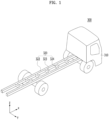
- FIG. 1 is a perspective view showing the external appearance of the fuel cell vehicle 300 according to an embodiment
- FIG. 2 is a plan view of the fuel cell vehicle 300 shown in FIG. 1
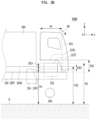
- FIGS. 3A and 3B are cross-sectional views of respective fuel cell vehicles 300A and 300B according to embodiments of the invention.
- FIGS. 1 and 2 illustrations of a front fuel cell (or, frontward fuel cell) 332 and a rear fuel cell (or, backward fuel cell) 334 are omitted from the fuel cell vehicle 300 shown in FIGS. 1 and 2 .
- the fuel cell vehicle 300 (300A or 300B) according to the embodiment includes a vehicle body 320 and a plurality of fuel cells.
- the plurality of fuel cells includes a front fuel cell 332 and a rear fuel cell 334.
- the plurality of fuel cells will be described below as including the front fuel cell 332 and the rear fuel cell 334, the following description may also be applied to the configuration in which three or more fuel cells are provided.
- the vehicle 300 (300A or 300B) according to the embodiment includes the front fuel cell 332 and the rear fuel cell 334 possibly having any of various configurations other than the configuration shown in FIG. 4 .
- FIG. 4 is an exemplary cross-sectional view of each of the front fuel cell 332 and the rear fuel cell 334 included in the fuel cell vehicle 300 (300A or 300B) according to the embodiment.
- the term "fuel cell” to be mentioned herein with reference to FIG. 4 may indicate each of the front fuel cell 332 and the rear fuel cell 334 according to the embodiment.
- the fuel cell may be, for example, a polymer electrolyte membrane fuel cell (or a proton exchange membrane fuel cell) (PEMFC), which has been studied most extensively as a power source for driving vehicles.
- PEMFC polymer electrolyte membrane fuel cell
- PEMFC proton exchange membrane fuel cell
- the fuel cell may include first and second end plates (pressing plates or compression plates) 110A and 110B, current collectors 112, and a cell stack 122.
- the cell stack 122 may include a plurality of unit cells 122-1 to 122-N, which are stacked in the first direction.
- N is a positive integer of 1 or greater, and may range from several tens to several hundreds. However, the disclosure is not limited to any specific value of "N".
- the cell stack 122 included in the front fuel cell 332 is referred to as a "first cell stack”
- the cell stack 122 included in the rear fuel cell 334 is referred to as a "second cell stack”.
- the number of unit cells included in the first cell stack and the number of unit cells included in the second cell stack maybe the same as each other, or may be different from each other.
- Each unit cell 122-n (where 1 ⁇ n ⁇ N) may generate 0.6 volts to 1.0 volts of electricity, on average 0.7 volts of electricity.
- N may be determined in accordance with the intensity of the power to be supplied from the fuel cell to a load.
- load may refer to a part of the vehicle 300 (300A or 300B) that requires power.
- the vehicle 300 (300A or 300B) may be a commercial vehicle, which requires a large amount of power, like a bus, a truck, or the like.
- the vehicle 300 (300A or 300B) may include multiple (e.g. two) fuel cells, namely, the front fuel cell 332 and the rear fuel cell 334.
- Each unit cell 122-n may include a membrane electrode assembly (MEA) 210, gas diffusion layers (GDLs) 222 and 224, gaskets 232, 234 and 236, and separators (or bipolar plates) 242 and 244.
- MEA membrane electrode assembly
- GDLs gas diffusion layers
- separators or bipolar plates
- the membrane electrode assembly 210 has a structure in which catalyst electrode layers, in which electrochemical reaction occurs, are attached to both sides of an electrolyte membrane through which hydrogen ions move.
- the membrane electrode assembly 210 may include a polymer electrolyte membrane (or a proton exchange membrane) 212, a fuel electrode (a hydrogen electrode or an anode) 214, and an air electrode (an oxygen electrode or a cathode) 216.
- the membrane electrode assembly 210 may further include a sub-gasket 238.
- the polymer electrolyte membrane 212 is disposed between the fuel electrode 214 and the air electrode 216.
- Hydrogen which is the fuel in the fuel cell, may be supplied to the fuel electrode 214 through the first separator 242, and air containing oxygen as an oxidizer may be supplied to the air electrode 216 through the second separator 244.
- the hydrogen supplied to the fuel electrode 214 is decomposed into hydrogen ions (protons) (H+) and electrons (e-) by the catalyst. Only the hydrogen ions may be selectively transferred to the air electrode 216 through the polymer electrolyte membrane 212, and at the same time, the electrons may be transferred to the air electrode 216 through the gas diffusion layers 222 and 224 and the first and second separators 242 and 244, which are conductors.
- a catalyst layer may be applied to each of the fuel electrode 214 and the air electrode 216. The movement of the electrons described above causes the electrons to flow through an external wire, thus generating current. That is, the fuel cell may generate power due to the electrochemical reaction between hydrogen, which is the fuel, and oxygen contained in the air.
- product water water
- the first and second gas diffusion layers 222 and 224 serve to uniformly distribute hydrogen and oxygen, which are reactant gases, and to transfer the generated electric energy.
- the first and second gas diffusion layers 222 and 224 may be disposed on respective sides of the membrane electrode assembly 210.
- the first gas diffusion layer 222 may serve to diffuse and uniformly distribute hydrogen supplied as a reactant gas through the first separator 242, and may be electrically conductive.
- the second gas diffusion layer 224 may serve to diffuse and uniformly distribute air supplied as a reactant gas through the second separator 244, and may be electrically conductive.
- the gaskets 232, 234 and 236 may serve to maintain the airtightness and clamping pressure of the cell stack at an appropriate level with respect to the reactant gases and the coolant, to disperse the stress when the first and second separators 242 and 244 are stacked, and to independently seal the flow paths. As such, since airtightness and watertightness are maintained by the gaskets 232, 234 and 236, the flatness of the surfaces that are adjacent to the cell stack 122, which generates power, may be secured, and thus surface pressure may be distributed uniformly over the reaction surfaces of the cell stack 122.
- the first and second separators 242 and 244 may serve to move the reactant gases and the cooling medium and to separate each of the unit cells from the other unit cells.
- the first and second separators 242 and 244 may serve to structurally support the membrane electrode assembly 210 and the gas diffusion layers 222 and 224 and to collect the generated current and transfer the collected current to the current collectors 112.
- the first and second separators 242 and 244 may be spaced apart from each other in the first direction and may be disposed outside the first and second gas diffusion layers 222 and 224, respectively. That is, the first separator 242 may be disposed on the left side of the first gas diffusion layer 222, and the second separator 244 may be disposed on the right side of the second gas diffusion layer 224.
- the first separator 242 serves to supply hydrogen as a reactant gas to the fuel electrode 214 through the first gas diffusion layer 222.
- the second separator 244 serves to supply air as a reactant gas to the air electrode 216 through the second gas diffusion layer 224.
- each of the first and second separators 242 and 244 may form a channel through which the cooling medium (e.g. coolant) may flow.
- Each of the first and second end plates 110A and 110B may be disposed at a respective one of both ends of the cell stack 122, and may support and fix the unit cells. That is, the first end plate 110A may be disposed at one end of the cell stack 122, and the second end plate 110B may be disposed at the opposite end of the cell stack 122.
- the current collectors 112 may be disposed between the cell stack 122 and the inner surfaces 110AI and 110BI of the first and second end plates 110A and 110B that are opposite the cell stack 122.
- the current collectors 112 serve to collect the electric energy generated by the flow of electrons in the cell stack 122 and to supply the electric energy to a load of the vehicle 300 (300A or 300B) that uses the fuel cell.
- the vehicle body 320 may include first and second body frames 322 and 324. Alternatively, the vehicle body 320 may further include at least one cross member 323.
- the first and second body frames 322 and 324 may extend in the first direction (or forward direction or backward direction), in which the vehicle 300 (300A or 300B) travels (or heads), and may be opposite each other in the second direction, which intersects the first direction.
- the at least one cross member 323 may be a part that is disposed (or located) between the first body frame 322 and the second body frame 324 in the vehicle body 320, and may be integrally formed with at least one of the first body frame 322 or the second body frame 324.
- the vehicle 300 (300A or 300B) according to the embodiment is not limited as to the presence or absence of the cross member 323 or the specific position of the cross member 323.
- the front fuel cell 332 maybe mounted in a first space S1 in the vehicle 300 (300A or 300B), and the rear fuel cell 334 may be mounted in a second space S2 in the vehicle 300 (300A or 300B).
- the first space S1 may be the space formed between the first body frame 322 and the second body frame 324, which are spaced apart from each other in the second direction in the vehicle 300 (300A or 300B).
- the second space S2 may be the space that is located at the rear side of the first space S1, within the space formed between the first body frame 322 and the second body frame 324, which are spaced apart from each other in the second direction in the vehicle 300 (300A or 300B).
- the vehicle 300 (300A) may include a cab (or a cabin room) 310, a loading part 362, and a hydrogen storage 350.
- the vehicle 300 (300B) may include a cab 310 and a loading part 364.
- the hydrogen storage 350 may be eliminated, or may be mounted at a position that is different from the position shown in FIG. 3A .
- the loading part 362 or 364 may be located at the rear side of the cab 310 in the vehicle 300 (300A or 300B).
- the loading part 362 or 364 may provide a space in which cargo is loaded, and when the vehicle 300 (300A or 300B) is a bus, the loading part 362 or 364 may provide a space that passengers occupy.
- the loading parts 362 and 364 are illustrated as being of a closed type that has a rectangular-shaped cross-section, but the disclosure is not limited thereto. That is, according to another embodiment, unlike the configurations shown in FIGS. 3A and 3B , the loading parts 362 and 364 may have an open-type cross-section that has an open upper portion.
- the hydrogen storage 350 may be located between the cab 310 and the loading part 362 in the first direction, and may store hydrogen required for the front fuel cell 332 and the rear fuel cell 334 as fuel of the vehicle 300 (300A or 300B).
- the vehicle 300A shown in FIG. 3A may further include pipes for respectively supplying hydrogen from the hydrogen storage 350 to the front fuel cell 332 and the rear fuel cell 334.
- the cab 310 and the loading part 362 or 364 may be supported by the first and second body frames 322 and 324.
- the hydrogen storage 350 may also be supported by the first and second body frames 322 and 324.
- the cross member 323 may serve to support at least one of the cab 310, the loading part 362 or 364, or the hydrogen storage 350.
- the cross member 323 may support none of the cab 310, the loading part 362 or 364, and the hydrogen storage 350, or may be omitted.
- the first space S1 in which the front fuel cell 332 is mounted may be formed in the lower end of the cab 310 (or below the cab). When viewed in plan, the front fuel cell 332 is hidden by the cab 310 and thus is invisible. However, in order to promote an understanding of the embodiment, the first space S1 and the first and second body frames 322 and 324 are indicated by dotted lines in FIG. 2 .
- the front fuel cell 332 may be mounted in the first space S1 located between the first body frame 322 and the second body frame 324 below the cab 310.
- the second space S2 (S21) in which the rear fuel cell 334 is mounted may be located below the hydrogen storage 350.
- the rear fuel cell 334 may be mounted in the second space S21 shown in FIG. 2 , which is located between the first body frame 322 and the second body frame 324 within the space below the hydrogen storage 350.
- the second space S2 (S22) in which the rear fuel cell 334 is mounted may be located below the loading part 364.
- the rear fuel cell 334 may be mounted at any position in the second space S22 between the first body frame 322 and the second body frame 324 below the loading part 364.
- the rear fuel cell 334 may be mounted in the space S21, which is adjacent to the first space S1, within the second space S2.
- the second space in which the rear fuel cell 334 is mounted may be determined within a range within which the rear fuel cell 334 does not interfere with a part (e.g. the cross member 323, a motor, or the like) mounted at the rear side of the rear fuel cell 334.
- the front fuel cell 332 and the rear fuel cell 334 may be located at various positions relative to the ground G, the bottom surface 350B of the hydrogen storage 350, the top surfaces 320T of the first and second body frames 322 and 324, the bottom surface 364B of the loading part 364, and the bottom surface 310L of the cab 310.
- the top surface 334T of the rear fuel cell 334 may be lower than the top surface 332T of the front fuel cell 332 on the basis of the ground G. That is, a first height H1, by which the top surface 334T of the rear fuel cell 334 is spaced apart from the ground G, may be less than a second height H2, by which the top surface 332T of the front fuel cell 332 is spaced apart from the ground G.
- the top surface 332T of the front fuel cell 332 may be located between the top surface 320T of each of the first and second body frames 320 (322 and 324) and the bottom surface 310L of the cab 310. That is, when viewed in a cross-section, the top surface 332T of the front fuel cell 332 may be located in a space DS1 between the top surface 320T of each of the first and second body frames 320 (322 and 324) and the bottom surface 310L of the cab 310.
- the vehicle 300 may further include a front axle 340.
- the front fuel cell 332 may be mounted between the cab 310 and the front axle 340.
- the top surface 334T of the rear fuel cell 334 may be lower than the bottom surface 350B of the hydrogen storage 350 on the basis of the ground G. That is, the first height H1, by which the top surface 334T of the rear fuel cell 334 is spaced apart from the ground G, may be less than a third height H31 (hereinafter, referred to as a "3-1 st height"), by which the bottom surface 350B of the hydrogen storage 350 is spaced apart from the ground G.
- a height difference DS2 between the first height H1 and the 3-1 st height H31 may be greater than or equal to 0.
- the more the height difference DS2 decreases the more the length in the third direction of the space in the hydrogen storage 350, in which hydrogen is stored, may increase.
- a height difference DS3 between the top surface 332T of the front fuel cell 332 and the top surface 334T of the rear fuel cell 334 may be greater than the height difference DS2 between the top surface 334T of the rear fuel cell 334 and the bottom surface 350B of the hydrogen storage 350.
- the top surface 334T of the rear fuel cell 334 may be lower than the bottom surface 364B of the loading part 364 on the basis of the ground G. That is, the first height H1, by which the top surface 334T of the rear fuel cell 334 is spaced apart from the ground G, may be less than a third height H32 (hereinafter, referred to as a "3-2 nd height"), by which the bottom surface 364B of the loading part 364 is spaced apart from the ground G.
- a height difference DS2 between the first height H1 and the 3-2 nd height H32 may be greater than or equal to 0.
- the more the height difference DS2 decreases the more the length in the third direction of the space in the loading part 364, in which cargo is loaded, may increase.
- a height difference DS3 between the top surface 332T of the front fuel cell 332 and the top surface 334T of the rear fuel cell 334 may be greater than the height difference DS2 between the top surface 334T of the rear fuel cell 334 and the bottom surface 364B of the loading part 364.
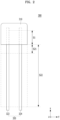
- FIG. 5 is a plan view of the fuel cell vehicle 300 (300A or 300B) according to the embodiment.
- FIG. 5 corresponds to a plan view of each of the vehicles 300A and 300B shown in FIGS. 3A and 3B .
- the spacing distance in the second direction between the first body frame 322 and the second body frame 324 may gradually decrease from the front portion of the vehicle 300 (300A or 300B) to the rear portion thereof.
- the spacing distance in the second direction between the first body frame 322 and the second body frame 324 may be maximized at the front end of the vehicle 300 (300A or 300B), and may be minimized at the rear end of the vehicle 300 (300A or 300B).
- the spacing distance in the second direction between the first body frame 322 and the second body frame 324 at the front end of the vehicle 300 may have the maximum value YMA
- the spacing distance in the second direction between the first body frame 322 and the second body frame 324 at the rear end of the vehicle 300 may have the minimum value YMI.
- the width YF in the second direction of the front fuel cell 332 may be greater than the width YB in the second direction of the rear fuel cell 334.
- the width YF and the width YB may be the same as each other.
- the width YB in the second direction of the rear fuel cell 334 may be less than the minimum spacing distance YMI in the second direction between the first body frame 322 and the second body frame 324.
- the front fuel cell 332 and the rear fuel cell 334 are respectively mounted in the first space S1 and the second space S21 or S22 between the first body frame 322 and the second body frame 324.
- the vehicle 300 (300A or 300B) according to the embodiment may further include a plurality of front connection members FC (e.g. FC1 to FC4) and a plurality of rear connection members BC (e.g. BC1 to BC4).
- the vehicle 300 (300A or 300B) according to the embodiment may further include a plurality of common connection members CC.
- the front connection members FC serve to connect (couple, assemble, dispose, or displace) the front fuel cell 332 to the first and second body frames 322 and 324.
- the front connection members FC may include first to fourth front connection members FC1 to FC4, which are located between the front fuel cell 332 and the first and second body frames 322 and 324.
- the disclosure is not limited as to the specific number of front connection members FC.
- the rear connection members BC serve to connect (couple, assemble, dispose, or place) the rear fuel cell 334 to the first and second body frames 322 and 324.
- the rear connection members BC may include first to fourth rear connection members BC1 to BC4, which are located between the rear fuel cell 334 and the first and second body frames 322 and 324.
- the disclosure is not limited as to the specific number of rear connection members BC.
- each of the front fuel cell 332 and the rear fuel cell 334 is illustrated in FIG. 5 as having a rectangular-shaped plane, the disclosure is not limited thereto.
- each of the front fuel cell 332 and the rear fuel cell 334 will be described as having a rectangular-shaped plane, as shown in FIG. 5 .
- the following description may also be applied to the case in which each of the front fuel cell 332 and the rear fuel cell 334 has a polygonal-shaped, circular-shaped, or elliptical-shaped plane.
- the front fuel cell 332 may include four sides, namely, first to fourth sides FS1, FS2, FS3 and FS4.
- each of the second and third front connection members FC2 and FC3 may be disposed between the first side FS1 of the front fuel cell 332 and the first body frame 322, and may connect the front fuel cell 332 to the first body frame 322.
- Each of the first and fourth front connection members FC1 and FC4 may be disposed between the third side FS3 of the front fuel cell 332 and the second body frame 324, and may connect the front fuel cell 332 to the second body frame 324.
- each of the second and third front connection members FC2 and FC3 may connect at least one of the second side FS2, the fourth side FS4, the corner between the first side FS1 and the second side FS2, or the corner between the first side FS1 and the fourth side FS4 of the front fuel cell 332, to the first body frame 322.
- each of the first and fourth front connection members FC1 and FC4 may connect at least one of the second side FS2, the fourth side FS4, the corner between the second side FS2 and the third side FS3, or the corner between the third side FS3 and the fourth side FS4 of the front fuel cell 332, to the second body frame 324.
- the rear fuel cell 334 may include four sides, namely first to fourth sides BS1, BS2, BS3 and BS4.
- each of the second and third rear connection members BC2 and BC3 may be disposed between the first side BS1 of the rear fuel cell 334 and the first body frame 322, and may connect the rear fuel cell 334 to the first body frame 322.
- Each of the first and fourth rear connection members BC1 and BC4 may be disposed between the third side BS3 of the rear fuel cell 334 and the second body frame 324, and may connect the rear fuel cell 334 to the second body frame 324.
- each of the second and third rear connection members BC2 and BC3 may connect at least one of the second side BS2, the fourth side BS4, the corner between the first side BS1 and the second side BS2, or the corner between the first side BS1 and the fourth side BS4 of the rear fuel cell 334, to the first body frame 322.
- each of the first and fourth rear connection members BC1 and BC4 may connect at least one of the second side BS2, the fourth side BS4, the corner between the second side BS2 and the third side BS3, or the corner between the third side BS3 and the fourth side BS4 of the rear fuel cell 334, to the second body frame 324.
- the common connection members CC serve to connect (couple, assemble, dispose, or place) some of the front connection members FC and some of the rear connection members BC to the first and second body frames 322 and 324.
- the common connection members CC may include first and second common connection members CC1 and CC2, but the disclosure is not limited as to the specific number of common connection members CC.
- Each of the common connection members CC serves to connect a corresponding one of the front connection members and a corresponding one of the rear connection members, which are adjacent to each other in the first direction, to a corresponding one of the first and second body frames 322 and 324.
- the third front connection member FC3 among the front connection members FC and the third rear connection member BC3 among the rear connection members BC are adjacent to each other in the first direction.
- the fourth front connection member FC4 among the front connection members FC and the fourth rear connection member BC4 among the rear connection members BC are adjacent to each other in the first direction.
- the first common connection member CC1 serves to connect the third front connection member FC3 and the third rear connection member BC3 to the first body frame 322, and the second common connection member CC2 serves to connect the fourth front connection member FC4 and the fourth rear connection member BC4 to the second body frame 324.
- front connection members FC and the common connection members CC may connect the front fuel cell 332 to the first and second body frames 322 and 324 such that the front fuel cell 332 may be mounted (secured, coupled, connected, or assembled) above the first and second body frames 322 and 324 and may be demounted (dismantled, disassembled, or removed) above the first and second body frames 322 and 324.
- the cab 310 is tilted in the direction indicated by the arrow shown in FIGS. 3A and 3B .
- the first to fourth front connection members FC1 to FC4 are connected to the front fuel cell 332, and then the first and second front connection members FC1 and FC2 are connected to the first and second body frames 322 and 324 above the first and second body frames 322 and 324, and the third and fourth front connection members FC3 and FC4 are connected to the first and second common connection members CC1 and CC2, thereby completing the mounting of the front fuel cell 332.
- the cab 310 is tilted in the direction indicated by the arrow shown in FIGS. 3A and 3B .
- the first and second front connection members FC1 and FC2 are connected to the first and second body frames 322 and 324 above the first and second body frames 322 and 324, and the third and fourth front connection members FC3 and FC4 are respectively connected to the first and second common connection members CC1 and CC2.
- the first to fourth front connection members FC1 to FC4 are connected to the front fuel cell 332, thereby completing the mounting of the front fuel cell 332.
- the cab 310 is tilted in the direction indicated by the arrow shown in FIGS. 3A and 3B .
- the first and second front connection members FC1 and FC2 are respectively separated from the first and second body frames 322 and 324 above the first and second body frames 322 and 324, and the third and fourth front connection members FC3 and FC4 are separated from the first and second common connection members CC1 and CC2.
- the separated components are withdrawn upwards from the first and second body frames 322 and 324.
- the first to fourth front connection members FC1 to FC4 are separated from the front fuel cell 332, thereby demounting the front fuel cell 332 from the vehicle 300 (300A or 300B).
- the cab 310 is tilted in the direction indicated by the arrow shown in FIGS. 3A and 3B .
- the first to fourth front connection members FC1 to FC4 are separated from the front fuel cell 332.
- the separated front fuel cell 332 is withdrawn upwards from the first and second body frames 322 and 324.
- the first and second front connection members FC1 and FC2 are respectively separated from the first and second body frames 322 and 324 above the first and second body frames 322 and 324
- the third and fourth front connection members FC3 and FC4 are respectively separated from the first and second common connection members CC1 and CC2, thereby demounting the front fuel cell 332 from the vehicle 300 (300A or 300B).
- the front connection members FC may be disposed in a region A1 that is exposed after the cab 310 is tilted in the direction indicated by the arrow AR, as shown in FIGS. 3A and 3B . Accordingly, for example, when it is desired to perform maintenance/repair on the vehicle 300 (300A or 300B) equipped with the front fuel cell 332, it is possible to easily demount the front fuel cell 332 above the first and second body frames 322 and 324.
- the rear connection members BC and the common connection members CC may connect the rear fuel cell 334 to the first and second body frames 322 and 324 such that the rear fuel cell 334 may be mounted above or below the first and second body frames 322 and 324 and may be demounted below the first and second body frames 322 and 324.
- the first to fourth rear connection members BC1 to BC4 are connected to the rear fuel cell 334, and then the first and second rear connection members BC1 and BC2 are respectively connected to the first and second body frames 322 and 324 above or below the first and second body frames 322 and 324, and the third and fourth rear connection members BC3 and BC4 are respectively connected to the first and second common connection members CC1 and CC2, thereby completing the mounting of the rear fuel cell 334.
- first and second rear connection members BC1 and BC2 are respectively connected to the first and second body frames 322 and 324 above or below the first and second body frames 322 and 324, and the third and fourth rear connection members BC3 and BC4 are respectively connected to the first and second common connection members CC1 and CC2.
- the rear fuel cell 334 is connected to the first to fourth rear connection members BC1 to BC4, thereby completing the mounting of the rear fuel cell 334.
- the rear fuel cell 334 may be demounted from the vehicle 300 (300A or 300B) according to the method to be described below.
- the first to fourth rear connection members BC1 to BC4 are separated from the rear fuel cell 334 below the first and second body frames 322 and 324, and the separated rear fuel cell 334 is withdrawn downwards from the first and second body frames 322 and 324. Thereafter, the first and second rear connection members BC1 and BC2 are respectively separated from the first and second body frames 322 and 324 below the first and second body frames 322 and 324, and the third and fourth rear connection members BC3 and BC4 are respectively separated from the first and second common connection members CC1 and CC2, thereby completing the demounting of the rear fuel cell 334.
- first and second rear connection members BC1 and BC2 are respectively separated from the first and second body frames 322 and 324 below the first and second body frames 322 and 324, and the third and fourth rear connection members BC3 and BC4 are respectively separated from the first and second common connection members CC1 and CC2. Thereafter, the first to fourth rear connection members BC1 to BC 4 are separated from the rear fuel cell 334, thereby completing the demounting of the rear fuel cell 334.
- the first to fourth rear connection members BC1 to BC4 are connected to the rear fuel cell 334. Thereafter, the first and second rear connection members BC1 and BC2 are respectively connected to the first and second body frames 322 and 324 below the first and second body frames 322 and 324, and the third and fourth rear connection members BC3 and BC4 are respectively connected to the first and second common connection members CC1 and CC2, thereby completing the mounting of the rear fuel cell 334.
- first and second rear connection members BC1 and BC2 are respectively connected to the first and second body frames 322 and 324 below the first and second body frames 322 and 324, and the third and fourth rear connection members BC3 and BC4 are respectively connected to the first and second common connection members CC1 and CC2.
- the rear fuel cell 334 is connected to the first to fourth rear connection members BC1 to BC4 below the first and second body frames 322 and 324, thereby completing the mounting of the rear fuel cell 334.
- the rear fuel cell 334 may be demounted from and again mounted to the vehicle 300 (300A or 300B) below the first and second body frames 322 and 324 in order to perform maintenance/repair or the like.
- the hydrogen storage 350 shown in FIG. 3A or the loading part 364 shown in FIG. 3B is not necessary to dismantle the hydrogen storage 350 shown in FIG. 3A or the loading part 364 shown in FIG. 3B from the vehicle 300 (300A or 300B) in order to mount or demount the rear fuel cell 334.
- the front fuel cell 332 may be mounted and demounted above the first and second body frames 322 and 324, whereas the rear fuel cell 334 may be mounted and demounted below the first and second body frames 322 and 324. That is, according to the embodiment, the direction in which the front fuel cell 332 is mounted and demounted and the direction in which the rear fuel cell 334 is mounted and demounted are different from each other. Therefore, it is required to prevent the connection state of the rear fuel cell 334 from being affected by the process of mounting or demounting the front fuel cell 332, and it is required to prevent the connection state of the front fuel cell 332 from being affected by the process of mounting or demounting the rear fuel cell 334.
- the third front connection member FC3 and the third rear connection member BC3, which are disposed adjacent to each other in the first direction, are not directly connected to the first body frame 322, but are indirectly connected to the first body frame 322 via the first common connection member CC1.
- the fourth front connection member FC4 and the fourth rear connection member BC4, which are disposed adjacent to each other in the first direction, are not directly connected to the second body frame 324, but are indirectly connected to the second body frame 324 via the second common connection member CC2.
- FIG. 6 is a partial side-sectional view of an example of the fuel cell vehicle 300 (300A or 300B) shown in FIG. 5 .
- FIG. 6 shows one of the front connection members FC, one of the rear connection members BC, and one of the common connection members CC.
- each 370 of the front connection members FC may include a first mounting support bracket 372 and a first individual mounting bracket 374.
- the first mounting support bracket 372 is a portion of the front connection member 370 that is connected to an end of the front fuel cell 332.
- the first individual mounting bracket 374 is a portion of the front connection member 370 that connects the first mounting support bracket 372 to one of the first body frame 322, the second body frame 324, the first common connection member CC1, and the second common connection member CC 2 .
- each of the first individual mounting brackets 374 of the first and second front connection members FC1 and FC2 may not be connected to the corresponding common connection member CC (390), but may be connected to a respective one of the first and second body frames 322 and 324, unlike the configuration shown in FIG. 6 .
- each of the first individual mounting brackets 374 of the third and fourth front connection members FC3 and FC4 may be connected to the corresponding common connection member CC (390), as shown in FIG. 6 .
- each 370 of the front connection members FC may further include a first mount insulator (or a bush) 376.
- the first mount insulator 376 may be connected to the front fuel cell 332 via the first mounting support bracket 372.
- the first mount insulator 376 is disposed between the first mounting support bracket 372 and the first individual mounting bracket 374 in the third direction, and has vibration isolation capability.
- the first mount insulator 376 may prevent or minimize the transmission of vibrations from the first mounting support bracket 372 to the first individual mounting bracket 374, and may prevent or minimize the transmission of vibrations from the first individual mounting bracket 374 to the first mounting support bracket 372.
- each 380 of the rear connection members BC may include a second mounting support bracket 382 and a second individual mounting bracket 384.
- the second mounting support bracket 382 is a portion of the rear connection member 380 that is connected to an end of the rear fuel cell 334.
- the second individual mounting bracket 384 is a portion of the rear connection member 380 that connects the second mounting support bracket 382 to one of the first body frame 322, the second body frame 324, the first common connection member CC1, and the second common connection member CC 2 .
- each of the second individual mounting brackets 384 of the first and second rear connection members BC1 and BC2 may not be connected to the corresponding common connection member CC (390), but may be connected to a respective one of the first and second body frames 322 and 324, unlike the configuration shown in FIG. 6 .
- each of the second individual mounting brackets 384 of the third and fourth rear connection members BC3 and BC4 may be connected to the corresponding common connection member CC (390), as shown in FIG. 6 .
- each 380 of the rear connection members BC may further include a second mount insulator 386.
- the second mount insulator 386 may be connected to the rear fuel cell 334 via the second mounting support bracket 382.
- the second mount insulator 386 is disposed between the second mounting support bracket 382 and the second individual mounting bracket 384 in the third direction, and has vibration isolation capability.
- the second mount insulator 386 may prevent or minimize the transmission of vibrations from the second mounting support bracket 382 to the second individual mounting bracket 384, and may prevent or minimize the transmission of vibrations from the second individual mounting bracket 384 to the second mounting support bracket 382.
- each of the common connection members CC may include a common mounting bracket 390.
- the common mounting bracket 390 serves to connect the first individual mounting bracket 374 and the second individual mounting bracket 384, which are adjacent to each other in the first direction, to the first and second body frames 322 and 324.
- the common mounting bracket 390 shown in FIG. 6 may connect the first individual mounting bracket 374 of the third front connection member FC3 (370) and the second individual mounting bracket 384 of the third rear connection member BC3 (380), which are adjacent to each other in the first direction, to the first and second body frames 322 and 324.
- the common mounting bracket 390 shown in FIG. 6 may connect the first individual mounting bracket 374 of the fourth front connection member FC4 (370) and the second individual mounting bracket 384 of the fourth rear connection member BC4 (380), which are adjacent to each other in the first direction, to the first and second body frames 322 and 324.
- each of the common mounting brackets 390 of the first and second common connection members CC1 and CC2 may be directly connected to a respective one of the first and second body frames 322 and 324.
- the first individual mounting bracket 374 of the front connection member 370 may be connected to the upper portion (or the top surface) CCU of the common mounting bracket 390
- the second individual mounting bracket 384 of the rear connection member 380 may be connected to the lower portion (or the bottom surface) CCL of the common mounting bracket 390. This serves, as described above, to allow the front connection member 370 to be mounted or demounted above the first and second body frames 322 and 324 and to allow the rear connection member 380 to be mounted or demounted below the first and second body frames 322 and 324.
- FIG. 7 is a plan view of an example of portion A shown in FIG. 5 .
- the second rear connection member BC2 shown in FIG. 5 may be connected to the first body frame 322, as shown in FIG. 7 .
- the first rear connection member BC1 shown in FIG. 5 may be connected to the second body frame 324 in the manner shown in FIG. 7 .
- a second mounting support bracket 382A, a second individual mounting bracket 384A, and a second mounting insulator 386A shown in FIG. 7 correspond to the second mounting support bracket 382, the second individual mounting bracket 384, and the second mounting insulator 386 shown in FIG. 6 , respectively.
- the second individual mounting bracket 384A may be connected while surrounding the first body frame 322, and may be separated from the first body frame 322 below the same.
- the second mounting support bracket 382A may include a bent portion P.
- the first mounting support bracket 372 may also include a bent portion P in the same manner as shown in FIG. 7 . This serves to connect the front and rear fuel cells 332 and 334, which are respectively disposed in the first and second spaces S1 and S2 formed between the first and second body frames 322 and 324 spaced apart from each other in the second direction, to the first and second body frames 322 and 324, extending in the first direction.
- the disclosure is not limited thereto.
- None of the front and rear connection members FC and BC may include a bent portion P depending on the portions of the front and rear fuel cells 332 and 334 at which the front and rear connection members FC and BC are disposed or depending on the shapes of the front and rear connection members FC and BC.
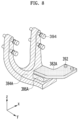
- FIG. 8 is a perspective view of an example of the rear connection member 380A shown in FIG. 7 .
- the second individual mounting bracket 384A of the rear connection member 380A may be coupled to the first body frame 322 using a screw 394.
- the second mounting support bracket 382A of the rear connection member 380A may be coupled to the rear fuel cell 334 using a screw 392.
- first mounting support bracket 372 of each of the first to fourth front connection members FC1 to FC4 may be screwed to the front fuel cell 332, and the first individual mounting bracket 374 thereof may be screwed to the first body frame 322, the second body frame 324, or the common mounting bracket 390.
- second mounting support bracket 382 of each of the first, third and fourth rear connection members BC1, BC3 and BC4 may be screwed to the rear fuel cell 334, and the second individual mounting bracket 384 thereof may be screwed to the first body frame 322, the second body frame 324, or the common mounting bracket 390.
- the fuel cell vehicle 300 (300A or 300B) according to the embodiment may correspond to a commercial vehicle such as a truck or a bus, which is heavier or larger than an automobile. Therefore, the fuel cell vehicle 300 (300A or 300B) according to the embodiment uses a plurality of fuel cells 332 and 334.
- the fuel cell vehicle 300 (300A or 300B) according to the embodiment may exhibit various effects through efficient arrangement of the fuel cells 332 and 334.
- the fuel cells 332 and 334 are disposed in the fuel cell vehicle 300 (300A or 300B) according to the embodiment such that, when the fuel cells 332 and 334 are demounted from and again mounted to the vehicle in order to preform maintenance/repair, it is not necessary to dismantle other parts of the vehicle 300 (300A or 300B), thereby improving maintainability.
- the rear fuel cell 334 may be removed or connected below the first and second body frames 322 and 324.
- the rear fuel cell 334 is demounted from and again mounted to the vehicle 300 (300A or 300B)
- the height difference DS2 in the cross-section shown in FIG. 3A is small, the length in the third direction of the space occupied by the hydrogen storage 350 may increase, and thus the amount of hydrogen that is capable of being loaded in the hydrogen storage 350 as fuel of the vehicle 300 (300A or 300B) may increase.
- the increase in the amount of hydrogen that is loaded as fuel of the vehicle 300 (300A or 300B) may increase the distance that the vehicle 300 (300A or 300B) is capable of traveling.
- the height difference DS2 in the cross-section shown in FIG. 3B is small, the length in the third direction of the space occupied by the loading part 364 may increase, and thus the amount of cargo that is capable of being loaded in the loading part 364 (or the number of passengers that are capable of getting on the vehicle when the vehicle is a bus) may increase.
- the height difference DS2 in the cross-section shown in FIG. 3B is small, the length in the third direction of the space occupied by the loading part 364 may increase, and thus the amount of cargo that is capable of being loaded in the loading part 364 (or the number of passengers that are capable of getting on the vehicle when the vehicle is a bus) may increase.
- the width YF in the second direction of the front fuel cell 332 and the width YB in the second direction of the rear fuel cell 334 may be adjusted so as not to affect the arrangement of parts (e.g. piping, wiring, etc.) around the front and rear fuel cells 332 and 334.
- the embodiments provide a fuel cell vehicle in which a plurality of fuel cells is efficiently disposed, thereby improving the maintainability thereof, increasing the traveling distance thereof, and increasing the amount of cargo capable of being loaded therein or the number of passengers capable of riding therein.
Landscapes
- Engineering & Computer Science (AREA)
- Life Sciences & Earth Sciences (AREA)
- Sustainable Development (AREA)
- Sustainable Energy (AREA)
- Transportation (AREA)
- Mechanical Engineering (AREA)
- Chemical & Material Sciences (AREA)
- Combustion & Propulsion (AREA)
- Power Engineering (AREA)
- Manufacturing & Machinery (AREA)
- Electrochemistry (AREA)
- General Chemical & Material Sciences (AREA)
- Chemical Kinetics & Catalysis (AREA)
- Fuel Cell (AREA)
- Arrangement Or Mounting Of Propulsion Units For Vehicles (AREA)
Description
- The present invention relates to a vehicle including a fuel cell.
- Because commercial vehicles such as trucks and buses are heavier and larger than automobiles, a relatively large amount of output, e.g., about 200 kW or more, is required in order to drive commercial vehicles. Thus, it may be impossible or difficult to drive a commercial vehicle using only one fuel cell of the type used in automobiles. Therefore, research thereon is being actively conducted. A fuel cell vehicle is for example disclosed in
US 2003/0070858 A1 forming the basis for the preamble ofclaim 1. - Accordingly, the invention is directed to a fuel cell vehicle that can substantially obviate one or more problems due to limitations and disadvantages of the related art.
- The invention provides a fuel cell vehicle in which a plurality of fuel cells is efficiently mounted.
- According to the invention, a fuel cell vehicle includes the features of
claim 1. - According to a second aspect of the invention, a fuel cell vehicle includes the features of claim 2.
- Other embodiments of the invention are covered by the dependent claims.
- For example, the front fuel cell may be mounted to the lower end of the cab.
- For example, the top surface of the front fuel cell may be located between the top surface of each of the first and second body frames and the bottom surface of the cab.
- For example, the top surface of the rear fuel cell may be lower than the bottom surface of the loading part on the basis of the ground.
- For example, the top surface of the rear fuel cell may be lower than the bottom surface of the hydrogen storage on the basis of the ground.
- For example, the fuel cell vehicle may further include a front axle, and the front fuel cell may be disposed between the cab and the front axle.
- For example, the top surface of the rear fuel cell may be lower than the top surface of the front fuel cell on the basis of the ground.
- For example, the spacing distance in the second direction between the first body frame and the second body frame may gradually decrease from a front portion of the fuel cell vehicle to a rear portion of the fuel cell vehicle on the basis of the direction in which the fuel cell vehicle travels.
- For example, the width in the second direction of the front fuel cell may be greater than the width in the second direction of the rear fuel cell, and the width in the second direction of the rear fuel cell may be less than the minimum spacing distance in the second direction between the first body frame and the second body frame.
- For example, the fuel cell vehicle may further include a plurality of front connection members configured to connect the front fuel cell to the first and second body frames and a plurality of rear connection members configured to connect the rear fuel cell to the first and second body frames.
- For example, the fuel cell vehicle may further include a plurality of common connection members configured to connect some of the plurality of front connection members and some of the plurality of rear connection members to the first and second body frames.
- For example, the plurality of front connection members and the plurality of common connection members may connect the front fuel cell to the first and second body frames such that the front fuel cell may be mounted and demounted above the first and second body frames.
- For example, the plurality of front connection members may be disposed in a region that is exposed after the cab is tilted.
- For example, the plurality of rear connection members and the plurality of common connection members may connect the rear fuel cell to the first and second body frames such that the rear fuel cell may be mounted above or below the first and second body frames and may be demounted below the first and second body frames.
- For example, each of the plurality of front connection members may include a first mounting support bracket connected to an end of the front fuel cell and a first individual mounting bracket configured to connect the first mounting support bracket to one of the first and second body frames.
- For example, each of the plurality of front connection members may further include a first mount insulator, which is disposed between the first mounting support bracket and the first individual mounting bracket in a third direction intersecting the first and second directions and has vibration isolation capability.
- For example, each of the plurality of rear connection members may include a second mounting support bracket connected to an end of the rear fuel cell and a second individual mounting bracket configured to connect the second mounting support bracket to one of the first and second body frames.
- For example, each of the plurality of rear connection members may further include a second mount insulator, which is disposed between the second mounting support bracket and the second individual mounting bracket in the third direction and has vibration isolation capability.
- For example, each of the plurality of common connection members may include a common mounting bracket configured to connect the first individual mounting bracket and the second individual mounting bracket, adjacent to the first individual mounting bracket in the first direction, to the first and second body frames.
- For example, the first individual mounting bracket may be connected to an upper portion of the common mounting bracket, and the second individual mounting bracket may be connected to a lower portion of the common mounting bracket.
- For example, the front fuel cell may include a first cell stack configured such that a plurality of unit cells is stacked in the first direction, and the rear fuel cell may include a second cell stack configured such that a plurality of unit cells is stacked in the first direction.
- For example, the number of unit cells included in the first cell stack and the number of unit cells included in the second cell stack may be the same as each other.
- For example, the number of unit cells included in the first cell stack and the number of unit cells included in the second cell stack may be different from each other.
- Arrangements and embodiments may be described in detail with reference to the following drawings in which like reference numerals refer to like elements and wherein:
-
FIG. 1 is a perspective view showing the external appearance of a fuel cell vehicle according to an embodiment; -
FIG. 2 is a plan view of the fuel cell vehicle shown inFIG. 1 ; -
FIGS. 3A and3B are cross-sectional views of the fuel cell vehicle according to the embodiment; -
FIG. 4 is an exemplary cross-sectional view of each of a front fuel cell and a rear fuel cell included in the fuel cell vehicle according to the embodiment; -
FIG. 5 is a plan view of the fuel cell vehicle according to the embodiment; -
FIG. 6 is a partial side-sectional view of an example of the fuel cell vehicle shown inFIG. 5 ; -
FIG. 7 is a plan view of an example of portion A shown inFIG. 5 ; and -
FIG. 8 is a perspective view of an example of the rear connection member shown inFIG. 7 . - The present invention will now be described more fully hereinafter with reference to the accompanying drawings, in which various embodiments are shown. The examples, however, may be embodied in many different forms and should not be construed as being limited to the embodiments set forth herein. Rather, these embodiments are provided so that this disclosure will be more thorough and complete, and will more fully convey the scope of the invention to those skilled in the art.
- It will be understood that when an element is referred to as being "on" or "under" another element, it may be directly on/under the element, or one or more intervening elements may also be present.
- When an element is referred to as being "on" or "under", "under the element" as well as "on the element" may be included based on the element.
- In addition, relational terms, such as "first", "second", "on/upper part/above" and "under/lower part/below", are used only to distinguish between one subject or element and another subject or element, without necessarily requiring or involving any physical or logical relationship or sequence between the subjects or elements.
- Hereinafter, a fuel cell vehicle 300 (300A or 300B) according to embodiments of the invention will be described with reference to the accompanying drawings. The fuel cell vehicle 300 (300A or 300B) will be described using the Cartesian coordinate system (x-axis, y-axis, z-axis) for convenience of description. However, other different coordinate systems may be used. In the drawings, the x-axis, the y-axis, and the z-axis of the Cartesian coordinate system are perpendicular to each other. However, the disclosure is not limited thereto. That is, the x-axis, the y-axis, and the z-axis may intersect each other. In the following description, the term "first direction" refers to at least one of the +x-axis direction or the -x-axis direction, the term "second direction" refers to at least one of the +y-axis direction or -y-axis direction, and the term "third direction" refers to at least one of the +z-axis direction or the -z-axis direction. The term "downward direction (or, lower side)" may refer to the gravity direction, which is oriented toward the ground, and the term "upward direction (or, upper side)" may refer to the direction that is oriented away from the ground, i.e. the direction opposite that indicated by the term "downward direction". The term "frontward direction (or, front side)" may refer to the direction in which the vehicle 300 (300A or 300B) moves forwards, and the term "backward direction (or, rear side)" may refer to the direction in which the vehicle 300 (300A or 300B) moves backwards, i.e. the direction opposite that indicated by the term "frontward direction".
- Hereinafter, a fuel cell vehicle (hereinafter, referred to as a "vehicle") 300 (300A or 300B) according to an embodiment of the invention will be described with reference to the accompanying drawings.
-
FIG. 1 is a perspective view showing the external appearance of thefuel cell vehicle 300 according to an embodiment,FIG. 2 is a plan view of thefuel cell vehicle 300 shown inFIG. 1 , andFIGS. 3A and3B are cross-sectional views of respectivefuel cell vehicles - In order to promote an understanding of a
vehicle body 320, illustrations of a front fuel cell (or, frontward fuel cell) 332 and a rear fuel cell (or, backward fuel cell) 334 are omitted from thefuel cell vehicle 300 shown inFIGS. 1 and2 . - Referring to
FIGS. 1 to 3B , the fuel cell vehicle 300 (300A or 300B) according to the embodiment includes avehicle body 320 and a plurality of fuel cells. For example, the plurality of fuel cells includes afront fuel cell 332 and arear fuel cell 334. Although the plurality of fuel cells will be described below as including thefront fuel cell 332 and therear fuel cell 334, the following description may also be applied to the configuration in which three or more fuel cells are provided. - First, an example of each of the
front fuel cell 332 and therear fuel cell 334 included in the vehicle 300 (300A or 300B) according to the embodiment will now be described with reference toFIG. 4 . However, the vehicle 300 (300A or 300B) according to the embodiment includes thefront fuel cell 332 and therear fuel cell 334 possibly having any of various configurations other than the configuration shown inFIG. 4 . -
FIG. 4 is an exemplary cross-sectional view of each of thefront fuel cell 332 and therear fuel cell 334 included in the fuel cell vehicle 300 (300A or 300B) according to the embodiment. The term "fuel cell" to be mentioned herein with reference toFIG. 4 may indicate each of thefront fuel cell 332 and therear fuel cell 334 according to the embodiment. - The fuel cell may be, for example, a polymer electrolyte membrane fuel cell (or a proton exchange membrane fuel cell) (PEMFC), which has been studied most extensively as a power source for driving vehicles.
- The fuel cell may include first and second end plates (pressing plates or compression plates) 110A and 110B,
current collectors 112, and acell stack 122. - The
cell stack 122 may include a plurality of unit cells 122-1 to 122-N, which are stacked in the first direction. Here, "N" is a positive integer of 1 or greater, and may range from several tens to several hundreds. However, the disclosure is not limited to any specific value of "N". - Hereinafter, the
cell stack 122 included in thefront fuel cell 332 is referred to as a "first cell stack", and thecell stack 122 included in therear fuel cell 334 is referred to as a "second cell stack". - Depending on embodiments, the number of unit cells included in the first cell stack and the number of unit cells included in the second cell stack maybe the same as each other, or may be different from each other.
- Each unit cell 122-n (where 1 ≤ n ≤ N) may generate 0.6 volts to 1.0 volts of electricity, on average 0.7 volts of electricity. Thus, "N" may be determined in accordance with the intensity of the power to be supplied from the fuel cell to a load. Here, "load" may refer to a part of the vehicle 300 (300A or 300B) that requires power.
- In particular, the vehicle 300 (300A or 300B) according to the embodiment may be a commercial vehicle, which requires a large amount of power, like a bus, a truck, or the like. In order to meet the requirements for a large amount of drive power, the vehicle 300 (300A or 300B) may include multiple (e.g. two) fuel cells, namely, the
front fuel cell 332 and therear fuel cell 334. - Each unit cell 122-n may include a membrane electrode assembly (MEA) 210, gas diffusion layers (GDLs) 222 and 224,
gaskets - The
membrane electrode assembly 210 has a structure in which catalyst electrode layers, in which electrochemical reaction occurs, are attached to both sides of an electrolyte membrane through which hydrogen ions move. Specifically, themembrane electrode assembly 210 may include a polymer electrolyte membrane (or a proton exchange membrane) 212, a fuel electrode (a hydrogen electrode or an anode) 214, and an air electrode (an oxygen electrode or a cathode) 216. In addition, themembrane electrode assembly 210 may further include a sub-gasket 238. - The
polymer electrolyte membrane 212 is disposed between thefuel electrode 214 and theair electrode 216. - Hydrogen, which is the fuel in the fuel cell, may be supplied to the
fuel electrode 214 through thefirst separator 242, and air containing oxygen as an oxidizer may be supplied to theair electrode 216 through thesecond separator 244. - The hydrogen supplied to the
fuel electrode 214 is decomposed into hydrogen ions (protons) (H+) and electrons (e-) by the catalyst. Only the hydrogen ions may be selectively transferred to theair electrode 216 through thepolymer electrolyte membrane 212, and at the same time, the electrons may be transferred to theair electrode 216 through the gas diffusion layers 222 and 224 and the first andsecond separators fuel electrode 214 and theair electrode 216. The movement of the electrons described above causes the electrons to flow through an external wire, thus generating current. That is, the fuel cell may generate power due to the electrochemical reaction between hydrogen, which is the fuel, and oxygen contained in the air. - In the
air electrode 216, the hydrogen ions supplied through thepolymer electrolyte membrane 212 and the electrons transferred through the first andsecond separators air electrode 216, thus causing a reaction that generates water (hereinafter, referred to as "product water"). The product water generated in theair electrode 216 may penetrate thepolymer electrolyte membrane 212 and may be transferred to thefuel electrode 214. - The first and second gas diffusion layers 222 and 224 serve to uniformly distribute hydrogen and oxygen, which are reactant gases, and to transfer the generated electric energy. To this end, the first and second gas diffusion layers 222 and 224 may be disposed on respective sides of the
membrane electrode assembly 210. The firstgas diffusion layer 222 may serve to diffuse and uniformly distribute hydrogen supplied as a reactant gas through thefirst separator 242, and may be electrically conductive. The secondgas diffusion layer 224 may serve to diffuse and uniformly distribute air supplied as a reactant gas through thesecond separator 244, and may be electrically conductive. - The
gaskets second separators gaskets cell stack 122, which generates power, may be secured, and thus surface pressure may be distributed uniformly over the reaction surfaces of thecell stack 122. - The first and
second separators second separators membrane electrode assembly 210 and the gas diffusion layers 222 and 224 and to collect the generated current and transfer the collected current to thecurrent collectors 112. - The first and
second separators first separator 242 may be disposed on the left side of the firstgas diffusion layer 222, and thesecond separator 244 may be disposed on the right side of the secondgas diffusion layer 224. - The
first separator 242 serves to supply hydrogen as a reactant gas to thefuel electrode 214 through the firstgas diffusion layer 222. Thesecond separator 244 serves to supply air as a reactant gas to theair electrode 216 through the secondgas diffusion layer 224. In addition, each of the first andsecond separators - Each of the first and
second end plates cell stack 122, and may support and fix the unit cells. That is, thefirst end plate 110A may be disposed at one end of thecell stack 122, and thesecond end plate 110B may be disposed at the opposite end of thecell stack 122. - The
current collectors 112 may be disposed between thecell stack 122 and the inner surfaces 110AI and 110BI of the first andsecond end plates cell stack 122. Thecurrent collectors 112 serve to collect the electric energy generated by the flow of electrons in thecell stack 122 and to supply the electric energy to a load of the vehicle 300 (300A or 300B) that uses the fuel cell. - Referring back to
FIGS. 1 to 3B , thevehicle body 320 may include first and second body frames 322 and 324. Alternatively, thevehicle body 320 may further include at least onecross member 323. - The first and second body frames 322 and 324 may extend in the first direction (or forward direction or backward direction), in which the vehicle 300 (300A or 300B) travels (or heads), and may be opposite each other in the second direction, which intersects the first direction. In this case, the at least one
cross member 323 may be a part that is disposed (or located) between thefirst body frame 322 and thesecond body frame 324 in thevehicle body 320, and may be integrally formed with at least one of thefirst body frame 322 or thesecond body frame 324. However, the vehicle 300 (300A or 300B) according to the embodiment is not limited as to the presence or absence of thecross member 323 or the specific position of thecross member 323. - The
front fuel cell 332 maybe mounted in a first space S1 in the vehicle 300 (300A or 300B), and therear fuel cell 334 may be mounted in a second space S2 in the vehicle 300 (300A or 300B). Here, the first space S1 may be the space formed between thefirst body frame 322 and thesecond body frame 324, which are spaced apart from each other in the second direction in the vehicle 300 (300A or 300B). - The second space S2 may be the space that is located at the rear side of the first space S1, within the space formed between the
first body frame 322 and thesecond body frame 324, which are spaced apart from each other in the second direction in the vehicle 300 (300A or 300B). - In addition, as shown in
FIG. 3A , the vehicle 300 (300A) may include a cab (or a cabin room) 310, aloading part 362, and ahydrogen storage 350. Alternatively, as shown inFIG. 3B , the vehicle 300 (300B) may include acab 310 and aloading part 364. Thehydrogen storage 350 may be eliminated, or may be mounted at a position that is different from the position shown inFIG. 3A . - The
loading part cab 310 in the vehicle 300 (300A or 300B). - When the vehicle 300 (300A or 300B) is a commercial vehicle, which is a truck, the
loading part loading part - Referring to
FIGS. 3A and3B , theloading parts FIGS. 3A and3B , theloading parts - The
hydrogen storage 350 may be located between thecab 310 and theloading part 362 in the first direction, and may store hydrogen required for thefront fuel cell 332 and therear fuel cell 334 as fuel of the vehicle 300 (300A or 300B). Although not shown, thevehicle 300A shown inFIG. 3A may further include pipes for respectively supplying hydrogen from thehydrogen storage 350 to thefront fuel cell 332 and therear fuel cell 334. - The
cab 310 and theloading part hydrogen storage 350 may also be supported by the first and second body frames 322 and 324. - In addition, the
cross member 323 may serve to support at least one of thecab 310, theloading part hydrogen storage 350. Alternatively, thecross member 323 may support none of thecab 310, theloading part hydrogen storage 350, or may be omitted. - Referring back to
FIG. 2 , the first space S1 in which thefront fuel cell 332 is mounted may be formed in the lower end of the cab 310 (or below the cab). When viewed in plan, thefront fuel cell 332 is hidden by thecab 310 and thus is invisible. However, in order to promote an understanding of the embodiment, the first space S1 and the first and second body frames 322 and 324 are indicated by dotted lines inFIG. 2 . Thefront fuel cell 332 may be mounted in the first space S1 located between thefirst body frame 322 and thesecond body frame 324 below thecab 310. - According to an embodiment, in the
vehicle 300A shown inFIG. 3A , the second space S2 (S21) in which therear fuel cell 334 is mounted (disposed, coupled, connected, located, or assembled) may be located below thehydrogen storage 350. In this case, therear fuel cell 334 may be mounted in the second space S21 shown inFIG. 2 , which is located between thefirst body frame 322 and thesecond body frame 324 within the space below thehydrogen storage 350. - According to another embodiment, in the
vehicle 300B shown inFIG. 3B , the second space S2 (S22) in which therear fuel cell 334 is mounted may be located below theloading part 364. In this case, therear fuel cell 334 may be mounted at any position in the second space S22 between thefirst body frame 322 and thesecond body frame 324 below theloading part 364. For example, therear fuel cell 334 may be mounted in the space S21, which is adjacent to the first space S1, within the second space S2. - In this case, in the vehicle 300 (300A or 300B), the second space in which the
rear fuel cell 334 is mounted (disposed, coupled, connected, located, or assembled) may be determined within a range within which therear fuel cell 334 does not interfere with a part (e.g. thecross member 323, a motor, or the like) mounted at the rear side of therear fuel cell 334. - The
front fuel cell 332 and therear fuel cell 334 may be located at various positions relative to the ground G, thebottom surface 350B of thehydrogen storage 350, thetop surfaces 320T of the first and second body frames 322 and 324, thebottom surface 364B of theloading part 364, and thebottom surface 310L of thecab 310. - Hereinafter, various positions at which the
front fuel cell 332 and therear fuel cell 334 are mounted in the vehicle 300 (300A or 300B) according to the embodiment will be described with reference to the accompanying drawings. - In the vehicle 300 (300A or 300B) according to the embodiment, the
top surface 334T of therear fuel cell 334 may be lower than thetop surface 332T of thefront fuel cell 332 on the basis of the ground G. That is, a first height H1, by which thetop surface 334T of therear fuel cell 334 is spaced apart from the ground G, may be less than a second height H2, by which thetop surface 332T of thefront fuel cell 332 is spaced apart from the ground G. - In addition, when viewed in a cross-section, the
top surface 332T of thefront fuel cell 332 may be located between thetop surface 320T of each of the first and second body frames 320 (322 and 324) and thebottom surface 310L of thecab 310. That is, when viewed in a cross-section, thetop surface 332T of thefront fuel cell 332 may be located in a space DS1 between thetop surface 320T of each of the first and second body frames 320 (322 and 324) and thebottom surface 310L of thecab 310. - In addition, the vehicle 300 (300A or 300B) may further include a
front axle 340. In this case, thefront fuel cell 332 may be mounted between thecab 310 and thefront axle 340. - According to an embodiment, as shown in
FIG. 3A , thetop surface 334T of therear fuel cell 334 may be lower than thebottom surface 350B of thehydrogen storage 350 on the basis of the ground G. That is, the first height H1, by which thetop surface 334T of therear fuel cell 334 is spaced apart from the ground G, may be less than a third height H31 (hereinafter, referred to as a "3-1st height"), by which thebottom surface 350B of thehydrogen storage 350 is spaced apart from the ground G. In this case, a height difference DS2 between the first height H1 and the 3-1st height H31 may be greater than or equal to 0. When viewed in a cross-section, the more the height difference DS2 decreases, the more the length in the third direction of the space in thehydrogen storage 350, in which hydrogen is stored, may increase. - Further, a height difference DS3 between the
top surface 332T of thefront fuel cell 332 and thetop surface 334T of therear fuel cell 334 may be greater than the height difference DS2 between thetop surface 334T of therear fuel cell 334 and thebottom surface 350B of thehydrogen storage 350. - According to another embodiment, as shown in
FIG. 3B , thetop surface 334T of therear fuel cell 334 may be lower than thebottom surface 364B of theloading part 364 on the basis of the ground G. That is, the first height H1, by which thetop surface 334T of therear fuel cell 334 is spaced apart from the ground G, may be less than a third height H32 (hereinafter, referred to as a "3-2nd height"), by which thebottom surface 364B of theloading part 364 is spaced apart from the ground G. In this case, a height difference DS2 between the first height H1 and the 3-2nd height H32 may be greater than or equal to 0. When viewed in a cross-sention, the more the height difference DS2 decreases, the more the length in the third direction of the space in theloading part 364, in which cargo is loaded, may increase. - Further, a height difference DS3 between the
top surface 332T of thefront fuel cell 332 and thetop surface 334T of therear fuel cell 334 may be greater than the height difference DS2 between thetop surface 334T of therear fuel cell 334 and thebottom surface 364B of theloading part 364. -
FIG. 5 is a plan view of the fuel cell vehicle 300 (300A or 300B) according to the embodiment. -
FIG. 5 corresponds to a plan view of each of thevehicles FIGS. 3A and3B . In order to promote an understanding of the structure in which each of thefront fuel cell 332 and therear fuel cell 334 is connected to the first and second body frames 322 and 324, illustration of thecab 310, theloading part hydrogen storage 350, which are mounted (disposed, coupled, connected, located, or assembled) on the first and second body frames 322 and 324, is omitted fromFIG. 5 . - Referring to
FIG. 5 , the spacing distance in the second direction between thefirst body frame 322 and thesecond body frame 324 may gradually decrease from the front portion of the vehicle 300 (300A or 300B) to the rear portion thereof. The spacing distance in the second direction between thefirst body frame 322 and thesecond body frame 324 may be maximized at the front end of the vehicle 300 (300A or 300B), and may be minimized at the rear end of the vehicle 300 (300A or 300B). That is, the spacing distance in the second direction between thefirst body frame 322 and thesecond body frame 324 at the front end of the vehicle 300 (300A or 300B) may have the maximum value YMA, and the spacing distance in the second direction between thefirst body frame 322 and thesecond body frame 324 at the rear end of the vehicle 300 (300A or 300B) may have the minimum value YMI. - When viewed in plan, as described above, in the case in which the spacing distance in the second direction between the
first body frame 322 and thesecond body frame 324 gradually decreases from the front portion of the vehicle 300 (300A or 300B) to the rear portion thereof, the width YF in the second direction of thefront fuel cell 332 may be greater than the width YB in the second direction of therear fuel cell 334. Alternatively, the width YF and the width YB may be the same as each other. The width YB in the second direction of therear fuel cell 334 may be less than the minimum spacing distance YMI in the second direction between thefirst body frame 322 and thesecond body frame 324. Through this structure, even when the minimum spacing distance YMI in the second direction between thefirst body frame 322 and thesecond body frame 324 is small, thefront fuel cell 332 and therear fuel cell 334 are respectively mounted in the first space S1 and the second space S21 or S22 between thefirst body frame 322 and thesecond body frame 324. - The vehicle 300 (300A or 300B) according to the embodiment may further include a plurality of front connection members FC (e.g. FC1 to FC4) and a plurality of rear connection members BC (e.g. BC1 to BC4). Alternatively, the vehicle 300 (300A or 300B) according to the embodiment may further include a plurality of common connection members CC.
- The front connection members FC serve to connect (couple, assemble, dispose, or displace) the
front fuel cell 332 to the first and second body frames 322 and 324. For example, the front connection members FC may include first to fourth front connection members FC1 to FC4, which are located between thefront fuel cell 332 and the first and second body frames 322 and 324. However, the disclosure is not limited as to the specific number of front connection members FC. - The rear connection members BC serve to connect (couple, assemble, dispose, or place) the
rear fuel cell 334 to the first and second body frames 322 and 324. For example, the rear connection members BC may include first to fourth rear connection members BC1 to BC4, which are located between therear fuel cell 334 and the first and second body frames 322 and 324. However, the disclosure is not limited as to the specific number of rear connection members BC. - Although each of the
front fuel cell 332 and therear fuel cell 334 is illustrated inFIG. 5 as having a rectangular-shaped plane, the disclosure is not limited thereto. Hereinafter, each of thefront fuel cell 332 and therear fuel cell 334 will be described as having a rectangular-shaped plane, as shown inFIG. 5 . However, the following description may also be applied to the case in which each of thefront fuel cell 332 and therear fuel cell 334 has a polygonal-shaped, circular-shaped, or elliptical-shaped plane. - The
front fuel cell 332 may include four sides, namely, first to fourth sides FS1, FS2, FS3 and FS4. - According to an embodiment, as shown in
FIG. 5 , each of the second and third front connection members FC2 and FC3 may be disposed between the first side FS1 of thefront fuel cell 332 and thefirst body frame 322, and may connect thefront fuel cell 332 to thefirst body frame 322. Each of the first and fourth front connection members FC1 and FC4 may be disposed between the third side FS3 of thefront fuel cell 332 and thesecond body frame 324, and may connect thefront fuel cell 332 to thesecond body frame 324. - According to another embodiment, unlike the configuration shown in
FIG. 5 , each of the second and third front connection members FC2 and FC3 may connect at least one of the second side FS2, the fourth side FS4, the corner between the first side FS1 and the second side FS2, or the corner between the first side FS1 and the fourth side FS4 of thefront fuel cell 332, to thefirst body frame 322. In addition, unlike the configuration shown inFIG. 5 , each of the first and fourth front connection members FC1 and FC4 may connect at least one of the second side FS2, the fourth side FS4, the corner between the second side FS2 and the third side FS3, or the corner between the third side FS3 and the fourth side FS4 of thefront fuel cell 332, to thesecond body frame 324. - The
rear fuel cell 334 may include four sides, namely first to fourth sides BS1, BS2, BS3 and BS4. - According to an embodiment, as shown in
FIG. 5 , each of the second and third rear connection members BC2 and BC3 may be disposed between the first side BS1 of therear fuel cell 334 and thefirst body frame 322, and may connect therear fuel cell 334 to thefirst body frame 322. Each of the first and fourth rear connection members BC1 and BC4 may be disposed between the third side BS3 of therear fuel cell 334 and thesecond body frame 324, and may connect therear fuel cell 334 to thesecond body frame 324. - According to another embodiment, unlike the configuration shown in
FIG. 5 , each of the second and third rear connection members BC2 and BC3 may connect at least one of the second side BS2, the fourth side BS4, the corner between the first side BS1 and the second side BS2, or the corner between the first side BS1 and the fourth side BS4 of therear fuel cell 334, to thefirst body frame 322. In addition, unlike the configuration shown inFIG. 5 , each of the first and fourth rear connection members BC1 and BC4 may connect at least one of the second side BS2, the fourth side BS4, the corner between the second side BS2 and the third side BS3, or the corner between the third side BS3 and the fourth side BS4 of therear fuel cell 334, to thesecond body frame 324. - The common connection members CC serve to connect (couple, assemble, dispose, or place) some of the front connection members FC and some of the rear connection members BC to the first and second body frames 322 and 324. For example, the common connection members CC may include first and second common connection members CC1 and CC2, but the disclosure is not limited as to the specific number of common connection members CC.
- Each of the common connection members CC serves to connect a corresponding one of the front connection members and a corresponding one of the rear connection members, which are adjacent to each other in the first direction, to a corresponding one of the first and second body frames 322 and 324. Specifically, the third front connection member FC3 among the front connection members FC and the third rear connection member BC3 among the rear connection members BC are adjacent to each other in the first direction. In addition, the fourth front connection member FC4 among the front connection members FC and the fourth rear connection member BC4 among the rear connection members BC are adjacent to each other in the first direction. The first common connection member CC1 serves to connect the third front connection member FC3 and the third rear connection member BC3 to the
first body frame 322, and the second common connection member CC2 serves to connect the fourth front connection member FC4 and the fourth rear connection member BC4 to thesecond body frame 324. - In addition, the front connection members FC and the common connection members CC may connect the
front fuel cell 332 to the first and second body frames 322 and 324 such that thefront fuel cell 332 may be mounted (secured, coupled, connected, or assembled) above the first and second body frames 322 and 324 and may be demounted (dismantled, disassembled, or removed) above the first and second body frames 322 and 324. - Hereinafter, the method of mounting and demounting the
front fuel cell 332 to and from the vehicle 300 (300A or 300B) using the front connection members FC will be described. - First, a method of mounting the
front fuel cell 332 to the vehicle 300 (300A or 300B) will be described. - According to an embodiment, the
cab 310 is tilted in the direction indicated by the arrow shown inFIGS. 3A and3B . Thereafter, the first to fourth front connection members FC1 to FC4 are connected to thefront fuel cell 332, and then the first and second front connection members FC1 and FC2 are connected to the first and second body frames 322 and 324 above the first and second body frames 322 and 324, and the third and fourth front connection members FC3 and FC4 are connected to the first and second common connection members CC1 and CC2, thereby completing the mounting of thefront fuel cell 332. - According to another embodiment, the
cab 310 is tilted in the direction indicated by the arrow shown inFIGS. 3A and3B . Thereafter, the first and second front connection members FC1 and FC2 are connected to the first and second body frames 322 and 324 above the first and second body frames 322 and 324, and the third and fourth front connection members FC3 and FC4 are respectively connected to the first and second common connection members CC1 and CC2. Thereafter, the first to fourth front connection members FC1 to FC4 are connected to thefront fuel cell 332, thereby completing the mounting of thefront fuel cell 332. - Next, a method of demounting the
front fuel cell 332 from the vehicle 300 (300A or 300B) will be described. - According to an embodiment, the
cab 310 is tilted in the direction indicated by the arrow shown inFIGS. 3A and3B . Thereafter, the first and second front connection members FC1 and FC2 are respectively separated from the first and second body frames 322 and 324 above the first and second body frames 322 and 324, and the third and fourth front connection members FC3 and FC4 are separated from the first and second common connection members CC1 and CC2. Thereafter, the separated components are withdrawn upwards from the first and second body frames 322 and 324. Thereafter, the first to fourth front connection members FC1 to FC4 are separated from thefront fuel cell 332, thereby demounting thefront fuel cell 332 from the vehicle 300 (300A or 300B). - According to another embodiment, the
cab 310 is tilted in the direction indicated by the arrow shown inFIGS. 3A and3B . Thereafter, the first to fourth front connection members FC1 to FC4 are separated from thefront fuel cell 332. Thereafter, the separatedfront fuel cell 332 is withdrawn upwards from the first and second body frames 322 and 324. Thereafter, the first and second front connection members FC1 and FC2 are respectively separated from the first and second body frames 322 and 324 above the first and second body frames 322 and 324, and the third and fourth front connection members FC3 and FC4 are respectively separated from the first and second common connection members CC1 and CC2, thereby demounting thefront fuel cell 332 from the vehicle 300 (300A or 300B). - As described above, in order to mount or demount the
front fuel cell 332 to or from the vehicle 300 (300A or 300B), the front connection members FC may be disposed in a region A1 that is exposed after thecab 310 is tilted in the direction indicated by the arrow AR, as shown inFIGS. 3A and3B . Accordingly, for example, when it is desired to perform maintenance/repair on the vehicle 300 (300A or 300B) equipped with thefront fuel cell 332, it is possible to easily demount thefront fuel cell 332 above the first and second body frames 322 and 324. - In addition, the rear connection members BC and the common connection members CC may connect the
rear fuel cell 334 to the first and second body frames 322 and 324 such that therear fuel cell 334 may be mounted above or below the first and second body frames 322 and 324 and may be demounted below the first and second body frames 322 and 324. - Hereinafter, a method of mounting and demounting the
rear fuel cell 334 to and from the vehicle 300 (300A or 300B) using the rear connection members BC will be described. - First, a method of initially mounting the
rear fuel cell 334 to the vehicle 300 (300A or 300B) will be described. - According to an embodiment, the first to fourth rear connection members BC1 to BC4 are connected to the
rear fuel cell 334, and then the first and second rear connection members BC1 and BC2 are respectively connected to the first and second body frames 322 and 324 above or below the first and second body frames 322 and 324, and the third and fourth rear connection members BC3 and BC4 are respectively connected to the first and second common connection members CC1 and CC2, thereby completing the mounting of therear fuel cell 334. - According to another embodiment, the first and second rear connection members BC1 and BC2 are respectively connected to the first and second body frames 322 and 324 above or below the first and second body frames 322 and 324, and the third and fourth rear connection members BC3 and BC4 are respectively connected to the first and second common connection members CC1 and CC2. Thereafter, the
rear fuel cell 334 is connected to the first to fourth rear connection members BC1 to BC4, thereby completing the mounting of therear fuel cell 334. - After the
rear fuel cell 334 has been initially mounted to the vehicle 300 (300A or 300B) in the manner described above, therear fuel cell 334 may be demounted from the vehicle 300 (300A or 300B) according to the method to be described below. - According to an embodiment, the first to fourth rear connection members BC1 to BC4 are separated from the
rear fuel cell 334 below the first and second body frames 322 and 324, and the separatedrear fuel cell 334 is withdrawn downwards from the first and second body frames 322 and 324. Thereafter, the first and second rear connection members BC1 and BC2 are respectively separated from the first and second body frames 322 and 324 below the first and second body frames 322 and 324, and the third and fourth rear connection members BC3 and BC4 are respectively separated from the first and second common connection members CC1 and CC2, thereby completing the demounting of therear fuel cell 334. - According to another embodiment, the first and second rear connection members BC1 and BC2 are respectively separated from the first and second body frames 322 and 324 below the first and second body frames 322 and 324, and the third and fourth rear connection members BC3 and BC4 are respectively separated from the first and second common connection members CC1 and CC2. Thereafter, the first to fourth rear connection members BC1 to BC4 are separated from the
rear fuel cell 334, thereby completing the demounting of therear fuel cell 334. - Next, a method of again mounting the
rear fuel cell 334, which has been demounted from the vehicle 300 (300A or 300B), to the vehicle 300 (300A or 300B) will be described below. - According to an embodiment, the first to fourth rear connection members BC1 to BC4 are connected to the
rear fuel cell 334. Thereafter, the first and second rear connection members BC1 and BC2 are respectively connected to the first and second body frames 322 and 324 below the first and second body frames 322 and 324, and the third and fourth rear connection members BC3 and BC4 are respectively connected to the first and second common connection members CC1 and CC2, thereby completing the mounting of therear fuel cell 334. - According to another embodiment, the first and second rear connection members BC1 and BC2 are respectively connected to the first and second body frames 322 and 324 below the first and second body frames 322 and 324, and the third and fourth rear connection members BC3 and BC4 are respectively connected to the first and second common connection members CC1 and CC2. Thereafter, the
rear fuel cell 334 is connected to the first to fourth rear connection members BC1 to BC4 below the first and second body frames 322 and 324, thereby completing the mounting of therear fuel cell 334. - As described above, according to the embodiment, after the
rear fuel cell 334 has been initially mounted to the vehicle 300 (300A or 300B), therear fuel cell 334 may be demounted from and again mounted to the vehicle 300 (300A or 300B) below the first and second body frames 322 and 324 in order to perform maintenance/repair or the like. Thus, it is not necessary to dismantle thehydrogen storage 350 shown inFIG. 3A or theloading part 364 shown inFIG. 3B from the vehicle 300 (300A or 300B) in order to mount or demount therear fuel cell 334. - Further, as described above, the
front fuel cell 332 may be mounted and demounted above the first and second body frames 322 and 324, whereas therear fuel cell 334 may be mounted and demounted below the first and second body frames 322 and 324. That is, according to the embodiment, the direction in which thefront fuel cell 332 is mounted and demounted and the direction in which therear fuel cell 334 is mounted and demounted are different from each other. Therefore, it is required to prevent the connection state of therear fuel cell 334 from being affected by the process of mounting or demounting thefront fuel cell 332, and it is required to prevent the connection state of thefront fuel cell 332 from being affected by the process of mounting or demounting therear fuel cell 334. To this end, the third front connection member FC3 and the third rear connection member BC3, which are disposed adjacent to each other in the first direction, are not directly connected to thefirst body frame 322, but are indirectly connected to thefirst body frame 322 via the first common connection member CC1. Further, the fourth front connection member FC4 and the fourth rear connection member BC4, which are disposed adjacent to each other in the first direction, are not directly connected to thesecond body frame 324, but are indirectly connected to thesecond body frame 324 via the second common connection member CC2. - Hereinafter, examples of the front connection members FC, the rear connection members BC, and the common connection members CC will be described with reference to the accompanying drawings.
-
FIG. 6 is a partial side-sectional view of an example of the fuel cell vehicle 300 (300A or 300B) shown inFIG. 5 . -
FIG. 6 shows one of the front connection members FC, one of the rear connection members BC, and one of the common connection members CC. - As shown in
FIG. 6 , each 370 of the front connection members FC according to the embodiment may include a first mountingsupport bracket 372 and a firstindividual mounting bracket 374. The first mountingsupport bracket 372 is a portion of thefront connection member 370 that is connected to an end of thefront fuel cell 332. - The first
individual mounting bracket 374 is a portion of thefront connection member 370 that connects the first mountingsupport bracket 372 to one of thefirst body frame 322, thesecond body frame 324, the first common connection member CC1, and the second common connection member CC2. - When the
front connection member 370 shown inFIG. 6 corresponds to the first and second front connection members FC1 and FC2 shown inFIG. 5 , each of the firstindividual mounting brackets 374 of the first and second front connection members FC1 and FC2 may not be connected to the corresponding common connection member CC (390), but may be connected to a respective one of the first and second body frames 322 and 324, unlike the configuration shown inFIG. 6 . However, when thefront connection member 370 shown inFIG. 6 corresponds to the third and fourth front connection members FC3 and FC4 shown inFIG. 5 , each of the firstindividual mounting brackets 374 of the third and fourth front connection members FC3 and FC4 may be connected to the corresponding common connection member CC (390), as shown inFIG. 6 . - In addition, each 370 of the front connection members FC may further include a first mount insulator (or a bush) 376. The
first mount insulator 376 may be connected to thefront fuel cell 332 via the first mountingsupport bracket 372. - The
first mount insulator 376 is disposed between the first mountingsupport bracket 372 and the firstindividual mounting bracket 374 in the third direction, and has vibration isolation capability. Thefirst mount insulator 376 may prevent or minimize the transmission of vibrations from the first mountingsupport bracket 372 to the firstindividual mounting bracket 374, and may prevent or minimize the transmission of vibrations from the firstindividual mounting bracket 374 to the first mountingsupport bracket 372. - In addition, according to the embodiment, as shown in
FIG. 6 , each 380 of the rear connection members BC may include a secondmounting support bracket 382 and a secondindividual mounting bracket 384. The secondmounting support bracket 382 is a portion of therear connection member 380 that is connected to an end of therear fuel cell 334. The secondindividual mounting bracket 384 is a portion of therear connection member 380 that connects the second mountingsupport bracket 382 to one of thefirst body frame 322, thesecond body frame 324, the first common connection member CC1, and the second common connection member CC2. - When the
rear connection member 380 shown inFIG. 6 corresponds to each of the first and second rear connection members BC1 and BC2 shown inFIG. 5 , each of the secondindividual mounting brackets 384 of the first and second rear connection members BC1 and BC2 may not be connected to the corresponding common connection member CC (390), but may be connected to a respective one of the first and second body frames 322 and 324, unlike the configuration shown inFIG. 6 . However, when therear connection member 380 shown inFIG. 6 corresponds to each of the third and fourth rear connection members BC3 and BC4 shown inFIG. 5 , each of the secondindividual mounting brackets 384 of the third and fourth rear connection members BC3 and BC4 may be connected to the corresponding common connection member CC (390), as shown inFIG. 6 . - In addition, each 380 of the rear connection members BC may further include a
second mount insulator 386. Thesecond mount insulator 386 may be connected to therear fuel cell 334 via the second mountingsupport bracket 382. - The
second mount insulator 386 is disposed between the second mountingsupport bracket 382 and the secondindividual mounting bracket 384 in the third direction, and has vibration isolation capability. Thesecond mount insulator 386 may prevent or minimize the transmission of vibrations from the second mountingsupport bracket 382 to the secondindividual mounting bracket 384, and may prevent or minimize the transmission of vibrations from the secondindividual mounting bracket 384 to the second mountingsupport bracket 382. - In addition, each of the common connection members CC may include a
common mounting bracket 390. Thecommon mounting bracket 390 serves to connect the firstindividual mounting bracket 374 and the secondindividual mounting bracket 384, which are adjacent to each other in the first direction, to the first and second body frames 322 and 324. - For example, the
common mounting bracket 390 shown inFIG. 6 may connect the firstindividual mounting bracket 374 of the third front connection member FC3 (370) and the secondindividual mounting bracket 384 of the third rear connection member BC3 (380), which are adjacent to each other in the first direction, to the first and second body frames 322 and 324. - In addition, the
common mounting bracket 390 shown inFIG. 6 may connect the firstindividual mounting bracket 374 of the fourth front connection member FC4 (370) and the secondindividual mounting bracket 384 of the fourth rear connection member BC4 (380), which are adjacent to each other in the first direction, to the first and second body frames 322 and 324. - To this end, each of the common mounting
brackets 390 of the first and second common connection members CC1 and CC2 may be directly connected to a respective one of the first and second body frames 322 and 324. - Referring to
FIG. 6 , the firstindividual mounting bracket 374 of thefront connection member 370 may be connected to the upper portion (or the top surface) CCU of thecommon mounting bracket 390, and the secondindividual mounting bracket 384 of therear connection member 380 may be connected to the lower portion (or the bottom surface) CCL of thecommon mounting bracket 390. This serves, as described above, to allow thefront connection member 370 to be mounted or demounted above the first and second body frames 322 and 324 and to allow therear connection member 380 to be mounted or demounted below the first and second body frames 322 and 324. -
FIG. 7 is a plan view of an example of portion A shown inFIG. 5 . - The second rear connection member BC2 shown in
FIG. 5 may be connected to thefirst body frame 322, as shown inFIG. 7 . Although not shown, the first rear connection member BC1 shown inFIG. 5 may be connected to thesecond body frame 324 in the manner shown inFIG. 7 . - A second mounting
support bracket 382A, a secondindividual mounting bracket 384A, and asecond mounting insulator 386A shown inFIG. 7 correspond to the second mountingsupport bracket 382, the secondindividual mounting bracket 384, and thesecond mounting insulator 386 shown inFIG. 6 , respectively. - As described above, in order to allow the rear connection member BC (380) to be mounted to or demounted from the vehicle 300 (300A or 300B) below the first and second body frames 322 and 324, as shown in
FIG. 7 , the secondindividual mounting bracket 384A may be connected while surrounding thefirst body frame 322, and may be separated from thefirst body frame 322 below the same. - In addition, as shown in
FIG. 7 , the second mountingsupport bracket 382A may include a bent portion P. Although not shown, the first mountingsupport bracket 372 may also include a bent portion P in the same manner as shown inFIG. 7 . This serves to connect the front andrear fuel cells rear fuel cells -
FIG. 8 is a perspective view of an example of therear connection member 380A shown inFIG. 7 . - Referring to
FIG. 8 , the secondindividual mounting bracket 384A of therear connection member 380A may be coupled to thefirst body frame 322 using ascrew 394. In addition, the second mountingsupport bracket 382A of therear connection member 380A may be coupled to therear fuel cell 334 using ascrew 392. - Although not shown, the first mounting
support bracket 372 of each of the first to fourth front connection members FC1 to FC4 may be screwed to thefront fuel cell 332, and the firstindividual mounting bracket 374 thereof may be screwed to thefirst body frame 322, thesecond body frame 324, or thecommon mounting bracket 390. In addition, the second mountingsupport bracket 382 of each of the first, third and fourth rear connection members BC1, BC3 and BC4 may be screwed to therear fuel cell 334, and the secondindividual mounting bracket 384 thereof may be screwed to thefirst body frame 322, thesecond body frame 324, or thecommon mounting bracket 390. - The fuel cell vehicle 300 (300A or 300B) according to the embodiment may correspond to a commercial vehicle such as a truck or a bus, which is heavier or larger than an automobile. Therefore, the fuel cell vehicle 300 (300A or 300B) according to the embodiment uses a plurality of
fuel cells fuel cells - The
fuel cells fuel cells rear fuel cell 334 may be removed or connected below the first and second body frames 322 and 324. Thus, when therear fuel cell 334 is demounted from and again mounted to the vehicle 300 (300A or 300B), it is not necessary to dismantle thehydrogen storage 350 shown inFIG. 3A or theloading part 364 shown inFIG. 3B from the vehicle 300 (300A or 300B), thereby reducing the time and expense required for maintenance/repair of thefuel cells - In addition, since the height difference DS2 in the cross-section shown in
FIG. 3A is small, the length in the third direction of the space occupied by thehydrogen storage 350 may increase, and thus the amount of hydrogen that is capable of being loaded in thehydrogen storage 350 as fuel of the vehicle 300 (300A or 300B) may increase. The increase in the amount of hydrogen that is loaded as fuel of the vehicle 300 (300A or 300B) may increase the distance that the vehicle 300 (300A or 300B) is capable of traveling. - In addition, since the height difference DS2 in the cross-section shown in
FIG. 3B is small, the length in the third direction of the space occupied by theloading part 364 may increase, and thus the amount of cargo that is capable of being loaded in the loading part 364 (or the number of passengers that are capable of getting on the vehicle when the vehicle is a bus) may increase. - In addition, since the height difference DS2 in the cross-section shown in
FIG. 3B is small, the length in the third direction of the space occupied by theloading part 364 may increase, and thus the amount of cargo that is capable of being loaded in the loading part 364 (or the number of passengers that are capable of getting on the vehicle when the vehicle is a bus) may increase. - In addition, in the fuel cell vehicle 300 (300A or 300B) according to the embodiment, the width YF in the second direction of the
front fuel cell 332 and the width YB in the second direction of therear fuel cell 334 may be adjusted so as not to affect the arrangement of parts (e.g. piping, wiring, etc.) around the front andrear fuel cells - As is apparent from the above description, the embodiments provide a fuel cell vehicle in which a plurality of fuel cells is efficiently disposed, thereby improving the maintainability thereof, increasing the traveling distance thereof, and increasing the amount of cargo capable of being loaded therein or the number of passengers capable of riding therein.
- The above-described various embodiments may be combined with each other in accordance with the scope of the invention. In addition, for any element that is not described in detail in any of the various embodiments, reference may be made to the description of an element having the same reference numeral in another embodiment.
Claims (10)
- A fuel cell vehicle (300: 300B), comprising:a front fuel cell (332) mounted in a first space (S1);a rear fuel cell (334) mounted in a second space (S21 or S22) located at a rear side of the first space based on a first direction in which the fuel cell vehicle travels;first and second body frames (322, 324) extending in the first direction and being opposite to each other in a second direction that intersects the first direction, wherein a space between the first body frame (322) and the second body frame (324), spaced apart from each other in the second direction, comprises the first space and the second space;a cab (310); anda loading part (364) located at a rear side of the cab, wherein the cab and the loading part are each supported by the first and second body frames,wherein the rear fuel cell comprises a top surface (334T) that is lower than a top surface (332T) of the front fuel cell relative a ground (G),characterized in thatthe rear fuel cell is mounted below the loading part, anda height difference (DS3) between the top surface (332T) of the front fuel cell and the top surface (334T) of the rear fuel cell is greater than a height difference (DS2) between the top surface of the rear fuel cell and a bottom surface (364B) of the loading part.
- A fuel cell vehicle (300: 300A), comprising:a front fuel cell (332) mounted in a first space (S1);a rear fuel cell (334) mounted in a second space (S21 or S22) located at a rear side of the first space based on a first direction in which the fuel cell vehicle travels;first and second body frames (322, 324) extending in the first direction and being opposite to each other in a second direction that intersects the first direction, wherein a space between the first body frame (322) and the second body frame (324), spaced apart from each other in the second direction, comprises the first space and the second space;a cab (310);a loading part (362) located at a rear side of the cab, wherein the cab and the loading part are each supported by the first and second body frames; anda hydrogen storage (350) located between the cab and the loading part in the first direction,wherein the rear fuel cell comprises a top surface (334T) that is lower than a top surface (332T) of the front fuel cell relative a ground (G),characterized in thatthe rear fuel cell is mounted below the hydrogen storage, anda height difference (DS3) between the top surface (332T) of the front fuel cell and the top surface (334T) of the rear fuel cell is greater than a height difference (DS2) between the top surface (334T) of the rear fuel cell and a bottom surface (350B) of the hydrogen storage.
- The fuel cell vehicle according to claim 2, wherein the top surface of the rear fuel cell is lower than a bottom surface (350B) of the hydrogen storage on a basis of the ground.
- The fuel cell vehicle according to any one of claim 1 to 3, wherein the front fuel cell is mounted to a lower end of the cab.
- The fuel cell vehicle according to claim 4, further comprising a front axle (340), wherein the front fuel cell is disposed between the cab and the front axle.
- The fuel cell vehicle according to any one of claims 1 to 5, wherein the top surface of the front fuel cell is located between a top surface (320T) of each of the first and second body frames and a bottom surface (310L) of the cab.
- The fuel cell vehicle according to any one of claims 1, 4, 5, and 6, wherein the top surface of the rear fuel cell is lower than a bottom surface (364B) of the loading part on relative to the ground.
- The fuel cell vehicle according to any one of claims 1 to 7, further comprising:a plurality of front connection members (FC:FC1 to FC4) configured to connect the front fuel cell to the first and second body frames; anda plurality of rear connection members (BC:BC1 to BC4) configured to connect the rear fuel cell to the first and second body frames.
- The fuel cell vehicle according to claim 8, further comprising a plurality of common connection members (CC1, CC2) configured to connect some of the plurality of front connection members and some of the plurality of rear connection members to the first and second body frames.
- The fuel cell vehicle according to claim 9, wherein the plurality of common connection members includes a first common connection member (CC1) and a second connection member (CC2),wherein the plurality of front connection members includes first and fourth front connection members (FC1 to FC4),wherein the plurality of rear connection members includes first and fourth rear connection members (BC1 to BC4),wherein the third front connection member (FC3) and the third rear connection member (BC3), which are disposed adjacent to each other in the first direction, are not directly connected to the first body frame (322), but are indirectly connected to the first body frame via the first common connection member (CC1), andwherein the fourth front connection member (FC4) and the fourth rear connection member (BC4), which are disposed adjacent to each other in the first direction, are not directly connected to the second body frame (324), but are indirectly connected to the second body frame (324) via the second common connection member (CC2).
Applications Claiming Priority (1)
| Application Number | Priority Date | Filing Date | Title |
|---|---|---|---|
| KR1020190144312A KR102799711B1 (en) | 2019-11-12 | 2019-11-12 | Fuel cell vehicle |
Publications (2)
| Publication Number | Publication Date |
|---|---|
| EP3822106A1 EP3822106A1 (en) | 2021-05-19 |
| EP3822106B1 true EP3822106B1 (en) | 2024-10-30 |
Family
ID=70417434
Family Applications (1)
| Application Number | Title | Priority Date | Filing Date |
|---|---|---|---|
| EP20171051.4A Active EP3822106B1 (en) | 2019-11-12 | 2020-04-23 | Fuel cell vehicle |
Country Status (4)
| Country | Link |
|---|---|
| US (1) | US11479130B2 (en) |
| EP (1) | EP3822106B1 (en) |
| KR (1) | KR102799711B1 (en) |
| CN (1) | CN112848927B (en) |
Families Citing this family (1)
| Publication number | Priority date | Publication date | Assignee | Title |
|---|---|---|---|---|
| CN114347810B (en) * | 2022-03-17 | 2022-07-29 | 杭叉集团股份有限公司 | Distributed architecture hydrogen fuel cell forklift |
Family Cites Families (13)
| Publication number | Priority date | Publication date | Assignee | Title |
|---|---|---|---|---|
| JP2003123779A (en) * | 2001-10-12 | 2003-04-25 | Toyota Motor Corp | Fuel cell stack vehicle mounting structure |
| US6974156B2 (en) | 2002-03-19 | 2005-12-13 | Honda Giken Kogyo Kabushiki Kaisha | Fuel tank structure |
| JP3816418B2 (en) * | 2002-04-08 | 2006-08-30 | 本田技研工業株式会社 | Body structure |
| US20090261107A1 (en) * | 2005-12-23 | 2009-10-22 | Thorsten Allgeier | Motor vehicle with a gas tank |
| DE112009004801B4 (en) * | 2009-05-28 | 2018-08-30 | Toyota Jidosha Kabushiki Kaisha | FUEL CELL SYSTEM AND VEHICLE |
| DE202012004613U1 (en) | 2012-04-26 | 2013-07-30 | Faun Umwelttechnik Gmbh & Co. Kg | commercial vehicle |
| DE102014017300A1 (en) | 2014-11-21 | 2015-06-11 | Daimler Ag | Modular system for a fuel cell device of a motor vehicle |
| CN205292313U (en) * | 2015-11-13 | 2016-06-08 | 北汽福田汽车股份有限公司 | Fuel cell electric vehicle |
| JP6667949B2 (en) | 2016-01-20 | 2020-03-18 | 新明和工業株式会社 | Work vehicle |
| CN206394459U (en) | 2016-12-31 | 2017-08-11 | 东风特汽(十堰)专用车有限公司 | Hydrogen fuel logistic car |
| CN107161016A (en) | 2017-04-17 | 2017-09-15 | 东风特汽(十堰)专用车有限公司 | Micro fuel cell logistic car complete vehicle structure is arranged |
| CN108099677A (en) | 2018-01-10 | 2018-06-01 | 东风商用车有限公司 | Chassis arrangement structure of fuel cell logistics vehicle |
| JP7127298B2 (en) * | 2018-02-28 | 2022-08-30 | トヨタ自動車株式会社 | fuel cell vehicle |
-
2019
- 2019-11-12 KR KR1020190144312A patent/KR102799711B1/en active Active
-
2020
- 2020-04-16 US US16/850,592 patent/US11479130B2/en active Active
- 2020-04-23 EP EP20171051.4A patent/EP3822106B1/en active Active
- 2020-06-05 CN CN202010502353.7A patent/CN112848927B/en active Active
Also Published As
| Publication number | Publication date |
|---|---|
| CN112848927B (en) | 2025-08-15 |
| KR20210057498A (en) | 2021-05-21 |
| US11479130B2 (en) | 2022-10-25 |
| CN112848927A (en) | 2021-05-28 |
| EP3822106A1 (en) | 2021-05-19 |
| KR102799711B1 (en) | 2025-04-25 |
| US20210138914A1 (en) | 2021-05-13 |
Similar Documents
| Publication | Publication Date | Title |
|---|---|---|
| JP3776300B2 (en) | Fuel cell stack | |
| US11670783B2 (en) | Fuel cell vehicle | |
| US9539897B2 (en) | Fuel cell vehicle | |
| JP6307541B2 (en) | In-vehicle mount structure for fuel cell stack | |
| US7971670B2 (en) | Fuel cell electric vehicle | |
| EP2827428B1 (en) | Fuel cell stack system and vehicle with fuel cell stack system | |
| US9701192B2 (en) | Fuel cell vehicle | |
| KR20050072750A (en) | Car | |
| JP2015193370A (en) | Fuel battery vehicle | |
| KR102668311B1 (en) | Fuel cell vehicle | |
| US11502324B2 (en) | Fuel cell module and method of mounting the fuel cell module | |
| KR102872110B1 (en) | Fuel cell | |
| EP3822106B1 (en) | Fuel cell vehicle | |
| US7595125B2 (en) | Fuel cell stack for vehicle | |
| US8361669B2 (en) | Fuel-cell-equipped apparatus with a fuel cell unit supported by three points | |
| CN1433361A (en) | Fuel cell system for driving vehide | |
| US12434574B2 (en) | Mounting structure for fuel cell system | |
| JP2006179293A (en) | Fuel cell mounting structure | |
| US20210013532A1 (en) | Fuel cell stack | |
| US20230155158A1 (en) | Fuel-cell battery pack | |
| KR20240082834A (en) | Fuel cell vehicle | |
| KR20220089139A (en) | Fuel cell mounting frame and Fuel cell vehicle with the same | |
| KR20250017024A (en) | Fuel cell system |
Legal Events
| Date | Code | Title | Description |
|---|---|---|---|
| PUAI | Public reference made under article 153(3) epc to a published international application that has entered the european phase |
Free format text: ORIGINAL CODE: 0009012 |
|
| STAA | Information on the status of an ep patent application or granted ep patent |
Free format text: STATUS: THE APPLICATION HAS BEEN PUBLISHED |
|
| AK | Designated contracting states |
Kind code of ref document: A1 Designated state(s): AL AT BE BG CH CY CZ DE DK EE ES FI FR GB GR HR HU IE IS IT LI LT LU LV MC MK MT NL NO PL PT RO RS SE SI SK SM TR |
|
| STAA | Information on the status of an ep patent application or granted ep patent |
Free format text: STATUS: REQUEST FOR EXAMINATION WAS MADE |
|
| 17P | Request for examination filed |
Effective date: 20210602 |
|
| RBV | Designated contracting states (corrected) |
Designated state(s): AL AT BE BG CH CY CZ DE DK EE ES FI FR GB GR HR HU IE IS IT LI LT LU LV MC MK MT NL NO PL PT RO RS SE SI SK SM TR |
|
| RAP3 | Party data changed (applicant data changed or rights of an application transferred) |
Owner name: HYUNDAI MOTOR COMPANY Owner name: KIA CORPORATION |
|
| STAA | Information on the status of an ep patent application or granted ep patent |
Free format text: STATUS: EXAMINATION IS IN PROGRESS |
|
| 17Q | First examination report despatched |
Effective date: 20220214 |
|
| P01 | Opt-out of the competence of the unified patent court (upc) registered |
Effective date: 20230424 |
|
| GRAP | Despatch of communication of intention to grant a patent |
Free format text: ORIGINAL CODE: EPIDOSNIGR1 |
|
| STAA | Information on the status of an ep patent application or granted ep patent |
Free format text: STATUS: GRANT OF PATENT IS INTENDED |
|
| INTG | Intention to grant announced |
Effective date: 20240730 |
|
| GRAS | Grant fee paid |
Free format text: ORIGINAL CODE: EPIDOSNIGR3 |
|
| GRAA | (expected) grant |
Free format text: ORIGINAL CODE: 0009210 |
|
| STAA | Information on the status of an ep patent application or granted ep patent |
Free format text: STATUS: THE PATENT HAS BEEN GRANTED |
|
| AK | Designated contracting states |
Kind code of ref document: B1 Designated state(s): AL AT BE BG CH CY CZ DE DK EE ES FI FR GB GR HR HU IE IS IT LI LT LU LV MC MK MT NL NO PL PT RO RS SE SI SK SM TR |
|
| REG | Reference to a national code |
Ref country code: GB Ref legal event code: FG4D |
|
| REG | Reference to a national code |
Ref country code: CH Ref legal event code: EP |
|
| REG | Reference to a national code |
Ref country code: IE Ref legal event code: FG4D |
|
| REG | Reference to a national code |
Ref country code: DE Ref legal event code: R096 Ref document number: 602020040148 Country of ref document: DE |
|
| REG | Reference to a national code |
Ref country code: LT Ref legal event code: MG9D |
|
| REG | Reference to a national code |
Ref country code: NL Ref legal event code: MP Effective date: 20241030 |
|
| PG25 | Lapsed in a contracting state [announced via postgrant information from national office to epo] |
Ref country code: HR Free format text: LAPSE BECAUSE OF FAILURE TO SUBMIT A TRANSLATION OF THE DESCRIPTION OR TO PAY THE FEE WITHIN THE PRESCRIBED TIME-LIMIT Effective date: 20241030 Ref country code: IS Free format text: LAPSE BECAUSE OF FAILURE TO SUBMIT A TRANSLATION OF THE DESCRIPTION OR TO PAY THE FEE WITHIN THE PRESCRIBED TIME-LIMIT Effective date: 20250228 Ref country code: PT Free format text: LAPSE BECAUSE OF FAILURE TO SUBMIT A TRANSLATION OF THE DESCRIPTION OR TO PAY THE FEE WITHIN THE PRESCRIBED TIME-LIMIT Effective date: 20250228 |
|
| PG25 | Lapsed in a contracting state [announced via postgrant information from national office to epo] |
Ref country code: FI Free format text: LAPSE BECAUSE OF FAILURE TO SUBMIT A TRANSLATION OF THE DESCRIPTION OR TO PAY THE FEE WITHIN THE PRESCRIBED TIME-LIMIT Effective date: 20241030 Ref country code: NL Free format text: LAPSE BECAUSE OF FAILURE TO SUBMIT A TRANSLATION OF THE DESCRIPTION OR TO PAY THE FEE WITHIN THE PRESCRIBED TIME-LIMIT Effective date: 20241030 |
|
| REG | Reference to a national code |
Ref country code: AT Ref legal event code: MK05 Ref document number: 1736576 Country of ref document: AT Kind code of ref document: T Effective date: 20241030 |
|
| PG25 | Lapsed in a contracting state [announced via postgrant information from national office to epo] |
Ref country code: BG Free format text: LAPSE BECAUSE OF FAILURE TO SUBMIT A TRANSLATION OF THE DESCRIPTION OR TO PAY THE FEE WITHIN THE PRESCRIBED TIME-LIMIT Effective date: 20241030 |
|
| PG25 | Lapsed in a contracting state [announced via postgrant information from national office to epo] |
Ref country code: ES Free format text: LAPSE BECAUSE OF FAILURE TO SUBMIT A TRANSLATION OF THE DESCRIPTION OR TO PAY THE FEE WITHIN THE PRESCRIBED TIME-LIMIT Effective date: 20241030 |
|
| PG25 | Lapsed in a contracting state [announced via postgrant information from national office to epo] |
Ref country code: NO Free format text: LAPSE BECAUSE OF FAILURE TO SUBMIT A TRANSLATION OF THE DESCRIPTION OR TO PAY THE FEE WITHIN THE PRESCRIBED TIME-LIMIT Effective date: 20250130 |
|
| PG25 | Lapsed in a contracting state [announced via postgrant information from national office to epo] |
Ref country code: AT Free format text: LAPSE BECAUSE OF FAILURE TO SUBMIT A TRANSLATION OF THE DESCRIPTION OR TO PAY THE FEE WITHIN THE PRESCRIBED TIME-LIMIT Effective date: 20241030 Ref country code: LV Free format text: LAPSE BECAUSE OF FAILURE TO SUBMIT A TRANSLATION OF THE DESCRIPTION OR TO PAY THE FEE WITHIN THE PRESCRIBED TIME-LIMIT Effective date: 20241030 Ref country code: GR Free format text: LAPSE BECAUSE OF FAILURE TO SUBMIT A TRANSLATION OF THE DESCRIPTION OR TO PAY THE FEE WITHIN THE PRESCRIBED TIME-LIMIT Effective date: 20250131 |
|
| PG25 | Lapsed in a contracting state [announced via postgrant information from national office to epo] |
Ref country code: PL Free format text: LAPSE BECAUSE OF FAILURE TO SUBMIT A TRANSLATION OF THE DESCRIPTION OR TO PAY THE FEE WITHIN THE PRESCRIBED TIME-LIMIT Effective date: 20241030 |
|
| PG25 | Lapsed in a contracting state [announced via postgrant information from national office to epo] |
Ref country code: RS Free format text: LAPSE BECAUSE OF FAILURE TO SUBMIT A TRANSLATION OF THE DESCRIPTION OR TO PAY THE FEE WITHIN THE PRESCRIBED TIME-LIMIT Effective date: 20250130 |
|
| PG25 | Lapsed in a contracting state [announced via postgrant information from national office to epo] |
Ref country code: SM Free format text: LAPSE BECAUSE OF FAILURE TO SUBMIT A TRANSLATION OF THE DESCRIPTION OR TO PAY THE FEE WITHIN THE PRESCRIBED TIME-LIMIT Effective date: 20241030 |
|
| PGFP | Annual fee paid to national office [announced via postgrant information from national office to epo] |
Ref country code: DE Payment date: 20250320 Year of fee payment: 6 |
|
| PG25 | Lapsed in a contracting state [announced via postgrant information from national office to epo] |
Ref country code: DK Free format text: LAPSE BECAUSE OF FAILURE TO SUBMIT A TRANSLATION OF THE DESCRIPTION OR TO PAY THE FEE WITHIN THE PRESCRIBED TIME-LIMIT Effective date: 20241030 |
|
| PG25 | Lapsed in a contracting state [announced via postgrant information from national office to epo] |
Ref country code: EE Free format text: LAPSE BECAUSE OF FAILURE TO SUBMIT A TRANSLATION OF THE DESCRIPTION OR TO PAY THE FEE WITHIN THE PRESCRIBED TIME-LIMIT Effective date: 20241030 |
|
| PGFP | Annual fee paid to national office [announced via postgrant information from national office to epo] |
Ref country code: CH Payment date: 20250501 Year of fee payment: 6 |
|
| PG25 | Lapsed in a contracting state [announced via postgrant information from national office to epo] |
Ref country code: RO Free format text: LAPSE BECAUSE OF FAILURE TO SUBMIT A TRANSLATION OF THE DESCRIPTION OR TO PAY THE FEE WITHIN THE PRESCRIBED TIME-LIMIT Effective date: 20241030 |
|
| PG25 | Lapsed in a contracting state [announced via postgrant information from national office to epo] |
Ref country code: SK Free format text: LAPSE BECAUSE OF FAILURE TO SUBMIT A TRANSLATION OF THE DESCRIPTION OR TO PAY THE FEE WITHIN THE PRESCRIBED TIME-LIMIT Effective date: 20241030 |
|
| PG25 | Lapsed in a contracting state [announced via postgrant information from national office to epo] |
Ref country code: CZ Free format text: LAPSE BECAUSE OF FAILURE TO SUBMIT A TRANSLATION OF THE DESCRIPTION OR TO PAY THE FEE WITHIN THE PRESCRIBED TIME-LIMIT Effective date: 20241030 |
|
| PG25 | Lapsed in a contracting state [announced via postgrant information from national office to epo] |
Ref country code: IT Free format text: LAPSE BECAUSE OF FAILURE TO SUBMIT A TRANSLATION OF THE DESCRIPTION OR TO PAY THE FEE WITHIN THE PRESCRIBED TIME-LIMIT Effective date: 20241030 |
|
| REG | Reference to a national code |
Ref country code: DE Ref legal event code: R097 Ref document number: 602020040148 Country of ref document: DE |
|
| PLBE | No opposition filed within time limit |
Free format text: ORIGINAL CODE: 0009261 |
|
| STAA | Information on the status of an ep patent application or granted ep patent |
Free format text: STATUS: NO OPPOSITION FILED WITHIN TIME LIMIT |
|
| PG25 | Lapsed in a contracting state [announced via postgrant information from national office to epo] |
Ref country code: SE Free format text: LAPSE BECAUSE OF FAILURE TO SUBMIT A TRANSLATION OF THE DESCRIPTION OR TO PAY THE FEE WITHIN THE PRESCRIBED TIME-LIMIT Effective date: 20241030 |
|
| 26N | No opposition filed |
Effective date: 20250731 |
|
| PG25 | Lapsed in a contracting state [announced via postgrant information from national office to epo] |
Ref country code: LU Free format text: LAPSE BECAUSE OF NON-PAYMENT OF DUE FEES Effective date: 20250423 |
|
| PG25 | Lapsed in a contracting state [announced via postgrant information from national office to epo] |
Ref country code: MC Free format text: LAPSE BECAUSE OF FAILURE TO SUBMIT A TRANSLATION OF THE DESCRIPTION OR TO PAY THE FEE WITHIN THE PRESCRIBED TIME-LIMIT Effective date: 20241030 |
|
| REG | Reference to a national code |
Ref country code: BE Ref legal event code: MM Effective date: 20250430 |
|
| PG25 | Lapsed in a contracting state [announced via postgrant information from national office to epo] |
Ref country code: BE Free format text: LAPSE BECAUSE OF NON-PAYMENT OF DUE FEES Effective date: 20250430 |
|
| PGFP | Annual fee paid to national office [announced via postgrant information from national office to epo] |
Ref country code: GB Payment date: 20260324 Year of fee payment: 7 |
|
| PG25 | Lapsed in a contracting state [announced via postgrant information from national office to epo] |
Ref country code: IE Free format text: LAPSE BECAUSE OF NON-PAYMENT OF DUE FEES Effective date: 20250423 |
|
| PGFP | Annual fee paid to national office [announced via postgrant information from national office to epo] |
Ref country code: FR Payment date: 20260323 Year of fee payment: 7 |