EP3821962A1 - Electronic device and automatic volume-adjustment method - Google Patents
Electronic device and automatic volume-adjustment method Download PDFInfo
- Publication number
- EP3821962A1 EP3821962A1 EP20169029.4A EP20169029A EP3821962A1 EP 3821962 A1 EP3821962 A1 EP 3821962A1 EP 20169029 A EP20169029 A EP 20169029A EP 3821962 A1 EP3821962 A1 EP 3821962A1
- Authority
- EP
- European Patent Office
- Prior art keywords
- volume
- gain
- audio
- audio data
- current frame
- Prior art date
- Legal status (The legal status is an assumption and is not a legal conclusion. Google has not performed a legal analysis and makes no representation as to the accuracy of the status listed.)
- Granted
Links
Images




Classifications
-
- A—HUMAN NECESSITIES
- A63—SPORTS; GAMES; AMUSEMENTS
- A63F—CARD, BOARD, OR ROULETTE GAMES; INDOOR GAMES USING SMALL MOVING PLAYING BODIES; VIDEO GAMES; GAMES NOT OTHERWISE PROVIDED FOR
- A63F13/00—Video games, i.e. games using an electronically generated display having two or more dimensions
- A63F13/40—Processing input control signals of video game devices, e.g. signals generated by the player or derived from the environment
- A63F13/42—Processing input control signals of video game devices, e.g. signals generated by the player or derived from the environment by mapping the input signals into game commands, e.g. mapping the displacement of a stylus on a touch screen to the steering angle of a virtual vehicle
- A63F13/424—Processing input control signals of video game devices, e.g. signals generated by the player or derived from the environment by mapping the input signals into game commands, e.g. mapping the displacement of a stylus on a touch screen to the steering angle of a virtual vehicle involving acoustic input signals, e.g. by using the results of pitch or rhythm extraction or voice recognition
-
- G—PHYSICS
- G06—COMPUTING OR CALCULATING; COUNTING
- G06F—ELECTRIC DIGITAL DATA PROCESSING
- G06F3/00—Input arrangements for transferring data to be processed into a form capable of being handled by the computer; Output arrangements for transferring data from processing unit to output unit, e.g. interface arrangements
- G06F3/16—Sound input; Sound output
- G06F3/165—Management of the audio stream, e.g. setting of volume, audio stream path
-
- A—HUMAN NECESSITIES
- A63—SPORTS; GAMES; AMUSEMENTS
- A63F—CARD, BOARD, OR ROULETTE GAMES; INDOOR GAMES USING SMALL MOVING PLAYING BODIES; VIDEO GAMES; GAMES NOT OTHERWISE PROVIDED FOR
- A63F13/00—Video games, i.e. games using an electronically generated display having two or more dimensions
- A63F13/50—Controlling the output signals based on the game progress
- A63F13/54—Controlling the output signals based on the game progress involving acoustic signals, e.g. for simulating revolutions per minute [RPM] dependent engine sounds in a driving game or reverberation against a virtual wall
-
- G—PHYSICS
- G10—MUSICAL INSTRUMENTS; ACOUSTICS
- G10L—SPEECH ANALYSIS TECHNIQUES OR SPEECH SYNTHESIS; SPEECH RECOGNITION; SPEECH OR VOICE PROCESSING TECHNIQUES; SPEECH OR AUDIO CODING OR DECODING
- G10L25/00—Speech or voice analysis techniques not restricted to a single one of groups G10L15/00 - G10L21/00
- G10L25/48—Speech or voice analysis techniques not restricted to a single one of groups G10L15/00 - G10L21/00 specially adapted for particular use
- G10L25/51—Speech or voice analysis techniques not restricted to a single one of groups G10L15/00 - G10L21/00 specially adapted for particular use for comparison or discrimination
-
- H—ELECTRICITY
- H03—ELECTRONIC CIRCUITRY
- H03G—CONTROL OF AMPLIFICATION
- H03G3/00—Gain control in amplifiers or frequency changers
- H03G3/20—Automatic control
- H03G3/30—Automatic control in amplifiers having semiconductor devices
- H03G3/3005—Automatic control in amplifiers having semiconductor devices in amplifiers suitable for low-frequencies, e.g. audio amplifiers
-
- H—ELECTRICITY
- H03—ELECTRONIC CIRCUITRY
- H03G—CONTROL OF AMPLIFICATION
- H03G3/00—Gain control in amplifiers or frequency changers
- H03G3/20—Automatic control
- H03G3/30—Automatic control in amplifiers having semiconductor devices
- H03G3/3089—Control of digital or coded signals
-
- H—ELECTRICITY
- H03—ELECTRONIC CIRCUITRY
- H03G—CONTROL OF AMPLIFICATION
- H03G7/00—Volume compression or expansion in amplifiers
- H03G7/007—Volume compression or expansion in amplifiers of digital or coded signals
-
- H—ELECTRICITY
- H04—ELECTRIC COMMUNICATION TECHNIQUE
- H04R—LOUDSPEAKERS, MICROPHONES, GRAMOPHONE PICK-UPS OR LIKE ACOUSTIC ELECTROMECHANICAL TRANSDUCERS; ELECTRIC HEARING AIDS; PUBLIC ADDRESS SYSTEMS
- H04R3/00—Circuits for transducers
-
- A—HUMAN NECESSITIES
- A63—SPORTS; GAMES; AMUSEMENTS
- A63F—CARD, BOARD, OR ROULETTE GAMES; INDOOR GAMES USING SMALL MOVING PLAYING BODIES; VIDEO GAMES; GAMES NOT OTHERWISE PROVIDED FOR
- A63F2300/00—Features of games using an electronically generated display having two or more dimensions, e.g. on a television screen, showing representations related to the game
- A63F2300/60—Methods for processing data by generating or executing the game program
- A63F2300/6063—Methods for processing data by generating or executing the game program for sound processing
- A63F2300/6081—Methods for processing data by generating or executing the game program for sound processing generating an output signal, e.g. under timing constraints, for spatialization
-
- H—ELECTRICITY
- H04—ELECTRIC COMMUNICATION TECHNIQUE
- H04R—LOUDSPEAKERS, MICROPHONES, GRAMOPHONE PICK-UPS OR LIKE ACOUSTIC ELECTROMECHANICAL TRANSDUCERS; ELECTRIC HEARING AIDS; PUBLIC ADDRESS SYSTEMS
- H04R2430/00—Signal processing covered by H04R, not provided for in its groups
- H04R2430/01—Aspects of volume control, not necessarily automatic, in sound systems
Definitions
- the present invention relates to the technology of volume adjustment, and more particularly to an electronic device and an automatic adjustment method that can automatically adjust the volume of a video game.
- FPS first-person shooter
- players can quickly identify the position of the enemy and the type of weapon they are using by the sound of the gunfire.
- Accurately determining the position and distance of the enemy at the earliest time possible will aid in mounting an effective counterattack on the enemy. Therefore, whether a player can identify certain types of sounds (for example, the sounds of gunfire, explosions, etc.) is quite important in playing video games.
- the automatic volume-adjustment method includes: recognizing whether one of a plurality of predetermined sound categories is included in audio data of a current game; when one of the predetermined sound categories is included in the audio data, determining a volume gain according to the predetermined sound category included in the audio data; and adjusting volume of the audio data according to the volume gain.
- An electronic device is disclosed in an embodiment of the present invention.
- the electronic device includes an audio recognition module and an audio adjustment module.
- the audio recognition module is used to recognize whether one of a plurality of predetermined sound categories is included in audio data of a current game.
- the audio adjustment module is used to determine a volume gain according to the predetermined sound category included in the audio data, and to adjust a volume of the audio data according to the volume gain.
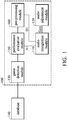
- FIG. 1 is a block diagram illustrating an embodiment of an electronic device.
- FIG. 1 presents a simplified block diagram, in which only the elements relevant to the invention are shown. It will be readily appreciated by persons with ordinary skill in the art that the electronic device can certainly comprise other elements to provide specific functions.
- An electronic device 100 can be used to run various software and programs, especially game software. Furthermore, a user can load the game software in the electronic device 100 to play the video game, and enjoy the visual and auditory experiences of playing the video game.
- the electronic device 100 may include an audio recognition module 110 and an audio adjustment module 120.
- the audio adjustment module 120 is coupled to the audio recognition module 110.
- the electronic device 100 can perform an automatic volume-adjustment method to change the volume in any embodiment of the present invention, so as to automatically adjust the volume of a specific sound in a video game that matches a predetermined game type to an appropriate volume, such that the user's auditory experience can be optimized.
- Fig. 2 is a flowchart illustrating an embodiment of the automatic volume-adjustment method. Please refer to Fig. 1 and Fig. 2 .
- the electronic device 100 can recognize whether one of a plurality of predetermined sound categories is included in the audio data D1 of the current game by using the audio recognition module 110 (step S10).
- the predetermined sound categories may include gunfire sounds, explosion sounds, engine sounds, etc.
- the predetermined sound category may be set according to a sound category that the user wants to strengthen.
- the electronic device 100 can determine the volume gain based on the predetermined sound category included in the audio data D1 by using the audio adjustment module 120 (step S20), and it can adjust the volume of the audio data D1 appropriately based on the volume gain by using the audio adjustment module 120 (step S30).
- the sounds that match the predetermined sound categories in the current game can be appropriately adjusted, for example, the volume of the sounds of the predetermined sound categories is amplified, such that the user's mastery of sounds that match the predetermined sound categories can be higher, and it further optimizes the game experience of the user.
- the game when only one game is being run on the electronic device 100, the game may be referred to as the current game.
- the game with the top-most game window may be referred to as the current game.
- the electronic device 100 may further include a game detection module 130, and the game detection module 130 is coupled to the audio recognition module 110.
- the game detection module 130 can be used to detect whether any games are currently being run on the electronic device 100.
- the game detection module 130 can automatically activate a detection function.
- the activation of the detection function of the game detection module 130 can also be controlled by the user using the application program interface.
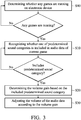
- Fig. 3 is a flowchart illustrating an embodiment of the automatic volume-adjustment method. Please refer to all the figures from Fig. 1 to Fig. 3 .
- the electronic device 100 can first determine whether any games are running on the electronic device 100 by using the game detection module 130 (step S40).
- the audio recognition module 130 can perform step S10 for recognizing the audio data D1 of the game (i.e., the current game), so as to confirm whether any of the predetermined sound categories is included in the audio data D1 of the current game.
- the present invention is not limited thereto.
- some predetermined sound categories may not be included in the audio data of certain games.
- the predetermined sound categories are gunfire sounds, explosion sounds and/or engine sounds and the current game is a sports game (SPT)
- audio data of the current game may not include any of the predetermined sound categories, and therefore the audio data herein has no need to be recognized by the audio recognition module 130.
- the current game is first-person shooter (FPS) or a race car game (RCG)
- the audio data of the current game may contain sounds from one of the predetermined sound categories, and so the audio data of the current game needs further recognition.
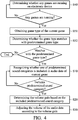
- the electronic device 100 when the game detection module 130 determines in step S40 that there is a game running on the electronic device 100, the electronic device 100 can further determine the game type of the current game by using the game detection module 130 (step S51), and it can determine whether the game type matches a predetermined game type by using the game detection module 130 (step S52), as shown in Fig. 4 . After that, when the game detection module 130 determines that the game type matches the predetermined game type, the electronic device 100 then continues to perform subsequent steps, such as step S10 in which the audio recognition module 110 is used to recognize the audio data D1 of the current game, so as to confirm whether any of the predetermined sound categories is included in this audio data D1.
- the electronic device 100 may not perform any subsequent steps. For example, it may not use the audio recognition module 110 to recognize the audio data D1 of the current game, to avoid wasting resources.
- the game detection module 130 can detect the titles of the windows operating on the electronic device 100 by using a first extraction function, and it can detect the process names of the windows by using the second extraction function. After that, the game detection module 130 can compare these titles and process names with a plurality of pre-stored titles and pre-stored process names in a database 140 to determine whether there are any games running on the electronic device 100.
- the pre-stored titles and the pre-stored process names in the database 140 can be obtained and stored by the game detection module 130 by using the first extraction function and the second extraction function at a previous time.
- the manufacturer can store commonly used pre-stored titles and pre-stored process names in the database 140.
- the pre-stored titles and the pre-stored process names can be stored in a table in the database 140, and they can have a one-to-one relationship, as shown in Table 1, below.
- the first extraction function and the second extraction function can be functions in a DLL (Dynamic Link Library) supported by the operating system.
- the first extraction function can include a GetForegroundWindow function, a GetWindowTextLength function, a GetWindowText function, a combination thereof or any other applicable function.
- the second extraction function can include a GetWindowThreadProcessId function, a GetModuleBassName function, a combination thereof or any other applicable function.
- the database 140 may store the pre-stored titles and the pre-stored process names in table format.
- the database 140 may be a cloud database connected to the game detection module 130 by a remote connection. However, the present invention is not limited thereto.
- the database 140 may be a local database provided in the electronic device 100.
- the audio recognition module 110 uses a selected algorithm A1 to recognize the audio data D1.
- the electronic device 100 further includes a performance evaluation module 150, and the performance evaluation module 150 is coupled between the game detection module 130 and the audio recognition module 110.
- the performance evaluation module 150 is used to evaluate computation performance of the electronic device 100, and to determine a suitable algorithm as the selected algorithm A1 used by the audio recognition module 110 from the a plurality of algorithms that are predetermined, so as to ensure the real-time performance of algorithm, and avoids delaying the output of the game sounds.
- the electronic device 100 before step S10, can further use the performance evaluation module 150 to evaluate the current computational performance of the electronic device 100, and to generate a suitable selected algorithm A1 for the audio recognition module 110 based on the evaluation result (step S60), as shown in Fig. 5 .
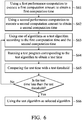
- Fig. 6 is a flowchart illustrating an embodiment of step S60. Please refer to Fig. 6 .
- the performance evaluation module 150 can use a first performance computation to execute a first computation amount to obtain a first computation time (step S61), and use a second performance computation to execute a second computation amount to obtain a second computation time (step S62). Subsequently, the performance evaluation module 150 can use one of a plurality of algorithms as a test algorithm according to the first computation time and the second computation time (step S63), and run a test program corresponding to the test algorithm to determine the test time (step S64). After that, the performance evaluation module 150 can compare the test time obtained in step S64 with a test threshold which is predetermined (step S65).
- test time is shorter than the test threshold, this indicates that the delay effect caused by this test algorithm on the output of the game sound is still within a tolerance range, and the performance evaluation module 150 can use this test algorithm as a selected algorithm A1 and provides it to the audio recognition module 110 (step S66).
- the performance evaluation module 150 can, at this time, return to step S63 to select another algorithm to use as the test algorithm, to perform the test again. These steps are repeated until the performance evaluation module 150 can finally determine the selected algorithm A1.
- each algorithm has a first computation time threshold corresponding to the first performance computation and a second computation time threshold corresponding to the second performance computation.
- the performance evaluation module 150 can compare the first computation time obtained in step S61 with the first computation time threshold of an algorithm, and compare the second computation time obtained in step S62 with the second computation time threshold of this algorithm, so as to confirm whether to select this algorithm as the test algorithm.
- the performance evaluation module 150 determines that the first computation time is less than the first computation time threshold of this algorithm and the second computation time is also less than the second computation time threshold of this algorithm, the performance evaluation module 150 then selects this algorithm as the test algorithm. Conversely, the performance evaluation module 150 continues to compare the first computation time and the second computation time with a first computation time threshold and a second computation time threshold of another algorithm, and so forth, finally determines out the test algorithm.
- the sequence of step S61 and step S62 are interchangeable.
- the first performance computation may be a floating-point operation, and the second computation may be an integer operation.
- the first computation amount may be equal to the second computation amount, and the first computation amount and the second computation amount may be fixed amount preset by a user or a manufacturer, but the present invention is not limited thereto.
- the core technologies of the algorithms may separately include artificial intelligence (e.g., deep neural network), statistical models (e.g., hidden Markov models), cluster analysis (e.g., K-means), etc., but the present invention is not limited thereto.
- artificial intelligence e.g., deep neural network
- statistical models e.g., hidden Markov models
- cluster analysis e.g., K-means
- the audio recognition module 110 uses the selected algorithm A1 to recognize a plurality of frames in the audio data D1.
- the electronic device 100 may further include a pre-processing module 160, and the pre-processing module 160 is coupled to the audio recognition module 110.
- the pre-processing module 160 can be used to obtain the audio data D1 of the current game, and to appropriately pre-process the audio data D1 to ensure that the extracted audio data D1 can be analyzed effectively.
- the electronic device 100 can use the pre-processing module 160 to obtain the audio data D1 from the frontend (step S71), for example, from audio driver, and to retrieve a plurality of frames from the audio data D1 (step S72).
- the pre-processing module 160 can appropriately pre-process these frames to obtain the characteristic coefficients of each frame (step S73), and after the pre-processing, it can output the characteristic coefficients of each frame to the audio recognition module 110 (step S74), so as to perform step S10.
- step S40, step S51, and step S52 are not shown in Fig. 7
- step S40, step S51, and step S52 may be combined into the flow shown in Fig. 7 .
- the pre-processing module 160 can retrieve a second number of sampling points from the audio data D1 to be a frame (i.e., one analysis unit).
- the frames retrieved by the pre-processing module 160 are sequentially spaced apart from each other by the first number of sampling points, and each of the frames includes the second number of sampling points.
- the first number may be 192
- the second number may be 256.
- the present invention is not limited thereto.
- the first number and the second number may be other appropriate values.
- the pre-process may include using Fourier transformation to transform each frame from a time domain to a frequency domain. Furthermore, the pre-process may further include using coefficient conversion to convert each frame which has been transformed to the frequency domain into characteristic coefficients with representative, such as Mel-Frequency Cepstral Coefficients, but the present invention is not limited thereto.
- the audio recognition module 110 can feed the characteristic coefficients generated by the pre-processing module 160 to the selected algorithm A1 determined by the performance evaluation module 150, so as to separately recognize whether each of the frames in the audio data D1 includes one of the predetermined sound categories.
- the current frame is the frame being processed by the audio recognition module 110.
- the audio adjustment module 120 can further obtain a plurality of estimated gains of a plurality of previous frames and the current frame.
- the previous frames refer to the frames that appear earlier than the current frame.
- the previous frames and the current frame can separately correspond to one of the estimated gains, and also separately correspond to one gain adjustment coefficient.
- the audio adjustment module 120 can separately calculate products of estimated gain of each previous frame and gain adjustment coefficient corresponding to each previous frame, calculate product of estimated gain of current frame and gain adjustment coefficient corresponding to the current frame, and then add them up to obtain a volume gain of the current frame.
- G i is a volume gain of a current frame
- C j is a gain adjustment coefficient
- G p(i-j) is an estimated gain of the (i-j)-th frame.
- x is the amount of frames to be considered. For example, when x is equal to 5, this indicates that the four previous frames are further considered from the current frame which is currently being processed.
- these gain adjustment coefficients corresponding to the previous frames and the current frame can be an increasing sequence (wherein, the gain adjustment coefficient corresponding to the earliest of the previous frames is the smallest, and the gain adjustment coefficient corresponding to the current frame is the largest) to adjust volume in a gradual manner.
- the sum of these gain adjustment coefficients may equal one.
- the estimated gain of the frame is zero. If the sounds of any of the predetermined sound categories are included in a frame, the estimated gain of that frame is mainly related to the included predetermined sound category. Further details of how to obtain an estimation of the estimated gain of each frame will be provided later.
- one embodiment consisting of five frames i.e., four previous frames and one current frame
- the amount of frames is not limited thereto.
- the audio adjustment module 120 can bring the values shown in Table 2 into the formula to obtain that the volume gain of the current frame is 1.8.
- each of the predetermined sound categories has a corresponding average recognition rate and a custom gain Gcn.
- the value of the average recognition rates can be obtained at the time to feed test database to audio recognition module 110 for training the algorithms of the audio recognition module 110.
- the custom gain Gcn of each predetermined sound category may be a preset gain value set by the user via the application program interface.
- each of the frames has a corresponding confidence score. The confidence score of i-th frame is generated by the audio recognition module 110 when the i-th frame is recognized.
- the audio adjustment module 120 can first subtract 1 from the custom gain Gcn of the predetermined sound category which is included by this frame, and then multiply it by the average recognition rate of the predetermined sound category, which is included by this frame, and by the confidence score of this frame, and finally add 1 to the product to obtain the estimated gain of this frame.
- G pi is a estimated gain of the i-th frame
- G rn is an average recognition rate of the n-th predetermined sound category
- G di is a confidence score of the i-th frame
- G cn is a custom gain of the n-th predetermined sound category.
- the selected algorithm A1 used by the audio recognition module 110 may not automatically generate a corresponding confidence score.
- the selected algorithm A1 when the selected algorithm A1 is an algorithm with artificial intelligence or statistical model as its core technology, the selected algorithm A1 can generate corresponding confidence score according to each recognition result.
- G di is a confidence score of a i-th frame
- D 1 is an Euclidean distance between an audio sample and the first one predetermined sound category.
- the audio adjustment module 120 can use a Sigmoid function to generate an output volume according to an input volume of the current frame, an input adjustment coefficient, an audio maximum output value and a volume gain which is obtained in step S20. After that, the audio adjustment module 120 can adjust the volume of the current frame according to the output volume generated by the Sigmoid function.
- the audio maximum output value refers to the maximum output value of an audio driver. For example, when an audio processor of the electronic device 100 is 8-bits, its output range can range from -128 to +127, and the audio maximum output value can be 127.
- Fig. 8 is a flowchart illustrating an embodiment of step S30. Please refer to Fig.8 .
- the audio adjustment module 120 can first divide the product of volume gain and the input volume with the product of the input adjustment coefficient and the audio maximum output value to find an S-function input (step S31). Subsequently, the audio adjustment module 120 can find the S-function output according to the S-function input by using the Sigmoid function (step S32). In order to cancel an output offset of the Sigmoid function, the audio adjustment module 120 can further subtract an offset value from the S-function output obtained in step S32 (step S33).
- the audio adjustment module 120 multiplies the S-function output (which has subtracted the offset value) by an audio maximum output value and by a predetermined constant to generate the output volume (step S34), and the audio adjustment module 120 further adjusts the volume of the current frame according to the output volume obtained in step S34 (step S35).
- the offset value in step S33 can be set to 0.5 for cancelling the output offset. Furthermore, since the maximum value output by the Sigmoid function is 1, and the offset value has been set to 0.5, the predetermined constant in step S34 can be set to 2.
- S out is an output volume
- C m is an audio maximum output value
- G i is a volume gain
- S in is an input volume
- K is an input adjustment coefficient
- C a is an offset value.
- the audio adjustment module 120 can first obtain the S-function input is 4.25 (i.e., 1.8 ⁇ 60 0.2 ⁇ 127 ). Subsequently, the audio adjustment module 120 can bring 4.25 into the Sigmoid function, and obtains the S-function output to be 0.9859.
- any one embodiment of the automatic volume-adjustment method and electronic device thereof of the present invention game sounds in any dimension, such as 1D, 2D, 3D, etc., are all applicable.
- the applying time of any one embodiment of the automatic volume-adjustment method and electronic device thereof of the present invention can be after the game sounds are synthesized and/or before the game sounds being played.
- the adjustment of any one embodiment of the automatic volume-adjustment method and electronic device thereof of the present invention mainly adjusts the volume according to the predetermined sound category included in the game sounds.
- each module such as the audio recognition module 110, the audio adjustment module 120, the game detection module 130, the performance evaluation module 150 and the pre-processing module 160 may be realized by a CPU (Central Processing Unit) and/or GPU (Graphic Processing Unit), but the present invention is not limited thereto.
- CPU Central Processing Unit
- GPU Graphic Processing Unit
- any one embodiment of the present invention provides an automatic volume-adjustment method and an electronic device thereof that can analyze the audio data of the current game in real time.
- any one embodiment of the automatic volume-adjustment method and the electronic device thereof of the present invention can obtain corresponding volume gain according to the included predetermined sound category, and appropriately adjust the volume of the audio data according to the volume gain, such that the user's mastery of sounds that match the predetermined sound categories can be higher, and it further optimizes the game experience of the user.
- any one embodiment of the automatic volume-adjustment method and the electronic device thereof of the present invention can select an appropriate selected algorithm to analyze the audio data according to the current computational performance of the electronic device.
- any one embodiment of the automatic volume-adjustment method and the electronic device thereof of the present invention can use the special calculation formula to prevent poor user experience caused by recognition error or sudden amplification.
Landscapes
- Engineering & Computer Science (AREA)
- Multimedia (AREA)
- Physics & Mathematics (AREA)
- Acoustics & Sound (AREA)
- Human Computer Interaction (AREA)
- Health & Medical Sciences (AREA)
- Audiology, Speech & Language Pathology (AREA)
- Signal Processing (AREA)
- Theoretical Computer Science (AREA)
- Computational Linguistics (AREA)
- General Health & Medical Sciences (AREA)
- General Engineering & Computer Science (AREA)
- General Physics & Mathematics (AREA)
- Circuit For Audible Band Transducer (AREA)
Abstract
Description
- This Application claims priority of Taiwan Patent Application No.
108141359, filed on November 14, 2019 - The present invention relates to the technology of volume adjustment, and more particularly to an electronic device and an automatic adjustment method that can automatically adjust the volume of a video game.
- In recent years, with the advancement of technology and the Internet, video games of various game types have also flourished. The sounds of the video game can be used to enhance interactivity with the game and create an atmosphere to bring a strong telepresence to its players. Furthermore, during the process of playing a video game, players even can make relative reactions and judgments based on certain game sounds, or on the volume of certain game sounds, so as to increase their chances of winning the game.
- For example, in a first-person shooter (FPS) game, players can quickly identify the position of the enemy and the type of weapon they are using by the sound of the gunfire. Accurately determining the position and distance of the enemy at the earliest time possible will aid in mounting an effective counterattack on the enemy. Therefore, whether a player can identify certain types of sounds (for example, the sounds of gunfire, explosions, etc.) is quite important in playing video games.
- An automatic volume-adjustment method is disclosed in an embodiment of the present invention. The automatic volume-adjustment method includes: recognizing whether one of a plurality of predetermined sound categories is included in audio data of a current game; when one of the predetermined sound categories is included in the audio data, determining a volume gain according to the predetermined sound category included in the audio data; and adjusting volume of the audio data according to the volume gain.
- An electronic device is disclosed in an embodiment of the present invention. The electronic device includes an audio recognition module and an audio adjustment module. The audio recognition module is used to recognize whether one of a plurality of predetermined sound categories is included in audio data of a current game. When one of the predetermined sound categories is included in the audio data, the audio adjustment module is used to determine a volume gain according to the predetermined sound category included in the audio data, and to adjust a volume of the audio data according to the volume gain.
- A detailed description is given in the following embodiments with reference to the accompanying drawings.
- The present invention can be more fully understood by reading the subsequent detailed description and examples with references made to the accompanying drawings, wherein:
-
Fig. 1 is a block diagram illustrating an embodiment of an electronic device. -
Fig. 2 is a flowchart illustrating an embodiment of the automatic volume-adjustment method. -
Fig. 3 is a flowchart illustrating an embodiment of the automatic volume-adjustment method. -
Fig. 4 is a flowchart illustrating another embodiment of the automatic volume-adjustment method. -
Fig. 5 is a flowchart illustrating an embodiment of the automatic volume-adjustment method. -
Fig. 6 is a flowchart illustrating an embodiment of step S60. -
Fig. 7 is a flowchart illustrating an embodiment of the automatic volume-adjustment method. -
Fig. 8 is a flowchart illustrating an embodiment of step S30. - In order to make the above objects, features and advantages of the embodiments of the present invention easier to understand, a detailed description is given in the following embodiments with reference to the accompanying drawings.
- It should be understood that the terms "comprises", "comprising", "includes" and/or "including", when used herein, specify the presence of stated features, integers, steps, operations, elements, and/or components, but do not preclude the presence or addition of one or more other features, integers, steps, operations, elements, components, and/or groups thereof.
- Use of ordinal terms such as "first", "second", etc., to modify an element does not by itself connote any priority or precedence, but are used merely as labels to distinguish the elements that have the same name.
-
Fig. 1 is a block diagram illustrating an embodiment of an electronic device. In order to clarify the concept of the invention, it should be noted thatFIG. 1 presents a simplified block diagram, in which only the elements relevant to the invention are shown. It will be readily appreciated by persons with ordinary skill in the art that the electronic device can certainly comprise other elements to provide specific functions. - Please refer to
Fig. 1 . Anelectronic device 100 can be used to run various software and programs, especially game software. Furthermore, a user can load the game software in theelectronic device 100 to play the video game, and enjoy the visual and auditory experiences of playing the video game. In an embodiment, theelectronic device 100 may include anaudio recognition module 110 and anaudio adjustment module 120. Theaudio adjustment module 120 is coupled to theaudio recognition module 110. Theelectronic device 100 can perform an automatic volume-adjustment method to change the volume in any embodiment of the present invention, so as to automatically adjust the volume of a specific sound in a video game that matches a predetermined game type to an appropriate volume, such that the user's auditory experience can be optimized. -
Fig. 2 is a flowchart illustrating an embodiment of the automatic volume-adjustment method. Please refer toFig. 1 andFig. 2 . In an embodiment of the automatic volume-adjustment method, theelectronic device 100 can recognize whether one of a plurality of predetermined sound categories is included in the audio data D1 of the current game by using the audio recognition module 110 (step S10). In some embodiments, the predetermined sound categories may include gunfire sounds, explosion sounds, engine sounds, etc. However, the present invention is not limited thereto. The predetermined sound category may be set according to a sound category that the user wants to strengthen. When theaudio recognition module 110 recognizes that one of the predetermined sound categories is included in this audio data D1, theelectronic device 100 can determine the volume gain based on the predetermined sound category included in the audio data D1 by using the audio adjustment module 120 (step S20), and it can adjust the volume of the audio data D1 appropriately based on the volume gain by using the audio adjustment module 120 (step S30). - In this way, the sounds that match the predetermined sound categories in the current game can be appropriately adjusted, for example, the volume of the sounds of the predetermined sound categories is amplified, such that the user's mastery of sounds that match the predetermined sound categories can be higher, and it further optimizes the game experience of the user.
- In some embodiments, when only one game is being run on the
electronic device 100, the game may be referred to as the current game. When more than one game is being run on theelectronic device 100, the game with the top-most game window may be referred to as the current game. - In some embodiments, the
electronic device 100 may further include agame detection module 130, and thegame detection module 130 is coupled to theaudio recognition module 110. Thegame detection module 130 can be used to detect whether any games are currently being run on theelectronic device 100. In some implementations, thegame detection module 130 can automatically activate a detection function. In other implementations, the activation of the detection function of thegame detection module 130 can also be controlled by the user using the application program interface. -
Fig. 3 is a flowchart illustrating an embodiment of the automatic volume-adjustment method. Please refer to all the figures fromFig. 1 to Fig. 3 . In an embodiment of the automatic volume-adjustment method, before step S10, theelectronic device 100 can first determine whether any games are running on theelectronic device 100 by using the game detection module 130 (step S40). When thegame detection module 130 determines that there is a game running on theelectronic device 100, theaudio recognition module 130 can perform step S10 for recognizing the audio data D1 of the game (i.e., the current game), so as to confirm whether any of the predetermined sound categories is included in the audio data D1 of the current game. However, the present invention is not limited thereto. Depending on the game type, some predetermined sound categories may not be included in the audio data of certain games. For example, when the predetermined sound categories are gunfire sounds, explosion sounds and/or engine sounds and the current game is a sports game (SPT), audio data of the current game may not include any of the predetermined sound categories, and therefore the audio data herein has no need to be recognized by theaudio recognition module 130. If the current game is first-person shooter (FPS) or a race car game (RCG), the audio data of the current game may contain sounds from one of the predetermined sound categories, and so the audio data of the current game needs further recognition. - Therefore, in another embodiment of the automatic volume-adjustment method, when the
game detection module 130 determines in step S40 that there is a game running on theelectronic device 100, theelectronic device 100 can further determine the game type of the current game by using the game detection module 130 (step S51), and it can determine whether the game type matches a predetermined game type by using the game detection module 130 (step S52), as shown inFig. 4 . After that, when thegame detection module 130 determines that the game type matches the predetermined game type, theelectronic device 100 then continues to perform subsequent steps, such as step S10 in which theaudio recognition module 110 is used to recognize the audio data D1 of the current game, so as to confirm whether any of the predetermined sound categories is included in this audio data D1. Conversely, when thegame detection module 130 determines in step S52 that the game type does not match a predetermined game type, theelectronic device 100 may not perform any subsequent steps. For example, it may not use theaudio recognition module 110 to recognize the audio data D1 of the current game, to avoid wasting resources. - In some embodiments of step S40, the
game detection module 130 can detect the titles of the windows operating on theelectronic device 100 by using a first extraction function, and it can detect the process names of the windows by using the second extraction function. After that, thegame detection module 130 can compare these titles and process names with a plurality of pre-stored titles and pre-stored process names in adatabase 140 to determine whether there are any games running on theelectronic device 100. - In some embodiments, the pre-stored titles and the pre-stored process names in the
database 140 can be obtained and stored by thegame detection module 130 by using the first extraction function and the second extraction function at a previous time. However, the present invention is not limited thereto. In other embodiments, the manufacturer can store commonly used pre-stored titles and pre-stored process names in thedatabase 140. Furthermore, the pre-stored titles and the pre-stored process names can be stored in a table in thedatabase 140, and they can have a one-to-one relationship, as shown in Table 1, below.Table 1 pre-stored titles pre-stored process names Racing Classics: Drag Race Simulator RacingClassicsDragRaceSimulator.exe Team Sonic Racing™ TeamSonicRacing™.exe F1 2018 F12018.exe Project CARS 2 ProjectCARS2.exe GTFO GTFO.exe Splitgate: Arena Warfare SplitgateArenaWarfare.exe Black Squad BlackSquad.exe RAGE 2 RAGE2.exe NBA 2K19 NBA2K19.exe Vampyr Vampyr.exe Katana ZERO KatanaZERO.exe Death Jump DeathJump.exe - In some implementations, the first extraction function and the second extraction function can be functions in a DLL (Dynamic Link Library) supported by the operating system. For example, when the operating system is a Microsoft operating system, the first extraction function can include a GetForegroundWindow function, a GetWindowTextLength function, a GetWindowText function, a combination thereof or any other applicable function. The second extraction function can include a GetWindowThreadProcessId function, a GetModuleBassName function, a combination thereof or any other applicable function. Furthermore, the
database 140 may store the pre-stored titles and the pre-stored process names in table format. Moreover, thedatabase 140 may be a cloud database connected to thegame detection module 130 by a remote connection. However, the present invention is not limited thereto. Thedatabase 140 may be a local database provided in theelectronic device 100. - In an embodiment of step S10, the
audio recognition module 110 uses a selected algorithm A1 to recognize the audio data D1. In some embodiments, theelectronic device 100 further includes aperformance evaluation module 150, and theperformance evaluation module 150 is coupled between thegame detection module 130 and theaudio recognition module 110. Theperformance evaluation module 150 is used to evaluate computation performance of theelectronic device 100, and to determine a suitable algorithm as the selected algorithm A1 used by theaudio recognition module 110 from the a plurality of algorithms that are predetermined, so as to ensure the real-time performance of algorithm, and avoids delaying the output of the game sounds. - Therefore, in an embodiment of the automatic volume-adjustment method, before step S10, the
electronic device 100 can further use theperformance evaluation module 150 to evaluate the current computational performance of theelectronic device 100, and to generate a suitable selected algorithm A1 for theaudio recognition module 110 based on the evaluation result (step S60), as shown inFig. 5 . -
Fig. 6 is a flowchart illustrating an embodiment of step S60. Please refer toFig. 6 . In an embodiment of step S60, theperformance evaluation module 150 can use a first performance computation to execute a first computation amount to obtain a first computation time (step S61), and use a second performance computation to execute a second computation amount to obtain a second computation time (step S62). Subsequently, theperformance evaluation module 150 can use one of a plurality of algorithms as a test algorithm according to the first computation time and the second computation time (step S63), and run a test program corresponding to the test algorithm to determine the test time (step S64). After that, theperformance evaluation module 150 can compare the test time obtained in step S64 with a test threshold which is predetermined (step S65). When the test time is shorter than the test threshold, this indicates that the delay effect caused by this test algorithm on the output of the game sound is still within a tolerance range, and theperformance evaluation module 150 can use this test algorithm as a selected algorithm A1 and provides it to the audio recognition module 110 (step S66). When the test time is longer than or equal to the test threshold, this means that the delay effect on the output of the game sound caused by this test algorithm has exceed the tolerance range, and theperformance evaluation module 150 can, at this time, return to step S63 to select another algorithm to use as the test algorithm, to perform the test again. These steps are repeated until theperformance evaluation module 150 can finally determine the selected algorithm A1. - In an embodiment of step S63, each algorithm has a first computation time threshold corresponding to the first performance computation and a second computation time threshold corresponding to the second performance computation. The
performance evaluation module 150 can compare the first computation time obtained in step S61 with the first computation time threshold of an algorithm, and compare the second computation time obtained in step S62 with the second computation time threshold of this algorithm, so as to confirm whether to select this algorithm as the test algorithm. Herein, when theperformance evaluation module 150 determines that the first computation time is less than the first computation time threshold of this algorithm and the second computation time is also less than the second computation time threshold of this algorithm, theperformance evaluation module 150 then selects this algorithm as the test algorithm. Conversely, theperformance evaluation module 150 continues to compare the first computation time and the second computation time with a first computation time threshold and a second computation time threshold of another algorithm, and so forth, finally determines out the test algorithm. - In some embodiments, the sequence of step S61 and step S62 are interchangeable. The first performance computation may be a floating-point operation, and the second computation may be an integer operation. Furthermore, the first computation amount may be equal to the second computation amount, and the first computation amount and the second computation amount may be fixed amount preset by a user or a manufacturer, but the present invention is not limited thereto.
- In some embodiments, the core technologies of the algorithms may separately include artificial intelligence (e.g., deep neural network), statistical models (e.g., hidden Markov models), cluster analysis (e.g., K-means), etc., but the present invention is not limited thereto.
- In an embodiment of step S10, the
audio recognition module 110 uses the selected algorithm A1 to recognize a plurality of frames in the audio data D1. In some embodiments, theelectronic device 100 may further include apre-processing module 160, and thepre-processing module 160 is coupled to theaudio recognition module 110. Thepre-processing module 160 can be used to obtain the audio data D1 of the current game, and to appropriately pre-process the audio data D1 to ensure that the extracted audio data D1 can be analyzed effectively. - Therefore, in an embodiment of the automatic volume-adjustment method, the
electronic device 100 can use thepre-processing module 160 to obtain the audio data D1 from the frontend (step S71), for example, from audio driver, and to retrieve a plurality of frames from the audio data D1 (step S72). After that, thepre-processing module 160 can appropriately pre-process these frames to obtain the characteristic coefficients of each frame (step S73), and after the pre-processing, it can output the characteristic coefficients of each frame to the audio recognition module 110 (step S74), so as to perform step S10. It should be noted that, although step S40, step S51, and step S52 are not shown inFig. 7 , step S40, step S51, and step S52 may be combined into the flow shown inFig. 7 . - In an embodiment of step S72, every first number of sampling points, the
pre-processing module 160 can retrieve a second number of sampling points from the audio data D1 to be a frame (i.e., one analysis unit). In other words, the frames retrieved by thepre-processing module 160 are sequentially spaced apart from each other by the first number of sampling points, and each of the frames includes the second number of sampling points. In some implementations, the first number may be 192, and the second number may be 256. However, the present invention is not limited thereto. The first number and the second number may be other appropriate values. - In an embodiment of step S73, the pre-process may include using Fourier transformation to transform each frame from a time domain to a frequency domain. Furthermore, the pre-process may further include using coefficient conversion to convert each frame which has been transformed to the frequency domain into characteristic coefficients with representative, such as Mel-Frequency Cepstral Coefficients, but the present invention is not limited thereto.
- Please refer to all the figures from
Fig. 1 to Fig. 7 . In an embodiment of step S10, theaudio recognition module 110 can feed the characteristic coefficients generated by thepre-processing module 160 to the selected algorithm A1 determined by theperformance evaluation module 150, so as to separately recognize whether each of the frames in the audio data D1 includes one of the predetermined sound categories. The current frame is the frame being processed by theaudio recognition module 110. - In an embodiment of step S20, when one of the predetermined sound categories is included in the current frame, the
audio adjustment module 120 can further obtain a plurality of estimated gains of a plurality of previous frames and the current frame. Wherein, the previous frames refer to the frames that appear earlier than the current frame. Furthermore, the previous frames and the current frame can separately correspond to one of the estimated gains, and also separately correspond to one gain adjustment coefficient. Herein, theaudio adjustment module 120 can separately calculate products of estimated gain of each previous frame and gain adjustment coefficient corresponding to each previous frame, calculate product of estimated gain of current frame and gain adjustment coefficient corresponding to the current frame, and then add them up to obtain a volume gain of the current frame. - In some embodiments, the volume gain of the current frame can be expressed by the following formula 1:

- Wherein, Gi is a volume gain of a current frame, Cj is a gain adjustment coefficient, and Gp(i-j) is an estimated gain of the (i-j)-th frame. Furthermore, x is the amount of frames to be considered. For example, when x is equal to 5, this indicates that the four previous frames are further considered from the current frame which is currently being processed.
- In some embodiments, since the values observed more recently are more representative, these gain adjustment coefficients corresponding to the previous frames and the current frame can be an increasing sequence (wherein, the gain adjustment coefficient corresponding to the earliest of the previous frames is the smallest, and the gain adjustment coefficient corresponding to the current frame is the largest) to adjust volume in a gradual manner. In some implementations, the sum of these gain adjustment coefficients may equal one.
- In some embodiments, if a frame does not include sounds of any of the predetermined sound categories, the estimated gain of the frame is zero. If the sounds of any of the predetermined sound categories are included in a frame, the estimated gain of that frame is mainly related to the included predetermined sound category. Further details of how to obtain an estimation of the estimated gain of each frame will be provided later.
- In the following paragraphs, one embodiment consisting of five frames (i.e., four previous frames and one current frame) is used to explain how to calculate the volume gain of the current frame. However, the amount of frames is not limited thereto. In an embodiment, an example of the estimated gain and the gain adjustment coefficient corresponding to each frame is shown in Table 2 below.
Table 2 Frame Estimated Gain Gain Adjustment Coefficient Coefficient Value G4 2 (gunfire sounds) C0 0.7 G3 2 (gunfire sounds) C1 0.2 G2 0 (none of predetermined sound categories is included in this frame) C2 0.05 G1 0 (none of predetermined sound categories is included in this frame) C3 0.03 G0 0 (none of predetermined sound categories is included in C4 0.02 this frame) - In this embodiment, the
audio adjustment module 120 can bring the values shown in Table 2 into the formula to obtain that the volume gain of the current frame is 1.8. The calculation is as follows: (2∗0.7)+(2∗0.2)+(0∗0.05)+(0∗0.03)+(0∗0.02)=1.8. - In some embodiments, each of the predetermined sound categories has a corresponding average recognition rate and a custom gain Gcn. Wherein, the value of the average recognition rates can be obtained at the time to feed test database to
audio recognition module 110 for training the algorithms of theaudio recognition module 110. The custom gain Gcn of each predetermined sound category may be a preset gain value set by the user via the application program interface. Furthermore, each of the frames has a corresponding confidence score. The confidence score of i-th frame is generated by theaudio recognition module 110 when the i-th frame is recognized. - In some embodiments, when the sounds of any predetermined sound category are included in the frame (the current frame or the previous frame), the
audio adjustment module 120 can first subtract 1 from the custom gain Gcn of the predetermined sound category which is included by this frame, and then multiply it by the average recognition rate of the predetermined sound category, which is included by this frame, and by the confidence score of this frame, and finally add 1 to the product to obtain the estimated gain of this frame. - In some embodiments, the estimated gain of a frame which includes any predetermined sound category can be expressed by formula 2, below:

- Wherein, Gpi is a estimated gain of the i-th frame, Grn is an average recognition rate of the n-th predetermined sound category, Gdi is a confidence score of the i-th frame, and Gcn is a custom gain of the n-th predetermined sound category.
- In some embodiments, the selected algorithm A1 used by the
audio recognition module 110 may not automatically generate a corresponding confidence score. For example, when the selected algorithm A1 is an algorithm with artificial intelligence or statistical model as its core technology, the selected algorithm A1 can generate corresponding confidence score according to each recognition result. However, when the selected algorithm A1 is an algorithm with cluster analysis as its core technology, it is predetermined that the selected algorithm A1 will not automatically generate corresponding confidence score. Therefore, in the case that the corresponding confidence score will not be automatically generated, theaudio adjustment module 120 can further calculate the confidence score using formula 3, below:
- Wherein, Gdi is a confidence score of a i-th frame, and D 1 is an Euclidean distance between an audio sample and the first one predetermined sound category.
- In an embodiment of step S30, the
audio adjustment module 120 can use a Sigmoid function to generate an output volume according to an input volume of the current frame, an input adjustment coefficient, an audio maximum output value and a volume gain which is obtained in step S20. After that, theaudio adjustment module 120 can adjust the volume of the current frame according to the output volume generated by the Sigmoid function. Wherein, the audio maximum output value refers to the maximum output value of an audio driver. For example, when an audio processor of theelectronic device 100 is 8-bits, its output range can range from -128 to +127, and the audio maximum output value can be 127. Furthermore, the input adjustment coefficient is used to make the output range of the Sigmoid function to match with the requirement more. In some embodiments, due to the characteristics of the Sigmoid function, its output saturation region is approximately at the region where the input is ±0.5. Therefore, the input adjustment coefficient can be set to 0.2 (output/input=1/5=0.2). -
Fig. 8 is a flowchart illustrating an embodiment of step S30. Please refer toFig.8 . In an embodiment of step S30, theaudio adjustment module 120 can first divide the product of volume gain and the input volume with the product of the input adjustment coefficient and the audio maximum output value to find an S-function input (step S31). Subsequently, theaudio adjustment module 120 can find the S-function output according to the S-function input by using the Sigmoid function (step S32). In order to cancel an output offset of the Sigmoid function, theaudio adjustment module 120 can further subtract an offset value from the S-function output obtained in step S32 (step S33). After that, theaudio adjustment module 120 multiplies the S-function output (which has subtracted the offset value) by an audio maximum output value and by a predetermined constant to generate the output volume (step S34), and theaudio adjustment module 120 further adjusts the volume of the current frame according to the output volume obtained in step S34 (step S35). - In some implementations, due to the characteristics of the Sigmoid function, if an input is zero, an output will be 0.5. Therefore, the offset value in step S33 can be set to 0.5 for cancelling the output offset. Furthermore, since the maximum value output by the Sigmoid function is 1, and the offset value has been set to 0.5, the predetermined constant in step S34 can be set to 2.
- In some embodiments, an output volume can be expressed by the following formula 4:

- Wherein, Sout is an output volume, Cm is an audio maximum output value, Gi is a volume gain, Sin is an input volume, K is an input adjustment coefficient, and Ca is an offset value.
- In the following, an example is used to explain the calculation of the output volume. In an embodiment, it is assumed that the input volume is 60, the volume gain is 1.8 (this can be obtained using formula 2), the audio maximum output value is 127, the input adjustment coefficient is 0.2 and the offset value is 0.5, the
audio adjustment module 120 can first obtain the S-function input is 4.25 (i.e.,
audio adjustment module 120 can bring 4.25 into the Sigmoid function, and obtains the S-function output to be 0.9859. After that, theaudio adjustment module 120 can bring0.9859 into formula 4, and obtains the output volume to be 123.41 (i.e., 2 × 127 × (0.9859 - 0.5) = 123.41). Based on this, it can be seen that the volume after being processed by an embodiment of the automatic volume-adjustment method and electronic device thereof can be adjusted from 60 to 123.41. It should be noted that, since the output volume in the present invention can be generated using the special calculation formula, poor user experience caused by recognition errors and sudden amplification can be avoided. - For any one embodiment of the automatic volume-adjustment method and electronic device thereof of the present invention, game sounds in any dimension, such as 1D, 2D, 3D, etc., are all applicable. Furthermore, the applying time of any one embodiment of the automatic volume-adjustment method and electronic device thereof of the present invention can be after the game sounds are synthesized and/or before the game sounds being played. Moreover, the adjustment of any one embodiment of the automatic volume-adjustment method and electronic device thereof of the present invention mainly adjusts the volume according to the predetermined sound category included in the game sounds.
- In some embodiments, the functions of each module, such as the
audio recognition module 110, theaudio adjustment module 120, thegame detection module 130, theperformance evaluation module 150 and thepre-processing module 160 may be realized by a CPU (Central Processing Unit) and/or GPU (Graphic Processing Unit), but the present invention is not limited thereto. - As described above, any one embodiment of the present invention provides an automatic volume-adjustment method and an electronic device thereof that can analyze the audio data of the current game in real time. When recognizing that a predetermined sound category is included in the audio data of the current game, any one embodiment of the automatic volume-adjustment method and the electronic device thereof of the present invention can obtain corresponding volume gain according to the included predetermined sound category, and appropriately adjust the volume of the audio data according to the volume gain, such that the user's mastery of sounds that match the predetermined sound categories can be higher, and it further optimizes the game experience of the user. Furthermore, any one embodiment of the automatic volume-adjustment method and the electronic device thereof of the present invention can select an appropriate selected algorithm to analyze the audio data according to the current computational performance of the electronic device. Moreover, any one embodiment of the automatic volume-adjustment method and the electronic device thereof of the present invention can use the special calculation formula to prevent poor user experience caused by recognition error or sudden amplification.
- The features of the embodiments described above will allow persons having ordinary skill in the art to clearly appreciate the form of the present specification. Persons having ordinary skill in the art will appreciate that the objectives and/or the advantages of the above embodiments can be accomplished in a way that is consistent with the above embodiments by designing or modifying other processes and structures based on the content of the present disclosure. Persons having ordinary skill in the art will also appreciate that equivalent constructions can be modified, substituted or retouched without departing from the scope and spirit of the present invention.
Claims (15)
- An automatic volume-adjustment method, comprising:recognizing whether one of a plurality of predetermined sound categories is included in audio data of a current game;when one of the predetermined sound categories is included in the audio data, determining a volume gain based on the predetermined sound category included in the audio data; andadjusting a volume of the audio data according to the volume gain.
- The automatic volume-adjustment method as claimed in claim 1, further comprising:obtaining a game type of the current game; anddetermining whether the game type matches a predetermined game type, wherein the step of recognizing is performed after determining that the game type matches the predetermined game type.
- The automatic volume-adjustment method as claimed in claim 1 or 2, further comprising:using a first performance computation to execute a first computation amount to obtain a first computation time;using a second performance computation to execute a second computation amount to obtain a second computation time;using one of a plurality of algorithms as a test algorithm according to the first computation time and the second computation time;running a test program corresponding to the test algorithm to obtain a test time; andwhen the test time is less than a test threshold, using the test algorithm as a selected algorithm, wherein the step of recognizing is performed by using the selected algorithm.
- The automatic volume-adjustment method as claimed in any of claims 1 to 3, further comprising:obtaining the audio data of the current game; andretrieving a plurality of frames from the audio data, wherein the frames are sequentially spaced apart from each other by a first number of sampling points, and each of the frames comprises a second number of sampling points, wherein the step of recognizing comprises: using one of the frames as a current frame; and recognizing whether one of the predetermined sound categories is included in the current frame.
- The automatic volume-adjustment method as claimed in claim 4, wherein the step of determining the volume gain comprises:when one of the predetermined sound categories is included in the current frame, obtaining a plurality of estimated gains of a plurality of previous frames and the current frame, wherein the previous frames are earlier frames than the current frame, and each of the previous frames and the current frame respectively corresponds to a gain adjustment coefficient; anddetermining the volume gain of the current frame by adding up the products of the estimated gain of each of the previous frames and the corresponding gain adjustment coefficient with the product of the estimated gain of the current frame and the corresponding gain adjustment coefficient wherein preferably the sum of the gain adjustment coefficients is equal to 1.
- The automatic volume-adjustment method as claimed in claim 5, wherein each of the predetermined sound categories has an average recognition rate and a custom gain, and each of the frames has a confidence score, wherein the estimated gain of the previous frame which comprises one of the predetermined sound categories and the estimated gain of the current frame are separately generated by subtracting 1 from the custom gain, multiplying this by the average recognition rate and by the confidence score, and then adding 1 to the product, wherein the estimated gain of the previous frame which comprises none of the predetermined sound categories is zero.
- The automatic volume-adjustment method as claimed in any of claims 1 to 6, wherein the step of adjusting the volume of the audio data according to the volume gain comprises:generating an output volume by using a Sigmoid function based on an input volume of a current frame in the audio data, an input adjustment coefficient, an audio maximum output value, and the volume gain; andadjusting the volume of the current frame in the audio data according to the output volume wherein the step of generating the output volume preferably comprises:dividing the product of the volume gain and the input volume by the product of the input adjustment coefficient and the audio maximum output value to find an S-function input;finding S-function output by using the Sigmoid function based on the S-function input;subtracting an offset value from the S-function output; andmultiplying the S-function output, from which the offset value has been subtracted, by the audio maximum output value and by a predetermined constant to generate the output volume.
- An electronic device, comprising:an audio recognition module, configured to recognize whether one of a plurality of predetermined sound categories is included in audio data of a current game; andan audio adjustment module, configured to determine a volume gain based on the predetermined sound category included in the audio data when one of the predetermined sound categories is included in the audio data, and to adjust a volume of the audio data according to the volume gain.
- The electronic device as claimed in claim 8, further comprising:
a game detection module, configured to obtain a game type of the current game, and to determine whether the game type matches a predetermined game type, wherein the audio recognition module recognizes the audio data of the current game after the game detection module determines that the game type matches the predetermined game type. - The electronic device as claimed in claim 8 or 9, further comprising:
a performance evaluation module, configured to use a first performance computation to execute a first computation amount to obtain a first computation time, and to use a second performance computation to execute a second computation amount to obtain a second computation time, wherein the performance evaluation module uses one of a plurality of algorithms as a test algorithm according to the first computation time and the second computation time, and the performance evaluation module runs a test program corresponding to the test algorithm to obtain a test time, wherein the performance evaluation module uses the test algorithm as a selected algorithm when the test time is less than a test threshold, and wherein the audio recognition module uses the selected algorithm to recognize the audio data. - The electronic device as claimed in any of claims 8 to 10, further comprising:
a pre-processing module, configured to obtain the audio data of the current game, and to retrieve a plurality of frames from the audio data, wherein the frames are sequentially spaced apart from each other by a first number of sampling points, and each of the frames comprises a second number of sampling points, and wherein the audio recognition module uses one of the frames as a current frame and recognizes whether one of the predetermined sound categories is comprised in the current frame. - The electronic device as claimed in claim 11, wherein when one of the predetermined sound categories is included in the current frame, the audio adjustment module further obtains a plurality of estimated gains of a plurality of previous frames and the current frame, wherein the previous frames are earlier frames than the current frame, and each of the previous frames and the current frame respectively corresponds to a gain adjustment coefficient, and wherein the audio adjustment module determines the volume gain of the current frame by adding up the products of the estimated gain of each of the previous frames and the corresponding gain adjustment coefficient with the product of the estimated gain of the current frame and the corresponding gain adjustment coefficient, wherein preferably the sum of the gain adjustment coefficients is equal to 1.
- The electronic device as claimed in claim 12, wherein each of the predetermined sound categories has an average recognition rate and a custom gain, and each of the frames has a confidence score, wherein the audio adjustment module separately generates the estimated gain of the previous frame which comprises one of the predetermined sound categories and the estimated gain of the current frame by subtracting 1 from the custom gain, multiplying this by the average recognition rate and by the confidence score, and then adding 1 to the product, wherein the estimated gain of the previous frame which comprises none of the predetermined sound categories is zero.
- The electronic device as claimed in any of claims 8 to 13, wherein the audio adjustment module further generates an output volume by using a Sigmoid function based on an input volume of a current frame in the audio data, an input adjustment coefficient, an audio maximum output value and the volume gain, and wherein the audio adjustment module adjusts the volume of the current frame in the audio data according to the output volume.
- The electronic device as claimed in claim 14, wherein the audio adjustment module divides the product of the volume gain and the input volume by the product of the input adjustment coefficient and the audio maximum output value to find an S-function input, and finds S-function output by using the Sigmoid function based on the S-function input, the audio adjustment module further subtracts an offset value from the S-function output, and multiplies the S-function output, from which the offset value has been subtracted, by the audio maximum output value and by a predetermined constant to generate the output volume.
Applications Claiming Priority (1)
| Application Number | Priority Date | Filing Date | Title |
|---|---|---|---|
| TW108141359A TWI731472B (en) | 2019-11-14 | 2019-11-14 | Electronic device and automatic adjustment method for volume |
Publications (2)
| Publication Number | Publication Date |
|---|---|
| EP3821962A1 true EP3821962A1 (en) | 2021-05-19 |
| EP3821962B1 EP3821962B1 (en) | 2025-06-04 |
Family
ID=70285497
Family Applications (1)
| Application Number | Title | Priority Date | Filing Date |
|---|---|---|---|
| EP20169029.4A Active EP3821962B1 (en) | 2019-11-14 | 2020-04-09 | Electronic device and automatic volume-adjustment method |
Country Status (3)
| Country | Link |
|---|---|
| US (1) | US11301202B2 (en) |
| EP (1) | EP3821962B1 (en) |
| TW (1) | TWI731472B (en) |
Families Citing this family (3)
| Publication number | Priority date | Publication date | Assignee | Title |
|---|---|---|---|---|
| GB2612173B (en) * | 2021-09-21 | 2026-06-24 | Apple Inc | Determining a Virtual Listening Environment |
| CN114225411B (en) * | 2021-12-13 | 2024-12-03 | 网易(杭州)网络有限公司 | Audio control method, device, electronic device and storage medium |
| CN115779425A (en) * | 2022-11-07 | 2023-03-14 | 网易(杭州)网络有限公司 | Method and device for simulating sound propagation, electronic equipment and computer readable medium |
Citations (4)
| Publication number | Priority date | Publication date | Assignee | Title |
|---|---|---|---|---|
| US20100241959A1 (en) * | 2006-03-06 | 2010-09-23 | Razer Usa Ltd. | Enhanced 3D Sound |
| US20150099584A1 (en) * | 2013-10-07 | 2015-04-09 | Voyetra Turtle Beach, Inc. | Method and System for Dynamic Control of Game Audio Based on Audio Analysis |
| US20160332078A1 (en) * | 2009-09-11 | 2016-11-17 | Steelseries Aps | Apparatus and method for enhancing a condition in a gaming application |
| US20160360334A1 (en) * | 2014-02-26 | 2016-12-08 | Tencent Technology (Shenzhen) Company Limited | Method and apparatus for sound processing in three-dimensional virtual scene |
Family Cites Families (7)
| Publication number | Priority date | Publication date | Assignee | Title |
|---|---|---|---|---|
| US7338373B2 (en) * | 2002-12-04 | 2008-03-04 | Nintendo Co., Ltd. | Method and apparatus for generating sounds in a video game |
| US7164076B2 (en) * | 2004-05-14 | 2007-01-16 | Konami Digital Entertainment | System and method for synchronizing a live musical performance with a reference performance |
| US8740701B2 (en) * | 2009-06-15 | 2014-06-03 | Wms Gaming, Inc. | Controlling wagering game system audio |
| US8629342B2 (en) * | 2009-07-02 | 2014-01-14 | The Way Of H, Inc. | Music instruction system |
| CN104078050A (en) * | 2013-03-26 | 2014-10-01 | 杜比实验室特许公司 | Device and method for audio classification and audio processing |
| FR3059191B1 (en) * | 2016-11-21 | 2019-08-02 | Institut Mines Telecom | PERFECTLY AUDIO HELMET DEVICE |
| EP3506080B1 (en) * | 2017-12-27 | 2023-06-07 | Nokia Technologies Oy | Audio scene processing |
-
2019
- 2019-11-14 TW TW108141359A patent/TWI731472B/en active
-
2020
- 2020-03-23 US US16/826,476 patent/US11301202B2/en active Active
- 2020-04-09 EP EP20169029.4A patent/EP3821962B1/en active Active
Patent Citations (4)
| Publication number | Priority date | Publication date | Assignee | Title |
|---|---|---|---|---|
| US20100241959A1 (en) * | 2006-03-06 | 2010-09-23 | Razer Usa Ltd. | Enhanced 3D Sound |
| US20160332078A1 (en) * | 2009-09-11 | 2016-11-17 | Steelseries Aps | Apparatus and method for enhancing a condition in a gaming application |
| US20150099584A1 (en) * | 2013-10-07 | 2015-04-09 | Voyetra Turtle Beach, Inc. | Method and System for Dynamic Control of Game Audio Based on Audio Analysis |
| US20160360334A1 (en) * | 2014-02-26 | 2016-12-08 | Tencent Technology (Shenzhen) Company Limited | Method and apparatus for sound processing in three-dimensional virtual scene |
Also Published As
| Publication number | Publication date |
|---|---|
| TW202118544A (en) | 2021-05-16 |
| TWI731472B (en) | 2021-06-21 |
| US20210149619A1 (en) | 2021-05-20 |
| US11301202B2 (en) | 2022-04-12 |
| EP3821962B1 (en) | 2025-06-04 |
Similar Documents
| Publication | Publication Date | Title |
|---|---|---|
| EP3607547B1 (en) | Audio-visual speech separation | |
| US11301202B2 (en) | Electronic device and automatic volume-adjustment method | |
| CN110211599B (en) | Application wake-up method, device, storage medium and electronic device | |
| US20180190306A1 (en) | Voice interface and vocal entertainment system | |
| CN110503976A (en) | Audio separation method, device, electronic equipment and storage medium | |
| US20180090152A1 (en) | Parameter prediction device and parameter prediction method for acoustic signal processing | |
| TWI740315B (en) | Sound separation method, electronic and computer readable storage medium | |
| CN112992190B (en) | Audio signal processing method, device, electronic device and storage medium | |
| CN110930987B (en) | Audio processing method, device and storage medium | |
| Rajan et al. | Effect of multicondition training on i-vector PLDA configurations for speaker recognition | |
| CN114073854B (en) | Game method and system based on multimedia file | |
| US12230288B2 (en) | Systems and methods for automated customized voice filtering | |
| CN110942779A (en) | Noise processing method, device and system | |
| JP4457221B2 (en) | Sound source separation method and system, and speech recognition method and system | |
| JP2016519784A (en) | Apparatus and method for audio classification and processing | |
| US20220279300A1 (en) | Steering of binauralization of audio | |
| US20080120115A1 (en) | Methods and apparatuses for dynamically adjusting an audio signal based on a parameter | |
| US20170263257A1 (en) | Method for generating unspecified speaker voice dictionary that is used in generating personal voice dictionary for identifying speaker to be identified | |
| CN111091810A (en) | VR game character expression control method based on voice information and storage medium | |
| KR102940928B1 (en) | Electronice device and control method thereof | |
| US11205424B2 (en) | Conversation apparatus, robot, conversation apparatus control method, and non-transitory computer-readable recording medium | |
| US20240355348A1 (en) | Detecting environmental noise in user-generated content | |
| EP4285611B1 (en) | Psychoacoustic enhancement based on audio source directivity | |
| CN113010137B (en) | Electronic device and automatic volume adjusting method | |
| CN113823318B (en) | A method for determining a magnification ratio based on artificial intelligence, a method for adjusting volume and a device |
Legal Events
| Date | Code | Title | Description |
|---|---|---|---|
| PUAI | Public reference made under article 153(3) epc to a published international application that has entered the european phase |
Free format text: ORIGINAL CODE: 0009012 |
|
| STAA | Information on the status of an ep patent application or granted ep patent |
Free format text: STATUS: THE APPLICATION HAS BEEN PUBLISHED |
|
| AK | Designated contracting states |
Kind code of ref document: A1 Designated state(s): AL AT BE BG CH CY CZ DE DK EE ES FI FR GB GR HR HU IE IS IT LI LT LU LV MC MK MT NL NO PL PT RO RS SE SI SK SM TR |
|
| STAA | Information on the status of an ep patent application or granted ep patent |
Free format text: STATUS: REQUEST FOR EXAMINATION WAS MADE |
|
| 17P | Request for examination filed |
Effective date: 20211119 |
|
| RBV | Designated contracting states (corrected) |
Designated state(s): AL AT BE BG CH CY CZ DE DK EE ES FI FR GB GR HR HU IE IS IT LI LT LU LV MC MK MT NL NO PL PT RO RS SE SI SK SM TR |
|
| STAA | Information on the status of an ep patent application or granted ep patent |
Free format text: STATUS: EXAMINATION IS IN PROGRESS |
|
| 17Q | First examination report despatched |
Effective date: 20230109 |
|
| GRAP | Despatch of communication of intention to grant a patent |
Free format text: ORIGINAL CODE: EPIDOSNIGR1 |
|
| STAA | Information on the status of an ep patent application or granted ep patent |
Free format text: STATUS: GRANT OF PATENT IS INTENDED |
|
| INTG | Intention to grant announced |
Effective date: 20250107 |
|
| GRAS | Grant fee paid |
Free format text: ORIGINAL CODE: EPIDOSNIGR3 |
|
| GRAA | (expected) grant |
Free format text: ORIGINAL CODE: 0009210 |
|
| STAA | Information on the status of an ep patent application or granted ep patent |
Free format text: STATUS: THE PATENT HAS BEEN GRANTED |
|
| AK | Designated contracting states |
Kind code of ref document: B1 Designated state(s): AL AT BE BG CH CY CZ DE DK EE ES FI FR GB GR HR HU IE IS IT LI LT LU LV MC MK MT NL NO PL PT RO RS SE SI SK SM TR |
|
| REG | Reference to a national code |
Ref country code: GB Ref legal event code: FG4D |
|
| REG | Reference to a national code |
Ref country code: CH Ref legal event code: EP |
|
| REG | Reference to a national code |
Ref country code: DE Ref legal event code: R096 Ref document number: 602020052175 Country of ref document: DE |
|
| REG | Reference to a national code |
Ref country code: IE Ref legal event code: FG4D |
|
| REG | Reference to a national code |
Ref country code: NL Ref legal event code: MP Effective date: 20250604 |
|
| PG25 | Lapsed in a contracting state [announced via postgrant information from national office to epo] |
Ref country code: FI Free format text: LAPSE BECAUSE OF FAILURE TO SUBMIT A TRANSLATION OF THE DESCRIPTION OR TO PAY THE FEE WITHIN THE PRESCRIBED TIME-LIMIT Effective date: 20250604 Ref country code: ES Free format text: LAPSE BECAUSE OF FAILURE TO SUBMIT A TRANSLATION OF THE DESCRIPTION OR TO PAY THE FEE WITHIN THE PRESCRIBED TIME-LIMIT Effective date: 20250604 |
|
| REG | Reference to a national code |
Ref country code: LT Ref legal event code: MG9D |
|
| PG25 | Lapsed in a contracting state [announced via postgrant information from national office to epo] |
Ref country code: NO Free format text: LAPSE BECAUSE OF FAILURE TO SUBMIT A TRANSLATION OF THE DESCRIPTION OR TO PAY THE FEE WITHIN THE PRESCRIBED TIME-LIMIT Effective date: 20250904 Ref country code: GR Free format text: LAPSE BECAUSE OF FAILURE TO SUBMIT A TRANSLATION OF THE DESCRIPTION OR TO PAY THE FEE WITHIN THE PRESCRIBED TIME-LIMIT Effective date: 20250905 |
|
| PG25 | Lapsed in a contracting state [announced via postgrant information from national office to epo] |
Ref country code: PL Free format text: LAPSE BECAUSE OF FAILURE TO SUBMIT A TRANSLATION OF THE DESCRIPTION OR TO PAY THE FEE WITHIN THE PRESCRIBED TIME-LIMIT Effective date: 20250604 |
|
| PG25 | Lapsed in a contracting state [announced via postgrant information from national office to epo] |
Ref country code: BG Free format text: LAPSE BECAUSE OF FAILURE TO SUBMIT A TRANSLATION OF THE DESCRIPTION OR TO PAY THE FEE WITHIN THE PRESCRIBED TIME-LIMIT Effective date: 20250604 |
|
| PG25 | Lapsed in a contracting state [announced via postgrant information from national office to epo] |
Ref country code: HR Free format text: LAPSE BECAUSE OF FAILURE TO SUBMIT A TRANSLATION OF THE DESCRIPTION OR TO PAY THE FEE WITHIN THE PRESCRIBED TIME-LIMIT Effective date: 20250604 |
|
| PG25 | Lapsed in a contracting state [announced via postgrant information from national office to epo] |
Ref country code: RS Free format text: LAPSE BECAUSE OF FAILURE TO SUBMIT A TRANSLATION OF THE DESCRIPTION OR TO PAY THE FEE WITHIN THE PRESCRIBED TIME-LIMIT Effective date: 20250904 |
|
| PG25 | Lapsed in a contracting state [announced via postgrant information from national office to epo] |
Ref country code: LV Free format text: LAPSE BECAUSE OF FAILURE TO SUBMIT A TRANSLATION OF THE DESCRIPTION OR TO PAY THE FEE WITHIN THE PRESCRIBED TIME-LIMIT Effective date: 20250604 |
|
| PG25 | Lapsed in a contracting state [announced via postgrant information from national office to epo] |
Ref country code: NL Free format text: LAPSE BECAUSE OF FAILURE TO SUBMIT A TRANSLATION OF THE DESCRIPTION OR TO PAY THE FEE WITHIN THE PRESCRIBED TIME-LIMIT Effective date: 20250604 |
|
| PG25 | Lapsed in a contracting state [announced via postgrant information from national office to epo] |
Ref country code: PT Free format text: LAPSE BECAUSE OF FAILURE TO SUBMIT A TRANSLATION OF THE DESCRIPTION OR TO PAY THE FEE WITHIN THE PRESCRIBED TIME-LIMIT Effective date: 20251006 |
|
| REG | Reference to a national code |
Ref country code: AT Ref legal event code: MK05 Ref document number: 1799839 Country of ref document: AT Kind code of ref document: T Effective date: 20250604 |
|
| PG25 | Lapsed in a contracting state [announced via postgrant information from national office to epo] |
Ref country code: IS Free format text: LAPSE BECAUSE OF FAILURE TO SUBMIT A TRANSLATION OF THE DESCRIPTION OR TO PAY THE FEE WITHIN THE PRESCRIBED TIME-LIMIT Effective date: 20251004 |
|
| PG25 | Lapsed in a contracting state [announced via postgrant information from national office to epo] |
Ref country code: AT Free format text: LAPSE BECAUSE OF FAILURE TO SUBMIT A TRANSLATION OF THE DESCRIPTION OR TO PAY THE FEE WITHIN THE PRESCRIBED TIME-LIMIT Effective date: 20250604 Ref country code: SM Free format text: LAPSE BECAUSE OF FAILURE TO SUBMIT A TRANSLATION OF THE DESCRIPTION OR TO PAY THE FEE WITHIN THE PRESCRIBED TIME-LIMIT Effective date: 20250604 |
|
| PG25 | Lapsed in a contracting state [announced via postgrant information from national office to epo] |
Ref country code: CZ Free format text: LAPSE BECAUSE OF FAILURE TO SUBMIT A TRANSLATION OF THE DESCRIPTION OR TO PAY THE FEE WITHIN THE PRESCRIBED TIME-LIMIT Effective date: 20250604 |
|
| PG25 | Lapsed in a contracting state [announced via postgrant information from national office to epo] |
Ref country code: EE Free format text: LAPSE BECAUSE OF FAILURE TO SUBMIT A TRANSLATION OF THE DESCRIPTION OR TO PAY THE FEE WITHIN THE PRESCRIBED TIME-LIMIT Effective date: 20250604 |
|
| PG25 | Lapsed in a contracting state [announced via postgrant information from national office to epo] |
Ref country code: RO Free format text: LAPSE BECAUSE OF FAILURE TO SUBMIT A TRANSLATION OF THE DESCRIPTION OR TO PAY THE FEE WITHIN THE PRESCRIBED TIME-LIMIT Effective date: 20250604 Ref country code: SK Free format text: LAPSE BECAUSE OF FAILURE TO SUBMIT A TRANSLATION OF THE DESCRIPTION OR TO PAY THE FEE WITHIN THE PRESCRIBED TIME-LIMIT Effective date: 20250604 |
|
| PG25 | Lapsed in a contracting state [announced via postgrant information from national office to epo] |
Ref country code: IT Free format text: LAPSE BECAUSE OF FAILURE TO SUBMIT A TRANSLATION OF THE DESCRIPTION OR TO PAY THE FEE WITHIN THE PRESCRIBED TIME-LIMIT Effective date: 20250604 |
|
| REG | Reference to a national code |
Ref country code: DE Ref legal event code: R097 Ref document number: 602020052175 Country of ref document: DE |
|
| PLBE | No opposition filed within time limit |
Free format text: ORIGINAL CODE: 0009261 |
|
| STAA | Information on the status of an ep patent application or granted ep patent |
Free format text: STATUS: NO OPPOSITION FILED WITHIN TIME LIMIT |
|
| PG25 | Lapsed in a contracting state [announced via postgrant information from national office to epo] |
Ref country code: DK Free format text: LAPSE BECAUSE OF FAILURE TO SUBMIT A TRANSLATION OF THE DESCRIPTION OR TO PAY THE FEE WITHIN THE PRESCRIBED TIME-LIMIT Effective date: 20250604 |
|
| REG | Reference to a national code |
Ref country code: CH Ref legal event code: L10 Free format text: ST27 STATUS EVENT CODE: U-0-0-L10-L00 (AS PROVIDED BY THE NATIONAL OFFICE) Effective date: 20260416 |
|
| 26N | No opposition filed |
Effective date: 20260305 |
|
| PG25 | Lapsed in a contracting state [announced via postgrant information from national office to epo] |
Ref country code: LT Free format text: LAPSE BECAUSE OF FAILURE TO SUBMIT A TRANSLATION OF THE DESCRIPTION OR TO PAY THE FEE WITHIN THE PRESCRIBED TIME-LIMIT Effective date: 20250604 |
|
| PGFP | Annual fee paid to national office [announced via postgrant information from national office to epo] |
Ref country code: GB Payment date: 20260406 Year of fee payment: 7 |
|
| PGFP | Annual fee paid to national office [announced via postgrant information from national office to epo] |
Ref country code: DE Payment date: 20260327 Year of fee payment: 7 |
|
| PGFP | Annual fee paid to national office [announced via postgrant information from national office to epo] |
Ref country code: FR Payment date: 20260401 Year of fee payment: 7 |
|
| PG25 | Lapsed in a contracting state [announced via postgrant information from national office to epo] |
Ref country code: SE Free format text: LAPSE BECAUSE OF FAILURE TO SUBMIT A TRANSLATION OF THE DESCRIPTION OR TO PAY THE FEE WITHIN THE PRESCRIBED TIME-LIMIT Effective date: 20250604 |