EP3819904A1 - Method of determining the speech in a web-rtc audio or video communication and/or collaboration session and communication system - Google Patents
Method of determining the speech in a web-rtc audio or video communication and/or collaboration session and communication system Download PDFInfo
- Publication number
- EP3819904A1 EP3819904A1 EP19208374.9A EP19208374A EP3819904A1 EP 3819904 A1 EP3819904 A1 EP 3819904A1 EP 19208374 A EP19208374 A EP 19208374A EP 3819904 A1 EP3819904 A1 EP 3819904A1
- Authority
- EP
- European Patent Office
- Prior art keywords
- client
- audio
- speech
- confidence value
- communication
- Prior art date
- Legal status (The legal status is an assumption and is not a legal conclusion. Google has not performed a legal analysis and makes no representation as to the accuracy of the status listed.)
- Granted
Links
Images

Classifications
-
- G—PHYSICS
- G10—MUSICAL INSTRUMENTS; ACOUSTICS
- G10L—SPEECH ANALYSIS TECHNIQUES OR SPEECH SYNTHESIS; SPEECH RECOGNITION; SPEECH OR VOICE PROCESSING TECHNIQUES; SPEECH OR AUDIO CODING OR DECODING
- G10L25/00—Speech or voice analysis techniques not restricted to a single one of groups G10L15/00 - G10L21/00
- G10L25/48—Speech or voice analysis techniques not restricted to a single one of groups G10L15/00 - G10L21/00 specially adapted for particular use
- G10L25/69—Speech or voice analysis techniques not restricted to a single one of groups G10L15/00 - G10L21/00 specially adapted for particular use for evaluating synthetic or decoded voice signals
-
- H—ELECTRICITY
- H04—ELECTRIC COMMUNICATION TECHNIQUE
- H04L—TRANSMISSION OF DIGITAL INFORMATION, e.g. TELEGRAPHIC COMMUNICATION
- H04L65/00—Network arrangements, protocols or services for supporting real-time applications in data packet communication
- H04L65/80—Responding to QoS
-
- G—PHYSICS
- G10—MUSICAL INSTRUMENTS; ACOUSTICS
- G10L—SPEECH ANALYSIS TECHNIQUES OR SPEECH SYNTHESIS; SPEECH RECOGNITION; SPEECH OR VOICE PROCESSING TECHNIQUES; SPEECH OR AUDIO CODING OR DECODING
- G10L15/00—Speech recognition
- G10L15/26—Speech to text systems
-
- G—PHYSICS
- G10—MUSICAL INSTRUMENTS; ACOUSTICS
- G10L—SPEECH ANALYSIS TECHNIQUES OR SPEECH SYNTHESIS; SPEECH RECOGNITION; SPEECH OR VOICE PROCESSING TECHNIQUES; SPEECH OR AUDIO CODING OR DECODING
- G10L25/00—Speech or voice analysis techniques not restricted to a single one of groups G10L15/00 - G10L21/00
- G10L25/48—Speech or voice analysis techniques not restricted to a single one of groups G10L15/00 - G10L21/00 specially adapted for particular use
- G10L25/51—Speech or voice analysis techniques not restricted to a single one of groups G10L15/00 - G10L21/00 specially adapted for particular use for comparison or discrimination
- G10L25/57—Speech or voice analysis techniques not restricted to a single one of groups G10L15/00 - G10L21/00 specially adapted for particular use for comparison or discrimination for processing of video signals
-
- G—PHYSICS
- G10—MUSICAL INSTRUMENTS; ACOUSTICS
- G10L—SPEECH ANALYSIS TECHNIQUES OR SPEECH SYNTHESIS; SPEECH RECOGNITION; SPEECH OR VOICE PROCESSING TECHNIQUES; SPEECH OR AUDIO CODING OR DECODING
- G10L25/00—Speech or voice analysis techniques not restricted to a single one of groups G10L15/00 - G10L21/00
- G10L25/48—Speech or voice analysis techniques not restricted to a single one of groups G10L15/00 - G10L21/00 specially adapted for particular use
- G10L25/51—Speech or voice analysis techniques not restricted to a single one of groups G10L15/00 - G10L21/00 specially adapted for particular use for comparison or discrimination
- G10L25/60—Speech or voice analysis techniques not restricted to a single one of groups G10L15/00 - G10L21/00 specially adapted for particular use for comparison or discrimination for measuring the quality of voice signals
Definitions
- the present invention relates to a method of determining the speech in a Web-RTC audio or video communication and/or collaboration session and to a corresponding communication system.
- WebRTC-based conferences nowadays are widely used for communication and collaboration when a plurality of users are located remotely.
- the audio or speech quality often is impaired, for example, due to bad data transmission within the communication network, inconvenient positioning of the microphone, background or ambient noise, bad speech of the user the speech of whom is transmitted to the other users or participants of the conference, as mumbling or whispering, noises of the user the speech of whom is transmitted to the other users or participants of the conference, as loud breathing or puffing, and the like.
- the speech of whom is transmitted to the other conference participants, that his or her speech quality is poor or impaired, the only means is that another participant interrupts him or her so as to inform him on her about this problem.
- the present invention is based on the object to provide a method of determining the speech quality in a Web-RTC audio or video communication and/or collaboration session and a corresponding communication system which mitigates the above mentioned problems at least partially.
- the object is solved by a method of determining the speech in a Web-RTC audio or video communication and/or collaboration session having the features according to claim 1 and by a communication system having the features according to claim 14.
- Preferred embodiments of the invention are defined in the respective dependent claims.
- a method of determining the speech quality in a Web-RTC audio or video communication and/or collaboration session comprises the steps of receiving, at a first client used by a first participant of the audio or video communication and/or collaboration session, an audio data stream comprising speech data transmitted from a second client used by a second participant of the audio or video communication and/or collaboration session, transmitting, at the first client, the speech data to a transcriber means, where the speech data is transcribed into text data, and where a confidence value for the transcribed text data is calculated, the confidence value indicating a probability on the correctness of the word recognition from the speech data, and transmitting the confidence value from the first client to the second client so as to display the confidence value as a measure for the speech quality.
- the speech quality is determined based on natural spoken language, namely, exactly on the basis of a speaker's speech.
- the thus measured speech quality corresponds to the actual audibility on the listener's side excellently.
- those cases are covered concerning the actual situation during the conference or communication session, for example, as the speaker does not wear his microphone correctly or if he or she is mumbling while speaking. That is, the comprehensibility of the transmitted speech at the other end is calculated.
- the result from testing the speech quality is automatically transmitted to the speaker in a communication and collaboration session, no other participants have to intervene.
- the speaker will not be interrupted, but rather he or she will receive the value indicating the speech quality continuously during his or her ongoing talk, so as to be able to immediately take corresponding adequate measures to eliminate the problem and thus, improve the speech quality.
- the confidence value is a value in the range of 0 to 1, and wherein a high confidence value indicates a good speech quality and a low confidence value indicates an impaired or poor speech quality.
- the transcriber means comprises a voice recognition engine.
- the user of the second client is a speaker in the WebRTC audio and/or video communication and collaboration session.
- the confidence value is visually displayed, at a display means of the second client.
- the confidence value is determined at all clients participating in the WebRTC audio or video communication and/or collaborations session based on the transcription of the speech data obtained from the audio stream transmitted from the second client.
- a mean value is calculated, which is transmitted to the second client and displayed at the display means of the second client as a measure for the speech quality individually for every client or transmission path to that client.
- all confidence values determined at all clients are transmitted to the second client and displayed at the display means of the second client as a measure for the speech quality.
- the determination of the confidence value for the transcribed audio data may be carried out continuously during the WebRTC communication and collaboration session.
- the method is superior compared to methods and systems or tools known from prior art, which currently are not able to determine speech quality in real-time and continuously.
- the WebRTC communication and collaboration session is an audio or a video conference.
- the audio stream comprising the speech data is tested on the basis of the confidence value at at least one further location on the transmission path from the second client to the first client.
- the at least one further location on the transmission path from the second client to the first client is at the conference server.
- This embodiment enables a more distinguished approach so as to possibly find a source of degrading audio quality which does not arise from the speaker and his speech himself or herself, as also the signal transmitted is tested at several points or locations in the communication path.
- the audio stream comprising the speech data is tested on the basis of the confidence value in the communication path from the second client to the conference server when entering the conference server, and on a further communication path when leaving the conference server.
- a communication system for performing an WebRTC-based audio or video communication and/or collaboration session comprising a conference server and a plurality of clients communicating with each other via a communication network, wherein each of the clients comprises or is connectable to a transcriber means, in particular, a voice recognition engine for determining the speech quality according to the method as described above.
- the server also comprises at least one transcriber means for determining the speech quality according to the method as described above.
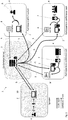
- Fig. 1 schematically shows a communication system 1 for carrying out a WebRTC-based audio or video communication and collaboration session in which a plurality of users or participants communicate with each other via a communication network with a plurality of clients 2, 2', 2", 2'" and a central media or conference server 3.
- the communication and collaboration session may be a video or audio conference, in which a user or participant 4 using a client 2 is a speaker giving a talk or the like to the other users or participants 4', 4", 4"' respectively using the clients 2', 2", 2"'.
- the user 4' is an individual remotely located participant using a headset 6 to listen to the speaker's talk or speech.
- the user 4" is a group of users located in a conference room
- the user 4'" is another group of users located in a conference hall.
- Both rooms, the conference room and the conference hall are equipped with respective audio output means 7, 7', as loudspeakers.
- every client of the listening users 4', 4", 4"' is equipped with a transcriber means 8', 8", 8'" that is configured so as to transcribe audio data to text and to analyze or evaluate the transcribed text according to a confidence value, ranging from 0 to 1, whereby 0 represents an impaired or poor speech quality and 1 represents a good speech quality.
- an audio data stream is continuously transmitted from the user's client 2 to the conference server 3 via a communication path 5, and from there to the other participants or users 4', 4", 4'" or their respective clients 2', 2", 2'" via the communication paths 5', 5", 5'" where the audio data stream is output via the respective devices, as mentioned above, via the headset 6, and via the loudspeakers 7, 7' so that the remotely located users 4', 4", 4"' are able to listen to the talk or speech of the speaking user 4 or participant.
- the speech data generated at the client 2 and the speaking user 4 that is comprised in the audio data stream received at the respective clients 2', 2", 2'" via the respective communication paths 5', 5", 5"' is then transferred to the respective transcriber means 8', 8", 8" which may be, for example, a speech recognition engine for automatically recognizing speech and analyzing the latter as outlined above, and which is able to convert speech- or audio data into text (speech-to-text) without knowing any specific grammar.
- the transcriber means 8', 8", 8'” respectively evaluate a confidence value as outlined above for the transcribed text generated from the received audio or speech data. The poorer the speech quality of the data, the lower the confidence value will be.
- the estimated confidence value may be used for determining the quality of the speech data comprised in the audio stream received at the clients 2', 2", 2"' from the client 2. Since the evaluation is based on the same data that the participants or users 4', 4", 4'" are currently listening to, the confidence value correlates to the audibility of the audio data stream for the listener or listeners quite well.
- the primary objective is the creation of a text representation of the respective audio data.
- the confidence value only is a secondary product of the transcription. Nevertheless, with respect to the method for determining the speech quality according to an embodiment of the present invention described here, the confidence value estimated by the transcriber means is used as a main goal, whereas the transcribed text itself is not used.
- the thus estimated confidence value is transmitted back to the speaker 4 or to the speaker's client 2 automatically via the respective transmission paths 9', 9", 9'" from the clients 2', 2", 2'" to the central conference server 3, and from there, via the communication path 9 to the speaker's client 2, where the confidence value or values is/are displayed to the speaking user 4 at a display means 10 of the client 2.
- a mean value of all confidence values is calculated and displayed, or all estimated confidence values are displayed individually for each participant or client.
- the speaking user 4 may determine himself or herself at which client a problem concerning the speech quality of this talk or speech may be present (for example, due to network problems on the communication path to that specific client), or in case a mean value is created, he or she may conclude that there is a general quality problem concerning the speech quality of his or her talk or speech, for example, caused by wrong or bad microphone positioning or settings.
- the processing of the various quality values represented by the confidence values may result automatically based on different strategies, as calculating the mean value, the worst value, etc., whereby only an overall result is transmitted and presented to the client 2 of the speaking user 4.
- the speaking user 4 is able to take corresponding measures for resolving the problem, or he or she may at least be able to decide whether taking any counter-measures is necessary or not.
- the continuous determination of the speech quality immediately uncovers degradation or changes in the audio quality and visualizes the latter immediately to the speaker.
- the speaker in case he or she has already recognized, due to bad quality values indicated by a low confidence value derived from the transcribed audio data stream, that a problem concerning the speech quality exists and has taken corresponding measures to alleviate or eliminate the source for bad audio quality, may then also determine whether his or her measures taken have been successful. Namely, if the quality value based on a mean confidence value of all confidence values increases, then the measure (for example, aligning the microphone or the like) has been successful.
- Fig. 2 schematically illustrates a communication system 1 according to another embodiment of the invention.
- the setup basically is the same as illustrated in Fig. 1 , however, the difference to the configuration shown in Fig. 1 is that the conference server 3 is also equipped with transcriber units 8"", 8""', one of which transcribes and evaluates the audio data stream received from the client 2 on the communication path 5 at its input, and the other one of which transcribes and evaluates the audio data stream at the output from the conference server 3, before being transmitted to the other clients 2', 2", 2"'.
- the speech data is not only tested at the various clients 2', 2", 2"' connected to the conference server 3 during the communication and collaboration session, but it is also tested at different locations along the path from the speaking user's client 2 to the listening users' clients 2', 2", 2"'.
- the conference server 3 which collects all speech data centrally and then distributes the latter to the clients connected thereto, has two transcriber means 8"", 8""' for testing the audio signals as received from the client 2, and also as output from the server 3.
- a qualified conclusion may be drawn for the cause of the possible bad or poor speech quality, as illustrated in the table below, which lists various analysis locations (i.e., testing locations for testing the audio signal by means of the transcriber means) and maps them to possible causes for degradation of the audio signal, if the confidence value lowers or is low.
- Analysis location Possible cause, if confidence value decreases at the speaker's microphone microphone position or setting, mumbling, background noise, dialect at the input of the conference server network path from speaking user to conference server at the output of the conference server problem with the conference server, e.g., audio mixing at individual listening users and their respective clients network path from conference server to listening users' clients
- the confidence values derived at various locations by analysis of the speech or audio quality based on transcribed audio data and estimation of the confidence value as outlined above may be used for improving the audio or speech quality.
- an immediate action may be taken and the speaking user may be notified that a problem exists concerning speech or audio quality.
- the confidence values which may have been recorded during the ongoing conference are very useful. For example, bottlenecks in certain network segments may be determined, or conclusions may be drawn on network problems that only occur at certain times or in certain time periods of the day. For example, if online conferences only take place at certain time of day, and problems with respect to the audio or speech quality occur in a certain network segments, the cause for such problems may be determined more easily.
Landscapes
- Engineering & Computer Science (AREA)
- Multimedia (AREA)
- Signal Processing (AREA)
- Health & Medical Sciences (AREA)
- Computational Linguistics (AREA)
- Audiology, Speech & Language Pathology (AREA)
- Human Computer Interaction (AREA)
- Physics & Mathematics (AREA)
- Acoustics & Sound (AREA)
- Quality & Reliability (AREA)
- Computer Networks & Wireless Communication (AREA)
- Telephonic Communication Services (AREA)
- Two-Way Televisions, Distribution Of Moving Picture Or The Like (AREA)
Abstract
Description
- The present invention relates to a method of determining the speech in a Web-RTC audio or video communication and/or collaboration session and to a corresponding communication system.
- WebRTC-based conferences nowadays are widely used for communication and collaboration when a plurality of users are located remotely. However, in such audio or video conferences, the audio or speech quality often is impaired, for example, due to bad data transmission within the communication network, inconvenient positioning of the microphone, background or ambient noise, bad speech of the user the speech of whom is transmitted to the other users or participants of the conference, as mumbling or whispering, noises of the user the speech of whom is transmitted to the other users or participants of the conference, as loud breathing or puffing, and the like. Usually, in order to signal to the user, the speech of whom is transmitted to the other conference participants, that his or her speech quality is poor or impaired, the only means is that another participant interrupts him or her so as to inform him on her about this problem.
- Such an interruption of the speaker or speaking user/participant is inefficient. A small problem concerning the speech may cause a long interruption of the ongoing conference session. Also, other participants may feel uncomfortable when having to interrupt another speaker while the latter is talking. However, if nobody of the other participants becomes active, as outlined above, then the poor speech quality of the speaker will remain like this, as he or she is unaware of the problem.
- However, systems or tools for detecting the audio quality during an ongoing WebRTC audio or video communication and/or collaboration session known from prior art, as for example, the speech transmission index or the mean opinion score (MOS), are rather complex to implement or are not reliable enough as usually, according to prior art, a predetermined artificial test signal is used to determine speech quality. However, such an artificial test signal will typically not comprise certain disturbing or interference sources, as for example, an incorrect location of the microphone or mumbling of the speaker.
- Therefore, the present invention is based on the object to provide a method of determining the speech quality in a Web-RTC audio or video communication and/or collaboration session and a corresponding communication system which mitigates the above mentioned problems at least partially.
- The object is solved by a method of determining the speech in a Web-RTC audio or video communication and/or collaboration session having the features according to
claim 1 and by a communication system having the features according to claim 14. Preferred embodiments of the invention are defined in the respective dependent claims. - Therefore, according to the present invention, a method of determining the speech quality in a Web-RTC audio or video communication and/or collaboration session is provided, wherein the method comprises the steps of receiving, at a first client used by a first participant of the audio or video communication and/or collaboration session, an audio data stream comprising speech data transmitted from a second client used by a second participant of the audio or video communication and/or collaboration session, transmitting, at the first client, the speech data to a transcriber means, where the speech data is transcribed into text data, and where a confidence value for the transcribed text data is calculated, the confidence value indicating a probability on the correctness of the word recognition from the speech data, and transmitting the confidence value from the first client to the second client so as to display the confidence value as a measure for the speech quality.
- Thus, according to the present invention, the speech quality is determined based on natural spoken language, namely, exactly on the basis of a speaker's speech. Thereby, the thus measured speech quality corresponds to the actual audibility on the listener's side excellently. Namely, in contrast to prior art solutions which generally use an artificial test signal for determining the audio quality of a transmission channel, according to the present invention, also those cases are covered concerning the actual situation during the conference or communication session, for example, as the speaker does not wear his microphone correctly or if he or she is mumbling while speaking. That is, the comprehensibility of the transmitted speech at the other end is calculated.
- Also, since the result from testing the speech quality is automatically transmitted to the speaker in a communication and collaboration session, no other participants have to intervene. The speaker will not be interrupted, but rather he or she will receive the value indicating the speech quality continuously during his or her ongoing talk, so as to be able to immediately take corresponding adequate measures to eliminate the problem and thus, improve the speech quality.
- According to a preferred embodiment of the invention, the confidence value is a value in the range of 0 to 1, and wherein a high confidence value indicates a good speech quality and a low confidence value indicates an impaired or poor speech quality. This is a very easy and reliable measure for determining the actual and personal speech quality of a specific person in any situation during the communication and collaboration session.
- According to another preferred embodiment of the invention, the transcriber means comprises a voice recognition engine.
- According to still another preferred embodiment of the invention, the user of the second client is a speaker in the WebRTC audio and/or video communication and collaboration session.
- Preferably, the confidence value is visually displayed, at a display means of the second client.
- Also, it is advantageous, if the confidence value is determined at all clients participating in the WebRTC audio or video communication and/or collaborations session based on the transcription of the speech data obtained from the audio stream transmitted from the second client.
- Alternatively, for all confidence values determined at all clients, a mean value is calculated, which is transmitted to the second client and displayed at the display means of the second client as a measure for the speech quality individually for every client or transmission path to that client.
- According to anther preferred embodiment of the invention, all confidence values determined at all clients are transmitted to the second client and displayed at the display means of the second client as a measure for the speech quality.
- Further, the determination of the confidence value for the transcribed audio data may be carried out continuously during the WebRTC communication and collaboration session. Thus, as the speech quality is monitored in real-time and continuously during a communication and collaboration session, the method is superior compared to methods and systems or tools known from prior art, which currently are not able to determine speech quality in real-time and continuously.
- Preferably, the WebRTC communication and collaboration session is an audio or a video conference.
- It is also preferable, if the audio stream comprising the speech data is tested on the basis of the confidence value at at least one further location on the transmission path from the second client to the first client.
- Advantageously, the at least one further location on the transmission path from the second client to the first client is at the conference server. This embodiment enables a more distinguished approach so as to possibly find a source of degrading audio quality which does not arise from the speaker and his speech himself or herself, as also the signal transmitted is tested at several points or locations in the communication path.
- According to yet another preferred embodiment of the invention, the audio stream comprising the speech data is tested on the basis of the confidence value in the communication path from the second client to the conference server when entering the conference server, and on a further communication path when leaving the conference server.
- Moreover, according to the present invention, a communication system for performing an WebRTC-based audio or video communication and/or collaboration session is provided, the communication system comprising a conference server and a plurality of clients communicating with each other via a communication network, wherein each of the clients comprises or is connectable to a transcriber means, in particular, a voice recognition engine for determining the speech quality according to the method as described above.
- Preferably, the server also comprises at least one transcriber means for determining the speech quality according to the method as described above.
- The invention and embodiments thereof will be described below in further detail in connection with the drawing.
- Fig. 1
- schematically shows a communication system according to an embodiment of the invention; and
- Fig. 2
- schematically illustrates a communication system according to another embodiment of the invention.
-
Fig. 1 schematically shows acommunication system 1 for carrying out a WebRTC-based audio or video communication and collaboration session in which a plurality of users or participants communicate with each other via a communication network with a plurality ofclients conference server 3. For example, the communication and collaboration session may be a video or audio conference, in which a user orparticipant 4 using aclient 2 is a speaker giving a talk or the like to the other users orparticipants 4', 4", 4"' respectively using theclients 2', 2", 2"'. Here, the user 4' is an individual remotely located participant using aheadset 6 to listen to the speaker's talk or speech. Theuser 4" is a group of users located in a conference room, whereas the user 4'" is another group of users located in a conference hall. Both rooms, the conference room and the conference hall are equipped with respective audio output means 7, 7', as loudspeakers. Also, every client of the listeningusers 4', 4", 4"' is equipped with atranscriber means 8', 8", 8'" that is configured so as to transcribe audio data to text and to analyze or evaluate the transcribed text according to a confidence value, ranging from 0 to 1, whereby 0 represents an impaired or poor speech quality and 1 represents a good speech quality. - During the speech or talk of the currently speaking user or
participant 4, an audio data stream is continuously transmitted from the user'sclient 2 to theconference server 3 via acommunication path 5, and from there to the other participants orusers 4', 4", 4'" or theirrespective clients 2', 2", 2'" via thecommunication paths 5', 5", 5'" where the audio data stream is output via the respective devices, as mentioned above, via theheadset 6, and via theloudspeakers 7, 7' so that the remotely locatedusers 4', 4", 4"' are able to listen to the talk or speech of the speakinguser 4 or participant. - The speech data generated at the
client 2 and the speakinguser 4 that is comprised in the audio data stream received at therespective clients 2', 2", 2'" via therespective communication paths 5', 5", 5"' is then transferred to the respective transcriber means 8', 8", 8" which may be, for example, a speech recognition engine for automatically recognizing speech and analyzing the latter as outlined above, and which is able to convert speech- or audio data into text (speech-to-text) without knowing any specific grammar. The transcriber means 8', 8", 8'" respectively evaluate a confidence value as outlined above for the transcribed text generated from the received audio or speech data. The poorer the speech quality of the data, the lower the confidence value will be. Thus, the estimated confidence value may be used for determining the quality of the speech data comprised in the audio stream received at theclients 2', 2", 2"' from theclient 2. Since the evaluation is based on the same data that the participants orusers 4', 4", 4'" are currently listening to, the confidence value correlates to the audibility of the audio data stream for the listener or listeners quite well. - With respect to the transcription of the audio or speech data of the audio data stream generated at the speaker's
client 2, the primary objective is the creation of a text representation of the respective audio data. However, the confidence value only is a secondary product of the transcription. Nevertheless, with respect to the method for determining the speech quality according to an embodiment of the present invention described here, the confidence value estimated by the transcriber means is used as a main goal, whereas the transcribed text itself is not used. - Subsequently, the thus estimated confidence value is transmitted back to the
speaker 4 or to the speaker'sclient 2 automatically via therespective transmission paths 9', 9", 9'" from theclients 2', 2", 2'" to thecentral conference server 3, and from there, via thecommunication path 9 to the speaker'sclient 2, where the confidence value or values is/are displayed to the speakinguser 4 at a display means 10 of theclient 2. Either, a mean value of all confidence values is calculated and displayed, or all estimated confidence values are displayed individually for each participant or client. As all values are displayed individually for every client, the speakinguser 4 may determine himself or herself at which client a problem concerning the speech quality of this talk or speech may be present (for example, due to network problems on the communication path to that specific client), or in case a mean value is created, he or she may conclude that there is a general quality problem concerning the speech quality of his or her talk or speech, for example, caused by wrong or bad microphone positioning or settings. - It is noted that the processing of the various quality values represented by the confidence values may result automatically based on different strategies, as calculating the mean value, the worst value, etc., whereby only an overall result is transmitted and presented to the
client 2 of the speakinguser 4. By this automated visual feedback of the speech or audio quality, the speakinguser 4 is able to take corresponding measures for resolving the problem, or he or she may at least be able to decide whether taking any counter-measures is necessary or not. - Moreover, the continuous determination of the speech quality immediately uncovers degradation or changes in the audio quality and visualizes the latter immediately to the speaker. The speaker, in case he or she has already recognized, due to bad quality values indicated by a low confidence value derived from the transcribed audio data stream, that a problem concerning the speech quality exists and has taken corresponding measures to alleviate or eliminate the source for bad audio quality, may then also determine whether his or her measures taken have been successful. Namely, if the quality value based on a mean confidence value of all confidence values increases, then the measure (for example, aligning the microphone or the like) has been successful.
-
Fig. 2 schematically illustrates acommunication system 1 according to another embodiment of the invention. Here, the setup basically is the same as illustrated inFig. 1 , however, the difference to the configuration shown inFig. 1 is that theconference server 3 is also equipped withtranscriber units 8"", 8""', one of which transcribes and evaluates the audio data stream received from theclient 2 on thecommunication path 5 at its input, and the other one of which transcribes and evaluates the audio data stream at the output from theconference server 3, before being transmitted to theother clients 2', 2", 2"'. - Thus, the speech data is not only tested at the
various clients 2', 2", 2"' connected to theconference server 3 during the communication and collaboration session, but it is also tested at different locations along the path from the speaking user'sclient 2 to the listening users'clients 2', 2", 2"'. Namely, as mentioned above, theconference server 3, which collects all speech data centrally and then distributes the latter to the clients connected thereto, has two transcriber means 8"", 8""' for testing the audio signals as received from theclient 2, and also as output from theserver 3. By comparing the thus determined confidence values for the same audio data stream, thereby, in many cases, a qualified conclusion may be drawn for the cause of the possible bad or poor speech quality, as illustrated in the table below, which lists various analysis locations (i.e., testing locations for testing the audio signal by means of the transcriber means) and maps them to possible causes for degradation of the audio signal, if the confidence value lowers or is low.Analysis location Possible cause, if confidence value decreases at the speaker's microphone microphone position or setting, mumbling, background noise, dialect at the input of the conference server network path from speaking user to conference server at the output of the conference server problem with the conference server, e.g., audio mixing at individual listening users and their respective clients network path from conference server to listening users' clients - The confidence values derived at various locations by analysis of the speech or audio quality based on transcribed audio data and estimation of the confidence value as outlined above may be used for improving the audio or speech quality. In case the cause of degraded audio or speech quality is determined to be at the speaking user's location, an immediate action may be taken and the speaking user may be notified that a problem exists concerning speech or audio quality.
- Also, after a communication and collaboration session or audio/video conference, the confidence values which may have been recorded during the ongoing conference are very useful. For example, bottlenecks in certain network segments may be determined, or conclusions may be drawn on network problems that only occur at certain times or in certain time periods of the day. For example, if online conferences only take place at certain time of day, and problems with respect to the audio or speech quality occur in a certain network segments, the cause for such problems may be determined more easily.
-
- 1
- communication system
- 2, 2', 2", 2'"
- clients
- 3
- conference server
- 4, 4', 4", 4'"
- users
- 5, 5', 5", 5'"
- communication paths
- 6
- headset
- 7, 7'
- loudspeaker
- 8', 8", 8"', 8"", 8'""
- transcriber means
- 9', 9", 9'"
- transmission paths
- 10
- display means
Claims (15)
- Method of determining the speech quality in an Web-RTC audio or video communication and/or collaboration session, wherein the method comprises the steps of- receiving, at least a first client used (2', 2", 2"') by at least one first participant (4', 4", 4"') of the audio or video communication and/or collaboration session, an audio data stream comprising speech data transmitted from a second client (2) used by a second participant (4) of the audio or video communication and/or collaboration session,- transmitting, at the at least one first client, the speech data to a transcriber means (8', 8", 8"', 8"", 8""'), where the speech data is transcribed into text data, and where a confidence value for the transcribed text data is estimated, the confidence value indicating a probability on the correctness of the word recognition from the speech data, and- transmitting the confidence value from the at least one first client (2', 2", 2"') to the second client so as to display the confidence value as a measure for the speech quality.
- Method according to claim 1, wherein the confidence value is a value in the range of 0 to 1, and wherein a high confidence value indicates a good speech quality and a low confidence value indicates an impaired or poor speech quality.
- Method according to claim 1 or claim 2, wherein the transcriber means (8', 8", 8"', 8"", 8""') comprises a voice recognition engine.
- Method according to any one of the preceding claims, wherein the user (4) of the second client (2) is a speaker in the WebRTC audio and/or video communication and collaboration session and wherein the at least one first user (2', 2", 2"') is a listener in the WebRTC audio and/or video communication and collaboration session.
- Method according to any one of the preceding claims, wherein the confidence value is visually displayed, at a display means (10) of the second client (2).
- Method according to any one of claims 4 or 5, wherein the confidence value is determined at all clients (2', 2", 2"') of listening users (4', 4", 4"') in the WebRTC audio or video communication and/or collaborations session based on the transcription of the speech data obtained from the audio stream transmitted from the second client.
- Method according to claim 6, wherein for all confidence values determined at all clients (2', 2", 2"') of listening users (4', 4", 4"'), a mean value is calculated, which is transmitted to the second client (2) of the speaking user (4) and displayed at the display means (10) of the second client (2) as a measure for the speech quality.
- Method according to claim 6, where all confidence values determined at all clients (2', 2", 2"') of listening users (4', 4", 4"') are transmitted to the second client (2) and displayed at the display means (10) of the second client (2) as a measure for the speech quality.
- Method according to any one of the preceding claims, wherein the determination of the confidence value for the transcribed audio data is carried out continuously during the WebRTC communication and collaboration session.
- Method according to any one of the preceding claims, wherein the WebRTC communication and collaboration session is an audio or a video conference.
- Method according to any one of the preceding claims, wherein the audio stream comprising the speech data is tested on the basis of the confidence value at at least one further location on the transmission path from the second client (2) to the at least one first client (2', 2", 2"').
- Method according to any one of the preceding claims, wherein the at least one further location on the transmission path from the second client (2) to the at least one first client (2', 2", 2"') is at the conference server (3).
- Method according to claim 12, wherein the audio stream comprising the speech data is tested on the basis of the confidence value in the communication path from the second client (2) to the conference server (3) when entering the conference server (3), and on a further communication path when leaving the conference server (3).
- Communication system (1) for performing an WebRTC-based audio or video communication and/or collaboration session, comprising a conference server (3) and a plurality of clients (2, 2', 2", 2"') communicating with each other via a communication network, wherein each of the clients (2', 2", 2"') of listening users (4', 4", 4"') comprises or is connectable to a transcriber means (8'., 8", 8"'), in particular, a voice recognition engine for determining the speech quality according to the method of any one of the preceding claims.
- Communication system according to claim 14, wherein the server (3) also comprises at least one transcriber means (8"", 8""') for determining the speech quality according to the method of any one of claims 1 to 13.
Priority Applications (2)
| Application Number | Priority Date | Filing Date | Title |
|---|---|---|---|
| EP19208374.9A EP3819904B1 (en) | 2019-11-11 | 2019-11-11 | Method of determining the speech in a web-rtc audio or video communication and/or collaboration session and communication system |
| US17/090,956 US11463501B2 (en) | 2019-11-11 | 2020-11-06 | Method of determining the speech in a Web-RTC audio or video communication and/or collaboration session and communication system |
Applications Claiming Priority (1)
| Application Number | Priority Date | Filing Date | Title |
|---|---|---|---|
| EP19208374.9A EP3819904B1 (en) | 2019-11-11 | 2019-11-11 | Method of determining the speech in a web-rtc audio or video communication and/or collaboration session and communication system |
Publications (2)
| Publication Number | Publication Date |
|---|---|
| EP3819904A1 true EP3819904A1 (en) | 2021-05-12 |
| EP3819904B1 EP3819904B1 (en) | 2024-08-28 |
Family
ID=68536738
Family Applications (1)
| Application Number | Title | Priority Date | Filing Date |
|---|---|---|---|
| EP19208374.9A Active EP3819904B1 (en) | 2019-11-11 | 2019-11-11 | Method of determining the speech in a web-rtc audio or video communication and/or collaboration session and communication system |
Country Status (2)
| Country | Link |
|---|---|
| US (1) | US11463501B2 (en) |
| EP (1) | EP3819904B1 (en) |
Families Citing this family (3)
| Publication number | Priority date | Publication date | Assignee | Title |
|---|---|---|---|---|
| US12052392B2 (en) * | 2021-03-16 | 2024-07-30 | Lenovo (Singapore) Pte. Ltd. | Resolving bad audio during conference call |
| US20230344891A1 (en) * | 2021-06-22 | 2023-10-26 | Meta Platforms Technologies, Llc | Systems and methods for quality measurement for videoconferencing |
| JP7482459B2 (en) * | 2022-09-05 | 2024-05-14 | ダイキン工業株式会社 | System, support method, server device and communication program |
Citations (2)
| Publication number | Priority date | Publication date | Assignee | Title |
|---|---|---|---|---|
| US6275797B1 (en) * | 1998-04-17 | 2001-08-14 | Cisco Technology, Inc. | Method and apparatus for measuring voice path quality by means of speech recognition |
| US9876901B1 (en) * | 2016-09-09 | 2018-01-23 | Google Inc. | Conversational call quality evaluator |
Family Cites Families (3)
| Publication number | Priority date | Publication date | Assignee | Title |
|---|---|---|---|---|
| US9183834B2 (en) * | 2009-07-22 | 2015-11-10 | Cisco Technology, Inc. | Speech recognition tuning tool |
| US12482458B2 (en) * | 2014-02-28 | 2025-11-25 | Ultratec, Inc. | Semiautomated relay method and apparatus |
| US20180144747A1 (en) * | 2016-11-18 | 2018-05-24 | Microsoft Technology Licensing, Llc | Real-time caption correction by moderator |
-
2019
- 2019-11-11 EP EP19208374.9A patent/EP3819904B1/en active Active
-
2020
- 2020-11-06 US US17/090,956 patent/US11463501B2/en active Active
Patent Citations (2)
| Publication number | Priority date | Publication date | Assignee | Title |
|---|---|---|---|---|
| US6275797B1 (en) * | 1998-04-17 | 2001-08-14 | Cisco Technology, Inc. | Method and apparatus for measuring voice path quality by means of speech recognition |
| US9876901B1 (en) * | 2016-09-09 | 2018-01-23 | Google Inc. | Conversational call quality evaluator |
Non-Patent Citations (2)
| Title |
|---|
| ANONYMOUS: "Speech Transcription Server - Automated speech-to-text conversion application", GL COMMUNICATIONS INC., 23 November 2018 (2018-11-23), XP055685444, Retrieved from the Internet <URL:https://web.archive.org/web/20181123014427/https://www.gl.com/speech-to-text-conversion-utility.html> [retrieved on 20200414] * |
| WENYU JIANG ET AL: "Speech recognition performance as an effective perceived quality predictor", IEEE 2002 TENTH IEEE INTERNATIONAL WORKSHOP ON QUALITY OF SERVICE (CAT. NO.02EX564) IEEE PISCATAWAY, NJ, USA, IEEE, no. 10TH, 1 January 2002 (2002-01-01), pages 269 - 275, XP002594253, ISBN: 978-0-7803-7426-3 * |
Also Published As
| Publication number | Publication date |
|---|---|
| EP3819904B1 (en) | 2024-08-28 |
| US20210144191A1 (en) | 2021-05-13 |
| US11463501B2 (en) | 2022-10-04 |
Similar Documents
| Publication | Publication Date | Title |
|---|---|---|
| US7653543B1 (en) | Automatic signal adjustment based on intelligibility | |
| US10104337B2 (en) | Displaying a presenter during a video conference | |
| US12159643B2 (en) | Systems and methods for filtering unwanted sounds from a conference call using voice synthesis | |
| US8676572B2 (en) | Computer-implemented system and method for enhancing audio to individuals participating in a conversation | |
| US9313336B2 (en) | Systems and methods for processing audio signals captured using microphones of multiple devices | |
| US7698141B2 (en) | Methods, apparatus, and products for automatically managing conversational floors in computer-mediated communications | |
| EP1622349B1 (en) | Teleconference volume level monitoring and feedback on the volume level | |
| US20240388659A1 (en) | Methods and systems for automatic queuing in conference calls | |
| US20050088981A1 (en) | System and method for providing communication channels that each comprise at least one property dynamically changeable during social interactions | |
| US20130024196A1 (en) | Systems and methods for using a mobile device to deliver speech with speaker identification | |
| EP3819904B1 (en) | Method of determining the speech in a web-rtc audio or video communication and/or collaboration session and communication system | |
| US20070263823A1 (en) | Automatic participant placement in conferencing | |
| US9560316B1 (en) | Indicating sound quality during a conference | |
| EP3257236A1 (en) | Nearby talker obscuring, duplicate dialogue amelioration and automatic muting of acoustically proximate participants | |
| JP2011076110A (en) | Interactive telephony trainer and exerciser | |
| US20160142451A1 (en) | Online meeting computer with improved noise management logic | |
| JP6420514B1 (en) | Conversation robot | |
| Guéguin et al. | On the evaluation of the conversational speech quality in telecommunications | |
| CN105190752A (en) | Audio transmission channel quality assessment | |
| EP2247082B1 (en) | Telecommunication device, telecommunication system and method for telecommunicating voice signals | |
| CN114582362B (en) | A processing method and a processing device | |
| Bruns et al. | Automated speech audiometry for integrated voice over internet protocol communication services | |
| Moeller et al. | Objective estimation of speech quality for communication systems | |
| Taschenberger et al. | Disfluencies in spontaneous speech in easy and adverse communicative situations: The effect of age | |
| Berndtsson et al. | Methods for human-centered evaluation of MediaSync in real-time communication |
Legal Events
| Date | Code | Title | Description |
|---|---|---|---|
| PUAI | Public reference made under article 153(3) epc to a published international application that has entered the european phase |
Free format text: ORIGINAL CODE: 0009012 |
|
| STAA | Information on the status of an ep patent application or granted ep patent |
Free format text: STATUS: THE APPLICATION HAS BEEN PUBLISHED |
|
| AK | Designated contracting states |
Kind code of ref document: A1 Designated state(s): AL AT BE BG CH CY CZ DE DK EE ES FI FR GB GR HR HU IE IS IT LI LT LU LV MC MK MT NL NO PL PT RO RS SE SI SK SM TR |
|
| STAA | Information on the status of an ep patent application or granted ep patent |
Free format text: STATUS: REQUEST FOR EXAMINATION WAS MADE |
|
| 17P | Request for examination filed |
Effective date: 20210923 |
|
| RBV | Designated contracting states (corrected) |
Designated state(s): AL AT BE BG CH CY CZ DE DK EE ES FI FR GB GR HR HU IE IS IT LI LT LU LV MC MK MT NL NO PL PT RO RS SE SI SK SM TR |
|
| RAP3 | Party data changed (applicant data changed or rights of an application transferred) |
Owner name: UNIFY PATENTE GMBH & CO. KG |
|
| STAA | Information on the status of an ep patent application or granted ep patent |
Free format text: STATUS: EXAMINATION IS IN PROGRESS |
|
| 17Q | First examination report despatched |
Effective date: 20230221 |
|
| GRAP | Despatch of communication of intention to grant a patent |
Free format text: ORIGINAL CODE: EPIDOSNIGR1 |
|
| STAA | Information on the status of an ep patent application or granted ep patent |
Free format text: STATUS: GRANT OF PATENT IS INTENDED |
|
| INTG | Intention to grant announced |
Effective date: 20240405 |
|
| GRAS | Grant fee paid |
Free format text: ORIGINAL CODE: EPIDOSNIGR3 |
|
| GRAA | (expected) grant |
Free format text: ORIGINAL CODE: 0009210 |
|
| STAA | Information on the status of an ep patent application or granted ep patent |
Free format text: STATUS: THE PATENT HAS BEEN GRANTED |
|
| AK | Designated contracting states |
Kind code of ref document: B1 Designated state(s): AL AT BE BG CH CY CZ DE DK EE ES FI FR GB GR HR HU IE IS IT LI LT LU LV MC MK MT NL NO PL PT RO RS SE SI SK SM TR |
|
| REG | Reference to a national code |
Ref country code: GB Ref legal event code: FG4D |
|
| REG | Reference to a national code |
Ref country code: CH Ref legal event code: EP |
|
| REG | Reference to a national code |
Ref country code: DE Ref legal event code: R096 Ref document number: 602019057793 Country of ref document: DE |
|
| REG | Reference to a national code |
Ref country code: IE Ref legal event code: FG4D |
|
| REG | Reference to a national code |
Ref country code: DE Ref legal event code: R081 Ref document number: 602019057793 Country of ref document: DE Owner name: UNIFY BETEILIGUNGSVERWALTUNG GMBH & CO. KG, DE Free format text: FORMER OWNER: UNIFY PATENTE GMBH & CO. KG, 81739 MUENCHEN, DE |
|
| RAP2 | Party data changed (patent owner data changed or rights of a patent transferred) |
Owner name: UNIFY BETEILIGUNGSVERWALTUNG GMBH & CO. KG |
|
| REG | Reference to a national code |
Ref country code: LT Ref legal event code: MG9D |
|
| PG25 | Lapsed in a contracting state [announced via postgrant information from national office to epo] |
Ref country code: NO Free format text: LAPSE BECAUSE OF FAILURE TO SUBMIT A TRANSLATION OF THE DESCRIPTION OR TO PAY THE FEE WITHIN THE PRESCRIBED TIME-LIMIT Effective date: 20241128 |
|
| REG | Reference to a national code |
Ref country code: AT Ref legal event code: MK05 Ref document number: 1718898 Country of ref document: AT Kind code of ref document: T Effective date: 20240828 |
|
| PG25 | Lapsed in a contracting state [announced via postgrant information from national office to epo] |
Ref country code: NL Free format text: LAPSE BECAUSE OF FAILURE TO SUBMIT A TRANSLATION OF THE DESCRIPTION OR TO PAY THE FEE WITHIN THE PRESCRIBED TIME-LIMIT Effective date: 20240828 Ref country code: GR Free format text: LAPSE BECAUSE OF FAILURE TO SUBMIT A TRANSLATION OF THE DESCRIPTION OR TO PAY THE FEE WITHIN THE PRESCRIBED TIME-LIMIT Effective date: 20241129 Ref country code: PT Free format text: LAPSE BECAUSE OF FAILURE TO SUBMIT A TRANSLATION OF THE DESCRIPTION OR TO PAY THE FEE WITHIN THE PRESCRIBED TIME-LIMIT Effective date: 20241230 Ref country code: FI Free format text: LAPSE BECAUSE OF FAILURE TO SUBMIT A TRANSLATION OF THE DESCRIPTION OR TO PAY THE FEE WITHIN THE PRESCRIBED TIME-LIMIT Effective date: 20240828 Ref country code: PL Free format text: LAPSE BECAUSE OF FAILURE TO SUBMIT A TRANSLATION OF THE DESCRIPTION OR TO PAY THE FEE WITHIN THE PRESCRIBED TIME-LIMIT Effective date: 20240828 |
|
| PG25 | Lapsed in a contracting state [announced via postgrant information from national office to epo] |
Ref country code: BG Free format text: LAPSE BECAUSE OF FAILURE TO SUBMIT A TRANSLATION OF THE DESCRIPTION OR TO PAY THE FEE WITHIN THE PRESCRIBED TIME-LIMIT Effective date: 20240828 |
|
| PG25 | Lapsed in a contracting state [announced via postgrant information from national office to epo] |
Ref country code: LV Free format text: LAPSE BECAUSE OF FAILURE TO SUBMIT A TRANSLATION OF THE DESCRIPTION OR TO PAY THE FEE WITHIN THE PRESCRIBED TIME-LIMIT Effective date: 20240828 |
|
| REG | Reference to a national code |
Ref country code: NL Ref legal event code: MP Effective date: 20240828 |
|
| PG25 | Lapsed in a contracting state [announced via postgrant information from national office to epo] |
Ref country code: AT Free format text: LAPSE BECAUSE OF FAILURE TO SUBMIT A TRANSLATION OF THE DESCRIPTION OR TO PAY THE FEE WITHIN THE PRESCRIBED TIME-LIMIT Effective date: 20240828 Ref country code: IS Free format text: LAPSE BECAUSE OF FAILURE TO SUBMIT A TRANSLATION OF THE DESCRIPTION OR TO PAY THE FEE WITHIN THE PRESCRIBED TIME-LIMIT Effective date: 20241228 |
|
| PG25 | Lapsed in a contracting state [announced via postgrant information from national office to epo] |
Ref country code: HR Free format text: LAPSE BECAUSE OF FAILURE TO SUBMIT A TRANSLATION OF THE DESCRIPTION OR TO PAY THE FEE WITHIN THE PRESCRIBED TIME-LIMIT Effective date: 20240828 |
|
| PG25 | Lapsed in a contracting state [announced via postgrant information from national office to epo] |
Ref country code: RS Free format text: LAPSE BECAUSE OF FAILURE TO SUBMIT A TRANSLATION OF THE DESCRIPTION OR TO PAY THE FEE WITHIN THE PRESCRIBED TIME-LIMIT Effective date: 20241128 Ref country code: ES Free format text: LAPSE BECAUSE OF FAILURE TO SUBMIT A TRANSLATION OF THE DESCRIPTION OR TO PAY THE FEE WITHIN THE PRESCRIBED TIME-LIMIT Effective date: 20240828 |
|
| PG25 | Lapsed in a contracting state [announced via postgrant information from national office to epo] |
Ref country code: RS Free format text: LAPSE BECAUSE OF FAILURE TO SUBMIT A TRANSLATION OF THE DESCRIPTION OR TO PAY THE FEE WITHIN THE PRESCRIBED TIME-LIMIT Effective date: 20241128 Ref country code: PT Free format text: LAPSE BECAUSE OF FAILURE TO SUBMIT A TRANSLATION OF THE DESCRIPTION OR TO PAY THE FEE WITHIN THE PRESCRIBED TIME-LIMIT Effective date: 20241230 Ref country code: PL Free format text: LAPSE BECAUSE OF FAILURE TO SUBMIT A TRANSLATION OF THE DESCRIPTION OR TO PAY THE FEE WITHIN THE PRESCRIBED TIME-LIMIT Effective date: 20240828 Ref country code: NO Free format text: LAPSE BECAUSE OF FAILURE TO SUBMIT A TRANSLATION OF THE DESCRIPTION OR TO PAY THE FEE WITHIN THE PRESCRIBED TIME-LIMIT Effective date: 20241128 Ref country code: NL Free format text: LAPSE BECAUSE OF FAILURE TO SUBMIT A TRANSLATION OF THE DESCRIPTION OR TO PAY THE FEE WITHIN THE PRESCRIBED TIME-LIMIT Effective date: 20240828 Ref country code: LV Free format text: LAPSE BECAUSE OF FAILURE TO SUBMIT A TRANSLATION OF THE DESCRIPTION OR TO PAY THE FEE WITHIN THE PRESCRIBED TIME-LIMIT Effective date: 20240828 Ref country code: IS Free format text: LAPSE BECAUSE OF FAILURE TO SUBMIT A TRANSLATION OF THE DESCRIPTION OR TO PAY THE FEE WITHIN THE PRESCRIBED TIME-LIMIT Effective date: 20241228 Ref country code: HR Free format text: LAPSE BECAUSE OF FAILURE TO SUBMIT A TRANSLATION OF THE DESCRIPTION OR TO PAY THE FEE WITHIN THE PRESCRIBED TIME-LIMIT Effective date: 20240828 Ref country code: GR Free format text: LAPSE BECAUSE OF FAILURE TO SUBMIT A TRANSLATION OF THE DESCRIPTION OR TO PAY THE FEE WITHIN THE PRESCRIBED TIME-LIMIT Effective date: 20241129 Ref country code: FI Free format text: LAPSE BECAUSE OF FAILURE TO SUBMIT A TRANSLATION OF THE DESCRIPTION OR TO PAY THE FEE WITHIN THE PRESCRIBED TIME-LIMIT Effective date: 20240828 Ref country code: ES Free format text: LAPSE BECAUSE OF FAILURE TO SUBMIT A TRANSLATION OF THE DESCRIPTION OR TO PAY THE FEE WITHIN THE PRESCRIBED TIME-LIMIT Effective date: 20240828 Ref country code: BG Free format text: LAPSE BECAUSE OF FAILURE TO SUBMIT A TRANSLATION OF THE DESCRIPTION OR TO PAY THE FEE WITHIN THE PRESCRIBED TIME-LIMIT Effective date: 20240828 Ref country code: AT Free format text: LAPSE BECAUSE OF FAILURE TO SUBMIT A TRANSLATION OF THE DESCRIPTION OR TO PAY THE FEE WITHIN THE PRESCRIBED TIME-LIMIT Effective date: 20240828 |
|
| PG25 | Lapsed in a contracting state [announced via postgrant information from national office to epo] |
Ref country code: DK Free format text: LAPSE BECAUSE OF FAILURE TO SUBMIT A TRANSLATION OF THE DESCRIPTION OR TO PAY THE FEE WITHIN THE PRESCRIBED TIME-LIMIT Effective date: 20240828 Ref country code: RO Free format text: LAPSE BECAUSE OF FAILURE TO SUBMIT A TRANSLATION OF THE DESCRIPTION OR TO PAY THE FEE WITHIN THE PRESCRIBED TIME-LIMIT Effective date: 20240828 Ref country code: SM Free format text: LAPSE BECAUSE OF FAILURE TO SUBMIT A TRANSLATION OF THE DESCRIPTION OR TO PAY THE FEE WITHIN THE PRESCRIBED TIME-LIMIT Effective date: 20240828 |
|
| PG25 | Lapsed in a contracting state [announced via postgrant information from national office to epo] |
Ref country code: EE Free format text: LAPSE BECAUSE OF FAILURE TO SUBMIT A TRANSLATION OF THE DESCRIPTION OR TO PAY THE FEE WITHIN THE PRESCRIBED TIME-LIMIT Effective date: 20240828 |
|
| PG25 | Lapsed in a contracting state [announced via postgrant information from national office to epo] |
Ref country code: CZ Free format text: LAPSE BECAUSE OF FAILURE TO SUBMIT A TRANSLATION OF THE DESCRIPTION OR TO PAY THE FEE WITHIN THE PRESCRIBED TIME-LIMIT Effective date: 20240828 |
|
| PG25 | Lapsed in a contracting state [announced via postgrant information from national office to epo] |
Ref country code: SK Free format text: LAPSE BECAUSE OF FAILURE TO SUBMIT A TRANSLATION OF THE DESCRIPTION OR TO PAY THE FEE WITHIN THE PRESCRIBED TIME-LIMIT Effective date: 20240828 Ref country code: IT Free format text: LAPSE BECAUSE OF FAILURE TO SUBMIT A TRANSLATION OF THE DESCRIPTION OR TO PAY THE FEE WITHIN THE PRESCRIBED TIME-LIMIT Effective date: 20240828 |
|
| REG | Reference to a national code |
Ref country code: DE Ref legal event code: R097 Ref document number: 602019057793 Country of ref document: DE |
|
| REG | Reference to a national code |
Ref country code: CH Ref legal event code: PL |
|
| PLBE | No opposition filed within time limit |
Free format text: ORIGINAL CODE: 0009261 |
|
| STAA | Information on the status of an ep patent application or granted ep patent |
Free format text: STATUS: NO OPPOSITION FILED WITHIN TIME LIMIT |
|
| PG25 | Lapsed in a contracting state [announced via postgrant information from national office to epo] |
Ref country code: MC Free format text: LAPSE BECAUSE OF FAILURE TO SUBMIT A TRANSLATION OF THE DESCRIPTION OR TO PAY THE FEE WITHIN THE PRESCRIBED TIME-LIMIT Effective date: 20240828 |
|
| PG25 | Lapsed in a contracting state [announced via postgrant information from national office to epo] |
Ref country code: LU Free format text: LAPSE BECAUSE OF NON-PAYMENT OF DUE FEES Effective date: 20241111 |
|
| REG | Reference to a national code |
Ref country code: CH Ref legal event code: PL |
|
| PG25 | Lapsed in a contracting state [announced via postgrant information from national office to epo] |
Ref country code: CH Free format text: LAPSE BECAUSE OF NON-PAYMENT OF DUE FEES Effective date: 20241130 |
|
| 26N | No opposition filed |
Effective date: 20250530 |
|
| REG | Reference to a national code |
Ref country code: BE Ref legal event code: MM Effective date: 20241130 |
|
| PG25 | Lapsed in a contracting state [announced via postgrant information from national office to epo] |
Ref country code: SE Free format text: LAPSE BECAUSE OF FAILURE TO SUBMIT A TRANSLATION OF THE DESCRIPTION OR TO PAY THE FEE WITHIN THE PRESCRIBED TIME-LIMIT Effective date: 20240828 |
|
| PG25 | Lapsed in a contracting state [announced via postgrant information from national office to epo] |
Ref country code: BE Free format text: LAPSE BECAUSE OF NON-PAYMENT OF DUE FEES Effective date: 20241130 |
|
| PGFP | Annual fee paid to national office [announced via postgrant information from national office to epo] |
Ref country code: GB Payment date: 20250918 Year of fee payment: 7 |
|
| PGFP | Annual fee paid to national office [announced via postgrant information from national office to epo] |
Ref country code: FR Payment date: 20250908 Year of fee payment: 7 |
|
| PG25 | Lapsed in a contracting state [announced via postgrant information from national office to epo] |
Ref country code: IE Free format text: LAPSE BECAUSE OF NON-PAYMENT OF DUE FEES Effective date: 20241111 |
|
| REG | Reference to a national code |
Ref country code: GB Ref legal event code: 732E Free format text: REGISTERED BETWEEN 20250925 AND 20251001 |
|
| PGFP | Annual fee paid to national office [announced via postgrant information from national office to epo] |
Ref country code: DE Payment date: 20250916 Year of fee payment: 7 |