EP3819901A1 - Method and device for adjusting brightness of vehicle-mounted screen, and controller and recording medium - Google Patents
Method and device for adjusting brightness of vehicle-mounted screen, and controller and recording medium Download PDFInfo
- Publication number
- EP3819901A1 EP3819901A1 EP19831503.8A EP19831503A EP3819901A1 EP 3819901 A1 EP3819901 A1 EP 3819901A1 EP 19831503 A EP19831503 A EP 19831503A EP 3819901 A1 EP3819901 A1 EP 3819901A1
- Authority
- EP
- European Patent Office
- Prior art keywords
- vehicle
- brightness
- screen
- traveling speed
- threshold
- Prior art date
- Legal status (The legal status is an assumption and is not a legal conclusion. Google has not performed a legal analysis and makes no representation as to the accuracy of the status listed.)
- Withdrawn
Links
Images

Classifications
-
- G—PHYSICS
- G09—EDUCATION; CRYPTOGRAPHY; DISPLAY; ADVERTISING; SEALS
- G09G—ARRANGEMENTS OR CIRCUITS FOR CONTROL OF INDICATING DEVICES USING STATIC MEANS TO PRESENT VARIABLE INFORMATION
- G09G5/00—Control arrangements or circuits for visual indicators common to cathode-ray tube indicators and other visual indicators
- G09G5/10—Intensity circuits
-
- B—PERFORMING OPERATIONS; TRANSPORTING
- B60—VEHICLES IN GENERAL
- B60K—ARRANGEMENT OR MOUNTING OF PROPULSION UNITS OR OF TRANSMISSIONS IN VEHICLES; ARRANGEMENT OR MOUNTING OF PLURAL DIVERSE PRIME-MOVERS IN VEHICLES; AUXILIARY DRIVES FOR VEHICLES; INSTRUMENTATION OR DASHBOARDS FOR VEHICLES; ARRANGEMENTS IN CONNECTION WITH COOLING, AIR INTAKE, GAS EXHAUST OR FUEL SUPPLY OF PROPULSION UNITS IN VEHICLES
- B60K35/00—Instruments specially adapted for vehicles; Arrangement of instruments in or on vehicles
- B60K35/20—Output arrangements, i.e. from vehicle to user, associated with vehicle functions or specially adapted therefor
- B60K35/21—Output arrangements, i.e. from vehicle to user, associated with vehicle functions or specially adapted therefor using visual output, e.g. blinking lights or matrix displays
- B60K35/22—Display screens
-
- B—PERFORMING OPERATIONS; TRANSPORTING
- B60—VEHICLES IN GENERAL
- B60K—ARRANGEMENT OR MOUNTING OF PROPULSION UNITS OR OF TRANSMISSIONS IN VEHICLES; ARRANGEMENT OR MOUNTING OF PLURAL DIVERSE PRIME-MOVERS IN VEHICLES; AUXILIARY DRIVES FOR VEHICLES; INSTRUMENTATION OR DASHBOARDS FOR VEHICLES; ARRANGEMENTS IN CONNECTION WITH COOLING, AIR INTAKE, GAS EXHAUST OR FUEL SUPPLY OF PROPULSION UNITS IN VEHICLES
- B60K35/00—Instruments specially adapted for vehicles; Arrangement of instruments in or on vehicles
- B60K35/20—Output arrangements, i.e. from vehicle to user, associated with vehicle functions or specially adapted therefor
- B60K35/28—Output arrangements, i.e. from vehicle to user, associated with vehicle functions or specially adapted therefor characterised by the type of the output information, e.g. video entertainment or vehicle dynamics information; characterised by the purpose of the output information, e.g. for attracting the attention of the driver
-
- G—PHYSICS
- G06—COMPUTING OR CALCULATING; COUNTING
- G06F—ELECTRIC DIGITAL DATA PROCESSING
- G06F3/00—Input arrangements for transferring data to be processed into a form capable of being handled by the computer; Output arrangements for transferring data from processing unit to output unit, e.g. interface arrangements
- G06F3/14—Digital output to display device ; Cooperation and interconnection of the display device with other functional units
- G06F3/147—Digital output to display device ; Cooperation and interconnection of the display device with other functional units using display panels
-
- B—PERFORMING OPERATIONS; TRANSPORTING
- B60—VEHICLES IN GENERAL
- B60K—ARRANGEMENT OR MOUNTING OF PROPULSION UNITS OR OF TRANSMISSIONS IN VEHICLES; ARRANGEMENT OR MOUNTING OF PLURAL DIVERSE PRIME-MOVERS IN VEHICLES; AUXILIARY DRIVES FOR VEHICLES; INSTRUMENTATION OR DASHBOARDS FOR VEHICLES; ARRANGEMENTS IN CONNECTION WITH COOLING, AIR INTAKE, GAS EXHAUST OR FUEL SUPPLY OF PROPULSION UNITS IN VEHICLES
- B60K2360/00—Indexing scheme associated with groups B60K35/00 or B60K37/00 relating to details of instruments or dashboards
- B60K2360/16—Type of output information
- B60K2360/167—Vehicle dynamics information
-
- G—PHYSICS
- G09—EDUCATION; CRYPTOGRAPHY; DISPLAY; ADVERTISING; SEALS
- G09G—ARRANGEMENTS OR CIRCUITS FOR CONTROL OF INDICATING DEVICES USING STATIC MEANS TO PRESENT VARIABLE INFORMATION
- G09G2320/00—Control of display operating conditions
- G09G2320/06—Adjustment of display parameters
- G09G2320/0626—Adjustment of display parameters for control of overall brightness
-
- G—PHYSICS
- G09—EDUCATION; CRYPTOGRAPHY; DISPLAY; ADVERTISING; SEALS
- G09G—ARRANGEMENTS OR CIRCUITS FOR CONTROL OF INDICATING DEVICES USING STATIC MEANS TO PRESENT VARIABLE INFORMATION
- G09G2320/00—Control of display operating conditions
- G09G2320/08—Arrangements within a display terminal for setting, manually or automatically, display parameters of the display terminal
-
- G—PHYSICS
- G09—EDUCATION; CRYPTOGRAPHY; DISPLAY; ADVERTISING; SEALS
- G09G—ARRANGEMENTS OR CIRCUITS FOR CONTROL OF INDICATING DEVICES USING STATIC MEANS TO PRESENT VARIABLE INFORMATION
- G09G2380/00—Specific applications
- G09G2380/10—Automotive applications
Definitions
- the invention relates to the technical field of vehicle control, and to a brightness adjustment method and apparatus for an in-vehicle screen, a controller, and a recording medium.
- a center console screen and dashboard of a conventional vehicle are of constant brightness that cannot be adjusted automatically, or brightness adjustment usually needs to be made manually by the users, which is very likely to cause safety hazards during traveling.
- a brightness adjustment method for an in-vehicle screen comprising: acquiring a traveling speed of a vehicle; and adjusting brightness of the in-vehicle screen based on the acquired traveling speed of the vehicle.
- said adjusting brightness of the in-vehicle screen based on the acquired traveling speed of the vehicle comprises: determining whether the acquired traveling speed of the vehicle is greater than or equal to a first threshold; and if yes, decreasing the brightness of the in-vehicle screen.
- said adjusting brightness of the in-vehicle screen based on the acquired traveling speed of the vehicle further comprises: determining whether the acquired traveling speed of the vehicle is less than a second threshold; and if yes, increasing the brightness of the in-vehicle screen; wherein the second threshold is less than or equal to the first threshold.
- said adjusting brightness of the in-vehicle screen based on the acquired traveling speed of the vehicle further comprises: before said decreasing the brightness of the in-vehicle screen, saving the brightness of the in-vehicle screen; and said increasing the brightness of the in-vehicle screen comprises adjusting the brightness of the in-vehicle screen to the saved brightness of the in-vehicle screen.
- said acquiring the traveling speed of the vehicle comprises: acquiring an average traveling speed of the vehicle within a preset time period.
- the in-vehicle screen comprises a center console screen and/or a dashboard screen.
- a brightness adjustment apparatus for an in-vehicle screen comprising: a speed acquisition module, configured to acquire a traveling speed of a vehicle; and a brightness adjustment module, configured to adjust brightness of the in-vehicle screen based on the acquired traveling speed of the vehicle.
- the brightness adjustment module comprises: a determination submodule, configured to determine whether the acquired traveling speed of the vehicle is greater than or equal to a first threshold; and a brightness adjustment submodule, configured to decrease the brightness of the in-vehicle screen when the determination submodule determines that the acquired traveling speed of the vehicle is greater than or equal to the first threshold.
- the determination submodule is further configured to determine whether the acquired traveling speed of the vehicle is less than a second threshold; and the brightness adjustment submodule is further configured to increase the brightness of the in-vehicle screen when the determination submodule determines that the acquired traveling speed of the vehicle is less than the second threshold; wherein the second threshold is less than or equal to the first threshold.
- the brightness adjustment module further comprises a saving submodule configured to save the brightness of the in-vehicle screen before decreasing the brightness of the in-vehicle screen by the brightness adjustment submodule; and the brightness adjustment submodule is further configured to adjust the brightness of the in-vehicle screen to the saved brightness of the in-vehicle screen when the determination submodule determines that the acquired traveling speed of the vehicle is less than the second threshold.
- the speed acquisition module is configured to acquire an average traveling speed of the vehicle within a preset time period.
- the in-vehicle screen comprises a center console screen and/or a dashboard screen.
- a controller which comprises a memory, a processor, and a program stored on the memory and capable of running on the processor, wherein when the program is executed by the processor, the steps of the method according to an aspect of the invention are implemented.
- a recording medium having a computer program stored thereon wherein the program is executable by a computer to implement the steps of the method according to an aspect of the invention.
- the brightness of the in-vehicle screen can be automatically adjusted according to the speed of the vehicle, thereby facilitating user operations and improving the safety of a user driving the vehicle.
- These computer program instructions may be stored in a computer-readable memory that can instruct a computer or another programmable processor to implement the functions in a specific manner, so that the instructions stored in the computer-readable memory generate a manufactured product containing instruction components that implement the functions/operations specified in one or more blocks of the flowchart and/or the block diagram.
- These computer program instructions may be loaded onto the computer or the another programmable data processor, so that a series of operations and steps are performed on the computer or the another programmable processor, thereby generating computer-implemented processes.
- the instructions executed on the computer or the another programmable data processor provide steps for implementing the functions or operations specified in one or more blocks in the flowchart and/or block diagram.
- the functions/operations shown in the blocks may not occur in the order shown in the flowchart. For example, two blocks shown in sequence may actually be executed substantially simultaneously or the blocks may sometimes be executed in a reverse order, depending on the functions/operations involved.
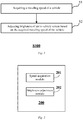
- FIG. 1 is an example flowchart of a brightness adjustment method for an in-vehicle screen according to an implementation of the invention.
- the method S100 comprises the step of: acquiring a traveling speed of a vehicle (step S1).
- a vehicle speed sensor is used to obtain an instantaneous traveling speed of the vehicle.
- the vehicle speed sensor can be of electromagnetic induction type, photoelectric type, variable reluctance type, or Hall type.
- the type and installation location of the vehicle speed sensor are not limited in the application.
- said acquiring a traveling speed of a vehicle comprises acquiring an average traveling speed of the vehicle within a preset time period. For example, an average traveling speed of the vehicle within the first 3 minutes or 5 minutes is acquired.
- the length of the preset time period is not limited in the application.
- the method S100 further comprises the step of: adjusting brightness of the in-vehicle screen based on the acquired traveling speed of the vehicle (step S2).
- said adjusting brightness of the in-vehicle screen based on the acquired traveling speed of the vehicle comprises: determining whether the acquired traveling speed of the vehicle is greater than or equal to a first threshold; and if yes, decreasing the brightness of the in-vehicle screen. For example, it is determined whether the acquired traveling speed of the vehicle is greater than 80 km/h, and if yes, the brightness of the in-vehicle screen is decreased. 80 km/h is only an example, and the speed may be other values, such as 70 km/h, 60 km/h, 50 km/h, and the first threshold is not limited in the application.
- said adjusting brightness of the in-vehicle screen based on the acquired traveling speed of the vehicle further comprises: determining whether the acquired traveling speed of the vehicle is less than a second threshold; and if yes, increasing the brightness of the in-vehicle screen; wherein the second threshold is less than or equal to the first threshold.
- the second threshold is equal to the first threshold. For example, it is determined whether the acquired traveling speed of the vehicle is less than 80 km/h, and if yes, the brightness of the in-vehicle screen is increased. In the case of a single threshold, the adjustment of the screen brightness is more sensitive, that is, the screen brightness will be decreased once the speed is above the threshold, and increased once the speed is below the threshold.
- the second threshold is less than the first threshold. For example, it is determined whether the acquired traveling speed of the vehicle is less than 70 km/h, and if yes, the brightness of the in-vehicle screen is increased. In the case of dual thresholds, the adjustment of the screen brightness will be less sensitive, and frequent adjustment of the screen brightness due to fluctuation of the vehicle speed around a certain threshold is avoided, which improves driving safety and user experience.
- the brightness of the in-vehicle screen is saved before said decreasing the brightness of the in-vehicle screen; and said increasing the brightness of the in-vehicle screen comprises adjusting the brightness of the in-vehicle screen to the saved brightness of the in-vehicle screen.
- the above in-vehicle screen comprises a center console screen and/or a dashboard screen.
- the brightness of the in-vehicle screen can be automatically adjusted according to the speed of the vehicle, thereby facilitating user operations and improving the safety of a user driving the vehicle.
- the brightness of the in-vehicle screen can be adjusted according to the averaged vehicle speed, the frequent adjustment of the screen brightness due to fluctuation of the instantaneous vehicle speed can be smoothed, and driving safety and user experience can be further improved.
- the dual thresholds of the vehicle speed to adjust the brightness of the in-vehicle screen, the frequent adjustment of the screen brightness due to fluctuation of the vehicle speed around a certain threshold can be avoided, and driving safety and user experience can be further improved.
- the manual adjustment by the user is avoided, and driving safety and user experience are improved.
- FIG. 2 is an example block diagram of a brightness adjustment apparatus 200 for an in-vehicle screen according to an implementation of the invention.
- the apparatus comprises: a speed acquisition module 201, configured to acquire a traveling speed of a vehicle; and a brightness adjustment module 202, configured to adjust brightness of the in-vehicle screen based on the acquired traveling speed of the vehicle.
- the brightness adjustment module 202 comprises: a determination submodule, configured to determine whether the acquired traveling speed of the vehicle is greater than or equal to a first threshold; and a brightness adjustment submodule, configured to decrease the brightness of the in-vehicle screen when the determination submodule determines that the acquired traveling speed of the vehicle is greater than or equal to the first threshold.
- the determination submodule is configured to determine whether the acquired traveling speed of the vehicle is greater than 80 km/h; and if yes, the brightness adjustment submodule is configured to decrease the brightness of the in-vehicle screen.
- 80 km/h is only an example, and the speed can be other values, such as 70 km/h, 60 km/h, 50 km/h, and the first threshold is not limited in the application.
- the determination submodule is further configured to determine whether the acquired traveling speed of the vehicle is less than a second threshold; and the brightness adjustment submodule is further configured to increase the brightness of the in-vehicle screen when the determination submodule determines that the acquired traveling speed of the vehicle is less than the second threshold; wherein the second threshold is less than or equal to the first threshold. In an example, the second threshold is equal to the first threshold.
- the determination submodule is further configured to determine whether the acquired traveling speed of the vehicle is less than 80 km/h; and if yes, the brightness adjustment submodule is further configured to increase the brightness of the in-vehicle screen.
- the adjustment of the screen brightness is more sensitive, that is, the screen brightness will be decreased once the speed is above the threshold, and increased once the speed is below the threshold.
- the second threshold is less than the first threshold.
- the determination submodule is further configured to determine whether the acquired traveling speed of the vehicle is less than 70 km/h; and if yes, the brightness adjustment submodule is further configured to increase the brightness of the in-vehicle screen.
- the adjustment of the screen brightness will be less sensitive, and frequent adjustment of the screen brightness due to fluctuation of the vehicle speed around a certain threshold is avoided, which improves driving safety and user experience.
- the brightness adjustment module 202 further comprises a saving submodule configured to save the brightness of the in-vehicle screen before the brightness adjustment submodule decreases the brightness of the in-vehicle screen; and the brightness adjustment submodule is further configured to adjust the brightness of the in-vehicle screen to the saved brightness of the in-vehicle screen when the determination submodule determines that the acquired traveling speed of the vehicle is less than the second threshold.
- the speed acquisition module 201 is used to acquire the instantaneous traveling speed of the vehicle through a vehicle speed sensor.
- the vehicle speed sensor can be of electromagnetic induction type, photoelectric type, variable reluctance type, or Hall type.
- the type of the vehicle speed sensor is not limited in the application.
- the speed acquisition module 201 may be directly a component in the vehicle that has vehicle speed data, such as a VCU, a controller of a vehicle braking system, etc. Any component in the vehicle that can provide speed data can be used as a speed acquisition module herein.
- Other things not submitted here, such as vehicle wheel speed sensors, can also be used to provide the traveling speed of the vehicle.
- the speed acquisition module 201 is configured to acquire an average traveling speed of the vehicle within a preset time period.
- the speed acquisition module 201 is configured to acquire an average traveling speed of the vehicle within the first 3 minutes or 5 minutes.
- the length of the preset time period is not limited in the application.
- the above in-vehicle screen comprises a center console screen and/or a dashboard screen.
- the brightness of the in-vehicle screen can be automatically adjusted according to the speed of the vehicle, thereby facilitating user operations and improving the safety of a user driving the vehicle.
- the brightness of the in-vehicle screen can be adjusted according to the averaged vehicle speed, the frequent adjustment of the screen brightness due to fluctuation of the instantaneous vehicle speed can be smoothed, and driving safety and user experience can be further improved.
- the dual thresholds of the vehicle speed to adjust the brightness of the in-vehicle screen, the frequent adjustment of the screen brightness due to fluctuation of the vehicle speed around a certain threshold can be avoided, and driving safety and user experience can be further improved.
- the manual adjustment by the user is avoided, and driving safety and user experience are improved.
- FIG. 3 shows an example block diagram of a controller according to an implementation of the invention, configured to perform a brightness adjustment method for an in-vehicle screen according to an implementation of the invention.
- the controller 300 comprises a memory 301 and a processor 302.
- the controller 300 further comprises a computer program that is stored on the memory 301 and capable of running on the processor 302. When the program is executed by the processor, for example, the steps, shown in FIG. 1 , of the brightness adjustment method for the in-vehicle screen according to an implementation of the invention are implemented.
- the controller when it is applied to a vehicle, it can communicate with a component used to acquire vehicle speed (such as the vehicle speed sensor mentioned in the above example) and a brightness adjustment component (such as the in-vehicle screen mentioned in the above example).
- vehicle speed such as the vehicle speed sensor mentioned in the above example
- brightness adjustment component such as the in-vehicle screen mentioned in the above example
- the controller may be implemented in an existing infotainment system of the vehicle, or implemented in the vehicle controller, or implemented alone.
- the invention may also be implemented as a recording medium, which stores a program for enabling a computer to perform a brightness adjustment method for an in-vehicle screen according to one implementation of the invention.
- various recording media such as disks (e.g., a magnetic disk, an optical disc, etc.), cards (e.g., a memory card, an optical card, etc.), semiconductor memories (e.g., a ROM, a non-volatile memory, etc.), and tapes (e.g., a magnetic tape, a cassette tape, etc.), can be used as the recording medium.
- disks e.g., a magnetic disk, an optical disc, etc.
- cards e.g., a memory card, an optical card, etc.
- semiconductor memories e.g., a ROM, a non-volatile memory, etc.
- tapes e.g., a magnetic tape, a cassette tape, etc.
- the recording medium is loaded on a computer, the computer reads the computer program recorded in the recording medium and stores same in a memory, and a processor (a central processing unit (CPU) and a micro processing unit (MPU)) provided on the computer reads out and executes the computer program from the memory, whereby the error correction method for speech recognition results in the implementations above can be performed, and functions of the error correction apparatus for speech recognition results in the implementations above can be implemented.
- a processor a central processing unit (CPU) and a micro processing unit (MPU)
Landscapes
- Engineering & Computer Science (AREA)
- Chemical & Material Sciences (AREA)
- Combustion & Propulsion (AREA)
- Transportation (AREA)
- Mechanical Engineering (AREA)
- Theoretical Computer Science (AREA)
- Physics & Mathematics (AREA)
- General Physics & Mathematics (AREA)
- Computer Hardware Design (AREA)
- General Engineering & Computer Science (AREA)
- Human Computer Interaction (AREA)
- Instrument Panels (AREA)
- Controls And Circuits For Display Device (AREA)
- Fittings On The Vehicle Exterior For Carrying Loads, And Devices For Holding Or Mounting Articles (AREA)
Abstract
Description
- The invention relates to the technical field of vehicle control, and to a brightness adjustment method and apparatus for an in-vehicle screen, a controller, and a recording medium.
- With larger screens in automobiles nowadays, content displayed with high brightness and a wide dynamic range will greatly distract users, especially when the users are traveling at medium-high speed, which may easily cause safety hazards. Nowadays, a center console screen and dashboard of a conventional vehicle are of constant brightness that cannot be adjusted automatically, or brightness adjustment usually needs to be made manually by the users, which is very likely to cause safety hazards during traveling.
- The invention is implemented to overcome one or more of the above disadvantages or other disadvantages, and the used technical solutions are as follows:
According to an aspect of the invention, a brightness adjustment method for an in-vehicle screen is provided, comprising: acquiring a traveling speed of a vehicle; and adjusting brightness of the in-vehicle screen based on the acquired traveling speed of the vehicle. - Further, according to an aspect of the invention, said adjusting brightness of the in-vehicle screen based on the acquired traveling speed of the vehicle comprises: determining whether the acquired traveling speed of the vehicle is greater than or equal to a first threshold; and if yes, decreasing the brightness of the in-vehicle screen.
- Further, according to an aspect of the invention, said adjusting brightness of the in-vehicle screen based on the acquired traveling speed of the vehicle further comprises: determining whether the acquired traveling speed of the vehicle is less than a second threshold; and if yes, increasing the brightness of the in-vehicle screen; wherein the second threshold is less than or equal to the first threshold.
- Further, according to an aspect of the invention, said adjusting brightness of the in-vehicle screen based on the acquired traveling speed of the vehicle further comprises: before said decreasing the brightness of the in-vehicle screen, saving the brightness of the in-vehicle screen; and said increasing the brightness of the in-vehicle screen comprises adjusting the brightness of the in-vehicle screen to the saved brightness of the in-vehicle screen.
- Further, according to an aspect of the invention, said acquiring the traveling speed of the vehicle comprises: acquiring an average traveling speed of the vehicle within a preset time period.
- Further, according to an aspect of the invention, the in-vehicle screen comprises a center console screen and/or a dashboard screen.
- According to another aspect of the invention, a brightness adjustment apparatus for an in-vehicle screen is provided, comprising: a speed acquisition module, configured to acquire a traveling speed of a vehicle; and a brightness adjustment module, configured to adjust brightness of the in-vehicle screen based on the acquired traveling speed of the vehicle.
- Further, according to another aspect of the invention, the brightness adjustment module comprises: a determination submodule, configured to determine whether the acquired traveling speed of the vehicle is greater than or equal to a first threshold; and a brightness adjustment submodule, configured to decrease the brightness of the in-vehicle screen when the determination submodule determines that the acquired traveling speed of the vehicle is greater than or equal to the first threshold.
- Further, according to another aspect of the invention, the determination submodule is further configured to determine whether the acquired traveling speed of the vehicle is less than a second threshold; and the brightness adjustment submodule is further configured to increase the brightness of the in-vehicle screen when the determination submodule determines that the acquired traveling speed of the vehicle is less than the second threshold; wherein the second threshold is less than or equal to the first threshold.
- Further, according to another aspect of the invention, the brightness adjustment module further comprises a saving submodule configured to save the brightness of the in-vehicle screen before decreasing the brightness of the in-vehicle screen by the brightness adjustment submodule; and the brightness adjustment submodule is further configured to adjust the brightness of the in-vehicle screen to the saved brightness of the in-vehicle screen when the determination submodule determines that the acquired traveling speed of the vehicle is less than the second threshold.
- Further, according to another aspect of the invention, the speed acquisition module is configured to acquire an average traveling speed of the vehicle within a preset time period.
- Further, according to another aspect of the invention, the in-vehicle screen comprises a center console screen and/or a dashboard screen.
- According to still another aspect of the invention, a controller is provided, which comprises a memory, a processor, and a program stored on the memory and capable of running on the processor, wherein when the program is executed by the processor, the steps of the method according to an aspect of the invention are implemented.
- According to yet another aspect of the invention, a recording medium having a computer program stored thereon is provided, wherein the program is executable by a computer to implement the steps of the method according to an aspect of the invention.
- According to the invention, the brightness of the in-vehicle screen can be automatically adjusted according to the speed of the vehicle, thereby facilitating user operations and improving the safety of a user driving the vehicle.
-
-
FIG. 1 is an example flowchart of a brightness adjustment method for an in-vehicle screen according to an implementation of the invention. -
FIG. 2 is an example block diagram of a brightness adjustment apparatus for an in-vehicle screen according to an implementation of the invention. -
FIG. 3 is an example block diagram of a controller according to an implementation of the invention, configured to perform a brightness adjustment method for an in-vehicle screen according to an implementation of the invention. - The brightness adjustment method and apparatus for an in-vehicle screen, the controller, and the recording medium of the invention will be further described in detail below in conjunction with the accompanying drawings. It should be noted that the following detailed description of embodiments are exemplary rather than limiting, and are intended to provide a basic understanding of the invention, and are not intended to confirm key or decisive elements of the invention or limit the scope of protection.
- The invention is described below with reference to block diagram illustrations, block diagrams and/or flowcharts of the methods and apparatuses in the embodiments of the invention. It will be understood that each block of these flowchart illustrations and/or block diagrams, and combinations of flowchart illustrations and/or block diagrams, can be implemented by computer program instructions. These computer program instructions may be provided for a processor or controller of a general-purpose computer, a dedicated computer, or another programmable data processing device to generate a machine, so that the instructions executed by the processor or controller of the computer or the another programmable data processing device create components for implementing the functions/operations specified in these flowcharts and/or blocks and/or one or more flow block diagrams. In particular, the above processor or controller comprises a vehicle control unit VCU and/or an electronic control unit ECU etc.
- These computer program instructions may be stored in a computer-readable memory that can instruct a computer or another programmable processor to implement the functions in a specific manner, so that the instructions stored in the computer-readable memory generate a manufactured product containing instruction components that implement the functions/operations specified in one or more blocks of the flowchart and/or the block diagram.
- These computer program instructions may be loaded onto the computer or the another programmable data processor, so that a series of operations and steps are performed on the computer or the another programmable processor, thereby generating computer-implemented processes. As such, the instructions executed on the computer or the another programmable data processor provide steps for implementing the functions or operations specified in one or more blocks in the flowchart and/or block diagram. It should also be noted that in some alternative implementations, the functions/operations shown in the blocks may not occur in the order shown in the flowchart. For example, two blocks shown in sequence may actually be executed substantially simultaneously or the blocks may sometimes be executed in a reverse order, depending on the functions/operations involved.
-
FIG. 1 is an example flowchart of a brightness adjustment method for an in-vehicle screen according to an implementation of the invention. As shown inFIG. 1 , the method S100 comprises the step of: acquiring a traveling speed of a vehicle (step S1). - In an example, a vehicle speed sensor is used to obtain an instantaneous traveling speed of the vehicle. The vehicle speed sensor can be of electromagnetic induction type, photoelectric type, variable reluctance type, or Hall type. The type and installation location of the vehicle speed sensor are not limited in the application.
- In an example, said acquiring a traveling speed of a vehicle comprises acquiring an average traveling speed of the vehicle within a preset time period. For example, an average traveling speed of the vehicle within the first 3 minutes or 5 minutes is acquired. The length of the preset time period is not limited in the application.
- As shown in
FIG. 1 , the method S100 further comprises the step of: adjusting brightness of the in-vehicle screen based on the acquired traveling speed of the vehicle (step S2). - In an example, said adjusting brightness of the in-vehicle screen based on the acquired traveling speed of the vehicle comprises: determining whether the acquired traveling speed of the vehicle is greater than or equal to a first threshold; and if yes, decreasing the brightness of the in-vehicle screen. For example, it is determined whether the acquired traveling speed of the vehicle is greater than 80 km/h, and if yes, the brightness of the in-vehicle screen is decreased. 80 km/h is only an example, and the speed may be other values, such as 70 km/h, 60 km/h, 50 km/h, and the first threshold is not limited in the application.
- In an example, said adjusting brightness of the in-vehicle screen based on the acquired traveling speed of the vehicle further comprises: determining whether the acquired traveling speed of the vehicle is less than a second threshold; and if yes, increasing the brightness of the in-vehicle screen; wherein the second threshold is less than or equal to the first threshold. In an example, the second threshold is equal to the first threshold. For example, it is determined whether the acquired traveling speed of the vehicle is less than 80 km/h, and if yes, the brightness of the in-vehicle screen is increased. In the case of a single threshold, the adjustment of the screen brightness is more sensitive, that is, the screen brightness will be decreased once the speed is above the threshold, and increased once the speed is below the threshold. In another example, the second threshold is less than the first threshold. For example, it is determined whether the acquired traveling speed of the vehicle is less than 70 km/h, and if yes, the brightness of the in-vehicle screen is increased. In the case of dual thresholds, the adjustment of the screen brightness will be less sensitive, and frequent adjustment of the screen brightness due to fluctuation of the vehicle speed around a certain threshold is avoided, which improves driving safety and user experience.
- In an example, before said decreasing the brightness of the in-vehicle screen, the brightness of the in-vehicle screen is saved; and said increasing the brightness of the in-vehicle screen comprises adjusting the brightness of the in-vehicle screen to the saved brightness of the in-vehicle screen. By saving the original screen brightness and adjusting the screen brightness back to the original screen brightness when the traveling speed drops below the second threshold, manual adjustment by the user is avoided, and driving safety and user experience are improved.
- The above in-vehicle screen comprises a center console screen and/or a dashboard screen.
- According to the invention, the brightness of the in-vehicle screen can be automatically adjusted according to the speed of the vehicle, thereby facilitating user operations and improving the safety of a user driving the vehicle. By adjusting the brightness of the in-vehicle screen according to the averaged vehicle speed, the frequent adjustment of the screen brightness due to fluctuation of the instantaneous vehicle speed can be smoothed, and driving safety and user experience can be further improved. By using the dual thresholds of the vehicle speed to adjust the brightness of the in-vehicle screen, the frequent adjustment of the screen brightness due to fluctuation of the vehicle speed around a certain threshold can be avoided, and driving safety and user experience can be further improved. By saving the original screen brightness and adjusting the screen brightness back to the original screen brightness when the traveling speed drops below the second threshold, the manual adjustment by the user is avoided, and driving safety and user experience are improved.
-
FIG. 2 is an example block diagram of abrightness adjustment apparatus 200 for an in-vehicle screen according to an implementation of the invention. As shown inFIG. 2 , the apparatus comprises: aspeed acquisition module 201, configured to acquire a traveling speed of a vehicle; and abrightness adjustment module 202, configured to adjust brightness of the in-vehicle screen based on the acquired traveling speed of the vehicle. - In an example, the
brightness adjustment module 202 comprises: a determination submodule, configured to determine whether the acquired traveling speed of the vehicle is greater than or equal to a first threshold; and a brightness adjustment submodule, configured to decrease the brightness of the in-vehicle screen when the determination submodule determines that the acquired traveling speed of the vehicle is greater than or equal to the first threshold. For example, the determination submodule is configured to determine whether the acquired traveling speed of the vehicle is greater than 80 km/h; and if yes, the brightness adjustment submodule is configured to decrease the brightness of the in-vehicle screen. 80 km/h is only an example, and the speed can be other values, such as 70 km/h, 60 km/h, 50 km/h, and the first threshold is not limited in the application. - In an example, the determination submodule is further configured to determine whether the acquired traveling speed of the vehicle is less than a second threshold; and the brightness adjustment submodule is further configured to increase the brightness of the in-vehicle screen when the determination submodule determines that the acquired traveling speed of the vehicle is less than the second threshold; wherein the second threshold is less than or equal to the first threshold. In an example, the second threshold is equal to the first threshold. For example, the determination submodule is further configured to determine whether the acquired traveling speed of the vehicle is less than 80 km/h; and if yes, the brightness adjustment submodule is further configured to increase the brightness of the in-vehicle screen. In the case of a single threshold, the adjustment of the screen brightness is more sensitive, that is, the screen brightness will be decreased once the speed is above the threshold, and increased once the speed is below the threshold. In another example, the second threshold is less than the first threshold. For example, the determination submodule is further configured to determine whether the acquired traveling speed of the vehicle is less than 70 km/h; and if yes, the brightness adjustment submodule is further configured to increase the brightness of the in-vehicle screen. In the case of dual thresholds, the adjustment of the screen brightness will be less sensitive, and frequent adjustment of the screen brightness due to fluctuation of the vehicle speed around a certain threshold is avoided, which improves driving safety and user experience.
- In an example, the
brightness adjustment module 202 further comprises a saving submodule configured to save the brightness of the in-vehicle screen before the brightness adjustment submodule decreases the brightness of the in-vehicle screen; and the brightness adjustment submodule is further configured to adjust the brightness of the in-vehicle screen to the saved brightness of the in-vehicle screen when the determination submodule determines that the acquired traveling speed of the vehicle is less than the second threshold. By saving the original screen brightness and adjusting the screen brightness back to the original screen brightness when the traveling speed drops below the second threshold, manual adjustment by the user is avoided, and driving safety and user experience are improved. - In an example, the
speed acquisition module 201 is used to acquire the instantaneous traveling speed of the vehicle through a vehicle speed sensor. The vehicle speed sensor can be of electromagnetic induction type, photoelectric type, variable reluctance type, or Hall type. The type of the vehicle speed sensor is not limited in the application. Alternatively, thespeed acquisition module 201 may be directly a component in the vehicle that has vehicle speed data, such as a VCU, a controller of a vehicle braking system, etc. Any component in the vehicle that can provide speed data can be used as a speed acquisition module herein. Other things not submitted here, such as vehicle wheel speed sensors, can also be used to provide the traveling speed of the vehicle. - In an example, the
speed acquisition module 201 is configured to acquire an average traveling speed of the vehicle within a preset time period. For example, thespeed acquisition module 201 is configured to acquire an average traveling speed of the vehicle within the first 3 minutes or 5 minutes. The length of the preset time period is not limited in the application. - The above in-vehicle screen comprises a center console screen and/or a dashboard screen.
- According to the invention, the brightness of the in-vehicle screen can be automatically adjusted according to the speed of the vehicle, thereby facilitating user operations and improving the safety of a user driving the vehicle. By adjusting the brightness of the in-vehicle screen according to the averaged vehicle speed, the frequent adjustment of the screen brightness due to fluctuation of the instantaneous vehicle speed can be smoothed, and driving safety and user experience can be further improved. By using the dual thresholds of the vehicle speed to adjust the brightness of the in-vehicle screen, the frequent adjustment of the screen brightness due to fluctuation of the vehicle speed around a certain threshold can be avoided, and driving safety and user experience can be further improved. By saving the original screen brightness and adjusting the screen brightness back to the original screen brightness when the traveling speed drops below the second threshold, the manual adjustment by the user is avoided, and driving safety and user experience are improved.
-
FIG. 3 shows an example block diagram of a controller according to an implementation of the invention, configured to perform a brightness adjustment method for an in-vehicle screen according to an implementation of the invention. As shown inFIG. 3 , thecontroller 300 comprises amemory 301 and aprocessor 302. Although not shown, thecontroller 300 further comprises a computer program that is stored on thememory 301 and capable of running on theprocessor 302. When the program is executed by the processor, for example, the steps, shown inFIG. 1 , of the brightness adjustment method for the in-vehicle screen according to an implementation of the invention are implemented. It should be understood that, according to the controller provided in the application, when it is applied to a vehicle, it can communicate with a component used to acquire vehicle speed (such as the vehicle speed sensor mentioned in the above example) and a brightness adjustment component (such as the in-vehicle screen mentioned in the above example). In addition, the controller may be implemented in an existing infotainment system of the vehicle, or implemented in the vehicle controller, or implemented alone. - In addition, as described above, the invention may also be implemented as a recording medium, which stores a program for enabling a computer to perform a brightness adjustment method for an in-vehicle screen according to one implementation of the invention.
- Here, various recording media, such as disks (e.g., a magnetic disk, an optical disc, etc.), cards (e.g., a memory card, an optical card, etc.), semiconductor memories (e.g., a ROM, a non-volatile memory, etc.), and tapes (e.g., a magnetic tape, a cassette tape, etc.), can be used as the recording medium.
- By recording, in these recording media, a computer program that enables a computer to perform the error correction method for speech recognition results in the implementations above or a computer program that enables a computer to implement functions of the error correction apparatus for speech recognition results in the implementations above and circulating the computer program, costs are reduced, and portability and versatility are improved.
- Furthermore, the recording medium is loaded on a computer, the computer reads the computer program recorded in the recording medium and stores same in a memory, and a processor (a central processing unit (CPU) and a micro processing unit (MPU)) provided on the computer reads out and executes the computer program from the memory, whereby the error correction method for speech recognition results in the implementations above can be performed, and functions of the error correction apparatus for speech recognition results in the implementations above can be implemented.
- Those of ordinary skill in the art should understand that the invention is not limited to the implementations above, and the invention can be implemented in many other forms without departing from the essence and scope thereof. Therefore, the presented examples and implementations are regarded to be schematic rather than restrictive, and without departing from the spirit and scope of the invention that are defined by the appended claims, the invention may cover various changes and replacements.
Claims (14)
- A brightness adjustment method for an in-vehicle screen, comprising:acquiring a traveling speed of a vehicle; andadjusting brightness of the in-vehicle screen based on the acquired traveling speed of the vehicle.
- The brightness adjustment method for the in-vehicle screen according to claim 1, wherein
said adjusting brightness of the in-vehicle screen based on the acquired traveling speed of the vehicle comprises:determining whether the acquired traveling speed of the vehicle is greater than or equal to a first threshold; andif yes, decreasing the brightness of the in-vehicle screen. - The brightness adjustment method for the in-vehicle screen according to claim 2, wherein
said adjusting brightness of the in-vehicle screen based on the acquired traveling speed of the vehicle further comprises:determining whether the acquired traveling speed of the vehicle is less than a second threshold; andif yes, increasing the brightness of the in-vehicle screen;wherein the second threshold is less than or equal to the first threshold. - The brightness adjustment method for the in-vehicle screen according to claim 3, wherein
before said decreasing the brightness of the in-vehicle screen, the brightness of the in-vehicle screen is saved; and
said increasing the brightness of the in-vehicle screen comprises adjusting the brightness of the in-vehicle screen to the saved brightness of the in-vehicle screen. - The brightness adjustment method for the in-vehicle screen according to any one of claims 1 to 4, wherein
said acquiring the traveling speed of the vehicle comprises:
acquiring an average traveling speed of the vehicle within a preset time period. - The brightness adjustment method for the in-vehicle screen according to any one of claims 1 to 4, wherein
the in-vehicle screen comprises a center console screen and/or a dashboard screen. - A brightness adjustment apparatus for an in-vehicle screen, comprising:a speed acquisition module, configured to acquire a traveling speed of a vehicle; anda brightness adjustment module, configured to adjust brightness of the in-vehicle screen based on the acquired traveling speed of the vehicle.
- The brightness adjustment apparatus for the in-vehicle screen according to claim 7, wherein
the brightness adjustment module comprises:a determination submodule, configured to determine whether the acquired traveling speed of the vehicle is greater than or equal to a first threshold; anda brightness adjustment submodule, configured to decrease the brightness of the in-vehicle screen when the determination submodule determines that the acquired traveling speed of the vehicle is greater than or equal to the first threshold. - The brightness adjustment apparatus for the in-vehicle screen according to claim 8, wherein
the determination submodule is further configured to determine whether the acquired traveling speed of the vehicle is less than a second threshold; and
the brightness adjustment submodule is further configured to increase the brightness of the in-vehicle screen when the determination submodule determines that the acquired traveling speed of the vehicle is less than the second threshold;
wherein the second threshold is less than or equal to the first threshold. - The brightness adjustment apparatus for the in-vehicle screen according to claim 9, wherein
the brightness adjustment module further comprises a saving submodule, configured to save the brightness of the in-vehicle screen before the brightness adjustment submodule decreases the brightness of the in-vehicle screen; and
the brightness adjustment submodule is further configured to adjust the brightness of the in-vehicle screen to the saved brightness of the in-vehicle screen when the determination submodule determines that the acquired traveling speed of the vehicle is less than the second threshold. - The brightness adjustment apparatus for the in-vehicle screen according to any one of claims 7 to 10, wherein
the speed acquisition module is configured to acquire an average traveling speed of the vehicle within a preset time period. - The brightness adjustment apparatus for the in-vehicle screen according to any one of claims 7 to 10, wherein
the in-vehicle screen comprises a center console screen and/or a dashboard screen. - A controller, comprising a memory, a processor, and a program stored on the memory and capable of running on the processor, wherein when the program is executed by the processor, the steps of the method according to any one of claims 1 to 6 are implemented.
- A recording medium having a computer program stored thereon, wherein the program is executable by a computer to implement the steps of the method according to any one of claims 1 to 6.
Applications Claiming Priority (2)
| Application Number | Priority Date | Filing Date | Title |
|---|---|---|---|
| CN201810719316.4A CN108962188A (en) | 2018-07-03 | 2018-07-03 | Vehicle-mounted screen brightness adjusting method and device, controller and recording medium |
| PCT/CN2019/094552 WO2020007319A1 (en) | 2018-07-03 | 2019-07-03 | Method and device for adjusting brightness of vehicle-mounted screen, and controller and recording medium |
Publications (2)
| Publication Number | Publication Date |
|---|---|
| EP3819901A1 true EP3819901A1 (en) | 2021-05-12 |
| EP3819901A4 EP3819901A4 (en) | 2022-03-23 |
Family
ID=64485217
Family Applications (1)
| Application Number | Title | Priority Date | Filing Date |
|---|---|---|---|
| EP19831503.8A Withdrawn EP3819901A4 (en) | 2018-07-03 | 2019-07-03 | METHOD AND DEVICE FOR VEHICLE-MOUNTED SCREEN BRIGHTNESS ADJUSTMENT AND CONTROL DEVICE AND RECORDING MEDIA |
Country Status (3)
| Country | Link |
|---|---|
| EP (1) | EP3819901A4 (en) |
| CN (1) | CN108962188A (en) |
| WO (1) | WO2020007319A1 (en) |
Families Citing this family (6)
| Publication number | Priority date | Publication date | Assignee | Title |
|---|---|---|---|---|
| CN108962188A (en) * | 2018-07-03 | 2018-12-07 | 蔚来汽车有限公司 | Vehicle-mounted screen brightness adjusting method and device, controller and recording medium |
| CN110599982A (en) * | 2019-09-19 | 2019-12-20 | 广州小鹏汽车科技有限公司 | Screen brightness adjusting method and system of vehicle-mounted terminal, vehicle-mounted terminal and vehicle |
| CN111179880A (en) * | 2019-12-26 | 2020-05-19 | 恒大新能源汽车科技(广东)有限公司 | Brightness adjusting method and device of display screen, electronic equipment and system |
| CN115705830B (en) * | 2021-08-05 | 2024-10-11 | 亿咖通(湖北)技术有限公司 | Screen brightness adjustment method, device, system and electronic equipment |
| CN115489311B (en) * | 2022-09-27 | 2024-07-09 | 智己汽车科技有限公司 | Vehicle-mounted screen brightness adjusting method and device |
| CN116750002B (en) * | 2023-04-19 | 2024-05-10 | 深圳市中海光电科技有限公司 | Method for selecting items based on vehicle-mounted touch screen |
Family Cites Families (9)
| Publication number | Priority date | Publication date | Assignee | Title |
|---|---|---|---|---|
| JP2004058828A (en) * | 2002-07-29 | 2004-02-26 | Denso Corp | Vehicle front display system |
| JP4309707B2 (en) * | 2003-06-26 | 2009-08-05 | パナソニック株式会社 | In-vehicle display device |
| CN101046508A (en) * | 2006-03-31 | 2007-10-03 | 上海乐金广电电子有限公司 | LCD brightness controlling method for navigation system |
| CN103578448A (en) * | 2012-07-24 | 2014-02-12 | 上海博泰悦臻电子设备制造有限公司 | Method and device for adjusting screen brightness of vehicle-mounted device |
| US9161411B1 (en) * | 2014-05-09 | 2015-10-13 | Continental Automotive Systems, Inc. | LED driver for vehicle display illumination |
| CN105513564A (en) * | 2016-01-08 | 2016-04-20 | 北京乐驾科技有限公司 | Automatic regulation method and system of luminance in car |
| CN107102442B (en) * | 2017-06-23 | 2020-04-07 | 江苏泽景汽车电子股份有限公司 | Adjusting method of automatic brightness adjusting device of HUD |
| CN107610674A (en) * | 2017-08-25 | 2018-01-19 | 维沃移动通信有限公司 | Screen brightness adjustment method and mobile terminal during navigation |
| CN108962188A (en) * | 2018-07-03 | 2018-12-07 | 蔚来汽车有限公司 | Vehicle-mounted screen brightness adjusting method and device, controller and recording medium |
-
2018
- 2018-07-03 CN CN201810719316.4A patent/CN108962188A/en not_active Withdrawn
-
2019
- 2019-07-03 EP EP19831503.8A patent/EP3819901A4/en not_active Withdrawn
- 2019-07-03 WO PCT/CN2019/094552 patent/WO2020007319A1/en not_active Ceased
Also Published As
| Publication number | Publication date |
|---|---|
| EP3819901A4 (en) | 2022-03-23 |
| WO2020007319A1 (en) | 2020-01-09 |
| CN108962188A (en) | 2018-12-07 |
Similar Documents
| Publication | Publication Date | Title |
|---|---|---|
| EP3819901A1 (en) | Method and device for adjusting brightness of vehicle-mounted screen, and controller and recording medium | |
| US10793010B2 (en) | Control method and control system for motor-driven vehicle | |
| US8165768B2 (en) | Method for determining trailer braking output | |
| CN111923930B (en) | Man-machine common driving mode switching method, device, storage medium and system | |
| US8862311B2 (en) | System and method for measuring inclination of vehicle | |
| JP2016119036A (en) | Mirroring dongle with mirroring data analysis function and mirroring data control method | |
| JP2006340323A (en) | Noise-sensitive volume controller and noise-sensitive volume control method | |
| US20150268842A1 (en) | Method for configuring dynamic user interface of head unit of vehicle by using mobile terminal, and head unit and computer-readable recoding media using the same | |
| US20170355355A1 (en) | Lane keeping control method for vehicle | |
| JPH04231254A (en) | Circuit for traction sliding control of automobile | |
| CN116766959B (en) | Vehicle torque zero crossing control method, device, equipment and storage medium | |
| KR20220103431A (en) | Torque compensating apparatus and method | |
| CN111959504A (en) | Device for controlling automatic driving of a vehicle, system including the device and method thereof | |
| CN117657141A (en) | Vehicle driving adjustment method, device, electronic equipment and storage medium | |
| CN115991178B (en) | AEB control method, device and equipment suitable for different road conditions | |
| JP7246509B2 (en) | Vehicle anti-lock braking system controller | |
| CN115123164B (en) | Anti-lock braking control method, device, electronic equipment, and storage medium | |
| CN113352901A (en) | Energy recovery torque control method and device and automobile | |
| CN112849123A (en) | Method and apparatus for controlling vehicle torque | |
| CN117985018A (en) | Road smoothness detection method and device, computer equipment and storage medium | |
| US11643087B2 (en) | Vehicle and method of controlling the same | |
| CN106585601B (en) | A kind of electronic parking method and device | |
| CN109664845B (en) | Vehicle-mounted software control method and device and vehicle | |
| CN111252068B (en) | Control method and device for electric vehicle and electric vehicle | |
| US20150291138A1 (en) | Increased vehicle braking gradient |
Legal Events
| Date | Code | Title | Description |
|---|---|---|---|
| STAA | Information on the status of an ep patent application or granted ep patent |
Free format text: STATUS: THE INTERNATIONAL PUBLICATION HAS BEEN MADE |
|
| PUAI | Public reference made under article 153(3) epc to a published international application that has entered the european phase |
Free format text: ORIGINAL CODE: 0009012 |
|
| STAA | Information on the status of an ep patent application or granted ep patent |
Free format text: STATUS: REQUEST FOR EXAMINATION WAS MADE |
|
| 17P | Request for examination filed |
Effective date: 20210203 |
|
| AK | Designated contracting states |
Kind code of ref document: A1 Designated state(s): AL AT BE BG CH CY CZ DE DK EE ES FI FR GB GR HR HU IE IS IT LI LT LU LV MC MK MT NL NO PL PT RO RS SE SI SK SM TR |
|
| DAV | Request for validation of the european patent (deleted) | ||
| DAX | Request for extension of the european patent (deleted) | ||
| A4 | Supplementary search report drawn up and despatched |
Effective date: 20220217 |
|
| RIC1 | Information provided on ipc code assigned before grant |
Ipc: B60K 35/00 20060101ALI20220211BHEP Ipc: G06F 3/147 20060101ALI20220211BHEP Ipc: G09G 5/10 20060101AFI20220211BHEP |
|
| STAA | Information on the status of an ep patent application or granted ep patent |
Free format text: STATUS: EXAMINATION IS IN PROGRESS |
|
| 17Q | First examination report despatched |
Effective date: 20231109 |
|
| STAA | Information on the status of an ep patent application or granted ep patent |
Free format text: STATUS: THE APPLICATION IS DEEMED TO BE WITHDRAWN |
|
| 18D | Application deemed to be withdrawn |
Effective date: 20250805 |