EP3819295A1 - Stereoselective synthesis of enantiomerically-enriched pantolactone - Google Patents
Stereoselective synthesis of enantiomerically-enriched pantolactone Download PDFInfo
- Publication number
- EP3819295A1 EP3819295A1 EP19207602.4A EP19207602A EP3819295A1 EP 3819295 A1 EP3819295 A1 EP 3819295A1 EP 19207602 A EP19207602 A EP 19207602A EP 3819295 A1 EP3819295 A1 EP 3819295A1
- Authority
- EP
- European Patent Office
- Prior art keywords
- formula
- substituted
- compound
- catalyst
- process according
- Prior art date
- Legal status (The legal status is an assumption and is not a legal conclusion. Google has not performed a legal analysis and makes no representation as to the accuracy of the status listed.)
- Withdrawn
Links
- SERHXTVXHNVDKA-UHFFFAOYSA-N pantolactone Chemical compound CC1(C)COC(=O)C1O SERHXTVXHNVDKA-UHFFFAOYSA-N 0.000 title abstract description 22
- 238000003786 synthesis reaction Methods 0.000 title abstract description 9
- 229940115458 pantolactone Drugs 0.000 title abstract description 8
- SIEVQTNTRMBCHO-UHFFFAOYSA-N pantolactone Natural products CC1(C)OC(=O)CC1O SIEVQTNTRMBCHO-UHFFFAOYSA-N 0.000 title abstract description 8
- 230000015572 biosynthetic process Effects 0.000 title abstract description 7
- 230000000707 stereoselective effect Effects 0.000 title abstract description 4
- 239000003054 catalyst Substances 0.000 claims description 41
- 150000001875 compounds Chemical class 0.000 claims description 32
- 238000000034 method Methods 0.000 claims description 27
- 125000003831 tetrazolyl group Chemical group 0.000 claims description 24
- 229910052741 iridium Inorganic materials 0.000 claims description 21
- GKOZUEZYRPOHIO-UHFFFAOYSA-N iridium atom Chemical compound [Ir] GKOZUEZYRPOHIO-UHFFFAOYSA-N 0.000 claims description 21
- 230000008569 process Effects 0.000 claims description 20
- 238000006243 chemical reaction Methods 0.000 claims description 19
- YMWUJEATGCHHMB-UHFFFAOYSA-N Dichloromethane Chemical compound ClCCl YMWUJEATGCHHMB-UHFFFAOYSA-N 0.000 claims description 16
- 239000011541 reaction mixture Substances 0.000 claims description 10
- 125000004178 (C1-C4) alkyl group Chemical group 0.000 claims description 8
- 125000000217 alkyl group Chemical group 0.000 claims description 8
- 125000003118 aryl group Chemical group 0.000 claims description 8
- XLYOFNOQVPJJNP-UHFFFAOYSA-N water Substances O XLYOFNOQVPJJNP-UHFFFAOYSA-N 0.000 claims description 8
- 238000009901 transfer hydrogenation reaction Methods 0.000 claims description 7
- RWRDLPDLKQPQOW-UHFFFAOYSA-N Pyrrolidine Chemical group C1CCNC1 RWRDLPDLKQPQOW-UHFFFAOYSA-N 0.000 claims description 6
- 239000003446 ligand Substances 0.000 claims description 6
- 238000004519 manufacturing process Methods 0.000 claims description 6
- 239000007858 starting material Substances 0.000 claims description 6
- 150000003839 salts Chemical class 0.000 claims description 5
- 239000002904 solvent Substances 0.000 claims description 5
- HEDRZPFGACZZDS-UHFFFAOYSA-N Chloroform Chemical compound ClC(Cl)Cl HEDRZPFGACZZDS-UHFFFAOYSA-N 0.000 claims description 4
- 239000000852 hydrogen donor Substances 0.000 claims description 4
- 125000000008 (C1-C10) alkyl group Chemical group 0.000 claims description 3
- 150000001298 alcohols Chemical class 0.000 claims description 2
- 150000001408 amides Chemical class 0.000 claims description 2
- 150000002148 esters Chemical class 0.000 claims description 2
- 150000002170 ethers Chemical class 0.000 claims description 2
- 150000008282 halocarbons Chemical class 0.000 claims description 2
- 229930195733 hydrocarbon Natural products 0.000 claims description 2
- 150000002430 hydrocarbons Chemical class 0.000 claims description 2
- SERHXTVXHNVDKA-BYPYZUCNSA-N (R)-pantolactone Chemical compound CC1(C)COC(=O)[C@@H]1O SERHXTVXHNVDKA-BYPYZUCNSA-N 0.000 description 14
- 229940115459 (r)- pantolactone Drugs 0.000 description 14
- GHOKWGTUZJEAQD-UHFFFAOYSA-N Chick antidermatitis factor Natural products OCC(C)(C)C(O)C(=O)NCCC(O)=O GHOKWGTUZJEAQD-UHFFFAOYSA-N 0.000 description 13
- 239000000203 mixture Substances 0.000 description 13
- GHOKWGTUZJEAQD-ZETCQYMHSA-N (D)-(+)-Pantothenic acid Chemical compound OCC(C)(C)[C@@H](O)C(=O)NCCC(O)=O GHOKWGTUZJEAQD-ZETCQYMHSA-N 0.000 description 12
- YXFVVABEGXRONW-UHFFFAOYSA-N Toluene Chemical compound CC1=CC=CC=C1 YXFVVABEGXRONW-UHFFFAOYSA-N 0.000 description 12
- DKGAVHZHDRPRBM-UHFFFAOYSA-N Tert-Butanol Chemical compound CC(C)(C)O DKGAVHZHDRPRBM-UHFFFAOYSA-N 0.000 description 10
- OKKJLVBELUTLKV-UHFFFAOYSA-N Methanol Chemical compound OC OKKJLVBELUTLKV-UHFFFAOYSA-N 0.000 description 9
- SERHXTVXHNVDKA-SCSAIBSYSA-N (3s)-3-hydroxy-4,4-dimethyloxolan-2-one Chemical compound CC1(C)COC(=O)[C@H]1O SERHXTVXHNVDKA-SCSAIBSYSA-N 0.000 description 8
- FAPWYRCQGJNNSJ-UBKPKTQASA-L calcium D-pantothenic acid Chemical compound [Ca+2].OCC(C)(C)[C@@H](O)C(=O)NCCC([O-])=O.OCC(C)(C)[C@@H](O)C(=O)NCCC([O-])=O FAPWYRCQGJNNSJ-UBKPKTQASA-L 0.000 description 8
- 229960002079 calcium pantothenate Drugs 0.000 description 8
- 229930003571 Vitamin B5 Natural products 0.000 description 7
- 239000000243 solution Substances 0.000 description 7
- 239000011675 vitamin B5 Substances 0.000 description 7
- 235000009492 vitamin B5 Nutrition 0.000 description 7
- XKRFYHLGVUSROY-UHFFFAOYSA-N Argon Chemical compound [Ar] XKRFYHLGVUSROY-UHFFFAOYSA-N 0.000 description 6
- XEKOWRVHYACXOJ-UHFFFAOYSA-N Ethyl acetate Chemical compound CCOC(C)=O XEKOWRVHYACXOJ-UHFFFAOYSA-N 0.000 description 6
- 229910021640 Iridium dichloride Inorganic materials 0.000 description 6
- ZMANZCXQSJIPKH-UHFFFAOYSA-N Triethylamine Chemical compound CCN(CC)CC ZMANZCXQSJIPKH-UHFFFAOYSA-N 0.000 description 6
- 235000019161 pantothenic acid Nutrition 0.000 description 6
- 239000011713 pantothenic acid Substances 0.000 description 6
- 229940055726 pantothenic acid Drugs 0.000 description 6
- TYEYBOSBBBHJIV-UHFFFAOYSA-M 2-oxobutanoate Chemical compound CCC(=O)C([O-])=O TYEYBOSBBBHJIV-UHFFFAOYSA-M 0.000 description 4
- AMIMRNSIRUDHCM-UHFFFAOYSA-N Isopropylaldehyde Chemical compound CC(C)C=O AMIMRNSIRUDHCM-UHFFFAOYSA-N 0.000 description 4
- KDLHZDBZIXYQEI-UHFFFAOYSA-N Palladium Chemical compound [Pd] KDLHZDBZIXYQEI-UHFFFAOYSA-N 0.000 description 4
- JHSNQMQCFPZPGU-LURJTMIESA-N ethyl (2r)-2-hydroxy-3,3-dimethyl-4-oxobutanoate Chemical compound CCOC(=O)[C@H](O)C(C)(C)C=O JHSNQMQCFPZPGU-LURJTMIESA-N 0.000 description 4
- TYAJZKRIMNQVHA-ZCFIWIBFSA-N (2r)-n-(2-hydroxyethyl)pyrrolidine-2-carboxamide Chemical compound OCCNC(=O)[C@H]1CCCN1 TYAJZKRIMNQVHA-ZCFIWIBFSA-N 0.000 description 3
- LAXRNWSASWOFOT-UHFFFAOYSA-J (cymene)ruthenium dichloride dimer Chemical compound [Cl-].[Cl-].[Cl-].[Cl-].[Ru+2].[Ru+2].CC(C)C1=CC=C(C)C=C1.CC(C)C1=CC=C(C)C=C1 LAXRNWSASWOFOT-UHFFFAOYSA-J 0.000 description 3
- HBAQYPYDRFILMT-UHFFFAOYSA-N 8-[3-(1-cyclopropylpyrazol-4-yl)-1H-pyrazolo[4,3-d]pyrimidin-5-yl]-3-methyl-3,8-diazabicyclo[3.2.1]octan-2-one Chemical class C1(CC1)N1N=CC(=C1)C1=NNC2=C1N=C(N=C2)N1C2C(N(CC1CC2)C)=O HBAQYPYDRFILMT-UHFFFAOYSA-N 0.000 description 3
- LFQSCWFLJHTTHZ-UHFFFAOYSA-N Ethanol Chemical compound CCO LFQSCWFLJHTTHZ-UHFFFAOYSA-N 0.000 description 3
- 239000007832 Na2SO4 Substances 0.000 description 3
- PMZURENOXWZQFD-UHFFFAOYSA-L Sodium Sulfate Chemical compound [Na+].[Na+].[O-]S([O-])(=O)=O PMZURENOXWZQFD-UHFFFAOYSA-L 0.000 description 3
- 239000004280 Sodium formate Substances 0.000 description 3
- 229910052786 argon Inorganic materials 0.000 description 3
- 238000004440 column chromatography Methods 0.000 description 3
- 239000001257 hydrogen Substances 0.000 description 3
- 229910052739 hydrogen Inorganic materials 0.000 description 3
- 239000012074 organic phase Substances 0.000 description 3
- 239000002243 precursor Substances 0.000 description 3
- HLBBKKJFGFRGMU-UHFFFAOYSA-M sodium formate Chemical compound [Na+].[O-]C=O HLBBKKJFGFRGMU-UHFFFAOYSA-M 0.000 description 3
- 235000019254 sodium formate Nutrition 0.000 description 3
- 229910052938 sodium sulfate Inorganic materials 0.000 description 3
- 229910052723 transition metal Inorganic materials 0.000 description 3
- JXGVXCZADZNAMJ-LLVKDONJSA-N (2r)-1-phenylmethoxycarbonylpyrrolidine-2-carboxylic acid Chemical compound OC(=O)[C@H]1CCCN1C(=O)OCC1=CC=CC=C1 JXGVXCZADZNAMJ-LLVKDONJSA-N 0.000 description 2
- HZAXFHJVJLSVMW-UHFFFAOYSA-N 2-Aminoethan-1-ol Chemical compound NCCO HZAXFHJVJLSVMW-UHFFFAOYSA-N 0.000 description 2
- YOETUEMZNOLGDB-UHFFFAOYSA-N 2-methylpropyl carbonochloridate Chemical compound CC(C)COC(Cl)=O YOETUEMZNOLGDB-UHFFFAOYSA-N 0.000 description 2
- MGTZNGICWXYDPR-ZJWHSJSFSA-N 3-[[(2r)-2-[[(2s)-2-(azepane-1-carbonylamino)-4-methylpentanoyl]amino]-3-(1h-indol-3-yl)propanoyl]amino]butanoic acid Chemical compound N([C@@H](CC(C)C)C(=O)N[C@H](CC=1C2=CC=CC=C2NC=1)C(=O)NC(C)CC(O)=O)C(=O)N1CCCCCC1 MGTZNGICWXYDPR-ZJWHSJSFSA-N 0.000 description 2
- XDTMQSROBMDMFD-UHFFFAOYSA-N Cyclohexane Chemical compound C1CCCCC1 XDTMQSROBMDMFD-UHFFFAOYSA-N 0.000 description 2
- UFHFLCQGNIYNRP-UHFFFAOYSA-N Hydrogen Chemical compound [H][H] UFHFLCQGNIYNRP-UHFFFAOYSA-N 0.000 description 2
- UIIMBOGNXHQVGW-UHFFFAOYSA-M Sodium bicarbonate Chemical compound [Na+].OC([O-])=O UIIMBOGNXHQVGW-UHFFFAOYSA-M 0.000 description 2
- HEDRZPFGACZZDS-MICDWDOJSA-N Trichloro(2H)methane Chemical compound [2H]C(Cl)(Cl)Cl HEDRZPFGACZZDS-MICDWDOJSA-N 0.000 description 2
- 238000002306 biochemical method Methods 0.000 description 2
- 230000003287 optical effect Effects 0.000 description 2
- 239000000126 substance Substances 0.000 description 2
- -1 transition metal salt Chemical class 0.000 description 2
- 229940088594 vitamin Drugs 0.000 description 2
- 229930003231 vitamin Natural products 0.000 description 2
- 235000013343 vitamin Nutrition 0.000 description 2
- 239000011782 vitamin Substances 0.000 description 2
- JXGVXCZADZNAMJ-NSHDSACASA-N (2s)-1-phenylmethoxycarbonylpyrrolidine-2-carboxylic acid Chemical compound OC(=O)[C@@H]1CCCN1C(=O)OCC1=CC=CC=C1 JXGVXCZADZNAMJ-NSHDSACASA-N 0.000 description 1
- 238000005160 1H NMR spectroscopy Methods 0.000 description 1
- 241000251468 Actinopterygii Species 0.000 description 1
- 235000001674 Agaricus brunnescens Nutrition 0.000 description 1
- NLXLAEXVIDQMFP-UHFFFAOYSA-N Ammonia chloride Chemical compound [NH4+].[Cl-] NLXLAEXVIDQMFP-UHFFFAOYSA-N 0.000 description 1
- 244000105624 Arachis hypogaea Species 0.000 description 1
- 241000972773 Aulopiformes Species 0.000 description 1
- 240000007124 Brassica oleracea Species 0.000 description 1
- 235000003899 Brassica oleracea var acephala Nutrition 0.000 description 1
- 235000011299 Brassica oleracea var botrytis Nutrition 0.000 description 1
- 235000011301 Brassica oleracea var capitata Nutrition 0.000 description 1
- 235000017647 Brassica oleracea var italica Nutrition 0.000 description 1
- 235000001169 Brassica oleracea var oleracea Nutrition 0.000 description 1
- 235000012905 Brassica oleracea var viridis Nutrition 0.000 description 1
- 244000064816 Brassica oleracea var. acephala Species 0.000 description 1
- 240000003259 Brassica oleracea var. botrytis Species 0.000 description 1
- LNAPENFOEHQKDM-ZETCQYMHSA-N C=C(CO)NC([C@H]1NCCC1)=O Chemical compound C=C(CO)NC([C@H]1NCCC1)=O LNAPENFOEHQKDM-ZETCQYMHSA-N 0.000 description 1
- HQLMLKUZSKULLB-UHFFFAOYSA-L CC1=C(C)C(C)(C)C([Ir](Cl)Cl)=C1C Chemical compound CC1=C(C)C(C)(C)C([Ir](Cl)Cl)=C1C HQLMLKUZSKULLB-UHFFFAOYSA-L 0.000 description 1
- FAPWYRCQGJNNSJ-UHFFFAOYSA-L Calcium DL-pantothenate Chemical compound [Ca+2].OCC(C)(C)C(O)C(=O)NCCC([O-])=O.OCC(C)(C)C(O)C(=O)NCCC([O-])=O FAPWYRCQGJNNSJ-UHFFFAOYSA-L 0.000 description 1
- BDAGIHXWWSANSR-UHFFFAOYSA-M Formate Chemical compound [O-]C=O BDAGIHXWWSANSR-UHFFFAOYSA-M 0.000 description 1
- 244000068988 Glycine max Species 0.000 description 1
- 235000010469 Glycine max Nutrition 0.000 description 1
- BZLVMXJERCGZMT-UHFFFAOYSA-N Methyl tert-butyl ether Chemical compound COC(C)(C)C BZLVMXJERCGZMT-UHFFFAOYSA-N 0.000 description 1
- 238000005481 NMR spectroscopy Methods 0.000 description 1
- NQLUCEBSEPFIAM-ZETCQYMHSA-N OCCCNC([C@H]1NCCC1)=O Chemical compound OCCCNC([C@H]1NCCC1)=O NQLUCEBSEPFIAM-ZETCQYMHSA-N 0.000 description 1
- 240000004808 Saccharomyces cerevisiae Species 0.000 description 1
- 235000014680 Saccharomyces cerevisiae Nutrition 0.000 description 1
- VYPSYNLAJGMNEJ-UHFFFAOYSA-N Silicium dioxide Chemical compound O=[Si]=O VYPSYNLAJGMNEJ-UHFFFAOYSA-N 0.000 description 1
- 241000209140 Triticum Species 0.000 description 1
- 235000021307 Triticum Nutrition 0.000 description 1
- 150000001412 amines Chemical class 0.000 description 1
- YGXMUPKIEHNBNQ-UHFFFAOYSA-J benzene;ruthenium(2+);tetrachloride Chemical compound Cl[Ru]Cl.Cl[Ru]Cl.C1=CC=CC=C1.C1=CC=CC=C1 YGXMUPKIEHNBNQ-UHFFFAOYSA-J 0.000 description 1
- 238000009835 boiling Methods 0.000 description 1
- 239000012267 brine Substances 0.000 description 1
- QRTVQUYKMVAQBJ-UHFFFAOYSA-L calcium;3-aminopropanoate Chemical compound [Ca+2].NCCC([O-])=O.NCCC([O-])=O QRTVQUYKMVAQBJ-UHFFFAOYSA-L 0.000 description 1
- 235000013351 cheese Nutrition 0.000 description 1
- 238000004296 chiral HPLC Methods 0.000 description 1
- 239000012230 colorless oil Substances 0.000 description 1
- 230000000052 comparative effect Effects 0.000 description 1
- 235000013365 dairy product Nutrition 0.000 description 1
- 235000015872 dietary supplement Nutrition 0.000 description 1
- 239000000539 dimer Substances 0.000 description 1
- 235000013601 eggs Nutrition 0.000 description 1
- 235000020774 essential nutrients Nutrition 0.000 description 1
- 238000002474 experimental method Methods 0.000 description 1
- 235000019688 fish Nutrition 0.000 description 1
- 235000021384 green leafy vegetables Nutrition 0.000 description 1
- 230000007407 health benefit Effects 0.000 description 1
- 238000011065 in-situ storage Methods 0.000 description 1
- SYJRVVFAAIUVDH-UHFFFAOYSA-N ipa isopropanol Chemical compound CC(C)O.CC(C)O SYJRVVFAAIUVDH-UHFFFAOYSA-N 0.000 description 1
- 150000002503 iridium Chemical class 0.000 description 1
- 239000010410 layer Substances 0.000 description 1
- 235000021374 legumes Nutrition 0.000 description 1
- 239000007788 liquid Substances 0.000 description 1
- 235000013336 milk Nutrition 0.000 description 1
- 239000008267 milk Substances 0.000 description 1
- 210000004080 milk Anatomy 0.000 description 1
- 235000013379 molasses Nutrition 0.000 description 1
- 235000014571 nuts Nutrition 0.000 description 1
- 238000005580 one pot reaction Methods 0.000 description 1
- 239000012044 organic layer Substances 0.000 description 1
- 235000020232 peanut Nutrition 0.000 description 1
- 238000002360 preparation method Methods 0.000 description 1
- 150000003147 proline derivatives Chemical class 0.000 description 1
- 238000000746 purification Methods 0.000 description 1
- 230000009467 reduction Effects 0.000 description 1
- 235000019515 salmon Nutrition 0.000 description 1
- 150000003333 secondary alcohols Chemical class 0.000 description 1
- 229910000030 sodium bicarbonate Inorganic materials 0.000 description 1
- HPALAKNZSZLMCH-UHFFFAOYSA-M sodium;chloride;hydrate Chemical compound O.[Na+].[Cl-] HPALAKNZSZLMCH-UHFFFAOYSA-M 0.000 description 1
- 239000011550 stock solution Substances 0.000 description 1
- 125000001424 substituent group Chemical group 0.000 description 1
- 239000000725 suspension Substances 0.000 description 1
- 150000003509 tertiary alcohols Chemical class 0.000 description 1
- 150000003624 transition metals Chemical class 0.000 description 1
- 150000003722 vitamin derivatives Chemical class 0.000 description 1
Classifications
-
- C—CHEMISTRY; METALLURGY
- C07—ORGANIC CHEMISTRY
- C07D—HETEROCYCLIC COMPOUNDS
- C07D307/00—Heterocyclic compounds containing five-membered rings having one oxygen atom as the only ring hetero atom
- C07D307/02—Heterocyclic compounds containing five-membered rings having one oxygen atom as the only ring hetero atom not condensed with other rings
- C07D307/26—Heterocyclic compounds containing five-membered rings having one oxygen atom as the only ring hetero atom not condensed with other rings having one double bond between ring members or between a ring member and a non-ring member
- C07D307/30—Heterocyclic compounds containing five-membered rings having one oxygen atom as the only ring hetero atom not condensed with other rings having one double bond between ring members or between a ring member and a non-ring member with hetero atoms or with carbon atoms having three bonds to hetero atoms with at the most one bond to halogen, e.g. ester or nitrile radicals, directly attached to ring carbon atoms
- C07D307/32—Oxygen atoms
- C07D307/33—Oxygen atoms in position 2, the oxygen atom being in its keto or unsubstituted enol form
Definitions
- the present invention relates to a stereoselective synthesis of enantiomerically enriched pantolactone with a specific Iridium catalyst.
- Pantolactone has two optically active enantiomers.
- (R)-pantolactone which is the compound of formula (I)
- (S)-pantolactone which is the compound of formula (I')
- (R)-Pantolactone is a starting material for the synthesis of calcium (R)-pantothenate (compound of formula (II)) which is the commercial form of pantothenic acid (compound of formula (III))
- Pantothenic acid which also known as vitamin B5
- Pantothenic acid is an essential nutrient.
- vitamin B5 There are many health benefits of vitamin B5, some of which include a healthy heart, lower stress levels, and applications in skin and hair care.
- calcium pantothenate is often used in dietary supplements because, as a salt, it is more stable than pantothenic acid.
- Natural sources of vitamin B5 are for example mushrooms, broccoli, cabbage, legumes, salmon, eggs, fish, brewer's yeast, nuts, milk, and dairy products like cheese, wheat, peanuts, soybeans, molasses, and collard greens.
- vitamin B5 is by chemical synthesis.
- An important starting material is, as said above, (R)-pantolactone.
- a usual way to produce vitamin B5 is the reaction of calcium ⁇ -alaninate with (R)-pantolactone in boiling ethanol or methanol.
- pantolactone which is (S)-pantolactone
- (S)-pantolactone can be used as such or it can be used as intermediate in various synthesis.
- (S)-pantolactone can also be transformed into (R)-pantolactone.
- the present invention relates to a two-step stereoselective synthesis of enantiomerically enriched pantolactone, which allows the production of (R)-pantolactone and/or (S)-pantolactone in good yields and good optical purity.
- the present invention relates to a two-step and one-pot synthesis of (R)-pantolactone in good yields and good optical purity and avoids the need for a resolution step.
- the process of production of (S)-pantolactone according to the present invention has the following reaction schemes wherein R is a C 1 -C 10 alkyl moiety, which is substituted or un-substituted alkyl, and wherein a specific Iridium catalyst is used in step (ii).
- the first step (step (i)) is carried out in the presence of at least one specific organo-catalyst.
- the first step (step (i)) is carried out in the presence of a least one organo-catalyst.
- the organo-catalyst has a pyrrolidine ring, which is substituted.
- organo-catalyst is a compound of formula (VII) wherein
- the substituent R 5 or R 6 contains a moiety, that can form a hydrogen bond.
- organo-catalyst is a compound of formula (VII') wherein
- An especially preferred organo-catalyst is a compound of formula (VII"a) wherein
- Another especially preferred organo-catalyst is a compound of formula (VII"b) wherein
- organo-catalysts of formula (VII) are the following ones of formula (VIIa) - (VIIg) and (ent-VIIa) - (ent-VIIg): and
- organo-catalysts of formula (VIIb) and (ent-Vllb) are preferred.
- organo-catalyst as described above are known. They are available commercially or they can be produced according to known methods.
- step (i) is usually carried out in a solvent (or a mixture of solvents).
- solvents are alcohols, hydrocarbons, halogenated hydrocarbons (for example chloroform and dichloromethane), ethers, esters and amides (for example DMF).
- secondary and tertiary alcohols such as isopropanol (propan-2-ol) and tert- butyl alcohol (2-methylpropan-2-ol)).
- the reaction mixture of step (i) should not comprise any water. This means that the water content is kept to a minimum and that no water is added to the reaction mixture of step (i) intentionally.
- step (i) the reaction mixture does not comprise any water
- the reaction is usually carried at temperatures of 0°C - 80°C, preferably 10°C - 40°C, more preferably 20°C - 30°C.
- the amount of the organo-catalyst is usually from 0.1 - 10 mol-% (in regard to the starting material). Preferably from 1 - 5 mol-%.
- the starting material (the compounds of formula (IV) and (V) are usually added in equimolar amounts. A slight excess of one of the compounds is acceptable as well.
- the reaction of step (ii) is a transfer hydrogenation.
- the reaction of step (ii) is carried out in the presence of a hydrogen donor (such as a formate or an alcohol).
- the transfer hydrogenation is catalyzed by a specific Iridium catalyst.
- the specific Iridium catalyst can be added as such to the reaction mixture.
- the specific Iridium catalyst can be formed by the addition of ligand and by the addition of the Iridium in the form of a salt.
- the organo-catalyst of step (i) serves as ligand to form the specific Iridium catalyst used in step (ii).
- Iridium is added to the reaction mixture in the form of a salt.
- Iridium can be added in form of a salt (such as pentamethylcyclo-pentadienyliridium(III) chloride dimer).
- step (ii) is usually carried out at elevated temperatures.
- the reaction temperature of step (ii) is between 20°C and 100 °C, more preferably between 30°C and 70 °C.
- the amount of hydrogen donor is between 1 and 7 mol-eq, preferably between 1 and 5 mol-eq (in regard of the compound of formula (VI) or the compound of formula (VI')).
- the amount of the iridium salt used to form the catalyst is between 0.02 and 9 mol-%, preferably 0.1 - 9 mol-%, more preferably 0.5 - 4 mol-%, in regard of the compound of formula (VI) or the compound of formula (VI').
- the molar ranges are of the Iridium catalyst is between 0.02 and 9 mol-%, preferably 0.05- 9 mol-%, more preferably 0.5-4 mol-%, in regard of the compound of formula (VI) or the compound of formula (VI').
- organocatalysts used are either commercially available or can be prepared using known methods. One method to prepare a range of organocatalysts is described below.
- Comparative examples were performed with organocatalysts A and B under the same conditions.
- Example # Organocatalyst Conversion (%) Enantioselectivity (%) Comp-A A 3 Not determined Comp-B B 0 Not determined
- transition metal catalyst or the transition metal salt and the ligand were added to a solution of ethyl (R)-2-hydroxy-3,3-dimethyl-4-oxobutanoate (VI) from example 2.
- the mixture was degassed, sodium formate was added and the mixture was stirred at the desired temperature until the reduction was complete.
- the reaction mixture extracted with MTBE and the combined organic phases were dried, filtered and concentrated in vacuo.
Landscapes
- Chemical & Material Sciences (AREA)
- Organic Chemistry (AREA)
- Organic Low-Molecular-Weight Compounds And Preparation Thereof (AREA)
Abstract
The present invention relates stereoselective synthesis of enantiomerically enriched pantolactone of formula (I) or (I').

Description
- The present invention relates to a stereoselective synthesis of enantiomerically enriched pantolactone with a specific Iridium catalyst.
- Pantolactone has two optically active enantiomers. (R)-pantolactone which is the compound of formula (I)


- (R)-Pantolactone is a starting material for the synthesis of calcium (R)-pantothenate (compound of formula (II))


- Pantothenic acid, which also known as vitamin B5, is a water-soluble vitamin. Pantothenic acid is an essential nutrient. There are many health benefits of vitamin B5, some of which include a healthy heart, lower stress levels, and applications in skin and hair care.
Instead of pantothenic acid, calcium pantothenate is often used in dietary supplements because, as a salt, it is more stable than pantothenic acid. - Natural sources of vitamin B5 are for example mushrooms, broccoli, cabbage, legumes, salmon, eggs, fish, brewer's yeast, nuts, milk, and dairy products like cheese, wheat, peanuts, soybeans, molasses, and collard greens.
- An alternative way to obtain vitamin B5 is by chemical synthesis. An important starting material is, as said above, (R)-pantolactone. A usual way to produce vitamin B5 is the reaction of calcium β-alaninate with (R)-pantolactone in boiling ethanol or methanol.
- The other enantiomer of pantolactone, which is (S)-pantolactone, can be used as such or it can be used as intermediate in various synthesis. Alternatively, (S)-pantolactone can also be transformed into (R)-pantolactone.
- Due to the importance of vitamin B5 and therefore the relevance of (R)-pantolactone as a starting material to produce vitamin B5 and for the use of (S)-pantolactone, there is always a need for an improved process of production of enantiomerically enriched pantolactone.
- Nowadays there are several processes known to produce (R)-pantolactone as well as for (S)-pantolactone. There are chemical as well as biochemical methods to produce (R)-pantolactone as well as (S)-pantolactone. Also, combinations of chemical and biochemical methods are known.
A summary of the most important synthesis of (R)-pantolactone are to be found for example in Ullmans Industrial Chemistry (Vitamins 8 Pantothenic Acid 2012, p.299-308). A common way is to synthesize racemic pantolactone and resolve the enantiomers, however this results in a maximum yield of 50%. - The present invention relates to a two-step stereoselective synthesis of enantiomerically enriched pantolactone, which allows the production of (R)-pantolactone and/or (S)-pantolactone in good yields and good optical purity.
Preferably, the present invention relates to a two-step and one-pot synthesis of (R)-pantolactone in good yields and good optical purity and avoids the need for a resolution step. - The process of production of (R)-pantolactone according to the present invention has the following reaction schemes

- The process of production of (S)-pantolactone according to the present invention has the following reaction schemes

- The first step (step (i)) is carried out in the presence of at least one specific organo-catalyst.
- The reaction steps are discussed in more detail below.
-


- The first step (step (i)) is carried out in the presence of a least one organo-catalyst.
- The organo-catalyst has a pyrrolidine ring, which is substituted.
- Preferably the organo-catalyst is a compound of formula (VII)

- R1 is H, CH3 or OH,
- R2 is H, CH3 or OH,
- R3 is H or CH3,
- R4 is H or CH3,
- R5 and R6 are independently from each other H or a moiety of formula (VIII)
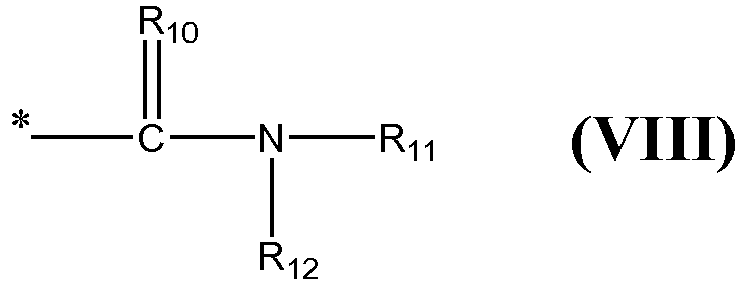
- R10 is O or NR13, wherein R13 forms together with R11 a tetrazole ring, which can be substituted (by a C1-C4 alkyl group)
- R11 is H, CH3 or forms together with R10 a tetrazole ring, which can be substituted (by a C1-C4 alkyl group), and
- R12 is H or CH3 when R10 and R11 form a tetrazole ring, or
- R12 is an aromatic ring system or a C2-C4 alkyl group, which can be substituted, and the * marks the bond to the pyrrolidine ring,
- R7 is H or CH3,
- R8 is H or CH3, and
- R9 is H or CH3,
- The substituent R5 or R6 contains a moiety, that can form a hydrogen bond.
- More preferably the organo-catalyst is a compound of formula (VII')

- R1 is H, CH3 or OH,
- R2 is H, CH3 or OH,
- R5 and R6 are independently from each other H or a moiety of formula (VIII)

- R10 is O or NR13, wherein R13 forms together with R11 a tetrazole ring, which can be substituted (by a C1-C4 alkyl group)
- R11 is H, CH3 or forms together with R10 a tetrazole ring, which can be substituted (by a C1-C4 alkyl group), and
- R12 is H or CH3 when R10 and R11 form a tetrazole ring, or
- R12 is an aromatic ring system or a C2-C4 alkyl group, which can be substituted, and the * marks the bond to the pyrrolidine ring,
- with the provisos that
- R5 is never identical to R6, and
- when R1 is OH or CH3, then R2 is H and
- when R2 is OH or CH3, then R1 is H.
- An especially preferred organo-catalyst is a compound of formula (VII"a)

- R1 is H, CH3 or OH,
- R2 is H, CH3 or OH,
- R10 is O or NR13, wherein R13 forms together with R11 a tetrazole ring, which can be substituted (by CH3)
- R11 is H, CH3 or forms together with R10 a tetrazole ring, which can be substituted (by CH3),
- R12 is H or CH3 when R10 and R11 form a tetrazole ring, or
- R12 is an aromatic ring system or a C2-C4 alkyl group, which can be substituted
- with the provisos that
- when R1 is OH or CH3, then R2 is H and
- when R2 is OH or CH3, then R1 is H.
- Another especially preferred organo-catalyst is a compound of formula (VII"b)

- R1 is H, CH3 or OH,
- R2 is H, CH3 or OH,
- R10 is O or NR13, wherein R13 forms together with R11 a tetrazole ring, which can be substituted (by CH3)
- R11 is H, CH3 or forms together with R10 a tetrazole ring, which can be substituted (by CH3),
- R12 is H or CH3 when R10 and R11 form a tetrazole ring, or
- R12 is an aromatic ring system or a C2-C4 alkyl group, which can be substituted
- with the provisos that
- when R1 is OH or CH3, then R2 is H and
- when R2 is OH or CH3, then R1 is H.
- Especially preferred organo-catalysts of formula (VII) are the following ones of formula (VIIa) - (VIIg) and (ent-VIIa) - (ent-VIIg):


- Most preferred are the organo-catalysts of formula (VIIb) and (ent-Vllb)


- The organo-catalyst as described above are known. They are available commercially or they can be produced according to known methods.
- The reaction of step (i) is usually carried out in a solvent (or a mixture of solvents). Suitable solvents are alcohols, hydrocarbons, halogenated hydrocarbons (for example chloroform and dichloromethane), ethers, esters and amides (for example DMF).
- Especially preferred are secondary and tertiary alcohols (such as isopropanol (propan-2-ol) and tert- butyl alcohol (2-methylpropan-2-ol)).
- The reaction mixture of step (i) should not comprise any water. This means that the water content is kept to a minimum and that no water is added to the reaction mixture of step (i) intentionally.
- Therefore, another preferred embodiment of the present invention is a process as described wherein step (i) the reaction mixture does not comprise any water
- The reaction is usually carried at temperatures of 0°C - 80°C, preferably 10°C - 40°C, more preferably 20°C - 30°C.
- The amount of the organo-catalyst is usually from 0.1 - 10 mol-% (in regard to the starting material). Preferably from 1 - 5 mol-%.
- The starting material (the compounds of formula (IV) and (V) are usually added in equimolar amounts. A slight excess of one of the compounds is acceptable as well.
-


- The reaction of step (ii) is a transfer hydrogenation. The reaction of step (ii) is carried out in the presence of a hydrogen donor (such as a formate or an alcohol).
The transfer hydrogenation is catalyzed by a specific Iridium catalyst. - The specific Iridium catalyst can be added as such to the reaction mixture.
Alternatively, the specific Iridium catalyst can be formed by the addition of ligand and by the addition of the Iridium in the form of a salt.
Furthermore, it is also possible that the organo-catalyst of step (i) serves as ligand to form the specific Iridium catalyst used in step (ii). In this case Iridium is added to the reaction mixture in the form of a salt.
These alternative ways how to obtain the specific Iridium catalyst could also be combined (which means that a catalyst can be added as well as a ligand and a transition metal salt). - As stated above, Iridium can be added in form of a salt (such as pentamethylcyclo-pentadienyliridium(III) chloride dimer).
- The reaction of step (ii) is usually carried out at elevated temperatures. Preferably, the reaction temperature of step (ii) is between 20°C and 100 °C, more preferably between 30°C and 70 °C.
- In the reaction of step (ii), the amount of hydrogen donor is between 1 and 7 mol-eq, preferably between 1 and 5 mol-eq (in regard of the compound of formula (VI) or the compound of formula (VI')).
- In the reaction of step (ii), the amount of the iridium salt used to form the catalyst is between 0.02 and 9 mol-%, preferably 0.1 - 9 mol-%, more preferably 0.5 - 4 mol-%, in regard of the compound of formula (VI) or the compound of formula (VI').
When the Iridium catalyst is added as such (not formed in situ), the molar ranges are of the Iridium catalyst is between 0.02 and 9 mol-%, preferably 0.05- 9 mol-%, more preferably 0.5-4 mol-%, in regard of the compound of formula (VI) or the compound of formula (VI'). - The following examples serve to illustrate the invention. If not otherwise stated the temperature is given in °C.
- The organocatalysts used are either commercially available or can be prepared using known methods. One method to prepare a range of organocatalysts is described below.
- An oven-dried flask was charged with Cbz-D-proline or Cbz-L-proline (1.00 eq.) or a proline derivative and dry dichloromethane (0.20 mol/L). The solution was cooled to 0 °C and triethylamine (1.00 eq.) and isobutyl chloroformate (1.00 eq.) were added. The mixture was stirred for 0.5 h, and the relevant amine (1.00 eq.) was added. The mixture was warmed to room temperature and stirred until complete conversion (monitored by TLC). The mixture was washed with aq. sat. NH4Cl, aq. sat. NaHCO3 and brine. Each aqueous layer was re-extracted with dichloromethane. The combined organic layers were dried over Na2SO4, filtered and concentrated in vacuo. The crude intermediate could be purified or used in the following step without further purification. The intermediate (1.00 eq.) was dissolved in MeOH (0.40 mol/L), the flask was flushed with argon three times and Pd/C (10.0 wt.%, 5.00 mol%) was added in one portion. The mixture was evacuated and flushed with hydrogen five times. The black suspension was stirred at room temperature under a hydrogen atmosphere until complete conversion (monitored by TLC). The reaction mixture was filtered over a plug of celite and rinsed with methanol.
- According to the procedure above: Cbz-D-proline (2.49 g,10.0 mmol, 1.00 eq.), triethylamine (1.41 mL, 10.0 mmol, 1.00 eq.), isobutyl chloroformate (1.30 mL, 10.0 mmol, 1.00 eq.) and ethanolamine (1.21 mL, 10.0 mmol, 1.00 eq.) were reacted to form the intermediate (2.08 g).
- The intermediate (2.03 g, 6.94 mmol, 1.00 eq.) and Pd/C (10.0 wt.%, 368 mg, 347 µmol, 5.00 mol%) yielded organocatalyst (ent-Vllb) as a colorless liquid (1.10 g, quant.).
- To a vial containing the organocatalyst (0.01 mmol, 10.0 mol%) 0.20 mL of a stock solution of isobutanal (91.0 µL, 1.00 mmol) and ethyl glyoxalate (50.0 wt.% in toluene, 198 µL, 1.00 mmol) in t-BuOH (2.00 mL) was added. The mixture was stirred at room temperature for 4 - 72 h. Conversion was measured by NMR or GC and enantioselectivity was determined by chiral HPLC.
- The results of the experiment are shown in the table below. Where a negative enantioselectivity is reported, this means that the major isomer produced is (S)-isomer. It is clearly understood that if opposite enantiomer of the organocatalyst is used, the identical yield and enantioselectivity for (R)-ethyl-2-hydroxy-3,3-dimethyl-4-oxobutanoate (VI) will be obtained
Example # Organocatalyst Conversion (%) Enantioselectivity (%) 2a VIIa 88 -75 2b VIIb 99 -74 2c VIIc 99 -70 2d VIId 94 -64 2e VIIe 54 -62 2f VIIf 93 50 2g VIIg 90 -58 - Comparative examples (Comp-A and Comp-B) were performed with organocatalysts A and B under the same conditions.

Example # Organocatalyst Conversion (%) Enantioselectivity (%) Comp-A A 3 Not determined Comp-B B 0 Not determined - To a solution of (R)-N-(2-hydroxyethyl)pyrrolidine-2-carboxamide (ent-VIIb, 79.1 mg, 500 µmol, 5.00 mol%) in t-BuOH (10.0 mL), isobutanal (910 µL,10.0 mmol, 1.00 eq.) and ethyl glyoxalate (50.0% in toluene, 1.98 mL,10.0 mmol, 1.00 eq.) were added. The mixture was stirred at room temperature for 24 h. The solvent was removed in vacuo and the residue purified by column chromatography (cyclohexane/ethyl acetate, 4:1) yielding ethyl (R)-2-hydroxy-3,3-dimethyl-4-oxobutanoate (VI) (1.47 g, 84%, 72% ee) as a colorless oil. 1H NMR (400 MHz, CDCl3) δ = 9.57 (1H, s), 4.32 (1H, s), 4.30-4.18 (2H, m), 3.06 (1H, br), 1.27 (3H, t), 1.14 (3H,s), 1.05 (3H, s). The analytical data was in agreement with an authentic sample.
- The transition metal catalyst or the transition metal salt and the ligand were added to a solution of ethyl (R)-2-hydroxy-3,3-dimethyl-4-oxobutanoate (VI) from example 2. The mixture was degassed, sodium formate was added and the mixture was stirred at the desired temperature until the reduction was complete. The reaction mixture extracted with MTBE and the combined organic phases were dried, filtered and concentrated in vacuo.
- To a solution of (R)-N-(2-hydroxyethyl)pyrrolidine-2-carboxamide (ent-VIIb, 7.91 mg, 50.0 µmol, 5.00 mol%) in tBuOH (1.00 mL), isobutanal (72.1 mg, 89 µL, 1.00 mmol, 1.00 eq.) and ethyl glyoxalate (47% in toluene, 211 µL, 1.00 mmol, 1.00 eq.) were added. The mixture was stirred at room temperature for 15 h. Water (5 mL) was added and the solution degassed with argon for 1 h, before (IrCl2(Cp*))2 (0.80 mg, 1.00 µmol, 0.1 mol%) and sodium formate (340 mg, 5.00 mmol, 5.00 eq.) were added. The reaction mixture was heated to 40 °C and stirred for 15 h. After addition of aq. HCI (1M, 2 mL) the mixture was extracted with CH2Cl2 (3 x 10 mL). The combined organic phases were dried over Na2SO4, filtered and concentrated in vacuo. The residue was purified by column chromatography (cyclohexane / ethyl acetate, 2:1) yielding the (R)-pantolactone (80.7 mg, 62%, ratio of enantiomers: 86:14)
- To a solution of (R)-N-(2-hydroxyethyl)pyrrolidine-2-carboxamide (ent-Vllb, 1 mol/L) at 25°C were added isobutanal (72.1 mg, 89 µL, 1.00 mmol, 1.00 eq.) and ethyl glyoxalate (47% in toluene, 211 µL, 1.00 mmol, 1.00 eq.). The mixture was stirred at 25°C for the indicated time. Water (2:1, water: tBuOH) was added and the solution degassed with argon for 1 h, before (IrCl2(Cp*))2 (5.0 - 1.0 µmol, 0.5 - 0.1 mol%) and sodium formate (340 mg, 5.00 mmol, 5.00 eq.) were added. The reaction mixture was heated to the desired temperature and stirred for the stated time. After addition of aq. HCI (1 mol/L, 1 mL) the mixture was extracted with CH2Cl2. The combined organic phases were dried over Na2SO4, filtered and concentrated in vacuo. The residue was purified by column chromatography.
Exp precursor Precursor Loading [mol%] T [°C] T [h] Conv. [%] 1 (RuCl2(p-cymene))2 0.50 rt 26 98 2 (RuCl2(p-cymene))2 0.50 mol% 40 6 98 3 (RuCl2(p-cymene))2 0.50 mol% 60 1 94 4 (RuCl2(benzene))2 0.50 mol% 40 5 92 5 (RhCl2Cp*)2 0.50 mol% 40 2.5 97 6 (IrCl2Cp*)2 0.50 mol% 40 1 99 7 (IrCl2Cp*)2 0.50 mol% rt 4 99 8 (IrCl2Cp*)2 0.25 mol% 40 2 93 9 (IrCl2Cp*)2 0.10 mol% 40 5 99
Examples 6 to 9 are the examples claimed by the present patent claims, whereas claims 1 - 5 are comparison examples.
Claims (15)
- Process for the production of a compound of formula (I)

a compound of formula (IV)


in the presence of at least one organo-catalyst,
and subsequently in a second step (step (ii))
the compound of formula (I) is formed by a transfer hydrogenation in the presence of hydrogen donor and at least one Iridium catalyst. - Process for the production of a compound of formula (I')
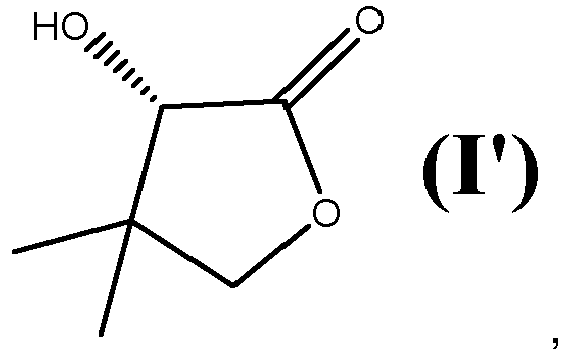
a compound of formula (IV)

are reacted to form a compound of formula (VI')
in the presence of at least one organo-catalyst,
and subsequently in a second step (step (ii))
the compound of formula (I') is formed by a transfer hydrogenation in the presence of hydrogen donor and an iridium catalyst. - Process according to claim 1 or claim 2, wherein between 0.02 and 9 mol-%, preferably 0.1 - 9 mol-%, more preferably 0.5 - 4 mol-%, in regard of the compound of formula (VI) or the compound of formula (VI'), of at least one Iridium catalyst is used in step (ii).
- Process according to claim 1, 2 or claim 3, wherein the organo-catalyst has a pyrrolidine ring, which is substituted.
- Process according to anyone of the preceding claims, wherein the organo-catalyst is a compound of formula (VII)
 R1 is H, CH3 or OH,R2 is H, CH3 or OH,R3 is H or CH3,R4 is H or CH3,R5 and R6 are independently from each other H or a moiety of formula (VIII)
 R10 is O or NR13, wherein R13 forms together with R11 a tetrazole ring, which can be substituted (by a C1-C4 alkyl group)R11 is H, CH3 or forms together with R10 a tetrazole ring, which can be substituted (a C1-C4 alkyl group), andR12 is H or CH3 when R10 and R11 form a tetrazole ring, orR12 is an aromatic ring system or a C2-C4 alkyl group, which can be substituted, and the * marks the bond to the pyrrolidine ring,R7 is H or CH3,R8 is H or CH3, andRg is H or CH3,with the proviso that R5 is never identical to R6.
 - Process according to anyone of the preceding claims, wherein the organo-catalyst is a compound of formula (VII')
 R1 is H, CH3 or OH,R2 is H, CH3 or OH,R5 and R6 are independently from each H or a moiety of formula (VIII)
 R10 is O or NR13, wherein R13 forms together with R11 a tetrazole ring, which can be substituted (by a C1-C4 alkyl group)R11 is H, CH3 or forms together with R10 a tetrazole ring, which can be substituted (by a C1-C4 alkyl group), andR12 is H or CH3 when R10 and R11 form a tetrazole ring, orR12 is an aromatic ring system or a C2-C4 alkyl group, which can be substituted, and the * marks the bond to the pyrrolidine ring,with the provisos thatR5 is never identical to R6, andwhen R1 is OH or CH3, then R2 is H andwhen R2 is OH or CH3, then R1 is H.
 - Process according to anyone of the preceding claims, wherein the organo-catalyst is a compound of formula (VII"a)
 R1 is H, CH3 or OH,R2 is H, CH3 or OH,R10 is O or NR13, wherein R13 forms together with R11 a tetrazole ring, which can be substituted (by CH3)R11 is H, CH3 or forms together with R10 a tetrazole ring, which can be substituted (by CH3),R12 is H or CH3 when R10 and R11 form a tetrazole ring, orR12 is an aromatic ring system or a C2-C4 alkyl group, which can be substituted with the provisos thatwhen R1 is OH or CH3, then R2 is H andwhen R2 is OH or CH3, then R1 is H.
 - Process according to anyone of the preceding claims, wherein the organo-catalyst is a compound of formula (VII"b)
 R1 is H, CH3 or OH,R2 is H, CH3 or OH,R10 is O or NR13, wherein R13 forms together with R11 a tetrazole ring, which can be substituted (by CH3)R11 is H, CH3 or forms together with R10 a tetrazole ring, which can be substituted (by CH3),R12 is H or CH3 when R10 and R11 form a tetrazole ring, orR12 is an aromatic ring system or a C2-C4 alkyl group, which can be substituted with the provisos thatwhen R1 is OH or CH3, then R2 is H andwhen R2 is OH or CH3, then R1 is H.
 - Process according to anyone of the preceding claims, wherein the organo-catalyst is chosen from the group consisting of


- Process according to anyone of the preceding claims, wherein the reaction of step (i) is carried out in at least one solvent, preferably alcohols, hydrocarbons, halogenated hydrocarbons (for example chloroform and dichloromethane), ethers, esters and amides (for example DMF).
- Process according to anyone of the preceding claims, wherein the reaction mixture of step (i) does not comprise any water.
- Process according to anyone of the preceding claims, wherein the reaction of step (i) is carried at temperatures of 0°C - 80°C, preferably 10°C - 40°C, more preferably 20°C - 30°C.
- Process according to anyone of the preceding claims, wherein the amount of the organo-catalyst in step (i) is from 0.1 - 10 mol-%, preferably from 1 - 5 mol-%. (regarding the starting material).
- Process according to anyone of the preceding claims 1 - 13, wherein the transfer hydrogenation of step (ii) is catalyzed by at least one Iridium catalyst, which is formed by the addition of ligand and by the addition of the Iridium in the form of a salt.
- Process according to anyone of the preceding claims 1 - 14, wherein the transfer hydrogenation of step (ii) is catalyzed by at least one Iridium catalyst, wherein the organo-catalyst of step (i) serves as ligand to form the Iridium catalyst.
Priority Applications (1)
| Application Number | Priority Date | Filing Date | Title |
|---|---|---|---|
| EP19207602.4A EP3819295A1 (en) | 2019-11-07 | 2019-11-07 | Stereoselective synthesis of enantiomerically-enriched pantolactone |
Applications Claiming Priority (1)
| Application Number | Priority Date | Filing Date | Title |
|---|---|---|---|
| EP19207602.4A EP3819295A1 (en) | 2019-11-07 | 2019-11-07 | Stereoselective synthesis of enantiomerically-enriched pantolactone |
Publications (1)
| Publication Number | Publication Date |
|---|---|
| EP3819295A1 true EP3819295A1 (en) | 2021-05-12 |
Family
ID=68502842
Family Applications (1)
| Application Number | Title | Priority Date | Filing Date |
|---|---|---|---|
| EP19207602.4A Withdrawn EP3819295A1 (en) | 2019-11-07 | 2019-11-07 | Stereoselective synthesis of enantiomerically-enriched pantolactone |
Country Status (1)
| Country | Link |
|---|---|
| EP (1) | EP3819295A1 (en) |
Cited By (1)
| Publication number | Priority date | Publication date | Assignee | Title |
|---|---|---|---|---|
| CN119613312A (en) * | 2024-12-30 | 2025-03-14 | 石河子大学 | A chiral primary amine catalyst with C2 axisymmetric structure and its preparation method and application |
Citations (1)
| Publication number | Priority date | Publication date | Assignee | Title |
|---|---|---|---|---|
| WO2019228874A1 (en) * | 2018-05-31 | 2019-12-05 | Dsm Ip Assets B.V. | Stereoselective synthesis of enantiomerically-enriched pantolactone |
-
2019
- 2019-11-07 EP EP19207602.4A patent/EP3819295A1/en not_active Withdrawn
Patent Citations (1)
| Publication number | Priority date | Publication date | Assignee | Title |
|---|---|---|---|---|
| WO2019228874A1 (en) * | 2018-05-31 | 2019-12-05 | Dsm Ip Assets B.V. | Stereoselective synthesis of enantiomerically-enriched pantolactone |
Non-Patent Citations (5)
| Title |
|---|
| MARCEL HEIDLINDEMANN ET AL: "Chemoenzymatic Synthesis of Vitamin B5-Intermediate ( R )-Pantolactone via Combined Asymmetric Organo- and Biocatalysis", JOURNAL OF ORGANIC CHEMISTRY, vol. 80, no. 7, 3 April 2015 (2015-04-03), US, pages 3387 - 3396, XP055495038, ISSN: 0022-3263, DOI: 10.1021/jo502667x * |
| MORRIS MARKERT ET AL: "Asymmetric Histidine-Catalyzed Cross-Aldol Reactions of Enolizable Aldehydes: Access to Defined Configured Quaternary Stereogenic Centers", JOURNAL OF THE AMERICAN CHEMICAL SOCIETY, vol. 131, no. 46, 25 November 2009 (2009-11-25), US, pages 16642 - 16643, XP055495036, ISSN: 0002-7863, DOI: 10.1021/ja907054y * |
| S. WANG ET AL: "Efficient Iridium Catalysts for Base-Free Hydrogenation of Levulinic Acid", ORGANOMETALLICS, vol. 36, no. 16, 28 August 2017 (2017-08-28), US, pages 3152 - 3162, XP055675857, ISSN: 0276-7333, DOI: 10.1021/acs.organomet.7b00503 * |
| SHENGDONG WANG ET AL: "Ruthenium and Iridium Dipyridylamine Catalysts for the Efficient Synthesis of [gamma]-Valerolactone by Transfer Hydrogenation of Levulinic Acid", ORGANOMETALLICS, vol. 36, no. 3, 13 February 2017 (2017-02-13), US, pages 708 - 713, XP055675860, ISSN: 0276-7333, DOI: 10.1021/acs.organomet.6b00895 * |
| ULLMANS INDUSTRIAL CHEMISTRY (VITAMINS 8 PANTOTHENIC ACID, 2012, pages 299 - 308 |
Cited By (1)
| Publication number | Priority date | Publication date | Assignee | Title |
|---|---|---|---|---|
| CN119613312A (en) * | 2024-12-30 | 2025-03-14 | 石河子大学 | A chiral primary amine catalyst with C2 axisymmetric structure and its preparation method and application |
Similar Documents
| Publication | Publication Date | Title |
|---|---|---|
| US10266469B2 (en) | Process for preparing terpinene-4-ol | |
| JP2017132793A (en) | Synthesis of R-biphenylalaninol | |
| US5536879A (en) | Process for preparing optically active amino alcohols | |
| WO2021190604A1 (en) | Preparation of cyclosporin derivatives | |
| DE102010005953A1 (en) | Process for the preparation of nebivolol | |
| CZ258794A3 (en) | Process for preparing indanylamine compounds | |
| US4994602A (en) | Process for preparing optically active 6-t-butyoxy-3,5-dihydroxyhexanoic esters | |
| EP1713801B1 (en) | Process for preparation of 1-(2s,3s)-2-benzhydr yl-n-(5-tert-butyl-2-methoxybenzyl)quinuclidin-3-amine | |
| DE60111461T2 (en) | Process for the preparation of an optically active alcohol | |
| US8546571B2 (en) | Catalytic hydrogenation of ene-carbamates | |
| EP3819295A1 (en) | Stereoselective synthesis of enantiomerically-enriched pantolactone | |
| WO2019228874A1 (en) | Stereoselective synthesis of enantiomerically-enriched pantolactone | |
| JPH04108782A (en) | Production of optically active gamma-butyrolactone derivative | |
| EP0860432B1 (en) | 2-Phenyl-2-(2'-piperidinylidene) acetate derivative, process for manufacturing the same, and process for manufacturing optically active 2-phenyl-2(2'-piperidinyl) acetate derivative by asymmetrically hydrogenating the same | |
| KR20110005470A (en) | Bifunctional Bis Cincona Alkaloid Thiourea Organic Chiral Catalyst Compounds, Methods for Preparing the Same, and Methods for Preparing Chiral Amino Acids from Azlactone Using the Same | |
| US7674614B2 (en) | Method of optically resolving racemic alcohols with a bicyclooxaoctane or a bicycooxaoctene resolving reagents | |
| WO2008135386A1 (en) | Chiral ligands of the n-heterocyclic carbene type for asymmetrical catalysis | |
| DE69322013T2 (en) | (3R, 5S) -3,5,6-trihydroxyhexanoic acid derivatives and process for their preparation | |
| WO2019228873A1 (en) | Synthesis of a racemic mixture of pantolactone | |
| DE102008033165A1 (en) | Process for producing an optically active β-hydroxycarboxylic acid derivative | |
| US6156941A (en) | Process for producing 1,2-propanediol | |
| EP0592881A2 (en) | Process for producing optically active gamma-hydroxyketones | |
| ES2214311T3 (en) | SUBSTITUTED CYCLOPENTENS, ITS PREPARATION AND ITS USE FOR CHIRAL ANDAMIOS | |
| KR19990008411A (en) | Improvement method of 4-hydroxy-2-pyrrolidone | |
| EP0915076A1 (en) | Process for the preparation of trans-(R,R)-actinol |
Legal Events
| Date | Code | Title | Description |
|---|---|---|---|
| PUAI | Public reference made under article 153(3) epc to a published international application that has entered the european phase |
Free format text: ORIGINAL CODE: 0009012 |
|
| STAA | Information on the status of an ep patent application or granted ep patent |
Free format text: STATUS: THE APPLICATION HAS BEEN PUBLISHED |
|
| AK | Designated contracting states |
Kind code of ref document: A1 Designated state(s): AL AT BE BG CH CY CZ DE DK EE ES FI FR GB GR HR HU IE IS IT LI LT LU LV MC MK MT NL NO PL PT RO RS SE SI SK SM TR |
|
| STAA | Information on the status of an ep patent application or granted ep patent |
Free format text: STATUS: THE APPLICATION IS DEEMED TO BE WITHDRAWN |
|
| 18D | Application deemed to be withdrawn |
Effective date: 20211113 |